124
Can crypto make podcasts pay?
Hannah Rashbass explores whether a Bitcoin-based platform could be an audio game changer
I
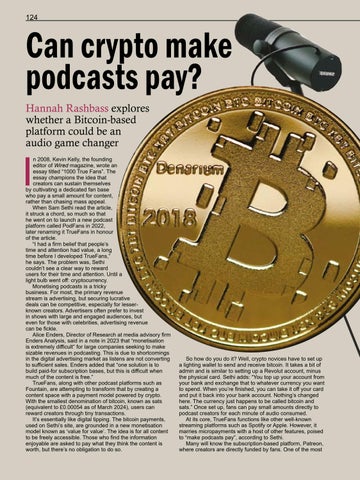
n 2008, Kevin Kelly, the founding editor of Wired magazine, wrote an essay titled “1000 True Fans”. The essay champions the idea that creators can sustain themselves by cultivating a dedicated fan base who pay a small amount for content, rather than chasing mass appeal. When Sam Sethi read the article, it struck a chord, so much so that he went on to launch a new podcast platform called PodFans in 2022, later renaming it TrueFans in honour of the article. “I had a firm belief that people’s time and attention had value, a long time before I developed TrueFans,” he says. The problem was, Sethi couldn’t see a clear way to reward users for their time and attention. Until a light bulb went off: cryptocurrency. Monetising podcasts is a tricky business. For most, the primary revenue stream is advertising, but securing lucrative deals can be competitive, especially for lesserknown creators. Advertisers often prefer to invest in shows with large and engaged audiences, but even for those with celebrities, advertising revenue can be fickle. Alice Enders, Director of Research at media advisory firm Enders Analysis, said in a note in 2023 that “monetisation is extremely difficult” for large companies seeking to make sizable revenues in podcasting. This is due to shortcomings in the digital advertising market as listens are not converting to sufficient sales. Enders added that “one solution is to build paid-for subscription bases, but this is difficult when much of the content is free.” TrueFans, along with other podcast platforms such as Fountain, are attempting to transform that by creating a content space with a payment model powered by crypto. With the smallest denomination of bitcoin, known as sats (equivalent to £0.00054 as of March 2024), users can reward creators through tiny transactions. It’s essentially like digital tipping. The bitcoin payments, used on Sethi’s site, are grounded in a new monetisation model known as ‘value for value’. The idea is for all content to be freely accessible. Those who find the information enjoyable are asked to pay what they think the content is worth, but there’s no obligation to do so.
So how do you do it? Well, crypto novices have to set up a lighting wallet to send and receive bitcoin. It takes a bit of admin and is similar to setting up a Revolut account, minus the physical card. Sethi adds: “You top up your account from your bank and exchange that to whatever currency you want to spend. When you’re finished, you can take it off your card and put it back into your bank account. Nothing’s changed here. The currency just happens to be called bitcoin and sats.” Once set up, fans can pay small amounts directly to podcast creators for each minute of audio consumed. At its core, TrueFans functions like other well-known streaming platforms such as Spotify or Apple. However, it marries micropayments with a host of other features, poised to “make podcasts pay”, according to Sethi. Many will know the subscription-based platform, Patreon, where creators are directly funded by fans. One of the most