CL
U
EQ
B
OK
EQ B O O K S
B
O
B
ET
TH N S EE ER W V O C
E
FROM CLASSICAL DRESSAGE TO LIBERTY An excerpt from THE HORSES WHO MADE ME by Alizée Froment.
I
remember the moment: The stable was very dark. A very common-looking horse was led out of a stall. His back was too long, his hocks too weak, and he had a short neck that tied in poorly with his head. And yet, the man with him, Ismael Romero Arroyo, made the horse dance in complete freedom, right before our eyes. At the time, it seemed unreal that such a thing was possible, and I wanted to understand how he did it, I wanted to find out how to do it myself, I wanted to learn. Since I only knew a few words of Spanish, I asked Raymond to ask Ismael if it was possible for me to come with my horse Sultan to work with him for a week. His immediate answer was no. He did not want “the French girl with flowers in her hair” at his home. And he was not teaching anymore, anyway, only taking in some horses from clients to teach them liberty tricks before sending them back. What he did was his own method, and he chose to pass it on only to a very close circle of acquaintances. I was sorely disappointed, and absolutely convinced that adding this man’s knowledge to my classical dressage background was the next level I had to reach in my own education. Seeing my dismay, Raymond winked at me and told me to show Ismael videos of my work with Sultan and Mistral on my phone. I saw the man’s curiosity piqued, and he finally grudgingly accepted Sultan and me as students. Two weeks and over 900 miles later, Sultan and I were back in Sanlúcar de Barrameda. The arena was very small and sloping. There was no pasture. There were no paddocks, either. We were forced out of our comfort zone during our stay, but it was worth it. Together, Sultan and I discovered groundwork, its principles, its rules, its basics, its foundation.
24 | EQ UE S T R I A N L I V IN G | S EP TEMB ER/ OC TOB ER | 2024
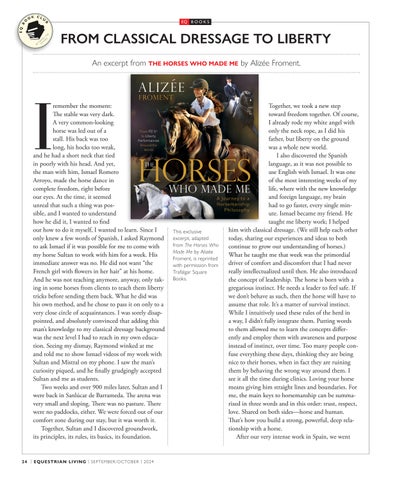
This exclusive excerpt, adapted from The Horses Who Made Me by Alizée Froment, is reprinted with permission from Trafalgar Square Books.
Together, we took a new step toward freedom together. Of course, I already rode my white angel with only the neck rope, as I did his father, but liberty on the ground was a whole new world. I also discovered the Spanish language, as it was not possible to use English with Ismael. It was one of the most interesting weeks of my life, where with the new knowledge and foreign language, my brain had to go faster, every single minute. Ismael became my friend. He taught me liberty work; I helped him with classical dressage. (We still help each other today, sharing our experiences and ideas to both continue to grow our understanding of horses.) What he taught me that week was the primordial driver of comfort and discomfort that I had never really intellectualized until then. He also introduced the concept of leadership. The horse is born with a gregarious instinct. He needs a leader to feel safe. If we don’t behave as such, then the horse will have to assume that role. It’s a matter of survival instinct. While I intuitively used these rules of the herd in a way, I didn’t fully integrate them. Putting words to them allowed me to learn the concepts differently and employ them with awareness and purpose instead of instinct, over time. Too many people confuse everything these days, thinking they are being nice to their horses, when in fact they are ruining them by behaving the wrong way around them. I see it all the time during clinics. Loving your horse means giving him straight lines and boundaries. For me, the main keys to horsemanship can be summarized in three words and in this order: trust, respect, love. Shared on both sides—horse and human. That’s how you build a strong, powerful, deep relationship with a horse. After our very intense work in Spain, we went