POWER ELECTRONICS HANDBOOK
region in which the agency operates and the applicable legislation within that region. It is for this reason that compliance declarations are often given as the IEC or ISO standard number, prefixed with an abbreviation that indicates the region for which the standard has been approved i.e. EN60960-1 (EN stands for European Norm). DC-DC power converters are typically evaluated against IEC60950-1, the Standard for Safety of Information Technology Equipment (ITE), but can also be evaluated against additional, more specialized standards depending on the market of the end product. One such specialized standard is the standard for Safety of Medical Electrical Equipment, or IEC60601-1. This standard specifies much higher degrees of isolation than IEC60950-1. It does so to
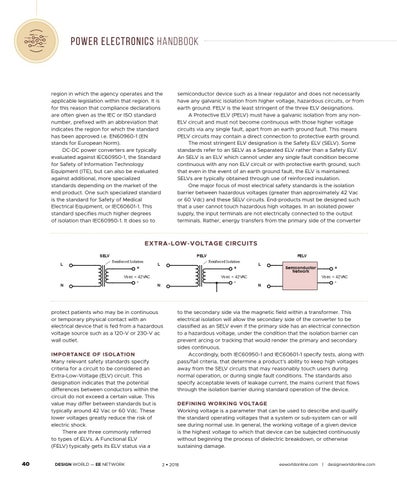
semiconductor device such as a linear regulator and does not necessarily have any galvanic isolation from higher voltage, hazardous circuits, or from earth ground. FELV is the least stringent of the three ELV designations. A Protective ELV (PELV) must have a galvanic isolation from any nonELV circuit and must not become continuous with those higher voltage circuits via any single fault, apart from an earth ground fault. This means PELV circuits may contain a direct connection to protective earth ground. The most stringent ELV designation is the Safety ELV (SELV). Some standards refer to an SELV as a Separated ELV rather than a Safety ELV. An SELV is an ELV which cannot under any single fault condition become continuous with any non ELV circuit or with protective earth ground, such that even in the event of an earth ground fault, the ELV is maintained. SELVs are typically obtained through use of reinforced insulation. One major focus of most electrical safety standards is the isolation barrier between hazardous voltages (greater than approximately 42 Vac or 60 Vdc) and these SELV circuits. End-products must be designed such that a user cannot touch hazardous high voltages. In an isolated power supply, the input terminals are not electrically connected to the output terminals. Rather, energy transfers from the primary side of the converter
EXTRA-LOW-VOLTAGE CIRCUITS
protect patients who may be in continuous or temporary physical contact with an electrical device that is fed from a hazardous voltage source such as a 120-V or 230-V ac wall outlet. IMPORTANCE OF ISOLATION Many relevant safety standards specify criteria for a circuit to be considered an Extra-Low-Voltage (ELV) circuit. This designation indicates that the potential differences between conductors within the circuit do not exceed a certain value. This value may differ between standards but is typically around 42 Vac or 60 Vdc. These lower voltages greatly reduce the risk of electric shock. There are three commonly referred to types of ELVs. A Functional ELV (FELV) typically gets its ELV status via a
40
DESIGN WORLD — EE NETWORK
Minmax — Power Electronics HB 02-18 V4 FINAL.indd 40
to the secondary side via the magnetic field within a transformer. This electrical isolation will allow the secondary side of the converter to be classified as an SELV even if the primary side has an electrical connection to a hazardous voltage, under the condition that the isolation barrier can prevent arcing or tracking that would render the primary and secondary sides continuous. Accordingly, both IEC60950-1 and IEC60601-1 specify tests, along with pass/fail criteria, that determine a product’s ability to keep high voltages away from the SELV circuits that may reasonably touch users during normal operation, or during single fault conditions. The standards also specify acceptable levels of leakage current, the mains current that flows through the isolation barrier during standard operation of the device. DEFINING WORKING VOLTAGE Working voltage is a parameter that can be used to describe and qualify the standard operating voltages that a system or sub-system can or will see during normal use. In general, the working voltage of a given device is the highest voltage to which that device can be subjected continuously without beginning the process of dielectric breakdown, or otherwise sustaining damage.
2 • 2018
eeworldonline.com | designworldonline.com
2/16/18 10:05 AM