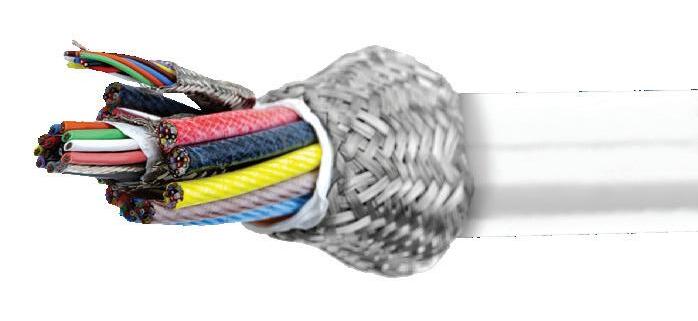
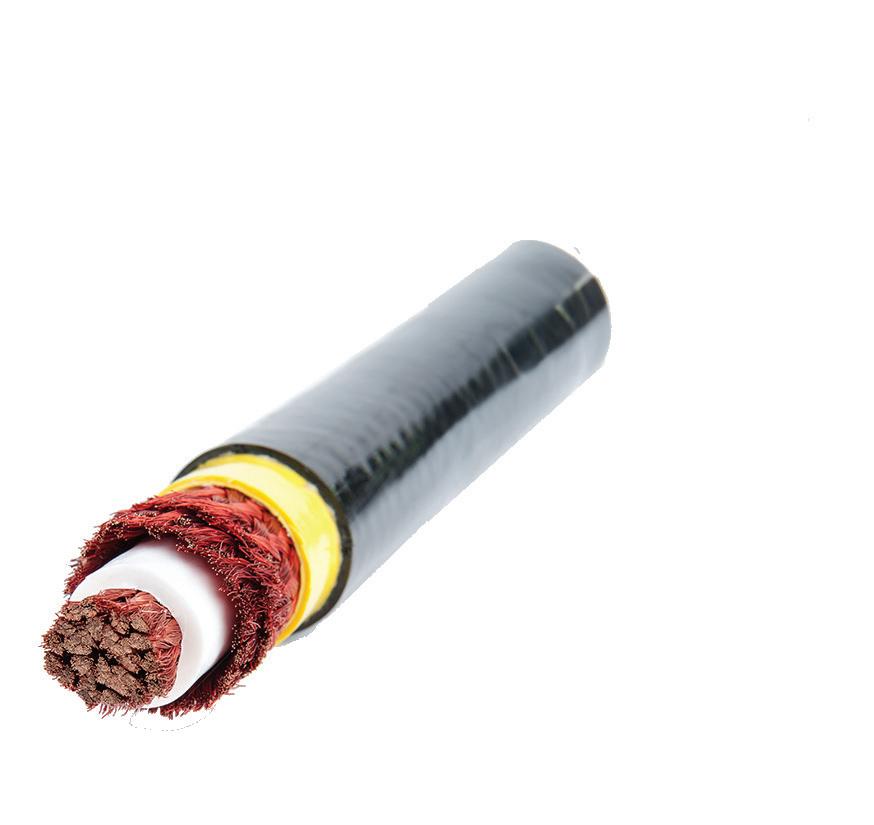
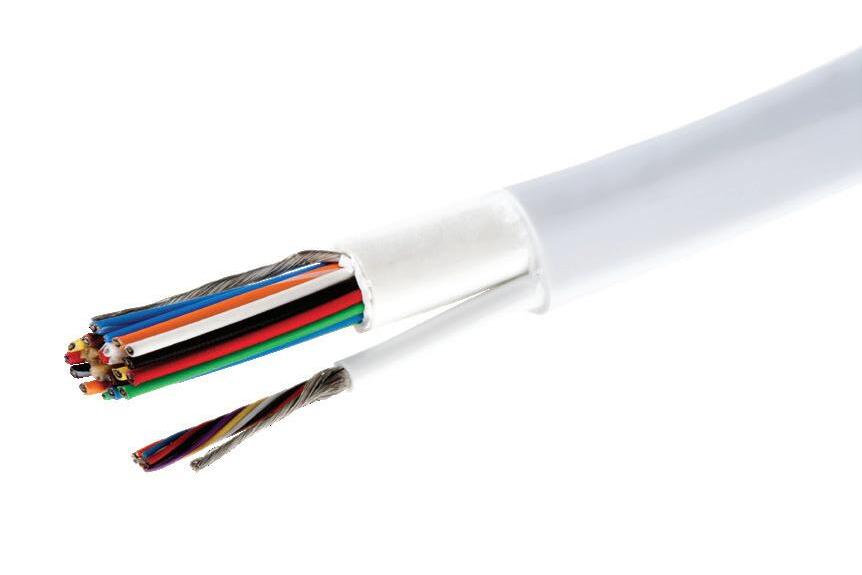
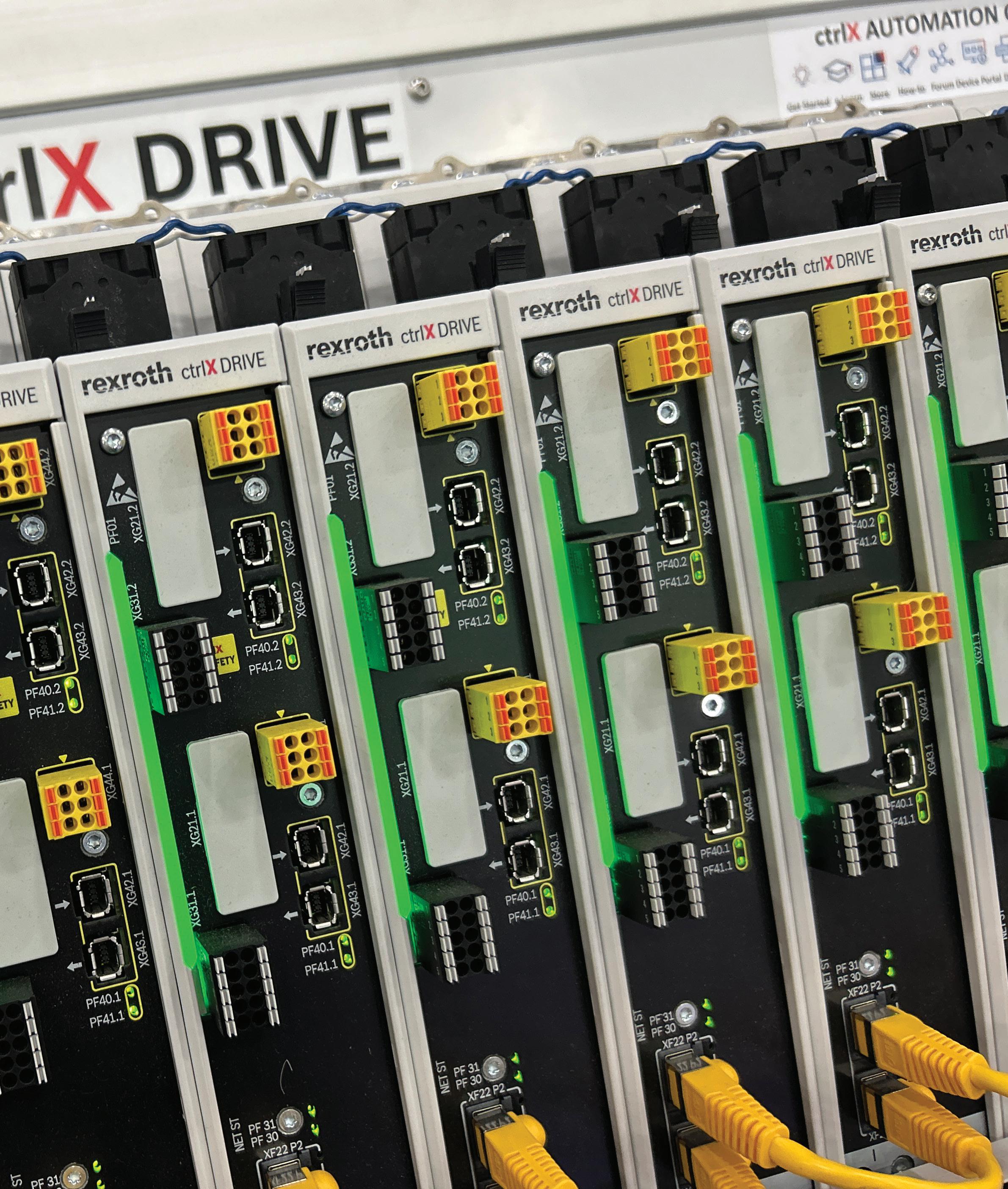
Need your variable speed drive to have an easy and problemfree connection to your favorite Ethernet or Fieldbus network? Yaskawa takes your desire for control and data seriously.
Our GA800 is no exception. It provides data-rich connectivity with all major industrial networks. The Industrial “Internet of Things” is here. Let Yaskawa help satisfy your appetite for it.
Your days are complicated enough. Let us help simplify them. Call Yaskawa today at 1-800-927-5292.
Affordable Industrial Enclosures
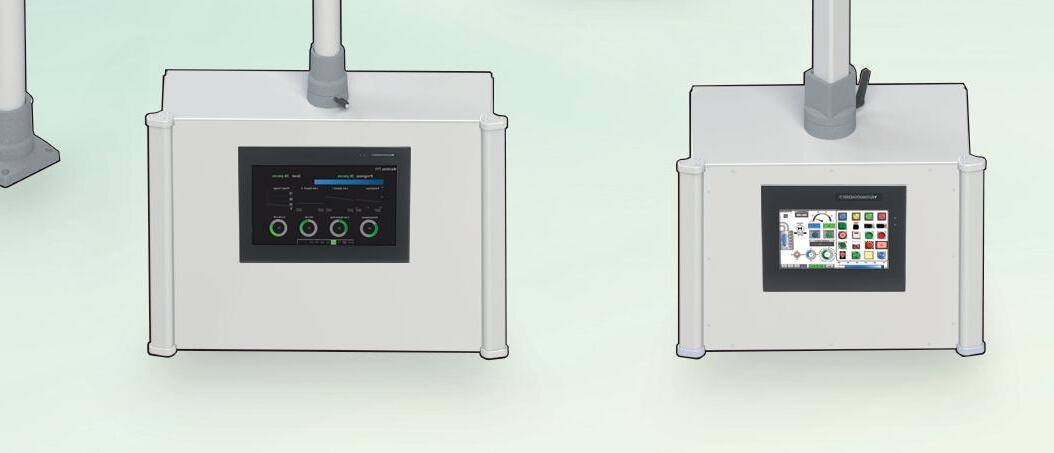
NEW! Hammond ACE Series HMI Enclosures & Suspension Arm Systems
Enclosures starting at 949.00 (ACE12126LG)
taraPLUS Suspension Arm Pro les Heavy Duty 50mm or 80mm Suspension Arm Pro le
AutomationDirect is continually expanding our o ering of quality, cost-e ective enclosures and accessories
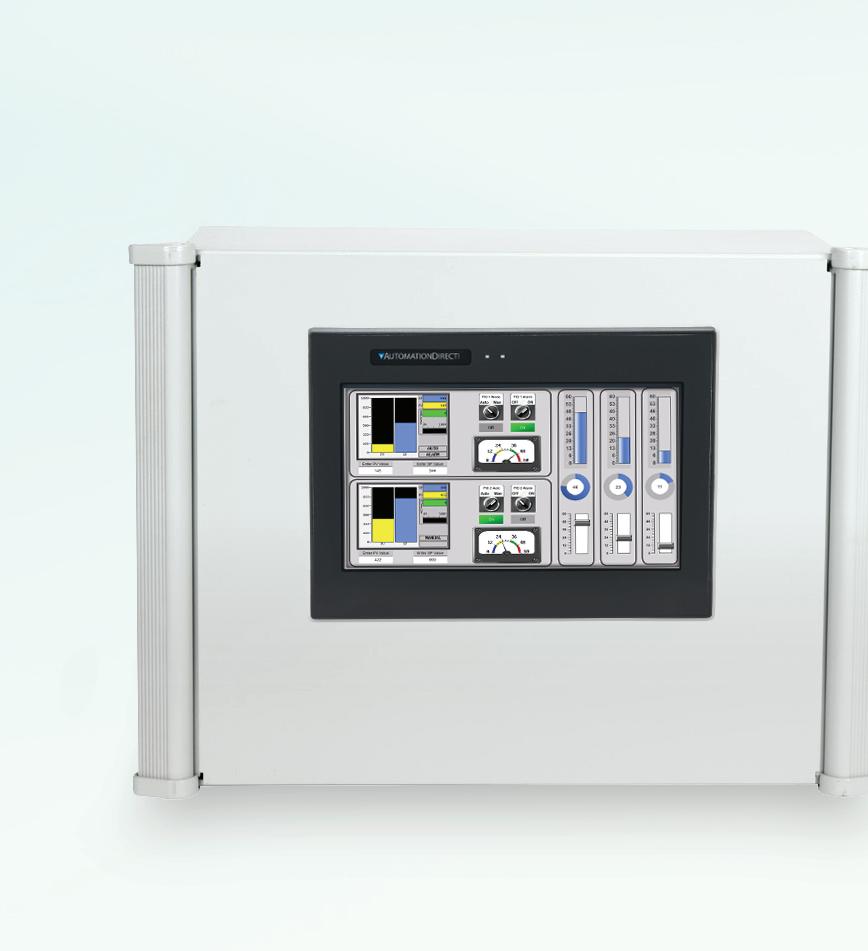
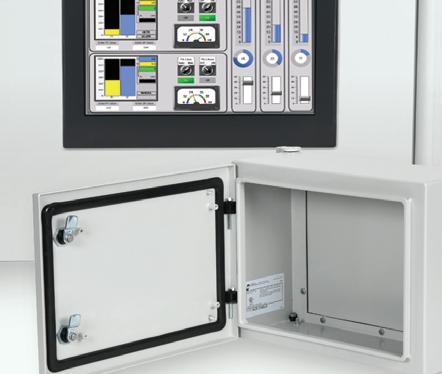
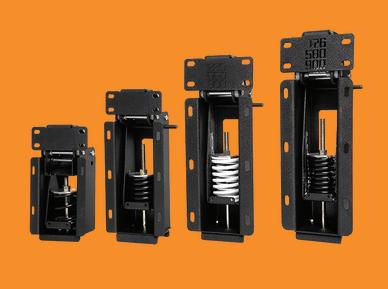
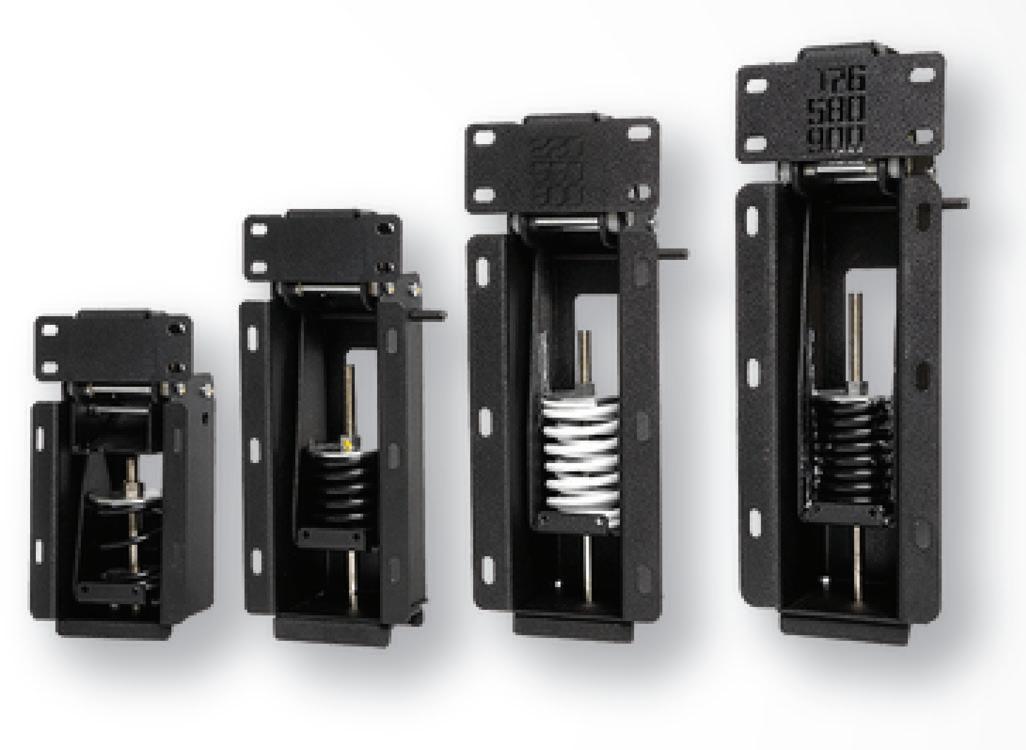
The Hammond Aluminum Command Enclosure (ACE) series provides a versatile, flexible solution for housing today’s most advanced operator interfaces, including the popular C-more CM5 HMIs. With removable front panels, quarter-turn latches, and oil-resistant gaskets, ACE enclosures offer easy machining and reliable protection. Hammond’s taraPLUS suspension arm system combines sleek, modular arms and integrated wire management to improve operator comfort. Hammond Heavy Duty suspension arms deliver greater load capacity with robust 50mm and 80mm profiles ideal for supporting bigger enclosures.
NEW! Quadritalia OK Series 2200mm
Modular Enclosure Components
Components start at $46.00 (CPR602)
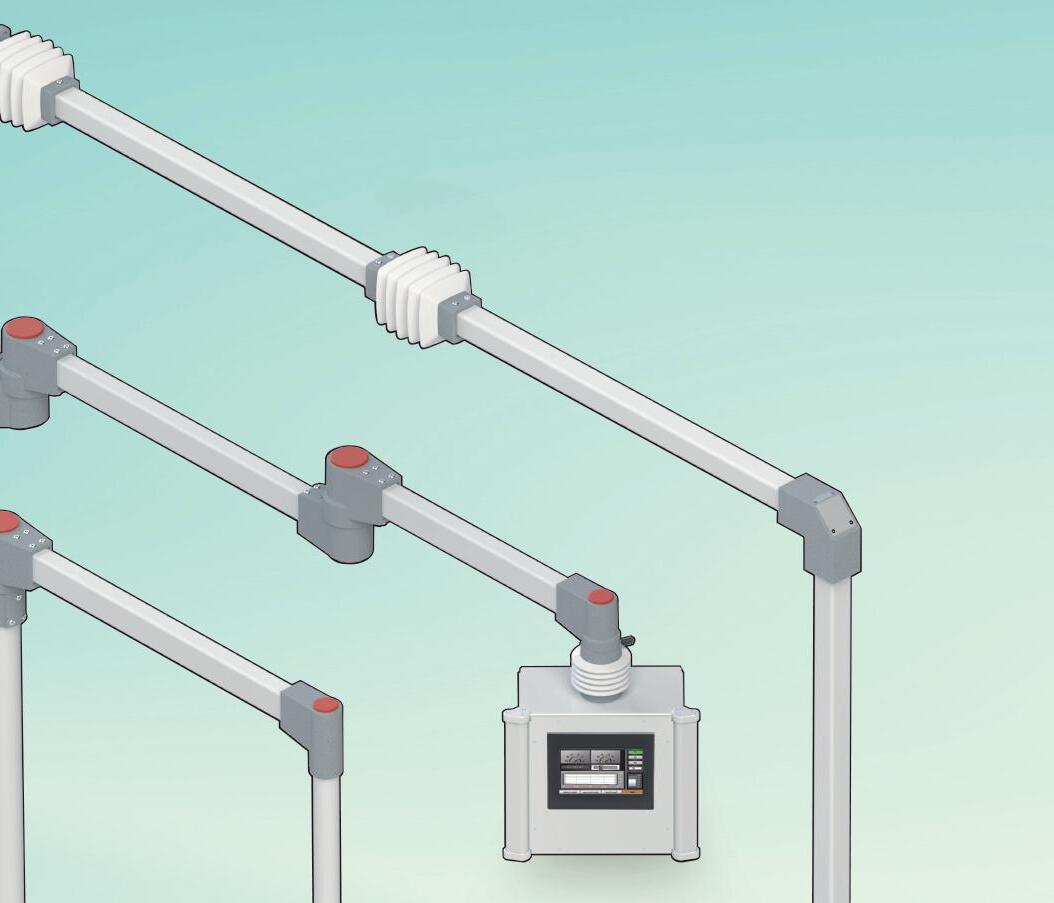
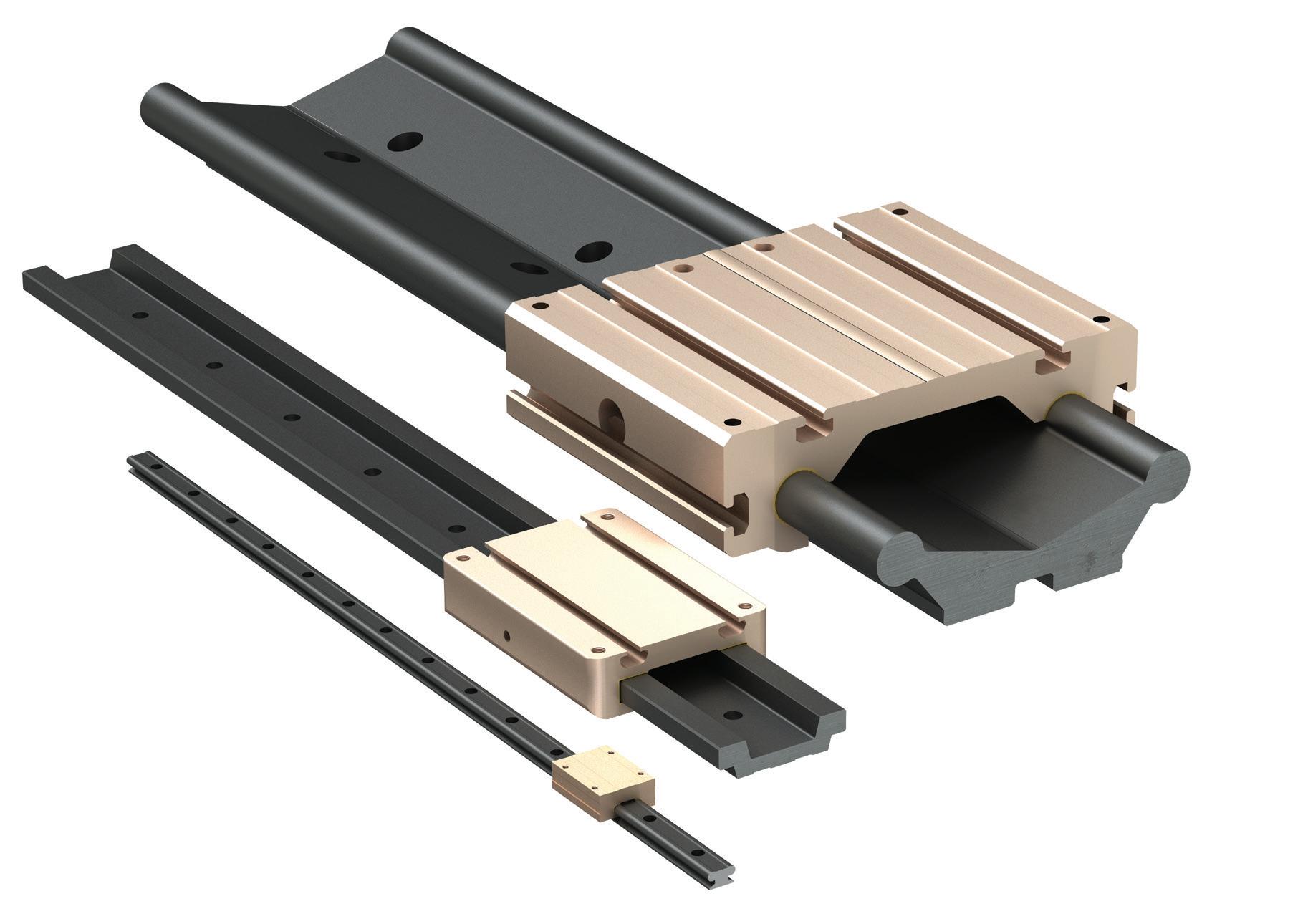
The Quadritalia OK series 2200mm modular enclosure system combines seamlessly fitting components such as frame rails, doors, panels,and subpanels with a full range of accessories like side doors, partition panels, plinths, swing panels, switches, and interlocks to deliver a highly adaptable, flexible enclosure solution for industrial, electrical, and data applications.
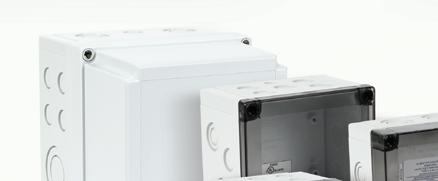
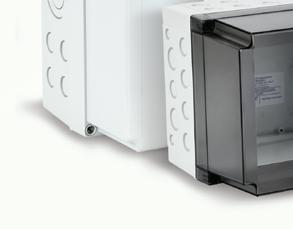
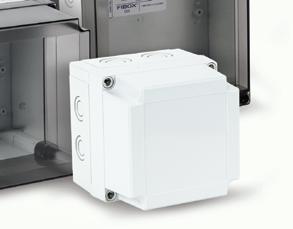
Fibox MNX and TEMPO series polycarbonate miniature cases are engineered to deliver durable, adaptable protection for every installation need.
• MNX series miniature cases with knockouts are UL listed and rated NEMA 4X & 6, providing protection against harsh and hostile environments
• TEMPO series miniature cases with knockouts are built for quick and efficient installation
Travel for Engineers
I often tell the story of my grandparents, who were big savers, and wanted to travel the world in their retirement. And they did! They flew in the Concorde and cruised to many exotic locales; I still have my grandmother’s little travel journal and their passport books. But I also recall how their bodies gave out far before their minds did. They constantly talked about how they wanted to go back to Rome, but it wasn’t the cost that held them back ... it was “all the stairs and steps” they couldn’t handle anymore.
With that in mind, I’ve always prioritized seeing places with my family while youth is still on our side. Last year, I finally visited my 50th state (Alaska!) after being stuck at 49 for a dozen years. And, depending on how you count — because people endlessly argue as to whether some places, say Curacao or Tahiti, count — I’ve been to either 49 countries or 61 countries/territories around the globe. I consider myself very lucky to have been able to experience so much of the world already.
But I have sort of a running joke with my family and my coworkers about how I can’t leave my mechanical engineering self at home when I do travel. I simply can’t separate these two passions of mine. Whether it’s gaping at magnificent cantilevered architecture that seems to defy gravity or being distracted by the hydraulics that’s running an amusement park ride, I find myself appreciating the engineering behind things around the world, even as I’m supposed to be escaping the world of work to relax.
Over the years, I’ve spoken to many other engineers about this and have found a lot of kindred spirits out there. It was in that spirit that I launched a new video series called Travel for Engineers, to focus on what captures our attention when we’re on the road. The videos are posted to
Design World’s home page, along with several of our sister publications, and there’s also a special LinkedIn video newsletter that I created for the series, which quickly garnered more than 1,000 subscribers in its first days.
Our most recent episode focuses on master architect Antoni Gaudí, famous for his designs like the Sagrada Familia cathedral in Barcelona. While visiting some of his architectural treasurers there a few years ago, I saw a bizarre chandelier-like display made out of metal chains. Gaudí (who I feel deserves an honorary structural engineering degree) was inspired by nature left and right, and was also fascinated by catenary curves, the shape that a hanging chain takes when held at two ends. This took me down a whole rabbit hole of how and why he used these curves as arches in his structures.
We’ll also look at everything from hydraulics on aircraft to motion control in airport vending machines to bearings on aerial tramways in future episodes. I’d love to have you as a subscriber (scan the QR code). And I would welcome you as a future guest on the video series if you have a fun story to tell of discovering some behind-the-scenes engineering while on vacation. Keep those eyes peeled on your next getaway! DW
EXPLORE THE WORLD THROUGH AN ENGINEER’S LENS. SUBSCRIBE ON LINKEDIN TODAY!
Paul J. Heney • VP, Editorial Director pheney@wtwhmedia.com
Connect with me: linkedin.com/in/paulheney
High Voltage Power Inductors
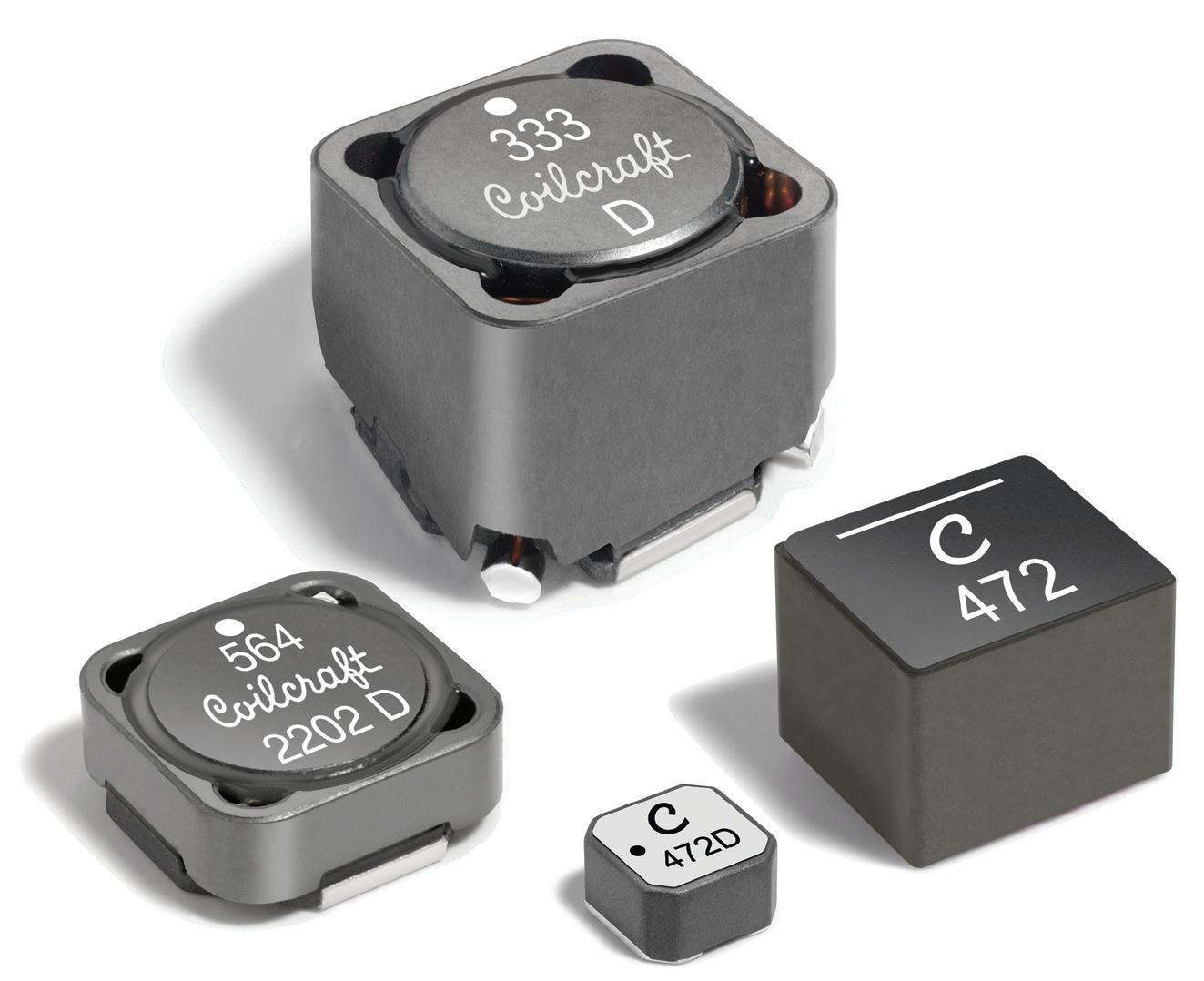
Coilcraft offers a wide range of voltage-rated power inductors that assure the safe, reliable operation of your designs.
Coilcraft voltage-rated inductors support applications such as high-voltage DC-DC and AC-DC power supplies, industrial and home automation controls, appliances, and automotive, including electric vehicles (EVs).
Our XEL and XGL Families of molded power inductors offer operating voltage ratings from 60 V to 120 V, and many of our
LPS and MSS Family inductors are suitable for 400-volt operation or higher.
Our new MSS1514V Series offers an 800 V rating in a 15.5 x 15.5 mm footprint, with excellent current handling and low DCR.
Learn more about operating voltage ratings for inductors and see our full line-up at www.coilcraft.com/ HighVoltage.
INFORMED. SMART. AHEAD. Stay
Design World reports on the vast world of design engineering and machine building with technical, indepth content. We cover semiconductor, medical, factory automation, packaging, off-highway, material handling, simulation, rapid prototyping, and more. By signing up for the Engineer’s Edge, you’ll stay on top of the news and trends happening in the engineering space. Scan the QR code to access three weekly newsletters plus new product announcements!
EDITORIAL
VP, Editorial Director
Paul J. Heney pheney@wtwhmedia.com
Editor-in-Chief
Rachael Pasini rpasini@wtwhmedia.com
Managing Editor Mike Santora msantora@wtwhmedia.com
Executive Editor Lisa Eitel leitel@wtwhmedia.com
Senior Editor Miles Budimir mbudimir@wtwhmedia.com
Digital Production Specialist Elise Ondak eondak@wtwhmedia.com
WEB DEVELOPMENT
Web Development Manager
www.linkedin.com/company/design-world-online
Make functional safety easier to implement
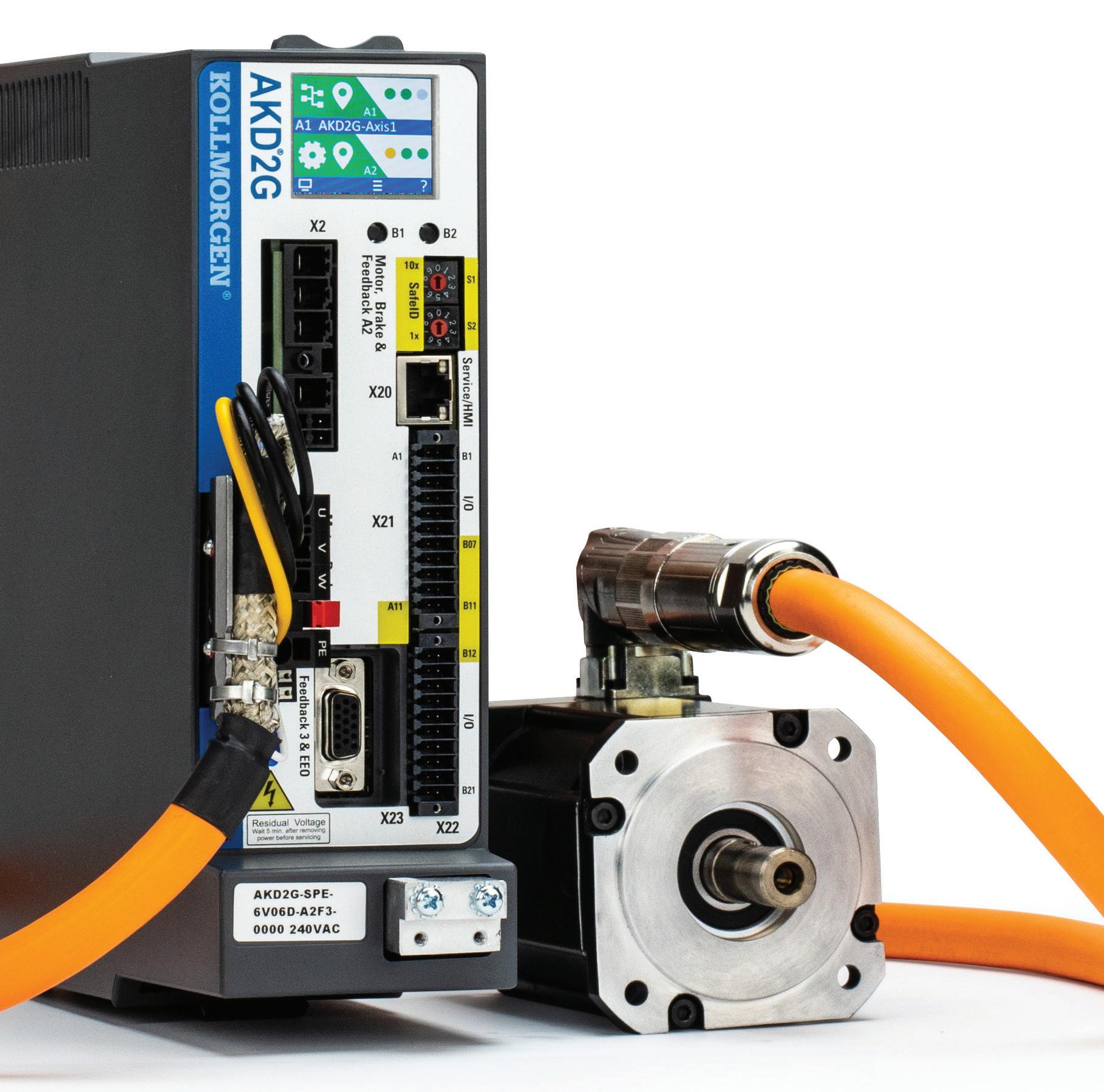
Chris Cooper, global director of product management at Kollmorgen, admits that implementing functional safety in linear motors can be challenging. The company recently announced an upgrade to its SafeMotion Monitor (SMM) firmware, SMM 3.0, which provides enhanced functional safety support for linear motors and linear axes. The intention is to help machine builders implement functional safety in applications ranging from semiconductor manufacturing to battery production and industrial automation.
SMM 3.0 is integrated into AKD2G servo drives and the Kollmorgen 2G Motion System and continues to work with all motors that feature any Hiperface DSL rotary-safe feedback system. It also now allows the AKD2G drive to support EnDat 2.2 safe feedback systems to meet the growing demand for highperformance safety solutions in precision motion control.
The EnDat 2.2 safe protocol provides dual independent positioning for error detection, high-speed serial data transmission for fast cycle times, integrated diagnostics with
POWER TRANSMISSION RETAINING DEVICES & maintenance & assembly tools
comprehensive monitoring, and flexible encoder support for incremental and absolute feedback drives. According to Cooper, the firmware update with EnDat 2.2 safe feedback support addresses the challenge of implementing functional safety in linear motors and provides machine builders with a complete safety solution without sacrificing speed and precision.
Kollmorgen’s AKM2G and AKMA servo motors also include an EnDat 2.2 safe feedback option for even higher performance and accuracy than Hiperface DSL, making them suitable for axes where functional safety is required. When combined, machine builders can create a more complete, integrated motion solution for safetyrelated applications.
Additionally, SMM 3.0 enables complete motion systems to achieve Safety Integrity Level 3 (SIL 3) certification. While the AKD2G drive has maintained SIL 3 certification since its launch, the addition of EnDat 2.2 safe feedback support now provides a complete, matched solution capable of meeting the rigorous standard. This is especially important when operators face frequent highrisk scenarios, such as stage lifting systems and heavy material-handling equipment. Furthermore, the SIL 3 capability helps future-proof systems so they can scale as safety requirements evolve. DW
Kollmorgen www.kollmorgen.com
WHITTET-HIGGINS manufactures quality oriented, stocks abundantly and delivers quickly the best quality and largest array of adjustable, heavy thrust bearing, and torque load carrying retaining devices for bearing, power transmission and other industrial assemblies; and specialized tools for their careful assembly.
Visit our website–whittet-higgins.com–to peruse the many possibilities to improve your assemblies. Much technical detail delineated as well as 2D and 3D CAD models for engineering assistance. Call your local or a good distributor.
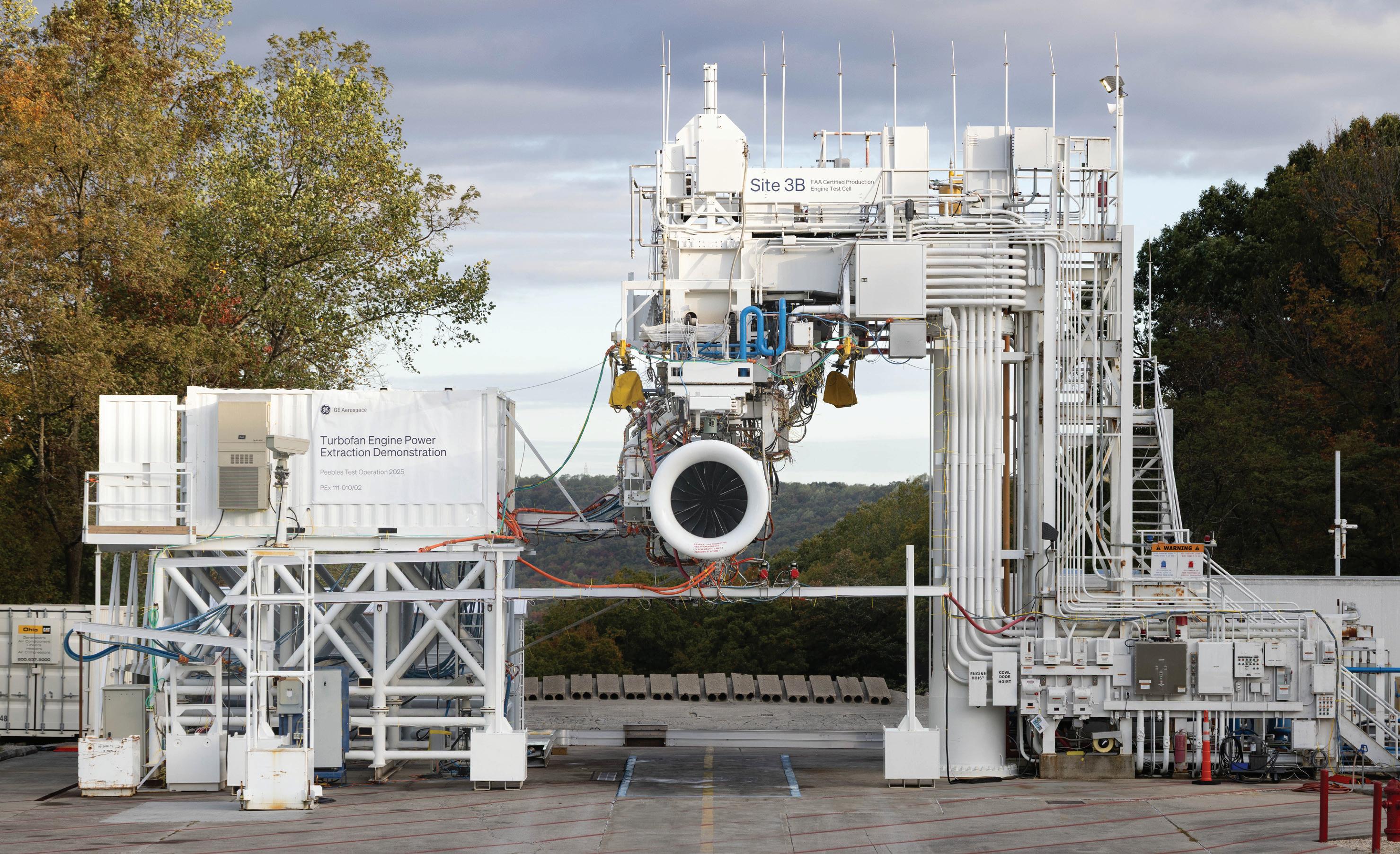
GE Aerospace reached a new test milestone in hybrid-electric aviation by successfully demonstrating power transfer, extraction, and injection in a high-bypass commercial turbofan engine. The company is developing a narrowbody hybrid-electric architecture that embeds electric motor-generators in a gas turbine engine to supplement power during different phases of operation. The design optimizes performance and creates a system that can operate with or without energy storage, such as batteries. Arjan Hegeman, vice president of future of flight for GE Aerospace, believes this is a critical step toward making commercial hybrid-electric flight a reality.
Ground testing of a modified Passport engine was completed in 2025 at Peebles Test Operation as part of NASA’s Turbofan Engine Power Extraction Demonstration project. Testing exceeded NASA’s technical
performance benchmarks, which are based on industry input about engine capabilities that would provide meaningful fuel cost savings for U.S. aviation while also meeting the power requirements of future aircraft.
The Power Extraction Demonstration is one of several efforts GE Aerospace has underway to mature technologies for more electric aircraft engines through the Revolutionary Innovation for Sustainable Engines (RISE) program. RISE is a technology demonstration program of CFM International, a 50-50 joint company between GE Aerospace and Safran Aircraft Engines. Unveiled in 2021, the RISE program has completed more than 350 tests and more than 3,000 endurance cycles to date, prioritizing safety, durability, and efficiency, and targeting more than 20% better fuel burn compared to commercial engines in service today. RISE program technologies are maturing toward ground and flight tests this
decade, with work underway on aircraft and engine integration in collaboration with partners.
GE Aerospace has achieved multiple hybrid electric milestones over the last decade, including a 2016 ground test of an electric motor-driven propeller. In 2022, GE Aerospace completed the world’s first test of a megawattclass and multi-kilovolt hybrid electric propulsion system in altitude conditions up to 45,000 ft that simulate single-aisle commercial flight.
A new strategic partnership and equity investment announced in 2025 with BETA technologies plans to develop a hybrid electric turbogenerator for Advanced Air Mobility (AAM) applications. DW
Gear units for tight spaces
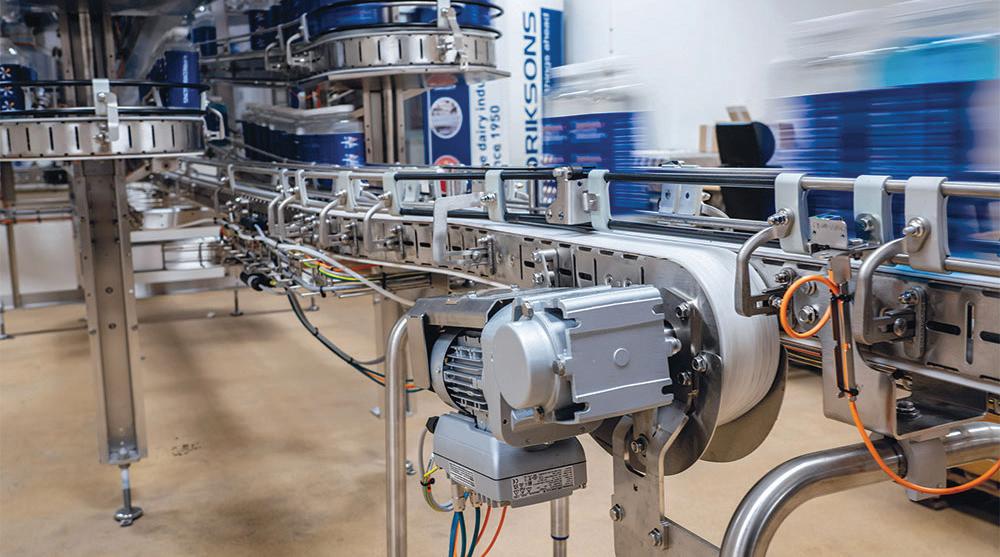
Numerous industries use chain conveyors to move goods and materials because of their versatility, durability in handling frequent, heavy loads, and robustness in demanding ambient conditions. Modular systems of gear units, electric motors, and electronic control products help minimize the number of drive variants, which helps reduce costs, total cost of ownership, and CO2 footprint. They can also simplify installation and commissioning, and make drop-in replacements easier.
However, space is often limited in industrial conveyor systems, so the installed components must have a slim, efficient design and be arranged cleverly. Nord’s compact Unicase gear units lend themselves to spaceconstrained environments and feature versatile shaft arrangements. The most popular solution for chain-and-drag conveyor applications is a right-angle gear unit with a hollow-shaft design. The company also offers options with free input shafts, direct-mounted motors, and protection against harsh environmental conditions, including dust, high temperatures, and moisture.
For chain conveyors in food packaging processes, the Nordbloc.1
helical bevel gear units are suitable. These have IE3 asynchronous motors and motor-mounted Nordac On variable frequency drives (VFDs). The decentralized VFDs cover a power range from 0.5 to 5 hp. The units also feature an internal PLC for drive-related functions and an integrated multi-protocol Ethernet interface with Profinet, Ethernet/IP, and EtherCAT protocols. Functional safety options such as STO and SS1 prevent dangerous movements to protect goods, systems, and operators. The drive solutions are also suitable for low temperatures down to -22° F, with special lubricants available for low or high temperatures.
Applications requiring stand-alone solutions can use the Nordac Pro SK 500P VFDs. The book-size design of the control cabinet VFD is suitable for numerous drive applications, and the case sizes cover a power range from 0.33 to 50 hp with high overload capabilities. Functional safety options STO and SS1 are also available. DW
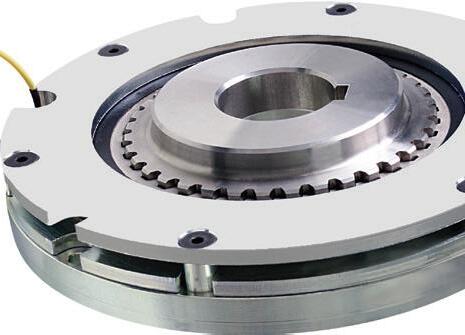
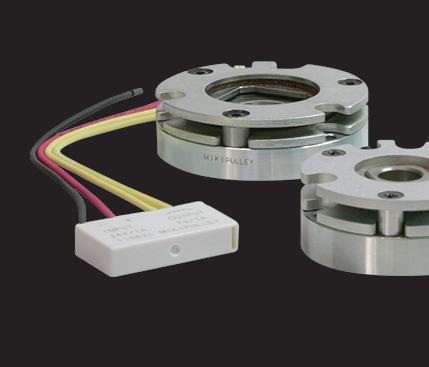
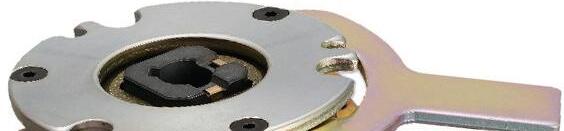
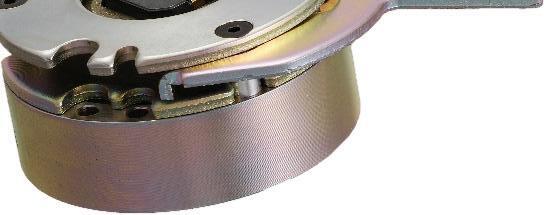
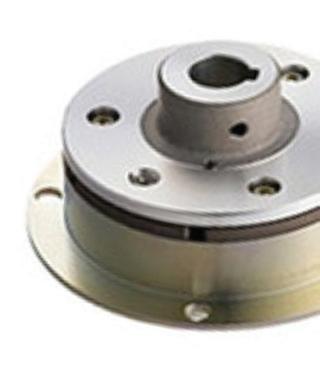
Electromagnetic (or EM) brakes are electrically actuated but are specifically designed to halt & hold torque mechanically. • Options to engage or disengage mechanical components.
• For high-performance demands
• Standard and modifiedstandard brakes available.
Sensors that keep getting smaller
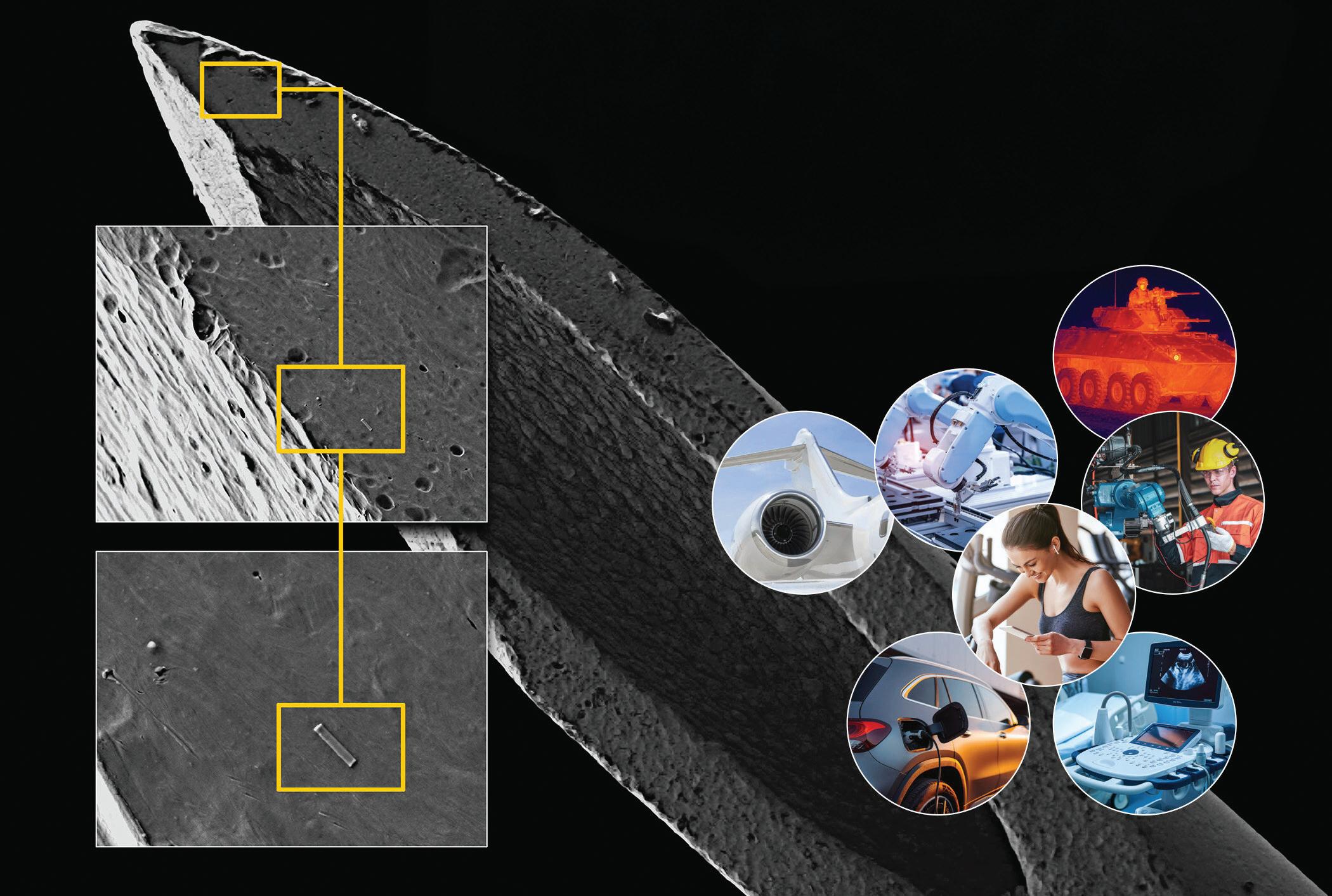
Digid’s nanoscale sensing technologies are believed to be the world’s smallest sensors — and they are set to get smaller. The German company recently announced that its patented printed electronics fabrication technology has been fully qualified for volume production of temperature and force sensors as small as 1 µm long. However, its technology roadmap forecasts future production of sensors only 10 nm long.
The company believes its nanoscale sensing technology provides the key to unlock the potential of multiple emerging markets, including physical AI and
humanoid robots. In robotics, for instance, Moravec's paradox — that robots struggle with tasks that humans find easy, such as handling a delicate wine glass — has persisted in part because robot hands lack the billions of nerve endings on a human finger. Now, Digid offers the opportunity for machines to mimic human sensory capabilities by applying nanoscale printed sensors to surfaces, such as a robot's shell, in arrays of up to 16 x 16 sensors.
Traditional sensor technology presents several challenges in such scenarios. Integrating a sensor into a medical device, for example, is often
complex because the sensor and device have specific requirements that must align. Most sensors cannot be modified without significant cost and production issues, so device adjustments are often implemented instead. In contrast, Digid’s technology is adaptable to products and devices and uses low power, so concerns related to heat and high voltage are non-issues. They can be integrated directly into products or subassemblies without affecting the original use case. Because of their small size, customers can add features such as temperature measurement while preserving the product’s core functionality.
Other applications for Digid sensors include:
• Force sensing on the blade of a scalpel in robotic surgical equipment
• Temperature sensing on the tip of a temperature probe used in minimally invasive surgery
• Temperature sensors embedded inside battery cells, for safety and performance monitoring
• Biosensors for detecting biological objects such as viruses, or the chemical markers of drugs in the bloodstream
For each design project, the company supplies a custom sensor, a sensor assembly, and hardware and software integration support. The sensor provides either a voltage or resistance measurement output via an I2C interface. Digid signal-processing software converts raw measurement outputs into useful temperature or force data.
In addition to their nanoscale dimensions, the sensors offer benefits such as negligible self-heating or other distorting effects on sensor readings, highly accurate linear measurement outputs, and minimal digital overhead.
"With the start of mass production of Digid sensors, the opportunities to embed sensing on almost any surface or in almost any device have become limitless,” said Konstantin Kloppstech, CTO of Digid. “Our sensor is so small that it cannot be seen with the naked eye. Now it is up to the imaginations of design engineers to dream of uses for sensing where sensing has never before been possible." DW
Digid www.digid.com
EDITED BY MIKE SANTORA
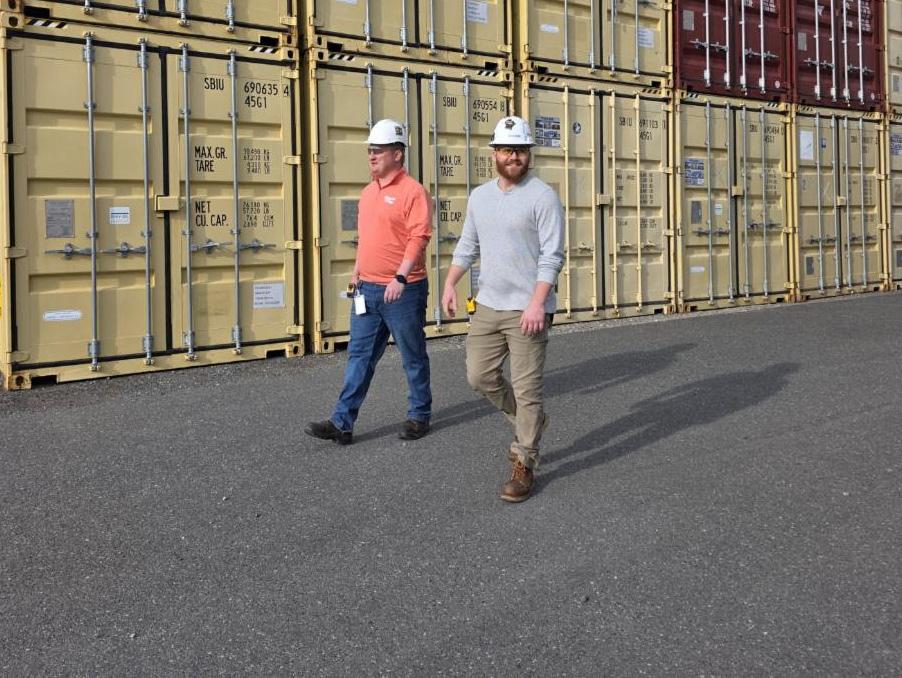
John Salyers and Korey Greene tour finished containers in the Sea Box yard. “I like that you can see your designs all the way to fruition,” said Salyers.
Thinking inside the box: A manufacturer’s software-integration journey
Sea Box works with Razorleaf to connect design, production, and inventory, improving efficiencies and enhancing its bespoke-customization capabilities
A portable forensic laboratory for investigating whether nuclear waste complies with international regulations. A mobile hospital for patients during a disease outbreak. A school annex. A wartime emergency room for acute care of the wounded. Even a 40-ft hot dog stand wrapped from end to end in an eye-catching red and yellow checkerboard pattern.
Each of these is an example of how that everyday, ubiquitous item — known the world-over as a shipping container — can be customized into something unique.
10 to 40-ft containers are today’s gold standard for moving a lot of things from place to place. But prior to the 1950s, most goods were relocated in
simple wooden crates and loaded, largely by hand, in and out of trucks, trains and ships — a tedious and timeconsuming practice.
Then in 1956, American entrepreneur Malcolm McLean started a revolution with the New Jersey launch of the first container ship. The converted World War II tanker was loaded with 58 onesize metal boxes that could be easily transferred by lift or crane between multiple modes of transport.
By the late 1960s other countries were adopting the template, relying on interlocking, stackable metal containers to move cars, furniture, clothing, electronics — or just a single family’s entire household goods in one big box. No one knows exactly how many ISO-
standard shipping containers exist in the world today, but there are at least 65 million known to be in “active use” at any one time. Other containers are increasingly being adapted for nonshipping uses, which is where the Sea Box story begins.
A business that looks at the box from different angles
In 1983, Jim Brennan Jr. and a few colleagues named their fledgling container dealership Sea Box, Inc., coincidentally located in the same state where Malcolm McLean launched his industry-transforming ship back in ’56. Brennan, a designer with multiple patents, soon instigated a shift from standard, empty steel boxes to more
interesting possibilities, inside as well as out. Just about anything a customer asked for could be fabricated; all the applications described above are examples of their recent work.
Bespoke customization soon became a primary reason people sought out Sea Box. The business was one of those fortunate to expand during the pandemic era and now includes some 350 employees and footprints in Ireland, China, Australia, and South America. U.S. military contracts remain a significant contributor to demand for standard as well as custom boxes: Sea Box launched a highly automated containerbox manufacturing line in 2024 to accommodate the U.S. Department of Defense’s (DOD) need for containers to transport goods and supplies to troops stationed around the world.
Keeping your engineers happy and engaged
As the company has grown, the spirit of the Sea Box enterprise has attracted engineers of the more adventurous kind. “Not everything in engineering is super flashy and exciting,” said John Salyers, now a project manager at Sea Box. “But when I was job hunting and found this company, I saw they were doing a lot of very creative projects with containers, both cool defense things and civilian applications like emergency housing for natural disasters, mobile office buildings — it ran the gamut of ways to use my skills.
“What really struck me — especially from a technical point of view — was that you could see your designs all the way through to
Are tariffs from overseas swerving into your bottom line, raising your blood pressure, causing you vertigo? You shouldn’t have to worry about paying more for imported cords when you can get them right here in the U.S.A. Interpower cords are reliable, and they come with 1-week U.S. lead times. Made in Iowa, our North American and international power cords are manufactured in accordance with a stringent product quality plan, including multiple inspections.
• 1-week U.S. lead times
• Same-day shipping on stocked products
• No surprise charges
Business Hours: 7 a.m.–5 p.m. CST
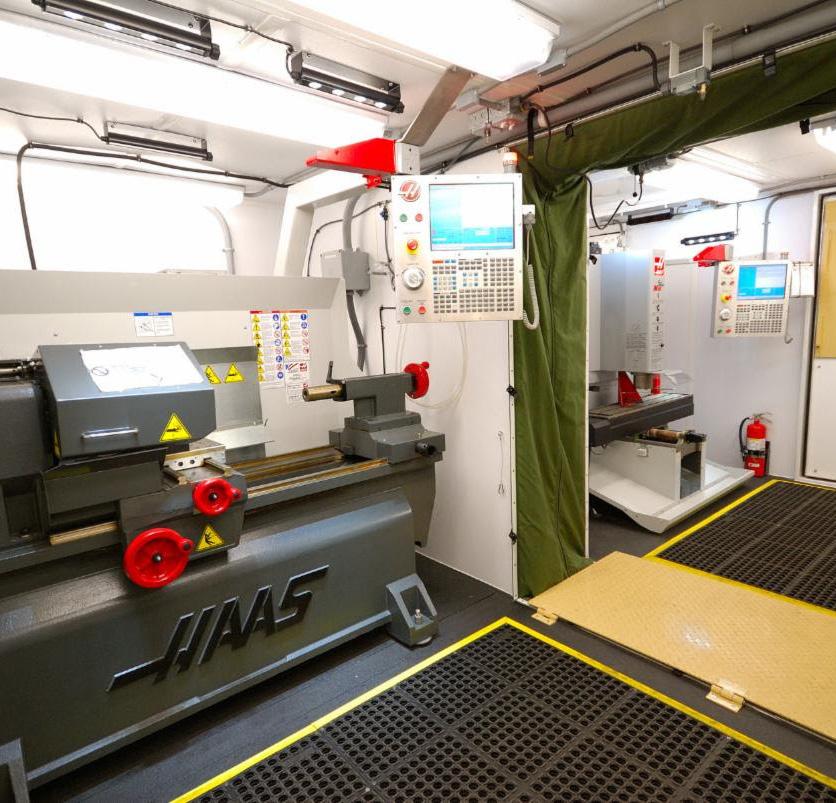
View of the interior of a container customized to serve as a mobile machine shop for the military.
fruition. They really push their engineers to be hands-on out on the production floor. You can be tasked with a project, start with a list of requirements, turn that into a drawing, and then work on that all the way until I literally would be standing outside watching the thing that I drew get loaded onto a truck after it was built. The satisfaction was huge.”
Sea Box mechanical engineer, Korey Greene, who has a constructionwelding background, agreed. “You wear a lot of hats here and there’s so much diversity in everything we do; it’s really rewarding. Taking such a mundaneseeming thing like a shipping container and making that into whatever anyone wants is a thrill. If we can fit it in the box, we can do it.”
From a nuclear sample testing lab to a giant hot dog stand It’s not as simple as it sounds, of course, as the nuclear materials testing laboratory example shows. “There was an urgent need for that one,” said John. “There were a lot of specs because it was a government-related job. But they hadn’t fully defined what their need
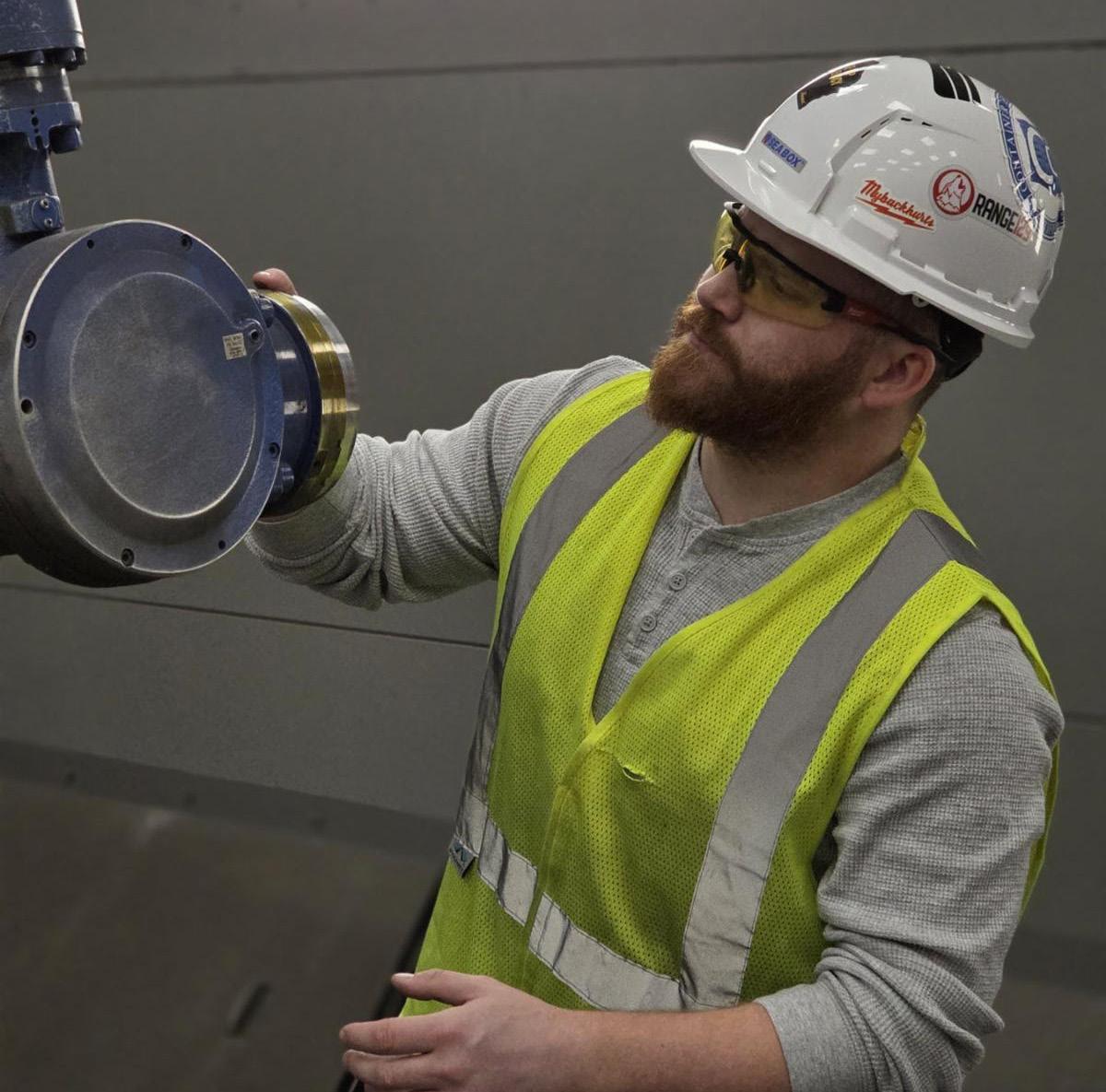
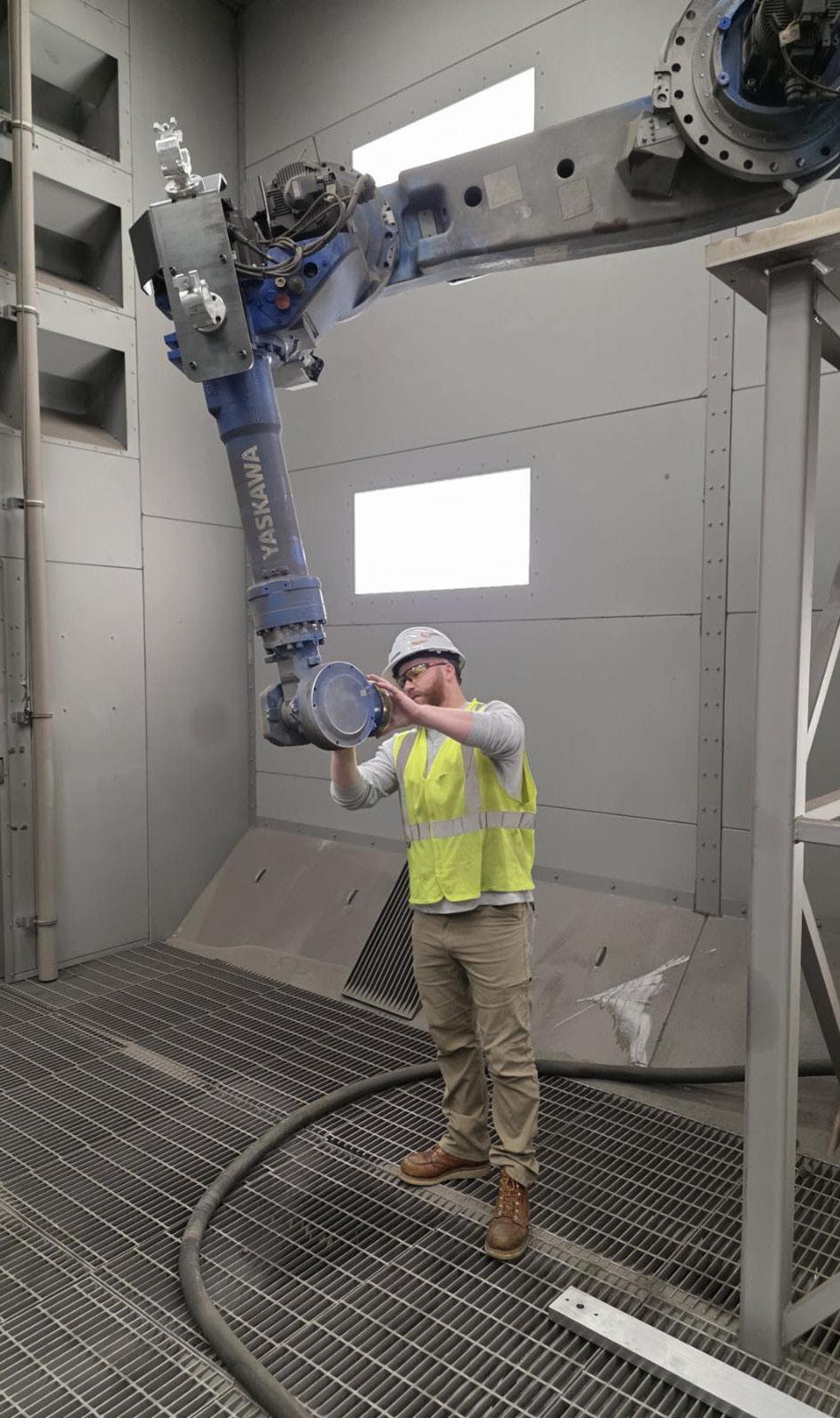
Korey Greene examines a blast robot used in automated container production. “You wear a lot of hats here at Sea Box and it’s really rewarding,” he said.
was so we had to figure it out as the project progressed. There was a lot of designing on-the-fly. In the end, it was four airlocked containers connected together so all work could be done without going outside. You’d enter in one room, change and sanitize, then move on to the lab space. We had special air filtration systems to make sure everything was scrubbed and clean so samples didn’t get contaminated.”
At the other end of the customization spectrum was the 40-ft hot dog stand. Inside the box was a standard commercial kitchen but outside there was a “crazy paint requirement,” according to Korey. “I’m used to being able to say to our paint department, ‘here’s a container, paint it desert tan’ [often requested for military applications]. But when I showed them a rendering of the huge checkerboard pattern that covered the box they came back with ‘how big is each square?’. So I had to go back and make an engineering drawing just for the paint design. It was a wild ride.”
Pulling it all together with data-integration software
John and Korey are the types of talent Sea Box likes to attract to support the company’s open mindset, said senior program manager Mark Campbell. “I think we’ve barely scratched the surface in terms of some of the architectural boxes that we work on,” he said. “The aperture for expansion is wide open.”
Of course, a wide-open aperture absorbs a great deal of information. Another critical aspect of John and Korey’s jobs at Sea Box has been adopting and integrating digital software tools that track and harness all that product data and optimize the workflow of the complex enterprise they serve.
A painful PLM journey at the outset
“Our Product Lifecycle Management (PLM) journey has been an interesting one and, I suspect, as is the case with many companies,
With Interpower cords and cord sets, you won’t pay additional tariffs attached to European or Asian cords—we make them in Iowa and ship them with 1-week U.S. lead times. With the cost of overseas shipping, why not choose stability? Interpower uses superior raw materials helping cords and components exceed UL and VDE testing standards. No other cord maker in the U.S., perhaps even the world, can quick-change die molds to make 40 different country-specific cord sets in 1 week.
info@interpower.com
Business Hours: 7 a.m.–5 p.m. CST
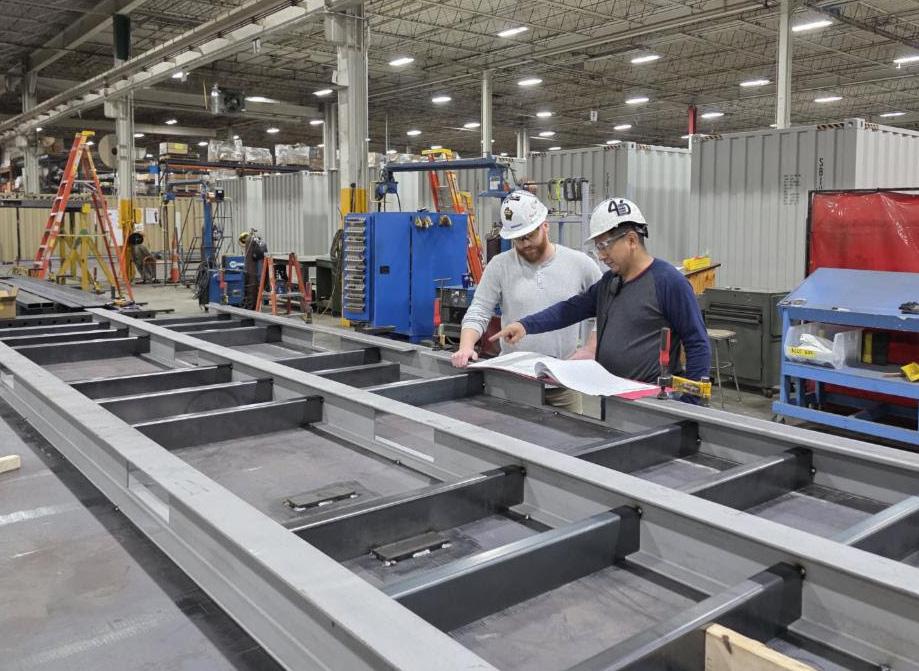
Sea Box welding lead Ivan Montalvan (right) discusses a job with mechanical engineer Korey Greene.
also a somewhat painful one,” said John. “When I joined the company in 2018, we were still using our basic parts database software, an EPN [engineering part number] system that was just a Microsoft Access database. The company was growing to a point where we were making so many new parts that the system was crashing every day.”
“It was a very paper-based, physical tradition that was probably fine once upon a time,” said Korey. “As the business evolved, our customers’ needs evolved, and our capabilities had to evolve along with that. In the early days we were going off napkin sketches and painting the boxes in the parking lot. Now we’re at a level of sophistication that requires accurate and reliable data tracking.”
Management realized it was time to shift to a full-fledged PLM system. But after a couple of frustrating years with one integration partner, the software development program was not going well and they parted company.
Time
to bring in the experts
“We didn’t have the in-house expertise to do it ourselves,” said John. “When we found PLM-solutions provider Razorleaf they came to New Jersey to do a discovery session with us and we were very impressed. They had the expertise to quickly determine which of the issues were complex PLM problems — indeed difficult to solve — and which actually had some fairly simple solutions.” Sea Box began the process of switching off their old EPN system and moving to a PLM platform, Aras Innovator, which was recommended by Razorleaf.
Cleaning up dirty data
Given its multitudes of custom-container jobs, Sea Box had a large database, one plagued with what the engineers admit was ‘poor data entry etiquette.’ “You need to have good, clean data in your PLM system,” said Korey. “And when we want to send that data to Business Central [the ERP business management system the company is implementing
and integrating with their PLM] that data also has to be clean. Razorleaf worked with us to identify which data needed cleaning up. This initially involved considerable manual-entry effort working with their team, and they also helped us with automating it, going forward.”
To keep the container workflow moving, the team set up standalone development servers with batch loading tools for trial runs. “This allowed us to test in a ‘sandbox’ without worrying about affecting our production department,” said Korey. “Giving us readouts of our data, providing a strategy for combing through that data, what’s good and what’s bad — Razorleaf was a massive help for us.”
While not every engineer needs to go as deep into the weeds as John and Korey, Sea Box has recently expanded from 25 PLM software licenses to 40. Training has been carried out in waves. “For our more recent hires, if you’re starting in this new environment with all-digital systems, it’s so much easier to get everything done more efficiently,” said Korey.
Okay, I can track my parts — but where ae my CAD designs?
One significant issue still lurked underneath the huge progress in PLM capabilities at Sea Box. Its parts database was up and running, but it didn’t have its CAD-data files stored there, so it had no automated revisioning control over designs.
This CAD disconnect was creating a host of issues, said Korey. “Whether it was a 2D drawing or a 3D computer model, there was a lot of redundant effort. For example, you’d find a part number in PLM but you couldn’t find the CAD for the actual part, so you would just redraw it again — this could happen 10, 20, or more times because it was faster to redraw the part than to try to sift through our system to find it. And disconnect between the systems could
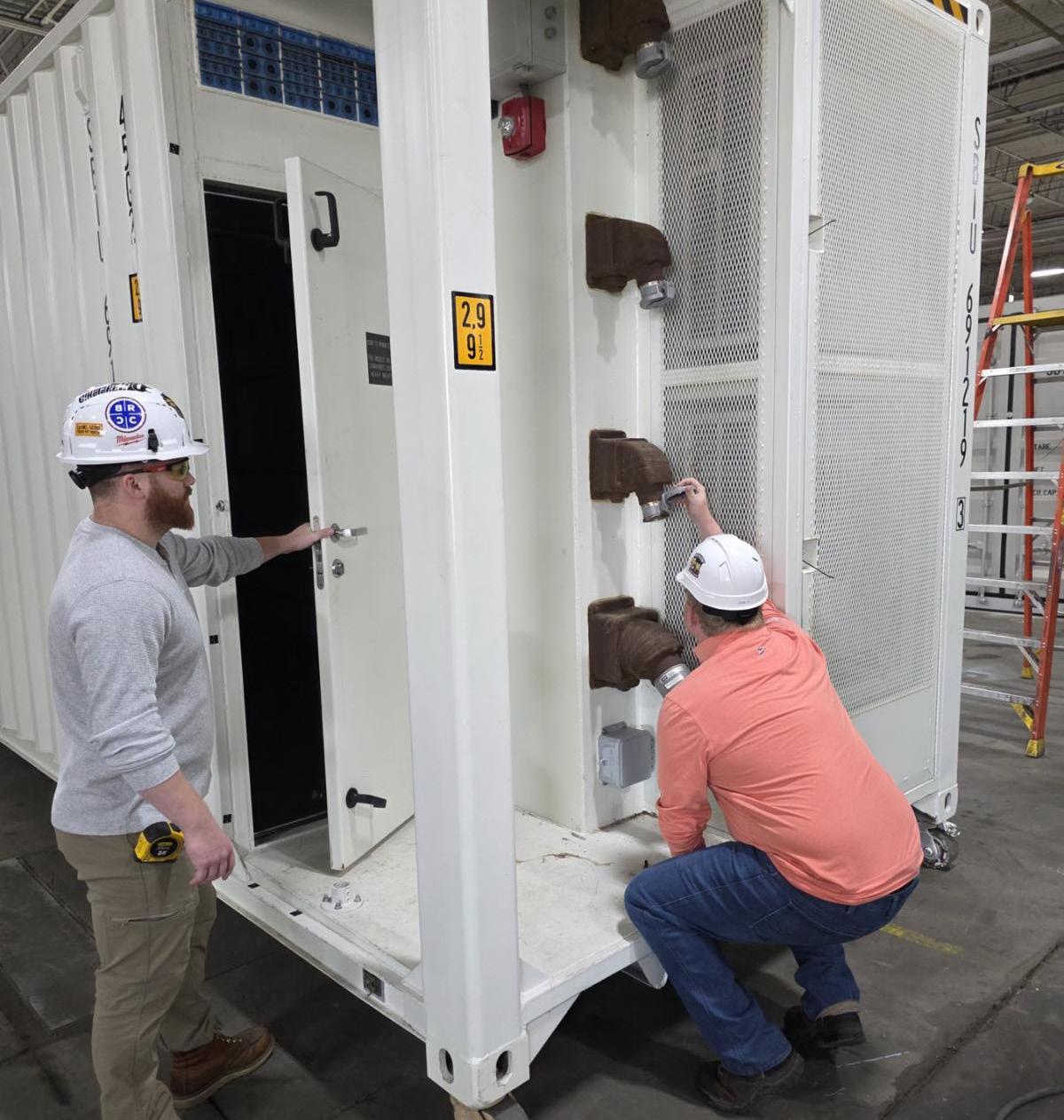
Korey Greene and John Salyers examine the electrical inlets of a container installed for powering work on transcontinental undersea cabling.
lead to potential human errors, like misentering part numbers or quantities.”
Again, they turned to Razorleaf, this time for CAD Connector software from ESSIG that tracks alterations to every design over time and is being linked to engineering-change management modules within their PLM system. “It’s all very well and good to have your revisions tracked in PLM, but to then have your drawings and models also associated with that revision tracking adds a quality to the data that we couldn’t previously achieve,” said Korey.
“Having CAD Connector benefits both production folks and project managers,” said John. “You can burn a lot of resources answering a simple question from operations about, say, where twenty ¼-20 screws go in a component. Our connector software democratizes CAD because there’s no longer a gateway between the engineers and the non-technical people; you can see your answers highlighted in the model right on your screen.” The company is working to get more ruggedized laptops out on the production floor, for use by manufacturing staff and qualityassurance people who need to inspect in real time.
Everything’s coming up CLOVER
Underpinning the entire digital operation is Razorleaf’s CLOVER integration platform, ensuring seamless data flow between Sea Box’s PLM, ERP, CAD and other programs.
“As we integrate our Business Central [ERP] system with our PLM, we’re running a lot of practice sessions to see how CLOVER is connecting things behind the scenes,” said John. “I think the greatest testament I can give to CLOVER is — even for me as an administrative user — that for the most part I don’t even know it’s there.” “What’s more, noted Korey, “we’re seeing massive gains in our engineering workflow.”
The view from 10,000-ft
Senior program manager Campbell has the 10,000-foot view on what building seamless connections between these advanced digital tools means to an expanding business. “We all want to work from a single source of truth,” he said. “You’ve got a repository where all your information is kept and configuration management that gives you revision control. What you’re looking for is repeatability, increased quality, consistency, and reliable product delivery.
Enthusiasm for the project remains high with Sea Box’s two “PLM journeymen,” as they call themselves. “This has been a large elephant to try to eat,” said Korey. “We’re taking
bites at a time to do that, and we’re getting pretty close to the full meal. We are now starting to see the impact of the improvements we’ve made in our system that we could not even envision before. That allows us more time to be creative and puts more internal resources into our hands for the next DOD laboratory, food-delivery stand — or whatever our customers ask us for next.” DW
Sea Box seabox.com
EDITED BY MIKE SANTORA
A 270-ton lift with million-dollar stakes
Eight coke drums were replaced ahead of schedule at oil sands mining operation in Fort McMurray, Alberta, Canada.
When it comes to equipment maintenance and facility shutdowns, particularly in the oil and gas sector, saving even a single day can result in significant cost reductions.
Key to ensuring that a schedule is completed on time — or sometimes accelerated — is having the right planning, people, and equipment in place.
Mammoet supported a leading Canadian energy provider in Alberta’s oil sands since 1967 with replacing its original eight coke drums at its Base Plant site in Fort McMurray. The
project extended the life of the original upgrader by 30 years.
The site upgraders use thermal and chemical processes — including coking and hydrotreating — to convert bitumen into synthetic crude oil. Coke drums gather the petroleum coke that is separated from the feedstock during the refining process.
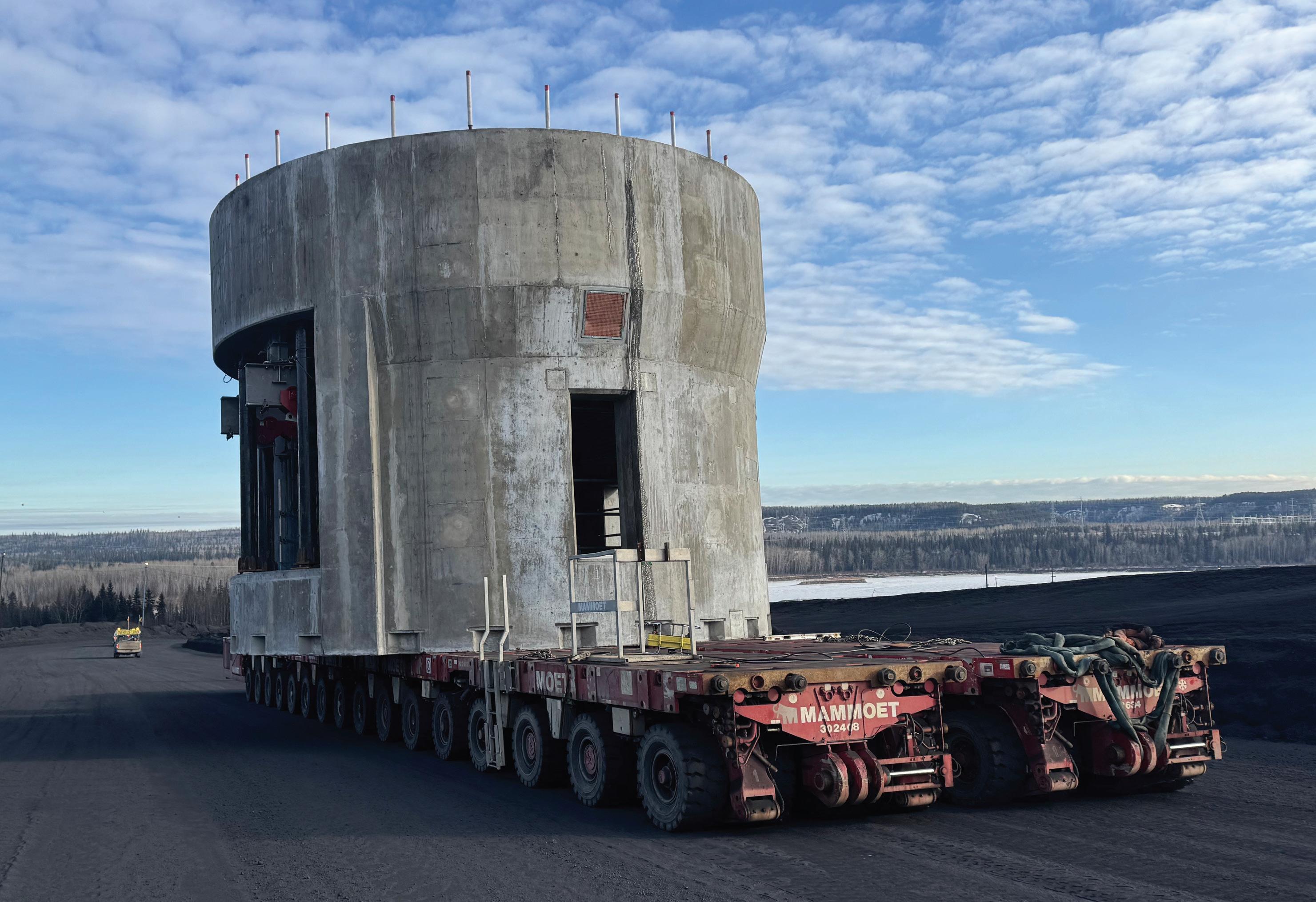
Weighing 270 tons apiece, each coke drum is 26-ft in diameter and 98-ft high. Moving them into place required one of the largest cranes in the world.
Through early involvement, Mammoet was able to advise on the
right crane for the job and, when one of the new components was heavier than estimated, they fabricated specialized rigging for the lift.
The team also helped accelerate the schedule by shortening the time between two of the biggest lifts of the project, helping enable the upgrader’s early return to operation.
Choosing the right tools for the job
Mammoet was brought in during the planning stages to conduct a feasibility analysis and assess which equipment
Weighing 270 tons apiece, each coke drum is 26-ft in diameter and 98-ft high.
would be best to remove the old drums and get the new ones delivered to the site and installed.
“In terms of the importance of the project and getting everything done within a specific timeline, this turnaround was completed safely, ahead of budget and ahead of schedule,” explained Kurt Reid, Sales Manager at Mammoet. “With the daily cost being significant, it was essential that planning happened years in advance.”
Mammoet was an integral part of the project for over seven years prior to execution, discussing the timing of lifts and movements. Its engineers undertook an entire crane review, assessing every suitable model in Mammoet’s fleet to select the right equipment for the job. The biggest consideration wasn’t weight, but reach.
The engineering team first considered using an LR 11350 crawler crane placed beside an upgrader wall, but the option wasn’t feasible because it interfered with concurrent operations and maintenance work in the area.
Moving each 270 ton coke drum into place required one of the largest cranes in the world.
Therefore, Mammoet’s PTC210DS ring crane was selected. It has the capacity not only to lift the heaviest component (a six-drum derrick weighing over 1,200 tons) but also, thanks to its impressive reach capacity, to be assembled farther away so as not to disrupt other on-site work.
As the PTC had to be erected inside the coke pit, civil work was needed to strengthen the ground beneath it. Around 200 piles were driven into the ground to build a solid foundation.
Getting everything ready and in place
Prior to project execution, the new components were delivered to the site. They were transported from their fabricator in Edmonton to Fort McMurray using prime movers on Alberta roads and Self-Propelled Modular Transporters (SPMTs) on site.
This process started a year and a half before the project area would
“IN TERMS OF THE IMPORTANCE OF THE PROJECT AND GETTING EVERYTHING DONE WITHIN A SPECIFIC TIMELINE, THIS TURNAROUND WAS COMPLETED SAFELY, AHEAD OF BUDGET AND AHEAD OF SCHEDULE. WITH THE DAILY COST BEING SIGNIFICANT, IT WAS ESSENTIAL THAT PLANNING HAPPENED YEARS IN ADVANCE.”
Kurt Reid • Mammoet
shut down for execution. Niek de Winter, Corporate Account Manager at Mammoet, explains why.
“Our plan was to have everything the company needed — equipment, materials, and components — on site by December 2024 so that on May 1, when the plant was shut down, the turnaround could begin without interruption. The crane was assembled, the coke drums and derricks were on site — everything was there months ahead of time. This allowed us to eliminate delays mid-project.”
On site, two sets of SPMTs and crews (each running day and night shifts) allowed work to move forward continuously and kept the PTC crane constantly fed.
Using the PTC to save time and cost
The old derricks (a two-drum and six-drum) were lifted first, followed by the eight coke drums and finally their concrete foundation sections.
The old components were placed onto SPMTs and driven to a nearby laydown area for decommissioning. For installation of the new components, the process then happened in reverse.
The fourth-deck derrick “supermodules” — named for their mammoth size — were transported to the facility in smaller modular sections and then moved and assembled on site.
The base of these supermodules made up the operating deck of the coke drums and was assembled via SPMT from the smaller modules. The derricks were erected with Mammoet crawler cranes.
Due to a weight increase in the largest derrick supermodule, the project team at Mammoet had to maximize use of the PTC210 to deliver the needed lifting capacity. It was reconfigured with a double masthead kit, and specialized rigging was also fabricated.
Accelerating the schedule
Thanks to detailed planning, specialized equipment, and a disciplined approach, production at the site could continue right up until April 30 — the day before the shutdown.
From factory to foundation, the components were safely and efficiently managed on site ahead of the turnaround.
“As soon as we are called on, we are ready to perform the next lift,” vsaid Reid. “When you have a client that is planning their multi-week event right down to 15-minute intervals, time is of the essence.” DW Mammoet mammoet.com
CONTROL
Modern motion systems demand ultra-fast deterministic communication with precise multi-axis synchronization. So, engineers are turning to realtime Ethernet-based industrial protocols.
Realtime motion control depends on fast, deterministic communication and precise synchronization across multiple axes. Among Ethernet-based technologies:
• EtherCAT delivers the highest synchronization accuracy and speed.
• EtherNet/IP provides unmatched PLC integration and interoperability.
Meanwhile, CANopen, CAN FD, and traditional serial networks
continue to deliver proven reliability for distributed, embedded, or cost-sensitive applications.
Current state of industrial communications
Industrial communications today are based on EtherCAT, EtherNet/IP, and PROFINET IRT as well as widely used legacy and serial options such as CANopen, CAN FD, and RS-232/ RS-485 (Modbus RTU). Each protocol is discussed in terms of architecture, timing, and application suitability. Product examples from some manufacturers illustrate how multi-
protocol motion control platforms enable engineers to align communication strategies with performance, integration, and cost objectives.
As industrial automation grows more complex, the communication infrastructure connecting drives, controllers, and sensors has become a critical design element rather than a background utility. Modern multi-axis motion control systems — such as those in robotics, packaging, and semiconductor manufacturing — need sub-microsecond synchronization, deterministic data transfer, and reliable realtime performance potentially across networks of dozens of axes.
ANKIT BARAD• APPLIED MOTION PRODUCTS
NEYRAM HEMATI, PhD
Ethernet-based fieldbus technologies have emerged as the dominant solution, combining high bandwidth, precise synchronization, and flexible topologies. At the same time, traditional networks such as CAN and serial protocols continue to play an important role in costsensitive or embedded applications.
Some manufacturers have responded to these evolving requirements by developing motion control devices that natively support multiple industrial
communication standards. This flexibility allows system designers to choose the most effective protocol for each application, whether optimizing for ultra-fast synchronization, seamless PLC integration, or reliable low-cost control.
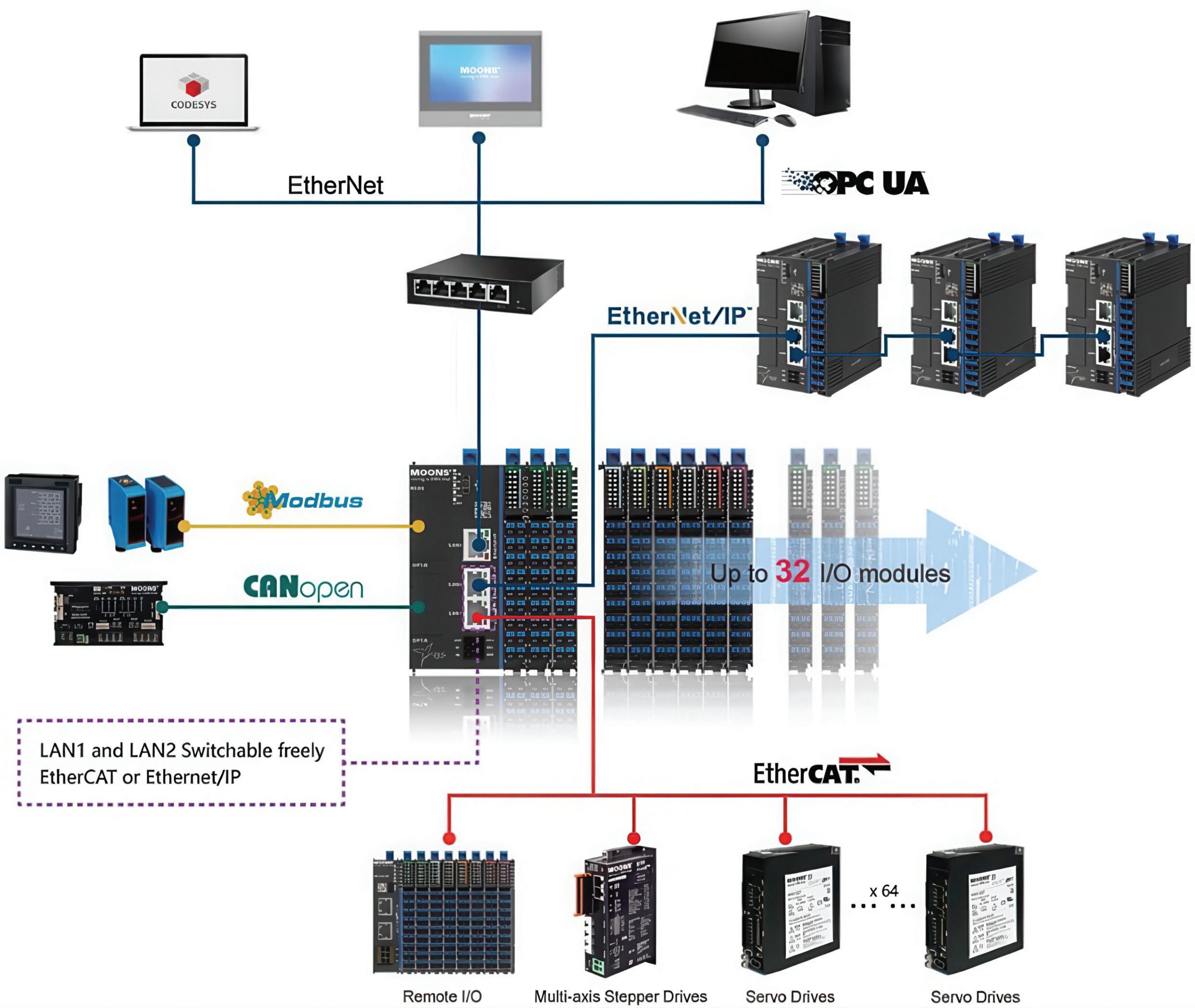
Enterprise and industrial systems integrate over modern Ethernet-based architectures to link PLCs, drives, sensors, human machine interfaces (HMIs), and IT infrastructure into unified and deterministic control networks.
Ethernet protocol: Ethernet for Control Automation Technology (EtherCAT)
Developed by Beckhoff, EtherCAT is known for its exceptional performance and efficiency. Using a “processingon-the-fly” approach, data is read and written by each device as a single Ethernet frame passes through the network, minimizing latency.
With cycle times down to 12.5 µsec and jitter below 1 µsec, EtherCAT supports highly synchronized motion
Shown here is the architecture of an Ethernet-based industrial automation network with a MOONS’ Industries MCA6 motion controller for multi-network integration and interconnection.
Motion Control
PROTOCOL
EtherCAT ~100 µsec to 1 msec <1 µsec 100 Mbps
EtherNet/IP ~1 to 4 msec ~10 to 100 µsec 100 Mbps or 1 Gbps
PROFINET
IRT ~250 µsec to 1msec <1 µsec 100 Mbps
CANopen (Classic CAN) ~1 to 10 msec N/A 1 Mbps
CAN FD ~1 to 4 msec N/A Up to 8 Mbps
RS-232 (Serial) 1 to 100 msec (typical)
RS-485 (Serial) 1 to 10 msec (typical)
Moderate Up to 115.2 kbps
Moderate Up to 10 Mbps
Modbus RTU (RS-485) 1 to 20 msec (typical) Moderate Up to 10 Mbps (commonly 9,600 to 115,200 bps)
profiles for torque, velocity, and position control. Its distributed clock mechanism ensures sub-microsecond timing alignment. The protocol scales to thousands of nodes and offers flexible topologies so is suitable for CNC, robotics, and high-speed packaging.
Ethernet protocol:
EtherNet/IP
Ethernet Industrial Protocol or EtherNet/ IP is an industrial communication protocol based on standard Ethernet and the Common Industrial Protocol or CIP. It’s designed to connect controllers, drives, and I/O devices. In motion control, it uses implicit UDP messaging for realtime cyclic transfer of position, velocity, and torque data between a PLC and drives, enabling precise, synchronized multi-axis motion, while explicit TCP messaging handles configuration, diagnostics, and parameter changes. By combining standard Ethernet hardware with fast, deterministic communication, EtherNet/ IP allows high-speed, coordinated motion control with interoperability across devices from different vendors.
Its ability to operate on standard Ethernet infrastructure allows for star, ring, or line topologies and seamless information and operational technology (IT/OT) integration. EtherNet/IP is
especially prevalent in North American automation markets and supported by a broad vendor ecosystem.
Rockwell Automation is a leading supplier of motion control products with CIP motion.
RT with deterministic, time-sliced communication for synchronized motion control. Cycle times as low as 250 µsec and jitter below 1 µsec make it wellsuited for precision automation and robotics. IEEE 1588 PTP synchronization and hardware-assisted switching ensure tight timing and efficient coexistence of realtime and standard Ethernet traffic.
Legacy and serial protocols
CANopen and CAN FD: The CAN family of protocols remains essential for cost-sensitive or embedded systems. CANopen delivers deterministic communication up to 1 Mbps using priority-based arbitration, while CAN FD increases payload size (up to 64 bytes) and data rate (up to 8 Mbps), enabling higher throughput without sacrificing reliability. These are common in mobile robotics, textile machinery, and modular automation.
CNC, robotics, packaging, semiconductors
General automation, packaging, conveyors
Factory automation, robotics, printing
Mobile robots, textile, embedded systems
Mobile robotics, modular automation
Point-to-point serial communication, PLCs, sensors, HMIs
Multidrop networks, industrial field devices, motor drives
Legacy industrial devices, sensors, PLCs, motor controllers
Listed here are leading realtime communication protocols for motion control and their key performance characteristics.
Listed here are leading realtime communication protocols for motion control and their key performance characteristics.
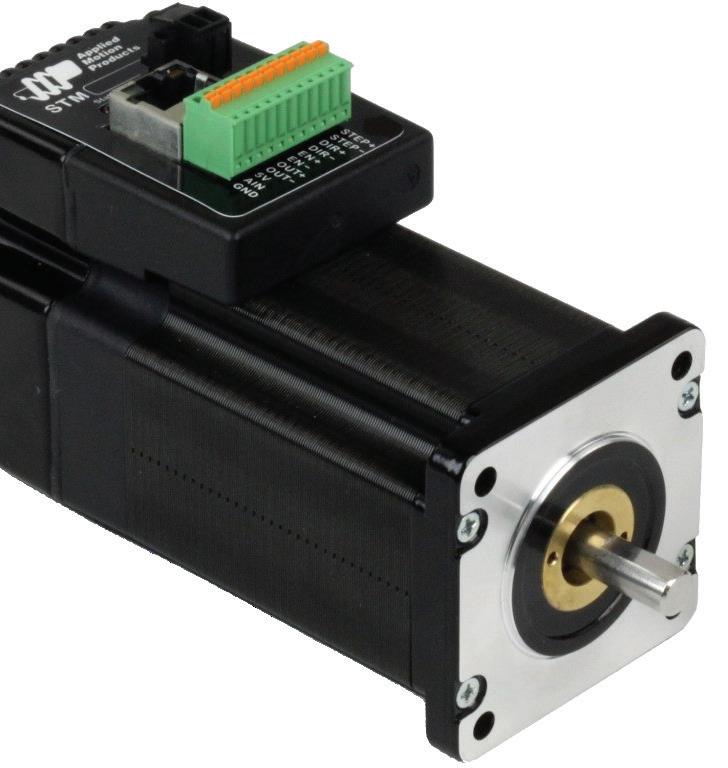
The STM24IP3EN integrated drive+motor shown here offers EtherNet/ IP connectivity.
RS-232, RS-485, and Modbus RTU: Serial protocols continue to serve as dependable solutions for legacy or simple distributed systems. RS-232 supports shortdistance point-to-point links, while RS-485 enables multidrop connections up to 1,200 meters. When paired with Modbus RTU, these links provide structured master-slave communication for sensors, drives, and controllers. Though slower and less deterministic, serial remains a practical bridge between older equipment and modern Ethernetbased networks.
Component suppliers offering multi-protocol support
Some suppliers of motors, drives, and other motion components offer comprehensive product ranges that support leading industrial communication protocols. This multi-protocol capability lets engineers build motion systems that meet diverse technical, integration, and cost requirements. DW
Applied Motion Products applied-motion.com
Application Engineering Group support@applied-motion.com
SENSORS HYDRAULIC VALVES MOTOR DRIVES
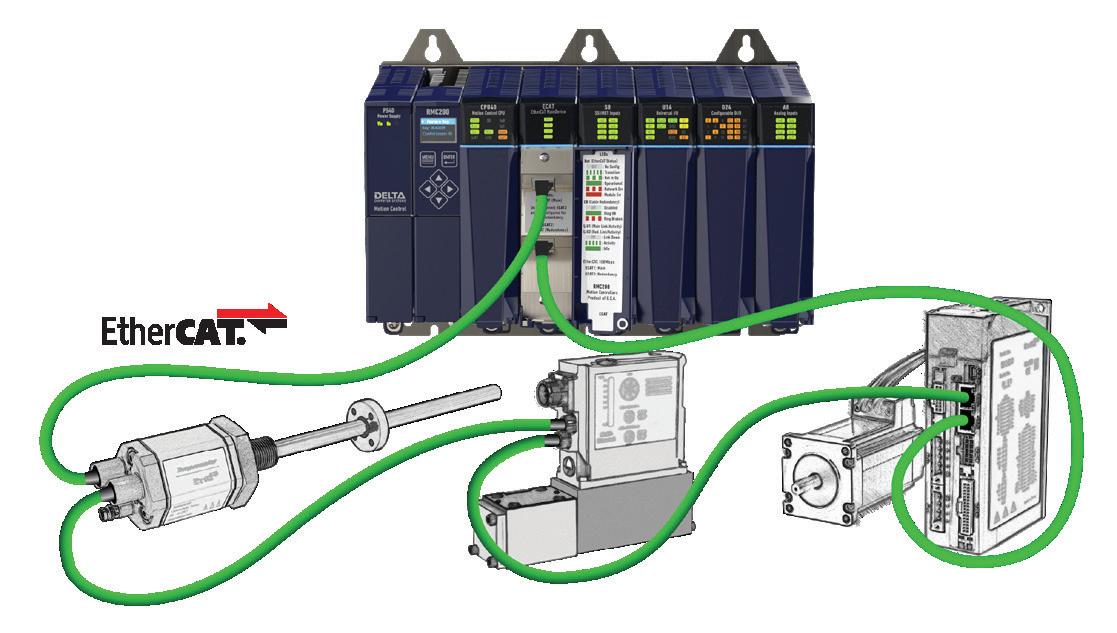
One axis or fifty. Servo hydraulic or servo electric. Position, velocity, or force control. Direct connection or through EtherCAT.
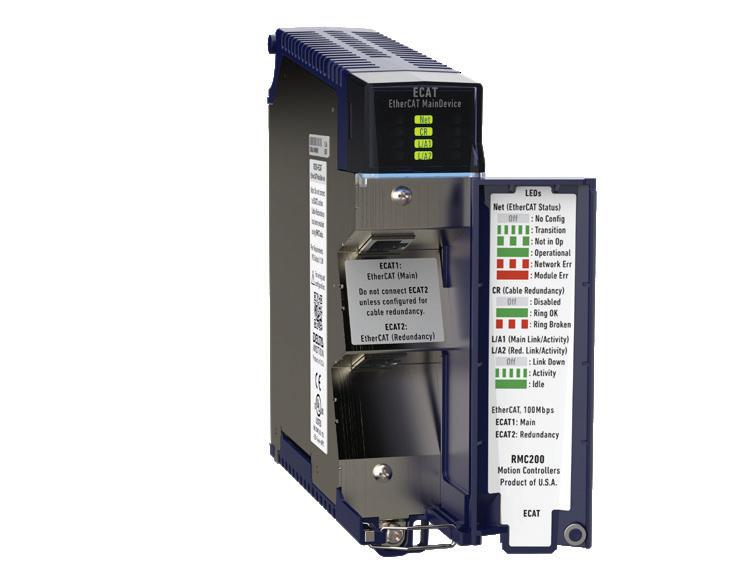
Delta RMC Motion Controllers and graphical RMCTools software make complex motion easier, smoother, and more precise. Drive over to deltamotion.com or call +1 (360) 254-8688 Get your next project moving forward more
PERFORMANCE & SPECIFICATIONS
IN MOTION CONTROL
Here’s how a focus on drives and controls can help achieve true precision in motion control applications.
Corey Foster Valin Corporation
PART 3
In high-precision motion control, system performance is often judged simply by the specifications of the mechanics alone. The actuators are typically sorted by a standard set of specifications such as repeatability, accuracy, and load capability. For many applications, this is all that’s required. Others will need an understanding of those specifications to
make sure the basic assumptions for them are met during installation. Achieving true precision, however, requires a deeper understanding of the full motion control system from the mechanics to the motors, drives and controls.
This series continues to explore how each layer of technology contributes to the overall system performance. The
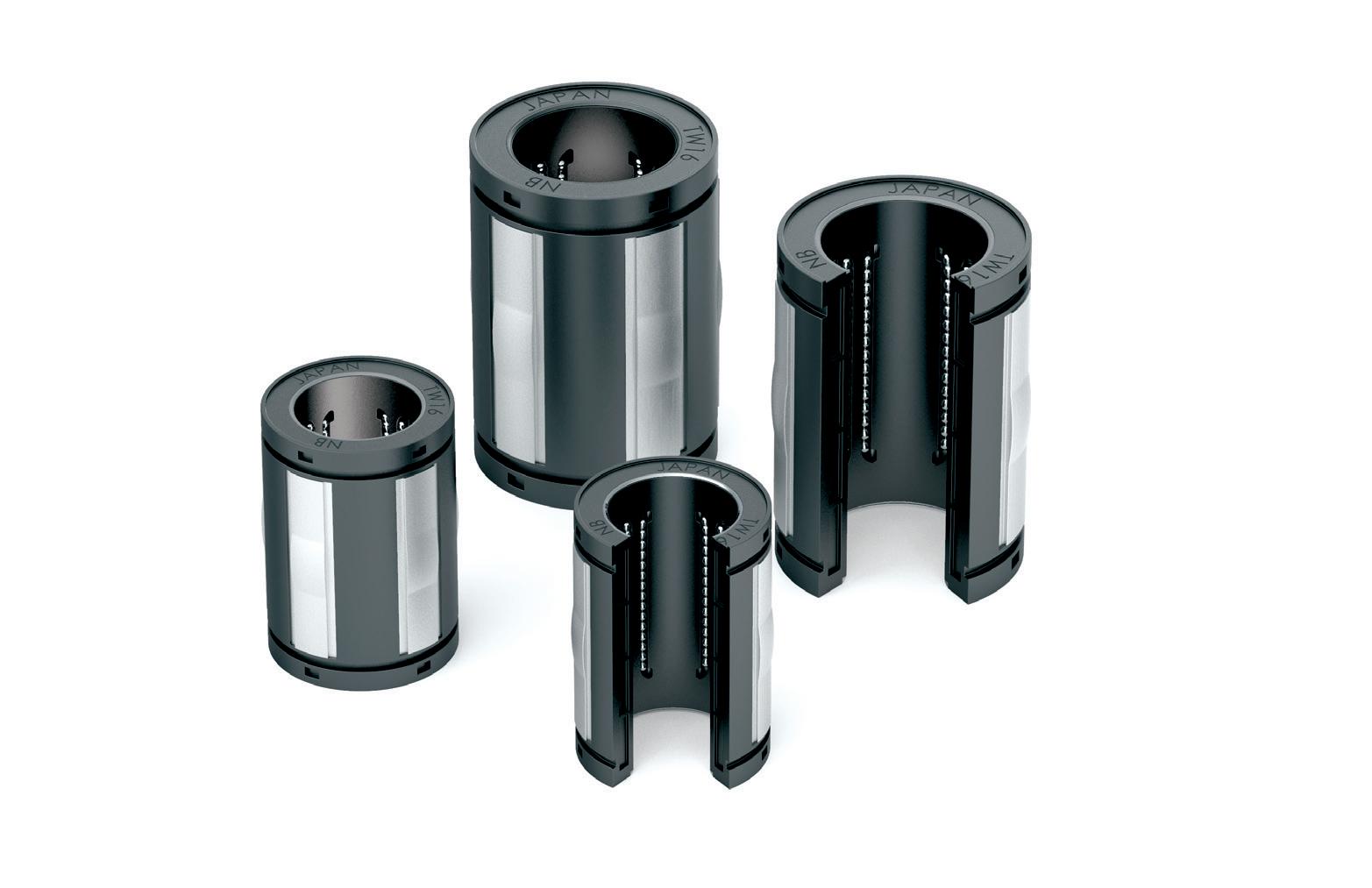
TOPBALL ® Ultimate
4 Times The Load
64 Times The Life*
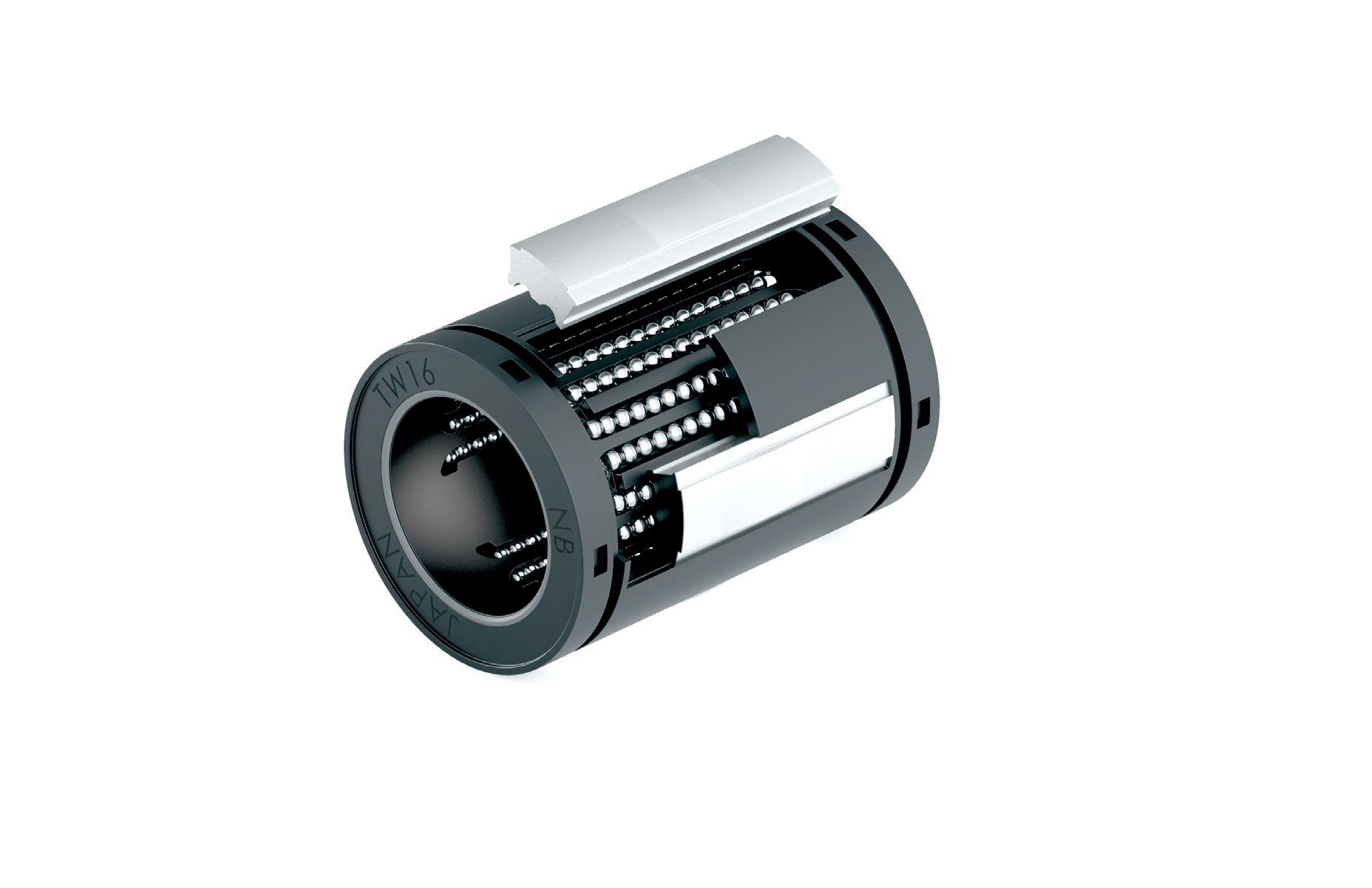
• Optimized load plates and outer cylinder plus more ball circuits.
• Improves performance of: Machinery and equipment for automation, optics and measuring.
• Floating raceway wiper seal allows unrestricted self-alignment.
• Load plate ends are thinner making center a fulcrum for self-alignment.
• Our raceways are groundnot stamped - a ording precision tolerances.
• Each load plate is precision-ground and checked for consistency - unlike competitions’ stamped plates.
• Light weight components for energy reduction.
• Unibody construction for quieter operation.
www.nbcorporation.com
Linear Motion
first article in the series looked at the mechanics, examining critical factors that are often overlooked such as bearing deflection, body stiffness, and structural smoothness. The second article looked at the motors, examining their designs, construction, quality and other factors. In this third part of the series, the discussion will surround the importance of the designs and features of drives and controls for the system.
In all cases, there are details that do not show up on data sheets but can make or break the high-performance expectations of the entire system. As motion systems push beyond micronlevel accuracy, traditional specifications start to lose their typical meaning and relevance, making nuanced engineering decisions essential. This series aims to help engineers, designers, and system integrators recognize just how important each decision is in putting a highprecision motion system together.
Drives and controls: the brains behind the motion
In the previous articles, we discussed three general tiers of performance to consider in a motion control system: basic, specification-level, and pushing-beyond-the-specifications performance. This applies to drives and controls as well.
The most basic electric motor applications do not have any built-in intelligence. Power is applied directly to the motor, and it simply turns. Drives, which are the electronics that supply power to motors, make this process smoother and more efficient. Controllers add another level of intelligence by providing more control, such as acceleration, velocity, and positioning control. For the most basic motor applications, this level of electronics is often more than what is actually needed. In those cases, the main requirement is simply that the
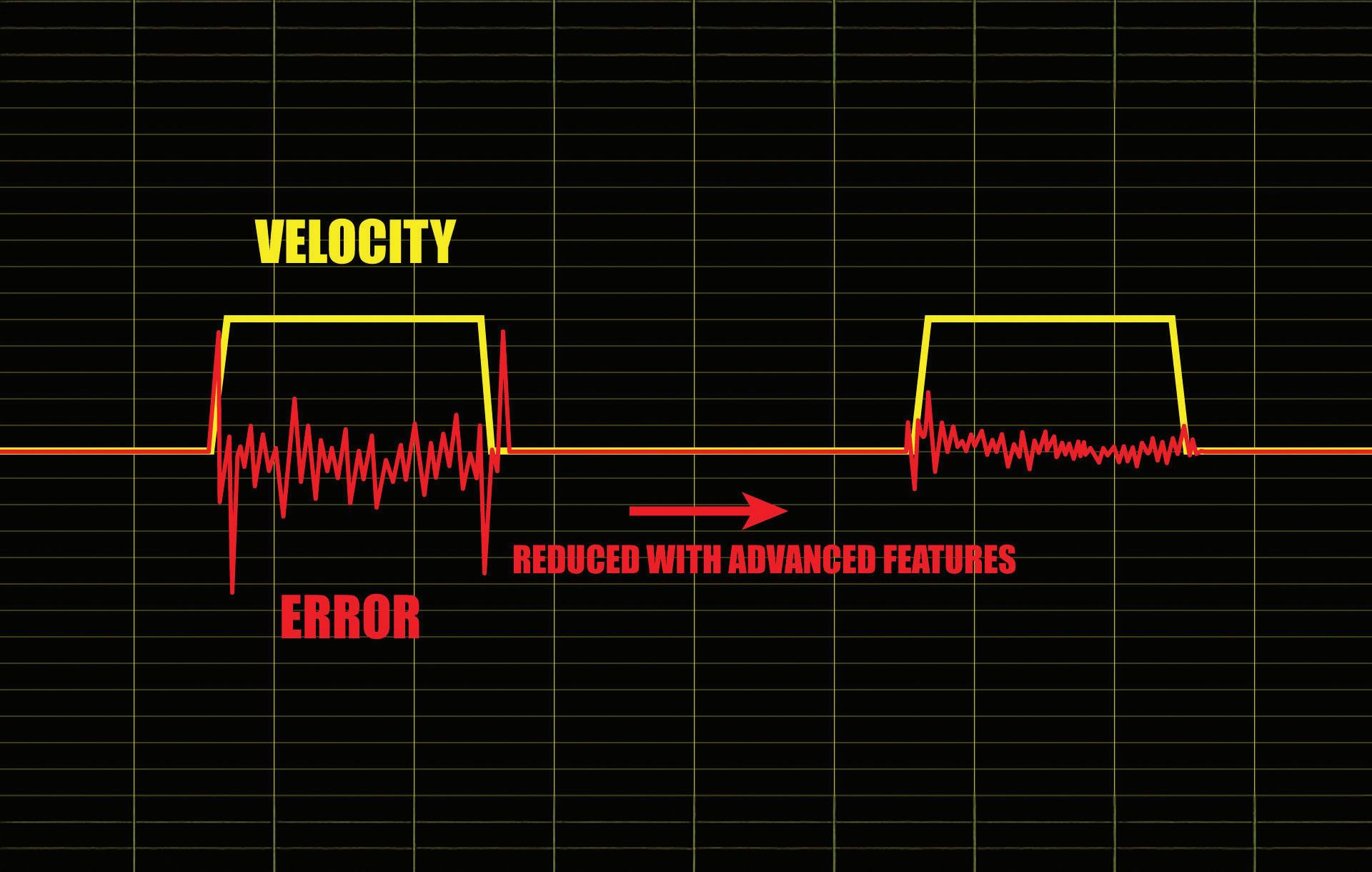
With the kinds of functions offered by high-performance controllers, such as flexible real-time multi-threaded programming and motion optimization tools, errors in systems can be greatly reduced.
electronics are compatible and allow the motor to run. If tuning features are available, the default settings are usually sufficient.
In applications requiring tighter control, the features of the drives and controllers start to become important. The tuning features need to be provided, and the correct information and parameters need to be adjusted to get the desired performance. The controllers also need to be programmed correctly to get the desired motion profile and sequence of actions. Most issues are caused by simple setup mistakes or missing settings and can usually be fixed easily. Tuning problems are more common and often happen when the system is adjusted by someone without proper training, leading to motion that is either slow and unresponsive or too aggressive and unstable. Using a high-performance motor with lower-performance
electronics is generally not ideal, though it is rarely a major issue in most applications.
That mistake of trying to maximize the performance of highend motors with low-end electronics becomes most apparent, however, in more demanding applications. The motor doesn’t quite achieve the requirements it should, and the system becomes difficult to tune resulting in poor performance. In general, meeting the application requirements is just plain difficult and even, in the worst-case scenarios, impossible.
High-performance applications require advanced tuning features with dynamic and adaptable gains, multi-axis synchronization for multiaxis mechanics such as gantries and cartesian robots, and fast update rates
for tight current and voltage control. They need to have fast processors to be able to process commands to prevent lag in the logic. They also need to have tools to adapt to an environment.
One OEM’s tool worked great when assembled in the company’s isolated environment, but when the tool was put in the real world with its electrically and mechanically noisy environment with arc-welders, people, and forklifts, the controls didn’t have the tools, such as notch filters and dynamic tuning parameters, to be able to adapt so they had to be upgraded to ones that did.
There are many other factors that come into play for high-end applications, such as:
• “Auto-tuning” isn’t a catch-all silver bullet; it’s just a place to start • Encoder resolution has to match the
application goal and the electronics’ capabilities
• Fieldbus communication protocols need to be up to the demanding speed and coordination
Precision motion isn’t as simple as controlling a motor well. It is the art of coordinating information from the target, even the environment, with the variables of the mechanics and motors themselves to achieve the specified goal of the application. The best hardware can’t overcome a dumb control loop. DW
Valin Corporation valin.com
Electronic Engineering
Edge AI demos are easy — scaling them into reliable, cloudconnected deployments is not. This piece explores the hidden connectivity, data, and infrastructure challenges that separate proofs of concept from production-ready edge AI systems, and how to bridge that gap.
CLOUD CONNECTIVITY FOR EDGE AI:
BRIDGING THE DEMO-TO-DEPLOYMENT GAP
Most edge AI demonstrations operate flawlessly in controlled environments with stable networks, predictable traffic, and carefully managed credentials. In contrast, many production deployments fail under realworld conditions.
This technical article outlines the best practices required for reliable edge AI deployment. It covers bandwidth planning for peak conditions and buffering strategies that maintain stability during degraded connectivity. The article also reviews automated certificate lifecycle management and presents a cost–benefit framework for evaluating when cloud connectivity adds value and when it introduces unnecessary cost or risk.
Plan bandwidth with explicit per-site budgets
The most common edge AI deployment failures assume cloud transmission is free from bandwidth constraints or cost impact. To prevent cost and latency penalties, production systems must define per-site bandwidth and cost budgets that account for peak conditions rather than average utilization.
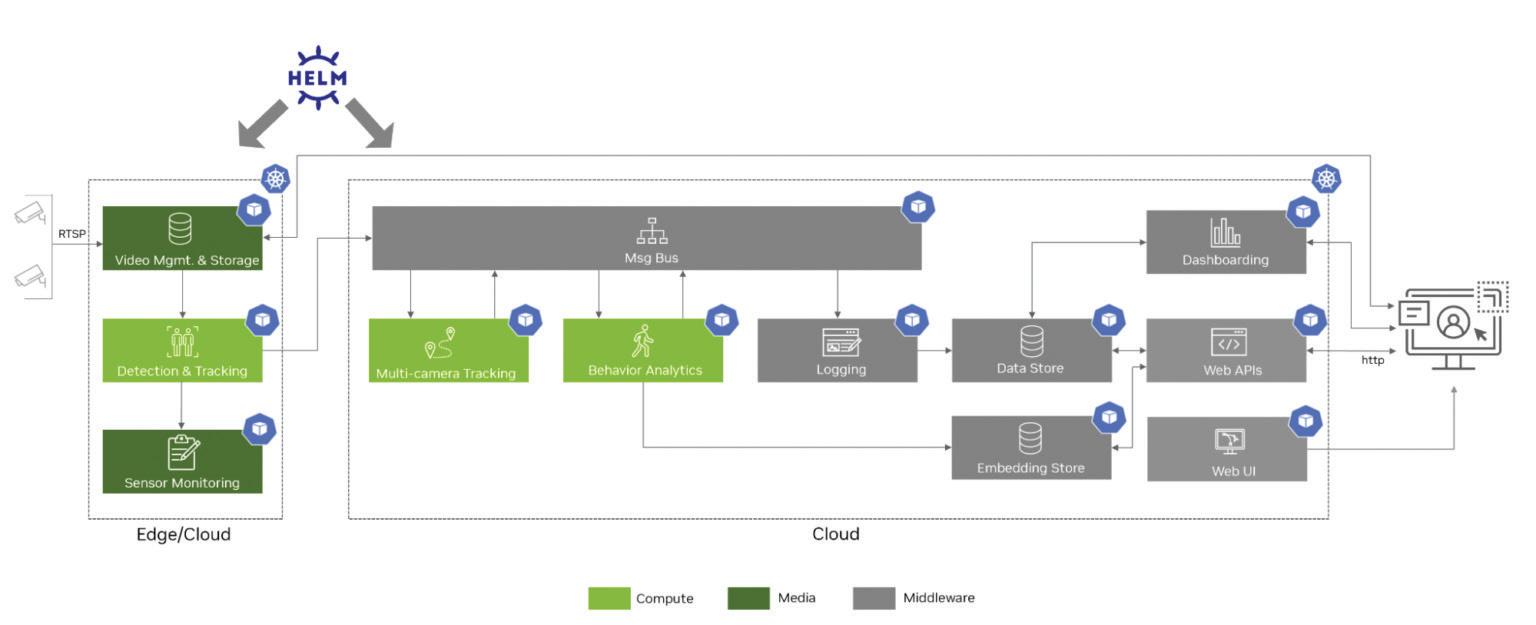
As shown in Figure 1, AI workloads such as industrial vision, autonomous perception, and retail analytics generate bursty traffic from video frames, embeddings, and event batches. Links that appear adequate in a dashboard demonstration often saturate under field conditions, introducing jitter, packet loss, and cascading timeouts.
Deployment-ready designs should partition data flows into three categories:
1. Local data: Keep raw sensor streams within the local network.
2. Edge processing: Produce compact outputs such as anomaly scores, detection bounding boxes, or feature embeddings that require significantly less bandwidth.
3. Selective uploads: Transmit full-resolution samples only when triggered by anomalies, uncertainty thresholds, or scheduled audits.
This partitioning guides peak-load planning by defining what data stays local and what data moves upstream.
AHARON ETENGOFF • CONTRIBUTOR
Cloud-Native Deployment of Multi-Camera Tracking COLLECTION
OF METROPOLIS MICROSERVICES
Model peak load accurately
Peak bandwidth estimates should model worst-case simultaneous activity across all nodes on a shared segment. A single 1080p video stream at 30 frames per second generates about 8 to 12 megabits per second before compression. Ten concurrent inference streams without local processing can saturate enterprise-grade connections.
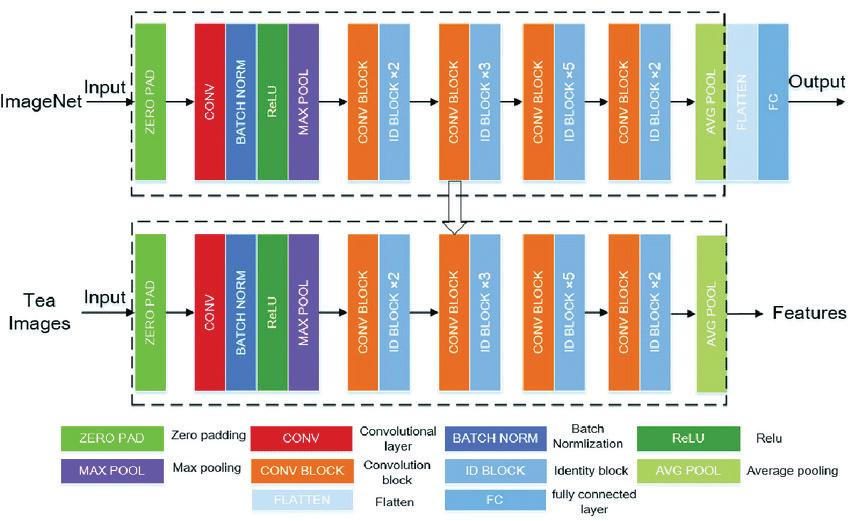
As shown in Figure 2, embedding vectors from a ResNet-50 model occupy about 8 kilobytes per inference. Transmitting these compact representations instead of raw frames reduces bandwidth demands by factors of 100 or more while retaining key information for centralized analytics.
Cost planning must evaluate bandwidth charges, cloud ingress fees, storage costs, and inference API expenses. Streaming full video often exceeds the value of the insights it supports, particularly in high-volume or low-margin deployments. Enforced bandwidth budgets, implemented through configuration and code, prevent individual nodes from consuming shared resources and reduce the risk of fleet-wide instability.
Although bandwidth budgets constrain transmission rates, deployments must also maintain operation when available bandwidth fluctuates.
Implement buffering and backpressure to prevent cascading failures
Edge AI demonstration code often assumes the network provides unlimited buffering capacity, absorbing any volume of data without delay or loss. Production systems require explicit buffering strategies and backpressure mechanisms for each link and workload, with rules for what to drop, downsample, or delay when network conditions degrade.
Deployment-ready designs should implement three controls:
1. Size-bounded queues: Allocate local queues for credible outage durations to prevent memory exhaustion and maintain application stability. For example, a factory vision system may buffer 60 seconds of anomaly detections to ride through short connectivity losses without losing critical alerts.
FIGURE 1. Representative multi-camera tracking architecture highlighting how video ingestion, detection, and analytics workloads span edge and cloud services. This workflow illustrates why highrate sensor streams generate bursty traffic that stresses bandwidth and buffering strategies in production deployments. NVIDIA
2. Activate fallback modes: Maintain real-time inference, local alerting, and closed-loop control during extended disconnections. Safety functions don’t rely on a remote round-trip. High-priority events remain in local storage until connectivity returns, then upload through rate-limited background processes.
3. Apply backpressure upstream: Reject new data at the source, reduce sampling rates, or shift to lower-fidelity modes when downstream components can’t keep pace. These controls prevent saturated links from causing memory pressure, application failures, or data loss across multiple subsystems.
While buffering strategies maintain operational continuity during network failures, deployments must also secure device identity and authentication at scale.
Scale certificate management through automation and hierarchy
Edge AI demonstrations typically use shared keys or manual provisioning to simplify setup and avoid the overhead of managing device identities at scale. In production, each device must hold a unique cryptographic identity with automated issuance, rotation, and revocation across the full lifecycle.
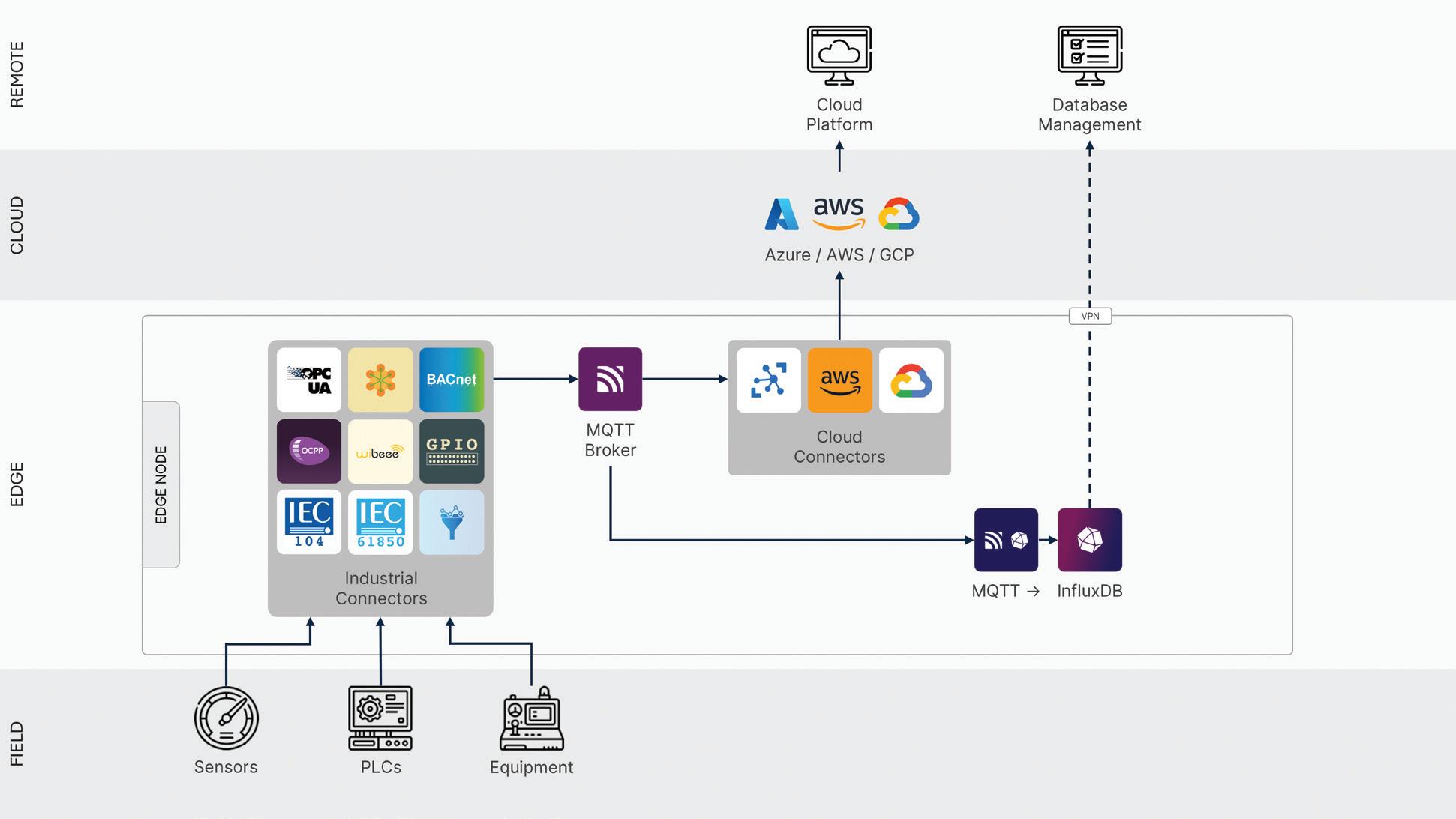
As shown in Figure 3, production deployments span heterogeneous field devices, message brokers, and cloud services that securely authenticate across edge-cloud boundaries.
To support this requirement, a public key infrastructure or cloud IoT identity service should provide zero-touch provisioning, with devices obtaining certificates automatically during their initial connection. Segmented certificate hierarchies separate test and production roots, isolate customer tenants, and limit the scope of a compromise.
Automated rotation cycles refresh device certificates at predictable intervals, often every 90 days, while root certificates persist for one to three years. Rotation occurs during normal operation without service interruption,
FIGURE 2. ResNet-50 feature-extraction workflow showing how a pretrained convolutional network produces compact high-level embeddings from image inputs. These embeddings are far smaller than raw video frames, which reduces bandwidth requirements for edge-tocloud transfers. ResearchGate
FIGURE 3. Representative edge-to-cloud architecture showing heterogeneous field devices connecting through industrial protocols, message brokers, and cloud services. Production deployments use public key infrastructure to authenticate these distributed components at scale and to secure communication across edge and cloud boundaries. Barbara Tech
and systems must track expiration dates and initiate renewal well before certificates lapse.
Edge AI deployments also require revocation mechanisms that invalidate compromised credentials across the fleet. Certificate revocation lists or online status services allow devices to verify peer certificates before establishing connections. These controls prevent compromised devices from communicating with backend systems or other nodes, even if private keys are exposed.
With identity and authentication secured, deployments must also determine whether cloud connectivity supports the application or instead introduces unnecessary risk.
Identify when cloud connectivity becomes a disadvantage
Edge AI cloud connectivity is counterproductive when excessive data transfers or round-trip times increase
Electronic Engineering
cost, latency, or operational risk more than they improve outcomes. This occurs when systems stream high-rate sensor data for time-critical decisions, pay more in egress and inference fees than the resulting insights justify, or rely on cloud services for functions that must continue during network outages.
As shown in Figure 4, systems that offload time-critical tasks to remote cloud servers face higher delays and increased failure rates compared to local edge execution. Latency-sensitive workloads should leverage local inference because their control loops operate within tight time budgets.
Manufacturing defect detection typically must respond within 50 milliseconds. Autonomous vehicle perception and control loops execute in 10 to 20 milliseconds, and robotics safety systems act within single-digit milliseconds. Cloud round-trip times often exceed 50
to 100 milliseconds before processing delays, so they can’t support workloads requiring deterministic response times.
Cost evaluations should compare cloud processing expenses with local compute investment. Cloud inference APIs charge per request and add data transfer fees, while dedicated edge hardware can reduce per-inference costs within months for high-volume deployments. Local processing also avoids variable cloud costs that increase during usage spikes.
Hybrid architectures can address these latency and cost constraints by keeping real-time inference and closedloop control local. Cloud infrastructure then supports fleet-level management, model distribution, and analytics that tolerate longer latencies. This structure maintains local autonomy while using centralized resources where they add value.
Summary
Production edge AI deployments require strategic planning for bandwidth budgets, buffering strategies, certificate lifecycle management, and hybrid architectures. Bandwidth planning must enforce per-site limits based on peak conditions, while buffering strategies should maintain operation during degraded connectivity through bounded queues and fallback modes. Certificate management must automate issuance and renewal under a structured public key infrastructure, and hybrid architectures should reserve cloud connectivity for tasks that benefit from centralization while keeping time-critical functions local. DW
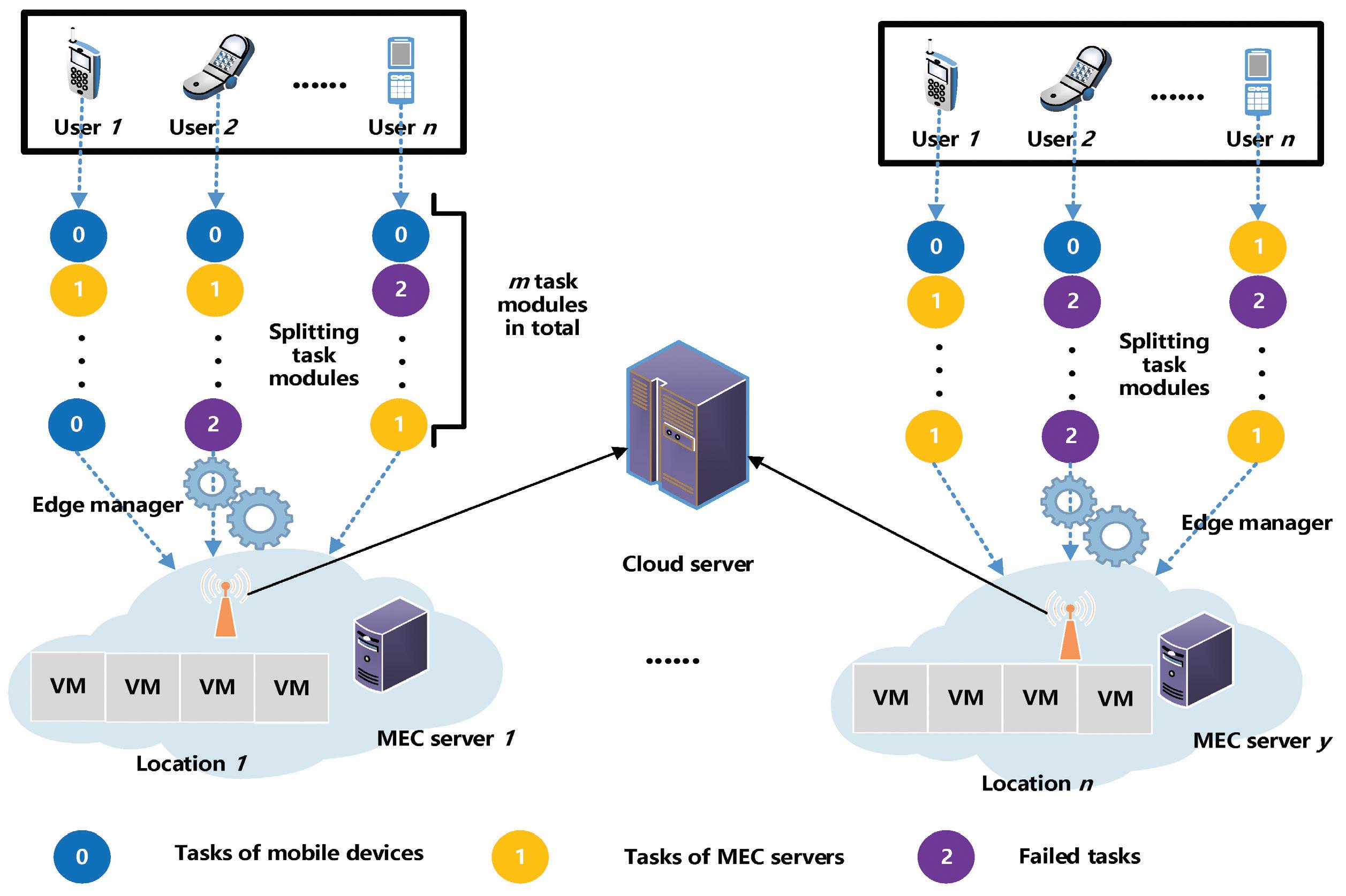
FIGURE 4. Task-offloading architecture illustration comparing local edge execution with cloud-based execution. Latency-sensitive workloads experience higher delays and increased task failures when computation is offloaded to remote cloud servers rather than handled by nearby edge resources. MDPI
COBOTS GETTING SMARTER
ARE AND WORKING CLOSER WITH PEOPLE IN WAREHOUSES
The collaborative robot industry has seen its ups and downs in recent years. The COVID-19 pandemic brought a surge in orders, but in the years following, that surge hasn’t continued. In 2024, orders for robot arms in North America dropped, according to research from the Association for Advancing Automation, or A3.
However, A3’s latest reports show that the industry began to bounce back in 2025, and many indicators point toward a strong 2026. Through these ups and downs, Universal Robots (UR), an Odense, Denmark-based developer and subsidiary of Teradyne, has remained a leader in the industry.
The Robot Report caught up with Keith Fox, the chief product officer at UR, to learn more about how cobots are becoming smarter, safer, and working more closely with humans.
Cobots can do more now, and customers are starting to realize that
Over the past 25 years, robots have grown a lot smarter and more capable, but a lot of end users are still hung up on the difficult-to-use robots they remember from their early days in engineering, Fox said.
“As humans, we have long memories, and we remember how hard it was,” he noted. “Most of the people who
are making those financial decisions today were young engineers or young operations managers at the time when it was really hard. So, I think we have to continually educate them.”
“The good news is that people who are of the younger generation don’t have the stigma of how hard it used to be,” added Fox. “I think they’re a lot more hands-on today, and they’re willing to actually accept mistakes and failures and keep going and iterate the process.”
At the same time, cobots are easier to deploy than they ever have been. Twenty years ago, someone deploying a robot might have to shut down operations for up to two weeks, Fox said.
BRIANNA WESSLING • THE ROBOT REPORT
“From the time you take it off a truck, move it into the plant, wire it all in, and get the plant saying it’s working, we would plan a crew for two weeks,” he asserted. “That’s a lot of time and a lot of labor on our side to execute.”
“On the customer side, that’s a lot of product downtime that they have in their plan, where they can’t run their product, or they have to do workarounds,” said Fox. “Today, most of our partners that are doing palleting can deploy a robot in one to two days.”
UR has done a lot of work to get to this point, but this still isn’t fast enough for it. The company’s team would eventually like to push its deployment time down to one day, according to Fox.
UR is getting cobots ready for AI In recent years, artificial intelligence has been a dominating force in the robotics industry. Everyone is rushing to find the best ways to create robust physical AI models, and get those working on robots.
OUR ROLE IS TO CONTINUE TO BUILD THE BEST ROBOT PLATFORM THAT WILL WORK WITH ALL THOSE DIFFERENT AI MODELS.
Yet Universal Robots isn’t concerned about building AI models completely from scratch.
“[AI] is an area we are very interested in, and it’s an area we are very active in,” said Fox. “Our role is t o continue to build the best robot platform that will work with all those different AI models. In doing so, we’re building new hardware and software capacity into our platform, right in the control box.”
UR is interested in building specific applications on top of existing AI models such as those built by Intrinsic, OpenAI, or Microsoft. With its direct connection
Camera-based AI from robominds enables cobots to do more complex tasks.
Universal Robots
to end users, the company is wellpositioned to develop these specific use cases.
“It’s kind of a three-way relationship that we have with our platform, these learning model companies, and then the end customers, who are the ones that need to see the benefit. Otherwise, all the work we do and all the work they do is for nothing. So we try to bring in that manufacturing aspect and the real-world aspect back to our platform and back to the developers of these learning models,” Fox said.
At the same time, UR is also working closely with its partner ecosystem, including companies that make vision cameras or grippers.
“We’re working really hard with them to make sure that their tech is more embedded into the robot, so that it can better take advantage of the language models,” Fox said.
Cobots work alongside humans Force- and power-limited robots, commonly known as cobots, are designed to be safe around humans, Fox noted. They don’t require safety fences or a safety cage.
“If I look at where we’re actively talking with customers right now around how they can use automation in coordination with their human capital, it’s really around autonomous mobile robots [AMRs] and cobots loading and unloading AMRs, which our sister company MiR [Mobile Industrial Robots] has,” he said.
Fox said he sees a lot of customers use a forklift to pull material from warehouses and deliver it to the material line side. From there, an operator comes to pick up boxes. This requires multiple people constantly moving back and forth across warehouses, or even between multiple buildings, just to get material where they need to be for production.
“In today’s world, you can have an AMR deliver that material to a cobot station,
where it can open the box, take out pieces of material or smaller boxes, and put them on a gravity feed conveyor that takes it right to the operator line side,” Fox explained.
“If you talk to these end users, a lot of their waste in the manufacturing process is the time the operator was walking from where they’re actually doing value-added work over to the box to get the part,” he said. “So, we’re trying to minimize the non-value time an operator spends in a factory by using automation, and we let the operator do the value-added work, which they’re really good at.”
Giving these tasks to robots means the human workers are freed up to do things that are too difficult for robots to handle.
“There’s a lot of use cases we’re working on right now, like in the electronics industry and the automotive industry, to make sure these parts get to the operator lineside in the most efficient way possible,” Fox said. RR
A UR20 cobot works with a human associate for palletizing.
Universal Robots
Standard Bots designed its cobots to be easy to set up and use even without an engineering degree.
Standard Bots
SHOULD BE AT THE CENTER OF AUTOMATION DECISIONS WHY WAREHOUSE WORKERS
BRIANNA WESSLING THE ROBOT REPORT
Oftentimes, decisions to automate are driven by high-level people within an organization. They use analytics and other company information to decide what to automate first, how many robots to bring on, and what kind of robots they need.
Zach Tomkinson, the chief commercial officer at Standard Bots, thinks end users should take a different approach. Standard Bots is a rapidly growing developer of collaborative robots. In 2025, the company grew its 2024 revenue by over six times, and its headcount is now over 120 people. Tomkinson said he hopes it will reach 200 by the end of the year.
“I always tell this to factory managers when they ask me, ‘What do you think we should automate? What tasks should we go after first?’ I usually say, ‘Talk to your workers,’” Tomkinson told The Robot Report. “The people who know what tasks should be automated are actually the ones doing the tasks. They’re the smartest ones around it. They might not have the best educational degree, but they know that process better than anyone else. They know when it works well and when it works wrong.”
Beyond making initial decisions on what to automate, the people working on warehouse or factory floors with the robots might be the biggest factor contributing to the success or failure of any deployment.
AI is making robots easier to use, which makes people’s jobs easier In commercial facilities, every second of downtime is revenue lost. Robots can work around the clock, but deploying them can be a tedious process that takes days or weeks.
“I remember sitting with a customer who had bought 100 systems from me in the past,” Tomkinson said. “This was probably in 2022, and I remember joking and saying, ‘I know you think this is copy and paste because you have 100 of the exact same machine, but this is still a bit bespoke, and every single one of these needs some custom love to be deployed.’”
“At the time, you could copy over a lot of the code from robot to robot, but you still needed to make adjustments with each robot to take into account any tiny differences they might experience,” he recalled.
After 100 robots were deployed, Tomkinson said it certainly felt like his team had deployed 100 robots.
“AI would have made it so you would have copied the code over, and then that final tweaking that was specific to each cell,” said Tomkinson. “Maybe the part is a little bit different, or the location was off by an inch or two. Those really specific moves are going to be able to be solved and handled with perception giving data for AI to use for decision making.”
This technology also makes the robots easier to work with, which means even someone without an engineering background can reprogram the system.
Prioritize upskilling workers
When robots enter the picture, most people have a knee-jerk fear of being pushed out of their jobs by automation. But that’s not the goal for Standard Bots, Tomkinson said. Instead, the company wants robots to take on dull, repetitive tasks that can wear down people’s bodies and then move people to tasks that are better suited to humans.
“I think it’s on us to upskill all of these workers into being more capable,” he said. “Standard Bots really does believe in educating the next workforce, and we have a lot of strategic plans around how to upskill these types of workers across America.”
Standard Bots’ stated goal is to give people a tool to master the work they're doing, with cobot doing much of the execution.
“They can know exactly where [an item] needs to go and what [the robot] needs to do, but they don’t have to be the ones doing this all day, every day, for their whole lives,” Tomkinson said. “The robot can be doing it, but the operator knows when there’s an error, and they know how to tweak it.”
How to balance safety with performance
With force- and power-limited robots working alongside employees, safety is crucial.
“First and foremost, absolutely, human safety is critical,” Tomkinson acknowledged. “I think we need to be very cognizant of how to make this a safe tool for people to use. But also, I do think in some cases, the safety standards can go a little far without taking into consideration how this can become a tool.”
For cobots, especially, there’s a constant tradeoff between making a robot strong and capable enough to do difficult tasks, but still safe enough to fit standards that allow the robots to work around people without a cage or safety fence.
“We allow people to use drill bits all day, every day. If you did something wrong with a drill, you could hurt yourself, right? You need to be educated on the
safety precautions and torquing limits and things like that, but we also allow them to use that drill every day as a tool,” Tomkinson said. “Sometimes, I do think the safety standards focus on safety being overarching and not nuanced.”
He also pointed out that in the early 1900s, when cars were first made, if someone wanted to drive into a city, they would have to have a person on a horse ride ahead of the car waving a red flag, called “red flag traffic laws.” Obviously, these laws seem counterintuitive today, but at the time, they were put in place to keep streets safe.
“I think there are some examples of that today, where we need to create guardrails, ways of making sure that we use the technology as needed without creating really long-standing difficulties for longterm adoption,” Tomkinson said. “One thing for us is to make the product as safe as possible through its design, and making really sophisticated interface models and touch sensing, so that the product can react with a very high frequency rate and to humans in the space.”
He also pointed out that putting cameras in the space around the robot can be a good way to add an extra layer of safety. “You have safety on the robot, you have safety on the cell, you have safety scanning around. You have a multi-pronged approach to have multiple redundancies and potential ways to stop,” Tomkinson said. RR
An easy-to-use interface is essential to democratizing use of robotics. Standard Bots
US PACKAGING LAWS
RESHAPE SUSTAINABLE MATERIALS AND MACHINE DESIGN
As new U.S. packaging laws take effect in 2026, OEMs and industry organizations spoke with Packaging OEM about how these changes affect materials, machine design, and long-term planning.
A2026 US packaging laws
SARAH WYNN SENIOR EDITOR PACKAGING OEM
reshape sustainable materials and machine design
As new U.S. packaging laws take effect in 2026, OEMs and industry organizations spoke with affect materials, machine design, and long-term planning
s several new packaging laws are implemented across the United States in 2026, equipment suppliers and industry organizations are speaking with Packaging OEM about how these regulatory changes affect format selection, machine design, and long-term planning.
Legislation includes expanded polystyrene bans, restrictions on Per- and polyfluoroalkyl substances (PFAS) in food packaging, and post-consumer recycled (PCR) content mandates.
From flexible films to paper-based solutions, the packaging industry is actively responding to regulatory requirements that impact materials and machinery decisions nationwide.
Recyclability and PCR expectations take hold
Several of the laws being implemented this year center on recyclability claims and raise expectations for recycled content in packaging.
Crystal Bayliss, interim executive director of the U.S. Plastics Pact, shared how OEMs should approach designing sustainable packaging.
“One of the most important things companies should be thinking about now is designing for recyclability and recycled content at the same time,” said Bayliss.
She added that meeting those expectations requires coordination across the packaging
supply chain. Whether it’s material suppliers, converters, OEMs, or brand owners, everyone is responsible for ensuring packaging is not only recyclable but fit for purpose.
“Meeting those expectations won’t happen in silos. It will require close collaboration,” said Bayliss.
She also pointed to the Association of Plastic Recyclers (APR) Design Guide, which offers criteria for formulating recyclable packaging. She encouraged companies to use the tool and collaborate with partners early in the packaging development process to address both performance and machinery compatibility.
As manufacturers respond to PFAS restrictions and expanded polystyrene bans in certain states, TOPPAN Packaging is testing new materials and resin blends
Multi-Conveyor engineered a material handling system to elevate and transport, or redirect, single-serve coffee pods up to a metered scale. The design assists in handling the oddly shaped pods while keeping the product moving without a lot of manual intervention.
Multi-Conveyor
“Developing and working with
said Astrid Torres, senior manager of global sustainability at TOPPAN Packaging. “When using new resins
or new materials, challenges are almost inevitable at the start.”
Torres provided an example of film development on a blown machine direction orientation (MDO) line.
“Success depends on fully understanding the resin or the resin blend properties and what the equipment can realistically handle and offer,” she said. “Having all parties involved in a trial often uncovers improvement opportunities; sometimes it is about tweaking resin blends, adjusting processing parameters, or modifying something on that equipment.”
TOPPAN has also expanded its footprint in flexible packaging, a format on the rise in popularity due to its lightweight nature, sustainability advantages, and transportation efficiencies. Included in its portfolio is EnviroFlex Paper, which offers barrier options designed for curbside recyclability.
Additionally, TOPPAN has worked with end-users such as Nylabone to earn recognition in the sustainable packaging category of the 2025 AmeriStar Awards. “This Forest Stewardship Council (FSC)certified paperboard solution will help eliminate over 40 tons of plastic annually,” said Torres.
The company is also increasing the use of PCR materials in flexible and thermoformed packaging formats. Torres said this reduces reliance on virgin plastics
and supports compliance with state-level mandates.
Machinery adapts to evolving materials
As regulatory requirements vary state by state, Wisconsin-based Multi-Conveyor says adaptable machinery remains a priority for end-users.
“These key elements require modular and adaptable equipment built to grow with their long-term objectives, like the conveyors we currently create,” said Cheryl Miller, director of marketing at Multi-Conveyor.
As products and formats multiply, machine builders must remain nimble to keep throughput consistent without constantly reconfiguring line layouts to meet changing regulatory and consumer demands.
In response, Multi-Conveyor offers adaptable conveyance systems. “That simultaneously increases original purchase longevity, which also means lower impending equipment costs for our customers year after year because they're not buying repeat equipment at every product changeover or plant upgrade,” said Miller.
Sustainability and regulatory pressures are also changing how customers choose packaging equipment, according to BW Packaging, a Barry-Wehmiller company, which offers vertical form-fill-seal (VFFS) baggers, flow wrappers, and scales.
The BW Packaging Hayssen X850 flow wrapper is designed for high-speed cheese packaging with long dwell time and high-integrity sealing.
BW Packaging
packaging oem
“We are seeing some customers choose partners who are prepared to address sustainability concerns and progress sustainability initiatives,” said Maggie Tucker, global sustainability leader at Barry-Wehmiller. “They are potentially interested in products that are more resource efficient, have the capability to run sustainable materials, and reduce environmental impacts.”
Jim Kolmus, vice president of innovation at BW Packaging, said customers are prioritizing operator ease of use as the manufacturing industry continues to face a workforce shortage.
“As we meet with customers, one theme consistently rises to the top: simplicity,” said Kolmus. “Reducing machine complexity and making equipment more intuitive is essential, especially given the ongoing turnover in customers’ plants.”
The digital transformation impacting packaging lines is also affecting operator training and workflows, says Kolmus.
Rolls of paper at Ranpak’s Concord Township, Ohio, facility is stacked nearly to the ceiling, ready for processing on the plant’s automated production lines.
Sarah Wynn
“Customers are also asking for easily accessible training videos and modules that help new employees get up to speed quickly,” he said. “Ultimately, any solution that accelerates employee productivity is highly valued.”
Automation targets material reduction As restrictions on certain single-use plastics expand in the U.S., some packaging providers are focusing on automation designed to reduce material use.
Ranpak offers automated equipment such as its Cut’It Evo machine, which utilizes right-sizing technology to adjust box height and reduce excess void space.
“This prevents the common problem of over-packing and material waste, ensuring manufacturers use the absolute minimum of paper resources required to safely protect the product,” said Bryan Boatner, chief revenue officer at Ranpak.
The company is also enabling a shift from plastic to paper by helping companies eliminate single-use plastics such as bubble wrap. It’s a transition ecommerce giant Amazon made in 2024, swapping plastic air pillows in its North American shipments for ecofriendly paper filler.
“Ranpak’s automation is exclusively designed for paper – a renewable, biodegradable, and curbsiderecyclable material,” said Boatner. “Our automation makes high-volume paper packaging operationally viable, allowing high-throughput facilities to ditch plastic tape and air bags without sacrificing speed or efficiency.”
Ranpak also leverages its DecisionTower platform, an artificial intelligence (AI)-driven 3D inspection system designed to detect out-ofscope boxes and optimize packaging line performance.
Ranpak’s facility in Concord Township, Ohio, produces about 1,500 feet of paper per minute and integrates packaging design, paper testing, automated production lines, and on-site research and development.
An operator is shown moving bundles coming off fanfold paper machines.
Sarah Wynn
Machine builders remain central in 2026
As 2026 implementation timelines move forward, companies across the industry are adjusting materials and workflows. One thing is certain – machine builders remain critical to ensuring those changes run effectively.
“OEMs and manufacturers are not just adapting to new materials,” said Torres. “They are also enabling the future of sustainable packaging by aligning equipment capabilities with innovation.”
OEM
BOSCH REXROTH EXPANDS APPBASED AUTOMATION PLATFORM WITH
ctrlX OS
Bosch Rexroth’s ctrlX OS brings an app-based approach to packaging automation, giving OEMs the ability to run applications on Bosch and third-party hardware.
SARAH WYNN • SENIOR EDITOR • PACKAGING OEM
Bosch Rexroth shared updates to its ctrlX automation platform during a recent media briefing, outlining how the Linux-based ctrlX OS supports a more modular, app-based approach to packaging machine controls.
For OEMs, the app-based model is designed to simplify control architecture while supporting faster changeovers, smaller engineering teams, and production lines built with equipment from multiple vendors.
Bosch Rexroth detailed how ctrlX OS can run across Bosch and third-party hardware. The approach allows OEMs to add functionality through applications
rather than fixed control logic tied to programmable logic controllers (PLCs).
“Our ctrlX automation platform is an app-based system running on our various hardware or even other hardware because we have this ctrlX OS, which is a portable operating system that can run on different hardware,” said Dave Cameron, director of product and project management at Bosch Rexroth.
What an app-based approach means for packaging controls
ctrlX OS delivers motion, vision, connectivity, and data capabilities through software rather than tying functionality
A Bosch Rexroth ctrlX drive on display at Automate 2025 in Detroit, Michigan. It’s part of the company’s app-based ctrlX automation platform running ctrlX OS to deliver modular motion, connectivity, and data capabilities for packaging equipment. Sarah Wynn
packaging oem
to a single control architecture. Like on a smartphone, applications can be added, updated, or removed as machine requirements change, without reworking the underlying system.
“It is very open and very scalable,” said Dave Boeldt, product manager at Bosch Rexroth, in an interview with Packaging OEM. “Security is number one, and then number two is the way that they have the openness to be able to connect to different devices. For packaging, we have the full spectrum.”
That openness is supported through Bosch Rexroth’s ctrlX World ecosystem, which now includes more than 110 technology partners. Applications support standard industrial protocols and mixedvendor requirements.
One example is the Device Bridge app, which allows machine data to be collected without changes to existing machine programming. Data can be visualized using tools such as InfluxDB and Grafana dashboards, supporting packaging use cases such as predictive maintenance, overall equipment effectiveness (OEE) tracking, and energy monitoring across mixed-vendor production lines.
The platform also works with thirdparty controls/PCs from Wago, Advantech, and Dell.
Bringing AI and vision to the controller
Bosch Rexroth is also extending intelligence to the controller level through artificial intelligence (AI) and vision applications running on ctrlX OS.
Recent additions include the Hailo-8 AI module and vision applications such as HD Vision and LumiScan. These tools are designed to support inspection tasks on packaging equipment, including fill-level verification, surface defect detection, and label inspection.
“AI has been a really big hot button item in today’s day of age with industrial manufacturing and adding features with sensing and vision,” said Garrett Wagg, product manager for controls at Bosch Rexroth.
Bosch Rexroth has also outlined future AI tools focused on simplifying engineering and configuration tasks at the controller level. “In the future, you’ll be able to say, put together this motion profile, or something along those lines, into a PLC,” Boeldt said.
Balancing openness with built-in security
As packaging environments become more connected, Bosch Rexroth emphasized that cybersecurity is built directly into the ctrlX platform architecture. Security features include secure boot, sandboxed applications, a trusted platform module (TPM) chip, and VPN and firewall applications.
These protections are designed to support compliance with the European Union’s Cyber Resilience Act, which introduces legally binding cybersecurity requirements for connected products beginning in 2027.
“With the Cyber Resilience Act, it’s shifting the voluntary best practices and guidelines that are now available and making them legally binding obligations that must be followed with any product that is connected to a network,” Boeldt said.
Bosch Rexroth said the ctrlX platform is designed to support increasingly software-driven packaging systems as OEMs balance flexibility, connectivity, and security requirements. OEM
Ryan Ashdown rashdown@wtwhmedia.com 216.316.6691
Jami Brownlee jbrownlee@wtwhmedia.com 224.760.1055
Mary Ann Cooke mcooke@wtwhmedia.com 781.710.4659
Mike Francesconi mfrancesconi@wtwhmedia.com 630.488.9029
Jim Powers jpowers@wtwhmedia.com 312.925.7793
CEO Matt Logan mlogan@wtwhmedia.com
CFO
Ken Gradman kgradman@wtwhmedia.com 773-680-5955
DESIGN WORLD does not pass judgment on subjects of controversy nor enter into dispute with or between any individuals or organizations.
DESIGN WORLD is also an independent forum for the expression of opinions relevant to industry issues. Letters to the editor and by-lined articles express the views of the author and not necessarily of the publisher or the publication. Every effort is made to provide accurate information; however, publisher assumes no responsibility for accuracy of submitted advertising and editorial information. Non-commissioned articles and news releases cannot be acknowledged. Unsolicited materials cannot be returned nor will this organization assume responsibility for their care.
Subscription Rates: Free and controlled circulation to qualified subscribers. Non-qualified persons may subscribe at the following rates: U.S. and possessions: 1 year: $125; 2 years: $200; 3 years: $275; Canadian and foreign, 1 year: $195; only US funds are accepted. Single copies $15 each. Subscriptions are prepaid, and check or money orders only.
Subscriber Services: To order a subscription or change an address visit our website at: www.designworldonline.com
DESIGN WORLD (ISSN 1941-7217)
USPS PUBLICATION #25146 is published monthly by: WTWH Media, LLC; 1111 Superior Ave., Suite 1120, Cleveland, OH 44114. Periodicals postage paid at Cleveland, OH & additional mailing offices.
POSTMASTER: Send address changes to: Design World, 1111 Superior Ave., Suite 1120, Cleveland, OH 44114
Technical Thinking
By Mark Jones
Why the 7-gram microplastics study fell apart
Susan, my friend, really put me on the spot. It was at an American Chemical Society national meeting, a session about microplastics. I was due to speak in 30 minutes. It was my first technical presentation on my microplastics research. The moderator announced a paper had been withdrawn and asked everyone to return on time for the next talk, my talk. Susan popped up and proposed a discussion. The moderator, looking a bit confused, asked, “What would we discuss?” Susan pointed to me and said “Mark told me last night that the 7 grams of plastic in a human brain study had to be wrong. Mark, why don’t you tell everyone what you told me?”
A study finding microplastics in human brains was getting a lot of attention. CBS Mornings is what really got things rolling. The hosts holding black plastic spoons to their temples shined a bright light on the work. Total mass concentrations measured by pyrolysis GC-MS in 52 brain samples averaged 4,040 mg/kg with the highest measurements equaling about 7 grams per brain, about the weight of a plastic spoon. Microplastic levels were higher in 2024 brains than 2016 brains by about 50% and found to correlate with dementia. The only “good” news was that microplastics do not appear to shorten life. Polyethylene was measured as the most prevalent polymer. Polypropylene and PVC followed. I knew it could not be true.
My argument centered on two main points. The first was that there are no credible studies of plastics exposure that could get 7 grams in a brain over a lifetime. The second was that the analytical chemistry must be flawed. Plastic particles have to get into the blood and then through the bloodbrain barrier to get into the brain. Only exceedingly small paricticles, nanoplastics, can get through. Google microplastic exposure and you may get 5 grams per week. That’s been discredited. It is more like 5 grams in 23,000 years. Seven grams of nanoparticles getting into the brain in a lifetime isn’t credible.
Pyrolysis GC-MS is a technique that uses heat to blast apart a sample. Fragments are different for different polymers and measurement of the fragments gives the amount of polymer in the sample. Fragments can tell a lot about the sample but can also be confounded. The term of art is “matrix effects.” That is the technical way of saying that techniques that are accurate for a pure sample can get messed up when dealing with mixtures.
Some polymers, like polystyrene, depolymerize and produce styrene. Detection of styrene guarantees the presence of a styrenic polymer. Polyethylene and PVC don’t cleanly depolymerize. Polyethylene falls apart to a range of oligomers, polymer chunks that are smaller than the starting polymer but still multiple
monomer units. PVC is even more complicated. Liberation of HCl causes a cascade of reactions. The standard pyrolysis method quantifies on naphthalene. The pyrolysis of lots of stuff makes naphthalene. The levels of PVC just had to be a red herring. The measured concentration was higher than other polymers that are more prevalent in the real world. The very high polyethylene levels had to be due to an interference. The same oligomers can form from polyethylene pyrolysis can come from lipids. The brain has lots of lipids. The method had to be counting lipids as polyethylene.
Fast forward to today and it looks like I got it right. There is a growing literature arguing the shortcomings and false positives coming from pyrolysis GC-MS. A letter to the editor questions the validity of the original brain study. Questions about the metabolic load 7 grams of plastic would place on the brain have also been raised. The authors of the original study offered a rebuttal but I don’t find it compelling. Seven grams per brain isn’t correct. Calls for better validation of methods are growing as are calls to be suspect of pyrolysis GC-MS for microplastics analysis in biological samples. It looks like I got it right. DW
INTRODUCING THE NEW
NESTAWAVE
COMPACT POWER, PRECISION PERFORMANCE
ᘩ High-force with significant travel
ᘩ Offers spring rate flexibility
ᘩ Produced from one piece of wire for consistent load properties
ᘩ Ideal for replacing stacks of Belleville washers