2o22 ANNUAL REPORT

WESTERN PENNSYLVANIA CONSERVANCY

I’m pleased to share the Western Pennsylvania Conservancy’s 2022 Annual Report, which highlights our progress during the year. Thank you for your wonderful generosity and support of our work—you play an essential role in our success.
We celebrated a milestone in 2022: 90 years in existence! During the nine decades since the Conservancy began, the scope and impact of our work have steadily grown. We protected more than a quarter of a million acres of natural lands in Pennsylvania, helped to establish 11 state parks, protected or restored more than 3,000 miles of rivers and streams, planted more than 105,000 trees, and steward Fallingwater, which is on the UNESCO World Heritage List. We also plant and maintain 130 community flower gardens in 20 counties, and provide more than 41 nature preserves for all to enjoy, free of charge.
2022 was the first year of implementing a new strategic plan. Our 2022-2024 Strategic Plan outlines how the Conservancy’s work will progress over the next several years through 21 strategic initiatives that are informed by science and current and future issues facing nature and our region as a whole. As always, these initiatives are tied to our mission.
Our land protection work advanced with more land added to our preserves, which are open to the public for hiking, fishing, walking, nature watching,
hunting and exploring. One of those preserves, Dutch Hill Forest, is near the Clarion River, which is one of the best rivers in Western Pennsylvania for paddling and nature watching.
Conservancy staff improved the health of local streams and rivers, protected some of our most rare species and habitats, and made advancements in our community greening work. This work is making cities and towns across the region greener and more livable.
Fallingwater is bouncing back from operational changes and challenges of the COVID-19 pandemic. Our staff there have placed an emphasis on innovation in many ways, including how we offer experiences at Fallingwater, a symbol of people living in harmony with nature. You’ll read more about tour experiences, Fallingwater Institute programming, and a major preservation initiative that is underway.
Please enjoy this look back on 2022. Because of your ongoing commitment, more people are being introduced to our work and we continue advancing conservation efforts in our region and preserving Fallingwater for future generations. Thanks again for your generous support.
Thomas D. Saunders PRESIDENT AND CEO
OFFICERS
Debra H. Dermody Chair
Geoffrey P. Dunn Vice Chair
Daniel S. Nydick Treasurer
Bala Kumar Secretary
PRESIDENT AND CEO
Thomas D. Saunders
The Western Pennsylvania Conservancy protects and restores exceptional places to provide our region with clean waters and healthy forests, wildlife and natural areas for the benefit of present and future generations. To date, the Conservancy has permanently protected more than 265,000 acres of natural lands. The Conservancy also creates green spaces and gardens, contributing to the vitality of our cities and towns, and preserves Fallingwater, a symbol of people living in harmony with nature.
For information on WPC and membership

412-288-2777 | 1-866-564-6972
info@paconserve.org | WaterLandLife.org
Alfred Barbour
David Barensfeld
Franklin Blackstone, Jr.*
Barbara H. Bott
E. Michael Boyle
Marie Cosgrove-Davies
Beverlynn Elliott
Donna J. Fisher
Susan Fitzsimmons
Paula A. Foradora
Dan B. Frankel
Dennis Fredericks
Felix G. Fukui
Caryle R. Glosser
Carolyn Hendricks
Candace Hillyard
Thomas Kavanaugh
Robert T. McDowell
Paul J. Mooney
Stephen G. Robinson
Samuel H. Smith
Alexander C. Speyer III
K. William Stout
Megan Turnbull
Joshua C. Whetzel III
Gina Winstead
*Emeritus Director
IN MEMORIAM: One of our dedicated board members, Carolyn Rizza, passed away on Dec. 27, 2022. She was a devoted and beloved community member and a friend to all who knew her. Through her experience, leadership, guidance and philanthropy, she made significant and enduring contributions to our work and the community.
FRONT COVER: Protected in 2022, Bentley Run Wetlands in Erie County is open to the public for hiking, wildlife watching, hunting and fishing. BACK COVER: The beautiful and wild Allegheny River is among the most biologically diverse watersheds in Pennsylvania.1,o25 acres permanently protected and saved for nature and future generations

3o stream miles restored
1,785 youth and adult learners participated in various Fallingwater Institute and other Fallingwater education programs
7,o67 volunteers planted community gardens and 763 planted trees
land steward volunteers gave
1,481 hours
543 new records for reptiles and amphibians added to the conservation database

The Conservancy continued working with numerous community and philanthropic partners to advance various tree and garden projects across the region in 2022, all helping to make Western Pennsylvania’s communities greener and healthier. Some of the 2022 progress included 1,107 new street and park trees planted, 130 gardens installed in cities and towns, and bursts of pink along downtown riverfronts and trails from Pittsburgh Redbud Project trees.
“The impetus of this work started in the 1970s and, each year since then, we continued assessing how our work can make more of a community impact,” says Cynthia Carrow, vice president of government and community relations for the Conservancy.
“Over the last 15 years, however, our work has greatly evolved and we now offer an even more robust set of greening opportunities. We continue to
prioritize opportunities for everyone to participate in and benefit from regional greening efforts.”
She says those opportunities and priorities include tree and native pollinator plantings to help offset habitat decline, bioswales and rain gardens for stormwater mitigation, ecological assessments coupled with greening recommendations, transforming asphalt and concrete school grounds to greenspaces and outside learning areas, and bringing nature to downtown business districts with tree plantings and flowering planters and baskets.
Cynthia explains this expansion prompted us to “rethink the name of our greening work to more closely align with current priorities and activities.” A new name, Community Greening (formerly known as Community Gardens and Greenspace), has emerged.
Volunteers help care for the new pollinator garden in downtown Pittsburgh at the intersection of Grant Street and First Avenue. In 2022, we created and installed new interpretative signage to help visitors identify plants and anticipated pollinators.
Beautiful, functional and educational describes the rain and pollinator garden that pops with color from native perennials and trees at the corner of Lincoln and Frankstown avenues in Pittsburgh’s Larimer community.
The rain garden, which was installed in 2020, expands the environmental benefits of the Conservancy’s existing community flower garden that has been a community staple at the intersection since 1995. Due to COVID-19 protocols, the ribbon-cutting ceremony took place in 2022.
The garden is adjacent to Pittsburgh Public School’s Lincoln PreK-5, whose students helped to select the flowers and design the garden. During fall 2022, Lincoln teachers and upper grade students worked with graduate students from Carnegie Mellon University’s Entertainment Technology Center to develop augmented reality (AR) experiences that featured simulated demonstrations of the rain garden ecosystem.
“Nature-based learning fosters so many skills, including mindful observation and design-based thinking, that reinforce and enliven the teaching and learning happening in our schools,” says Danielle Forchette, the Conservancy’s conservation education coordinator. “So, we’re pleased to work with students, teachers, staff and partners to create such fun and interactive learning opportunities in their community gardens.”
Allegheny County Executive Rich Fitzgerald attended the ribbon cutting and thanked the Conservancy for its longstanding commitment to community greening and innovations to address stormwater capture.
“This project is exciting because it brings so many things together that we care about in this community and provides an opportunity for our youth to learn about green infrastructure,” he adds.
In downtown Pittsburgh at Grant Street and First Avenue, pollinators have safe nesting habitat full of nectar, pollen and berries as a result of recently planted native trees, herbs, grasses and shrubs. And pollinator-friendly native perennial flowers, including brown-eyed Susan, butterfly milkweed, purple coneflower and goldenrod are also rooted at this garden site.
In 2021 and 2022, Conservancy staff transitioned an existing community flower garden at the location to pollinator-welcoming habitat. Art DeMeo, senior
director of community greenspace services, says the changeover to this type of habitat provides many environmental benefits in a busy urban setting.
“Pollinators are in decline due to increased pesticide use, decrease in natural habitats and increases in non-native invasive plants, so we’re strategically planting more pollinator-friendly plants in several community gardens around the region.”
In addition to Grant at First, other Conservancyowned community gardens, such as at Centre and Herron avenues in Pittsburgh’s Hill District, do triple duty as native pollinator habitat, a community garden and a bioswale that is mitigating stormwater.

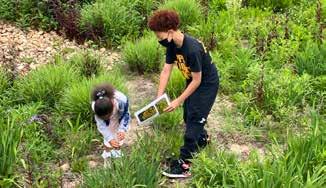
Students from Pittsburgh Public School’s Lincoln PreK-5 engage in nature-based play in this functional rain garden and outdoor classroom in Pittsburgh’s Larimer community.
82O street and community trees planted
2.69 acres of perennial beds that help pollinators thrive 77,648 annuals, 1,787 perennials planted at 13O community garden plants
Approximately 2,ooo individual daffodil bulbs given away to hundreds of community members
 Community members attended several public meetings in 2022 to help inform the Girty’s Run Watershed Conservation Plan. The plan will help shape future conservation decisions for the Allegheny County watershed.
Do you enjoy fishing, paddling or swimming in a clean river, or just drinking a clean glass of water? Remember it hasn’t always been this way! It takes a community working together to ensure great water quality and wildlife habitat. In 2022, the Conservancy continued to partner with landowners, farmers, conservation and community groups and government agencies to protect and restore local rivers and streams from the detrimental effects of abandoned mine drainage, land development, agricultural runoff and other impacts.
The U.S. Clean Water Act, which turned 50 in 2022, established the structure for regulating pollutant discharge into rivers and streams and quality standards for surface waters. WPC has worked with partners to protect and restore more than 3,000 miles of rivers and streams since 2001.
French Creek was named River of the Year in 2022, thanks to the efforts of multiple organizations and agencies. As one of Pennsylvania’s most biologically diverse areas that hosts more than 80 species of fish, 27 species of freshwater mussels, numerous bird species, and our state amphibian, the Eastern hellbender, the 1,250-square-mile French Creek watershed has been a WPC conservation priority for half a century. You can enjoy nature on 15 WPC-owned preserves within the watershed, including West Branch French Creek Conservation Area, Helen B. Katz Natural Area, Lake Pleasant Conservation Area and Franklin Line Canal Natural Area.
Conservancy members took action by asking lawmakers to boost Pennsylvania’s Growing Greener Program by more than $500 million, and it proved fruitful. A large chunk of federal American Rescue Plan funding went to environmental, conservation and outdoor recreation investments, including:
• $100 million to an Outdoor Recreation Program for state parks and forest infrastructure and local conservation and recreation projects
• $220 million to a new Clean Streams Fund
• $320 million to Commonwealth Financing Authority for water, sewer, flood and high hazard dam projects.
Watershed Conservation staff participated in 159 educational, outreach and technical assistance events, including to STREAM Girls Program in coordination with Girl Scouts of America and PA DCNR at Chapman State Park in Warren County. WPC led the stream walk and assisted with watershed education at the event.

This federal funding source supports the Conservancy’s nature-based solutions such as riparian buffers, passive abandoned mine drainage treatment and wetland restoration that prevents flooding and stream degradation.

A 30-mile tributary to Lake Erie, Elk Creek is a popular destination for paddling and steelhead fishing. Its scenic forested buffer along the creek provides miles of important wildlife habitat for bald eagles, warblers, herons and many other birds and animals. The lower reaches of Elk Creek also host various types of wetlands and several beaver and river otter populations.
The Conservancy is completing a streambank stabilization on Elk Creek and enhancing habitat on our Lower Elk Creek Nature Reserve near Girard Township, Erie County. After 10 years of fundraising, we fixed a more than 20-feet-high eroding bank with a 600-feet-long stacked stone wall that took three months to complete. This project will help prevent erosion, sediment and pollutants from entering the stream, ultimately helping to keep the creek healthy and improve water quality.
We completed stream restoration at the former Indian Caverns property on Spruce Creek in Huntingdon County, and removed two dams on Greenlick Run in Fayette County, opening four miles of habitat for fish and other aquatic species.
Preliminary results from a mussel silo study, a partnership with the U.S. Forest Service and PA Fish and Boat Commission to implant juvenile mussels in concrete silos in 13 streams, show the Kiskiminetas River’s water quality supports juvenile freshwater mussels. An 87 percent survival rate of the mussels shows that “The Kiski is on the road to recovery and the proof is in the silos,” says Eric Chapman, WPC’s director of aquatic sciences. Mussels stabilize stream bottoms, add to diversity and are important for water quality: one mussel can filter up to 20 gallons a day.
Before: Elk Creek’s streambank was eroding, causing sedimentation and pollutants to enter the stream and a safety hazard to visitors of the preserve.
After: The Elk Creek restoration project is improving water quality. Strategic placement of a 600-feet-long stone stabilization wall and eight in-stream weirs control erosion. In spring 2023, volunteers planted trees that will further prevent erosion and filter pollutants.


Paddlers have six more places to get on the water in the region, thanks to Canoe Access Development Fund grants the Conservancy provided in 2022.
The Kiski Watershed Association has built two CADF-funded sites on the Kiski River, including one in Leechburg in 2022. Genay Hess, KWA’s president and treasurer, says, “Working with the Conservancy has gone seamlessly and having canoe access on the Kiski is tremendous. Paddling
is a great, affordable activity for families, and a lot of people use the sites to fish, too.” Currently, 88 CADF-supported projects are completed and open to the public along 37 waterways in 21 counties.
Watch “Helping Elk Creek Thrive: Our Decades-long Commitment to a Local Treasure,” a recorded webinar about our work to restore Elk Creek and keep its ecosystem thriving.
With partners and volunteers, we planted 6,21o riparian trees and shrubs in 2022. We have planted 72,828 riparian trees and shrubs planted since 2001.
We removed 11 aquatic organism passage barriers such as inadequate culverts and dilapidated dams so that fish can now freely move and establish habitat throughout the rivers or streams.
We awarded 2o mini grants totaling $41,ooo to 2o local environmental organizations in 13 counties, as part of the 2022 Watershed Mini Grant Program, with funding from BHE GT&S, a Berkshire Hathaway Energy Company.
Fallingwater’s leadership staff began 2022 with a significant and specific financial objective: Raise $2.4 million in additional funding needed for preservation of Fallingwater’s major building systems that need urgent attention.

Thanks to a yearlong effort supported by the generosity of many private donors, foundations and the Commonwealth of Pennsylvania’s Redevelopment Assistance Capital Program, and with the help of a matching grant, fundraising efforts were successful for the “World Heritage Preserved: Forging a Future for Fallingwater” campaign. These generous supporters gave $3 million dollars from 2019 through
2021, but rising costs due to supply-chain issues, inflation and other factors necessitated more funding.
Campaign funds will allow us to replace the waterproofing membranes on the roofs and terraces, repoint and grout stonework to prevent water leaks, conserve steel window and door frames, and repair degraded reinforced concrete.
“This work will be a significant three-year undertaking. We’re preserving a work of architecture that’s much more than just a building. It’s a site inscribed on the UNESCO World Heritage List, so Fallingwater must be preserved at the highest
Fallingwater, east elevation. Photo by Christopher Little.standards possible,” says Justin Gunther, director of Fallingwater and a vice president of the Conservancy. “We’re extremely grateful to everyone who has supported Fallingwater throughout this campaign.”
Work is now underway and being performed by inhouse staff alongside preservation contractors and professionals. To stay up-to-date on this evolving preservation project, go to Fallingwater.org/ WorldHeritagePreservation for progress photos and ongoing updates.

Visitors locally and from around the world experienced Fallingwater’s 59th tour season, which kicked off March 5, 2022. We continued to offer a variety of interior and exterior tour experiences, where visitors gained insights into Wright’s architecture and design philosophy, and discovered the beautiful natural landscape.
One of our most popular tours, the Guided Architectural Tour, provides interpretation of Fallingwater’s most architectural significant spaces, such as the living room and terraces. Visitors also get insights into the collection and close-up views of custom-made furniture designed by Wright specifically for Fallingwater.
A 2022 visitor from State College, Pa., who took the Guided Architectural Tour, says Fallingwater was a fun experience for the entire family. “Fallingwater has always been on my bucket list, and it did not disappoint! Our 11-year-old son has always loved architecture, so we bought him Fallingwater tickets for Christmas. His mind was blown. Definitely worth the trip! We enjoyed every minute it’s a magical place.”
People shared the same sentiments about the In-Depth Tour, too. On hiatus since 2020 due to COVID-19 protocols, the In-Depth Tour returned in 2022 and allows smaller groups of visitors to explore the secondary spaces of the main and guest house.


Our special fundraising event, the Fallingwater Soirée, was back after a two-year hiatus due to the pandemic. Nearly 250 people enjoyed Fallingwater at dusk, with wine, signature cocktails, curated cuisine by Kate Romane of Black Radish Kitchen and the smooth sounds of MCG Jazz. For tickets for the 2023 Soirée on August 12, go to Fallingwater.org/Soiree or scan this code.
Two exhibitions were on view in Fallingwater’s Speyer Gallery last year. “Building Fallingwater” featured a collection, much of it never-before exhibited, of historic photography, archival materials and original film footage of Fallingwater’s main house construction from 1936-1937.
In celebration of Touchstone Center for Crafts’ 50th anniversary, “Touchstone: A Half-Century of Craft,” highlighted the organization’s history and efforts toward promoting craft education in the Laurel Highlands. Fallingwater’s collection, architectural details, and landscape also served as inspiration for six contemporary artists whose unique works in wood, ceramic, metal and paper were on display during the exhibition and auctioned to raise funds for Touchstone.
Charles Lutz, a conceptual artist who grew up in the Laurel Highlands, spent time at Fallingwater in 2020 and 2021 as a Fallingwater Institute artist-inresidence. That experience resulted in the creation

of a limitededition porcelain vase inspired by Fallingwater, the Kaufmann family’s role as tastemakers and retailers, and Ruba Rombic glass, a style of early 20th-century moldblown glassware originally designed by Ruben Haley and sold at Kaufmann’s Department Store.
He also created nine metal sculptures for his installation, “Modern Made Leisure.” The sculptures, which paid homage to Ruba Rombic glassware and the Kaufmann family’s style and taste, were on view throughout Fallingwater in 2022. The vase is available for purchase online at FallingwaterMuseumStore.org or onsite at the Fallingwater Museum Store.
475 students used their design and creativity skills to build homes for gnomes around the world
1,o27 school students experienced Fallingwater
161 people from 47 families participated in Family Field Trips at Fallingwater
Scan here to view our World Heritage Preserved Blog Charles Lutz stands inside the Fallingwater living room holding his vase inspired by Ruba Rombic glassware, which was designed by Reuben Haley in 1928 and sold exclusively at Kaufmann’s Department Store in Pittsburgh.Agood day in nature for Ray Stroud, Jr. of Pittsburgh is off-the-beaten-path fishing and camping. “But, my secret places aren’t so secret anymore,” says Ray, who shares he’s not the only one enjoying the Clarion River’s secluded forested banks.
His favorite spots along the river to relax and cast his rod are within the Allegheny National Forest. When there, he regularly sees eagles soaring, relaxes to the peaceful sounds and observes incredible scenic beauty. “Nature is truly for everyone to learn from, experience and respect, so it’s cool that there are many places in Western Pennsylvania to do that.”
Thanks to the Conservancy’s permanent protection of 140 acres along the Clarion River in 2022, there’s now even more land for Ray and others to enjoy for birding, fishing, kayaking, hiking, hunting and more. Those newly protected
acres also provide one-half mile of forested riparian buffer along the 2019 River of the Year, and expand the Conservancy’s now 630-acre Dutch Hill Forest in Jefferson County.

Dutch Hill Forest offers scenic views of the river, off-trail hiking and steep slopes with extensive thickets of rhododendron and mountain laurel. Since the 1970s, the Conservancy has protected nearly 13,000 acres along the Clarion River, starting with more than 3,500 acres in the southern section of the river.
Ray is planning a camping trip soon to ANF and looks forward to also exploring Dutch Hill Forest to see some of the preserve’s unique features, including the hemlock wetland forest. “I also might find my new, less crowded, fishing spot there, too,” he says hopefully.
The protection of 348 acres in Union Township, Erie County, safeguards unusual geological features and a mature upland forest, which provides a buffer for streams, glacial wetlands and rare plant communities.The protected acres for the forest are among the more than 1,400 total acres in Bedford, Erie, Jefferson and Westmoreland counties that the Conservancy protected in 2022.

Thanks to a donation of 33 acres from Regis and Jamie McHugh to the Conservancy in 2022, land that was once home to the historic Oakford Park in Jeannette, Westmoreland County, will once again be used as a local public greenspace.
Oakford Park opened in 1896 and thousands flocked to the grounds for decades to enjoy the outdoors and amusement park attractions. Although the park closed in 1938, its swimming pool, constructed in 1921, remained open until the 1980s.
“The property sat vacant for years, but we always believed it had so much potential for the greater good to help the community, environment and nature thrive,” Regis says, explaining why they acquired the property in 2020. “We had many good times there and didn’t want to see this important local history vanish.”
Their land donation included a half-mile of forested frontage along Brush Creek and some regenerating woodlands that include oaks, tulip trees and hickories.
The donation has inspired a community effort to help reimagine the public space. Michael Knoop, the Conservancy’s senior director of special projects, is leading the effort.
“We are using our land protection and restoration experience to help advance a community-led process,” says Michael. “With the help of local partners, we want to explore how this future greenspace can best benefit the community and nature. We’re extremely grateful to the McHughs for their donation of nature to benefit the Jeannette, Penn Township and Hempfield Township communities, and the entire region.”
We continued efforts in 2022 to protect critical land in the French Creek watershed in Erie County. French Creek is the most biologically diverse stream of its size in Pennsylvania or any state in the Northeastern United States. That’s why its protection is essential.
To date, the Conservancy has protected more than 5,600 acres within the 1,250-square-mile French Creek watershed, starting with the Wattsburg Fen Natural Area in 1969. The protection of the two properties in 2022 expands outdoor recreation opportunities on two different Conservancy-owned preserves. These protections also keep forestland and habitats in the watershed intact.
We added a 70-acre property to the West Branch French Creek Conservation Area, bringing it to more than 1,000 acres of contiguous forests, wetlands and streams. In Union Township, 40 acres were protected and added to the now 233-acre South Branch French Creek Conservation Area. The protected land includes a 635-foot forested stream buffer that filters pollutants and sediments. The conservation area, which opened to the public in 2018, features a diverse mix of habitats including forests, creek frontage, wetlands, vernal pools and former agricultural fields. A trail leads to a healthy old-growth hemlock stand.
A new conservation easement protects this 289-acre forested property in Cook Township, Westmoreland County. The property provides more than a half mile of frontage along two tributary streams and falls within the Campbelle Run Natural Heritage Area.

Three Conservancy-owned preserves expand by 285 acres in 2022 to offer more land for all to explore for fishing, hiking, boating, walking, hunting and more.
We protected 46o acres in 2022 within the French Creek watershed. To date, the Conservancy has protected more than 6,ooo acres within the biologically diverse river system.
Our longstanding history of expanding state public lands continued in 2022 with the protection of 15o forested acres in Bedford County for State Game Lands 48.
Newly protected land in Heath Township, Jefferson County, expands the Conservancy’s 630-acre Dutch Hill Forest.August’s featured book was “The Hike” by Alison Farrell, which was also reviewed by our staff on our website, with a link to hear the book read aloud. “Wonder Walkers,” written and illustrated by Micha Archer, also reviewed on our website, was displayed during November so that families could view it on National Take a Hike Day, November 17.
On a spring morning, 12 students from Cornell High School’s Greenspace Team and Ecology class visited Toms Run, just across the Ohio River from their school in Coraopolis. The students worked with Conservancy staff as they explored, asked questions and enjoyed the chance to look closely at nature’s small details. In fall, they had naturalist walks with Conservancy staff on their school campus woodlot and at Toms Run, and began a campus tree identification and education project.
Our land stewardship staff and volunteers work to sustain our preserves’ ecological value and improve accessibility so everyone can enjoy nature. Land steward volunteers contributed 1,481 hours in 2022 to help us build, extend or complete trails at Tryon-Weber Woods, Toms Run Nature Reserve, Wolf Creek Narrows Natural Area and Plain Grove Fens Natural Area. At our 108-acre Tryon Weber Woods in Crawford County, we added a new parking area and a 1.3-mile loop trail that leads hikers though a mature beech-maple forest. At Toms Run, we completed a connector trail.
We removed old structures at Bear Run Nature Reserve and Lake Pleasant Conservation Area. Visitors are enjoying improved parking areas at six preserves: Bennett Branch Forest, Lake Pleasant, Plain Grove Fens, West Branch French Creek Conservation Area, Whites Creek Valley Natural Area and Wolf Creek Narrows.
The Conservancy is working closely with the PA Bureau of Forestry to fight the spread of hemlock wooly adelgid, an invasive insect that feeds on and kills our state tree, the Eastern hemlock. At Wolf Creek Narrows, we planted a hemlock insectary, or nursery, for the Ln beetle (Laricobius nigrinus), a natural predator of hemlock wooly adelgid.
With nearly 14,000 acres of forests, streams, wetlands and open meadows in 16 counties, near cities and towns as well as in rural areas, our 41 preserves have a variety of experiences to offer!
Thanks to the 789 donors who generously responded to our “41 Places: Nature Near You Needs You” fundraising campaign in 2021 and 2022, we received $632,000 to improve and enhance the preserves we own and manage across Western Pennsylvania for all to enjoy!
In 2022, staff and volunteers began improvements at several preserves to remove past traces of damage to land, control invasive species and maintain welcoming trails, signage and parking.
“For years, parking was limited at our 243-acre Wolf Creek Narrows Natural Area in Butler County for everyone who wanted to view the spring wildflowers or hike the 1.1-mile loop trail,” says Andy Zadnik, director of land stewardship. “Thanks to generous donors, in 2022, we added a new parking area, which includes a concrete accessible space, to complement the existing parking area. We also created a new half-mile trail to connect with the existing loop.”
We made our 1,040-acre West Branch French Creek Conservation Area more accessible and inviting by removing a deteriorating retaining wall to create a safer parking area and resurfacing the parking lot and universal access pathway.
The littlest hikers enjoyed StoryWalks® in 2022 at our Toms Run Nature Reserve located in Allegheny County. Signs featuring pages of children’s books were displayed along a short, flat trail near the parking lot, where families could enjoy an afternoon discovering nature.
The students said the experiences helped them feel even more motivated to care for their school greenspace and that helped them appreciate nature’s ability to heal itself.
Volunteers and staff cared for 14,139 acres of WPC preserves, and staff monitored over 4o,6oo acres protected by conservation easement.
Volunteers and staff removed 2,18o pounds of trash and debris as part of the annual French Creek Watershed Clean-up.
Contractors treated invasive plants across approximately 36 acres at LeBoeuf Wetlands Conservation Area.

Visit our Explore Our Preserves webpages to plan your outdoor adventure. Search by county, activities, parking availability and size, and find details and directions.

Bucknell student Isaac Buabeng, who is pursuing his master’s degree, is investigating the genetic diversity and phylogenetic relationships among Canby’s mountain-lover populations. His research could help us identify genetically healthy populations that could help save the species from extinction.

Scott connected Isaac and Bucknell postdoctoral fellow Dr. Melody Sain with land managers, stewardship practitioners and field botanists who monitor Canby’s mountain-lover populations and sites in Pennsylvania and West Virginia that support them.
Conservancy scientists scaled cliffs, slogged through wetlands, knelt in fields and navigated forests to assess the locations of native, rare and endangered plants and animals. In 2022, through our partnership with the Pennsylvania Natural Heritage Program, whose partners include the Conservancy, PA Department of Conservation and Natural Resources, PA Game Commission and PA Fish and Boat Commission, conservation science staff reported 113 field surveys. The outcomes of this important work help inform conservation and development decisions statewide.
The importance of protecting native species was underscored in 2022 with the celebration on June 17 of the first Pennsylvania Native Species Day. The day highlights and recognizes the need to protect our state’s diverse native plants, trees, insects, fish, birds and mammals that originated thousands of years ago and thrive in mutual dependence.
Some of the greatest endeavors have simple beginnings…as did the Pennsylvania Natural Heritage Program. In 1982, GIS and GPS were still military secrets; instead, directions to field sites were scribbled on coffee-stained, folded paper maps. Certainly, no one carried cell phones. And data lived in stacks of folders in desks and file cabinets.
What began 40 years ago as a conversation among colleagues at the Western Pennsylvania Conservancy, The Nature Conservancy and the PA Department of Environmental Resources (now DCNR) developed into a program that guides our conservation work and helps set the state’s conservation agenda. Offices staffed by two or three people evolved into an integrated, 45-plus person and increasingly sophisticated program managed by a four-way partnership between WPC, DCNR, PGC and PFBC.
Technology has evolved, but the mission and focus remain the same. The program continues to guide the Conservancy’s land and water conservation work, helps set the conservation agenda for the state and maintains the Conservation Explorer and the Pennsylvania Natural Diversity Inventory database, with records of thousands of species and communities of special concern, and information on rare plants, animals and natural communities.
WPC’s PNHP botanist Scott Schuette worked with researchers at Bucknell University to conduct genetic assessments of three globally rare plant species, including Canby’s mountain-lover, found on limestone cliffs and outcrops in a few areas in central Appalachian states. Its low numbers and subsequent reduced genetic diversity make it less resilient to threats such as loss of habitat, deer browsing, woodrat foraging and climate change.
PNHP staff entered 894 new records for plants, animals or communities of conservation interest in the conservation database.
PNHP staff surveyed sites in 12 Northwest Pennsylvania counties to identify which invasive weeds could find their way to Lake Erie watershed.
About 1,4oo invasive weed presences were recorded within 491 individual survey areas and 136 survey sites.
 Bucknell University master’s degree student Isaac Buabeng, collects leaf tissue from plants while postdoctoral fellow Dr. Melody Sain balances herself on a steep slope. They worked with PNHP botanist Scott Schuette to assess a globally rare plant species.
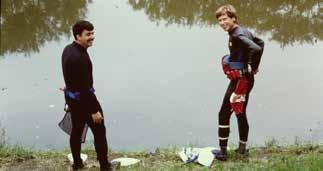
Charles Bier, WPC senior director of Conservation Science, right, with volunteer Tim Schumann, left, on a mussel survey on French Creek circa 1986. Charles has served most of his career at WPC.
Bucknell University master’s degree student Isaac Buabeng, collects leaf tissue from plants while postdoctoral fellow Dr. Melody Sain balances herself on a steep slope. They worked with PNHP botanist Scott Schuette to assess a globally rare plant species.
Charles Bier, WPC senior director of Conservation Science, right, with volunteer Tim Schumann, left, on a mussel survey on French Creek circa 1986. Charles has served most of his career at WPC.
The Western Pennsylvania Conservancy was supported by 11,132 private donors (individuals, corporations, foundations and organizations) that together made cash, stock and in-kind gifts totaling $10,287,278 in 2022. Their extraordinary support played a significant role in advancing WPC’s mission of protecting water, land and wildlife in Western Pennsylvania and stewarding Frank Lloyd Wrightdesigned Fallingwater.
We are also delighted to recognize both the generous future commitments of our Heritage Circle members as well as remember the legacies of those who
have passed on in 2022. Together, they provide transformational support for the Conservancy to care for our beautiful region now and in the future.
Donors making gifts totaling $250 or more and Evergreen Circle members giving $100 or more are listed in the following pages. We regret that space constraints prohibit acknowledging all supporters by name. We have made every effort to ensure that our donor lists are accurate and reflect gifts last year; however, should you find an error or omission, please contact Nicole Walsh, donor stewardship manager, tollfree at 1-866-564-6972 (ext. 2322) or via email at nwalsh@paconserve.org
The Western Pennsylvania Conservancy relies on the support of nearly 11,000 member households and its volunteers to fulfill its mission. Your continued involvement will ensure that our work continues. For more details, contact Kathy Patrignani, development operations administrator, toll-free at 1-866-5646972 (ext. 2340) or via email at kpatrignani@paconserve.org. Additional information can be found on our website at WaterLandLife.org.
The Heritage Circle recognizes donors who have made the Western Pennsylvania Conservancy a part of their legacy through their estate plans. By designating the Conservancy as a beneficiary of will, trust, IRA, retirement plan, life insurance policy or charitable gift annuity, individuals provide long-term, significant support for the Conservancy. Contact Julie Holmes, senior director of development, toll-free at 1-866-564-6972 (ext. 2312) or jholmes@paconserve.org for more details.
Unrestricted gifts to the annual fund are essential in sustaining our daily operations. These vital contributions enable the Conservancy to carry out its mission throughout the year. You can also provide dependable income for WPC and Fallingwater by making your annual gift through convenient monthly deductions via credit card or debit from a designated financial account.
The Conservancy’s Leadership Circle members, including Kaufmann Society donors whose gifts are directed for Fallingwater, have made the Western Pennsylvania Conservancy’s work a philanthropic priority. Members who make annual gifts of $1,000 or more are recognized through the Leadership
Circle program. The Conservancy recognizes this significant commitment by providing additional insights into our plans throughout the year. Become a monthly donor and make your $1,000+ annual gift in convenient monthly deductions a simple way to make a big difference!
Members of the Evergreen Circle have loyally supported the Conservancy for at least 15 out of the last 20 years. Some have been members for much longer with memberships dating back to the 1950s! Their loyal and continuous support has been a crucial part of our successful work. We are deeply grateful for those who support our efforts each and every year.
Many companies and organizations will match employee contributions, greatly increasing the impact of your gift to WPC. Please contact your human resources office for further information.
The Conservancy deeply appreciates gifts of appreciated stock, real estate property, in-kind gifts and multi-year commitments in support of our programs. Please contact the Conservancy’s development office at 412-586-2336 or development@paconserve.org for more information.
800 Waterfront Drive
Pittsburgh, PA 15222
412-288-2777
info@paconserve.org

WaterLandLife.org
Fallingwater.org
You can create a long-lasting impact in Western Pennsylvania by including the Conservancy in your estate plans.
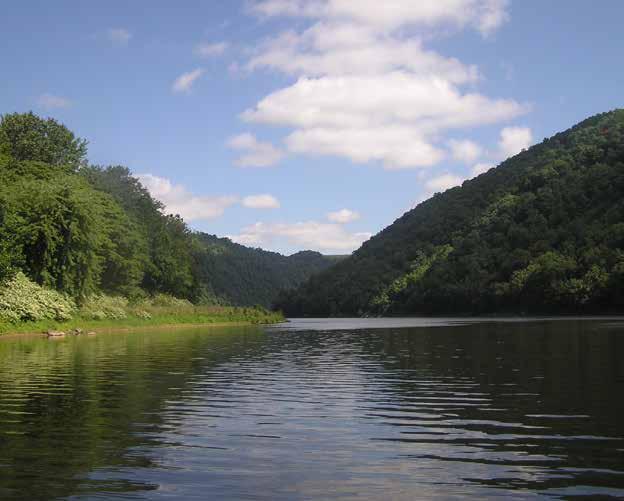
Your legacy will contribute to our ability to continue to conserve Western Pennsylvania’s most spectacular land, water and wildlife and to preserve Frank Lloyd Wright’s Fallingwater. Bequests in a will or trust are one of the most common ways of making a legacy gift, and they are simple to establish!
If you would like more information or if you have already included WPC or Fallingwater in your estate plans, please contact Julie Holmes, senior director of development, at 412-586-2312 or jholmes@paconserve.org. Thank you.
Discover the many ways you can create a legacy at the Western Pennsylvania Conservancy with a gift from your estate.