KIDS_1013_CONSOLIDATION_ALT_EUR_1006_ELLENDER 9/20/13 1:20 PM Page 2
78 TV KIDS
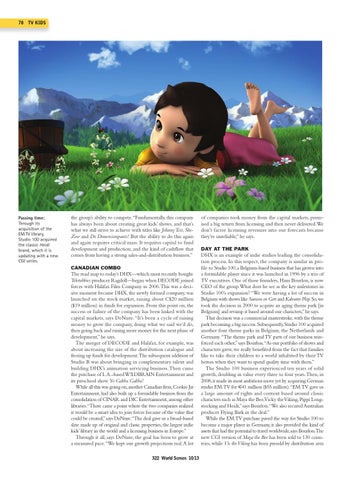
Passing time: Through its acquisition of the EM.TV library, Studio 100 acquired the classic Heidi brand, which it is updating with a new CGI series.
the group’s ability to compete. “Fundamentally, this company has always been about creating great kids’ shows, and that’s what we still strive to achieve with titles like Johnny Test, SheZow and Dr. Dimensionpants! But the ability to do this again and again requires critical mass. It requires capital to fund development and production, and the kind of cashflow that comes from having a strong sales-and-distribution business.” CANADIAN COMBO
The road map to today’s DHX—which most recently bought Teletubbies producer Ragdoll—began when DECODE joined forces with Halifax Film Company in 2006. This was a decisive moment because DHX, the newly formed company, was launched on the stock market, raising about C$20 million ($19 million) in funds for expansion. From this point on, the success or failure of the company has been linked with the capital markets, says DeNure. “It’s been a cycle of raising money to grow the company, doing what we said we’d do, then going back and raising more money for the next phase of development,” he says. The merger of DECODE and Halifax, for example, was about increasing the size of the distribution catalogue and freeing up funds for development.The subsequent addition of Studio B was about bringing in complementary talent and building DHX’s animation servicing business. Then came the purchase of L.A.-based W!LDBRAIN Entertainment and its preschool show Yo Gabba Gabba! While all this was going on, another Canadian firm, Cookie Jar Entertainment, had also built up a formidable business from the consolidation of CINAR and DIC Entertainment, among other libraries.“There came a point where the two companies realized it would be a smart idea to join forces because of the value that could be created,” says DeNure.“The deal gave us a broad-based slate made up of original and classic properties, the largest indie kids’ library in the world and a licensing business in Europe.” Through it all, says DeNure, the goal has been to grow at a measured pace. “We kept our growth projections real. A lot 322 World Screen 10/13
of companies took money from the capital markets, promised a big return from licensing and then never delivered. We don’t factor licensing revenues into our forecasts because they’re unreliable,” he says. DAY AT THE PARK
DHX is an example of indie studios leading the consolidation process. In this respect, the company is similar in profile to Studio 100, a Belgium-based business that has grown into a formidable player since it was launched in 1996 by a trio of TV executives. One of those founders, Hans Bourlon, is now CEO of the group. What does he see as the key milestones in Studio 100’s expansion? “We were having a lot of success in Belgium with shows like Samson en Gert and Kabouter Plop. So, we took the decision in 2000 to acquire an aging theme park [in Belgium] and revamp it based around our characters,” he says. That decision was a commercial masterstroke, with the theme park becoming a big success. Subsequently, Studio 100 acquired another four theme parks in Belgium, the Netherlands and Germany. “The theme park and TV parts of our business reinforced each other,” says Bourlon.“As our portfolio of shows and characters grew, we really benefited from the fact that families like to take their children to a world inhabited by their TV heroes when they want to spend quality time with them.” The Studio 100 business experienced ten years of solid growth, doubling in value every three to four years. Then, in 2008, it made its most ambitious move yet by acquiring German studio EM.TV for €41 million ($55 million).“EM.TV gave us a large amount of rights and content based around classic characters such as Maya the Bee,Vicky the Viking, Pippi Longstocking and Heidi,” says Bourlon.“We also secured Australian producer Flying Bark in the deal.” While the EM.TV purchase paved the way for Studio 100 to become a major player in Germany, it also provided the kind of assets that had the potential to travel worldwide, says Bourlon.The new CGI version of Maya the Bee has been sold to 130 countries, while Vic the Viking has been presold by distribution arm