World Scout Bureau, Global Support Centre Kuala Lumpur
Suite 3, Level 17, Menara Sentral Vista, No 150 Jalan Sultan Abdul Samad Brickfields, 50470 Kuala Lumpur, MALAYSIA
Tel.: + 60 3 2276 9000
Fax: + 60 3 2276 9089
worldbureau@scout.org scout.org
Reproduction is authorized to National Scout Organizations and Associations which are members of the World Organization of the Scout Movement. Credit for the source must be given.
SAFE FROM HARM ASSESSMENT GUIDELINES
Strengthening Safe from Harm in your National Scout Organization
INTRODUCTION
Keeping children, young people, and adults safe from harm or abuse is the highest priority in Scouting and it is the duty of National Scout Organizations and Associations (NSOs) to ensure a safe environment for all.
As Member Organizations of the World Organization of the Scout Movement (WOSM), NSOs are required to meet the standards outlined in the Safe from Harm Assessment Tool (Assessment Tool), a set of a criteria that evaluates levels of safeguarding and protection of children and young people against international best practices1. It is, however, important to note that the purpose of the Assessment Tool is not to grade individual NSOs but to provide a way to better understand how Safe from Harm is being implemented at NSOs.
NSOs can use the Assessment Tool to conduct an internal evaluation of their organisation’s Safe from Harm practices (Self-Assessment) and later request a WOSM Safe from Harm Assessment (WOSM Assessment), which is conducted by a WOSM assessor and a Safe from Harm expert. Completing these assessments enables NSOs to identify the current state of their Safe from Harm practices based on clearly defined and measurable criteria adopted by WOSM.
WOSM developed these guidelines to help NSOs use the Assessment Tool to conduct Safe from Harm assessments. It provides information and direction on various areas, including scope, recommended processes, scoring methods, and next steps. In doing so, this document enables NSOs to reflect on their practices, processes, policies, and procedures so that they can identify areas of strength, opportunities for improvement, and demonstrate transparency and accountability to their members and the community.
NSOs should note that the requirements outlined in the Safe from Harm assessments apply to all National Scout Organizations and Associations. It is the responsibility of a National Scout Organization to ensure that all National Scout Associations within its federation meet the stated criteria. If one or more National Scout Associations do not meet these criteria, then the Member Organisation will be considered as non-compliant.
1. “Best practices” refers to standards used by Scout Organizations and other non-governmental organisations.
4 SAFE FROM HARM DIMENSIONS
The Safe from Harm Assessment Tool consists of the four dimensions of child, youth, and adult safeguarding. This section provides an overview of the criteria that are covered in each of these dimensions.
Dimension 1: Child and Youth Safeguarding
Child and youth safeguarding looks at the measures an NSO puts in place to achieve the core aim of Safe from Harm: protecting children and young people. This includes having in place a strong National Safe from Harm Policy, a Code of Conduct that covers the behaviour of adults towards young people, and a Safe from Harm team or coordinator. This dimension also encourages NSOs to reflect on how to communicate and ensure the implementation of child and youth safeguarding across the organisation.
Dimension 2: Safeguarding, Selection, Recruitment and Training of Adults in Scouting
To ensure the implementation of Safe from Harm at all levels, this dimension looks at various elements related to the Adults in Scouting lifecycle. From the selection process to training, this dimension highlights how to prepare adults to offer safe experiences for children, young people and adults.
Dimension 3: Report, Response, and Case Management
This dimension covers safeguarding reporting as an essential element of a strong safeguarding structure, including the procedures and mechanisms that an NSO must have in place for members to share concerns relating to potentially harmful situations. Safeguarding reporting procedures are linked with risk management and events and are implemented at all levels in an NSO, taking into account the protection of victims and data privacy.
Dimension 4: Education
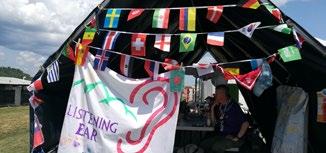
This dimension focuses on the preventative aspect of Safe from Harm. It includes elements around access to child-friendly documents so that children and young people can be empowered to protect themselves and have access to safe spaces, trained “listening ears”, educational materials on Safe from Harm, and learning opportunities in the Youth Programme.
SAFE FROM HARM ASSESSMENT TOOL
What is it?
NSOs should use the Assessment Tool to evaluate their organisation’s performance in the four dimensions described above.
Why should we do it?
• To assess the current state of Safe from Harm in your organisation against international best practices.
• To get a general check of your organisation in Safe from Harm to identify areas of improvement and help prioritise future areas of action to strengthen capacity.
• To help define a Safe from Harm implementation plan by targeting your organisation’s strengths and opportunities for improvement.
• To help your organisation strengthen its implementation of Safe from Harm through support and access to resources and funding.
• To assess your organisation’s compliance status against the WOSM Safe from Harm standards.
• To prepare for a WOSM Assessment, conducted by a WOSM assessor and a Safe from Harm expert.
Who should do it?
When using the Assessment Tool, the process should:
• Be led by your NSO’s leadership team, which is composed of the Safe from Harm team, board members, and any other members relevant to the topic.
• Be supported by your NSO’s national board. Note that the outcome of the Self-Assessment is equally important for both the Safe from Harm team and the board.
• Involve key staff and volunteers in charge of Safe from Harm at the national level.
When should we do it?
NSOs are encouraged to following these recommendations:
• Stable period: avoid transitions, such as right before or after a General Assembly, or if your organisation or country is experiencing a crisis.
• At the start of the development of your strategic plan.
In accordance with WOSM’s membership requirements, NSOs must complete a Self-Assessment every three years. They must submit annually the documentation part of their annual reporting process (coordinators contact, policy and procedures)
How do we do it?
NSOs are recommended to complete one dimension at a time and assign team members to lead the collection of documentation required.
SAFE FROM HARM AND GSAT
The Global Support Assessment Tool, known as GSAT, is a capacity strengthening tool and quality standard that supports NSOs in meeting international best practices in good governance and quality Scouting.
To ensure that both GSAT and the Safe from Harm Assessment Tool support each other and reflect WOSM’s view that child, youth, and adult safeguarding is its highest priority, GSAT aligned its standards to meet specific criteria.
“Across the self-assessment, 6 criteria were identified as key good practices/principles considered as essential, “the minimum required” for the implementation of safeguarding in your organisation. These 6 criteria are therefore identified as red flags, “major non-conformities”, and if not met will imply the non-conformity of the organisation with WOSM safeguarding standards. They are considered a priority in the assessment follow-up.” - GSAT FAQ
The Major Non-Conformity standards of the WOSM Safe from Harm assessment will be reflected in the different dimensions of GSAT. You can find them in the section “What are Major Non-Conformities?”
How do we use the scoring method for the assessments?
For each of the criteria, we encourage you to reflect on and assess the situation at your organisation using the scoring method outlined below:
NON-COMPLIANT IN ACCORDANCE WITH FEW ITEMS IN ACCORDANCE WITH MOST ITEMS
No evidence exists that the NSO has met any of the standards outlined in this criteria.
Evidence exists that the NSO has met some of the standards outlined in this criteria.
Evidence exists that the NSO has met most of the standards outlined in this criteria, and that they are upto-date and implemented.
Evidence exists that the NSO has met all the standards outlined in this criteria. They are up-to-date, implemented, regularly evaluated, and refreshed.
Not applicable due to the local circumstances or in relation to another non-compliant criteria.
Examples:
Below are examples to provide guidance on the scoring method for the Self-Assessment. Remember that the Self-Assessment will help identify your organisation’s areas of improvement in Safe from Harm. Be honest: avoid overestimating or underestimating the situation at your organisation and always consider whether an external assessor would share your opinion.
Criteria 3: The NSO has made their National Safe from Harm Policy and Code of Conduct publicly available, communicated, and disseminated them across the organisation
Statement Score
The NSO has made their National Safe from Harm Policy and Code of Conduct publicly available, and communicated AND disseminated them across the organisation.
The NSO has made their National Safe from Harm Policy AND Code of Conduct publicly available BUT they have NOT been disseminated across the organisation.
FULL COMPLIANCE
IN ACCORDANCE WITH FEW ITEMS
The NSO does NOT have a National Safe from Harm Policy or Code of Conduct. NON-COMPLIANT
Criteria 8: The NSO has a written Code of Conduct that specifies acceptable and unacceptable behaviour regarding interactions between adults.
Statement
The NSO meets ALL the following criteria:
• Demonstrates that its Code of Conduct includes behaviour between adults.
• Has a list of “dos” and “don’ts” on acceptable and unacceptable behaviour between adults.
• The NSO’s Code of Conduct is communicated and made available on the NSO’s official communications platform.
• Has included the Code of Conduct in in-person or online training.
The NSO can:
• Demonstrate that its Code of Conduct includes behaviour between adults.
• The NSO’s Code of Conduct is communicated and made available on the NSO’s official communications platform.
BUT does not:
• Have a list of “dos” and “don’ts” on acceptable and unacceptable behaviour between adults.
• Include the Code of Conduct in in-person or online training.
Score
FULL COMPLIANCE
IN ACCORDANCE WITH FEW ITEMS
The NSO has none of the Code of Conduct elements NON-COMPLIANT
What are Major Non-Conformities?
The Assessment Tool contains 23 criteria, of which six are considered key and serve as red flags that enable NSOs to spot priorities areas in the assessment follow-up. These criteria are classified as “major nonconformities” and must be met to achieve the minimum standards.
NSOs that do not meet these items will need to implement immediate and urgent action to ensure compliance with WOSM membership requirements. Early intervention is crucial and NSOs are encouraged to reach out to their World Scout Bureau (WSB) Regional Support Centre and request a WOSM Safe from Harm service at any stage of the selfassessment process for support.
Where can I find the Assessment Tool?
WOSM has made available a printable version of the Assessment Tool on Microsoft Excel along with a digital version online.
With the link received through their official directory contact, NSOs are able to use the Safe from Harm digital self-assessment, to go through each dimension, input and save their scores. Further guidance on this platform will be made available to members.
How do I know if I meet fully, partially or not Safe from Harm requirements?
The table below outlines the scoring for the Safe from Harm requirements. In the review of your regional panel, you will find the scoring and the final compliance status.
Level 3 – Fully meets Safe from Harm requirements
Major NonConformity
Scoring
All Major Non-Conformity criteria are met
Score of 2-3 per criterion of all MNCs
Are the results confidential?
Level 2 –Partially meets Safe from Harm requirements
A least 4 of the Major NonConformity criteria are met
Score of 2-3 for| 4 or 5 MNCs
Level 1 – Not meeting Safe from Harm requirements
Less than 4 of the Major NonConformity criteria are met
Score of 2-3 in only 0, 1, 2 or 3 of the MNCs
The results of your Self-Assessment belong to your NSO and will be kept confidential within WOSM. The WSB Global and Regional Support Centre may use this information internally to understand trends or adjust the support being delivered but will never disclose them to a third party without the express consent of the NSO concerned.
If you want to learn more about the Safe from Harm self-assessment, you can connect to the World Scouting support platform here.
SAFE FROM HARM ASSESSMENT CYCLE
While each NSO will be at a different stage in their Safe from Harm journey, the following section is designed to help all Member Organizations gain a better understanding of the stages in the Safe from Harm assessment cycle and ensure a safe environment for children, young people, and Adults in Scouting.
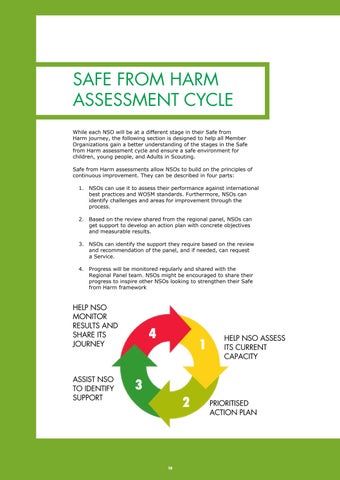
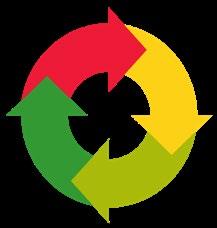
Safe from Harm assessments allow NSOs to build on the principles of continuous improvement. They can be described in four parts:
1. NSOs can use it to assess their performance against international best practices and WOSM standards. Furthermore, NSOs can identify challenges and areas for improvement through the process.
2. Based on the review shared from the regional panel, NSOs can get support to develop an action plan with concrete objectives and measurable results.
3. NSOs can identify the support they require based on the review and recommendation of the panel, and if needed, can request a Service.
4. Progress will be monitored regularly and shared with the Regional Panel team. NSOs might be encouraged to share their progress to inspire other NSOs looking to strengthen their Safe from Harm framework
HELP NSO MONITOR RESULTS AND SHARE ITS JOURNEY 1 2 3 4
HELP NSO ASSESS ITS CURRENT CAPACITY
PRIORITISED ACTION PLAN ASSIST NSO TO IDENTIFY SUPPORT
Whether your NSO is in the early or advanced stages of Safe from Harm implementation, we suggest that you:
• Read the Safe from Harm documentation found on the Safe from Harm subpage on the Treehouse, starting with the World Safe from Harm Policy
• Familiarise yourself with the requirements of the Assessment Tool.
• Ensure that your NSO’s national board is aware and supportive of your Safe from Harm plan and its processes. While your NSO’s leadership team can conduct the self-assessment itself, the full commitment of the national board is essential to support and define the next steps based on the outcomes.
• Request a Safe from Harm service through the WOSM Services platform and get a consultant assigned to support you.
WORLD SCOUTING SAFE FROM HARM CONSULTANTS
Trained Safe from Harm Consultants can support NSOs throughout the Safe from Harm assessment journey. Use the WOSM Services platform to request support, such as getting a preparatory briefing, extra guidance, or clarification on specific elements of Safe from Harm. Support can be done virtually and provided free of charge.
World Scouting’s Safe from Harm consultants can help you:
• Link your project with the broader capacity strengthening cycle.
• Explain the purpose of the Self-Assessment, its dimensions, and criteria.
• Help identify the evidence and documentation needed to complete a Self-Assessment and WOSM Assessment.
• Explain the scoring system and method.
• Identify gaps in your Safe from Harm framework.
Keep in mind:
Safe from Harm assessments can take significant resources to prepare for and complete, therefore it is important that NSOs do not underestimate the amount of time required at each stage. NSOs should also note that each assessment is only one step in implementing Safe from Harm at your NSO. Read more under “Next Steps”.
SELF-ASSESSMENT
NSOs can use the Assessment Tool to conduct a Self-Assessment and evaluate the current state of Safe from Harm at their organisation by following the steps below.
Please note that the purpose of a self-assessment is not to grade individual NSOs but to better understand how Safe from Harm is being implemented at NSOs.
Step 1: Complete the Self-Assessment and annual reporting requirements
A. Preparation phase
Before starting, NSOs should assign a team responsible for completing the Self-Assessment. It can include members of an NSO’s board, Safe from Harm team, key staff, and volunteers in charge of Safe from Harm at the national level.
This team should start by reviewing and familiarising themselves with the criteria contained in the Assessment Tool. They should also reflect on how best to complete the Self-Assessment - either together as a team or by assigning sections to specific individuals.
Once the team is ready, they must score their NSO in each of the Assessment Tool’s 23 criteria. It is recommended to first complete the Self-Assessment as a draft before submitting a final version. You can refer to the scoring method on page 12 to understand how to grade each criteria.
In this phase, make sure you have proper access to the digital platform to be able to submit your self-assessment. If you need further support to find your link, you can reach out to your Regional Safe from Harm staff member.
Tips before starting the Self-Assessment
Make sure that you understand the overall process. You can request a WOSM Service in Safe from Harm to introduce and guide you through the Self-Assessment process.
Involve the relevant people.
Be objective.
Be honest.
Avoid overestimating or underestimating the time needed to complete the Self-Assessment.
Consider whether your responses would be seen in the same way as an external assessor.
Remember that this is a support tool that will help you identify your organization’s areas of improvement in Safe from Harm.
B. Submit the Self-Assessment
After the team has reviewed its scores, your NSO will be ready to submit its Self-Assessment. You will also be required to provide comments and clarifications to support your submission.
To submit your self-assessment, log in to the digital platform through the link shared with your official directory contact. For each criteria, please share the score and add comments on any elements that can explain the scoring you gave your NSOs. We encourage you to share any links to documents or tools that could support your selfassessment.
If you need further support on navigating through the digital tool, you can click here
Once you have completed all the scoring boxes and the comments boxes, you can submit your self-assessment. You will receive a report of your submission. On the regional side, the Safe from Harm team will also receive this report which will trigger the review from the Regional Panel.
Note that you can resubmit your self-assessment as often as you want through the triennium but make sure you let at least 6 months pass between two self-assessments.
While you cannot make any changes to the Self-Assessment after it has been submitted, you will be able to download a report of it on the self-assessment digital platform. This report can be used during the annual reporting process.
C. Complete your annual reporting requirements
NSOs must complete a Self-Assessment every three years based on the annual reporting timeline. Your NSO has between May and October to complete its annual reporting requirements on Safe from Harm and supply the following documentation:
1. Self-Assessment report
2. National Safe from Harm Policy
3. Safeguarding Reporting Procedure
4. Contact details of the national Safe from Harm team or coordinator
NSOs that do not complete the annual reporting process may see their membership rights being affected. Further information will be shared after the launch of the Enforcement Mechanism planned for end of 2026.
NSOs will receive details on the annual reporting timeline and requirements every three years from World Scouting’s annual reporting team in collaboration with the Safe from Harm team.
Step 2: Feedback from regional panels
After your NSO has submitted its Self-Assessment, it will be reviewed by a regional panel of experts.
If during the initial review, the regional panel identifies key pieces missing, they will reach out to the NSO team by email to request more documents. The NSO will have two weeks to share the complementary documentation required. If after this timeline, if no further documentation was submitted, the Regional Panel will proceed with the review based on the elements they have. Passed this timeline, the results won’t be changed except after a new resubmission, six months later.
The regional panel will thoroughly review the documents submitted in the Annual Report and the self-assessment itself.
Based on the documents, comments, and scores submitted, the Regional Panel will provide the NSO with a report that outlines the following:
• Overall compliance of the NSO with Safe from Harm.
• Feedback on uploaded documents in the Annual Report.
• Scoring and compliance of the NSO with the Major NonConformity criteria.
• Feedback and Recommendations for each of the self-assessment dimensions.
• Next steps the NSO should take to reach the next level.
The Regional Panel’s report will be shared with the NSO by the Regional Support Centre up to four months after the submission of the self-assessment of the NSO. The Regional Support Centre is available to further clarify the outcomes of the Regional Panel review with the NSO at all times.
Step 3: Next steps
After receiving the regional panel’s report, an NSO should follow these steps to start implementing any identified areas of improvement:
1. Review the outcomes of the report with the Safe from Harm team.
b. Which requirements must be completed based on the Major Non-Conformity elements?
c. What are the recommendations of the regional panel in each of the dimensions of the Self-Assessment?
d. What should my organisation prioritise? Which resources are needed to implement the requirements and recommendations of the regional panel?
e. Does my organisation need support to achieve the requirements and recommendations of the regional panel? What type of support is needed?
2. Based on these outcomes, set a plan of action with objectives based on the defined priorities.
3. The NSO assessed the resources needed to ensure the implementation of the action plan.
4. The NSO requests a World Scouting Safe from Harm Service to receive support to meet the requirements and implement the recommendations of the Regional Panel.
NSOs must take steps to implement the feedback of the regional panel to meet the requirements of the annual report (mentioned in “complete your annual reporting requirements”) and Major Non-Conformity criteria. Failure to do so could lead to the suspension of some of the membership rights of an organisation.
WOSM ASSESSMENT
After completing the Self-Assessment, NSOs can also use the Assessment Tool to conduct a WOSM Assessment and work with a WOSM assessor and a Safe from Harm expert to evaluate the current state of Safe from Harm at their organisation by following the steps below.
We recommend that you have your Self-Assessment to hand and have reviewed the report from the regional panel before proceeding with the WOSM Assessment.
Step 1: Kick-off meeting
Members of an NSO’s Safe from Harm team and national board taking part in the WOSM Assessment should start by holding a kick-off meeting that is led by the national leadership.
The meeting will offer an opportunity to introduce the WOSM Assessment and its process. It should cover the follow elements:
• Include
Make sure that all relevant parties are onboard and understand the overall process.
• Responsible
Agree on the appointment of one person responsible to lead the process and ensure overall follow-up and that deadlines are respected.
• Create teams
Assign teams to address different dimensions, keeping in mind the positive engagement of the national board (see Suggested Method box on the opposite page for team actions).
• Timelines
Agree on specific timelines to complete work.
• Share Communicate with different stakeholders within the organisation to achieve a sense of ownership and collaboration.
RECOMMENDED APPROACHDIMENSION BY DIMENSION:
Team members can be allocated to different dimensions, such as:
Dimension 1: Safe from Harm team, national board, communications team
Dimensions 2: Safe from Harm team, Adults in Scouting team, national board
Dimension 3: Safe from Harm team, risk management team, events team
Dimension 4: Safe from Harm team, educational methods team
SUGGESTED METHODS FOR COORDINATION
• Each team is responsible for compiling the documentation required in each criteria.
• Consider creating online folders for each dimension so that documentation can be kept in one place.
• Teams can schedule separate meetings to agree on workload sharing and other practicalities.
Note that the WOSM Assessment process requires the submission of written evidence. The Self-Assessment process only requires comments and clarification of the scoring.
Step 2: Progress updates on preparation before the WOSM Assessment
In preparing for the WOSM Assessment, the team should also hold a short meeting to provide progress updates and ensure that everyone remains motivated to complete the process. The meeting should also be used to:
• Share
Allocate some time to raise issues or challenges encountered, if any.
• Timelines
Wrap up with a check of the timings.
HOW CAN A SAFE FROM HARM CONSULTANT SUPPORT YOU?
If you are conducting a WOSM Assessment, a service request will be triggered. Through this request, you will be offered the support of a Safe from Harm Consultant who will be present during the assessment and will also be able to support you in preparing for the assessment
Consultants can help your NSO understand more about Safe from Harm, the different types of documentation to prepare, and the scoring approach. They can also help manage your timeline, bring an external perspective, and keep focus on the aims of the WOSM Assessment.
TIPS BEFORE STARTING THE WOSM ASSESSMENT
Make sure you understand the overall process. By requesting a WOSM Service in Safe from Harm, a Safe from Harm Consultant will be available to introduce and guide you through the WOSM Assessment process.
Set clear objectives with your team.
Involve the relevant people.
Be objective.
Be honest.
Avoid overestimating or underestimating the time needed to complete the WOSM Assessment.
Consider whether your responses would be seen in the same way by an external assessor.
Remember that the WOSM Assessment will help identify your organisation’s areas of improvement in Safe from Harm.
Step 3: Conducting the WOSM Assessment
Taking the WOSM Assessment is a commitment made by NSOs as members of WOSM. A team of Safe from Harm experts and a WOSM assessor will support your NSO during the WOSM Assessment along with your assigned Safe from Harm consultant either in person or virtually.
OPTION 1: Schedule a two day in-person assessment
Set aside two days for the relevant team members to gather and undertake the WOSM Assessment with a WOSM Assessment team. The advantage of this option is that participants can gain a better understanding of each WOSM Assessment criteria and start thinking about an action plan. Some NSOs, however, may find this step time consuming.
• Agenda
You can use the proposed agenda below or organise your meeting based on other priorities, such as team members’ availability – particularly volunteers – in agreement with the WOSM Assessment team.
• Participants
Gather key members from the preparation phase to contribute to the evaluation, including the national coordinator of Safe from Harm (if appointed), relevant board members, volunteers, and staff members responsible for or overseeing both child and youth safeguarding and adults safeguarding at your NSO. If no individuals have been appointed to these roles, you can involve board and staff members who will undertake these responsibilities in the future.
• Evaluation
Go through each criteria and – based on the evidence compiled – the assessors will score the criteria from “full compliance” to “non-compliant”.
• Support
The WOSM assessment team will facilitate and support you during this assessment. In case you need additional support, make sure that you can contact other relevant individuals, including your Safe from Harm consultant, who can be invited to join in person if possible.
• Conclusion
At the end of the assessment, there will be a conclusion and assessment with the WOSM assessment team. This is an opportunity to share your thoughts around the process and discuss the next steps and actions to take as a result of the assessment, for example, requesting a WOSM service.
Sample agenda for WOSM Assessment in-person meeting
Timing
DAY 1
9:00-10:00
10:00-12:00
13:30-15:15
15:30-17:00
17:00-18:00
Attendance
Safe from Harm team, national board representatives
Safe from Harm team, national board, communications team
Safe from Harm team, Adults in Scouting team, national board
Safe from Harm team, risk management team, events team
Safe from Harm team, educational methods team
DAY 2
9:00-10:00
10:00-11:30
11:30-12:00
Safe from Harm team, national board representatives
Subject(s) / Dimension of the Safe from Harm Assessment Tool
Safeguarding, Recruitment, Selection and Training of Adults in Scouting
Dimension 3 Report, Response and Case Management
Dimension 4 Education
Summary of the assessment and discussion about the achieved results, and major nonconformities.
Reflection session (feedback and discussion about the presented assessment criteria and processes) and action plan to take forward.
Closing meeting: agree on follow-up meeting and next steps.
OPTION 2: Conduct the WOSM Assessment online
Schedule an introductory online meeting where team members can participate and agree on a timeline to undertake the online assessment with the WOSM Assessment team.
The online assessment is recommended only if an in-person assessment is not feasible. The advantage of this option is that it provides ample of time to work and gather information, as it will occur over online sessions totalling 12 hours.
• Agenda
You can use the proposed agenda below (daily timing can be moderated as per the convenience of the WOSM Assessment team and NSO leaders) or organise your sessions based on other priorities, such as team member availability, particularly volunteers, in agreement with the WOSM Assessment team.
• Participants
Gather key members from the preparation phase to contribute to the evaluation, including the national coordinator of Safe from Harm (if appointed), relevant board members, volunteers, and staff members responsible for or overseeing both child and youth safeguarding and adults safeguarding at your NSO. If no individuals have been appointed to these roles, you can involve board and staff members who will undertake these responsibilities in the future.
• Evaluation
Go through each criteria and - based on the evidence compiled - the assessors will score the criteria from “full compliance” to “non-compliant”. We recommend that you have to hand and have reviewed your Self-Assessment and the report from the regional panel before the assessment.
• Support
A WOSM Assessor will facilitate and support you during this assessment. In case you need additional support, make sure that you can contact other relevant individuals, including your Safe from Harm Consultant, who can be invited to join in person if possible.
• Conclusion
At the end of the assessment, there will be a conclusion and assessment with a WOSM Assessor. This is an opportunity to share your thoughts around the process and discuss the next steps and actions to take as a result of the assessment, for example, requesting a WOSM service.
Sample agenda for online WOSM Assessment meeting
Timing
1 hour
2 hours
2 hours
2 hours
1.5 hours
Attendance
Safe from Harm team, national board representatives
Safe from Harm team, national board, communications team
Safe from Harm team, Adults in Scouting team, national board
Safe from Harm team, risk management team, events team
Safe from Harm team, educational methods team
1 hour
1.5 hours
1 hour
Safe from Harm team, national board representatives
Subject(s) / Dimension of the Safe from Harm Assessment Tool
Dimension 2 Safeguarding, Recruitment, Selection and Training of Adults in Scouting
Dimension 3 Report, Response and Case Management
Dimension 4 Education
Summary of the assessment and discussion about the achieved results, and major nonconformities.
Reflection session (feedback and discussion about the presented assessment criteria and process) and action plan to take forward.
Closing meeting: agree on follow-up meeting and next steps
WHAT’S NEXT?
As introduced at the beginning of these guidelines, the steps that come after your assessments are the most important in terms of understanding the current state of Safe from Harm at your NSO. It is therefore important not to underestimate the follow-up work that must take place.
Your WSB Regional Support Centre is available to support you in the development of priorities and an action plan. You can also make a WOSM Service request to receive tailored support in specific areas of improvement.
Schedule an action planning follow-up meeting
After completing the assessments, the NSO acknowledges the receipt of their review by answering the email received from the Regional Staff Member. The NSO shares the results with relevant people in the organisation and discusses them with the national board after a period of reflection.
Continuing the Safe from Harm assessment cycle, the NSO should use this time to schedule a meeting to start developing an action plan. This meeting can consist of a brainstorming session. Don’t forget to involve board members to ensure strategic overview.
Use this meeting to focus on Major Non-Conformities, define priority areas for the organisation to focus on, and link the action plan with the NSO’s overall strategic plan. It should also provide a space to:
Coordinate
Appoint a leader responsible for the follow-up stage.
Brainstorm
Reflect on your needs and priorities based on the review of the Regional Panel and the strategy of the organisation. Try to align the needs and assess the resources available to support the plan.
Request support with your Regional Support Centre
Once the NSO has agreed on a plan internally or if the NSO needs further guidance or clarification, you can reach out to your Regional Safe from Harm staff and set a meeting together. This will be an opportunity to explore the different options of support to implement the plan of action. This includes:
Seek support
Consider requesting a Safe from Harm service to get tailored support and advice. You can also request to join a Capacity Building module offered at the regional level. For further information, you can reach out to your Regional Safe from Harm staff member.
Find resources
You can also find resources on your identified areas of support on the following platforms