ALUMNA ABROAD
.
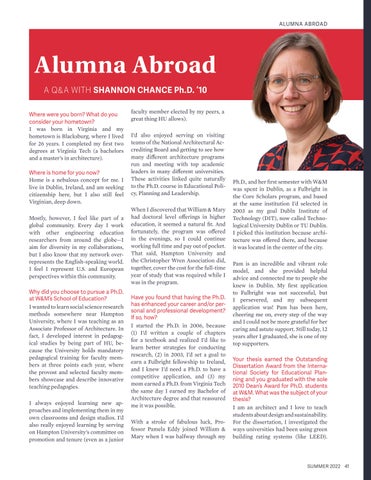
Alumna Abroad A Q&A WITH SHANNON CHANCE Ph.D. ‘10 Where were you born? What do you consider your hometown? I was born in Virginia and my hometown is Blacksburg, where I lived for 26 years. I completed my first two degrees at Virginia Tech (a bachelors and a master’s in architecture). Where is home for you now? Home is a nebulous concept for me. I live in Dublin, Ireland, and am seeking citizenship here, but I also still feel Virginian, deep down. Mostly, however, I feel like part of a global community. Every day I work with other engineering education researchers from around the globe—I aim for diversity in my collaborations, but I also know that my network overrepresents the English-speaking world. I feel I represent U.S. and European perspectives within this community. Why did you choose to pursue a Ph.D. at W&M’s School of Education? I wanted to learn social science research methods somewhere near Hampton University, where I was teaching as an Associate Professor of Architecture. In fact, I developed interest in pedagogical studies by being part of HU, because the University holds mandatory pedagogical training for faculty members at three points each year, where the provost and selected faculty members showcase and describe innovative teaching pedagogies. I always enjoyed learning new approaches and implementing them in my own classrooms and design studios. I’d also really enjoyed learning by serving on Hampton University’s committee on promotion and tenure (even as a junior
faculty member elected by my peers, a great thing HU allows). I’d also enjoyed serving on visiting teams of the National Architectural Accrediting Board and getting to see how many different architecture programs run and meeting with top academic leaders in many different universities. These activities linked quite naturally to the Ph.D. course in Educational Policy, Planning and Leadership. When I discovered that William & Mary had doctoral level offerings in higher education, it seemed a natural fit. And fortunately, the program was offered in the evenings, so I could continue working full time and pay out of pocket. That said, Hampton University and the Christopher Wren Association did, together, cover the cost for the full-time year of study that was required while I was in the program. Have you found that having the Ph.D. has enhanced your career and/or personal and professional development? If so, how? I started the Ph.D. in 2006, because (1) I’d written a couple of chapters for a textbook and realized I’d like to learn better strategies for conducting research, (2) in 2003, I’d set a goal to earn a Fulbright fellowship to Ireland, and I knew I’d need a Ph.D. to have a competitive application, and (3) my mom earned a Ph.D. from Virginia Tech the same day I earned my Bachelor of Architecture degree and that reassured me it was possible. With a stroke of fabulous luck, Professor Pamela Eddy joined William & Mary when I was halfway through my
Ph.D., and her first semester with W&M was spent in Dublin, as a Fulbright in the Core Scholars program, and based at the same institution I’d selected in 2003 as my goal Dubln Institute of Technology (DIT), now called Technological University Dublin or TU Dublin. I picked this institution because architecture was offered there, and because it was located in the center of the city. Pam is an incredible and vibrant role model, and she provided helpful advice and connected me to people she knew in Dublin. My first application to Fulbright was not successful, but I persevered, and my subsequent application was! Pam has been here, cheering me on, every step of the way and I could not be more grateful for her caring and astute support. Still today, 12 years after I graduated, she is one of my top supporters. Your thesis earned the Outstanding Dissertation Award from the International Society for Educational Planning and you graduated with the sole 2010 Dean’s Award for Ph.D. students at W&M. What was the subject of your thesis? I am an architect and I love to teach students about design and sustainability. For the dissertation, I investigated the ways universities had been using green building rating systems (like LEED).
SUMMER 2022 41