Published by the Wits Marketing Department in 2021.
Disclaimer: This publication contains information about regulations, policies, tuition fees, curricula and programmes of the University applicable at the time of printing. Amendments to, or updating of the information in this publication may be effected from time to time without prior notification. The accuracy, correctness, or validity of the information contained in this publication is therefore not guaranteed by the University at any given time and is always subject to verification. The user is kindly requested to, at all times, verify the correctness of the published information with the University. Failure to do so will not give rise to any claim or action of any nature against the University by any party whatsoever.
WELCOME
It is my pleasure to welcome you to the University of the Witwatersrand as we celebrate 100 years of academic excellence. As one of the world’s leading research institutions, Wits will equip you with a contextually-grounded, world-class education. Our graduates are innovators, job creators and thought leaders. By developing the next generation of leaders and producing knowledge for the world, we have a positive impact on our society.
Situated in the heart of South Africa’s economic hub and the gateway to Africa, Wits provides a cosmopolitan environment for our students. At Wits, you will find experts in fields as diverse as palaeontology, clinical medicine, data science, engineering, inequality studies and the digital arts.
Your Wits experience will go beyond the lecture halls as we host a variety of events throughout the year. We also offer our students a wide range of cultural and sporting activities through our many student clubs and societies. So whether it is in the classroom, at the Wits Art Museum or on the sports field, you will find an opportunity to grow and learn at Wits.
Thank you for choosing Wits as the next step in your academic and professional development. As a part of the 2022 student cohort, you will hold a special place in Wits’ history as you take it into its next century. I hope that you will enjoy being a part of our vibrant community and I wish you the best on your academic journey with us.
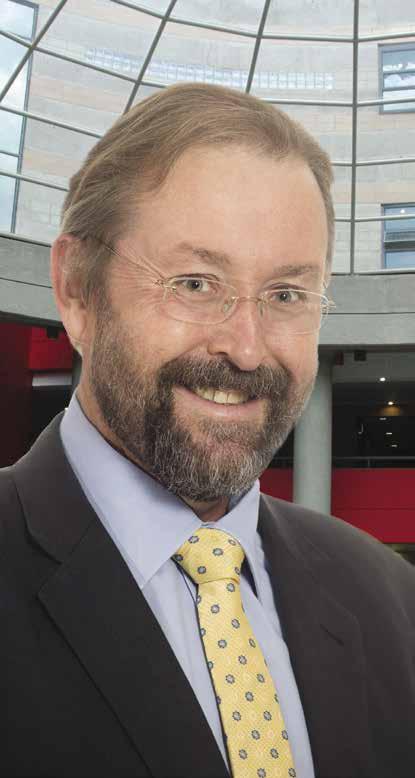
Professor Zeblon Vilakazi Vice-Chancellor & Principal
Fearless in our pursuit of knowledge and innovation
ABOUT WITS
Wits in the academic rankings Placed in the top 1.4% universities worldwide.
CWUR publishes the only global university ranking that measures the quality of education and training of students, as well as the prestige of the faculty members and the quality of their research without relying on surveys and university data submissions.
A university that values the careers of its graduates tends to produce successful alumni. QS have identified the alma maters of those individuals featuring in over 220 high-achievers lists, out of 40,000 of the world’s most innovative, creative, wealthy, entrepreneurialand /or philanthropic individuals to establish which universities are producing world-changing individuals. www.topuniversities.com/employability-rankings/methodology
*Number of Universities
*the results of the top 1 000 universities are published
Achievements in research
Wits has a proud history of research excellence dating back to its origins in 1922.
Our networks and partnerships include the US, UK, Germany, Brazil, Russia, India, China and the rest of Africa where, together with the University of Cape Town, we have built the African Research Universities Alliance (ARUA).
ARUA’s purpose is to build a Pan-African research platform comprising sixteen research universities in an equitable partnership with institutions around the world to research and address the challenges of our globe.
Wits University has long been recognised as a global leader in HIV research and has contributed a vast amount of knowledge in the fight against the Covid-19 pandemic.
Covid-19 Vaccine Trials
The University lead two Covid-19 vaccine trials, which at the time were the only trials in South Africa and on the continent.
New injection to prevent HIV
An HIV study showed that a newly discovered injection was more effective than the current daily HIV pill to prevent HIV in women.
Wits University’s Early unblinding of the of long-acting cabotegravir (CAB LA) is a milestone for prevention of HIV among women in sub Saharan Africa.
World’s first HIV transplant
In a world first, Wits doctors transplanted the liver from a mother living with HIV to her critically ill HIV negative child, who had end stage liver disease.
Most influential research on fractal light
The Optical Society of America named Wits’ research involving fractal light from lasers as the most influential in optics and photonics. Climate scientists are developing the first Earth System Model based in Africa which will contribute to the fight against the climate emergency.
Major African genome study
Wits geneticists have discovered more than three million
new genetic and susceptibility variants which informs African population history, environmental adaptation and susceptibility to disease.
Pelebox
A Master’s student, based at the Tshimologon Digital Innovation Precinct created Pelebox, named one of TIME magazine’s Top 100 inventions of the year. Pelebox is a digital platform that manages various internet enabled smart lockers. Pelebox smart lockers enable patients to collect their repeat chronic medication in under two minutes instead of waiting hours queuing at public clinics.
Quantum Computing
IBM expands its quantum computing programme with Wits as its first partner in Africa. Wits scientists are investigating the use of quantum computing and machine learning in the fields of cosmology and molecular biology with a specific focus on HIV drug discovery and quantum teleportation. Academics and students also connected two computers through the human brain and successfully transmitted words like ‘hello’ and ‘apple’, without the user being aware that a message was present.
Wits scientists have discovered:
• a new species of dinosaur
• the dung beetle wind compass
• an asteroid that contributed to mass extinction and climate change
• an ancient drop of water that rewrites the Earth’s history.
Wits students have developed:
• a new genetic mobile application
• an off-grid solution to electrify households in Africa and,
• self-sanitising surfaces to prevent infections in hospitals.
Wits continues to generate high-quality, locally-relevant knowledge that matches and exceed global standards in research fields like Covid-19, HIV, genetics, quantum computing, energy, migration, diversity and inequality.
52 Research Entities
www.wits.ac.za/news/latest-news/research-news/
*6 DSI/NRF Centres of Excellence
*Highest of all universities in SA
457
*NRF-rated Researchers
*National Research Foundation
30 SARChI CHAIRS*
*The South African Research Chairs Initiative
29 A-RATED Researchers Recognised by peers and leaders in their fields globally
Origins Centre: Houses Paleoanthropological and Archaeological material as well the largest rock engraving archive on the continent
Attractions on Wits campus
History, heritage and science at Wits
collections
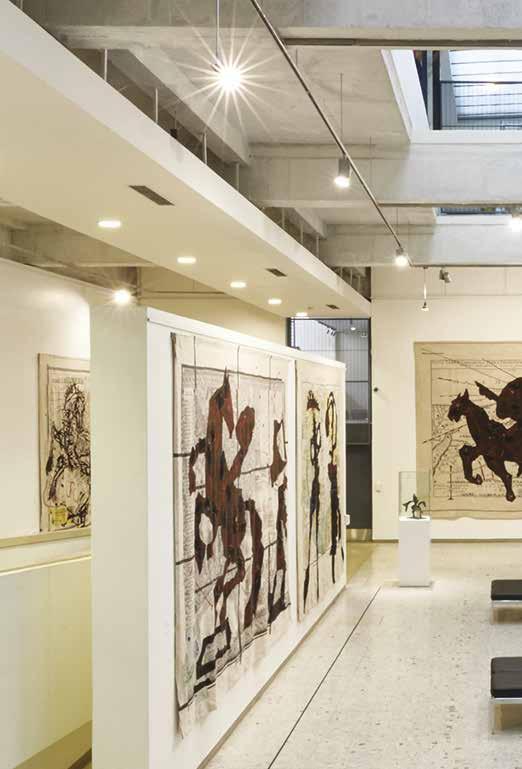
Wits Art Museum (WAM): Houses 9 000 of the world’s largest and finest collections of African art and is a rich resource for research and training
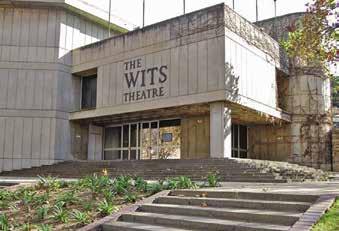
Wits Theatre: One of the finest performing arts facilities in the country providing support for the mounting of productions and aspects of technical teaching and practical training. The Wits Theatre has established itself as South Africa’s major venue for contemporary dance
The Adler Museum of Medicine: Preserves South Africa’s history of the health sciences
The Bernard Price Institute: Exhibits important
of fossils, mainly from South and southern Africa
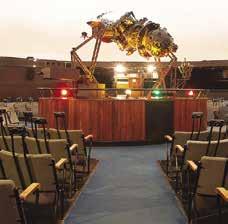
The Planetarium: One of two in the Southern Hemisphere, this local icon sheds light on the world of science and the stars
The Life Sciences Museum: The only natural history museum in Joburg
Wits offers state-of-the-art infrastructure & technology to enhance learning
unlimited & fast WiFi smart classrooms future libraries knowledge hubs online resources e-degrees & short courses
Blended Learning
Learning via electronic and online media as well as traditional face to face teaching by expert lecturers.
Simulation Labs
Students are trained and assessed on how to react to conditions as they would under real life circumstances. Clinical skills, attitudes, knowledge and reasoning are evaluated, preparing students for transition into the real clinical environment.
A student-centred adaptive learning environment on Wits Education Campus that uses advanced eLearning tools to deliver education that prepares students for the 21st Century.
eZones
ADMISSIONS, APPLICATIONS & FEES
Apply in time: In 2020, 4 700 out of 70 000 applicants were accepted into first-year.
When you have a question, go to: www.wits.ac.za, and chat with KuduBot, your friendly online support: KuduBot works 24/7 and provides information on:
• applications • fees and payments • exams
• timetables • graduation information
THE MORE YOU ASK, the more Kudubot refines his answers
NB: Compliance with the minimum requirements does not guarantee a place at the University. The University has a specific number of places for first year undergraduates, approved by the Department of Higher Education and Training. Final selection is made subject to the availability of places, academic results and other entry requirements where applicable.
Applicants require the following to be considered for entry into any of the five faculties:
• National Senior Certificate (NSC), or Independent Examinations Board (IEB), or South African Comprehensive Assessment Institute (SACAI) subjects, and
• Certain levels of achievement as set out in this Guide, as well as a Bachelor’s degree pass.
Points
Wits tabulates the points score for all subjects on the following basis:
• English must be taken either as Home Language or First Additional Language
• Mathematics is a core and compulsory subject for all numerate programmes in Commerce, Law and Management, Engineering and the Built Environment, Science and most of the programmes in the Health Sciences Faculty
• Maths Literacy will be accepted by Law, Education and Humanities (except for Speech-Language Pathology and Audiology)
• Wits does not distinguish between designated vs. non - designated subjects when calculating the admission point score (APS)
• The APS calculation is based on the best seven subjects including Life Orientation (faculty specific subjects must be included in the calculation)
• AP subjects are also included in the APS calculation.
Wits Admission Points Scores (APS)
National Senior Certificate (NSC) Admission Points Scores (APS)
Note: Seven subjects are used in the
Central Application Service (CAS)
The DHET has published the Draft Central Application Service Bill, 2019 to enable the establishment of a Post-School Education and Training Central Application Service. The CAS will offer advice and serve as an application channel for students applying for PSET opportunities. The service allows students to apply for study places, pay a single application fee and facilitate their applications to more than one institution if necessary. The University will provide further updates as and when these become available.
National Benchmark Tests
Test Dates (*Dates are subject to change)
Health Sciences as well as Humanities (Speech-Language Pathology and/or Audiology): no later than 14 August 2021
Science: The test must be written by 31 October 2021. (Your test results are used in addition to your Grade 12 results to identify students who may need additional support during the course of their studies).
Humanities (Social Work): no later than 31 October 2021
For a comprehensive list of test dates, registration dates and available venues, please refer to the NBT website: www.nbt.ac.za
The following applicants are required to write the National Benchmark Tests (NBT) before being considered for admission:
Faculty of Health Sciences
All applicants, except those applying to the Graduate Entry Medical Programme (GEMP) only, those who are in their final year of a degree and those who have already completed a degree, must write the NBT before being considered for admission.
Please note:
• Applicants who achieve in the ‘basic’ range (refer to the Benchmark Performance Levels table below), are unlikely to be considered for a place in the Health Sciences degrees.
• These are standard tests for all medical schools in South Africa and you are only required to write the tests once, irrespective of the number of medical schools you have applied to.
Wits Additional Placement Test (WAPT) Graduate Entry Medical Programme (GEMP) (GEMP) applicants only
To be able to calculate a composite index, all components that contribute to this must be finalised (i.e.Tertiary Aggregate). Applicants will be notified of their eligibility to write the WAPT, scheduled for September 2021, as and when documentation for applications is complete. This means that the Faculty has received an academic transcript and all other pertinent documents. If documents are not submitted by July 2021, no further consideration will be given to your application. Applicants will need to start preparing well in advance of notification. All information about the content and nature of each of the components of the test is given on the GEMP website: www.wits.ac.za/health/gemp
Faculty of Humanities
Applicants to the Bachelor of Speech-Language Pathology, Bachelor of Audiology and Bachelor of Social Work.
Mature age applicants who wrote matric pre-2008, with no degree exemption, may qualify for exemption and will be required to write the NBT test for all Arts degrees (excluding BA Law, Bachelor of Speech-Language Pathology and Bachelor of Audiology).
Two Tests
1) Academic and Quantitative Literacy Test
2) Mathematics Test
The test results will be used in addition to the Grade 11 results (for early decision making purposes) and the Grade 12 results (for final decision-making purposes).
• Both tests (1 and 2) must be written at one session.
• ONLY the first attempt results will be taken into account for selection purposes and thus it is not advisable to write the tests more than once in any year.
NBT results are valid for three years.
Rules
• Applicants to register on www.nbt.ac.za/ to write the tests. Registration closes approximately three weeks prior to each of the test dates. You can register for the NBT even before you submit your application to the University. DO NOT wait for an official notification from the University in order to register and write the tests. You may miss the NBT deadline.
• A fee is charged for the tests. The fee can only be paid once you have registered to write the test.
• Results received for tests written after this date WILL NOT be taken into consideration. Applicants are encouraged to write the tests as early as possible.
National Certificate (Vocational)
Subject to institutional admission requirements, the minimum admission requirement to a Bachelor’s degree programme is a National Certificate (Vocational) Level 4 issued by Council for General and Further Education and Training. The minimum legislative requirements for admission to a Bachelors degree include the achievement of:
• Three fundamental subjects between 60 - 69%) (including English as the language of learning and teaching at Wits)
• Three vocational subjects from the designated list between 70-79% (4).
Wits Institutional Requirements
An applicant who holds an NCV may be invited to write a test, provided that he/she has met the following compulsory institutional requirements as well as the Faculty and degree-specific requirements. An applicant must have:
• Taken English as either language of learning and teaching or as the first additional language
• Taken Mathematics as a fundamental component
• Achieved 70-79% for all seven subjects - in fundamental and vocational categories.
Faculty of Commerce, Law and Management
BCom
BEconSc BAccSc
Four subjects from Business, Commerce and Management Studies
Faculty of Engineering and the Built Environment and the Faculty of Science Besides meeting the University’s requirements an applicant who holds an NCV will be interviewed by the Dean, Assistant Dean and relevant Head of School.
Faculty of Health Sciences
MBBCh, BPharm
BSc(Physio), BHSc (Biomedical and Biokinetics)
BNurs
BSc (OT)
Faculty of Humanities
Applicants who present with an NCV will not be considered.
National Senior Certificate (NSC) Bachelor’s degree pass
Closing Date: 30 September 2021
Applicants
Applicants
as
by the
of Law and place availability. Applicants who have completed an undergraduate degree at an institution other than Wits are required to apply for the three-year LLB programme. Wits applicants who have completed an undergraduate degree without Law modules are also required to apply for the three-year LLB. Applicants must have obtained an average of at least 60% in an undergraduate degree. Four-year LLB
Applicants with an APS of 40-42, as well as English Level 6 AND Mathematics Level 5 OR Maths Literacy Level 6, will be wait-listed, subject to place availability.
NB: Due to the limited number of places available, meeting the minimum requirements does not guarantee a place. Final selection is made subject to the availability of places, academic results and other entry requirements where applicable.
International Qualifications (Relevant exemption from South African Matriculation Board)
NB: Due to the limited number of places available, meeting the minimum requirements does not guarantee a place. Final selection is made subject to the availability of places, academic results and other entry requirements where applicable.
School of Business Sciences
School of Accountancy
School of Economics and Finance
School of Law
Faculty of Engineering & the Built Environment
Minimum Admission Requirements
National Senior Certificate (NSC) Bachelor’s degree pass
Closing Dates: 30 June 2021 (Bachelor of Architecture) | 30 September 2021 (all other programmes)
NB: Due to the limited number of places available, meeting the minimum requirements does not guarantee a place. Final selection is made subject to the availability of places, academic results and other entry requirements where applicable.
(Refer to page 68 for information on the common First year curriculum for all professional engineering degrees).
Acceptance depends on departmental selection. Applicants must complete a written and graphic exercise and may be required to attend an interview. Following an interview, applicants with a Wits APS of 29-33 may be accepted on the basis of exceptional scores. The BAS selection process is conducted by a panel of senior academics from the School of Architecture and Planning, which is monitored by the Assistant Dean. Selection is based predominantly on performance in the selection exercise, interview and academics. Demographic balance is taken into consideration where a choice needs to be made between applicants scoring within the same range.
School of Mining Engineering
School of Architecture and Planning
School of Construction Economics and Management
Faculty of Health Sciences
Minimum Admission Requirements
National Senior Certificate (NSC) Bachelor’s degree pass
Closing Date: 30 June 2021
When applying to the Faculty of Health Sciences, you will not be selected on your school leaving results only, although they are very important. A composite index is calculated, taking into consideration, (i) your academic results for five subjects and (ii) your National Benchmark Test scores. Only five subjects are used to derive an academic score, which is calculated according to the percentages obtained, NOT symbols. These are English, Mathematics, Physical Science/Life Sciences and the best two other subjects. Dental Science requires English, Mathematics, Physical Science AND Life Sciences. All applicants (excluding applicants who are applying to the Graduate Entry Medical Programme (GEMP) only, are required to write the National Benchmark Test. Qualifying GEMP applicants will be invited to take the Wits Additional Placement Test (WAPT). Applicants are advised to prepare in advance in the event that they are invited to write the WAPT. Refer to page 88 for more information on the NBT and the WAPT.
Bachelor of Health Sciences: (BHSci)
• Biomedical Sciences
• Biokinetics
• Health Systems Sciences (All 3 years)
Bachelor of Clinical Medical Practice (BCMP) (3 years)
Bachelor of Medicine and Bachelor of Surgery (MBBCh) (6 years)
Bachelor of Dental Science (BDS) (5 years)
All Faculty of Health Sciences applicants, except those applying to the Graduate Entry Medical Programme (GEMP) only, those who are in their final year of a degree and those who have already completed a degree, must write the NBT by 14 August 2021 before being considered for admission.
Refer to Page 88 for more information on the NBT or refer to: www.nbt.ac.za
There are two entry points into the MBBCh:
• First year, for applicants currently in Grade 12and ;
• Third year, for applicants who have completed a relevant degree (GEMP).
All applicants to Bachelor of Dental Science and Bachelor of Oral Health Sciences must spend time observing specific procedures as performed by a Dentist/Dental Therapist/Oral Hygienist to gain insight into the profession. Applicants must complete a certificate of attendance (minimum 16 hours). Only observation hours completed between 1 July 2020 and 31 July 2021 will be accepted. Please download the form from: www.wits.ac.za/undergraduate/apply-to-wits/ under Additional Forms.
Applicants who fail to submit a certificate of attendance will not be considered for admission.
of Pharmacy (BPharm) (4
All applicants to BSc Occupational Therapy must spend time observing an Occupational Therapist and all applicants to BSc Physiotherapy must spend time observing a Physiotherapist, to gain insight into the profession. Applicants must complete a certificate of attendance (minimum 16 hours). Only observation hours completed between 1 July 2020 and 31 July 2021 will be accepted. Please download the form from: www.wits.ac.za/undergraduate/apply-to-wits/ under Additional Forms.
Applicants who fail to submit a certificate of attendance will not be considered for admission.
NB: Due to the limited number of places available, meeting the minimum requirements does not guarantee a place. Final selection is made subject to the availability of places, academic results and other entry requirements where applicable.
International Qualifications (Relevant exemption from South African Matriculation Board)
Ordinary Level (O Level)/ International General Certificate of Secondary Education (IGCSE)
Advanced Level (A Level)
Advanced Subsidiary (AS Level)
English Language
International Baccalaureate (IB Diploma) Higher Int. Certificate of Secondary Education (HIGCSE)
Advanced Level (A Level)
Advanced Subsidiary (AS Level)
International Baccalaureate (IB Diploma) Higher Int. Certificate of Secondary Education (HIGCSE)
Advanced Level (A Level)
Advanced Subsidiary (AS Level)
International Baccalaureate (IB Diploma)) Higher Int. Certificate of Secondary Education (HIGCSE)
Biology/Physics/Chemistry
ALL Applicants must have done English Language, Mathematics, Biology, Physics or Chemistry. Bachelor of Dental Science applicants must have done English Language, Mathematics, Biology, Physics AND Chemistry.
A-C A choice of TWO from Biology, Physics OR Chemistry
A-C A choice of TWO from Biology, Physics OR Chemistry
A-C A choice of TWO from Biology, Physics OR Chemistry
A-C Biology AND Physics AND Chemistry
A-C A choice of TWO from Biology, Physics OR Chemistry
A-C A choice of TWO from Biology, Physics OR Chemistry
A-C A choice of TWO from Biology, Physics OR Chemistry
A-C A choice of TWO from Biology, Physics OR Chemistry
A-C A choice of TWO from Biology, Physics OR Chemistry
A-C A choice of TWO from Biology, Physics OR Chemistry
A-C A choice of TWO from Biology, Physics OR Chemistry
A-C A choice of TWO from Biology, Physics OR Chemistry
A-C Biology AND Physics AND Chemistry
A-C A choice of TWO from Biology, Physics OR Chemistry
A-C A choice of TWO from Biology, Physics OR Chemistry
A-C A choice of TWO from Biology, Physics OR Chemistry
A-C A choice of TWO from Biology, Physics OR Chemistry
A-C A choice of TWO from Biology, Physics OR Chemistry
HL 4-7, SL 5-7 A choice of TWO from Biology, Physics OR Chemistry 1-2 A choice of TWO from Biology, Physics OR Chemistry
HL 4-7, SL 5-7 A choice of TWO from Biology, Physics OR Chemistry 1-2 A choice of TWO from Biology, Physics OR Chemistry
HL 4-7, SL 5-7 A choice of TWO from Biology, Physics OR Chemistry 1-2 A choice of TWO from Biology, Physics OR Chemistry
HL 4-7, SL 5-7 Biology AND Physics AND Chemistry 1-2 Biology AND Physics AND Chemistry
HL 4-7, SL 5-7 A choice of TWO from Biology, Physics OR Chemistry 1-2 A choice of TWO from Biology, Physics OR Chemistry
HL 4-7, SL 5-7 A choice of TWO from Biology, Physics OR Chemistry 1-2 A choice of TWO from Biology, Physics OR Chemistry
HL 4-7, SL 5-7 A choice of TWO from Biology, Physics OR Chemistry 1-2 A choice of TWO from Biology, Physics OR Chemistry
HL 4-7, SL 5-7 A choice of TWO from Biology, Physics OR Chemistry 1-2 A choice of TWO from Biology, Physics OR Chemistry
HL 4-7, SL 5-7 A choice of TWO from Biology, Physics OR Chemistry 1-2 A choice of TWO from Biology, Physics OR Chemistry
NB: Due to the limited number of places available, meeting the minimum requirements does not guarantee a place. Final selection is made subject to the availability of places, academic results and other entry requirements where applicable.
Faculty of Humanities
National Senior Certificate (NSC) Bachelor’s degree pass
Closing Dates: 30 June 2021 (B Speech Language-Pathology and B Audiology and BA Film and Television | 30 September 2021 (all other programmes)
NB: Due to the limited number of places available, meeting the minimum requirements does not guarantee a place. Final selection is made subject to the availability of places, academic results and other entry requirements where applicable.
Professional and Specialist degrees:
of
in
Arts (4 years) Consideration for any degree in the Wits School of Arts requires applicants to fulfil the academic entrance criteria set out by the University. In addition, it is required that the applicant successfully complete an interview/audition/portfolio/written assignment at the Wits School of Arts that will take place from May 2021. Consideration into the degree is dependent on you successfully fulfilling both these criteria.
30-35 points. Preference is given to higher English results.
Applicants who wish to take law courses in their first year of study must meet the admission requirements for law (40-42 points). Preference is given to higher English results.
An APS of 30-33 points may be wait-listed, subject to place availability. Preference is given to higher English results.
An APS of 30-33 points may be wait-listed, subject to place availability. Preference is given to higher English results.
An APS of 30-33 points may be wait-listed, subject to place availability. Preference is given to higher English results.
An APS of 30-33 points may be wait-listed, subject to place availability. Preference is given to higher English results.
An APS of 30-33 points may be wait-listed, subject to place availability. Preference is given to higher English results.
APS of 31-35 may be
subject to place
An APS of 31-35 may be
subject to place availability. Preference is given to higher English results.
An
International Qualifications (Relevant exemption from South African Matriculation Board)
Level (O Level)/ International General Certificate of Secondary Education (IGCSE)
Level (A Level)
Wits School of Education (WSoE)
Bachelor of Education (BEd)
School of Human and Community Development (SHCD)
Baccalaureate (IB Diploma))
Faculty of Science
Minimum Admission Requirements
National Senior Certificate (NSC) Bachelor’s degree pass
Closing Date: 30 September 2021
All applicants to the Faculty of Science, are required to write the National Benchmark Test on 31 October 2021. Refer to page 114 for more information on the NBT
NB: Due to the limited number of places available, meeting the minimum requirements does not guarantee a place. Final selection is made subject to the availability of places, academic results and other entry requirements where applicable.
• Apply for a maximum of three programmes. Order of choice does not matter. Wits does not rank applications and a decision for each degree choice will be provided.
• Each choice of degree is considered individually and the outcome of one does not affect the outcome of another.
• If you apply for two programmes within one Faculty, you are advised to apply for one programme in a less restricted Faculty (e.g. Humanities, Commerce or Science).
• Try to keep your options open, especially when applying for programmes in faculties such as Health Sciences or Engineering.
Additional selection requirements: Some degrees have additional selection requirements such as portfolio and essay submissions, auditions or the National Benchmark Test (NBT). www.wits.ac.za/undergraduate/apply-to-wits/ (Additional Forms)
• All Health Sciences programmes
• Bachelor of Architecture
• Bachelor of Audiology
• Bachelor of Speech-Language Pathology
• Bachelor of Arts in Film & Television
30 SEPT 2021
• All other programmes
• Residence applications
Supporting documents required at the time of application
Current Matric Applicants
Applicants currently in Grade 12 must upload their final Grade 11 results at the point of application. Hard copies of final Grade 11 results are not required.
Past Matric Applicants
Applicants who have completed Grade 12 or are currently upgrading must upload their final Grade 12 results.
Applicants with Tertiary Experience
Applicants with tertiary experience must upload an official academic transcript of all tertiary studies, whether these have been completed or not. Academic transcripts are required to include a statement of good conduct.
All documents need to be certified within the last three months. If you are requested to post or courier any documents, please use: Student Enrolment Centre, Private Bag 4, Wits, 2050, or Student Enrolment Centre Braamfontein Campus East, Ground Floor, Solomon Mahlangu House, Jorissen Street, Braamfontein, Johannesburg, 2 000
Note: If you are unable to upload supporting documentation at the point of application, you will be able to do so via the student self-service portal after submission of your application. No emailed documentation will be accepted.
• R100 Application fee for South African citizens (non-refundable)
• R700 Application fee for foreign citizens (non-refundable)
Payments to be made before closing dates 30 June 2021 or 30 September 2021 (refer to the application closing dates on page 22).
How to pay
Please deposit the exact amount into the Wits student fees account:
Bank: Standard Bank
Account name: Wits University - Application Fees
Account type: Current Account
Account number: 200 346 385
Branch code: 004805
Branch name: Braamfontein
CI number: 074A
SWIFT code: SBZAZAJJ (for international payments)
Use your Temporary ID or Person Number as a reference
You can pay via EFT, credit card or through a direct deposit at the bank.You can also pay in cash or using a credit card at the: Fees Office, Braamfontein Campus East, Ground Floor, Solomon Mahlangu House, Braamfontein, Johannesburg
Submit your application
You will receive an email from the University acknowledging receipt of your application. The acknowledgment email will contain a person number (which will become your student number). You will also be assigned an Admissions Consultant whom you may contact for any application related queries or any programme amendments you wish to make. Further communication will include various instructions (e.g. write the NBT, attend an interview, or submit outstanding documents).
Note:
• Certain programmes have additional selection criteria, e.g. NBT/audition/portfolio.
• Applicants currently writing matric may be made a provisional offer depending on self-reported Grade 11 results.
• Firm offers can only be confirmed after the release of the final matric results.
• Successful applicants will receive communication offering a firm place and information about registration and orientation programme.
• You are required to respond to the offer within a few days to secure your place.
• Places are limited, therefore you may only accept one offer.
• Meeting the minimum admission requirements does not guarantee a place for any applicant.
www.wits.ac.za/applications/
INTERNATIONAL STUDENTS OFFICE
The International Students Office (ISO) is your first port of call for international students and offers a wide range of services, including:
• Answering general enquiries from prospective students;
• Offering advice on immigration and advocacy;
• Assisting with advice on matric exemptions;
• Offering advice on safety and
• Offering general advice about your stay at Wits.
The ISO complements the services provided by faculties, departments and internal and external service providers to Wits.
The ISO is committed to ensuring:
• Wits remains the preferred study destination for international students;
• Through our integration programmes, students from diverse cultures and backgrounds receive a high quality academic education as well as enjoy an immersive and life-changing experience;
• Wits remains a highly sought-after university for international academic partnerships.
In cooperation with the Strategic Partnerships Office (SPO), the ISO facilitates amongst other programmes, the ‘Semester Study Abroad Programme,’ creating opportunities for Wits students to study as well as to conduct research at partner universities abroad.
ISO contact details: T: +27 (0)11 717 1054 | E: studysa.international@wits.ac.za For more information visit: www.wits.ac.za/internationalstudents/ www.facebook.com/WitsInternationalStudentsOffice https://twitter.com/witsinternation
demographically diverse University
Additional information INTERNATIONAL QUALIFICATIONS
The Higher Education Act (101 of 1997) gives the University the autonomy to determine its admissions policy and the entry requirements for admission into all programmes.
Not all curricular are suitable for consideration into degree studies at Wits University. Whilst Universities South Africa (USAf) may issue a Certificate of Exemption, it is made clear that meeting the exemption requirement does not guarantee meeting the minimum faculty entry requirements of a Higher Education Institution.
Additionally, the University does not consider the outcome of assessments (e.g. SATs, NBTs, etc.) on their own to decide on admission to the University. The admission criteria take into consideration the combination of curriculum, pedagogy and assessment standards. As with all foreign qualifications, any curriculum developments (brought to the University’s attention) are scrutinised by the academics in the faculties – and admissions criteria adjusted on the basis of this. Any advice provided to applicants at a given point in time is subject to change and admission to the University is not guaranteed for any applicant.
Applicants completing international qualifications are required to submit certified copies of all secondary school leaving results, as well as academic transcripts of all tertiary studies, whether these have been completed or not. Additionally, the syllabus for certain subjects, e.g. Mathematics and Physics may be necessary for consideration into a programme.
Applicants who have completed qualifications in a language other than English are required to submit copies of all original language documents, as well as sworn copies thereof translated into English. These applicants are also required to write the International English Language Testing System (IELTS) test.
2) Check with the Student Enrolment Centre (SEnC) if applications are still open for your new selection
3) Check the admission requirements
4) Contact your admissions consultant
Have your contact details changed?
Should your contact details change (e.g. email, residential or postal address or contact numbers) update your new details on the student self-service portal: https://self-service.wits.ac.za/
FEES, SCHOLARSHIPS & BURSARIES
Average tuition fees
All fees are due by 31 March 2022
If you cannot pay you will be required to contact the Fees Office to sign a payment plan. E feesoffice.finance@wits.ac.za | T 011 717 1531
NOTE: At the time of going to print, the tuition fees for 2022 were not available. These are the approximate tuition fees for the first year of study in 2022. Fees may increase by approximately 6% or more, so you need to add at least 6% to the figures listed on this page. Please note that the fees listed are for South African citizens only. International students pay a composite fee depending on the degree.
South African citizens will be expected to make a first payment prior to, or during enrolment before being permitted to enrol at the University. Applicants will be informed of this in writing. This amount is offset against the fee account.
Programmes
Commerce, Law and Management
Fees
Bachelor of Accounting Science (BAccSci) R53 740
Bachelor of Commerce (BCom) R47 830R53 940
Bachelor of Economic Science (BEconSci) R47 310R48 910
Bachelor of Laws (LLB) R42 140
Engineering and the Built Environment
Bachelor of Architectural Studies (BAS) R59 530
Bachelor of Engineering Science (Biomedical Engineering) (BEngSc(BME)) R58 200
Bachelor of Engineering Science (Digital Arts) (BEngSc(DA)) R51 650
Bachelor of Science (Engineering) (BSc(Eng)) depending on branch R54 000
Bachelor of Science (Construction Studies) (BSc(CS)) R75 240
BSc (Construction Studies) in the field of Property Studies BSc(CS) R61 960
Bachelor of Science (Urban and Regional Planning) (BSc(URP)) R61 180
Health Sciences
Bachelor of Clinical Medical Practice (BCMP) R56 290
Bachelor of Dental Science (BDS) R64 600
Bachelor of Health Sciences (BHSc) R62 930
International applicants pay fees at the beginning of the year. All International applicants must pay 75% of the tuition fees and related costs at the time of registration. The balance is to be paid by the end of March.
Bachelor of Nursing (BNurs) R48 130
Bachelor of Pharmacy (BPharm) R46 920
Bachelor of Oral Health Sciences (BOHSc) R47 810
Bachelor of Science (Occupational Therapy) (BSc(OT)) R56 320
Bachelor of Science (Physiotherapy) R55 360
Bachelor of Medicine and Bachelor of Surgery (MBBCh) R64 550
Humanities
Bachelor of Arts (BA) R43 220R56 920
Bachelor of Arts (Digital Arts) R47 440
Bachelor of Arts (Theatre and Performance) R46 800
When it comes to paying fees, there are various options open to you:
1. Self-funding
You can work before you study, to raise tuition fees. Another option is to work part-time while you study. But don’t over-extend yourself and fail your courses as a result.
2. Parents/guardian/religious groups
Your parents or guardian may be able to help you with funding, or their employers may offer student bursaries. Many church groups and other religious organisations also offer bursaries to their members. Make enquiries early, to find out what’s available to you.
3. A bank loan
Most major banks offer student loans at attractive interest rates. Bank loans usually cover the duration of study and must be repaid once you start working – or once you have graduated. Some banks offer a grace period to students who are completing internships, articles, or community service. Sometimes surety/security is required, which means that a relative, friend or sponsor
must guarantee to repay the loan if you fail to do so. Visit a few local banks to find out what products they offer to students like you.
4. National Student Financial Aid Scheme (NSFAS)
Funded by Government, the National Student Financial Aid Scheme (NSFAS) provides financial assistance in the form of a loan. Like a bank loan, an NSFAS loan is repayable once you start working; specifically, once you are employed and are earning more than R30 000 per year. The period allowed for repayments varies according to individual circumstances, but special legislation allows the NSFAS to require employers to deduct loan repayments from the wages or salaries of borrowers. What’s great about the NSFAS is that it rewards students who succeed academically. Your academic results are used to calculate rebates (discounts), so if you pass all of your courses in any one year, 40% of your annual loan will be converted to a bursary (a part of the loan that you don’t have to pay back). Furthermore, if you graduate within the minimum number of years required, you’ll have saved 40% of your loan each year and you will owe far less than someone who takes longer to complete their degree.
http://www.nsfas.org.za
Summary of Student Average Monthly Expenses
Student fees & funding
1. First-time entering undergraduate students
If you’ve been made a firm offer by Wits University, you must formally accept the offer if you wish to study at Wits. Once you do so, the first fee payment of R9 340 is due. There are certain conditions under which you may not need to make the first fee payment. These include students with provisional NSFAS offers; students on full scholarships/bursaries; and those who fall under the new funding threshold.
Students on full bursaries/scholarships
Students who have been given a full Wits University scholarship, or any other approved external bursary/ scholarship, must present proof to the Financial Aid and Scholarships Office (FASO). You may not be required to make the first fee payment.
Please be aware that if you are a first-time student who has been awarded a bursary or scholarship by another funder, you won’t qualify for a full NSFAS bursary even if you meet the NSFAS eligibility criteria. You may, however, receive ‘top-up’ financial aid.
If you receive a Wits University Entrance Scholarship and you are receiving a NSFAS grant or another bursary, you won’t be able to receive the monetary value of the award.
Household income below R350 000 per year
If you are a first-time student whose gross household income per year is under R350 000, you may qualify to receive funding in 2022; made available as a bursary with conditions. Students who apply and qualify for these bursaries will have to sign a contract with NSFAS, including academic requirements and service requirements.
The actual cost of tuition and prescribed study materials will be covered and qualifying students may also be eligible for subsidised accommodation and living costs (including meals). Where meals are not included in the cost, there may be a separate allowance.
You’ll need to:
(a) Request a deferral of the first fee payment via the Self-Service Portal https://self-service.wits.ac.za
(b) Tick the block to indicate that your gross household income is under R350 000 per year.
Your registration service indicator will be dropped and you will be directed to a link to download the NSFAS consent form
(c) Please complete the NSFAS consent form, sign it and either scan it and email it to nsfas@wits.ac.za or precious.nkosi@wits.ac.za or drop off the signed original form at the Financial Aid Office on the Ground Floor of Solomon Mahlangu House.
Household income of R350 000-R600 000 per year
If your gross household income per year is between R350 000 and R600 000, you may qualify to have your 2022 fee increase paid for by Government. You’ll need to:
(a) Apply for gap grant funding via the Self-Service Portal https://self-service.wits.ac.za
(b) Log in and navigate as follows:
- Select Financial Aid and Residence
- Select Apply for Scholarships and Bursaries
- Select Aid Year 2022
- Select Apply/Update Application
- Select Funding Type
- Select DHET GAP Funding
Students who cannot afford the first fee payment
If you find that you can’t afford the first fee payment, please access the self-service portal at https://self-service.wits.ac.za and acknowledge that payment can only be made by 31 March 2022, by which time all fees should be settled in full. If you’re still unable to pay, you will need to sign an Acknowledgement of Debt.
2. International students Do you have a valid visa?
• Full-time students: You’ll need a Study visa that shows that you will be studying at the University of the Witwatersrand, Johannesburg.
• Part-time students: You’ll need a Critical/General Work visa or an Intra-Company or Business visa permitting you to work in South Africa.
• Holders of Refugee Permits, Asylum-Seeker Permits and Diplomatic Visas: Please visit the International Students Office website at www.wits.ac.za/internationalstudents/
In general, here’s what you will need to do:
• Generate a fees quotation from the student self-service portal: https://self-service.wits.ac.za. Course codes can be obtained from the relevant faculty office.
• Pay 75% of the tuition fees and related costs before annual enrolment. (The remaining 25% must be paid by 31 March 2022.
• Once payment has been made, submit proof of payment to the Wits Fees Office, which will provide you with a Fees Clearance form.
• Note: If you are sponsored, your sponsorship letter must be vetted by the Financial Aid and Scholarships Office (FASO).
• Present your passport, relevant visa and proof of current SA medical aid membership to the International Students Office, to obtain clearance to register.
Student scholarships & bursaries
The University’s Financial Aid & Scholarships Office (FASO) administers funds on behalf of the University, donors and sponsors. The office also provides information on student funding.
University Entrance Scholarships
- For Matriculants only
- Awards are calculated according to the Wits Admission Point Score (APS).
- Scholarships are for a maximum of six subjects and exclude Life Orientation
• APS of 51+ (R42 000)
• APS 48-50 (R30 000)
• APS 45-47 (R15 000)
• APS 43-44 (R10 000)
Scholarship students are still eligible for NSFAS top-up funding.
Conditions:
- No application is necessary as the award is given automatically.
- The scholarship is applicable for the year of registration.
- Students who took a gap year (limited to one year) must submit an affidavit or proof to the Financial Aid & Scholarships Office of what the student did during the gap year.
NB: Students cannot be awarded the Vice-Chancellor Scholarship, the VC Equality Scholarship or Entrance Scholarship at the same time.
Sports Bursaries
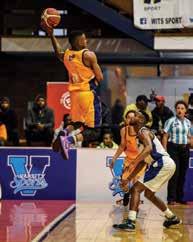
Bursary awards are made possible by funding from the University itself and by the generosity of alumni, the business and non-profit communities and past Wits sports achievers. Applications for sports bursaries for the 2022 academic year, open on the 1st April 2021 and close on 31 August 2021. Please note that only online applications will be accepted.
If you have represented your province or South Africa in top-level sport and display the appropriate academic potential, you may be eligible for a Wits Sport Bursary.
Terms and conditions are outlined in the Wits Sport Bursary application form, which can be downloaded from: www.wits.ac.za/sport/sport-bursaries/ Applications must be received by 31 August.
Vice-Chancellor
For the ten most outstanding matriculants, a scholarship of approximately R50 000 is awarded.
IMPORTANT:
The scholarship is renewable for each year of the first undergraduate degree provided that academic performance is of a high standard. The award is automatically offered after registration. No application is required.
Criteria: Subjects are ranked as below:
• English
• Mathematics
• Physical Science
And the next best three designated subjects are taken into consideration.
NB: Students are chosen on the first submission of the matric results obtained from the Department of Education. No remarks are considered for this scholarship. Students cannot be awarded the Vice-Chancellor Scholarship, the VC Equality Scholarship or Entrance Scholarship at the same time.
Equality Scholarships
These scholarships target the top ten performing students in Quintile 1 and 2 schools, who have performed outstandingly in their Matric year and who have been offered a place at the University. The scholarship is renewable for each year of the first undergraduate degree provided that academic performance is of a high standard. The award is automatically offered after registration. No application is required.
Criteria: Subjects are ranked as follows:
• English
• Mathematics
• Physical Science, and
• the next best three designated subjects are taken into consideration.
NB: Students are chosen on the first submission of the matric results obtained from the Department of Education. No remarks are considered for this scholarship.
National Olympiad Winners
Applies to Maths and English Olympiad winners only:
• R20 000 for winners
• R8 000 for top 10 runners up
Students must provide the Financial Aid and Scholarships Office (FASO) with a certified copy of their Olympiad certificate.
Foreign Results
South African students who have completed a foreign qualification such as an A Level, AS Level, IB or German Abitur, may be eligible for recognition of distinctions achieved in these qualifications. The award is up to a maximum of R30 000. Academically excellent applicants with foreign school-leaving qualifications may also apply on an ad hoc basis.
If a student receives an external bursary that is more than the maximum allocation of R155 000, regardless of the source, the student will be required to return sponsorship funding. This is to enable the University to assist other Wits students. Please also note that all Wits awards will be cancelled and forfeited if a student deregisters.
Choose programmes from 5 faculties, 34 schools and 3 416 courses
Wits’ academic programmes enjoy national and international accreditation. The curriculum is cutting-edge and is continuously enhanced to ensure that our students and staff keep up to date with the newest knowledge from around the globe.
5 Faculties
Commerce, Law & Management
pg. 36
The Faculty of Commerce, Law & Management (CLM) offers world-class educational programmes that equip future leaders with business, management and legal skills, while supporting your professional development.
www.wits.ac.za/clm/
Engineering & the Built Environment
pg. 54
Degrees offered through the Faculty of Engineering and the Built Environment address South Africa’s social, spatial and infrastructural needs and include architecture, urban and regional planning, property studies and construction studies.
www.wits.ac.za/ebe/
We offer a wide range of undergraduate qualifications through the:
• School of Business Sciences
• School of Accountancy
• School of Economics and Finance
• School of Law
• Wits Plus Centre for Part-Time Studies
Our programmes include the Bachelor of Commerce (BCom) with flexible major combinationsand more specialised degrees, like:
• Bachelor of Commerce (Accounting)
• Bachelor of Commerce (Information Systems)
• Bachelor of Commerce (Politics, Philosophy and Economics)
• Bachelor of Commerce with Law
- Two-year stream LLB
- Three-year stream LLB
- Four-year stream LLB
• Bachelor of Accounting Science
• Bachelor of Economic Science
This Faculty comprises seven Schools:
• Architecture and Planning
• Civil and Environmental Engineering
• Chemical and Metallurgical Engineering
• Construction Economics and Management
• Electrical and Information Engineering
• Mechanical, Industrial and Aeronautical Engineering
• Mining Engineering
We offer a range of undergraduate programmes, including:
• Digital Arts (within Electrical & Information Engineering)
• Architecture
• Urban and Regional Planning
• Construction Studies
• Property Studies
The Bachelor of Health Sciences offers three fields of study: Biokinetics, Biomedical Sciences and Health Systems Sciences. Degrees are offered in:
• Clinical Medical Practice
• Dentistry
• Medicine
• Nursing
• Occupational Therapy
• Pharmacy
• Physiotherapy
You will receive academic and practical training at five major hospitals in Johannesburg, at several clinics and rural hospitals in Gauteng and at the Donald Gordon Medical Centre, which also assists clinicians with all aspects of their clinical research.
More than 500 students graduate from our faculty every year.
Choose between vocationally oriented programmes for specific careers and theory and research-oriented programmes for careers in academia and research institutes, the public and private sectors and non-governmental organisations.
Three schools in the Faculty of Humanities offer professional (vocational) programmes
• Wits School of Arts (WSoA): Digital Arts; Dramatic Arts; Film and Televsion; Fine Arts and Music
• Wits School of Education (WSoE): Foundation Phase Teaching; Intermediate Phase Teaching; Senior Phase and Further Education and Training Teaching
• School of Human and Community Development (SHCD): Speech-Language Pathology; Audiology; Social Work
There are nine Schools in the Faculty, clustered into four groupings:
• Mathematical Sciences: Actuarial Sciences; Computational and Applied Mathematics; Computer Science; Mathematics; Mathematics of Finance; Mathematical Sciences
• Physical Science: Physical Science; Chemistry with Chemical Engineering; Material Science; Astronomy and Astrophysics
• Biological Sciences: Biodiversity; Ecology and Conservation; Organismal Biology; Applied Bioinformatics; Biochemistry and Cell Biology; Genetics and Development Biology; Microbiology and Biotechnology
Sciences pg. 73
The Faculty of Health Sciences pioneers African and global research that improves and saves lives.
www.wits.ac.za/health/
Humanities
pg. 90
The Faculty of Humanities is among Africa’s leading centres of study in the Arts, Social Sciences, Human and Community Development, Education and Literatureand Media.
www.wits.ac.za/humanities/
www.wits.ac.za/science/ Science pg.113
The Faculty of Science has a long tradition of excellence in teaching and research. Studying science opens doors to careers in fields like research, chemistry and biotechnology
MESSAGE FROM THE DEAN FACULTY OF COMMERCE, LAW & MANAGEMENT (CLM)
We prepare students not just for a profession but for the daily life of active citizenship.
For those of you who are hungry to make your mark in the country, the continent and globally, there is no better option than Wits. If you plan to pursue a career in law, economics, commerce and business, you cannot beat the experience of studying in the country’s economic hub. It is no accident that the majority of law firms and businesses have headquarters in Johannesburg. The buzz of the city makes it a networking nucleus which connects the worlds of commerce and industry to the worlds of art, culture and sport. I firmly believe that whatever way you assess Wits, its proximity to the business and economic heartland of the country, its historic reputation of being at the forefront of social and political struggles in South Africa, or its world-class research and teaching, if you are planning a career that is engaged in the future of this country and of the African continent, Wits should be your first choice.
Professor Imraan Valodia
COMMERCE, LAW & MANAGEMENT
How to structure your BCom degree
1st year
2nd year
3rd year
compulsory choose your majors choose your majors
Economics IA OR
Economics Theory IA Economics IB OR
Economics Theory IB AND Accounting I AND Computational Mathematics Business Statistics AND Fundamentals of Information Systems
Commercial Law
First things first
Potential Major (Second year level) AND
Potential Major (Second year level) AND
Potential Major (Second year level)
Major 1 (Third year level) AND
Major 2 (Third year level)
The Wits BCom (refer to page 42) includes compulsory first year courses that build foundational knowledge in Economics, Accounting, Commercial Law, Information Systems and Introductory Mathematics and Business Statistics. These courses prepare you for a career in the commercial and related sectors of any economy.
You can either take them as full-year courses across both semesters of the academic year, or as semester courses in the first or second semesters. In some cases, you must pass one course before proceeding to another.
?Two or three majors?
The Wits BCom is a double major degree, which means you need to complete at least two full majors. But, in your second year, you can choose courses or modules that lead to three potential majors. By choosing three majors in your second year, you can start exploring areas of interest in more depth, but make a final decision later.
You must have at least one major from Commerce, Law and Management (CLM); your second major could be from another faculty, like Science or Humanities. However, many students take both majors from disciplines offered within CLM.
?Still deciding? Go General.
One of the great benefits of a Wits BCom General degree is that you don’t have to commit to your major choices in first year. Even if you choose one of the more specialised BCom degrees (e.g. BCom Law or BCom PPE), you can easily move between degrees if you change your mind later.
From second year onwards, BCom General students select their majors from either:
• Economics, Finance, Information Systems, Insurance and Risk Management, Human Resource Management, Marketingand Management;
• Courses offered in the School of Accountancy (i.e. Auditing, Taxation and Management Accounting); or
• Selected approved majors from other faculties. (Refer to pages 39-41)
Faculty officers can advise you on your options at registration or during the year.
www.wits.ac.za/bcom/structuring-your-wits-bcom/
Flexible Major Combinations
Create a BCom degree that suits your career goals with our guided major combinations.
Economics
Do you have a flair for problem-solving, reasoning and analysis? Are you fascinated by how money makes the world go around? A career in Economics might be for you.
What is Economics?
Economics is the study of how, where and why money and resources are produced, spent and allocated by governments and businesses and how this affects individuals. When you hear discussions about unemployment, monetary policy, budget deficit and inflation, chances are an economist is involved. Since all businesses, organisations and citizens are affected by local and global economies, every commerce graduate must complete at least one year of study in Economics.
Major Combinations
• Finance • Information Systems • Insurance and Risk Management • Law • Management OR Politics OR • Philosophy as part of a BCom(PPE)
• Investment Banker • Journalist • Manager • Political Advisor or ‘Lobbyist’ • Policy Analyst • Politician • Researcher
Finance
Are you analytical and skilled at problem-solving and planning? Are you good with numbers and have you always been money-savvy? Consider a major in Finance.
What is Finance?
Finance is the science of managing money. This involves two broadly related activities:
• The management of money by businesses (corporate finance), government (public finance) and individuals (personal finance); and
• The process of acquiring the funds needed to operate successfully.
Finance is the engine of all economies and stock markets and is central to their success (or failure). Some of the topics you will study include investments, equity and debt, assets and liabilities, credit, mergers and acquisitions, dividend policy, initial public offerings (IPOs) and financial regulations and decision-making.
Major Combinations
• Economics • Information Systems • Insurance and Risk Management • Law • Management
Are you a great communicator who relates well to people? Do you have excellent problem-solving skills, with the ability to ‘see both sides’? Studying Human Resource Management may be a great choice for you.
What is Human Resource Management?
Human Resource Management (HRM) involves managing people within organisations to optimise their performance. HRM studies focus on people-related policies and systems. They are also concerned with change in organisations and industrial relations, such as recruitment, talent management, employee development and motivation and compensation.
Major Combinations
• Management • Psychology • Law • Information Systems • Economics • Marketing
• Recruitment & Talent Management • Strategic Planning • Training and Development
Information Systems
Are you fascinated by the relationship between technology, people, organisations and societies? Are you the first to download and use the latest app? Do you enjoy solving real-world problems? Information Systems might be the career path for you.
What is Information Systems?
Information Systems (IS) enable individuals, organisations and society to gather, store, organise, protect, retrieve, shareand analyse information. Though technologies play a vital part in these systems, IS studies also focus on systems design in their entirety. This is how IS differs from information technology (IT) or computer science, which only study the technology components.
IS professionals work in all sectors of the economy, including large organisations.
Does risk management and the probability of disaster fascinate you? Are you analytical and focused, with good attention to detail? A career in insurance and risk management might be for you.
What is Insurance and Risk Management?
Insurance is how companies and individuals protect themselves against the risk of loss and against loss itself. This may involve property, life, health, or income. Insurance is a form of risk management. Risk management refers to the way in which risks are identified, assessed and prioritised and the means used to minimise, monitor and control the threat posed by unpredictable events.
Wits offers professional development in this field outside of actuarial science studies. There is a high demand for graduates with insurance and risk management knowledge in senior management positions within this industry.
Management
Do you have a flair for planning, organisingand teamwork? Are you an effective communicator who can motivate others? Do you see yourself leading a Fortune 500 company, or as South Africa’s next successful entrepreneur? If so, consider majoring in Management.
What is Management?
Management studies how organisations – be they businesses, government bodies, or non-profit organisations – are run and administrated. Topics covered include: leadership and the role of managers; managing individuals, groups and teams; organisational development and behaviour; project management and strategic management; and the theory and practice of entrepreneurship and new venture creation. Those with an entrepreneurial flair may start their own businesses, or become small business advisors or business consultants.
Major Combinations
You can choose from almost any discipline, because most graduates eventually move into leadership positions in their careers.
Careers in Management
• Compliance Manager • Manager in Public Works and Health • Manager in Tourism • Marketing Manager
• Operations Manager • Project Manager • Strategic Planning Director • Training Manager Top Management posts include:
• Chief Executive Officer • Chief Operating Officer • Company President • General Manager • Managing Director
Marketing
Are you fascinated by trends and why certain brands are more successful than others? Do you ever wonder what makes last season’s ‘must-haves’ suddenly ‘so last year’? Would you love to shape the world’s consumer desires? Marketing could be your dream career.
What is
Marketing?
The role of marketing in business is to build brand profiles and persuade people to buy products. Technology, travel, entertainment, services, apps and games - even your favourite musician or sports team - all of these are marketed. Marketing includes the creation and design of images and products (branding), advertising, demand creation and management, public relations and digital marketing.
Major Combinations
• Management • Information Systems • Psychology • Finance • Economics • Human Resource Management
• Promotions Manager • Public Relations Manager • Sales Manager
www.wits.ac.za/bcom/structuring-your-wits-bcom/
Bachelor of Commerce (General)
Bachelor of Commerce (General)
CBA00
Duration: 3 years
NSC REQUIREMENTS
APS 39+
English Home Language OR First Additional Language Level 5
Mathematics Level 5
Waitlisting
Applicants with an APS of 35-38, as well as English 6 and Mathematics 6, will be wait-listed subject to place availability.
International Qualifications: Page 25
Closing Date: 30 September
Invest in your future with a Wits BCom. Establish a strong knowledge foundation, build your intellectual capital and take the first step towards future-proofing your career.
Associated with one of the highest graduate employment rates in the country, a Wits BCom makes you highly soughtafter, both locally and internationally.
English Home Language OR First Additional Language Level 5
Mathematics Level 5
Waitlisting
Applicants with an APS of 35-38, as well as English 6 and Mathematics 6, will be wait-listed subject to place availability.
International Qualifications: Page 25
Closing Date: 30 September
The three-year, full-time BCom Accounting programme includes compulsory and elective courses.
The choice of courses within the BCom Accounting programme allows you to tailor your degree to meet your career aspirations. With this degree, you can become a chartered financial analyst (CFA) in the USA or SA, a professional accountant registered with the South African Institute of Professional Accountants (SAIPA), a management accountant registered with the Chartered Institute of Management Accountants (CIMA), a certified internal auditor (CIA) or a chartered certified accountant registered with the Association of Chartered Certified Accountants (ACCA).
If you want to pursue the ACCA qualification, please refer to the admission requirements for the Postgraduate Diploma in Specialised Accountancy.
A minimum total of 120 credits must be taken from the following courses-provided that you have satisfied the prerequisite courses. In order to qualify for the Bachelor of Commerce in the field of Accounting it is important to note that Accounting III must be completed.
English Home Language OR First Additional Language Level 5
Mathematics Level 6
Waitlisting
Applicants with an APS of 39-43, as well as English 6 and Mathematics 6, will be wait-listed subject to place availability.
International Qualifications: Page 25
Closing Date: 30 September
The Bachelor of Accounting Science (BAccSCi) degree prepares you for the qualification as a Chartered Accountant. The programme includes four core areas of study: Management Accounting and Finance, Financial Accounting, Auditing and Taxation. You will also take introductory courses in Economics, Commercial Law, Mathematics and Statistics and Accounting Information Systems.
The curriculum is fully compliant with international accounting education requirements, as well as those of the following boards:
• South African Institute of Chartered Accountants (SAICA)
• Public Accountants and Auditors Board (PAAB)
• International Federation of Accountants (IFAC)
Once you’ve completed your BAccSc, you will need to complete a Higher Diploma in Accounting (HDipAcc), which is a one-year, full-time postgraduate programme. If you successfully complete the HDipAcc, you will be eligible to write the SAICA qualifying exams (otherwise known as Board Exams).
The exams are written in two parts and you will need to complete a three-year training contract in the accountancy profession (Training in Public Practice) or in commerce and industry (Training Outside Public Practice). After writing your first exam, you will need to choose a specialist course in either Financial Management or Auditing. You will then write the second qualifying exam. Once you have successfully completed both exams, you will be eligible to register as a chartered accountant with SAICA.
Applicants with an APS of 39-41, as well as English Level 5 and Mathematics Level 7, will be wait-listed, subject to place availability. Applicants interested in Actuarial Science require Mathematics Level 7 and English Level 6.
International Qualifications: Page 25
Closing Date: 30 September
The Bachelor of Economic Science (BEconSc) is a mathematically focused degree with majors in Economics and Mathematical Science.
The BEconSc is a specialist degree that builds strong analytical abilities for graduates wishing to work in fields like economics, actuarial science, or other business and data analytics fields.
You can choose to major in Mathematical Science from Actuarial Science, Computational and Applied Mathematics, Computer Science, Mathematics and Mathematical Statistics.
The entrance requirements for the BEconSc degree are higher than those for the BCom. You should only consider it if you have a strong mathematical ability.
CAREERS
• Actuary • Budget Analyst • Economist
• Field Marketing Associate
• Financial Analyst
• Industry Analyst
• Management Consultant
• Policy Analyst • Statistician
PROGRAMME OUTLINE
First year
Business Accounting I
Economic Theory IA (Microeconomics for Economists)
Economic Theory IB (Macroeconomics for Economists)
Algebra I
Calculus I
AND, one of the following groups:
Computational and Applied Mathematics I OR
Basic Computer Organisation
Discrete Computational Structures
Introduction to Algorithms and Programming
Introduction to Data Structures and Algorithms
OR
Actuarial Science I AND
Mathematical Statistics I
Second year
Economics IIA and IIB AND
Basic Analysis II
Multivariable Calculus
Abstract Mathematics
Linear Algebra II
Transition to Abstract Mathematics II
Introduction to Mathematical Statistics
AND, one of the following groups:
Computational and Applied Mathematics II OR
Database Fundamentals II
Mobile Computing II
Computer Networks II
Analysis of Algorithms II OR
Mathematical Statistics II OR
Actuarial Science II
Third year
Economic Science III
AND, one of the following groups provided you have done the equivalent in the second year of study and complied with the pre- and co-requisite courses
Applicants with an APS of 35-38, as well as English 6 and Mathematics 6, will be wait-listed, subject to place availability.
International Qualifications: Page 25
Closing Date: 30 September
The pervasiveness of technology in the knowledge economy has resulted in increasing demand for professionals with a unique blend of analytical, technical, business and communication skills.
Information Systems are systems that allow individuals, organisations and societies to gather, store, organise, protect, retrieve, share and make sense of the information in their environments.
In Information Systems, we study what happens when technologies, people, organisations and societies interact. Technology now lies at the heart of a dynamic, information and knowledge-driven world that needs people to point the way, people who “get it”. Our analysts solve “real world” problems, using technology to build systems that allow for quicker and smarter responses to changes in dynamic and complex environments.
It is important to note that we focus on the design of endto-end solutions of which technology may be an element and not only on technology for the sake of technology. This is what differentiates us from other disciplines such as Information Technology (IT), Computer Science and Software Engineering.
CAREERS
The analytical, technical, business and communication skills gained through the BCom with specialisation in IS can lead to a wide range of career choices, including: Business Analyst, Systems Analyst, Consultant, Analyst Programmer, Application Developer, Technology Architect, Database Administrator, UX/UI Designer, IT Auditor, Project Manager, Change Manager, Chief Information Officer. We regularly supply graduates to major professional services and banking organisations, including ABSA, Accenture, BSG, Deloitte, EY, First National Bank, Investec, Nedbank, PWC, Rand Merchant Bank and Standard Bank; technology
organisations, including Amazon, Facebook, Google, Oracle and SAP; and telecommunications organisations, including Telkom, MTN and Vodacom. We also have many graduates working internationally.
PROGRAMME OUTLINE
First year
Information Systems IA and IB
Accounting I
Computational Mathematics I
Business Statistics I
Economic IA (Microeconomics)
Economics IB (Macroeconomics)
OR
Economic Theory IA (Microeconomics for Economists)
Economics Theory IB (Macroeconomics for Economists)
Second year
Information Systems IIA and IIB
A total of 72 credits must be taken from the following courses. At least 48 of these credits must make up the Second year level of your second major. Students who wish to pursue a second major in Computer Science must be aware of the prerequisite requirements for this course.
Corporate Finance II
Investment II
Economics IIA and IIB
Consumer Behaviour
Principles of Marketing
Integrated Marketing Communications
Retail Management
Principles of Management IIBA and IIB
Entrepreneurship
Insurance and Risk Management IIA and IIB
Human Resources IIA
Human Resources IIB (Labour Relations)
Third year
Management and Application of Information Systems
Information Systems Development Project
A total of 72 credits must be taken from the following courses:
Bachelor of Commerce (Politics, Philosophy and Economics)
CBA12
Duration: 3 years
NSC REQUIREMENTS
APS 39+
English Home Language OR First Additional Language Level 5
Mathematics Level 5
Waitlisting
Applicants with an APS of 35-38, as well as English Level 6 and Mathematics Level 6, will be wait-listed subject to place availability.
International Qualifications: Page 25
Closing Date: 30 September
The Politics, Philosophy and Economics BCom(PPE) specialisation gives you a broad and deep understanding of the world, as well as a wide range of thinking skills required for high-level engagement.
Specialising in PPE gives you an understanding of political, philosophical and economic ideas; the nature of political institutions; political processes and decision-making; how economic systems work; the causes of poverty and wealth; and how to promote development.
In the first year, you will take economics, politics and philosophy, as well as a selection of general BCom first year subjects. From second to third year level, you will continue to major in economics and either politics or philosophy. You can choose to do a BA(PPE) or to take politics or philosophy as part of a general BCom degree.
CAREERS
• Academia • Civil Service • Development • Diplomatic Corps • Economics • International Banking or Finance
• Journalism • Politics • Research
PROGRAMME OUTLINE
First year
Economic Theory IA (Microeconomics for Economists)
Economic Theory IB (Macroeconomic for Economists)
Introduction to Ethics
Introduction to Philosophy: Knowledge and Reality I
Introduction to Political Studies I States, Power and Governance
Computational Mathematics I
Business Statistics I
Second year
Economics IIA and IIB
A student must choose between Politics II and Philosophy II
History of Philosophy: A Classical and Early Modern Philosophy
AND, one of the following:
• Philosophy of Mind and Psychology II
• Philosophy of Religion II
• Philosophy of Science II
• Social and Political Philosophy II
• Theories of Justice II
• Continental Philosophy II
• African Philosophy
OR, two of the following:
• Social Theories of Modernity
• South Africa: Politics and Governance
• Black Consciousness Thought and the Politics of Anti-Racism
A total of 48 credits must be taken from:
• Corporate Finance II
• Investment II
• Principles of Management IIA
• Principles of Management IIB (Entrepreneurships)
• Insurance and Risk Management IIA
• Insurance and Risk Management IIB
• Human Resources IIA
• Human Resources IIB (Labour Relations)
• Consumer Behaviour
• Principles of Marketing IIA
• Integrated Marketing Communications
• Retail Management Third year
Economic Science III OR
Economic Theory III OR
Applied Development Economics III
A total of 72 credits must be selected from either Politics III or Philosophy III, depending of what was taken in second year of study AND
Epistemology and Metaphysics III
Ethics III
History of Philosophy B: Further Topics in Modern Philosophy III
You have several options if you want to study law at Wits:
If you want to practise law, you need at least an LLB degree.
While it is possible to enter an LLB at first year undergraduate level, you are encouraged to complete a BCom or BA degree first, preferably with law as one of your majors. This gives you a feeling for general law subjects before you commit to studying law. It also develops your knowledge and skills in other disciplines, which will be useful when you practise law. If you want to work in corporate law, either for a law firm or in the legal department of large organisations, you should do a BCom(Law) with a second major in Finance, Management, Accounting, Taxation, or any other BCom major. However, if you want to work in human rights law, family law, constitutional law, or international law, you should begin your legal studies with a BA(Law) and pair this with courses like politics, sociology, economics, or languages.
Both the BCom(Law) and BA(Law) routes into the LLB include introductory and core LLB courses, taken over three years, which will be your majors. You can then complete your LLB degree over two years, with credits accrued during the undergraduate degree awarded towards your LLB.
This four-year programme comprises mostly law subjects with several Humanity or Commerce subjects at first year level. You must take certain core law subjects if you wish to graduate with an LLB. Other subjects form a set of electives you can choose from.
You can also enter the LLB if you hold any undergraduate degree, without Law as a major. In this case, you will only have to complete the law courses required in the LLB and can complete the qualification in three years.
In both cases, you will develop critical thinking and analytical skills during your first degree, which enables you to progress through the LLB.
Subject to assessment criteria as determined by the School of Law and place availability. Wits students who have completed a BA Law or a BCom Law are eligible to apply for the two-year LLB.
International Qualifications: Page 25
Closing Date: 30 September
CAREERS
Students studying law at Wits can consider many careers both in the legal and related areas, bearing in mind that further study and requirements are necessary for certain roles. Roles might include:
Subject to assessment criteria as determined by the School of Law and place availability. Applicants who have completed an undergraduate degree at an institution other than Wits are required to apply for the three-year LLB programme. Wits applicants who have completed an undergraduate degree without Law modules are also required to apply for the three-year LLB. Applicants must have obtained an average of at least 60% in an undergraduate degree.
Closing Date: 30 September
CAREERS
Students studying law at Wits can consider many careers both in the legal and related areas, bearing in mind that further study and requirements are necessary for certain roles. Roles might include:
Students studying law at Wits can consider many careers both in the legal and related areas.
NSC REQUIREMENTS
APS 43+
English Home Language OR Additional First Language Level 6
Mathematics Level 5
Maths Literacy Level 6
Waitlisting
Students who come to Wits immediately after Matric may apply for the four-year LLB.
Applicants with an APS of 40-42, as well as English Level 6 AND Mathematics Level 5 OR Maths Literacy Level 6, will be wait-listed, subject to place availability.
A MESSAGE FROM THE DEAN FACULTY OF ENGINEERING & THE BUILT ENVIRONMENT (EBE)
At Wits, you will learn to work in a trans-disciplinary world and be trained to create new areas of endeavour, new technologies and new solutions to humanity.
t Wits you will be exposed to scientific synthesis, understanding and critical thought and you will use this knowledge and skill to do remarkable things for society.
You will learn the fundamentals of design; you will be involved in analysis and find solutions in a creative way. You will work in teams made up of people from different backgrounds, all working towards a common solution for humanity. You will be trained to become problem-solvers; the multiple ways of looking at situations and collectively finding the best solutions. We are training you to become the thinkers and doers that will make the world a better place. I wish you all the best in your career choice.
Professor Ian Jandrell
ACCREDITATION
Our undergraduate engineering degrees are recognised by the Engineering Council of South Africa and have also been approved by the professional engineering accrediting bodies in the USA, Canada, Australia, New Zealand, the UK, Ireland and Hong Kong.
Schools in Engineering
School of Chemical and Metallurgical Engineering
The School of Chemical and Metallurgical Engineering offers a four year BSc(Eng) degree in Chemical as well as Metallurgical Engineering. The Metallurgical Engineering part of the School was one of the founding departments (together with the Schools of Mining Engineering and Geosciences) of the University when it was first established as the Kimberley School of Mines in 1896. Chemical Engineering teaching and research commenced at the University shortly after its inception as The University of the Witwatersrand in 1922. Both departments in the School have a long and proud history of producing leaders in the local industry in their various disciplines and providing the local economy with highly skilled and sought after engineers.
Chemical Engineering
The course focuses on the fundamentals of chemical engineering such as thermodynamics, process and reactor design, preparing you for a wide variety of applications in the chemical industries and related fields even such as environmental engineering.
Metallurgical Engineering
A strong foundation is provided and will prepare you for both materials engineering as well as extractive metallurgy, which includes pyrometallurgy and hydrometallurgy.
School of Civil and Environmental Engineering
The School of Civil and Environmental Engineering has for nearly 100 years been home to many internationally respected academics and produced graduates who have made tremendous strides in the engineering profession as leaders of industry within South Africa and around the globe. The School remains a steady source of highly skilled professionals for the infrastructural development of the country. The hallmarks of graduates of the School are being excellent professional engineers with profound leadership skills and entrepreneurial acumen and strong ethical values.
The School offers a four-year BSc(Eng) degree in Civil Engineering and postgraduate programmes which enable students to specialise in the disciplines of water, environmental, geotechnical, construction materials and structural engineering and infrastructure engineering and management. With its worldclass laboratory facilities and highly skilled academic and professional staff, the School continues to produce cutting-edge scholarly works and train professionals for the industry.
School of Electrical and Information Engineering
The School of Electrical and Information Engineering has extensive research laboratory facilities, including those for machines and drives, electronics, high voltage, lightning and electromechanics (EMC) telecommunications, information engineering, computational electromagnetics and systems and control. Bioinformatics has also been added as a competency. The School is a partner of the Johannesburg Centre for Software Engineering and is involved in a renewable energy research initiative at Masters and PhD Level, with particular focus on wind, solar and smart grids. The School has also incubated two hightech companies and our staff are active academic research and industrial consultants.
School of Mechanical, Industrial and Aeronautical Engineering
The School of Mechanical, Industrial and Aeronautical Engineering has produced world-class engineers and has been at the forefront of engineering in South Africa for over 100 years
The School produces graduate engineers in three branches:
Mechanical Engineering
Mechanical engineers design, develop, construct and use the machines and systems found in all areas of industry.
Industrial Engineering
After you have completed two years of study in any engineering stream, you may enter the Industrial Engineering stream in third year. You will graduate as an industrial engineer, but with a background in another engineering discipline, such as chemical or electrical engineering.
Aeronautical Engineering
Aeronautical engineers design, develop and modify aircraft components and systems.
School of Mining Engineering
The School of Mining Engineering is one of the world’s leading mining engineering schools
The School, in consultation with the South African mining industry, gives you the engineering knowledge that you will need as a practising mining engineer. This includes technical management and evaluation and rock engineering, as well as management skills in evaluation techniques and fundamental mineral economic principles.
COMMON First year PROGRAMME ACROSS ALL PROFESSIONAL DISCIPLINES
A common First year programme was introduced from 2019 across all professional engineering disciplines. The academic curriculum is regularly modernised in order to ensure that it meets the highest professional and academic standards and that it simultaneously remains locally relevant and applicable. Many engineering students entering the engineering programmes have a limited knowledge of the different branches of engineering and only gain the knowledge to make an informed choice of programme during their first year. A first year curriculum that is identical for all programmes allows students to amend their choice at the end of the first year.
Bachelor of Science in Engineering in Chemical Engineering
EFA00
Duration: 4 years
NSC REQUIREMENTS
APS 42+
English Home Language OR First Additional Language Level 5
Mathematics Level 5
Physical Science Level 5
Waitlisting
Students with English, Mathematics and Physics at Level 5 will be wait-listed, subject to place availability. Generally, applicants who achieve 70% in English, Mathematics and Physical Science stand a greater chance of being accepted.
International Qualifications: Page 15
Closing Date: 30 September
Design, operate and manage large-scale industrial conversion processes.
Chemical Engineering involves large-scale industrial processes that convert raw materials – by physical or chemical change – into products with higher economic and social value. For example, coal, petroleum, natural gas, vegetation and microorganisms are converted into fuels and chemicals. Chemical engineers are needed in fields such as plastics, oil refinery, explosives, fertilisers, detergents and food and mineral processing.
Chemical engineering plays an important role in society by minimising and controlling the impact of modern industry on the environment, society and businesses.
The curriculum therefore includes courses on environmental engineering, management principles and professional practice and ethics.
Courses such as Chemical Engineering Thermodynamics, Chemical Reactor Theory, Process Control, Solid Fluid Systems, Transport Phenomena, Mass-Transfer Operations and Chemical Plant Design are studied after first year. In final year, you will study elective subjects in advanced chemical engineering topics.
You need a thorough understanding of Mathematics, Physics and Chemistry and must be computer literate.
CAREERS
• Biochemical Engineer • Environmental Engineer
• Food Processing Engineer
• Process Control Engineer
• Process Design Engineer • Process Plant Manager
• Systems Engineer • Technical Sales Engineer
PROGRAMME OUTLINE
First year
Engineering Chemistry
Introduction to the Engineering Profession
Engineering Analysis and Design IA AND IB
Engineering Mathematics IA AND IB
Engineering Physics IA AND IB
Applied Physics I
AND, one of the following courses:
• Elementary IsiZulu Language and Culture IA
• Elementary Sesotho Language and Culture IA
• The International Relations of South Africa and Africa
• Introduction to Political Studies
• Southern Africa in the Era of Globalisation
• Identity and Society
• Introduction to Ethics I
• Introduction to Philosophy: Knowledge and Reality
Bachelor of Science in Engineering in Metallurgy and Materials Engineering
EFA08
Duration: 4 years
NSC REQUIREMENTS
APS 42+
English Home Language OR First Additional Language Level 5
Mathematics Level 5
Physical Science Level 5
Waitlisting
Students with English, Mathematics and Physics at Level 5 will be wait-listed, subject to place availability.
Generally, applicants who achieve 70% in English, Mathematics and Physical Science stand a greater chance of being accepted.
International Qualifications: Page 15
Closing Date: 30 September
Design, operate and manage industrial plants that convert minerals and metals into valuable products.
Metallurgy and Materials Engineering involves the engineering principles required to concentrate, extract and refine metals, materials and carbon (coal) materials, as well as to develop new alloys and materials, including ceramics and composites.
Core subjects in Materials Engineering focus on the structure and behaviour of materials and their conversion into usable forms through heat treatment processes such as welding, forming processes and powder metallurgy. As in Chemical Engineering, the Materials Engineering PROGRAMME OUTLINE also focuses on the issues of environmental engineering, management and professional ethics.
There is a strong emphasis on design and project work, with the programme culminating in an extensive laboratory project and a large design project. The degree programme provides a sound foundation for future postgraduate study, as well as a career in technical management.
CAREERS
• Corrosion Engineer • Extractive Metallurgist
• Failure Analysis Consultant • Foundry Engineer
• Heat Treatment Engineer
• Metallurgical Plant Design Engineer
• Process Control Engineer
• Tribologist Materials Consultant
PROGRAMME OUTLINE
First year
Engineering Chemistry
Introduction to the Engineering Profession
Engineering Analysis and Design IA AND IB
Engineering Mathematics IA AND IB
Engineering Physics IA AND IB
Applied Physics I
AND, one of the following courses:
• Elementary IsiZulu Language and Culture IA
• Elementary Sesotho Language and Culture IA
• The International Relations of South Africa and Africa
• Introduction to Political Studies
• Southern Africa in the Era of Globalisation
• Identity and Society
• Introduction to Ethics I
• Introduction to Philosophy: Knowledge and Reality
• Global Encounters and Contemporary Realities IA
Second year
Engineering Chemistry IIA
Introductory Mineralogy and Earth Sciences
Computing for Process Engineering
Introduction to Extractive Metallurgy
Practical Metallurgy
Material Science and Engineering
Process Engineering Fundamentals A
Economic Concepts IA
Electrical Engineering
Mathematics II
Third year
Numerical Methods (Metallurgy)
Engineering Failure Analysis
Kinetics and Transport Processes in Metallurgical
Engineering
Solidification, Heat Treatment and Microstructure
Environmental Process Engineering
Crystal Structure and Analysis
Corrosion and Wear
Non-Ferrous Pyrometallurgy
Metallurgical Thermodynamics I AND II
Process and Materials Design I AND II
Engineering Statistics
Fourth year
Physical Chemistry of Iron and Steel Manufacturing
Bachelor of Science in Engineering in Civil Engineering
EFA01
Duration: 4 years
NSC REQUIREMENTS
APS 42+
English Home Language OR First Additional Language
Level 5
Mathematics Level 5
Physical Science Level 5
Waitlisting
Students with English, Mathematics and Physics at Level 5 will be wait-listed, subject to place availability. Generally, applicants who achieve 70% in English, Mathematics and Physical Science stand a greater chance of being accepted.
International Qualifications: Page 15
Closing Date: 30 September
Plan, design and manage physical infrastructure.
Civil Engineering is the practice of improving and maintaining the built environment to enhance the quality of life for present and future generations.
Civil engineers primarily plan, design, construct, operate and maintain physical infrastructure, including water and waste management facilities, transportation and communications infrastructure and structures and public buildings. This infrastructure supports people’s basic needs, while enabling and driving economic development.
In the first two years of study, students develop competencies in mathematics, natural sciences, computing and complementary studies. In the third and fourth years, students develop competencies in engineering design and synthesis through courses in Geotechnical Engineering, Hydrology, Hydraulics, Transportation Engineering, Structural Engineering and Construction Materials.
CAREERS
• Bridge Engineer
• Earthquake Design Engineer
• Consulting Engineer
• Construction Manager
• Environmental Engineer
• Geotechnical Engineer
• Hydrologist
• Structural Engineer
• Water Resource Manager
PROGRAMME OUTLINE
First year
Engineering Chemistry
Introduction to the Engineering Profession
Engineering Analysis and Design IA AND IB
Engineering Mathematics IA AND IB
Engineering Physics IA AND IB
Applied Physics I
AND, one of the following courses:
• Elementary IsiZulu Language and Culture IA
• Elementary Sesotho Language and Culture IA
• The International Relations of South Africa and Africa
• Introduction to Political Studies
• Southern Africa in the Era of Globalisation
• Identity and Society
• Introduction to Ethics I
• Introduction to Philosophy: Knowledge and Reality
• Global Encounters and Contemporary Realities IA
• Vacation Work (Civil)
Second year
Materials and Structures I AND II
Numerical Methods
Probability Theory and Mathematical Statistics for Engineers
Bachelor of Science in Engineering in Electrical Engineering
EFA03
Duration: 4 years
NSC REQUIREMENTS
APS 42+
English Home Language OR First Additional Language Level 5
Mathematics Level 5
Physical Science Level 5
Waitlisting
Students with English, Mathematics and Physics at Level 5 will be wait-listed, subject to place availability. Generally, applicants who achieve 70% in English, Mathematics and Physical Science stand a greater chance of being accepted.
International Qualifications: Page 15
Closing Date: 30 September
Design, operate and manage communications, IT, electric power and automation technology.
Electrical Engineering covers a broad range of activities involving the generation and use of electrical energy, including the planning and operation of large stations, computing and information transfer and telecommunication systems. An Information Engineering option is also offered within the programme.
In the first two years, all Electrical Engineering students focus on enhancing their capabilities in mathematics, physics and chemistry. In the third year, you will study Electrical Engineering Science subjects and take more advanced courses in mathematics, such as Electronics, Power Engineering, Electro-magnetic Engineering and Mathematical Methods.
In the third year, you will study five complementary courses, including Engineering Design, Engineering Laboratory and Systems Management. You will also choose three elective courses to specialise in either Electrical or Information Engineering. Engineering Design and Engineering Laboratory are project-based subjects in which you are required to submit a report for examination.
CAREERS
• Antennas Engineering
• Computer Engineer
• Control and Automation Engineer
• High Voltage Engineer
• Machines and Drives Engineer
• Power Engineer
• Power Systems Manager
• Telecommunications Engineer
EBE: Electrical Engineering
PROGRAMME OUTLINE
First year
Engineering Chemistry
Introduction to the Engineering Profession
Engineering Analysis and Design IA AND IB
Engineering Mathematics IA AND IB
Engineering Physics IA AND IB
Applied Physics I
AND, one of the following courses:
• Elementary IsiZulu Language and Culture IA
• Elementary Sesotho Language and Culture IA
• The International Relations of South Africa and Africa
• Introduction to Political Studies
• Southern Africa in the Era of Globalisation
• Identity and Society
• Introduction to Ethics I
• Introduction to Philosophy: Knowledge and Reality
• Global Encounters and Contemporary Realities IA
Second year
Data Structures and Algorithms
Electrical and Magnetic Systems
Software Development I
Signals and Systems I
Microprocessors
Electronics I
Electric Circuits
Mathematics II
Physics II (Electrical)
Vacation Work I (Electrical)
Third year
At the beginning of the third year, students can choose to continue with Electrical Engineering or register for Information Engineering.
Bachelor of Science in Engineering in Information Engineering
EFA03
Duration: 4 years
NSC REQUIREMENTS
APS 42+
English Home Language OR
First Additional Language
Level 5
Mathematics Level 5
Physical Science Level 5
Waitlisting
Students with English, Mathematics and Physics at Level 5 will be wait-listed, subject to place availability. Generally, applicants who achieve 70% in English, Mathematics and Physical Science stand a greater chance of being accepted.
International Qualifications: Page 15
Closing Date: 30 September
Plan, design and manage complex software systems.
The Information Engineering degree focuses on Software Engineering, Telecommunications and Computer Networking.
In the first two years, you will focus on enhancing your capabilities in mathematics, physics and chemistry. At the beginning of the third year you can choose to continue with the Electrical Engineering degree or apply to change to the Information Engineering degree.
In the final year, you will study five complementary courses, including Engineering Design, Engineering Laboratory and Systems Management. You will also choose three elective courses, to specialise in either Electrical or Information Engineering. Engineering Design and Engineering Laboratory are project-based subjects in which you are required to submit a report for examination.
CAREERS
• Computer Engineer
• Information Engineer
• Software Developer
• Software Engineer
• Software Project Manager
• Software Systems Architect
• Network Engineer
• Telecommunications Engineer
• Information Technology Consultant
PROGRAMME OUTLINE
First year
Engineering Chemistry
Introduction to the Engineering Profession
Engineering Analysis and Design IA AND IB
Engineering Mathematics IA AND IB
Engineering Physics IA AND IB
Applied Physics I
AND, one of the following courses:
• Elementary IsiZulu Language and Culture IA
• Elementary Sesotho Language and Culture IA
• The International Relations of South Africa and Africa
• Introduction to Political Studies
• Southern Africa in the Era of Globalisation
• Identity and Society
• Introduction to Ethics I
• Introduction to Philosophy: Knowledge and Reality
• Global Encounters and Contemporary Realities IA
Second year
Data Structures and Algorithms
Electrical and Magnetic Systems
Software Development I
Signals and Systems I
Microprocessors
Electronics I
Electric Circuits
Mathematics II
Physics II (Electrical)
Vacation Work I (Electrical)
Third year
At the beginning of the third year, students can choose to continue with Electrical Engineering or register for Information Engineering.
Bachelor of Engineering Science in Biomedical Engineering
EBA00
Duration: 3 years
NSC REQUIREMENTS
APS 42+
English Home Language OR
First Additional Language Level 5
Mathematics Level 5
Physical Science Level 5
Waitlisting
Students with English, Mathematics and Physics at Level 5 will be wait-listed, subject to place availability. Generally, applicants who achieve 70% in English, Mathematics and Physical Science stand a greater chance of being accepted.
International Qualifications: Page 15
Closing Date: 30 September
Work at the cutting edge of research and development in healthcare systems.
Specialisation
Biomedical Engineering, which falls within the School of Electrical and Information Engineering, applies engineering and other quantitative sciences to solving medical and biological problems, for example, developing sophisticated X-ray imaging systems, artificial organs, image recognition systems and medical devices and provides a quantitative understanding of disease processes.
The three-year Bachelor of Engineering Science in Biomedical Engineering BEngSc (BME) undergraduate degree combines subjects in science, engineering, medicine and biology, as well as specific Biomedical Engineering courses.
Because this is a pre-professional qualification, you will not be eligible for professional registration with this degree alone. After you graduate, there are various routes you can take to obtain a professional qualification, such as Medicine (MBBCh), BSc(Eng) in Electrical or Information Engineering and BSc(Hons) in Physics.
You can apply for admission into the third year of BSc(Eng) in Electrical / Information Engineering. However, the entry requirements for MBBCh and BSc(Hons) in Physics are competitive and may vary.
CAREERS
Physicist or Electrical Engineer or Medical Professional working in the development of:
• Artificial organs
• Information Technology for Healthcare
• Medical Imaging System Design (e.g. ultrasound or CT scanning)
• Modelling and simulation of physiological states and disease
• Therapeutic Equipment Design
PROGRAMME OUTLINE
First year
Introductory Physiology and Environmental Sciences I Chemistry I
Engineering Mathematics IA AND IB
Introductory Molecular and Cell Biology I
Engineering Physics IA AND IB
Applied Physics I
Second year
Electric and Magnetic Systems
Software Development I
Signals and Systems I
Microprocessors
Electronics I
Electric Circuits
Molecular and Cell Biology
Mathematics II
Physics II (Electrical)
Third year
Anatomy
Biomedical Transport Phenomena
Biomedical Measurement, Instrumentation and Imaging
English Home Language OR First Additional Language Level 5
Mathematics Level 5
Physical Science Level 5
Waitlisting
Students with English, Mathematics and Physics at Level 5 will be wait-listed, subject to place availability. Generally, applicants who achieve 70% in English, Mathematics and Physical Science stand a greater chance of being accepted.
Additional Selection Criteria
You will be required to attend a digital arts workshop.
Due to limited space, meeting the minimum requirements does not guarantee a place. Final selection is made subject to place availability, academic results and other entry requirements, where applicable. www.wits.ac.za/undergraduate/apply-to-wits/
International Qualifications: Page 15
Closing Date: 30 September
Work at the cutting edge of software development in gaming.
Specialisation
Digital Arts is a specialised programme combining Electrical Engineering and Digital Arts courses to prepare you for a career in game design and development. The game design programme is a collaboration between the Wits School of Arts and the School of Electrical and Information Engineering.
Once you’ve completed the BEngSc in Digital Arts, you may continue into the third year of the BSc(Eng) (Electrical) or (Information Engineering) option, or into the Honours course in Digital Arts.
CAREERS
• Animation • Game Design • Software Engineer • Software Development
PROGRAMME OUTLINE
First year
Engineering Analysis and Design IA AND IB
Engineering Mathematics IA AND IB
Engineering Physics IA AND IB
Applied Physics
Key Concepts in Game Design I AND II
Second year
Engineering Analysis and Design IA AND IB
Engineering Mathematics IA AND IB
Engineering Physics IA AND IB
Applied Physics
Key Concepts in Game Design I AND II
Data Structures and Algorithms
Software Development I Microprocessors
Electronics I
Electric Circuits
Mathematics II
Digital Art Design Project
Introduction to Game Creation IIA AND IIB
Third year
Electrical and Magnetic Systems
Signals and Systems I
Professional Practice and Software Development
Introduction to the World Wide Web as Creative Medium III
Game Design IIIA AND IIIB
www.wits.ac.za/wsoa/digital-arts/
Mechanical Engineering
Bachelor of Science in Engineering in Mechanical Engineering
EFA05
Duration: 4 years
NSC REQUIREMENTS
APS 42+
English Home Language OR
First Additional Language Level 5
Mathematics Level 5
Physical Science Level 5
Waitlisting
Students with English, Mathematics and Physics at Level 5 will be wait-listed, subject to place availability. Generally, applicants who achieve 70% in English, Mathematics and Physical Science stand a greater chance of being accepted.
International Qualifications: Page 15
Closing Date: 30 September
Design, develop and manufacture machines and component systems.
Mechanical Engineering applies scientific principles to design, develop, construct, install, operate and maintain engines, energy harnessing equipment and machines in all industries.
Mechanical engineers work in the most important sectors of the economy, including manufacturing, mining, power generation and transportation.
CAREERS
• Energy Engineer
• Mechanical Design and Development Engineer
• Manufacturing Engineer
• Systems Engineer
• Production Engineer
• Technical Marketing Manager
• Transport Engineer
PROGRAMME OUTLINE
First year
Engineering Chemistry
Introduction to the Engineering Profession
Engineering Analysis and Design IA AND IB
Engineering Mathematics IA AND IB
Engineering Physics IA AND IB
Applied Physics I AND, one of the following courses:
• Elementary IsiZulu Language and Culture IA
• Elementary Sesotho Language and Culture IA
• The International Relations of South Africa and Africa
• Introduction to Political Studies
• Southern Africa in the Era of Globalisation
• Identity and Society
• Introduction to Ethics I
• Introduction to Philosophy: Knowledge and Reality
Bachelor of Science in Engineering in Industrial Engineering
EFA07
Duration: 4 years
NSC REQUIREMENTS
APS 42+
English Home Language OR
First Additional Language Level 5
Mathematics Level 5
Physical Science Level 5
Waitlisting
Students with English, Mathematics and Physics at Level 5 will be wait-listed, subject to place availability. Generally, applicants who achieve 70% in English, Mathematifcs and Physical Science stand a greater chance of being accepted.
International Qualifications: Page 15
Closing Date: 30 September
Improve and optimise productivity and quality in manufacturing and service companies
Industrial Engineering studies the systems, processes, technology and people that make up organisations. Industrial engineers are often involved ‘behind the scenes’, answering questions like:
• How do vehicle manufacturers economically produce hundreds of variations of the same vehicle?
• How can South Africa streamline its public healthcare delivery to ensure quality care for all?
• How can you safely and quickly send money to your family in another country, if they don’t have a bank account?
CAREERS
• Enterprise Resource Planning Consultant
• Inventory Engineer
• Logistics Engineer
• IT Consultant
• Management Consultant
• Production and Operations Manager
• Process Engineer
• Quality Control Engineer
• Supply Chain Consultant
• Technical Manager
PROGRAMME OUTLINE
First year
Engineering Chemistry
Introduction to the Engineering Profession
Engineering Analysis and Design IA AND IB
Engineering Mathematics IA AND IB
Engineering Physics IA AND IB
Applied Physics I
AND, one of the following courses:
• Elementary IsiZulu Language and Culture IA
• Elementary Sesotho Language and Culture IA
• The International Relations of South Africa and Africa
• Introduction to Political Studies
• Southern Africa in the Era of Globalisation
• Identity and Society
• Introduction to Ethics I
• Introduction to Philosophy: Knowledge and Reality
Bachelor of Science in Engineering in Aeronautical Engineering
EFA06
Duration: 4 years
NSC REQUIREMENTS
APS 42+
English Home Language OR First Additional Language Level 5
Mathematics Level 5
Physical Science Level 5
Waitlisting
Students with English, Mathematics and Physics at Level 5 will be wait-listed, subject to place availability. Generally, applicants who achieve 70% in English, Mathematics and Physical Science stand a greater chance of being accepted.
International Qualifications: Page 15
Closing Date: 30 September
Design, develop and manufacture aerospace vehicles and component systems.
Aeronautical Engineering is concerned with the design, development and modification of the components and systems of all types of flight vehicles, including fixed wing aircraft, helicopters, sailplanes, missiles and non-flying aerodynamic devices.
CAREERS
• Aircraft Design Engineer
• Aircraft Systems Design Engineer
• Airline Manager
• Automotive Aerodynamics Engineer
• Production Manager
• Technical Director
PROGRAMME OUTLINE
First year
Engineering Chemistry
• Research
• Propulsion Engineer
Introduction to the Engineering Profession
Engineering Analysis and Design IA AND IB
Engineering Mathematics IA AND IB
Engineering Physics IA AND IB
Applied Physics I
AND, one of the following courses:
• Elementary IsiZulu Language and Culture IA
• Elementary Sesotho Language and Culture IA
• The International Relations of South Africa and Africa
• Introduction to Political Studies
• Southern Africa in the Era of Globalisation
• Identity and Society
• Introduction to Ethics I
• Introduction to Philosophy: Knowledge and Reality
Bachelor of Science in Engineering in Mining Engineering
EFA09
Duration: 4 years
NSC REQUIREMENTS
APS 42+
English Home Language OR
First Additional Language Level 5
Mathematics Level 5
Physical Science Level 5
Waitlisting
Students with English, Mathematics and Physics at Level 5 will be wait-listed, subject to place availability. Generally, applicants who achieve 70% in English, Mathematics and Physical Science stand a greater chance of being accepted.
International Qualifications: Page15
Closing Date: 30 September
Plan, organise and manage safe and efficient ways to extract raw materials from the earth.
Mining engineers play a key role in the planning, exploitation and excavation of mineral resources.
In the first two years, you will learn the skills, technology and basic sciences common to all areas of engineering, including courses in civil, electrical and mechanical engineering. In the third and fourth years, you will study mining engineering subjects, including courses in mineral resources evaluation, ventilation, environmental engineering, mine and rock mechanics. In the final stage of the programme, you’ll complete a mine design exercise in which you’ll apply your knowledge to designing a mine and assessing its economic feasibility and profit potential.
The programme will provide you with the engineering expertise you’ll need as a mining engineer or mine manager.
CAREERS
• Blasting Engineer
• Consulting Mining Engineer
• Environmental, Safety and Health Manager
• Financial Analyst
• Mine Manager
• Mine Design Engineer
• Mineral Resources Manager
• Project Manager
• Rock Engineer
PROGRAMME OUTLINE
First year
Engineering Chemistry
Introduction to the Engineering Profession
Engineering Analysis and Design IA AND IB
Engineering Mathematics IA AND IB
Engineering Physics IA AND IB
Applied Physics I
AND, one of the following courses:
• Elementary IsiZulu Language and Culture IA
• Elementary Sesotho Language and Culture IA
• The International Relations of South Africa and Africa
• Introduction to Political Studies
• Southern Africa in the Era of Globalisation
• Identity and Society
• Introduction to Ethics I
• Introduction to Philosophy: Knowledge and Reality
• Global Encounters and Contemporary Realities IA
Second year
Applied Mathematics IIA
Geology IA AND IB
Mathematics II
Engineering Services for Mining
Introduction to Underground and Surface Mining Methods
The School of Architecture and Planning provides an excellent learning environment towards accredited professional degrees in:
• Architecture
• Planning
• Postgraduate qualifications in related fields such as development planning, housing, urban management, urban design, sustainable and energy efficient cities and wider urban studies.
Many of our graduates have become esteemed professionals and leading academics at universities across the globe.
School of Construction Economics and Management
The School of Construction Economics and Management comprises a vibrant community of approximately 700 students and 32 academic and administrative staff. We strive to attract the best students, who will contribute to the development of the national economy and the real estate and construction industry.
The School currently produces South Africa’s highest number of graduates in the field of construction economics and management.
Built Environment programmes provide an entry qualification into professional degrees, such as:
• Bachelor of Architectural Studies (BAS) into BAS(Honours), which leads to the Master of Architecture (Professional) (MArch), which is the professional exit degree in Architecture. The Master of Urban Design (MUD) degree offers further specialisation as an urban designer. The BAS and Masters (professional) degrees are accredited by the South African Council for the Architectural Profession (SACAP) and are internationally validated.
• Bachelor of Science in Urban and Regional Planning into BSc(URP) (Honours) in Urban and Regional Planning. The BSc(URP) Honours programme is accredited by the South African Council of Planners (SACPLAN). Further Masters degrees are available.
• Bachelor of Science in Construction Studies into BSc(Hons) (Construction Management) and the BSc(Hons) (Quantity Surveying) are both internationally accredited.
• Bachelor of Science in Construction Studies (in the field of Property Studies). Provisional conditional accreditation status by the South African Council for Property Valuers Profession (SACPVP).
Each of the Built Environment degrees deals with a different aspect of our physical environment. Wits Built Environment qualifications address the social, spatial, cultural and infrastructural needs of a transforming South Africa.
The delivery of affordable housing, the development of rural and urban environments and solving other social and physical challenges form the basis of the degrees offered. Working in the built environment requires a keen environmental and social awareness, as well as mathematical, analytical and organisational ability.
Urban and regional planners help to shape better places for people to live, work and relax. Good planning considers population changes, community life, economic development, environmental questions and design.
The Property studies specialist requires a combination of legal, financial and engineering skills to implement property solutions in line with corporate or government strategy. As such, s/he must be up-to-date with the latest thinking in property investment and development.
Construction managers are experts in effective and efficient construction and property development. As such, they oversee projects that include planning the layout of sites, overseeing contractors and ensuring that building regulations are adhered to.
Quantity surveyors are the financial specialists of the building industry. They contribute their skills and knowledge of costs and revenues to the planning of all building and engineering projects to ensure they are cost-effective.
www.wits.ac.za/ebe/
Architectural Studies
Bachelor of Architectural Studies
FBA00
Duration: 3 years
NSC REQUIREMENTS
APS 34+
English Home Language OR First Additional Language Level 4
Mathematics Level 4
Waitlisting
Acceptance depends on departmental selection. Applicants must complete a written and graphic exercise and may be required to attend an interview. Following an interview, applicants with a Wits APS of 29-33 may be accepted on the basis of exceptional scores.
The Bachelor of Architectural Studies (BAS) selection process is conducted by a panel of senior academics from the School of Architecture and Planning, which is monitored by the Assistant Dean. Selection is based on performance in the selection exercise, interview and academics.
Demographic balance is taken into consideration where a choice needs to be made between applicants scoring within the same range.
International Qualifications: Page 15
Closing Date: 30 June
Enhance human lives and experiences through spatial and structural design.
An architectural technologist can draw up buildings, design and supervise the construction of simple buildings or work under the supervision of a professional architect on complex projects. Most commonly BAS graduates continue studying to become professional architects. The BAS degree offers a good basic training for other design careers (e.g. furniture or stage set design) and can be converted into a Bachelor of Interior or Landscape Architecture degree with the addition of certain specialised courses. It could also be the basis for a non-professional career such as an architectural historian and gives an excellent training in critical thinking.
With a Master of Architecture (Professional) qualification, you can register as a candidate architect. After two years of appropriate experience as a candidate architect, you may write the practice examinations to register as a professional architect.
Wits architecture degrees are accredited by the South African Council for the Architectural Profession, a signatory to the Canberra Accord and validated by the Commonwealth Association of Architects.
Bachelor of Science in Urban and Regional Planning
FBA05
Duration: 3 years
NSC REQUIREMENTS
APS 36+
English Home Language OR First Additional Language Level 5
Mathematics Level 5
Waitlisting
Applicants who achieve 60% in English and Mathematics stand a greater chance of being accepted.
International Qualifications: Page 15
Closing Date: 30 September
Sustain the environment and develop economic and social wellbeing.
The Bachelor of Science in Urban and Regional Planning BSc(URP) programme, offered by the School of Architecture and Planning, is concerned with sustaining the environment and developing economic and social wellbeing. In a context of increased technological change, rapid urbanisation, social transformation and a changing natural environment, planning is about efficient and effective space management and places with meaning and quality.
The programme covers a range of fields, including geography, economics, sociology, property studies and mathematics. Core planning subjects range from the design of urban spaces and principles of place-making in a culturally diverse context, to policies for the planning and management of entire spatial regions. The classes involve mostly small group teaching and expose you to real-life issues during practical field trips.
Planners often work in large companies with property portfolios, like insurance firms and in communities, NGOs and independent consultancies.
If you achieve the minimum requirements at the end of the three-year BSc(URP) programme, you may register for the professional BSc(URP) Honours programme, which enables you to register with the South African Council of Planners (SACPLAN) after you have gained necessary practical experience.
CAREERS
• Built Environment Analyst • Consulting • Damage Assessor • Development and Corporate Real Estate
• Local, Provincial or National Government Planner • Policy Analyst • Property Management
PROGRAMME OUTLINE
First year
Mathematical Technique for Planners
History of Settlement and Architecture
Introduction to Environmental Interpretation
Introduction to Settlement Form and Design
Geography for Planners
Identity and Society I
Second year
Two and three Dimensional Computer-Aided Design & GIS
Planning for Housing Services, Infrastructure and Transport
Introduction to Land Management
Contemporary Design and Environmental Issues in South Africa
Histories,Theories and Futures of Planning
Introduction to Environmental Planning
Introduction to Civil Engineering Infrastructure
Economic Concepts IA AND IB
Quantitative Methods for Planners
Third year
Comparative Planning Systems
Integrated Development Planning
Regional Planning and Local Economic Development
Development Policy and Processes in South Africa
Applications in Graphic and Spatial Communication in Planning
The BSc Construction Studies degree is accredited by both the South African Council for the Quantity Surveying Profession and the South Africa Council for the Project and the Construction Management Professions.
English Home Language OR First Additional Language Level 5
Mathematics Level 5
Waitlisting
Applicants who achieve 60% in English and Mathematics stand a greater chance of being accepted.
International Qualifications: Page 15
Closing Date: 30 September
Plan, organise and control construction projects.
The School of Construction Economics and Management offers professionally recognised qualifications in construction management, property studies and quantity surveying.
The three-year Bachelor of Science (BSc) in Construction Studies forms the foundation of these professional fields and gives you insights into how they interact. This will help you decide which professional field to pursue at Honours level.
Construction managers plan, organise and control all aspects of large and complex construction projects. They have highly developed managerial skills and advanced technical knowledge of construction processes. They work in construction companies, insurance organisations, manufacturing organisations and government departments, as property developers and project management consultants.
The BSc Construction Studies is accredited by the South African Institute of Building; the Chartered Institute of Building, UK (CIOB); the Royal Institution of Chartered Surveyors, UK (RICS); the South African Council of Quantity Surveying Profession; and the South African Council for Project and Construction Management Professions.
CAREERS
• Careers within local Authorities and Government
• Commercial Trading as a Materials or Equipment Supplier
• Construction Management • Project Management • Quantity Surveying Practice
English Home Language OR First Additional Language Level 5
Mathematics Level 5
Waitlisting
Applicants who achieve 60% in English and Mathematics stand a greater chance of being accepted.
International Qualifications: Page 15
Closing Date: 30 September
Provide spaces that sufficiently meet organisational requirements.
Property is a high-demand finite resource that supports economic activity and influences the cost of goods and services. It forms the major asset value in corporate balance sheets, with most corporate debt secured against it. The challenge for the property practitioner is to provide spaces that efficiently meet organisational requirements. This requires a combination of legal, financial and engineering skills.
The three-year Bachelor of Science (BSc) in Construction Studies (in the field of Property Studies) programme provides comprehensive training in most aspects of the property business, including finance, investment, development and valuation. You can also specialise in corporate real estate and facilities management.
You will get a strong understanding of the fundamentals, including introduction to property, business and property, applications of mathematics, statistics, law and planning. You will also receive training in finance, market analysis, investment finance and property valuation, as well as skills training, including oral and written communication, the ability to work in teams, financial statement analysis, valuation and financial modelling.
This gives you the practical experience you need to start working in finance, property asset management, letting and leasing, banking, property development and valuations, in the public and private sectors.
CAREERS
• Banking, Investment and Finance • Built Environment Analyst • Consulting • Damage Assessor
• Development and Corporate Real Estate • Policy Analyst • Property Management • Property Valuation
MESSAGE FROM THE DEAN FACULTY OF HEALTH SCIENCES (HS)
RANKING
The Faculty of Health Sciences is ranked 77th in the world by the Times Higher Education World subject rankings for clinical, pre-clinical and health subjects.
We pride ourselves on a legacy of excellence
For more than a century, our Faculty has produced some of the world’s most pioneering and innovative individuals; clinicians, researchers and healthcare workers who have gone on to shape global health policy and transform the healthcare industry. At Wits, students trained in the Faculty of Health Sciences are equipped with the relevant skills in order to be responsive to the health challenges of South Africa. Our objective is to create an enabling environment that supports students in achieving beyond their professional career goals and ignites a passion for research across all levels of the academy. As a student, you will have the opportunity to leverage from the best teachers globally, in modalities that are adopted in line with international trends. This includes hybridised teaching and learning, an offshoot of the Covid-19 pandemic that has accelerated the focus in the Faculty in terms of how we conduct research and training. Join us at the frontline as we meet the many challenges facing us as a country. Be part of a legacy that makes Wits what it is today, an internationally recognised institution of academic and research excellence.
Professor Shabir Madhi
The Bachelor of Health Sciences (BHSc)
The entry-level Bachelor of Health Sciences degree has a scientific and global health emphasis. The undergraduate qualification meets the needs of a number of health-related industries, including biotechnology, forensic science, health service and hospital management, health policy and economics, insurance and medical aid, medical science and research, the pharmaceutical industry and sport and fitness. The Bachelor of Health Sciences offers three fields of study: Biokinetics, Biomedical Sciences and Health Systems Sciences (refer to pages 75-77).
Bachelor of Health Sciences in the field of Biokinetics
MBA05
Duration: 3 years
NSC
REQUIREMENTS
English Home Language OR First Additional Language Level 5
Mathematics Level 5
Life Sciences AND/OR Physical Science Level 5
Honours Programmes are now available in Public Health and in Clinical Medical Practice; opportunities also exist for further study in the field of Nursing.
The Faculty of Health Sciences uses a composite index score to guide applicant selection. This includes:
1) Your matric academic results for five subjects: English, Mathematics, Physical Science/Life Sciences and the best two other subjects. We consider the percentage achieved, not the symbol.
2) National Benchmark Test (NBT) scores.
Each of the two components carries a 50% weighting.
All applicants must write the NBT. Refer to page 88 for more information on the NBT. Applicants applying to the Graduate Entry Medical Programme (GEMP) only, as well as applicants who are in their final year of study towards a Bachelor’s degree, or who have already completed a Bachelor’s degree, are not required to write the NBT.
International Qualifications: Page 17
Closing Date: 30 June
Apply scientifically based physical activity to prevent disease or assist in rehabilitation.
Biokinetics gives you the knowledge and skill you need to apply scientifically based physical activity, either to help prevent disease or assist in rehabilitation following the onset of disease.
Biokineticists offer specialised exercise rehabilitation for people with orthopaedic injuries, sports injuries and chronic diseases.
This is an entry-level degree with a strong scientific focus. If you major in Physiology and Exercise Science, you can apply for the Bachelor of Health Sciences with Honours in Biokinetics programme. The BHSc(Hons) degree is offered through the Centre for Exercise Science and Sports Medicine. It allows you to pursue studies and professional training as a Biokineticist.
Bachelor of Health Sciences in the field of Biomedical Sciences
MBA05
Duration: 3 years
NSC REQUIREMENTS
English Home Language OR First Additional Language Level 5
Mathematics Level 5
Life Sciences AND/OR Physical Science Level 5
The Faculty of Health Sciences uses a composite index score to guide applicant selection. This includes:
1) Your matric academic results for five subjects: English, Mathematics, Physical Science/Life Sciences and the best two other subjects. We consider the percentage achieved, not the symbol.
2) National Benchmark Test (NBT) scores.
Each of the two components carries a 50% weighting.
All applicants must write the NBT. Refer to page 88 for more information on the NBT. Applicants applying to the Graduate Entry Medical Programme (GEMP) only, as well as applicants who are in their final year of study towards a Bachelor’s degree, or who have already completed a Bachelor’s degree, are not required to write the NBT.
International Qualifications: Page 17
Closing Date: 30 June
Study the cells, organs and system functions of the human body.
Biomedical Sciences offers exciting opportunities within the biological sciences such as molecular medicine, physiology, applied anatomy and pharmacology.
In the first two years, students will cover the fundamental topics in biomedical science: Cell Biology, Human Anatomy and Physiology.
Honours degrees are available for many of the major subjects completed within the Bachelor of Health Sciences degree including Forensic Sciences, Human Genetics, Human Biology, Medical Cell Biology and Physiology, Anatomical Pathology, Chemical Pathology, Clinical Microbiology and Infectious Diseases and Immunology.
Bachelor of Health Sciences in the field of Health Systems Sciences
MBA05
Duration: 3 years
NSC REQUIREMENTS
English Home Language OR First Additional Language Level 5
Mathematics Level 5
Life Sciences AND/OR Physical Science Level 5
The Faculty of Health Sciences uses a composite index score to guide applicant selection. This includes:
1) Your matric academic results for five subjects: English, Mathematics, Physical Science/Life Sciences and the best two other subjects. We consider the percentage achieved, not the symbol.
2) National Benchmark Test (NBT) scores.
Each of the two components carries a 50% weighting.
All applicants must write the NBT. Refer to page 88 for more information on the NBT. Applicants applying to the Graduate Entry Medical Programme (GEMP) only, as well as applicants who are in their final year of study towards a Bachelor’s degree, or who have already completed a Bachelor’s degree, are not required to write the NBT.
International Qualifications: Page 17
Closing Date: 30 June
Study public health and the incidence, distribution and control of diseases.
The Health Systems Sciences degree covers the factors and processes that contribute to disease outbreak and control. It includes a combined Anatomy and Physiology module to help you to understand the underlying principles of health and disease.
You will also gain a basic understanding of disease epidemiology, leading into courses dealing with public health, primary healthcare and health management and health systems.
You will also gain biostatistics skills to help you to interpret data. These critical skills are in short supply in southern Africa. An Honours Programme in Public Health is now available.
English Home Language OR First Additional Language Level 4
Mathematics Level 4 OR Maths Literacy Level 7
Life Sciences AND/OR Physical Science Level 4
The Faculty of Health Sciences uses a composite index score to guide applicant selection. This includes:
1) Your matric academic results for five subjects: English, Mathematics, Maths Literacy, Physical Science/Life Sciences and the best two other subjects. We consider the percentage achieved, not the symbol.
2) National Benchmark Test (NBT) scores.
Each of the two components carries a 50% weighting.
All applicants must write the NBT. Refer to page 88 for more information on the NBT. Applicants applying to the Graduate Entry Medical Programme (GEMP) only, as well as applicants who are in their final year of study towards a Bachelor’s degree, or who have already completed a Bachelor’s degree, are not required to write the NBT.
Note that the Clinical Medical Practice programme is offered to South African citizens only and that completion of the programme is not sufficient for applicants to be considered for admission into the Graduate Entry Medical Programme (GEMP).
International Qualifications: Page 17
Closing Date: 30 June
Practise medicine, provide treatment and improve patient care under a doctor’s supervision. The Clinical Medical Practice programme aims to develop mid-level healthcare workers, called clinical associates. They have the knowledge, attitude and psychomotor skills to assist doctors and healthcare teams in improving patient care and especially in providing treatment in rural and disadvantaged communities. Clinical associates practice medicine in government hospitals and clinics, for NGOs providing care and for the private healthcare sector, under the license of a medical practitioner. They are registered with the Health Professions Council of South Africa.
As a qualified clinical associate, you will:
• Perform patient consultations and physical examinations, including assessment and management of patients in casualty or emergency wards, for all common medical conditions.
• Perform routine procedures, under supervision, in hospital wards, emergency departments, outpatient departments and clinics.
You will be taught mainly at district hospitals but also at other hospitals and at Wits Medical School. The three-year, fulltime clinical associate programme aims to develop sound knowledge of the medical and clinical sciences and facilitates understanding of medical conditions and management strategies. You need detailed knowledge of biomedical sciences in areas related to procedural performance.
An Honours Programme in Clinical Medical Practice is now available.
CAREERS
Clinical Associates are mid-level healthcare workers who have the necessary knowledge, attitudes and psychomotor skills to be able to, under the supervision of a doctor, assist health care team members to improve patient care especially in rural and disadvantaged communities.
English Home Language OR First Additional Language Level 5
Mathematics Level 5; Life Sciences Level 5;
Physical Science Level 5
This includes:
1) Your matric academic results for five subjects: English, Mathematics, Physical Science/Life Sciences and the best two other subjects. We consider the percentage achieved, not the symbol.
2) National Benchmark Test (NBT) scores
Each of the two components carries a 50% weighting.
All applicants must write the NBT. Refer to page 88 for more information on the NBT. Applicants applying to the Graduate Entry Medical Programme (GEMP) only, as well as applicants who are in their final year of study towards a Bachelor’s degree, or who have already completed a Bachelor’s degree, are not required to write the NBT.
All applicants to Bachelor of Dental Science and Bachelor of Oral Health Sciences must spend time observing specific procedures as performed by a Dentist/Dental Therapist/Oral Hygienist to gain insight into the profession. Applicants must complete a certificate of attendance (minimum 16 hours). Only observation hours completed between 1 July 2020 and 31 July 2021 will be accepted. Please download the form from: www.wits.ac.za/undergraduate/ apply-to-wits/ under Additional Forms. Applicants who fail to submit a certificate will not be considered for admission.
International Qualifications: Page 17
Closing Date: 30 June
Diagnose, treat and prevent diseases of the teeth, mouth tissue and supporting bones of the mouth.
Modern dentistry has moved beyond the scope of the ‘drilling and filling’ of the past.
Today, dentists manage diseases and abnormalities of the face, jaws, joints and soft tissue lining of the mouth. They offer comprehensive care for the entire oral and facial system.
The Bachelor of Dental Science (BDS) is a five-year, fulltime course. Years one to three focus on bioethics, health law and dental sciences. Years four and five focus on understanding the medical, dental, social and community
context of dental clinical practice. You will be required to complete one year of community service after graduating. If you are registering for the BDS for the first time, you must register with the Health Professions Council of South Africa (HCPSA).
CAREER
Dentists work in different locations, including in community, industrial, private practice and public service clinics.
PROGRAMME OUTLINE
First year
Anatomy for Dental Students
Physiology and Medical Biochemistry
Bioethics and Health Law
Fundamental Dental Skills
Community Dentistry
Dental Materials for Dental Students
Second year
Pathology (Anatomical and Haematological)
Oral Biology for Dental Students
Medical Microbiology
Oral Microbiology
Paediatric, Endodontic and Restorative Dentistry
Prosthodontics
Third year
Oral Pathology
Pharmacology
Maxillo-Facial and Oral Radiology II
Emergency Medicine
Community Dentistry II
Prosthodontics II
Maxillo-Facial and Oral Surgery I
Paediatric, Endodontic and Restorative Dentistry II
Orthodontics I
Periodontology
Integrated Dentistry I
Dental Materials for Dental Students II
Dental Practice Management I
Fourth year
General Medicine and Paediatrics for Dental Students
General Surgery
Integrated Dentistry II
Prosthodontics III
Paediatric, Endodontic and Restorative Dentistry III
English Home Language OR First Additional Language Level 5
Mathematics Level 5
Life Sciences AND/OR Physical Science Level 5
The Faculty of Health Sciences uses a composite index score to guide applicant selection. This includes:
1) Your matric academic results for five subjects: English, Mathematics, Physical Science/Life Sciences and the best two other subjects. We consider the percentage achieved, not the symbol.
2) National Benchmark Test (NBT) scores.
Each of the two components carries a 50% weighting.
All applicants must write the NBT. Refer to Page 88 for more information on the NBT. Applicants applying to the Graduate Entry Medical Programme (GEMP) only, as well as applicants who are in their final year of study towards a Bachelor’s degree, or who have already completed a Bachelor’s degree, are not required to write the NBT.
Admission into MBBCh:
There are two entry points into the MBBCh:
• First year, for applicants currently in Grade 12, and
• Third year, for applicants who have completed a relevant degree (GEMP).
No application to second year will be considered. Applicants who are currently studying or who have studied at a tertiary institution are advised to complete their studies and then apply for admission to the GEMP.
Do you already have a degree?
The GEMP offers an entry point into the third year of the MBBCh degree at Wits for suitably qualified graduates who want to become doctors. Years three to six of the MBBCh programme cover integrated multidisciplinary and clinical courses. As each year of study is compulsory, no student may be admitted into the programme after the third year
For more information, visit: www.wits.ac.za/health/gemp/ International Qualifications: Page 17
Closing Date: 30 June
Surgeons, paediatricians, pathologists, radiologists and family medicine practitioners start with an MBBCh.
An MBBCh degree opens doors to exciting and challenging careers. In addition, there is a critical need in South Africa’s under-served areas for doctors to provide quality preventative, diagnostic and therapeutic services. The country offers modern facilities in both academic and private practice settings, with the opportunity to perform research at many levels.
CAREERS
Areas of Specialisation:
• Anaesthesiology • Clinical Microbiology and Infectious Disease • Community Health • Family Medicine
• Forensic Medicine • Internal Medicine • Obstetrics and Gynaecology • Ophthalmology • Pathology
English Home Language OR First Additional Language Level 4
Mathematics Level 4
Life Sciences AND/OR Physical Science Level 4
The Faculty of Health Sciences uses a composite index score to guide applicant selection. This includes:
1) Your matric academic results for five subjects: English, Mathematics, Physical Science/Life Sciences and the best two other subjects. We consider the percentage achieved, not the symbol.
2) National Benchmark Test (NBT) scores.
Each of the two components carries a 50% weighting.
All applicants must write the NBT. Refer to Page 88 for more information on the NBT. Applicants applying to the Graduate Entry Medical Programme (GEMP) only, as well as applicants who are in their final year of study towards a Bachelor’s degree, or who have already completed a Bachelor’s degree, are not required to write the NBT.
International Qualifications: Page 17
Closing Date: 30 June
Work with patients, families, communities and healthcare teams to improve health and quality of life.
Nursing combines compassion, knowledge and sophisticated health technology to restore, maintain and promote the health of individuals, groups, or communities. Nursing is both an art and a science: caring, compassionate relationships blended with the development and application of nursing knowledge, techniques and ethics.
As a Wits nursing student, you will study in a rigorous and vibrant multidisciplinary environment that will stimulate your intellectual inquiry and professional responsiveness. You will learn in small groups and engage in cooperative learning as you work through real-life health scenarios, deciding how to access information that produces the best results in managing health issues.
Nurses practice in a range of settings, including hospitals, community clinics, industry, the military, private practices, homes and in specialised areas such as hospice and rehabilitation and aged care facilities.
Wits offers opportunities for further study in nursing
CAREERS
• General nursing • Child nursing • Intensive care nursing • Nursing education • Nephrology nursing • Oncology and palliative nursing • Psychiatric nursing • Research • Trauma and emergency nursing • Midwife
English Home Language OR First Additional Language Level 4
Mathematics Level 4
Life Sciences AND/OR Physical Science Level 4
The Faculty of Health Sciences uses a composite index score to guide applicant selection. This includes:
1) Your matric academic results for five subjects: English, Mathematics, Physical Science/Life Sciences and the best two other subjects. We consider the percentage achieved, not the symbol.
2) National Benchmark Test (NBT) scores.
Each of the two components carries a 50% weighting.
All applicants must write the NBT. Refer to Page 88 for more information on the NBT. Applicants applying to the Graduate Entry Medical Programme (GEMP) only, as well as applicants who are in their final year of study towards a Bachelor’s degree, or who have already completed a Bachelor’s degree, are not required to write the NBT.
All applicants to BSc(Occupational Therapy) must spend time observing a professional occupational therapist and complete a certificate of attendance (minimum: 16 hours). Only observation hours completed between 1 July 2020 and 31 July 2021 will be accepted. You can download a certificate of attendance form from the Wits website, under Additional Forms: www.wits.ac.za/undergraduate/apply-to-wits
Without this certificate, you will not be considered for admission to the programme.
International Qualifications: Page 17
Closing Date: 30 June
Help patients who are temporarily or permanently impaired by illness, accident, disability, environmental limitations, or developmental delay, to increase their independent function.
Occupational Therapy is the therapeutic use of self-care, work, education, play, leisure and social activities to increase independent function, enhance development, promote health and well-being and prevent disability. It is indicated when people lose their ability to carry out their everyday activities, due to temporary or permanent illness, disability, environmental limitations and developmental delay.
What do occupational therapists do? Occupational therapists assess a person’s ability to engage in daily activities. They then engage the person in meaningful and culturally appropriate activities to maximise their functioning and well-being. This engagement empowers the person to be as independent as possible and enhances dignity and quality of life at work, school, at homeand during leisure. Intervention may include adapting the person’s environment to help them to cope.
Occupational Therapy is practised in a wide range of public, privateand voluntary settings, like the person’s home, schools, workplaces, health centres, supported accommodation, housing for seniors, rehabilitation centres, hospitals and forensic services.
CAREERS
• Aged Care Facilities
• Community Health Centres
• Home Care Services
• Hospitals and Rehabilitation
Units
• Independent Living and Respite Centres
• Private Practice
• Psychiatric Clinics
• Schools and Education
Facilities
• Vocational Rehabilitation Centres
PROGRAMME OUTLINE
First year
Introduction to Medical Sciences
Chemistry I
Fundamentals of Occupational
Science and Occupational
Therapy I
Physics I
Introduction to Psychology I
Basic Principles of Group and Individual Psychology I
Human Behavioural Sciences I
Second year
Anatomy for Physiotherapy and Occupational Therapy Students II Fundamentals of Occupational
Science and Occupational Therapy II
Physiology and Medical Biochemistry I
Third year
Occupational Therapy III applied to Physical Conditions
Occupational Therapy III applied to Psychiatric Conditions
Medicine and Surgery for Occupational Therapy
Science of Occupation II
Psychiatry in Relation to Occupational Therapy
Health Psychology
Research Design and Analysis
Fourth year
Science of Occupation III
Occupational Therapy as applied to Psychiatric Conditions
Occupational Therapy as applied to Physical Conditions
English Home Language OR First Additional Language Level 4
Mathematics Level 4 OR Maths Literacy Level 7
Life Sciences AND/OR Physical Science Level 4
The Faculty of Health Sciences uses a composite index score to guide applicant selection. This includes:
1) Your matric academic results for five subjects: English, Mathematics OR Maths Literacy, Physical Science/Life Sciences and the best two other subjects.
We consider the percentage achieved, not the symbol.
2) National Benchmark Test (NBT) scores.
Each of the two components carries a 50% weighting.
All applicants must write the NBT. Refer to Page 88 for more information on the NBT. Applicants applying to the Graduate Entry Medical Programme (GEMP) only, as well as applicants who are in their final year of study towards a Bachelor’s degree, or who have already completed a Bachelor’s degree, are not required to write the NBT.
All applicants to Bachelor of Dental Science and Bachelor of Oral Health Sciences must spend time observing specific procedures as performed by a Dentist/Dental Therapist/Oral Hygienist to gain insight into the profession. Applicants must complete a certificate of attendance (minimum 16 hours). Only observation hours completed between 1 July 2020 and 31 July 2021 will be accepted. Please download the form from: www.wits.ac.za/undergraduate/apply-to-wits/ under Additional Forms.
Applicants who fail to submit a certificate will not be considered for admission.
International Qualifications: Page 17
Closing Date: 30 June
Help patients to safeguard their oral hygiene.
Oral hygienists focus on the prevention of oral disease and the maintenance of good oral hygiene.
The Oral Health Sciences programme aims to address and improve the oral health needs of patients and communities. You will learn how to deliver appropriate oral hygiene services in a wide range of settings, like schools, private practices, academia, research, community health centres, sales and marketing and military health.
Oral hygienists work in the government sector, universities, private surgeries, private companies and research institutions. Wits is one of few oral health training institutes in South Africa and has a reputation for producing world-class dental professionals. You can also pursue postgraduate studies once you’ve completed the programme.
CAREERS
Oral Hygienists work in community, industrial, private practice and public service clinics.
PROGRAMME OUTLINE
First year
Anatomy
Oral Biology and Physiology for Dental Auxiliaries
Fundamentals of Clinical Oral Health
Behavioural and Social Sciences for Dental Auxiliaries
Oral Microbiology for Dental Auxiliaries
Oral Pathology for Dental Auxiliaries
Second year
Integrated Clinical Dentistry for Oral Hygienists
Bioethics for Dental Auxiliaries I
Community Dentistry for Dental Auxiliaries
Fundamentals of Clinical Oral Health I
Third year
Applied Research and Dental Practice Management for Dental Auxiliaries
Bioethics for Dental Auxiliaries II
Community Dentistry for Dental Auxiliaries II
Fundamentals of Clinical Oral Health II
www.wits.ac.za/oralhealthsciences/
Pharmacy
Bachelor of Pharmacy
MFA04
Duration: 4 years
NSC REQUIREMENTS
English Home OR First Additional Language Level 5
Mathematics Level 5
Life Sciences AND/OR Physical Science Level 5
The Faculty of Health Sciences uses a composite index score to guide applicant selection. This includes:
1) Your matric academic results for five subjects: English, Mathematics, Physical Science/Life Sciences and the best two other subjects. We consider the percentage achieved, not the symbol.
2) National Benchmark Test (NBT) scores.
Each of the two components carries a 50% weighting.
All applicants must write the NBT. Refer to Page 88 for more information on the NBT. Applicants applying to the Graduate Entry Medical Programme (GEMP) only, as well as applicants who are in their final year of study towards a Bachelor’s degree, or who have already completed a Bachelor’s degree, are not required to write the NBT.
International Qualifications: Page 17
Closing Date: 30 June
Pharmacists screen people for early signs of disease, using advanced methods to provide sound pharmaceutical care.
Be at the forefront of game-changing medical innovations.
Pharmacists are experts on the action and use of drugs, including their chemistry, formulation into medicines and how they are used to manage diseases. The profession is dynamic; continually expanding in new directions and offering interdisciplinary professional education and work-based learning opportunities.
Over time, the paradigm has shifted from traditional compounding and dispensing of medicines to a more patient-orientated, research-led professional advisory and primary healthcare role.
Pharmacists screen people for early signs of disease, using advanced methods to provide sound pharmaceutical care. They are also specialists in the formulation, manufacture, storage, dispensing, counselling and controlling of medicines. They provide advice on medications used to treat illnesses and ensure optimal drug therapy.
Clinical pharmacy involves screening patients for chronic diseases and implementing appropriate care and advice to improve patient outcomes. You will learn how to screen for chronic diseases through our Screening and Testing Programme for Pharmacy Students (STEPPS) and in our Clinical Pharmacy programme, which uses state-of-the-art screening equipment.
Pharmaceutical research pharmacists research and develop new, safer, more effective medicines. As a Wits Pharmacy graduate, you will be exposed to cutting-edge global research and distinctive research-led pharmacy education from our Wits Advanced Drug Delivery Platform (WADDP) unit, as well as aseptic concepts in Pharmaceutical Microbiology and Natural Products development.
CAREERS
The Pharmacy degree provides training in a wide range of interrelated disciplines and therefore offers a variety of career opportunities to graduates that include:
• Academia and Research • Community Pharmacy • Hospital Pharmacy • Industrial Pharmacy • Managed Healthcare Other areas in which Pharmacists are involved:
• Adverse Drug Reaction Monitoring • Clinical Trials• Contract Research • Drug Abuse Counselling
• Drug Information Centres • Drug Stewardship • Drug Utilisation Reviews • Intellectual Property of Pharmaceuticals
• Medicines Control Council • Pharmacovigilance • Pharmaco-Economics • Professional Regulatory Bodies
• Poison Information Centres • Publishing of Pharmaceutical Research
The Faculty of Health Sciences uses a composite index score to guide applicant selection. This includes:
1) Your matric academic results for five subjects: English, Mathematics, Physical Science/Life Sciences and the best two other subjects. We consider the percentage achieved, not the symbol.
2) National Benchmark Test (NBT) scores.
Each of the two components carries a 50% weighting.
All applicants must write the NBT. Refer to Page 88 for more information on the NBT. Applicants applying to the Graduate Entry Medical Programme (GEMP) only, as well as applicants who are in their final year of study towards a Bachelor’s degree, or who have already completed a Bachelor’s degree, are not required to write the NBT.
All applicants to BSc(Physiotherapy) must spend time observing a professional physiotherapist and complete a certificate of attendance (minimum: 16 hours). Only observation hours completed between 1 July 2020 and 31 July 2021 will be accepted. You can download a certificate of attendance form from the Wits website, under Additional Forms: www.wits.ac.za/undergraduate/apply-to-wits Without this certificate, you will not be considered for admission to the programme.
Use health promotion, treatment, rehabilitation and exercise to prevent disability and restore patients’ normal movement and physical function.
Physiotherapists aim to improve patients’ quality of life through skilled evaluation and therapy that reduces their pain and restores movement and physical function. This often restores their ability to perform normal activities. Physiotherapy also aims to maintain patients’ mobility, muscle strength and exercise endurance. With this degree, you can work as part of a multidisciplinary team in hospitals, clinics, community health centres, private practices, schools for children with disabilities, centres for people living with disabilities and sports centres.
CAREERS
The field of physiotherapy is vast, encompassing seven different areas, namely:
• Cardiopulmonary • Community Health • Neuromusculo-skeletal • Neurology • Orthopaedic • Paediatrics
• Sport Physiotherapy (specialised branch of physiotherapy which deals with injuries and health of the sports person)
PROGRAMME OUTLINE
First year
Introduction to Medical Sciences I Chemistry I
Introduction to Physiotherapy I Physics I
Introduction to Psychology I
Basic Principles of Group and Individual Psychology I
Human Behavioural Sciences I
Second year
Anatomy for Physiotherapy and Occupational Therapy students
All Faculty of Health Sciences applicants, except those applying to the Graduate Entry Medical Programme (GEMP) only, those who are in their final year of a degree and those who have already completed a degree, must write the NBT before being considered for admission.
There are two tests: The Academic and Quantitative Literacy Test and the Mathematics Test. Your test results are used in addition to your Grade 11 results (for early decision-making purposes) and your Grade 12 results (for final decision-making purposes), as well as other admission criteria, to guide applicant selection.
Please note:
• If you score in the ‘Basic’ range (please refer to the Benchmark Performance Levels table below), you are unlikely to be considered for a place in the Health Sciences degrees. For more information on the performance levels, please refer to the NBT website: http://www.nbt.ac.za
• These are standard tests for all medical schools in South Africa. You only have to write the tests once, regardless of the number of schools you apply to.
Rules for the NBT
You must register on the NBT website, or via mobile phone, to write the tests. Registration closes about three weeks before each test date. You can register for the NBT before you submit your application to Wits. DO NOT wait for an official notification from Wits to register for and write the tests, because you may miss the August deadline (see below).
• The test fee can be paid once you have registered to write the test.
• The tests must be written by 14 August 2021. Results received for tests written after this date WILL NOT be considered. You are encouraged to write the tests as early as possible.
• For a comprehensive list of test dates, registration dates and available venues, please refer to the NBT website.
• Both tests must be written in one session.
• ONLY the first attempt results will be considered for selection purposes, so, we advise against writing the tests more than once in a year.
• NBT results are valid for three years.
Wits Additional Placement Test (WAPT) for GEMP Applicants
To calculate a composite index, all contributing components must be finalised (into a tertiary aggregate). You will be notified of your eligibility to write the WAPT, scheduled for September. This includes academic transcripts and all other pertinent documents. If documents are not submitted by 15 July, we will not consider your application. This is why you need to start preparing well in advance of notification. You can find all information about the content and nature of each component of the tests on the GEMP website:
www.wits.ac.za/health/gemp
Health Sciences Compliance
A health sciences practitioner without the necessary skills and expertise may endanger the patients he or she treats and infringe on the patient’s fundamental human rights. We have identified the minimum training requirements to avoid this and you will have to adhere to a standard of ethical practice that supports an open and trusting relationship between the patient and the health professional.
Wits University takes seriously the risks that HIV/AIDS poses to our students. Before applying for admission, please be aware that you may be exposed to life-threatening diseases, including HIV/AIDS. While the main route of HIV infection is through unprotected sex, you should be aware that, in the occupational setting, there is an additional risk to students and healthcare professionals. The risk, however, is low (0,36% following a needle stick injury). However, to minimise the risk of occupational acquisition of HIV, you’ll receive instruction in “Universal Precautions”. When appropriate, instruction on post-exposure prophylaxis will also be provided. If you are HIV+, you may have a low immune system, which makes you vulnerable to certain infectious diseases that you may encounter in your daily activities in hospitals.
Certain aspects of clinical practice, like history-taking, patient examination and basic patient care issues must be completed without influence from the individual’s belief system. The Faculty of Health Sciences will not condone any personal belief system that prevents, interferes with, or is contrary to these minimum training requirements.
In practice, a number of situations have been noted, in which students’ religious beliefs may conflict with programme requirements. These include but are not limited to:
- travelling on certain days, or travelling unaccompanied on certain journeys
- attending a certain venue for training purposes
- attending lectures at certain times of day
- examining patients of both genders
- acquiring appropriate clinical skills relating to Choice on Termination of Pregnancy (CTOP)/sterilisation procedures
- complying with certain clothing requirements, e.g. not wearing veils, which might impede or detract from patient care or appropriate training
- performing certain skills (e.g. scrubbing) in the available facilities
- being assessed on religious holidays that are not on the University’s official list of approved holidays (published and placed on all notice boards at the start of each academic year)and
- being on intake duty on certain days or nights.
Such objections and failure to comply with programme requirements would interfere with the training offered by the Faculty. The student would therefore fail to meet the requirements for a particular course, as stipulated by a particular school or department. The final decision regarding assessment and whether requirements have been met remains with the school or department concerned.
The following situations are known to conflict with requirements:
• Wearing veils in any department, discipline requiring physical or personal interaction with patients, e.g. Psychiatry, Surgery, Emergency Medicine, etc., or where a specific dress code is required, e.g. Physiotherapy, Nursing, etc.
• Wearing veils in the School of Oral Health Sciences – in this case, students wearing veils will be required to identify themselves at the start of every clinical session and to conform to infection-control clothing protocols.
• Wearing veils in tests or exams – in this case, students wearing veils will need to identify themselves beforehand.
The process is guided by the following principles:
• Meeting the minimum requirements for training, as set by the Faculty; and
• A culture of religious tolerance.
This information has been drawn up and approved by all of the Faculty’s Undergraduate Committees and the Teaching and Learning Committee. If you have any questions or concerns, please contact the Office of the Assistant Dean: Teaching and Learning and Undergraduate Affairs.
Statutory bodies:
• All students registering for the first time for the MBBCh, BSc (Occupational Therapy), BSc (Physiotherapy), BDS, BOHSc and BCMP must register with the Health Professions Council of South Africa (HPCSA)
• All new BNurs students must register with the South African Nursing Council
• All new Pharmacy students must register with the South African Pharmacy Council.
www.wits.ac.za/health/
MESSAGE FROM THE DEAN FACULTY OF HUMANITIES (HU)
RANKING
The Faculty of Humanities was ranked no. 1 in the 2020 Times Higher Education World University Rankings out of 536 universities, with a special mention for the exceptional quality for our research and teaching.
The Faculty boasts renowned international scholars who will be your lecturers during your studies.
The Humanities is the place for development of robust thinking and debate that is done critically, but respectfully and where there is a tolerance for diverse views. It is a place to think deeply about the future of the world, to deal with the challenges facing us today and how we think about transforming our society to rise to a set of imagined futures that are yet to unfold. We all live in a challenging, but exciting time where we have the opportunities to change our future for the betterment of all. That is my challenge to all of you. Fulfil your potential as the best and brightest and engage these challenges head on, so that you may lead us into the next generation. At Wits, be an active citizen of the University –engage socially, join clubs and societies; participate in the cultural and intellectual activities and life on campus and open your minds to the new possibilities of what it means to be a citizen in the 21st century.
Professor Garth Stevens
Bachelor of Arts (General)
ABA00
Duration: 3 years
NSC REQUIREMENTS
APS 36+
English Home Language OR First Additional Language Level 5
Waitlisting
Applicants with entry requirements of at least 30-35 APS points are wait-listed, subject to place availability.
International Qualifications: Page 19
Closing Date: 30 September
The Bachelor of Arts (BA) three-year full-time programme includes two majors and 22 courses (refer to pages 104-106 for more information on courses). You will study your major in first, second and third years, with each year adding different and more complex aspects of the subject, so you become specialised in your chosen field.
Courses run either for half an academic year or for one semester. When choosing your majors and courses, keep your career goals and interests in mind, to ensure that you’re fully equipped for a specific profession.
CAREERS
Refer to ‘Mix and match courses to suit your career’ on page 96.
COMPULSORY REQUIREMENT ACROSS ALL BA PROGRAMMES
A student of the Bachelor of Arts is required to complete two semester courses in one of the following languages: isiZulu or Sesotho or South African Sign Language (SASL). If a student is proficient in any two of the three languages (isiZulu, Sesotho or SASL), the student is advised to do one of the following:
(i) Register in a first-language stream for two courses in isiZulu or Sesotho;
(ii) Register for two courses in any one of the following: French, German, Italian, Portuguese, or Spanish; or
(iii) Formally apply to the Dean for exemption from the requirement to register for a language subject. Where an exemption has been granted, students must add a course/s yielding at least 36 credits in a subject approved by Senate. A student may also be granted a credit if s/he has completed the same or an equivalent course.
www.wits.ac.za/humanities/
Majors & courses
African Languages/Language Acquisition
These courses will familiarise you with basic speaking, reading, writing and listening, either in isiZulu or Sesotho. You will study texts from various literary genres to learn grammatical structures and socio-cultural context.
African Languages and Linguistics
These courses examine the history of the languages spoken in South Africa today. You will also learn about the linguistic aspects of these languages and compare their morphophonological structures, especially those of the Sotho and Nguni languages. In addition, you will be introduced to Computational Linguistics, which focuses on the development of technological tools for resource-scarce languages.
These courses are designed for students with existing knowledge of at least one of South Africa’s official indigenous languages.
African Languages and Literature
These courses comprise language acquisition components for non-mother tongue speakers, as well as linguistic and literature components for mother tongue speakers and students of African language media. You will acquire receptive and language reproduction skills, as well as analytical and interpretive skills.
African Languages Literature
These courses look at the diverse range of Nguni and Sotho literary material in southern Africa. They cover major works of poetry, prose, drama and journalistic articles, including translated works. Emphasis is placed on the history and emergence of the different types of literary genres.
These courses are designed for students with knowledge of at least one of South Africa’s official indigenous languages.
African Literature
These courses study oral and written literature that is written in or translated from English, directly concerned with the African experience using fiction, poetry, popular culture and drama from the African continent. All non-English study texts are also available in English.
Anthropology
Anthropology is the study of humankind in social and cultural contexts. It documents and examines the diversity of human cultures, social relations, environments and products.
Archaeology
Archaeology is the study of human history through material remains, such as stone tools, food residue, rock art, pottery and settlement plans. First year students study the biological evolution of man, man’s past as a hunter-gatherer and the origins of farming and urbanisation.
Digital Arts Theory
Digital Arts Theory introduces you to the historic, conceptual and critical frameworks of a range of digital art practices, like interactive and networked art and game studies. It investigates digital culture from its origins to present-day practice, around the world and particularly in Africa.
Drama for Life
Drama for Life enhances dialogue for social transformation and healing, via arts-based research, teaching and learning and community engagement.
Bachelor of Arts students who are interested in arts therapies, arts education, arts activism and all arts for development can also choose from the following undergraduate courses:
• Arts and Global Rights
• Arts and Global Health
• Applied Drama and Theatre Economics
These courses look at how economic systems function, as well as the determination of income and development, international trade and payment mechanisms. Matric Mathematics is required.
English Literature
Studying English Literature at Wits gives you the opportunity to learn various approaches to textual analysis and criticism that can be applied to a wide range of literature. You will also explore the relationship between literary works and their social, historicaland /or cultural contexts. English Literature prepares you for various communicative professions, like teaching, writing, research, journalism, editing, publishing, human resources, public relations and more.
European Transnational Literary and Cultural Literature Studies
This field introduces students to a range of literary texts written in the main European languages (Spanish, Portuguese, French, German, Italian and Russian). Courses explore transnational relations and reciprocal influences especially with regards to Francophone, Lusophone and South American Spanish texts.
NEW MAJOR: Environmental Studies
These courses address national-scale developmental priorities, transformation and skills/employability. It is also designed to encourage students to develop integrated skills that can be applied to contemporary issues.
Film and Television
These courses span the intellectual and analytical study of topics relating to theatre, performance, visual arts and film within diverse contexts. You will develop conceptual creativity, intellectual rigour and strong practical capabilities to prepare you for a career in the theatre, film, visual arts and entertainment industry, or for future academic study.
French and Francophone Studies
These courses introduce French, which is spoken in more than 20 African countries, in its spoken and written forms. You will develop an appreciation of French literature, thought, history and civilisation. Courses that align well with French include Political Science, International Relations, Journalism and Media Studies, the Arts and Business Studies.
Geography
These courses cover physical geography, human geography and regional photography.
German
These courses introduce German in its spoken and written forms and help you to develop an appreciation of German literature, thought, history and culture. Germany is one of South Africa’s most important trading partners and German is the most commonly spoken language in the European Union. Graduates who are proficient in German are sought after by German-speaking companies and NGOs, as well as in tourism, diplomatic services and government departments. German aligns well with Humanities subjects.
History
Interested in historical, linguistic, literacy, or cultural perspectives of the past, the relationship between past and present, or the conservation and preservation of heritage? History revitalises views of the past, introduces exciting topics and challenges many of the assumptions and approaches you may have learned at school. History will equip you with sought-after skills in research, analysis and effective writing, speaking and thinking.
History of Art
History of Art examines images and objects in their historical contexts. It provides critical insights into the lives of makers, viewers and users of art, as well as the spaces and times in which these images and objects are rooted.
A History of Art major provides a gateway to understanding, critically analysing and engaging in the visual world.
Industrial and Economic Sociology
Sociology is the study of society in all its complexity from empirical and theoretical perspectives. Human behaviour is shaped by the social contexts in which people find themselves. As such, Sociology helps us to understand how families, organisations, communities, cultural practices and broader political, economic and social processes affect the way people act and think. Sociology examines areas as diverse as disease, development, land reform, crime, culture, states, government, media, identity, gender, race and class, among others. Industrial and Economic Sociology is a specialisation that focuses on the socially embedded nature of the economy and the workplace.
International Relations
The study of International Relations helps us understand why states go to war, why they trade with each other and why they care when human rights are abused. You will gain an understanding of the key events and tools that are used to unpack and determine why states, international organisations and individuals behave and engage the way they do. International Relations is a multidisciplinary field, with origins in history, economics, political science, sociology and law. First year courses provide a fundamental understanding of this exciting area of study.
Italian
These courses introduce Italian in its spoken and written forms. You will develop an appreciation of Italian literature, thought, history and culture and understand why Italy is a world leader in the culinary arts, interior design and fashion and furniture design. Italian is useful for students planning careers in music, fine arts, design, architecture, linguistics, translation, interpreting and international relations.
Law
All societies are governed by some form of law. These courses provide knowledge of legal systems and how they conform with morality. Topics include: Constitutional Law, Customary Law, Persons and Family Law, Criminal Law and Delict, Succession Law and Contract Law.
Linguistics
Linguistics is the scientific study of language. In this course, you will study language on its own and as part of culture and society, referring to a wide range of languages in the process.
Mathematics
This field covers all aspects of Mathematics, including general knowledge and history of mathematical concepts. Matric Mathematics is essential.
Mathematical Statistics
This field covers Statistics, which deals with descriptive statistics, counting techniques, probability, discrete and continuous distribution, estimation, hypothesis testing, correlation, regression and one-way analysis of variance. Matric Mathematics is essential.
Media Studies
Media Studies gives you the critical and analytical skills needed to function in the Information Age. You will be exposed to theories, debates and discussions about the role of the media in society and find ways to analyse media operations, media products and media consumption.
Music Studies
You will study music in its historical, cultural and social contexts, encountering music from Africa, the western classical canon, popular music and jazz. In your first year, you will study Film and Visual Performing Arts and proceed to Critical Music Studies in second and Third year.
Philosophy
Philosophy searches for rational answers to fundamental questions about humans and the world they live in. Philosophical questions include abstract matters, such as whether religious belief is rationally defensible; whether humans have free will; whether abortion is morally permissible; and whether a philosophy of Ubuntu could be compatible with the death penalty.
Philosophy helps you to develop reflection skills that deepen your personal understanding and promote autonomy. It promotes reasoning. You will explore topics such as thinking correctly, devising practical methods of logical analysis, argument construction and evaluation.
Political Studies
This field studies power relations in society, conflict, money matters, position and influence or status. There are many competing analytical models in politics, each with its own concepts or terminology and each with its own questions. Political Studies prepares you for a career in public affairs; former students include Winnie Madikizela-Mandela, Tony Leon, Valli Moosa and Judge Richard Goldstone. A degree in Political Studies yields opportunities to work in non-governmental organisations, the public sector, private businesses, diplomacy, international organisations, survey research organisations, development bodies and the media.
Portuguese
These courses introduce Portuguese in its spoken and written forms. You will develop an appreciation of Portuguese literature, thought, history and culture. Portuguese has significant status in Africa, as the official language of PALOP (Portuguese-speaking African countries).
The courses are designed for beginners and students with prior knowledge of Portuguese. They include a communicative approach based on conversation skills and facilitated by multimedia tools. Courses that align well with Portuguese include International Relations, Political Sciences, Media Studies and other language courses.
Psychology
Psychology studies human experience, behaviour and the ways in which we relate to each other and our environment. Psychology offers a rich and diverse understanding of human functioning and is relevant to most aspects of our lives. As society has become more complex, Psychology plays an increasingly important role in understanding human behaviour and in shaping interventions to ensure optimal functioning of individuals, groups and communities. You can major in General Psychology or Organisational Psychology.
South African Sign Language
This field introduces the receptive and productive skills of South African Sign Language (SASL), vocabulary in context, basic social functions and grammatical structures of SASL, the origins of signed language and the concepts underlying Deaf Culture and the Deaf Community. If you major in SASL, you will also study SASL linguistics, poetry and sociolinguistics for sign languages. SASL is recommended for students interested in Education, Deaf Education, Drama, Language and Psychology.
Spanish
These courses introduce Spanish in its spoken and written forms and helps students to develop an appreciation of Spanish literature, thought and history.
Transnational Literary and Cultural Studies
Focus on the relationship between the arts, literatureand society. This field introduces you to a range of literary texts written in the main European languages (Spanish, Portuguese, French, German, Italian and Russian). Courses explore transnational relations and reciprocal influences, especially regarding Francophone, Lusophone and South American Spanish texts.
African Languages, African Languages Literature, African Linguistics, African Literature, African Studies in History and Politics, Anthropology South African Sign Language, History, History of Art, International Relations, Modern Languages, Screen Studies
Interested in Communications or Journalism?
Choose majors from:
Media Studies, Languages, Sociology, Psychology, International Relations, Political Studies and Film, Visual and Performing Arts, History of Art
Interested in Developmental Studies?
Choose majors from:
African Languages and Literature, Labour and Economic Sociology, African Studies in History and Politics, International Relations, Anthropology, Linguistics, Economics, Psychology, Geography, Social Work
Interested in Economics and Commerce?
Choose majors from: Labour and Economic Sociology, History, International Relations, Maths, Political Studies, Psychology/Organisational Psychology, Philosophy
Interested in Education?
Choose majors from:
African Languages and Literature, History, Geography, Linguistics, Modern Languages, Philosophy, Political Studies, Psychology, Sociology, South African Sign Language, History of Art
Interested in English and Literature?
Choose majors from:
African Literature and English offer various course combinations. Study diverse literatures from different cultures and contexts as well as English Language and Literacy, Film, Visual and Performing Arts
Interested in Global Politics and Diplomacy?
Choose majors and courses from: Economics, International Relations and Political Studies and combine these with a language course, such as French, German, Italian, Portuguese, or Spanish African Studies in History and Politics, History, History of Art, Philosophy, Psychology, Sociology
Interested in Heritage and Museum work?
Choose majors and courses from: Archaeology, Geography, History, Anthropology, Film, Visual and Performing Arts, History of Art, various languages
Interested in History?
Choose majors and courses from: African Languages, Literature and Linguistics, African
Literature, African Studies in History and Politics, Archaeology, English, History, History of Art, Linguistics, Modern Languages, Music in History and Society, South African Sign Language
Interested in Language Studies and Translation?
Do you want to learn a range of different languages, or study the relationship between language, society and culture?
Choose majors from:
African Languages and Literature, English, French and Francophone Studies, German, Italian, Linguistics, Portuguese, Spanish and Latin American Studies and South African Sign Language
Interested in Law, Culture and Language?
The dynamic relationship between languages and the values, attitudes, beliefs and rules of society will be valuable to students studying Law.
Choose a second major or course from:
African Languages, African Literature, Anthropology, English, Linguistics, Media Studies, Philosophy, Psychology, South African Sign Language, Sociology and Modern Languages
Interested in Literary and Cultural Studies?
Choose majors and courses from:
African Languages, African Literature, Anthropology, Drama and Film, English, History of Art, Film, Visual and Performing Arts, Linguistics, Media Studies, Modern Languages, Music in History and Society, Psychology/ Organisational Psychology, Sociology, South African Sign Language, Screen Studies
Interested in Media, Literature and Culture?
Understand the relationship between the modern mass media, literature and culture in the constantly evolving technological age.
Choose majors from:
African Languages, African Literature, Dramatic Art, English, History of Art, Media Studies, Modern Languages, Music in History and Society, Philosophy, Psychology/Organisational Psychology, Linguistics, South African Sign Language and Film, Visual and Performing Arts, Arts Management, History of Art, Screen Studies
Interested in Work, Organisation and Society?
If you want to understand the relationship between the world of work, the individual and the broader society.
Choose majors and courses from:
African Languages and Literature, Anthropology, Economics, History, Industrial and Economic Sociology and Psychology/Organisational Psychology. Linguistics, Modern Languages, Psychology and South African Sign Language.
BA(Law)
Bachelor of Arts (Law)
ABA02
Duration 3 years
NSC REQUIREMENTS
APS 43+
English Home Language OR First Additional Language Level 5
Mathematics Level 3
Maths Literacy Level 4
Waitlisting
Applicants with an APS of 40-42 will be wait-listed, subject to place availability.
International Qualifications: Page 19
Closing Date: 30 September
Students interested in studying law are encouraged to take a complete BA or BCom degree first, preferably choosing Law as one of their majors.
This enables students to get a feeling for the general law subjects before committing to the study of Law, whilst also developing knowledge and skills in other disciplines which will be useful to them in the context in which they will one day be practicing law. Students envisaging a future in human rights, family law, constitutional law, international law, etc. amongst others are advised to begin their legal studies with a BA(with Law major), pairing this with courses like politics, sociology, economics or languages.
CAREERS
• Advocate • Arbitrator • Attorney • Conveyancer
• Judge • Legal Advisor • Mediator • Negotiator
• Professional Counsellor • Prosecutor
The BA is also a route to an LLB qualification, taken over two years after completing a BA (with Law major) degree; or over three years if no law courses are completed during your BA degree.
Gain comprehensive, professional training with a global perspective.
Situated in the vibrant hub of Braamfontein, Johannesburg, the Wits School of Arts (WSoA) offers programmes in Cultural Policy Management, Drama for Life (Applied Theatre and Drama Therapies), Digital Arts, Fine Arts, Film and Television, Heritage Studies, History of Art, Music and Theatre and Performance – at undergraduate, graduate and doctoral Levels. These programmes will help you to critically engage with South Africa’s rich and diverse cultural life and heritage. You will also gain comprehensive professional training in the arts – across local urban, African continental and international contexts.
At WSoA, you can access a wide range of specialised teaching environments, including theatres, music venues, sound recording studios, fine arts studios, digital media laboratories, television studios and multimedia libraries. You may also have the opportunity to participate in an international exchange programme, thanks to the School’s excellent global reputation.
WSoA graduates are among the top thought leaders and creative professionals in the arts world.
COMPULSORY REQUIREMENT ACROSS ALL BA PROGRAMMES
A student of the Bachelor of Arts is required to complete two semester courses in one of the following languages: isiZulu or Sesotho or South African Sign Language (SASL). If a student is proficient in any two of the three languages (isiZulu, Sesotho or SASL), the student is advised to do one of the following:
(i) register in a first-language stream for two courses in isiZulu or Sesotho;
(ii) register for two courses in any one of the following: French, German, Italian, Portuguese, or Spanish; or
(iii) formally apply to the Dean for exemption from the requirement to register for a language subject. Where an exemption has been granted, students must add a course/s yielding at least 36 credits in a subject approved by Senate. A student may also be granted a credit if s/he has completed the same or an equivalent course.
www.wits.ac.za/wsoa/
Digital Arts
Bachelor of Arts in Digital Arts
AFA11
Duration: 4 years
NSC Requirements
APS 34+
English Home Language OR First Additional Language Level 5
Waitlisting
Applicants with an entry requirement of at least 30-33 APS points are wait-listed, subject to place availability. Additional Selection Criteria
You will be required to attend a digital arts workshop.
Due to limited space, meeting the minimum requirements does not guarantee a place. Final selection is made subject to place availability, academic results and other entry requirements, where applicable. www.wits.ac.za/undergraduate/apply-to-wits/
International Qualifications: Page 19
Closing Date: 30 September
Combine technical and creative skills in game design.
The BA in Digital Arts degree brings together the creative and technical aspects of game creation. You will learn a variety of skills, including technical development and programming, illustration, animation, writing and sound design. You will also learn about game history and theory, game mechanics, programming, puzzle design, Level design, character design and much more. As the degree progresses, you may choose to specialise in Animation, Writing and Interactivity or Interactive Art.
This multidisciplinary programme is offered to students from the School of Electrical and Information Engineering (BEngSc Digital Arts) and the WSoA (BA Digital Arts)
Careers
• Animator • Game Developer • Systems Administrator • Game Writer • VR Developer
PROGRAMME OUTLINE
First year
Film, Visual and Performing Arts IA AND IB
Game Design IA AND IB
Digital Arts Practice IA AND IB AND
A student is required to complete two semester courses in one of the following languages: isiZulu or Sesotho or South African Sign Language (SASL). If a student is proficient in any two of the three languages (isiZulu, Sesotho or SASL), the student is advised to do one of the following: (i) register in a first-language stream for two courses in isiZulu or Sesotho, (ii) register for two courses in any one of the following: French, German, Italian, Portuguese, or Spanish, or (iii) formally apply to the Dean for exemption from the requirement to register for a language subject. Where an exemption has been granted, students must add a course/s yielding at least 36 credits in a subject approved by Senate. A student may also be granted a credit if s/he has completed the same or an equivalent course.
Second year
Digital Art Theory II
Game Design IIA AND IIB
Digital Art Design Project Digital Art Practice II
Film, Visual and Performing Arts IIA: Storytelling across Media and Cultural Contexts
Third year
Digital Art Theory IIIA AND IIIB
Film, Visual and Performing Arts IIIA: Aesthetics, Technologies and Commodity Cultures
Film, Visual and Performing Arts IIIB: Medium, Process and Criticality
Writing and Interactivity IIIA AND IIIB
Interactive Media IIIA AND IIIB
Animation IIIA AND IIIB
Game Design IIIA AND IIIB
Writing and Interactivity IIIA AND IIIB
Fourth year
Digital Arts Research Project
Digital Art Project IV
AND, select two courses from the following:
• Animation IV
• Game Design IV
• Interactive Media IV
• Writing and Interactivity IV
www.wits.ac.za/wsoa/digital-arts/
Film & Television
Bachelor of Arts in Film and Television
AFA10
Duration: 4 years
NSC Requirements
APS 34+
English Home Language OR First Additional Language Level 5
Waitlisting
Applicants with entry requirements of at least 30-33 APS points are wait-listed, subject to place availability.
Additional Selection Criteria
Applicants have to submit a portfolio and may have to attend an interview.
Due to limited space, meeting the minimum requirements does not guarantee a place. Final selection is made subject to place availability, academic results and other entry requirements, where applicable. www.wits.ac.za/undergraduate/apply-to-wits/
International Qualifications: Page 19
Closing Date: 30 June
Explore multiple aspects of film-making.
Whether you’re an aspiring director, a would-be producer, a creative and/or someone who wants to write innovative South African stories for film or television, the Bachelor of Arts in Film and Television (BAFT) offers exciting and creative learning opportunities.
You will benefit from theoretically informed and production-based learning in a range of formats, including documentary and fiction short films, music videos and experimental film-making, as well as specialised courses in cinematography, post-production, studio production and sound design. The four-year undergraduate programme allows you to interrogate multiple aspects of film-making, in addition to specialised technical training.
Careers
• Director
Editor
Film-Maker
PROGRAMME OUTLINE
First year
Producer
Writer
• History of Arts IIA
• Critical Music Studies: Concepts and Contexts IIA
Third year
Directing Fiction III
Documentary Film-making III
Principles of Sound Design III
Principles of Studio Production III
Screen Writing IIIA AND IIIB
OR, select one course from the following:
• Interactive Media IIIA
• Animation IIIA
• Theories of Art
• Introduction to Cultural Policy and Management A
• Funding Contexts in Cultural and Creative Industries OR
Screen Studies IIIA AND
• Film, Visual and Performing Arts IIIA: Aesthetics Technologies and Commodity Cultures
• Film, Visual and Performing Arts IIIB: Medium, Process and Criticality OR History of Art IIIC AND IIID OR
• Music in History and Society III: Musical Modernisms
• Music in History and Society III: Music in Contemporary Lives OR
Level 3000 courses yielding 36 credits
Fourth year
Select one course from the following:
• Long Essay in Film and Television
• Research Project in Film and Television
Select four courses from the following:
• Fact and Fiction IV
• Experimental Film IV
• Fundamentals of Post-production IV
• Fundamentals of Cinematography IV
• Screenwriting IVA AND Screenwriting IVB OR
Select three courses from the list above AND one appropriate fourth year course from the following:
Film, Visual and Performing Arts 1A AND IB
Visual Storytelling IA AND IB
Image Creation IA AND IB
COMPULSORY REQUIREMENT across all BA programmes: refer to page 98
Second year
Image Creation IIA AND IIB
Visual Storytelling I!A
Select courses yielding 48 credits from:
• Film, Visual and Performing Arts 1A: Storytelling across Media and Cultural contexts
• Screen Studies IIB, OR
• Film Studies IVA AND IVB
• Digital Humanities
• Participatory Cultures
• Cultural Entrepreneurship
• Arts, Marketing: Context, Strategies and Practices
• Animation IV
• Interactive Media IV
• Key Moments in the 20th Century Arts: Tradition and Innovation
• Selected topic in Interdisciplinary Arts and Cultural Studies
www.wits.ac.za/wsoa/film-and-television/ HU: Film & Television
Fine Arts
Bachelor of Arts in Fine Arts
AFA01
Duration: 4 years
NSC Requirements
APS 34+
English Home Language OR First Additional Language Level 5
Waitlisting
Applicants with entry requirements of at least 30-33 APS points are wait-listed, subject to place availability.
Additional Selection Criteria
Applicants must contact the School to schedule an interview. Remember to take a portfolio of work to the interview. Due to limited space, meeting the minimum requirements does not guarantee a place. Final selection is made subject to place availability, academic results and other entry requirements, where applicable.
www.wits.ac.za/undergraduate/apply-to-wits/
International Qualifications: Page 19
Closing Date: 30 September
Explore all aspects of contemporary fine art.
The BA Fine Arts degree combines fine art studio practice with academic study in Art History, Theory and Criticism.
Painting, sculpture, photography, print-making, video, installation and digital media form the core of the studio programme, which is supplemented by a course in Professional Practice and Curating, along with a number of interdisciplinary options from other courses in the WSoA.
Careers
Curriculum
First year
Fine Arts IA AND IB
Film, Visual and Performing Arts IA AND IB
Drawing and Contemporary Practice IA AND IB AND
A student is required to complete two semester courses in one of the following languages: isiZulu or Sesotho or South African Sign Language (SASL). If a student is proficient in any two of the three languages (isiZulu, Sesotho or SASL), the student is advised to do one of the following: (i) register in a first-language stream for two courses in isiZulu or Sesotho, (ii) register for two courses in any one of the following: French, German, Italian, Portuguese, or Spanish, or (iii) formally apply to the Dean for exemption from the requirement to register for a language subject. Where an exemption has been granted, students must add a course/s yielding at least 36 credits in a subject approved by Senate. A student may also be granted a credit if s/he has completed the same or an equivalent course.
Honours Study
Second year
Fine Arts IIA AND IIB
History of Arts IIA AND IIB
Drawing and Contemporary Practice IIA AND IIB
Third year
Fine Arts IIIA AND IIIB
History of Art IIIA AND IIIB
History of Art IIIC AND IIID
Drawing and Contemporary Practice IIIB
Fourth year
Research Project
Critical Theories and Visual Cultures
Fine Arts IVA and IVB
Professional Practice in Fine Arts
Follow your BA undergraduate degree with an Honours degree, one-year (full-time) and specialise in a field that will allow you to follow your passion in the career of your choice.
www.wits.ac.za/wsoa/fine-arts/
Music
Bachelor of Music
AFA02
Duration: 4 years
NSC Requirements
APS 34+
English Home Language OR First Additional Language Level 5
Waitlisting
Applicants with an entry requirement of at least 30-33 APS points are wait-listed, subject to place availability.
Additional Selection Criteria
Applicants must attend an interview and audition at the Wits School of Arts.
An extended curriculum provides for BMus students and is determined by academic background and performance. Due to limited space, meeting the minimum requirements does not guarantee a place. Final selection is made subject to place availability, academic results and other entry requirements, where applicable.
www.wits.ac.za/undergraduate/apply-to-wits/
International Qualifications: Page 19
Closing Date: 30 September
Experience and learn from multiple music traditions and disciplines.
This degree gives you an opportunity to experience and learn from multiple music traditions. This pragmatic and philosophical programme exposes you to new and different music domains, skills and knowledge – all of which better prepares you for a variety of music careers. Students develop their practical skills with a jazz or classical music focus, voice for musical theatre is an additional option. In each of these choices you will encounter music from South Africa as well as international musical genres. Beyond this chosen practical focus, all students can benefit from learning skills that work across musical genres, such as music technology and studio practice, composition and arrangement and community music-making among others.
Careers
• Arrangement • Composing • Conducting
• Education • Entertainment Law • Music Journalism
• Music Therapy • Performance
• Radio/TV/Digital Media • Recording Industry
PROGRAMME OUTLINE
First year
Film, Visual and Performing Arts IA AND IB
Music Literacies and Skills IA AND IB
two BA semester courses
OR COMPULSORY REQUIREMENT across all BA programmes: refer to page 98.
Second year
Critical Music Studies IIA AND IIB
Music Literacies and Skills IIA AND IIB
Music Performance Studies IIA AND IIB
two BA semester courses
OR one BA year course
Third year
Music in History and Society:
• Music and the Theatre
• Music, Sound and the Moving Image
• Musical Modernisms
• Music in Contemporary Lives
• Composition IIIA AND IIIB
• Performance IIIA AND IIIB
If Music Performance Studies OR Music Composition studies were not chosen, select two from the following courses:
• Music Composition Studies IIIA AND IIIB
• Introduction to Cultural Policy and Management
• Funding Context in Cultural and Creative Industries
• Animation IIIA
• Interactive Media IIIA
• Writing and Interactivity IIIA
Fourth year
Music Criticism: Research Project
Music Business Studies
Select one of the following specialisations:
• Composition
• Performance
• Community Music
• Business and the Arts
• Long Essay
Select one course at fourth year level from the following:
• Composition Theory and Analysis (if not taken in the composition specialisation)
• Music Performance Minor Study
• Community Music: Minor Studies
• Cultural Entrepreneur
• Arts Marketing: Context, Strategies and Practices
• Key Moments in the 20th Century Arts: Tradition and Innovation
• Animation IV
• Interactive Media IV
• Writing and Interactivity IV
• Selected topic in Interdisciplinary Arts and Culture Studies
Music Performance Studies IA AND IB www.wits.ac.za/wsoa/music/
Theatre & Performance
Bachelor of Arts in Theatre and Performance
AFA14
Duration: 4 years
NSC Requirements
APS 34+
English Home Language OR First Additional Language Level 5
Waitlisting
Applicants with entry requirements of at least 30-33 APS points are wait-listed, subject to place availability.
Additional Selection Criteria
Students must speak English as a Home Language OR First Additional Language and must meet departmental selection procedures, which include auditions/interviews.
Bookings for Drama auditions close in October 2021. www.wits.ac.za/undergraduate/apply-to-wits/
International Qualifications: Page 19
Closing Date: 30 September
Immerse yourself in the theoretical and practical study of theatre and performance.
The four-year BA in Theatre & Performance programme covers the historical and theoretical developments in drama and film, as well as the theoretical and practical study of theatre, performance and cognate disciplines. The degree helps you develop critical insight and imaginative intelligence, so you can become an innovative theatre-maker, performer, director, teacher, writer or designer. It also gives you real-world experience in all areas of the performing and communicative arts. You will work regularly in the Wits Theatre, a professionally run four-theatre complex with excellent facilities. Careers
• Choreographer • Critics • Director • Designer
• Performer • Production and Arts Manager
• Teachers/Facilitators/Academics • Theatre-Maker
• Theorists • Writer
PROGRAMME OUTLINE
First year
Course (A) is taken in the first semester and Course (B) in the second semester.
Performance Practice IA AND IB
Theatre and Production IA AND IB
Film, Visual and Performing Arts IA AND IB
COMPULSORY REQUIREMENT across all BA programmes: refer to page 97
Second year
Performance Practice IIA AND IIB
Theatre and Production IIA AND IIB
Film, Visual and Performing Arts IIA: Storytelling across media and cultural contexts
Theatre and Performance Studies II
Third year
Select four pairs of courses from the following:
• Design IIIA AND IIB
• Performance Studies IIIA AND IIIB
• Directing IIIA AND IIIB
• Applied Drama and Theatre Studies IIIA AND IIIB
• Media Studies IIIA AND IIIB
• Movement IIIA AND IIIB
• Performance Studies IIIA AND IIIB
• Introduction to Cultural Policy and Management
• Funding Context in Cultural and Creative Industries
• Writing IIIA AND IIIB
• Theatre and Performance IIIA: Performance Theory
• Theatre and Performance Studies IIIB: Studies in Theatre Practice
• Music Composition Studies IIIA AND IIIB
• Music Performance Studies IIIA AND IIIB
• Interactive Media IIIA
• Animation IIIA
• Theories of Art
• Film, Visual and Performing Arts IIIA: Aesthetics, Technologies and Commodity Cultures
• Film, Visual and Performing Arts IIIB: Medium, Process and Criticality
• Musical Theatre IIIA
• Musical Theatre IIIB
Fourth year
Select one course from the following:
• Long Essay
• Research Project
• Drama Therapy Research Essay
• Applied Drama Research Essay AND, ANY four courses from the following:
• Design IVA AND IVB
• Directing IVA AND IVB
• Applied Drama and Theatre Studies IVA AND IVB
• Movement IVA AND IVB
• Dramatic Literature and Production Studies IVA
• Directions in Cultural Leadership
• Film Studies IV
• Media Studies IVA AND IVB
• Writing IVA AND IVB
• Cultural Entrepreneurship
• Arts Marketing: Context, Strategies and Practices
• Dance, Culture and Education IVA AND IVB
• Animation IV
• Interactive Media IV
• Musical Theatre IVA AND IVB
• Performance Studies IV: Minor Study
• Music Performance Studies IV
• Key Moments in the 20th Century Arts: Tradition and Innovation
• Introduction to Drama Therapy
www.wits.ac.za/wsoa/theatre--performance/
Professional Programmes Education
The Wits School of Education
The Bachelor of Education (BEd) is a four-year, full-time internationally recognised qualification, offering specialisation in early childhood development and primary and secondary school specialisations.
The Wits School of Education offers high-quality teaching and research through thoughtfully developed undergraduate and postgraduate programmes, as well as access to engaging seminars facilitated by well-known academics in education, teaching and learning.
You can choose from three BEd degrees:
• Foundation Phase Teaching: Grades R-3
• Intermediate Phase Teaching: Grades 4-7
• Senior Phase and Further Education and Training Teaching: Grades 8-12
If you want to qualify as a teacher at the secondary (high) school level, you may choose a first degree programme (such as a BA, BSc, or BCom), followed by a one-year Postgraduate Certificate in Education (PGCE).
The BEd qualifies you to teach in any school in South Africa and to register with the South African Council of Educators (SACE). A BEd from Wits provides career options in teaching or educational research.
While certain courses are compulsory for all BEd students, you can take other courses that prepare you to teach particular phases and teach subjects effectively to different age groups. All students undertake regular practical teaching experience during their studies.
COMPULSORY REQUIREMENT ACROSS ALL BA PROGRAMMES
A student of the Bachelor of Arts is required to complete two semester courses in one of the following languages: isiZulu or Sesotho or South African Sign Language (SASL). If a student is proficient in any two of the three languages (isiZulu, Sesotho or SASL), the student is advised to do one of the following:
(i) register in a first-language stream for two courses in isiZulu or Sesotho;
(ii) register for two courses in any one of the following: French, German, Italian, Portuguese, or Spanish; or
(iii) formally apply to the Dean for exemption from the requirement to register for a language subject. Where an exemption has been granted, students must add a course/s yielding at least 36 credits in a subject approved by Senate. A student may also be granted a credit if s/he has completed the same or an equivalent course.
www.wits.ac.za/education/
Foundation Phase Teaching (Grades R-3)
Bachelor of Education: Foundation Phase Teaching
HFA00
Duration: 4 years
NSC Requirements
APS 36+
English Home Language OR First Additional Language Level 5
Mathematics Level 4
OR
Maths Literacy Level 5
OR
Technical Mathematics Level 5
Waitlisting
Applicants with an entry requirement of at least 31-35 APS points are wait-listed, subject to place availability.
Additional Selection Criteria
Preference is given to students with higher English results.
Due to limited space, meeting the minimum requirements does not guarantee a place. Final selection is made subject to place availability, academic results and other entry requirements, where applicable.
International Qualifications: Page 19
Closing Date: 30 September
PROGRAMME OUTLINE
First year
Education IA AND B
Being a Foundation Phase Teacher A AND B
Mathematics for Primary School Teachers
Childhood Studies I
Literacy for Primary School Teachers I
Arts for Teachers
Teaching Experience IA AND IB
• ICT Literacy
AND, select one elective from the following:
• Fun with Choir
• Physical Activity and Sports in Schools
• Financial Planning and Entrepreneurship
• Learning in and through Art
• Learning in and through Drama
Second year
Education II
Mathematics for Primary School Teachers II
Literacy for Primary School Teachers II
Childhood Studies II
AND, select ONE additional language; a language not taken for the NSC; and which is not a home language:
• isiZulu I
• Sesotho I
• isiZulu Additional Language I
• Sesotho Additional Language I
• South African Sign Language I
Teaching Experience II
Third year
Education III
Mathematics for Foundation Phase Teachers III
Literacy for Primary School Teachers III
Teaching Experience IIIA AND IIIB
AND, select ONE additional language from the following:
• IsiZulu Additional Language II
• Sesotho Additional Language II
• IsiZulu II
• Sesotho II
• South African Sign language II
Fourth year
Education IV
Mathematics for Primary School Teachers IV
Literacy for Foundation Phase Teachers IV
Childhood Studies IV
Being a Teacher
Teaching Experience IV A/B
AND, select two electives from the following:
• Learning in and through Art
• Learning in and through Drama
www.wits.ac.za/education/
Intermediate Phase Teaching (Grades 4-7)
Bachelor of Education: Intermediate Phase Teaching
HFA01
Duration: 4 years
NSC Requirements
APS 36+
English Home Language OR First Additional Language Level 5
Mathematics Level 4
OR
Maths Literacy Level 5
OR
Technical Mathematics Level 5
Waitlisting
Applicants with an entry requirement of at least 31-35 APS points are wait-listed, subject to place availability.
Additional Selection Criteria
Preference is given to students with higher English results.
Due to limited space, meeting the minimum requirements does not guarantee a place. Final selection is made subject to place availability, academic results and other entry requirements, where applicable.
International Qualifications: Page 19
Closing Date: 30 September
PROGRAMME OUTLINE
First year
Education IA AND B
Mathematics for Primary School Teachers I
Literacy for Primary School Teachers I
Social Sciences I
Becoming a Teacher A AND B
English I
Teaching Experience IA/IB
For students unable to demonstrate conversational competence in Sesotho, IsiZulu or South African Sign
Language select a course from the following:
• IsiZulu (Conversational Competence)
• Sesotho (Conversational Competence)
• South African Sign Language (Conversational Competence)
Second year
Education II
Mathematics for Primary School Teachers II
Teaching Experience II
Select a language course from the following:
• isiZulu
• IsiZulu Additional Language
• Sesotho
• Sesotho Additional Language
• South African Sign Language
Select a teaching course from the following:
• Natural Science
• Social Sciences I
Select a course corresponding to courses selected in the First year:
• Teaching Natural Sciences (Intermediate Phase) A AND B OR
• Teaching Social Sciences (Intermediate Phase) A AND B
Third year
Education III
Mathematics for Primary School Teachers III
Teaching Home Language in the Intermediate Phase III
Teaching Experience IIIA AND B
Life Skills I: Arts for Teachers
Fourth year
Education IV
Mathematics for Primary School Teachers IV
Teaching Additional Language for Primary School Teachers IV
Life Skills II: Personal, Social and Physical well-being
Economics and Financial Literacy
Being a Teacher
Teacher Experience IV A AND B
Select one elective from the following:
• ICT Literacy
• Fun with Choir
• Physical Activity in Sports in Schools
• School-Based Support
• Learning in and through Art
• Learning in and through Drama
www.wits.ac.za/education/
Senior Phase and Further Education and Training Teaching
Bachelor of Education:
Senior Phase and Further Education and Training
Teaching (Grades 8-12)
HFA02
Duration: 4 years
NSC Requirements
APS 36+
English Home Language OR First Additional Language Level 5
Waitlisting
Applicants with an entry requirement of at least 31-35 APS points are wait-listed, subject to place availability.
Additional Selection Criteria
Preference will be given to students with higher English results.
Due to limited space, meeting the minimum requirements does not guarantee a place. Final selection is made subject to place availability, academic results and other entry requirements, where applicable.
International Qualifications: Page 19
Closing Date: 30 September
PROGRAMME OUTLINE
First year
Education IA AND B
Literacy for Senior Phase and FET Teachers
Becoming a Teacher A AND B
Teaching Experience IA AND IB
Select two courses from the following:
• English I
• Information Technology I
• Natural Science I
• Technology I
• isiZulu I
• Mathematics I
• Sesotho I
• Social Sciences I
• Life Orientation I
Students who cannot demonstrate ICT (Information and Technology Competency) to select:
• ICT Literacy
Students whom ICT does not apply to select from the following:
• Fun and Choir
• Physical Activity and Sports
• Financial Planning and Entrepreneurship
• Learning in and through Art
• Learning in and through Drama
Second year
Education II
Life Skills for Teachers
Teaching Experience II
Select Level II courses of the major you did in first year from the following:
• Natural Sciences II
• English II
• isiZulu II
• Sesotho II
• Mathematics II
• Social Sciences II
• Technology II
• Information Technology II
• Life Orientation II
Select the senior phase pedagogy courses A and B corresponding to one of the courses above:
• Teaching Natural Sciences (Senior Phase A AND B)
• Teaching English (Senior Phase A AND B)
• Teaching isiZulu (Senior Phase A AND B)
• Teaching Sesotho (Senior Phase A AND B)
• Teaching Mathematics (Senior Phase A AND B)
• Teaching Social Sciences (Senior Phase A AND B)
• Teaching Technology (Senior Phase A AND B)
• Teaching Information Technology (Senior Phase A AND B)
www.wits.ac.za/education/
• Teaching Experience II
A student who does not have an Indigenous African Language on their matric must select one of the following:
• IsiZulu (Conversational Competence)
• Sesotho (Conversational Competence)
• South African Sign Language (Conversational Competence)
Third year
Education III
Teaching Experience IIIA AND IIIB
Select the Level III major you did in the second year:
• Life Sciences IIIA OR B
• Physical Science IIIA OR B
• Geography III
• History III
• English III
• isiZulu III
• Sesotho III
• Mathematics III
• Engineering Graphics and Design III
• Mechanical Technology III
• Information Technology III
• Life Orientation III
Select the FET pedagogy courses A and B corresponding to one of the courses above:
• Teaching Life Sciences
• Teaching Physical Science
• Teaching Geography
• Teaching History
• Teaching Life Orientation (Senior Phase A AND B)
• Teaching English
• Teaching isiZulu
• Teaching Sesotho
• Teaching Mathematics
• Teaching Engineering Graphics and Design
• Teaching Mechanical Technology
• Teaching Information Technology
• Teaching Life Orientation
Select the Senior Phase Pedagogy Courses A and B corresponding to your second year major:
• Teaching Natural Sciences (Senior Phase A AND B)
• Teaching Social Sciences (Senior Phase A AND B)
• Teaching English (Senior Phase A AND B)
• Teaching isiZulu (Senior Phase A AND B)
• Teaching Sesotho (Senior Phase A AND B)
• Teaching Mathematics (Senior Phase A AND B)
• Teaching Technology (Senior Phase A AND B)
• Teaching Information Technology (Senior Phase A AND B)
• Teaching Experience IIIA
• Teaching Life Orientation (Senior Phase)
Fourth year Education IV
Being a Teacher IV
Teaching Experience IVA AND IVB
Select at least one Level IV course from the list below that you completed at Level III:
• Life Sciences IV
• Physical Science IV
• Geography IV
• History IV
• English IV
• isiZulu IV
• Sesotho IV
• Mathematics IV
• Engineering Graphics and Design IV
• Mechanical Technology IV
• Information Technology IV AND
Select a Level IV course from the list above completed at Level III OR a Level III course OR one of the following:
Choose the FET pedagogy course corresponding to the Level III OR Level IV course above:
• English I
• IsiZulu I
• isiZulu Additional Language I
• South African Sign Language
• Sesotho I
• Sesotho Additional Language I
Select a FET course from the list below:
• Teaching Life Sciences (FET)
• Teaching Physical Science (FET)
• Teaching Geography (FET)
• Teaching History (FET)
• Teaching English (FET)
• Teaching isiZulu (FET)
• Teaching Sesotho (FET)
• Teaching Mathematics (FET)
• Teaching Engineering Graphics and Design (FET)
• Teaching Mechanical Technology (FET)
• Teaching Information Technology (FET)
• Teaching Life Orientation (FET)
Professional Programmes in Human & Community Development
School of Human & Community Development
Gain intensive practical and theoretical training that aids social adjustment.
The School of Human and Community Development offers a Bachelor of Arts degree (which can include Psychology as a major), a B (Social Work) degree, a B (Speech-Language Pathology) degree and a B (Audiology) degree. Majors include Audiology, Speech-Language Pathology, Psychology and Linguistics. You can also take related courses in medical, educational, linguistic and psychological areas that give you the necessary background knowledge for your chosen career.
Social workers help individuals, groups, or communities to resolve relational, emotional, material and social development difficulties that hinder their social adjustment. The four-year Bachelor of Social Work programme offers basic preparation in social science subjects, as well as professional education in social work theory and practice, with an emphasis on practical work. Practical work takes place at the Wits Speech and Hearing Clinic and at various speech and hearing clinics in hospitals and at schools across Gauteng.
Psychology complements a range of courses in humanities and social sciences. This field offers a number of career options, including working within organisations, working with the mentally ill and disturbed children, working to change destructive patterns in communities and researching social and health phenomena.
COMPULSORY REQUIREMENT ACROSS ALL BA PROGRAMMES
A student of the Bachelor of Arts is required to complete two semester courses in one of the following languages: isiZulu or Sesotho or South African Sign Language (SASL). If a student is proficient in any two of the three languages (isiZulu, Sesotho or SASL), the student is advised to do one of the following:
(i) register in a first-language stream for two courses in isiZulu or Sesotho;
(ii) register for two courses in any one of the following: French, German, Italian, Portuguese, or Spanish; or
(iii) formally apply to the Dean for exemption from the requirement to register for a language subject. Where an exemption has been granted, students must add a course/s yielding at least 36 credits in a subject approved by Senate. A student may also be granted a credit if s/he has completed the same or an equivalent course.
www.wits.ac.za/shcd/
Audiology
Bachelor of Audiology
AFA13
Duration:
4 years
NSC Requirements
APS 34+
English Home Language OR First Additional Language Level 5
Mathematics Level 4
Waitlisting
Applicants with an entry requirement of at least 30-33 APS points are wait-listed, subject to place availability.
Additional Selection Criteria
Only 30 places are available in the First year of study for the Bachelor of Audiology degree. Applicants are selected on the basis of academic merit (i.e. school leaving results and NBT scores). This aligns with the University’s transformation policy for student selection.
Potential students are encouraged to observe a Speech Pathology and Audiology professional, preferably in a public hospital setting.
Applicants are required to write the NBT by no later than 14 August (refer to page 10).
International Qualifications: Page 19
Closing Date: 30 June
Assess and treat children and adults with hearing and related difficulties.
Audiologists assess, advise and provide rehabilitative services to children and adults with hearing and balance disorders and related communication difficulties.
In the four-year Bachelor of Audiology programme, you will major in Audiology and Psychology.
Other courses include South African Sign Language, Linguistics, Anatomy and Neurology, among others. Practical courses are held at the University’s Speech and Hearing Clinic and at various speech and hearing clinics at hospitals, schools and care facilities, within the broader urban and rural context.
Career
• Community Work and Outreach • Educational Setting • Government Healthcare Settings • Private Practice
PROGRAMME OUTLINE
First year
Speech and Hearing Science
Speech Pathology and Audiology I
Psychology I
Linguistics: Introduction to the Structure of Language I
Linguistics: Language, Mind and Brain I
South African Sign Language: Basic IA
South African Sign Language: Basic IB
Anatomy and Physiology for Speech, Language and Hearing
English Home Language OR First Additional Language Level 5
Mathematics Level 4
Waitlisting
Applicants with an entry requirement of at least 30-33 APS points are wait-listed, subject to place availability.
Additional Selection Criteria
Only 30 places are available in the First year of study for the Bachelor of Speech-Language Pathology degree. Applicants are selected on the basis of academic merit (i.e. school leaving results and NBT scores). This aligns with the University’s transformation policy for student selection.
Potential students are encouraged to observe a speech-language pathology professional, preferably in a public hospital setting.
Applicants are required to write the NBT no later than 14 August (refer to page 10).
International Qualifications: Page 31
Closing Date: 30 June
Treat children and adults with communication disorders.
Speech-language therapists assess and treat children and adults with communication disorders.
These include disorders of speech and language, articulation, voice, fluency, expressive and receptive language problems and feeding and swallowing problems. They also screen children and adults for hearing difficulties.
In the four-year Bachelor of Speech-Language Pathology degree, you will major in Speech and Language Pathology and Psychology. Other courses include a language course, such as isiZulu, Linguistics, Anatomy and Neurology. Practical courses are held at the University’s Speech and Hearing Clinic and at speech and hearing clinics at hospitals, schools and care facilities, within the broader urban and rural context. Careers
• Community Work and Outreach • Educational Settings • Government Healthcare Settings • Private Practice
PROGRAMME OUTLINE
First year
Speech and Hearing Science
Speech Pathology and Audiology I
Psychology I
Linguistics: Introduction to the Structure of Language I
Linguistics: Language, Mind and Brain I
Anatomy and Physiology for Speech, Language and Hearing
English Home Language OR First Additional Language Level 5
Waitlisting
Applicants with an entry requirement of at least 30-33 APS points are wait-listed, subject to place availability. Additional Selection Criteria
Potential social work students are required to write a National Benchmark Test (NBT) 31 October 2021.
For more information on the NBT refer to page 10.
International Qualifications: Page:19
Closing Date: 30 September
Promote social change and the development and wellbeing of people.
The Social Work Department strives to be a centre of excellence in promoting social change, development and the wellbeing of people, through research, teaching and community service. Social workers help individuals, groups and communities solve problems relating to human relationships and facilitate the empowerment and liberation of people by enhancing their well-being and promoting social change. Principles of human rights, anti-oppression and social justice form the foundation of the profession.
During the four-year degree, you will learn about professional ethics and processes in social work, as well as different intervention models, the legislative framework, research methodologies and concepts and theories underpinning the profession.
Once you’ve completed the undergraduate degree, you may extend your studies to Master’s and Doctorate levels. Careers
• Marriage and Divorce Counsellor • Substance Abuse Counsellor
• Development Planner Working with Disadvantaged Communities • Lecturer • Personnel Manager • Probation Officer
• Social Welfare Manager • Social Welfare Researcher
A degree from Wits is a an investment in your life and a passport to the world.
This is an exciting time to be part of science because science drives the modern world – it always has and always will. Scientific research in the past 100 years has been the basis for the technology we still enjoy today. There are many challenges facing the world today brought about by an ever increasing population and the enormous pressures this is putting on our limited resources and environment. Scientific research is going to be a source for finding sustainable solutions. Data science methods, machine learning and artificial intelligence are important, emerging, new endeavours to help with decision-making in a wide range of activities and these ideas have their roots in science. All 10 schools in the Faculty are actively engaged in pursuing research at the highest international standards. It is within this mileau of excellence that we develop postgraduate students up to PhD level.
At Wits, we expect academics to be strongly involved in the engagement of society in our public outreach programmes. Wits is critical to the transformation of Africa. At Wits, we want you to go as far and as high as you can. I believe we have an obligation to make this a better place for all.
I look forward to welcoming you to the Faculty of Science.
Professor Nithaya Chetty
The Faculty of Science is one of the leading science faculties in South Africa.
SCIENCE
CHOOSE YOUR PROGRAMME
NATIONAL BENCHMARK TEST
All Faculty of Science applicants must write the National Benchmark Tests (NBT) before being considered for admission (refer to page 10). There are two tests: The Academic and Quantitative Literacy Test and the Mathematics Test. Your test results are used in addition to your Grade 12 results to identify students who may need additional support during the course of their studies.
Rules for the NBT
You must register on the NBT website, or via mobile phone, to write the tests. Registration closes about three weeks before each test date. You can register for the NBT before you submit your application to Wits.
DO NOT wait for an official notification from Wits to register for and write the tests, because you may miss the end of September deadline.
• The test fee can be paid once you have registered to write the test.
• The tests must be written by 31 October 2021. You are encouraged to write the tests as early as possible.
• For a comprehensive list of test dates, registration dates and available venues, please refer to the NBT
• Both
•
session.
Broad areas of study in science
The broad areas of study covered in the BSc degree include:
Biological Sciences
Biology involves the study of living organisms, from understanding genes to managing ecosystems. This includes the biochemistry of molecules, such as DNA, RNA and proteins; the physiological functions of cells, tissues, organs and organ systems; the influence of evolutionary relationships on biological problems; and aquatic and terrestrial ecology.
Biological Sciences fall into two main streams: the School of Animal, Plant and Environmental Sciences and the School of Molecular and Cell Biology
Courses offered by the School of Animal, Plant and Environmental Sciences cover three broad themes: Biodiversity, Ecology and Conservation and Organismal Biology. You will study living things and their interaction with the environment. Specialist areas include savannas, grasslands and aquatic biology, focusing on biodiversity, sustainable resources and range limitation; ecology and animal behaviour (herbivores, beetles, rodents, lizards, snakes, birds, etc.); biocontrol; biodiversity; conservation; restoration; ecophysiology; systematics; taxonomy; and evolutionary biology. The courses teach important basic knowledge, while exploring new and relevant fields. Training involves both field work and laboratory skills. The majors combine courses to offer you flexibility and choice.
The School of Molecular and Cell Biology offers four majors: Applied Bioinformatics, Biochemistry and Cell Biology, Genetics and Developmental Biologyand Microbiology and Biotechnology.
This programme gives you a comprehensive introduction to molecular advances and their application in medicine, agriculture and biotechnology. Considered the science of the future, molecular understanding has made a substantial impact in a number of disciplines, including bioinformatics, forensics and drug design.
Regardless of the stream you choose, you must register for Introductory Life Sciences, Chemistry and Auxiliary Mathematics in your First year. Other course options include Complementary Life Sciences, Physics Auxiliary, Psychology, Geography, Archaeology and Philosophy.
Earth Sciences
Earth Sciences study the earth’s processes, atmosphere and organisms. Specialist fields include the exploration for and mining of, minerals; weather and earthquake prediction; the evolution of species; and the state of our natural environment and how to best manage it.
Earth Sciences courses are taught through the Schools of Geosciences and Geography, Archaeology and Environmental Studies.
Mathematical Sciences
Wits has three ‘Mathematical Sciences’ schools, including the School of Mathematics, the School of Computer Science and Applied Mathematics and the School of Statistics and Actuarial Science. Know the difference
- Pure Mathematics is a developing science.
- Computer Science covers hardware and software, in all their applications.
- Applied Mathematics has applications in banking, finance and industry.
- Statistics and Actuarial Science are important in business and governmental planning, insurance, finance, banking and investments.
Physical Sciences
Physical Science include nuclear, particle, solid and liquid state physics, as well as electricity, electronics, magnetism, optics, acoustics, heat and thermodynamics. This area also covers the composition of matter (gas, liquid or solid) and the changes that take place under certain conditions. Physical Sciences are taught by the Schools of Chemistry and Physics.
The Bachelor of Science (BSc)
This flexible three-year programme allows you to ‘design’ your own degree. An additional year of study could lead to a teaching qualification or a more specialised Honours qualification. And because the Faculty actively encourages research, many students go on to study for Master of Science and Doctoral degrees. The BSc General is automatically added when applying for any of the Science fields.
When planning your BSc degree, keep in mind...
You need two major courses at third year Level. Choose complementary First year courses that will expand your options as you proceed to second and third year. In some cases, you can include courses from other faculties, like Psychology, Philosophy, or Economics.
The BSc programme is based on a credit system. Each course carries a number of credits, defined by Level and duration. You need to complete a minimum number of science courses to have two major courses at third year Level, one of which must be in the Faculty of Science.
The BSc credit structure
Four Level I courses
- three of these must be major courses (minimum of 144 credits)
Three Level II courses
- two of these must be major courses (minimum of 144 credits)
Two Level III courses
- at least one of which must be taken through the Faculty of Science (minimum of 144 credits)
NSC REQUIREMENTS
APS 42+
English Home Language OR First Additional Language Level 5
Mathematics Level 5
Waitlisting
Applicants with 40-41 points may be wait-listed, subject to place availability.
Bachelor of Science in the field of Biological Sciences
SBA11
Major: Biodiversity
Duration: 3 years
NSC REQUIREMENTS
APS 42+
English Home Language OR First Additional Language Level 5
Mathematics Level 5
Waitlisting
Applicants with 40-41 points may be wait-listed, subject to place availability.
International Qualifications: Page 21
Closing Date: 30 September
Study the foundations of animal, ecology and plant sciences.
This exciting course, offered by the School of Animal, Plant and Environmental Sciences, provides you with the appropriate skills, knowledge and attitudes needed for a range of zoological, botanical and ecological careers and specialisations.
CAREERS
• Agricultural Research Council (ARC) • Biodiversity Planner • Biology Education
• Department of Water Affairs and Forestry (DWA) • Education Officer • Herbaria (e.g. at Kirstenbosch)
• Medical Research (Linked to Herbal Medicines) • Nature Conversation
• Research for the Council for Scientific and Industrial Research (CSIR) • Scientific Journalism
• Private Consulting Firms • South African National Biodiversity Institute (SANBI)
PROGRAMME OUTLINE
First year
Introductory Life Sciences AND Chemistry AND
Auxiliary Mathematics AND Any other Level I course
Recommended:
Complementary Life Sciences
Second year
Aquatic Ecology
Biotic Diversity
Evolution
Fundamentals of Ecology
Introduction to Animal Behaviour AND Basic Statistics for the Natural Sciences AND Any other Level II courses
Third year
Each major has a choice of the following courses:
Animal Behaviour
Behavioural Ecology
Biogeography
Biosystematics and Evolution
Diversity, Ecology and Economic Importance of Algae
Medical and Applied Entomology
Molecular Ecology
Palaeontology
Physiological Entomology
Environment and Sustainability AND
one field trip course: Applied Freshwater Ecology and Management
Experimental Field Biology OR
one laboratory course: Microscopy
Service Learning in Biology
Course selection is subject to the guidance of the School for second and third year majors
Bachelor of Science in the field of Biological Sciences
SBA11
Majors: Ecology and Conservation
Duration: 3 years
NSC REQUIREMENTS
APS 42+
English Home Language OR First Additional Language Level 5
Mathematics Level 5
Waitlisting
Applicants with 40-41 points may be wait-listed, subject to place availability.
International Qualifications: Page 21
Closing Date: 30 September
Study ecology, conservation and environmental science.
You will gain insight into the quantitative study and use of ecological, physiological and systematic principles. These are studied in the contexts of ecology, conservation and environmental science and their applications in conservation biology and environmental management.
You can continue studies in Law, Economics, Engineering, Veterinary Science and Development Management. Offered by the School of Animal, Plant and Environmental Sciences, this career line includes diverse training in ecology and conservation, which are sought-after skills in dealing with the interdisciplinary challenges faced by society.
CAREERS
• Ecotourism • Environmental Consultancy
• Environmental Economist
• Environmental Education
• Environmental Engineer
• Environmental Lawyer
• Environmental Management
• Environmental NGO • Forestry
• Nature Conservation • Planning and Consulting • Wildlife Documentaries
• Research for South African Environmental Observation Network (SAEON)
PROGRAMME OUTLINE
First year
Introductory Life Sciences AND Chemistry AND Auxiliary Mathematics AND
Any other Level I course
Recommended:
Complementary Life Sciences
Second year
Aquatic Ecology
Evolution
Fundamentals of Ecology
Introduction to Animal Behaviour AND
Basic Statistics for the Natural Sciences AND
Any other Level II courses
Third year
Each major has a choice of the following courses: Applied Population Ecology
Ecological Communities and Biodiversity Conservation
Functional Ecology in Changing Environments
Molecular Ecology
Spatial Ecology and Conservation
Environment and Sustainability AND
one field trip course: Applied Freshwater Ecology and Management
Field Methods in Terrestrial Ecology
People and Conservation Field Course OR
one laboratory course: Service Learning in Biology
Microscopy
Course selection is subject to the guidance of the School for second and third year majors.
Bachelor of Science in the field of Biological Sciences
SBA11
Major: Organismal Biology
Duration: 3 years
NSC REQUIREMENTS
APS 42+
English Home Language OR First Additional Language Level 5
Mathematics Level 5
Waitlisting
Applicants with 40-41 points may be wait-listed, subject to place availability.
International Qualifications: Page 21
Closing Date: 30 September
Study how evolution, heredity and development shape animal and plant life.
Animal and plant life is shaped by central processes of evolution, heredity and development. In the School of Animal, Plant and Environmental Sciences, we focus largely on whole organisms. However, we also cover topics ranging from basic animal or plant biology, including physiology, to animal and plant interactions with the biotic and abiotic characteristics of their environments.
The syllabus provides broad competence for careers involving the biology of animals and plants in relation to their environment, including human or veterinary medicine.
This major aligns well with Physiology or Anatomy offered through the Faculty of Health Sciences and is an excellent first degree for continuing in the medical profession.
Bachelor of Science in the field of Biological Sciences
SBA11
Major: Applied Bioinformatics
Duration: 3 years
NSC REQUIREMENTS
APS 42+
English Home Language OR First Additional Language Level 5
Mathematics Level 5
Waitlisting
Applicants with 40-41 points may be wait-listed, subject to place availability.
International Qualifications: Page 21
Closing Date: 30 September
Study how bioinformatics is used to select and describe computational results.
This programme, offered by the School of Molecular and Cell Biology, helps you to understand how bioinformatics is used in the scientific field. This includes how to select, describe and use basic bioinformatics tools and how to interpret computational results.
You will learn the history and application of bioinformatics, as well as algorithm, pipeline and software development and analysis and the transfer and storage/database development of genomics data. You will also explore gene expression data analysis, protein structure, functional genomics and genome analysis. Bioinformatics is important to genetic research because the large-scale, complex data that is generated in genomics simply would not make sense without contextual knowledge of how life forms work.
CAREERS
• Biomechanics • Biostatistics • Conservation Genomics • Data Management • Drug Discovery • Genomics • Healthcare Scientist • Molecular Modelling • Pharmacogenomics • Precision Medicine
PROGRAMME OUTLINE
First year
Introductory Life Sciences AND Chemistry AND Auxiliary Mathematics OR Mathematics I (Major): Algebra Calculus AND
Any other Level I course
Recommended course: Physics I (Auxiliary)
Second year
Molecular and Cell Biology IIA: Scientific Practice AND
Molecular and Cell Biology IIB: Concepts AND Basic Statistics for the Natural Sciences AND
Molecular and Cell Biology IIC: Applications (for double-MCB major students) OR
Bachelor of Science in the field of Biological Sciences
SBA11
Majors: Biochemistry and Cell Biology
Duration: 3 years
NSC REQUIREMENTS
APS 42+
English Home Language OR First Additional Language Level 5
Mathematics Level 5
Waitlisting
Applicants with 40-41 points may be wait-listed, subject to place availability.
International Qualifications: Page 21
Closing Date: 30 September
Study life forms and their functions at the molecular level.
Biochemistry embraces the fascinating worlds of Molecular Biology, Biotechnology, Genetic Engineering, ImmunoTechnology, Advanced Cell Biology and Enzymology.
In Biochemistry and Cell Biology, you will study all living organisms (microbes, parasites, plants, insects,animals and humans) at the molecular level. You will investigate the structure and biological functions of enzymes, carbohydrates, fats, proteins and nucleic acids.
Bachelor of Science in the field of Biological Sciences
SBA11
Majors: Genetics and Developmental Biology
Duration: 3 years
NSC REQUIREMENTS
APS 42+
English Home Language OR First Additional Language Level 5
Mathematics Level 5
Waitlisting
Applicants with 40-41 points may be wait-listed, subject to place availability.
International Qualifications: Page 21
Closing Date: 30 September
Study how genes function.
This is the era of the gene. You can sequence it. You can research how it functions. You can study how it makes an animal, plant, bacterium, or virus. You can understand how it evolves and how it can make cells cancerous. What’s more, with the help of modern tools, you can now quickly and precisely edit a plant or animal genome.
See how genes are transforming biology, biotechnology, the pharmaceutical industry and medicine.
Due to recent discoveries in genetics, the biotech field is about to undergo an explosion similar to that of the IT field in the 1980s and you can be part of this by joining MCB Genetics. Our courses include: Gene Regulation in Eukaryotes, Molecular Genetics of Prokaryotes, Chromosomes and Gene Maps and Advanced Animal Developmental Biology.
CAREERS
• Clinical Research Associate • Genetic Counselling • Healthcare Scientist (Immunology) • Medical Diagnostics
• Pharmacogenetics • Plant and Animal Breeding• Research Scientist (Life Sciences and Medical)
• Scientific and Medical Research
PROGRAMME OUTLINE
First year
Introductory Life Sciences AND Chemistry AND
Auxiliary Mathematics AND
Any other Level I course
Second year
Molecular and Cell Biology IIA: Scientific Practice AND Molecular and Cell Biology IIB: Concepts
AND
Basic Statistics for the Natural Sciences AND
Molecular and Cell Biology IIC: Applications (for double-MCB major students) OR
Bachelor of Science in the field of Biological Sciences
SBA11
Majors: Microbiology and Biotechnology
Duration: 3 years
NSC REQUIREMENTS
APS 42+
English Home Language OR
First Additional Language Level 5
Mathematics Level 5
Waitlisting
Applicants with 40-41 points may be wait-listed, subject to place availability.
International Qualifications: Page 21
Closing Date: 30 September
Study microbe groups, their morphology, metabolism, genetics and taxonomy.
Microbiology and Biotechnology is the study of small living creatures, or microbes, including bacteria, viruses, yeasts, and fungi. Our courses provide you with basic knowledge of the various microbe groups, their morphology, metabolism, genetics and taxonomy. Microbiology and Biotechnology embrace environmental biotechnology, industrial microbiology, food and medical microbiology and plant genetic engineering.
Bachelor of Science in the field of Geographical and Archaeological Sciences
SBA10
Majors: Geography and Archaeology
Duration: 3 years
NSC REQUIREMENTS
APS 42+
English Home Language OR
First Additional Language Level 5
Mathematics Level 5
Waitlisting
Applicants with 40-41 points may be wait-listed, subject to place availability.
International Qualifications: Page 21
Closing Date: 30 September
Study environmental change, policy, systems, information systems and remote sensing.
Teaching and research in Geography closely engages with the southern African region while drawing on broad theoretical frameworks and global matters such as climate change, environmental policy and development agendas. An undergraduate degree in Geography provides grounding in:
- Earth Systems - from climate studies and meteorology, to earthsurface processes, to earth’s biodiversity and ecosystems.
- Environmental Change - from land degradation to environmental management.
- Environmental Policy - including global and national environmental agendas, shortfalls and policy implementation.
- Geographical Information Systems and Remote Sensingfoundation courses in GIS and Remote Sensing are carried out in our GIS labs during the second and third years of study.
- Human Society - looking at economic development, climate and society, cultural geography, food security and urban dynamics. In addition to course work, research forms an important basis for learning in Geography. Students will embark on group fieldwork and independent research and field trips take place throughout the programme.
South Africa’s archaeological record is particularly rich. It covers a period of over two million years, starting with the first toolmakers. Archaeology is a dynamic subject that grows with each new discovery or technological advance. As a prospective archaeologist, you will learn about the origins of humans, rock art and the evolution of technology from the Stone Age to the present. Fieldwork takes you to some of South Africa’s best archaeological sites.
CAREERS
• Biodiversity Conservation • Climate Change
First year
Geography AND Archaeology AND Auxiliary Mathematics
OR
Mathematics I (Major) Algebra
Calculus AND
Any other Level I course
Recommended courses: Chemistry
Geology
Second year
Geography (four courses)
Honours Study
Follow your BSc undergraduate degree with an Honours degree, one-year (full-time) and specialise in a field that will allow you to follow your passion in the career of your choice.
Earth and Atmospheric Processes or
An introduction to Climate Change and Society
Environmental Governance: From Local to Global or
Conservation Biogeography
Methods, Models and Geographical Information Systems
Thinking Geographically: Concepts and Practices in Human Geography AND Archaeology AND
Any other Level lI course
Third year
Geography III
Four courses from:
Food: Security, Politics and Culture
Climate and Environmental Change
Economic Geography
Environmental Monitoring and Modelling
Geographic Information Systems and Remote Sensing
Theory and Practice in Sustainability Science and Sustainable Development
Urban Futures: The Political-Economy of Population and Scarcity
Coastal Geomorphology
Advanced Atmospheric Sciences AND/OR
Archaeology AND/OR
Any other Level III major
NB: All eight Geography III courses may be taken for a double major in Geography
Environmental Assessment • Ecosystem Services • Food Security • Geomorphology • Hydrology • Market Research • Meteorology and Weather Forecasting • Property Development
Urban Development • Rural Development • Tourism Development • Water or Aquatic Resources Management • Contract Archaeology • Conservation • Environmental and Cultural Heritage Management
Heritage Assessors • Museum Curator
Museum Development • Research • Site Development • Tourism and Media
Bachelor of Science in the field of Geospatial Sciences
SBA20
Majors: Geospatial Sciences III and Geographic Information Systems and Remote Sensing III
Duration: 3 years
NSC REQUIREMENTS
APS 42+
English Home Language OR
First Additional Language Level 5
Mathematics Level 5
Waitlisting
Applicants with 40-41 points may be wait-listed, subject to place availability.
International Qualifications: Page 21
Closing Date: 30 September
Study information technology to understand life on earth.
Geospatial Sciences is a discipline that focuses on using information technology to understand people, places and processes of the earth. Remote Sensing, Geographic Information Systems and Global Positioning Systems technologies are commonly used as measurement, observation and analysis tools.
CAREERS
• Applications Specialist • Cartographer
• Computer Scientist • Database Administrator
• Geographer • GIS Analyst • Image Analyst
• Photogrammetrist • Physical Scientist
• Project Manager • Remote Sensing Scientist
• Surveyor
This curriculum has a strong science focus but will provide you with a foundation for a professional career in Geospatial Science, based on a background in theory, practice and research developed through this curriculum. You will undertake a capstone experience in the final year through a Geospatial Science Major Project. At the end of the programme you will be equipped with all the knowledge and skills required for registration with the South African Geomatics Council as a GIS practitioner. Whilst there is no accreditation for this new programme at the moment, graduates are eligible for admission to the SAGC at technologist level. Entry to this curriculum requires achievement of a minimum of 108 points at year 1 level within the Faculty of Science with pre-requisites of Auxiliary Maths I or equivalent with a 65% minimum and Geography I.
First year
Geography AND Auxiliary Mathematics AND Chemistry AND
Introductory Life Sciences OR
Any other Level I course
Second year
Geospatial Sciences: Engineering Surveying
Honours Study
Follow your BSc undergraduate degree with an Honours degree, one-year (full-time) and specialise in a field that will allow you to follow your passion in the career of your choice.
Auxiliary Computer Science and Programming IA
Auxiliary Computer Science and Programming IB
Auxiliary Database Systems AND
Basic Statistics for Natural Sciences AND
Geography II: Geographic Information Systems
Science and Mapping Systems
Thinking Geographically: Concepts and Practices in Human Geography AND
Any two courses yielding 12 credits each as listed below:
Earth and Atmospheric Processes
An Introduction to Climate Change and Society
Environmental Governance: From Local to Global Conservation Biogeography AND
Any other Level II course
Third year
Geospatial Sciences AND
Geographic Information Systems and Remote Sensing AND
Three courses from the list below:
Economic Geography
Climate and Environmental Change
Advanced Atmospheric Sciences
Theory and Practice in Sustainability Science and Sustainable Development
Environmental Monitoring and Modelling
Urban Futures: The Political Economy of Population and Scarcity
Bachelor of Science in the field of Geological Sciences
SBA09
Majors: Geology and Applied Geology
Duration 3 years
NSC REQUIREMENTS
APS 42+
English Home Language OR
First Additional Language Level 5
Mathematics Level 6
Physical Science Level 5
Waitlisting
Applicants with 40-41 points may be wait-listed, subject to place availability.
International Qualification: Page 21
Closing Date: 30 September
Study mineral exploration and extraction.
Geoscientists are key to South Africa and Africa’s current and future economic development and carry out important work in searching for and extracting, economic mineral resources. Most graduates work in mines or for mineral exploration companies. An increasing number of graduates work in environmental geoscience. As a geoscientist, you must be inquisitive and passionate about the world, be prepared to travel and enjoy working outdoors or in a mining environment. South Africa’s large mining sector provides bursary opportunities.
If you have good Mathematics and Physical Science marks and take Geology II and III, you can specialise in Mining Geology through second- and third year co-majors. The School also offers a co-major in Applied Geology.
CAREERS
• Academic Researcher • Environmental Consultant
• Geochemist • Geologist • Geophysics Consultant
• GIS-Remote Sensing Specialist
• Government Survey Geologist
• Heritage/Tourism Consultant • Hydrogeologist
• Mining • Mining Analyst
• Minerals and Oil Exploration Geologist
• Mineralogist • Palaeontologist • Teacher
PROGRAMME OUTLINE
First year
Geology AND Chemistry AND Mathematics I (Major): Algebra Calculus OR
Auxiliary Mathematics (at the discretion of the Head of School) AND
Bachelor of Science in the field of Actuarial Science
SBA03
Majors: Actuarial Science and Mathematical Statistics
Duration: 3 years
NSC REQUIREMENTS
APS 42+
English Home Language OR First Additional Language Level 7
Mathematics Level 7
Physical Science Level 7
Waitlisting
Applicants with 40-41 points and Mathematics Level 7 may be wait-listed, subject to place availability.
International Qualifications Page: 21
Closing Date: 30 September
Study the application of analytical, statistical and mathematical skills to financial and business problems.
A Wits Actuarial Science degree gives you a solid foundation for the internationally recognised actuarial examination. Over 480 graduates have qualified as actuaries since the programme began in 1983.
An actuary is a professional who applies analytical, statistical and mathematical skills to financial and business problems. This is especially valuable when facing problems involving uncertain future events or financial risks in insurance, retirement, investments and risk management environments.
The School of Statistics and Actuarial Sciences offers the largest number of accredited courses of any single university in Africa.
CAREERS
PROGRAMME OUTLINE
First year
Actuarial Science AND Mathematical Statistics AND Mathematics I (Major): Algebra Calculus AND Economic Theory IA Microeconomics
Economic Theory IB Macroeconomics AND Business Accounting
Second year
Actuarial Science AND
Mathematical Statistics AND Mathematics II: Abstract Mathematics Differential Equations
Basic Analysis
Linear Algebra
Multivariable Calculus
Transition to Abstract Mathematics
Third year
Actuarial Science III: Computers and Communications for Actuaries Life Contingencies
Actuarial Economics
Actuarial Reserving Techniques AND Mathematical Statistics III: Multivariate Data Analytics
Risk Theory
Statistical Elements of Machine Learning Stochastic Processes
Bachelor of Science in the field of Computational and Applied Mathematics
SBA13
Major: Computational and Applied Mathematics
Duration: 3 years
NSC REQUIREMENTS
APS 42+
English Home Language OR First Additional Language Level 5
Mathematics Level 6
Waitlisting
Applicants with 40-41 points may be wait-listed, subject to place availability.
International Qualifications: Page 21
Closing Date: 30 September
Study the application of mathematics and computational techniques to problems in commerce and industry, engineering, finance and economics, society, the medical sciences and pure sciences.
Applied Mathematics is important in many disciplines. The School also teaches engineers, architects, building scientists, town planners, commerce students and medical and health science students.
CAREERS
Requires postgraduate studies that lead to mathematical modelling which is applicable in medicine, economics and in the social sciences, advanced mathematics of finance and can also lead to careers in astronomy and trading.
Bachelor of Science in the field of Computer Science
SBA13
Majors:
Computer Science and Computational Applications
Duration: 3 years
NSC REQUIREMENTS
APS 42+
English Home Language OR First Additional Language Level 5
Mathematics Level 6
Waitlisting
Applicants with 40-41 points may be wait-listed, subject to place availability.
International Qualifications: Page 21
Closing Date: 30 September
Study the many ways in which computers can be used in problem-solving.
Computer Science is the discipline of solving problems via solutions that are implemented on computers. These problems can arise from a variety of areas, such as commerce, finance, mining, science, engineering, mathematics, music and entertainment. To be a successful Computer Science student, you will need to be creative and have good critical thinking skills, analytical ability and mathematical ability.
The undergraduate Computer Science curriculum teaches you the fundamental mathematical and scientific principles behind Computer Science, as well as the practical skills required. You will be taught how to design and implement programmes and how to analyse them for correctness and efficiency. You will also take courses in computer networks, database systems, operating systems, artificial intelligence, formal languages, software design and data structures.
CAREERS
• Advertising • Game Design • Software Development • Software and System Architects • Teaching • Research • Robotics
PROGRAMME OUTLINE
First year
Computer Science I:
Basic Computer Organisation
Discrete Computational Structures
Introduction to Algorithms and Programming
Introduction to Data Structures and Algorithms AND Mathematics I (Major): Algebra Calculus AND Computational and Applied Mathematics AND
Any other Level I course
Second year
Computer Science II: Analysis of Algorithms
Computer Networks
Database Fundamentals
Mobile Computing AND
Mathematics II: Abstract Mathematics
Basic Analysis
Introduction to Mathematical Statistics
Linear Algebra
Multivariable Calculus
Transition to Abstract Mathematics AND Computational and Applied Mathematics
Third year
Computer Science III: Analysis of Advanced Algorithms
Formal Languages and Automata
Operating Systems and System Programming
Software Design OR Software Engineering AND
Computational Applications III: Computer Graphics and Visualisation
English Home Language OR First Additional Language Level 5
Mathematics Level 6
Waitlisting
Applicants with 40-41 points may be wait-listed, subject to place availability.
International Qualifications: Page 21
Closing Date: 30 September
Study the quantitative and logic structure that underpins many important fields of study.
Mathematics is the quantitative and logic structure that forms the basis of all analytical science, modern economics and finance.
You will take major stream Mathematics courses if you require Mathematics as a tool in other disciplines, or you intend to specialise in Mathematical Sciences or associated subjects, such as Mathematical Physics and Theoretical Physics.
CAREERS
Most of our graduates work in the financial sector, in mathematical finance and in the building of mathematical/ statistical models of market and consumer behaviour.
Bachelor of Science in the field of Mathematics of Finance
SBA16
Majors: Investment and Corporate Finance OR Economics, Computational and Applied Mathematics OR Computer Science OR Mathematics
Duration: 3 years
NSC REQUIREMENTS
APS 42+
English Home Language OR First Additional Language Level 5
Mathematics Level 6
Waitlisting
Applicants with 40-41 points may be wait-listed subject to place availability
International Qualifications: Page 21
Closing Date: 30 September
Study financial environments.
This programme consists of one major in a computational or mathematical field, like Applied Mathematics, Mathematics or Computer Science and one major in a financial or economic field, like Economics or Corporate Finance and Investments.
You can take postgraduate studies in any related field, which broadens your career options. As a graduate of this programme, you will be financially, mathematically and computationally literate. You will typically work as a quantitative analyst, risk or portfolio manager, financial engineer, or back-end programmer in environments requiring computational skills and an understanding of financial environments. These include banks, investment houses and other corporate entities.
CAREERS
Depending on courses taken:
• Economist
• Financial Mathematician
• Financial Systems Developer
• Investment Strategist
• Quantitative Analyst
• Quantitative Trader
• Risk and Investment Consultant
PROGRAMME OUTLINE
First year
Economic Theory IA Microeconomics
Economic Theory IB Macroeconomics AND
Computer Science I:
Basic Computer Organisation
Discrete Computational Structures I
Introduction to Algorithms and Programming
Introduction to Data Structures and Algorithms AND
Computational and Applied Mathematics
AND
Mathematics I (Major): Algebra
Calculus
Second year
Mathematics II : Abstract Mathematics
Basic Analysis
Linear Algebra
Multivariable Calculus
Transition to Abstract Mathematics
Introduction to Mathematical Statistics AND
Economics IIA and Economics IIB OR Investments
Corporate Finance AND
Computer Science II: Analysis of Algorithms
Computer Networks
Database Fundamentals
Mobile Computing OR
Computational and Applied Mathematics
Third year
Economics OR
Investment and Corporate Finance AND
Computational and Applied Mathematics OR
Computer Science III: Analysis of Advanced Algorithms
Bachelor of Science in the field of Mathematical Sciences
SBA08
Majors: Mathematics and Statistics
Duration: 3 years
NSC REQUIREMENTS
APS 42+
English Home Language OR First Additional Language Level 7
Mathematics Level 7
Physical Science Level 7
Waitlisting
Applicants with 40-41 points may be wait-listed subject to place availability.
International Qualifications: Page 21
Closing Date: 30 September
Study statistics and computations and develop problem-solving skills.
The Mathematical Sciences curriculum will develop your problem-solving skills, combining statistical and computational aspects. These high-level skills can be applied in high-performance computing, robotics, operations research and many other areas.
Theoretical and practical skills are necessary in Mathematical Sciences when pushing the boundaries of technological development.
CAREERS
• Advanced Mathematics of Finance • Banking • Statistician
PROGRAMME OUTLINE
First year
Mathematics I (Major): Algebra
Calculus AND
Computational and Applied Mathematics AND Mathematical Statistics AND
Additional courses yielding a minimum of 54 Level I credits
Second year
Mathematics II: Basic Analysis
Abstract Mathematics
Differential Equations
Multivariable Calculus
Linear Algebra
Transition to Abstract Mathematics AND
Computational and Applied Mathematics AND Mathematical Statistics
Third year
Mathematical Statistics III: Multivariate Data Analytics Risk Theory
Statistical Elements of Machine Learning Stochastic Processes
Survival Analysis Time Series AND Computational and Applied Mathematics OR
Mathematics III: Group Theory Intermediate Analysis Complex Analysis Number Theory or Topology
Bachelor of Science in the field of Physical Science (Chemistry)
SBA12
Majors: Chemistry and Applied Chemistry
Duration: 3 years
NSC REQUIREMENTS
APS 42+
English Home Language OR
First Additional Language Level 5
Mathematics Level 6
Physical Science Level 5
Waitlisting
Applicants with 40-41 points may be wait-listed, subject to place availability.
International Qualifications: Page 21
Closing Date: 30 September
Study the structure, composition, behaviour and energetics of substances.
Chemistry is known as the central science because it lies between Physics and Mathematics on the one hand and Biological and Earth Sciences on the other. It is concerned with matter and how it changes. As a chemist, you will study the structure, composition, behaviour and energetics of substances. You will explore what happens when atoms and molecules react and try to understand the underlying changes that occur. You will observe phenomena in the world around us and your discoveries could impact our everyday lives.
Chemistry trains you to think logically, analytically and creatively. Basic Chemistry skills have applications in patent law, commerce, management and teaching, drawing on the language of Mathematics and the laws of Physics to describe the world from a chemical, biological and physical point of view. Chemistry plays a vital part in our understanding of the structure and interactions of matter in the universe.
CAREERS
• Administrators • Agricultural Research • Applied Chemical Research • Biotechnology • Chemical Analysis
• Chemical Services • Consultants • Environmental Research • Food and Drink Technology • Forensic Science
• Forestry Research • Hazardous Waste Management • Materials Research • Medical Research • Patents
• Pesticides Industry • Petrochemical Industry • Personal Care Chemistry • Sales of Scientific Equipment
• Science Publishing • Science Teacher • Textile Chemistry • Water Treatment and Analysis
• Quality Control and Management
PROGRAMME OUTLINE
First year
Chemistry AND Mathematics I (Major): Algebra Calculus OR Auxiliary Mathematics AND
Any two other Level I courses
Recommended courses:
Introductory Life Science Physics OR Physics I (Auxiliary)
Bachelor of Science in the field of Chemistry with Chemical Engineering
SBA04
Majors: Applied Chemistry and Chemistry
Duration 3 years
NSC REQUIREMENTS
APS 43+
English Home Language OR First Additional Language Level 5
Mathematics Level 6
Physical Science Level 6
Waitlisting
Applicants with 40-42 points may be wait-listed, subject to place availability.
International Qualifications: Page 21
Closing Date: 30 September
Study industrial chemical processes for the production of important materials.
Chemical engineers combine the disciplines of Chemistry and Physics, expressed in mathematical language, with concepts such as course operations and reaction kinetics, to develop industrial chemical processes.
As a chemical engineer, you will build on the findings of the research chemist, who works with small amounts of materials in the laboratory. You will be concerned with the design, construction, operation and marketing of equipment that can reproduce the processes or products developed by chemists on a large scale. These include materials needed for specialist applications in the aerospace, automotive, biomedical and electronics industries. You might also work in biotechnology, designing bioreactors for plant cultures, or using bacteria to extract minerals from their ores, or in electronics, where you will conduct research on the synthesis of micro-electronic components.
CAREERS
• Administrators
• Agricultural Research • Applied Chemical Research • Biotechnology • Chemical Analysis
• Chemical Services • Consultants • Environmental Research • Food and Drink Technology • Forensic Science
• Forestry Research • Hazardous Waste Management • Medical Research • Patents • Pesticides Industry
• Petrochemical Industry • Personal Care Chemistry • Sales of Scientific Equipment • Science Publishing
• Science Teacher • Textile Chemistry • Water Treatment and Analysis • Quality Control and Management
PROGRAMME OUTLINE
First year
Chemistry AND Mathematics I (Major): Algebra Calculus AND Physics I (Major) AND
Engineering Analysis and Design IA and IB AND
Any one course from the list below:
Elementary Sesotho Language and Culture IA
Elementary IsiZulu Language and Culture IA
The International Relations of South Africa and Africa
Introduction to Political Studies
Southern Africa in the Era of Globalisation
Identity and Society
Second year
Computing for Process Engineering AND Electrical Engineering AND
Mathematics II (Engineering) AND Chemistry IIA AND Chemistry IIB AND
Follow your BSc undergraduate degree with an Honours degree, one-year (full-time) and specialise in a field that will allow you to follow your passion in the career of your choice.
Materials Science
Bachelor of Science in the field of Materials Science
SBA19
Major: Materials Science and Chemistry or Physics
Duration: 3 years
NSC REQUIREMENTS
APS 43+
English Home Language OR First Additional Language Level 5
Mathematics Level 6
Physical Science Level 5
Waitlisting
Applicants with 40-42 points may be wait-listed, subject to place availability.
International Qualifications: Page 21
Closing Date: 30 September
Study the properties and applications of materials of construction or manufacture (such as ceramics, metals, polymers and composites).
Materials Science is a multidisciplinary field that involves the study of the properties of substances particularly solids and their applications. It involves the design and processing of materials and studying properties such as physical, mechanical, thermal, electronic and magnetic for the goal of attaining superior performance for various applications. In South Africa, companies such as Sasol, CSIR, Mintek, Element 6, PetroSA, NECSA, Impala, HySA Platinum, Lonmin, AngloGold, Pilot tools, Metallurgical Technologies and Bateman all need Materials Science students with a comprehensive background.
Bachelor of Sciences in the field of Astronomy and Astrophysics
SBA15
Majors: Physics and Astrophysics
Duration 3 years
NSC REQUIREMENTS
APS 43+
English Home Language OR First Additional Language Level 5
Mathematics Level 6
Physical Science Level 6
Waitlisting
Applicants with 40-42 points may be wait-listed, subject to place availability.
International Qualifications: Page 21
Closing Date: 30 September
Study astronomical data and understand how the universe works.
Astrophysicists interpret astronomical data gathered by astronomers to understand how our universe works. Astronomers view the entire electromagnetic spectrum – called “Multi-Frequency Astronomy” – through optical telescopes, radio telescopes, microwaves, gamma-rays and X-rays.
An exciting career awaits you in Astronomy and Astrophysics in South Africa, which was awarded the Square Kilometre Array (SKA) project.
This comprises a core of radio telescopes in the Karoo and is one of many projects supported by our own South African Large Telescope (SALT), an optical telescope sited at Sutherland.
CAREERS
• Astrophysicist • Physicist
PROGRAMME OUTLINE
First year
Physics I (Major) AND Mathematics I (Major): Algebra Calculus AND Computational and Applied Mathematics AND Astrophysics: Introduction to Astronomy Modern Astrophysics
Second year
Physics II: Physics IIA (Major) Physics IIB (Major) AND
Mathematics II: Multivariable Calculus
Introduction to Mathematical Statistics
Linear Algebra AND Computational and Applied Mathematics AND Cosmology: The Origin and Evolution of the Universe
Third year
Physics III:
Quantum Mechanics
Applications of Quantum Mechanics
Statistical Physics
Waves and Modern Optics
Advanced Experimental Physics and Project Astrophysics III:
Relativity: The Basis of Cosmology and Astrophysics
Bachelor of Science in the field of Physical Science (Physics)
SBA12
Major: Physics
Duration: 3 years
NSC REQUIREMENTS
APS 42+
English Home Language OR First Additional Language Level 5
Mathematics Level 6
Physical Science Level 5
Waitlisting
Applicants with 40-41 points may be wait-listed, subject to place availability.
International Qualifications: Page 21
Closing Date: 30 September
Study analytical and problem-solving skills in an increasingly technological society.
A degree in Physics equips you with analytical and problem-solving skills, which are in high demand. These skills also offer a background for understanding an increasingly technological society. Additionally, the course will equip you with experience for life-long learning in a rapidly changing world; mathematical skills that can be applied in many environments; and computational skills that are marketable in many sectors of the economy.
CAREERS
• Communications • Consultants and Administrators • Education • Environmental Science • Law • Physics Research • Project Managers • Software Engineers
PROGRAMME OUTLINE
First year
Physics (Major) AND Mathematics I (Major): Algebra Calculus AND Chemistry AND Any other Level I course
Second year
Physics II: Physics IIA and IIB AND Mathematics II: Abstract Mathematics Differential Equations
Basic Analysis
Linear Algebra
Multivariable Calculus
Transition to Abstract Mathematics AND Any other Level II course
Third year
Physics III: Advanced Experimental Physics and Project
Right at the epicentre of comedy, theatre, art, music, nightlife, food, sports, nature, hiking, history and heritage, Wits is an urban-based University, in the heart of Joburg’s commercial hub.
Rea Vaya and Metrobus buses; the Gautrain; e-tuktuk Melville and Uber. Wits buses will taxi you between residences and campus.
Soweto Theatre
Goodman Gallery
The Jozi Night run
Zoo Lake
Constitution Hill & Museum
The Joburg Zoo
Newtown
Gold Reef City
(Dis)Ability
It’s not enough just to enrol students with disabilities at Wits. Our commitment is to provide support and inclusion.
At Wits, we want to offer a learning environment that is rewarding and enriching for students with disabilities, who receive the academic support and reasonable accommodations they need to participate fully in all aspects of university life.
The Disability Rights Unit (DRU) works to overcome the educational barriers and accessibility requirements facing students with visual, hearing, physical, learning and psychological disabilities, as well as chronic illnesses. At the same time, the DRU focuses on the design of innovative learning and working environments, as well as the promotion of disability awareness and the abilities of people with disabilities.
Services include:
• campus orientation
• IT and mobility training
• state-of-the-art assistive technology
• support for deaf students through South African Sign Language interpreting or real-time captioning services
• assistance with extra-time applications for tests and examsand
• academic materials in accessible formats (e.g. electronic, braille).
1st Floor, Solomon Mahlangu House, East Wing, Braamfontein Campus East T 011 717 9152/51
The Division of Student Affairs offers student support, student development and co-curricular opportunities as an integral part of your journey to academic success, leadership skills, engaged citizenship and a rich Wits experience. These services and opportunities are offered via:
Counselling & Careers Development
Identify a suitable career path
You’re at Wits to get an excellent education – no question about that. But which career path should you pursue? And how can you acquire a realistic appreciation of the world of work? The Counselling and Careers Development Unit (CCDU) can help.
1. If you’re in Grade 11 or 12, make an appointment for a career counselling session with a Career Practitioner. This will help you to identify suitable career paths and make an informed decision. Contact the Unit for an appointment.
2. If you’re a Grade 11 or 12 learner, a current university student or an adult considering a mid-career change, you’re eligible for the Psychometric Career Assessment Programme (at a fee). Contact the Unit for more information. This programme uses both computerised and written psychometric assessment tools to evaluate your learning potential, interests, personality and values.
We also want you to be the best possible version of yourself once you’re here. Our unit offers students professional supportive services. Provided in a welcoming, empowering and safe space, these include:
• individual and group counselling
• career counselling and development
• Psycho-educative workshops and programmes
• HIV education, advocacy and support
• volunteer peer advocacy on social justice, mental health and HIV
• peer mentorship training
• graduate recruitment
• The ‘Journey to Employability’
• life coaching
• professional internships.
CCDU Satellite office. Parktown Education Campus, Ground Floor, Marang Building T 011 717 9140/32 | E info.ccdu@wits.ac.za www.wits.ac.za/ccdu/
Clubs & Societies
Student Representative Council (SRC)
There’s an active SRC which exists to voice your concerns, hear your suggestions and represent your interests (academic, financial, residential, sporting, etc.).
Visit us:
2nd Floor, The Matrix, Braamfontein Campus East T 011 717 9206
There are a variety of clubs and societies at Wits, enabling you to find your happy place whether your interests lie in academics, business, culture, politics, religion, society or social responsibility.
To find out how to register for clubs and societies, visit us during Orientation Week at the Information Village on the Library Lawns, Braamfontein Campus East. Registrations may be debited to a student’s fee account only until the end of March. Thereafter payment will be cash only at the Fees office.
www.wits.ac.za/students/clubs-and-societies/
Whatever gets your pulse racing – sports, special interest clubs, or a full calendar of social events and gatherings – it’s bound to be part of the vibrant student social life available to all Witsies.
WITS Citizenship & Community Outreach (WCCO) Get more than a degree
No Witsie should exit the University without a strong sense of how he or she can actively contribute to the development of society through the proper exercise of his or her rights and responsibilities as a citizen. Volunteering is an integral part of student life at Wits. The WCCO provides students with real-world experiences and the opportunity to enhance their learning and civic responsibility while addressing community needs. You can work as a volunteer on campus, in your community or in other communities, with children, youth or the aged, for causes as diverse as sustainable development, literacy, social justice, child welfare, the fight against poverty, animal rights or disability awareness.
The work of WCCO can shape how you:
• interact with your community
• define public problems
• develop your social skills and value systems
• apply your knowledge
• become a responsible citizen.
The WCCO recommends a time commitment of at least two hours per week. Volunteer time could however be just once a month, or for a special event. It is totally up to you to get involved. We also encourage students to initiate their own projects to meet a variety of needs. There’s a wide range of community engagement projects, led by students.
Development & Leadership Unit (DLU)
The word university comes from the Latin for ‘seeking truth together’ and is a shorter version of universitas magistrorum et scholarium or a ‘community of masters and scholars’.
In this spirit, the Development and Leadership Unit exists to develop high-impact world leaders for a better society. The DLU believes that a vibrant student life experience requires an environment that allows the space for constructive debate, critical enquiry, civic engagement and challenging the status quo – for the benefit of students and society.
DLU learning platforms and co-curricular activities include:
• Student leadership camps, round-tables, training and development
• ‘Journeys of Discovery’
• Outdoor experiential learning
These help students to maximise their potential for personal growth and intense self-discovery.
A student-centred programme, designed to make the journey from high school to Wits a smooth and exciting one.
The First Year Experience Programme is a student-centred programme aimed at helping First year students to transition from high school to university. It aims to offer student support while providing programmes that contribute to the student experience, promote a sense of belonging and unlock the potential for success and retention.
The FYE Programme offers:
• orientation
• information, Communication and Technology (ICT) skills
• student development (personal leadership and self-awareness)
•‘Learn for Life’ (time management, learning styles, goal setting, etc.)
• academic seminars (on plagiarism, critical thinking, etc.)
• civic engagement and advocacy (outreach, gender equality, etc.)
www.wits.ac.za/students/first-year-experience/
Campus Health & Wellness Centre
Without optimal health and well-being, it would be impossible for our students and staff to be their best academic, co-curricular, extra-curricular, social and moral selves
The Campus Health and Wellness Centre (CHWC) is the primary healthcare facility on campus, committed to promoting health, wellness and safety.
Services include:
• medical consultation on minor ailments (a minimal fee is charged)
• mental healthcare
• reproductive health services, including contraception
• vaccination programmes; e.g. flu, Hepatitis B, etc.
• HIV counselling and testing
• the management of sexually transmitted diseases
• emergency medical care
• wellness programmes and awareness campaigns
• applications for deferments if you are ill during exams
• assessments for extra time during examinations
The main CHWC service. Lower Ground Floor, The Matrix, Braamfontein Campus East. Hours of operation are Monday to Friday from 08h00 to 16h30 (closed on weekends and public holidays) www.wits.ac.za/campushealth/ Visit us:
Satellite healthcare service: Parktown Campus, Highfield House near to the main dining room www.wits.ac.za/campushealth/
OneinfiveWitsies liveinone ofour 18RESIDENCES
Campus Housing & Residence Life (CHRL)
Res Life is often one of the most rewarding experiences of a Wits student’s university journey.
OUR RESIDENCES
Modern, secure, professionally managed and well maintained. First year undergraduates are usually placed in shared rooms. A limited number of single rooms are available.
Braamfontein Campus West
Braamfontein Campus East International
Braamfontein Braamfontein
The Tourism Grading Council of South Africa has awarded Wits Junction three stars for backpacking and hostelling
Ernest
Parktown
House; Jubilee Hall; College House and Dalrymple House (Male residences); Sunnyside Hall (Female residence)
Centre; Noswal Hall; Rennie House
Barnato Hall; David Webster Hall; West Campus Village; Yale Village
Parktown Education Campus Girton Hall; Medhurst Hall; Reith Hall
Oppenheimer Hall; Knockando Halls; Wits Junction
SERVICES ON OFFER
Our residences offer all the day-to-day services you need to feel at home while studying, including accommodation, housekeeping, meals, recreationand access to support, development and extra-curricular activities. There are single-gender catered residences for undergraduates; mixed-gender catered and self-catered residences. There are six dining halls catering for res students and Oppidani (day students) who can register for meals. Self-catering and day students can register for Oppidani Meals online. Full details of the ‘Wits Smart Dining’ online meal booking system (which enables students to book additional meals, or to cancel a particular meal, or to move meal bookings) are available on registration.
APPLICATION INFORMATION
Before applying for accommodation in a Wits residence, you must first submit your application for academic study:
• 30 September is the closing date for Residence applications
• Apply through the self-service portal, by clicking on the residence self-service tile: https://self-service.wits.ac.za
• Successful applicants must pay a non-refundable deposit of R990 to confirm acceptance of a place in residence
• Acceptance of offers must be done via the student self-service portal
NB: All applicants who receive a residence offer must pay the deposit, whether or not they have bursaries or scholarships
Payment Information:
Standard Bank Student Fees
Account Number: 002 891 697 Branch Code: 004805
Use your Person Number as the reference. Pay via EFT; credit card; at the Cashier’s Office; or at the bank.
Please refer to: www.wits.ac.za/accommodation/
SAFETY AND SECURITY
Your safety and security is our top priority.
Services include:
• 24-hour security and access control
• academic support for First year undergraduates
• cultural activities
• DSTV rooms and indoor games
• free laundry facilities
• inter-res/inter-campus transport
• live-in wardens
• professional catering
• regular cleaning services
• sporting programmes
• social events
• residence computer centres and Wifi access
Some residences even have swimming pools, sports facilities, gyms, and more.
www.wits.ac.za/accommodation/
Our on-site Protection Service staff carry out 24-hour vehicle and foot patrols and offer 24-hour on-campus escort service for all students and staff, especially those working late. There are emergency panic buttons throughout the campus, as well as an integrated surveillance system and an automated crime reporting system. There is an additional 24/7 security service that exists to respond to security incidents off campus in Braamfontein and Parktown, with the support of law enforcement bodies.
Download mySOS, available on the iPhone App Store, or get it on Googleplay. Press the Wits button and a call will be started to protection services. Read about my SOS on: wits.ac.za/mywits/mysos/
WITS SPORT (WS)
Game On!
Wits Sport has a reputation for sporting excellence
Wits Sport offers 28 SPORT CODES to choose from Students may choose to compete at the level they are comfortable with, from beginner, right through to elite level.
OUTDOOR SPORT Aquatics Cricket
Football Futsal Hockey Mountain
Climbing/Bouldering Netball
Orienteering Rowing Rugby Rugby
7’s Snow Skiing Tennis Ultimate Frisbee Underwater Sport Yachting
INDOOR SPORT Aerobics Basketball
Boxing Chess Fencing Gymnastics
Karate (JKA) Tai Chi & Yuishinkai
Kobujutsu Squash Table Tennis Tang
Soo Do Volleyball, Wargames
WORLD-CLASS SPORTING FACILITIES
Wits Hockey Turf
a world-class sport facility has hosted the following events:
- 2016 USSA Hockey, (men & women)
- 2017 USSA Hockey, (men & women)
- 2017 USSA Hockey, (men)
- 2017 FIH World League
- 2018 SA vs France (men’s series)
- 2020 SA vs Germany (men’s series)
Expect world-class sport facilities including: football, rugby, cricket fields, hard court areas for tennis, basketball and netball, two 50m swimming pools, an artificial hockey turf, extensive indoor sport facilities, futsal courts, two exceptional outdoor gyms and a Wits Fitness and Wellness Centre which offers state of the art equipment, top trainers and cutting edge facilities.
All our HIGH PERFORMANCE SPORTING CODES have access to strength and conditioning training facilities at the WITS SPORT HIGH PERFORMANCE GYM, situated on the Wits Education Campus. This together with ELITE TRAINING, TESTING AND COACHING, ensures athletes receive integrated, sport specific, periodised training. Athletes also receive rehabilitative support.
We prepare our athletes to be competitive at all levels, from representing our University to representing our country on the national and international stage. Our network of professionals is growing with the launch of WITS SPORT AND HEALTH (WiSH) which gives Wits Sport unmatched access to the world’s best sport physicians, surgeons, physiotherapists and other sport and medical professionals.
www.wits.ac.za/wish/
Six Witsies took on the Cape Town to Rio de Janeiro Yacht Race on the 4th of January 2020 and finished in third place, winning the class one handicap and class one line honours.
Wits University Women’s Football Club
FIRST WITS WOMEN’S FOOTBALL TEAM TO QUALIFY FOR THE VARSITY FOOTBALL TOURNAMENT
2019 USSA Football Woman’s Team of the Tournament (Bronze Medallists)
WITS SPORT SUPERSTARS
Interview with: Thabelo Mammburu
High School: St. Brendan's Catholic Secondary School Degree: 2016, BSc Chemical Engineering (Hons); 2020 MSc Chemical Engineering Sport: Football
Achievements:
- 2020 Golden Key International Honour Society Member
- 2019 USSA Bronze Medalist
- 2018 Wits Women’s Football Player of the Year
- 2017 USSA Women's football national team (final 30)
Why did you choose to study at Wits?
I wanted to study in a high performing institution both in academics and in sports. I have always known that Wits graduates are sought after by recruiters and are often spoilt for choice when it comes to opportunities for employment.
How do you balance studying at Wits and playing sport?
I have been a student athlete all my life. I played sports in primary and secondary school, so I would not know how to do just one. However, that does not make it any easy task. It is all about discipline!
You need to plan your day and most importantly stick to the plan. I developed a routine and that made it a lot easier. I would constantly remind myself that it was okay for me to be selfish with my time in order for me to meet deadlines, training sessions and games.
What are your future goals?
I plan to pursue my chemical engineering career for the next five years. I would like to learn as much as I can while I build a network in the industry, before I can move on to the next chapter of my life. I am currently working on a project whose main objective is to offer the necessary support to emerging student athletes before they enter the higher learning set-up and to see them through the transition as well. The idea is to normalise life as a student athlete, discouraging the need to have to choose either one.
Interview with: Travis Gordon
High School: King Edward VII School
Degree: BCom General
Sport: Rugby
Achievements:
- 2020 Captain for the U/21 Lions Currie Cup Team
- 2019 U/21 Currie Cup
- 2019 Supersport Challenge
- 2018 U/19 - Currie Cup
- 2017 SA Schools
- 2017 U/18 Craven Week Captain
Why did you choose Wits?
I chose Wits because of the balance that is offered between playing rugby professionally and business life. Being able to study part-time and have the likes of Kerry Yates helping me with my academic decisions has made the whole experience enjoyable and worthwhile.
Why did I choose Wits?
I chose Wits because I had been on a school tour to visit the premises and I was impressed by the facilities that are available to students. Additionally, I wanted to be part of an institution that embraced diversity and Wits makes this a priority. I chose Wits because of the excellent reputation it has for supporting student athletes and, as a rhythmic gymnast, I was drawn to this. Overall, my experience with Wits has been incredible so far.
How do you balance studying at Wits and playing sport?
Time management and focusing on the most important things first. Obviously being a professional rugby player is my profession but there is more to life than rugby, so one has to balance the two in order to maintain a holistic lifestyle.
What are your future goals?
My future goals would be to captain my country, play over 100 first division games and put over 1 000 children through school.
Interview with: Karishma Naicker
High School: SAHETI School
Degree: BSc Physiotherapy
Sport: Rhythmic Gymnastics
Achievements:
- 2020 Junior Sportswoman of the Year
- 2020 Rhythmic African Championships
- 2019 Three times gold medallist at the National Competition for Rhythmic gymnastics for the Senior Olympic Rhythmic Group. Senior Protea Colours for Rhythmic Gymnastics.
How do you balance studying at Wits and playing sport?
I think the most important life skill one can learn is time management. If you have good time management skills, you will be able to accomplish goals in many different aspects of life simultaneously. I strongly believe that life is about balance – studying, playing sport, participating in cultural events and setting aside some time to relax. I make a weekly timetable and keep a year planner so that I can see how much time I have available and where I can fit in all the activities I would like to do.
What are your future goals?
I am still formulating my future goals for sport. Rhythmic gymnastics is a sport that takes up a lot of time. I used to train with my team six days a week, for four hours a day. I do not think it is realistic to continue this kind of commitment and thus I have decided to focus on my degree for now. This means that I will continue doing rhythmic gymnastics but not competitively. If given another opportunity, I will return to competition. I am definitely going to remain involved in rhythmic gymnastics by either coaching or judging at competitions.
Interview with: Cody van Wyk
High School: Grey High School
Degree: Masters in Molecular and Cell Biology (by Dissertation)
Sport: Hockey
Achievements:
- 2020 Member of the Senior South African Men’s Hockey Squad
- 2018 & '19 Premier Hockey League Winner
- 2014 4th place finish at the Youth Olympic Games
Why did you choose Wits?
I completed my undergraduate studies at Rhodes University and after three years in a small-town space, I was excited for the prospect of a bigger university and a completely new environment. Wits made sense as it is a university that has top-tier academic standards, while combining world-class sporting facilities. Being a hockey player, I was ready to take the next step in my sporting career by surrounding myself with other like-minded athletes and the
opportunity to represent such a highly regarded university was one that I was not going to miss!
How do you balance studying at Wits and playing sport?
I find that the most efficient manner to manage my time between sports and studies is through the act of physically writing things down. In this way, I can visualise everything that needs to be completed and it allows me to highlight areas that may need more time, e.g. studies.
A key component to this method is
having a diary/notebook. I currently have three diaries, just in case.
What are your future goals?
I am firstly aiming to complete my degree, as that is the main reason that prompted me to take on the challenge of a postgraduate degree. Once I have achieved this, I would like to travel overseas to play hockey and to be exposed to different hockey cultures/playing styles and generally learn more about the environment outside of South Africa.
Interview with: Panashe Chiranga
High School: Cambridge Academy
Degree: BSc Engineering (Chemical) Sport: Netball
Achievements:
- 2020 Gauteng Golden Fireballs Telkom Netball League Squad
- 2019 U/21 Spar Proteas Squad
- 2019 Johannesburg Netball Association (JNA) Senior A Team
- 2019 Spar National Netball Championships
Why did you choose Wits?
I chose Wits because of its prestigious academic standing.
How do you balance studying at Wits and playing sport?
Having a daily planner is essential.
www.wits.ac.za/sport/
I always want to make sure that my academics and sport get attention.
What are your future goals?
My future goals are to pursue netball professionally in the big leagues and become a senior Protea player.
Commerce, Law & Management
ACCA – Association of Chartered Certified Accountants
BAccSc – Bachelor of Accounting Science
BCom – Bachelor of Commerce
BCom(PPE) – Bachelor of Politics, Philosophy and Economics
BEconSc – Bachelor of Economic Science
CFA – Chartered financial analyst
CIA – Certified internal auditor
CIMA – Chartered Institute of Management Accountants
HDipAcc – Higher Diploma in Accounting
HRM – Human resource management
IFAC – International Federation of Accountants
IPO – Initial Public Offering
IS – Information systems
IT – Information technology
LLB – BCom Law
PAAB – Public Accountants and Auditors Board
SAIPA – South African Institute for Professional Accountants
UI – User interface
UX – User experience
List of acronyms
Engineering & the Built Environment
BAS – Bachelor of Architecture Studies
BEngSc (BME) – Bachelor of Engineering Science in Biomedical Engineering
BSc URP – Bachelor of Science
Urban and Regional Planning
BSc(Eng) – Bachelor of Science in Engineering
CIOB – Chartered Institute of Building, UK
ECSA – Engineering Council of South Africa
RICS – The Royal Institution of Chartered Surveyors, UK
SACPLAN – South African Council of Planners
SACPVP – South African Council for Property Valuers Profession
Health Sciences
BDS – Bachelor of Dental Science
BHSc – Bachelor of Health Sciences
GEMP – Graduate Entry Medical Programme
HPCSA - Health Professions
Council of South Africa
MBBCh – Medicine and Bachelor of Surgery
NGO – Non-governmental organisation
STEPPS – Screening and Testing Programme for Pharmacy Students
WAPT – Wits Additional Placement Test
Humanities
BEd – Bachelor of Education
NBT – National Benchmark Test
PGCE – Postgraduate Certificate in Education
SACE – South African Council of Educators Science
ARC – Agricultural Research Council
DWA – Department of Water Affairs and Forestry
NNR – National Nuclear Regulator
SAEON – South African Environmental Observation Network
SANBI – South African National Biodiversity Institute General
NBT - National Benchmark Test
NSC - National Senior Certificate
SRC -The Student Representative Council
FYE - The First year Experience Programme
CCDU - Counselling and Careers
Development Unit
DLU -Development and Leadership Unit
CHWC - Campus Health and Wellness Centre
DRU -Disability Rights Unit
WCCO- Wits Citizenship & Community Outreach
Contacts
1 Jan Smuts Avenue Braamfontein 2000 Johannesburg, South Africa
Private Box 3 WITS 2050
T +27 (0) 11 717 1000
www.wits.ac.za/
Student Enrolment Centre (SEnC) for Undergraduate Admissions
T +27 (0)11 717 1888 www.wits.ac.za/askwits/
Student Life
E enquiries.studentaffairs@wits.ac.za
Residence Life
E accommodation@residence.wits.ac.za
Wits Sport
T +27 (0) 11 717 9409
Protection Services
T +27 (0) 11 717 4444/6666
Fees, Financial Aid and Scholarships
T +27 (0)11 717 1531/1081
E info.finaid@wits.ac.za
International Students Office
T +27 (0) 11 717 1054/5
E studysa.international@wits.ac.za
Part-time degrees (undergraduate students only)
T +27 (0) 11 717/9500/9501/9505
E wits.plus.marketing@wits.ac.za
UNDERGRADUATE GENERAL ENQUIRIES
Commerce, Law & Management
T +27 (0) 11 717 8001/8174
Engineering & the Built Environment
T +27 (0) 11 717 7007/2/3/4/6
Health Sciences
T +27 (0) 11 717 2545
Humanities
T +27 (0) 11 717 4004/5/13/18/8203
Science
T +27 (0) 11 717 6000 www.wits.ac.za/about-wits/contact-us/
PREPARE
YOURSELF FOR THE NEW WORLD
Study part-time and achieve more.
Equip yourself for extended opportunities through dynamic short courses or part-time degrees.
Available course options:
•Part-time Degrees
•Business related Short Courses
•Learn a new language OR improve your language skills
• Teach a Language (TEFL)
• Translate & Interpret languages
•Upskill with a career-focused short course
• Visit our website for more information https://www.wits.ac.za/part-time/
• Email: Wits.Plus.Marketing@wits.ac.za
Wits Sport Conference Centre and Facility Hire offers:
• Clean, secure and health compliant, guest-friendly spaces for most sporting codes, business, corporate or private events
WITS SPORT
CONFERENCE CENTRE & FACILITY HIRE
• Dedicated on-site caterers offering freshly prepared meals for all dietary preferences and bespoke requirements
• Free Wi-Fi access across campuses, facilities & meeting spaces
• Professional and hospitable staff
• Convenient accessibility from Johannesburg CBD, OR Tambo International airport or Pretoria
• Competitive rates and tailor-made packages
• A range of sports and meeting/conference venues to choose from
• Gala dinners, team building, year-end parties, meetings, conference, expos, film shoots, training and tournaments
• Free on-site and controlled parking for over 300 vehicles