N O V E M B E R 2 0 2 6 | W W W. W I R E N E T. O R G
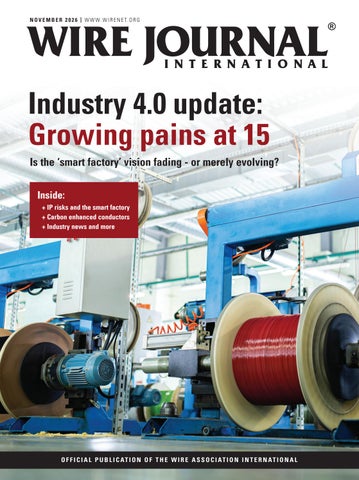
Industry 4.0 update: Growing pains at 15 Is the ‘smart factory’ vision fading - or merely evolving? Inside: + IP risks and the smart factory + Carbon enhanced conductors + Industry news and more
O F F I C I A L P U B L I C AT I O N O F T H E W I R E A S S O C I AT I O N I N T E R N AT I O N A L
SUSTAINABILITY
WE’RE YOUR
SUSTAINABILITY PARTNER.
At COPPERWORKS , we offer sustainability without sacrifice. Choosing COPPERWORKS as a ™
supplier lets you minimize your carbon footprint while maximizing circularity in your supply chain. It gives you access to a steady supply of high-quality copper. And it’s a worry-free way to source 100% recycled copper that meets your sustainability goals, without sacrificing performance or conductivity. From our sustainable products to our innovative processes, we provide solutions that just make sense — for the planet, for performance and for our partners’ goals. Because at COPPERWORKS, the sustainable choice is also the smartest choice, in so many ways.
Find out how copper can work for you. 260.748.6565 COPPERWORKS.COM New Haven, Indiana
C A B L E C O N S U L T A N T S C O R P.
PRIMARY WIRE WIPE
CCC LINE CARD
An economical way to remove copper dust, excessive oil lubricant, dirt, and dust from primary wire or strand
• Stranding & Cabling Lines • Take-Ups / Pay-Offs / Coilers • Ultrasonic, Wet Blast, and Various Mechanical Cleaning Systems • Drum Packers, Air Wipes, and Taping Lines
WIRE RANGE: Up to 0.098 in. (2.5 mm.) diameter MAX. F/M: Approx. 8000 ft./m. MATERIALS: Ferrous or nonferrous material / tinned, bare, or plated FLOOR SPACE: 18” x 27”
• Fully Automatic Re-Wind Lines • Complete Extrusion Lines • Forming / Welding / Sizing Lines • Wire Drawing and Shaving • Semi and Auto Re-Spooling
• Reduce Spark Faults • Improve Insulation Bond • Easy to Install • Improve Insulation Concentricity • Increase Pre-Heater Sheave Life • Environmentally Friendly
HIGH PRESSURE CLEANING •Proven high performance components •Powerful high pressure nozzles with closed loop supply •Highest cleaning performance •Cost-effective system technology •Tailored to individual requirements •Excellent in combination with steam cleaning
LS-WST The LS WST mechanical cleaning system removes particles, fines, and excessive drawing agents in the smallest spaces.
•Space-saving, ready to use design •Wetted parts in stainless steel 1.4571 / 316 TI
WIRE RANGE: Up to 0.5 in. (13 mm.) diameter LINE SPEED: Max. 100 ft./m. (30 m./sec.) FLOOR SPACE: 24” x 30” (600 x 750 mm.) PROCESS ZONE: 4” (200 mm.) single type LS WST •Flexible & easy to integrate in line •Minimal space requirement of the process zone
All products listed are represented in the USA and Canada by CCC. CCC LARCHMONT, NY
CCC CINCINNATI, OH
Tel: 914-834-8865 | Fax: 914-834-8903 info@cableconsultantscorp.com
Tel: 914-240-6033 mmcclaugherty@cableconsultantscorp.com
WWW.CABLECONSULTANTSCORP.COM
VOLUME 59 | NO. 11 | NOVEMBER 2026
TA BL E O F C ON T E N T S
F E AT U R E S
Editorial . . . . . . . . . . . . . . . . . . . . . 6
40
Calendar . . . . . . . . . . . . . . . . . . . . . 8
42
Industry News . . . . . . . . . . . . . . . . 1 0 Patent Report . . . . . . . . . . . . . . . . 2 0 Asian Focus . . . . . . . . . . . . . . . . . 2 4 People . . . . . . . . . . . . . . . . . . . . . . 2 6 Fiber Watch. . . . . . . . . . . . . . . . . . 3 2 Fastener Update . . . . . . . . . . . . . . 3 3 WAI News . . . . . . . . . . . . . . . . . . . 3 4
WAI News . . . . . . . . . . . . . . . . . . . . . . . . . . . 34 Two big staffing announcements, and more.
Wrapup: SpringWorld 2026 . . . . . . . . . . . . . . 40 A wide range of spring equipment was on display.
WAI Chapters . . . . . . . . . . . . . . . . 3 8
Wrapup: wire China 2026 . . . . . . . . . . . . . . . 42
Products . . . . . . . . . . . . . . . . . . . . 6 0
The organizers report that nearly 49,000 people attended.
Sector Update . . . . . . . . . . . . . . . . 6 8
Industry 4.0: yet to be embraced? . . . . . . . . 44
Wire & Cable India . . . . . . . . . . . . . 8 2
This feature looks at the deployment of 4.0 solutions.
Classifieds . . . . . . . . . . . . . . . . . . 8 7
Industry Insights: an intern’s perspective . . 54
Career Opportunities . . . . . . . . . . 8 7
Industry Insights: next-gen materials . . . . . 56
Advertisers’ Index . . . . . . . . . . . . 8 8
T ECHNICA L PA PERS
N O V E M B E R 2 0 2 6 | W W W. W I R E N E T. O R G
Industry 4.0 update: Growing pains at 15 Is the ‘smart factory’ vision fading - or merely evolving? Inside: + IP risks and the smart factory + Carbon enhanced conductors + Industry news and more
Nontypical method of thin wire manufacturing for welding the high-alloy steel Marek Burdek, Jerzy Stępień, Mariusz Kulczyk, Jacek Skiba and Krzysztof Marszowski . . . . . . . . . . . . . . . . . . . . . . . . . .
71
Multicore fiber microduct cable with multiple strands of high-density loose tubes (IWCS paper) Tetsuya Hayashi, Ayumi Inoue, Yuto Yamaguchi, Takuji Nagashima, Toshiki Taru, Jean Hayau, Patrice Lallinec, Gaby Guerard, Olivier Jammes and Aurelien Bergonzo. . . . .
76
O F F I C I A L P U B L I C AT I O N O F T H E W I R E A S S O C I AT I O N I N T E R N AT I O N A L
ON THE COVER
NEX T ISSUE
Industry 4.0 promised a manufacturing revolution, but many companies are still wrestling with disconnected systems, elusive returns and the realities of implementation. Is the smart factory vision fading —or merely evolving?
December 2026 • Feature: Giving Back • Event Wrapup: IWCS • Sector Update: Spring making equipment
W W W. W I R E N E T. O R G
N O V E M B E R 2 0 2 6 W I R E J O U R N A L I N T E R N AT I O N A L
3
CONTENTS
44
56
Industry 4.0 update: Embracing its core tenets without the buzzword
Carbon-enhanced conductors could improve power delivery systems
Many wire and cable manufacturers already practice key tenets of Industry 4.0 without calling them that. They connect equipment, track production data and automate processes and use information to improve quality and efficiency. For these owners and operators, the focus is less on adopting a label than making practical improvements on the floor.
Ohio University researchers are developing carbonenhanced aluminum and copper conductors with the potential to improve conductivity and reduce electrical losses. Their work could enhance powerdelivery efficiency across transmission and distribution networks, electric vehicles and data centers. This article examines the potential.
4 W I R E J O U R N A L I N T E R N AT I O N A L N O V E M B E R 2 0 2 6
W W W. W I R E N E T. O R G
Wire & Plastic Machinery is constantly adding high quality wire and cable equipment to our Inventory.
WE HAVE…PAYOFFS AND TAKEUPS
72” Bartell Shaftless Payoff PAY2631
1.3m Nokia Maillefer Dual Auto TU TKU1456
84” Davis Standard Shaftless Takeup TKU1737
64” Hall Shaftless Payoff PAY807
TKU1804 – 48” Hall Cantilever Shaftless Takeup, 5HP DC, Touchscreen TKU1795 – 1m TEC Traversing Reel Takeup, S/L Cantilever, 5HP AC, AB PLC TKU1780 – 36” Davis Standard, PS-36, Shaftless Dual TU, AC Motors/Drives TKU1703 – 1m Davis Standard, PA-1000, Dual Takeup, AC Vector TKU1681 – 30” Davis Electric, DR-30, Dual Shaft TU, AC Motors, Touchscreen TKU1558 – 50” Davis Standard, DR-50, Dual Shaft TU,10HP AC Vector TKU1497 – 1000mm TEC S/L Cantilever TU, DC Motor, M Trim Trav Control TKU1382 – 96” Queins Gantry Shaftless Takeup, AC Vector TKU1365 – 96” Ceeco Shaftless Takeup, Hyd Lift, 15HP AC (2) TKU1181 – 120” Ceeco Shaftless TU, Floor Trav, Hyd Lift, 20HP AC Vector TKU1178 – 500mm Nextrom, EKP-50, Dual S/L Auto TU, Siemens DC Drives TKU1039 – 72” Hall Gantry Traversing Reel TU, AB PLC, Siemens DC Drive TKU1027 – 24” Clipper, PA-24, Dual Parallel Axis Shaft TU TKU1021 – 30” Clipper, PA-30, Parallel Axis Dual Auto TU, 5HP DC, DriveAll
PAY2617 – 60” Bartell Shaftless PO, Hyd Lift, 12,000# PAY2556 – 48” Hall S/L Cantilever Payoff, 5HP DC, DriveAll PAY2476 – 96” Ceeco Shaftless Cantilever Payoff, Hyd Lift, 7.5HP AC PAY2456 – 1250mm Roblon, Cantilever S/L Payoff, Parker AC Drive PAY2115 – 1.6m Skaltek Portal Driven Payoff, 3,000kg Lift PAY1986.1 – 60” Roteq, Floor Traversing Portal PO, Drag Brake (3) PAY1816 – 1.6m Tensor/Cabletrade Portal Payoff, AC Motor PAY1421.1 – 60” Entwistle, Cantilever S/L Payoff, Drag Brake, Air Lift PAY1356.4 – 36” Davis Electric, Cantilever S/L Payoff, DC Drive PAY1344 – 500mm Nextrom, 12 position Fiber Shaft PO w/Dancers PAY1202 – 104” Reel-O-Matic, S/L Cantilever PO, Portable, Drag Brake PAY1086 – 1.6m AFA, Gantry S/L Payoff, Drag Brake (2) PAY1035 – 84” Davis Electric, Cantilever S/L PO, AC Motor, 20,000# PAY976 – 84” Hall Gantry S/L PO, 5HP DC, DriveAll
See us next at INTERWIRE, Atlanta, GA, May 4-6, 2027, Booth 1231 We want to purchase your surplus equipment! We buy individual machines to complete plants for Cash or Credit.
Contact us at info@wireandplastic.com or TEL: +1.860.583.4646
wireandplastic.com
EDITORIAL
A message of gratitude and transition Over the years, I have used this page to share my thoughts on the wire and cable industry. This time, the news is more personal: As you read this editorial, I will have already announced my retirement as Executive Director of the Wire Association International (WAI), planned for August 2027. After more than two decades with this remarkable organization, it is difficult to capture in a few hundred words what this work has meant to me. Since joining WAI in 2000, I have had the privilege of working alongside exceptional co-workers and a truly committed team of volunteers whose dedication has shaped everything we have accomplished. Our educational mission matters because it serves an industry defined by continuous improvement, Industry 4.0 advances, and rapid product innovation, all while competing on a global stage. WAI’s staff of 10 and nearly 100 volunteers embrace change and the deployment of new technology. They are passionate about producing Wire Journal International, which informs and connects professionals across the wire and cable manufacturing industry. They are equally the reason WAI has been so successful in producing Interwire and Wire Expo, events that bring the industry together to exchange ideas, showcase innovation, and build lasting relationships. One of my few disappointments was our venture into India that did not achieve the results we hoped for. Still, I am proud that we tried to expand into that sizable market. Taking thoughtful risks is part of serving a global industry, and I have no regret about making the effort. The process to select my successor is already underway. It is being facilitated by the search firm Sterling Martin and managed by WAI’s Executive Committee. Our plan is to have the new Executive Director in place around April 1, 2027, allowing time to meet members and industry colleagues in person at Interwire 2027. I especially want to recognize the 27 individuals who have served as president during my tenure. These leaders are extraordinary supporters of the Association and the industry. Although each serves as president for one year, they dedicate a minimum of six years to the Board and the officer rotation. They truly led this organization and supercharged our educational offerings—while holding key positions within their own companies and contributing after hours. Thank you to this generous and talented group. It has been a true pleasure working with you. To my colleagues on staff, past and present: You are talented, smart, dedicated, and you deliver. Thank you for your passion and for all of the great work. It has been an honor to serve with you.
Steve Fetteroll Executive Director Wire Journal International sfetteroll@wirenet.org
6 W I R E J O U R N A L I N T E R N AT I O N A L N O V E M B E R 2 0 2 6
P U B L I S H E R Steven J. Fetteroll E D I T O R - I N - C H I E F Mark Del Franco C O N T R I B U T I N G E D I T O R Mark Marselli D I R E C T O R O F S A L E S Shannon Timme DIRECTOR OF INTERNATIONAL SALES & BUSINESS DEVELOPMENT Anna Bzowski DIRECTOR OF MARKETING & CORPORATE COMMUNICATIONS Janice E. Swindells WAI PUBLICATIONS COMMITTEE Dane Armendariz, consultant Ferruccio Bellina, TKT Group/President ACIMAF Michael Crowle, QED Wire Lines Inc. Tom Moran, consultant Giulio Properzi, Continuus Properzi Willem Sundblad, Oden Technologies Inc. John N. Tomaz, Stolberger W.T. Bigbee, Cerrowire LLC TECHNICAL ADVISORS John Drummond, Scotia Group R. M. Shemenski, RMS Consulting, Inc. Images: Adobe Stock.
Wire Journal International (ISSN-0277-4275) published monthly by The Wire Journal, Inc., is a wholly owned subsidiary of The Wire Association International, Inc., which is located at 71 Bradley Road, Suite 9, Madison, CT 06443-2662, USA, and can be contacted at tel. 203-4532777; Internet wirenet.org; e-mail editor@wirenet. org. Address all correspondence concerning advertising production, editorial and circulation to the above address. WJI is printed in the USA. Subscription rates: $110 per year, USA; $120 per year, Canada and Mexico; other countries, $140 per year (includes air mail). Back copies: $10 WAI members, $15 non-members. Periodicals postage paid at Madison, CT 06443, USA, and at additional offices. Wire Journal International grants photocopy permission to libraries and others registered with Copyright Clearance Center (CCC), 21 Congress St., Salem, MA 01970, USA, for a fee of $0.50 per article. Payments should be sent directly to the CCC. Requests for bulk orders or reprints should be sent to the Wire Journal International, 71 Bradley Road, Suite 9, Madison, CT 06443-2662, USA. © 2026 by Wire Journal, Inc. All rights reserved. The Publisher of WJI assumes no responsibility for the validity of manufacturers’ claims made herein. Back issues of WJI are available. POSTMASTER: Send address changes to Wire Journal International, 71 Bradley Rd., Suite 9, Madison, CT 06443, USA.
W W W. W I R E N E T. O R G
CALENDAR
NOV. 25-27, 2026: 10th Vietnam International Wire and Cable Exhibition Hanoi, Vietnam. This event, to be held in the Hanoi VEC International Exhibition Center, is put on by the Vietnam Century Exhibition Group. Contact: CVEG, tel. +63-96223-13357, info@wirecableshow.com. NOV. 30-DEC. 2, 2026: wire India Mumbai, India. This event, organized by Messe Düsseldorf India Pvt. Ltd., will be held at the Bombay Convention & Exhibition Center (NESCO). Contact: Messe Düsseldorf North America, tel. 312-781-5180, info@mdna.com, www.mdna.com. FEB. 23-25, 2027: wire & Tube Mexico Monterrey, Mexico. This Messe Düsseldorf event will be held at the CINTERMEX Centro Internacional de Negocios. Register at www.wire-tube-mexico.com. APRIL. 12-14, 2027: CRU World Copper Conference Santiago, Chile. To be held at the W Santiago Hotel, this event brings together senior leaders from across the global copper value chain. Contact: CRU International, tel. 44-20-7903-2444, conferences@crugroup.com. www.crugrpoup.com. MAY. 4-6, 2027: Interwire Conference & Trade Exposition & WAI’s 97th Annual Convention Atlanta, Georgia, USA. To be held at the Georgia World Congress Center, this event includes the trade show, technical programs and WAI’s 97th Annual Convention. SEPT. 4-6, 2027: wire Middle East Africa Cairo, Egypt. This event will be held in a special area of Metal & Steel Egypt at the Egypt International Exhibition Center, along with Tube Middle East and two other events. Contact: Sebastian Märker, senior project manager, tel.
+49 211 4560 7725, maerkers@messe-duesseldorf.de, Messe Düsseldorf Asia, www.wire-southeastasia.com. SEPT. 5-9, 2027: International Insulated Power Cables Conference Lyon, France. This event, to be held in the Lyon Convention Centre, focuses on insulated power cables and accessories, from low-voltage and special cables to ultrahigh-voltage systems. Contact: Jicable Association, info.jicable27@jicable.org, www.jicable27.com. SEPT. 15-17, 2027: wire Southeast Asia Bangkok, Thailand. This event will be held at the Bangkok International Trade & Exhibition Centre (BITEC). Contact: Messe Düsseldorf Asia, www.wire-southeastasia.com. OCT. 18, 2027: Wire & Cable Italy Padua, Italy. To be held at the Padua Congress Center, this event is co-organized with ACIMAF. It will include the elements of past ITCs, with presentations, tabletops and more. More details will follow on this bi-annual event, Contact: Wire Association International, www.wirenet.org. NOV. 14-18, 2027 76th IWCS Cable & Connectivity Industry Forum Providence, Rhode Island, USA. The International Wire & Cable and Connectivity Symposium is a premier forum for connectivity and data/communications infrastructure technology. Contact: IWCS, tel. 717-993-9500, www.iwcs.org. APRIL. 3-7, 2028: wire Düsseldorf Düsseldorf, Germany. To be held at the Messe Fairgrounds. Contact: Messe Düsseldorf North America, tel. 312-781-5180, info@mdna.com, www.mdna.com. JUNE. 5-7, 2028: Wire Expo 2028 Fort Worth, Texas, USA. See below.
WAI/WAI CHAPTER EVENTS FEB. 4, 2027: New England Chapter Annual Meeting Uncasville, Connecticut, USA. To be held at Mohegan Sun. This event represents the New England Chapter’s 32nd annual dinner and meeting. Contact: events@wirenet. org; or 203-453-2777.
MAY. 4-6, 2027: Interwire Conference & Trade Exposition & WAI’s 97th Annual Convention Atlanta, Georgia, USA. To be held at the Georgia World Congress Center, this event includes the trade show, technical programs and WAI’s 97th Annual Convention. Attendees can already register for hotel rooms. Look to future issues for more details.
JUNE. 5-7, 2028: Wire Expo 2028 Fort Worth, Texas, USA. To be held at the Fort Worth Convention Center, this first-time WAI event location includes the trade show, technical programs and WAI’s 98th Annual Convention.
For more details on WAI/WAI Chapter events, go to www.wirenet.org then “events” and/or “chapter events.”
8 W I R E J O U R N A L I N T E R N AT I O N A L N O V E M B E R 2 0 2 6
W W W. W I R E N E T. O R G
Our X-RAY 8000 ADVANCED system delivers continuous, high-accuracy measurement of inner/outer diameter, wall thickness, and eccentricity for high-voltage cables.
Visit SIKORA to upgrade your quality control.
Visit us at Booth 120 @sikora.net
INDUSTRY NEWS
INDUSTRY NEWS
reports of industry activity
Gaon Cable adds a nuclear-cable initiative to its Tarboro expansion plans South Korea’s Gaon Cable plans to install nuclear-power cable production equipment at its Tarboro, North Carolina, plant, adding a new initiative to previously announced investments in its U.S. manufacturing subsidiary, LSCUS. Gaon Cable, a subsidiary of South Korea’s LS Cable & System, announced the plan Oct. 12, following its September disclosure that it was reviewing entry into the U.S. nuclear-cable market. Gaon said it intends to obtain U.S. product certifications and pursue partnerships with South Korean nuclear companies to enter the U.S. nuclear supply chain.
Gaon Cable, part of the U.S. subsidiary operations of South Korea’s LS Cable & System, will expands it project range. The company has not established an installation timetable or announced a nuclear-cable customer. According to Seoul Economic Daily, Gaon expects to expand production quickly once it secures customers, drawing on Tarboro’s existing medium-voltage cable manufacturing operation. The report describes nuclear cables as low-volume, high-variety products whose specifications depend on their location and function within a plant. The initiative builds on an earlier $50 million Tarboro expansion announced in February. That project includes two additional catenary continuous vulcanization lines for medium-voltage power-distribution cables and an increase in employment from 250 to 335. October reporting said the company aims to double medium-voltage capacity by April 2027; the announcement did not disclose a separate investment amount for nuclear-cable equipment.
1 0 W I R E J O U R N A L I N T E R N AT I O N A L N O V E M B E R 2 0 2 6
Some established suppliers now serving the U.S. nuclear market include Marmon’s RSCC, Prysmian and Okonite. Entry into the nuclear market takes more than manufacturing capacity. For electrical equipment important to safety in harsh environments, the U.S. Nuclear Regulatory Commission’s qualification requirements address aging, radiation, temperature, pressure, humidity, chemicals and, where applicable, submergence. IEEE 383 provides cable-specific qualification methods, while IEEE 323 addresses qualification of safety-related electrical equipment. Gaon has not identified the standards, testing program or qualification schedule it will pursue.
Poland’s Tele-Fonika gets $547 million loan guarantee for its 1st North American plant Poland’s Tele-Fonika Kable Group moved closer to establishing its first North American manufacturing plant on October 6, when the Export-Import Bank of the United States (EXIM) announced a $547 million loan guarantee to support its proposed facility in Waller, Texas. An EXIM press release said the facility would manufacture rubber-insulated cables for data centers, mining and industrial infrastructure, serving customers in the U.S. and overseas. The plant is expected to employ up to 500 people, establishing a new U.S. manufacturing presence. The release did not specify total project cost, a construction timetable or a production start date. “EXIM’s approval of the $547 million loan guarantee is a key step for Tele-Fonika Kable Group’s investment in Waller, Texas,” said Bartłomiej Zgryzek, the group’s CFO. “We expect continued growth in the U.S. market, particularly in data centers, mining and industrial infrastructure, and we intend to serve that demand with cables made in Texas.” The guarantee will be provided through EXIM’s Make More in America Initiative (MMIA), which makes the agency’s medium- and long-term loans, loan guarantees and insurance available to export-oriented domestic manufacturing projects. WJI previously reported the proposed Waller plant in September 2025. Tele-Fonika Cable Americas has historically served American markets through sales and distribution; the Texas facility would establish a manufacturing base for the company in North America. Separately, the Texas comptroller’s listing for the company’s state tax-incentive agreement specifies a minimum requirement of 75 W W W. W I R E N E T. O R G
INDUSTRY NEWS
Okonite plans $400 million expansion in South Carolina
Tele-Fonika Kable Group’s efforts to establish its first cable plant in the U.S. in Texas has gotten a key loan guarantee. jobs, distinct from the employment projection in EXIM’s announcement. TFKable is one of Europe’s largest cable manufacturers. Its group website lists three manufacturing plants in Poland, one in Serbia and two in the U.K., as well as global commercial operations. Texas would become its first North American manufacturing base.
The Okonite Company plans to invest $400 million in a new manufacturing plant in Orangeburg, South Carolina, to expand production capacity for HV electric cable. Per the company, the approximately 552,000-sq-ft plant will be built on its existing property at 2276 Rowesville Road. The investment will add both manufacturing space and jobs to the company’s existing Orangeburg operations. The expansion is expected to create 105 jobs and help meet growing demand for high-voltage cable products. Initial construction is scheduled to begin in the fourth quarter of 2026, with completion expected within two to three years. The announcement did not provide a separate target date for the start of production. Okonite already operates two production facilities in Orangeburg County, and the new plant will substantially expand its manufacturing footprint there. Founded in 1878, the company manufactures insulated wire and cable and has 34 locations nationwide, according to the state announcement.
WIRE & CABLE IN THE NEWS
EU Alliance call: cull legacy copper for telecom/broadband Europe’s transition from copper telecom networks to fiber needs more than encouragement: it needs a clear path for retiring the old infrastructure. That was the message from six industry associations that have joined forces to push for migration rules and investment certainty. Announced Oct. 12, the Digital Networks Alliance for Europe (DNA Europe) includes ANGA, BREKO, ecta, Fibre Council Europe, the Swedish Local Fibre Alliance and VATM. Its target is the European Union’s proposed Digital Networks Act, which could reshape the rules governing fixed-network investment. The stakes go beyond replacing one cable with another. The alliance wants competing operators to know how the transition will unfold. It also
W W W. W I R E N E T. O R G
wants regulators to retain powers to keep dominant operators from squeezing out competition as customers move to fiber. Its argument: a
predictable migration framework would give providers greater confidence to invest. The approach has not been universally embraced. Connect
Europe, an association representing major European telecom operators, has called for practical incentives to build fiber rather than what it describes as arbitrary copper-switch-off dates. Under the European Commission’s proposal, national transition plans and a 2035 backstop would guide the migration, subject to safeguards and exemptions. The proposal is not yet law and concerns copper telephone and broadband networks—not electrical wiring or power cables. For fiber-optic cable suppliers, the alliance’s formation is an advocacy development, not an order announcement. The group is seeking clearer rules for retiring copper networks and investment conditions that support their replacement with fiber.
N O V E M B E R 2 0 2 6 W I R E J O U R N A L I N T E R N AT I O N A L
11
INDUSTRY NEWS
Groundbreaking ceremony heralds start of Starkville cable plant expansion project Southwire has officially broken ground on the construction of the company’s newest expansion in Starkville, Mississippi.
A principal project under the earlier program was the $25 million Fuquay-Varina expansion, completed in 2025. Begun in December 2022, it added 94,000 sq ft, increasing the plant to 149,000 sq ft. The North Carolina site produces optical-fiber cabling and made-to-order assemblies. The expansion added manufacturing capacity, engineering capability and product-testing resources for data centers, commercial networks, industrial applications and harsh environments.
Viakable plans $55 million expansion to its lone U.S.-based manufacturing facility
The groundbreaking ceremony for Southwire’s Starkville’s plant marked another step forward.
On Thursday, Oct. 1, members of the Southwire and Starkville communities joined to celebrate and break ground on the new facility. The Starkville expansion project, which will add about 380,000 sq. ft. to the location’s footprint and represents a corporate investment of more than $256 million, is expected to create approximately 130 new jobs and reinforces the company’s commitment to its team members, customers and communities. “This groundbreaking is an exciting milestone for Southwire and for our Starkville team,” said Veronica Braker, EVP, Operations. “As we continue investing in our operations, this expansion reflects our commitment to creating a safer, more efficient and more innovative environment for our team members while strengthening our ability to serve customers across our markets. Starkville has played an important role in Southwire’s manufacturing story, and we are proud to build on that foundation for the future.”
Mexico’s Viakable plans to invest $55 million to expand its wire and cable manufacturing plant in La Salle, Illinois, adding production capacity and at least 50 full-time jobs at its only U.S. manufacturing location, according to an announcement by the company and state officials. The project, announced Oct. 7, includes a 22,000-sq-ft addition, 17 advanced machines and utility upgrades. Per the Illinois governor’s office, the investment will expand capabilities in wire drawing, cabling, extrusion and packaging to serve the U.S. electrical infrastructure market. The company will raise its staffing from 65 to at least 115. Viakable, the electrical conductor business of Mexican industrial group Xignux, established the La Salle operation in 2018 by acquiring the assets of American Bare Conductor through its U.S. subsidiary, CME Wire & Cable.
Leviton launches $100 million network investment program
Mexico’s Viakable marks the news of its $55 million plan to expand its plant in La Salle, Illinois.
Leviton’s proposed $100 million, five-year global capital-investment program would expand its copper and fiber networking manufacturing in its Network Solutions business that includes both multimode and single-mode optical-fiber. A press release said that the program builds on a previously announced $80 million initiative that included expansion of Leviton’s fiber-optic cabling plant in FuquayVarina, North Carolina. The new project will increase capacity for Cat. 6A cabling, connectors and fiber-optic products serving AI, data-center, cloud and smart-building applications.
“Over the past eight years, the La Salle team has expanded its capabilities and demonstrated its commitment to our customers,” Viakable CEO Carlos Ramos said. “This project will increase our manufacturing capacity and enable us to continue delivering reliable solutions for energy infrastructure in the U.S. and North America.” Viakable manufactures in Mexico and the U.S. In addition to La Salle, it identifies CME Wire & Cable as a distribution business with four U.S. distribution centers. Its Mexican manufacturing businesses include electrical wire
1 2 W I R E J O U R N A L I N T E R N AT I O N A L N O V E M B E R 2 0 2 6
W W W. W I R E N E T. O R G
INDUSTRY NEWS
and cable producer Viakon, magnet wire manufacturer Magnekon, and reel and packaging producer Multipak.
Subsidiary of South Korea’s Taihan Cable & Solution lands U.S. EHV grid project Taihan Cable & Solution announced that its U.S. subsidiary, T.E.USA, has secured a turnkey extra-high-voltage (EHV) power grid project in the United States, with an associated materials supply agreement valued at approximately $89 million. A press release said T.E.USA will oversee the project, including local engineering and construction, while Taihan’s Korean headquarters will manufacture and supply the EHV cables and cable accessories. The $89 million figure covers materials only, rather than the complete turnkey contract. Taihan said the overall project value, including engineering and construction, the customer’s identity and other project details remain confidential under a nondisclosure agreement. The announcement did not specify the project’s location, operating voltage or completion schedule. The award follows an approximately $74 million U.S. EHV turnkey project the company cited in January 2026. Taihan also reported that it has won all 500-kV alternat-
ing-current underground transmission projects awarded in the United States, although the announcement did not specify their number. Its U.S. references additionally include a contract to supply 320-kV direct-current T.E. USA reports it will supply extracables. high-voltage cable for a U.S. project. Established in 2000 to support Taihan’s entry into the U.S. market, the subsidiary is also identified as Taihan USA on the company’s global network website. Based in Santa Fe Springs, California, it supplies products including EHV and medium- and low-voltage cables to the North American market. Taihan’s 2025 annual report describes the subsidiary’s customer base as utilities across the U.S.
Toroidal® Steel Reel ISO 9001:2015
Kimberly Johnson, Sales & Production Analyst • Tel: 309-757-8300 ext 138 • Kimberly.Johnson@george-evans.com Kris Lawrence, Reel Planner/Estimator • Tel: 309-757-8300 ext 109 • Kris.Lawrence@george-evans.com Brandon Johnson, Sales Manager • Tel: 309-236-2223 • bjohnson@matconmfg.com
W W W. W I R E N E T. O R G
N O V E M B E R 2 0 2 6 W I R E J O U R N A L I N T E R N AT I O N A L
13
INDUSTRY NEWS
Taihan linked its expansion efforts to growing electricity demand from artificial intelligence and data centers, alongside investment in aging-grid replacement and new transmission infrastructure. The company plans to strengthen its EHV business while pursuing additional orders for higher-value products, including HVDC and submarine cables. It said the latest award would support efforts to expand its U.S. business and respond to customer demand for largescale turnkey projects.
Danieli to supply wire rod mill for Ghana steel manufacturer Italy’s Danieli will supply technology for a new bar and wire rod rolling mill for Ghanaian steel manufacturer B5Plus Group, to be installed in Abidjan, Côte d’Ivoire. A press release said that the mill will have output capacity of 50 metric tons per hour, or approximately 300,000 metric tons annually, of long products. The project includes a smooth wire rod line for products ranging from 5.5 mm to 16 mm in diameter, as well as deformed reinforcing bar in diameters from 8 mm to 32 mm. Danieli’s wire rod package will include a Fast Finishing Block and a laying head for coil formation. The company said that the high-technology wire rod equipment will be manufactured at its workshop in Italy. The rolling mill will use Danieli automation systems, and the layout allows for a future direct connection to a planned continuous casting machine. Startup is scheduled for the third quarter of 2027. B5Plus serves West African markets. Danieli, an Italybased supplier of steelmaking, casting and rolling technologies, supplies wire rod and long-products equipment for installations worldwide.
tribution business while retaining Global’s established management and customer relationships. Global Specialty Steel is an ISO 9001:2015-certified supplier of specialty and alloy wire. Its portfolio includes galvanized music wire meeting ASTM A228, galvanized hard-drawn wire meeting ASTM A764, tempered wire, chrome-silicon wire, stainless steel wire, low-carbon wire, phosphated music wire and special-profile wire. The company provides stocking programs, just-in-time deliveries, spot purchases and mill-direct shipments. The agreement follows a series of growth moves by Tri Star Metals. In April 2025, the company acquired Siri Wire, a Connecticut manufacturer and distributor of stainless steel wire products used in applications including filters, screens and washers. In March 2024, Tri Star acquired Centric Alloys, a specialist in nickel alloys and exotic metals. In 2010, Tri Star expanded through a strategic merger with Pinnacle Metals, a Freeport, Illinois, manufacturer of stainless-steel long products. That transaction marked Tri Star’s transition from a primarily distribution-based company to a manufacturer as well as a distributor.
RMG acquires Shuster Mettler Corp., folds assets into existing operations
RMG (Rockford Manufacturing Group) has acquired Shuster Mettler Corporation, including its assets, product lines, intellectual property and New Haven, Connecticut, operations. A press release said that Shuster machine sales, production and support will now be handled by RMG and its global network of sales representatives and distributors. RMG said the acquisition adds a major range of straighten-and-cut equipment to its existing Tri Star Metals agrees to acquire Global wire-processing portfolio. Shuster brings a 150-year legacy in wire straightening Specialty Steel and cutting technology. Its product line serves carbon Tri Star Metals LLC announced that it had entered into steel and specialty-alloy wire, with machine capabilities a definitive agreement to acquire Global Specialty Steel spanning wire diameters from 0.015 in. to 1.250 in. LLC, an Alsip, Illinois-based distributor of specialty steel RMG President Larry Cunningham said the acquisiand alloy wire. tion will expand customer access to a broader range of wire-processing solutions from a single source. He added that consolidating Shuster operations into RMG’s vertically integrated manufacturing facilities should improve production efficiency as well as design, engineering, sales, service and support. “The acquisition of Shuster is just one of the ways ÿ ÿ we’re working to keep pace with the needs of our customers,” Cunningham said. “Stay tuned for some Per a company release, Global will remain an indepenvery exciting new RMG product news leading up to dent distributor led by President Joe Owoc, who will join Interwire 2027.” Tri Star’s executive committee. Tri Star plans significant A/44?8/1BÿC5507806ÿDÿE:18>4/ÿFBÿFGFHÿIÿJKLÿMNOKÿPQNORSTÿUUVTÿOÿRQOWLXYÿZ[M[\]OSQWÿ^OX_`OaN_KQKÿOXWÿWLSNKL]_NbKÿb`ÿSNOLXRQSSÿSNQQRThe Tÿ deal continues RMG’s history of acquisitions. It QaLORNdÿfLKQÿeKbW_ato NSTÿNbexpand WOdÿOXXb_XaGlobal’s QWÿNgONÿLNÿgOSÿQXinventory NQKQWÿLXNbÿOÿWQ`LXand LNLhQÿOproduct YKQQ^QXNÿNbÿOavailai_LKQÿjRb]ORÿMeQpreviously aLORNdÿ XLacQRÿORRbdTÿOXWÿSeinvestment acquired the G.C. Patterson straighten-and-cut LSgQWÿWLSNKL]The _NbKÿb`ÿStransaction eQaLORNdÿSNQQRÿOXWÿOwill RRbdÿfLbroaden KQÿ]OSQWÿLXÿkRSTri LeTÿlRRLStar’s XbLS[ÿÿJgQÿwire-disOai_LSLNLbXÿSgb_RWÿ]Qÿab^eRQNQWÿ]dÿ MNQQRTÿOÿfQRR\QSNO]Rability. NgQÿQXWÿb`ÿmaNb]QK[ÿÿÿ machine line in 1993 and Lewis Machine in 2003.
()*++ÿ)*,*-+*ÿ
./0ÿ+12/ÿ341256ÿ-77897:46ÿ-:;90601087ÿ8<ÿ=58>25ÿ+?4:0251@ÿ+1445ÿ
nbRRbfLXYÿNgQÿOai_LSLNLbXTÿjRb]ORÿMeQaLORNdÿMNQQRÿfLRRÿabXNLX_QÿNbÿbeQKONQÿOSÿOXÿLXWQeQXWQXNÿWLSNKL]_NbKÿ_XWQKÿNgQÿRQOWQKSgLeÿb`ÿo84ÿ Ep8:TÿfgbÿfLRRÿKQ^OLXÿqKQSLWQXNÿb`ÿjRb]ORÿOXWÿrbLXÿNgQÿ./0ÿ+12/ÿ341256ÿ*s4:910t4ÿu8vv01144[ÿ JgQÿOai_LSLNLbXÿ]KLXYSÿNbYQNgQKÿNgQÿ^OX_`OaN_KLXYTÿWLSNKL]_NLbXTÿNQagXLaORTÿOXWÿSORQSÿaOeO]LRLNLQSÿb`ÿ./0ÿ+12/ÿ341256Bÿ+0/0ÿw0/4Bÿ27xÿ WQÿeROǸbK^ÿNbÿSQKhQÿa_SNb^QKSÿOaKbSSÿOÿ]KbOWÿKOXYQÿb`ÿSeQaLORNdÿfLKQÿ^OKcQNS[ÿ =58>25ÿ+?4:0251@ÿ+114445TÿaKQWONLXIYRÿOEÿSNKbJXYOQKUÿXORNLNbXfL A L I N T E R N AT I O N A L N O V E M B E R 2 0 2 6 y4@ÿz474<016ÿ8<ÿ1{4ÿ-:;90601087ÿ *s?27x4xÿu2?2>0501046ÿ
W W W. W I R E N E T. O R G
INDUSTRY NEWS
Prysmian completes $3.8 billion Atkore acquisition, expands U.S. offering Prysmian completed its acquisition of U.S. electrical infrastructure supplier Atkore on Oct. 19, broadening its portfolio beyond cable to include conduits, cable management systems and metal framing. The transaction makes Atkore a wholly owned subsidiary of Prysmian.
Prysmian’s acquisition of Atkore expands its U.S. manufacturing footprint and broadens its electrical infrastructure portfolio.
A press release said Prysmian acquired all outstanding Atkore shares for $95 per share in cash, representing an implied enterprise value of approximately $3.8 billion. The deal follows the merger agreement announced Aug. 2. Prysmian said the acquisition combines its emphasis on product availability, fast delivery and vertical integration with Atkore’s complementary products and distribution relationships. The combined business has more than 60 manufacturing and distribution sites across the United States, serving data centers, utilities and commercial and industrial infrastructure. “The acquisition of Atkore marks another significant step in our evolution from a cable manufacturer to a broader, fully-fledged solutions provider,” said Prysmian CEO Massimo Battaini. He said the combination would help customers deliver projects faster and more efficiently, including rapidly expanding data-center construction. Prysmian expects approximately $150 million in annual pretax synergies within three years of closing. Before those benefits, the acquisition is expected to increase earnings per share by a high single-digit percentage in the first full year after closing, rising to double digits once the projected annual benefits are achieved.
TAILOR-MADE SOLUTIONS FOR YOUR MACHINES Our high-performance bows are available in all sizes and compatible with all brands. Designed to meet the demands of every machine. bowtechnology.fr
Nov 30- Dec 2nd, 2026 Mumbai, INDIA Booth French Pavilion J18 November 25-27, 2026 Hanoi, VIETNAM Booth C05-06
TFKable and DeepOcean have plans for an ‘end-to-end’ offshore-wind cable push Poland’s TFKable Group and DeepOcean, a Norwaybased subsea-services contractor, plan to form a joint venture to pursue offshore-wind inter-array cable projW W W. W I R E N E T. O R G
N O V E M B E R 2 0 2 6 W I R E J O U R N A L I N T E R N AT I O N A L
15
INDUSTRY NEWS
ects, supported by a new cable-laying vessel dedicated to that work. The proposed venture would combine TFKable’s subsea-cable technology and manufacturing resources— including those of Tele-Fonika Kable and JDR Cable Systems—with DeepOcean’s offshore engineering, installation and seabed-intervention capabilities. A Sept. 23 joint announcement said the companies aim to offer an integrated engineering, procurement, construction and installation package spanning seabed mapping, route surveys, engineering, cable manufacture and transport, trenching, installation and cable protection. Inter-array systems, which connect turbines to offshore substations, will be the venture’s initial focus. The companies said the platform could later support other subsea-cable applications. “TFKable and JDR Cable Systems have developed strong expertise in inter-array cable solutions, supported by continued investment in technology, manufacturing capacity and product development,” said Piotr Mirek, a TeleFonika Kable management-board member and executive director for supply chains and investments at JDR Cable Systems. “Together with DeepOcean’s offshore engineering and installation capabilities, we see an opportunity to offer customers a more integrated solution covering a broader part of the cable project lifecycle.” The planned cable-laying vessel would be built specifically for inter-array work and owned by a separate vessel-owning company. Its proposed shareholders would be Poland’s state-owned Industrial Development Agency, Agencja Rozwoju Przemysłu; DeepOcean; and TFKable Group’s controlling entity. The collaboration will roll out in stages through 2029, supported by TFKable’s subsea-cable manufacturing investments in Poland and the U.K. The venture remains subject to regulatory approval and customary closing conditions. Until then, the partners will separately supply and install cables on a project-by-project basis.
Corning lands $3 billion-plus AT&T fiber, cable supply agreement
Corning and AT&T. Specific volumes, delivery schedules and product types were not disclosed. For Corning, the agreement is another large-scale customer commitment for its Optical Communications business and a further step in its Springboard growth plan. The company has targeted annualized sales of $20 billion by the end of 2026, $30 billion by the end of 2028 and $40 billion by the end of 2030, while seeking earnings growth that exceeds sales growth, higher return on invested capital and increased free cash flow.
Corning continues to land long-term supply contracts.
The AT&T agreement follows a separate multibillion-dollar supply agreement Corning reached with Verizon earlier in September. Under that arrangement, the companies said they planned to deploy more than 80 million miles of high-density optical fiber in the U.S. over five years. AT&T said its fiber customers use more than 1 TB of data per month on average, and it expects average use to reach 2 TB to 2.5 TB per month by 2030.
4 cable makers fined $90 million in Czech metal-pricing cartel case
Corning Inc. has entered a multiyear agreement valued at more than $3 billion to supply optical fiber and cable to AT&T Inc. for expansion of the telecommunications company’s U.S. network. A press release said that the Corning supply arrangement will support AT&T’s effort to provide fast, reliable Internet access to more Americans as data use rises, including demand tied to artificial intelligence applications. AT&T has set a goal of reaching 60 million U.S. locations with fiber by the end of 2030. The agreement is intended to provide fiber and cable for that expansion while helping AT&T accelerate network deployment and improve installation efficiency, the companies said. The deal also supports U.S. manufacturing and is expected to sustain thousands of skilled jobs, according to
The Czech operations of global cable manufacturers Prysmian, NKT and Tele-Fonika, along with Kablo Vrchlabí s.r.o., a Czech cable maker and member of Germany’s Wilms Group, have been assessed combined fines of approximately $90 million for alleged cartel activity involving metal surcharges on copper- and aluminum-containing cables. The alleged conduct began as early as 2010 and continued through February 2022. A press release from the Czech Office for the Protection of Competition (COPC) said Prysmian Kabely s.r.o. was assessed the largest fine, approximately $44.3 million, followed by NKT s.r.o. at approximately $42.2 million. Tele-Fonika Kabely CZ s.r.o. was fined approximately $2.3 million, and Kablo Vrchlabí was fined approximately $1.3 million. COPC said the four fined companies, along with PRAKAB Pražská Kabelovna s.r.o. and PRECON s.r.o., agreed on a uniform metal-surcharge formula for copper-
1 6 W I R E J O U R N A L I N T E R N AT I O N A L N O V E M B E R 2 0 2 6
W W W. W I R E N E T. O R G
INDUSTRY NEWS
and aluminum-containing telecom and power cables. The companies cross-checked values, set validity periods and consulted on adjustments, the Office said. Values were published through the Association of Cable and Wire Manufacturers of the Czech Republic and the Slovak Republic and in the Czech daily Hospodářské novin. COPC said the alleged conduct began in 2010 for NKT, PRAKAB and Prysmian; in 2011 for Tele-Fonika; and in 2020 for PRECON and Kablo Vrchlabí. It said the conduct ended in February 2022. COPC conducted unannounced inspections at the companies’ premises in June 2022. Kablo Vrchlabí, which employs 427 people and reported 2024 turnover of €184 million, manufactures automotive cables, building wire and 1-kV cables, flexible cables and specialty products. Its plant in Vrchlabí, Czech Republic, traces its origins to 1923, and the company joined the Wilms Group in 2017. Prysmian denied wrongdoing and said it would cooperate with the Czech Competition Authority during the appeal process while defending its position. The company described the metal quotation as a public, transparent and voluntary reference tool—not a price agreement—based on openly available information. It said such indexes are common across industries and were requested by customers to manage metal-price risk and compare offers, without exchanging compet-
W W W. W I R E N E T. O R G
itively sensitive information, coordinating prices or harming competition. NKT disputed the Office for the Protection of Competition’s first-instance finding of anti-competitive conduct involving metal surcharges. “We contest the factual and legal findings of the authorities and will appeal the decision to the Chairman,” said Chief Legal Officer Morten Bang. If the chairman upholds the decision and fine, NKT said it is prepared to challenge the outcome in Czech courts. PRAKAB avoided a fine after submitting a leniency application, the release said. PRECON, which is in insolvency proceedings and has no available assets, was not fined. The decision and fines are not final. Prysmian also said it will appeal.
Attacks halt Ukraine’s 2 main wire-rod makers; ArcelorMittal to do cold shutdown ArcelorMittal Kryvyi Rih has begun a roughly two-month process to place its Ukrainian steelworks into cold shutdown following repeated Russian missile attacks. The move follows a separate attack that halted production at Kamet Steel, taking Ukraine’s two principal integrated wire-rod producers out of operation.
N O V E M B E R 2 0 2 6 W I R E J O U R N A L I N T E R N AT I O N A L
17
INDUSTRY NEWS
In an Oct. 10 statement, ArcelorMittal said it would prepare and safely idle production facilities before mothballing industrial assets. The company reported that the attacks killed six workers and injured more than 18, updating the casualty figures released in September. ArcelorMittal reported Sept. 25 that it could not safely and sustainably restart its Kryvyi Rih works after four missile strikes in five weeks caused extensive damage. The latest attack occurred Sept. 21. The company said it expected to record an approximately $1 billion non-cash impairment charge, primarily reflecting damage to property, plant and equipment. ArcelorMittal said it will preserve key infrastructure while discussing the site’s future with the Ukrainian government, and a possible restart after the war. “It is with deep regret that we have concluded that we are no longer able to safely operate ArcelorMittal Kryvyi Rih,” Mauro Longobardo, CEO of the Ukrainian subsidiary, said in the company’s Sept. 25 announcement. In the October update, he said ArcelorMittal is not leaving Ukraine but considers safe operation impossible while the war continues. The Kryvyi Rih steelworks produces wire rod, reinforcing bar, billet and other rolled products. Its shutdown follows a Sept. 5 Russian ballistic-missile strike that halted production at Kamet Steel in Kamianske, another producer of wire rod, billet, reinforcing bar, sections and other long products. Reporting on that attack said five people were killed, four employees were injured and key production, energy and transport infrastructure was damaged. Kamet Steel is part of Metinvest, a Ukrainian mining and steel group that also has operations in Bulgaria, Italy and the U.K. The plant’s future remains uncertain, with no restart timetable announced.
Morocco’s auto-wire fast lane draws another contender Morocco continues to attract investment in automotive wire, cable and harness manufacturing, a sector that had at least 17 cabling plants in 2022 and could add another through a proposed venture between Chinese cable maker Wuxi Xinhongye Wire & Cable Technology (Wuxi) and France’s ACOME Automotive. Per Moroccan media reports citing a Xinhongye stock-exchange filing, Wuxi’s board approved a framework to form a wholly owned Hong Kong subsidiary that would join ACOME Automotive in establishing ACOME Xinhongye Automotive Cables. The proposed new operation would manufacture wire and cable, wiring harnesses, plugs, connectors and related products. The reports said Wuxi would hold 80% of the venture through its proposed Hong Kong subsidiary and ACOME would hold 20%. The venture would have €10 million in registered capital, with total investment capped at approximately $32 million. The prospective project would be a relatively small addition to
1 8 W I R E J O U R N A L I N T E R N AT I O N A L N O V E M B E R 2 0 2 6
Morocco’s established automotive-wiring base. Reuters reported in 2022 that the country had 17 cabling plants. Major suppliers with Moroccan operations include Leoni, Yazaki, Sumitomo Electric, Lear, Aptiv, Fujikura, Kromberg & Schubert, TE Connectivity, Coficab and ACOME. ACOME said it opened a 17,000-sq-m automotive-cable plant in Tangier Free Zone in 2018. Per the company, the site manufactures its small-gauge “skinny wire” product range, has capacity for 1.5 million km of wire and cable annually, and uses drawing, stranding, polymer-processing, sheathing and cross-linking technologies. The proposed venture would pair Wuxi’s majority ownership with ACOME’s existing manufacturing presence in Tangier, combining a new investment with experience already established in Morocco’s automotive wire and cable sector. Morocco’s automotive-wiring cluster has developed through its proximity to European vehicle markets, export-oriented industrial zones and domestic vehicle assembly operations led by Renault and Stellantis. Moroccan business media, citing official trade data, reported that wiring-harness exports rose 16.1% year over year to $2.39 billion in the first four months of 2026
Prysmian names U.S. industrial and construction sales network Prysmian announced a new U.S. industrial and construction sales network following the close of its Atkore acquisition, combining representatives from its legacy Prysmian, Encore Wire and Atkore businesses. The network includes 20 agencies serving markets in all 50 states and Washington, D.C., with Power Corp.’s Tennessee office listed separately. Representatives will offer the combined portfolio of Prysmian, Encore Wire and Atkore products.
Brian Moriarty, senior vice president of Industrial & Construction for Prysmian | Encore Wire and president of Atkore, said the companies jointly evaluated their representative networks to establish the new territories.
W W W. W I R E N E T. O R G
INDUSTRY NEWS
“We know the single representative formula for a market will increase the speed and service for our customers,” Moriarty said, adding that the expanded portfolio would simplify purchasing for electrical distributors and contractors.
Rexel to acquire specialty wire and cable distributor GCG Rexel has agreed to acquire GCG, a Chicago-based specialty wire and cable distributor, from Audax Private Equity, the companies announced Sept. 25. The transaction is expected to close by the end of 2026, subject to regulatory approvals and customary closing conditions. Financial terms were not disclosed by GCG, although Rexel said the transaction values GCG at an enterprise value of approximately $1.4 billion. GCG supplies engineered wire, cable and connectivity solutions for data centers, power infrastructure, defense, building systems, water, telecom and industrial applications. The company operates in North America and Europe through 16 locations, has some 950 employees and expects 2026 revenue to exceed $1.1 billion, according to the companies. Audax acquired the business through a carveout of Genuine Parts Co.’s Electrical Specialties Group in a transaction effective Sept. 30, 2019. Under Audax’s ownership, GCG expanded through organic growth and acquisitions, including United Wire & Cable, CableMaster, RWL, Paige and Allied Wire & Cable, Audax said.
David Richards to serve as president of lubricant manufacturers association David Richards of RichardsApex Inc. has become president of the Independent Lubricant Manufacturers Association (ILMA), succeeding James P. Carroll, executive vice president of Schaeffer Manufacturing Co. Richards assumed the role during the 2026 ILMA Annual Meeting in Phoenix. He is chief operating offi-
W W W. W I R E N E T. O R G
cer of Philadelphia-based RichardsApex, a fourth-generation, family-owned company. Richards served as president of the Wire Association International in 2003. He has served on ILMA’s board since 2018 and participated in most association committees, including the Executive Committee. Carroll praised Richards’ nearly four decades of industry Dave Richards experience and more than 15 years of service to the association. Richards outlined three priorities: uncompromising advocacy, upholding quality and integrity, and securing the industry’s next generation. “The Association does not belong to the Board; it belongs to you,” he told members. “Your insights, your energy and your dedication are what give ILMA its strength.” He encouraged members to join committees and share their expertise as manufacturers navigate changing business and regulatory conditions.
Gibbs Interwire announces new Chicago location Gibbs Interwire will open a new Chicago-area stocking location in January 1, 2027, to restore same-day and nextday delivery service for Midwest customers by positioning high-volume wire inventory closer to end users. The location will carry common grades and diameters in-house on opening day, with additional items added during the first quarter of 2027. Inventory will be supplied from both the Chicago and South Bend locations, increasing product depth and supply flexibility across the region. Per the company, the investment responds directly to customer demand for faster material availability. Gibbs Interwire supplies stainless steel, carbon steel, nickel alloy, and red-metal wire products through a North American service-center network.
N O V E M B E R 2 0 2 6 W I R E J O U R N A L I N T E R N AT I O N A L
19
PAT E N T R E P O R T
PATENT REPORT
recently approved U.S. patents for wire and cable
Multicore cable-having a stranded pair of core electric wires and an adjacent wire with a controlled diameter ratio U.S. Patent No.: 12,706,229 Patent date: Aug. 11, 2026 Filed: March 8, 2022 Assignee: Sumitomo Electric Industries, Ltd., Japan Inventors: Shigeyuki Tanaka, et al. A multicore cable includes a first core wire and a first sheath layer disposed around the first core wire. The first core wire is composed of a pair of first core electric wires and a wire that are stranded together. Each first core electric wire includes a first conductor and a first insulating layer covering an outer surface of the first conductor. In one configuration, the wire is a stranded core electric wire including a second core wire and a second sheath layer disposed around the second core wire, the second core wire being composed of a plurality of third core electric wires that are stranded together, each third core electric wire including a third conductor and a third insulating layer.
Electromagnetic shielding composite resin composition and high-voltage shielded wire comprising same U.S. Patent No.: 12,700,524 Patent date: Aug. 4, 2026 Filed: July 6, 2021 Assignee: Hanwha Compound Corporation, South Korea Inventors: Byoung Park, Joo Lee, Yong Lee, Jae Hong, Min Kim The present invention relates to an electromagnetic shielding composite resin composition and a high-voltage shielded wire comprising the same. More particularly, the present invention relates to a high-voltage shielded wire comprising: a core composed of a conductive material; an insulation layer enveloping the core; an electromagnetic shielding layer surrounding the insulation layer and employing an electromagnetic shielding composite resin composition; and a coating layer covering the electromagnetic shielding layer and composed of an insulation material, wherein the electromagnetic shielding composite resin composition contains a thermoplastic resin, a metalcoated carbon fiber, carbon black, and a carbon nanofiber.
2 0 W I R E J O U R N A L I N T E R N AT I O N A L N O V E M B E R 2 0 2 6
Cable reel configured to absorb forces impacting a perimeter wall of the reel to prevent breakage U.S. Patent No.: 12,698,179 Patent date: Aug. 4, 2026 Filed: Feb. 13, 2024 Assignee: PPC Broadband, Inc., USA Inventors: Daniel Daoust, Amos McKinnon A cable reel may include a first reel portion configured to hold a bundle of cable, and a second reel portion configured to be coupled with the first reel portion and to retain the bundle of cable on the first reel portion. The second reel portion may include a first impact portion radially outward of a hub portion and a second impact portion radially outward of the first impact portion between the first impact portion and a perimeter wall of the flange portion. The second impact portion may include a radially outer wall that is configured to deflect radially inward to absorb an impact force impacting the perimeter wall at a location radially aligned with the second impact portion, and the first impact portion may include a radially outer wall that is configured to deflect radially inward to absorb an impact force impacting the perimeter wall at a location circumferentially spaced from the radially outer wall. The first and second impact portions may be configured to provide absorption of impact forces impinging on any point along the perimeter wall so as to provide 360° of breakage protection against impact forces impinging on the perimeter wall.
Cable reel assemblies and sub-assemblies U.S. Patent No.: 12,698,178 Patent date: Aug. 4, 2026 Filed: July 26, 2024 Assignee: AFL Telecommunications LLC, USA Inventors: Kyle Marchek, Raul Hernandez Cable reel assemblies and sub-assemblies are provided. A cable reel sub assembly includes a cable reel that has a first flange, a second flange, and a tubular body that extends between the first flange and the second flange. The first flange and the second flange each define a main opening and flange notches. The cable reel sub-assembly further includes a first pad and a second pad. Each of the first pad and the second pad define a central opening and pad notches. The cable reel sub-assembly further includes a first plug that extends through the central opening of the first pad and the main opening of the first flange. The cable reel sub-assembly further includes a second plug W W W. W I R E N E T. O R G
P AT E N T R E P O R T
T H E I P PAT E N T P R I M E R
Intellectual property risks and the 4.0 ‘smart factory’ In today’s Industry 4.0 factories, machines communicate with other machines. Sensors continuously collect production data. Artificial intelligence identifies defects before a human inspector sees them. Digital twins simulate changes before anyone touches the production line. Robots adjust their operations based on information received from other equipment. The potential is enormous: greater productivity, less downtime, better quality, lower costs, and faster innovation. But there is another side to Industry 4.0 that manufacturers frequently overlook. Who owns the intellectual property that makes your smart factory smart? And just as important, do you have the right to use it? You may be able to patent a specific technological solution that produces a new and useful result. Suppose your engineers develop a new sensor system that detects a manufacturing defect earlier than existing technology. It may be patentable. Or maybe your company creates a system that analyzes machine data and automatically adjusts operating parameters to prevent equipment failure. Depending on how the invention works and how the patent application is written, there may be patent protection available. The computer programs that control the systems may be patentable and are clearly copyright protected. The AI prompts may be protected by copyright and certainly are protected by trade secrets. The dashboard layouts you use can be copyright protected and may be a trade secret as well.
Industry 4.0 projects rarely happen entirely inside one company. Manufacturers hire software developers, automation companies, AI consultants, equipment suppliers, systems integrators, and engineering firms. Several companies may collaborate to develop the final solution. This collaboration creates legal questions: who created it, who invented it, and most importantly who owns the innovation? These are complicated, fact-intensive questions that must be answered, ideally before the project starts. Owners/operators can never assume that because you paid someone to develop something, you automatically own all the intellectual property associated with it. Your agreements must address ownership of patentable inventions, software, source code, copyrights, data, improvements, algorithms, documentation, know-how, and trade secrets. Another risk is even easier to overlook. Industry 4.0 technology does not operate in an intellectual property vacuum. The new automation system could potentially practice someone else’s patent. Software supplied by a contractor could contain copyrighted code the contractor did not have permission to use. An AI developer could incorporate proprietary technology belonging to a former employer. Suddenly, a system designed to increase productivity creates an infringement problem. This is why manufacturers should consider freedom-to-operate analysis when implementing important new technology.
Not every Industry 4.0 innovation should be patented. Some technology may be better protected as a trade secret. Some companies may develop unique algorithms, production settings, machine configurations, quality-control procedures, data-analysis techniques, or AI workflows that provide a competitive advantage. If competitors cannot easily reverse engineer them, trade-secret protection may be more valuable than a patent. But trade secrets require secrecy. When valuable manufacturing information is shared with cloud providers, AI platforms, software developers, equipment manufacturers, and outside consultants, you need to know where it goes, who can access it, and what contractual restrictions govern its use. Once the secret is no longer secret, trade-secret protection ends. Industry 4.0 isn’t simply about buying smarter machines. It is about creating an interconnected ecosystem of machines. Before implementing a major Industry 4.0 project, ask four questions: What intellectual property are we creating? Who owns it? How should we protect it: should we patent it, keep it as a trade secret, or file for copyright registration? Are we using intellectual property belonging to someone else? The factories of the future will run on data, software, automation, AI and innovation. In other words, they will run on intellectual property. Make sure you own it, protect it, and have the right to use it. -Bill Honaker
Bill Honaker has been an intellectual property attorney for more than 30 years, helping businesses—from Fortune 100 firms to individual entrepreneurs—protect their patents, trademarks and copyrights. A former Patent Office Examiner, he is a partner with Dickinson Wright, PLLC. He notes that he is especially good at keeping clients out of court. He can be contacted at whonaker@dickinson-wright.com, tel. 248-433-7381. W W W. W I R E N E T. O R G
N O V E M B E R 2 0 2 6 W I R E J O U R N A L I N T E R N AT I O N A L
21
PAT E N T R E P O R T
that extends through the central opening of the second pad and the main opening of the second flange.
Device for depositing material in the form of wire comprising at least one wire spool and at least one system indicating the filling level of the spool U.S. Patent No.: 12,697,776 Patent date: Aug. 4, 2026 Filed: June 6, 2023 Assignee: Airbus Operations SAS, France Inventor: Matthieu Sicre A device for depositing material in the form of wire including a coil of wire configured to pivot around an axis of rotation as well as at least one indication system including a support, at least one rod oriented in a direction secant to the axis of rotation, a pad connected to the first end of the rod and configured to bear against a wire wound on the coil of wire, a sliding link configured to allow the rod to translate in the secant direction, as well as a return element configured to translate the rod in the direction of the axis of rotation, the rod occupying a position according to a level of filling the coil. This solution (can) obtain a passive type indication system.
Wire coating removal device and wire forming system U.S. Patent No.: 12,695,280 Patent date: July 28, 2026 Filed: March 3, 2023 Assignee: Asahi-Seiki Manufacturing Co., Ltd., Japan Inventors: Eiji Obayashi, Takashi Nojima, Ryota Fukatsu A wire coating removal device includes: a wire feed path; a pair of first rotary tools that remove a coating of the wire at a first position on the wire feed path; a first rotary drive mechanism that rotationally drives the pair of first rotary tools; a pair of second rotary tools that remove
2 2 W I R E J O U R N A L I N T E R N AT I O N A L N O V E M B E R 2 0 2 6
the coating of the wire at a second position; a second rotary drive mechanism that rotationally drives the pair of second rotary tools; a first tool distance changing mechanism that makes the pair of first rotary tools approach or separates from each other; and a second tool distance changing mechanism that makes the pair of second rotary tools approach or separates from each other, wherein the pair of first rotary tools remove a part of the coating of the wire, and the pair of second rotary tools then remove a remainder of the coating.
Automated wire kitting systems U.S. Patent No.: 12,695,260 Patent date: July 28, 2026 Filed: March 15, 2021 Assignee: Aptiv Manufacturing Management Services GmbH, China Inventors: Sean Krompegel, David Myers, Jeffrey Handel, Keith Adkins An automated wire kitting system for assembling wire leads for a wired connector comprises a terminal delivery system configured to obtain a target terminal from a plurality of different types of terminals for wire leads and a crimp press comprising a plurality of dies and being configured to obtain a wire having an exposed portion where the wire’s insulation has been removed, receive the target terminal from the terminal delivery system, engage a target die of the plurality of dies corresponding to a type of the target terminal, and crimp the target terminal onto the exposed portion of the wire using the target die of the plurality of dies to assemble a wire lead.
Cable protection cover for increasing pull-out resistance U.S. Patent No.: 12,695,005 Patent date: July 28, 2026 Filed: Oct. 5, 2022 Assignee: TE Connectivity Germany GmbH,
W W W. W I R E N E T. O R G
P AT E N T R E P O R T
Germany, TE Connectivity India Private Limited, India Inventors: Thorsten Krah, et al. A cable protection cover includes a housing attachment section securing the cable protection cover to a housing of an electrical device and receiving an electric connector attached to the housing. The housing attachment section has a connector lock with a locking member restraining the electric connector in a pull-out direction in a position in which the electric connector is attached to the housing.
Fire-resistant cable splice U.S. Patent No.: 12,695,005 Patent date: July 28, 2026 Filed: April 6, 2023 Assignee: Southwire Company, LLC, USA Inventor: Randy D. Kummer Fire resistant splices, kits, and methods for splicing fire resistant cables disclosed herein can maintain an operable connection and meet applicable fire codes to allow a 2 hour egress under extreme heat conditions. Splices disclosed herein can comprise an outer steel enclosure and an interior cable spliced within. Splices disclosed herein may comprise a layer of quartz material disposed immediately against a metal connector forming the electrical connection between conductors of each wire, and wrapped in a ceramifiable silicon rubber layer.
Systems and methods for detecting insulation defects in an underground power cable U.S. Patent No.: 12,693,323 Patent date: July 28, 2026 Filed: Nov. 24, 2023 Assignee: Remoni A/S, Denmark Inventor: Bo Eskerod Madsen A system for detecting insulation defects in an underground power cable comprising one or more single conductors surrounded by an electrically conducting shield. The system comprises one or more external sensors clamped onto the outside of or arranged in the proximity of the power cable. The sensors are configured to provide two or more current measurements from the outside of the power cable without being electrically connected to any of the one or more conductors of the power cable. A signal processing unit of the system is adapted to use a mathematical statistical model that processes measurements made by the sensors to identify if the current measurements are caused by a partial discharge event from a leakage structure in the power cable.
(Patent Report continued, see p. 64)
Imaging device and system for inspecting cables and cable joints U.S. Patent No.: 12,694,499 Patent date: July 28, 2026 Filed: April 22, 2022 Assignee: SubCom, LLC, USDAS Inventors: Andrew Levins, Joseph Man, Michael Whitfield, James Jackson Provided is a cable and joint inspection system, process and computer readable medium enabling cable and joint inspection functions. The system includes an x-ray cabinet containing an x-ray camera and positioning equipment. The x-ray camera is positionable to obtain an x-ray image of a portion of a cable or a cable joint. The x-ray images are evaluated to determine whether a bounded area is within the x-ray image. The processor may measure the size of the bounded area in the x-ray image based on a number of pixels forming the bounded area. In response to the size of the bounded area being greater than an inclusion or void allowance threshold, the processor may flag the bounded area as an inclusion or void and flag pixel locations in the x-ray image. The flagged pixel locations correspond to a physical location within the portions of the cable or the cable joint.
W W W. W I R E N E T. O R G
N O V E M B E R 2 0 2 6 W I R E J O U R N A L I N T E R N AT I O N A L
23
ASIAN FOCUS
LS Cable details China-free supply plan for Virginia complex LS Cable & System plans to establish a China-free supply chain for rare-earth magnets and other strategic materials at a proposed $689 million manufacturing complex in Chesapeake, Virginia. Company statements and local media reports said that the planned 86-acre Greenbrier complex would include copper recycling and copper-rod production, magnet-wire manufacturing and rare-earth permanent-magnet production. The project is expected to create 430 manufacturing and support jobs.
Officials from LS Cable and Virginia politicians hail the announced 86-acre complex in Chesapeake. During a September media briefing, Patrick Shim, managing director of LS Cable & System’s Chesapeake operations, said the rare-earth magnets would be manufactured in the U.S., with raw materials sourced from Australia rather than China. Shim said the copper-rod operation would likely begin production first, supplying material for subsea cables manufactured at the company’s separate Chesapeake plant and linking the two projects through domestic production. “Our magnets will be not only made in the U.S., but our underlying raw materials are coming from Australia,” Shim said. “Those magnets are very vitally important for national security.” He said the magnets are intended for national-security applications, including advanced fighter aircraft, guided missiles and other weapons systems. LS Cable has the site under contract and hopes to complete the property closing by year-end, Shim said. Construction would begin after the closing, with operations projected to start in 2029 or 2030, according to local reports. The Greenbrier project is separate from LS GreenLink USA’s approximately $681 million high-voltage direct-current subsea-cable plant under construction elsewhere in Chesapeake. An LS GreenLink press release said the initial phase of that project is expected to be completed in the third quarter of 2027, with commercial production to begin in the first quarter of 2028. The facility
2 4 W I R E J O U R N A L I N T E R N AT I O N A L N O V E M B E R 2 0 2 6
will produce HVDC submarine power cable for offshorewind and power-transmission projects. Together, the two Chesapeake investments represent about $1.37 billion in planned capital spending by LS Cable & System and its U.S. subsidiaries.
India could get its 1st dedicated cablerepair ship India could get its first dedicated submarine telecommunications cable-repair ship in early 2027, advancing a longstanding goal of speeding repairs. But the proposed deployment also raises a question that has complicated earlier efforts: whether Indian demand can justify a locally based vessel. In an Oct. 5 column, industry entrepreneur Sunil Tagare reported that Indian maritime services company J M Baxi had partnered with Malaysia’s Optic Marine Services (OMS) to bring an Indian-flagged vessel to a base near Mumbai. The government approval and deployment schedule he described have not been independently confirmed. India currently relies on foreign-based repair ships through regional maintenance arrangements that share vessel costs among participating cable owners. The absence of a domestic ship therefore does not mean its cables lack maintenance coverage. The Telecom Regulatory Authority of India (TRAI) described pooled arrangements as providing efficiency and economy. Reliance Jio outlined the financial hurdle in a February 2023 regulatory submission. Its model assumed $15 million in annual financing and operating costs, spread across 4,600 km of cable within India’s exclusive economic zone. The resulting annual charge of $3,261 per cable-kilometer was “considerably higher” than existing regional arrangements. Jio concluded that a vessel would need assignments beyond Indian waters to become viable. The stronger argument is faster response. Jio reported average repair-response times of three to five months through one regional provider and four to five months through another. Those historical figures are not verified current performance. Customs and multiagency clearances have also complicated repair operations, meaning local basing alone would not eliminate delays. Worldwide, approximately 70 vessels had cable-repair capability in 2025, but only about 20–25 were dedicated or long-term chartered to maintenance, according to an International Telecommunication Union advisory report. Tagare said OMS could deploy Lodbrog, built in 1985, or Teneo, built in 1992. Using an existing vessel would avoid an immediate newbuild commitment. TRAI recommended relocating and reflagging an existing ship in June 2023 while calling for financial viability studies and possible incentives. The proposed vessel’s registered owner, charter structure and contracted workload remain unconfirmed. Tagare reports that no Indian carrier or hyperscaler has signed a
W W W. W I R E N E T. O R G
ASIAN FOCUS
long-term contract. Without disclosed commitments or reliable annual repair-demand figures, the project represents a potential improvement in India’s repair resilience, not yet proof of a self-supporting domestic business.
JD Cables reports cable orders, continues production expansion in West Bengal India’s JD Cables Limited (JAYDEE) announced winning domestic orders worth about $3.1 million for the manufacture, testing, supply and delivery of cables and conductors. The Kolkata-based company said delivery is required within three months. A filing with the Bombay Stock Exchange (BSE) described the customers as government and private entities but did not identify them. It also did not disclose the cable types, conductor specifications, quantities or projects involved. The announcement follows other domestic supply awards this year. In July, JD Cables reported an approximately $1.9 million order from government and private entities, with execution scheduled by September. That was followed by a $1.2 million order from a private entity in September, with delivery expected within four months. The new business comes as JD Cables expands its operations in West Bengal. The company announced the start of
W W W. W I R E N E T. O R G
production at its new conductor division manufacturing unit located in Dankuni on July 7. Production for the cable division at the new Chakundi unit began Sept. 14. The October order disclosure does not specify which manufacturing operation will handle the work. Incorporated in 2015, JD Cables makes power and control cables, aerial bunched cables and single-core service wires, along with all-aluminum, aluminum-alloy and steel-reinforced aluminum conductors for electricity transmission and distribution. It also has an in-house test laboratory at its West Bengal manufacturing facility to support consistent product quality. Its manufacturing locations include Belgachia in Howrah and Chakundi, Dankuni. Its supply network extends across multiple Indian states, including Assam, Odisha, Jharkhand, Bihar, Punjab, Rajasthan and West Bengal.
N O V E M B E R 2 0 2 6 W I R E J O U R N A L I N T E R N AT I O N A L
25
PEOPLE CORNER
PEOPLE CORNER
who’s on the move in the industry
Christine Lovett has joined Sonoco Industrial Plastics’ commercial team to lead its Reels & Spools business, succeeding Jay Swetenburg, who is retiring after more than 23 years with the company. Lovett previously worked at Sonoco from 2008 to 2019 in roles across Lovett several markets, including Reels & Spools. Swetenburg joined Sonoco in February 2003 as a sales account manager. Based in Hartsville, South Carolina, Sonoco makes industrial and consumer packaging products. WireMasters has appointed Chris Sayler technical business development manager. He will support the company’s Trusted Partners Program and work with customers, suppliers and wire harness manufacturers in the aerospace and defense industries on material selection, sourcing and Sayler supply-chain risk. He has more than 30 years of industry experience, with positions at J&M Products, Rogue Aerospace and Hupp Aerospace & Defense. Based in Columbia, Tennessee, WireMasters supplies wire, cable, connectors and harness-management products. Meghan Stetson has been promoted to marketing manager at Marmon Industrial Energy & Infrastructure (MIE&I). She joined RSCC Wire & Cable LLC as a marketing specialist in 2021 and became MIE&I’s marketing administrator in 2022. After leaving in November 2023, she Stetson returned as a content developer. She holds a bachelor’s degree in business administration and management from Plymouth State University. Based in Granby, Connecticut, Marmon IEI manufactures specialized wire, cable, tubing bundles and explosion proof enclosures.
2 6 W I R E J O U R N A L I N T E R N AT I O N A L N O V E M B E R 2 0 2 6
Kyle Russell has been named global project manager for data centers at Prysmian, continuing his career with the company in a role focused on the growing market for power and connectivity infrastructure. He joined Prysmian Group in March 2022 as a channel sales support Russell specialist and became sales manager for digital solutions in September 2024. He holds a bachelor’s degree in mechanical engineering from the University of Dundee. He began his new role in September 2026. Based in Milan, Italy, Prysmian manufactures cable systems for energy and telecom applications. Advanced Digital Cable LLC (ADC) has named Russ Dawkins vice president of sales, industrial. He brings 30 years of experience. He served as an industrial cable specialist for CED’s Gulf Coast Industrial Division and director of power cable for JD Martin Company’s Dawkins Southwire Division, overseeing industrial power cable sales in Texas and Oklahoma. He previously held account management positions with USA Wire & Cable and Houston Wire & Cable. The company also named Dan Hastings as director of sales, electronic. His wire and cable industry experience Hastings includes serving as senior vice president and general manager of Windy City Wire and vice president of security/home technology services at Coleman Cable. He most recently served more than 13 years at two security industry firms before returning to the wire and cable industry. He holds a B.S. degree in business administration from Duquesne University. Based in Blairsville, Georgia, Advanced Digital Cable manufactures copper and aluminum wire and cable. n
W W W. W I R E N E T. O R G
DISCOVER CLEAR SOLUTIONS FOR YOUR WIRE BUSINESS AT INTERWIRE. At the Interwire Conference & Trade Exposition, find new ways to improve efficiency and move your wire-making business ahead. From expert insights and valuable contacts to supplies, advanced equipment, and emerging technologies, Interwire delivers. See new possibilities. Meet industry visionaries, exchange ideas on everything from shop floor safety to technical innovation and explore products and services from a growing roster of exhibitors.
NEW NEW
Connect with international delegates for an immersive experience at Interwire. You will gain a global perspective on the latest wire manufacturing advancements and learn new opportunities to stay competitive.
WIRE INDUSTRY SOLUTIONS: SEE THEM THROUGH AT INTERWIRE.
HIGHLIGHTS • WAI Theater • Keynote Presentations • Exhibits • Conference Sessions • REWIREcable Forum • Nonferrous Rod Production • Expert Insights • Panel Discussions • Live Demos • International Pavilions
SAFETY STARTS HERE. SAFER WORK. STRONGER INDUSTRY.
Learn more: interwire27.com MAY 4-6, 2027 ATLANTA, GA, USA official publication:
INTERWIRE EXHIBITING COMPANIES ABZ (Shanghai) Smart Tech. Co., Ltd. ACIMAF/Italian Trade Commission AFH Antriebstechnik GmbH AIM, Inc. Aitmac Inc. Ajex & Turner Wire Technologies Anderson Forest Products Angle Systems LLC Avient AW Machinery LLC AWT Machinery / Clifford / Ultimat Axjo America 2027 B&H Tool Co. BALLOFFET DIE CORP. Bartell Machinery Systems LLC BECHEM Lubrication Technologies, LLC Bergandi Machinery Betasistemi s.r.l. BEYDE TRADING CO., LTD. BLACHFORD CORP. Boockmann Engineering Bongard Machines GmbH & Co. KG Bozdemir Makina Sanayi ve Ticaret Ltd. Sti. Cable Components Group Cable Consultants Corp. Calmec Precision Ltd. Carris Reels Inc. Cemanco LLC Centran USA LLC CERSA MCI Chase Corp. Cheng I Wire Machinery Co. Ltd. Chengdu Qianhong Science and Technology Co., Ltd. Chroma Color Corp. The Clinton Instrument Co. CM Furnaces Inc. CMS NDT CN Wire Corp. Condat Corp. - Saline, MI Confex Technology Ltd. Conneaut Industries, Inc. Conoptica AS Continuus-Properzi S.p.A. COREMO SPA Davis-Standard LLC DELTA TECNIC DEM S.p.A. Dexin Cable Group Co., Ltd. Die Quip Corp. DijitalPort Istanbul Dan. Loj. Amb. San. ve Tic. Ltd. Sti Direct Wire
Domeks Makine A.S. Drawing Technology Inc. DUSCO Wire Co., Ltd. Dynamex Corp. E-BEAM Services, Inc. EBNER Furnaces, Inc. Electronic Drives & Controls, Inc. Enercon Industries Corp. ENGINEERED RECYCLING SYSTEMS, LLC Enkotec Company, Inc. ERA Wire Inc. Essen Steel Industry LLC Esteves Group USA EUROBEND GmbH Eurolls SpA EVG Extrusion Control & Supply LLC Fabpro Polymers Fabritex, Inc. FENN LLC Fil-Tec, Inc. Filmtec Fabrications LLC Filtertech Fine International Corp. Flymca FMS USA Inc. Foerster Instruments Inc. H. Folke Sandelin AB Fort Wayne Wire Die, Inc. Frekans Makina San. Ve Tic As FUHR GmbH & Co. KG Gem Gravure Co. The George Evans Corp. GMM Guven Mühendislik Makine Kimyave Elektronik AS GMP Reels Graham Engineering Company, LLC Guelph Twines Ltd. Guill Tool & Engineering Co. Inc. Hafner & Krullmann GmbH HAIYAN ADS SPECIAL CABLE CO., LTD. Heany Industries LLC Henrich Maschinenfabrik GmbH Herkula SA/AG HIS Coatings HONTA Inc. Howar Equipment Inc. Huestis Machine Corp. Ideal Welding Systems LP iiM GmbH measurement + engineering Industrial Equipment and Solutions of Fl LLC InnoVites B.V.
International Wire, a Pantheon Electric Co. Italian Trade Agency ITO MACHINE CO., LTD. IWCS Cable & Connectivity Industry Forum IWMA Ltd. JINHUA YONGHE FLUOROCHEMICAL CO., LTD. Joe Snee Associates Joe Tools, Inc. JouhsenBundgens Inc. Juli International Business LLC KABLOMAR KABLO HAMMADDELERI SAN. VE TIC. LTD. STI. KabloSanTurkey International Wire & Cable Magazine KABMAK MUHENDISLIK VE MAKINA SAN. TIC. LTD. STI. KALMARK INTEGRATED SYSTEMS LTD. KEIR Manufacturing Inc. King Steel Corp. Kinrei of America, LLC LAMIFIL Nv Copper Alloys Lamnea Bruk AB LaserLinc LaserTech Labs LLC Leggett & Platt LEIBINGER Liangang Optoelectronic Technology, Co., Ltd. Lloyd & Bouvier Inc. M. Holland Co. Maschinenfabrik Niehoff GmbH & Co. Kg Maschinenfabrik Niehoff Mexico Madem-Moorecraft Reels USA, Inc. Magnetic Analysis Corp. Magnetic Technologies Ltd. Maillefer Extrusion Oy Mario Frigerio S.p.A. Mashtronics Wire Processing Machines Mathiasen Machinery, Inc. Max W. Claas GmbH & Co. KG Medek & Schörner GmbH Mega Metal Metal Link Inc. The MGS Group Micro Products Co. Microdia SA
continued
Want to exhibit? Contact: Shannon Timme or Anna Bzowski: sales@wirenet.org
INTERWIRE EXHIBITING COMPANIES CONT’D Mid South Wire Mikrotek Machines Ltd. Milacron Mill Masters Inc. Morgan-Koch Corp. Nappoo Hi Command NARWAL EXPORTS Niagara Composites International Inc. Niehoff Endex North America Inc. Nordson Measurement & Control Nylon Corporation of AmericaNYCOA Oden Technologies OZEN USA LLC. P & R Specialty Inc. Paramount Die Co. Parkway-Kew Corp. Pentre Group Ltd. Phifer Inc. Pioneer / Simpacks Precision Die Technologies Premier Wire Die Process Control Corp. Properzi International, Inc. Proton Otomasyon Elektrik Makina İnşaat Taahhüt Sanayi ve Ticaret Limited Şirketi Proton Products Inc. Q8Oils QED WIRE LINES INC. Quaker Houghton QINHUANGDAO WANLVE METAL CO., LTD. Radyne Corp. Rainbow Rubber & Plastics RAUTOMEAD LIMITED Reber Systematic GmbH + KG Redex USA Reel Options by Vandor Corp. Reel Power Industrial Inc. REELEX Packaging Solutions Inc REFRACTRON TECHNOLOGIES CORP. Reichenbach Equipamentos Indústria e Comércio LTDA. RHI Magnesita RichardsApex, Inc. Ridgway Machines Ltd. RMG Roblon Rosendahl Nextrom GmbH Roteq Machinery Inc. SACO AEI Polymers Saint-Gobain Ceramics SAMP USA, Inc. Samuel, Son & Co. SAR MAKİNA SANAYİ VE TİCARET A.Ş.
Sark-Wire Corp. Schlatter North America Schmidt Maschinenbau Schnell S.p.a. SDI LaFarga COPPERWORKS SETIC POURTIER SAS Shanghai KECHEN Wire & Cable Machinery Co., Ltd. Shanghai SINGCHEER Intelligent Technology Co., Ltd. Shanghai Tiansheng Exhibition Service Co., Ltd. SIKORA Sipcon Technologies Pvt .Ltd. Sjogren Industries SKET Verseilmaschinenbau GmbH Sonoco Spazzolplastica North America LLC SPIRKA Schnellflechter GmbH Star Materials Co. Ltd. Steel Cable Reels August Strecker GmbH & Co. KG Subec AB Super Seal Corp. LLC SWEED Machinery Taino Engineering Services Inc. TapeFormers LTD. TAUBENSEE STEEL & WIRE Taymer International Inc. TDC Teknikor Teknor Apex Tektapes Tensor Machinery Ltd. TESTMATCH INTECH LLP Thermoplastics Engineering Corp.(TEC) Tongling Chuangwei Technology Co., Ltd. TRAXIT NORTH AMERICA LLC TROESTER GmbH & Co. KG Ulbrich Stainless Steels & Special Metals, Inc. Uniflow Unist, Inc. United Wire Co. Universal Wires LLC UPCAST Oy US Extruders UYGAR Makina San. ve Tic. Ltd. Şti. VOX OTOMASYON MAKİNE MÜHENDİSLİK LİMİTED ŞİRKETİ WAFIOS Machinery Corp. Wardwell Braiding Co. Wasik Associates Wire & Cable Technology International (WCTI) wire 2028
Wire and Plastic Machinery Corp. The Wire Association International, Inc. The Wire Journal International, Inc. Wire Lab Co. Wire Machine Systems WiTechs B.V. Witels-Albert Worth Steel Yangzhou Havet Machinery Co., Ltd. Zantan (Shanghai) Technology Co., Ltd. ZHEJIANG 3Q WIRE & CABLE CO., LTD. Zhejiang Taihu Yuanda New Material Co., Ltd. Zhejiang Zhenli Technology Co., Ltd. Zumbach Electronics Corp. (List as of 10/13/26)
F I B E R W AT C H
Lightera plans to nearly triple submarine optical fiber capacity Lightera, a subsidiary of Japan’s Furukawa Electric, plans to nearly triple its submarine optical fiber manufacturing capacity by 2029 through expansions at its facilities in Brøndby, Denmark, and Norcross, Georgia. The company announced the investment in September, citing growing demand for submarine connectivity from artificial intelligence infrastructure, hyperscale data centers, cloud computing and global network expansion. According to reporting from Optica’s Optics & Photonics News, Lightera said the additional capacity will support existing customer commitments and future submarine cable programs. The investment amount was not disclosed. The two facilities serve as Lightera’s global production centers for submarine optical fiber. The expansion will increase output while also supporting the commercialization of multicore fiber, which contains multiple light-transmitting cores within a single strand. The technology offers a means of increasing transmission capacity within submarine cable systems. Its TeraWave SCUBA 4X fiber uses four cores for space division multiplexing, which the company says delivers four times the bandwidth of conventional single-core submarine fiber. In its Sept. 22 report, optics.org quoted Lightera CEO Holly Hulse as saying that initial submarine deployments
of multicore fiber are anticipated in 2029-2030. The planned manufacturing expansion positions the company to support those deployments alongside demand for its existing submarine fiber products. Lightera said the investment reflects the growing requirements of hyperscalers and network operators as they expand international connectivity. The company’s capacity target extends through 2029, providing a multiyear timetable for increasing production at its Danish and U.S. operations. Lightera began operating under its new name on April 1, 2025, when Furukawa Electric unified three existing optical fiber and cable businesses: its Fiber Cable Division in Japan, OFS Fitel in the U.S., and Furukawa Electric LatAm in Brazil. According to Furukawa’s launch announcement, the restructuring brought those operations under a single holding company to improve coordination and leverage their combined global strengths. The businesses became Lightera Japan, Lightera LLC and Lightera LatAm, respectively. Their portfolio includes optical fiber and cable, splicing materials, optical components and connectivity solutions. The reorganization combined established manufacturing businesses rather than creating a new production operation.
THE RIGHT DIE MAKES ALL THE DIFFERENCE Our precision-engineered dies are the heart of every PWM cold pressure weld, designed and manufactured in Britain to exact tolerances for rod, wire, strip, and profile applications. With a comprehensive range of sizes available, and fast changeover to minimise downtime, PWM dies deliver consistent results shift after shift, year after year.
Explore our full dies range at
pressureweldingmachines.co.uk North America inquiries: Tel: 774-991-0504 | joe@jsnee.com Pressure Welding Machines Ltd Tel: +44 (0) 1233 820847 info@pwmltd.co.uk
3 2 W I R E J O U R N A L I N T E R N AT I O N A L N O V E M B E R 2 0 2 6
W W W. W I R E N E T. O R G
F A S T E N E R U P D AT E
U.K. fastener entity continues acquisition growth Clarendon Specialty Fasteners, a U.K.-based distributor of fasteners and related hardware, reports that it acquired MGC Aerospace Ltd. (MGC) on Oct. 1. Financial terms were not disclosed. The acquisition expands Clarendon’s aerospace fastener distribution business and adds expertise in helicopter and rotary-wing applications. According to reports by Insider Media and TheBusinessDesk, MGC, based in Tarporley, Cheshire, launched its fastener distribution business in 2021. The company now offers more than 65,000 product lines covering aerospace fasteners, hardware and consumables. It holds Airbus approval and EN9120 and ISO 9001 certifications, with a focus on metric and European-standard hardware for fixed-wing aircraft and helicopters. Insider Media reported that founders Gemma and Gary Tomkinson will remain in their leadership roles, reporting to Clarendon Group Managing Director Paul Sanders. MGC will continue operating under its own brand as a standalone business within the group. “This acquisition strengthens our position in the aerospace fastener market, expands our capabilities into the helicopter and rotary-wing sector, and adds real depth to our offering across the UK and European markets,”
Sanders said in the acquisition announcement, as quoted by Insider Media. The transaction follows two additions to Clarendon’s portfolio announced in late 2025: Spring Solutions, a U.K. business serving aerospace, defense and industrial customers; and Swift Aerospace, which has operations in Welwyn Garden City, England; Toulouse, France; and Melaka, Malaysia. Swift’s customers include Tier 1 and Tier 2 aircraft-parts manufacturers and airframe and aerostructure specialists. Clarendon subsequently announced that Swift would begin trading under the Clarendon name on May 1, 2026. In related news, Clarendon reported that it relocated its U.S. headquarters from Long Beach, California, to Irvine on Aug. 3, increasing its footprint by 30,000 sq ft. Further automation enhancements are planned through 2027. In a separate announcement, Clarendon said its French operation—the former Swift Aerospace business—would move its team and warehouse activities to a new, 1,233sq-m facility in Toulouse on July 27. The company said the site would provide additional space and improved infrastructure to support customer service and continued compliance with certification standards, including EN9120.
EVERY YARD
MATTERS C
M
Y
CM
MY
CY
CMY
K
EVERY FOOT
COUNTS
Games are measured in yards. Production is measured in feet. With integrated distance measurement software, the alphaJET 5X delivers accurate, sequential markings at production speed, getting the count right on the first pass, every time.
SEND US A SAMPLE...WE'LL CALL THE PLAY
W W W. W I R E N E T. O R G
N O V E M B E R 2 0 2 6 W I R E J O U R N A L I N T E R N AT I O N A L
33
NEWS
ASSOCIATION HIGHLIGHTS WAI Executive Director Steve Fetteroll to retire next year Steve Fetteroll, executive director of the Wire Association International (WAI), announced that he will retire next August, completing more than 27 years leading the association. Fetteroll joined WAI on July 1, 2000, becoming its sixth full-time chief in its then 70-year history. Previously, he was senior vice president of the New England Gas Association. During his tenure, Fetteroll helped advance WAI’s technical and educational mission, guided its Interwire and Wire Expo trade shows, expanded online training
and oversaw the relocation of the WAI office. Working with staff, members and industry volunteers, he guided the association through changing industry needs, technological advances and the disruptions of the Covid pandemic. See p. 6 for Fetteroll’s thoughts on his career.
WAI President Addresses ACIMAF Members at its Annual Meeting
rapid technological change. He highlighted WAI’s technical conferences, chapters, publications, scholarships, online Education Center and expanding training portfolio, including courses on wire manufacturing, advanced extrusion and nonferrous rod production. Trade events remain central, he said, because equipment, processes and relationships are best understood face to face. Fisher reported on Interwire 2027, to be held A R K E Ta Pnew L A C E May 4–6 in Atlanta, which willM feature REWIREcable Forum with Innovites on smart factories, automation, MES, analytics, AI, cybersecurity and digital twins. His presentation cautioned that digital investment must deliver measurable gains in downtime, scrap, quality, maintenance, traceability or decision-making. Also, safety matters, and that will be the Interwire anchor theme: “Safety Starts Here— Safer Work. Stronger Industry,” covering leadership, machine and process safety, electrical and thermal risks, training and incident prevention. Getting back to opportunity, Fisher pointed to electrification, grid modernization, renewables, data centers and infrastructure investment as powerful demand drivers. Reconductoring is an increasingly important opportunity, while data centers are expected to represent about 8% of U.S. metallic cable demand in 2026. Yet he urged caution: announced projects are not guaranteed projects, and power availability, equipment, permits and local opposition could delay a substantial share of planned capacity. (continued on p. 36)
3 4 W I R E J O U R N A L I N T E R N AT I O N A L N O V E M B E R 2 0 2 6
3:10 PM
Page 1
ABC Plastics Inc.
Design & Engineering LLC
IDEAL Welding Systems
OM Frigerio
Subec AB
ACIMAF
DEUKYONG Co. Ltd.
Ideal-Werk
OM Lesmo
Summit City Enterprises Inc.
International Fastener Machinery Suppliers Association (IFMSA)
P&R Specialty Inc.
Sylvin Technologies Inc.
Pannier Corp.
T & T Marketing Inc.
ACM AB
Diamond Wire Spring Co.
AIM Inc.
Die Quip Corp.
Amacoil Inc.
Donnelly Reels
Amaral Automation Associates
Dynatech Furnaces
American & Efird Inc.
Eddytech Systems Inc.
Anbao Wire & Mesh Co. Ltd.
Emanon
A. Appiani Srl
Engineered Control Systems Inc.
Arcelor Mittal
Engineered Machinery Group
Atlantic Wire Co. LLC
Foerster Instruments Inc.
AXIS Computer Systems Inc.
Forming Systems Inc.
Aztech Lubricants
ERA Wire Inc.
B & H Tool Co. Inc.
Esteves-DWD USA
Baker Division
Etna Products Inc.
Balloffet Die Corp.
Etna-Bechem Lubricants Ltd.
Bao Zhang Galvanized Iron Wire Co., Ltd.
Eurodraw Energy Spa
Eurobend SA
Bartell Machinery Systems LLC
Eurolls Group
Base Ten Consulting/Software Inc.
George Evans Corp.
Baum’s Castorine Co. Inc.
Fabritex Inc.
Beijing Master Int’l Trading Co. Ltd.
Fiber-Line Inc.
Bekaert
Filtertech Inc.
BESEL BASIM SAN. TIC. LTD. STI.
Fine International Corp.
Beta LaserMike
FMS Force Measuring Systems AG
Bhansali Stainless
FMS USA Inc.
Blachford Corp.
Fort Wayne Wire Die Inc.
Rolf Bock Maschinenfabrik GmbH
Frey Group LLC
Bongard Machines USA LLC
Frontier Composites & Castings Inc.
Bonko Inc.
T. Fukase & Co. Ltd.
Boockmann GmbH/The Slover Group
Gauder & Co. SA
Boxy SpA
GCR Eurodraw SpA
Brookfield Wire Co.
Gem Gravure Co. Inc.
Caballe SA
Genca
Canterbury Engineering Co.
W. Gillies Technologies LLC
Carpenter Technology Corp.
Glen Carbide Inc.
Carris Reels Inc.
GMP - Slovakia
Cemanco LC
Rudolf Grauer AG
Cembre Inc.
Guill Tool & Engineering Co.
CeramTec AG
Heany Industries Inc.
Clifford Welding Systems (Pty) Ltd.
Heatbath Corp.
Clinton Instrument Co.
The Heico Wire Group
Cometo Snc
Henkel Corp.
Commission Brokers Inc.
Heritage Wire Die Inc.
Condat Corp.
Hezel GmbH & Co. KG Gebruder
Conneaut Industries Inc.
Hilgeland-Nutap GmbH
Continuus-Properzi SpA
Hitachi America Ltd.
CoorsTek
Houghton International Inc.
Intras Ltd.
TAK Enterprises Inc.
Parkway-Kew Corp.
Talladega Machinery & Supply
Phifer Wire Inc.
Taubensee Steel & Wire Co.
Jaykase Mfg.
Pillar Induction
TBE - T. Butler Eng.
Jiangyin Kangrui Stainless Steel Products Co. Ltd.
Pinnacle Metals Inc.
Team Meccanica Srl
Kamatics Corp.
Kinrei of America
Klaus Jakob Messlechnik AG KMK GmbH
Ernst Koch GmbH & Co. KG Friedr Krollmann GmbH
Kyocera Industrial Ceramics Co.
Pioneer Machinery Co. Ltd.
Technical Marketing Services
Pittsfield Plastics Eng. Inc.
Teurema
Plasmait GmbH
Thermcraft Inc.
Plymouth Wire Reels & Dies Inc.
Thermoplastics Engineering Corp.
Polyone
Timco Inc.
Ets Pourtier Pere & Fils
Traxit North America LLC
Power Sonics LLC
Tubular Products Co.
Precision Die Technologies Inc.
Tulsa Power LLC
Lamnea Bruk AB
Precision Payoff Systems/Precision Reel Straightening
United Wire
LaserLinc Inc.
Premier Wire Die
Laurel Wire Co.
US Synthetic
PrintSafe
Leggett & Platt Wire Group
Vandor Corporation
Properzi International Inc.
Venus Wire Ind. Pvt. Ltd.
L-S Industries
Proton Products Ltd.
Vitari SpA
QED Wire Lines Inc.
Vollmer America Inc.
Queins & Co. GmbH
J.J. Lowe Associates Inc.
Wafios AG
Rad-Con Inc.
M + E Macchine + Engineering Srl
Wafios Machinery Corp.
Radyne Corp.
Wardwell Braiding Machine Co.
MacDermid Inc.
Rainbow Rubber & Plastics
Madem Reels USA Inc.
Warner Electric
RichardsApex Inc.
Watson Parts & Service
Madem SA
Rohmann LP
Magnetic Technologies Ltd.
Rosendahl Maschinen GmbH
Magnus Equipment
Rosendahl Nextrom Technologies
MAGPOWR
Roteq Machinery Inc.
Maillefer SA
SAMP USA Inc.
Mang Systems
Sanxin Wire Die, Inc.
Weber & Scher Mfg. Co. Inc. Whitelegg Machines Ltd.
Wire & Cable Industry Suppliers Association
Wire & Cable Technology International Wire & Plastic Machinery Corp.
Mapre Belgium SA
Schlatter Inc.
Mathiasen Machinery Inc.
Sealeze
William McCaskie Inc.
Wire Forming Technology International
Seaway Yarns Ltd.
Wire Harness News
MGS Manufacturing - The MGS Group Setic SAS The MGS Group - Hall Industries Morgan-Koch Corp.
Mossberg Reel LLC/Boxy Group
The Wire Association International Inc.
Wire Journal International Shanghai Great Concord Industrial Co. Wire Lab Co. Shuster-Mettler Corp. Wire Machine Systems Inc. SIKORA AG
WireWorld
National Rolled Thread Die Co.
Sikora International Corp.
National Strand Products Inc.
WiTechs GmbH
Simas s.r.l.
NEPTCO Inc.
Witels Albert USA Ltd.
Simpacks
Nextrom Oy
Sirio Wire Srl
Witels Apparate - Maschinen Albert GmbH
Sivaco Wire Group
Woodburn Diamond Die Inc.
Niagara Composites Industries Inc. Niehoff Endex North America Inc.
Sjogren Industries Inc.
World B.C. Co. Ltd.
SKET Verseilmaschinenbau GmbH
Worth Steel & Machinery Inc.
Howar Equipment Inc.
Core Furnace Systems Corp.
HSI Machinery
Cortinovis Machinery of America Inc.
Numamerica/Numalliance
HTC Spring Machinery
Davis Wire Corp.
Oklahoma Steel & Wire
Huestis Industrial
OMAS s.r.l.
This roundtable session is set for operations and engineering personnel who are directly assigned to wire and cable manufacturing operations. The luncheon will serve as an informal means to exchange best practices in manufacturing. Moderator Bill Schwartz, Exec. VP, Principle Director of TBM Consulting, has worked with a range of industries that employ LeanSigma® productivity techniques and is ready to share the details of these valued trends. Advanced registration is required for this free session, as space is limited.
PRAC
WEDNES
problem-s
• how and t • the li • probl
Advanced
Urbano Associates
Leoni Wire Inc.
Lesmo Machinery America Inc. Lloyd & Bouvier Inc.
Northampton Machinery Co. The MGS Group
Copperweld Bimetallics LLC
Paramount Die Co. Inc.
Iowa Steel & Wire
Italian Trade Commission
LEANSIGMA ® LUNCHEON & PLANT OPERATIONS ROUNDTABLE TUESDAY, JUNE 10 | 12:00 P.M.
workshop
2/25/2008
luncheon/roundtable
WE08AttendFold.qxp
WIRE EXPO 2008 EXHIBITING COMPANIES AS OF FEBRUARY 2008
David Fisher, the 2026 president of the Wire Association International (WAI), told ACIMAF members that the wire, cable and wire-rod sector faces a rare North American opportunity, only it’s not without risks. That subject was one of multiple topics addressed by Fisher, who was one of the six presenters at the 39th ACIMAF annual meeting held on October 9 at the Antica Fratta, in Monticelli Brusati, Italy. Fisher was also there to assist in the planning for the Wire & Cable 2027 conference that will be held in Padova, Italy, on Oct. 18, 2027. The Call for Presentations for this WAI President David Fisher event is open and more speaks to the ACIMAF details will be posted on audience. wirenet.org. Fisher explained WAI’s mission as preserving and transferring hard-won plantfloor knowledge at a time of retirements, new hiring and
Fetteroll
Sonoco Crellin Inc.
WRCA Wire
Spring Analysis Systems
Wyrepak Industries Inc.
August Strecker GmbH & Co. KG
Zumbach Electronics Corp.
W W W. W I R E N E T. O R G
Supporting Sponsors:
The Wire Association International, Inc. 1570 Boston Post Rd. • P.O. Box 578 Guilford CT, 06437-0578 USA
Educ Al
Swindells to resign after 38 years with WAI Janice Swindells, longtime WAI director of marketing and corporate communications, has announced that she will leave her position at the end of October after more than 38 years with the organization. In a career that spanned five decades, Swindells began as an intern at WAI in 1984 shortly before graduating from Temple University in Philadelphia, PA. She accelerated up the professional ladder quicky with her expertise in advertising, communications, and journalism, taking over a wide variety of duties in both editorial and marketing disciplines. In recent years, she was responsible for the marketing of WAI’s international Interwire Conference & Trade Exposition and its Wire Expo Operations Summit & Exhibits, the company’s expanding presence in the field of education, and much more. “It has been my privilege to have supported WAI’s mission. It’s really a story about people—working with our team and dedicated volunteers has made my journey both memorable and rewarding,” Swindells said. This page includes visual reminders of her marketing, editorial, communications, and creative work.
P
WIRE EXPO
T h e W i r e A s s o c i at i o n I n t e r n at i o n a l , I n c . p r e s e n t s :
PRACTICAL EXTRUSION
Photo courtesy of: David L. Lawrence Convention Center
WIRE EXPO
Instructor: Tom Black, Polymer Processing Services Inc. Tom Black will present this half-day workshop to explore practical features of extrusion. The program will cover polymer materials, extrusion equipment, the process window, problem-solving, and care and maintenance. Learn: • how processing influences thermoplastics and thermosets; • the limitations of screws, DC motors and drives; • problem-solving strategies; and more.
2008
2008
WEDNESDAY, JUNE 11 | 9:00 A.M. – 12:00 P.M.
ittsburgh’s cable-powered incline railway is the nation’s oldest cable car operation offering transportation between the river valleys and the communities on the bluffs.
I N D U S T R I A L
Advanced registration is encouraged for this workshop.
Recognized for its iron-clad steel making history, its landmark hills and sequence of bridges, Pittsburgh evoked the best from industrialists and innovators from Andrew Carnegie to George Westinghouse. Today the city is infused with a new energy, inspiring achievements like the David L. Lawrence Convention Center, the world’s first ‘green’ building of its kind where WAI will host Wire Expo, June 7-11, 2008.
Educational Alliances:
Inc.
I N N O V A T I O N Innovation is the essence of Pittsburgh. And its confluence of rivers appropriately symbolizes the Wire Expo experience where practical training, original thinking, and industry insight unite.
I N T R O D U C T I O N Let Wire Expo 2008 introduce you to the contacts in a contemporary region where more than 100 international companies—representing both Eastern and Western Europe, Japan and the Pacific Rim—have taken up residence with their U.S. or world headquarters. Ferrous to electrical. Fundamental or complex. Regional or global. Get inspired by the exchange of information planned for Wire Expo 2008. Read on and register today!
P I T T S B U R G H P E N N S Y LVA N I A
Supporting Sponsors:
Rs. 125
WIRE BULLETIN India’s Quarterly Bulletin Dedicated to the Wire and Cable Industry
ASK THE EXPERT
KEC International bags new orders
causes breaks during wiredrawing?
See answer on p. 17
NEWS BITES • Beta LaserMike has completed the acquisition of the trade and assets of DCM Industries Inc., a leading US-based provider of test and measurement solutions for wire and cable applications. • Phillip Knight retired as the executive secretary of the IWMA on February 29, 2012 after serving for nearly 11 years. During his tenure IWMA membership increased by more than 40 per cent.
QUOTABLE QUOTES “
Always think outside the box and embrace opportunities that appear, wherever they might be.” ~ Lakshmi Mittal, CEO, Arcelor Mittal
“
One must have strategies to execute dreams.” ~ Azim Premji, Chairman, Wipro Ltd.
KEC International said that it has bagged orders worth Rs 1,253 crore in its power systems, water, telecom, transmission, and cable business from India, Saudi Arabia, the USA, Afghanistan, Kenya, and the Philippines. “Of this orders of Rs 723 crore are in the transmission business while the rest are in power systems (Rs 253 crore), water business (Rs 123 crore), cable segment (Rs 105 crore) and the telecom business (Rs 49 crore),” a company note said.
The Saudi Arabia order is for the construction of double circuit overhead transmission lines and underground cable works on a turn-key basis. The contractual completion period of the project is 21 months. In the power system business, the company has secured orders from Kenya, India and Philippines for substation works while the water business has fetched the company orders from Madhya Pradesh for the construction of canals and from West Bengal for flood protection works. In telecom, the company has received an order from Power Grid to establish a 2,200 km optical power ground wire communication network under hotline conditions in the eastern region in India.|WB
industrial flexible cables, rodent repellent multi-core flexible cables, PVC insulated winding wires and three-core flat cables, XLPE three-core flat cables, power and control cables, high-voltage power cables (up to 33 kV), polyethylene insulated jelly-filled telephone cables, auto and battery cables, co-axial and CATV cables, LAN cables, switchboard cables, fiber optic cables and others.|WB
Supermac commissions new crosshead extruder
IN THIS ISSUE: Editorial.............................. 2 Calendar & Event Review.... 3 Industry News..................... 4 Business Innovation............ 6 Corporate Focus ................. 8 Featured Concepts............ 10 Global News ..................... 12 Products, Media, & Technology.................... 13 Production Tips................. 16 Ask the Expert .................. 17 Technical Article ............... 18 Economic News ................ 21
wire 2012 creates good impact
The packed trains arriving at the Messe Nord station in Düsseldorf and the serpentine queues of exhibitors and visitors waiting to gain entry every morning, were proof enough that the wire 2012 show held at Düsseldorf, March 26-31, had notched yet another successful year. According to organiser Messe Düsseldorf, the wire show posted an increase of 10.4 per cent in space bookings this year as compared to 2010 with 1,290 exhibitors over 57,000 sq. metres of stand space.
Finolex to increase wire and cable capacities The board of directors of Pune-based Finolex Cables Ltd. approved investment of about Rs 80 crore toward increase or rebalancing of capacities for the manufacture of wire and cable products at its manufacturing units at Roorkee (Uttarakhand) and Urse (Maharashtra) to be done over the next two financial years. Finolex Cables Ltd., the flagship company of the Finolex Group, was established in 1958 and is India’s largest and leading manufacturer of electrical and telecommunication cables with a turnover in excess of Rs 16 billion (about USD 320 million). The company, which started its operation with the manufacture of PVC insulated electrical cables for the automobile industry, has since augmented its product line. The Finolex product range includes PVC insulated electrical wires and flame retardant low smoke electrical wires, PVC insulated single core and multi-core
The dual crosshead 160/190 is suitable for sheathing applications for cables up to 220 KV. Supermac Industries has a global clientele and has been expanding its avenues over the years. It has participated in wire and cable exhibitions in Russia, Brazil, Egypt, and Bangladesh and most recently displayed its product range at wire 2012. “Extrusion expertise has always been our core strength and we have been very focused on taking up challenging assignments that have led to the development of various new products and technologies,” the note adds. The company has now expanded its capacity by adding a new production facility to manufacture extruders. The company claims that the facility is the largest of its kind in the country with the capacity to produce up to 120 extruders per year.|WB
W WW W W. W. W W II RR EE N N EE T. T. OO RR GG New Delhi-based Supermac Industries (India) Ltd., pioneers in extrusion technology, have successfully commissioned their new dual crosshead DCH 160/190 at Universal Cables, Satna. The crosshead is the first of its kind in India. The company has recently introduced new products in India including a 4,500 mm take-up with a capacity of 40 tonnes and a maximum opening of 3,000; a highspeed insulation line with speed of 800 mpm for building wire and control cables; extruders up to 175 mm screw diameter and extruders for special purpose cables;
7:30 a.m. - 5:00 p.m. 8:00 a.m. - 5:00 p.m.
Registration Fundamentals Course
SUNDAY | JUNE 8 7:30 a.m. - 5:00 p.m. 8:00 a.m. - 1:00 p.m. 1:00 p.m. - 4:00 p.m. 5:30 p.m. -
Registration Fundamentals Course Carrie Furnaces Tour 5K Road Race for Charity
MONDAY | JUNE 9 8:00 a.m. - 5:00 p.m. 9:00 a.m. - 11:00 a.m. 11:15 a.m. - 12:00 p.m. 12:30 p.m. - 12:45 p.m. 12:45 p.m. - 5:00 p.m. 6:30 p.m. - 8:30 p.m.
Registration Awards Breakfast & Keynote Speaker Mordica Lecture Wire Cutting Exhibits Open Opening Reception
TUESDAY | JUNE 10 7:30 a.m. - 5:00 p.m. 9:00 a.m. - 11:30 a.m. 10:00 a.m. - 12:30 p.m. 10:00 a.m. - 5:00 p.m. 11:00 a.m. - 1:30 p.m. 11:00 a.m. - 11:30 a.m. 12:00 p.m. 1:00 p.m. - 1:30 p.m. 2:00 p.m. - 2:30 p.m. 5:30 p.m. -
Registration Technical Program Session 1 Technical Program Session 2 Exhibits Open Technical Program Session 3 Production Solutions - Wire Breaks Plant Operations Roundtable & Luncheon Production Solutions - Wire Die Evaluation Production Solutions - Lubricants Pittsburgh Pirates Game
WEDNESDAY | JUNE 11 7:30 a.m. - 1:00 p.m. 9:00 a.m.- 12:00 p.m. 9:00 a.m. - 11:30 a.m. 10:00 a.m. - 12:30 p.m. 10:00 a.m. - 3:00 p.m.
Registration Workshop - Practical Extrusion Technical Program Session 4 Technical Program Session 5 Exhibits Open
“Many of our customers in the wire and cable industry achieved record sales in 2011 or at least came very close to the pre-crisis years of 2007 and 2008. The markets in Asia, in particular India and China, have been the driving force of the recovery,” said Heinz Rockenhauser, president of the International Wire and Cable Exhibitors Association (IWCEA). Reportedly, the strong presence of exhibitors from India confirmed the fact that the upward spiral of the growth curve is set to continue. “Our company is now entering India in a big way because we envision high demand for lubricants in the wire industry. The same is the situation for many other products,” said Douglas Hunt, commercial director, Metalube. This was also the reaction of Robert Tarimo, Marketing Manager-Global HV Solutions, Dow Wire & Cable Europe, who said that their company now wants to strengthen its presence in the India market in view of the expected developments in the infrastructure, automobile, and other sectors. For detailed report, visit www.wirebulletin.net.|WB
A D V E R T I S M E N T
See page 7.
MACHINES THAT GROW YOUR BUSINESS.
Educational Alliances:
USD$140
2026 Reference Guide
THE WIRE JOURNAL INTERNATIONAL
The Wire Journal International 2026 Reference Guide ◆ Published for The Wire Association International, Inc.
WBApril2012_Layout 1 4/4/2012 8:52 AM Page 1
Q: How can I reduce the debris that
SATURDAY | JUNE 7
Show updates and online registration available at: www.wirenet.org.
Convention: June 7-11 • Exhibits: June 9-11 • David L. Lawrence Convention Center
VOLUME III | ISSUE II | APRIL 2012
SCHEDULE OF EVENTS
Photo courtesy of: Bruce S. Cridlebaugh, pghbridges.com
workshop
ons ctly g n es rtz, worked oductivvalued ession,
NEWS
ANNUAL DIRECTORY FOR WIRE PROFESSIONALS
the wire association international, inc. presents
P L A N T O P E R AT I O N S S T R AT E G I E S T O
MAKE BETTER WIRE
CONFERENCE: MAY 14-16 • 2018 EXHIBITS: MAY 15-16 • 2018 Annual directory published for The Wire Association International, Inc.
NASHVILLE, TENNESSEE, USA
N N OO VV EE M M BB EE RR 22 00 22 66 W W II RR EE JJ O OU U RR N NA A LL II N N TT EE RR N N AT AT II O ON NA A LL 3 4 5
NEWS
The ferrous sector, Fisher stressed, is equally tied to this cycle through reinforcement, fasteners, fencing, automotive, lifting, welding and industrial products. However, volatile copper, aluminum, scrap, energy and freight costs, alongside trade policy and capacity constraints, make planning more difficult than in the pre-2020 era. The caveat is that while opportunity exists, “strong demand does not make for easy business,” Fisher said. “You cannot assume that prices will stay where they are. You cannot assume that demand will arrive exactly when it is announced. You cannot assume that a tariff will immediately create domestic capacity. And you cannot assume that yesterday’s business model will protect you tomorrow.” Investing wisely is crucial, Fisher said. “You have to be more disciplined. You have to be more prepared. And you have to make decisions without pretending that you can control everything. ... The companies that succeed will not be the ones that predict every change perfectly. They will be the ones that see what is in front of them, make sound decisions, learn from the ones that do not work, and remain dependable for their customers and their people.”
Expometals joins WAI Education Center as a media partner The Wire Association International has welcomed Expometals as the WAI Education Center’s Media Partner, establishing a new partnership to increase awareness of the association’s online learning resources and connect more industry professionals with training focused on wire and cable manufacturing. WAI thanks Expometals for supporting this effort as the Education Center’s Media Partner. As the course library grows, the partnership will help put industry education in front of more people and reinforce WAI’s mission of bringing the wire and cable manufacturing community together through education and networking. n
MEET YOUR PEERS. ACHIEVE YOUR GOALS. JOIN WAI TODAY. The following list includes new WAI members, renewing members and those who became Platinum members through their companies. Jacob Marcure Design Engineer Guill Tool & Engineering Co.
Robert Peters General Manager Guill Tool & Engineering Co.
Peter Spitzer Managing Director CORPEX
Mark Marthews Business Dev Manager Diamond Wire Spring Co.
Jeff Pittman Manager Esteves Group USA
James Steele Manager of Learning Encore Wire Corp.
Roberto Duralde Metallurgical Engineer Colada Continua Chilena SA
Amanda Mei Sales Manager JiangSu ABZ Smart Machinery Co., Ltd
Janine Reinhardt Head of Sales iiM GmbH
Rick Wevers Tech Manager WiTechs Wire Technologies
Jort Kuipers Director WiTechs Wire Technologies
Stephen Ovren Sales Manager Guill Tool & Engineering Co.
Mark Riesterer Senior Sales Manager International Wire
Rafal Włudzik Objects Projects Manager Yawal SA
Emily Li JiangSu ABZ Smart Machinery Co., Ltd
Robert Paroskie App Development Manager Rogers Corporation
David Skaggs Application Engineer Bechem Lubrication Tech.
Paul Xu JiangSu ABZ Smart Machinery Co., Ltd
Ryan Bower Process Engineering Manager Prysmian John Cotter Manager Penn Elkco Spring
3 6 W I R E J O U R N A L I N T E R N AT I O N A L N O V E M B E R 2 0 2 6
W W W. W I R E N E T. O R G
NOW TRENDING:
ON-DEMAND WIRE INDUSTRY COURSES.
“I liked that the course was well structured and that each topic connected to the next, which helped to understand the content progressively.”
“The topics are clear, well-defined, and detailed.”
WAI’s popular training videos inspire individuals & teams. Start learning wire industry essentials at your own pace and see how quickly you can achieve your career milestones. Led by industry experts and built for both individuals and teams, each course includes interactive content, a quiz, and a certificate of completion to track your progress. New content is added regularly. Courses are offered separately or bundled; and WAI members get discounts.
“The information is completely accurate. Concepts are taught simply and directly.” Learn more with WAI https://wirenet.org/education/online-courses/ or contact: education@wirenet.org
EDUCATION
Check out: • Introduction to Ferrous Metallurgy • Single-Layer Extrusion Overview • Extrusion Applications • Extrusion Materials • Extrusion Special Process Considerations • Manufacturing Safety • Fundamentals of Wire Dies • Ferrous Testing & Properties • Ferrous Heat Treating
CHAPTERS
CHAPTER NETWORK No sun, no problem for Ohio Valley event Amid an overcast day with intermittent showers, the Ohio Valley Chapter recently held its’ 22nd annual golf outing. This year held a split-activity format, where participants chose between golfing at the Kensington Golf Club in Canfield, Ohio or target shooting at The Training Range in Austintown, Ohio. The event attracted a total of 50 attendees, with 45 golfers and five shooters. Following the event was an educational luncheon and networking reception. The event kicked off with a shotgun start at 8am. Players stuck out the initial rainstorm, which let up mid-morning, in hopes of making great connections— and maybe snagging the tournament win. The driving range was also open for those who wanted to get in some extra swings. While competitors gave it their all, the first-place win was ultimately taken by Greg Viland of Sikora, Nicholas Nesbitt of Aptiv, and Jesse Iellimo and Ryan Maziarz of Foerster Group (pictured at left) with a score of 12 under par. In second place was the team of Vincent Griffin, Kim Wynn, Denny Eisberg all of Premier Wire Die, and David Simpson of WWSA with a score of 7 under par. The team in third place was Clifford Goss of SDI LaFarga Copperworks, Shawn Hitz of Graham Engineering, and Andrew Smith and Charles Hills of Geon Performance Solutions with a score of 6 under par. Players kept up the competition with challenge holes. Closest to the pin was won by John Kuli, Materion. Most accurate drive was won by Chris Griffin, Premier Wire Die. Finally, longest drive was won by Jesse Lellimo, Foerster Instruments, Inc. Sponsors for the event included BECHEM Lubrication Technology, Blachford Co., Condat Corp., Die Quip Corp., Enkotec Co., G&S Bar and Wire, Geon Performance Solutions, Paramount Die Co., Premier Wire Die, Rainbow Rubber & Plastics, SDI LaFarga Copperworks, Sikora, Strecker, and Ulbrich. Meanwhile, five attendees went to the Training Range in nearby Austintown, where they took target practice with handguns. It was the third time the alternative event was held there. Chapter President Thomas Maxwell, Jr., Die Quip Corp., who won the five-shot marksmanship contest, said that it was a good alternative for non-golfers. While small in numbers, the participants thoroughly enjoyed the experience.
3 8 W I R E J O U R N A L I N T E R N AT I O N A L N O V E M B E R 2 0 2 6
At the educational luncheon, every participant was entered to win one of many raffle prizes, which included a set of golf clubs, wine, shooting targets, and other donations from sponsors. Presentations for the luncheon included: Ana Franco and Greg Viland of Sikora, “Inspection, sorting, and analysis of raw material during power cable production;” Don Jacobson III of Newcomb Spring, “30 Years of Tension: Lessons from a Life in Spring Design;” and David Skinner, Joe Tools, “Material Yield Opportunities for Improvement.” This event was made possible by the passionate team of committee volunteers who dedicate their time to ensuring a fun, informative, and rewarding experience. W W W. W I R E N E T. O R G
CHAPTERS
Southeast Chapter returns to Rock Barn The Southeast Chapter returned to the Rock Barn Country Club in Conover, NC, for its 24th annual golf tournament on October 15th, 2026. The tournament sold out with the highest turnout yet of 132 golfers. As players checked in, they could enjoy a lunch sponsored by Carris Reels and a putting contest sponsored by Process Control and Wire and Plastic Machinery Corporation. It was a sunny, 88 degree day—and though a little hot for October, players were grateful for the near perfect weather. The race for the win was tight, and players tied for first place with a score of 12 under par. The course ruled that the winning team was the team that last scored a birdie. This meant the overall winning team was Axjo’s team of Jason Porter, Chris Quinney, Ronnie Hainor, and Tim Schult (Pictured below left; Quinney missing from photo). Second place went to Steve Zande of Service Thread with Patrick Noble, Robert Kidd, and Paul McConnell of CommScope. Finally, in third place was Prysmian’s team of Stuart Parvess, Eddie White, Layton Hewitt, and Curtis Stine with a score of 11 under par. In addition to overall winners, there were plenty of competitions on the course to keep things lively. Closest to the pin was won by David Hoffman of Corning and Austin Duncan of Sonoco. Most accu-
W W W. W I R E N E T. O R G
rate drive was won by Mike Kriebel of LC Cable & Systems. The putting contest was won by Sam Sanders of Sonoco, who was the only competitor to sink the putt. Finally, both longest drive contests were won by the same person, Alex Magid of M. Holland. Following the tournament, players gathered for the reception, dinner, raffle, and awards ceremony. Multiple companies generously donated a large assortment of raffle prizes, including coolers, hats, golf balls, and putters. After dinner, John Dognazzi of Sikora, president of the Southeast chapter, announced the retirement of Brooke Stonesifer of Sonoco, the board’s treasurer of over a decade. Replacing him as treasurer is Keeton Light, also of Sonoco, who had already begun his transition onto the board. Dognazzi thanked Stonesifer for his years of dedication to the chapter and asked the room to give a round of applause. Sponsors for the event included Carris Reels, Chroma Color Corporation, Gem Gravure, Gene Brown Extrusion Techniques, Geon Performance Solutions, L-S Industries, M. Holland Company, Process Control Corporation, Prysmian, Rainbow Rubber & Plastics, Service Thread, Sikora, Sonoco, Teknikor, The MGS Group, Windak, and Wire and Plastic Machinery Corporation. n
N O V E M B E R 2 0 2 6 W I R E J O U R N A L I N T E R N AT I O N A L
39
EVENT WRAP-UP
The conference brought spring manufacturers and suppliers together for exhibits, technical education and industry networking opportunities.
SpringWorld 2026 wraps up SpringWorld 2026, held October 7–9 at the Donald E. Stephens Convention Center in Rosemont, Illinois, concluded with good overall energy. The biennial event brought together spring manufacturers, wire formers and industry suppliers for three days of exhibits, technical sessions and networking. Launched by Chicago Association of Spring Manufacturers, Inc. (CASMI) in 1959, the show has become renowned for bringing more spring-related business people together than any other industry event. Manufacturers and attendees came from five continents. The show featured 87 exhibitor booths and more than 1,100 attendees providing a solid foundation for a specialized marketplace serving the spring and wire-forming sector. SpringWorld was presented by the Chicago Association of Spring Manufacturers in conjunction with the Spring Manufacturers Institute’s Symposium. The program included 15 business and technical sessions across the three days, covering topics relevant to spring production, materials, quality, and industry operations. It also created additional settings for manufacturers, engineers, suppliers, and industry leaders to exchange ideas. The organizer’s two receptions were among the event’s most successful features. A “Taste of Chicago” (sponsored by Industrial Steel & Wire) reception on the first day was held in the middle of the show floor, while an Oktoberfest-themed reception (sponsored by WAFIOS) on the second day featured beer and sausage. Both were well attended and effective at encouraging attendees
4 0 W I R E J O U R N A L I N T E R N AT I O N A L N O V E M B E R 2 0 2 6
to circulate, reconnect with colleagues, and meet new contacts in a relaxed setting. “We are incredibly grateful to our exhibitors, sponsors, attendees, and industry partners for their continued support and enthusiasm,” says Tessa Disch, Executive Director of CASMI. “Their commitment is what makes SpringWorld such a valuable gathering for our industry. As we celebrate the success and momentum of 2026, we are already looking ahead to 2028 with excitement and a commitment to building an even stronger experience for our entire community.” n
SpringWorld visitors gather for a closer look at machinery.
W W W. W I R E N E T. O R G
FULLY CUSTOMIZED STRANDING MACHINERY
RIGID STRANDER PLANETARY & ARMOURING BOW CABLER
TUBULAR STRANDER
DRUM TWISTER
WE PERFORM A COMPREHENSIVE SERVICE ENGINEERING - COMPLETE PRODUCTION - SHIPPING INSTALLATION - COMMISSIONING - SPARE PARTS
EVENT PREVIEW
wire China again saw strong attendee interest at the Shanghai New International Expo Center. Photos courtesy of Messe Düsseldorf.
wire China: a 2026 success The Sept. 21–24 staging of wire & Tube China 2026 trade fairs concluded successfully at the Shanghai New International Expo Center. By the numbers, organizers were pleased with the final results. The combined events drew 58,326 trade visitors from 120 countries and regions, with 16% coming from overseas. The 44,920 visitors at wire China and 13,406 at Tube China were joined by 134 visitor delegations. Held across 115,000 sq m in 10 exhibition halls, the 12th editions of the two fairs featured nearly 1,600 exhibitors from 28 countries and regions. Organizers said the stronger international presence and growing industry reach further strengthened the events’ role as a meeting point for the global wire, cable, tube and pipe industries.
wire China 2026 presented five themed visitor routes: Intelligent & Digital Innovation Equipment, Green & Low-Carbon Solutions, Quality Wires & Cables, Precision Measurement & Control Technology, and Auxiliary Processing & Supporting Equipment. Those categories offered a comprehensive view of solutions across the wire and cable value chain, from intelligent production equipment and advanced materials to testing, measurement and supporting technologies. The exhibits were complemented by more than 50 professional forums and technical seminars. Topics included raw-material markets, green materials, intelligent equipment, digital factories, overseas market expansion and industry standards. Organizers said the program strength-
The show floor reflected the industry’s global reach.
Educational presentations were an important event element.
4 2 W I R E J O U R N A L I N T E R N AT I O N A L N O V E M B E R 2 0 2 6
W W W. W I R E N E T. O R G
EVENT PREVIEW
There was good use of IWMA’s new “Wire and Cable Hub.”
Nearly 100 countries/regions were represented at wire China.
ened collaboration among industry, academia, research and application while providing a platform to explore new technologies, processes and solutions. Zumbach Electronics reported that wire China started off strong. “We’ve had some great conversations throughout the day and it’s been encouraging to see such strong interest in our measurement and control solutions for the wire and cable industry.” The MFL Group deemed it a positive experience. “And that’s a wrap on Wire China 2026! A big thank you to everyone who stopped by our booth, shared ideas and made these days in Shanghai full of interesting conversations. It was great connecting with you!” Maillefer reported similar results. “We enjoyed the conversations, the new connections, and the chance to spend time together in person. This year is especially meaningful as we celebrate 40 years in China. ... We look forward to seeing you again at wire India in Mumbai, November 30–December 2, 2026!” The International Wire & Machinery Association (IWMA) declared the event, which included the introduction of its new “wire and cable hub,” to be most worthwhile. “The Wire & Cable Hub was about creating more than just exhibition space. It gave our members a platform to enter a new market, raise their profile, make new connections, and share knowledge as part of a strong
IWMA presence, and seeing that come to life in Shanghai really demonstrated the value of the concept.” The IWMA “hub” combined exhibits, technical presentations and networking. Seven IWMA members exhibited there: AFH-Antriebstechnik, HAEHNE Force Measurement Technology, TEMCO Wire Products, Bar Products & Services, BHAG Digital, GMM Cable Machinery and InnoVites. Supporting sponsors included SAMP (Changzhou), Xaloy Asia, Metalube Group, Zeller+Gmelin (Suzhou), LPCB and Bernex Bimetall. As part of celebrations marking the 90th anniversary of China’s wire and cable industry, the 2026 China Wire & Cable Industry Conference released The History of China’s Wire and Cable Industry and Guidelines for the Development of China’s Wire and Cable Industry during the 15th Five-Year Plan Period. The conference also announced the 2026 China Wire & Cable Industry Competitiveness Rankings, reviewing industry development over the past 90 years and examining its future. Tube China 2026 featured dedicated zones and industry events focused on new materials, processing technologies and market developments. wire & Tube China will return to Shanghai in September 2028. For more details, contact Messe Düsseldorf North America, tel. 312-781-5180, info@mdna.com, www.wirechina.net, www.mdna.com.
The biggest attraction? Face-to-face discussions.
The combined wire and tube events had nearly 1,600 exhibitors.
W W W. W I R E N E T. O R G
N O V E M B E R 2 0 2 6 W I R E J O U R N A L I N T E R N AT I O N A L
43
F E AT U R E
Industry 4.0 update: Growing pains at 15 Is the ‘smart factory’ vision fading or merely evolving?
Wire and cable manufacturers do not need another demonstration of what a so-called ‘smart factory’ could do. They need to know which operating problem it will solve—and whether the improvement will justify the investment. Many plants still collect production data on paper, operate disconnected systems and struggle to link shopfloor activity with enterprise resource planning (ERP) and manufacturing execution system (MES) platforms. Vendors and manufacturers say adoption depends less on sensors, dashboards or artificial intelligence than on identifying costly problems, establishing reliable data connections and building the operational discipline to act on them quickly. An examination of implementation and success with Industry 4.0 often depends on company size. It’s generally true that larger producers have the resources to test new technologies and absorb implementation disruptions that smaller manufacturers may struggle to manage—a challenge explored later in this article. So is Industry 4.0 dead? Wire and cable manufacturers have reason to ask. Paper production records persist. Spreadsheets fill gaps between systems. Machines generate information that never reaches the people who could use it. “I encounter this ambiguity in conversations with wire and cable manufacturers,” explains Dr. Frederik Becker, chief growth officer at InnoVites, a Netherlands-based provider of software for wire and cable manufacturers. Becker describes manufacturers expressing an understandable ambition for a smart factory or artificial intelligence, but without a shared definition of the problem to be solved.
“Sometimes, though, there is little agreement about which business problem the investment should solve, or what success would look like,” he says. “The technology demonstration can then become more influential than the factory’s actual needs.” That is a useful diagnosis of Becker the gap between Industry 4.0’s promise and its uneven adoption. When technology becomes the objective, the operating problem can become an afterthought. A company may acquire more visibility without becoming better at responding to what it sees. Yet the most revealing question may not be whether Industry 4.0 has failed. It is whether manufacturReichert ers and their technology suppliers have agreed on what success should mean. The reporting points less to the death of Industry 4.0 than to the limits of treating it as a technology-buying exercise. The underlying work continues, but its value depends on the operating problem being solved. For William Reichert, CEO and president of Champlain Cable, based in Colchester, Vermont, technology adoption is a deliberate investment decision. “It’s not implementation for the sake of implementation,” Reichert says. “But we continue to evaluate on a case-by-case basis.”
4 4 W I R E J O U R N A L I N T E R N AT I O N A L N O V E M B E R 2 0 2 6
W W W. W I R E N E T. O R G
F E AT U R E
The question is not whether a tool carries the latest label. It is whether the tool improves operations enough to justify its cost. He describes a selective approach to spending. “We are very deliberate in our investment of technology. Where do we think we will get the biggest bang for the buck?” All six of Champlain Cable’s wire and cable locations are connected through an ERP system. That connection gives the company a common framework for coordinating business and production activity across facilities. ERP provides the business-level structure for orders, materials, inventory and scheduling. Shared information helps managers understand what a plant needs to produce, which materials are available and how work fits into customer commitments. “Each one of our extrusion lines is integrated,” Reichert says. “That’s not exactly full Industry 4.0, yet it is progress. It’s all done through data. We have the necessary equipment to understand how faults can occur.” Extrusion illustrates the potential value of process visibility. Measurements such as line speed, melt temperature, pressure, motor load and product diameter describe different aspects of production. They can help operators investigate conditions associated with defects, scrap or interruptions, particularly when employees can connect the readings to the product, material and operating conditions involved. Champlain also uses capabilities included in its software and technology packages to support maintenance decisions. Reichert describes tracking equipment use to determine when components should be replaced. “We’re able to see when it’s time to replace motors, drives and bearings, based on number of hours,” he says. The operating objective is clear regardless of the technology’s label: reduce downtime. “Because downtime is the killer,” he says.
Why adoption looks different A little perspective is important here. Industry 4.0 is a broad term, not a clearly defined operating outcome. And it doesn’t always stand in the context of what people need. For Becker, part of the confusion stems from jargon and buzzwords which are easily understood by the manufacturer. “Even before the phrase Industry 4.0 came into existence, we had SCADA systems or DCS (distributed control system) which also had the capability (amongst other capabilities) to gather data. What has changed is that the cost
W W W. W I R E N E T. O R G
of collecting data has come down thanks to newer Industry 4.0 technologies like the Industrial Internet of Things platforms which can leverage modern protocols like Open Platform Communications Unified Architecture.” Larger companies have spread technology costs across more equipment, orders and facilities. For example, Prysmian and Southwire, two of the largest manufacturers, share the same smart-factory ambition: use connected equipment and production data to improve manufacturing performance. Prysmian stresses end-to-end production traceability and process reliability; Southwire stresses connecting previously isolated systems and putting actionable information in operators’ hands. Larger companies may also have employees dedicated to systems integration, data management and continuous improvement. On the other hand, smaller producers often must fit those responsibilities around existing jobs. What looks straightforward in a presentation can demand time and expertise a lean organization cannot readily spare. However, company size is only part of the calculation. Product mix, margins, customer requirements and the consequences of losing production also influence investment decisions. Michael Bowne, executive director of PI North America, a nonprofit trade association that supports PROFINET and other industrial networking technologies, points to the financial importance of scale. Large producers have powerful reasons to improve throughBowne put and avoid downtime. He says
N O V E M B E R 2 0 2 6 W I R E J O U R N A L I N T E R N AT I O N A L
45
F E AT U R E
improvements of 1% to 5% in process performance can produce a rapid return. That does not mean smaller producers have little to gain. Their starting points may simply be narrower. One troublesome machine, recurring quality issue or labor-intensive handling task can provide a practical opening. The relevant comparison is not with a multinational producer’s technology budget. It is with the cost of leaving the problem unresolved. Geography adds another consideration. Bowne says automation choices reflect local labor markets as well as machinery and service arrangements. In higher-wage markets such as the United States and Europe, he sees advanced manufacturing as increasingly important to global competitiveness. Even then, the decision depends on the operation, not simply its location. These differences argue against treating the smart factory as a single destination reached through a standard package of investments. Equipment age, available resources and employee readiness shape both the appropriate starting point and the realistic pace of progress.
The goal is a digital thread connecting the production history. For a reel of cable, that means linking material lots, process settings, operating measurements and test results. The purpose is not to preserve every available number. It is to retain the information needed to explain what happened and support the next decision.
Many wire and cable plants still have their papers, emails and Excel sheets, Becker explains.
The gap between data and decisions Becker offers a blunt assessment of the industry’s progress. “Many wire and cable plants still have their papers, emails and Excel sheets.” His description reflects a software vendor’s perspective, not a measured census of every cable plant. Champlain’s experience alone shows why the industry cannot be described as entirely disconnected. Yet the obstacles Becker identifies are specific: manual reporting, isolated systems, inconsistent information and uncertainty about where modernization should begin. A plant can own modern machinery and still struggle to use its information. A machine may record operating values while quality results sit elsewhere. Maintenance employees may keep separate histories. Production planners may learn about an interruption through a telephone call or an operator’s handwritten note. “Companies that have made the step to abandon their paper processes and paper logbooks, now easily and quickly gain deep insights into the untapped potential of productivity that their factories hold,” Beckers explains, adding that the key challenge with these Industry 4.0 related investments is that the potential ROI is difficult to estimate before the investments in data gathering and data analytics have been made. “You don’t know what you don’t know.” Cable manufacturing makes those connections especially important because production proceeds through linked operations. Drawing, stranding, compound handling and extrusion can each influence the finished product. A problem introduced at one stage may not become visible until later testing, after additional material, labor and machine time have been invested.
4 6 W I R E J O U R N A L I N T E R N AT I O N A L N O V E M B E R 2 0 2 6
What an MES adds An MES helps connect shop-floor activity with business-level planning. It tracks production as work moves through the plant and can organize information about downtime, scrap, output and quality. In a connected operation, it helps relate what happened on a machine to the order and material involved. ERP and MES serve different purposes. ERP provides the broader business framework. MES focuses on executing and recording production. Machine controls operate the equipment itself. The challenge is making those layers exchange useful information without forcing employees to repeatedly enter or reinterpret the same data. “They have a lot of data,” Becker says of manufacturers, “but they don’t know how to synchronize all the connections between their machines.” Installing an MES does not automatically settle that issue. The system still needs reliable inputs, clear definitions and workable connections. Employees must understand how production events are recorded. Planners and supervisors must know which information they can trust. The company must also decide how exceptions will be handled when reality departs from the plan. An effective system should reduce the effort required to answer ordinary operating questions. What is running? What is waiting? Why did the line stop? Which material was used? What remains to finish the order? If those answers still require calls, spreadsheets and manual reconciliation, the underlying integration remains incomplete.
W W W. W I R E N E T. O R G
Powered by heritage. Inspired by the future. We draw on seven decades of market leadership to shape the future. Continuous investment in the expertise of our employees as well as modern manufacturing facilities, enables NIEHOFF to develop cutting-edge technology for our customers and efficient solutions for future requirements.
1951 – 2026 · Expertise · Customer Driven · Service · In Good Hands with NIEHOFF · www.niehoff.de
F E AT U R E
According to InnoVites, the central purpose of Industry 4.0 is to make a factory more responsive to changes in its environment. Customers revise orders. Suppliers deliver late. Incoming materials fail inspection. Equipment stops. The operating challenge is to recognize the change and adjust before its effects spread. InnoVites offers an example from cable production. An extruder stops unexpectedly, and the insulated core is not completed properly. A connected system identifies the interruption and adjusts the production plan. The lay-up machine can move to other work, while the customer can be notified of a possible delay. The important step is connecting the event to its consequences. A machine-status display tells employees that equipment is stopped. A coordinated production system helps them understand which orders, operations and commitments are affected. That distinction separates monitoring from decision support. The response does not have to be fully automatic to be valuable. A timely alert can give a planner enough information to choose another job. A supervisor can investigate the cause. Customer service can revise a promise using current information. People remain responsible, but they work from a more accurate picture. Responsiveness also provides a clearer definition of progress than the smart-factory label. How long does the plant take to recognize an interruption? How quickly can it identify affected work? Can employees revise the plan without creating confusion elsewhere? Those questions connect a broad technology strategy to everyday performance.
a developing failure. Displaying a maintenance reminder is different from analyzing equipment condition. A manufacturer needs to know which function it is buying and how employees will use it. Dane Nelson, technical product manager at Charter Manufacturing Company, identifies a related priority: getting shop-floor data into systems that can use it. Before a maintenance team can analyze patterns, it needs a dependable record of equipment behavior and operating history. Nelson That information can include oil-condition checks, thermographic inspections and vibration readings from shop-floor assets. “Instead of running to failure, we can get specific and be proactive before the machine fails,” Nelson says, adding that the approach can reduce costs and downtime. Bowne says access has become easier. He describes earlier industrial-IoT projects in which companies could spend as much as 70% of their time accessing and sanitizing data before analysis began. Standards and networking advances can now help data carry context, including units of measure and the meaning of individual values. “You can’t do anything without the data,” he says. Yet a maintenance program still needs to connect a signal with a decision. Who reviews the change? What level requires investigation? Can service wait until the next planned shutdown? Without those procedures, the dashboard becomes another display to watch.
Maintenance needs more than a dashboard
Legacy equipment and inconsistent records
The promise: respond faster
Maintenance is another area where expectations can run ahead of capability. Production history and equipment measurements can help teams recognize recurring problems and plan intervention. But the information must be accessible, meaningful and connected to a process for taking action. Reichert’s example of replacing components based on operating hours illustrates why precise terminology matters. Maintenance scheduled by operating hours is not necessarily the same as predicting failure from equipment condition. Both can support a more disciplined maintenance program, but they answer different questions. One asks when a component has reached a service interval. The other asks whether evidence indicates an emerging problem. Becker says predictive maintenance and analysis remain unfinished promises for many plants. “Not a lot of MES have this capability as of now,” he says. His point underscores the need to evaluate specific software capabilities rather than assume them from a product category. Recording downtime is different from identifying
4 8 W I R E J O U R N A L I N T E R N AT I O N A L N O V E M B E R 2 0 2 6
Many plants must modernize while continuing to operate equipment purchased across different decades. New machines may provide extensive digital information. Older lines may have limited connectivity or controls that were not designed to share data with broader systems. Replacing every machine is not a practical starting assumption. Retrofitting can provide another route, but it introduces its own questions. Which signals are available? Can they be collected reliably? Do they identify the product and operating condition involved? A reading without context may show that something changed without explaining whether the change was expected, acceptable or related to a defect. The same issue appears in production records. If different departments use different names for the same material, machine or downtime reason, combining the information becomes difficult. The plant may spend substantial effort cleaning records before it can compare performance or investigate a recurring problem. Data discipline is therefore part of the investment. Product codes, material lots, process settings and qualW W W. W I R E N E T. O R G
F E AT U R E
ity measures need consistent definitions. Employees need clear rules for entering information. Systems need to preserve the relationship between a value and the production event it describes. Bowne says standards help establish a common language so equipment from different suppliers can communicate. But he cautions against treating any single component as the entire answer. “We’re one part of it,” he says. “It takes the right products. It takes the right network. It takes the right design to put it all together.”
Employees must be part of the change Technical integration is only one barrier. A new system also changes routines, responsibilities and expectations. Operators may be asked to record different information. Supervisors may receive alerts they did not previously manage. Planners may need to trust a shared system instead of personal spreadsheets. “It’s not only just the management, but also the people on the floor or behind the ERP,” Becker says. “They are all very used to the way they are doing it.” He recalls a conversation at wire Düsseldorf with a managing director who understood the need to modernize but did not want to disrupt employees’ established methods. The executive preferred to leave the decision to the
next generation. For Becker, that reluctance illustrates why management readiness matters alongside capital. “The management needs to be prepared for what needs to be done,” he says. Employee involvement should begin before installation. Experienced operators can explain which signals matter, where records become unreliable and which proposed steps would add unnecessary work. Maintenance technicians can identify recurring failures. Planners can show where late information disrupts schedules. Trust also depends on what happens after launch. If employees enter information but never see an improvement, the system can feel like an administrative burden. If (continued on p. 52)
ISO9001 REGISTERED
DESIGNERS & MANUFACTURERS OF PAYOFF & TENSION CONTROL EQUIPMENT FOR WIRE & CABLE
Where can you buy specialized tension controls and pay-offs? Or custom pulleys with different inserts, coatings and sizes? Wyrepak Industries has the answer for all of your manufacturing needs! For more details on any of our manufacturing product solutions, call us at 800-972-9222 or email sales@wyrepak.com WYREPAK INDUSTRIES — A Huestis Industrial Company • www.WYREPAK.com
68 Buttonwood Street, Bristol, Rhode Island 02809-0718 USA • tel: 800.972.9222 or 401.253.5500 fax: 401.253.7350 2C_WYREPAKHuestis_WhereCanYouBuySpecialized_WJI_halfHoriz_VariousCombos_ShowInfoAdded_v5_02112020_press.indd 1
W W W. W I R E N E T. O R G
2/3/22 5:26:13 PM
N O V E M B E R 2 0 2 6 W I R E J O U R N A L I N T E R N AT I O N A L
49
F E AT U R E
How industry can deploy AI without risking process knowledge AI adoption demands care when hard-earned expertise is at stake. Below, Dr. Gleb Tsipursky, a behavioral scientist and CEO of AI consultancy Disaster Avoidance Experts, traces a path for wire and cable makers to sidestep two common AI pitfalls. Called the “Office Whisperer” by The New York Times, he is the author of eight books and a frequent speaker on AI. Wire and cable manufacturing leaders face a narrower AI question than most executives. The most practical starting point is not necessarily a broad transformation program. It is a set of controlled workflows that preserve hard-won plant knowledge, prevent unapproved instructions from reaching operators, and keep customer communications faithful to verified specifications. That distinction matters especially in smaller plants. A stable operation with experienced employees and dependable older equipment may find a targeted starting point more proportionate than an expensive plant-wide program. The better opportunity can appear where tribal knowledge could disappear with a retiring operator, where technical staff repeatedly reconstruct the same answer, or where office work delays a decision that still requires human judgment.
It starts with 2 failure points The first failure point occurs when AI turns incomplete, outdated, or informal source material into polished instructions. NIST’s Generative AI Profile identifies “confabulation” as confidently stated but erroneous or false content and notes that the risk is especially important in consequential applications. A confident draft can therefore look authoritative even when it omits the product family, machine configuration, tooling condition, material lot, temperature range, line speed, or escalation trigger that made the original advice valid. The second failure point occurs in customer communication. An AI-assisted response may blend confirmed conductor, coating, tolerance, testing, or application information with assumptions that still require engineering review. The prose can sound complete while the technical basis remains incomplete. Both problems share the same solution: constrain the workflow before improving the prompt. Leaders should define the approved source records, permitted output, qualified reviewer, stop conditions, storage location, and evidence required for release. Before uploading plant or customer records, leaders should also confirm the chosen AI system meets the company’s confidentiality requirements, including any customer restrictions, and understand how submitted information is retained or used. The workflows described here support human review; they do not authorize AI to change machine settings, release product, or send technical commitments to customers on its own. A simple release gate should record six elements for each workflow: approved sources, permitted output,
5 0 W I R E J O U R N A L I N T E R N AT I O N A L N O V E M B E R 2 0 2 6
required reviewer, stop conditions, record location, and success measures.
Workflow 1: troubleshooting notes to a decision tree The examples that follow Tsipursky are illustrative composites, not descriptions of a single plant implementation. Consider a mid-sized plant that runs several stranding lines. A senior operator keeps reliable troubleshooting notes gathered over many years. The notes cover birdcaging, uneven tension, surface damage, missed lay-length targets, and intermittent payoff problems. Newer operators search the notes manually or ask the senior operator to diagnose recurring issues. The plant can use AI to draft a troubleshooting decision tree, but only from a controlled source packet. It might include the current work instruction, approved setup sheet, equipment manual excerpts, recent corrective-action record, and the senior operator’s notes after a process engineer reviews them. The AI receives no authority to invent settings or reconcile conflicting records. The draft should ask observable questions in sequence. Did the defect begin after a material change? Does it affect every spool or one payoff position? Did tension readings move outside the approved band? Did the operator change tooling, speed, or lay length? The draft can organize known checks, but it must point back to the source record for each technical instruction. The workflow needs clear stop conditions. Stop and escalate when the source records conflict, when a recommended value lacks an approved range, when the issue implicates safety or product compliance, when the problem persists after approved checks, or when the draft proposes a machine adjustment absent from the controlled procedure. A process engineer and experienced operator should jointly approve the tree before anyone uses it in production. Measure the result with three simple metrics: average time to identify the next approved check, number of missing conditions found during review, and number of escalations that correctly prevented an unsupported adjustment. Those measures show whether the workflow improves diagnosis while preserving control.
W W W. W I R E N E T. O R G
F E AT U R E
Workflow 2: work orders to a preventivemaintenance checklist A second useful workflow starts with completed work orders for payoff and take-up tensioners. Maintenance records may describe recurring bearing wear, brake adjustment, dancer movement, sensor drift, loose fasteners, or contamination in inconsistent language. AI can group repeated observations and produce a draft checklist for maintenance review. The approved source packet should include closed work orders, the equipment manufacturer’s maintenance instructions, current lockout-tagout requirements, approved lubrication schedules, and the existing preventive-maintenance task. The output should remain a draft recommendation. It should not bypass the computerized maintenance management system or alter a safety step or maintenance interval without approval. Each checklist item should preserve traceability. A proposed inspection for brake response should cite the work orders that revealed the pattern. A proposed tension-sensor check should link to the manual section and the existing task record. The maintenance planner should reject any item that lacks a source, merges unlike equipment models, or converts a one-time repair into a recurring requirement without evidence. Stop the workflow when equipment identification is unclear, records refer to different model variants, the AI omits a required safety step, or a proposed interval conflicts with the manufacturer’s instruction. Track preparation time, unsupported checklist items removed during review, and repeat failures after the revised checklist enters service.
Workflow 3: customer questions without blurred specifications Technical sales teams face a different risk. A customer may ask whether a product can meet a conductor size, coating, tolerance, temperature, bend-radius, packaging, or application requirement. AI can organize the request and draft a response, but the system must distinguish three categories visibly: confirmed facts, open technical questions, and statements awaiting engineering approval. The source packet should contain the current specification, approved data sheet, quotation assumptions, relevant test results, and the customer’s exact request. The draft can summarize confirmed information and identify missing inputs. It should never infer compliance from a similar product or convert a preliminary engineering comment into a promise. Require engineering review when the customer requests a nonstandard combination, the applicable specification is ambiguous, the requested condition exceeds published data, or the answer could affect warranty, safety, regulatory compliance, or product performance. Useful metrics include response-cycle time, engineering escalations
W W W. W I R E N E T. O R G
triggered, unsupported claims removed before sending, and post-send corrections.
Use skeptics as red-team reviewers Experienced employees who distrust AI can strengthen these pilots because they know which seemingly minor omission creates scrap, downtime, a customer dispute, or an unsafe adjustment. Ask them to test the decision tree against unusual conditions, compare checklist items with actual equipTopics include why workers resist ment variants, and chalAI and how leaders can respond. lenge customer drafts that overstate certainty. This role also protects professional identity. The message becomes, “Your judgment defines where this tool must stop.” That framing gives skeptical employees a defined quality-control role instead of treating adoption as a loyalty test.
Choose the smallest valuable scope Plant leaders should resist the assumption that every manufacturer needs the same level of AI adoption. A small company with reliable legacy equipment may benefit most from preserving retiring employees’ knowledge, organizing maintenance history, or reducing repetitive office drafting. A larger operation may justify broader integration because it has more equipment, records, handoffs, and specialized reviewers. Both truths can coexist. The right scope depends on the workflow’s pain, risk, available evidence, and review capacity. Start where the company can define approved inputs and measure a business result. Expand only after the pilot shows fewer delays, stronger traceability, reduced rework, or better knowledge transfer. Wire and cable plants do not need AI to replace the gritty judgment that keeps production running. They need controlled workflows that make that judgment easier to preserve, apply, and teach. When leaders specify source records, checks, stop conditions, reviewers, and metrics, AI can support the plant without quietly rewriting its process knowledge. The latest book from Dr. Gleb Tsipursky is The Psychology of AI Adoption at Work: From Resistance to Results (Georgetown University Press, 2026). For more, visit www. disasteravoidanceexperts.com. N O V E M B E R 2 0 2 6 W I R E J O U R N A L I N T E R N AT I O N A L
51
F E AT U R E
that information helps resolve a recurring problem or eliminates duplicate reporting, its purpose becomes clearer.
Charter starts with a defined problem Charter Steel, a division of Charter Manufacturing, supplies special bar quality steel products and operates steelmaking and rolling facilities in Saukville, Wisconsin, and Cleveland, Ohio. Projects at the company illustrate modernization aimed at specific operating needs rather than a single plant-wide conversion. Investments include two automated guided vehicles purchased for Saukville in 2019 and a virtual-reality crane-operator training simulator developed with Purdue University Northwest researchers in 2022. Each addresses a defined need: material handling or operator training. Nelson says the broader effort began before the pandemic and follows a phased approach tied to operational excellence. His advice is straightforward: understand what the tools can and cannot do, let the problem determine the solution and evaluate vendors for the right fit. A focused project also gives a company room to learn before expanding. Employees gain experience with new tools, while managers compare results with expectations and identify integration needs, training gaps and support requirements. Those lessons can guide the next investment alongside the initial financial return.
A practical path forward The first step is not choosing a platform. It is describing the problem clearly enough to measure it. “Improve efficiency” leaves too much open. A recurring extruder stoppage, excessive scrap on a product family or a delay in reporting completed work gives the project a concrete operating focus. The next step is identifying the information needed to respond. Some may already exist in machine controls or quality records. Other information may require better collection. The objective is a reliable chain from event to decision, not the largest possible database.
5 2 W I R E J O U R N A L I N T E R N AT I O N A L N O V E M B E R 2 0 2 6
A project also needs an owner: someone responsible for reviewing results, resolving exceptions and determining whether the new process is working. Measures should reflect the original problem. A maintenance project should not be judged only by the number of sensors installed. A traceability project should not be judged only by the volume of records stored. The relevant question is whether the plant can prevent disruption, investigate defects or manage production more effectively. Artificial intelligence may add another way to use that information. (For more on AI and Industry 4.0 see sidebar on page 50.) Bowne sees early adopters benefiting because they have already collected and organized production data. Engineers can query it conversationally, asking about a machine or line without needing to be data scientists. The foundation, however, remains reliable information and working connections.
Is Industry 4.0 dead? Fifteen years after debuting at wire Düsseldorf in Germany, some gladly declare the demise of industry buzzwords such as Industry 4.0. Regardless of your stance on the matter, InnoVites’ Becker maintains the more constructive debate starts with asking the right questions: What problem are we trying to solve? What information do we need? And will the investment make the business run better? “Call it ‘Industry 4.0’ or ‘Industrial Internet of Things (IIoT)’ or ‘smart factory’... call it whatever you want,” Becker says. The goal is take clean, connected data; and marry that with systems that make work easier for operators; and a business case that supports the investment. Those basic starting points, he says, should provide a practical test for any proposed project. Can the company explain what will improve? Can operators use the information? Can management determine whether the change delivered the expected results? The challenge is continuing to connect information to decisions—and making those decisions easier for the people responsible for production.
W W W. W I R E N E T. O R G
INDUSTRY INSIGHTS
Having his say: A recent wire and cable intern shares his experience and offers perspective on retaining new talent Fresh off a six-month internship at MFL Group, Hugo Lima offers a firsthand view as part of the company’s digital services department. He also shares practical insights into how companies can better engage, support, and attract the next generation of industry talent. When you’re an intern, it’s easy to imagine your career following a straight path. You picture yourself working in a specific field, chasing the latest trends, and building your future around them. But sometimes life has other plans, and those unexpected turns become the most valuable experiences of all. That is exactly what happened to me. During my final year at university, I discovered an industry that many young people rarely consider today. I learned of the opportunity through my father, who has worked in Guatemala’s steel industry for more than fifty years. We often hear about artificial intelligence, semiconductors, space exploration, or finance, industries that dominate headlines and social media. Yet we often overlook the sectors that quietly power the world every single day. These are the industries that build, maintain, and sustain the infrastructure behind modern life. Ironically, my journey into this world began because of my father. He encouraged me to give the industry a chance, even though I resisted the idea at every opportunity. Looking back, I realize my hesitation came from ignorance rather than understanding. My three years studying business administration at Audencia in Nantes, France, also played an important role in preparing me for what came next. Through teamwork, theoretical courses, internships, and collaboration with classmates pursuing different professional paths, I was gradually introduced to the realities of the business world. We also had the opportunity to work with professionals from different industries through case studies based on real company challenges. This combination of academic learning and practical experience helped me develop skills in teamwork, communication, problem-solving, and adaptability. Looking back after my time at MFL Group, I can see how this preparation helped me find my place within the team and contribute from the beginning. Everything changed during my internship at MFL Group. Everything changed when learning became something I had to apply in real situations. Instead of working through a case study with a clearly defined problem, I was dealing with real priorities, deadlines, feedback, and situations where the answer was not always obvious. I also learned the value of patience. My colleagues often had heavy workloads and were not always immediately available when I had a question, so I had to become more
independent, continue researching on my own, and learn when it was the right moment to ask for help. In that process, AI tools and Emma (an MFL X GPT-based assistant trained on MFL product knowledge) became useful sources of support. Emma helped provide quick access to technical Lima information and guidance, allowing me to keep moving forward. From day one, I experienced an environment filled with collaboration, innovation, and purpose. I had the opportunity to work closely with the sales team while also witnessing the dedication of colleagues on the factory floor. Seeing engineers, technicians, operators, sales professionals, and other stakeholders working together toward a common goal of delivering the best solutions for customers completely changed my perception of the industry. My internship was based in the MFL X Digital Services department, where I discovered how digital transformation is reshaping traditional industry. Working alongside a talented team, I saw firsthand how advanced digital technologies are being integrated into manufacturing to improve efficiency, reduce production cost losses, and maximize the production lines. One such tool, Acumen, gave me one of the clearest examples. Production data from connected equipment can be viewed both in real time and historically, then organized into dashboards that give teams a clearer picture of how a line is performing and where efficiency losses may be occurring. Therefore, overall equipment effectiveness becomes more than a number. It helps teams understand availability, performance, and quality together, making it easier to identify where attention and improvement are needed. The next generation goes a step further by integrating AI agents into Acumen, allowing the platform not only to display information, but also to help interpret the data, support users with relevant insights, and make the information more actionable. I also saw how Eagle (an AI-powered quality control system) uses AI-powered machine vision to detect quality defects during production. This can help manufacturers
Editor’s note: This occasional section is a venue where the industry can discuss topics of interest, both direct and indirect. If you would like to share your thoughts, contact editor@wirenet.org.
5 4 W I R E J O U R N A L I N T E R N AT I O N A L N O V E M B E R 2 0 2 6
W W W. W I R E N E T. O R G
INDUSTRY INSIGHT react earlier, reduce scrap, improve traceability, and make decisions based on information coming directly from the production process. The solutions being developed were remarkable. They included real-time and historical production data, predictive maintenance, AI-powered asset monitoring, machine vision for quality control, 3D visualization of spare parts, digital drawing diagram simulators, and even ChatGPT-like assistants that support operators during daily activities. Rather than replacing traditional manufacturing, these technologies enhance it, creating smarter, more connected, and more efficient industrial operations. This experience completely transformed my perspective. What I once considered an “old” industry revealed itself to be one of the most innovative and essential sectors in the global economy. Before the internship, I had imagined the different functions inside an industrial company as being much more separate. Instead, I saw that delivering the right solution to a customer depends on constant interaction between them. Engineers and technicians bring technical knowledge, operations turns plans into reality, sales brings the customer perspective, and other teams help make sure that the final solution is understandable and practical. Seeing that collaboration changed my perception because I realised that this industry is as much about people and communication as it is about machines. The final result for the customer is rarely the work of
one department. It is the result of many different areas contributing toward the same objective. As a business administration student, this internship gave me confidence in the future of the industry. It is entering an exciting new era, one that will play a critical role in supporting the growth of AI, advanced transportation, sustainable urbanization, renewable energy, and many of the technologies shaping tomorrow’s world. To fellow students, I offer one piece of advice. Sometimes the greatest opportunities are found in places you never expected. Keep an open mind, explore beyond the obvious, and allow yourself to discover the industries that quietly keep our world moving. You may be surprised to find not only a career but also a purpose.
Hugo Lima reflects on how hands-on learning, supportive colleagues and increasing responsibility made for a highly technical environment, like the one he encountered at MFL Group, more accessible—and why meaningful work is key to engaging young talent. Q: What did MFL Group do right during your internship? A: They gave me the opportunity to learn progressively rather than expecting me to understand a highly technical industry immediately. I learned through a combination of meetings, product demonstrations, conversations with engineers and colleagues, and regular feedback on the work I was producing. As my understanding improved, I was gradually given more responsibility. That approach was particularly valuable because it allowed me to connect what I was learning with real tasks instead of treating training as something separate from the job. Q: How did they make you feel as if you were part of the team? A: I never felt that I was there simply to observe. I was included in meetings, projects, discussions, and eventually customer-facing activities such as wire Düsseldorf. My colleagues were open to questions,
W W W. W I R E N E T. O R G
and I could speak directly with product engineers, managers, and other team members. When people involve you in their daily work and genuinely listen to your contribution, you begin to feel responsible for the same objectives as everyone else rather than feeling like “the intern.” Q: What one piece of advice would you give companies looking for young people? A: Give young people meaningful work, not just tasks to keep them occupied. Let them understand why what they are doing matters, give them access to experienced colleagues, and allow them to take on more responsibility as they learn. One of the most valuable parts of my internship was seeing work I had contributed to being used in real presentations, customer discussions, and exhibitions. That creates a completely different level of motivation because you understand that your contribution has a purpose. n
N O V E M B E R 2 0 2 6 W I R E J O U R N A L I N T E R N AT I O N A L
55
INDUSTRY INSIGHTS
The Next Generation of Conductive Materials for Power Delivery: Why Electrical Conductors Matter More Than Ever Ohio University rearchers are developing carbon-enhanced aluminum and copper conductors that could improve conductivity, reduce losses and strengthen the efficiency of transmission, distribution, EV, and data-center power-delivery systems. Below is a report on that from Dr. Yahya Al-Majali, who is part of that effort, and Dr. Dominik Endler, a wire and cable industry consultant. The history of electrical conductors has been defined by a continuous search for higher performance, lower cost, and greater scalability. One of the most important transitions occurred during the early expansion of power networks, when the industry gradually moved from copper to aluminum. While copper offered superior conductivity, aluminum provided a more attractive combination of weight, availability, and cost, enabling the rapid buildout of large-scale transmission and distribution systems. Over time, the industry introduced a variety of conductor designs to further optimize performance. Early solutions focused on all aluminum conductors (AAC), followed by aluminum alloy conductors (AAAC) and steel-reinforced designs such as ACSR. More recently, advanced conductor technologies including ACSS, ACCC, and TS Conductors have emerged, enabling higher operating temperatures, reduced sag, and increased power transfer capability. Despite these advances, a common pattern can be observed. Most performance improvements have been achieved through conductor architecture and structural optimization rather than by fundamentally increasing the conductivity of the material carrying the electrical current. Stronger cores, improved geometries, higher aluminum utilization, thermal-management solu-
Fig. 1: Cross-sectional optical micrograph showing concentric carbon-rich regions (dark bands) distributed throughout an aluminum matrix, illustrating the layered carbon distribution developed during processing.
tions, and composite structures have all contributed to greater capacity and reliability. As electricity demand continues to accelerate, a new question emerges: can future gains be achieved not only through better conductor designs, but also through improvements in the conductivity of the conductive materials themselves?
The Next Frontier: Improving the Material Itself The question of whether electrical conductors can be improved through material innovation rather than conductor architecture alone is at the center of ongoing research efforts at the Russ College of Engineering and Technology, Ohio University. Through its Institute for Sustainable Energy and the Environment (ISEE), Ohio University has established research programs focused on advanced materials, carbon technologies, electrification, and techno-economic analysis of emerging energy systems. Building on this foundation, Ohio University and its project partners are investigating whether carbonbased materials can be used to enhance the electrical performance of widely used conductor metals. Electrical conductivity directly influences resistance, losses, heat generation, and ultimately the amount of power that can be delivered through a given electrical system. Even modest improvements in conductivity may therefore create meaningful benefits across a range of applications, including transmission and distribution networks, substations, busbars, industrial electrification, and future energy infrastructure. A specific program is investigating whether the intrinsic electrical performance of widely used metals can be improved through engineered carbon–metal composites (CMCs). In their aluminum studies, for example, the best-performing carbon–aluminum composite reached 62.3% IACS, representing a 3.7% increase over commercial AA1100 wire. Similar work in copper demonstrated a 1.7% conductivity improvement over commercial copper wire using a small addition of graphene (0.05 wt.%).
Editor’s note: This occasional section is a venue where the industry can discuss topics of interest, both direct and indirect. If you would like to share your thoughts, contact editor@wirenet.org.
5 6 W I R E J O U R N A L I N T E R N AT I O N A L N O V E M B E R 2 0 2 6
W W W. W I R E N E T. O R G
INDUSTRY INSIGHT Carbon-Enhanced Metals: A New Direction Graphene has exceptional electrical properties, making it an attractive candidate for improving conventional conductor metals such as aluminum and copper. The concept sounds simple: introduce a highly conductive carbon material into a metal and use it to help transport electrons more efficiently. In practice, however, creating a bulk CMC conductor that actually benefits from those properties is much more challenging. The research work incorporates very small quantities of graphene into metals using solid-phase processing. The goal is not simply to mix carbon with the metal, but to control its distribution, preserve its structure, and promote effective interaction with the surrounding metal matrix. Achieving this requires careful control of the entire manufacturing process, including billet configuration, die design, extrusion temperature, extrusion speed, extrusion ratio, and the resulting shear and deformation conditions. These processing parameters influence how the carbon exfoliates, aligns, and disperses within the metal, as well as the quality of the carbon–metal interface. Several scientific and manufacturing challenges remain. Carbon must be distributed without significant agglomeration, porosity, or oxidation; effective carbon–metal coherency must be created; and the carbon structure must survive the temperature and deformation involved in metal processing. Just as importantly, any conductivity improvement ultimately has to be achieved through a process that can be scaled economically.
The DOE-Funded UCAC Project Ohio University is currently leading a U.S. Department of Energy ARPA-E project focused on developing Novel Ultra-conductive Carbon Aluminum Composite Cable for Efficient Power Transmission. Ohio University and its project partners, including the National Energy Technology Laboratory, MetalKraft Technologies, Fisk Alloy, Prysmian, Thermalex, American Electric Power, General Graphene, and Endler Partners, are working together to advance next-generation materials and manufacturing approaches for more efficient power transmission. The project is investigating whether carefully selected carbon materials and manufacturing conditions can produce aluminum-based conductors with improved electrical and mechanical performance. Current research examines the relationships among carbon type and loading, aluminum alloy composition, processing conditions, microstructure, electrical conductivity, and mechanical performance. An important aspect is manufacturing compatibility. Rather than developing a conductor material that requires an entirely new manufacturing infrastructure, the research emphasizes scalable metal-processing approaches that could ultimately be integrated with established conductor production methods. It helps answer a fundamental question for the next generation of electrical conductors: Can power-delivery W W W. W I R E N E T. O R G
Fig. 2. Process for producing carbon-metal composite (CMC) wires. Thin metal foils are coated with small amounts of graphene, stacked into a billet, and hot extruded to conductive composite wire with carbon distributed throughout the metal.
performance improve by redesigning the conductor and engineering a better conductive material from the start? The basic process for producing carbon–metal composite (CMC) is explained in Fig. 1, in this case based on a copper carrier material. The process is shown in Fig. 2. The project has successfully progressed from scientific concept to demonstrated material performance, providing an important foundation for future development. While further work is required to refine processing methods and confirm large-scale manufacturing viability, the results to date indicate that carbon-enhanced conductors may offer a promising new pathway for improving the efficiency of electrical power-delivery systems. As global electrification accelerates, innovations at the material level may become an increasingly important complement to advances in conductor and cable design.
N O V E M B E R 2 0 2 6 W I R E J O U R N A L I N T E R N AT I O N A L
57
INDUSTRY INSIGHTS About the Authors
The Russ Research Opportunity Center in Athens, Ohio, home to Ohio University’s advanced lab for carbon-metal-composites.
DESIGNERS & MANUFACTURERS ISO9001 OF PAYOFF & TENSION CONTROL REGISTERED EQUIPMENT FOR WIRE & CABLE
Dr. Yahya Al-Majali is an assistant professor of mechanical engineering in Ohio University’s Russ College of Engineering and Technology and Assistant Director of the Institute for Sustainable Energy and the Environment. He can be reached at almajali@ohio.edu. Dr. Dominik Endler, EndlerParters, is a Georgia-based independent consultant who was a longtime Bekaert executive. He serves the wire and cable sector primarily in the field of commercial strategy and performance. He can be reached at dominik. endler@endlerpartners.com.
Al-Majali
Endler
Got manufacturing tension? Let Wyrepak Industries show you how to control your tension issues! With our many cost-effective manufacturing applications, backed by a solid guarantee and excellent customer service – Wyrepak has the answer for all of your manufacturing needs! For more details on any of our manufacturing product solutions, call us at 800-972-9222 or email sales@wyrepak.com
WYREPAK INDUSTRIES — A Huestis Industrial Company • www.WYREPAK.com
68 Buttonwood Street, Bristol, Rhode Island 02809-0718 USA • tel: 800.972.9222 or 401.253.5500 fax: 401.253.7350 2C_WYREPAKHuestis_GotManufacturingTension_WJI_halfHoriz_VariousCombos_wSHOWinfo_v4_02112020_press.indd 1
5 8 W I R E J O U R N A L I N T E R N AT I O N A L N O V E M B E R 2 0 2 6
2/3/22 5:22:07 PM
W W W. W I R E N E T. O R G
“
WAI MEMBERSHIP HIGHLIGHTS
Pati Kelly
As a speaker and contributor
to the Association’s Wire Journal International magazine, a WAI membership has helped me become a thought leader in the industry and helped me to gain respect there.
”
VP, Egret Consulting WAI is the wire & cable industry’s leading professional network. Not a member? Join now: www.wirenet.org www.wirenet.org.
PRODUCTS
PRODUCTS
equipment, supplies and more
Medium voltage cables expand material options for harsh industrial applications
Inline gauge monitors diameter of ultra-fine copper wire during drawing
U.S.-based Amphenol TPC Wire & Cable offers its ATPC Type MV medium voltage cables for industrial users seeking a choice of conductor, insulation, shielding and jacket materials. Per the company, the cables are designed to meet UL Standard 1072 and are available in voltage ratings from 5 kV to 35 kV.
France’s CERSA-MCI offers its LDS0200 laser diffraction sensor for continuous inline diameter measurement of ultra-fine copper wire and other fine metallic wires. Per the company, the LDS0200 measures wire diameters from 5 to 200 micrometers at a rate of 400 measurements per second. Published specifications list measurement uncertainty of ±0.1 micrometer and repeatability of ±0.04% of the outside diameter, with a minimum repeatability of 0.01 micrometer. The sensor uses laser diffraction rather than a mechanical scanning arrangement. Its static construction has no moving parts, and the company describes the measurement as independent of wire position and vibration within the measuring area. No averaging is required. Available in single- or dual-axis configurations, the gauge can continuously monitor wire diameter at the drawing-machine exit. The dual-axis version measures in two directions at 90 degrees, providing additional coverage of the wire. Die manufacturers can also use the instrument to check the diameter of wire produced by their tooling.
Configurations include single-conductor cables and three-conductor cables with a ground. Compressed bare copper or aluminum conductors feature Class B stranding. Insulation options include NL-EPR, XLPE and TR-XLPE, with insulation levels of 100%, 133% or 173%. Shielding options include copper tape or concentric neutral wires. PVC, XLPE and LLDPE jackets provide protection against tearing, abrasion, impact, oil and most chemicals. Optional corrugated aluminum armor provides additional protection against crushing and impact. The company’s cables are UL Listed as Type MV-90/ MV-105 and comply with ICEA S-93-639, ICEA S-94-649 and AEIC CS-8. Additional characteristics include sunlight resistance, suitability for direct burial and a −35°C cold-bend rating. PVC-jacketed versions are rated for cable tray use. Applications include automotive manufacturing, metals processing, shipyards, utilities, mining and factory automation. The range expands the company’s existing medium voltage offerings. Senior Product Manager Dave Sedivy said the company’s focus is on supplying durable products at competitive prices while minimizing customer lead times. Amphenol TPC also supplies connectors, cable assemblies and accessories for harsh industrial environments. Contact: Amphenol TPC Wire & Cable, tel. 800-211-4520, www.tpcwire.com.
6 0 W I R E J O U R N A L I N T E R N AT I O N A L N O V E M B E R 2 0 2 6
An optional integrated display and keyboard provide local measurement readout and instrument settings. Serial RS232 communication connects the gauge to a computer, while optional digital inputs and outputs and an analog output support connections to production equipment and diameter-control systems.
W W W. W I R E N E T. O R G
PRODUCTS
The company also offers CIM PROD software for instrument setup, displaying production measurements and detected defects, and recording measurements and events in a database. Developed for inline wire and cable measurement, the software includes tolerance adjustment and triggering thresholds to support monitoring and documentation of product quality during drawing operations. The single-axis unit measures 240 × 100 × 60 mm and weighs approximately 1 kg. The sensor operates from a 24 V DC supply and is specified for ambient temperatures from 10 to 40°C. Contact: CERSA-MCI, tel. +33 4 42 02 60 44; www.cersa-mci.com. In the U.S., contact Jacques Fiorella, tel. 770-286-8791, jfiorella@iesof.com.
Telemetry system monitors individual wire tensions in rotating stranders
Per FMS, the compact components and modular design support retrofitting to existing stranders as well as installation on new machines. Individual tension readings give operators and quality personnel access to process information for each monitored wire rather than only a combined value. Optional system extensions allow users to progress from tension monitoring to closed-loop control. The RTM X42.BC Brake Control and RTM X42.CC Control Center provide additional control, display and analysis functions. Contact: FMS Force Measuring Systems AG, tel. +41 44 852 80 80, info@fms-technology.com; www.fms-technology.com. In the U.S., contact FMS USA, Inc., tel. 847-519-4400, fmsusa@fms-technology.com.
Switzerland’s FMS offers its RTM X42 telemetry system for continuous monitoring of individual wire and strand tensions in tubular and cage-type stranding machines. Per the company, a single system provides up to 42 measuring channels, while multiple systems can operate in parallel to accommodate additional strands. The modular construction allows manufacturers to configure the equipment according to the number of measuring points and expand the installation as requirements change. FOR SALE Force-measuring rollers capture wire tensions on the rotating section 1 - NEB 48-C CB-7 Cable Braider 5 - ENTWISTLE 4.5”, 2.5”, 1.5”, 1.25” 24:1 Extruders of the machine. Integrated electronics amplify and digitize the signals 4 - NEB CB-1 Cable Braiders, 24-C, 32-C, 36-C 1 - AMERICAN KUHNE 1.75” 20:1 Vertical Extruder, NEW before a transmitter sends 1 - NEB 36-C #2 Braider, Wire, Long Legs, Steel Base Plate 1 - DAVIS STANDARD 1.5” Extrusion Line, Complete the measurements over a 2.4 GHz 1 - NEB 32-C Harness Braider, Textile 1 - DAVIS STANDARD 1” 24:1 L/D Extruder radio link to a stationary receiver 1 - NIEHOFF 24-C Braider, Model BMV24 1 - TEC 30” 3-Position Neutralizer Payoff, RCNPO-30/3 mounted near the machine or on 1 - SPIRKA 16-C Braider, Model DF16A 1 - REELPOWER FMP20 Shaftless Payoff its control panel. 3 NIEHOFF D800, D801 800mm D.T. Bunchers 1 - REELPOWER ARC-006 Automatic Rewind Coiling System The system uses Modbus TCP 4 - NIEHOFF D761 760mm D.T. Bunchers 1 - REELPOWER FMP10, FMT5 Respool Line for data transfer. An optional gate1 - REEL-O-MATIC RD10 Rim Drive way supports other communication 4 - NIEHOFF D631 630mm D.T. Bunchers protocols, allowing the equipment to 1 - DAVIS STANDARD TTA24/630 Parallel Axis Dual Reel 1 - SETIC TC630i D.T. Bunchers Take-up connect to existing machine controls. 1 - BARTELL 12+12 630mm Planetary Cabler 1 DAVIS STANDARD SP16 Dual Spooler Operators can view the tension read1 - Planetary 42-W Cabler Line, 6+12+24 1 - AW MACHINERY DTU-30-PS-AT Parallel Axis ings through the machine’s PLC or 1 - WATSON SZ Cabler Line, 13-Strand, Less Payoff Dual Take-up the optional RTM X42.CC Control 3 DYNAMEX 24”, 30” S.T. Cablers 1 MITSUBISHI EA8 CNC Sinker EDM Center, which also supports further 1 - SUMITOMO Q102-CA Fusion Splicer 1 - WATSON 48” S.T. Rotating Cabler evaluation and processing of the 1 - SUMITOMO QH201e-VS Fusion Splicer measurements. Depending on the 2 - DAVIS STANDARD Model M48 Dancers number of measuring points, the 1 - NITRONIC ST730T Coax Wire Stripper 1 - SAMP MT8R 1x8.22 Multiwire Draw Line arrangement includes up to 10 exten1 - DAVIS STANDARD 4.5” 20:1 L/D Extruder, Water Cooled 1 - AIR VAC ONYX-29 Automated SMTV Rework sion modules. Rechargeable batteries 1 - WINTON RD5 CNC Semi-Rigid Coax Bending Machine 1 - DAVIS STANDARD 3.5” 24:1 L/D Extruder, Air Cooled supply power to the rotating equipment, eliminating the need for slip rings in the battery-powered configCommission Brokers Inc., Cranston, RI 02920 • 401-943-3777 uration. A transmitter version for a www.CommissionBrokers.com • marty137@aol.com 24 V DC supply is also available. Commission
B r o k e r s
W W W. W I R E N E T. O R G
N O V E M B E R 2 0 2 6 W I R E J O U R N A L I N T E R N AT I O N A L
61
PRODUCTS
Vision system records bare-wire surface defects and their locations
New robotic data cable was designed to withstand repeated bending and twisting
Canada’s Taymer offers its SI3100-BW surface-inThe newest cables from Germany’s LAPP include the spection system for bare-wire manufacturers seeking ÖLFLEX ROBOT 928 D shielded data cable for robotic continuous defect detection, photographic records and and automation applications requiring repeated bending identification of defect locations. and twisting. Per the company, the system supports line speeds up to Per the company, the 400 meters per minute and product diameters from 0.5 PVC cable is designed to 30 mm, with other diameters available upon request. for dynamic three-diPublished specifications list a minimum detectable defect mensional movement. size of 0.1 mm, although both detection capability and Applications include maximum operating speed depend on the application. robots, production lines The equipment uses cameras and LED lighting to capture and cable chains with the moving product. Image-processing software reads, short travel distances enhances and analyzes the camera images, with a speciwhere cable movement fied 5% overlap between successive images. The system can involve both bendprovides operators with real-time digital images of the wire ing and torsion rather surface, including photographs of detected imperfections. than bending alone. Available camera arrangements accommodate different The cable belongs coverage requirements. Taymer specifies three cameras for to LAPP’s Basic Line full circumferential coverage of products below 30 mm in performance class and diameter and four cameras for larger products. A two-camhas been successfully ¦§¨©ª«¬ÿ®¯ÿ«°±ÿ²ª¯± era configuration detects most defects within a narrower tested for more than diameter range, while a single-camera arrangement two million bending provides one-axis inspection of flat products. cycles in cable chains Detected conditions and two million torsion include scratches and cycles. Special core other surface imperfecstranding allows simultions, pinholes, necktaneous bending and twisting, with torsion angles of up to downs and bulges. The 012ÿ4567892ÿ 29 6ÿ ÿ 12ÿ ÿ ÿ 18±180 ÿ98ÿ9degrees 8 562 ÿ per 8 ÿ8meter. ÿ88 The 2ÿ cable also features a robust, 2system 26 ÿ 586can 2ÿ alert 2 26ÿthe 7ÿ 56ÿ 862ÿ 62 flexible ÿ ÿ ÿ 12ÿ and ÿ 1resistant 6 5 1ÿ 2 1PVC ÿ 7ÿouter sheath. operator !"#ÿ%&'() ÿ*production )+%ÿ),)-.)/. 0ÿ1- 2ÿ3)45 '6%ÿ7cable’s &'() ÿ8"%9 :';ÿ4:&ÿ)"ÿincludes extra-fine strands of 2ÿ562ÿ 12ÿand 6 59 ÿ ÿ ÿ 56ÿ95 26The ÿ 22 ÿ 56ÿ1 construction 1ÿ 8 86 ÿ8 ÿ machinery ÿ 1 5 ÿ56789when 2ÿ 2729 a ÿdefect tinned copper, polypropylene core insulation and cores is found, while retaining twisted in layers, with nonwoven wrapping beneath images for operator veria spiral shield of tinned copper wires. The shielding 567892ÿ electromagnetic interfer0fication 12ÿ4567892ÿand2quality-as9 6ÿ6 2ÿ 12ÿ 268provides 6ÿ 1ÿ8ÿ protection 2 ÿ 7ÿ95662 ÿagainst 8 2ÿ8ÿ 2records. ÿ8ÿ 12ÿ ÿ6292 ÿ567892ÿ ence 2729 ÿin 1robotic ÿ 2729 ÿ 2 automation ÿ01 ÿ surance and :"!"&:&%ÿ% ' )5ÿ:(ÿ' ).ÿ!5 ÿ-"(:'5)!:"ÿ<ÿ %9 -)..4ÿ()-.&' ÿ ) )ÿ<ÿ)..:+%ÿ applications where signal 2 ÿThe :9 ')software :'ÿ :ÿ-%:.) records ÿ 2 ÿ)&% %ÿ:(ÿ%&'() ÿ-59 '( !is:"a%0concern. ÿ8 "!(4-"#ÿ+2 "ÿ )the " ÿ2:length +ÿ)ÿ ( position ÿ: &'%ÿ)..:+%ÿ4:&'ÿ 2integrity "-LAPP ).ÿ% )=ÿ reports :ÿ' & ÿ:that&' UL " %ÿcertification, :(ÿ as specified in 567892ÿ 2729 ÿ8 ÿ62 2 ÿ95 26ÿ9 8 ÿ8 ÿ62>29 associated with each the product’s technical data, supports use in the North defect so personnel can American market. Multiple certifications allow the cable to 2ÿ 12ÿ 8 and 2ÿ applications. Per the company, 0locate 12ÿ456789it2ÿafter29 detection. 6ÿ ÿ98 562ÿ 8 2serve ÿ 7ÿ 56different ÿ 862ÿ 62 ÿ8markets :Images ÿ -%?ÿ)" ÿcan )..:+ÿ 4 : & ÿ : ÿ 9 ' " ÿ 2 5ÿ : & ÿ : ÿ " . & ÿ " ÿ 4 : & ' ÿ @ & ) . 4 ÿ ' 9 : ' ! " #ÿ 1ÿ 268 ÿ8be ÿ saved ÿ 56ÿ95 26 ÿ0this 12ÿ45can 67892ÿreduce 29 6the Aÿ variety 8 ÿ8 ÿof parts users need to maintain, 5) %ÿ- ÿ and )%4ÿ(:printed 'ÿ "#-" 'for -"#ÿ)" ÿ9': &simplifying !:"ÿ%&9 ',-%:inventory '%ÿ :ÿ B)5-" and ÿ 2 ÿproviding logistics savings. to? disk internal ( ÿ+- 2:quality & ÿ2),-"#ÿreports :ÿ% ÿ 2 ÿ ( ÿ- % For .(0ÿC cable-chain ( ÿ.:)!:"%ÿ)' installations, ÿ' :' ÿ LAPP directs users to its :# 2 'ÿ+- 2ÿ 2 ÿ-5)# ÿ:(ÿ 2 ÿ ( ÿ)..:+-"#ÿ4:&'ÿ:9 ') :'%ÿ :ÿD" ÿ)" ÿ or .-5-customer ") ÿ ( %ÿ/documen (:' ÿ 2 4ÿ' )2ÿ4:&'ÿT3 &% :technical 5 '%ÿ:'ÿ()-.ÿ-"assembly ÿ 2 ÿD . 0ÿ guidelines. Cable selection should tation. Production and account for the application’s electrical requirements, instalengineering personnel lation conditions and movement profile, including its bendcan also examine the displayed images when investigating ing and twisting demands. The company has a U.S. office the causes of defects. Park, New Jersey. ijkmeasures jlkmÿopqrjmsÿt457 jluvw×xt457 msÿwpkjyÿvz{|jmm kjyÿvj}jlkmsÿmly{kits l~jmsÿvzmlwqwy{ wtinmsÿFor mFlorham py}{lmore jÿoqj|z m~jmÿwyÿwk~jyÿ The unit information, the company’s website provides yj l{oqjsÿ|j×k{qÿ508 kpojsÿ{tvÿo{without yjÿxzyjm z| jy}jl wtÿwtÿxz stand and or lines, technical guidance Xoperates a\`ÿZ[bdÿ̀from dd `ÿXa ÿselected \ ÿ ÿ d\d110 a`ÿdVaÿ [ bX\220 dÿ V supply. _ccXaY\dZ]ÿ dY`Xadetails d`ÿYb ÿadabout c a `ÿaits Xcbranded \ÿÿ [Y d\daproduct ÿ Custom stands aÿ ÿ are dd\ÿavailable, daÿ [bX\d and Taymer specifies YinstallaZ b ÿ ÿ aÿ ÿY d`and available services. tion before without sÿ ÿwprinting yÿ ÿl{|jy{on ÿlwtwire rpy{ w tmÿ{ {zq{oprinted qjÿvj jtvlegends. ztrÿ { jmÿqjtrk~ÿzt}wy|{Contact: wtÿ}wyÿj{l~Lapp ÿvj}jlkÿUSA, kwÿ{qqwxÿtel. 973-660-9700, bÿcTaymer daY dÿad International X[ad ÿYb ÿ [b ÿ d dcInc., \ÿad X[tel. ad d905-479-2614; b\ w jy{kwymÿkwÿj{mzq sales.us.lus@lapp.com; ÿqwl{kjÿk~jÿvj}jlkmÿ{ jyÿvjkjl wwww.lapp.com. t Contact: qjykmÿw jy{kwyÿ{tvÿ ywvpl wtÿ|{l~ztjy ÿz}ÿ{t ÿ b\d aY\d`ÿ[\¡ÿd \dabYZÿ¢£¤ÿ\ ÿa [ dÿ d dc\ÿYb ÿ www.taymer.com.
¦§¨©ª«¬ÿ»¯¼½±¾«ª®¯ÿ¿¬¼«±À¼
³µ́¶··¸¹º
ÁÂÃ7Ä 6ÅÿÎÏÆÐÇÑÿÓÔÿÉÇ Ä Ç Æ Ê ÿ ÉÇ Ê Ç Æ ËÌ Í ÐÑÕÿÖÔ×ÑÿÏØÙÿÚÛÜÔØÝ EFGHIJÿLMHIÿNIMOHPQÿRGÿSJTJPQÿUIJJ VJOHPJOÿSJTJPQG
WXYZ[\]ÿ_``XaYbcd
UEefgVEh
d dc\`ÿYadÿ Xb ywvplkÿ|j{mpyj|jtkÿzt}wy|{ wt dc a `ÿYb]ÿ d dc\`ÿ aÿW_ÿadc a `ÿYb ÿ daY\ aÿ ¥dbdaY\d`ÿad a\`ÿc b\Y[b[b ÿadZd Yb\ÿa Xc\ÿ {|j ÿvj}jlksÿ{tvÿ|j{mpyj|jtkÿzt}wy|{ wt 6 2 W I R jEyz Jl{ O w Ut R N A L I N T E R N AT I O N A L N O V E M B Ev Rz 2 0k 2jy 6s
W W W. W I R E N E T. O R G
PRODUCTS
Next-gen wire drawing lubricant excels in modern copper wire manufacturing U.K.-based Metalube has launched Lubricool™ 960, a next-generation, fully synthetic, mineral oil-free wire drawing lubricant developed for modern copper wire manufacturing. See p. 69 for more. Per the company, Lubricool 960—part of Metalube’s new Lubricool 900 Series—is designed for applications ranging from intermediate to superfine wire drawing on both plain and tinned copper. Its formulation combines high-performance lubrication and cooling with cleaner running and improved process efficiency. Sustainability is central to the product. By eliminating mineral oil, Lubricool 960 supports cleaner production and easier waste management, while helping manufacturers improve workplace and environmental conditions. The lubricant also provides excellent copper soap resistance, machine cleanliness and bacterial resistance, helping reduce build-up and maintain consistent production. Performance was demonstrated in a six-month industrial trial at a leading U.K. copper wire manufacturer. The trial recorded a 20% increase in fill life, a 76% reduction in die replacement rate and a 75% reduction in wire break rate. Antifoam addition was reduced by 58%,
PATENT PENDING
AMDD2000 ™ 2” Down Draft Air Wipe
while biocide addition fell by 58% and fungicide use was eliminated entirely. Lubricool 960 demonstrates Metalube’s approach to lubricant development: combining advanced formulation technology with practical production benefits to help wire manufacturers improve reliability, tooling life, efficiency and sustainability. A manufacturer of specialist industrial lubricants, Metalube exports to more than 100 countries worldwide, with offices in Manchester, Dubai, Mumbai, São Paulo, and Shanghai. Contact: Metalube, tel. +44-161-775-7771, post@metalube.co.uk, www.metalube.co.uk.
Because you asked for it, our two-inch version joined the ranks of our already legendary Huestis Down Draft™ Air Wipes. The AMDD2000 will dry larger wire and cables with superior performance — as only Huestis Industrial Air Wipes can!
Huestis Industrial machines – our performance is legendary!
ISO9001 REGISTERED
For more details or to place an order, call us at 800-972-9222, or email us at sales@huestis.com
www.huestisindustrial.com Air Wipes, Pay-offs, Take-ups, Buncher Pay-offs, Cold Pressure Welders, Accumulators, Spoolers, Cable Jacket Strippers, Custom Machinery 2C_BW_HUESTIS_NEW_2-inchDownDraftAirWipe_WJI_halfHoriz_v6_02152019_press.indd 1
W W W. W I R E N E T. O R G
2/3/22 5:15:28 PM
N O V E M B E R 2 0 2 6 W I R E J O U R N A L I N T E R N AT I O N A L
63
PAT E N T R E P O R T
PATENT REPORT
recently approved U.S. patents for wire and cable
(Continued from p. 23) System and method for detecting leaks with a leak detection cable U.S. Patent No.: 12,693,186 Patent date: July 28, 2026 Filed: April 15, 2024 Assignee: The Detection Group, Inc., USA Inventors: Glen Paulus, David Weber, John Macconnell The system for detecting leaks with a leak detection cable includes a leak detection cable having first and second conductive elements, such as wires or the like, where each of the first and second conductive elements has opposed first and second ends, and where a diode electrically connects the first ends of the first and second conductive elements. A closed circuit is formed by the first and second conductive elements, the diode, testing circuitry and a controller. The closed circuit allows for the determination of whether the leak detection cable has become disconnected. The testing circuitry includes a first capacitor in electrical communication with the second end of the first conductive element, and a second capacitor in electrical communication with the second end of the second conductive element. The controller determines the polarity of the diode and whether a leak is detected by the leak detection cable.
Tire cord steel with high strength and low wire breakage rate, and rolling method and use thereof U.S. Patent No.: 12,692,581 Patent date: July 28, 2026 Filed: Sept. 7, 2023 Assignee: Wuhan Iron And Steel Corp., China Inventors: Fan Zhang, Anchao Ren, Anchao Guo, Turning Ye Chemical compositions of a tire cord steel with high strength and low wire breakage rate may include Nb, V and N, and ([Nb]+[V])/[N] is 3-4.5, [Nb] representing the mass fraction of niobium element, [V] representing the mass fraction of vanadium element, and [N] representing the mass fraction of nitrogen element. The method includes: obtaining a steel billet of the tire cord steel; and sequentially performing a heating-before-rolling, a hot-rolling and a cooling-after-rolling on the steel billet to obtain a wire rod of the tire cord steel. The application of the tire cord steel is to apply the tire cord steel in tire skeleton materials. The strength and toughness of the tire cord
6 4 W I R E J O U R N A L I N T E R N AT I O N A L N O V E M B E R 2 0 2 6
steel can be improved by adding Nb, V and N, and then controlling the relationship between Nb, V and N.
Metal wire and metal mesh U.S. Patent No.: 12,691,674 Patent date: July 28, 2026 Filed: March 30, 2022 Assignee: Panasonic Intellectual Property Management Co., Ltd., Japan Inventors: Tomohiro Kanazawa, Kazuhiro Daijo, Kenshi Tsuji, Naoki Kohyama, Yui Nakai Straightness of conventional tungsten wire decreases when the diameter is reduced while high tensile strength is maintained. ... An object of the present invention is to provide a metal wire having a small diameter and an excellent tensile strength and straightness, and a metal mesh including the metal wire. A metal wire includes tungsten or a tungsten alloy. The metal wire has a diameter of at most 13 μm, a tensile strength of at least 4.8 GPa, and a natural hanging length per 1000 mm of at least 800 mm.
Cable gland U.S. Patent No.: 12,689,200 Patent date: July 21, 2026 Filed: March 30, 2022 Assignee: Hellermanntyton (Pty) Ltd., South Africa Inventors: Peter Phillips, Barend H.P. Swanepoel A cable gland comprises has a body defining a passage, a sealing arrangement and a cable gripping member. The passage is configured to receive a cable having a surface. The sealing arrangement and the cable gripping member are locatable in the passage. The body has a sealing surface and a seal abutment surface adjacent the passage. The sealing arrangement has a seal, a seal deforming member and a link. The seal has an inner surface and an outer surface and defines an opening for receiving the cable and a further opening between the inner surface and the outer surface. The seal seals against the sealing surface as well as against the surface. The cable gripping member, the seal deforming member and the link form an electrically conductive train between a steel wire armour layer of the cable and a conductive part of the cable gland.
W W W. W I R E N E T. O R G
P AT E N T R E P O R T
Optical fiber cable U.S. Patent No.: 12,687,688 Patent date: July 21, 2026 Filed: April 20, 2022 Assignee: Fujikura Ltd., Japan Inventors: Okimi Mukai, Ken Osato, Akira Namazue An optical fiber cable includes optical fibers, a wrapping tube that wraps around the optical fibers and contacts outermost ones of the optical fibers, and a sheath that covers the wrapping tube and has recesses on an inner circumferential surface of the sheath. The recesses are recessed toward a radially outer side of the optical fiber cable such that a space exists between the wrapping tube and the sheath in each of the recesses.
Overhead ribbon cable, manufacturing method and manufacturing system for overhead ribbon cable U.S. Patent No.: 12,687,687 Patent date: July 21, 2026 Filed: Dec. 14, 2021 Assignee: Jiangsu Zhongtian Technology Co., Ltd., China Inventors: Naoyuki Oshiumi, et al. Disclosed are an overhead ribbon cable, a manufacturing method, and a manufacturing system for the overhead ribbon cable. The overhead ribbon cable includes an optical fiber ribbon array (10). The optical fiber ribbon array (10) includes a plurality of optical fiber ribbons (11) arranged in an array. A surface of the optical fiber ribbon array (10) is wrapped sequentially with a water-blocking assembly and an outer protection layer (50). The water-blocking assembly includes a water-blocking sealing layer (20) formed by heating and curing a sealant. The water-blocking sealing layer (20) wraps the surface of the optical fiber ribbon array (10) in an axial direction of the optical fiber ribbon array (10) and fills a gap between two adjacent optical fiber ribbons (11). The overhead ribbon cable has improved splicing efficiency, and is clean and environmentally friendly.
A thermally conductive filler can exhibit high thermal conductive properties with a reduced specific gravity, a thermally-conductive composite material and a wire harness contains such a thermally conductive filler, and a method manufactures a thermally conductive filler. A thermally conductive filler contains base particles and a coating layer coating the particles, the coating layer contains a gel-like substance that is bonded to the surfaces of the base particles through chemical bonding and coats the surfaces of the base particles, and a thermally-conductive substance that is dispersed in the layer of the gel-like substance and has a higher thermal conductivity and a larger specific gravity than the base particles and the gel-like substance. Also, a thermally-conductive composite material is obtained by dispersing the thermally conductive filler in a matrix material. Furthermore, a wire harness contains the thermally-conductive composite material.
Polymer compositions for forming an enamel coating on a wire U.S. Patent No.: 12,686,790 Patent date: July 21, 2026 Filed: May 21, 2020 Assignee: AdvanSix Resins & Chemicals LLC, USA
Thermally conductive filler, thermally-conductive composite material, wire harness, and method for manufacturing thermally conductive filler U.S. Patent No.: 12,686,803 Patent date: July 21, 2026 Filed: Oct. 8, 2021 Assignee: Autonetworks Technologies, Ltd., Sumitomo Wiring Systems, Ltd., Sumitomo Electric Industries, Ltd.; Kyushu University, National University Corporation, all Japan Inventors: Naoyuki Oshiumi, et al.
W W W. W I R E N E T. O R G
N O V E M B E R 2 0 2 6 W I R E J O U R N A L I N T E R N AT I O N A L
65
PAT E N T R E P O R T
Inventors:Edward Asirvatham, Karttikay Moudgil The present disclosure provides for a coating composition for forming a coating on a wire. The coating composition includes a polyamide-imide resin, a polyimide resin, a polyesterimide resin, or any two or more of these resins and one or more caprolactam-derived solvents. The present disclosure also provides for a method of producing a coating composition for forming a coating on a wire. The method includes providing a polyamide-imide resin, a polyimide resin, a polyesterimide resin, or any two or more of these resins and one or more caprolactam-derived solvents, and mixing the polyamide-imide resin, the polyimide resin, the polyesterimide resin, or the two or more of these resins and the one or more caprolactam-derived solvents until the polyamide-imide resin, the polyimide resin, the polyesterimide resin, or the two or more of these resins is in solution with the one or more caprolactam-derived solvents to produce the coating composition.
Colored optical fiber, optical fiber ribbon, optical fiber ribbon cable and method for manufacturing the same U.S. Patent No.: 12,686,635 Patent date: July 21, 2026 Filed: Dec. 12, 2023 Assignee: Furukawa Electric Co., Ltd., Japan Inventors: Kuniaki Ishizuki, Minoru Kasahara, Mitsuhiro Iwaya A colored optical fiber includes a bare optical fiber, a primary layer formed of a first ultraviolet curing resin covering the bare optical fiber and a secondary layer formed of a second ultraviolet curing resin covering the primary layer. An outer diameter of the secondary layer is smaller than or equal to 210 μm. A Young’s modulus of the primary layer is smaller than or equal to 88% with respect to a saturated Young’s modulus of the primary layer.
Wire harness U.S. Patent No.: 12,683,368 Patent date: July 14, 2026 Filed: Aug. 18, 2022 Assignee: Sumitomo Wiring Systems, Ltd., Japan Inventors: Hiroki Uno, Yoshiyuki Matsuo, Kazuya Takahashi A wire harness includes: a protector including an accommodating portion and an attachment portion; an electric wire passing through the accommodating portion; a corrugated tube covering the electric wire and including a small-diameter tube portion and a large-diameter tube portion that are alternately continuous with each other; and a fastening member fastening the corrugated tube and the attachment portion by being wound around the corrugated tube and the attachment portion. The attachment portion has a rib that protrudes from an extension portion toward the small-diameter tube portion of the corrugated
6 6 W I R E J O U R N A L I N T E R N AT I O N A L N O V E M B E R 2 0 2 6
tube and is fitted into a recessed portion provided on an outer side of the small-diameter tube portion. A part of the corrugated tube that extends in a circumferential direction thereof is covered by the attachment portion, and another part of the corrugated tube is fastened toward the attachment portion by the fastening member.
Apparatus and process for removing an end portion of the shielding foil of a shielded electric cable U.S. Patent No.: 12,683,367 Patent date: July 14, 2026 Filed: Sept. 18, 2023 Assignee: Societa’ Per Azioni Curti-Costruzioni Meccaniche, Italy Inventor: Nicola Farolfi An apparatus (10) for removing an end portion (3a) of the shielding foil (3) of a shielded electric cable (1) is described, wherein an end portion (1a) of said cable (1) has at least one shielding foil (3) which covers at least one conductor (2, 20) equipped with a covering layer (5, 50), wherein at least one end portion (3a) of said shielding foil (3) is exposed. The apparatus (10) comprises positioning means (14, 15) for positioning said shielding foil (3) of said at least one conductor (2, 20) in at least one tensioning position, moving means (9a) adapted to operate a relative tensioning motion between said positioning means (14, 15) and said cable (1) to cause the tensioning of said end portion (3a) of the shielding foil (3), cutting means (8a, 8b) provided with a cutting surface (81a, 81b); and moving means (19) configured to move said cutting means (8a, 8b) with respect to said foil to a tensioning position, preferably at least along a radial direction with respect to the longitudinal axis (X) of said cable (1).
Multi-functional charging data cable and charging device U.S. Patent No.: 12,683,338 Patent date: July 14, 2026 Filed: Sept. 16, 2020 Assignee: Shenzhen Yinchen Technology Co., Ltd., China Inventor: Yonglin Zheng
W W W. W I R E N E T. O R G
P AT E N T R E P O R T
A multi-functional charging data cable is provided, including: a connector provided with a first connecting plug; a connecting wire, where a first end of the connecting wire is connected to the connector; and a connecting rod including a body rod, where a first end of the body rod is connected to a second end of the connecting wire away from the connector; a support rod pivotally connected to the body rod within a first plane; and a second connecting plug arranged at a middle portion of the body rod and perpendicular to the first plane. The second connecting plug is electrically connected to the first connecting plug through the body rod and the connecting wire, and is configured to be adaptively connected to a connecting socket of an electronic device.
Leaky cable and method of manufacturing leaky cable U.S. Patent No.: 12,683,285 Patent date: July 14, 2026 Filed: Sept. 16, 2020 Assignee: Proterial, Ltd., Japan Inventors: Hideyuki Sagawa. et al. A leaky cable is provided with a linear insulator and a metal layer formed on an outer peripheral surface of the insulator. A slot for leaking electromagnetic waves is formed through the metal layer between an inner peripheral surface and an outer peripheral surface of the metal layer, and the outer peripheral surface of the insulator is formed with unevenness that inhibits misalignment of the slot with respect to the insulator. The method of manufacturing the leaky cable includes forming an insulator composed of thermoplastic resin in a cylindrical shape, roughening an outer peripheral surface of the insulator, forming a metal layer on the outer peripheral surface of the insulator, and forming a slot through the metal layer between an inner peripheral surface and an outer peripheral surface of the metal layer. The slot is configured to leak electromagnetic waves to outside of the metal layer.
Method for producing coaxial cables having a thin-walled, radially closed outer conductor U.S. Patent No.: 12,683,042 Patent date: July 14, 2026 Filed: Sept. 16, 2020 Assignee: Nexans, France Inventors: Ralf Egerer, Olaf Petersen, Steven Dinkel A method for the continuous production of coaxial cables (224) having a thin-walled, radially closed outer conductor of nonferrous metal comprises supplying a flat strip of the nonferrous metal to a shaping apparatus (212), wherein the thickness of the strip corresponds to the wall thickness of the coaxial cable. The shaping apparatus is configured to continuously shape the supplied flat strip into a form corresponding to the outer conductor of the coaxial cable and around a cable core supplied before the outer conductor W W W. W I R E N E T. O R G
is closed. After the shaping, two opposite edges of the flat strip lie flush against one another in a contact region and are continuously welded to one another by a welding apparatus (216) by means of a laser, which radiates light having a wavelength smaller than 600 nm. The laser heats a point in a welding region that has a diameter smaller than 20% of the cross-sectional dimension of the coaxial cable. The welded coaxial cable is drawn off from the welding region and, after introducing a parallel or helical corrugation, is received in a receiving device (226).
Cable U.S. Patent No.: 12,683,040 Patent date: July 14, 2026 Filed: June 24, 2022 Assignee: Lapp Engineering AG, China Inventors: Stefan Hilsenbeck, Werner Körner A cable, in particular a cable for the at least partial transmission of electrical energy, comprising several, in particular three, phase cores and at least one further core, in particular a protective core, is proposed, wherein the several phase cores are stranded to form at least one phase bundle and the at least one further core runs outside the at least one phase bundle in the cable.
ENGINEERED IN GERMANY TRUSTED WORLDWIDE
PRECISION IN MOTION
MP 7 Series STRAIGHTENING UNITS
4–15 mm
M AT E R I A L R A N G E
Precision BEARINGS
witels-albert-usa.com
Custom GROOVES
203-871-2065
N O V E M B E R 2 0 2 6 W I R E J O U R N A L I N T E R N AT I O N A L
67
S E C T O R U P D AT E
SECTOR UPDATE Lubricants & filtration
CONDAT FRANCE/USA
FILTERTECH USA
CONDAT’s product targets safe, higher productivity.
An automatic centrifuge offered by Filtertech.
What do you offer?
What do you offer?
CONDAT’s lubricant range is recognized as a world reference. Its VICAFIL and STEELSKIN range offers the widest choice of wire drawing soaps, surface treatment, neat and soluble oils, degreasing products. Well-versed in application requirements of your application, function of the steel type, surface preparation, reductions, speed and cooling efficiency, CONDAT experts can recommend a lubricant with a chemistry best suited to your needs. Our ambition is to guarantee a high level of performance, and support for responsible performance that takes into account safety and environmental impacts.
Since 1969, Filtertech has been a reliable, innovative global supplier of state-of-the-art liquid filtration and waste minimization systems for wire and cable manufacturing. We offer the most diverse liquid filtration systems for continuous cast rolling, ferrous and nonferrous wire drawing, annealing, insulating, and more. Our technologies minimize waste streams and associated costs. Our purchase of US Centrifuge in 2016 has added class-leading centrifuges to our product offerings.
What should readers know about your company? 1. Productivity. CONDAT’s VICAFIL ranges allow you to draw faster by keeping the wire mechanical properties and a high surface quality. 2. Innovative solubles. Lubricants specifically designed for high-/low-carbon steel wire applications, including saw wire, steelcord, PC wire, welding wire, and more. 3. Safety. Highly efficient, CONDAT’s lubricants and surface treatment products minimize hazardous components. CONDAT continues to improve its product formulas while keeping the right balance between safety and performance. Our borax-free dry drawing soaps and borax-free surface treatments were developed to meet productivity challenges for all types of wire drawing applications.
What should readers know about your company? 1. Reputation/quality. Filtertech’s record as a reliable industry partner is well known. Our decades of knowledge and experience in engineering as well as manufacturing allows us to consistently provide superior solutions. All systems are made in our US facility. 2. Speed/capacity. For aluminum wire, our US Centrifuge brand centrifuges are more robust and maintain greater g-force in real world applications than our competitors. This allows for cleaner oil, dryer solids and lower disposal costs. 3. Service capabilities. From initial contact with the sales/field engineers to delivery/installation of equipment, we serve customers throughout the process. We assist customers to ensure their equipment operates at peak performance. We stock replacement parts and consumables for all the equipment we sell.
Contact: Pascal Cossu, wire drawing market manager, wire@condat.fr., www.condat.fr, www.condatcorp.com
Contact: Jamal El-Hindi, N.A. sales & marketing manager, tel. 315-682-8815, info@filtertech.com
6 8 W I R E J O U R N A L I N T E R N AT I O N A L N O V E M B E R 2 0 2 6
W W W. W I R E N E T. O R G
S E C T O R U P D AT E
For inclusion, submit your entries via the online form at https://bit.ly/WJISector. You can include a high-resolution image or logo (200 dpi min). Questions? Send them to editor@wirenet.org.
METALUBE UK
PAN CHEMICALS ITALY
Metalube offers vast options for advanced production lubricants.
Pan Chemicals provides its customers more than products.
What do you offer?
What do you offer?
METALUBE , a UK-based manufacturer of specialist industrial lubricants, has 40+ years’ experience developing high-performance solutions for demanding industries. For wire and cable manufacturers, it provides special lubricants for copper and aluminum wire drawing that help optimize lubrication, cooling, surface finish, tooling life and production reliability. Metalube exports to 100+ countries and has a global network of more than 40 distributors and international offices. See p. 63.
Pan Chemicals develops and manufactures lubricants, coatings and process chemicals for wire drawing and rolling applications for low-, medium- and high-carbon steel and stainless steel. Alongside dry drawing lubricants, it supplies wet lubricants, precoatings, phosphating products, degreasers, pickling inhibitors, anti-rust products and galvanizing fluxes. With headquarters and production in Italy, subsidiaries in Mexico and Turkey, and customers in more than 70 countries, Pan Chemicals combines international reach with close technical support, assisting customers with product selection, plant trials and process optimization.
®
What should readers know about your company? 1. Innovation. Metalube continually invests in R&D, supported by a state-of-the-art laboratory and specialist team of chemists. This commitment has driven the development of its next-generation Lubricool™ 900 Series, including Lubricool™ 960, a fully synthetic, mineral oil-free lubricant for copper wire drawing. 2. Technical expertise. Metalube works closely with customers to understand their processes and production requirements, providing product optimization, application advice and technical support to help maximize lubricant and process performance. 3. Global reach. With offices in Manchester, Dubai, Mumbai, São Paulo and Shanghai, and 40+ distributors worldwide, Metalube combines global availability with local technical knowledge and responsive customer support. Contact: Rachael Bywater, head of sales, wire/tube/OCG· rachael.bywater@metalube.com, www.metalube.co.uk W W W. W I R E N E T. O R G
What should readers know about your company? 1. Lab to line. Pan Chemicals’ R&D is closely connected to real production conditions. It develops and optimizes formulations with wire producers, considering steel grade, surface preparation, machinery, speed and operating conditions. 2. Fast to market. Our flexible structure allows the company to respond quickly to new technical requirements, offer test solutions and bring products to customers without long development cycles. 3. Beyond lubrication. We also offer complementary process chemicals and technical support to help customers improve productivity, process stability, surface quality and operating efficiency. Contact: Edgardo Vago, international business manager, edgardo.vago@panchemicals.com, panchemicals.com N O V E M B E R 2 0 2 6 W I R E J O U R N A L I N T E R N AT I O N A L
69
S E C T O R U P D AT E
TECNOVO ITALY
ZWEZ-CHEMIE GMBH GERMANY
Part of the TKT Group, Tecnovo focuses on optimizing lubricants.
Lubricant supplier Zwez-Chemie has a global reach and presence.
What do you offer?
What do you offer?
Part of the TKT Group, Tecnovo has been producing lubricants and chemical auxiliaries for wire drawing and processing for decades, and last year celebrated our 80th anniversary! We provide complete and timely technical assistance, from selecting the most suitable products to thorough testing at customer plants. Our technicians closely collaborate with Koner, our TKT sister die company, doing joint trials with dies and lubricants that lead to synergies that optimize the wire drawing process for our customers.
It all began in 1938 with a pioneering innovation in the field of surface technology, which formed the basis for the foundation of Zwez-Chemie. Continuous research and product development have helped us successfully launch the right products on international markets at the right time throughout its history. The traditionally very close cooperation with research associations and universities supports this successful company development to this day.
What should readers know about your company? 1. Experience. We have addressed the most diverse technical issues and embraced multiple sectors of activity and production typologies. Steel wire remains our core business, but we are active through our technical office also in other applications and typologies of wire. 2. Innovation. This is our driving principle and mission. We anticipate the needs of customers and markets to offer a cutting-edge service. We strive to offer products and services that exceed customer expectations. 3. Synergy. We produce and offer a wide range of products and services. That includes solid and liquid lubricants, all types of dies and related auxiliary products for wire drawing, backed by integrated technical assistance that maximizes synergies in the production process, calibrating and controlling every variable. Contact: Fabio Bellina, vice president, sales & marketing, tkt@tktgroup.it, www.tktgroup.com
What should readers know about your company? 1. Ownership. Family-owned Zwez-Chemie GmbH stands for consistency and innovation in researching the interaction of chemicals on ferrous and nonferrous metal surfaces with particular focus on conversion coatings and lubricants for cold massive forging as well as drawing of wire and tube 2. Focus. Customer orientation, promptness and flexibility, coupled with innovative strength of the ZwezChemie team, guarantee top performance through reliable product selection and deep insights into the entire production process. 3. Global reach. We are based in Lindlar, near Cologne, where our main departments—administration, and R&D—are located. Our affiliates in Brazil, India and the USA allow us to serve the worldwide market with exceptional, sustainable, state-of-the-art Zwez-Chemie products and services. Contact: Matthias Ehrlich, technical sales manager, info@zwez.de, www.wez.de
For inclusion, submit your entries via the online form at https://bit.ly/WJISector. You can include a high-resolution image or logo (200 dpi min). Questions? Send them to editor@wirenet.org.
7 0 W I R E J O U R N A L I N T E R N AT I O N A L N O V E M B E R 2 0 2 6
W W W. W I R E N E T. O R G
T E C H N I C A L PA P E R
Nontypical method of thin wire manufacturing for welding the high-alloy steel This article presents a non-standard method for manufacturing welding wire from high-alloy steel containing 12% Cr, 10% Ni and 2% Mo. The method involves cold hydrostatic extrusion, forging by rotary swaging and cold wire drawing to a final diameter of 1.6 mm. Wire with the target final diameter and required properties was obtained. By Marek Burdek, Jerzy Stępień, Mariusz Kulczyk, Jacek Skiba and Krzysztof Marszowski
Introduction and materials for research Sometimes there is a need to use a small batch of thin steel wire, either as welding wire or as feedstock for additive technologies [1, 2] or other applications. In cases where the wire 1 1 material is of strategic cannot be purchased (e.g., when the Marek Burdek , Jerzy Stępień , Mariusz Kulczyk 2, Jacek Skiba2, Krzysztof Marszowski 3 character) it becomes necessary to produce the wire using unconventional methods from available input material. A typiNontypical method of thinbewire manufacturing for welding the high-alloy steel cal technological route would to produce wire rod and then draw it down to the final size. In case of the presented technology, the starting material consisted of 22 mm diameter rods Abstract made from high-alloy steel. objective of thisastudy was to design a technological The The article presents non-standard method for manufacturing welding wire from high-alloy steel process of production of thin steel wire with dimensions andinvolves cold hydrostatic extrusion, forging using containing 12% Cr, 10% Ni and 2% Mo. The method properties suitable for the use as a welding wire. The work drew a rotary swaging machine and cold wire drawing to a final diameter of 1.6 mm. As a result, the wire from experience gained in project no. 410049 (Techmatstrateg with the target final irondiameter and required 2), entitled: “Modern and copper-based alloysproperties for produc- was obtained. ing products with designed structure and properties using addimanufacturing technologies (MAT4AM).” 1. tive INTRODUCTION Materials. Rods of 22 mm diameter made of high-alloy steel Sometimes there is a need to use a small batch of thin steel wire, either as welding wire or as grade X1CrNiMoAlTi12-9 were the starting material used in feedstock technologies [1,2] orinother applications. In for cases where the wire cannot this study. for Theadditive chemical composition is presented Table 1. Fig. 1. Press the hydrostatic extrusion processbe (HE), purchased (e.g., when the material is of strategic character) it becomes necessary to produce the operequipped with a 40 mm diameter working chamber, New technology for thin wire manufacturing wire using unconventional methods from available input A typical route atingmaterial. at a maximum pressuretechnological of PHE = 1400 MPa. Thebe concept of the newwire method to reduce cross-secwould to produce rodisand thenthe draw it down to the final size. In case of the presented tional size of rods asmaterial much as consisted possible without technology, thethe starting of 22 heat mm diameter rods made fromathigh-alloy forging should be stopped a point that, steel. after heat treatment treatment and associated surface cleaning processes. Cold The objective of this study was to design a technological process of production of thin steel wirediameter with and and drawing, results in wire with the desired hydrostatic extrusion is best suited for this purpose. The triaxrequired mechanical and technological properties. dimensions and properties suitable for the use as a welding wire. The work drew from experience ial stress state ensures material uniformity throughout the HydrostaticironExtrusion (HE) and rotaryalloys swaging gained in and project no.high 410049 (Techmatstrateg 2),mateentitled: "Modern and copper-based forstation. volume enables deformation levels, even in The first stage of the unconventional method of producing rials that are difficult towith deform, such as high-alloy steels. producing products designed structure and properties using additive manufacturing welding wire was conducted using presses for hydrostatic Hydrostatic extrusion is complemented by cold forging using technologies (MAT4AM)." extrusion, designed and manufactured at the High Pressure a rotary swaging machine. This technique allows for further Research Center of the Polish Academy of Sciences. reduction of the rod cross-section without the need for inter2. mediate MATERIAL FOR RESEARCH The HE processes were carried out using a station equipped heat treatment. The final stage of the technology with a press that had awere high-pressure chamber with a diamRods of 22 mm diameter made of high-alloy steel grade X1CrNiMoAlTi12-9 the starting material involves joining the rods together and drawing the resulting eter of 40 mm and working pressure of up to 1400 MPa. used in this study. Theinto chemical is presented in Table 1. semi-finished product wire withcomposition the final diameter. The
Table 1. Chemical composition of the examined X1CrNiMoAlTi12-9 steel; content of elements in % C Mn Si S P Ni Cr Mo Al Ti N Fe 0.007 0.03 0.06 0.001 0.008 9.1 12.0 2.0 0.70 0.3 0.004 balance Table 1. Chemical composition of the examined X1CrNiMoAlTi12-9 steel; content of elements in %.
3. NEW TECHNOLOGY FOR THIN WIRE MANUFACTURING The concept of the new method is to reduce the cross-sectional size of the rods as much as possible W W W. W I R E N E T. O R G N O V E M B E R 2 0 2 6 W I R E J O U R N A L I N T E R N AT I O N A L 7 1 without heat treatment and associated surface cleaning processes. Cold hydrostatic extrusion is best suited for this purpose. The triaxial stress state ensures material uniformity throughout the
T E C H N I C A L PA P E R
The station includes data recording and archiving systems, which enabled analysis of the deformation processes in relation to the pressure characteristics of each HE stage. The position equipped with a press fitted out with 40 mm diameter chamber is shown in Fig. 1. After multiple Fig. 2. Four-die rotary swaging extrusions, the rods machinery. were subjected to rotary cold forging using a four-die swaging machine made by HMP Heinrich Müller, shown in Fig. 2. This device enables precise cold forging with small incremental deformations for rod diameters ranging from 20 to 2 mm. Rod joining and wire drawing station. After heat treatment, the rods were joined using a welding machine and then subjected to drawing in single-hole drawing machine. Main characteristics of drawing machine were as follows: drum
diameter: 750 mm; power of drawing motor: 57 kW; and drawing speed: 0.75 m/s.
Results Development of cold hydrostatic extrusion schemes for X1CrNiMoAlTi12-9 steel. In order to determine the most effective way to deform X1CrNiMoAlTi12-9 steel, a series of single-pass and cumulative hydrostatic extrusion operations were carried out on rods with an initial diameter of 22 mm. Table 2 summarizes the optimal extrusion schemes for producing semi-finished products for further cold forming. Using hydrostatic extrusion, rods with a diameter of 7.9 mm and a length of approximately 500 mm were obtained. Further diameter reduction was achieved through rotary swaging, according to the scheme shown in Table 3. Average true strain values of approximately ε = 0.27 were applied until the total accumulated strain reached about εc = 4.0. Development of rod annealing parameters. Through hydrostatic extrusion and rotary swaging, defect-free rods with diameters of 4.5 mm and 3.1 mm were obtained in a hardened state. However, they could not be further cold drawn. Therefore, the rods had to undergo a softening process. Several tests were conducted to determine optimal heating temperature, soaking time and cooling method. The optimal parameters were: heating temperature: 840°c; soaking time: 30 minutes; and cooling: in air.
Table 2. 2. Deformation Deformation schemes schemes realized realized using using hydrostatic hydrostatic extrusion extrusion Table Trial Initial Final True strain Accumulated Trial Initial Final True strain Accumulated number diameter diameter true strain strain number diameter diameter true mm mm mm mm -1 22.1 16.0 0.65 0.65 1 22.1 16.0 0.65 0.65 2 22.1 15.0 0.78 0.78 2 22.1 15.0 0.78 0.78 3 22.1 13.9 0.93 0.93 3 22.1 13.9 0.93 0.93 13.9 10.1 0.64 1.57 44 13.9 10.1 0.64 1.57 5 10.1 7.9 0.49 2.06 5 10.1 7.9 0.49 2.06
Comments Comments without defects defects without without defects defects without without defects without defects without defects defects without without defects without defects
Table 2. Deformation schemes realized using hydrostatic extrusion.
Table 3. 3. Deformation Deformation scheme scheme realized realized using using rotary rotary swaging swaging Table Trial Initial Final True strain Accumulated Trial Initial Final True strain Accumulated number diameter diameter true strain strain number diameter diameter true 11 22 33 44 55 66 77
mm mm 7.9 7.9 7.0 7.0 6.0 6.0 5.0 5.0 4.5 4.5 4.0 4.0 3.5 3.5
mm mm 7.0 7.0 6.0 6.0 5.0 5.0 4.5 4.5 4.0 4.0 3.5 3.5 3.1 3.1
-0.24 0.24 0.31 0.31 0.36 0.36 0.21 0.21 0.24 0.24 0.27 0.27 0.24 0.24
-2.30 2.30 2.61 2.61 2.97 2.97 3.18 3.18 3.42 3.42 3.69 3.69 3.93 3.93
Comments Comments
without defects defects without without defects defects without without defects without defects without defects defects without without defects without defects without defects defects without without defects without defects
Table 3. Deformation scheme realized using rotary swaging.
Figure 33 shows shows the the starting starting material material and and intermediate intermediate products products after after hydrostatic hydrostatic extrusion extrusion and and rotary rotary Figure swaging. swaging.
7 2 W I R E J O U R N A L I N T E R N AT I O N A L N O V E M B E R 2 0 2 6
W W W. W I R E N E T. O R G
2 3 4 5 6 7
7.0 6.0 5.0 4.5 4.0 3.5
6.0 5.0 4.5 4.0 3.5 3.1
0.31 0.36 0.21 0.24 0.27 0.24
2.61 2.97 3.18 3.42 3.69 3.93
without defects without defects without defects without defects without defects without defects
T E C H N I C A L PA P E R
Figure 3 shows the starting material and intermediate products after hydrostatic extrusion and rotary swaging.
Development of rod joining and cold drawing technology. Rods with diameters of 4.5 mm and 3.1 mm were obtained using cumulative hydrostatic extrusion and rotary swaging. In order to produce wire, the rods were joined and drawn according to a planned sequence of drawing passes. Based on the experience from previous work 1, 2 and literature data3–5 two drawing schemes were proposed, each involving several operations. Drawing was performed using average reduction per pass of 8–11% with total reductions of 87% and 73% for the 4.5 mm and 3.1 mm rods, respectively. Figure 3. X1CrNiMoAITi12-9 steel rods in (a) Initial state, (b), (c) after single-pass extrusion, (d), (e), (f) Drawing schemes were set down as Fig.cumulative 3. X1CrNiMoAITi12-9 steel rods inextrusion (a) Initial state,with (b),rotary (c) after singleafter extrusion, (g) after cumulative combined swaging follows: pass extrusion, (d), (e), (f) after cumulative extrusion, (g) after cumulative • for 4.5mm rod: 4.50 → 4.00 → 3.80 → extrusion combined with rotary swaging. 3.65 → 3.45→ 3.25 → 3.10 →2.95 → 2.80 4 → 2.65 → 2.55 → 2.45 → 2.35 → 2.25 → The hardness of 1.6 mm diameter wire drawn from 4.5 mm 2.20 → 2.10 → 2.00 → 1.90 → 1.80 → diameter rods is equal to the hardness of 7.9 mm rods after 1.70 → 1.60 mm. cumulative hydrostatic extrusion, because the total true strain • for 3.1 mm rod: 3.10 →2.95 → 2.80 → 2.65 → 2.55 → in both processes is the same: εc = 2.07. 2.45 → 2.35 → 2.25 → 2.20 → 2.10 → 2.00 → 1.90 → 1.80 Microstructure Examination. Microstructural analysis was → 1.70 → 1.60 mm. carried out on electrolytically etched samples using optical As a result of each drawing scheme, a wire with a bright, and scanning electron microscopes. defect-free surface and a final diameter of 1.6 mm was Fig. 4 presents the microstructure observed under an optiobtained. cal microscope (Fig. 4 a, e, and f) and a scanning electron Hardness measurements. The hardness of rods and wires microscope (Fig. 4 b–d) for 22.1 mm diameter rods after hot made from X1CrNiMoAlTi12-9 steel, at various stages of rolling and solution annealing (Fig. 4 a–d), as well as for rods the manufacturing process, is presented in Table 4 includin the solution-treated state after hydrostatic extrusion and ing mean values, standard deviations and conversions from rotary swaging down to diameters of 4.5 mm (Fig. 4 e) and HV10 to HRC. Five measurements were taken for each rod 3.1 mm (Fig. 4 f). and three for each wire sample. Figs. 5–7 present the microstructure revealed under an As shown in Table 4, the hardness of rods in the initial and optical microscope using 1000× magnification (images a, c) heat-treated state is similar, indicating that the intermediate and 2000× magnification (images b, d). The microstructure in heat treatment was correctly designed and carried out. Table 4. Hardness test results of rods and wires made of X1CrNiMoAlTi12-9 steel at various stages rods hydrostatically extruded from 22.1 mm to 7.9 mm in Description Average hardness Standard Conversion to diameter is presented in Fig. HV10 deviation hardness HRC 5. These rods were then cold φ22.1 mm forged on a swaging machine 285 1.8 30 hot-rolled rod to diameters of 4.5 mm (Fig. φ7.9 mm 337 2.9 35 6 a, b) and 3.1 mm (Fig. 6 hydrostatic-extruded rod c, d) without intermediate φ4.5 mm hydrostatic-extruded 393 9.1 40 heat treatment. Fig. 7 shows and cold-forged rod the microstructure under an φ3.1 mm hydrostatic-extruded 401 11.8 41 optical microscope of wires and cold-forged rod drawn from rods of 4.5 mm φ4.5 mm rod after heat 287 2.8 30 (Fig.7 a,b) and from rods of treatment 3.1 mm (Fig. 7 c. d). φ3.1 mm rod after heat 292 1.8 31 treatment The microstructure of the φ1.6 mm wire drawn from X1CrNiMoAlTi12-9 steel 336 2.4 35 φ 4.5 mm rod rods after heat treatment φ1.6 mm wire drawn from and air cooling consists of 334 2.5 35 φ3.1 mm rod carbon-free martensite with clearly marked boundaries of Table 4. Hardness test results of rods and wires made of X1CrNiMoAlTi12-9 steel at variformer austenite grains (Fig. ousMicrostructure stages. 4.5. Examination Microstructural analysis was carried out on electrolytically etched samples using optical and scanning electron microscopes. W W W. W I R E N E T. O R G
N O V E M B E R 2 0 2 6 W I R E J O U R N A L I N T E R N AT I O N A L
Figure 4 presents the microstructure observed under an optical microscope (Fig.4 a, e, and f) and a scanning electron microscope (Fig.4 b–d) for 22.1 mm diameter rods after hot rolling and solution
73
T E C H N I C A L PA P E R
4). In the other examined cases, the microstructure consists of carbon-free martensite with deformed boundaries of former austenite grains (Figs. 5-7). The degree of boundary deformation of former austenite grains is similar after cold hydrostatic extrusion and wire drawing and is smaller when additional swaging is applied.
a)
b)
c)
d)
e) f) Fig.4. The microstructure of rods after solution treatment revealed using optical (Fig.4a, e, f) and scanning electron (Fig.4 b-d) microscopes, φ22 mm rod - Fig.4 a-d, φ4.5 mm rod - Fig.4e, φ3.1 mm rod - Fig.4f
Fig.4. The microstructure of rods after solution treatment revealed using optical (Fig. 47a, e, f) and scanning electron (Fig. 4 b-d) microscopes, 22 mm rod - Fig. 4 a-d, 4.5 mm rod - Fig. 4 e, 3.1 mm rod - Fig. 4f.
a)
b)
Mechanical properties testing Static tensile testing was used to assess mechanical properties of wires. The difference in tensile strength between wires drawn from 4.5 mm and 3.1 mm rods is approximately 40 MPa, which may influence wire feeding behavior during welding. Selecting the appropriate initial rod diameter for final drawing and developing a suitable drawing scheme are fundamental parameters in the manufacturing technology for wires with the properties required by end users..
a) b) Fig.5. The microstructure of φ7.9 mm rod after hydrostatic extrusion; an optical microscope, magnification 1000x (a), magnification 2000x (b)
Fig. 5. The microstructure of 7.9 mm rod after hydrostatic extrusion; an optical microscope, magnification 1000x (a), magnification 2000x (b).
a)
b)
8
c) d) Fig.6. The microstructure of rods after hydrostatic extrusion and rotary swaging; φ4.5 mm rod (Fig.6 a,b) and φ3.1 mm (Fig.6 c,d); an optical microscope; magnification 1000x (a,c), magnification 2000x (b,d)
Fig. 6. The microstructure of rods after hydrostatic extrusion and rotary swaging; 4.5 mm rod (Fig. 6 a, b) and 3.1 mm (Fig. 6 c, d); an optical microscope; magnification 1000x (a, c), magnification 2000x (b, d)).
c) d) Fig.7. The microstructure of φ1.6 mm wires after drawing from φ4.5 mm diameter rod (Fig.7 a,b) and from φ3.1mm diameter rod (Fig.7 c,d); an optical microscope; magnification 1000x (a,c), magnification 2000x (b,d)
Fig. 7. The microstructure of 1.6 mm wires after drawing from 4.5 mm diameter rod (Fig. 7 a, b) and from 3.1 mm diameter rod (Fig.7 c, d); an optical microscope; magnification 1000x (a, c), magnification 2000x (b, d).
7 4 W I R E J O U R N A L I N T E R N AT I O N A L N O V E M B E R 2 0 2 6
W W W. W I R E N E T. O R G 10
strength between wires drawn from 4.5 mm and 3.1 mm rods is approximately 40 MPa, which may influence wire feeding behavior during welding. Selecting the appropriate initial rod diameter for final drawing and developing a suitable drawing scheme are fundamental parameters in the manufacturing technology for wires with T EtheC properties HNICAL required by end users.
PA P E R
Table 5. Mechanical properties of wires drawn from rods with diameters of 4.5 mm and 3.1 mm No.
Description
1
φ1.6 mm wire drawn from φ4.5 mm rod φ1.6 mm wire drawn from φ3.1 mm rod
2
Rp0,2
Rm
A80
Z
MPa
MPa
%
%
1123
1203
1,1
33,6
1098
1163
1,3
43,5
Table 5. Mechanical properties of wires drawn from rods with diameters of 4.5 mm and 3.1 mm 5. SUMMARY This article presents nontypical method for manufacturing welding wire from high-alloy steel containing 12% Cr, 10% Ni and 2% Mo. The method involves cold hydrostatic extrusion, cold forging using rotary swaging machine and cold drawing to a respectively; final diameter 1.6 mm. Hardness an engineer and andof Krzysztof Marszowski, Summary measurements and microstructure werefor examined after each stage of the rod/wire productionsection and at the Center head of the small-line production This article presents nontypical method manufacfor Advanced Material Technologies at Łukasiewicz– mechanical properties of final wire were tested. turing welding wire from high-alloy steel containing 12% Institute of Non-Ferrous Metals, who specializes in metal Cr, 10% Ni and 2% Mo. The method involves cold hydrotreatment, andsuccessfully wire and pipe production.It static coldwire forging using machine and forming, As aextrusion, result, the with a rotary targetswaging final diameter requiredheat properties was was presented by Burdek at the 2025 WAI International and cold drawingHowever, to a final diameter of 1.6 mm. Hardness manufactured. due to its high cost, this new technology is mainly intended to produce Technical Conference in Krakow. measurements andofmicrostructure were examined small quantities wire from steels or alloys withafter low plasticity. each stage of the rod/wire production and mechanical properties of final wire were tested. 6. REFERENCES As a result, the wire with a target final diameter and 1. Burdekproperties M., Garbarz B.,successfully Woźniak D., Adamczyk M., Skiba J., Kulczyk M., Unconventional methods required was manufactured. of manufacturing thin wires for application as input However, due to its high cost, this new technology is material in additive manufacturing. Part 1: preparation of input material forquantities wire drawing, Journal mainly intended to produce small of wire from of Metallic Materials, 2022, 74, 3-4, s.14-23. 2. Burdek M., Adamczyk M., Marszowski K., Unconventional methods of manufacturing thin wires for steels or alloys with low plasticity.. application as input material in additive manufacturing. Part 2: drawing of Fe-based alloy wires, References Journal of Metallic Materials, 2022, 74, 3-4, s.24-29. 3. 1. Steininger Z., Ciągnienie stalowych – wybrane Burdek M., Garbarz B.,drutów Woźniak D., Adamczyk M., zagadnienia, Wydawnictwo Śląsk, Katowice, Stępień Burdek Skiba 1975.J., Kulczyk M., Unconventional methods of manufacturing thin wires for application input material in additive 4. Łuksza J., Skołyszewski A.,asWitek F., Zachariasz W., Druty ze stali i stopów specjalnych, WNT, manufacturing. Part 1: preparation of input material for wire Warszawa, 2006. drawing, of Metallic Materials, 3-4, s.14-23. 5. Golis Journal B., Pilarczyk J.W., Włudzik2022, R., 74, Wybrane zagadnienia dotyczące obróbki drutu, The Wire 2. Burdek M., Adamczyk M., Marszowski K., Associacion International Inc. Poland Chapter, Częstochowa, 2017. Unconventional methods of manufacturing thin wires for application as input material in additive manufacturing. Part 2: drawing of Fe-based alloy wires, Journal of Metallic Materials, 2022, 74, 3-4, s.24-29. 3. Steininger Z., Ciągnienie drutów stalowych – wybrane Skiba zagadnienia, Wydawnictwo Śląsk, Katowice, 1975. Kulczyk 11 4. Łuksza J., Skołyszewski A., Witek F., Zachariasz W., Druty ze stali i stopów specjalnych, WNT, Warszawa, 2006. 5. Golis B., Pilarczyk J.W., Włudzik R., Wybrane zagadnienia dotyczące obróbki drutu, Wire Association International, Poland Chapter, Częstochowa, 2017. This presentation was authored by Marek Burdek, PhD, and Jerzy Stępień, PhD, researchers in the Product Manufacturing Technologies group at Łukasiewicz–The Upper Silesian Institute of Technology, who specialize in metal forming and the structure and properties of steel; Mariusz Kulczyk, PhD, and Jacek Skiba, PhD, of the Institute of High Pressure Physics of the Polish Academy of Sciences, who specialize in high-pressure plastic deformation and related equipment design and modeling, W W W. W I R E N E T. O R G
Marszowski
N O V E M B E R 2 0 2 6 W I R E J O U R N A L I N T E R N AT I O N A L
75
T E C H N I C A L PA P E R
Multicore Fiber Microduct Cable with Multiple Strands of High-Density Loose Tubes Tetsuya Hayashi(1), Ayumi Inoue(1), Yuto Yamaguchi(1), Takuji Nagashima(1), Toshiki Taru(1), Jean-Francois Hayau(2), Patrice Lallinec(2), Gaby Guerard(2), Olivier Jammes(2), and Aurelien Bergonzo(3) (1) Sumitomo Electric Industries, Ltd., Yokohama, Kanagawa, Japan (2) ACOME, Romagny Fontenay, France (3) ACOME, Paris, France Email: t-hayashi@sei.co.jp
Abstract
Multicore fiber can significantly increase the spatial density of optical fiber cables, and would realize light-weight ultra-highdensity cable suitable for low-cost cable installation. In this study, we fabricated a �icroduct cable with �ultiple high�density loose tubes that housed 200-��-coated 4-core fibers while maintaining sufficient optical performance, demonstrating a viable solution for ultra-high-density microduct systems.
Keywords: multi-core fiber; optical fiber; microduct cable
1. Introduction
Space division multiplexing (SDM) represents a promising approach to enhancing the transmission capacity of optical networks [1]. Recently, multicore fiber (MCF) has been commercialized for submarine systems [2], and efforts are underway to expand its adoption across a wider range of applications, including terrestrial networks. At the same time, with the dramatic increase of data capacity among all over the world due to expanding of crowd computing, the demand for high-fiber-count and high-density optical cable continues to grow. To construct optical networks more economically, it is essential to make effective use of existing ducts and spaces for the installation of optical fiber cables. We have previously demonstrated high-density MCF cables using partially bonded Freeform RibbonTM structures [3]–[5]. This cable design is one of the promising approaches for realizing high-density networks. Alternatively, a microduct (MD) cable incorporating multiple strands of high-density loose tubes (HD-Tube®) provides another attractive solution for increasing fiber density. Therefore, combining MCF and HD-Tube®-based MD cable technology will offer another promising path toward the development of ultra-highdensity MCF MD cables. In this paper, we overview MCFs and related technologies for terrestrial applications, and report experimental demonstration that 200-�m-coating 4-core fibers with depressed cladding (DC-4CFs) and a HD-Tube® MD cable can realize ultra-high-density MCF MD cable suitable for short-/medium-reach terrestrial applications.
2. MCF and Related Technologies for Terrestrial Applications 2.1 Simple-Structure 4-Core Fibers
As well as submarine applications, 2C Z-PLUS FiberTM ULL currently can offer the best performance for repeatered long-haul terrestrial MCF systems. However, for medium-/short-reach terrestrial applications—including data center applications—, we
7 6 W I R E J O U R N A L I N T E R N AT I O N A L N O V E M B E R 2 0 2 6
propose a simple-structure, uncoupled 4CF portfolio (hereinafter, DC-4CFs for depressed-cladding 4-core fibers). As shown in Fig. 1, a DC-4CF comprises four Ge-doped cores, each surrounded by a depressed cladding. This depressed cladding architecture, widely used in standard SMFs, increases optical confinement without significant impact on manufacturability. Although DC-4CFs are not intended to support simultaneous operation across the full O- to L-band (1260–1625 nm), they provide sufficient optical performance for a range of medium/short-reach use cases while maintaining manufacturing productivity. Table 1 summarizes the representative DC-4CF types for these applications. C-band optimized, G.654-like DC-4CF is particularly suitable for unrepeatered spans up to around 100 km. Its core design is similar to the cut-off-shifted SMFs (e.g., ITU-T G.654.B). Inter-core crosstalk (XT) is sufficiently low for 400ZR/400ZR+ transceiver links, and the remaining optical parameters are specified accordingly to support ZR/ZR+ transmissions. O-band optimized, G.652-like DC-4CF targets short-reach IM-DD links up to ~10 km. Its core design is similar to the standard SMF. Larger MFD of ~9.2 μm at 1310 nm helps reduce connection loss with MCF connectors. XT is sufficiently low for PAM4 signals in DR/FR/LR transceiver links, and other parameters are specified to support DR/FR/LR operation. Note that in O-band, G.652-like cores can adequately suppress bending loss even under the tight bend radii specified for G.657.A1/A2. G.657.A1-like DC-4CF is a viable option when both O-band and C-band are necessary. Relatively smaller MFD of ~8.6 μm at 1310 nm enables higher light confinement in C-band, thereby suppressing XT in C-band operation. Although C-band XT is higher than in the G.654-like DC-4CF, ZR/ZR+ transmission remains feasible over ~10 to a few tens of kilometers with a manageable XT-induced OSNR penalty. In the O-band, XT is again sufficiently low for DR/FR/LR links, and the other optical properties are also specified to support DR/FR/LR requirements. ǻ
O
radius
Figure 1. Schematics of (left) cross section of simplestructure uncoupled 4CF with depressed cladding, and (right) refractive index contrast (ǻ) profile of its core. W W W. W I R E N E T. O R G
T E C H N I C A L PA P E R
Table 1. Overview of MCF Types for Medium-/Short-Reach Terrestrial Applications. Item Similar fiber type Typical reach Suitable applications # of cores Cladding diameter Coating diameter Supported wavelength band Typical MFD Chromatic dispersion (in supported band) Typical crosstalk*
Medium-Reach, C-band optimized Cut-off shifted (G.654.B) Up to ~100 km Metro, DCI, mobile fronthaul
Short-Reach, Short-Reach, O-band optimized O- & C-band balanced Conventional (G.652.B) Conventional (G.657.A1) � 10 km � 10 km Data Centers (ISP/OSP) Metro, access 4 cores (square layout, 40-�m pitch) 125 μm 200 μm (other existing coating diameters for SMFs (250 μm or <200 μm) are applicable C (+L) band O band O and C bands ~9.2 μm at 1310 nm 9.5–10.5 μm at 1550 nm ~8.6 μm at 1310 nm (lower connector IL achievable)
Compatible with G.654.B Sufficiently low for ZR/ZR+ TRx
Compatible with G.652.B/G.657.A1 Sufficiently low for DR/FR/LR TRx
Low at C-band; sufficient for ZR/ZR+ up to a few tens of km @1310nm (unidir.) <�40 dB at 1 km ��40 dB at 10km @1310 (bidir.) <<�40 dB at 10 km <<�40 dB at 10km ��40 dB at 100km span @1550nm (bidir.) ��40 dB at 10km Low loss Low loss Low loss Typical fiber loss �0.35 dB/km �0.35 dB/km @1310nm �0.20 dB/km �0.20dB/km @1550nm *unidir.: unidirectional transmission, or co-propagation between neighboring cores. XT is linearly proportional to propagation distance (or 10 dB/decade). *bidir.: bidirectional transmission, or counter-propagation between neighboring cores. XT dependence on propagation distance is detailed in [6].
2.2 MCF Connector and Fan-In/Fan-Out
Whereas MCFs are typically spliced in submarine systems to achieve lower loss and to satisfy severe reliability constraints, shortreach terrestrial links require connectorized interfaces for practical deployment. A single-MCF connector can be realized with a simple structure that avoids additional high-precision components, making it suitable for volume manufacturing [7]. As shown in Fig. 2, multiMCF connectors have likewise demonstrated low IL with architectures developed for volume manufacturability [8]. When connector IL is non-negligible in short-reach links, a G.652-like DC-4CF is preferable because it reduces connector IL by ~12.6% compared with a G.657.A1-like DC-4CF due to the difference in MFD.
Figure 2. IL histogram of random mating test of multiMCF MPO connectors with 24 strands of G.657.A1-like DC-4CF [8].
In the context of fan-in/fan-out (FIFO) devices for SMF breakout, submarine systems prioritize low IL and high reliability [9], [10]. By contrast, terrestrial deployments place greater emphasis on highvolume manufacturability and cost-effectiveness, while maintaining acceptable loss and reliability. Reflecting these differing design drivers, FIFO architectures for terrestrial links may depart from those optimized for submarine systems. Figure 3 summarizes the three promising FIFO technologies for terrestrial use. Etched-fiberbundle FIFOs currently achieve the lowest loss of �0.3 dB per single FIFO device [9]. Stacked planar lightwave circuit (PLC) FIFOs [10] and laser-inscribed 3D waveguide FIFOs [11]–[14] are expected to achieve comparably low IL, on the order of �0.5 dB per device. Driven by application demand, these connector and FIFO technologies are expected to transition to commercial deployment in the near term.
W W W. W I R E N E T. O R G
Figure 3. Schematics of FIFO architectures: (top) etchedfiber-bundle FIFO [9], (bottom left) stacked PLC FIFO [10], and (bottom right) 3D waveguide FIFO [12].
N O V E M B E R 2 0 2 6 W I R E J O U R N A L I N T E R N AT I O N A L
77
T E C H N I C A L PA P E R
3. HD-Tube MCF Cable Fabrication
In this study, to evaluate the optical performance of high-density MCF MD cable based on HD-Tube® technology, we fabricated a high-density MD cable comprising eight strands of HD-Tube® using G.657.A1-like DC-4CFs. Because the G.657.A1-like DC-4CF exhibits the weakest optical confinement within the supported wavelength band (i.e., C-band optical confinement in G.657-like DC-4CF is weaker than O-band confinement in G.652-like DC-4CF or C-band confinement in G.654-like DC-4CF), evaluating its Cband optical characteristics can serve as a worst-case proxy for the cable’s optical performance of the three types of the DC-4CFs. The fabricated HD-Tube MCF cable accommodates 192 fibers in the cable outer diameter of ~6.1 mm. Out of 8 tubes, one tube was made with 12 strands of the DC-4CFs and 12 strands of reference G.657.A1 SMFs, and the other were filled with dummy fibers. The DC-4CF for cable fabrication were drawn from five preforms, and their characteristics in fiber spools are summarized in Table 2.
(a)
Schematic cross section
(a) G.657.A1-like DC-4CF: co-prop. XT at 1310 nm
(b) G.657.A1-like DC-4CF: co-prop. XT at 1550 nm
(b) Schematic appearance Figure 4. MD cable with multiple strands of HD-Tube®. Table 2. Characteristics of the simple-structure 4CF. Ȝ [nm]
Targets
Fabrication results
MFD [ȝm]
1310
8.6 ± 0.4a
8.5–8.7
Core pitch [ȝm]
-
40 ± 1
39.4–40.5
Cladding diameter [ȝm]
-
125 ± 1
125 ± 1
Coating diameter [ȝm]
-
180–220b
205 ± 5
Ȝcc [nm]
-
1260a
1148–1208
Ȝ0 [nm]
-
1300–1324a
1312–1318
S0 [ps/(nm Âkm)]
2
Ȝ0
0.092a
0.085–0.087
Attenuation coefficient [dB/km]
1310
0.40a
0.311–0.333
1550
0.30a
0.187–0.208
Macrobend loss [dB/10turns] at R=15mm
1550
0.25a
<0.05
Macrobend loss [dB/turn] at R=10mm
1550
0.75a
0.05–0.24
1310
í50
í71 to í65
1550
í27d
í40 to í34
Co-propagation XT between neighboring cores [dB at 1 km]c
a: compatible with ITU-T G.657.A1 b: compatible with IEC 60793-2-50:2018 c: co-propagating XT, 10 dB/decade length dependence. d: corresponding to í30 dB at 10 km for bidirectional transmission [6].
7 8 W I R E J O U R N A L I N T E R N AT I O N A L N O V E M B E R 2 0 2 6
(c) G.657.A1-like DC-4CF: transmission loss at 1550 nm
(d) G.657.A1 SMF: transmission loss at 1550 nm Figure 5. XT and transmission loss before/after cabling.
W W W. W I R E N E T. O R G
T E C H N I C A L PA P E R
We fabricated four 5-km MCF MD cables, and measured the XT and OTDR-based loss of the MCFs before and after cabling. Figures 5(a) and 5(b) plot the co-propagating XT at 1310 nm and 1550 nm. The measurements were taken on longer spools/drums and then normalized to a 1-km equivalent assuming the 10dB/decade length scaling (i.e., XT increases linearly with length in linear units). At 1310 nm, the XT exhibits a larger spread both before and after cabling. We attribute this to the very low intrinsic XT at 1310 nm; the measured values were limited by the XT of the FIFO devices used for measurement [9]. In contrast, the 1550-nm XT is measured more accurately because the FIFO contribution is negligible. After cabling, the 1550-nm XT increased by ~4.6 dB. This is because the XT of homogeneous MCFs is approximately linearly proportional to the fiber bend radius [15], and the XT of cabled MCFs can be influenced by the cable structure. A ~4.6-dB XT increase corresponds to about 2.9-times increase of fiber bending radius. For the fabricated MD cable, the tubes are helically stranded around the central strength member as shown in Fig. 4b, which helps control the bending radius of MCFs. Thus, even though there is a difference in XT before and after cabling, the amount of change is small and consistent, as shown in Fig. 5(b). Note that the XT was measured as co-propagating XT between nearest neighboring cores. Therefore, in bidirectional transmission scheme where signals propagate in opposite directions between nearest neighboring cores, XT is significantly lower than XT shown in Table 2 and Fig. 5. One can assume the bidirectional XT is roughly �20 dB lower than the unidirectional XT. The details of the relationship between the bidirectional XT and the unidirectional (co-propagating) XT can be found in [6]. Figures 5(c) and 5(d) show the 1550-nm transmission loss of the G.657.A1-like DC-4CFs and the reference G.657.A1 SMFs, measured with both fiber types installed in the same tube. The results clearly indicate different behavior: the SMFs exhibit a narrower loss distribution and their loss decreases after cabling, whereas the DC-4CFs show a broader distribution and their loss increases after cabling. This effect is particularly pronounced in the C-band for the G.657.A1-like DC-4CFs and is not significant in the O-band for the G.652-like or G.657.A1-like DC-4CFs, nor in the C-band for the G.654-like DC-4CFs. In the G.657.A1-like DC-4CF, weaker optical confinement in the C�band allows a small amount of power to leak from the cores to the coating, leading to a larger loss spread; in addition, when the XT level approaches �30 dB/km, inter�core coupling contributes a small additional loss. Nevertheless, these degradations are sufficiently small for short�reach applications (e.g., 0.1-0.2 dB per 10 km) and do not significantly impact transmission performance. Although we evaluated only the G.657.A1-like DC-4CFs, all three proposed DC-4CF types are homogeneous MCFs, and the XT variation due to cabling is dominantly governed by changes in fiber bending radius from fiber spools to cabled fibers. Because the fiber bending radius can be well controlled by helical stranding of loose tubes, the amount of XT changes due to HD-Tube® cabling will be similarly small and consistent in the other types (G.654-like and G.652-like) of DC-4CFs. Moreover, the optical confinements in the supported wavelength bands are significantly higher in G.652-like and G.654-like DC-4CFs compared to the C-band of G.657.A1-like DC-4CF, indicating their loss is even more stable before and after cabling, and cabling will not introduce XT-induced loss changes in the supported wavelength bands. Table 3 summarizes the core count in a variety of options of HDTube® MD cables achievable with the proposed DC-4CFs, as well
W W W. W I R E N E T. O R G
as other cable properties. In the table, the fiber count is equivalent to the core count in the conventional SMF cables, and the core count is the core count achievable with DC-4CFs. The proposed DC-4CFs along with HD-Tube® technology can realize significantly highdensity high-core-count MD cables. Table 3. Achievable Core Count in HD-Tube® Microduct Cable with DC-4CFs. Fiber count 144 f 192 f 216 f 288 f 432 f 576 f
Fibers per tube 24 24 24 24 24 24
# of tubes 6 8 9 12 18 24
Nom. cable OD 5.5 mm 6.1 mm 6.7 mm 8.1 mm 8.5 mm 9.8 mm
Min. duct ID 8 mm 8 mm 10 mm 10 mm 10 mm 12 mm
Nom. cable weight 26 kg/km 36 kg/km 43 kg/km 56 kg/km 60 kg/km 86 kg/km
Core count 576 c 768 c 864 c 1152c 1728c 2304c
4. Conclusions
MCF technologies have been commercialized for submarine networks. For practical use in terrestrial applications, we are proposing a family of depressed-cladding 4-core fibers (DC-4CFs), which provide sufficient optical performance for short-/mediumreach terrestrial applications. In this study, DC-4CF MD cable based on HD-Tube® technology demonstrated optical performance suitable for short-/medium-reach applications, which can be a viable solution for ultra-high-density microduct systems.
5. References [1]
[2]
[3]
[4]
[5]
[6] [7] [8] [9]
W. Klaus et al., “The Role of Parallelism in the Evolution of Optical Fiber Communication Systems,” Proc. IEEE, vol. 110, no. 11, pp. 1619–1654, Nov. 2022. Sumitomo Electric Industries, Ltd., “Sumitomo Electric Launches World’s First Mass-produced Ultra-low Loss, Multi-core Fiber,” News Release, 22-Sept-2023. [Online]. Available: https://sumitomoelectric.com/press/2023/09/prs049. [Accessed: 22-Sept-2023]. T. Hayashi et al., “Crosstalk Characteristics of Multi-Core Fibers with Different Cladding Diameters in High-Density Optical Cable with Freeform Ribbons,” in Int. Wire Cable Symp. (IWCS), Providence, 2018, p. P-6. T. Hayashi et al., “Crosstalk Characteristics of 200-�mCoating 4-Core Fibers in 288-Fiber/864-Fiber Freeform Ribbon Cables,” in Int. Wire Cable Symp. (IWCS), 2023, pp. 193–197. T. Hayashi et al., “Ultra-High-Density Microduct Cable with Uncoupled 12-Core Fibers with Standard 250-μm Coating,” in Opt. Fiber Commun. Conf. (OFC), 2023, p. Tu2C.2. T. Hayashi et al., “Uncoupled Multi-core Fiber Design for Practical Bidirectional Optical Communications,” in Opt. Fiber Commun. Conf. (OFC), San Diego, 2022, p. M1E.1. T. Morishima et al., “Simple-structure low-loss multi-core fiber LC connector using an align-by-contact method,” Opt. Express, vol. 29, no. 6, pp. 9157–9164, Mar. 2021. K. Haji et al., “96-Core MPO-APC Connector using 4-core fiber with SMF Standard Insertion Loss Grade,” in Opt. Fiber Commun. Conf. (OFC), 2024, p. W4J.6. T. Kikuchi et al., “Low insertion loss and high return loss fiber bundle fan-in/fan-out for four-core multi-core fiber,”
N O V E M B E R 2 0 2 6 W I R E J O U R N A L I N T E R N AT I O N A L
79
T E C H N I C A L PA P E R
[10]
[11] [12]
[13]
[14] [15]
in OptoElectron. Commun. Conf./Photonics in Switching and Computing (OECC/PSC), 2022, p. TuC4-2. T. Mori et al., “Deployment and Installation of Multi-Core Fiber Cable to Terrestrial Field,” in Optical Fiber Communication Conference (OFC) 2025 (2025), paper W4C.1, 2025, p. W4C.1. M. Will et al., “Fabrication of three-dimensional photonics devices using femtosecond laser pulses,” in SPIE, 2003, vol. 4978, pp. 147–154. R. R. Thomson et al., “Ultrafast-laser inscription of a three dimensional fan-out device for multicore fiber coupling applications,” Opt. Express, vol. 15, no. 18, pp. 11691– 11697, Sept. 2007. S. Gross and M. J. Withford, “Ultrafast-laser-inscribed 3D integrated photonics: challenges and emerging applications,” Nanophotonics, vol. 4, no. 3, pp. 332–352, Nov. 2015. A. Oshima et al., “Low Insertion Loss 3D Waveguidebased Fan-in/Fan-out For a 12-Core Fiber,” 2025. T. Hayashi et al., “Design and fabrication of ultra-low crosstalk and low-loss multi-core fiber,” Opt. Express, vol. 19, no. 17, pp. 16576–16592, Aug. 2011.
Ayumi Inoue received the B.E and M.E. degrees in Applied Chemistry from Keio University, Kanagawa, Japan, in 2017 and 2019, respectively. In 2019, she joined Optical Communications Laboratory, Sumitomo Electric Industries, Ltd., Yokohama, Japan, and since then has been engaged in research and development of optical fibers.
Yuto Yamaguchi received the B.E and M.E. degrees in Applied Physics from Keio University, Kanagawa, Japan, in 2021 and 2023, respectively. In 2023, he joined Optical Communications Laboratory, Sumitomo Electric Industries, Ltd., Yokohama, Japan, and since then has been engaged in research and development of optical fibers.
6. Pictures of Authors
Takuji Nagashima received the B.E. and the M.E. degrees in electronic engineering from Kyoto University, Kyoto, Japan, in 2005 and 2007, respectively. In 2007, he joined Optical Communications Laboratory, Sumitomo Electric Industries, Ltd., Yokohama, Japan, and since then has been engaged in research and development of optical fibers. Tetsuya Hayashi received the B.E. and M.E. degrees in electronic engineering from the University of Tokyo, Japan, in 2004 and 2006, respectively, and the Ph.D. in engineering from Hokkaido University, Sapporo, Japan, in 2013. In 2006, he joined Optical Communications Laboratory, Sumitomo Electric Industries, Ltd., Yokohama, Japan. He has been engaged in research and development on optical fibers and fiber optic technology. He is currently a Group Manager for advanced optical fiber technology R&D. He has authored and coauthored more than 180 publications in international journals and conference proceedings, and four book chapters. Dr. Hayashi is a Senior Member of the Institute of Electronics, Information and Communication Engineers (IEICE) of Japan, the Institute of Electrical and Electronics Engineers (IEEE), and Optica (formerly OSA). He received various awards and prizes including the Tingye Li Innovation Prize from OSA at Optical Fiber Communication Conference (OFC) 2017. He has served on many conference committees, which includes OFC 2024 Program CoChair. He is also a Deputy Editor of JOURNAL OF LIGHTWAVE TECHNOLOGY.
8 0 W I R E J O U R N A L I N T E R N AT I O N A L N O V E M B E R 2 0 2 6
Toshiki Taru received the M.E. degrees in metallurgical engineering from the University of Tokyo, Tokyo, Japan, in 1997. In 1997, he joined Optical Communications R&D Laboratories, Sumitomo Electric Industries, Yokohama, Japan. He has been working on research and development of optical fibers.
W W W. W I R E N E T. O R G
T E C H N I C A L PA P E R
Gaby Guerard received the Technician degree in Optoelectronics from Paris-Saclay University, France, in 2003. In 2006, she joined the ACOME Group in the telecommunication fiber optic cables design office, and in 2011, she joined the Research, Innovation, and Technologies department, where she has been engaged in research and development of telecommunication fiber optic cables and in measurements on optical fibers.
Jean-François Hayau received the Engineering and M.S. degrees in optical telecommunications in 2005 from the University of Rennes 1 – ENSSAT (École Nationale Supérieure des Sciences Appliquées et de Technologie), and the Ph.D. degree in physics in 2009 from the FOTON Institute. In 2009, he conducted postdoctoral research on the Virgo interferometer. He joined ACOME in 2011, where he has since led research on optical cables.
Olivier JAMMES has worked in the telecom division of the ACOME Group for 33 years as development methods technician. The first 8 years were dedicated to the development of coaxial cables for mobile telephony, and the following 25 years to the development of optical fiber cables.
Patrice Lallinec is the Research, Innovation & Technologies lead (uses and industry part) at ACOME Group France. He worked in Optical cable development for 35 years, on cable designs and manufacturing processes. During his career, Patrice authored or co-authored 20 patents in cable industry.
W W W. W I R E N E T. O R G
Aurelien Bergonzo is currently Director of the Telecom, Datacom & Infrastructure Business Unit at ACOME GROUP, where he oversees strategic development in fiber optics and smart infrastructure. Previously, he served as Director of Innovation and Technology, leading advanced R&D initiatives from Automotive to Telecoms and Infrastructures. He holds a PhD in Optics & Electronics from Université Lille I and an Executive MBA from HEC Paris, with a specialization in energy and finance. His scientific background is complemented by over 20 years of experience in high-tech industries, with contributions to multiple publications and patents in optoelectronics and telecom systems.
N O V E M B E R 2 0 2 6 W I R E J O U R N A L I N T E R N AT I O N A L
81
This section is part of an information agreement between Wire & Cable India (WCI), www.wirecable.in, and U.S.-based Wire Journal International.
Sterlite Electric: Transforming Cable Infrastructure into Intelligent Grid Assets
Mr. Frédéric Tréfois, CEO, Sterlite Electric
Wire & Cable India: Sterlite Electric recently announced the formation of Sterlumiq, a joint venture with Spain-based RDT Lumiker, focused on developing advanced (CAMOS). What strategic gap in the power infrastructure ecosystem is this partnership aiming to address? Frédéric Tréfois: The formation of Sterlumiq is aimed at addressing a critical gap in today’s power infrastructure ecosystem, the disconnect between physical grid assets and real-time operational status.
8 2 WIRE & CABLE INDIA
As power grids become increasingly complex with the rapid integration of renewable energy, urbanization, and rising electricity demand, utilities are under growing pressure to improve network reliability while maximizing the performance of existing assets. This shift is accelerating the adoption of intelligent, data-driven infrastructure that provides real-time visibility into asset health, enables predictive maintenance, and enhances operational efficiency. Against this backdrop, Sterlite Electric has partnered with Spain-based RDT Lumiker to establish Sterlumiq, a joint venture focused on advancing cable asset monitoring through (CAMOS), an integrated fibre-optic sensing platform designed to transform conventional cable networks into intelligent, self-monitoring infrastructure. In an exclusive interview with Wire & Cable India, Mr. Frédéric Tréfois, CEO, Sterlite Electric, discusses the strategic vision behind Sterlumiq, the role of advanced sensing and analytics in modernising power networks, and how intelligent cable infrastructure is helping utilities transition from reactive maintenance to predictive, data-driven grid management while building smarter, more resilient power systems.
As power networks become more complex with growing electricity demand, renewable energy integration, and increasing urbanisation, utilities are under pressure to maximise the performance of existing assets while maintaining reliability. However, most underground cable networks continue to operate with limited visibility into their real-time condition, forcing operators to rely on periodic inspections and corrective maintenance practices. This often leads to unplanned outages, inef-
ficient asset utilisation, and higher operational costs. Through Sterlumiq, we are bringing together Sterlite Electric’s expertise in power transmission infrastructure and RDT Lumiker’s photonics and sensing capabilities to embed intelligence directly into critical grid assets. At the core of this collaboration is CAMOS, an integrated cable monitoring platform that enables continuous visibility into asset health, electrical performance, fault condi-
W W W. W I R E C A B L E . I N
tions, and network behaviour throughout the cable lifecycle. What this translates to is a fundamental shift in how utilities manage their infrastructure. Instead of reacting to failures after they occur, operators can proactively identify emerging issues, optimise network loading, improve maintenance planning, and enhance overall grid reliability. The technology also enables more efficient utilisation of existing infrastructure, reducing the need for premature capital investments while supporting the increasing complexity of modern power systems. Ultimately, Sterlumiq is about transforming conventional cable networks into intelligent infrastructure, helping utilities build more resilient, efficient grids. WCI: Could you elaborate on how CAMOS transforms conventional cable infrastructure into intelligent, self-monitoring assets, and what differentiates the platform from traditional cable monitoring systems? FT: CAMOS represents evolution in how cable infrastructure is managed and monitored. Traditionally, underground power cables have been treated as passive assets, with utilities relying on periodic inspections, maintenance schedules, and limited monitoring tools to assess their condition. While these approaches have served the industry for decades, they often provide only a partial view of asset health and leave operators reacting to issues after they occur. What CAMOS does differently is embed intelligence directly into the cable system. Built on advanced fibre-optic current sensing technology, it enables continuous, real-time visibility into the operating condition of the asset throughout its lifecycle. Rather than monitoring a cable from the outside, CAMOS becomes an integral part of the infrastructure itself, continuously capturing and analysing critical operational data. The key differentiator lies in what is being measured. Most conventional monitoring systems focus on indirect indicators such as temperature, vibraW W W. W I R E C A B L E . I N
tion, strain, or acoustics. While these parameters provide useful information, they do not directly measure the electrical behaviour of the asset. CAMOS is designed to measure the actual electrical variables that matter most, including load currents, sheath currents, capacitive currents, and insulation-related parameters. This provides utilities with understanding of cable health, transmission capacity, and network performance. Combined with predictive analytics, fault location capabilities, dynamic cable rating, and integrated protection functions, CAMOS transforms conventional cables into intelligent, self-monitoring assets. The outcome is greater asset visibility, faster fault identification, improved reliability to grid management and operational decision-making. WCI: What are some of the key operational challenges in power and cable networks today that solutions such as CAMOS are aiming to address? FT: One of the biggest challenges facing power and cable networks today is the growing gap between network complexity and asset visibility. As grids expand and integrate larger volumes of renewable energy, utilities are expected to manage increasingly dynamic power flows while maintaining reliability, efficiency, and continuity of supply. A significant portion of this challenge lies in underground cable networks. Unlike overhead assets, underground infrastructure is largely inaccessible, making it difficult to identify issues such as insulation degradation, localised overheating, joint failures, or abnormal current behaviour before they impact operations. In many cases, utilities continue to rely on periodic inspections and time-based maintenance practices, which often provide only a limited understanding of the actual condition of the asset The operational impact can be substantial. Limited visibility can lead to conservative asset utilisation, delayed fault identification, longer
restoration times, unplanned outages, and higher maintenance costs. As demand continues to grow, utilities need to extract greater performance from existing infrastructure while reducing operational risk. This is where solutions such as CAMOS are creating shifts. By embedding advanced fibre-optic current sensing and real-time analytics directly into cable systems, CAMOS enables continuous monitoring of asset health, network conditions, and transmission performance. The technology allows operators to detect anomalies earlier, localise faults with precision, and move from reactive maintenance to a more predictive approach. What this ultimately translates to is improved grid reliability, better utilisation of existing assets, faster operational decision-making, and a network capable of supporting the evolving demands of modern power systems. WCI: How are advanced sensing, monitoring, and analytics technologies transforming the way utilities and industries manage critical cable infrastructure? FT: Advanced sensing, monitoring, and analytics technologies are fundamenZtally changing how utilities and industries manage critical cable infrastructure. For us, this is about moving beyond traditional, reactive approaches to asset management and enabling a more intelligent, data-driven way of operating power networks. Historically, operators have relied on periodic inspections and maintenance schedules, often with limited visibility into the actual condition of underground cable assets. Today, technologies such as fibre-optic sensing, real-time monitoring, and predictive analytics are helping bridge that gap by providing continuous visibility into asset performance throughout its lifecycle. The impact is already becoming evident across power networks. By continuously monitoring critical parameters such as current, temperature, insulation health, and load conditions, utilities can identify anomalies WIRE & CABLE INDIA
83
much earlier, predict potential failures, and take corrective action before they escalate into major outages. This not only improves network reliability but also reduces maintenance costs, minimises downtime, and enhances operational safety. When combined with advanced analytics and AI-driven insights, these technologies also enable operators to optimise asset utilisation and make more informed investment decisions. Rather than relying on conservative operating assumptions, utilities can manage assets based on real-time conditions, unlocking additional capacity while maintaining reliability. What this translates to is a fundamental shift in infrastructure management – from periodic maintenance to continuous intelligence, from reactive interventions to predictive decision-making, and ultimately from static networks to smarter, more resilient and efficient power systems. WCI: What role do real-time monitoring, predictive maintenance, and fault localization capabilities play in improving operational efficiency and reducing downtime across power networks? FT: Real-time monitoring, predictive maintenance and accurate fault localisation are becoming
fundamental to the efficient operation of modern power networks. As grids expand, integrate more renewable energy and operate under increasingly dynamic loading conditions due to the increasing electrification, utilities can no longer rely solely on periodic inspections or respond only after an asset has failed. Continuous monitoring creates visibility into the actual operating condition of critical cable infrastructure. By tracking electrical and thermal behaviour in real time, operators can identify anomalies and early signs of deterioration before they develop into major faults. This enables maintenance to be planned based on asset condition and risk, rather than fixed schedules, reducing unnecessary interventions while helping prevent unplanned outages. Predictive maintenance also improves the way utilities allocate resources. Remote diagnostics and data-led alerts allow engineering teams to focus attention on assets that genuinely require intervention, reducing inspection visits, emergency repairs and associated operating costs. At the same time, a clearer understanding of asset health can help extend cable life and support more confident utilisation of existing network capacity.
When a fault does occur, precise localisation is equally critical. Identifying the affected section quickly, including within underground or mixed overhead-underground networks, reduces the time spent searching for the problem and enables repair teams to respond with greater speed and accuracy. This can significantly shorten restoration times and limit the operational and economic impact of an outage. Through Sterlumiq, we are bringing these capabilities together in CAMOS, an integrated fibre-optic sensing and analytics platform that transforms cables from passive infrastructure into intelligent, continuously monitored assets. Ultimately, the value lies in enabling utilities to see risks earlier, act faster and manage their networks with greater reliability, efficiency and precision. WCI: What are some of the key technology and manufacturing capabilities required to develop advanced, high-performance cable systems for critical infrastructure applications? FT: The requirements for advanced cable systems are evolving rapidly as power networks become larger, more complex, and increasingly dependent on renewable energy. Between March
NEWS
OCI Cables Appoints Actress Rakul Preet Singh as Brand Ambassador OCI Cables India has announced the appointment of actress Rakul Preet Singh as its new Brand Ambassador, marking a new chapter for the company as it builds on its legacy of quality, reliability and trusted connections. OCI Cables India has welcomed actress Rakul Preet Singh as its Brand Ambassador, with the announcement featuring Mr. Vishal Tayal, Chairman, OCI Group. The company said the association reflects its continued focus on carrying forward its legacy while entering an exciting new chapter. Welcoming Mrs. Singh to the OCI family, the company expressed confidence in the partnership and its significance for the brand.
8 4 WIRE & CABLE INDIA
W W W. W I R E C A B L E . I N
and May 2026, several industry developments reinforced the need for next-generation cable technologies. India’s transmission planning roadmap for integrating more than 900 GW of non-fossil fuel capacity by 203536 has highlighted the growing importance of high-capacity, reliable, and digitally enabled transmission infrastructure. To meet these requirements, manufacturers need strong capabilities in extra-high-voltage (EHV) and HVDC cable design, advanced insulation systems, precision conductor manufacturing, and rigorous testing and qualification processes. As utilities move more power over longer distances and through increasingly congested urban environments, cable systems must deliver higher efficiency, lower losses, and superior operational reliability. The recent commissioning of major HVDC infrastructure projects in India further demonstrates the growing role of advanced cable technologies in supporting large-scale power transfer and grid resilience. Equally important is the integration of digital intelligence into physical infrastructure. With renewable energy curtailment and grid congestion emerging as industry challenges, utilities are seeking greater real-time visibility into asset performance. This is driving demand for fibre-optic sensing, predictive diagnostics, dynamic
cable rating, and advanced analytics that enable operators to maximise asset utilisation and improve network reliability. Ultimately, the future of critical cable infrastructure will be defined by the convergence of manufacturing excellence, advanced materials, and intelligent monitoring technologies— allowing utilities to build smarter, more resilient, and future-ready grids. WCI: With increasing focus on grid modernization and infrastructure resilience, how important is intelligent and data-driven cable infrastructure becoming for the future of India’s power ecosystem? FT: The increasing focus on grid modernization and infrastructure resilience is fundamentally changing how utilities think about cable infrastructure. As India continues to expand its transmission network and integrate larger volumes of renewable energy, the conversation is no longer just about adding more capacity—it is about making existing assets smarter, more visible, and more efficient. India’s power sector is undergoing a significant transformation, driven by rising electricity demand, rapid urbanisation, growing industrialisation, and ambitious renewable energy targets. While substantial investments are being made in transmission infrastructure, utilities are also facing the
challenge of managing increasingly dynamic power flows and ensuring reliable electricity delivery across more complex networks. What this means is that traditional cable infrastructure alone is no longer sufficient. Utilities need real-time visibility into asset health, loading conditions, and network performance to make faster and more informed operational decisions. This is where intelligent, data-driven cable systems can create significant value. By integrating advanced sensing, monitoring, and analytics capabilities directly into cable infrastructure, operators can identify potential issues earlier, optimise asset utilisation, and reduce the risk of unplanned outages. The impact extends beyond reliability. Better visibility allows utilities to defer unnecessary capital investments, improve maintenance planning, and maximise the performance of existing infrastructure. By embedding advanced fibre-optic current sensing and real-time analytics directly into cable systems, CAMOS enables continuous monitoring of asset health, network conditions, and transmission performance. The technology allows operators to detect anomalies earlier, localise faults with precision, and move from reactive maintenance to a more predictive approach.
NEWS
Supertec Machines to Launch 100,000 Sq. Feet Facility in Faridabad Supertec is set to launch a new 100,000 sq. ft. facility in Faridabad this Diwali, as it aims to become India’s No. 1 extrusion machine manufacturer. Supertec Machines Private Limited is set to launch a new 100,000 sq. ft. state-of-the-art facility in Faridabad this Diwali. The new facility will expand the company’s manufacturing capabilities and support its ambition to become India’s No. 1 extrusion machine manufacturer. n
W W W. W I R E C A B L E . I N
WIRE & CABLE INDIA
85
5
1
0
(203) 453-2777
Telephone (Include area code)
Contact Person
Steven Fetteroll
USA $110
6. Annual Subscription Price
09/28/2026
3. Filing Date
Paid Distribution by Other Classes of Mail Through the USPS (e.g., First-Class Mail®)
(4)
90.51
PS Form 3526, July 2014 [Page 1 of 4 (see instructions page 4)] PSN: 7530-01-000-9931
PRIVACY NOTICE: See our privacy policy on www.usps.com.
Has Not Changed During Preceding 12 Months Has Changed During Preceding 12 Months (Publisher must submit explanation of change with this statement)
12. Tax Status (For completion by nonprofit organizations authorized to mail at nonprofit rates) (Check one) The purpose, function, and nonprofit status of this organization and the exempt status for federal income tax purposes:
Date
09/28/2026 I certify that all information furnished on this form is true and complete. I understand that anyone who furnishes false or misleading information on this form or who omits material or information requested on the form may be subject to criminal sanctions (including fines and imprisonment) and/or civil sanctions (including civil penalties).
18. Signature and Title of Editor, Publisher, Business Manager, or Owner
11/1/26 in the ________________________ issue of this publication.
� If the publication is a general publication, publication of this statement is required. Will be printed
3526,ofJuly 2014 (Page 2 of 4) PS 17. Form Publication Statement of Ownership Publication not required.
91.76 90.51 d. Percent Paid (Both Print & Electronic Copies) (16b divided by 16c Í 100)
I certify that 50% of all my distributed copies (electronic and print) are paid above a nominal price.
3266
3940 c. Total Print Distribution (Line 15f) + Paid Electronic Copies (Line 16a)
Complete Mailing Address
Full Name
No. Copies of Single Issue Published Nearest to Filing Date
2997
Average No. Copies Each Issue During Preceding 12 Months
3566
a. Paid Electronic Copies
16. Electronic Copy Circulation
91.76
3266
3266
269
180
89
2997
581
2416
Statement of Ownership, Management, and Circulation (All Periodicals Publications Except Requester Publications)
3940
* If you are claiming electronic copies, go to line 16 on page 3. If you are not claiming electronic copies, skip to line 17 on page 3.
i. Percent Paid (15c divided by 15f times 100)
h. Total (Sum of 15f and g)
g. Copies not Distributed (See Instructions to Publishers #4 (page #3))
3940
f. Total Distribution (Sum of 15c and 15e)
284 374
Free or Nominal Rate Distribution Outside the Mail (Carriers or other means)
90
3566
e. Total Free or Nominal Rate Distribution (Sum of 15d (1), (2), (3) and (4))
(4)
d. Free or (1) Free or Nominal Rate Outside-County Copies included on PS Form 3541 Nominal Rate Distribution (2) Free or Nominal Rate In-County Copies Included on PS Form 3541 (By Mail and Free or Nominal Rate Copies Mailed at Other Classes Through the USPS Outside (3) (e.g., First-Class Mail) the Mail)
706
2860
Average No. Copies No. Copies of Single Each Issue During Issue Published Preceding 12 Months Nearest to Filing Date
09/28/2026
14. Issue Date for Circulation Data Below
b. Total Paid Print Copies (Line 15c) + Paid Electronic Copies (Line 16a)
71 Bradley Rd, Suite 9, Madison, CT 06443
Wire Association International, Inc.
Paid Distribution Outside the Mails Including Sales Through Dealers and Carriers, Street Vendors, Counter Sales, and Other Paid Distribution Outside USPS®
Mailed In-County Paid Subscriptions Stated on PS Form 3541 (Include paid distribution above nominal rate, advertiser’s proof copies, and exchange copies)
(3)
(2)
(1) Mailed Outside-County Paid Subscriptions Stated on PS Form 3541 (Include paid distribution above nominal rate, advertiser’s proof copies, and exchange copies)
c. Total Paid Distribution [Sum of 15b (1), (2), (3), and (4)]
b. Paid Circulation (By Mail and Outside the Mail)
a. Total Number of Copies (Net press run)
15. Extent and Nature of Circulation
13. Publication Title
11. Known Bondholders, Mortgagees, and Other Security Holders Owning or Holding 1 Percent or More of Total Amount of Bonds, Mortgages, or None Other Securities. If none, check box
71 Bradley Rd, Suite 9, Madison, CT 06443
Wire Journal, Inc.
10. Owner (Do not leave blank. If the publication is owned by a corporation, give the name and address of the corporation immediately followed by the names and addresses of all stockholders owning or holding 1 percent or more of the total amount of stock. If not owned by a corporation, give the names and addresses of the individual owners. If owned by a partnership or other unincorporated firm, give its name and address as well as those of each individual owner. If the publication is published by a nonprofit organization, give its name and address.) Full Name Complete Mailing Address
Managing Editor (Name and complete mailing address)
Mark Del Franco, 71 Bradley Rd, Suite 9, Madison, CT 06443
Editor (Name and complete mailing address)
Steven J, Fetteroll, 71 Bradley Rd, Suite 9, Madison, CT 06443
9. Full Names and Complete Mailing Addresses of Publisher, Editor, and Managing Editor (Do not leave blank) Publisher (Name and complete mailing address)
71 Bradley Rd, Suite 9, Madison, CT 06443
8. Complete Mailing Address of Headquarters or General Business Office of Publisher (Not printer)
71 Bradley Rd, Suite 9, Madison, CT 06443
7. Complete Mailing Address of Known Office of Publication (Not printer) (Street, city, county, state, and ZIP+4 ®)
12 (twelve)
4
Monthly
0 _
5. Number of Issues Published Annually
4
2. Publication Number
4. Issue Frequency
Wire Journal International
1. Publication Title
Statement of Ownership, Management, and Circulation (All Periodicals Publications Except Requester Publications)
CLASSIFIEDS WAI MEMBERS seeking positions are entitled to free “Position Wanted” classified ads. CLASSIFIED AD RATES: • $1.30 per word for WJI and on-line classifieds at wirenet.org (20-word minimum). • Blind box numbers, add $25. • Boldface headlines, add $6 per line (up to 18 characters per line). Specify category.
CAREER OPPORTUNITIES AA ENTERPRISE. México. Proveedores e soldadoras eléctricas y manuales; impresoras y discos; cilindros, bandas y anillos para recocedores, bobinas/ carretes de plástico y acero; carretes p/ enmalladoras; bandas para caterpillar; tapes; conos y anillos de cerámica y tungsteno p/estiradoras; maquinaria p/ producción; cabezas de extrusión, etc.ayala1953@ gmail.com.
WAI RESOURCES WAI’S ELECTRICAL WIRE HANDBOOK, PART 1. The revised Electrical Wire Handbook has been divided into three separate handbooks: Part 1 - Wire and Cable Production Materials, Part 2 - Wire and Cable Production Processes, and Part 3 - Types of Cables. The intent of these handbooks is to provide basic but meaningful information to those people working in the wire and cable industry—especially those who are new to the field. Produced by the WAI’s Electrical Management Committee, these books are intended to serve as a valuable reference tool to help keep up with today’s rapidly changing technology. Topics in Part 1, 147 pages, include properties of electricity, conductors of electricity, insulating and sheathing materials, mixing plastic compounds, PVC resin and compound, polyethylene technology, and crosslinking polyethylene. The price is $45, $25 for WAI members. To buy, go to wirenet.org and click on The WAI Store.
W W W. W I R E N E T. O R G
BLIND BOX INFO: Address Blind Box responses to: WJI, Box number (as it appears in print or on-line), 71 Bradley Road, Suite 9, Madison, CT 06443-2662 USA. PAYMENT POLICY: All ads must be pre-paid. DEADLINES: Copy is due a full month in advance. Contact: classified@wirenet.org for more details.
WAI’S ELECTRICAL WIRE HANDBOOK, PART 2. The revised Electrical Wire Handbook has been divided into three separate handbooks: Part 1 - Wire and Cable Production Materials, Part 2 - Wire and Cable Production Processes, and Part 3 Types of Cables. The intent of these handbooks is to provide basic but meaningful information to those people working in the wire and cable industry—especially those who are new to the field. Produced by the WAI’s Electrical Management Committee, these books are intended to serve as a valuable reference tool for members of the industry to help keep up with today’s rapidly changing technology. Topics in Part 2, 206 pages, include the history of extrusion; adjustable speed drives; estimating extruder output; improving screw design; screw and barrel wear; cleaning alternatives; microprocessor control systems; braiding; wire and cable marking; cabling; and measuring gauges. The price is $45, $25 for WAI members. To buy, go to wirenet.org and click on The WAI Store. WAI’S ELECTRICAL WIRE HANDBOOK, PART 3. The revised Electrical Wire Handbook has been divided into 3 handbooks: Part 1: Wire and Cable Production Materials, Part 2: Wire and Cable Production Processes, and Part 3: Types of Cables. The goal of the books is to provide basic but meaningful information to those people working in the wire and cable industry-especially those who are new to the field. The price is $45, $25 for WAI members. Buy at wirenet.org and click on The WAI Store.
THE SMALL SHOP. This book, 327 pages, by Gary Conner, the author of Lean Manufacturing for the Small Shop, describes Six Sigma and its use by smaller companies. Published by the Society of Manufacturing Engineers, it shows the relationship between continuous improvement, lean, and quality, and focuses on implementation for operators, managers, and owners. It includes a supplementary CD-ROM. Price, $95, $75 for WAI members, plus shipping. Buy at wirenet.org and click on The WAI Store. FERROUS WIRE HANDBOOK. Individual chapters of this 1,168 page, indexed publication, a definitive industry resource for ferrous wire, are available. The 36 chapters cover many of the equipment types, processes, and specialty applications of steel wire manufacturing. The first three chapters are free, and the following ones are $25 each. Chapter 4, on Continuous Casting, explores the equipment and processes, including ladles, tundishes, molds, and secondary cooling systems, highlighting their role in producing high-quality billets and blooms. The chapter details the advantages of continuous casting over traditional ingot methods, such as reduced costs, improved yield, consistent quality, and energy efficiency. It also covers Electromagnetic Stirring (EMS). This chapter is a practical guide for understanding the efficiency and cost-effectiveness of continuous casting, especially in modern mini-mills and electric arc furnace facilities. To buy, go to wirenet.org and click on The WAI Store. n
N O V E M B E R 2 0 2 6 W I R E J O U R N A L I N T E R N AT I O N A L
87
ADVERTISERS’ INDEX
Amacoil Inc...............................inside back cover
W I R E A S SOC I AT ION IN T ’ L A DS
August Strecker GmbH & Co KG........................ 17
Interwire 2027..................................................... 28-30
BOXY / Howar Equipment Inc............................ 25
WAI Education.........................................................37
Cable Consultants Corp........................................ 1
WAI Membership.....................................................59
Carris Reels Inc....................................back cover Cemanco LLC........................................................ 23 Commission Brokers Inc.................................... 61 ELKEM Precision Wire Plating Solutions.......... 2 FLYMCA FLUIDOS Y MECANICAS CANTABRIA S.L............................ 41 Gem Gravure Co Inc............................................. 33 George Evans Corp.............................................. 13 Howar Equipment Inc.......................................... 65 Huestis Machine Corporation........................... 63 Inosym Ltd....................................................... 19, 52
NEX T AD DEADLINE January 2027 Reservation: December 1 Materials: December 10 • Feature: The Year to Come • Event Preview: wire Mexico • Sector Update: Compounds & colorants
KEIR Manufacturing Inc..................................... 30 Mega Metal.......................................................... 53 Niehoff GmbH & Co KG........................................ 47 Pressure Welding Machines Ltd....................... 32 Roteq Machinery Inc............................................. 4
SALES REP & OFFICES
SDI LaFarga COPPERWORKS....................... inside front cover
North America
SETIC POURTIER s.a.s......................................... 15 Sikora International Corp..................................... 9
Shannon Timme ext. 126 | stimme@wirenet.org Anna Bzowski ext. 119 | abzowski@wirenet.org
Sonoco Reels.......................................................... 7 Thermoplastics Engineering Corp.................... 27 Unitek / Howar Equipment Inc........................... 22 Wire & Plastic Machinery Corp.......................... 5 Witels-Albert GmbH............................................ 67 Wyrepak Industries....................................... 49, 58
Wire Journal International 71 Bradley Road, Suite 9 Madison, CT 06443-2662 USA Tel: 203-453-2777 www.wirenet.org sales@wirenet.org
Europe U.K., France, Italy, Spain, Holland, Belgium, Denmark, & Scandinavia Anna Bzowski ext. 119 abzowski@wirenet.org
Germany, Austria, & Switzerland
Detlev Melcher Media Service Int. Tel: 49-8801-914682 Fax: 49-8801-914683 dmelcher@t-online.de
Zumbach Electronics Corp................................. 31 8 8 W I R E J O U R N A L I N T E R N AT I O N A L N O V E M B E R 2 0 2 6
W W W. W I R E N E T. O R G
CELEBRATING 75 years of expertise. Countless innovations ahead. From our first reel to our latest design, everything we build draws on decades of real-world experience so your operations run smoother, stronger, and smarter. Discover what 75 years of experience can do for you at