WINE BUSINESS MONTHLY May 2018 • $5.95
The Industry’s Leading Publication for Wineries and Growers
Barrels & Oak Also: Best Practices for Creating Sensory Trials and Evaluations Measuring Phenolics to Manage Color and Tannins in Grapes and Wines Using Water Stress Management to Enhance Quality and Maintain Yield
2 DAYS IN MAY!
May 23-24, 2018
www.winebusiness.com
PRESTIGE
COLLECTION
Opulence personified The Bordelaise MERCURE is imposing with its powerful, poised shape, drawing its undeniable lineage from the HERMÈS design. It is characterized by the slope of its shoulder and its deep punt, as well as its exceptional glass weight (1,200 g), all of which make it the perfect companion to the most prestigious vintages.
SAVERGLASS INC. Napa (CA): (707) 259-2930 East Coast (NJ): (201) 825-7100 Pacific North West (OR): (707) 337-1479 Mid West (KY): (859) 308-7130
www.saverglass.com HAUTE COUTURE GLASS
No maco rc T rendset t ers # 4 in a Series
“You learn to trust the planT to connect you to the land. We trust Nomacorc to keeP that connection clear.� Ken Wright has used our closures for 15 years because they eliminate faults due to oxidation, reduction and TCA. They help him deliver wines that are true to the place where they were grown.
vinventions.nomacorc.com/trendsetters
by VINVENTIONS
WINE BUSINESS MONTHLY
month in review
May 2018 • Volume XXV No. 5 EDITOR Cyril Penn SENIOR TECHNICAL EDITOR Curtis Phillips MANAGING EDITOR Rachel Nichols SENIOR EDITOR Erin Kirschenmann
Inside The May Issue:
Toward Innovation and Quality MAY 2018
WINE BUSINESS MONTHLY May 2018 • $5.95
The Industry’s Leading Publication for Wineries and Growers
www.winebusiness.com
STAFF WRITER Bill Pregler COPY EDITOR Paula Whiteside CONTRIBUTORS Larry M. Brooks, Joëlle Brouard, Claude Chapuis, Elaine Chukan Brown, Lance Cutler, Mark Greenspan, Michael S. Lasky, Benoît Lecat, Ted Rieger, James A. Stamp, Ph.D., Alan Wei, Ph.D., Gary Werner, Liza B. Zimmerman
WINE BUSINESS MONTHLY
Barrels & Oak
Barrels & Oak • INNOVATION+QUALITY
for managing color and tannins to evolving water management practices, this issue of Wine Business Monthly includes a wealth of information on how the industry is evolving as winemakers and growers endeavor to innovate and improve. Some of these evolving best practices will be discussed during the upcoming Innovation + Quality (IQ) 2018 event, a one-of-a-kind forum for ultra-premium wineries focused on innovations that advance wine quality, produced by Wine Business Monthly. IQ also includes a focus on winery trials. At the end of the day, it’s what’s in the glass that counts. Wine tasting is a routine activity for winemakers, yet structured sensory evaluation is rarely practiced in the winery. An article in this issue discusses best practices for sensory evaluation for analysis of vineyard and cellar experiments. Winemakers don’t usually have the time or attention required for scientifically valid sensory evaluation. Ideally, they should. The practices outlined in the article can strengthen technical tastings and improve results. Quality always starts in the vineyard, of course, and the foundation of a fruitful vineyard is healthy planting material. One article in this issue considers technology for winegrape improvement using non-traditional techniques, i.e., new plant breeding technologies.
FROM MEASURING PHENOLICS
STAFF WRITER/NEWS EDITOR Kerana Todorov
Also:
DESIGN & PRODUCTION Scott Summers
Best Practices for Creating Sensory Trials and Evaluations Measuring Phenolics to Manage Color and Tannins in Grapes and Wines
PRESIDENT & PUBLISHER Eric Jorgensen
Using Water Stress Management to Enhance Quality and Maintain Yield
ASSOCIATE PUBLISHER Tamara Leon
2 DAYS IN MAY!
ADVERTISING Business Development Manager Bob Iannetta
May 23-24, 2018
Another highlight of this month’s issue is our look at mechanical harvesting, a topic we’ve been focusing on this year as labor prices skyrocket and acceptance of the technology increases. While this month’s article includes feedback from a number of Napa winemakers that tried it and opted not to go there, the article also indicates that way more wineries in Napa and Sonoma are already mechanically harvesting grapes than most people probably realize. Cyril Penn – Editor
Account Support Representative Mary Anne Stockus ADMINISTRATION Vice President – Data Management Lynne Skinner Circulation Liesl Stevenson Operations Analyst/Customer Support Katie Kohfeld Office Manager/Customer Support Jacki Kardum Customer Support Mary Jorgensen Office Assistant Natalia Zea EVENTS Kara Foley Olivia Haywood WINEJOBS .COM Marissa Bell
P
U
WINE BUSINESS MONTHLY
CHAIRMAN Hugh Tietjen
The leading producer of wine industry information and events
PUBLISHING CONSULTANT Ken Koppel
I C A T I O B L N
N T S E V E S
Financial
WINE BUSINESS MONTHLY dailY news e M A I L
R V I C E S S E
WINE BUSINESS.com WINE BUSINESS INSIDER
winejobs.com
SYMPOSIUM
C EN T R A L C O A S T
Vineyard
Insights
ECONOMICS
SYMPOSIUM
Classifieds grapes & bulk wine used equipment
Lodi Economics
SYMPOSIUM
winejobs.com
TECH
SUMMIT
services & supplies
used barrels real estate
For editorial or advertising inquiries, call 707-940-3920 or email info@winebusiness.com For subscriptions, call 800-895-9463. Copyright 2018 Wine Communications Group, Inc. Short passages can be quoted without permission but only if the information is attributed to Wine Business Monthly. Wine Business Monthly is distributed through an audited circulation.
SYMPOSIUM
6 May 2018 WBM
Those interested in subscribing for $39/year, or $58 for 2 years, call 800-895-9463 or subscribe online at www.winebusiness.com. You may also fill out the card in this magazine and send it in.
Pour on the savings Savor more than a decade of wine shipping experience and exclusive discounts with F FedEx Advantage®. As a Wine Institute member, you’re entitled to savings on select FedEx® services, including the Adult Signature Required fee. mor Contact Jerry Van Sickle at FedEx (916.262.5501 or Learn more: jerry.v or Ian Blue at Wine Institute jerry.van.sickle@fedex.com) (415.356.7537 or iblue@wineinstitute.org). ©2017 FedEx. All rights reserved.
contents
May 2018 • Volume XXV No. 5 • The Industry’s Leading Publication for Wineries and Growers • www.winebusiness.com
2 Days!
A sneak peek at the sessions, trials and more featured at IQ 2018
May 23 & 24, 2018
Silverado Resort & Spa | Napa Valley For more information visit www.winebusinessIQ.com
INNOVATION+QUALITY
Winemaker Trials Edna Valley Winemaker Compares Different Yeasts to Achieve Variability and Complexity in Chardonnay. . . . . . . . . . . 24 Niner Wine Estates winemaker Molly Bohlman performs trials with different yeasts on a regular basis to seek out new variability and complexities with her fermentations. In this first of a two-part trial, she compared CY3079, a yeast she uses regularly, with BRG to see how this newer yeast would affect a newer block in a 77-acre vineyard. Michael S. Lasky
Measuring Phenolics to Manage Color and Tannins in Grapes and Wines . . . . . . . . . 32 Innovation + Quality session highlights winemaker experiences with phenolic analysis Ted Rieger
Best Practices for Creating Sensory Trials and Evaluations. . . . 28
INNOVATION+QUALITY
Winemaker Trial Preview:
Larry M. Brooks
Ultra-premium Winemakers to Pour Trial Wines at Innovation + Quality 2018 . . . 40 From smoke taint removal methods to the latest in phenolic enhancement, join winemakers as they pour and discuss experiments from the 2017 vintage.
winemaking Industry Insight: Why Wine Executives Added Spirits to Their Portfolios. . . . . . . . 44
Barrels & Oak
Lance Cutler
And Now a Word About Barrels . . . . . . . . . 60 Some notes about aging wine in wood Curtis Phillips
Reducing Extraction in Pinot Noir: Thoughts from Prophet’s Rock Winemaker Paul Pujol. . . 54 Elaine Chukan Brown
Select Barrel & Oak Suppliers. . .
COVER PHOTO & DESIGN:
Scott Summers
62
Wine Business Monthly (ISSN 1075-7058) is published monthly by Wine Communications Group, Inc., 35 Maple St., Sonoma, CA 95476. Subscription rates are $39 for domestic; US$49 for Canadian and US$89 for foreign subscribers. Periodicals Postage Paid at Sonoma, CA, and at additional mailing offices. POSTMASTER: Send address changes to: Wine Business Monthly, PO Box 1649, Boulder, CO 80306-1649.
contents continued…
grape growing
technology & business
Water Stress Management: Do We Have it Figured Out? . . . . . . . . . . . . . . 68 Practices have evolved in the way we use water management to bring out the best wine quality while maintaining yield. Mark Greenspan
Opportunities for New Methods of Genetic Improvement of Grapevines . . . . . . . . . . . . . . . 74 Alan Wei, Ph.D. and James A. Stamp, Ph.D.
Machine Harvesters Gain Ground in California’s Premium Wine Industry . . . . . . . 84 Winemakers increasingly open to mechanization Kerana Todorov
Research Reveals the Extremes of Wine Shipping . . . . . . . . . . . . . . . . . . . . . . 106 Gary Werner
$ Millions
Paso Robles Tonnage Continues to Grow . . . 110
Central Coast Total Crop Value
900 800 700 600 500
A record 79,950 tons of Cabernet Sauvignon were crushed in 2017 – 16 percent more than in 2016
400 300 200 100 2007
2008
2009
2010
2011
2012
2013
2014
2015
2016
2017
Kerana Todorov
Are Mobile Users Abandoning Their Smartphones? . . . . . . . . . . . . . . . . . . . . . . . . . 114 Has our collective co-dependence on the device reached a tipping point – and what other trends will we see this year? Erin Kirschenmann
departments
sales & marketing F I G U R E 1 .
Stakeholders
Wine Producers/Châteaux (in charge of viticulture and wine-making) Brokers/Courtiers (10 major ones): yearly allocation: 2% margin
Négociants (Place de Bordeaux; 60 major négociants): direct allocation + broker’s allocation 15-20% margin
Futures in Bordeaux: How Does the En-Primeur System Work? . . . . . . . . 88 Benoît Lecat, Claude Chapuis and Joëlle Brouard
Importers all over the world
month in review . . . . . . . . . . . . . . . . . . . . . . . . . . . . . . . . 6 news . . . . . . . . . . . . . . . . . . . . . . . . . . . . . . . . . . . . . . . . 14
what’s cool: . . . . . . . . . . . . . . . . . . . . . . . . . 16 Time-tested Delta Robotics for Grape Sorting Continuous process technology to replace hand sorting Bill Pregler
10-15% margin; 20-25% margin if low competition2
Wholesalers/Retailers (specialty stores, wine shops) Consumers/Influencers
Creating a Unique Tasting Room Experience . . . . . . . . . . . . . . . . . 98 Vintners delineate what makes for an outstanding winery visit Liza B. Zimmerman
Retail Sales Analysis Off-Premise Wine Sales Increase 0 .4 Percent . . . 102
people . . . . . . . . . . . . . . . . . . . . . . . . . . . . . . . . . . . . . . 116 advertiser index . . . . . . . . . . . . . . . . . . . . . . . . . . . . . . 120 jake lorenzo Carne y Caldo . . . . . . . . . . . . . . . . . . . . . 122 winemaker of the month . . . . . . . . . . . . . . 121 Marcus Notaro, winemaker, Stag’s Leap Wine Cellars, Napa Valley, CA
YOUR COMMUTE IS IN ACRES.
Your alarm clock has feathers and your second car is a tractor. You are an American farmer and there’s a whole world out there depending on what you do. And we’re here to help you do it.
WE ARE FARM CREDIT — a nationwide network of customer-owned associations supporting rural communities and agriculture with reliable, consistent credit and financial services.
FarmCreditAlliance.com • (855) 611-4110 toll free
American AgCredit | CoBank | Farm Credit West | Northwest Farm Credit Services
WBM
who’s talking in this issue
May 2018
Paul Pujol, Prophet’s Rock, “Reducing Extraction in Pinot Noir,” page 54
“Grapes simply being in their own juice when you put them in a vessel in the winery, is already a form of extraction. That’s the baseline of extraction. Everything you do in the winery on top of that is an optional extra; realizing that led me to question and fine-tune my extraction regime.”
Michael Haddox, Agajanian Vineyard and Wine Co., “Paso Robles Tonnage Continues to Grow,” page 110 “You can enter the market here and not break the bank. You don’t have to build the Taj Mahal.”
Corey Beck, Francis Ford Coppola Presents, “Measuring Phenolics to Manage Color and Tannins in Grapes and Wines,” page 32 “We have come a long way in getting numbers closer to real-time in order to make better management decisions.”
Jeffrey O’Neil, O’Neill Vintners and Distillers, “Why Wine Executives Added Spirits to Their Portfolios,” page 44 “If you look at history, there is very little interface between wineries and spirits producers. In most instances, spirits got created in areas where it was hard to make really good wine.”
Steve Matthiason, Matthiason Wines, “Why Wine Executives Added Spirits to Their Portfolios,” page 44 “Wine and whiskey production is weighted differently. With wine it is all about the vineyard. The flavor of the grain is important for whiskey, but the aging is the 800-pound gorilla in the room.”
Dave Derby, Trinchero Family Estates”Why Wine Executives Added Spirits to Their Portfolios,” page 44 “There are increasingly advantageous sales and marketing synergies between wine and spirits, as the wine and spirits industries converge. For instance, there are now over 10 large wine and spirits-focused suppliers, and most of the major distributors with whom we partner sell both wine and spirits.” 12 May 2018 WBM
For at least a decade our full-time team of scientists have pioneered and fine-tuned a unique process they call “Barrel Profiling.” Through a comprehensive and exhaustive series of trials and tastings, this method allows a winemaker to precisely recreate (and tweak, if need be) their wine aged in the exact barrel of their choice—using our alternative aging tools. We offer the widest spectrum of toast levels and techniques. Our cutting edge Barrel Head products combined with our Micro-Oxygenation component demonstrate StaVin’s twenty-nine rich years of experience, learning and understanding the fickle nuances of barrel flavors. And let winemakers play god. StaVın Inc, Post Office Box 1693, Sausalito,CA 94966 Tel.(415) 331-7849 fax (415) 331-0516 stavin.com
© 2018 StaVin Inc.
®
news
For daily news you can search or browse by region, visit winebusiness .com/news
W I NG L E G RO AD
ER
GREEN CALIFORNIA GREEN MEDAL: MEDAL CA
LIFOR NIA
RDS AWA
AB
IN E
IP
SUSTAIN
W
SH
LE
Top Stories from WINE BUSINESS.com – In Case You Missed It Winners Announced for Fourth Annual California Green Medal: Sustainable Winegrowing Leadership Awards The California Green Medal winners have been announced for the fourth annual Sustainable Winegrowing Leadership Awards, which recognize the leadership of wineries and vineyards committed to sustainability were honored at a ceremony at the California State Capitol in Sacramento on April 11, and will also be honored at Innovation + Quality 2018, held May 23-24 in Napa. Bogle Vineyards was named winner of the Leader Award, St. Supéry Estate Vineyards and Winery earned the Environment Award, KG Vineyard Management won the Community Award and Cakebread Cellars was named winner of the Business Award. More information on the winner’s sustainability initiatives will be featured in the June 2018 issue of Wine Business Monthly.
Vermont Information Processing Enters Into Two New Partnerships Southern Glazer’s Wine & Spirits announced its technology partnership with Vermont Information Processing (VIP), a data
processing, reporting, and analytics solutions provider, which will leverage VIP’s data management applications to provide Southern Glazer’s trading partners with visibility into sales activity, deal information and pricing. It will focus initially on enhancing depletion reporting access for Southern Glazer’s, as well as developing and rolling-out a new pricing platform for Southern Glazer’s commercial team. Wine & Spirits Wholesalers of America (WSWA), VIP and Nielsen have teamed up to create The SipSource Report, which will be based on aggregated and trended wine and spirits distributor depletion sales data covering an expansive portfolio of wine and spirits products sold in all trade channels across the U.S. The first publication will be released in Fall 2018 with marketing and distribution support provided by Nielsen.
NGWI Renamed to National Grape Research Alliance The non-profit National Grape & Wine Initiative (NGWI) has changed its name to the National Grape Research Alliance (NGRA) to more accurately reflect and communicate the organization’s core mission of research and its collaborative efforts to advance the entire grape production industry. NGRA is a national coalition representing all grape and grape product sectors, dedicated to improving the U.S. grape industries through coordinated research priorities. “Research is at the heart of what we do, but that word wasn’t in the organization’s name. This makes it much more apparent that it’s the mission of our organization. We also wanted to emphasize we are a collaborative organization, an ‘alliance’ of industry sectors and representatives who believe in the power of science to improve our industry,” NGRA president Donnell Brown said.
ETS Laboratories Pledges Long-term Analysis Services to Cal Poly In a statement made at WiVi Central Coast 2018, ETS Laboratories co-founder Gordon Burns announced that the wine analysis company would make a long-term commitment to the education of the Central Coast wine industry and California Polytechnic University, San Luis Obispo’s wine and viticulture program. ETS is set to provide a $10,000 annual gift for five years of in-kind analytical services to the students and faculty researchers of the university, Burns told Wine Business Monthly. He was accompanied in the announcement by Cal Poly San Luis Obispo College of Agriculture, Food & Environmental Sciences’ department head, Benoit Lecat. Burns and Lecat believe that the analytical services ETS will provide will offer two main benefits: for the students to understand the importance of quality assurance and “good” data, and for the faculty researchers to have stronger data to support their work, which is published in numerous scientific and industry journals.
Domaine Serene Winery Donates $6 Million to Linfield College Domaine Serene made the largest single donation to a wine studies program in Oregon when it gifted $6 million to the interdisciplinary wine studies program, now to be known as the Grace and Ken Evenstad Center for Wine Education at Linfield College. The funds will also provide for a chair in wine studies, which for the first year will appoint the program’s director, Greg Jones.
Charles Shaw Launches “Shaw” Made with Organic Grapes Charles Shaw Winery, producer of Charles Shaw Wines, a.k.a. “Two Buck Chuck,” launched Charles Shaw Wines made with organic grapes. The Shaw Organic wines will be available in Cabernet Sauvignon, Pinot Noir and Rosé—with other varieties, including Chardonnay and Pinot Grigio to follow. Shaw will initially target an initial 1 million cases. The wines will be sealed with Helix, developed by Amorim and O-I. Bronco Wine Company, producers of Charles Shaw, started using Helix with its Red Truck brand.
14 May 2018 WBM
what’s cool Products that are smart, make your tasks easier and provide cost or labor savings Bill Pregler
Bill Pregler has worked in the winery equipment industry for many years and is a staff writer for Wine Business Monthly.
Time-tested Delta Robotics for Grape Sorting Continuous process technology to replace hand sorting
PHOTOS: JEAN-BERNARD NADEAU/CITF
Each Delta assembly has three arms connected to an end-effector fitted with orange vacuum hoses to remove MOG.
a new company that is using delta robotic technology to sort grapes. Often called “pick-and-place robotics,” this equipment has been embraced by the food industry for more than 25 years, and I have regularly wondered, why not wine? The basic criteria of identifying and moving minutia are identical, but it took one company, CITF-Group in France, that understands our industry to integrate these computer robotics. Those who have followed my column know I am a huge fan of what I call “continuous process technology” and any level of mechanization for the wine world. I got wind of these folks in early January so I had a chance to sit down with company president Francois Lalut while he was visiting the Unified Wine & Grape Symposium in Sacramento. Their robotic sorter, called the Alien, will debut at our Innovation + Quality conference in May in Napa Valley. While there is plenty to say about this new sorting machine’s potential, I first need to describe how delta robotics work. I R E C E N T LY L E A R N E D O F
16 May 2018 WBM
Delta Robotics: Fast and Faultless In today’s world of robo-speak, deltas are often called spiders. If you have ever watched a spider weaving a web, with rear legs moving effortlessly in all directions and with absolute precision, that explains the name. Many consider spiders to be the quickest and most efficient assemblers in nature. The same can be said of these machines’ ability to identify, locate, pick and place, or remove. They are incredibly accurate and efficient and resemble a spider on steroids. Deltas are an assembly comprised of three integrated arms and, like spider legs, all work in unison. Each arm is driven by a separate motor mounted on a stationary structure above an enclosed work space, generally over a conveyor that is moving components or finished products. Jointed in the middle, these arms will bend inward or outward, all the while connected to a small tooling plate, which holds the “end-effector.” This is the working end of the design
Let us show you what we’re made of You’ll see why for over 30 years our industry’s top wineries have chosen Western Square for the best in stackable barrel racks. Our superior, all-new construction maximizes product integrity and workplace safety. Our experienced welders are true craftsmen, and our expert advisory services are complemented by our excellent customer service.
1621 North Broadway Stockton, CA 95205 • 888-867-6974 • www.westernsquare.com
what’s cool: Time-tested Delta Robotics for Grape Sorting
Haute Futaie CLL Reveal the elegance in your Chardonnay and Cabernet with our carefully selected 30 month Haute Futaie wood. Unique CLL & CL toasting provides tension, transparency and vibrancy for Chardonnay & Cabernet to compliment your hard work in the vineyards. Michael Weyna Tonnellerie de Mercurey USA, Inc m.weyna@tonnellerie-de-mercurey.com 707.246.1708 Corey Guinnee, OREGON Tonnellerie de Mercurey, Oregon corey@enologygroup.com 971.237.5071 www.tonnellerie-de-mercurey.com
and may include precise mechanical gripping jaws, suction cups and even screw-driving functions or soldering. In the case of grape sorting, a vacuum tube is employed to remove the unwanted grapes, stems or other MOG. Together the jointed arms continuously move side-to-side, up-and-down across the moving conveyor belt. Throughout the process, the tooling plate remains absolutely parallel to the work surface while flowing within the X,Y and Z axi. Delta robots are primarily used where they must pick and sort products into groups and place them in a designated pattern or a container. By adding modern RVision (robotic vision) technologies, the robots are able to instantly distinguish different colors, sizes and shapes. For grape sorting, a 21-megapixel camera will detect where the MOG is on the conveyor and send the end-effector, with vacuum removal, directly to that location. Because the arms do not carry the weight of a motor and are made of lightweight carbon fiber or aluminum, they provide unlimited motion 18 May 2018 WBM
Two delta robotic “spiders” work together to sort grapes on a conveyor.
with explosive speed. They work in what is called an “obstruction-free” environment where there are no “dead zones” anywhere over the moving conveyor. The assembly is extremely dexterous and far more consistent than a human hand. The end-effector moves quickly, zigzagging from one location to the next. The delta system in the Alien is capable of moving at measured speeds of an amazing 33 feet per second with a repeatable (accurate) variance of only +/- 0.1 mm. That is almost a blur. Due to their low payload capacity and high cycle rates, they are the fastest growing segment of the robotic industry: with applications from pharmaceuticals to packaging, assembly, labeling and soon removing MOG off a conveyor of grapes, effortlessly, all day and night without compromise.
The Alien Production Team CITF-Group describe themselves as “industrial management supervisors,” who specialize in custom machinery and system development. They integrate client needs with design solutions, then fabricate and install the machinery necessary to optimize the production line. They integrate computing solutions with virtually any of today’s modern robotics. The Alien sorting machine hardware and electronics are built with components from Schneider Electric, the international conglomerate. I spoke with Andrew Lasky, OEM business development specialist with Schneider Electric U.S.A., who lives just south of Napa/Sonoma and is helping bring the Alien to the wine industry. He told me the company was founded in 1836 and literally grew up during the industrial and electrical revolutions. Today they are huge—found virtually throughout the world—and are involved in everything from industrial automation, to mining, utilities, healthcare technology and software, and the list goes on. I am a big fan of “soup-to-nuts” fabrication, especially when I need product support, like installation, training and parts availability, regardless of where I am. All components from Schneider, including servo motors, controllers, drives and touchscreen panels, are conveniently “remove and replace.” So the fabricator of the Alien will be CITF, using Schneider Electric California products. But the good news is that when talking with CITF, I learned their future plans are to establish a facility in Sonoma County to service the U.S. wine market. Most design prototyping has been at facilities throughout France with additional (seasonal) time in Australia. After the IQ conference in May, CITF will be conducting field trials in the Napa/Sonoma wine regions.
Intuitive touchscreen controls allow the winemaker to define custom sorting criteria.
That means we have room for you.
As said, delta is a proven technology and is absolutely perfect for our industry. The first time I saw one was years ago at a PACKEXPO convention in Chicago. It was positioned over a moving conveyor and picking up randomly placed, colored aspirins and depositing them in their respective pill bottles, in a blur. Removing MOG from grapes will be easy for the winemaker, using the touchscreen to set and adjust whatever parameters needed. The compact the 304 stainless steel Alien will be located directly after a destemmer, eliminating a sorting table and integrated to match speeds. The unit is on wheels and totally self-contained. Basically, there are two motors: to drive the conveyor and vacuum pump. Electrical specifications will be based on whether sold in the E.U. or U.S. The outside dimensions are roughly 12 feet long, 63 inches wide and 71 to 79 inches tall based on adjustable legs. No additional components are required for in-feed or discharge. What is totally cool is CITF decided to push the envelope by having two delta systems working in parallel within each unit. Basically, that doubles the precision. Production currently is rated at 8 tons per hour, but that is based on winemaker needs and if they actually know how to properly adjust a destemmer. Like all good automation, the Alien has precise, intuitive touchscreen controls, and with two deltas there is automatic built-in redundancy to maintain quality control. Sanitation is always paramount with any form of conveyor. The Alien allows for high pressure rinsing, and I would defer to high temperature for anything. The computer will automatically cycle a 15 minute sanitation protocol of the vacuum system at the end of the work day. In-house water is required, and I would highly suggest a chemical clean. At Unified I asked Tatiana Arsene, business developer at CITF, how they got the name Alien. She said to simply watch the machine in operation. And yes, with all the arms of two Deltas moving in unison, I could see similarities to a really big spider from outer space. If and when you finally get to visit a national PACKEXPO convention, you will see how easily this proven robotic will replace little fingers with integrated micro-management. WHAT’S COOL:
It is rewarding to see more robotic technology coming to our industry. This is especially cool when robotics, like deltas, come with such a strong heritage and simply cross over from the massive food industry to wine. Even better, the components, software, equipment support and parts distribution will all in place. For more information, contact: Alain Descoins at descoinsalain@gmail.com or t.arsene@citf-group.com WBM May 2018 19
2 Days in May!
(see next spread)
Register today at www.winebusinessIQ.com
FOURTH ANNUAL
INNOVATION+QUALITY A one-of-a-kind forum — for ultra-premium wineries — focused on innovations that advance wine quality. 2 Days!
May 23 & 24, 2018
New Location! Silverado Resort & Spa | Napa Valley
PRESENTED BY
WINE BUSINESS MONTHLY
P L AT I N U M S P O N S O R
GOLD SPONSORS
In partnership with
For more information please call us at 707-940-4749 or visit www.winebusinessIQ.com
THANK YOU TO OUR CURRENT 2018 SPONSORS
S I LV E R S P O N S O R
BRONZE SPONSORS
O’Connell
CONCRETE WINE TANKS
JETTING SYSTEMS
SONOMA CAST STONE
ADDITIONAL SPONSORS
I found my job at
winejobs .com Sponsorship Opportunities To become a sponsor, contact Tamara Leon tamara@winebusinessIQ.com or 707-940-3937
Wednesday
May 23
Wednesday Schedule 1:30 pm – 2:45 pm
Session: Recent Research: What We Know (and Don’t Know) About Smoke Taint
The world’s foremost smoke taint researchers are converging at Innovation + Quality to provide insight into the leading explorations and investigations on a type of natural disaster that has affected winemakers and regions across the globe this year. What do we know (or don’t know) about how smoke taint affects wine? Are there removal methods? Join Tom Collins of Washington State University, Kerry Wilkinson of the University of Adelaide, Wesley Zandberg, University of British Columbia, and Anita Oberholster of UC Davis, as they discuss their latest findings, best practices and more. This session is a lead into IQ Connect, a fundraiser for smoke taint research. Scheduled Speakers:
Moderator: Cyril Penn
Tom Collins, Ph.D., Washington State University
Anita Oberholster, Ph.D., University of California, Davis
Kerry L . Wilkinson, Ph.D., University of Adelaide
Wesley Zandberg, Ph.D., University of British Columbia
3:45 pm – 5:00 pm
Winemaker Keynote + Tasting: A Comprehensive Interpretation of Cabernet: The Marchesi Antinori Perspective
With family estates and vineyards throughout Italy as well as in Napa Valley, Chile and Washington state, Renzo Cotarella has overseen a number of diverse quality improvement ideas and practices. As he leads attendees through a tasting of Marchesi Antinori’s wine production, he’ll discuss the methods, trials and tribulations of producing only the highest quality wines from Italy, the United States and Chile-three considerably different wine regions. Renzo Cotarella, chief enologist/ chief executive, Marchesi Antinori
5:00 pm – 7:00 pm
Session attendees will participate in a guided tasting of a selection of 100 percent-varietal and blended Cabernet Sauvignon wines from Marchesi Antinori, including: • • • • •
Marchese Antinori Chianti Classico DOCG Riserva 2015 Guado al Tasso Bolgheri DOC Superiore 2015 Col Solare Cabernet Sauvignon Red Mountain 2015 Haras de Pirque Albis Maipo Valley 2015 Antica Napa Valley “Townsend Vineyard” Cabernet Sauvignon 2015
IQCONNeCTSoirée The exclusive opening night reception to kick off the IQ Event
IQ CONNECT is an evening wine and food reception featuring wineries and winemakers known for their devotion and dedication to innovation. Join hundreds as they taste through some of the wine world’s most cutting-edge creations in a relaxed environment. IQ CONNECT will feature select “bars,” pouring wines from distinct winemakers, wineries and award winners. • Marchesi Antinori: Chief executive and chief winemaker for Marchesi Antinori, Renzo Cotarella, will be on hand to pour Antica Chardonnay and Guado al Tasso Vermentino.
• IQ Advisory Board Wines: Have you ever wanted to try some of the wines produced by IQ’s outstanding board of expert winemakers? This is your chance, as several will be pouring and discussing methods.
• Ridge Vineyards: Paul Draper, widely recognized as a leader in the wine industry, pioneered and popularized vineyard designated wines and has led a movement to protect and promote Californian old vine Zinfandel.
• Green Medal Award Winners: The California Sustainable Winegrowing Alliance will recognize the recipients of the Green Medal Awards, vineyards and wineries who are leaders in implementing the 3 E’s of sustainability (environment, economic and social equity), at Innovation + Quality.
Proceeds from IQ CONNECT will be used to fund a grant for enterprising smoke taint researchers discovering how it affects a final wine, removal methods and more.
For more information please call us at 707-940-4749 or visit www.winebusinessIQ.com
May 24
Thursday
Thursday Scheduled Sessions 10:00 am – 11:30 am
12:30 pm – 1:30 pm
2:15 pm – 3:30 pm
How to Fall in Love with Phenolics and Keep the Relationship Fresh (session + tasting)
The Evolving Role of Oxygen in Fermentation Processes and Why We Should Care
Does Mechanical Harvesting Provide Superior Grapes?
Scheduled speakers: Moderator: Cara Morrison, Sonoma-Cutrer Vineyards Gregory Gambetta, Bordeaux Sciences Agro Simon Faury, Merryvale Vineyards Adam Popp, Austerity Wines Elizabeth Kester, Wente Vineyards
Scheduled speakers: Moderator: Sam Tannahill, A to Z Wineworks Molly Hill, Sequoia Grove Winery Genevieve Janssens, Robert Mondavi Winery David Ramey, Ramey Wine Cellars
Scheduled speakers: Moderator: Corey Beck, Francis Ford Coppola Winery Bob Bertheau, Chateau Ste. Michelle Rudy Marchesi, Montinore Estate Aaron Fishleder, Nickel & Nickel
Taste trial wines from: Austerity Wines, Merryvale Vineyards, Wente Vineyards
(session + tasting)
Taste trial wines from: Chateau Ste. Michelle, Montinore Estate, Ken Wright Cellars
Winemaker Trials Tastings
Experience one of IQ’s greatest features – Winemaker Trials These trials have been hand-selected to be presented at IQ. Winemakers will be on hand to pour wines and interact with attendees. Times are as follows: 9:30 am – 10:30 am
11:00 am – 12:00 pm
Flash Detente as a Mitigation Technique for Smoke-exposed Grapes Carneros Vintners
Use of Cilyo to Decrease Unstable Polyphenols in White Wines Domaine Carneros
The Effect of Maceration Timing on Smoke Taint Extraction A to Z Wineworks
Increased SO2 at Crush to Enhance Color Extraction in Pinot Noir Chemeketa Cellars
Understanding Pinot Grigio Color Stabilization Francis Ford Coppola Winery
Comparing the Use of Air and Nitrogen as Flotation Gases Erath Winery
Fermentation Temperatures on Barrelfermented Chardonnay Chamisal Vineyards
Does the Stabulation Technique Build Palate Weight and Structure in Syrah Rosé? Chateau Ste . Michelle Effect of Higher Yield and Later Thinning on Pinot Noir Adelsheim Vineyard
12:15 pm – 1:15 pm Implications of Barrel, Stainless Steel and Alternative Oak RRV PN Ferments Francis Ford Coppola Winery/Virginia Dare Winery Fermentation and Aging of Sauvignon Blanc in Two Different Concrete Eggs with Different Origins Galerie Wines Nutrient Timing on Barrelfermented Chardonnay Sonoma-Cutrer Vineyards Whole Cluster on Top vs. Bottom of Fermenter in Pinot Noir Adelsheim Vineyard
Register today at www.winebusinessIQ.com
1:45 pm – 2:45 pm Non-Saccharomyces Yeast Comparison in Barrelfermented Chardonnay Sonoma-Cutrer Vineyards Velocity Winemaking via STARS Technologies Hess Collection Winery Co-inoculation of Malolactic Bacteria vs. Sequential Inoculation in Carneros Pinot Noir and Dry Creek Valley Cabernet Sauvignon Francis Ford Coppola Winery Effect of Direct Inoculation vs. Normal Rehydration of GVS107 Yeast on Chardonnay Hess Collection Winery Using No-SO2 Wine Production Methods on Pinot Noir Van Duzer Vineyards
winemaking INNOVATION+QUALITY
Winemaker Trials
Submit a wine trial: www.winebusiness.com/winetrials
Edna Valley Winemaker Compares Different Yeasts to Achieve Variability and Complexity in Chardonnay Niner Wine Estates winemaker Molly Bohlman performs trials with different yeasts on a regular basis to seek out new variability and complexities with her fermentations. In this first of a two-part trial, she compared CY3079, a yeast she uses regularly, with BRG to see how this newer yeast would affect a newer block in a 77-acre vineyard. Michael S. Lasky
W I N E B U S I N E S S M O N T H L Y ’ s editors believe that trials are the embodiment of a winemaker’s pursuit of quality, and selected more than 20 trials to feature at last year’s Innovation + Quality conference, a forum for ultra-premium wineries focused on cutting-edge innovations that advance wine quality.
WINERY: Niner Wine Estates, Edna Valley AVA
Michael S. Lasky is the former editor of AppellationAmerica.com and is the author of hundreds of articles for national magazines and newspapers.
INNOVATION + QUALITY 2018 will be held at the Silverado Resort & Spa in Napa, California on May 23-24. At the conference, winemakers who have conducted new trials will pour their wines so attendees/fellow winemakers can taste the wines and compare the resulting wines from each trial. LABORATORY ANALYSIS
WINEMAKER: Molly Bohlman
Lot
TRIAL OBJECTIVE: To compare two different commercial yeast strains on
17CHJR29CY
17CHJR29BRG
CLONE TREAT
GAL
GF g/L
MAL g/L
ML inoc
PH
TA g/L
ALC %
4
CY3079 YEAST
944
0.80
0.08
X
3.37
7.27
14.1
4
BRG YEAST
944
0.86
0.10
X
3.40
6.82
13.9
a barrel-fermented Chardonnay. SUMMARY: A block consisting of 3.17 acres of Chardonnay clone 4 on 1103P
rootstock was used for the trial. The grapes were picked on the same day and pressed into tank for cold-settling. Prior to settling, the juice was divided into two tanks, each receiving a different yeast strain, one inoculated with CY3079 and the other with BRG. The juice was then transferred to barrels for fermentation. Fermentation dynamics, laboratory and sensory analysis were compared post-fermentation. Approximately 7.5 tons of fruit were ultimately used in this trial. Lot 1: Chardonnay with CY3079 yeast Lot 2: Chardonnay with BRG yeast CONCLUSION:
Fermentation dynamics (temperature and length of ferment) and laboratory analysis were similar between the two yeast strains. The BRG ending Brix was lower than the CY3079 ending Brix, but glucose/ fructose levels were the same. Both lots were inoculated with the same strain of ML bacteria and completed MLF at the same time, so no noticeable effect on ML performance was seen. Preliminary sensory notes for BRG: pretty apple/pear fruit, delicate floral, clean and focused mouthfeel, bright acidity, minerality/salinity; for CY3079: baked apple, pineapple rind, lemon meringue, less aromatic, richer/rounder mouthfeel, softer acid impression.
24 May 2018 WBM
Winemaker’s Postmortem What led to this trial? All my Chardonnay comes from a single vineyard, so I’m trying to get some variability and some complexity within my fermentations. I always do some yeast comparison trials just to get some different characteristics in the ending wine. So CY3079 was kind of a yeast that I’ve used traditionally on Chardonnay. I’ve been using BRG just for the past couple of years, so I wanted to see how this particular block compared. It’s also a relatively new block for me, and I have had good results in that vineyard with CY3079 in the past. But maybe these new plantings don’t work quite as well so I’m just trying to see what fits best for these new blocks in the vineyard.
E N H A N C I N G
C R A F T S I N C E
etslabs.com
1 9 7 8
Winemaker Trials
Is there a reason you selected these particular yeasts?
Were there any issues during the trial that needed to be addressed?
I’ve used the CY3079 traditionally with Chardonnay for the past 15 years or so, and it seems to be just a really consistent yeast for the valley Chardonnay. BRG is a little bit newer for me, but I like the characteristics that the company [Scott Labs] described—it’s a little bit more driving minerality, a little bit fresher fruit with more like apple and pear, and I think it just kind of gave a different idea of what the potential from the fruit could be.
I looked at the fermentation curves, and they were pretty close; they fermented at the same rate and the temperature was similar. So yes, I think they were overall good performers, and there weren’t any issues.
From the results of this trial what have you learned and how will you apply this knowledge in future wine blending? I think there was a noticeable difference between the two lots. I think that it’s been pretty split, 50-50, as far as people’s preference for each. I like both of them for their differences. The CY3079 tends to produce a less aromatic wine, maybe with more Chardonnay characteristics, a little bit more tropical and a little bit rounder mouthfeel. The BRG brings some of the minerality or the salinity because it’s very coastal, and to me it was more interesting aromatically whereas the CY3079 was more field-driven.
Did the difference in the end Brix reading concern you at all? No, I wasn’t really too concerned about the Brix being lower on one; I was mostly concerned about the glucose/fructose levels being the same in the end, which they were. So the Brix reading honestly could have been just a funny reading one day where one ended up lower than the other. What really matters to me is that the glucose/fructose numbers were the same in the end.
What would you do differently in the future, if anything, because of this trial? I do like both of these yeasts, but I would probably use a little bit more of the BRG on this particular vineyard block just because of when I pick it; I think the CY3079 is maybe a little bit better suited to slightly riper fruit or riper areas for Chardonnays. The BRG seems to be a little bit better suited to this particular vineyard block.
What style of Chardonnay gravitates to your winemaking approach―more flint and minerality or more fruit forward? Kind of a balance of both: it definitely is more fruit-driven, but I like to get some of the minerality and the higher output because the vineyard is 2 miles from the ocean, so it’s really hard to make a really ripe, voluptuous style of Chardonnay, and I don’t really want to try to push it into something that it’s not. The second part of Niner Wine Estates winemaker Molly Bohlman’s yeast trials will appear in the June 2017 issue. WBM
Oenosylva offers a range of œnologic oak products sourced from the most prestigious forests in France. All of the products are manufactured from stave-quality oak that has been naturally seasoned in the open air. Oenosylva products are finely calibrated to provide the perfect organoleptic contribution of oak during the winemaking process. A range of proprietary techniques and three consistent toasting methods give the wine a subtle range of aromas.
Office: 1285 Foothill Blvd Cloverdale, CA 95425 Ph: (707) 224-2377 Fax: (707) 224-2390
www.oenosylva.com
WINE BUSINESS MONTHLY 1/2 ŒNOSYLVA_2018_HORIZONTAL.indd 1
26 May 2018 WBM
17/11/2017 17:21
Taste
Clean
Rated100
Tested Zero
An unbroken string of highly rated wines from Quilceda Creek has led Robert Parker Jr. to name them the premier Cabernet Sauvignon
It was pass or fail. Quilceda Creek insisted their stringent cork testing protocol be employed. Thus, forty times more lot samples
producer in the state of Washington.
than set by the Cork Quality Council were
Six Cabernet Sauvignons from this estate
tested by independent ETS Laboratories.
were awarded a perfect 100 point score from Wine Advocate. Results like this can only come from a near-obsessive pursuit of quality in all aspects of winemaking. That pursuit led Quilceda Creek to forge an ongoing relationship with M. A. Silva for wine corks.
M. A. Silva corks passed. When Quilceda Creek wanted our onebyone tm individually tested corks, the same independent veriďŹ cation of purity was required. We passed again. For 17 years we have satisďŹ ed Quilceda Creek with our own near-obsessive attitude for quality.
Santa Rosa, CA
|
707.636.2530
|
www.masilva.com
winemaking
Best Practices for Creating Sensory Trials and Evaluations Larry M. Brooks Larry Brooks has spent close to four decades making fine wine in California. His career began at Acacia in 1979. From his role as winemaker and general manager he went on to become the vice president and COO of Chalone Wine Estates, Acacia’s parent company. He founded L.M. Brooks Consulting in 2000 after leaving executive winemaking and continues to offer a wide range of services. He has recently been lecturer in advanced sensory analysis of wine at both Cal Poly San Luis Obispo and at Fresno State. He is currently taking the lead role as consulting winemaker at Paraiso Winery.
routine, daily activity for winemakers, yet sensory evaluation is rarely practiced in the winery. Sensory evaluation is the ultimate test for analysis of vineyard and cellar experiments. There is no other analytical data that can substitute for rigorous flavor analysis when wine quality is the question. Winemakers do not employ sensory evaluation because of its inherent difficulty. Even in academia little first-rate sensory evaluation is performed. The resources needed to do it are intimidating. While most winemakers will never devote the necessary time and attention required for scientifically valid sensory evaluation, a review of its methods and aims can strengthen technical tastings and add confidence to results. Lawless and Heymann, in their standard text, define sensory evaluation in a fourfold manner as: “A scientific method to evoke, measure, analyze and interpret sensory information.”1 The myriad aspects of all four of these areas must be considered in order to generate reliable and statistically valid sensory results. Success depends as much on work done prior to the tasting as during it. TA ST I NG W I N E I S A
Classes of Tests There are three classes of sensory tests, and subcategories within each. The three main are: discriminative, which ask if samples are different; descriptive, which ask how the samples differ in specific sensory character; and affective, which ask how well samples are preferred. In practice, classes of tests are often used in sequence. An example would be a discriminative followed by a descriptive—are there differences, first of all, and then what are those differences? Sometimes classes of tests are combined, such as the common difference/preference triangle test, which is a discriminative/ affective combination. Combinations will make the tasting work more difficult, and should be avoided. All three classes of tests can, and have, been used by winemakers, but by far the most common, simple and useful tests are discriminative. The winemaker asks: when I make this change in technique, does it affect the flavor of the wine? Given the limited space available, these tests will be our focus, though many of the observations apply to other types as well.
28 May 2018 WBM
Larry Brooks speaking at last year’s IQ BOB MCCLENAHAN
Before the Test: Designing Success Aspects of all four areas of concern need attention before any tasting occurs. Experimental design is crucial. Data is only useful in the context of the hypotheses’ background: “ask a better question, get a better answer.” All stakeholders in the experiment need to be involved in design. Ideally the general areas of production, sensory and statistics should all participate. In many wineries statistical sophistication is lacking, and in those cases outsourcing should be considered. The so-called Central Dogma of sensory science is that the means must match the desired ends. There is no single perfect sensory method for all experiments. For example, if the focus of the research is consumer preference, there is no worse panel than expert winemakers. Conversely, if descriptive analysis is the goal, small expert panels will succeed while consumer panels will fail.
Winemakers Protect and enhance the quality of your wine with Fermentis® range of functional products.
Spring’FinerTM
SpringArom®
SpringCell™ Color G2
A perfect fining agent produced from yeast
Preserving aromatic freshness of white and rosé wines
The new generation of SpringCell™ Color
SpringCellTM Color
SpringCellTM Manno
For stable color and smoothness
The best of lees for balanced, rich and stable wines
Specially developed to enhance and preserve the quality of your wine, our full range of functional products will become your greatest allies to preserve aromatic freshness, stabilize color and smoothness. A full range of solutions for balanced, rich and stable wines Discover the whole range now on www.fermentis.com
Exclusively distributed by
Call us on (707) 836-6840 – Send us an email to enology@atpgroup.com
Best Practices for Creating Sensory Trials and Evaluations
Panels: Selection, Screening and Training Sensory evaluation is always performed by panels. A single taster cannot generate valid results. Because the tasting panel is the analytical instrument in sensory evaluation, appropriate attention must be paid to it. The size of the panel will vary, depending on its expertise. Expert panels that consist of wine professionals with seven to 10 years of intensive tasting experience can consist of as few as four to eight members. Some larger wineries will have this many expert tasters on staff. Qualified panels that consist of professionals with less intensive experience than experts will need to be larger—in the range of 12 to 25 tasters. Consumer panels that consist of occasional tasters must be very large, with 75 to 100 participants, before valid results are generated2. Panels can be recruited from outside, or wineries may choose to cooperate to form regional panels. All tasters need not be empaneled at once as long as samples can be consistently prepared. There are established methods for screening tasters for sensitivity that can and should be used. Even if panels are smaller than ideal, presenting the sample wines more than once can still generate valid data.
Preparation and Presentation of Samples: Eliminating Bias Every effort must be made to control variables that could influence the taster. Samples should be at similar levels of volume, clarity, gassiness and temperature, for example. Unless the subject being studied is a flaw, flaws must be eliminated so they do not interfere with judgment3. Glassware must be consistent, identical and impeccably clean. Random codes of three digits should be assigned to the samples. Do not label samples A, B, C… or 1, 2, 3… as these sequential identifiers will influence tasters. The order in which samples are presented should be random, or tasters should be instructed to taste in different order to eliminate this influence. As little information as possible about the wine or experiment should be revealed to the tasters. Samples ideally are prepped and presented by someone who is not a member of the panel.
The Tasting Environment An area that is quiet, cool, well lit and free from extraneous aromas is essential. Tasters should be provided with tasting sheets (often including specific instructions), spit buckets, water and neutral crackers if many samples are to be evaluated. In any given session it is wise to limit the number of samples—more than a dozen or so will begin to fatigue most tasters. Late morning is the ideal time of day, but late afternoon will also work. Avoid early morning and early to mid-afternoon.
Specific Examples: Discriminative Tests Paired tasting is the simplest and also the most accurate and sensitive of the discriminative tests. As a result, it is the most commonly used as well. Its major disadvantage is that if a taster is guessing, they have a 50 percent chance of a correct answer. This weakness can be offset with large numbers of tasters or tests. With 10 tasters, nine must answer correctly for 0.05 probability. With 20 tests only 15 must be correct, and at 100 tests or tasters, 61 correct answers will give 0.05 probability4. Statistics are neither scary nor mysterious. They are straightforward mathematical tools to help us better understand the world. Statistical significance and its related term p < .05 are simple concepts—indicating that the pattern found in a sample will likely generalize to the broader population of interest that is being studied. 30 May 2018 WBM
Review of Essential Aspects
It is worth reviewing the basics of the four major aspects of sensory evaluation, both before and during any experiments. Evoking – all aspects of the presentation and preparation should minimize bias. Measuring – numerical data must be collected to establish the relationship. Analyzing – statistical methods, screening/training panels, experimental design and variability of data are all involved. Interpreting – data is only useful in the context of the hypothesis.
Pairs can be used to test whether samples are different, to test the degree of a character (which is sweetest, more tannic, etc.) and also to establish preference. There are two basic ways to present pairs. Unilaterally is where one of the wines is identified as the standard, and the question is focused on the unidentified wine. More usual is bilateral presentation where neither wine is identified as the standard. A slight variant, called the duo trio, exists where a standard is identified and two wines are presented against it, one of which is identical to the standard. So the question posed is, “Which of these two wines is the same as the standard?” Triangle tests are the other common discriminative test. In this test three glasses are presented. Two are identical, and one glass is different. The taster is asked to identify the pair and the outlier. Triangles are simply more difficult for the taster to deal with than pairs. It has been established that experienced
tasters often cannot detect differences in a triangle test that they can easily detect in a pair. So, for experiments where differences between the wines are small, it is generally better to use pair testing, though triangles could still be employed to test the sensitivity of the panelists before the pairs are presented to generate the results. Triangle tests will identify any taster with either inferior sensitivity or someone having a bad day because the chances of guessing the correct answer are only one in 10. It is ideal for small groups of tasters. With 10 tests only seven need be correct to achieve 0.05, and with 20 tests only 11 correct are needed. As a result, this test is quite efficient in terms of both time and tasters compared to pair tests. WBM Footnotes: 1 From Sensory Evaluation of Food by Harry T. Lawless & Hildegarde Heymann 1999 – this book is particularly helpful for its in-depth view of statistical methods, basic best practices and experimental design. Another classic and more readily accessible resource for the less scientific among us is The Taste of Wine by Emile Peynaud. Chapters six and seven focus on sensory evaluation. Peynaud’s book has literary values that most texts lack, which add to the pleasure of consulting it. 2 These large numbers are the primary reason consumer testing is so expensive. With some cooperation and imagination a winery’s tasting room visitors might be employed for in-house consumer preference research. 3 Winemakers are invariably negative toward any perceptible flaws. Even when instructed to ignore them, they will not. 4 While 0.05 probability is the scientific standard and is required if peer-reviewed publication is the goal, my personal thinking is that somewhat higher probability should be employed for sensory work. I am not alone in this thinking, but there is no trend towards it by sensory scientists. All the standard sensory textbooks contain tables for determining the statistical validity of results.
A Passion For Excellence for over 100 Years Our French, American and European oak barrel collections have been elegantly designed to enhance your best wine.
Discover Our Collections twboswell.com
WBM May 2018 31
winemaking
IQ 2018 – Don’t Miss How to Fall in Love with Phenolics and Keep the Relationship Fresh (session + tasting)
Measuring Phenolics to Manage Color and Tannins in Grapes and Wines Innovation + Quality session highlights winemaker experiences with phenolic analysis Ted Rieger
C
M
Y
CM
MY
CY
CMY
K
SCOTT SUMMERS
during fermentation can help guide winemaking decisions to manage color and tannins in red wine. Wineries are increasingly using phenolic analysis in the vineyard to guide harvest time and to correlate grape data with wine data to better manage phenolics in the vineyard. During a session at Wine Business Monthly’s 2017 Innovation + Quality (IQ) conference, “Measuring Phenolics from Vineyard to Tank,” a panel of California winemakers discussed how they use phenolic measurements for decision-making in the vineyard and in the winery to produce premium Cabernet Sauvignon. Session moderator Corey Beck, CEO at Francis Ford Coppola Presents (FFC), has worked with phenolic measurements since 1999 and observed how analytical technology and test result turnaround have progressed since then. In 1999, it took 24 hours to get test results. When the Harbertson-Adams Tannin Assay, developed at UC Davis, later became available, it took three hours to get results. In 2016, results were available in less than 30 minutes. “We have come a long way in getting numbers closer to real-time in order to make better management decisions,” Beck said. In addition to guiding decisions for harvest and fermentation, phenolic measurements are used at FFC for grower feedback, with data included in reports given to growers to improve vineyard management from season to season. Several wine labs and service companies provide phenolic analysis, such as Napa-based WineXRay and Sonoma-based Enologix, ETS Laboratories, and Enartis USA. M E A S U R I NG P H E NOL IC DATA
32 May 2018 WBM
Daou Vineyards Daniel Daou, winemaker and proprietor of Daou Vineyards, farms a
117-acre vineyard at 2,200 feet in elevation—the highest elevation vineyard in the Paso Robles appellation. He describes Daou Mountain as “a phenolic-intense terroir.” The vineyard is planted to Bordeaux varieties with nearly 70 percent Cabernet Sauvignon. Daou has measured grape and wine phenolics for six years with WineXRay. Daou listed the reasons phenolics are measured in the vineyard: to determine peak levels for harvest, to determine the strength of a vineyard or blocks in terms of potential phenolic output, to determine the strength of vintage potential and to test different vineyard management practices to see what works. Discussing peak harvest time, Daou described the basic science of phenolic and anthocyanin development in grapes that follows a bell curve—with levels rising along with sugar level, as grapes mature to a peak, then gradually declining. He said the peak anthocyanin level is not necessarily the determining factor, or the best time, to pick. “Our trials show that phenolic output can be greater, if we harvest past the peak, because we can get greater extractability at higher Brix, maybe due to hangtime, softer berry skins, dehydration and other factors,” Daou said. “With mountain-grown fruit, grape skins tend to be thicker, so it’s important to let them hang longer to get softer skin and a better release,” he added.
Measuring Phenolics to Manage Color and Tannins in Grapes and Wines
Daou Vineyards 2016 Cabernet Sauvignon
• Tannins, or Protein Precipitable Tannins (PPT): found in grape skins and seeds that provide structure, strength and longevity. • Total Phenols, or Iron Reactive Phenols (IRP): all phenolic compounds, including non-colored compounds in skins and seeds, and tannins.
tANT: 1290 fANT: 824 bANT: 449 pTAN: 1634 IRPs 3432 Daou uses phenolic measurements to moderate the effects of a WineXRay mountain vineyard known toSOURCE: produce an oversupply of tannins in its fruit. Source: WineXRay
Daou listed five phenolic measurements taken, based on the Harbertson-Adams Tannin Assay, that have been adapted and built upon by WineXRay to provide analytical services to measure red wine phenolics more efficiently:
Daou produces wines for a reserve program and a regular program and uses both estate fruit and purchased fruit. Measuring anthocyanin in the vineyard helps determine the program where the grapes are used. Daou said there is some correlation between berry sample anthocyanin and anthocyanin extraction into the wine during fermentation, with a conversion rate ranging from 50 to 65 percent for total anthocyanin and 12 to 15 percent for bound anthocyanin, although bound anthocyanin conversion is very dependent on winemaking techniques. “Having that correlation, when evaluating vineyard blocks, is very helpful,” he said. A challenge with mountain fruit with high phenolic levels is that the available tannin is vastly in oversupply, and extraction can quickly go out of control and disrupt the balance in the finished wine. Daou said he found that it’s virtually impossible to determine when to drain a fermentation tank based simply on tasting. The winery developed target parameters during fermentation for desired phenolic values based on comparisons with sensory evaluation:
• Total Anthocyanin: the total pigment in grape skins and wine.
• Tannin levels should range from 1,200 to 1,700 ppm.
• Free Anthocyanin: the “free form” of anthocyanin available to bind to tannins to form polymeric pigments or “bound anthocyanin.”
• Tannin levels divided by Total Phenol levels should be at 50 percent or less. This relates to desired mouthfeel.
• Bound Anthocyanin: the anthocyanin bound to tannins in the wine that remains stable over time and provides color stability for bottle-aging.
• The winery monitors the shift between Total and Free Anthocyanin during fermentation. The greater the shift, the greater the binding. The target is at least 25 percent, and the wines often exceed that.
0 p.m. - 2:45 p.m.
Barrel Room
March 2, 2017 Charles Krug Winery | Napa Valley
We patiently craft limited production barrels to respect the fruit and reflect each wine’s unique beauty.
21200 Beaune - Côte d’Or - France 34 May 2018 WBM
www.tonnellerie-tremeaux.fr
Since 1873 Tonnellerie Saury has been built on the traditions and expertise of its master coopers and is now one of France’s most well-known cooperages. Benefiting from a 100% selfsufficient supply of French oak and a fully integrated manufacturing process, Tonnellerie Saury maintains complete control over the raw materials for its production. Each barrel and tank undergo rigorous quality control testing during every step of the production process.
BOB MCCLENAHAN
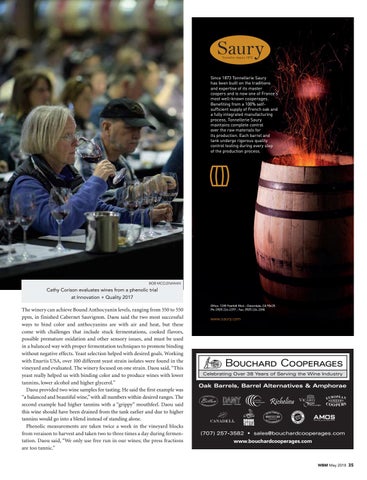
Cathy Corison evaluates wines from a phenolic trial at Innovation + Quality 2017 Office: 1285 Foothill Blvd - Cloverdale, CA 95425
Ph: (707) 224-2377 - Fax: (707) 224-2390 The winery can achieve Bound Anthocyanin levels, ranging from 350 to 550 ppm, in finished Cabernet Sauvignon. Daou said the two most successful www.saury.com ways to bind color and anthocyanins are with air and heat, but these come with challenges that include stuck fermentations, cooked flavors, possible premature oxidation and other sensory issues, and must be used in a balanced way with proper fermentation techniques to promote binding without negative effects. Yeast selection helped with desired goals. Working WINE BUSINESS MONTHLY 3/8 SAURY_2018.indd 1 16/11/2017 with Enartis USA, over 100 different yeast strain isolates were found in the vineyard and evaluated. The winery focused on one strain. Daou said, “This Celebrating Over 38 Years of Serving the Wine Industry yeast really helped us with binding color and to produce wines with lower tannins, lower alcohol and higher glycerol.” Oak Barrels, Barrel Alternatives & Amphorae Daou provided two wine samples for tasting. He said the first example was “a balanced and beautiful wine,” with all numbers within desired ranges. The second example had higher tannins with a “grippy” mouthfeel. Daou said this wine should have been drained from the tank earlier and due to higher tannins would go into a blend instead of standing alone. Phenolic measurements are taken twice a week in the vineyard blocks (707) 257-3582 • sales@bouchardcooperages.com from veraison to harvest and taken two to three times a day during fermentation. Daou said, “We only use free run in our wines; the press fractions www.bouchardcooperages.com are too tannic.”
WBM May 2018 35
14:5
Measuring Phenolics to Manage Color and Tannins in Grapes and Wines
S1A
S1B BOB MCCLENAHAN
Nicole Marchesi, winemaker for Far Niente Winery, discusses how she uses phenolic data to make vineyard management and picking decisions, with Corey Beck, Dan Petroski and Daniel Daou.
Far Niente 2016 Cabernet Sauvignon
Far Niente Winery Far Niente winemaker Nicole Marchesi said the winery has used
WineXRay for several years with a goal of building a correlation between phenolic measurements and sensory characteristics to produce the winery’s blend for its 100 percent Oakville Cabernet Sauvignon. She said the winery is producing wine for two consumers—those who want to cellar and age wines for later consumption and those who want an approachable wine to drink upon purchase. “The wines we like are wines with more bound color,” Marchesi observed. In 2016, the winery began looking at phenolics more closely in the vineyard to evaluate what differences in select blocks may be related to different clones, rootstocks, trellis, cropload and other factors. Marchesi listed several questions the data could possibly answer: Can I use phenolic data to guide picking decisions? How good is extraction? Will the phenolic potential of the grapes help guide the fermentation plan? How can I optimize a specific block’s contribution to the blend? What can we do viticulturally to manage phenolics? Analysis was done for a total of five blocks from two different vineyards. Berry-sampling involved identifying 38 vines in a representative section of each block, picking eight berries per vine to sample a total of 304 berries weekly, starting at veraison. The berries were weighed, crushed and pressed in a benchtop press. Measurements taken per sample included: juice weight and volume, skin and seed weights, Brix, pH and TA. The samples and data were then given to WineXRay to perform an extraction and provide
36 May 2018 WBM
16C11
16C08
tANT: 611
tANT: 536
fANT: 411
fANT: 371
bANT: 189
bANT: 157
pTAN: 1075
pTAN: 970
TIRP: 2317
TIRP: 2105
Far Niente measured anthocyanin and tannin from two vineyards farmed in different methods in an attempt to manipulate phenolic SOURCE: WineXRay content. The methods produced two greatly different wines. Source: WineXRay
additional data, including extractable anthocyanin. Phenolic measurements were also taken during fermentation to track extraction, guide processing and for making press cuts. Marchesi described how data and sensory evaluation were used to select vineyard lots for the wine blend. Measureable color differences were confirmed between the two vineyards and the individual blocks, and Vineyard 1 had more color. All the wine from Vineyard 1 (three lots) made
it into the first master blend. For Vineyard 2, only two lots out of five made it into the first master blend based on sensory evaluation. Lots that failed the cut seemed out of balance. The phenolic numbers for the wine lots and vineyard blocks generally correlated, and the lots that did not make the blend had potentially less color to extract. Marchesi summarized her findings: • The data confirmed phenolic differences in the vineyard between the sites evaluated. • Higher color in the vineyard translated to higher color in the wine. • You can’t build a wine that doesn’t exist. (The grapes must have adequate phenolic values to begin with to contribute value to the blend.) • We’re not making wine by numbers but making wine with numbers. She explained: “The numbers are a great tool, but we’re not making wine strictly by the numbers. Sensory trumps everything. It still has to taste good.” • The berry analysis data helped make fermentation decisions regarding saignee, enzyme additions, maceration, etc. • There is a strong and consistent inverse relationship between berry size and color. “Should we focus on managing berry size in the vineyard to get more color?” she pondered. “In the future, we plan to make more comparisons and compare cumulative data from vintage to vintage to build a historical database,” Marchesi said. She also plans to take more samples during fermentation to track extraction efficiency.
Larkmead Cellars Larkmead Cellars in Calistoga started working with WineXRay in 2014. Winemaker Dan Petroski said the service enables the winery to collect
more phenolic data during harvest, which it can’t do in-house with current resources. “It has enabled us to look at things on a data-driven basis, and it’s a good tool to help understand your vineyard site,” Petroski said. “Our goal is to extract all of a vineyard’s good aromas, flavors and textures,” he said. During harvest, Larkmead focused on two vineyard parcels to evaluate and compare site-related phenolic differences. In addition, the winery wanted to evaluate possible differences between two different grape delivery systems: crushed fruit delivered from the crushpad by pump and mustline to fermentor tanks; and a portable, more gentle, whole-berry delivery system used within the tank room in which fruit was destemmed and then moved by an elevating conveyor to load into the fermentors. The vineyards are planted with Cabernet Sauvignon clone 7 on 110R rootstock dating to 1998. Berry sampling in the vineyard showed higher berry anthocyanins for one block. This fruit was processed through the whole-berry delivery system. The lower anthocyanin fruit was crushed and delivered by must line, run through a saignee trial, and managed to try to bring it closer to the anthocyanin levels of the fruit from the other block. Extraction was higher toward the end of fermentation. “We usually don’t get good color extraction until the fermentation is almost at dryness, in the 0° to 5° Brix range in the fermentor,” Petroski observed. The two wines spent 23 days and 21 days, respectively, fermenting on the skins. Petroski concluded that the phenolic data differences in the final wines were minimal based on
Introducing CDR WineLab ~The Future of Wine Testing~ ®
It’s simple. The CDR WineLab requires no special training. Just add a sample to the pre-vialed reagent and go. It’s fast. It will print readings of must and wine in a matter of minutes. It’s accurate. The CDR WineLab has 25 pre-calibrated tests for SO2, sugars, polyphenols, nitrogen, color and many more.
It’s versatile. The CDR WineLab can perform 16 tests simultaneously. It’s reliable. The CDR WineLab is extremely dependable. It comes with a 3~year warranty. It’s affordable. An exclusive of ATPGroup, the CDR WineLab is reliable, precise and fast. Any winery, large or small, can afford it.
For more inFormation about the CDr WineLab, ContaCt atPgrouP at (707) 836-6840 or onLine at WWW.atPgrouP.Com
WBM May 2018 37
Measuring Phenolics to Manage Color and Tannins in Grapes and Wines
A
S1B
S1C
S1D BOB MCCLENAHAN
Dan Petroski shared his discoveries from a comparison of crushed fruit and whole-berry delivery system experiment.
Far Niente 2016 Cabernet Sauvignon
SOURCE: WineXRay
38 May 2018 WBM TION+QUALITY
Larkmead Cellars 2016 Cabernet Sauvignon 16C08
A5c
A5d
tANT: 536
tANT: 769
tANT: 671
fANT: 371
fANT: 640
fANT: 556
bANT: 157
bANT: 120
bANT: 102
pTAN: 970
pTAN: 1372
pTAN: 1402
TIRP: 2105
IRPs: 2862
IRPs: 2758
Larkmead focused its phenolic trial on wines from two vineyard SOURCE: WineXRay parcels delivered to tank in two methods: crushed fruit delievered by pump and must lines to the fermentor and a gentler, portable, whole-berry delivery system. Source: WineXRay
the grape delivery method, and said, “The wines ended up in basically the same place at the end of fermentation.� However, differences were observed between the two vineyard blocks. He believes the block with better berry phenolic numbers had more refined tannins and better sensory phenolics, compared with the other block that had more green sensory notes. He attributed this difference to the effects of Red Blotch virus in part of this block. WBM
Measuring Phenolics from Vineyard to Tank
1:30 p.m
GREEN CALIFORNIA GREEN MEDAL: MEDAL
LE
CA
RDS AWA
AB
IP
SUSTAIN
ER SH
W
IN
OWING LEA R G E D
LIFOR NIA
congratulations to the 2018 winners!
CALIFORNIA GREEN MEDAL SUSTAINABLE WINEGROWING LEADERSHIP AWARDS Recognizing California Vineyards and Wineries Who Excel in Sustainability With Four Awards:
LEADERSHIP
ENVIRONMENT
COMMUNITY
BUSINESS
Bogle Vineyards
St. Supery Vineyards & Winery
KG Vineyard Management
Cakebread Cellars
To learn more about 2018 Green Medal winners, visit www.greenmedal.org
SPONSORED BY: exclusive media sponsor
gold sponsor
silver sponsors
Protected Harvest
WINE BUSINESS MONTHLY presented by:
Farm Credit Alliance
MCE Clean Energy
winemaking INNOVATION+QUALITY
winebusiness.com/winetrials
INNOVATION+QUALITY
Winemaker Trial Preview:
Ultra-premium Winemakers to Pour Trial Wines at Innovation + Quality 2018 From smoke taint removal methods to the latest in phenolic enhancement, join winemakers as they pour and discuss experiments from the 2017 vintage. to the pursuit of high quality wine join Wine Business Monthly for its annual Innovation+ Quality conference, a one-of-a-kind forum for ultra-premium wineries focused on innovations that advance wine quality. Winemaking trials are an essential component in that pursuit. While a single winemaker can test some hypothesis each vintage, countless others can learn from that winemaker’s results. Innovation + Quality aims
E AC H Y E A R , W I N E M A K E R S DE DIC AT E D
Flash Detente as a Mitigation Technique for Smokeexposed Grapes WIN E RY/ W I N E M AK E R : VA RIE TA L & R E G I O N :
Carneros Vintners, Nate Rippey
Cabernet Sauvignon, Napa and Merlot, Sonoma
The objective was to assess the use of Flash Detente as a mitigation technique for smoke-exposed grapes.
TRIA L O B J E C T I V E :
The Effect of Maceration Timing on Smoke Taint Extraction WIN E RY/ W I N E M AK E R : VA RIE TA L & R E G I O N :
to bring together some of the best winemaking trials conducted every vintage so that everyone can discuss methods, results and more in an interactive gathering that allows all parties to taste the trial wine and collaborate on the outcomes. IQ 2018 will feature 20 hand-selected trials, some of which are previewed here.
Use of Cilyo to Decrease Unstable Polyphenols in White Wines WINERY/ WINEMA KER: VA RIETA L & REG ION:
The objective of the trial is to determine whether pressing a ferment before dryness or including a cold soak will affect the levels of smoke taint compounds in the finished wine.
TRIA L O B J E C T I V E :
The objective of the trial is to add a precise dose of O2 to lower the number of unstable polyphenols present in the press fraction of Chardonnay. The goal is to reach a compromise between the decrease of phenol acids and the protection of the aromas.
T RIA L OBJECT IV E:
(More information on this trial is available in the April 2017 issue of Wine Business Monthly.)
Increased SO2 at Crush to Enhance Color Extraction in Pinot Noir WINERY/ WINEMA KER: VA RIETA L & REG ION:
Understanding Pinot Grigio Color Stabilization VA RIE TA L & R E G I O N : TRIA L O B J E C T I V E :
Francis Ford Coppola Winery, Francois Cordesse
Pinot Grigio, California
To remove color related to Pinot Grigio early in the
wine process.
Fermentation Temperatures on Barrel-fermented Chardonnay VA RIE TA L & R E G I O N :
Chamisal Vineyards, Michael Callahan
Chardonnay, Sta. Rita Hills
The objective was to see less fruit aromatics, and more savory aromas at higher temperatures.
TRIA L O B J E C T I V E :
40 May 2018 WBM
Chemeketa Cellars, Scott Dwyer
Pinot Noir, Willamette Valley; Eola-Amity Hills AVA
To determine if increasing SO2 at crush will enhance color extraction in Pinot Noir.
T RIA L OBJECT IV E:
Comparing the Use of Air and Nitrogen as Flotation Gases WINERY/ WINEMA KER: VA RIETA L & REG ION:
WIN E RY/ W I N E M AK E R :
Chardonnay, Carneros
A to Z Wineworks, Dan Berglund
Pinot Noir, Applegate Valley, OR
WIN E RY/ W I N E M AK E R :
Domaine Carneros, Zak Miller
Erath Winery, Karl Weichold
Pinot Gris, Umpqua Valley
The objective of the trial was to compare the sensory effects and analyze the phenolic composition of juice float clarified with air and nitrogen.
T RIA L OBJECT IV E:
Beginning with Craftsmanship Going Forward with Innovation
1880 Bertolaso was founded with a strong passion to bring to the world the best in Italian engineering
2017
2008 The National Association of Italian Manufacturers Award — Creativity and Innovation
2011 Verdicchio d’Oro Award — Innovation in Wine Filling Production
2013 SIMEI Technological Innovation Award — Integrated Bottle Management System
2015 Innovation Award Prize of Enomaq — Bottle Transport System
SIMEI New Technology Award — Automatic Bottle Inspection System
171 Camino Dorado, Napa, California 94558 • 707.258.3940 • www.collopack.com
SIMEI Technological Innovation Award — Optimized Weight Level Bottling System
Ultra-premium Winemakers to Pour Trial Wines at Innovation + Quality 2018
Does the Stabulation Technique Build Palate Weight and Structure in Syrah Rose? WIN E RY/ W I N E M AK E R : VA RIE TA L & R E G I O N :
Chateau Ste. Michelle, Leah Adint
Syrah, Yakima Valley
Non-Saccharomyces Yeast Comparison in Barrel-fermented Chardonnay WINERY/ WINEMA KER: VA RIETA L & REG ION:
Sonoma-Cutrer Vineyards, Cara Morrison
Chardonnay, Russian River Valley
TRIA L O B J E C T I V E :
To build palate weight and structure without phenolics or color by solids-juice mixing at a cold temperature.
T RIA L OBJECT IV E:
Effect of Higher Yield and Later Thinning on Pinot Noir
Velocity Winemaking via STARS Technologies
WIN E RY/ W I N E M AK E R : VA RIE TA L & R E G I O N :
Adelsheim Vineyard, Gina Hennen
Pinot Noir, Willamette Valley, OR
The objective is to see if non-Saccharomyces yeast add more complexity to barrel-fermented Chardonnay.
WINERY/ WINEMA KER: VA RIETA L & REG ION:
Hess Collection, Alison Rodriguez
Chardonnay, Monterey
TRIA L O B J E C T I V E :
The objective of the trial was to understand the effect on quality with a later, lighter thinning pass.
T RIA L OBJECT IV E:
Implications of Barrel, Stainless Steel and Alternative Oak RRV PN Ferments
Co-inoculation of Malolactic Bacteria vs. Sequential Inoculation in Carneros Pinot Noir and Dry Creek Valley Cabernet Sauvignon
WIN E RY/ W I N E M AK E R :
FFCW/Virginia Dare Winery, Humberto Berlanga/
Corey Beck VA RIE TA L & R E G I O N :
WINERY/ WINEMA KER:
Pinot Noir, Russian River
Phase II. To compare and narrow down the improved color and texture quality of barrel fermented-, oak alternative- and a stainless-steel tank-fermented Pinot Noir from the Russian River Valley.
TRIA L O B J E C T I V E :
Fermentation and Aging of Sauvignon Blanc in Two Different Concrete Eggs with Different Origins WIN E RY/ W I N E M AK E R : VA RIE TA L & R E G I O N :
Galerie Wines, Laura Diaz Munoz
Sauvignon Blanc, Napa
The objective of the trial is to compare the fermentation of the same juice in two different concrete eggs, one built in the U.S. and the other one in France with a different composition in the concrete/ clay mix. Chemistry, potential redox and organoleptic characteristics will be considered.
TRIA L O B J E C T I V E :
Whole Cluster on Top vs. Bottom of Fermenter in Pinot Noir WIN E RY/ W I N E M AK E R : VA RIE TA L & R E G I O N :
Adelsheim Vineyard, Gina Hennen
Pinot Noir, Willamette Valley, OR
The objective of the trial was to explore the organoleptic effect of whole clusters (13 percent total) placed at the top versus the bottom of a fermenter.
TRIA L O B J E C T I V E :
42 May 2018 WBM
To evaluate time/energy cost and quality of STARS-XF versus cold-stabilization followed by cross-flow microfiltration.
VA RIETA L & REG ION:
Francis Ford Coppola Winery, Natalie Dale
Pinot Noir, Carneros and Cabernet Sauvignon, Dry
Creek Valley To enhance fruitiness and mouthfeel, producing true appellation expression, controlling spontaneous ML fermentation, and getting our wines ready for market sooner and stabilizing color and tannin.
T RIA L OBJECT IV E:
Effect of Direct Inoculation vs. Normal Rehydration of GVS107 Yeast on Chardonnay WINERY/ WINEMA KER: VA RIETA L & REG ION:
Hess Collection Winery, Alison Rodriguez
Chardonnay, Monterey
The objective of the trial is to compare the fermentation and the resulting wine of Chardonnay made from an easy to use Fermentis yeast used with a normal rehydration protocol versus a direct inoculation in the tank.
T RIA L OBJECT IV E:
Using No-SO2 Wine Production Methods on Pinot Noir WINERY/ WINEMA KER: VA RIETA L & REG ION:
Van Duzer, Florent Merlier
Pinot Noir, Oregon
The objective of the trial is to produce wines without or with a low amount of SO2, using allergen free alternatives for the entire winemaking process.
T RIA L OBJECT IV E:
A True Artisan Always Uses The Right Equipment
Innovative Equipment Solutions for Superior Wine Production Crushing
|
Pressing
|
Floatation
|
Filtration
|
Bottling
|
Packaging
The right equipment can be the difference between a Work-of-Art or a simple garage sale piece. Della Toffola offers 50 years of experience in the design and manufacture of innovative equipment that delivers artistry in each production run. OMNIA High Solids Crossflow
www.dellatoffola.us 975 Corporate Center Parkway Suite 130 Santa Rosa, CA 95407 – USA
Phone 707.544.5300 Fax 707.837.8742 Email dtgroup@dellatoffola.us
winemaking
Industry Insight:
Why Wine Executives Added Spirits to Their Portfolios Lance Cutler
Tequila from Don Sebastiani & Sons
O N E O F T H E G R E A T charms of the wine business is that if you have the dream and the passion to make wine, you can do it. The consumer base loves a wide range of grape varieties and winemaking styles, and they are continuously searching for the next great wine. These factors spell “opportunity.” If you have talent, locate top quality grapes and market locally or directly to consumers, then you have a good shot at success. That is why wineries have popped up in almost every state of the union. According to the Wine Institute, the wine industry in California alone has blossomed into a $33 billion annual proposition. The spirits business, especially in the United States, has different roots. For the most part, brands are owned by gigantic corporations. Marketing budgets are astronomical, and brand-building is essential. Brands are almost always built on-premise, in bars and restaurants. Spirits cannot be shipped across state lines by individual producers, so the opportunity for direct to consumer sales is limited. Still, wineries and winemakers are finding reasons to experiment with spirits. They have done it with vermouth, grappa, gin, vodka, brandies and whiskeys. Their reasons for entering the spirits market are as diverse as the beverages they produce. Wine Business Monthly wanted to learn what the attraction was. We interviewed six different winemakers, who were also working with spirits. Here is what they had to say.
44 May 2018 WBM
O’Neill Vintners and Distillers is the seventh largest winery in California. They contract over 15,000 acres of grapes to make premium brands, custom brands, bulk wine, brandy and spirits. They produce over 5 million proof gallons of brandy and dessert wines annually. That includes beverage brandy, grape brandy designate, port, sherry and neutral spirits. They have over 40,000 barrels. CEO and founder, Jeffrey O’Neill, spoke about spirits and his new brandy project.
According to O’Neill: “The most basic similarity between wine and brandy is that grapes are the same source, so there is a natural fit, but you are not a good distiller just because you have a winery. If you look at history, there is very little interface between wineries and spirits producers. In most instances, spirits got created in areas where it was hard to make really good wine. “We produce our spirits by making wine and then distilling that. For our spirits we prefer grapes with higher acid because higher acid makes better, smoother brandy. We add almost zero sulfur to wine for distilled spirits because you don’t need to preserve it and the sulfur has a tendency to bind up esters once it comes through a still. We use refrigeration technology, during the winemaking process, to try to retain all of the fresh fruit aromas that ultimately pass through the still.
Why Wine Executives Added Spirits to Their Portfolios
“If a winery wants to make spirits, you have to educate yourself. There are a number of craft distiller organizations that can give you guidance, whether it is grapes or whiskey or whatever. There is great availability today of small scale stills suited to whatever style you want to make. There is enormous flexibility around it once you make the investment in the still. You can get into this with a minimal financial outlay, but brown spirits have an enormous lead time, and the carrying costs of holding onto the inventory are a big part of it, plus losing 3 to 5 percent a year of your entire inventory to evaporation. You probably don’t want to start a project like this when you are 75 years old. “If you simply want to start a brand of spirits, there are a number of resources. There are periodicals and directories that will send you to the handful of large distillers in Canada. Their rules about making whiskey are a bit different than those in the U.S. There you are allowed to ameliorate and do all kinds of stuff, where you can’t do that with whiskey, brandy or bourbon here. “When we look at the spirits business, most of us conclude that vodka is somewhat played out. The obvious exception to that is Tito’s (which is scheduled to sell over 4.5 million cases this year) and Gallo’s New Amsterdam. We think gin is a very interesting category but only on-premise, not retail.
46 May 2018 WBM
Bourbon whiskey continues an unprecedented pace of growth that is not slowing significantly. “We, as a company, think mixologists and consumers will continue to look for new brown goods that they find interesting and tasty. We started laying down brandy about 12 years ago, so we have a couple of projects in the works and hope to launch our first brandy this year. We are looking at a very California style of brandy. It will be aged at least as long as other fine cognacs and brandies; but because of our grape sources and the way we distill, it will end up being a little bit smoother and a little more fruit-forward. “We think it will be fun. It is a very small part of the category today, but there is a lot of press working. Brandy, in general, across the world is growing at a very fast pace. Not as fast as bourbon whiskey but certainly faster than most other brown spirits. “California makes quality inexpensive brandies, and most of those sell for about $12. It is tough to put age on those at that price; but once you make the investment in aging properly to get that superior product, those price points have to be above $35 a bottle. That will be our target for our new aged, alembic brandy. “We don’t want to launch with luxury prices because that puts it out of the reach of most people. Our view is that there is this magic spot that makes it affordable for mixologists at a bar, as well as for consumers to take home, while still providing a luxury product. We hope to be more mainstream in the luxury category. We expect to release our first brandy in the middle of this year, so we will see.”
Bill Reading is the owner/portmaker for Sonoma Portworks. He always
thought that wine and chocolate would go well together, but he was having no success with the combo. One day he added chocolate essence to a glass of port and loved the result. That evolved into DECO, a port with dark chocolate essence. Soon after, he created DUET, an after-dinner sherry with essence of hazelnut. Once he had his Portworks up and running, he continued to look for new beverages to produce and decided to make grappa, using the pomace from his port making.
According to Reading: “All of our grapes come from the Heringer Estates in Clarksburg. Our certified organic and sustainable grapes are harvested by hand, so we get really good fruit. Our target Brix is 28. When the grapes get to our winery, we treat them with care, add no sulfites and use only native yeast for fermentation. We ferment in ½-ton bins until we hit our target Brix. Then we do all of our pressing by foot. We add spirit that has been aged in a barrel solera system, so we not only stop fermentation, but we add some aged character by using that spirit. We let it settle for a day or two and then put the port into neutral oak.
3 companies to serve you
“Since we are foot-pressing, the pomace remains quite juicy, so we take that next door to Stillwater Spirits where we have it distilled into grappa, which comes out at 160 proof. I cut that to 80 proof with ionized water and produce three different grappas. We have a traditional clear grappa. We make a fig grappa by cutting up figs that we have purchased here in California, placing them into the grappa and letting them steep for about six weeks before filtering. We also place grappa in a freshly emptied port barrel where it ages for about two years. “The cash flow on grappa is much faster than it is on aged port. The downside is how little spirit you get when distilling pomace. It takes a lot of pomace to get a little bit of alcohol. To give you an idea, 1 ton of pomace might produce 25 gallons of 160-proof spirit. Price point is extremely important with grappa, but everything we do is done in very limited quantities, so our grappas command premium prices of $35 to $40 for a 375L bottle.”
Check out our website at NADALIE.COM
707 942 9301 info@nadalie.com nadalie.com
WBM May 2018 47
Why Wine Executives Added Spirits to Their Portfolios
Steve Matthiason, owner of Matthiason Wines, always wanted to be a
farmer. He worked in vineyards and orchards, co-authored the California manual on sustainable vineyard practices and started his own winery with his wife Jill. They farm to produce intense fruit and then try to intervene as little as possible in the winemaking process. They started producing vermouth, which allowed them to combine wine with other fruits and herbs they had grown. Most recently, Steve is a partner in Splinter Group Spirits, which produces brown spirits aged in wine barrels.
HIGH-PERFORMANCE PROCESSING & WASHING SYSTEMS
According to Matthiason:
TBC-2STD Two-Barrel Washer
Maximize Cleaning Minimize Water Use Durable Portable Ozone-capable Minimize Workplace Injuries
1650 Almar Parkway, Santa Rosa CA 95403 tombeard.com p: 707-573-3150 e: jmendoza@tombeard.com
48 May 2018 WBM
“My wife and I drank vermouth as an aperitif for years. We grow fruits and herbs and sell them at the farmer’s market. We thought it would be neat to make vermouth out of things that we grow. Vermouth is wine-based. Then you take the herbs and extract them in high-proof alcohol. Then you add that to the wine. We started researching it about 15 years ago just as a lark. Six years ago we got it together and made our first vermouth. “We used a late harvest desert wine based on Semillon, and we aged it three years in half-full unsulfured barrels, so it got really nice and nutty. We grow cardoon, sour cherries and blood orange. We have wormwood, coriander and some barks. You take those ingredients and place them in labeled Mason jars with brandy spirit. You end up with all these Mason jars filled with murky liquid with stuff floating in it. Then you blend the various extracts together until you come up with the right flavor profile. You add that to the wine. “Because I am particularly a hands-off type of winemaker, vermouth was a joy because I could be a cook. You know, add a little sugar or some more water or some cherries into the infusion. With wine I just don’t think that way. I agonize over any decision that may distract from the fruit’s purity. It’s stressful to make good wine with the least intervention. Vermouth is fun for me. Our wine customers love it, and bar programs like it for mixed drinks. Restaurants serve it as a dessert wine. People really like it for Manhattans.
“As for the spirits business, a friend asked me to come over and help him blend whiskey for a project. I said I’d be willing if we were distilling from organic corn grown by family farmers. Sustainable agriculture is really important to us. So we found someone in North Carolina to grow corn for us, and we distilled it in Kentucky this fall. Splinter Group Spirits started in the negociant style, where we bought aged lots and blended them. All of the aged lots that were purchased originally were brought here to Napa and then put into wine barrels. The French oak adds another whole dimension to the whiskeys. Bob Cabral, the other winemaker, is a barrel guru. He goes to France and literally picks out the trees used for his barrels. So we’ll blend the whiskey, and then Bob will recommend a certain cooper for more aging and to move the spirit in the direction we want it to move.
in the room. I had to get my head around that because at my winery, we use very little new oak. It is important to me to respect the fruit. That is critical to my winemaking. So I was thinking to get some good grain and leave it unoaked. “I went to Kentucky and talked to serious whiskey bartenders, who are the equivalent of whiskey sommeliers. I saw how passionate they were about the oak. More and more I realized that oak is a beautiful, natural growing tree that has great flavors and is a traditional part of that drink. I had a whole mind change and really embraced oak as an essential part of whiskey. That’s the beauty of working with something totally different. It’s fun for me.”
“The original business model was to purchase whiskey and finish it in wine barrels, but we decided to start from scratch by distilling the product. The distilling world is like the wine world. We have custom crush facilities, and they have the same thing for distillation. We make all the decisions, but they distill it for us. So now we have our organic corn and a relationship with the farmer, and we have a good distillery. We plan to leave the whiskey in their traditionally-charred whiskey barrels for a couple of years and then move it out here and put it into the wine barrels. “Wine and whiskey production is weighted differently. With wine it is all about the vineyard. The flavor of the grain is important for whiskey, but the aging is the 800 pound gorilla
WBM May 2018 49
Why Wine Executives Added Spirits to Their Portfolios
Joe Barton is the partner/owner of Krobar Craft Distillery. Joe’s family started Grey Wolf Cellars in 1994 as a family business. Joe functions as the farmer and winemaker. After years of making wine, he and partner Stephen Kroener decided to try their hands at distillation. They opened Krobar Craft
Distillery on the Grey Wolf property. They produce rye whiskey, Americana bourbon and several gins.
According to Barton: “In the beginning we were making wines and looking for uses for our saignée. The Rosé world hadn’t taken off yet, so we investigated distillation. That got me into the process of distillation. Once I got into it, I got a lot more appreciative of whiskey and gin. It opened my eyes to the spirits world in general. It seems there is a lot more blue sky in spirits than wine right now. “When we got started, there were no clear lines on distilleries. As a winery, you could get your distiller’s license to make brandy. Joe Barton Once you have a licensed area, you can make whatever you want. New legislation kicked through with the Type 74 craft distiller’s license which really opened up the door for craft distillers as far as production and consumer sales. You have to distill on property and sell what you make at that licensed facility, but it gives you the ability to have tastings and to sell a certain amount of spirits to customers.
50 May 2018 WBM
“When we started, we were using grape based-products for our distillations. We’d use saignée or buy grapes directly for distillation purposes to make gin. We really enjoy that. You do your basic brandy distillation; and once we’ve achieved the desired quality and neutrality, then we turn to different methods of getting botanical flavors into the gin, either with vapor or a second distillation after steeping. Gin is the main thing we do on the grape side.
“We also make rye whiskey and bourbon on property as well, and we are starting to use some winery cooperage to age some of those whiskies. We’re even aging some of our gin in winery cooperage. We’re trying to take advantage of our knowledge of cooperage, so we’re trying to take all that wine experience and blend it into our distilling mode now. We’re having a lot of fun with it. We use a lot of smaller barriques, which we feel give a nicely flavored whiskey in just three to five years. There is a lot of whiskey out there that is less than two years old. We are starting to discover that with these smaller barriques we are achieving some high-quality flavors in two to three years. If you start with good quality ingredients and use good barriques, it tends to soften and smooth the spirit, so there is a smoother texture in these younger whiskeys as well. “There is a different mindset in the crafting of the original distillations and of the ferments too. It’s a changing world. The whiskey business is seeing more young whiskeys out there that are more accessible and more approachable in the marketplace. You are trying to craft the best whiskey you can. I think the ingredients play a big part in it. Straight grain whiskeys are more content-driven but have less sweetness. The different types of malted grains you use and the different barrels contribute a lot. Before, you used traditional whiskey barrels made with unseasoned wood. Now there is more seasoned wood out there, so the barrel quality is better, and it gives a softer mouthfeel and a better integration of the char in the whiskeys. “It is no joke: we are bottling a barrel at a time. If we like the flavor of a particular lot, we bottle it. If we don’t, we just leave it there. We’re not trying to rush through this. The knock on the craft whiskey industry is that things get bottled too early, and we are sensitive to that. We are trying to age them, but it is a waiting game for sure.”
For more than a decade Tonnellerie Berthomieu has been part of Groupe Charlois, the only cooperage group that is completely integrated from forestry operations to the finished product. Benefiting from the reputation of the Groupe Charlois, its knowledge of oak and savoir-faire offer a unique advantage.Located in one of the most renowned oak forests in France, the cooperage distinguishes itself by its unique steam bending process and by its exceptional selection of oak from France’s most prestigious forests.
Donny Sebastiani is president/CEO of Don Sebastiani & Sons. The Sebas-
tiani Family has been essential to California winemaking, especially in Sonoma County, for more than 110 years. Donny is the fourth generation of this venerable wine family, and working with his brother August and father Don since 2001, their company currently produces more than a dozen different wines. Recently, they have added artisanal tequila from Jalisco, Mexico to their portfolio.
According to Sebastiani: “As for spirits, we are just 18 months into tequila exclusively. From my perspective, making wine and making spirits are very different. There are some synergies where they are similar, certain spirits more than others. Tequila has a little more because there is a sense of terroir and place, which is akin to grape growing. More so than like a vodka, which has less soul to it and is more different from the wine business. “There is more synergy in the marketing and sales of the products, like the mechanics of the pipeline, from the path to the market, which includes the three tier system. Most of our wholesalers around the country are both wine and spirits wholesalers. Some of them have the same salespeople, selling both wine and tequila; others have separate divisions with separate salespeople.
Office: 1285 Foothill Blvd Cloverdale, CA 95425 Ph: (707) 224-2377 Fax: (707) 224-2390 www.berthomieu.com
WINE BUSINESS MONTHLY 3/8 TBE-Berthomieu_2018.indd 1
“It changes, and it is different in every market. In most cases, we prefer16/11/2017 our tequilas to be separated from all wine business and dedicated to spirits. We are very serious about our tequila effort, and we are offering a completely different selling proposition from our wine business, so we prefer someone who understands that and can articulate it. We have three tequilas in our portfolio. Our Anejo is called El Macho, the reposado is called El Fumador, and the platinum is Contigo, which is our entry-level tequila and sells for about $30. All of them are produced at the same distillery in Mexico. “Finding the right guy is a Goldilocks thing. This guy is a friend of a friend, and he was referred by a business associate. You might meet him on the internet, and then talk to him and get to know him. There are a lot of reasons to settle on one guy. Nowadays the quality of everything is so high.
WBM May 2018 51
10:5
Why Wine Executives Added Spirits to Their Portfolios
You obviously look for quality, customer service and a personal relationship. They need to be the right size for us, and we need to get along personally. “I don’t really know how price point affects tequila sales. Some of the price points are just so high, and I rarely buy those. If bottles sell between $45 and $60, then the price is not what sways me there. One of the reasons I think our tequila has been very well received is that they are reasonably priced even though they start at $30 and go up to $60.”
Dave Derby, senior vice president of marketing for Trinchero Family Estates, said that their expansion into spirits was a natural and needed
sell both wine and spirits—and both products share commonalities, such as fermentation and barrel-aging—we’re able to borrow production practices from wine and extend them to spirits. “For instance, our Amador Double Barrel marries the best of Kentucky Bourbon with Napa Valley wine barrel finishing. We transport our whiskey to California, where we finish the bourbon with our family’s Chardonnay wine barrels. The “Double Barrel” technique creates characteristics from the individual barrels that are then blended together to make an exceptional bourbon, far greater than the sum of its parts. We like to say Amador Double Barrel Bourbon has Kentucky pedigree with California flair.
evolution. As one of the largest wineries in the United States, they felt it was important to offer a greater portfolio of products to their customers. They found that the spirits business has ensured portfolio diversification, high product gross margins, incremental accounts and new consumers.
According to Derby: “We’ve watched the alcohol beverage industry evolve quite a bit over the past 10 years. The spirits category has grown 2 to 4 percent whereas wine has grown just 1 to 3 percent, and beer sales are flat to down. Recognizing this growing consumer affinity for higher quality craft cocktails and spirits and increasing loyalty toward spirits brands, we added the spirits division to Trinchero Family Estates’ portfolio in 2012. Growing every year, our spirits portfolio now encompasses brands such as Tres Agaves Tequila and Cocktail Mixers, Amador Whiskey Co. and Sugar Island Rums. “We think that winemaking and spirits production complement each other in a way that makes wine companies natural spirits producers. Because we
www.gusmerwine.com sales@gusmerenterprises.com
West Coast (559) 485-2692 East Coast (908) 301-1811
Exclusive North American Distributor
52 May 2018 WBM
FREE SAMPLE Experience Renaissance Yeast on us!
“Our entry into the spirits business was based on our 70-year philosophy of giving customers what they want. We reviewed areas of opportunity within the marketplace to identify areas in which the market was under-delivering. We also evaluated spirits categories based on size, growth within price segments, competitor strength and fit for Trinchero Family Estates. “We then sourced the best ingredients from premiere locations—such as the Kentucky Bourbon Trail and Tequila Valley, Mexico—and identified the proper partners to help deliver the products that the market demands. We knew we didn’t want to produce spirits, so we partnered with established, like-minded brands that sought the guidance, expertise and resources that a winery, such as Trinchero Family Estates, could offer them to help them expand their portfolios. “Wine and craft beer industries have proven that price points are important to consumers, and consumers are increasingly likely to trade up to more premium products. We take a niche approach with a focus on quality to meet this market demand. With continued consumer trade-up in an overall healthy U.S. economy, we believe Trinchero spirits’ sweet spot is $20 to $40 brands, where we can leverage both retail and on-premise strengths. “There are increasingly advantageous sales and marketing synergies between wine and spirits, as the wine and spirits industries converge. For instance, there are now over 10 large wine and spirits-focused suppliers, and most of the major distributors with whom we partner sell both wine and spirits. True to our ideology of offering an expansive, 50+ brand portfolio, we feel that having more items in the bag, when making a sales call, is a good thing.”
Wine Business Monthly took note of the fact that in recent years several wineries have ventured into making spirits. Winemaking is about fermentation, a process where yeast breaks down sugar to yield ethanol and CO2. Distillation is a different type of process where fermented liquids are heated, turned into vapor and then condensed back into liquids. As the participants in this story make clear, the reasons for wineries to move into spirit production are as diverse as the spirits they decide to make. There are some synergistic points between the two. Certain spirits can be produced from grapes. Wine and spirits are often distributed by
the same companies and sold at the same places. Both are taxed by the government although spirit taxes are much higher than those on wine. Both are licensed by the government and restricted as to how they sell their products, but spirit regulations tend to be more draconian. Fine wines are primarily influenced by terroir and source material, and vary in quality vintage to vintage. Wines are susceptible to a myriad of bacteriological problems that must be controlled. The higher alcohol in spirits makes them more stable, less prone to bacteriological infection and they never go bad. Once distillers develop their protocols, they can pretty much reproduce the same quality spirit over and over. Right now wineries have one distinct advantage: they can ship their product to most states. This allows wineries to develop wine clubs and pursue direct to consumer sales. With certain craft licenses spirits producers can sell direct-to-consumers on-premise, but they cannot ship within their home state nor can they ship to consumers across state lines. For now at least, spirits producers can only sell on premise or must use distributors to move their goods. If they can figure a way to open up channels for direct to consumer sales of spirits, it may produce a new California gold rush. There is no doubt that the spirits business is booming and provides many avenues for future sales growth. If you listen to our participants, the reasons for getting into the spirits business are varied. Bill Reading has created a viable product by using pomace from his port-making. Joe Barton was captivated by spirits production while looking for a way to use up saignée wine. Steve Matthiason decided to make vermouth to mess
around with the fruit and herbs he was growing and that led to getting involved with brown spirits. In fact, as our winemakers got involved with spirits production, many of them slipped toward brown spirits where they felt their knowledge and experience with barrels gave them leverage. Even larger wineries have their own reasons for adding spirits to their portfolio. Jeffrey O’Neill had been making brandy for years before he decided to produce a fine-aged product. He has been waiting patiently for 12 years to release it. Donny Sebastiani got into the tequila business because he likes to drink it and he saw business opportunities for doing it. Trinchero Family Estates saw the booming spirits market as a great avenue for growth while at the same time providing new categories for their customers. Each of the winemakers in this story had a distinct reason for getting into the wine business. The bottom line is always related to money, and clearly each person here is hoping to develop a new revenue stream, but the word that keeps popping up in this article is “fun.” Jeffrey O’Neill said of his 12-year-old brandy venture, “We think it will be fun.” Joe Barton commented, “We’re having a lot of fun with it,” about making his whiskeys. As Steve Matthiason summed up working with Splinter Group Spirits this way, “That’s the beauty of working with something totally different. It’s fun for me.” If making spirits is fun for hard-working winemakers, then Wine Business Monthly is all for it. WBM
Top Innovative Products for Winemaking QUI CK D ELIVERY FRO M O UR WAREH O USE IN MI CHI GAN
Shop online: gwkent.com
info@gwkent.com
GWKent1985
WBM May 2018 53
winemaking
Reducing Extraction in Pinot Noir: Thoughts from Prophet’s Rock Winemaker Paul Pujol Elaine Chukan Brown Based in Sonoma, California, Elaine Chukan Brown serves as the American Specialist for JancisRobinson.com and is a contributing writer to Wine & Spirits. Her work has also been featured in The World of Fine Wine, San Francisco Magazine and Men’sHealth.com, among others, and appears on her own website, WakawakaWineReviews.com. Brown is known for her wine illustration work, which has been described by @KermitLynchWine as “a new standard in wine reviews.” W H I L E R E L A T I V E L Y Y O U N G , C E N T R A L Otago has quickly risen to the fore as one of the world’s top Pinot Noir-focused wine regions. Its wine erupted onto the scene in the late 1990s and early 2000s, showcasing a fruit-forward style with plenty of amplitude. As vine age and winemaker experience have increased, Central Otago Pinot has developed a broader range of styles. In the last several years, one of the key shifts has been reducing and rethinking extraction in the cellar. Wineries such as Felton Road, Aurum, Doctor’s Flat and Amisfield, as examples, have moved from fuller styles with both more tannin and fruit matter to progressively lighter weight, lithe wines that retain Central Otago fruit character while increasing site transparency. With it, the freshness of the wines has also increased. While picking earlier is one aspect of the change, the more significant difference has come from reducing handling in the cellar. Winemaker Paul Pujol of Prophet’s Rock was one of the first in the region to make this marked shift in winemaking. While other winemakers have reduced cellar-handling by decreasing punch-downs per day, Pujol has taken an even stronger approach by reducing his punch-downs to only one for the entire length of the fermentation process. He also does only two short pumpovers in that time, one early in fermentation to give a bit of air to the yeast and one at the end for homogenization without aeration. In each case both pump-overs are short and do not add significantly to extraction. Instead, Pujol chooses to merely keep the cap wet during the fermentation process using a literal garden-style watering can to sprinkle wine over it once or twice a day as needed. In Burgundy and the Rhône Valley it is not uncommon for winemakers to eliminate punch-downs during fermentation in a similar fashion. However, the choice is essentially unheard of in New World wine regions. Pujol started making the change in technique with his 2009 vintage of Prophet’s Rock, committing more fully to it over the next few years. Tasting through multiple cuvées and across all Prophet’s Rock vintages, as well as with winemakers who utilize similar practices in both France and elsewhere, gives a picture of the effect of the change in technique on the final wine. Wines made with this reduced-extraction approach are generally lighter-bodied, with more transparency in both the sense of literal translucency in the glass and also a greater sense of site recognition in the flavor profile. While the tannin often feels more apparent in the mouth, it
54 May 2018 WBM
Paul Pujol
is also less assertive and more even across the palate. The tannin seems to be more apparent from it being housed in less fruit matter rather than from having more literal tannin. In the case of Prophet’s Rock, while the wines are comparatively lighter-bodied, they are not lacking for presence or for fruit. Pujol shared insight on both his motivation for handling extraction in this way and on how the change in technique has coincided with other choices in the cellar.
The Impact of Climate Conditions on Fruit Presence Central Otago hosts a semi-continental climate, which brings with it significant vintage variation. The region can move between short growing seasons with daytime temperatures during the peak of the season regularly in the 90s (while still quite cool at night), to long, cool growing seasons with daytime temperatures only occasionally reaching the 70s. The result is also a significant shift in style from year to year. New Zealand also entertains what are essentially the highest UV-levels of any growing region in the world. The earth’s orbit, during the Southern Hemisphere’s summer, brings the planet closer to the sun than during the Northern Hemisphere’s summer in the other half of the year, naturally increasing UV levels during a Southern growing season. Additionally, New Zealand’s distant position from any other land mass means the dust levels in the atmosphere around the country are also lower, thus decreasing the natural filtering effect in other regions created simply from continental airflow. These UV levels play an important role in the final profile of the country’s wines. Unlike Northern Hemisphere growing regions, warmer vintages in Central Otago often produce comparatively lighter wines to their cooler vintage counterparts. Longer, cooler growing seasons mean far greater exposure to elevated UV levels and thus more pronounced fruit character in cooler vintages, even with far lower sugar levels and higher natural acidity. Additionally, the schist-based soils of Central Otago tend to produce naturally spindly tannin, meaning winemakers in the region do not need to work to build structure in their wines.
Washington grandview, wa warehouse
Always close. Now closer.
Oregon Idaho
With our new warehouse in Grandview, Washington, ATPGroup can now provide service for the wine, beer and juice industries of the Pacific Northwest. Some of the products and ser vices we provide: windsor, ca warehouse
California paso robles, ca warehouse
• Tannins • Fermentis Yeast • Enzymes • Yeast Nutrients • Malolactic Bacteria
• Fining Agents • Stabilizers and Antioxidants • Filtration Products • Beco Pads and Cartridges • Cellar Supplies - Chemicals • Cleaning and Sanitation Products • Parts and Service Repair • Mobile Filtration Services (Coming Summer 2018)
To place an order or inquire abouT a producT, please conTacT us aT 707-836-6840 or go To www.aTpgroup.com or come see us aT our new grandview warehouse aT 601 elm sTreeT, suiTe b, grandview, washingTon, 509-203-2100
Reducing Extraction in Pinot Noir: Prophet’s Rock Paul Pujol Prior to returning to New Zealand, Pujol served as head winemaker for Kuntz Bas in Alsace, becoming the first non-French winemaker in the region, and then as head winemaker at Lemelson in Willamette Valley. While
Kuntz Bas is primarily known for its white wines, he made Pinot Noir in both regions. In becoming head winemaker at Prophet’s Rock, Pujol found the techniques used in France and Oregon produced significantly different wines. The vintage variation native to the region also pushed him to more closely consider the impact of cellar choices on the final wine. In adjusting to his new growing conditions, Pujol also began to rethink his views on balance in the relationship of structure to fruit character. Pujol began to do cellar trials with differing numbers of punch-downs on different, otherwise similar, fermentation lots. At the same time he also trialed fermentation with differing frequencies of pump-overs. The trials led to his current protocol of only one punch-down and two pump-overs with use of the watering can otherwise. He found that using a more typical protocol of multiple punch-downs per day not only extracted more tannin but also more fruit matter. Importantly, though, he also found that on lots with fewer punch-downs, the tannin was smoother and more even across the palate, even if more apparent. Over time he has also found more elegant ageability on the wines with fewer punch-downs. While Central Otago Pinot Noir has a good track record for aging, older examples from a variety of producers made in the more fruit-forward style tend to retain fruit sweetness over time that sits alongside its structure. It is still quite early in the evolution of these newer cellar choices in Central Otago Pinot. Pujol’s first vintage, for example, bottling wine made in this way was 2009. However, looking at how it has aged in bottle versus other wines from the region of the same vintage, as well as how older examples from France made in similar fashion have aged, there seems to be a greater harmony of fruit to structure that coincides with fewer punch-downs. Importantly, each of the examples tasted using this technique have been made without stem inclusion. As stem inclusion, or whole cluster fermentation, can impact how punch-downs and other extraction techniques are done, I asked Pujol to also comment on his choice to fully de-stem Prophet’s Rock Pinot Noir.
Site Conditions and the Choice to Destem
For more information contact your sales representative or email us at info @seguinmoreau.com
Wine Testing Systems
Autoanalyzers, Reagents, Fast Service, Great Quality 25 great Reagents: GF, ML, AMM, NOPA, Acetic, Fr- & T-SO2, Citric, Tartaric & more! Wine Analyzers: EnoLyzer TM Semi-automated, portable ChemWell-T for WineTM NEW 100-tests/hr ChemWell for Wine TM Auto-Washing, 200 tests/hr Order online www.unitechscientiic.com Contact us info@unitechscientiic.com Phone: 562 924-5150
56 May 2018 WBM
For Prophet’s Rock, Pujol has farmed sites in multiple parts of the Cromwell Basin of Central Otago. Today, the winery works primarily with two different vineyards on neighboring glacial terraces but differing elevations. The Prophet’s Rock Home Vineyard in the Bendigo sub-zone sits on one of the highest elevation sites of the entire region at an 1,150-foot elevation while the Rocky Point Vineyard in Northburn grows at 740 feet. The difference in elevation has a significant impact on microclimate, creating noteworthy picking variation in cooler years. In 2017, for example, a very cool vintage for Central Otago, the Rocky Point site was picked 25 days earlier than the Home Vineyard. Elevation in the region also impacts soil character. The older soils at higher elevation have undergone more significant erosion and thus contain a mix of schist-based loam with pedogenic lime. Pedogenic lime impacts vine growth chemically in a similar fashion as limestone, though it is created through the natural erosion of schist-based soils in an arid climate, rather than underwater. The Rocky Point site, on the other hand, is instead more exposed rocky schist. Both sites grow a mix of five Dijon clones – 113, 114, 115, 667, 777 – Pommard (both UDC 5 and 6) and Abel clone, New Zealand’s unique suitcase selection. As a result, Prophet’s Rock works with each of the
Pinot Noir selections available in New Zealand other than Wadenswil, which is relatively uncommon there. Once picked, Pujol chooses to fully de-stem. As he explains, due to the significant vintage variation in the region and conditions of growing at higher elevation, “it would be difficult to have a blanket rule to include a certain percentage of stems every year,” he said. “There are quite a few seasons where the stems are not sufficiently lignified and so are very green and aggressively vegetal. Inclusion of those stems would have negative consequences for the wine.” Pujol points out too that stem lignification in Central Otago tends to act in a backwards fashion to Northern Hemisphere expectations, much like mentioned previously about fruit expression. “It is often the cooler vintages with later picking dates where the stems are lignified and the warmer vintages where they are not,” he said. Because of this significant variation, Pujol has chosen to forego stem inclusion entirely. It would exacerbate vintage variation if it were done in some years and not others. He also feels the sites do not need the additional structure or aromatics gained from stem inclusion. “I think both sites are quite concentrated and structured in terms of the finished wines,” he said. “They don’t require filling-out with whole-bunch to modify structure, tannin, aroma or flavor.” Speaking to winemakers from throughout the region, the use of wholecluster earlier in the region’s development was a way to give additional depth to the fruit-forward character of the wines. As vine age has increased, greater complexity seems to be present in the fruit itself, whether or not whole-cluster is used. Some of this additional depth of character is surely from vine age.
In the case of Prophet’s Rock, and for others that have reduced extraction as well, the additional depth also seems to come from reducing the overall fruit-sweetness derived by greater extraction, thus giving more room, so to speak, for other characteristics to show.
Sulphur, Cold Soak and Ambient Fermentation In rethinking extraction, Pujol begins not only with adjusting how he thinks about punch-downs or pump-overs but everything from the moment fruit enters the cellar. “I think it’s important to remember that the baseline of extraction is putting grapes in a tank,” he said. “Extraction is occurring the whole time without any intervention. We often think of extraction purely in terms of what we do in the winery with plunging or pump-overs, for example, when it’s actually occurring the whole time.” To put that another way, “Grapes simply being in their own juice when you put them in a vessel in the winery, is already a form of extraction. That’s the baseline of extraction. Everything you do in the winery on top of that is an optional extra; realizing that led me to question and fine-tune my extraction regime.” In picking, the goal for Prophet’s Rock is to bring in the fruit both relatively clean and quite cool. It is then de-stemmed and put into open-top fermentors generally without sulfur. The fruit is allowed to begin fermentation on its own after an initial cold soak of several days. It should be clarified here that what Pujol is calling the cold soak period occurs naturally from fruit relying on ambient yeast fermentation without being inoculated, rather
WBM May 2018 57
Reducing Extraction in Pinot Noir: Prophet’s Rock Paul Pujol than from the fruit being intentionally chilled. As explained in what follows, Pujol only chills the fruit when necessary. “Due to the low humidity of the region and relatively low disease pressure, we are fortunate to get extremely clean fruit,” Pujol said. “The amount of sulfur used, if any, depends on the temperature of the fruit at harvest. If the fruit is cold, which is usually the case, 46° F to 57° F, then I have stopped adding any sulfur at all at processing. If the fruit is warmer and requires some cooling, and hence some movement or exposure, then I add 30 ppm at the de-stemmer. The sulfur, in this case, is just to protect the fruit from oxidation through this period without unduly inhibiting the onset of indigenous yeast fermentation. At this level, after a few days, there is no remaining free SO2.” Assuming sulfur is unnecessary at processing, Pujol clarifies that those fermentations see no SO2 until after malolactic conversion (ML) is complete, which usually occurs nine to 10 months after the fruit is picked. Winters are quite cold in Central Otago, which slows ML. Prophet’s Rock does not inoculate for ML. Pujol said that he used to add sulfur at the de-stemmer as a matter of routine but over time has realized that when the fruit is clean and cold, it is not necessary. “If the fruit is cold, you’re putting it straight in a full tank, gassing it and sealing it, monitoring it until ferment, how much oxidation is actually going to occur? Was I just adding sulfur ‘because?’ Also, I wondered whether even a small amount of sulfur is having an effect on the indigenous yeast culture coming in from the vineyard,” he said. “And lastly, I wondered whether even a small sulfur add at processing was retarding the onset of fermentation, which is slow anyway when the fruit is cold.” Pujol said since moving to the new sulfur regime, he hasn’t seen any oxidation in the juice. “We look after the surface of the tank as mentioned and monitor for mold, etc. There’s been no rise in our finished VA numbers since stopping with sulfur at the de-stemmer. Ferments have been healthy, no issues. Instead, the temperature of the tank seems to have the biggest impact on the onset of fermentation. It is hard to quantify if dropping sulfur has changed the wines as there are so many other variables, but it’s nice to have reduced our overall sulfur use.” In rethinking his views on extraction, Pujol now regards the initial cold soak period itself as part of the extraction process. “I think that the extraction we get during the cold soak is a very gentle, as opposed to the more aggressive, tannin extracted post-ferment, when heat and alcohol are present, and seed tannins become a factor,” he said.
Tonelería Magreñán represents 5 generations of great coopering tradition. Its savoir-faire and perpetual quest for quality has given rise to its current prestige. Born into a family of coopers with a history dating back to 1820, it was Rafael Magreñán’s affinity for the wines of Rioja that led him to create his own cooperage in Alfaro in 1950. Today the cooperage is managed by his grandchildren, Antonio and Teresa. Tonelería Magreñán is recognized for the quality of its products both in Spain and all over the world. Its barrels are made from American, French and European oak.
Bibiana Guerra Commercial agent email: bibianaguerra@magrenan.es Cell: +1 (530) 565-5137 Office: 1285 Foothill Blvd - Cloverdale, CA 95425 Ph: (707) 224-2377 - Fax: (707) 224-2390
www.magrenan.es
NE BUSINESS MONTHLY 3/8_MAGRENAN_02_2018.indd 1
58 May 2018 WBM
Extraction During Fermentation 08/02/2018
Many producers rely on punch-downs, during fermentation, in order to ensure good color extraction and the presence of anthocyanins as part of helping to resolve tannin. Pujol has found that while the wines are lighter in 16:05 color with his newer regime, the wines are not wanting for color. “Flavor and aromatic expression of the site change, of course, every year, but clarity and concentration in the wines overall are not light or incomplete,” he said. “Structure is the other main element, of course. The finished wines have good structure, and the nature of the structure is consistent for each site. While I am not concerned about color, there seems to be heaps.” Allowing the fruit to ferment without inoculated yeast means it takes several days for fermentation to start; and when it does, it occurs relatively slowly. He clarified: “Our fermentation arc is usually quite long and slow. The tanks will smell active several days before first Brix drop. Early fermentation is slow, up to 1° Brix per day. Then, after three to five days, the pace will increase up to 6° to 8° Brix per day. It then slows again, and it takes about a week or more to move from the last 2° to 3° Brix to dry. So the really active
part of ferment is a couple of weeks. It can be slow to finish, depending on the year. We seem to average about 28 to 30 days in tank.” The various stages of fermentation inform how Pujol handles managing the cap. “Before ferment starts, we gently renew the juice twice daily by lightly pressing down the cap about 4 inches by hand, keeping the tanks covered and gassed until ferment starts,” he said. “Once the cap comes up, we use the watering can of juice twice a day. At this point, the cap becomes too solid for the previous method. During fermentation, we monitor the ferment as there’s no one fixed approach. Usually we will do only one hand-plunge for the whole of fermentation and a couple of short pump-overs if required. Sometimes we do one early pump-over to introduce a bit of air and one non-aerative pump-over near the end to homogenize the juice.” The “one hand-plunge” Pujol refers to is a punch-down done gently with a standard plunging tool about halfway through fermentation. It is done generally just after the peak of fermentation with the goal to submerge the cap and thus slow fermentation again slightly. It also helps to even the impact of the overall fermentation by reintroducing the skins in the cap to the juice for integration. Previously, Pujol did a trial doing fermentation without even the single punch-down and found that the wine was quite reductive until after ML was complete. While the wine did lose the reductive character after ML, he still felt fermentation stayed healthier, and the tannin profile was more complete when including the single punch-down. Vintage variation can also play a role in how Pujol handles extraction during fermentation. “If a block has struggled for ripeness and shows vegetal notes in tank, which normally shows quite quickly early in fermentation, then I’m even more careful with extraction,” he said. “In this case, I’ll try to
avoid much extraction at all, maybe no plunging at all during fermentation, and then press off as soon as possible after, making sure to press very lightly. I find the resulting wines to be more agreeable this way, albeit lighter in profile, than if I’d extracted more forcefully and ended up with bitterness and a greener, more aggressive profile.” Once fermentation is complete, Pujol presses relatively quickly. “I tend to press quite early at the end of fermentation,” he said. “In trials we haven’t gained anything I thought was beneficial from post-ferment maceration. For us, the often extended cold soak period and more gradual fermentation arc give us an average length of time in tank of around 28 to 30 days. So, although our extraction regime is very light, we are getting what we need from the fruit. “The tannins seem integrated and balanced at end of fermentation. Perhaps it is the low extraction regime? It is hard to know as it also could be sites. When I’ve done trials leaving the wine longer before pressing, all we’ve gained is hardness, some bitterness and less balance. Basically, it has just made the wine more tannic. The sites and the wine from them are quite structured anyway. Hence, the low extraction regime, and I think more extraction or post-fermentation maceration would send the wine toward overly tannic, out of balance Pinot. “Otherwise,” he clarified, “I’ve found that neither of our sites lack for structure, and that the more I took away from extraction in terms of added techniques, the ‘truer’ the wines tasted to site. The tannin profile changed too. It became less ‘chunky’ and massive, more elegant and integrated with a very different texture.” WBM
Crafting Partnerships At World Cooperage, we craft premium American and French oak barrels and partner with you to build comprehensive barrel programs you can trust, time and time again.
www.worldcooperage.com
WBM May 2018 59
winemaking
And Now a Word About Barrels Some notes about aging wine in wood Curtis Phillips about oak alternatives in light of our annual surveys. While I did discuss barrels to some extent, it was mainly to note that the price point at which a wine moves from probably not undergoing a traditional élevage to probably being aged in barrels has been increasing steadily for as long as we have been asking about barrels and oak. I also noted that smaller wineries are less likely to use any oak alternatives at all. As I noted, I believe this is due to a combination of factors, including a greater need to rely on barrels simply as storage vessels and the amount of oversight required to make sure a MOX (micro-oxygenation) regime is beneficial rather than harmful to a wine in smaller tanks.
L A ST MON T H I TA L K E D
The Paradoxes of Tradition Someone’s tradition is always someone else’s prior innovation. The “tradition” of aging wine in the sorts of barrels we use today is really a fairly recent innovation, relative to the overall history of winemaking, that has as much to do with the accidents of geography and the expansion of land-borne trade in Imperial Rome than it does with any intrinsic superiority of the barrel over the amphora for storing and aging wine. Amphorae proved to be an adequate transport container as long as wine was consumed locally and its production or transport was primarily waterborne. Overland transport is really the point at which barrels demonstrate any superiority over amphorae. Simply put, barrels full of wine can take jostling in an oxcart better than can amphorae. Note that this is strictly a barrels to amphorae comparison. Alternative containers, like rawhide bags, the biblical new wine into old wineskins, are reasonably durable and were available for as long as wine has been made. Skiers bota-bags notwithstanding, however, wine isn’t stored in leather bags if anything better, like an oak barrel, is available. A further detail that may have helped the adoption of barrels is that Gaul, what is now France, while having some deposits of the red clay one would need to make amphorae, was well more generously supplied with white oak, along with a wide distribution of the technical knowhow to turn these trees into barrels. The thousand-year reign of barrels then began by happenstance and endured simply because no cheaper and more widely available storage and transport vessel for wine was found until stainless steel became widely available. I would contend that the mythologically exalted function of barrels, as a medium for wine-aging, is completely accidental. The fashion for what constitutes a good wine is formed by the wine that is available rather than the other way around. The Romans drank wine that we would consider unpalatable. Worse, they considered drinking unadulterated wine to be uncouth and snickered at the Germans and Gauls that “weren’t sufficiently civilized” to know that one had to add herbs, pine resin, honey, seawater and lead salts to properly bring out the bouquet.
60 May 2018 WBM
Curtis Phillips, an editor for Wine Business Monthly since 2000, is a graduate of UC Davis, and has been a winemaker since 1984 and an agricultural consultant since 1979.
Similarly, the taste for oxidized wines seems to have derived from drinking oxidized wines first and only becomes a preference afterward. Sherry is certainly an example but doesn’t just about everyone in this industry have an uncle, other relative or neighbor who prefers his own oxidized, rot-gut, homemade wine over “those fancy store-bought vinos?” I would argue that the taste for oak aroma compounds in wine is similar in origin. We like oak-derived vanillin and furfural in our wine because that’s in the wine we drink, and we’ve taught ourselves that those aromas are supposed to be in wine, more than we seek out oaky wines because of any inborn preference for those aromas.
Barrels and Oxidation Aside from the direct addition of oak-extracted aroma compounds, barrels also enable a sub-saturation oxygenation of wine while stored in them. The mechanism of this oxygenation is frequently misunderstood by non-winemakers, even if otherwise involved in the wine industry. When correctly bunged, and assuming there are no bung-holes or leaks, a barrel is essentially an airtight container. As water and ethanol evaporate through the sides of the barrel, they aren’t immediately replaced by the atmosphere outside the barrel. Instead, a vacuum is formed in the ullage until the bung is removed. It is at that point that oxygen is introduced as air rushes in to fill the vacuum in the ullage. It is this introduction of oxygen that is responsible for the “micro-oxygenation” or “micro-oxidation” of the wine during a traditional barrel-aging regime. The oxygen that’s allowed to get into the wine is more a function of the number of times the bung is pulled off the barrel than it is a function of the amount of time that the wine resides in barrels. This can be amplified if a bung is removed and replaced without the barrel being topped to remove the ullage. One of my banes as a winemaking consultant, is the winery owner that can’t resist “sampling” barrels. I understand the excitement of tasting a wine as it develops during élevage, but I also understand why some winemakers absolutely forbid anyone but themselves from touching any barrel in the winery. Point and scream winemaking is a really bad management tactic, but I certainly understand winemaker frustration regarding people that won’t keep their paws off the barrels. As a consultant, I don’t have the luxury of making absolute prohibitions, I don’t own the wine I make after all. I can usually get the crew to understand that they need to top before replacing any bung, even one that was knocked
SCOTT SUMMERS
NEW! CONSISTA-HOPPER™
born to run off by accident. I’ve never been able to get winery owners to do the same. They never seem to understand that every time you pull a bung, you kill the wine by inches. Let the barrel do its job and immediately top every barrel that is opened. Maybe I need to revise my contract boiler-plate so that I get paid an indemnity, if not a wergeld then perhaps a wingeld, any time anyone other than myself pulls a bung?
■
■ ■
What the Consumer Wants Consumer expectation and preference are at once simple and elusive. Consumers generally want today what they wanted yesterday, right up until they don’t. I believe that the cliché is that up until the introduction of an affordable automobile, consumers would have answered that they wanted a faster horse rather than a different mode of transportation. With wine, we have to be careful about talking about “the consumer’s preferences” simply because there are many different strata of consumers, each with their own preferences. For example, a depressing one-third of adults in the U.S. don’t consume alcohol at all or at least claim they don’t, which amounts to the same thing. The non-wine drinker is going to be more concerned with the shelf price point than with whether the wine tastes like it underwent a traditional élevage. Individual wine brands don’t compete with each other for this consumer. Instead, the competition is beer, soda and mixed drinks. The occasional wine-drinker, probably the next most price-sensitive, may state that they want a “barrel-aged” wine, but in my experience that’s more because they’ve been told that’s what they should like than what they really want. I think that this is the main reason that they remain only occasional consumers. What they really prefer remains something other than what most of us are providing. The core wine-drinker is the one who really drinks most wine. The numbers wander around a bit, depending on who is asking and how the question is phrased, but there has been little expansion from the 8 percent to 10 percent of wine consumers that make up the core wine-drinker segment since the 1970s. In the main, when total wine consumption is up, it is because this segment is drinking more individually rather than an expansion in the percentage of people that regularly drink wine. Since they drink the most wine, it probably makes sense that we allocate most of our attention to making the wines this segment wants. At the same time, I’ve long felt that we’re leaving a lot of money on the table by not paying sufficient attention to the other, alcohol-consuming, segments. As I noted, the main competition for our industry isn’t each other as much as it is beer, soda and, to a much lesser extent, spirits. WBM
Large hopper accepts full 1/2-ton bins. No waiting! Adjustable for cluster size Fits over belted or vibratory sorting tables
■
VFD speed control
■
Lockable swivel casters
■
Easy-to-sanitize design
■
Food-grade star rollers
Barrels and the Consumer If I am correct that the consumer preference for the results of barrel-aging was derived by accident, then I think that there are a few lessons to be learned. (1) Our job is to provide the consumer with a beverage with the flavors and aromas they want at the price they want to pay. (2) Taste, and therefore consumer preference, is mutable rather than static. (3) Just because the preference arose accidentally, it doesn’t follow that, as winemakers, we need to make our wines accidentally.
Gently and evenly meters whole clusters onto your sorting table
www.pnlspecialties.com
■
p. 707 573 3141
■
f. 707 573 3140
1650 Almar Pkwy, Santa Rosa, CA 95403 Licenses: CA #803431, WA #PLSPELS923BZ, OR #180330
CROSSFLOW FILTRATION LEES FILTRATION ULTRA FILTRATION ISOBARIC SPARKLING WINE TREATMENT 4EP-4EG TREATMENT VA ADJUSTMENT PH ADJUSTMENT SMOKE TAINT REMOVAL ETHYL ACETATE REMOVAL TCA-TBA REMOVAL DE-ALCOHOLIZATION
• MOBILE CROSSFLOW SERVICES AVAILABLE IN CA, OR & WA • SALES & DELIVERY OF CUSTOM-BUILT CROSSFLOW & DE-ALC UNITS
WBM May 2018 61
winemaking
Select Barrel & Oak Suppliers Company Name
City
Adour Cooperage
Santa Rosa
Alain Fouquet French Cooperage, Inc.
State
Phone
Website
CA
773-332-0059
www.adour.fr
Napa
CA
707-265-0996
www.alainfouquet.com
Allary Tonnellerie
Amity
OR
503-307-1593
www.nicholaskeelerinternational.com
Artisan Barrels and Tanks
Oakland
CA
510-339-0170
www.artisanbarrels.com
Barrel Builders, Inc.
St. Helena
CA
707-963-9963
www.barrelbuilders.com
ad on page 50
We know barrels, it’s what we do. Marchive barrels can be individualized to suit your specific wine and style. From wood type, to wood seasoning, to toast level options you can create a barrel that will harmonize perfectly with each vintage. Barrels, oak alternatives, cooperage supplies/tools
French Oak, American Oak, Eastern European Oak, Acacia
Burgundy, Bordeaux, Large Format
Barrels Unlimited, Inc.
Seal Beach
CA
562-438-9901
www.barrelsunlimited.com
Berthomieu Tonnellerie
Cloverdale
CA
707-224-2377
www.berthomieu.com
ad on page 51
For more than a decade Tonnellerie Berthomieu has been part of Groupe Charlois, the only cooperage group that is completely integrated from forestry operations to the finished product. Benefiting from the reputation of the Groupe Charlois, its knowledge of oak and savoir-faire offer a unique advantage.Located in one of the most renowned oak forests in France, the cooperage distinguishes itself by its unique steam bending process and by its exceptional selection of oak from France’s most prestigious forests.
Barrels
French Oak
Bouchard Cooperages
Napa
Burgundy, Bordeaux Large Format CA
707-257-3582
www.bouchardcooperages.com
ad on page 35
A complete integration of wood and wine throughout the five stages of tasting After 37 years of passion and dedication to the cooperage business, Vincent Bouchard has finally put his signature on a barrel Barrels, Barrel Alternatives, & Amphorae
French Oak, American Oak
Burgundy, Bordeaux
Canton Cooperage
Santa Rosa
CA
707-836-9742
www.cantoncooperage.com
Charlois Cooperage USA
Cloverdale
CA
707-944-1371
www.charloiscooperageusa.com
Integrated by the Charlois Group in 2011, and located in California’s Sonoma Valley, this cooperage combines American production and French quality to create the best oak barrels stateside. All the exceptional know-how built up by the Charlois Group’s experience of working with oak is now brought to the USA. Expertise, quality and sustainable development are combined to create local products intended to complement the quality of the winemakers’ efforts. Charlois Cooperage USA’s raw material is sourced from the best oak forests of the Appalachian Mountains. The fruit of this intercontinental alliance is the creation of a high-end collection of American oak barrels. Barrels
American Oak, American-French Hybrid
Creative Oak
Benicia
62 May 2018 WBM
CA
Bordeaux Export
707-746-5704
www.creativeoak.com
ad on page 108
Company Name
City
State
Phone
Website
Demptos Napa Cooperage
Napa
CA
707-257-2628
www.demptosusa.com
East Coast Wood Barrels
Medford
NY
516-582-1065
www.ecwbny.com
Éclat
San Rafael
CA
415-457-3955
www.boswellcompany.com/barrels/eclat-2
Ermitage Tonnellerie
Cloverdale
CA
707-224-2377
www.tonnellerie-ermitage.com
ad on page 76
Tonnellerie Ermitage specializes in a select, made-to-order offering of barrels produced from the very best lots of oak from trees a minimum of 150 years old. Tonnellerie Ermitage works exclusively with State forests that are sustainably farmed and managed by the ONF and certified PEFC. Each order is handled with rigorous and personalized attention from the barrel or tank selection process through delivery and beyond. Barrels
Bordeaux, Burgundy, Large Format, tanks and casks
Fine Northern Oak
Napa
CA
707-307-6222
www.finenorthernoak.com
G3 Enterprises
Modesto
CA
800-321-8747
www.g3enterprises.com
GOLD SPONSOR AT IQ
We are Creative, Integrated Solutions. As a leading manufacturer and supply chain company, G3 Enterprises has expanded its offerings to include wine ingredients. G3 is the exclusive distributor of Vivelys’ Boisé® in the United States. Boisé® is a line of premium French oak that includes a unique range of chips and “new” Inspiration staves. Boisé® high quality oak products help winemakers create precise and consistent wine profiles. In addition, G3 is introducing Phenesse Oak, a new oak alternative that comes with two types of tank staves (11MM format) and two types of chips sourced from high quality French and American Oak forests. The Phenesse products are designed to bring harmonious results to assist in quality winemaking for the North American region. Garbellotto
Paso Robles
CA
805-226-8100
www.thevintnervault.com
Heinrich Cooperage
Sonoma
CA
707-738-8670
www.heinrich.com.au
Heritage Barrels
Napa
CA
707-696-7695
www.heritagebarrels.com
Innerstave, LLC
Sonoma
CA
888-996-8781
www.innerstave.com
ad on page 57
Experience Oak Alchemy Innerstave sources our American oak Alba from Missouri and our French oak from the center of France before aging in the Carneros Region of Sonoma, CA. Then the oak is specialty toasted by our toastmaster. Oak alternatives
French Oak, American Oak
Barrel Alternatives that replenish barrels and for adding to tanks
Kelvin Cooperage
San Rafael
CA
415-457-3955
www.boswellcompany.com
La Grand Oak North America, LLC
Lafayette
CA
707-455-1095
www.legrandoak.com
Louis Latour
San Rafael
CA
415-479-4616
www.louislatour.com
Mercier USA, Inc.
Napa
CA
707-321-9640
www.tonnellerie-mercier.com/accueil
Meyrieux Cooperage
Napa
CA
707-259-5344
www.tonnelleriemeyriux.com
WBM May 2018 63
Select Barrel & Oak Suppliers Company Name
City
Morlet Selection
St. Helena
Nadalié USA
Calistoga
State
Phone
Website
CA
707-967-8690
www.morletselection.com
CA
707-942-9301
www.nadalie.com
ad on page 47
American, French, and Eastern European oak products in the Napa Valley since 1980 Founded in 1980, Nadalié USA is the first French cooperage in America. Located in Calistoga, CA, the Nadalié USA production facility handcrafts American oak barrels and imports French oak barrels made at the Nadalié cooperages in France. By continuing the tradition of handcrafting barrels in the traditional French style, the name Nadalié has become synonymous with fine cooperages worldwide. Barrels, oak alternatives and casks
French Oak, American Oak, Eastern Eurnpean Oak
Burgundy, Bordeaux, Large Format
Northwest Cooperage
Portland
OR
503-241-2988
www.nwcooperage.com
Oak Solutions Group / evOAK
Napa
CA
707-259-4988
www.oaksolutionsgroup.com
Oak Wise, Inc.
Lodi
CA
209-224-5353
www.oak-wise.com
Oenosylva
Cloverdale
CA
707-224-2377
www.oenosylva.com
ad on page 26
Oenosylva offers a range of œnologic oak products sourced from the most prestigious forests in France. All of the products are manufactured from stave-quality oak that has been naturally seasoned in the open air. Oenosylva products are finely calibrated to provide the perfect organoleptic contribution of oak during the winemaking process. A range of proprietary techniques and three consistent toasting methods give the wine a subtle range of aromas. Oak Alternatives
French Oak
Chips, dominos, blocks, staves and barrel inserts
Oregon Barrel Works
McMinnville
OR
503-472-8883
www.oregonbarrelworks.com
Premier Wine Cask
Napa
CA
707-257-0714
www.premierwinecask.com
Pronektar
Santa Rosa
CA
707-284-2888
www.radouxcooperage.com
Quercus Concepts
Napa
CA
707-775-7065
www.quercuswood.com
Saveurs
Cloverdale
CA
707-224-2377
ad on page 87
In collaboration with its R&D department and internal laboratory, Tonnellerie Saury presents a new range of oak alternatives with 3 main organoleptic and aromatic profiles most requested by winemakers. The Saveurs line offers 3 unique toast blends with the goal of providing the following characteristics: Fruit, tannic structure, sweetness; Vanilla, roundness, sweetness; Ripe fruits, toasted notes, weight on the palate. The range is available in 4 different products to be used for aging from 2 to 8 months: Chips, Blocks, Staves for tanks and Zig-zags for barrels. Oak Alternatives
French Oak, American Oak
Chips, Blocks, Staves for tanks and Zig-zags for barrels
Seguin Moreau Napa Cooperage
Napa
707-252-3408
CA
www.seguinmoreaunapa.com
ad on page 56
Inspired by the past, built for the future Seguin Moreau Napa Cooperage blends its French heritage with American resources, with nearly two centuries of tradition and decades of wood R&D. The company offers barrels and oak alternatives for wine aging, along with large-format oak tanks.
Barrels, Oak Alternatives
French Oak, American Oak, Eastern Euro Oak, Russian Oak
Burgundy, Bordeaux, Large Format
StaVin, Inc.
Sausalito
415-331-7849
CA
www.stavin.com
ad on page 13
Traditional flavor. Real economics. We are StaVin, the world’s leading supplier of the highest quality toasted oak products for wine. We are family run and operate in an artisanal fashion to customize and craft winemakers’ complex flavor profiles. Our innovative and ecologically responsible products help wineries reduce production costs drastically while maintaining the subtle nuanced flavors of their favorite barrel program. Our mission is to help wineries enhance the pure traditional flavors in their wines while saving them money.
®
Oak Adjuncts - Barrel Alternatives
French Oak, American Oak, Eastern European Oak
Oak Adjuncts-Beans, Segments, Barrel Replica, Barrel Insert, Stave Fan
Taransaud/Knox Barrels
San Francisco
415-751-6306
64 May 2018 WBM
CA
www.knoxbarrels.com
Company Name
City
State
Phone
TB Tonnellerie
Les Artigues de Lussac
France
The Boswell Company
San Rafael
CA
415-457-3955
The Oak Cooperage
Highbee
MO
660-456-7227
Titan Barrel Works
Pine Plains
NY
516-582-1065
Website
www.tb-tonnellerie.com www.boswellcompany.com
www.titanbarrels.com
SEE US AT IQ
The Barrel Reimagined The Titan Barrel is a new take on the traditional barrel. A stainless steel shell with wood heads and internal staves, the Titan brings the benefits of both materials to wine and spirits. With a wide range of available woods and toast levels, the possibilities are limitless. Barrel, Oak Alternative
French Oak, American Oak, Cherry, Apple, Hard Maple, Hickory
Burgundy, Bordeaux, small format, large format
TN Coopers
Sonoma
707-996-5600
CA
www.toneleria.com
IQ SILVER SPONSOR
Mistral barrels are toasted by direct contact with the flame, with our selection of French, American or European Oaks.
Odyse is our convection toasting method offered in a variety of recipes according to different temperatures. Provided in French Oak, American Oak, Eastern European Oak
Ambrosia is our long convection toasting with increasing time with maintaining the temperatures to achieve softer toasting. Offered in French, American & European Oaks, and also in Acacia & Cherry woods. Barrels, Oak Alternatives
French Oak, American Oak, Eastern European Oak, Hybrid, Acacia, Cherry
Tonelería Magreñán
Cloverdale
CA
707-224-2377
www.magrenan.es
ad on page 58
Tonelería Magreñán represents 5 generations of great coopering tradition. Its savoir-faire and perpetual quest for quality has given rise to its current prestige. Born into a family of coopers with a history dating back to 1820, it was Rafael Magreñán’s affinity for the wines of Rioja that led him to create his own cooperage in Alfaro in 1950. Today the cooperage is managed by his grandchildren, Antonio and Teresa. Tonelería Magreñán is recognized for the quality of its products both in Spain and all over the world. Its barrels are made from American, French and European oak. Barrels
French, American, Eastern European, Spanish Oak
Tonnellerie Atelier Centre France
Sancoins
Tonnellerie Baron
St. Helena
CA
707-328-8207
www.tonnelleriebaron.com/en
Tonnellerie Bel Air
Calistoga
CA
707-987-8905
www.tonnellerie-bel-air.fr
Tonnellerie Berger & Fils
Vertheuil
France
707-266-8357
www.tonnellerie-berger.com
Tonnellerie Bossuet
San Rafael
CA
415-457-3955
www.boswellcompany.com
Tonnellerie Boutes
Rodeo
CA
510-799-1518
www.boutes.com
Tonnellerie Cadus
Paso Robles
CA
805-226-5488
www.tonnelleriecadus.com
Bordeaux, Burgundy, Large Format
France
www.atelier-centre-france-tonnellerie.com
SEE US AT IQ
Cadus barrels are used in wine regions throughout the world. Thanks to their proven versatility and profile’s consistency, Cadus barrels are a key element in oak programs for numerous red and white grape varietals. Burgundy, Bordeaux, Large Format
Barrels
French Oak
Tonnellerie de Jarnac
Napa
CA
707-332-4524
www.tonnellerie-de-jarnac-16.com
Tonnellerie du Sud-Ouest
Napa
CA
707-315-5114
www.tonnellerie-sud-ouest.com
Tonnellerie Garonnaise
Rodeo
CA
510-799-1518
www.garonnaise.com
WBM May 2018 65
Select Barrel & Oak Suppliers
Company Name
City
Tonnellerie Leroi
Cloverdale
State CA
Phone
Website
707-224-2377
www.tonnellerie-leroi.com
ad on page 96
Originally founded by the oldest of the great Cognac houses, Tonnellerie Leroi boasts a rare expertise in the production of oak barrels. The noble quality of the material is matched by the mastery and skill of its expert coopers. By perfectly taming the heat during the toast, the master cooper reveals the subtle aromas of the oak, which brings to the wine or spirit its aromas and vitality. Barrels
French Oak
Bordeaux, Burgundy, Large Format, tanks and casks
Tonnellerie Mercier
Napa
CA
805-712-4471
www.tonnellerie-mercier.com
Tonnellerie Mercurey
American Canyon
CA
707-246-1708
www.Tonnellerie-de-Mercurey.com
ad on page 18 SEE US AT IQ
Respect and stewardship of the forests blended with the traditions of our cooperage to serve your wines. Tonnellerie de Mercurey is renowned for its precision oak blending and the consistency of our own integrated stave mill, NT BOIS. We use three criteria to objectively evaluate the quality of each stave based on grain size, terroir and forest management. The result is 7 specific oak selections and 9 highly developed toasting regimes designed to amplify the best qualities of each oak selection. Barrels
French Oak
Tonnellerie Ô
Benicia
Burgundy, Bordeaux, Large Format, Half Barrels
CA
707-752-6350
www.tonnellerieo.com
ad on page 45
At “Ô” we are dedicated to providing our winemaking partners tools to craft the wine they intend. Because every bottle is a memory. Tonnellerie Ô is a state-of-the-art cooperage near the heart of Northern California wine country, where artisan coopers hand-craft, hand-toast and hand-finish French and American oak barrels. Production methods feature innovative design and equipment from R. Monnot, SA, including a multi-stage jointer that is one of a handful of its kind in the world. In addition to pioneering technology, our coopers employ time-honored practices, such as barrel toasting in our traditional 2,500 square foot brick lined toasting room. Collectively, our Master Cooper and his team have nearly a century of experience crafting artisan barrels. For more information on Tonnellerie Ô, please visit: www.tonnellerieo.com Barrels, Oak Alternatives
French Oak, American Oak
Burgundy, Bordeaux, Large Format
Tonnellerie Orion
Napa
CA
707-812-4554
www.tonnellerieorion.com
Tonnellerie Quintessence
Sonoma
CA
707-935-3452
www.tonnelleriequintessence.fr
ad on page 49
The Art Lives On Tonnellerie Quintessence is a creative cooperage blending savoir-faire and contemporary expertise. Located just outside of Bordeaux on the road to St. Émilion, Tonnellerie Quintessence crafts barrels from the finest oak milled at our PEFC-certified stave mill. Our team is committed to only the very best, the essence of Quintessence. Barrels
French Oak, American Oak
Burgundy, Bordeaux, Large Format
Tonnellerie Radoux USA
Santa Rosa
707-284-2888
CA
www.radouxcooperage.com
IQ 2018 GOLD SPONSOR
Technology in the Hands of Atrisans Radoux manufactures French, American and Eastern European oak barrels (including 36-month options), puncheons, casks, tanks, and oak for oenology (Pronektar). Radoux has strict protocols in place for optimum oak sourcing, natural aging, sorting by grain and polyphenolic indexes (Oakscan-proprietary technology), toasting regimes and finishing which result in a portfolio of barrel, tank and oak adjunct options perfectly suited to the objectives of the winemaker. Pronektar, Radoux’s oak for fermentation and aging, is a portfolio of French and American oak granulate, chips, segments, blocks, barrel chains, barrel stave sets, and tank staves. Recent innovation Nektar ID (Instant Decision), in the form of liquid oak concentrates, allows for trials of Pronektar products with immediate results. Barrel, Oak Alternative, Tanks & Casks
French Oak, American Oak, Eastern European Oak
Burgundy, Bordeaux, Large format, small format
Tonnellerie Remond
Sonoma
CA
707-953-9317
Tonnellerie Rousseau
Couchey
France
Tonnellerie Saint Martin North America
Paso Robles
66 May 2018 WBM
CA
office@remondUSA.com www.tonnellerie-rousseau.com
805-226-5622
www.tonnelleriesaintmartin.com
Company Name
City
State
Phone
Website
Tonnellerie Sansaud USA
Napa
CA
707-666-2946
www.sansaud-usa.com
Tonnellerie Saury
Cloverdale
CA
707-944-1330
www.saury.com
ad on page 35
Since 1873 Tonnellerie Saury has been built on the traditions and expertise of its master coopers and is now one of France’s most well-known cooperages. Benefiting from a 100% self-sufficient supply of French oak and a fully integrated manufacturing process, Tonnellerie Saury maintains complete control over the raw materials for its production. Each barrel and tank undergo rigorous quality control testing during every step of the production process. Barrels
French Oak
Bordeaux, Burgundy, Large Format, tanks and casks
Tonnellerie Sirugue
Santa Monica
CA
310-403-8398
www.sirugueusa.com
Tonnellerie Sylvain
Napa
CA
707-259-5344
www.tonnellerie-sylvain.fr
Tonnellerie Taransaud
Cognac, Cedex
France
415-549-7333
www.taransaud.com
Tonnellerie Tremeaux
Beaune
France
707-935-3452
www.tonnellerie-tremeaux.fr
Trust International Corp.
Napa
CA
707-337-4344
www.trustintl.com
TW Boswell
Napa
CA
707-255-5900
www.twboswell.com
ad on page 31
100 Years of Excellence Our French, American and European oak barrel collections have been elegantly designed to enhance your best wine. Barrels
French Oak, American Oak, Eastern European Oak
225L and 240L
Vicard Generation 7
Napa
707-228-5982
CA
www.vicardg7.com
ad on page 113, SEE US AT IQ
Vicard Generation 7 is changing the paradigm. Founded with a single goal: understand, control and eliminate the variables found in the coopering process. Using patented systems for wood analysis, selection and toasting, Vicard Generation 7 delivers a completely homogeneous and reproducible barrel with predictable flavor profiles year after year. Backed by international research teams and the partnerships of wine and spirit professionals around the world, Vicard Generation 7 is leading the industry and changing the paradigm. Barrels, Oak Alternatives, Oak Eggs, casks and tanks
French Oak, American Oak, Eastern European Oak
Burgundy, Bordeaux, Large Format
Vivelys’ Boisé
Santa Rosa
707-546-2213
CA
www.vivelys.com/en
SEE US AT IQ
Owned by a French global leading consulting and R&D company, Vivelys’ Boisé® brand has become a world leader in technical oenological oak over the past 20 years. Boisé® relies on the latest production technology when manufacturing its French premium oak staves and chips, including analytical sorting of raw materials, precise heat processing and the oak-wine interaction experience; all backed by its own field support to ensure consistent performance, precision oak profiles and desired results on targeted wine profiles. Boisé® is renowned for its high quality oenological oak ranges including Inspiration staves #07.1 SELECT and #07.5 SELECT and the unique Origine range of oak chips as well as the Signature Y & T oak chip blends. G3 is the exclusive distributor of Vivelys’ Boisé® in the United States. Oak Alternatives
French Oak
World Cooperage
Napa
Oak Chips and Staves
CA
707-255-5900
www.worldcooperage.com
ad on page 59
Crafting Partnerships At World Cooperage, we craft premium American and French oak barrels and partner with you to build comprehensive barrel programs you can trust, time and time again. Barrels
French Oak, American Oak, Eastern European Oak
225L and 240L
XtraChêne
Santa Rosa, CA
707-843-4407
www.xtrachene.fr
WBM May 2018 67
grape growing
Water Stress Management: Do We Have it Figured Out? Practices have evolved in the way we use water management to bring out the best wine quality while maintaining yield. Mark Greenspan Dr. Mark Greenspan has more than a quarter century of scientific viticulture research and viticultural field experience. He specializes in irrigation and nutrition management, yield and canopy management, vineyard climate and microclimate, vineyard design and vineyard technology. He is the founder of Advanced Viticulture, Inc. based in Windsor, California (www.advancedvit. com), providing consulting, technology, vineyard management and vineyard development for wineries, winemakers and wine growers devoted to producing premium wines. Please direct queries to mark@advancedvit.com or 707-838-3805.
with grapevine-water relations, from a research perspective and in practice, for nearly 30 years. It’s been a focus of my career. Why? I just fell into it. As a new graduate student looking to combine my background in engineering with my new love of viticulture, I found some cool gadgetry being used by professors Mark Matthews in the Department of Viticulture and Enology and Ken Shackel in the department of Pomology. It doesn’t take a genius to know how important water is to agriculture, but I had yet to learn about the finer aspects of how it can be managed and manipulated to produce the best wines from any vineyard. I’m glad that I ended up working with water as it continues to be known as one of the primary tools a wine grower has to manipulate his crop towards the end product and, for those of us in the coastal regions, to bring out the true site characteristics from a vineyard. Shortly after I arrived at UC Davis in the fall of 1988, I became aware of the research that was being conducted in Matthews’ lab regarding the timing of water deficit stress on vines and fruit and wine quality. Applying “Early Deficits” (between set and veraison) as well as “Late Deficits” (between veraison and harvest), they found differences not only in yield but in fruit and wine composition. I think their work was prescient in that we are still using those two phenological periods in our discussion about timing of water stresses. But, as Matthews is a grapevine physiologist, of course he knew why those two periods should be studied in contrast to one another. I’ll divide the active growing season into four segments for the sake of this discussion: Budbreak to fruit set, fruit set to veraison, veraison to harvest and harvest to leaf drop. I
H AV E
BEEN
68 May 2018 WBM
WORKING
Budbreak to Fruit Set This stage is easy. Between budbreak and fruit set, we are aiming for steady, uniform shoot elongation. This period has been referred to as the “grand period of growth.” While we don’t want excessive vigor, we usually manage vigor before the season starts, using balanced pruning techniques, not water management. We pretty much want our vines to have all the water they need during the grand period of growth. In the North Coast, this is easy. Even in drought years and except for the rockiest soils, we usually start the growing season with a soil profile that is at field capacity and in some cases above field capacity. Spring rains are typical in the north coast, at least through April, so water is rarely a limiting factor. As I said, there may be some very rocky or very shallow soil sites that have such low water-holding capacity that will need irrigation, but almost everyone in the North Coast should be quiet with irrigation at this time. That is not the case with the Central Coast. Many locations will not receive a full profile from rainfall each year, so some irrigation will be necessary during the spring (and some will need irrigation during the winter as well). How does one know if their vineyard needs to be irrigated? The easy and non-sustainable way would be to simply irrigate. There is no downside to the vineyard to irrigate, during the winter and spring, as long as one uses high-quality water. But, the use of soil moisture monitoring devices is always a good idea to identify how much moisture resides in the soil at any given time. Comparisons to previous years can be made with devices that are kept in-situ year-round. Finally, we absolutely do not want any water stress to occur on the vines during bloom and fruit set periods. We also do not want excessive vegetative vigor at this time, but that is often a function more of nitrogen status than water status. The vine will most certainly abort its crop if it is in survival mode due to stress at that time of year. Hence, a happy vine is in its best position to set fruit, and water stress should never be used in an attempt to reduce fruit set, as is done in some varieties and locations to reduce cluster compactness. Water stress is way too good at reducing set to the point where a whole crop could potentially be lost.
Clean Plants Tons and tons of reasons
TM
• Ultra clean rootstocks • 100% containerized • 291 certified virus free clones 24”
• 2010 protocol selections
Magnum Vine
TM
• Mother vine to vine testing
12”
Big Pot Vine
TM
INVITATION 21ST ANNUAL FRIDAY, MAY 4TH, 2018 9AM - 2PM
FRIENDS DAY RSVP to marketing@duartenursery.com
Clean, Clonal, Containerized
sales@duartenursery.com
35”
Ubervine
TM
Water Stress Management: Do We Have it Figured Out?
Fruit Set to Veraison This is the critical period. Following fruit set, the berry enlarges, first by cell division and expansion and later (after two to three weeks) by cell expansion alone. Berry enlargement will be very sensitive to water deficit stress at this time as the berry is being fed by xylem vessels, which can both push water into the berry and pull it back out. Growth of berries is impossible without turgor pressure within the cells, and water stress will cause berries to become less turgid. The softening usually only occurs temporarily during the day but can be sufficient to reduce berry enlargement. Therefore, water deficit stress has a direct, depressing effect on yield.
Location Location Rotation
Quintec® Fungicide for Powdery Mildew.
The unique mode of action of Quintec allows it to keep moving around leaf and berry tissues long after application, forming a protective barrier as it moves in a vapor phase. You get up to 21 days of superior protection, even under high pressure. Plus, Quintec is literally in a class by itself – the quinolines – making it an important part of resistance management programs.
However, the benefits of well-managed water stress at this stage are great, and this is the phenological period that benefits most from controlled water stress. As mentioned, berry size is reduced by water deficit stress. This can be beneficial, especially for tight-clustered, thin-skinned varieties, like Pinot Noir, Grenache and Zinfandel, as cluster compactness can be reduced in this manner. But, the benefits are not solely with berry size. Let’s get back to vine vegetative growth—primary shoot and lateral elongation. Our goal is to grow enough leaf area to ripen the crop but not so much growth, including lateral shoots, that we create a dense canopy, especially not in the fruit zone. Dense canopies cost more money in canopy management, create disease pressure, both for powdery mildew and Botrytis, and have a depressing effect on wine quality. Dense canopies cause elevated levels of methoxypyrazines (bell pepper character) in the fruit, as well as suppressing production of many of the phenolic compounds, including color. Vigorous canopies can certainly be managed by leaf and lateral removal, trimming and shoot-positioning, but these operations cost money. There is evidence that the vigorous canopies themselves, independent of canopy density, create problems with pyrazines in some varieties. Vines that have ample water resources will simply continue to grow vegetatively, so there is a compelling reason to control water status of the vines during this phase of development. Allowing vines to descend into a mild water stress will slow and eventually stop their growth. This varies by variety, as well as other factors, but generally vegetative growth will stop when midday leaf water potential reaches -12 bars (+/- a bar). So, this serves as a good target to aim for when shoots are of sufficient length (about 4 feet) and we need no additional leaf area. In the north coast, we usually don’t irrigate until this point is reached, and we monitor shoot tips, shoot length and leaf water potential to help us decide the only FRac when to begin irrigation. I am also Group 13 fungicide a firm believer that soil moisture monitoring is a valuable tool here also. We monitor this; and when the threshold is reached, we can note that on our moisture chart—we do it on our profile average moisture chart. This soil moisture level is usually a consistent indicator of the irrigation Trademark of The Dow Chemical Company (“Dow”) or an affiliated company of Dow starting point each year, once it has Always read and follow label directions. been defined, reducing our need for the other measurements. However, ®
Solutions for the Growing World
70 May 2018 WBM
monitoring of both plant and soil helps us to avoid mistakes, so we in my company choose to do all of the above. However, perhaps the most compelling reason is that we have a short, but fairly identifiable, period during which water stress can improve aspects of ripening and final wine quality more than any other time of the growing season. This is the period preceding veraison, whose length is unclear, but I suggest is about two to three weeks before veraison. For many varieties, this is the lag phase when fruit slows down its growth prior to softening and resumes its growth at and after veraison. There has been research to indicate that water stress, probably via its stimulation of the plant growth regulator abscisic acid (ABA) and perhaps also by suppression of growth-stimulating hormones (primarily gibberellic acid), influences the transcription of RNA from DNA (the plant’s genes). RNA gets “translated” into amino acid sequences, forming proteins—structural and enzymatic. It’s the enzymatic ones that are of primary interest here. The change in plant growth regulator levels causes differential expression of genes associated with ripening enzymes. There are some enzymes that are up-regulated by the change in growth regulators, and others that are down-regulated. The list is too extensive to go into here (and frankly I don’t know all of them), but in general, the stimulative effect seems to be for genes associated with ripening—mostly those involved with secondary metabolism. Probably the most dramatic effect of water stress, during this pre-veraison window, is formation of anthocyanin pigments. Of course, this is only beneficial to red varieties. There are other effects on ripening processes, and red varieties seem to gain the most. There has been some evidence of effects on enzymes of all varieties, and some effect
on aromatics may result, but it is still inconclusive whether the effects are beneficial for white varieties as they are for reds. Tannins are produced in the berry up to veraison, so water deficit stress does not influence their formation, though their concentration will be affected by berry size. However, the polymerization of tannins during ripening may be influenced by stress, though whether it is pre-veraison stress that influences it or not is not well understood. Hence, the primary window for water stress is lag phase through completion of veraison (because berries go through veraison asynchronously). Some evidence exists that water stress could hasten the onset of veraison and possibly make it more uniform, but excessive water stress may also retard veraison. So, like most things, moderation is the name of the game. We usually aim for -14 bars of midday leaf water potential or 125 mmol m-2 s-1 of stomatal conductance during this period, though these values vary among varieties, wine styles, and soil conditions.
Veraison to Harvest The current trend seems to be that the water stress applied prior to veraison can be relieved after veraison because the effect on berry metabolism is far less. This may be the case; and after last year’s Labor Day heat massacre, I and many of my colleagues will be supplying vines with a little more water than we had been doing. Mind you, there is no reason to go overboard, and we are best off applying additional water only a couple of days prior to the heat event—not continuously. The goal in heat wave protection is to keep the leaves functioning as much as possible. Water supply has very little
LEAFING SEASON IS JUST AROUND THE CORNER Y E A R- R O U N D M E C H A N I Z E D V I N E YA R D M A N AG E M E N T SOFT-TOUCH 1/2 ROW
REVERSIBLE LEAF PULLER
Take more or less leaves off by simply turning a knob from inside the cab! No more driving into the canopy to adjust intensity!
AUTOM
ATIC
SOFT-TOUCH HALF ROW LEAF REMOVER
SOFT-TOUCH SINGLE ROW LEAF REMOVER
TWIN ROW 3-POINT
HITCH AND PTO
PRECISION VITICULTURE
EOLE2 SPRAYER
3 AND 4 ROW SPRAYER
TM
PASO ROBLES LOCATION 1650 Ramada Drive, Ste 170 Paso Robles, CA 93446
SANTA ROSA LOCATION 3171 Guerneville Road Santa Rosa, CA 95401
P: (805) 239-7343 F: (805) 239-7380
P: (707) 568-7286 F: (707) 568-7369
PLUS MORE IMPLEMENTS! VISIT US AT PELLENCUS.COM
WBM May 2018 71
Water Stress Management: Do We Have it Figured Out?
ASEV Corner ASEV Celebrates Emerging Research in Grapegrowing and Winemaking Viticulture and enology research throughout the U.S. is submitted to the American Society for Enology and Viticulture (ASEV) for publication in either the American Journal of Enology and Viticulture (AJEV) or Catalyst. These papers are peer-reviewed, and at the end of each year two research papers from AJEV—one viticulture and one enology—are selected for their high-quality scientific content. ASEV shares these papers for free at www.ajevonline.org, providing a great resource for students and the industry. The 2018 Viticulture Best Paper is “Population Diversity of Grape Phylloxera in California and Evidence for Sexual Reproduction,” by Summaira Riaz, Karl T. Lund, Jeffrey Granett and M. Andrew Walker. The study had two objectives: (1) to determine the genetic diversity and relationships of both root and foliar phylloxera samples collected and (2) to understand the genetic origin of recent infestations of leaf-galling phylloxera. The researchers also evaluated if sexual reproduction contributed to genetic diversity. The study identified four Northern California populations of phylloxera, including a new foliar-feeding population. It also concluded that foliar populations were exclusively asexual and had a wide range of hosts. The three root-based populations suggested that strains were adapting to rootstock hosts, and interestingly, two possible examples of sexual reproduction were detected in these populations. The study’s findings may help predict outbreaks of new, more aggressive strains and help rootstock breeders better prepare to fight against them. Kudos to Dr. Walker and his team for a well-written paper! For the 2018 Enology Best Paper, ASEV selected one of my studies, “Impact of Grape Maturity and Ethanol Concentration on Sensory Properties of Washington State Merlot Wines,” with my co-authors Emma Sherman, David R. Greenwood, Silas G. VillasBoas, Hildegarde Heymann. We recently did research evaluating the impact of ripening on wine composition in Merlot grapes in Washington. Our experiment evaluated a long period of grape ripening in which we decided to represent unripe fruit picked at 20° Brix, ripe fruit at 24° Brix and overripe fruit at 28° Brix. We waited 21 days for the fruit to ripen from 20° to 24° Brix and 37 days to ripen from 24 to 28° Brix. Since alcohol is recognized to impact tannin extraction and wine flavor, we controlled for alcohol in the experiment by either diluting or adding sugar to a portion of the must. We measured many aspects of how the grapes and wines were impacted by grape ripening; and while there were many significant effects observed, our most interesting results came from the sensory evaluation. What did we find? When we performed sensory on the Merlot wines, as expected, the wine made from unripe fruit had vegetable flavors and sour tastes, while wines made from overripe fruit were fruity and had a perception of sweetness. What surprised us is the impact of alcohol. When we evaluated the impact of ethanol on wine, we found the alcohol concentration had a greater impact on the sensory profile of the wines than the fruit maturity. From a winemaker’s perspective, it has been thought that green character in fruit is reduced in wines from riper fruit as a result of changes during grape ripening. Our findings suggest that the green character may be reduced as a result of alcohol concentration rather than ripening and fruity flavors, which are not always suppressed by ethanol. These award-winning papers will also be presented by one of authors during the ASEV National Conference in Monterey, California on June 18-21. Visit asev.org for ASEV National Conference details and to read these papers. — James Harbertson, ASEV President
72 May 2018 WBM
direct effect on fruit since the fruit gets essentially all of its water inputs from the phloem, not the xylem after veraison. But keeping the water status high during heat waves allows leaves to better cool themselves and maintain some photosynthesis, even when the temperatures exceed the optimal. Photosynthesis drives sap flow from leaves to the fruit, so it is important to mitigate its attenuation during extreme events. But, otherwise, there is no reason to over-irrigate vines during the ripening phase. We want to maintain a little stress on the vines, though perhaps not as much as we had imposed on them during our lag phase stress window. In Bordeaux, where vineyards are not irrigated, but rainy weather is common, a strong correlation between high water status (i.e., low water stress) during ripening and poor vintages was found, as well as vice-versa1. There may be some influence on tannin polymerization, but likely other effects on ripening due to water status, but less so than prior to veraison. Additionally, it is known that nitrate suppresses phenolic production, and high water availability usually also frees up nitrate in the soil, which is readily taken up by vines. So, one should not get carried away with irrigating vineyards during ripening. Ask a winemaker. Speaking of winemakers, it burns me when they ask us growers not to irrigate during ripening or at least at the latter stages of ripening. Unless vines have been over-irrigated, there is little reserve in the soil available, and going cold turkey on irrigation causes vines in that condition to crash. I totally understand not wanting growers to over-irrigate at that stage, but vines still need water to maintain leaf function through harvest. I usually suggest cutting water off a couple days before harvest, if only to keep the picking bins from getting muddy!
Post-harvest Post-harvest irrigation is so important, it’s amazing how many growers get it wrong. I’ve seen everything, from no-irrigation after harvest to the infamous “big drink and walk away.” I’d prefer the latter to the former; but if the length of time between harvest and leaf drop is long, it’s better to just keep irrigating the vines as before. We want to keep leaves functioning to replace carbohydrates in the permanent structure of the vine. This is extremely important. I’m not going to drone on and on about this, but the moment after harvest is the first day of the new growing season so don’t neglect your vines at this critical time. Water management is probably our biggest tool in California viticulture. Most growing regions of the world do not have the opportunity to control vine stress as we do. Let’s use our advantage wisely. WBM
1
Van Leeuwen, C., et al. Vine water status is a key factor in grape ripening and vintage quality for red Bordeaux wine. How can it be assessed for vineyard management purposes? J. Int. Sci. Vigne Vin, 2009, 43(3): 121-134.
Registration is Open!
Vineyard ECONOMICS
SYMPOSIUM
The premier conference covering vineyard economic and financial issues.
June 18, 2018 Napa Valley Marriott
VineyardEconomics.com For Sponsorship Opportunities, contact Waunice Orchid at 707-666-2525 or send an email to waunice@winebusiness.com Vineyard Economics Symposium is presented by the Wine Industry Symposium Group, a subsidiary of
Thank you to our current 2018 sponsors!
I found my job at
winejobs .com
WINE BUSINESS MONTHLY
grape growing
Opportunities for New Methods of Genetic Improvement of Grapevines Alan Wei, Ph.D. and James A. Stamp, Ph.D.
securing clean stock for the establishment of (healthy) virus-test negative vineyards, it is frustrating to complete a new spring planting while vines in adjacent established vineyards show fall reddening. In some cases entire neighboring vineyards may turn red, or it may be single vines located through the edge rows of a particular block. The chances are that these vines are reddening due to the presence of either Grapevine Leafroll Virus type 3 (GLRaV-3) or Grapevine Red Blotch-associated Virus (GRBaV). Other viruses, especially other leafroll types and Corky Bark virus (GVB), may be involved in the development of reddened foliage, but GLRaV-3 and GRBaV are most likely responsible because they are so rapidly and effectively transmitted by, respectively, mealybug and treehopper insect vectors. Of course, the likelihood is that white varietals are similarly infected with leafroll and Red Blotch, but their disease status is hidden because they do not possess the chemical pathways to synthesize red anthocyanin pigments. Identification of clean “virus test negative” grapevine stock is something that can be accomplished by careful examination and testing of nursery stock mother blocks. Clean stock can be identified by examining and testing CDFA-certified nursery Increase Blocks (www.cdfa.ca.gov/plant/pe/nsc/docs/ regs/ccr_3024_grapevine.pdf) in October/November of the year prior to grafting. Late fall is the time when the Increase Block (IB) scion vines are most likely to show symptoms of stress (virus, mechanical, insect, nutritional, etc.), and it is a good time to eliminate vines, rows and blocks that do not appear healthy. Appropriate testing of apparently healthy vines will permit identification of clean stock that can be used for propagation. When selecting non-certified scion materials for propagation, the chances of finding infected vines are greater. However, careful observation and rejection of questionable stock can result in the identification of clean, virus test negative material. Historically, CDFA-certified stock has proven to be contaminated with economically important viruses (Stamp, 2010; Stamp and Wei, 2013, 2014). If clean material of a particular selection cannot be identified, submission of dormant cuttings to the virus elimination program at Foundation Plant Services at UC Davis will result in the production of virus test negative plants in approximately three years. Grapevine species are highly heterozygous and readily cross with close and distant genetic relatives, thus resulting in the varieties that are cultivated worldwide today. The genetic variability inherent in grapevine stock is the underlying reason why grapevines are propagated vegetatively: to maintain the unique genotype of fruiting varietals. F OR T HO S E TA S K E D W I T H
74 May 2018 WBM
Dr. James A. Stamp is a Sebastopol, California scientist who specializes in the critical evaluation of vineyard performance issues and grapevine nursery plant material quality and propagation. He has more than 25 years of viticulture experience and established Stamp Associates after founding Novavine grapevine nursery, working in the plant biotech industry and completing a post-doctorate at UC Davis. Stamp Associates advises growers and winemakers in the U.S. and overseas in the establishment and management of high-quality, pathogen-tested vineyards. Contact Dr. Stamp at james@jamesstamp.net.
Dr. Alan Wei is the general manager of Agri-Analysis LLC, located in West Sacramento. He has more than 25 years’ industry experience in developing microbial detection technologies, ranging from high sensitivity ELISA, PCR, qPCR, high throughput screening and in-field methods. He has more than 20 issued United States’ Patents in this and related areas. Dr. Wei enjoys interacting and working with growers to learn from them and help identify and solve problems for them. Agri-Anlysis is a laboratory that tests for Red Blotch and other grapevine viruses to help growers protect their investments. Contact Dr. Wei at apwei@agri-analysis.com.
Targets for Non-traditional Improvements in Grapevine Foodstuffs containing the products derived from genetically modified organisms (GMO’s) abound in U.S. chain supermarkets (Time magazine 2015), and many fast food restaurants typically serve portions containing some GMO food derivative. So what’s all the fuss? Why is there this seemingly insurmountable kickback against bringing useful and popular technology to one of the, arguably, most technologically primitive plant species cultivated? Technologically primitive? Not all grape products are equal. Considered unacceptable in wine varieties, variability and unique genetics are desired in table grapes where novelty is key and large seedless berries of distinctive flavor or off-season harvest readiness are highly sought after. The techniques of winegrape propagation are virtually unchanged since Roman times when varieties such as Shiraz (Syrah, Hermitage) were already distinguished. The Romans and their forebears understood that maintenance of distinct varietal properties was only possible by vegetative propagation. Striking of cuttings from favored vines occurs readily—and with little improvement this is still the basis of 21st century grapevine propagation. The technology for winegrape improvement by using non-traditional techniques has existed since the late 1980s, and it is the perceived public rejection of GMOs that has prevented the commercialization of this technology in grapevines. Desirable winegrape improvement targets are many, and the methods that would be used have been proven in a wide range of crops, including potato, soybean and papaya. Perhaps one of the simplest targets for crop improvement is the development of resistance to important viruses, and of course, this would also be one of the top targets for grapevines. The use of planting materials from virus-tested certified nursery stock is currently the primary virus control option. These certified stocks are derived from materials originated from foundation vineyards maintained by Foundation Plant Services at UC Davis. In vineyards where infected vines are present,
SUPPORT RESEARCH
&
WINE INDUSTRY NEEDS THROUGH THE
A M E R I C A N V I N EYA R D FOUN D AT I O N
Finding Solutions Through Research hormone activity and grape berry ripening Each stage and transition in grape berry development requires the action of multiple hormones that orchestrate a complex network of interacting genes, proteins and metabolites which ultimately lead to optimally ripe clusters with desirable quality characteristics. Dr. Deluc’s research is designed to provide further understanding of hormone activity driving the mechanisms involved in the control of the grape ripening process. For more information, visit AVF.org or contact Dr. Deluc at delucl@oregonstate.edu
For a wealth of useful viticulture and enology research and information, visit AVF.org, ngr.ucdavis.edu, asev.org, iv.ucdavis.edu or ngwi.org
AM ER I C A N V I N EYA R D FOUNDATI ON
P.O. Box 5779, Napa, CA, 94581 • tel (707) 252-6911 Visit our Web site at www.avf.org for information on funding and current research projects
Opportunities for New Methods of Genetic Improvement of Grapevines
management strategies rely on the elimination or rogueing of virus-infected vines and the reduction of insect vector populations (mealybugs and tree hoppers) through the application of systemic insecticides. The level of mealybug control required to limit virus spread is not known although encouraging results were recently reported (Wallingford et al, 2015). Management of leafroll viruses and their mealybug vectors remains challenging due to a lack of recognized host resistance (Oliver and Fuchs, 2011). Very recently and disturbingly, leafroll virus 3 and Red Blotch have been detected in CDFA Protocol 2010-certified Foundation vines at FPS’s Foundation Block west of UC Davis and in Protocol 2010 rootstock Increase Block vines under cultivation at a California nursery.
A “tailor-made” cooperage Tonnellerie Ermitage specializes in a select, made-to-order offering of barrels produced from the very best lots of oak from trees a minimum of 150 years old. Tonnellerie Ermitage works exclusively with State forests that are sustainably farmed and managed by the ONF and certified PEFC. Each order is handled with rigorous and personalized attention from the barrel or tank selection process through delivery and beyond.
New Plant Breeding Technologies Although “traditional” genetic engineering techniques developed in the 1980s were revolutionary at the time and resulted in products such as “Roundup-ready” crops, the public backlash against these approaches has soured the opportunities for a new generation of techniques—collectively referred to as New Plant Breeding Technologies, or “green biotechnology” (Costa et al, 2017). These technologies do not rely on the introduction of foreign genes into the target organism but rather the clever control of expression of native genes that theoretically could have been introduced through traditional breeding. These methods, called cisgenesis or gene editing, are ideal for improvement of highly heterozygous crops with long juvenile phases, such as grapevines, and result in the targeted expression of native genes far more rapidly than achievable through standard breeding.
Pierce’s Disease Resistance Pierce’s disease (PD), caused by the bacterium Xylella fastidiosa (Xf), is an important disease of grapevines in California and many winegrowing regions. In the vineyard, Xf is spread by sharpshooters: insect vectors that feed on infected vegetation and then inject the bacterium into the sap of healthy grapevines. The disease is also graft transmissible if the scion and/ or rootstock materials are infected with the bacteria. The bacterium multiplies in the xylem, eventually reducing the movement of water throughout the vine, resulting in disease and/or death. Conventional breeding methods can be accelerated by modern molecular tools such as PCR-based marker-assisted selection (MAS), for the rapid identification and selection of new varieties. Using this technique, Dr. Andy Walker’s group at UC Davis has developed several new Pierce’s Disease (PD) resistant varietals (Riaz et al, 2009). By scouring North America for wild and weedy Vitis species Walker identified candidate grapevine germplasm possessing natural resistance genes against Xf. The Mexican grape species Vitis arizonica was found to be the most promising candidate, possessing a single dominant PD-resistant gene. By using the molecular techniques of MAS, Walker was able to backcross wild species of grapevine with popular varieties, such as Cabernet Sauvignon, Chardonnay and Pinot Noir. By repeated backcrossing and by testing and selection of seedlings for PD-resistant traits, Walker was able to create PD-resistant grapevine plants that were up to 97 percent genetically identical to the backcrossed varietal parent. These plants are now undergoing trials, and wines derived from them have been favorably reviewed. Because PD is such a serious problem in many premium wine regions of California there is strong demand for these resistant plants, especially for replanting diseased vineyard rows adjacent to riparian habitat. The hope is to establish PD-resistant border rows to prevent the movement of the disease from these rows inward to non-resistant traditional varieties
Biocontrol of Pierce Disease
Office: 1285 Foothill Blvd - Cloverdale, CA 95425 Ph: (707) 224-2377 - Fax: (707) 224-2390 www.tonnellerie-ermitage.com
76 May 2018 WBM
NE BUSINESS MONTHLY 3/8 TBE-ERMITAGE_2018.indd 1
Bacteriophage, also known informally as phage, is a virus that infects and replicates within a bacterium to eventually kill the bacteria. Phage therapy has been used to treat or prevent pathogenic bacterial infections in human medicine, food and agricultural applications. For example, the USDA and FDA have approved the use of several lytic phages specifically for bacterial pathogens, such as Escherichia coli O157:H7, Salmonella spp. and Listeria monocytogenes in foods, produce and on food processing surfaces (Sharma, 2013). It is quite likely that the fresh salads at the local market have been treated by a bacteriophage product. Since Xylella fastidiosa, the casual agent of Pierce’s Disease is a bacterium, why not treat PD with bacteriophages?
07/02/2018 10:42
Researchers at Texas A&M University evaluated the therapeutic and prophylactic efficacy of a phage cocktail composed of four virulent (lytic) phages for control of PD. Xf levels in grapevines were significantly reduced in therapeutically or prophylactically treated grapevines. PD symptoms ceased to progress one-week post-therapeutic treatment and symptoms were not observed in prophylactically treated grapevines. Cocktail phage levels increased in grapevines in the presence of the host. No phage-resistant Xf isolates were obtained, and Xf mutants selected for phage resistance in vitro did not cause PD symptoms. These results show that phages have great potential for biocontrol of PD in grapevine and other economically important diseases caused by Xylella fastidiosa (Das et al 2015). In what appears to be a promising research track, Dr. Don Hopkins’ research group at the University of Florida is studying the protection or “inoculation” of uninfected grapevines from PD by injecting them with a benign strain of Xylella fastidiosa (Hopkins, 2005). Field trials are currently underway in California and in southwestern USA.
Powdery Mildew Resistance Grapevine powdery mildew (PM) caused by the fungal pathogen Erysiphe necator, is a major fungal disease in California and all grape-growing regions of the world. At present, fungicide applications are the main control method for powdery mildew but are costly, labor intensive and environmentally unsustainable. Agri-Analysis, Inc. has frequently found fungicide-resistant strains of E. necator in client samples: resistant to demethylation inhibitors (DMI) and quinone outside inhibitors (QOI). Dr. Walt Mahaffe’s group at USDA Agriculture Research Service surveyed Napa Vineyards for QOI-resistant PM and found over 85 percent of samples contain QOI resistant E. necator and more than 62 percent were also resistant to at least some DMIs (e.g. mycobutinol and tebuconezol). Needless to say E. necator is a rapidly evolving fungal pathogen with significant economic impact in the wine industry. Dr. Andy Walker’s group at UC Davis has investigated powdery mildew resistance in multiple accessions of the Chinese grapevine species Vitis piasezkii. Chinese Vitis species have attracted attention from grape breeders because of their strong resistance to powdery mildew and their lack of negative fruit quality attributes that are often present in resistant North American species. Walker discovered two distinct powdery mildew R loci designated Ren6 and Ren7 in multiple accessions of this Chinese grape species. Their location on different chromosomes to previously reported powdery mildew resistance R loci offers the potential for grape breeders to combine these R genes with existing powdery mildew R loci to produce grape germplasm with more durable resistance against powdery mildew (Pap et al, 2016). However, there may not be a single magic bullet against PM. “Even with plant resistance you will still need to use fungicides to protect the investment in the resistant varieties. E. necator is constantly evolving and has circumvented everything we have thrown at it to date. I doubt this will change in the future. Look at any other crop that deploys plant resistance traits—it is an arms race. The pathogen gets around the trait, and breeders develop another. The difference is we can’t afford to replant very often,” said Dr. Walt Mahaffee. Innovative “green” biotechnologies to breed virus-resistant new crops can complement traditional breeding and genetic engineering methods and address their inherent limitations. Resistance can be achieved by a number of methods, including interference (RNAi), CRISPR and anti-viral antibodies. Some examples of the most recent developments in plant improvement are described below. These examples are not exhaustive, and interested readers should read more comprehensive reviews by Costa et al, (2017).
IF YOU WANT THE BEST, BUY FROM THE BEST.
Every day, Wonderful Nurseries follows the philosophy that testing is believing. It’s why we confidently offer the cleanest vines in the industry. In line with our “Growers First” philosophy, we have designed every element of our advanced processes & facilities to bring our grower partners peace of mind. This includes our intensive vine testing program, with 100% scion testing for internal mother blocks annually. Our in-house ISO Certified testing lab and built-in safeguards help accomplish this task. When it comes to getting the best in value, selection and cleanliness, Wonderful Nurseries delivers every time, vine after vine. RELY ON THE INDUSTRY’S CLEANEST VINES – 100% TESTED MOTHER BLOCKS
SERVING THE WINE, TABLE GRAPE, RAISIN AND PISTACHIO INDUSTRIES
661.758.4777
WonderfulNurseries.com
P.O. Box 279, 27920 McCombs Ave., Wasco, California 93280 © 2017 Wonderful Nurseries LLC. All rights reserved. WONDERFUL, WONDERFUL NURSERIES and the accompanying logos are trademarks of Wonderful Nurseries LLC or its affiliates.
WBM May 2018 77
Opportunities for New Methods of Genetic Improvement of Grapevines
Fanleaf Virus Resistance
Although traditional antibody approaches have been attempted for plant protection with limited success, the research community has been reinThe human immune system consists of two fundamental pillars—the vigorated by a new class of antibodies called nanobodies derived from the innate, general defense and the acquired, specialized defense. Both systems camelid (Llama) family. These are single-domain antigen-binding fragments work closely together and take on different tasks to defend against foreign of heavy-chain only antibodies. Since their discovery in 1994, there has been substances, such as viruses and toxins. Antibodies are a vital component of intense interest in their use as therapeutic drugs for various human diseases, both pillars, especially in acquired defense. Plants, on the other hand, do including cancers and infectious diseases. Recently, French researchers not possess antibodies to eliminate viral infection although they have an identified a set of nanobodies specific to grapevine fanleaf virus (GFLV) innate defense system. Advances in recombinant antibodies have made it that confer strong resistance to GFLV upon stable expression in the model possible to introduce crop resistance by the expression of pathogen-specific plant Nicotiana benthamiana and also in grapevine rootstock 41B. They antibodies that can bind and neutralize the virus and therefore hinder its showed that resistance was effective against a broad range of GFLV isolates ability to propagate inside plant cells. but not against any isolates of its close relative Arabis mosaic virus. They also demonstrated that virus neutralization occurs at an early step in the virus life cycle, prior to cell-to-cell movement (Hemmer C. 2018). - Same Day Turnaround on Analysis “Nanobodies are exciting in that they are one-tenth of the size - Lowest Prices in the Industry of a traditional antibody. This means they can be more readily - ISO 17025 Accredited expressed in plants. Despite their small molecular size, they are resistant to organic solvent and heat. Some nanobodies have been shown to maintain activity even Fix Your Monthly Analysis Costs Easy and Convenient after exposure to 100° C heat Sample Submission • Subscription Packages available, including unlimited analysis treatment. These properties make All Clients receive (free of charge): • Subscription clients also receive nanobody-mediated resistance to • Sample tubes and packaging 10% off products and up to 25% off materials plant viruses an attractive antipremium analysis services • Next day return shipping labels* viral strategy,” said Distinguished • Package pickup at your facility* Professor Bruce D. Hammock who * some restrictions apply runs a nanobody research program aimed to develop next generation Further Savings More than just wine analysis: diagnostic and therapeutic tools in • High sample volume discounts • Beer and Water analysis the Department of Entomology at • Loyalty Program - Earn Points for • Full line of products from all major every dollar spent suppliers UC Davis. Funded by a USDA SBIR • Cellar Chemicals & Lab Supplies grant, Agri-Analysis has developed a set of nanobodies for the viral coat protein of GLRaV-3. Work is in progress to use these nanobodies for the possible protection of grapevines from the GLRaV-3 virus.
Lodi Wine Laboratories Fast Affordable Accurate
Tired of Analysis Costs Spiraling Out of Control?
w i n e laboratories
Contact us at 209.339.1990 or visit our website www.lodiwinelabs.com for more information
78 May 2018 WBM
Resistance to Leafroll– associated Virus 3 RNA interference (RNAi) is a biological process in which RNA molecules interfere with gene expression by neutralizing targeted mRNA molecules. Plants use RNAi to regulate gene expression and defend themselves against infection by viruses. Researchers have engineered RNAi constructs in plants to specifically down-regulate the expression of target viral genes. Papaya and plum are two successful examples of RNAi-mediated plant protection against viruses. Gonsalves et al. developed papaya resistant to papaya ringspot virus (PRSV). The research to obtain PRSV-resistant papaya involved isolating and characterization of the coat protein (CP) gene of PRSV, transforming embryogenic calli of a Hawaiian papaya cultivar with a PRSV CP construct, producing transgenic papaya plants expressing the PRSV CP construct and screening transgenic plants for resistance to PRSV (Gonsalves 2007). Following extensive research and close interactions with growers and consumers, PRSV-resistant papaya was commercially released. It was the first transgenic fruit crop to ever be released. PRSV-resistant papaya cultivars have been grown in Hawaii for the past 20 years. Similarly, “HoneySweet” is a transgenic plum cultivar that is resistant to plum pox virus (PPV) based on RNAi. After extensive studies under greenhouse and field conditions, HoneySweet plum was cleared for cultivation in the U.S. (Scorza et al 2016).
Resistance to the Grape Mealybug RNAi can also be applied to engineer resistance against insect pests or insect vectors of pathogens by targeting specific insect genes. For example, RNAi constructs directed to down regulate key insect genes can be expressed in a plant, ingested by insects upon feeding and affect their viability (Galdeano et al 2017). Specifically, RNAi targeting osmoregulation genes of phloem-feeding insects such as aphids, whiteflies and psyllids have shown to significantly increase mortality rates of these insect pests by depriving them of water (Scott et al, 2013). “RNAi represents a paradigm shift for grapevine protection against viruses and their insect vectors,” said Dr. Marc Fuchs, Cornell University. Funded by a grant from American Vineyard Foundation (AVF), Dr. Fuchs and his colleagues are working on a RNAi approach against grapevine leafroll-associated virus 3 (GLRaV-3) and grape mealybugs (GM) simultaneously. Given Cornell’s record of success in research and development of the world’s first virus-resistant transgenic fruit crop, we expect Fuchs’ interdisciplinary team to be successful in providing grapevines with effective and durable resistance against GLRaV-3 and GM.
Red Blotch Resistance CRISPR-Cas9 is a gene-editing tool that allows researchers to precisely alter DNA sequences and modify gene function. Its potential applications include correcting genetic defects, diagnosing and treating diseases and improving traits of crops. This genetic tool can be programmed to target certain sequences of an organism’s DNA, snip them out and even replace them with desirable DNA sequences. Researchers have used the CRISPR-Cas9 gene-editing tool to eliminate HIV from infected cells (Kaminski et al 2016). When HIV is not actively spreading throughout the body, the virus lays dormant inside cells where it can escape detection and is hard to get rid of. Grapevine red blotch virus (GRBV) may share similar properties in that when the virus
69 s c i e n c e
sixtyninth national conference
a platform for progress
69th ASEV National Conference June 18–22, 2018 Portola Hotel and Monterey Conference Center Monterey, California USA
INCLUDES n n n
n n n n n
Merit Award Presentation – Dr. Terry Acree, Cornell University, New York ASEV Extension Distinction Award Presentation – Dr. Patty Skinkis, Oregon State University, Corvallis Honorary Research Lecturer – Dr. Véronique Cheynier, Institut National de Recherche Agronomique (INRA), France Keynote Presentation Brettanomyces Symposium Research Reports Student Flash Talks Regional Wine Reception
JOIN NOW AND SAVE!
Member registration fees are significantly lower than non-member fees. Apply online! Visit our website for updates on the 2018 program. www.asev.org | 530-753-3142
AMERICAN SOCIETY FOR ENOLOGY AND VITICULTURE INFORMATION PLATFORM | CONFERENCES | SCHOLARSHIPS | COMMUNITY
WBM May 2018 79
Opportunities for New Methods of Genetic Improvement of Grapevines
is latent it lays low inside cells, especially during dormant season. If CRISPR can remove HIV from a cell’s genome, it might help tear GRBV from its hideout as well if properly designed. One approach is to make a transgenic plant to express CRISPR-Cas9 as a transgene to edit the incoming virus. Another approach is to use CRISPR-Cas9 to modify essential host factors that are required for virus replication and movement. These approaches have been used to inhibit virus accumulation and introduce mutations in beet severe curly top virus (BSCTV) which a geminivirus the same genera as red blotch virus. Transgenic Arabidopsis plants overexpressing sgRNA– Cas9 were shown to be highly resistant to BSCTV infection (Ji et al 2015). For GRBV and leafroll viruses, no such work has been demonstrated yet. Research work is needed in this front. “CRISPR is a powerful tool due to its high specificity, efficiency and versatility. Its potential in cell and molecular biology research is far beyond DNA cleavage, and its usefulness in crop improvement will likely be limited only by our imagination,” said Dr. Tristan Eifler, Ph.D., Research Associate at Agri-Analysis.
Summary Driving through the Napa or Sonoma valleys in fall is reason enough to consider technology to provide resistance to the reddening diseases of Red Blotch and Leafroll viruses. Although clean stock can be sourced for planting, it is to be expected that these vines will be planted adjacent to virus-infected vineyards. It is not unusual to see Red Blotch and Leafroll symptoms in the second or third leaf of planted clean stock located adjacent to historically
virus-infected blocks. Leafroll-3 and Red Blotch are rapidly transmitted by their respective vectors, and it is understood that, for example, movement by wind or flight of the Three Cornered Alfalfa Tree Hopper into a clean block from an adjacent contaminated block can result in individual Red Blotch contamination of vines wherever the hopper alighted and momentarily fed. Similarly, it is known that contaminated Grapevine Mealybug can transmit LR3 with no more than 20 minutes’ feeding on clean stock. Fortunately, winemakers like to shift varietals, try new clones or rootstocks, switch vine densities or row orientations and so there is always the opportunity to plant more clean stock in contaminated locations. This is never truer than with Fanleaf virus where there is only one rootstock—VR039-16—that offers good resistance to the nematode Xiphinema index, the virus vector. This rootstock is planted in a virtual monoculture in locations such as Oakville and Rutherford in the Napa Valley and parts of Geyserville, Sonoma County. There is currently no good alternative to VR039-16, with the most promising alternative fanleaf virus-resistance rootstock, GRN1, being virtually impossible to propagate. The utility of Leafroll- and/or Red Blotch-resistant vines is without question. Winegrowers seem content to continue to replant on a 10-15-20 year basis, and the arguments for revised viticultural specifications are real. However, what if vines were resistant to virus? This would represent a huge savings to the grower—not only if just considering that it takes up to five years for new plantings to reach expected production parameters. The argument most frequently raised against genetically modified vines is that introduction of foreign DNA/RNA, protein will alter the vital
ROMFIL CROSSFLOW FILTRATION One of the pioneers in engineering crossflow filtration, Romfil Crossflow systems have been filtering wine since 1998. Romfil crossflow stands for quality and precision in manufacturing and processing. Our filters are simple, gentle, modular and thoughtfully engineered. With capacity ranges from 200 gallons an hour to over 5000 gallons an hour – we have a system to simplify your life.
FOR THE LOVE OF WINE West: 707-864-5800 East: 540-825-5700 info@euromachinesusa.com – www.euromachinesusa.com
80 May 2018 WBM
characteristics of the target vine. How could a Cabernet Sauvignon vine expressing the coat protein gene of GLRaV-3 produce wine that could be called Cabernet Sauvignon? However, it is worth considering that like all complex organisms grapevines are awash with foreign genetic and proteinaceous materials embedded deep within the mechanisms of cell division and vine replication—either vegetatively or via sexual propagation. This is especially true when the vine is infected with viruses, fungi or bacteria, pathogenic or not, where multiple foreign genes are be expressed simultaneously by the plant. Grapevines lacking foreign DNA would most likely be impossible—because the natural biosphere associated with both the external vine and the internal vine tissues are essential in providing a balanced plant that can withstand various external threat factors. In fact, “microbiome” is an exciting emerging field of research to study the vast population of microbes in humans and plants and their function in protecting hosts against germs, breaking down food to release energy and producing vitamins etc. (Schlaeppi et al. 2015)
Industry Comments: During the most recent survey of winegrape growers by the American Vineyard Foundation (AVF), 75 percent of respondents support the academic community pursuing biotechnology/gene modification research, 57 percent favor using genetically enhanced materials/products, and 77 percent support AVF-funded biotechnology research. “Growers affirmative
responses to our biotechnology research survey questions point to their increased awareness of biotechnology as an important tool for the future of our industry to enhance sustainability, disease management, productivity and profitability,” said Tony Stephen AVF chairman and chief planning officer of Scheid Vineyards. “NVG’s mission is to preserve and promote Napa Valley’s world-class vineyards. To this end, we think biotechnology as an important tool in sustainability, productivity and disease management. We echo the AVF comments above and would like to see more research done in this area to let our growers have more options and choices when it comes to disease resistance,” said Jennifer Putnam, executive director of Napa Valley Grapegrowers Association. Dan Martinez, Martinez Orchards : “In my experience, when GMO is mentioned as a potential research topic, a representative from any company with international ties/sales may want to see the research but doesn’t actually want a product. We lack a consensus as to whether gene-editing is viewed the same as traditional GMOs. Even if it is accepted then there is the discussion as to whether Cabernet Sauvignon is still Cabernet Sauvignon if you have edited the genes and then what do you put on a label, I personally would like to see more research done to prove the concepts as I think it is currently the only long term solution with potential. At the end of the day, the people selling wine need to figure out if their consumers will buy wine made with grapes from a GM plant, rootstock or scion.”
TMCI Padovan Nitor SMART Cross-Flow Filter Small package. Big results. • Ideal solution where space is limited. • Small size / Large filtering surface. • Compact, integrated automatic CIP system. • Fully automatic. • Micro-filtration membrane for preparation prior to bottling. • Intelligent backwash system that starts only when a pre-set quantity of solids is reached. • A unique membrane design provides superior results. • Only available through ATPGroup.
For more inFormation about this nitor smart Filter, contact atPGrouP at 707-836-6840 or online at www.atPGrouP.com.
WBM May 2018 81
Francois Guillaume, Guillaume Grapevine Nursery : “In Guillaume
USA
PRESENTS
DIWINE TOUR AMERICA 2018
DIWINE TOUR is back to the West Coast ! Join us, and discover different ways to maximize aroma extraction!
PROGRAM
DATES
Enhancing aroma production: Adequate nutrition and pre-fermentary treatments
5/29/18 - Temecula, CA 5/30/18 - Paso Robles, CA 5/31/18 - Santa Rosa, CA 6/4/18 - McMinnville, OR 6/5/18 - Prosser, WA
Managing micro-organisms during and after harvest New Products review With Oenofrance’s R&D Director Celine Sparrow
French patent for the use of DIWINE® range in musts and wines
PLEASE CONFIRM YOUR PRESENCE jrumora@oenofrance.com fmacharddegramont@oenofrance.com Ph: 707.304.1685
• Are we going, after few years to create another type of mildew more resistant to the current pesticide if it mutates? This is what happened with the Roundup.
www.oenofrance.com
european craftsmanship stainless steel
winery tanks
now in stock, ready to ship
Harvest is on the horizon. You need tanks and you need them now, but compromising on quality to get them fast is not how great wines are made. We’re ready. Our Letina stainless tanks – jacketed, single wall, variable, you name it – are built in Europe and in stock in our Pacific Northwest warehouse, ready to ship. Want more info? Call us today, or visit:
(503) 222-7079 82 May 2018 WBM
Nursery group, we don’t make any study on GMO. The public opinion is really scared in Europe due to some real risk and some disinformation. People agree that GMOs can be a good way to care human health but they don’t think that it is something safe to do it on plants. The Monsanto firm made a terrible publicity with their corn resistant to Roundup. They create varieties resistant to pesticide and now people are confounding resistance to pesticide and resistance to disease. In the agricultural sector, people are too divided. Some are saying ‘We use this technique to care for people, why could we not do it with the plants?’ All the studies in Europe were stopped a few years ago because in my own opinion, most of the researches were based on resistance to pesticide and not to disease resistance. As a lot of pesticides are going to be prohibited in Europe, they will have to move this way if to stay competitive but things are moving very slowly to protect the public. There is not a lot of information on the current studies and people who are working on it don’t like to talk about their researches. They don’t want to be considered as a bad scientist trying to make money on the health of people. In my opinion, GMO can be one of the future solution to lower the impact of disease control treatments on the environment. We know that some vine varieties are naturally resistant to mildew. Using these genes and incorporating them into other vine variety would be a possible. These studies need to be very controlled and have to be done ethically. Creating a Cabernet Sauvignon resistant to mildew would be for sure a great improvement in viticulture but two things need to be studied carefully:
agertank.com/winery AGERTANK.COM
• Is it going to be safe for the consumer and will the consumer buy the wine knowing this?” John Duarte, president, Duarte Nursery, Inc. “Grape growers face
numerous challenges that can be addressed through GMO technologies. AS far back as the mid 1990s, there were grape fanleaf virus-resistant grape rootstocks produced through GMO technologies. Virus resistance in other crops has been accomplished using GMO very successfully. Fanleaf virus is a devastating problem to specific farms where the soil has become infected with virused nursery stock or through local movement. Today, new potent viruses GVLR3 and GVRBaV, are spreading broadly through winegrowing areas due to established insect vectors. In recent years the spread and economic impact have accelerated greatly. GMO grapevines can very likely be used to address these newly problematic viruses. Pierce’s Disease, fungal diseases and insect resistance are additional feasible targets. “Most biotechnology successes have been in annual crops where the large acreages and annual replanting are business advantages—companies can offer their innovations to 100 percent of the market each year. Major crops, such as corn and soy are produced more abundantly and sustainably than ever before in history. Orchards and vineyards are typically replanted on a 20-25 year cycle. That means 4 to 5 percent of the industry is available for sale of new genetics each year. Vines and trees also have multiyear preproductive periods before the first crop revenues are collected. Financial returns for innovation investments in tree and vine crops are inherently challenging. “GMO plants now feed the world. The agricultural biotechnology industry delivered the safest technological revolution in the history of the world. Global demand for fruit and nut crops is expanding with global economic development. A rich and diverse diet for all humans is more possible every decade. This will be best accomplished with an objective regard for those technologies and market systems that can deliver variety and abundance.
Opportunities for New Methods of Genetic Improvement of Grapevines
“All people deserve an honest political system and a pro human ecology policy. The technological and market potentials of GMO food has been hampered by business realities that include vague public acceptance controversies. Subjugating a large portion of the world’s people to a less abundant and less diverse diet for sentimental or vague causes is disingenuous and antihuman. It is now time for those who would slow the further applications this technology to clearly argue their issues.” WBM
References
Sharma, Lytic Bacteriophages: Potential Interventions Against Enteric Bacterial Pathogens On Produce. Bacteriophage. 2013:3(2). Stamp, James A. 2010 Health Status Of California Grapevine Planting Material. Wine Business Monthly, August 2010. Stamp And Wei, 2013. The Impact of Grapevine Red Blotch Virus. Wine Business Monthly, March 2013. Stamp and Wei, 2014. Red Blotch Disease And The Virus Status Of CDFA-Certified Grapevine Stock Wine Business Monthly, August 2014. Wallingford et al, Slowing the Spread of Grapevine Leafroll-Associated Viruses in Commercial Vineyards With Insecticide Control of the Vector,Pseudococcus maritimus(Hemiptera: Pseudococcidae), Journal of Insect Science 2015:15(1):112
E0128902, 2015. Doi: 10.1371/Journal.Pone.0128902. ecollection.
Ji et al. Establishing a CRISPR-Cas-like immune system conferring DNA virus resistance in plants, Nat Plants. 2015:1:15144.
Costa M and Gribaudo, Breeding Next Generation Tree Fruits: Technical And Legal Challenges. Hort. Res. 2017:4, 1-11.
Kaminski R et al, “Elimination of HIV-1 Genomes from Human T-lymphoid Cells by CRISPR/Cas9 Gene Editing”, Sci Rep. 2016:6:22555.
Das B et al. Control Of Pierce’s Disease By Phage, PLoS One. 2015:10(6).
Hemmer C et al. Nanobody-mediated resistance to Grapevine fanleaf virus in plants. Plant Biotechnol J. 2018:660-671
Gonsalves D et al. Papaya ringspot virus (Potyviridae). Encyclopedia of Virology, 5 vols. In: B.W.J. Mahy and M.H.V. van Regenmortel (Eds.), Elsevier Ltd, Oxford, UK. 2007 Hopkins, Biological Control Of Pierce’s Disease In The Vineyard With Strains Of Xylella Fastidiosa Benign To Grapevine. Plant Disease 2005:89(12):1348-1352. Oliver JE, Fuchs MF, Tolerance and resistance to viruses and their vectors in Vitis sp.: A virologist’s perspective of the literature. Am J Enol Vitic 2011:62: 438–451. Riaz, Tenscher, Graziani, Krivanek And Walker, Using Marker-Assisted Selection To Breed Pierce’s Disease-Resistant Grapes. Am. J. Enol. Vitic. 2009:60:2. Scorza et al, “HoneySweet’ (C5), the First Genetically Engineered Plum pox virus– resistant Plum (Prunus domestica L.) Cultivar”, HortScience, 2016:(51)5 601-603
Pap D et al., Identification of two novel powdery mildew resistance loci, Ren6 and Ren7, from the wild Chinese grape species Vitis piasezkii. BMC Plant Biol. 2016:16(1):170 Galdeano et al. Oral delivery of double-stranded RNAs induces mortality in nymphs and adults of the Asian citrus psyllid, Diaphorina citri. PLoS ONE 2017:12(3): e0171847. JOHNSON and O’CONNOR “Genetically Modified Foods: What Is Grown and Eaten in the U.S.,” Times magazine, April 30, 2015 Schlaeppi K, Bulgarelli D. “The plant microbiome at work”, Mol Plant Microbe Interact, 2015:28(3):212-7
Scott et al Towards the elements of successful insect RNAi, J. Insect Physiology 2013:59:1212–1221
WBM May 2018 83
grape growing
Machine Harvesters Gain Ground in California’s Premium Wine Industry Winemakers increasingly open to mechanization Kerana Todorov
in Napa and Sonoma counties during harvest and chances are you will see lights from machine harvesters picking fruit. While most vineyards in Napa and Sonoma counties are still picked by hand, machine harvesting has gained popularity even in the heart of California‘s premium wine industry as labor becomes increasingly tighter and more expensive than in years past. Exactly how many acres in Napa and Sonoma are being machine-harvested is unclear. All indications are its popularity in the two North Bay counties, home to premium and super-premium wineries, is nowhere near what it is elsewhere in the Golden State. About 90 percent of all winegrape acres in California are harvested by machine, according to various accounts. About 20 percent of all vineyard acres in Napa County—and a little more than 40 percent in Sonoma County—are being machine harvested, estimated Kaan Kurtural, professor at UC Davis’ Department of Viticulture and Enology. In Oakville, UC Davis is developing an all-mechanized vineyard block at its experimental station, a stone’s throw from the famed To Kalon properties. Why a no-touch vineyard in Oakville? “Labor is getting at a premium or [its availability] is non-existent,” Kurtural said before leading a tour of the vineyard, where personnel with VMech of Fresno demonstrated a mechanized pruning machine. Towle Merritt, general manager at Walsh Vineyards Management and vineyard manager for Silverado Vineyards, estimates 25 to 45 percent of all grapes harvested in the Napa Valley are done with a machine. DR I V E A L ONG H IG H WAY 12
84 May 2018 WBM
Grapes can be picked at the optimum time, he and others said. “We can pick faster than ever before, so inclement weather can be mitigated more easily,” Merritt said. Silverado Vineyards was the first winery in the Napa Valley to use an optical berry sorting machine, Merritt said. “The quality of the harvest is equal to or better than standard field cluster-thinning and standard grape reception techniques.” One Pellenc Selectiv Harvester picks what about 20 staff members can harvest by hand in a night, according to Merritt. “There are a lot of exceptions to this, but this is a good estimate,” he said. Sonoma County Grapegrowers president Karissa Kruse hears about mechanization a lot these days. Depending on the year, she estimates 30 to 50 percent of all vineyards in Sonoma County are being machine harvested. “Overall, winemakers seem to be more and more open to mechanical harvesting,” Kruse said. “All forms of mechanization have been discussed on a more frequent basis as labor becomes harder to attract and more expensive (in terms of trying to work through the federal work VISA program - H2A).” Sonoma-based Carneros Vineyard Management, which farms about 500 acres in Napa and Sonoma counties, machine harvests some of its vineyards. The company’s Pellenc Optimum 680 harvests about 100 acres in Sonoma and another 75 acres in Napa, said owner Andrew Avellar. “Not only is the cost of labor high but the availability has decreased. So it’s one thing if something costs more,” Avellar said, after touring UC Davis’ “no-touch” vineyard. “It’s another thing if you just don’t have the labor to get the fruit off at the optimal time,” he added.
SCOTT SUMMERS
Kerana Todorov is a staff writer/news editor at Wine Business Monthly. She can be reached at ktodorov@winebusiness.com.
“We used to do things by hand, and we were on time in the valley, and our wine quality was good,” Avellar said. But labor has become scarce. “Over the last few years, everybody has gotten behind,” he said. “They’re late to pick, they’re late to leaf, pull leaves, they’re late to remove suckers, they’re late to do everything because we don’t have enough labor, and therefore the wine quality is definitely not improving. If anything, it’s going backwards.” But by doing machine farming, they are able to stay on schedule with all the tasks throughout the year. “At the end of the year, we actually deliver a better quality,” Avellar added. The winemakers are “coming around,” said Daniel Salvatore-DeMars, viticulturist at Carneros Vineyard Management. Silverado Vineyards winemaker Jonathan Emmerich said looking at alternatives to hand picking and other expensive, manual vineyard tasks when labor is tight and expensive is being prudent. “It has to happen. We don’t have the choice,” Emmerich said.
Bryan Bins
Inc.
Macro Bins • Totes • Trellising • Vineyard Supplies
Call for a Quote
www.bryanbinsinc.com 831-905-5155 ~ Ask for Nancy
THE MOS T INTELLIGENT M ACHINE
FOR YOUR V INE YA RD. KERANA TODOROV
Towle Merritt and Jon Emmerich survey Silverado Vineyard’s property, discussing the benefits to wine quality farming mechanically provides.
Mechanization Grows as Technology Improves Monica Cooper, farm advisor at UC Cooperative Extension in Napa
County, said the primary factor behind mechanization is efficiency. “However, some wineries also prefer the machine-harvested fruit over the hand-harvested, for various reasons,” she said. Al Wagner, vice president of vineyard operations at Foley Family Wines, is a strong believer in machine harvesting. Foley Family Wines, which farms more than 4,000 acres, machine harvests about 25 percent of its vineyards in Napa and Sonoma counties. The other ranches are not, either because they are too small, too steep or not set up for mechanization, Wagner said. The machine harvesters’ technology keeps improving, Wagner and others said in separate interviews. In some cases, Wagner said, the quality of the wine produced from machine-harvested fruit is better. Treasury Wine Estates’ fleet of machine harvesters pick about 80 percent of the fruit from the 5,000 acres the company farms in Napa and Sonoma counties. The fleet includes eight leased Pellenc harvesters and three owned
MORE POWER, COMFORT, AND VERSATILITY WITH THE UNDISPUTABLE HARVEST QUALITY BRAUD PROVIDES.
Powered by FPT Industrial common rail electronic engines, BRAUD harvesters give you improved output and economy. With a choice of four or six cylinders, the engines deliver more power and torque with 35% fuel savings on average.
The BRAUD SDC system is recognized as the best picking system in the industry. Each shaking rod is independently hinged for perfect control of the shaking action, with maximum flexibility for gentle picking.
Turlock, CA (209) 632-3931
The proven NORIA system, with its polyurethane baskets, ensures the most gentle treatment of the vines and harvested crop, without ground losses.
Santa Rosa, CA (707) 586-1790
Fairfield, CA (707) 425-9545
The BRAUD harvester cab is fully suspended and sound-proofed for a smoother, more comfortable ride. The pressurized cabs with heat and air-conditioning offer optimum comfort and protection during harvest, spraying and other operations.
Stockton, CA (209) 948-5401
Ukiah, CA (707) 468-5880
Quality People Quality Products® | GartonTractor.com | 1-877-TRACTOR
© 2017 CNH Industrial America LLC. All rights reserved. New Holland is a trademark registered in the United States and many other countries, owned by or licensed to CNH Industrial N.V., its subsidiaries or affiliates.
Garton_Grape Harvester Ad_WBM.indd 1
11/16/17 3:16 PM
WBM May 2018 85
Machine Harvesters Gain Ground in California’s Premium Wine Industry
KERANA TODOROV
Kaan Kurtural, professor at UC Davis’ Department of Viticulture and Enology, discussed the ways in which trellising can be affected by mechanical farming.
Korvans based in Yountville, said vineyard manager Jim Burgess. “The technology has leaped forward,” he said. “The winemakers are requesting their fruit to be picked with these machines now.” One of the reasons, according to Will Drayton, director of technical viticulture at Treasury Wine Estates, “is we can get it to them exactly when they want it. The fruit can be picked at the optimal time and temperature.” He also noted that the fruit bins arrive at the winery with no leaves or jacks in them. “You look at a bin of these (fruit) picked…it looks like a bin of blueberries,” Drayton said. “It’s really very clean.” At Silverado Vineyards, Emmerich also said that machine-harvested fruit is much cleaner than hand-picked grapes. “Many times, problematic berries (raisins or rot) will remain on the stem and not come off when the machine passes over the vine. With hand-picking, the whole cluster is picked and then would need to be sorted later.” Money saved from machine harvesting can be spent on an additional “clean-up” pass through the block before the pick to make sure all the clusters are healthy, Emmerich said.
86 May 2018 WBM
Not all varieties are suitable for machine harvesting, though, Emmerich said. Chardonnay is not a good candidate, he said. The juice of machine-harvested fruit may sit on the skins and lead to bitterness. In addition, a small amount of oxygen may be introduced and react with the juice, causing oxidation. Leasing its Pellenc harvesters cuts the bills significantly while allowing Treasury Wine Estates to have the latest technology available, including improved fuel efficiency, according to Treasury. Having leased machines—and continued access to new equipment—also helps attract talent, Burgess said. A crew of 20 operators are assigned to the fleet of machine harvesters in Napa and Sonoma, according to Treasury. The Pellencs based in Yountville pick about 25 tons a night with only four people. The rest of the year, the machines are used to pre-prune and spray.
Will More Winemakers Produce Machine-harvested Wine in Napa and Sonoma? David Graves, co-founder at Saintsbury, makes Pinot Noir. The estate
vineyard near the winery is not designed to be machine harvested, he said. But he’s open to the idea of machine harvesting. There are two reasons: “The need to pick sometimes with great speed and the opportunity to have some version of optical (sorting),” he said. “When I replant, I’ll make the vineyard machine harvestable.” Hugh Davies, of Schramsberg and Davies Vineyards in Calistoga, is not certain machine harvesting for his programs. “I’m a little dubious for our purposes,” he said. But, he added, “Who knows?” Jim Barbour, owner of Barbour Vineyards, is not buying a machine harvester anytime soon. But his winemakers do not really want to use them, said the Napa-based Barbour. “I’m not saying they’re bad,” he said. Others have tested mechanical harvesting with various conclusions in Napa, where a ton of Napa Cabernet Sauvignon averaged nearly $7,450 in 2017, according to the 2017 California Grape Crush Report. Cakebread Cellars is testing machine harvesting at a Chardonnay vineyard in Carneros, said Bruce Cakebread, president and CEO. “We have been doing trials on mechanically harvested fruit compared to hand harvested Chardonnay from the same block the last three years,” Cakebread said. “Our main focus has been the amount of juicing and skin contact versus hand harvested fruit and its impact on wine quality,” he added. “We continue to evaluate the wines with no clear outcome at this stage,” he said. Shafer Vineyards also does not produce wine with fruit that has been mechanically harvested. “I know that for a lot of people, this is really an exciting possibility, but here at Shafer we’ve decided to forgo mechanically harvesting our fruit for a few reasons,” Shafer winemaker Elias Fernandez said. Shafer’s key vineyards are on hillsides, where machine harvesting would be nearly impossible because of the terrain, he noted. A few years ago, the company conducted an experiment with handpicked versus mechanically-harvested fruit at other vineyards that could be machine harvested, Fernandez explained. “What we found, because of the old metal framework in the vineyard, we got elevated amounts of iron in the juice and wine, which is a catalyst for oxidation,” Fernandez said. “Obviously, this affects the quality of the wine, so we decided at the time to not pursue it further.” “With that said, it does not mean we would not be open to exploring the idea again in the future as machines and vineyard hardware improve,” Fernandez said.
In collaboration with its R&D department and internal laboratory, Tonnellerie Saury presents a new range of oak alternatives with 3 main organoleptic and aromatic profiles most requested by winemakers. The Saveurs line offers 3 unique toast blends with the goal of providing the following characteristics:
1
Fruit, tannic structure, sweetness
2
Vanilla, roundness, sweetness
3 Ripe fruits, toasted notes, weight on the palate The range is available in 4 different products to be used for aging from 2 to 8 months: Chips, Blocks, Staves for tanks and Zig-zags for barrels.
Office: 1285 Foothill Blvd - Cloverdale, CA 95425 Ph: (707) 224-2377 - Fax: (707) 224-2390
www.saveurs-saury.com
WINE BUSINESS MONTHLY 3/8_ SAVEURS_2018.indd 1
Conclusion Mechanization in the premium and ultra-premium vineyards in Napa and Sonoma is trending upward as more growers say they have been using machines to harvest fruit for the first time. “You see lights at night,” said Napa winemaker David Graves. “And it’s not humans doing night harvesting,” he added. WBM
12/12/2017 14:4
Legal Counsel to the Beverage Industry • Applications for ABC and TTB licenses • Distribution agreements & direct shipping advice for all states • ABC and TTB Business Practice Counseling • Accusation, Defense and Protest Hearing Representation • Regulatory clearance of promotions, point-of-sale material, labels and advertising ATTORNEYS: John Hinman Lynne Carmichael Beth Aboulafia Rebecca Stamey-White Suzanne DeGalan Sara Mann Erin Kelleher Alana Joyce John W. Edwards II Barbara Snider
260 California Street, Suite 700 San Francisco CA 94111 Telephone 415.362.1215 Facsimile 415.362.1494
beveragelaw.com
WBM May 2018 87
sales & marketing
Futures in Bordeaux: How Does the En-Primeur System Work? Benoît Lecat, Claude Chapuis and Joëlle Brouard Benoît Lecat is currently head of the Wine and Viticulture Department at California Polytechnic State University, San Luis Obispo. He was professor of marketing in the School of Wine and Spirits Business, ESC Dijon/Burgundy School of Business in Dijon, France, but also visiting professor in different universities, including HEC Genève, HEC Lausanne and the UNESCO Department in Inter-cultural and Inter-Religious Exchanges at the University of Bucharest. His research has focused on management of luxury goods, fine wines and spirits, with a specific interest on price premium, price determinants, m-commerce, scarcity, terroir and tourism. He was co-organizer with Joëlle Brouard of the International Conference on Innovation & Trends in Wine Management (ITWM) held in Dijon. He teaches courses relevant to the wine industry, such as Wine Strategic Marketing and Global Wine and Viticulture. Claude Chapuis is professor in the School of Wine and Spirits Business, Burgundy School of Business in Dijon, France, and an expert in viticulture and many topics linked to wine and culture. He worked many years as a winegrower in Burgundy, California, Australia, New Zealand, South Africa and in the Mosel Valley in Germany. He wrote many books and articles on wine, with a specific focus on history, viticulture and Burgundy. His last book was Sustainable Viticulture: The Vines and Wines of Burgundy published at Apple Academic Press in August 2017. Joëlle Brouard is currently the co-founder and managing partner of a wine consulting company called Terroir Manager, sharing her expertise acquired all over her long career in the wine sector. In 1988, she created the specialized Master in International Trade of Wine and Spirits program where she acted as director until 2015. She is a member of different scientific committees, such as UNESCO Chair in Culture and Wine Tradition. Her research topics focus on appellation performance, wine marketing, premiumization and valorization of terroirs product.
B E F O R E E X P L A I N I N G T H E F U T U R E S system in Bordeaux, it is important to have an idea of what Bordeaux represents on the French wine market in terms of production and who the major actors in this market are. The Bordeaux wine region is the largest in France, with nearly 285,000 acres. There are around 8,000 growers, and production is quite fragmented: the two entry-level appellations, Bordeaux AC and Bordeaux Supérieur AC, account for around 50 percent of the total production whereas the prestigious appellations are relatively small: (a) Pomerol – 40,000 hl – (0.5 percent); (b) St. Emilion – 265,000 hl – (4 percent); (c) St. Estèphe/Pauillac/ St. Julien/Margaux – 260,000 hl – (4 percent) and (d) Graves/Pessac-Léognan – 215,000hl – (3 percent). In 2016, 630 million bottles were marketed, 58 percent in France and 42 percent in export markets. In 2016, the major markets, in terms of volume, were China, Belgium, USA, UK, Germany and Japan. In terms of value, China, Hong Kong, USA, UK, Japan and Belgium led. In terms of varietals, 85 percent of the wine was made with red cultivars: Merlot (66 percent), Cabernet Sauvignon (22.5 percent), Cabernet Franc (9.5 percent), Petit Verdot and Malbec (or Cot): 2 percent. The other 11 percent was made with white cultivars: Sémillon (47 percent), Sauvignon Blanc (45 percent), Muscadelle (6 percent) and miscellaneous others (2 percent), according to www.Bordeaux.com. Because Bordeaux is a harbor town, it is geographically well-located. Historically and politically, it was closely connected to the UK, which remains a major market. Bordeaux wines age very well, and a large production volume is offered for sale (first region in France). Therefore, Bordeaux, in the wine trade has to be structured to facilitate the access to current markets—but it also aims to break into new markets.
Stakeholders There are many stakeholders in the futures system, and they all play a key role in the efficiency of the sales of Bordeaux wine, especially through the En-Primeur system.
FIGURE 1.
Stakeholders
Wine Producers/Châteaux (in charge of viticulture and wine-making) Brokers/Courtiers (10 major ones): yearly allocation: 2% margin
Négociants (Place de Bordeaux; 60 major négociants): direct allocation + broker’s allocation 15-20% margin
Importers all over the world 10-15% margin; 20-25% margin if low competition2
Wholesalers/Retailers (specialty stores, wine shops) Consumers/Influencers
88 May 2018 WBM
EVERY ORDER IS BACKED BY
T H E T R I C O R B R A U N W I N E PA K
PROMISE Our commitment to quality and convenience is this: We pledge to you that your order will arrive on time and precisely as you ordered it. This is the promise that drives our purpose. Backed by a legacy of leadership, it is upheld by every individual in our organization; at the core of every action we take. We choose not simply to be a distributor of products, but a supplier of value. To provide expertise on the fullspectrum of wine packaging issues, not just the bottle. Never biased toward one product, or one set of products — we focus on the right solution, not simply the next sale.
with personalized service. And recognize that while our industry will change, our promise never will. This is our purpose; this is our promise. This, is TricorBraun WinePak.
Your trusted industry experts for: Domestic & Imported Glass, Capsules & Closures, Decorating, Custom Design, Warehousing & Logistics, and Repacking.
1-800-DRINKWINE | tricorbraunwinepak.com | � �
© 2017 TricorBraun WinePak
Here we balance our growing size
Futures in Bordeaux: How Does the En-Primeur System Work?
Stakeholders Wine Producers/Châteaux (winegrowers or estates) Most of the 8,000 Bordeaux growers are located in areas that show little international awareness: 6,300 growers have an average area of 17.6 ha, and there are 33 cooperatives and 3 unions of cooperatives. To make it easier for the readers to understand, let’s divide Bordeaux wines into six categories:
Among these six categories, some geographic areas have their own classification system, which is supposed to enhance the awareness of the Châteaux belonging to this classification: Left Bank
• The most famous one is probably the 1855 classification created by Napoléon III to help the visitors to the International Exhibition of 1855, held in Paris, better understand the wines of the Left Bank (located on the left side of the Gironde estuary). The Châteaux belonging to this classification are called the Classed Growths, and this classification is structured into five levels (First Growths being the most prestigious ones).These include: Château Lafite Rothschild, in Pauillac; Château Latour, in Pauillac; Château Mouton Rothschild, in Pauillac (classified in 1973), Château Margaux, in Margaux and Château Haut-Brion, in Pessac-Léognan, in the Graves region (although it should not be part of this classification because it is located in the Graves region, it was, however, incorporated into this classification in 1855). Next to that, there are 14 Châteaux classified as Second Growths, 14 Third Growths, 10 Fourth Growths and 18 Fifth Growths. The sweet wines located on the Left Bank (Sauternes and Barsac) are also part of this 1855 classification except for the fact that it is structured into three levels: First Growth Superior: Château d’Yquem; the other two levels include 11 First Growths and 14 Second Growths.
(a) Generic appellations
• Bordeaux AC • Bordeaux Supérieur AC • Bordeaux Rosé AC They account for more than 50 percent of the total production. The other half of the production can be classified into five groups (among them, only those with * have a very high awareness in consumers’ minds): (b) Reds of Médoc and Graves (which constitute the Left Bank).
There are several areas/appellations that are similar to an AVA in the USA, except for the fact that French regulations are much more restrictive: • Médoc (also called Bas-Médoc) • Haut-Médoc* • St. Estèphe* • Pauillac* • St. Julien* • Margaux* • Moulis • Listrac • Graves • Pessac-Léognan*
• The Médoc classification or Cru Bourgeois1 encompasses most of the Châteaux from the Médoc that were not classified in 1855. They refer to the following appellations: Médoc, Haut-Médoc, Listrac-Médoc, Moulis en Médoc, Margaux, Saint Julien, Pauillac and Saint Estèphe. It has been updated every year since 2010.
(c) Reds of Libourne (called the Right Bank)
There are four main areas: • Fronsac • Pomerol* • St. Emilion* • And its satellites: Lussac-Saint-Émilion, Montagne-Saint-Émilion, Puisseguin-Saint-Émilion, Saint-Georges-Saint-Émilion.
• The Graves wines have also had their own classification since 1959. It includes 16 Châteaux with 13 red and nine white wines. Right Bank:
• Contrary to the 1855 classification, the St. Emilion Grand Cru classification is not static. It has often been revised with many lawsuits as a consequence. The latest edition was in 2012. This classification comprises 18 Premiers Grands Crus Classés and 64 Grands Crus Classés. Among the Premiers Grands Crus Classés, four are A-level, and 14 are B-level. The quality of the As: Château Angélus, Château Ausone, Château Cheval Blanc and Château Pavie is considered higher. Then there are 64 Grands Crus Classés. The other 200 Châteaux, which are not part of this classification, are only allowed to put the term “Grand Cru” on their labels.
(d) The Reds of the Côtes de Bordeaux area are:
• Côte de Blaye • Côte de Francs • Côte de Castillon (e) Premium white wines are produced in
• Entre-Deux-Mers • Pessac-Léognan* (Left Bank) • Graves (Left Bank)
• Finally, the very prestigious, small area of Pomerol has no ranking. It includes many iconic wines, such as: Petrus, Le Pin, Lafleur, Evangile or Eglise-Clinet and La Conseillante a.o.
(f) The sweet wines production is located in:
• Barsac* (Right Bank) • Sauternes* (Right Bank) • Cadillac (Côtes de Bordeaux)
90 May 2018 WBM
1
Six Châteaux are not part of this classification and join the group called Cru Bourgeois Exceptionnel. Next to that, there are also 44 Crus Artisans of Médoc (since 1989) for small and medium entities.
Futures in Bordeaux: How Does the En-Primeur System Work?
Stakeholders Brokers /Courtiers Brokers act as middlemen between producers and merchants. They take a small percentage of any eventual sale (2 percent on average). There are 10 major ones on the Bordeaux Place. There are two structures: the brokerage firm (group of brokers) and individual brokers (there are 75 in 2017). In Bordeaux, brokerages are one of the three branches of the wine sector, just like viticulture and the négociants (wine merchants). This shows the importance of brokers—and for good reason. In Gironde, over 75 percent of yearly transactions between growers and merchants are carried out through them. Brokerage, an age-old, yet little known trade, was codified in France in a royal ordinance of 1321. The broker, also known as a country wine broker, provides services for the transaction of bulk wine. His job consists of connecting sellers, i.e., producers, with buyers, i.e., merchants. He manages to bring together supply and demand and, for his part, receives a commission. His activity is regulated and meets strict requirements. Not an authorized agent but an independent go-between, the wine broker neither makes commitments on behalf of the principal nor does he purchase wine in his own name. He plays the role of adviser for the two parties, conducts the negotiation, defines the sales terms, solves possible disagreements, records the agreement concluded between the producer and the merchant and ensures the performance of the contract. An institution in the Bordeaux wine region, the Tastet-Lawton brokerage firm keeps carrying out its mission, following in the footsteps of Abraham Lawton, a young Irishman from Cork who arrived in the Gironde region in
1739. There, he opened the first Bordeaux brokerage office. His son, Guillaume Lawton, is the origin of the famous 1815 notebook, which describes the châteaux and explains the characteristics of vintages, a forerunner of the 1855 Grands Crus classification. Daniel Lawton, Guillaume’s great-greatgrandson, has been holding the reins of the family’s firm since 1952. Today, Daniel’s nephews, Erik Samazeuilh and Bertrand de Lesdain, perpetuate the family’s tradition. Since 1997, in order to obtain a professional card, the broker has to pass an exam. He/she must demonstrate integrity and pass a certain number of tests: knowledge of enology, tasting skills and commercial law…He/she must also carry out a 3-month internship at a broker’s firm, during which the intern is strictly not allowed to engage in any business activity, and his mission consists of guaranteeing the validity of transactions from both an enological and a legal point of view. He may ply his trade alone or within a brokerage firm.
Négociants (Merchants) There are more than 400 négociants in Bordeaux, but in practice, 60 of them are major actors. Some négociants sell “primeurs” or futures only to professionals; others work with both private individuals and professionals. Thirty companies account for 70 percent of the “primeurs” market. The best known companies are: Ballande ; Borie-Manoux ; Cordier; Crus et Domaines de France ; CVBG ; Descaves ; Dubos ; Duclot ; Ginestet ; Joanne ; Johnston ; Jean Merlaut ; Millesima ; The Wine Marchant and Veyret-Latour (see www.ins-bordeaux-negoce.com).
past. present. futures. reflect the past, embrace the present, protect your futures
Crowning the Achievements of Fine Wine for Generations™ Lafitte-USA.com • 800.343.2675
92 May 2018 WBM
The “Place de Bordeaux” is a unique commercialization system: the great wines of Bordeaux are sold to négociants through brokers. Afterwards, merchants ensure commercialization according to their networks. Chateaux decide how many négociants they want to work with. The criteria taken into account are the networks of these négociants and the sales strategies they want to put in place. Thus, a château may be promoted by seven to 100 merchant companies. Historically, these négociants were established on the “Chartrons” waterfront. Today, their wine storehouses are often on the periphery of the town, but their business address is still largely that of the mythical waterfront. Chateaux work by “allotments,” which mean they share the available production of a given vintage between the négociants they have accredited. Among the major allotment criteria, let’s mention loyalty (regular purchases of wine regardless of the vintage year and also the quality of the commercial network).Together, the wine merchants form the “Place de Bordeaux” (Marketplace of Bordeaux). Their role is manifold: they taste, advise and manage the markets, both nationally and internationally. They have to allocate the wines among all the markets. They organize the distribution in the different parts of the world, and they must analyze the market. Thus, by assessing the quality of the vintage and the economic context, they forecast which markets (countries) are likely to be receptive to the released new wines and therefore what price they are willing to pay. Before the Second World War, Bordeaux wine producers were selling their wine in bulk to the local merchants, and then the merchants tended it in their cellar in the Quai des Chartrons. That’s the reason why you see bottles of old Bordeaux wines with a label mentioning Négociants and Châteaux. After 1945, the Classed Growths (classification of 1855) and many other estates decided to bottle their wine in the Château (mainly to better monitor the quality control process). Nowadays, négociants buy both from the Châteaux when they are entitled to a direct allocation and from the brokers. Their margin is traditionally between 15 and 20 percent.
The Importers and Their Distribution: Wholesalers, Retailers, Consumers The importers are négociants’ partners who are selected by the Bordeaux wine merchants to sell their wines in a state or in a whole country (depending on the size of the market and the specific regulations). The choice of importers is strategic because it relies on trust and long-term relationships. The importers are supposed to be smart enough to sell wines during prosperity periods but also during crises. They must also work to sell the best vintages (e.g., 2000, 2003, 2005, 2010 or 2015), which are well rated by many critics but also the average vintages made between the great harvests. Their role is to get access to their local distribution through wholesalers and retailers to reach the final consumers.
The Influencers Finally, the influencers are journalists, critics, bloggers, lead-users or consumers who, by expressing their opinion, will influence other consumers in their buying decisions. We will focus on critics although apps, like Vivino, or websites, like winesearcher.com, are playing a growing role as influencers. Although there are many critics in the world, historically, Robert Parker has probably been the most famous and the most influential. He became famous because he called the 1982 Bordeaux vintage “superb,” contrary to the opinions of many other respected critics. He has also introduced a simple rating system on a 100-point scale, which made ratings for U.S. consumers and connoisseurs much easier. Of course, since the beginning of the globalization phenomenon, wine has become more and more popular, and many critics emerged.
The Influencers Here are 30 magazines or critics who extensively wrote about Bordeaux wines:
James Suckling
Galloni
Quarin
Izak Litwar
Wine Spectator (James Molesworth)
Figaro
René Gabriel
Wine Enthusiast (Roger Voss)
RVF 2016 eRobertParker.com (Neal Martin)
Gilbert & Gaillard Point
Jeannie Cho Lee
Bernard Burtschy
Tim Atkins
Jacques Perrin
Wine Doctor (Chris Kissack)
Terre de Vins
Panos Kakaviatos
Bordeaux Wine Mag (Ronald Rens) a.o.
B my Bordeaux (Christer Byklum) Jancis Robinson Aux Fins Gourmets (Matthias Hilse blog) Jeff Leve Decanter
Beckustator
The Wine Patriot (Antoon Laurent) Markus Del Monego
Vinum
Bettane & Desseauve
Consumers, Connoisseurs and Collectors Historically, consumers didn’t have direct access to “primeur” wines, but gradually, some merchants started offering them to private individuals. Millesima is a key actor. Since the development of e-commerce, new players have more or less successfully entered the market. The scandal caused by the 1855 site, which offered and sold primeur wines but it didn’t benefit from any allotment, may be mentioned. Collector sites such as Ideal Wine have developed.
It is the case in countries with a state monopoly distribution like Canada or Scandinavia.
2
WBM May 2018 93
Futures in Bordeaux: How Does the En-Primeur System Work?
En Primeur System/Futures En primeur means the wine is sold as futures before being bottled (Jancis Robinson, 2006). This form of sale became popular with wine consumers in the ’70s and ’80s, though it had been practiced by the wine trade for a long time. How does it work? Let’s take the example of the 2017 vintage. In September 2017, the grapes are harvested and after the traditional winemaking process put into barrels. In Spring 2018, the cases will be sold as primeur (when the wine is still in barrels), and they will be delivered to retailers/consumers one year later in 2019. It is really a futures contract, like in international finance: most Bordeaux wines are sold when they are still in the barrel. The deal is based on the relationships developed between all the stakeholders and their ability to promote and position the portfolio of Châteaux “Brands.” It is indeed a good deal for the consumers who will pay a lower price in comparison than the one offered on the market when the bottles are officially released; it is a good deal for producers because they receive part of the payment when the wine is still in barrel. It is a good deal for négociants and wholesalers because they are offered attractive prices based on long-term relationships. The system is based on tranches whereby the estates/Châteaux release a certain proportion of their total production (based on their need for cash but also on the market situation).
Those tranches or offerings (that could amount to three in an outstanding vintage) are set up as follows: • First tranche: a set price is proposed to some selected wine merchants. It is a way to assess the response of the market (in bad years, there is only one tranche) • Second tranche: a higher adjusted price is offered to a wider range of wine merchants • A third tranche is possible when the market is very receptive (and the proposed price may amount to twice the set price) FIGURE 2.
Timeframe for the 2017 Vintage September 2017
Spring 2018
Summer 2018
Harvest
Tasting of the wines that are still in barrels in Bordeaux with professionals
Importers sell the Wine is delivered wines as futures to final clients & collect the money
Different proposals are made by the estates based on the vintage quality
Spring 2019
The producers, brokers and négociants are paid
Négociants sell the wines as futures through their network of distributors
The following table and chart illustrate the price evolution of Bordeaux wines over time since 1982. We can make the following observations: • The prices for all the First Growths (classification of 1855; Left Bank) tend to be quite similar for each vintage (except for Yquem due to its higher production cost). • There are no data for Latour, as of 2012, because this Château no longer sells through the futures system, and Yquem has been selling indirectly to consumers since the 2011 vintage (NB: no Yquem was produced in 2012). • Cheval Blanc and Ausone tend to be more expensive than the First Growths but also more than the recently promoted A- Premiers Grands Crus: Pavie and Angelus. • Pomerol is very volatile in terms of price, especially because of the small size of some estates. The prices listed in our database (euros per bottle) were transformed into real prices (equivalent 2016). The transformation of current prices (nominal value) into constant prices (real prices in 2016) is based on the vintage plus one year: in other words, the price of the 1982 vintage is, in fact, the price of the wine released in 1983, which is converted into the real price of 2016.
94 May 2018 WBM
TA B L E 1 . Châteaux
Price Evolution from 1982 for the First Tranche Proposed by the Châteaux App.
Class.
Lafite Rothschild
Pau
1CC
R
51
47
53
45
31
43
52
45
34
27
32
37
46
59
97
84
74 148 103 71 139 91 336 298 215 118 476 518 356 282 241 240 350 380
Latour
Pau
1CC
R
51
47
55
45
32
42
52
45
34
29
32
37
46
59
97
84
74 148 103 77 151 103 393 298 215 118 529 673 381
Mouton Rothschild
Pau
1CC
R
51
47
53
45
32
42
52
45
34
27
32
37
46
59
97
84
74 148 103 71 139 91 336 298 215 107 476 518 305 201 180 200 320 350
Yquem
Sau
1CS
S 156 147
157 164 85 141 125 125 123
Margaux
Mar
1CC
R
53
PL
1CC
R
Haut Brion Red
col ‘82 ‘83 ‘84 ‘85 ‘86 ‘87 ‘88 ‘89 ‘90 ‘91 ‘92 ‘93 ‘94 ‘95 ‘96 ‘97 ‘98 ‘99
51
47
45
32
42
52
45
34
2000
‘01 ‘02 ‘03 ‘04 ‘05 ‘06 ‘07 ‘08 ‘09 ‘10 ‘11 ‘12 ‘13 ‘14 ‘15 ‘16
124 138 199 168 198 127 79 265 27
32
37
46
59
97
84
157 125 449 332 355 140 476 363
74 148 103 71 139 91 393 298 215 118 476 518 305 201 180 200 320 350 91 224 304 215 134 529 570 366 201 180 200 320 350
L’eglise Clinet
Pom
R
L’evangile
Pom
R
28
42
51
37
La Conseillante
Pom
R
26
31
48
31
Le Pin
Pom
R
Ausone
SEGC
18
19
18
20
30
41
36
20
29
40
35
13
26
12
14
16
24
44
68 102 85 117 91
60
55
44 126 133 64
64 243 238 86 105 90 110 150 185
17
29
33
50
71
78
84
79 148 103 71
70
51 112 94
75
54 159 155 86
86
85
75 125 150
22
22
29
38
55
68
68
50
38
34
53
38 122 129 61
48
48
55
38
44
49
80 177 195 194 193 278 260 237
94
59
36
73
66 553
1347
403
95 125
501
1GCCA
R
142 561 497 408 322 846 984 432 302 251 301 450 490
Cheval Blanc SEGC 1GCCA
R
51
47
59
45
32
42
52
45
Pavie
SEGC
1GCCA
R
18
18
22
19
15
18
22
20
Angelus
SEGC
1GCCA R 18 17 20 17 14 16 20 19 15 14 16 19 28 50 64 58 48 105 73 50 81 57 146 116 91 54 185 197 117 151 140 150 210 245 Price Evolution from 1982 for the first tranche proposed by the Châteaux
27 14
32
37
48
59
97 107 100 197 157 124 186 137 449 442 344 268 635 777 406 292 251 301 450 480
14
16
19
27
29
62
73 136 119 77
87
71 185 115 106 88 175 197 97 151 140 150 210 245
EUROS PER BOTTLE
I L L U S T R AT I O N 3 .
Price Evolution from 1982 for the First Tranche Proposed by the Châteaux
1400
1200
1000
800
600
400
200
0
Lafite Rothschild
Latour
Mouton Rothschild
Yquem
Margaux
Haut Brion Red
L'eglise Clinet
L'evangile
La Conseillante
Le Pin
Ausone
Cheval Blanc
Pavie
Angelus
WBM May 2018 95
Futures in Bordeaux: How Does the En-Primeur System Work? The following charts show that the prices are stable from the 1982 vintage to the 1997 vintage, which is an average vintage. It is considered as the beginning of the globalization phenomenon with the emergence of new consumers (Russia a.o). Later, there are three successive jumps due to the vintage effect (2000, 2003, 2005, 2009 and 2010). The price structure of the vintages 2009 and 2010 is strongly influenced by the importance of the Asian market (especially China, Hong Kong and Singapore). Finally, since 2011, the prices tend to be more reasonable although the vintage effect is present for 2015 and 2016.
Price Evolution from 1982 for the First Tranche Proposed by the Châteaux in the Left Bank
I L L U S T R AT I O N 4 .
Price Evolution of the First Growths (1855 Classification)
800 600 400 200
1982 1983 1984 1985 1986 1987 1988 1989 1990 1991 1992 1993 1994 1995 1996 1997 1998 1999 2000 2001 2002 2003 2004 2005 2006 2007 2008 2009 2010 2011 2012 2013 2014 2015 2016
0
Lafite Rothschild
Latour
Mouton Rothschild
Yquem
Margaux
Haut Brion Red
Price Evolution from 1982 for the First Tranche Proposed by the Châteaux in the Right Bank (Pomerol)
I L L U S T R AT I O N 5 .
Price Evolution of Pomerol (no classification) 1600 1400 1200 1000 800 600 400 200
1982 1983 1984 1985 1986 1987 1988 1989 1990 1991 1992 1993 1994 1995 1996 1997 1998 1999 2000 2001 2002 2003 2004 2005 2006 2007 2008 2009 2010 2011 2012 2013 2014 2015 2016
0
Originally founded by the oldest of the great Cognac houses, Tonnellerie Leroi boasts a rare expertise in the production of oak barrels. The noble quality of the material is matched by the mastery and skill of its expert coopers. By perfectly taming the heat during the toast, the master cooper reveals the subtle aromas of the oak, which brings to the wine or spirit its aromas and vitality.
L’eglise Clinet
L’evangile
La Conseillante
Le Pin
Price Evolution from 1982 for the First Tranche Proposed by the Châteaux in the Right Bank (Saint-Emilion)
I L L U S T R AT I O N 6 .
1200
Price Evolution of Premiers Grands Crus Classés A
1000 800
1285 Foothill blvd Cloverdale, CA 95425 Ph: (707) 224-2377 Fax: (707) 224-2390
www.tonnellerie-leroi.com
600 400 200
1982 1983 1984 1985 1986 1987 1988 1989 1990 1991 1992 1993 1994 1995 1996 1997 1998 1999 2000 2001 2002 2003 2004 2005 2006 2007 2008 2009 2010 2011 2012 2013 2014 2015 2016
0
Ausone
96 May 2018 WBM
NE BUSINESS MONTHLY 3/8 LEROI_2018_VERTICAL.indd 1
17/11/2017 17:36
Cheval Blanc
Pavie
Angelus
The Primeur Week “Primeur week” is a key time of the economic life of primeur wines in Bordeaux. Its organization has changed with time. Initially, it was restricted to professionals, but it became a media event, enabling the press and the influencers to take part in it. Since 1973, it has been organized by UGCB (Grands Crus of Bordeaux Union). In 2017, it attracted 6,500 participants. In the beginning, its objective was purely commercial (evaluation of the vintage and pricing of the primeur wines); then it became a communication operation, which exerted its influence on the consumers’ awareness of Bordeaux wines, but it also drifted away. Are all tasters who give their opinion about a very young wine able to judge it? As of 2015, the year when Robert Parker didn’t come to Bordeaux, a new organization was put in place with “pre-primeur wines” restricted to professionals and a bigger centralization of tasting places. “Primeur week” remains the flagship event for Bordeaux wines; the other professional organizations gathering together, bourgeois growths and appellation unions, also take advantage of the wine world’s visit to Bordeaux to organize promotional events for their products.
Conclusions The Place of Bordeaux is quite structured, and it is based on the long-term relationships and trust built among the different stakeholders. It is a win-win situation for everyone: • The Châteaux are paid by the négociants a year in advance while their wine is still aging in barrels. Only 5 to 15 percent of the First Growths’ wines are sold after bottling. It is a good deal because they don’t have to worry about distribution, delivery and insurance. As a consequence, they don’t sell wine directly from the Château (to avoid distribution conflicts), and they support négociants in their different markets as much as they can by organizing tastings/dinners abroad or in Bordeaux. • The brokers receive a small commission for the historic allocation of prestigious brands they have in their portfolio, but in practice, it is a reward for the good job they do for the benefit of négociants in finding bulk wine or any entry-level wines to make private labels for supermarkets or specialty stores. • Négociants have a key strategic role because they must organize the sales force through their distribution network and be consistent in terms of pricing. They diversify as much as possible and sell small amounts of each Château wine all over the world. In other words, they manage scarcity and maintain the prices as high as possible. • Importers who are doing a good job (those who can sell every vintage, even bad ones, find the right wholesalers and retailers and have, at the same time, a robust capacity of payment) will be given priority and will have access to a wider assortment of wine. • Finally, although consumers pay for the wines a year in advance (and the duties and shipping costs one year later when they receive the wine), they are supposed to get a good deal. The price should be attractive in relation to the market price after the en-primeur campaign. Many other characteristics, such as a high aging ability, the quality of the vintage: e.g., 2000, 2003, 2005, 2009 or 2010, and the reputation of the Château also matter. Some consumers will focus on scarcity and buy products they can always manage to resell in case of a problem. It is therefore important to buy cases of 12 bottles (which provide a better guarantee against counterfeit wine) or large formats (1,500 ml or above), which will
guarantee the wine can be easily traded. Some other consumers consider the purchase of Bordeaux wines as an investment (they pay an interesting price and resell part of their purchase to finance their own consumption or they just speculate!). However, a successful investment should take into account the exchange rate, storage costs and a high score (e.g., 100 Parker!). There are also many collectors who only buy the best vintages. • It appears that the “After-Parker” era is blazing a new trail for the Bordeaux “place.” The wine quotation will no longer be dominated by a single recommender but by a growing number of influencers. This new phenomenon may dilute speculation on certain wines and certain vintages. UGCB organizes tastings all over the world so as to get closer to its customers. • The “primeur” system enables the evaluation of a vintage to be made both at its quality level and the market’s ability to value it. It’s an “objective” wine quotation tool on the world market.
Some Questions About the Future of the Futures System In Strategy, when we make a SWOT Matrix, there are some variables that we can manage (internal environment) and some others that we cannot (external environment). If we take the external environment into consideration, let’s examine the threats and opportunities of the en-primeur system: • Political/Economic Environment: Right now, we are in a period of globalization, favoring economic exchanges. However, international political instability and isolationist/protectionist policies (e.g., increased taxes on imported goods) may reduce the consumption of imported Bordeaux wines in foreign markets. This phenomenon can be accentuated by the evolution of the exchange rate. What’s more, some emerging markets that are consuming a lot of Bordeaux wines may or may not remain stable with all the economic consequences entailed by the consumption of luxury food and beverages. • Societal/Technological Evolution: the consumer behavior of millennials is very different from the other cohorts. They may want to consume more Bordeaux, support their local industry or discover other wine regions. Besides, the social media have already contributed to changing the perception of critics/influencers: Thirty years ago, Robert Parker was considered as the only leading critic; nowadays, many other wine writers have emerged, thanks to their exposure to a wider audience (blogs, Twitter, Instagram, Facebook, etc.). It is especially true for some specific apps like Vivino where the peer-to-peer critics’ phenomenon appears. • Finally, the sustainability concept may reduce the sales of imported wines in favor of the consumption of local wines. Furthermore, forgery is also a problem that each wine region has to cope with. On the other hand, the internal environment can be managed. The distribution of Bordeaux wine is very integrated and constitutes a unique system in its kind that will not be easily transferred to other wine regions (especially in the USA because of the direct-to-consumer sale phenomenon that is highly profitable, especially in the Napa Valley). Not only is it important for Bordeaux to keep promoting its image in the consumers’ mind in order to enhance the experience after each consumer’s exposure, but this region should also maintain good relationships and trust among the stakeholders who are part of a win-win game. WBM References
Rejalot M., Les logiques du château: filière et modèle viti-vinicole à Bordeaux, 1980-2003; Presse universitaire de Bordeaux: Bordeaux, 2007.
Robinson J., The Oxford Companion to Wine; Oxford University Press: Oxford, UK, 2006.
Roudié P., Vignobles et Vignerons du Bordelais (1850-1980); Feret: Bordeaux, 2014. WBM May 2018 97
sales & marketing
Creating a Unique Tasting Room Experience Vintners delineate what makes for an outstanding winery visit Liza B. Zimmerman
Telaya Wine Company’s tasting room is located right on the Boise River.
visitors in wine country grows ever-more competitive, inventive producers are trying to provide a greater variety of wine tasting experiences. They could include sampling the wine in a number of different environments—seated and standing, as well as in different rooms, indoors and out—as well as with food or as part of a structured wine tasting conducted by tasting room staff. The smartest wineries are doing research on guests who book appointments ahead of time in order to tailor their consumer experiences and ask more focused questions before and during their guests’ visits. Attracting the right kind of customers, particularly in Napa, has only become more challenging as many new wineries in the area have been restricted to “reservation-only” policies, with guest numbers capped at a few dozen visitors a day. In much of Sonoma County, many wineries are also feeling some pushback from local communities to dial the volume down—literally and figuratively—on large parties and big gatherings. “The best tasting room experiences,” according to Alf Nucifora, the founder and chairman of the Luxury Marketing Council of San Francisco— who has done a number of research projects for California winery clients on the subject—provide an “emotional and experiential cocoon that takes the visitor behind the screen.”
AS THE RACE FOR
98 May 2018 WBM
Liza Zimmerman has been writing, educating and consulting about wine and food for more than two decades. She is the principal of the San Francisco-based Liza the Wine Chick consulting firm and regularly contributes to publications such as Wine Searcher, DrinkUpNY and Beverage Media. She has also worked almost every angle of the wine and food business: from server and consultant to positions in distribution, education, event planning and sales. She has visited all the world’s major wine-growing regions and holds the Wine & Spirit Education Trust Diploma (D.W.S.), the three-year program that is the precursor to the Master of Wine.
Hitting the High Game Memorable visits to wineries need to provide a real consumer-winery employee interaction and give guests a unique experience that they are likely to remember and associate with the winery for years to come. These memories are likely to encourage follow-up visits and a desire to join the wine club as a way to keep the wines on the table even when consumers are back at home. A productive visit to a winery might include providing a unique, personal experience where the visitor becomes akin to a member of the winery family or winemaking team, according to Nucifora. That might also include “having wine hosts who are actually inquisitive about the visitor, not having the wine host prattle on about arcane wine issues that are of little real interest to the visitor…[such as] lengthy dissertations about the history of the winery, the land or the family.” Asking insightful questions is also becoming a more important part of the ways smart wineries structure consumer visits. When staff greets guests at Healdsburg-based Bella Vineyards & Wine Caves, they brief them with information about the day’s tours, according to Lacy Procopenko, director of production at Bella. “Having a unique element to the winery visit that makes an indelible impression is memorable, long after the visitor has returned home, and cannot be ‘owned’ by any other winery,” continued Nucifora. “And that special element does not have to be specifically related to the wine. For Sterling Vineyards, it is the cable car ride up to the winery; for Chateau Montelena, it is the gardens, the lake, the swans and the 1976 Paris blind tasting win.”
Registration is Open!
Lodi Vineyard & Wine
Economics SYMPOSIUM The economic and financial conference for growers and wineries in Lodi and surrounding regions.
June 28, 2018 Wine & Roses Conference Center, Lodi, California
LodiWineSymposium.com For Sponsorship Opportunities, contact Waunice Orchid at 707-666-2525 or send an email to waunice@winebusiness.com Lodi Vineyard & Wine Economics Symposium is presented by the Wine Industry Symposium Group, a subsidiary of
WINE BUSINESS MONTHLY
Thank you to our current 2018 sponsors!
I found my job at
winejobs .com
Creating a Unique Tasting Room Experience
PACKAGING BEYOND THE GLASS CEILING
GLASS BOTTLE SPECIALISTS
According to Rob McMillan, St. Helena-based executive vice president and founder of Silicon Valley Bank’s Wine Division, winery “tasting rooms that stand out aren’t defined by any one thing. They are unique sensory experiences that are integrated into the larger marketing plan and can be anything, from two barrels and a plank, to an outdoor tasting, to gilded gold and marble. But one thing that’s consistent: The best tasting rooms aren’t accidents. The planning and attention to detail are engrained to such an extent, guests never notice anything distracting from their opportunity to engage and immerse themselves with the people, place and product.” Barbara Insel, president and CEO of St. Helena-based Stonebridge Research Group, said that having a personal connection with someone you meet at the winery is often the most important factor that comes into play during a consumer’s visit. This connection is tantamount to Nucifora’s “going behind the curtain” experience. Ideally, she added, that connection would be made with the winemaker or an owner; however, “just having the person serving you really make an effort, get to know you, pull out special wines for you, tell you ‘insider’ stories, something that makes you feel this was not just some run-of-the mill process.” As a result, she noted that, visitors “will feel an obligation to buy something, sign up for the club, etc., [which is] more important than anything else.”
Select from our premium bottles or custom design the ideal bottle, pewter label or other packaging solution to promote and sell your flagship wines.
WEST COAST info@globalpackage.net 707 224-5670 2793 Napa Valley Corporate Drive Napa California 94558 USA
globalpackage.net
usa@estal.info 305 443-7451
estal.com/en
100 May 2018 WBM
Local Assets GP188888 (3)
EAST COAST
Beyond offering multiple tasting programs, many wineries have spectacular views or beautiful underground wine caves that can be used to their advantage. Earl Sullivan, owner and winemaker—whose Telaya Wine Company’s tasting room is located right on the Boise River in the state’s capital—has a beautiful location and focuses on training his staff to be accessible and welcoming. He geographically placed the welcome bar at eye level to where guests enter the winery’s tasting room—which serves wines it produces in both Idaho and Washing appellations—as well as focused on stepping up staff training in numerous ways. He said that prepping to work at his winery starts with “any new employee having to read the book Setting the Table by Danny Meyer,” he said, mentioning the non-fiction book by the iconic restaurateur behind New York City’s Gramercy Tavern. He also takes his Boise-based staff on two offsite retreats a year, which have recently included trips to Italy. The focus, according to Sullivan, is about setting a high bar and discussing what worked well and less so at high-end venues way beyond his state limits. What is more, at Telaya, all the winery’s employees have an “education budget” that they can spend as they like. They are also all invited to work on the production floor during harvest to give them a perspective on the technical aspects of the winemaking process. The physical beauty of wine country—conveyed in different ways—doesn’t play a minor role in the tasting experience. Gracious, new wineries, such as the Calistoga-based Davis Estates, show off their epic views to garner more tasting room visitors. According to Christian Miller, the proprietor of Full Glass Research in Berkeley, “The beauty of the physical setting, distinct rooms or sections of the tasting room and personalized tastings were features most often mentioned as highlights. Unusual or distinctive tastings also leave a strong impression. “More comfort, style and space are expected now out of tasting rooms. A commercial looking room, a cramped tasting room or a cheap-looking tasting room are all negative factors, regardless of the actual wine tasting,” added Miller. His perspective was confirmed by a panel focused on mystery wine tasting experiences held by Napa-based Wine Industry Sales Education at the Direct-to-Consumer Wine Conference held in Concord in January.
BELLA VINEYARDS AND WINE CAVES
The interior cave tasting bar at Bella Vineyards provides an alternate experience for returning guests.
Diversifying the Tasting Experience Most producers are realizing that to get return business they need to offer a variety of wine tastings at different price points that take place in unique places throughout the winery, its outdoor space and production facilities. St. Francis Winery & Vineyards in Santa Rosa, like many other producers, offers a number of seasonal tasting experiences that range from $15 to $75 per person, depending on which wines and food pairings are served. At Castello di Amorosa—which is an Italian-inspired castle with a full moat and drawbridge, near Calistoga—guests can taste in any number of different environments in the winery, according to Michala Jeberg, the winery’s public relations and marketing manager. They include wine and cheese tours, seated tastings and a top-end tasting in the winery’s “Royal Apartment,” where guests enjoy the wines with food pairings. At Kukkula Winery in Paso Robles, owner and winemaker Kevin Jussila offers three different wine experiences. Several times a year he also features a hike in the vineyard prior to a reserve tasting for $50. At Bella Vineyards the tasting fee for the “Cave Experience,” is $15, 45-minute private tastings cost $25, and the “Mix-it-Up” Tour, priced at $65, includes a chance to meet the winemaking team and for visitors to do a blending experience and make their own wine. Some wineries, however fewer than might be expected, are also pre-screening clients who make advance appointments by checking out their LinkedIn or company’s page for background on them. Nucifora lamented that basic research is rarely done and that he has often arrived in wineries where they asked him if he preferred “red or white?” as opposed to having done their research and engaging him about his background as the executive director of an influential luxury networking group in San Francisco. While many wineries are upping their game about how to welcome clients in a more engaging, multi-faceted manner, some challenges obviously still lie ahead. WBM
All in one winery DTC solution
NEW! MOBILE POS Wine Club Software Ecommerce • CRM
Contact us today for a demo and our introductory POS rates
877-441-2582 • www.activeclubsolutions.com WBM May 2018 101
sales & marketing
Retail Sales Analysis
Off-Premise Wine Sales Increase 0.4 Percent sales increased 0.4 percent from the same period of the previous year in the four weeks ending Feb. 24, 2018, according to Nielsen-tracked data. In the 52 weeks ending Feb. 24, wine sales increased 1.8 percent.
OF F- P R E M I S E T O TA L TA B L E W I N E
Editor’s note: Nielsen is in the midst of revamping its data, according to Danny Brager. Readers will notice some changes to the data in this report, particularly in the price point category.
Domestic wine sales increased 0.4 percent while imported wine sales increased 0.3 percent in the four weeks ending Feb. 24. In case volume during that same period, domestic case volume decreased 1.4 percent and imported case volume decreased 1.1 percent. The French, New Zealand and Israeli wine categories had the strongest growth: French wines are up 6.9 percent in sales and 4.4 percent in volume; New Zealand wines are up 6 percent in sales and 4.9 percent in volume and Israeli wines, a newly tracked category in this report, are up 28.2 percent in sales and up 27.6 percent in volume. Sales and case volume for wines from Argentina, Chile, Germany, South Africa and Spain decreased in the four weeks ending Feb. 24. On the domestic front, wines from Oregon had the most growth in the four weeks ending Feb. 24, increasing 13.4 percent in sales and 14.9 percent in volume. Only wines from New York saw positive growth in both sales and volume. Wines from Washington, Texas and North Carolina saw decreases in both categories in the four weeks ending Feb. 24 Sales for wines in the $15 to $19.99 (Ultra-premium) price point segment, lately the leader in growth, saw increases of 6.8 percent in sales and 5.8 percent in volume in the four weeks ending Feb. 24. A newly designated category, super luxury, which constitutes price points of $25 and up, saw increases of 7.9 percent in value and 5.2 percent in volume in that same time period. The other premium price point categories had fair growth in the four weeks ending Feb. 24: the $8 to $10.99, or premium, segment grew 0 percent in sales and 0.6 percent in volume; the $11 to $14.99, or super-premium, segment increased 3.5 percent in sales and 2.6 percent in volume; and the $20 to $24.99, or luxury, segment grew 3.7 percent in sales and 2.2 percent in volume. Sales and case volume for wines priced $7.99 and below dropped.
102 May 2018 WBM
By Varietal RosĂŠ table wine, as a category, saw a 68.4 percent increase in sales and a 65.3 percent increase in volume in the four weeks ending Feb. 24. The category holds a 1.9 percent market share in sales and 1.5 percent market share in volume. Red blended table wine is up 2.8 percent in sales and 1.7 percent in volume, and white blended table wine is down 5.3 percent in sales and 3.1 percent in volume. Chardonnay, was the second-largest selling varietal by case value and largest varietal by volume on the market, holding a 17.6 percent market share in sales and an 18.4 percent share in volume in the four weeks ending Feb. 24. During that period, Chardonnay sales were down 0.7 percent and volume 1.6 percent. Cabernet Sauvignon increased 3 percent in sales and 1 percent in volume. Cabernet Sauvignon was the top-selling varietal by value and second top-selling varietal by volume on the market in the four weeks ending Feb. 24, representing 18.5 percent of all wine sales and 15.3 percent of case volume. Sauvignon Blanc and Pinot Noir and Tempranillo were the only other varietal categories with growth. Sauvignon Blanc grew 4.3 percent in sales and 3.4 percent in volume, Pinot Noir grew 0.8 percent in sales and decreased 0.9 percent in volume, and Tempranillo grew 1.2 percent in sales and 0.9 percent in volume. Sales and volume for Malbec, Merlot, Moscato, Petite Sirah, Pinot Grigio/ Gris, Riesling, Syrah/Shiraz, White Zinfandel and Zinfandel have all decreased in the four weeks ending Feb. 24. WBM
What sets us apart? Nielsen Measured Off Premise Channels Dollar Volume
weeks ending: February 24, 2018
PERCENT CHANGE vs. YEAR AGO 4 WEEKS ENDING 2/24/18
TOTAL TABLE WINE
52 WEEK ENDING 2/24/18
4 WEEKS ENDING 2/24/18
52 WEEK ENDING 2/24/18
1 .8
$1,064,708,659
$14,092,658,649
0 .4
$102,070,475
$1,303,311,055
5.0
6.5
TOTAL TABLE WINE BOX ex. 4/5L
$64,055,936
$799,589,675
10.7
13.4
Value Box $0-$3.99
$44,750,638
$588,063,140
-4.0
-3.4
Premium Box $4+
$57,313,445
$715,234,561
13.4
16.3
Table Wine Glass
$947,073,640
$12,583,324,795
-0.3
1.2
$57,912,160
$747,129,792
-3.3
-3.4
Popular Glass $4-$7.99
$254,082,178
$3,429,005,994
-6.8
-5.2
Premium Glass $8-$10.99
$262,365,009
$3,448,702,663
0.0
1.5
Super Premium Glass $11-$14.99
$189,865,660
$2,521,487,220
3.5
5.7
Ultra Premium Glass $15-$19.99
$91,341,174
$1,202,112,592
6.8
8.8
Luxury Glass $20-$24.99
$40,015,320
$551,091,206
3.7
6.0
Super Luxury Glass $25+
$50,799,982
$679,356,666
7.9
7.0
TTL DOMESTIC TABLE WINE
$785,413,410
$10,339,197,347
0.4
1.8
TTL CALIFORNIA TABLE WINE
$711,145,335
$9,333,280,214
0.5
1.8
TTL WASHINGTON TABLE WINE
$45,068,395
$601,172,065
-2.0
-0.8
TTL OREGON TABLE WINE
$13,091,436
$170,895,361
13.4
16.6
TTL TEXAS TABLE WINE
$2,394,568
$32,489,696
-5.7
-7.0
TTL NEW YORK TABLE WINE
$2,372,462
$36,111,672
0.5
3.8
TTL NORTH CAROLINA TABLE WINE
$2,769,601
$39,939,277
-4.6
3.6 1.6
TOTAL TABLE WINE BOX
Value Glass $0-$3.99
TTL IMPORTED TABLE WINE
$279,295,249
$3,753,461,302
0.3
TTL ITALIAN TBL
$87,975,459
$1,182,026,974
0.1
1.9
TTL AUSTRALIAN TBL
$60,444,043
$720,909,119
3.6
-0.2
TTL FRENCH TBL
$25,734,380
$414,902,463
6.9
14.8
TTL CHILEAN TBL
$20,390,102
$269,450,185
-6.1
-4.3
TTL SPANISH TBL
$12,481,222
$166,582,766
-3.5
-4.8
TTL GERMAN TBL
$5,810,684
$87,265,337
-7.8
-4.9
TTL NEW ZEALAND TBL
$31,031,345
$435,102,341
6.0
8.6
TTL ARGENTINE TBL
$29,161,647
$383,354,255
-8.6
-6.5
TTL SOUTH AFRICAN TBL
$1,772,119
$26,985,680
-14.2
-7.1
TTL PORTUGUESE TBL
$2,281,478
$35,908,149
4.7
7.0
TTL ISRAEL TBL
$1,332,878
$17,676,098
28.2
9.3
TTL TABLE RED WINE
$578,384,643
$7,299,391,303
0.2
1.1
TTL TABLE WHITE WINE
$421,451,281
$5,825,851,429
-0.8
0.5
$64,757,957
$960,254,072
11.3
15.9
TTL TABLE BLUSH TTL CHARDONNAY unblended
$186,913,553
$2,536,611,354
-0.7
0.3
TTL CAB SAUVIGNON unblended
$196,436,614
$2,445,652,987
3.0
4.0
TTL BLENDED TABLE RED ex 4/5
$144,227,575
$1,789,239,205
2.8
3.8
TTL PINOT GRIGIO/GRIS unblend
$89,848,860
$1,254,740,595
-0.7
0.9
TTL PINOT NOIR unblended
$82,438,265
$1,047,421,725
0.8
2.2
TTL SAUVIGNON BLANC unblend
$63,128,135
$885,623,335
4.3
5.8
TTL MERLOT unblended
$58,743,094
$767,926,722
-6.9
-5.6
TTL MOSCATO/MUSCAT TBL unbl
$50,200,573
$666,248,202
-0.8
1.6
TTL WHT ZINFANDEL unblended
$22,059,687
$306,655,724
-7.8
-5.7
TTL MALBEC unblended
$21,229,376
$273,890,206
-8.2
-5.6
TTL RIESLING unblended
$18,005,387
$258,321,771
-4.6
-3.2
TTL BLENDED TABLE WHT ex 4/5L
$16,272,627
$237,807,588
-5.3
-4.2
TTL ZINFANDEL unblended
$17,249,497
$221,849,184
-3.4
-4.3
TTL ROSE TABLE
$20,037,428
$356,782,187
68.4
66.4
TTL SYRAH/SHIRAZ unblended
$9,401,060
$118,747,582
-8.0
-8.5
TTL CHIANTI
$8,862,566
$113,445,243
-4.3
-5.2
TTL PETITE SIRAH unblended
$2,530,898
$33,121,408
-15.5
-6.8
TTL TEMPRANILLO unblended
$2,366,172
$29,997,022
1.2
-8.5
TTL LAMBRUSCO unblended
$3,587,925
$46,793,621
-1.4
-0.2 2.2
TTL MONTEPULCIANO unblended
$2,242,603
$29,159,891
5.2
Ttl Table 750ml Glass
$758,696,428
$10,055,768,765
1.0
2.3
Ttl Table 1.5L Glass
$165,552,843
$2,221,096,543
-5.0
-2.6
TTL TABLE WINE 3 L GLASS
$5,347,639
$70,336,904
-10.6
-10.7
Ttl Table 4L Glass
$6,690,243
$90,621,739
-5.2
-6.4
$22,929,781
$295,953,616
4.4
3.1
$565,637
$9,348,023
-25.4
-25.5 10.6
TTL TABLE WINE 187 ML Ttl Table 1L Glass Ttl Table 375ml Glass
$1,259,952
$16,735,157
-4.8
Ttl Table 5L Box
$38,014,440
$503,720,857
-3.3
-2.9
TTL TABLE WINE 3 L BOX
$47,158,336
$588,544,444
9.7
12.6
$1,092,106
$14,196,946
0.2
1.9
$2,000,862
$26,745,094
15.2
9.6
$15,807,225
$196,246,436
15.5
17.4
Ttl Table 1.5L Box Ttl Table 1L Box TTL TABLE TETRA PACK
The Waterloo Container Team
SERVICE
• Extensive Selection of Glass Bottles, Corks and Closures
• Custom Glass Decorating • High Speed Shrink Sleeving • Re-pack, Delivery and Inventory Services
• Dedicated Customer Service Team
888-539-3922
• waterloocontainer.com
Source: Nielsen
WBM May 2018 103
Maste C e re m r o f Leslie onies author Sbrocco, , televis speaker, ion ho st.
For schedule, speakers, sessions and
THE FIFTH ANNUAL
WINES & VINES PACKAGING CONFERENCE AUGUST 9, 2018
Conference highlights include: • New World vs. Old World Package Design • The Nielsen Co. on Packaging That Sells • Overcoming Consolidation in the Supply Chain
& WVPACK WINES & VINES PACKAGING CONFERENCE
• Cans & Kegs: Best Practices for Alternative Bottling
EARLYBIRD REGISTRATION RATE ONLY $99 FOR WINERY PERSONNEL ONLY, VALID UNTIL MAY 31, 2018
registration information, visit wvpack.com.
technology & business
Research Reveals the Extremes of Wine Shipping Gary Werner Gary Werner is a drinks industry journalist, nonfiction book editor and writing teacher based in Seattle, Washington.
WINE PROFESSIONALS UNDERSTAND THAT temperature control is crucial to quality. Heat can ruin a refreshing Riesling or compromise a captivating Cabernet. As a result, wine production facilities are noticeably chilly venues. But what happens during transit between winemaker and wine consumer? This question is worth asking since more wine is being shipped vast distances. According to the 2016 annual report of the German Wine Institute (DWI), the share of global wine production sold to export has expanded dramatically across the past three decades—from just 16 percent in 1990 to 42 percent by 2015. Facilitating this international trade, a growing portion of exported wine (now 38 percent, according to DWI) is shipped in bulk containers and then bottled at destination rather than at origin. Without glass and associated packing materials, a standard shipping container can carry more than double the volume of wine—with significant cost and carbon emissions savings. The export journey is frequently a long one—as many as nine weeks—and the climatic conditions in equatorial sea lanes and low-latitude land routes can be extreme. So, what happens to that well-traveled wine? Oddly enough, there is little formal scientific research into the impact of temperature fluctuations on wine during transport. Such a dearth of data recently inspired Dr.
106 May 2018 WBM
Dominik Durner and his team at Weincampus Neustadt, a viticulture and
enology center operated jointly by three German universities, to conduct a commercial-scale study. “When looking at other food industries, quality control does not end when the product leaves its production site,” said Durner. “Dairy or soda companies, for example, have strict specifications for their shipping partners to make sure that consumers get top quality. So why don’t we seek more control over wine logistics? Some of my colleagues and I believe it is time to do so.” Durner and his team monitored three shipments of Chardonnay from Adelaide in South Australia to Duisberg in Germany. The journeys took place between November 2015 and October 2016. They each lasted between 58 and 63 days, and “transshipment” or in-port movement of the wine from one vessel to another occurred at Singapore and then at Rotterdam (onto inland barges for the final leg of the journey). Each shipment consisted of six containers, and each container held 24,000 liters of wine. Commercial wine shipments of this scale generally occur in “flexitanks,” which are huge synthetic bags. These, in turn, are stored inside conventional steel containers of the type hauled on highways by semi-tractor-trailer trucks.
To determine the impact of shipping conditions on this exported wine, Durner and his team installed temperature probes within the actual fluid (at a depth of 1 meter), as well as on the outer surface of each flexitank and on the inner wall of each shipping container. Additionally, the wine in each of the three shipments was transported in three different container types: one-third of it within standard, uninsulated steel; one-third in steel containers lined with insulation, such as polystyrene foam; and one-third within insulated cylinders known as Isotanks. Finally, the containers in each shipment were positioned at three different locations on the ships: one-third of them above deck, one-third below deck near the bow and one-third below deck further aft. Data from such a combination of variables should yield some potential answers to questions about the best season to ship wine across the globe, the best locations to position wine on ocean-going vessels and the best container types to preserve wine quality. Of course, some kind of control wine is necessary for any chemical and sensorial (tasting) comparison; so Durner and his team air-shipped bottled samples to be evaluated alongside the sea-transited wines. The control wines never exceeded 14° C (57° F) during their air shipment, and they were identical to those wines in each of the commercial containers. WBM May 2018 107
Research Reveals the Extremes of Wine Shipping
When American oak meets French exper tise Integrated by the Charlois Group in 2011, and located in California’s Sonoma Valley, this cooperage combines American production and French quality to create the best oak barrels stateside. All the exceptional know-how built up by the Charlois Group’s experience of working with oak is now brought to the USA thanks to this acquisition. Exper tise, quality and sustainable development are combined to create local products intended to complement the quality of the winemakers’ effor ts. Charlois Cooperage USA’s raw material is sourced from the best oak forests of the Appalachian Mountains with the finest grains of the best American stave wood being hand-picked to make its barrels. The fruit of this intercontinental alliance is the creation of a high-end collection of American oak barrels.
Char lois Cooper a ge , USA 1285 Foothill Blv d - C lov e r d a le , C A 9 5 4 2 5 P h: (707) 224-23 7 7 - Fa x: (7 0 7 ) 2 2 4 - 2 3 9 0 info@c har loisc oope r a ge us a . c o m www.c har loisc ooper a ge us a . c o m
NE BUSINESS MONTHLY 3/8 COOPERAGE 2018.indd 1
108 May 2018 WBM
16/11/2017
Comparative analysis took place three weeks after the terminal arrival of the sea-transited wine. Alongside comprehensive chemical assessment, tasting was conducted in two rounds by a panel of 18 judges. “They were a mixture of sommeliers, winemakers and enology students,” said Durner. “All received training on a variety of wine attributes before the evaluation sessions.” What did they learn? Durner presented his research results at the national conference of the American Society for Enology and Viticulture near Seattle, Washington, in late June. He explained to the audience of fellow scientists and commercial professionals that the conditions logged by the experiment’s wine temperature probes varied wildly from 7° C (45° F) to 32° C (90° F). “And as temperature increases, the chemical reactions behind wine aging accelerate,” he said. “Also, the correlation between temperature and reaction speed is not linear—it’s exponential. So in order to guarantee the full flavor experience that the winemaker intends for the consumer, shipping temperatures should not exceed 23° C (73° F).” Unsurprisingly, the wines transported in standard (uninsulated) shipping containers suffered most when compared with the control wines. Their degradation took the form of deeper color and more honeyed characters in aromas and flavors than in the air-freighted samples. The wines shipped by sea in well-insulated containers—such as the Isotanks—tracked between the air-shipped wines and the wines in standard sea containers in terms of these parameters. Additionally, altering the location of the wines on container ships correlated to a mean temperature difference of 5° C (9° F) over the duration of transit, and varying the season of shipping correlated to a 6° C (11° F) mean temperature difference. The chemical profile of the unoaked, 2015 vintage Chardonnay shipped during this experiment, was 13 percent alcohol by volume, 6.2 g/L residual 15:10 sugar, 5.4 g/L total acidity, 3.4 pH, 148 mg/L total SO2 and total phenols of 400 mg/L. Almost all of these characteristics were unaltered by the experience of shipment. An exception was the loss of SO2. While just 7 mg/L of total SO2 were lost from the air-freighted control wines during the two-month period of sea transit, triple that amount was lost from the heat experienced by the ocean-shipped wines. Additionally, a change in total phenols represented something of a mystery. In some instances, wines from the sea containers displayed lower phenolic content than the control wines while other samples showed the opposite results. Durner said there was no immediately apparent reason for this puzzling outcome. Finally, the data showed important changes in the aromatic compounds monitored for this experiment. “We measured 115 different volatiles in the wines, and 29 of them changed significantly,” said Durner. “Compounds,
We provide the highest level of professional expertise and customized service to meet our customer’s wine storage and distribution needs. Temperature Controlled Bay Alarm Security AMS Software Fire / Automatic Sprinkler System Tax-Paid and TTB Bonded Storage
3 Convenient Locations in American Canyon 175 Tower Road • 644 Hanna Drive, Suite B • 75 South Kelly Road
such as ethyl octanoate, ethyl decanoate, ethyl dodecanoate and phenylethyl acetate (fruity esters), were significantly lower in concentration in the oceanshipped wines compared to the control wines,” he said. “By contrast, diethyl malate, diethyl succinate, as well as some aroma-active acids, such as decanoic acid and dodecanoic acid, increased in concentration due to the experience of ocean transport.” What can the wine industry do with the results of this research? Durner said that timing such long-distance, trans-equatorial shipping around the spring or autumn equinox is generally better than doing so around the summer or winter solstice. In terms of location within the ocean-going vessel, Durner’s experiment found that shipment above the waterline is best during the northern hemisphere’s winter, while positioning the wine below the waterline is better during winter in the southern hemisphere. “All containers accumulate heat during their journey toward equatorial waters,” he said. “And the temperature gain on the way toward the Arabian Peninsula is similar for all locations on a vessel. However, northern winters offer a benefit to containers above the waterline (on deck) in that they chill down again as soon as ships leave the Suez Canal. Containers stored below the waterline do not benefit from this chilling effect.” In regard to container types, insulated Isotank cylinders or flexitanks within containers lined with polystyrene foam do notably more to preserve wine quality than do containers lined with other thermal liners, such as foil or inflatable materials, and certainly more than uninsulated steel containers. One final point highlighted by the research relates to trans-shipment—the movement of containers from one vessel to another in port. “Time on the docks causes enormous warming,” said Durner. “I was shocked that wine is exposed to such high temperatures.” The extremes of direct sunlight and ambient temperatures up to 47° C (117° F), during this phase of transport, drove the temperatures recorded in some wines to exceed a punishing 32° C (90° F). For this reason, Durner said that limiting or avoiding trans-shipment is vital to preserving wine quality. However, the commercial viability of doing so may be a significant hurdle. Moving forward, Durner and his associates are continuing their research into wine logistics and the impact of temperature fluctuations. “Some experiments include looking at the influence of shaking wine at different temperatures,” he said, “because the motion of shipment speeds up the chemistry of wine development.” As well, Durner said, “We are working on new insulation materials to lower peak temperatures in transit. These materials need to be cheap, easy to recycle and environmentally friendly. So it’s not an easy objective.” WBM
VALLEY WINE WAREHOUSE P.O. Box 11056 • Napa, CA 94581 •
707-259-0250
ValleyWineWarehouse.com ~ facebook.com/valleywinewarehouse
WBM May 2018 109
technology & business
Paso Robles TonnageContinues to Grow A record 79,950 tons of Cabernet Sauvignon were crushed in 2017 – 16 percent more than in 2016 Kerana Todorov
rnia
fo Cali ush
e Cr
Grap r Repo
Kerana Todorov is a staff writer/news editor at Wine Business Monthly. She can be reached at ktodorov@winebusiness.com.
t produced a record crop of Cabernet Sauvignon as young vineyards came into full production, according to the 2017 California Grape Crush Report. A record 79,950 tons of Cabernet Sauvignon were crushed in 2017—16 percent more than in 2016, according to the California Grape Crush Report. Cabernet Sauvignon’s harvest was 52 percent bigger in 2017 than 5 years ago, according to Turrentine Brokerage. The prices for a ton of Cabernet Sauvignon steadily rose after the 2015 short crop. In 2017, the average district price for a ton of Cabernet Sauvignon was $1,661 a ton—about 14 percent more than in 2016. But underneath the reported average district prices appears a more complex picture of the spot market for winegrapes. L A ST Y E A R , PA S O ROBL E S
110 May 2018 WBM
2017 Harvest in Paso Robles: The Tale of Two Markets The past year was the “tale of two markets,” said Audra Cooper, grape broker at Turrentine Brokerage. Winegrape prices for most varieties were strong in early 2017. But as the season progressed, spot market prices decreased, brokers reported. Wineries did not renew contracts during the summer when the growth of wine sales slowed. That led to prices softening. California brand producers then became aware of the opportunities and started buying grapes at lesser prices and spot market prices decreased for most varieties, Cooper said. Still, high quality grapes from Paso Robles, particularly those from districts west of Highway 101, remained in demand.
$ Millions
Central Coast Total Crop Value
900 800 700 600 500 400 300 200 100 2007
COURTESY OF PASO ROBLES WINE COUNTRY ALLIANCE / PHOTO ROBERT HOLMES
Todd Azevedo, broker for The Ciatti Co., said the 18-month upward trend
for Paso Robles Cabernet Sauvignon came to a halt in September. Wineries did not want excess inventory and stopped buying grapes after premium wine sales flattened. “Growers were holding on to their high prices,” he said. But the spot market was silent. “The demand was zero or next to nothing,” Azevedo said. Michael Haddox, senior winery relations manager and winemaker for Agajanian Vineyard and Wine Co., remembered hearing “crickets” by mid-season. There was a lot of fruit out there, he recalled. Small and medium-size buyers were purchasing quality grapes with specific parameters. “But you did not see activity from the larger buyers,” he said.
2008
2009
2010
2011
2012
2013
2014
2015
2016
2017
Prices dropped. Right on the cusp of harvest, growers were saying “’just make me an offer,’” Haddox recalled. With so much fruit coming online, Haddox expects a buyer’s market over the next few years. “It’s supply and demand,” he said. With that come opportunities, Haddox and others stressed. Sellers can forge new relationships with buyers, and buyers can try new varieties. Jeff Meier, chief operating officer at J. Lohr Vineyards & Wines, expects winegrape prices in Paso Robles to remain stable for the next two to three years. That’s because of the new vineyard plantings that are coming into production, putting downward pressure on grape prices, he explained. In the meantime, vineyards prices in Paso Robles have remained steady, said Max Knupper, appraiser with Schenberger, Taylor, McCormick and Jecker. Prices vary depending east and west of Highway 101, he and others reported. JoAnn Wall, another appraiser, said the price for a planted vineyard on the west side of Paso Robles ranges from about $65,000 to up to $90,000 an acre. On the east side, a planted vineyard costs from $50,000 to $75,000 an acre. Silverado Investment Managing Co. (SIMCO), a division of TIAA, farms more than 1,500 acres in San Luis Obispo County. Doug Wilson of SIMCO said he was pleased with the 2017 price increases reported in the preliminary report given the increased costs of farming. “I think it was a very healthy increase,” he said. Wilson hopes prices continue to rise a little to account for the higher cost of labor. Altogether, winegrape production reached 233,228 tons in District 8, which includes Paso Robles, the rest of San Luis Obispo County as well as Santa Barbara and Ventura counties, according to the 2017 California Crush Report. That’s about 3.7 percent more than in 2016. The average winegrape prices in District 8 increased by about 7.6 percent in 2017 to nearly $1,719 a ton, according to the final 2017 California Crush Report released March 9. District 7, which includes Monterey County, produced 1.2 times as much fruit than District 8, according to the report. That includes nearly 2.5 times as much Chardonnay and more than 2.2 times as much Cabernet Sauvignon. Chardonnay’s average price per ton in District 7 rose by 3 percent in 2017. Prices increase gradually 2 to 3 percent every year, said Erica Moyer, grape broker and partner at Turrentine. While it is the top variety, there is a limited amount of supply, she said. Pinot Noir prices are also hedging up every year, Moyer said. There has been less planting in the last two years than between 2010 and 2012. Growers also face competition from other crops.
WBM May 2018 111
California Grape Crush Report: Paso Robles TonnageContinues to Grow
COURTESY OF PASO ROBLES WINE COUNTRY ALLIANCE
Paso Robles Offers Quality and Value Paso Robles includes 11 sub-AVAs which produce Bordeaux, Rhône and other varieties. The region offers quality, value and is home to a wide range of grape varieties, brokers, growers and others say. The potential for Paso Robles is “off the charts,” Haddox of Agajanian said. It’s accessible, with young winemakers able to afford the fruit. “You can enter the market here and not break the bank. You don’t have to build the Taj Mahal.” Paso Robles offers quality and value, said Rob Murray, owner and managing partner at Rabble Wine Co. and Tooth and Nail Winery. “I’m really bullish on Paso Robles,” said Murray, who also owns a vineyard management company. “And I think a lot of wineries are figuring this out.” “I’ve really seen this area just grow over the past 20 years,” Murray said in March at Wine Business Monthly’s Central Coast Insights seminar. “There is that great sweet spot that’s here in the $20 to $30 range for wine,” he said, all without jeopardizing “profit margins by having to buy more expensive fruit.” Haddox sees more buyers from outside the area. It’s the “Napa conundrum,” he said, referring to Napa, where the average price for a ton of grapes was nearly $7,450 in 2017. “Everybody is getting priced out of the high end. So everybody down trades.”
112 May 2018 WBM
Duckhorn Wine Co. of Napa ventured to the Central Coast in 2017 to purchase Calera Wine Co. in San Benito County. The company may buy more land. “We like dirt,” said Zach Rasmuson, Duckhorn chief operations
officer, said in March at Central Coast Insights. Duckhorn, which aims to own 25 percent of its winegrapes, is setting a Central Coast team to look for “good opportunities,” Rasmuson said. “It is becoming a challenge for Decoy specifically to deliver what is essentially a $20 bottle of wine with some of the grape pricing in Sonoma County with the new average of Pinot Noir being almost $4,000. So it gives us a chance to contemplate some appellation transitions or if not, at least maximize our blendability with some great fruit from other regions in California.” The company now owns about 2,700 acres in Paso Robles, according to Steve Lohr, chief executive officer with J. Lohr. The land is planted in a number of varieties, including Cabernet Sauvignon for its fruitful and soft tannins profile. J. Lohr plants almost every year, Steve Lohr said. A recent investment, however, includes 100 acres of planted vineyards near Creston from the Beck family. San Luis Obispo County records indicate the parcels south of Creston, which total more than 350 acres, were purchased from Beck Ag Operators Inc. early February for approximately $4.2 million. The J. Lohr Signature Cabernet Sauvignon is produced with fruit sourced from the Beck vineyard, according to Steve Lohr. The 2014 J. Lohr Signature
$8K
Cabernet Sauvignon Price/ Ton
Source: 2017 California Grape Crush Report
$7K
San Jose-based J. Lohr, which produces about 1.6 million cases a year, also owns vineyards in other regions, including more than 1,370 acres in Monterey and another 34 acres in the Napa Valley, according to Meier. Francis Ford Coppola Winery is another presence in the Central Coast. Coppola buys fruit from District 7 and District 8 under long-term contracts with growers, according to Ryan Stapleton, director, grower relations at The Family Coppola. They represent “a core of our Diamond collection wines,” Stapleton said. The company does not acreage in the Central Coast districts, according to the company. Coppola buys Chardonnay, Pinot Noir and Cabernet Sauvignon in District 7, which includes Monterey and San Benito counties, according to Stapleton. In District 8, the company primarily buys Cabernet Sauvignon, he said.
$6K
$5K
$4K
$3K
$2K
$1K
San Joaquin County (Lodi) 2007
2008
Monterey 2009
2010
Paso Robles 2011
2012
Sonoma 2013
2014
Napa 2015
2016
2017
Cabernet Sauvignon received Grand Champion honors at the 2018 Houston Livestock Show and Rodeo International Wine Competition in November. J. Lohr started buying land in Paso Robles in the 1980s. Meier, chief operating officer at J. Lohr, recalls traveling throughout California with winemaker Barry Gnekow, looking for land to plant in Cabernet Sauvignon. “We kept coming back to the Cabs of Paso,” Meier said.
Conclusion Estimated winegrape bearing acreages in the Central Coast, which includes Paso Robles, are anticipated to increase between 2017 and 2020 for such varieties as Cabernet Sauvignon, Pinot Noir, Pinot Grigio, Sauvignon Blanc and red blenders, according to a nursery survey Jeff Bitter, vice president of operations at Allied Grape Growers presented at the Unified Wine & Grape Symposium in January. Cabernet Sauvignon’s estimated bearing acreage is expected to grow by 19 percent on the Central Coast between 2017 and 2020, according to the survey. WBM
CHANGING the PARADIGM the MOST PRECISE, HOMOGENEOUS, & REPRODUCIBLE BARREL on the MARKET 1832 Soscol Avenue, Suite 108, Napa 94559 - U.S.A ∙ Tel : +1(707) 927 3168 ∙ office@vicardg7.com ∙ www.vicardg7.com
U N I Q U E T E C H N O L O G Y C O M B I N I N G TA N N I N S E L E C T I O N & M O L E C U L A R C O O K I N G o f t h e W O O D
WBM May 2018 113
technology & business
Are Mobile Users Abandoning Their Smartphones? Has our collective co-dependence on the device reached a tipping point – and what other trends will we see this year? Erin Kirschenmann
takes a look at how far smartphones have penetrated into our daily use. We look at how many smartphones have been purchased—and by whom—how people are using their phones to consume media, content and make purchases, as well as what the future holds. For the last few years, the trend has been on a simple upswing—smartphone usage has been increasing at exponential rates over the last five years, and consumers have steadily embraced their phones has methods of obtaining crucial information, consuming entertainment, shopping and more. This year, however, it might not be all good news. For the first time, we’ve seen smartphone sales slow, movements away from constant use, and a hesitance to have private information available via the Cloud. That’s not to say that smartphone use isn’t at an all-time high, because it is. When the Pew Research Center first started tracking smartphone ownership in 2011, attrition was just 35 percent. Today, 77 percent of Americans own smartphones and 95 percent own some kind of cell phone. While all Americans seem to have a cell phone, the demographics of those who own a smartphone vary greatly (S E E C H A R T ). Additionally, at least half of Americans own a tablet in addition to their smartphone. While by no means a replacement, tablets also have the capability to do many of the same tasks as a phone, at least while around the house. Plus, almost 75 percent of adult Americans own a desktop or laptop computer to supplement use while at home. Last year, we reported that many Americans used their smartphones as their sole access to the internet, especially among those with lower incomes. Pew research supports that 28 percent of Americans have used their phones while looking for jobs. That number nearly doubles when looking at adults under the age of 29—53 percent. Internet shopping and internet-supplemented shopping have increased in the last year as well. Additionally, 59 percent of Americans have used a mobile phone to call or text someone while in a physical retail shop in the last 12 months, according to that same Pew survey. What can we look forward to in the next 12 months? What does the future of mobile use look like? While there are a number of trends in the smartphone space, we chose to focus on those that might affect how wineries think about their customers’ behaviors and habits. E A C H Y E A R , W I N E B U S I N E S S M O N T H LY
114 May 2018 WBM
Erin Kirschenmann is senior editor for Wine Business Monthly, and has been with the magazine since 2012. In addition to production responsibilities for the monthly trade magazine, she writes about wine industry trends, including business, technology and sales and marketing topics for WBM, Wine Business Insider and Winebusiness.com. She graduated from Sonoma State University with a bachelor’s degree in communications with a journalism emphasis. She can be reached at erin@winebusiness.com.
Smartphone Sales Have Slowed Analyst firm Gartner released a report in February with data that shows a slowdown in the total number of smartphones sold—a 5.6 percent decrease in year-over-year smartphone sales in the fourth quarter of 2017. This is the first time in history that mobile phone sales have fallen. Members of Gartner’s research firm are citing a three “new” user habits for the decline: a longer replacement term, trading phones with friends and family and a reluctance to purchase new when value drops so quickly. Gartner’s study discovered that the average ownership length was 2.59 years, or 945 days. It’s a considerably longer period—78 more days to be exact—than in 2016, where the average length of time before trade in was 2.38 years or 867 days. In addition, the report suggests that consumers are not impressed with the latest models and “innovations” included in the latest Apple and Samsung releases—essentially, they are not adequately motivated to make a new purchase. Quite simply, the latest updates to cameras and connection speeds are not sufficient. Many producers and attendees at the Mobile World Congress echoed that sentiment: any new developments were simply manufacturers making subtle additions to existing models and maintaining the “black rectangles.”
Smartphone Use and Effects In the Pew Research Survey, 89 percent of Americans said they used their phones while in the midst of a social gathering and roughly 75 percent said it was perfectly acceptable to use phones while walking down the street. In perhaps a positive sign, far fewer respondents said that it was acceptable to use a phone while in a meeting, a movie or at church. Motorola ordered a similar study in conjunction with Dr. Nancy Etcoff of Harvard University and administered by Ipsos, an independent research company, to understand user behavior by generation. Unsurprisingly, it found that issues with phone/life balance were primarily held by the younger generations. Motorola reported that 53 percent of those born in the 1990s and early 2000s (Gen Z) referred to their phone as their “best friend.” Three important habits were identified in the study: “compulsive checking,” “excessive phone time” and “emotional over-dependence.”
The majority of those members of older generations—those who grew up or remember a childhood that was mostly device-free—say that though they have become frequent or habitual smartphone users, they are aware of the problem and want to create times and moments away from their phones.
% of U.S. adults who own the following devices Any cellphone
Smartphone
Cellphone, but not smartphone
The Future of SMS Marketing
Long gone are the days of communicating with clients and customers via phone and Men 95% 80% 16% email—today even credit unions are using Women 94% 75% 19% conversational text messaging platforms such as “Elle” to facilitate customer interAges 18-29 100% 94% 6% actions. Shastic, the software-as-a-service 30-49 98% 89% 9% 50-64 company responsible for the launch of Elle, 94% 73% 21% The latest promise of greater networking speeds, 5G 65+ told the Credit Union Times that more 85% 46% 40% connections, is coming to fruition. At the Mobile than half of business customers prefer White 94% 77% 17% World Congress, T-Mobile, Sprint and AT&T made to communicate via text for support and Black 98% 75% 23% announcements surrounding the rollout of 5G service, resulting in better open rates; Hispanic 97% 77% 20% coverage in select cities in the United States. With 99 percent as compared to 32 percent for promises of speeds that will enable a large number Less than high 90% 57% 33% emails. school graduate of smart, self-driving cars, new artificial intelligence Shastic also reported that the credit unions High school 92% 69% 24% applications and more, a number of carriers have graduate using its service saw “a 70 percent text set goals to launch the coverage within the next few Some college 96% 80% 16% message response rate from both members years. Sprint, for example, will provide 5G coverage College graduate 97% 91% 6% and non-members. Sixty percent of those to mobile phone users in Atlanta, Chicago, Dallas, Annual income 92% 67% 25% who replied responded in 90 seconds or less Houston, Los Angeles and Washington, D.C. beginless than $30,000 and 69 percent of those who received text $30,000 - $49,999 ning in April. 5G will be up and running for Sprint 98% 82% 15% message communication then completed $50,000 - $74,999 in 30 cities by the end of 2018, starting with New York 98% 83% 15% applications, with 50 percent of these indi$75,000+ 98% 93% 5% City, Los Angeles, Las Vegas and Dallas. AT&T made viduals approved for loans.” The benefit for a similar, but less ambitious claim, noting that there Urban 96% 83% 13% the credit unions, beyond the fast and high would be 5G coverage available in Dallas, Atlanta and Suburban 94% 78% 16% response rate, was that it allowed them to Waco, Texas by the end of the year. Rural 91% 65% 26% collect more client information and cleaned What does this mean for wineries? The new up task operations. networks provide enhanced opportunities to build Source: Pew Research Center survey conducted Jan. 3-10, 2018 For many years, the conventional wisdom creative, data- and photo-heavy websites, as well was that reaching clients or customers by as incorporate more artificial intelligence and SMS text messaging was a step too far, a augmented reality capabilities into both a web and privacy invasion in many ways. That’s changed as the adoption and acceptasting room presence. If the claims are to be believed, mobile smartphone tance of the mobile platform has penetrated a far wider audience and has users will have phones that download content at incredible and reliable become an essential tool in everyday tasks and media consumption. SMS speeds. messaging, especially for the younger generations, is now accepted as a tool At the Direct-to-Consumer Wine Symposium held in January, Philip van to communicate with brands in a timely, easy and efficient manner because it Allen, a professor at Art Center College of Design in Pasadena, California allows for a back and forth conversation without the phone call—and avoids delivered a keynote on the power of virtual/augmented reality (AR). While it’s holding times to answer simple questions. Another upside is that it easily an interesting technology, he said, the limitations of networks and coverage facilitates the sending of photos to help demonstrate a problem or defect have played a small part in keeping it from going mainstream—and now with a product. 5G coverage will play a pivotal role in allowing it to happen. As Apple and The obvious implication here is that wineries could more easily troubleSamsung develop phones already equipped with AR, consumers will start shoot wine shipment problems with alerts or notices that the wine has been demanding their carriers increase coverage and efficiency to meet it. shipped, where it’s being shipped to, when the package is out for delivery and With that, you could build a tasting room that allows your staff to hold how to pick up a shipment when no one is home to sign for it. Others include a tablet up to the space, and with text and graphics that appear to hover incentives to return to an abandoned shopping cart, reminders for tasting over each table on-screen, virtually see how long a customer has been experience appointments, help locating wine nearby and more. waiting for their next pour, which wine/flight is being tasted, who the wine club members are and how much they’ve spent on which SKUs and more. Something similar could be implemented for your tasters—they could hold their phones up to a bottle and instantly see stats, photos of the vineyard/ Cell phones are increasingly being used as everything but a phone—for vines the wine was sourced from, link off to videos, see food pairings, etc. years it has been an essential tool in daily life, as well as a connection to the For a more interactive experience, designated zones in the winery could be world at large. While smartphone ownership is at an all-time high, keep in AR compatible and tasters could lead their own tour, using mobile devices to mind that the ways in which they are being used are evolving; some might search for facts, or have a virtual tour guide pop up on-screen at interesting pull away from use, others might dive in. Whichever the case, it’s vital to locations to talk about the winemaking process or tell the brand story. consider the platform when creating digital strategies, from website design to marketing tactics, email development to customer service. WBM Total
95%
77%
17%
5G is On its Way
The Future?
WBM May 2018 115
people
For people news you can search or filter visit winebusiness.com/people
Obituaries Tablas Creek Vineyard founder Robert Haas passed away at the age of 90. Robert Haas has played a leading role in the American wine industry for over half a century and was a pivotal and influential figure in the Central Coast wine world. After graduating from Yale University in 1950, he joined his father’s firm, M. Lehmann, Inc., a retailer of fine wines and spirits in Manhattan. In the mid-1960s he set out on his own to import fine estate wines from Burgundy, Bordeaux, the Loire, Alsace and the Rhône Valley. He founded importer Vineyard Brands through which he introduced the American market to numerous French brands, as well as newly emerging California wineries, including Chappellet, Freemark Abbey, Joseph Phelps, Rutherford Hill, and later Sonoma-Cutrer. He founded first ever French-American Rhône Symposium, which was held in 1990. Haas was one of four American members of the Académie Internationale du Vin. He was recognized by the Paso Robles Wine Community as 2007 Wine Industry Person of the Year, and in 2014 he received a lifetime achievement award from Rhone Rangers for his contributions to the American Rhone movement. Haas remained a regular presence at Tablas Creek through his retirement.
Winemaking & Wineries David Galzignato is returning to Napa as the newly appointed senior winemaker and general manager at Rutherford’s Provenance Vineyards. Most recently he has served as winemaker at boutique winery Jada Vineyards in Paso Robles, making wines from the Willow Creek district that critics describe as “bold yet refined.” Earlier, his Napa pedigree includes time at Charles Krug, Lewis Cellars David Galzignato and Paraduxx. After graduating from UC Davis with degrees in both viticulture and enology as well as Italian, the Hayward native moved to Italy and gained experience in the cellar before returning and working with Columbia Crest in Washington. That wide range of experience, he says, led him to a winemaking style best described as “living on the edge between classic and contemporary,” combining modern techniques with an appreciation for well-established techniques that stand the test of time. Provenance currently produces estate and single vineyard expressions of Sauvignon Blanc, Chardonnay, Malbec Rosé, Merlot, Malbec, Cabernet Sauvignon and Fortitude, a limited release Cabernet Sauvignon showcase for Napa appellations. 116 May 2018 WBM
Nicolaus (Nicky) Hahn, founder of Hahn Family Wines and pioneer of California’s Santa Lucia Highlands AVA, died Friday at his home in Zurich, Switzerland. He was 81 years old. Hahn arrived in Monterey County in the 1970s in search of a new area to transform into an acclaimed winemaking region. In 1979, he purchased the Smith Vineyard and Hook Vineyard, which were planted to Cabernet Sauvignon at the time. The following year, the family made their first vintage of wine. Hahn spent the next four decades dedicated to building a reputation for what he identified as a unique winemaking area. In 1988, Hahn rallied his neighbors on the eastern slopes of the Santa Lucia Mountains to firmly define and promote the quality and characteristics of the region. Their efforts were rewarded with AVA status for the Santa Lucia Highlands in 1991. Earlier this year, he received Wine Enthusiast magazine’s “American Wine Pioneer” Wine Star Award for his essential role in establishing the Santa Lucia Highlands appellation.
Rombauer Vineyards has appointed Matthew Owings as chief financial officer, reporting to chief Operating officer Bob Knebel. Owings will oversee the financial operations of the family-owned Napa Valley winery based in St. Helena, California. Owings joins Rombauer after nearly 10 years with Jackson Family Wines where he served most recently as vice president, finance. At Jackson Family Wines, Owings led and managed the company’s domestic treasury operations, devised and executed strategic projects to improve long-term company performance and managed corporate development projects including acquisitions, divestitures and joint ventures. Prior to Jackson Family Wines, Owings worked for Bain & Company, based in San Francisco and Sydney, Australia. Earlier in his Matthew Owings career he spent six years at Agilent Technologies in product management, strategic planning and manufacturing roles. A native of Washington state, Owings graduated from Harvey Mudd College with an engineering degree and holds an MBA from the Walter Haas School of Business, UC Berkeley, where he was first in his class and won the MBA Academic Achievement Award. He was a recipient of the 2005 Mayfield Fellowship.
people
For people news you can search or filter visit winebusiness.com/people
Geyser Peak winery announced the appointment of Randy Meyer to winemaker. A Santa Rosa native, Meyer has more than 30 years’ experience in the Northern California wine industry. Meyer’s interest in winemaking began at a young age when his father, a local Santa Rosa pediatrician, received some Muscat vines from an Italian family in the area. Intrigued by the possibility of making their own wine, they built a small cellar into a hill on their property and started production. When the time came for Meyer for college, he continued to pursue his love of winemaking at UC Davis as a fermentation major. During his studies, he interned at Piper Sonoma and Far Niente before spending 23 years with Korbel and, most recently, Draxton wine. Meyer is excited to lead the winemaking team at Geyser Peak. Having grown up in the area, he understands the history and significance of the brand in Sonoma County. C. Mondavi & Family announced that the next generation of the Mondavi family is now officially more involved in the family’s business. As part of the announcement, C. Mondavi & Family revealed that members of the fourth generation, or “G4” as they are called, are now shareholders in the company. They also serve as official brand ambassadors and two members have been appointed to the board of directors. Fourth generation family members include Alycia Mondavi, Angelina Mondavi, Giovanna Mondavi, Lia Mondavi, Lucio Mondavi and Riana Mondavi. Each member of the “G4” brings their own approach and expertise to the business, creating a diverse background within the overall umbrella company of C. Mondavi & Family. Their daily contributions to the CK Mondavi and Family brand include serving as brand ambassadors and providing guidance on the direction of the winery that has remained family owned for almost 75 years. Their collective expertise is wide ranged and each G4 member has a natural interest and training in different parts of the business, including business management, engineering, finance, marketing, sales and winemaking. While third generation family members, Marc Mondavi and Peter Mondavi Jr., remain co-proprietors of the company, this next generation is now more involved in the direction of the business and they are being groomed for the future of the C. Mondavi & Family company, including the CK Mondavi and Family brand.
ERIN MILLER
Members of the G4
118 May 2018 WBM
Emiliano Castanon has joined Heringer Estates as vineyard manager and grape sales manager. He has been immersed in the viticulture world in Napa, Lodi, and the Sacramento Delta throughout his career. His background is in vineyard management and grower relations. Lizz Castillo joins as the new vineyard and winery relations coordinator. She has experience as a tasting room associate in our estate winery as well as in client relations, and a knowledge and background in biological sciences. She discovered Heringer Estates through a goal to further educate herself in the fields of viticulture and oenology. Her background is in biological sciences, customer care and administration. Heringer Estates is a family-owned and -operated winery with vineyards that was established in 2002 after a long tradition of family farming, spanning from the 1880s, in the Clarksburg region. The Heringer family is committed to sustainably managing the winery and vineyards to hand them down in better condition with every generation. Crown Point Vineyards, a producer of distinguished Bordeaux-style wines from their estate vineyard in the Happy Canyon of Santa Barbara County AVA, has welcomed Karl Ziegler to the team as director of sales and marketing. Born and raised in the Los Angeles area, Ziegler started his career in fine dining while attending college in Las Vegas. After discovering the wholesale wine and spirits business, he was hired by Larry Ruvo at Southern Wine and Spirits of Nevada, later working as a supplier for Allied Domecq Wines, Cline Cellars, Robert Oatley and Terroir Selections upon moving back to Southern California. Ziegler joins Karl Ziegler Crown Point with a renewed sense of energy for the business, bringing his passion for fine wine and expertise in sales and strategic partnerships to his new role as director of sales. Folio Fine Wine Partners announced the appointment of Clint Wilsey as vice president of sales. Wilsey joins Folio after 11 years with Silverado Vineyards, where he held a number of sales leadership roles, most recently as vice president, sales and marketing. Wilsey began his career at Robert Mondavi Winery as grower relations liaison in the early 1990s, transitioning to a sales career within the Robert Mondavi Corporation in 1997 before joining Wilson Daniels in 2005, and ultimately Silverado Vineyards in 2006. Wilsey is now based at Folio’s Napa office. Folio Fine Wine Partners was founded in 2004 by Michael Mondavi and his wife, Isabel, with their children, Dina and Rob Jr. Folio is an importer, fine wine agency and producer of quality wines from the world’s premiere and emerging wine regions, providing sales, marketing and public relations services to wine brands from California, Italy, Spain, France, Argentina and Austria.
Wheeler Farms appointed David Schulze as director of sales and hospitality, leading guest experiences at the biodynamic farm, vineyards and state-of-the-art custom crush winery in St. Helena. Schulze worked at Joseph Phelps Winery for 10 years as retail sales manager where he helped develop guest experiences, managed retail sales activity and provided wine education to staff and guests. Prior to Joseph Phelps, when he first arrived in Napa Valley from David Schulze the Midwest, Schulze worked as a tasting room associate at Elizabeth Spencer Wines. Bart and Daphne Araujo purchased the present Wheeler Farms parcel in 2014 and conceived a plan to construct a new winery and hospitality complex, and replant the existing vineyards. Out of respect for the property’s legacy of farm and home, they used an old California agricultural vernacular for the new buildings and included fruit and olive orchards, gardens, bees and chickens to present a complete expression of diversified Napa Valley agriculture. The property is a sanctuary of biodiversity, and home to a unique collaboration of winegrowers sharing a common goal of producing outstanding wines. Nigel Kinsman is consulting winemaker for Wheeler Farms and Sarah Donley is the production manager and winemaker. Sbragia Family Vineyards, the winery founded by renowned winemaster Ed Sbragia, announced that Audrey Posl has been promoted to sales and marketing manager of Sbragia Family Vineyards. Posl is also wine club manager, events committee chair and social media manager. Posl has four years of wine industry experience with expertise in design, branding, marketing and sales. Previously, she was branding coordinator at Co+opportunity Market in Santa Monica, California and graphic designer for LA Wine Tasting.
Industry Services & Suppliers In recognition of his contribution to firm success, Yi Yang, S.E. has been promoted to managing principal at Summit Engineering. He is responsible for the firm’s operations, business development and other strategic initiatives. Yi also continues to serve as the Structural Division manager. He joined Summit in 2001 and received his bachelor’s degree in civil engineering from Case Western Reserve in Cleveland. In 2012, he was named one of the Business Journal’s Forty Under 40 winners. Greg Swaffar, P.E., continues to serve as Principal within the firm, and will focus on providing support and advice to the leadership team. He previously served as president, and remains involved in master-planning, permitting and project team leadership. He joined Summit in 1983 and is a graduate of the UC Davis. Demae Rubins, A.I.C.P., manager of the Planning Division, has been promoted to Principal in recognition of her successes in planning, permitting, and project management. Rubins joined Summit in 2006 and has more than 18 years of experience. She received a bachelor’s degree in landscape architecture at California Polytechnic University, San Luis Obispo. The Summit leadership team also includes Principals Zak Zakalik, manager of the Electrical/ Lighting Design Division; Jasper Lewis-Gehring, P.E., manager of the Civil Division; and Gina Giacone, P.E., manager of the Water/Waste Management Division. The new team is committed to carrying forth and improving the quality engineering and personal service that defines Summit. WBM
EARN. PLAN. GROW.
Audrey Posl
With the release of wines from the 2015 vintage, winemaker Erin Green makes her debut as consultant winemaker for Ehret Family Winery. Previously, Green has made ultra-premium wines in both Sonoma and Napa counties. The 2015 vintage marks the 10th release for Ehret Family Winery. The winery makes super-premium and ultra-premium, Bordeaux-inspired wines from the estate Bavarian Lion Vineyards in Knights Valley, Sonoma County. Ehret Family Winery debuted with the 2005 vintage. Owned by husband and wife Pierre and Susan Ehret, the Sonoma County Winery harvests all its grapes from the family-owned Bavarian Lion Vineyards. Located in Knights Valley, just North of Napa Valley in Sonoma County, the vineyard was established in 1996. Certified Sommelier Gregory Hayes is the new general manager of Tasting deVine Cellars in downtown Naperville, Illinois, following the footsteps of Jodi Dirth in retirement. Tasting deVine Cellars is a sister store to the Lynfred Winery, the oldest and largest, continuously-operating, family winery in Illinois, producing over 80 varietals and 40,000 cases of fine wine per year. Hayes received his formal wine education from the Culinary Institute of America, Napa Valley, in their post-graduate Accelerated Wine and Beverage Program.
LIVE
At Bank of Marin, we take the time to understand our customers and develop trusted relationships. Backed by the personal service and resources of a community bank, our wine industry specialists have the local expertise to serve the unique and often complex needs of your business. We provide custom financing solutions through our wide range of products and services. To find out how we can deliver flexible solutions for your wine business, please call Scott McAdams at (707) 265-2022.
BANKOFMARIN.COM • MEMBER FDIC
WBM May 2018 119
advertiser index
Thank you to all of our advertisers!
Company
web address
Company
web address
page
A Bright Idea
www.abrightideaonline.com
101
Innovation + Quality
www.winebusinessiq.com
20-23
Active Club Solutions
www.activeclubsolutions.com
101
Lafitte Cork & Capsule, Inc.
www.lafitte-usa.com
92
Ager Tank & Equipment Co.
www.agertank.com
82
Leroi Tonnellerie
www.tonnellerie-leroi.com
96
American Society for Enology and Viticulture (ASEV)
www.asev.org
79
Lodi Vineyard & Wine Economics
www.lodisymposium.com
99
American Vineyard Foundation
www.avf.org
75
Lodi Winery Laboratory
www.lodiwinelabs.com
78
ARS/SWASH Sanitizing Equipment
www.swashequipment.com
58
M.A. Silva USA
www.masilva.com
27
ATPGroup
www.atpgroup.com
33
Magreñán Toneleria
www.magrenan.es
58
Bank of Marin
www.bankofmarin.com
119
Nadalié USA
www.nadalie.com
47
Bank of the West
www.bankofthewest.com
15
Oenofrance USA, LLC
www.oenofrance.com
82
Barrel Builders, Inc.
www.barrelbuilders.com
20
Oenosylva
www.oenosylva.com
26
Bergin Screen Printing and Etching
www.berginglass.com
9
P&L Specialties
www.pnlspecialties.com
61
Berthomieu Tonnellerie
www.berthomieu.com
21
Parsec SRL
www.parsec.srl
33
Biagi Bros., Inc.
www.biagibros.com
107
Pellenc America, Inc.
www.pellencus.com
71
Bin to Bottle Winery
www.bintobottle.com
19
Portocork America
www.portocork.com
3
Bouchard Cooperages
www.bouchardcooperages.com
35
Rose City Transportation Co.
www.rosecitytransinc.com
Brick Packaging, A Saxco Co
www.brickpackaging.com
91
Saury Tonnellerie
www.saury.com
35
Bryan Bins, Inc.
www.bryanbinsinc.com
85
Saverglass, Inc.
www.saverglass.com
2
Bucher Vaslin North America
www.bvnorthamerica.com
79
Saveurs
www.saury.com
87
California Green Medal
www.greenmedal.org
39
Seguin Moreau Napa Cooperage
www.seguinmoreaunapa.com
56
Carlsen & Associates
www.carlsenassociates.com
83
St. Patrick’s of Texas
www.stpats.com
46
CDR s.r.l.
www.atpgroup.com
37
StaVin, Inc.
www.stavin.com
13
Charlois Cooperage USA
www.charloiscooperageusa.com
108
TMCI Padovan
www.atpgroup.com
81
C-Line Express
www.c-linexp.com
108
Tom Beard Co
www.tombeard.com
48
ColloPack Solutions
www.collopack.com
41
Tonnellerie de Mercurey USA
tonnellerie-de-mercurey.com
18
Della Toffola USA, Ltd.
www.dellatoffola.us
43
Tonnellerie Ô
www.tonnellerieo.com
45
Diam Closures USA
www.diam-cork.com
123
Tonnellerie Quintessence
www.tonnelleriequintessence.fr
49
Dow Agrosciences
www.dowagro.com
70
Tonnellerie Tremeaux
www.tonnellerie-tremeaux.fr
34
Duarte Nursery, Inc.
www.duartenursery.com
69
TricorBraun WinePak
www.tricorbraunwinepak.com
89
Ermitage Tonnellerie
www.tonnellerie-ermitage.com
76
TW Boswell
www.twboswell.com
31
ETS Laboratories
www.etslabs.com
25
UC Davis Extension
www.extension.ucdavis.edu/ winemaking
94
Euro-Machines, Inc.
www.euromachinesusa.com
80
Unitech Scientific
www.unitechscientific.com
56
Farm Credit
www.farmcreditalliance.com
11
Valley Wine Warehouse
www.valleywinewarehouse.com
109
FedEx®
www.fedex.com
7
Vicard Generation 7
www.vicardg7.com
113
Fermentis
www.fermentis.com
29
Vineyard Economic Symposium
www.vineyardeconomics.com
73
Free Flow Wines
www.freeflowwines.com
30
Vinventions USA
www.vinventions.com
Ganau America, Inc.
www.ganauamerica.com
124
Waterloo Container Co.
www.waterloocontainer.com
Garton Tractor, Inc.
www.gartontractor.com
85
Western Square Industries, Inc.
www.westernsquare.com
17
Global Package, LLC
www.globalpackage.net
Wine Check
www.thewinecheck.com
100
Winejobs.com
www.winejobs.com
117
Wine & Beverage Group
page
100 38, 48, 52
109
4 103
Gusmer Enterprises
www.gusmerwine.com
GW Kent, Inc.
www.gwkent.com
53
Wines & Vines Packaging Conf.
www.wvpack.com
104
Hinman & Carmichael, LLP
www.beveragelaw.com
87
Winetech, LLC
www.winetech.us
61
Innerstave, LLC
www.innerstave.com
57
Wonderful Nurseries
www.wonderfulnurseries.com
77
World Cooperage
www.worldcooperage.com
59
120 May 2018 WBM
winemaker of the month
Marcus Notaro, winemaker, Stag’s Leap Wine Cellars, Napa Valley, CA “I enjoy both the online and print versions of Wine Business Monthly as it’s easy to read and touches all aspects of the industry. I always feel like I’m ‘up-to-date’ after reading through. Wine Business Monthly has a great deal of practical information. I particularly enjoy the Winemaker Roundtable discussions as they give different ideas on ways to view the complexities of grape growing and winemaking. As we are close to breaking ground on a new fermentation cellar at Stag’s Leap Wine Cellars, I like reading the new product reviews and winery innovations. For example, Cool Products at the Unified Wine & Grape Symposium (Curtis Phillips), or Ted Rieger’s article on Fermentation Tank Control Technology were very relevant and useful for our decision-making in the design phase of the project. And, as busy as I am, I also like to read the “Checklists” as they are a great refresher.”
NAME AND TITLE:
Marcus Notaro, Winemaker, Stag’s Leap Wine Cellars,
Napa Valley, CA WINERY NAME AND LOCATION: Stag’s
Leap Wine Cellars produces renowned Cabernet Sauvignon from our historic Stags Leap District estate vineyards. Founded in 1970, the winery brought international recognition to California winemaking and the Napa Valley when the 1973 S.L.V. Cabernet Sauvignon won the now famous 1976 Paris Tast¬ing, also known as the “Judgment of Paris.” Stag’s Leap Wine Cellars’ three estate-grown Cabernet Sauvignons – CASK 23, S.L.V. and FAY – are among the most highly regarded and collected Cabernet Sauvignons worldwide. The wines are crafted to express classic elegance, structure and ageability and to reflect the place in which they are grown. In addition to the estate Cabernets, we also produce a Napa Valley tier that includes AVETA Sauvignon Blanc, KARIA Chardonnay and ARTEMIS Cabernet Sauvignon. ANNUAL CASE PRODUCTION: Approximately PLANTED ACRES: Approximately
136,00 cases
205 planted acres of owned vineyards: FAY vineyard is 66 acres, S.L.V. is 36.5 acres, Danika Ranch is 39.5 acres, Twin Creeks Vineyard (Wooden Valley) is approx. 64 planted acres
CAREER BACKGROUND: I
moved to Napa Valley in the spring of 2013 to become the winemaker at Stag’s Leap Wine Cellars. Previously, I was making red wines in Washington State since 1995 and became the winemaker at Col Solare on Red Mountain in 2003, focused on Cabernet Sauvignon. Like Stag’s Leap Wine Cellars, Col Solare is a partnership between Ste. Michelle Wine Estates and Marchesi Antinori of Italy.
WHAT HAS BEEN YOUR BIGGEST PROFESSIONAL CHALLENGE? The
October fires in Napa Valley were undoubtedly my biggest challenge. Here at Stag’s Leap Wine Cellars, the Atlas Peak fire burned right down to the edge of the vineyards. Thankfully the vineyard served as a giant fire break and the winery and tasting room were not damaged. We did, however, lose power and regular access to the winery for several days. Our maintenance and production teams were able to quickly get a generator in place, so we could perform pump-overs on the wines and drain tanks that were ready to come off the skins. It was stressful balancing the need to ensure the safety of my team while also trying to protect the great fruit we’d just harvested without full power, water and limited access to the winery. VARIETALS THAT YOUR WINERY IS KNOWN FOR: Cabernet
Sauvignon,
Chardonnay and Sauvignon Blanc
WBM May 2018 121
Carne y Caldo “ C H U Y, P U T T H E G U N
down,” pleaded Jake Lorenzo. “There are better
options to this.” “No, Jake,” insisted Chuy. “I’ve lost my Burrito Palace to the damned fire, and I’ve been operating out of a truck for six months, like some Mexicano nomad. This is no life for me. I’ve got to do this.” Before I could stop him, Chuy fired the Gen 3 Glock 22. The explosion deafened my ears as the bullet passed through the back of the counter stool, whizzed through the air to plunk into one of Chuy’s huge soup pots and then fell with a clatter onto the kitchen floor. Chuy beamed and had a glint in his eye. “Now we have a proper ‘la silla de Jake’ with a bullet hole, just like the original from the Burrito Palace.” As much as this detective hates the smell of gunpowder in the morning, I was glad for my friend. Six months after the wine country fires burned down his Burrito Palace, Chuy Palacios had cashed his insurance check and opened a new brick and mortar restaurant. It’s not really a restaurant so much as a soup kitchen. He calls it Carne y Caldo, and Jake Lorenzo has never seen anything quite like it. Chuy purchased a small building right on Highway 12. He installed two used commercial stoves and a giant hood vent. There are eight mounted stools in front of a long counter, four tables and 16 seats, but there is a ton of parking around the building. “It’s turn ’em and burn ’em,” explained Chuy. “People come here to start their day and get something tasty and nourishing into their bellies that will carry them through to dinner.” When people come to Carne y Caldo, they never know what will be on the menu. It will definitely be one or two meat stews and a couple of soups, but you never know which ones. Chuy’s pozole is legendary. His birria is always sensational, whether it is made with goat, lamb or beef. Most Sundays he does a fantastic barbacoa served with fresh lime, lettuce, cabbage, radish, cilantro and chopped serrano peppers. On weekends there is always menudo. Chuy’s soups can be amazing. His classic Albondigas with Red Chile is as good as it gets. He created a delightfully thick and sinful Poblano Cream Soup and a delicately nuanced Cilantro and Squash Flower Soup that features his homemade chicken stock. He has made Sopa de Costillas with a rich stock, carrots, celery and succulent pork rib bones, with meat so tender it falls from the bone. On hot summer days he has even produced garden fresh gazpacho from the free produce local gardeners lavish on him. Chuy’s Carne y Caldo is open from 7 a.m. to 11 a.m. Wednesday through Sunday. “I need a couple of days off to recharge my batteries,” Chuy explains. His restaurant is open to everyone: homeless people, vineyard workers, housekeepers, insurance adjusters, winemakers and even winery owners. There is no menu, just a chalkboard with the day’s soups and stews. There are no prices: people simply pay what they can afford. If you don’t have money, you eat for free. In fact, if you don’t have any money, Chuy will give you some. He will take it from the 30-gallon Francois Freres barrel with the head cut off that he uses to collect the money from those people who pay. “We’re a community,” Chuy insists. “We have been through a horrific, devastating event, and we need to support one another. If I can provide a hot meal for someone who otherwise may not get one, then I am thrilled.
122 May 2018 WBM
Those who come for the food and have money have been overly generous, and their contributions allow me to keep going.” Jake Lorenzo is happy. I’m happy that no one got shot when Chuy fired his gun inside Carne y Caldo just to make a hole in my counter stool. I’m ecstatic that Chuy will regularly be treating us to his heavenly pozole, birria and albondigas soups. I am eager to see what other soup concoctions he will invent as he moves forward with the new restaurant. More than anything, I am delighted that Chuy Palacios is back. The fire and its aftermath have been hard on him. For a while, this detective worried he might never return. Clearly, Chuy’s soul has scars from the fire, just like the hills ringing Sonoma Valley still show their blackened wounds, but his spirit has returned. There is a glint and sparkle in his eye. There is a barb to his humor, and I can almost see his brain working as he reimagines a future where he cooks and shapes a future for our valley. Chuy has always proclaimed, “If you don’t eat, you die.” So why not build our recovery on food, creative cooking and caring for our community? We’ve already got the wine. Tourists are starting to return, and construction jobs are ready to explode. We will have a vibrant economy, and people will have money in their pockets. Let’s spend it here at home. Jake Lorenzo walks out of Carne y Caldo, leaving Chuy to cook up some great soup. Parked outside is Palacio en Fuego, Chuy’s gourmet Mexicano
Jake Lorenzo is happy. burrito wagon. By late afternoon and well into the evening, he will be patrolling Sonoma Valley, setting up wherever he pleases and serving his gourmet Mexicano-based delicacies to those lucky enough to find him. It has turned into a daily local adventure. People load into their cars, packing their own wine, and drive through the valley, looking for Palacio en Fuego. When they find it, they march up to the window to order a Firebreak Tostada with Huitlacoche Risotto or a Smoked Chipotle Ensalada. Chuy expertly opens their wine bottle, pours a dollop into his tastevin and then hands them a couple of Govino wine glasses. He comments on their wine as they leave the window with their wine bottle and glasses, hoping to find a vacant Equipale chair at one of the matching tables. Everyone shares tables, and they share their wines. When the food is ready, Chuy calls out the name of the wine they brought, instead of their names, and they return to the window for their food. No one wants to be associated with cheap plonk nor do they want to be connected to some high-priced snooty wine. People have learned to bring reasonably priced, delicious wines. Since everyone is sharing wine, Chuy’s customers discover new favorites and learn where to buy them. “I’m like a dating service for wine,” chuckles Chuy. “They’ve got to select a wine and then find me, just to have dinner. I’m training them to search for what they need, and that’s a good skill to have.” WBM
ILLUSTRATION BY BOB JOHNSON
jake lorenzo
*Releasable TCA ≤ to measurable limit of 0.3 ng/l © Photo - R. Sprang -
“You say Diam, I say Yes!”
In just over ten years, Diam has quickly become the closure of choice for winemakers and winery owners around the world. This is because Diam closures guarantee absolute consistency from one closure to the next which ensures the wine ages in the bottle as intended.Year after year, Diam delivers unbeatable mechanical performance and sensory neutrality* which, together with controlled permeability, makes it possible for wines to express their unique sensory profiles. By choosing Diam, rest assured that consumers are consistently experiencing your finest work.You Say Diam, I say Yes! www.diam-cork.com Jean-Claude Mas, Winegrower and owner of Domaines Paul Mas.
PROTECTING YOUR PASSION YOU’VE
CRAFTED
YOUR
MASTERPIECE;
DISCOVER THE IDEAL PRODUCT TO PRESERVE IT. METHODICALLY CLEANED*, EXQUISITELY ENGINEERED
TO
LEAVE
EVERY
UNTARNISHED.
CONSISTENTLY
YOUR
TO
THE
VISION HARD
ENSURE
WORK,
YOUR
LIFE.
BRINGING
YOU’VE
NOW
WINE
BOTTLE
DONE
EFFORTLESSLY
REMAINS
UNIQ.
*Releasable TCA ≤ 0.5ppt. Analysis performed in accordance to ISO 20752
GANAU.COM | 800 694 CORK