Technical Information
technical information WHAT IS A GRINDING WHEEL? A grinding wheel is a precision tool with thousands of cutting points. It consists of abrasive grains held in a matrix of bond and separated by pores. The abrasive grains are the cutting points while the purpose of the bond is to hold the individual grains together. The pores (hollow spaces between adjacent abrasive grains and the bond) serve to provide clearance for coolant penetration and metal chips removed in the grinding process. When the wheel is rotated at grinding speed and applied to the workpiece, the abrasive grains cut the material that is being ground, removing the material in small chips. Under the action of the forces imposed during grinding the abrasive cutting points are worn flat, resulting in the points becoming blunt. This causes an increase in friction, and a build up of heat. The increase in grinding forces causes either the abrasive to fracture, exposing new cutting edges, or fractures the bond bridges holding the abrasive grains. In the latter case fresh abrasive grains are exposed to cut the workpiece. In normal vitrified grinding applications the wheel has to be dressed. By varying the properties of the abrasive, the type of bond, the make-up of the wheel, it is possible to produce grinding wheels with a vast range of different grinding characteristics.
ABRASIVES Modern synthetic abrasives allow accurate control over the physical properties and form of the abrasive grain. This helps to ensure that grinding wheels can be manufactured with consistent cutting properties. Norton offers a comprehensive selection of abrasive types to provide a wide range of specific grinding characteristics. This is necessary for maximum efficiency in the large variety of operations demanded by the industry today. Abrasive Grain Size The grain or grit size is most important in determining a wheel’s ability to achieve the required surface finish and remove stock. The size is designated by a number which increases as grain size decreases. For example 10 grit has a median size of about 2,0mm and 60 grit 0,25mm. Standard sizes are used in all Norton wheels as specified in the European Standards laid down by FEPA. An ideal grinding abrasive has the ability to stay sharp with minimum point dulling, and when dulling begins it fractures revealing new sharp cutting edges. Abrasive grains used in the manufacture of bonded abrasives come in three main categories.
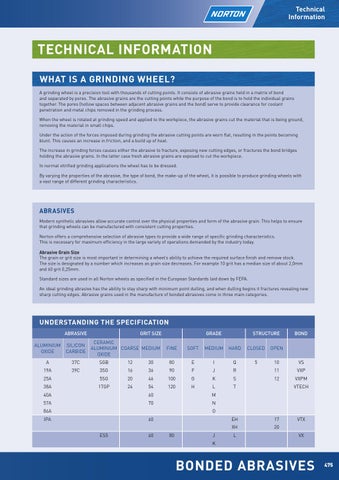
UNDERSTANDING THE SPECIFICATION ABRASIVE
GRIT SIZE
ALUMINIUM OXIDE
SILICON CARBIDE
CERAMIC ALUMINIUM COARSE MEDIUM OXIDE
A
37C
SGB
12
19A
39C
3SG
25A 38A
GRADE
STRUCTURE
BOND
FINE
SOFT
MEDIUM
HARD
CLOSED
OPEN
30
80
E
I
Q
5
10
VS
16
36
90
F
J
R
11
VXP
5SG
20
46
100
G
K
S
12
1TGP
24
54
120
H
L
T
40A
60
M
57A
70
N
86A
VXPM VTECH
O
IPA
60 ES5
60
80
J
EH
17
XH
20
L
VTX VX
K
BONDED ABRASIVES
475