Tim Morse
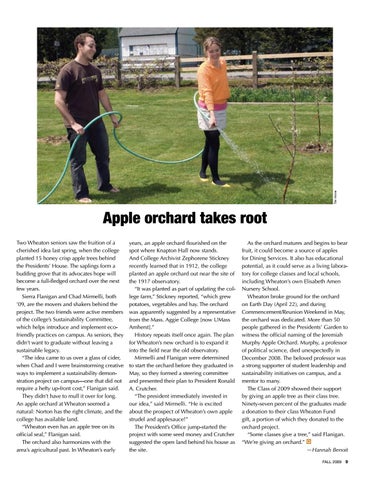
Apple orchard takes root Two Wheaton seniors saw the fruition of a cherished idea last spring, when the college planted 15 honey crisp apple trees behind the Presidents’ House. The saplings form a budding grove that its advocates hope will become a full-fledged orchard over the next few years. Sierra Flanigan and Chad Mirmelli, both ’09, are the movers and shakers behind the project. The two friends were active members of the college’s Sustainability Committee, which helps introduce and implement ecofriendly practices on campus. As seniors, they didn’t want to graduate without leaving a sustainable legacy. “The idea came to us over a glass of cider, when Chad and I were brainstorming creative ways to implement a sustainability demonstration project on campus—one that did not require a hefty up-front cost,” Flanigan said. They didn’t have to mull it over for long. An apple orchard at Wheaton seemed a natural: Norton has the right climate, and the college has available land. “Wheaton even has an apple tree on its official seal,” Flanigan said. The orchard also harmonizes with the area’s agricultural past. In Wheaton’s early
years, an apple orchard flourished on the spot where Knapton Hall now stands. And College Archivist Zephorene Stickney recently learned that in 1912, the college planted an apple orchard out near the site of the 1917 observatory. “It was planted as part of updating the college farm,” Stickney reported, “which grew potatoes, vegetables and hay. The orchard was apparently suggested by a representative from the Mass. Aggie College [now UMass Amherst].” History repeats itself once again. The plan for Wheaton’s new orchard is to expand it into the field near the old observatory. Mirmelli and Flanigan were determined to start the orchard before they graduated in May, so they formed a steering committee and presented their plan to President Ronald A. Crutcher. “The president immediately invested in our idea,” said Mirmelli. “He is excited about the prospect of Wheaton’s own apple strudel and applesauce!” The President’s Office jump-started the project with some seed money and Crutcher suggested the open land behind his house as the site.
As the orchard matures and begins to bear fruit, it could become a source of apples for Dining Services. It also has educational potential, as it could serve as a living laboratory for college classes and local schools, including Wheaton’s own Elisabeth Amen Nursery School. Wheaton broke ground for the orchard on Earth Day (April 22), and during Commencement/Reunion Weekend in May, the orchard was dedicated. More than 50 people gathered in the Presidents’ Garden to witness the official naming of the Jeremiah Murphy Apple Orchard. Murphy, a professor of political science, died unexpectedly in December 2008. The beloved professor was a strong supporter of student leadership and sustainability initiatives on campus, and a mentor to many. The Class of 2009 showed their support by giving an apple tree as their class tree. Ninety-seven percent of the graduates made a donation to their class Wheaton Fund gift, a portion of which they donated to the orchard project. “Some classes give a tree,” said Flanigan. “We’re giving an orchard.” Q —Hannah Benoit Fall 2009 9