profile
Sound Judgement Rating the performance of WGI groups is as much an art as it is a science. By Jon Chappell
Chris Hestin
WGI Percussion Judge Administrator
Chris Hestin has been judging WGI events for nine years, and currently serves as the organization’s Percussion Judge Administrator. He holds similar positions with the Mid-East Judges Association, Indiana Percussion Association, Rocky Mountain Percussion Association, and Three Rivers Winter Ensemble Association. After taking up the drums in fourth grade, he played in as many ensembles as possible through middle and high school. But as Hestin explained just after the 2014 WGI World Championships, he almost ended up judging on profits and losses instead of percussion scores.
season. The criteria are laid out on the sheet, and I filter all my reactions through that. But it’s not about hitting a checklist; What’s important is the program itself and how well the performers communicate it. I look for the expressive qualities of the performers, the range of effects and how well they engage the audience , [some of whom happen to be judges]. The audience isn’t a measuring stick, but ultimately [the ensembles] are there to perform for the audience and not the judges. ➧ What’s hardest about judging WGI groups? Just because of the number of groups these days, the most challenging part is having to make tough decisions among three or four or five groups that are all very similar. We appreciate everything that happens, but we are still accountable to a number system and scoring process. You go through that checklist
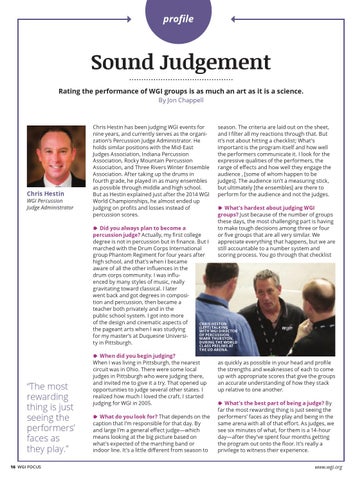
➧ Did you always plan to become a percussion judge? Actually, my first college degree is not in percussion but in finance. But I marched with the Drum Corps International group Phantom Regiment for four years after high school, and that’s when I became aware of all the other influences in the drum corps community. I was influenced by many styles of music, really gravitating toward classical. I later went back and got degrees in composition and percussion, then became a teacher both privately and in the public school system. I got into more of the design and cinematic aspects of Chris Heston (left) talking the pageant arts when I was studying with WGI Director of Percussion, for my master’s at Duquesne UniversiMark Thurston, During the World ty in Pittsburgh. Class Prelims at the UD Arena.
“The most rewarding thing is just seeing the performers’ faces as they play.” 16 wgi focus
5_WGI_Profile copy.indd 1
➧ When did you begin judging? When I was living in Pittsburgh, the nearest circuit was in Ohio. There were some local judges in Pittsburgh who were judging there, and invited me to give it a try. That opened up opportunities to judge several other states. I realized how much I loved the craft. I started judging for WGI in 2005. ➧ What do you look for? That depends on the caption that I’m responsible for that day. By and large I’m a general effect judge—which means looking at the big picture based on what’s expected of the marching band or indoor line. It’s a little different from season to
as quickly as possible in your head and profile the strengths and weaknesses of each to come up with appropriate scores that give the groups an accurate understanding of how they stack up relative to one another. ➧ What’s the best part of being a judge? By far the most rewarding thing is just seeing the performers’ faces as they play and being in the same arena with all of that effort. As judges, we see six minutes of what, for them is a 14-hour day—after they’ve spent four months getting the program out onto the floor. It’s really a privilege to witness their experience. www.wgi.org
5/15/14 3:44 PM