
PP100007396 RETHINKING THE GRID NEW DIRECTIONS IN COMMUNITY SOLAR SEPTEMBER 2022 VOL.21 NO.3 VIRTUAL POWER PLANTS HYDROGEN ENERGY FOR EVERYDAY LIFE


These are transformational times for the energy sector. In Australia, climate change, the east coast’s energy crisis and the passing (at the time of writing) of the federal government’s Climate Change Bill 2022 in the House of Representatives all bring with them a need to rethink the grid through energy diversifica tion. Already, a host of initiatives, both local and international, are seeking to change the way energy is integrated into our existing grids — and renewables are at the forefront of this wave of innovation. With solar PV the fastest-growing type of generation in Australia, and more than 30% of Australian households having rooftop solar panels, according to ARENA, there’s a push on the part of government, business, nonprofit organisations and the university sector to explore a range of community solar initia tives: this issue’s feature, based on projects presented at the renewable energy expo En ergy Next, takes a look at what might be just around the corner. Further into the magazine, Discover Energy’s Chris Cormack sheds light on another innovation that rethinks community involvement in the grid — virtual power plants.
CONTENTS ECD SEPTEMBER[ELECTRICAL+COMMS+DATA]2022 Your copy of ECD [Electrical+Comms+Data] is available as an online eMag. READ ONLINE! www.ECDonline.com.au/magazine 4 New directions in community solar 12 How lighting technology can protect sensitive ecosystems 16 Hydrogen energy for everyday life 20 Multimeter safety in Australia 28 Q&A with Chris Cormack: What role can VPPs play in Australia’s energy transition? 30 All-Energy Australia coming to Melbourne 32 Vehicle-to-grid charging is key to university’s future sustainability 34 Young women empowered to join electrical industry
Other articles in September’s ECD present yet more renewable energy initiatives. In South Australia, a university campus’s growing fleet of electric vehicles is being deployed to store and supply renewable energy directly to the grid via 20 new vehicle-to-grid chargers. In Woven City, a futuristic smart city currently under construction in Japan, a prototype of Toyota’s portable hydrogen cartridge will be trialled, with the aim of facilitating the transport and supply of hydrogen energy to power a range of everyday applications in and outside of the home.
Industrial lighting is also being rethought in a drive to be more environmentally aware, and Rico Schulz’s article, ‘How lighting technology can protect sensitive ecosystems’, details the ways in which lighting can be designed in order to prevent disrup tion of the plants.surroundingenvironmentsindustrial
FROM cover image ©stock.adobe.com/au/Thurtell
Katerina Sakkas — ecd@wfmedia.com.auEditor
SEPTEMBER 2022 ECD [ELECTRICAL+COMMS+DATA] 3www.ecdonline.com.au
THE EDITOR


4 ECD [ELECTRICAL+COMMS+DATA] SEPTEMBER 2022 www.ecdonline.com.au Katerina Sakkas NEW DIRECTIONS IN COMMUNITY SOLAR

SEPTEMBER 2022 ECD [ELECTRICAL+COMMS+DATA] 5www.ecdonline.com.au
Community batteries Louise Bardwell, from the Battery Storage and Grid Integration Program at the School of Engineering, ANU, spoke about community batteries, which are a form of medium-scale energy storage, normally in the range of a couple of 100 kWh though they can go up to 1 MWh. (For reference, household batteries might be 40–50 kWh.) Bardwell pointed out that while there are many large grid-scale batteries in Australia, there is a need for smaller-scale storage, including household batteries, electric vehi cles and most recently: community batteries. All of these could have a role to play in Australia’s increasing need for storage to accommodate its particularly high penetra tion of household solar. A community battery is located in the distribution network, in the low-voltage area around the houses it serves, close to where it’s being generated from solar. A defined set of households makes up the community of customers this community is as much a part of the process as the technology. In addition to its financial and environ mental benefits, a community battery eases pressure on the grid by storing excess energy, increases hosting capacity (ie, in creases the number of distributed energy resources [DERs] like EVs and solar panels that can be integrated into the grid) and is more efficient than household batteries. However, implementing these projects is complicated; community battery models are difficult to structure, especially with regard to tariffs.
COMMUNITY SOLAR iStock.com/Lacheev
W ith momentum building towards net zero in Australia most recently boosted by the pass ing of the federal government’s Climate Change Bill 2022 and its emissions reduction target of 43% below 2005 levels by 2030 an increasing amount of research is being undertaken into energy diversification and the deployment of small to midscale community-driven solar initiatives. Several trial projects discussed by speakers at Australian renewable energy expo Energy Next provided inspiration, cautionary advice and a glimpse at possible solutions to the energy transition.

Solar gardens Kim Mallee from the Community Power Agency, a not-for-profit that works with industry, government and community to wards making the transition to renewable energy, presented the solar garden model.
• Community co-op model, in which par ticipants buy and sell their energy to the battery, reducing their energy costs.
• Third-party owner with community coinvestment.
A case in point is the Alkimos Beach trial, WA, 2016, run by state utilities Synergy and Western Power. While significant benefits included peak consumption being offset by 85%, and 83% of customers benefiting financially, the $11/month subscription fee wasn’t sustainable for Synergy. Additionally, the community were confused by the fee structure and didn’t feel engaged in the trial.
A major benefit is flexibility, with solar gardens allowing families to move house while still retaining their solar garden plot. Solar gardens enable investment in mid-scale solar, there is no maintenance involved for owners of solar plots and solar developers large and small can rent a por tion of their panels as solar gardens. The federal government clearly believes in the potential of solar gardens, or “solar banks”, as it terms them, as seen in its new Solar Banks Initiative, which is investing $100m into 85 solar banks.
To create a SAPS, the following are needed:
• One or more sources of generation a way of getting energy to your system.
• Control a method of controlling the flow of that energy around the system.
• Storage a buffer to help with control, like a battery or diesel.
• Distributed network service provider (DNSP), eg, Ausgrid in Sydney.
Haystacks Solar Garden pilot Run by Community Power Agency and sup ported by the NSW Government Regional Community Energy Fund, the Haystacks Solar Garden pilot is Australia’s first large-scale solar garden, drawing on models popular in Germany and the US, and building on ARENA-funded research. Its aim is to find out how this model will work within Aus tralian energy and legal systems.
There will need to be transparency about where the profit from community batteries is going, especially since many of them are government-funded. Bardwell recommended ownership by a not-for-profit organisation such as YEF. There is significant support on the horizon for community batteries, including the Victorian Government’s Neighbourhood Battery Initiative and the federal govern ment’s funding of 400 community batteries to the tune of $200m. While community batteries have exciting potential, Bardwell stressed that they are only one part of the energy transition.
Operational models include: virtual storage (eg, Alkimos Beach trial), where there is no physical battery connected to the premises and individual customers are allocated virtual storage capacity in the battery; passive (eg, YEF Solar Sponge), with non-financial benefits but reduction of customer energy costs long term; billing ; or peer-to-peer trading , in which participants buy and sell their energy to the battery.
A 1.5 MW solar farm near Grong Grong in the Riverina region in NSW, Haystacks will have capacity for 333 plots, enabling buyers to obtain credits on their electricity bill via a retailer for 10 years. It aims to be operational by March 2023.
In contrast, the ongoing Solar Sponge project in North Fitzroy, Melbourne, owned by non-profit org Yarra Energy Foundation (YEF) and run in partnership with retailer Acacia Energy, has no direct customer involvement. This was a community choice; consultations found that reducing the cost of electricity bills was not the primary concern of people in the area. Instead, they wanted assurance that their solar was not being wasted and that it was being retained and used locally. They were willing to pay more for efficient, local energy.
Community battery ownership models vary and include: • Third party (eg, YEF’s Solar Sponge).
Standalone power systems (SAPS)
• DNSP plus market participant, eg, West ern Power and Synergy at Alkimos Beach.
• A load, or sink for the energy some thing that’s using up energy, like a house or business.
SAPS can range from a simple Endeavour Energy SAPS in Kangaroo Valley serving a single-family residence (solar, Tesla battery, back-up diesel generator) to a microgrid serving an entire island. Customer-led SAPS have been around for a long time, Knott said, with 2% of small-scale solar PV installed in Australia already being off-grid. A big factor in the future success of SAPS will be understanding customers’ level of energy literacy, because there is a cost in educating them.
6 ECD [ELECTRICAL+COMMS+DATA] SEPTEMBER 2022 www.ecdonline.com.au
Why should SAPS be used now? Knott cited the significant reduction in battery cost, which has come down approximately six times from 2013–2021; while still ex pensive, batteries are becoming increasingly cost-competitive.
Jonathan Knott, from the Institute for Su perconducting and Electronic Materials at the University of Wollongong (UoW), gave an overview of standalone power systems power systems not connected to the main electricity grid that can supply either a single customer (individual power system) or multiple customers (microgrid).
This model is designed for people who are ‘locked out’ of solar, due, for example, to being a tenant, or living in a house that doesn’t get any sun or is heritage-listed. It’s a relatively new model for Australia that has not been attempted before on a large scale in this country. Solar gardens provide the opportunity to purchase a solar garden ‘plot’ in a large solar array. An electricity retailer is then used to distribute the benefits from the solar garden generation back to the purchaser’s electricity bill. This differs from other arrangements in that customers are buying the solar in order to offset the brown power on their bill, rather than using the solar energy directly.

Step 3 involved technical and economic analysis of the data, leading to step 4, where a business model was co-designed with the community.
What’s next?
Continuing the SAPS theme, Dr Scott Dwyer from the University of Technology Sydney’s Institute of Sustainable Futures spoke about the institute’s “community-led, data-driven” microgrid project, MyTown Microgrid, which began in 2020. An ARENA initiative, this feasibility study aimed to discover how to make it easier, cheaper and faster for com munities to understand whether a microgrid was suitable for them; and to develop toolkits and guides for this purpose. The rural Victorian town of Heyfield (population about 2000) was chosen for the trial due partly to its community’s high level of energy literacy and commitment to sustainability. UTS, Federation University and RMIT partnered with Heyfield Community Re source Centre on the project, along with Public Interest Advocacy Centre Ltd. (PIAC); Community Power Agency; Wattwatchers Digital Energy; Ausnet; and LaTrobe Valley Authority (LVA).
iStock.com/snvv
4. Latent value, eg, in natural disasters. Knott stressed that the way the above data is taken and interpreted has a huge impact on the way a SAPS is designed, its utility and whether it actually serves its purpose.
COMMUNITY SOLAR
3. Customer profile, including energy literacy and engagement with the process.
... WHILE THERE ARE MANY LARGE GRID-SCALE BATTERIES IN AUSTRALIA, THERE IS A NEED FOR SMALLER-SCALE STORAGE, INCLUDING HOUSEHOLD BATTERIES, ELECTRIC VEHICLES, AND MOST RECENTLY: COMMUNITY BATTERIES. THE 10% OF AUSTRALIANS WHO LIVE OUTSIDE OF URBAN AREAS, LEAVING THEM PARTICULARLY VULNERABLE TO FLOODS, BUSHFIRES AND OTHER NATURAL DISASTERS, MAY BE BEST SERVED BY SAPS.
SEPTEMBER 2022 ECD [ELECTRICAL+COMMS+DATA] 7www.ecdonline.com.au
A key finding from all the solar initiatives discussed at Energy Next was the need for community engagement. Small-scale solar initiatives might have a role to play in the energy transition, but only if the groundwork is laid for strategic implementation via collection and interpretation of data, and prior consultation in communities that are receptive, engaged and informed.
• Priority 2 was to develop a national framework for the ongoing regulation of third-party SAPS. UoW’s work has primarily been concerned with Priority 1. How is a SAPS site identified? The UoW research earmarked four key areas:
Dwyer emphasised the importance of hav ing a community liaison officer to facilitate constant dialogue, answer questions and help with installations and energy audits.
1. Technical requirements, eg, energy con sumption, location, whether the site gets a lot of sun/rain.
2. System requirements, eg, generation, storage, maintenance. What will the customer actually be using?
SAPS provide an opportunity for DNSPs to mitigate various issues arising from traditional power systems, like the cost of maintaining traditional electricity infra structure, which can amount to a startling $25,000/customer/year to clear vegetation in some areas. Also, the 10% of Australians who live outside of urban areas, leaving them particularly vulnerable to floods, bushfires and other natural disasters, may be best served by SAPS. Further expanding the potential use of SAPS, in 2018 an AEMC market review of regulatory frameworks for SAPS was instigated by the COAG energy council. The review has set out two priority areas of work:
• Priority 1 was to develop a national frame work for transition of grid-connected customers to SAPS supply provided by the current DNSP (ie, companies that would otherwise be providing electric ity to sites by poles and wires) as well as a mechanism for transition of gridconnected customers to third-party SAPS.
MyTown Microgrid
The project moved through several stages, beginning with community vision and goal-setting. Real-world data was then collected through Wattwatchers’ IoT platform, involving energy monitoring devices (96 devices, 76 sites, 98 audits) and community engagement through an app and dashboards installed around Heyfield.

The Andrews Labor government is upskilling Victoria’s electrical workers, with the aim of improving community safety and equipping the workforce to be part of the state’s growing renewable and new energy sectors.
Energy Safe Victoria (ESV) has developed the program alongside Future Energy Skills with coursework approved by a committee including members from ESV, the Electrical Trades Union, the National Electrical and Communications Association and the Institute of Electrical Inspectors.
“The ETU has monitored and reported these issues for several months, with workers’ health and safety at risk. This incident could have easily been fatal. I hope the labourer is able to make a full recovery and is able to access leave entitlements until then.” Duff said the escalator collapse at Martin Place was equally concerning, and that it was a miracle all workers onsite escaped unscathed.
8 ECD [ELECTRICAL+COMMS+DATA] SEPTEMBER 2022 www.ecdonline.com.au
“These incidents raise concerns over whether the Sydney Metro project is being rushed to meet the NSW Government’s deadline at the expense of worker safety,” he said.
“The NSW Government needs to order SafeWork onto the project for a thorough investigation before another worker is seriously injured or killed.”
Energy Safe Victoria CEO Leanne Hughson said, “While electrical apprenticeships are important, we need to make sure that electrical workers continue to learn and build their respective skillsets as their careers continue to progress.”
The worker had been using the hoist, without being trained to do so, when the machinery failed. The labourer became stuck and climbed onto the roof of the hoist so he could jump to a nearby landing. However, when he jumped, he fell through the concrete, plummeting nine metres before crashing to the ground. He suffered serious injuries including a broken leg and pelvis.
iStock.com/tzahiV
The Electrical Trades Union (ETU) has called for an urgent investigation into the Sydney Metro project after an escalator collapsed and a labourer was seriously injured in two separate incidents at the Martin Place and Pitt Street construction sites. Around 1 pm on Tuesday, 21 June, an escalator being built to eventually carry tens of thousands of passengers collapsed at Martin Place, falling four floors and through a wall, narrowly missing nearby workers. This followed a separate incident at the Pitt Street Sydney Metro site on Thursday, 9 June where a labourer was seriously injured while operating a hoist.
“This is a great example of how our TAFE and training sector is providing opportunities for workers to retrain and upskill while also preparing us for the workforce we need for our clean, green future,” said Minister for Skills and Higher Education Gayle Tierney. Workers in the electrotechnology, renewable and new energy sectors are required to undertake CPD every five years. The program includes the eighthour Skills Maintenance course, with additional skills development courses available next year. Skills Maintenance covers safe isolation, mandatory testing, industry changes and the responsibilities of licensed workers with training available at a range of metro and regional locations by carefully selected professional trainers.
The announcement follows a successful CPD pilot run earlier this year involving 66 electricians across regional and metro areas. Further information is available on the ESV website at esv.vic.gov.au.
ELECTRICAL WORKERS
“These are extremely serious incidents and should never have occurred on NSW Government-funded job sites,” said ETU organiser Lawrence Duff. “The incident at Pitt Street was easily preventable and it is why companies running worksites need to be checking accreditation and ensuring the safety of staff. “Safety issues onsite include a failure to meet standards on emergency lighting, temporary site wiring and the switchboard, the maintenance of lighting throughout the site, accessibility and storage.
“The company contracted by the NSW Government clearly wants to cut corners but workers deserve better and the state’s taxpayers funding the entire operation deserve better.
The ETU subsequently investigated the site and found a litany of serious safety issues. They have been reported to SafeWork NSW but there has been no action from the regulator.
UPSKILLED FOR BRIGHT FUTURE
ESCALATOR COLLAPSE, SERIOUS INJURY AT SYDNEY METRO SITES
©stock.adobe.com/au/ymgerman
The Labor government will invest $7.2 million into Victoria’s first continuing professional development (CPD) program for electrical workers across the state. The support ensures more than 7500 electrical workers will be able to complete the course before the end of next year.


The corporation stated, “The Gumatj people have enjoyed working with ELA, NASA and Aggreko on this project, on our land. Quite simply, without Aggreko, there would be no power for the space portal. “This project is an opportunity for Gumatj and the residents of East Arnhem Land to be at the forefront of space technology in Australia.”
ROCKETS FROM ARNHEM TO SPACE
SEPTEMBER 2022 ECD [ELECTRICAL+COMMS+DATA] 9www.ecdonline.com.au
POWERING
Power generation and temperature control company Aggreko was contracted to supply the critical temporary power to enable NASA to launch three suborbital sounding rockets, all of which successfully took off in June and July this year from Arnhem Space Centre (ASC) in the Northern Territory. Given the space centre’s remote East Arnhem Land location, there is no access to mains power. The ASC’s owner and operator, Equatorial Launch Australia (ELA), will conduct astrophysics studies that are only possible from the Southern Hemisphere. This is the first time NASA has undertaken a launch from a commercial launch facility outside of the US. Since the construction phase in November 2021, Aggreko has provided around 220 hours of hire prep, technical support, servicing, repairs and maintenance. There is currently 1.5 MW of temporary power and 250 kW of air conditioning onsite, which enables the use of offices, ablutions facilities, accommodations, kitchens, workshops and technological equipment such as satellites and communication devices. The most critical part of Aggreko’s contract was providing the power to get the rockets off the ground. Michael Jones, Executive Chairman and Group CEO of ELA, said, “I really want to acknowledge the support of not only NASA, but our staff, investors and suppliers. The three NASA launches marks the end of the first stage of the development of both the ASC spaceport and ELA as a world-class launch services company.”
The spaceport sits on Yolngu-owned land, the lease of which sits with the Gumatj Aboriginal Corporation, which represents one of the Gove Peninsula’s most powerful clan groups, the Gumatj, who have sub-leased it to ELA.
©stock.adobe.com/au/structuresxx


“Distributors like Endeavour Energy have a responsibility to protect vulnerable consumers and we will take action, if necessary, when life support customers are missing those protections they are entitled to under the law.”
“The research also indicated renewable energy being important to rural customers, with a third of participating customers already using solar and believing it was the way of the future.
The AER encourages anyone requiring life support equipment to contact their energy retailer or distributor and make sure they are registered.
For more information about life support protections, read the AER Life Support Registration Guide.
Life support obligations protect those who rely on life-saving equipment such as oxygen concentrators, dialysis machines, ventilators and other equipment needed for life support. Without power, these machines cannot function properly, which could have dangerous or even fatal consequences.
©stock.adobe.com/au/151508962
WA TOPS NATION IN
“There are 90 SPS currently being deployed by four WA suppliers, which is creating a new industry and jobs for locals, and replacing around 330 km of overhead lines.”
ENERGY CO FINED FOR PLACING CUSTOMERS AT RISK
SAPS are now located in numerous locations throughout the Mid West, Wheatbelt and Great Southern regions. The latest was installed following the Shackleton bushfire early this year. The WA Government plans to roll out a further 4000 standalone power systems across the state in the next 10 years. A recent Western Power customer research report found high levels of satisfaction with SAPS. Participating customers rated their overall satisfaction at 8.2 out of 10 (10 being ‘excellent’); in contrast, their satisfaction with poles and wires connection pre-SAPS was lower at 6.7 out of 10. Energy Minister Bill Johnston said, “Western Power’s survey is a great outcome, with more than 75% of customers saying they were likely to recommend standalone power systems to others.
The distributor admitted it breached life support obligations under the National Energy Retail Rules in relation to 69 customers across its distribution network.
10 ECD [ELECTRICAL+COMMS+DATA] SEPTEMBER 2022 www.ecdonline.com.au
AER Chair Clare Savage said customers using life support equipment are particularly vulnerable if disconnected from their energy supply and so it is important that these life support obligations are complied with to prevent disconnection and to ensure sufficient notice is given of planned interruptions.
Distributors must send customers an information pack, including the number to call if there is an unexpected interruption to supply, within five business days of the customer advising of the life support requirement.
The breaches include failing to record that there were life support needs at the customer’s premise, not sending information packs, not notifying the retailer of the customer’s life support requirements and not giving the required four-day notice of planned electricity interruptions.
The AER was concerned that these breaches were caused by Endeavour’s inadequate investment in its IT systems, processes and training.
“Unexpected loss of life support equipment can be a life-or-death matter,” Savage said.
Electricity network distribution business Endeavour Energy has paid seven infringement notices totalling $474,600 issued by the Australian Energy Regulator (AER) for putting vulnerable life support customers in New South Wales at risk between March 2021 and February 2022.
STANDALONE POWER SYSTEMS Western Australia is leading the nation in the use of standalone power systems, 100 of which are now deployed across the state’s main electricity grid, the South West Interconnected System. This innovative green solution provides improved power reliability and quality for regional and remote customers, and is said to be a safer alternative to traditional poles and wires. Standalone power systems (SAPS or SPS) are particularly beneficial for regional customers, where supply costs are high and power reliability is impacted by distance, terrain and severe weather events. Delivering cleaner and more reliable power, the units are powered by solar panels and battery storage, and include backup diesel generation.
The National Energy Retail Rules require distributors to register life support customers as soon as they are advised by either the customer or retailer, and to notify the energy retailer as soon as they are advised by the customer, that life support equipment is required at the customer’s premises.
Distributors must also give customers four business days’ notice of planned outages.
The AER has accepted a court enforceable undertaking from Endeavour Energy, committing to implement new IT systems and to engage an independent expert to conduct an end-to-end review of its life support processes, controls and systems.
Schönknecht©stock.adobe.com/au/Jana


Y


As a result, R. STAHL considers both the relevant standards for workplace lighting and measures to prevent artificial light from having a negative effect on ecological aspects of the environment. Industrial light, alongside street lighting, illuminated advertisements and floodlight systems, is one of the main sources of irritating light pollution that creates sig nificant ‘light domes’ and lights up the night sky over urban areas. Light pollu tion the emission of artificial light into the atmosphere and subsequent reflection of this light by fine particles does not just affect human biorhythms. It also has detrimental effects on animals and plants. For instance, artificially brightened sur roundings affect plants’ growth cycles. Light emissions with a high proportion of blue light, which is characteristic of cold white LED lighting, can disrupt nocturnal insects and migratory birds’ sense of direction, as well as affecting the breeding and feeding behaviour of a range of species.
HOW LIGHTING TECHNOLOGY CAN PROTECT SENSITIVE ECOSYSTEMS
Rico Schulz When planning and installing lighting systems for industrial plants, ever more emphasis is being placed on considering the ecological aspects. S ustainable, energy-efficient and environmentally friendly lighting solutions for indoors and outdoors are in more demand than ever before as we aim to conserve our natural resources. This includes measures to reduce light emissions and modifications to lighting technology to protect particularly sensitive ecosystems. Sustainable lighting solutions for Ex and non-Ex areas LED technology is a superior alternative to conventional lighting solutions in almost any area, for almost any application. Converting around 35% of their energy consumption into light, LED lights are around twice as efficient as gas discharge lamps and fluo rescent tubes. Thanks to their reduced en ergy consumption, the light-emitting diodes contribute to lowering CO 2 emissions and protecting the environment. LED light fittings also outdo conventional lighting technology when it comes to their service life, which is multiple times longer. With a service life lasting up to 100,000 operating hours, they have proven to be particularly sustainable and require far less maintenance or replace ment. Unlike discharge lamps that contain mercury, LED lights are also free from toxic substances, in particular mercury, and can therefore be disposed of much more easily and in an environmentally friendly manner.
12 ECD [ELECTRICAL+COMMS+DATA] SEPTEMBER 2022 www.ecdonline.com.au
Systematically combating light pollution As well as efficient, energy-saving lighting and light-fitting technology, a sustainable lighting concept also requires professional lighting design that guarantees standardcompliant lighting at business premises that is as environmentally friendly as possible.

©stock.adobe.com/au/Drew
Optimised lighting
R. STAHL Australia Pty www.r-stahl.com/en/global/home/Ltd
In short Protecting the environment from harmful light emissions is becoming more and more important in the lighting industry. Industrial sites in ecologically sensitive regions and increasing light pollution in urban centres require light manufacturers and lighting designers to rise to the challenge of devel oping sustainable, environmentally friendly solutions.
Modified lighting technology Compared to conventional lighting, which emits light across a wide angle, lightemitting diodes can be aligned for use as a superior half-sphere spotlight. The special light design prevents unwanted light emis sion into the upper half caused by reflection within the light itself. For this purpose, R. STAHL manufactures special versions of its tubular light fittings and LED universal spot lights with a minimised upward light factor. The light distribution curves are modified using a method suitable for the specific characteristics of the light-emitting diodes in use either refractively using lenses or using reflectors to eliminate upward light. Additionally, semiconductor technology makes it possible to modify the LEDs’ emission spectrum and eliminate unwanted wavelengths. Depending on the semiconductor material and conversion used, the wavelength of the light emis sion can be deliberately limited to certain spectral ranges. Compared to conventional solutions such as filtered fluorescent lamps, this more than doubles the efficiency of the lighting. What’s more, functional limitations that would otherwise be caused by filter or film material fatigue over time are a thing of the past. We manufacture light fittings with a converted colour spectrum for a range of uses, including the pharmaceutical indus try, photo development or signalling safety equipment such as emergency showers. This equipment is also used for onshore and offshore projects in areas with a sensitive ecosystem; in these environments, unmodi fied artificial light could have a significant negative effect on the natural behaviour of endangered species.
directed almost entirely towards the area to be illuminated this reduces and can even eliminate disruptive light emission. A sustainable lighting concept requires efficient, energy-saving lighting technology and professional lighting design.
Up to now, there are still no binding regula tions limiting light emissions from industrial plants; as a result, it is down to lighting manufacturers and lighting designers to make their customers aware of this impor tant issue. Unfavourable light distribution caused by improper planning, installation errors or outdated lighting not only has a negative effect on plants and animals it also wastes energy, thereby driving operat ing costs higher and higher. From a design perspective, therefore, the aim is to provide optimum lighting that illuminates all required areas evenly and with as few shadows as possible, without losing scattered light. Using software-based planning tools, every inch of an industrial site can be mapped precisely in 3D, including area calculations, standard objects and shadows. The number and position of light fittings and the required luminous flux of the lighting can be accurately determined for defined mounting surfaces. The radiation angle can be adjusted in all three axes, which enables the light to be
Illuminating conservationspecies R. STAHL collaborates with relevant envi ronmental organisations to develop environ mentally sustainable lighting for industrial plants and delivery platforms in protected conservation zones. The geography of the area is used as a basis to determine whether endangered species are found in the area to be lit and, if so, how sensitive these species are to light emissions in a certain colour spectrum.
ECO LIGHTING
Artificial light with a predominantly blue content is particularly attractive to many animals. It stimulates their mesopic vision, which confuses the animals into thinking that it is dawn or dusk and, as a result, triggers their hunting, flying or defence instincts. For example, the natural behaviour of endangered sea turtles is affected by this type of light. To protect these animals, R. STAHL has developed a ‘turtle-friendly’ lighting version with a light spectrum that has been shifted towards yellow. This solution is specifically intended for use as external lighting on oil rigs and plants close to the coast. The use of particularly warm white light ensures that newly hatched animals are not drawn away from their path to the sea, and does not disrupt the biological rhythms of the adult members of the species.
SEPTEMBER 2022 ECD [ELECTRICAL+COMMS+DATA] 13www.ecdonline.com.au

METCASE’s accessory range now includes the 19 ″ cantilever shelves, 19 ″ mounting kits, a PCB mounting kit, PCB/panel fixing screws, PCB guides, mounting plates, front panels, chassis plates (METTEC 19 ″), wall-mounting kits (UNIDESK), an assembly tool (UNICASE) and a wide range of case feet (including tilt-leg versions).
All METCASE enclo sures can be supplied fully customised. Services include bespoke sizes, custom front panels, CNC machining, fixings and in serts, painting/finishing and photo-quality digital print ing of graphics, legends and logos.
Supercapacitors
Ethernet I/O module
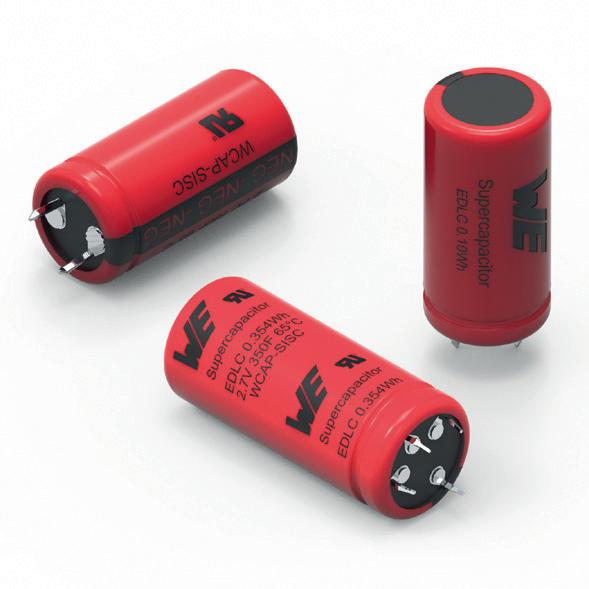
Würth Elektronik has introduced a class of EDLC (electric double-layer capacitor) supercapacitors with snap-in terminals. The WCAP-SISC series — available with capacitance values of 100 and 350 F — is suitable for applications with high power and high energy requirements such as UPS or energy storage solutions. They can be used in smart metering devices, network components or energy harvesting applications to name but a few. The product attains a rated current of up to 75 A. With higher energy density compared with conventional capacitors, double-layer capacitors are seen as an environmentally friendly alternative to batteries. Compared to Li-ion batteries, the supercapacitor with activated carbon technology offers numerous benefits, including fast charging, long service life of 500,000 cycles and low fire hazard. The capacitance tolerance is -10/+30% and the rated voltage is 2.7 V. The product can be used at an operating temperature of -40 to +65°C.
Wurth Electronics Australia Pty www.we-online.com
ROLEC OKW Australia New Zealand P/L www.metcase.com.au
ICP DAS’s ET-7019Z/S is an Ethernet I/O Module with 10-ch universal AI and 6-ch DO. ET-7019Z supports a built-in web server, both Modbus TCP and Modbus UDP protocols, communication security, dual watchdog and built-in I/O. ET-7019Z is specifically designed for thermocouple measurement and features automatic cold-junction com pensation for each channel to ensure temperature output consistency in the field. Current input and voltage input are both supported. Another feature is that its 10 input channels can be individually configured for different kinds of analog input. Open thermocouple detection and ESD/ EFT/Surge protection mechanisms are also included. The six/five digital output channels can be set as alarm out puts with short-circuit protection and overload protection. Due to its multifaceted nature, the ET-7019Z is suitable for a range of applications across various industries, in cluding building automation, factory automation, machine automation, remote maintenance, remote diagnosis and testing equipment.
The shelves form part of METCASE’s range of accessories, acting as an alternative to the company’s open-topped COMBIMET T aluminium 19 ″ rack cases. Unlike the shelves, COMBIMET T has a front panel and a rear lip. It is available in 2U and 3U heights (2U x 365 mm and 3U x 365 mm). The standard colours are light grey and black.
Universal 19″ rack shelves
14 ECD [ELECTRICAL+COMMS+DATA] SEPTEMBER 2022 www.ecdonline.com.au
ICP DAS Co Ltd www.icpdas.com
Universal cantilever shelves from METCASE enable electronics equipment without built-in 19 ″ fittings to be added to racks or cabinets quickly and easily.
The 2U shelves are DIN 41494 and IEC 60297-3 compliant. They are suitable for a wide range of applications, including networking and com munications equipment, industrial computers, sound and studio systems, laboratory instruments and industrial control. Slots in the bottom of the C4 mild steel shelves aid in-rack ventilation. The shelves are finished in tough powder polyester paint in either anthracite or light grey. There are two standard sizes — 2U x 280 mm and 2U x 400 mm. Custom sizes are available on request.



Toyota and its subsidiary, Woven Planet Holdings (Woven Planet), are studying a number of viable pathways to carbon neutrality and consider hydrogen a promising solution.
FUTURE ENERGY
Next steps for the hydrogen cartridge Today most hydrogen is generated from fossil fuels and used for industrial purposes such as fertiliser production and petroleum refin ing. To use hydrogen as an energy source in the home and daily life, the technology must meet different safety standards and be adjusted to new environments. In the future, Toyota expects hydrogen will be generated with very low carbon emissions and used in a wider variety of applications. The Japa nese Government is working on a range of studies to promote the safe early adoption of hydrogen. Woven City will explore and test an array of energy applications using hydrogen cartridges, including mobility and household applications. The ultimate goal of the project is to realise a carbon-neutral society where everyone can access clean energy, first in Japan and then throughout the world. The portable hydrogen cartridge prototype was showcased at Super Taikyu Series 2022 Round 2 at Fuji Speedway from 3–5 June. The showcase was geared towards teaching people about how hydrogen energy works and helping them imagine the different ways hydrogen can become a useful part of their daily lives.
Toyota and Woven Planet have developed a working prototype of Toyota’s portable hydrogen cartridge, which aims to facilitate the transport and supply of hydrogen energy to power a range of everyday applications in and outside of the home. Toyota and Woven Planet will conduct proof-of-concept (PoC) trials in various places, including Woven City a ‘human-centred’ smart city of the future currently being constructed in Susono City, Shizuoka Prefecture, Japan. Together with ENEOS Corporation, Toyota and Woven Planet are working to build a comprehensive hydrogen-based supply chain aimed at expediting and simplifying produc tion, transport and daily usage. Their trials will focus on meeting the energy needs of Woven City residents and those living in its surrounding communities. A particular benefit of hydrogen cartridges is their portability and affordability, making it possible to bring hydrogen to where people live, work and play without the use of pipes. The small-scale infrastructure can meet energy needs in remote and non-electrified areas and be swiftly dispatched in the case of a disaster.
HYDROGEN ENERGY FOR EVERYDAY LIFE
H ydrogen has significant advan tages: it produces zero carbon dioxide emissions when used and, when produced using renewable energy sources such as wind and solar, CO 2 emissions are minimised during the production process as well. It can be used to generate electricity in fuel cell systems and can also be used as a combustion fuel.
16 ECD [ELECTRICAL+COMMS+DATA] SEPTEMBER 2022 www.ecdonline.com.au
©stock.adobe.com/au/Rawpixel.com
Toyota Motor Corporation Australia Ltd www.toyota.com.au


When is power reliability highly critical?
While these critical asset operators may build their own mitigation strategies for power outages, network operators can also offer increased reliability performance for specific connection points. The technique is known as auto-changeover.
Fortunately, implementing this system is relatively straightforward. This article explores a couple of ways of implementing auto-changeover, then looks at two examples of the system in action. Basic auto-changeover configuration
• If both incoming supplies come from the same substation, then the supply is only protected against failures of equipment in the connection chain from the substation to the critical load.
Functionally, auto-changeover is the application of multiple sources to a load. If a source supply quality degrades, the autochangeover scheme automatically switches to the backup supply. This automation spreads the risk of outage across two different sources, providing a backup power supply if the primary source fails.
All over the world, utility businesses and network operators are charged with providing a reliable supply of electricity. This is the operating goal, but on some occasions, failure to supply electricity carries increased consequences. Think of critical infrastructure. A hospital? A water treatment plant? A data centre?
Mitigating risk for a critical load
18 ECD [ELECTRICAL+COMMS+DATA] SEPTEMBER 2022 www.ecdonline.com.au
STUDYCASE
Auto-changeover is a risk mitigation strategy where two separate sources are supplied for a single critical load. To implement the system, engineers select two power sources to supply a load. The power system engineer then designs a switchgear arrangement that automatically changes over supply between the two sources, whenever one of the power supplies fails. The degree of outage mitigation provided depends on the independence of the supply:
• If the two supplies come from different zone substations, or different power stations, then the mitigation is far greater, offering protection against many more outage scenarios. With this basic concept in mind, let’s explore two ways to implement this.
The simplest, cheapest way to build auto-changeover is to rely on voltage presence. Reclosers such as NOJA Power’s OSM Recloser have voltage sensing on both sides of the circuit breaker. Therefore, in the open state, the breaker can check that: (a) the critical load has voltage and (b) the backup supply is present. Under this arrangement, there is no need for the two devices to communicate directly with each other. The presence of voltage on either side is enough to make switching decisions. If the power supply fails on the primary supply (recloser 1) in our figure, the device is programmed to automatically open on loss of voltage. This prevents a backfeed from the other source when the power is restored from the backup. Recloser 2 will see the backup source voltage high, but critical load voltage low. In this condition, it can automatically close the breaker, restoring supply.
Auto-changeover without communications

NOJA Power’s OSM auto reclosers used to protect Castelão stadium’s electricity distribution feeders.
1. Power supply to Brazil stadium To soccer fans, there are few more critical power supply points than a World Cup stadium. In 2014, NOJA Power’s OSM Reclosers were used in an autochangeover scheme at Brazil’s Castelão stadium. This installation had both reclosers installed in close proximity, simplifying operations challenges but offering clear reliability benefits for the stadium.
2. Power supply to railway in Victoria, Australia
Secondly, this design does not prevent closing onto faults.
©stock.adobe.com/au/Kalawin
NOJA Power’s OSM Recloser has a built-in auto-changeover function that uses this communication link to share information between the two devices. Each recloser monitors both the supply quality and the automation system quality.
NOJA Power GMK, Victoria.
Project examples
NOJA Power Switchgear Pty Ltd www.nojapower.com.au
Conclusion Power reliability is among the key goals of electricity network operators. While critical assets may implement their own mitigation schemes, network operators can also offer increased supply reliability through implementing auto-changeover schemes. “Power reliability is the expectation of most customers in the world today and methods to ensure reliability are being developed by all of our customers. An auto-changeover scheme is a simple way to achieve that for critical loads and has been deployed with and without communication links by our customers all over the world,” said NOJA Power Group Managing Director Neil O’Sullivan.
If there is a power degradation, the reclosers communicate between each other, switching power between supplies. The reclosers also communicate with each other if a fault occurs, avoiding an extra recloser operation. Lastly, operators can disable the automation scheme from either side, solving the works practices challenges.
Alternatively, if Recloser 2 closes immediately on sensing loss of voltage to the critical asset, this is ‘make before break’. It carries extra risk of backfeeds, but it minimises the critical load outage duration. Limitations to auto-changeover without communications This first method is cost-effective but has a couple of key design limitations.
SEPTEMBER 2022 ECD [ELECTRICAL+COMMS+DATA] 19www.ecdonline.com.au
Auto-changeover with communications To address the limitations in our first auto-changeover implementation, we can implement a communications link between the two switching devices.
If Recloser 2 closes after Recloser 1 opens, this is a ‘break before make’ scenario. The load experiences a minimal outage, but there is no backfeeding through the original supply line.
The most common method for implementing communications between the devices is through fibre-optic communications, but ethernet, Wi-Fi or radio communications are all possible.
Firstly, there is no central way to disable the automation. Maintenance teams who need to work on the critical load must be aware that opening one breaker may cause the other to operate. This is an added risk that must be handled through works practices.
Auto-changeover functionality is also applicable to NOJA Power’s GMK product for underground connections. In this project, two NOJA Power GMKs were used in an auto-changeover scheme to control the power supply to the electrified rail in Victoria. The two GMKs were connected with a communications link, sharing information on supply quality and fault presence. This provided risk mitigation against closing-onto-fault scenarios, while maximising the power uptime for the operating rail network.
If a fault occurs downstream of the primary supply, the primary recloser will trip to interrupt the fault. The problem arises when the second recloser detects the fault as a simple outage, and proceeds to re-energise the fault. The second device can also be programmed to trip on the fault, but the system has created an extra energisation of the fault. If these two limitations are not critical to the project, then a communications-free auto-changeover scheme offers improved reliability and customer value. If these two limitations are critical, then there are communications-enabled auto-changeover schemes to address these cases.

T o meet Australian safety require ments, a multimeter must be designed, constructed and tested to Australian safety standard AS 61010.1:2003, which is based on interna tional standard IEC 1010. It should also be verified by independent lab testing. A multimeter tested to these standards has been checked to ensure its internal com ponents are designed and constructed to protect the operator from hazards including electric shock and burns in environments with high electrical risk. A marking alone is no guarantee the multimeter has been tested to the standard, particularly if it was purchased overseas.
When measuring distribution circuits, even the smallest breakdown in the internal insulation in a multimeter can trigger a substantial arc flash.
There have been some serious electrical incidents involving multimeters recently, highlighting the risks of using them when incorrectly rated or inadequately insulated for the job.
• an explanation of the measurement category ratings marked on the meter, such as Category 4.
• Category 1 measurements on very low energy equipment not connected to electricity mains, such as second ary circuits in electronic equipment or automobile circuits.
• Category 2 measurements on equip ment connected to domestic electricity mains such as household appliances, tools and equipment classified as low energy equipment with a potential fault current up to 5 kA.
Measurement category
The Australian standard has four meas urement categories to cover different levels of exposure to transient spikes or spikes of voltage that can occur from a mains distribution system:
The rated working voltage is defined as the highest RMS value of AC or DC voltage that could be applied across the internal insulation of the device. However, the abil ity of the multimeter to safely withstand a spike or transient much higher than the working voltage has been incorporated into the measurement category rating used in the standard.
The measurement category on the meter will often have an accompanying working voltage rating; however, this voltage rating should not be confused with the measure ment category rating. Even a momentary voltage spike or peak can have catastrophic results on an underrated multimeter. The voltage rating is for the general operat ing condition of the multimeter, while the measurement category rating withstands the transients and spikes of high energy that can be encountered on electricity distribu tion circuits.
Always seek further evidence the product has been tested by a reputable lab to the correct electrical safety standard. A multimeter complying with the Australian standard should also be supplied with instruc tions for safe use and maintenance including: • the intended use of the equipment for which it is designed for measurement • instructions for use (in English)
20 ECD [ELECTRICAL+COMMS+DATA] SEPTEMBER 2022 www.ecdonline.com.au
MULTIMETER SAFETY IN AUSTRALIA
©stock.adobe.com/au/kunakorn
The measurement category rating of multi meters considers the working voltage and a maximum transient voltage that could be encountered in a particular electricity network environment.
• Category 3 measurements on a build ing’s electrical installation such as wir ing, wall socket outlets, junction boxes

• Category 4 measurements on sources of voltage supply such as electricity me ters, primary fuses and services classified as a high energy circuit with a potential fault current of greater than 25 kA. Multimeters are marked with these four categories expressed in Roman numerals I, II, III and IV, respectively.
SEPTEMBER 2022 ECD [ELECTRICAL+COMMS+DATA] 21www.ecdonline.com.au and fixed motors classified as a medium energy circuit with up to 25 kA fault current capacity.
The category rating also considers the likely source impedance of the transient which on a mains distribution network can deliver significant energy. A Category 2 meter, even if it has a higher marked voltage rat ing than a similar Category 3 meter, may not be able to withstand a transient voltage and potential current flow encountered in a commercial building installation.
The safety rating of the multimeter can also be seriously compromised by substand ard leads and internal fuses. Multimeter leads should also carry a measurement category rating that should be the same as the multimeter or better. Multimeter leads must be kept in good condition. Cuts and damage to the lead’s insulation create a risk of shock, just like any other damaged cable. Always replace internal fuses with the correct rating and type of fuse in your mul timeter, as specified by the manufacturer. Cheaper multimeters may use glass fuses instead of higher quality, higher rupturing capacity (HRC) fuses designed to withstand voltage transients or spikes. Multimeter HRC fuses are designed to contain any arc flash or rupture that could otherwise compromise the multimeter’s own internal safety and injure the user.
Electrical Safety cal-safety-officewww.worksafe.qld.gov.au/about/who-we-are/electriOffice
Measurement is one of the few situations where live work is legal, so: choose the correct highest measurement category for the range of work you do; select a quality multimeter supported by independent type testing; and always buy from reputable suppliers. For more information, Standards Australia has a detailed guide to selecting a safe multimeter in HB187-2006.
ELECTRICAL SAFETY
Remember check your multimeters are safe for their intended use by:
• looking for the correct electrical safety standard • seeking evidence of independent type testing to that standard • checking warning labels or markings on the multimeter • understanding the right measurement categories for the task.
Higher category ratings indicate greater internal clearances and stronger insulation built into the multimeter to safely withstand peak transient voltages and fault currents.

22 ECD [ELECTRICAL+COMMS+DATA] SEPTEMBER 2022 www.ecdonline.com.au S
ince the launch of APS Industrial we have been committed to providing industry with a new choice. With that in mind, APS Industrial are proud to release the first range in what will become a complete family of ‘DB’ distribution boards that are custom designed for the demands of Australian industry and feature world-class technology and innovation. The ‘DB family’ of competitively priced distribution boards are exclusive to APS Industrial and purpose-built for compatibility with Siemens circuit breakers. The first release, DB Ultimate, features an enclosure by the world’s leading supplier of innovative enclosure technology, Rittal.
3. Assemble Gear Tray Assemble gear tray with required components independent of the enclosure for increased time savings.
This unique feature enables assembly of the DBs independent of the enclosure itself for added flexibility. In addition to the unique removable one-piece pan assembly, the APS DB Ultimate is packed full of value-add features including:
SPONSORED CONTENT
• Continuous Poured Door Seal • Removable Hinged Escutcheon and Door (Reversible)
See more of this range at apsindustrial.com.au/ distribution-boards. APS www.apsindustrial.com.auIndustrial
• Dual Earth Neutral Bars
• DIN Rail (Top and Bottom)
• Semi Flush Rittal Swing Handle (2 Keys)
Combining the shared expertise and experience of these leading global manufacturers that also draws on KATKO switching technology and Weidmüller surge protection, the ‘DB family’ of distribution boards set the benchmark for quality, flexibility, compliance, and intelligence. Quality Market leading enclosure and componentry to enable increased reliability, availability, and reduced downtime. Flexibility Ultimate flexibility in design, assembly, installation, commissioning, and future retrofitting. Compliance Custom designed for the demands of Australian industry and compliant to local standards. Intelligence Smart technology enabling greater connectivity, communication, and performance. As part of this initial release, the ‘DB Ultimate’ range of distribution boards are ideally suited to highend industrial applications. In a move that will revolutionise distribution board assembly and installation, the ‘DB Ultimate’, within the ‘DB family’ of distribution boards, features a unique removable one-piece pan assembly that enables full assembly and wiring independent of the enclosure itself.
• Three-point locking system Alongside the DB Ultimate range, APS Industrial also offer the DB Eco and the DB Essential ranges. Perfect for domestic, commercial, and high-end commercial applications, these distribution boards have the necessary tools to provide when the power distribution needs are not as demanding.
1. Enclosure Select your enclosure size and material based on application/installation requirements and model features.
• Rittal IP66 Rated Enclosure
4. Insert Assembled Gear Tray into the enclosure
• Removable Gland Plates (Top and Bottom)
2. Gear Tray Each APS DB Ultimate comes with a high-quality gear tray that can be removed from and inserted into the enclosure.
APS Industrial launches ‘DB family’ of competitively priced distribution boards

Essential EcoUltimate


Clamp meters
Fluke has released a variety of clamp meters, for non-invasive and safe AC and DC measurement.
The system has been designed to meet IK08 and IP55 standards, and constructed to be tamper-proof with backup functionality via SuperCap in case of a power loss.
The FIMER FLEXA AC Wallbox Future Net EV charger has been listed on the approved charger list for organisations looking to receive a grant from the NSW Government to install and manage a public EV charger.
As part of the New South Wales (NSW) Government’s strategy to encour age the uptake of electric vehicles (EVs), it recently announced a $20 million grant program to deliver up to 3500 EV chargers in regional NSW.
The Fluke 377FC and 378FC clamp meters are meanwhile powered by the company’s FieldSense technology, which allows users to measure simultaneously voltage and current on insulated wires. Simply connect the black test lead to any earth ground, then clamp the jaw around the conductor; the meter display will show the measurement of AC current, DC current (up to 999.9 A) and AC voltage (up to 1000 V).
The 378FC features automatic detection of power supply quality problems. When taking measurements using FieldSense, the device will alert users to problems with voltage, current or the power factor. With this function, the user can quickly learn whether the problem lies in the power supply line or in the device itself. The 377FC and 378FC clamp meters, like the 393FC model, support Fluke Connect technology. Transfer Multisort Elektronik www.tme.eu
The devices feature the True RMS measurement function and additionally enable users to measure frequency, inrush current or resistance.
EV charger
The Fluke 393FC clamp meter is compliant with CAT III 1500 V and designed for use in environments where high DC voltages are present, such as photovoltaic systems, solar power systems, railway industry or testing batteries in server rooms. The clamp meter can measure voltage up to 1500 V DC, 1000 V AC and current up to 999.9 A DC or AC; using the attached iFlex AC flexible probe, users can measure currents up to 2500 A. The meter also offers True RMS measurement and enables the measurement of resist ance, capacitance, frequency and inrush current.
The co-funded grants can range from $2000 to $40,000 per site for EV chargers across regional NSW, with up to 75% of the grant available to go towards the cost of the charger and installation costs.
24 ECD [ELECTRICAL+COMMS+DATA] SEPTEMBER 2022 www.ecdonline.com.au
Designed and manufactured in Italy, the charger is available in either single phase or three phase, with power ratings of 3.7, 7.4, 11 and 22 kW, with a Type 2 cord or socket version.
The Future Net model’s case is made from 100% recycled plastic and has advanced communication functionality, including 3G/4G, Bluetooth, Wi-Fi, RS485 and ethernet connectivity.
The charger is compatible with OCPP, 1.6 Json communication protocol, enabling integration into third-party payment management software such as Everty and Chargefox. Installation is easy as wall-mounted or mounted on a dedicated stand. If the site has multiple charging points, they can be configured to a master/ slave arrangement and manage the load protocols to ensure the system is performing at its best 24/7.
FIMER Australia www.fimer.com
The included test leads meet the CAT III 1500 V DC safety category. The meter is IP54 rated, which makes it suitable for use in harsh environments such as outdoors. The clamp jaw is 25% thinner than that of the Fluke 37X series, which allows users to take measurements even in hard-to-reach places. The built-in Fluke Connect technology makes it possible to save measurement results and upload them to the cloud or to mobile devices.


You want to improve your knowledge in EX? No problem, we have your solution. In our online seminars we share our EXpertise for hazardous areas to various topics. Learn comfortably from anywhere and anytime. The best? You also could get a certificate. Enrole now here stahl.my-e-campus.com/en or email
Peter Darley, simPRO Regional Director (Asia Pacific), said this set-up and data collection is made possible by the technology used by simPRO IoT. “simPRO IoT uses a low-powered wide-area network standard called LoRaWAN. This enables the remote monitoring solution to be retrofitted to assets already installed in a building,” he said. “It is also perfect for commercial applications like this because it is low frequency and has a long range and is able to penetrate buildings and other obstructions.”
The research is being conducted on four buildings in the Docklands to ensure a range of data is collected in buildings within the same climate area. As these buildings are already standing, however, gathering data would have been difficult without the use of software.
IoT technology from field service management software company simPRO is being used as part of CSIRO’s innovative research into energy-efficient living in apartments.
E-LEARNINGsales.aurs@r-stahl.comWITHTHEEXPERTS LINK.
“Structural wiring would have had to be done between floors of buildings; we would have been there for a good while just doing the structured cabling,” said David Tripp, O’Brien Electrical Wantirna Director. “But using simPRO IoT, we could do this wirelessly and simply retrofit sensors. It was such an advantage.”
SEPTEMBER 2022 ECD [ELECTRICAL+COMMS+DATA] 25www.ecdonline.com.auCASESTUDYCSIROsupportedresearchbyIoT
The remote monitoring solution provides CSIRO with data about energy efficiency and power usage in high-rise residential buildings by tracking assets such as lifts, chillers, air conditioning, lights and power in the Victoria Point complex in Docklands, Melbourne. This information will form baseline data to run energy-efficient residential high-rise projects in the future, similar to the star ratings used in the design of Australian residential homes today.
Once collected from assets, data can be viewed and interpreted in simPRO’s customisable dashboard. “We’re really excited to have been able to work with O’Brien and CSIRO on this fantastic project,” Darley said. “It shows that IoT can be used for an incredibly broad range of use cases. IoT has an exciting future for many industries throughout Australia and overseas.” simPRO Software Pty Ltd www.simPRO.com.au
©stock.adobe.com/au/Mark
THE STRONGEST
The implementation was made possible through a joint venture with IoT installer O’Brien Electrical Wantirna. “We’ve got a really good understanding of energy efficiency in detached homes,” said CSIRO senior experimental scientist Michael Ambrose. “However, we have very little information about how units and apartments perform. And with the rise in apartment living, that’s really how this project came about.”


The DELTA Pro has a base capacity of 3.6 kWh and is expandable to 25 kWh pending the addition of extra batteries or accessories like solar panels and smart generators. The range creates a self-sustaining power system — enough to power a week’s worth of emergency power usage with just one charge.
The series can be used in order to combat the numerous power quality issues that could arise with the use of solar panels. The IoT device can be programmed to capture power RMS, power and energy, unbalance, voltage dip/ sag, voltage swell, voltage sub-cycle events, phase angle deviation, rapid voltage change, total harmonic distortion (THD), total demand distortion (TDD), gapless harmon ics, gapless inter-harmonics, frequency and flicker. Once all data has been captured, it is important to analyse it and understand the implications of the data gathered.
Control and data cables
IoT photovoltaic power frequency analyser
Control Devices Australia www.controldevices.com.au
The ÖLFLEX ROBUST range are flexible down to -40°C with a low-capacitance design. They are also suitable for use in fresh water down to 10 m depth at max and water temperature of +40°C according to EN 50565-2, and have a core insulation made of modified PP. An option for EMC-sensitive environments is also available.
Portable and sustainable power manufacturer EcoFlow has launched the DELTA Pro ecosystem in Australia. The portable home battery with an expandable ecosystem provides consumers with the power to generate electricity from a more sustainable and off-the-grid solution. The ecosystem comprises the DELTA Pro power station along with a 400 W solar panel and a smart genera tor, making it suitable for home backup energy, smart energy management, energy bill reduction and more.
The EcoFlow Smart Generator links with the DELTA Pro or Max to charge up during extended blackouts. Compared to traditional gas generators, it charges directly with DC, saving fuel and charging time. The smart generator also features an AC output, enabling devices to be powered during emergencies while the power station charges up. EcoFlow https://au.ecoflow.com/
SEPTEMBER 2022 www.ecdonline.com.au
The UNITRONIC ROBUST range can be used for data processing, measurement and control engineering, safety-related systems and as electronics cable. They have a core insulation that has low smoke density according to IEC 61034-2 and is made of a special halogen-free compound. Treotham Automation Pty Ltd www.treotham.com.au
The core DELTA Pro unit can handle up to 13 devices or appliances simultaneously; add-ons like solar panels for recharging or a smart meter boost capacity and energy management. It can charge via the grid, an EV charger or solar panels — and can fully recharge in less than two hours.
Weighing 12.5 kg, the 400 W solar panel’s lightweight design and built-in shoulder strap make it suitable for outdoor travels. The protective case turns into a stand that adjusts from 40–90°, allowing the solar panels to capture maximum sunlight. It uses the universal MC4 connector, making it compatible with many third-party generators.
When in contact with hot steam, the cables are expected to have a service life 10 times greater than normal rubber or polyurethane sheathed cable. This makes the ROBUST series good for indoor and outdoor use in machine tool building, food and beverage, the chemical industry, medical engineering, laundries, car wash systems, composting and sewage plants, and agricultural machinery.
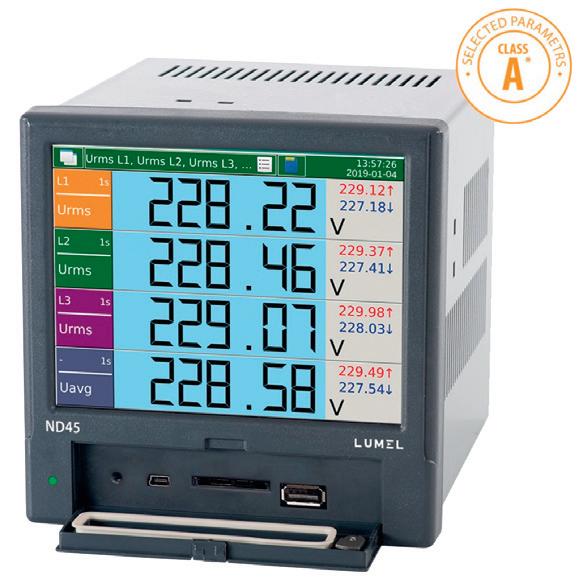
The Lumel ND45 is an IoT intelligent electronic device (IED) with data-logging and report-generating capabili ties. It offers measurement and recordings of over 500 electric energy quality parameters, including harmonics and inter-harmonics up to the 51st harmonic, energy measurement in four tariffs, recording measurements before and after events (dips and swells), monitoring of up to six additional energy meters with pulse outputs, a configurable display and web server.
Thanks to their chemical resistance, as well as being highly ozone-, UV- and weather-resistant in compliance with EN 50396 and HD 605 S2, the ÖLFLEX and UNITRONIC ROBUST cables from Treotham are certified to be suitable for wet cleaning in the food and beverage industry in accordance with ECOLAB, European and North American standards.
Portable power system
26 ECD
[ELECTRICAL+COMMS+DATA]


The DE VPP draws heavily on customers’ own solar PV generation, but increasingly we are encouraging customers to keep battery capacity available to draw from the grid at times of high solar and wind gen eration. This helps us manage the grid and encourage greater renewable penetration, by purchasing what would have been wasted energy in some cases and providing that energy back into the grid at times when generation may be scarce and prices high. Also by providing services such as fre quency control ancillary services (FCAS) or voltage management the DE VPP effectively allows for more renewable energy to be con nected into our system. It’s only small now but the Australian Energy Market Operator (AEMO) predicts more than 50% of customers will have these resources installed by 2030.
Discover www.discoverenergy.com.au/Energy
What are VPPs and how do they work? Virtual power plants are collections of solar and battery customers who provide services to the network and grid and are responsive to wholesale energy price movements. Dis cover Energy’s VPP provides the software to do this and shares the value of providing these services with our customers.
28 ECD [ELECTRICAL+COMMS+DATA] SEPTEMBER 2022 www.ecdonline.com.au
What alternative generation sources does the DE VPP draw on?
iStock.com/BeyondImages
Q&A WITH CHRIS CORMACK:
FUTURE NETWORKS
WHAT ROLE CAN VPPs PLAY IN AUSTRALIA’S ENERGY TRANSITION?
How would an average suburban family home that relies on energy from fossil fuels go about making the conversion to green energy sources? Firstly, the key is to install solar PV, although we would suggest only enough for your own consumption, as given the increased prevalence of solar in our energy grid the price of the energy generated from solar is decreasing and so are the feed-in tariffs that reward solar PV generation.
A battery or, in time, an electric vehicle, will allow the household to store its solar energy even store other renewable sources such as wind power and output it at times when the household requires.
DE currently has a project underway involving EVs — what part can electric vehicles play in our energy networks? Electric vehicles (EVs) can play a key role in two different areas firstly, by increasing consumption across the grid it will effectively decrease the cost of recovering largely fixed network costs; as long as networks can ensure that EVs are not charging at peak times. Discover Energy’s Super Charge program effectively allows customers to do just that and to reap the benefits.
In this interview, Chris Cormack, Executive General Manager, Discover Energy, discusses the potential of virtual power plants and related technology in shaping the future of Australia’s networks and grids.
The other potential benefit of EVs will be when vehicle to grid (V2G) technology allows owners to draw energy from the battery of their vehicles for their own consumption offset ting potentially expensive energy consumption OR providing energy to the grid at peak times just as Discover Energy’s VPP does today.
What role can smart tech/devices (for example, Discover Energy’s DE Box) have in creating more efficient energy usage for consumers?
Installation of other demand response technology for controlling hot water, air conditioning or pool pumps will ensure the household uses energy at times when there is abundant renewable energy.
One example of smart technology can be used to ensure that the household uses solar energy to ‘pre-cool’ the house in summer by running the air conditioner from solar earlier in the day. Discover Energy’s smart APIs (application programming interfaces) will allow a multitude of battery and inverter systems to be used to store renewable energy to use at times when the household requires it or to sell back to the grid for others to use.



ALL-ENERGY AUSTRALIA COMING TO MELBOURNE
The expo floor will feature over 290 leading companies including Enphase, Fronius, GoodWe, Growatt, Nextracker, Sungrow, Longi, TrinaSolar, Shoals and more. For the first time, there will be a dedicated Energy Management Zone within the All-Energy Australia exhibition. This zone will host its own theatre with sessions running throughout both days on sustainable solutions that facilitate improved energy management and increased cost savings.
The fully metallic connectors feature a compact overall di mension size of 32.13 and a robust stainless steel lever. The hoods come in one piece for handling any wiring combination and they are EMC-ready if equipped with suitable M25 EMC cableTheygland.come together with the new specifically designed CQ 08E inserts in crimp termination technology with integrated PE plate, for granting the connection continuity between the PE contact and the metal enclosure.
30 ECD [ELECTRICAL+COMMS+DATA] SEPTEMBER 2022 www.ecdonline.com.au EVENT A ll-Energy Australia, billed as Australia’s largest clean energy event, is taking place this October in Melbourne, to continue supporting the industry’s growth and to help accelerate Australia’s transition to a renewable energy future. Organised in partnership with the Clean Energy Council, this is where renewable energy professionals can get exclusive access to the latest technologies and trends and discuss opportunities and challenges for the sector.
With energy at the forefront of many discussions as the fed eral government’s ambitious climate change Bill is being pushed through, it will be a timely return for the free-to-attend exhibition and conference, which is expected to attract more than 10,500 industry professionals.
When: 26–27 October 2022
There will be six sessions across the two days focusing on business leadership in energy efficiency and energy management, with each session running for 80 minutes. The business leadership theme is designed to establish industry best practices in manag ing the risks and capturing the opportunities of Australia’s energy transition and net zero transformation. These sessions will also highlight innovative energy management technologies and services that support the reduction of energy bills and emissions. Session topics will be on agriculture, food and beverage manufacturing, metals and other materials manufacturing, residential buildings, commercial buildings and government operations.
48 V controlelectronicspowerunit
Eaton’s eMobility business has introduced a 48 V programmable power electronics control unit for electri cally heated catalysts that can be used by commercial vehicle manufacturers to meet tightening global emissions regulations. Rapidly warming up the exhaust aftertreatment catalyst, and keeping it warm during low engine load operation, is essential for optimal performance to reduce harmful nitrogen oxide (NO x) exhaust emissions.
The air-cooled electric catalyst heater controller is part of Eaton’s broader 48 V electrical system portfolio, which contains several technologies that allow manufacturers to integrate 48 V architectures in next-generation vehicles. The e-heater controller is designed to receive power commands from the aftertreat ment system and provide soft-start and soft-stop capabilities for assisting in maintaining system voltage control, as well as diagnostic feedback of the heater element. Eaton Electrical (Australia) Pty Ltd www.eaton.com
Enclosures
Robby Clark, Portfolio Director at All-Energy Australia, said, “The 2022 event takes place at a crucial time in our country where Australia’s clean energy transition is more important than ever. AllEnergy Australia provides a platform for the industry to connect visitors with leading suppliers on our exhibition floor and drive conversations about the future of renewables at our multi-stream conference. With Energy Management being a growth industry as well as a major focus for all industries, we are very excited to introduce our specialised Energy Management Zone to the event and expect it to be very popular with visitors.”
Components for the automation industry are required to remain compact and small, but along with the size, the connectors have to be resistant to vibrations and maintain their seal to withstand rugged environments.
To meet these needs, Treotham is presenting ILME’s newly developed CQA/MQA 08 enclosures, which stand out for fea tures and functionality.
Where: Melbourne Convention and Exhibition Centre Register: www.all-energy.com.au/en-gb/register.html
Interested parties can book a stand in the new zone or register to be a speaker here: https://www.all-energy.com.au/en-gb/energymanagement-zone.html.
What: All-Energy Australia
For fast and error-free wiring, internal keys on both hoods and housings avoid possibly hazardous mounting of inserts without such integrated PE plate. Treotham Automation Pty Ltd www.treotham.com.au


igh performing and reliable ICT networks need high performing and reliable products. WBT’s HypaConnect copper CAT6, CAT6A and optical fibre products provide comprehensive, industry-leading reliability and are designed and tested against the latest version of the ISO/IEC 11801. Therefore, the system is guaranteed to perform to this level for the life of the 25-year warranty. In addition to the reliability of the solution, WBT also provides a large local stock holding of every key component to allow you to get the job done on time and on budget. There are many factors to consider when deciding on what cabling network to utilise. However, CAT6A is a wisely proven choice due to being future-proof against increased networking speeds. CAT6A is available in either a shielded or unshielded solution and each option has its own use depending on the demands of the project.
CAT6A is also backwards compatible with CAT6 and CAT5E due to the continued use of the RJ45 connector. CAT6A has proven to be a cost-effective solution for current and emerging applications as it supports higher bandwidths and 10Gbps network speeds up to 100 metres. In addition, CAT6A and structured cabling products can be used for applications other than voice and data, such as Building Automotive, CCTV, Access Control, and many others. Therefore, the potential to integrate all these applications into a single cabling infrastructure provides another advantage. The HypaConnect series provides unparalleled performance and reliability. Inclusive of the HypaConnect ICS solution is a 25-year component and optional certified site warranty, including the replacement cost of ICS components and labour in the event of a valid warranty claim. Therefore, if you require an end-to-end certified structured cabling solution, insist on HypaConnect.
SPONSORED CONTENT
Warren & Brown Technologies (WBT) is a world leader in the design, manufacture, and supply of telecommunications network connectivity infrastructure. WBT provides local technical support, and stock availability to the Australian market, along with fast production and delivery times. With designers and engineers onsite, this provides peace of mind that your end-to-end solution is in the hands of industry experts.
Email:Phone:108Warrenau/products/copper-structured-cabling.html.https://wbnetworks.com.&BrownTechnologiesMitchellStreet,Maidstone,VIC3012(03)93176888sales@wbt.com.au
Future-Proof your network with WBT’s HypaConnect Integrated Cabling Solutions
Warren & Brown www.wbnetworks.com.auTechnologies
For more information:
SEPTEMBER 2022 ECD [ELECTRICAL+COMMS+DATA] 31www.ecdonline.com.au
H

In collaboration with ENGIE Australia & New Zealand, the EV fleet at Flinders University will be fully charged at the be ginning of each workday from low-demand night-time energy generated by ENGIE’s Willogoleche Wind Farm in South Australia. Intermittent daytime charging will be supplemented by Flinders University’s onsite-generated solar energy. The fleet will then be used as stationary batteries feeding renewable energy back to the campus grid from 5–9 pm, when demand is highest in the wider SA grid and primarily gas-generated.
“We’re thrilled to be expanding our partnership with Flinders University as they progress towards a Climate Positive Campus and we applaud the SA Government for their additional funding support to accelerate the uptake of EVs.”
Ten of the V2G chargers, installed by JET Charge, are being located at Flinders Univer sity’s car park nine (Bedford Park), where the university’s EV fleet is currently based, and an additional 10 chargers at car park three near the large solar car park installation.
VEHICLE-TO-GRID CHARGING IS KEY F linders University is launching 20 vehicle-to-grid chargers designed to export spare battery capacity generated by the university’s grow ing fleet of electric vehicles (EVs) into the electricity grid at its Bedford Park campus. The deployment also includes an additional two EV rapid charging stations, further enhancing charging capacity on campus.
iStock.com/BeyondImages
“There’s increasing interest in integrat ing green power supply, EV-charging and battery management systems that optimise energy consumption, while lowering carbon emissions,” he said.
VEHICLE-TO-GRID TO UNIVERSITY’S FUTURE SUSTAINABILITY
engie.com.auENGIE
ENGIE’s Director of Transport and Green Mobility, Greg Schumann, said the program will help Flinders University achieve its sustainability targets and raise awareness of the convenience of transitioning to an EV.
Vehicle-to-grid (V2G) chargers enable two-way energy flow between the grid and EV batteries, allowing EVs to become mobile batteries that can store and supply energy directly to the grid during periods of high demand.
Vice-Chancellor Professor Colin Stir ling said Flinders University is committed to deploying its growing fleet of electric vehicles by developing new and innovative ways to generate and store electricity on campus while also providing energy back into the electricity network, as part of its Sustainability Plan 2025.
ENGIE will also offer two rapid charging stations at car park two (Bedford Park), which will be accessible for students and staff, located within walking distance of the College of Education, Psychology and Social Work. This will provide an important additional link in ENGIE’s broad rapid charging network throughout Adelaide.
32 ECD [ELECTRICAL+COMMS+DATA] SEPTEMBER 2022 www.ecdonline.com.au
“Our goal is to expand the Flinders Uni versity EV fleet so we can construct a 650 kW virtual battery, using both smart charg ing stations and vehicle-to-grid technology,” Stirling said. “This will allow our fleet of security and pool vehicles to operate in a way that embodies renewable energy genera tion, reducing the university’s peak demand while delivering benefits for the SA grid. “This project supports our sustainability goals in transitioning the university’s fleet of vehicles to electric, and Bedford Park represents an ideal location for the develop ment of innovative networks that can inspire the wider SA community, with our campus already powered by 100% renewable energy.”
The South Australian Government is supporting this initiative with more than $350,000 as part of the South Australian Electric Vehicle Smart Charging Trials, enabling the university to procure Nissan Leaf vehicles with two-way batteries preinstalled, which allows them to be charged from the grid but also to provide power.
The opportunity to install two-way charg ers is the latest initiative linked to the strategic partnership between ENGIE and Flinders University, which is investigating further ways to reduce emissions and achieve energy generation and storage targets.


CELEBRATINGYEARS
With only 8% of licensed electricians in Australia being female, according to recent Workplace Gender Equality Agency figures, the National Electrical and Communications Association’s (NECA) Womenin-Power program has been specifically designed to remove industry barriers by providing female high school students and school leavers with the skills and knowledge required to secure an apprenticeship.
YOUNG WOMEN EMPOWERED TO JOIN ELECTRICAL INDUSTRY
Advertising Sales: Sales Manager – Liz Wilson Ph: 0403 528 tthompson@wfmedia.com.auPh:Timlwilson@wfmedia.com.au558Thompson0421623958
Copy Control: Mitchie copy@wfmedia.com.auMullins
The group also discussed their expe riences within the industry. First-year electrical apprentice Piri Songsara said, “It’s very interesting. I feel empowered. The tradies are welcoming, and I feel I can learn from them.” When asked to provide advice to other women or girls considering an electro trade, every one of the participants was enthusiastic. “Go for it!” Songsara said. “Even if you think you can’t, you have to push yourself out of your comfort zone.”
ECD [ELECTRICAL+COMMS+DATA]: ISSN 2201-2702 Printed and bound by Dynamite Printing If you have any queries regarding our privacy policy please email www.wfmedia.com.auA.B.N.Westwick-Farrowprivacy@wfmedia.com.auMedia22152305336
I n the final year of her Electrical Ap prenticeship with NECA, Tiana Cameron is one of many young women who have joined the industry through the Women-in-Power program. She said, “It’s important to realise that, in a male-dominated industry, you can actually do everything and do it well. It’s not as scary as you think it’s going to be. NECA’s Women-in-Power program was brilliant.” NECA is bridging the gender diversity gap within the electrical industry through a variety of initiatives aimed at educat ing young women about the trades. The association hosts a range of workshops, pre-apprenticeship programs (such as the Women-in-Power program) and educational seminars to encourage young women to join the electrical industry. “NECA is excited and proud to be sup porting more women, like these skilled apprentices, to enter the electrical trades. Improving gender diversity across the in dustry is a key goal of ours,” said NECA Project Manager Michelle Ellis. “We support innovative programs that as sist in addressing gender imbalance in the construction industry and, like our Women-inPower program, encourage young women to realise a vocational pathway into the industry.” Ellis commended the ACT Government’s recent $1 million commitment to the Under standing Building and Construction Program for early learning about the construction industry in schools. Being piloted with four ACT high schools, the program is geared towards students in Years 7–10. A group of five female NECA apprentices from the ACT recently met to share their feedback on a range of industry issues faced by women within the electrical industry, with the group agreeing that “the electrical industry needs to be talked about more in high schools” and that “careers advisers need to promote females in the electrical trades more”. Participants recommended providing access to more female trade networks like the Women-in-Power program and Build Like a Girl, founded in 2020 by ACT-based builder Jo Farrell.
GENDER EQUITY NECAcredit:Image
NECA/National Electrical & Communications www.neca.asn.auAssociation Women-in-Power program participants.
Head Office Unit 7, 6-8 Byfield Street, North Ryde Locked Bag 2226, North Ryde BC NSW 1670 Ph: +61 2 9168 2500 Editor: Katerina ecd@wfmedia.com.auSakkas Publishing Director/MD: Geoff Hird Art Director/Production Manager: Julie Wright Art/Production: Colleen Sam, Linda Klobusiak Circulation: Dianna circulation@wfmedia.com.auAlberry
All material published in this magazine is published in good faith and every care is taken to accurately relay information provided to us. Readers are advised by the publishers to ensure that all necessary safety devices and precautions are installed and safe working procedures adopted before the use of any equipment found or purchased through the information we provide. Further, all performance criteria was provided by the representative company concerned and any dispute should be referred to them. Information indicating that products are made in Australia or New Zealand is supplied by the source company. Westwick-Farrow Pty Ltd does not quantify the amount of local content or the accuracy of the statement made by the source.
34 ECD [ELECTRICAL+COMMS+DATA] SEPTEMBER 2022 www.ecdonline.com.au

Visit melbourne.comms-connect.com.au for more information Limited expo space remaining – contact Tim Thompson tthompson@wfmedia.com.au Featured speakers ShaneResilienceCommissionerAFSMFitzsimmonsNSW Jackie FounderDujmovicandCEOHoverUAVMatsCSIROGroupHenriksonLeaderData61 Richard Reed Deputy TechnologyNetworkChiefandOfficerFirstNetUSA Kylie De ManagingCourteneyDirectorNSWTelcoAuthority Neal NGCCTechnicalRichardsonDirectorNZPoliceLeadAgency What’s on • Industry-focused case studies and technical presentations • Panel sessions on public safety, state of the industry and satellite evolution • Extensive exhibition and networking opportunities • ARCIA Industry Gala Dinner Workshops – October 18 • Power supply options for communications systems, including solar and battery options • Latest initiatives and innovations in critical LMR, critical broadband 4G/5G and control centres • Private LTE/5G the fundamentals of technology and system design EARLY BIRD REGO CLOSES SEPTEMBER – DON’T MISS OUT OctOber 18-20, 2022 MELbournE Events for critical communications users and industry M ELBOURNE C ONVENTION & Ex HIBITIONCENTRE ENTRYEFREExPO EVENT PARTNER Platinum Sponsors: Media Partner: Association Partners: Gold Sponsors: Silver Sponsors:


