

City of West Kelowna
Recreational Trails Master Plan
August 2024

Gellatly Bay Recreation Corridor
2.2.1
2.2.2

TABLES
Table
Map A: Existing Trails (2023)
APPENDICES
Appendix A: Typical Recreational Trail Design Details (Bylaw No. 0249)
Appendix B: Code of Conduct Examples MAP
ACKNOWLEDGMENTS

The City of West Kelowna is on the Traditional Territory of the Syilx/Okanagan Peoples.
The Recreational Trails Master Plan update team would like to thank City Mayor and Council, City staff, the Regional District of Central Okanagan, Westbank First Nation, our diverse and dedicated local interest group representatives, and the many community members who use and care for recreational trails in West Kelowna. The input shared by participants has provided valuable information to help shape this Recreational Trails Master Plan update and guide how we plan, develop, and manage the City's recreational trails network in the years to come.
This Plan was prepared by the City of West Kelowna with support from Lanarc 2015 Consultants Ltd. and Licker Geospatial Consulting Co.
DOCUMENT PHOTO CREDITS:
We gratefully acknowledge the contribution of photographs for this document by: Darren Hull, Michael Hintringer Photography, Jonathan Behnke, and T. Stechman
EXECUTIVE SUMMARY
Introduction
The Recreational Trails Master Plan provides overall direction and guidance for planning, developing, operating, and investing in West Kelowna's recreational trails network over a long-term (10-year) horizon.
WHAT'S IN THE RECREATIONAL TRAILS MASTER PLAN?
f An introduction to recreational trails planning and the process.
f An overview of West Kelowna's context.
f Analysis of West Kelowna's recreational trails network and related trails networks.
f A framework for the future, including nine guiding goals.
DEFINING RECREATIONAL TRAILS
This plan focuses on Recreational Trails which provide fun outdoor recreation experiences, typically within park spaces, and are managed by the City's Parks Department. They are distinct from Active Transportation Routes which provide safe, reliable transportation between City neighbourhoods and destinations and are managed by the City's Engineering Department through the Transportation Master Plan
f A set of 21 recommendations with details about why they are recommended, design considerations, actions, and costs.
f An implementation summary outlining short, medium, and long-term priorities.
f Supporting mapping and information.
RECREATIONAL TRAILS MASTER PLAN
How we will develop an outdoor trails network to enjoy recreational experiences
TRANSPORTATION MASTER PLAN
How we will connect people and places within our transportation network
Trails managed by others like the Regional District of Central Okanagan (RDCO), Westbank First Nation (WFN), non-profit organizations, or others are also outside the scope of this plan, though they are considered in planning as part of the broader network.
Recreational Trails Today
See Section 2.0 (p.11)
A 2023 snapshot of West Kelowna's existing recreational trails network provides a baseline for current state and future planning.
EXISTING WEST KELOWNA RECREATIONAL TRAILS
32.7 km
11.3 km Increase since the 2013 Recreational Trails Master Plan
RESOURCE LIMITATIONS
Limited resources is identified as the key challenge faced by recreational trails. A lack of dedicated resources means recreational trails works are addressed on an issues basis, without proactive management.
Other challenges include:
f Barriers to connectivity
f Increased trail use
f Unauthorized routes
f Trail safety
f Lack of information
f Climate change
f Environmental management
f Missed opportunities for trail development
RECREATIONAL TRAIL TYPES
There are 3 typical types of recreational trails in West Kelowna based on location, type, and amount of use.
MAJOR MULTI-USE TRAIL
USE: High
LOCATIONS: Major routes through parks or along the waterfront
NARROW MULTI-USE TRAIL
USE: Moderate
LOCATIONS: Community or neighbourhood connectors, major creek corridors, major routes through natural areas, irrigation flumes
TRAIL RATING SYSTEM
NATURE TRAIL
USE: Low
LOCATIONS:
Natural areas, minor creek corridors, hillsides
West Kelowna's recreational trails follow a simple three-level rating system that is compatible with the RDCO Regional Parks trails ratings.
Moderate BLACK DIAMOND Difficult
GREEN CIRCLE Easy BLUE SQUARE
A Framework for the Future
COMMUNITY IDEA THEMES
what people would like to see for the future
Existing Network Improvements
Quality and Safety
Mapping and Wayfinding
Trail Use Management/ Asset Management
Natural Environment Protection
Amenities
GOALS
See Section 3.0 (p.23)
KEY TRENDS
that influence recreational trails planning
Climate Change can increase risks for impacts like wildfire or erosion
Active Outdoor Lifestyles increase participation in activities that use trails
Tourism is be supported by recreational trails
Multi-Modal Transportation is adding demand for pedestrian/cyclist connectivity
A Growing Community impacts informal trails and access into recreational networks
Inclusivity is enhanced by accessible experiences on recreational trails
Technological Advances provide new approaches to wayfinding, communications, and experiences
Provide overall guidance for the future of recreational trails in West Kelowna.
GOAL 1: Provide a publiclyaccessible, connected recreational trails system with links to all parts of the community.
GOAL 2: Establish the trails system as a destination for residents and visitors, with natural attractions and varied, year-round recreation opportunities.
GOAL 3: Provide opportunities for people of all ages, abilities, and lifestyles to experience trails in West Kelowna safely, securely, and comfortably.
GOAL 4: Improve the quality and consistency of trail management and maintenance, with sufficient resources to effectively maintain trails assets.
GOAL 5: Provide clear and accessible information about recreational trails to support wayfinding and code of conduct.
GOAL 6: Balance protection of natural areas and building climate resiliency with public access and connectivity.
GOAL 7: Take steps to improve responsible trails use and reduce conflicts among trail users.
GOAL 8: Encourage and support the engagement and involvement of user groups and partners in trail stewardship
GOAL 9: Establish positive relationships and pursue partnerships with trail users, volunteers, neighbouring municipalities, RDCO, WFN, the Province, and the development community.
A Path Forward: Recommendations
See Section 4.0 (p.31)
The Recreational Trails Master Plan provides a set of recommendations for implementing the ideas, values, and priorities generated through the planning process.
The following pages provide a summary of recommendations included in the Recreational Trails Master Plan and references to their pages in the report.
PTRAIL PLANNING & DEVELOPMENT RECOMMENDATIONS
Recommendations on how the overall recreational trails network should develop over the coming decade, including an approach to planning and developing the network, as well as steps the City can take to support a network that is safe, comfortable, and connected.
P1 Recreational Trails Scope (p.36)
Focus the scope of recreational trails on off-road routes and plan collaboratively for them alongside active transportation routes (managed through the Transportation Master Plan)
P2 Asset Management & Resourcing (p.37)
Develop a Parks & Recreational Trails Asset Management Plan to assess current assets and plan for life-cycle management
P3 Trails on Private Lands (p.39)
Encourage/support trails through privately-owned lands where there are willing landowners and community benefits.
P4 Parks & Recreational Trails Guidelines (p.41)
Incorporate updated recreational trails guidelines into the new Parks & Recreational Trails Design Guidelines to provide clear, consistent guidance on design.
P5 Trailheads (p.42)
Continue to add new trailheads and improve existing trailheads throughout the network.
P6 Wayfinding & Signage (p.44)
Enhance digital and physical wayfinding and signage to increase community awareness and improve access to information.
P7 Trail Rating & Accessibility (p.46)
Provide information about level of difficulty within the network and seek opportunities to increase accessibility in key locations.
P8 Trail Safety & Security (p.47)
Undertake improvements to enhance safety and security on recreational trails.
MTRAIL MANAGEMENT RECOMMENDATIONS
Recommendations for managing the recreational trails network so it continues to provide longterm community benefit.
M1 Environmental Management (p.50)
Plan and manage recreational trails in a way that respects the natural environment.
M2 Trail Maintenance (p.52)
Develop and implement a systematic approach to maintaining recreational trails.
M3 Trail Use Guidelines & Codes of Conduct (p.54)
Formalize and communicate trail use guidelines and codes of conduct for recreational trails.
M4 Pets on Trails (p.56)
Develop a trails network that accommodates both dog owners and non-owners and protects the environment.
M5 Volunteers & Organizations (p.57)
Consider opportunities to engage organizations and individuals in support of the recreational trails network.

CCAPITAL PROJECT RECOMMENDATIONS
Larger projects addressing potential future connections that have a recreation focus.
C1 Goats Peak Trails Network (p.60)
As development occurs in Goats Peak, secure a linked trails network that connects to adjacent Regional Parks and neighbourhoods.
C2 Waterfront Trail (p.61)
Collaborate with active transportation and others to work towards a linked waterfront trail from Bennett Bridge to Peachland.
C3 Flume Trail (p.62)
As development continues in Smith Creek, formalize the Flume Trail.
C4 Mount Boucherie Trails (p.63)
Consider opportunities to support ongoing management of trails on Mount Boucherie, including those on Crown lands.
C5 Rock Ridge Park Trails (p.65)
As development continues in Rose Valley, formalize trails leading from the undeveloped parkland in Rock Ridge Park.
C6 Other Recreational Trail Projects (p.66)
Continue to add linkages within existing/future parks or other locations that help fill gaps and make connections in the network.
C7 Support for Crown Land Trail Initiatives (p.67)
Continue to support others interested in seeking authorizations to manage trails within Crown land areas.
C8 Support for Partner Trail Initiatives (p.68)
Continue to support partners interested in developing and managing recreational trails that benefit West Kelowna residents.
Implementation
An Implementation Summary (page 69) provides a categorized summary of recommended actions for West Kelowna's recreational trails network organized by timeframe. This information is intended to support ongoing implementation of key actions that support progress towards the goals outlined in the master plan.
See Section 4.3 (p.69)
SHORT-TERM 1-5 years
MEDIUM-TERM 6-10 years
LONG-TERM 10+ years
ASSET MANAGEMENT Ongoing
The Recreational Trails Master Plan identifies short-term actions that could be considered to advance key recommendations. Recommendations with short-term actions include:
f P2 Asset Management & Resourcing (p.37)
f P4 Parks & Recreational Trails Guidelines (p.41)
f P8 Trail Safety & Security (p.47)
f M2 Trail Maintenance (p.52)
FUTURE TRAIL DEVELOPMENT
Continuing to expand the network will require new connections. The following will be key mechanisms to expanding the network:
f Developing trails on City lands including parks, rights-of-way, or other public lands, using capital funds or other funding sources.
f Seeking opportunities to support or partner on key projects (e.g., with the RDCO or Province) through agreements to enhance the broader network.
f Formalizing trails on private lands through collaboration with private landowners or developers through acquisition, right-of-way agreements, land preservation, or other agreements.
f M5 Volunteers & Organizations (p.57)
f C4 Mount Boucherie Trails (p.63)
f C5 Rock Ridge Park Trails (p.65)
FUNDING STRATEGIES
A range of potential funding sources and strategies that could support implementation of recreational trails projects include:
f Municipal Taxation
f Grant Funding
f Development Cost Charges
f Amenity Cost Charges
f Subdivision
f Parcel Tax
f Other Development-Related Funding
f Coordination Among Departments
f Corporate and Private Donations & Bequests
f Partnerships
If additional funding is available, medium-term and long-term recommended actions could be implemented sooner than shown in this Plan.

Views from Mount Boucherie

West Kelowna's nature trails
1.0 INTRODUCTION
1.1
Plan Purpose
A Recreational Trails Master Plan (Plan) provides overall direction and guidance for planning, developing, operating, and investing in West Kelowna's recreational trails network over a long-term (10-year) horizon. This document is an update to the 2013 Recreational Trails Master Plan.
Recreational trails are routes that have a primary purpose for recreational use such as walking, hiking, trail running, biking, or pet exercise. These trails range from accessible pathways in urban areas to steep and challenging trails in natural environments. West Kelowna has a significant and growing recreational trails network.
This Recreational Trails Master Plan provides recommendations for trails on lands within the City of West Kelowna. It does not provide guidance what happens on Crown, Regional District of Central Okanagan, or private lands. The recommendations in this Plan focus on improving the quality and quantity of trails on public land owned by the City of West Kelowna and working with other government bodies and land owners to achieve trail linkages that contribute to the overall network.
Detailed design of specific trails is not the focus of this Plan; rather, it articulates strategic actions for:
f Trail planning and development;
f Trail management and operations;
f Trail improvement strategies;
f Trail budgeting and funding strategies; and
f Coordination with others to enhance the overall trails network.
The recommendations outlined in this Plan should be reviewed and adjusted on an annual basis to explore new opportunities and prioritize investments that reflect community needs. Recommendations are intended to be considered within the broader community planning context and are subject to consideration and approval by Council.
1.2 Planning Process
The Recreational Trails Master Plan update process was conducted in three phases, beginning in spring 2023 and concluding in summer 2024. Because parks and recreational trails are intrinsically linked, the process ran concurrently with the City's Parks Master Plan update, with a combined two-round engagement process.
Figure 1 summarizes the three phases that guided the development of the master plan and the activities completed within each phase.
Figure 1: Planning Process Diagram
The first phase focused on analyzing the existing recreational trails network and coordinating a first round of community engagement to discuss progress, priorities, and new ideas.
KEY ACTIVITIES
Background Review & Analysis
Round 1 Engagement: Exchanging Info & Ideas
Public Open House Pop-ups
Questionnaires
Stakeholder Meetings
Phase 2 focused on review, analysis, and development of emerging directions for the trails network. The outcome was identification and evaluation of draft directions that will go on to form the updated Recreational Trails Master Plan.
Technical Analysis Outline of Emerging Directions Development of the Draft Plan
The final phase focused on reviewing the Draft Recreational Trails Master Plan with the project team, Council, stakeholders, and the community to identify refinements prior to finalization.
Round 2 Engagement: Draft Plan Review
Draft Plan Referrals
Public Open House
Feedback Forms Revision of the Plan Final Recreational Trails Master Plan
1.3 Planning Context
A city is complex and interconnected. Planning helps us stay organized and focused so that progress is sustained and important projects get done. Below is a summary of how different City plans work together to accomplish community improvements.
#OUR
WK
Community Vision & Official Community Plan (OCP)
City Master Plans
Recreational Trails Master Plan
A Community Vision and OCP (Bylaw No. 0300) are the building blocks for the community. They provide a long-term outlook for what the community wishes to achieve and guides how to get there over time. A Recreational Trails Master Plan aligns with and supports this overarching guidance.
Master Plans provide a communitywide outlook for important City networks. They prioritize how and where the City will invest to maintain and improve critical networks over time.
The Recreational Trails Master Plan provides planning for this key community network, while considering how it aligns with other City Master Plans.
Site-Specific Plans & Projects
f Park Plans: e.g., CNR Wharf & Memorial Park Plans
f Park Improvements: e.g., playground upgrades
f Transportation Upgrade: e.g., Boucherie Road Upgrades
f Utility Upgrade Projects: e.g., Rose Valley Water Treatment Plant
f Other Plans & Projects: e.g., Urban Forest Strategy
Site-specific plans and projects provide detailed direction and design to implement priorities from the City Master Plans. These are projects that typically lead to things getting built.
The Recreational Trails Master Plan identifies actions the City can further develop and implement in SiteSpecific Plans & Projects.
Figure 2: Planning Context
1.4 Defining Recreational Trails
In the 2013 Recreational Trails Master Plan, the City was in the early stages of defining the interconnected scope of trails. There was little distinction between recreational trails and active transportation routes. Since then, these networks have become increasingly distinct.
Recreational trails in West Kelowna, the focus of this plan, are the pathways, nature trails, and routes that provide outdoor recreational experiences. They are distinct from active transportation routes which focus on transportation to and from destinations around the City. Figure 3 summarizes key differences between recreational trails and active transportation routes.
The community has identified a range of desirable connections for West Kelowna’s future. Many of these linkages will be adjacent to roadways and addressed in the Transportation Master Plan as active transportation routes. These include projects like extension of the Waterfront Route, the Boucherie Wine Trail, Shannon Lake Road upgrades, and Elliott Road upgrades. As these routes are in the Transportation Master Plan, they are not duplicated in the Recreational Trails Master Plan. However, as both plans are implemented, opportunities to enhance connectivity between the networks will be a priority.
RECREATIONAL TRAIL
PRIMARY PURPOSE
PLANNING & MANAGEMENT
SCOPE
TYPICAL LOCATION
Routes that provide fun outdoor recreation opportunities and experiences
PARKS DEPARTMENT
Planned as part of the recreation network and guided by the Recreational Trails Master Plan
Recreation trails network including nature trails, narrow multi-use trails, and major multiuse pathways
Off-street locations, primarily in parks and open spaces
Longer routes, primarily nature trails or narrow multi-use trail types, and typically soft surface materials TYPICAL FACILITIES & MATERIALS
TYPICAL ACTIVITIES
Walking, hiking, mountain biking, jogging, dog-walking, nature viewing, relaxing, and other recreational pursuits
ACTIVE TRANSPORTATION ROUTE
Routes that provide safe, reliable transportation between City neighbourhoods and destinations
ENGINEERING DEPARTMENT
Planned as part of the transportation network and guided by the Transportation Master Plan
Transportation network including roads, sidewalks, bike lanes, mobility hubs for transit connections, and multi-use pathways
Within road rights-of-way, typically parallel to the street network or between properties
Varied lengths, from long routes to pedestrian access points in neighbourhoods, primarily sidewalks, bike lanes, and major multi-use trails, and typically hard surface materials
Cycling and pedestrian routes that help people choose active transportation for dayto-day travel
THESE NETWORKS ARE COMPLEMENTARY.
Some active transportation routes, like the Gellatly Bay Recreation Corridor and the Boucherie Wine Trail offer both active transportation and recreational trail benefits.
Figure 3: Recreational Trails vs. Active Transportation Routes
1.5 Benefits of Recreational Trails
Recreational trails have a strong cost-to-benefit ratio. They are low-cost to build, yet provide significant community value.
PERSONAL BENEFITS
HEALTHY, ACTIVE INDIVIDUALS
f Low-barrier access to recreation with opportunities for activity in each season from walking to rolling to snowshoeing to pet activity.
f Encouragement for active living, supporting positive health benefits.
f Access to nature which is known to reduce stress and enhance mental health.
ECONOMIC BENEFITS A PROSPEROUS
FUTURE
f Attractive amenities for residents and businesses choosing a location.
f Support for tourism opportunities such as recreational events like trail races or local initiatives like the Westside Wine Trail.
f Relationship-building in the community to collectively create and care for an integrated trails network.
ENVIRONMENTAL BENEFITS A SUSTAINABLE FUTURE
f Long-term protection of natural assets through establishment of linked corridors and management to limit human impact on sensitive areas.
f Support for human-powered movement throughout the community, helping reduce reliance on automobiles.
f Potential for educational opportunities about the area's unique culture, history, or environment.
SOCIAL BENEFITS AN ENGAGED COMMUNITY
f Increase community livability by providing access to nature and opportunities for social connection.
f Support to regional initiatives like a fully-linked waterfront connection that will benefit residents throughout the City and neighbouring communities.
f Opportunities for inclusivity by providing diverse opportunities for people of all ages and abilities to participate in recreational trails activities.
1.6 Community Input & Process
Input from stakeholders, interest groups, and community members is integral to the development of a Plan that reflects community needs and desires. The Recreational Trails Master Plan process consisted of two rounds of community engagement, each with a specific focus. This input, combined with technical analysis and input from City staff and Council, informed Plan directions.
1.6.1 COMMUNITY INPUT #1
: EXCHANGING INFORMATION & IDEAS
ENGAGEMENT PERIOD
f May to June 2023
ENGAGEMENT GOALS
f Raise awareness and provide information about the existing recreational trails network
f Gather information about concerns, values, gaps, and ideas to reflect community needs and interests today and in the future
OUTCOMES
f Confirm aspirations and relevant directions from the previous plan and identify new ideas

OVERALL ROUND 1 PARTICIPATION:
f ~300 in-person connections
f ~750 online inputs
f ~500 'engagements' on social media (likes, clicks, shares, reactions)
OUTREACH TOOLS
f Project web pages on the City's engagement site (ourwk.ca)
f Council Presentation on May 16, 2023
f Direct outreach via email and phone to neighbouring jurisdictions, community groups, and stakeholders
f Public service announcements during the engagement period
f Social media posts on the City's channels
f Advertisement in the Summer 2023 West Kelowna Recreation Guide
f Email blasts distributed via the City’s subscriber list
f West Kelowna News advertisement
f Project cards distributed at various locations
f Requests to stakeholders to share information with their membership
f Posters and signs at municipal facilities
f Engagement station at the Okanagan Regional Library Westside Branch
f Digital reader board at Highway 97 and Bartley Road intersection
f Banners at the West Kelowna Yacht Club
f Sandwich boards along the Gellatly Bay Recreation Corridor
SNAPSHOT
ROUND 1 ENGAGEMENT
68 community questionnaire responses
72
youth/student questionnaire responses
190+
people engaged in-person (open house, meetings, pop-ups)
RECREATIONAL
TRAILS ACTIVITIES
participants reported doing each of the following activities at least a few times/year
WALKING/HIKING DOG EXERCISE
MOUNTAIN BIKING
TOP TRAILS
that participants reported using
f Rose Valley Trails
f Trails in Kalamoir Regional Park
f Mount Boucherie Trails
The following is a snapshot of input collected through the first round of engagement on the Recreational Trails Master Plan. It includes feedback on people's experiences with recreational trails and their ideas for the future.
The complete report is available on the City's website.
HOW DO WE VIEW RECREATIONAL TRAILS
TODAY?
79% of respondents are feeling satisfied with the QUALITY of recreational trails in West Kelowna
71% of respondents are feeling satisfied with the NUMBER of recreational trails in West Kelowna
KEY FUTURE PRIORITIES
for managing and growing the recreational trails network
f Expand/add new trails in urban areas
f Expand/authorize trails in backcountry areas
f Enhance maintenance of existing trails
f Establish/improve codes of conduct and trail use guidelines
IDEA THEMES
about what people would like to see for the future
1.6.2 COMMUNITY INPUT #2 : DRAFT PLAN REVIEW
ENGAGEMENT PERIOD
f April to May 2024
ENGAGEMENT GOALS
f Share the draft plan and encourage review and feedback on the plan goals and recommendations
f Understand public priorities for the draft recommendations (what should be done first)
OUTCOMES
f Confirm and/or refine draft plan goals and

OVERALL ROUND 2 PARTICIPATION:
f ~100 in-person connections
f ~26 online inputs
f Many 'engagements' on social media (likes, clicks, shares, reactions)
OUTREACH TOOLS
f Project web page updates on the City's engagement site (ourwk.ca)
f Council Presentation on April 23, 2024 to provide an overview of the Draft Master Plan and kick-off the engagement process
f Direct outreach via email and phone to neighbouring jurisdictions, community groups, and stakeholders to invite participation in the process
f Media release during the engagement period to share information about the process and identify opportunities to participate
f Social media posts on the City's Facebook, X, and Instagram accounts
f Email blasts distributed via the City’s subscriber list
f Half page ad in the West Kelowna News to advertise the community open house
f Requests to stakeholders to share information with their membership
f Posters and signs at municipal facilities such as City Hall, Royal LePage, Jim Lind Arena, and JBMAC
f Banners at the West Kelowna Yacht Club and sandwich boards along the Gellatly Bay Recreation Corridor during the open house
SNAPSHOT ROUND 2 ENGAGEMENT
26 completed recreational trails feedback forms written submissions / questions for parks & trails
community open house attendees 18
DRAFT GOALS
The majority of participants felt all NINE Draft Goals will support a successful recreational trails system.
Top Goals participants rated as "Yes! This goal will support a successful recreational trails system"
Establish positive relationships and pursue partnerships (Goal 9)
Improve the quality and consistency of trail management & maintenance (Goal 4)
COMMON THEMES ON RECOMMENDATIONS
Trail Planning & Development Recommendations
f Enhance and protect the recreational trails network
f Distribute recreational trails throughout West Kelowna
f Improve trail amenities
f Improve access and connectivity
f Provide more wayfinding and signage including digital options
f Provide a range of trail ratings including fully accessible trails and more challenging trails
f Improve safety on recreational trails
f Consider how to allow continued access by motorized uses into the backcountry
The following is a snapshot of input collected through the second round of engagement on the Recreational Trails Master Plan. It includes community feedback on the draft goals, recommendations, and priorities articulated in the Draft Recreational Trails Master Plan.
The complete report is available on the City's website.
DRAFT RECOMMENDATIONS
Top 6 draft recommendations rated the highest level of support (%)
Trail Management Recommendations
f Protect and enhance trail environments
f Improve overall trail maintenance
f Manage conflicts on trails with trail use guidelines, public eduction, and enforcement
f Accommodate both dog-owners and non-dogowners' enjoyment
f Work with partners and volunteers
Capital Project Recommendations
f Prioritize Waterfront Trail extension
f Prioritize Flume Trail development
f Support others working to enhance the broader recreational trails network

Young cyclists on the Gellatly Bay Recreation Corridor
2.0 TRAILS TODAY
2.1 Planning Context
2.1.1 CITY OF WEST KELOWNA
The City of West Kelowna covers a large area of land on the west side of Okanagan Lake, bounded by Okanagan Lake to the east and mountains to the west. The area has a long history as an agricultural community with orchards, vineyards, and farm industry, all of which remain major components of the City's community fabric.
Figure 4: Regional Context Map
Approximate Area 12,209 ha (122.1 km2)
Population (2023)1 39,849
Average Annual Growth Rate 2.1%/year between 2016-2021

WEST KELOWNA CITY SNAPSHOT
CURRENT DEMOGRAPHICS
Demographic trends and community growth can influence how the City plans for future trail network development.
COMMUNITY
GROWTH AGING POPULATION
f The City of West Kelowna is a growing municipality.
f Between 2016 and 2021, the City saw a growth rate of 10.5% over 5 years,1 well above BC’s growth rate of 7.6% and just below the RDCO's growth rate of 11.6% for the same period.2
f As of 2023, West Kelowna is home to an estimated 39,849 residents.3
f Looking ahead, if West Kelowna grows at the current rate projected in 2023 BC Census data4, the number of residents will be approximately:
» 42,500 by 2026
» 47,000 by 2031
» 51,500 by 2036
» 55,000 by 2041
f This does not include growth in neighbouring communities who may use West Kelowna's recreational trails or tourists that visit the area.
f Community growth means more pressure will be placed on the recreational trails network, which will in turn affect the level of service and maintenance required to manage it.
1 Statistics Canada, Census Profile West Kelowna, 2021
2 Statistics Canada, Census Profile British Columbia and RDCO, 2021
3 BC Stats, Population Estimates & Projections, 2023 (last updated July 12, 2024)
4 BC Stats, Population Estimates & Projections, 2023 (last updated July 12, 2024)
f The last BC Census, completed in 2021, identified a median age for West Kelowna of 44 (up from 43.5 in 2016).1 BC’s median age in 2021 was 42.8.2
f As of the last Census 2021, West Kelowna’s largest age group is those between the ages of 60-64 years, with the next three highest age groups being 55-59 years, 35-39 years, and 65-69 years, respectively.3
f West Kelowna's OCP predicts that by 2040, those aged 65 and over will make up 27% of the population and an additional 12% will be made up by those aged 55 to 64.4
f An aging population can affect how the community will plan and develop outdoor recreational opportunities.
f Technological and health improvements have made participation easier for people of all ages and abilities.
f Walking is one of the most beneficial activities for human health, shown to reduce blood pressure, improve balance and coordination, and maintain physical and mental health.
f As West Kelowna's trail system develops, providing age-friendly opportunities can help enhance quality of life.
1 Statistics Canada, Census Profile West Kelowna, 2021
2 Statistics Canada, Census Profile British Columbia, 2021
3 Statistics Canada, Census Profile West Kelowna, 2021
4 City of West Kelowna OCP, 2023
KEY COMMUNITY FEATURES
West Kelowna has outstanding trail opportunities due to its location and physical characteristics. The area is renowned for scenic views, natural areas, and lake access. All of these features contribute to the recreational trail network experience.
NATURAL FEATURES LAND USE
f Okanagan Lake: Scenic views of the 135 km-long Okanagan Lake occur throughout the recreational trails network and the existing sections of waterfront trail are cherished amenities.
f Watercourses: Several watercourses, including Powers Creek, Smith Creek, McDougall Creek, and Faulkner-Keefe Creek run down the hillsides, through West Kelowna, and into Okanagan Lake. Some recreational trail components align with portions of these watercourses and further opportunities may exist to increase the trails near watercourses.
f Topography: West Kelowna’s hilly terrain is a defining feature that is beneficial for recreational trail development particularly for activities like hiking and mountain biking.
f Natural Habitats: The dryland ecosystems on West Kelowna's hillsides are habitat to a wide variety of flora and fauna. These areas provide opportunities for low impact trail users to experience the area's unique character and geography.
f Forests: Much of West Kelowna’s upper elevations are forested hillside Crown lands that form the City's backdrop and also provide opportunities for walking, hiking, running, mountain biking, and more. Most of this area is Westbank First Nation Community Forest.
f Parks: West Kelowna has an extensive parks network, with integrated recreational trails. Aligning plans for recreational trails and parks maximizes opportunities within these complementary networks.
f Agriculture: Agricultural is core to West Kelowna’s character. The City is known for its local vineyards, orchards, distilleries, breweries, and farms visited by tourists and locals alike. Many of the agricultural lands in the community are within the Agricultural Land Reserve (ALR), which protects them from development, but can also limit trail connections.
COMPLEMENTARY NETWORKS
f Other Networks: The City's recreational trails network connects with active transportation routes and trails operated by others like RDCO Regional Park trails and Crown land trails. There are many opportunities to enhance overall connectivity within the complementary networks in and around West Kelowna.
2.1.2 REGIONAL CONTEXT
The City of West Kelowna shares borders with other communities in the region that also offer recreational trail opportunities; and residents in these communities also use West Kelowna’s trail assets. A collaborative approach to inter-regional trail planning is co-beneficial.
f Westbank First Nation Tsinstikeptum 9 and 10: 2021 Population:10,900. West Kelowna shares borders with both Tsinstikeptum 9 and 10 which have been rapidly growing communities.1
f City of Kelowna: 2021 Population:144,576. Kelowna is directly across Okanagan Lake and is connected to the City of West Kelowna via Bennett Bridge. Kelowna is the largest city in the Central Okanagan, and it continues to be one of the fastest growing cities in BC.2 West Kelowna’s proximity to Kelowna affords access to regional opportunities that may not be available in a smaller community.
f Central Okanagan West Electoral Area: 2021 Population: 2,897. The Central Okanagan West encompasses the largely rural portion of the RDCO west of Okanagan Lake.3
f District Municipality of Peachland: 2021 Population: 5,789. Peachland shares the south border of West Kelowna and is connected to the City via Highway 97.4
2.1.3 PROVINCIAL CONTEXT
The Province of British Columbia has a Trails Strategy for British Columbia1 that provides a "framework, principles, and guidance necessary to develop a world class trails system for BC". Municipal trails and routes are considered within the strategy.
Key actions outlined in the strategy mirror many of the directions for recreational trails in West Kelowna, including:
f Integrating environmental considerations and standards into the planning, construction, and management of trails.
f Enhancing environmental awareness and appreciation through education and interpretation.
f Collaboratively developing local, regional, and provincial trail system plans that secure opportunities for all trail users in balance with environmental, cultural, and social values.
f Engaging First Nations in collaborative trail planning.
f Engaging landowners, tenured resource users, and other stakeholders in collaborative trail planning.
f Integrating trail planning with the transportation network system.
f Using legislative tools to approve trails, and identify trail uses, in support of a comprehensive trail network.
1 Statistics Canada, Census Profile Tsinstikeptum 9 & 10, 2021
2 Statistics Canada, Census Profile City of Kelowna, 2021
3 Statistics Canada, Census Profile Regional District of Central Okanagan West Electoral Area, 2021
4 Statistics Canada, 2021, Census Profile Peachland, 2021
1 Trails Strategy for British Columbia, Ministry of Forests, Lands and Natural Resource Operations (2021)
2.2 Existing Trails System
While the Recreational Trails Master Plan focuses on recreational trails owned and operated by the City of West Kelowna, the system is part of a connected context.
A summary of West Kelowna's current trails context is outlined in Table 1. See Map A: Existing Trails Inventory (2023) for additional details. While this Plan does not specifically address networks beyond West Kelowna recreational trails, planning is done with consideration to this larger context. Brief details about each network component are summarized in the following pages.
Table 1: Existing Trails Network Summary


WEST KELOWNA ACTIVE TRANSPORTATION ROUTES
2.2.1 WEST KELOWNA RECREATIONAL TRAILS
The 2013 Recreational Trails Master Plan identified approximately 21.4 km of existing recreational trails in West Kelowna. Current trails data indicates recreational trails provision has increased significantly to 32.7 km in 2023. The majority of the City's recreational trails have been acquired through development projects or have been built by the City in existing parks. Table 2 outlines notable trail updates and expansion projects in the past decade. TRAIL IMPROVEMENTS YEAR
Table 2: Completed Trail Improvements Since 2013 TRAIL
Astoria Park
Casa Rio Waterfront Park
Carate Park
Eain Lamont
Rita's Trail
Glen Canyon Park (City portion)
Gellatly Bay
Recreation Corridor
Horizon Park
Majoros Park
McIver Park
Memorial Park
Moonbeam Park
New trail 2022
Trail upgrades 2018
New trail 2021
Trail upgrades 2013/ 2019
Trail upgrades
New staircase 2017
Acquisition to improve regional trail connection 2014
Trail upgrades 2013
Trail upgrades
New staircase 2020
Trail repair 2020
Trail upgrade 2019
Amphitheatre access trail 2016
Trail upgrade
New staircase 2020
Rush Trail construction
Mount Boucherie Park
Trailhead/parking improvements
Rush Trail entrance rerouting and improvements
Restoration project 2015 2016 2018 2023
Mule Deer Park
New trail 2023
Rose Ridge Park New trail 2014
Rose Valley Trails Parking/ Trailhead
New parking lot
Water bottle and dog fill station
Bike tool station 2017
Sandstone Park New trails 2014
Shannon Springs Park
Smith Creek Park
Sunnyside Park
Tallus Greenway
Wild Horse Park
Rotary Trails
Unnamed Park on Cabernet Way
Trail improvements 2023
Trail extension 2014
New waterfront access trail 2015
Trail upgrades
Trail extension
New fencing 2014 2019 2021
New trail development 2022
Bridge upgrade
Flood restoration 2019
New trailhead to Mount Boucherie 2023
Various New Signage
2.2.2 WEST KELOWNA ACTIVE TRANSPORTATION ROUTES
In 2024, the City will complete an updated Transportation Master Plan that will set directions for walking, cycling, driving, and transit in the City. The plan identifies a range of active transportation projects that could link with the recreational trails network, such as:
f Anders Road sidewalks and bike lanes
f Shannon Lake Road sidewalks and bike lanes
f Gellatly Corridor extension
f Elliot Road sidewalks and bike lanes
f Wine Trail extension
f Westside Trail multi-use pathway connection
f Glenrosa neighbourhood sidewalks and bike lanes
f Westbank Centre sidewalks and bike lanes
f Boucherie Centre sidewalks and bike lanes
f Lakeview Heights neighbourhood sidewalks and bike lanes
f Rose Valley neighbourhood sidewalks and bike lanes
f Glencoe Road sidewalks and bike lanes
f Smith Creek Road sidewalks and bike lanes

2.2.3 REGIONAL DISTRICT OF CENTRAL OKANAGAN TRAILS
The RDCO has eight regional parks in West Kelowna, including: Kalamoir, Rose Valley, Shannon Lake, Glen Canyon, Gellatly Heritage, Gellatly Nut Farm, Raymer Bay, and Goats Peak Regional Parks. All regional parks have trails, which in many cases, connect into the City's trails network.
The RDCO continues to plan for and manage the regional parks network through:
f The Official Regional Parks Plan (ORPP)
f Management Plans for key parks including for Kalamoir (updated in 2023) and Goats Peak (2016).
f Trails Plans like the Rose Valley Regional Park Trails Master Plan (on hold after the 2023 McDougall Creek Fire).
f Other initiatives like the Regional Parks and Greenways Plan (2008 to 2020).
Continuing to collaborate with the RDCO through planning initiatives will identify opportunities that bring benefits to the collective trails network.

Boucherie Wine Trail active transportation route Goats Peak Regional Park
2.2.4
TRAILS ON CROWN LAND
There are many trails within the hillside Crown lands to the north and west of West Kelowna. Most of these trails have been informally developed over the years by recreation enthusiasts. The City does not maintain nor manage these trails.
Since 2013, the City has supported processes to authorize two key networks:
f Smith Creek Trails Recreation Area is a popular network of mountain biking and hiking trails accessed from Smith Creek Road.
f Rose Valley Trails Recreation Area includes trails west of Rose Valley Regional Park around Rose Valley Lake. The network is accessed from Rose Valley Regional Park or the City trailhead on Rosewood Drive. Trails were impacted by the 2023 McDougall Creek Fire.
Both of these networks are managed by the West Kelowna Trails Crew Society, a volunteer nonprofit organization. The City does not have an active role in management.
In addition to authorized networks, there are many informal, unmaintained trails throughout the Crown lands, with some of the most popular including McDougall Rim, Carrot Mountain, Powers Creek, Drought Mountain, and Mount Boucherie (outside the City-owned park).
Organizations can apply to the Province for authorization to construct and maintain trails on Crown land under the Forest and Ranges Practices Act (Section 57). An authorized trail has legal status meaning it is mapped and managed, which can support trail upgrades, help manage use and impacts, and reduce risk of environmental impacts or wildfire. However, authorization also requires a commitment to ongoing management and needs to be carefully considered.
2.2.5 WESTBANK FIRST NATION
As close neighbours, Westbank First Nation and West Kelowna share common goals to enhance connectivity. Westbank First Nation’s Parks and Trails Master Plan (2015) supports collaboration with neighbouring communities to enhance connectivity and align trail design standards to support seamless connectivity. For example, WFN's multi-use path along Boucherie Road was built to match the Gellatly Bay Recreation Corridor trail standard. WFN's Parks and Trails Master Plan identifies trail linkages for the community, and potential exists for West Kelowna recreational trails to support links between the communities.
Westbank First Nation Community Forest tenure is in place through much of the Crown land in the north and west parts of the community. Westbank First Nation is a referral agency for any proposals in these areas, and forestry activities may be managed to protect established recreation as part of their forest licence.
2.2.6 TRAILS ON PRIVATE LANDS
Throughout the City there are incidences of informal trails over private lands (i.e., not park or Crown land). In some cases, agricultural landowners informally allow local residents to cross or link through properties. These connections are typically not formal nor documented. In other cases, trail activities occur in undeveloped parts of private properties where future development is planned, for example, Goats Peak and Smith Creek. As development continues in these areas, it will be important that trails networks are formalized and key connections are protected. There are also incidences of trespass (i.e., where informal trails are created along desire lines) which can be a concern for both property owners and the City.
2.3 Trails Network Observations
The planning process highlighted several challenges in the recreational trails network.
f Limited Resources: Lack of dedicated resources means recreational trails works are typically addressed on an issue basis, without proactive management (see sidebar).
f Barriers to Connectivity: Network gaps exist due to past development patterns, jurisdictional boundaries, private land holdings, agricultural uses, and other barriers.
f Increasing Trail Use: More people enjoying recreational trails increases risk of damage or conflict, requiring more extensive management and use guidelines.
f Unauthorized Routes: Ongoing, informal use of unauthorized trails can pose concerns around trespass and liability.
f Trail Safety: Lack of consistent monitoring and maintenance can mean that hazards or deterioration are not addressed in a proactive manner.
f Lack of Information: Lack of up-to-date information such as maps, trail ratings, and condition information can limit user enjoyment of the network.
f Climate Change: More intense winter storms and prolonged summer drought can affect trail conditions, while human use in natural areas can increase risk of events like wildfire.
f Environmental Management: Increased use, unauthorized trail building, off-leash dog activity, and other practices can affect sensitive natural environments.
f Missed Opportunities: As development proceeds, opportunities to secure linkages can be missed, leaving barriers or gaps in the network.
KEY ISSUE: LIMITED RESOURCES
Of the observations, the most significant is resource limitations. The City currently does not have dedicated resources for managing recreational trails. A certain amount of necessary maintenance on trails is completed as part of regular park maintenance where trails are present upon request – for example, litter removal and hazard tree management. Initiatives such as wildfire mitigation have also provided opportunities for trail upgrades.
The Gellatly Bay Recreation Corridor is the only recreational trail that receives regular surface maintenance. Specific projects, such as updates to Rush Trail in Mount Boucherie Park, have also been completed to address issues when required and when resources permit.
There is currently no funding for routine maintenance, life-cycle management, wayfinding signage and information, or other common recreational trails costs. Recreational trail use will continue to increase as the community grows. Adequate resourcing is necessary to maintain safe trails, reduce deterioration, and provide high quality assets for the community over the long-term.
2.4 Key Trends
Trends display the tendencies and preferences of society as it evolves. Several trends may influence recreational trails in West Kelowna.


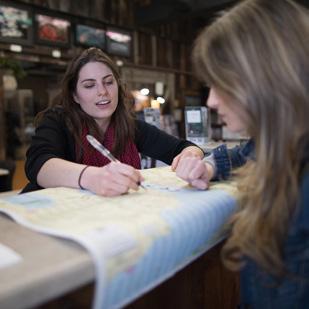


CLIMATE CHANGE: Recreational trails often occur within areas most vulnerable to climate change impacts – forested hillsides, shorelines, and watercourses. Planning and developing recreational trails will require consideration of potential risks and opportunities to be resilient to impacts.
ACTIVE OUTDOOR LIFESTYLES: Recreation trends suggest people are increasingly looking for independent, unscheduled outdoor activities like walking, pet exercise, hiking, rolling, mountain biking, trail running, and cross-country skiing. People often seek recreational trails that support these activities when selecting a community to call home.
TOURISM GROWTH: The Okanagan continues to be known as a destination for tourism, with West Kelowna becoming an increasingly popular destination for visitors. Trails networks often play an important role in tourism, supporting opportunities for exploration, activity, and events.
MULTI-MODAL TRANSPORTATION: As West Kelowna shifts from auto-dependency to a multi-modal transportation network, active transportation routes will increase pedestrian and cyclist connectivity. As the active transportation network grows, there will be opportunities for linked recreational trails to support an interconnected network.
A GROWING COMMUNITY: As rapid growth continues in West Kelowna, there can be impacts to informal trails and access into recreational networks. Planning ahead to identify and secure critical routes supports ongoing connectivity through neighbourhoods, even as an area changes.
INCLUSIVITY: Communities across Canada are becoming increasingly diverse, with people of all ages, needs, abilities, and interests seeking recreational opportunity. It will be important to consider how there can be inclusive and accessible experiences on recreational trails, especially in the most popular areas.
TECHNOLOGICAL ADVANCES: Online resources and digital tools are advancing at an unprecedented rate, providing new opportunities for wayfinding, communications, and experiences. In addition, mobility technology like e-bikes and adaptive equipment are expanding the audiences who can enjoy recreational trails.

Mount Boucherie viewpoint

Mount Boucherie trails
3.0 FRAMEWORK FOR THE FUTURE
3.1 Framework for the
Future
The Recreational Trails Master Plan is guided by...
COUNCIL'S 2022-2026 STRATEGIC PRIORITIES:
A progressive local government, committed to engaging the community to make West Kelowna a welcoming, safe, and inclusive place, resilient in the face of challenges, and rich with opportunity for all ages.
Nine goals are updated from the 2013 Recreational Trails Master Plan, to reflect community priorities and provide guidance to recreational trail planning, development, and management.
GOAL 1: Provide a publicly-accessible, connected recreational trails system with links to all parts of the community.
GOAL 2: Establish the trails system as a destination for residents and visitors, with natural attractions and varied, year-round recreation opportunities.
GOAL 3: Provide opportunities for people of all ages, abilities, and lifestyles to experience trails in West Kelowna safely, securely, and comfortably.
GOAL 4: Improve the quality and consistency of trail management and maintenance, with sufficient resources to effectively maintain trails assets.
GOAL 5: Provide clear and accessible information about recreational trails to support wayfinding and code of conduct.
GOAL 6: Balance protection of natural areas and building climate resiliency with public access and connectivity.
GOAL 7: Take steps to improve responsible trails use and reduce conflicts among trail users.
GOAL 8: Encourage and support the engagement and involvement of user groups and partners in trail stewardship.
GOAL 9: Establish positive relationships and pursue partnerships with trail users, volunteers, neighbouring municipalities, RDCO, WFN, the Province, and the development community.
3.2 Recreational Trail Types
Providing different trail types within the recreational trails network provides a range of experiences that align with location and conditions.
West Kelowna's existing (2023) recreational trails network spans over 32 km. This is separate from active transportation routes and trails managed by others including RDCO and Crown land trails (see Section 2.2 Existing Trails System).
There are three types of recreational trails typical to the network, based on location, type of use, and amount of use:
f Major Multi-use Trails
f Narrow Multi-use Trails
f Nature Trails
The intent of defining recreational trail types is to provide consistent guidelines and standards for trail development and maintenance for public trails.
Trail types and design standards for each trail type are summarized on the following pages.
The standards for these trail types apply to new trail construction and, where feasible, when existing trails, sections of trails, or trail features are upgraded or repaired. It is important to note that it is not financially realistic to upgrade all trails at once, so trails will typically be upgraded over time as resources and opportunity become available.


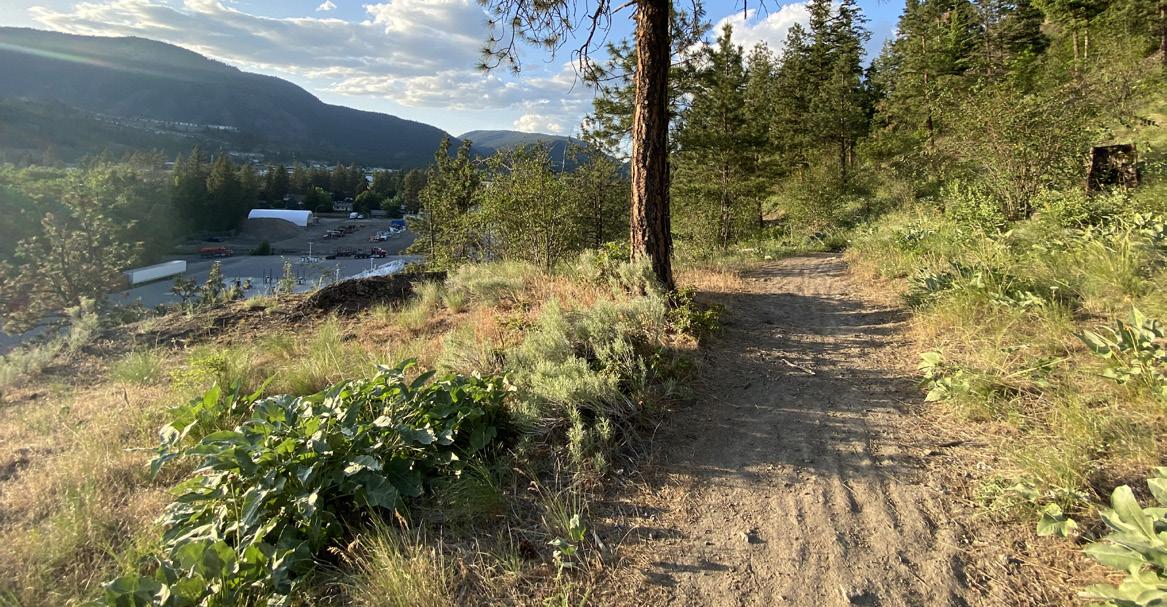
Major Multi-use Trail
Narrow Multi-use Trail
Nature Trail
MAJOR MULTI-USE TRAIL
TYPICAL LOCATIONS:
f Major routes through urban areas and parks
f Waterfront walkway

ROW: 7m min. & 10m pref.
CRITERIA DESIGN STANDARDS
Trail Width
LEVEL OF USE:
f High
TYPES OF USE:
f Non-motorized multi-use such as walking, jogging, cycling, in-line skating (where possible), scooters
f Meets minimum standards for wheelchairs, strollers
f Allows maintenance vehicle access
GUIDANCE:
f City Works & Services Bylaw
f IMBA Trail
Standards as applicable
Unobstructed
Clear Width
3 to 5 metres
1 metre min. on each side of trail
2.5 metres or more on each side of trail preferred
Clear Height 2.4 to 3.0 metres
Sightlines Good visibility for 20 metres
Right-of-way (ROW) Width
Surfacing
Base
7 metres min., 10 metres preferred
Or within road right-of-way
Paved (e.g., asphalt or concrete)
Well-compacted aggregate (e.g., decomposed granite or recycled asphalt grindings)
Solid, well-draining granular base
150 mm depth min.
Grade 0-3% average sustained grade
Accessibility
Infrastructure
Up to 8% for short sections
Enhanced accessibility for most ages and abilities
Trail
Benches
Viewpoints
Waste/Recycling
Lighting (as needed)
Bridge/Boardwalk (sensitive areas)
Trailhead
Signs, Kiosks
Waste/Recycling
Landscape treatment
Bollards
Washrooms (high-use areas)
Maintenance High - Snow clearing, sweeping, routine repairs
Example Gellatly Bay Recreation Corridor
Notes Trail and ROW Widths may vary based on ground conditions and property constraints. Preferred widths to be provided where there are no constraints.
NARROW MULTI-USE TRAIL
TYPICAL LOCATIONS:
f Community or neighbourhood connectors
f Major creek corridors
f Major routes through natural areas
f Irrigation flumes

CRITERIA DESIGN STANDARDS
LEVEL OF USE:
f Moderate
TYPES OF USE:
f Non-motorized multiuse such as walking, jogging, hiking, cycling
f Wheelchairs, scooters, and strollers (where possible)
f Equestrian (where designated)
GUIDANCE:
f City Works & Services Bylaw
f IMBA Trail Standards as applicable
Trail Width
Unobstructed
Clear Width
1 to 3 metres
0.5 metre min. on each side of trail
Total 1.5 meter min. for maintenance service access
Clear Height 2.4 metres
Sightlines
Right-of-way (ROW) Width
Surfacing
Good visibility for 10 metres
7.5 metres preferred
Wider in natural areas to maintain character
Compacted aggregate (e.g., gravel)
Asphalt (urban or neighbourhood connectors) or former road bed
Base Granular base
Grade
Accessibility
Infrastructure
0-3% average sustained grade
Up to 8% for short sections
Most ages and abilities where terrain permits
Trail
Viewpoints
Boardwalks (sensitive areas)
Maintenance
Trailhead
Signs (directional, instructional, interpretive)
Site-specific landscaping
Waste/Recycling
Low to Moderate (depending on location)
Urban/Residential Trails (paved): snow clearing, sweeping, routine repairs
Park/Rural Trails (unpaved): resurfacing, grading
Example Pinot Gris Park Walkway
Notes
This trail standard will not be constructed within road right-of-ways. Road cross-section standards will be followed in those situations.
NATURE TRAIL
TYPICAL LOCATIONS:
f Natural areas
f Minor creek corridors
f Hillsides
Nature trail

CRITERIA DESIGN STANDARDS
Trail Width
LEVEL OF USE:
f Low
TYPES OF USE:
f Non-motorized multiuse such as walking, trail running, hiking, mountain biking, and other low impact
recreation
GUIDANCE:
f City Works & Services
Bylaw
f IMBA Trail Standards as applicable
Unobstructed
Clear Width
0.3 to 1 metre
0.5 metre min. on each side of trail
Total 1.5 meter min. for maintenance service access
Clear Height 2.4 metres
Sightlines As safety permits
Right-of-way
Width
Surfacing
n/a in parks or Crown land areas
10 metres min. in urban areas for natural setting
Compacted native soil
Aggregate or mulch where needed
Base Native material
Grade 0-15% average sustained grade
Short sections of steeper grade where terrain requires
Accessibility Typically for physically-able; limited access for some
Trail
Viewpoints
Infrastructure
Additional Features
Maintenance
Stairs (as needed)
Fencing (as needed)
Cut and Fill Slopes
Bench cut trails (on slopes) by grade
Drainage may be required to divert runoff/limit erosion
Trailhead
Waste/Recycling
Signs (directional, instructional, interpretive)
Climbing Turns
Switchback when slope is >10%
Rolling crown switchback preferred to allow drainage
Low; occasional repair to address erosion/vegetation
Example Mount Boucherie Park Trails
Notes
Trail and ROW Widths may vary based on ground conditions and property constraints. Preferred widths to be provided where there are no constraints.
0.5m min. ROW: 10m min. where applicable
3.3 Trail Rating System
A trail rating system is a method to categorize the difficulty of trails based on factors such as width, surface, grade, obstacles, or other technical features. Trail ratings help users select appropriate trails based on their abilities and interests.
By informing visitors what trail conditions to expect, trail ratings reduce the likelihood of injury and increase the enjoyment and experience of the user. Therefore, ratings are an important tool in managing risk.
Trail ratings typically consider width, slopes, barriers, and conditions that make a trail easier or more difficult to navigate. For example, a narrow, steep, rocky trail will be more challenging than a wide, flat, and paved trail.
A recreational trails network typically features routes with different ratings to meet the broad needs of community members with varied abilities and interests.
Ideally, trail ratings are consistent across West Kelowna so that the experience on a trail in one park is similar to a trail with the same rating in another park. The 2013 Recreational Trails Master Plan proposed a simple trails rating system for recreational trails. It is intended to be compatible with the RDCO Regional Parks trails ratings, with a simple three-level system as summarized in Table 3. Symbology and criteria for the rating system align with other common rating systems including the International Mountain Bike Association (IMBA) rating system and International Trail Marking System for ski areas, and other recreational trails rating systems. For trails that are primarily used for mountain biking, it is recommended that the IMBA standards be followed.

Trail ratings on the Rose Valley trailhead sign
Table 3: Recreational Trails Rating System
CRITERIA TRAIL RATING SYSTEM
Trail Rating Symbol
Trail Rating Difficulty Easy Moderate Difficult
Related Recreational Trail Types (see Section 3.2)
Anticipated User Groups
Trail Descriptions
Trail
Walkers/runners
People with mobility limitations
Beginner/recreational cyclists
Wide, firm surface
Gentle slopes
No obstacles within the trail
Walkers/runners
Hikers
Intermediate cyclists
Moderate slopes
No significant obstacles within the trail
Advanced hikers
Advanced cyclists
High level of fitness required
Steep or variable slopes
Can include long steep climbs and descents
Loose trail surfaces
Potential obstacles
Trail Surface
Firm and stable
Paving or compacted aggregates
Minimum Constructed Width
Maximum Grade
3.0 metres (Major Multi-Use Trail)
1.0 metres (Narrow Multi-Use Trail)
0-3% average sustained grade
Up to 8% for short sections
Mostly stable
Compacted aggregates or loose gravel
1.0 metres (Narrow Multi-Use Trail)
0.5 metres (Nature Trail)
0-8% average sustained grade
Up to 20% for short sections
Variable surface of native material
Can include roots and rocks
0.3 metres (Nature Trail)
0-15% average sustained grade
Short sections of steeper grade where terrain requires
Bridge Width
Note: Future updates to the rating system may be completed. See P7 Trail Rating & Accessibility (p.46).

Mount biking in West Kelowna
4.0 FUTURE TRAILS SYSTEM
(RECOMMENDATIONS)
Master Plans support informed, systematic progress towards a community's goals.
To support this progress, the Recreational Trails Master Plan provides a set of recommendations and strategies for implementing the ideas, values, and priorities generated through the planning process.
These recommendations are provided for Council, staff, partners, and the community to consider within the context of ongoing recreational trail planning and budgeting.
The recommendations are based on several sources of input:
f Consideration of West Kelowna's current plans and strategies that influence recreational trails;
f Review of regional and provincial plans, strategies, policies, and regulations;
f Input from the community including ideas from stakeholders, local partners, Mayor and Council, staff, and community members gathered through the engagement process;
f Analysis of the existing recreational trails network and its assets;
f Review of West Kelowna context including demographics and land use information;
f Consideration of trends affecting recreational trails; and
f The overarching vision and goals.
The recommendations are based on information known at the time of plan development. Recognizing that West Kelowna and the world around it is evolving rapidly, an adaptive approach to implementation will be important. An adaptive approach will monitor when opportunities or changes arise so the community can make informed decisions about which priorities will best support the goals articulated in this Plan.
4.1 Recommendations Overview
Three types of recommendations are provided for West Kelowna’s Recreational Trails system.
TRAIL PLANNING & DEVELOPMENT RECOMMENDATIONS
Trail planning and development recommendations focus on where and how the overall recreational trails network should develop over the coming decade. The recommendations include an approach to planning and developing the network, as well as steps the City can take to support a network that is safe, comfortable, and connected.
TRAIL MANAGEMENT RECOMMENDATIONS
Trail management recommendations consider directions for caring for the recreational trails network such as activities and use, etiquette, maintenance, wayfinding, and other elements that affect user experience.
Capital project recommendations identify key connections that may be a focus for the coming decade to expand and link the recreational trails network.
4.2 Detailed Recommendations
The Detailed Recommendations provide further information including background, rationale, and key considerations supporting the recommended actions that are summarized in Section 4.3 Action Summary Tables.
RECOMMENDATION FORMAT
Each recommendation is organized to include the following information:
f NUMBER/NAME: To identify the recommendation.
f DESCRIPTION: A brief statement describing the primary purpose of the recommendation.
f BACKGROUND & RATIONALE: Information about why the recommendation is proposed, including highlights from analysis, trends, and community input. Where applicable, key elements to be addressed as the recommendation is advanced are included.
f ACTIONS: Suggested steps for moving the recommendation forward (which form the basis for the tables in Section 4.3 Action Summary Tables).
f TIME FRAME: Relative estimate for planning purposes:
» SHORT = 0-5 years
» MEDIUM = 6-10 years
» LONG = Beyond 10 years
» ONGOING = Recurring, no defined time frame
f PARTIES: Potential City departments or agencies, partners, or organizations that could be involved during implementation of an action. Short form legend as follows:
» Parks = CWK Parks
» Dev. Services = CWK Development Services
» Eng. = CWK Engineering
» Finance = CWK Finance
» Comms. = CWK Communications
» SD23 = School District 23
» Muni. = Local Municipalities
» Prov. = Province of BC (Crown Land)
» RDCO = Regional District of Central Okanagan
» Volunteers = Community Volunteers
f RESOURCING: An estimated allowance for planning purposes. Budget symbols are as follows:
» $ = <$50,000
» $$ = $50,000 - $100,000
» $$$ = $100,000 - $250,000
» $$$$ = $250,000 - $500,000
» = Staff Time (existing capacity)
» = Staff Increase
» = Support to Others
f RELATED RECOMMENDATIONS: Other Recreational Trails Master Plan recommendations that should be considered concurrently.
f REFERENCE: Sections of the Recreational Trails Master Plan or related plans with more information.
BUDGET ESTIMATING NOTES
Planning-level estimates for capital projects identified in this Plan are provided; however, it is important to read these estimates in the context of the following conditions:
f Given the broad scope of master planning, costing of capital recommendations should only be considered a planning-level estimate. Planning-level estimates are meant for project budgeting, phasing, and comparative costing only, and are assumed to carry a contingency of +/- ~30%. Costs will continue to be clarified through future steps in planning and design for specific projects.
f Estimates only consider capital costs in total, not a breakdown of funding sources. It is presumed that projects will be funded using a variety of strategies including those identified in Section 5.2 Funding Strategies In some cases, project implementation may be contingent on West Kelowna securing outside sources of funding. The estimates in this plan are not intended for direct translation into municipal tax calculations.
f Estimates do not include future land acquisition costs for trails development or potential of long-term major projects that are beyond the 10-year planning horizon, as these costs will vary widely. Land acquisition costs in particular will depend on the manner in which land is acquired.
f Further planning and design development will provide additional clarity on costs for specific improvements which may increase or decrease estimate numbers. Estimating will be completed during future processes to provide more certainty.
f As the community, and subsequently the trails system grows, staffing levels, maintenance requirements, and life-cycle needs must be considered. A general “ruleof-thumb” is to expect annual operational, maintenance, and life-cycle costs for recreational trails assets to be from 0.5% to 5% of the capital cost of a new trail. Costs will depend of trail type and amenities. For example, major multi-use trails or trails in high-use areas require more investment for development, operations, and maintenance while nature trails typically require lower development and maintenance costs.
f Inflation is not included in the estimate. Presumably, improvements implemented five years from now will be more expensive than estimates allocated today due to inflation.
f Where costs are identified as annual costs, estimating is projected for a 10-year period.
4.2.1 TRAIL PLANNING & DEVELOPMENT
West Kelowna’s recreational trails network has developed incrementally as the community has grown and evolved. Network growth will continue as new connections are added and gaps are filled. A refined and consistent approach to recreational trails planning and development is needed as the network becomes increasingly complex. It will be important to maintain a balance of high quality recreational trails that are safe, functional, and appropriate to the diverse interests and abilities of users.
This section includes recommendations to support cohesive planning, development, management, and operation of recreational trails over the next decade. These recommendations are not specific to a single location, but provide guidance for the network overall.
TRAIL PLANNING & DEVELOPMENT RECOMMENDATIONS
P1 Recreational Trails Scope
P2 Asset Management & Resourcing
P3 Trails on Private Lands
P4 Parks & Recreational Trails Guidelines P5 Trailheads P6 Wayfinding & Signage P7 Trail Rating & Accessibility P8 Trail Safety & Security
P1
RECREATIONAL TRAILS SCOPE
Continue to focus and define the role of recreational trails within the City’s overall multi-modal network.
BACKGROUND & RATIONALE
f When the 2013 Recreational Trails Master Plan was developed, there was little distinction between recreational trails and active transportation routes. Since that time, the roles of each of these networks have become clearer as outlined in Figure 3 (p.4)
f This clarity comes with the City’s commitment to shift towards a more multi-modal transportation network that encourages sustainable, active transportation choices.
f With on-street active transportation components addressed in the Transportation Master Plan, the Recreational Trails Master Plan can focus on off-road connections including trails in parks and neighbourhoods.
f In many cases, the recreational trails network will link with active transportation routes, emphasizing the importance of ongoing collaboration to prioritize and plan projects to maximize community benefit.
P1.1 Update City procedures to continue to clarify the active transportation and recreational trails purview.
P1.2 Conduct a regular meeting of City staff responsible for implementing the Transportation Master Plan and Recreational Trails Master Plan to review respective priority projects, identify synergies, and coordinate delivery of integrated network improvements.
RELATED RECOMMENDATIONS
f P2 Asset Management & Resourcing (p.37)
f C2 Waterfront Trail (p.61)
REFERENCE
f Recreational Trails Master Plan Section 1.4 Defining Recreational Trails (p.4)
f Transportation Master Plan (2024)
P2 ASSET MANAGEMENT & RESOURCING
Develop a Parks & Recreational Trails Asset Management Plan process in support of the Corporate Asset Management Plan.
BACKGROUND & RATIONALE
f With significant growth in the recreational trails network over the past decade, from approximately 21 km in 2013 to over 32 km in 2023, there is insufficient capacity to effectively maintain the growing network, or to manage it proactively.
f With new recreational trails anticipated, including in Goats Peak and Smith Creek development areas, additional resources will be required.
f Recreational trails are high priorities for the community, with community interest in expansion of trails; development of new trails; maintenance of existing trails; and trail use management, all of which require resources.
f Effective management requires accurate, upto-date data and a forward-looking approach that informs decisions about ongoing upgrades and management of trail assets.
f The City’s OCP includes policy that supports asset management planning with consideration for long-term life-cycle full cost accounting.
f Many communities are developing Asset Management Plans for parks and trails assets to provide a more quantifiable understanding of these services and the funds required to continue to service them effectively over time.
f A Parks & Recreational Trails Asset Management Plan would update and build upon existing trails information West Kelowna has by collecting up-to-date data, assessing the current state of recreational trails assets, identifying upgrade costs, and outlining a life-cycle management approach.
f A process to develop a trails inventory and Parks & Recreational Trails Asset Management Plan that includes existing recreational trails may include:
» Survey and inventory to accurately map existing recreational trails and capture current data on trail lengths, types, ratings, alignments, start/finish, materials, accessibility, and condition. The inventory could also collect data on trailheads, amenities, and signage.
» Compilation of collected data into the City's GIS database for ongoing analysis and communications.
» A life-cycle analysis to determine the current state and backlog of existing recreational trails maintenance.
» A prioritized plan to upgrade existing trails and integrate new connections where feasible.
TRAIL PLANNING & DEVELOPMENT

such as viewing platforms and seating
P2.1 Establish a Recreational Trails operational budget line item specific to this service.
P2.2 Consider a staff position specific to operation and management of recreational trails.
P2.3 Undertake a comprehensive baseline inventory for recreational trails to inform the Parks & Recreational Trails Asset Management Plan.
P2.4 Incorporate recreational trails as part of an initial Parks & Recreational Trails Asset Management Plan (refer to the Parks Master Plan, Q5.2).
P2.5 Based on Parks & Recreational Trails Asset Management Plan outcomes, review and adjust annual recreational trails budgets.
P2.6 Undertake regular reviews/updates of the Parks & Recreational Trails Asset Management Plan (e.g., every 3-5 years).
REFERENCE
Refer to Parks Master Plan
f M2 Trail Maintenance (p.52)
f Recreational Trails Master Plan Section 2.2 Existing Trails System (p.15)
f Council's Strategic Priorities (2022-2026)
f Official Community Plan (2023)
Gellatly Bay Recreational Corridor features trail assets
P3
TRAILS ON PRIVATE LANDS
Encourage and support trail access through privately-owned lands where there are willing landowners and community benefits.
BACKGROUND & RATIONALE
f West Kelowna has an abundance of open space and agricultural lands interwoven through the City. These lands, while privately held, may see some informal trail use. However, private lands may also limit the ability to create trail connections.
f Through public input, the community has indicated strong interest in experiencing the tranquility and beauty of the City’s agricultural and open space fabric, which is generally under private ownership beyond the street network. While recreational trails access in these areas could have many benefits, there are many challenges to address, even with a willing landowner. These could include liability, trespass, privacy concerns, and potential for damage. However, this does not mean establishing such routes is impossible.
f Some avenues that may warrant exploration to support trails expansion on private lands include:
» Land Donation: Tax laws allow individuals and corporations to deduct from their taxable income for gifts of property in specific circumstances, including environmental protection.
» Use Agreements: A City can coordinate with local organizations and private landowners to explore opportunities that may benefit the trail network and the common good, for example, securing rights to trail development and management with willing landowners through easements, licences, or leases. Some municipalities also provide tax relief to private landowners who accept public use of trails on their land.
» Collaboration: Economic development and tourism agencies often promote experiences like the Westside Farm Loop or Westside Wine Trail. While these routes primarily follow the road network, opportunities may exist to identify offroad connections that could enhance experiences. Recreational trails could play a role in such routes.
The Outdoor Recreation Council of British Columbia has developed a Guide for Developing Public Trails on Private Lands
The guide helps landowners and trail organizations understand the complexities of developing public trails on private lands and how to embrace best practices for planning; environmental design (to respect context); monitoring and impact mitigation (from development and use); and public education.
TRAIL PLANNING & DEVELOPMENT

P3.1 Where landowners express interest/willingness to permit public access through private lands, collaborate with the landowner to determine appropriate agreement arrangements and, where needed, address issues around liability, management, and responsibilities.
P3.2 Research urban agricultural trail precedents and practices including Agricultural Land Reserve (ALR)/Agricultural Land Commission (ALC) permissions to consider if and how such trails could exist in West Kelowna and the City’s potential role(s).
RELATED RECOMMENDATIONS
f M3 Trail Use Guidelines & Codes of Conduct (p.54)
REFERENCE
f Council's Strategic Priorities (2022-2026)
f Agricultural Plan (2011)
Boucherie Multi-use Pathway
P4 PARKS & RECREATIONAL TRAILS GUIDELINES
Incorporate updated recreational trails guidelines into the new Parks & Recreational Trails Design Guidelines to provide clear, consistent guidance on design.
BACKGROUND & RATIONALE
f Every year, new recreational trails projects are completed. Some of these projects are led by the City, while some are done by others to meet development requirements.
f A set of standard guidelines that can be used by City staff, planners, consultants, and contractors will support a parks and recreational trails network that is consistent, coherent, and appropriate to the character of West Kelowna. Guidelines will also increase efficiency of design, construction, and maintenance of parks and recreational trails.
f The Parks Master Plan contains a recommendation to develop comprehensive Parks & Recreational Trails Design Guidelines. A single guideline document for both parks and recreational trails is recommended as trails are often located within parks, the networks share similar amenities, and consistency is desired.
f The 2013 Recreational Trails Master Plan included preliminary guidelines for recreational trails. These guidelines have been refined within this updated Plan and should be further developed in the new Parks & Recreational Trails Design Guidelines.
P4.1 Incorporate updated recreational trails guidelines within the West Kelowna Parks & Recreational Trails Design Guidelines. Guidelines should incorporate the following aspects:
» Wayfinding & Signage (see P6)
» Trail Rating & Accessibility (see P7)
» Trail Safety & Security (see P8)
» Environmental Management (see M1)
P4.2 Provide the updated Parks & Recreational Trails Design Guidelines to all parties involved in projects that will be ultimately maintained by Parks.
RELATED RECOMMENDATIONS
f P1 Recreational Trails Scope (p.36)
f P5 Trailheads (p.42)
f P8 Trail Safety & Security (p.47)
f M1 Environmental Management (p.50)
ONGOING Parks Dev. Services Staff Time
REFERENCE
f Parks Master Plan (2024)
TRAILHEADS
Continue to add new trailheads and improve existing ones throughout the network.
BACKGROUND & RATIONALE
f Trailheads are the access points into the recreational trails networks. These are staging areas where people park, prepare for their journey, and get oriented.
f Table 4 outlines two scales of trailheads that are recommended for the recreational trails network.
Major Trailhead/ Staging Area

Primary point of access into the recreational trails network. Typically located where space is available for parking and other amenities and at locations that are convenient for accessing the network.
Examples:
Mount Boucherie Trailheads (Darroch Park, East Boundary Road, Eain Lamont Park, Cabernet Way)
Rose Valley Trails Trailhead (pictured)
Smith Creek Trails Trailhead (managed by others)
Regional Park Trailheads (managed by the RDCO)
Minor Trailhead Smaller points of access often located where trails cross streets or linkages from neighbourhoods into the network. These spaces typically include more limited amenities like wayfinding and regulatory information.
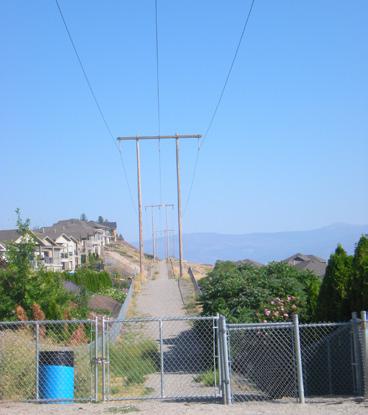
Examples:
Rotary Trails Park
Cobblestone Park
Powerline Trail (pictured)
Parking lot
Information kiosk/signage
Waste/recycling receptacles
Additional potential facilities:
» Gathering area
» Benches
» Washroom
» Bike rack
» Bike repair station
Wayfinding signage
Additional potential facilities:
» Parking or on-street parking
» Waste/recycling receptacle
» Gates/fencing
Table 4: Typical Trailhead Types
TRAIL
f Trailheads positioned throughout the community provide multiple entry points into the network and help users navigate and make use of recreational trails.
f Since 2013, the City has developed a number of trailheads throughout the community; however, there are opportunities for improvements and additions.
f Community input identified the addition of trail amenities as a priority, in particular, washroom access, parking, and waste receptacles, which are typical to trailhead locations.
f Design and amenities for trailheads should be guided by the future West Kelowna Parks & Recreational Trails Guidelines (see P4)
f Map A: Existing Trails Inventory (2023) shows locations of existing trailheads.
P5.1 As part of the Parks & Recreational Trails Asset Management Plan (see P2), develop and maintain a working list of trailhead additions or upgrades. See P2
P5.2 Target development and/or upgrade of an average of one trailhead per year (with associated development and operational increases) to enhance navigation and use of the network.
RELATED RECOMMENDATIONS
f P2 Asset Management & Resourcing (p.37)
f P4 Parks & Recreational Trails Guidelines (p.41)
f P6 Wayfinding & Signage (p.44)
f M2 Trail Maintenance (p.52)
$-$$$$/ year depending on scale and amenities
REFERENCE
f Parks Master Plan (2024)
WAYFINDING & SIGNAGE
Enhance the wayfinding and signage program to increase community awareness and access to information about the recreational trails network.
BACKGROUND & RATIONALE
f Wayfinding signage is a key asset that helps users navigate and enjoy recreational trails.
f A robust wayfinding and signage program includes both information a user can access before visiting and the physical signage encountered in the network.
f Typical wayfinding signage could include:
» Directional signage to support safe and effective navigation of the network.
» Regulatory signage informing people about regulations and permitted uses on recreational trails.
» Warning signage about hazards or other issues that could affect safety or use.
» Interpretive signage with relevant information about cultural, heritage, environmental, geological, or other aspects of the area.
f Online wayfinding could include up-to-date mapping tools.
f Opportunities may exist to collaborate with other jurisdictions on wayfinding efforts to benefit the larger recreational trails network.
f Community input indicated that residents are generally satisfied with the quality of existing signage, but would like more signage across the network. Feedback also indicated an interest in more maps, both digital and physical, that clearly articulate routes, level of difficulty, trailhead locations, amenities, and regulations.
TRAIL
PLANNING & DEVELOPMENT RECOMMENDATIONS

Example of wayfinding signage
P6.1 As part of the Parks & Recreational Trails Asset Management Plan (see P2), develop and maintain a working list of wayfinding additions or upgrades. See P2
P6.2 Develop a West Kelowna trails digital navigation tool.
P6.3 Include wayfinding signage in the City’s Parks & Recreational Trails Guidelines (See P4) See P4
P6.4 Develop an updated trails map that could be incorporated into wayfinding kiosks, signage, and print information.
P6.5 Complete priority signage additions or upgrades on an annual basis.
P6.6 Continue to name major trails to assist in recognition following the guidance of the Parks Naming Policy
RELATED RECOMMENDATIONS
f P2 Asset Management & Resourcing (p.37)
f P4 Parks & Recreational Trails Guidelines (p.41)
f P5 Trailheads (p.42)
Comms.
ONGOING Parks Comms. Staff Time
REFERENCE
P7
TRAIL PLANNING & DEVELOPMENT RECOMMENDATIONS
TRAIL
RATING & ACCESSIBILITY
Provide information about level of difficulty within the network and seek opportunities to increase accessibility in key locations.
BACKGROUND & RATIONALE
f A recreational trails network should provide an appropriate balance of effort and reward for users, with trails that have varied levels of difficultly, requiring different skill sets.
f Prior to 2013, West Kelowna’s trail system had no classification of trails according to difficulty, type of user, or design standards. The 2013 Recreational Trails Master Plan provided a foundation for trail difficulty ratings based on considerations like width, surfacing, and grade. Section 3.3 Trail Rating System provides updated information.
f Community input indicated opportunities to increase accessibility on select trails.
f Accessible design enables people of all ages and abilities to experience recreational trails by implementing measures to reduce or remove barriers.
f Identifying select trails (e.g., high-use trails or trails within neighbourhood centres or near destination parks) for accessibility improvements will create a more inclusive experience.
f Incorporating information about accessibility into wayfinding helps users select routes that match their abilities (see P6).
f External funding opportunities may be available for accessibility improvements.
P7.1 As a part of the baseline inventory and Parks & Recreational Trails Asset Management Plan include:
» Assignment of updated ratings to all existing trails
» Identification of potential accessibility upgrade projects See
P7.2 Include accessibility considerations within the Parks & Recreational Trails Guidelines by trail type (i.e., targeting select trails such as green rated trails or multi-use trails).
P7.3 Include or add trail ratings to recreational trails digital navigation tools and print-ready maps.
P7.4 Continue to engage with non-profit organizations to seek opportunities to improve accessibility on select trails.
RELATED RECOMMENDATIONS
f P2 Asset Management & Resourcing (p.37)
f P4 Parks & Recreational Trails Guidelines (p.41)
f P6 Wayfinding & Signage (p.44)
f P8 Trail Safety & Security (p.47)
REFERENCE
See P4
See P6
f Recreational Trails Master Plan Section 3.3 Trail Rating System (p.28)
f Parks Master Plan (2024)
f Council's Strategic Priorities (2022-2026)
TRAIL PLANNING & DEVELOPMENT
RECOMMENDATIONS
P8 TRAIL SAFETY & SECURITY
Undertake improvements to enhance safety and security on recreational trails.
BACKGROUND & RATIONALE
f Using recreational trails comes with inherent risks, especially where trails are in wilderness areas. While it is impossible to eliminate all risk, safety enhancement can support user comfort and experience.
f Safety on trails will be supported by several recommendations in this Plan including:
» P4 Parks & Recreational Trails Guidelines to incorporate safety considerations with future trail development guidelines
» P6 Wayfinding & Signage so users can navigate the network.
» P7 Trail Rating & Accessibility so users can understand if trails align with their abilities and the activities they wish to pursue.
» M2 Trail Maintenance to support ongoing care of network assets.
» M3 Trail Use Guidelines & Codes of Conduct to increase awareness about appropriate use in the network and sharing trails with others.
f Community input indicated the following ideas to support safety for recreational trails:
» Select trail upgrades in steep areas to manage slope and erosion issues.
» Additional amenities such as lighting at trailheads or in key connections.
» Updates to reduce potential of user conflicts through clear use guidelines or design improvements such as lay-bys that allow users to pass safely.
» Increased information about potential risks on trails (e.g., potential to encounter wildlife, poisonous vegetation, unstable surfacing, other users, etc.)
P8.1 Include safety guidance for recreational trails within the City’s Parks & Recreational Trails Guidelines (see P4) and include these considerations in all new or upgrade projects. See P4
P8.2 Post information about potential risks in the network through online information and signage as they are identified following Municipal Insurance Association of British Columbia (MIABC) recommendations.
RELATED RECOMMENDATIONS
f P4 Parks & Recreational Trails Guidelines (p.41)
f P6 Wayfinding & Signage (p.44)
f P7 Trail Rating & Accessibility (p.46)
f M2 Trail Maintenance (p.52)
f M3 Trail Use Guidelines & Codes of Conduct (p.54)
REFERENCE
f Parks Master Plan (2024)

Mount Boucherie multi-use pathway
TRAIL MANAGEMENT RECOMMENDATIONS
4.2.2 TRAILS MANAGEMENT
Effective management of recreational trails helps support and maintain the network to minimize conflict and maximize benefits. Management includes both physical maintenance, along with clear guidance on permitted uses and sharing of the network.
A trails management program supports the following objectives:
f Trail user safety;
f Risk management and liability;
f Protection of the environment;
f Ongoing provision of convenient recreation access;
f Protection of investments; and
f Attraction of new users, tourism, and economic development.
This section outlines recommendations for managing the recreational trails network so it continues to provide long-term community benefit.
5
TRAILS MANAGEMENT RECOMMENDATIONS
M1 Environmental Management
M2 Trail Maintenance
M3 Trail Use Guidelines & Codes of Conduct
M4 Pets on Trails
M5 Volunteers & Organizations
ENVIRONMENTAL MANAGEMENT
Plan and manage recreational trails in a way that respects the natural environment.
BACKGROUND & RATIONALE
f Recreational trails often occur in natural areas – and a key part of their value is permitting people to immerse themselves in nature. This means that a fundamental aspect of sustainable trail management is environmental stewardship to avoid, minimize, and/or mitigate adverse impacts to sensitive ecosystems, species at risk, soils, water, wildlife, and vegetation.
f While recreational trails use is typically considered a low-impact recreation activity, issues like unauthorized trail building, routing through sensitive areas, misuse or overuse, littering, vandalism, and other activities can compromise the natural environment.
f Environmental impacts are compounded by climate change which can increase risks such as erosion, drought, wind-induced tree losses, and wildfire hazard.
f Community input indicates that environmental enhancement and protection are priorities for West Kelowna residents, including ongoing protection of iconic natural areas like Mount Boucherie where the recreational trails network provides access through sensitive landscapes.
f Residents also indicated a desire for more information about the natural environment and the importance of protecting natural spaces.
f Key activities that can support environmental management of recreational trails include:
» Reviewing and either formalizing or closing unsanctioned informal trails.
» Developing a maintenance approach for reviewing and making changes to existing recreational trails.
» Rerouting or closing trails through sensitive areas.
» Developing and implementing clear design guidelines with environmental protection considerations for future trail development or upgrades. See P4 Parks & Recreational Trails Guidelines
» Clearly defining appropriate uses and behaviours for the trails network. See M3 Trail Use Guidelines & Codes of Conduct.
» Enhancing environmental awareness and appreciation through education and interpretation.
» Supporting involvement of others in trail stewardship and environmental protection initiatives. See M5 Volunteers & Organizations
TRAIL MANAGEMENT RECOMMENDATIONS

M1.1 Include environmental management considerations within the Parks & Recreational Trails Guidelines (see Parks & Recreational Trails Guidelines).
M1.2 As part of recreational trail maintenance planning (see M2), include identification of trails with environmental impacts and make plans to reduce these impacts.
M1.3 Define and clearly communicate appropriate uses and regulations for recreational trails (see M3).
RELATED RECOMMENDATIONS
f P4 Parks & Recreational Trails Guidelines (p.41)
f P5 Trailheads (p.42)
f M2 Trail Maintenance (p.52)
f M3 Trail Use Guidelines & Codes of Conduct (p.54)
f M4 Pets on Trails (p.56)
f M5 Volunteers & Organizations (p.57)
REFERENCE
f Parks Master Plan (2024)
See P4
See M2
See M3
f Corporate Climate Action Plan (2023)
f Council's Strategic Priorities (2022-2026)
f Official Community Plan (2023)
Powers Creek
TRAIL MANAGEMENT RECOMMENDATIONS
M2 TRAIL MAINTENANCE
Develop and implement a systematic approach to maintaining recreational trails.
BACKGROUND & RATIONALE
f Like any infrastructure asset, recreational trails must be maintained to minimize deterioration/loss and support public safety. As the network grows, maintenance needs increase. Ongoing maintenance is required for both risk mitigation and insurance purposes.
f Community input indicates resident support for enhanced trails maintenance.
f A maintenance program assigns regular maintenance activities to each trail component based on trail type and use. Generally, trails through natural areas require less frequent maintenance than trails in more urban settings.
f The 2013 Recreational Trails Master Plan included an action to develop maintenance standards for each type of trail in the recreational network. A maintenance standard, combined with a comprehensive database of trails assets (see P2 Asset Management & Resourcing), is an effective tool for forecasting and estimating trail maintenance requirements.
f A maintenance program could include:
» Identification of regular maintenance activities such as trail resurfacing and repairs, waste/recycling bin emptying, litter pick-up, signage and furnishing maintenance, vegetation management, sweeping, and/or snow removal, along with frequency of relevant activities for each existing trail, based on trail type and level of use. Seasonal use considerations should be included when establishing a maintenance program.
» Frequency and timing of trails monitoring, depending on trail type and level of use.
» Monitoring inspection guidelines or checklists to be used during reviews.
» A rating scale and criteria for setting trail upgrade priorities. Criteria may include aspects like safety, environmental impacts, level of use, scale of deterioration, and public input.
» Identification of informal and unauthorized routes that may warrant consideration either for formalization or closure and rehabilitation.
» A priority list of trail upgrade projects. These would include projects that require a higher level of effort than day-to-day maintenance can provide, such as realignments, replacement of infrastructure (e.g., stairs), resurfacing, closure and rehabilitation, or other major upgrade projects.
TRAIL MANAGEMENT RECOMMENDATIONS
MAINTENANCE CONSIDERATIONS
f Practice environmentally-sound maintenance in all areas.
f Remove brush vegetation within the clear zone as needed to manage wildfire risk and address Crime Prevention Through Environmental Design (CPTED).
f Inspect trails for erosion, trail braiding, or water flowing down the trail, and repair trails as needed to manage these conditions.
f Clear natural debris, remove plants growing on the trail surface, restore the surface as needed, clear and maintain drainage features, and repair structures such as signs, railing, bridges, and steps.
f In natural areas, include the following maintenance practices:
» Manage vegetation along trails with the objectives of ecological protection and enhancement balanced with the provision of safe and comfortable user experiences.
» Remove unauthorized structures and block redundant trails. Use coarse woody debris or other natural materials to decommission unsanctioned trails.
» Set up environmental monitoring sites in locations with known concerns in order to quantify damage and monitor results of improvements or repairs.
M2.1 Assign funding and staffing to support ongoing monitoring and maintenance activities for the recreational trails network.
M2.2 Following from the Parks & Recreational Trails Asset Management Plan (see P2 and Parks Master Plan), develop a detailed Trails Monitoring & Maintenance Program that categorizes recreational trails by trail type (i.e., major multi-use, narrow multi-use, nature trail) and use, and assigns expected monitoring and maintenance tasks and frequencies.
RELATED RECOMMENDATIONS
f P2 Asset Management & Resourcing (p.37)
f P8 Trail Safety & Security (p.47)
f M1 Environmental Management (p.50)
REFERENCE
f Parks Master Plan (2024)
M3 TRAIL USE GUIDELINES & CODES OF CONDUCT
Formalize and communicate trail use guidelines and codes of conduct for West Kelowna’s recreational trails.
BACKGROUND & RATIONALE
f All of West Kelowna’s existing recreational trails are shared use trails. Given the more urban location of the trails (as opposed to the backcountry Crown land networks), the primary users of West Kelowna’s recreational trails are walkers, hikers, and dog-walkers, with more limited numbers of recreational rollers and mountain bikers depending on trail type. Some participants also reported cross-country skiing.
f Motorized uses on West Kelowna’s recreational trails are not permitted.
f When trails are shared by different user groups, conflict can occur. While reported conflicts are currently low, as the community grows, more residents and visitors will be sharing the network.
f Evolving technologies such as electricpowered devices (e.g., e-bikes and e-scooters) are becoming increasingly popular in West Kelowna.
f The growing use of electric-powered devices will increasingly affect recreational trails, for example, speed/interface of e-devices with other user groups, infrastructure impacts such as compaction and erosion, and increased need for monitoring and enforcement.
f A clearly defined trails code of conduct is an effective strategy to manage trail use and mitigate user conflict. A code of conduct establishes how people are intended to use and share specific trails, including:
» Permitted and restricted uses, e.g., nonmotorized/motorized uses, biking, dog activity, electric powered devices, etc.
» Environmental protection practices, e.g., staying on the trail, no unauthorized trail building, etc.
» User interaction practices, e.g., user group hierarchy.
» Best practices and trail etiquette, e.g., safety considerations and behavioural practices such as pack-in, pack-out, dog waste management, etc.
See Appendix B for examples of code of conduct practices.
f The City currently provides code of conduct information at select trailheads such as the Mount Boucherie Park trails network. This information is a starting point to refining code of conduct and communicating information more broadly throughout the network.
f Participants ranked establishing code of conduct and trail use guidelines within their top three priorities for recreational trails.
TRAIL MANAGEMENT RECOMMENDATIONS

Use and code of conduct signs at Mount Boucherie Park
M3.1 Establish trail use guidelines and code of conduct information for the different trail types within the recreational trails network and make this information available via the City website, Recreation Guide, and other typical communications materials.
LONG Parks Recreation Comms. Staff Increase
M3.2 During future wayfinding projects (see P6), incorporate code of conduct information throughout the network. See P6
M3.3 Continue to monitor emerging trends in trail user technologies (e.g., e-assist, e-bikes, etc.) and research and consider policy updates to manage potential for conflict. ONGOING Parks Staff Time
RELATED RECOMMENDATIONS
f P6 Wayfinding & Signage (p.44)
f P7 Trail Rating & Accessibility (p.46)
f M1 Environmental Management (p.50)
f M4 Pets on Trails (p.56)
REFERENCE
f Recreational Trails Master Plan (2024), Appendix B
TRAIL MANAGEMENT RECOMMENDATIONS
M4 PETS ON TRAILS
Develop a trails network that accommodates both dog owners and non-owners and protects the environment.
BACKGROUND & RATIONALE
f The presence and management of dogs on trails can be a contentious topic. Many who own dogs often desire more access to off-leash opportunities due to the health and social benefits for both people and their pets; however, some people who have had poor experiences or are afraid of dogs communicate a desire for spaces where dog interactions can be avoided.
f Current practices are for dogs to be on-leash in all City and RDCO Parks, except in designated off-leash areas. This includes the recreational trails network.
f Increasing accommodation of pets on trails must be balanced with safety, environmental management, and potential for damage to facilities.
f Engagement input identified dog exercise as one of the top activities on West Kelowna's recreational trails. Participants in the Trails Ideas Questionnaire indicated an interest in increasing the number of dog off-leash trails in the community, where residents can walk or hike with their pet off-leash.
f Feedback also indicated a desire for better management of dogs on trails to limit potential conflicts and trail impacts.
f In the process, a range of candidate locations were identified that could be suitable for dog off-leash trails. Each location would need to be carefully considered for suitability:
» Casa Palmero Park
» Eain Lamont Park
» Faulkner Creek Park
» Gates Grove Park
» Glen Canyon Park (municipal section or coordination with RDCO for regional park)
» Rock Ridge Park
» Rose Ridge Park
» Sandstone Park
» Tallus Ridge Trails
» Powerline Walkway
f If off-leash trails are explored, a communications strategy and signage should be developed to provide information about trail use, conflicts, and responsibilities.
M4.1 Seek to pilot one designated dog off-leash trail within the recreational trails network. Monitor trail use and function.
M4.2 Incorporate dog management within code of conduct information for recreational trails (see M3).
RELATED RECOMMENDATIONS
f M1 Environmental Management (p.50)
f M3 Trail Use Guidelines & Codes of Conduct (p.54)
REFERENCE
f Parks Master Plan (2024)
See M3
TRAIL MANAGEMENT RECOMMENDATIONS
M5 VOLUNTEERS & ORGANIZATIONS
Consider opportunities to engage organizations and individuals in support of the recreational trails network.
BACKGROUND & RATIONALE
f Volunteer programs can support municipal resources, create solid community partnerships, provide energy for initiatives, encourage public involvement, and build civic pride; however, management of volunteer programs also require significant support and time from City staff to administer.
f Volunteer programs are only successful when sufficient staff resources are dedicated to supporting the programs and there needs to be careful consideration about benefits for all parties involved.
f Community members are passionate about the trails network, and opportunities may exist to engage external organizations or individuals in support of maintaining the system.
f Public input indicated that trail users may be willing to assist with trail planning, trail construction, stewardship, maintenance, monitoring, conflict resolution, and marketing.
f Specific organizations like the School District use recreational trails for school programs, and opportunities may exist for collaborations.
f The Parks Master Plan includes a recommendation for developing a parks volunteer plan/program. Potential for trails volunteering opportunities could be incorporated.
RESOURCING
M5.1 Include consideration for recreational trails volunteer opportunities within an overall parks volunteer plan/ program. Refer to Parks Master Plan
M5.2 Meet with SD23 to discuss current program use of the recreational trails network and identify opportunities for potential collaborations. SHORT Parks SD23 Staff Increase
RELATED RECOMMENDATIONS
f M1 Environmental Management (p.50)
f M2 Trail Maintenance (p.52)
f C7 Support for Crown Land Trail Initiatives (p.67)
f C8 Support for Partner Trail Initiatives (p.68)
REFERENCE
f Parks Master Plan (2024)

4.2.3 CAPITAL PROJECTS
Through engagement, including this process and others, the community has identified a range of pedestrian and cycling connections that they desire for West Kelowna’s future. Many of these linkages will be located within transportation rights-of-way and are addressed in the Transportation Master Plan as active transportation routes (see Section 1.4 Defining Recreational Trails). However, there are a number of recreational trail routes that also warrant consideration and are detailed here.
The recommendations in this section include projects focused on addressing key connections that have a recreation focus. All projects identified will require further planning and analysis, budget development, and may require land acquisition.
Goats Peak Trails Network
CAPITAL PROJECT RECOMMENDATIONS
C1 GOATS PEAK TRAILS NETWORK
As development occurs in the Goats Peak area, secure a linked trails network that connects to trails in adjacent Regional Parks and neighbourhoods.
BACKGROUND & RATIONALE
f The Goats Peak area has long been a popular hiking area with scenic viewpoints over Okanagan Lake. There is high public interest in preservation of natural areas and trails in this area.
f The approved Goats Peak Comprehensive Development Plan lays out a trails connectivity network for the future neighbourhood and a covenant has been secured by the City for the trail routes identified.
f The trails will be constructed as development in the area proceeds and will ultimately become part of the City's recreational trails inventory.
f The future trails will feature:
» Connections into exiting trails networks in Glen Canyon Regional Park, Goats Peak Regional Park, and Gellatly Heritage Regional Park.
» Connection to an upgraded multi-use trail along Gellatly Road.
» A range of recreational experiences for diverse users and various abilities.
C1.1 Require recreational trails and amenities be completed as development of the Goats Peak neighbourhood progresses and maintain the trails once they are added to the network in compliance with standards and guidelines.
RELATED RECOMMENDATIONS
f P2 Asset Management & Resourcing (p.37)
Information is for planning purposes only. Lines indicated are not verified and should not be interpreted as a literal representation of existing conditions.
REFERENCE
f Goats Peak Comprehensive Development Plan (2017)
Glen Canyon Regional Park
Gellatly Heritage Regional Park
Goats Peak Development Area
CAPITAL PROJECT RECOMMENDATIONS
C2 WATERFRONT TRAIL
Collaborate with active transportation and others to work towards a linked waterfront trail from Bennett Bridge to Peachland.
BACKGROUND & RATIONALE
f Trail 2000 was a long-term community vision to establish the Trail of the Okanagans — a multi-use waterfront trail to connect from Bennett Bridge to Peachland. Since that time, a range of City and Regional initiatives continue to identify this key connection as a priority.
f Public input continues to prioritize waterfront experiences. There is strong community desire to connect waterfront areas into the trails network, including extension of existing waterfront trails.
f The existing Gellatly Bay Recreational Corridor is a portion of the larger envisioned waterfront trail.
f While most of this future linkage will be an active transportation route, recreational trail components and connections may be required.
f Refer to the Transportation Master Plan for routing and costing information.
C2.1 Continue to collaborate on opportunities for waterfront trail development.
C2.2 Allocate staff time to support waterfront trail initiatives. ONGOING
RELATED RECOMMENDATIONS
f P1 Recreational Trails Scope (p.36)
f P2 Asset Management & Resourcing (p.37)
REFERENCE
f Transportation Master Plan (2024)
f Parks Master Plan (2024)
f Waterfront Plan (2011)
CAPITAL PROJECT RECOMMENDATIONS
C3 FLUME TRAIL
As development continues in Smith Creek, formalize the Flume Trail.
BACKGROUND & RATIONALE
f The Smith Creek area has several informal east-west trail connections, including the existing Flume Trail; however, a formal route has not been established.
f Over the years, community input has indicated that a continuous offroad connection from Glen Canyon to the Rose Valley neighbourhood is desirable. The existing informal Flume Trail would be a key component.
f The OCP indicates future development in this area. To maintain eastwest connectivity, the Smith Creek Comprehensive Development Plan shows a pedestrian connection near the informal Tallus Flume route.
f As development proceeds, securing and developing a high-quality, linked recreational trail is a high priority.
f In addition to the main trail, rights-of-way between the street network, parks (e.g., Smith Creek Greenway, Powerline Walkway), and the new trail should be prioritized to provide many opportunities for access. ANTICIPATED
Information is for planning purposes only. Lines indicated are not verified and should not be interpreted as a literal representation of existing conditions.
C3.1 Require recreational trails and amenities to be completed as development of the Smith Creek neighbourhood progresses and maintain the trails once they are added to the network.
C3.2 Ensure future development plans include multiple access points between the street network and the Flume Trail in the Smith Creek neighbourhood.
RELATED RECOMMENDATIONS
f P2 Asset Management & Resourcing (p.37)
ONGOING
REFERENCE
Staff Increase (upon development)
Dev. Services Eng. Staff time
f Smith Creek Comprehensive Development Plan (2020)
Smith Creek
Smith Creek Development Area
Smith Creek Development Area
Smith Creek Greenway
PowerlineWalkway
Smith Creek Recreational Trails
SmithCreek Rd
C4 MOUNT BOUCHERIE TRAILS
Consider opportunities to support ongoing management of trails on Mount Boucherie.
ANTICIPATED
BACKGROUND & RATIONALE
f On Mount Boucherie, the City owns and manages:
» Mount Boucherie Park, which includes the west summit and west and south slopes of the mountain. Formalized trails, including Flint Man, Boucherie Rush, and Andesite Grinder are within the park.
» Eain Lamont Park, a large natural area on the east side of Mount Boucherie with trailhead access.
» Vineyard View Park on the south side of the mountain with trailhead access and trail connections.
» Mount Boucherie Community Centre and Arenas at the base of the north side of the mountain, where people access the informal Crown trails.
» Four trailheads: Darroch Park, East Boundary Road, Cabernet Way, and Eain Lamont Park.
f Most of the remaining summit and slopes are Crown lands with informal trails that are not maintained.
f Visitors often explore both Mount Boucherie Park and Crown land trails and there is public interest in continued preservation of natural areas and ongoing recreational access, as well as potential improvements for maintenance and management.
f Because part of the trails network is outside the City’s municipal parkland area, collaboration would be needed with the province and partners to consider trails management in these areas.
f Extensive new trail development on Mount Boucherie is not anticipated; however, opportunities to enhance existing recreational trails could include:
» Alignment improvements for Andesite Grinder trail.
» Continued development of connections and access from surrounding development into the trails network.
» Consideration for formalizing a loop that includes trails within City parks, Crown land trails, and improved connectivity between them.
» Trail restoration and mitigation of trail braiding through trail management.
CAPITAL PROJECT RECOMMENDATIONS
Information is for planning purposes only. Lines indicated are not verified and should not be interpreted as a literal representation of existing conditions.
C4.1 Undertake re-routing and improvements on Andesite Grinder Trail (City owned) on Mount Boucherie.
C4.2 Engage with the Province and partners regarding ongoing management of the informal trails on Mount Boucherie.
C4.3 If agreements are reached supporting ongoing management of the informal trails on Mount Boucherie, consider a new trailhead and formalized connections to Mount Boucherie Community Centre.
C4.4 Continue maintenance, improvements, and management of Mount Boucherie Trails to limit trail braiding and address damages.
f P2 Asset Management & Resourcing (p.37)
f Parks Master Plan (2024)
Eain Lamont Park
Mount Boucherie Park
Andesite Grinder
Flint Man BoucherieRush
Crown Land Area
Mount Boucherie Community Centre and Arenas
Hwy97
Ross Rd
Pinot Noir Dr
Trevor Dr
C5
ROCK RIDGE PARK TRAILS
As development continues in the Rose Valley neighbourhood, formalize trails leading from the existing undeveloped parkland in Rock Ridge Park.
BACKGROUND & RATIONALE
f Rock Ridge Park is undeveloped parkland used by the community for walking/hiking, dog walking, and nature appreciation.
f Community residents have requested that this area be formalized for recreational use.
f Active community volunteer groups have expressed interest in participating in the construction of trails and a staircase.
f The City's Channel Recovery Project in 2023 included the reconstruction of approximately 250 metres of degraded channel bed and banks damaged by flooding in 2017. Work to mitigate flood risks included the removal of debris and resulted in the removal of the previous walkway.
Information is for planning purposes only. Lines indicated are not verified and should not be interpreted as a literal representation of existing conditions.
C5.1 Formalize trails leading from the existing undeveloped parkland in Rock Ridge Park.
RELATED RECOMMENDATIONS
f P2 Asset Management & Resourcing (p.37)
REFERENCE
f Official Community Plan (2023)
f Parks Master Plan (2024)
C6
CAPITAL PROJECT RECOMMENDATIONS
OTHER RECREATIONAL TRAIL PROJECTS
Continue to add linkages within existing or future parks or other locations that help fill gaps and make connections in the recreational trails network.
BACKGROUND & RATIONALE
f Community input identified an interest for increasing access points into existing trails networks and in park spaces throughout the community.
f Typically smaller in size, these routes could be added as new subdivisions are developed or through regular City investment in existing parks or other public lands.
f These routes could be identified through the inventory work developed as part of the Parks & Recreational Trails Asset Management Plan (see P2), through ongoing operational and maintenance reviews, and from community input.
C6.1 As part of the Parks & Recreational Trails Asset Management Plan (see P2), develop and maintain a working list of potential new linkages. Following the work of the inventory, develop a prioritized list of minor recreational trail additions.
C6.2 Undertake development of recreational trail linkages to complete gaps in the network based on priority areas identified.
C6.3 Review all new subdivision proposals to identify opportunities for off-road trails linkages within new development areas.
RELATED RECOMMENDATIONS
f P2 Asset Management & Resourcing (p.37)
REFERENCE
f Official Community Plan (2023)
f Parks Master Plan (2024)
C7 SUPPORT FOR CROWN LAND TRAIL INITIATIVES
Continue to support others interested in seeking authorizations to manage trails within Crown land areas.
ANTICIPATED
BACKGROUND & RATIONALE
f The Crown land trails networks in the hillsides above West Kelowna are a valued recreational amenity.
f Since the 2013 Recreational Trails Master Plan, Recreation Sites and Trails BC have authorized the Smith Creek and Rose Valley Recreational Trails networks. These networks are operated by the West Kelowna Trail Crew Society (Society), a non-profit organization that advocates for mountain biking and supports maintenance and management within the authorized area.
f The City of West Kelowna plays a supporting role through contributions to the Society and providing support for trailheads and signage.
f Through engagement, participants identified several informal networks that are well-used in the area, including:
» McDougall Rim Trails
» Carrot Mountain Trails
» Powers Creek Trails
» Drought Mountain Trails
f While the City's recreational trails efforts will focus on areas within the City's growth boundary, supporting others interested in advancing Crown land trail initiatives outside the City’s growth boundary may warrant consideration.
C7.1 Consider opportunities to support others in processes to authorize key existing informal Crown land trails.
C7.2 Continue to provide public information about authorized trails networks that are managed by others.
RELATED RECOMMENDATIONS
f M5 Volunteers & Organizations (p.57)
REFERENCE
f Recreational Trails Master Plan Section 2.2.4 Trails On Crown Land (p.18)
CAPITAL PROJECT RECOMMENDATIONS
C8 SUPPORT FOR PARTNER TRAIL INITIATIVES
Continue to support partners interested in developing and managing recreational trails that benefit West Kelowna residents.
ANTICIPATED
BACKGROUND & RATIONALE
f West Kelowna residents have access to trails that are owned and managed by partners and neighbours including the Regional District of Central Okanagan (RDCO), Westbank First Nation, neighbouring municipalities, School District 23, and non-profit organizations.
f Community input indicates a desire for enhanced linkages into existing networks.
f Coordination with others who manage these assets supports recreational trails connectivity in the City as well as across the region.
f Key areas of interest identified by participants in this process include:
» An enhanced connection between the Glenrosa and Smith Creek neighbourhoods through Glen Canyon.
» A continuous connection through Glen Canyon from the upper Glen Canyon Regional Park to Gellatly Bay.
» Waterfront lands (adjacent to Shannon Lake and along Okanagan Lake).
C8.1 Support implementation of connections to trails managed by others where they intersect with the City's recreational trails network.
C8.2 Participate in collaborations with partners that have trails connectivity interests to share information and coordinate with goals of achieving an integrated recreational trails network.
RELATED RECOMMENDATIONS
f M5 Volunteers & Organizations (p.57)
WFN
Parks RDCO
ONGOING
REFERENCE
Support to Others
WFN
SD23
Others Staff Time
f Recreational Trails Master Plan Section 2.2 Existing Trails System (p.15)
f Council's Strategic Priorities (2022-2026)
f Official Community Plan (2023)
4.3 Action Summary Tables
The Action Summary Tables in this section provide a categorized list of recommended actions for West Kelowna’s recreational trails network. This summary is based on detailed directions outlined in the previous Section 4.2 Detailed Recommendations.
The Implementation Summary Tables in this section are categorized by timeframe:
f Short-term (one- to five-year timeframe)
f Medium-term (six- to ten-year timeframe)
f Long-term (over a ten-year timeframe)
f Ongoing (No defined timeframe, ongoing)
Each year staff should review recommended actions, consider inflation or other cost impacts, and prepare strategies for funding and implementing priority projects. All the recommended actions in the Plan are important, and should opportunity arise, Council consideration to complete a project sooner than its suggested timeframe may be warranted.
TABLE COMPONENTS
f REF#: Each recommendation in the Implementation Summary Tables is referenced with a corresponding number. This reference guides the reader to the detailed recommendation (e.g.,P2.2 correlates to Recommendation #P2, Action #2).
f RECOMMENDED ACTION: A brief description of the action. The reference number can be used to cross-reference the action for additional detail.
f RESOURCING: An estimated budget range for planning purposes (for projects with capital budget requirements). Where capital budget is not anticipated, “Staff Time” or other costs are noted.
The legend of budget symbols are as follows:
» $ = <$50,000
» $$ = $50,000 - $100,000
» $$$ = $100,000 - $250,000
» $$$$ = $250,000 - $500,000
» = Staff Time (existing capacity)
» = Staff Increase
» = Support to Others
f OTHER PLANS: Other plans that support and/ or are aligned with the identified action.
f POTENTIAL FUNDING SOURCES: Potential funding strategies discussed in Section 5.2 Funding Strategies that may warrant consideration when implementing the action. It should be recognized that some actions may be contingent on alternative funding sources and would be undertaken only when funding has been secured.
4.3.1 SHORT-TERM ACTIONS
Short-term actions were prioritized due to:
(2024-2028)
f Garnering significant input during the engagement process;
f Potential to have high positive impact on the trails system in West Kelowna, linking key destinations and/or filling gaps;
f Potential to be affected by change/development in the near future including linkages at risk of being lost;
f Need for completion as a first step in a phased implementation process; and/or
f Opportunity or funding that currently exists to support implementation.
Table 5: Short-Term Actions Implementation Summary
P1 Recreational Trails Scope (p.36)
P1.1
Update City procedures to continue to clarify the active transportation and recreational trails purview.
P2 Asset Management & Resourcing (p.37)
P2.1
P2.2
P2.3
Establish a Recreational Trails operational budget line item specific to this service.
Consider a staff position specific to operation and management of recreational trails.
Undertake a comprehensive baseline inventory for recreational trails to inform the Parks & Recreational Trails Asset Management Plan.
P2.4
P2.5
Incorporate recreational trails as part of an initial Parks & Recreational Trails Asset Management Plan (refer to the Parks Master Plan, Q5.2).
Based on Parks & Recreational Trails Asset Management Plan outcomes, review and adjust annual recreational trails budgets.
P4 Parks & Recreational Trails Guidelines (p.41)
P4.1
Incorporate updated recreational trails guidelines within the West Kelowna Parks & Recreational Trails Design Guidelines.
Plan
M2 Trail Maintenance (p.52)
M2.1
Assign funding and staffing to support ongoing monitoring and maintenance activities for the recreational trails network.
M5
Volunteers & Organizations (p.57)
M5.1
M5.2
Include consideration for recreational trails volunteer opportunities within an overall parks volunteer plan/program.
Meet with SD23 to discuss current program use of the recreational trails network and identify opportunities for potential collaborations.
C4 Mount Boucherie Trails (p.63)
C4.1
Undertake re-routing and improvements on Andesite Grinder Trail (City owned) on Mount Boucherie.
C5 Rock Ridge Park Trails (p.65)
C5.1
Formalize trails leading from the existing undeveloped parkland in Rock Ridge Park.
4.3.2 MEDIUM-TERM ACTIONS
(2029-2033)
Medium-term actions were prioritized due to:
f Garnering significant input during the engagement process;
f Potential to require more extensive design, planning, and accumulation of funding resources prior to completion than short-term recommendations;
f Not likely at risk of being compromised due to change/development in the immediate future, but should be monitored;
f Future land development in these areas may support trail development; and/or
f Potential for funding to be available in the medium-term to implement the project.
Medium-term actions may warrant consideration for earlier completion if opportunity or funding permit.
P3 Trails on Private Lands (p.39)
P3.2
Research urban agricultural trail precedents and practices including Agricultural Land Reserve (ALR)/Agricultural Land Commission (ALC) permissions to consider if and how such trails could exist in West Kelowna and the City’s potential role(s).
P6 Wayfinding & Signage (p.44)
P6.2
P6.4
Develop a West Kelowna trails digital navigation tool.
Develop an updated trails map that could be incorporated into wayfinding kiosks, signage, and print information.
M4 Pets on Trails (p.56)
M4.1
Seek to pilot one designated dog off-leash trail within the recreational trails network. Monitor trail use and function.
C4 Mount Boucherie Trails (p.63)
C4.2
Engage with the Province and partners regarding ongoing management of the informal trails on Mount Boucherie.
Table 6: Medium-Term Actions Implementation Summary
4.3.3 LONG-TERM ACTIONS
Long-term actions are:
(beyond 2033)
f Identified as desirable but considered lower priority;
f Require longer range planning as well as longer-term accumulation of funding resources; and/or
f Not at the risk of being compromised due to change/development in the short-term or medium term, but should be monitored.
Long-term actions may warrant consideration for earlier completion if opportunity or funding permit. It is anticipated the Recreational Trails Master Plan will be updated in the long-term to review accomplishments to date and realign outstanding priorities with the needs of the community at that time.
M2
Trail Maintenance (p.52)
M2.2
Following from the Parks & Recreational Trails Asset Management Plan (see P2 and Parks Master Plan), develop a detailed Trails Monitoring & Maintenance Program that categorizes recreational trails by trail type (i.e., major multi-use, narrow multi-use, nature trail) and use, and assigns expected monitoring and maintenance tasks and frequencies.
M3 Trail Use Guidelines & Codes of Conduct (p.54)
M3.1
Establish trail use guidelines and code of conduct information for the different trail types within the recreational trails network and make this information available via the City website, Recreation Guide, and other typical communications materials.
C4 Mount Boucherie Trails (p.63)
C4.3
If agreements are reached supporting ongoing management of the informal trails on Mount Boucherie, consider a new trailhead and formalized connections to Mount Boucherie Community Centre.
C6 Other Recreational Trail Projects (p.66)
C6.1
As part of the Parks & Recreational Trails Asset Management Plan (see P2), develop and maintain a working list of potential new linkages. Following the work of the inventory, develop a prioritized list of minor recreational trail additions.
Table 7: Long-Term Actions Implementation Summary
4.3.4 ASSET MANAGEMENT ACTIONS
Asset management actions include investments that are recommended for regular capital investment and ongoing operational projects for the life of the Plan.
Table 8: Asset Management Implementation Summary
P1 Recreational Trails Scope (p.36)
P1.2
Conduct a regular meeting of City staff responsible for implementing the Transportation Master Plan and Recreational Trails Master Plan to review respective priority projects, identify synergies, and coordinate delivery of integrated network improvements.
P2 Asset Management & Resourcing (p.37)
P2.6
Undertake regular reviews/updates of the Parks & Recreational Trails Asset Management Plan (e.g., every 3-5 years).
P3 Trails on Private Lands (p.39)
P3.1
Where landowners express interest/ willingness to permit public access through private lands, collaborate with the landowner to determine appropriate agreement arrangements and, where needed, address issues around liability, management, and responsibilities.
P4 Parks & Recreational Trails Guidelines (p.41)
P4.2
Provide the updated Parks & Recreational Trails Design Guidelines to all parties involved in projects that will be ultimately maintained by Parks.
P5 Trailheads (p.42)
P5.2
Target development and/or upgrade of an average of one trailhead per year (with associated development and operational increases) to enhance navigation and use of the network. $-$$$$/ year depending on scale and amenities
Parks Master Plan
Municipal Taxation, Grant Funding, DCCs, Other DevelopmentRelated Funding, Donations & Bequests
P6 Wayfinding & Signage (p.44)
P6.5
P6.6
Complete priority signage additions or upgrades on an annual basis.
Continue to name major trails to assist in recognition following the guidance of the Parks Naming Policy. Staff Time
P7 Trail Rating & Accessibility (p.46)
P7.4
Taxation, Other DevelopmentRelated Funding
Naming Policy -
Continue to engage with non-profit organizations to seek opportunities to improve accessibility on select trails. Staff Time 2024 Parks Master Plan OCP Partnerships
P8 Trail Safety & Security (p.47)
P8.2
Post information about potential risks in the network through online information and signage as they are identified following Municipal Insurance Association of British Columbia (MIABC) recommendations. Staff Time
M3 Trail Use Guidelines & Codes of Conduct (p.54)
M3.3
Continue to monitor emerging trends in trail user technologies (e.g., e-assist, e-bikes, etc.) and research and consider policy updates accordingly. Staff Time
C1 Goats Peak Trails Network (p.60)
C1.1
Require recreational trails and amenities be completed as development of the Goats Peak neighbourhood progresses and maintain the trails once they are added to the network in compliance with standards and guidelines.
C2 Waterfront Trail (p.61)
C2.1
C2.2
Staff Increase (upon development) 2017 Goats Peak Comprehensive Development Plan
Continue to collaborate on opportunities for waterfront trail development. Staff Time
Allocate staff time to support waterfront trail initiatives. Staff Increase
Trans. Master Plan
Taxation, DCCs, Subdivision, Other DevelopmentRelated Funding
Taxation, Grants, Parcel Tax
Taxation, Departmental Coordination
C3 Flume Trail (p.62)
C3.1
C3.2
Require recreational trails and amenities to be completed as development of the Smith Creek neighbourhood progresses and maintain the trails once they are added to the network.
Staff Increase (upon development)
2020 Smith Creek Comprehensive Development Plan Municipal Taxation, DCCs, Subdivision, Other DevelopmentRelated Funding
Ensure future development plans include multiple access points between the street network and the Flume Trail in the Smith Creek neighbourhood. Staff Time Departmental Coordination
C4 Mount Boucherie Trails (p.63)
C4.4
Continue maintenance, improvements, and management of Mount Boucherie Trails to limit trail braiding and address damages.
C6 Other Recreational Trail Projects (p.66)
C6.2
C6.3
Undertake development of recreational trail linkages to complete gaps in the network based on priority areas identified.
Partnerships
Municipal Taxation, Grants, DCCs, Subdivision
Review all new subdivision proposals to identify opportunities for off-road trails linkages within new development areas. Staff Time OCP Subdivision Bylaw Subdivision, Other DevelopmentRelated Funding
C7 Support for Crown Land Trail Initiatives (p.67)
C7.1
C7.2
Consider opportunities to support others in processes to authorize key existing informal Crown land trails. Support to Others Partnerships
Continue to provide public information about authorized trails networks that are managed by others. Staff Time -
C8 Support for Partner Trail Initiatives (p.68)
C8.1
C8.2
Support implementation of connections to trails managed by others where they intersect with the City's recreational trails network. Support to Others Partnerships
Participate in collaborations with partners that have trails connectivity interests to share information and coordinate with goals of achieving an integrated recreational trails network.
Staff Time Partnerships

Wildflowers along the trails network

Gellatly Bay Recreation Corridor
5.0 IMPLEMENTATION
5.1
Future Trail Development
Continuing to expand the network will require new connections. The following are key mechanisms for implementing recreational trails updates and expansion.
ON CITY LAND
In most cases, recreational trails will be developed on City lands including parks, rights-of-way, or other public lands. Tools for developing trails on City lands include:
f Using capital funds for land acquisition and/or trail construction on existing lands as determined through the City's annual priority setting.
f Using other funding sources outlined in Section 5.2 Funding Strategies for trail construction.
f Developing trails as a part of other utility, street network, parks improvement, wildfire fuel management, or active transportation projects. Recreational trails should be a key consideration for planning of all projects, especially those that could support connectivity.
ON CROWN LAND OR PARTNER LAND
While these areas will typically be beyond the City's scope, opportunities may exist to support or partner on key projects. Key tools include:
f Establishing agreements, supporting others in establishing agreements, or creating partnerships for planning, construction, and/or managing linkages that bring benefits to the recreational trails network.
ON PRIVATE LAND
In some cases, informal trails or desire lines cross private land and there may be opportunities to formalize access. Key tools for securing trail access on private lands include:
f Acquisition through subdivision and development approval processes and agreements with developers to construct new trails as part of new neighbourhood areas.
f Statutory right-of-way agreements with willing landowners to allow trail access for public use while managing landowner liability.
f Preservation of lands through donations, land preservation agreements, or conservation covenants by willing landowners. Federal and provincial tax laws allow individuals and corporations to deduct from taxable income for gifts of property in specific circumstances, including environmental protection.
f Tax relief for private landowners who accept public use of trails on their land. This is a mechanism granted by some municipalities and would need to be negotiated with the landowner and approved by Council.
f Where a corridor is or can be routed along one edge of a private property, it may be possible for the City to buy property from a willing seller, subdivide the corridor, and sell the remainder of the property.
5.2 Funding Strategies
Recreational trails development will be ongoing, with progress linked to available resources. This section outlines potential funding sources and strategies that may warrant consideration.
MUNICIPAL TAXATION
The City's municipal taxation is funded primarily through property tax. It is the principle funding source for community services, including infrastructure development like recreational trails. Municipal taxation is shared among the many different municipal services the City provides and priorities are defined by Council Strategic Priorities, City plans, life-cycle demands, and more.
GRANT FUNDING
The Province of BC, Government of Canada, Federation of Canadian Municipalities, and other government and non-government organizations offer grants for capital or planning projects. Trails projects are often well-positioned to attract funds related to parks and recreation, multi-modal transportation, public infrastructure, environment, sustainability initiatives, tourism, and more. However, sufficient staff time must be dedicated to support applications. Examples of current (2024) grant programs that could be accessed for recreational trails include:
f Canada Community-Building Fund (formerly Gas Tax fund) that provides long-term funding to local governments for investment in infrastructure and capacity building projects.
f The Outdoor Recreation Fund of BC (starting in 2024) will support grants for communitybased initiatives that create and shape meaningful outdoor recreational and naturebased experiences.
DEVELOPMENT COST CHARGES
Development Cost Charges (DCCs) are funds collected by the City from development projects for infrastructure improvements necessitated by community growth. The Local Government Act enables municipalities to collect DCCs for parkland acquisition and select improvements to parkland, including trails.
SUBDIVISION
In accordance with the Local Government Act, the City requires a minimum dedication of up to 5% of the site area for parkland which can support some trails; however, the City does not typically accept active transportation routes or trail routes focused on transportation as part of the dedication. The City maintains a Park Land Acceptance Policy that outlines criteria for acceptance of parkland.
OTHER DEVELOPMENT-RELATED FUNDING
Beyond DCCs or park dedication at subdivision, other development-related contributions can generate capital funds for parks infrastructure. The Local Government Act enables municipalities to use development-funded tools such as public realm or frontage improvements, Amenity Cost Charges (AACs), density bonusing contributions, or cash-in-lieu of contributions to offset impacts of growth and densification.
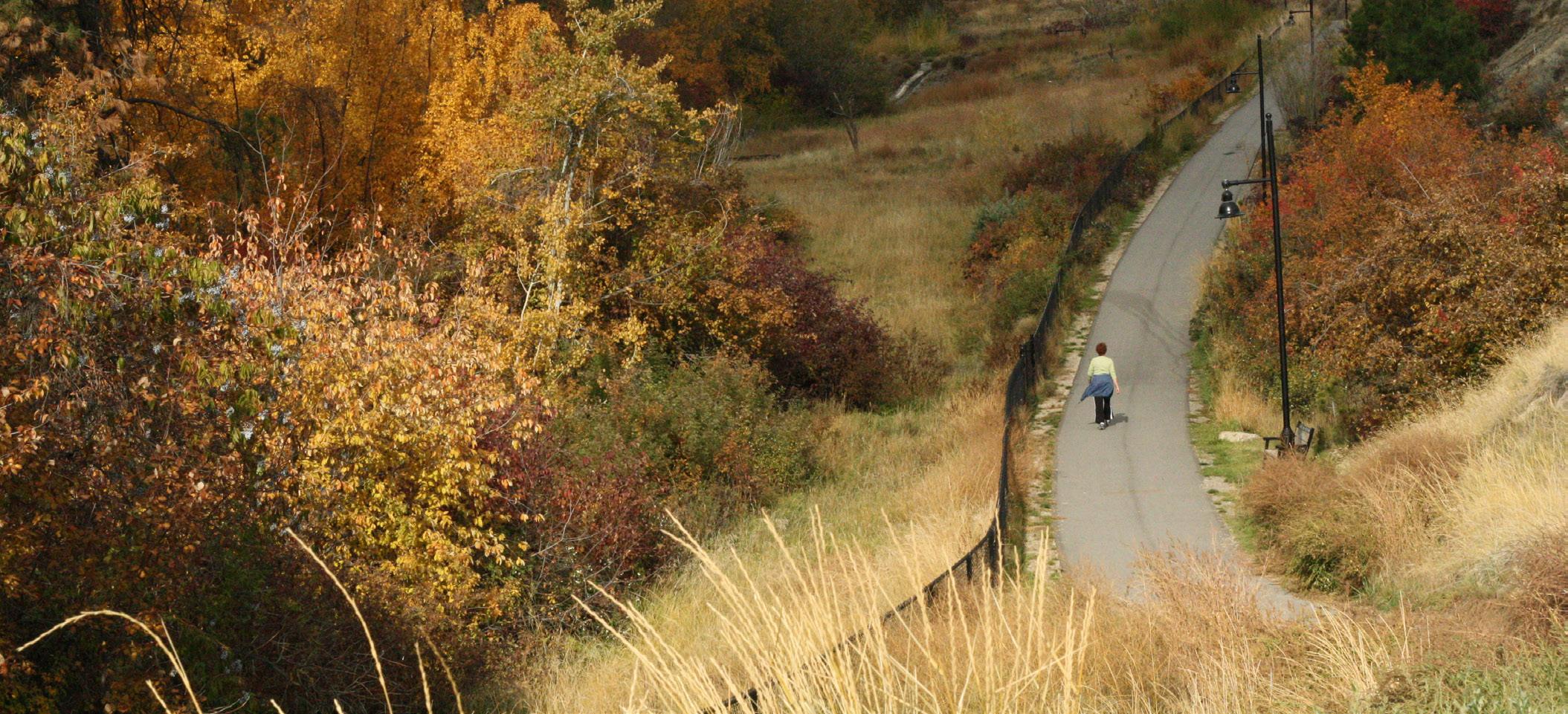
PARCEL TAX
A parcel tax levies a specific charge per selected properties within a community. This tax allows funds for a specific purpose to be raised, without increasing general property taxes. The use of a parcel tax can alleviate public fears that funds raised through general property taxes may not be directed to a specific project and provides a fixed time frame for the implementation of the levy. A parcel tax is typically used for major capital improvement projects (e.g., Waterfront Walkway).
DEPARTMENTAL COORDINATION
The City's various departments have responsibilities and potential projects that may overlap with recreational trails. In particular, major linear infrastructure improvements such as road construction or utility upgrades may provide opportunities for recreational trails development. Projects identified in the Transportation Master Plan, Master Drainage Plan, Parks Master Plan, Sanitary Sewer Utility Master Plan, Water Utility Master Plan, and other plans should consider recreational trails opportunities
DONATIONS & BEQUESTS
Corporations, organizations, and individuals are sometimes willing to contribute assets to the community. An organized donation program can help to attract these opportunities. For example, corporate sponsorships can be sought, along with a method to acknowledge their support. Information on the West Kelowna's website could be updated to further encourage donation and bequest opportunities.
PARTNERSHIPS
Partnerships involve working with other governments, landowners, and local organizations on mutually beneficial projects. Partnerships can provide opportunities for joint capital investment, acquisition, or maintenance/operations where mutual benefits can be realized.
Majoros Pond pathway
5.3 Recreational Trail Costs
Like all infrastructure, building and maintaining recreational trails requires ongoing investment. At the planning phase, estimating helps to assign project budgets and secure funding to complete projects.
City staff use planning-level estimates for budgeting, phasing, and comparative costing for project planning. Specific costs are clarified through further design development for each project as costs can fluctuate widely depending on economic cycles including inflation adjustments, availability of materials and labour, and site specific conditions.
There are two key cost components for recreational trails:
f Capital Costs: Capital costs reflect the onetime cots to first construct a trail. Building recreational trails typically involves site preparation, grading, and construction of the trail surface, with a base course and drainage features as needed. There may be associated amenities, such as waste and recycling containers, signs, benches, bike racks, and lighting. In select circumstances capital costs may also include land acquisition or costs associated with geotechnical, major grading, or environmental protection/restoration, which can vary greatly depending on trail location and circumstance. In some locations, more infrastructure like bridges may be required.
f Management Costs: Once a trail has been developed, it must be monitored and maintained to support its ongoing integrity. Management costs can include activities such as inspections, minor resurfacing and grading, repairs to amenities and infrastructure, revegetation, emptying waste bins, and other regular activities. In addition, management costs including life-cycle renew or upgrade an asset as it ages over time.
5.4 Liability & Risk Management
Using recreational trails comes with inherent risks. Liability and risk management are of concern to governments and private landowners.
Despite potential liabilities and risks, the recreating public continues to demand and support the development of new trails for an everincreasing diversity of users. While no legislation has emerged to reform this aspect of the legal system, trails (and other amenities such as skate parks, BMX tracks, and bike skills parks) continue to be built and managed effectively with very few lawsuits. There are thousands of kilometres of trails in Canada, providing an extensive recreation opportunity with very low rates of injuries, litigation, and risk.
In BC, the Occupiers Liability Act establishes a duty to not create a danger or act with willing disregard for the safety of a person or the integrity of a person’s property. The Occupiers Liability Act also establishes that a person who enters “recreational trails reasonably marked as such” shall be deemed to have willingly assumed all risks.
The Municipal Insurance Association of British Columbia (MIABC) provides guidance through its Risk Management Program including identification and mitigation of risks on municipal and regional lands. For example, signage can be recommended to minimize risks posed by hidden hazards.
Local governments can use these tools and best practices to manage risks. A risk management program can reduce exposure to loss and potential accidents, injuries, and claims.
The following are some guidelines for risk management:
f Establish policies, standards, inspection, maintenance programs, and signage that support a safe environment for trail users based on the financial abilities, resources, and service levels of the City. This applies to City trails and trails on private lands where a formal agreement is in place (e.g., easement agreement or right-of-way).
f Monitor risk management plans and activities and update guidelines and operating policies to continue to be relevant in the face of changing technology, conditions, users, uses, and standards.
f Work with trail users to recognize the limits on their rights to build trails, since unsanctioned activities can hamper opportunities for legitimate trails.
f Where trails cross private land and the landowner is willing to permit public use, work with the landowner to establish limitations on liability to the landowner resulting from public use of the lands. This may include indemnification clauses written into agreements saving the landowner harmless from claims related to use of trails. It may also include signs along trails with codes of conduct for trails through private land and notifications about limitations on liability.
5.5 Monitoring & Review
Monitoring and review allow the City and residents to review progress, confirm steps taken, and make adjustments if needed to be responsive to changes within the City.
This Recreational Trails Master Plan has been Within that time, the Plan should be monitored

Scenic views from Mount Boucherie trails

Eain Lamont Park

Eain Lamont Park trailhead
MAP
A: EXISTING TRAILS INVENTORY (2023)
Map Overview
An overview map has been created to support the Recreational Trails Master Plan. This map is intended to be used in conjunction with this report to identify the locations of existing trails.
MAPPING NOTES
f The information shown on this map is for planning purposes only. Lines indicated are not verified and should not be interpreted as a literal representation of existing conditions.
f This map shows existing trail connections in the City of West Kelowna. Trails data is based on existing GIS data at the time of plan development. Trail routes will need to be verified.
f Active transportation routes such as sidewalks and active transportation routes are based on data available at the time of planning and only provide context to recreational trails planning. Refer to the Transportation Master Plan for details about all active transportation routes.
f All linkages and amenities are for master planning purposes only and will be subject to more detailed planning and design prior to implementation.
MAP A: EXISTING TRAILS (2023)
McDougall Creek Fire Impact Area (2023) EXISTING TRAILS
West Kelowna Recreational Trail
West Kelowna Proposed Active Transportation Route*
West Kelowna Sidewalk*
RDCO Regional Park Trail (Formal)
RDCO Regional Park Trail (Informal)
Authorized Crown Land Trail Informal Routes
EXISTING TRAILHEADS Major West Kelowna Trailhead
West Kelowna Trailhead Major Trailhead Managed by Others Minor Trailhead Managed by Others
0
Map created 2024/08/02
* Active transportation routes including sidewalks include both existing and proposed routes. See the Transportation Master Plan for more details.

Existing recreational trails are based on data available at the time of plan development. Information on this map is subject to change over time with further development of the recreational trails network.
This page is intentionally blank for printing purposes.
A: TYPICAL TRAIL DESIGN DETAILS (BYLAW NO. 0249)
B: CODE OF CONDUCT EXAMPLES

West Kelowna trails network views
TYPICAL TRAIL DESIGN DETAILS (BYLAW NO. 0249)
Overview
Development of lands within the City of West Kelowna, including recreational trail development, is regulated by the City's Works and Services Bylaw No. 0249 (2018).
The Bylaw outlines trail types and standard detail drawings for recreational trails including:
f Major Multi-Use Trails - Routes through the community, parks, or waterfront.
f Narrow Multi-Use Trails - Routes that are community or neighborhood connectors, major creek corridors, or major routes through natural areas.
f Nature Trails - Routes within natural areas or corridors through minor creeks.
The Bylaw also outlines standard detail drawings for features that support recreational trails including fencing and signage.

Existing trailhead sign with code of conduct information
CODE OF CONDUCT EXAMPLES
Recommendation M3 Trail Use Guidelines & Codes of Conduct (p.54) outlines actions to increase code of conduct information for West Kelowna's recreational trails. Below are common code of conduct examples that could be considered when updating West Kelowna's code of conduct resources.
f Stay on the trail, no shortcutting. Leaving the trail can lead to erosion and destruction of vegetation, especially in environments with sensitive ecosystems.
f Unauthorized trail building is prohibited.
f Do not feed, provoke, or approach wildlife.
f If moving slowly, keep to the right (where trail width permits). Step aside to allow those moving more quickly to pass.
f In groups, hike single-file and be attentive to other users wishing to pass.
f When stopping, find a safe place to pull off the trail, not blocking traffic in either direction.
f Uphill trail users have the right-of-way and choice as to whether to stop when passing.
f Adopt the “triangle” of trail sharing where hikers, bikers, and equestrian users exist: bikers yield to hikers and horses, hikers yield to horses.
f Keep conversations at a reasonable volume so as not to disturb other trails users or wildlife.
f Follow "Leave No Trace" principles and pack out what you pack in.
f Take only photos, leave nothing but footprints.
f Bikers are to keep speed under control and sound a warning when approaching other trail users.
f Users are recommended to use helmets and other protective equipment when using recreational trails, especially when biking.
f On trails where horses are permitted, if encountering a horse, provide as much room as possible, and when it is safe to pass, provide a verbal warning to the horse rider.
f Report vandalism. Look for contact information at the trailhead to inform the managing agency of any destruction or management needs you notice.
f Dog and horse owners are responsible for keeping their animals under control, following rules about on- or off-leash uses.
f Dog feces creates hazards to humans and the environment. Owners must properly dispose of waste.
f Be prepared and be safe. Anticipate others being on the trail, familiarize yourself with the route, and tell someone about your plans.
f Know your limits and exercise caution at all times. Do not attempt any trails or features unless you have sufficient ability and skill to do so safely.
f Protect the environment and respect wildlife habitat and plant life.
f Do not trespass on closed trails.
