


Volume 24, Number 1, January 2023 Open Access at www.westjem.com ISSN 1936-900X West A Peer-Reviewed, International Professional Journal Western Journal of Emergency Medicine: Integrating Emergency Care with Population Health Indexed in MEDLINE Special Issue in Educational Research and Practice Western Journal of Emergency Medicine VOLUME 24, NUMBER 1, January 2023 PAGES 1-118
ACOEP stands with all emergency physicians and providers on the front line. We thank you for your tireless work and effort.

www.acoep.org
Western Journal of Emergency Medicine:
Integrating Emergency Care with Population Health
Indexed in MEDLINE, PubMed, and Clarivate Web of Science, Science Citation Index Expanded
JOURNAL FOCUS
Emergency medicine is a specialty which closely reflects societal challenges and consequences of public policy decisions. The emergency department specifically deals with social injustice, health and economic disparities, violence, substance abuse, and disaster preparedness and response. This journal focuses on how emergency care affects the health of the community and population, and conversely, how these societal challenges affect the composition of the patient population who seek care in the emergency department. The development of better systems to provide emergency care, including technology solutions, is critical to enhancing population health.
Table of Contents
ORIGINAL RESEARCH
1 Deciphering a Changing Match Environment in Emergency Medicine and Identifying Residency Program Needs
T Murano, M Weizberg, B Burns, LR Hopson
8 Procedural Curriculum to Verify Intern Competence Prior to Patient Care
J Yee, C San Miguel, S Khandelwal, DP Way, AR Panchal
15 An Evaluation of Emergency Medicine Core Content Covered by Podcasts
J Riddell, S Kobner, G Padilla
23 PEARL: Pharmacy Education Applied To Resident Learners
J Lenning, A Nay, M Ogren, B Dolcourt, K Mangan, A Messman
30 A Novel Point-of-Care Ultrasound Curriculum for Air Critical Care Providers
L O’Connor, M Beth-Ulroy, S Allegra, A Dowd, A Nordberg, T Boardman, T Gleeson, R Lindsay
38 Taking More Society for Academic Emergency Medicine Practice Tests Does Not Lead to Improved National EM-M4 Exam Scores
DJ Story, H Gao, AL Vallevand, D Manthey
43 Simulation-Based Mastery Learning Improves Emergency Medicine Residents’ Ability to Perform Temporary Transvenous Cardiac Pacing
MR Klein, ZP Schmitz, MD Adler, DH Salzman
50 Exploring Teamwork Challenges Perceived by International Medical Graduates in Emergency Medicine Residency
D Khoujah, A Ibrahim
BRIEF EDUCATIONAL ADVANCES
59 A Competency-based Tool for Resident Evaluation of Pediatric Emergency Department Faculty
E Sandler, M Lee, R Carter, NL Davis, K Webster, SB Dubbs, KE Donohue
68 Novel synchronous first-person perspective virtual simulations for medical students in Emergency Medicine
M Sperandeo, T Moadel, S Yun, S Pollack, M Cassara
71 Developing Master Adaptive Learners: Implementation of a Coaching Program in Graduate Medical Education
M Wolff, M Hammoud, M Carney
Policies for peer review, author instructions, conflicts of interest and human and animal subjects protections can be found online at www.westjem.com.
Western Journal of Emergency Medicine i Volume 23, no. 1: January 2022
Western Journal of Emergency Medicine:
Integrating Emergency Care with Population Health
Indexed in MEDLINE, PubMed, and Clarivate Web of Science, Science Citation Index Expanded
Table of Contents continued
BRIEF EDUCATIONAL ADVANCES
76 Strategic Educational Expansion of Trauma Simulation Initiative via a PDSA Ramp
A Meshel, L Iavicoli, B Dilos, G Agriantonis, S Kessler, P Fairweather, D Nazarian, D Lugassy, S Bentley
79 Virtual Open House: Incorporating Support Persons into the Residency Community
H Vongsachang, A Jain
83 The Impact of an Experiential Social Medicine Curriculum in an Emergency Medicine Residency Training Program: Mixed Methods Curricular Evaluation
H Vongsachang, T Schneberk, L Sprunt, G Padilla, J Riddell
89 Incorporation of a Case Based Health Equity Curriculum into Morbidity and Mortality Conference
JA Carreras Tartak, G Rodriguez, E Goralnick, WL Macias-Konstantopoulos, DJ Egan
EDUCATIONAL ADVANCES
98 Education Value Units: A Currency for Recognizing Faculty Effort
BJ Hexom, K Gore, SA Heinrich, YA Purim-Shem-Tov
104 Tele-Simulated Instruction and Learner Perceptions of Fiberoptic Intubation and Nasopharyngoscopy: A Pilot Study
AD Bloom, RE Aliotta, A Mihas, D Taylor Peterson, DA Robinett, M Lee White
BRIEF RESEARCH REPORTS
114 Number of Patient Encounters in Emergency Medicine Residency Does Not Correlate with In-Training Exam
Domain Scores
MW Kern, CM Jewell, DJ Hekman, BH Schnapp
PERSPECTIVES
64 The Emergency Medicine Educational Community and the Supply-Side of the Workforce
DJ Carlberg
94 Debriefing Gold: Harnessing the Power of Debriefing Data to Inform Education A Meshel, B Dilos, L Wong, D Lugassy, S Bentley
110 Universal Precautions Plus: Educational Strategies Directed at Enhancing Physician Skills for Improving Patient Health Literacy in the Emergency Department
JC Nwanaji-Enwerem, M Smith-Wilkerson, B Gordon, H Okpere, T Jones, R Gizaw, I Husain
Policies for peer review, author instructions, conflicts of interest and human and animal subjects protections can be found online at www.westjem.com.
Western Journal of Emergency Medicine ii Volume 23, no. 1: January 2022
2022 Gold Standard Reviewers
The WestJEM Special Issue in Educational Research & Practice couldn’t exist without our many reviewers. To all, we wish to express our sincerest appreciation for their contributions to this year’s success. Each year a number of reviewers stand out for their (1) detailed reviews, (2) grasp of the tenets of education scholarship and (3) efforts to provide feedback that mentors authors on how to improve. This year’s “Gold Standard” includes:
• Jassim Almarzooqi/Claudia Ranniger*
• April Choi/Lina Regan*
• Andrew Cox, Jessie Werner*
• Molly Furin
• Erin Karl/Sarah Ringstrom/Glenn Paetow*
• Scott Kobner/Ignacio Calles/Jeff Riddell*
• Will Kropf/Laura Hopson*
• Bryanne Macdonald/Lucienne LutfyClayton*
• Matthew Magda/Kevin Scott*
• Brian Milman
• Elspeth Pearce
• Daniela Ortiz/Tyson Pillow/ Ynhi Thomas/ Anisha Turner*
• Daniel Ridelman/Anne Messman**
• Sarah Ronan-Bentle/Sally Santen**
• Thaddeus Schmitt/Benjamin Schnapp*
• John Schneider/Grace Hickman*
• Samantha Stringer/Albert Kim*
• Ashley Vuong/Rebecca Bavolek*
• David Warshaw/Kevin Scott*
• Lauren Willoughby/Benjamin Schnapp*
• Catherine Yu/Rebecca Bavolek*
*Mentored Peer Reviews from Emergency Medicine Education Fellowship Programs
**Mentored Peer-Reviews of faculty
CDEM/CORD Guest Consulting Editors
We would also like to recognize our guest consulting editors who assisted with pre-screening submissions during our initial peer-review stages. Thank you for all of your efforts and contributions.
CDEM
• Christine Stehman
• Eric Shappell
• Holly Caretta-Weyer
Consulting Statistician/ Psychometrician
• David Way
CORD
• Anne Messman
• Jaime Jordan
• Jenna Fredette
• Kendra Parekh
• Listy Thomas
• William Soares III
Volume 23, no. 1: January 2022 iii Western Journal of Emergency Medicine
Western Journal of Emergency Medicine:
Integrating Emergency Care with Population Health
Jeffrey N. Love, MD, Guest Editor
The George Washington University- Washington, District of Columbia
Danielle Hart, MD, Associate Guest Editor
Hennepin County Medical Center- Minneapolis, Minnesota
Chris Merritt, MD, MPH, Associate Guest Editor
Alpert Medical School of Brown University-Providence, Rhode Island
Wendy Macias-Konstantopoulos, MD, MPH, Associate Editor Massachusetts General Hospital- Boston, Massachusetts
Danya Khoujah, MBBS, Associate Editor University of Maryland School of Medicine- Baltimore, Maryland
Patrick Joseph Maher, MD, MS, Associate Editor Ichan School of Medicine at Mount Sinai- New York, New York
Yanina Purim-Shem-Tov, MD, MS, Associate Editor Rush University Medical Center-Chicago, Illinois
Gayle Galletta, MD, Associate Editor University of Massachusetts Medical SchoolWorcester, Massachusetts
Resident Editors
AAEM/RSA
John J. Campo, MD Harbor-University of California, Los Angeles Medical Center
Tehreem Rehman, MD Advocate Christ Medical Center
ACOEP
Justina Truong, DO Kingman Regional Medical Center
Section Editors
Behavioral Emergencies
Erin Dehon, PhD University of Mississippi Medical Center
Leslie Zun, MD, MBA Chicago Medical School
Marc L. Martel, MD Hennepin County Medical Center
Cardiac Care
Fred A. Severyn, MD University of Colorado School of Medicine
Michael C. Kurz, MD University of Alabama at Birmingham
Sam S. Torbati, MD
Cedars-Sinai Medical Center
Clinical Practice
Cortlyn W. Brown, MD Carolinas Medical Center
Casey Clements, MD, PhD Mayo Clinic
Patrick Meloy, MD Emory University
Nicholas Pettit, DO, PhD Indiana University
Eric Snoey, MD Alameda County Medical Center
David Thompson, MD University of California, San Francisco
Kenneth S. Whitlow, DO
Kaweah Delta Medical Center
Critical Care
Christopher “Kit” Tainter, MD University of California, San Diego
Gabriel Wardi, MD
University of California, San Diego
Joseph Shiber, MD
University of Florida-College of Medicine
Matt Prekker MD, MPH
Hennepin County Medical Center
Dan Mayer, MD, Associate Editor Retired from Albany Medical College- Niskayuna, New York
Julianna Jung, MD, Associate Guest Editor Johns Hopkins Hospital, Baltimore, Maryland
Douglas Franzen, MD, Associate Guest Editor Harborview Medical Center, Seattle, Washington
Gentry Wilkerson, MD, Associate Editor University of Maryland
Michael Gottlieb, MD, Associate Editor Rush Medical Center-Chicago, Illinois
Sara Krzyzaniak, MD Associate Guest Editor Stanford Universtiy-Palo Alto, California
Gavin Budhram, MD, Associate Editor Tufts University- Medford, Massachusetts Susan R. Wilcox, MD, Associate Editor Massachusetts General Hospital- Boston, Massachusetts
Donna Mendez, MD, EdD, Associate Editor University of Texas-Houston/McGovern Medical School- Houston Texas
David Page, MD University of Alabama
Erik Melnychuk, MD Geisinger Health
Quincy Tran, MD, PhD University of Maryland
Disaster Medicine
Christopher Kang, MD Madigan Army Medical Center
Education
Danya Khoujah, MBBS University of Maryland School of Medicine
Jeffrey Druck, MD University of Colorado
John Burkhardt, MD, MA University of Michigan Medical School
Michael Epter, DO Maricopa Medical Center
ED Administration, Quality, Safety
David C. Lee, MD Northshore University Hospital
Gary Johnson, MD Upstate Medical University
Brian J. Yun, MD, MBA, MPH
Harvard Medical School
Laura Walker, MD Mayo Clinic
León D. Sánchez, MD, MPH
Beth Israel Deaconess Medical Center
William Fernandez, MD, MPH
University of Texas Health-San Antonio
Emergency Medical Services
Daniel Joseph, MD Yale University
Joshua B. Gaither, MD University of Arizona, Tuscon
Julian Mapp
University of Texas, San Antonio
Shira A. Schlesinger, MD, MPH Harbor-UCLA Medical Center
Geriatrics
Cameron Gettel, MD Yale School of Medicine
Stephen Meldon, MD Cleveland Clinic
Luna Ragsdale, MD, MPH
Duke University
Health Equity
Emily C. Manchanda, MD, MPH
Boston University School of Medicine
Douglas S. Ander, MD, Guest Editor
Emory University School of Medicine-Atlanta, Georgia
Edward Ullman, MD, Associate Guest Editor
Harvard University-Cambridge, Massachusetts
Abra Fant, MD, Associate Guest Editor
Northwestern University Feinberg School of MedicineChicago, Illinois
Matthew Tews, DO, MS, Associate Guest Editor Indiana University School of Medicine, Augusta, Georgia
Rick A. McPheeters, DO, Associate Editor Kern Medical- Bakersfield, California
Elizabeth Burner, MD, MPH, Associate Editor University of Southern California- Los Angeles, California
Shahram Lotfipour, MD, MPH, Managing Associate Editor
University of California, Irvine School of Medicine- Irvine, California
Mark I. Langdorf, MD, MHPE, Editor-in-Chief
University of California, Irvine School of Medicine- Irvine, California

Neurosciences
Mandy J. Hill, DrPH, MPH
UT Health McGovern Medical School
K. Tom Xu, MD, PhD
Texas Tech University Health Sciences Center
Infectious Disease
Elissa Schechter-Perkins, MD, MPH
Boston University School of Medicine
Ioannis Koutroulis, MD, MBA, PhD
Drexel University College of Medicine

Kevin Lunney, MD, MHS, PhD
University of Maryland School of Medicine
Robert Derlet, MD
Founding Editor, California Journal of Emergency Medicine
University of California, Davis
Stephen Liang, MD, MPHS
Washington University School of Medicine
Injury Prevention
Mark Faul, PhD, MA
Centers for Disease Control and Prevention
Wirachin Hoonpongsimanont, MD, MSBATS
Eisenhower Medical Center
International Medicine
Heather A.. Brown, MD, MPH
Prisma Health Richland
Taylor Burkholder, MD, MPH
Keck School of Medicine of USC
Christopher Greene, MD, MPH
University of Alabama
Chris Mills, MD, MPH
Santa Clara Valley Medical Center
Shada Rouhani, MD
Brigham and Women’s Hospital
Legal Medicine
Melanie S. Heniff, MD, JD
Indiana University School of Medicine
Greg P. Moore, MD, JD
Madigan Army Medical Center
Statistics and Methodology
Shu B. Chan MD, MS
Resurrection Medical Center
Stormy M. Morales Monks, PhD, MPH
Texas Tech Health Science University
Soheil Saadat, MD, MPH, PhD
University of California, Irvine
James A. Meltzer, MD, MS
Albert Einstein College of Medicine
Musculoskeletal
Juan F. Acosta DO, MS
Pacific Northwest University
Antonio Siniscalchi, MD
Annunziata Hospital
Rick Lucarelli, MD
Medical City Dallas Hospital
William D. Whetstone, MD
University of California, San Francisco
Pediatric Emergency Medicine
Paul Walsh, MD, MSc
University of California, Davis
Muhammad Waseem, MD
Lincoln Medical & Mental Health Center
Deena Berkowitz, MD, MPH
Children’s National Hospital
Cristina M. Zeretzke-Bien, MD University of Florida
Public Health
Jeremy Hess, MD, MPH
University of Washington Medical Center
Jacob Manteuffel, MD
Henry Ford Hospital
John Ashurst, DO
Lehigh Valley Health Network
Tony Zitek, MD
Kendall Regional Medical Center
Trevor Mills, MD, MPH
Northern California VA Health Care
Erik S. Anderson, MD
Alameda Health System-Highland Hospital
Technology in Emergency Medicine
Nikhil Goyal, MD
Henry Ford Hospital
Phillips Perera, MD
Stanford University Medical Center
Trauma
Pierre Borczuk, MD
Massachusetts General Hospital/Havard Medical School
Toxicology
Brandon Wills, DO, MS
Virginia Commonwealth University
Jeffrey R. Suchard, MD
University of California, Irvine
Ultrasound
J. Matthew Fields, MD
Thomas Jefferson University
Shane Summers, MD
Brooke Army Medical Center
Robert R. Ehrman
Wayne State University
Ryan C. Gibbons, MD
Temple Health
Official Journal of the California Chapter of the American College of Emergency Physicians, the America College of Osteopathic Emergency Physicians, and the California Chapter of the American Academy of Emergency Medicine

Volume 23, no. 1: January 2022 iv Western Journal of Emergency Medicine Available in MEDLINE, PubMed, PubMed Central, CINAHL, SCOPUS, Google Scholar, eScholarship, Melvyl, DOAJ, EBSCO, EMBASE, Medscape, HINARI, and MDLinx Emergency Med. Members of OASPA. Editorial and Publishing Office: WestJEM/Depatment of Emergency Medicine, UC Irvine Health, 333 City Blvd, West, Rt 128-01, Orange, CA 92868, USA. Office: 1-714-456-6389; Email: Editor@westjem.org.
Indexed in MEDLINE, PubMed, and Clarivate Web of Science, Science Citation Index Expanded
Editorial Board
Amin A. Kazzi, MD, MAAEM The American University of Beirut, Beirut, Lebanon
Anwar Al-Awadhi, MD
Mubarak Al-Kabeer Hospital, Jabriya, Kuwait
Arif A. Cevik, MD United Arab Emirates University College of Medicine and Health Sciences, Al Ain, United Arab Emirates
Abhinandan A.Desai, MD University of Bombay Grant Medical College, Bombay, India
Bandr Mzahim, MD King Fahad Medical City, Riyadh, Saudi Arabia
Brent King, MD, MMM University of Texas, Houston
Daniel J. Dire, MD University of Texas Health Sciences Center San Antonio
David F.M. Brown, MD Massachusetts General Hospital/ Harvard Medical School
Edward Michelson, MD Texas Tech University
Edward Panacek, MD, MPH University of South Alabama
Francesco Dellacorte, MD
Azienda Ospedaliera Universitaria “Maggiore della Carità,” Novara, Italy
Francis Counselman, MD Eastern Virginia Medical School
Gayle Galleta, MD Sørlandet Sykehus HF, Akershus Universitetssykehus, Lorenskog, Norway
Hjalti Björnsson, MD Icelandic Society of Emergency Medicine
Jacob (Kobi) Peleg, PhD, MPH Tel-Aviv University, Tel-Aviv, Israel
Jonathan Olshaker, MD Boston University
Katsuhiro Kanemaru, MD University of Miyazaki Hospital, Miyazaki, Japan
Khrongwong Musikatavorn, MD King Chulalongkorn Memorial Hospital, Chulalongkorn University, Bangkok, Thailand
Leslie Zun, MD, MBA Chicago Medical School
Linda S. Murphy, MLIS University of California, Irvine School of Medicine Librarian
Nadeem Qureshi, MD St. Louis University, USA
Emirates Society of Emergency Medicine, United Arab Emirates
Niels K. Rathlev, MD Tufts University School of Medicine
Pablo Aguilera Fuenzalida, MD Pontificia Universidad Catolica de Chile, Región Metropolitana, Chile
Peter A. Bell, DO, MBA Liberty University College of Osteopathic Medicine
Peter Sokolove, MD University of California, San Francisco
Robert M. Rodriguez, MD University of California, San Francisco
Robert Suter, DO, MHA UT Southwestern Medical Center
Robert W. Derlet, MD University of California, Davis
Rosidah Ibrahim, MD Hospital Serdang, Selangor, Malaysia
Samuel J. Stratton, MD, MPH Orange County, CA, EMS Agency
Scott Rudkin, MD, MBA University of California, Irvine
Scott Zeller, MD
University of California, Riverside
Steven Gabaeff, MD Clinical Forensic Medicine
Steven H. Lim, MD Changi General Hospital, Simei, Singapore
Terry Mulligan, DO, MPH, FIFEM
ACEP Ambassador to the Netherlands Society of Emergency Physicians
Vijay Gautam, MBBS University of London, London, England
Wirachin Hoonpongsimanont, MD, MSBATS Siriraj Hospital, Mahidol University, Bangkok, Thailand
Editorial Staff Advisory Board
Amal Khalil, MBA UC Irvine Health School of Medicine
Brian Potts, MD, MBA California Chapter Division of AAEM Alta Bates Summit Medical Center
Elena Lopez-Gusman, JD California ACEP American College of Emergency Physicians
Randy Young, MD California ACEP Kaiser Permanente- San Diego
Mark I. Langdorf, MD, MHPE UC Irvine Health School of Medicine
Peter A. Bell, DO, MBA American College of Osteopathic Emergency Physicians
Robert Suter, DO, MHA American College of Osteopathic Emergency Physicians UT Southwestern Medical Center
Shahram Lotfipour, MD, MPH UC Irvine Health School of Medicine
Trevor Mills, MD, MPH California Chapter Division of AAEM Northern California VA Health Care
Jorge Fernandez, MD UC San Diego Health School of Medicine
Isabelle Nepomuceno, BS Executive Editorial Director
Visha Bajaria, BS WestJEM Editorial Director
Anuki Edirimuni, BS WestJEM Editorial Director
Zaynab Ketana, BS CPC-EM Editorial Director Associate Marketing Director
Stephanie Burmeister, MLIS WestJEM Staff Liaison
Cassandra Saucedo, MS Executive Publishing Director
Jordan Lam, BS WestJEM Publishing Director
Anthony Hoang, BS WestJEM Associate Publishing Director
Rubina Rafi, BS CPC-EM Publishing Director
Avni Agrawal, BS WestJEM Associate Publishing Director Associate Marketing Director
June Casey, BA Copy Editor
Western Journal of Emergency Medicine v Volume 23, no. 1: January 2022 Available in MEDLINE, PubMed, PubMed Central, Europe PubMed Central, PubMed Central Canada, CINAHL, SCOPUS, Google Scholar, eScholarship, Melvyl, DOAJ, EBSCO, EMBASE, Medscape, HINARI, and MDLinx Emergency Med. Members of OASPA. Editorial and Publishing Office: WestJEM/Depatment of Emergency Medicine, UC Irvine Health, 333 City Blvd, West, Rt 128-01, Orange, CA 92866, USA Office: 1-714-456-6389; Email: Editor@westjem.org Official Journal of the California Chapter of the American College of Emergency Physicians, the America College of Osteopathic Emergency Physicians, and the California Chapter of the American Academy of Emergency Medicine
Emergency Care with Population Health Indexed in MEDLINE, PubMed, and Clarivate Web of Science, Science Citation Index Expanded
Western Journal of Emergency Medicine: Integrating
Western Journal of Emergency Medicine:
Integrating Emergency Care with Population Health
Indexed in MEDLINE, PubMed, and Clarivate Web of Science, Science Citation Index Expanded
This open access publication would not be possible without the generous and continual financial support of our society sponsors, department and chapter subscribers.
Professional Society Sponsors
American College of Osteopathic Emergency Physicians
California ACEP
Academic Department of Emergency Medicine Subscriber
Albany Medical College
Albany, NY
Allegheny Health Network
Pittsburgh, PA
American University of Beirut
Beirut, Lebanon
AMITA Health Resurrection Medical Center
Chicago, IL
Arrowhead Regional Medical Center
Colton, CA
Baystate Medical Center
Springfield, MA
Bellevue Hospital Center
New York, NY
Beth Israel Deaconess Medical Center
Boston, MA
Boston Medical Center
Boston, MA
Brigham and Women’s Hospital
Boston, MA
Brown University
Providence, RI
Carl R. Darnall Army Medical Center
Fort Hood, TX
Conemaugh Memorial Medical Center
Johnstown, PA
Crozer-Chester Medical Center
Upland, PA
Desert Regional Medical Center
Palm Springs, CA
Eastern Virginia Medical School
Norfolk, VA
Einstein Healthcare Network
Philadelphia, PA
Eisenhower Medical Center
Rancho Mirage, CA
Emory University
Atlanta, GA
Geisinger Medical Center
Danville, PA
Grand State Medical Center
Allendale, MI
Hennepin County Medical Center
Minneapolis, MN
Henry Ford Medical Center
Detroit, MI
State Chapter Subscriber
Arizona Chapter Division of the American Academy of Emergency Medicine
California Chapter Division of the American Academy of Emergency Medicine
Florida Chapter Division of the American Academy of Emergency Medicine
International Society Partners
Emergency Medicine Association of Turkey
Lebanese Academy of Emergency Medicine
INTEGRIS Health
Oklahoma City, OK
Kaiser Permenante Medical Center
San Diego, CA
Kaweah Delta Health Care District
Visalia, CA
Kennedy University Hospitals
Turnersville, NJ
Kent Emergency Medical Residency Program
Warwick, RI
Kern Medical
Bakersfield, CA
Lakeland HealthCare
St. Joseph, MI
Lehigh Valley Hospital and Health Network
Allentown, PA
Loma Linda University Medical Center
Loma Linda, CA
Louisiana State University Health Sciences Center
New Orleans, LA
Madigan Army Medical Center
Tacoma, WA
Maimonides Medical Center
Brooklyn, NY
Maine Medical Center
Portland, ME
Massachusetts General Hospital
Boston, MA
Mayo Clinic College of Medicine
Rochester, MN
Mercy Health - Hackley Campus
Muskegon, MI
Merit Health Wesley
Hattiesburg, MS
Midwestern University
Glendale, AZ
New York University Langone Health
New York, NY
North Shore University Hospital
Manhasset, NY
Northwestern Medical Group
Chicago, IL
Ohio State University Medical Center
Columbus, OH
Ohio Valley Medical Center
Wheeling, WV
Mediterranean Academy of Emergency Medicine
California Chapter Division of AmericanAcademy of Emergency Medicine
Oregon Health and Science University
Portland, OR
Penn State Milton S. Hershey Medical Center
Hershey, PA
Regions Hospital Emergency Medicine Residency
Program
St. Paul, MN
Rhode Island Hospital
Providence, RI
Robert Wood Johnson University Hospital
New Brunswick, NJ
Rush University Medical Center
Chicago, IL
St. Luke’s University Health Network
Bethlehem, PA
Spectrum Health Lakeland
St. Joseph, MI
Stanford
Stanford, CA
SUNY Upstate Medical University
Syracuse, NY
Temple University
Philadelphia, PA
Texas Tech University Health Sciences Center
El Paso, TX
University of Alabama, Birmingham
Birmingham, AL
University of California, Davis Medical Center
Sacramento, CA
University of California, Irvine
Orange, CA
University of California, Los Angeles
Los Angeles, CA
University of California, San Diego
La Jolla, CA
University of California, San Francisco
San Francisco, CA
UCSF Fresno Center
Fresno, CA
University of Chicago
Chicago, IL
University of Florida
Gainesville, FL
University of Florida, Jacksonville
Jacksonville, FL
Great Lakes Chapter Division of the AmericanAcademyofEmergencyMedicine
Tennessee Chapter Division of the AmericanAcademyofEmergencyMedicine
University of Illinois at Chicago
Chicago, IL
University of Iowa
Iowa City, IA
University of Louisville
Louisville, KY
University of Maryland
Baltimore, MD
University of Massachusetts
Amherst, MA
University of Michigan Ann Arbor, MI
University of Missouri, Columbia Columbia, MO
University of Nebraska Medical Center
Omaha, NE
University of Nevada, Las Vegas Las Vegas, NV
University of Southern Alabama
Mobile, AL
University of Southern California Los Angeles, CA
University of Tennessee, Memphis Memphis, TN
University of Texas, Houston Houston, TX
University of Washington
Seattle, WA
University of Wisconsin Hospitals and Clinics
Madison, WI
Virginia Commonwealth University Medical Center
Richmond, VA
Wake Forest University
Winston-Salem, NC
Wake Technical Community College
Raleigh, NC
Wayne State Detroit, MI
Wright State University
Dayton, OH
York Hosptial York, ME
Uniformed Services Chapter Division of the American Academy of Emergency Medicine
Virginia Chapter Division of the American Academy of Emergency Medicine
Norwegian Society for Emergency Medicine Sociedad Argentina de Emergencias
Sociedad Chileno Medicina Urgencia
ThaiAssociationforEmergencyMedicine
To become a WestJEM departmental sponsor, waive article processing fee, receive print and copies for all faculty and electronic for faculty/residents, and free CME and faculty/fellow position advertisement space, please go to http://westjem.com/subscribe or contact:
Stephanie Burmeister
WestJEM Staff Liaison
Phone: 1-800-884-2236
Email: sales@westjem.org
Western Journal of Emergency Medicine vi Volume 23, no. 1: January 2022
Clerkship Directors in Emergency Medicine (CDEM) Meeting
Thursday, May 18, 2023
1:00 PM - 5:00 PM CT
www.saem.org/cdem
RESOURCES OFFERED BY SAEM/CDEM





• SAEMTests
• CDEM Curriculum
• CDEM Faculty Podcast
ADDITIONAL




JW Marriott Austin – Austin, TX Society for Academic Emergency Medicine | 1111 East Touhy Avenue, Suite 540 | Des Plaines, IL 60018 SAEM .org | Ph: 847-813-9823 | Fx: 847-813-5450
Education Fellowship at Eisenhower Medical Center, Rancho Mirage, CA





ABOUT THE PROGRAM
SAEM-approved Education Fellowship
Opportunities to learn in both Graduate and Undergraduate Medical Education
Offer “Training to Teach in Medicine” certificate program from Harvard Medical School

One- or two-year fellowship
Competitive salary with full-benefits from Eisenhower Health
ABOUT EISENHOWER MEDICAL CENTER
Rated among the region’s Best Hospitals by U.S. News & World Report
More than 85,000 visits per year
Advanced Primary Stroke Center, STEMI Center, Accredited Geriatric Emergency Department and Level Four Trauma Center
State-of-art medical center
50 private patient rooms
Best EMR: Epic
Three-year Emergency Medicine residency program
LIVING IN THE DESERT
Affordable cost of living
Variety of activities: hiking, shopping, dining, golfing, etc.

Within two hours from many big cities (L.A. and San Diego)
CONTACT
Wirachin Hoonpongsimanont, MD, MS
Cell: 862-216-0466 Email: wirachin@gmail.com website: gme.eisenhowerhealth.org
39000 Bob Hope Drive, Rancho Mirage, CA 92270 EisenhowerHealth.org L I V E . W O R K . P L A Y . P R O S P E R .
SPRING SEMINAR 2023 April 1-5, 2023 Hilton Phoenix Tapatio Cliffs Resort Phoenix, AZ www.acoep.org #ACOEP23 SAVE THE DATE
Call for Section Editors • Behavioral Emergencies • Emergency Cardiac Care • International Medicine • Pediatric Emergencies • Public Health • Trauma Care • Ultrasound Send CV and letter of interest to Editor@WestJEM.org NEW: HEALTH EQUITY SECTION Call for Reviewers and Manuscripts Send CV and letter of interest to Editor@WestJEM.org

Call for Reviewers! Please send your CV and letter of interest to editor@westjem.org
Deciphering a Changing Match Environment in Emergency Medicine and Identifying Residency Program Needs
Tiffany Murano, MD*
Moshe Weizberg, MD, MBA†
Bo Burns, DO, MBA, MHA‡
Laura R. Hopson, MD§
Section Editor: Sara Krzyzaniak, MD
Columbia University Irving Medical Center, Department of Emergency Medicine, New York, New York
Maimonides Medical Center, Department of Emergency Medicine, Brooklyn, New York University of Oklahoma School of Community Medicine, Department of Emergency Medicine, Tulsa, Oklahoma
University of Michigan Medical School, Department of Emergency Medicine, Ann Arbor, Michigan
Submission history: Submitted July 15, 2022; Revision received November 8, 2022; Accepted November 18, 2022
Electronically published January 16, 2023
Full text available through open access at http://escholarship.org/uc/uciem_westjem
DOI: 10.5811/westjem.2022.11.58060
Introduction: The Match in emergency medicine (EM) is historically competitive for applicants; however, the 2022 residency Match had a large number of unfilled positions. We sought to characterize the impact of and response to the Match on programs and determine programs’ needs for successful recruitment strategies.
Methods: We conducted a web-based survey of EM residency program leadership during March–April 2022. Program characteristics were generated from publicly available data, and descriptive statistics were generated. We analyzed free-text responses thematically.
Results: There were 133/277 (48%) categorical EM residency programs that responded. Of those, 53.8% (70/130) reported a negative impression of their Match results; 17.7% (23/130) positive; and the remainder neutral (28.5%; 37/130). Three- and four-year programs did not differ in their risk of unfilled status. Hybrid programs had a higher likelihood of going unfilled (odds ratio [OR] 4.52, confidence interval [CI] 1.7- 12.04) vs community (OR 1.62, CI 0.68-3.86) or university programs (0.16, 0.0-0.49). Unfilled programs were geographically concentrated. The quality of applicants was perceived the same as previous years and did not differ between filled and unfilled programs. Respondents worried the expansion of EM residency positions and perceptions of the EM job market were major factors influencing the Match. They expressed interest in introducing changes to the interview process, including caps on applications and interviews, as well as a need for more structural support for programs and the specialty.
Conclusion: This survey identifies impacts of the changed match environment on a broad range of programs and identifies specific needs. Future work should be directed toward a deeper understanding of the factors contributing to changes in the specialty and the development of evidence-based interventions. [West J Emerg Med. 2023;24(1)1–7.]
INTRODUCTION
The National Resident Matching Program (NRMP) (the Match) in emergency medicine (EM) is historically considered competitive for applicants. By 2021, EM grew to comprise up to 8.1% of positions in the Match with nearly 100%
program match rates.1 However, the 2022 Match resulted in an unusually large number of unfilled programs and positions.2 The application and matching environment for EM has evolved over the past decade. The number of Accreditation Council for Graduate Medical Education (ACGME)-
Volume 24, NO.1: January 2023 1 Western Journal of Emergency Medicine Original Research
* † ‡ §
accredited EM training programs and associated training slots increased dramatically since 2016. Of the 95 new programs accredited by the ACGME since 2016, 41 were previously accredited by the American Osteopathic Association (AOA) and received ACGME-accreditation through the single accreditation system moving their positions and applicants into the Match.3 In 2021, there were 273 residency programs, with 2,826 of the 2,840 EM positions (99.5%) filled in the Match, and only nine programs (3.3%) unfilled.1 In 2022, of the 2,921 offered positions in 277 programs, there were 219 unfilled positions (7.5%), with 69 programs (24.9%) not filling in the Match.2 This unprecedented number of unfilled positions calls for reflection on the evolving landscape of EM and residency training.
We sought to understand the needs and perceptions of the specialty’s residency training programs. The Council of Residency Directors in EM (CORD) conducted a survey to characterize the impact and response of programs to the 2022 EM Match. We hypothesized that the impact of the 2022 Match extended beyond the unfilled programs and that we could identify common needs to tailor future support interventions for all our programs.
METHODS
We conducted a survey of residency training program leadership (ie, program directors [PD], assistant/associate [APD], program coordinators, vice chairs of education) using a webbased survey distributed by Qualtrics (Seattle, WA) during the CORD Academic Assembly in March 2022 in San Diego, CA. Participation in the survey was solicited using QR codes during conference presentations, and the survey was also sent on the organization’s PD listserv during and after the conference to elicit responses from individuals who did not attend the conference.
The survey included program demographic information and respondent’s role. Participants were also asked to indicate whether their program filled in the Match and whether it filled at, below, or above the expected level on their rank list. They were also asked to rank factors they believed may have contributed to the outcome. We created the survey based on knowledge of the literature and current conversations within the specialty. We all have significant expertise in residency administration with more than 50 cumulative years in residency leadership and ongoing involvement with EM education. The survey was pilot-tested with an expanded group of expert volunteers consisting of four current and former PDs, all of whom have experience with survey design. We refined the survey on their feedback prior to distribution. The survey is included as an Appendix. The study was reviewed by the University of Michigan Institutional Review Board and given exempt status.
We analyzed the data using Microsoft Excel 365 (Microsoft Corporation, Redmond, WA) to calculate descriptive statistics and an online calculator for odds ratios (OR) and confidence intervals (CI).4
Population Health Research Capsule
What do we already know about this issue? The 2022 residency Match in emergency medicine had a large number of unfilled positions. No previous research has been published to explain the sudden change in the Match outcome.
What was the research question?
What was the impact of the 2022 Match on EM residency programs? What needs do programs have for the future?
What was the major finding of the study? Perceived worsened Match results were mainly attributed to increased slots and the future job market. Application and interview processes were a major concern.
How does this improve population health? These findings will help the specialty in developing program-level resources that will address future needs.
To avoid over-weighting perspectives from a single program, data were sorted to select a single response per program. We used the following order of consideration to select responses when more than one was available per program: residency PD; residency coordinator; vice (or associate) chair or chair; APD; residency core faculty member; general faculty member. No questions were required in the survey. We used the American Medical Association’s publicly available portions of their Fellowship and Residency Electronic Interactive Database (FREIDA) of residency programs for self-reported demographic descriptions, and the Emergency Medicine Residents Association Match for training format.5,6 Free-text responses were coded by consensus between two authors (MW, TM) using descriptive codes, and any disagreements were resolved by the other two authors (BB, LRH). The codes were then grouped into broader themes by the entire author group.
RESULTS
Of an initial 169 responses, 133 represented unique programs for a 48% (133/277) response rate of EM residency programs. Unique respondents for programs included 103 PDs (77.4%); 18 APDs (13.5%); four chairs including vice and associate (3.0%); four coordinators (3.0%); three clerkship leadership (2.3%); and one other (<1%). We compared demographics of responding programs with those of EM residency programs as a whole in Table 1 using the publicly
Western Journal of Emergency Medicine 2 Volume 24, NO.1: January 2023 Changing EM Match Effect on Residency Program Needs Murano et al.
Table 1. Emergency medicine (EM) program demographics. Column 1 (All EM programs) represents the complete list/description of ACGME-accredited EM programs. Column 2 (All responding programs; n=133) indicates the total number of programs that responded to the survey. Columns 3 and 4 further break down the filled (n=107) and unfilled programs (n=26) of all respondents, respectively.
available and program-defined characteristics from the AMA FREIDA database. 5
Of the 69 unfilled programs, 26 responded to this survey (37.6%). Unfilled programs in our study were predominantly concentrated in four geographic divisions: Mid-Atlantic, East North Central, South Atlantic, and West South Central (92.3%, 24/26). The postgraduate year (PGY) 1-3 format programs were not more affected than PGY 1-4 (OR 2.1; CI 0.58-7.6, ns). Programs self-described as community/university-affiliated (hybrid) programs had a much higher odds ratio at 4.52 (CI 1.7-12.4) of going unfilled in our sample than university (OR
0.16, CI 0.05-0.29) or community programs (OR 1.62, CI,0.683.86). Programs overall viewed their match outcome negatively with 70/130 (53.8%) responding that the overall quality of their match was a little or substantially worse than typical. Even when only filled programs were considered, 51/105 (48.6%) reported that their match outcome was worse than in previous years. A minority reported a better than usual perceived match outcome (23/130 (17.7%) all respondents; 23/105 (22.0%) filled programs only). Programs perceived the quality of applicants as similar to previous years. This did not significantly differ between filled and unfilled programs.
Volume 24, NO.1: January 2023 3 Western Journal of Emergency Medicine
et al.
Murano
Changing EM Match Effect on Residency Program Needs
All EM programs (n=277) All responding programs (n=133) Filled programs responding (n=107) Unfilled programs responding (n=26) Region New England 12 (4.3%) 9 (6.8%) 9 (8.4%) 0 (0.0%) Mid-Atlantic 65 (23.5%) 25 (18.8%) 18 (16.8%) 7 (26.9%) East North Central 58 (20.9%) 23 (17.3%) 16 (15.0%) 7 (26.9%) West North Central 11 (4.0%) 7 (5.3%) 7 (6.5%) 0 (0.0%) South Atlantic 53 (19.1%) 29 (21.8%) 24 (22.4%) 5 (19.2%) East South Central 11 (4.0%) 3 (2.3%) 3 (2.8%) 0 (0.0%) West South Central 27 (9.7%) 10 (7.5%) 5 (4.7%) 5 (19.2%) Mountain 11 (4.0%) 8 (6.0%) 7 (6.5%) 1 (3.8%) Pacific 27 (9.7%) 18 (13.5%) 17 (15.9%) 1 (3.8%) Territory 2 (0.7%) 1 (0.8%) 1 (0.9%) 0 (0.0%) Self-identified program type University 94 (33.9%) 61 (22.0%) 57 (53.3%) 4 (15.3%) Community 49 (17.7%) 23 (8.3%) 37 (34.6%) 12 (46.2%) Community/ university-affiliated (hybrid) 129 (46.6%) 49 (17.7%) 13 (12.1%) 10 (38.5%) Military 5 (1.8%) 0 (0.0%) 0 (0.0%) 0 (0.0%) Training format PGY 1-3 220 (79.7%) 107 (80.5%) 84 (78.5%) 23 (88.5%) PGY 1-4 56 (20.3%) 26 (19.5%) 23 (21.5%) 3 (11.5%)
ACGME. Accreditation Council for Graduate Medical Education; PGY, postgraduate year.
Changing EM Match Effect on Residency Program Needs
In general, programs reported interviewing an average of 14.2 candidates per residency position available (n=123; range 4.4-30.0, SD 4.0). Unfilled programs averaged 13.9 applicants per residency position (range 8.1-23.5, SD 3.2) with filled programs averaging 14.3 (range 4.4-30.0, SD 4.2), which did not reflect a significant difference (P=0.7, ns). Neither did filled and unfilled programs differ significantly in the number of candidates they interviewed but elected not to place on their rank lists. Programs largely indicated that they would continue to interview about the same number of applicants in the next year (68/125 responding, 54.4%), although unfilled programs were more likely than filled programs to indicate plans to expand the size of their interview pool (20/23, 87.0% vs 26/102, 25.5%).
Unfilled programs generally reported a positive outcome with the Supplemental Offer and Acceptance Program (SOAP), with 75% (20/25 responding) reporting they were either extremely or somewhat satisfied with the quality of candidates in the SOAP. Programs averaged 3.2 open positions entering into the SOAP (range 1-10) with an average intern class size of 10 (range 6-16). Fifteen of 25 (60%) had more than one open position in the SOAP. Program needs regarding the SOAP largely centered on rapidly learning an unfamiliar process and the need for guidance and support.
Respondents focused on the expansion of EM residency slots in both new (23.9%) and existing (19.4%) programs, as well as student perceptions of the future job market within EM (21.7%), as the major factors they felt influenced the 2022 Match. The unfilled programs focused on perceptions of future job prospects in EM (48.0%) and the virtual interview format (28.0%) as their major concerns .
Programs identified their greatest needs for the future and resources from the CORD organization in free-text responses. These were grouped into themes (Table 2). The majority of the responses indicated a desire for structural changes in the interview process including placing caps on the number of programs that students may apply to as well as the number of interviews they may attend. Thirty-five programs (36.1%, n=97 total programs responding) indicated that the number of interviews per applicant should be capped. There was also a significant interest in an in-person component to interviews (31/97 responding, 32.0%).
DISCUSSION
We report data on program perceptions and experiences in the 2022 EM Match. Overall, we identified significant programlevel concerns associated with the unprecedented number of unfilled residency positions and the need to unexpectedly use the SOAP. Recognizing that the depth of the rank order list (ROL) is not the same as true applicant quality, programs broadly reported that they went deeper into their ROLs than in previous years. This trend affected both filled and unfilled programs, which suggests that the changes in the Match environment itself are responsible rather than individual program factors. We did not identify a clear
difference in numbers interviewed between filled and unfilled programs to account for different outcomes in the Match. One potential risk factor, which is suggested by our data, is the influence of geography on program outcomes. Our dataset, as well as the general NRMP data, show that the unfilled positions in EM were higher in certain geographic areas.2 A 2021 NRMP survey of senior medical students entering EM indicated that desired geographic location was the single most important factor when selecting programs for application and third in importance when ranking programs.7 For comparison, the reputation of the program was the thirdmost important factor in selecting programs to apply to and fifth in ranking programs.7 In the 2022 Match, there were a significant number of newer programs that went unfilled, with evidence of clustering of unfilled programs in specific geographic areas.2 While we cannot make a direct assessment of the exact importance of each factor, this may also suggest that the most recently approved programs and those located in specific geographic areas are at higher risk to go unfilled in the Match. Programs that fit these descriptions may benefit from more strategic interviewing and recruitment strategies.
Challenges with the application and interview processes were a major concern among our respondents. Programs expressed a desire for changes including interest in the implementation of program signaling, interview control (capping applications and interviews), and allowing an in-person component to the interview day (Table 2). Current NRMP survey data suggests that US allopathic students applying to EM sent applications to 40-49 programs; osteopathic applicants 62-64 programs; and other applicants 95-101 programs.7 These application numbers contrast with additional NRMP data that EM applicants ranking 10 programs have almost a 95% chance of matching in the specialty.8 On the surface, limiting the number of applications that a student may submit has appeal; however, it creates challenges and may inadvertently disadvantage certain subgroups of applicants. Alternative proposals such as specialty-level caps on the number of residency interviews, such as that being explored by ophthalmology, or phased application cycles, may merit further exploration within EM.9-12 Preference signaling is already in use by other specialties such as otolaryngology, dermatology, and obstetrics/gynecology.13,14 Emergency medicine is currently piloting this system for the 2022-2023 application cycle.15 Programs are now caught between managing large volumes of applications and the understandable fears evolving out of a difficult match year. Any interventions must respect both of those realities and will require careful implementation to minimize the chances of an overcorrection.
There are undoubtedly external factors that may have influenced how students view the specialty including the dramatically tight job market in 2020 that was precipitated by the financial crisis with COVID-19.16 The influence of the COVID-19 pandemic and its direct and indirect impacts on EDs are unknown. There is also the widely publicized emergency physician workforce study that predicted there will
Western Journal of Emergency Medicine 4 Volume 24, NO.1: January 2023
Murano et al.
Table 2. Thematic summary of free-text responses for program needs. This table represents themes identified in the free-text answers to program needs from CORD after the 2022 EM Match. The number in parentheses indicates the number of respondents who mentioned that element.
Needs related to the interviews/recruitment process (# responses)
Interest in central control of residency interviews within the specialty Cap on the number of interviews per applicant (35)
Cap on the number of residency applications per applicant (10)
Control timing of interview offers such as a universal date (3)
Preferences for interview format
Hybrid (includes some/any in-person component) (17)
All In-person (14)
All virtual (2)
Interest in preference signaling in the match process (20)
Explore changes to the Match structure itself (e.g. early match, SOAP process) (5)
Promotion/support of programs within the specialty regardless of size, location, and reputation (5)
Enforce adherence to standards of conduct in interviews/match (3)
Encourage holistic reviews of applications by programs despite limitations in the quality of information (2)
Needs related to student advising and experience (# responses)
Develop strategies to educate students regarding the future of EM and potential challenges
Help build best practices for innovative ways for EM residents to find jobs (12)
Address workforce concerns and take steps to address applicant concerns/dispel rumors and misconceptions (10)
Standardize advice to applicants regarding number of applications, interviews, and away rotations (14)
Develop strategies to promote the specialty to students (7)
Advocate for increased exposure to EM during medical school (3)
Provide resources for faculty development around the match processes (2)
Residency training and resources needs (# responses)
Increased transparency and communication to the programs on information relevant to residency operations and the match including data from recent research, organizational purpose and data releases (eg: NRMP, ACGME, ERAS), ACGME initiatives and decisions affecting programs (8)
Increased organizational advocacy for faculty support of residency leadership (3)
Need related to the future of EM (# responses)
Provide guidance for regulations regarding residency programs’ approval, expansions, and residency format. Specific areas for engagement and exploration include:
Capping residency spots and expansion of programs (33)
Raising accreditation standards for training programs (12)
Increasing accountability for maintaining accreditation standards (4)
Promulgating recommendations for a single training format (2)
Identifying and tracking training outcomes (1)
Structural concerns around the practice of EM
Desire to expand scope of practice opportunities for emergency physicians (9)
Concerns regarding training programs sponsored by contract management groups (5)
Engage with study on the EM workforce including incorporation of new information (4)
Competition from advanced practice providers (3)
CORD, Council of Residency Directors in Emergency Medicine; EM, emergency medicine; NRMP, National Residency Match Program; ACGME, Accreditation Council for Graduate Medical Education; ERAS, Electronic Residency Application Service; SOAP, Supplemental Officer and Acceptance Program.
be a surplus of almost 8,000 emergency physicians by the year 2030.17 We clearly observed a concern from our programs that these factors, coupled with how they were interpreted by and messaged to medical students, may have played a large role in the outcome of the Match this past year.18 A more recent study questions the conclusion of a physician surplus, identifying that the attrition rate used (3%) was artificially low and led to an overestimation.17,19
This is somewhat reminiscent of anesthesiology’s challenges in the 1990s in which a major surplus was predicted.17 These estimates were later found to be based on inaccurate assumptions,
but the adverse publicity surrounding the predicted oversupply of anesthesiologists led to a dramatic decrease in the number and quality of medical students applying to US anesthesiology residency programs, as students were being advised to choose alternative careers.20 This resulted in a massive need for anesthesiologists in the next decade.21 Certainly, concerns are being raised about the long-term EM workforce and our rate of graduating new emergency physicians, but the magnitude of these challenges is unclear.22,23 Our respondents clearly identified priorities to educate students regarding these findings and address concerns about the future viability of our specialty. There were
Volume 24, NO.1: January 2023 5 Western Journal of Emergency Medicine Murano et al.
on Residency Program Needs
Changing EM Match Effect
Changing EM Match Effect on Residency Program Needs
suggestions to limit or even shrink the number of residency positions either by preventing current program expansion or limiting the creation of new programs. Given the evolving data around the state of the EM workforce and cautionary lessons from anesthesiology’s overcorrection two decades ago, we would be wise to use caution in the measures that we take in limiting the number of training positions. However, further study and thoughtful design of interventions to continue to develop the quality and scope of training in the specialty should be pursued.
LIMITATIONS
This was a voluntary survey subject to selection bias focused on organizational involvement with CORD. However, our 48% response rate is composed of a broad geographic and program-format sampling, which provides support for its conclusions. It is important to note that there are response biases in our sample with overrepresentation of filled programs and some geographic regions, which may have biased results. In addition, the issues around a successful Match are tied to program reputation, and responses may be impacted by social desirability bias given the identified nature of the data. While we recognize that disclosure and discussion of information by specific programs may be sensitive, this information is publicly available through NRMP reports.
CONCLUSION
We present data from a survey of EM residency program leadership in the wake of the 2022 EM residency match, which identifies broad-based effects extending beyond the historic number of unfilled EM residency programs. In addition, the unfilled programs have needs for support including effective use of the SOAP program. Interventions at the specialty level will include a research agenda and development of program-level resources that will address these needs. Future work should be directed toward a deeper understanding of the factors contributing to these changes and the development of evidence-based policy interventions.
REFERENCES
1. National Resident Matching Program, Results and Data: 2021 Main Residency Match®. National Resident Matching Program, Washington, DC. 2021. Available at: https://www.nrmp.org/wpcontent/uploads/2021/08/MRM-Results_and-Data_2021.pdf
Accessed October 31, 2022.
2. National Resident Matching Program, 2022 NRMP Main Residency Match®: Match Rates by Specialty and State National Resident Matching Program, Washington, DC. 2022. Available at: https://www. nrmp.org/wp-content/uploads/2022/06/2022-Match-Results-by-StateSpecialty-and-Applicant-Type-1.pdf Accessed November 3, 2022.
3. Accreditation Council for Graduate Medical Education (ACGME)Public. List of Programs that Applied for Accreditation Under the Single Accreditation System by Specialty. Emergency Medicine. Available at: https://apps.acgme-i.org/ads/Public/Reports/Report/18. Accessed June 30, 2022.
4. Odds Ratio Calculator. Available at: https://select-statistics.co.uk/ calculators/confidence-interval-calculator-odds-ratio/. Accessed July 15, 2022.
5. Fellowship and Residency Electronic Interactive Database (FREIDA™), American Medical Association. Available at: https://freida. ama-assn.org/search/list?spec=42701. Accessed June 30, 2022.
6. EMRA Match. Available at: https://webapps.emra.org/utils/spa/ match#/search/map. Accessed June 30, 2022.
7. National Resident Matching Program®, Data Release and Research Committee: Results of the 2021 NRMP Applicant Survey by Preferred Specialty and Applicant Type. National Resident Matching Program, Washington, DC. 2021. Available at: https://www.nrmp.org/wpcontent/uploads/2021/11/NRMP-2021-Applicant-Survey-Report.pdf Accessed October 31, 2022.
8. National Resident Matching Program®, Charting Outcomes in the Match: Senior Students of U.S. Medical Schools, 2020. National Resident Matching Program, Washington, DC 2020. Available at: https://www.nrmp.org/wp-content/uploads/2021/08/ChartingOutcomes-in-the-Match-2020_MD-Senior_final.pdf. Accessed October 31, 2022.
Address for Correspondence: Laura R. Hopson, MD, University of Michigan Medical School Ann Arbor, Department of Emergency Medicine, 1500 E Medical Center Dr, TC B1382, Ann Arbor, MI 48109-5305. Email: LHopson@med.umich.edu.
Conflicts of Interest: By the WestJEM article submission agreement, all authors are required to disclose all affiliations, funding sources and financial or management relationships that could be perceived as potential sources of bias. No author has professional or financial relationships with any companies that are relevant to this study. There are no conflicts of interest or sources of funding to declare.
Copyright: © 2023 Murano et al. This is an open access article distributed in accordance with the terms of the Creative Commons Attribution (CC BY 4.0) License. See: http://creativecommons.org/ licenses/by/4.0/
9. Burk-Rafel J, Standiford TC. A novel ticket system for capping residency interview numbers: reimagining interviews in the COVID-19 era. Acad Med. 2021;96:50-5.
10. Quillen DA, Siatkowski RM, Feldon S. COVID-19 and the ophthalmology match. Ophthal. 2021;128(2):181-4.
11. Mattson CD, Farina EM. Use application phases instead of interview caps: Help applicants match into programs in which they are genuinely interested. Acad Med. 2021;96(10):1372.
12. Dacre M, Hopson LR, Branzetti J, et al. The Summer Match: a qualitative study exploring a two-stage residency match option. AEM Educ Train. 2021;5(3):e10616.
13. Salehi PP, Azizzadeh B, Lee YH. Preference signaling for competitive residency programs in the NRMP. J Grad Med Educ. 2019;11(6):733-4.
14. Pletcher SD, Chang CWD, Thorne MC, et al. The otolaryngology residency program preference signaling experience. Acad Med.
Western Journal of Emergency Medicine 6 Volume 24, NO.1: January 2023
Murano et al.
2022;97(5):664-8.
15. Pelletier-Bui AE, Schnapp BH, Smith LG, et al. Making our preference known: preference signaling in the emergency medicine residency application. West J Emerg Med. 2021;23(1):72-5.
16. ACEP Now. ACEP Surveys Members About COVID-19. Available at: https://www.acepnow.com/article/acep-surveys-members-aboutcovid-19/. Accessed June 30, 2022.
17. Marco CA, Courtney DM, Ling LJ, et al. The emergency medicine physician workforce: projections for 2030. Ann Emerg Med. 2021;78(6):726-37.
18. Katz B. 2021 Survey of the Emergency Medicine Job Market. ACEP Now. 40(10). 2021. Avaiable at: https://www.acepnow. com/article/2021-survey-of-the-emergency-medicine-job-market/. Accessed June 30, 2022.
19. Gettel CJ, Courtney DM, Janke AT, et al. The 2013 to 2019 emergency medicine workforce: clinician entry and attrition across the US geography. Ann Emerg Med. 2022;80(3):260-71.
20. American Society of Anesthesiologists. (1994). Estimation of Physician Workforce Requirements in Anesthesiology. Bethesda, MD: Abt Associates, Inc.
21. Schubert A, Eckhout G, Cooperider T, et al. Evidence of a current and lasting national anesthesia personnel shortfall: scope and implications. Mayo Clin Proc. 2001;76:995– 1010.
22. Reiter M, Allen BW. The emergency medicine workforce: shortage resolving, future surplus expected. J Emerg Med. 2020;58(2):198-202.
23. Haas MRC, Hopson LR, Zink BJ. Too big too fast? Potential implications of the rapid increase in emergency medicine residency positions. AEM Educ Train. 2019;4(Suppl 1):S13-21.
Volume 24, NO.1: January 2023 7 Western Journal of Emergency Medicine
Murano et al.
Changing EM Match Effect on Residency Program Needs
Procedural Curriculum to Verify Intern Competence Prior to Patient Care
Jennifer Yee, DO
Christopher San Miguel, MD
Sorabh Khandelwal, MD
David P. Way, MEd
Ashish R. Panchal, MD, PhD
Section Editor: Edward Ullman, MD
The Ohio State University College of Medicine, Department of Emergency Medicine, Columbus, Ohio
Submission history: Submitted July 15, 2021; Revision received date not provided on escholarship; Accepted November 28, 2022
Electronically published December 29, 2022
Full text available through open access at http://escholarship.org/uc/uciem_westjem
DOI: 10.5811/westjem.2022.11.58057
Introduction: Emergency medicine (EM) programs train residents to perform clinical procedures with known iatrogenic risks. Currently, there is no established framework for graduating medical students to demonstrate procedural competency prior to matriculating into residency. Mastery-based learning has demonstrated improved patient-safety outcomes. Incorporation of this framework allows learners to demonstrate procedural competency to a predetermined standard in the simulation laboratory prior to performing invasive procedures on patients in the clinical setting. This study describes the creation and implementation of a competency-based procedural curriculum for first-year EM residents using simulation to prepare learners for supervised participation in procedures during patient care.
Methods: Checklists were developed internally for five high-risk procedures (central venous line placement, endotracheal intubation, lumbar puncture, paracentesis, chest tube placement). Performance standards were developed using Mastery-Angoff methods. Minimum passing scores were determined for each procedure. Over a two-year period, 38 residents underwent baseline assessment, deliberate practice, and post-testing against the passing standard score to demonstrate procedural competency in the simulation laboratory during intern orientation.
Results: We found that 37% of residents required more than one attempt to achieve the minimum passing score on some procedures, however, all residents ultimately met the competency standard on all five high-risk procedures in simulation. One critical incident of central venous catheter guideline retention was identified in the simulation laboratory during the second year of implementation.
Conclusion: All incoming first-year EM residents demonstrated procedural competence on five different procedures using a mastery-based educational framework. A competency-based EM curriculum allowed for demonstration of procedural competence prior to resident participation in supervised clinical patient care. [West J Emerg Med. 2023;24(1)8–14.]
INTRODUCTION
The transition from medical student to intern is abrupt and filled with challenging new roles and responsibilities. In procedural specialties such as emergency medicine (EM), new interns are expected to perform bedside procedures under the supervision of senior residents and attending physicians. However, students’ experiences with procedures and the
degree of supervision provided are significantly variable. Consequently, procedures performed by unprepared clinicians are a significant contributor of medical errors, which are in turn a major source of morbidity and mortality in the United States.1 Researchers have estimated that between 13.5-24.5% of all adverse events in the US healthcare system are due to iatrogenic procedural complications.2-4 In response to this
Western Journal of Emergency Medicine 8 Volume 24, NO.1: January 2023
Original Research
threat to patient safety, there has been a widespread movement to evaluate and address sources of medical error including improvement of the procedural education of trainees.5
The Association of American Medical Colleges (AAMC) published Core Entrustable Professional Activities (EPA) to provide expectations for the activities that medical students should be able to perform upon entering residency.6 Entrustment was clearly defined as “trustworthiness in applying the requisite knowledge, skills, and attitudes” when performing a clinical activity. Upon entering an EM residency, programs assess their learners with milestones created by the American Board of Emergency Medicine (ABEM) and the Accreditation Council for Graduate Medical Education (ACGME).7 Level 1 milestones define skills expected of medical school graduates, which should correspond to the AAMC’s EPAs. However, gaps in skills and knowledge can occur in the handoff between medical school and residency training, particularly when it comes to the ability to perform procedures.8 Furthermore, both EPAs and EM milestones describe procedural competency in general terms rather than through specific standards that define competence. Trainees, therefore, enter residency with a myriad of knowledge and experience with procedures they are now expected to perform as residents. This heterogeneity in procedural education prior to residency exposes patients to avoidable risk from trainees who matriculate with unverified competence to perform procedures.
To optimize procedural performance, rigorous training paradigms that support verification of competence are needed. One method for confirming procedural competency is simulation-based mastery learning (SBML), which incorporates baseline skills assessment, engagement in educational activities, deliberate practice with feedback, and testing until a minimum passing standard (MPS) is achieved.9 Through this process, learners attain a standard level of performance without limitations on the time needed to achieve that standard.9 The purpose of this project was to apply SBML to prepare entering EM learners to perform (under supervision) the most common, high-risk procedures they will be required to implement during training. This program sets the standards for competence and provides the opportunity for residents to demonstrate achievement of those standards on these procedures in simulation, so they can participate in these procedures (under supervision) during training without putting patients at risk.
METHODS
Study Design, Setting and Population
This study was a prospective observational study of the implementation and outcomes of a SBML procedural training curriculum. The curriculum was designed and implemented for incoming EM and EM-internal medicine (EM-IM) residents; it was launched during orientation in July 2020 and continued in 2021. The overall goal was to implement a mastery-based procedural training program to enhance
Population Health Research Capsule
What do we already know about this issue?
Iatrogenic procedural injury is a known cause of patient harm. Simulation-based Mastery Learning (SBML) methods for procedures has demonstrated improved patient outcomes.
What was the research question?
Would an SBML curriculum enable EM interns to attain and demonstrate procedural competence during orientation?
What was the major finding of the study?
All interns achieved competence on five high-risk procedures with improvement from pre- to postscores (p<0.05).
How does this improve population health?
SBML served as a method for verifying the procedural competence of EM interns prior to their involvement with actual patient procedures.
training and verify procedural competency in five common, high-risk procedures performed in EM, including ultrasoundguided internal jugular central venous catheter (CVC) placement, endotracheal intubation (ETI), lumbar puncture (LP), paracentesis, and tube thoracostomy (or chest tube, CT). These procedures were chosen because of their inclusion in the ACGME’s Review Committee for Emergency Medicine’s Key Index Procedure list,10 documented iatrogenic risk,11-17 and/or availability of commercial task trainers. The study was deemed exempt by our institutional internal review board (IRB #2020E0236).
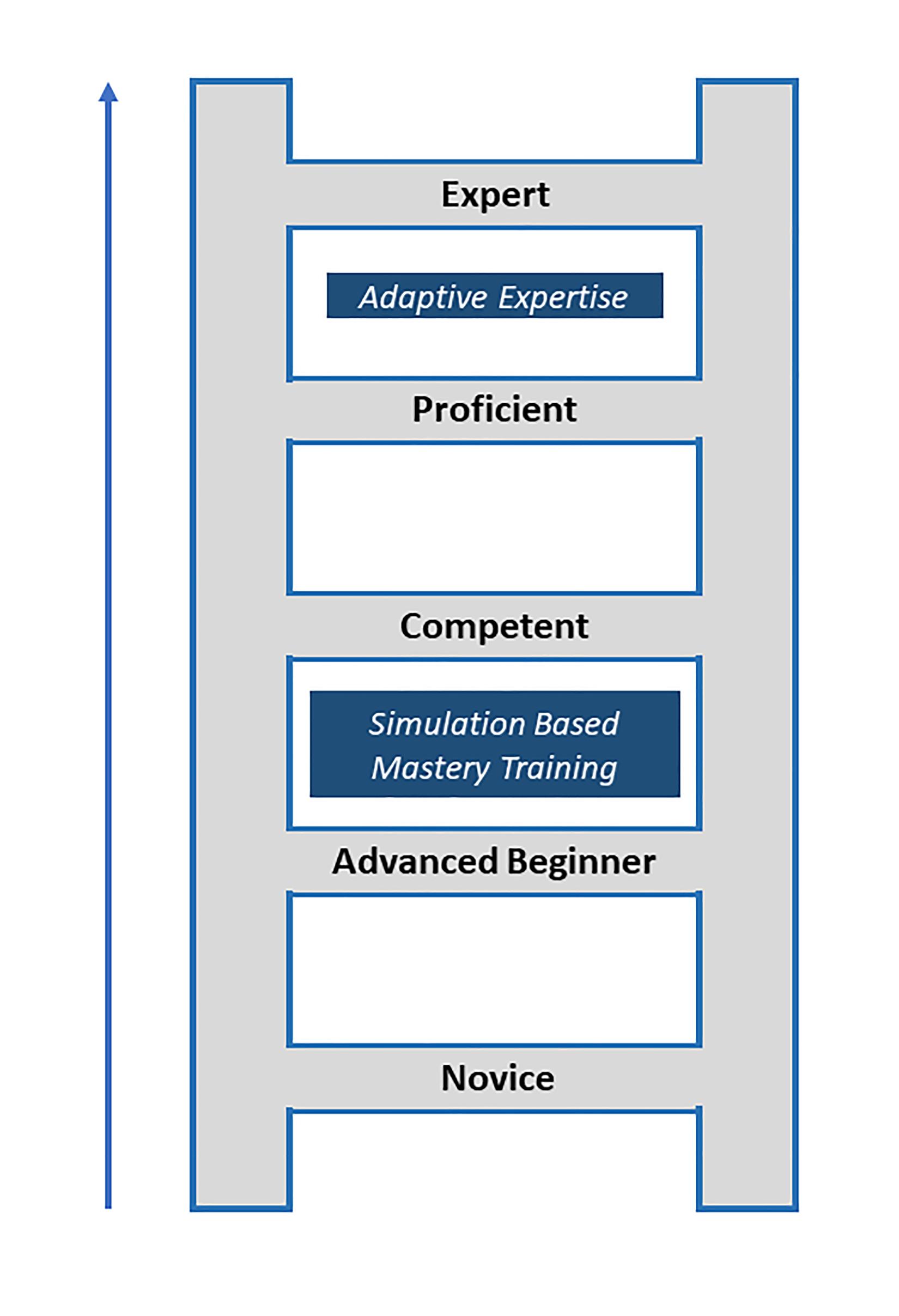
We designed this program from the perspective of Griswold-Theodorson’s synthesis of the Dreyfus/Benner SBML model of skill acquisition.18 Using this model, we introduced SBML to matriculating residents with the assumption that they had already progressed through the “novice” stage and were in the “advanced beginner” stage of development.18 Advanced beginners are characterized as having early working knowledge of key aspects of a technical skill and view them as interrelated steps; however, they still require guidance for successful procedure completion.18 The goal of our program was to implement SBML to move our matriculating interns from the “advanced beginner” stage to the level of “competent.”18 The competent intern is able to safely participate in performing procedures during patient care encounters with gradually decreasing supervision as they move from competent to proficient. (See Figure 1.)18
The setting was a university-based, tertiary-care teaching hospital and its three-year EM program with 17 residents
Volume 24, NO.1: January 2023 9 Western Journal of Emergency Medicine Yee et al.
Intern Competence Prior to Patient Care
Procedural Curriculum to Verify
Procedural Curriculum to Verify Intern Competence Prior to Patient Care
per year and a five-year EM-IM residency program with two residents per year. As part of the project development plan, mastery-based training paradigms were developed following commonly described methodology that included the following: 1) development of procedural assessment checklists and standard setting to define competency and 2) mastery training implementation (pretesting and deliberate practice) followed by 3) post-testing to confirm achievement of competency for supervised clinical care.9
Assessment Checklist and Standard Setting
Assessment checklists were developed de novo to address institution-specific safety protocols, such as verbalizing
when guidewires are inserted or removed. Checklists for the designated procedures were initially developed by a panel of 13 EM faculty members. These faculty were chosen for their varied expertise with procedures, procedural education, and program administration (Appendix 1). Checklists were developed with each item being scored dichotomously (correct or incorrect) and each item being given equal weight for scoring. Skills assessed by the checklists included maintaining sterility, ultrasound competency, and universal safety items such as calling for time-outs. Consensus on checklist items was achieved through an iterative process of addition and deletion of individual procedural microtasks.
Performance standards were set for these internally developed checklist instruments using methods previously described.19 In brief, faculty panelists applied the MasteryAngoff method by assigning a percentage to each checklist item that represented how many well-trained residents would be able to perform that step correctly without bedside supervision.20 To evaluate the overall performance of each procedural checklist, internal consistency reliability among items was estimated using Cronbach’s alpha. For each panelist, the scores of each checklist item were added up for a total raw procedure score. The raw score was then divided by the number of checklist items to determine the MPS specific to each checklist. The MPS was then averaged between all the panelists’ scores for the final MPS for each procedure. During the first year of implementation, we evaluated the item-total correlations (point-biserial correlations) of each item on each checklist. Items with point-biserial correlations less than or equal to .20 (rptbis<.20) were dropped from further use.
Mastery Training Implementation
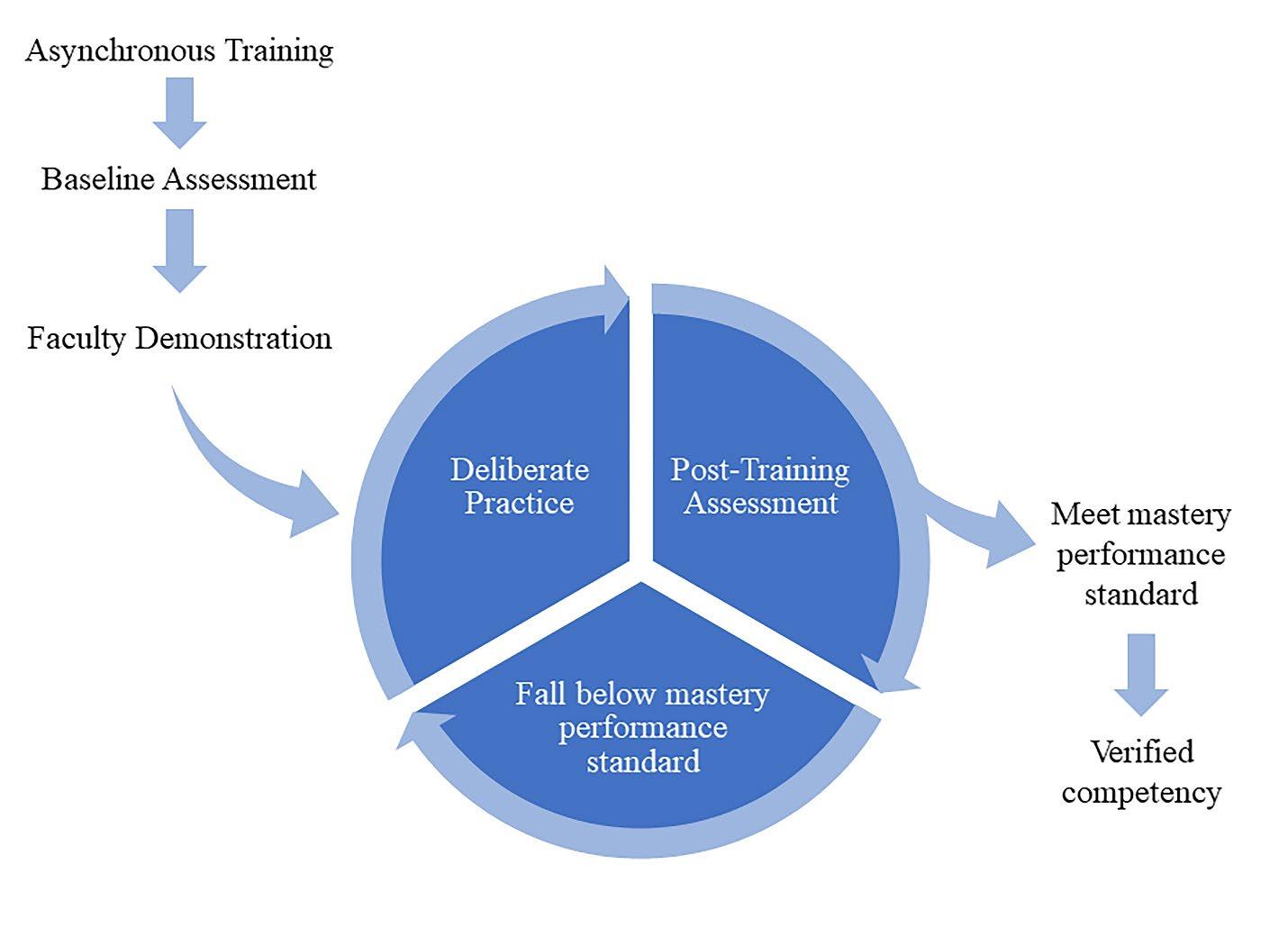
The SBML training was used to instruct incoming first-year EM and EM-IM residents in procedural skills and to confirm achievement of competence.21 This included asynchronous pre-training with videos followed by a face-toface training event (Figure 2). These videos, which included the New England Journal of Medicine procedure series (Year One), were assigned prior to the resident’s scheduled time in the simulation laboratory.22-26 Internally created videos that specifically covered the content of all procedural checklist content were used in Year Two. The internally created videos included institution-specific patient safety initiatives, such as verbalizing when guidewires are inserted and when they are removed, as well as a review of the commercial kit contents used by our institution.
Figure 1. Model depicting progression of procedural skill development from novice to expert. Simulation-based mastery training helps prepare trainees to enter the clinical care environment at a competent skill level without risk to patients. In contrast, adaptive expertise is essential to move to high proficiency and expert levels. This is the ability to understand and manage complex patients and situational conditions thus achieving the optimal patient outcomes.18
Participants were then provided face-to-face training including pretesting assessments, faculty demonstration, time for deliberate practice, and a post-test to confirm the achievement of competence. This experience was facilitated by faculty who were trained to teach the five procedures and score the checklist assessments. During training, faculty were specifically instructed in how to score each item in the checklists and were instructed not to provide prompting or
Western Journal of Emergency Medicine 10 Volume 24, NO.1: January 2023
Yee et al.
coaching during pre- or post-testing unless explicitly told to do so on their checklist.
Face-to-face skills training events were held over three days to accommodate all interns. Sufficient time was designated to allow for pretesting, faculty demonstration, deliberate practice time, and post-testing. Included in the overall training period was additional time accommodations for repeat education, deliberate practice, and post-testing if competency was not achieved. One faculty member was assigned to each participant for the day. During pretesting, checklists were used to obtain participants’ individual baseline performance on the procedures (up to 30-minute pretesting period).
Each participant’s performance was compared against the MPS derived from standard setting. Afterward, a faculty member then demonstrated the procedures for the group of participants. Participants were able to ask questions and were given clarity on critical procedural steps. Following this, each participant then returned to their assigned faculty member for deliberate practice and receipt of individualized feedback. Participants were given up to 45 minutes of deliberate practice per procedure. At a minimum, the individual participant’s time commitment for all five procedures was estimated at nine hours if they were able to pass each post-test on their first attempt after one session of deliberate practice.
Post-testing for Competence Verification
Deliberate practice was followed by post-testing to assess whether procedural competency was achieved. If the participant did not achieve the MPS on their first attempt, they were assigned to additional deliberate practice until they were ready for a repeat post-test. This was repeated for each time the MPS was not achieved by the participant as outlined
by mastery-learning principles to train everyone to a preset standard, resulting in outcomes with minimal variation. During the second year, we added the identification of critical incidents or “dangerous actions,” such as a retained guidewire, dilation of a carotid artery, or a CVC advanced in a cephalad direction that were likely to lead to patient harm. As they were thought to be critical enough to be identified and remediated immediately, if these actions were identified during pretesting or posttesting, the facilitator would immediately stop the attempt and debrief with the participant. Participants were then directed to additional deliberate practice to optimize skills.
Analysis
Descriptive statistics were calculated for demographic characteristics of the population. We used cumulative percentages (with frequencies) to describe achievement of competence, per assessment attempt, for each procedure. Box and whisker plots were generated to demonstrate the percent correct per procedure for baseline and final comparisons. These plots described the median, interquartile ranges, and upper and lower extremes. Outliers are demonstrated by single points below or above the plot. We used Wilcoxon matched-pairs signed-rank tests to evaluate differences between baseline and final assessment scores. All analyses were completed using Stata SE version 17 (StataCorp LP, College Station, TX).
RESULTS
In 2020 and 2021, 38 matriculating EM and EM-IM residents were enrolled in the training program. These residents were 47.4% women with a median age of 27.5 years. This group had a higher composition of women than the national average for EM residents in the United States, which was 36.9% female in 2020-2021.27
Greater than 90% of participants were able to achieve the MPS on all five procedures within two attempts after baseline assessment (Table 1). All participants achieved competence by the third attempt. A total of 14 participants needed more than one attempt at post-testing (37%), including six participants
Volume 24, NO.1: January 2023 11 Western Journal of Emergency Medicine Yee et al. Procedural Curriculum to Verify Intern Competence Prior to Patient Care
Figure 2. Mastery-based curriculum structure. Included in the curriculum is baseline assessment, deliberate practice with feedback, post-training assessment for competence attainment. If minimum performance standard (MPS) is achieved, the trainee has verified competence. If MPS is not achieved, the trainee continues deliberate practice with feedback until prepared to reassess.
Passed assessment after attempt 1 (frequency, %) Passed assessment after attempt 2 (frequency, %) Passed assessment after attempt 3 (frequency, %) CVC 32/38 (84) 35/38 (92) 38/38 (100) CT 32/38 (84) 37/38 (97) 38/38 (100) ETI 32/38 (84) 37/38 (97) 38/38 (100) LP 32/38 (84) 38/38 (100) n/a Para 31/38 (82) 37/38 (97) 38/38 (100)
Table 1. Cumulative percentage of participants who achieved competence, by number of post-test attempts, for each procedure (n=38).
CVC, central venous catheter; CT, chest tube; ETI, endotracheal intubation; LP, lumbar puncture; Para, paracentesis.
for CVC placement, six for CT, six for ETI, six for LP, and seven for paracentesis. Five learners (13.16%) needed more than one attempt on one procedure, five learners needed more than one attempt on two procedures, two learners (5.26%) for three procedures, and two learners for all five procedures. Twenty-four participants (63%) were able to demonstrate competency in all five procedures after a single session of instruction and deliberate practice. The learning pattern for participants who required more than one attempt is noted in Figure 3. As expected through the mastery-based training platform, performance improved to eventual attainment of competence in all procedures for learners who required additional attempts.
requiring greater than one post-test assessment: CVC (n=6), CT (n=6), ETI (n-=6), LP (n=6) and para (n=7). CVC, central venous catheter; CT, chest tube; ETI, endotracheal intubation; LP, lumbar puncture; Para, paracentesis.
There was a significant improvement in performance for each procedure, from baseline to final post-assessment, for the whole cohort as noted in Figure 4 (P<0.05, baseline testing to final post-assessment scores). Additionally, the extent of variability in scores significantly decreased from baseline to final post-assessment.
Total time for attainment of competence for participants was tracked through the study. Total time per participant ,if the MPS was achieved on all five procedures after one post-test attempt, was approximately nine hours. The maximum amount of time required by a participant to achieve competency on all procedures was 16 hours. Of note, dangerous actions, tracked in year two, were rare with only one event occurring where a guidewire was retained during post-testing.
DISCUSSION
In an ideal world, all EM trainees would be supervised throughout the entirety of a clinical procedure. In reality, however, faculty step away from the bedside to care for another sick patient, become distracted with a phone call, or may not have training themselves on how to troubleshoot
learners who encounter procedural difficulties. Through this mastery-based learning program, all participants achieved a level of procedural competence, as defined by preset standards, in the simulation laboratory. This cleared residents for supervised participation in procedures during clinical care, ameliorating the risk of novice iatrogenic injuries that result from “practicing” on a patient.
One significant observation of this study is that 37% of participants required additional deliberate practice and additional attempts to pass the MPS for at least one procedure. This indicated that achievement of skills competency required additional focused deliberate practice and feedback for several interns with a small group needing multiple attempts on several procedures.
Procedural competence is a core aspect of EM training and has been noted to be essential for independent practice.7,10 Unfortunately, many EM procedures occur at low frequencies,28-32 and may be associated with high-risk complications.33 Key index procedure numbers coupled with procedure logs have been traditionally used by residency programs as indicators of procedural experience or mastery. However, these guidelines have never been supported by any specific literature or validated against competency-based performance assessments. Clear definitions of procedural competence during residency training have not been established, nor has there been a standard framework for how procedural competency should be demonstrated during EM residency training.
Realistically, it is not feasible to assess individual clinicians’ competence regularly to determine their current procedural skillset during residency, nor are procedural competencies reviewed at the level of program accreditation. Mastery-based procedural education has been demonstrated to improve patient outcomes in a variety of settings.34 To
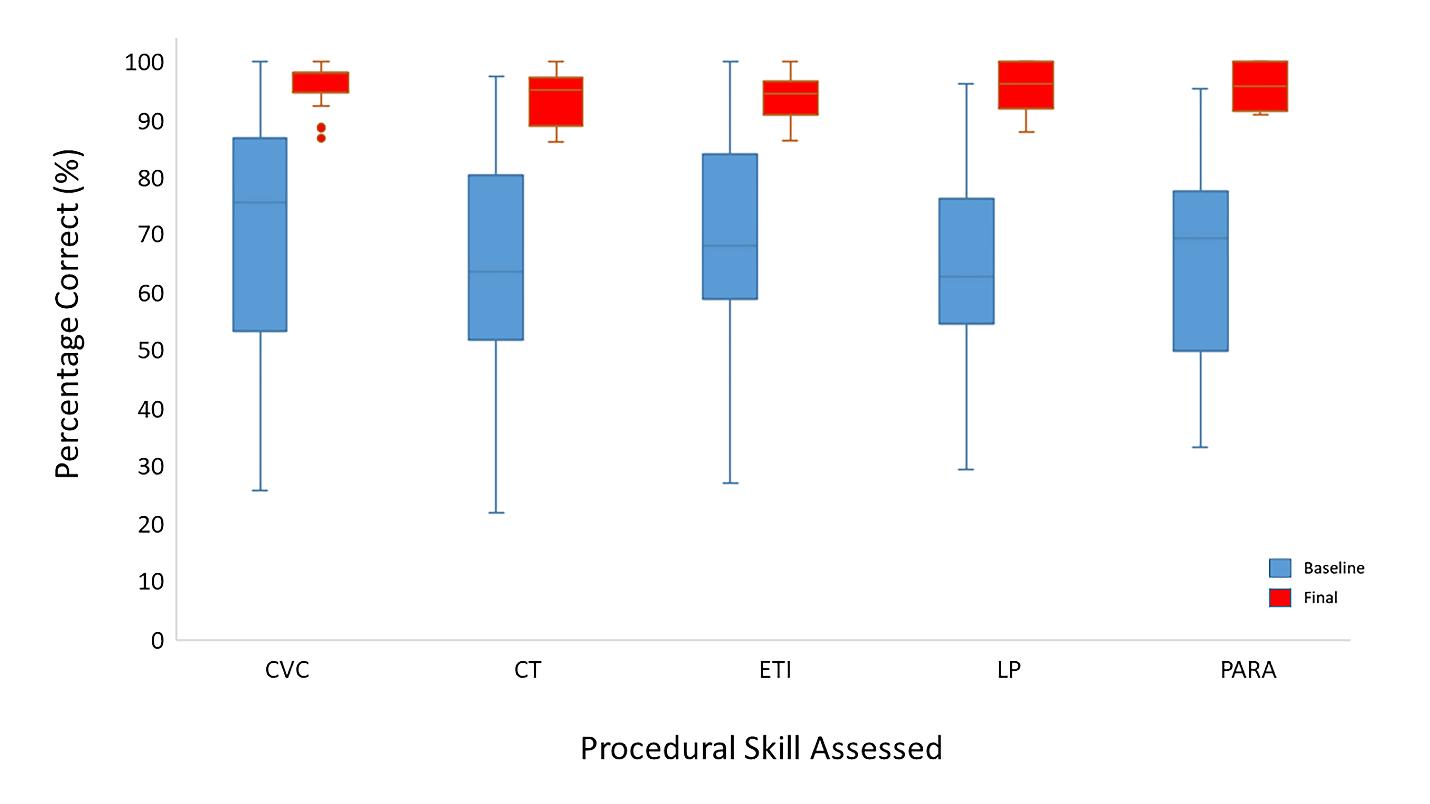
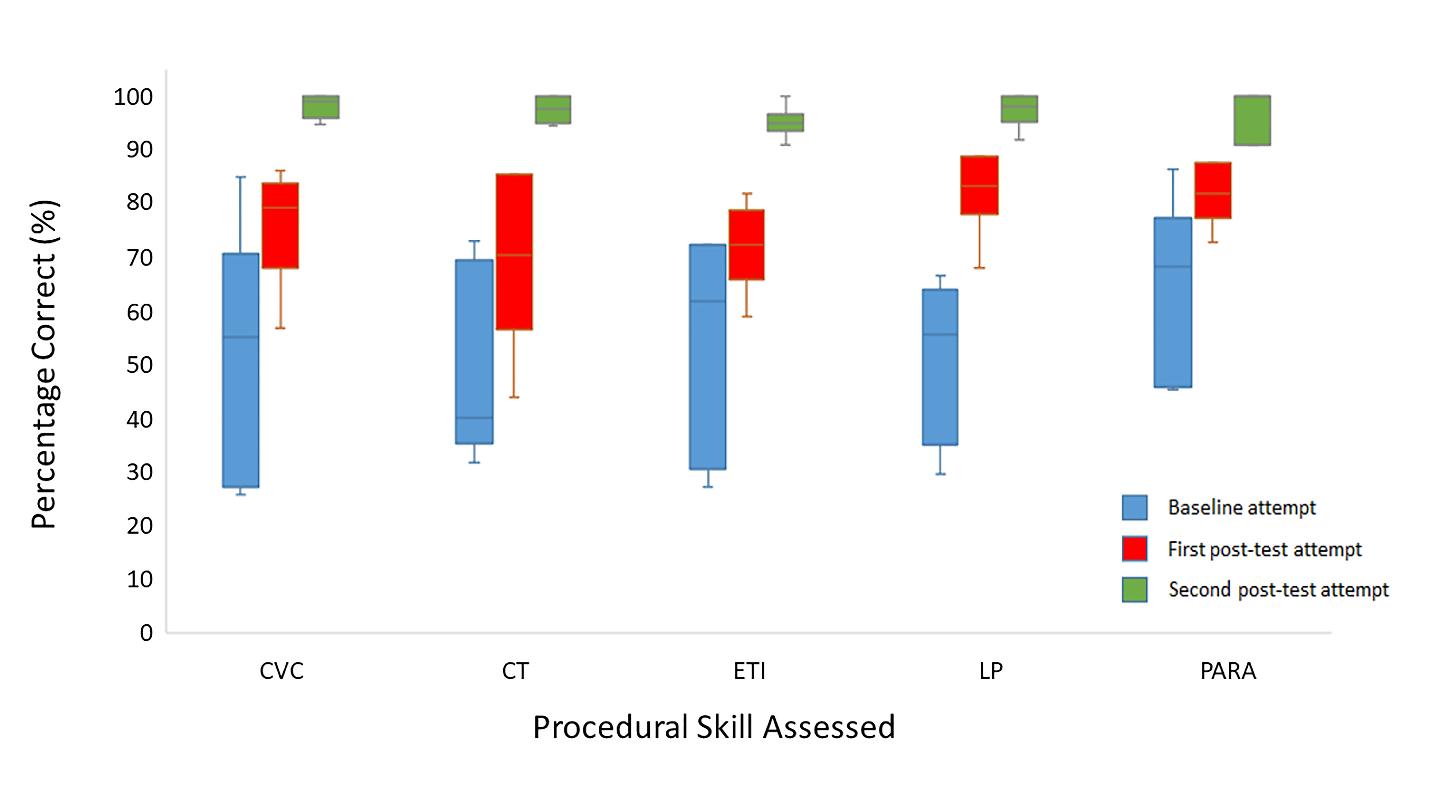
Western Journal of Emergency Medicine 12 Volume 24, NO.1: January 2023 Procedural Curriculum to Verify Intern Competence Prior to Patient Care Yee et al.
Figure 4. Improvement from baseline to final assessment in the 5 procedures (n=38). Box whisker plot with median and interquartile range; *, P<0.05.
CVC, central venous catheter; CT, chest tube; ETI, endotracheal intubation; LP, lumbar puncture; Para, paracentesis.
avoid iatrogenic harm from matriculating first-year residents, the least a program can do is to assess their residents’ procedural competency prior to allowing them to encounter patients in the clinical setting. If incoming residents are lacking procedural competence, training them up to preestablished standards in the simulation lab prepares them to participate in procedures during patient encounters. The next step will be to assess for maintenance of skill over time and translational patient outcomes.
There is currently a lack of literature that describes the actual baseline procedural competency of matriculating EM interns. Our data showed significant variability of baseline performance across five high-risk procedures, suggesting the need for competency-based procedural education at the onset of residency training. While the extent of variability of procedural competence of matriculating first-year residents is unclear, it is an important consideration for educators as they prepare these physicians for clinical practice.
A key factor involved in this study was the amount of time and manpower needed for a comprehensive residencywide, mastery-based procedural training program. Due to the substantial time and physical resources required, it is possible that implementation of this program may not be universally feasible. The total procedural training time for all procedures averaged 11 hours per participant. Thirty-two facilitators were needed in year one, which was streamlined to 17 facilitators in year two. Upon reflection, a key implementation consideration is the burden of time and educational infrastructure weighed against the overall training benefit for new residents and potential for improvement in patient outcomes.
Resource-limited programs may find this approach challenging but may consider choosing SBML for a different set of procedures or adjust the time schedule to suit their faculty and resource availability. We suggest that interested programs identify procedures based on risk of potential iatrogenic injury, create institution-specific checklists or modify existing published procedural checklists to include any institutionspecific safety elements, and obtain faculty buy-in with scheduling education time well in advance to accommodate the time needed for both preparation and education.
LIMITATIONS
This was a pilot study performed at one clinical site with experts derived from the faculty of a single residency program to develop checklists and standards and provide the teaching for SBML. One key challenge we faced were the logistics of delivering the necessary education in the face of COVID-19 with limited availability of personal protective equipment and required physical distancing between stations. Future work will evaluate the best method for developing subsequent procedural proficiency as well as optimal training delivery while maintaining the health and safety of patients.
Despite careful training of faculty facilitators in masterybased instruction and use of the checklist assessments, we
must also consider that the use of so many facilitators was a limitation that may have contributed to variation in scoring and teaching practices. Future research will need to evaluate assessments and training to improve interrater reliability between assessors. Finally, our residency program has a strong tradition of ultrasound education, including its use in guiding procedures, and these best-practice skills were emphasized during instruction, which may not be the case at other institutions.
CONCLUSION
Educators should strive to deliver care to patients that is as safe as possible, including ensuring that residents are competent before they are permitted to participate in procedures associated with high risk of iatrogenic injuries. Mastery-based frameworks for procedural education have demonstrated improved patient outcomes. By assessing incoming first-year residents’ procedural skills and training them to a standard, potentially dangerous actions were identified, and procedural competency was able to be demonstrated prior to supervised clinical care.
ACKNOWLEDGMENTS
The authors would like to thank the residents from the entering classes of 2020 and 2021, as well as the departmental and residency administration and the faculty instructors for their support of this effort. The authors would also like to acknowledge our chair, Dr. Jeffrey Caterino, and administrative and education program leadership for their support of the EM procedural education curriculum.
Address for Correspondence: Jennifer Yee, DO, The Ohio State University College of Medicine, Department of Emergency Medicine, 760 Prior Hall, 376 W 10th Ave., Columbus, Ohio 43210. email: Jennifer.Yee@osumc.edu.
Conflicts of Interest: By the WestJEM article submission agreement, all authors are required to disclose all affiliations, funding sources and financial or management relationships that could be perceived as potential sources of bias. No author has professional or financial relationships with any companies that are relevant to this study. There are no conflicts of interest or sources of funding to declare.
Copyright: © 2023 Yee et al. This is an open access article distributed in accordance with the terms of the Creative Commons Attribution (CC BY 4.0) License. See: http://creativecommons.org/ licenses/by/4.0/
REFERENCES
1. Institute of Medicine (US) Committee on Quality of Health Care in America, Kohn LT, Corrigan JM, Donaldson MS, eds. To Err is Human: Building a Safer Health System. Washington (DC): National Academies Press (US); 2000.
Volume 24, NO.1: January 2023 13 Western Journal of Emergency Medicine Yee et al. Procedural Curriculum to Verify Intern Competence Prior to Patient Care
Procedural Curriculum to Verify Intern Competence Prior to Patient Care
2. Calder L, Pozgay A, Riff S, et al. Adverse events in patients with return emergency department visits. BMJ Qual Saf. 2015;24(2):142-8.
3. Thomas EJ, Studdert DM, Burstin HR, et al. Incidence and types of adverse events and negligent care in Utah and Colorado. Med Care 2000;38:261271.
4. Southwick FS, Cranley NM, Hallisy JA. A patient-initiated voluntary online survey of adverse medical events: the perspective of 696 injured patients and families. BMJ Qual Saf. 2015;24(10):620-9.
5. Ziv A, Wolpe PR, Small SD, et al. Simulation-based medical education: an ethical imperative. Acad Med. 2003;78:783–8.
6. AAMC. Core Entrustable Professional Activities for Entering Residency. 2017. Available at: https://www.aamc.org/media/20196/ download?attachment. Accessed July 4, 2022.
7. The Accreditation Council for Graduate Medical Education. Emergency Medicine Milestones. 2021. Available at: https:// www.acgme.org/globalassets/PDFs/Milestones/Emerge ncyMedicineMilestones2.0.pdf?ver=2021-02-24-104718043&ver=2021-02-24-104718-043. Accessed January 18, 2022.
8. Santen SA, Rademacher N, Heron SL, et al. How competent are emergency medicine interns for level 1 milestones: Who is responsible? Acad Emerg Med. 2013;20(7):736-9.
9. McGaghie WC, Harris IB. Learning Theory foundations of simulationbased mastery learning. Simul Healthc. 2018;13(3S Suppl 1):S15-20.
10. The Accreditation Council for Graduate Medical Education. Emergency Medicine Defined Key Index Procedure Minimums. 2017. Available at: https://www.acgme.org/globalassets/PFAssets/ ProgramResources/EM_Key_Index_Procedure_Minimums_103117. pdf?ver=2017-11-10-130003-693&ver=2017-11-10-130003-693.
Accessed January 18, 2022.
11. Harris A, O’Driscoll BR, Turkington PM. Survey of major complications of intercostal chest drain insertion in the UK. Postgrad Med J. 2010;86;68-72.
12. Hernandez MC, El Khatib M, Prokop L, et al. Complications in tube thoracostomy: systematic review and meta-analysis. J Trauma Acute Care Surg. 2018;85(2):410-6.
13. Lennon M, Zaw NN, Pӧpping DM, et al. Procedural complications of central venous catheter insertion. Minerva Anestesiol 2012;78(11):1234-40.
14. Ruesch S, Walder B, Tramèr MR. Complications of central venous catheters: internal jugular versus subclavian access—a systemic review. Crit Care Med. 2002;30(2):454-60.
15. Horlocker TT, McGregor DG, Matsushige DK, et al. A retrospective review of 4767 consecutive spinal anesthetics: central nervous system complications. Anesth Analg. 1997;84(3):578-84.
16. Sharzehi K, Jain V, Naveed A, Schreibman I. Hemorrhagic complications of paracentesis: a systematic review of the literature. Gastroenterol Res Pract. 2014;2014:985141.
17. Barsuk JH, Cohen ER, Feinglass J, et al. Clinical outcomes after bedside and interventional radiology paracentesis procedures. Am J
Med 2013;126:349–56.
18. Griswold-Theodorson S, Ponnuru S, Dong C, et al. Beyond the simulation laboratory: a realist synthesis review of clinical outcomes of simulation-based mastery learning. Acad Med. 2015;90(11):1553-60.
19. Panchal AR, Way DP, King AM, et al. Performance standards of comprehensive airway management for emergency medicine residents. AEM Educ Train. 2018;3(1):39-49.
20. Yudkowsky R, Park YS, Lineberry M, et al. Setting mastery learning standards. Acad Med. 2015;90(11):1495–500.
21. McGaghie WC, Issenberg SB, Barsuk JH, et al. A critical review of simulation-based mastery learning with translational outcomes. Med Educ. 2014;48(4):375-85.
22. Ortega R, Song M, Hansen CJ, et al. Videos in clinical medicine. Ultrasound-guided internal jugular vein cannulation. N Engl J Med 2010;362(16):e57.
23. Kabrhel C, Thomsen TW, Setnik GS, et al. Videos in clinical medicine. Orotracheal intubation. N Engl J Med. 2007;356(17):e15.
24. Ellenby MS, Tegtmeyer K, Lai S, et al. Videos in clinical medicine. Lumbar puncture. N Engl J Med. 2006;355(13):e12.
25. Thomsen TW, Shaffer RW, White B, et al. Videos in clinical medicine. Paracentesis. N Engl J Med. 2006;355(19):e21.
26. Dev SP, Nascimiento B Jr, Simone C, et al. Videos in clinical medicine. Chest-tube insertion. N Engl J Med. 2007;357(15):e15.
27. Accreditation Council for Graduate Medical Education. Data Resource Book Academic Year 2020-2021. 2021. Available at: https:// www.acgme.org/globalassets/pfassets/publicationsbooks/2020-2021_ acgme_databook_document.pdf. Accessed January 25, 2022.
28. Bucher JT, Bryczkowski C, Wei G, et al. Procedure rates performed by emergency medicine residents: a retrospective review. Int J Emerg Med. 2018;11(1):7.
29. Deveau JP, Lorenz JE, Hughes MJ. Emergency medicine resident work productivity and procedural accomplishment. J Am Osteopath Assoc. 2003;103(6):291-6.
30. Hayden SR, Panacek EA. Procedural competency in emergency medicine: the current range of resident experience. Acad Emerg Med. 1999;6(7):728-35.
31. Langdorf MI, Montague BJ, Bearie B, et al. Quantification of procedures and resuscitations in an emergency medicine residency. J Emerg Med. 1998;16(1):121-7.
32. Wadman MC, Fago B, Hoffman LH, et al. A comparison of emergency medicine resident clinical experience in a rural versus urban emergency department. Rural Remote Health. 2010;10(2):1442.
33. Hansen K, Schultz T, Crock C, et al. The Emergency Medicine Events Register: an analysis of the first 150 incidents entered into a novel, online incident reporting registry. Emerg Med Australas 2016;28(5):544-50.
34. Barsuk JH, Cohen ER, Feinglass J, et al. Use of simulation-based education to reduce catheter-related bloodstream infections. Arch Intern Med. 2009;169(15):1420-3.
Western Journal of Emergency Medicine 14 Volume 24, NO.1: January 2023
Yee et al.
An Evaluation of Emergency Medicine Core Content Covered by Podcasts
Jeffrey Riddell, MD*
Scott Kobner, MD*
Gabriel Padilla, MD‡
Keck School of Medicine of USC, Department of Emergency Medicine, Los Angeles, California Alpert Medical School of Brown University, Department of Emergency Medicine, Providence, Rhode Island
Section Editor: Jules Jung, MD, MEd
Submission history: Submitted June 14, 2022; Revision received November 17, 2022; Accepted November 15, 2022
Electronically published January 11, 2023
Full text available through open access at http://escholarship.org/uc/uciem_westjem
DOI: 10.5811/westjem.2022.11.57717
Introduction: Podcasts are used broadly for learning in emergency medicine (EM); however, there is concern about the potential for knowledge gaps for learners who rely on podcasts for their learning. The extent to which EM podcasts cover the core curriculum of EM is not known; thus, we sought to quantify the extent to which podcasts represent the core content of our specialty
Methods: We performed a retrospective review of all EM podcast episodes published in 2019. All podcasts were given credit for the content they covered as it related to the 2016 American Board of Emergency Medicine (ABEM) Model of Clinical Practice in Emergency Medicine (EM Model). The primary outcome was a description of how podcasts represented the ABEM EM Model content topics compared to the topic representation of the ABEM Qualifying Exam.
Results: We included 54 unique EM podcast programs and 1,193 podcast episodes. They covered 2,965 total EM Model core content topics. The topics most covered were “other” (which includes interpersonal skills and professionalism), procedures, and signs and symptoms. Musculoskeletal, hematology, and environmental each accounted for less than 1% of all topics covered. Almost threequarters of podcast episodes covered other core competencies of the practice of EM.
Conclusion: Podcasts had a broad yet imbalanced coverage of the ABEM EM Model core content subtopics in 2019, with a notable coverage of other core competencies of the practice of EM. Learners, educators, and scholars should be mindful of these gaps and focus future work on exploring how podcasts should best be used in EM education. [West J Emerg Med. 2023;24(1)15–22.]
INTRODUCTION
Medical students, residents, and practicing physicians increasingly use podcasts for their education, with some preferring podcasts to textbooks and journal articles.1–6 Podcasts are an easy-to-use and engaging medium that provide learners with broad exposure to educational content and targeted learning opportunities.7,8 While educational podcasts are used in many medical specialties,9–13 podcasting is particularly popular in emergency medicine (EM). To date, EM has the largest number of active podcasts, podcast episodes, and hours of content.14
While some hail the rise of podcasts as the “Netflix” of medical education,15 others sound notes of caution. In addition
to concerns over quality,16,17 some argue that online educational resources lack the comprehensiveness of textbooks and other commonly used curricula designed to impart the breadth of core-content knowledge dictated by the American Board of Emergency Medicine (ABEM) Model of the Clinical Practice of Emergency Medicine (EM Model).18,19 Thus, learners who rely primarily on these resources may have knowledge gaps due to over- or under-representation of topics.20
This begs the question, however, of whether the amalgam of EM podcasts should be comprehensive. If podcasts are poised to “fundamentally reimagine medical education” in the next decade,21 then we must wrestle with their role and purpose. Although some podcasts have been designed
Volume 24, NO.1: January 2023 15 Western Journal of Emergency Medicine Original
Research
* ‡
An Evaluation of EM Core Content Covered by Podcasts
specifically to cover EM core content,22–24 should we ask podcasts to cover the breadth of an EM education? And if so, can they? It is unclear the extent to which even the core content-focused podcasts cover the breadth of the specialty. Further, within EM core-content podcasts, are they disproportionately covering topics that are probably best taught in a visual (eg, dermatology) or kinesthetic (eg, procedures) format? Or should we ask instead of podcasts that they bring multi-specialty expertise to controversial topics,25 model clinical reasoning and diagnosis,26 analyze recent clinical literature,27 focus on mindset and mental performance,28 tackle gender equity in medicine,29 or carry forward conversations about racism in medicine?30–32
Given trainees’ current dependence on these resources, and the ways in which many learners listen by absorbing whatever topic is pushed to them in the queue,7 our responses to these debates should be informed by a comprehensive understanding of what podcasts are currently covering. This knowledge will begin to help educators make thoughtful recommendations to their learners, help podcast creators see the domains they may have been over- or under-emphasizing, and help scholars make educated arguments about the role and purpose of podcasts in EM education. The only existing studies looking at the comprehensiveness of online educational resources have focused on blogs,19,20 leaving a gap in our understanding of the content podcasts provide. Thus, we sought to quantify the extent to which podcasts represent the core content of our specialty.
METHODS Study Design
We performed a retrospective review of all available episodes from 54 EM educational podcasts posted online in 2019. We followed the approach used in a previous study evaluating blog content, and we mapped the content of all included podcast episodes to the 2016 ABEM EM Model content topics.18,19 Our local institutional review board deemed the study exempt.
Podcast Selection
As there was no updated listing of all EM podcasts, we used a three-step process to identify all EM podcasts that released episodes in 2019. First, we included all accessible podcasts documented in a recent study that relied on a web search to identify podcasts in every medical specialty (including EM).14 This yielded 32 EM podcasts for inclusion. Next, we searched the Social Media Index (SMI) on March 31, 2020, to find podcasts that we had not yet included. The SMI is a website that lists EM and critical care blogs and podcasts, ranking them based on their impact.33,34 The SMI yielded 39 additional podcasts. Finally, we emailed a group of seven EM podcast creators for their content expertise. We showed them our existing list and asked them to recommend any podcast we might have missed. They recommended 14 additional podcasts. From a total of 85
Population Health Research Capsule
What do we already know about this issue? Emergency medicine (EM) trainees utilize podcasts extensively for learning.
What was the research question? Does the representation of core content topics in EM podcasts differ significantly from the American Board of Emergency Medicine (ABEM) qualifying exam?
What was the major finding of the study? Podcasts had an imbalanced yet broad coverage of ABEM EM Model core content subtopics.
How does this improve population health? Listeners, educators, and podcast creators should be mindful of these gaps and consider which parts of the core curriculum of our specialty are best suited to audio learning.
podcasts, we then excluded duplicates (those on both the web search study and the SMI), podcasts not focused on EM, and podcasts without any episodes during 2019.
The 54 remaining podcasts yielded 1,270 unique podcast episodes. We excluded individual episodes if they were a video/vodcast, mailbag-response episode, summarized another podcast, largely advertisements, or focused on personal stories. A total of 77 episodes were excluded, leaving 1,193 for our analysis (Figure 1). The list of included podcasts is available as eAppendix A.
Measurement methods
We used the 2016 ABEM EM Model clinical categories and subtopics to define EM core content.18 The 2016 model was used because the updated 2019 ABEM EM Model was not publicly available at the start of the study. There are a total of 20 broad categories in the EM Model, which are each divided into subtopics. We defined each category within the EM Model as a core content topic.
One author (GP) evaluated each podcast episode for EM Model, core content coverage by reviewing the podcast episode title and show notes. If show notes were unavailable, the author listened to the podcast. If a podcast covered any EM Model core content topic in an educational manner, we documented that podcast as having covered its corresponding EM Model core content category. We gave podcasts credit for as many EM Model core content topics as were mentioned. In other words, a single podcast could have covered multiple EM Model core content topics.
Western Journal of Emergency Medicine 16 Volume 24, NO.1: January 2023
Riddell et al.
If a topic was merely mentioned incidentally but not expanded upon in an educational manner, the podcast episode was not credited with covering that topic. For example, if a podcast was discussing a cardiovascular diagnosis and then mentioned that the differential diagnosis included a gastrointestinal topic but did not describe it in any detail, then the podcast would only receive credit for the cardiovascular topic. However, if the gastrointestinal topic was described in further detail, then the podcast episode would be credited with covering that topic as well.
Throughout the coding process a second author (JR) reviewed and discussed any unclear podcast topic coverage until consensus was achieved. A third author (SK) then abstracted data from a random sample of 5% of podcasts and coded each podcast in a similar manner to the primary
abstractor. Their inter-rater agreement was excellent (pooled k = 0.84). The inter-rater agreement broken down by each EM Model topic is available in eAppendix B.
Outcomes
For the purpose of comparison given our primary focus on resident education, and in keeping with previous blogbased studies,19,20 we used the ABEM Qualifying Exam (QE) content specifications as the standard weighting of core content.35 The primary outcome was a description of how ABEM EM Model content topics were represented by EM podcasts from January 1–December 31, 2019 compared to the topic representation of the ABEM QE. Additional outcomes included the number of unique EM podcast episodes that covered each EM Model category.
Volume 24, NO.1: January 2023 17 Western Journal of Emergency Medicine Riddell et al. An Evaluation of EM Core Content Covered by Podcasts
Figure 1. Podcast selection.
● ○ ● ○ ● ○ ● ○ ● ○ Figure 1A ● ○ ● ○ ● ○ ● ○ ● ○ ● ○ ● ○ ● ○ ● ○
An Evaluation of EM Core Content Covered by Podcasts
Data Analysis
We calculated proportional representation of ABEM categories covered by podcasts with associated 95% confidence intervals (CI). We also calculated differences between categorical representation in podcasts and the ABEM QE.
RESULTS
The 54 unique EM podcasts yielded 1,193 included podcast episodes. They covered 2,965 EM Model topics, with a mean of 2.49 (SD 1.77) subtopics per podcast. Of all topics, those most commonly covered were as follows: “other” (29.1%, 95% CI 27.75-30.53); procedures (15.8%, 95% CI 14.54-16.96); and signs and symptoms (12.9%, 95% CI 11.76-14.01). When compared to their relative weight on the ABEM QE, the same topics were the only ones notably over-represented (Table 1). Musculoskeletal (0.7%, 95% CI 0.43-1.05), hematology (0.8%, 95%CI 0.52-1.17), and environmental (0.9%, 95% CI 0.54-1.21) each accounted for less than 1% of all topics covered. The most under-represented topics relative to their weight on the ABEM QE were abdominal/GI (-5.1%), trauma (-4.0%), respiratory (-3.7%), and cardiovascular (-3.5%).
The percentage of all podcast episodes that covered each ABEM topic are shown in Table 2. Almost three-quarters (72.4%, 95% CI 70.8-74.0) of podcast episodes covered other core competencies of the practice of EM, which was 70.4% more than the topic’s relative weight on the ABEM QE. Signs and symptoms and procedures were also covered on more than 32% and 39% of podcast episodes, respectively. While many topics were over-represented relative to the ABEM QE, relatively few were under-represented as a proportion of all podcast episodes, including abdominal/GI (-2.4%); head, eyes, ears, nose, and throat exam (-1.3%); musculoskeletal (-1.2%); and hematology (-0.9%).
DISCUSSION
We found notable differences in how ABEM EM Model content topics were represented by EM podcasts compared to the topic representation of the ABEM Qualifying Exam. Overall, our data suggests imbalanced yet broad coverage of the core content of EM. The finding that, as a percentage of all podcast episodes, very few topics were proportionally underrepresented relative to their ABEM QE weight speaks to the thorough coverage of core content that podcasts provided. This is in line with a previous study of blogs that also found five topics under-represented compared with the QE model.20 When considering all topics covered, we found a range of proportional representation relative to the QE from +27% to -5%. The imbalance we found with podcasts is not strikingly dissimilar to previous studies of blog posts.19,20 The imbalance in podcasts, however, appears different from the imbalance found in the blog studies. While these studies also reported high proportions of signs and symptoms, procedures, and
other competencies,19 we found a strikingly higher level of discussion of other core competencies of the practice of EM on podcasts. The subtopics for other core competencies of the practice of EM are shown in Figure 2.
The finding that other competencies accounted for 29% of all topics covered and was covered on 72% of all podcasts reveals a lot about the role podcasts may be filling in the EM educational milieu. Whereas a leading EM textbook has now relegated chapters on multiculturalism, bioethics, medicolegal issues, wellness, stress, and the impaired physician to its “Bonus Online Content,”36 it appears podcasts are elevating, or at least making more frequent, these discussions. There are several factors likely contributing to this discrepancy. First, it may be a function of time. As the first study highlighting imbalanced coverage of core content studied the landscape in 2013-2014,19 and the other between 2015-2017,20 it is possible that podcast creators have reacted to these studies and/or current events in creating content that addresses current pressing issues around subjects such as professionalism or systems-based practice.
Similarly, while some topics like “other” may be overrepresented because they are covered by recently published, high-impact, primary literature articles, the topics that were under-represented might not have been featured in recent primary literature publications. For example, the EM Model subtopic “status epilepticus” made up 8.5% of the coverage for the nervous system category (data not shown). This is largely due to multiple podcast episodes in 2019 that discussed the ConSEPT and EcLiPSE trials following their publication in Lancet in May 2019.37,38 We did not, however, find similarly impactful trials published about “inter-departmental and medical staff relations” or “clinical decision support,” two of the most covered topics in the category “other.”
To address the questions raised in the introduction, our data suggests that learners who rely primarily on podcasts may have knowledge gaps due to over- or under-representation of topics. Given that most podcast listeners (including EM residents, attendings, and other healthcare professionals) indicate that they listen to podcasts to learn EM core content,2,3,5,39 it is possible that some learners may be unaware of the gaps in EM core content coverage. If they do not continue to use a broad range of resources for their education, they could miss out on the full breadth of knowledge necessary to pass the ABEM QE and be prepared for every patient who enters the ED. 40 Therefore, listeners, educators, and podcast creators should be aware of these gaps. Several podcasts have, however, been created to specifically cover the breadth of EM core content. Most notably, there is a podcast that covers every chapter of Rosen’s Emergency Medicine textbook.22,41
The question of whether the amalgam of EM podcasts should be comprehensive is a thornier one. While our data does not definitively answer that question, it does suggest that podcast creators are overwhelmingly bringing what they think is important into their audio conversations. It is likely that
Western Journal of Emergency Medicine 18 Volume 24, NO.1: January 2023
Riddell et al.
An Evaluation of EM Core Content Covered by Podcasts
ABEM, American Board of Emergency Medicine; EM, emergency medicine; CI, confidence interval; GI, gastrointestinal; HEENT, head, eyes, ears, nose, and throat; OB/GYN, obstetrics/gynecology.
Volume 24, NO.1: January 2023 19 Western Journal of Emergency Medicine
Riddell et al.
ABEM Topic Relative weight on ABEM Qualifying Exam Total number of podcast episodes that covered topic Topic representation among all topics covered (n=2,965) 95% CI Difference between topic representation among all topics covered and percentage of ABEM Qualifying Exam Signs and symptoms 10% 382 12.9% 11.76 - 14.01 2.9% Abdominal/GI 7% 55 1.9% 1.37 - 2.34 -5.1% Cardiovascular 10% 192 6.5% 5.62 - 7.33 -3.5% Cutaneous 3% 36 1.2% 0.82 - 1.61 -1.8% Endocrine 5% 78 2.6% 2.06 - 3.20 -2.4% Environmental 2% 26 0.9% 0.54 - 1.21 -1.1% HEENT 4% 32 1.1% 0.71 - 1.45 -2.9% Hematology 3% 25 0.8% 0.52 - 1.17 -2.2% Immune system 2% 30 1.0% 0.65 - 1.37 -1.0% Infectious disease 7% 112 3.8% 3.10 - 4.45 -3.2% Musculoskeletal 3% 22 0.7% 0.43 - 1.05 -2.3% Nervous system 6% 120 4.0% 3.35 - 4.74 -2.0% OB/GYN 3% 31 1.0% 0.68 - 1.41 -2.0% Psychobehavioral 2% 64 2.2% 1.64 - 2.68 0.2% Renal and urogenital 3% 53 1.8% 1.31 - 2.26 -1.2% Respiratory 7% 97 3.3% 2.64 - 3.90 -3.7% Toxicology 4% 131 4.4% 3.70 - 5.14 0.4% Trauma 9% 148 5.0% 4.23 - 5.76 -4.0% Procedures 8% 467 15.8% 14.54 - 16.96 7.8% Other 2% 864 29.1% 27.75 - 30.53 27.1% Total 100% 2,965 100.0%
Table 1. Proportional representation of the American Board of Emergency Medicine EM Model topics covered in podcasts relative to the ABEM Qualifying Exam.
ABEM topic Relative weight on ABEM Qualifying Exam Total number of podcast episodes that covered topic Percentage of podcasts that covered topic (n=1,193) 95% CI Difference between percentage of podcasts that covered topic and percentage of ABEM Qualifying Exam Signs and symptoms 10% 382 32.0% 29.8 - 34.2 22.0% Abdominal/GI 7% 55 4.6% 3.4 - 5.8 -2.4% Cardiovascular 10% 192 16.1% 14.2 - 18.0 6.1% Cutaneous 3% 36 3.0% 2.1 - 4.0 0.0% Endocrine 5% 78 6.5% 5.2 - 7.9 1.5% Environmental 2% 26 2.2% 1.4 - 3.0 0.2% HEENT 4% 32 2.7% 1.8 - 3.6 -1.3% Hematology 3% 25 2.1% 1.3 - 2.9 -0.9% Immune system 2% 30 2.5% 1.6 - 3.4 0.5% ABEM, American Board of Emergency Medicine; EM, emergency medicine; CI, confidence interval; GI, gastrointestinal; HEENT, head, eyes, ears, nose, and throat; OB/GYN, obstetrics/gynecology.
Table 2. Proportional representation of individual podcast episodes that covered ABEM EM Model topics relative to the ABEM Qualifying Exam.
An Evaluation of EM Core Content Covered by Podcasts
resident learners also listen to podcasts, and podcast producers create podcasts for reasons other than learning EM core content. Podcast users have various reasons for listening including to be entertained, to connect with the EM community, to be inspired, and to engage in targeted personalized learning.5,7 These important reasons for using podcasts do not rely on them to broadly cover all of EM core content. Rather, the benefit of podcasts in the EM educational space may have more to do with the depth that the format enables.
Podcasts offer long-form “deep dives” infused with immersive storytelling that can provide more gravitas than their written counterparts.42 The personal nature of audio allows the creator to stimulate the imagination of the listener using richly textured narratives and self-reflexive gestures, thereby influencing both motivation and cognition.43,44 In contrast to blogs and textbooks, the heightened intonations and subtle adjustments in volume, inflexion, and phrasing allowed by the spoken word can communicate emotions, create a sense of intimacy, and captivate audiences for extended periods.8,42,45 The format allows for conversations about workplace-based violence, compliance, litigation, reimbursement issues, burnout, and diversity in ways that just aren’t possible with other educational media (blogs, textbooks, journal articles, etc).
Therefore, future work might focus less on ensuring that every core content subtopic gets covered by a podcast and more on understanding the content that is included in podcasts. It would be fruitful to explore why topics are chosen, how they stimulate emotions and imagination, how to make podcast learning more effective,43 how podcasts impact professionalism and systems-based practice and, ultimately, which parts of the core curriculum of our specialty are best suited to audio learning.
LIMITATIONS
This study has many limitations. First, we evaluated only podcasts released in 2019, and it is possible that including podcast episodes released in prior years would reduce the gaps in coverage of EM core content. Further, impactful studies during the year of release could also have skewed the data. Second, podcasts were evaluated based mostly on the episode title and show notes. We were not able to listen to every podcast episode due to logistical time constraints. It is possible that EM Model core content could have been covered in actual audio podcast recordings without being outlined in the show notes, which could have led us to underestimate the extent of EM core content coverage by podcasts and perhaps points to the need for a standardized template for show notes.
Third, determining what constitutes a meaningful educational discussion of a subtopic was difficult. We attempted to remedy this by discussing all questionable educational points and achieving group consensus, including a large number of podcast episodes, and having a second abstractor review a random percentage of podcasts with excellent inter-rater reliability. Finally, our study was designed to simply evaluate how podcasts covered ABEM EM Model core content. We did not evaluate the depth or quality of coverage, nor did we explore podcast creators’ qualifications or their use of primary literature references. Future studies should continue to explore the issues affecting the quality of EM educational podcasts.33,46
CONCLUSION
Podcasts had an imbalanced yet broad coverage of ABEM EM Model core content subtopics in 2019. We found
Western Journal of Emergency Medicine 20 Volume 24, NO.1: January 2023
Riddell et al. ABEM topic Relative weight on ABEM Qualifying Exam Total number of podcast episodes that covered topic Percentage of podcasts that covered topic (n=1,193) 95% CI Difference between percentage of podcasts that covered topic and percentage of ABEM Qualifying Exam Infectious disease 7% 112 9.4% 7.8 - 11.0 2.4% Musculoskeletal 3% 22 1.8% 1.1 - 2.6 -1.2% Nervous system 6% 120 10.1% 8.4 - 11.7 4.1% OB/GYN 3% 31 2.6% 1.7 - 3.5 -0.4% Psychobehavioral 2% 64 5.4% 4.1 - 6.6 3.4% Renal and urogenital 3% 53 4.4% 3.3 - 5.6 1.4% Respiratory 7% 97 8.1% 6.6 - 9.6 1.1% Toxicology 4% 131 11.0% 9.3 - 12.7 7.0% Trauma 9% 148 12.4% 10.7 - 14.2 3.4% Procedures 8% 467 39.1% 36.9 - 41.4 31.1% Other 2% 864 72.4% 70.8 - 74.0 70.4% Table 2. Continued.
ABEM, American Board of Emergency Medicine; EM, emergency medicine; CI, confidence interval; GI, gastrointestinal; HEENT, head, eyes, ears, nose, and throat; OB/GYN, obstetrics/gynecology.
20.1
20.1.1
20.1.2
20.2
20.2.1
20.2.2
20.2.3
20.2.4
20.3
20.3.1
20.3.2
20.3.3
20.4
20.4.4
20.4.6
20.4.7
20.4.8 Regionalization of emergency care
Figure 2. Subtopics under “20.0 Other Core Competencies of the Practice of Emergency Medicine” category in the 2016 ABEM EM Model.
ABEM, American Board of Emergency Medicine; EM, emergency medicine; ED, emergency department.
imbalances in content representation compared to the weight given in the ABEM Qualifying Exam, with a strikingly higher level of discussion of other core competencies of the practice of emergency medicine on podcasts. Learners, educators, and scholars should be mindful of these gaps and focus future work on exploring how podcasts should best be used in EM education.
REFERENCES
1. Mallin M, Schlein S, Doctor S, et al. A survey of the current utilization of asynchronous education among emergency medicine residents in the United States. Acad Med. 2014;89(4):598-601.
2. Riddell J, Swaminathan A, Lee M, et al. A survey of emergency medicine residents’ use of educational podcasts. West J Emerg Med 2017;18(2):229-34.
3. Purdy E, Thoma B, Bednarczyk J, et al. The use of free online educational resources by Canadian emergency medicine residents and program directors. CJEM. 2015;17(2):101-6.
4. Lien K, Chin A, Helman A, et al. A randomized comparative trial of the knowledge retention and usage conditions in undergraduate medical students using podcasts and blog posts. Cureus. 2018;10(1):e2065.
5. Thoma B, Goerzen S, Horeczko T, et al. An international, interprofessional investigation of the self-reported podcast listening habits of emergency clinicians: A METRIQ Study. CJEM 2020;22(1):112-7.
6. Chorley A, Azzam K, and Chan TM. Redesigning continuing professional development: harnessing design thinking to go from needs assessment to mandate. Perspect Med Educ. 2020.
7. Riddell J, Robins L, Brown A, et al. Independent and interwoven: a qualitative exploration of residents’ experiences with educational podcasts. Acad Med. 2020;95(1):89-96.
8. Riddell JC, Robins L, Sherbino J, et al. Residents’ perceptions of effective features of educational podcasts. West J Emerg Med 2020;22(1):26-32.
9. Ekambaram K, Lamprecht H, Lalloo V, et al. An electronic survey of preferred podcast format and content requirements among trainee emergency medicine specialists in four Southern African universities. Afr J Emerg Med. 2021;11(1):3-9.
10. Cho D, Cosimini M, Espinoza J. Podcasting in medical education: a review of the literature. Korean J Med Educ. 2017;29(4):229-39.
11. Berk J, Trivedi SP, Watto M, et al. Medical education podcasts: Where we are and questions unanswered. J Gen Intern Med 2020;35(7):2176-8.
12. Patrick MD, Stukus DR, Nuss KE. Using podcasts to deliver pediatric educational content: development and reach of PediaCast CME. Digit Health. 2019;5:2055207619834842.
Address for Correspondence: Jeff Riddell, MD, Keck School of Medicine of USC, Department of Emergency Medicine, 1200 N State St, Los Angeles, CA 90033. Email: jriddell@usc.edu
Conflicts of Interest: By the WestJEM article submission agreement, all authors are required to disclose all affiliations, funding sources and financial or management relationships that could be perceived as potential sources of bias. No author has professional or financial relationships with any companies that are relevant to this study. There are no conflicts of interest or sources of funding to declare.
Copyright: © 2023 Riddell et al. This is an open access article distributed in accordance with the terms of the Creative Commons Attribution (CC BY 4.0) License. See: http://creativecommons.org/ licenses/by/4.0/
13. Bernstein E, Bhardwaj N, Pfoh ER, et al. A nationwide survey of educational resource utilization and perception among internal medicine residents. J Gen Intern Med. 2021.
14. Little A, Hampton Z, Gronowski T, et al. Podcasting in medicine: a review of the current content by specialty. Cureus. 2020;12(1):e6726.
15. Tarchichi TR, Szymusiak J. Continuing medical education in an ondemand world: Is podcasting the Netflix of medical education? Hosp Pediatr. 2019;9(10):818-9.
16. Ostermayer D. Podcasts are great, but.... ACEP Now. 2013. Available at: http://www.acepnow.com/article/podcasts-great/. Accessed Jan 11, 2022.
17. Zanussi L, Paget M, Tworek J, et al. Podcasting in medical education: Can we turn this toy into an effective learning tool? Adv Health Sci Educ Theory Pract. 2012;17(4):597-600.
18. Counselman FL, Babu K, Edens MA, et al. The 2016 Model of
Volume 24, NO.1: January 2023 21 Western Journal of Emergency Medicine
et al. An Evaluation of EM Core Content Covered
Podcasts
Riddell
by
Interpersonal
and Communication Skills
Interpersonal
skills
Communication
skills
Practice-based Learning and
Improvement
Performance
improvement and lifelong learning
Practice
guidelines
Education
Principles of
quality improvement
Professionalism
Advocacy
Ethical
principles
Leadership and management
Well-being
principles 20.3.4
Systems-based Practice
Clinical informatics
ED Administration
ED operations
20.4.1
20.4.2
20.4.3
Healthcare coordination
Regulatory/Legal
20.4.5
Risk
management
Evolving trends in healthcare delivery
An Evaluation of EM Core Content Covered by Podcasts
the Clinical Practice of Emergency Medicine. J Emerg Med 2017;52(6):846-9.
19. Stuntz R, Clontz R. An evaluation of emergency medicine core content covered by free open access medical education resources. Ann Emerg Med. 2016;67(5):649-53.
20. Grock A, Chan W, Aluisio AR, et al. Holes in the FOAM: an analysis of curricular comprehensiveness in online educational resources. AEM Educ Train. 2020;5(3):e10556.
21. Rodman A, Trivedi S. Podcasting: a roadmap to the future of medical education. Semin Nephrol. 2020;40(3):279-83.
22. Thomas A. CRACKCast. 2016. Available at: https://canadiem.org/ crackcast/. Accessed June 14, 2022.
23. Herbert M. EM:RAP. Available at: https://www.emrap.org/. Accessed June 14, 2022.
24. Core EM. Podcast. Available at: https://coreem.net/. Accessed June 14, 2022.
25. Helman G. Emergency Medicine Cases. Available at: https:// emergencymedicinecases.com/. Accessed June 14, 2022.
26. The Clinical Problem Solvers. Available at: https:// clinicalproblemsolving.com/. Accessed June 14, 2022.
27. Swaminathan A, Rezaie S. REBEL CAST. Available at: https:// rebelem.com/. Accessed June 14, 2022.
28. Dworkis D. The Emergency Mind. Available at: https://www. emergencymind.com/. Accessed June 14, 2022.
29. Vu K, Woods J. Little Big Med. Available at: http://www.littlebigmed. com/. Accessed June 14, 2022.
30. Mason J, Briggs M. Special Report: Implicit Bias. Available at: https:// www.emrap.org/episode/emrap2020june2/specialreport. Accessed June 14, 2022.
31. Frayha N, Allen JS. Race and Medicine - An Introduction. 2022. Available at: https://www.iheart.com/podcast/256the-osa-insider-30950489/episode/episode-61-race-andmedicine--65458774/. Accessed June 14, 2022.
32. Lindo E. The Praxis. Available at: https://clime.washington.edu/ teaching-resources/podcasts/the-praxis/. Accessed June 14, 2022.
33. Thoma B, Chan TM, Kapur P, et al. The social media index as an indicator of quality for emergency medicine blogs: a METRIQ Study Ann Emerg Med. 2018;72(6):696-702.
34. Thoma B, Sanders JL, Lin M, et al. The social media index: measuring the impact of emergency medicine and critical care
websites. West J Emerg Med. 2015;16(2):242-9.
35. American Board of Emergency Medicine. Exam Content. Available at: https://www.abem.org/public/become-certified/qualifying-exam/ exam-content. Accessed April 15, 2020.
36. Walls R, Hockberger R, Gausche-Hill M, et al. (2022). Rosen’s Emergency Medicine: Concepts and Clinical Practice: 2-Volume Set . Elsevier.
37. Dalziel SR, Borland ML, Furyk J, et al. Levetiracetam versus phenytoin for second-line treatment of convulsive status epilepticus in children (ConSEPT): an open-label, multicentre, randomised controlled trial. Lancet. 2019;393(10186):2135-45.
38. Lyttle MD, Rainford NEA, Gamble C, et al. Levetiracetam versus phenytoin for second-line treatment of paediatric convulsive status epilepticus (EcLiPSE): a multicentre, open-label, randomised trial. Lancet. 2019;393(10186):2125-34.
39. Sherbino J, Upadhye S, Worster A. Self-reported priorities and resources of academic emergency physicians for the maintenance of clinical competence: a pilot study. CJEM. 2009;11(3):230-4.
40. Reiter DA, Lakoff DJ, Trueger NS, et al. Individual interactive instruction: an innovative enhancement to resident education. Ann Emerg Med. 2013;61(1):110-3.
41. Walls R, Hockberger R, Gausche-Hill M. (2017). Rosen’s Emergency Medicine - Concepts and Clinical Practice E-Book. Elsevier Health Sciences.
42. Dowling DO, Miller KJ. Immersive audio storytelling: podcasting and serial documentary in the digital publishing industry. J Radio Audio Media. 2019;26(1):167-84.
43. Weinstock M, Pallaci M, Aluisio AR, et al. Effect of interpolated questions on podcast knowledge acquisition and retention: a doubleblind, multicenter, randomized controlled trial. Ann Emerg Med 2020;76(3):353-61.
44. Rodero E. Stimulating the imagination in a radio story: the role of presentation structure and the degree of involvement of the listener. J Radio Audio Media. 2012;19(1):45-60.
45. Lee MJW, Chan A. Exploring the potential of podcasting to deliver mobile ubiquitous learning in higher education. J Comput High Educ 2006;18(1):94-115.
46. Thoma B, Chan TM, Paterson QS, et al. Emergency medicine and critical care blogs and podcasts: establishing an international consensus on quality. Ann Emerg Med. 2015;66(4):396-402.e4.
Western Journal of Emergency Medicine 22 Volume 24, NO.1: January 2023
Riddell et al.
PEARL: Pharmacy Education Applied to Resident Learners
Jacob Lenning, MD
Anna Nay, DO
Matt Ogren, DO
Bram Dolcourt, MD
Kyle Mangan, PharmD
Anne Messman, MD, MHPE
Section Editor: Matthew Tews, DO, MS
Wayne State University School of Medicine, Department of Emergency Medicine, Detroit, Michigan
Submission history: Submitted April 21, 2022; Revision received December 5, 2022; Accepted December 12, 2022
Electronically published December 30, 2022
Full text available through open access at http://escholarship.org/uc/uciem_westjem
DOI: 10.5811/westjem.2022.12.57219
Introduction: Emergency medicine residents typically train with the support of emergency medicine pharmacists (EMP), but many EM residents will practice in post-graduation settings without EMP assistance. Therefore, a novel pharmacy curriculum for postgraduate year-1 (PGY-1) EMRs was developed, implemented, and assessed.
Methods: We performed a controlled study of 25 residents from two separate EM programs in Detroit, MI. One program was the control group and the other program was the intervention group. The primary outcome was pre- and post-curriculum knowledge assessment scores, and the secondary outcome was pre- and post-curriculum, self-perceived knowledge survey responses. We performed statistical analyses with Welch’s t-test or the Mann-Whitney U test.
Results: The pre-curriculum assessment scores (41% ± 11; 41% ± 8.1; P = 0.96; mean ± SD) and average pre-curriculum survey responses (2.8 ± 0.92; 3.0 ± 0.60; P = 0.35) were not statistically different between the control and the intervention groups. The post-curriculum assessment scores (63% ± 14; 74% ± 8.3; P = 0.04) and the average post-curriculum survey responses (4.2 ± 0.61; 5.0 ± 0.74, P = 0.02) were statistically different. The increase from the pre- to post-curriculum assessment scores (24% ± 11; 33% ± 11; P = 0.05) was also significantly different.
Conclusion: The implementation of a novel pharmacy curriculum for PGY-1 EM residents resulted in improved knowledge of and comfort with pharmaceuticals and therapeutics specific to EM practice. The impact on patient care and frequency of medical errors requires further investigation. [West J Emerg Med. 2023;24(1)23–29.]
INTRODUCTION
Emergency medicine (EM) is a specialty centered on the diagnosis and management of a vast array of acute illnesses typically requiring the use of pharmacologic agents. This requires knowledge of proper indications, contraindications, mechanisms of action, drug-drug interactions, dosing, and methods of administration. The large scope of this information means EM pharmacists (EMP) are highly valued, and studies have shown that they contribute to improved patient care.1
Despite their proven value, EMP coverage in emergency departments (ED) is not universal. A 2015 national survey found that only two-thirds of EDs have EMP coverage for more than eight hours per day.2 Although EM residents have the advantage of training with EMPs in large academic settings, many residents will practice in post-graduation settings where the physician is responsible for many pharmacologic tasks.2 In an age of medicine wherein 19% of medical errors are drug-related, with 3% of these errors resulting in patient harm, it is imperative that EM residents are prepared to practice without the aid of EMPs.3,4
Volume 24, NO.1: January 2023 23 Western Journal of Emergency Medicine Original Research
Unfortunately, the literature suggests that there are deficiencies in pharmacology knowledge among EM residents, especially during the early phases of training. One study surveyed first-year EM residents and found that only 8% rated their clinical pharmacology knowledge as “good,” while 30% rated it as “poor or worse” and the remainder as “average.”5 A separate study found that EM residents often have difficulty calculating dosages for common, life-saving medications.6 Such studies support the need for long-term interventions to reform EM education and prepare residents for posttraining practice environments in which an EMP may not be immediately available. By doing so, medication errors and adverse drug events could be avoided.
The purpose of this intervention and investigation was to develop, implement, and evaluate a high-yield, longitudinal pharmacy curriculum for postgraduate year-1 (PGY-1) EM residents of the Wayne State University (WSU) EM residency at Sinai-Grace Hospital (SGH) of the Detroit Medical Center (DMC).
We used Kern’s six-step approach for medical education curriculum development.7 The identified problem was EM resident deficiency in the pharmacology knowledge required for EM practice. Assessment of the targeted needs of EM residents at SGH revealed that EMP presence in all resuscitations allowed the residents to mentally offload decisions of drug selection, dosage, and administration as the EMP tended to perform these tasks, especially for critical patients. Therefore, the overall goal of the curriculum was to teach EM residents basic pharmacological knowledge and tasks to prepare them for instances in which they may care for critical patients without pharmacist support post-graduation.
Specific objectives were formed by identifying common areas of deficiency in EM practice described in the literature and correlating these with the Accreditation Council for Graduate Medical Education (ACGME) core competencies and other specific learning objectives in the 2016 Model of Clinical Practice of EM.8 One multicenter study demonstrated that the most frequent medication errors by emergency physicians were associated with antimicrobial agents (32.1%), central nervous system medications (16.2%), anticoagulants and thrombolytics (12.7%), cardiovascular medications (6.7%), and hormonal agents (6.7%).9 The same study classified 29.1% of the reported medication errors as dosing errors, three times higher than any other type of error. A separate study of a confidential, online medication-error reporting system used by nearly 500 EDs across the country classified 18% of all medication errors as dosing errors, nearly twice the proportion of any other type of error.3 Considering these studies, we focused our objectives on mastering the dosing and administration of the most used and misused agents commonly used to treat the major diseases described in the ACGME core competencies. The objectives were divided into four units: 1) neurological and respiratory disorders; 2) cardiovascular disorders and hemodynamic instability, 3)
Population Health Research Capsule
What do we already know about this issue? Emergency Medicine residents (EMRs) train with EM pharmacist (EMP) assistance, but often practice in post-graduations settings without EMP assistance.
What was the research question?
Does a year-long pharmacy curriculum for EMRs improve knowledge and comfort with pharmaceuticals and therapeutics?
What was the major finding of the study?
The post-curriculum knowledge assessments (p = 0.04) and knowledge surveys (p = 0.02) of the curriculum group were significantly improved compared to the non-curriculum group.
How does this improve population health?
This novel graduate medical education curriculum has potential to improve the quality and safety of medical care provided by emergency physicians.
endocrine, immunological, and bleeding disorders; and 4) toxicology and infectious disease (Figure 1).
The educational strategies for meeting the objectives were influenced by Kolb’s experiential learning theory to foster knowledge acquisition through experience.10 Residents were provided with medication dosing charts, institutional guidelines, copies of landmark EM studies and review articles, and case-based learning modules for guided selfstudy during each three-month unit (Figure 1; Supplemental Materials). In addition, residents completed one-on-one
Western Journal of Emergency Medicine 24 Volume 24, NO.1: January 2023 Pharmacy Education Applied to Resident Learners Lenning et al.
Unit July - September October - December January - March April - June Topics Neurological Disorders Respiratory Disorders Cardiovascular Disorders Hemodynamic Instability Endocrine Disorders Immunology Bleeding Disorders Toxicology Infectious Disease Materials Journal Articles Practice Cases Medication Cheat Sheets Clinical Pharmacy Shifts (One per Unit)
Figure 1. Curriculum map for the year-long novel pharmacy curriculum.
clinical shifts with the EMP once per unit (Supplemental Materials). The medication dosing charts and institutional guidelines provided the factual knowledge for rapid review and quick reference. The landmark studies were selected to foster understanding of the reasons certain medications are favored in specific instances. Case-based learning modules allowed the residents to practice applying their knowledge. During clinical shifts, real-time patient encounters provided further practice for them to apply their knowledge. However, with the guidance of the EMP, higher levels of Bloom’s taxonomy were often reached as residents were led to analyze and evaluate new patient scenarios as they practiced making critical treatment decisions.11
The greatest barrier to implementation of the curriculum was finding time in the busy general EM curriculum for the residents to work directly with the EMP. The solution was to schedule the clinical pharmacy shifts for approximately four hours on a day that was already protected educational time and free from clinical responsibilities. Prior to full implementation of the curriculum, the clinical pharmacy shifts were trialed by senior residents. One adjustment made after the trial shifts included incorporating discussions led by the EMP pertaining to the specific unit, especially if the patient encounters that day were sparse. Moreover, the EMP was prepared to guide the residents through hands-on-tasks such as preparing and administering specific medications.
Once the curriculum was developed and implemented, we considered Kirkpatrick’s model to evaluate the ability of the curriculum to meet the defined purpose and objectives. Per the model, a training or educational program can be evaluated at four possible levels: 1) the learner’s reaction; 2) improvement in knowledge; 3) change in behavior; and 4) impact on patient outcomes.12 For the purposes of this investigation, the aim was to achieve first- and second-level outcomes as measured by assessment of the participants’ comfort level with the material of the curriculum and of the participants’ level of knowledge after completing the curriculum.
METHODS Study Design
This prospective, repeated-measure, controlled study was reviewed by the WSU Institutional Review Board and deemed exempt. The study was conducted from June 2020–July 2021 in the WSU Department of Emergency Medicine encompassing two separate DMC EM residency programs: Sinai-Grace Hospital (SGH), an urban/community center, was used as the intervention site; and Detroit Receiving Hospital (DRH), an urban/academic center, was used as the control site.
Notably, both residency programs are staffed by the same physician group. Both hospitals have the same policies, procedures, guidelines, and formulary management from both a physician and pharmacist standpoint. Each ED has a satellite pharmacy that is staffed 24/7 by a pharmacist. Furthermore, each ED has an American
Society of Health-System Pharmacists (ASHP) PGY-2 residency-trained EM pharmacy specialist who is solely dedicated to working in the ED. The pharmacists’ roles, involvement, and expectations are the same at both hospitals. Pharmacists at both institutions attend all medical and trauma resuscitations, intubations, and procedural sedations. Additionally, the pharmacists have the same responsibilities regarding order verification, dosing consults, and intravenous medication compounding.
Participants
A total of 25 WSU PGY-1 EM residents from SGH (12) and DRH (13) participated in the study. Written consent was obtained. Demographics of the participants were not recorded. The control group consisted of the 13 PGY-1 EM residents at DRH who followed the standard EM residency curriculum without the additional pharmacy curriculum. The intervention group consisted of the 12 PGY-1 EM residents at SGH who completed the novel pharmacy curriculum in addition to the standard EM residency curriculum.
Outcome Measures and Data Collection
The primary outcome was the difference in scores of an identical pre- and post-curriculum knowledge assessment, which consisted of a case-based, 30-question multiple-choice examination. Scores were tabulated as the percentage of questions correct. The questions were written by the resident authors and the EMP. The examination was proctored over one hour by WSU EM faculty. The pre-curriculum assessment was conducted in July 2020 and the post-curriculum assessment in July 2021. Each assessment was completed individually and anonymously by the participants without access to supplemental resources.
The secondary outcome was the difference in average values of an identical pre- and post-curriculum self-perceived knowledge survey, which consisted of eight questions to elicit self-perceived knowledge and comfort with pharmacology and therapeutics. Responses were based on a seven-point Likert scale. We tabulated average values for the survey. The questions of the assessments and the surveys were contentvalidated by WSU EM faculty and then piloted by residents who were not participating in the study.
Data Analysis
We used RStudio (Boston, MA) software for statistical analysis. Mean and standard deviation for each dataset were calculated. We assessed normality with histogram plots and with the Shapiro-Wilk test. The datasets of the pre- and post-curriculum knowledge assessments for both the control and intervention groups followed normal distributions based on visual analysis of the histograms and the universally non-significant P -values of the ShapiroWilk test. Therefore, we performed Welch’s two sample, two-tailed t -tests to compare assessment scores. The
Volume 24, NO.1: January 2023 25 Western Journal of Emergency Medicine
Lenning et al. Pharmacy Education Applied to Resident Learners
datasets of the pre- and post-curriculum self-perceived knowledge surveys for both the control and intervention groups did not universally follow normal distributions as evidenced by skewed histograms and significant P -values reported by the Shapiro-Wilk test. Therefore, MannWhitney U tests were performed to compare the average survey responses. The level of significance α = 0.05 was assumed for all statistical testing.
RESULTS
In total, 25 PGY-1 EM residents participated in the study, 13 in the control group and 12 in the intervention group. Two participants in the control group did not complete the post-curriculum knowledge assessment and five participants in the control group did not complete the post-curriculum, self-perceived knowledge survey. One participant in the intervention group did not complete the pre-curriculum, self-perceived knowledge survey. The participants with missing responses were only excluded from the comparison of the differences between the pre- and post-curriculum knowledge assessments and self-perceived knowledge surveys within the treatment groups. However, these participants were otherwise included in the comparison of the knowledge assessment percentage scores and the average self-perceived knowledge survey responses between the two groups.
Assessment Scores
The baseline pre-curriculum knowledge assessment scores were not significantly different between the two groups with the control group averaging 41% ± 11; n = 13 (mean ± standard deviation; number of participants) and the intervention group averaging 41% ± 8.1; n = 12 ( P = 0.96). The post-curriculum knowledge assessment scores were significantly different with the control group averaging 63% ± 14; n = 11 and the intervention group averaging 74% ± 8.3; n = 12 ( P = 0.04). The pre- and post-curriculum knowledge assessment scores were significantly different for both the control group ( P < 0.01) and the intervention group ( P < 0.01). The differences between the pre- and post-curriculum knowledge assessment scores were significantly different with the control group averaging an increase of 24% ± 11; n = 11, and the intervention group averaging an increase of 33% ± 11; n = 12 ( P = 0.05) ( Table 1 , Figure 2 ).
Average Survey Values
The baseline average pre-curriculum, self-perceived knowledge survey responses were not significantly different with the control group averaging 2.8 ± 0.92; n = 13 (mean ± SD; number of participants) and the intervention group averaging 3.0 ± 0.60; n = 11 ( P = 0.35). The average postcurriculum, self-perceived knowledge survey responses were significantly different with the control group
Figure 2. (A) Mean ± SD (error bars) of the percent correct of the pre- and post-curriculum assessments for the control group and intervention group. (B) Mean ± SD of the differences between the percent correct of the pre- and post-curriculum assessments for the control group and intervention group. Asterisks (*) denote P-values representative of statistically significant differences between the control group and the intervention group. Level of significance α = 0.05 was assumed. P-values are from Welch’s two-sample t-tests performed to compare the normally distributed assessment data. Cont, control; Int, intervention; Diff, difference
averaging 4.2 ± 0.61; n = 8 and the intervention group averaging 5.0 ± 0.74; n = 12 ( P = 0.02). The average preand post-curriculum self-perceived knowledge survey responses were significantly different for both the control group ( P < 0.01) and the intervention group ( P < 0.01). The differences between the average pre- and post-curriculum, self-perceived knowledge survey responses were not significantly different with the control group averaging an increase of 1.4 ± 0.79; n = 8, and the intervention group averaging an increase of 1.9 ± 0.85; n = 11 ( P = 0.20).
(Table 1, Figure 3 )
DISCUSSION
This controlled study demonstrated the benefit of a novel pharmacy curriculum for PGY-1 EM residents as indicated by a significantly larger improvement in pre- to post-curriculum knowledge-assessment scores (33% and
Western Journal of Emergency Medicine 26 Volume 24, NO.1: January 2023 Pharmacy Education Applied to Resident Learners Lenning et al.
Control
(x
SD) Intervention
(x ± SD) P-value Pre-assessment score 41 ± 11 n = 13 41 ± 8.1 n = 12 0.96 Post-assessment score 63 ± 14 n = 11 74 ± 8.3 n = 12 0.04* Difference in assessment score 24 ± 11 n = 11 33 ± 11 n = 12 0.05* Average presurvey response 2.8 ± 0.92 n = 13 3.0 ± 0.60 n = 11 0.35 Average postsurvey response 4.2 ± 0.61 n = 8 5.0 ± 0.74 n = 12 0.02* Difference in survey response 1.4 ± 0.79 n = 8 1.9 ± 0.85 n = 11 0.20 x, mean; SD, standard deviation; n, number of participants.
Table. Comparison of assessment scores and survey responses.
group
±
group
* 0 10 20 30 40 Cont Score Diff Int Score Diff Difference in Assessment Score (%) 0 10 20 30 40 50 60 70 80 Cont Pre Cont Post Int Pre Int Post Assessment Score (%) * A B * * * 0 10 20 30 40 Cont Score Diff Int Score Diff Difference in Assessment Score (%) 0 10 20 30 40 50 60 70 80 Cont Pre Cont Post Int Pre Int Post Assessment Score (%) * A B * *
Figure 3. (A) Mean ± SD of the average values of the pre- and post-curriculum self-perceived knowledge surveys for the control group and intervention group. (B) Mean ± SD of the differences between the average values of the pre- and post-curriculum, self-perceived knowledge surveys for the control group and intervention group. Asterisks (*) denote P-values representative of statistically significant differences between the control group and the intervention group. Level of significance α = 0.05 was assumed. P-values are from the Mann-Whitney U tests performed to compare the skewed survey data. Cont, control; Int, intervention; Diff, difference
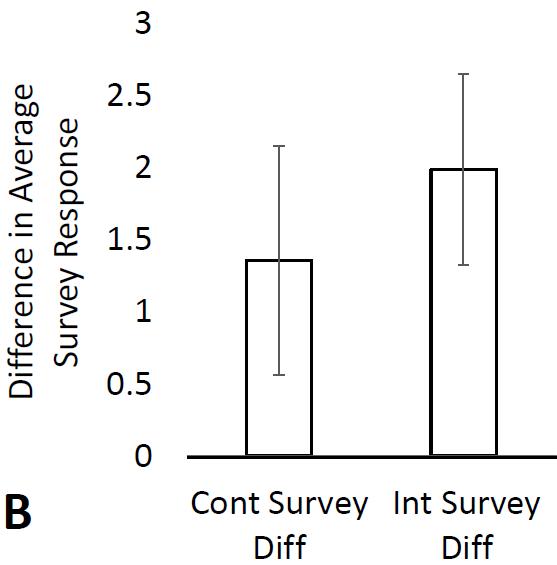
24%; P = 0.05) in the intervention group compared to the control group. Importantly, the mean of the pre-curriculum knowledge-assessment scores was the same for both groups (41%; P = 0.96) and the mean of the average pre-curriculum, self-perceived knowledge survey responses was also very similar for the intervention and the control groups (3.0 and 2.8, P = 0.35). These results established that both groups began the study period with a similar knowledge base and comfort level regarding EM pharmacology. This allowed for direct comparison of the post-curriculum knowledgeassessment scores and the post-curriculum, self-perceived knowledge survey responses between the control and intervention groups.
As expected, knowledge assessment scores and selfperceived knowledge survey responses increased over time in both groups, but the intervention group demonstrated greater improvement. Although the increase from the average pre- to post-curriculum, self-perceived knowledge survey responses was not significantly different between the intervention and the control group (1.9 and 1.4; P = 0.20), the average postcurriculum, self-perceived knowledge survey responses were significantly different between groups (5.0 and 4.2; P = 0.02). Therefore, the results still suggest that the intervention group finished the curriculum with a higher level of self-perceived knowledge of the material than the control group. Overall, the results suggest that the intervention group gained additional knowledge and that their comfort level increased because of the curriculum.
The strengths of this study are its longitudinal nature and controlled design. The curriculum was delivered over an entire academic year, which provided enough time to cover the most frequently used medications for the most common EM patient presentations in a systematic and organ system-based approach. While previous studies have already demonstrated the benefit of short-term interventions,5,14 we
could not identify any studies in our literature review that had implemented and investigated such an extensive and comprehensive curriculum.
One short-term study focused on the appropriate calculation of doses for select medications and concluded that a single, brief education session led to short-term improvement in EM resident performance of such tasks.5 However, the reassessment was only six weeks after the educational session, and long-term knowledge retention was not assessed. Furthermore, the control group did not perform the pre-assessment; therefore, it was unknown whether there were baseline differences between the control group and the intervention group. Considering this, our study was specifically designed to account for possible baseline differences between the control and intervention groups by administering the pre-curriculum knowledge assessment to each group. Moreover, the pre- and post-curriculum knowledge assessments were separated by an entire calendar year to assess long-term knowledge retention of the material presented in the curriculum.
The positive results of our study in combination with insights from previous literature suggest that novel curricula like ours may have the potential to impact patient-centered outcomes. In one previous study, pediatric emergency resident rotators participated in didactic sessions and daily discussions regarding the best practices of medication administration with an EMP and attending physicians over the course of one month.14 Medication dosing errors and adverse events were significantly less frequent after implementation of the program. Considering that our novel curriculum was more comprehensive than the short-term curriculum used in the study of pediatric emergency resident rotators, one could speculate that our novel curriculum could lead to improvement in patient outcomes. Further studies investigating clinical and patient-centered outcomes, such as number of incorrect medication orders and medication administration errors before and after implementation of a similar pharmacy curriculum, should be conducted.
There is already extensive literature demonstrating that EMPs improve patient care and reduce medical errors. However, the role of EMPs in EM resident physician education is less defined. The ASHP guidelines on EMP service recommend that EMPs play an active role in interdisciplinary education among other healthcare professionals. The opportunity for such education is broad, and the guidelines do not specify in what capacity an EMP should educate; rather, the guidelines nonspecifically encourage involvement in formal and informal education.15 Our novel curriculum classifies as interdisciplinary education and demonstrates the value of an EMP while specifically outlining methods in which an EMP may positively impact resident physician knowledge. In doing so, our study helps define the role of EMPs in optimizing and improving EM resident physician knowledge in ways that could translate into improved patient outcomes.
Volume 24, NO.1: January 2023 27 Western Journal of Emergency Medicine Lenning et al.
Pharmacy Education Applied to Resident Learners
* 0 1 2 3 4 5 6 Cont Pre Survey Cont Post Survey Int Pre Survey Int Post Survey Average Survey Response 0 0.5 1 1.5 2 2.5 3 Cont Survey Diff Exp Survey Diff Difference in Average Survey Response A B * * Int Diff
LIMITATIONS
The first limitation has to do with the study design in which the control group and intervention group were PGY-1 classes from two separate EM residency programs. Ideally, the residents would have been blindly randomized into the control and intervention groups, however, splitting the residents from the same program among the intervention and control groups would have been difficult and of questionable ethics. Therefore, despite the same physician group staffing both EDs and despite very similar pharmacy services being provided at both institutions, the possibility exists that the SGH residency program assigned to the intervention group may have had a more robust pharmacy education at baseline to account for the results of the study.
The second limitation was the rather small sample size, which was made smaller by the number of post-curriculum knowledge assessments and post-curriculum self-perceived knowledge surveys that were not completed, leading to large variance in the datasets. Likely, a larger study population with improved follow-up would have lessened the variance. The study was also limited by the available number of PGY-1 EM residents and could not be designed with an appropriate sample size for the estimated effect size. Despite achieving statistical significance, the effective increase in assessment scores and average survey responses was still small and, therefore, the possibility of a type I error still exists.
The purpose of the study was simply to support adoption of the novel pharmacy curriculum; and so the statistical results are less important than the educational and clinical significance. Logically, the introduction of a pharmacy curriculum should increase participant knowledge and self-perceived knowledge. Therefore, any positive results from the limited sample size support implementation of the curriculum because the potential benefits in resident education and clinical patient care far outweigh any potential risks of implementation.
Perhaps the largest limitation of our study is that the primary outcome—change in knowledge-assessment scores following the intervention—is a second level outcome in Kirkpatrick’s model.9 The inspiration for development of the novel pharmacy curriculum was to prepare EM residents for post-graduation practice without EMP assistance and reduce medication errors to improve patient care. While these fourthlevel outcomes of Kirkpatrick’s model were not feasible to measure in this study, it would be interesting and important to investigate in future studies.
CONCLUSION
The implementation of a novel pharmacy curriculum for firstyear EM residents resulted in improved knowledge of and comfort with pharmaceuticals and therapeutics specific to EM practice. The impact on patient care and frequency of medical errors requires further investigation.
Address for Correspondence: Jacob Lenning, MD, Wayne State University School of Medicine, Department of Emergency Medicine, 4201 Saint Antoine St., University Health Center - 6G, Detroit, MI 48201. Email: jlenning@med.wayne.edu.
Conflicts of Interest: By the WestJEM article submission agreement, all authors are required to disclose all affiliations, funding sources and financial or management relationships that could be perceived as potential sources of bias. No author has professional or financial relationships with any companies that are relevant to this study. There are no conflicts of interest or sources of funding to declare.
Copyright: © 2023 Lenning et al. This is an open access article distributed in accordance with the terms of the Creative Commons Attribution (CC BY 4.0) License. See: http://creativecommons.org/ licenses/by/4.0/
REFERENCES
1. Fairbanks RJ, Hays DP, Webster DF, et al. Clinical pharmacy services in an emergency department. Am J Health Syst Pharm. 2004;61(9):934-7.
2. Thomas MC, Acquisto NM, Shirk MB, et al. A national survey of emergency pharmacy practice in the United States. Am J Health Syst Pharm. 2016;73(6):386-94.
3. Leape LL, Brennan TA, Laird N, et al. The nature of adverse events in hospitalized patients. Results of the Harvard Medical Practice Study II. N Engl J Med. 1991;324(6):377-84.
4. Pham JC, Story JL, Hicks RW, et al. National study on the frequency, types, causes, and consequences of voluntarily reported emergency department medication errors. J Emerg Med. 2011;40(5):485-92.
5. Tobaiqy M, McLay J, Ross S. Foundation Year 1 doctors and clinical pharmacology and therapeutics teaching. A retrospective view in light of experience. Br J Clin Pharmacol. 2007;64(3):363-72.
6. Nelson LS, Gordon PE, Simmons MD, et al. The benefit of house officer education on proper medication dose calculation and ordering. Acad Emerg Med. 2000;7(11):1311-6.
7. Kern DE, Thomas PA, Hughes MT, et al. (2016). Curriculum Development for Medical Education: A Six-Step Approach. 3rd Rev. Baltimore, MD: John Hopkins University Press.
8. Counselman FL, Babu K, Edens MA, et al. American Board of Emergency Medicine. The 2016 Model of the Clinical Practice of Emergency Medicine. J Emerg Med. 2017;52(6):846-9.
9. Rothschild JM, Churchill W, Erickson A, et al. Medication errors recovered by emergency department pharmacists. Ann Emerg Med. 2010;55(6):513-21.
10. Kolb DA. (1984). Experiential Learning: Experience as the Source of Learning and Development. Englewood Cliffs, NJ: Prentice Hall.
11. Anderson LW, Krathwohl DR, Airasian PW, et al. (2001). A Taxonomy for Learning, Teaching, and Assessing: A Revision of Bloom’s Taxonomy of Education Objectives . New York, NY: Pearson Longman.
Western Journal of Emergency Medicine 28 Volume 24, NO.1: January 2023 Pharmacy Education Applied to Resident Learners Lenning et al.
12. Rajeev P, Madan MS, Jayarajan K. Revisiting Kirkpatrick’s model - an evaluation of an academic training course. Current Science. 2009;96(2):272-6.
13. Foster ME, Lighter DE, Godambe AV, et al. Effect of a resident physician educational program on pediatric emergency department
pharmacy interventions and medication errors. J Pediatr Pharmacol Ther. 2013;18(1):53-62.
14. Ortmann MJ, Johnson EG, Jarrell DH, et al. ASHP Guidelines on Emergency Medicine Pharmacist Services. Am J Health Syst Pharm. 2021;78(3): 262-75.
Volume 24, NO.1: January 2023 29 Western Journal of Emergency Medicine Lenning et al. Pharmacy Education Applied to Resident Learners
A Novel
Laurel O’Connor, MD*
Matthew Beth-Urhoy, MD†
Stephen Allegra, MD*
Andrew Dowd, MD*
Alexandra Nordberg, MD*
Timothy Boardman, MD*
Timothy Gleeson, MD*
Robert Lindsay, MD*
Original Research
Point-of-care Ultrasound
Curriculum
for Air Critical Care Personnel
University of Massachusetts Chan Medical School, Department of Emergency Medicine, Worcester, Massachusetts
University of Massachusetts Chan Medical School, Department of Radiology, Worcester, Massachusetts
Section Editor: Matthew Tews, DO, MS
Submission history: Submitted June 9, 2022; Revision received December 1, 2022; Accepted December 12, 2022
Electronically published January 9, 2023
Full text available through open access at http://escholarship.org/uc/uciem_westjem
DOI: 10.5811/westjem.2022.12.57599
Introduction: Point-of care-ultrasound (POCUS) has become ubiquitous in emergency medicine practice for the management of emergent pathophysiology. There is growing interest in its potential as a diagnostic tool in the prehospital setting. Few studies have examined the feasibility or efficacy of curricula targeted at teaching POCUS to prehospital personnel. Our objective in this study was to investigate a curriculum for the extended focused assessment with sonography in trauma (eFAST) exam in helicopter emergency medical services (HEMS) crews.
Methods: This was a pre/post intervention study of HEMS personnel at a tertiary care center. Subjects were administered a pre-intervention written test and an observed structured clinical evaluation (OSCE). Subsequently, they participated in an educational intervention intended to impart proficiency in performing the eFAST. Subjects underwent post-intervention written exams and OSCEs. We analyzed pre- and post-intervention test performance along with the number and quality of practice ultrasound examinations achieved.
Results: Sixteen subjects were enrolled (62.5% male, mean age 44.1). After undergoing the intervention, the mean written test score increased 22.1% (t=3.41; P <0.001) and the mean OSCE score increased by 64.5% (t=6.87, P <0.001). All subjects met “passing” criteria for the written test and OSCE on their post-intervention attempt. Subjects accomplished a mean of 21.1 clinically interpretable eFAST sonographs. Most subjects reported the curriculum was useful (90.1%) and that they would incorporate this skill into clinical practice (90.1%).
Conclusion: A targeted POCUS curriculum was feasible and effective in establishing clinical proficiency in HEMS crews for performing and interpreting the eFAST exam. [West J Emerg Med. 2023;24(1)30–37.]
INTRODUCTION
Ultrasound-mediated imaging plays an essential role in acute patient care. It is a unique imaging modality in that it is non-invasive, involves no radiation, and can capture dynamic processes rather than only static images.1 In the past 20 years, point-of-care-ultrasound (POCUS) has become
ubiquitous in emergency medicine practice for the diagnosis and management of emergent pathophysiology as well as to facilitate common emergent procedures.2
The use of POCUS is no longer limited to brick-andmortar clinical spaces. New advancements in ultrasound technology have yielded the development of machines
Western Journal of Emergency Medicine 30 Volume 24, NO.1: January 2023
* †
small enough to fit in a medical aircraft or vehicle without compromising image quality, thereby granting ultrasound access to areas previously constricted by free space, including medical transport helicopters and ambulances. There is a historical precedent for out-of-hospital POCUS: It has been used by ground and air emergency services by the United States military and in parts of Europe as early as the late 1990s for detection of heart, lung, and vascular emergencies.3 Although the image quality was not as high as that generated by the cart-based machines used in hospitals and clinics, it was possible to detect chest and abdominal abnormalities.4 These deviations in image quality have improved due to breakthroughs in imaging technology, paving the way for more mainstream utilization in the prehospital environment.5
In the hyper-acute management of critical care patients there are two major diagnostic uses for POCUS that direct the care of time-sensitive and life-threatening pathologies. First, POCUS is highly sensitive for clinically significant pneumothorax.6,7 While pneumothorax can also be detected by other means including physical exam, a comprehensive exam may prove challenging during helicopter transport of patients because of environmental noise and movement. A POCUS exam can diagnose or confirm clinically suspect pneumothorax in real time. Intra-abdominal bleeding can also be detected with POCUS. The extended focused assessment with sonography for trauma (eFAST) exam requires images of the lungs for pneumothorax as well as left upper quadrant, right upper quadrant, cardiac, and pelvic views.7
The eFAST exam can be applied during flight if an ultrasound machine is present in the helicopter. Given that many critical care services now carry blood products, identifying active hemorrhage with ultrasound may help optimize the use of such resources. It will also allow crews to relay critical information to receiving hospitals, direct destination choice, and decrease the time from arrival at the hospital to transfer to an operating room for definitive management.
Ultrasound technology has the potential to improve the quality of patient care during helicopter transport by facilitating the diagnosis and management of life-threatening conditions in the out-of-hospital space. However, it must first be demonstrated that sonography training programs can effectively prepare helicopter emergency medical services (HEMS) crews to master this skillset. There is limited data on the practicality and effectiveness of POCUS training programs for prehospital personnel. Prior feasibility studies have demonstrated modest success in teaching HEMS to perform the eFAST exam, as well as chest wall and thoracic sonography.8,9,10 However, these studies have focused on standard evaluation metrics, such as written tests, and did not measure the clinical interpretability of complete eFAST sonographs achieved by subjects.
We sought to determine whether a novel curriculum would be successful at training HEMS critical care paramedic and nurses to achieve an adequate level of mastery for clinical use of POCUS. The curriculum is innovative first in that it was
Population Health Research Capsule
What do we already know about this issue?
Point of care ultrasound (POCUS) can be used to guide treatment for serious pathologies managed by HEMS crews. There is no validated curriculum for teaching POCUS skills to Helicopter Emergency Medical Services (HEMS) clinicians.
What was the research question?
Can an investigational curriculum for POCUS effectively impart proficiency in this skill to HEMS personnel?
What was the major finding of the study?
Subjects’ mean written test scores increased by 22%, and mean Objective Structured Clinical Evaluations (OSCE) scores increased by 65%.
How does this improve population health?
A POCUS curriculum was effective teaching HEMS providers skills in performing and interpreting the POCUS studies. This skill may be a valuable addition to prehospital care.
developed specifically for critical care personnel. The scope and clinical applications used for the didactic were tailored to the out-of-hospital, low-resource environment. Trainees were offered asynchronous learning opportunities necessary for the nonstandard duty hours typical of air critical care services including both expert-supervised and independent, practical learning sessions. Finally, the training was intended to prepare HEMS crews both to excel at standard written and practical evaluations of competency and consistently produce clinically interpretable images. Our objective in this study was to investigate the feasibility and efficacy of this curriculum to render HEMS personnel proficient in the theory and application of the eFAST exam.
METHODS Study Setting and Participants
The development and implementation of the novel HEMS POCUS curriculum, along with evaluation of its execution and efficacy took place at an urban, tertiary-care center that houses and provides medical direction for a regional air critical care HEMS service. Subjects were recruited via email and in person at scheduled staff meetings. All subjects were licensed critical care paramedics or critical care registered nurses and active crew for the local HEMS service. All personnel were English speaking and provided informed consent to participate. No trainees or orienting subjects on probation
Volume 24, NO.1: January 2023 31 Western Journal of Emergency Medicine O’Connor et al.
Novel POCUS Curriculum for Air Critical Care Personnel
A
were included. No eligible subjects declined to participate. Pregnant women were included in this study; subjects under 18 were excluded. This study was approved by the institutional review board of the affiliate medical school.
Curriculum Development
Four ultrasound lectures were developed specifically for the training of HEMS crews, adapted from didactics previously used for medical students by the ultrasound division at our institution. All lectures were developed in collaboration between ultrasound and EMS faculty on the study team. Each lecture was one-hour long and focused on foundations of ultrasound concepts and equipment operation, the chest wall ultrasound to evaluate for pneumothorax, the FAST exam to evaluate for free fluid in the abdomen, and a review of clinical applications and image review for the combined eFAST exam. For the structured practical learning components of the curriculum, all sessions were presided over by ultrasound faculty experienced in coaching trainees in performing POCUS studies in clinical settings.
A 30-minute written test for proficiency in the eFAST exam was developed by the ultrasound faculty on the study team, which was comprised of a combination of image-clip interpretation, equipment operation, and clinical scenario questions. Solicited answers were a combination of multiple choice and free responses. For free responses with multiple components, all acceptable answers were decided in advance and partial credit (a single “point”) was awarded for each correct response. The content of the written exam is included in Appendix A. Additionally, a standard rubric for the observed structured clinical evaluation (OSCE) in POCUS eFAST was leveraged as a measurement tool for this study. The OSCE rubric is included as Appendix B.
Study Procedure
Enrollment of subjects occurred between January 1–March 31, 2021. Collection of data for each subject began on the first day of participation and continued throughout a one-year period during which each subject underwent four formal didactic sessions, three hands-on sessions with standardized patients, and individual-driven, unsupervised practice scanning sessions. This study used the Philips Lumify (Philips Ultrasound, LLC, Bothell, WA) portable handheld ultrasound device identical to the one employed on the aircraft. The system consisted of a single convex (5-2 megahertz) ultrasound transducer and an accompanying tablet with an application to display the images. This device was used for all educational sonograms performed throughout the study period.
All subjects attended the four one-hour didactic learning sessions either synchronously in person or asynchronously via video recording. All didactics were taught by an ultrasound faculty member. All subjects were required to attend didactics before participating in the practical component of the curriculum.
After completing all four didactic sessions, subjects attended between two and three, two-hour ultrasound practical sessions during which ultrasound and EMS faculty supervised practice scans on live standardized patients in a simulation setting. These sessions were scheduled every 3-4 months to be evenly spaced out during the year after the didactic curriculum was presented, and subjects were asked to attend at least two formal sessions.
Between supervised practical sessions, subjects were invited to perform educational scans on volunteer patients in the emergency department (ED) either independently or under the supervision of EMS or ultrasound faculty. Subjects were asked to complete a minimum of 25 practice ultrasound scans during the study period but were allowed to attend as many practice scanning sessions as they chose and were permitted to choose between independent practice vs scanning with an expert trainer for all informal sessions. All practice scans were formally scored by a member of the ultrasound faculty, and formative feedback about deficiencies in technique and image quality were provided to subjects after each scanning session as per usual practice in the department for all sonographs obtained throughout the study. Scores and formative feedback were provided via email within 72 hours of a completed practice sessions. The scoring rubric used for the eFAST exams is shown in Appendix C. Subjects were permitted to undergo the postintervention written exam and OSCE after the completion of the final formal training session, approximately one year after the commencement of the curriculum.
Measures
This project was a within-subjects pre/post intervention study. We collected and managed all data using REDCap electronic data capture tools, version 9.3.0, hosted at University of Massachusetts Chan Medical School.11 Subjects’ pre-and post-intervention written test scores were recorded as a percentage of a possible 51 points; a score greater than 70% was considered passing. The pre- and post-written test administered to subjects was identical. Subjects’ pre-and post-intervention OSCE scores were similarly recorded as a percentage of a possible 67 points, with a score greater than 75% considered passing. The passing score for the OSCE and written examination were set before any assessments were administered. Subjects were also scored on a series of OSCE “critical criteria,” any of which, if not met, would render the sonograph clinically non-interpretable.
All practice scans performed by subjects were scored on a standard 1-8 grading rubric by a member of the ultrasound faculty. This grading rubric was already established in the ED where the study was conducted for all clinical and educational studies performed by physicians. A score of 4 or greater indicates that the sonogram is clinically interpretable. Throughout the study period, the number of scans performed per subject, scan scores, and number of scans that met a minimum criterion of being clinically interpretable were recorded. Finally, upon completion of data collection,
Western Journal of Emergency Medicine 32 Volume 24, NO.1: January 2023 A Novel POCUS Curriculum for Air Critical Care Personnel O’Connor et al.
all subjects were asked to respond to a brief, anonymous acceptability survey rating the usability and value of the curriculum and evaluation tools. A summary of the curriculum development process, using the validated Kern six-step process is depicted in Table 1.12
Analysis
Demographic and personnel proficiency data, along with the number of clinically interpretable scans, scan scores, and acceptability data, were described descriptively. We compared pre-and post-intervention testing scores using paired t-tests for continuous variables and chi squares for categorical variables.
RESULTS
In total, 16 subjects were enrolled in the study, comprised of 10 critical care registered nurses, four critical care paramedics, and two subjects with both certifications. Their
demographics are summarized in Table 2. All enrolled subjects successfully completed the initial training curriculum. One subject only completed 24 practice scans while the remaining 15 subjects accomplished the requested minimum of 25 scans. Subjects were prominently male (62.5%) with a mean age of 44.1 years. Most subjects had no previous formal training in ultrasonography. On average, subjects performed 27.5 complete eFAST scans (range 24-32) consisting of both the standard FAST images plus chest wall images.
Personnel Performance
Two subjects met “passing” criteria on their preintervention written test scores, and none met passing criteria on their pre-intervention OSCE. After undergoing the didactic and practical components of the curriculum intervention, the average written test score increased 22.1% (t=3.41, P <0.001) and the average OSCE score increased
Kern's Step POCUS curriculum for critical care personnel
1. Problem identification and general needs assessment
2. Targeted needs assessment
3. Goals and objectives
• POCUS can be used to identify and guide treatment for acute, life-threatening pathologies commonly managed by HEMS crews.
• There is no universally validated curriculum widely available for teaching POCUS skills to HEMS personnel.
• It is important that the curriculum used to teach the cognitive and psychomotor skills necessary to perform and interpret POCUS is feasible, acceptable, and effective for HEMS crews.
• There is little literature on the feasibility and efficacy of curricula for training non-physician field personnel in POCUS.
• HEMS crew members will be able to describe the clinical indications for the POCUS eFAST exam.
• HEMS crew members will be proficient in consistently obtaining clinically interpretable eFAST images using the Philips Lumify ultrasound device.
• HEMS crew members will be proficient in interpreting images of the POCUS eFAST and their clinical significance in the context of their critical care practice.
4. Educational strategies
• Four 1-hour lectures focused on foundations of ultrasound concepts and equipment operation, the chest wall ultrasound, the FAST exam, and a review of clinical applications and image review for the combined eFAST exam.
• Three formal practice ultrasound sessions were spaced evenly over one year, taught by expert faculty, and using standardized patients.
• Unlimited informal practice ultrasound sessions were performed at the convenience of subjects’ schedules with the option of independent practice or practice with an expert instructor.
• OSCEs were administered prior to and after completing the didactic and practical curriculum .
• Written exams were administered prior to and after completing the didactic and practical curriculum.
5. Implementation
• HEMS crew members participated in pre-curriculum OSCE and written exam to assess baseline knowledge and skills in performing and interpreting the POCUS eFAST.
• HEMS crew members were allotted one month to attend lectures live or consume them asynchronously
• Over the course of one year, HEMS crew members participated in 2-3 formal practical educational sessions with expert faculty.
• Over the course of one year, HEMS crew members participated in self-paced, informal practice sessions with volunteer patients, independently or with expert faculty, to obtain a minimum of 25 complete eFAST exams.
• HEMS crew members participated in post-curriculum OSCE and written exam to assess changes in knowledge and skills in performing and interpreting the POCUS eFAST.
6. Evaluating the effectiveness of the curriculum
• Evaluation of the efficacy of the curriculum with post-implementation OSCE and written exam
• Tracking of subjects’ number of clinically interpretable practice ultrasounds
• Survey administered after completion of final assessments to all participants to determine curriculum acceptability
POCUS, point-of-care-ultrasound; HEMS, helicopter emergency medical services; eFAST, extended focused assessment with sonography in trauma; OSCE, observed structured clinical evaluation.
Volume 24, NO.1: January 2023 33 Western Journal of Emergency Medicine O’Connor et al.
Air
Personnel
A Novel POCUS Curriculum for
Critical Care
Table 1. Kern’s six-step framework for curriculum design.
by 64.5% (t=6.87, P <0.001). All subjects met passing criteria for both the written test and OSCE on their first post-intervention attempt. No subject met any of the critical failure criteria during their post-intervention OSCE. Subject proficiency data is summarized in Table 2.
The mean score assigned to subjects’ FAST exams was a 4.73, and the mean score assigned to chest wall scans was 5.64. Subjects accomplished a mean of 21.1 clinically interpretable FAST sonographs and 24.4 chest wall sonographs during their supervised and unsupervised practice sessions. The number of clinically interpretable sonographs performed as a function of total number of practice scans performed is illustrated in Table 3. There was a weak but positive association between increased number of practice scans performed and average score assigned for both the FAST and chest wall sonographs (R=0.44 and R=0.45, respectively). The correlations were stronger between number of scans performed and number of interpretable sonographs produced for both types of scans (R= 0.86 and 0.95, respectively); this is illustrated in Figure 1.
Acceptability
Subjects’ responses to Likert scale questions pertaining to the acceptability of the novel ultrasound curriculum are summarized in Table 4. Most of the participants either agreed or strongly agreed with positive statements about the acceptability of curriculum including that the lecture component of the curriculum was useful (91%), and that the curriculum was appropriate for HEMS crews (72.7%).
They also largely agreed or strongly agreed that after the intervention they could confidently perform a chest wall ultrasound (81.8%) and a FAST ultrasound (81.8%). Overall, 72.7% of subjects agreed or strongly agreed that they gained enough knowledge and experience to comfortably use ultrasound in flight to make clinical decisions as they pertain to lung and FAST ultrasound exams, and 90.1% believed they would incorporate their new ultrasound knowledge and skill in the prehospital setting. Most subjects (72.7%) felt that they would be able to maintain their ultrasound skills after the structured curriculum.
DISCUSSION Personnel Performance
The implementation of a novel curriculum intervention for HEMS personnel was effective in teaching nurse and paramedic subjects with little preexisting knowledge of ultrasound to correctly perform and interpret an eFAST exam in a standardized manner. Subjects were able to successfully participate in a combined didactic and practical learning educational model targeted to their level of medical literacy and subsequently meet standardized benchmarks of proficiency, including consistently producing clinically interpretable sonographs. These results suggest that the curriculum model developed and deployed in this project is efficacious and feasible. Additionally, it suggests that proficiency in limited POCUS skills can be successfully learned and applied by HEMS crews with paramedic and nursing educational backgrounds with a limited, focused intervention. Twenty-four practice scans appeared to be adequate to establish subjects’ ability to produce consistently interpretable sonographs. This is consistent with ultrasound benchmarks established by the American College of Emergency Physicians.13
Performing and interpreting POCUS requires a combination of clinical knowledge of anatomy and pathophysiology, procedural skills, including manipulating equipment to optimize image quality, and clinical reasoning skills to interpret and respond appropriately to obtained images in conjunction with other aspects of a patient’s clinical presentation. The improvement in scores from the pre-intervention and postintervention evaluations suggests that our curriculum imparted adequate education in the theory and application of ultrasound as well as pathophysiology that can be detected with POCUS. There was a notably larger increase in the OSCE scores as compared with the written test. This is likely because while the subjects had some foundational knowledge in the anatomy and pathophysiology required to understand POCUS application as well as the interventions required once pathological conditions are recognized, they had little or no previous experience with operating an ultrasound machine and obtaining and interpreting images. The OSCE evaluation required subjects to operate equipment that was completely unfamiliar to them prior to the initiation of the curriculum, which limited their ability to perform the maneuvers required.
Western Journal of Emergency Medicine 34 Volume 24, NO.1: January 2023 A Novel POCUS Curriculum for Air Critical Care Personnel O’Connor et al. Age (years) Mean 44.2 Median 41.5 Range 28,62 SD 11.9 Gender (n, %) Male 11 (68.7) Female 5 (31.2) Certification (n, %) Paramedic 4 (25) Registered nurse 10 (62.5) Both 2 (12.5) Previous ultrasound training (n, %) None 10 (62.5) 1-5 hours 3 (18.8) 5-10 hours 1 (6.3) >10 hours 0 (0)
SD, standard deviation
Table 2. Demographics of emergency medical services personnel who participated in ultrasound training.
The advantages of the novel curriculum are attributed to the fact that it was created expressly for HEMS personnel. The lectures were developed for non-physicians and taught only by qualified ultrasound faculty with formal training in ultrasound education. The cases used in lecture were tailored to be representative of the pathology frequently encountered by HEMS crews during missions. They could be viewed in real time or asynchronously to be available to all shifts. Additionally, ample time for supervised practice scanning using the actual device planned for use on the aircraft was provided during the study period; and consistent verbal and written feedback, and individualized instruction, was imparted after each practice scan performed. Subjects were offered a variety of options for both supervised and independent scanning sessions that could be performed at the convenience of their schedule; this likely also contributed to the feasibility of the intervention.
Acceptability
Both the notable increase in written and practical evaluation scores post-intervention, as well as the positive
responses on the post-intervention survey suggest that the educational intervention was found to be acceptable and useful by subjects. Subjects generally reported favorable responses to the curriculum, deeming it useful and appropriate for their level of training. They also reported confidence in performing both FAST and chest wall sonographs and felt that they would be able to incorporate their new skills into their existing clinical practice, as well as maintain their skills. These responses further support the feasibility of the curriculum implementation.
LIMITATIONS
This was a small study performed with a single group of HEMS personnel. There was a narrow range in the number of scans performed and scores achieved. An important subset of subjects had prior exposure to ultrasound education, which could have hastened the establishment of their proficiency in performing the eFAST scans. Since the researchers and evaluators were not blinded to the educational curriculum, observational biases may have occurred during the grading of the OSCEs toward a more favorable outcome. There was
Volume 24, NO.1: January 2023 35 Western Journal of Emergency Medicine O’Connor et al.
Curriculum for Air Critical Care Personnel Pre-intervention Post-intervention t p Written test (%) Mean 60.1 82.2 3.41 <0.001 Median 62.7 85 Range 45.1-88.2 71.1-94.2 Standard deviation 11.9 8.4 Personnel with a passing score 12.5 100 OSCE (%) Mean 30.8 95.3 Median 25.7 95.5 6.87 <0.001 Range 20.0-61.0 83.5-100 Standard deviation 21.1 5.2 X2 p Personnel with >/= 1 critical fail 100 0 21.2 <0.001 Personnel with a passing score 0 100 21.2 <0.001 Practice sonographs Mean practice scans performed 27.5 Mean FAST score 4.73 Mean chest wall score 5.64 Mean clinically acceptable FAST scans 21.2 Mean clinically acceptable chest wall scans 24.4 R R2 Increased practice scans and score- FAST 0.44 0.18 Increased practice scans and score- Chest 0.45 0.19 Increased practice scans and interpretable sonographs- FAST 0.86 0.75 Increased practice scans and interpretable sonographs- Chest 0.95 0.91 Table
OSCE, observed structured clinical evaluation; FAST, focused assessment with sonography in trauma.
A Novel POCUS
3.
Personnel proficiency measures.
have gained enough knowledge and experience to comfortably use ultrasound in flight to make clinical decisions as they pertain to lung and FAST ultrasound exams.
will incorporate my new ultrasound knowledge and skill in the prehospital setting.
FAST, focused assessment with sonography in trauma.
also likely some variability in the grading between different assessors. The curriculum was designed to allow subjects to participate asynchronously and perform both supervised and unsupervised practice ultrasounds when feasible for their schedule. However, this may have resulted in a lack of standardization of how many of their scored ultrasounds were achieved with the assistance of a trainer vs independently.
All practice scans were performed in a simulation center or ED; therefore, environmental conditions such as the movement in an aircraft, variations in lighting, performing scans in a helmet and visor, and ability of the patient to cooperate were not considered. Such variations may impact the ability of subjects to practice scans in their usual clinical environment. Additionally, we investigated only a single training strategy, and we did not compare its efficacy to that
of other curriculums. Finally, it is possible that there is a more efficient or shorter curriculum design that would impart the same level of proficiency as that elicited by the intervention studied in this project; measuring the minimum amount of time and practice sonographs to establish clinical competency was beyond the scope of this study.
CONCLUSION
To ensure external validity, the implementation and efficacy of this curriculum should be studied at a variety of outside helicopter emergency medical services organizations to demonstrate its value in a diverse group of learners. Furthermore, the clinical interpretability of sonographs performed by subjects in real clinical settings, as well as their interpretation and clinical actions taken in response to
Western Journal of Emergency Medicine 36 Volume 24, NO.1: January 2023 A Novel POCUS Curriculum for Air Critical Care Personnel O’Connor et al. 0 5 10 15 20 25 30 35 0 5 10 15 20 25 30 35 40 Number of Clinically Interpretable Scans Number of Practice Scans Performed
# FAST Score >3 # Chest Wall Score >3 Linear (# FAST Score >3) Linear (# Chest Wall Score >3) Figure
Agree/strongly agree Neutral Disagree/strongly disagree The lecture component of the ultrasound curriculum was useful. 10 (90.1) 0 (0) 1 (9.1) Time spent on ultrasound education made it difficult for me to accomplish my other daily career responsibilities. 2 (18.1) 0 (0) 9 (81.8) I felt as though the ultrasound curriculum was appropriate for nurses and paramedics. 9 (81.8) 1 (9.1) 1 (9.1) After this education, I can confidently conduct a lung/chest wall ultrasound exam. 9 (81.8) 1 (9.1) 1 (9.1) After this education, I can confidently conduct a FAST ultrasound exam. 9 (81.8) 1 (9.1) 1 (9.1) I feel as though I will be able to maintain my ultrasound skills. 8 (72.7) 1 (9.1) 2 (18.1) I
8 (72.7) 1 (9.1) 2 (18.1)
10 (90.1) 1 (9.1) 0 (0) I
9 (81.8) 1 (9.1) 1 (9.1)
Figure 1: Number of Clinically Interpretable Scans by Number of Scans Performed
1. Number of clinically interpretable scans by number of scans performed.
I
am satisfied with my participation in ultrasound education.
Table 4. Personnel acceptability ratings (n=11) (n, %).
obtained images is crucial to truly determining the practical value of the educational intervention. Finally, the impact of ultrasonography on clinical decision-making by HEMS crews in the out-of-hospital setting should be studied to determine the utility of focusing time and resources on developing skills in ultrasonography in this population. The overall success of the chosen evaluation measures and the confidence of HEMS personnel in performing POCUS after undergoing the novel curriculum suggests that it is both feasible and effective in preparing HEMS crews to competently perform the eFAST exam.
Address for Correspondence: Laurel O’Connor, MD, University of Massachusetts Medical School, Department of Emergency Medicine, 55 Lake Avenue North, Worcester, MA 01655. Email: laurel.o’connor@umassmemorial.org.
Conflicts of Interest: By the WestJEM article submission agreement, all authors are required to disclose all affiliations, funding sources and financial or management relationships that could be perceived as potential sources of bias. No author has professional or financial relationships with any companies that are relevant to this study. There are no conflicts of interest or sources of funding to declare.
Copyright: © 2023 O’Connor et al. This is an open access article distributed in accordance with the terms of the Creative Commons Attribution (CC BY 4.0) License. See: http://creativecommons.org/ licenses/by/4.0/
aerospace medicine: known and potential applications. Aviat Space Environ Med. 2014;85(7):730-9.
4. Baugher KM, Euerle BD, Sommerkamp SK, et al. Image quality evaluation of a portable handheld ultrasound machine for the focused assessment with sonography for trauma examination. Am J Emerg Med. 2014;32(4):389-91.
5. European Society of Radiology (ESR). ESR statement on portable ultrasound devices. Insights Imaging. 2019;16;10(1):89.
6. Kirkpatrick AW, Sirois M, Laupland KB, et al. Hand-held thoracic sonography for detecting post-traumatic pneumothoraces: the extended focused assessment with sonography for trauma (eFAST). J Trauma. 2004;57(2):288-95.
7. Netherton S, Milenkovic V, Taylor M, et al. Diagnostic accuracy of eFAST in the trauma patient: a systematic review and meta-analysis. CJEM. 2019;21(6):727-38.
8. Press GM, Miller SK, Hassan IA, et al. Evaluation of a training curriculum for prehospital trauma ultrasound. J Emerg Med 2013;45(6):856-64.
9. Mason R, Latimer A, Vrablik M, et al. Teaching flight nurses ultrasonographic evaluation of esophageal intubation and pneumothorax. Air Med J. 2019;38(3):195-7.
10. Lyon M, Leal B, Walton P, et al. Ultrasound detection of the sliding lung sign by critical care transport providers. Ann Emerg Med 2008;52(4).
11. Harris PA, Taylor R, Thielke R, et al. Research electronic data capture (REDCap) – a metadata-driven methodology and workflow process for providing translational research informatics support, J Biomed Inform. 2009;42(2):377-81.
12. Kern DE, Hughes MT, Chen BY. (1998). Curriculum Development for Medical Education: A Six-step Approach. Baltimore, MD: JHU Press.
REFERENCES
1. Sigrist RMS, Liau J, Kaffas AE, et al. Ultrasound elastography: review of techniques and clinical applications. Theranostics. 2017;7(5):1303-29.
2. Whitson MR, Mayo PH. Ultrasonography in the emergency department. Crit Care. 2016;15:20(1):227.
3. Wagner MS, Garcia K, Martin DS. Point-of-care ultrasound in
13. American College of Emergency Physicians. Ultrasound Guidelines: Emergency, Point-of-care, and Clinical Ultrasound Guidelines in Medicine. 2016. Available at: https://www.acep.org/patient-care/ policy-statements/ultrasound-guidelines-emergency-point-of--careand-clinical-ultrasound-guidelines-in-medicine/. Accessed November 29, 2022.
Volume 24, NO.1: January 2023 37 Western Journal of Emergency Medicine
O’Connor et al.
Personnel
A Novel POCUS Curriculum for Air Critical Care
Taking More Society for Academic Emergency Medicine
Practice Tests Does Not Lead to Improved National EM-M4 Exam Scores
David J. Story, MD*
Hong Gao, PhD†
Andrea L. Vallevand, PhD†
David Manthey, MD‡
Wake Forest Baptist Medical Center, Department of Emergency Medicine, WinstonSalem, North Carolina
Wake Forest School of Medicine, Office of Undergraduate Medical Education, WinstonSalem, North Carolina
Wake Forest School of Medicine, Department of Emergency Medicine, Winston-Salem, North Carolina
Section Editor: Douglas Franzen, MD, MEd
Submission history: Submitted June 15, 2022; Revision received December 23, 2022; Accepted December 24, 2022
Electronically published January 16, 2023
Full text available through open access at http://escholarship.org/uc/uciem_westjem
DOI: 10.5811/westjem.2022.12.57683
Introduction: Emergency medicine (EM) is a required clerkship for third-year medical students, and an elective EM acting internship (AI) is available to fourth-year students at our institution. The Society for Academic Emergency Medicine’s (SAEM) National Emergency Medicine M4 Examination (EM-M4) is administered to students at the end of the EM AI experience. To prepare for the exam, students gain access to 23 practice tests available from SAEM. In this study we investigate the correlation between the number of practice tests taken and EM-M4 performance.
Methods: We collected data for EM-M4 and the US Medical Licensing Exam (USMLE) Step 2 Clinical Knowledge (CK) from students completing a MS4 EM clerkship in consecutive medical school classes from 2014-2017 at a private medical school. In addition, we collected data during the clerkship on the number of practice exams taken and whether a comprehensive practice exam was taken. We analyzed the study population three ways to determine whether the number of practice tests impacted final exam results: a binary distribution (1-11 or 12-23 tests taken); quaternary distribution (1-6, 7-12, 13-18, or 19-23 tests taken); and individual test variability (1,2,3,…22,23 tests taken). Complete data for 147 students was used for data analysis.
Results: The EM-M4 showed moderate (r = 0.49) correlations with USMLE Step 2 CK. There was no significant difference in EM-M4 performance in the binary analysis (P ≤ 0.09), the quaternary analysis (P ≤ 0.09), or the continuous variable analysis (P ≤ 0.52). Inclusion of a comprehensive practice test also did not correlate with EM-M4 performance (P ≤ 0.78).
Conclusion: Degree of utilization of SAEM practice tests did not seem to correlate with performance on the EM-M4 examination at our institution. This could be due to many factors including that the question bank is composed of items that had poor item discrimination, possible inadequate coverage of EM curriculum, and/or use of alternative study methods. While further investigation is needed, if our conclusions prove generalizable, then using the SAEM practice tests is an extraneous cognitive load from a modality without proven benefit. [West J Emerg Med. 2023;24(1)38–42.]
INTRODUCTION
A recent survey indicates that more than half of the medical schools in the United States require emergency medicine (EM) clerkships in their undergraduate medical curricula.1 There
are currently two validated national EM exams (National Board of Medical Examiners [NBME] and Society for Academic Emergency Medicine [SAEM]), each with multiple forms available to clerkship directors for use in assessing
Western Journal of Emergency Medicine 38 Volume 24, NO.1: January 2023 Original Research
†
*
‡
the knowledge of their students. At our institution, an acting internship (AI) in EM for fourth-year medical students (MS4) has been offered for several years using the SAEM M4 National Exam as the end-of-rotation testing modality.
The first national EM exam was developed in 2010, when the Clerkship Directors in Emergency Medicine (CDEM) membership appointed a task force with the goal of developing an MS4-level test suitable for “high-stakes” evaluation of students rotating in EM.2 The task force based the content of the examination on the EM MS4 curriculum guide that was defined by CDEM in 2006 and revised in 2010.3,4 CDEM had previously created a question bank in 2005 consisting of 565 items that were divided into 22 different system-based tests and two comprehensive tests.5 These tests were evaluated by members of the task force in search of questions that fit the curriculum, showed high reliability and validity, and adhered to NBME item-writing guidelines.
Thirteen additional questions were written to assess the entirety of the curriculum. The result was a 50-question test (EM-M4) aimed at evaluating a student’s knowledge of the topics that should be gained in a fourth-year EM rotation.2 The exam began being offered in 2011 and became the testing modality for our EM AI. Previous studies on the SAEM final tests found they are moderately correlated with the US Medical Licensing Examination (USMLE) Step 1, and USMLE Step 2 Clinical Knowledge (CK).6 The unselected questions from the original question bank has been preserved and promoted as a study tool at www.saemtests.org. We provided students access to this question bank during the EM AI.
Testing can have multiple learner benefits with respect to memory retrieval and long-term retention.7-9 The format of the tests requires asking the right questions in the right format.9 As the SAEM practice tests were made of questions not selected for the EM-M4 exam there may be a concern as to the quality of the questions.2 As well, 13 additional questions had to be written to cover the entire curriculum, which suggests the practice test questions would not cover the entire curriculum.2
As educators, we want to promote techniques and sources that will benefit the student in the goal of learning the material critical for the successful understanding of the subject matter. The promotion and usage of the SAEM question bank as a study tool for students led to this study investigating the following questions:
1. Do students who take a higher number of practice tests have a significantly higher performance on the EM-M4 examination?
2. Does including a comprehensive practice test impact EM-M4 examination performance?
MATERIALS AND METHODS Setting
The Wake Forest School of Medicine program is four years in duration. Students are required to pass the USMLE Step 1 examination to be promoted into the clinical program
Population Health Research Capsule
What do we already know about this issue?
To our knowledge, no prior studies have investigated the relationship between the number of SAEM practice exams attempted and National EM M4 exam performance.
What was the research question?
This study investigates whether there is a correlation between the number of SAEM practice exams taken and National EM M4 exam score.
What was the major finding of the study?
Taking a higher number of SAEM practice exams did not lead to improved National EM M4 exam performance (p < 0.09).
How does this improve population health? Educators should promote study modalities with proven benefit to reduce extraneous cognitive load for medical students with a finite amount of study time.
(Years 3 and 4). Eight mandatory clerkships, including a four-week EM clerkship, comprise Year 3. An AI in EM is available during Year 4 as an elective, and the SAEM EM-M4 exam is required of all students on the last day of the rotation. Students are given access to the SAEM practice exams and are provided a copy of the study guide “First Aid for the EM Clerkship” for use during the EM AI.
Participants
The study group was composed of MS4 students enrolled in the EM AI representing three consecutive medical school classes from 2014-2017 who took at least one practice test.
Procedures
The USMLE Step 2 CK (hereafter referred to as Step 2 CK) and EM-M4 examination scores were collected for all participants and subsequently de-identified for statistical analysis. We recorded and incorporated Step 2 CK scores into the analysis as a comparative variable. De-identified data was also collected on the total number of SAEM practice tests attempted and whether a SAEM comprehensive practice test was completed. We obtained this data directly from the www. saemtests.org website.
Statistical Analysis
We analyzed Step 2 CK scores, number of SAEM practice tests taken, and EM-M4 scores using descriptive statistics. Completion of a SAEM comprehensive test
Volume 24, NO.1: January 2023 39 Western Journal of Emergency Medicine Story et al. SAEM Practice Tests Do Not Improve National EM Clerkship Exam Scores
was analyzed using frequency statistics. We investigated correlational analysis between EM-M4 and Step 2 CK performances using Pearson’s r.
An analysis of covariance (ANCOVA) explored Step 2 CK as a moderator on EM-M4 performance based on the number of practice tests taken. We analyzed the cohort three ways: continuous independent data (1-23 individually); binary distribution (1-11 vs 12-23 tests taken); and quaternary distribution (1-6, 7-12. 13-18 and 19-23 tests taken). We conducted a subgroup analysis of EM-M4 performance based on whether a comprehensive practice test was completed (yes or no). Test statistics and adjustments in EM-M4 mean scores from pre- to postANCOVA are reported.
The Institutional Review Board of Wake Forest School of Medicine approved this study.
RESULTS Participants
We collected data from 147 students from three consecutive medical school classes (2014: n = 54 [37%]; 2015: n = 47 [32%]; 2016: n = 46 31%]).
Descriptive Statistics
The USMLE Step 2 CK and EM-M4 scores and number of practice tests taken (mean, standard deviation, minimum, maximum and 95% confidence interval are presented in Table 1. Frequency analyses revealed 82/147 (55.8%) of students completed at least one comprehensive practice test in preparation for the EM-M4 examination. There was a significant relationship between Step 2 CK and EM-M4 scores, r = .46, P ≤ 0.01. Of note, the Step 2 CK and EMM4 mean scores of the study cohort were slightly higher than the national average, but within the standard deviation of the exams. 11,12
Number of practice tests taken (2 groups):
The covariate, Step 2 CK, was significantly related to performance on the EM-M4 examination F[1,144] = 36.927, P ≤ 0.001. There was no statistically significant effect on the number of practice tests taken, after controlling for Step 2 CK, F[1,144] = 2.856, P ≤ 0.09. The adjustments from pre-to-post ANCOVA mean for the EM-M4 variable are presented in Table 2.
Table 2. Pre- and post-analysis of covariance mean score adjustments (EM-M4 as dependent variable) based on number of practice tests taken and whether a comprehensive test was taken.
Number of practice tests taken (four groups):
The covariate, Step 2 CK, was significantly related to performance on the EM-M4 examination F[1,142] = 31.165, P ≤ 0.001. There was no statistically significant effect on the number of practice tests taken, after controlling for Step 2 CK, F[3,142] = 2.206, P ≤ 0.09 (Table 3).
Table 3. Pre- and post-analysis of covariance mean score adjustments (EM-M4 as dependent variable) based on number of practice tests taken and whether a comprehensive test was taken.
Number of practice tests taken as a continuous variable (23 groups):
The covariate, Step 2 CK, was significantly related to performance on the EM-M4 examination F[1,123] = 29.790, P ≤ 0.001. There was no statistically significant effect on the number of practice tests taken between the 23 groups, after controlling for Step 2 CK, F[22,123] = 0.961, P ≤ 0.52 (Table 4).
*EM-M4 (Version 1) reported as percent score.
USMLE, United States Medical Licensing Examination; CK, clinical knowledge; EM-M4, emergency medicine fourth-year medical student; SD, standard deviation; CI, confidence interval.
Western Journal of Emergency Medicine 40 Volume 24, NO.1: January 2023 SAEM Practice Tests Do Not Improve National EM Clerkship Exam Scores Story et al.
Variable Mean SD Minimum Maximum 95% CI Lower 95% CI Upper USMLE Step 2 CK 248.8 15.6 194 282 246.2 251.3 Practice Tests Taken 9.8 7.2 1 23 8.7 11.0 EM-M4* 83.1 6.9 62 96 81.9 84.2
Table 1. Descriptive statistics for USMLE Step 2 CK and EM-M4 and the number of practice tests taken (N = 147).
ANCOVA Independent variables (groups) N ANCOVA mean Adjusted ANCOVA mean Number of practice tests taken 1-11 tests 87 82.1 82.3 12-23 tests 60 84.4 84.1 EM-M4, emergency medicine fourth-year medical student; ANCOVA, analysis of covariance.
ANCOVA Independent variables (groups) N ANCOVA mean Adjusted ANCOVA mean Number of practice tests taken 1-6 tests 62 81.5 81.8 7-12 tests 29 83.2 83.3 13-18 tests 33 83.0 83.3 19-23 tests 23 87.2 85.7 EM-M4, emergency medicine fourth-year medical student; ANCOVA, analysis of covariance.
Table 4. Pre- and post-analysis of covariance mean score adjustments (EM-M4 as dependent variable) based on the number of practice tests taken.
Table 5. Pre- and post-analysis of covariance mean score adjustments (EM-M4 as dependent variable) based on whether a comprehensive test was taken.
Whether a comprehensive test was taken (yes or no): The covariate, Step 2 CK, was significantly related to performance on the EM-M4 examination F[1,144] = 37.329, P ≤ 0.001. There was no statistically significant effect on the number of practice tests taken, after controlling for Step 2 CK, F[1,144] = 0.081, P ≤ 0.78 (Table 5).
DISCUSSION
In this study we set out to investigate whether the usage of the SAEM question bank correlates with improved scores on the EM-M4 exam. Our data indicates that taking SAEM practice tests, both system-based and comprehensive, did not significantly improve EM-M4 test performance when adjusting for Step 2 CK performance. There was a moderate correlation between Step 2 CK and EM-M4 scores similar to those observed by Lawson and colleagues.6
analysis of covariance.
The EM-M4 exam is reflective of what a fourth-year medical student should learn over the course of a clinical rotation in EM. If we are recommending that students use the question bank as a method of learning the required material, and thus preparing for the exam, then it is important for that process to be a meaningful method for gaining knowledge. Because there is a finite amount of time for extraneous cognitive load during a clinical rotation, it is imperative that recommended study materials be high yield for students. Based on our results, students may not be gaining the intended benefit of the practice tests, and thus spending hours using a study modality with limited value.
This lack of benefit is contrary to current theory and what has been found in prior studies on practice tests, which show that repeated study and regular testing result in better organization of knowledge and improve application of knowledge to new contexts.7-9,12,13 Although we have no way of defining causation for this correlation, one explanation might be that the questions in the SAEM practice tests were not accepted for inclusion in the EM-M4 examination. Reasons for exclusion included poor item discrimination values, questions not addressing the National EM M4 curriculum, and item-writing flaws.2
Use of practice bank questions that were analytically removed in the creation of an examination may not be the best study preparation for that exam. Additionally, 13 additional questions had to be written because the available practice tests did not cover all the material on the tests.2 It is unknown whether additional questions covering the missing topics were written and added to the practice tests, but if not then a gap in the curriculum would still exist within the
Other explanations may include that the EM test is developed on a defined curriculum which is supported by an online website specifically for that curriculum. As such the use of additional materials may not add as much as in broader scenarios. Perhaps students not utilizing the practice tests prepared in other just as beneficial ways, negating a difference in taking more tests but not the importance of taking a practice test to identify where to study. As we
Volume 24, NO.1: January 2023 41 Western Journal of Emergency Medicine Story et al. SAEM Practice Tests Do Not Improve National EM Clerkship Exam Scores
practice-test question bank.
ANCOVA Independent variables (groups) N ANCOVA mean Adjusted ANCOVA mean Number of practice tests taken 1 20 82.1 81.8 2 11 80.9 82.2 3 11 78.7 79.6 4 6 80.9 80.8 5 5 84.0 83.6 6 9 83.3 84.0 7 4 80.6 79.8 8 5 82.0 83.0 9 7 86.3 85.5 10 4 84.4 85.7 11 5 83.7 82.7 12 4 80.1 81.7 13 8 79.8 82.0 14 7 86.9 87.7 15 4 83.0 81.0 16 9 83.3 83.3 17 3 79.9 78.8 18 2 85.0 85.2 19 2 85.4 83.5 20 5 88.3 86.2 21 2 91.0 91.4 22 3 87.8 86.4 23 11 86.2 84.5 EM-M4, emergency medicine fourth-year medical student; ANCOVA, analysis of covariance.
ANCOVA Independent variables (groups) N ANCOVA mean Adjusted ANCOVA mean Whether a comprehensive test was
or
Yes 82 83.5 83.2 No 65 82.5 82.9 EM-M4, emergency medicine fourth-year medical student; ANCOVA,
taken
not
could not look at zero tests versus one test in our cohort, we do not know that doing at least one test made a significant difference. Finally, taking a test versus taking a test to promote recognition, recall, and understanding are two different approaches and we have no way of knowing the mindset of the student taking a given practice test. Additionally, we chose to investigate student utility of taking a comprehensive practice test and whether EMM4 performance was impacted. Taking a comprehensive practice test lends itself to identifying an area of weakness, while the system-specific practice tests may address filling a knowledge gap. Unfortunately, only a raw score is provided to the student after completing a comprehensive test. Without a breakdown of performance within certain areas or topics within emergency medicine, the student does not receive any guidance regarding where to focus future study. This may limit the value of the SAEM practice comprehensive tests in study preparation for EM-M4. Our data did not find a benefit for students taking a comprehensive practice exam.
LIMITATIONS
We acknowledge that this study has limitations. This was a single institution study, which limited our sample size and the amount of data available for analysis. Additionally, we were unable to distinguish between starting and completing a practice test, as only the raw data of score on the practice test is reported on the website. We did not have access to any specific student factors that may have impacted the scores, such as number of practice tests taken, etc. We assessed the data continuously as well as in binary and quaternary fashion. Other cutoffs may find a statistically significant difference. Due to a server catastrophe at www.saemtests. org, access to additional retrospective data and incorporation of other institutions was no longer available. It should be noted that we were looking at data from 2014-2017, which may not be transcribable to current SAEM tests due to their continuous program improvements.10 Prospective studies into this topic at other institutions are now possible as the practice tests have recently been transferred to a new website. In addition, the CDEM community is actively evaluating and assessing both their practice exams as well as both versions of the EM-M4 examination.
CONCLUSION
The data obtained during this study carries implications for academic emergency medicine. Taking the available 2014-2017 SAEM practice tests as a studying modality did not appear to have a significant benefit in EM-M4 exam scores. Without knowledge of this lack of benefit, these practice tests were offered and promoted for EM-M4 examination preparation. If our results are generalizable, then we may be advising students to spend time and effort on an endeavor that we now suggest is low yield as compared to other study techniques.
Address for Correspondence: David Story, MD, Wake Forest University School of Medicine, Department of Emergency Medicine, 1 Medical Center Boulevard, Winston-Salem, NC 27157. Email: dstory@wakehealth.edu.
Conflicts of Interest: By the WestJEM article submission agreement, all authors are required to disclose all affiliations, funding sources and financial or management relationships that could be perceived as potential sources of bias. No author has professional or financial relationships with any companies that are relevant to this study. There are no conflicts of interest or sources of funding to declare.
Copyright: © 2023 Story et al. This is an open access article distributed in accordance with the terms of the Creative Commons Attribution (CC BY 4.0) License. See: http://creativecommons.org/ licenses/by/4.0/
REFERENCES
1. Khandelwal S, Way DP, Wald DA, et al. State of undergraduate education in emergency medicine: a national survey of clerkship directors. Acad Emer Med. 2014;21(1):92-5.
2. Senecal EL, Heitz C, Beeson MS. Creation and implementation of a national emergency medicine fourth-year student examination. J Emer Med. 2013;45(6):924-34.
3. Manthey DE, Coates WC, Ander DS, et al. Report of the Task Dorce on National Fourth Year Medical Student Emergency Medicine Curriculum Guide. Ann Emerg Med. 2006;47(3):e1-7.
4. Manthey DE, Ander DS, Gordon DC, et al. Emergency medicine clerkship curriculum: an update and revision. Acad Emerg Med. 2010;17(6):638-43.
5. Senecal EL, Thomas SH, Beeson MS. A four-year perspective of Society for Academic Emergency Medicine tests: an online testing tool for medical students. Acad Emer Med. 2009;16(12), suppl 2:S42-5.
6. Lawson LE, Musick D, Brewer K. Correlation of the National Emergency Medicine M4 Clerkship Examination with USMLE examination performance. West J Emer Med. 2015;16(7):1159-65.
7. Balch WR. Practice versus review exams and final exam performance. Teach Psychol. 1998;25(3):181-5.
8. Naujoks N, Harder B, Handel M. Testing pays off twice: potentials of practice tests and feedback regarding exam performance and judgment accuracy. Metacog Learn. 2022;17:479-98.
9. Yang BW, Razo J, Persky AM. Using testing as a learning tool. Amer J of Pharm Educ. 2019;83(9):1862-72.
10. Miller ES, Heitz C, Ross L, et al. Emergency Medicine Student Endof-Rotation Examinations: Where Are We Now? West J Emerg Med 2018;19(1):134-6.
11. USMLE Score Interpretation Guidelines. https://www.usmle. org/pdfs/ transcripts/ USMLE_Step_Examination_Score_ Interpretation_Guidelines.pdf. Published August 18, 2022. Accessed December 23, 2022.
12. Snooks MK. Using Practice Tests on a Regular Basis to Improve Student Learning. New Directions for Teaching and Learning. 2004;100:109-113.
13. Roediger HL, Putnam AL, Smith MA. Ten benefits of testing and their applications to educational practice. Psychol Learn Motiv. 2011;55:1-35.
Western Journal of Emergency Medicine 42 Volume 24, NO.1: January 2023 SAEM Practice Tests Do Not Improve National EM Clerkship Exam Scores Story et al.
Simulation-based Mastery Learning Improves Emergency Medicine Residents’ Ability to Perform Temporary Transvenous Cardiac Pacing
Matthew R. Klein, MD, MPH*
Zachary P. Schmitz, MD†
Mark D. Adler, MD‡
David H. Salzman, MD MEd*§
Section Editor:
Northwestern University Feinberg School of Medicine, Department of Emergency Medicine, Chicago, Illinois
NYU Grossman School of Medicine, New York City, New York
Northwestern University Feinberg School of Medicine, Department of Pediatrics, Department of Medical Education, Chicago, Illinois
Northwestern University Feinberg School of Medicine, Department of Medical Education, Chicago, Illinois
Chris Merritt, MD, MPH, MHPE
Submission history: Submitted June 16, 2022; Revision received October 11, 2022; Accepted October 12, 2022
Electronically published December 28, 2022
Full text available through open access at http://escholarship.org/uc/uciem_westjem
DOI: 10.5811/westjem.2022.10.57773
Introduction: Temporary transvenous cardiac pacing (TVP) is a critical intervention that emergency physicians perform infrequently in clinical practice. Prior simulation studies revealed that emergency medicine (EM) residents and board-certified emergency physicians perform TVP poorly during checklist-based assessments. Our objective in this report was to describe the design and implementation of a simulation-based mastery learning (SBML) curriculum and evaluate its impact on EM residents’ ability to perform TVP.
Methods: An expert panel of emergency physicians and cardiologists set a minimum passing standard (MPS) for a previously developed 30-item TVP checklist using the Mastery Angoff approach. Emergency medicine residents were assessed using this checklist and a high-fidelity TVP task trainer. Residents who did not meet the MPS during baseline testing viewed a procedure video and completed a 30-minute individual deliberate practice session before retesting. Residents who did not meet the MPS during initial post-testing completed additional deliberate practice and assessment until meeting or exceeding the MPS.
Results: The expert panel set an MPS of correctly performing 28 (93.3%) checklist items. Fiftyseven EM residents participated. Mean checklist scores improved from 13.4 (95% CI 11.8-15.0) during baseline testing to 27.5 (95% CI 26.9-28.1) during initial post-testing (P < 0.01). No residents met the MPS at baseline testing. The 21 (36.8%) residents who did not meet the MPS during initial post-testing all met or exceeded the MPS after completing one additional 30-minute deliberate practice session.
Conclusion: Emergency medicine residents demonstrated significantly improved TVP performance with reduced variability in checklist scores after completing a simulation-based mastery learning curriculum. [West J Emerg Med. 2023;24(1)43–49.]
INTRODUCTION
Temporary transvenous cardiac pacing (TVP), a potentially life-saving intervention for critically-ill patients
with unstable bradycardia,1 is a vital component of the emergency physician’s skillset but is performed infrequently in clinical practice.2 Although the Accreditation Council
Volume 24, NO.1: January 2023 43 Western Journal of Emergency Medicine Original Research
* † ‡ §
for Graduate Medical Education (ACGME) includes cardiac pacing in its list of key index procedures that are essential for the independent practice of emergency medicine (EM),3 residency programs cannot guarantee every trainee an opportunity to perform TVP during patient care. Unsurprisingly, limited exposure to TVP during training raises concerns about procedural competence,4,5 and EM graduates feel underprepared to perform TVP.6 Checklistbased assessments conducted in a simulation setting reveal poor baseline TVP performance,7 with both EM residents and board-certified emergency physicians correctly performing, on average, fewer than half of the necessary steps of this critical procedure.8,9
This reported lack of confidence and objective poor performance suggest the need for more effective models of TVP training during EM residency. Simulation provides an opportunity for learners to demonstrate procedural competence in a controlled setting.10 Mastery learning is a form of competency-based education in which all learners meet fixed achievement standards after individualized and variable amounts of educational time.11 Simulation-based mastery learning (SBML) is a rigorous educational paradigm that employs an integrated bundle of seven features12 (Table 1) and produces superior learning outcomes compared to non-mastery instruction.13,14 SBML is a proven method for assessing and improving trainee performance for a variety of invasive procedures in the EM scope of practice, including lumbar puncture,15 central venous catheter insertion,16 and emergency department (ED) thoracotomy.17 SBML seems well-suited to improving TVP training and performance; however, to our knowledge no mastery learning curriculum exists for this procedure.
Our goal in this report was to describe the design and implementation of an SBML curriculum for TVP. Specific objectives included first establishing a minimum passing standard (MPS) for this procedure by consensus of an expert panel using
1. Baseline diagnostic testing
2. Clear learning objectives sequenced as units ordered by increasing difficulty
3. Engagement in educational activities (eg, deliberate skills practice, coaching, data interpretation, reading) that are focused on reaching the objectives
4. The establishment of a minimum passing standard (e.g., test score, checklist score) for each educational unit
5. Formative testing with actionable feedback to gauge unit completion, or the need for more practice at the preset minimum passing standard
6. Advancement to the next educational unit given measured achievement at or above the minimum passing standard
7. Continued practice or study on an educational unit until the minimum passing standard is reached
Population Health Research Capsule
What do we already know about this issue? Transvenous pacing (TVP) is a potentially life-saving intervention, but opportunities for emergency medicine (EM) residents to develop competence with TVP are limited.
What was the research question?
Can a simulation-based mastery learning curriculum improve EM residents’ ability to perform TVP?
What was the major finding of the study? Mean checklist score improved from 13.4/30 to 27.5 during initial post-testing. All learners reached mastery.
How does this improve population health?
After completing this curriculum, all learners demonstrated the ability to perform this rare but potentially life-saving procedure.
the Mastery Angoff approach.18 Additional objectives included determining whether this curriculum led to achievement of the MPS by all learners and comparing baseline and post-training checklist scores for EM residents performing TVP in a simulated environment. We also present program evaluation data.
METHODS Study Design and Setting
Like previously described SBML interventions,17 this prospective, cohort study used a pretest-post-test design following the mastery learning model (Figure 1) 19 We conducted this study at a single, urban, academic medical center with a four-year EM residency during the 2019-2020 academic year. The institutional review board reviewed this study and determined it to be exempt.
All learners completed baseline diagnostic testing during a five-week period in October–November 2019. Those who did not demonstrate mastery during baseline testing by meeting or exceeding a predetermined MPS were required to complete an educational intervention, which took place between December 2019–February 2020. The intervention consisted of viewing a procedure video followed by deliberate practice with individual feedback. After the intervention, learners were again assessed using the checklist from February–April 2020; those who did not meet or exceed the MPS at initial post-testing completed additional deliberate practice and additional post-testing in May–June 2020 until all learners met or exceeded the MPS. Learners evaluated the curriculum after initial post-testing.
Western Journal of Emergency Medicine 44 Volume 24, NO.1: January 2023 SBML Improves EM Residents’ Ability to Perform TVP Klein et al.
Table 1. Seven features of a mastery learning bundle.12
Baseline Testing Procedure Video Deliberate
using a “pause and discuss” model as events unfold).20 These sessions were all led by a single instructor working with one learner at a time and followed a structured format to ensure consistency in session content. Each session began with a review of the checklist items most commonly not performed or performed incorrectly by all learners. Checklist items that were not performed or performed incorrectly by the individual learner were then reviewed, and correct performance was demonstrated using the simulator. Learners were able to practice these items as many times as necessary until correct performance was demonstrated. Finally, each learner practiced the entire procedure from beginning to end while receiving directly observed coaching and feedback.
Measurements
Selection of Participants

All postgraduate year (PGY) 1-4 EM residents at our institution were eligible for inclusion in this study. One resident was excluded due to participation in the study design and assessment.
Intervention
We created a series of learning objectives with increasing complexity for this curriculum. These included describing the indications and contraindications for TVP, listing the necessary equipment, demonstrating each step of the procedure, and then performing TVP to a mastery standard on a high-fidelity task trainer as assessed by a checklist. The first component of the educational intervention was an 11-minute video that we scripted and which was then filmed by professional videographers. The video begins with a review of indications, contraindications, relevant anatomy, and necessary equipment for TVP. Next, the video provides a narrated demonstration of each step of the procedure as detailed in the checklist. To encourage attention to the overall procedural skill and avoid rote memorization of the checklist itself, individual checklist items are not identified or displayed. The video was stored on a password-protected website and was shared only after all learners completed baseline testing. Learners were required to view the video prior to their deliberate practice session, and there was no limit on the number of times the video could be reviewed.
The second component of the educational intervention consisted of an individual, 30-minute session for each learner, designed to follow principles of deliberate practice (ie, an interactive discussion based on directly observed performance,
Learners were assessed using a 30-item, dichotomous (“correct” vs “incorrect/not done”) checklist created for this curriculum with input from emergency physicians, interventional cardiologists, and electrophysiologists. The checklist prompted learners to perform TVP in a patient with unstable bradycardia in whom an introducer sheath had already been placed. (During checklist development, the expert panel decided that placing the introducer sheath was a separate procedure.) A detailed description of the checklist’s design, content, and characteristics was previously reported, along with data demonstrating strong interrater reliability for checklist scores and the ability for the checklist to distinguish learners at different levels of training.8
A panel of 12 board-certified physicians (two cardiologists and 10 emergency physicians with experience performing and teaching TVP) established an MPS for the checklist using the Mastery Angoff approach.18 Panelists were recruited from our professional network and represent a diversity of geographic practice areas. None of the panelists participated in other aspects of the curriculum, including checklist design. One author facilitated the standard setting by leading a video conference call with the panelists that began by describing the purpose of the curriculum, the intended learners, and the concept of mastery learning. The checklist was then reviewed in detail.
Consistent with the Mastery Angoff approach, panelists were asked to estimate the percentage of well-prepared learners (defined as an individual who could safely and successfully perform the procedure in clinical practice with minimal or no supervision) who would correctly perform each checklist item after completing the curriculum. Panelists finalized their estimates after a group discussion and submitted their responses electronically. Each panelist’s individual MPS was determined by averaging their individual checklist item percentages. We then averaged these individual standards to determine the overall MPS for the checklist.
All learners were assessed by the same rater who stood adjacent to the task trainer and scored learners’ performance using a web-based version of the checklist (Qualtrics
Volume 24, NO.1: January 2023 45 Western Journal of Emergency Medicine Klein et al. SBML Improves EM Residents’ Ability to Perform TVP
Post-Testing Meets Minimum Passing Standard Minimum Passing Standard Not Met
Practice
Figure 1. Flow diagram showing the study design using the mastery learning model.19
SBML Improves EM Residents’ Ability to Perform TVP
LLC, Provo, UT). The rater was blinded to the MPS until completion of the study. For compound items (for example, item 10: “Attaches the cap to the introducer sheath and turns the cap to lock into place on the sheath”), the item was scored as correct only if the learner performed all actions described in the item. To ensure all learners had the opportunity to demonstrate item 30 (“Retracts pacing wire only when balloon is deflated throughout procedure”), the TVP software was programmed so that successful capture could not be obtained on the first attempt. The same method was used for baseline assessment and post-testing. Learners did not have access to the checklist at any point during the curriculum.
We collected course evaluation data using an electronic survey (Qualtrics) following initial post-testing. Survey questions focused on whether learners felt the curriculum was a beneficial addition to their residency training, their enjoyment of the session, and whether learners felt confident performing TVP in the ED. Responses were scored on a Likert scale 1-5 (1 = strongly disagree; 5 = strongly agree).
Outcomes
The primary outcome measure was the mean number of correctly performed checklist items at each phase of the curriculum (baseline testing, initial post-testing, additional post-testing). Secondary outcome measures included program evaluation data obtained from a post-curriculum survey.
Analysis
Individual learner performance was determined by calculating the total number of correctly performed checklist items. Mean scores for all learners are reported with 95% confidence intervals (CI). We used the Wilcoxon signed-rank test to evaluate the difference in scores between baseline and initial post-testing. For program evaluation data, we calculated mean Likert scores with standard deviations. All analysis was performed using Stata 16.1 (StataCorp, College Station, TX).
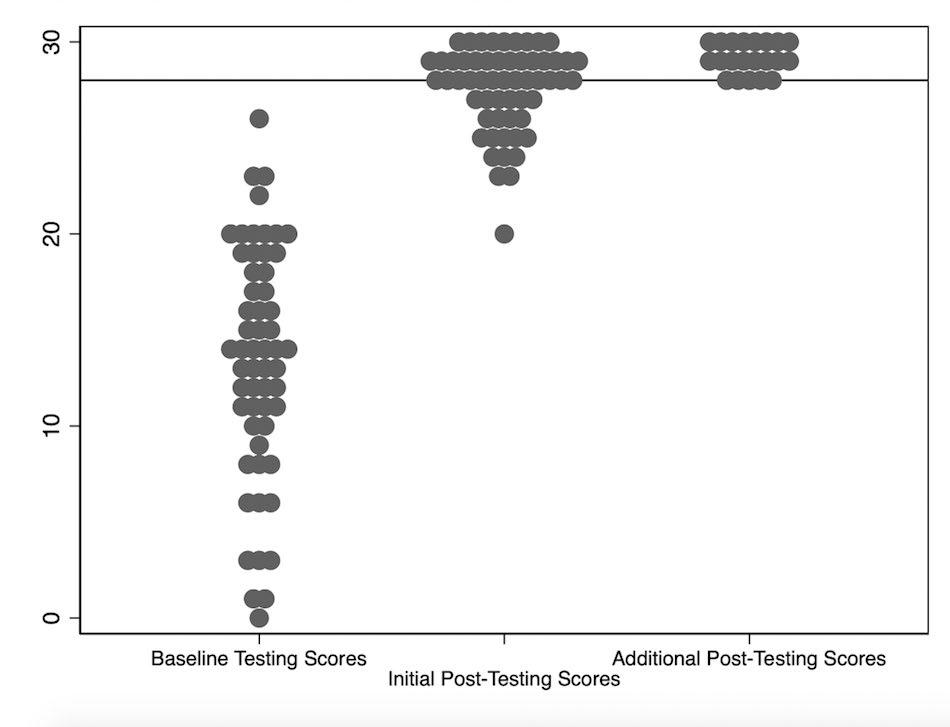
RESULTS
Characteristics of Study Subjects
There were 59 residents eligible for inclusion in this study; two PGY-4 residents were unable to participate in the study due to scheduling conflicts. We collected data for 57 participants, including 15 PGY-1s, 15 PGY-2s, 15 PGY-3s and 12 PGY-4s. There were 38 (66.7%) male and 19 (33.3%) female residents enrolled.
Main Results
The expert panel set an MPS of correctly performing 28 (93.3%) checklist items. Performance data is displayed in Figure 2. No learners met the MPS during baseline testing. The mean score at baseline testing was 13.4 (95% CI 11.8-15.0). The mean score at initial post-testing was 27.5 (95% CI 26.928.1). The difference between the mean score at baseline testing and initial post-testing was statistically significant (P < 0.01).
Of the 57 residents enrolled, 36 (63.2%) achieved the MPS during initial post-testing. The mean score for the 21 residents (eight PGY-1s, six PGY-2s, five PGY-3s, and two PGY-4s) who did not meet or exceed the MPS during initial post-testing was 25.2 (95% CI 24.4-26.0). After completing one additional 30-minute, deliberate practice session, each of these 21 residents met or exceeded the MPS during additional post-testing. Checklist items that were most commonly not performed or performed incorrectly during baseline testing included the following: confirming the connection between the pacing wire and 2-millimeter adapters; confirming mechanical capture; securing the pacing generator after the procedure; and locking the introducer sheath cap O-ring. Complete data for checklist performance is presented in Table 2.
Course evaluations were completed by 51 (89%) of the participants. Learners indicated that the curriculum was a beneficial (mean 5.0, SD 0.2) and enjoyable (mean 4.9, SD 0.3) addition to their training, and they felt confident (mean 4.6, SD 0.6) performing TVP in the ED after completing the course.
DISCUSSION
This report describes the design and implementation of a SBML curriculum for training EM residents to perform TVP. After viewing a procedure video and completing individualized amounts of deliberate practice, all learners met or exceeded the MPS set for this procedure. These findings add to existing literature that shows SBML to be a highly effective form of competency-based medical education, particularly for
Western Journal of Emergency Medicine 46 Volume 24, NO.1: January 2023
Klein et al.
Figure 2. Distribution of checklist scores during each phase of testing. Vertical axis depicts checklist score (maximum score 30). Horizontal line represents the minimum passing standard (MPS) of 28/30. Additional post-testing scores represent the 21 learners who did not meet the MPS during initial post-testing.
*The number (n) and percentage (%) of learners who performed each checklist item correctly during each
infrequently performed invasive procedures.15-17 The rigorous MPS set for this curriculum – 93.3% – is similar to the high standards set for other mastery learning interventions.18,21
While mastery, defined as meeting the MPS, is ultimately a dichotomous variable, analyzing performance by checklist score allowed for a more granular understanding of a learner’s
Volume 24, NO.1: January 2023 47 Western Journal of Emergency Medicine Klein et al. SBML Improves EM Residents’ Ability to Perform TVP Checklist item Baseline testing* Initial posttesting Additional post-testing n (%) n (%) n (%) 1 Gathers necessary equipment 10 17.5% 43 75.4% 21 100.0% 2 Cleans hands 19 33.3% 48 84.2% 20 95.2% 3 Dons personal protective equipment 42 73.7% 55 96.5% 21 100.0% 4 Identifies the appropriate syringe for balloon inflation and fills syringe with 0.75 mL of air and attaches to the port of the pacing wire 37 64.9% 56 98.2% 20 95.2% 5 Assesses the patency of the balloon 38 66.7% 57 100.0% 21 100.0% 6 Attaches the 2-mm adapters to the proximal end of the pacing wire and confirms integrity of connection by gently tugging on connectors 1 1.8% 50 87.7% 21 100.0% 7 Hands the distal end of the pacing wire (with 2-mm adapters attached) and syringe to non-sterile assistant 37 64.9% 57 100.0% 21 100.0% 8 Instructs non-sterile assistant to attach the 2-mm adapters to the pacing generator adapter cable and confirms integrity of connection by gently tugging on the attached wires 4 7.0% 43 75.4% 18 85.7% 9 Asks non-sterile assistant to attach the cable to the pacing generator 46 80.7% 56 98.2% 21 100.0% 10 Attaches the cap to the introducer sheath and turns the cap to lock into place on the sheath 14 24.6% 56 98.2% 20 95.2% 11 Inserts the distal tip of the pacing wire through the sterile sheath in the correct orientation 46 80.7% 55 96.5% 21 100.0% 12 Inserts the pacing wire through the introducer sheath to at least the 20-cc mark 51 89.5% 55 96.5% 21 100.0% 13 Inflates the balloon and ensures the stopcock is closed after balloon inflation 32 56.1% 53 93.0% 20 95.2% 14 Asks non-sterile assistant to turn on the pacing generator 46 80.7% 57 100.0% 21 100.0% 15 Asks non-sterile assistant to select a mode that allows for ventricular pacing 43 75.4% 57 100.0% 21 100.0% 16 Asks non-sterile assistant to select a rate of 60-80 beats per minute on the pacing generator 44 77.2% 57 100.0% 21 100.0% 17 Asks non-sterile assistant to select a ventricular output of 10-25 mA (maximum) on the pacing generator 31 54.4% 57 100.0% 21 100.0% 18 Advances pacing wire with balloon inflated until electrical capture is achieved 27 47.4% 54 94.7% 21 100.0% 19 Asks non-sterile assistant to confirm mechanical capture by palpation of pulses 4 7.0% 42 73.7% 18 85.7% 20 Deflates balloon 14 24.6% 46 80.7% 20 95.2% 21 Turns the stopcock for the balloon to the OFF position 9 15.8% 40 70.2% 17 81.0% 22 Asks non-sterile assistant to decrease ventricular output amps until capture is lost 20 35.1% 52 91.2% 21 100.0% 23 Asks non-sterile assistant to increase ventricular output amps to a level higher than that which resulted in electrical capture 13 22.8% 50 87.7% 21 100.0% 24 Locks introducer sheath cap O-ring 9 15.8% 51 89.5% 20 95.2% 25 Extends sterile sheath to cover the length of the pacing wire and connects sterile sheath to introducer sheath cap 20 35.1% 55 96.5% 21 100.0% 26 Locks O-ring on the sterile sheath covering 21 36.8% 51 89.5% 21 100.0% 27 Secures pacing generator 6 10.5% 56 98.2% 20 95.2% 28 Orders chest radiograph to confirm location of pacing wire 7 12.3% 48 84.2% 20 95.2% 29 Maintains full sterility throughout procedure 48 84.2% 55 96.5% 21 100.0% 30 Retracts pacing wire only when balloon is deflated throughout procedure 24 42.1% 57 100.0% 21 100.0%
Table
2. Learner performance for individual checklist items.
phase of testing.
SBML Improves EM Residents’ Ability to Perform TVP
skill before and after undergoing the educational intervention. The poor baseline performance in this cohort – a mean score of 13.4 on a 30-item checklist – is not surprising for such an uncommon intervention and is consistent with the poor baseline performance observed in prior mastery learning studies of other procedures.15-17 Previous TVP training in our program did not follow a competency-based model, and a majority of our residents had not performed TVP on a patient prior to the beginning of this curriculum; we suspect this limited experience is similar to that of trainees at other EM programs.
All learners in this report demonstrated the ability to meet or exceed the MPS after completing this curriculum, which included rigorous assessment, an educational intervention (watching the procedure video), and individualized amounts of deliberate practice with directly observed coaching and feedback, which are essential features of mastery learning. Although the mean checklist score improved significantly from baseline testing to initial post-testing, for more than one third of the learners, a single deliberate practice session did not result in meeting or exceeding the MPS. This is not unexpected. In mastery learning there is no “failure,” only the opportunity for additional practice and testing until all learners achieve the desired standard.
The mean checklist score for the learners who required additional practice was still notably improved from initial post-testing, with a narrower range of performance. Following one additional 30-minute, deliberate practice session, these learners all met or exceeded the MPS during additional posttesting. Despite the additional time commitment required to complete this curriculum, learners found it to be an enjoyable and beneficial addition to their training and felt confident in their ability to perform TVP after completing the course.
Procedural competence is critical to the practice of EM22,23; however residency programs cannot guarantee trainees exposure to all procedures in the clinical environment prior to graduation.24,25 This is particularly true for TVP, which, due to its rarity, is one of only three procedures for EM allowed by the ACGME to be exclusively performed through simulation prior to residency graduation.3 As growing numbers of learners in all specialties compete for access to a finite number of invasive procedures in teaching hospitals, clinical experience alone may no longer be sufficient to ensure procedural competence.26 Notably, the 21 learners in this study who did not meet the MPS during initial post-testing included PGY-1 through PGY-4 residents, which suggests that skill level and need for additional practice cannot be predicted solely by level of training. Rigorous, competency-based training and assessment methods like mastery learning can – and should – be used to prepare EM residents to successfully and independently perform uncommon but potentially lifesaving interventions.
LIMITATIONS
There are several limitations to this report. A relatively small number of learners completed the curriculum due to
the single-site design; a larger sample size could improve the generalizability of these findings. Prior to the creation of this SBML intervention, our residents completed TVP training during an annual “rare procedures” simulation session that did not follow a competency-based model and which residents attended as their clinical schedule allowed; we acknowledge that learners with alternate methods of prior training may demonstrate different levels of performance in this curriculum.
We were unable to track how many times the procedure video was viewed; however, all learners verbally attested to watching the video prior to their deliberate practice session. Finally, this curriculum required a significant investment of time and resources: learners participated in a minimum of three sessions (baseline testing, deliberate practice, and initial post-testing), each of which required direct observation and active involvement of a faculty member. Specialized equipment and support from simulation staff was also required. The resource-intensive nature of mastery learning may limit its feasibility in other settings.
Given the small sample size, we did not compare SBML to other methods of TVP training. However, mastery learning has been consistently shown to outperform nonmastery instruction.13-15 ,27 In addition, we did not control for learners who had previous experience performing TVP during clinical practice. However, no learners in our cohort demonstrated mastery during baseline testing, which indicates that any residents with prior clinical TVP experience were not adequately prepared to meet or exceed the MPS set for this procedure. This is consistent with a previous analysis of other invasive procedures performed by internal medicine and EM residents (including central venous catheter insertion, lumbar puncture, and thoracentesis), which found that clinical procedure experience during residency was not sufficient to ensure competence.28
Future research should investigate the optimal timing for repeat assessment and practice to ensure TVP skill retention. Assessment of other specialists who perform TVP, such as cardiologists and intensivists, should be explored. While challenging to assess, the effect of this curriculum on patientlevel outcomes (ie, Kirkpatrick Level 3) should also be investigated. Finally, the deliberate practice and assessment components of this curriculum were conducted using a highfidelity simulator; adapting the curriculum to incorporate lowfidelity models could also be explored.29
CONCLUSION
This study demonstrated a significant improvement in emergency medicine residents’ ability to perform temporary transvenous cardiac pacing on a high-fidelity task trainer after completing a mastery learning curriculum and contributes to the growing body of literature that proves simulationbased mastery learning to be a highly effective method of competency-based medical education.
Western Journal of Emergency Medicine 48 Volume 24, NO.1: January 2023
et al.
Klein
Address for Correspondence: Matthew R. Klein, MD, MPH, Northwestern University Feinberg School of Medicine, Department of Emergency Medicine, 211 E. Ontario Street, Suite 200, Chicago, IL 60611. Email: matthew.klein@northwestern.edu.
Conflicts of Interest: By the WestJEM article submission agreement, all authors are required to disclose all affiliations, funding sources and financial or management relationships that could be perceived as potential sources of bias. No author has professional or financial relationships with any companies that are relevant to this study. There are no conflicts of interest or sources of funding to declare.
Copyright: © 2023 Klein et al. This is an open access article distributed in accordance with the terms of the Creative Commons Attribution (CC BY 4.0) License. See: http://creativecommons.org/ licenses/by/4.0/
based mastery learning. Simul Healthc. 2018;13(3S Suppl 1):S15-S20.
13. Cook D, Brydges R, Zendejas B, et al. Mastery learning for health professionals using technology-enhanced simulation: a systematic review and meta-analysis. Acad Med. 2013;88(8):1178-86.
14. McGaghie W, Issenberg S, Cohen E, et al. Does simulation-based medical education with deliberate practice yield better results than traditional clinical education? A meta-analytic comparative review of the evidence. Acad Med. 2011;86(6):706-11.
15. Barusk J, Cohen E, Caprio T, et al. Simulation-based education with mastery learning improves residents’ lumbar puncture skills. Neurology. 2012;79(2):132-7.
16. Barsuk J, McGaghie W, Cohen E, et al. Use of simulationbased mastery learning to improve the quality of central venous catheter placement in a medical intensive care unit. J Hosp Med. 2009;4(7):397-403.
REFERENCES
1. Harrigan R, Chan T, Moonblatt S, et al. Temporary transvenous pacemaker placement in the emergency department. J Emerg Med. 2007;32(1):105-11.
2. Sodek G, Domanovits H, Meron G, et al. Compromising bradycardia: management in the emergency department. Resuscitation. 2007;73(1):96-102.
3. Accreditation Council for Graduate Medical Education. Emergency Medicine Defined Key Index Procedure Minimums. 2017. Accessed November 1, 2020.
4. Murphy JJ. Problems with temporary cardiac pacing. Expecting trainees in medicine to perform transvenous pacing is no longer acceptable. BMJ. 2001;323(7312):527.
5. Sharma S, Sandler B, Cristopoulos C, et al. Temporary transvenous pacing: an endangered skill. Emerg Med J. 2012;29(11):926-7.
6. Druck J, Valley M, Lowenstein S. Procedural skills training during emergency medicine residency: Are we teaching the right things? West J Emerg Med. 2009;10(3):152-6.
7. Ahn J, Kharasch M, Aronwald R, et al. Assessing the Accreditation Council for Graduate Medical Education requirement for temporary cardiac pacing procedural competency through simulation. Simul Healthc. 2013;8(2):78-83.
8. Klein M, Schmitz Z, Adler M, et al. Development of a rigorously designed checklist for assessment of emergency medicine resident performance of temporary transvenous cardiac pacing. AEM Educ Train. 2021;5(3):e10566.
9. Branzetti J, Adedipe A, Gittinger M, et al. Randomised controlled trial to assess the efficacy of just-in-time training on procedural performance: a proof-of-concept study to address procedural skill decay. BMJ Qual Saf. 2017;26(11):881-91.
10. Sawyer T, White M, Zaveri P, et al. Learn, see, practice, prove, do, maintain: an evidence-based pedagogical framework for procedural skill training in medicine. Acad Med. 2015;90(8):1025-33.
11. McGaghie W. Mastery learning: It is time for medical education to join the 21st century. Acad Med. 2015;90(11):1438-41.
12. McGaghie WC, Harris IB. Learning theory foundations of simulation-
17. Miller D, Zaidi H, Sista P, et al. Creation and implementation of a mastery learning curriculum for emergency department thoracotomy. West J Emerg Med. 2020;21(5):1258-65.
18. Barsuk J, Cohen E, Wayne D, et al. A comparison of approaches for mastery learning standard setting. Acad Med. 2018;93(7):1079-84
19. McGaghie W, Barsuk J, Wayne D. AM Last Page: Mastery learning with deliberate practice in medical education. Acad Med. 2015;90(11):1575.
20. Eppich W, Hunt E, Duval-Arnould J, et al. Structuring feedback and debriefing to achieve mastery learning goals. Acad Med. 2015;90(11):1501-8.
21. Prenner S, McGaghie W, Chuzi S, et al. Effect of trainee performance data on standard-setting judgements using the Mastery Angoff method. J Grad Med Educ. 2018;10(3):301-5.
22. Beeson M, Ankel F, Bhat R, et al. The 2019 Model of the Clinical Practice of Emergency Medicine. J Emerg Med. 2020;S0736-4679.
23. Chapman D. Definitively defining the specialty of emergency medicine: issues of procedural competency. Acad Emerg Med. 1999;6(7):678-81.
24. Petrosoniak A, Herold J, Woolfrey K. Emergency medicine procedural skills: What are residents missing? CJEM. 2013;15(4):241-8.
25. Hayden S, Panacek E. Procedural competency in emergency medicine: the current range of resident experience. Acad Emerg Med. 1999;6(7):728-35.
26. Gisondi M, Regan L, Branzetti J, et al. More learners, finite resources, and the challenging landscape of procedural training at the bedside. Acad Med. 2018;93(5):699-704.
27. Schroedl C, Frogameni A, Barsuk J, et al. Implementation of simulation-based mastery learning on resident skill managing mechanical ventilators. ATS Sch. 2020;2(1):34-48.
28. Barsuk J, Cohen E, Feinglass J, et al. Residents’ procedural experience does not ensure competence: a research synthesis. J Grad Med Educ. 2017;9(2):201-8.
29. Young T, Tango J, Toomasian C, et al. An inexpensive conceptual training model for transvenous pacemaker placement. West J Emerg Med. 2019;21(1):180-3.
Volume 24, NO.1: January 2023 49 Western Journal of Emergency Medicine Klein et al. SBML Improves EM Residents’ Ability to Perform TVP
Exploring Teamwork Challenges Perceived by International Medical Graduates in Emergency Medicine Residency
Danya Khoujah, MBBS, MEHP*† Ahmed Ibrahim, MSc, PhD‡
Tampa AdventHealth, Emergency Medicine, Tampa, Florida University of Maryland School of Medicine, Department of Emergency Medicine, Baltimore, Maryland Johns Hopkins University, School of Education, Baltimore, Maryland
Section Editor: Chris Merritt, MD, MPH, MHPE
Submission history: Submitted July 11, 2022; Revision received November 12, 2022; Accepted November 20, 2022
Electronically published January 11, 2023
Full text available through open access at http://escholarship.org/uc/uciem_westjem
DOI: 10.5811/westjem.2022.11.58002
Introduction: Non-US international medical graduates (IMG) represent a gradually increasing portion of emergency medicine (EM) residents in the United States. Yet there are no previous studies that explore the needs of this learner population. We conducted a qualitative study to examine nonUS IMGs’ perceptions of challenges they face specifically regarding team dynamics during their first year of an EM residency.
Method: Nine non-US IMGs in EM from all over the US participated in anonymous, semi-structured phone interviews lasting 45-60 minutes. We then coded and analyzed the interviews to identify axes and themes using an inductive approach informed by grounded theory. Focused coding and member checking were employed.
Results: Non-US IMGs’ perceptions of challenges regarding team dynamics during their first year of an EM residency coalesced into two themes: system-based challenges, such as a new power dynamic and understanding the local hospital system, and interpersonal challenges, such as establishing rapport and articulation of critical thinking.
Conclusion: Non-US IMGs perceived several unique challenges regarding team dynamics during their first year of an EM residency, whether system-based or interpersonal-based. We propose solutions such as a transitional curriculum (as suggested by the participants as well) and culturalcompetence training for academic leadership. [West J Emerg Med. 2023;24(1)50–58.]
INTRODUCTION
Over 4,000 residents accepted through the National Resident Matching Program are non-US international medical graduates (IMG),1 a number that has been consistently increasing over the past two decades.2 This learner population forms 25% of physicians practicing in the US3 and a significant proportion of the healthcare services provided to the underserved.4 However, over half of US residency programs never interview or rank non-US IMGs,5 which may be attributed to unsubstantiated concerns regarding the ability of IMGs to succeed in residency.6,7 Two distinct groups of IMGs exist, all of whom completed undergraduate medical education outside the US and Canada:
those who are US citizens, termed US IMGs, and those who are not, termed non-US IMGs. The two groups differ in their cultural backgrounds, prior schooling, patterns of acceptance into residency and, therefore, perceived challenges during residency. This study focused on the second group.
Prior research has identified challenges facing IMGs, such as communication, power dynamics within the healthcare team, rapport-building, and understanding the hospital system.8-16 However, none of these studies specifically addressed IMGs in emergency medicine (EM), despite the doubling of non-US IMGs matching annually in EM between 2017–2022, from 20 to 45 per year.1,17
Western Journal of Emergency Medicine 50 Volume 24, NO.1: January 2023 Original Research
* † ‡
Emergency medicine residents are evaluated according to the Accreditation Council for Graduate Medical Education Milestones in EM,18 which include interpersonal and communication skills that are integral to teamwork and interprofessional collaborative practice.19 Given the multidisciplinary approach to care in EM,20,21 understanding IMGs’ experience with team dynamics provides an important insight into their learning environment, which affects learners’ behaviors and educational outcomes.22 This is especially important in light of previously identified team-based challenges faced by IMGs, such as giving and receiving feedback, understanding the responsibilities of team members, team hierarchy, and addressing conflict.9,14-16,23,24
In this study we aimed to explore the perceived challenges related to team dynamics for non-US IMGs during their first year of an EM residency, using the qualitative methodology most suited to explore and contextualize individuals’ experiences.25
METHODS
Setting
We identified participants by manually searching EM residency websites and contacting residency program leadership, either directly or through the Council of Residency Directors in EM listserv. The invitation email described the study purpose including assurance of anonymity and offered a $20 gift card as an appreciation. Fourteen potential participants contacted the study team, and thematic saturation was achieved after nine interviews. The study was determined to be exempt by the institutional review board.
Study Design
We used a descriptive case study design26 to gain an indepth understanding of the perceived challenges. Interviews were conducted by the lead author (DK), an IMG emergency physician, from May–July 2019 to preserve consistency. The questions focused on team dynamics and were crafted by both authors from prior IMG studies in other disciplines (Table 1, Appendix 1).8-10
Data Collection
Participants completed an electronic consent and demographic form and were identified using a unique ID to preserve anonymity. We collected data using semi-structured phone interviews that lasted 45-60 minutes, starting with the same questions for all participants, followed by probing and clarifying questions. Some questions approached the same topic from different angles, triangulating the findings and improving the credibility of the resulting data. Iterative questioning of data with apparent conflict allowed further exploration. Interviewees’ honesty was enhanced by anonymity and voluntary enrollment. Trustworthiness was established by voluntary member-checking; interview participants reviewed summaries and themes of their
Population Health Research Capsule
What do we already know about this issue?
Prior studies identified challenges facing international medical graduates (IMG), such as communication and team hierarchy. None has specifically addressed learners in emergency medicine.
What was the research question?
What are the perceived challenges related to team dynamics for non-US international medical graduates during their first year of an emergency medicine residency?
What was the major finding of the study?
IMGs perceive system-based (e.g., power dynamic) and interpersonal challenges (e.g., rapport) during the first year of residency.
How does this improve population health?
Understanding of the diversity of learners creates a more culturally competent work environment for all residents and faculty.
All of these questions relate to your first year of residency. In your opinion:
• What are some of the challenges you faced when working with your team members?
• What was your perception of the value of the opinions of other members in your team?
• What was your experience with receiving feedback from your team members in your first year of residency?
• What were your expectations of your role as a resident?
• What was your understanding of your rights as a resident?
• What are some behaviors that you thought your team would perceive as a weakness for a team member?
own interviews for accuracy and elaborated on unclear or seemingly conflicting data.
Data Analysis
We audio-recorded and transcribed the interviews, and then coded them using MAXQDA qualitative analysis software version 2018.2 (Verbi Software GmbH. Berlin, Germany) to organize emergent categories and their interrelationships using grounded theory methodology. DK conducted open coding and then organized codes into themes. Trustworthiness of findings
Volume 24, NO.1: January 2023 51 Western Journal of Emergency Medicine Khoujah et al. Exploring Teamwork Challenges Perceived by IMG in EM Residency
Table 1. Examples of interview questions asked of non-US international medical graduates.
Exploring Teamwork Challenges Perceived by IMG in EM Residency
was increased using focused coding; DK then partnered with an independent coder and, using the initial thematic categories, reviewed a subset of the transcripts to check for consistency and identify any overlooked themes. Disagreements were resolved through discussion. The themes were compared with known literature, and if new themes were identified, then further information was deduced from the interviews. Reflective memoing allowed the development of progressive subjectivity. Reflexivity was maintained by disclosing the researchers’ background and acknowledging its effect in knowledge construction.25 We did the coding inductively, avoiding quick conclusions influenced by our views. The conceptual model was built on actual quotes rather than our interpretations of quotes.
RESULTS
Participant Description
Nine participants were included in the study and were well-matched with average non-US IMGs, except for gender (Table 2). Approximately 90% of the sample were male, in comparison to 63.2% of non-US IMGs in EM programs.27 Seven participants were between the ages of 26-30, which is the same as the general demographic of EM residents and similar to the mean age of postgraduate year-1 IMGs (30.6 years).28 None of the participants were from residencies in the Western US, which was expected as there was only one non-US IMG accepted to a residency from that region in the 2018-2019 match.29 All participants were non-US IMGs who completed the first year of an EM residency between July
2016–July 2019. None had completed any residency training in North America prior to that.
Two broad themes emerged of IMGs’ perceptions of team dynamic challenges: system-based and interpersonal. Unsolicited solutions were volunteered by several participants and are included in the discussion. We edited quotes to promote clarity, and each speaker’s voice was retained as much as possible while preserving anonymity. Subthemes and exemplar quotes are summarized in Tables 3 and 4 and Appendix 2.
Theme 1: System-based Challenges Team Structure
Although most participants had a basic understanding of the concept of teamwork, a few limited their definitions to patient resuscitation-related instances. Several participants defined team members as exclusive to only physicians, while others had a more inclusive definition. One participant verbalized the lack of familiarity with the roles of different team members as these roles were not present in their home countries. Several participants described a hierarchical power dynamic between attending physicians and trainees in their previous experience, with one participant likening it to the “military.” This power dynamic differed from IMGs’ current residencies. While viewed positively by several participants, the change in hierarchy led to confusion about the expected level of formality in interactions between team members and correctly framing learning interactions.
In their home countries, a few participants had practiced within teams with authoritative rather than collaborative physician leadership where nurses were not involved in decisionmaking. Some participants expressed the positive effect that horizonal systems had on patient care in their new environment.
Prior Exposure to Emergency Medicine and Medicine in the US
The specialty of EM is not well-developed in many countries, affecting the participants’ prior exposure to it, especially given the vast difference between practicing in the ED and on the wards. Lack of familiarity with the demands of clinical work in EM may contribute to feeling overwhelmed due to the workload, busyness, and general chaos. Going in with the right mindset and expecting a high workload was helpful for one participant in tempering expectations. Having prior EM experience in the US or having worked as a research assistant eased the transition as well.
One participant commented that they didn’t know “where patients go after they’re discharged or where they are coming from” in reference to long-term care facilities, as these were not options they had been exposed to before.
Understanding the Local Hospital System
Participants used “new environment” to refer to the culture of the US as well as the hospital itself. Several participants commented on how adjusting to “the way of doing medicine” and “missing the algorithm” detracted from
Western Journal of Emergency Medicine 52 Volume 24, NO.1: January 2023
Khoujah et al.
Descriptor Number Percentage Gender Male 8 88.9% Female 1 11.1% Age 26-30 7 77.8% 31-35 2 22.2% Region of the US where the first year of EM residency was completed Northeast 3 33.3% Midwest 1 11.1% South 5 55.6% Time gap between medical school graduation and start of EM residency 1-3 years 5 55.6% 4-7 years 4 44.4% Consider English to be their first language Yes 2 22.2% No 7 77.8%
Table 2. Description of participants (n=9).
Subtheme Exemplar quotes Team structure
Team members
Power dynamic
Hierarchy between physicians and nonphysicians
Prior exposure to EM and medicine in the US
Current state of EM in other countries
Nature of prior EM experience
Logistics (e.g. transitions of care)
Understanding the local hospital system
“New environment”
Splitting attention between acclimation and medical knowledge
Residents’ rights and addressing conflict
“We don’t have techs. I didn’t know what a CRNA was.” (Participant 1, referring to their home country)
“People from – generally speaking – the Middle East, Asia, there is a different level of authority. If your attending is a little bit bossy, a little bit difficult to deal with, we just take it, it’s not a big deal.” (Participant 6)
“It’s mainly hierarchical. The attending is supposed to be the most respected person on the team, and then you’d have your senior resident. When a nurse or a patient care technician would ask you a question, you would answer the question, but you would not be regarding their thoughts into your decision making.” (Participant 2, referring to their home country)
“Emergency medicine is one thing that the US is leading, and my country is far behind in properly running the emergency department. Being familiar with how things are run in the emergency department is definitely different from how things are done in other specialties.” (Participant 8)
“My expectation was that my life outside of work will be very limited and I would have long work hours and I would have only few days off per month every month.” (Participant 9)
“I never understood “this patient is appropriate for an LTCF or a skilled nursing facility.” I couldn’t grasp it. It was very abstract for me.” (Participant 1)
“I didn’t know my place. Where should I be standing exactly?” (Participant 5)
“You’re coming to a new place and new space, and you look different and people know you’re different as opposed to someone who “grew up in that environment.” They’d be much more familiar with everything around them. They’re already familiar with the interactions, whether with patients or other providers, so they can focus on other things such as improving their clinical care alone as opposed to trying to improve everything; trying to acclimate yourself with everything.” (Participant 1)
“I didn’t realize that you can express yourself and express your concern and you can fight for your rights and you can have a discussion about things that make you uncomfortable.” (Participant 4)
their educational experience. One participant commented on how US graduates have a “home-field advantage” and how that made the participant appear clinically less competent, when the issue was logistics rather than knowledge. Another participant commented that several residents in their class went to the same medical school as well, so “they knew their way around the ER.” In EM, understanding the logistics may be essential given the fast-paced approach.
Residents’ Rights and Addressing Conflict
Participants described varying levels of feeling empowered and validated; one participant felt respected and valued, whereas another shared an overt instance of “intimidation” and “injustice.” When issues such as conflict or abuse occurred, they were often not addressed due to several reasons, including lack of recognition of abuse, lack of empowerment, feeling “overwhelmed,” thinking the effort would be futile, or simply not knowing how to navigate the system Consequently, this reflected on participants’ anticipation of fair treatment. None of the participants stated that they were explicitly denied any rights.
Theme 2: Interpersonal Challenges Establishing Rapport
The lack of “shared background” made establishing rapport difficult for several participants. One participant explained how these “cultural differences” made it “hard” to connect with others outside the workplace. One participant attributed this to “cultural bias… they already have their own thoughts about you.” The difficulty establishing rapport contributed to a sense of isolation (despite some having immediate family with them), as well as affecting clinical work and the ability to give feedback.
Cultural Competence
Culturally appropriate behaviors at participants’ home countries were sometimes viewed negatively in their new environment, specifically body language such as “gesturing,” or being “loud and boisterous.” A participant was told by an attending physician to “stop being an aggressive (race/ ethnicity)” in reference to this demeanor. For another participant, being “quiet” and “not outspoken” were viewed
Volume 24, NO.1: January 2023 53 Western Journal of Emergency Medicine Khoujah et al. Exploring Teamwork Challenges Perceived by IMG in EM Residency
Table 3. Team-dynamic challenges perceived by non-US international medical graduates in emergency mnedicine residencies: systembased challenges.
CRNA, certified registered nurse anesthetist; LTCF, long-term care facility; EM, emergency medicine.
Subthemes Exemplar quotes
Establishing rapport “Being able to talk during the shift about things outside of clinical work. It was difficult for me.” (Participant 1)
“They talk about wine a lot; I have no idea what they’re talking about.” (Participant 9)
“I felt like I was alone in all of this” (Participant 6)
Cultural competence
“I had to recognize the cultural issues that I had or what I grew up with or what I have learned before and then try to modify that to make it more applicable to the culture that I’m doing my training in.” (Participant 2)
Feedback “Americans are so nice in giving feedback ... so my experience with it has been great.” (Participant 7)
Self-expectations
Clarity “I was like …. I have to know everything... But then you come here and everybody emphasizes that you being a good learner, accepting feedback well, having a positive attitude, asking for feedback, and being respectful are the core values, are the things that really matter rather than coming in with a knowledge base.” (Participant 7)
“My residency program was not clear about my exact duties: what I should do, what I shouldn’t do.” (Participant 3) Autonomy “I was transferring some sort of a [home country] model. You should let the attending know what you are about to do and then they agree to it (before going ahead with the plan).” (Participant 4)
“I worked in [home country] on my own in the ER for two years and I was used to making my own decisions” (Participant 3)
Asking for help “I didn’t want to confirm somebody’s suspicions that I’m an imposter.” (Participant 1)
“Even though I felt that it was my right, if I’m still asking very basic questions, they were perceiving it as my weakness (as mentioned in performance evaluations).” (Participant 8)
Vulnerability “I felt like other people were more comfortable sharing their mishaps or their academic weaknesses because they had that background of being from here… As opposed to me, where anytime I felt like I had an academic weakness it was because I came from an outside program and therefore I was weak.” (Participant 1)
Communication “People here communicate using a lot of American expressions that I was not accustomed to, so I would use formal English to convey a message instead of an expression that would seem more appropriate for the situation.” (Participant 7)
Articulation of critical thinking and discussion as a way of learning
US, United States.
“If I thought differently, I would rarely bring it up with someone more senior than me… Me sharing things did not play a role in my education.” (Participant 5)
“I started to back up my opinion before even talking so I know what I’m talking about, so you can have a productive, good conversation about anything, which you learn from, which is good.” (Participant 4)
as passiveness and a weakness by team members. For a third, avoiding eye contact while talking to team members was viewed as “condescending” and “ignoring,” whereas it is a culturally appropriate behavior in their home country.
Projecting confidence during interactions was another challenge that faced some participants, with resulting negative feedback if that “confidence” was not outwardly projected. One participant struggled in finding the fine line for appropriate assertiveness, risking being viewed as either aggressive or reticent.
Feedback
Participants’ experience in receiving feedback was variable. Several didn’t feel a “personal attack.” However, one participant felt that they were “judged harshly,” while another acknowledged that “it’s for my benefit.” More than one
participant clarified that they “brush off” positive feedback as they didn’t view it as helpful. One exclaimed that the feedback process is (positively) different from their prior experiences. This difference may have contributed to the initial dismissal of the feedback by another participant. One participant attributed their perceived difficulty in obtaining feedback to a lack of faculty investment in them due to their IMG status.
Self-expectations
Clarity of expectations is paramount in optimizing learners’ success as one participant emphasized. Emphasis on learning rather than knowledge surprised one participant, possibly reflecting what was valued in their prior education. Unfortunately, the clarity of expectations was not the case for all participants. The disconnect between perceived and actual expectations of autonomy vs dependency, when present,
Western Journal of Emergency Medicine 54 Volume 24, NO.1: January 2023 Exploring Teamwork Challenges Perceived by IMG in EM Residency Khoujah et al.
Table 4. Team-dynamic challenges perceived by non-US international medical graduates in emergency medicine residencies: interpersonal challenges.
negatively affected the participant’s comfort, efficiency, and performance during clinical work.
Participants viewed asking for help in contrasting lights. For some participants, their “fear of failure” and not wanting to “mess up” prompted them to ask for help “a lot,” while others would avoid asking questions if possible. Participants hesitating to ask for help either perceived it as “weakness” or did not recognize the expectations of their autonomy or knowledge, and in one case, were worried about a negative perception by the residency, as their pattern of asking for help was negatively noted on evaluations. One participant had to “learn how to ask for help.” For some, the fear of showing vulnerability was exacerbated by their IMG status. On the other hand, other participants did not perceive asking for help as a weakness and felt empowered to reach out to residency leadership outside clinical hours to seek advice.
All participants verbalized prioritizing patient safety over fear of perception of lacking knowledge or being “weak,” even when they felt “unsafe” asking questions at times or if it made them feel “stressed.”
Communication
“Communication is probably the most important aspect of working well in a team” especially “closing the loop” and being efficient and clear. An important part of the communication is the linguistics, and while some participants might not be comfortable using English in general, the issue for some was the spoken or informal English, rather than “textbook” English.
Articulation of Critical Thinking and Discussion as a Way of Learning
Articulation of critical thinking was a struggle for several participants especially with an authority figure, suggesting that discussion may not be viewed by them as a way of learning. Some participants recognized the importance of supporting arguments with evidence, and for some this improved with time.
DISCUSSION
This study explored challenges perceived by IMGs in EM as they relate to team dynamics, revealing several systembased and interpersonal challenges. Some inconsistencies emerged in participants’ experiences, which enhances the validity of the data as the participants were a diverse group and their experiences were not anticipated to be identical.13,30
System-based challenges are expected as emergency care in the US is vastly different from countries that employ a different model of care. Integration of rehabilitation facilities, nursing homes, and other community resources in medical care is not widespread, especially in collectivist societies. While these macro-level issues have been mentioned before,10,11,31 the challenges regarding scope of practice and nature of interactions with other specialties is unique to EM in the US and has not been previously described. These
issues are accentuated with lack of familiarity with the role of other team members such as non-physician practitioners.10,32 Horizontal relationships among healthcare staff (rather than hierarchical) are commonly different from IMGs’ prior experiences,9,14 and although embracing collaboration itself did not appear to be a challenge, the sudden shift in perspective appeared to be one.
Difficulty building rapport with patients has been investigated in prior studies,8,13 and our data shows that this challenge may be present with colleagues as well. Building collegial relationships and socialization are essential elements of learning and professional growth.33 Strong workplace connections may also mitigate the feelings of social isolation described by some participants, which, if unaddressed, may lead to burnout.9,34,35
Challenges related to communication with the team resonate with prior literature,9,11 and in our study cannot be attributed to linguistics alone as two of the nine participants consider English their first language. Contributing factors may be prior educational experiences with a sole focus on hard science8 and a lack of a dedicated communication curriculum.8
Discomfort with self-advocacy and addressing conflict are in line with previously described views of hierarchy in learning and fear of questioning authority.9,13–15 This lack of empowerment is exacerbated by feeling overwhelmed by other demands and not being aware of support resources.9
Another downstream effect of perceived hierarchy is not recognizing discussion as a learning tool, combined with prior educational experiences such as large-group learning or a “banking system of education,”36 as previously addressed.13,15 Non-Western cultures do not place a similar emphasis on negotiation and debate,37 and in many cultures silence during discussions is viewed as a sign of respect.13 Proactively addressing these perceptions will facilitate robust clinical discussions and decrease the frustration of both faculty and learners from poorly orchestrated teaching interactions, especially given the fast-paced workflow in the ED.
A salient perception by non-US IMGs was the need to assimilate to the dominant culture and hinder self-expression to build rapport and improve evaluations. Participants felt penalized for behaviors deemed appropriate in their home culture, which is unfortunately consistent with prior reports9,14,38 and probably stems from the lack of cultural competence in healthcare.39,40 A specific example is the negative feedback for lack of assertiveness mentioned by our participants, which has been reported by ethnically diverse medical students,41 as well as female resident physicians.42
This study highlights the value of a transitional curriculum as alluded to by some participants as well as documented in prior literature.23,43 Our results can be used as a needs assessment for a curriculum addressing team dynamics, rather than only knowledge and procedures.44 Our participants shared several topics for a clearer orientation: residents’ rights; empowerment; communication;
Volume 24, NO.1: January 2023 55 Western Journal of Emergency Medicine
al.
by IMG in EM Residency
Khoujah et
Exploring Teamwork Challenges Perceived
Exploring Teamwork Challenges Perceived by IMG in EM Residency Khoujah
clarification of team members’ roles; and transitions of care. A shadowing component may allow IMGs to familiarize themselves with their new environment without the added stress of performing clinical work. A participant shared their positive experience with a communication workshop they attended later in residency and reflected that it could have been helpful earlier, as noted in a prior study for IMGs in a Canadian internal medicine residency.45 A well-rounded approach would also address faculty and staff to improve their understanding of the diversity of learners, enabling them to have open, nonjudgmental conversations, mold clinical discussions, and accurately evaluate residents’ performance, hence avoiding contrast-effect bias and creating a more culturally competent work environment, not only for IMGs but for all.
LIMITATIONS
This study was explorative, limiting the ability to generalize the findings to all non-US IMGs in EM, especially women, given that there was only one female participant. Participants were (at the time of the interview) at different stages of training, which may have affected the accuracy of their reflections as they spoke from memory. Some issues such as those related to power dynamics and rapport-building are likely to be widespread, while critique for culturally appropriate behavior may be specific to a country or ethnicity. Our ability to discern the influence of ethnicity or country of origin is limited as participants were not queried for this information. Some interpersonal challenges perceived may be due to local, program-related factors or a specific faculty member, affecting all trainees at the site rather than only IMGs. Prior training and practice may have affected perception as some participants expressed. Some challenges may have been related to the participants having a time gap between medical school and residency,12 regardless of IMG status.7,46 Finally, the study is limited by the inherent fallacies of self-perception and self-selection bias.
CONCLUSION
International medical graduates in EM perceive several system-based and interpersonal challenges regarding team dynamics. Addressing these challenges proactively through a clear orientation curriculum may smoothen the transition. Creating a culturally competent workplace necessitates that faculty and staff learn about the values and experiences of IMGs and empower the IMGs to ask for their rights, seek help, and address conflicts when they arise.
ACKNOWLEDGMENT
The authors would like to acknowledge the participants for sharing their perspective, Mr. Marcus Bowers for transcribing the interviews and identifying the sample, Dr. Michael S. Ryan for editing the manuscript, and Dr. John Shatzer for his assistance with coding.
Address for Correspondence: Danya Khoujah, MBBS, MEHP, Tampa AdventHealth, Department of Emergency Medicine, 3100 E. Fletcher Ave, Tampa, FL 33613. Email: dkhoujah@gmail.com.
Conflicts of Interest: By the WestJEM article submission agreement, all authors are required to disclose all affiliations, funding sources and financial or management relationships that could be perceived as potential sources of bias. No author has professional or financial relationships with any companies that are relevant to this study. This research was funded by University of Maryland Emergency Medicine Associates, P.A. There are no conflicts of interest to declare.
Copyright: © 2023 Khoujah et al. This is an open access article distributed in accordance with the terms of the Creative Commons Attribution (CC BY 4.0) License. See: http://creativecommons.org/ licenses/by/4.0/
REFERENCES
1. National Resident Matching Program. Results and Data: 2022 Main Residency Match. 2022. Available at: https://www.nrmp.org/wpcontent/uploads/2022/11/2022-Main-Match-Results-and-Data-FinalRevised.pdf. Accessed November 1, 2022.
2. 1999 NRMP Match Data. National Resident Matching Program. Available at: https://mk0nrmp3oyqui6wqfm.kinstacdn.com/wp-content/ uploads/2013/08/resultsanddata1999.pdf. Accessed July 11, 2022.
3. Young A, Chaudhry HJ, Pei X, et al. A census of actively licensed physicians in the United States, 2014. J Med Licens Discip 2015;101(2):7-22.
4. Traverso G and McMahon GT. Residency training and international medical graduates. JAMA. 2012;308(21):2193-4.
5. Results of the 2018 NRMP Program Director Survey. National Resident Matching Program. 2018. Available at: https://www.nrmp.org/ wp-content/uploads/2018/07/NRMP-2018-Program-Director-Surveyfor-WWW.pdf. Accessed July 11, 2022.
6. Allman R, Perelas A, Eiger G. Should the United States provide postgraduate training to international medical graduates? Yes. Chest 2016;149(4):893-5.
7. Bohrer-Clancy J, Lukowski L, Turner L, et al. Emergency medicine residency applicant characteristics associated with measured adverse outcomes during residency. West J Emerg Med. 2018;19(1):106-11.
8. Dorgan KA, Lang F, Floyd M, et al. International medical graduatepatient communication: a qualitative analysis of perceived barriers. Acad Med. 2009;84(11):1567-75.
9. Hall P, Keely E, Dojeiji S, et al. Communication skills, cultural challenges and individuals support: Challenges of international medical graduates in a Canadian healthcare environment. Med Teach 2004;26(2):120-5.
10. Searight HR, Gafford J. Behavioral science education and the international medical graduate. Acad Med. 2006;81(2):164-70.
11. Zulla R, Baerlocher MO, Verma S. International medical graduates (IMGs) needs assessment study: Comparison between current IMG trainees and program directors. BMC Med Educ. 2008;8:1-5.
Western Journal of Emergency Medicine 56 Volume 24, NO.1: January 2023
al.
et
12. Bates J, Andrew R. Untangling the roots of some IMGs’ poor academic performance. Acad Med. 2001;76(1):43-6.
13. Osta AD, Barnes MM, Pessagno R, et al. Acculturation needs of pediatric international medical graduates: a qualitative study. Teach Learn Med. 2017;29(2):143-52.
14. Triscott JAC, Szafran O, Waugh EH, et al. Cultural transition of international medical graduate residents into family practice in Canada. Int J Med Educ. 2016;7:132-41.
15. Kevin Fiscella, Miguel Roman-Diaz, Bee-Horng Lue RB, et al. “Being a foreigner, I may be punished if I make a small mistake”: assessing transcultural experiences in caring for patients. Fam Pract 1997;14(2):112-6.
16. Murillo Zepeda C, Alcalá Aguirre FO, Luna Landa EM, et al. Challenges for international medical graduates in the US Graduate medical education and health care system environment: a narrative review. Cureus. 2022;14(7):e27351.
17. Results and Data: 2017 Main Residency Match. National Resident Matching Program. 2017. Avaialble at: https://www.nrmp.org/wpcontent/uploads/2021/07/Main-Match-Results-and-Data-2017.pdf.
Accessed July 11, 2022.
18. The Emergency Medicine Milestone Project. The Accreditation Council for Graduate Medical Education and The American Board of Emergency Medicine. Feb 2021. Available at: https://www.acgme. org/globalassets/pdfs/milestones/emergencymedicinemilestones.pdf.
Accessed July 11, 2022.
19. Schmitt M, Blue A, Aschenbrener CA, et al. Core competencies for interprofessional collaborative practice: reforming health care by transforming health professionals’ education. Acad Med 2011;86(11):1351.
20. Thomas D. 24|7|365: The Evolution of Emergency Medicine. United States: Emergency Medicine Residents’ Association. 2014. Available at: https://www.emra.org/about-emra/publications/legacydocumentary/. Accessed July 11, 2022.
21. Aldeen AZ, Gisondi MA. Bedside teaching in the emergency department. Acad Emerg Med. 2006;13(8):860-6.
22. Isba R, Rousseva C, Woolf K, et al. Development of a brief learning environment measure for use in healthcare professions education: the Healthcare Education Micro Learning Environment Measure (HEMLEM). BMC Med Educ. 2020;20(1):110.
23. Chen PG-C, Curry LA, Bernheim SM, et al. Professional challenges of non-U.S.-born international medical graduates and recommendations for support during residency training. Acad Med. 2011;86(11):1383-8.
24. Broquet KE, Punwani M. Helping International Medical Graduates Engage in Effective Feedback. Acad Psychiatry. 2012;36(4):282-7.
25. Malterud K. Qualitative research: standards, challenges, and guidelines. Lancet. 2001;358(9280):483-8.
26. Yin RK. (2016). Case Study Research and Applications: Design and Methods. 6th ed. Thousand Oaks, CA: Sage.
27. Perina DG, Collier RE, Counselman FL, et al. Report of the Task Force on residency Training Information (2010-2011), American Board of Emergency Medicine. Ann Emerg Med. 2011;57(5):526-34.
28. Data Resource Book: Academic Year 2018-2019. Department of
Applications and Data Analysis, Accreditation Council for Graduate Medical Education (ACGME). 2019. Available at: https://www.acgme. org/globalassets/pfassets/publicationsbooks/2018-2019_acgme_ databook_document.pdf. Accessed July 11, 2022.
29. 2019 NRMP Main Residency Match®: Match Rates by Specialty and State. National Resident Matching Program. 2019. Available at: https:// www.nrmp.org/wp-content/uploads/2021/07/NRMP-Results-andData-2019_04112019_final.pdf. Accessed July 11, 2022.
30. Antin TMJ, Constantine NA, Hunt G. Conflicting discourses in qualitative research: the search for divergent data within cases. Field Methods. 2015;27(3):211-22.
31. Symes HA, Boulet J, Yaghmour NA, et al. International medical graduate resident wellness: examining qualitative data from J-1 visa physician recipients. Acad Med. 2022;97(3):420-5.
32. Rao A, Freed CR, Trimm RF. International and American medical graduates in a U.S. pediatric residency program: a qualitative study about challenges during post-graduate year 1. Med Teach 2013;35(10):815-9.
33. Vaidyanathan B. Professional socialization in medicine. AMA J Ethics 2015;17(2):160-6.
34. Stehman CR, Testo Z, Gershaw RS, et al. Burnout, drop out, suicide: Physician loss in emergency medicine, part I. West J Emerg Med 2019;20(3):485-94.
35. Athena Health. Disconnected: isolation and physician burnout. 2019. Available at https://www.athenahealth.com/knowledge-hub/practicemanagement/disconnected-isolation-and-physician-burnout. Accessed July 11, 2022.
36. Freire P. (1972). Pedagogy of the Oppressed. New York, NY: Herder and Herder.
37. Merriam SB, Caffarella RS, Baumgartner LM. (2007). Learning and knowing: non-Western perspectives. In: Learning in Adulthood: A Comprehensive Guide (p. 217-240). 3rd edition. San Francisco, CA: Jossey-Bass.
38. Warsame RM, Asiedu GB, Kumbamu A, et al. Assessment of discrimination, bias, and inclusion in a United States hematology and oncology fellowship program. JAMA Netw Open. 2021;4(11):e2133199.
39. Jongen C, McCalman J, Bainbridge R. Health workforce cultural competency interventions: a systematic scoping review. BMC Health Serv Res. 2018;18(1):1-15.
40. Betancourt JR, Green AR, Carrillo JE, et al. Defining cultural competence: a practical framework for addressing racial/ ethnic disparities in health and health care. Public Health Rep 2003;118(4):293-302.
41. Lee KB, Vaishnavi SN, Lau SKM, et al. Cultural competency in medical education: demographic differences associated with medical student communication styles and clinical clerkship feedback. J Natl Med Assoc. 2009;101(2):116-26.
42. Kolehmainen C, Brennan M, Filut A, et al. Afraid of being “witchy with a ‘B’”: a qualitative study of how gender influences residents’ experiences leading cardiopulmonary resuscitation. Acad Med 2014;89(9):1276-81.
43. Coverdale JH, Balon R, Roberts LW. Which educational programs
Volume 24, NO.1: January 2023 57 Western Journal of Emergency Medicine Khoujah et al. Exploring Teamwork Challenges Perceived by IMG in EM Residency
Exploring Teamwork Challenges Perceived by IMG in EM Residency Khoujah et al.
promote the success of international medical graduates in psychiatry training? Acad Psychiatry. 2012;36(4):263-7.
44. Shappell E, Ahn J. A needs assessment for a longitudinal emergency medicine intern curriculum. West J Emerg Med. 2017;18(1):31-4.
45. Goldszmidt M, Kortas C, Meehan S. Advanced medical
communications: support for international residents. Med Educ 2007;41(5):522.
46. Binczyk NM, Babenko O, Schipper S, et al. Common factors among family medicine residents who encounter difficulty. Fam Med 2018;50(4):300-3.
Western Journal of Emergency Medicine 58 Volume 24, NO.1: January 2023
A Competency-based Tool for Resident Evaluation of Pediatric Emergency Department Faculty
Ethan Sandler, DO*
Michael Lee, MD, PhD†
Rebecca Carter, MD‡
Natalie L. Davis, MD§
Sarah B. Dubbs, MD||
Karen Webster*
Katelyn E. Donohue, MD#
University of Maryland School of Medicine, Department of Pediatrics, Baltimore, Maryland
University of Maryland School of Medicine, Baltimore, Maryland
University of Maryland School of Medicine, Division of General Pediatrics, Department of Pediatrics, Baltimore, Maryland
University of Maryland School of Medicine, Division of Neonatology, Department of Pediatrics, Baltimore, Maryland
University of Maryland School of Medicine, Department of Emergency Medicine, Baltimore, Maryland
University of Maryland School of Medicine, Divisions of Pediatric Emergency Medicine and General Internal Medicine, Departments of Pediatrics and Internal Medicine, Baltimore, Maryland
Section Editor: Chris Merritt, MD
Submission history: Submitted June 13, 2022; Revision received November 4, 2022; Accepted November 18, 2022
Electronically published December 21, 2022
Full text available through open access at http://escholarship.org/uc/uciem_westjem
DOI: 10.5811/westjem.2022.11.57686
[West J Emerg Med. 2023;24(1)59–63.]
BACKGROUND
The quality of teaching skills among faculty is critical to allowing trainees to gain competence for independent practice, and while considerable progress has been made on trainee assessment, faculty evaluation tools have lagged behind.1-3 The Accreditation Council for Graduate Medical Education (ACGME) Common Program Requirements dictate that residents must evaluate faculty, underscoring the need for quality evaluation tools.4,5 A competency-based evaluation (CBE) emphasizes behaviorally focused skills and developmental outcomes, and has long been used to assess trainees; however, there are no published CBEs for faculty in pediatric emergency medicine (PEM), and limited tools in pediatrics and EM.6-9
The ACGME has established six core physician competencies that are the gold standard in graduate medical education and continue to be developed into specialty-specific CBEs with “Pediatric Milestones 2.0” and “Emergency Medicine Milestones 2.0.”4,5,10-12 To address the lack of faculty assessments in PEM, we aimed to develop a specific CBE using the conceptual framework of the ACGME milestones, with behavioral anchors incorporating previously published tools, such as the Stanford Faculty Development Program.13-16
OBJECTIVES
Our objectives were to develop a CBE tool 1) for formative assessment on pediatric emergency department (PED)-specific teaching skills, including procedural instruction, 2) that trainees
perceive as efficient and effective, and
3) that faculty find useful for their development as educators.
CURRICULAR DESIGN
The CBE was designed using iterative review by a cohort of six clinician-educators from the departments of pediatrics and emergency medicine, including graduates of the Harvard Macy Institute, American College of Emergency Physicians teaching fellowship, and the Johns Hopkins University Master of Education in the Health Professions. The cohort members all have experience on clinical competency committees, and in faculty and program evaluation. For content validity, we conducted a literature review of existing tools, and through consensus methodology we identified skills critical to a PED attending and developed sub-competencies from the ACGME core competencies. Behavioral anchors were adapted from a CBE used for general surgery faculty, the Pediatric and Emergency Medicine Milestones, and the Stanford Faculty Development tool.2,4,5,14 We used a milestone scale, with half-steps to indicate that the lower milestone has been demonstrated, as well as some skills of the higher milestone. The tool was then evaluated by additional educational reviewers beyond the initial cohort to ensure efficiency of use and readability, and to consider whether critical items had not yet been included. The review process resulted in 11 sub-competencies distributed over the ACGME competencies (Table).
Trainees completed both an existing Likert assessment without behavioral anchors and the CBEs over a six-month
Volume 24, NO.1: January 2023 59 Western Journal of Emergency Medicine Brief Educational Advances
* † ‡ § || #
Critical deficiency –Level 1
Variable skills –Level 2
Procedural Autonomy: Balances supervision and autonomy
Permits no or very limited procedural autonomy for the level of training. Residents are rarely allowed to attempt common pediatric emergency procedures.
Allows for simple involvement with procedures, attempts to allow participation based on skill level.
Patient Care Autonomy: Balances supervision and autonomy
Permits no or very limited autonomy. Residents are rarely allowed to practice independent decision making appropriate for their level of training.
Allows residents to see patient and make care decisions appropriate for level of training but always reviews prior to implementation. Limits independent decision making and senior supervision of interns.
Effective skills –Level 3
Provides residents with appropriate procedural supervision commensurate with their level of training and promotes progressive procedural autonomy.
Provides resident with appropriate supervision commensurate with their level of training, endorses progressive autonomy, and allows senior residents to guide interns.
Knowledge Base: Promotes understanding of knowledge and use of clinical reasoning
Rigid or outdated approach to clinical scenarios. Demonstrates knowledge of several approaches used in the field. Able to describe the benefits of their own approach.
Up to date on emerging research in their field. Aware of the utility of novel approaches. Discusses patient-specific data in the context of clinical decision making.
Exemplary skills –Level 4
Encourages proficient residents to teach procedural skills to others, works with residents to develop procedural independence, encourages residents to take on challenging procedures.
Expects senior residents to manage complex patients independently with immediate availability and encourages interns to take on increasingly complex patients. All residents are encouraged to develop and implement care decisions.
Encourages and assists residents to become up to date on relevant literature. Dedicates time to synthesize emerging data and discuss how to apply it to patient care. Coaches residents to use relevant literature in their clinical decision making.
Technical Skills: Demonstrates technical skill with procedures. Does not perform rare or time-sensitive procedures with consistent success. Does not coach residents to perform procedures or does not provide sufficient procedural supervision.
Performs rare or time- sensitive procedures with accuracy. Limited coaching for residents to perform procedures, minimal educating on procedural complications.
Able to perform rare or timesensitive procedures with accuracy. Coaches residents to perform simple procedures. Educates on common procedural complications.
Evidence-based Medicine: Promotes the use of EBM in clinical practice
Does not use evidence-based medicine.
Conceptually supports using evidence-based medicine but is limited in implementing new approaches into clinical practice.
Feedback: Provides formative feedback
Provides little or no feedback of any type.
Offers generalized feedback consisting mostly of positive reinforcement. Provides little to no corrective or constructive feedback.
Readily identifies studies that support their approach to patient care. Discusses new evidence and its impact on their current practice.
Able to perform rare or time- sensitive advanced procedures with accuracy and efficiency. Coaches residents to perform both simple and advanced procedures with good technique and educates on common and rare complications.
Discusses up-to-date studies that impact patient care with residents. Seamlessly adapts clinical practice to incorporate new approaches when appropriate. Teaches residents how to use EBM themselves.
Provides timely corrective and constructive feedback and positive reinforcement. Corrective feedback accompanied by practical suggestions for improvement.
PED, pediatric emergency department; EBM, evidence-based medicine
Frequent corrective and constructive feedback with explanations. Able to adjust feedback based on resident needs to foster self-motivated learning and implementation of suggestions for improvement.
Western Journal of Emergency Medicine 60 Volume 24, NO.1: January 2023
of Pediatric ED Faculty Sandler et al.
A Competency-based Tool for Resident Evaluation
Table. Competency-based evaluation of pediatric emergency department.
Critical deficiency –Level 1
Variable skills –Level 2
Effective skills –Level 3
Exemplary skills –Level 4
Team Dynamics: Works in interprofessional teams to enhance patient safety and improve patient care quality
Develops care plans independently of the rest of the team. Limited involvement of the patient and family in shared decision making. Rarely uses consultants or provides a minimal level of communication with consultants.
Uses consultants and support services in developing care plans. Involves patients, families, and residents in the plan of care with some opportunities for shared decision making.
Uses consultants and support services in developing care plans and encourages residents to do the same. Involves residents, patients, and families in shared decision making and solicits feedback from families.
Works with consultants, support services, residents, and families effectively to use shared decision making. Coaches residents to communicate effectively with consultants and support services to improve patient care. Coaches residents on how to develop shared decision making with patients and families.
Leadership: Demonstrates leadership skills and encourages residents to take on leadership roles in PED
Does not demonstrate effective leadership in most situations. Does not teach residents about effective leadership skills.
Demonstrates leadership in most situations but at times may be noticeably uncomfortable. Does not discuss the importance of leadership or how to effectively lead a team with residents.
Cultural Sensitivity: Demonstrates and promotes cultural sensitivity
Frequently lacks cultural sensitivity or responds uniformly to patients regardless of diverse backgrounds. Does not coach or educate residents to demonstrate cultural sensitivity.
Demonstrates sensitivity and responsiveness to diverse populations in most situations. Does not coach or educate residents to demonstrate cultural sensitivity.
Demonstrates exemplary leadership in their area of expertise but can satisfactorily lead team in all situations. Teaches residents effective leadership skills but does not always encourage them to assume leadership roles themselves.
Demonstrates sensitivity and responsiveness to diverse populations in all settings, including but not limited to diversity in gender, age, culture, race, religion, disabilities, and sexual orientation.
Demonstrates exemplary leadership skills in both emergent and non-emergent situations. Encourages residents to assume leaderships roles in the ED that are appropriate to their level of training.
Demonstrates sensitivity and responsiveness to patients in all situations, including but not limited to diversity in gender, age, culture, race, religion, disabilities, and sexual orientation. Coaches residents to demonstrate the same level of cultural sensitivity.
Communication: Promotes effective communication with patients, families, and other health professionals
Uses standard medical interview template to engage all patients regardless of unique socioeconomic, cultural, and physical needs. Does not effectively engage other health professionals.
Attempts to identify unique aspects of each patient and use them to establish an effective physician-patient alliance. Approaches all healthcare professionals in the same way, regardless of their role in patient care.
Systematically identifies the unique needs of each patient and uses them to build a strong physician-patient relationship. Effectively communicates with other healthcare professionals with an understanding of their role in patient care.
Effortlessly identifies the unique needs of each patient and builds an authentic relationship with them and their support system. Seamlessly broaches sensitive topics in a way that puts patients at ease. Approaches other healthcare professionals as individuals to build a working relationship that provides the best outcomes for the patient.
Teaching Style: Establishes positive learning climate
Performs little education, does not encourage resident participation in academic discussions.
Performs didactic teaching but teaching sessions are not tailored to resident’s level of training. May ask for resident opinions with limited discussion.
Solicits resident opinions and discusses their merits on a basic level. Willing to teach complex topics. Tailors teaching to resident’s level of training. Provides guidance of future topics to study.
PED, pediatric emergency department; EBM, evidence-based medicine
Encourages residents to share opinions and provide individualized teaching based on resident competency level. Provides the tools and motivation necessary for residents to formulate essential questions and to self-teach complex topics.
Volume 24, NO.1: January 2023 61 Western Journal of Emergency Medicine Sandler et al.
of Pediatric ED
A Competency-based Tool for Resident Evaluation
Faculty
Table. Continued.
A Competency-based Tool for Resident Evaluation of Pediatric ED
period. Trainees and faculty were surveyed on use of the CBE tool for efficacy, efficiency, and satisfaction to determine Kirkpatrick Level 1 (reactions) outcome attainment at the conclusion of the pilot period.17 No faculty or residents who completed the surveys were involved in the development of the tool. This initiative was deemed exempt by the University of Maryland Institutional Review Board.
IMPACT/EFFECTIVENESS
A total of 143 CBEs of seven PED faculty were assigned, and trainees completed all assigned evaluations. All faculty (7), and 45% of residents (17) responded to the survey; survey items were rated on a five-point scale. Primarily pediatrics trainees completed the survey (10) and included both intern (10) and senior (7) trainees. The CBE tool was rated by 71% of residents as easy to understand (mean 3.6, SD 0.6), and 76% agreed or strongly agreed the CBE allowed them to effectively evaluate faculty (mean 3.9, SD 0.6). Most residents agreed or strongly agreed they are satisfied with the CBE (mean 3.8, SD 0.6), with no residents disagreeing. After reviewing six months of their CBEs, 71% of faculty reported the tool was formative (mean 4.3, SD 1), and 86% felt it was easy to understand (mean 4.4, SD 0.8). Importantly, 86% of faculty agreed with the areas for improvement identified (mean 4.4, SD 0.8).
The CBE was longer than the previous Likert evaluation; however, trainees felt the CBE remained efficient. The milestone scales with behavioral anchors and halfsteps were intended to indicate when faculty were between milestones. While this mirrors the design of the ACGME milestones, it may have created the opportunity for personal bias to affect the CBE.4,5 Additional limitations include our use of a small sample size of faculty, trainees from multiple specialties with possible different expectations of faculty, and a lower response rate on trainee surveys.
Importantly, our CBE tool introduced two subcompetency items addressing technical skills and procedural autonomy. The use of procedural-focused faculty competencies is unique, with only two previously published items, one within general surgery, and one within an EM shift-based feedback tool.2,6 Procedures are a significant component of PEM and a critical area of assessment for faculty. Procedural autonomy is of critical importance to trainees’ development; however, we acknowledge that a trainee’s opinion of how much autonomy they should be granted is biased and makes interpretation of this competency more challenging.18-20
This PED CBE could be adapted to other clinical teaching experiences, with the caveat that there is likely variation between different specialties regarding teaching expectations. Our future goals are to assess reliability after a full year of implementation and investigate the role of CBEs in departmental educational offerings for faculty. The ultimate goal is improvement in faculty teaching behaviors, progressing to Kirkpatrick Level 3 (behavior) outcomes.17
There are important considerations for other programs hoping to implement faculty CBEs. As the goal of the CBE is for individual skill development, faculty buy-in is critical to successful implementation. Faculty were briefed on the change prior to implementation and were educated on the role of CBEs in professional development. Notably, this assessment is from the perspective of trainees and must be paired with direct observation, and peer and supervisor evaluations to create a complete assessment of a teaching competency. Additionally, it is important to consider the limitations of the evaluation management system when developing a CBE, as the system needs to support behavioral anchor descriptions.
In summary, this was an impactful and feasible intervention of a faculty competency-based evaluation in our pediatric emergency department, including two new procedural sub-competencies, that was well received by trainees and faculty members.
Address for Correspondence: Katelyn Donohue, MD, University of Maryland School of Medicine, Departments of Pediatrics and Internal Medicine, N5W70, 22 S. Greene Street, Baltimore, MD, 21210. Email: Kdonohue@som.umaryland.edu.
Conflicts of Interest: By the WestJEM article submission agreement, all authors are required to disclose all affiliations, funding sources and financial or management relationships that could be perceived as potential sources of bias. No author has professional or financial relationships with any companies that are relevant to this study. There are no conflicts of interest or sources of funding to declare.
Copyright: © 2023 Sandler et al. This is an open access article distributed in accordance with the terms of the Creative Commons Attribution (CC BY 4.0) License. See: http://creativecommons.org/ licenses/by/4.0/
REFERENCES
1. Arah OA, Heineman MJ, Lombarts KM. Factors influencing residents’ evaluations of clinical faculty member teaching qualities and role model status. Med Educ. 2012;46(4):381-9.
2. Shah D, Goettler CE, Torrent DJ, et al. Milestones: the road to faculty development. J Surg Educ 2015;72(6):e226-35
3. Bartlett AD, Um IS, Luca EJ, et al. Measuring and assessing the competencies of preceptors in health professions: A systematic scoping review. BMC Med Educ. 2020;20(1):165.
4. The Accreditation Council for Graduate Medical Education. Pediatrics Milestones. 2021. Available at: https://www.acgme.org/globalassets/ pdfs/milestones/pediatricsmilestones.pdf. Accessed June 3, 2021.
5. The Accreditation Council for Graduate Medical Education. Emergency Medicine Milestones. 2021. Available at: https://www.acgme.org/globalassets/PDFs/Milestones/ EmergencyMedicineMilestones.pdf. Accessed June 5, 2021.
Western Journal of Emergency Medicine 62 Volume 24, NO.1: January 2023
Sandler et al.
Faculty
A Competency-based Tool for Resident Evaluation of Pediatric ED Faculty
6. Dehon E, Robertson E, Barnard M, et al. Development of a clinical teaching evaluation and feedback tool for faculty. West J Emerg Med 2019;20(1):50-7
7. Mazzaccaro RJ, Rooney K, Donoghue EA. A milestone-based system of pediatric faculty evaluation: They aren’t just for residents anymore. Acad Peds. 2016;16(1).
8. Steiner IP, Franc-Law J, Kelly KD, et al. Faculty evaluation by residents in an emergency medicine program: a new evaluation instrument. Acad Emerg Med. 2000;7(9):1015-21.
9. Kassis K, Wallihan R, Hurtubise L, et al. Milestone-based tool for learner evaluation of faculty clinical teaching. MedEdPORTAL 2017;13:10626.
10. Edgar L, McLean S, Hogan S, et al. The Milestones Guidebook The Accreditation Council for Graduate Medical Education. 2020. Available at: https://www.acgme.org/What-We-Do/Accreditation/ Milestones/Resources. Accessed June 15, 2021.
11. Swing SR, Beeson MS, Carraccio C, et al. Educational milestone development in the first 7 specialties to enter the next accreditation system. J Grad Med Educ. 2013;5(1):98-106.
12. Cate O ten, Hart D, Ankel F, et al. Entrustment decision making in clinical training. Acad Med. 2016;91(2):191-8.
13. Friedman KA, Cacace SB, Katona K, et al. Impact on house staff evaluation scores when changing from a Dreyfus- to a milestone-
based evaluation model: one internal medicine residency program’s findings. Med Educ Online. 2014;19(25):185.
14. Mintz M, Southern DA, Ghali WA, et al. Validation of the 25-item Stanford Faculty Development Program Tool on clinical teaching effectiveness. Teach Learn Med. 2015;27(2):174-81.
15. Hicks PJ, Schumacher DJ, Benson BJ, et al. The Pediatrics Milestones: conceptual framework, guiding principles, and approach to development. J Grad Med Educ 2010;2(3):410-8.
16. Colletti JE, Flottemesch TJ, O’Connell TA, et al. Developing a standardized faculty evaluation in an emergency medicine residency. J Emerg Med. 2010;39(5):662-8.
17. Kirkpatrick DL. (1994). Evaluating Training Programs: The Four Levels . Berrett-Koehler Publishers. Berkeley, CA: Publishers Group West.
18. Sadosty AT, Bellolio MF, Laack TA, et al. Simulation-based emergency medicine resident self-assessment. J Emerg Med 2011;41(6):679-85.
19. Srikumaran D, Tian J, Ramulu P, et al. Ability of ophthalmology residents to self-assess their performance through established milestones. J Surg Educ. 2019;76(4):1076-87.
20. Davis DA, Mazmanian PE, Fordis M, et al. Accuracy of physician self-assessment compared with observed measures of competence: a systematic review. JAMA. 2006;296(9):1094-102.
Volume 24, NO.1: January 2023 63 Western Journal of Emergency Medicine
Sandler et al.
The Emergency Medicine Educational Community and the Supply Side of the Workforce
David J. Carlberg, MD
Section Editor: Jules Jung, MD, MEd
Georgetown University School of Medicine, Department of Emergency Medicine, Washington DC
Submission history: Submitted September 15, 2022; Revision received December 4, 2022; Accepted November 28, 2022
Electronically published December 28, 2022
Full text available through open access at http://escholarship.org/uc/uciem_westjem
DOI: 10.5811/westjem.2022.11.58880
Abstract [West J Emerg Med. 2023;24(1)64–67.]
INTRODUCTION
Emergency medicine (EM) is at an inflection point: The specialty’s response to the projected workforce surplus will shape the specialty for decades. Emergency physician (EP) educators, especially residency and clerkship leadership, have a duty to address the pipeline into EM, specifically the marked growth of EM residency positions via program expansion and creation. The pipeline problem is complex: How does the specialty slow or reverse the growth of EM residency positions while so many emergency departments (ED) and EPs could provide exceptional education if given the opportunity?
The answers will be just as complex. They will require open, honest, and respectful discussion; and they will require nuance, introspection, and a focus on the greater good. Both the search for answers and the potential solutions will be uncomfortable:
• Established EM residency programs need to consider harms of expansion and potential benefits of contraction;
• Planned residencies need to weigh their impact on the greater EM community given the predicted oversaturated job market; and
• Professional organizations need to directly address the rapid expansion of EM residency positions.
If educators, clerkships, residency programs, and professional organizations take urgent and appropriately aggressive actions, potentially drastic workforce sequelae may be averted.
DEFINING THE PROBLEM Residency Positions and the EM Workforce
The workforce numbers appear grim. Projections suggest an over-supply of 7,845 EPs by 2030.1 The marked increase in EM residency positions largely contributes to the over-supply. Even accounting for American Osteopathic Association EM residency programs transitioning to the Accreditation Council for Graduate Medical Education (ACGME) under the single accreditation system (SAS), EM postgraduate year-1 (PGY-1)
positions increased from 2,056 to 2,840 (38%) between 20142021. Emergency medicine had the largest growth rate of PGY1 positions among all medical specialties from 2014 to 2019, growing twice as fast as the overall number of residency positions across specialties.2 While many of these additional residency positions resulted from new programs opening, the expansion and contraction of established programs led to the creation of an estimated 129 additional EM PGY-1 positions from 2018 to 2022. Roughly 70 programs expanded while 13 contracted.3
The number of EM residency programs increased from 222 to 273 (23%) between 2014-2021 after accounting for the SAS.2 An average of nine new EM residency programs opened annually from 2016 to 2021, while an average of four programs opened annually between 1983-2015.2 Many of the new programs founded between 2013-2020 opened in states with a plethora of established programs. The number of programs in Florida nearly quadrupled (from 5 to 19), and the number of programs in Michigan and Ohio at least doubled (11 to 25 and 9 to 18, respectively).4
Of the 42 EM residency programs currently on initial ACGME accreditation, nearly a quarter (10) are accredited “with warning”; for comparison, only six of 236 programs on continued accreditation are accredited “with warning.”5
The proportion of EM education delivered at for-profit hospitals has also changed considerably. Before 2016, only 4% of new training sites were located at for-profit hospitals, but from 2016 to 2021, 37% of new sites were located at forprofit hospitals.2
The 2022 Emergency Medicine Match
The data from the 2022 EM match was not much better. Of the 277 EM residency programs participating in the Match, 69 did not fill (25%), and of the 2,921 EM residency positions offered, 219 did not fill (7.5%). For comparison, there were 14 unfilled EM positions in the 2021 Match (0.5%).6
While EM programs that filled in 2021 ranked an average of 5.8 applicants per position, this year EM programs that filled ranked an average of 8.8 applicants per position. The only
Western Journal of Emergency Medicine 64 Volume 24, NO.1: January 2023 Perspective
specialties that ranked more applicants per position in order to fill were internal medicine and pediatrics. This year only 1.1% of seniors graduating from allopathic medical schools applying solely to EM went unmatched, and the only specialties with lower unmatched rates were pediatrics and child neurology. Additionally, 25 EM residency programs did not fill more than half their quota of spots in 2022; three programs filled only one spot; and two programs did not fill any spots.6
Some EM educators believe that market forces will bring the supply side of the EM workforce back into balance, suggesting that the overall number of EM residency positions offered will decrease because of poor Match results.7 However, with 202 of the 217 available EM PGY-1 positions filling in the Supplemental Offer and Acceptance Program (SOAP), and with 57 of 67 EM residency programs participating in the SOAP completely filling,6 the power of market forces to reign in the expansion of EM residency positions is likely limited.
Incentives to Create New Residency Positions
Hospitals and EDs may have financial incentives to develop new EM residency positions, especially when creating training programs at hospitals without established graduate medical education (GME) programs. In 2018, Medicare paid teaching hospitals an average of $171,000 per funded resident.8 While hospitals with GME programs in existence for more than five years are capped in their number of Medicare-funded trainees, hospitals with GME programs developed more recently do not yet have established trainee caps; so expanding the number of trainees increases Medicare funding.8 Additionally, if GME trainees are used to fulfill a service need, thereby reducing the demand for non-resident healthcare professionals, adding GME trainees is likely financially beneficial. A 2013 study estimated that adding an internal medicine resident to fulfill a service need could save a hospital $43,707 and that adding a cardiology fellow to fulfill a service need could save a hospital $151,694 before accounting for the additional Medicare and Medicaid funding those trainees could bring.9
ADDRESSING THE PROBLEM
While identifying the multitude of factors underlying the rapid growth of EM residency positions is vitally important to developing and implementing solutions, attributing blame with a goal of punishment or retaliation prevents collaboration and removes the nuance necessary to find answers. Potential solutions may not satisfy all stakeholders.
Dr. Gillian Schmitz, president of the American College of Emergency Physicians (ACEP), said: “We need to start having some difficult conversations on how we control [residency] growth in a responsible manner and put the needs of the specialty ahead of any individual residency program’s best interests.”10 This message is important for all to hear: individual educators, residency program leadership, and national organizations. Individual programs may be disadvantaged
by some solutions, not out of malicious intent, but for the betterment of the specialty. Conversely, if the community of EM educators demands solutions that make everyone happy, attempts to address the pipeline into EM will fail.
Finding and implementing solutions will take thoughtful and potentially aggressive action by EM educators, residency programs, clerkships, and national organizations.
EM Educators
While EM faculty may feel sheltered from workforce issues because of a modicum of job security and some level of insulation provided by the academic orb, EM educators must still work to understand the problem, its scope, and potential solutions. Faculty should feel empowered to create the space and time necessary to respectfully discuss the problem and the uncertainty and angst surrounding it, both with colleagues and with learners.
Forums like the Council of Residency Directors in EM (CORD) list-serv or the Clerkship Directors in EM (CDEM) list-serv may be great venues for advancing the discussions, proposing potential solutions, and pushing one another to think outside the box. The power of the “CORD collective” has often been cheered for addressing challenges together. Additionally, EM educators should not shun potential solutions, even if they disagree.
Program and Clerkship Leadership
Given current workforce projections, it is important for residency program leaders to be introspective regarding the short- and long-term plans for their residencies. It may be useful for leaders at established or planned programs to answer the key questions listed in Table 1 privately, or maybe even publicly. Residency leaders should also welcome questions from applicants regarding the workforce, the program’s Match and SOAP record, and the service-to-learning balance.
Clerkship directors and EM specialty advisors should provide robust education to prospective EM residency applicants regarding the workforce and the 2022 Match, and they should help students craft respectful but probing questions for residency
• Does the program have the “right” complement of residents given workforce projections?
• Even if the program could provide superb education to more residents, how would expanding the residency benefit EM given workforce projections?
• Are there legitimate arguments for decreasing the number of residents in the program?
• Does the program provide the right balance of service to learning?
• Even if a planned new program would provide superb education, how would that program benefit EM given workforce projections?
• What proportion of the motivation for expanding a current program or developing a new program is financial gain? EM, emergency medicine.
Volume 24, NO.1: January 2023 65 Western Journal of Emergency Medicine
Carlberg EM Educational Community and the Supply Side of the Workforce
Table 1. Key questions for program directors.
interviews to tease out a variety of issues, including the potential influence of business interests on resident education.
Professional Organizations
Professional organizations have and will continue to play a significant role in EM’s response to the predicted workforce crisis because they wield powers that individuals, residency programs, and departments do not have. These organizations can elevate the standards required of EM residency programs, formulate consensus statements, research best practices, and even lobby for potential solutions.
A working group with representatives from CORD, ACEP, American Academy of Emergency Medicine (AAEM), the Society for Academic Emergency Medicine (SAEM), American College of Osteopathic Emergency Physicians, Association of Academic Chairs of Emergency Medicine (AACEM), Emergency Medicine Residents’ Association, AAEM Resident and Student Association, and SAEM Residents and Medical Students convened to strategize solutions to the predicted oversupply of EPs.
In March, these organizations published a joint statement addressing the 2022 Match, highlighting the growth in EM residency positions, the utility of continuing to study workforce dynamics, and the importance of working together toward solutions.11 In April, a draft of the group’s recommended updates to the ACGME EM program requirements was distributed.12 If adopted, these more stringent and often research-based EM residency program guidelines would ensure higher quality training and could slow the growth of EM residency positions as new, expanding, or even current programs may not be able to meet the new bar. Hopefully EM organizations will continue to jointly explore interventions that could improve training while addressing the workforce.
Emergency medicine organizations could even more directly address the supply side of the workforce by developing guidelines aimed at reducing program creation and complement increases, except in exceptional circumstances. While these guidelines would not be enforceable, they would still tighten the reins on workforce expansion; for example, organizations ignoring such guidelines would have to share their reasoning when interviewing prospective residents. Table 2 lists potential guidelines that could be adopted individually or jointly by national EM organizations.
CORD appears to be in a bind when it comes to making statements or guidelines regarding the Match and the EM workforce. To some extent, both SAEM and AACEM find themselves in similar positions. Although not explicitly stated in its mission, vision, and purpose statements,13 one of CORD’s guiding principles is avoiding any action that could harm an EM residency program. Therefore, CORD’s primary mechanism for addressing the supply side of the workforce has been via reinforcing academic standards, a very principled and egalitarian approach. While CORD takes a “port in the storm” approach, it should be noted that during a hurricane, ships are sometimes safer at sea.14 CORD’s attempts to address the
Table 2. Potential guidelines from national EM organizations addressing the supply side of the EM workforce.
• With rare exception, we discourage the creation of additional EM residency positions, either by program expansion or the development of new programs.
• We recommend any new EM residency positions be specifically designed to (1) recruit applicants who are underrepresented in medicine into EM, (2) have residents work in EM “deserts” after graduation, or (3) both.
• We recommend that each new and expanding EM residency program craft a statement describing its reasoning for creating new EM residency positions given recent workforce projections.
• We recommend that all programs evaluate their complement of residents and consider whether a complement reduction would be feasible and good for the specialty.
• We recommend that programs who do not fill in the Match (not the SOAP) for consecutive years consider a complement decrease.
• We recommend that programs not take applicants in the SOAP who had no intent to match into EM, as they have not thoroughly explored the specialty and do not have SLOEs.
• We recommend that clerkships educate EM-interested medical students regarding EM workforce projections, including events leading to the projected EP surplus and steps the EM community is taking to address the issue.
• We recommend that applicants to EM residency programs strongly consider potential factors that could skew the balance between education and service, including lack of ancillary services, for-profit hospital ownership, and corporate influences in the emergency department.
• We recommend that applicants to EM residency programs strongly consider potential risks and benefits of applying to programs that do not regularly fill in the Match.
• We recommend that health systems not push departments to open or expand EM residency programs in an attempt to increase their GME cap on resident trainees.
• We recommend that health systems not punish departments for choosing not to open or expand EM residencies, even if there is a financial argument to do so.
EM, emergency medicine; SOAP, Supplemental Offer and Acceptance Program; SLOE, Standard Letter of Evaluation; EP, emergency physician; GME, graduate medical education.
predicted workforce crisis could be more impactful if it took the approach of balancing the needs of the specialty with the needs of individual programs. Additionally, because the over-supply of EM residency positions was created by CORD’s member programs, CORD may be in a unique position to influence programs to slow or even reverse this growth.
In addition to making guidelines and advocating to strengthen residency standards, EM professional organizations can address the supply side of the workforce in a variety of other ways as well. Table 3 expands on strategies professional organizations could employ to address the supply of EPs.
CONCLUSION
Educators in EM have the opportunity to help guide the specialty through an inevitable inflection point. Proactively
Western Journal of Emergency Medicine 66 Volume 24, NO.1: January 2023 EM Educational Community and the Supply Side of the Workforce Carlberg
Table 3. Strategies professional organizations could employ to address the supply of emergency physicians.
• Advocating to strengthen EM residency standards;
• Developing consensus statements and guidelines to limit or reverse the growth of EM residency positions;
• Providing frequent communications to members explaining the organization’s approach to the EP oversupply and detailing actions planned or already taken;
• Making time during academic or scientific assemblies for information sharing, question and answer sessions, and open and honest discussion;
• Tasking committees to brainstorm solutions;
• Sponsoring research evaluating proposed solutions; and
• Continuing to advise the ACGME EM Residency Review Committee (RRC), including
1. Recommending that the RRC deny accreditation of programs with red flags instead of granting accreditation with warning, and
2. Highlighting the downsides of EM residency expansion and the danger of the disproportionate growth of programs in regions already heavily populated by EM residencies.
addressing the supply side of the EM workforce risks creating near-term pain points, including a temporary decrease in EM residency applicants. Simultaneously, however, having uncomfortable discussions, exploring potential solutions, and making difficult decisions now could strengthen and fortify the specialty for decades.
ACKNOWLEDGMENTS
The opinions presented in this manuscript are the author’s own. He does not claim to represent the views of his employer (residency, medical school, or department). The author thanks Drs. Jonathan Fisher, Louis Ling, and Fiona Gallahue for sharing their vast background knowledge and workforce insights.
Address for Correspondence: David J. Carlberg, MD, Georgetown University School of Medicine, Department of Emergency Medicine, 3800 Reservoir Rd, NW Emergency Department, Ground Floor – CCC Building, Washington, DC 20007. Email: David.carlberg@medstar.net.
Conflicts of Interest: By the WestJEM article submission agreement, all authors are required to disclose all affiliations, funding sources and financial or management relationships that could be perceived as potential sources of bias. No author has professional or financial relationships with any companies that are relevant to this study. There are no conflicts of interest or sources of funding to declare.
Copyright: © 2023 Carlberg. This is an open access article distributed in accordance with the terms of the Creative Commons Attribution (CC BY 4.0) License. See: http://creativecommons.org/ licenses/by/4.0/
REFERENCES
1. Marco CA, Courtney DM, Ling LJ, et al. The emergency medicine physician workforce: projections for 2030. Ann Emerg Med 2021;78(6):726-37.
2. Jarou Z. Growth of Emergency Medicine Residency Programs. Oral presentation to ACEP Board; 2021.
3. National Resident Matching Program. NRMP Program Results 20182022 Main Residency Match. Available at: https://www.nrmp.org/wpcontent/uploads/2022/06/Program-Results-2018-2022.pdf. Accessed July 27, 2022.
4. Bennett CL, Clay CE, Espinola JA, et al. United States 2020 emergency medicine resident workforce analysis. Ann Emerg Med 2022;80(1):3-11.
5. Emergency Medicine Programs, Academic Year 2022-2023, United States. Accreditation Council for Graduate Medical Education. Available at: https://apps.acgme.org/ads/Public/Reports/Report/1. Accessed July 23, 2022.
6. National Resident Matching Program. Results and Data: 2022 Main Residency Match. 2022. Available at: https://www.nrmp.org/wpcontent/uploads/2022/05/2022-Main-Match-Results-and-Data_Final. pdf. Accessed July 8, 2022.
7. Cook TP. After the Match: the disappointing Match was exactly what EM needed. Emergency Medicine News. 2022;44(6):1,33.
8. Government Accountability Office. Physician Workforce: Caps on Medicare-Funded Graduate Medical Education at Teaching Hospitals (GAO-21-391). Available at: https://www.gao.gov/assets/gao-21-391. pdf. Accessed June 14, 2022.
9. Wynn BO, Smalley R, Cordasco KM. Does It cost more to train residents or to replace them? A look at the costs and benefits of operating graduate medical education programs. Rand Health Q 2013;3(3):7.
10. Dark C. Q&A with ACEP President Dr. Gillian Schmitz, Our midyear overview of the College, from ACEP’s President. ACEP Now 2022;41(7):9,12.
11. American College of Emergency Physicians. Joint Statement on the 2022 Emergency Medicine Residency Match. 2022. Available at: https://www.acep.org/globalassets/sites/acep/media/latest-news/ residencymatch2022.jointstatement.pdf. Accessed July 27, 2022.
12. Draft Summary of Workforce Taskforce Recommendations to be Sent to Membership. Working Group of Over 35 Representatives from Emergency Medicine Organizations. 2022. Available at: https:// mcusercontent.com/0eaacdc132ced87271518ba57/files/0df81fe8df50-8d23-bd50-2046b83b9442/Draft_summary_of_workforce_ taskforce_recommendations_to_be_sent_to_membership.pdf. Accessed July 22, 2022.
13. Council of Residency Directors in Emergency Medicine. CORD Vision and Mission. Available at: https://www.cordem.org/about-cord/ mission--vision/mission--vision/. Accessed July 22, 2022.
14. Smith-Strickland K. How ships survive a hurricane at sea. 2014. Available at: https://www.popularmechanics.com/adventure/outdoors/ tips/a10688/how-ships-survive-a-hurricane-at-sea-16862613/. Accessed July 22, 2022.
Volume 24, NO.1: January 2023 67 Western Journal of Emergency Medicine Carlberg EM Educational Community and the Supply Side of the Workforce
EM, emergency medicine; EP, emergency physician; ACGME, Accreditation Council for Graduate Medical Education.
Novel, Synchronous, First-person Perspective Virtual Simulations for Medical Students in Emergency Medicine
Michael Sperandeo, MD*†
Tiffany Moadel, MD†‡
Sezzy Yun, MD§
Stephanie Pollack, MD†‡
Michael Cassara, DO, MSEd‡
Section Editor: Douglas Franzen, MD
Long Island Jewish Medical Center, Department of Emergency Medicine, New Hyde Park, New York
Zucker School of Medicine at Hofstra/Northwell, Hempstead, New York North Shore University Hospital, Department of Emergency Medicine, Manhasset, New York
NYU Grossman School of Medicine, Ronald O. Perelman Department of Emergency Medicine, New York, New York
Submission history: Submitted June 15, 2022; Revision received November 25, 2022; Accepted November 28, 2022
Electronically published January 10, 2023
Full text available through open access at http://escholarship.org/uc/uciem_westjem
DOI: 10.5811/westjem.2022.11.57764
[West J Emerg Med. 2023;24(1)68–70.]
BACKGROUND
Simulation is a mainstay in undergraduate and graduate medical education and is recognized as a “best practice” approach that is effective and complementary to medical education in patient care settings.1 Citing concerns for shortages in personal protective equipment and the need for social distancing during the peak of the coronavirus disease 2019 (COVID-19) pandemic,2 institutions compelled many medical student rotations and simulation centers to shut down.3,4 Educators were forced to pivot toward virtual learning methods.5,6 Due to social distancing precautions, students who were enrolled in our emergency medicine (EM) subinternship could not be physically present within the emergency department (ED) or simulation center. To address this education gap, we created a novel, synchronous, firstperson virtual simulation experience.
OBJECTIVES
Our program-level goals were as follows: a) to successfully implement a novel, synchronous, first-person perspective virtual simulation experience into an EM subinternship curriculum; and b) to assess the perceived efficacy of our novel, virtual simulation experience and virtual debriefing.
CURRICULAR DESIGN
Fourth-year medical students enrolled in our EM subinternship participate in a virtual simulation session during their rotation. Students access the session from a remote location. Sessions consist of two cases with groups of 2-4 students caring for a single virtual patient. The same two cases are uniformly used across all sessions. Sessions are hosted and broadcast over Zoom (Zoom Video Communications Inc., San Jose, CA). Students are told that they are working in a virtual ED and will be directing the care of an arriving patient. Two first-person perspective avatars (FPA) facilitators equipped
with body cameras broadcast a first-person view of the virtual ED. The FPA bodycams function as the “eyes” of the learner, while the FPAs also function as the “hands” of the learner. All available medical equipment is visible through a video feed originating from the body cameras of the FPAs (Figure 1a).
Learners are encouraged to interact with the patient through the virtual environment.as they would in real life. Students receive a verbal hand-off from emergency medical services, including patient demographic information, the chief complaint, and a set of initial vital signs. A simulation operations specialist (SOS) plays the role of the patient. The SOS also facilitates the flow of the case and serves as a consultant. If a procedure is indicated, students must instruct the FPA in stepwise fashion how to perform the procedure for successful completion (Figure 1b). A dynamic vital signs monitor is displayed using the simulation training app Simpl.7 Case supplemental materials including laboratory and imaging results are uploaded onto the group chat on Zoom. Learners end the case by conducting a verbal hand-off to the appropriate medical service. The virtual simulation is followed by a virtual debriefing session led by trained EM simulation faculty using the PEARLS9 method.
Institutional review board (IRB) approval for this study was obtained at the Feinstein Insitutes for Medical Research at Northwell Health.. All learners are sent voluntary consent to participate in the research study. If consent is provided, students access a link to a single anonymous, post-experience survey using Google Docs (Google LLC, Mountain View, CA).
IMPACT and EFFECTIVENESS
Since August 2020, we have piloted this experience to 76 fourth-year medical students. To date, 56 students responded to the post-experience survey (74%). Preliminary data on the perceived educational efficacy of this novel approach to virtual simulation has been largely positive: 95% of students
Western Journal of Emergency Medicine 68 Volume 24, NO.1: January 2023 Brief Educational Advances
* † ‡ §
found the experience beneficial, while 84% reported they learned more than they expected based upon their preconceived expectations. Prior to our virtual simulation experience, 72% of respondents felt virtual simulation could be an effective learning tool, compared to 98% after the session. Furthermore, 94% felt that virtual debriefing is equivalent to or more effective than in-person debriefing, suggesting that virtual debriefing is non-inferior to standard, in-person debriefing. Eighty-eight percent of students expressed they would participate in a virtual simulation experience again.
Select qualitative feedback from medical student participants included:
With the residents wearing the body cams, we were really able to feel as if we were hands on.
I imagined something more conversational - like being presented with a case and talking through it but this was much more like a real in-person simulation.
In person is a better learning experience (more handson, more memorable, more active). However, I feel that virtual simulation is a super valuable tool. I feel that it should take the place of most didactics in the future. You learn way more from a simulation experience than from lectures. And because in-person simulations, although better, are not always feasible, I feel that that’s where virtual simulation can play a part in education.
Informal faculty feedback applauded this simulation approach for its ease in deployment and perceived learner engagement. Drawbacks included the lack of fidelity in the virtual environment, inability for in-vivo, hands-on procedural training and technical difficulties related to a suboptimal internet connection. Study limitations include the fact that learners were only surveyed post-experience, a potential source of recency bias. Additionally, learners who enjoyed the experience may have been more likely to enroll in the study, a possible source of response bias.
In conclusion, we performed a pilot study implementing FPA virtual simulations for medical student rotators in EM. While students’ responses indicate a non-inferior level of perceived efficacy from FPA virtual simulations, additional study is required. Future directions require higher level Kirkpatrick evaluation of content retention. Assessment of actual learning as compared to perceived efficacy is paramount for further development of our virtual simulation experience.
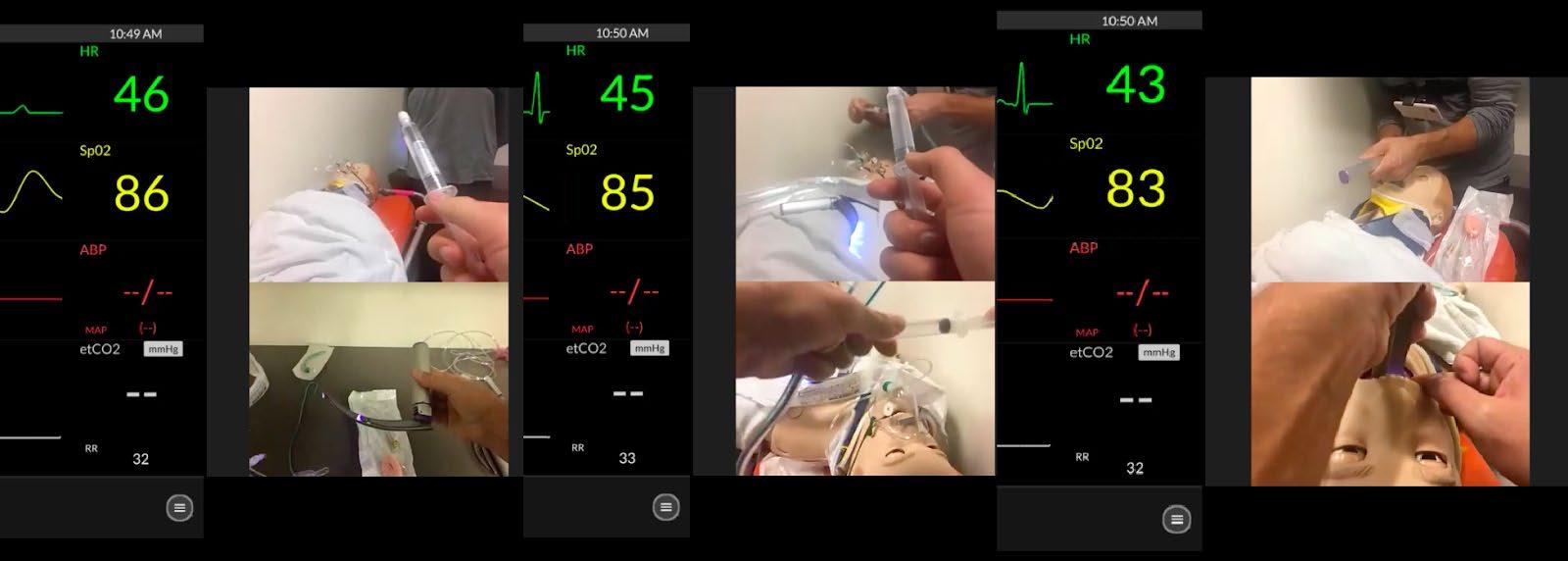
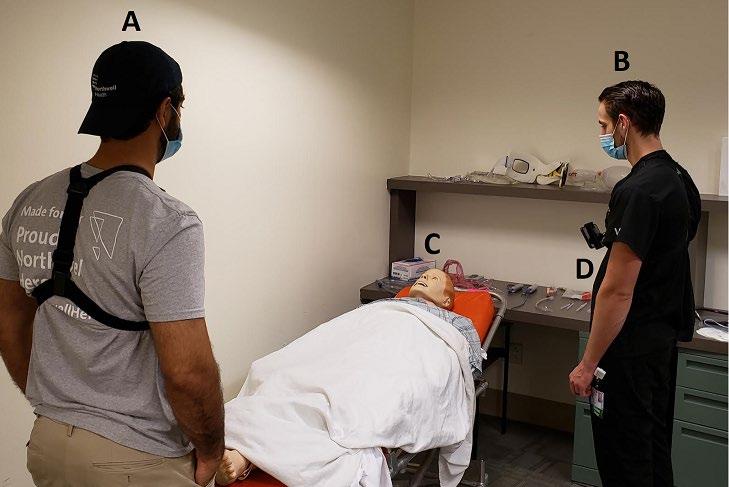
We believe our conceptual framework has the potential in the post-COVID-19 era to bridge gaps in medical education in ways that were not previously possible. Medical students away from their home institutions can engage with faculty and peers in the virtual realm, opening new possibilities for formative and summative assessments. Our method can be applied internationally to introduce simulation-based medical education to lower resource settings without “brick and mortar” simulation infrastructure, fostering a new era of virtual collaboration and cooperation. We believe ongoing development of our novel method is critical in preparation
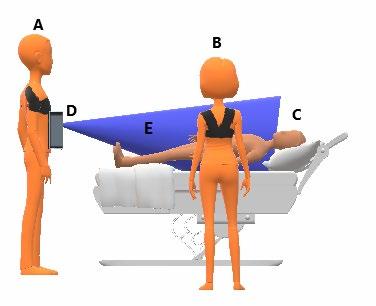
Volume 24, NO.1: January 2023 69 Western Journal of Emergency Medicine Sperandeo et al. Novel, Synchronous, First-person Perspective Virtual Simulations for Medical Students in EM
A.
B.
Figure 1. A. Conceptual framework for first-person perspective avatar (FPA) virtual simulation with body cameras. Key: (a, b) FPA; (c) patient mannequin; (d) body cameras. B. Learner’s view during endotracheal intubation.
Novel, Synchronous, First-person Perspective Virtual Simulations for Medical Students in EM Sperandeo et al.
for future challenges where pivots to virtual learning environments will be required.
ACKNOWLEDGMENT
The authors would like to acknowledge the following for their contributions to this work: Michael Quinn, DO; Eric Christie, DO; Jennifer Fermin, MD; Hillary Moss, MD; Timothy Palmieri, MD; and Codrin Nemes, MD, PhD.
Address for Correspondence:Michael Sperandeo, MD, Long Island Jewish Medical Center, Department of Emergency Medicine, 270-05 76th Ave, New Hyde Park, NY 11040. Email: msperande1@northwell.edu.
Conflicts of Interest: By the WestJEM article submission agreement, all authors are required to disclose all affiliations, funding sources and financial or management relationships that could be perceived as potential sources of bias. No author has professional or financial relationships with any companies that are relevant to this study. There are no conflicts of interest or sources of funding to declare.
Copyright: © 2023 Sperandeo et al. This is an open access article distributed in accordance with the terms of the Creative Commons Attribution (CC BY 4.0) License. See: http://creativecommons.org/ licenses/by/4.0/
REFERENCES
1. Issenberg SB, McGaghie WC, Petrusa ER, et al. Features and uses of high-fidelity medical simulations that lead to effective learning: a BEME systematic review. Med Teach. 2005;27(1):10-28.
2. Rose S. Medical student education in the time of COVID-19. JAMA . 2020;323(21):2131-2.
3. Important guidance for medical students on clinical rotations during the coronavirus (COVID-19) outbreak. AAMC. 2020. Available at: https://www.aamc.org/news-insights/press-releases/ important-guidance-medical-students-clinical-rotations-duringcoronavirus-covid-19-outbreak. Accessed November 14, 2021.
4. Nadir NA, Kim J, Cassara M, et al. Simulation-based emergency medicine education in the era of physical distancing. AEM Educ Train . 2021;5(3):e10586.
5. Gordon M, Patricio M, Horne L, et al. Developments in medical education in response to the COVID-19 pandemic: a rapid BEME systematic review: BEME Guide No. 63. Med Teach 2020;42(11):1202-15.
6. Sani I, Hamza Y, Chedid Y, et al. Understanding the consequence of COVID-19 on undergraduate medical education: medical students’ perspective. Ann Med Surg (Lond) . 2020;58:117-9.
7. Simpl. Medical training anywhere. Available at: https://www. simplsim.com/. Accessed November 14, 2021.
Western Journal of Emergency Medicine 70 Volume 24, NO.1: January 2023
Developing Master Adaptive Learners: Implementation of a Coaching Program in Graduate Medical Education
Margaret Wolff, MD, MHPE*
Maya Hammoud, MD, MBA†
Michele Carney, MD*
Section Editor: Matthew Tews, DO, MS
University of Michigan Medical School, Department of Emergency Medicine and Pediatrics, Ann Arbor, Michigan
University of Michigan Medical School, Department of Obstetrics and Gynecology, Ann Arbor, Michigan
Submission history: Submitted June 7, 2022; Revision received December 19, 2022; Accepted December 27, 2022
Electronically published January 11, 2023
Full text available through open access at http://escholarship.org/uc/uciem_westjem
DOI: 10.5811/westjem.2022.12.57636
[West J Emerg Med. 2023;24(1)71–75.]
BACKGROUND
Medical knowledge is expanding exponentially, outpacing the information that can be learned during medical training.1 To keep pace with this rapid acceleration of new information, physicians must continually address practice gaps and adapt to novel situations.2,3 Unfortunately, studies demonstrate physicians frequently perform inaccurate self-assessments and generate learning goals discordant with gaps.4 This suboptimal approach to learning is attributed, in part, to medical training not preparing physicians to be effective learners and highlights the need to teach learners to learn.2,5–6 Despite this, there is a paucity of published curricula or programs delineating how to train trainees to learn effectively.
This imperative for continuous learning is palpable in the complex and challenging clinical setting of the emergency department (ED). The acuity, fast pace, and variability in patient presentations require physicians to nimbly adapt to novel challenges.7 These same factors that make effective, continuous learning necessary to provide high-quality patient care also make the ED a challenging place to learn.7 Therefore, this intervention focused specifically on a novel coaching approach to develop life-long learning skills in pediatric emergency medicine (PEM) fellows at a large academic center.
OBJECTIVES
Coaching is a collaborative process focused on helping the learner achieve their full potential by improving their self-monitoring, facilitating goal-setting, and providing accountability.3 We developed, piloted, and evaluated a novel coaching approach consisting of longitudinal, on-shift, and group coaching designed to facilitate the development of skills, processes, and habits necessary to become career-long, selfdirected learners who can adapt. We identified the conceptual framework of the master adaptive learner (MAL) as the basis
for our program.3 This framework combines principles from quality improvement (plan-do-study-act) and the educational theory of self-regulated learning to describe an approach to learning.3 This model describes learners moving through four integrated phases that begin with identifying a knowledge or skills gap (planning phase), engaging in learning to address this gap (learning phase), and assessing learning and receiving feedback (assessing phase), followed by incorporation of the newly learned information (adjusting phase).
Although there are no published curricula to develop MAL skills, various approaches have been proposed in the literature.3,5,8,9 These proposals emphasize the central role of educators in facilitating MAL development and creating a supportive learning environment. Specifically, educators must provide teaching that focuses on metacognition, direct observation with frequent feedback, and support for learning plan development.8–10 Coaching has been suggested as a facilitator of MAL development because of the emphasis on gap identification, goal creation, and personal accountability in coaching.3 In addition, the Coalition for Physician Accountability recommends coaching to promote effective lifelong learning across the learner continuum.5
PROGRAM DESIGN
We performed a needs assessment in December 2020–January 2021 of our PEM fellows to identify their current approach to learning and application of MAL skills. One author (MW) performed semi-structured interviews with three recent graduates, four fellows, and one incoming fellow. We performed focus groups with faculty to understand their approach to fellow education, direct observation, feedback, and learning plan development. The fellows lacked a defined approach to learning and pointed to infrequent and poor-quality feedback as barriers to identifying gaps. The faculty cited multiple challenges to providing feedback and
Volume 24, NO.1: January 2023 71 Western Journal of Emergency Medicine Brief Educational Advances
* †
Developing Master Adaptive Learners Wolff
acknowledged infrequently identifying actionable steps to improve their performance.
This pre-pilot needs assessment highlighted the need for an approach that included the fellows and the faculty supervising them. Therefore, we developed a three-pronged approach of group, on-shift, and longitudinal coaching (Table 1) to focus on different aspects of MAL development. The group coaching sessions focused on the metacognition of learning using the MAL framework. Faculty and fellows learned alongside each other to share ideas, create shared language, and build community and trust. Initial sessions focused on building coaching skills for the faculty and
coachee skills for the fellows, using an in-the-moment coaching approach.11 The MAL framework was introduced in the initial session and MAL concepts and skills were layered on in subsequent sessions. On-shift and longitudinal coaching reinforced these concepts and provided fellows opportunities to practice the elements of MAL – specifically reflection, goal-setting, and action plan development. Onshift coaching is a type of performance coaching focused on gap identification, performing informed self-assessment and creating an active plan for change, which are key components of the MAL process. The goal of longitudinal coaching with their fellowship program director was to reflect on on-shift
Activity Metric Group coaching sessions
Session/ MAL phase Learning objectives
1. Overview Describe MAL framework Apply real-time coaching models
2. Planning Seek out and use feedback
Identify gaps on shift Use questioning
3. Planning Prioritize gap
Set learning goals
Search for resources
4. Planning Identify gaps outside of clinical shifts
5. Learning Identify appropriate resources for each context (eg, on shift vs. reviewing charts)
Critically appraise resources Identify active learning opportunities
6. Assessing adjusting Perform informed self-assessment Adjust practice to account for new learning
On-shift coaching
Longitudinal coaching
Expected change
• Describe MAL framework
• Apply real-time coaching models
Quantitative (Fellow survey) N=6 Qualitative
100% (6/6) recognized need for feedback for gap identification
83% (5/6) comfortable seeking feedback
100% (6/6) with specific goals
Planning
Use effective approaches to learning
83% (5/6) have standard approach to their learning
Learning
Use informed selfassessment Incorporate new learning into routine practice
Increased frequency of feedback conversations oriented to development
Increased creation of learning plans for identified gap
Develop learning strategies
Increased active, iterative learning plans
Increased use of active learning plan
Fellow engagement in learning process
83% (5/6) regularly had on-shift coaching
Assessing and adjusting
83% (5/6) have active plans
Western Journal of Emergency Medicine 72 Volume 24, NO.1: January 2023
et al.
Table 1. Overview of coaching approach to facilitate the development of a master adaptive learner.
Planning
Learning
Planning
Learning
Overall
MAL, master adaptive learner.
coaching, review written feedback and overall development, and to set goals.
To gain support, we elicited fellow and faculty input early in the development. Prior to implementation, fellows identified a cohort of trusted faculty who were recruited to provide on-shift coaching. Faculty and fellows learned the approach for on-shift coaching during the group coaching sessions and had opportunities to practice via role play. Division leadership approved creating this role for faculty to include in their educators’ portfolios to increase buy-in.
The pilot ran from April 2021–February 2022. Faculty and fellows participated in six group-coaching sessions facilitated by a certified coach. In between the sessions, monthly emails provided fellows and faculty an opportunity to ask questions, provide feedback, and troubleshoot barriers. At monthly division meetings, we provided suggestions for effective feedback to all faculty and highlighted faculty selected by the fellows for their exemplar on-shift feedback and coaching. This served to celebrate successes and raise awareness of the initiative.
The faculty and fellows were surveyed at the end of the pilot regarding two key MAL processes: feedback behaviors and development; and use of learning goals and plans. Using these results, we developed a follow-up interview questionnaire. Using a phenomenological approach, one author (MW) conducted follow-up, semi-structured interviews in February and March 2022 with fellows who participated in the program to explore their experience and the impact of the program on their development of MAL skills. Data was categorized by two authors (MW and MC) using the a priori identified codes of the phases of MAL: planning; learning; assessing; and adjusting. The study was deemed exempt by our institutional review board.
IMPACT
Table 1 summarizes the results of the pilot survey. The fellows’ experience of the program and their MAL development based on the semi-structured interviews is described below, and representative quotations are shown in Table 2.
Impact on Approach to Learning
Fellows described how the pilot positively influenced their approach to learning and normalized their development by creating a conversation about learning. The regular intervals of the group and on-shift coaching kept learning at the forefront and provided opportunities to learn from each other. They described feedback evolving from a static conversation to an ongoing conversation throughout shift. The fellows described growth in the planning and assessing phases of MAL, as described below. The learning and adjusting phases were not impacted significantly.
Impact on Planning
Fellows described being more proactive in identifying gaps and intentionally seeking feedback from multiple sources over
the course of the pilot. The fellows described on-shift coaching as crucial to their identification of gaps, reinforcement of positive behaviors, and overall growth as a pediatric emergency physician. Fellows reported trying out methods to identify gaps that their colleagues shared during the group sessions. Fellows differentiated learning tasks for medical knowledge from learning goals focused on procedural skills and non-technical skills such as interprofessional communication or leadership. They described creating intentional learning goals and ongoing learning plans for procedural skills and non-technical skills and not being as specific about medical knowledge.
Prior to starting the pilot, the fellows routinely prioritized gaps necessary for immediate patient care while on shift. The gaps not immediately critical to patient care were often lost by the time they had time to learn. While this remained effortful throughout the pilot, faculty and fellows shared strategies such as keeping a list on their phone, keeping annotated patient logs, and saving patients in a personal follow-up list on the electronic health record for keeping track of the gaps they wanted to address.
The longitudinal sessions prompted the fellows to reflect on their overall performance, develop goals, and revisit prior goals. The sessions also served to validate progress and set expectations for performance.
Impact on Assessing
The fellows described on-shift coaching to be crucial to the informed self-assessment process. In addition, the fellows described feeling more comfortable trying out new things and being vocal about asking for feedback.
Although this program had success in facilitating MAL skill development, implementation did not go entirely as planned. Initially, all group-coaching sessions were designed to be in person to facilitate community building and open dialogue. Unfortunately, with the pandemic, four sessions were virtual. The content was delivered, but this may have diminished discussion. We also had waning attendance from the faculty participants at the group-coaching sessions. Additionally, there was variation in approach to on-shift coaching. We trained fellows and faculty on a specific approach; however, fellows reported that faculty typically used a more flexible, informal approach throughout the shift.
Although we made efforts to mitigate limitations, these findings should be interpreted in context of the limitations. Our outcomes data used interviews, which relied on recall and may have been influenced by social desirability; we did not measure frequency of skill use. Other factors that were not measured may have contributed to the development of MAL skills. Further, the small sample size at a single institution may limit the generalizability.
Next Steps
This innovation demonstrates a novel coaching approach to facilitation of MAL development in PEM fellows. Our initial
Volume 24, NO.1: January 2023 73 Western Journal of Emergency Medicine
Wolff et al. Developing Master Adaptive Learners
Table 2. Representative quotes on the impact of program to develop master active learners. Phase of MAL Representative quotes
PLANNING
Learner identifies gap in practice (knowledge, skill, or attitude), prioritizes learning gap, and then searches for appropriate resources for learning.
• “It is so helpful when an attending tells me what I did wrong and then works with me to identify how I can do better next time…and then helps me figure out an action plan to do better.”
• “[Another fellow] shared last time that he asks the inpatient team for feedback after he admits them to see what he could have done differently - I have started doing that too and have recognized some things to work on.”
• “I have to have some time and space to think about it. So, now I write it [the topic] down after shift or maybe a patient MRN and then return to it the next day when I’m not so tired.”
• “I have actual goals for the big things that we review [with the PD] like working on flow. But for the rest of the stuff, it really depends on what walks in the door, and I address the gaps as they come up.”
• “The meetings [with the PD] help me set expectations for myself for what I should be able to achieve at this level of training and identify how to work towards that.”
• “[The group sessions] were really helpful – now we look out for each other on shift to point out learning opportunities if we know someone is trying [to work on a particular area] “
LEARNING
Learner engages in meaningful learning, appraises resources, and then uses active learning strategies.
• “My approach to this hasn’t changed too much, but I have learned some tips from the others.”
• “I have different strategies depending on where I am. On shift, I look at UptoDate, ask an attending or quick try to find an article. Usually though I am only putting out fires [on shift] and looking up what I have to. And then try to keep a list to look up later. I started doing this early in fellowship, and I don’t think it has really changed [during this pilot].”
• “If I identify something totally out of my knowledge base but I have to consult someone anyways, I don’t worry about really understanding it in that moment if I’m busy. But I’d ask them (the consultant) questions about what I need to know in my role, and maybe I’ll try to follow-up for more later. I started doing this in residency.”
ASSESSING
Learner tries out what they have learned by comparing and contrasting their self-assessment with external feedback
• “The feedback made me realize that I hadn’t improved at talking to families as much as I thought I had. We worked together to make a new plan.”
• “Group sessions with faculty show me they are open to having these conversations, even if they don’t get the words totally right.”
• “All of this primes me to receive feedback and try to compare it to what I thought [about how I did] and then figure out what I don’t know and what to work on.”
• “I try to reflect after shift on what I tried and what I need to learn from there and also about any progress on bigger goals.”
ADJUSTING
Incorporate new learning into practice
• I feel like I have mastered a goal when I am very comfortable and can integrate it into natural workflow and teach about it. For example, when I have a kid with an arm injury if I can read the elbow x-rays and make a plan with the resident before staffing or consulting ortho[pedics], I feel like I’ve mastered it. I’m not sure this has changed much.”
• “I really feel comfortable with something after I do it on shift a few times, but I think this has always been true.”
PD, program director.
evaluation of this pilot has informed our next steps in enhancing and expanding the program. We identified key factors for success: fellow engagement; group sessions; and faculty participation. By eliciting input prior to implementation, highlighting need for these skills early, and making skills relevant to
the ED, fellows were engaged from the beginning and felt this was relevant to their learning. Going forward, we will include a fellow on our core team to provide ongoing input to ensure continued engagement. We will continue using the group sessions to create an exchange of ideas and normalize
Western Journal of Emergency Medicine 74 Volume 24, NO.1: January 2023 Developing Master Adaptive Learners Wolff et al.
the conversation around growth. We are considering ways to harness the expertise of the fellows who completed the initial pilot to teach new fellows while continuing to build their skills throughout their three-year fellowship.
Despite declining attendance, faculty participation in the group sessions demonstrated to the fellows the faculty’s receptivity to having these coaching conversations even when not using the prescribed approach. Fellows felt comfortable seeking input about their development without concern for punitive response. Therefore, we will continue to include faculty in our group sessions and are exploring ways to increase faculty engagement such as limiting faculty sessions, rotating faculty, or seeking compensation.
We identified a gap in our program in facilitating growth in the learning and adjusting phases. This may be attributed to a higher starting point in these areas. However, we are incorporating content on learning strategies in the group sessions and faculty will model searching for resources on shift. For the adjusting phase, fellows have developed an approach to changing their own clinical practice and recognizing when they have mastered this change. We will expand our focus to creating change in the local system by more intentionally linking this process to leadership development and teamwork.
Address for Correspondence: Margaret Wolff, MD, University of Michigan, Department of Emergency Medicine and Pediatrics, 1500 East Medical Center Drive, B1380 TB, Ann Arbor, MI 481095305. Email: wolffm@med.umich.edu.
Conflicts of Interest: By the WestJEM article submission agreement, all authors are required to disclose all affiliations, funding sources and financial or management relationships that could be perceived as potential sources of bias. No author has professional or financial relationships with any companies that are relevant to this study. There are no conflicts of interest or sources of funding to declare.
Copyright: © 2023 Wolff et al. This is an open access article distributed in accordance with the terms of the Creative Commons Attribution (CC BY 4.0) License. See: http://creativecommons.org/ licenses/by/4.0/
REFERENCES
1. Densen P. Challenges and opportunities facing medical education. Trans Am Clin Climatol Assoc . 2011;122:48.
2. Mylopoulos M, Brydges R, Woods NN, et al. Preparation for future learning: a missing competency in health professions education? Med Educ . 2016;50(1):115-23.
3. Cutrer WB, Atkinson HG, Friedman E, et al. Exploring the characteristics and context that allow master adaptive learners to thrive. Med Teach . 2018;40(8):791-6.
4. Davis DA, Mazmanian PE, Fordis M, et al. Accuracy of physician self-assessment compared with observed measures of competence: a systematic review. JAMA . 2006;296(9):1094-1102.
5. The Coalition for Physician Accountability. The Coalition for Physician Accountability’s Undergraduate Medical Medical Education Review Committee (UGRC): recommendations for comprehensive improvement of the UME-GME transition. 2021. Available at: https://physicianaccountability.org/wp-content/ uploads/2021/08/UGRC-Coalition-Report-FINAL.pdf. Accessed May 17, 2022.
6. Regehr G, Mylopoulos M. Maintaining competence in the field: learning about practice, through practice, in practice. J Contin Educ Health Prof . 2008;28 Suppl 1:S19-23.
7. Buckley C, Natesan S, Breslin A, et al. Finessing feedback: recommendations for effective feedback in the emergency department. Ann Emerg Med . 2020;75(3):445-51.
8. Edje L, Price DW. Training future family physicians to become master adaptive learners. Fam Med . 2021;53(7):559-66.
9. Regan L, Hopson LR, Gisondi MA, et al. Creating a better learning environment: a qualitative study uncovering the experiences of Master Adaptive Learners in residency. BMC Med Educ 2022;22(1):141.
10. Regan L, Hopson LR, Gisondi MA, et al. Learning to learn: a qualitative study to uncover strategies used by Master Adaptive Learners in the planning of learning. Med Teach. 2019;41(11):1252-62.
11. Lockyer J, Armson H, Konings KD, et al. In-the-moment feedback and coaching: improving r2c2 for a new context. J Grad Med Educ . 2020;12(1):27-35.
Volume 24, NO.1: January 2023 75 Western Journal of Emergency Medicine
Wolff et al. Developing Master Adaptive Learners
Strategic Educational Expansion of Trauma Simulation Initiative via a Plan-Do-Study-Act Ramp
Alexander Meshel, MD*
Laura Iavicoli, MD†‡
Barbara Dilos, DO§||
George Agriantonis, MD#
Stuart Kessler, MD‡¶
Phillip Fairweather, MD‡
Devorah Nazarian, MD‡
Daniel Lugassy, MD‡**
Suzanne Bentley, MD, MPH†‡
The Mount Sinai Hospital, Department of Anesthesiology, Perioperative and Pain Medicine, New York, New York
NYC H+H/Elmhurst, Elmhurst, New York
Icahn School of Medicine at Mount Sinai, NYC H+H/Elmhurst, Department of Emergency Medicine, New York, New York
NYC H+H/Elmhurst, Department of Anesthesiology, Elmhurst, New York
Icahn School of Medicine at Mount Sinai, Department of Anesthesiology, Perioperative and Pain Medicine, New York, New York
Icahn School of Medicine at Mount Sinai, NYC H+H/Elmhurst, Department of Surgery, New York, New York
NYC H+H/Elmhurst, Department of Emergency Medicine, Elmhurst, New York
NYC H+H/Elmhurst, Simulation Center, NYC H+H/Elmhurst, Elmhurst, New York
Section Editor: Jules Jung, MD, MEd
Submission history: Submitted June15, 2022; Revision received December 23, 2022; Accepted December 29, 2022
Electronically published January 11, 2023
Full text available through open access at http://escholarship.org/uc/uciem_westjem
DOI: 10.5811/westjem.2022.12.57735
[West J Emerg Med. 2023;24(1)76–78.]
BACKGROUND
Trauma represents a major public health threat and is the leading cause of death for individuals 45 and older and the fourth leading cause of death in all ages.1 Trauma teams consist of a single team leader with a multidisciplinary group of people. Literature shows that having a designated leader improves team performance and that hands-off leaders with a directive style of leadership are more effective. 2,3 However, despite consensus on the importance of leadership, clinical team leadership is often only a small component of broader teamwork-focused training.4 Simulation-based training is increasingly recognized as a mechanism to develop effective leadership and bolster team performance, including for trauma teams.4-6
In situ simulation offers a higher impact approach to trauma team training, allowing participants to participate as if a “real” trauma had occurred and allowing for systems assessment and capture of systems vulnerabilities.7,8 It requires high levels of coordination and facilitation and should not be initiated without serious pre-work and planning.
At our Level 1 Trauma Center, NYC Health + Hospitals/ Elmhurst, there are two levels (red and yellow) of trauma team activation based on specific criteria, with each garnering a different level of responding team composition and resources. A “red trauma” is the highest level activation for the most critical and severely injured patients. Upon activation, a complex, multiprofessional, multidisciplinary group responds
to the emergency department (ED) to work swiftly together as one team caring for the trauma patient.
OBJECTIVES
With the known complexity of the trauma team and evidence supporting team training using simulation, our overarching objective was to demonstrate the use of a Plan-Do-Study-Act (PDSA) ramp as a framework for creating increasingly complex simulations in a stepwise, iterative fashion that could subsequently be used as a model for other simulations. We endeavored to create and implement in situ “red” (high acuity) trauma simulations with deliberately escalating but controlled complexity. This was done such that with each successive “upgrade” on the PDSA ramp, more complexity was systematically introduced by progressively adding layers of additional team members and resources to ultimately develop a fullscale, in situ simulation of the entire red trauma team and assisting consultants. We would use what was found in the previous level to both improve the clinical environment or system (eg, if a latent safety threat [LST] or area of opportunity was identified) and to inform future simulation iterations. Additionally, the simulation series itself was conducted with learning objectives related to trauma team leadership, team roles, communication, and clinical care decision-making, as well as use for assessment of trauma system functioning.
Western Journal of Emergency Medicine 76 Volume 24, NO.1: January 2023 Brief Educational Advances
* † ‡ § || # ¶ **
CURRICULAR DESIGN
We used a novel educational approach incorporating a PDSA ramp to develop a realistically feasible and implementable full-scale, in situ trauma simulation initiative. We used trauma team performance observation checklists and debriefing discussion points to evaluate the “success” of the current cycle and to iteratively expand the simulation through the next PDSA cycle. If the main learning objectives were fulfilled and no critical clinical issues were identified, we progressed up the PDSA ramp. If we observed major clinical issues or failure to meet objectives, the current simulation was repeated before continuing up the ramp. Multiple simulations were conducted during each cycle. This trauma simulation initiative was determined to be exempt by the Institutional Review Board of the Icahn School of Medicine at Mount Sinai.
Each cycle followed the PDSA sequence:
• Plan: Simulation was planned and tailored to participant group(s), guided by specific educational learning objectives relevant to the scenario type and participating team.
• Do: Simulation was conducted followed by facilitated debriefing. During simulation, the trauma team performance observation checklist was completed by observers and debriefing discussion points were recorded during the debriefings.
• Study: Team performance, debriefing outcomes, and fulfillment of learning objectives were assessed, as well as areas of strength, identified LSTs, and opportunities for improvement—both educationally and in the clinical system.
• Act: Main points were reinforced, and education was provided to the team, as needed, via closedloop debriefing with email back to participants summarizing findings and resulting changes/
suggestions from debriefing outcomes. Highyield discussion points and learner-driven insights not previously incorporated in the simulation and debriefings were iteratively added to future simulation cycles. Identified LSTs were escalated to leadership for mitigation.
All simulations of the PDSA ramp followed the general outlined PDSA steps and had their own specific learning objectives. Each cycle possessed its own unique component of escalating complexity, as shown in the Figure. The simulation itself would range from 5-30 minutes based on the complexity of the stage, followed by 30 minutes of debriefing.
For example, PDSA1 consisted of planning (PLAN) and conducting (DO) two parallel yellow trauma simulations with emergency physicians in one simulation and ED nurses in a separate simulation. The PDSA1 main learning objectives focused on initial evaluation and management of minor trauma. A performance checklist and debriefing points were reviewed within the context of the learning objectives (STUDY). Main points were then reinforced, and education was provided to the team via closed-loop debriefing detailing a summary of findings and resulting changes/suggestions (ACT). Satisfactory completion of objectives allowed for expansion of the simulation to PDSA2; the same scenario completed this cycle by the now interdisciplinary ED team. Next, the same team completed a red trauma simulation. Following cycles continued systematic layering of additional team members, with increasing complexity in the learning objectives, through PDSA7 involving the entire trauma team (eg, ED, surgery, anesthesiology, respiratory therapy, registrars, techs, police).
In PDSA8 cycles, the entire red trauma team responded along with specialists based on specific case permutations and learning objectives crafted to necessitate different
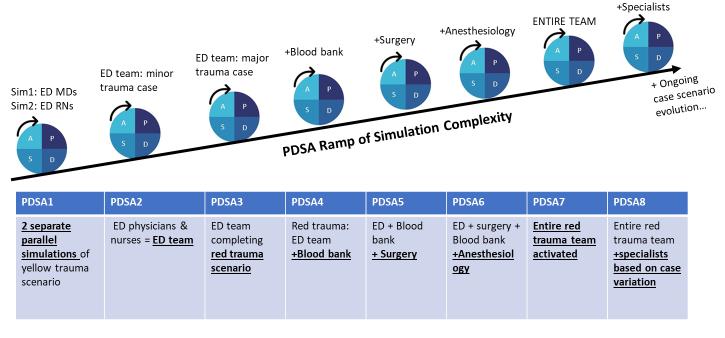
Volume 24, NO.1: January 2023 77 Western Journal of Emergency Medicine Meshel et al. Strategic Educational Expansion of
Simulation Initiative via a PDSA Ramp
Trauma
Figure. Plan-Do-Study-Act (PDSA) ramp with escalating complexity each cycle. ED, emergency department.
Strategic Educational Expansion of Trauma Simulation Initiative via a PDSA Ramp Meshel et
specialists (eg, neurosurgery, orthopedics, obstetrics, pediatrics). Most objectives by PDSA8 focus heavily on systems assessment and capturing vulnerabilities and LSTs, as well as the overarching goal of analyzing and maximizing leadership and overall teamwork and communication.
IMPACT/EFFECTIVENESS
A total of 45 trauma simulations over 24 months were conducted across the aforementioned levels of complexity. Each stage involved different teams and different groups of participants based on objective. Some participants completed multiple stages. No participant completed the same stage twice. Of the 64 participants who completed postevaluations following PDSA 7/8 (the culmination phases of the ramp), 100% agreed or strongly agreed that this was an effective clinical teaching tool, and more than 95% strongly agreed or agreed this would impact their future clinical practice, improve teamwork, and improve communication.
These simulations identified knowledge gaps (such as protocols, role assignments, and escalation pathways), performance deficiencies, and areas of need for additional training. Analyses of previous iterations identified system stressors that could be addressed both in real time and through future ramp cycles. Many of the critical team skills were able to be taught and reinforced in a manageable and streamlined manner (ie, leadership skills easier with smaller team structure, working up to commanding a much larger team in later cycles).
Of note, we recognize that trauma systems are individualized across institutions and that these specific PDSA ramps reflect our local environment. The PDSA ramp framework, however, applies to any trauma team, and the PDSA ramp table in the Figure can be customized to any trauma team system (or other clinical team). Deliberate reflection on local trauma protocols (eg, levels of trauma activation and resulting inclusion of specialists) can help guide the progressive ramps. While there are limitations, including buy-in of stakeholders and barriers to implementation, this novel application of a PDSA ramp approach adapted from quality improvement to in situ trauma-simulation creation may serve as an educational strategy for crafting meaningful future interventions and initiatives.
Address for Correspondence: Alexander Meshel, MD, The Mount Sinai Hospital, Department of Anesthesiology, Perioperative and Pain Medicine, 1 Gustave L. Levy Place, New York, NY, 10029.
Email: alexander.meshel@icahn.mssm.edu
Conflicts of Interest: By the WestJEM article submission agreement, all authors are required to disclose all affiliations, funding sources and financial or management relationships that could be perceived as potential sources of bias. No author has professional or financial relationships with any companies that are relevant to this study. There are no conflicts of interest or sources of funding to declare
Copyright: © 2023 Meshel et al. This is an open access article distributed in accordance with the terms of the Creative Commons Attribution (CC BY 4.0) License. See: http://creativecommons.org/ licenses/by/4.0/
REFERENCES
1. WISQARS Data Visualization. National Center for Injury Prevention and Control: Web-Based Injury Statistics Query and Reporting System (WISQARS). Available at: https://wisqars.cdc.gov/data/lcd/home. Accessed June 14, 2021.
2. Hoff WS, Reilly PM, Rotondo MF, et al. The importance of the commandphysician in trauma resuscitation. J Trauma. 1997;43(5):772-7.
3. Yun S, Faraj S, Sims HP Jr. Contingent leadership and effectiveness of trauma resuscitation teams. J Appl Psychol. 2005;90(6):1288-96.
4. Rosenman ED, Vrablik MC, Brolliar SM, et al. Targeted simulationbased leadership training for trauma team leaders. West J Emerg Med. 2019;20(3):520-6.
5. Eppich W, Howard V, Vozenilek J, et al. Simulation-based team training in healthcare. Simul Healthc. 2011;6 Suppl:S14-9.
6. Fernandez R, Rosenman ED, Olenick J, et al. Simulation-based team leadership training improves team leadership during actual trauma resuscitations: a randomized controlled trial. Crit Care Med. 2020;48(1):73-82.
7. Lioce L, Lopreiato J, Downing D, et al. Healthcare Simulation Dictionary 2nd ed. Agency for Healthcare Research and Quality, 2020. Available at: https://www.ahrq.gov/sites/default/files/wysiwyg/patient-safety/resources/ simulation/sim-dictionary-2nd.pdf. Accessed April 25, 2022.
8. Lamberta M, Aghera A. (2022). Latent safety threat identification via medical simulation. In: StatPearls . Treasure Island, FL: StatPearls Publishing.
Western Journal of Emergency Medicine 78 Volume 24, NO.1: January 2023
al.
Virtual Open House: Incorporating Support Persons into the Residency Community
Hurnan Vongsachang, MD, MPH Aarti Jain, MD, MACM
Section Editors: Danielle Hart, MD, MACM
Los Angeles County + University of Southern California Medical Center, Department of Emergency Medicine, Los Angeles, California
Submission history: Submitted June 6, 2022; Revision received October 10, 2022; Accepted October 14, 2022
Electronically published December 21, 2022
Full text available through open access at http://escholarship.org/uc/uciem_westjem
DOI: 10.5811/westjem.2022.10.57468
[West J Emerg Med. 2023;24(1)79–82.]
BACKGROUND
Medical trainees rely on supportive personal relationships when navigating the challenges encountered during residency training.1 Unfortunately, the demands of the training environment may erode these pre-existing relationships and negatively impact residents’ psychological wellbeing. 1 Further, the geographic separation inherent to the residency match process and the recent coronavirus 2019 (COVID-19) pandemic may limit in-person support from friends and family members.
A qualitative study conducted at our institution suggested that an additional barrier to effective communication between residents and their support persons (SP) is dissonance between residents’ personal and professional identities.2 Residents encounter challenges discussing workplace stressors with individuals who have minimal understanding of the clinical environment.1,2 Study authors recommended that future wellness interventions attempt to reduce this dissonance by proactively providing SPs with greater insight into the residency training experience.2 This recommendation is in line with existing literature highlighting the importance of social relatedness— engaging in meaningful conversation and feeling understood— in enhancing psychological well-being. 3,4 In light of this, we created an innovation aimed at familiarizing residents’ SPs with the residency experience. To our knowledge, there are limited existing formal interventions with this objective. 1,5-7
OBJECTIVES
We developed a virtual open house (VOH) to invite residents’ self-selected SPs into the residency community and provide them with greater insight into the clinical and nonclinical training environment.
CURRICULAR DESIGN
All 72 postgraduate year PGY1-4 residents in our emergency medicine (EM) residency training program and their self-selected SPs received an electronic invitation to attend a two-hour VOH in April 2021. The VOH was
scheduled during protected educational conference time due to prior studies suggesting that wellness interventions are perceived as a time burden and are limited by a lack of available time. 8-10 The SPs were self-selected by residents and were not limited to any population or geographic location.
As the aim of the VOH was to create an opportunity for residents to share details of their training environment, content selection was shaped largely by resident input. A VOH Task Force, created and led by HV, consisted of a select group of residents representing each postgraduate training year as well as individual resident leads of extracurricular committees. Session content, structure, and format were informed by Kern’s six-step approach to curriculum development11 and guided by a faculty member (AJ), given her medical education fellowship training, master’s degree in academic medicine, and experience in residency program leadership.
During the VOH, the residency program director first provided an overview of the impact of COVID-19 on the resident training experience and oriented guests to the broader hospital system. After this introduction, resident representatives summarized the day-to-day clinical responsibilities and nonclinical opportunities that characterize each residency training year. Additional residents then provided updates on the current projects and activities of various resident-led special interest committees (ie, social EM, global EM, resident wellness). During each of these segments, speakers included photos and videos to better familiarize attendees with the physical work environment and the specific members of the residency community. The program then concluded with an opportunity for large-group discussion and reflection among all attendees. While the virtual modality limited the use of interactive educational strategies, we incorporated a combination of formal presentation, large-group debriefing, and reflection to deliver session content.
Methods
This study received institutional review board exemption from the University of Southern California. We conducted a
Volume 24, NO.1: January 2023 79 Western Journal of Emergency Medicine Brief Educational Advances
Incorporating Support Persons into the Residency Community Vongsachang
mixed-method analysis of participants’ experiences attending the VOH. Immediately after the conclusion of the VOH, all residents and guest attendees received an electronic invitation to complete an anonymous survey regarding their experiences attending the VOH (Appendix 1). This survey was created by both authors (HV and AJ) and reviewed by faculty members from the emergency department’s education division for content validity.12
Additionally, six months after the conclusion of the VOH, we conducted two virtual focus groups with a convenience sample of SPs who had attended the VOH. Focus groups were scheduled at a delayed time point to explore any sustained perceptions or impacts of the VOH experience. Five SPs participated in each of the two focus groups, both of which were led by AJ given her experience in focus group facilitation. A semi-structured interview guide was developed by AJ and HV and aimed to explore a deeper understanding of the VOH experience as well as probe for any change in the conversational dynamic between SPs and residents following the VOH (Appendix 2). Interviews were audio-recorded, deidentified, and professionally transcribed.
We used an inductive thematic analysis approach.13
Understanding that our perspectives may influence interpretation of transcripts, we offer some background information: 13 Author AJ is an EM faculty member who has created departmental wellness initiatives and has experience in qualitative medical education research. HV was the EM resident lead of the residency wellness committee and has received training in qualitative research through her master’s degree in public health. We initially analyzed both transcripts and generated code definitions. After refining the coding framework, we developed thematic categories and reorganized them until consensus was achieved. Trustworthiness was enhanced by use of reflexivity, memoing, and an audit trail.
IMPACT AND EFFECTIVENESS
Quantitative Analysis
Of the 155 individuals who attended the VOH 60 (38.7%) were residents, 86 (55.5%) guests, and 11 (7.1%) faculty members. Forty residents (66%) and 47 guests (54.7%) responded to the post-VOH survey. Of the SPs who responded to the post-session survey, 89% were parents or other relatives. Additional demographic information for SPs is found in Appendix 3. Overall, attendees reported that they enjoyed the VOH (95% residents [38]; 98% guests [46]). Most respondents reported that the VOH helped to foster a greater sense of community (85% residents [34]; 73% guests, [34]), and the majority suggested that they felt more comfortable engaging in conversations regarding workplace challenges (77% residents [27]; 94% guests [44]).
Qualitative Analysis
The SPs reported that participation in the VOH facilitated subsequent dialogue with their residents and provided them with an increased sense of comfort and familiarity with the
residency training environment. Representative quotations are included in the Table. After participating in the VOH, SPs reported that their improved insight into the training environment offered them new “talking points” when engaging in subsequent dialogue with residents. Not only did the VOH provide additional conversational “clues,” but emboldened participants to initiate dialogue on topics that had previously been unaddressed. The SPs also hypothesized that their participation in the VOH allowed them to engage in deeper and more intimate conversations with residents than those who had not attended the session.
Participants also appreciated the opportunity to virtually “meet” their residents’ colleagues and supervisors, finally “put[ing] faces to names.” They were comforted by gaining an increased understanding of the emotional and structural support provided by the residency program and by directly witnessing the collegiality among trainees and faculty members. Several participants referenced the physical and emotional separation caused by the COVID-19 pandemic and reported that their concerns about their residents were alleviated by receiving greater insight into, and familiarity with, the residency community.
The focus groups also provided insights into areas for improvement during future iterations of the VOH. Participants requested the addition of virtual breakout rooms to provide them with opportunities for more intimate, smallgroup conversations. They also voiced enthusiasm for more longitudinal forms of connection to the residency community (ie, monthly newsletters or local parent support groups). Future iterations of this innovation can modify the frequency of VOH events and add in-person or hybrid activities when social distancing restrictions are lifted. Additionally, educators can consider including explicit instruction to SPs on effective support and communication techniques and incorporating didactic components on well-being and burnout. To enhance our understanding of the impact of a VOH, future studies should explore resident perceptions of changes to their perceived social support networks and the quality and quantity of dialogue with SPs after participation in a VOH.
LIMITATIONS AND CONCLUSION
Our innovation involved a single institution and medical specialty, which may limit its generalizability. The SPs were selfselected by residents; individuals who attended and completed the post-session surveys may have been susceptible to varying levels of response bias. Additionally, as we did not establish levels of pre-existing medical knowledge among SPs, the perceived utility of the VOH in offering topics for future conversation may not be broadly applicable. Our qualitative findings are limited by the small sizes of our focus groups and the social desirability bias inherent to many focus group discussions. In addition, frank discussion from SPs regarding their VOH experience may have been inhibited by use of a member of program leadership (AJ) as the focus group facilitator.
Western Journal of Emergency Medicine 80 Volume 24, NO.1: January 2023
al.
et
Theme 1: Enhancing Future Dialogue Between Loved Ones and Residents
Providing content for future conversations
• “I think this virtual Zoom helped me know the whole program and gave me some opportunities on talking points that XXX may not have brought up, you know. Sometimes she would be so focused on only one thing because she’s busy, she’s tired. Having some other conversation about, “I saw your video” or “tell me about that person.” I think that gave me little clues to have different conversations and ask her different questions so she could share some other parts of work that she didn’t think to do.” [FG2]
Promoting deeper conversations
• “I think having the faces and the names, it opens different doors to have a little bit more personal conversation. Not everybody from our family could attend that day, so I can see how the conversations are different when I attended and her dad couldn’t attend or her spouse couldn’t attend. I think the connectivity has definitely gone to a deeper level.” [FG1]
Theme 2: Deepening Support Persons’ Understanding of the Residency Experience
“Putting faces to names”
• “The other thing that I really liked about the open house was getting to see his friends, because we’re not there to see them. And I know that his companions in the XXX year are what makes it possible to do the work that he does. He’s very tight with them and they support each other really well. So I was glad to see everybody’s face come through there. That was really meaningful to us being that we live in XXX and just can’t get there as often as we’d like, especially in the COVID year and a half. And who knows how often we’ll be able to be together. Right? Outreach was so much appreciated.”[FG1]
Providing insight into the emotional support provided by the residency community
• “It was very heartwarming, and you felt as a parent that your kid is in good hands. It doesn’t matter how old the children get, but it’s like, “okay, are they in a good place? Are they learning what they need to be learning at this point?” And med school has been hard. Training is harder, and that is known. So that part was very comforting.”[FG2]
Enhancing an understanding of the training structure
• “I remember being encouraged and comforted that the residents helped one another. The more advanced residents helped their first years and second years and it seemed to be in a very structured way.”[FG1]
Bridging the geographic separation
• “He doesn’t really download what’s hard. So, we try to come every couple months, but we couldn’t of course for that year and a half. And, so just not knowing how safe he was and how the mental health strain….When I’m with him, I can see how he’s doing. Just as a mother, all you parents can tell. It’s just been something to get used to, the actual physical distance and not really knowing. You can’t walk your child’s path in any case, but this one’s particularly hard, I think.” [FG1]
FG1, Focus Group 1; FG2, Focus Group 2.
Despite these limitations, the use of a VOH may help encourage future dialogue between residents and their SPs about the residency training experience. Residency program leaders should consider adopting interventions aimed at reducing identity dissonance by incorporating residents’ support persons into the residency community.
Address for Correspondence: Hurnan Vongsachang, MD, MPH, Los Angeles County + University of Southern California Medical Center, Department of Emergency Medicine, 1200 N. State Street, Rm 1060E Los Angeles, CA 90033. Email: HVongsachang@dhs.lacounty.gov.
Conflicts of Interest: By the WestJEM article submission agreement, all authors are required to disclose all affiliations, funding sources and financial or management relationships that could be perceived as potential sources of bias. No author has professional or financial relationships with any companies that are relevant to this study. There are no conflicts of interest or sources of funding to declare.
Copyright: © 2023 Vongsachang et al. This is an open access article distributed in accordance with the terms of the Creative Commons Attribution (CC BY 4.0) License. See: http:// creativecommons.org/licenses/by/4.0/
REFERENCES
1. Law M, Lam M, Wu D, et al. Changes in personal relationships during residency and their effects on resident wellness: a qualitative study. Acad Med. 2017;92(11):1601-6.
2. Jain A, Tabatabai R, Schreiber J, et al. “Everybody in this room can understand”: a qualitative exploration of peer support during residency training. AEM Educ Train. 2022;6(2):e10728.
3. Reis H, Sheldon K, Gable S, et al. Daily well-being: the role of autonomy, competence, and relatedness. Pers Soc Psychol Bull. 2000;26(4):419-35.
4. Ryan RM, Deci EL. Self-determination theory and the facilitation of intrinsic motivation, social development, and well-being. Am Psychol . 2000;55(1):68-78.
5. Kennedy B, Levine M, Goldman ML, et al. Social support network outreach: a no-cost intervention to improve resident well-being J Grad Med Educ. 2017;9(3):390-1.
6. Martinelli SM, Isaak RS, Chidgey BA, et al. Family comes first: a pilot study of the incorporation of social support into resident wellbeing. J Educ Perioper Med . 2020;22(4):E652.
7. Martinelli SM, Chen F, Hobbs G, et al. The Use of Simulation to Improve Family Understanding and Support of Anesthesia Providers. Cureus . 2018;10(3):e2262.
Volume 24, NO.1: January 2023 81 Western Journal of Emergency Medicine Vongsachang et al. Incorporating Support Persons into the Residency Community
Table. Themes with exemplary quotations describing participants’ perceptions of the virtual open house experience.
Incorporating Support Persons into the Residency Community
8. Tran EM, Scott IU, Clark MA, et al. Resident wellness in US ophthalmic graduate medical education: the resident perspective. JAMA Ophthalmol . 2018;136(6):695-701.
9. Meeks LM, Ramsey J, Lyons M, et al. Wellness and work: mixed messages in residency training. J Gen Intern Med. 2019;34(7):1352-5.
10. Kolarik RC, O’Neal RL, Ewing JA. Resident preferences for program director role in wellness management. J Gen Intern Med. 2018;33(5):705-9.
11. Kern DE, Thomas PA, Hughes MT. (2009). Curriculum Development for Medical Education: A Six-Step Approach . 2nd ed. The John›s Hopkins University Press.
12. Downing SM. Validity: on meaningful interpretation of assessment data. Med Educ. 2003;37(9):830-7.
13. Corbin J, Strauss A. (2008). Basics of Qualitative Research: Techniques and Procedures for Developing Grounded Theory 3rd Ed. SAGE Publications, Inc.
Western Journal of Emergency Medicine 82 Volume 24, NO.1: January 2023
Vongsachang et al.
The Impact of an Experiential Social Medicine Curriculum in an Emergency Medicine Residency Training Program:
Mixed-methods Curricular Evaluation
Hurnan
Todd
Vongsachang, MD, MPH*
Schneberk, MD, MS, MA*
Laura Sprunt, MD†
Gabe Padilla, MD, MPH‡
Jeff Riddell, MD§
Los Angeles County + University of Southern California Medical Center, Department of Emergency Medicine, Los Angeles, California
Temple University Hospital, Department of Emergency Medicine, Philadelphia, Pennsylvania
Rhode Island Hospital and Brown Emergency Medicine Residency, Providence, Rhode Island
Keck School of Medicine of the University of Southern California, Department of Emergency Medicine, Los Angeles, California
Section Editor: Chris Merritt, MD, MPH, MHPE
Submission history: Submitted June 15, 2022; Revision received October 18, 2022; Accepted October 19, 2022
Electronically published December 29, 2022
Full text available through open access at http://escholarship.org/uc/uciem_westjem
DOI: 10.5811/westjem.2022.10.57724
[West J Emerg Med. 2023;24(1)83–88.]
BACKGROUND
Social medicine (SM) is an emerging field that includes the study of the social determinants of health (SDoH), which include addressing health disparities, cultural competency, service, and population health.1,2 Despite widespread acknowledgment of its influence in patient care, SM is underemphasized in graduate medical education.3-6 There have been numerous attempts to incorporate SM into both medical school and residency curricula in existing literature, most of which suggest promising results especially when learning is experiential in nature.2,7-17 However, there is still no widely accepted or standardized experiential SM curriculum in postgraduate training.18-20
As the scope and practice of emergency medicine (EM) is intimately tied with SM, there has been a recent focus on incorporating SM curricula into existing residency programs to better care for the underserved patients who often rely on the emergency department (ED).21,22 A limited number of EM residency programs have developed and/or integrated a SM curriculum into their training programs; however, most are didactic-based and have varying experiential components.23-25 Despite calls for formal evaluation of SM curricula, the impact of experiential SM curricula on EM residents’ attitudes and behaviors remains unclear. Developing and evaluating an SM curriculum can address this gap and improve residents’ attitudes toward, understanding of, and perceived ability to care for vulnerable patients who often seek care in the ED.
OBJECTIVES
To address this gap, we aimed to develop and evaluate an SM elective where EM residents learn from experience. We
sought to understand the impact of this type of curriculum on residents’ attitudes toward and self-reported ability to care for vulnerable populations.
CURRICULAR DESIGN
This study received approval from the institutional review board. From July 2018-2019, all 73 residents at our EM residency program were invited to participate in experiential two-week electives focused on patients from seven vulnerable subpopulations: persons experiencing substance use disorders; experiencing homelessness; having been seen at a border health clinic; seeking asylum, facing primary care access barriers; having been involved in the Violence Intervention Program (VIP), or involved with the carceral system. Participation was voluntary. Experiences were coordinated with community-based organizations (CBO) and tailored to the resident’s interest and prior exposure.
The SM curriculum was developed by a task force of ED faculty, residents, community-engaged faculty, and linked CBOs that were active in addressing SDoH from the ED in a multidisciplinary perspective. Partnerships were built on prior connections with CBOs and existing linkages between the department and the community. Faculty reached out to CBOs already interacting with ED care, such as on-campus VIPs, and established more robust and defined routes of resident involvement in programming for a two-week elective period. Care was taken in working with CBOs to ensure that resident involvement would not be onerous to their staff or disrupt workflow and that the task force incorporated an approach beneficial to their service delivery whenever possible. Content
Volume 24, NO.1: January 2023 83 Western Journal of Emergency Medicine Brief Educational Advances
* † ‡ §
The Impact of an Experiential SM Curriculum in an EM Residency Training Program
expert faculty who helped with development of electives included the director of the street medicine program, sociology research faculty working with vulnerable populations in needleexchange settings, the director of addiction medicine for the medical center, the faculty directors of the Keck University of Southern California Human Rights Asylum Clinic, the director of the urgent care clinic and outpatient clinic care coordination, and a trauma surgery faculty member who serves on the board of the violence intervention CBO. The main faculty member developing and coordinating the curriculum development (TS) was fellowship trained in community-based research methods and SM, and has experience with a previous SM curriculum development at another program.
In addition to resident educational experience, the task force valued solidarity with CBOs and benefit to patients as primary goals. The curriculum was driven by CBOs that were activated, interested, and willing to provide learning opportunities for residents. We recognized that residents were present to learn from the CBOs; thus, the intention was to not overwhelm CBOs with extra tasks. Finally, we also favored CBOs who had already been involved in providing services in the ED with the intention of maximizing the overlap of patients between CBOs and the ED.
Objectives were to expose residents to CBOs working with these specific populations with the goal of better understanding the structural vulnerability of these populations. These rotations exposed residents to services provided by the CBO and how those services can be incorporated into the care of these patients in the ED. For example, for VIP, residents observed and assisted the community partner with service provision including job placement, peer counseling, and tattoo removal, and subsequently learned how to better incorporate referrals during routine ED care. This strategy used the expertise of the CBO while extending ED care to incorporate a community perspective. Sample activities from each experience are listed in Table 1. We
recognize that there is heterogeneity across CBOs and the overlap with care delivery in the ED is not uniform. Therefore, we did not develop or enforce experience-specific resident evaluations.
Elective experience Sample Activities
Patient experiencing homelessness
•Attend “Street Rounds” with the Street Medicine team to provide local wound care and supplies for patients
•Observe practice patterns of street medicine team and work with them to develop strategies for improvement of ED referrals and optimize ED consults to their service
Patients seen at border health clinic
•Provide local wound care and medical consultations under attending supervision
•Provide harm reduction services such as naloxone, fentanyl test strips, hygiene kits, drug use supplies, and patient education about said materials
•Learn about intersection of immigration and drug use in a trans-national setting and the specific local barriers to care and harm reduction ideology
Patient seeking asylum
•Receive training on writing medical evaluations for patients seeking asylum
•Participate in and document medical evaluations for patients seeking asylum under attending supervision
•Participate in avenues for client advocacy and learn from lawyers about the legal determinants of health regarding the asylum seeker population
Patient facing primary care access barriers
•Engage in projects with hospital administration to improve upon the referral process for patients who are under- or uninsured
Elective experience Sample Activities
Patients with substance use disorders
•Inpatient: respond to and see consults with the Addiction Medicine team to provide recommendations for drug use treatment
•ED: Review in real-time cases related to drug abuse or overdose with the Addiction Medicine team; speak with patients regarding drug use behaviors and readiness for change. If patient expresses interest in cessation, provide provide recommendations for drug use cessation
•For all patients seen by Addiction Medicine team and who have expressed interest, provide follow up appointment prior to discharge to ensure continuity of care
•Develop materials to guide harm reduction practices in the ED and resident education regarding concepts such as motivational interviewing and reducing patient stigma
Patients involved in the Violence Intervention Program (VIP)
•Diagramming the local barriers to primary care access and subspecialty access within different types of insurance and work toward developing workflows for patients experiencing these access barriers
•Observe and assist community partner with service provision including job placement, peer counseling, and tattoo removal through ED bedside engagement
•Learn how better to incorporate referrals during routine ED care and improve department-wide workflows with community-based organization
Patients involved with carceral system
•Shadow and learn from current staff, providers, and patients at the county jail to better understand logistics (i.e. timing, equipment, staff, material resources) and other challenges involved in patient care
•Develop quality improvement initiatives for care transitions between providers in the county jail and ED care
Western Journal of Emergency Medicine 84 Volume 24, NO.1: January 2023
et al.
Vongsachang
Table 1. Description of Social Medicine Elective Experiences
Table 1 Continued. Description of Social Medicine Elective Experiences
IMPACT AND EFFECTIVENESS
We invited participants to complete a voluntary, anonymous, post-rotation electronic survey exploring changes in their attitudes and competence (Appendix 1). Items were adapted from existing surveys on attitude change in public health and SM, and pilot tested with non-involved residents of the curriculum.26,27 No changes were made to the survey based on the pilot results. In the year following completion of the SM elective, we also conducted semi-structured interviews with a convenience sample of seven participants to explore a deeper understanding of the SM experience and provide a rich description of how it impacted them. Interviews were conducted in delayed fashion to explore any sustained impacts of the experience. Interview questions aimed to explore residents’ self-reported changes in attitudes toward and behaviors in caring for vulnerable populations. Interviews were audio-recorded, de-identified, and transcribed. Two authors (HV, LS) performed a reflexive thematic analysis of resulting transcripts.28 They familiarized themselves with the data, generated initial codes, searched, reviewed and defined themes, and wrote up the results of the analysis.29
Of the 38 residents who participated, 22 completed the survey (58%). Participants reported increased understanding,
satisfaction, empathy, perceived responsibility, and perceived competence towards working with vulnerable populations after their elective (Table 2a). Any references to behavior change are self-reported from survey data, which has shown validity for behavior change in other medical education contexts.30 However, given that we did not directly measure changes in clinical care, we attributed all references to behavior change in the context of self-reported changes. Both patient- and residentoriented themes were identified in the interviews (Table 2b).
First, participants reported increased understanding of the healthcare challenges faced by vulnerable populations. One participant offered that their carceral health elective: …definitely narrowed the gap in knowledge, significantly, as far as understanding their experience in the jails. I got to go to this space where my patients come to me from. How often do you ever get to do that and understand their perspectives and their experience from like directly going into the place…and seeing it? (Participant #5)
Participants commented on the increased sense of empathy that came from their experience. Participants also reported perceived increased confidence and clinical
Compared
Data are reported n (%). *Patients experiencing substance use disorders, experiencing homelessness, being seen at the border health clinic, seeking asylum, facing primary care access barriers, being involved in the Violence Intervention Program at our hospital, or being involved with the carceral system.
Volume 24, NO.1: January 2023 85 Western Journal of Emergency Medicine Vongsachang et al. The Impact of an Experiential SM Curriculum in an EM Residency Training Program
domain #1 (N=22)
Table 2a. Aggregate post-elective experience survey scores by domain.
Attitude
to how you felt prior to this elective, how would you rate your: 1 = Strongly Decreased 2 = Decreased 3 = Unchanged 4 = Increased 5 = Strongly Increased Understanding of healthcare challenges faced by *? 0 (0%) 0 (0%) 0 (0%) 12 (54.5%) 10 (45.5%) Ability to empathize with *? 0 (0%) 0 (0%) 0 (0%) 9 (40.9%) 13 (59.1%) Sense of satisfaction when treating *? 0 (0%) 0 (0%) 0 (0%) 9 (40.9%) 13 (59.1%) Sense of frustration when treating *? 0 (0%) 6 (27.2%) 9 (40.9%) 3 (13.6%) 4 (18.1%) Attitude domain #2 (N=22)
to how you felt prior to this elective, how would you rate your level of agreement with the following statement: 1 = Strongly Disagree 2 = Disagree 3 = Neutral 4 = Agree 5 = Strongly Agree Emergency physicians are responsible for identifying and intervening on social determinants of health for *. 0 (0%) 1 (4.5%) 1 (4.5%) 6 (27.2%) 14 (63.6%) There is a LOT that I can do to help *in the emergency department. 0 (0%) 1 (4.5%) 4 (18.1%) 10 (45.5%) 7 (31.8%)
Compared
Competence domain (N=21)
1 = Strongly Decreased 2 = Decreased 3 = Unchanged 4 = Increased 5 = Strongly Increased Knowledge of the social support services and/or resources available to * at our institution? 0 (0%) 0 (0%) 5 (23.8%) 10 (47.6%) 6 (28.6%) Ability to identify the social determinants of health that are contributing to a(n) * presentation? 0 (0%) 0 (0%) 2 (9.5%) 13 (61.9%) 6 (28.6%) Ability to establish a therapeutic alliance with *? 0 (0%) 0 (0%) 3 (14.3%) 11 (52.4%) 7 (33.3%) Ability to intervene on the social issues that are
to a(n) * presentation? 0 (0%) 1 (4.8%) 5 (23.8%) 11 (52.4%) 4 (19.0%)
Compared to how you felt prior to this elective, how would you rate your:
contributing
The
Impact of an Experiential SM Curriculum in an EM Residency Training Program
Table 2b. Continued. Themes from semi-structured interviews (N=7).
Themes Supporting Quotes
1. Patient-oriented themes
A. Residents reported a deeper understanding into the healthcare challenges faced by *.
B. Residents reported increased perceived confidence when caring for *.
C. Residents reported increased perceived clinical competence when caring for *.
D. Residents reported increased motivation when caring for *
E. Residents reported increased empathy when caring for *.
F. Residents reported frustrations when caring for *.
a. “For the most part, it’s been helpful to just understand what the landscape looks like in the Los Angeles area and get a sense of that…Certainly having a better understanding of what community resources were out there and some of the challenges facing the LA population specifically was helpful because I have [now] a little more literacy to know what the landscape is when we have to refer out.” (Transcript 4)
a. “I think, especially for asylum work, it sounds really intimidating to be writing these affidavits and you’re doing these interviews, and it sounds (at least to me) really daunting - like “oh my god that’s intense, I don’t know if I’m cut out for that,” but then getting to see that this is a very achievable process and it’s not so bad.” (Transcript 1)
b. “I think there were times that things felt comfortable or more comfortable or I felt more confident because people would come back and clearly have used the needles that we did give out for harm reduction or tell us about how they saved someone’s life with the Narcan.” (Transcript 7)
a. “I think it’s changed the way that I’m able to plug patients into care and safely discharge patients and kind of recognize needs, as well.” (Transcript 3)
b. “Obviously we’re talking orders of magnitude difference, but I think the mindset of having to fight those fights a lot for patients really allows it or makes it easier to get involved with the Wound Clinic and also made it easier to come back and work in the setting that I was working in and be able to bring lessons from both to each place.” (Transcript 7)
a. “So, it’s been only positive I feel in terms of motivating on-shift compassion and feeling, you know, empowered to actually make a difference - even if it’s not supported from top down. I think there are a lot of us who care and who kind of share best practices with each other.” (Transcript 2)
a. “But, you know, I think when you understand where people come from, where their backstory is, or why people go to Tijuana for random medications and things, or what Tijuana is actually like, what the healthcare system there is like, what access our undocumented patients have, or what issues and barriers they face, it makes you more compassionate when they show up to the emergency department because you understand how limited they are.” (Transcript 2)
a. “But I think it’s really frustrating when it feels like every day in the emergency department, I don’t get to be the doctor that I want to be because our current system and pathways just don’t care to address some of these issues that our patients face. So, I end up spending a lot of extra time, trying to find and print out resources for patients or trying to explain to patients the different opportunities that they have for healthcare or for follow-up or for legal services…It sucks to feel as though you are an actor in a system that doesn’t really serve our patients well. And it’s out of your control.” (Transcript 2)
b. “Another hard thing was just the recognition that you can help, but you can’t fix everything, which is something that we are all aware of every day.” (Transcript 5)
2. Resident-oriented themes
A. Residents reported that the elective helped career development.
B. Residents reported a sense of rejuvenation with the elective.
a. “I think it’s maintained my interest in social emergency medicine. I think it’s actually made me a little bit more interested in administrative work as well, and using those two pathways to go down a joint mission together - to use systems to improve access to care and to improve social emergency care for patients.” (Transcript 3)
b. “I was using [the elective] to confirm that I did want to stay involved in that space… it changed my career goals in that it just solidified that I do want to keep working with this patient population.” (Transcript 5)
a. “It’s really inspired me to make sure I’m involved in that and really mindful about allocating time and energy for that in the future and funding if I can. It’s definitely made it something that I definitely want to be a part of more.” (Transcript 1)
b. “I think it was a huge rallying point for a lot of folks. Also, I think it brought people out of the woodwork or back from the brink - people who might have been disillusioned or kind of lost sight of some of the reasons why they showed up to do the work every day. It re-inspired some of those folks or at least made those conversations a bigger part of every shift or allowed it to come back to spaces that might have been inhabited by complaining about schedules or talking about other things related to clinical work and residency.” (Transcript 7)
C. Residents enjoyed the sense of ownership with regard to curriculum development.
a. “I think the other thing that I didn’t bring up that’s really awesome to see over the last few years too, and it’s been kind of cool to see develop is how the curriculum has really been championed by the people who want to learn in that curriculum. I feel like a lot of the so-called learners or residents are the people who are designed to gain something by going through it have also added a lot to it. And so it’s been this very awesome reciprocal relationship that is just allowing it to snowball. It’s kind of like a really beautiful thing. I can’t really think of any other curriculum that I’ve been a part of, as a student that I’ve seen grow like that where people are really growing it from the bottom up as they’re partaking in it. It almost feels like a potluck in some ways, which is kind of cool.” (Transcript 7)
*Patients experiencing substance use disorders, experiencing homelessness, being seen at the border health clinic, seeking asylum, facing primary care access barriers, being involved in the Violence Intervention Program at our hospital, or being involved with the carceral system.
Western Journal of Emergency Medicine 86 Volume 24, NO.1: January 2023
Vongsachang et al.
Vongsachang et al.
The Impact of an Experiential SM Curriculum in an EM Residency Training Program
competence when caring for these patients, as the experiences “made it easier to come back and work in the setting that I was working in and be able to bring lessons from both to each place.” (Participant #7) Participants noted that the elective provided a sense of rejuvenation, as “it re-inspired some of those folks or at least made those conversations a bigger part of every shift.” (Participant #7) The SM elective also was integral in career development. One participant voiced, “I’d like to be involved in health system development or community outreach or something at least part time for my career.” (Participant #2)
Finally, participants offered suggestions for future iterations of the elective, such as a hybrid curriculum, including formalized didactic lectures. Most participants also requested a more longitudinal experience to “keep the momentum going longer.” (Participant #6) One participant also voiced that “a social EM, formalized curriculum should be a mandatory part of training in this program that happens early on in residency because I think it really does impact the type of care and followup that we provide to our patients.” (Participant #2)
LIMITATIONS AND CONCLUSION
While the results of our SM curriculum suggest that it positively impacted residents’ attitudes and informed their care of vulnerable populations, several limitations exist. Although the construct of partnership with CBOs is generalizable, the exact CBOs with which we worked vary geographically and demographically, which may limit reproducibility. Our innovation also involved a single institution and medical specialty, which may further limit its generalizability. Individuals who completed the surveys are susceptible to varying levels of response bias. Our qualitative findings are limited by the small sample size of resident interviews, whose voluntary participation may also introduce selection bias.
Despite these limitations, our experiential SM curriculum positively impacted residents’ attitudes and informed their care of vulnerable populations. It also empowered residents in addressing SDoH on shift. Given the pervasive impact of the SDoH in the practice of EM, it may be useful for residency program leaders to integrate experiential electives into residency curricula. Future research may include communitybased participatory research methods with existing CBOs to understand the perceived attitudes, challenges, and opportunities that CBOs have in facilitating and receiving hand-off of patients from clinical providers. Resident practice patterns in referring and linking patients to care beyond the ED should also be examined as well. Resident performance milestones consistent with current Accreditation Council for Graduate Medical Education guidelines (ie, quality improvement, system navigation for patient-centered care, physician role in healthcare systems under “systems-based practice”; as well as practice-based learning, professionalism and interpersonal and communication skills) could also be examined in existing residency-specific evaluation avenues.
Finally, as this was a preliminary and foundational study, patient-centered outcomes were not studied and are important to examine in future iterations.
Address for Correspondence : Hurnan Vongsachang, MD, MPH, Los Angeles County + University of Southern California Medical Center, Department of Emergency Medicine, 1200 N. State Street, Rm 1060E Los Angeles, CA 90033. Email: HVongsachang@dhs.lacounty.gov.
Conflicts of Interest: By the WestJEM article submission agreement, all authors are required to disclose all affiliations, funding sources and financial or management relationships that could be perceived as potential sources of bias. No author has professional or financial relationships with any companies that are relevant to this study. There are no conflicts of interest or sources of funding to declare.
Copyright: © 2023 Vongsachang et al. This is an open access article distributed in accordance with the terms of the Creative Commons Attribution (CC BY 4.0) License. See: http:// creativecommons.org/licenses/by/4.0/
REFERENCES
1. Vanderbilt AA, Baugh RF, Hogue PA, et al. Curricular integration of social medicine: a prospective for medical educators. Med Educ Online. 2016;21:30586.
2. Marmot M, Allen JJ. Social determinants of health equity. Am J Public Health. 2014;104 Suppl 4(Suppl 4):S517-S519.
3. Westerhaus M, Finnegan A, Haidar M, et al. The necessity of social medicine in medical education. Acad Med. 2015;90(5):565-8.
4. Mou D, Sarma A, Sethi R, et al. The state of health policy education in U.S. medical schools. N Engl J Med. 2011;364(10):e19.
5. Mullan F. Social mission in health professions education: beyond Flexner. JAMA. 2017;318(2):122-3.
6. Verma S, Flynn L, Seguin R. Faculty’s and residents’ perceptions of teaching and evaluating the role of health advocate: a study at one Canadian university. Acad Med. 2005;80(1):103-8.
7. Kumagai AK, Lypson ML. Beyond cultural competence: critical consciousness, social justice, and multicultural education. Acad Med 2009;84(6):782-7.
8. Bourgois P, Holmes SM, Sue K, et al. Structural vulnerability: operationalizing the concept to address health disparities in clinical care. Acad Med. 2017;92(3):299-307
9. Albritton TA, Wagner PJ. Linking cultural competency and community service: a partnership between students, faculty, and the community. Acad Med. 2002;77(7):738-9.
10. Brill JR, Jackson TC, Stearns MA. Community medicine in action: an integrated, fourth-year urban continuity preceptorship. Acad Med 2002;77(7):739.
11. Chamberlain LJ, Wang NE, Ho ET, et al. Integrating collaborative population health projects into a medical student curriculum at Stanford. Acad Med. 2008;83(4):338-44.
12. Dworkis DA, Wilbur MB, Sandel MT. A framework for designing
Volume 24, NO.1: January 2023 87 Western Journal of Emergency Medicine
The Impact of an Experiential SM Curriculum in an EM Residency Training Program
training in medical advocacy. Acad Med. 2010;85(10):1549-50.
13. Sola O, Kothari P, Mason HRC, et al. The crossroads of health policy and academic medicine: an early introduction to health policy skills to facilitate change. MedEdPORTAL. 2019;15:10827.
14. Moffett SE, Shahidi H, Sule H, et al. Social determinants of health curriculum integrated into a core emergency medicine clerkship. MedEdPORTAL. 2019;15:10789.
15. Sibley A, Dong KA, Rowe BH. An Inner city emergency medicine rotation does not improve attitudes toward the homeless among junior medical learners. Cureus. 2017;9(10):e1748.
16. Greysen SR, Wassermann T, Payne P, et al. Teaching health policy to residents--three-year experience with a multi-specialty curriculum. J Gen Intern Med. 2009;24(12):1322-6.
17. Siegel J, Coleman DL, James T. Integrating social determinants of health into graduate medical education: a call for action. Acad Med 2018;93(2):159-62.
18. Patow C, Bryan D, Johnson G, et al. Who’s in our neighborhood? Healthcare disparities experiential education for residents. Ochsner J. 2016;16(1):41-4.
19. McDonald M, Lavelle C, Wen M, et al. The state of health advocacy training in postgraduate medical education: a scoping review. Med Educ. 2019;53(12):1209-20.
20. Stillman K, Owen DD, Mamtani M, et al. A social emergency medicine curriculum: bridging emergency care and health equity. AEM Educ Train. 2021;5(Suppl 1):S154-S157.
21. Anderson ES, Lippert S, Newberry J, et al. Addressing social
determinants of health from the emergency department through social emergency medicine. West J Emerg Med. 2016;17(4):487-9.
22. Axelson DJ, Stull MJ, Coates WC. Social determinants of health: a missing link in emergency medicine training. AEM Educ Train 2017;2(1):66-8.
23. Bandiera G. Emergency medicine health advocacy: foundations for training and practice. CJEM. 2003;5(5):336-42.
24. Althaus F, Paroz S, Hugli O, et al. Effectiveness of interventions targeting frequent users of emergency departments: a systematic review. Ann Emerg Med. 2011;58(1):41-52.e42.
25. Scott MD, McQueen S, Richardson L. Teaching health advocacy: a systematic review of educational interventions for postgraduate medical trainees. Acad Med. 2020;95(4):644-56.
26. Long T, Chaiyachati KH, Khan A, Siddharthan T, Meyer E, Brienza R. Expanding health policy and advocacy education for graduate trainees. J Grad Med Educ. 2014;6(3):547-50.
27. Zúñiga ML, Sidelinger DE, Blaschke GS, et al. Evaluation of residency training in the delivery of culturally effective care. Med Educ. 2006;40(12):1192-200.
28. Braun V, Clarke V. Using thematic analysis in psychology. Qualitative Research in Psychology. 2006;3(2):77-101.
29. Mauire M, Delahunt B. Doing a thematic analysis: a practical, step-by-step guide for learning and teaching scholars. AISHE-J. 2017; 9(3).
30. Curry L, Purkis IE. Validity of self-reports of behavior changes by participants after a CME course. J Med Educ. 1986;61(7):579-84.
Western Journal of Emergency Medicine 88 Volume 24, NO.1: January 2023
Vongsachang et al.
Incorporation of a Case-based Health Equity Curriculum into Morbidity and Mortality Conference
Jossie A. Carreras Tartak, MD, MBA*†
Giovanni Rodriguez, MD*†
Eric Goralnick, MD, MS†
Wendy L. Macias-Konstantopoulos, MD, MPH, MBA*
Daniel J. Egan, MD*†
Section Editor: Abra Fant, MD
Massachusetts General Hospital, Department of Emergency Medicine, Boston, Massachusetts
Brigham and Women’s Hospital, Department of Emergency Medicine, Boston, Massachusetts
Submission history: Submitted June 15, 2022; Revision received November 11, 2022; Accepted November 19, 2022
Electronically published December 21, 2022
Full text available through open access at http://escholarship.org/uc/uciem_westjem
DOI: 10.5811/westjem.2022.11.57723
[West J Emerg Med. 2023;24(1)89–93.]
BACKGROUND
The emergency department (ED) serves as a safety net for vulnerable populations that might otherwise be unable to engage with the healthcare system, including patients who are underinsured or who might feel discriminated against based on their social identity.1-2 To provide the highest quality of care emergency physicians should have the structural competency to identify and address the potential barriers to care that their patients may face. The Accreditation Council for Graduate Medical Education (ACGME) requires that residents “receive training and experience in quality improvement processes, including an understanding of health care disparities.”3
Advances within emergency medicine (EM) education have included dedicated curricula on social determinants of health, implicit bias, structural racism. and issues affecting the LGBTQ+ community.4-8 Many of these initiatives have been targeted toward trainees, most of whom have had some formal training on these topics during medical school compared to previous generations that may not have received similar training.9 Although these advances exist, it is unclear how many programs use the curricula, and there are no longitudinal health disparities curricula for EM. Therefore, education on health disparities can be variable across institutions, and past surveys of residents across different specialties have reported low preparedness to deliver cross-cultural care.10,11 Furthermore, many of the educational advances consist of brief interventions rather than longitudinal initiatives.5,6 For example, residents within our program led a three-hour health equity retreat during didactic conference that focused on racism and microaggressions.7 Building on the success of this health equity retreat in our program, we sought to expand on it and develop a longitudinal and sustainable curriculum. Integration of health disparities’ education into morbidity and mortality (M&M) conferences was successfully piloted at the
University of Michigan and University of Maryland general surgery residencies, and our aim was to trial a similar structured curriculum during our M&M conference while adding unique survey data to examine the ability to respond to discrimination.12
The M&M conference is a highly attended portion of our residency’s weekly didactic conference, providing a wide audience that includes faculty members who might otherwise not receive formal training on healthcare disparities as well as advanced practice providers (APP) and nurses. Furthermore, M&M provides an established framework to analyze cases from a quality and safety perspective, shifting the focus from individual physicians to system factors contributing to errors or adverse patient outcomes. Human factors related to communication, attitudes, and environmental culture also impact care.13,14 Approaching cases through a systems-based and human factors approach can help introduce potentially sensitive topics, such as racism and implicit bias, and shift the focus of the discussion to the structural inequalities that lead to health disparities rather than interpersonal or cultural factors.15
OBJECTIVES
The educational objectives of our curriculum for EM residents and faculty were the following: 1) to understand the disparities that affect our patient population; 2) to understand the disparities that affect colleagues who are underrepresented in medicine; 3) to identify instances of discrimination in the workplace as they affect both patients and clinicians; and 4) to apply the lessons learned through our curriculum when addressing these instances of discrimination.
CURRICULAR DESIGN
Our Health Equity Curriculum (HEC) was developed using Kern’s curricular design framework.16 A consensus group of six residents from our Social EM Interest Academy
Volume 24, NO.1: January 2023 89 Western Journal of Emergency Medicine Brief Educational Advances
* †
and five senior faculty members (program director; assistant program director; vice chair of diversity, equity and inclusion; and others with research and academic interests related to equity) met over four months (May-September 2020) to identify curriculum gaps using the majority decision rule. Topics were identified based on a literature review as well as an informal needs assessment through which all faculty and residents were invited to contribute topics via email that they would like to see covered in the curriculum. A health equity email account was developed to solicit cases from residents and faculty members and moderated by HEC leadership. This email account was used both to forward cases for formal quality review by departmental leadership mirroring all other safety reporting and to identify potential future topics. Cases of interest demonstrated how structural inequalities and biases were involved in potential or realized adverse outcomes, such as delays in care or missed diagnoses. Topics were identified for monthly delivery over a 24-month cycle (Table 1), so that they would be repeated twice in the four-year training period of each resident.
The HEC leadership met with M&M and departmental leadership to strategize the delivery format of the case-based sessions, opting to extend M&M conference from 60 to 90 minutes to accommodate a 30-minute health equity topic either before or between M&M cases. The HEC leadership created a standard lecture template to mirror the format of M&M conference. Each lecture began with a de-identified case of a patient or physician experiencing an inequity that aligned with the session’s topic. Cases were primarily sourced from our HEC email account. Sessions concluded with a discussion of systemic factors that contributed to that incident, a literature review on the topic, and action items to prevent or address these incidents when they happen. Interested residents prepared sessions with the mentorship of self- or peeridentified faculty members with subject expertise, as defined by either prior technical, teaching, or research experience in the relevant topic. Monthly HEC case reviews and lectures were collected via anonymous surveys sent to all faculty members and residents in our program after six months of the curriculum being in effect. The Mass General Brigham
Institutional Review Board deemed this survey to be exempt from review.
IMPACT/EFFECTIVENESS
With 18 sessions completed , we have demonstrated the feasibility of incorporating health equity education into M&M conference within our residency program. This approach has led to the incorporation of race and ethnicity, language, insurance status, and contribution of structural inequities in all M&M cases. It has also led to an established workflow for identifying and addressing cases where structural inequalities led to adverse outcomes within our department.
For our six-month survey, we had a total of 38 respondents (14/60 residents and 24 faculty members). Most respondents (97%) reported that the length of the lectures was “just right.” Respondents were split regarding the timing of the lectures, with 16 (42.1%) expressing a preference for the HEC lectures to take place before M&M cases, 16 (42.1%) between cases, and five (13.1%) after cases. Using a five-point Likert scale, respondents were asked to rate their level of agreement with a series of statements (Table 2). Respondents on average agreed that the HEC lectures increased their understanding of the disparities that affect our patients and our colleagues and increased their ability to identify instances of discrimination in the workplace and respond to them.
Several respondents commented that these sessions empowered them on shift to address instances of discrimination with data to support their actions and a plan on how to act. Respondents identified areas of opportunity, such as expanding the curriculum to involve input and participation from other health professionals, (eg, nurses and APPs) and developing a repository of health equity resources that can be easily accessed on shift.
Limitations in assessment of the curriculum included the inability to calculate an accurate survey response rate given that the survey was sent to all faculty members and residents rather than to those who specifically attended at least one or more HEC sessions. We do know that given our total number of residents and faculty at two sites that the response rates
Month Topic
1 Introduction to curriculum
2 What is race and the implications of structural racism in medicine
3 History of racism in medicine
Educational goals
To provide a 10-minute overview of the HEC and its educational goals at faculty meeting at both academic medical centers and during resident conference.
To understand race as a social construct and the foundational ideas of critical race theory and its importance in medicine. To identify examples of structural violence and to understand the impact of structures on healthcare. To recognize the process of naturalized inequality and the implicit frameworks which justify the perpetuation of structural racism by healthcare providers.
To understand the role that medicine played in constructing racial categories, the historical legacy of medical and scientific experimentation on Blacks, and how such a legacy impacts bias and trust in medicine today.
Western Journal of Emergency Medicine 90 Volume 24, NO.1: January 2023 Health
Curriculum within Morbidity and Mortality Conference Carreras Tartak et al.
Equity
Table 1. List of covered Health Equity Curriculum (HEC) topics.
Table 1. Continued.
Month Topic
4 Biases against patients with substance use in the ED
5 Intersectionality and its role in patient care
6 Racial disparities in ED restraint use
7 Healthcare disparities in immigrant populations
8 Racial disparities in ED diagnosis and treatment
9 Gender schemas and their role in the ED
10 LGBTQ+ health disparities
11 Treating gender diverse and transgender patients in the ED
12 Racial Disparities in ED Triage
13 Considerations in the Care of Undocumented Patients
14 Racial disparities in the care of pregnant patients
15 Biases in the care of mental health patients
16 Caring for patients with disabilities
17 Capacity assessments and disparities in care of patients with dementia
18 Religious considerations in emergency care
19 Caring for incarcerated patients
20 The role of ageism in the emergency department
21 Socioeconomic disparities in emergency care
22 Trauma-informed care in the emergency department
23 Diversity in medicine: the evidence and benefits
24 Disparities in the treatment and evaluation of URM trainees
Educational goals
To discuss the physiologic nature of substance addiction, genetic factors, and social circumstances that predispose patients to substance use, and behavioral interventions that may be effective at helping these patients.
To recognize the impact of compounding biases and overlapping systems of oppression against “minority” groups (eg, non-White races, sexual and gender diversity, women) and, thus, the complex intersection of anti-racism, LGBTQ+ affirmation, and feminist frameworks.
To discuss disparities in care that patients with mental health conditions face. To discuss the intersectionality of mental health disparities (eg, patients of color and non-English speaking patients are more likely to be restrained). To discuss deescalation measures to avoid restraints.
To discuss the unique challenges of the immigrant population, including language barriers, limited social resources, difficulty navigating social systems, and unique working conditions predisposing them to abuse and occupational hazards.
To discuss actionable racial disparities affecting patients in the ED, reviewing literature on disparities in stroke care and delays in IV access.
To define gender schemas and how they affect the professional development of women in medicine as well as the care received by female patients.
To introduce healthcare disparities of the LGBTQ+ population and the impact on ED care.
To introduce proper terminology and discuss definitions of gender identity, sexual orientation, and romantic preferences. To highlight specific disparities in care of the transgender population.
To understand the racial and ethnic biases in emergency triage, how they affect patients, and ways to address those biases.
To understand the barriers to healthcare that undocumented patients face in the United States. To equip clinicians with tools to help undocumented patients navigate the health system.
To understand the racial disparities in outcomes of pregnant patients and ways in which they can be connected to resources in an emergency setting.
To discuss how biases against mental health patients can lead to missed diagnoses and adverse outcomes.
To equip clinicians on accommodating the needs of patients with different disabilities in an emergency setting.
To equip clinicians with the tools to properly evaluate capacity in patients with altered mental status or cognitive decline. To discuss disparities in the care of patients with dementia as well as the intersection of race and ethnicity in contributing to those disparities.
To discuss religious considerations that can affect the care patients receive in the emergency setting.
To discuss how biases against incarcerated patients or patients otherwise involved with the legal system can lead to adverse outcomes.
To introduce ageism and explore its manifestations in our department. To discuss ways to improve care for our geriatric population.
To discuss bias towards patients experiencing homelessness or other forms of financial hardship. To discuss biases in perceptions of patients’ appropriate use of resources.
To understand the impact of trauma, recognize signs and symptoms of trauma, appropriately respond to patients with trauma, and avoid re-traumatization.
To define diversity and discuss the evidence-based, practical benefits of diversity, particularly in patient outcomes.
To discuss disparities in how URM residents and attendings are evaluated by supervisors, colleagues, and patients.
ED, emergency department; LGBTQ, lesbian, gay, bisexual, transgender, queer or questioning; URM, underrepresented in medicine.
Volume 24, NO.1: January 2023 91 Western Journal of Emergency Medicine
Tartak
al.
Carreras
et
Morbidity and Mortality Conference
Health Equity Curriculum within
Table 2. Average Satisfaction Scores on 6-month survey needs and concerns. Further research is needed to determine whether such a curriculum can lead to improved knowledge and changes in practice that can mitigate disparities facing our patients and colleagues who are underrepresented in medicine.
On a scale of 1 to 5 with 5 being “strongly agree”, please rate your level of agreement with the following statements
The HAEMR Health Equity Curriculum has increased my understanding of the healthcare disparities that affect my patients.
The HAEMR Health Equity Curriculum has increased my understanding of the disparities that affect my colleagues who are underrepresented in medicine.
Address for Correspondence: Daniel J. Egan, MD, Massachusetts General Hospital, Department of Emergency Medicine, 5 Emerson Place, Suite 101 Boston, MA 02114. Email: djegan@partners.org.
Conflicts of Interest: By the WestJEM article submission agreement, all authors are required to disclose all affiliations, funding sources and financial or management relationships that could be perceived as potential sources of bias. No author has professional or financial relationships with any companies that are relevant to this study. There are no conflicts of interest or sources of funding to declare.
Copyright: © 2023 Carreras Tartak et al. This is an open access article distributed in accordance with the terms of the Creative Commons Attribution (CC BY 4.0) License. See: http:// creativecommons.org/licenses/by/4.0/
were low. Additionally, survey results were self-reported rather than evaluative of attainment of the curriculum learning objectives. This is further limited by the lack of pre- and posttesting, as most residents and younger faculty have had other education related to health disparities outside our curriculum.” Self-reported survey results may also have been influenced by social desirability bias, as many of these issues had more public discourse and respondents may have been primed to more positively review these interventions and topics. Lastly, members of the HEC consensus group were not explicitly excluded from the feedback survey, and their responses could have overstated the impact of this curriculum on our program. Another factor that could limit the generalizability of this curriculum is the wide variation of M&M conference across institutions. Our program has the benefit of two sites with close to 120 faculty members, providing many potential mentors. However, even without faculty experts, the content is evidencebased and generalizable and could be shared with minimal new development by others. To succeed the curriculum will also require support of residency, departmental, and quality leadership to modify M&M conference.
CONCLUSION
This Health Equity Curriculum delivered through casebased discussions in morbidity and mortality conference contributes to the limited existing literature regarding education in structural competency, while also providing a novel and sustainable approach to integrating formal education on health disparities into resident education and faculty continuous medical education. The case-based nature of the HEC makes it possible for other programs to replicate the curriculum while individualizing it to meet local health equity
REFERENCES
1. Pitts SR, Carrier ER, Rich EC, et al. Where Americans get acute care: Increasingly, it’s not at their doctor’s office. Health Affairs 2010;29(9):1620-9.
2. O’Brien G, Stein M, Zierler S, et al. Use of the ED as a regular source of care: associated factors beyond lack of health insurance. Ann Emerg Med. 1997;30:286-91.
3. Accreditation Council for Graduate Medical Education (ACGME). ACGME Common Program Requirements (Residency). Available at: https://www.acgme.org/globalassets/PFAssets/ProgramRequirements/ CPRResidency2021.pdf. Accessed June 6 2022.
4. Taira BR, Hsieh D, Ogunniyi A. Social Emergency Medicine Teaching Modules. Los Angeles: IDHEAL-UCLA, 2018. Available at: http:// idheal-ucla.org. Accessed June 6, 2022.
5. Ward-Gaines J, Buchanan JA, Angerhofer C, et al. Teaching emergency medicine residents health equity through simulation immersion. AEM Educ Train. 2021;5(Suppl 1):S102-7.
6. Zeidan A, Tiballi A, Woodward M, et al. Targeting implicit bias in medicine: lessons from art and archaeology. West J Emerg Med. 2019;21(1):1–3.
7. Chary AN, Molina MF, Dadabhoy FZ, et al. Addressing racism in medicine through a resident-led health equity retreat. West J Emerg Med. 2020;22(1):41-4.
8. Moll J, Vennard D, Noto R, et al. The prevalence of lesbian, gay, bisexual, and transgender health education and training in emergency medicine residency programs: Where are we now? AEM Educ Train. 2021;5(2):e10580.
9. Betancourt JR. Cross-cultural medical education: conceptual approaches and frameworks for evaluation. Acad Med. 2003;78:560-9.
10. Ambrose AJ, Lin SY, Chun MB. Cultural competency training
Western Journal of Emergency Medicine 92 Volume 24, NO.1: January 2023 Health Equity Curriculum within Morbidity and Mortality Conference Carreras Tartak et al.
Faculty members (n = 24) Residents (n = 14)
4.04 4.21
4.13 4.21
3.88 4.29 The HAEMR Health Equity Curriculum
increased my ability to respond
instances of discrimination in the
3.96 4.21
The HAEMR Health Equity Curriculum has increased my ability to identify instances of discrimination in the workplace.
has
to
workplace.
HAEMR, Harvard Affiliated Emergency Medicine Residency
Carreras Tartak et al. Health Equity Curriculum within Morbidity and Mortality Conference requirements in graduate medical education. J Grad Med Educ 2013;5(2):227-31.
11. Weissman JS, Betancourt J, Campbell EG, et al. Resident physicians’ preparedness to provide cross-cultural care. JAMA. 2005;294:1058-67.
12. Harris CA, Dimick JB, Dossett LA. Cultural complications: a novel strategy to build a more inclusive culture. Ann Surg. 2021;273(3):e97-9.
13. Schaefer HG, Helmreich RL, Scheidegger D. Human factors and
safety in emergency medicine. Resuscitation. 1994;28(3)221-5.
14. Schnittker R, Marshall S, Horberry T, et al. Human factors enablers and barriers for successful airway management – an in-depth interview study. Anaesthesia. 2018;73(8)980-9.
15. Salhi BA, Tsai JW, Druck J, et al. Toward structural competency in emergency medical education. AEM Educ Train. 2020;4(Suppl 1):S88–97.
16. Kern, DE. (1998). Curriculum Development for Medical Education: A Six-Step Approach. Baltimore, MD: Johns Hopkins University Press.
Volume 24, NO.1: January 2023 93 Western Journal of Emergency Medicine
Debriefing Gold: Harnessing the Power of Debriefing Data to Inform Education
Alexander Meshel, MD*
Barbara Dilos, DO†‡
Lillian Wong, MD§
Daniel Lugassy, MD§||
Suzanne Bentley, MD, MPH#
The Mount Sinai Hospital, Department of Anesthesiology, Perioperative and Pain Medicine, New York, New York
NYC H+H/Elmhurst, Department of Anesthesiology, Elmhurst, New York
Icahn School of Medicine at Mount Sinai, Department of Anesthesiology, Perioperative and Pain Medicine, New York, New York
Icahn School of Medicine at Mount Sinai, NYC H+H/Elmhurst, Department of Emergency Medicine, New York, New York
NYC H+H/Elmhurst, Simulation Center, Elmhurst, New York
Icahn School of Medicine, Department of Emergency Medicine, New York, New York
Section Editor:
Jules Jung, MD, MEd
Submission history: Submitted June 15, 2022; Revision received December 14, 2022; Accepted December 21, 2022
Electronically published January 11, 2023
Full text available through open access at http://escholarship.org/uc/uciem_westjem
DOI: 10.5811/westjem.2022.12.57727
Debriefing is a critical element in healthcare, both in the clinical environment and in the simulation lab. Often, what is said at a debriefing is not recorded, leading to loss of critical data that could be used to inform future simulations, education, and systems improvement. In this perspective piece, we explain the powerful role that capturing debriefing data can have for identifying themes to improve learners’ knowledge and skills, as well as inform data-driven systems change and initiatives.
[West J Emerg Med. 2023;24(1)94–97.]
INTRODUCTION
Debriefing in healthcare is an interactive, bidirectional, and reflective discussion regarding a recent event.1 It requires some form of facilitation to enhance the resulting reflection.2 It allows learners to critically evaluate their own clinical performance to better learn through the analysis of their actions, thoughts, and emotions.2-4 Different tools have been developed to aid in debriefing,5-7 with entire publications concluding that there is no “one right way” to debrief.8 Furthermore, debriefings can occur at varying time points surrounding an event and can be self-directed or facilitator-led.9-11
Educators commonly incorporate standardized teaching points within debriefings related to the session’s educational objectives. In the simulation center, group debriefings often rely on notes scribed by the facilitator (such as on a white board). The educator may scribe debriefing points inclusive of best practices, new knowledge, and ideas for improvement—the golden nuggets of education and innovation to be gleaned. Following the debriefing, however, these white boards are often erased as the facilitator moves to the next group of participants and this “debriefing gold”
is “lost.” The learner has hopefully received valuable, new knowledge; however, without systematic recording of debriefing discussion points, there is a huge missed opportunity for building a data-driven system to help inform future educational lessons, materials, and simulations and to assess for recurring patterns or themes elucidating potential systems issues or latent safety threats (LST).
VALUE OF DEBRIEFING DATA
We have implemented a system in which debriefing discussions in the simulation center and after in situ simulations are recorded in a database. Following in situ simulations, debriefings are the time when participants identify specific lessons learned, positive occurrences to reinforce, areas of opportunity, and LSTs. During our debriefings, we use a white board or giant pad to visually operationalize the discussion of what went well and what could have gone better during the simulation and why. These comments and discussion points are then transcribed into the database, where they are further delineated and categorized by the debriefing phase during which the topic discussion arose (eg, reactions, analysis, summary phase), whether they
Western Journal of Emergency Medicine 94 Volume 24, NO.1: January 2023 Perspective
* † ‡ § || #
represent a positive or negative/area of opportunity or an LST. The LSTs were then categorized as equipment, medication, technical skill/knowledge, or a systems issue. Finally, action items and their remediation and generated outcomes were recorded. We use the debriefing system in this instance to capture the LSTs in order to escalate and mitigate them (Table 1). We ensure that we close the loop by reporting outcomes back to the participants, fostering buy-in to simulation as a change agent, particularly when conducting future in situ simulations. Over time, this data may be thematically coded and compared to real- case outcomes or incidents to create a data-driven approach to capture emerging themes and analyze consistencies or inconsistencies across cases.
Additionally, we use debriefing data to inform educational activities. While the gold standard is to create simulation curricula based on formal needs assessment, in reality many simulations are also developed based on leadership, clinician, or simulation educators’ clinical “feeling” of what they think is most needed educationally or at times from a single, root cause analysis (RCA) outcome. Simulation can be an effective tool for high-acuity, low-frequency events; however, simulation may not always be the highest yield solution and it may risk leading to a large opportunity cost in investing time and resources in education that may be better served by a less resource-intensive educational modality. These rare occurrences can result in numerous fallacies and biases based on perception of both severity and frequency of event and lead to perhaps misguided investment in simulation to address such issues. We should acknowledge that not everything can or should be simulated and advocate that
educational modalities and investments should be conducted via a strategy that is as highly informed as possible. If simulation is selected as the appropriate corrective action from a RCA, for example, capturing and analyzing debriefing points may provide greater insight into both participant action(s) and knowledge, as well as a systems assessment of equipment, resources, and educational efforts.
Our database has allowed for iterative expansion of educational modalities based on data captured during ongoing simulations and serves as a robust and evolving needs assessment. While doing an extensive in situ simulation initiative on cardiac arrest focusing on identifying and mitigating LSTs, debriefings identified numerous deficiencies in the team leader’s performance with evident recurring downstream effects.12 In more than 90% of the simulations, we found there to be at least one debriefing point relating to a deficiency or area of improvement in the team leader performance. We therefore developed a new cardiac arrest team leader training specifically addressing the objectively highest frequency debriefing trends seen in leader performance from the database. Upon implementation of this new program, the learners report that they are now being taught about and given the opportunity to practice the specific problematic areas that they continually encounter but have been unsuccessful in rectifying on their own. By capturing debriefing points over time, we were able to create cases that our learners found particularly high fidelity to their day-to-day work and realistic of the problems they encounter in their clinical performance and teamwork.
A debriefing data system not only allows for educational initiatives expansion and creation but can target workforce
Trauma team guide with roles and infographic creation; education of team through future simulations targeting roles Inability to locate rarely used
Equipment location review and redesign; simulation participants informed of resulting changes; teams educated; wellness resources provided
Volume 24, NO.1: January 2023 95 Western Journal of Emergency Medicine Meshel et al Debriefing Data to Inform Education
Topic discussed Debriefing phase (eg, reactions, analysis, summary) Positive or negative / opportunity LST (yes/no) LST category type (equipment, medication, technical skill/ knowledge, systems issue) Outcome Delay in transfusion due to assigned staff “runner” not aware of location of blood bank Analysis Opportunity Yes Systems issue; knowledge gap
aid/map creation;
Role confusion on trauma team Analysis Opportunity Yes Systems issue
Cognitive
education of team
“high stress” from situation Reaction; Analysis Negative/ Opportunity Yes Equipment
equipment (pediatric tray), with participants noting resulting
LST, latent safety threat.
Table
1. Debriefing data outcomes recorded and examples.
well-being and be used for the development and inclusion of other resources. From the analysis of the reactions phase discussions, many participants had noted high stress from particular simulation case types. The capture of this specific data theme allowed us to use this information to ensure we brought and provided tailored emotional support resources to these simulations (which we now provide to all participants in all simulations). We were able to inform facilitators about prior reactions and allow them to be on alert for participants noting particularly strong reactions or distress to the simulation. For example, many participants noted strong negative reactions following certain trauma simulations. In discussions it appears this was due to the severity of the case, as well as unique previous experiences with similar scenarios in real cases. We have also since worked to alter our pre-brief to ensure a psychological space that is as maximally safe as possible, and we have brought emotional support service resources to future simulations that participants could use to discuss the simulation or other clinical situations.
This method of data capture can be used across a wide variety of simulation initiatives. While we have used it mainly during both in situ and simulation lab sessions, it can also be used during post-event clinical debriefing by clinical faculty. We plan on implementing this system for data capture with clinical faculty leading post-event debriefing to record similar information that can then be analyzed across events. This will further allow the simulation faculty and leadership of the respective departments who are using our system to understand trends and themes, allowing for design of simulations centered directly on the needs or issues identified in real clinical events. Lastly, this system can be applied to other simulation environments including debriefings of procedures learned on task-trainers and telesimulation.
There are some limitations and barriers to implementation. For example, a single simulation facilitator would classify and code debriefing points based on best judgment (unless the simulations were part of a specific research initiative with two reviewers). While this may introduce bias in the capture, it allows for logistically easier implementation to elicit patterns of performance (both strengths and weaknesses). There are also barriers to implementation including buy-in from departmental and hospital leadership regarding how debriefing data would influence their educational and simulation efforts, as well as the simulation faculty’s time required to create and maintain this system. We do believe, however, that the outcomes of maintaining a database of debriefing points offer data-driven approaches to help inform new initiatives, education, and future simulations.
CONCLUSION
Clinicians and educators should recognize the inherent power of the debriefings they lead and the information “gold” gained through discussing learners’ reactions, case analysis, and reasoning between positives and areas of opportunity in the cases. We educators are in a unique position to leverage observed, data-
driven patterns to construct thoughtful, deliberate, and timely future programming. Given the time constraints of educators and learners of all levels, it is crucial that we use many different metrics, data points, and strategies to derive our education activities and maximize their fidelity and utility to local learner environments and phenomena. Every white board that is erased at the conclusion of a debriefing is a missed opportunity, as we simply erase the gold nuggets of gleaned information that could instead inform future data-driven programs. Capturing debriefing data in a systematic way for use as an ongoing needs assessment is a powerful method to further operationalize and inform what we can and should be teaching.
Address for Correspondence: Alexander Meshel, MD, Icahn School of Medicine at Mount Sinai- The Mount Sinai Hospital, Department of Anesthesiology, Perioperative and Pain Medicine, 1 Gustave L. Levy Place New York, NY 10029, New York, NY 10029. Email: alexander.meshel@icahn.mssm.edu
Conflicts of Interest: By the WestJEM article submission agreement, all authors are required to disclose all affiliations, funding sources and financial or management relationships that could be perceived as potential sources of bias. No author has professional or financial relationships with any companies that are relevant to this study. There are no conflicts of interest or sources of funding to declare.
Copyright: © 2023 Meshel et al. This is an open access article distributed in accordance with the terms of the Creative Commons Attribution (CC BY 4.0) License. See: http://creativecommons.org/ licenses/by/4.0/
REFERENCES
1. Sawyer T, Eppich W, Brett-Fleegler M, et al. More than one way to debrief: a critical review of healthcare simulation debriefing methods. Simul Healthc. 2016;11(3):209-17.
2. Fanning RM, Gaba DM. The role of debriefing in simulation-based learning. Simul Healthc. 2007;2(2):115-25.
3. Rudolph JW, Simon R, Raemer DB, et al. Debriefing as formative assessment: closing performance gaps in medical education. Acad Emerg Med. 2008;15(11):1010-6.
4. Sawyer T, Loren D, Halamek LP. Post-event debriefings during neonatal care: Why are we not doing them, and how can we start? J Perinatol. 2016;36(6):415-9.
5. Diaz-Navarro C, Leon-Castelao E, Hadfield A, et al. Clinical debriefing: TALK to learn and improve together in healthcare environments. Trends Anaesth. Crit Care. 2021;40:4-8.
6. Guimond ME, Sole ML, Salas E. TeamSTEPPS. Am J Nurs 2009;109(11):66-8.
7. Bajaj K, Meguerdichian M, Thoma B, et al. The PEARLS healthcare debriefing tool. Acad Med. 2018;93(2):336.
8. Sawyer T, Eppich W, Brett-Fleegler M, et al. More than one way to debrief: a critical review of healthcare simulation debriefing methods.
Western Journal of Emergency Medicine 96 Volume 24, NO.1: January 2023 Debriefing Data to Inform Education Meshel et al
Meshel et al Debriefing Data to Inform Education
Simul Healthc. 2016;11(3):209-17.
9. Lederman LC. Debriefing: Toward a systematic assessment of theory and practice. Simul Gaming. 1992;23(2):145-60.
10. Boet S, Dylan Bould M, Bruppacher HR, et al. Looking in the mirror: self-debriefing versus instructor debriefing for simulated crises. Crit Care Med. 2011;39(6):1377-81.
11. Van Heukelom JN, Begaz T, Treat R. Comparison of post-simulation debriefing versus in-simulation debriefing in medical simulation. Simul Healthc. 2010;5(2):91-7.
12. Bentley SK, Meshel K, Boehm L, at al. Hospital-wide cardiac arrest in situ simulation to identify and mitigate latent safety threats. Adv Simul (Lond). 2022;7(1):15.
Volume 24, NO.1: January 2023 97 Western Journal of Emergency Medicine
Education Value Units: A Currency for Recognizing Faculty Effort
Braden J. Hexom, MD
Katarzyna Gore, MD
Scott A. Heinrich, MD
Yanina A. Purim-Shem-Tov, MD, MS
Section Editor: Danielle Hart, MD
Rush University Medical Center, Department of Emergency Medicine, Chicago, Illinois
Submission history: Submitted June 14, 2022; Revision received October 27, 2022; Accepted November 2, 2022
Electronically published December 28, 2022
Full text available through open access at http://escholarship.org/uc/uciem_westjem
DOI: 10.5811/westjem.2022.11.57595
[West J Emerg Med. 2023;24(1)98–103.]
BACKGROUND
Graduate medical education residency program funding is increasingly at risk where teaching institutions are faced with significant budgetary challenges.1,2 These funding challenges are compounded by recent revisions by the Accreditation Council for Graduate Medical Education (ACGME) redefining core faculty protected time to a 0.1 full time equivalent (FTE) benchmark.3 When based on 1,550 clinical hours per year, this represents a decrease in ACGME-required protected time by approximately 0.05 FTE per core faculty. It is imperative for programs to develop systems explicitly tracking time spent on educational activities.4 Some departments have developed education value units (EVU) to assign time and financial values to educational activities.5–8 Described as an initiative of the Association of American Medical Colleges to encourage institutions to approach fiscal management based on their missions, the concept of EVUs is borrowed from its clinical equivalent, the relative value unit.9 Our emergency department (ED), recognized a need to holistically quantify overall faculty effort sustaining our program and incorporate it into the department’s fiscal structure. Change management and workplace-based motivational theories, borrowed from the business literature, can inform principles for making such transitions.10-11 Challenging the status quo requires planning, structure, leadership, individual empowerment, communication, and frequent assessments highlighting wins. Furthermore, many individuals’ extrinsic motivators rest on achievement recognition and growth opportunities. Using these concepts to create new systems can lead to successful adaptation and acceptance from faculty stakeholders.
OBJECTIVES
We developed an EVU system encompassing the educational and administrative responsibilities for our threeyear emergency medicine (EM) residency program, of 36 total residents. Our objectives were as follows:
1. To quantify all activities necessary to run a high-quality residency program, including less often quantified activities such as mentorship, wellness, and faculty development;
2. To create a structure that acknowledged faculty effort, encouraged faculty to take ownership of their contributions, and hold them accountable for their activities;
3. To make an equitable distribution of tasks and compensated time in which efforts are rewarded and are reflected in appropriate time distribution.
We hoped to demonstrate to GME leadership that both core faculty and clinical faculty provided significant educational support to the residency program, and that this effort should be recognized with protected time to sustain those activities. Funding for GME at our institution is limited due to the number of residents exceeding the Medicare Direct and Indirect Payment limits (“GME cap”)2, and increasingly scarce institutional funding for faculty, especially with new ACGME faculty time definitions. However, our institution allowed for each department to internally fund a model to protect faculty time beyond the 0.1 FTE benchmark by redistributing unfunded protected time to all faculty. Previously, core faculty were defined as having 0.15 FTE specifically to support the residency mission. Clinical faculty did not have this time but may have received other FTE support (ie, from the medical school).
CURRICULAR DESIGN
Our clinical faculty were given the opportunity to participate in up to 0.1 FTE of departmentally funded education time. We secured additional provisions from the institution to continue funding 10 core faculty at an additional 0.05 FTE for the pilot year (0.15 FTE total for core faculty). Next, we met with each faculty member to review their interests, skills, and past education
Western Journal of Emergency Medicine 98 Volume 24, NO.1: January 2023 Educational
Advances
Hexom et al.
efforts and asked them to consider their ideal effort level. We then assigned a level of effort each faculty would commit to in the following academic year. This ranged from 0 FTE to 0.1 FTE for some clinical faculty, to 0.15 FTE for core faculty, and 1.2 FTE total for three program leaders.
A faculty group consisting of departmental, residency, and fellowship leaders, as well as both core and clinical faculty, compiled a list of all hours required to sustain residency activities. This organizing group accounted for 24% of the faculty roster. The group tallied lectures, small groups, labs, professional development sessions, and administrative activities. A modified nominal group design was used across several meetings and emails where lists of hours were generated, shared, discussed, and revised. A final list curated by residency program leadership was presented at faculty meetings and further revised with core and clinical faculty input. Expanding from other EVU models, we chose to recognize diverse activities such as recruitment, mentorship, wellness, faculty development, rotation/track administration, and administrative tasks/activities we consider essential for a healthy residency program. Using the following assumptions, EVUs needed for the year were determined as follows:
● Didactic Sessions: Lectures; labs; board preparation; journal club; intern orientation (1,523 hours [hrs])
● Lecture Preparation: New lectures and old lectures with updates (296 hrs)
● Conference Attendance: Core faculty only (874 hrs)
● Rotation and Elective Teaching: Toxicology; addiction; ultrasound; anesthesia; and electives (1,290 hrs)
● Recruitment: Holistic application review, hosting webinars, residency fairs, interviewing applicants (1,399 hrs)
● Program Administrative Time: Evaluations; curricula development; data management; coaching; conference coordination; scheduling; performance reviews; crisis management meetings (1,693 hrs)
● Program Standing Committees: Participation in Clinical Competency Committee, Program Evaluation Committee; Diversity Equity and Inclusion Committee (482 hrs)
● Faculty Development: Workshops; retreats; planning (414 hrs)
● Mentorship and Wellness: Formal mentee relationships; career development; team building; retreats; community service; and mentoring Women in Emergency Medicine; Quality Improvement, and other groups (528 hrs)
Education Value Units: A Currency for Recognizing Faculty Effort
Where discrepancies were identified, consensus among department, fellowship, and residency leadership led to an accepted EVU value. For instance, as described elsewhere, faculty’s self-reported lecture preparation ranged from 2-60 hours per lecture 6 The group agreed to categorize lectures as de novo (12 hrs credit) or updated (4 hrs credit). Similarly, EVUs were assigned to other didactics commensurate with the amount of preparation needed to create and/or deliver that content. Faculty could thus self-select the activities they would contribute (Table). Excluded were activities unrelated to resident education, such as medical student and fellow teaching. Although fellows are considered faculty in our program, their teaching is a requirement of their fellowship program. Also excluded were activities better described as personal/professional development such as publications, research, or teaching outside the EM residency. The program was administered through a process of accountability and adjustment throughout the academic year. During the year, faculty proposed several new activities not initially included but that were deemed by residency leadership necessary for the training program (ie, an orthopedics curriculum). These activities were given credit, granted they sustained the training mission, thus allowing some faculty to adjust their contributions mid-year to meet their predetermined commitments. Accountability was achieved by reviewing the didactic calendar and various sign-up lists, and through individual communication, tabulating hours quarterly and distributing these as dashboards. Some end-products served as confirmation of task completion (ie, applicant screening, evaluations, committee reports). Faculty identified as behind in their contributions met with program leadership to consider alternative activities or revise their expectations with a change in their shift commitments.
IMPACT/EFFECTIVENESS
● Rotation, Elective, and Track Administration: Nonteaching time for directing the simulation; ultrasound; toxicology; Foundations small-group series; pediatrics; addiction; social and global EM; a required Diversity Inclusion and Racial Equity program; and others (720 hrs)
The pilot was successful in quantifying a broad set of activities to describe the time required to administer a highquality EM residency program. Faculty protected time was distributed to various degrees, with nine faculty taking 0.03-0.05 FTE (50-84 hrs); eight taking 0.08-0.1 FTE (135- 168 hrs); nine taking 0.13-0.15 FTE (218-252 hrs); two associate program directors (APD) taking 0.35 FTE (588 hrs); one program director (PD) taking 0.5 FTE (840 hrs); and six taking no protected time. In total, 3.72 FTEs were distributed. The total number of hours predicted for education activities was 9,219, of which 3,412 were funded through the department (2.02 FTE) and 2,871 by the GME office (1.7 FTE - PD/APD/core faculty) for a total of 6,283 hrs (3.72 FTE). At the pilot conclusion, faculty had provided 8,416 hrs, or 2,133 hrs (1.26 FTE) more than were funded. These volunteer hours represent a significant effort by faculty to teach well above their level of funded support.
We underestimated by around 50% the time credited for lecture preparation. This was likely due to faculty seeing de novo lectures as “worth” more hours, and several wrote entirely new lectures (an outcome that program leadership felt was a positive influx of new content). Some clinical faculty who previously
Volume 24, NO.1: January 2023 99 Western Journal of Emergency Medicine
Education Value Units: A Currency for Recognizing Faculty Effort
had not volunteered to teach found that they had an aptitude for it. Others who initially signed up for lectures switched instead to focus on small-group activities, mentorship, or administrative tasks. Similarly, mentorship and wellness hours were underestimated by around 15%, likely due to ongoing expansion of these programs. We overestimated by 20% the hours required for program leadership administrative time, although these were still well in excess of funded time. Similarly, we overestimated by more than 50% the hours committed to faculty development, and 30% to recruitment, likely due to mid-year redesigns of the program. All other categories were within 10% of the predicted number of hours.
Contributions of hours were tracked for 38 non-fellow faculty. This fulfilled our second objective of creating an accountability structure to acknowledge faculty effort. Three faculty left prior to completing a full year, although their activities were included in final totals. At the end of the year, 12 of 35 faculty were within 20 of their target hours. Faculty projected to not meet target hours were offered to increase their shift obligations the following year (one individual) or to take on additional tasks (four) including serving on the Clinical Competency Committee, managing a board review program, or expanding a telehealth curriculum. Several faculty members contributed hours well in excess of their protected time, including six who volunteered 50-100 additional hours, two faculty 100-150 additional hours (simulation and Foundations faculty), four faculty 200-250 additional hours (ultrasound and simulation faculty), and three program leaders 350-500 additional hours (Figure).
Our third objective to make an equitable distribution of tasks and compensated time was accomplished throughout the year with distribution of quarterly dashboards to faculty with subsequent adjustment of expectations. At end-of-year evaluations, department leadership used faculty members’ achievement of assigned activity goals as one marker for faculty
success. Those well above their goals had some excess hours applied to the departmental incentive bonus formula. This pilot, with its focus on accountability and flexibility, has supported institutional requests to continue funding faculty time. We anticipated that some faculty would not meet the anticipated number of hours they had proposed. In fact, almost all faculty found activities to meet their projections, although with some mid-year adjustment.
As shown in Figure 1, faculty of all types provided more educational commitment than were funded. The implementation of this pilot has been influential in both the ED and institution. Faculty uptake has been favorable, and several have better defined their scholarly niche or charted a more deliberate promotion track. Our ED maintained core faculty time by demonstrating to GME that their contributions greatly exceed the modest hours reductions assigned to them. Several other departments are considering adopting this strategy.
Overall, this process describes a framework by which a currency of EVUs can be used to distribute effort, maintain the residency program mission, and provide accountability between leadership and faculty. This was a change management process that was collaborative and self-directed, with attention to a wide range of faculty interests, skills, and goals. Department leadership is more able to monitor faculty educational productivity yet allow for faculty to identify their ideal level of contribution and area of focus. It seems clear that the ACGME core-faculty benchmark of 0.1 FTE is not sufficient to recognize the contributions required to maintain a high-quality residency program.
Limitations of our design were most evident in the exclusion of non-ACGME fellows when quantifying faculty effort, despite the reality that they provided significant educational inputs. Related to this issue, the faculty who provided the most unfunded time, aside from program leadership, were fellowship directors and fellowship faculty. Our FTE distribution does not allow
PD/APD (0.35-0.5FTE)
US (0.1-0.15FTE)
Sim (0.1-0.15FTE)
Core (0.15FTE)
Clinical (0.0-0.1FTE)
Western Journal of Emergency Medicine 100 Volume 24, NO.1: January 2023
al.
Hexom et
-50 50 150 250 350 450 Additional Hours Contributed Faculty
Figure. Additional hours contributed by faculty above the amount funded. PD, program director; APD, assistant program director; US, ultrasound; Sim, simulation; FTE, full time equivalents
Additional Hours Contributed by Faculty (above FTE)
Table. Selection of activities available to faculty and corresponding education value units (in hours offered per event/faculty).
Selected program activities
(EVUs per faculty, number required)
Lectures (1 hr each, 65 total)
Lecture preparation (de novo) (12 hrs, 4 total)
Lecture preparation (update) (4 hrs, 61 total)
Foundations (case-based learning) (2 hrs, 32 sessions x 7 faculty)
Small groups (5 hrs, 4 sessions x 3 faculty)
Simulation labs (4 hrs, 20 sessions x 6 faculty)
Procedure labs (3.5 hrs, 2 sessions x 8 faculty)
5-minute radiology/ECG bundle (0.5 hrs, 32 sessions)
Ultrasound lab (4 hrs, 10 sessions x 3 faculty)
Oral boards prep (2 hrs, 6 sessions)
SimTastic (10 hrs, 6 faculty)
SonoGames (20 hrs, 3 faculty)
Resident olympics (5 hrs, 10 faculty)
Diversity Inclusion, and Racial Equity (DIRE)
Didactic Sessions (1.5 hrs, 9 sessions x 4 faculty)
DIRE simulation lab (4 hrs, 4 faculty)
Orientation sessions prep and teaching (3 hrs, 25 sessions)
Orientation lab sessions (3 hrs, 2 sessions x 8 faculty)
Board prep workgroups (1 hr, 36 sessions)
Citywide oral boards day (3 hrs, 12 faculty)
Citywide oral boards administration (12 hrs)
Social and global health didactic sessions (1 hr, 14 sessions)
Cadaver lab (2 hrs, 8 sessions x 2 faculty)
Journal club (3 hrs, 6 sessions)
In-Person elective teaching (10hrs/week x 12 weeks)
Description of activity
Classic educational talk
Prep time allotted for creating new content
Prep time allotted for updating preexisting talk
Case-based small-group interactive learning
Small-group teaching on themed topics with multiple facilitators
Simulation case learning in small groups (usually 3-4 cases)
Hands-on, interactive simulation labs focused on procedures
Interactive review of ECGs and radiology images as a large group
Hands-on, interactive ultrasound labs
Small-group review of oral boards style cases
Simulation competition with multiple stations
Ultrasound competition with multiple stations
Multi-station medical knowledge and procedural competition
Asynchronous and didactic curriculum developed to enhance knowledge and encourage discourse on topics related to diversity, inclusion, and racial equity
Simulation focused on diversity, inclusion, and racial equity topics
Didactic education during the PGY-1 month-long orientation block
Lab sessions including cadaver and simulation labs for PGY-1 orientation month
Board review sessions reviewing commonly missed questions
Oral boards style mock examinations collaborating with neighboring Chicago programs
Preparation and coordination of mock oral boards sessions
Didactic sessions outside of core curriculum on topics related to social and global health
Procedure training on cadavers
Group meeting to review and critique current literature
Teaching by EM faculty outside of clinical shifts on in-person electives such as observation medicine, addiction, ultrasound, EMS, etc.
EVU, education value unit; ECG, electrocardiogram; PGY, postgraduate year; EM, emergency medicine.
Volume 24, NO.1: January 2023 101 Western Journal of Emergency Medicine
Hexom et al.
Education Value Units: A Currency for Recognizing Faculty Effort
Selected program activities
(EVUs per faculty, number required)
Virtual elective teaching (4hrs/week x 28 weeks)
Applicant screening (25 hrs, 75 apps/faculty x 14 faculty)
Regional recruitment events (3 hrs, 3 sessions)
Rank list meeting (4 hrs, 14 faculty)
Interview day interviews (4 hrs, 15 sessions x 5 faculty)
Webinar recruitment series (1 hr, 8 sessions x 3 faculty)
Program Evaluation Committee (PEC) (3 hrs, 2 sessions x 8 faculty)
PEC member data work (4 hrs, 8 faculty)
Clinical competency committee (CCC) (3 hrs, 2 sessions x 10 faculty)
CCC member prep work (4 hrs, 2 sessions x 10 faculty)
CCC member data work (6 hrs, 2 sessions x 10 faculty)
Annual faculty development retreat (4 hrs, 10 faculty)
Annual faculty development retreat planning (10 hrs, 3 faculty)
Faculty development workshop planning (20 hrs, 4 sessions x 5 faculty)
Faculty development workshop (2 hrs, 4 sessions x 10 faculty)
Resident retreat (16 hrs, 8 faculty)
Resident retreat planning (8 hrs, 4 faculty)
Wellness event planning (2 hrs, 12 sessions)
Faculty assigned resident mentor (12 hrs, 36 faculty)
Resident research mentorship (4 hrs, 12 faculty)
Resident lecture mentoring/review (1 hr, 36 sessions)
Quality improvement group mentorship (12 hrs, 6 faculty)
Orthopedics curriculum development (20 hrs)
Women in EM mentorship (12 hrs)
Description of activity
Teaching of online-based elective such as documentation and billing
Review and appraisal of medical student applicants for residency positions prior to interview offers
Representing the residency at events focused on recruitment of a diverse cohort of residents
Meeting to review and determine the final rank status of medical student applicants for residency positions
Conducting interviews with prospective applicants
Represent the residency at web-based recruitment event
PEC meets to review resident perceptions and experiences in rotations as well as overall within the program and makes recommendations for changes.
Prep work for meeting in which members review written evaluations of rotations in order to summarize for meeting
CCC meets to review resident performance and provide overall assessments of residents and make recommendations of remediation and advancement
Prep work for meeting in which members review written evaluation of the resident in order to summarize for meeting
Post work after meeting in which members create written assessment statements of residents for biannual meeting
Yearly meeting on a specific faculty development topic
Planning for the yearly faculty development session, including creation of didactics as well as event planning
Planning of quarterly faculty development sessions, which include creation of didactic content and coordination of speakers/panels
Quarterly faculty development didactic sessions on various topics including feedback, mentoring, autonomy, etc.
Serve as faculty mentors during annual two-day retreat
Planning, coordinating, and organizing yearly retreat
Planning of wellness-themed events
Participating in a yearlong mentoring relationship with a resident with goals to meet for 1 hr, monthly
Mentorship focused on resident scholarly activity.
Reviewing and providing feedback on didactics created by residents
Mentorship focused on quality improvement projects, working with residents to create meaningful change based on cases brought forth for quality review
Development of an asynchronous curriculum on the topic of orthopedics
Mentorship focused on topics relevant to female physicians
EVU, education value unit; ECG, electrocardiogram; PGY, postgraduate year; EM, emergency medicine.
Western Journal of Emergency Medicine 102 Volume 24, NO.1: January 2023
Faculty
Hexom et al.
Education Value Units: A Currency for Recognizing
Effort
Table. Continued.
for any specific time to support non-ACGME simulation and ultrasound fellowship programs.
Future directions will use this framework in funding discussions with institutional leadership and to establish faculty support metrics to guide incentive funding. We anticipate that when periodically provided with individualized reports of contributions, faculty will have more agency to rebalance future clinical time with educational responsibilities. The innovation we describe will most likely be successful in academic centers where all faculty are assumed to have a commitment to medical education and desire to contribute to an educational mission. This is, therefore, unlikely to be replicated in programs where only a few core faculty provide most of the non-clinical teaching, although we speculate our framework could be modified to accommodate a variety of departmental FTE structures. We ultimately see this innovation as one tool to recognize all faculty who contribute to education in our ED in diverse ways tailored to individual skillset or personality and aligned with their professional and academic goals.
ACKNOWLEDGEMENT
The authors thank all the faculty of the Department of Emergency Medicine for their dedication to training our EM workforce. We acknowledge the Rush Office of Graduate Medical Education for their faculty support and commitment to residency education.
Address for Correspondence: Braden Hexom, MD, Rush University Medical Center, Department of Emergency Medicine, Suite 108 Kellogg, 1750 W. Harrison St, Chicago, IL 606012. Email: braden_hexom@rush.edu
Conflicts of Interest: By the WestJEM article submission agreement, all authors are required to disclose all affiliations, funding sources and financial or management relationships that could be perceived as potential sources of bias. No author has professional or financial relationships with any companies that are relevant to this study. There are no conflicts of interest or sources of funding to declare.
Copyright: © 2023 Hexom et al. This is an open access article distributed in accordance with the terms of the Creative Commons Attribution (CC BY 4.0) License. See: http://creativecommons.org/ licenses/by/4.0/
Education Value Units: A Currency for Recognizing Faculty Effort
REFERENCES
1. He K, Whang E, Kristo G. Graduate medical education funding mechanisms, challenges, and solutions: A narrative review. Am J Surg. 2021;221(1):65-71.
2. Boyle P. Medical school enrollments grow, but residency slots haven’t kept pace. Association of American Medical Colleges. 2020. Available at: https://www.aamc.org/news-insights/medical-schoolenrollments-grow-residency-slots-haven-t-kept-pace Accessed on May 12, 2022.
3. Accreditation Council for Graduate Medical Education. ACGME Program Requirements for Graduate Medical Education in Emergency Medicine. 2022. Available at: https://www. acgme.org/globalassets/pfassets/programrequirements/110_ emergencymedicine_2022.pdf. Accessed October 24, 2022.
4. Greenberger S, Finnell J, Chang B, et al. Changes to the ACGME Common Program Requirements and their potential impact on emergency medicine core faculty protected time. AEM Educ Train 2020;4(3):244-53.
5. Regan L, Jung J, Kelen GD. Educational value units: a missionbased approach to assigning and monitoring faculty teaching activities in an academic medical department. Acad Med 2016;91(12):1642-6.
6. House J, Santen SA, Carney M, et al. Implementation of an education value unit (EVU) system to recognize faculty contributions. West J Emerg Med. 2015;16(6):952-6.
7. Khan NS, Simon HK. Development and implementation of a relative value scale for teaching in emergency medicine: the teaching value unit. Acad Emerg Med. 2003;10(8):904-7.
8. Ma OJ, Hedges JR, Newgard CD. The academic RVU: ten years developing a metric for and financially incenting academic productivity at Oregon Health & Science University. Acad Med 2017;92(8):1138-44.
9. Nutter DO, Bond JS, Coller BS, et al. Measuring faculty effort and contributions in medical education. Acad Med. 2000;75(2):199-207.
10. Kotter JP. Leading Change: Why Transformation Efforts Fail Boston, MA: Harvard Business Review Press. 2012. Available at: https://irp-cdn.multiscreensite.com/6e5efd05/files/uploaded/ Leading%20Change.pdf. Accessed October 18, 2022.
11. Christie KIM. What motivates change within a healthcare organization? Am J Biomed Sci Res. 2021;14(6):565-7.
Volume 24, NO.1: January 2023 103 Western Journal of Emergency Medicine Hexom et al.
Tele-Simulated Instruction and Learner Perceptions of Fiberoptic Intubation and Nasopharyngoscopy: A Pilot Study
Andrew D. Bloom, MD*
Rachel E. Aliotta, MD†
Alexander Mihas, BS†
Dawn Taylor Peterson, PhD‡
Derek A. Robinett, MD*
Marjorie
Lee White, MD, MPPM, MA
Section Editor: Chris Merritt, MD
University of Alabama at Birmingham, Department of Emergency Medicine, Birmingham, Alabama
University of Alabama at Birmingham, Department of Orthopaedic Surgery, Birmingham, Alabama
§
University of Alabama at Birmingham, Department of Medical Education, Birmingham, Alabama
University of Alabama at Birmingham, Department of Pediatrics, Birmingham, Alabama
Submission history: Submitted July 14, 2022; Revision received November 9, 2022; Accepted November 15, 2022
Electronically published December 21, 2022
Full text available through open access at http://escholarship.org/uc/uciem_westjem
DOI: 10.5811/westjem.2022.11.58053
[West J Emerg Med. 2023;24(1)104–109.]
BACKGROUND
The coronavirus disease 2019 (COVID-19) pandemic presented many challenges to medical training and education. As the number of cases grew worldwide, medical schools and institutions were forced to cease in-person activities to limit disease spread. The immediate result was the cancellation of conferences and didactics, temporarily halting medical education. As a response, distance-based, virtual learning rapidly popularized. Adapting in-person lecture learning styles to a remote digital setting has been proven acceptable as a new educational platform.1 However, with this transition to digital learning, many distancing guidelines paused or limited inperson, hands-on simulations.
Today, simulation-based training continues to be a wellestablished and integral part of medical education.2 Simulation allows trainees to practice technical and non-technical skills in a safe environment without risk to patients. It has frequently been demonstrated that simulation effectively promotes skill acquisition and translates to improved patient care outcomes.3-6 In emergency medicine (EM), simulationbased training is essential to meet Accreditation Council for Graduate Medical Education (ACGME) requirements.7 Simulation affords trainees increased exposure, practice, and competency in rare and infrequently encountered procedures. 8 Importantly, progressing medical trainee’s knowledge and skills during periods of distancing regulations requires the development of new and effective strategies to deliver simulation and high-quality medical and procedural training.8,9
In the emergency department, airway management is a critical skill to master. Increasing patient complexity, physiology, and anatomy have necessitated the need for
adjunct and alternative strategies to manage more difficult airways. Fiberoptic nasopharyngoscopy can serve as a lifesaving airway skill.10-16 Allowing visualization of laryngeal anatomy provides valuable diagnostic information in angioedema, airway obstruction, and many other head and neck airway emergencies. While intubations are frequently encountered in practice, fiberoptic nasopharyngoscopy is far less often used but extremely useful, making it ideal for simulation-based training.
OBJECTIVES
The objective of our study was to evaluate learners’ selfreported comfort and competency after learning advanced airway procedures including fiberoptic intubation and nasopharyngoscopy in a telesimulation vs standard in-person simulation setting.
CURRICULAR DESIGN
We conducted a prospective, randomized pilot study approved by the institutional review board in spring 2021 in a university simulation center. The type of procedural instruction was chosen based on a questionnaire sent to all resident classes identifying fiberoptic intubation and nasopharyngoscopy as the most requested and least performed procedure. The curriculum was developed using Sawyer’s learn, see, practice, prove, do, maintain (LSPPDM) framework for procedural skill training in medicine.17
Study participants were EM residents from all three trainee years in the emergency department at a large level I trauma center-university hospital system. All participants had at least completed a four-week rotation in anesthesia, and
Western Journal of Emergency Medicine 104 Volume 24, NO.1: January 2023 Educational Advances
* † ‡ §
Bloom et al.
Instruction and Learner Perceptions of Fiberoptic Intubation and Nasopharyngoscopy
successfully performed multiple orotracheal intubations. The EM residents voluntarily agreed to participate in the study and provided informed consent. One week before the study began, all participants received a formal, slideshow-based lecture during scheduled didactics on fiberoptic nasopharyngeal intubation and were provided instructional, web-based videos for viewing. No prior hands-on instruction was given.
After formal instruction the simulations were held during weekly protected didactics time. The study was conducted over three consecutive weeks with each participant assigning themselves to a 20-minute timeslot online. This was contingent upon the work shift-education availability of the individual resident. The facilitator was a board-certified emergency physician with fellowship training in medical simulation.
Participants arrived in succession at their individual assigned timeslots and completed a pre-intervention survey to assess perceptions, comfort, and self-perceived ability to perform the advanced airway procedure. The survey also included previous experience, preparedness, and attitudes toward the procedure in the ED. The survey used a Likert scale of 1-10 (1 - not comfortable, to 10 - extremely comfortable) for all qualitative questions. Afterward, they were randomized to either the standard simulation (SIM) group or virtual telesimulation (Tele-SIM) group with a random number generator without repeats. Even-numbered participants were assigned the SIM group and odd Tele-SIM, respectively.
After randomization, the facilitator arrived in person with the SIM participants, while the Tele-SIM participants would be introduced to the same facilitator at a remote location via live video broadcast. Participants were then given an identical short, pre-brief introduction to the singleuse flexible bronchoscope, Ambu aScope Broncho Slim (Ambu Inc, Columbia, MD), and intubation supplies and adjuncts. The participants were taught proper handling of the scope technique for proper nasopharyngoscopy, as well as strategies for troubleshooting. Participants were then asked to perform nasopharyngoscopy with the device to properly visualize the vocal cords. They then performed nasotracheal intubation using the scope. The facilitator was present to assist, answer questions, and troubleshoot any complications either in person for the SIM group or virtually via live video broadcast. After successful nasotracheal intubation the participants were given time to perform the procedure again, with facilitator support as needed during the 15-minute session. The remaining five minutes were spent preparing for the next participant.
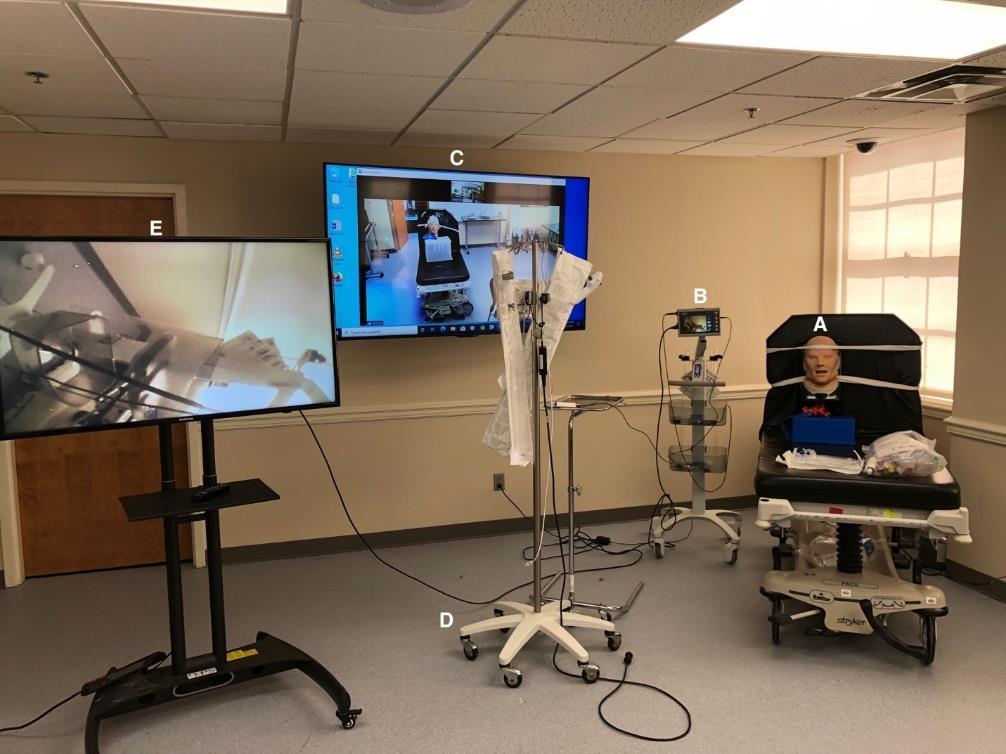
The participants were observed and rated by the facilitator using a checklist (Figure 1). The checklist outlined proper handling of the bronchoscope, adequate manipulation of the device, and troubleshooting measures. The checklist was developed and reviewed by emergency physicians and intensivists at our institution who regularly perform the procedure. The facilitator was not blinded to the study hypothesis. Upon completion of the procedural component,
all participants were individually asked to complete a postsimulation survey. Those in the Tele-SIM cohort were then given the opportunity to receive in-person instruction and facilitation if they wished with any remaining time.
To provide an adequate and similar experience for the TeleSIM group a series of audiovisual equipment was set up (Figure 2). Each group was provided identical equipment to perform the procedure including but not limited to the scope, airway manikin, endotracheal tubes, and elastic gum bougie. In the participants’
(B) connected to monitor (E); Zoom projection of facilitator in nearby location (C); additional intubation scope for teaching and debriefing (D); and projected fiberoptic camera for ease of facilitator visualization (E).
Volume 24, NO.1: January 2023 105 Western Journal of Emergency Medicine
Figure 1. Learner checklist for flexible scope. PPE, personal protective equipment; ETT, endotracheal tube.
Figure 2. Room for emergency medicine resident learner. Manikin head for nasopharyngoscopy and intubation (A); fiberoptic flexible bronchoscope
Learner checklist for flexible scope Planning for procedure Confirm patient identity using two patient identifiers Obtain informed consent Perform hand hygiene and don exam gloves Preparing for procedure Gather appropriate equipment Place patient in neutral position Don necessary PPE Procedural Steps Apply topical anesthetic / vasoconstrictor / inhaled lidocaine Open scope Connect scope to screen Perform up, down, and side to side with scope for comfort (prior to insertion for familiarity) Connect suction to scope Connect suction tubing to cannister Attach ETT (if needed) Insert distal end of scope into nostril Rotate scope downwards to advance to oropharynx Advance to visualize larynx (including epiglottis and glottis) Advance to visualize trachea Slowly withdraw scope to visualize and confirm glottis Insert ETT (if needed) Withdraw scope in neutral position Performing appropriate aftercare Dispose of all other non-sharp materials Remove PPE and perform hand hygiene Clean hands using alcohol-based hand sanitizer or soap and water
Instruction and Learner Perceptions of Fiberoptic Intubation and Nasopharyngoscopy
room two monitors were set up. The first monitor projected the facilitator in a nearby room broadcasted via Zoom (Zoom Video Communication, San Jose, CA]. The second monitor was connected to the scope to allow the facilitator visualization of the participant’s technique (Figure 2). This allowed timely feedback while the procedure was being completed.
In a nearby room the facilitator had available the same supplies as the participant. The facilitator was in front of a large screen projecting themselves and their image to the participant in the first room. This allowed for any real-time instruction on handling the scope or troubleshooting. Full live audio was available to both the facilitator and the participant for the entirety of the simulation and teaching experience.
The design for the Tele-SIM group was developed with assistance from our simulation center. In the weeks leading up to the study, EM faculty and simulation staff determined best practices for the video session based on trial and error. Prior to the study we participated in multiple walk-through sessions to identify issues and improve overall flow.
IMPACT/EFFECTIVENESS
Overall, 28 EM residents of various postgraduate year (PGY) training levels from PGY 1-3 participated in the training. The number of times using a flexible scope before training and the number who had any formal training before the exercise were similar between the two groups (Table). Residents in both Tele-SIM and SIM learning groups reported a self-perceived improvement in their scope intubation skills after their simulation and training session (Table). Both groups felt increased comfort with the scope as well as their ability to visualize the anatomy of the laryngopharynx/vocal cords (LP/VC) with the scope (Table). There was no significant difference in improvement between the two groups. Both groups felt more comfortable to teach this procedure to their peers and felt increased utility in their clinical practice in the ED following completion (Table).
The learner’s ability and confidence in procedural competency increased significantly in both groups. Most importantly, all learners felt more comfortable operating the
Western Journal of Emergency Medicine 106 Volume 24, NO.1: January 2023
et al.
Bloom
Pre-simulation group characteristics Tele-SIM (n=14) SIM (n=14) P-Value PGY Level 0.129 PGY-1 7 (50.0%) 2 (14.3%) PGY-2 4 (28.6%) 7 (50.0%) PGY-3 3 (21.4%) 5 (35.7%) Prior to workshop: how many times used scope 0.454 0 8 (57.1%) 6 (42.9%) 1 to 3 5 (35.7%) 7 (50.0%) 4 to 6 0 (0.0%) 1 (7.1%) >6 1 (7.1%) 0 (0.0%) Mean reported pre- and post-simulation experience comfort scores Tele-SIM (n=14) SIM (n=14) P-Value Perceived comfort level operating scope Pre-workshop 3.2 ± 2.2 3.2 ± 1.6 0.949 Post-workshop 7.9 ± 1.1 8.0 ± 1.5 Perceived comfort visualizing airway anatomy with scope Pre-workshop 3.6 ± 2.1 3.4 ± 1.7 0.911 Post-workshop 8.6 ± 1.0 8.4 ± 1.4 Perceived comfort level performing scope assisted intubation Pre-workshop 2.4 ± 1.9 2.6 ± 1.2 0.824 Post-workshop 7.9 ± 1.0 7.5 ± 1.5 Perceived comfort teaching peers procedure Pre-workshop 1.9 ± 1.4 1.6 ± 0.8 0.796 Post-workshop 7.4 ± 1.5 7.4 ± 1.3 Feel scope is useful skill in practice Pre-workshop 8.0 ± 2.7 7.6 ± 3.3 0.829 Post-workshop 9.9 ± 0.4 10.0 ± 0.0
PGY, postgraduate year.
Table. Group characteristics and pre- and post-simulated reported experiences.
Table Continued. Group characteristics and pre- and post-simulated reported experiences.
scope and performing this advanced procedure afterward with Tele-SIM group pre: 2.4 +/- 1.9 improving to post: 7.9 +/-1.0, and the SIM group pre: 2.6+/- 1.2 improving to post: 7.5+/- 1.5 as well (Table 1). There was no significant difference comparing the two groups across pre- and post-survey domains.
Both groups felt the goals of the simulation were clear and they had adequate supervision during the simulation. Specifically, the Tele-SIM group felt they had adequate support and that the teaching modality complemented their learning style. No Tele-SIM learners crossed over and requested additional training session time in person when offered. All learners regardless of simulation technique felt they were given the tools they needed to succeed and were satisfied with their simulation experience (Table 1).
The COVID-19 pandemic has highlighted the need for continued efforts in procedural simulation delivery and medical education. With limits on in-person instruction, telesimulation can serve as an additional tool for teaching both from a procedural and non-procedural aspect. From the perception of our learners, our study suggests real-time instruction can be similarly meaningful and supportive to increase learner comfort whether presented virtually or in person, even for a complex airway procedure. Here we observed no differences or limitations between reported learner experiences.
To help bridge the gap of needed simulation-based training and in-person limitations, telesimulation has been increasingly used. Telesimulation was defined by McCoy et al as a process by which telecommunication and simulation resources are used to provide education, training, or assessment to learners at an offsite location.18 Telesimulation in procedural task training has been studied in areas such as surgery, ultrasound, and intraosseous needle placement, focusing mostly on training in remote and resource-limited regions.19-23 There has also been increasing use of telesimulation in non-procedural, case-based situations with promising results.24,25
While initially developed to provide learning to resourcelimited areas, telesimulation in the era of COVID-19 has also been studied.26,27 Most studies have focused on casebased, non-procedural simulation. Despite its ongoing use,
there exists a paucity of literature comparing telesimulation to conventional simulation in a prospective manner. To our knowledge there are no studies that have evaluated advanced procedural airway training delivered virtually vs in person. If successfully implemented in airway training and other procedures, telesimulation could maintain learners’ health and safety without sacrificing important training experiences.
In development of a novel procedural telesimulation, we realized the importance of a precise set-up. Multiple monitors were required to project images back to the facilitator, particularly to capture detailed imaging. High speed internet was essential for in-time audio and visual feedback without delay. Finally, a larger space with adequate soundproofing helps prevent echoing and any interference for the learner and facilitator.
Here our data supports learners’ perceived satisfaction with telesimulation as an alternative or adjunct to standard simulation, a modality that can extend far beyond the limitations of the COVID-19 era. Both groups self-reported improvement in performance, knowledge, and comfort after participating in the simulation with no significant difference between the two groups.
The primary limitation of this pilot study is that our findings, while encouraging, consist of opinions and selfperceived competency. While learners reported similar procedural comfort, it is not clear whether their skills truly improved. Further study is needed with objective outcomes measuring procedural skills to show that telesimulation is indeed a comparable learning experience. This study also represents a single encounter with the learner. Additional research is needed to evaluate learner retention and skill decay over time but can only be achieved after objective skills are measured. Resource-limited areas without access to such technology may create difficulties in delivery. Having only one instructor present limited objective evaluation of participants. The results represent a single institutional experience with a small sample size and are limited to a sole procedure being simulated and taught. Future studies may look to validate telesimulation in delivery style as well as across different procedure simulation categories.
Volume 24, NO.1: January 2023 107 Western Journal of Emergency Medicine Bloom et al.
Intubation and Nasopharyngoscopy
Instruction and Learner Perceptions of Fiberoptic
Post workshop learner experience survey Tele-SIM SIM P-Value The goals of simulation were clearly outlined prior to participation 9.3 ± 1.1 9.7 ± 0.7 0.352 Felt had enough supervision during simulation 9.6 ± 0.7 10.0 ± 0.0 0.352 Felt comfortable asking question or for help during simulation 9.9 ± 0.5 10.0 ± 0.0 0.769 Felt was given adequate feedback during simulation 9.7 ± 0.6 10.0 ± 0.0 0.352 Simulation complemented learning style 9.7 ± 0.6 10.0 ± 0.0 0.352 Perceived knowledge of indications, and procedural technique improved 9.7 ± 0.5 9.9 ± 0.4 0.541 This workshop would be useful for future ED clinicians to participate 9.6 ± 1.1 10.0 ± 0.0 0.541 I am satisfied with overall simulation experience 9.6 ± 0.9 10.0 ± 0.0 0.352 PGY, postgraduate year.
Instruction and Learner Perceptions of Fiberoptic Intubation and Nasopharyngoscopy
As the educational landscape continues to adapt to social limitations and embrace distance-learning structures, consideration should be taken to implement telesimulation for teaching critical hands-on procedures and skills to future emergency physicians.
Address for Correspondence: Andrew D. Bloom MD, Department of Emergency Medicine, University of Alabama at Birmingham, Heersink School of Medicine, 214 General Services Building, 521 19th Street South, Birmingham, AL 35233, USA. Email: abloom@uabmc.edu
Conflicts of Interest: By the WestJEM article submission agreement, all authors are required to disclose all affiliations, funding sources and financial or management relationships that could be perceived as potential sources of bias. No author has professional or financial relationships with any companies that are relevant to this study. There are no conflicts of interest or sources of funding to declare.
Copyright: © 2023 Bloom et al. This is an open access article distributed in accordance with the terms of the Creative Commons Attribution (CC BY 4.0) License. See: http://creativecommons.org/ licenses/by/4.0/
maintain the education of residents during the COVID-19 pandemic. J Surg Educ. 2020;77(4):729-32.
9. Newman NA, Lattouf OM. Coalition for medical education - a call to action: a proposition to adapt clinical medical education to meet the needs of students and other healthcare learners during COVID-19 J Card Surg. 2020;35(6):1174-5.
10. Bentsianov BL, Parhiscar A, Azer M, et al. The role of fiberoptic nasopharyngoscopy in the management of the acute airway in angioneurotic edema. Laryngoscope. 2000;110(12):2016-9.
11. Mitra A, Gave A, Coolahan K, et al. Confirmation of endotracheal tube placement using disposable fiberoptic bronchoscopy in the emergent setting. World J Emerg Med. 2019;10(4):210-4.
12. Hayden EM, Pallin DJ, Wilcox SR, et al. Emergency department adult fiberoptic intubations: incidence, indications, and implications for training. Acad Emerg Med. 2018;25(11):1263-7.
13. Tonna JE, DeBlieux PM. Awake laryngoscopy in the eemergency department. J Emerg Med. 2017;52(3):324-31.
14. Binstadt E, Donner S, Nelson J, et al. Simulator training improves fiber-optic intubation proficiency among emergency medicine residents. Acad Emerg Med. 2008;15(11):1211-4.
15. Giles G, Diprinzio D, Haber J. Low fidelity trainer for fiberoptic scope use in the emergency department. JET EM. 2020;5(3):1-8.
REFERENCES
1. Gottlieb M, Landry A, Egan DJ, et al. Rethinking residency conferences in the era of COVID-19. AEM Educ Train. 2020;4(3):313-7.
2. Passiment M, Sacks, H, Huang G. Medical simulation in medical education: results of an AAMCSurvey. Available at: https://www. aamc.org/system/files/c/2/259760medicalsimulationinmedicaleducati onanaamcsurvey.pdf. Published 2011. Accessed February 11, 2022.
3. McGaghie WC, Issenberg SB, Petrusa ER, et al. Effect of practice on standardised learning outcomes in simulation-based medical education. Med Educ. 2006;40(8):792-7.
4. McGaghie WC, Issenberg SB, Cohen ER, et al. Does simulationbased medical education with deliberate practice yield better results than traditional clinical education? A meta-analytic comparative review of the evidence. Acad Med. 2011;86(6):706-11.
5. Wayne DB, Butter J, Siddall VJ, et al. Simulation-based training of internal medicine residents in advanced cardiac life support protocols: a randomized trial. Teach Learn Med. 2005;17(3):210-6.
6. Cook DA, Hatala R, Brydges R, et al. Technology-enhanced simulation for health professions education: a systematic review and meta-analysis. JAMA. 2011;306(9):978-88.
7. ACGME Program Requirements for Graduate Medical Education in Emergency Medicine. Available at: https://www. acgme.org/Portals/0/PFAssets/ProgramRequirements/110_ EmergencyMedicine_2019_TCC.pdf?ver=2019-06-11- 153018223. 2019. Accessed March 18, 2020.
8. Chick RC, Clifton GT, Peace KM, et al. Using technology to
16. Marsland C, Larsen P, Segal R, et al. Proficient manipulation of fibreoptic bronchoscope to carina by novices on first clinical attempt after specialized bench practice. Br J Anaesth. 2010;104(3):375-81.
17. Sawyer T, White M, Zaveri P, et al. Learn, see, practice, prove, do, maintain: an evidence-based pedagogical framework for procedural skill training in medicine. Acad Med. 2015;90(8):1025-33.
18. McCoy CE, Sayegh J, Alrabah R, et al. Telesimulation: an innovative tool for health professions education. AEM Educ Train. 2017;1(2):132-6.
19. Mikrogianakis A, Kam A, Silver S, et al. Telesimulation: an innovative and effective tool for teaching novel intraosseous insertion techniques in developing countries. Acad Emerg Med. 2011;18(4):420-7.
20. Okrainec A, Henao O, Azzie G. Telesimulation: an effective method for teaching the fundamentals of laparoscopic surgery in resourcerestricted countries. Surg Endosc. 2010;24(2):417-22.
21. Okrainec A, Smith L, Azzie G. Surgical simulation in Africa: the feasibility and impact of a 3-day fundamentals of laparoscopic surgery course. Surg Endosc. 2009;23(11):2493-8.
22. Burckett-St Laurent DA, Cunningham MS, Abbas S, et al. Teaching ultrasound-guided regional anesthesia remotely: a feasibility study. Acta Anaesthesiol Scand. 2016;60(7):995-1002.
23. Jewer J, Parsons MH, Dunne C, et al. Evaluation of a mobile telesimulation unit to train rural and remote practitioners on highacuity low-occurrence procedures: pilot randomized controlled trial. J Med Internet Res. 2019;21(8):e14587.
24. McCoy CE, Sayegh J, Rahman A, et al. Prospective randomized crossover study of telesimulation versus standard simulation for teaching medical students the management of critically ill patients.
Western Journal of Emergency Medicine 108 Volume 24, NO.1: January 2023
Bloom et al.
Bloom et al.
AEM Educ Train. 2017;1(4):287-92.
Instruction and Learner Perceptions of Fiberoptic Intubation and Nasopharyngoscopy
25. Hayden EM, Khatri A, Kelly HR, et al. Mannequin-based telesimulation: increasing access to simulation-based education Acad Emerg Med. 2018;25(2):144-7.
26. Brei BK, Neches S, Gray MM, et al. Telehealth training during the
COVID-19 pandemic: a feasibility study of large group multiplatform telesimulation training. Telemed J E Health. 2021;27(10):1166-73.
27. Patel SM, Miller CR, Schiavi A, et al. The sim must go on: adapting resident education to the COVID-19 pandemic using telesimulation. Adv Simul (Lond). 2020;5:26.
Volume 24, NO.1: January 2023 109 Western Journal of Emergency Medicine
Universal Precautions Plus: Physician-Directed Strategies for Improving Patient Health Literacy in the Emergency Department
Jamaji C. Nwanaji-Enwerem, MD, PhD, MPP*†
Mikhaila Smith-Wilkerson,
Brittney Gordon, MD*
Helene Okpere, MD*
Terrell Jones, MD*
Rahel Gizaw, MD*
Irfan Husain, MD, MPH*
MD*
Emory University School of Medicine, Department of Emergency Medicine, Atlanta, Georgia
Emory Rollins School of Public Health, Gangarosa Department of Environmental Health, Atlanta, Georgia
Section Editor: Sara Krzyzaniak, MD
Submission history: Submitted June 14, 2022; Revision received September 28, 2022; Accepted October 7, 2022
Electronically published December 28, 2022
Full text available through open access at http://escholarship.org/uc/uciem_westjem
DOI: 10.5811/westjem.2022.10.57697
Working on the frontlines with safety-net populations, emergency physicians are uniquely positioned to take on a greater role in addressing the current health literacy crisis and specific barriers that may exist. Here, we review the concept of universal health literacy precautions and explore the application of these universal precautions in conjunction with other patient-centered strategies. More specifically, to improve patient understanding and outcomes, emergency physicians can pair universal health literacy precautions with strategies including multiple learning techniques, dual-code theory, empowerment counseling, family buy-in, and hands-on practice. We provide two examples of emergency department encounters where this combined approach was used differently yet successfully and efficiently. Ultimately, we aim to highlight the value of emergency physicians being equipped with basic skills in health literacy educational strategies. [West J Emerg Med. 2023;24(1)110–113.]
INTRODUCTION
Patient health literacy should be an important consideration for all physicians because of its relationship to important health outcomes. Low health literacy has been associated with lower utilization of preventive services, lower rates of medication adherence, greater numbers of hospitalizations, poorer overall health, and higher rates of mortality.1,2 Low patient health literacy is particularly important for emergency physicians because it is a significant contributor to higher uses of emergency care,3 including emergency department (ED) visits for complaints that could otherwise be addressed in an ambulatory context4 and ED visits that result in hospitalizations.5 In short, health literacy is a problem for both non-acute and acute patients. Furthermore, because many patients initially, or most frequently, interact with the healthcare system through the ED, emergency physicians are uniquely positioned to address health literacy concerns.
Defining Health Literacy
The United States (US) Department of Health and Human Services and the Institute of Medicine define
health literacy as “the degree to which individuals have the capacity to obtain, process, and understand basic health information and services needed to make appropriate health decisions.” 6 This definition focuses on clinical risk and is framed as an individual deficit. To emphasize the role of personal as well as social and environmental determinants of health, it has been proposed that health literacy be framed as an asset to be built.7 The asset framework further emphasizes the co-creation of knowledge between physicians and patients while prioritizing patient preferences and values.8 Combining both the risk and asset frameworks results in a comprehensive definition of health literacy including functional, interactive, and critical thinking skills. 7
Functional skills include the basic ability to write and read information such as medication labels. Interactive skills include more advanced literacy and cognitive skills that enable patients to understand and apply medical information in ever-changing circumstances. At this level of health literacy, a patient may obtain information from a medication advertisement and can
Western Journal of Emergency Medicine 110 Volume 24, NO.1: January 2023 Perspective
* †
discuss their interest or concerns about the advertisement while creating a care plan with their physician. Critical literacy skills are even more advanced and include the ability to critically use information to implement lifestyle and living condition changes when possible. Patients with critical literacy demonstrate the greatest effectiveness in making informed decisions and in health self-management. This includes comfort in knowing when to ask for assistance in decision-making.7
The Emergency Department and Universal Precautions Plus
As with other health-related experiences, EDs remain an important population safety net. Thus, emergency physicians must be equipped with skills to identify and approach health literacy concerns effectively and in a manner that is efficient given their working environment. In 2003, the US Department of Education conducted a national assessment of health literacy skills – measuring the ability to read health-related information and manage numerical information related to health – and found that 88% of US adults do not have the health literacy skills needed for handling the demands of the current healthcare system.6 Given this finding and research reporting that clinicians have difficulty identifying patients with low health literacy,9 professional organizations recommend using universal health literacy precautions to improve accessibility of health information to all patients regardless of education or literacy levels.9,10
Universal health literacy precautions aim to simplify written and verbal communication, confirm comprehension using “teach-back,” improve navigation of the healthcare system, and empower patients’ efforts to improve their health.10 Although universal health literacy precautions help in increasing the accessibility of the information that patients receive,9 a prior ED randomized trial reported that patients demonstrated even greater learning when they also received materials matched to their preferred learning styles.2 However, there has been controversy surrounding learning styles and data demonstrating that learning styles have no bearing on individuals’ ability to learn and retain material.11 Still, this may not mean that recognizing learning styles is completely futile. In fact, it has been proposed that learning styles may be of limited utility given their prescriptive nature; however, reframing them as learning strategies or techniques allows for more flexibility and allows learners to use a variety of styles depending on the task at hand.12 Given this data, to aid efforts directed at educating emergency physicians in building a more robust health literacy skillset we provide examples of ED patient encounters where additional strategies were paired with universal health literacy precautions and multiple learning techniques to successfully improve patient health literacy.
Dual Coding and Hands-On Practice to Address “Noncompliance” in Respiratory Failure
A bedbound, 48-year-old man with a past medical history of pulmonary hypertension, obstructive sleep apnea, and heart
failure presented to the ED with confusion. He received an extensive infectious and metabolic work-up including an arterial blood gas and computed tomography imaging of the brain. Given initial labs showing that he was acidotic and hypercapnic, he was placed on bilevel positive airway pressure, which normalized his pH and mental status. Nevertheless, his arterial carbon dioxide levels remained slightly elevated, resulting in our belief that his presentation likely reflected an acute-onchronic process. As the patient’s mental status improved, he revealed to the treatment team that he had not been using his continuous positive airway pressure (CPAP) machine at home. He continued to explain to the team that he had significant difficulty and discomfort with putting on the CPAP mask due to his body habitus, and his caretakers were not able to assist him at night. Throughout the conversation, the patient admitted that when he was initially prescribed CPAP, he did not understand his need for it or how it would help him.
Understanding that properly delivered patient education has improved outcomes in patient compliance, satisfaction, and healthcare utilization,13 we appreciated that this man’s future health depended on the education provided at this visit. We also recognized that each patient has a unique cognitive load or working memory that represents their capacity to receive and process finite amounts of information.14,15 In agreement with the use of flexible learning techniques, the team aimed to maximize the patient’s uptake of information through Allan Paivio’s dualcode theory.16 Dual-code theory acknowledges both verbal and non-verbal cognitive processing and then leverages words and imagery to improve patient memory and enhance learning.17 Different from a prescriptive learning style, this approach places a significant and equal emphasis on verbal and non-verbal modalities of education.
We planned to use two separate working memory systems – visual (non-verbal) and auditory – to present complex medical diagnosis and management information in a manner that would not cause cognitive overload. Along with verbal teaching, we used simple visual aids to explain the etiology of the patient’s symptoms and how CPAP can prevent future episodes of this initial presentation to the ED. After the education, the patient was able to demonstrate understanding of the information through “teach-back.” Furthermore, given that the patient previously expressed difficulty with placing his CPAP mask, we asked our respiratory therapist to spend some time with him to fit his mask and practice mask placement and removal. Review of tasks is likely helpful to all patients, taps into the domain of kinesthetic learning, and further reinforces previous non-verbal efforts employed in dual coding.2
Empowerment Counseling and Family Buy-In to Address Disinformation in Leg Pain
A 68-year-old woman with a past medical history of type II diabetes and degenerative disc disease treated with lumbar spinal fusion surgery six years prior presented to the
Volume 24, NO.1: January 2023 111 Western Journal of Emergency Medicine Nwanaji-Enwerem et al.
Patient Health Literacy in the ED
Physician-directed Strategies for Improving
ED for bilateral shooting leg pain that had been ongoing for several months. The patient reported seeing an outpatient pain management doctor during the prior year who discontinued her gabapentin because it “was one of the worst medications on the market and would cause her legs to become necrotic and fall off.” Instead, she was told that she needed a $3,000 procedure to manage her pain. In the ED, her vital signs were within normal limits. She stated that her pain was tolerable, but she was amenable to acetaminophen while we completed her evaluation. Her physical exam was unremarkable including no spinal tenderness. Gross motor and sensation were intact, and she had a negative bilateral straight leg test. She was able to ambulate without deficits. Her lab work demonstrated no electrolyte disturbances.
Upon completion of her evaluation, we believed that her symptoms were most likely due to neuropathic pain that would benefit from gabapentin. However, we knew that she would be apprehensive about restarting gabapentin due to the fear of losing her legs. With respect to her specific health literacy barriers, we needed to address the gabapentin disinformation. She expressed a preference for visual materials. Thus, embracing the techniques of dual coding and using multiple, flexible learning techniques, we tapped into the visual/nonverbal domain by printing easy-to-understand tables and figures describing gabapentin side effects – none of which were limb necrosis.18 We also focused on the verbal/auditory domain and, at the bedside, reviewed these visual materials using positive and empowerment counseling techniques shown to be effective from the musculoskeletal pain literature.8
These techniques involve avoiding low recovery expectations, promoting the attempted resumption of daily activities even when still experiencing pain, and emphasizing the improvement of activity levels as an important endpoint –not simply pain relief. When available, other useful auditory/ verbal tools include video discharge instructions and followup caseworker phone calls.18 During our discussion, the patient’s adult son arrived in the room and we were also able to share the information with him. This was critical as family involvement has been identified as a cornerstone for successful shared decision-making with elderly patients.19 Ultimately, the patient agreed to restart her gabapentin and was given information to schedule a primary care visit with a physician at our institution. Review of her chart demonstrated that she made her follow-up visits and reported improvement in her pain symptoms.
Building Health Literacy Skills
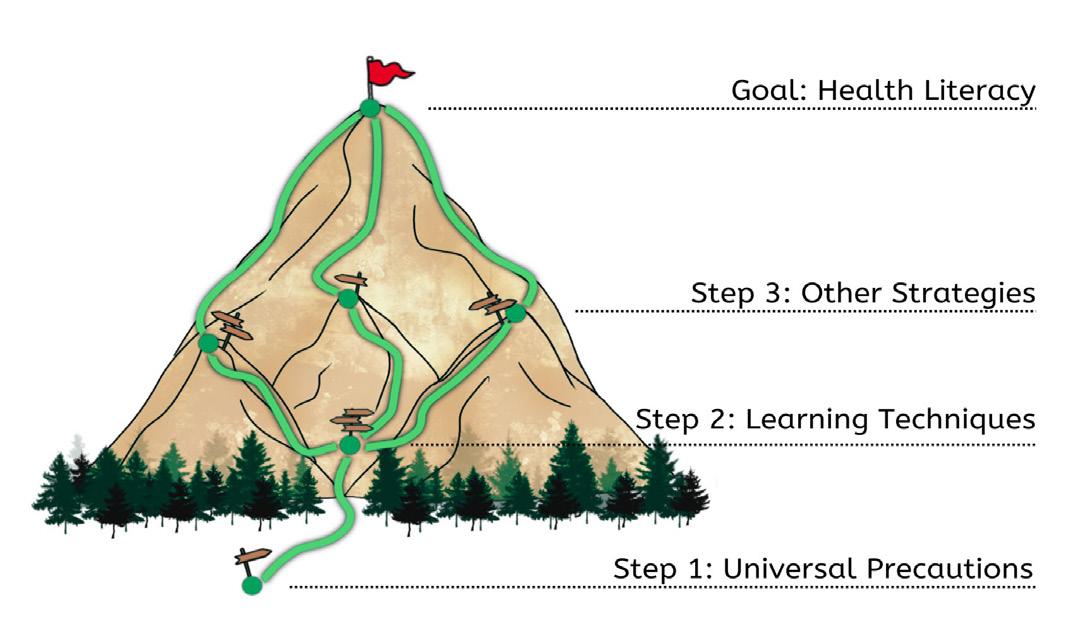
If not doing so already, all physicians – especially those in the ED – should be using the basics of universal health literacy precautions. Nevertheless, we recognize that like many skills in medicine, the strategies for improving patient health literacy do not often come automatically to physicians and require training, particularly in ED encounters where physician-patient interaction time is
limited.2,20 Resources like the Agency for Healthcare Research and Quality’s Health Literacy Universal Precautions Toolkit can be implemented in curricula at the medical student and resident level to aid in bolstering educational efforts in this area.10 There is also an opportunity to practice health literacy skills in simulationbased education delivered as part of didactics. Importantly, health literacy should be viewed as a dynamic concept. Different learning tools will have different efficacies depending on the patient. Even for one individual, the dynamism of his/her/their own health status can result in new deficits in their health literacy.21 Simultaneously, clinical understanding of disease process and management schemes is also ever evolving. Thus, physicians will have to work at maintaining their health literacy skills throughout their careers. Pursuing formal health literacy activities for continuing medical education credit may prove helpful in this endeavor.
CONCLUSION
While on the job, emergency physicians must actively remain vigilant to identify instances where addressing health literacy may require more than the universal precautions. Important warning signs may include frequently missed appointments, incomplete registration forms, medication noncompliance, or even a patient who does not ask many questions during the medical encounter.22 Given the gravity of health literacy to individual and population health, we provide these strategies (eg, the application of multiple learning techniques/dual coding, positive empowerment counseling, family-involved shared decision-making, hands-on medical equipment skills practice, etc.) in addition to universal health literacy precautions to bolster emergency physicians’ chances of improving patient understanding and thereby health outcomes (Figure 1). 21
Figure
patient health literacy. The paths for improving patient health literacy are vast. We recommend beginning with universal health literacy precautions. We then recommend using a multi-learning technique strategy such as dual coding followed by the application of other strategies (eg, positive empowerment counseling, family-involved shared decision-making, hands-on medical equipment skills practice, etc).
Western Journal of Emergency Medicine 112 Volume 24, NO.1: January 2023 Physician-directed Strategies
Patient Health Literacy in the ED Nwanaji-Enwerem et al.
for Improving
1. Approach for improving
ACKNOWLEDGMENTS
We gratefully acknowledge Dr. Douglas Ander for his advice during manuscript preparation.
Address for Correspondence: Jamaji C. Nwanaji-Enwerem, MD, PhD, MPP, Emory School of Medicine, Emory Rollins School of Public Health, 68 Armstrong Street, Room 318, Atlanta, GA 30303. Email: jnwanaj@emory.edu.
Conflicts of Interest: By the WestJEM article submission agreement, all authors are required to disclose all affiliations, funding sources and financial or management relationships that could be perceived as potential sources of bias. No author has professional or financial relationships with any companies that are relevant to this study. There are no conflicts of interest or sources of funding to declare.
Copyright: © 2023 Nwanaji-Enwerem et al. This is an open access article distributed in accordance with the terms of the Creative Commons Attribution (CC BY 4.0) License. See: http:// creativecommons.org/licenses/by/4.0/
REFERENCES
1. Berkman ND, Sheridan SL, Donahue KE, et al. Low health literacy and health outcomes: an updated systematic review. Ann Intern Med 2011;155(2):97-107.
2. Giuse NB, Koonce TY, Storrow AB, et al. Using health literacy and learning style preferences to optimize the delivery of health information. J Health Commun. 2012;17 Suppl 3:122-40.
3. Griffey RT, Kennedy SK, McGownan L, et al. Is low health literacy associated with increased emergency department utilization and recidivism? Acad Emerg Med. 2014;21(10):1109-15.
4. Balakrishnan MP, Herndon JB, Zhang J, et al. the association of health literacy with preventable ED visits: a cross-sectional study Acad Emerg Med. 2017;24(9):1042-50.
5. Sheikh S, Hendry P, Kalynych C, et al. Assessing patient activation and health literacy in the ED. Amer J Emerg Med. 2016;34(1):93-6.
6. Kutner M, Greenburg E, Jin Y, et al. (2006). The health literacy of America’s adults: results from the 2003 National Assessment of Adult Literacy. Washington, DC: US Department of Education.
7. Nutbeam D. The evolving concept of health literacy. Soc Sci Med
2008;67(12):2072-8.
8. Wittink H, Oosterhaven J. Patient education and health literacy. Musculoskelet Sci Pract. 2018;38:120-7.
9. Hersh L, Salzman B, Snyderman D. Health literacy in primary care practice. Am Fam Physician. 2015;92(2):118-24.
10. Brega A, Barnard J, Mabachi N, et al. AHRQ Health Literacy Universal Precautions Toolkit, 2nd Ed. Available at: https://www.ahrq.gov/healthliteracy/improve/precautions/toolkit.html Accessed June 8, 2022.
11. Newton PM, Miah M. Evidence-based higher education: Is the learning styles ‘myth’ important? Front Psychol. 2017;8:444.
12. LeBlanc TR. Learning styles: academic fact or urban myth? A recent review of the literature. J-CASP. 2018;1(1)34-40.
13. Wei HG, Camargo CA. Patient education in the emergency department. Acad Emerg Med. 2000;7(6):710-7.
14. Baddeley AD, Hitch G. Working memory. In: Bower GH, ed. Psychology of Learning and Motivation. Vol 8. Academic Press; 1974:47-89.
15. Pusic MV, Ching K, Yin HS, et al. Seven practical principles for improving patient education: evidence-based ideas from cognition science. Paediatr Child Health. 2014;19(3):119-22.
16. Clark JM, Paivio A. Dual coding theory and education. Educ Psychol Rev. 1991;3(3):149-210.
17. Goolsby RD, Sadoski M. A theoretical approach to improving patient education through written materials. Ann Behav Sci Med Educ 2013;19(1):14-8.
18. Bloch SA, Bloch AJ. Using video discharge instructions as an adjunct to standard written instructions improved caregivers’ understanding of their child’s emergency department visit, plan, and follow-up: a randomized controlled trial. Pediatr Emerg Care. 2013;29(6):699-704.
19. Bradley E, Green D. Involved, inputting or informing: “shared” decision making in adult mental health care. Health Expect 2018;21(1):192-200.
20. Sullivan GM. The growing health literacy gap and graduate medical education. J Grad Med Educ. 2017;9(3):275-7.
21. Berkman ND, Davis TC, McCormack L. Health literacy: What Is It? J Health Comm. 2010;15(sup2):9-19.
22. Agency for Healthcare Research and Quality, Rockville, MD. Tool 3a: Health Literacy: Hidden Barriers and Practical Strategies. 2020. Available at: https://www.ahrq.gov/health-literacy/improve/ precautions/tool3a.html. Accessed June 8, 2022.
Volume 24, NO.1: January 2023 113 Western Journal of Emergency Medicine
et al.
Health
in the ED
Nwanaji-Enwerem
Physician-directed Strategies for Improving Patient
Literacy
Number of Patient Encounters in Emergency Medicine Residency Does Not Correlate with In-Training Exam Domain Scores
Michael W. Kern, MD*
Corlin M. Jewell, MD†
Dann J. Hekman, MS†
Benjamin H. Schnapp, MD, Med†
Section Editor: Abra Fant, MD
Mayo Clinic Health System – Northwest Wisconsin Region, Department of Emergency Medicine, Eau Claire, Wisconsin BerbeeWalsh Department of Emergency Medicine, University of Wisconsin School of Medicine and Public Health, Madison, Wisconsin
Submission history: Submitted July 10, 2022; Revision received November 13, 2022; Accepted November 19, 2022
Electronically published December 21, 2022
Full text available through open access at http://escholarship.org/uc/uciem_westjem
DOI: 10.5811/westjem.2022.11.57997
Introduction: Emergency medicine (EM) residents take the American Board of Emergency Medicine (ABEM) In-Training Examination (ITE) every year. This examination is based on the ABEM Model of Clinical Practice (Model). The purpose of this study was to determine whether a relationship exists between the number of patient encounters a resident sees within a specific clinical domain and their ITE performance on questions that are related to that domain.
Methods : Chief complaint data for each patient encounter was taken from the electronic health record for EM residents graduating in three consecutive years b etween 2016-2021. We excluded patient encounters without an assigned resident or a listed chief complaint. Chief complaints were then categorized into one of 20 domains based on the 2016 Model. We calculated correlations between the total number of encounters seen by a resident for all clinical years and their ITE performance for the corresponding clinical domain from their third year of training.
Results : Available for analysis were a total of 232,625 patient encounters and 69 eligible residents who treated the patients. We found no statistically significant correlations following Bonferroni correction for multiple analyses.
Conclusion : There was no correlation between the number of patient encounters a resident has within a clinical domain and their ITE performance on questions corresponding to that domain. This suggests the need for separate but parallel educational missions to achieve success in both the clinical environment and standardized testing. [West J Emerg Med. 2023;24(1)114–118.]
INTRODUCTION
Every year, emergency medicine (EM) residents take the in-training examination (ITE) administered by the American Board of Emergency Medicine (ABEM). This test is important, in part, due to its ability to predict who will pass the Qualifying Examination (QE).1,2 The QE is a critical part of ABEM’s certification process and, therefore, independent clinical practice.3 The ITE is designed to follow the EM Model of Clinical Practice (Model), which is based on an “extensive practice analysis of the specialty.”4 It has previously been shown in 2011 that no correlation exists between the total
number of patient encounters during EM residency and ITE score.3 However, it is unclear whether any relationship exists between the number of patient encounters a resident has within a specific clinical domain during training and their ITE performance on questions that correspond to that domain. Should no relationship exist, it could call into question the utility the ITE might have in measuring whether a resident is progressing appropriately with regard to their clinical skills. Kolb’s experiential learning theory would suggest that residents who have greater clinical exposure in a particular area (eg, cardiovascular complaints) should be able to better
Western Journal of Emergency Medicine 114 Volume 24, NO.1: January 2023 Brief Research Report
* †
conceptualize and achieve a greater understanding of clinical concepts than simply reading about them alone, provided that they engage in patient follow-up, self-reflection, and/or facilitated feedback with attending physicians. If experiential learning theory were to apply to health professions education, residents with increased experience should theoretically perform better on ITE questions corresponding to that domain, as this test is meant to be a surrogate for the knowledge required to competently practice EM.5 Our purpose in this study was to determine whether there was a relationship between ITE performance within individual content domains of the Model and the number of patients seen during residency with chief complaints in each domain.
METHODS
This project was deemed exempt quality improvement by the University of Wisconsin Health Sciences Institutional Review Board.
Study Setting
We conducted the study at a three-year EM residency program situated within an urban, academic emergency department (ED) in the Midwest. The ED has 54 beds with a volume of approximately 60,000 patient visits annually. During the period of the study, the residency had 12 postgraduate year-1 positions available each year.
Data Acquisition
In this study we used deidentified, first chief complaint data rather than downstream categorization (eg, final diagnosis, admitting diagnosis). We used chief complaints to identify the nature of the patient encounter as this data was available at the time of patient presentation, likely dictated most of the ED evaluation, and would not have been affected by changes in treatment identified during later stages of a patient’s hospital course. Residents were eligible for inclusion if they had graduated in three consecutive years between 2016-2021. All patient encounters from all years of training involving eligible EM residents were queried. To maintain anonymity, each resident was assigned a study identification number; the ID key was accessible only to the senior author, a member of the residency leadership team.
We excluded from analysis encounters where no chief complaint was listed or no resident was assigned. In cases where multiple residents were assigned to a single encounter, we designated the initial resident assigned to the encounter as the resident of record. This was done as the first resident is typically the most cognitively involved in determining the patient’s diagnostic and treatment strategy. The chief complaint for each encounter was determined by the patient’s primary nurse who cared for the patient in the ED initially, which is nearly always selected from a list of frequent chief complaints. Resident ITE scores across
domains during the third year of training were taken from internal residency records.
Data Analysis
A previously published list of common EM chief complaints had been compiled and independently categorized into one of 20 content domains correlating with the 2016 ABEM Model of Clinical Practice by two boardcertified EM attending physicians.4 For all chief complaints appearing in our data that were not previously categorized, we repeated the same categorization process with two board-certified EM attending physicians at our institution. In both cases, if there was disagreement between the two reviewers, a third board-certified emergency physician was brought in to adjudicate. We categorized complaints in which a symptom was used as the descriptor and could potentially correspond to multiple organ systems (eg, chest pain) into domains based on what was most likely given the general experiences of the coding physicians, rather than into the “Signs, Symptoms, and Presentations” domain.
The ITE scores are reported by ABEM by domain according to the Model. We calculated Pearson’s correlation coefficient, Pearson’s coefficient of determination, and Spearman’s rank correlation along with 95% confidence intervals for each domain, comparing individual caseloads within each content area to the same individual’s ITE subscore percentages within that domain using SPSS (IBM Corporation, Armonk, NY). The Bonferroni correction for multiple comparisons was used to determine significance.
RESULTS
We included in the analysis a total of 232,625 patient encounters from 69 residents in the analysis. Resident performance on the ITE is shown in Table 1. Correlation coefficients (Pearson’s) ranged from -0.12 to 0.28 for the different domains. Correlation coefficients for each topic’s clinical exposures and ITE scores, as well as their significance levels, are listed in Table 2. No significant correlations were identified after Bonferroni correction.
DISCUSSION
The number of patient encounters within a certain domain showed no correlation to resident performance on the corresponding ITE domains. This is in line with previous studies that have demonstrated little relation between total number of patient encounters during residency and performance on formal testing.3 It has been demonstrated that differences exist between resident clinical exposure and the weight each domain is given on the ITE,6 but our study further suggests that a disconnect exists between the breadth of clinical encounters and ITE performance. This would suggest that program leadership should limit the use of ITE scores as a global assessment tool for a resident’s clinical progress and instead focus on those scores’ ability to predict success on the QE.
Volume 24, NO.1: January 2023 115 Western Journal of Emergency Medicine Kern et al.
Exam
Scores
Number of Patient Encounters in EM Residency Does Not Correlate with
Domain
Number of Patient Encounters in EM Residency Does Not Correlate with Exam Domain Scores
Western Journal of Emergency Medicine 116 Volume 24, NO.1: January 2023
Kern et al. Domain Min Max Median Mean Signs, symptoms, and presentations 1.0 52.63% 100.00% 84.21% 82.38% Abdominal and gastrointestinal disorders 2.0 66.67% 100.00% 83.33% 85.10% Cardiovascular disorders 3.0 59.09% 95.45% 81.82% 81.29% Cutaneous disorders 4.0 0.00% 100.00% 50.00% 58.72% Endocrine, metabolic, and nutritional disorders 5.0 40.00% 100.00% 95.45% 86.39% Environmental disorders 6.0 33.33% 100.00% 83.33% 80.74% Head, ear, eye, nose, and throat disorders 7.0 40.00% 100.00% 75.00% 78.21% Hematologic disorders 8.0 0.00% 100.00% 85.71% 81.56% Immune system disorders 9.0 33.33% 100.00% 75.00% 76.93% Systemic infectious disorders 10.0 11.69% 100.00% 73.33% 74.42% Musculoskeletal disorders (non-traumatic) 11.0 57.14% 100.00% 85.71% 86.97% Nervous system disorders 12.0 50.00% 100.00% 81.82% 78.34% Obstetrics and gynecology 13.0 37.50% 100.00% 83.33% 80.68% Psychobehavioral disorders 14.0 37.50% 100.00% 85.71% 81.09% Renal and urogenital disorders 15.0 42.86% 100.00% 84.52% 80.51% Thoracic-respiratory disorders 16.0 58.82% 100.00% 77.78% 79.53% Toxicologic disorders 17.0 45.45% 100.00% 81.82% 78.51% Traumatic disorders 18.0 40.91% 95.45% 76.19% 74.09% Procedures and skills 19.0 47.06% 100.00% 77.78% 77.18% Other components 20.0 0.00% 100.00% 83.33% 79.13%
Domain Pearson’s Correlation R2 95% confidence interval P value Spearman’s Correlation 95% confidence interval P value Case total Abdominal and gastrointestinal disorders 0.14 0.02 -0.10 - 0.37 0.24 0.15 -0.10 -0.37 0.23 40,819 Cardiovascular disorders -0.03 0.00 -0.26 - 0.21 0.84 -0.01 -0.25 -0.24 0.97 22,918 Cutaneous disorders -0.05 0.00 -0.28 - 0.19 0.7 -0.09 -0.33 -0.16 0.46 3,444 Endocrine, metabolic, and nutritional disorders 0.06 0.00 -0.18 - 0.29 0.64 0.07 -0.17 -0.31 0.54 1,326 Environmental disorders 0.05 0.00 -0.19 - 0.28 0.7 0.08 -0.17 -0.31 0.54 1,198 Head, ear, eye, nose, and throat disorders 0.25 0.06 0.02 - 0.46 0.03 0.30 0.07 - 0.51 0.01 10,516 Hematologic disorders -0.04 0.00 -0.27 - 0.20 0.74 0.04 -0.20 - 0.28 0.72 729 Immune system disorders -0.02 0.00 -0.25 - 0.22 0.88 0.02 -0.22 - 0.26 0.86 1,860 Musculoskeletal disorders (non-traumatic) -0.25 -0.06 -0.45 - -0.01 0.04 -0.23 -0.45 - 0.01 0.05 21,984 Nervous system disorders -0.07 0.00 -0.30 – 0.17 0.55 -0.18 -0.40 – 0.06 0.13 22,299 Obstetrics and gynecology -0.04 0.00 -0.27 – 0.20 0.77 0.03 -0.21 – 0.27 0.80 1,377 Other components 0.03 0.00 -0.21 – 0.26 0.81 0.07 -0.18 – 0.30 0.59 7,172 Procedures and skills -0.20 0.04 -0.41 – 0.04 0.1 -0.25 -0.46 - -0.01 0.04 2,591 Psychobehavioral disorders 0.28 0.08 0.05 – 0.48 0.02 0.30 0.06 – 0.51 0.01 8,832 Renal and urogenital disorders -0.04 0.00 -0.27 – 0.20 0.73 -0.05 -0.28 – 0.20 0.71 5,019 Signs, symptoms, and presentations -0.03 0.00 -0.26 - 0.21 0.81 -0.02 -0.26 - 0.23 0.90 9,019 Systemic infectious disorders 0.17 0.03 -0.07 – 0.39 0.17 0.14 -0.11 – 0.37 0.26 11,566 Thoracic-respiratory disorders 0.10 0.00 -0.14 – 0.33 0.39 0.08 -0.17 – 0.32 0.51 19,608 Toxicologic disorders -0.04 0.00 -0.28 – 0.19 0.72 -0.05 -0.28 – 0.20 0.71 3,338 Traumatic disorders -0.12 -0.01 -0.35 – 0.11 0.31 -0.16 -0.38 – 0.09 0.20 37,010
Table 1. Resident performance on the Emergency Medicine In-Training Examination.
Table 2. Correlations between number of patient encounters and in-training exam scores for each of the American Board of Emergency Medicine Model of Clinical Practice domains.
It appears that success in clinical practice does not imply success on standardized testing. This would provide an argument to maintain parallel, separate educational missions focused on each mission, as success in the clinical environment and passing the QE are both critical components of an emergency physician’s career after residency graduation. Requiring two separate missions would require a residency program to devote time to both, which could tax a program’s faculty. Alternatively, this dual focus would require a program to potentially rely on commercial products to provide the specific knowledge to do well on the ITE. Access to online question banks (Qbank LLC, Stockholm, Sweden) has been demonstrated to be beneficial,7 but their use may tax a residency’s financial resources. While it is possible that the breadth (or lack) of clinical experience in certain areas would direct a resident’s self-study practices, our study results suggest that this strategy may be suboptimal, at least as far as ITE study is concerned. Instead, residents would be best served with a broad study plan regardless of the range of their clinical encounters, which is in line with previous studies demonstrating the differences between residents’ patient care experiences and the blueprint provided by the Model.6,8 There remains room for further study to more clearly elucidate the link, if any, between clinical training and ITE performance.
Overall, our results appear to be in opposition to Kolb’s experiential learning theory, which would have suggested a more robust link between clinical experience and testing performance. There may be multiple reasons for this discrepancy. First, experiential learning theory relies heavily on reflection to translate experience into knowledge.5 On one hand, residents have multiple opportunities to reflect on cases during their clinical work, including documentation of the clinical encounter and feedback provided from faculty and other staff, as well as patient case logs as mandated by the Accreditation Coiuncil for Graduate Medical Education.9 On the other hand, it is possible that the amount of reflection for each case is low, particularly during busy shifts where the demands of patient care may limit the amount of time for case review and feedback. Reflection on clinical experiences also requires the identification of experiences as learning opportunities, which is often reliant on faculty and peers, and may not be recognized by trainees.10 Finally, there may be minimal to no dedicated time built into residency for residents to reflect; therefore, they must balance this against a busy schedule of other clinical and non-professional activities.
Another potential reason for the disconnect between actual clinical experiences and a corresponding ITE question is differences in medical content. It is possible that the topics discussed in the questions revolve around atypical presentations that are not seen frequently, if at all, during the span of a three- or four-year EM residency. If residents are not seeing certain pathologies (eg, scombroid poisoning) during their clinical shifts, then it would be unlikely that their clinical exposures would assist them on ITE questions. This does not imply that programs are not providing a comprehensive clinical experience to their residents, but rather that certain
unavoidable gaps occur due to differences in communities served, geographical region, etc. For example, residents practicing in Wisconsin are unlikely to see a scorpion bite in their day-to-day clinical responsibilities, but this is identified as a critical topic in the Model. Therefore, program leaders should seek to identify areas in which potential clinical gaps exist and seek to devote extra time to these domains during their didactic conferences.
It is possible that ceiling effects are responsible for the overall lack of correlations we found and that residents who see a substantially lower number of patients in a particular domain would have lower ITE scores on that section. This may not have been captured by our data if the included residents did not fall below this threshold. However, programs perceiving a large deficit in clinical cases corresponding to a particular domain could review their own performance data to determine whether a significant deficit on their residents’ ITE score reports exists within that domain.
LIMITATIONS
This study has several limitations. First, assessing case content by chief complaint could inappropriately categorize some presentations. For example, a patient presenting with a “behavior problem” (categorized under Psychobehavioral Disorders) could have anticholinergic toxicity because of an overdose (better categorized as a Toxicologic Disorder). While we considered using discharge or primary diagnosis instead of chief complaint to categorize our clinical exposures, we ultimately felt that this was inconsistent with the way EM is practiced. Additionally, some of the chief complaints of the encounters may have been categorized into the wrong domain due to errors on the part of the research team.
We used the 2016 Model of Clinical Practice, which informed the creation many of the ITEs administered during the years included in the study. Our study did not account for other factors that may have impacted a resident’s performance on the ITE, such as differences in the type and usage of exam preparatory materials, although study resources made freely available by the program were the same throughout the study period (Rosh Review, Los Angeles, CA). Effort in the clinical setting also may not translate to success on the ITE, as the test offers no direct disincentives for poor performance, and any incentives for success are program specific.11 Finally, this data was collected at a single site and, therefore, may be difficult to generalize to institutions with different clinical environments and test preparation resources.
CONCLUSION
We found no significant correlation between resident clinical exposure and performance on the ITE. This study supports the concept that standardized test performance is not linked to performance in other areas and suggests the need for the creation of separate, parallel educational missions to achieve success in both areas.
Volume 24, NO.1: January 2023 117 Western Journal of Emergency Medicine Kern et al. Number of Patient Encounters in EM Residency Does Not Correlate with Exam Domain Scores
Number of Patient Encounters in EM Residency Does Not Correlate with Exam Domain Scores
Address for Correspondence: Corlin M. Jewell, MD, University of Wisconsin, BerbeeWalsh Department of Emergency Medicine, 800 University Bay Dr., Madison, WI 53705. Email: cmjewell@ medicine.wisc.edu.
Conflicts of Interest: By the WestJEM article submission agreement, all authors are required to disclose all affiliations, funding sources and financial or management relationships that could be perceived as potential sources of bias. No author has professional or financial relationships with any companies that are relevant to this study. There are no conflicts of interest or sources of funding to declare.
Copyright: © 2023 Kern et al. This is an open access article distributed in accordance with the terms of the Creative Commons Attribution (CC BY 4.0) License. See: http://creativecommons.org/ licenses/by/4.0/
REFERENCES
1. McCrary HC, Colbert-Getz JM, Poss WB, et al. A systematic review of the relationship between in-training examination scores and specialty board examination scores. J Grad Med Educ 2021;13(1):43-57.
2. Exam Scoring. American Board of Emergency Medicine. Available at: https://www.abem.org/public/for-program-directors/in-trainingexamination/exam-scoring. Accessed November 7, 2022.
3. Frederick RC, Hafner JW, Schaefer TJ, et al. Outcome measures for emergency medicine residency graduates: Do measures of academic
and clinical performance during residency training correlate with American Board of Emergency Medicine test performance? Acad Emerg Med. 2011;18 Suppl 2:S59-64.
4. Beeson MS, Ankel F, Bhat R, et al. The 2019 Model of the Clinical Practice of Emergency Medicine. J Emerg Med. 2020;59(1):96-120.
5. Kolb D. (1984). Experiential learning: experience as the source of learning and development. Englewood Cliffs, NJ: Prentice Hall.
6. Bischof JJ, Emerson G, Mitzman J, et al. Does the emergency medicine in-training examination accurately reflect residents’ clinical experiences? AEM Educ Train. 2019;3(4):317-22.
7. Walter LA, Khoury CA, DeLaney MC, et al. Does QBank participation impact in-training examination performance? AEM Educ Train. 2021;5(3):e10636.
8. Kizziah MA, Miller KN, Bischof JJ, et al. Emergency medicine resident clinical experience vs. in-training examination content: a national database study. AEM Educ Train. 2022;6(2):e10729.
9. ACGME. ACGME Common Program Requirements (Residency). 2020. Available at: https://www.acgme.org/globalassets/PFAssets/ ProgramRequirements/CPRResidency2021.pdf. Accessed November 24, 2021.
10. Mordang SBR, Vanassche E, Smeenk FWJM, et al. Residents’ identification of learning moments and subsequent reflection: impact of peers, supervisors, and patients. BMC Med Educ. 2020;20(1):484.
11. Fowler JG, VanEenenaam DP, Johnson KN, et al. Sticks or carrots? How an easy-to-implement incentive plan improved our performance on the in-training exam. J Educ Perioper Med. 2020;22(3):E647
Western Journal of Emergency Medicine 118 Volume 24, NO.1: January 2023
Kern et al.
A publication of CORD Educati
We believe that all learners should benefit from active learning. We are an online, open access, peer-reviewed journal-repository for EM educators in all major topic areas.
Scholarship
We believe educators should advance through the scholarship of their educational work. JETem gives you the opportunity to publish & distribute your outstanding, scholarly academic work.

em Journal of Education & Teaching in Emergency Medicine JET ™ published by eScholarship University of California visualem lect e tbl al bo ds podcasts small ps simulati www.jetem.org
your content or contact us to become a reviewer! c iculum inn ati s
Submit
Championing individual physician rights and workplace fairness JOIN CAL/AAEM! BENEFITS - Western Journal of Emergency Medicine Subscription - CAL/AAEM News Service email updates - Free and discounted registration to CAL/AAEM events - And more! CAL/AAEM NEWS SERVICE - Healthcare industry news - Public policy - Government issues - Legal cases and court decisions In collaboration with our official journal Join the CAL/AAEM Facebook Group to stay up-to-date: www.facebook.com/groups/calaaem www.aaem.org/calaaem AAEM-0720-255

APRIL 18, 2023 J O I N C A L I F O R N I A A C E P I N S A C R A M E N T O , C A T O A D V O C A T E O N B E H A L F O F O U R S P E C I A L T Y A N D O U R P A T I E N T S ! LEGISLATIVE LEGISLATIVE L L EADERSHIP EADERSHIP CONFERENCE CONFERENCE SAVE THE DATE
