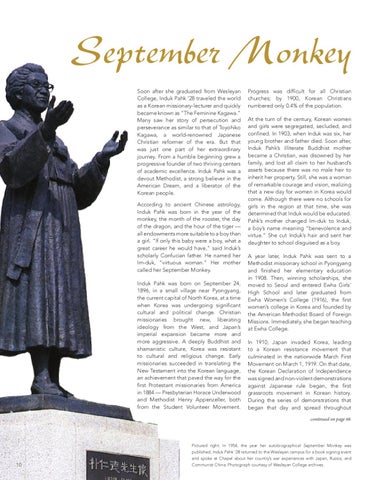
September Monkey Soon after she graduated from Wesleyan College, Induk Pahk ’28 traveled the world as a Korean missionary-lecturer and quickly became known as “The Feminine Kagawa.” Many saw her story of persecution and perseverance as similar to that of Toyohiko Kagawa, a world-renowned Japanese Christian reformer of the era. But that was just one part of her extraordinary journey. From a humble beginning grew a progressive founder of two thriving centers of academic excellence. Induk Pahk was a devout Methodist, a strong believer in the American Dream, and a liberator of the Korean people. According to ancient Chinese astrology, Induk Pahk was born in the year of the monkey, the month of the rooster, the day of the dragon, and the hour of the tiger –– all endowments more suitable to a boy than a girl. “If only this baby were a boy, what a great career he would have,” said Induk’s scholarly Confucian father. He named her Im-duk, “virtuous woman.” Her mother called her September Monkey. Induk Pahk was born on September 24, 1896, in a small village near Pyongyang, the current capital of North Korea, at a time when Korea was undergoing significant cultural and political change. Christian missionaries brought new, liberating ideology from the West, and Japan’s imperial expansion became more and more aggressive. A deeply Buddhist and shamanistic culture, Korea was resistant to cultural and religious change. Early missionaries succeeded in translating the New Testament into the Korean language, an achievement that paved the way for the first Protestant missionaries from America in 1884 –– Presbyterian Horace Underwood and Methodist Henry Appenzeller, both from the Student Volunteer Movement.
Progress was difficult for all Christian churches; by 1900, Korean Christians numbered only 0.4% of the population. At the turn of the century, Korean women and girls were segregated, secluded, and confined. In 1903, when Induk was six, her young brother and father died. Soon after, Induk Pahk’s illiterate Buddhist mother became a Christian, was disowned by her family, and lost all claim to her husband’s assets because there was no male heir to inherit her property. Still, she was a woman of remarkable courage and vision, realizing that a new day for women in Korea would come. Although there were no schools for girls in the region at that time, she was determined that Induk would be educated. Pahk’s mother changed Im-duk to Induk, a boy’s name meaning “benevolence and virtue.” She cut Induk’s hair and sent her daughter to school disguised as a boy. A year later, Induk Pahk was sent to a Methodist missionary school in Pyongyang and finished her elementary education in 1908. Then, winning scholarships, she moved to Seoul and entered Ewha Girls’ High School and later graduated from Ewha Women’s College (1916), the first women’s college in Korea and founded by the American Methodist Board of Foreign Missions. Immediately, she began teaching at Ewha College. In 1910, Japan invaded Korea, leading to a Korean resistance movement that culminated in the nationwide March First Movement on March 1, 1919. On that date, the Korean Declaration of Independence was signed and non-violent demonstrations against Japanese rule began, the first grassroots movement in Korean history. During the series of demonstrations that began that day and spread throughout continued on page 66
10
Pictured right: In 1954, the year her autobiographical September Monkey was published, Induk Pahk ’28 returned to the Wesleyan campus for a book signing event and spoke at Chapel about her country’s war experiences with Japan, Russia, and Communist China. Photograph courtesy of Wesleyan College archives.