6 minute read
A Message From Weld Australia’s CEO

INNOVATIVE TRAINING MODELS KEY TO AUSTRALIA’S CLEAN ENERGY TRANSITION
Australia’s skilled welder shortage has reached critical levels. Industry is already at capacity, with Weld Australia’s members turning away projects because they cannot find enough welders to complete the work. We have known for some time now that Australia will have a shortfall of at least 70,000 welders by 2030. Alarmingly, this projected shortfall of welders does not account for Australia’s move from carbon fuelled power generation to a renewable energy system. To combat this skills shortage, innovative training solutions are required.
Advertisement
Geoff Crittenden (CEO, Weld Australia)
The results of our 2022 Member Survey indicate that skills shortages have reached critical levels.
When asked what they are most concerned about, 64% of senior managers cited lack of skilled staff in an extremely constrained recruitment market.
With a considerable volume of work being onshored in the wake of international supply chain disruptions, most Australian fabrication companies are so strapped for skilled welders that they are working at anywhere between 30% and 50% of their full capacity. They are being forced to turn down jobs because they simply don’t have the manpower to complete the work. This is having a major impact on production and causing delays throughout downstream industries including building and construction, mining, oil and gas, and manufacturing.
It is little wonder that half of survey respondents have a pipeline of work that extends for six months or longer—this protracted pipeline is necessary in the face of these ongoing skills shortages. By way of context, this is a marked increase on Weld Australia’s 2020 member survey results. In the wake of the COVID-19 pandemic, the most common answers were a pipeline of work that extended less than one month (at 28%), one month (19%), and two months (16%).
Amid these skills shortages, employers are also facing increasingly unstable workforces. Employers never know when their staff might be forced into a seven-day isolation period, with COVID-19 case numbers reaching record highs over the last couple of months.
And, let’s not forget the strain that this is having on welders themselves. With so few skilled welders available, overtime and long hours are the norm. In some instances, this is leading to fatigue, non-compliant welds and rework.
None of this is surprising. The Australian Government has projected that, to 2024, the number of job openings for structural steel and welding trades will be above average. In some states, advertised vacancies have shown substantial increases over the last few years; Queensland has seen welding trades workers vacancies increase by 87%, Western Australia saw vacancies increase by 80%, and Victoria saw an increase of 18%.
And yet, the number of welding trade workers in Australia dropped by 8% in the course of just five years; from 75,800 in 2014 to 69,600 in 2019. In addition, completion rates of welding apprenticeships, including a Certificate III in Engineering (Fabrication Trade), continue to fall by as much as 23% annually.
We have known for some time now that Australia will have a shortfall of at least 70,000 welders by 2030.
Alarmingly, this projected shortfall of welders does not account for Australia’s move from carbon fuelled power generation to a renewable energy system.
According to the Australian Energy Market Operator’s (AEMO) 2022 Integrated System Plan, for Australia to become a renewable energy superpower, National Electricity Market needs approximately 269 GW of wind and approximately 278 GW of solar—equivalent to 34 times its current capacity of Variable Renewable Energy (VRE).
To put this into perspective, construction commenced this month on the MacIntyre Wind Precinct in Queensland. This consists of two wind farms and 180 turbines. This Wind Precinct will generate 1 GW of energy annually. So, if this project is used as a benchmark, Australia
needs to manufacture and erect 48,420 turbines to generate the 269 GW of wind power required. All this will require a highly skilled workforce.
While our governments can wish, and hope, and make public pledges about Australia’s transition to renewable energy, we simply do not have the sovereign manufacturing capability to make this a reality.
With Australian industry already desperate for welders, how will this extra demand be met?
A Global Perspective This skills crisis is not unique to Australia. By 2024, the United States is predicting that their workforce will need an additional 400,000 welders. To put this into perspective, that is equivalent to the size of the entire welding workforce in America as of 2019. Similarly, in a recent report released by the European Commission, welders and metal workers rank third on the list of occupations with the greatest workforce shortage.
The situation is much the same in Asia. For instance, according to data released in late 2021 by China’s Ministry of Human Resources and Social Security, 58 of the 100 occupations with the largest shortage of workers were classified as manufacturing roles, including welders. By 2025, the total number of skilled workers in 10 key areas of China’s manufacturing industry will be close to 62 million, with a talent demand gap of nearly 30 million—a 48% shortfall.
Even with international borders opening post-COVID, immigration is not the answer to Australia’s welding workforce crisis. There is no magic pool of international welders from which to draw on—this is a global skills crisis. Australia must develop its own sovereign manufacturing capabilities.
Innovative Training Programs The only way to combat this skills crisis is with innovative ideas— innovative training models that engage students and apprentices from the outset and retain them long-term.
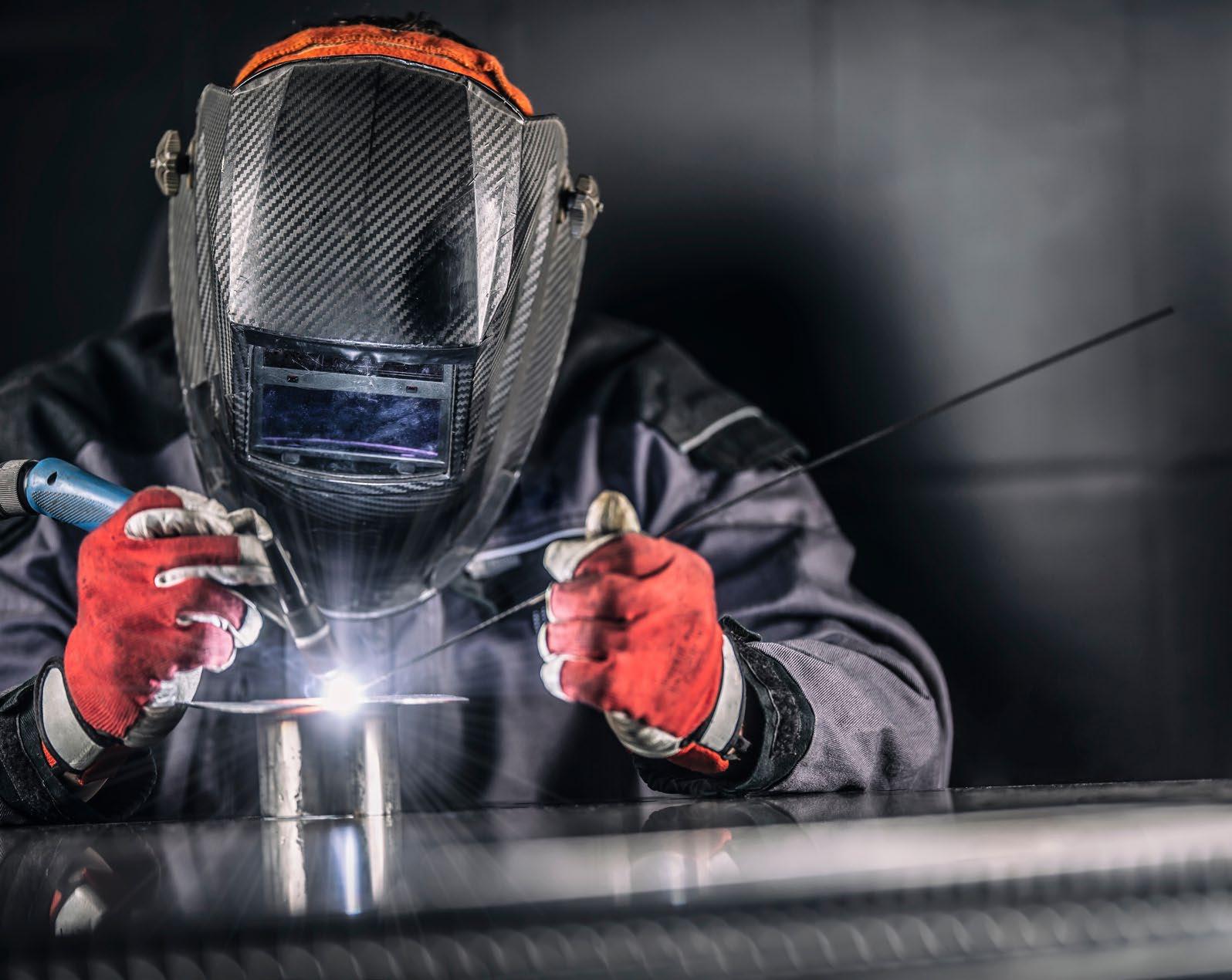
One such innovative training model is the BHP FutureFit Academy. Launched in 2020, the Academy is part of a new national training program designed to bolster Australia’s skills base and create new career pathways into the mining sector. Offering an innovative approach to training, the Academy’s fit-for-purpose maintenance training programs are run in dedicated learning centres in Perth, Western Australia, and Mackay in Queensland.
In the last two years, BHP’s FutureFit Academy has welcomed over 590 apprentices and trainees, with more than 80% women and over 20% Indigenous learners. The average age is about 30 years old, and most are from regional communities. There have already been over 220 graduates deployed to permanent jobs across BHP’s Australian operations. With strong demand for future intakes, BHP expects to train 2,500 new apprentices and trainees over the next five years. From day one at the Academy, students are a permanent BHP employee, earning a salary while they’re studying. The purpose-built learning centres feature the latest immersive virtual reality technology— including Soldamatic augmented reality welding simulators—combined with workshop learning designed to provide students with the training they need to competently and safely carry out their work in the field.
It is not just the likes of BHP rolling out innovative training programs. A range of Weld Australia members have invested in their own welder training programs. Komatsu, JRS Manufacturing, Maxi-Trans and Precision Manufacturing Group have all established their own schools.
Unless industry and governments come together now to formulate a plan of attack, when the time comes to manufacture the assets needed for a clean energy transition, the skilled workforce required will simply not exist. There will be no sovereign manufacturing capability.


