EE PROJECT 3H
(Human Horse Heart) Working with horses with the heart in mind
TRAINING & Showing
M
STORY AND PHOTOS BY Dr. Alessandra Deerinck
any are the ways to keep the heart in mind when working with horses. Some even think that heart rate can synchronize between equine and human, that they have a metaphysical connection, and that we should look up to the horse as an animal with superior qualities. While working with the heart in mind is a very needed mean of bringing wellbeing to horses, at Human Horse Sensing we prefer to stay clear from the wide spread tendency to give more meaning than it really has to the correlation between equine and human heart. Scientifically approaching a subject involves measuring meaningful values, and then focus on what we measured, but also not lose track of the complete picture. When heart rate synchronicity occurs between human and horse, the correlation does not equal causation. At Human Horse Sensing we think that heart rate synchronicity between human and horse can be caused by the situation of sentient individuals that are interacting, and being in the same environment seen from the different perspectives of a human species and a horse species. Horses always have their senses active in perceiving the environment as well as our behavior, and can become anxious because of their perception. Horses would not react to some aspects of a situation that can be stressful for human beings because they cannot understand details in the same manner, and the same is true in reverse for people. For example, physiological markers like heart rate indicate that active performance in general impacts the equine metabolism, but the stress of performing “for an audience”, which is a meaningful concept for human beings is not additionally stressful for equines, unless there is physical reason at the time of the action, and horses can perceive it, or they had a previous similar experience that was not positive. An event in the surrounding area can actually distract an attentive animal from an already happening interaction, regardless of the character of it being cooperative or competitive and become the focus of the animal’s attention. This is very true for horses that naturally are prey
68
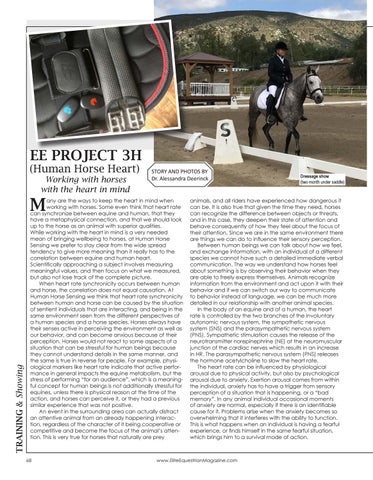
Dressage show (two month under saddle)
animals, and all riders have experienced how dangerous it can be. It is also true that given the time they need, horses can recognize the difference between objects or threats, and in this case, they deepen their state of attention and behave consequently of how they feel about the focus of their attention. Since we are in the same environment there are things we can do to influence their sensory perception. Between human beings we can talk about how we feel, and exchange information, with an individual of a different species we cannot have such a detailed immediate verbal communication. The way we understand how horses feel about something is by observing their behavior when they are able to freely express themselves. Animals recognize information from the environment and act upon it with their behavior and if we can switch our way to communicate to behavior instead of language, we can be much more detailed in our relationship with another animal species. In the body of an equine and of a human, the heart rate is controlled by the two branches of the involuntary autonomic nervous system, the sympathetic nervous system (SNS) and the parasympathetic nervous system (PNS). Sympathetic stimulation causes the release of the neurotransmitter norepinephrine (NE) at the neuromuscular junction of the cardiac nerves which results in an increase in HR. The parasympathetic nervous system (PNS) releases the hormone acetylcholine to slow the heart rate. The heart rate can be influenced by physiological arousal due to physical activity, but also by psychological arousal due to anxiety. Exertion arousal comes from within the individual, anxiety has to have a trigger from sensory perception of a situation that is happening, or a “bad memory”. In any animal individual occasional moments of anxiety are normal, especially if there is an identifiable cause for it. Problems arise when the anxiety becomes so overwhelming that it interferes with the ability to function. This is what happens when an individual is having a fearful experience, or finds himself in the same fearful situation, which brings him to a survival mode of action.
www.EliteEquestrianMagazine.com