Ogema Safe Routes to School Plan
April 2016
THIS PAGE INTENTIONALLY LEFT BLANK
SAFE ROUTES TO SCHOOL PLAN OGEMA ELEMENTARY SCHOOL WAUBUN-OGEMA-WHITE EARTH PUBLIC SCHOOL DISTRICT #435 APRIL 2016 OGEMA, MINNESOTA
Prepared by: West Central Initiative 1000 Western Avenue P O Box 318 Fergus Falls, MN 56538-0318
.
218-739-2239 www.wcif.org
Andrew J. Besold, Principal Author Emily Ambrosy, Outreach and Research
Safe Routes to School Plan | P a g e 1
THIS PAGE INTENTIONALLY LEFT BLANK
P a g e 2 | Safe Routes to School Plan
TABLE OF CONTENTS Table of Contents ........................................................................................................................................................ 3 Acknowledgements ..................................................................................................................................................... 7 Executive Summary .................................................................................................................................................... 9 Significant Findings .......................................................................................................................................... 10 Recommendations ............................................................................................................................................ 12 Chapter 1: Introduction ............................................................................................................................................. 18 Purpose of the Plan ........................................................................................................................................... 18 Chapter 2: About Safe Routes to School (SRTS) .....................................................................................................20 Overview ............................................................................................................................................................20 History ...............................................................................................................................................................20 The Decline of Walking and Bicycling ........................................................................................................... 21 Health Risks....................................................................................................................................................... 22 The 5 E’s of SRTS Planning .............................................................................................................................. 23 A 6th E? - Equity ............................................................................................................................................... 27 National Physical Activity Trends In Children ..............................................................................................29 Safe Routes to School Planning Framework .................................................................................................. 30 MnDOT Walk / Bicycle Zone Concept ............................................................................................................31 Status of State and Federal Support for Safe Routes to School .................................................................... 32 Minnesota Schools Statewide Enrollment Options and the Impacts on SRTS .......................................... 33 Chapter 3: Vision and Goals ..................................................................................................................................... 34 Chapter 4: Community and School Profiles .......................................................................................................... 35 Community Profile ........................................................................................................................................... 35 School and District Profile ............................................................................................................................... 38 Chapter 5: Strengths – Barriers – Opportunities Analysis .................................................................................... 43
Table of Contents | P a g e 3
Chapter 6: Community SRTS Open House Meeting ............................................................................................47 Chapter 7: Existing Conditions and Findings ....................................................................................................... 48 Ogema Walk / Bicycle Zones .......................................................................................................................... 48 Walk Audit ....................................................................................................................................................... 48 Observation Results ..........................................................................................................................................54 Traffic Volume Data ......................................................................................................................................... 55 Crash Data .........................................................................................................................................................59 Chapter 8: Standardized SRTS Survey Analysis .................................................................................................... 63 Key Findings – Parent Survey.................................................................................................................... 64 Parent Survey – Highlights .........................................................................................................................65 Student Travel Tally Highlights ................................................................................................................ 77 Discussion / Comparison ........................................................................................................................... 80 Chapter 9: Action Plan Recommendations ............................................................................................................. 81 Education ........................................................................................................................................................... 81 Encouragement ................................................................................................................................................ 84 Enforcement ..................................................................................................................................................... 86 Engineering .......................................................................................................................................................87 Evaluation ..........................................................................................................................................................92 Other ..................................................................................................................................................................93 Chapter 10: Conclusion ........................................................................................................................................... 94
P a g e 4 | Table of Contents
Appendices .................................................................................................................................................................95 Appendix A: Parent Survey Results ....................................................................................................................95 Appendix B: Student Travel Tally Results ....................................................................................................... 106 Appendix C: Data Collection Instruments ........................................................................................................ 110 Parent Survey: English ............................................................................................................................. 110 Parent Survey: Spanish ............................................................................................................................ 112 Student Travel Tally .................................................................................................................................. 114 Appendix D: Public Health Law Center, SRTS Policy Amendments .............................................................. 115 Appendix E: Minnesota SRTS Model Policies Tip Sheet ..................................................................................122 Appendix F: Waubun-Ogema-White Earth Public School District Transportation Policy ..........................127 Appendix G: Waubun-Ogema-White Earth Public School District Wellness Policy ................................. 145 Appendix H: Waubun-Ogema-White Earth Public School District Health & Safety Policy ...................... 150
Table of Contents | P a g e 5
THIS PAGE INTENTIONALLY LEFT BLANK
P a g e 6 | Table of Contents
ACKNOWLEDGEMENTS West Central Initiative acknowledges the contributions and guidance provided by the Safe Routes to School team members listed below. In addition, we express gratitude for the technical support and resources provided by the Minnesota Department of Transportation.
Safe Routes to School Team Members Annie Baker – Parent, Ogema Elementary School Dejah Buchette – Parent and Superintendent’s Assistant, Ogema Elementary School Jane E.W. Butzer, P.E. – Program Coordinator, MnDOT District 4 Kathy Clark – Community Member, City of Ogema Jeremy Cossette – Administrative Lieutenant, White Earth Police Department Al Haugo – School Board Member, Ogema Elementary School Jacob Haugo – Student, Ogema Elementary School Christie Haverkamp – School Board Member, Ogema Elementary School Shanda Hoban – Parent, Ogema Elementary School Patrick Hollister – Active Living Planner, PartnerSHIP 4 Health Laurie Johnson – Principal, Ogema Elementary School Joshua Kemper – Physical Education teacher, Ogema Elementary School Rose Lanoue – Teacher, Ogema Elementary School Tracy Lhotka – Parent, Ogema Elementary School Roberta Mastin – Community Member, City of Ogema Toni Napier – Community Member, City of Ogema Kimberly O’Brien – Community Member, City of Ogema Acknowledgements | P a g e 7
Rick Ohren – Mahnomen County Sheriff’s Department Dave Peterson – Teacher, Ogema Elementary School Bobbi Pinskie – Parent, Ogema Elementary School Tim Savior – Community Member, City of Ogema Jon Syverson – School Board Member, Ogema Elementary School Kayla Teiken – Parent, Ogema Elementary School Lisa Weber – Superintendent, Ogema Elementary School John Zima – School Board Member, Ogema Elementary School
Minnesota Department of Transportation (MnDOT) Lisa Austin – Bicycle and Pedestrian Planning Coordinator Nicole Campbell – Former Safe Routes to School Program Administrator Dave Cowan – Safe Routes to School Program Administrator Mary Safgren – Planning Director, MnDOT District 4
West Central Initiative Wayne Hurley – Planning Director Greg Wagner – Business & Economic Development Director / GIS Cartography
P a g e 8 | Acknowledgements
EXECUTIVE SUMMARY The purpose of this Safe Routes to School (SRTS) plan is to guide school officials, city staff, parents and educators in their efforts to make it easier, safer and more comfortable for students to walk and bicycle to and from school. Physical inactivity and increased levels of obesity are considered a public health crisis and walking or biking to and from school is an easy way for children to get the regular physical activity they need to combat this problem. Physically-active kids have fewer chronic health problems. They also have improved mood and concentration, a stronger self-image and more self-confidence which are all critical for succeeding in school and in life.
SRTS programs require community involvement and can improve the community’s quality of life well beyond that of students attending school. The SRTS planning process began in August of 2014 with a kickoff meeting. The SRTS team envisions a community connected by sidewalks and crosswalks where it is safe for children to walk and bicycle to school and where community members are educated and aware of pedestrian and bicycle traffic. The City of Ogema and Waubun-Ogema-White Earth (WOWE) Public School District makes the community uniquely suited to implement the identified recommendations. The recommendations in this plan address the five “E”s of education, encouragement, enforcement, engineering and evaluation, which is the standard strategy in SRTS planning. Also addressed are possible issues of equity. This needs to be considered as the community may have been historically underserved, have greater needs and/or have been more negatively affected by transportation planning decisions of the past. Today, they are left to deal with the resultant transportation infrastructure now found in their local community. After the SRTS planning document is approved by both the City of Ogema and WOWE Public School Board, the City and/or School District may seek out funding and resources to implement the identified recommendations.
Executive Summary | P a g e 9
SIGNIFICANT FINDINGS OBSERVATIONS AND WALKING AUDIT
Traffic speeds and traffic volumes on U.S. Highway 59 were observed to be high with a high number of trucks and commercial vehicles. These observations are confirmed in the MnDOT traffic volume data.
There were at least three students who walk to school and crossed U.S. Highway 59 at County Highway 18 and 370th (Kolb) Street. None of these three students were observed using the pushbutton-activated, LED-embedded “School Crosswalk Warning” signs.
There were concerns expressed by some observers about how some of the students walked through the parking lot after being dropped off by parents in family vehicles.
There was also some confusion as to how parents dropping off students in family vehicles should navigate the parking lot and where they should actually drop off students.
In the afternoon, a police car was parked on Feather Street near U.S. Highway 59, just north of the school. The vehicle’s presence seemed to have an effect on drivers, as vehicle speeds appeared to be reduced.
Number of students walking and biking to school in the morning: o
3, possibly 5 Pedestrians
o
0 Bicyclists
Number of students walking and biking to school in the afternoon: o
3 Pedestrians
o
0 Bicyclists
Use of the crosswalk and pushbutton-activated, LED-embedded “School Crosswalk Warning” signs at the intersection of the intersection of U.S. Highway 59, County Highway 18 and 370th (Kolb) Street was sporadic at best.
The pushbutton-activated, LED-embedded “School Crosswalk Warning” signs may not be having the desired effect of getting a majority of drivers to yield to pedestrians crossing U.S. Highway 59 when activated.
P a g e 10 | Executive Summary
The crosswalk at the intersection of U.S. Highway 59, County Highway 18 and 370th (Kolb) Street is placed at an angle across the intersection which creates additional potential conflicts for pedestrians with motorists and increases the time and distance that pedestrians must spend in the highway while crossing.
The existing sidewalk on U.S. Highway 59 varies from good to extremely poor condition and is covered in sand and debris for much of its length.
The Ogema School is in close proximity to most residences in Ogema but its location on the west side of U.S. Highway 59 is less than ideal for those living on the east side of the highway.
Besides Main Street, there are no other sidewalks in Ogema for students to use to walk and bike to and from school.
There is a well-worn desire path from Eagle Drive to school grounds.
PARENT SURVEY AND STUDENT TRAVEL TALLY RESULTS
According to the Student Travel Tally, only three percent of students walk to and from school. None bike.
Across grades Pre-kindergarten through Fourth, the school bus was the most frequently used mode of travel to and from school, followed by family vehicle.
Distance was the main reason some parents do not allow their children to walk or bicycle to and from school.
Roughly one third (33 percent) of children who live within one-half mile of the school walk to school in the morning. This number decreases to one sixth (17%) in the afternoon. However, the extremely small sample size from the parent survey means that these numbers have no statistical significance without knowing the total number of students that live within this distance from the school.
Safety factors, such as traffic speed and volume were chosen more frequently than crime or violence as barriers to children walking or biking to school.
Executive Summary | P a g e 11
RECOMMENDATIONS EDUCATION Goal: Establish at least two educational programs a year to foster and teach bicycle and pedestrian safety within the community. 1.
Facilitate an annual bicycle rodeo event to teach bicycle skills and safety to students.
2.
Educate students about proper walking and bicycling etiquette through in-school and after-school bicycle and pedestrian safety education. a.
If not existing, establish an after-school club.
b. Utilize the Walk! Bike! Fun! Curricula to help students understand the rules of the road. c. 3.
Identify the need for a bicycle fleet.
Develop a school district safety campaign to build awareness of students walking and bicycling to and from school, and to encourage safe driving behavior among parents and passersby.
4.
Design a parent workshop to provide tools, resources and support needed to encourage parents and other community members to begin walking and bicycling for transportation.
5.
Create a family-oriented educational training program that builds upon the school safety campaign (#3) such as a family biking class and/or family biking guide to teach basic bicycle maintenance, safety checks, etc.
ENCOURAGEMENT Goal: Explore strategies to promote walking and bicycling through the identification of safe routes, organizing events, rewarding participation and educating adults. 1.
Edit the Waubun-Ogema-White Earth Public School District Transportation and Wellness policies to include language that is not only supportive but actively promotes walking and biking to and from school as long as students routes are deemed safe and within a reasonable distance to the school as defined in the MnDOT Walk / Bike Zone concept.
2.
Develop informational messages to be included in the monthly school newsletter or email blast, encouraging students to walk or bike to school and highlighting associated health benefits.
P a g e 12 | Executive Summary
3.
Explore the development of a remote school bus drop site. Explore / develop a competition or challenge to reward students by tracking the number of times they walk or bike to school (within one-half mile). Such a competition should also allow the children that take the bus (over one-half mile) to participate in some way as well, preferably by having them do some sort of physical fitness activity like walking on school grounds, etc.
4.
Participate in International Walk and Bike to School Days to encourage students and their families to try walking or biking to school.
5.
Investigate the need and/or feasibility of a walking school bus for students within one-half mile of the school and/or within Ogema city limits.
ENFORCEMENT Goal: Address traffic and safety concerns by identifying and implementing enforcement measures within the school walk and bike zone. 1.
Increase the prevalence of traffic law enforcement in strategic locations during student morning arrival and afternoon dismissal.
2.
Identify the most effective form of automated speed feedback sign to be placed on U.S. Highway 59 for speeding traffic from both the north and south.
3.
Investigate the possibility of having an adult crossing guard at the intersection of U.S. Highway 59, County Highway 18 and 370th (Kolb) Street.
ENGINEERING Goal: Improve the existing infrastructure within the City of Ogema to ensure active transportation is encouraged and made safe. 1.
With MnDOT, coordinate and investigate the possible installation of a more robust, lighted, pedestrian-activated crosswalk beacon with a proven high yielding / stopping rate like a Highintensity Activated crossWalK (HAWK) beacon or a Rectangular Rapid Flashing Beacon (RRFB) at th
the intersection of U.S. Highway 59, County Highway 18 and 370 (Kolb) Street. Install any potential electrical conduit with the repaving of U.S. Highway 59 in 2016 keeping in mind Engineering suggestion #2.
Executive Summary | P a g e 13
2.
Coordinate and investigate with MnDOT about the potential safety benefits of realigning the th
crosswalk at the intersection of U.S. Highway 59, County Highway 18 and 370 (Kolb) Street. From the northwest corner of this intersection, it is suggested that a crosswalk be installed perpendicular th
to U.S. Highway 59 so that it terminates on the north side of 370 (Kolb) Street. From this point, a th
second crosswalk would be installed heading south to cross 370 (Kolb) Street and connect to the existing sidewalk on the east side of U.S. Highway 59 and the proposed sidewalk to head east on th
the south side of 370 (Kolb) Street. Incorporate Engineering suggestion #1. 3.
With MnDOT, coordinate and investigate the possibility of implementing a transitional speed limit of 45 mph on U.S. Highway 59 prior to traffic entering Ogema from both the north and south so that drivers are more likely to comply with the 40 mph speed limit as they traverse the city.
4. With MnDOT, coordinate and investigate replacing the current street light at the at intersection of th
U.S. Highway 59, County Highway 18 and 370 (Kolb) Street with a more robust streetlight(s) that is(are) preferably situated to emphasize drivers’ perception of pedestrians crossing U.S. Highway 59. 5.
With MnDOT, coordinate and investigate the addition of a second crosswalk at Uran Ave and the school entrance to not only serve the residences on the northeast side of Ogema but to also aid in the evacuation of school students to the Ogema Firehouse in case of an emergency on the Canadian-Pacific Railroad tracks that lie just 625 feet west of the Ogema School building. The importance of safely evacuating the school was reinforced by the March 23, 2016 train derailment and propane tanker explosion in nearby Callaway, Minnesota.
6. Investigate gateway and other traffic calming features on U.S. Highway 59 to better control traffic speed on the highway as it traverses the City of Ogema. A possible inexpensive treatment could be the installation of gore striping in the shoulders, in appropriate locations, that help to emphasize the perception of speed to passing drivers. 7.
Investigate the creation of a “School Zone” on U.S. Highway 59 that further reduces the speed limit when students are arriving and departing school.
8. Investigate the formal development of the crude, makeshift footpath that currently connects Eagle Drive to school property.
P a g e 14 | Executive Summary
9. Where practical, set sidewalks as far back as possible from the roadway curb to create a buffer between pedestrians and motor vehicle traffic. Such buffers can reduce traffic stress on pedestrians and make walking safer and more enjoyable. These buffers are even more important on busier roadways with higher traffic volumes, faster vehicle speeds and/or significant heavy truck traffic. This is of particular importance on U.S. Highway 59. 10. Clean sidewalk along U.S. Highway 59 of excessive sand and debris and develop a maintenance plan for debris and snow removal on this and other sidewalks in Ogema that do not front private property. 11. With MnDOT, coordinate the reconstruction and installation of new sidewalk along U.S. Highway 59 during the planned repaving of the highway. 12. With MnDOT, coordinate to install new sidewalks along U.S. Highway 59; on the west side between Feather Street connecting to the sidewalk south of the Ogema School entrance at Uran th
Ave and on the east side between Feather Street and 370 (Kolb) Street. 13. Coordinate with Becker County to investigate the reduction of the speed limit on County Highway 18 from a point west of the train tracks to U.S. Highway 59, from the current 55 mph to 30 mph so that vehicle speeds are greatly reduced near school grounds. A 30 mph speed limit on County Highway 18 in this location would be consistent with other county highway speed limits within Ogema city limits. th
14. Coordinate with Becker County to install a new sidewalk along the south side of 370 (Kolb) Street th
from U.S. Highway 59 to Sunnyside Ave and on the west side of Sunnyside Ave / 4 Street to Main Street. Placement of sidewalks on the selected sides of the streets is just a recommendation and is based on the observed space seen behind the curb, possible wetlands issues, the location of residences at the outreaches of town (County Highway 34 / 4th Street south of Main Street) and an effort to avoid pedestrians crossing over the predominant traffic movements at the intersection of Main Street and 4th Street. 15. Coordinate with Becker County to install new crosswalks at the intersection of 4th and Main Street, th
crossing 4 Street on the north side of Main Street and crossing Main Street on the west side of 4
th
Street.
Executive Summary | P a g e 15
16. Coordinate with Becker County to install a new sidewalk along the east side of 4th Street to Ontario Street. Placement of sidewalks on the selected sides of the streets is just a recommendation and is based on possible wetlands issues, the location of residences at the outreaches of town (County Highway 34 / 4th Street south of Main Street) and an effort to avoid pedestrians crossing over the predominant traffic movements at the intersection of Main Street and 4th Street. 17. Maintain the narrow width and investigate reducing the speed limit on Feather, Eagle, Oak, Ontario, Beaulieu (alley), 2
nd
rd
and 3 Streets and Uran Ave to 20 mph.
18. Coordinate with Becker County to investigate a complete streets reconstruction and narrowing of rd
Main Street between U.S. Highway 59 and 3 Streets with boulevard / planting strip between the sidewalk and the roadway, as well as marked crosswalks at the intersection with U.S. Highway 59 and another at the intersection with 3rd Street. 19. Coordinate with Becker County to redesign existing sidewalks on Main Street so that curb ramps line up with the crosswalks and meet contemporary Americans with Disabilities Act standards, namely the Public Right-of-Way Accessibility Guidelines (PROWAG). 20. Reduce or remove the excess width of the curb cuts leading into the gas station at the corner of U.S. Highway 59 and Main Street. 21. Investigate giving the edge of 2
nd
Street some better definition between Oak and Main Streets.
22. Investigate the installation of more robust and strategically-placed street lighting at the th
intersection of U.S. Highway 59, County Highway 18 and 370 (Kolb) Street to improve the conspicuousness of pedestrians crossing U.S. Highway 59 to drivers. 23. Investigate improving the mechanics of the school bus loading/unloading area and the parent pickup and drop-off on the school grounds to make it safer for students walking and biking to and from school, and for those being dropped of and picked up by family vehicle and school buses alike.
P a g e 16 | Executive Summary
EVALUATION Goal: Evaluate the effectiveness of programming by tracking baseline data and, in addition, actively work on improvement, based on results. 1.
Administer the student travel tallies at least once per year to track the number of students walking and bicycling in comparison to the 2014 baseline results.
2.
Administer a parent survey questionnaire once every two to three years to track and analyze school travel behaviors and parents’ perceptions.
3.
Explore establishing baseline health data (possibly already gathered) to evaluate possible health improvements over time related to SRTS improvements.
OTHER Goal: Create partnerships with local businesses and organizations to increase support and encouragement of active transportation. 1.
Identify opportunities or partners to fund bicycle helmets for educational events, like bike rodeos and/or Walk! Bike! Fun! training events.
Goal: Work to ensure all City policies and ordinances are supportive of active transportation. 2.
If not already in place, the city should create an ordinance that mandates the preservation of sidewalks installed within the public right-of-way regarding maintenance and clearance of those sidewalks by adjacent property owners during snow and other weather events.
3.
Ensure that existing sidewalks are properly cleared of snow and identify snow storage areas that do not impede walking and bicycling to school. This is particularly important at the corners of intersections.
Executive Summary | P a g e 17
CHAPTER 1: INTRODUCTION In April of 2014, the City of Ogema and Waubun-Ogema-White Earth (WOWE) Public School District received a Safe Routes to School planning assistance award from the Minnesota Department of Transportation (MnDOT). This plan is a product of that award and was developed to encourage students that live within an appropriate distance of the Ogema Elementary School to walk and bike to and from school, and to do so safely. In a collaborative effort with the City of Ogema, the WOWE Public School District, and members of the community, West Central Initiative staff developed this report which is focused on developing strategies and identifying the infrastructure needs to help attain these goals.
PURPOSE OF THE PLAN A Safe Routes to School (SRTS) plan is a multi-faceted guide for school officials, city staff, parents and educators to improve the conditions for students walking and biking to and from school. Walking or biking to and from school is an easy way for children to get the regular physical activity they need for good health. Physical inactivity and increased levels of obesity are considered a public health crisis and, as such, the Minnesota Department of Health has allocated funds and personnel through the Statewide Health Improvement Program (SHIP) to assist with SRTS programs such as Walk to School Day. Physically active kids have fewer chronic health problems, have improved mood and concentration, a stronger self-image, and increased self-confidence and independence—all of which are critical for succeeding in school and in life. In some communities, SRTS programs have had the added benefit of reducing and, in select cases, eliminating expensive student transportation costs. The recommendations in this plan are intended to improve safety, encourage walking and bicycling, empower students and reduce traffic congestion during the morning and afternoon school rush. Parents will only allow their children to walk to and from school if the parents are comfortable that it is safe for their children to do so. This plan was commissioned with these goals in mind.
P a g e 18 | Chapter 1: Introduction
While the primary goal of the plan is to make walking and bicycling to school a safe and desirable transportation choice, the safety improvements proposed have the potential to benefit the community as a whole. The sidewalk, trail and/or intersection improvements possibly built for students as a result of this report will always be there for any and all who wish to walk or bike for transportation and/or recreation, whether that be a couple going for an evening stroll after dinner or an elderly widow who needs to walk to her local church, convenience store, pharmacy, etc.
This five-to-ten year plan was developed for the City of Ogema and WOWE Public School District and is based specifically on the school’s location, the City’s and the surrounding School District’s geography, pre-existing conditions, school walk Figure 1: New sidewalks and street lights next to the
and bicycle zones, strengths, barriers,
Barnesville, MN football stadium were installed after the
opportunities and student population throughout
need was identified in a SRTS plan. While the sidewalk and lights were paid for with a SRTS infrastructure grant
the district. A 5-E SRTS plan greatly improves a
primarily to benefit students walking to and from school,
school’s and community’s chances to be awarded
these amenities are in the public right-of-way and benefit all
state and federal SRTS infrastructure grant funds.
in the community that wish or need to use them.
Chapter 1: Introduction | P a g e 19
CHAPTER 2: ABOUT SAFE ROUTES TO SCHOOL (SRTS) OVERVIEW Today more than ever, there is a need to provide options that allow all children—including those with disabilities—to walk and bicycle to school safely. Many communities struggle with traffic congestion around schools and motor vehicle emissions polluting the environment. At the same time, children in general engage in less physical activity, which contributes to the prevalence of childhood obesity. At first glance, these problems may seem to be separate issues, but SRTS programs can address all these challenges through a coordinated action plan.
SRTS programs use a variety of education, engineering and enforcement strategies that help make routes safer for children to walk and bicycle to school and encouragement strategies to entice more children to walk and bike. They have grown popular in recent years in response to problems created by a growing reliance on motor vehicles for student transportation, an expanding built environment, as well as the development and availability of federal and state funding for SRTS programs.
- National Center for Safe Routes to School. (2015) SRTS Guide - Introduction
1
HISTORY The SRTS concept began in the 1970s in Odense, Denmark, rooted in concern for the safety of children walking and bicycling to school.
The SRTS concept spread internationally, with programs developing in other parts of Europe, Australia, New Zealand, Canada and the United States. The Bronx, a borough of New York City, started the first SRTS program in the United States in 1997. In the same year, the State of Florida implemented a pilot program. In August of 2000, the U.S. Congress funded two SRTS pilot projects through the National Highway Traffic Safety Administration. Within a year of the launch of the pilot projects, many other grassroots SRTS efforts began throughout the United States.
1
National Center for Safe Routes to School. SRTS Guide – Introduction. 2015. Available at http://guide.saferoutesinfo.org/introduction/index.cfm. Accessed on December 22, 2015.
P a g e 20 | Chapter 2: About Safe Routes to School (SRTS)
Success with the pilot projects generated interest in a federally-funded national program. In 2003, advocates convened meetings with experts in pedestrian and bicycle issues to talk about SRTS issues and ideas for developing a national program. Momentum for a national SRTS program in the United States continued to build as several states developed their own programs.
Congress created the Federal-Aid Safe Routes to School Program in 2005 through comprehensive transportation legislation, ultimately resulting in nearly $1 billion in funding. Subsequent transportation legislation, Moving Ahead for Progress in the 21st Century (MAP-21) passed in 2012 making Safe Routes to School (SRTS) activities eligible to compete for funding alongside other programs, including the Transportation Enhancements program and Recreational Trails program, as part of a new program called Transportation Alternatives.
- National Center for Safe Routes to School. (2015) SRTS Guide - History
2
THE DECLINE OF WALKING AND BICYCLING Not long ago, children routinely moved around their neighborhoods by foot or by bicycle, and that was often how they traveled to and from school. That is no longer the case. Whether looking at the total proportion of children walking and bicycling to school, the proportion of children who live within a mile of school or the proportion of children living within one mile of school who walk or bike, the decline is apparent.
In 1969, 48 percent of children 5 to 14 years of age usually walked or bicycled to school.
In 2009, 13 percent of children 5 to 14 years of age usually walked or bicycled to school.
In 1969, 41 percent of children in grades K–8 lived within one mile of school. o
89 percent of these children usually walked or bicycled to school.
In 2009, 31 percent of children in grades K–8 lived within one mile of school; o
35 percent of these children usually walked or bicycled to school.
The circumstances that have led to a decline in walking and bicycling to school did not happen overnight and have created a self-perpetuating cycle. As motor vehicle traffic increases, parents become more convinced that it is unsafe for their children to walk or bicycle to school. They begin driving them to school, thereby adding even more traffic to the road and sustaining the cycle. Understanding the many reasons why so many children do not walk or bicycle to school is the first step in interrupting the cycle. 2
National Center for Safe Routes to School. SRTS Guide – History. 2015. Available at http://guide.saferoutesinfo.org/introduction/history_of_srts.cfm. Accessed on December 22, 2015.
Chapter 2: About Safe Routes to School (SRTS) | P a g e 21
Many factors contribute to the reduction in children walking and bicycling to school. The U.S. Centers for Disease Control and Prevention (CDC) conducted a nationwide survey of parents to find out the most common barriers that prevented them from allowing their children to walk to school. Parents of children aged 5 to 18 years cited one or more of the following six barrier reasons: Barrier Reason
Percentage of parents identifying with the barrier
Distance to school:
61.5
Traffic-related danger:
30.4
Weather:
18.6
Crime danger:
11.7
Opposing school policy:
6.0
Other reasons (not identified):
15.0
While this CDC report is from 2005, a report from the National Center for Safe Routes to School in 2010 found that these barriers remain the same. - National Center for Safe Routes to School. (2015) SRTS Guide – The Decline in Walking and Bicycling
3
HEALTH RISKS The U.S. Department of Health and Human Services recommends that children do 60 minutes (1 hour) or more of physical activity each day and that the bulk of this physical activity comes through aerobic exercise, such as walking and bicycling. For children and adolescents, regular physical activity helps build and maintain healthy bones and muscles, reduces the risk of developing obesity and chronic diseases, reduces feelings of depression and anxiety and promotes psychological well-being.
3
National Center for Safe Routes to School. SRTS Guide – The Decline in Walking and Bicycling. 2015. Available at http://guide.saferoutesinfo.org/introduction/the_decline_of_walking_and_bicycling.cfm. Accessed on December 22, 2015.
P a g e 22 | Chapter 2: About Safe Routes to School (SRTS)
Despite these benefits, many children are not getting adequate physical activity. In the 2014 United States Report Card on Physical Activity for Children and Youth, the National Physical Activity Plan Alliance reports that only 24.8 percent of youth ages 12-15 years obtain 60 minutes of moderate to vigorous physical activity every day. A 2014 CDC study reports that during the school day, only 4 percent of elementary schools and 8 percent of middle/junior high schools provide daily physical education classes, and in 2012 only 58.9% of all school districts required that elementary schools provide students with regularly scheduled physical activity. Unfortunately, less active children are more likely to be overweight, according to the American Academy of Pediatrics
When it comes to children's health, the costs of inadequate physical activity and poor eating habits are alarming. Inadequate physical activity and poor eating habits are major contributors to the increased rates of childhood obesity and overweight in the United States. Obese children are at least twice as likely to become obese adults. According to both a 2003 report by the American Academy of Pediatrics and a 2015 CDC, this puts obese children at greater risk for premature death and chronic diseases than their healthy-weight counterparts.
- National Center for Safe Routes to School. (2015) SRTS Guide – Health Risks
4
THE 5 E’S OF SRTS PLANNING Safe Routes to School (SRTS) programs are intended to improve the health and well-being of children by enabling and encouraging them to walk and bicycle to school. The recommendations outlined in this plan are based on the “5 E’s” of the National SRTS program, which include Education, Encouragement, Enforcement, Engineering and Evaluation. An integrated approach, each one of the “5 E’s” is intended to complement one another. Below is a detailed description of the “5 E’s”.
4
National Center for Safe Routes to School. SRTS Guide – Health Risks. 2015. Available at http://guide.saferoutesinfo.org/introduction/health_risks.cfm. Accessed on December 22, 2015.
Chapter 2: About Safe Routes to School (SRTS) | P a g e 23
EDUCATION Programs focused on education can have long-lasting effects on students that continue into adulthood. Education programs that teach students safety skills for walking and bicycling also form the basis of good driving skills they may need in the future. Programs should also target parents and other drivers to inform them how to drive more safely around pedestrians and bicyclists. A few examples of possible education strategies are bicycle rodeos that teach safe bicycling skills, classroom lessons focused on traffic safety, takehome flyers informing parents of the rules and regulations regarding student pick-up and drop-off at the school, the Minnesota Walk! Bike! Fun! program and thoughtfully-placed billboards with safety messages targeting drivers.
Figure 2: Bike MN instructors demonstrate to teachers how to do on-bike skill drills in a parking lot at the Rothsay, MN School.
P a g e 24 | Chapter 2: About Safe Routes to School (SRTS)
ENCOURAGEMENT Encouragement strategies are focused on getting students to try walking and bicycling to school and in turn to celebrate and reward students for their efforts. These strategies can be low cost, easy to implement and fun for students. Examples of encouragement activities include walking school buses and organizing events such as “Walk to School Day” (in October) and “Bike to School Day” (in May) to encourage students to try walking and biking to school.
ENFORCEMENT The primary goals of enforcement strategies are to help reduce unsafe behaviors by drivers, pedestrians, and bicyclists; and to increase awareness of laws protecting children who are walking and bicycling. Enforcement strategies
Figure 3: Hundreds of Frazee, MN students along with
include students, parents, and school personnel
teachers, parents, local officials, including police participate in International Walk to School day by walking on the new
working in conjunction with law enforcement
multi-use trail. The trail was built after it was identified in a
officers. Examples of enforcement activities include
SRTS plan as a possible valuable connector between a new
the installation of digital speed feedback signs,
neighborhood and the school (as well as downtown).
adult or student safety patrol, crossing guards and educational “stings” that inform motorists of the dangers of seemingly minor traffic infractions without issuing tickets.
ENGINEERING Engineering involves the planning and implementation of physical improvements to the built environment that make it safer and more attractive for students to walk and bicycle to and from school. For example, providing a designated space for pedestrians, such as sidewalks, has been proven to reduce pedestrian crash risks. Up to an 88 percent reduction in ‘walking along the roadway’ pedestrian crashes has been seen with
Chapter 2: About Safe Routes to School (SRTS) | P a g e 25
5
the installation of sidewalks on both sides of the road. However, engineering projects are most successful when used in conjunction with education, encouragement and enforcement strategies. Partnering with engineers and planners is crucial to the successful implementation of projects. Examples of engineering strategies include adding bicycle racks, installing fully-accessible crosswalks, sidewalks and multi-use trails, traffic calming, bicycle lanes, signs and signals, as well as other infrastructure.
Figure 4: This crosswalk is equipped with a pedestrian (push button) activated, solar-powered Rectangular Rapid Flashing Beacon (RRFB). It is located in Frazee, MN and crosses County Road 12 near the north entrance into town. It is a prime example of an engineering SRTS solution. It was installed as part of a new trail that allows students to get to school in a more direct and safer manner. Once a pedestrian presses the button located on the sign posts, super- bright yellow LED lights flash in an eye-catching “wiggle” pattern under both signs and in both directions. Otherwise, the LED lights remain turned off as seen in this photo. Driver compliance rates for crosswalks with RRFBs are significantly higher than at crosswalks without them, and can be relatively inexpensive to install.
5
US Department of Transportation – FHWA. An Analysis of Factors Contributing to “Walking Along Roadway” Crashes: Research Study and Guidelines for Sidewalks and Walkways. 2002. Report No. FHWA-RD-01-101, FHWA, Washington D.C.
P a g e 26 | Chapter 2: About Safe Routes to School (SRTS)
EVALUATION In order to measure the progress of the program activities over time, consistent evaluation is necessary. Evaluation techniques include a combination of quantitative and qualitative information. Schools are very strongly encouraged to continue conducting the National Centers for SRTS parent surveys (every two to three years) and student travel tally (once or twice a year) which were already done as part of this plan to provide baseline data. You can find the National Centers for SRTS survey forms in the Appendix C of this report. Other examples of evaluation strategies include but are not limited to, school walking audits and observations of student travel behaviors arriving to and leaving school. Figure 5: The cover page of the Pedestrian and Bicycle Information Center, Walkability Checklist. A walk audit is one of the ways a community can perform a SRTS evaluation.
A 6TH E? - EQUITY Recently, the principle of Equity has begun to be added to the standard “5 Es” of SRTS planning. According to the MnDOT SRTS webpage: Equity is a needs-based approach to allocating resources that aims to achieve fairness in the distribution of benefits and costs. In transportation planning, discussion of equity acknowledges that some communities and populations may require additional resources in order to have the same opportunities as other communities. Equity is often confused with equality, when in fact they have different meanings. Equality assumes that all needs are the same. The result is that every community gets the exact same resources without regard to individual differences. Equality works only in circumstances where everyone starts from the same place and needs the same things. Equity allows resources to be provided on the basis of need. Communities disproportionally impacted by safety, health or transportation access inequities Chapter 2: About Safe Routes to School (SRTS) | P a g e 27
are provided appropriate resources to address their individual needs. Therefore, resource allocation 6
may differ between communities .
Figure 6: This is a common diagram used to illustrate the concept of Equity versus Equality. Equality is demonstrated on the left, where six boxes (units of aid) are given equally to three people despite their differences in height (need). The two boxes are more than enough for the tall person to reach the fruit high in the tree (goal). Two boxes however is just enough for the person of medium height but still not enough for the short person (the one with the most need) to reach the high hanging fruit. When resources are distributed equally some people may be given more assistance then they need, while others are still not given enough. Equity is demonstrated on the right where the same six boxes (units of aid) are distributed to three people based on their differences in height (need). The tall person is given just one box as that is all (the aid) that person needs. The person of medium height is again given two boxes as that remains the amount of boxes (aid) this person needs to reach the high hanging fruit (goal). Finally, the short person is given three boxes (units of aid) as this is the additional level of assistance that person needed to be able to reach the fruit in the tree (goal). Source: Modified version of an image obtained from the Maine Office of Health Equity website.
The introduction of equity to the SRTS planning formula is an effort to better focus limited SRTS resources to communities and groups that have been often underserved, have greater needs and/or have been more negatively affected by transportation planning decisions of the past and the transportation infrastructure now found in their local community.
6
Minnesota DOT. SRTS webpage. Available at http://www.dot.state.mn.us/mnsaferoutes/. Accessed on November 23, 2015.
P a g e 28 | Chapter 2: About Safe Routes to School (SRTS)
NATIONAL PHYSICAL ACTIVITY TRENDS IN CHILDREN Children today are not attaining the recommended amounts of physical activity, contributing to the increasing rates of obesity and a variety of chronic diseases. Lack of physical activity along with poor nutrition is the second leading cause of preventable death, according to the Minnesota Department of 7
Health (MDH). Physical activity not only prevents chronic diseases but also improves moods and helps 8
with weight control. There is also increasing evidence that physical activity improves academic performance, attentiveness and concentration in the classroom.
9, 10, 11
There are many ways to promote physical activity among youth, and improving walking and biking to school is one of them. SRTS programs can increase students’ daily amount of physical activity and has the potential to decrease the prevalence of students becoming overweight or obese. It is recommended that children get sixty minutes of physical activity a day. Nationally, only 50 percent of high school students participated in any kind of physical activity that increased their heart rate for a total of 60 minutes on five 12
or more days a week. A 15-minute walking or biking route to and from school can help students meet much of their recommended 60 minutes of physical activity per day. Walking and bicycling to school at a young age also has the potential to instill habits of an active lifestyle that children may take with them into adulthood.
7
Minnesota Department of Health. The Minnesota Statewide Health Improvement Program SHIP Progress Brief - Year 2. Available at http://mn.gov/health-reform/images/WG-PPH-2012-03-16-SHIP-Progress_Brief-Yr2.pdf. Accessed on November 23, 2015. 8
Centers for Disease Control and Prevention (CDC). Physical Activity and Health webpage. Last updated June 4, 2015. Available at http://www.cdc.gov/physicalactivity/basics/pa-health/. Accessed on November 23, 2015. 9
Minnesota Department of Health. Physical Activity: Active School Day. Last updated November 04, 2014. Available at http://www.health.state.mn.us/physicalactivity/activeschool.html. Accessed on February 18, 2016. 10
Active Living Research. “Active Education: Growing Evidence on Physical Activity and Academic Performance”. January, 2015. Available at http://activelivingresearch.org/sites/default/files/ALR_Brief_ActiveEducation_Jan2015.pdf. 11
Centers for Disease Control and Prevention (CDC). The Association Between School-Based Physical Activity, Including Physical Education, and Academic Performance. July, 2010. Available at http://www.cdc.gov/healthyyouth/health_and_academics/pdf/pape_paper.pdf. 12
Centers for Disease Control and Prevention (CDC). 1991-2013 High School Youth Risk Behavior Survey Data. Available at http://nccd.cdc.gov/youthonline/. Accessed on January 10, 2015.
Chapter 2: About Safe Routes to School (SRTS) | P a g e 29
SAFE ROUTES TO SCHOOL PLANNING FRAMEWORK SRTS TEAM Successful SRTS programs recognize each community as being unique and emphasize the importance of including a diverse range of community representation on the team. The Ogema SRTS team included representation from the Ogema Elementary School and the Waubun-Ogema-White Earth (WOWE) Public School District (an administrator, teachers, student and parents), Mahnomen County, White Earth Nation Police Department, Minnesota Department of Transportation – District 4, PartnerSHIP 4 Health, and residents of the City of Ogema. The team members were directly involved in the planning process, with many having the knowledge and skills needed to implement the plan recommendations. After delivering the plan West Central Initiative (WCI) will continue to provide ongoing technical assistance to aid in plan implementation.
SRTS PLANNING PROCESS In January 2014, Ann Wothe formally of WOWE, contacted WCI to discuss a SRTS planning assistance grant. During this initial conversation, it was determined that they were looking for planning assistance specifically for the Ogema Elementary School. The WOWE Public School District crosses county lines and Regional Development Commission boundaries as it extends into Mahnomen County. However, since Ogema and the elementary school lie within WCI’s jurisdiction, it was determined that WCI would take the lead in developing the plan.
In August of 2014, the formal planning process began. With the assistance of staff at WCI, the SRTS team came together to review the school and community profiles, provide input on the barriers, outline the vision and goals, assist in data collection, and develop and review the recommendations. As part of the planning and outreach process, the community was invited and encouraged to provide feedback on the community’s strengths, barriers and opportunities (a type of SWOT Analysis adopted for SRTS planning).
P a g e 30 | Chapter 2: About Safe Routes to School (SRTS)
In addition to gathering community input, the team conducted an assessment of the community’s current conditions and policies in order to identify opportunities to advance walking and bicycling to school or programs that support active transportation. The team conducted observations to understand how many students walk and bike to and from school, what routes are most-traveled, their behaviors as pedestrians and bicyclists, and the interactions between pedestrians and motorists. In addition, the team conducted a separate walk-audit of the entire community to survey its geography and infrastructure. During the walkaudit, the team recorded sidewalk conditions, child-friendly opportunities to cross streets, along with vehicle speeds, and potential trail and sidewalk connections.
Furthermore, the team helped administer the National Centers for Safe Routes to School (National Centers) student travel tally survey and a separate parent survey. The student travel tally form is used to count the number of students arriving to and departing from school by various modes. The parent survey collects th
information from parents of K-8 graders about how their children travel to and from school, their attitudes towards active transportation, and finally barriers that prevent their children from participating in active transportation modes of travel. The results were then entered into the National Centers’ database. These assessment tools illustrate the range of current barriers and opportunities, which is the foundation of the identified recommendations. These surveys are to be done yearly with continuing WCI assistance so that possible trends in student travel behavior and parent perceptions can be identified and recorded with the National Centers for Safe Routes to School database. Understanding the possible changes in student travel trends will give school, school district, and WCI staff the information they need to be able to determine if the goal of getting more children to walk and bike to and from school is being met.
All of this information was reviewed by the SRTS team and analyzed by the staff at WCI to provide a list of recommendations to improve walking and biking to and from school, structured around the active transportation planning principles of the “5 E’s”.
MNDOT WALK / BICYCLE ZONE CONCEPT Children are more likely to walk or bicycle to school if they live within the school “walk/bicycle zone.” MnDOT defines this as “the area within the school’s enrollment boundary from which students can realistically walk or bike to school.” MnDOT guidelines generally assume a distance of up to o.5 miles for children in grades PreK-5, 1 mile for grades 6-8, and 1.5 miles for grades 9-12.
13
13
Minnesota DOT. Safe Routes to School: Neighborhood Assessment Guide. September, 2012. Available at http://www.dot.state.mn.us/saferoutes/pdf/srtschecklist.pdf . Accessed on November 16, 2015.
Chapter 2: About Safe Routes to School (SRTS) | P a g e 31
STATUS OF STATE AND FEDERAL SUPPORT FOR SAFE ROUTES TO SCHOOL A SRTS plan is not required to receive Minnesota state and/or federal SRTS infrastructure grants but is highly recommended. A school and/or community with a 5-E SRTS plan will be much better able to compete for limited funding and resources to implement the identified recommendations. Please be aware that with likely future changes in federal and state transportation laws, the following funding sources are subject to change. Please contact WCI or MnDOT for updated funding information at any point in the future.
FEDERAL st
In 2012, Congress passed a Federal transportation bill entitled Moving Ahead for Progress in the 21 Century (MAP-21). The Transportation Alternatives Program (TAP) established under MAP-21 provides funding for a variety of alternative transportation projects, including Safe Routes to School. (Unlike previously, when the SRTS program was a separately-funded category) TAP is funded from the Highway Account of the Highway Trust Fund at an amount equal to 2% of the total amount of federal-aid highways each fiscal year. Each state will develop their own program for soliciting projects to be funded by the TAP funds allocated to them. Late in 2015, Congress passed a five-year transportation spending bill called the Fixing America’s Surface Transportation Act (FAST Act), which was then signed into law by the President on December 4th. It is the first law enacted in over 10 years that provides long-term funding certainty for surface transportation. Overall, the FAST Act largely maintains current program structures and funding for SRTS. The only difference is that Transportation Alternative Program (TAP) which provides SRTS infrastructure funding has been renamed Transportation Alternatives (TA). The FAST Act does include two modest funding increases (4% over the life of the Act) for TA/SRTS programs . WCI can assist communities and school 14
districts that apply for federal TA and SRTS infrastructure funds.
14
US Department of Transportation. “The Fixing America's Surface Transportation Act or "FAST Act"”, webpage. https://www.transportation.gov/fastact#sthash.aDqlysIt.dpuf. Last updated January 12, 2016. Accessed on January 14, 2016.
P a g e 32 | Chapter 2: About Safe Routes to School (SRTS)
STATE In 2014 the Minnesota Legislature allocated $1 million from the general fund from that fiscal year’s budget to the SRTS Program as proclaimed by Minnesota Statute 174.40. MnDOT was tasked with administering the program and allocating the funding to communities. Under the 2014 state program, requested funds could be used only for construction costs, which must be clearly identified in the SRTS budget proposal. Applications could have been submitted for projects with a total cost as low as $50,000, which made them useful for spot improvements. Regardless, it was still recommended that the minimum project cost at least $100,000 to make efficient use of the funds and limited amount of administrative time at the local level.
It is uncertain if this program will receive funding again in the future.
MINNESOTA SCHOOLS STATEWIDE ENROLLMENT OPTIONS AND THE IMPACTS ON SRTS Minnesota law allows parents, whose children are Minnesota residents, the choice to enroll their children in a regular public school district other than the one in which they reside.
15
While not required to provide
transportation, school districts will often send buses into the immediate neighboring districts with the practical and alluring promise of front-door pickups. To compete, local school districts have then felt compelled to offer equivalent transportation services, even for students living within immediate proximity of the local school. This has had the unintended consequence of undermining many SRTS efforts. In prior communities in which WCI has done SRTS plans, the SRTS team had observed students being picked up by the local district bus only to be taken to the school a block away, a distance walked in no more than a minute.
15
Minnesota Department of Education. Enrollment Choices Statewide Enrollment Options (Open Enrollment) Key Topics, webpage. http://education.state.mn.us/MDE/StuSuc/EnrollChoice/003871. Accessed on January 14, 2016.
Chapter 2: About Safe Routes to School (SRTS) | P a g e 33
CHAPTER 3: VISION AND GOALS The SRTS team created a vision for Ogema and the Ogema Elementary School by imagining what Ogema will look like in five to ten years after the successful and complete implementation of the Ogema SRTS Plan. In order to make the vision a reality, the team set goals to attain and barriers to overcome in pursuit of opportunities to increase walking and bicycling to and from school. The goals outlined below are that of the SRTS team. Most of these goals are attainable through the Action Plan Recommendations found in Chapter 9, however those recommendations were not developed to address these goals as an itemized list.
VISION Students have access to safe and well-maintained travel paths and are encouraged to walk or bike to and from school because it’s a safe and convenient form of transportation.
GOALS 1.
Identify a speed reduction technique to alter driver’s perception of the road environment on U.S. Highway 59. a.
Decreasing the lane width from 12 ft. to 11 ft.
2.
Install vertical landscaping, such as trees, along U.S. Highway 59.
3.
Improve the existing sidewalk running north and south on U.S. Highway 59 by adding curb ramps and a buffer zone, increasing the sidewalk width to 5 feet and ensuring continuity.
4.
Identify key messages to educate parents, children, drivers and neighbors on pedestrian, bicyclist and traffic safety.
5.
When conditions are safe to walk and bicycle to school, create ongoing programs and activities to generate interest and build excitement in walking and bicycling.
6.
Conduct student travel tallies at least once per year, preferably twice to track the number of students walking and biking to and from school under different weather conditions and different times of the year.
7.
Conduct Parent SRTS Surveys once every two to three years to track parent perceptions and opinions about walking and bicycling to and from school as well as the number of students walking and bicycling to and from school.
8.
Identify funding sources for each of the recommended objectives outlined under the “5 E’s”.
P a g e 34 | Chapter 3: Vision and Goals
CHAPTER 4: COMMUNITY AND SCHOOL PROFILES COMMUNITY PROFILE The City of Ogema is located in Becker County in west central Minnesota and also lies within the White Earth Nation Indian Reservation. Ogema is 201 miles northwest of the state capitol in Saint Paul, 43 miles east-northeast of the Red River between downtown Fargo, North Dakota and downtown Moorhead, Minnesota and about 21.5 miles north of the Becker County Courthouse in Detroit Lakes via U.S. Highway 59 which bisects the city.
Ogema is a rural agrarian community on the far eastern edge of the Great Plains and the Prairie Biome. It is on the cusp of the sliver Deciduous Forest Biome that buffers the Prairie from the Coniferous Forest Biome further east.
According to the 2010 U.S. Census, the City of Ogema has a population of 184 residents,
Figure 7: Ogema’s location in Minnesota relative to major landmarks.
in 73 households, with 49 families, all living within 1.29 square miles. This gives the City a population density of 150 residents per square mile. The racial makeup of the city was 38.6% White, 46.2% Native American, and 15.2% from two or more races. Hispanic, or Latino of any race, was 3.3% of the population. In Becker County, the top five industries in order of number of people employed are health care and social services, retail, manufacturing, hospitality and food services, and public administration.
16
16
US Census Bureau. American Fact Finder. 2010. Accessed March 18, 2016.
Chapter 4: Community and School Profiles | P a g e 35
The White Earth Nation is a tribe of Ojibwe or Anishinaabe which means "the original people." Today, the population on the White Earth Reservation is predominantly white, as the Nelson Acts permitted sales of land to non-Natives. The 2000 census reported a population of 9,192 for the White Earth Reservation. The Native American population was reported as 3,378. It has been suggested by some within the tribe that the population of the White Earth Band is much higher on the Reservation than reported as many Anishinaabe have more than one family living in a home and are likely to not have participated in Census counts.
P a g e 36 | Chapter 4: Community and School Profiles
Figure 8: The City of Ogema city limits and school location.
Chapter 4: Community and School Profiles | P a g e 37
SCHOOL AND DISTRICT PROFILE The Ogema Elementary School is located on the northwest corner of U.S. Highway 59 and County Highway 18, in Ogema, MN which is in the northwestern corner of the city (Figure 8). As of March 21, 2016, the school serves grades PreK-4 with a school enrollment of 252. The breakdown of students per grade is shown in Table 1 below. 79 percent of the students are Native American and approximately 75 percent of
Figure 9: The front entrance to the Ogema Elementary School.
students are eligible for free and reduced costs meals.
Table 1: Number of Students per Grade (School Year 2015-2016)
Grade
Size
PreK
32
K
56
1st
42
2nd
43
3rd
45
4th
34
The WOWE School District itself is very large, encompassing around 400 square miles in Becker and Mahnomen Counties. A small portion of the district is on the south east portion of Norman County and lies outside the White Earth Nation Indian Reservation. The district is roughly 58 miles from east to west and 18 miles north to south and reaches out into a number of townships and unincorporated lands, as far as 44 miles away from the school (Figure 11).
P a g e 38 | Chapter 4: Community and School Profiles
Figure 10: A close-up of the Ogema Elementary School, grounds, and its immediate surroundings.
Chapter 4: Community and School Profiles | P a g e 39
Figure 11: The Waubun-Ogema-White Earth School District, Ogema City Limits, Ogema School location and concentric radii from the school location.
P a g e 40 | Chapter 4: Community and School Profiles
WOWE PUBLIC SCHOOL DISTRICT MISSION The mission of the Waubun School District, a collaboration of communities and culture, is to prepare our students to be responsible citizens and lifelong learners in an ever-changing world.
REWARD SCHOOL The Ogema Elementary School is a leader in school performance. For three consecutive school years (201213, 2013-14 and 2014-15) the school was designated as a Reward School. This designation means the Ogema Elementary School was in the top 15% of all schools in the state during those years according to the Multiple Measurement Rating (MMR) from the Minnesota Department of Education. The rating is a 1 to 100% for all schools in the state and includes data on proficiency, growth, achievement gap reduction and graduation rates.
WOWE PUBLIC SCHOOL DISTRICT TRANSPORTATION SAFETY POLICY WOWE Public School District Student Transportation Safety Policy was first adopted in 1995 and last revised in 2015. The policy states, “The purpose of this policy is to provide safe transportation for students and to educate students on safety issues and the responsibilities of school bus ridership.” As such, this policy is focused on transporting students to school via school buses. The policy states that “riding the school bus is a privilege, not a right.” However, there are also no specific guidelines regarding busing for students living within safe walking and biking distance to school as defined by MnDOT’s SRTS “walk/bicycle zone” concept (See Chapter 2) nor are there guidelines for students, parent, teachers and administrators for those for students who choose to walk and/or bike to and from school..
The complete WOWE Student Transportation Safety Policy can be found in Appendix F and online at http://www.waubun.k12.mn.us/.
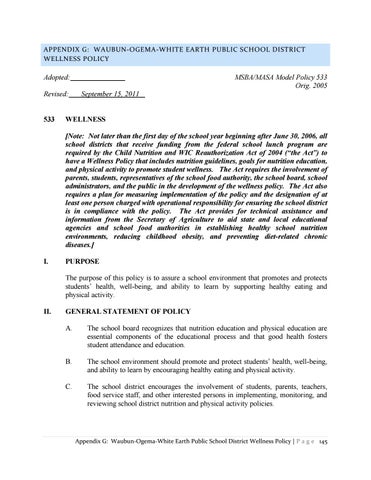
WOWE PUBLIC SCHOOL DISTRICT WELLNESS POLICY The WOWE Public School District adopted a wellness policy that became effective after June 30, 2006 and was then revised on September 15, 2011. The superintendent or designee will ensure compliance with the wellness policy and will provide an annual report of the school district’s compliance with the policy to the school board. The purpose of the policy is to “assure a school environment that promotes and protects students’ health, well-being and ability to learn by supporting healthy eating and physical activity.” More specifically, the guidelines outlined for physical activity are as follows:
Chapter 4: Community and School Profiles | P a g e 41
1.
“Students need opportunities for physical activity and to fully embrace regular physical activity as a personal behavior. Toward that end, health education will reinforce the knowledge and selfmanagement skills needed to maintain a healthy lifestyle and reduce sedentary activities such as watching television;
2.
Opportunities for physical activity will be incorporated into other subject lessons, where appropriate; and
3.
Classroom teachers will provide short physical activity breaks between lessons or classes, as appropriate.”
Also of note, the wellness policy states that the district “will support parents’ efforts to provide their children with opportunities to be physically active outside of school.” The policy does not directly outline walking and biking to and from school as a means to achieve this goal. With the adoption of the physical activity guidelines noted above, the WOWE Public School District recognizes the health and academic benefits of being physically active. The complete WOWE Public School District Wellness Policy can be found in Appendix G and online at http://www.waubun.k12.mn.us/. .
WOWE PUBLIC SCHOOL DISTRICT HEALTH AND SAFETY POLICY The WOWE Public School District Health and Safety Policy was first adopted in 2012 and last revised February 2015. It is a best management practices document regarding the management and operation of the school district physical plant to optimize the health and safety of students, faculty, staff and visitors alike. It is evaluated to ensure that no issues related to SRTS are contained within. The complete WOWE Public School District Health and Safety Policy can be found in Appendix H and online at http://www.waubun.k12.mn.us/.
OGEMA CITY SIDEWALK ORDINANCE / REGULATIONS No specific sidewalk regulations could be located for the City of Ogema.
RECOMMENDATIONS Policy recommendations to improve SRTS can be found in Chapter 9 in the Encouragement section and with further policy recommendations in Appendices D and E.
P a g e 42 | Chapter 4: Community and School Profiles
CHAPTER 5: STRENGTHS – BARRIERS – OPPORTUNITIES ANALYSIS A strengths, barriers and opportunities analysis of existing policies and programs related to walking and bicycling to school was also performed. This is similar to a SWOT Analysis (Strengths, Weaknesses, Opportunities and Threats) but tailored for use in SRTS planning. The comments in the following tables are not edited and are not listed in any priority order.
STRENGTHS The main existing strengths within the community are the presence of committed staff and community members, as well as the school’s location contiguous with the City of Ogema. A primary example of the personal commitment to SRTS are stakeholders such as local law enforcement and the school principal who are already involved in student safety around the school and key players in the SRTS Team. The strengths that enhance and support the opportunity for children to safely walk and bicycle to school were gathered by the Ogema SRTS Team and community members and are listed in greater detail in Table 2 below. Recommendations to improve SRTS found in Chapter 9 of this report are built off of many of these strengths. Table 2: Community and School District Strengths
Community Strengths 1
The presence of committed staff and community members at the school and in the City of Ogema.
2
School monitors are present to help direct morning traffic and ensure students can safely access the school from vehicles and buses.
3
The location of the school makes it accessible to those on foot and by bike living within city limits, based on the MnDOT Walk/Bike Zone Concept.
4
The school set-up and playground amenities allow for children to be active during after-school programs.
5
The school also provides busing for children attending after school programs.
6
Ogema Days is a community event that is accessible via walking or biking.
7
A pedestrian (button) activated LED crosswalk is in place on U.S. Highway 59.
Chapter 5: Strengths – Barriers – Opportunities Analysis | P a g e 43
8
Extraordinary level of parent and community involvement at the second kick-off meeting.
9
An Ogema police officer patrols vehicle speed on U.S. Highway 59 during school dismissal.
BARRIERS To successfully develop and implement SRTS activities and programs, it is important for the SRTS Team, with aid from members of the community, to identify and understand the existing barriers within the community that are preventing children from walking and bicycling to school. These barriers, listed in greater detail in Table 3 below, are an accumulation of information received from the SRTS team and community members. Table 3: Commuity and School District Barriers
Community Barriers 1
There is currently no designated path or trail for students to travel by foot or bike between Waubun and Ogema (a distance of 5.4 miles).
2
U.S. Highway 59 has a speed limit of 40 through Ogema and past the school. There is no transitional speed limit from the 55mph limit on either side of Ogema.
3
U.S. Highway 59 is very busy and is not safe for students to walk or bike across.
4
A housing development is located on Feather St. (just north of the school) and there are no sidewalks or an official trail for students to safely get to and from school.
5
The bus and parent drop-off area in front of the school is busy and potentially unsafe for students.
6
The Ogema School District covers a large geographical area, which increases the amount of time children are on the bus, sometimes over an hour.
7
County Road 18 on the south side of the school is unsafe for students due to the water drainage ditches. There is only one sidewalk, on the east side of the school.
8
Low visibility near the parent and bus drop-off areas.
9
Vehicles travel at speeds higher than the posted speed limit of 40mph on U.S. Highway 59.
P a g e 44 | Chapter 5: Strengths – Barriers – Opportunities Analysis
10
The topography of U.S. Highway 59 creates low visibility when approaching the school from either the north or the south.
11
The pedestrian activated signage on U.S. Highway 59 is not highly visible.
OPPORTUNITIES The SRTS Team, also with aid from members of the community, identified opportunities to improve walking and bicycling to school that are not currently being acted upon, as well as programs that support and encourage these behaviors. The list of opportunities in Table 4 is not exhaustive but is an accumulation of ideas and action steps to help achieve the overall vision. Table 4: Community and School District Opportunities
Community Opportunities 1
Identify the feasibility of implementing a school speed zone designation on U.S. Highway 59.
2
The City of Elbow Lake has a high concentration of students attending Ogema. There is an opportunity to develop targeted fitness and education programs in Elbow Lake.
3
Identify potential education and encouragement activities for students.
4
The town of White Earth has a community center which could potentially serve as a remote drop off area for students living there.
5
Opportunity to partner with the Boys and Girls Club in Ogema.
6
The open space and amenities behind the school could allow for education and encouragement activities to take place there.
7
There is room to place a bike rack near the front door of the school.
8
Safety patrol (parent or student) in school in parking lot and along U.S. Highway 59.
9
Provide education on pedestrian safety skills and informing parents how to drive more safely around pedestrians and bicyclists.
10
Introduce transition speeds on U.S. Highway 59 so traffic entering Ogema will be traveling at a lower speed.
Chapter 5: Strengths – Barriers – Opportunities Analysis | P a g e 45
11
Opportunity to build a path between the School and Eagle Drive / Feather Street housing development.
12
Partner with MnDOT on the resurfacing of U.S. Highway 59 this Summer.
13
Improve lighting on U.S. Highway 59, especially near crosswalk and intersections.
14
Sidewalk along school and U.S. Highway 59. Crosswalk connection between the school and the Fire Hall. (Emergency evacuation site).
15
School speed zone on U.S. Highway 59 with radar enabled speed feedback sign.
16
Install a stop light at the intersection of U.S. Highway 59 and County Highway 18 and th 370 (Kolb) Street.
P a g e 46 | Chapter 5: Strengths – Barriers – Opportunities Analysis
CHAPTER 6: COMMUNITY SRTS OPEN HOUSE MEETING On Sunday January 25, 2015 from 4:00-6:00 pm, the Waubun-Ogema-White Earth SRTS Committee held a community SRTS open house meeting in the Ogema Elementary School Open Gym. Available to the community members at the open house were the results from the strengths, barriers, and opportunities analysis seen in the previous chapter. Comments from members of the community are as follows and have not been edited. They are not listed in any priority order.
th
January 25 2015 Community SRTS Open House Comments 1
Path between the School and Eagle Drive / Feather Street housing development.
2
Sidewalk along school and county road U.S. Highway 59. Crosswalk connection between the school and the Fire Hall (Emergency evacuation site).
3
School speed zone and speed radar on U.S. Highway 59.
4
The pedestrian activated signage on U.S. Highway 59 is not highly visible.
5
Improve lighting on U.S. Highway 59, especially near crosswalk and intersections.
6
Partner with MnDOT on resurfacing this Summer.
7
Stop light at the intersection of U.S. Highway 59, County Highway 18 and 370 (Kolb) Street.
th
Chapter 6: Community SRTS Open House Meeting | P a g e 47
CHAPTER 7: EXISTING CONDITIONS AND FINDINGS The SRTS team conducted school observations, a community walking audit, and a neighborhood assessment in order to identify the existing conditions at the Ogema School and within the city. Traffic volume and crash data were also retrieved from MnDOT’s databases for the roads in and around Ogema. And while the SRTS team is a core group of individuals, most of whom are at the forefront of planning, broader community input was gathered to create a comprehensive list of existing conditions. To aid with this, a community open house was held on January 25, 2015 to collect additional community input (See Chapter 6). Having information on existing conditions is critical in making strategic decisions that support wise and fiscally-sound future SRTS programing and activities.
OGEMA WALK / BICYCLE ZONES As discussed in Chapter 2, MnDOT guidelines generally assume a distance of up to o.5 miles for children in grades PreK-5, 1 mile for grades 6-8, and 1.5 miles for grades 9-12 from which students can realistically walk or bike to school. The one-half mile “walk/bicycle zone” is shown in Figure 14, and is measured here by using bee-line radii from the center of the school. Most of Ogema fell within the 0.5 mile walk / bike zone which is considered the appropriate maximum distance for the PreK-4 students to walk and/or bike to and from the Ogema School. No residence within the urbanized area of Ogema was more than a mile from the school. Actual walking and biking distance are likely slightly greater due to direct route limitations imposed by the street network.
WALK AUDIT A walk-audit of the community was conducted in September of 2014 and again in March 2016 to gather data related to major streets, intersections and sidewalk conditions impeding or facilitating pedestrian and bicyclist safety. Factors that were documented include sidewalk width and condition, traffic volume, terrain, threatening features (dogs, perception of criminal activity, highways, and busy intersections), trash, speed limits, and general safety. The audit provided an opportunity for the team to identify where the community is walkable and where there are opportunities for improvement. The major street and intersection observations from the walk-audit are shown in Figure 14, and described in Table 5.
P a g e 48 | Chapter 7: Existing Conditions and Findings
School Location on U.S. Highway 59 The Ogema School is located on the west side of U.S. Highway 59 and north County Highway 18. U.S. Highway 59 also has a high volume of truck traffic and high vehicle speeds, and a low rate of vehicle drivers yielding to pedestrians particularly at the marked crosswalk
Sidewalks and Crosswalks From the main entrance of the Ogema School, there is a sidewalk that runs south in front of the school to the intersections of U.S. Highway 59 and th
County Highway 18 and 370 (Kolb) Street. From here, there is a crosswalk to the east side of U.S. Highway 59 and crosses the intersection at a skewed angle through the center of the intersection (see Figure 14). The crosswalk itself is of high visibility, “Continental,” bar style variety. It’s accentuated with a two-pedestrian, pushbutton activated, solar-powered, LED-embedded “School Crosswalk Warning” signs (MUTCD S1-1). It should be noted that the push buttons are oriented away from the sidewalk (see Figure 12). It has been said by members of the SRTS team that the rate of vehicle drivers yielding to pedestrians at this marked crosswalk was rather low despite the pushbutton activated, LED-embedded “School Crosswalk Warning” signs. From there, there is a sidewalk on the east side of U.S. Highway 59 that heads south from 370th (Kolb) Street. From this
Figure 12: The pushbutton activated, solar powered, LEDembedded “School Crosswalk Warning” signs (MUTCD S1-1) installed to aid pedestrians crossing U.S. Highway 59 at Kolb Street.
intersection, the first 320 feet of sidewalk is in good condition. South of there to approximately 370 feet north of Oak Street, the sidewalk is in exceptionally poor condition (see Figure 13). From that point south, the sidewalk is fair condition. It crosses Oak Street without a marked crosswalk and then terminates at the northeast corner of Main Street. All along U.S. Highway 59 there is little to no separation between the sidewalk and the shoulder of the highway and no curb for much the sidewalk’s length.
Chapter 7: Existing Conditions and Findings | P a g e 49
rd
Main Street has sidewalks on both sides from U.S. Highway 59 east to 3 Street. The sidewalk is in good condition but there are several large curb cuts, and curb ramps do not meet the latest Americans with Disabilities Act (ADA) requirements. There are no marked crosswalks between the sidewalk sections anywhere on Main Street. There are no other sidewalks in Ogema.
Street, Lane, and (if present) Shoulder Widths Street design and lane width can provide subtle clues to drivers as to a safe operating speed on a particular stretch of roadway. Today, recent thinking is that bigger is not always safer and that wide road and lane widths can encourage drivers to speed, even unintentionally. Wide streets and lanes, however, can provide the space needed within the right-of-way to install bike lanes, sidewalks, wider sidewalks, tree boulevards, etc. Throughout the study area, U.S. Highway 59 has 12 foot travel lanes and a wide shoulder approximately 12 feet in width. Main Street / County Highway 34 from U.S. Highway 59 to 3rd Street is exceptionally wide at 82 feet curb to curb. th
East of there to the intersection of 4 Street, it is 34 feet from pavement edge to pavement edge with Figure 13: An example of the very poor sidewalk conditions
a seven-foot wide soft shoulder on either side. At
on the east side of U.S. Highway 59 between 370th Street and
this intersection, County Highway 34 heads south
Beaulieu Street in Ogema. Also note the wide shoulder.
and then east as it exits Ogema and is 36 feet wide from pavement edge to pavement edge and has six-
th
foot-wide paved shoulders on either side. 4 Street north of Main Street is 42 feet wide from pavement th
edge to pavement edge and has eight-to-ten foot-wide shoulders. 4 Street north of Oak Street maintains the same roadway dimensions but is then called Sunnyside Ave and also has curbs. 370th (Kolb) Street has curbs between U.S. Highway 59 and Sunnyside Ave, and is 42 feet wide from pavement edge to pavement edge with nine foot shoulders.
P a g e 50 | Chapter 7: Existing Conditions and Findings
Speed and Speed Limits High-speed vehicles are long known to be a significant safety hazard to pedestrians and bicyclists. In the U.S., according to the AAA, if a pedestrian gets hit by a car traveling at 20 mph, there is approximately a 7% chance of death. The fatality rate climbs to 90% for a pedestrian struck at 60 mph. The greatest rate of fatality risk increase happens between 25 and 45 mph, increasing from 12% to 60%, according to AAA.
17
Other studies have the 45 mph pedestrian fatality rate at 85%. High-speed traffic also creates noise and induces stress on pedestrians, making even well designed sidewalks unappealing places to walk.
The speed limit on U.S. Highway 59 is 55 mph outside of Ogema. It slows down to 40 mph approximately 570 feet north of the Ogema School. Heading south, it stays at 40 mph through the City of Ogema to a point approximately 205 feet south of Main Street. South from there, the speed limit returns to 55 mph. County Highway 18 is paved and enters Ogema from the west and intersects U.S. Highway 59 immediately adjacent to the Ogema School. There are no speed limit signs on County Highway 18 and it is assumed that the speed limit is the default state standard for rural highways of 55 mph right up to the point it intersects U.S. Highway 59. This means there is a highway with a 55 mph speed limit directly adjacent to the Ogema School and school property. County Highway 34 enters Ogema from the southeast, turns west and become Main Street. It is posted at 30 mph approximately 1750 feet south and east of the intersection of Main Street. County Highway 142 is unpaved and enters Ogema across from where Main Street intersects U.S. th
Highway 59. It does not have a marked speed limit. 370 Street enters Ogema from east on the northern th
edge of town. The unpaved portion of 370 Street also does not have a marked speed limit but is assumed to default to the state urban speed limit of 30 mph when it becomes paved and enters Ogema. All other roads in the City of Ogema are either marked at 30 mph or are assumed to default to the state urban speed limit of 30 mph.
Notables and Concerns Of notable concern is the crosswalk near the school that crosses U.S. Highway 59. While it uses pedestrian, pushbutton-activated, LED-embedded “School Crosswalk Warning” signs to better inform drivers when pedestrians are actively crossing the highway, there are concerns that the speed, volume and nature of traffic on U.S. Highway 59 likely warrant a more robust pedestrian-activated crossing signal like a Rectangular Rapid Flashing Beacon (RRFB), or even a Pedestrian Hybrid Beacon (PHB) which is more commonly known as a HAWK Beacon (High-Intensity Activated crossWalK beacon).
17
AAA Foundation for Traffic Safety. Impact Speed and a Pedestrian’s Risk of Severe Injury or Death. September, 2011. Available at https://www.aaafoundation.org/sites/default/files/2011PedestrianRiskVsSpeed.pdf . Accessed on May 23, 2016.
Chapter 7: Existing Conditions and Findings | P a g e 51
Elsewhere, the lack of sidewalks on the more major roads in Ogema (Main St, 4th Street, Sunnyside Ave, 370th (Kolb) Street and portions of U.S. Highway 59 north of the Ogema School) are issues of concern. Table 5: Major Street and Intersection Conditions in Ogema, MN
Street or Intersection
Posted Speed Limit
Conditions Observed
U.S. Highway 59 (Rural)
55
12 foot wide shoulder. High volume of truck traffic and high vehicle speeds.
U.S. Highway 59 (Urban)
40
12 foot wide shoulder. High volume of truck traffic and high vehicle speeds. Sidewalk in good to very poor condition.
Intersection of U.S. Highway 59, and County Highway 18 and 370th (Kolb) Street
40, 55, 30
Crosswalk traverses intersection at a skewed angle through the center of the intersection. Likely warrants a more robust pedestrian activated crossing signal.
Main Street rd (between US 59 and 3 Street).
30
Roadway excessively wide (82 foot). Sidewalks present on both sides of roadway but likely do not meet latest ADA requirements.
Main Street (between rd 3 and 4th Streets).
30
Roadway is narrower at 42 feet but no sidewalks present.
4 Street / County Highway 34 (SE city limit to Oak Street).
30
Total roadway width is 34 foot with 7 foot shoulders and no sidewalks.
Sunnyside Ave
30
Total roadway width is 34 foot with 7 foot shoulders, curbs but no sidewalks.
370th (Kolb) Street (between US 59 and Sunnyside Ave)
30
42 foot wide with 9 foot shoulders, curbs but no sidewalks.
30
Poorly defined roadway edges / curbs.
th
nd
2 Street
P a g e 52 | Chapter 7: Existing Conditions and Findings
Figure 14: Ogema School Vicinity Map with existing sidewalk / crosswalk inventory and 1/2 mile walk / bike zone radius.
Chapter 7: Existing Conditions and Findings | P a g e 53
OBSERVATION RESULTS To gain a better understanding of the current conditions at and around the Ogema School, on Tuesday, September 16, 2014, the SRTS Team conducted field observations of students’ travel behaviors, patterns and mode choices during morning arrival and afternoon departure. Team members were strategically positioned around the school and in the City of Ogema. They counted the number of pedestrians and bicyclists accessing school grounds and which routes the students took. They also observed whether students were using good techniques when crossing the street and how motorists behaved in relation to pedestrians and bicyclists on the streets and on school grounds.
Morning Observations
Weather in Detroit Lakes: 7:30 AM - 45 °F. Clear. Wind Southwest at 5.8 mph.
18
Observations began at 7:20 AM with school starting at 8:15 AM. The busiest arrival time was between 7:34 and 8:00 AM. Nearly all observers noted the high traffic speeds, high traffic volumes and a high number of trucks and commercial vehicles on U.S. Highway 59. There were at least three students who walk to school and crossed U.S. Highway 59 at County Highway 18 and 370th (Kolb) Street. None of these three students were observed using the pushbutton-activated, LED-embedded “School Crosswalk Warning” signs. One observer location near the school parking lot saw five students walking to school. There were also concerns expressed by some observers about how some of the students walked through the parking lot after being dropped off by parents in private automobiles. There was also some confusion as to how parents dropping off students from private automobiles should navigate the parking lot and where they should actually drop off students. Some parents even parked in the student drop-off area. Afternoon Observations
18
Weather in Detroit Lakes: 3:00 PM - 66 °F. Clear. Wind South at 6.9 mph.
Observations began at 3:00 PM with school dismissing at 3:08 PM. Buses depart the school at 2 separate times with two leaving at 3:10 PM and another four leaving at 3:40 PM.
18
Weather Underground. Weather History for Detroit Lakes, MN: Tuesday, September 16, 2014. Available at http://www.wunderground.com. Accessed on March 28, 2016.
P a g e 54 | Chapter 7: Existing Conditions and Findings
As during the morning, there was a high volume of trucks and commercial vehicles observed on U.S. Highway 59. One parent with a student child was observed using the pushbutton-activated, LEDembedded “School Crosswalk Warning” signs to cross U.S. Highway 59 at County Highway 18 and 370th (Kolb) Street crosswalk. Three student walkers were observed being assisted by a parent. Two students crossed U.S. Highway 59 without using the crosswalk. Parent pick-up started at 3:00 PM with a lull by 3:07. A police car was parked on Feather Street near U.S. Highway 59, just north of the school and the vehicle’s presence seemed to have an effect on drivers, as vehicle speeds appeared to be reduced.
TRAFFIC VOLUME DATA While speed limits/traffic speed, street form (street width, number of lanes, lane width, presence of street trees, etc.) and the presence of sidewalks can have a great deal of impact on the safety of a street for pedestrians and bicyclists, traffic volume is also a highly-important factor. It goes without saying that streets with heavy traffic are often more dangerous for bicyclists and pedestrians due to increased exposure to potential conflicts. Traffic volumes are also the ultimate factor with regard to the stress experienced due to passing motor traffic while walking or biking (No traffic. No stress). Level of Traffic Stress (LTS) is a relatively new term in the active transportation field, which looks to replace or supplement the oftencriticized Level of Service (LOS) measure of facilitation for bicycles and pedestrians. High traffic stress environments can dissuade people from walking and biking despite the presence of facilities that have a high LOS. This report however does not attempt to measure LTS but provides traffic volumes to help understand current conditions and justify and prioritize future investments. A common measure of traffic volume is “Annual Average Daily Traffic”, abbreviated AADT. According to MnDOT, AADT “is the theoretical estimate of the total number of vehicles using a specific segment of roadway (in both directions) on any given day of the year. This estimate represents the total number of cars per year divided by 365 and is developed using factors to adjust for season, day of the week, and vehicle type.” “Heavy Commercial Annual Average Daily Traffic” (HCAADT) is a subset of AADT of just heavy commercial truck traffic. MnDOT defines “Heavy Commercial Traffic” as “traffic from all trucks with at least 2 axles and 6 tires.” It is important to have a measure of HCAADT when available because heavy commercial vehicles are more cumbersome to operate and the increased mass of these vehicles is likely to cause more serious injuries and/or fatalities when involved in any type of crash. Heavy commercial traffic also has a greater impact on LTS per vehicle observed.
Chapter 7: Existing Conditions and Findings | P a g e 55
Even though Ogema is a very small, rural community, it is traversed by U.S. Highway 59 with its high traffic speeds, high traffic volumes and a high number of trucks and commercial vehicles. Figures 15 and 16 are maps of the AADT and HCAADT from data collected by MnDOT of the more significant roads in the immediate vicinity of Ogema. Table 6 is a breakdown of both AADT and HCAADT (where available) within an approximate 2 mile radius of the center of Ogema City defined in this report as the intersection of Oak Street and 3rd Street.
Table 6: Average Annual Daily Traffic (AADT) for state system highways in and around Ogema and Heavy Commercial Average Annual Daily Traffic (HCAADT) on select highways.
Highway Name and Location
Average Annual Daily Traffic (AADT)
U.S. Highway 59 north of Main Street
4650
U.S. Highway 59 south of Main Street
3850
th
Main Street between U.S. 59 and 4 Street
1300
Main Street west of U.S. 59
20
2 Street between Main and Oak Streets
80
nd
th
4 Street / County 34 south of Main Street
1450
4th Street / Sunnyside Ave north of Main Street
280
th
370 (Kolb) Street between US 59 and Sunnyside Ave th
280
370 Street west of US 59
220
Highway Name and Location
Heavy Commercial AADT
U.S. Highway 59 north of Main Street
385
U.S. Highway 59 south of Main Street
315
P a g e 56 | Chapter 7: Existing Conditions and Findings
Figure 15: Average Annual Daily Traffic (AADT) for more significant roads in and around Ogema.
Chapter 7: Existing Conditions and Findings | P a g e 57
Figure 16: Heavy Commercial Average Annual Daily Traffic (HCAADT) for more significant roads in and around Ogema.
P a g e 58 | Chapter 7: Existing Conditions and Findings
CRASH DATA Crash data with the greatest proximal significance to walking and biking to the Ogema Elementary School was gathered using the online Minnesota Crash Mapping Analysis Tool (MCMAT – http://www.dot.state.mn.us/stateaid/crashmapping.html). The MCMAT data for Ogema was accessed March 30, 2016. As of that date, the dataset included crash reports from January 1, 2005 through June 1, 2015, all of which were included in this analysis. According to the MCMAT homepage, the lag time between crash occurrence and data entry into the MCMAT database can last approximately 2-3 months and the data is updated four times per year (approximately quarterly). The staff at WCI felt that collecting crash data within a one-mile radius of the intersection of 3rd and Oak Streets would provide the most utility. This intersection is the approximate center of Ogema, around 1650 feet south-southeast of the edge of school property that sits at the northwest edge of city limits. From that center point, a one-mile radius includes all of Ogema’s city limits and all residences that are within the walk / bike zone of the Ogema School plus more for good measure. A one-mile radius from the above-mentioned center point returns 21 crash reports from the MCMAT dataset. Of the 21, 14 have been mapped (see Figure 17). It is not known why 7 of the crash sites are not shown on the MCMAT generated map. Of these 21 crashes, there were no fatalities, two with nonincapacitating injuries, seven possible injuries, and 12 incidents of property damage (see Figure 18). Of the “Crash Types,” 12 of those crashes involved a collision with another motor vehicle in transport, four involved collisions with a parked motor vehicle, one involved a collision with an “other” non-fixed object, one involved a collision of an “other” type, one involved a collision with a bank, ditch or curb and two involved an overturned vehicle or rollover (see Figure 19). On average, there are 2 crashes in the selected area per year. There was no noticeable correlation with time of day or day of the week, or an increase or decrease in the number of crashes. No crashes are reported to have involved pedestrians or bicyclists. A MCMAT-generated crash summary report of all the pertinent crash statistics for the selected area around Ogema can be found on the last page of this chapter.
Chapter 7: Existing Conditions and Findings | P a g e 59
Intersection of 3rd and Oaks Streets
Ogema School Radius Center Point Crash Locations Pedestrian Involved Crash One-mile Radius
Figure 17: Map of the 14 out of 21 crash sites within a one-mile radius of the intersection of 3rd and Oaks Streets. Mapped crash sites are shown as red dots; crashes involving pedestrians if occurring, turquoise blue.
P a g e 60 | Chapter 7: Existing Conditions and Findings
Ogema Crash Severity – Severity Class and Number
Figure 18: Ogema Crash Severity - Severity Class and Number. Graph automatically generated online by MCMAT.
Ogema Crash Type and Number
Figure 19: Ogema Crash Type and Number. Graph automatically generated online by MCMAT.
Chapter 7: Existing Conditions and Findings | P a g e 61
P a g e 62 | Chapter 7: Existing Conditions and Findings
CHAPTER 8: STANDARDIZED SRTS SURVEY ANALYSIS A take-home self-report parent survey and a teacher-administered in-class student travel tally were conducted in September 2014. These surveys and survey documents have been designed by the National Centers for Safe Routes to School (National Centers) (http://www.saferoutesinfo.org/). These surveys and survey forms are the national standard for reporting SRTS data in the United States and help the National Centers keep track of walking and biking rates. As per the National Centers’ guidelines, both of these surveys are administered to gather data from students in grades K-8. However, since many school districts in rural Minnesota have only a K-12 school, some schools may have administered these surveys to students all the way up to grade 12. When this happens, it is WCI policy to enter the data as the individual surveys have a place to indicate what grade the student is in and it would be very easy to deselect data from students grade 9-12, if so desired. The results from Ogema School are for grades PreK-4.
The parent survey questionnaire is a two-page form that was taken home by students for parents to complete asking about their child’s school travel behaviors and the parents’ perceptions regarding whether walking and biking to school is appropriate and fitting for their child. Besides English, the parent survey is available from the National Centers in Spanish, Arabic, Armenian, Mandarin Chinese, Haitian Creole, Hmong, Korean, Russian, Somali, Ukrainian and Vietnamese. The parent survey can also be done online by parents themselves (English and Spanish only), saving administrative data entry time.
The student travel tally is administered by teachers and conducted over three days in a single school week throughout the entire school. Teachers record weather conditions on each particular day, in the morning and afternoon. Then the teachers ask about students’ travel modes to school that particular day and how they plan on going home.
Once the paper forms were completed and collected for both surveys, the data is entered on-line into the National Centers’ database by staff at WCI (this is done to maintain data entry continuity and as a service to the school). After the survey data is entered, those with access to the National Centers’ database can produce automated individual reports from each school for both the parent survey and the student travel tally. These reports provide a breakdown of the basic statistics that first establish a baseline that progress can be measured against in the future. The reports are also the origin of most of the graphs and charts in this chapter and all those in Appendix A and B. The 2014 surveys will be used to establish baseline data for the Ogema School. Moving forward, the parent survey will be done once every two to three years and the teacher-administered student travel tally will be done at least once, but preferably twice per school year.
Chapter 8: Standardized SRTS Survey Analysis | P a g e 63
Follow-up surveying, with help from WCI, will be done so that local, state and national officials can monitor trends over time in the travel habits of students traveling to and from school.
KEY FINDINGS – PARENT SURVEY Below are the more significant highlights gleaned from the 2014 parent survey for students grades PreKindergarten (PK) through 4. (Please note that parents of PK students were surveyed, which is not standard but admissible). Ogema Elementary School teaches students PK through 4. The results provide valuable information about parental attitudes and opinions relevant to SRTS at the Ogema Elementary School and create a benchmarking baseline which future analysis can be compared against.
The 2014 survey of the parents of students at the Ogema Elementary School found that five percent of children walked or biked to school and three percent walked or biked from school. These results aligned well with the results from the 2014 teacher-administered student travel tally, which showed three percent of children district-wide walked or biked to school and three percent walked or biked from school. When compared to national SRTS numbers from 2013 of 17.4 percent in the morning and 20.2 percent in the afternoon, the percentages of students walking and bicycling to the Ogema School are below average.
19
Further WCI staff analysis of the parent survey data showed that it’s possible that 33 percent of children who live within one half-mile of the school already walk to and from school. This is somewhat in keeping with the Walk/Bike Zone concept as defined and promoted by MnDOT, which generally assumes a distance of up to a half-mile for children in grades PreK-5 are walkable or bikeable for students within those grades. Clearly, there is room for improvement if this number truly represents the percentage of students walking and biking to and from school. Other results included:
Across all grades that attend the Ogema School (PK-4), the school bus was the most frequentlyused mode of travel to and from school followed by the family vehicle.
Distance was the main reason parents do not allow their children to walk or bicycle to/from school, by parents who currently do not allow their children to walk or bicycle.
Safety factors, such as traffic speed and volume, were chosen more frequently as barriers to children walking or biking to school than crime or violence.
A vast majority of parents (88 percent) believe that the Ogema School neither supports nor actively discourages children from walking and biking to and from school.
19
The National Center for Safe Routes to School. Trends in Walking and Bicycling to School from 2007 to 2013. March, 2015. Available at http://saferoutesinfo.org/sites/default/files/SurveyTrends_2007-13_final1.pdf. Accessed on April 1, 2016.
P a g e 64 | Chapter 8: Standardized SRTS Survey Analysis
A majority of parents (67 percent) believe that walking and biking to and from school is healthy (38 percent) or very healthy (29 percent) for their child.
PARENT SURVEY – HIGHLIGHTS For the complete Parent Survey results see Appendix A.
The Ogema Elementary School serves grades PK-4 with a total school enrollment of 252. Due to many students having siblings that also attend the Ogema School, only 100 surveys were distributed to parents. Of that 100, only 39 parent surveys were returned and met the criteria for inclusion in this report.
Question – Is the child who brought home this survey male or female? Approximately 54 percent of questionnaires were completed for male and 46 percent for female students.
Figure 20: Breakdown of male/female student representation in the parent survey.
Chapter 8: Standardized SRTS Survey Analysis | P a g e 65
Question – What is the grade of the child who brought home this survey? st
Kindergarten, followed by 1 and 2
nd
grade, had the highest number of responses, followed by the other
three grades (see Table 7). The percentages listed in the right column are not the percent of survey returns versus the total number of students in each grade. It is simply the percentage of surveys returned from that grade as part of the 39 total that were returned from the entire school. This is also what the term “percent” represents in most of the following survey questions. While a sample of 39 out of a school of 252 students may be enough to interpret parental attitudes from the school as a whole, the small number of returns of just five or six from some grades is likely not enough to draw accurate conclusion of parental attitudes in just those individual grade subsets. Table 7: Ogema Public School grade levels of children represented in parent survey (Fall 2014).
Grade levels of children represented in survey
No response: 0 Percentages may not total 100% due to rounding.
P a g e 66 | Chapter 8: Standardized SRTS Survey Analysis
Question – On most days, how does your child arrive and leave for school? A comparison of a child’s typical travel mode of arrival at and departure from school, as reported by parents, is shown in Figure 21 and Table 8. The survey is structured so that parents can give an answer for both how their child arrives at school and then leaves from school. Based on the parent responses, the school bus was the most common mode of travel both to and from school representing 64 percent and 67 percent of all trips, respectively. The second most frequently chosen mode for travel to and from school was the family vehicle at 28 percent and 31 percent, followed by walking at 5 and 3 percent.
The modes of travel chosen for school departure were not notably different than during arrival.
Figure 21: Typical mode of arrival at and departure from school (Fall 2014)
Chapter 8: Standardized SRTS Survey Analysis | P a g e 67
Table 8: Typical mode of arrival at and departure from school (Fall 2014)
Typical mode of arrival at and departure from school
No Response Morning: 0 No Response Afternoon: 0 Percentages may not total 100% due to rounding.
Question – How far does your child live from school? Parents were asked to give the distance from their home to the school. This question is asked in a way so that parents likely estimate that distance. These results are shown in Table 9. This is recorded because what parents estimate will have an effect on their mode choice for their child. Often parents will overestimate that distance and drive their child to school when walking and/or biking is a viable, safe and timely alternative. Table 9: Parent estimate of distance from the child’s home to school.
Don't know or No response: 3 Percentages may not total 100% due to rounding.
P a g e 68 | Chapter 8: Standardized SRTS Survey Analysis
Cross-reference – Distance, by arrival and departure modes These estimated distances are then cross-referenced with actual arrival and departure mode choice (Tables 10 and 11). Table 10: Parent estimate of the distance from child’s home to school and mode choice to school (Fall 2014).
School Arrival
Table 11: Parent estimate of the distance from child’s home to school and mode choice from school (Fall 2014).
School Departure
Chapter 8: Standardized SRTS Survey Analysis | P a g e 69
For the six students reported to live within one-quarter mile of the school, the school bus and the family vehicle still make up a sizable percentage of trips, particularly in the afternoon. No children are reported to live within one-quarter to one-half mile from the school. Only one child is reported to travel the estimated one half to one mile to school and that child is driven in the family vehicle both to and from school. Again, only one child is reported to travel the estimated one to two miles to school and that child uses the school bus to travel to and from school. Over two miles, all students use a motorized travel mode to and from school.
While the sample size was very small (6 students), further WCI staff analysis of the take-home survey data shows that 33 percent of children surveyed who live within one-half mile of the school already walk and bike to school in the morning (Table 12). In the afternoon however, that number decreases to only 17 percent of the children who live within one-half mile of the school, walking or biking home (Table 13). While this subset is extremely small and likely of no statistical significance, it seems to indicate a latent demand by students and/or parents for walking and/or biking up to one-half mile to the Ogema School. This is in keeping with the Walk / Bike Zone concept as defined and promoted by MnDOT which generally assumes a distance of up to a half mile for children in grades PreK-5 are walkable and/or bikeable. For students living within one half mile of the school, parents’ use of the school bus and family vehicle to travel to and from school is likely due to the convenience posed by both modes and of the perceived and/or real dangers posed by automobile traffic on U.S. Highway 59 and on the other roads in Ogema.
Table 12: School arrival modes for PK-4 students (raw numbers and percent) living within ½ mile of the Ogema Elementary School. A half mile is considered the appropriate maximum walking / biking distance for the PK-4 students that attend the Ogema School.
P a g e 70 | Chapter 8: Standardized SRTS Survey Analysis
Table 13: School departure modes for PK-4 students (raw numbers and percent) living within ½ mile of the Ogema Elementary School. A half mile is considered the appropriate maximum walking / biking distance for the PK-4 students that attend the Ogema School.
Question – What of the following issues affected your decision to allow, or not allow, your child to walk or bike to/from school? Parents were asked to identify issues affecting their decision to allow, or not allow, their child to walk or bike to and from school. Parents were given a list of options to choose from, with the ability to select as many reasons they felt applied. The results from this question were then split by whether parents did allow their child to walk or bike to and from school, or did not.
For this question, 30 parents said their “Child does not walk/bike to school,” one parent said their “Child walks/bikes to school,” and 8 parents did not answer.
Figure 22 illustrates the issues affecting parents’ decision to not allow their child to walk or bike both to and from school. For the 30 parents of children who do not walk or bike to/from school, the top four issues affecting their decision are “distance” (87 percent), “weather or climate” (73 percent), “speed of traffic along route” (70 percent), and “amount of traffic along route” (67 percent). The four least frequently cited issues are a lack of “sidewalks or pathways” (40 percent), “child’s participation in after school programs” (40 percent), “convenience of driving” (37 percent), and “adults to bike/walk with” (37 percent).
Chapter 8: Standardized SRTS Survey Analysis | P a g e 71
Figure 22: Issues reported to affect the decision to not allow a child to walk or bike to/from school by parents of children who do not walk or bike to/from school (Fall 2014).
P a g e 72 | Chapter 8: Standardized SRTS Survey Analysis
Figure 23 shows the results of the one parent respondent who allows their children to walk or bicycle to/from school. The three issues cited affecting this one parent’s decision were “speed along route”, “amount of traffic along route”, “safety of intersections and crossings”. Despite the phrasing of the question, it would seem that these are more issues of concern for this one parent even though they still allow their child to walk/bike to school.
Note: Because of the low response rate from parents that do allow their children to walk and bike to school (one), the results from this question are likely not statistically significant and likely cannot be compared to the general population or parents that do allow their children to walk and bike to school.
Figure 23: Issues reported to affect the decision to allow a child to walk or bike to/from school by parents of children who already walk or bike to/from school (Fall 2014).
Chapter 8: Standardized SRTS Survey Analysis | P a g e 73
Question – In your opinion, how much does your child’s school encourage or discourage walking and biking to/from school? Figure 24 shows the results of parents’ opinions about how much their child’s school encourages or discourages walking and biking to and from school. A vast majority (71 percent) feel that the Ogema School neither encourages nor discourages walking and biking. However, of the parents that had an opinion, more parents felt that the school discourages the activity to some degree (18 percent combined) versus those parents who believe the school encourages it (12% combined).
Figure 24: Parents’ opinions about how much their child’s school encourages or discourages walking and biking to/from school.
P a g e 74 | Chapter 8: Standardized SRTS Survey Analysis
Question – In your opinion, how much fun is walking or biking to/from school for your child? Figure 25 shows the results of parents’ opinions about how much fun walking and biking to and from school is for their child. While vast majority (79 percent) have a neutral opinion, and combined 18 percent of parents believe it to be fun to some degree (12 percent fun and, six percent very fun), only 3 percent believe it to be boring or very boring (zero percent believe it to be boring, three percent very boring). Of those that did have an opinion, six times as many thought walking or biking to and from school to be fun or very fun compared to those that thought it to be boring or very boring.
Figure 25: Parents’ opinions about how much fun walking and biking to/from school is for their child.
Chapter 8: Standardized SRTS Survey Analysis | P a g e 75
Question – In your opinion, how healthy is walking or biking to/from school for your child? Figure 26 shows the results of parents’ opinions about how healthy walking and biking to and from school is for their child. A vast majority, 67 percent of parents, believe it to be healthy to some degree for their child (38 percent healthy and 29 percent very healthy). 29 percent had a neutral opinion, three percent believed it to be unhealthy and zero percent believe it to be very unhealthy. Of those parents that had an opinion, 22 times as many parents felt that walking or biking to and from school was healthy for their child.
Figure 26: Parents’ opinions about how healthy walking and biking to and from school is for their child.
Parent Comments Survey ID
Comment
1273121
I walk my son across the road (HWY 59) in the morning for school. I would never let him walk alone unless the crosswalk issues is addressed on HWY 59. The traffic does not stop even with signs out and flashers. The speed limit is 40mph in front of the school. We need a school zone.
1273142
Walking and/or bicycling does not effect my household due to the amount of distance 10+ miles.
P a g e 76 | Chapter 8: Standardized SRTS Survey Analysis
STUDENT TRAVEL TALLY HIGHLIGHTS (For Complete Student Travel Tally results see Appendix B)
The student travel tally survey is used to quantify students’ travel both to and from school by travel mode. The tally form is administered in school, by teachers. The count is administered school-wide in one single school week. Doing the tally on all three mid-week days (Tuesday, Wednesday and Thursday) is greatly preferred but two of three midweek days is acceptable. Monday and Friday are avoided as possible weekend plans and/or holidays are more likely to affect students’ regular travel behaviors on those two days. Students are asked by a show of hands how they arrived at school that day and then how they plan to leave for home after school. This survey also records weather conditions on each particular day, morning and afternoon separately, as inclement weather can have an obvious effect on children walking or biking to and from school.
The student travel tally counts represent the number of actual recorded student trips (589) to and (569) from school on three days in September, 2014. Differences in these numbers are likely due to teachers forgetting to record a morning and/or afternoon travel tally on one or more days.
Question – How did you arrive at school today? How do you plan to leave for home after school? Travel mode results from the student travel tally match up well with the travel mode results from the parent survey. As seen in Figure 27 and Table 14, walking rates to school stayed around three percent in both the morning and afternoon. Riding the school bus and traveling in a family vehicle were the two most frequent travel modes. Compared to the morning commute, a lower percentage of students departed from school in a family vehicle and switched instead to the school bus. This is not consistent with the results of the parent survey which showed almost no mode shift in school bus and family vehicle use between morning and afternoon but that had a much smaller sample size. The higher use of a family vehicle in the morning may be due to the convenience of dropping off students while parents are headed to work.
Chapter 8: Standardized SRTS Survey Analysis | P a g e 77
Figure 27: Morning and Afternoon Travel Mode Comparison.
Table 14: Morning and Afternoon Travel Mode Comparison.
Morning and Afternoon Travel Mode Comparison
Percentages may not total 100% due to rounding. Weather Conditions – Sunny, Rainy, Overcast, Snow Arrival and departure modes were then cross-referenced based on weather conditions. The tally sheet allows for the recording of weather conditions each day, both in the morning and afternoon. Results between the two weather conditions (sunny and cloudy) were not noticeably different. As shown in Figure 28 and Table 15, weather did not appear to have an effect on the mode choice of students. Based on the results, a larger percentage of students walked to school in sunny weather conditions compared to overcast conditions. Because the tally was conducted on only three days of one week in September, students’ trips were not counted for all possible weather conditions, including rain and snow. Since a limited number of weather conditions were observed on the dates tallied, conclusions about the influence of weather on the choice of travel modes for students at the Ogema School is limited at best. P a g e 78 | Chapter 8: Standardized SRTS Survey Analysis
Figure 28: Travel mode by weather conditions (Fall 2014).
Table 15: Travel mode by weather conditions (Fall 2014).
Travel Mode by Weather Condition
Percentages may not total 100% due to rounding.
Chapter 8: Standardized SRTS Survey Analysis | P a g e 79
DISCUSSION / COMPARISON Results from both the parent surveys and student tallies are comparable, and besides the question addressing mode shift, did not contradict one another. The similarities of the results between both data collection instruments reinforce the credibility and reliability of the final results.
Distance from home to the school appears to be the predominant factor as to whether students either walk or bike, or take a motorized mode to and from school. Distance was also the main barrier cited by parents who currently do not allow their children to walk or bicycle, as to why they do not allow their child to walk or bicycle to and from school. This should not come as a surprise. After distance, safety factors such as traffic speed and volume were chosen more frequently as barriers to children walking or biking to school, more so than crime or violence. While parents’ real and/or perceived safety concerns with walking and biking to school should not be dismissed, for those that live within the Walk / Bike Zone of the Ogema School, those concerns are not insurmountable barriers.
Additional findings indicate that walking and biking to school is already fairly common for a possible 33 percent of PK-4 students that live within the one-half mile Walk / Bike Zone. It is difficult to know for sure since the sample size of students living within one-half mile of the school was so small, however the findings suggest that there is an opportunity to increase walking and bicycling to school for those students that live within one-half mile from school. All students living further than one-half mile from the school travel to and from school by motorized modes, which is to be expected.
While the results from the parent surveys and student travel tallies provide valuable baseline data, several limitations exist. The parent survey was self-reported information, which may self select and bias the results to a socially desirable response. Furthermore, the three-day time frame for student travel tallies, taken only during one school week out of the entire year, limits the likelihood of collecting data in all weather conditions. Additional analysis, particularly a second student travel tally at a different time of the year would be helpful to better understand student travel behaviors and how the weather influences travel mode decisions.
P a g e 80 | Chapter 8: Standardized SRTS Survey Analysis
CHAPTER 9: ACTION PLAN RECOMMENDATIONS EDUCATION Goal: Establish at least two educational programs a year to foster and teach bicycle and pedestrian safety within the community. 1.
Facilitate an annual bicycle rodeo event to teach bicycle skills and safety to students. Bicycle Rodeos are bicycle safety training events held over a period of several hours that teach bicycle safety lessons and on-bike skills, usually in a station format (e.g., bicycle safety check, helmet fitting, instruction about the rules of the road, on-bike obstacle course, on-bike skills drills, etc.). While geared towards children, many of the lessons can be appropriate for adults as well. Bicycle rodeos can be held as part of a larger event or on their own, and either during the school day or outside of school. Adult volunteers can administer rodeos, or they may be offered through the local police department. Key partners in implementing a bicycle rodeo event may (should) include teachers, League of American Bicyclists Cycling Instructors, and PartnerSHIP 4 Health.
2.
Educate students about proper walking and bicycling etiquette through in-school and after-school bicycle and pedestrian safety education. a. If not existing, establish an after-school club. b. Utilize the Walk! Bike! Fun! Curriculum to help students understand the rules of the road. c. Identify the need for a bicycle fleet. Observation results indicate that a number of students do not know proper walking etiquette. Students were not utilizing crosswalks and/or did not activate the LED-embedded “School Crosswalk Warning” signs. The Walk! Bike! Fun! Curriculum is an in-classroom and real-world (on foot, on bike) educational resource and can help address improper walking and biking behaviors like those observed by the SRTS Team. Taught by specially-trained school district teachers, this curriculum is intended for children ages five through thirteen. It teaches life-long skills related to traffic rules, potential hazards and bike handling skills that enable students to walk and bike safely and comfortably to and from school along with other trips around their communities. The curriculum addresses a variety of walking and bicycling topics and is endorsed by MnDOT. Finally, in order to engage students in the Walk! Bike! Fun! Curriculum, the Waubun-Ogema-White Earth
Chapter 9: Action Plan Recommendations | P a g e 81
School District, maybe even the whole White Earth Nation, should identify the need for a bicycle fleet, or identify a nearby fleet they may borrow.
Figure 29: The Fergus Falls bike fleet is kept inside this towable trailer.
Figure 30: Some of the inspirational graphics painted on the sides of the Fergus Falls bike fleet trailer.
P a g e 82 | Chapter 9: Action Plan Recommendations
3.
Develop a school district safety campaign to build awareness of students walking and bicycling to and from school, and to encourage safe driving behavior among parents and passersby. A school safety campaign should be developed that builds awareness around students walking and bicycling to and from school. An effective safety campaign might utilize multiple forms of media to get the attention of parents, students and passersby. Primary outcomes are improved walking, bicycling and driver safety behaviors (particularly near the school) and youth empowerment.
4.
Design a parent workshop to provide tools, resources and support needed to encourage parents and other community members to begin walking and bicycling for transportation. A parent workshop for those living in Ogema can provide the tools, resources and support needed for parents to overcome some of the common barriers noted by parents who do not allow their children to walk or bicycle to and from school. While distance and weather were the top two barriers noted by parents, traffic speed, the amount of traffic and safety while crossing intersections were also in the top five barriers noted. These perceived and real barriers will have a negative effect on anyone needing to cross U.S. Highway 59. Topics such as how to be a responsible driver, starting a walking school bus, and launching a safety campaign may impact the amount and speed of traffic near the school route.
5.
Create a family-oriented educational training program that builds upon the school safety campaign (#3) such as a family biking class and/or family biking guide to teach basic bicycle maintenance, safety checks, etc. Educational trainings teach students the skills necessary to walk and bike safely while encouraging them to try walking and bicycling on a regular basis. If held in conjunction with the school safety campaign, students and families have the opportunity to practice skills and gain confidence.
For more Education ideas, see Minnesota SRTS Model Policies Tip Sheet (Appendix E).
Chapter 9: Action Plan Recommendations | P a g e 83
ENCOURAGEMENT Goal: Explore strategies to promote walking and bicycling through the identification of safe routes, organizing events, rewarding participation and educating adults. 1.
Edit the Waubun-Ogema-White Earth Public School District Transportation and Wellness Policies to include language that is not only supportive but actively promotes walking and biking to and from school as long as students’ routes are deemed safe and within a reasonable distance to the school as defined in the MnDOT Walk/Bike Zone concept. A review of the Waubun-Ogema-White Earth Public School District Transportation, Wellness, and Health and Safety Policies (Appendices F, G, H) found no reference to walking or biking to and from school. One or more of these policies should have specific language that supports and actively promotes walking and biking to and from school for students, as long as it has been found to be safe and those students live within an appropriate distance. A sample Wellness policy amendment specific to Minnesota and SRTS was produced by the Public Health Law Center at the William Mitchell College of Law and can be found in Appendix D. An additional policy resource specific to Minnesota is the Minnesota SRTS Model Policies Tip Sheet which can be found in Appendix E. Finally, the SRTS National Partnership in cooperation with ChangeLab Solutions (a multi-disciplinary, multi-government agency policy partnership) has developed an on-line SRTS District Policy Workbook. This resource is a comprehensive SRTS policy guide covering everything from general policies supporting SRTS to more advanced policies like “No Idling Policies” and “School Siting Policies.” This resource is best accessed on-line and can be found at: http://www.changelabsolutions.org/safe-routes/welcome.
2.
Develop informational messages to be included in the monthly school newsletter or email blast, encouraging students to walk or bike to school and highlighting associated health benefits. Monthly informational messages can raise awareness about the positive health and academic benefits associated with increased physical activity, such as walking and bicycling. To get information to parents, a short message could be included in the monthly school newsletter.
P a g e 84 | Chapter 9: Action Plan Recommendations
3.
Explore the development of a remote school bus drop site. Explore / develop a competition or challenge to reward students by tracking the number of times they walk or bike to school (within one-half mile). Such a competition should also allow the children that also take the bus (over one-half mile) to participate in some way as well, preferably by having them do some sort of physical fitness activity like walking on school grounds, etc. Competitions or challenges provide students with immediate, positive reinforcement. The possible competitions or challenges are endless and could target individuals, classrooms or the entire school.
4.
Participate in International Walk and Bike to School Days to encourage students and their families to try walking or biking to school. International Walk and Bike to School Day attracts millions of participants all over the world. The intent is to encourage students and their families to try walking or bicycling to school for one day. In some districts with high busing numbers, events on this day might include a walk around school grounds and throughout the town for all students, or a remote bus drop-off which would allow all students to walk to school from that location. Depending on the response rate, these events could be extended into the future and turn into ongoing designated walking and bicycling days. Key partners include law enforcement officials, high school students, teachers, parent advocates and PartnerSHIP 4 Health. As a result, youth become empowered and more connected to health and their environment.
5.
Investigate the need and/or feasibility of a walking school bus for students within one-half mile of the school and/or within Ogema city limits. A walking school bus is a group of students walking to and from school with chaperones (usually adult/parent volunteers.) A walking school bus is a fun, healthy and easy opportunity for students to be physically active. A walking school bus usually provides front door pick-up and drop-off of students along the way, which can allay most parents’ fears. It can be done daily or just on certain days of the week and/or depending on weather conditions. The Ogema Elementary School should investigate the desire for a walking school bus and see if parents or other citizen volunteers are interested in taking turns walking students. If a walking school bus is explored, outreach to parents could be done via the parent newsletter. The hardest part to operating a walking school bus is finding enough dedicated volunteers to act as “drivers.”
For more Encouragement ideas, see Minnesota SRTS Model Policies Tip Sheet (Appendix E). Chapter 9: Action Plan Recommendations | P a g e 85
ENFORCEMENT Goal: Address traffic and safety concerns by identifying and implementing enforcement measures within the school walk and bike zone. 1.
Increase the prevalence of traffic law enforcement in strategic locations during student morning arrival and afternoon dismissal. Increasing the prevalence of law enforcement officers near the school may help to reduce vehicle speeds, improve compliance with speed limits around the school and increase the likelihood of vehicles yielding to pedestrians. This is a short-term, easy-to-implement recommendation that can be low cost.
2.
Investigate the possibility of having an adult crossing guard at the intersection of U.S. Highway 59, County Highway 18 and 370th (Kolb) Street. The presence of a trained adult crossing guard can be of invaluable importance to student safety as they cross U.S. Highway 59 and have the added benefit of acting as a source of encouragement to students and reassurance to parents. This person could be a school employee or adult volunteer.
3.
Identify the most effective form of automated speed feedback sign to be placed on U.S. Highway 59 for speeding traffic from both the north and south. Based on SRTS Team observations and community input, vehicle speeds on U.S. Highway 59 are, or seem to be, higher than the posted limit near the school. WCI observations seemed to confirm this. It is recommended that the City of Ogema, with help of MnDOT, identify the most effective form of automated speed feedback sign to be placed on U.S. Highway 59 in order to reduce vehicle speeds and increase vehicle compliance with speed limits.
For more Enforcement ideas, see Minnesota SRTS Model Policies Tip Sheet (Appendix E).
P a g e 86 | Chapter 9: Action Plan Recommendations
ENGINEERING Goal: Improve the existing infrastructure within the City of Ogema to ensure active transportation is encouraged and made safe. For a visual summary of the suggested Engineering proposals, please see Figure 30. 1.
Coordinate and investigate with MnDOT about the possible installation of a more robust, lighted, pedestrian-activated crosswalk beacon with a proven high yielding / stopping rate 20
like a High intensity Activated crossWalK (HAWK) beacon or a Rectangular Rapid 21
Flashing Beacon (RRFB) at the intersection of U.S. Highway 59, County Highway 18 and th
370 (Kolb) Street. Install any potential electrical conduit with the repaving of U.S. Highway 59 in 2016 keeping in mind Engineering suggestion #2. 2.
Coordinate and investigate with MnDOT the potential safety benefits of realigning the th
crosswalk at the intersection of U.S. Highway 59, County Highway 18 and 370 (Kolb) Street. It is suggested that that a crosswalk be installed perpendicular to U.S. Highway 59 from the th
northwest corner of this intersection so that it terminates on the north side of 370 (Kolb) Street. From this point, a second crosswalk would be installed heading south to cross 370
th
(Kolb) Street and connect to the existing sidewalk on the east side of U.S. Highway 59 and th
the proposed sidewalk to head east on the south side of 370 (Kolb) Street. Incorporate Engineering suggestion #1. 3.
Coordinate and investigate with MnDOT the possibility of implementing a transitional speed limit of 45 mph on U.S. Highway 59 prior to traffic entering Ogema from both the north and south so that drivers are more likely to comply with the 40 mph speed limit as they traverse the city.
4.
Coordinate and investigate with MnDOT about replacing the current street light at the th
intersection of U.S. Highway 59, County Highway 18 and 370 (Kolb) Street with a more robust streetlight(s) that is(are) preferably situated to emphasize drivers’ perception of pedestrians crossing U.S. Highway 59.
20
US Department of Transportation - FHWA. Safety Effectiveness of the HAWK Pedestrian Crossing Treatment. July, 2010. Available at https://www.fhwa.dot.gov/publications/research/safety/10042/10042.pdf. Accessed on April 7, 2016.
21
US Department of Transportation - FHWA. “Rectangular Rapid Flash Beacon (RRFB),” Tech Brief . May, 2009. Available at http://safety.fhwa.dot.gov/intersection/conventional/unsignalized/tech_sum/fhwasa09009/fhwasa09009.pdf. Accessed on April 7, 2016.
Chapter 9: Action Plan Recommendations | P a g e 87
5.
Coordinate and investigate with MnDOT the addition of a second crosswalk at Uran Ave and the school entrance. This would not only serve the residences on the northeast side of Ogema but also aid in the evacuation of school students to the Ogema Firehouse in case of an emergency on the Canadian-Pacific Railroad tracks. Said tracks lie just 625 feet west of the Ogema School building. The importance of safely evacuating the school was reinforced by the March 23, 2016 train derailment and propane tanker explosion in nearby Callaway, Minnesota.
6. Investigate gateway and other traffic-calming features on U.S. Highway 59 to better control traffic speed on the highway as it traverses the City of Ogema. A possible inexpensive treatment could be the installation of gore striping in the shoulders, in appropriate locations, that help to emphasize the perception of speed to passing drivers. 7.
Investigate the creation of a “School Zone” on U.S. Highway 59 that further reduces the speed limit when students are arriving and departing school.
8. Investigate the formal development of the crude, makeshift footpath that currently connects Eagle Drive to school property. 9. Where practical, set sidewalks as far back as possible from the roadway curb to create a buffer between pedestrians and motor vehicle traffic. Such buffers can reduce traffic stress on pedestrians and make walking safer and more enjoyable. These buffers are even more important on busier roadways with higher traffic volumes, faster vehicle speeds, and/or significant heavy truck traffic. This is of particular importance on U.S. Highway 59. 10. Clean sidewalk along U.S. Highway 59 of excessive sand and debris and develop a maintenance plan for debris and snow removal on this and other sidewalks in Ogema that do not front private property. With MnDOT, coordinate the reconstruction and installation of new sidewalk along U.S. Highway 59 during the planned repaving of the highway. 11. Coordinate with MnDOT to install new sidewalks along U.S. Highway 59; on the west side between Feather Street connecting to the sidewalk south of the Ogema School entrance at th
Uran Ave and on the east side between Feather Street and 370 (Kolb) Street.
P a g e 88 | Chapter 9: Action Plan Recommendations
12. Coordinate with Becker County to investigate the reduction of the speed limit from the current 55 mph to 30 mph on County Highway 18 from a point west of the train tracks to U.S. Highway 59, so that vehicle speeds are greatly reduced near school grounds. A 30 mph speed limit on County Highway 18 in this location would be consistent with other county highway speed limits within Ogema City Limits. th
13. Coordinate with Becker County to install new sidewalk along the south side of 370 (Kolb) Street from U.S. Highway 59 to Sunnyside Ave and on the west side of Sunnyside Ave / 4
th
Street to Main Street. Placing sidewalks on the selected sides of the streets is just a recommendation and is based on the observed room seen behind the curb, possible wetlands issues, the location of residences at the outreaches of town (County Highway 34 / 4th Street south of Main Street) and an effort to avoid pedestrians crossing over the predominant traffic movements at the intersection of Main Street and 4th Street. 14. Coordinate with Becker County to install new crosswalks at the intersection of 4th and th
Main Street, crossing 4 Street on the north side of Main Street and crossing Main Street th
on the west side of 4 Street. 15. Coordinate with Becker County to install a new sidewalk along the east side of 4th Street to Ontario Street. Placing sidewalks on the selected sides of the streets is just a recommendation and is based on possible wetlands issues, the location of residences at the outreaches of town (County Highway 34 / 4th Street south of Main Street) and an effort to avoid pedestrians crossing over the predominant traffic movements at the intersection of Main Street and 4th Street. 16. Maintain the narrow width and investigate reducing the speed limit on Feather, Eagle, Oak, Ontario, Beaulieu (alley), 2
nd
rd
and 3 Streets and Uran Ave to 20 mph.
17. Coordinate with Becker County to investigate a complete streets reconstruction and rd
narrowing of Main Street between U.S. Highway 59 and 3 Streets with boulevard / planting strip between the sidewalk and the roadway, as well as marked crosswalks at the rd
intersection with U.S. Highway 59 and another at the intersection with 3 Street.
Chapter 9: Action Plan Recommendations | P a g e 89
18. Coordinate with Becker County to redesign existing sidewalks on Main Street so that curb ramps line up with the crosswalks and meet contemporary Americans with Disabilities Act standards, namely the Public Right-of-Way Accessibility Guidelines (PROWAG).
22
19. Reduce or remove the excess width of the curb cuts leading into the gas station at the corner of U.S. Highway 59 and Main Street. 20. Investigate giving the edge of 2
nd
Street some better definition between Oak and Main
Streets. 21. Investigate the installation of more robust and strategically placed street lighting at the th
intersection of U.S. Highway 59, County Highway 18 and 370 (Kolb) Street to improve the conspicuousness of pedestrians crossing U.S. Highway 59 to drivers. 22. Investigate improving the mechanics of the school bus loading/unloading area and the parent pick-up and drop-off on the school grounds to make it safe for students walking and biking to and from school, and for those being dropped of and picked up by family vehicle and school buses alike. For more Engineering ideas, see Minnesota SRTS Model Policies Tip Sheet (Appendix E).
22
US Access Board. About the Rulemaking on Public Rights-of-Way, website. Available at https://www.access-board.gov/guidelinesand-standards/streets-sidewalks/public-rights-of-way. Accessed on April 7, 2016.
P a g e 90 | Chapter 9: Action Plan Recommendations
Figure 31: Ogema Safe Routes to School proposed engineering / walk and bike facility improvements.
Chapter 9: Action Plan Recommendations | P a g e 91
EVALUATION Goal: Evaluate the effectiveness of programming by tracking baseline data and, in addition, actively work on improvement, based on results. 1.
Administer the student travel tallies at least once per year to track the number of students walking and bicycling in comparison to the 2014 baseline results. In order to track the results of implemented programming, it is recommended that the Ogema Elementary School and the Waubun-Ogema-White Earth School District administer the student travel tallies at least annually. The results will indicate the number of students walking and bicycling, which in turn will identify the effectiveness of the programs. If possible, try to conduct the student travel tallies more than once per year, so it will be possible to capture travel data during periods of inclement weather, particularly rain and snow, to see how that affects students’ travel mode choice. This data will also be useful when applying for non-infrastructure or infrastructure funding.
2.
Administer a parent survey questionnaire once every two to three years to track and analyze school travel behaviors and parents’ perceptions. The parent survey tool tracks and analyzes student travel behaviors and parents’ perceptions of walking and bicycling. This survey should be conducted no more than bi-annually as attitudes are not likely to change that quickly. If done too frequently, parents may not be as inclined to complete them. Results can then be compared to the baseline analysis completed in the Fall of 2014.
3.
Explore establishing baseline health data (possibly already gathered) to evaluate possible health improvements over time, related to SRTS improvements. In order to track student health improvements over time, it is suggested that the Waubun-OgemaWhite Earth School District collect baseline health data. It is likely that the school district is already collecting this data. As SRTS programs and improvements are implemented, the health of students can be tracked on a continual basis. PartnerSHIP 4 Health may be able to help the school district organize this.
For more Evaluation ideas, see Minnesota SRTS Model Policies Tip Sheet (Appendix E).
P a g e 92 | Chapter 9: Action Plan Recommendations
OTHER Goal: Create partnerships with local businesses and organizations to increase support and encouragement of active transportation. 1.
Identify opportunities or partners to fund bicycle helmets for educational events like bike rodeos and/or Walk!Bike!Fun! training events.
Goal: Work to ensure all City policies and ordinances are supportive of active transportation. 2.
If not already in place, the city should create an ordinance that mandates the preservation of sidewalks installed within the public right-of-way and maintenance and clearance of those sidewalks by adjacent property owners during snow and other weather events.
3.
Ensure that existing sidewalks are properly cleared of snow and identify snow storage areas that do not impede walking and bicycling to school. This is particularly important at the corners of intersections.
Chapter 9: Action Plan Recommendations | P a g e 93
CHAPTER 10: CONCLUSION This Safe Routes to School (SRTS) plan is intended to guide the Waubun-Ogema-White Earth School District, Ogema Elementary School and the City of Ogema towards their collective goal of making it easier, safer and more fun for students to walk and bicycle to and from school. Where it is already safe, encourage students to walk and bicycle to school. Where it is less than ideally safe, improve the existing conditions to make it as safe as practically possible with an eye towards walking and bicycling comfort. When children get exercise on their way to and from school they:
Arrive more alert and able to focus,
Get a large portion of their recommended daily physical activity,
Are more likely to be a healthy weight,
Demonstrate improved test scores, and
Are less likely to suffer from anxiety.
The SRTS recommendations address the “5 Es” and were created to improve safety, reduce traffic congestion, encourage students to consider walking or bicycling, and instill an active lifestyle. The recommendations in this report were formed based on examining the existing conditions around the school, community input and the results of the parent surveys and student tallies. SRTS plans are the most successful when programs involve the entire community and when they are integrated into current and future policies. If, at any time, the Waubun-Ogema-White Earth School District, Ogema Elementary School or the City of Ogema have any questions about how to best enact the recommendations in this report, whether that be funding sources, best policies and practices, etc., they are encouraged to contact the staff at West Central Initiative and/or PartnerSHIP 4 Health.
P a g e 94 | Chapter 10: Conclusion
APPENDICES
APPENDIX A: PARENT SURVEY RESULTS
Parent Survey Report: One School in One Data Collection Period School Name: Ogema Elementary
Set ID: 12670
School Group: Ogema Safe Routes to School
Month and Year Collected: September 2014
School Enrollment: 398
Date Report Generated: 12/12/2014
% Range of Students Involved in SRTS: 26%-50%
Tags:
Number of Questionnaires Distributed: 100
Number of Questionnaires Analyzed for Report: 39
This report contains information from parents about their children's trip to and from school. The report also reflects parents' perceptions regarding whether walking and bicycling to school is appropriate for their child. The data used in this report were collected using the Survey about Walking and Biking to School for Parents form from the National Center for Safe Routes to School.
Sex of children for parents that provided information
P a g e 95 | Appendix A: Parent Survey Results
Grade levels of children represented in survey
Grade levels of children represented in survey
No response: 0 Percentages may not total 100% due to rounding.
P a g e 96 | Appendix A: Parent Survey Results
Parent estimate of distance from child's home to school
Parent estimate of distance from child's home to school
Don't know or No response: 3 Percentages may not total 100% due to rounding.
Appendix A: Parent Survey Results | P a g e 97
Typical mode of arrival at and departure from school
Typical mode of arrival at and departure from school
No Response Morning: 0 No Response Afternoon: 1 Percentages may not total 100% due to rounding.
P a g e 98 | Appendix A: Parent Survey Results
Typical mode of school arrival and departure by distance child lives from school
Appendix A: Parent Survey Results | P a g e 99
Typical mode of school arrival and departure by distance child lives from school School Arrival
Don't know or No response: 1 Percentages may not total 100% due to rounding.
School Departure
Don't know or No response: 1 Percentages may not total 100% due to rounding.
P a g e 100 | Appendix A: Parent Survey Results
Percent of children who have asked for permission to walk or bike to/from school by distance they live from school
Percent of children who have asked for permission to walk or bike to/from school by distance they live from school
Don't know or No response: 2 Percentages may not total 100% due to rounding.
Appendix A: Parent Survey Results | P a g e 101
Issues reported to affect the decision to not allow a child to walk or bike to/from school by parents of children who do not walk or bike to/from school
Issues reported to affect the decision to allow a child to walk or bike to/from school by parents of children who already walk or bike to/from school
P a g e 102 | Appendix A: Parent Survey Results
Issues reported to affect the decision to allow a child to walk or bike to/from school by parents of children who already walk or bike to/from school
No response: 8 Note: --Factors are listed from most to least influential for the 'Child does not walk/bike to school' group. --Each column may sum to > 100% because respondent could select more than issue --The calculation used to determine the percentage for each issue is based on the 'Number of Respondents per Category' within the respective columns (Child does not walk/bike to school and Child walks/bikes to school.) If comparing percentages between the two columns, please pay particular attention to each column's number of respondents because the two numbers can differ dramatically.
Appendix A: Parent Survey Results | P a g e 103
Parents' opinions about how much their child's school encourages or discourages walking and biking to/from school
Parents' opinions about how much fun walking and biking to/from school is for their child
P a g e 104 | Appendix A: Parent Survey Results
Parents' opinions about how healthy walking and biking to/from school is for their child
Comments Section Survey ID
Comment
1273121
I walk my son across the road (HWY 59) in the morning for school. I would never let him walk alone unless the crosswalk issues is addressed on HWY 59. The traffic does not stop even with signs out and flashers. The speed limit is 40mph in front of the school. We need a school zone.
1273142
Walking and/or bicycling does not effect my household due to the amount of distance 10+ miles.
Appendix A: Parent Survey Results | P a g e 105
APPENDIX B: STUDENT TRAVEL TALLY RESULTS
Student Travel Tally Report: One School in One Data Collection Period School Name: Ogema Elementary
Set ID: 16813
School Group: Ogema Safe Routes to School
Month and Year Collected: Sept. 2014
School Enrollment: 0
Date Report Generated: 12/31/2014
% of Students reached by SRTS activities: 26%-50%
Tags:
Number of Classrooms Included in Report: 15
This report contains information from your school's classrooms about students' trip to and from school. The data used in this report were collected using the in-class Student Travel Tally questionnaire from the National Center for Safe Routes to School.
Morning and Afternoon Travel Mode Comparison
P a g e 106 | Appendix B: Student Travel Tally Results
Morning and Afternoon Travel Mode Comparison
Percentages may not total 100% due to rounding.
Appendix B: Student Travel Tally Results | P a g e 107
Morning and Afternoon Travel Mode Comparison by Day
Morning and Afternoon Travel Mode Comparison
Percentages may not total 100% due to rounding. P a g e 108 | Appendix B: Student Travel Tally Results
Travel Mode by Weather Conditions
Travel Mode by Weather Condition
Percentages may not total 100% due to rounding.
Appendix B: Student Travel Tally Results | P a g e 109
APPENDIX C: DATA COLLECTION INSTRUMENTS PARENT SURVEY: ENGLISH – PAGE 1
P a g e 110 | Appendix C: Data Collection Instruments
PARENT SURVEY: ENGLISH – PAGE 2
An original, high-quality version of this document can be found at: http://www.saferoutesinfo.org/sites/default/files/resources/Parent_Survey_English.pdf Appendix C: Data Collection Instruments | P a g e 111
PARENT SURVEY: SPANISH – PAGE 1
P a g e 112 | Appendix C: Data Collection Instruments
PARENT SURVEY: SPANISH – PAGE 2
An original, high-quality version of this document can be found at: http://www.saferoutesinfo.org/sites/default/files/resources/Parent_Survey_Spanish.pdf
Appendix C: Data Collection Instruments | P a g e 113
STUDENT TRAVEL TALLY
An original text readable version of this document can be found at: http://www.saferoutesinfo.org/sites/default/files/resources/SRTS_Two_Day_Tally.pdf P a g e 114 | Appendix C: Data Collection Instruments
APPENDIX D: PUBLIC HEALTH LAW CENTER, SRTS POLICY AMENDMENTS
Appendix D: Public Health Law Center, SRTS Policy Amendments | P a g e 115
P a g e 116 | Appendix D: Public Health Law Center, SRTS Policy Amendments
Appendix D: Public Health Law Center, SRTS Policy Amendments | P a g e 117
P a g e 118 | Appendix D: Public Health Law Center, SRTS Policy Amendments
Appendix D: Public Health Law Center, SRTS Policy Amendments | P a g e 119
P a g e 120 | Appendix D: Public Health Law Center, SRTS Policy Amendments
An original cop of this document can be found at: http://publichealthlawcenter.org/sites/default/files/resources/SRTS%20Wellness%20Policy%20Final.pdf Appendix D: Public Health Law Center, SRTS Policy Amendments | P a g e 121
APPENDIX E: MINNESOTA SRTS MODEL POLICIES TIP SHEET
P a g e 122 | Appendix E: Minnesota SRTS Model Policies Tip Sheet
Appendix E: Minnesota SRTS Model Policies Tip Sheet | P a g e 123
P a g e 124 | Appendix E: Minnesota SRTS Model Policies Tip Sheet
Appendix E: Minnesota SRTS Model Policies Tip Sheet | P a g e 125
Source: http://www.dot.state.mn.us/mnsaferoutes/assets/downloads/MN_SRTS_Tip%20Sheet_MODEL%20POLCI ES.pdf P a g e 126 | Appendix E: Minnesota SRTS Model Policies Tip Sheet
APPENDIX F: WAUBUN-OGEMA-WHITE EARTH PUBLIC SCHOOL DISTRICT TRANSPORTATION POLICY
Adopted:
MSBA/MASA Model Policy 709 Orig. 1995 Rev. 2014
Revised: February 2015
709
STUDENT TRANSPORTATION SAFETY POLICY [Note: School districts are required by statute to have a policy addressing these issues.]
I.
PURPOSE The purpose of this policy is to provide safe transportation for students and to educate students on safety issues and the responsibilities of school bus ridership.
II.
PLAN FOR STUDENT TRANSPORTATION SAFETY TRAINING A.
School Bus Safety Week The school district may designate a school bus safety week. The National School Bus Safety Week is the third week in October.
B.
Student Training 1.
The school district shall provide students enrolled in grades kindergarten (K) through 10 with age-appropriate school bus safety training of the following concepts: a.
transportation by school bus is a privilege, not a right;
b.
school district policies for student conduct and school bus safety;
c.
appropriate conduct while on the bus;
d.
the danger zones surrounding a school bus;
e.
procedures for safely boarding and leaving a school bus;
f.
procedures for safe vehicle lane crossing; and
g.
school bus evacuation and other emergency procedures.
Appendix F: Waubun-Ogema-White Earth Public School District Transportation Policy | P a g e 127
2.
All students in grades K through 6 who are transported by school bus and are enrolled during the first or second week of school must receive the school bus safety training by the end of the third week of school. All students in grades 7 through 10 who are transported by school bus and are enrolled during the first or second week of school must receive the school bus safety training or receive bus safety instruction materials by the end of the sixth week of school, if they have not previously received school bus training. Students in grades K through 10 who enroll in a school after the second week of school, are transported by school bus, and have not received training in their previous school districts shall undergo school bus safety training or receive bus safety instructional materials within 4 weeks of their first day of attendance.
3.
The school district and a nonpublic school with students transported by school bus at public expense must provide students enrolled in grades K through 3 school bus safety training twice during the school year.
4.
Students taking driver’s training instructional classes must receive training in the laws and proper procedures for operating a motor vehicle in the vicinity of a school bus as required by Minn. Stat. § 169.446, Subd. 2.
5.
The school district and a nonpublic school with students transported by school bus at public expense must conduct a school bus evacuation drill at least once during the school year.
6.
The school district will make reasonable accommodations in training for students known to speak English as a second language and students with disabilities.
7.
The school district may provide kindergarten students with school bus safety training before the first day of school.
8.
The school district may provide student safety education for bicycling and pedestrian safety for students in grades K through 5.
9.
The school district shall adopt and make available for public review a curriculum for transportation safety education.
10.
Nonpublic school students transported by the school district will receive school bus safety training by their nonpublic school. The nonpublic schools may use the school district’s school transportation safety education curriculum. Upon request by the school district superintendent, the nonpublic school must certify to the school district’s school transportation safety director that all students enrolled in grades K through 10 have received the appropriate training.
P a g e 128 | Appendix F: Waubun-Ogema-White Earth Public School District Transportation Policy
III.
CONDUCT ON SCHOOL BUSES AND CONSEQUENCES FOR MISBEHAVIOR A.
Riding the school bus is a privilege, not a right. The school district’s general student behavior rules are in effect for all students on school buses, including nonpublic and charter school students.
B.
Consequences for school bus/bus stop misconduct will be imposed by the school district under adopted administrative discipline procedures. In addition, all school bus/bus stop misconduct will be reported to the school district’s transportation safety director. Serious misconduct may be reported to local law enforcement. 1.
School Bus and Bus Stop Rules. The school district school bus safety rules are to be posted on every bus. If these rules are broken, the school district’s discipline procedures are to be followed. In most circumstances, consequences are progressive and may include suspension of bus privileges. It is the school bus driver’s responsibility to report unacceptable behavior to the school district’s Transportation Office/School Office.
2.
Rules at the Bus Stop a.
Get to your bus stop 5 minutes before your scheduled pick up time. The school bus driver will not wait for late students.
b.
Respect the property of others while waiting at your bus stop.
c.
Keep your arms, legs, and belongings to yourself.
d.
Use appropriate language.
e.
Stay away from the street, road, or highway when waiting for the bus.
f.
Wait until the bus stops before approaching the bus.
g.
After getting off the bus, move away from the bus.
h.
If you must cross the street, always cross in front of the bus where the driver can see you. Wait for the driver to signal to you before crossing the street.
i.
No fighting, harassment, intimidation, or horseplay.
j.
No use of alcohol, tobacco, or drugs.
Appendix F: Waubun-Ogema-White Earth Public School District Transportation Policy | P a g e 129
3.
4.
Rules on the Bus a.
Immediately follow the directions of the driver.
b.
Sit in your seat facing forward.
c.
Talk quietly and use appropriate language.
d.
Keep all parts of your body inside the bus.
e.
Keep your arms, legs, and belongings to yourself.
f.
No fighting, harassment, intimidation, or horseplay.
g.
Do not throw any object.
h.
No eating, drinking, or use of alcohol, tobacco, or drugs.
i.
Do not bring any weapons or dangerous objects on the school bus.
j.
Do not damage the school bus.
Consequences a.
Consequences for school bus/bus stop misconduct will apply to all regular and late routes. Decisions regarding a student’s ability to ride the bus in connection with cocurricular and extracurricular events (for example, field trips or competitions) will be in the sole discretion of the school district. Parents or guardians will be notified of any suspension of bus privileges. (1)
Elementary (K-6) 1st offense – warning 2nd offense – 3 school-day suspension from riding the bus 3rd offense – 5 school-day suspension from riding the bus 4th offense – 10 school-day suspension from riding the bus/meeting with parent Further offenses – individually considered. Students may be suspended for longer periods of time, including the remainder of the school year.
(2)
Secondary (7-12) 1st offense – warning 2nd offense – 5 school-day suspension from riding the bus
P a g e 130 | Appendix F: Waubun-Ogema-White Earth Public School District Transportation Policy
3rd offense – 10 school-day suspension from riding the bus 4th offense – 20 school-day suspension from riding the bus/meeting with parent 5th offense – suspended from riding the bus for the remainder of the school year Note: When any student goes 60 transportation days without a report, the student’s consequences may start over at the first offense. (3)
Other Discipline Based on the severity of a student’s conduct, more serious consequences may be imposed at any time. Depending on the nature of the offense, consequences such as suspension or expulsion from school also may result from school bus/bus stop misconduct.
(4)
Records Records of school bus/bus stop misconduct will be forwarded to the individual school building and will be retained in the same manner as other student discipline records. Reports of student misbehavior on a school bus or in a bus-loading or unloading area that are reasonably believed to cause an immediate and substantial danger to the student or surrounding persons or property shall be provided by the school district to local law enforcement and the Department of Public Safety in accordance with state and federal law.
(5)
Vandalism/Bus Damage Students damaging school buses will be responsible for the damages. Failure to pay such damages (or make arrangements to pay) within 2 weeks may result in the loss of bus privileges until damages are paid.
(6)
Notice School bus and bus stop rules and consequences for violations of these rules will be reviewed with students annually and copies of these rules will be made available to students. School bus rules are to be posted on each school bus.
Appendix F: Waubun-Ogema-White Earth Public School District Transportation Policy | P a g e 131
(7)
Criminal Conduct In cases involving criminal conduct (for example, assault, weapons, drug possession, or vandalism), the appropriate school district personnel and local law enforcement officials will be informed.
IV.
PARENT AND GUARDIAN INVOLVEMENT A.
Parent and Guardian Notification The school district school bus and bus stop rules will be provided to each family. Parents and guardians are asked to review the rules with their children.
B.
Parents/Guardians Responsibilities for Transportation Safety Parents/Guardians are responsible to:
V.
1.
Become familiar with school district rules, policies, regulations, and the principles of school bus safety, and thoroughly review them with their children;
2.
Support safe riding and walking practices, and recognize that students are responsible for their actions;
3.
Communicate safety concerns to their school administrators;
4.
Monitor bus stops, if possible;
5.
Have their children to the bus stop 5 minutes before the bus arrives;
6.
Have their children properly dressed for the weather; and
7.
Have a plan in case the bus is late.
SCHOOL BUS DRIVER DUTIES AND RESPONSIBILITIES A.
School bus drivers shall have a valid Class A, B, or C Minnesota driver’s license with a school bus endorsement. A person possessing a valid driver’s license, without a school bus endorsement, may drive a type III vehicle set forth in Sections VII.B. and VII.C., below. Drivers with a valid Class D driver’s license, without a school bus endorsement, may operate a “type A-I” school bus as set forth in Section VII.D., below.
P a g e 132 | Appendix F: Waubun-Ogema-White Earth Public School District Transportation Policy
B.
The school district shall conduct mandatory drug and alcohol testing of all school district bus drivers and bus driver applicants in accordance with state and federal law and school district policy.
C.
A school bus driver, with the exception of a driver operating a type A-I school bus or type III vehicle, who has a commercial driver’s license and who is convicted of a criminal offense, a serious traffic violation, or of violating any other state or local law relating to motor vehicle traffic control, other than a parking violation, in any type of motor vehicle in a state or jurisdiction other than Minnesota, shall notify the Minnesota Division of Driver and Vehicle Services (Division) of the conviction within 30 days of the conviction. For purposes of this paragraph, a “serious traffic violation” means a conviction of any of the following offenses: 1.
excessive speeding, involving any single offense for any speed of 15 miles per hour or more above the posted speed limit;
2.
reckless driving;
3.
improper or erratic traffic lane changes;
4.
following the vehicle ahead too closely;
5.
a violation of state or local law, relating to motor vehicle traffic control, arising in connection with a fatal accident;
6.
driving a commercial vehicle without obtaining a commercial driver’s license or without having a commercial driver’s license in the driver’s possession.
D.
A school bus driver, with the exception of a driver operating a type A-I school bus or type III vehicle, who has a commercial driver’s license and who is convicted of violating, in any type of motor vehicle, a Minnesota state or local law relating to motor vehicle traffic control, other than a parking violation, shall notify the person’s employer of the conviction within 30 days of conviction. The notification shall be in writing and shall contain all the information set forth in Attachment A accompanying this policy.
E.
A school bus driver, with the exception of a driver operating a type A-I school bus or type III vehicle, who has a Minnesota commercial driver’s license suspended, revoked, or cancelled by the state of Minnesota or any other state or jurisdiction and who loses the right to operate a commercial vehicle for any period or who is disqualified from operating a commercial motor vehicle for any period shall notify the person’s employer of the suspension, revocation, cancellation, lost privilege, or disqualification. Such notification shall be made before the end of the business day following the day the employee received notice of the suspension, revocation, cancellation, lost privilege, or disqualification. The
Appendix F: Waubun-Ogema-White Earth Public School District Transportation Policy | P a g e 133
notification shall be in writing and shall contain all the information set forth in Attachment B accompanying this policy. F.
VI.
A person who operates a type III vehicle and who sustains a conviction as described in Section VII.C.1.g. (i.e., driving while impaired offenses), VII.C.1.h. (i.e., felony, controlled substance, criminal sexual conduct offenses, or offenses for surreptitious observation, indecent exposure, use of minor in a sexual performance, or possession of child pornography or display of pornography to a minor), or VII.C.1.i. (multiple moving violations) while employed by the entity that owns, leases, or contracts for the school bus, shall report the conviction to the person’s employer within 10 days of the date of the conviction. The notification shall be in writing and shall contain all the information set forth in Attachment C accompanying this policy.
SCHOOL BUS DRIVER TRAINING A.
Training 1.
All new school bus drivers shall be provided with pre-service training, including in-vehicle (actual driving) instruction, before transporting students and shall meet the competency testing specified in the Minnesota Department of Public Safety Model School Bus Driver Training Manual. All school bus drivers shall receive in-service training annually. For purposes of this section, “annually” means at least once every 380 days from the initial or previous evaluation and at least once every 380 days from the initial or previous license verification. The school district shall retain on file an annual individual school bus driver “evaluation certification” form for each school district driver as contained in the Model School Bus Driver Training Manual.
[Note: The Model School Bus Driver Training Manual is available online through the Minnesota Department of Public Safety State Patrol web page.] 2.
B.
All bus drivers operating a type III vehicle will be provided with annual training and certification as set forth in Section VII.C.1.b., below, by either the school district or the entity from whom such services are contracted by the school district.
Evaluation School bus drivers with a Class D license will be evaluated annually and all other bus drivers will be assessed periodically for the following competencies: 1.
Safely operate the type of school bus the driver will be driving;
P a g e 134 | Appendix F: Waubun-Ogema-White Earth Public School District Transportation Policy
2.
Understand student behavior, including issues relating to students with disabilities;
3.
Ensure orderly conduct of students on the bus and handling incidents of misconduct appropriately;
4.
Know and understand relevant laws, rules of the road, and local school bus safety policies;
5.
Handle emergency situations; and
6.
Safely load and unload students.
The evaluation must include completion of an individual “school bus driver evaluation form” (road test evaluation) as contained in the Model School Bus Driver Training Manual. [Note: The school district may use alternative assessments rather than those set forth in the Model School Bus Driver Training Manual for bus driver training competencies with the approval of the Commissioner of Public Safety. A driver also may receive at least 8 hours of school bus in-service training in any year as an alternative to being assessed for bus driver competencies after the initial year of being assessed for bus driver competencies.] VII.
OPERATING RULES AND PROCEDURES A.
General Operating Rules 1.
School buses shall be operated in accordance with state traffic and school bus safety laws and the procedures contained in the Minnesota Department of Public Safety Model School Bus Driver Training Manual.
[Note: The Model School Bus Driver Training Manual is available online through the Minnesota Department of Public Safety State Patrol web page.] 2.
Only students assigned to the school bus by the school district shall be transported. The number of students or other authorized passengers transported in a school bus shall not be more than the legal capacity for the bus. No person shall be allowed to stand when the bus is in motion.
3.
The parent/guardian may designate, pursuant to school district policy, a day care facility, respite care facility, the residence of a relative, or the residence of a person chosen by the parent or guardian as the address of the student for transportation purposes. The address must be in the attendance area of the assigned school and meet all other eligibility requirements.
Appendix F: Waubun-Ogema-White Earth Public School District Transportation Policy | P a g e 135
4.
Bus drivers must minimize, to the extent practical, the idling of school bus engines and exposure of children to diesel exhaust fumes.
5.
To the extent practical, the school district will designate school bus loading/unloading zones at a sufficient distance from school air-intake systems to avoid diesel fumes from being drawn into the systems.
[Note: A school district is not required to comply with Section VII.A.5. if the school board determines that alternative locations block traffic, impair student safety, or are not cost effective.] 6.
B.
A bus driver may not operate a school bus while communicating over, or otherwise operating, a cellular phone for personal reasons, whether handheld or hands free, when the vehicle is in motion or a part of traffic. For purposes of this paragraph, “school bus” has the meaning given in Minn. Stat. § 169.011, Subd. 71. In addition, “school bus” also includes type III vehicles when driven by employees or agents of the school district. “Cellular phone” means a cellular, analog, wireless, or digital telephone capable of sending or receiving telephone or text messages without an access line for service.
Type III Vehicles 1.
Type III vehicles are restricted to passenger cars, station wagons, vans, and buses having a maximum manufacturer’s rated seating capacity of 10 or fewer people including the driver and a gross vehicle weight rating of 10,000 pounds or less. A van or bus converted to a seating capacity of 10 or fewer and placed in service on or after August 1, 1999, must have been originally manufactured to comply with the passenger safety standards.
2.
Type III vehicles must be painted a color other than national school bus yellow.
3.
Type III vehicles shall be state inspected in accordance with legal requirements.
4.
A type III vehicle cannot be older than 12 years old unless excepted by state and federal law.
5.
If a type III vehicle is school district owned, the school district name will be clearly marked on the side of the vehicle. The type III vehicle must not have the words “school bus” in any location on the exterior of the vehicle or in any interior location visible to a motorist.
P a g e 136 | Appendix F: Waubun-Ogema-White Earth Public School District Transportation Policy
6.
A “type III vehicle” must not be outwardly equipped and identified as a type A, B, C, or D bus.
7.
Eight-lamp warning systems and stop arms must not be installed or used on type III vehicles.
8.
Type III vehicles must be equipped with mirrors as required by law.
9.
Any type III vehicle may not stop traffic and may not load or unload before making a complete stop and disengaging gears by shifting into neutral or park. Any type III vehicle used to transport students must not load or unload so that a student has to cross the road, except where not possible or impractical, then the driver or assistant must escort a student across the road. If the driver escorts the student across the road, then the motor must be stopped, the ignition key removed, the brakes set, and the vehicle otherwise rendered immobile.
10.
Any type III vehicle used to transport students must carry emergency equipment including:
11.
a.
Fire extinguisher. A minimum of one 10BC rated dry chemical type fire extinguisher is required. The extinguisher must be mounted in a bracket, and must be located in the driver’s compartment and be readily accessible to the driver and passengers. A pressure indicator is required and must be easily read without removing the extinguisher from its mounted position.
b.
First aid kit and body fluids cleanup kit. A minimum of a 10-unit first aid kit and a body fluids cleanup kit is required. They must be contained in removable, moisture- and dust-proof containers mounted in an accessible place within the driver’s compartment and must be marked to indicate their identity and location.
c.
Passenger cars and station wagons may carry a fire extinguisher, a first aid kit, and warning triangles in the trunk or trunk area of the vehicle if a label in the driver and front passenger area clearly indicates the location of these items.
Students will not be regularly transported in private vehicles that are not state inspected as type III vehicles. Only emergency, unscheduled transportation may be conducted in vehicles with a seating capacity of 10 or fewer without meeting the requirements for a type III vehicle. Also, parents may use a private vehicle to transport their own children under a contract with the district. The school district has no system of inspection for private vehicles.
Appendix F: Waubun-Ogema-White Earth Public School District Transportation Policy | P a g e 137
C.
12.
All drivers of type III vehicles will be licensed drivers and will be familiar with the use of required emergency equipment. The school district will not knowingly allow a person to operate a type III vehicle if the person has been convicted of an offense that disqualifies the person from operating a school bus.
13.
Type III vehicles will be equipped with child passenger restraints, and child passenger restraints will be utilized to the extent required by law.
Type III Vehicle Driven by Employees with a Driver’s License Without a School Bus Endorsement 1.
The holder of a Class A, B, C, or D driver’s license, without a school bus endorsement, may operate a type III vehicle, described above, under the following conditions: a.
The operator is an employee of the entity that owns, leases, or contracts for the school bus, which may include the school district.
b.
The operator’s employer, which may include the school district, has adopted and implemented a policy that provides for annual training and certification of the operator in: (1)
safe operation of a type III vehicle;
(2)
understanding student behavior, including issues relating to students with disabilities;
(3)
encouraging orderly conduct of students on the bus and handling incidents of misconduct appropriately;
(4)
knowing and understanding relevant laws, rules of the road, and local school bus safety policies;
(5)
handling emergency situations;
(6)
proper use of seat belts and child safety restraints;
(7)
performance of pretrip vehicle inspections;
(8)
safe loading and unloading of students, including, but not limited to: (a)
utilizing a safe location for loading and unloading students at the curb, on the nontraffic side of the roadway, or at off-street loading areas, driveways,
P a g e 138 | Appendix F: Waubun-Ogema-White Earth Public School District Transportation Policy
yards, and other areas to enable the student to avoid hazardous conditions;
(9)
(b)
refraining from loading and unloading students in a vehicular traffic lane, on the shoulder, in a designated turn lane, or a lane adjacent to a designated turn lane;
(c)
avoiding a loading or unloading location that would require a student to cross a road, or ensuring that the driver or an aide personally escort the student across the road if it is not reasonably feasible to avoid such a location;
(d)
placing the type III vehicle in “park” during loading and unloading;
(e)
escorting a student across the road under clause (c) only after the motor is stopped, the ignition key is removed, the brakes are set, and the vehicle is otherwise rendered immobile; and
compliance with paragraph V.F. concerning reporting convictions to the employer within 10 days of the date of conviction.
c.
A background check or background investigation of the operator has been conducted that meets the requirements under Minn. Stat. § 122A.18, Subd. 8, or Minn. Stat. § 123B.03 for school district employees; Minn. Stat. § 144.057 or Minn. Stat. Ch. 245C for day care employees; or Minn. Stat. § 171.321, Subd. 3, for all other persons operating a type III vehicle under this section.
d.
Operators shall submit to a physical examination as required by Minn. Stat. § 171.321, Subd. 2.
e.
The operator’s employer requires preemployment drug testing of applicants for operator positions. Current operators must comply with the employer’s policy under Minn. Stat. § 181.951, Subds. 2, 4, and 5. Notwithstanding any law to the contrary, the operator’s employer may use a breathalyzer or similar device to fulfill random alcohol testing requirements.
f.
The operator’s driver’s license is verified annually by the entity that owns, leases, or contracts for the type III vehicle as required by Minn. Stat. § 171.321, Subd. 5.
Appendix F: Waubun-Ogema-White Earth Public School District Transportation Policy | P a g e 139
D.
g.
A person who sustains a conviction, as defined under Minn. Stat. § 609.02, of violating Minn. Stat. § 169A.25, § 169A.26, § 169A.27 (driving while impaired offenses), or § 169A.31 (alcoholrelated school bus driver offenses), or whose driver’s license is revoked under Minn. Stat. §§ 169A.50 to 169A.53 of the implied consent law, or who is convicted of violating or whose driver’s license is revoked under a similar statute or ordinance of another state, is precluded from operating a type III vehicle for 5 years from the date of conviction.
h.
A person who has ever been convicted of a disqualifying offense as defined in Minn. Stat. § 171.3215, Subd.1(c), (i.e., felony, controlled substance, criminal sexual conduct offenses, or offenses for surreptitious observation, indecent exposure, use of minor in a sexual performance, or possession of child pornography or display of pornography to a minor) may not operate a type III vehicle.
i.
A person who sustains a conviction, as defined under Minn. Stat. § 609.02, of a moving offense in violation of Minn. Stat. Ch. 169 within 3 years of the first of 3 other moving offenses is precluded from operating a type III vehicle for 1 year from the date of the last conviction.
j.
Students riding the type III vehicle must have training required under Minn. Stat. § 123B.90, Subd. 2 (See Section II.B., above).
k.
Documentation of meeting the requirements listed in this section must be maintained under separate file at the business location for each type III vehicle operator. The school district or any other entity that owns, leases, or contracts for the type III vehicle operating under this section is responsible for maintaining these files for inspection.
2.
The type III vehicle must bear a current certificate of inspection issued under Minn. Stat. § 169.451.
3.
An employee of the school district who is not employed for the sole purpose of operating a type III vehicle may, in the discretion of the school district, be exempt from paragraphs VII.C.1.d. (physical examination) and VII.C.1.e. (drug testing), above.
Type A-I “Activity” Buses Driven by Employees with a Driver’s License Without a School Bus Endorsement
P a g e 140 | Appendix F: Waubun-Ogema-White Earth Public School District Transportation Policy
1.
The holder of a Class D driver’s license, without a school bus endorsement, may operate a type A-I school bus or a Multifunction School Activity Bus (MFSAB) under the following conditions: a.
The operator is an employee of the school district or an independent contractor with whom the school district contracts for the school bus and is not solely hired to provide transportation services under this paragraph.
b.
The operator drives the school bus only from points of origin to points of destination, not including home-to-school trips to pick up or drop off students.
c.
The operator is prohibited from using the 8-light system if the vehicle is so equipped.
d.
The operator has submitted to a background check and physical examination as required by Minn. Stat. § 171.321, Subd. 2.
e.
The operator has a valid driver’s license and has not sustained a conviction of a disqualifying offense as set forth in Minn. Stat. § 171.02, Subd. 2a(h) - 2a(j).
f.
The operator has been trained in the proper use of child safety restraints as set forth in the National Highway Traffic Safety Administration’s “Guideline for the Safe Transportation of Preschool Age Children in School Buses,” if child safety restraints are used by passengers, in addition to the training required in Section VI., above.
g.
The bus has a gross vehicle weight rating of 14,500 pounds or less and is designed to transport 15 or fewer passengers, including the driver.
2.
The school district shall maintain annual certification of the requirements listed in this section for each Class D license operator.
3.
A school bus operated under this section must bear a current certificate of inspection.
4.
The word “School” on the front and rear of the bus must be covered by a sign that reads “Activities” when the bus is being operated under authority of this section.
Appendix F: Waubun-Ogema-White Earth Public School District Transportation Policy | P a g e 141
VIII. SCHOOL DISTRICT EMERGENCY PROCEDURES A.
If possible, school bus drivers or their supervisors shall call “911” or the local emergency phone number in the event of a serious emergency.
B.
School bus drivers shall meet the emergency training requirements contained in Unit III “Crash & Emergency Preparedness” of the Minnesota Department of Public Safety Model School Bus Driver Training Manual. This includes procedures in the event of a crash (accident). [Note: The Model School Bus Driver Training Manual is available online through the Minnesota Department of Public Safety State Patrol web page.]
IX.
C.
School bus drivers and bus assistants for special education students requiring special transportation service because of their handicapping condition shall be trained in basic first aid procedures, shall within 1 month after the effective date of assignment participate in a program of in-service training on the proper methods for dealing with the specific needs and problems of students with disabilities, assist students with disabilities on and off the bus when necessary for their safe ingress and egress from the bus; and ensure that protective safety devices are in use and fastened properly.
D.
Emergency Health Information shall be maintained on the school bus for students requiring special transportation service because of their handicapping condition. The information shall state: 1.
the student’s name and address;
2.
the nature of the student’s disabilities;
3.
emergency health care information; and
4.
the names and telephone numbers of the student’s physician, parents, guardians, or custodians, and some person other than the student’s parents or custodians who can be contacted in case of an emergency.
SCHOOL DISTRICT VEHICLE MAINTENANCE STANDARDS A.
All school vehicles shall be maintained in safe operating conditions through a systematic preventive maintenance and inspection program adopted or approved by the school district.
B.
All school vehicles shall be state inspected in accordance with legal requirements.
C.
A copy of the current daily pre-trip inspection report must be carried in the bus. Daily pre-trip inspections shall be maintained on file in accordance with the
P a g e 142 | Appendix F: Waubun-Ogema-White Earth Public School District Transportation Policy
school district’s record retention schedule. immediately corrected will be submitted. D.
X.
Prompt reports of defects to be
Daily post-trip inspections shall be performed to check for any children or lost items remaining on the bus and for vandalism.
SCHOOL TRANSPORTATION SAFETY DIRECTOR The school board has designated an individual to serve as the school district’s school transportation safety director. The school transportation safety director shall have day-today responsibility for student transportation safety, including transportation of nonpublic school children when provided by the school district. The school transportation safety director will assure that this policy is periodically reviewed to ensure that it conforms to law. The school transportation safety director shall certify annually to the school board that each school bus driver meets the school bus driver training competencies required by Minn. Stat. § 171.321, Subd. 4. The transportation safety director also shall annually verify or ensure that the private contractor utilized by the school has verified the validity of the driver’s license of each employee who regularly transports students for the school district in a type A, B, C, or D school bus, type III vehicle, or MFSAB with the National Driver Register or the Department of Public Safety. Upon request of the school district superintendent or the superintendent of the school district where nonpublic students are transported, the school transportation safety director also shall certify to the superintendent that students have received school bus safety training in accordance with state law. The name, address and telephone number of the school transportation safety director are on file in the school district office. Any questions regarding student transportation or this policy may be addressed to the school transportation safety director.
XI.
STUDENT TRANSPORTATION SAFETY COMMITTEE The school board may establish a student transportation safety committee. The chair of the student transportation safety committee is the school district’s school transportation safety director. The school board shall appoint the other members of the student transportation safety committee. Membership may include parents, school bus drivers, representatives of school bus companies, local law enforcement officials, other school district staff, and representatives from other units of local government.
Legal References:
Minn. Stat. § 122A.18, Subd. 8 (Board to Issue Licenses) Minn. Stat. § 123B.03 (Background Check) Minn. Stat. § 123B.42 (Textbooks; Individual Instructor or Cooperative Learning Material; Standard Tests) Minn. Stat. § 123B.88 (Independent School Districts; Transportation) Minn. Stat. § 123B.885 (Diesel School Buses; Operation of Engine; Parking)
Appendix F: Waubun-Ogema-White Earth Public School District Transportation Policy | P a g e 143
Minn. Stat. § 123B.90 (School Bus Safety Training) Minn. Stat. § 123B.91 (School District Bus Safety Responsibilities) Minn. Stat. § 144.057 (Background Studies on Licensees and Other Personnel) Minn. Stat. Ch. 169 (Traffic Regulations) Minn. Stat. § 169.011, Subds. 15, 16, and 71 (Definitions) Minn. Stat. § 169.02 (Scope) Minn. Stat. § 169.443 (Safety of School Children; Bus Driver’s Duties) Minn. Stat. § 169.446, Subd. 2 (Driver Training Programs) Minn. Stat. § 169.451 (Inspecting School and Head Start Buses; Rules; Misdemeanor) Minn. Stat. § 169.454 (Type III Vehicle Standards) Minn. Stat. § 169.4582 (Reportable Offense on School Buses) Minn. Stat. §§ 169A.25-169A.27 (Driving While Impaired) Minn. Stat. § 169A.31 (Alcohol-Related School Bus or Head Start Bus Driving) Minn. Stat. §§ 169A.50-169A.53 (Implied Consent Law) Minn. Stat. § 171.02, Subds. 2, 2a, and 2b (Licenses; Types, Endorsements, Restrictions) Minn. Stat. § 171.168 (Notification of Conviction for Violation by a Commercial Driver) Minn. Stat. § 171.169 (Notification of Suspension of License of Commercial Driver) Minn. Stat. § 171.321 (Qualifications of School Bus Driver) Minn. Stat. § 171.3215, Subd. 1(c) (Canceling Bus Endorsement for Certain Offenses) Minn. Stat. §181.951 (Authorized Drug and Alcohol Testing) Minn. Stat. Ch. 245C (Human Services Background Studies) Minn. Stat. § 609.02 (Definitions) Minn. Rules Parts 7470.1000-7470.1700 (School Bus Inspection) 49 C.F.R. § 383.31 (Notification of Convictions for Driver Violations) 49 C.F.R. § 383.33 (Notification of Driver’s License Suspensions) 49 C.F.R. § 383.5 (Transportation Definitions) Cross References:
MSBA/MASA Model Policy 416 (Drug and Alcohol Testing) MSBA/MASA Model Policy 506 (Student Discipline) MSBA/MASA Model Policy 515 (Protection and Privacy of Pupil Records) MSBA/MASA Model Policy 707 (Transportation of Public Students) MSBA/MASA Model Policy 708 (Transportation of Nonpublic Students) MSBA/MASA Model Policy 710 (Extracurricular Transportation)
P a g e 144 | Appendix F: Waubun-Ogema-White Earth Public School District Transportation Policy
APPENDIX G: WAUBUN-OGEMA-WHITE EARTH PUBLIC SCHOOL DISTRICT WELLNESS POLICY
Adopted: Revised:
533
MSBA/MASA Model Policy 533 Orig. 2005 September 15, 2011
WELLNESS [Note: Not later than the first day of the school year beginning after June 30, 2006, all school districts that receive funding from the federal school lunch program are required by the Child Nutrition and WIC Reauthorization Act of 2004 (“the Act”) to have a Wellness Policy that includes nutrition guidelines, goals for nutrition education, and physical activity to promote student wellness. The Act requires the involvement of parents, students, representatives of the school food authority, the school board, school administrators, and the public in the development of the wellness policy. The Act also requires a plan for measuring implementation of the policy and the designation of at least one person charged with operational responsibility for ensuring the school district is in compliance with the policy. The Act provides for technical assistance and information from the Secretary of Agriculture to aid state and local educational agencies and school food authorities in establishing healthy school nutrition environments, reducing childhood obesity, and preventing diet-related chronic diseases.]
I.
PURPOSE The purpose of this policy is to assure a school environment that promotes and protects students’ health, well-being, and ability to learn by supporting healthy eating and physical activity.
II.
GENERAL STATEMENT OF POLICY A.
The school board recognizes that nutrition education and physical education are essential components of the educational process and that good health fosters student attendance and education.
B.
The school environment should promote and protect students’ health, well-being, and ability to learn by encouraging healthy eating and physical activity.
C.
The school district encourages the involvement of students, parents, teachers, food service staff, and other interested persons in implementing, monitoring, and reviewing school district nutrition and physical activity policies.
Appendix G: Waubun-Ogema-White Earth Public School District Wellness Policy | P a g e 145
D. E.
F.
III.
Children need access to healthy foods and opportunities to be physically active in order to grow, learn, and thrive. All students in grades K-12 will have opportunities, support, and encouragement to be physically active on a regular basis. Qualified food service personnel will provide students with access to a variety of affordable, nutritious, and appealing foods that meet the health and nutrition needs of students; try to accommodate the religious, ethnic, and cultural diversity of the student body in meal planning; and will provide clean, safe, and pleasant settings and adequate time for students to eat.
GUIDELINES A.
Foods and Beverages [Note: The Act requires that school districts have nutrition guidelines, selected by the school district, for all foods available on the school campus during the school day with the objective of promoting student health and reducing student obesity.] 1.
All foods and beverages made available on campus (including concessions and a la carte cafeteria items) will be consistent with the current USDA Dietary Guidelines for Americans.
2.
Food service personnel will take every measure to ensure that student access to foods and beverages meet or exceed all federal, state, and local laws and guidelines.
3.
Food service personnel shall adhere to all federal, state, and local food safety and security guidelines.
4.
The school district will make every effort to eliminate any social stigma attached to, and prevent the overt identification of, students who are eligible for free and reduced-price school meals. [Note: The Act requires that the school district’s wellness policy provide an assurance that guidelines for reimbursable school meals shall not be less restrictive than regulations and guidance issued by the Secretary of Agriculture pursuant to the Child Nutrition Act (42 U.S.C. 1771 et seq.) and sections 9(f)(1) and 17(a) of the Richard B. Russell National School Lunch Act (42 U.S.C. 1758(f)(1), 1766(a), as those regulations apply to schools.]
5.
The school district will provide students access to hand washing or hand sanitizing before they eat meals or snacks.
P a g e 146 | Appendix G: Waubun-Ogema-White Earth Public School District Wellness Policy
B.
6.
The school district will make every effort to provide students with sufficient time to eat after sitting down for school meals and will schedule meal periods at appropriate times during the school day. (Sitting down is defined as entering the line immediately upon arrival at school (breakfast) or release from class (lunch) and taking a seat immediately after being served)
7.
The school district will discourage tutoring, club, or organizational meetings or activities during mealtimes, unless students may eat during such activities.
School Food Service Program/Personnel 1.
The school district will provide healthy and safe school meal programs that strictly comply with all federal, state, and local statutes and regulations. 2. The school district shall designate an appropriate person to be responsible for the school district’s food service program, whose duties shall include the creation of nutrition guidelines and procedures for the selection of foods and beverages made available on campus to ensure food and beverage choices are consistent with current USDA Dietary Guidelines for Americans.
3.
C.
As part of the school district’s responsibility to operate a food service program, the school district will provide continuing professional development for all food service personnel in schools.
Nutrition Education and Promotion [Note: The Act requires that wellness policies include goals for nutrition education, physical activity, and other school-based activities that are designed to promote student wellness in a manner that the school district determines is appropriate.] 1.
The school district will encourage and support healthy eating by students and engage in nutrition promotion that is: a.
offered as part of a comprehensive program designed to provide students with the knowledge and skills necessary to promote and protect their health;
b.
part of health education classes as well as classroom instruction in subjects such as math, science, language arts, social sciences, and elective subjects, where appropriate; and
Appendix G: Waubun-Ogema-White Earth Public School District Wellness Policy | P a g e 147
c.
D.
E.
enjoyable, developmentally appropriate, culturally relevant, and includes participatory activities, such as contests, promotions, taste testing, and field trips.
2.
The school district will encourage all students to make age appropriate, healthy selections of foods and beverages, including those sold individually outside the reimbursable school meal programs, such as through a la carte [snack] lines, vending machines, fundraising events, concession stands, and student stores.
3.
Schools will not use foods or beverages as rewards for academic performance or good behavior (unless this practice is allowed by a student’s individual education plan or behavior intervention plan) and will not withhold food or beverages as punishment.
Physical Activity 1.
Students need opportunities for physical activity and to fully embrace regular physical activity as a personal behavior. Toward that end, health education will reinforce the knowledge and self-management skills needed to maintain a healthy lifestyle and reduce sedentary activities such as watching television;
2.
Opportunities for physical activity will be incorporated into other subject lessons, where appropriate; and
3.
Classroom teachers will provide short physical activity breaks between lessons or classes, as appropriate.
Communications with Parents 1.
The school district recognizes that parents and guardians have a primary and fundamental role in promoting and protecting their children’s health and well-being.
2.
The school district will support parents’ efforts to provide a healthy diet and daily physical activity for their children.
3.
The school district encourages parents to pack healthy lunches and snacks and refrain from including beverages and foods without nutritional value.
4.
The school district will provide information about physical education and other school-based physical activity opportunities and will support parents’ efforts to provide their children with opportunities to be physically active outside of school.
P a g e 148 | Appendix G: Waubun-Ogema-White Earth Public School District Wellness Policy
IV.
IMPLEMENTATION AND MONITORING [Note: The Act requires that the wellness policy establish a plan for measuring implementation of the policy, including designation of at least one or more persons within the school district or at each school, as appropriate, charged with operational responsibility for ensuring that the school meets the requirements of the wellness policy.] A.
After approval by the school board, the wellness policy will be implemented throughout the school district.
B.
School food service staff, at the school or district level, will ensure compliance within the school’s food service areas and will report to the food service program administrator, the building principal, or the superintendent’s designee, as appropriate.
C.
The school district’s food service program administrator will provide an annual report to the superintendent setting forth the nutrition guidelines and procedures for selection of all foods made available on campus.
D.
The superintendent or designee will ensure compliance with the wellness policy and will provide an annual report of the school district’s compliance with the policy to the school board.
Legal References:
42 U.S.C. § 1751 et seq. (Richard B. Russell National School Lunch Act) 42 U.S.C. § 1771 et seq. (Child Nutrition Act of 1966) P.L. 108-265 (2004) § 204 (Local Wellness Policy) 7 U.S.C. § 5341 (Establishment of Dietary Guidelines) 7 C.F.R. § 210.10 (School Lunch Program Regulations) 7 C.F.R. § 220.8 (School Breakfast Program Regulations)
Local Resources:
Minnesota Department of Education, www.education.state.mn.us Minnesota Department of Health, www.health.state.mn.us County Health Departments Action for Healthy Kids Minnesota, www.actionforhealthykids.org and www.actionforhealthykids.org/filelib/toolsforteams/recom/MNHealthy%20Foods%20for%20Kids%208-2004.pdf
Appendix G: Waubun-Ogema-White Earth Public School District Wellness Policy | P a g e 149
APPENDIX H: WAUBUN-OGEMA-WHITE EARTH PUBLIC SCHOOL DISTRICT HEALTH & SAFETY POLICY
Adopted: Revised: February 2015
807
MSBA/MASA Model Policy 807 Orig. 2012 Rev. 2014
HEALTH AND SAFETY POLICY [Note: To receive health and safety revenue for any fiscal year, school districts must submit an application to the Commissioner of Education, along with a health and safety budget adopted and confirmed by the school board as being consistent with the school district’s health and safety policy. The provisions of this policy substantially reflect statutory requirements. This policy has been approved by the Minnesota Department of Education.]
I.
PURPOSE The purpose of this policy is to assist the school district in promoting health and safety, reducing injuries, and complying with federal, state, and local health and safety laws and regulations.
II.
GENERAL STATEMENT OF POLICY A.
The policy of the school district is to implement a health and safety program that includes plans and procedures to protect employees, students, volunteers, and members of the general public who enter school district buildings and grounds. The objective of the health and safety program will be to provide a safe and healthy learning environment; to increase safety awareness; to help prevent accidents, illnesses, and injuries; to reduce liability; to assign duties and responsibilities to school district staff to implement and maintain the health and safety program; to establish written procedures for the identification and management of hazards or potential hazards; to train school district staff on safe work practices; and to comply with all health and safety, environmental, and occupational health laws, rules, and regulations.
B.
All school district employees have a responsibility for maintaining a safe and healthy environment within the school district and are expected to be involved in the health and safety program to the extent practicable. For the purpose of implementing this policy, the school district may form a health and safety advisory committee to be appointed by the superintendent. The health and safety advisory committee will be composed of employees and other individuals with specific knowledge of related issues. The advisory committee will provide recommendations to the administration regarding plans and procedures to
P a g e 150 | Appendix H: Waubun-Ogema-White Earth Public School District Health & Safety Policy
implement this policy and to establish procedures for identifying, analyzing, and controlling hazards, minimizing risks, and training school district staff on safe work practices. The committee will also recommend procedures for investigating accidents and enforcement of workplace safety rules. Each recommendation shall include estimates of annual costs of implementing and maintaining that proposed recommendation. The superintendent may request that the safety committee established under Minn. Stat. § 182.676 carry out all or part of the duties of the advisory committee or the advisory committee may consider recommendations from a separate safety committee established under Minn. Stat § 182.676. III.
IV.
PROCEDURES A.
Based upon recommendations from the health and safety advisory committee and subject to the budget adopted by the school board to implement or maintain these recommendations, the administration will adopt and implement written plans and procedures for identification and management of hazards or potential hazards existing within the school district in accordance with federal, state, and local laws, rules, and regulations. Written plans and procedures will be maintained, updated, and reviewed by the school board on an annual basis and shall be an addendum to this policy. The administration shall identify in writing a contact person to oversee compliance with each specific plan or procedure.
B.
To the extent that federal, state, and local laws, rules, and regulations do not exist for identification and management of hazards or potential hazards, the health and safety advisory committee shall evaluate other available resources and generally accepted best practice recommendations. Best practices are techniques or actions which, through experience or research, have consistently proven to lead to specific positive outcomes.
C.
The school district shall monitor and make good faith efforts to comply with any new or amended laws, rules, or regulations to control potential hazards.
PROGRAM AND PLANS A.
For the purpose of implementing this policy, the administration will, within the budgetary limitations adopted by the school board, implement a health and safety program that includes specific plan requirements in various areas as identified by the health and safety advisory committee. Areas that may be considered include, but are not limited to, the following: 1. 2. 3. 4. 5. 6.
Asbestos Fire and Life Safety Employee Right to Know Emergency Action Planning Combustible and Hazardous Materials Storage Indoor Air Quality
Appendix H: Waubun-Ogema-White Earth Public School District Health & Safety Policy | P a g e 151
7. 8. 9. 10. 11. 12. 13. 14. 15. 16. 17. 18. 19. 20. 21. 22. 23. 24. 25. 26. 27. 28. 29. 30. 31. 32. 33. 34. 35.
Mechanical Ventilation Mold Cleanup and Abatement Accident and Injury Reduction Program: Model AWAIR Program for Minnesota Schools Infectious Waste/Bloodborne Pathogens Community Right to Know Compressed Gas Safety Confined Space Standard Electrical Safety First Aid/CPR/AED Food Safety Inspection Forklift Safety Hazardous Waste Hearing Conservation Hoist/Lift/Elevator Safety Integrated Pest Management Laboratory Safety Standard/Chemical Hygiene Plan Lead Control of Hazardous Energy Sources (Lockout/Tagout) Machine Guarding Safety Committee Personal Protection Equipment (PPE) Playground Safety Radon Respiratory Protection Underground and Above Ground Storage Tanks Welding/Cutting/Brazing Fall Protection National Emission Standards for Hazardous Air Pollutants for School Generators established by the United States E.P.A. Other areas determined to be appropriate by the health and safety advisory committee.
If a risk is not present in the school district, the preparation of a plan or procedure for that risk will not be necessary. B.
The administration shall establish procedures to ensure, to the extent practicable, that all employees are properly trained and instructed in job procedures, crisis response duties, and emergency response actions where exposure or possible exposure to hazards and potential hazards may occur.
C.
The administration shall conduct or arrange safety inspections and drills. Any identified hazards, unsafe conditions, or unsafe practices will be documented and corrective action taken to the extent practicable to control that hazard, unsafe condition, or unsafe practice.
P a g e 152 | Appendix H: Waubun-Ogema-White Earth Public School District Health & Safety Policy
D.
V.
Communication from employees regarding hazards, unsafe or potentially unsafe working conditions, and unsafe or potentially unsafe practices is encouraged in either written or oral form. No employee will be retaliated against for reporting hazards or unsafe or potentially unsafe working conditions or practices. E.
The administration shall conduct periodic workplace inspections to identify potential hazards and safety concerns.
F.
In the event of an accident or a near miss, the school district shall promptly cause an accident investigation to be conducted in order to determine the cause of the incident and to take action to prevent a similar incident. All accidents and near misses must be reported to an immediate supervisor as soon as possible.
BUDGET The superintendent shall be responsible to provide for periodic school board review and approval of the various plan requirements of the health and safety program, including current plan requirements and related written plans and procedures and recommendations for additional plan requirements proposed to be adopted. The superintendent, or such other school official as designated by the superintendent, each year shall prepare preliminary revenue and expenditure budgets for the school district’s health and safety program. The preliminary budgets shall be accompanied by such written commentary as may be necessary for them to be clearly understood by the members of the school board and the public. The school board shall review the projected revenues and expenditures for this program and make such adjustments within the expenditure budget to carry out the current program and to implement new recommendations within the revenues projected and appropriated for this purpose. No funds may be expended for the health and safety program in any school year prior to the adoption of the budget document authorizing that expenditure for that year, or prior to the adoption of an amendment to that budget document by the school board to authorize that expenditure for that year. The health and safety program shall be implemented, conducted, and administered within the fiscal restraints of the budget so adopted.
VI.
ENFORCEMENT Enforcement of this policy is necessary for the goals of the school district’s health and safety program to be achieved. Within applicable budget limitations, school district employees will be trained and receive periodic reviews of safety practices and procedures, focusing on areas that directly affect the employees’ job duties. Employees shall participate in practice drills. Willful violations of safe work practices may result in disciplinary action in accordance with applicable school district policies.
Legal References:
Minn. Stat. § 123B.56 (Health, Safety, and Environmental Management) Minn. Stat. § 123B.57 (Capital Expenditure; Health and Safety) Minn. Stat. § 182.676 (Safety Committees)
Appendix H: Waubun-Ogema-White Earth Public School District Health & Safety Policy | P a g e 153
Minn. Rules Part 5208.0010 (Applicability) Minn. Rules Part 5208.0070 (Alternative Forms of Committee) Cross References:
MSBA/MASA Model Policy 407 (Employee Right to Know - Exposure to Hazardous Substances) MSBA/MASA Model Policy 701 (Establishment and Adoption of School District Budget) MSBA/MASA Model Policy 806 (Crisis Management Policy)
P a g e 154 | Appendix H: Waubun-Ogema-White Earth Public School District Health & Safety Policy
THIS PAGE INTENTIONALLY LEFT BLANK
Appendix H: Waubun-Ogema-White Earth Public School District Health & Safety Policy | P a g e 155