

African American Leadership Academy
May-June 2024 Charlotte’s African-American Magazine The Business Issue Lakeview Neighborhood Alliance In the business of transforming neighborhoods Southern Lion Marketplace Enhancing Charlotte’s shopping experience West Side Community Land Trust Opening doors in Charlotte’s underserved areas
Breaking down barriers in Charlotte’s C-Suites
African American Leadership Academy of Charlotte 2023-2024 Fellows

If you’ve got big dreams, we’ve got scholarships that can help make them a reality. Get the education you deserve at a cost you can afford. Find out how a scholarship from Central Piedmont can help you conquer possibility. cpcc.edu/afford “ ” Tyler Central Piedmont Scholarship Recipient Being able to go to school without worrying about costs — I’m just grateful. 24697 60 years of serving our community

You take care of business. We take care of you. Running a business is rewarding. And hard. And busy. But having a caring partner that can offer you big support makes all the difference. That’s where we come in— with local bankers, rewarding products, and free tools to help you succeed. Let’s team up. Check out Truist.com/small-business to learn how we can support you and your business. Truist.com Truist Bank, Member FDIC. © 2024 Truist Financial Corporation. TRUIST, the Truist logo and Truist Purple are service marks of Truist Financial Corporation. All rights reserved.









Spreading dollars. Getting back change. THE CHARLOTTE MECKLENBURG BLACK CHAMBER OF COMMERCE RECEIVED FUNDING TO SUPPORT ITS WORKFORCE DEVELOPMENT TRAINING PROGRAM. THIS PROJECT IS SUPPORTED BY MECKLENBURG COUNTY WITH FUNDS FROM THE 2021 AMERICAN RESCUE PLAN ACT (ARPA). THEMECKEFFECT.MECKNC.GOV #THEMECKEFFECT
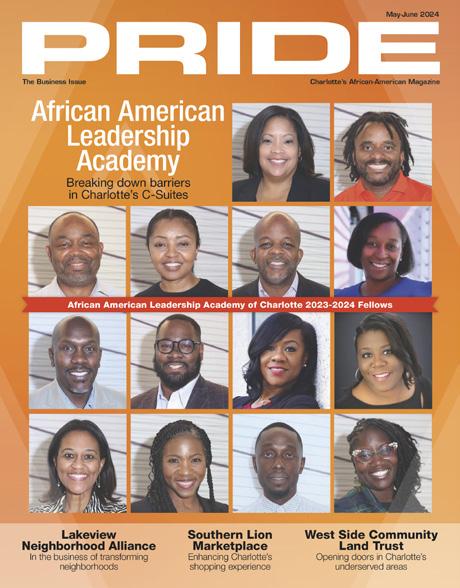


12 Departments 8 From the Publisher 10 Notable Names 12 Book Review 13 By Faith 14 The Vegucator 61 FYI News and Notes Features 16 Lakeview Neighborhood Alliance Helping to transform Charlotte neighborhoods 19 African American Leadership Academy Nurturing future top-level executives in Charlotte 22 Harvesting Humanity Inspiring youth to solve domestic and global problems 24 The Southern Lion Experience Q&A with CEO Sonja Nichols 27 Reimagining the Spectrum Center Improvement and renovation project unveiled Log on to pridemagazineonline.com for more features. 31 May – June 2024 30 A Boost to the Economy University City Partners launches small business initiative 31 The Business of Art Charlotte creatives discuss how they live as artists 33 Teens Search for Homes Transitioning from homelessness to independent living 35 West Side Community Land Trust Opening doors in underserved neighborhoods 37 Meet Jackie Curry Executive producer of the John Boy & Billy Big Show 39 Long Road to Justice Ronnie Long exonerated after 44 years in prison 42 ‘Beyond Open’ Grant Recipients Spotlight on 7 small businesses in Charlotte 44 The Beat Goes On The importance of maintaining heart health for seniors 50 Best of the Best Recognizing outstanding professionals in Charlotte 59 The Pride Awards Photos from 2024 awards event On the Cover: The African
2023-24
American Leadership Academy of Charlotte
Fellows
44 39 May-June 2024 | Pride Magazine 5
Photo courtesy of the African American Leadership Academy of Charlotte

Last year, I faced the ba le of my life. A er months of su ering from debilitating headaches a rare cyst was found in my brain. The headaches were so bad I was losing my eyesight. The experts at Novant Health used an innovative technique, called “neuro navigation” to remove the cyst. Thank you, Novant Health, for truly life-saving care.
Jocelyn Harris
NEUROSURGERY PATIENT



“ Their expertise served me well.”








Best physicians. Amazing nurses. Remarkable care.
Learn more at NovantHealth.org/Neuro © Novant Health, Inc. 2024 3/24 • NH1610190m
CEO/Publisher
Dee Dixon
Editor
Alicia Benjamin
Copy Editor
Sonja Whitemon
Lead Writer
Angela Lindsay
Creative Director
Larry Preslar
Design & Production
SPARK Publications
www.SPARKpublications.com
Distribution
©Watch Dog Entertainment® LLC
Digital Content Distribution
Account Executive
Nikelle Fesperman
Public Relations
Nepherterra Estrada Best
Subscribe to Pride
$13.25. Please subscribe online at www.pridemagazineonline.com, mail to P.O. Box 30113, Charlotte, NC 28230 or call 704-375-9553
Letters to the Editor
Please send an e-mail to info@pridemagazine.net fax to 704-375-9550 or mail to Pride Magazine 8401 University Executive Park Drive, Ste. 122, Charlotte, NC 28262 www.pridemagazineonline.com

Copyright© 2024 Pride Magazine
All rights reserved. Copying or reproduction, in part or in whole, is strictly prohibited.
Pride Magazine reserves the right to deny any advertisement, listing or feature that does not meet Pride Magazine standards or that is outside the scope or mission of our magazine. Pride Magazine assumes no responsibility for information, products, services, or statements made by advertisers or editorial contributors.

All rights reserved for PRIDE Communications Inc. Pride Magazine prints with soy ink.
Vol. 32 No. 3 May-June 2024


Find us on Facebook: Facebook.com/PrideMagazineNC Find us on Instagram: @pridemagazinenc Find us on LinkedIn: Pride Communications, Inc.

MAGAZINE
Charlotte’s African-American Magazine
May-June 2024 | Pride Magazine 7
Reflecting on Pride Awards 2024 — It Takes a Community
Confidentially speaking, Pride Awards 2024 was a trial by fire. The obstacles were tremendous. Honestly, this year’s event tested my mettle to the core. Major hurdles included struggling to land on a new and fresh idea with a purpose, shrinking sponsorship dollars, extremely late commitments, having to find a new venue, an event day podium that was way too small and most painfully, having the actual value of this 30-year Charlotte staple put in question.
The Pride Awards are not just “another” luncheon or gala. We set the stage for Black excellence in programming back in 1993 and have consistently provided a platform for corporations and the community to come together to enjoy unique cultural experiences that celebrate achievement as well as diversity and inclusion. Since inception, we make monetary donations to worthy nonprofits each year — approximately $300,000 so far. Oh, and did I mention how supporting the Pride Awards helps keep Pride magazine in business? Know that the playing field is not level regarding advertising. So many corporations in the Queen City don’t support our magazine with advertising or the Pride Awards, for that matter. Pride Magazine and the Pride Awards are a unique part of Charlotte’s history whose value to the community is to be treasured.
Officially speaking and despite the obstacles, Pride Awards 2024 was a success! It was a highly nuanced luncheon, recognizing achievement in underserved neighborhoods, uplifting nonprofits making a difference in the lives of those in need and acknowledging corporate social responsibility endeavors.
Foremost, we recognized one of our sponsors for their Corporate
Social Responsibility initiative. The winner was Truist, chosen by our judges for their $17 million investment in affordable housing and economic mobility in North Carolina. Accepting the award was Quincy Seitz, Head of Virtual Solutions Delivery.

We also highlighted seven outstanding Charlotte neighborhoods, doing great things for our City. They were West Boulevard Neighborhood Coalition, Washington Heights Community Association, Lakeview Neighborhood Alliance, East Charlotte Coalition, Greenville Combined Youth, Derida Road Community Organization
and the Hidden Valley Community Association. The Lakeview Neighborhood Alliance was chosen to receive the Neighborhood Excellence Award. See their feature on page 16.
Three nonprofits (Freedom Fighting Missionaries, Home4Me and Gracious Hands) competed for a $20,000 donation. Home4me was the winner of the Outstanding Nonprofit Award. However, thanks to Wells Fargo and two unidentified donors, they ALL received $40,000 each. Unbelievable! Read about Home4Me on page 33.
One last thing before I close. The legendary Hugh McColl graced our event with his presence and actually came on stage to participate in our Black History challenge!!! He was a hoot and get this; he even answered his Black history question correctly!
We have received many compliments about this year’s event. I thank God for the struggle and truly appreciate all of those who continue to support Pride Awards 2024 and seeing us through.
Indeed, “The struggle is part of the story.”


CEO
FromThe
8 Pride Magazine | www.pridemagazineonline.com
THE MILLS VIP LUXURY EXPERIENCE
Discover The Mills VIP Luxury Experience, where personalized vehicle services await you!
Enjoy a tailored purchase experience designed to ma tch your preferences as our client team expertly guides you through a vast selection of luxury brand s available with the expansive portfolio of Mills Automotive Group. Whether it's for a special birthd ay, anniversary, or simply to treat yourself, allow us to assist you in discovering the ideal vehicle to elev ate your driving experience.
Our dedicated consultants provide exclusive one-on- one vehicle consulting with attention to detail, professionalism, speed, and discretion - ensuring y our vehicle aligns perfectly with your lifestyle. Included in our offerings is a designated VIP Luxur y Experience Consultant who will serve as your prim ary point of contact throughout the entirety of the pur chasing and delivery process, accompanied by customized delivery options.
At Mills, we are committed to providing you with a seamless purchasing and delivery experience tailore d precisely to your needs - all while creating memora ble moments and lasting memories.

Call 833.776.4008 and let us give you The Mills VIP Luxury Experience today!
www.millsautogroup.com


Mills Automotive Group is a family-owned company th at takes great pride in our position as one of the leading dealership groups in the United States. With a cons tantly expanding portfolio of over 30 dealerships a nd a diverse range of brands under the Mills Auto umbrella, we’r e well-equipped to cater to consumer’s automotive n eeds. What truly distinguishes us is our unwavering commitment to our clientele. Our experienced sales and servic e team possesses years of industry expertise – all dedicat ed to satisfying the consumer's automotive needs.





Official Automotive Group Partner of the Charlotte Hornets
NEW Porsche dealership coming to North
late 2024!
Charlotte
• NORTH CAROLINA • SOUTH CAROLINA • VIRGINA • WEST VIRGINA • LOUISIANA • KENTUCKY •
NotableNames
By Ryan KouameAYO JOHNSON
Mental Health America of Central Carolinas (MHA) is pleased to announce Ayo Johnson as their new executive director. Johnson comes to the organization with years of experience in nonprofit management, fundraising, staff development, financial management and program analysis.
Johnson is a New York native and a veteran nonprofit leader with nearly a decade of experience at the Capital Area YMCA where she served as chief operating officer and chief human resources officer. Throughout her decades working in the nonprofit arena, she has helped build meaningful partnerships and implement strategic visions that achieve community and organizational objectives that help strengthen nonprofits.

AKIERA DAVIS
Digital marketing analyst and project manager Akiera Davis is the CEO of AKurated Solutions — a newly developed process optimization and project management agency. Davis started her career as a marketing communications coordinator for Sealed Air Corporation then went on to become a project manager with various agencies that include Red Ventures and McKinney — a full-service creative & media agency based in Durham.

Johnson holds a master’s degree in organizational leadership and a bachelor’s degree in global marketing from Rider University in New Jersey. She is also the owner of Wonder Girl Consulting, where she specializes in taking on interim CEO and COO assignments to help lead and stabilize organizations during times of transition.
BRENDA ROBINSON
Charlotte resident, Brenda Robinson, is the first Black female pilot in U.S. Navy history. Robinson says it all started when she visited an air traffic control tower when she was 16. Back then, Black women almost had no frame of reference for flying a plane. Still, Robinson pursued her degree in aeronautics at Dowling College and earned her wings of gold (the final qualification to become a pilot) in 1980 at the Naval Air Station Corpus Christi.

She joined the Navy in 1981 and her career was filled with firsts for Black women including flight instructor, evaluator, and VIP transport pilot. During the war in Iraq, she flew through fires and helped transport people, mail and supplies to troops on the ground.
She left the Navy after 13 years and went on to become a commercial pilot for American Airlines where she flew the Boeing 727, 757, and 767 for 17 years. She’s now a sought-after speaker at schools and hosts events nationwide.
Davis’ new venture, AKurated Solutions, helps young professionals with all things marketing, project management, resume writing and process optimization. Her dynamic journey in creative project/program management is what inspired her to start the business and begin crafting solutions that streamline processes and implement cutting-edge automation tools. Davis earned her bachelor’s degree in integrated marketing communication and holds a master’s degree in business administration from Winthrop University. Ever since, she has been on a journey to champion efficiency, foster collaboration, and curate solutions that help move the needle and cultivate success. To learn more about Akiera and her business, visit her website at www.akurated.com.
RAQILAH-SADE CLYBURN
Raqilah-Sade Clyburn is the founder of BlkPrnt, a community dedicated to creating safe spaces for Black women to connect, network, and build meaningful relationships.

Clyburn, a full-time content creator and digital marketing manager, started the organization to connect with Black women and to fight against the stigmas, pressures and issues they face. The idea came from a video that Clyburn made on TikTok, simply asking people to meet up for brunch during Black History Month. The video gained thousands of likes and support from all over and encouraged people to foster new connections. Their first meet-up started with about 10 people and has now grown into gatherings of more than 30 women. Past events have included a hike, Pilates and picnics.
Find BlkPrnt events social media (blkprnt.clt). To learn more, visit blkprnt.org.
10 Pride Magazine | www.pridemagazineonline.com
STYLISH SENIOR LIVING AT Windsor Run
•


North Carolina is growing. We’re here for it with reliable, affordable energy. We’re supporting North Carolina’s rapid growth with a balanced mix of energy sources. This helps keep electricity cleaner, reliable and affordable so North Carolina can thrive in a smarter energy future. DUKE-ENERGY.COM/ TOMORROW May-June 2024 | Pride Magazine 11
325205 See a selection of our stunning floor plans! Call 1-800-983-7609 for your free brochure, or visit WindsorRunCommunity.com. No matter your budget or style, you’ll find the perfect, maintenance-free apartment home at Mecklenburg County’s premier community.
Choose from a wide variety of floor plans
Discover freedom from house repairs
Enjoy resort-style amenities steps from your door! Matthews WindsorRunCommunity.com
•
•
BookReview
 By Angela M. Haigler
Consider Books by Historic Heavy Hitters for the Spring

“Our God Is Marching On”by Dr. Martin Luther King, Jr.
This beautiful commemorative edition of Dr. Martin Luther King’s speech, “Our God Is Marching On” is part of Dr. King’s archives and published exclusively by HarperCollins. The book feature’s Dr. King’s message told at the end of the Selma to Montgomery, Alabama march on March 25, 1965. There he stood in front of a crowd and celebrated the demanding work and effort that had been done by all in the fight against racial injustice for the Civil Rights Act of 1964. In this speech, Dr. King testified that this march for justice had been long and difficult and would continue as long as the resistance to change persisted. “Our God Is Marching On” showcases a message of determination, faith, and the unyielding pursuit of equality while remaining committed to nonviolence.

“Bits and Pieces: My Mother, My Brother and Me”by Whoopi Goldberg
The dynamic and multitalented Whoopi Goldberg has traditionally kept her private life private. In her new memoir, Goldberg opens up about the impact her late mother and brother had on her life. Told in “bits and pieces,” instead of in traditional memoir style, Goldberg shares how her mother did her best to provide a childhood that exposed her kids to a wide variety of experiences. Goldberg shares how much she began to appreciate her mother’s efforts even more when she became an adult and a mother.


“Joy Is the Justice We Give Ourselves”by J. Drew Lanham
As a birder and professor of wildlife ecology at Clemson University and an Edgefield, South Carolina native, J. Drew Lanham is a lover of nature. In this latest effort, Lanham poses the question: How do we achieve joy in today’s divisive climate? His signature mix of poetry and prose provides an answer: Look to nature! Lanham mines the deep connection to ancestors through the living world and tunes his unique voice toward embracing the radical act of joy.

“The Black Box: Writing The Race”by Henry Louis Gates, Jr
Henry Louis Gates, Jr. has become an icon in African American Studies, moving beyond teaching to helping us embody our individual history through DNA testing and research. In this epic work, he lays out the legacy of the African American artist through the written word. He shows us that Blacks have always defined themselves from Phillis Wheatley and Frederick Douglass, W.E.B. Du Bois and Booker T. Washington, to Zora Neale Hurston and Richard Wright, James Baldwin and Toni Morrison. African American writers have refused to be confined to a box defined by others, while at the same time creating their own box, or home, to survive and thrive in a society that never wanted them to succeed.
Children’s Choice
“Miss Edmonia’s Class of Wildfires”
by Victoria Scott-MillerIn this delightful first of a new series, Miss Edmonia takes her elementary school students to visit a different museum in each book. The “Wildfires,” as the students are called, immerse themselves into a new adventure with each museum they visit providing readers an opportunity to learn about museums as well. Victoria Scott-Miller is an award-winning Raleigh-based entrepreneur, documentarian, author and creator of “The Museum Lives in Me” book series. She is also the owner of North Carolina’s first Black-owned children’s bookstore. P
12 Pride Magazine | www.pridemagazineonline.com
ByFaith

The Importance of Building a Christ-Centered Business
By Rev. Dr. Dwayne BondIn our fast-paced business world, it’s easy to get swept up in pursuing success, profit, and recognition.
Yet, as Christians, we are called to a higher standard that reflects Christ’s character in every aspect of our lives, including our businesses. What does it mean to have a Christ-centered company, and how do you practically implement gospel principles in the marketplace?
First and foremost, building a Christcentered business requires biblical values and principles. It starts with recognizing that our companies are not our own but belong to God. As stewards of His resources, we manage our businesses in a way that honors Him and advances His kingdom’s purposes.
One of the fundamental principles of a Christ-centered business is integrity. In a world where dishonesty, corruption, and self-centeredness abound, integrity sets us apart as followers of Christ. Integrity means being honest in our dealings, transparent in our communications, and faithful to our commitments. As Proverbs 10:9 reminds us, “Whoever walks in integrity walks securely, but whoever takes crooked paths will be found out.”
Furthermore, a Christ-centered business prioritizes the well-being of its employees and customers above profits. The priority is creating a workplace culture that fosters respect, compassion, and fairness. Thus, the workplace becomes a place where employees feel cared for, protected, and encouraged. It means treating employees as valued team members, investing in their growth and development, and providing a safe and supportive environment for them to thrive. It also means serving our customers excellently, going above and beyond to meet their needs and exceed their expectations.
At the heart of a Christ-centered business is a commitment to love and serve others (John 13:34). This means sacrificing our interests for the good of those around us. It means being generous with our resources, both within

our businesses and in our communities. It means using our platform and influence to advocate for justice, mercy, and compassion.
Moreover, a Christ-centered business operates with a long-term perspective, recognizing that true success is not measured solely by financial gain but by the impact we have on the lives of others and the glory we bring to God. This means being willing to make shortterm sacrifices for long-term kingdom purposes. It means seeking wisdom and guidance from God in decisionmaking rather than relying solely on our understanding.
Finally, a Christ-centered business exudes humility and dependence on God. As leaders, we must recognize our limitations and weaknesses, seeking God’s strength and wisdom to lead with grace and humility. We must be willing
to admit when we are wrong, ask for forgiveness when we fall short, and extend grace and forgiveness to others in turn.
Building a Christ-centered business takes work, but it is worth the effort. By embracing biblical values and principles, prioritizing integrity, serving others with love and humility, and depending on God for wisdom and strength, we can create businesses that bring glory to God and bless those around us. As Colossians 3:23-24 reminds us, “Whatever you do, work heartily, as for the Lord and not for men, knowing that from the Lord you will receive the inheritance as your reward. You are serving the Lord Christ.” Let us pray and strive to build businesses that honor Christ in all we do. P
The Rev. Dwayne Bond is the lead pastor of Wellspring Church.
fizkes / Shutterstock.com May-June 2024 | Pride Magazine 13
TheVegucator
 By Dawn Hilton-Williams
INVESTING IN BLACK MATERNAL HEALTH: A Matter of Life, Dignity and Wellness Equity
As a wife and mother, it pains me to see the glaring disparities in maternal health outcomes that persist for Black women in America. The ugly reality is, if you’re Black and low-income, the statistics paint a bleak picture when it comes to a healthy pregnancy and delivery.

Barriers to healthy eating
Many Black women, particularly in underserved areas, lack access to affordable fresh fruits and vegetables, which is vital for a healthy pregnancy. Chronic conditions more common in Black women, like obesity, diabetes and hypertension are fueled by these

Black women in the U.S. are 3 to 4 times more likely to die from pregnancy-related causes compared to white women. In North Carolina, the disparity is even greater, with Black mothers dying at 4.5 times the rate of white mothers. Our babies are also twice as likely to die before their first birthday than white babies.
Charlotte’s maternal health crisis
Despite being dubbed a healthcare hub, Charlotte mirrors national trends, with Mecklenburg County’s Black infant mortality rate at 12.1 per 1,000 live births, which is nearly 3 times the white rate. Studies also show that even when controlling for income and education, Black women still fare worse.
barriers, and coupled with inadequate prenatal care, implicit healthcare bias and coping with the daily stressors of racism, the issue is compounded.
Call to action
Just as attempting to mop a floor while the faucet is still running is an exercise in futility, we must stop trying to dismantle the structural inequities using the same worn tools that keep us in the unending cycle.
Breaking cycles demand uncomfortable conversations and bold change, which begins, in this instance, with shutting down practices like:
• Food apartheid: neighborhoods cut off from affordable, fresh produce
• Food swamps: fast food and junk food filled convenience stores saturate neighborhoods
• Nutrition redlining: retailers abandon or avoid building in Black and brown neighborhoods
Since most grocery chains and farmers markets are profit-driven entities, we must support our elected officials by raising our voices at public hearings to ensure investments, both public and private, include incentives that persuade businesses to open in underserved communities prior to their gentrification or offer incentives that compel them to return to the communities they previously abandoned.
Expanding programs like WIC, the federal nutrition program for women, infants and children, to include plant-based cooking demos, classes and nutrition coaching will improve engagement and impart valuable information about optimal wellness. In addition to food access issues, dismantling implicit biases in healthcare is critical to improving maternal health outcomes. Mandating comprehensive cultural competency training for medical staff, coupled with a greater representation of Black doulas, midwives and OB/GYN’s will foster spaces where Black mothers feel heard and supported.
A path forward
We must convey that the struggle isn’t solely about securing access but the permanent affirmation of our dignity and place in a society that too often repeals our basic rights. By valuing, nourishing and empowering Black families, we invest in the wellbeing of generations, beginning with our mothers. P
Dawn Hilton-Williams, is a whole food, plant-based (WFPB) certified nutrition professional, clinicallyendorsed, award-winning vegan chef, cookbook author, speaker, wellness equity activist and founder.
14 Pride Magazine | www.pridemagazineonline.com
Scan the QR code below to view the recipe for Latin Black Bean Stew by chef Dawn HiltonWilliams.

Take Pride in Homeownership
SouthState is proud to offer Community Advantage, a lending program designed to make homeownership more accessible with up to 100% financing1 and no private mortgage insurance (PMI) required.
Program Highlights
• Must be a first-time homebuyer2
• 600 minimum credit score
• Applicant income must be equal to or less than the estimated MSA median income or the property is located in a tract with a minority percentage greater than 50%
• Property is located in select counties including but not limited to: Mecklenburg County, NC or Wake County, NC3
Contact us today to learn more about the program qualifications and whether Community Advantage is right for you!
All loans are subject to credit approval and program guidelines. SouthState Bank N.A. NMLS ID #403455. Member FDIC. Equal Housing Lender. 1. The Community Advantage mortgage provides up to 100% financing based on the lesser of the purchase price or a bank-accepted appraisal. Speak to a mortgage banker for qualification details. 2. Buyer must complete homebuyer education course prior to closing. At least one borrower must be a first-time homebuyer. 3. Property must be applicant's primary residence. For a full list of qualifying counties please visit SouthStateBank.com/PrideMagazine.

800.277.2175 • Mortgage@SouthStateBank.com SouthStateBank.com/PrideMagazine Scan To Learn More
Lakeview Neighborhood Alliance Is in the Business of Neighborhood Building
By Brenda Porter-Rockwell | Photos courtesy of Jamaal KinardBlock parties and barbecues make for great television when it comes to showing the work of a nonprofit community-building effort. Behind the scenes, there is the neighborhood building strategy that leads to program funding and recognition to fuel the awareness that a block party brings.
Lakeview Neighborhood Alliance (LNA), a Neighborhood Excellence Pride Awards winner, and no stranger to block parties, aims to address systemic poverty and concentrated inequality in this northwest Charlotte community. LNA Executive Director, Jamaal Kinard can attest that developing a solid and actionable business
Brandi Cagle, Lakeview Neighborhood Alliance Executive Assistant; Jamaal Kinard, Executive Director of LNA; and Shakeema Grier, LNA Development Associate at the 2024 Pride Awards event.
Below: Johnny Sibley (left), Lakeview At-Large Zone Captain, and Tonnette Bowles, LNA Data Entry Specialist receiving weekly Farm Share from Basket Case Farms/Gambrell Foundation.


strategy for neighborhood development doesn’t always make the 5 o’clock news; nonetheless, the work is critical to building a better neighborhood.
Getting down to business
According to Kinard, the strategic business plan contains the goals the group has set for the year ahead. It also provides transparency for both potential funders and community members.
“We think everything is supposed to be … the kumbaya moments,” said Kinard. “You still (must) have a revenue stream,
you have to drive outcomes, you have to collect data, you have to understand what it means to have the trust of the people that you’re serving, and also have those people hold you accountable.”
Potential donors, Kinard said, want to know what’s behind the headlines — data from the strategic plan that answers tough questions like, “What problem are you trying to solve?”
According to Kinard, it’s important to build relationships with donors and community partners who want to work cooperatively to seek solutions to the issues LNA is trying to address.
16 Pride Magazine | www.pridemagazineonline.com
WINNER
Right:

“If you’re doing that, that leads to longevity and that leads to sustainability,” Kinard said.
Setting and meeting goals
LNA has a big picture strategy and revitalizing the Lakeview community is just the beginning.
“We have organized ourselves around a ‘3E plan’ — engage, educate and empower. That’s the [basis] for everything we’re doing here in the neighborhood,” said Kinard.
The 3E plan is baked in to four areas of tactical programming: child and family stability; prevention of displacement due to gentrification; economic mobility; and civic awareness and political education.
For instance, under the economic mobility pillar, LNA helps supplement families’ income gaps with gift cards they can use for food and other immediate needs. The gift card program is paired with financial counseling to help recipients learn to create and maintain savings.
LNA also educates and empowers residents with tools for wealth building, such as placing a tiny home on a resident’s property to create rental income.
The group plans to purchase the Lakeview Elementary School, a nearby vacant building, turning the space into a cooperative business to spur economic mobility within the community. Kinard pointed to a similar concept successfully executed in Cleveland. There, a
neighborhood formed a cooperative and partnered with a major employer — creating jobs in the community and putting money back into the pockets of stakeholders.
“We’re trying to put the ‘neighbor’ back in neighborhood and turn a neighborhood back into a true community that has an economic base,” Kinard said.
On the horizon: “We’re building a model that can not only help solve the problems in our neighborhood but can be a model that can be duplicated across the city, and hopefully across the nation,” he said.
Overcoming challenges
The Lakeview area was once called Lakewood, the older name is a holdover from the days when Black people weren’t allowed to live there. Times changed and Blacks migrated into the community by the lake and began calling their borders Lakeview, taking the name from the Lakeview Elementary School.
By 2019, the community wanted to unify its identity. The Lakewood Neighborhood Alliance and the Lakeview Reunion Committee collaborated on a resident survey to name the neighborhood. The overwhelming favorite — Lakeview, a name proudly etched on the community sign.
Post-survey, LNA’s community engagement increased from 30 households to 200.
“It came about by us being intentional about getting to know people, what they
“We have organized ourselves around a ‘3E plan’ — engage, educate and empower. That’s the [basis] for everything we’re doing here in the neighborhood.”
—JAMAAL KINARD

wanted, what they stood for, what was important to them,” said Kinard, who started LNA thinking he had most of the answers to Lakeview’s problems.
He had completed racial equity training, earned an advanced degree, worked as an educator in Charlotte public schools and had a background like those Lakewood families.
“I got a lot of doors slammed in my face — ‘Like man, if you don’t go sit down,” he half-joked.
Since then, Kinard learned to address those issues, one step at a time.
He said he learned another lesson — untangle your personality from the business.
“Understand you’re not going to always get your way. When you’re co-creating a neighborhood … you’ve got to have this benevolent leader that understands the goals and vision,” he said. “But you also got to have that leader that leads with empathy, that can hear residents, and can understand when the lay of the land changes.” P
May-June 2024 | Pride Magazine 17
Above: The Lakeview Neighborhood Association relies on place-based community partners such as Communities in Schools. Back row, left to right: Shakeema Grier, Anna Kennington, Chelsey McIvor (holding a baby), Brandi Cagel and Jamaal Kinard. Front row, left to right: Shakaka Perry (holding a baby), Tamisha Williams and T-keyah Cunningham.
Right Jamaal Kinard leading the discussion at LNA’s Annual Board/Staff Retreat and Community Partner Luncheon.
live purposefully

This is what life is supposed to feel like. When you aren’t held back. When you have a health partner that doesn’t just treat part of you – they care for all of you. That’s why more people prefer Atrium Health, with the most complete care that lets you get back to the moments that matter. That’s what it’s like to live fully. live fully

A New Leadership Academy Is Building a Pipeline of C-Level Executives in Charlotte
By Anders J. HareThe African American Leadership Academy (AALA), managed by One Catalyst Consulting, was created to nurture, grow and expand the pool of African American leaders in the Charlotte-Mecklenburg region in a supportive space. The nonprofit is educating and nurturing its fellows, Black professionals in the area, to serve as top level executives for private and nonprofit corporations.
In the U.S., Black people made up only 5.2% of chief executive roles in 2023, according to the Bureau of Labor Statistics.
“This outcome represents not only a need, but also an opportunity for organizations who thoughtfully invest
In the U.S., Black people made up only 5.2% of chief executive roles in 2023, according to the Bureau of Labor Statistics.
in Black leadership to achieve growth,” according to a statement by the organizational consulting firm, Korn Ferry. The AALA is looking to do just that.
The Academy is an initiative of the CLT Alliance Foundation, in partnership with The Harvey B. Gantt Center as the venue partner for key events.
The AALA’s mission is to equip, empower and advance local Black professionals to “strengthen the impact and pipeline of executive and C-suite leaders for the public, private and philanthropic sectors.” With an advisory board that includes highprofile executives in the Charlotte area, the Academy is paying it forward by graduating its inaugural cohort of 14 Black leaders in May 2024.


“Being from Columbus, Ohio, I was aware of the African American Leadership Academy there,” said owner of the Academy, Elizabeth Carter Trotman. “And so I really examined their program and looked at the core components of it and recognized that it was something that would be a great model for Charlotte — but I
also understood that we needed to have something tailored for our community.”
Carter Trotman and the Academy’s Governing Board emphasize the importance of a well-rounded curriculum tailored to meet the needs of its fellows. One key piece of the Academy is its partnership with Korn Ferry, from which it draws its “power of choice” curriculum. For Korn Ferry CEO, Gary Burnison, the “power of choice” refers to the decision to make powerful choices rather than falling into stagnation. The pillared areas of focus that fellows are given through their time in the cohort are “equip, empower and advance.”
As stated in a recent report by Korn Ferry, “High-performing Black talent exists at all levels across the corporate community.
May-June 2024 | Pride Magazine 19
Above: LaQuisha Parks, AALA 2023-2024 fellow. Left: (from left to right) Morgan Hinton, Tammy Hinton and Sam Smith, AALA fellow.

The African American Leadership Academy 2023-24 Fellows
(from top to bottom and left to right)
Fellow Company
Natalie Brown Ally Financial
Todd Bullock Campbell’s
Rodrick Banks Wells Fargo
Tiffany Capers Crossroads Community Corporation
Eric Craft KFC Global
JoAnne Harvey Synchrony
Matt Bradley Deloitte
Steven Johnson Lowe’s Companies, Inc.
LaShauna Lowry Ally Financial
Aliya McClendon AvidXchange
Semoine McCray Lowe’s Companies, Inc.
LaQuisha Parks Energy United
Sam Smith Jr. GreenLight Fund
Tya Bolton CLT Alliance Foundation
Yet, despite investing in large-scale diversity and inclusion initiatives, firms are still not bringing enough Black talent into the leadership pipeline.”
The report goes on to say, “Data shows that companies with ethnically diverse executive teams are 70% more likely to capture new markets than their less-diverse peers” and “generate 38% more in revenue from innovative products and services.”
With many of the fellows already occupying space in Charlotte’s private sector, the academy focuses on


supplemental objectives such as wellness and navigating spaces where they are often told they don’t belong.
“These are already highly skilled professional members at various levels in their respective industries, and what this program does, it gives them a chance to understand that path toward additional leadership within their organization and also outside of that,” said Seth Bennett, Chief Marketing Officer of Hornets Sports & Entertainment and one of the Academy’s governing board members.
The proof is truly in the pudding when it comes to measuring the success of the Academy so far. Ahead of the cohort’s graduation in May, one of its fellows has
already moved on to a C-Suite level position, and with much accomplished already, the Academy is also equipping its fellows to step up and pay it forward for the next group of corporate leaders.
“They [the fellows] are going to have an appreciation and affection for Charlotte in the region, because it was something that was fostered in a way that helped them,” Bennett said. “There will be various levels of reciprocal return on our investment in the individual. Some of it will be realized in
Data shows that companies with ethnically diverse executive teams are 70% more likely to capture new markets.
real time, some in the not-too-distant future, and then others who will just kind of see Charlotte as a progressive, inclusive city that does things to try to help their citizens grow and kind of lead it that way.”
Carter Trotman said that in various pre- and post-surveys taken of the fellows, many of them said the program has caused them to reflect on their life personally and professionally. Also, they’ve become more confident and bolder in their leadership, and much more intentional –– which is a major goal for this non-profit, she added.
“The African American Leadership Academy of Charlotte is intentional about equipping, empowering and advancing Black leaders so that our organizations are truly reflective of the diversity of the clients and communities we serve,” said Kieth Cockrell, president of Bank of America Charlotte and an Academy advisory board member.
He added, “We know that diversity makes us stronger, and it is important that we support efforts like this that have a focus on building the bench of leaders for years to come.” P
Top: Rodrick Banks, Sonya Banks, Blair Stanford and Nate Hogan Middle: Fred Whitfied, Machell Mims and Semoine McCray Below: Jada Grandy-Mock, Erika Duncan and Dr. Raynard Washington20 Pride Magazine | www.pridemagazineonline.com

CONGRATULATES


Our vision is to catalyze transformative growth in the Charlotte Region where dynamic small businesses and business leaders thrive. The African American Leadership Academy of Charlotte is one of our strategies for advancing Black leaders in the private, public and nonprofit sectors to the C-suite. We believe these efforts are a moral, ethical and economic imperative for Charlotte and in doing so, we will live up to the employer commitment goals of the Mayor’s Racial Equity Initiative.
Nate Hogan, President
Tya Bolton, Director of Small Business and Entrepreneurship
Jonathan Evans, Program Manager
THE INAUGURAL CLASS
THE AFRICAN AMERICAN LEADERSHIP ACADEMY
CHARLOTTE (AALAC) CHARLOTTEREGION.COM
OF
OF

Harvesting Humanity Inspires Youth to Solve Domestic and Global Problems
 By John Burton Jr.
Education-related inequity remains a concerning issue in many underserved communities. Various challenges, such as insufficient allocation of resources, limited human capital and lack of motivation, impede not only the learning outcomes of individual students but also the educational progress of the entire community. Neglecting the issue of education equity can lead to the widening of economic and social disparities within underserved areas.
Harvesting Humanity is working to change this. Founded in 2017, the youthdriven, experiential learning out-of-school time program was designed to provide all learners with diverse opportunities to engage in meaningful, equitable, sustainable, collaborative discussions and discoveries that confront and dismantle inequities, stereotypes and “isms” that divide our local, national and global communities. The
organization also builds strong 21st-century leadership skills, cultivates cultural intelligence in tandem with advanced literacy competencies and innovates viable, art-transpired solutions to problems in our communities.
Eboné Lockett, founder and CEO of Harvesting Humanity, drew inspiration for the name during a presentation at the Moldova Bilateral Partnership committee meeting in Raleigh. As Lockett shared her school-to-school collaboration activities and outcomes, a presenter before her shared that their business had not only provided potatoes but also transferred the skills to grow and harvest them domestically.
“As I took the stage and began to share, I was moved to add that we are harvesting more than potatoes,” Lockett said. “We are harvesting humanity,” she added.
Lockett’s educational background included a holistic and experiential approach from a young age. An amorist of the English language, Lockett was a published poet by
22 Pride Magazine | www.pridemagazineonline.com
Eboné Lockett, founder and CEO of Harvesting Humanity
the age of 13. Her poetic ability gave her the artistic space to articulate and translate a world of her life’s experience earlier in life than may have been possible for others at that age.
With a dual undergraduate degree in English and psychology from Central Connecticut State University, and a master’s degree in educational leadership from Fairfield University, Lockett utilized this
Fitness for All
fusion of studies to serve this unique fusion of the educational and experiential to begin serving her community, near and far. Harvesting Humanity has five key initiatives listed below, which are designed, co-designed and/or led by the organization. Each aspect of their work is deliberate, intersectional and structured to be adaptable and tailored to individual needs, Lockett said.
A two-month healthy eating and active living experience in conjunction with the Public Health Department and other partners, that offers synchronous and asynchronous opportunities for diverse and differently-abled local, national, and global communities to engage, and put into daily practice of healthy eating and active living habits from cooking to mind and physical exercise.
Climates of Inequality
In partnership with the Humanities Action Lab, University of Connecticut–Hartford, City of Hartford, Hartford Public School System, Hartford Public Libraries, and a host of local, national and global network partners, Harvesting Humanity is co-producing a story to add to the “Climates of Inequality” traveling exhibit.
E.A.T. with Humanity
An innovative research, learning and leadership experience that engages and centers impacted communities by deepening their awareness, understanding and examination of intersecting climate, environmental and social justice issues.
Pupil to Practitioner
Deepening the engagement with K-12 schools, agricultural extensions and wider environmental justice communities to co-design curricula and experiences that prepare, position and promote hyperlocal conservationists.
L.E.A.P. Forward
Recruitment of high school students to co-design and participate in hands-on research that includes elements of laboratory research and field sampling. The students will discover, explore and work to mitigate issues related to water cycling throughout homes, schools, businesses and neighborhoods.
With these key initiatives in place, Lockett said championing Harvesting Humanity isn’t difficult. “Support the social good by hiring us, partnering with us, and sharing contracts and social capital with us,” she said.
A decorated educator, winning grants from the likes of the Charlotte Hornets, Art & Science Council, and Qatar Foundation, Lockett describes the greatest win as working with the people with whom she has connected — it’s “the success of those learners and leaders whom I have had the privilege of training, leading and learning from,” she said.
“Learning for life and lifelong learning” is a phrase that captures the work Humanity Harvest does in “diverse learning environments and through diverse experiences,” Lockett added.
Through multifaceted initiatives and strategic partnerships undergirded by exceptional tenacity — transformation can easily occur, she said. Harvesting Humanity, under Lockett’s leadership, makes one thing clear. It is not what you reap that is most important — it is what you sow that is vital. P

“Learning for life and lifelong learning” is a phrase that captures the work Humanity Harvest does in “diverse learning environments and through diverse experiences.”
— Eboné Lockett, founder and CEO of Harvesting Humanity
May-June 2024 | Pride Magazine 23

Retail Reboot: How Southern Lion Is Changing Charlotte’s Shopping Experience
By Angela LindsayWhen Blacklion home décor marketplace closed last year after 27 years, it left a void not only as a destination location for savvy shoppers hoping to luck upon a distinctive new addition for their home or a unique gift for that friend who has everything, but also for those merchants for whom the venue had become a reliable avenue through which to showcase their wares. Fortunately, San Francisco native (by way of Tallahassee, Florida), Sonja P. Nichols decided to open Southern Lion in the two-story, 160,000 square foot former Sears building at Carolina Place Mall with her son, Rich Nichols. Southern Lion is located just a mile down the street from Blacklion’s former location near Pineville.
The top floor of Southern Lion opened on September 1, 2023, and the ground floor opened in April 2024. Items sold in the stores include home décor and

accessories, women’s apparel, jewelry, fashion accessories, live plants and flowers, and more.
The retail space contains approximately 300 merchant spaces downstairs and 125 spaces upstairs with over 10 booths options, ranging in sizes from 10 x 14 feet to 2 x 5 feet. While Southern Lion isn’t Nichols’ first foray into business ownership (having owned Nicholant Security, a security guard company that was staffed entirely by military veterans, and a small business consulting firm previously), it is certainly an ambitious venture — but it is one she believes was ordained just for her.
This interview has been edited for length and clarity.
Pride Magazine: Where did the name Southern Lion come from?
Sonja Nichols: I loved both Blacklion and the Southern Christmas Show. Because I
Photo by Tripwire Photography24 Pride Magazine | www.pridemagazineonline.com
Phooto by C.E. Clark Photography
Sonja Nichols, president and CEO of Southern Lion marketplace
Southern Lion Management Team from left to right: Odetta Maxwell, human resources; Maureen Maxwell, merchant leasing; Eric Mechum, operations; Sonja P. Nichols, president and owner; Rich Nichols, V.P. and owner

“Only God can give you the confidence you need to do something this magnificent. I wish I could take credit for this, but I cannot.”
— Sonja Nichols

could not buy the Blacklion name, I decided to combine my two favorite places together — Southern Lion. I love the name because being from the South is such a “cool thing.” Being Southern is a “mood.”
PM: How did the idea behind this concept come to be?
SN: One Sunday in 2022, I was cooking, and God dropped it into my spirit to go see if the Blacklion was for sale. My daughter and I drove down, met with store manager Maureen Rudolph and asked if the owners would ever sell the store. She shared that the building had already sold to Tryon Medical Partners.
I asked where were the merchants going. She said many of them were still trying to figure it out. I informed Maureen that God put it into my spirit to help them find a home because we simply could not let Blacklion go away. I met with Bob Emory, the owner and master brain behind Blacklion. He said he wanted to help me. Then I called my adopted momma, Joan Zimmerman, owner and master mind of The Southern Shows. She told me she would jump on this opportunity in a New York minute!
PM: What kind of service does it provide to the community?
SN: Southern Lion …is a multi-merchant retail shopping venue where entrepreneurs, artists, designers, style-setters and small business owners will be able to build and grow and sell their products to customers who have an eye for elegant, one-of-akind home furnishings and décor. We have more than 100 small businesses within our building. More than 85% are women-owned.
PM: What was it that made you believe you could make a concept like this successful?
SN: Only God can give you the confidence you need to do something this magnificent. I wish I could take credit for this, but I cannot. This is the biggest thing I have ever done in my life … Several banks and investors turned me down. Many people who were employees and merchants at the original Blacklion said I would not be able to pull off such a huge project and would not be able to open Southern Lion. But God….
Bob Emory and Joan Zimmerman supported me and knew I could do this. Then God brought me Truist Bank and Kevin Dale, SVP Commercial Banking. Kevin is the one banker who fully understood the Blacklion concept, being a Charlotte native and having worked for Belk as a teenager … My wonderful husband, Richard Nichols, believed in me when most people didn’t.
Photo by Daniel Coston PhotographyMay-June 2024 | Pride Magazine 25
Photo by Daniel Coston Photography
Décor from a Southern Lion store
Dining room table and chairs from a Southern Lion vendor
He has always been my biggest cheerleader and motivator. He truly represents what “love of my life” means!
PM: What was the process like to acquire the space?
SN: I traveled all over South Charlotte to find the appropriate space. It was not easy because I needed at least 75,000 square feet. (Blacklion was 68,000). One day, my husband Richard and I just happened to drive through the Carolina Place Mall parking lot after looking at the Toys R Us. We looked over and saw the empty Sears building. When I called the mall’s property owner, no one would call me back … That’s when I reached out to Boundary Street Partners and Rodney Faulkner got into the door! The property company was only going to talk to another commercial property professional. And that was Rodney at Boundary Street.
PM: Is Southern Lion completely or partially open now?
SN: Our upstairs is open now for business. We have over 75 small businesses occupying 50,000 square feet of retail space. The ground floor, with its Community Meeting Room, Man Cave with four big screen televisions only playing sports, and café will open mid-to-late April 2024.
PM: Why did you feel the need to expand now?
SN: Customers wanted the expansion. My merchants wanted the expansion. Many of my merchants have more than 4 booth spaces/rooms in the ground floor retail space. Remember, many of them are coming from Blacklion, with a total building space of 68,000 square feet. My total building space is 160,000 square feet.
PM: What are some of the biggest challenges you’ve faced so far? Any surprises?
SN: The biggest challenge has been funding. You hear about all these programs to help small businesses, minority-owned businesses, women-owned businesses. I seemed to never qualify for any of the grants and loans. I cannot begin to tell you how frustrating it has been to talk to
“Carolina Place Mall has shared that the traffic pattern in the mall has shifted and all the traffic is coming in on our side of the mall. The stores located near us have seen a tremendous uptick in sales because of our opening.”
— Sonja Nichols
folks who make all kinds of offers but don’t actually come through ...
God blessed me with a wonderful husband who has funded this major project along with Truist Bank.
Retail is retail. It is a rollercoaster ride. The tremendous high of the final quarter holiday sales is fantastic. The post-holiday blues come in the first quarter when sales drop.
PM: How does a concept like this benefit a city like Charlotte?
SN: Being able to host and support so many small businesses is absolutely phenomenal. We have so many small, Black-owned businesses joining us. It is wonderful to have them be a part of this multi-merchant market place. The diversity is great.
PM: Why did you decide to open the marketplace up with your son?
SN: We were all shocked when Richard L. Nichols III agreed to join us. He and I are both bossy first-born children, so you can imagine we bump heads all the time. He had just finished getting his MBA at UCLA and came home for the pandemic. I had asked him to just help me a little with the numbers and concept. One day, I just asked him if he would want to stay to help me get things off the ground and he agreed.
Richard III is my partner and is the other owner in the business. He has been helping me and has been my right-hand man this whole time.
PM: What would success look like for you?
SN: God willing, I would like to own a couple more Southern Lions in different parts of the country. Currently, we believe we are one of the largest, 100% Black-owned retailers in the country.
PM: What has been the reaction from some of your merchants?
SN: (Southern Lion) merchants have been tremendously excited and supportive. They are pleased to have a brand new, beautifully appointed space, along with lots of new merchants, new energy, and new management! We are a wonderful multi-vendor retail shopping venue for entrepreneurs, artists and small business owners. .
PM: Foot traffic at malls have taken a hit in recent years, so how has Southern Lion changed shopping patterns at Carolina Place Mall?
SN: Carolina Place Mall has shared that the traffic pattern in the mall has shifted and all the traffic is coming in on our side of the mall. The stores located near us have seen a tremendous uptick in sales because of our opening.
PM: What is your hope for the future of the business?
SN: We hope that others are inspired to open their own small businesses and to place them in a home like Southern Lion. Multi-merchant marketplaces like ours give small business owners the opportunity to live out their dreams of business ownership without the tremendous headaches that come with managing real estate or employees.
PM: What kind of experience can shoppers hope to have when they enter Southern Lion?
SN: Southern Lion is a fabulous shopping venue that allows the customer to come in and experience merchandise from all over the world. We want customers to come to our home to shop for their home! P
26 Pride Magazine | www.pridemagazineonline.com
Spectrum Center to Be Reimagined with Improvements and Renovations
By Ryan KouameHornets Sports and Entertainment unveiled its plans, earlier this year, to renovate the Spectrum Center, home to the Charlotte Hornets and many other sports and entertainment events. The plan, named the Re!magine Spectrum Center arena improvement project, includes renovations and improvements to the arena, including a new training facility, and health, safety and environmental upgrades to meet the evolving needs of all arena stakeholders.
The renovations will kick off in May 2024, with an anticipated 2025 completion date, before the start of the 2025-26 NBA season.
Improved guest experience
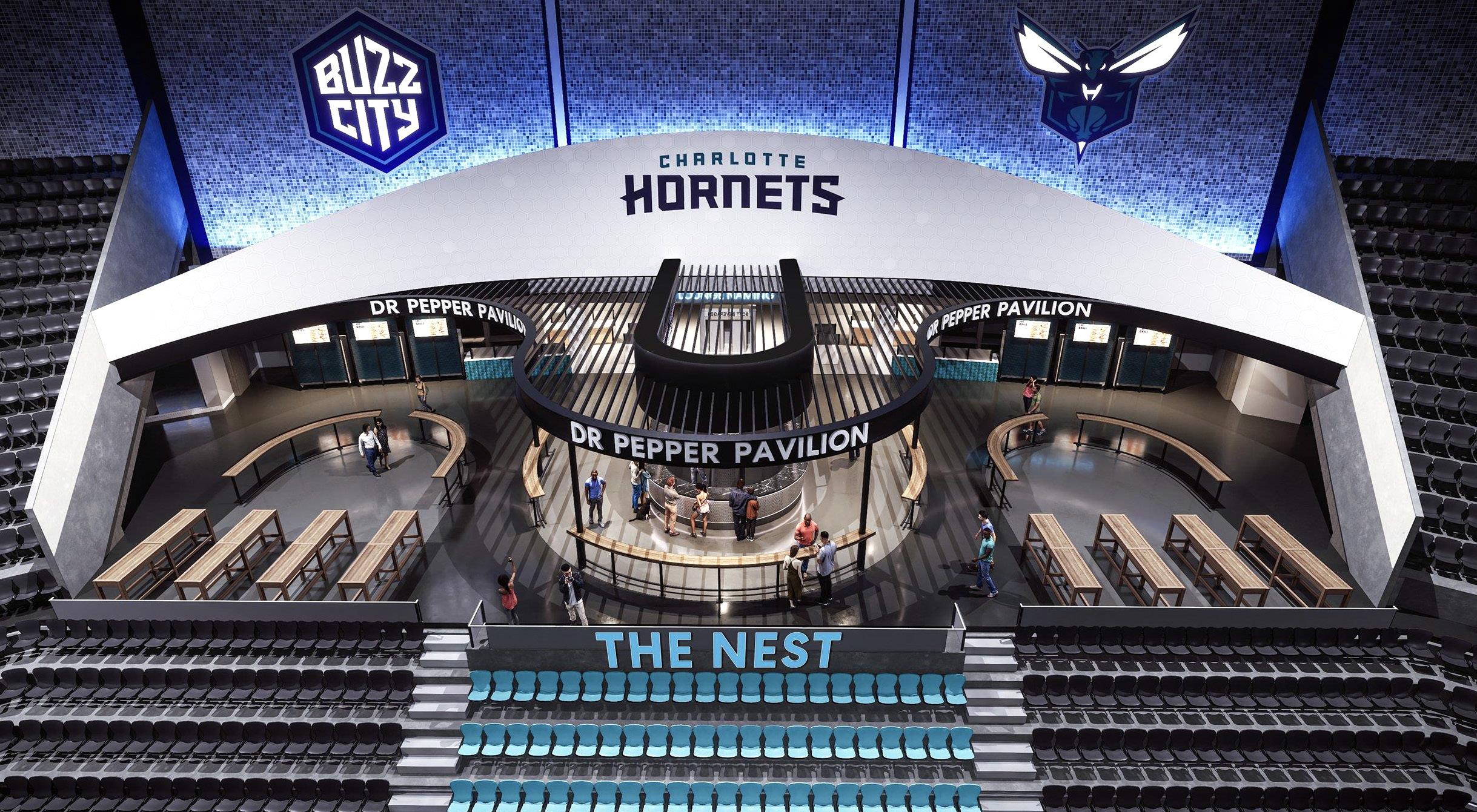
The main concourse will be renovated with four themed destinations for game attendees, inspired by communities across the Carolinas. These renovations focus on modifications that better support traffic flow, including larger breezeways, corridors, and entrances, making it easier to move in, out, and around the arena. Planned additions also include: enhanced fan engagement
130 the maximum number of guests the new theater boxes can accommodate
$215 million the estimated cost of the renovation project
areas, new retail experiences, and an additional 2,500 lower-level seats with more visibility into the bowl for those who are afraid of heights.
All premium spaces, including clubs and suites, will be transformed with a new Courtside Club, allowing for hundreds more seats inclusive of club amenities. Also, the entire Suite Level will be renovated in 2024, followed by the Founders Level in 2025. The reimagined Suite Level will offer new options and a theater box at different price points that can accommodate anywhere from two to 130 guests.
New technology like grab-and-go markets will be implemented to create safer, more efficient, and frictionless interactions that improve the overall concession experience. The Re!magine Spectrum Center project will include expanded and enhanced menu options and additional bar and social gathering spaces for guests to enjoy their food and entertainment.
Teamwork makes the dreamwork
D.A. Everett Construction Group, a prominent Black-owned construction company with offices in Charlotte and Raleigh, North Carolina, and St. Thomas, U.S. Virgin Islands, was hired as lead contractor, along with Turner Construction for this $215 million renovation project set to begin this year.
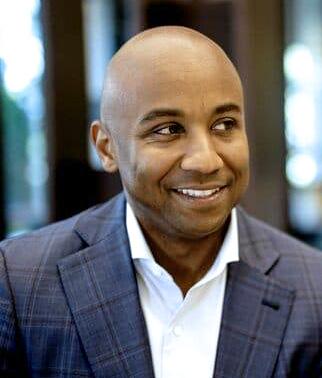
“I look forward to getting into the community to make an impact and to help people — especially those that look like me,” said President and Chief Executive Officer of D.A. Everett Construction Group, Donovan
Photos courtesy of Hornets Sports & Entertainment
Donovan Everett
May-June 2024 | Pride Magazine 27
Rendering of the updated Dr. Pepper Pavillion

Everett. “Whether it’s concerts, basketball, or whatever event, the Spectrum Center will be the place to be,” Everett said.
With over 20 years of experience in the industry, Everett said he is proud to be part of this project which is making a significant impact on the city’s construction landscape. Everett has been around the construction business since he was a child — his father is a general contractor. Everett launched the D.A. Everett Construction Group in 2013 and managed many high-profile renovation projects for clients, including the Bojangles Coliseum, CharlotteMecklenburg County Schools, and Novant Health expansion projects.
Executive Vice President and Spectrum Center General Manager at Hornets Sports & Entertainment, Donna Julian, will also assist in directing all aspects of arena administration, including operations, booking, guest experience, public safety, and marketing for the venue. Julian, a veteran at the organization, was selected as one of Sports Business Journal’s Game Changers in 2020.
“We have always viewed the Spectrum Center as an important community asset that brings people together and has tremendous economic impact for our city. Re!magine Spectrum Center touches nearly every aspect of the arena and allows us to remain the premier destination for sports and entertainment in the Carolinas, drawing more highprofile events and thus more patrons to Uptown Charlotte,” said Julian. “We look forward to seeing our collective vision come to fruition over the next
two years, and we’re confident the planned enhancements will set the Spectrum Center up for success long into our future.”
What to expect
For the next few months, Everett, along with other contractors, will be working alongside the Hornets and a diverse group of community members to begin the next phases of the project.
“We look forward to beginning work on the innovative transformation of Spectrum Center with our partner D.A. Everett Construction Group, “ said Joe Dyer, Senior Project Manager and Associate Principal at architecture firm Perkins&Will. “We want to capture the true spirit of Charlotte in the new design, its heritage and diversity, by celebrating what makes this city unique in a space that resonates with locals and reflects their values.” P


28 Pride Magazine | www.pridemagazineonline.com
From top to bottom: Rendering of a Standard Suite; Rendering of the Uptown Concourse; Rendering of the Theater Box


At Self-Help, we put your dollars to work building communities. Your deposits help us strengthen families, grow local businesses, provide affordable home loans, revitalize downtowns, build vibrant neighborhoods, and advocate for fair and responsible financial practices for everyone.
CHARLOTTE BRANCHES SALISBURY BRANCH
1065 Providence Road (704) 554-7201
431 Beatties Ford Road (704) 375-5781
2146 Statesville Blvd (704) 637- 6528
Three-time Self-Help borrower Sugar Creek Charter School, a high-performing public charter school in Charlotte that outperforms both district and state averages for Black and economically disadvantaged student groups.
Self-Help business loan borrowers Deven and Marquita Carter, owners of the Charlotte-based syrups, pancakes, and waffle mixes line, Blanket™.
The
Carter’s Blanket™
Sugar Creek Charter School
self-help.org C M Y CM MY CY CMY K SHCU_Pride AD_FA.pdf 1 4/12/2023 2:58:29 PM May-June 2024 | Pride Magazine 29
Charlotte Economic Development Agency Launches Small Business Initiative
By Derik HicksUniversity City Partners (UCP) is introducing its latest endeavor, the Small Business Initiative, made possible through the support and funding from the City of Charlotte. This initiative aims to bolster the marketing and promotional efforts of small businesses within the University City area, providing them with essential resources to enhance visibility and foster growth.
Launched in March 2024, the small business initiative is part of UCP’s broader mission as a Municipal Service District to serve the needs of local businesses and property owners. Keith Stanley, president and CEO of University City Partners, explains the initiative’s objectives and implementation strategies.

“This program began with the support of the city of Charlotte with a $236,500 grant,” Stanley said. “It allows us to provide not only resources to our businesses but also to develop infrastructure to connect to these businesses, which is a job within itself.”
While the program does not offer direct grants to businesses, it provides a range of activities and engagements to support them. This includes arranging entertainment services such as musicians or magicians to entertain guests, facilitating gift card promotions, offering social media promotion through videography and photography assistance, and even establishing Instagram walls to boost visibility. Additionally, UCP plans to launch an audio and video podcast to further promote participating businesses.
Stanley emphasizes that the initiative is particularly focused on assisting small, locally owned establishments, especially those lacking the backing of national or regional corporations. To take part, businesses must meet certain criteria:
• The business must be within a 3-mile radius of University City.
• Attention will be given to areas within University City that may need more support.
• Owners must complete a survey so that UCP can assess their business needs.
• Consideration will be given to ownership status (minority, women, or veteran-owned).


• UCP will also consider how long the establishment has been in business.
Since its inception, the Small Business Initiative has already aided approximately eight businesses, with a goal of supporting around 30 in total. Looking ahead, Stanley envisions the initiative contributing to the development of a vibrant brand for University City, enticing visitors to explore its diverse offerings, including culinary delights, cultural attractions, and recreational amenities. “We want to promote that vibe,” Stanley said. “It’s about the business, but it’s also about people coming to University City. We want to build community.”
Through the Small Business Initiative, UCP aims to create a dynamic ecosystem where local businesses thrive and contribute to the overall vibrancy of University City. By providing targeted support and resources, the initiative seeks to address the specific needs of small businesses in the area, empowering them to grow and succeed in a competitive market.
In addition to the financial support provided by the City of Charlotte, the Small Business Initiative relies on collaboration with local stakeholders, including business owners, community organizations and residents. By working together, these partners can leverage their collective expertise and resources to maximize the impact of the initiative and ensure its long-term sustainability.
Looking ahead, UCP plans to expand the reach of the program and deepen its impact within the community. By continuously assessing the needs of local businesses and adapting their strategies accordingly, the initiative aims to remain responsive to the evolving challenges and opportunities facing University City.
Small business owners interested in participating in the initiative can contact UCP via email at business@universitycity partners.org to request a survey link or further information P
Keith Stanley Above: Neville Wallace, owner of Ne-Villes Alternations in University City Left: Mac Stephenson, one of the owners of Sol’Delish Restaurant in University City30 Pride Magazine | www.pridemagazineonline.com


Making It Work:
By Alicia BenjaminCThe Business of Art
Charlotte creatives discuss how they live and survive as artists
reativity takes courage. That’s what 20th century French artist Henri Matisse said. And his contemporary and friend Pablo Picasso said, “Every child is an artist. The problem is how to remain an artist once we grow up.”
The reasons for this are surely multifaceted and vary for each child. But what about those who remain artists or return to their passions somewhere along the way? Perhaps Matisse is right — they’ve got courage and will do whatever it takes to make it work.
These Charlotte creatives — actor Tracie Frank, podcasters Roderick (Rod) and Karen Morrow, and vocalist and visual artist Kenya Templeton — are courageously making their living as artists.

Actor Tracie Frank started her acting journey when she started taking acting classes and performed in a local theater production. She quit her day job in 2015 and dedicated her time to pursuing a professional acting career.
“I booked my first commercial that May, so I guess that commercial booking marked my first professional paying gig!” she said. It was her pursuit of voiceover work that led Frank to explore acting. Her voiceover coach said acting classes would help improve her voiceover technique. “But I have to admit,” Frank said, “acting became the bigger priority for me. I’ve wanted to be an actor as long as I can remember, so it felt like I was finally doing what I was meant to do when I started taking those classes.”
Although Frank said she has done some work for free in the past, she’s less likely to do so now. “In the early days, I was happy to do it,” she said. “I also did lots of student films — for the experience, to build my resume, and to get some footage for my reel.” She said any free work she does now would be for passion projects or work with her actor friends, when she’s available.
In addition to her work as a professional actor, Frank is also a voiceover performer and coach. She has appeared in such films as “The Angry Black Girl and Her Monster,” which was shot in Charlotte; “Dopesick,” starring Michael Keaton and Uzo Aduba; “The Hill, starring Dennis Quaid; and many more projects.
Frank consistently books work as a voiceover actor and coach, and that work has helped to fund her home studio, she said. Frank’s agents find on-camera, and national and international voiceover work for her. “They’re amazing and have given me opportunities well beyond what I could have found myself,” Frank said.
She supports herself entirely with the money she earns as an actor and voiceover performer, she added. “And frankly, I’m very proud of that! I remember the people who laughed when I made the decision to pursue my dream. Yet here I am. I’m very proud and very grateful.”
Tracie Frank / traciefrank.com Photo credit: Tracie Frank Photo credit from left to right: Val Tannuzzi Photography; Rod and Karen Morrow; Gena Johnson Photography Actor Tracie Frank Karen and Rod Morrow, cohosts of “The Black Guy Who Tips” podcastMay-June 2024 | Pride Magazine 31
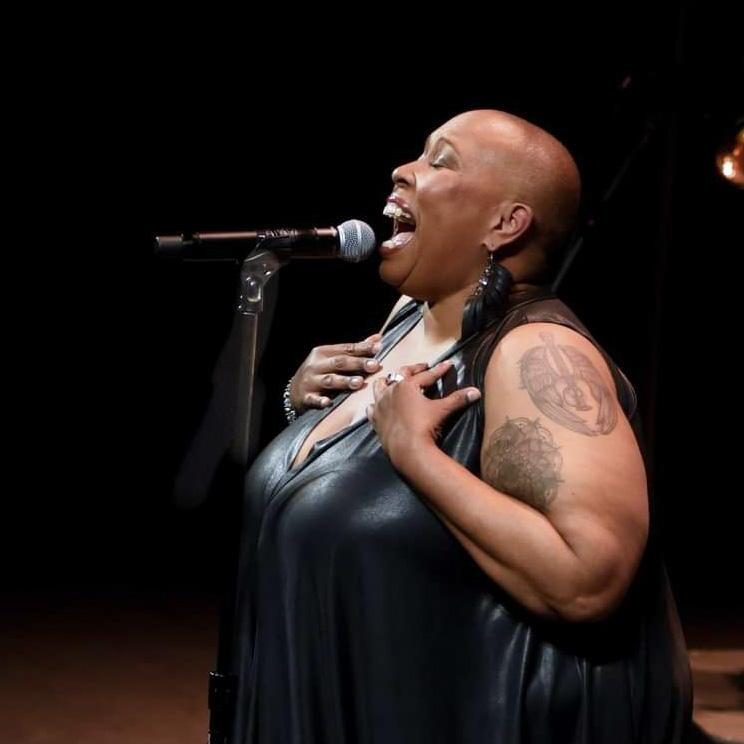
Kenya Templeton is a vocal stylist and jewelry and clothing designer

Rod and Karen Morrow / theblackguywhotips.com
Husband and wife podcasters Roderick (Rod) and Karen Morrow have been producing their comedy podcast, “The Black Guy Who Tips,” for 15 years from their home in Charlotte. Four or five days a week the two muse on various topics and issues from the news of the day to random cultural issues.
It was Rod’s idea to start the podcast, but Karen has been his cohost from the beginning. “We’re like 3,000 plus episodes in and there’s never been an episode without me on it,” Karen said.
The couple decided to monetize the “The Black Guy Who Tips” about nine years ago when Rod was laid off from his job. That’s when the state cut the maximum time people could collect unemployment payments to six months and also capped the payments at $350 per week. “Imagine trying to make that work,” said Rod.
Karen continues to work her day job in accounting. “Maybe it’s just being Black in America to be like, ‘Well, you always got to have a backup plan type of thing if something goes wrong,’” Karen said.
Rod handles the technical and day-today tasks for the podcast. “That’s part of the partnership of being married and being working partners on this thing. That’s just to balance out the work so that Karen isn’t basically working two jobs all the time — even though she still puts in a lot of work for the podcast,” he added. “I want to make it so that she can just show up, be her bright self and be funny.”
“If something happened and we had to just strictly make money off of being podcasters and nothing else we can make that work and still maintain our life right now.”
— Rod Morrow
Rod also worked as a writer for the “Game Theory with Bomani Jones” TV series and the podcast “Drapetomaniax: Unshackled History” with Michael Harriot. Rod also appears at least once a week on the Karen Hunter Show, a SiriusXM radio program.
Several companies have also advertised on the “The Black Guy Who Tips.” Rod said, “We used to spend a lot of time pursuing advertisers, but it’s very hard for Black podcasts to get advertisers.”
For several years, the podcast has been bringing in enough money for the couple to live on – outside of Karen’s salary, Rod said. “If something happened and we had to just strictly make money off of being podcasters and nothing else — we can make that work and still maintain our life right now.”
Audience members can donate once, monthly, or become paid premium subscribers to “The Black Guy Who Tips.”

Kenya Templeton / @kenya_templeton_does
Kenya Templeton has been singing since she was a child but began performing professionally in 2013.
When she was a North Carolina State University student, Templeton sang with New Horizons, an African American
choir and played the upright bass for a community orchestra.
She quit performing during her junior year, but it wasn’t until local performer Quentin Talley encouraged her to sing at a jazz show at Petra’s Bar that she started performing again. “I had nary intention to sing in public. I only sang at that jazz jam as a dare by my friend Wendy,” Templeton said.
“I consider myself an energetic sound curator. If you ever see me sing the way I honestly desire,” she said, “I often go into trances or scatting that is out of the realm of what most consider as scatting.”
Templeton also creates jewelry and wearable art. She said her design business, Griot Designs, allows her to explore her “creative tendencies.”
Last fall Templeton was awarded a John S. and James L. Knight Foundation grant to upgrade her mobile arts, science and Black history classroom called The Velo Griot. She also draws, paints and teaches the arts.
She performs at several venues around Charlotte, including Charlotte Shout! events, the VAPA Center, Harvey B. Gantt Center, Duke Energy Theater and other places.
Regarding the pay she receives as a vocalist, she said, “I feel that most creatives are severely underpaid. That certainly includes musicians, especially singers. … The cost of living has certainly surpassed what I make as a singer.”
Templeton said about two-thirds of her income comes from her creative endeavors. “Luckily, music is a tertiary creative practice for me at this time.” She said she continues to solidify her design, education and tour businesses.
Templeton is looking forward to what’s to come. “I’m ecstatic about what I’m getting into creatively right now. For those that have supported me for a while, I’m most grateful.” P
32 Pride Magazine | www.pridemagazineonline.com
Finding Home: Teens Transitioning from Experiencing Homelessness to Independent Living
By Sonja Whitemon
While many young people are thinking about sports, proms and graduating, some can only think of where they will sleep at night. There are so many teens who have nowhere to go, they are living out of cars, living on the streets and couch surfing. These teenagers are homeless, and they are vulnerable to some of the worst elements of life.
Sometimes teens are homeless by choice, escaping abuse or family conflicts and sometimes through no fault of their own. According to Covenant House, each year, an estimated 4.2 million young people in the United States experience a form of homelessness. Family experiences like child abuse and/or neglect, domestic violence, parental substance use or abandonment can lead a teen to become homeless.
Zion Newton was being raised by his grandmother until she was diagnosed with dementia and could no longer care for him. He moved in with a pastor and his wife until a death in their family caused them to need
the room he was using. Zion Newton was declared homeless by his school system.
“It made me feel like abandoned in a sense, like — not that she abandoned me — but it made me feel like I wish it wasn’t me,” said Newton. “Sometimes, I didn’t worry about it, but sometimes I was upset, like a
“When you’re 17, you shouldn’t have to worry about where you’re gonna live, where you’re gonna stay.”
—ZION NEWTON
lot, really upset because it was too much for somebody who is 17 to handle. I always felt like when you’re 17, you shouldn’t have to worry about where you’re gonna live, where you’re gonna stay.”
He remembers what it felt like to be without a home. “So, I really had no idea like what to do. I was really scared actually because of the simple fact that I really had
WINNER
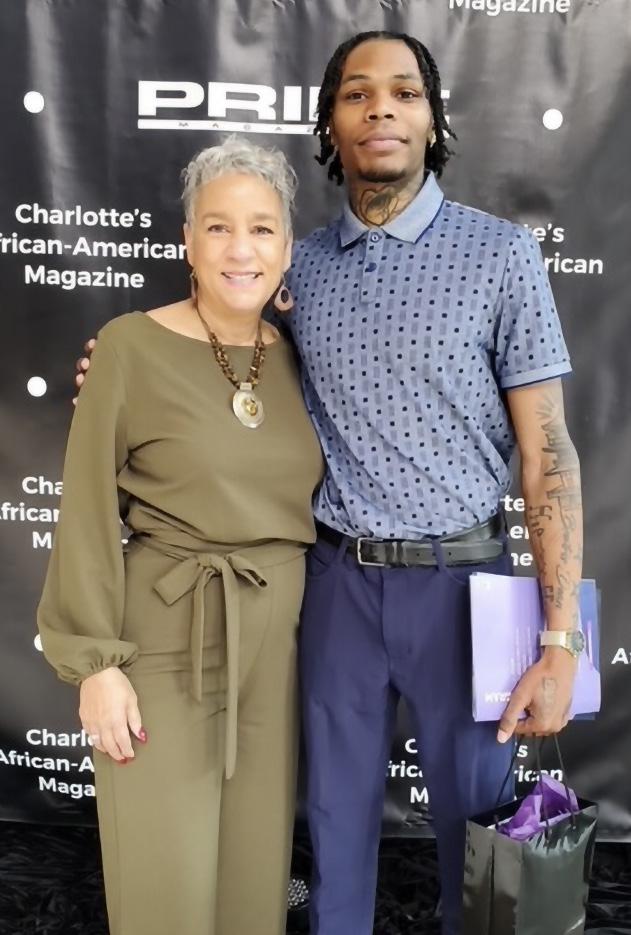
Donna Reed, founder of Home4Me, and JaQuan, a former foster care youth who overcame experiencing homelessness to earning a 4.0 at Livingstone College
May-June 2024 | Pride Magazine 33
Specific subpopulations of youth and young adults face a higher risk for homelessness.
Black youth face an 83% increased risk than their white peers.
Hispanic youth face a 33% increased risk.
LGBTQ youth were more than twice as likely to have experienced homelessness.
Young parents—especially unmarried—had a three times higher risk than non-parenting peers.
Youth with experiences of foster care, juvenile detention, jail, or prison.
Youth who do not complete high school are 3.5 times more likely to experience homelessness than peers who completed a high school diploma.
no idea where I was going to go ... what I was going to do. I really had no idea how I was gonna go to college if I wanted to,” he said.
His first thought was the military because the military would provide housing.
Ultimately, after graduating from Harding University High School in 2023, Donna Reed, founder of Home4me stepped in and helped him get into dormitory living at Livingstone College in Salisbury. Today, Newton is living year-round at the college with a major in business administration and a minor in religious studies.
Without adequate support, life after foster care for those who age out can be traumatic.
There are so many more Zions who have nowhere to go and don’t know what to do. Foster care exists to prevent children from being without homes. It is estimated that more than 5,000 children a year enter foster care in North Carolina. For some teens, it could be an option, but the maximum age of eligibility is 17. And those who are already in foster care on their 18th birthday, and have not made arrangements to live with parents, relatives or legal guardians are emancipated, which is commonly known as aged out of foster care.
Without adequate support, life after foster care for those who age out can be traumatic.
Donna Reed with Home4me said the excitement that comes with turning 18 for most is not necessarily the same for those in foster care. “There’s no excitement when you know that where you live, what’s coming in, what decisions are going to be made over your life — everything comes to an end,” she said. “And if you are in the middle of a school year and have not graduated yet and all of your resources come to an end and you have to figure out where you are going to go and what’s gonna happen to you. Imagine what that’s like.”
And Reed has imagined. She had the experience of aging out of foster care. Her organization, Home4me, wants every teen aging out of foster care to have the same options as youth with parents. And this includes the opportunity to receive their choice of education with paid tuition. For those who are college-bound, the organization has a relationship with Livingstone College that helps [them] attend
college and live on campus year-round until graduation.”
There are also government programs available to those who age out of foster care:
LINKS
Mecklenburg County also provides assistance with independent living through its LINKS project. LINKS provides services for youth in foster care who are between the ages of 13-21. LINKS was developed to help teach life skills so that aging-out youth can be self-sufficient once they are out of the foster care system.
NC Reach
NC Reach is a post-secondary educational program for students who have aged out of foster care. It is a state-funded scholarship offered to qualified applicants for up to four years of undergraduate study at public universities and community colleges in North Carolina.
Medicaid
Young adults ages 18-26 who have aged out of foster care may be eligible for Medicaid and can apply for Medicaid coverage at the Mecklenburg Department of Social Services where they reside.

34 Pride Magazine | www.pridemagazineonline.com
Left to right: Zion Newton, Donna Reed and her grandson Malik Reed at the Harding University High School graduation in June 2023.

West Side Community Land Trust Opening Doors in Charlotte’s Underserved Neighborhoods
By Sasha ManleyWith more than 100 people moving to the area daily, Charlotte is one of the fastestgrowing cities in the United States. While the population continues to rise, affordable housing is in rapid decline.
“Affordability housing is considered 30% of income, with the remaining 70% reserved for food, gas and other necessities of daily life,” according to CharlotteNC.gov.
On a mission
The West Side Community Land Trust (WSCLT) works to resolve the affordable housing crisis in one of Charlotte’s most underserved areas. Created in 2017, the WSCLT is a 501(c) 3 nonprofit organization that works to organize and empower the
West Side community to preserve and develop their neighborhoods.
Charis Blackmon, the Charlotte native who serves as the organization's executive director, is a natural-born leader who believes in community.
Blackmon defines the nonprofit’s mission with residents as a top priority: “West Side CLT’s mission is to create permanently affordable housing with communitycentered development in West Charlotte and beyond.” She added, “We were founded by West Charlotte neighbors in an Enderly Park living room to create “staying power” for those at risk of displacement.”
The nonprofit uses the Community Land Trust Model (CLT), which allows residents to have more say in their neighborhoods.
“The model focuses on permanently and perpetually preserving land and space for
West Side Community Land Trust Quick Facts
• Homes are sold based on income between 60%-80% of the average medium income and priced as low as $180,000
• They do not list homes on MLS
• The rental program supports those earning between 30%-80% of AMI with a goal to transition into homeownership
• The WSCLT serves the following zip codes: 28208, 28214, 28216, 28217
community benefit through a ground lease structure,” Blackmon said. “Recognizing residents as the experts of their communities, we come alongside them to acquire, develop, and preserve real estate based on what they envision and desire for themselves and their communities.”
The organization has supported residents through:
• Preserving the affordable inventory of homes
• Displacement prevention
• Creating permanent affordable homes and senior living spaces
Charis Blackmon, executive director of the West Side Community Land TrustMay-June 2024 | Pride Magazine 35
• Redeveloping the historical shotgun homes
• Historical community land control
“All of this occurs in rampantly gentrifying, historically Black communities, where West Side CLT homes and spaces will remain affordable and accessible to neighbors now and for generations to come,” Blackmon said.
To date, WSCLT has had great success in helping residents. They have supported more than 60 seniors with pre-lease housing, specifically for senior living communities, sold three of four completed home units, and prevented over 25 families from displacement. There are three more units in development beginning with a pre-sale program and homeowner pool.
Through Blackmon’s expertise, she feels affordable housing obstacles are directly related to profit over responsibility. “I think our most significant obstacle is irresponsible capitalism that has made housing a commodity instead of a human right and maintained a posture of profits over people through the extraction and overextrapolation of resources from our most vulnerable communities, both currently and historically,” Blackmon said.
Redevelopment and gentrification are also driving up home prices, and the pool


of affordable homes is continuing to shrink, she added.
This profoundly affects the organization’s mission, but Blackmon feels steadfast. “There is immense pressure to acquire and preserve as much real estate as possible to keep pace with the demand/needs of our communities,” she said. “Yet, we must balance that with resource challenges and barriers to entry that come along with the competition that gentrification creates.”
More than housing
Members of WSCLT have created welcoming initiatives for prospective homeowners. These opportunities go


beyond affordable housing and explore residents’ current and future needs.
“We employ a variety of initiatives in pursuit of our mission and the overall goal of preserving land and space for community benefit — ultimately serving communities in the ways they’ve identified,” Blackmon said.
Five key service areas are Rental Housing, Community Engagement, Advocacy, Placemaking and Development and, of course, understanding homeownership.
Steps to apply
The initial step to purchasing a Westside CLT home is simple. Prospective homeowners should visit the nonprofit’s website at www.westsideclt.org to sign up for the interest list.
After signing up, prospects are asked to complete a 101 course on homeownership and then are invited to complete an application with additional financial/ homebuying education.
All are welcome to apply, but the selection process prioritizes applicants based on factors such as displacement risk, family size, income, location and home availability.
Looking ahead
Unfortunately, the future of affordable housing will continue to be a challenge unless there is planning and actions in mind. The vast amount of growth in Charlotte is expected to remain strong.


Take your next step to home sweet home

Get expert guidance from a Southern First Mortgage Executive and find the right mortgage for you with up to 100% financing and low down payment options available.




*Loan originations are subject to underwriting and credit approval. Other terms, conditions and certain fees may apply.


When asked about predictions and goals over the next five to ten years, Blackmon said, “Based on the influx of people migrating to our city and consistent trends in increased housing/living costs, it seems as though we will continue to struggle with housing affordability. Yet, my optimistic prediction is that we will see a positive impact with continued and persistent commitment. But we have to get it right.”
Here are a few steps Blackmon feels should take place over time:
• Affordable innovation and progressive housing structures such as 3-D printing, cooperative housing and modular development


• The current West Side CLT structure can be used as a template for city-wide land development/expansion, with affordability as a top priority
• Legislation and policy changes that advocate for access and affordable homeownership


Are you interested in helping WSCLT with their efforts? Many opportunities exist to be a donor, member or partner. You can get connected by email at info@westsideclt.org.
The organization is eager to share its lifechanging mission with the community. P
36 Pride Magazine | www.pridemagazineonline.com
Meet Jackie Curry
E xecutive Producer
of the John Boy & Billy Big Show
By Ruby DurhamShe might not be shooting literal shots in the gym like her nephews Stephen and Seth, but Jackie Curry is helping write the winning playbook at the John Boy & Billy Big Show, a Charlotte-based syndicated radio show.
Curry is the Executive Producer for the show with a classic rock format which airs on 99.7 The Fox WRFX, Monday through Saturday mornings. The Big Show is frequently ranked #1 on Arbitron with over 50 affiliates in the Charlotte market among their demographics.
“I tell people I’m a Black woman stuck in a white man’s world and love it, and they love that about me,” Curry said. “I’m also the mama. I’m easy to talk to, and I love making sure they can do their job exceptionally well.”
This year marks 30 years at the Big Show for Curry. She works behind the scenes making sure John Boy and Billy (John Isley and Billy James), the main on-air talents, know the run of the show and takes calls from listeners who want to be a part of live games. Over the last 20 years, Curry said she has written all the Saturday and vacation shows.
Jackie recalled one of her favorite moments being able to travel with the Big Show to air live from places like Japan and at the Daytona races at Disney World.
“I’m a guy’s girl and it’s been that way since I was younger,” Curry said. “I think it comes from my brother Dell and I being close growing up.

We were both athletes and shared a lot of the same friends.”
Curry said her radio career has brought a lot of diversity in her life and experiences she loves to share with her son Eric Lynch.
“I tell everybody I have one son that is one of my best accomplishments, but I also work at a daycare (the radio show) and have two children,” Curry said.
“Billy’s quiet but very smart, funny and like the perfect child. And John Boy is spoiled rotten but makes you feel like you’re the most important person,” she said.
Curry initially started as a receptionist at WRFX before being promoted to the Big Show. Prior to that, Curry had moved to Charlotte from Grottoes, Virginia, after her job shut down and her father passed away.

The plan was to help her brother, Dell Curry, and his then-wife Sonya Curry, with their two sons Stephen and Seth Curry. At the time, Dell played for the Charlotte Hornets.
“Growing up, I went to a predominantly white school in Fort Defiance, Virginia, and listened to Led Zeppelin, The Police, Aerosmith and Kiss. We didn’t have urban stations — not even a stoplight, and could not get Dominos to deliver pizza,” Curry said. “I loved helping my brother, so I accepted the job and would often bring Seth and Steph with me. Everybody embraced them and called them the ‘Big Show’ kids.”
Curry said she never wanted to be on the frontlines of the show but can tell you about every song being played. Some of her repeat songs are John Boy’s song, “I Need a Vehicle,” “Wagon Wheel” by Darius Rucker and anything by Santana, and The Marshall Tucker Band, to name a few.

“My significant other tells me I know more redneck music than Black music,” Curry said. “Besides that, I have a potty mouth — so my mom told me, ‘Do not get on that microphone.’ ” Curry’s advice to other women taking leaps into jobs that may be different from what people expect is to be authentic, and find a community of people who embrace that as well. P
Randy Brazell, John Isley, Marci Moran and Jackie CurryMay-June 2024 | Pride Magazine 37
Left: Jackie Curry, producer of the John Boy & Billy Big Show. Right: Jackie Curry, Executive Producer of the John Boy & Billy Big Show, and her nephew, Steph Curry, point guard for the Golden State Warriors.


2.CARDBOARD & SMALL BOXES (Clean Pizza Boxes - Okay) 1. PLASTIC BOTTLES & JUGS with Necks 3. EMPTY METAL CANS 4. MILK & JUICE CARTONS 6. GLASS BOTTLES & JARS (Lids On - Okay) 5. PAPER & MAGAZINES Place ONLY these SIX items in your curbside recycling! WE ARE ALL WHEN WE
The RoadLongto Justice
Concord, N.C. man exonerated after 44 years in prison
By Sonja Whitemon
13% of the U.S. Population are African Americans
47% of known exonerations are African Americans Black people are 7 t imes more likely to be wrongfully convicted of killing white victims. 1/2 of all sexual assault exonerations where mistaken identification is a factor, the defendant was Black and the victim was white.
Source: The National Registry of Exonerations

Ronnie Long credits his release from prison to the grace of God and his committed, loving family, but he is understandably angry with the people who manipulated the legal system to convict him in the first place. His comments are raw and unfiltered.
How well do you remember the year 1976? That’s if you were even born yet. Gerald Ford was completing the presidential term of Richard Nixon who had resigned in disgrace and the price of gas was 55 cents a gallon. It is also the year that 21-year-old Ronnie Long began serving two life terms in prison for crimes he did not commit. He would remain in prison for the next 44 years, 3 months and 17 days. Reminiscent of segregated Mississippi during the Emmit Till murder trial, his fate was sealed by police misconduct and false testimonies.
Given an opportunity to accept a shorter sentence, he refused. “Now they come to me telling me if they give me seven years, I’ll be back home in three. My father said, ‘Ronnie, I didn’t raise y’all to say you did something when you didn’t do it.’ I didn’t take that plea. I [was] facing a death sentence. They wanted to kill me. I prayed to the most righteous God.”
Long was convicted of first-degree rape and burglary. At that time, rape was a capital offense in North Carolina. That year the state put a hold on new death penalty convictions.
“That’s when my lawyer came to me and said, ‘We need to get you in court now while the death sentence is off the table. We don’t know how long it’s gonna be off the table,’” he recalls. He narrowly avoided the death
penalty. The pause lasted only about 60 days. He said, “They took me to the toughest prison in North Carolina — Central Prison.” Central Prison is the largest and often considered among the worst prisons in the state. It is also where male inmates awaiting the death penalty are held.
The alleged victim was 54-year-old Sarah Bost, a prominent white woman and the wife of a deceased former Cannon Mills executive. Cannon Mills was a textile manufacturing company based in Kannapolis, North Carolina. It was once the world’s largest producer of towels and sheets and a Fortune 500 company estimated to have once employed nearly 30,000 people.
A good life
Ronnie Long lived a good life — nothing extravagant. Just three years out of Concord Senior High, he worked as a brick mason for a concrete company his father owned in Concord. He also played city league baseball with the Concord Giants and hoped for a career in the majors. That was his world until detectives showed up at his family’s house under a ruse of a misdemeanor trespassing violation, telling his mother he only needed to sign some papers and would be back in 15 minutes. Fifteen minutes turned into 44 years.
The State vs. Ronnie Long
The trial was a parade of disinformation coming from both law enforcement and the alleged victim. Some evidence was planted and evidence that might have cleared him was withheld from his attorneys or, in some
A young Ronnie Long Concord Police Department/the Charlotte Observer via AP Ronnie Long's mug shot from the Concord Police DepartmentMay-June 2024 | Pride Magazine 39



cases, just disappeared. Police officers were proven to have lied on the witness stand. The victim’s testimony did not altogether match the initial interviews. Even the jury pool was hand-selected by the Concord police chief.
Despite massive amounts of evidence available only to the prosecution at the time, the district attorney felt comfortable making this bold statement after the trial: “We have shown that Ms. Bost’s testimony is not only accurate but totally consistent with every piece of physical evidence existent. Everything she says happened that is capable of being corroborated by physical evidence is so corroborated,” And, with that, Long was convicted and began 44 years of court filings, appeals and waiting.
After repeated appeals in state court beginning in 1977, Long’s legal team took his appeal to federal court. An appeal was denied in federal court in 1990.
‘I always knew I would get out.’
About 30 years after his conviction, Long’s attorneys learned that in 1976, investigators had tested more than a dozen pieces of evidence and had hidden the results from the defense team. On appeal, it was determined that Long’s rights were violated by the suppression of evidence that would have been favorable to him at trial.
In 2005 his attorneys asked a superior court judge to order the the North Carolina State Bureau of Investigations (SBI), the Cabarrus County District Attorney’s Office, and the Concord Police Department to turn over all records and evidence collected in the case. The state objected to the request and the SBI argued, “There is no objective evidence warranting a rational belief that any further exculpatory evidence or material exists.” The court also ordered hospital records.
As a result of the request, they found boxes that held a trove of evidence in Long’s defense that included:
The victim described her attacker as a “yellow or really lightskinned Black male…not your ‘normal’ Black person.” Mr. Long, however, is dark-skinned – a “normal” Black person.
The police hid evidence that could have cleared Long. The evidence included hair samples and more than 40 fingerprints found at the crime scene that did not match Long’s. There were also semen samples from a rape kit that were no match.
Before the trial, the Cabarrus County sheriff, the Concord police chief and some of his officers personally vetted the jury rolls to weed out “undesirables,” according to Long’s lawsuit. As a result, there were only four Black candidates in the pool of 99 prospective jurors that Mr. Long’s trial team reviewed. None were seated.
Of the jurors who were selected, three members of the all-white jury worked for Cannon Mills, (where the victim’s late husband had
40 Pride Magazine | www.pridemagazineonline.com
“Free Ronnie Long” rally participants
worked as an executive), and a fourth was married to a Cannon Mills employee, said the lawsuit.
Shortly after this evidence was discovered, a federal appeals court ordered a new hearing and, in September 2020, Ronnie Long was almost immediately released from prison. He was later pardoned by the governor and received $750,000 in compensation — by law, the state’s top compensation for victims of wrongful incarceration.
‘Hell, no, it’s not enough!’
“Ain’t no way in hell you put me in the penitentiary then tell me what I’m worth,” Long said. “Hell, no, it’s not enough! I lost opportunity. I lost the privilege given every man born in the United States to grow and progress — to expand. They know they took my life … but ain’t nobody apologized.”
Knowing that he never raped anyone, Ronnie Long quipped, “If I raped that woman, I would be the first Black man to rape a white woman and get paid for it.” Long sued the city of Concord, the Concord Police Department, the Cabarrus County Sheriff Department, the SBI and the estates of those involved who are now deceased. Not only did he get his apology, he was also awarded settlements totaling $25 million.
Through a public statement by the Concord City Council, the apology reads, in part, “We are deeply remorseful for the past wrongs that caused tremendous harm to Mr. Long, his family, friends and our community.”
The true alleged perpetrator, the “yellow-skinned” Black man, was never found.


Transforming hopelessness into hope! "You cannot solve a problem with the same thinking that created it. Inspiring hope in underserved youth 12-17 by fostering their emotional, intelligence, through free therapy that their innate talents 704-264-4761 www.asopnc.org info@asopnc.org
The Best Relationships Start With Trust Mortgage | Personal | Commercial | Business 6310 Fairview Road Charlotte, NC 28210 htb.com/reggie-miles 240314-1204793087 Community Development Mortgage Loan O cer NMLS# 214972 Reggie Miles May-June 2024 | Pride Magazine 41
Spotlight on 7 “Beyond Open” Small Business Grant Recipients
By Kurtavia Burton and Alicia BenjaminThe Foundation for the Carolinas (FFTC) announced the chosen recipients of the Beyond Open Round 2 small business grant program last fall. The program, administered by FFTC and made possible by support from the Wells Fargo Open for Business Fund, awarded 116 small businesses in Charlotte’s Corridors of Opportunity with grants totaling $4.8 million in the second round of the program. Beyond Open Round 2 grants range from $10,000 to $150,000. Eligible small businesses will compete in the third round this year. Here are seven of the businesses that received grants in the second round of the Beyond Open small business grant program.

1Rise Up Learning Center LLC provides in-house tutoring for schools and afterschool programs that serve underserved students as well as 1:1 tutoring. They primarily focus on underserved and schools that are considered low performing.
“I applied for the grant because there was a desperate need to update our technology for staff and students who participate in our programs Most importantly, the need to help students during post-covid was significant,” said Carmen Blackmon, Rise Up Learning Center owner. “A high percentage of students have not fully recovered from the loss of learning that occurred during covid and remote learning. They are making progress, and we are glad to share in their academic growth and success.”
Blackmon said the Beyond Open grant helped the center increase the number of programs they’re able to serve in the community. The center used the grant to support their partner programs to ensure their students can access quality tutoring programs while attending after school programs. They were able to increase staffing to serve more students and purchased vehicles to help students who need transportation to attend center programs, she said.

2
180º Productions, LLC is a fullservice media production company with expertise in all areas of production, including photography, videography, location scouting, concept development, equipment, production support, and post-production editing.
Tony Rushing, owner of 180 Productions, said his company applied for the Beyond Open grant to help them provide comprehensive, customizable and innovative live streaming services to their customers. They wanted to incorporate multi-camera support and advanced technology to seamlessly capture and stream high-quality videos, catering to both on-site and remote participants, Rushing said.
“The Beyond Open Grant was pivotal in helping to establish our company’s (ability) to effectively compete for and complete projects when bidding for large-scale contracts involving LED walls, multi-camera live streaming, and video production services, Rushing said.
“Since implementing these modifications to our live-streaming and video production services, we have experienced a notable increase in word-of-mouth referrals. This growth has allowed us to hire more subcontractors, secure larger projects, and improve our overall workflow efficiency.”

3 Junior Designs specializes in painting, mural art, and digital artwork. While he primarily works solo, artist Junior Gomez said he collaborates with contracted professionals when necessary to deliver high-quality creative projects.
Gomez, owner of Junior Designs, said he “sought the grant to realize my vision of establishing a dedicated art studio.” Previously confined to a limited 12 foot by 12 foot space, he said he found it challenging to fully express his creativity and accommodate client meetings. He also
“The grant has been instrumental in transforming my business operations. By enabling the construction of a purpose-built studio, it has vastly improved efficiency by consolidating all aspects of my work under one roof.”
—JUNIORGOMEZ
Tutoring session at the Rise Up Learning Center Tony and Nikki Rushing Artist and owner of Junior Designs, Junior Gomez42 Pride Magazine | www.pridemagazineonline.com
plans to hire an assistant, content creator and videographer, he said.
“The grant has been instrumental in transforming my business operations. By enabling the construction of a purpose-built studio, it has vastly improved efficiency by consolidating all aspects of my work under one roof,” Gomez said. “No longer do I need to travel between locations to complete projects, streamlining the production process and enhancing client satisfaction.
“Additionally, the studio serves as a professional and welcoming space for clients, bolstering their confidence in my services and legitimizing my business within the artistic community,” he said.


5
Squeaky Clean Car Wash, a hand car wash and detailing company, offers buffing, waxing and shampooing for all motor vehicles.
Owners Corby and Lea Watkins said they applied for the grant to use the funds to help boost their business by upgrading electrical work in their building and purchasing uniforms. “We were also able to get our mobile vehicle repaired, interior and exterior painting of our building, roofing repair and much needed equipment,” Lea said. “We are so grateful for their assistance. We may not have been able to stay afloat without them.”
as efficiently and effectively as we would have liked,” said Jean-Claude Kadio, General manager and owner of Bonka Consulting.
The Beyond Open grant helped Bonka Consulting purchase new equipment which helps their employees work faster and operate more efficiently, he said. “This tax season is going a lot smoother because of the newer equipment and the more robust security systems we have in place, which also give our clients more confidence in the service we provide.”

4
Loving Touch Adult Day Health Care Center, Inc., is a statecertified dementia care facility, said the center’s owner and Executive Director, Joyce Freeman.
The center serves individuals 18 years and over who can’t be left alone during the day. Most of our clients are 75 years old and over and have cognitive and developmental disorders that the Living Touch center nursing staff can help assist with daily. The center staff provides individuals they serve with meals, exercise, current events and other services. “We strive to keep all our participants happy, independent and above all, safe,” said Freeman.
Loving Touch applied for the Beyond Open grant to beautify the parking lot and provide better security for our participants, Freeman said. The center will use the funds to erect a security fence around the parking lot, pave the parking lot, and build a gate in front of the parking lot to help with unwanted traffic. “This security fence and gate will help continue to keep our participants safe and truly enjoy their home away from home.”

6
Bonka Consulting, LLC is a tax, accounting and advisory service practice. They provide accounting services to small and medium size companies, tax services to individuals and businesses, and advisory services.
“As part of the fabric of the community we serve, one of our goals is to serve our community well and become one of Charlotte premier Accounting, Tax and Advisory Services. With our outdated equipment, we were not operating
7
Ocean Transportation, Inc. provides same-day and final-mile courier services in North Carolina and surrounding areas.
“I applied for the Beyond Open grants to help purchase another vehicle for the company. This way I was able to add another driver to the team as well as a jump start to the new year,” said Shakeithia Brice, owner of the company. “The Beyond Open grant has helped my business by allowing me to cut down on maintenance of vehicles. I’m able to see a better profit within the business.” P
“The Beyond Open grant has helped my business by allowing me to cut down on maintenance of vehicles. I’m able to see a better profit within the business.”
—SHAKEITHIA BRICELeft to right: C. McCullum, E. Crowder and D. Glass Bonka Consulting owner, Jean-Claude Kadio Squeaky Clean Car Wash co-owner, Corby Watkins Shakeithia Brice, owner of Ocean Transportation Inc.
May-June 2024 | Pride Magazine 43
The Importance of Maintaining Heart Health for Seniors
By Rosanny CrumptonMaintaining a healthy heart throughout our lifetime is both plausible and important for our own well-being and for the good of public health.
Heart disease is the leading cause of death in the U.S., according to the Centers for Disease Control and Prevention. According to the World Health Organization, ischemic heart disease is responsible for deaths worldwide and according to the Mecklenburg County Office of Chronic Disease Policy and Prevention, heart disease is also the leading cause of death in the county.
We can do something about this.
Dr. Khawar Shaikh specializes in interventional cardiology, cardiovascular disease and endovascular medicine at Novant Health Heart & Vascular Institute. As a practicing physician, he sees patients day in and out and assures us that many heart-related concerns can be prevented as well as managed.
Shaikh said he wishes people would invest in their health just as they invest in their retirement plans as they plan for their senior years. Blood pressure, diabetes, high cholesterol and other health complications often begin when people are in their 30s and 40s. By adopting healthy lifestyle habits such as healthy eating, developing an exercise routine, scheduling regular doctor visits, etc., people can prevent or detect potential catastrophic events early.
In addition to following a hearthealthy diet and engaging in regular physical exercise, other healthy lifestyle practices that support overall well-being


Dr.
Khawar Shaikh, specializes in interventional cardiology, cardiovascular disease and endovascular medicine at Novant Health Heart & Vascular Institute.
Shaikh … wishes people would invest in their health just as they invest in their retirement plans as they plan for their senior years.
inevitably supports good heart health. Shaikh said watching alcohol intake, maintaining a healthy weight, practicing stress management, not smoking, managing diabetes, cholesterol and blood pressure are all recommendations for maintaining heart health as we age. While lifestyle plays a significant role in our health and longevity, understanding family health history is also important.
“Those individuals who have multiple family members with heart disease and other conditions are at much higher risk of developing heart and cardiovascular disease as well as stroke as compared to another person without this kind of family history,” explained Shaikh. Prevention is extremely important for everyone, but especially if there’s family history of cardiovascular disease, he said.
Many people are in denial about their health. Shaikh explained that seeking help from a trained and qualified physician can lead to early detection, early diagnosis and timely treatment. Seek out help soon if you
44 Pride Magazine | www.pridemagazineonline.com
are experiencing high blood pressure consistently, if blood sugar is out of control and if you are experiencing other health concerns, he said. If you have chest pain or shortness of breath symptoms, something serious and significant may be occurring. Do not ignore what your body is telling you.
There are a lot of medical conditions included in heart disease, he explained. Warning signs of heart concerns vary which is why it’s important to talk to your doctor about any symptoms you may be experiencing. Some people may experience the classic symptoms of chest discomfort, challenges and abnormalities in their heart performance while engaging in a physical activity while others may feel unusual light headedness, fatigue, etc. whether experienced during intense physical activity or not, Shaikh said. These can be early warning signs, but it varies.
It’s also important not to shrug off warning signs as we age.
“Just like any part of the body, aging takes place in the heart and vascular system as well,” Shaikh said. As we age,

Experiencing a heart-related event is not a life sentence. There are advanced treatments that can help people live very long and productive lives.


Access Services Inc., a proud black-owned business, marks 30 years of excellence in staffing services. Specializing in construction, manufacturing, and light industrial sectors, they've been a trusted partner in connecting skilled workers with top-tier companies. With a commitment to diversity and quality, Access Services Inc. continues to thrive, embodying resilience and success in the ever-evolving landscape of the staffing industry. Here's to another 30 years of innovation and impact!

704-644-5529
info@access-services.biz access-services.biz 2101-115 Sardis Road North Charlotte, NC 28227
Access Services Inc.
Charlotte Business Trailblazers
Kevin Smith
May-June 2024 | Pride Magazine 45
Frank Johnson

While lifestyle plays a significant role in our health and longevity, understanding family health history is also important.
Charlotte Business Trailblazers
Wrapper’s Delight, LLC
Natasha Pender-Craig is the dedicated owner of Wrapper’s Delight LLC. With a passion for creativity and customer satisfaction, she specializes in personalized gifts and gift-wrapping services. Attention to detail and innovative designs have garnered praise from clients, making Wrapper’s Delight a go-to destination for beautifully presented gifts. Her commitment to excellence has established her business as a beloved local gem in the Charlotte community.


5835 Prosperity Crossing Dr, Ste 108 Charlotte NC 28269 980.285.2859 Natasha@wrappersdelight-llc.com www.wrappersdelight-llc.com @CLTWrapStar
there is a higher risk of developing a stroke or cardiovascular event which can lead to a major disability, he added. However, “getting old does not necessarily mean that you should be out of breath or experience heart pain. Any change in your ability or health status, go see your doctor,” Shaikh said.
Experiencing a heart-related event is not a life sentence. There are advanced treatments that can help people live very long and productive lives. Generally, Individuals should visit their primary care physician at least once a year, if not more, Shaikh said. The patient’s doctor can decide if the person needs any specialists.
Shaikh expressed the importance of not ignoring signs and symptoms just because you’re getting old. It’s important to seek help, talk to your doctors, and stay up to date with health care screenings.
Qualified physicians can detect impending heart disease through certain imaging studies and certain blood tests, he said. Seeing your doctor regularly can help avoid a major cardiac or vascular event. P
Charlotte Business Trailblazers
Trauma Informed Institute


Vernisha Crawford is A TOP RATED INTERNATIONAL CORPORATE SPEAKER to book for transformative talks on traumainformed leadership, workplace wellness, and organizational resilience. With extensive experience at the Trauma Informed Institute, Vernisha empowers leaders with practical strategies for fostering healthy work environments. Engage your audience with dynamic presentations that inspire change and promote a culture of well-being. Book Vernisha Crawford today for impactful corporate events.

Vernisha Crawford; President & CEO of Trauma Informed Institute Founder of BYE Foundation, INC 428 4th Street #300B Charlotte, NC 28202 www.vernishacrawford.com
46 Pride Magazine | www.pridemagazineonline.com



Charlotte Business Trailblazers
AC&M Group


AC&M Group is a trailblazing marketing firm and has been headquartered in Charlotte, North Carolina, since 2005. Standing as a beacon of innovation and inclusivity in the marketing world, they are proudly celebrating two decades of unparalleled service, marking their 20th year in business with a legacy that has significantly shaped the industry landscape.
AC&M was founded with a focus on bridging gaps, forging connections, and increasing sales for their clients. Their campaigns are known for resonating with the country’s fastest-growing segments, thanks to a keen focus on authenticity and community dynamics. Cutting-edge research and data analytics are at the core of their tailored campaigns, which have earned AC&M a reputation for creative and culturally relevant solutions.
What sets AC&M apart is their unwavering commitment to understanding the unique dynamics of various communities. By leveraging cutting-edge research and data analytics, they ensure that every campaign is rooted in authenticity and tailored to meet the specific needs of their clients. This approach has enabled them to execute campaigns that are not only creative but also culturally relevant, earning them a distinguished reputation in the industry.
As they celebrate their 20th anniversary, AC&M remains at the forefront of marketing innovation. Their portfolio speaks to their commitment to excellence, featuring award-winning work for clients such as SherwinWilliams, Bojangles, CertainTeed, YMCA of Greater Charlotte, Family Dollar, Mecklenburg County, and the North Carolina Department of



Health and Human Services. Their mastery of digital marketing, creative development, social media, and traditional advertising continues to yield superior results.
AC&M is proud of their journey from a visionary startup to a leading agency that champions diversity and inclusion. As they look forward to the next chapter, AC&M Group remains committed to driving change and creating meaningful connections in an ever-evolving digital world.
info@acmconnect.com 704-697-4400 acmconnect.com 1307 W. Morehead Street, Ste 107 Charlotte, NC 28208
Kristi J. Booker Managing Director
Jaime Cardenas CEO/Founder
Charlotte Business Trailblazers
Kendric Best, REALTOR®


Kendric Best is a natural connector with a knack for getting deals done.
As a licensed Realtor ®, Kendric’s clients describe him as detail-oriented, proactive and determined. He is a member of the Equity Real Estate team who specializes in relocations, new construction and assisting first-time homebuyers. He is passionate about helping individuals, investors and developers achieve their real estate goals. With a diverse professional background that encompasses real estate, banking, sales and nonprofit leadership, Kendric is a high-touch agent known for his unmatched devotion to his clients as well as his extensive knowledge of the Charlotte market.
He recently launched Moving2CLT.com, a real estate blog and relocation portal. The site features helpful tips, resources and expert advice for anyone who has recently relocated or is considering moving to the Queen City, one of the nation’s fastest growing cities.
Kendric was recently named one of the Top Real Estate Agents to Watch by Disruptor Magazine. A graduate of Johnson C. Smith, he is committed to giving back to the community. He is a lifetime member of Omega Psi Phi Fraternity, Inc and is a member of the Epsilon Upsilon chapter. He also serves on the Board of Directors for A.C.E. Academy Charter School in Harrisburg, NC.

Equity North Carolina Real Estate LLC 13124 Idlewild Rd Matthews, NC 28105 (704) 287-9969 Cell https://kendric-best.equity.us/
Charlotte Business Trailblazers


Over the past three decades, TWT Distributing has built the reputation as the ‘go to’ supplier of ethnic personal care products to many of the leading retailers throughout the country.

Since opening its doors in 1992, TWT Distributing has been hired by many of the top retailers such as Food Lion, Ingles Markets, Kroger, Harris Teeter, Lowes Foods, Citi Trends and many more to make available in their stores the leading personal care products used by ethnic consumers on a daily basis.
Customers can expect the find their favorite hair and facial products, hair accessories, natural care products, and trial-sized products made by brand names such as Bronner Brothers, Ampro, Carol’s Daughters, Mielle Organics, Organics Roots Stimulator, Mixed Chicks, Aunt Jackie’s, etc., when they shop at a store serviced by TWT Distributing.
To guarantee a successful shopping experience for each customer, TWT Distributing offers its retail partners support services such as product research and performance data, instore merchandising, result-driven marketing, and electronic replenishment.


TWT Distributing Inc. 1-800-849-7898 twtdistributing.com
TWT Distributing Incorporated
48 Pride Magazine | www.pridemagazineonline.com
Charlotte Business Trailblazers
Emma Allen Insurance Agency

Emma Allen is a seasoned financial expert and highly successful entrepreneur. As a 30-year banker, and insurance and financial services professional, Emma has been called the banker’s banker, achieving executive level status during her banking career. Emma has coached, mentored and advised financial professionals and individuals from across the country and internationally.
Emma is a highly sought after professional speaker and is a speaker on the Les Brown speakers network. Emma invites you to fasten your seat belt and enjoy the ride when participating in one of her high energy workshops. Emma is an expert in the arena of financial literacy training as well as financial planning. She has developed a specialized niche that transcends traditional thinking and has a proven track record of helping both business and personal clients significantly advance their personal financial conditions.
As a highly successful entrepreneur, Emma has owned a number of businesses including Emma Allen Enterprises, a financial consulting firm focused on financial literacy for


church congregations, professional athletes, colleges and business owners. Emma also is the agent/owner at Emma Allen State Farm located in Charlotte, North, which serves all of North and South Carolina.
Emma has received numerous accolades including:
• The Maya Angelou Women Who Lead Award
• The Thurgood Marshall Award
• The Charlotte Post People of Prominence Award
• City Of Winston Salem Woman of The Year
• City Of Charlotte Small Business of the Year
• M&F Bank Founders Award
• Roddey Foundation Leadership Award
• NC Works Employer Recognition Award
• Black Political Caucus Business Women Of The Year
• Chairman’s Circle Award Winner
• UNC-Charlotte Distinguished Alumni Award
• The Chronicle Community Service Award
• Outstanding Women Leaders Award
• National Negro Women’s Hall of Fame Inductee
As an accomplished columnist, Emma has regularly contributed to various local, national and international publications. Emma has regularly appeared on nationally syndicated talk shows. As a community activist, Emma currently offers a wide range of financial empowerment workshops for college students, community and civic organizations , small businesses and churches. Some offerings include: Wise People Live Full and Finish Rich, Diva’s Don’t Do Debt, Start Now Finish Rich for College Students, How to Save your 401k from the Recession, Smart Business Owners build a legacy and finish rich.
Emma’s State Farm Agency is located at 4920 Monroe Road, Charlotte, N.C., 28205. With over 300 Google reviews the agency is focused on improving the financial conditions of the community at large with an emphasis on small business continuity.
www.emmasallen.com www.facebook.com/EmmaAllen55 www.linkedin.com/in/emmaallen2
4920 Monroe Rd Charlotte NC, 28205 704-372-1088 Email-Emma@EmmaSAllen.com


Atrium Health


Irene Bolis
Director, Operations
Irene leads corporate strategic operations and analysis of service line financials for all acute facilities. She is transitioning to lead 12 outpatient neurology practices.
Shawana Burnette, DNP, RNC-OB, NEA-BC, CLNC, FAWHONN
Nursing Practice Specialist
Shawana is a Nurse Practice Specialist for Nursing Excellence with over 20+ years of OB nursing experience including 18 years in leadership.
Ericka Ellis-Stewart
Enterprise Director, Corporate Social Responsibility
Ericka provides enterprise-wide strategic leadership and operations management for Advocate Health’s internal teammate philanthropic giving and teammate engagement through community service.
Rashard Johnson
Senior Vice President, South Area President
Rashard governs the development and day-to-day operations of the following Atrium Health hospitals: Pineville, Union, Union West, and Anson.
Lilliam Núñez-Rodríguez, MBA, SHRM-SCP
Assistant Vice President- Senior HR Strategic Business Partner
Lilliam is the Human Resources lead and senior leadership advisor for the Central and West Markets in Greater Charlotte.
Tiffany Victor, DNP, MSN, BA, ACM-RN
Vice President, Population Health and Care Management
Tiffany is a strategic leader responsible for developing, aligning and executing clinical care management and related services across the Atrium Health Greater Charlotte Region.
Bank of America

Karen Bardales
Senior Vice President, Business Banking
Senior Relationship Manager
Karen has extensive experience creating local economic value by enabling advancement opportunities for all (President ALPFA Charlotte) and empowering the next generation of Hispanic-Latino entrepreneurs.


Dheepa Nanduri
Senior Vice President, Risk Management Manager
Dheepa specializes in Payments and Climate Risk, and is also an advisor on Asian Leadership Network Charlotte, connecting nonprofits to Bank of America’s resources..
Andree Taylor
Senior Vice President, Charitable Foundation Program Manager
Andree partners with nonprofit organizations to help advance economic mobility for LMI communities, and drive community impact through leadership development and organizational capacity building.
City of Charlotte 2040


Jason Burke
Owner + Creative Director, Atomic Design Co.
Jason, as Owner and Creative Director, oversees creative work and staff, manages projects, aligns marketing goals with strategies, and utilizes various design tools.
Byron Greene
Budget and Finance Manager, City of Charlotte – Planning, Design and Development Department
Byron directs financial activities, ensures alignment with goals and regulations, advises senior management, and oversees reporting.

Yolanda Jones
Senior Project Manager, Community Outreach, City of Charlotte – Planning, Design and Development Department
Yolanda coordinates communications for Charlotte’s Planning, Design, and Development Department, strategizing outreach for major initiatives like the Charlotte Unified Development Ordinance.
CLT Alliance Foundation

Tya Bolton
Director, Small Business & Entrepreneurship
Tya cultivates community partnerships across the Charlotte region and helps small businesses navigate the entrepreneurial ecosystem. She’s a Charlotte Business Journal Power 100 leader in DEI.
PRIDE MAGAINZE BEST OF THE BEST 2024 May-June 2024 | Pride Magazine 51

Nate Hogan President
Nate’s experience as an entrepreneur, intrapreneur and corporate executive has positioned him to serve the Charlotte Region’s small businesses and business leaders with fidelity.
Duke Energy


Olivia Draeger
Human Resources Consultant
Olivia consults with leaders on HR functions, supporting the execution of the enterprise strategy, and leads the Disability Outreach and Inclusion Team Employee Resource Group.
Jorge A Gonzalez
Channel Management Coordinator
Jorge drives revenue growth and operational efficiency through the portfolio of nonregulated products in Customer Care Operations, and he leads the LGBTQ+ Employee Resource Group.
Felicia Withers
Human Resources Manager - Time Reporting
Felica oversees daily operations of the time and attendance system, and is the Community Outreach Chair for the Advocates for African Americans Employee Resource Group.
Fifth Third Bank


Jabbar K. Abdullah
Vice President | SBA Market Specialist
A 24-year banking industry veteran, Jabbar’s work supports the Carolinas, Georgia, and Tennessee by assisting current banking clients and prospects with SBA loan requests.
Annie Moyer
Senior Private Banker
Annie has over 15 years of experience working with High Net Worth and Ultra High Net Worth individuals and families.
Food Lion


Margarita Carballo
Category Manager, Commercial Bread
Margarita manages all facets of the bread category within all 1,100+ Food Lion Stores and is Co-chair of the Hispanic & Latino Business Resource Group.
Madelina Fordham
Regional Director of Operations
Madelina champions sales growth, strategic planning, and creates business intimacy and ownership. She develops talent to advance performance and deliver our Brand, Strategy and Culture.
Teresa Shea
Category Assistant, Fresh Bakery
Teresa supports Fresh Bakery at Food Lion. She also co-chairs the Veteran & Military Business Resource Group and continually works to promote intersectionality among BRGs.
Billy Williams
Strategy & Innovation Manager, Asian & Pacific Islander Business Resource Group Chair
Billy manages strategic initiatives for the Food Lion brand. He leads the Asian & Pacific Islander Business Resource Group initiatives.
Foundation For The Carolinas


Rhonda Dean
Vice President, Board Management
Rhonda oversees relationships and grantmaking activities across FFTC’s regional affiliate boards, helping local leaders provide equitable and impactful support to nonprofits in their communities.
Marla Neely
Vice President, Special Events
Marla oversees a team that manages weddings, receptions and other events with revenues that allow FFTC to provide free meeting space to local nonprofits.
Federico Rios
Senior Vice President, Robinson Center for Civic Leadership
Federico provides leadership, strategic planning and management for FFTC’s civic engagement efforts. He serves on the Governor’s Advisory Council for Hispanic and Latino Affairs.
PRIDE MAGAINZE BEST OF THE BEST 2024
52 Pride Magazine | www.pridemagazineonline.com
Harvesting Humanity


La’Tanya Johnson
Creative Director
La’Tanya oversees the design and execution of the artistic intersections, including securing and developing creative professionals, coordinating with consultants, and assigning tasks to complete projects.
Eboné M. Lockett, M.S.Ed.
Chief Executive Officer and
Principal Consultant
Eboné manages the overall operations of the company, designs, develops, and delivers curricula and training materials, and provides strategic consultation for diverse clientele.
Kai N. Spence
Experiential Design Lead/Youth Facilitator
Kai organizes and leads youth learning and development activities in addition to supporting the design, development, and delivery of products and service offerings to clients.
Johnson C. Smith University


Helen Caldwell, Ph.D.
Associate Provost
Dr. Caldwell, founder of the JCSU School of Social Work, provides oversight of academic policy, coordinates Title III programs and manages faculty promotion and tenure processes.
Maurice Flowers ‘96
Head Football Coach
Coach Flowers governs recruitment, development, fitness training, and strategy with a goal of fostering academic achievement for student-athletes.
Kingdom Development Partners

Kevin Christiansen
President, Mixed Income for Sale Division
Kevin spearheads developments in single and multi-family townhomes, passionately fostering communities aimed at generating generational wealth through homeownership.

Lowe’s


Torrey Feimster
CEO, Ascension Community Development Corp.
Torrey champions efforts to build communities with a focus on homeownership and financial literacy for generational wealth.
Ricky Budhan
Senior Director of Finance
Ricky supports all of the Marketing functions and has ownership of the advertising budget, overseeing the financial effectiveness of marketing efforts across the country.
Chiceea Lovely
Manager, Accounting Corporate Payables –Payables Support
Chiceea manages the Corporate P-Card Program, T&E, the Call Center for Stores Cash Office Accounting issues, and the Market Delivery Payment Process via Cass.
Chevor Russell
Assistant Store Manager at Store 2981
Chevor trains and develops his team through Lowe’s core values. He serves as a mentor to his peers, being the support and leader that they need.
Mecklenburg County Sheriff’s Office


Veronica Lee
Deputy Sheriff
Deputy Lee has extensive knowledge of courtroom procedures and shows teamwork by assisting in all areas of the courthouse.
Arterious Maye
Detention Officer
Officer Maye’s knowledge of the hearing process and his experience with residents has made him a valued member of MCSO.
PRIDE MAGAINZE BEST OF THE BEST 2024
May-June 2024 | Pride Magazine 53
Neighboring Concepts


Frank A. Little
AIA, PMP, Partner
Frank, a primary leader for education projects at Neighboring Concepts, strives to improve communities for the next generation through designing innovative and safer learning environments.
Cathy Morrison
AIA, LEED, AP BD+C, NOMA, NCARB, Partner, CEO
As CEO, as well as the primary leader for Neighboring Concepts healthcare projects, Cathy ensures both the work and staff embody community transformation through architecture.
Premier, Inc.


Robinson

Alvin Martin
Senior Workforce Management Engagement Leader
Alvin works closely with healthcare organizations as a subject matter expert to optimize their labor productivity and reduce workforce inefficiencies.
Lauren Nunally MPH, RM, BSN, RNC-OB, C-ONQS, FAWHONN Manager, Advisory Services
Lauren manages a project that includes supporting client needs, data analyses, and contributing to final recommendations for clients. She is a strong advocate for the reduction of healthcare disparities.
LaToya Richardson
Director, Project Management
LaToya spearheads strategic project direction in the Clinical Surveillance business and is responsible for setting/upholding operational implementation standards for successful project deployments for members.
Bradshaw
Chelsea Evans Attorney
Chelsea is a corporate attorney who focuses on transactional matters including mergers and acquisitions, private equity acquisitions and dispositions, joint ventures, corporate finance, and health care.

Rodgers


Brandon Lofton Attorney
Brandon serves as bond, underwriter’s, borrower’s, and bank counsel for tax-exempt and taxable financings. He represents municipalities, counties, hospitals, and more in the financing of capital improvements.
Donald Alston
Senior Superintendent
Donald creates construction schedules and sequencing and supervises the safety and completion of projects to ensure client expectations are met or exceeded.
Conroy Parchment
Construction Manager
Conroy oversees and manages all aspects of the construction process and stakeholder engagement to successfully deliver projects under budget and on schedule.
Starving Arts


TD Bank

Rosanny (Rosy) Crumpton
Author and Owner, Sophrosyne Wellness, LLC
Rosy helps clients make behavioral changes to improve health and life quality through coaching and wellness workshops. She contributes to publications on topics around health and wellness.
Qiana Hasberry
Creative Director, Zuri Creative Services
Qiana has 20+ years of design experience helping start-ups, small businesses, and nonprofits in Charlotte. She serves as a board member of The Starving Arts Initiative.
Mikel Brown
Store Manager, Carmel Road
Mikel’s team supports the checking, savings, and credit needs of consumers and small businesses, along with connecting with community members and organizations.
PRIDE MAGAINZE BEST OF THE BEST 2024 54 Pride Magazine | www.pridemagazineonline.com


Ryan Jor El Coleman
Store Manager, Wilkinson Boulevard
Ryan’s team supports the checking, savings, and credit needs of consumers and small businesses, along with connecting with community members and organizations.
Marcus Nelson
Store Manager, Beatties Ford Road
Marcus and his team support the checking, savings, and credit needs of consumers and small businesses, along with connecting with community members and organizations.
Sheldon Osborne
Vice President and Senior Relationship Manager
Sheldon provides support and expertise for all commercial lending needs in the Piedmont Region.
Trinity Episcopal School


Truist Bank


Ayeola Elias
Director of Diversity, Equity & Belonging
Ayeola leads programming and initiatives focused on embracing diversity. These programs include cultural festivals and celebrations, affinity groups, classroom curriculum and a robust speaker series.
Jen Rankey-Zona
Visual Arts Director
Jen, a founding faculty member, leads the Teaching Artistic Behavior curriculum and the Middle School’s Gender Sexuality Alliance. She is involved in the Embracing Diversity staff committee.
Sparkle Douglas
Director of Digital Portfolio Management and Enablement
Sparkle oversees the vision and execution of digital strategy, managing the overall business performance in Digital, Client Experience, and Marketing at Truist.
Rondell Gaddist
SVP, Commercial Banker
Rondell manages large commercial clients in the Charlotte market. Consistently a top performer, he goes above and beyond to provide outstanding business solutions for clients.


Mitch Gibson
SVP, CRA Community Development Manager
Mitch oversees Community Reinvestment Act funding in North Carolina for Truist, activating organizations that serve and support low- to moderate-income populations and small businesses.
Rhondale Haywood
Division Investment Director
Rhondale leads a team of high-net worth investment managers constructing investment strategies that reflect clients’ beliefs and help them achieve their personal goals and dreams.
Christian Robinson
SVP, Truist Wealth Advisor
Christian manages relationships with highnet-worth individuals, families, business owners,entrepreneurs, and executives. He provides financial advice across investments, credit and liquidity, banking, and estate planning.
Quincy Seitz
EVP, Head of Virtual Solutions Delivery
Quincy builds leading virtual banking solutions focused on curating distinctive client experiences anchored in care, expertise, and financial solutions in a modern and scalable way.
UNC Charlotte

Tehia Starker Glass, Ph.D.
Professor of Educational Psychology and Elementary Education and Assistant Dean of Inclusive Excellence, Cato College of Education
Dr. Glass is a faculty development leader for inclusive excellence and facilitates diversity equity and inclusion within teaching, research, service, and strategic planning.

Kendra Jason, Ph.D.
Executive Fellow for Strategic Initiatives in the Office of Diversity and Inclusion and Associate Professor of Sociology
Dr. Jason is the strategic leader for inclusive excellence and leads organizational change efforts in diversity, equity, and inclusion while maintaining close relationships with stakeholders.
PRIDE MAGAINZE BEST OF THE BEST 2024 May-June 2024 | Pride Magazine 55
U.S. Bank


Jonna Johnson
Mortgage Strategic Markets Loan Officer
Jonna is a CRA Community Loan Officer committed to helping people achieve their dream of homeownership. She volunteers with organizations that promote financial literacy and homeownership education.
Patrick Jordan
Senior Vice President and Relationship Manager, Corporate Banking
Patrick leads the bank’s sales and client initiatives related to Consumer-Packaged Goods for food companies, selling successfully across the bank’s comprehensive portfolio of products.
Tonja McFadden
Assistant Vice President, CSR Diversity & Inclusion
Tonja is responsible for metric reporting for initiatives within the U.S. Bank Access Commitment®, a strategic initiative for closing the economic wealth gap for underserved communities.
Tom Priedeman
Senior Vice President and Relationship Manager, Corporate Banking
Tom develops and manages relationships with healthcare clients across the U.S. He leads the bank’s Mid-Corporate Healthcare segment, a key growth initiative for Corporate Banking.
John Smith
District Manager for Charlotte
John leads branch network teams in Charlotte and executes growth strategies to help brand development, grow new customers, and deepen relationships with current customers.

 Trey Harmon Producer
A 24-year veteran of WCNC, Trey writes and produces an engaging WCNC morning newscast with fresh and unique headlines to get the viewer’s day started.
Robin Lipe
Sales ExecutiveRobin specializes in creating new and incremental television and digital revenue for WCNC. She develops advertising solutions to connect businesses to the viewing audience.


Colin Mayfield
News Anchor
Colin connects with the community to earn trust. He helps write an engaging newscast with unique and forward-thinking content for the 5pm, 6pm and 11pm newscasts.
Kevin Wardlaw
Photojournalist
A 37-year veteran of WCNC, Kevin shoots and edits stories for WCNC TV and online. He serves as an advisor, mentor and contributor to community organizations.
Wells Fargo

Cesar Gonzalez
Executive Vice President, Head of Wholesale Lending Operations
Cesar leads critical business and lending operations for Commercial Banking and partners closely with leaders across Wells Fargo to ensure an integrated operating environment.

Michael Martino
Executive Vice President, Head of CSBB Diverse Customer Segments
Michael drives customer growth and business

 WCNC
WCNC
PRIDE MAGAINZE BEST OF THE BEST 2024 56 Pride Magazine | www.pridemagazineonline.com

For over 20 years, the Disadvantaged Business Enterprise (DBE) program has played an essential role in providing services that assist the Charlotte Area Transit System (CATS) in providing public transit services to the Charlotte region. By participating in the DBE program, you'll have the chance to work on projects that help enhance the community and make a real di erence.
• Increased Opportunities: Certified DBEs have an equal chance to bid on federally funded projects, leveling the playing field and opening doors to new business opportunities.
• Business Development Assistance: The DBE Program o ers various resources and support to help your business thrive. Benefit from workshops, training and technical assistance tailored to the needs of DBEs.
• Networking and Collaboration: Join a supportive community of DBEs where you can network, collaborate and learn from other successful businesses. Build relationships that can lead to future partnerships and growth.
• Visibility and Recognition: A certified DBE can enhance your business's visibility and reputation, showcasing your commitment to diversity and inclusion. Gain recognition for your community contributions and your role in promoting economic growth.
www.ridetransit.org 704-336-RIDE (7433)
Scan
Scan
Join
crafting a stronger, more inclusive community, one project
a time! DISADVANTAGED BUSINESS ENTERPRISE PROGRAM
the QR code to learn more about the DBE program.
the QR code to learn more about current opportunities with the City of Charlotte.
us in
at


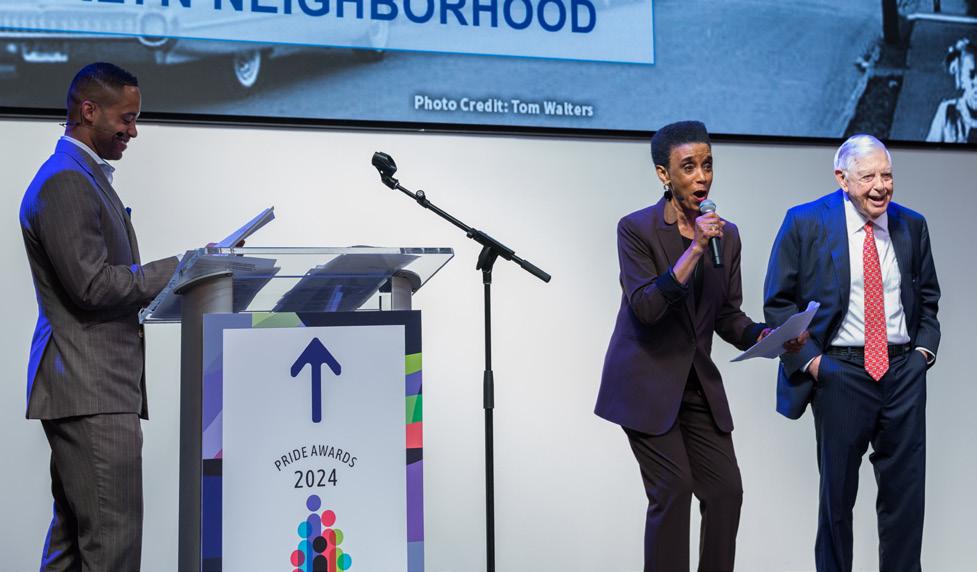


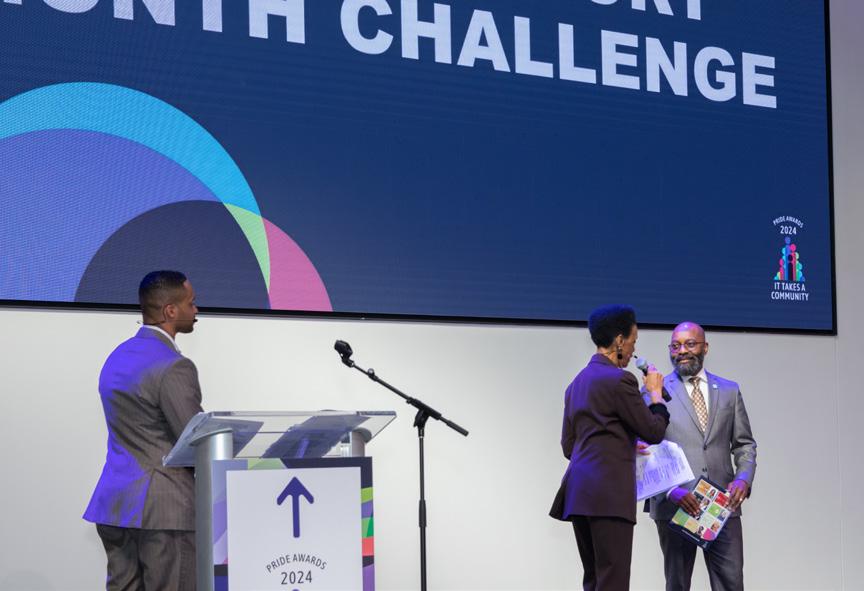


58 Pride Magazine | www.pridemagazineonline.com


May-June 2024 | Pride Magazine 59

FYI News & Notes
Compiled by John Burton Jr.JCSU Announces Hendricks as New Director of Athletics
Dr. Denisha Hendricks is returning to Johnson C. Smith University as the new Director of Athletics and as a Visiting Associate Professor of Sport Management (nontenure track).
Her appointment is effective May 1, 2024, Hendricks will be reporting directly to the JCSU President, Dr. Kinloch. Hendricks will be responsible for various initiatives, including:
• Planning, administering, and directing intercollegiate athletic activities for the University’s NCAA DII athletics program
• Developing, managing, coordinating, supervising
our intercollegiate athletics program
• Assuring that all programs, coaches, staff, and studentathletes comply with the policies, rules, and regulations of the University, the NCAA, and the Central Intercollegiate Athletic Association (CIAA)
• Overseeing the athletic department budget and fundraising for the athletics program
• Strengthening a culture of inclusivity, collaboration, and care across all of athletics
• Serving as an active member on the University President’s Executive Cabinet.

With more than 20 years of experience in athletics and academic administration, Dr. Hendricks currently has served in multiple high-capacity roles such as Director of Parks and Recreation for the City of Selma, Alabama, Keene State University as Special Assistant to the Vice President for Student Affairs and other positions.
Business Opportunity Conference
Canopy Housing Foundation Launches New Initiative
In 2019, the Canopy Housing Foundation launched the Pearl Society – the first-ever formal donor society organized to benefit the mission of the foundation. Since that time, the foundation has reached its benchmark of $1 million in the Endowment Fund, helping to solidify a secure future for the continued work and impact of the foundation. In February, The Canopy Housing Foundation announced its new initiative being launched this year: the Canopy Innovation Award (Pearl Society Partners in Housing).


Pride
Business
May-June 2024 | Pride Magazine 61
Dr. Denisha Hendricks
24 August 5 & 6 | Virginia Beach, VA Marriott Virginia Beach Oceanfront Resort Luncheon Keynote Speaker ANTON GUNN Breakfast Keynote Speaker CORY MOSLEY, CSP REGISTER TODAY! Join the wave! Title Sponsors


Are you following Pride? Keep up to date with the latest news and events. www.PrideMagazineOnline.com 2024 July/Aug Charlotte Multicultural Resource Magazine


Stress, left unaddressed, creates a mess."
"Stress, left unaddressed, creates a mess."
PrideBusiness
News & Notes
The Canopy Innovation Award will offer a competition for five area colleges / universities with an ultimate challenge to identify innovative approaches to affordable housing problems. The year-long competition will conclude in November as each of the top teams present their concepts in front of a panel of industry experts. The competition will offer $10,000 in scholarship awards to those who take the top honors. The funds for this project are a result of supporter financial contributions. It is that assistance that will allow the organization the ability to identify methods to increase the housing availability for all people in our communities.

HBCU Receives 3rd $1 Million Gift from Anonymous Donor
~ Dr. Puranda. Self-Talk Counseling & Consulting Where
"Stress, left unaddressed, creates a mess."
"Stress, left unaddressed, creates a mess."
~ Dr. Puranda. Self-Talk Counseling & Consulting Where positive thoughts live! www.selftalkcounseling.com
~ Dr. Puranda.
~ Dr. Puranda.
980-285-3689
3126 Milton Rd, Ste#234, Charlotte, NC 28215
3126 Milton Rd, Ste#234, Charlotte, NC 28215
~ Dr. Puranda. Self-Talk Counseling & Consulting Where positive
www.selftalkcounseling.com 980-285-3689 3126 Milton Rd, Ste#234, Charlotte, NC 28215
Ste#234, Charlotte, NC 28215
1 980-285-3689 CallToday!

& Consulting Where positive thoughts live! www.selftalkcounseling.com 980-285-3689 3126 Milton Road, Ste# 234, Charlotte, NC 28215 "Stress, left unaddressed, creates a mess."
Livingstone College has received a $1 million donation from an anonymous donor for the third time in less than 180 days, according to an announcement made by President Dr. Anthony J. Davis on March 11. The previous two $1 million donations were also made by the same anonymous donor, with the first being received during the college’s homecoming celebrations last fall and the second announced during the college’s 145th Founder’s Day program in February. These donations are a testament to the enduring legacy of Livingstone College and the profound impact it has on the community.
"Stress, left unaddressed, creates a mess."
"Stress, left unaddressed, creates a mess."
This third unrestricted donation will continue to support the work being executed on campus. The hope is that it will inspire other members of the community to support Livingstone College’s mission and vision and give to the college in the future, knowing that their contributions are instrumental in the college’s success.
~ Dr. Puranda
~ Dr. Puranda
~ Dr. Puranda
~ Dr. Puranda
~ Dr. Puranda
Self-Talk Counseling & Consulting Where positive thoughts live!
As previously shared by Dr. Davis, these donations will not only provide a significant boost to the institution’s ongoing mission to educate, equip, and empower students to compete and contribute in a global context with confidence and competence, but they also underline the crucial role of philanthropy in our journey. They continue to expand scholarship opportunities for current and future students, making a tangible difference in their lives.
www.selftalkcounseling.com 980-285-3689
www.selftalkcounseling.com 980-285-3689
3126 Milton Road, Ste# 234, Charlotte, NC 28215
3126 Milton Road, Ste# 234, Charlotte, NC 28215
FYI
P
980-285-3689 CallToday! Self-Talk Counseling & Consulting Where positive thoughts live! www.selftalkcounseling.com 980-285-3689 3126 Milton Road, Ste# 234, Charlotte, NC 28215 "Stress, left unaddressed, creates a mess."
Stress, left unaddressed, creates a mess."
Dr. Puranda. Self-Talk Counseling & Consulting Where positive thoughts live! www.selftalkcounseling.com 980-285-3689 3126 Milton Rd, Ste#234, Charlotte, NC 28215 Option 2 Option 1 980-285-3689 CallToday! Self-Talk Counseling & Consulting Where positive thoughts live! www.selftalkcounseling.com 980-285-3689 3126 Milton Road, Ste# 234, Charlotte, NC 28215 "Stress, left unaddressed, creates a mess."
Dr.
~
~
Puranda Stress, left unaddressed, creates a mess."
positive
live!
980-285-3689
Option 2 Option 1 980-285-3689 CallToday! Self-Talk Counseling & Consulting Where positive thoughts live! www.selftalkcounseling.com 980-285-3689 3126 Milton Road, Ste# 234, Charlotte,
thoughts
www.selftalkcounseling.com
Milton Rd, Ste#234, Charlotte, NC 28215
NC 28215 "Stress, left unaddressed, creates a mess."
Self-Talk
Where positive thoughts live!
Counseling & Consulting
www.selftalkcounseling.com 980-285-3689
Option 2 Option
Self-Talk
1 980-285-3689 CallToday!
Counseling & Consulting Where positive thoughts live!
Option
Option
2
Option 2 Option 1 980-285-3689 CallToday! Self-Talk
thoughts live!
Counseling
Option 2 Option 1
Self-Talk Counseling & Consulting Where positive thoughts live! www.selftalkcounseling.com 980-285-3689 Milton Rd,
Call today to reserve advertising space: 704-375-9553
62 Pride Magazine |
www.pridemagazineonline.com
Livingstone College


collaboration with
support for
the
the Terra Foundation for American Art. The Mint Museum is supported, in part, by the Infusion Fund and
b.
Card Pieces (detail), 2020–2021, charcoal pencil on paper with attached playing card, each: 12 x 9 in.
Whitfield Lovell: Passages is generously presented in Charlotte by PNC. Whitfield Lovell: Passages is organized by the American Federation of Arts
in
Whitfield Lovell. Major
the national tour and exhibition catalogue are provided by
National Endowment for
Arts and
its donors as well as by the North Carolina Arts Council. ABOVE: Whitfield Lovell (American,
Bronx, NY).
Mint Museum Uptown at Levine Center for the Arts | 500 South Tryon Street, Charlotte, NC 28202 | 704.337.2000 | mintmuseum.org | @themintmuseum June 29–September 22, 2024 Mint Museum Uptown at Levine Center for the Arts Revealing hidden histories of emancipation and the African American experience
Courtesy of American Federation of the Arts, the artist, and DC Moore Gallery, New York

Creating opportunities for businesses here in Charlotte with SBA loans1
Creating opportunities for businesses here in Charlotte with SBA loans1
Bank of America is committed to helping small businesses get access to the capital they need to achieve success. Entrepreneurs are the bedrock of our communities, creating jobs and economic opportunity in every area of the country.
Bank of America is committed to helping small businesses get access to the capital they need to achieve success. Entrepreneurs are the bedrock of our communities, creating jobs and economic opportunity in every area of the country.
With an SBA loan, your business could have access to capital for a wide range of financing1 needs including commercial real estate, equipment, leasehold improvements and more.
Now is a great time to get financing for your business.
If you own a business, having access to the right financing at the right time can make a big difference. Small Business Administration (SBA) loans1 are a smart financial option for almost any business purpose. They offer longer terms, lower down payments and reduced collateral requirements.
Now is a great time to get financing for your business. If you own a business, having access to the right financing at the right time can make a big difference. Small Business Administration (SBA) loans1 are a smart financial option for almost any business purpose. They offer longer terms, lower down payments and reduced collateral requirements.
As America’s #1 Small Business lender and an SBA Preferred Lender, we have a complete range of SBA lending1 options as well as traditional commercial real estate loans, secured term loans and lines of credit. Our dedicated team of specialists will work to help you strengthen your business and plan for the future. To learn more, scan the
With an SBA loan, your business could have access to capital for a wide range of financing1 needs including commercial real estate, equipment, leasehold improvements and more. As America’s #1 Small Business lender and an SBA Preferred Lender, we have a complete range of SBA lending1 options as well as traditional commercial real estate loans, secured term loans and lines of credit. Our dedicated team of specialists will work to help you strengthen your business and plan for the future.
What would you like the power to do?®
or visit
1 Small Business Administration (SBA) financing is subject to approval through the SBA 504 and SBA 7(a) programs. Loan terms, collateral and documentation requirements apply. Actual amortization, rate and extension of credit are subject to necessary credit approval. Bank of America credit standards and documentation requirements apply. Some restrictions may apply. Please consult your financial, legal and accounting advisors, as neither Bank of America, nor its affiliates or employees provide legal, accounting or tax advice. © 2023 Bank of America Corporation. Bank of America and the Bank of America logo are registered trademarks of Bank of America Corporation. MAP5519783 | PRGM-01-23-2106 | 03/2023
To learn more, scan the code or visit bankofamerica.com/financeoptions What would you like the power to do?®
1 Small Business Administration (SBA) financing is subject to approval through the SBA 504 and SBA 7(a) programs. Loan terms, collateral and documentation requirements apply. Actual amortization, rate and extension of credit are subject to necessary credit approval. Bank of America credit standards and documentation requirements apply. Some restrictions may apply. Please consult your financial, legal and accounting advisors, as neither Bank of America, nor its affiliates or employees provide legal, accounting or tax advice. © 2023 Bank of America Corporation. Bank of America and the Bank of America logo are registered trademarks of Bank of America Corporation. MAP5519783 PRGM-01-23-2106 | 03/2023 bank of america business advantage
code
bankofamerica.com/financeoptions