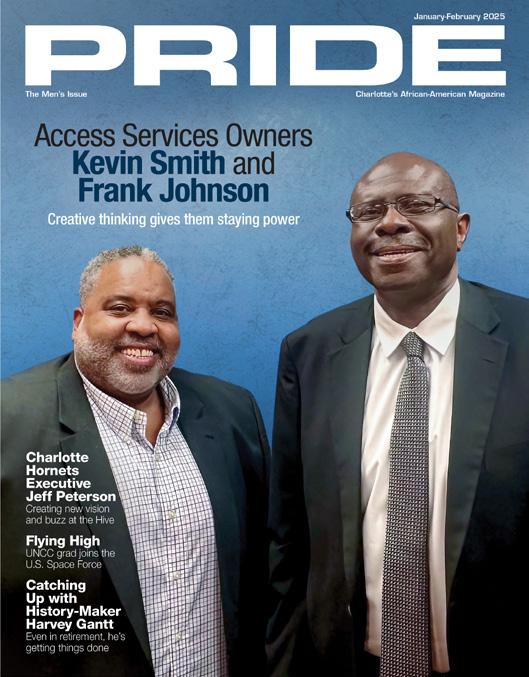
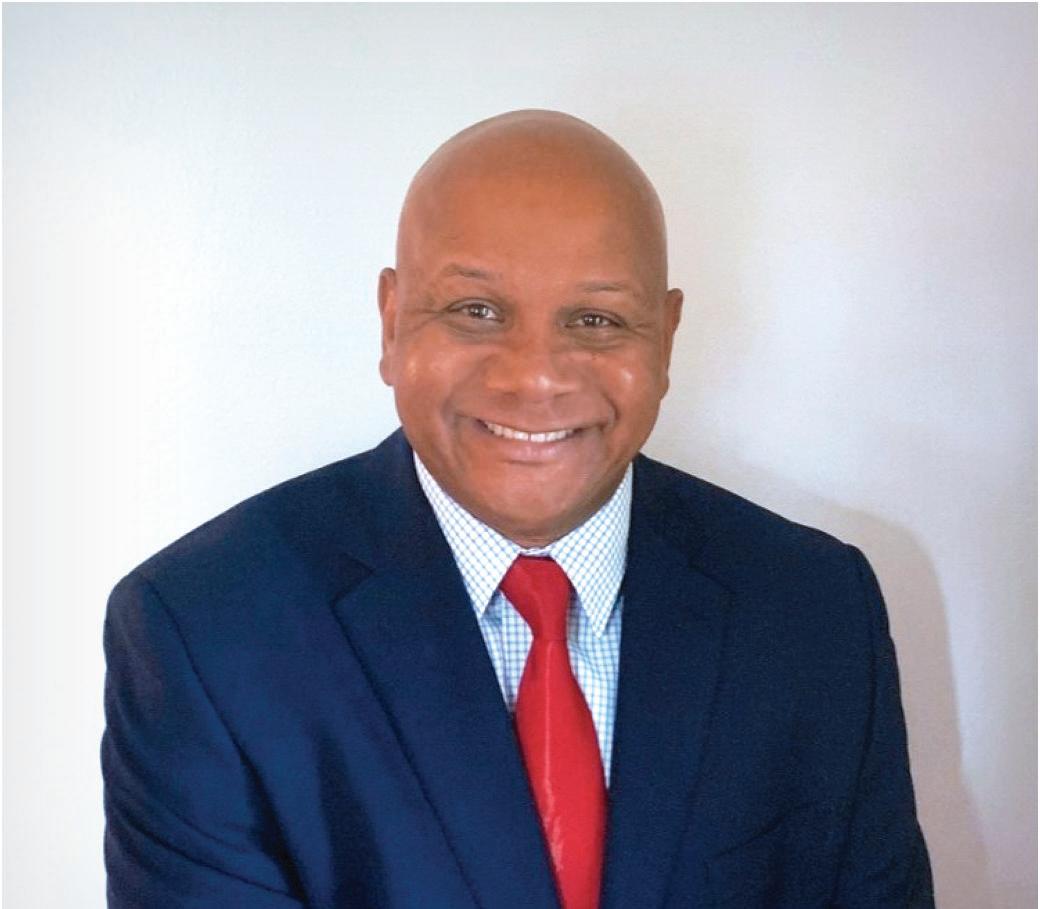
Access Services Owners Kevin Smith and Frank Johnson
Creative thinking gives them staying power
Charlotte Hornets
Executive
Jeff Peterson
Creating new vision and buzz at the Hive
Flying High
UNCC grad joins the U.S. Space Force
Catching
Up with History-Maker
Harvey Gantt
Even in retirement, he’s getting things done
The Men’s Issue
Charlotte’s African-American Magazine
BOTTLES
Leading with intention
Like you, we work to make a difference in our communities. We strive every day to create a culture where all teammates feel empowered to show up as their authentic selves. Because leading with intention, action, and care helps us build better lives and communities.
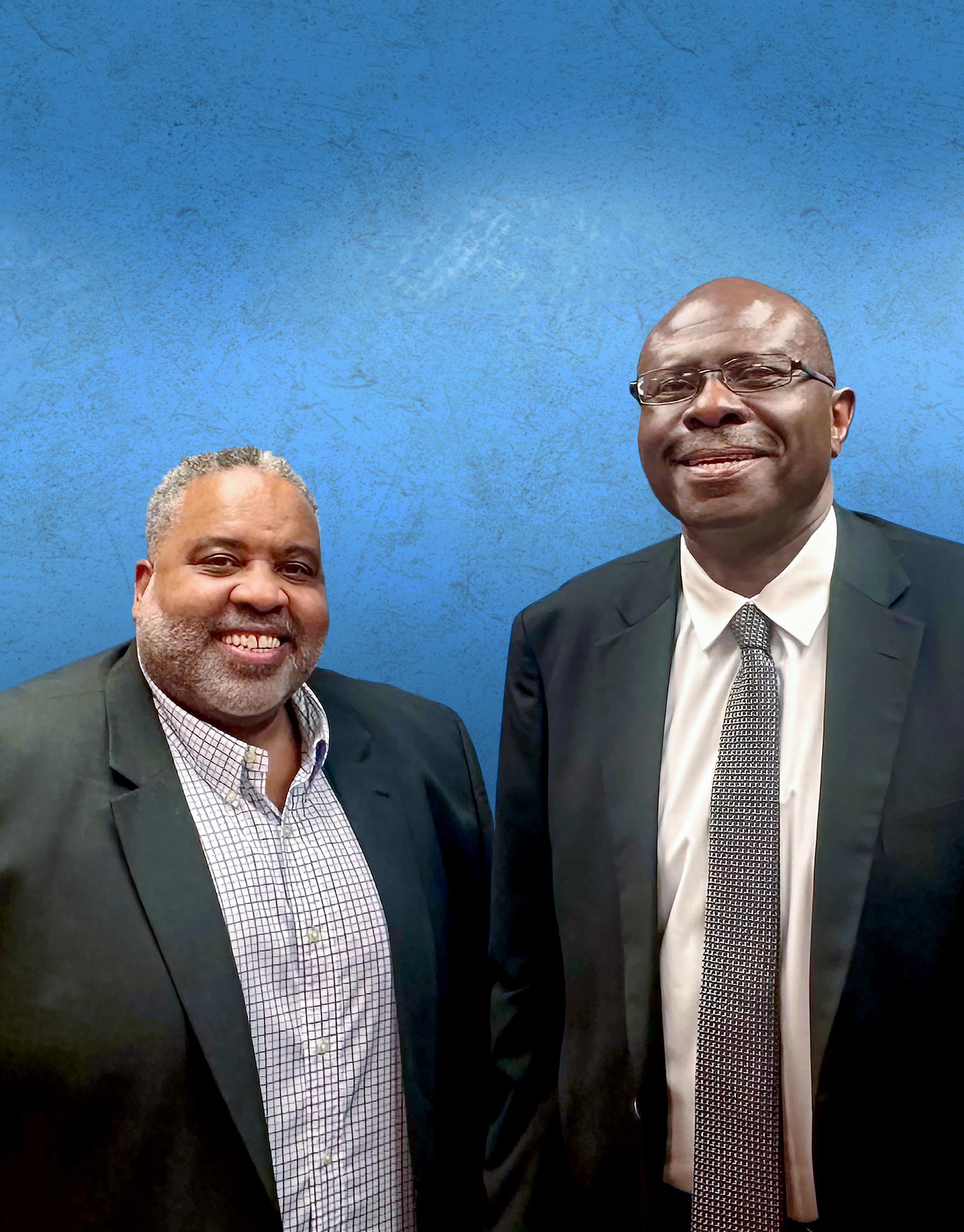
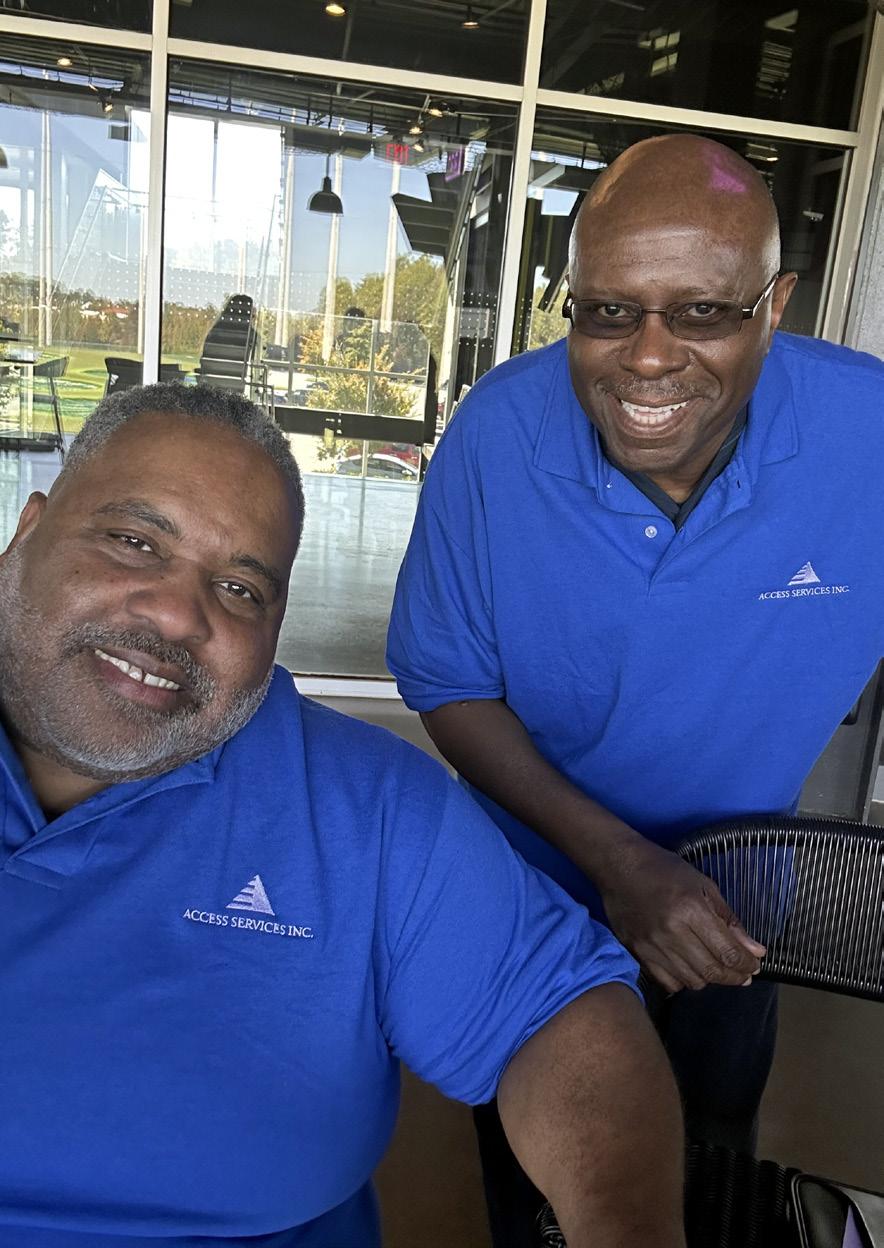
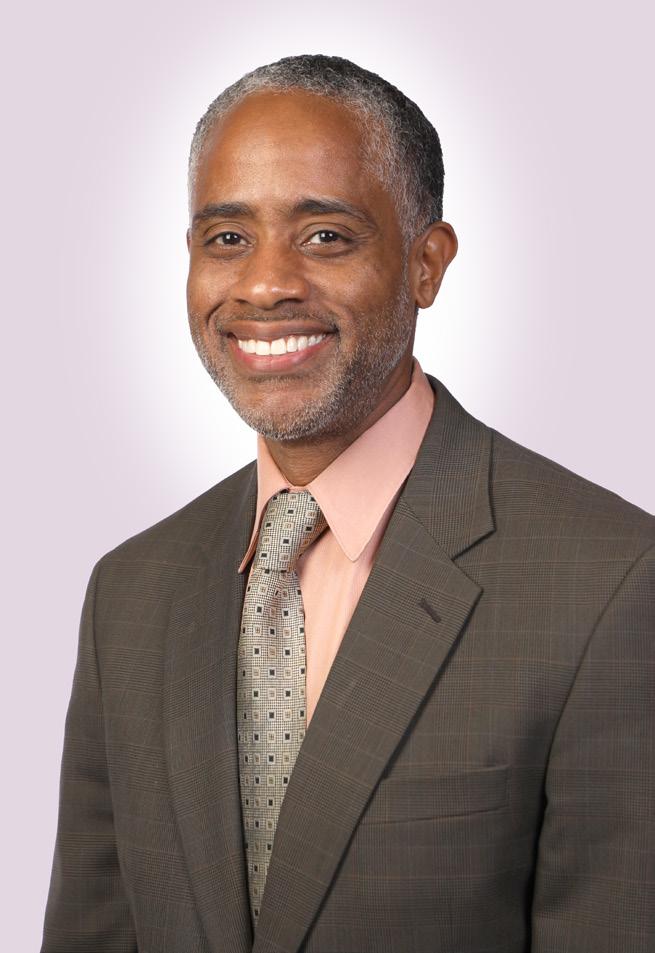
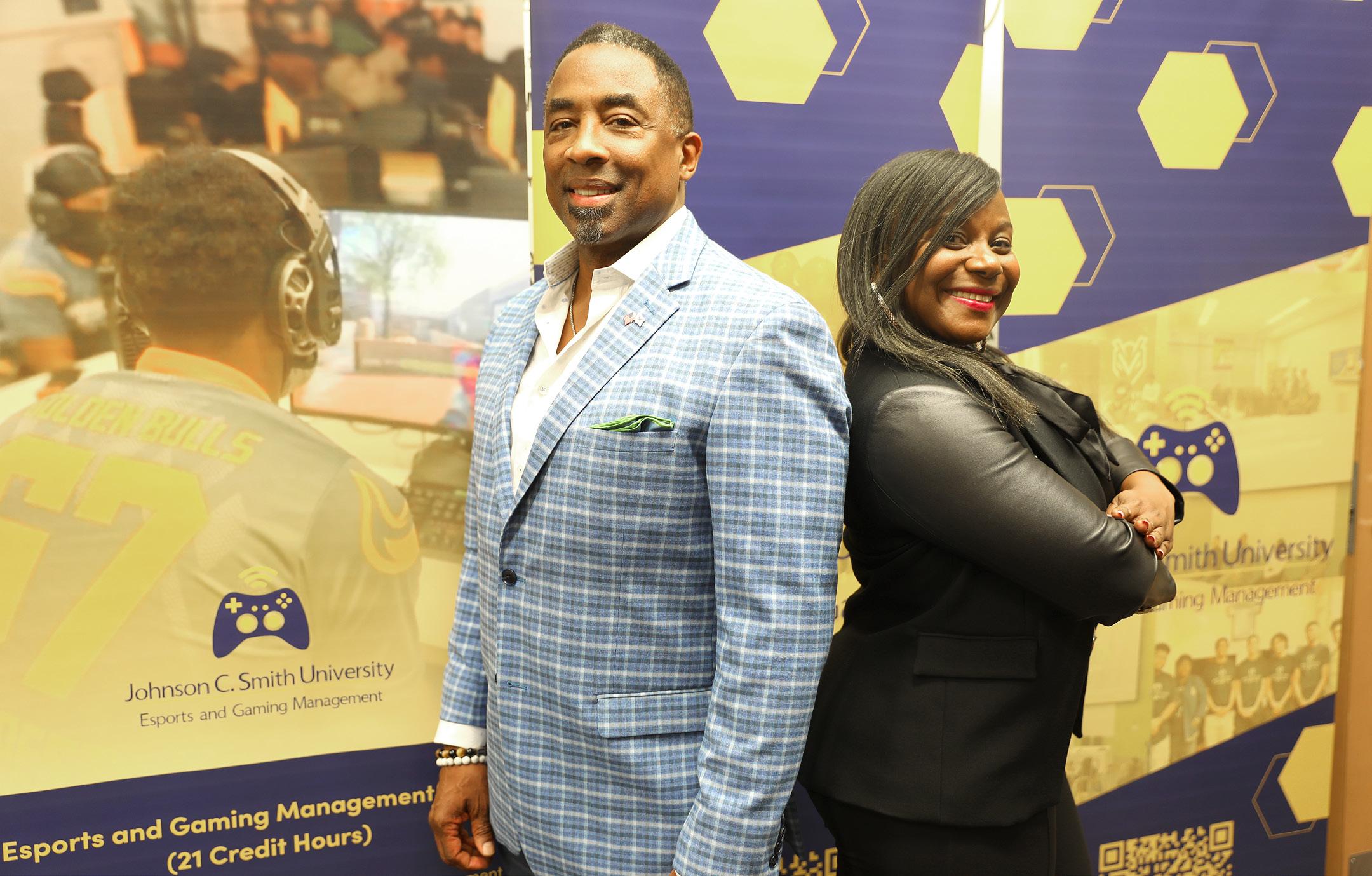
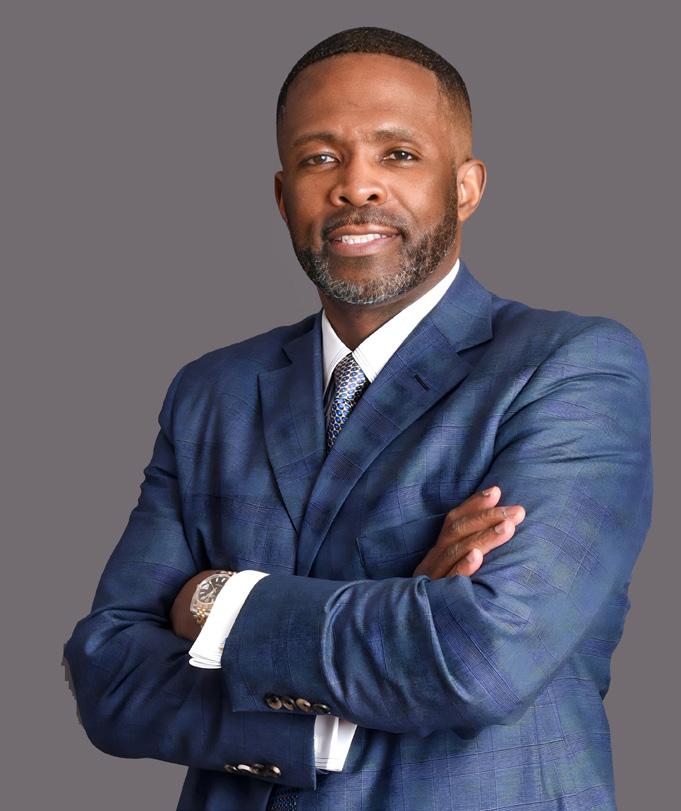
Kevin Smith (left) and Frank Johnson, owners of Access Services in Charlotte
Photo courtesy of Frank Johnson
Make Novant Health your home for healthcare in Charlotte. Find your care team at NovantHealth.org/Doctors
Novant Health is here for you with a network of award-winning hospitals and physician clinics.
Trusted experts: Our primary care and specialty doctors work together to ensure you get all the care you need, from routine to advanced.
Compassion: We connect with you to understand and deliver what is important to you and your family.
Access for all: Our 24/7 virtual care options, extended clinic hours, walk-in care and same-day appointments help you get the care you need, the way you need it.
$13.25. Please subscribe online at www.pridemagazineonline.com, mail to P.O. Box 30113, Charlotte, NC 28230 or call 704-375-9553
Letters to the Editor
Please send an e-mail to info@pridemagazine.net fax to 704-375-9550 or mail to Pride Magazine 8401 University Executive Park Drive, Ste. 122, Charlotte, NC 28262 www.pridemagazineonline.com
All rights reserved. Copying or reproduction, in part or in whole, is strictly prohibited.
Pride Magazine reserves the right to deny any advertisement, listing or feature that does not meet Pride Magazine standards or that is outside the scope or mission of our magazine. Pride Magazine assumes no responsibility for information, products, services, or statements made by advertisers or editorial contributors.
33 No. 1 January–February 2025
rights reserved for PRIDE Communications Inc. Pride Magazine prints with soy ink. Find us on Facebook: Facebook.com/PrideMagazineNC Find us on Instagram: @pridemagazinenc Find us on LinkedIn: Pride Communications, Inc.
Charlotte’s African-American Magazine
FromTheCEO
By Dee Dixon
Pride Awards 2025: Queen City Black Excellence
Hello, everyone. We are busy creating another Black History luncheon that will educate, entertain and energize you. African Americans have made tremendous contributions in the United States and worldwide in every field, including medicine, construction, the arts and entertainment, and so many more. You name it — we can claim it. Such is the case in Charlotte, and we want to acknowledge some of our heroes of excellence at Pride Awards 2025.
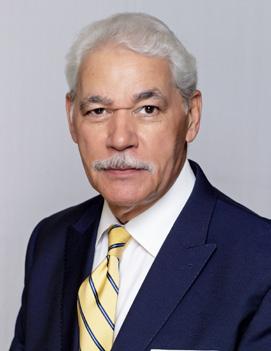
With Truist as our title sponsor, this year’s event will be a highly nuanced luncheon experience recognizing the achievements of three outstanding Charlotte citizens who have exemplified extraordinary excellence in their personal and/or professional lives. Our Queen City Black Excellence Awards will be presented to:
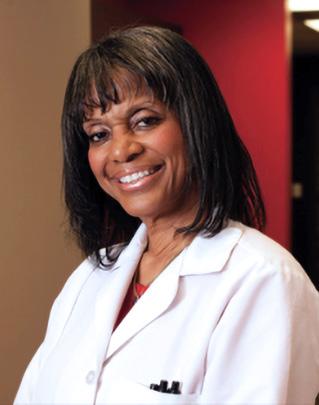
Dr. Paula Newsome, OD – CEO of Advantage Vision Center
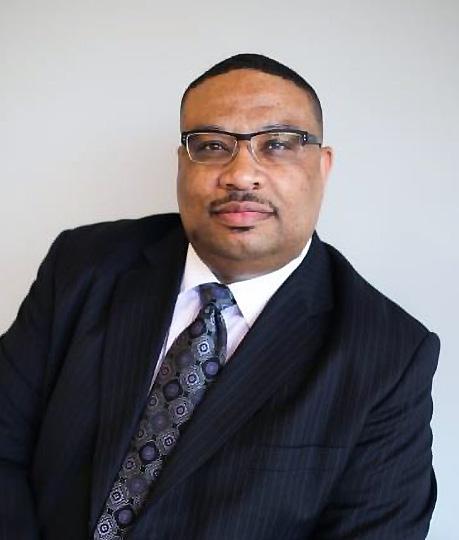
Mills – CEO of the Mills Automotive Group
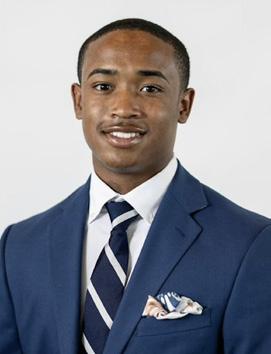
Vance Johnson –Senior at East Mecklenburg High School
Now listen, you all know we at Pride don’t want our events to be boring. With this said, we are bringing back by popular demand our nonprofit pitch competition! That is right — you will hear a pitch from three folk representing their nonprofits and our attendees will vote and choose the winning nonprofit that will receive a $20,000 grant underwritten by Wells Fargo!
The participating nonprofits are:
• Grooming Greatness – Monique Stubbs-Hall, CEO
• Changed Choices – Diane Hunt, CEO
• TruSolace Counseling and Wellness Center – Reneisha Black-Ferguson, CEO
Remember, the focus of Pride Awards 2025 is on the meaning of Black Excellence in Charlotte. You could win two tickets to this extraordinary luncheon by letting us know in 50 words or less, “What Black Excellence Means to You.” Email your entry to info@Pridemagazine.net by January 17, 2025. We will notify the winner.
We are super excited to have Dr. George C. Fraser, author, entrepreneur and motivational speaker, join our Black History excellence celebration. He is the founder and CEO of FraserNet, Inc., a company he created to lead a global networking and economic development movement for people of African descent.
If you haven’t already secured your seating, you’d better do so now. Here’s what you need to know:
What: Pride Awards 2025 Luncheon: Queen City Black Excellence
When: Friday, Feb. 14, 2025
Where: The Ritz Carlton, 201 E. Trade Street
Time: 11:15 a.m.: Networking
Noon: Lunch and Program
Attire: Business Casual
Seating: www.prideawards.net or call 704-375-9553
Mills Automotive Group is a family-owned company th at takes great pride in being one of the leading dealership groups in the United States. With a growing portfolio of over 40 dealerships and a diverse range of brands under the Mills Auto umbrella, we are well-positioned to meet all your automotive needs.
What truly sets us apart is our unwavering commitme nt to our clients. Our experienced sales and service teams, backed by years of industr y expertise, are dedicated to providing a best-in-class consumer experience.
COMING TO N. CHARLOTTE IN 2025!
NotableNames
By Alicia Michele Benjamin
Shaw Names New Director of Racial and Justice Center
Shaw University has appointed Reverend Sheritta Michelle Williams as the Director of The Center for Racial & Social Justice. Originally from Buffalo, New York, Williams has been ordained since May 2012 and brings over 25 years of diverse ministry experience.
Williams has served as a missionary in the U.S., China, Japan and the Caribbean. She has worked as a program director, church mobilization officer and community advocate in the faith-based nonprofit sector.
Located in Shaw’s School of Divinity in Leonard Hall, the Center for Racial & Social Justice is a place where students and the community are encouraged to speak out strongly against racial and social injustice.
As an educator, Williams has served as a student affairs administrator and professor at various colleges, universities, and theological institutions. Her work emphasizes womanist theology, liberation theology, racial and social justice, and the arts. She has shared her knowledge through lectures across the United States, Canada and Sri Lanka.
Williams earned a Master of Theological Studies degree from The Divinity School at Duke University.
Poet de’Angelo Dia Receives ASC Scholarship
JCSU Student Receives Gold Scholarship
Johnson C. Smith University honor student and golfer, Traykiese Gillentine, received a scholarship from the Black College Golf Coaches Association (BCGCA) in the fall.
Gillentine has a record of success inside and outside the classroom. He maintains a 4.0 GPA and interns with Titleist, a sporting goods manufacturing company. Currently pursuing a degree in interdisciplinary studies at JCSU, Gillentine also studied mechanical engineering at Purdue University and earned an associate’s degree in engineering from the College of Lake County.
He has worked as a caddy at Racine Country Club in Wisconsin and Glen Flora Country Club in Illinois since 2015 and refereed for the Wisconsin Youth Soccer Association. He’s planning to graduate from JCSU in 2025. The BCGCA supports and uplifts historically Black college and university golf programs, students and coaches. The organization’s mission is to empower and promote excellence within HBCU golf programs, students and coaches. The BCGCA also works to enhance representation, increase diversity and create a pathway for future generations of Black golfers to excel both on and off the course.
Educator, clergyman and professional artist de’Angelo DIA is one of four recipients of the Arts and Science Council (ASC) 2024 Creative Renewal Fellowship. This award is given to individuals who have been pursuing a career in the creative sector for at least 10 years and have been generating most of their income over the past three years through their work as a sole proprietor, creative entrepreneur or contract employee in the creative sector.
DIA’s poetry deals with several themes including “the rise and fall of athletes of color, grief as a reaction to the abuse of power and authority, mass incarceration and the psychology of parenting,” according to an article about him on ASC’s website.
The fellowship of $15,000 funded his attendance at arts-related workshops and travel including a Cave Canem poetry workshop, a series of virtual workshops including one led by poet Tracie Morris, a workshop by Pulitzer Prize winner Jericho Brown and other opportunities. He also travelled to Chile and participated in a one-on-one meeting with Rigoberto Gonzalez, an acclaimed poet, educator and book critic.
DIA earned a Master of Arts in Interdisciplinary Studies: Literature from the University of North Carolina at Charlotte, and a Master of Divinity and Doctorate of Ministry from Union Presbyterian Seminary. He is also the Community Relations Manager of Goodyear Arts in Charlotte.
DID YOU KNOW?
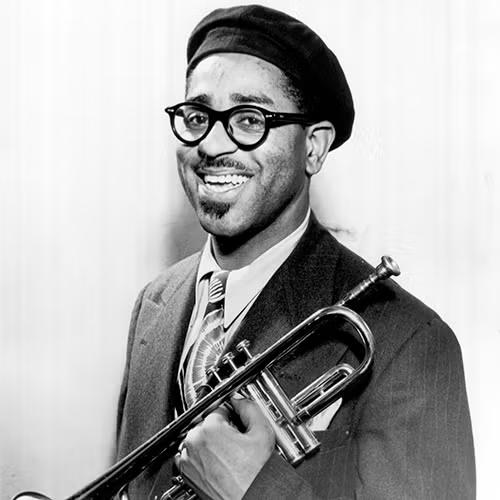
Jazz trumpeter Dizzy Gillespie, from Cheraw, S.C., is known for his bent horn, bulging cheeks when he played and sense of humor. Writer of such hits as “A Night in Tunisia” and “Manteca,” Gillespie is known as one of the progenitors of Latin jazz along with Chano Pozo and other jazz musicians like Chico O’Farrill.
Be the Hero for Youth in Crisis
By: Jasmyn Broadnax
For 50 years, The Relatives has been more than just a shelter for youth in crisis—it has been a place of relief, empowerment, and acceptance. From its earliest days in a church basement to its role today as a trusted community resource, The Relatives has provided a foundation of stability and hope for countless young people.
Through life-changing programs like the Youth Crisis Center, On Ramp Resource Center, and Housing Program, The Relatives not only helps youth facing challenges like homelessness, family conflict, and instability but also ensures their most basic needs are met. For many, this means access to essentials such as food, clothing, showers, and hygiene supplies—simple but critical lifelines for those without a safe place to turn.
SHCU_Pride AD_FA.pdf 1 4/12/2023 2:58:29 PM
Your compassion provides relief. Your support offers empowerment. Together, we can create a community of acceptance where no young person feels forgotten. Visit therelatives.org to learn more, donate, or volunteer.
How You Can Help
Donate: Every contribution provides food, clothing, and life-changing resources for youth.
Volunteer: Cook a meal, share time in our teaching kitchen with Cook and Chat, or deliver meals to the Youth Crisis Center.
Refer a Youth: Help connect young people to our 24/7 Crisis Hotline, Safe Place sites, or walk-in services.
Your Compassion Can LivesChange
“At The Relatives, we believe no young person should face homelessness or crisis alone,” says Jasmyn Broadnax, Director of Communications. “As someone with lived experience, I know firsthand what it feels like to be on the edge, desperate for relief and a path forward. Now, I have the privilege to amplify the impact of The Relatives—and to invite others to join us.
Can you imagine being the reason a young person feels seen, supported, and empowered to rebuild their life?
Imagine being the helping hand that offers not just shelter but a warm meal, clean clothes, and a safe space to heal and grow. These simple acts restore dignity, spark hope, and inspire young people to believe in themselves again.”
Every small action has a ripple effect. Together, we can rewrite the stories of so many young people, offering them relief in their moment of need, empowerment to take their next steps, and acceptance for who they are.
t Self-Help, we put your dollars to work building communities. Your deposits help us strengthen families, grow local businesses, provide affordable home loans, revitalize downtowns, build vibrant neighborhoods, and advocate for fair and responsible financial practices for everyone.
CHARLOTTE BRANCHES SALISBURY BRANCH
1065 Providence Road (704) 554-7201
431 Beatties Ford Road (704) 375-5781
2146 Statesville Blvd (704) 637- 6528
Three-time Self-Help borrower Sugar Creek Charter School, a high-performing public charter school in Charlotte that outperforms both district and state averages for Black and economically disadvantaged student groups.
Self-Help business loan borrowers Deven and Marquita Carter, owners of the Charlotte-based syrups, pancakes, and waffle mixes line, Blanket™.
By Angela Haigler
Books by Men From Poetry to Hip Hop and Civil Rights
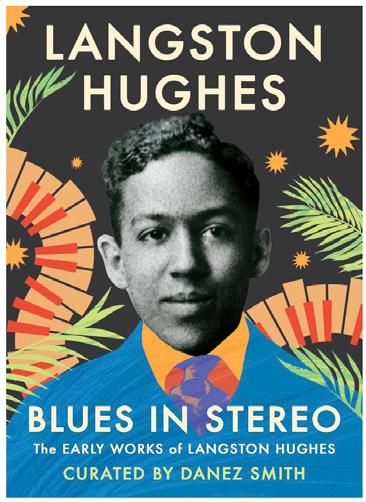
“Blues
in Stereo: The Early Works of Langston Hughes”
Curated by Danez Smith
In this stunning collection, curated by award-winning poet and National Book Award finalist, Danez Smith, readers are treated to Harlem Renaissance poet Langston Hughes’ early works, written from 1921-1927. We hear from young Langston as a teen heading to Mexico for work to pursue his passion. This is not formally trained Langston; this is a youthful Langston speaking from the heart and from the pages of his handwritten journals and scribblings on the back of napkins and envelopes. Beautifully rendered and thoughtfully curated, “Blues in Stereo” foreshadows a master poet who will go on to define literature for centuries to come.
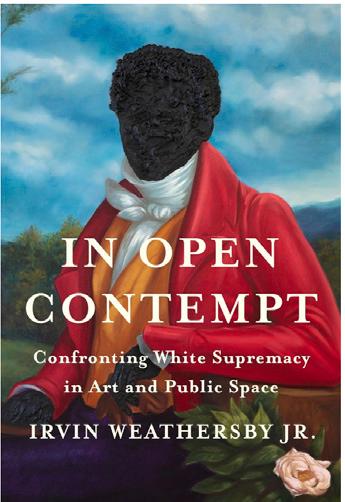
“In Open Contempt: Confronting White Supremacy in Art and Public Space”
by Irvin Weathersby Jr.
A stirring journey into the soul of a fractured America confronting the specter of white supremacy in art, monuments, and public spaces, from a captivating new literary voice. Amid the ongoing reckoning over America’s history of anti-Black racism, scores of monuments to slaveowners and Confederate soldiers still proudly dot the country’s landscape, while schools and street signs continue to bear the names of segregationists. With poignant, lyrical prose, cultural commentator Irvin Weathersby confronts the duality of the history of the Country’s open spaces and contemplates what it means to bear witness to these edifices of racial trauma.
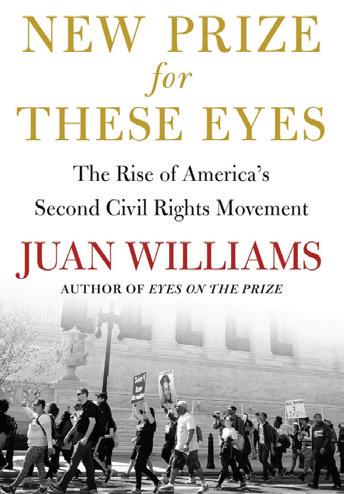
“New
Prize for
These
Eyes:
The
Rise of American’s Second Civil Rights Movement”
by Juan Williams
More than a century of civil rights activism reached a mountaintop with the arrival of a Black man in the Oval Office. But hopes for a unified, post-racial America were deflated when Barack Obama’s presidency met with furious opposition. A white, right-wing backlash was brewing, and a volcanic new movement—a second civil rights movement — began to erupt. In “New Prize for These Eyes,” award-winning author Juan Williams shines a light on this historic, new movement. Who are its heroes? Where is it headed? What fires, furies, and frustrations distinguish it from its predecessor?
For the middle grade reader
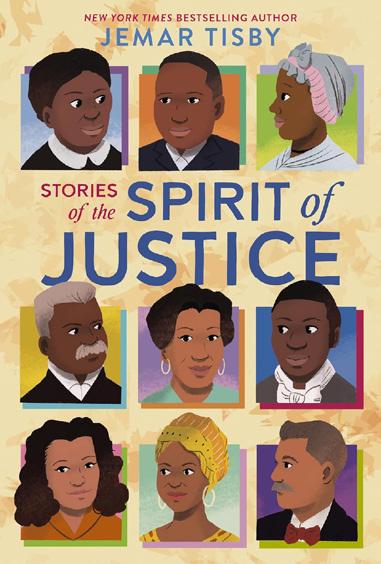
“Stories of the Spirit of Justice” by Jemar Tisby
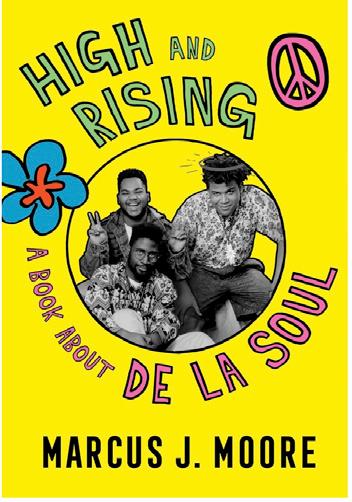
“High and Rising: A Book about De La Soul”
by Marcus J. Moore
De La Soul, was the eradefining hip-hop trio that touched millions of lives and changed rap forever. Their groundbreaking 1989 album, “3 Feet High & Rising,” a masterpiece, was hailed as a new work from a bygone era of Black experimentation. Formed in Long Island in 1988 by Kelvin “Posdnuos” Mercer, Dave “Trugoy the Dove” Jolicoeur, and Vincent “Maseo” Mason, De La Soul rebuked classification and appealed to the Black alternative. Completed in the wake of Dave’s passing and the group’s arrival on streaming platforms after years in digital purgatory, “High and Rising” tells the story of one of the most influential rap groups of all time.
“Stories of the Spirit of Justice” is the companion book for young readers ages 8-12 to Jemar Tisby’s “The Spirit of Justice” and tells the story of the justice movement through short biographies of the figures who did the work. With illustrations depicting the people profiled and practical tips connecting readers to the continued fight for justice, this is essential reading for everyone who still dreams of a land where all are truly free. P
ByFaith
Grow Up: Take Steps Toward Spiritual Maturity
By Rev. Dr. Dwayne Bond
Spiritual growth for Christians is an urgent need that requires a plan and intention. It doesn’t happen by accident. We don’t just drift into it. It takes place with deliberate follow through on the things that promote our growth. What do we need to grow? We need a simple, spiritual growth playbook that brings us to the heart of Jesus Christ. He is our foundation, and growing in Him occurs when we follow the plan laid out in His Word. Over time, we become mature Christfollowers equipped to help others and serve in our respective places of influence.
purposefully feast on His Word (2 Timothy 2:15), and position themselves within the church community (Acts 2:42).
feasting on God’s Word? It’s best to start small. Find a book of the Bible that interests you. Consider reading and marinating on a small section of Scripture daily. You can also use a Bible reading plan or app to ensure consistency. As you read, journal what you learn. Write down insights and reflections to help you to apply the Word to your heart and life. Reading the Bible consistently will transform the heart of a believer.
Position Yourself in the Church Community
While spiritual growth is necessary for all believers, spiritually mature men can greatly bless their families, churches, workplaces, and neighborhoods. Families need men who can lead, serve, protect, and care for them (Ephesians 5:23). Our sons and daughters need a witness of Christ’s love and grace through their fathers’ example. In addition, the church needs an army of men who intentionally pursue the heart of God and seek to conform to His image and likeness. Churches need men modeling godliness, integrity, hard work, and servant-leadership (1 Timothy 3:1-7).
In the workplace, mature Christian men who work as unto the Lord can be significant witnesses (Colossians 3:23). Men who respect their bosses, serve well on teams, show up on time, follow through, and walk with integrity display the fruit of spiritual growth. Lastly, our neighborhoods need men who love their neighbors as themselves (Mark 12:31). We need men who represent God’s love, kindness, mercy, and grace in all their spheres of influence.
I have personally experienced the blessings and benefits of spiritual growth. I see it in my relationships with God, my wife, and my children, as well as in my church, workplace, and community. God’s grace has allowed me to mature, but it didn’t just happen by default. I had to train myself for godliness (1 Timothy 4:7). What does it look like to train ourselves in godliness? Scripture teaches that Christians grow spiritually when they prioritize prayer (1 Thessalonians 5:17),
Prioritize Prayer
Prayer is our lifeline and the way we communicate with God. It’s not simply a spiritual discipline; it’s how our hearts connect with and align with God’s heart. Every man needs to develop a daily habit of prayer. This can be accomplished through three practical steps.
First, set a time and place where you can meet with God. It can be anywhere you are comfortable and can focus. It can be in your office, closet, car, porch, family room, kitchen, or whatever best suits you. Secondly, use the ACTS format to pray: adoration, confession, thanksgiving, and supplications. Adoration means to worship God by praising Him for who He is, His character, and His attributes. Confession allows you to own any known sin and come clean before God. Thanksgiving focuses your heart on all that God has done in you, for you, and around you. Supplications are prayer requests, specific things you’d like God to do on your behalf. In addition to setting a time and place and using the ACTS format, pray the Scriptures. As you read the Word, pray the Word back to God. By doing this, you agree with Him as you pray His truth and promises.
Purposefully Feast on the Word
We must saturate our hearts with God’s Word since His words are the foundation and anchor of our faith. How can you begin
Spiritual growth is challenging for “lone ranger” Christians. God calls believers to engage with one another in community. The church is a group of genuine believers called by God to be with one another on their journeys to become more like Jesus. How can we position ourselves in the church community?
First, if your church has small groups, join one — intimate spaces foster learning, accountability, connection, and life-onlife interactions. Small group discussions around God’s Word assist us in living out what we believe. Secondly, be intentional about church attendance. Corporately worshipping through song and hearing the Bible accurately preached strengthen our connection with God and one another. Thirdly, serve alongside other believers. We grow in humility and love when we serve in God’s church. It’s essential that you guard yourself against isolation. We need one another to mature in Christ. Prioritizing prayer, purposefully feasting on the Word, and positioning yourself in the church community are all necessary for spiritual growth. This is the foundation for maturity in Christ. Men, take a small step toward spiritual development. Your family is counting on you. Your church is counting on you. Your workplace is counting on you. Your neighborhood is counting on you. The good news is that you’re not alone. God wants to help. Ask Him to empower you to take intentional steps toward maturity. P
TheVegucator
By Dawn Hilton-Williams
Preserving Black Men: A Guide to Dismantling Chronic Disease Management
According to the 2021 Mecklenburg County Community Health Assessment, Black men face disproportionately high rates of chronic illness, with 50% more likely deaths from heart disease than white men and twice the rate of diabetes-related mortality. These local disparities mirror national patterns, where the Centers for Disease Control and Prevention data shows Black men are 30% more likely to die from heart disease and 60% more likely to develop diabetes.
Scan the QR code below to view the recipe for Loaded Farro Salad by chef Dawn Hilton-Williams.
Systemic inequities such as lack of access to fresh produce, absence of evidence-based education supported by peer review and the prevalence of food swamps fuel these disparities. In these areas, fast-food establishments and convenience stores selling highly processed foods dramatically outnumber healthy food options by a ratio north of 4:1. These conditions make it significantly harder to adopt lifestyle changes that support optimal nutrition.
Symptom management
Too often, our focus on chronic disease is limited to masking and managing symptoms rather than addressing root causes. While medications do help regulate blood pressure, blood sugar and cholesterol, they do nothing to halt disease’s forward progression. This is why our loved ones still experience repeat hospitalizations and preventable deaths, even while following prescribed treatment plans that typically include multiple medications. Because the power to transform our health lies in our everyday choices, a 100% whole food, plant-based (WFPB) lifestyle stands as our most powerful tool in the fight to prevent, arrest, and reverse our top chronic illnesses. And while most believe genetics determine their health destiny, science reveals the empowering truth that DNA loads the gun but it’s what you choose to place at the ends of your forks that pulls the chronic illness trigger.
What about my protein?
Contrary to popular belief, all animals get their protein from plants; it is processed through their digestive systems and passed along to you. Aside from the protein being recycled, their digestive process also strips away fiber and crucial nutrients, making it impossible to pass along the fiber your body needs.
According to the Institute of Medicine, adults need a daily offering of 50-70 grams of protein and 25-38 grams of fiber, all of which is easily achieved with WFPB foods such as: a cup of cooked black beans (15g protein and 15g fiber) brown rice (14g protein and 4g fiber) or cooked
lentils (18g of protein and 16g of fiber).
By choosing easy to prepare, affordable and minimally processed plant-based foods, you’ll get plenty of complete protein directly from the source while benefitting from nutrients and fiber, which support heart and gut health.
Four easy steps to optimal wellness
Take the first steps toward better health with these small but transformative changes:
1 Get Cooking: Try the original, flava-filled recipe included in this article and experience how delicious and affordable WFPB eating can be. Each issue, I share a new flava-packed recipe that makes healthy eating both easy and enjoyable.
2 Start Small: Commit to one WFPB meal per day for 10 days, then increase to two meals per day for the following 10 days.
3 Learn More: Explore trusted resources like Physicians Committee for Responsible Medicine (pcrm.org) and Power is Giving (powerisgiving. org) to gain knowledge about how and why a WFPB lifestyle is effective.
4 Get Support: Share your journey with family and friends to build accountability and community.
A legacy of change
Every Black man who reclaims his health strengthens the foundation of our community. By dismantling preventable and reversible chronic diseases through the power of intentional lifestyle choices, we restore joy and generational wellness, uplifting family and preserving the vitality of our communities for generations to come. P
Thinking Outside the Box Helped Access Services Persevere
By Charles Harris
If you doubt that persistence pays off, talk to Kevin Smith, president and CEO of Access Services. “I have always been a man of faith and never had a problem with risk,” he said.
That faith has helped Smith navigate through a minefield of small business perils for more than 30 years.
Smith, a Pittsburgh native, worked as a property maintenance manager for Mellon Bank where he felt secure in his future. “I had no dreams or aspirations of leaving (Pittsburgh). I thought I would have my little bank job and then retire,” Smith said.
“[But] life has a way of slapping you in the face. You go from ‘life is good’ to walking into work and finding out you’ve been let go. I was given some doggone severance pay and a letter,” he said.
Overnight, Mellon Bank outsourced Smith’s entire department. After the initial shock abated, Smith said he decided to never leave his financial security in someone else’s hands again. “That’s when that entrepreneurial light bulb turned on,” he said.
Blending job experience and personal charm, Smith launched a commercial cleaning business, Access Janitorial “This was going to give me access to financial freedom,” he said.
Photos courtesy of Frank Johnson and Kevin Smith
Owners of Access Services, Frank Johnson (left) and Kevin Smith
Soon Smith had a moderate amount of clients and employees. Still, Smith felt stifled by the union-controlled and less-than-inclusive business community in Pittsburgh.
Then, in 1993, Smith visited Charlotte for a wedding. Impressed and inspired by the rapidly expanding city, Smith determined the ticket for progress was not back in the Steel City, but within Charlotte’s burgeoning skyline. “I knew with growth comes opportunity,” he said.
“All of a sudden one trailer becomes 10 and then 10 trailers become 15,” Smith said. By project completion, Access was servicing the entire 1 million square foot facility.
Once Access brought on the Carolina Panthers as a customer, interest in the business increased. Corporate titans Sprint PCS, General Motors and Norfolk Southern followed.
Smith said big clients help land more clients, but he doesn’t discount
Smith said big clients help land more clients, but he doesn’t discount the value of quality customer service. “People want to do business with people they like, know and trust.”
In the following months, Smith frequented Charlotte, scoping potential clients and making in-person “cold” pitches. During one such visit, Smith set his sights on a single construction trailer set, 30 acres of barren clay fields near Uptown.
He recalled, “I went in, introduced myself and asked if they had anyone to clean. We ended up securing that trailer that day. That trailer belonged to a construction conglomerate tasked with building what became Bank of America Stadium. Given the project’s enormous visibility, opportunities multiplied.
the value of quality customer service. “People want to do business with people they like, know and trust,” he said.
However, even the best of working relationships can’t stop clients from prioritizing their bottom line. In time, Access’ clients started opting for larger, nationally known providers offering janitorial, landscaping, security and prevention maintenance under one business banner. “A lot of them told me, ‘Hey, it’s not personal! It’s about the money.’”
He said dwindling clientele left him “scrambling.” Fortunately, as profits sank, Smith was not alone at the helm.
Enter Frank Johnson.
Johnson first met Smith in the early 1990s while working as a lender. An economics major, Johnson, now 62, spent most of his career with First Union (now Wells Fargo).
After befriending Smith, Johnson decided to make an investment into Access, though he admits he was not necessarily interested in the long haul. “I was not expecting to do anything major or long term,” Johnson said.
But Johnson invested more than funds, dedicating extra time to managing Access’ books. For more than a decade, Johnson, a married father of three, balanced his banking job with overseeing the finances of Access Services.
By 2006, Johnson decided to turn his full attention to Access, leaving First Union just as Access was losing clients. Complicating matters further, shortly thereafter, the 2008 Great Recession happened, leaving a staggering 1.8 million small businesses dead in its wake.
“It was not easy,” said Johnson, who emphasized that cutting his losses and abandoning Smith to face the crisis was never an option for him. It was evident to both men that salvaging Access would take more than financial flair and seasoned
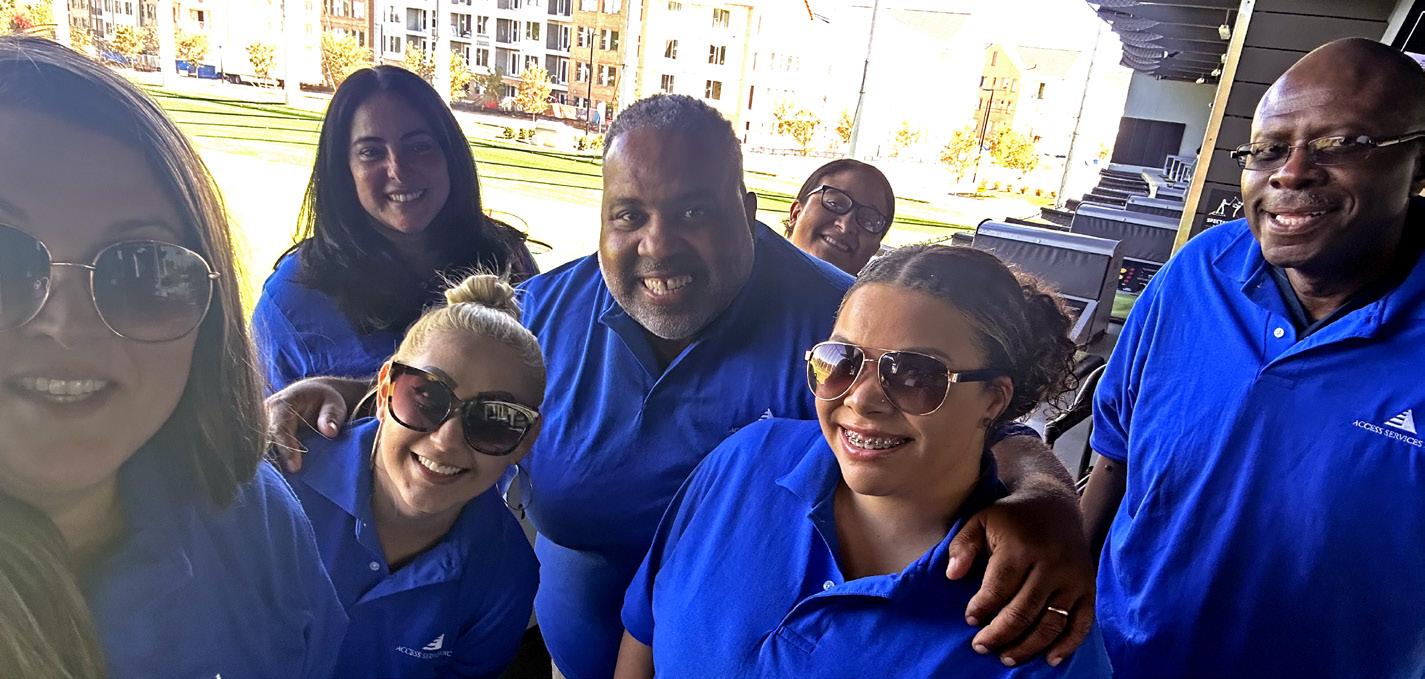
Above: Kevin Smith and Frank Johnson Left: Access Services staff members: (Back row, from left): Kimberly Marquez, Yanira Espada and Kali Lipford. Brittany Cabuno (sitting)
DID YOU KNOW?
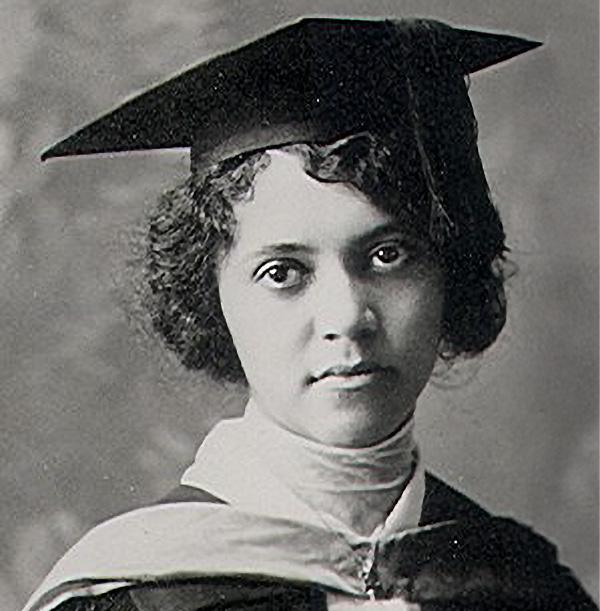
Alice Augusta Ball, born on July 24, 1892 in Seattle, Washington, was a chemist who developed the “Ball Method” for making ethyl ester derivatives of chaulmoogra oil, which were used as a treatment for leprosy during the early 20th century.
salesmanship. It was time to think outside the box.
Though the economy stalled, Access was still providing primarily jobsite cleaning for Charlotte-based RT Dooley Construction, which also relied on Smith as an unofficial, and unpaid, job scout as well.
“They would say, ‘Do you know anyone who can do a demo? Has carpentry skills? Can drive a forklift?’ So, I would help,’” Smith said. Then “Frank says to me, ‘Hey, I think we’ve got something here. You’re providing them with more than just clean-up.’ ”
That’s when Access Janitorial officially became Access Services.
“It could not have been more timely,” Johnson said, explaining that RT Dooley was involved with three major office tower projects simultaneously. Adding staffing to janitorial duties helped Access Services survive the recession intact. “Those towers
The men of Access Services don’t limit their talents and energies to the office either. They consistently channel wisdom and talent toward the greater good.
were going up, while the economy was going down,” Johnson said.
Access Services also offers skilled staffing, primarily in the construction and healthcare industries. Staff recruiters work independently and with community partners to find skilled candidates.
When covid shuddered businesses again, Smith and Johnson adapted once more; this time, expanding their reach, instead of their services. Like many companies, Access Services learned the value of virtual connections during the pandemic.
As a result, they successfully place workers with employees across the entire Southeast. This move not only kept Access afloat, but it also actually increased profits. Currently, their annual revenue is around $7 million, Smith said.
Neither man attempts to shoulder the credit though. The business partners are quick to cite firm faith and supportive spouses as the backbone of their success.
Johnson, who has been married to his wife Juanita for 40 years said, “If you don’t have a wife who’s on board, it can be a real challenge. Sometimes those paychecks aren’t on the regular. It’s good to be able to come home and not get beat over the head,” he said.
“This is not for the faint of heart,” said Smith, adding how his wife, Merrie’s unwavering support and praise put “wind in his sails” during especially bleak patches.
Smith and Johnson’s community visibility as successful Black entrepreneurs is a unique advantage not lost on them. “A lot of these kids look like us,” Johnson said. “So hopefully our words will carry more weight.”
“[Young people] will come in the door, their pants sagging, [not] looking you directly in the eye,” Smith said. “I’ll say, ‘We aren’t going to have an interview today. Let’s have a conversation,” Smith added. “We know the landscape out here. We know [Black people] don’t get second and third chances.” The hope is to ensure that Black job hunters get it right the first time around.
Smith and Johnson both also promote the importance of continued adaptation as a means to success. “We’re in our 60s, but we are still learning. People who are successful know what they don’t
The men of Access Services don’t limit their talents and energies to the office either. They consistently channel wisdom and talent toward the greater good.
The Access Services team regularly volunteer in conjunction with local organizations such as the CharlotteMecklenburg Communities in Schools, NXT/CLT, Goodwill and the Salvation Army, offering career counseling, interview pointers and skills training to those just starting out in the workforce and some who are starting over.
know. And they’re open to other ideas,” Johnson said.
With that in mind, White and Johnson are totally open to adapting Access Services if necessary.
“Hey man, if you’re looking for an astronaut, I’m gonna find you one,” Smith joked. For these seasoned business veterans, apparently even the sky is not the limit. P
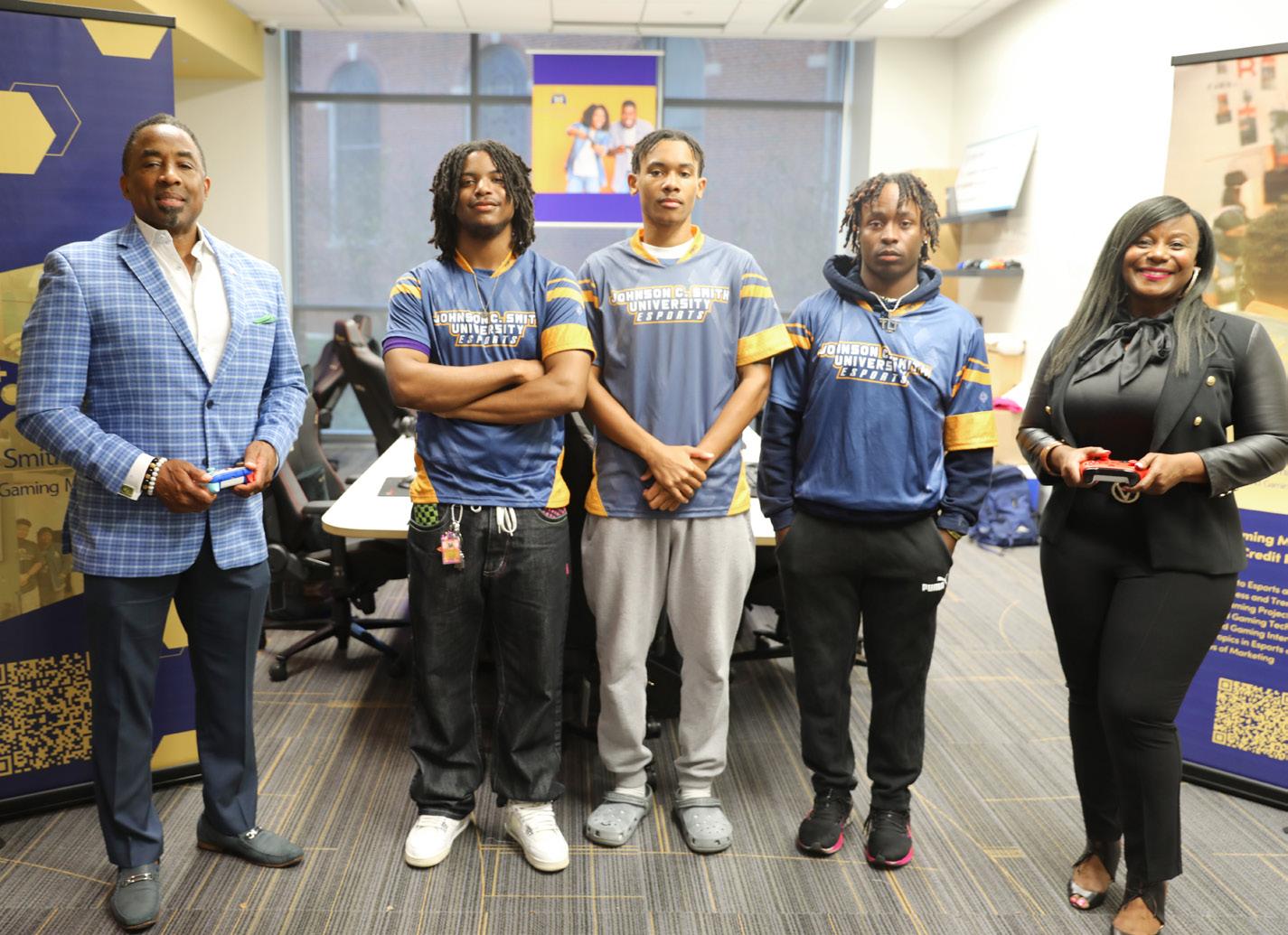
Access Services owners Kevin Smith (center) and Frank Johnson (far right), and members of their staff.
Jeff Peterson Is Creating New Vision and Buzz at the Hive
By Angela Lindsay
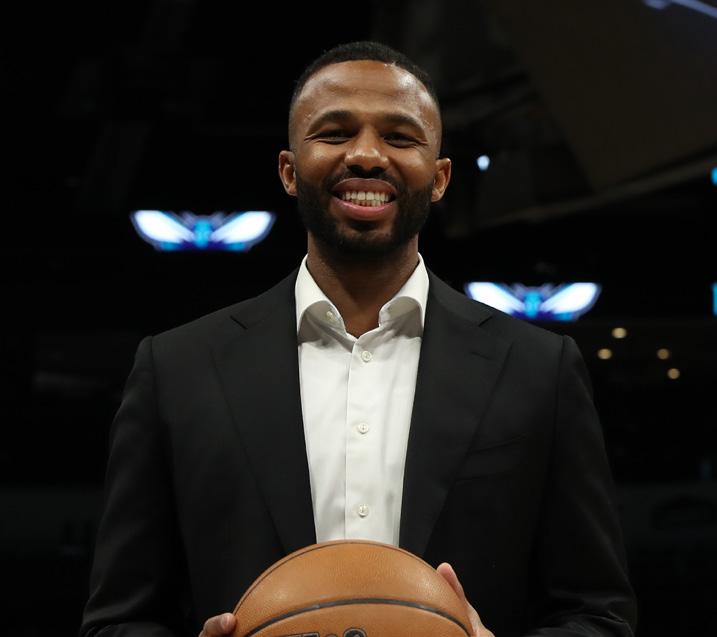
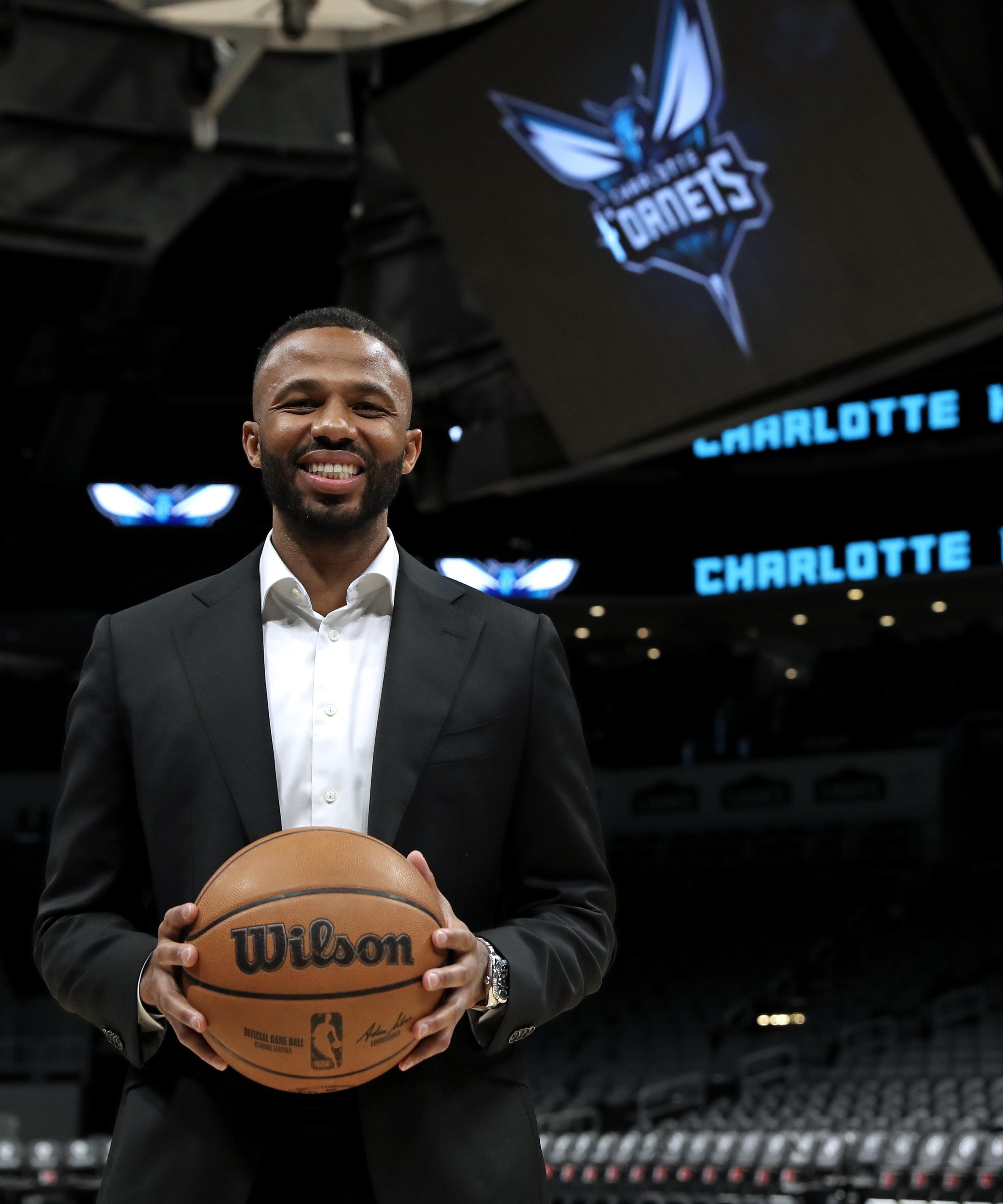
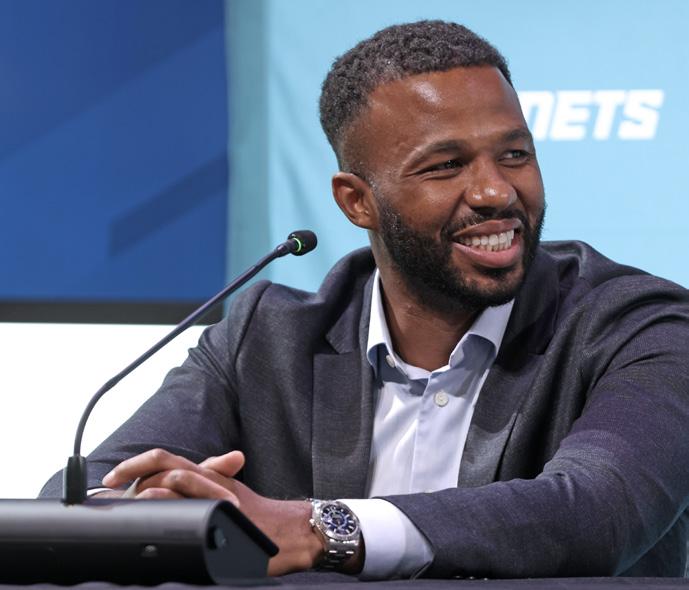
Jeff Peterson, the Charlotte Hornets President of Basketball Operations
It’s no surprise that Charlotte’s NBA franchise has been struggling for some time. Over the past several seasons, the Hornets have underperformed winning under 30 games out of 82 for most of the past 10 years. Enter Jeff Peterson. In March, the 35-year-old was named the President of Basketball Operations for the Charlotte Hornets, replacing longtime executive Mitch Kupchak. His vision for the organization? Shifting the squad’s reputation from mediocrity to that of a winning culture.
“We are looking to create a team culture around hard work, player development, a commitment to winning and togetherness,” said the Springfield, Missouri native. “We want a team that plays hard and competes every night. It’s important that we have players on our team that embody these characteristics. Our entire organization is focused on developing a winning on-court product for our fans, for this city and for the Carolinas.”
As the organization’s chief basketball decision maker, Peterson is also responsible for leading the team’s day-today basketball operations. Before arriving in Charlotte, he spent four and a half years as assistant general manager with the Brooklyn Nets where he said he was forced to get out of his comfort zone, manage different people and see a new way of doing things in a different market.
Initially wanting to be a sports agent, Peterson instead pursued an internship after college with the Atlanta Hawks (at the urging of a college coach), which gave him his start in the industry. At the time, their front office was very small, so he was afforded more opportunities than most interns. Though he admits he made lots of mistakes, they allowed him to grow and learn, and he was kept on after his intern year. Over the next few years, he was promoted several times and, by his fourth year, he was assistant general manager.
“I’m very fortunate, and I give a ton of credit to the players, coaching staff and everyone I was with because they helped me a ton,” Peterson said.
Courtesy of the Charlotte Hornets
Understanding that greatness is a process can be one of the biggest difficulties for someone in Peterson’s position to face. So, he tempers expectations with the reality that the team’s transformation will occur organically over time.
Though a passionate pursuit of athletics played a prominent role during his youth, it was academics that his parents emphasized growing up.
“Obviously, they knew I loved basketball and wanted to be an NBA player, but at the same time, even if that would’ve worked out, at some point the ball stops bouncing, and they would always say, ‘People can’t take away your mind.’ It was instilled in me at an early age that you have to work to get
good grades, and more than anything just be open to learning,” said Peterson.
And he was.
For high school, Peterson transferred to DeMatha Catholic in Maryland, an institution known as much for its legacy of producing professional athletes as it is for its rigorous academic program. There, Peterson actually committed to Princeton but decided to play basketball at a “bigger school” and ended up at Iowa. He received his undergraduate degree in marketing at
Arkansas and a master’s degree in marketing at Florida State.
“I’m really proud of that,” he said.
Along with his education and experience, Peterson brings a vision that some would argue the organization seems to have lost sight of since the days of the pulsating energy and palpable excitement at “the old Coliseum” formerly on Tyvola Road with its once consistently sold-out purple and tealcolored crowds.
“Our goal is to become a premier franchise in the NBA. A big part of that is constructing a team built for long-term sustainable success,” he said.
Such a challenge isn’t foreign to him. He’s been involved with a couple of remarkable circumstances in the league.
“During my time in Atlanta, we went from a mediocre team to the Eastern Conference Finals to going through a rebuild,” said Peterson. “Then, I got to the Nets with three future Hall of Famers — Kevin Durant, Kyrie Irving and James Harden. It was a great reminder that there are no guarantees.”
Understanding that greatness is a process can be one of the biggest
DID YOU KNOW?
Samuel Harold Lacy was a sports journalist, editor and broadcast commentator for nine decades. In 1948, Lacy became became one of the first Black members of the Baseball Writers’ Association of America (BBWAA). In 1997, he received the J. G. Taylor Spink Award for outstanding baseball writing from the BBWAA.
difficulties for someone in Peterson’s position to face. So, he tempers expectations with the reality that the team’s transformation will occur organically over time.
“It’s not an overnight thing as much as we all want it to be. Trust me, I want success more than anyone—but to truly build something sustainable, you can’t skip any steps. You have to be methodical in how you build it,” he said. “I’ve said this before, but we trust the process and we trust the work. Good things will come as a result of that. I continue to remind everyone, including myself, that sometimes you have to go through growing pains before we can get to where we want to go.”
Peterson said his decision to accept the job in Charlotte was due, in part, to his attraction to the city, its growth,
its people and the unique potential the opportunity presented.
“People who end up in these kinds of positions aren’t always fortunate to step into a situation like this. We have all our (draft) picks. We have contract flexibility. We have a lot of optionality. That’s not always the case. The stars aligned with this job,” he said.
Hornets ownership was the other deciding factor.
“It starts with ownership—Gabe Plotkin, Rick Schnall, and their vision to turn this into a premier franchise in the NBA,” he explained. “Any organization needs to have trust, synergy and alignment between ownership, the general manager and head coach to have success.”
The head coach he acknowledges, Charles Lee, 40, was also hired by the franchise this year after helping the Boston
Celtics secure the NBA title this past season as an assistant coach. Peterson said Lee’s leadership and contributions are helping to turn things around.
“First, hiring Charles as head coach was really important. That’s the voice the players are hearing on a daily basis, so we were very intentional as to who we brought into that seat. Charles has done a tremendous job, and it all starts with him,” Peterson said.
“He’s very relatable to the guys, he loves getting on the floor with them, he’s creative, and he always has their best interests in mind. On the other hand, he’s very demanding and holds everyone accountable . . . We’ve been down in some games, and guys have continued to fight back and show some grit and fortitude. It’s been really encouraging to see.”
Both Peterson and Lee were recently named to The Athletic’s NBA 40 Under 40 list of rising stars in the league. With such pedigree at play behind the scenes as well as the chemistry being built on the court, Peterson believes they’ll give fans something to cheer about.
“We don’t want to be a team that makes the playoffs one year and then misses the playoffs for the next three years. We strive to build a team that will be a perennial playoff team that advances in the playoffs and ultimately is competing for an NBA championship,” said Peterson. “We want to bring a winning team to our passionate Hornets fans throughout the Carolinas because they deserve it.” P
Courtesy of the Charlotte Hornets
Jeff Peterson
Rising Above: Walter Kirkland Jr.’s Journey to the U.S. Space Force
By Ruby Durham
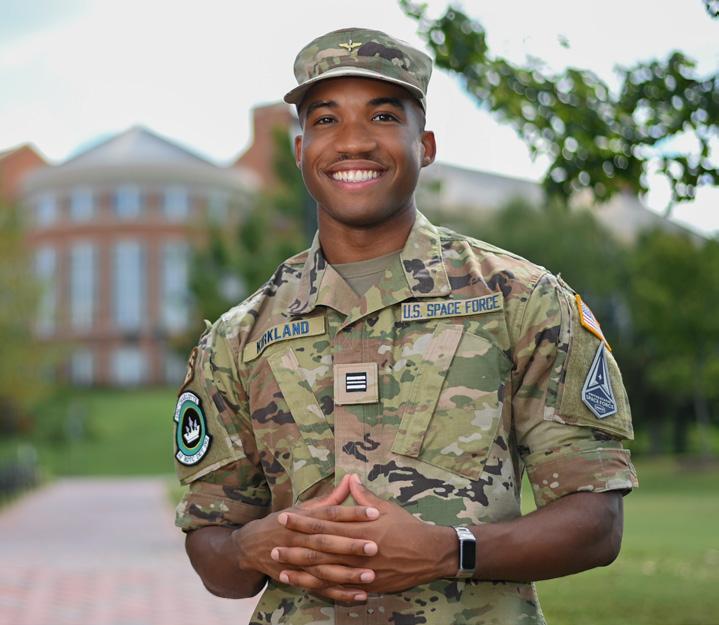
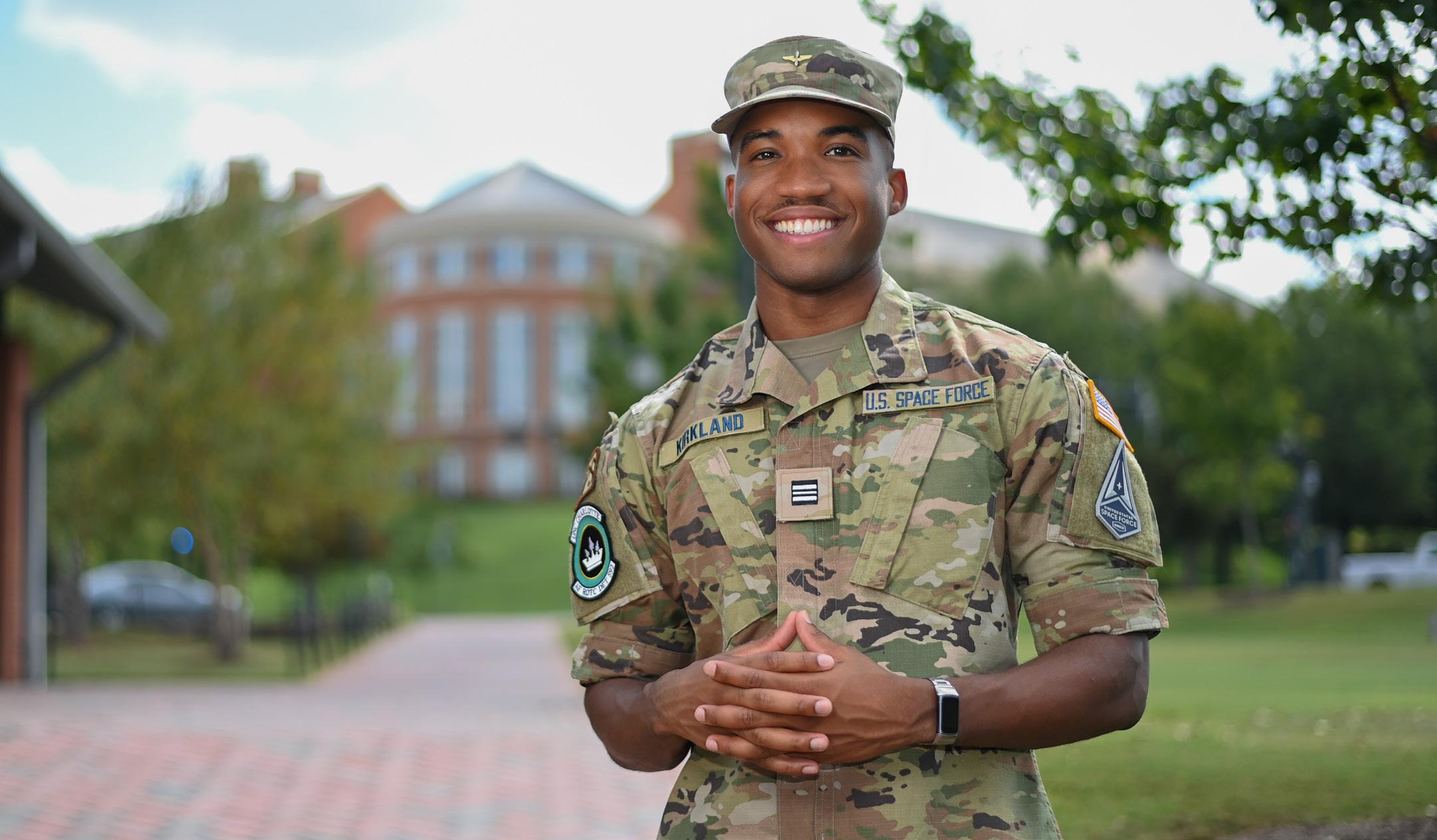
When Walter Kirkland Jr. reflects on his journey from a military kid to an officer in the United States Space Force, it’s clear that adaptability and determination have been the driving forces in his life. Kirkland’s path to becoming a U.S. Space Force Cyber Operations Officer is not just a story of academic achievement but one of resilience, seizing opportunities and making the most of every experience no matter the odds.
Kirkland’s background is as unique as his future career. As a child of Army parents, his “hometown” was constantly changing. “We moved around 10 times before my parents were stationed at Fort Liberty in North Carolina (formerly Fort Bragg) in 2015,” he said. “By the time I was in high school, I’d lived in so many places, but Fayetteville and Charlotte, North Carolina, became home after my parents retired in 2020.”
It was in Fayetteville that Kirkland first developed a deep interest in military service, pursuing an Air Force ROTC scholarship at Village Christian Academy. However, like many of his peers, Kirkland’s academic experience took an unexpected turn when the covid pandemic disrupted the world in 2020. Despite the challenges of remote learning and restricted access to campus, Kirkland’s dedication to his goals never wavered.
“My first two years were a bit unconventional,” he said. “I remember doing ROTC physical training in my dorm room, trying to angle my camera just right for jumping jacks.” But rather than being deterred, Kirkland saw the adversity as an opportunity to build flexibility and resilience. Those qualities would serve him well as he embarked on his journey at the University of North Carolina at
Walter Kirkland Jr. is joining the U.S. Space Force as a Cyber Operations Officer.
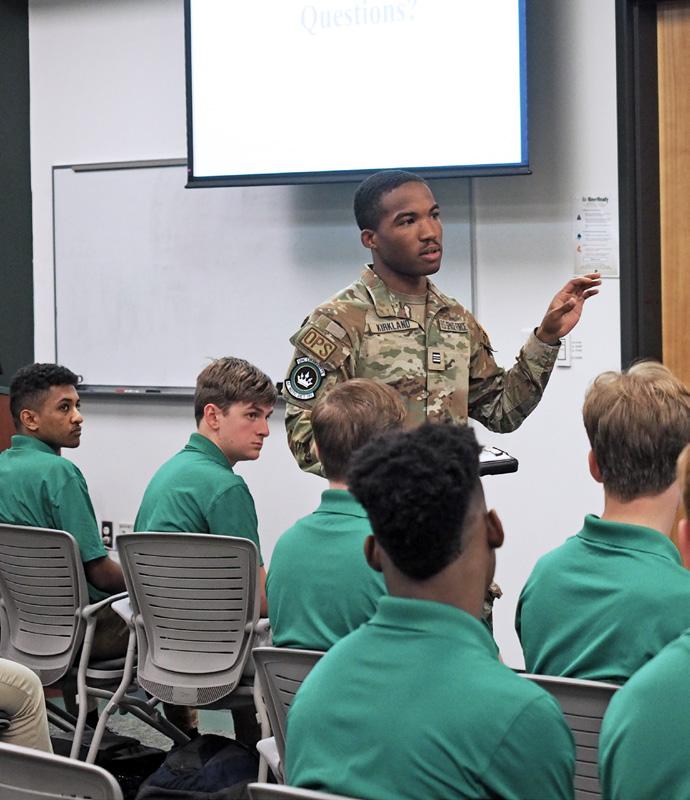
Walter Kirkland Jr. giving a briefing to ROTC undergraduate students in the ROTC building in Memorial Hall at UNC Charlotte for the Leadership Laboratory class.
Charlotte (UNC Charlotte), where he majored in computer science.
It wasn’t just his academic experience at UNC Charlotte that would shape his future. Kirkland’s passion for cybersecurity blossomed from his childhood desire to travel. “Growing up in a military family, I had the itch to see the world,” he said. “I figured the best way to do that was through technology. So, I decided to major in computer science, a field that could take me anywhere.”
This decision set him on a course toward becoming a Cyber Operations Officer — a role that eventually led him to the newly formed U.S. Space Force, the branch responsible for securing the nation’s interests in space.
“The Space Force caught my attention because it was something new, a blank slate,” Kirkland said. “I wanted to be one of the ‘OGs,’ to help shape what it meant to be a Space Force Guardian.”
And that’s exactly what he’s done. When the opportunity arose to apply for a position in the Space Force, Kirkland was all in.
As he explained, “The Space Force’s mission is critical — securing GPS, communications, air travel, space launches and so much more. Space technology impacts every part of our daily lives, and I wanted to be part of that.”
The competition for a role in the Space Force was fierce. At the time, only around 8,000 active-duty Guardians served in the Space Force, and the selection process was
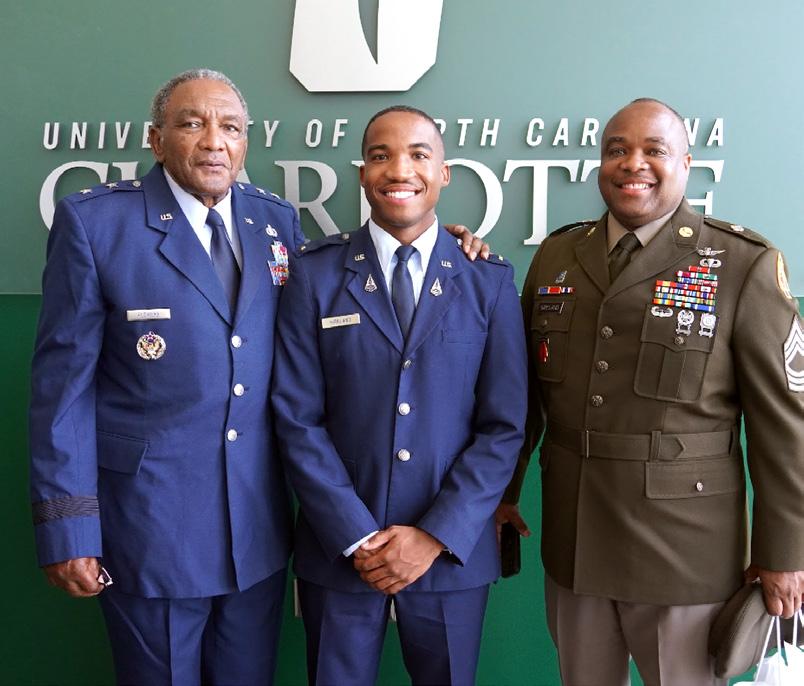
Walter Kirkland Jr. (center) with his father, Walter Kirkland Sr. (right) and retired 3-Star General Alfred K. Flowers (left) who was the guest speaker at the Jr. Kirkland’s commissioning ceremony.
highly competitive. “In the spring of 2023, I applied, and only about 120 ROTC students nationwide were selected,” Kirkland said.
The process involved submitting academic records, physical fitness scores, and completing a rigorous digital interview. But it wasn’t just about what he knew — it was about who he was.
“The interview focused a lot on your character and your leadership potential,” he said. “They wanted to see if you had the drive, the passion for the mission and the ability to work with others.”
In September 2023, Kirkland received the life-changing news: He was selected
to become a U.S. Space Force Cyber Operations Officer.
“It was a surreal moment, honestly,” he said. “I was just so grateful and excited for the opportunity.” But the journey didn’t end there.
Kirkland’s future is bright, and his training has already begun. After graduating in May 2024 and being officially commissioned into the Space Force, Kirkland will be participating in the CyberCorps: Scholarship for Service program at UNC Charlotte.
“It’s an accelerated master’s program that is fully funding my cybersecurity graduate degree,” he said. Kirkland was scheduled to graduate in December 2024. After graduation, he said he will report to a Colorado base for officer training.
The training will be rigorous and multifaceted, combining space operations, cyber operations, intelligence and acquisitions to prepare him for a variety of responsibilities, he said. “The goal is to be a well-rounded officer, someone who understands all aspects of the mission,” Kirkland explained.
“This role isn’t just about cybersecurity — it’s about ensuring our nation’s interests in space are protected, whether that’s secure communications or supporting space launches.”
Looking ahead, Kirkland said he’s eager to take on his new role. “I’m excited to be part of something so important and so new,” he said. “The Space Force has a small but mighty group of Guardians, and I can’t wait to contribute to the mission.”
Walter Kirkland Jr.’s story is one of perseverance, passion and the relentless pursuit of excellence. From a military upbringing to becoming a leader in one of the most cutting-edge branches of the U.S. military, his journey is inspiring. His advice to those looking to follow in his footsteps: “Always stay adaptable, keep pushing forward, and never underestimate the power of resilience,” he said. “Every challenge is an opportunity to grow and succeed,” he said.
“People usually say, ‘The sky’s the limit,’ but I prefer to tell them, ‘The sky’s not the limit,’ which especially applies to any dream or goal that you are desiring to accomplish. Our motto is ‘Semper Supra,’ which is Latin for ‘Always Above!’” P
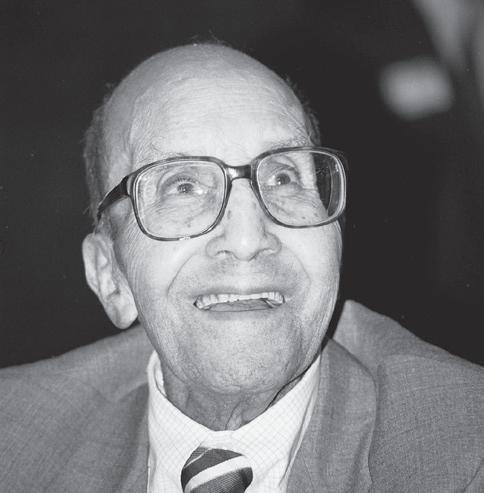
Catching Up with Harvey Gantt
The Trailblazer Who Redefined Boundaries in Education, Business and Government
By Sonja Whitemon
Throughout his life, Harvey Gantt accomplished things that most people would not even think to pursue. Figuratively speaking — Gantt broke the rules. From salutatorian at Burke High School, an all-Black school in Charleston, S.C., he broke barriers in education, business and government.
Gantt chose a career not often associated with Black Americans, especially in 1960 when the segregation of races was the standard. “And back then [architecture] was off limits to us. Ninety-nine percent of all the architects were white,” said Gantt. This did not deter him.
He recalls dinner table conversations with his parents who were working-class people who grew up under the rigid rules of the South. Those conversations instilled confidence and purpose in his life. He recounts, “this notion that no one was better than we were, and we were not better than anybody else, but we had a responsibility to try to achieve and to do well in spite of our color, in spite of our race. I think that’s what motivated me.”
In the 1960s, America was not the America we know today. It was the era of Jim Crow laws, which were observed in all Southern states and some Northern states. Jim Crow restricted Black people in nearly every aspect of life. Understanding the restrictions imposed on Black Americans by these laws, he only applied to Black colleges, such as Tuskegee University and Howard University.
His guidance counselor dared him to try a predominantly white institution. He took the challenge and got into Iowa State University. After about a year and a half, Gantt, a child of the South, decided the Iowa weather was too cold. He applied for a transfer to Clemson University. It was declined.
“So, I was motivated again,” he said. “The Supreme Court had said that segregation was unconstitutional, and Black children had a right to go to school with white children, and that meant at the higher education level too. But no one had done that in South Carolina.”
It was the Supreme Court decision in Brown v. Board of Education in 1954 that overruled the 1896 Plessy v. Ferguson separate but equal doctrine upholding the constitutionality of Jim Crow laws and legalizing racial segregation in the United States.
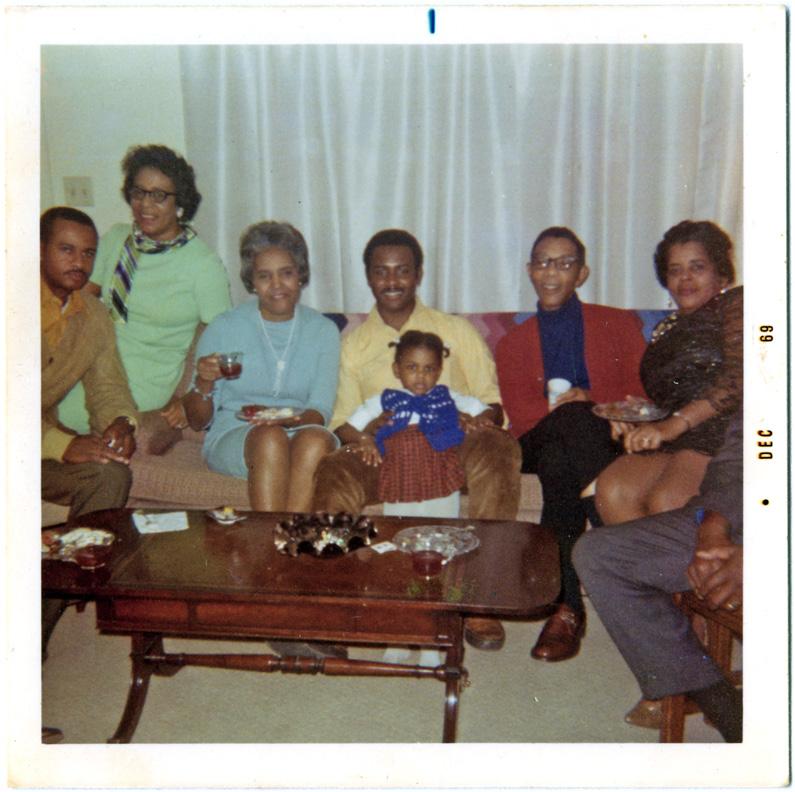
Sonya, circa 1969.
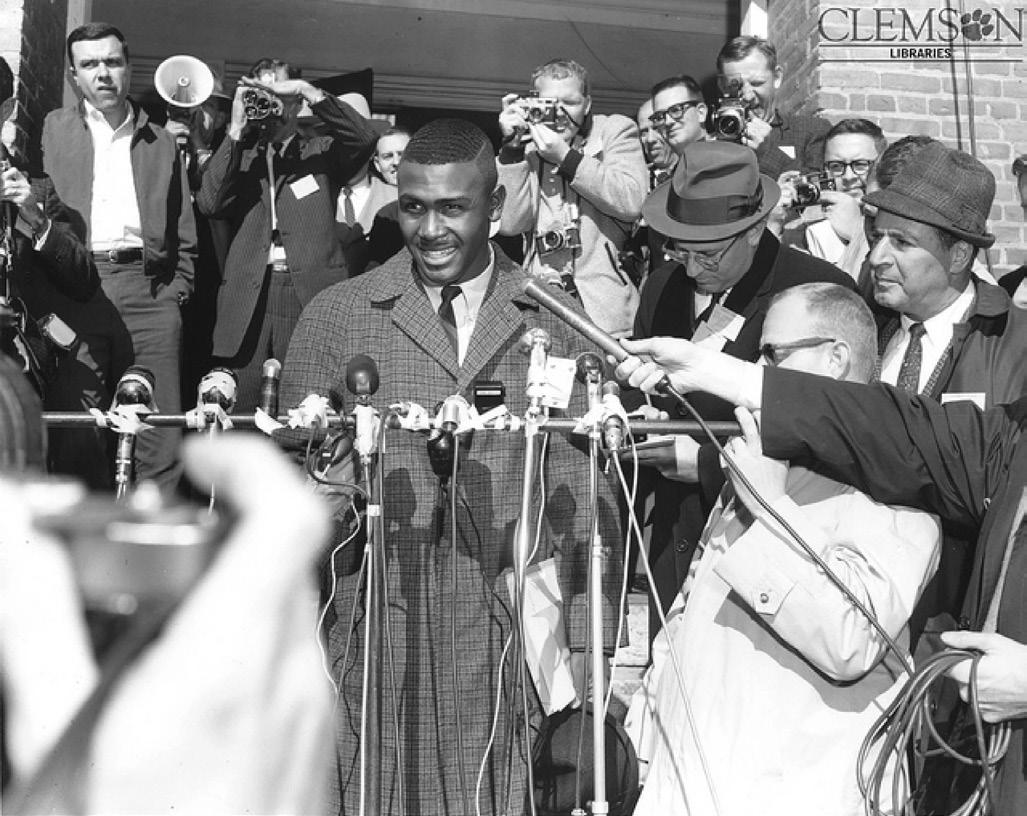
Below: Harvey Gantt, the first Black student admitted to Clemson University, stands on the steps of Sikes Hall at the school in 1963.
Amid written protests against integration from students and alumni — the expected epithets included — Gantt pursued acceptance at Clemson University even though no Black person had ever been accepted at the school. After five rejected applications to Clemson and a lawsuit that was decided in Gantt’s favor by the U.S. 4th Circuit Court, the state of South Carolina sought to appeal to the Supreme Court. They were unsuccessful and Gantt was finally accepted at Clemson. He was once again breaking the rules. He earned a degree in architecture with honors from Clemson University.
Top Left: Harvey Gantt was elected as Charlotte’s first Black Mayor in 1983.
Top Right: Left to right: Harry Jones, Gladys Gantt, Anna Lou Reid, and Harvey Gantt holding daughter
Photo courtesy of Clemson University Libraries
Photo courtesy of Clemson University Libraries
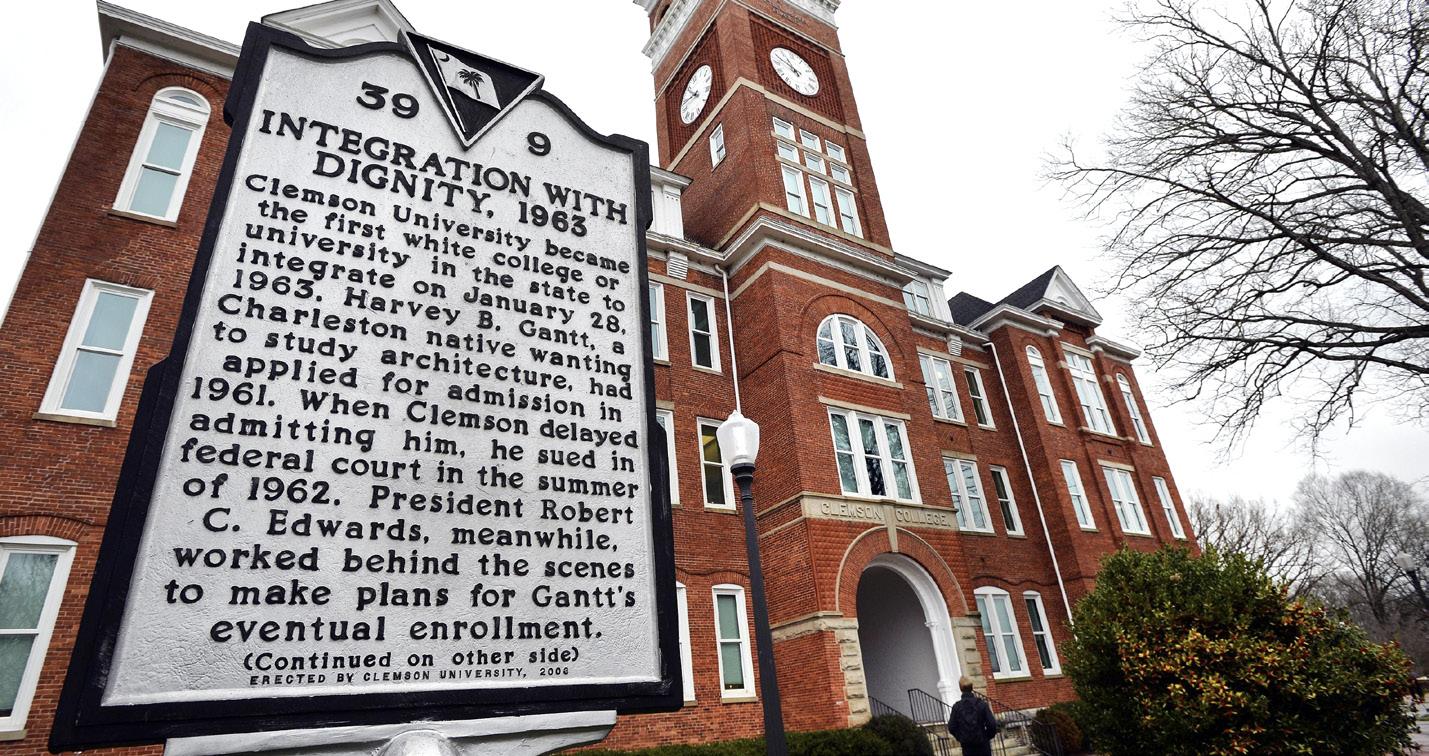
Harvey Grant is now a celebrated alumnus at Clemson. In 2017, the Clemson Board of Trustees dedicated granite marble to surround a statue of the school’s namesake, Thomas Green Clemson as “Gantt Circle.” It complements the historical marker near the campus building where Gantt registered for his first semester there on Jan. 28, 1963. There is also The Harvey and Lucinda Gantt Multicultural Center and the Harvey B. Gantt Scholarship Endowment. The scholarship provides academic scholarships to recruit and retain Black students with special preference given to South Carolina residents and entering freshmen.
Gantt went on to an equally remarkable career in architecture. Following his internship, he moved to Charlotte and began working as an architect. He eventually partnered with a former
colleague to form Gantt Huberman Architects, which grew to 55 architects, plus interior designers and other specialists. The firm worked throughout North and South Carolina.
You might recognize some of Gantt Huberman’s work in several key buildings in Charlotte, among them the Charlotte
Harvey Gantt is now a celebrated alumnus at Clemson.
Transportation Center, TransAmerica Square, ImaginOn, Friendship Missionary Baptist Church and the Johnson C. Smith University Science Center. To this day, according to the National Council of Architectural Registration Boards, only around 2% of architects in the United States are Black.
After serving on Charlotte City Council for nine years, Gantt was elected to two terms as the city’s first Black mayor from 1983 to 1987.
“I always said by the time I reached somewhere around age 70, I thought that it might be an excellent time to retire. It happened so that circumstances allowed our firm to be in a position where we had people interested in the body of work we were doing and the national firm approached us, and they bought us.” He stayed with the firm for three additional years to help with the transition.
After breaking new barriers most of his life, Gantt made the decision to retire. Following a brief vacation, he felt rejuvenated and looked for other things to do. Now, at 82, he enjoys spending time with his family, which includes nine grandchildren.
Today he is also active on several nonprofit advisory boards in the area, he has agreed to take on some responsibilities to do exploratory work for the city of Charlotte, and he is working for the Charlotte Rescue Mission to get a fundraising effort to build a new building along with a host of other activities.
Retirement has been defined as withdrawal from an active working life, ceasing to work. That’s not Harvey Gantt’s style of retirement. Today, in retirement, he is still breaking the rules. P
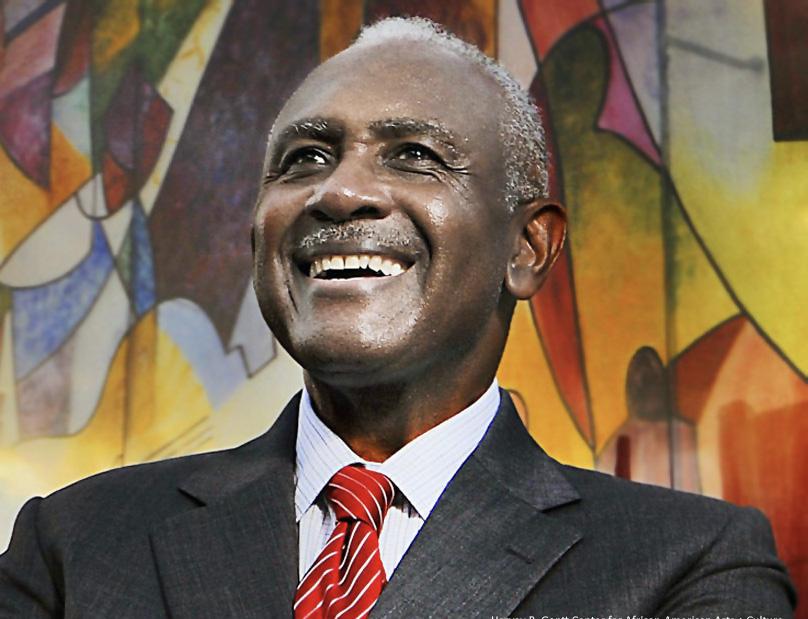
The Afro-American Cultural Center in Charlotte was renamed the Harvey B. Gannt Center for African-American Arts+Culture in honor of Harvey Gantt’s contributions to city.
This Clemson University marker was erected in 2003 — 40 years after Harvey Gantt enrolled in the school. He was the first Black student to do so.
Photo courtesy of Harvey B. Gantt Center
Photo courtesy of Harvey B. Gantt Center
Johnnie Taylor’s Daughter Says Her Dad Deserves More Recognition
By Alicia Michele Benjamin
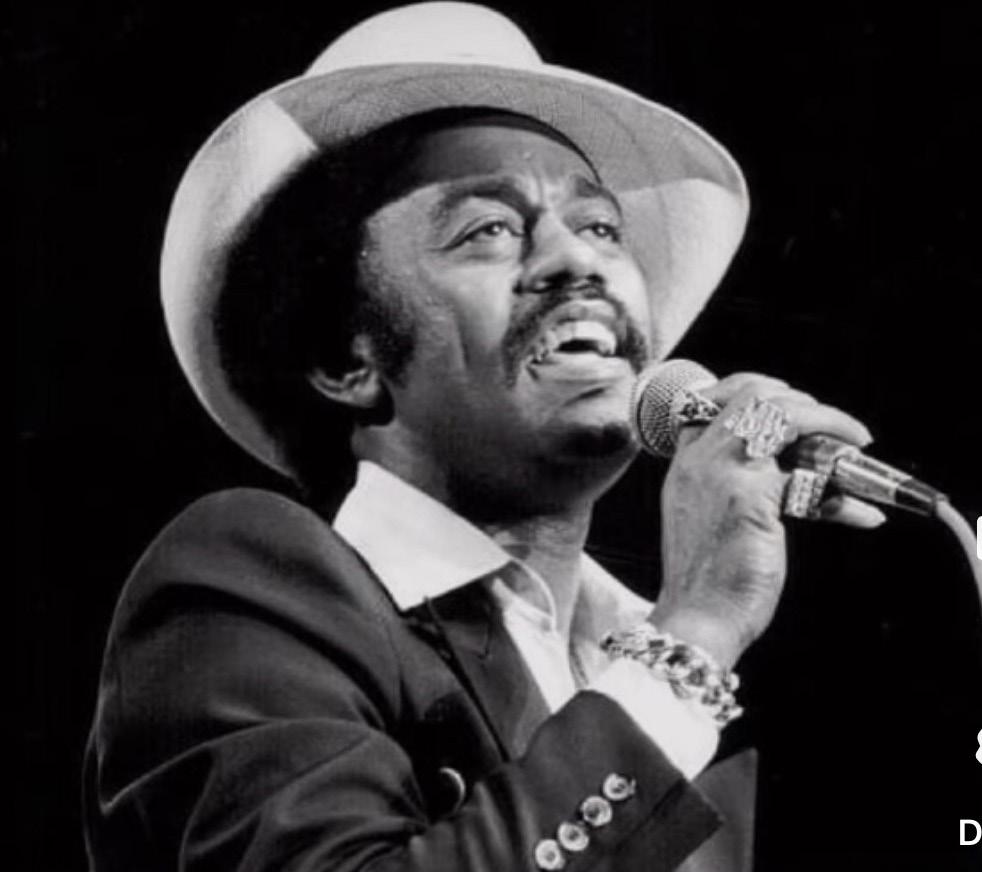
Rhythm and blues singer Johnnie Taylor deserves to be recognized with his friends Otis Redding, Aretha Franklin, Sam Cooke, Isaac Hayes and Ben E. King, according to his daughter, Fonda Bryant.
Bryant, who lives in Charlotte, has been campaigning to get her father into the Rock and Roll Hall of Fame. “How can an artist who made music and Black history by having the first ever platinum record, not be in there?” she asked. “I’m also going to nominate him for a star on the Hollywood Walk of Fame next year. He deserves that too.”
Although Bryant, founder of Wellness Action Recovery, a mental health and suicide prevention nonprofit, didn’t really know Taylor — she’s never actually met him — she said she’s proud of his musical legacy and wants him to receive the recognition she feels he deserves.
The musical titan
Taylor, who made such hits as “I Believe in You,” “Who’s Making Love,” and “Disco Lady,” was born in 1934 in Crawfordsville, Arkansas, and grew up in West Memphis around 8 miles from Memphis, Tennessee. He died in 2000 from a heart attack.
Like many other R&B singers, Taylor started singing in church as a child. He joined the gospel group the Soul Stirrers in 1957, taking Sam Cooke’s place.
He joined the Stax Records roster of musicians in 1966, recorded with Booker T. & the M.G.’s, and made several recordings there including songs penned by Isaac Hayes and David Porter.
Taylor’s 1996 song “Disco Lady” was the first single to be certified platinum by the Recording Industry Association of America (RIAA). He was a top-selling performer at Stax — even outselling Otis Redding. His breakout hit, “Who’s Making Love,” recorded in 1968, reached Number 5 on the Billboard Hot 100 chart and Number 1 on the R&B chart. It sold over one million copies and was certified gold by the RIAA.
His song “What About My Love,” reached number 24 on the R&B charts in 1984, and the London-based band The Shapeshifters sampled the tune in their 2004 hit, “Lola’s Theme,” which reached the top of the UK’s Single Chart.
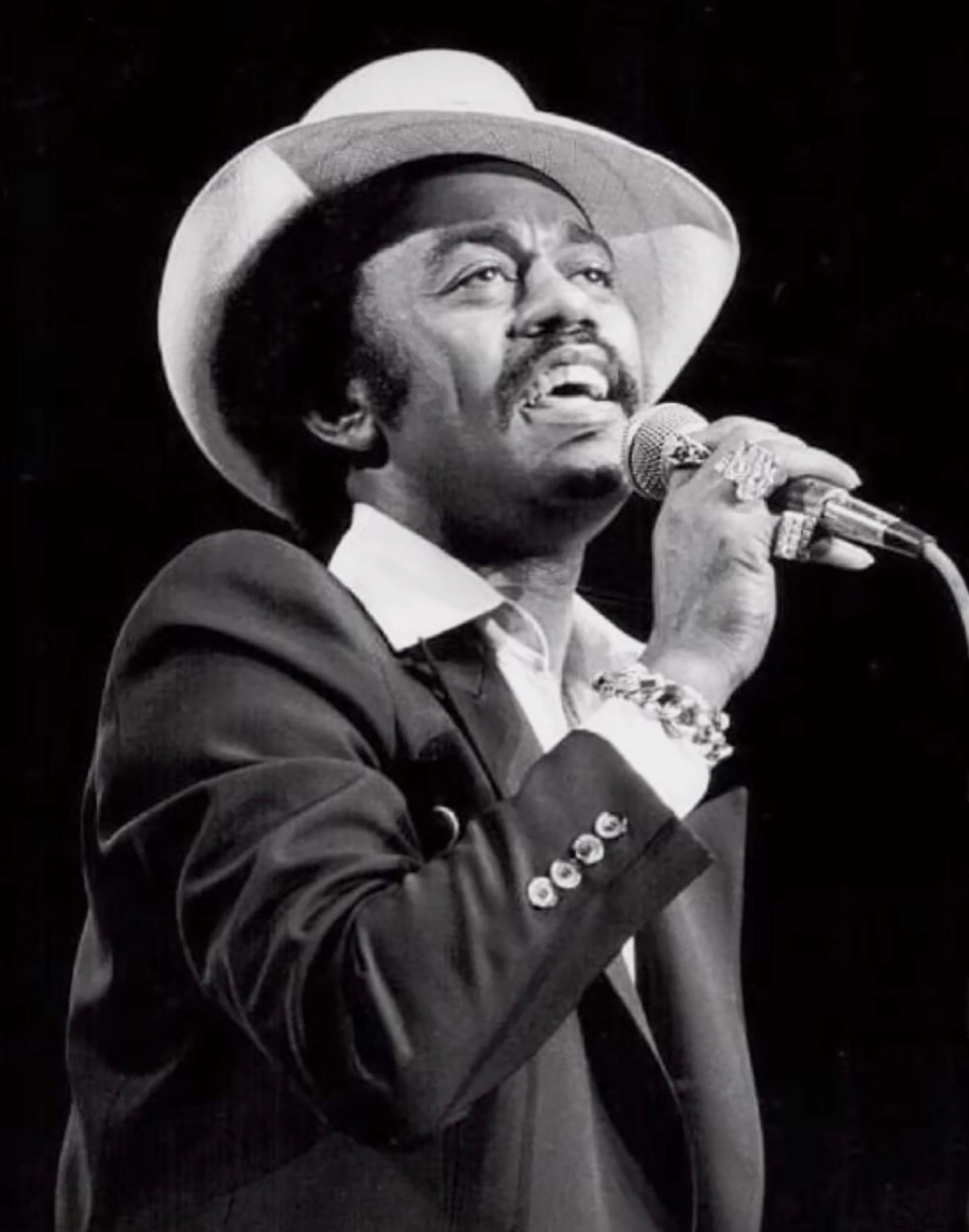
Top: R&B singer Johnnie Taylor. He received the Brass Music Note on Beale Street last month to honor his contribution to music history in Memphis, Tenn.
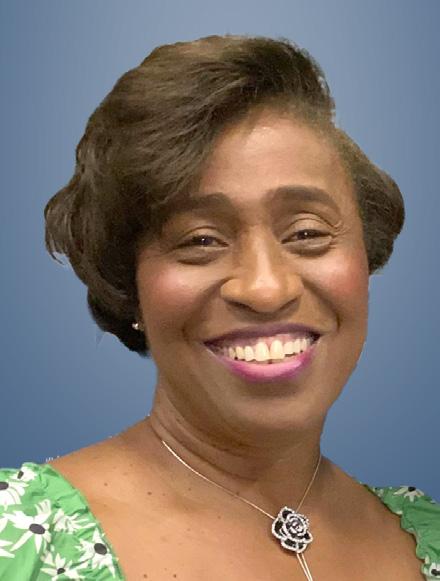
Above: Fonda Bryant, Johnnie Taylor’s daughter
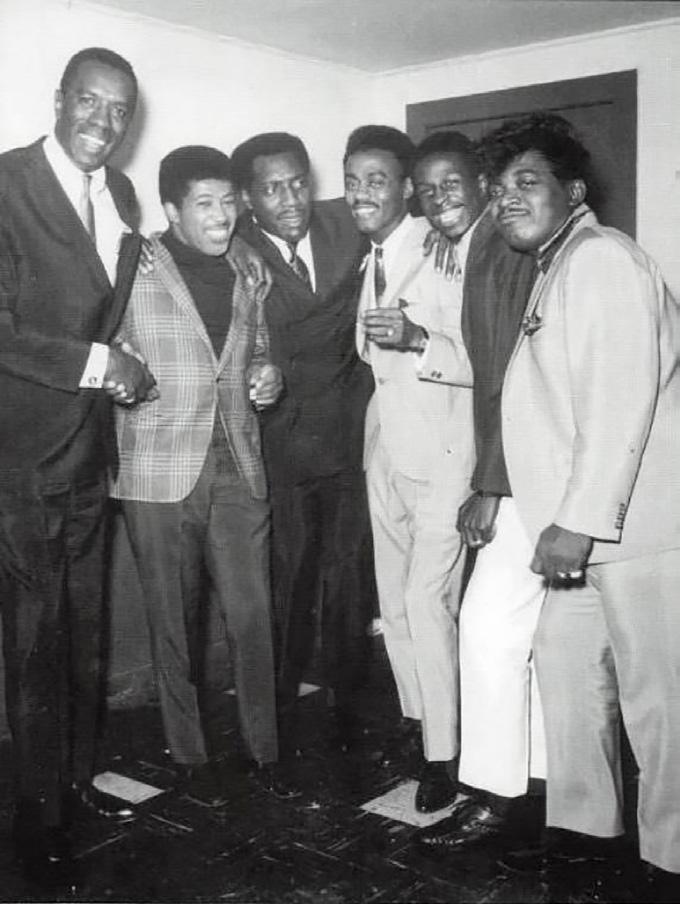
Right: Left to right: Unknown DJ, Ben E. King, Otis Redding, Johnnie Taylor, Authur Conley and Percy Sledge
Taylor is also featured in the 2024 documentary “Stax: Soulsville USA” on Max streaming service, along with others on the Stax roster including Isaac Hayes, Otis Redding and Carla and Rufus Thomas.
Family ties
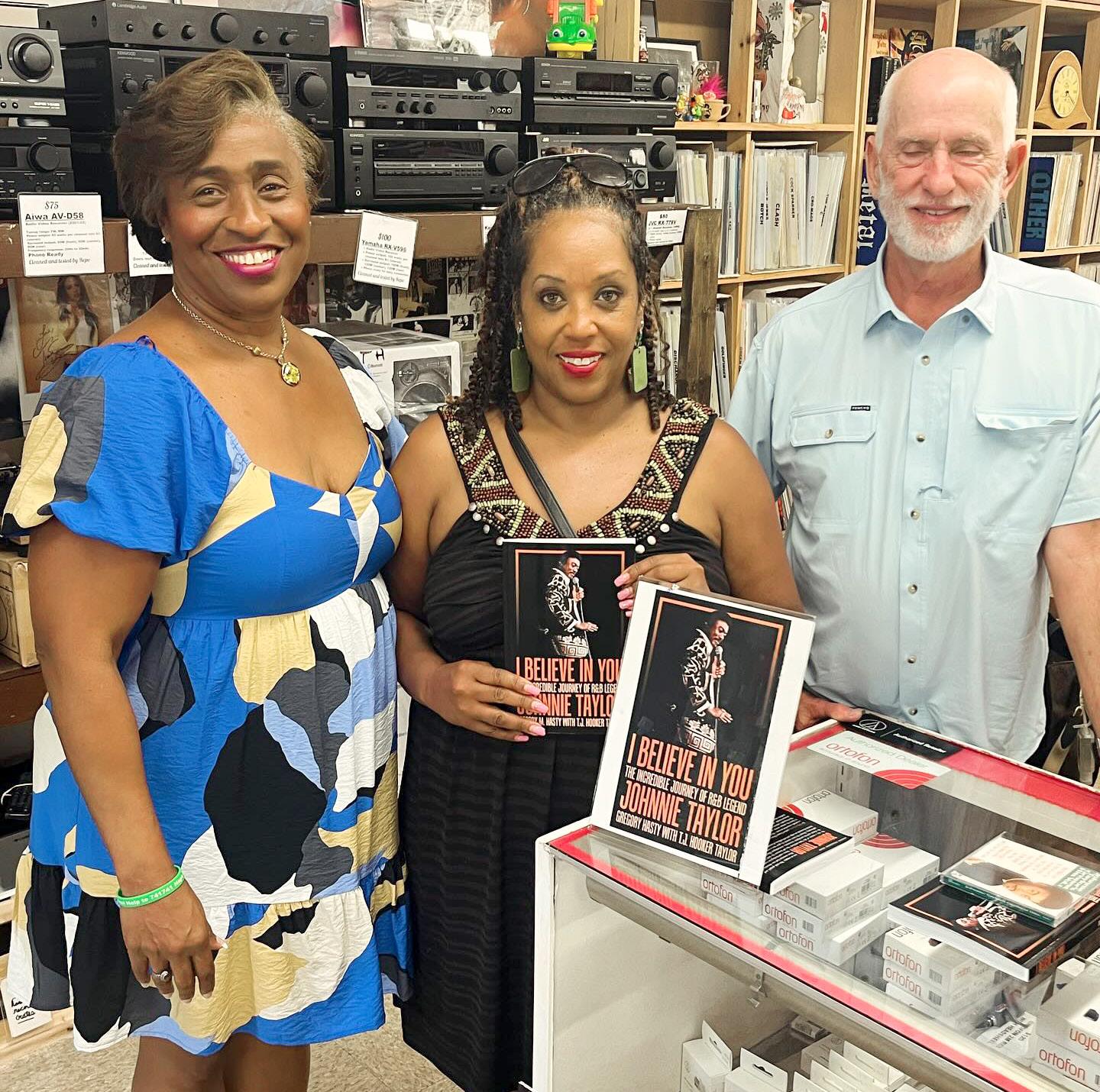
The 2024 book, “I Believe in You: The Incredible Journey of R&B Legend Johnnie Taylor,” written by Gregory Hasty with Taylor’s son, T.J. Hooker Taylor, is about Johnnie’s life, relationships with his family, children, girlfriends and others, and his many accomplishments as a musician.
Bryant said she hopes people will read the book because Taylor is “one of the most underrated artists I’ve ever seen.” I hope people learn more about him, his music and just realize what a great entertainer he was.”
But Bryant would like to have known her father better herself.
Taylor and Bryant’s mother Peggye Edwards met when Edwards was a teenager in Gastonia, N.C. Edwards’ mother was a gospel promoter, so music celebrities like Mavis Staples and Taylor often came to their house.
“That’s how my mother met Johnny Taylor in the first place,” Bryant said. “When I was a little girl, famous people would come to the house. Like when I was a little girl, I sat on Pops Staples’ lap, and he would share stories with us. My sister was named after Mavis Staples. We had all kinds of people come through there.”
What about my love?
Edwards was 17 when she had Bryant. When she was five, Bryant’s mom pointed to a poster on the wall in their home and said, “This is your father.” That’s when Bryant wanted to know more about this man. “But I was little,” she said. “So, my mom shared stories of how she tried to get him to come see me and things like that, and he wouldn’t. So that brought up a lot of resentment because, you know, my mom was single and other people had dads.”
When she finally spoke to her father, she was 28, and she did so over the phone.
Taylor was a lady’s man. He had lots of relationships with women in various cities, was married twice, had a total of nine children — six with his first and second wife and three, including Bryant, with other women.
He invited Bryant to meet him in Charleston, S.C., at a performance, but she didn’t go. “I didn’t feel comfortable with that because … my father did drugs and alcohol, and I was not going to put myself in that situation,” she said.
Left:
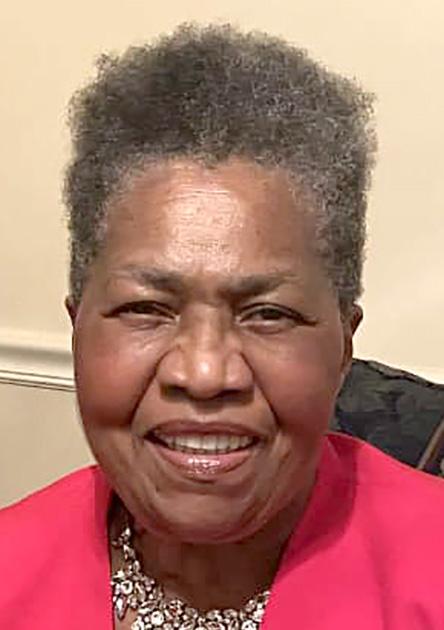
Edwards, Fonda Bryant’s mother, gave birth to Bryant when she was 17. Edwards, 81, has four other children, and lives in Georgia with her husband.
“As an entertainer, you can’t take away his great voice, his showmanship, none of that. But as a father, he was a deadbeat. He was a terrible father. He wasn’t a father.”
But she said, “He takes better care of me in death than he did when he was alive.” This is because Bryant and the other eight siblings get royalty money from music companies.
Paternity test
Taylor didn’t have a will when he died in May 2000 (he was 66). His nine children battled over his estate. The three children, including Bryant, had paternal DNA tests done to determine if Taylor was their father. The tests proved that Bryant and seven of the others were Taylor’s biological children.
But through it all, Bryant keeps uplifting her father’s name and fighting for him to get more acknowledgement in the music world “because he deserves it,” she said. “Because this is what I tell people all the time. In order for me to do the things that I do for my father on the entertainment side, I have to look at the entertainer, not the person.”
Bryant said her favorite song by Taylor is “I Believe in You.” P
Fonda Bryant (left), Kim Martin, Radio One Account Executive and Greg Hasty, author of the book “I Believe in You: The Incredible Journey of Johnnie Taylor.”
Above: Fonda Bryant, her son Wesley (middle) and her grandson
Peggye
Men of Influence Making Transformational Changes in Our Community
Meet six men in the Charlotte area who are leading in the fields of education, sports, government, social justice and the arts. These men from different backgrounds serve as an inspiration to all of us and are striving to create positive change in our community. Kudos to them all!
Sean Carter
By Anders J. Hare
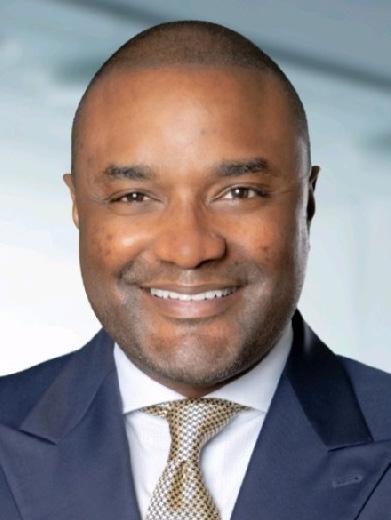
SEAN CARTER, a senior accounting major at Johnson C. Smith University (JCSU), has been named one of the 2024 White House HBCU Scholars, an honor recognizing 110 exceptional students from 77 historically Black colleges and universities across the nation. A native of the Bronx, Carter’s selection is a personal milestone, bringing back cherished memories of visiting the White House with his late grandmother.
Carter was chosen from over 350 applicants for his academic excellence, leadership potential and dedication to community service. He is deeply involved at JCSU, serving as senior class president and president of the National Association of Black Accountants (NABA). A member of Kappa Alpha Psi Fraternity, Inc., Carter is also actively engaged in extracurricular activities that contribute to his leadership development. Carter credits JCSU’s Career Services team and his professors for helping him build the professional connections that will propel his future career.
“The work I pursue is important to me because too many people use the word impossible,” Carter explained. “I hate that word, and I seek to destroy it. Where I’m from it feels we aren’t supposed to be great, and I hope to inspire others by defying those expectations. Post-graduation, I have accepted an offer as program analyst at the Asset Management Firm Barings.”
Monty Witherspoon
By Anders J. Hare
Chase Howard
By Anders J. Hare
DR. MONTY WITHERSPOON, husband, father and pastor of Steele Creek AME Zion Church, is also an At-Large member of the CharlotteMecklenburg Schools Board of Education. An engaged community leader, Witherspoon is an active member of the Black Political Caucus. He’s currently running for the District 2 seat on the CMS School Board.
After graduating from Olympic High School, Witherspoon earned a Bachelor of Arts in Religious Studies from Livingstone College and later received a Master of Divinity from Morehouse College and a doctorate from Drew University.
Witherspoon said he has been an advocate for policies that ensure all students, regardless of their Zip code, graduate college are career ready. His vision for CMS is to foster a safe, quality learning environment where every child can succeed. He has developed numerous community programs, earned Congressional recognition for Outstanding Community Service and championed inclusive, communityguided conversations.
“As a school board member, I work to ensure all students have a bright future,” Witherspoon said. “I am particularly focused on closing opportunity gaps, which disproportionately impact the outcomes of Black students.”
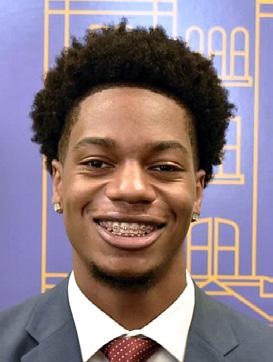
CHASE HOWARD is a proprietor of young people’s rights and social change in Charlotte, North Carolina. As president of the Youth Advocacy Council at NC Child, his team is dedicated to improving the well-being of children and families across the state. Since taking on the role just two months ago, Chase has already contributed to several successful campaigns focused on health, education, and justice. As vice president of membership for the North Carolina Association of Teen Democrats, he played a key role in growing the organization’s membership, reforming processes, and supporting progressive causes.
Chase is co-president of GenerationNation, a group of student leaders that advise local leaders on the issues that affect the youth of Charlotte. He also hones his leadership and diplomatic skills through his involvement in the Palisades High School Model United Nations. A senior at Palisades High, Chase is scheduled to graduate in 2025. He plans to study social studies or history. With strong communication and strategic thinking skills, Chase is committed to making a lasting impact in his community and beyond.
“Since I was in elementary school, I have had a deep passion for government and using it to create a better future,” Howard said. “I have strived since then to be the change I wanted to see, and I believe my work with the Charlotte Mecklenburg Youth Council and NC Child has continued that mission,” he said. “I plan to continue this work, possibly representing my community in Congress one day to pass laws that better my community and our world.”
“The work I pursue is important to me because too many people use the word impossible.”
Sean Carter
Greg Jackson
By Kurtavia Burton GREG JACKSON
is the founder of
Heal Charlotte, a nonprofit that works to help constituents, community officials and laborers work together to build a better vision for Charlotte. After moving from New York to Charlotte, Jackson was inspired to act following the deaths of Keith Lamont Scott and Justin Carr. His protest led to a viral handshake with then Charlotte-Mecklenburg Police Department (CMPD) Captain Mike Campagna, sparking productive conversations on police training and community relations.
Rodney Stringfellow
By Kurtavia Burton
Screenwriter, filmmaker and educator RODNEY STRINGFELLOW teaches film studies, including screenwriting and film production at the University of North Carolina at Charlotte. He has also taught screenwriting at Sarah Lawrence College.
Born and raised in Indiana, Stringfellow said his screenwriting journey began when he volunteered to work with the Hudlin Brothers, Warrington and Reggie, at the Black Filmmaker Foundation, an organization that supports Black creatives.
Frank McKinney
By Kurtavia Burton FRANK MCKINNEY,
head coach of the Royals, Queens University of Charlotte’s rugby team, has transformed the program since its creation in 2017. A former rugby player, Mr. McKinney led the team to their first-ever USA-Rugby Division II National Championship as they defeated the University of WisconsinWhitewater team, becoming the first Black college rugby coach to do so.
Heal Charlotte serves 65 families and works to build safe communities through partnerships, such as with CMPD. Jackson remains a key consultant with the police department, helping officers understand the historical divide between African American communities and the police.
“Heal Charlotte is an organization fighting for true equity, true ownership inside of the community that we’re serving with the goal of better serving and excellence. We’re building safe communities for families, providing facilities and spaces for the people stemming from partnerships like the one with CMPD,” said Jackson.
Jackson, who also uses music as a tool for healing, was named Male Gospel Artist of the Year at The Queen City Awards ceremony in the fall for his Christian rap album, “Something God Loves.”
He has worked with Rush Media (Russell Simmon’s company) performing development work with Def Pictures, and he was an associate producer on the Nickelodeon TV show “Gullah Gullah Island” and writer/associate producer for the show “Taina.” Stringfellow also worked as a screenwriter for the “The Backyardigans.”
Stringfellow is on the Board of the Charlotte Film Society/Independent Picture House, home of a few festivals like the Carolina Film Festival. He is also the Chair of the nonprofit, Collaboration & Education Committee. As a member of this committee, Stringfellow and his team host events that use film as a bridge to connect and help the community. “We focus on programming that has an educational aspect or a need we perceive in the city,” he said.
“What I love about working with people is recognizing everyone has a story to tell. I encourage people to get their stories told however they can.”
In the late fall, the Queen’s University team was participating in the playoffs, having recently defeated Life University, one of the top rugby teams in the U.S. The 2025 Collegiate Rugby Championship for men will take place in Boyds, Maryland from April 25–27.
Originally from Virginia Beach, Va., McKinney, who earned his undergraduate degree at Belmont Abbey College and his MBA from the University of Michigan, has lived in North Carolina since 1988. He has been teaching and coaching at Queens University for about eight years. McKinney played rugby for several years, including for 15 years with the CLT Rugby Club from 1993-2008. “This is a passion,” said McKinney. The Queens University rugby team typically consists of about 50 players, and McKinney said he’s looking forward to 9 of them graduating in the spring. “It’s important to help young people with their education and to teach young men to work hard to be better individuals,” he said. P
Fathers of Basketball Professionals Partner with Billingsville-Cotswold Elementary
By Derik Hicks
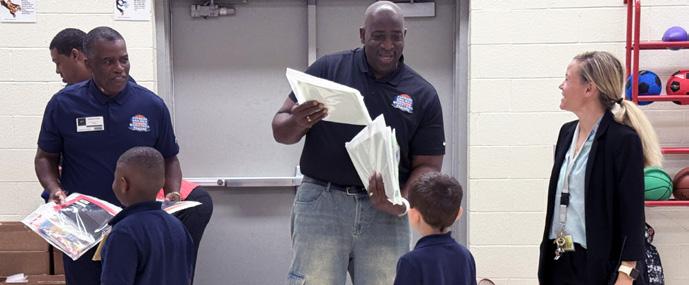
In a heartwarming display of community spirit and commitment to education, the Fathers & Men of Professional Basketball Players (FAMPBP), including North Carolina’s Charles Paul — father of NBA star Chris Paul — joined forces with Billingsville-Cotswold Elementary for a backto-school supply drive. This event, held last fall, highlighted the transformative power of collaboration and support in bridging educational resource gaps.
Supporting a community in need
Charlotte-Mecklenburg Schools proudly announced the adoption of BillingsvilleCotswold Elementary by FAMPBP, marking a milestone in the school’s ongoing mission to foster academic success and equity. The organization generously donated 744 back-to-school kits and 100 headsets for student assessments. These contributions help to support a diverse student body that Principal Alicia Hash describes as “families from different demographic and socioeconomic backgrounds, all committed to their children’s success.”
The highlight of the day came when the students received their supplies directly from the fathers, including Charles Paul. “One little guy’s mom sent a picture of her son proudly holding his notebook, exclaiming, ‘Chris Paul’s dad gave me this,’” Hash shared.
A broader vision
The FAMPBP has a storied history of philanthropy across the nation, supporting schools through mentoring programs, resource donations and initiatives aimed at empowering underserved communities. Dr. Chance Lewis, who leads the Urban Education Doctoral Program at the University of North Carolina at Charlotte, facilitated their partnership with Billingsville-Cotswold.
activities, particularly its elementary basketball league.
“Basketball is a powerful motivator for our students. It builds teamwork, discipline and confidence,” she explained. “We’re exploring ways FAMPBP can help strengthen our program as the season kicks off in January.”
The event’s impact extended beyond the students. Parents and staff celebrated the partnership on social media, praising the positive energy and generosity displayed. “To know there are people across the globe who care about our students’ success is a powerful lesson,” Hash remarked. “It reinforces the idea that it truly takes a village to raise a child, and that village can include people you’ve never met.”
“This is more than just supplies,” Hash said. “It’s a message to our students that their education matters and that they have a village of supporters invested in their success.”
The kickoff event
The supply distribution was far from an ordinary affair. The day began with a surprise pep rally, energizing students with the help of East Mecklenburg High School cheerleaders. As fathers from the organization walked into the gymnasium, the excitement was palpable. The students were thrilled, some even speculating that NBA legends like LeBron James might make an appearance.
“When Dr. Lewis reached out about this opportunity, it was an easy decision,” Hash said. “Our school community thrives on partnerships that align with our mission to provide students with the tools and support they need to succeed.”
Why are the initiatives of FAMPBP important? “The playing field is not even for everyone,” Charles Paul explained. “It’s about doing something about it and not just talking.”
Building momentum for the future
This collaboration may be just the beginning. While the initial focus was on equipping students for the academic year, discussions are already underway to expand the partnership. Hash expressed enthusiasm for potential support for the school’s extracurricular
A legacy of impact
This initiative reflects FAMPBP’s broader mission to uplift communities and inspire the next generation. By stepping into classrooms and engaging directly with students, they’re showing that leadership extends beyond the basketball court.
For Paul and the other fathers, this partnership is deeply personal. As men who have witnessed the power of mentorship and opportunity in their own families, they are now paying it forward. Their message is simple: Every child deserves the chance to succeed, and it is our collective responsibility to make that happen.
As Billingsville-Cotswold Elementary students gear up for the school year, they carry with them not just new supplies but a renewed sense of hope and belonging. With organizations like FAMPBP by their side, the future looks bright. P
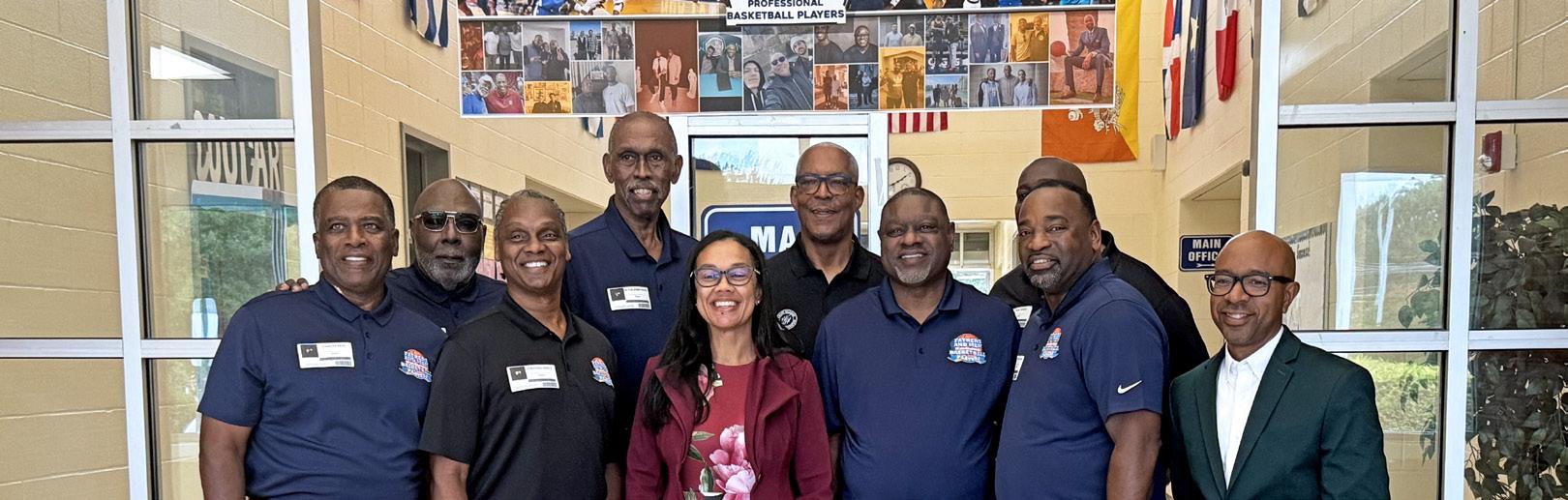
Charles Paul (far left), Fathers & Men of Professional Basketball Players member; Alicia Hash (center), principle of Billingsville-Cotswold Elementary; Dr. Chance Lewis (far right), leader of the Urban Education Doctoral Program at UNCC; and other members of (FAMPBP)
Charles Paul (left), another FAMPBP member (center) and assistant principal Lauren C. Rohrer working with students.
When you or a loved one gets a cancer diagnosis, you are not alone. We are here to help you navigate treatment.
Often from Behind the Scenes, Oncology Pharmacists put Patients Front and Center
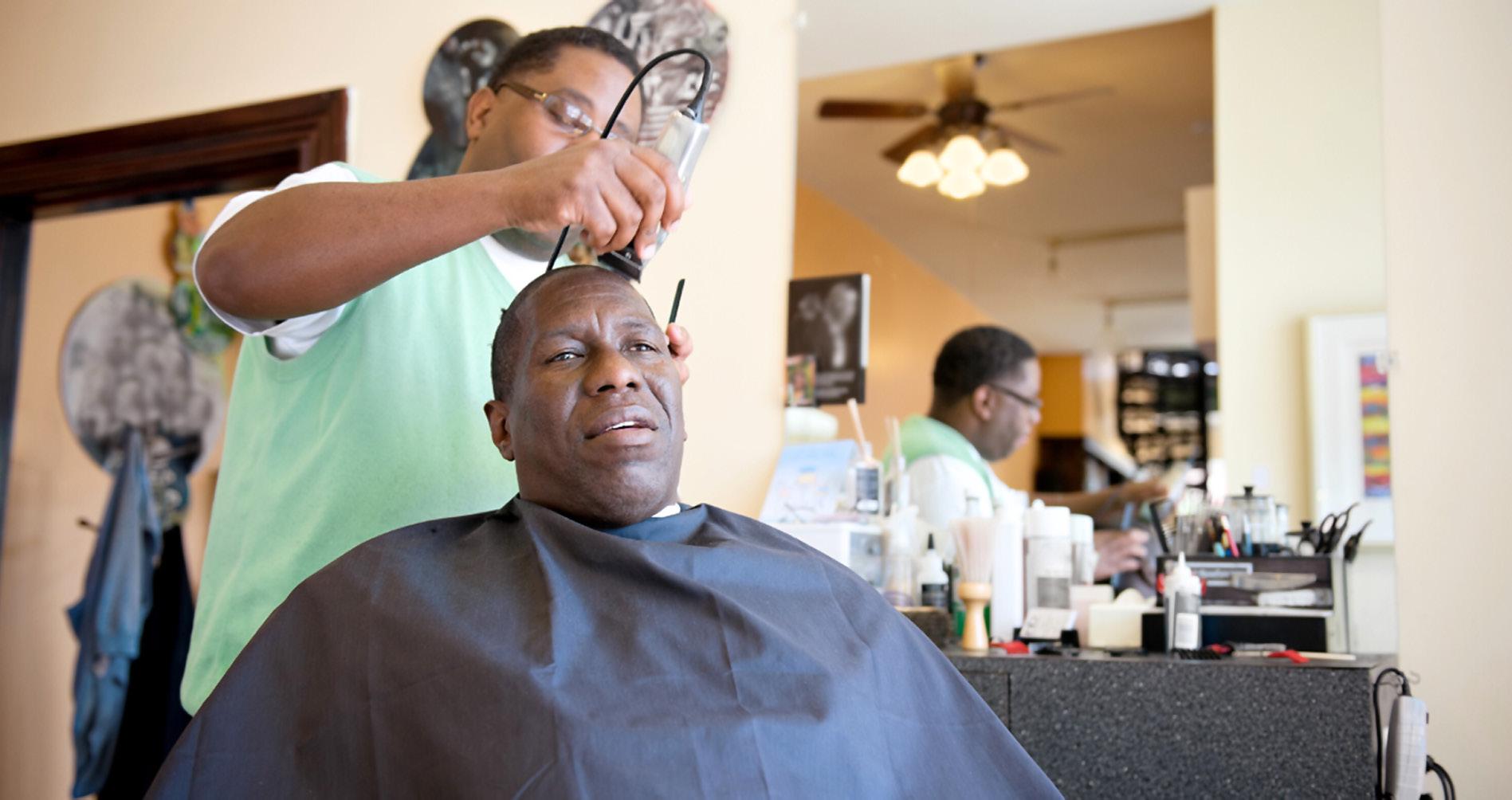
Acancer diagnosis impacts more than just one individual. Your neighbor with prostate cancer is somebody’s dad; he is a barber and business owner who many people look up to.
The woman from your church who just found out she has breast cancer is a grandmother; she is the one her friends count on for a ride to Sunday services or to the store during the week. The young person with cervical cancer feels very alone – but she isn’t. You and the rest of the community are there should she need you.
This is how it is in a close-knit community. Family members become caregivers and neighbors become kin. There are others in your care circle we want you to meet, too. We are oncology pharmacists,
In a close-knit community, family members become caregivers and neighbors become kin. There are others in your care circle we want you to meet, too: oncology pharmacists.
and we work alongside oncologists and nurses every day. And every day, we help people navigate cancer treatment.
Like the quiet pillars of your community, pharmacists play an often unsung, but important, role in cancer treatment.
What to Know about Oncology Pharmacists
When you go through cancer treatment, you likely have a lot of questions. As the medication expert on your care team, the oncology pharmacist worries about the complexity of cancer treatment so you can focus on what’s most important: your health.
If you have questions about how your cancer medication works or the side effects it might cause, please ask for your oncology pharmacist. In the meantime, you can read
about the Who, What, When, and Where of oncology pharmacists below.
Who are Oncology Pharmacists?
Simply put, we are your medication experts. Our extensive training in medication management helps round out the skill sets of oncologists, nurses, and other cancer care providers. Providing you and your caregivers with education is one of our primary responsibilities. Look to us for your questions about what to expect during your cancer treatment; we can go over side effects, what is normal (and what’s not), and help you get started on related care like pain management.
Right from the start, we are there to help educate you and answer questions about your treatment. When it is time to secure your medication, monitor your treatment, and manage any side effects, we are there.
Where do Oncology Pharmacists Work?
We work with cancer patients in large hospitals, as well as smaller community cancer centers and infusion clinics. In most settings, we manage any type of treatment you may be given, whether that includes chemotherapy, immunotherapy, or oral anticancer therapies.
What is the Role of an Oncology Pharmacist?
We will often personalize your chemotherapy treatment by preparing the medication prescribed by your doctor for your specific case. We monitor your symptoms, drug levels, and side effects and help you avoid any potential interactions between your cancer drugs and your other medications and vitamins. We may also be able to help you access specialty drugs, manage high-cost medications, and maximize insurance reimbursements.
When is an Oncology Pharmacist Involved in Care?
The short answer is your oncology pharmacist is involved throughout your cancer treatment.
Cancer Clinical Trials are for Everyone, not only a Few
Cancer affects everyone – but everyone hasn’t had the same access to the latest treatments. As recently as 2020, 75% of clinical trial participants were white, 11% were Latino, 8% were Black, 6% were Asian, and about 1% were Indigenous.
Lack of representation in cancer clinical trials negatively impacts patient care and slows medical advancements. In short, without the inclusion of minorities, clinical trial results do not accurately reflect how treatments work across populations – and so, health inequities continue.
That’s why we have launched Time to Talk: Diversity in Clinical Trials –an awareness campaign dedicated to transforming cancer care for all.
On our website, you will find:
• The History of Cancer Clinical Trials
• Clinical Trials MythBusters
• The 4 Ws of Clinical Trials
• Other people’s stories, told firsthand
If you have participated in a cancer clinical trial, we want to hear from you! Share your story on our website.
About HOPA
At nearly 4,000 members strong, the Hematology/Oncology Pharmacy Association (HOPA) is 100% dedicated to supporting oncology pharmacists and optimizing patient care. We believe everyone undergoing cancer treatment should have an oncology pharmacist as an integral member of your care team.
Many people don’t know how safe and accessible cancer clinical trials have become –visit our website for more MythBusters.
Dr. David Smith Is Redefining Cardiovascular Care in the Carolinas
By Rosanny Crumpton
Dr. David Smith is the driving force behind Premier Cardiovascular Care and Wellness, a local concierge practice offering personalized, integrative care to patients in the Charlotte metro and surrounding areas. Smith’s practice combines traditional evidence-based treatments with holistic methods.
With an impressive academic foundation, including a fellowship at Yale University and advanced clinical research training at the Columbia University Mailman School of Public Health, Smith’s approach to wellness focuses on treatment and prevention.
Patients often see Smith with symptoms or concerns related to coronary heart disease, heart failure, hypertension, obesity, high cholesterol, syncope and autonomic dysfunction, just to name a few. While the practice is centered around cardiovascular medicine, its integrative approach is about helping people live a higher quality of life with a focus on overall health.
“We’re more than a cardiology practice,” he said. “Every visit is a concierge experience.”
Smith described how his philosophy is rooted in collaboration. “For every new patient, we gather all the information needed to provide the best, guidelinedirected therapy. Then, we create a plan
together, treating the patient as if they were my family member.” His approach is a shared decision-making process, together with his patients.
In addition to leading his practice, Smith is deeply involved in advancing cardiovascular medicine. He is a nationally trained clinical investigator for multiple ongoing clinical trials. He welcomes interested patients from surrounding counties to reach out to him, especially those in ethnically diverse communities, to learn about how they may be able to participate. As a principal investigator for ongoing clinical trials, he remains at the forefront of research, contributing to the development of new therapies and treatments.
Cardiovascular care is the cornerstone of health according to Smith. “Heart disease is the number one killer in America, yet much of it is preventable. It’s under valued. Your heart impacts every single organ in your body.”
Smith’s passion for cardiology stems from his fascination with the complexity of the heart. “When I was in my primary care program, my mentors encouraged me to specialize. Cardiology intrigued me because it’s both challenging and rewarding. It’s the one field I don’t mind being called at 2 a.m. for — it’s that meaningful.”
Smith’s path to becoming an esteemed cardiologist is a story of determination and a deep commitment to patient care. Hailing from Connecticut and rooted in his Jamaican heritage, Smith’s upbringing in a large family and early years in the public school system shaped his drive to excel.
“When teachers doubted my potential and asked me, ‘Why are you looking at medicine?’ it fueled me,” he shared. “It made me mad, and that fire is what got me through medical school and into working at an elite university. It takes a village—I’m a reflection of all the people who poured into me.”
Smith is also an Assistant Clinical Professor at Yale where he teaches and mentors undergraduate medical students. He also volunteers his time at Heartbright Foundation.
Today, as a proud husband of 18 years and a father to four scholar-athlete children, Smith’s journey is both inspiring and reflective of his values: education, perseverance, and service.
In his free time, Smith enjoys basketball and playing the piano — activities that help him recharge and make him better at practicing medicine.
For more information about Smith and his practice, visit Premier Cardiovascular Care and Wellness. P
Dr. David Smith, cardiologist
Dr. David Smith working at Premier Cardiovascular Care and Wellness
Photos Courtesy of Dr. David Smith
JCSU’s Esports and Gaming Management Program is Hot and Getting Hotter
By Brenda Porter-Rockwell
The e-sports and e-gaming market is on fire right now, and it’s only getting hotter. Market research firm, Statista, in its recent analysis, “Video Games – United States,” predicts the U.S. e-gaming industry will be worth nearly $104 billion by 2027. With this undeniable growth potential, e-gaming and e-sports was a trend Charotte’s Johnson C. Smith University (JCSU) couldn’t ignore, and in 2020, the school was the first historically Black college and university (HBCU) to launch an Esports and Gaming Management program. Four years later, the flame is still lit.
Lightning-fast reaction
Recognizing the potential to prepare students for one of the most in-demand future job markets, JCSU’s leadership quickly realized the value of the program. The would-be trifecta of curriculum is a trailblazing move for the school — better positioning it to attract more top scholars, tap into new revenue streams and enhance campus life for students.
“After initial research provided such an ‘ah-ha’ moment it was less than a year from concept to program launch,” said John Cash, Instructor of Esports & Gaming Trifecta in JCSU’s Esports and Gaming Management/Online Sport Management program and one half of the brain trust behind the program.
The school first offered a single special topics course in esports and gaming within the Health and Human Performance curriculum in January 2020. That early success was quickly followed by official approval of the Esports and Gaming Minor/Certificate one month later.
By May 2020, the first Esports Club member competed in the inaugural HBCU-focused e-sports tournament organized by an HBCU. The e-sports trifecta of courses was formally operational by
Johnson C. Smith University Esports and Gaming Management program instructor John Cash and Dr. BerNadette Lawson-Williams, professor of Sport Management in the program
JCSU e-sports and gaming management students doing the work
August 2020, when JCSU launched the first course in the Esports and Gaming Minor/ Certificate curriculum. Fast forward to August 2023 and JCSU once again changed the game by adding another new curriculum featuring coursework in e-sports and gaming management, computer science, marketing and communication.
Cash’s e-sports program development partner, Dr. BerNadette Lawson-Williams, JCSU’s Professor of Sport Management said, “Through experiential opportunities such as their participation in esports and gaming-related professional activities such as attending conferences, acquiring internship opportunities, and competing in esports tournaments, our scholars are positioned to excel within the esports and gaming landscape.”
A self-proclaimed “gamer-girl” turned university instructor, Lawson-Williams added, “We are confident that these opportunities will lead them to new career pathways, employability and ultimately successful careers.”
A changing e-landscape
To date, more than 200 colleges and universities across the nation offer varsitylevel e-gaming programs. Yet, the broader industry is still underrepresented by Black students.
Case in point: Results from the Entertainment Software Association’ (ESA) annual report, “2024 Essential Facts About the U.S. Video Game Industry,” shows that 61% of Americans aged 5 to 90 play video games. Further, the ratio between male and female players remains at about halfand-half, with 53% of players identifying as male and 46% identifying as females. Blacks represent about 12% of players compared to the 75% of Americans who are white. This shows an increasing presence and growing interest in gaming among Blacks.
JCSU, for its part, is pioneering efforts to change the landscape of the e-sports and gaming industries, particularly for Blacks and other underrepresented minority groups, including females. Since the JCSU e-sports trifecta launched, approximately 67 of the 102 HBCUs now have either a club team, esports lab, and/or a course. To date there are approximately 21 students enrolled in the Esports and Gaming Minor and another 24 students playing on the Esports Team. According to Lawson-Williams, JCSU is widely regarded as the blueprint and “blackprint” of HBCU e-sports.
“We have transformed the landscape of e-sports and gaming, not just for the benefit of JCSU, but all HBCUs,” she said. “We are continually integrating content into
our courses that addresses the importance of [diversity, equity and inclusion] in the e-sports and gaming workforce, and, most importantly, leading by example!”
Over the last four years, the Esports Club has claimed victory over many Power Five varsity e-sports teams from top-tier colleges and universities. The university has forged partnerships and collaborations with global e-sport businesses such as Riot Games, NBA 2K League, Charlotte Hornets & Hornets Venom GT.
Point 3 Basketball launched JCSU’s online Esports Team Store — the first at an HBCU. That partnership yielded internships, scholarships and educational support for the curriculum. In 2023, JCSU became the first HBCU to host an e-sports and gaming summer camp for high school students. That same year, the school also co-produced the historic HBCU Esports and Gaming Week event, which boasted an attendance of over 400 collegiate, middle and high school students during its two-day offering.
“These victories were truly [impactful] as they showcased the ‘gaming prowess’ of our e-sports athletes while catalyzing HBCU e-sports and [improving] the way our students are often perceived. These milestone victories provided a platform for our gamer-scholars to be both valued and recognized!” Lawson-Williams said..
Ready for the future
Looking at the data, the swift moving flame that is e-gaming shows no signs of burning out anytime soon. The number of e-gaming users in the U.S. is expected to
increase to 91 million by 2027, according to Statistica.
Dr. Lawson-Williams and Cash said JCSU’s curriculum shows students a more lucrative world beyond the play for pleasure approach most are familiar with.
“There are over 150 careers associated with e-sports and gaming and not all are tech,” explained Cash. Over 15 students intern with e-sports companies and, currently, about five program graduates have found a career in the gaming industry, Cash said.
With several wins, nationwide recognition, internships and sponsorships under the program’s belt, the future continues to glow for JCSU’s e-sports program. Cash said he wants to continue to mesh the program’s goals with the university’s overall strategy to recruit, retain and graduate students into this dynamic industry. Lawson-Williams said that strategy will include:
• Instituting a varsity e-sports program for a greater level of competition under the supervision of a coach and with scholarship offerings
• Hosting or co-producing a mega e-sports tournament
• Re-launching the Esports and Gaming Management Certificate program
• Adding coursework related to innovation, e-sports analytics, esports performance, artificial intelligence, game development, game design and more
Lawson-Williams said JCSU will continue to partner with other schools and businesses to advance collegiate e-sports and gaming. P
John Cash (far left) and BerNadette Lawson-Williams (far right) with JCSU e-sports and gaming management students
On the Market Investing While Black
By John Burton Jr.
The world of American finance is experiencing a significant transformation — it’s becoming darker. It’s not the economy or a recession but more Black individuals are participating in the stock market. This new interest is boosted by more Black and brown people who are seeking more creative ways to build wealth and secure their financial futures.
According to a 2024 report by the FINRA Investor Education Foundation study, “Investors of Color in the United States.” Black investor participation is increasing. This incline has been fueled by
a few factors: a rise in financial literacy, rapid technological advancements and a shared desire for economic empowerment. It’s this unique shift that reflects resilience and ambition, paving the way for a more inclusive financial landscape.
Throughout history, Blacks people have encountered significant obstacles in trying to build wealth, shaped by discriminatory lending practices, a lack of financial education and pervasive economic inequality. It’s these challenges that aided in causing a wealth divide between Blacks and whites. Today, there is a new generation of Black investors seeking to dismantle these longstanding disparities head-on.
“It’s all a matter of access to information,” said Roderick Barnes, PhD, private wealth advisor. “More Blacks are becoming exposed to financial information, largely through peers and friends, which means they’re more willing to consider investing.” Through initiatives like workshops, educational programs and a wealth of online resources, Blacks are learning more about essential fundamentals like stocks, bonds and mutual funds to confidently step into the stock market, Barnes continued.
“Blacks are learning more about essential fundamentals like stocks, bonds and mutual funds to confidently step into the stock market.”
— Roderick Barnes
Roderick Barnes, PhD, is a private wealth advisor.
Younger people are starting to see the benefits of investing. Survey results show that investors of color are entering the market at a faster pace than white investors, according to the FINRA Investor Education Foundation report. “In addition, investors of color, particularly Black/African American and Hispanic/Latino investors, tend to be much younger than white investors, and thus exhibit many of the same behaviors typical of younger investors, such as reliance on social media for investment information and trading risky investments like cryptocurrencies and so-called meme stocks” the report stated.
Non-white investors tend to be younger than white investors, the report shows. Nearly half of investors of color, particularly Black and Latino investors, are under 35 years old.
“Younger investors are willing to take more risks,” Barnes said. “At their age, they can afford to lose, but they still have time to recover from a loss. According to a study conducted in 2022 and now released by Ariel Investments and Charles Schwab, 68% of Black respondents under 40 are investing in stocks compared to to 57% of younger white respondents.
Now, more than ever, Blacks are stepping into the world of investing, which could be attributed largely to technology and social
media. With just a few taps on smartphones, mobile trading apps and online brokerage platforms have made it easier than ever to buy and sell stocks and invest.
Moreover, the use of social media has become a game-changer. Platforms like Facebook, TikTok, Instagram and YouTube are abuzz with influencers and more Black finance gurus sharing savvy investment tips, clever strategies and inspiring success stories. This new online community is sparking the interest of younger Black investors. It’s this burgeoning, “If they can, I can” mentality that’s motivating more Blacks to delve into investing and start building their wealth.
As a result, a dynamic wave of financial empowerment has been sweeping through Black communities with conversations about creating generational wealth becoming more important, said Barnes. “Investing is really about moving forward. If you’re not investing, you’re moving backward.”
According to “The HBCU Advocate,” this shift is also connected to the emergence of Black-owned businesses and entrepreneurial experiences. Inspired by this surge in the Black entrepreneurial space, many Black investors are eager to support these initiatives by putting their money into the stocks of companies they believe in, according to the publication. This
movement represents not just investment, but a powerful statement of solidarity and community growth.
Although the landscape of investing is evolving, several hurdles still exist. According to a 2023 series “Retiring While Black” by AARP, many Black investors still are skeptical and mistrust financial advisors and institutions.
Moreover, the daunting prospect of losing money often holds back potential investors from taking the plunge. To combat this, Black investors and financial professionals need to form trusting relationships. By offering tailored advice and genuine support, financial advisors can educate and empower Black investors on the complexities of the financial world and realize their long-term financial goals.
Financial literacy, technology, personal empowerment, and a younger but financially educated demographic are bringing about this uptick in Black investors. This yellow brick road to wealth featuring Black investment is not just about financial growth but learning the fundamentals of building and transference of generational wealth.
“Investing is a long-term process and not for short-term money,” Barnes said. Staying the course is imperative. He said, in doing so, Black investors can shape a brighter financial future for themselves, their families and their communities. P
The VAPA Center
A Creative Space and Haven for Artists in Charlotte
By Loán C. Lake
Nestled on the edge of Charlotte’s city center at 700 N. Tryon St. in Charlotte is the VAPA Center, a locally run arts space for the visual and performing arts. Home to more than 370 creatives of various crafts and backgrounds, the VAPA Center is a hub for musicians, dancers, culture bearers, painters and potters to showcase their creativity in an affordable and communal way.
Since its inception in December 2020 and subsequent opening in 2021, the VAPA Center has emerged as an artist collective in the heart of Charlotte that is home to more than 20 arts organizations. Under the leadership of Arthur Rogers Jr. as the
executive director, and 12 board members, what started as an idea during the covid pandemic has emerged as a multi-story nexus where artists can create masterpieces and share them with the community.
As you step foot onto the premises, you are greeted with vivid paintings, woodwork and photography depicting various aspects of life. A stroll through the hallways reveals the work of myriad artists at every turn. From multimedia to murals featuring messages of empowerment and art galleries, this 158,000-square-foot facility has something for everyone.
“We envisioned a creative space where local artists could showcase and sell their work without the worry of exorbitant rents. Now, each artist is coming in and bringing
Arthur Rogers Jr., executive director of the VAPA Center on North Tryon Street in Charlotte
Joanne Rogers, executive director and founder of Nine Eighteen Nine Studio Gallery
“Cineasta/Races” by Madelyn Hernandez; latex paint on PVC board
Photos courtesy of the VAPA Center
their network with them to be a part of the VAPA community,” said Executive Director Arthur Rogers Jr., whose vibrant paintings are also featured in the space. “We probably have every demographic in the building— Black, white, Hispanic, Asian, veteran, woman-owned—and the art lives in the building,” Rogers said.
After Spirit Square closed in 2020, a select group of arts leaders and organizations seized the opportunity to utilize Mecklenburg County’s Hal Marshall Center to house a new arts collective.
The group met regularly for about a year and a half to solidify the concept, holding fast to the vision of a space where local artists could work collaboratively and support one another. Charlotte’s Off-Broadway is one of the founding arts organizations at the VAPA Center. One of its founding members is awardwinning actor, director and producer Anne Lambert, who also co-created Chickspeare — Charlotte’s all-female Shakespeare company. Charlotte’s Off-Broadway is a 55-seat, blackbox theater and rehearsal space that can be rented by the public.
“I really like producing and doing work in uptown Charlotte. The VAPA Center was a partnership with independent artists. Those of us who were ready to leap into the abyss, cleaned, painted and scavenged furniture. We created the heart and soul of independent artistry in Charlotte,” Lambert said. “The VAPA Center is the coolest, ‘vibe-iest’ facility and we are a part of the economic infrastructure of this city.”
Arthur Rogers credits his wife Joanne, founder of Nine Eighteen Nine Studio Gallery, and her tenacity and reputation as an arts leader as one of the key elements to the Center’s initial success.
The pair had seen other examples of arts collectives but had not worked with the other interested parties before. The shared interest to birth an affordable space for Charlotte creatives and the community to gather, coupled with the county’s support resulted in the center opening when it did.
The full roster of The VAPA Center’s founding members includes:
• Nine Eighteen Nine Studio Gallery
• BLKMRKCLT
• Gay Men’s Chorus of Charlotte and Women’s Chorus of Charlotte
• Charlotte Comedy Theater
• Charlotte’s Off-Broadway
• JazzArts Charlotte
• Levine Museum of the New South
• McColl Center
• OBRA Collective
• The Arts Empowerment Project
• The Light Factory
• Arthur Rogers Jr.
“We have seen an increase in visitorship of over 2300 percent since January 2024, and it is proving that there’s so much of a need for this type of venue so that artists can
“Olowu Idan” (The Magical Fingers) by Oluwanbe Amodu; acrylic on canvas
connect to the community,” Rogers said. “Our initial lease with the county was for three years, and renewable every six months.
We just received a $1.7 million grant to do improvements on the building and extended the lease for five years.” Rogers has ambitious plans to secure more longterm space that could be built to the way their artists work, and accommodate crafts such as pottery and metallurgy.
The VAPA Center is open Monday through Thursday from 9 a.m. to 10 p.m., Fridays and Saturdays from 9 a.m. to 11 p.m., and Sundays from 12 p.m. to 10 p.m. The center hosts open studios on the first Saturday of each month where visitors can view the artists in their workspaces as they work. For those looking to start or expand their art collection, or simply support local artists, original works of art are available for purchase on-site.
Learn more about the VAPA Center at vapacenter.com. P
The founding members of VAPA
Anne Lambert, director and producer of Charlotte’s Off-Broadway
Turning Grief Into Growth: A Journey of Resilience
By Angel Morel Brown
We’ve all heard the phrase “good grief,” but what if grief, painful as it is, could be a source of growth? Though none of us would choose to go through it, grief has the potential to transform us, deepening our understanding of life, strengthening our resilience, and helping us find new meaning. As someone who would have never thought this before November 4, 2021 — losing my mother and facing my own grief journey has reshaped my life and given it a different perspective.
When we talk about grief, it’s often limited to the loss of a loved one, yet grief is far broader. I define it as “the loss of” — a powerful phrase encompassing all the ways we can experience grief. Whether it’s a divorce, job loss, or retirement, many life changes can trigger feelings of grief. These events are deeply personal, and each person’s sense of loss is unique. Let’s explore a few of the most common grief events.
Understanding grief events
A “grief event” is any experience that disrupts our sense of stability, identity, or well-being. It’s a moment when life shifts, leaving us feeling unanchored. Some major grief events include:
• Death-Related Loss: The death of family, friends, pets, or even public figures can leave us grieving deeply.
• Relationship-Related Loss: Divorce, a breakup, or the end of a friendship are significant grief triggers.
• Health-Related Loss: A serious illness, loss of mobility, or disability can provoke grief as we adjust to a new reality.
• Material or Financial Loss: Financial setbacks, bankruptcy, or the loss of a
DID YOU KNOW?
home also disrupt our sense of security.
• Identity or Role Loss: Job loss, retirement, or major life shifts force us to reevaluate our identity and purpose.
This is just a glimpse into the many ways grief can enter our lives. There are over 40 recognized types of grief events, each unique to individual circumstances.
Moving through grief stages
Grief is often described as a journey, and it’s rarely straightforward. Traditionally, there are five stages of grief: denial, anger, bargaining, depression, and acceptance. However, grief doesn’t follow a simple sequence, and we don’t necessarily experience each stage or in this order. Personally, I moved through denial, anger, and depression before finding acceptance, though I skipped bargaining altogether. Each stage offers a glimpse into how we process loss.
These stages serve as guideposts rather than steps. Recognizing them can help normalize our responses, reminding us that our experiences are valid, even if they don’t fit a linear path. Transitioning through these stages toward healing is crucial.
Tools for managing grief
Managing grief is a deeply personal experience, yet several tools and resources can help us navigate the emotional terrain. Here are some ways to support yourself through grief:
• Therapy and Counseling: Grief counseling can provide tailored support, and many therapists specialize in helping clients work through grief. Support groups and online therapy platforms also offer connection and understanding.
• Books on Grief and Loss: Books provide insights and practical tools for navigating grief, offering comfort and perspective.
• Meditation Practices: Meditation and mindfulness help quiet the mind and ground us in the present, offering relief from overwhelming feelings.
• Physical Health and Wellness: Caring for our physical health through regular exercise, a balanced diet, and proper rest strengthens both body and mind.
• Spiritual or Faith-Based Support: Spiritual practices like prayer and meditation often bring comfort, helping many find peace and resilience through faith.
• Podcasts and Online Resources: Various podcasts and websites discuss grief openly, providing stories and strategies that can resonate with listeners.
Prolific poet and performer Sonia Sanchez has written over 20 books, including “Shake Loose My Skin” and “Wounded in the House of a Friend.” Born in Alabama and a Hunter College graduate, Sanchez has won many awards and created the Black Studies program at San Francisco State University. She taught the first course on Black women writers in the U.S. at the University of Pittsburgh in 1969.
While these resources provide support, the journey ultimately rests with each of us. Grief can feel isolating, but with the right tools, it can also be a journey toward growth and healing. By recognizing and embracing the process, men and women alike can emerge from grief with renewed strength and a deeper understanding of life’s complexities. P
FYI News & Notes
Compiled by John Burton Jr.
Charlotte Is Home Center Is Setting a New Standard for Immigrant and Refugee Support
Through the generosity of Aldersgate, ourBRIDGE for KIDS, Charlotte Community Health Clinic, and Carolina Migrant Network, the Charlotte is Home Center has been completed in East Charlotte. The center, leased for a symbolic fee of $1 per year, launched with a soft opening. Initially, it will operate by appointment only, with plans to eventually welcome walk-ins. When the center is open to the public, details and hours will be available on their website at charlotteishome.org.
The Charlotte is Home Center is the first of its kind in our region offering low-cost health services, pro-bono immigration legal services, civic engagement programing, educational attainment and wraparound Services.
“We, immigrants, want to be seen, respected, and valued. That’s why, at the Charlotte Is Home Center, our organizations will work together to transform our community and our city’s
future,” said Sil Ganzó, Executive Director of ourBRIDGE for KIDS. “We aim to make it easier for our immigrant community to stay healthy, achieve economic stability, and experience socio-emotional well-being in a supportive, culturally responsive environment driven by justice, representation, and dignity,” added Ganzó.
Charlotte is Home Center will enable newcomers to access many resources by eliminating multiple barriers. “I am proud that our new clinic will be named after our founder, Dr. Ophelia Garmon-Brown, who was a magnificent leader and advocate for providing support to underserved communities in Charlotte-Mecklenburg County,” said Carolyn Allison, Chief Executive Officer of the Charlotte Community Health Clinic. The mission of Aldersgate is to celebrate and respect the value of each individual within an inclusive and vibrant Aldersgate community.
Photo credit: Charlotte is Home website
Three Sisters Market Leaders Attend Up and Coming Food Co-op Conference
Leadership of Three Sisters Market, a community-owned food co-op in development, located in the heart of the West Boulevard Corridor, recently participated in the Up and Coming Food Co-op Conference in Kalamazoo, Mich. The conference, brought together representatives from startup food co-ops across the country. The Three Sisters Market delegation included board members Rickey Hall and Guy Cousins, along with staff members Janiqua Jackson and Tara Bengle. The Up and Coming Food Co-op Conference serves as a crucial learning platform for startup food co-ops, providing essential knowledge and resources for those working to open new cooperative grocery stores.
The Three Sisters Market will soon join the ranks of other Black-led food co-ops, of which there are only three out of more than 270 in total food co-ops across the US. The market plans to break ground in 2025, aligning with the typical development process for food co-ops, which often takes over a decade to launch. Black-led food co-ops are demonstrating that cooperatives are an effective tool for bringing community-centered solutions to historically underserved areas that have been overlooked by major grocery chains. The Three Sisters Market aims to follow this model, addressing food insecurity while promoting community empowerment and community wealth.
“Three Sisters Market attendance at this conference is a crucial step in our journey,” said Elliott Royal, Interim Executive Director of the West Boulevard Neighborhood Coalition. “Not only is our team learning from established co-ops and bringing that knowledge back to benefit our community, but we have become leaders in this space,” said Royal. The Three Sisters Market will be located at 2901 Romare Bearden Dr. off of West Blvd. near the intersection of Clanton Rd.
Local Org Hosted Entrepreneurship Program Pitch Event as Part
of Its Restorative Efforts
City Startup Labs (CSL) hosted a 5.0 Pitch Event for its ReEntry Entrepreneurship Program (REEP), a career development program that addresses challenges presented for justice-impacted individuals in the summer. Participants of the Pitch Event were a combination of business teams that have been formed and coached to showcase
DID YOU KNOW?
Actor LeVar Burton gained fame after playing Kunta Kinte in the highly acclaimed TV miniseries, “Roots.” President Joe Biden awarded Burton, who hosted the PBS children’s show, “Reading Rainbow” for more than 20 years, with the National Humanities Medal in 2023 for his work to promote literacy.
their learnings and present their new ventures. Guests and panelists learned about the growth experienced by each program participant, as well as the process undergone to build their new enterprise. Through the REEP program, City Startup Labs offers 21st century career development skills to cohort participants for
success in their entrepreneurial endeavors. CSL training covers cognitive, interpersonal, personal leadership and digital skill development for enterprising individuals seeking to improve their economic mobility. Participants of the REEP 5.0 Pitch Event have successfully completed the “LEARN” and “BUILD” phases of the REEP training and development. Following the pitch event, the budding entrepreneurs will “DEPLOY” or launch their new business ideas.
“City Startup Labs is really in the human-potential business, as we cultivate entrepreneurial talent and capacity among justiceimpacted folks,” said City Startup Labs Executive Director Henry Rock. “This pitch event, the first for REEP, is a small glimpse of how we transition these budding entrepreneurs into business building,” said Rock. This REEP cohort and pitch event was made possible by Mecklenburg County, Wells Fargo, US Bank, Truist, Ally and the Mecklenburg County ABC Board.
CSL is reimagining entrepreneurship and redefining workforce development for formerly incarcerated individuals by cultivating their human and intellectual capital and potential for building businesses, and by developing an engaged, motivated and productive workforce for on-trend careers. P
Photo
Credit: Poprock Photography
Queen City Black Excellence
Steven Coker
Meet Steven Coker, Charlotte Business Inclusion Officer
Steven Coker is a visionary leader driving transformative change in Charlotte’s business landscape. As the Business Inclusion Officer for the Office of Charlotte Business Inclusion (CBI), he’s dedicated to fostering a thriving, equitable business ecosystem that empowers all.
With over 25 years of combined experience as a business owner, attorney, and executive in the DEI space, Steven brings a unique blend of real-world experience and strategic acumen to his role. His deep-rooted commitment to social justice and community empowerment fuels his passion for creating opportunities for all.
At CBI, Steven is spearheading innovative initiatives to expand opportunities for minority, women, and small business enterprises. His strategic leadership is propelling Charlotte to the forefront of supplier diversity and inclusion, ensuring that local MWSBEs have a fair chance to participate in the city’s economic growth.
A sought-after speaker and thought leader, Steven is passionate about sharing his expertise and inspiring others to embrace diversity, equity, and inclusion. He has a knack for breaking down complex issues into actionable solutions and motivating others to take action. His unwavering dedication to creating a more equitable future makes him a powerful force for positive change in Charlotte and beyond.
600 East Trade St Suite 300 Charlotte, NC 28202
steven.coker@charlottenc.gov
704-420-0703
live purposefully
This is what life is supposed to feel like. When you aren’t held back. When you have a health partner that doesn’t just treat part of you – they care for all of you. That’s why more people prefer Atrium Health, with the most complete care that lets you get back to the moments that matter. That’s what it’s like to live fully. live fully