THE MAGAZINE FOR WAKATŪ
Issue #2 Ngāhuru 2020
Kōwhaiwhai Kōwhaiwhai are a traditional Māori artform, with patterns often inspired by nature. As well as being decorative, kōwhaiwhai help to tell a story. The kōwhaiwhai featured throughout the magazine is specific to Wakatū; designed by one of our Te Hunga Panuku, Te Waiho Paratene. There are three strands central to the design; the awa (rivers) that nurture the lands of Wakatū, the heke, the migration of our whānau and hapū from the North Island to Te Tauihu, and the journey of Wakatū since its incorporation in 1977. Each segment of the kōwhaiwhai represents the hapū of Wakatū who descend from the iwi of Ngāti Koata, Ngāti Rārua, Ngāti Tama and Te Ātiawa. These segments symbolise chain links. Built from the strength of those who came before, the chain represents the strong links Wakatū has with its Owners, whānau, employees and business associates. It also represents the presence of Wakatū in Te Tauihu, Aotearoa, and the world, now and in the future.
Mārahau
RECONNECTING WITH THE WHENUA
and also: KAUPAPA TUPURANGA TŪPUNA LEGACY TOWARDS ZERO WASTE OUR WHĀNAU WHĀNUI
Kōwhaiwhai Kōwhaiwhai are a traditional Māori artform, with patterns often inspired by nature. As well as being decorative, kōwhaiwhai help to tell a story. The kōwhaiwhai featured throughout the magazine is specific to Wakatū; designed by one of our Te Hunga Panuku, Te Waiho Paratene. There are three strands central to the design; the awa (rivers) that nurture the lands of Wakatū, the heke, the migration of our whānau and hapū from the North Island to Te Tauihu, and the journey of Wakatū since its incorporation in 1977. Each segment of the kōwhaiwhai represents the hapū of Wakatū who descend from the iwi of Ngāti Koata, Ngāti Rārua, Ngāti Tama and Te Ātiawa. These segments symbolise chain links. Built from the strength of those who came before, the chain represents the strong links Wakatū has with its Owners, whānau, employees and business associates. It also represents the presence of Wakatū in Te Tauihu, Aotearoa, and the world, now and in the future.
Kōwhaiwhai Kōwhaiwhai are a traditional Māori artform, with patterns often inspired by nature. As well as being decorative, kōwhaiwhai help to tell a story. The kōwhaiwhai featured throughout the magazine is specific to Wakatū; designed by one of our Te Hunga Panuku, Te Waiho Paratene. There are three strands central to the design; the awa (rivers) that nurture the lands of Wakatū, the heke, the migration of our whānau and hapū from the North Island to Te Tauihu, and the journey of Wakatū since its incorporation in 1977. Each segment of the kōwhaiwhai represents the hapū of Wakatū who descend from the iwi of Ngāti Koata, Ngāti Rārua, Ngāti Tama and Te Ātiawa. These segments symbolise chain links. Built from the strength of those who came before, the chain represents the strong links Wakatū has with its Owners, whānau, employees and business associates. It also represents the presence of Wakatū in Te Tauihu, Aotearoa, and the world, now and in the future.
MIHI
E koakoa ana te ngākau, ko tēnei te tauira tuarua o Koekoeā. Anei anō te mihi ki a koutou, ngā uri o Te Tauihu, tēnā koutou katoa.
E rere rā tāku reo mihi ki ngā tai e whā o te motu whānui. Kei aku nui, kei aku rahi – tēnā koutou katoa.
Last year was an exciting one for Wakatū. We launched
Welcome to our second issue of Koekoeā. We are
a new business, Auora, and we took the lead on the Te
so proud to share the stories of Wakatū with you,
Tauihu Intergenerational Strategy, a new approach to
our whānau, as well as with the wider community.
regional development. We’re proud to be a part of this
As well as reading about the emerging Te Tauihu
exciting initiative that brings together diverse voices of
Intergenerational Strategy, in this issue you’ll also hear
people across Te Tauihu who are committed to building
from various people who are working on initiatives
a strong and resilient region.
across Wakatū, such as Renee Thomas and Matt
As we travelled around the rohe attending hui
Kelly, our kaitiaki at Mārahau, and Hōani Tākao, who
as part of our community outreach for this strategy,
is leading an initiative to create more employment
I observed a new sense of urgency to tackle the big
opportunities for our whānau within the horticulture
issues. At the same time, there was overwhelming
industry. There are also updates on our Whenua Ora
positivity about what we can achieve as a community
strategy that, over time, will transform our businesses
working together.
and how we do things.
In this issue, we take a closer look at the
We update you on our proceedings against the
intergenerational strategy and what it means for our
Crown following our 2017 Supreme Court win in
whānau, draw inspiration from our entrepreneurial
Proprietors of Wakatū & Others v Attorney-General;
tūpuna, Tāmati Pirimona Marino, and see that the
and share with you some beautiful creative writing,
future is in good hands with our future leaders, our Te
a poem ‘Ihumātao’ by Donna McLeod.
Hunga Panuku.
We hope you enjoy reading Koekoeā – and please share this magazine with whānau and friends.
Otirā, tēnā tātou katoa, Mauri ora, Pāora Te Poa Karoro Morgan Tiamana Wakatū Incorporation
Kerensa Johnston Tumu Whakarae, Wakatū Whānui Chief Executive, Wakatū Group
R Ā R A NG I T U H I NG A
Issue #2 Ngāhuru 2020
Mārahau, reconnecting with
04
the whenua Tūpuna Pono: Te Tauihu Intergenerational Strategy
10
Stepping into te ao Māori
16
Next steps: litigation update
19
Our tūpuna legacy: Tāmati
20
Pirimona Marino Trade talks
23
Kaimahi kōrero: Riki Kotua
24
Kaitunu kai: Blair Taylor
27
Tohutohu tao kai: apple tarte tatin
29
Tō mātou whare: Wilson whānau
30
Five minutes with Joe Hanita
32
Johannah Kātene-Burge,Wakatū intern
34
New whare for Wakatū
36
Advocating for a world without waste
38
Para Kore – reducing waste at events
40
Poipoia te kākano
41
Kaupapa Tupuranga
42
‘Ihumātao’ by Donna McLeod
46
Wātaka
47
KOE KOE Ā
Mārahau beach. Bottom right: looking on to Abel Tasman National Park.
Mārahau ‘O
W I T H T H E W H E N UA
n a good day, it’s beautiful here,’ says
dawn blessings at five in the morning, yes, I set an
Renee Thomas (Ngāti Rārua, Ngāti Tama),
alarm.’
kaitiaki for Wakatū Incorporation on the
4
R E C ON N E C T I NG
This soil here, dark and friable, has been owned
whenua at Mārahau. ‘On a bad day, it’s pretty bad.
by the families of Wakatū for generations. The
The house shakes, and that’s not even the wind; it’s
whānau and hapū settled here at Mārahau in the
the sea hitting the sand. It’s very exposed.’ All the
early 1800s and have owned the land ever since.
same, at Mārahau she feels her senses returning.
Originally part of the wider papakāinga, the land
‘I’m more aware of my surroundings. Being so much
and foreshore area at Mārahau was reserved for
closer to nature allows you to be more open to
the benefit of the Māori customary owners as part
things, to what’s going on. I’ll pick up wind shifts
of the Nelson Tenths’ Estate in 1845. The land at
and know that rain’s coming. I go to bed when it’s
Mārahau was vested in Wakatū in 1977. It’s been
dark, wake up when it’s light. I don’t set an alarm –
managed by the Committee of Management (the
I rise naturally.’ Then she laughs: ‘Ok, when we have
Wakatū Board) on behalf of the Owners ever since.
M Ā R AH AU
‘I’m more aware of my surroundings. Being so much closer to nature allows you to be more open to things, to what’s going on.’ RENEE THOMAS
Whānau tents at Mārahau, December 2019
‘Our whānau and hapū lived here along the
there, on the high centre – root cellars for the crops
coast during the warmer months, and in the colder
they grew. The island microclimate was ideal, nice
months, they lived on the hills behind the Mārahau
and cool, and the kiore couldn’t get into the food
township. We collected kaimoana and other kai all
stores.’ If the gardening was good in those days, it
year around,’ says Rōpata Taylor, General Manager,
was about to get vastly better with the arrival of the
Manaaki. This place is in his blood. ‘My ancestor
European settlers, who became a lucrative market
Wi Parana, who was also known as Ngāmamaku,
for produce. ‘They would travel all the way into
lived here. He was from Te Ātiawa and was a
Nelson,’ says Rōpata, ‘landing at Mātangi Āwhio,
tōhunga.’ He married a Ngāti Rārua woman called
Auckland Point, and trade there with the New
Te Rangimatohe, thereby consolidating a critical
Zealand Company settlers.’
alliance. ‘The whānau here planted potatoes and kūmara,
‘We planted some trees the other week,’ says Renee, ‘and the soil was just unreal – lovely black
and their winter storehouse was out on Motu
soil – so you can see why, naturally, people would
Aorere-iti, or Fisherman’s Island. There are still pits
settle here, because you’ve got food on one side, and
5
KOE KOE Ā
Renee Thomas and Matt Kelly in their coffee cart at Mārahau.
more food on the other. And these natural vantage points where you can see who’s coming from any
whenua and the wider whānau and hapū every
direction.’
summer. ‘Last summer, we had a couple of families
The gardens are still here and the whenua still
that had never camped here before. You could see
calls families home. Renee, and her husband, Matt
the transition – at first, being anxious about not
Kelly, had done a few camping holidays here when
being able to hook into wi-fi and really missing
they decided to take on the role of kaitiaki. ‘I’m
that. Then by day three, they are so relaxed. You’d
a recovering accountant,’ she quips. ‘I sold my
see the kids out on their bikes or walking around
house, quit my job, and bought a coffee cart.’ It’s
the property, spending time together, with their
sitting beside the house where the couple now live,
cousins. It’s not just about reconnecting with the
caretakers to the 18 hectares of grounds. Matt is
whenua, it’s about reconnecting with each other, at
mowing lawns, and Renee’s wrangling bookings for
that whānau base. People can go out with their kids
Haumoana (that wind gets another mention), the
to collect kaimoana or go floundering at night – all
bach that is available for Wakatū whānau to rent for
those customary things that we do, and we used to
holidays.
do before iPads. Kids love that stuff.’
Mārahau has always offered sanctuary for the
6
Renee sees people reconnecting with their
Rōpata says Mārahau offers Wakatū Owners a
Wakatū whānau. It still does: it’s available for
chance to reconnect with their land after decades
Wakatū Owners to come and enjoy any time they
of alienation. For some, that bond will have to
like, either by way of camping or holidaying at
be re-learnt. Whole generations were estranged
Haumoana, and as far as Renee’s concerned, the
from Mārahau after it was placed in 1843 under
more, the merrier. ‘I love it most in summer when
the statutory management of Crown trustees, who
we have people here because it makes the place feel
leased it to a succession of settlers. ‘Most of our
alive. It’s just magical. You’ve got kids here, you’ve
lands in the Nelson region were under lease in the
got families here – our wider whānau all coming
period 1843–1977. The Owners couldn’t control or
together.’
influence the use of the land or the terms of the
M Ā R AH AU
leases – in almost all cases, the Owners could not access their own land. This was one of the main reasons why our grandparents fought so hard for the return of the management of their land, and the establishment of Wakatū in the 1970s. ‘It wasn’t until 1977 when Wakatū Incorporation was established and the control of our land was returned to the whānau that we could begin the process of opening up our lands to the whānau as
Last summer, we had a couple of families that had never camped here before. You could see the transition – at first, being anxious about not being able to hook into wi-fi and missing that. Then by day three, they are so relaxed. RENEE THOMAS
well as making our own decisions about what would happen on our land.’ Mārahau is part of the larger land estate that
commercial proposals were put forward, including
Wakatū owns across Nelson, which includes
a hotel to service the tourist industry, but Kerensa
commercial and residential developments as well
says the drive for development has given way to a
as its orchards and vineyards. After the Crown,
wish for protection and care of this special area.
Wakatū is one of the largest land owners in the
‘It’s important that our whānau have a place they
Nelson region. ‘Our intention at Mārahau is to
can go, and be on the land and water, and exercise
create a place where we can ensure that sense of
their customary practices. Many have lost that
direct connection to the whenua – this in turn
opportunity, because they’ve moved away from their
makes sure we maintain a sense of identity for
customary area and whenua. It’s really important
the whānau of Wakatū. A place where they can
that they have a place they can come and be
come and relax, but also gain a deeper insight and
together as whānau, especially for those who now
understanding of the way our ancestors lived on
live outside of Nelson.’
the land.’ ‘When it came back to us,’ says Wakatū CEO
Some people in the community assume the land is public property, because there is very little
Kerensa Johnston, ‘probably for the first 20 years
development on the land. ‘From time to time, we get
of our existence, there were lots of discussions
complaints from people who believe they have the
about that land; about how it might be developed,
right to roam over the land and beach area, which is
what might be appropriate.’ Over the years, various
privately owned by Wakatū,’ says Kerensa.
Tui Henry, Gwen Gordon, Jessica Sanderson, Naomi Āporo, Parana Taylor and Kerensa Johnston at Mārahau.
7
KOE KOE Ā
At present, along part of the road boundary, a single rope undulates through occasional posts, making the grounds look for all the world like a public park. So, a big part of Renee and Matt’s job is to explain that the land is private property and that there are good reasons why some areas of the beach are restricted. ‘We explain to people that the area is culturally sensitive, and that there have been kōiwi tangata exposed on the beach. Most people respect that, and they understand why in particular we don’t allow any vehicles or boats along the foreshore as they can cause damage and interfere with the planting programmes underway,’ explains Renee. The Mārahau boundary extends well out onto the tidal flats, so the kaitiaki spend their summers correcting common misperceptions about the Queen’s Chain. ‘People are always insisting that the beach belongs to everybody,’ says Renee, ‘but there are many areas of New Zealand’s foreshore that are in private ownership, including our land at Mārahau.’ But the shape of that foreshore and beach area is changing. A line of dying grass marks the intrusion of the latest king tide, each higher than the last, which is eroding the whenua. Much has been lost: the caretakers’ house was moved inland in 1992. Renee points to where it once stood, on what is now shellbanks under an incoming tide. Across the road, behind the line of water taxi and sea kayak outfits, machines are levelling the land, ready for up to 65 new houses. The subdivision is a Special Housing Area; affordable homes being built under Housing Accords signed between the government and the Tasman and Nelson councils in 2017. Mostly, the machines are digging up sand, and Wakatū has negotiated a win/win that might offer a solution to sea-level rise. Renee points out the heaped spoil from the subdivision that will become, she hopes, a new dune system. The plan is to heap the sand along the shoreline, sufficiently inland to give dune plantings time to establish and bind the defences before the tides reach them. ‘It’ll take time,’ says Rōpata, ‘and initially, we’ll still lose more land, but it’s a more natural thing to do. We’ll try to restore the ecology if we can. We need to create a different gradient Top: Planting at Mārahau by, from left to right: Colleen Carew, Nick Rangi, Helen Carew and Grace Walker. Above: a tarata (lemonwood) ready for planting. Photos: Naomi Āporo.
8
on the shoreline, so that when the tide comes in, the energy disperses naturally upslope. One of our
M Ā R AH AU
Drone photo of Marahau: Andrew Boyes, GNS Science.
Owners, Tuaiwa Rickard, is a coastal scientist, and
runs on gas and solar rather than mains electricity.
she’s been leading a project to look at how best to
At peak times, like Christmas, Wakatū suspends
proceed, and we have a hydrologist looking at water
the usual booking system and runs a lottery system
movement in the bay. Our response will be a mix of
instead due to the demand for the bach. ‘You put
customary knowledge, scientific expertise and our
your family name into the ballot system and Wakatū
own resources. I think it sits well with our values
randomly selects who can use the bach over the
base,’ he says.
busy Christmas and New Year period. The rest of
Plantings have already started elsewhere along
the time, you can book the bach via the website.’
the road, to create a more tangible boundary. And Renee wants future campers to enjoy a little more privacy, and shelter from that afternoon sea breeze, with ‘little glades of native species. We want to fence
STAYING AT MĀRAHAU
it as well, just to give a bit more privacy. People
Information about how Wakatū whānau can
generally don’t camp in the back paddocks, because
apply to stay at Mārahau is on the Wakatū
the whole world can see in when they’re walking
website at www.wakatu.org/whanau#marahau
past. If we can create a bit of privacy there, I think our families might use that area more.’ Those who do make the trip to camp must be
Applications to camp over the Christmas break must be received by 10 December each year.
willing to deal with facilities you might call basic:
Haumoana is available exclusively to
the toilet block is a converted shipping container
shareholders of Wakatū. To check availability
delivering to septic tanks. There’s no power, no
and to book go to www.holidaynelson.co.nz and
cooking facilities, and no showers. ‘You can always
search for Haumoana.
bring a caravan, but there’s nowhere to plug it in,
Requests to book Haumoana over the Christmas
that can be tough for some people, but it’s also one
break are automatically put into the ballot, and
of the beautiful things about Mārahau too – it is
the successful applicants are informed in early
definitely back to nature and living on the land.’
December.
Haumoana, the holiday bach, sleeps ten, and it
9
KOE KOE Ā
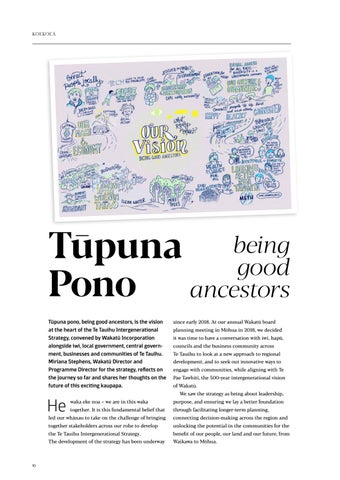
Tūpuna being good Pono ancestors Tūpuna pono, being good ancestors, is the vision at the heart of the Te Tauihu Intergenerational Strategy, convened by Wakatū Incorporation alongside iwi, local government, central government, businesses and communities of Te Tauihu. Miriana Stephens, Wakatū Director and Programme Director for the strategy, reflects on the journey so far and shares her thoughts on the future of this exciting kaupapa.
He
10
since early 2018. At our annual Wakatū board planning meeting in Mōhua in 2018, we decided it was time to have a conversation with iwi, hapū, councils and the business community across Te Tauihu to look at a new approach to regional development, and to seek out innovative ways to engage with communities, while aligning with Te Pae Tawhiti, the 500-year intergenerational vision of Wakatū. We saw the strategy as being about leadership,
waka eke noa – we are in this waka
purpose, and ensuring we lay a better foundation
together. It is this fundamental belief that
through facilitating longer-term planning,
led our whānau to take on the challenge of bringing
connecting decision-making across the region and
together stakeholders across our rohe to develop
unlocking the potential in the communities for the
the Te Tauihu Intergenerational Strategy.
benefit of our people, our land and our future, from
The development of the strategy has been underway
Waikawa to Mōhua.
T E TAU I H U I N T E RG E N E R AT IONAL S T R AT E GY
Participants at the Te Tauihu Youth Summit.
region, including our Te Tauihu Talks series. Held
We are the people of Te Tauihu. Together, we care for the health and wellbeing of our people and our places. We will leave our taonga in a better state than when it was placed in our care, for our children and the generations to come.
in different locations across the region, this series
VISION STATEMENT FROM DRAFT STRATEGY
The formal process began in 2019 when the government announced its support for the kaupapa through the Provincial Growth Fund. A leadership group was formed, a programme of work for stage one was agreed and community engagement began. We ran over 25 community events across the
facilitated important discussions on topics such as sustainability, resilience, healthy communities, ambition and courageous leadership. While these events were well attended, we were also able to offer a live-stream option through social media
wine region. We also lead the way in the ocean
for others to participate in the conversation. It was
economy. We have high-value engineering and
encouraging to see many of our community who are
design in areas such as horticulture and viticulture,
not currently living in Te Tauihu being still able to
aviation, marine, forestry and wood processing. We
participate. These talks are available on our website
undertake a range of research, development and
at https://tetauihu.nz/talks as ongoing useful,
innovation, including hosting New Zealand’s largest
informative resources.
independent science and research centre, the
Te Tauihu is a special region in which to live and
Cawthron Institute. We also have the highest per
work, while the region attracts many visitors from
capita employment in these fields. We have much
around Aotearoa and the world. There are three
to celebrate, and we have a range of organisations
national parks, we have the scenic Marlborough
already working hard to both grow and protect our
Sounds, and over one-fifth of New Zealand’s
collective assets. Our environmental management
coastline, and we are New Zealand’s leading
is, broadly speaking, very good.
11
KOE KOE Ā
However, we are facing some strong challenges. While our natural resources have helped fuel our
feedback from communities across Te Tauihu, along
high-quality primary industries, this has placed
with input from our technical advisors formed the
stress on our environment, including water
draft strategy, released at the end of 2019.
quality and biodiversity. We also recognise the
One of the highlights of the journey so far has
importance of moving to a low-emissions society
been hearing from our young people who have
and economy. We have reduced productivity
shared with us their vision for Te Tauihu. While
and a high dependence on low-value jobs and
our young people are concerned about many of the
industries, compared to the New Zealand average.
same issues as those in our wider community, it was
This has contributed to an underlying inequality
particularly encouraging to hear such honest and
of outcomes across health, education and
compassionate dialogue, and their passion for the
incomes across our region. As in other regions,
importance of identity. Identity that must reflect
housing affordability is a key challenge, as is tired
culture, te reo Māori, history, kindness to humanity
infrastructure in some parts of our region that is
and the natural world.
not keeping up with changing demands. These are challenging issues. Early on in
In addition to the strategy itself, another positive result has been the seeds planted across Te Tauihu
the process, we brought in nationally and
through connection, conversation and the sharing
internationally recognised experts as a technical
of data and knowledge among communities. While
advisory group to focus and help us make sense of
it’s impossible to track or measure the impact of
the information being gathered, and to help form
these new relationships, it’s been hugely affirming
the overall strategy for the region. We recognise
to hear so many positive stories of connection and
that we don’t have all the answers and we are
collaboration emerging through our engagement
willing to seek advice and use best practice, locally
process.
Kiwa Kahukura-Denton opens the Te Tauihu Youth Summit.
12
and globally, to solve the issues we are facing. The
T E TAU I H U I N T E RG E N E R AT IONAL S T R AT E GY
Florence van Dyke, Te Puoho Kātene & Julie Fry discuss ambition at the Te Tauihu Talks held at Te Āwhina Marae.
Our people and our children cannot be what they cannot see. We need to tell stories to connect with them and enable their dreams to come through. If we achieve our ambitions and succeed for our people to see, they can aspire to the same lofty goals and in doing so we can all rise together. TE PUOHO KĀTENE
The Intergenerational Strategy is providing a blueprint for communities and agencies across Te Tauihu to work together to develop a healthy,
have already, and helps identify areas where we have gaps that need to be filled. The next stage of work will continue our
prosperous and safe future for all whānau of
community engagement and collaboration while
Te Tauihu.
working together to deliver on these identified
Another outcome of the strategy has been the
priorities:
development of our wellbeing framework, Oranga Te Tauihu. Wellbeing of both people and place is at the heart of the overall strategy, and the framework,
• Improved climate change and regenerative agriculture outcomes
thought to be the first of its kind in the country,
• Strengthening our regional economy
establishes intergenerational wellbeing outcomes,
• Regional identity (our stories, te reo Māori and
goals and indicators. To help us understand how
culture)
we’re currently tracking across the region and
• Working together to improve social equity
to measure future improvements, the framework
• Smart housing solutions
outlines what wellbeing indicators and measures we
• Leadership forum for ongoing collaboration
13
KOE KOE Ā
The journey to develop the draft strategy has
I have been in awe of the level of passion, talent and willingness to engage that has been shared across the region. From Wairau to Mōhua, people have come on board, and the intergenerational perspective that we live and breathe at Wakatū has resonated. MIRIANA STEPHENS
been difficult at times. It is a new way of working together. We have all learnt along the way, and we acknowledge that we can always do better, but we are proud of our achievement in bringing together a diverse range of stakeholders to have a conversation about the future of Te Tauihu and work to solve some of our most pressing challenges. This mahi requires us to live by ‘tūpuna pono’, and our commitment to be good ancestors will be ongoing. It’s been incredibly rewarding and inspiring to meet with people across Te Tauihu and celebrate what we do well, recognise what we could be doing better and address the ongoing challenges that exist within our communities such as inequality, housing and climate change. I have been in awe of the level of passion, talent and willingness to engage that has been shared across the region. From Wairau to Mōhua, people have come on board, and the intergenerational perspective that we live and breathe at Wakatū has resonated. While the strategy will be a valuable asset for our communities and local agencies, and it has the potential to guide us in the work we do, it also has a role in advocating and strengthening our position with central government. It’s important that our local people have a say in how government pūtea is spent in our communities. We are encouraged by the Provincial Growth Fund’s willingness to invest in this process. Engaging in this level of colloboration is never easy. I am proud of our whānau, of the team for their tireless work on this mahi, and of our regional leaders for investing their resources and energy into this kaupapa. The progress has affirmed our
Rangatahi discuss the big issues of the day at the Youth Summit.
collective passion for Te Tauihu and our desire to do better by doing better things. The Te Tauihu Intergenerational Strategy is strengthening the connections between our
14
It is exciting to see that the draft strategy is
decision makers and communities. It has incubated
beginning to be recognised nationally. This is
a new wave of leadership to tackle the big issues
an innovative model and a first for the country:
we face and sparked new conversations about
a strategy being led by a Māori organisation, with
what is possible. We have heard from people who
a long-term vision, supported by local businesses,
are not often heard, through these processes.
connecting strongly with community, and putting
And we have demonstrated that our region can
wellbeing at its centre. Wakatū is leading the way for
lead the way, illustrating what can be done through
the benefit of the whole region.
collective action.
T E TAU I H U I N T E RG E N E R AT IONAL S T R AT E GY
Above: Audience at the Nelson community hui. Right: Bill Gilbertson and Nelson City Councillor Rachel Sanson at the Nelson community hui.
As a community-led process, it is the intention that the strategy will be owned by the communities of Te Tauihu rather than any one stakeholder. It’s up to all of us to deliver on these priorities and enhance this beautiful place we call home. The next phase of work is for the leadership group to work through the feedback from the communities on the draft strategy. Then the final
The natural world has a voice, we just need to listen. When we see that, we will start to do things differently and that is the change that is required. ANEIKA YOUNG
version of the strategy will be delivered and we will embark on stage two of our mahi. We look forward to taking action and to the challenges ahead.
15
KOE KOE Ā
Maihi Barber (Ngāpuhi) welcomes manuhiri at a pōwhiri at Te Āwhina marae.
F
rancis Tīpene, one of the funeral directors on the New Zealand television series ‘The Casketeers’ was in a recent interview on
Radio New Zealand to discuss his new book, Life as a Casketeer. He said that most Māori families in Aotearoa, in fact perhaps as many as 99 per cent, prefer an open casket for the tangihanga of their loved ones. This came as a surprise to interviewer Kim Hill, who had led into this conversation by sharing her own fact, that perhaps as few as 5 per cent of
Stepping into te ao Māori KER EN SA JOHN STON
families choose an open casket when organising the funeral of a family member. That statistic was given,
At Waitangi this year, there was an acknowledgement
as so many statistics are in the New Zealand media,
of this, with politicians and commentators saying
as though it holds true for all New Zealanders – as if
that for too long Māori have had to step into the
the majority sets the bar for the rest of us.
Pākehā world. We’ve had no choice about this
As I listened to the interview and nodded in agreement at what Francis and his wife Kaiora
on every aspect of our lives. We understand the
talked about – everything from the importance of
rules of engagement, the values and principles that
tikanga in the tangihanga process to the value of
underpin te ao Pākehā because it has been part of
including children in our rituals and the grieving
us for so long. The call at Waitangi this year was
process – it struck me that those of us who live and
that it is time for Pākehā to learn about te ao Māori,
work in the Māori world tend to take this knowledge
the Māori world.
for granted. Yet, many Pākehā in our country have
16
because of the pervasive impact of colonisation
When I was growing up in the 1980s and
little, if any, knowledge about our tikanga, our
1990s, most of the Pākehā I came across, outside
beliefs and practices; in essence, they have no idea
of my immediate family, had no interest in or
who we are or why we do the things we do.
understanding of te ao Māori. If something was
S T E P P I NG I N TO T E AO M ĀOR I
happening in te ao Māori, if they thought about
In the last 10 years, there has been a growing
it at all, it happened on the periphery; it had no
understanding that the wellbeing of our country
relevance to their daily lives. Growing up in the
depends on the strength of our relationships with
heart of Ngāti Awa and Tuhoe country, I was caught
each other. When these are strong, we can better
off guard when a Pākehā friend, born and raised
manage other relationships as others come here in
in Whakatāne, asked me for the name of the local
the future.
iwi. It seemed a basic fact to me but it had passed
At the heart of this relationship is Te Tiriti
her by completely. What saved me that year, my
o Waitangi, debated over and signed by over
last year at secondary school, was a traditional,
500 rangatira on behalf of their hapū. It is the
Pākehā history teacher. A man ahead of his time,
authoritative text according to international law
he refused to teach Elizabethan history to students
and, in particular, the rule of contra preferendum,
in Aotearoa. Instead, he prescribed texts such
which holds that a treaty must be interpreted in
as Claudia Orange’s The Treaty of Waitangi and
favour of the indigenous signatories.
made us watch films about issues such as the 1981 Springbok Tour. And yet, times are changing, and they are changing for the better. More tourists and immigrants coming to
It’s our responsibility as New Zealanders, regardless of our cultural background and identity, to engage with Te Tiriti in order to understand its significance and the role it plays in underpinning our constitutional foundations. Those foundations
Aotearoa learn te reo Māori, spend time on our
are not nearly strong enough yet. This is largely
marae and in our communities and make active
because the Crown has still failed to grapple with
attempts to learn and be part of Māori life.
genuine Tiriti-driven reform of our legal, political
Although many Pākehā I have met have never
and economic structures in a way that places Māori
been to the marae in their hometown or have
and Pākehā power sharing and decision making at
only a cursory knowledge of the iwi and hapū in
the heart of that reform.
their region, more Pākehā are appreciating that
All over the Western world, communities are
their identity as New Zealanders, their sense of
struggling with the current political and economic
humour, kindness, generosity and practicality
order. It has led to the climate crisis, poor
owes something to their relationship with Māori.
physical and mental health, poverty, and growing
That those same characteristics and values are
economic inequality and instability, particularly
deeply embedded in te ao Māori.
for indigenous communities. Here in Aotearoa we
We share a similar but, in some important respects, different relationship to our whenua
have an answer: a political and economic system founded on principles such as rangatiratanga,
and water, for example, including our fiercely held belief that it must be looked after for generations of mokopuna to come. In many ways, Māori and Pākehā are different sides of the same coin. Pākehā identity derives from the recognition of Māori identity, which in turn requires a recognition of Te Tiriti o Waitangi and the constitutional blueprint it established, which enables Māori and Pākehā to live peacefully here in partnership. If you are a Pākehā, describing yourself as ‘Pākehā’ instead of a ‘Kiwi’ or worse, a ‘European’ is a political and wholly positive act because it affirms the existence and authority of Māori as the indigenous people of our country and the importance of Te Tiriti and the bicultural relationship.
Pōwhiri at Te Āwhina Marae.
17
KOE KOE Ā
manaakitanga and kaitiakitanga, and a tikanga-led
context of the prison reform and Māori land reform
approach to the management and oversight of our
underway, this is probably fair. But, there is a long
communities, whenua, water and other taonga.
list of matters that are indicators of a poor Treaty
At the celebrations at Waitangi this year, Marama Davidson, co-leader of the Green Party,
At the time of writing, a resolution for the
reminded us that ‘Te Tiriti is the founding
whānau at Ihumātao seems close. Yet, the problems
document for New Zealand’, a statement which
with Oranga Tamariki reflect the deep institutional
places a Māori understanding of Te Tiriti front and
racism that still exists to a greater or lesser extent
centre. In stark contrast, the leader of the National
across all government institutions in New Zealand.
Party, Simon Bridges, reiterated that, according to
A real change to organisational culture across
the National Party view of the world, ‘. . . there may
government entities is needed to address this deep
be a time when the Waitangi Tribunal becomes
and age-old problem, and the ministers and senior
redundant’; and with respect to Māori claims to
officials across their organisations must lead this.
rangatiratanga over taonga such as water, ‘we are
For Māori throughout the country, issues such
not going to have a situation where Māori or iwi
as poverty, the health of our waterways, the use and
own the water’. So, in other words, notions of
allocation of water, inequity in health treatment
co-governance, genuine partnership models and
and outcomes, inadequate or lack of housing and
shared sovereignty as envisioned by Te Tiriti will
unacceptable outcomes in education (all of which
not be entertained by them.
speaks to institutional racism) are front of mind
In the conversations that followed on Waitangi
and will be important concerns in this election.
Day 2020, we were reminded that 2019 began with
These are issues which are symptoms of the bigger
Prime Minister Jacinda Ardern promising a year
problem – that is, the need to engage with Te Tiriti
of delivery – presumably for Māori as well as all
and ensure that our constitutional foundations
New Zealanders. Minister Kelvin Davis reinforced
fully reflect its meaning. From there we can start to
this in his Waitangi kōrero: ‘This government
build a political and economic system which better
takes seriously its obligation to Māori . . . and [it] is
reflects the values, principles and practices of te ao
working in a real Treaty-based way.’ Really? In the
Māori and te ao Pākehā.
Wero by Kopohau Matiu-Wherepapa at Te Āwhina Marae.
18
relationship, which need to be addressed.
L I T IG AT ION U P DAT E
Next steps: litigation update
In
February 2017, the Supreme Court of New
Crown-held land in the Nelson area until our
Zealand delivered a ground-breaking
proceedings are resolved. The attorney-general has,
decision in the case of Proprietors of Wakatū &
so far, refused to make this declaration. As a result,
Others v Attorney-General, determining that the
we will be in the Wellington High Court in April
Crown owes a fiduciary duty to our families, the
2020, arguing that the attorney-general should
Māori customary owners of the Nelson Tenths’
exercise his powers to prevent any further land loss
lands and occupation lands in Whakatū, Tasman
in our region so that there is enough Crown land
and Mōhua, to reserve and protect 15,100 acres of
left to enable the Crown to meet its obligations as
Tenths’ land, as well as our papakāinga, cultivation
the trustee to the owners of the Nelson Tenths’.
and wāhi tapu lands. Over the past three years, our team has been
In other words, we want to ensure that there is land left in our rohe, so the Crown can return that
busy working with the Crown to resolve these
land which ought to have been included in the trust
proceedings. The proceedings are led by our
to the owners of the Tenths’.
kaumātua, Rore Stafford, on behalf of all of the
This will resolve the Crown’s breach of trust
owners of the Tenths’ Reserves. The owners include
against the owners of the Tenths’, which led to a
those families who make up the shareholders
significant shortfall with respect to the amount of
of Wakatū today and descend from the original
land that was reserved for the owners – well short
owners of the Nelson Tenths’ identified by the
of the 15,100 acres guaranteed by the Crown grant
Native Land Court in 1892, as well as all other
in 1845.
descendants of the original Māori land owners as identified by the Court. A great deal of research has now been completed to identify the land for return. At the same time, we have taken further legal proceedings against the Crown to stop it from selling any more land in the Nelson region before it has resolved these
HIGH COURT HEARING
proceedings. The Crown has tried to sell or alienate
Please come along to the High Court hearing in
several blocks of land in Nelson during these last
April to learn more about the case. All Wakatū
three years, and as a result, we have filed caveats
whānau are very welcome to attend. The details
against land held by the Crown to stop any further
for the court hearing are:
land losses. We do not believe, in principle, that the Crown is the rightful owner of this land. It is land that should have been part of the Tenths’ Trust – and on that basis it is Trust property, which belongs to our whānau, the beneficiaries of the Trust, rather than the Crown. Following the Supreme Court decision in 2017, the Crown is not free to deal with the land it holds within the Nelson region as it sees fit. We have also asked the attorney-general to make a declaration preventing the sale of any further
Monday 20 April–Thursday 23 April, 10 a.m., Wellington High Court, 2 Molesworth Street, Wellington. Nau mai, haere mai. All are welcome to attend. The case is led by our kaumātua, Rore Stafford, with the working committee and legal team in support. Please contact Kerensa Johnston, Wakatū CEO, hono@wakatu.org if you have any questions or would like further information.
19
KOE KOE Ā
OUR TŪPUNA LEGACY
Tāmati Pirimona Marino Ngāti Tama, Ngāti Rārua, Te Āti Awa, Kaitangata
Gottfried Lindauer: Tāmati Pirimona Marino [oil on canvas] Auckland Art Gallery Toi o Tāmaki. gift of Mr H E Partridge, 1915 (1915/2/37) http://www.lindaueronline.co.nz/maori-portraits/ tamati-pirimona-marino.
A
WORDS : X
small urupā on the side of a hill near the settlement of Aorere (Collingwood) is the final resting place of rangatira
Tāmati Pirimona Marino, chief for an extended whānau community at Aorere. Leader, humanitarian, trader, entrepreneur, mariner and politician, Tāmati Pirimona Marino lived in a time of great change in Aotearoa. He had considerable mana and influence and was held in high regard in both te ao Māori and in early colonial society. Tāmati Pirimona Marino was important to us in terms of his leadership, and in many ways he is a role model for us. Along with his father and two brothers, Tāmati Marino is named as one of the orginal owners of the Nelson Tenths’.
20
Lindauer exhibition promotion, Nationalgalerie, Berlin
OU R T Ū P U NA L E G ACY
[Coates, Isaac], 1808-1878 :Erino, Massacre Bay. [1843?]. part of Coates, Isaac, 1808-1878. Coates, Isaac, 1808-1878 :Erino, Massacre Bay. [1843?].. Ref: A-114-052. Alexander Turnbull Library, Wellington, New Zealand. /records/23035550.
He led the Kaitangata people at Aorere. As a
akin to a kawe mate, the ritual where the whānau
kinship group, Kaitangata trace their name from a
of someone who has died takes an image of that
pā site, Kaitangata, at what today is known as Ngāti
person to another place that has a significant
Mutunga, in northern Taranaki.
connection to them. Taking the portraits of such
A number of images of Tāmati Marino exist,
an illustrious group of tūpuna to Lindauer’s home
depicting him at different stages of his life. His
town was emotional and meaningful, Rōpata recalls.
portait was posthumously painted by celebrated
Tāmati Pirimona Marino led a busy life. He co-
colonial artist Gottfried Lindauer and this portrait
owned a large schooner, the Erena, named after his
is now part of the Auckland Art Gallery Toi o
first wife, Erena Te Kehu. The Erena was the first
Tāmaki Lindauer Collection. In this portrait he is
Māori-owned vessel officially registered in Nelson,
wearing a valuable cloak of woven muka (flax fibre)
and Marino used it to trade and ship goods and
and kurī (dog skin). It’s a striking portrait of our
carry passengers around Te Tauihu and across to
tūpuna.
the North Island. As a trader and entrepreneur in
In 2014, Rōpata Taylor, General Manager Manaaki, was part of a group from Aotearoa who accompanied a selection of Lindauer portraits,
the mid-1800s, he travelled up and down the Abel Tasman National Park coastline. He was also a civil rights activist. In 1847,
including the one of Tāmati Pirimona Marino, to
Tāmati Marino took the first legal case of a civil
a series of exhibition sites in Europe. One of the
nature between a Māori and a European when
locations was Západočeská galerie (Gallery of West
he took his European business partner, Samuel
Bohemia) in Pilsen, Lindauer’s birthplace. From
Strong, to court for what was basically a breach
a cultural perspective, the exhibition series was
of contract. Strong was paying Māori workers less
21
KOE KOE Ā
Grave of Tāmati Pirimona Marino at Aorere urupā.
money than the European workers doing the same
such as Thomas Brunner and Charles Heaphy. In
work. The court found for Marino, awarding him
these records, he is known by a number of different
£27. Such a demonstration of equity, equality,
names, including Te Pua, Te Pua Ringahuri, Takina,
human rights and race relations is very important
Te Wetu, Tāmati Freeman, Thomas Freeman, Arino,
and shows qualities of leadership that still
Erino, Irino and Rino.
resonate today. As a humanitarian, he provided support, food and refuge for people living in destitution during
Tāmati Marino and the impact and influence he
the gold fever in Mōhua in the late 1850s, actively
had on the history of Te Tauihu. Today, Tāmati
petitioning the government to support basic human
Marino is represented in carvings at both Whakatū
rights for those living in poverty. The gold rush also
and Onetāhua marae. The Wakatū subdivision
sparked an intense interest in land, and Tāmati
of Waimeha has Marino Street, and the Marino
Marino was active in trying to protect the land
mountain range, which includes Mt Owen, are other
interests of Māori.
ways he is remembered.
In 1847 his reputation for integrity and fair
Marino died in 1877, aged around 80 years. With
dealing saw him achieve another important
no direct living descendants, his interests came to
milestone when he was appointed as one of the first
three first cousins of Ngāti Tama and Ngāti Rārua
Native Assessors to settle disputes between Māori
descent. Those whānau are part of Wakatū today.
and settlers. He continued this role into the 1860s,
Their direct ancestors were his first cousins and
helping diffuse issues in Buller, on the West Coast.
were living in Te Tauihu at the time of his death,
Because of his mana and influence, he is
22
Hilary and John Mitchell’s volumes Te Tau Ihu o Te Waka also include many stories about
and were among the first wave of people on the
mentioned frequently in the diaries and records
Heke. Those vital whakapapa connections are woven
of colonial settlers, explorers and administrators,
through the generations of Wakatū today.
T R A DE TA L K S
TRADE TALKS
from the 21 APEC member economies, it is a fascinating rōpū. I gave three presentations: on the World Trade Organisation (WTO) and our multilateral trading system, the role of indigenous business in our economies, and mega-trend effects on food and agribusiness. I was proud to include Kono in my presentations and to be able to talk about what makes us special. So what did I get out of the meeting? 1. The Asia-Pacific business community is worried about the stability of the trading system: that we are focused on strengthening the WTO and pressing on with regional economic integration. Business and communities do best with open, predictable, dynamic markets, not protectionism and volatility.
Craig Heraghty and Rachel Taulelei at ABAC 2020, Sydney, Australia.
2. Sustainability and especially climate change is a huge focus and there were challenging discussions on energy, food, and environmental, social, and governance business practices.
At
Business wants to be part of the solution, not the end of 2019, Prime Minister Jacinda
seen as the problem. Businesspeople have a
Arden announced the appointment of Kono
real role to play here. I also asked the necessary
CEO Rachel Taulelei to the Asia Pacific Economic
question, are we being good ancestors?
Cooperation (APEC) Business Advisory Council (ABAC). The main mandate of this council is to
3. Shared prosperity and inclusion are more
advise leaders and other APEC officials on issues of
than just abstract concepts – there was a lot of
interest to business.
discussion about how to empower women and
Exporting and trade are a big focus for Kono, as
encourage small and medium-sized enterprises.
well as for the New Zealand economy as a whole.
It will still be a journey to get indigenous issues
APEC is a significant trade and economic forum.
where they belong, front and centre, but the week
It represents 21 economies around the Asia-Pacific
was a positive start. Reducing barriers, building
region, including Chile, China, Papua New Guinea
capacity, unlocking digital potential and
and Philippines; it represents 71 per cent of New
changing mindsets will all make a difference.
Zealand’s two-way trade, 80 per cent of our direct investment, and 8 of our top 10 markets. New
4. There is a strong sense of purpose from around
Zealand has free-trade agreements with 18 out of 20
the region on the key role that the business
of the APEC economies.
community can play in helping shape a
Rachel Taulelei reflects on the insights she has gained from her first ABAC meeting. As appointees on ABAC, we represent the
prosperous, inclusive and sustainable AsiaPacific over the coming decade. We are committed to improving equity and inclusion
interests of the New Zealand business community.
for the wellbeing of all. World events such as
The aim is to raise the profile of issues important to
the coronavirus epidemic show us how quickly
the Asia-Pacific region, but specifically to Aotearoa.
international trade can be disrupted, and how
In early February, I co-chaired the first ABAC
reliant we are on the flow of goods, both into
meeting of the year in Sydney. With representatives
and out of the country.
23
KOE KOE Ā
KAIMAHI KŌRERO
Riki Kotua NGĀTI KOATA
Riki Kotua and Leanne White-Havercamp at Wakatū kaimahi wānanga.
24
K A I M A H I KŌR E RO
I
have always wanted to work at Wakatū and I feel extremely lucky to be working for the
organisation as legal counsel. My whānau are Owners of Wakatū and our links to Wakatū are through Ngāti Koata and in particular our tūpuna, Renata Te Ohiohi. My great-uncle Kahu Kotua helped establish Wakatū and was the inaugural chair. Our whānau is immensely proud of Uncle Kahu and his achievements, and I think he would be happy to know that we are keeping the connection
With the various strands of litigation stemming from the Wakatū Supreme Court decision, it feels a real privilege to be involved in such important work and I feel very lucky to be among and learn from such talented and amazing colleagues. RIKI KOTUA
alive. Uncle Kahu and his wife Aunty Morrie were the first people that my parents took me to see after I was born. Unfortunately, Uncle Kahu passed away when I was two, so I don’t have any direct memories of him. I know my father was particularly close to Uncle Kahu, who helped raise him and his siblings after my grandfather passed away quite young. I was
and issues. I also worked in the corporate and
very lucky to recently sit with Sir Tīpene O’Regan
commercial team, and the banking and finance
as he recounted his impressions of Uncle Kahu
team at Bell Gully. These roles provided me with
and how they had worked together to establish the
broad legal experience working for a range of clients
various Māori incorporations.
both in Aotearoa and overseas. I worked in-house
My nana was really proud when I told her I had
at GlaxoSmithKline and Intel Corporation in
a job at Wakatū. I remember we weren’t sure she
London, working predominately on large mergers
was going to make it to my mihi whakatau, as she
and acquisitions and banking-related matters.
was living on the other side of the Takaka Hill at
Working at Intel provided interesting insights into
the time, but she wasn’t missing it. It was priceless
technological developments around the world, such
to see her fly around the corner of the carpark to
as investment in 5G and driverless transport.
Wakatū House, tooting her horn to announce her
My role as legal counsel at Wakatū is extremely
arrival. At 88 years old, there she was with a big
varied as I work across the Wakatū and Kono
smile, and dressed immaculately. This memory will
businesses on a range of different matters. This
always be very special to me, given that she passed
includes marine farm, employment, confidentiality
away later that year. It was also lovely to have my
and kiwifruit and apples supply agreements. I
partner Mel and my whānau attend.
look after intellectual property matters and other
I wanted to be a lawyer from a young age.
projects as required, for example, with the Auora
I studied law at Otago University and was
team on the Indigenous Organisms project. This
particularly interested in Māori land law and the
has meant a lot of learning and quickly getting
rights of indigenous peoples. I wrote my honours
up to speed with areas of law I am less familiar
dissertation on the removal of Māori rights under
with, which has been a bit daunting, but also really
the then-Labour Government’s Foreshore and
fulfilling. It was humbling and rewarding to recently
Seabed Bill, in response to the Court of Appeal’s
gather all of the great work that Kono does into
(now Supreme Court’s) Ngāti Apa decision.
the applications for the New Zealand International
Interestingly, I had originally planned to write my
Business Awards 2019. We were finalists in five
dissertation on the Crown’s fiduciary duty to Māori,
categories and winner of the awards for Inspiring
but someone else had written on that topic the
Preference for New Zealand and He kai kei aku
previous year.
ringa for Māori Excellence in Export.
I began my legal career in the Māori legal
With the various strands of litigation stemming
services team at Kensington Swan in Wellington,
from the Wakatū Supreme Court decision, it feels a
working on a range of Treaty of Waitangi claims
real privilege to be involved in such important work
25
KOE KOE Ā
Since reaching out to Wakatū, I have truly felt the whanaungatanga and manaakitanga, which is a testament to how the Incorporation ‘walks the talk’. RIKI KOTUA
Archie Harris, district officer of the Māori Trustee’s Christchurch office, handing over the deeds of Māori reserved lands to Kahu Kotua, Wakatū Inc’s inaugural chair, 17 December, 1977. Nelson Provincial Museum, Geoffrey C Wood Collection: GCW3.4115_fr20.
and I feel very lucky to be among and learn from
try and make it over to Wharariki beach in Mōhua
such talented and amazing colleagues.
or Whangarae in Marlborough where our whānau
I feel more passionate and invested working for Wakatū than other places in which I’ve worked. It is
in sport, but I ruptured my Achilles tendon playing
special to know that you are also working for your
basketball a few months after starting at Wakatū
whānau and community, but at Wakatū I also feel
(which seems to be a bit of a rite of passage at
like I have been reconnected to my wider whānau
Wakatū and Kono).
and Māori culture. I was born in Nelson and went
When we moved back to Nelson, Mel and I had
to college here, but I spent my childhood growing
big plans to run the Abel Tasman, Heaphy and other
up in Australia, so there was a disconnection from
tracks, however, due to my injury, we have taken
my culture. It is great to have the opportunities
up mountain biking instead and now spend a lot
at Wakatū to learn te reo Māori and reconnect
of time in the mountain bike parks and on tracks
to my culture, people and place, such as the staff
in the region. We recently biked part of the Queen
wānanga, and to listen and learn from kaumātua,
Charlotte Track, which was stunningly beautiful.
including Uncle Rore Stafford. Since reaching out
We also enjoy our food, so when we’re not
to Wakatū, I have truly felt the whanaungatanga
cooking a big feed at home we like to try what’s on
and manaakitanga, which is a testament to how the
offer at the restaurants and cafés around Whakatū.
Incorporation ‘walks the talk’.
I am also interested in politics and social justice
Outside of work I enjoy spending time with
26
have land. I’ve always been very active and involved
issues and as much as possible try to keep up to
whānau and friends and being in the sun and
date on current events in Aotearoa and around
outdoors around Te Tauihu. Whenever possible we
the world.
KAITUNU KAI
KAITUNU KAI
Blair Taylor NGĀTI RĀRUA, TE ĀTIAWA, NGĀTI TAMA, NGĀTI KOATA
If
you have been on a Wakatū wānanga in the past few years, chances are your kai was prepared
by Blair Taylor. At a Wakatū hākari, not only would he have been in the kitchen, but Blair has designed and made wooden signs for the tables as well. When he is not organising the kai and logistics for wānanga, Blair’s role at Wakatū is working with the tūpuna archive. While the two roles may seem quite different, Blair sees the similarities. ‘Both involve creativity, problem solving and manaakitanga. Our value of hihiritanga, doing things better, doing better things, is another value that resonates with me – I’m always looking at how something is made or done and whether I can improve on it. ‘I feel blessed to work for Wakatū as it connects me to my wider whānau. It is such a privilege to help people find their connections, too. Being part of Wakatū, I can see the legacy that we are building for the next generations. That includes my son Parana, who already is thinking about what his involvement in Wakatū may be in the future.’ Blair says he feels lucky he’s worked in a variety
At work and at home, Blair says he’s immersed in te ao Māori, but his grandmother on his mother’s side was French. ‘I love to celebrate and recognise
of different roles across Wakatū, including three
this side of my heritage. I haven’t travelled to France
vintages at the winery. And back when Wakatū
yet but when I do, I’m looking forward to trying the
had a tourism and kayak business, he was a kayak
classic apple tarte tatin, from its original region
guide, which is when he really started to get into his
of the Loire Valley. Until then I’m happy to share
cooking. ‘I believe that cooking is a way to share and
my version of the French upside-down apple tart.
celebrate culture and heritage,’ he explains.
It’s great any time of the year, but particularly in
‘What we serve at our hākari is always evolving and is influenced by other cultures. For example,
autumn. Serve it with freshly whipped cream and French vanilla ice cream.’
alongside traditional kai like kōura and tītī, we now have raw fish, marinated Pacific-style with coconut
On the next page Blair shares his tarte tatin
milk and lime.’
recipe with us.
27
KOE KOE Ā
28
TOH U TOH U TAO K AI
TOHU TOHU TAO K A I
Apple tarte tatin S ERV ES : FOU R TO F I VE P REPARAT ION TI M E: 10 MI NUTES COOKING T IME: A ROUND 20 MI NUTES
Ingredients puff pastry, rolled flat (you can use store-bought pastry or make your own) 1.5 kg apples 3 tbsp water half a cup of sugar
200 mls cream 2 vanilla pods de-seeded (set aside) 3 tsp icing sugar French vanilla ice cream, for serving
3 tbsp unsalted butter Method Using a 23 cm flat-sided cake pan as a template, cut
This will take around 5–7 minutes. Add the
a circle out of the puff pastry. Poke holes all over the
butter, stirring constantly until the colour is a
pastry with a fork to provide ventilation. Set aside.
creamy light brown.
Peel and quarter the apples. Remove the cores. Preheat oven to 190°C. In a large saucepan over medium heat,
Add the apples, stirring until they are coated in a thick layer of caramel. Cook for about 15–20 minutes, moving the apples around constantly
heat the water and sugar, cooking it until light
so that they bathe in the caramel. Remove from
amber in colour, and stirring to melt any lumps.
the heat when the caramel has reduced and little remains in the bottom of the pan. Be careful not to burn the caramel, and check it does not taste bitter. Arrange the apple slices in concentric circles on the bottom of the cake pan. Press the apples tightly against each other, then pour any remaining caramel over the top. Lay the circle of pastry on top. Tuck the pastry down the sides of the dish. Bake for 45–50 minutes, until the pastry is golden brown and firm. Cool for about 1 hour, then invert onto a plate. Add vanilla and sugar to the cream and beat until thick. Slice and serve with vanilla ice cream. Garnish with the vanilla pods. Bon appétit. Blair’s tip: Set aside your vanilla pods and put them in your sugar bowl to make an infusion of vanilla sugar.
29
KOE KOE Ā
Joanie Wilson, her husband Josh, daughter Bella (14), son Elias (11), her mum Joan Carew along with Joan’s brother Keepa (not pictured) and their dog Nugget, live in Bishopdale, Whakatū. Joanie’s whakakapa connection to Wakatū is through Renata Ohiohi, Ngāti Koata. Joanie is a strategic adviser Māori at the Ministry of Education and is chair of the Ngāti Koata Trust. She has been on the Wakatū outdoor wānanga ahi kaa as well as the whakapapa wānanga, Te Rākau Pakiaka. Her daughter Bella has participated in taiohi wānanga.
TŌ MĀTOU WHARE WILSON WHĀNAU
W
e’ve been in this house just over a year. We chose this spot because of
the amazing views out to the ngahere and
keeps us busy. We’ve got a big, steep
the moana. It was always part of the plan
section, which makes for an interesting
having Mum and Keepa live with us here,
challenge.
so we designed the house with them in
What is most rewarding is that our kids
mind – in fact, Mum’s room is the biggest
see us sowing the seeds of hard work and
in the house! Our lives are busy, so having
they, too, have contributed to both the
a modern home with space for everyone
hard work and our success.
and everything makes life easier. The
Mehemea ka moemoeā ahau, ko ahau
contemporary design has encouraged me
anake, mehemea ka moemoeā tātou,
to keep it simple – I’ve decluttered twice
ka taea tātou.
since we’ve been here. Three of my sisters
If I dream, it is just for me; if we all
live in Whakatū so this house is perfect for
dream, we can do it together; great things
hosting whānau get-togethers. Whānau is
are possible.
everything to me.
30
And while the house might make things easier for us, the garden and landscaping
TŌ M ĀTOU W H A R E
31
KOE KOE Ā
FIVE MINUTES WITH...
Joe Hanita NGĀTI KOATA
Te Amonuku, our associate director and manager programme, is an important part of our succession planning for the future of Wakatū. Each year we bring on board new associate directors and managers for a two-year programme where they gain experience in the governance and management of Wakatū. Associate directors spend the first year on one of the Whenua, Kono, Auora or Manaaki boards, and the second year on the Wakatū Board. Previous associate directors include current board members Miriana Stephens, Johnny McGregor and Jeremy Banks, as well as Wakatū CEO Kerensa Johnston and Kono CEO Rachel Taulelei. We spent five minutes with Joe Hanita, our latest associate director, and asked him some quick-fire questions.
What is your connection to Wakatū?
Where else have you lived and worked?
My parents are John Hanita and Brigette Witinitara.
As my career has developed, I have also moved
I am the eldest of five boys, and I have two older
around the North Island. My first accounting role
whāngai sisters. My connection to Wakatū is
was based in Ōtorohanga. I then moved into the
through my dad, and his great-grandfather,
health and education sector, including a stint as
Hakaraia Hēmi. I was born in Masterton, Wairarapa.
director–finance for Te Wānanga o Aotearoa in
My dad was a pig and dairy farmer, and during
Te Awamutu. My role as Māori sector lead/associate
my childhood we moved around provincial North
director for KPMG took me to Tāmaki Makaurau.
Island because of his work. What qualifications do you have?' Where do you live now and what do you do?
I’ve got a Bachelor of Business from Wintec,
I live in Inglewood with my partner, James, and
Hamilton. I’m an internationally qualified
I commute to work in New Plymouth, under the
chartered accountant and a member of the
watchful presence of Taranaki Mounga. For the
Institute of Directors.
last two and half years, I have had the privilege of being the chief financial officer for Parininihi ki
What do you do outside of mahi?
Waitotara Incorporation (PKW). We have around
Three main things keep me busy:
10,000 shareholders. I oversee the PKW Group
Whānau, making sure we stay in contact, finding
financial affairs, as well as strategy and developing
time to create new memories, and reminding me to
and implementing our long-term outcomes. I also
stay grounded. Travel, experiencing new adventures,
have oversight across our various investments such
taking time to rest and reflect, and being in the
as forestry, horticulture, rural and commercial
moment. Governance roles, ensuring that I share
property, dairy and drystock farming, kōura, and
what I know with others, so we can all learn, grow
tourism. Similar to Wakatū, PKW is in growth
and prosper together.
mode, seeking out means to diversify and optimise
32
our business portfolio, along with building key
Why did you apply to be an associate director?
relationships and partnerships. Our vision is He
My reasons for applying can be summed up in the
tangata, he whenua, he oranga: sustaining and
opening of my application for the role:
growing our people through prosperity.
Ko wai au? I am the legacy of my tūpuna.
J OE H A N I TA
He aha taku mahi? To remember, learn, grow,
of working hard and thinking about and caring for
embrace and share my gifts.
others. This has been a major influence in my belief
He aha ai? So our legacy will endure from
in servant leadership.
generation to generation. Who has been an influential person in your life? What does being an associate director mean for
This is a really hard question as many whānau,
you personally?
friends and employers have influenced my
It is about honouring the gift from my nana,
journey. But anyone who has the persistence and
Joyce Hanita (née Falleni). It’s also about making
determination to overcome barriers, has willingness
a commitment to reconnect with our whakapapa
to share and teach others, who dares to dream and
in Te Tauihu. During my childhood, I never really
makes it a reality, has my respect.
heard my nana share or speak about her Māori whakapapa. It wasn’t until after my father’s passing
What are you hoping for during your time as
in 2000 that I learnt about my great-grandmother,
associate director?
Kiti Hēmi. My nana requested the transfer of her
In closing my application, I wrote: My financial
interests to my generation and it was through that
skillset is my foundation, but as I grow, so does
succession process that we became aware of her
my ability to think strategically and, long term,
stories, our whakapapa and the disconnection from
empower the potential of people, champion the
the whenua.
change of heart and mind and ultimately live my deep sense of purpose: to remember those
Any whakataukī you live by or that are important
who gave us our current opportunities; to make
to you?
a contribution using my gifts and to prepare and
Kāore te kūmara e kōrero mō tōna ake reka; the
guide those who are yet to come, so they may
kūmara does not say how sweet it is.
continue the legacy.
My parents and grandparents showed me the value
33
KOE KOE Ā
Hoea hoea ki te tahatūi Paddling together to the distant horizon JOHANNAH KĀTENE-BURGE NGĀTI TAMA, NGĀTI RARUA
34
J OH A N NA H K ĀT E N E - B U RG E
Hoea hoea ki te tahatūi
paddle together, drawing courage and strength from
Kia kotahi ai te hāpai ō te hoe
the core values of Te Pae Tawhiti: identity, integrity
Hoea hoea ki te pae tawhiti
and innovation.
Hei oranga tonutanga mō ngā uri
‘I was invited to attend the Manaaki board hui
Te tuakiri me te pono
on the last day of my internship, and it felt right
Te hihiritanga ko ngā pou
to share my waiata then. I’m a confident singer,
O tō mātou nei waka,
but I did have a few nerves. It’s definitely harder
ko Te Tauihu e hoea rā. Hō!
to perform in front of your own!’ But she says the reaction was positive, and she’s begun to teach the
Imagining herself 500 years into the future was
waiata to Te Hunga Panuku so it can become part of
the inspiration for a new waiata composed by
the Wakatū waiata tautoko repertoire.
Johannah Kātene-Burge, a Wakatū scholarship
It was a busy year in 2019 for Johannah. She
recipient, Te Hunga Panuku member and 2019
was appointed as an associate trustee on the Ngāti
Wakatū intern.
Tama board, an initiative to grow and develop skills
J
in governance and iwi leadership. Johannah was ohannah is currently doing a Bachelor of
also selected for an 11-day business trip to Vietnam
Management Studies Honours, majoring in
with SEA-CAPE Te Hononga-a-Kiwa, a scheme
human resource management and strategic
aimed at improving Māori business capability
management, at Waikato University. Johannah says, ‘The Wakatū internship gave me the opportunity to spend time in different
and engagement in different regions, including Southeast Asia. Johannah is a member of the invitation-only
departments, including Kono marketing, Manaaki
‘Golden Keys Honorable Society’ – an international
whānau engagement, the Owners’ Liaison office and
academic society for the top 15 per cent of tertiary
Human Resources.’ She feels that the wide variety
students – and she now co-chairs the Waikato
of tasks she undertook helped her to articulate
chapter. Johannah was also recognised as the 2019
what she would like to specialise in with her degree
top Māori academic of the Business Management
and what her future career will look like. She
faculty at the University of Waikato.
particularly appreciated the hands-on time spent
‘I’ve always been driven to excellence at whatever
with the HR team, conducting reference checks,
I set out to achieve – not for my own sake but in
contract reviews and inductions.
light of being a positive role model for others, and
A highlight was the annual kaimahi wānanga,
especially for my whānau. In my life I have often
where she facilitated the cultural development
known what I didn’t want to be. There are people
sessions. Johannah took the group through the
who I have looked up to, who have inspired me and
pōwhiri process. ‘For some kaimahi it was their first
made me determined, and if I can inspire even one
time on a marae, so I’m glad that I was able to be a
other person to achieve more than they think they
part of their journey,’ she says. ‘Over the wānanga, I
can, I’ll be pretty stoked.’
saw each individual grow in confidence in their own
The internship programme has further
understanding of tikanga and find their connection
strengthened Johannah’s connection to Wakatū
with the Wakatū story.’
and galvanised her intention to give back to the
Wakatū CEO Kerensa Johnston asked Johannah
Wakatū whānau who have supported her study. ‘I’m
to write a letter as if she were writing from 500
certain that I will work for Wakatū, but when and in
years in the future. ‘It was a real challenge thinking
what capacity isn’t so clear yet. I’m concentrating
about what life might be like, and the status of
on finishing my degree, and then going out into the
the earth in 500 years’ time,’ Johanna explains.
world to write my own story. In time, I will bring
For inspiration, Johannah reflected upon Te Pae
back what I have found to benefit the whānau of
Tawhiti, the 500-year intergenerational plan. ‘My
Wakatū.’
waiata tries to capture the essence of that plan – to
You can read Johannah’s letter from the
travel steadfastly towards the distant horizon. To
future on the Wakatū website at www.wakatu.org/
achieve wellbeing for our descendants, we must
tupunaletter
35
KOE KOE Ā
Proposed development on the west bank of the Mahitahi river, Whakatū.
A NEW WHARE FOR WAKATŪ Iain Sheves, Wakatū Group General Manager
Turner library and Countdown supermarket, but
Property and Commercial (Strategy and Risk),
many of the other buildings are dilapidated and
tells us about an exciting concept for the
earthquake prone.
Mahitahi river precinct.
O
the river and the city centre, and help make the ver the last three years we have been
Mahitahi river precinct an attractive, vibrant
working with a range of partners on
place for people to work and play, shop and stay,
a plan to revitalise our block of Tenths’
while ensuring that environmental issues and
land on the west bank of the Mahitahi River. The whānau of Wakatū have long had a
sustainability remain front and centre. The first part of the multi-year and multi-phase
relationship with the river as it is a key customary
project is a new home for Wakatū. Since Wakatū
site for the whānau of Wakatū and traditionally a
House in Montgomery Square opened in 2008, our
source of kai and fresh water.
organisation and businesses have expanded. We’ve
We’ve taken a holistic approach to the area to
36
Our vision is to make a stronger link between
outgrown the current space, with some teams
create the overall plan. The area is an important
now based in different buildings across Nelson.
part of Nelson city. It currently includes the Elma
After considering a number of options, the board
A NEW WHARE
decided on a new building for Wakatū, which means we’ll be able to bring all our teams together. The new building is designed for future expansion if needed and will also kickstart and showcase the redevelopment of the wider precinct for Nelson city.
He kokonga whare e kitea, he kokonga ngākau e kore e kitea The corners of a house can be seen but not the corners of the heart
Many buildings are designed to only last for around 50 years. However, in line with our 500year intergenerational strategy, Te Pae Tawhiti, our new building is designed in a way to still be around and in use in 200–300 years’ time. For us, Whenua Ora and sustainability covers many different aspects, including seismic
that our identity and tikanga is embedded
resilience and resilience to sea-level rise. We’re
throughout the building. We are working with
looking at smart ways where we can minimise
multidisciplinary artist Rangi Kipa on the design
energy use, waste and emissions, not just in the
for the exterior, and the pou whenua at the
construction phase but also over the lifecycle of
entrance of the current Wakatū House will be
the building. For example, the structure, excluding
incorporated into the design of the new office.
the foundations, will be built from locally
The new building for Wakatū is one of three
sourced laminated timber. Using wood as our
planned for the site, with resource consent issued
main material adds seismic resilience as well as
for two of the three. We are actively engaging
considerably reducing the carbon footprint of
with organisations who have interest in leasing
the building.
space within the second building. The timing
We see this as a great opportunity to
of the wider precinct will be driven by market
demonstrate leadership in our region for quality
demand, and will have different zones for retail,
long-term building projects. It is being designed
accommodation, restaurants and office and
so it may go through a number of changes of use
education. It’s going to be a real space for the
during its lifecycle, so it can adapt to changes in
community to enjoy.
terms of how people work and how office spaces are organised. We’re also putting emphasis on different ways
Once we have made the shift over to the river, Wakatū House in Montgomery Square will be managed as part of our commercial property
of getting to work, such as biking, walking and
portfolio and will generate rental income for us.
shared transport, rather than relying on individual
Wakatū House is one of the best office buildings in
cars for the daily commute. We’ll have charging
Nelson – it is high quality and in a great location.
stations for electric vehicles, as well as providing
We’ve already been contacted from organisations
e-scooters or e-bikes for our team to use for
interested in being tenants here.
around-town meetings. We are targeting a Green Star NZ Certified
By autumn this year we expect to begin preliminary site works before starting
Office Built v3 Rating. Green Star is an
construction. As the project progresses, we’ll keep
independent rating system that assesses a
the Wakatū whānau and the community informed
building’s sustainability attributes across a range
about the milestones for the building, and about
of criteria. Our new office space will be a showcase
the precinct as a whole.
for excellence in sustainability. It will hopefully
We are inviting any business or organisation
inspire others in the region looking at commercial
who is interested in being part of the exciting
development to take a long-term view with their
plans for the precinct, either as a partner or
building projects as well as encouraging others to
tenant, to make early contact with us to discuss
lease space within the precinct.
ideas and options. Please email property@wakatu.
Like the current Wakatū House, we’re ensuring
org to find out more.
37
KOE KOE Ā
Jacqui Forbes interview
Advocating for a world without waste to Papatūānuku – the concept that everything is related and interconnected. Jacqui sees the Para Kore values of whakapapa, māramatanga, kaitiakitanga, rangatiratanga and manaakitanga as being very similar to the values of Wakatū. She’s been professionally involved in the community recycling movement to reduce waste going to landfill for over 15 years, first at Xtreme Zero Waste and then at Para Kore, but her passion for this kaupapa she believes has been deeply embedded since childhood. ‘I grew up in my grandparents’ house, where thrift and reusing were strongly ingrained, so I’ve always had a natural instinct for valuing resources. Reusing and not wasting was tika, it was common sense and the norm growing up. Wasting something intrinsically
I n 2018, the Wakatū board set an ambitious target of zero waste by 2028 for the entire Wakatū Group. Jacqui Forbes (Ngāti Tama) has been supporting Wakatū on its pathway to this goal, in her role as kaihautū matua for Para Kore Marae Incorporated, a Māori zero-waste organisation based in Raglan. Jacqui discusses her longstanding commitment to zero waste, and some of the challenges that Wakatū may face on its journey to a low-waste future and, ultimately, zero waste.
doesn’t feel right to me.’
J
and tomatoes. Mum and the neighbours were
money, her mum, Marcia Amadio, would get maximum use out of everything – something she’d learnt to do from her own parents. ‘She’d mend sheets and towels and reuse containers and jars. Our main source of food was what we could grow in the garden and most of our kai came from our vege garden and things that would be in season or that we’d preserve, like raspberries, strawberries, gooseberries, nectarines, plums, peaches, apples
acqui’s whakapapa to Wakatū is through her
always sharing veges over the fence, and all the kids
father, Michael Uruwhero Carter, who grew
roamed through the properties and ate whatever
up in Taranaki, and her Te Tauihu connection
was in season.’
is through his great grandfather from Ngāti Tama,
The other aspect to why Jacqui is involved in
Tākaka, Mōhua. She says she became more aware
this work is the importance her family places on
of Wakatū and her Te Tauihu whakapapa when her
advocating for social change and people’s rights.
sister Kerensa Johnston started working for Wakatū.
‘My mum is an activist, has always been politically
The purpose of Para Kore is to educate and
38
Jacqui says because they didn’t have much
active,’ she explains, ‘a zero-waste, plant-based,
advocate from a Māori worldview for a world
Green Party member.’ Back in the 1980s, Jacqui’s
without waste. The kaupapa is based on whakapapa
mum was involved in local leading protest groups
A DVO C AT I NG FOR A WOR L D W I T HOU T WAS T E
such as HART (Halt All Racist Tours), Treaty
than an indigenous worldview of connectedness
protests, Feilding anti-nuclear and environment
with nature. The life systems of Papatūānuku,
protection, and feminist and gay rights.
her mauri, healthy fresh waste, biodiversity and
Jacqui feels honoured to be able to use her skills
planetary boundaries are disregarded by the current
and experience to contribute to Wakatū, and its
paradigm and, as Jacqui explains, we are being
goal of being good kaitiaki. In 2018 she was part of
pushed towards a drier, hotter, more dangerous
a Wakatū workshop focused on waste; it resulted
climate, with sea levels rising. The need to make
in the goal of zero waste by 2028 being adopted
big changes for the sake of our tamariki mokopuna,
formally by the board as part of the overall Whenua
our whanaunga, other species, and our climate is
Ora strategy. Since then, she’s run workshops for
urgent.
Wakatū at different work sites. Part of this has been
‘I’d encourage people to make both small and
spot waste audits. This exercise helps people see
big changes at home as well as in the workplace.
what they can do to reduce what is being sent to
It’s time for the old ways – for indigenous values of
landfill. ‘It’s a good start to show people where they
recognising we are social and reciprocating, we are
are at now, and to start to think about what changes
interdependent, we are connected to our tūpuna
need to be made,’ says Jacqui.
and our mokopuna. Through our whakapapa, our
An ambitious goal like zero waste takes hard
genealogy, we are deeply embedded in the web of
work because behavioural change may be required
life, related to all living and non-living things that
at an individual level, and at the same time, there
make up the world and planet to which we belong.’
needs to be system-wide organisational changes, for
Jacqui believes that recycling in Aotearoa
example, around supply chains and procurement
is currently a broken system and although the
decisions.
government, industry and community are all
‘A lot of people don’t understand what setting
working really hard to fix it, the system is still
a target for zero waste means in practice,’ Jacqui
broken. Para Kore teaches that recycling is just
explains. ‘Generally, all waste audits reveal that
under landfilling and burning on the waste
between 70–90 per cent of waste currently sent
hierarchy, and it should be avoided as it produces
to landfill could be either composted, recycled or
waste, uses energy and pollutes. Reduce and reuse,
eliminated if different procurement choices were
which eliminate waste in the first place, are the
made. Wakatū is no different and the opportunity
preferred strategies to reach zero waste.
to reduce waste by more than 75 per cent is real and
‘I hope that the Wakatū Whenua Ora strategy
achievable. However, to get there, you need to have
is signalling an internal paradigm shift to truly
honest conversations about current levels of waste
uphold the principle of kaitiakitanga. I think our
generation, along with what needs to change.’
tūpuna would be proud of this mahi,’ says Jacqui.
The zero-waste target is similar to other targets such as zero harm in a health and safety context – the goal has to be zero. ‘In 2028, Wakatū may not be generating zero waste across the organisation, but that doesn’t mean that Wakatū can’t reduce its current annual waste generation by 90 per cent by 2028. Once data is collected, a real target can be set to define what success looks like in 2028 in terms of tonnes of waste generated in that year. A lowwaste future must be achieved before a zero-waste future can be achieved,’ she says. The generation of waste is based on the paradigm of being dominant over nature, on a linear system of take – make – throwaway that places profit,
PARA KORE was established in 2010. It supports more than 435 marae, kōhanga reo, kura kaupapa, Māori organisations and events. Para Kore has a nationwide team of zero-waste educators who have interacted so far with over 300,000 people through wānanga, presentations and events. Para Kore distributes free recycling crates, wheelie bins, bilingual signage, compost bins and even chickens to participating organisations. The Para Kore programme has diverted more than 376 tonnes of waste from landfills. .parakore.maori.nz.
GDP and economic growth at the forefront rather
39
KOE KOE Ā
Para Kore – Reducing waste at events
Whether it’s the Wakatū annual general meeting, a wine festival or a trade show, Meg Malcolm, Events and Partnerships Manager, is focused on delivering events where plastic and food waste is reduced or eliminated.
‘Whenua Ora, our programme
the tables at our meetings. We
to be good kaitiaki of the
used to provide water in plastic
resources we look after, isn’t
bottles. Now if we are providing
just about what we are doing
water on tables, we use glass jugs
on the orchards and vineyards,
and glasses.’
but it is how we demonstrate that commitment right across
other events and businesses are
the organisation. The goal of
becoming more environmentally
Wakatū being zero waste by 2028
conscious.
is a challenging one in the event
‘We aim to work with
space – but it’s a challenge we’re
suppliers, venues and events that
happy to take on,’ Meg says.
share our zero-waste ethos. It’s
Meg has appreciated advice
great that there are now more
from Jacqui Forbes and Para
environmentally friendly options
Kore, particularly on how to
for a range of products, like
reduce waste at the annual and
compostable plates made from
special general meetings.
potato starch, or bio cups that can
‘Through Jacqui we’ve learnt
Meg Malcolm
be used instead of plastic wine
any rubbish, put it in the right
that it is not just about recycling
glasses. Reducing food waste at
recycling or waste station.
but also looking for ways to
events is another big issue for us.
According to Meg, going for the
refuse, reduce, re-purpose or
Most of our events for Wakatū
sustainable option can take more
reuse. We’re learning that single
whānau involve kai. To help
planning and time, but it’s worth
use items are harmful, in that
reduce food waste, we work hard
it. ‘We know the Wakatū whānau
they are created from natural
to get the quantity of food right,
have high expectations of us, and
resources from Papatūānuku,
and we try and find venues that
it’s our challenge to demonstrate
used once and then thrown away
allow whānau to take away food
our commitment to zero waste
into a toxic landfill. Anything
with them, if there is any leftover
at every opportunity. We learn
that is only used once, we are
food. It’s frustrating that some
something new about reducing
looking to design out, and
venues still don’t allow this.’
waste every time we run an event,
instead use things that can be reused again and again.
If you are coming along to a
and we take that knowledge
Wakatū AGM or SGM, Meg says
into improving the next one.
to help reduce waste, bring your
Sometimes it can seem like small
taken in reducing waste at
own pens, water bottles and
steps, but we know that small
our events is to simplify. We
keep-cups – and, of course, take
changes all add up to make a big
no longer put pens, pads or
them away with you at the end
difference. So it’s still a work in
individually wrapped sweets on
of the event. And, if you generate
progress.’
One of the approaches we’ve
40
Meg says that it helps that
P OI P OI A T E K Ā K A NO
Poipoia te kākano, kia puawai Nurture the seed and it will blossom
‘We’ve been collecting seeds
has many surprising uses, from
and cuttings from four different
drinking it as a tea to treating
native plant species: kānuka,
burns. One of the most important
mānuka, Marlborough rock
roles kānuka plays is as a nursery
daisy and hebe hulkeana, also
crop, providing shade and shelter
known as New Zealand lilac,
for native seedlings, particularly
which are common in the Wairau
on exposed, dry hillsides.
region’s Flaxbourne ecological
the source of the highly prized
hulkeana, in particular, are quite
mānuka honey. Famous for its
specific and unique to the South
natural medicinal properties,
Marlborough region.
mānuka products have high star-shaped flowers are displayed
at a local nursery and then
for many months from spring,
replanting them back in the
blanketing the hillsides like
vineyard aligns with the Wakatū
summer snow. a hardy, compact shrub that
land, being guardians of the land,
thrives in Marlborough’s hot,
water, airspace, the native plant
dry summers. Growing on
species, and people.
the rocky terraces above the like flowers, with white petals
depending on the species and
and yellow centre, which only
whether they use cuttings or
bloom in winter. While common
seeds. Once the seedlings are
throughout Marlborough, outside
ready, Mondo explains that they’ll
of domestic gardens, this pretty
bring them back into the vineyard
shrub isn’t found anywhere else
and replant them in specific
in the world. New Zealand lilac (heliohebe
which they are aiming to only
hulkeana) is part of the hebe
have native plant species in it.
group of plants known to have
Kānuka is a hardy and useful
to Mondo Kōpua, assistant vineyard manager.
Awatere River, it has daisy-
months to grow the plants,
locations, including an area
is underway. Koekoeā talks
Marlborough rock daisy is
sense, it’s about protecting the
It takes between 9 and 24
Marlborough, a special project
antibacterial potency. The white
from these plants, growing them
value of kaitiakitanga. In a broad
in the Awatere Valley,
Mānuka is an iconic tree and
district. The rock daisy and hebe
Collecting seeds and cuttings
On Whenua Awa, our vineyard
Mondo Kōpua (above) and mānuka capsules.
abundance of them growing on the Awatere River bluffs below the vineyard.
medicinal properties. It has
Follow the progress of the seedlings
tree. It’s a special plant that
dainty, pale mauve flowers, and
by signing up for regular updates via
is only found in Aotearoa and
is rare in the wild. There is an
www.kono.co.nz/seedling
41
KOE KOE Ā
The first intake of Kaupapa Tupuranga (from left to right): Tokoahu Wilkie-Te Rahui, Cumorah-Lee Aiolupotea, Reann Hippolite-Elkington, Kapohau Matiu-Wharepapa, Virginia Kalani-Aiolupotea, Tuakana Tuira, Kaleb Hawea, Una Stephens, Hōani Tākao.
Kaupapa Tupuranga
Tupuranga – 1. (noun) growth, a place to grow
Hōani Tākao, Mātanga Whānau Mahi, talent acquisition coordinator for Wakatū, has been working on Kaupapa Tupuranga, a new horticultural programme, since mid-2019. It is part of an overall strategy to increase the number of Wakatū whānau working at all levels of the organisation. Kaupapa Tupuranga has been designed to connect, grow and develop Wakatū whānau on the whenua, by working and learning in a horticultural and agricultural business, through a tikanga and te ao Māori lens, and in a safe and whānau-friendly working environment. As well as undertaking standard horticultural tasks, whānau on the Tupuranga programme are supported to build individual development plans, including goal setting and strength finding. The pilot scheme began in 2019 with a small group based at Kono Horticulture in Motueka. There are plans to extend the programme in 2020. Anyone with a whakapapa connection to Wakatū who is interested in developing their horticultural skills in a tikanga Māori environment can contact Hōani Tākao to find out more: Hoani.Takao@wakatu.org. Tokoahu Wilkie-Te Rahui and Cumorah-Lee Aiolupotea are two members of this pilot scheme and they share their experiences of being part of Kaupapa Tupuranga.
42
K AU PA PA T U P U R A NG A
Tokoahu Wilkie-Te Rahui TE ĀTIAWA, NGĀTI RĀRUA, NGĀTI TAMA, NGĀTI KOATA
I
moved to Te Tauihu to be part of Kaupapa Tupuranga, and also to reconnect with my Te Tauihu whānau. Before moving down here,
I was living in Taranaki and working in the forestry industry. I heard about the programme through my dad, Anaru Wilkie, and through Rōpata [Taylor]. Hōani got in contact and let me know about the programme – not just what he wanted to achieve with this pilot group, but plans for the future. As well as the work, it’s great to have other opportunities, like learning te reo Māori and having the support to improve my reading skills. I’m really excited about the long-term goal, to develop whānau so they can play a bigger part in the Kono business. It’s about building up, so there are more whānau teams on the orchard. It’s also about giving us the big picture – not just of the orchard, but how all the different aspects of the Kono business fit together. And in the long term, to encourage our entrepreneurial skills and confidence so maybe in the future, more whānau can launch their own businesses.
Tokoahu Wilkie-Te Rahui.
I’m used to being outdoors because of working in forestry, except horticultural work is heaps hotter! It’s been quite a steep learning curve, but it’s
and is intergenerational with Te Pae Tawhiti, our
exciting to think of the opportunity, not only for
500-year plan. I’m not going to be around to see it
me, but the whole whānau.
come to fruition, but generations of my children’s
The programme has the right people in the
children will, so it’s awesome to know that we have
right positions to support us on the right path. I
a goal to work towards, and that future generations
really hope that more whānau come and work for
will continue to prosper here in Te Tauihu.
Kono. And not just from Te Tauihu. Our tūpuna
I’m hoping that what we’re doing here will
made the heke down here, and it would be great if
inspire others around the country as well. So many
other whānau make the journey back so that we can
whānau haven’t yet had the opportunity to walk on
learn more about our whānau and hapū, about the
the lands or be on the marae.
history of the land, and about Wakatū and Kono. It feels like a privilege to be here on the whenua. It’s cool to see that Wakatū is thinking long-term
For myself, I’m ambitious – I’d eventually love to have Karla’s job as pipfruit manager or even Marty’s job as Kono Horticulture manager!
43
KOE KOE Ā
Cumorah-Lee Aiolupotea NGĀTI KOATA
I 44
...things are a lot better when you are learning and working with people who you know and are comfortable with. CUMORAH-LEE AIOLUPOTEA
was born and raised in Nelson. I finished
so it’s been great to find out more about how our
school last year and was looking for a job when
whānau is involved in the business.
I heard about this opportunity. I was keen to
Because this is my first job out of school, it
sign up and find out more about what it involved
has been awesome to have the extra support
so I then got introduced to Hōani. I certainly didn’t
and learning opportunities. I love working with
consider horticulture as a career when I was at
other whānau as part of the team. It’s made a big
school but Kaupapa Tupuranga appealed to me.
difference – things are a lot better when you are
I saw it as an opportunity to learn more about
learning and working with people who you know
whenua around Motueka and our whānau history in
and are comfortable with. I wish that I’d had this
this area. I hadn’t had much to do with Kono before,
whānau vibe at school!
K AU PA PA T U P U R A NG A
Opposite page and above left: Cumorah-Lee Aiolupotea, top right: Reann Hippolite-Elkington, below right: Tuakana Tuira, Kapohau Matiu-Wharepapa.
Kono Ahumahi scholarship Hōani Tākao is also involved in a scheme to support whānau who want to develop a career in the primary industries, through studying at Nelson Marlborough Institute of Technology (NMIT). The Kono Ahumahi scholarship is a partnership between Wakatū Incorporation and NMIT. The scholarship is aimed at those studying or thinking of studying at NMIT for a career in the aquaculture, horticulture, viticulture and food sectors, or supporting industries such as engineering, automotive engineering, and logistics. The scholarship covers two-thirds of the recipient’s annual NMIT fees, for up to a maximum of three years. The successful applicant will also be supported through mentoring. To be eligible, a student must be of Māori descent and planning full-time study at NMIT. Priority will be given to applicants with a whakapapa connection to Wakatū Incorporation. For further information and application forms, contact Hōani Tākao: Hoani.Takao@wakatu.org
45
KOE KOE Ā
Ihumātao BY D ONNA MCLEOD, T E ĀT I AWA
Our first born
Our first born
is holding the blue line.
is holding the blue line.
Blessed by mana whenua kaumātua, Kīngitanga,
He tells his cousin, who stands before him,
an eviction notice is served.
he is proud of her and to be safe.
Houses can be built on confiscated
He texts his sister, as she gathers koha,
land, deals have been struck.
to dress warmly and bring him pizza.
Our first born
Our first born
is their visual might.
upholds our uri.
Our first born
Our first born
is still holding the blue line
is holding the blue line.
after the important people have left.
He carries maunga, waters, whenua, whānau,
Those left holding space have woken.
grew up knowing
They too form a line.
he was born holding te Tiriti.
Kanohi ki te kanohi.
He stands as Māori.
Our first born
Our first born
is their pou.
is.
Our first born
Our first born
is holding the blue line,
is holding the blue line.
standing fifteen hours,
He is a child of Parihaka.
no kaumātua, no karakia.
His blood runs with passive resistance.
We karakia.
He is a child of warriors
We hold him.
and men of God.
Our first born
Our first born.
is our heart.
E tū, Tama.
Our first born is holding the blue line with Māori, with Pasifika full-face challenges of kūpapa, told he isn’t Māori, whakaiti of whakapapa, lectured on the Treaty. They stand as pou. Our first born. Puku stirs.
46
Donna McLeod belongs to the Wakatū whānau and lives on her papakāinga in Motueka. Donna was at Ihumātao on 2 August 2019, the day her poem was featured as the Friday Poem on the website, The Spinoff. She is a writer and performer of Te Ora Haa and a member of Te Ohu Whakaari. She is published in Headlands: New Stories of Anxiety (VUP, 2018) and Eastbourne: An Anthology (Mākaro Press, 2013). Image: Ihumātao 25 July 2019, Alika Wells, licensed under the Creative Commons Attribution-Share Alike 4.0 International license.
WĀTA K A
2020 6 April
Applications open for taiohi (kōtiro) wānanga – our youth wānanga
4 May
Applications open for Te Amonuku – our associate director & manager programme
31 May
Taiohi wānanga applications close
15 June
Te Amonuku applications close
3 August
Applications open for tertiary education scholarship
31 August
Tertiary education scholarship applications close
28 September – 2 October
Taiohi wānanga
27 November
Owners’ tour – mussel boats
28 November
Annual general meeting (AGM), Nelson
10 December
Deadline for summer bookings for camping at Mārahau
2021 28 January – 1 February
Ahi kaa
27 March
Special general meeting (SGM), Wellington
5 April
Applications open for taiohi (tamatane) wānanga – our youth wānanga
3 May
Applications open for Te Amonuku - our associate director & manager programme
31 May
Taiohi wānanga applications close
14 June
Te Amonuku applications close
2 August
Applications open for tertiary education scholarship
31 August
Tertiary education scholarship applications close
4 – 8 October
Taiohi wānanga
3 December
Owners’ bus tour – Motueka, Moutere and Mārahau
4 December
Annual general meeting (AGM), Nelson
10 December
Deadline for summer bookings for camping at Mārahau
Kōtiro taiohi wānanga 2018 47
TÄ€ PA E
Writers: Kerensa Johnston, RĹ?pata Taylor,
All photos Kate MacPherson unless otherwise
Printed by Spectrum Print in Christchurch
Miriana Stephens, Johny O'Donnell,
acknowledged, except for pages 7, 10-15, 20, 23, 38
Printed on a chlorine-free stock made from pulp
Felicity Connell
Cover: Cumorah-Lee Aiolupotea photographed
that is sourced from sustainable tree farms.
Editor: Jude Watson
by Kate Mac Pherson.
Printed using soya based inks.
Design: Floor van Lierop (thisisthem.com)
Kōwhaiwhai Kōwhaiwhai are a traditional Māori artform, with patterns often inspired by nature. As well as being decorative, kōwhaiwhai help to tell a story. The kōwhaiwhai featured throughout the magazine is specific to Wakatū; designed by one of our Te Hunga Panuku, Te Waiho Paratene. There are three strands central to the design; the awa (rivers) that nurture the lands of Wakatū, the heke, the migration of our whānau and hapū from the North Island to Te Tauihu, and the journey of Wakatū since its incorporation in 1977. Each segment of the kōwhaiwhai represents the hapū of Wakatū who descend from the iwi of Ngāti Koata, Ngāti Rārua, Ngāti Tama and Te Ātiawa. These segments symbolise chain links. Built from the strength of those who came before, the chain represents the strong links Wakatū has with its Owners, whānau, employees and business associates. It also represents the presence of Wakatū in Te Tauihu, Aotearoa, and the world, now and in the future.
Kōwhaiwhai Kōwhaiwhai are a traditional Māori artform, with patterns often inspired by nature. As well as being decorative, kōwhaiwhai help to tell a story. The kōwhaiwhai featured throughout the magazine is specific to Wakatū; designed by one of our Te Hunga Panuku, Te Waiho Paratene. There are three strands central to the design; the awa (rivers) that nurture the lands of Wakatū, the heke, the migration of our whānau and hapū from the North Island to Te Tauihu, and the journey of Wakatū since its incorporation in 1977. Each segment of the kōwhaiwhai represents the hapū of Wakatū who descend from the iwi of Ngāti Koata, Ngāti Rārua, Ngāti Tama and Te Ātiawa. These segments symbolise chain links. Built from the strength of those who came before, the chain represents the strong links Wakatū has with its Owners, whānau, employees and business associates. It also represents the presence of Wakatū in Te Tauihu, Aotearoa, and the world, now and in the future.
www.wakatu.org