
Upper Makefield
BEHIND THE CROSSING REENACTMENT
LIVING HISTORY
FITNESS AND FRIENDSHIP
BUCKS COUNTY ROADRUNNERS




A Special New Magazine

Welcome to the debut issue of Upper Makefield magazine!
In preparing to launch this debut issue, I have had the joy and privilege of meeting so many amazing people who contribute to making Upper Makefield such a wonderful community.
It is my sincere hope to bring the vibrancy of Upper Makefield to life on these pages each month by sharing the stories of the families, friends, neighbors and colleagues who make this community so special. I have always loved magazines, especially for their ability to meld words and pictures into unique stories. I believe these stories can strengthen the sense of community we feel when we learn more about each other.
For our debut issue, we are honored to share the story of Nick Angelakis and Colonial Farms through the eyes of Nick and many loyal customers. If there is
one place in Upper Makefield that says “community,” it’s Colonial Farms. That’s the essence we’ve set out to capture with this magazine.
Of course, this community is also rich in history. At this special time each year, thousands gather for the annual reenactment of the crossing of the Delaware, an event that made an indelible mark on not just Upper Makefield but also our country. In this issue, we share the history of the reenactment and the dedicated staff, residents and volunteers who make the event so spectacular for Upper Makefield and history lovers everywhere.
Even as the weather grows frigid, the beauty of Bucks County continues to beckon us outdoors. There’s one group that knows this better than most. For many years, the Bucks County Roadrunners have been taking advantage of the beauty of the canal towpath and local trails that provide a backdrop to their winter runs. You’ll hear club members talk about how the runs and races have had the magical effect of creating a lasting camaraderie.
In every issue, we’ll feature local experts covering topics from health and wellness to homes and gardens and more. In our inaugural issue, you’ll find wonderful columns on wine gifting, books for readers of all ages and tips for adding warmth and sparkle to your home during the holidays.
My hope is for Upper Makefield magazine to bring some of that warmth, sparkle and joy into your home each and every month. During this time of year, I am especially grateful for that opportunity. I wish each of you and your families a peaceful and joyous holiday season!
Warmly,

Laura Lazar Publisher
Upper Makefield MAGAZINE
Publisher
Laura Lazar
Local Editor
Nick Norlen
Writers
Tom Carroll Sr.
Lisa Espinoza, MD
Nick Norlen
Raphael Novoa
Liz Young
Photographers
Jorge Fernandez
Jennifer Janikic Photography, LLC
Michael Napolitano
Juan Vidal Photography
WAINSCOT MEDIA
Chairman Carroll V. Dowden
President and CEO
Mark Dowden
VP, Group Publisher, Regional
Thomas Flannery
VP, Content Strategy
Maria Regan
Creative Director
Kijoo Kim
Art Director
Rosemary O’Connell
Executive Editor
Richard Laliberte
Associate Editor
Sophia Carlisle
Advertising Services Director
Jacquelynn Fischer
Operations Director
Catherine Rosario
Production Designer
Chris Ferrante
Print Production Manager
Fern Meshulam
Advertising Production Associate
Griff Dowden
Upper Makefield magazine is published by Wainscot Media. Serving residents of Upper Makefield Township, the magazine is distributed monthly via U.S. mail. Articles and advertisements contained herein do not necessarily reflect


Mary
Chris
LOCAL PULSE

A VICTORY LAP FOR LITTLE LEAGUERS
Following their run in the Little League World Series, members of the Council Rock Newtown 12-and-under baseball team traveled to Harrisburg in October for special recognition at the state capital. Players include Upper Makefield’s own Saverio Longo (No. 10), Greyson Gage (No. 8) and William Siveter (No. 15), pictured here with State Rep. Perry Warren (far left).


ART, LOCAL AND SMALL
Through December 28, Canal Frame-Crafts Gallery in Washington Crossing hosts its annual Small Works Show, featuring new works by 33 artists. Works are all between 11 by 14 inches and 3 by 3 inches, and represent a range of subjects, including scenes from Washington Crossing.

THE TOWNSHIP HOLDS COMMUNITY DAY
The township hosted its first-ever Community Day in September at Brownsburg Park, including food, games, crafts, touch-a-truck, a free tennis clinic and the Sol Feinstone Elementary School science fair. Pictured with a Sol Feinstone student scientist are (from left) Upper Makefield supervisors Thomas Cino, Yvette Taylor and Ben Weldon.

BRIDGES CROSSED, BATONS PASSED
During the Bucks County Roadrunners’ annual Bridge to Bridge Relay in September, teams of runners completed a 53-mile loop starting in Washington Crossing and continuing along the towpath, over Centre Bridge and back across Scudders Falls. The club’s long-running Winter Series begins Dec. 8.
“Washington Crossing Village,” John Ennis “At the Crossing,” John Ennis

THE REV RUN FUNDS DONATIONS
The Upper Makefield Business Association (UMBA) presented a $12,000 check to the township and the Upper Makefield Emergency Services Fund at the township board of supervisors’ October meeting. The donation was funded by record revenue from the UMBA’s annual Revolutionary Run. Other UMBA allocations funded by the Rev Run include college scholarships for local students; a $2,500 donation to Newtown Ambulance Service, which partners with Upper Makefield; and a $1,500 donation to the Friends of Washington Crossing Park. Attendees at the check presentation included (front, from left) UMBA secretary Scott Miller, UMBA president Harry Barfoot, UMBA treasurer Bob Shaw and Upper Makefield police chief Mark Schmidt, who serves on the UMBA executive board. The next regular UMBA meeting is scheduled for Wednesday, Dec. 11, at the Washington Crossing Inn. Register at www.uppermakefieldba.org.

RAISING FUNDS FOR UPPER MAKEFIELD’S FINEST
Attendees of September’s Upper Makefield Police and Fire Gala included (from left) Congressman Brian Fitzpatrick, Upper Makefield police officer Harry Vitello, former Pennsylvania governor Mark Schweiker and Heather Roberts, head of the Keystone Community Coalition, which helped to raise $130,000 for the police and fire departments.

A CROSSING VINEYARDS BENEFIT HONORS A CO-FOUNDER
In October, Crossing Vineyards and Winery in Washington Crossing hosted its inaugural benefit in honor of co-founder Christine M. Carroll, who passed away in 2023.
Pictured are Christine’s husband and fellow co-founder, Tom Carroll Sr., who served as live auctioneer at the event, and Sarah Pilacik, executive director of the Eastern Pennsylvania Bleeding Disorders Foundation, the beneficiary of the fundraiser.

HISTORIC PARK HEAD MEETS HISTORIAN HERO
Jennifer Martin (right), executive director of the Friends of Washington Crossing Park, attended the American250 Congressional Caucus Reception at the U.S. Supreme Court in Washington, D.C., in September. While there, Martin met her personal hero, renowned filmmaker Ken Burns (left). “I told him I’ve been watching his documentaries since I was a little girl,” Martin says. Burns’ forthcoming documentary “The American Revolution” is scheduled to premiere in fall 2025.
Legacy of Service
A
township supervisor reflects on community, wildlife watching and her globetrotting podcast.

Yvette Taylor, Esq., is the chair of the Upper Makefield Board of Supervisors and has been a Bucks County resident for more than 25 years. She’s the founder and principal attorney of an estate-planning law practice and host of the podcast “What’s Your Legacy?”
What are you most passionate about?
As it pertains to the community, I am passionate about getting work done that impacts residents’ lives. I am passionate about open governance and engaging residents for the good of the community. Finding ways to work together for the common good benefits everyone and makes our community prosper. Public service is an honor that I take seriously.
What’s an aspect of your work as a township supervisor that people might find surprising?
The budget of our small but mighty township is in excess of $13 million, which might be surprising to many who have not thought about it. As supervisors, we make sure our tax dollars are spent in a prudent and wise manner. We don’t always think about the extensive work done at the local government
level. However, local government is key to our day-to-day living.
What does “community” mean to you?
Community is about people gathering together for common goals. Living in our community involves caring for one another, supporting our educational institutions, having a place of spiritual support and having access to goods and services that support individuals and families. None of this happens without the commitment, dedication and active involvement of residents.
What’s a fun fact that most people don’t know about you?
My podcast, “What’s Your Legacy?” is now in its sixth season, and I have done over 180 shows. I enjoy talking to people about their life and their legacy, especially in this community where everyone has a story to tell.
Having people share what they want their legacy to be is so inspirational and motivational. I have also traveled internationally with the show, doing interviews in the south of France, Prague and South Africa. I will be in Panama and Paris for the upcoming season.
What’s your favorite thing to do in Upper Makefield?
Walking along the Delaware Canal. I captured a scene along the canal years ago when I was blogging and wrote about wildlife. A blue heron glided along the waterway as I approached his private perch. The mallards—the colorful males and their mates—floated along the water’s edge. Squirrels rustled dry leaves as they scampered from the shore up the nearest tree. A black snake slithered across the canal path, disappearing into the murky waters. And that was just one morning’s walk!
INTERVIEW WITH YVETTE TAYLOR


Food, Family and Community
For more than 30 years, Colonial Farms gourmet market in Washington Crossing has been a business built around family—including its customers.
BY NICK NORLEN
If you’re lucky, your hometown has a “mom-and-pop” market. The kind that’s locally famous for the from-scratch and freshly-baked. The kind run by folks who know you by name. Who bake your kid’s birthday cake every year and maybe even catered your wedding. Who make you feel like you live in a place distinct from other places—like you live in a community.
Maybe that sounds too good to be true. But for Upper Makefield residents, it just sounds like Colonial Farms.
Originally a small country store, the gourmet market in Washington Crossing is now a small grocery. It’s also a deli. A bakery. A caterer. A purveyor of prepared foods. And in every way, a family business.

At Colonial Farms, Nick Angelakis (opposite page, top right) says regulars are as much like family as they are customers.

Family Histories
Colonial Farms was established in 1991 by two Upper Makefield families, the Angelakis family and the Verganelakis family, members of whom also run Olives market in Princeton, New Jersey.
The smiling face of Colonial Farms is Nick Angelakis, who runs the market alongside his wife, Mary, and several other family members, including cousins Marianna Gerasopoulos and pastry chef Katerina Manolakis, and, at various times, three of the Angelakises’ five children. But in this business, the family extends even further, into the community.
“Our regulars are not just regulars— they’re family,” Angelakis says. “The whole community is one big family.” And he’s got the address list to prove it. Like many people, Angelakis sends out holiday cards each year, and his list of recipients has grown significantly over the years.
“That list is probably 200 people longer now because all these customers have become our family,” he says.
Colonial Farms has become the kind
of community hub that’s baked into customers’ routines: grabbing coffee and a newspaper in the morning, picking up dinner on the commute home, stopping in for a snack after the kids’ weekend baseball game.
Longtime customer Christy Howe, who is Angelakis’s neighbor in Washington Crossing, has been going to Colonial Farms since she moved to the community 16 years ago. Howe says that when dinner isn’t lined up for the night, she regularly poses the same question to her family: “What do you want from Colonial?”
Howe lists examples of how her life intersects with Colonial Farms. The friend who insists on only getting Colonial Farms burgers for his barbecues. Her sister, who gets Colonial’s raspberry chocolate cake every year for her birthday. How Angelakis remembers everyone’s special preferences and regularly asks about her kids and their activities. And the time he helped her select a cheese for book club by opening several samples— and then following up the next time to see
how her guests liked it.
“We’re part of people’s lives,” Angelakis says. “We strive to be here for everyone in every way. Basically, we feed the community breakfast, lunch, and dinner.”
And then there are the life events: birthdays, graduations, weddings, funerals, holidays. “They become like family events where we know everybody who’s there,” Angelakis says.
He says he takes pride in being part of the special traditions that his customers share with their own families. Angelakis recounts how gratifying it is to make a cake for a graduate who’s been getting birthday cakes from Colonial Farms since infancy. Or when longtime customers ask Colonial Farms to cater their wedding.
Angelakis singles out Upper Makefield resident Henriette Thomas as a particular favorite among his beloved regulars. When Thomas turned 100 eight years ago, Angelakis promised her a free birthday cake every year from then on. Thomas turned 108 last February, and Angelakis was ready with yet another free cake.

Focusing on Food
Of course, it all starts with the food. Asked to philosophize about his love of food, Angelakis laughs. “Really, it’s ’cause I love to eat,” he says. “Look, growing up in a family where everything was homemade … obviously that was a foundation right there.”
After developing a love of cooking as a child, Angelakis turned pro. Both he and Mary graduated from the prestigious Culinary Institute of America. He also earned his master’s degree in restaurant management from Penn State.
At Colonial Farms, food is taken seriously. “This is our life,” Angelakis says, lovingly describing what he calls “controlled chaos in the kitchen.”
Howe says the love is obvious. “He’s the most caring person, and he puts it into every dish he makes,” she says. “He takes such pride in his craft. You can tell his job is a labor of love for him.”
Angelakis uses that same exact phrase, expressing pride in the ever-changing menu. “We make everything from scratch, just as we do in our own home.”
The proof, apparently, is in the chicken salad, a customer favorite. And it’s a lot of proof: hundreds of pounds of it are made from scratch every day.
“How many times have I heard people say, ‘I’m not supposed to say this, but your

chicken salad is better than my mother’s’?” Angelakis says, mentioning that others have quietly told him that Colonial Farms’ meal-sized muffins are better than their grandmother’s.
And don’t forget about the chicken pot pie, which is offered twice a week for dinner. Some devoted fans don’t need a reminder. “There’s specific people who come here Monday and Thursday and line up for pot pies at 3 p.m. when they come out of the oven.” Ultimately, Angelakis is serving his neighbors.
A Sense of Place
“I grew up in the area. I live in the area. I’m raising my children in the area,” Angelakis says, calling Upper Makefield a “perfect little pocket.”
Howe, who serves as president of the Council Rock North Choir Parents Association, says Colonial Farms is always one of the first businesses to sponsor community events and support local organizations. “They are so generous to their core,” she says. She calls Angelakis “the guy you want in your neighborhood.”
Angelakis says that being fortunate enough to live in a prosperous community like Upper Makefield comes with a sense of responsibility. Along with efforts to support local charities, schools, and the fire and
police departments, Colonial Farms staff and volunteers have prepared thousands of prepackaged meals over the last several years, distributing them to food pantries, shelters, and other organizations in Levittown, Trenton, North Philadelphia and elsewhere.
Angelakis says he realized the need during the pandemic, when many support services had limited resources at a time when people needed them more than ever.
In 2022, those efforts were recognized by food equipment manufacturer Hobart when it selected Colonial Farms as the winner of an equipment giveaway that has helped the market make even more meal donations.
Angelakis recited a guiding principle that has stuck with him: “This one pastor told me, he says, ‘Serve the people and God will serve you.’”
That sense of responsibility continues to drive efforts to serve the community. “We definitely have to go out of the way to give back,” he says. “When you’re in the hospitality industry, you grow up with a sense of service—service to others.”
Howe says she couldn’t imagine Upper Makefield without Colonial Farms: “It really is the epitome of what a community is.”
Nick Norlen is the editor of Upper Makefield magazine and lives with his family in Bucks County. If you’ve got a story about Upper Makefield, email him at editor@uppermakefieldmag.com.
Many of Colonial Farms’ customers put the market’s food offerings at the center of their lives, whether for a morning cup of coffee, day-to-day mealtime needs or catering of life’s big events.
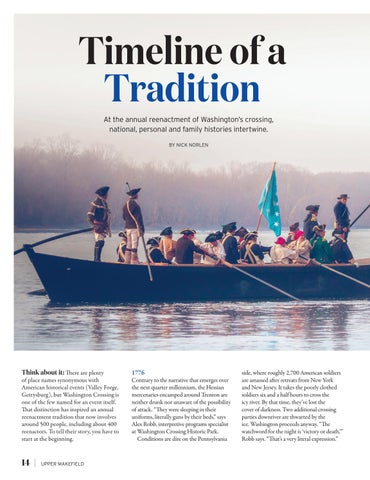
Timeline of a Tradition
At the annual reenactment of Washington’s crossing, national, personal and family histories intertwine.
BY NICK NORLEN

Think about it: There are plenty of place names synonymous with American historical events (Valley Forge, Gettysburg), but Washington Crossing is one of the few named for an event itself. That distinction has inspired an annual reenactment tradition that now involves around 500 people, including about 400 reenactors. To tell their story, you have to start at the beginning.
1776
Contrary to the narrative that emerges over the next quarter millennium, the Hessian mercenaries encamped around Trenton are neither drunk nor unaware of the possibility of attack. “They were sleeping in their uniforms, literally guns by their beds,” says Alex Robb, interpretive programs specialist at Washington Crossing Historic Park.
Conditions are dire on the Pennsylvania
side, where roughly 2,700 American soldiers are amassed after retreats from New York and New Jersey. It takes the poorly clothed soldiers six and a half hours to cross the icy river. By that time, they’ve lost the cover of darkness. Two additional crossing parties downriver are thwarted by the ice. Washington proceeds anyway. “The watchword for the night is ‘victory or death,’” Robb says. “That’s a very literal expression.”


1918
A Pennsylvania river town called Taylorsville has its name changed to match the name of the park established there the year before: Washington Crossing.
1953
Bucks County Playhouse founder St. John Terrell dreams up a publicity stunt for his other venture, Lambertville Music Circus. With a handful of friends, he stages a reenactment of George Washington’s Christmas crossing of the Delaware River. For the next 25 years, he portrays the general in the pose mythologized by Emanuel Leutze’s iconic 1851 painting.
1982
Lisa Thorndike witnesses the crossing reenactment for the first time. She watches as Washington leaps from the boat, with the general now portrayed by Jack Kelly, Olympic rower and brother of movie star Grace Kelly. He lands successfully in New Jersey, where Thorndike had eventually settled after moving to the U.S. from England in 1962.
Thorndike starts taking her children to the reenactment and learning more about the American Revolution. “Because I certainly didn’t learn it in England,” she says.
2009
State budget cuts close the park and threaten to sink the crossing reenactment. John Godzieba and other local citizens, including Thorndike, rally to form the Friends of Washington Crossing Park, whose staff now manages the park jointly with the state. Godzieba has portrayed Washington in the reenactment ever since.
2016
Michelle Flanagan takes her son Logan to an event at the park, where he’s given a colonial hat by a reenactor. A fuse is lit. The family returns for the crossing. The spark spreads to both Flanagan and her husband Sean, and, boom, the three begin reenacting together, even serving on the same artillery crew. This past summer, Flanagan is hired by the Friends as an administrative assistant. “I’ve always said to my husband, ‘I wish I could just volunteer at the park forever,’” Flanagan says. “And here I am, getting paid for it.”
2017
A century after the park is established, college student Alex Robb is pursuing studies in American history. His former elementary school teacher connects him with reenactors who become his mentors. Seven years later this January, he’s hired as an educator for the park.
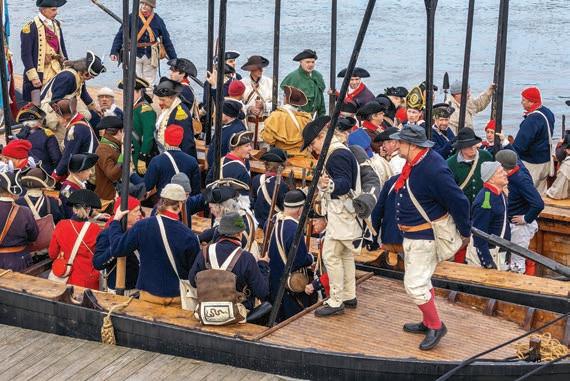
Hundreds of people help reenact the 1776 crossing of the Delaware River by troops led by George Washington during the Revolutionary War.

2018
Jennifer Martin becomes executive director of the Friends, a culmination of her history with the site. “I used to come here as a child, and now I’m running the Friends group,” Martin says.
She says that the crossing is part of a “shared American memory”—and that the reenactment brings the memory to life. “You can stand on the banks of the Delaware River like Washington and his men did,” she says. “It gives people this grand perspective about the sacrifices that people made.”
Thorndike says it’s that history, and admiration for the bravery of the soldiers, that keep her—and so many others— involved 248 years after the pivotal event.
2024
Today, of the hundreds who contribute to the annual reenactment, some are family. Some consider themselves family. For


some, it’s a hometown tradition.
“This important event that made us a country, that made us a young nation, took place here in this community,” Martin says.
“That’s what’s magical to me—these little microhistories that really happened, and how unique this spot was,” says Paul Beck, a longtime Yardley resident who since 2002 has been responsible for maintaining the Durham boats that were specially built for the historical site.
Kathy Pasko has been participating in reenactments since she moved to Washington Crossing in 2007. On a warm Sunday morning in October, Pasko is among the crew of a Durham boat in the ice-free, currentless waters of Lake Luxembourg in Langhorne for one of the on-water practices being held before the event.
On this day, rowers are getting a feel for the 16-foot, solid-wood oars, and the period-accurate (but not always intuitive)
THIS YEAR’S REENACTMENT
FIRST CROSSING
Sunday, Dec. 8; 10 a.m. to 3 p.m.; actual crossing at 1 p.m.
Cost: $9 per adult; $5 per child ages 5–11; under 5 free; $25 per family (2 adults and 2 children)
Special colonial-era activities and demonstrations will also be held in the Historic Village.
CHRISTMAS DAY CROSSING
Wednesday, Dec. 25; noon to 3 p.m.; actual crossing at 1 p.m.
Cost: Free
For more details, visit www. washingtoncrossingpark.org/crosswith-us.
commands for wielding them. “Toss oars,” for example, means hold them straight up. The crew includes a few new members as well the group’s newest captain, who is issuing orders with civilian politeness until Pasko gives him a stern reminder from the bow: “Since this is a practice, and you’re the captain, no pleases and thank yous.”
At practice, full uniforms are not required. An Eagles cap juxtaposes with a colonial tricorn hat. Period garb clashes with a Phillies shirt and a fluorescent fleece. One member dutifully dressed in uniform nevertheless realizes that his breeches are on backward. Before the rowers settle in and find their rhythm, starboard oars collide a few times. It’s a reminder that these are regular people coming together to pull off a complex mission, just like the real-life revolutionaries they represent.
But they are devoted, to the cause and to each other. By the time of the crossing, they’ll be ready. Victory or death.


John Godzieba (middle photo at right) helped found the Friends of Washington Crossing Park and has portrayed Gen. Washington at the annual reenactment since the late 2000s.
A Running Conversation


Bucks County Roadrunners talk winter running, the towpath and forming friendships in stride.
BY NICK NORLEN
They say being able to hold a conversation while on a run is a sign of good fitness. But what to talk about?
“The Eagles, Phillies, whatever. Your job, what’s going on in your life,” says Bill Schaffling, who’s been chatting alongside fellow members of the Bucks County Roadrunners running club since he joined it in 1995.
As for finding someone to talk to? Most of the Roadrunners have
the same answer: Just start running. The Roadrunners formed in 1978, making the club one of the older running groups in the country. As the club enters its 47th season, you may encounter some of its 550 or so members—and the many Upper Makefield residents among them—engaging in “nonstop chatter” or simply “enjoying the quietness” on various runs, says club member John O’Brien, who joined in the early 2000s.
The Bucks County Roadrunners’ regular towpath runs and annual Winter Series, slated for Sundays from December 8 through February 23, are among many activities that the club offers throughout the year.

The Towpath and Beyond Whether amid conversation or silence, much of the club’s running happens in Upper Makefield along the Delaware Canal towpath, the platonic ideal of a long, flat, forgiving footpath.
“It’s a wide-open area. It’s free of traffic. It’s softer than a road surface, so it’s easier on your joints,” O’Brien says. “When you run on the towpath, you can run as far as you want to run.”
The towpath features prominently in many of the club’s weekly group runs, including the one that Schaffling leads on Saturday mornings. On most Sundays, another towpath run crosses the Washington Crossing bridge into New Jersey, and then returns over the walkway on the Scudders Fall Bridge.
“The towpath is just an endless resource
of miles, both north and south,” says club member Joe Boyce, who also leads a weekly run.
The club’s annual Bridge to Bridge Relay features teams of runners starting in Washington Crossing and completing a 53-mile towpath loop, crossing into New Jersey on Centre Bridge and back into Pennsylvania over Scudders Falls.
The canal and its surroundings serve as an idyllic backdrop in every season. “You get to experience everything there,” O’Brien says. “As the snow comes in, you see the winter wonderland. You get to watch it all come back in the spring and summer.”
If there’s a local antithesis to the flatness of the towpath, it’s the hilly terrain of Tyler State Park in Newtown, where the club hosts its annual Winter Series. Starting December 8 and running through February
23, it consists of a series of 12 runs of varying lengths, all on Sunday mornings except for the New Year’s “Cham-Pain” race on Wednesday, January 1.
O’Brien, who serves as director of the Winter Series, says running isn’t always the first activity that comes to people’s minds in wintertime, for the obvious reasons: “Less hours of sunlight. It’s colder. There’s more reasons to stay in.”
But every week, hundreds of runners brave the cold and hills. “The beauty of the Winter Series is that every Sunday, you can go out and run with 200 or 300 people— like souls who just love running,” says Boyce. “There’s no better way of staying in shape over the winter.”
If that’s your goal. Some runners use the Winter Series to build up to a halfmarathon. Distances gradually increase,
starting with a 5K (3.1 miles) and maxing out with a half-marathon (13.1 miles) on the secondto-last event in February.
Longer races always have a shorter option for those who aren’t looking for long distance. And you don’t need to be a member to participate— runners who want to join a single race can register on-site on race day.
A Social Crowd
After each run, finishers gather around the firepit at Tyler’s boathouse and enjoy whatever that day’s refreshments happen to be.
“We’re well-known for our food after races,” O’Brien says—like the chili cookoff at the Polar Bear Race in January, or the barbecue after the Bridge to Bridge Relay.
There are events year-round: a pancake breakfast, costumed races, the awarding of scholarships for local college-bound high school students. Talk to club members long enough and you’ll hear the word “social” almost as much as the word “running.”
Linda Lederer, now the Roadrunners’ membership director, joined the club more than a decade ago. She soon found a group within the group: a crew of “slowpoke moms” who took to calling themselves the Demons, for reasons Lederer can’t recall. “And now I consider them some of my best friends,” she says.
Boyce says that supportive spirit animates all the group’s activities. “The club is so welcoming,” he says. “Not just great runners, but great people.”
It’s in the time spent alongside each other, mile after mile, stride after stride, that acquaintances have become friendships and then community.
“You find your tribe within this tribe,” Lederer says. “That’s what’s amazing.”
Schaffling says he counts fellow Roadrunners as his main group of friends. Boyce says a club member told him that same thing when he initially joined. At first he was skeptical. But, he says, “Here I am 20 years later saying my best friends are in the Bucks County Roadrunners.”
For more information about Bucks County Roadrunners and the Winter Series, visit www. bcrrclub.com.


Novoa Interior Design

Simon Pearce’s iconic hand blown glass trees have become a statement to the design ethos and master craftsmanship of their brand. From majestic evergreens to modern takes on form, their trees come in many styles, textures and sizes. Tues-Fri 10 – 4:30 Saturday 10 – 4:00 Hours Yardleyville Square, 90 West Afton Ave, Yardley, PA
Welcome friends! So glad you’re here!
I’m Jenny, your local Bucks County, Philadelphia and New Jersey Photographer. Some things about me… I married the love of my life, I’m a mama to two rambunctious boys, I drink more coffee than I should, I love to travel and immerse myself in new cultures and I’m a true hippy at heart! I’m obsessed with sunsets and capturing motherhood, families and couples during the beautiful golden hour. I am captivated by raw, authentic emotion and moments between couples and families.
My work is what I would call emotive storytelling. I look forward to capturing your family’s story.


The Art of Gifting Wine
It can be the perfect present. Here’s what to consider before showing up with bottle in hand.
BY TOM CARROLL SR.

When it comes to gifting wine, my late wife, Christine, a sommelier by trade and a wine enthusiast by heart, used to remind me with a knowing smile, “Any question about wine only has one answer: It depends.”
And she was right. Selecting a bottle for someone can feel like navigating a vineyard without a map. The answer to “What wine should I gift?” isn’t as simple as red or white, sweet or dry. It depends—on the person, the occasion and the experience you’re trying to create.
Let’s face it, not everyone is a wine expert. Some people drink wine often but still haven’t nailed down what they really enjoy. This leaves you, the wine gifter, with a choice: Play it safe or go on a wine adventure. These pointers can help you navigate no matter what approach you take.
Tom Carroll Sr.
Give Surefire Favorites
If you’re uncertain about someone’s wine preferences, a little sweetness tends to be a crowd-pleaser. Consider an off-dry wine like a riesling or a pinot grigio. These wines have a touch of sweetness but aren’t overpowering. Christine used to say that these are wines that “don’t offend anyone,” which is great when you’re gifting to someone whose taste buds are a mystery. For red-wine lovers, a soft and fruitforward wine like a merlot or a malbec is often a safe bet. These wines are smooth, approachable and versatile enough to pair with a variety of foods.
Offer Food with Wine
If you want to elevate your wine gift, just pair it with food. When you hand someone a bottle of wine paired with a carefully selected treat, you’re no longer just giving them a drink—you’re offering them an experience.
Christine was a big believer in the power of food and wine pairings. One of her go-to pairings was a bottle of rich, earthy pinot noir with a selection of gourmet cheeses and charcuterie. Or, if you’re gifting a lighter white like sauvignon blanc, a small basket of seafood delicacies or citrusy salad ingredients can enhance the experience. This way, the wine’s flavors become more vibrant and memorable.
Contemplate Personality
Gifting wine is not just about giving someone a bottle—it’s about the connection you create with the gift. Christine’s philosophy of “it depends” reminds us that the right wine for the right person is always a bit nuanced. Maybe your recipient enjoys cozy evenings curled up with a book. In that case, something soothing and mellow, like a malbec or syrah, can be the perfect fit.
If you know the giftee is the life of the party, why not offer a sparkling wine or a bottle of Champagne? The bubbly nature of these wines instantly says celebration and fun.

Enhance the Experience
Wine gifting is a delightful art, and, like any art form, it has many right answers, but none of them are carved in stone.
Christine always insisted that the beauty of wine is its complexity, which makes gifting it both fun and personal.
If you’re still unsure, a thoughtful option is to offer a wine-tasting experience—whether at a local winery or through a curated selection of wines.
That way, recipients can explore their own preferences and you can still take credit for introducing them to something new.
So the next time you find yourself in a wine aisle trying to pick the perfect local bottle, just remember: It depends. But with a little thought, a little sweetness and maybe a little food, you can turn a simple gift into something unforgettable.
Happy gifting!
Tom Carroll Sr. is the co-founder and owner, with son Tom Carroll Jr., of Crossing Vineyards and Winery in Washington Crossing, which grows a dozen varietals on 20 acres and has won numerous local, regional and international wine awards.
The choice of a perfect gift wine can depend on a variety of factors, including recipient personalities and how well you (or they) understand their varietal preferences.

Create a wintry welcome with live greens, pine cones and white flowers. Cozy up any space with lanterns and faux fur. The possibilities are endless.


Home, for the Holidays
Simple adornments and accessories can seasonally transform any dwelling into a haven of comfort and joy.
BY RAFAEL NOVOA
Wintertime decor can be so much more than the typical novelties you find in gift shops. The end of the year is not only a reminder of another year gone by and a new one to look forward to, but also a time of multiple holidays that allow us to enhance our interiors and exteriors with accessories suggestive of the season.
Here are simple steps that can add seasonal comfort and coziness throughout the home.
Interior Holiday Touches
Use natural flowers and plants to create a story. Live greens and ribbons say, “Hello and come on in!” Live garlands and a small, simple holiday tree are joyous decor for the dining room. Decorate your tree of life with blues; pearly whites and silver; little songbirds; and pinecones in glass.
Simply add a wreath on a hook, a tartan scarf in a bucket, and throw some winter boots on a bench to create a functional vignette. Add dried leaves, apples, gourds, candles and cable-knits and you have a warm, cozy room— always enhanced with a blazing fire! Or keep it simple with white orchids and greens, or magnolia branches and leaves on a mantle.
Switch out pillows on sofas and chairs, bringing in colors of the season: reds, greens, whites and blues, as well as lingering autumn shades like deep wines and berries.
Add crystal to your tabletop and white candles to create a winter vibe. A creamy white throw across an ottoman or at the end of a comfy sofa can easily transform a simple space.
Bring in porch lanterns and simple bells and add some candles at the bottom of
the staircase. Faux fur is always a wintery mix-in. A touch of tinsel thread—gold or silver—can reflect and twinkle to remind us of the holidays as well.
Look Outside
There are so many avenues that you can travel with the excitement of changing the all -year-round look of your home by just exchanging accessories here and there for a short period of time.
A similar approach can add festive touches to exterior spaces. You can play with the many different objects available to you at your local garden centers and home goods shops. Outside, you can feature seasonal potted plants on garden benches and pathways as a way to enhance them.
Whatever you do, have fun with it. Go all out. Because nothing you decide is permanent!
Rafael Novoa is an interior designer whose firm has locations in Newtown and Philadelphia. His signature aesthetic fuses function, comfort and expression, juxtaposing the ornate beauty of old-world craftsmanship against the clean lines and spare spaces of modern design.

Frost-Proof Your Face
Winter doesn’t have to be tough on skin with tips from a local cosmetic dermatology physician.
Have you ever noticed your cheeks turning rosy after coming inside from the cold? That’s your compromised skin barrier reacting to the harsh conditions.
With temperatures lowering, gusts of wind blowing and snow falling, your skin can be calling for a new routine to battle dryness, sensitivity and seasonal skin changes. The moisture barrier weakens in the cold, leading to redness and irritation. To protect your skin this season, it’s essential to adjust your skincare routine. Here are some of the essentials of winter skin survival.
BY LISA ESPINOZA, MD
BUSTING MYTHS
Let’s start by debunking some of the many winter skincare myths and getting to the facts.
Myth: You don’t need sunscreen in winter.
Fact: Ultraviolet (UV) rays are still present, and skipping products with a sun protection factor (SPF) can lead to premature aging and sun damage.
Myth: Thicker moisturizers are better. Fact: Thicker creams don’t always mean more moisture. Look for products that contain hydrating ingredients such as hyaluronic acid.
Myth: Hot showers hydrate skin.
Fact: Hot water strips natural oils from the skin, making dryness worse. Instead, treat your skin to a facial to replenish moisture and protect against winter elements.
Myth: You need more exfoliation during the winter.
Fact: Over-exfoliating can damage your skin’s barrier. Opt for gentle exfoliation enhanced with a dermaplane treatment to remove dead skin and leave your skin smooth and refreshed.

SMART STEPS FOR COLDER CLIMES
Environmental factors also affect your skin’s health during the colder months. Weather the winter and protect your complexion with these tips for happy, healthy skin. Use a humidifier. Combat dry indoor air by adding moisture back into your environment. This helps prevent further dryness and keeps your skin hydrated.


Moisturize frequently. Protect your skin barrier by using a rich moisturizer with ceramides, niacinamides and antioxidants to lock in hydration and provide long-lasting protection. Switch to a hydrating cleanser. Avoid harsh cleansers that strip your skin’s natural moisture. Choose a gentle, fragrance-free cleanser that’s infused with jojoba and vitamin E for a deep cleanse
without the dryness. With appropriate winter skincare, your skin will stay radiant, hydrated and healthy throughout the season!
For more information or to schedule an appointment at La Chelé, call 215-862-6100 or visit www.lachelemedspa.com. Mention Upper Makefield magazine for $50 off Botox, $100 off filler or $25 off a spa service.
Lisa Espinoza, MD, says caring for skin in harsh, cold conditions entails knowing what works and what doesn’t.
Lisa Espinoza, MD, is founder of La Chelé Medical Aesthetics, which has four major locations, including in Newtown and New Hope. She is a top U.S. injector and expert in cosmetic dermatology with over 18 years of experience.
Books for Everyone on Your List BOOK NOOK
Books are treasures. Giving one as a gift is a wonderful way to express respect, admiration and appreciation for someone you care about—especially when it’s a book that touches the heart, challenges the mind or lifts the spirit.
These selections offer a range of options for a variety of interests and ages.
“DEMON COPPERHEAD”
By Barbara Kingsolver
Winner of the Pulitzer Prize and ranked No. 1 on The New York Times list of readers’ picks of the 100 best books of the 21st century, “Demon Copperhead” examines life in Appalachia with wit, compassion and wisdom. It’s a perfect book club book: a heartbreaking story that’s a great read and perhaps an even better re-read.
“JAMES”
By Percival Everett
Elegantly written and insightful for the period and for today, Everett’s “James” is a formidable retelling of the Mississippi odyssey of Huckleberry and Jim. The courageous decisions of the titular character come from principles and intelligence that enable true freedom—of thought and action.
“THE
WAGER”
By David Grann
Sharply and cleverly shaped, “The Wager”
BY LIZ YOUNG
is a nonfiction thriller that’s perfect for the armchair traveler. It’s a story of shipwrecked sailors making impossible choices for their collective survival. Be prepared for real-life twists and a thrilling conclusion.
“A COURT OF THORNS AND ROSES”
By Sarah J. Maas
Maas’ deep and fearless writing is the foundation of this first novel in a go-to series for those who crave a saga of feisty fairies and immersive stories. For a respite from the digital age, share with a friend and enjoy great conversations that follow.
“SAY
NOTHING”
By Patrick Radden Keefe
An award-winning, modern nonfiction classic. With deep research and a careful hand, Keefe pulls back layers of intrigue, political nuance and dark secrets around the Troubles in Northern Ireland. The story pulls you in and drags you through the mud of human destruction as you wrestle with difficult emotions that characterize the region and its history.
“SALT,
FAT, ACID, HEAT”
By Samin Nosrat
Cookbooks are wonderful gifts, especially when they inspire year-round use. This one should be on the shelf of every cook—novice or experienced—
for its fundamental approach to food preparation. With beautiful illustrations to engage the senses, it will become a go-to choice for everyday cooking.
“BIRDS
OF THE WORLD: THE ART OF ELIZABETH GOULD”
By Andrea Hart and Ann Datta
It’s no surprise that birds have become a source of fascination to so many of us: They can be watched, listened to and appreciated from homes and offices with no special equipment or specific knowledge. This gorgeous art book travels the world with superlative illustrations and descriptions, and is perfect for anyone interested in art and the natural world.
“DRAGONS LOVE TACOS”
By Adam Rubin and Daniel Salmieri
Rubin’s modern kid classic is a fun read for all members of the family. Who doesn’t love a taco party? Gather your dragons, assemble the ingredients and, whatever you do, keep an eye on the salsa.
Liz Young is the owner of Commonplace Reader (commonplace-reader.com), which just celebrated its fiveyear anniversary and hosts several adult book clubs each month along with kids’ activities on Saturdays in the shop on Main Street in Yardley.


Woolly and Watchful

Meet William, one of the sheep that grace the grounds of the Thompson-Neely Farmstead, captured by photographer Jennifer Janikic. Named for William Washington, George’s cousin, William is a 9-year-old Leicester longwool, a breed that Washington himself kept in his flock at Mount Vernon. To celebrate our inaugural issue, this month Upper Makefield magazine is sponsoring William, who is fittingly described by his caretakers as one who “always keeps his eye on everything happening around him.” A sheep after our own heart! To learn how you can sponsor a sheep, visit www. washingtoncrossingpark.org/ sponsor-sheep.
Have a fabulous Upper Makefield photo? Email it to editor@uppermakefieldmag.com and it could be featured in an upcoming issue!


