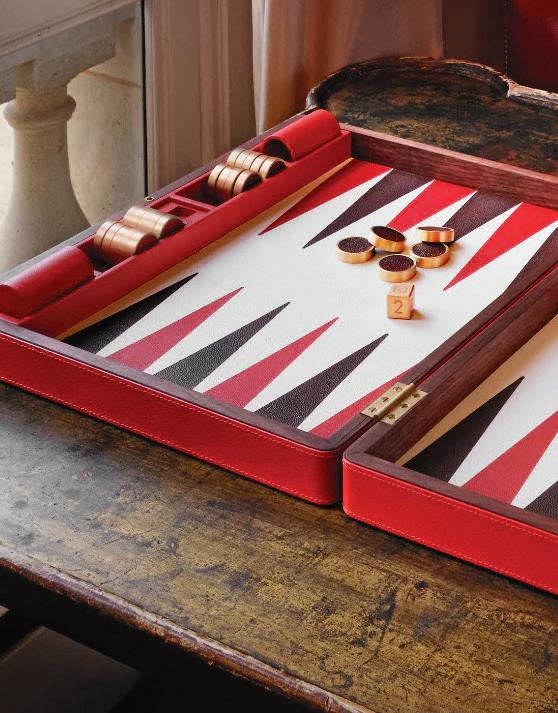

Gifts, gatherings and good company—everything to make the season sparkle


Modern approaches for urologic cancer care.

Everything medicine can do. A few things medicine can’t.
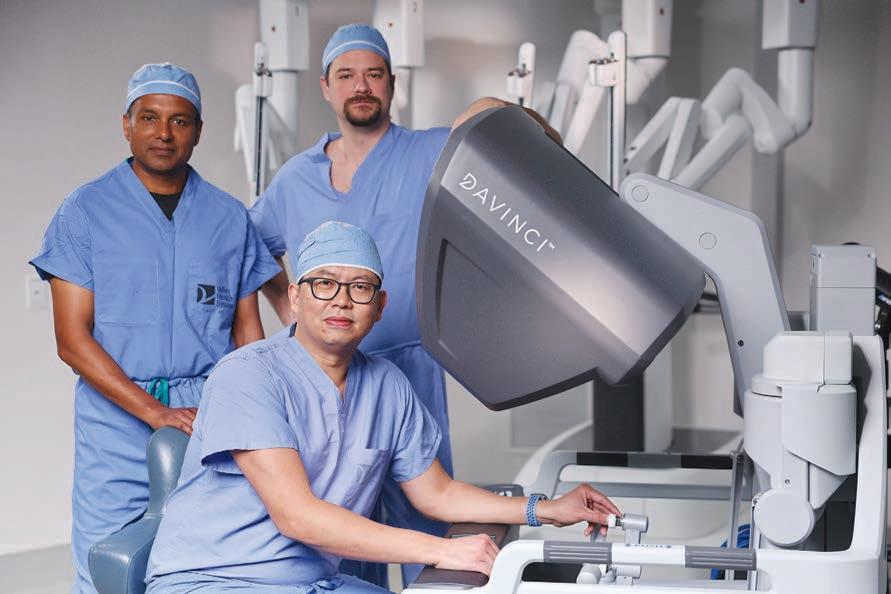
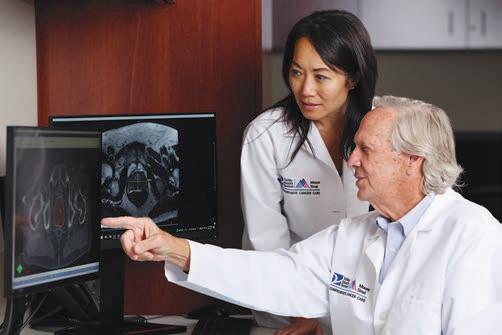
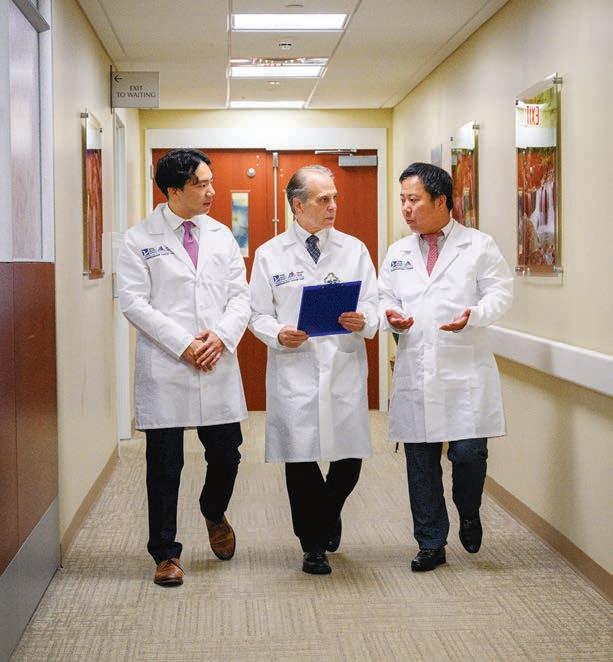
At Valley-Mount Sinai Comprehensive Cancer Care, our team of doctors bring the experience and commitment required to address all aspects of prostate, bladder, kidney, and testicular cancer. Surgical tools including da Vinci Xi® and NanoKnife® are minimally invasive approaches to help you heal quicker and maintain quality of life. Our Think Five program can reduce radiation treatments for prostate cancer to only five. Our specialists will design a treatment plan around you, and our nurse navigator will guide you every step of the way.
To find the approach that’s best for you, call 201- 634- 5567 or visit ValleyHealth.com/UrologicOncology.




Attention, Weekend Warriors 26
Play hard on Saturday and Sunday for peak gains, not peak pains. A Bergen doctor shares tips.
Gift Guide 2025 29
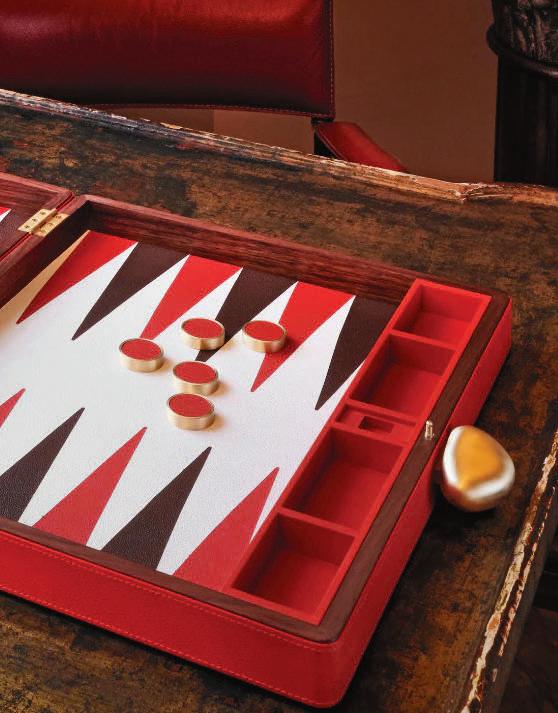
From stylish to sentimental, these 45 ideas will make every name on your list sparkle.
36
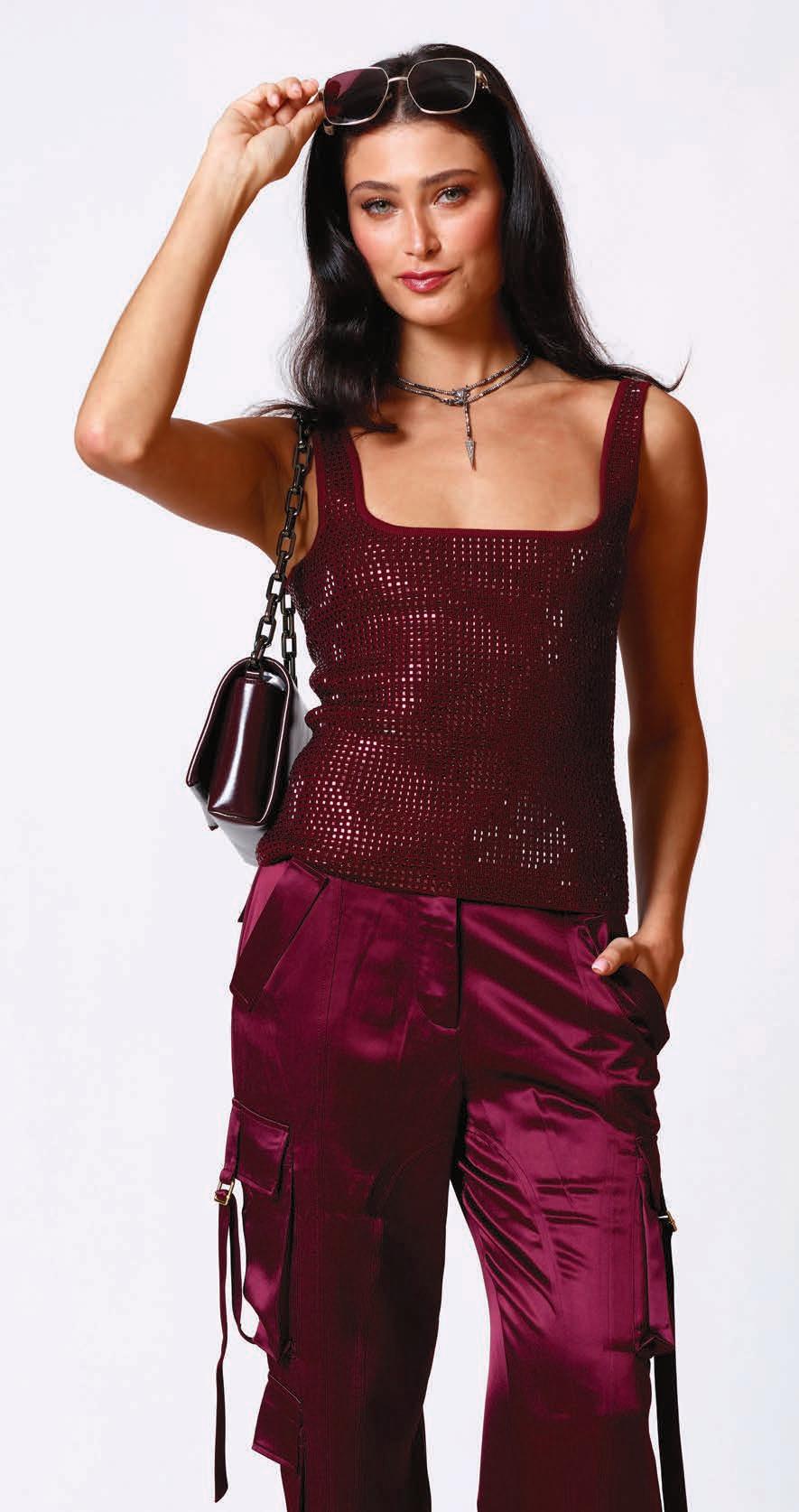
The season’s hottest looks are designed for crisp days and stylish nights—and everything in between.
Warm Your Heart 40
Nothing sparks the imagination and magic of the holidays more than the comfort of a fireplace.
44
Why not celebrate the season with an unforgettably chic martini soirée?
Do More Good 50
Wishing you could give more—or more effectively—to the causes that matter to you? Here’s how.





Bergen Buzz 13
Our guide to new ideas, tips, trends and things we love in the county.
Style Watch 18
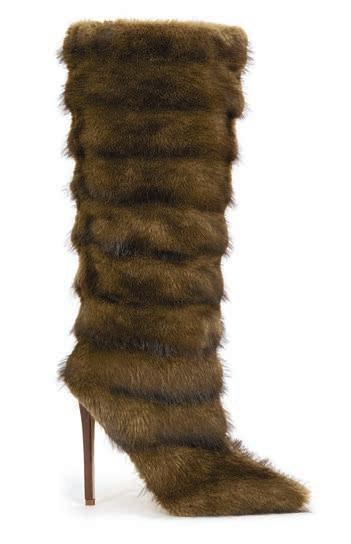
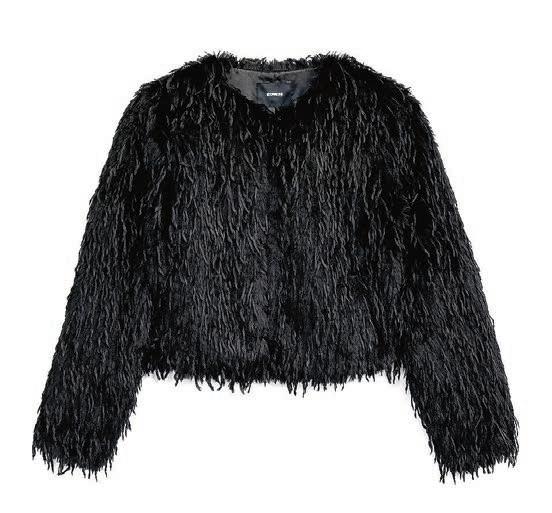
Feel good and stay cozy with these stylish coats and accessories.
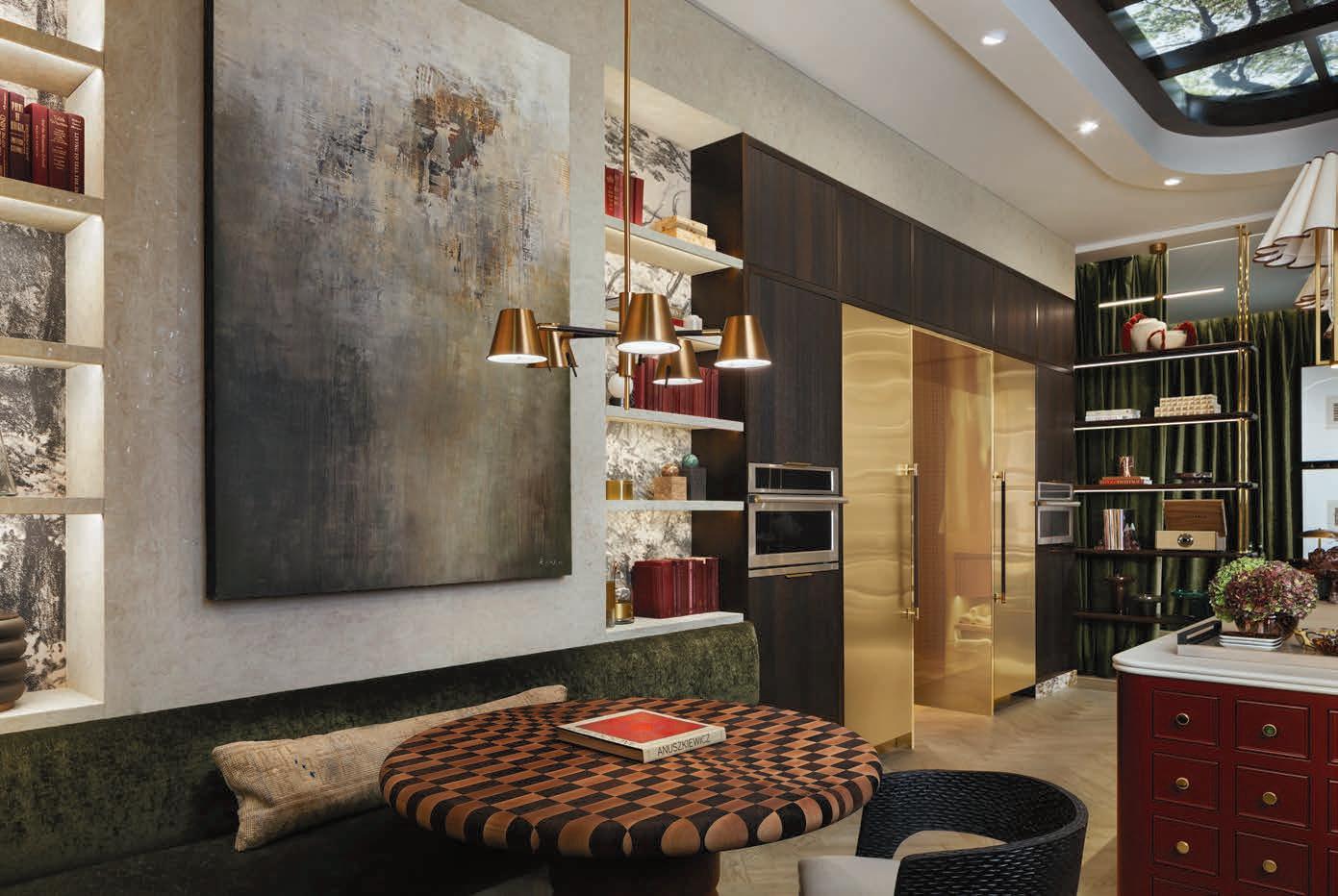
Home Front 19
These picks bring cheer, shine and a dash of drama to your December table.
Friends & Neighbors 20
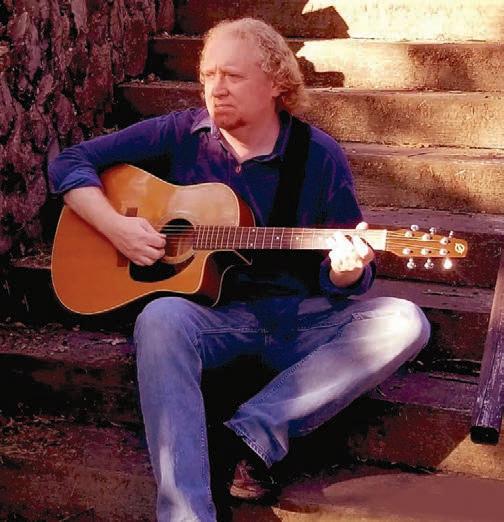
Bogota’s Dan Sheehan wants to make music, help others make music and help make sure there’s still a world in which to hear it.
Escapes 54
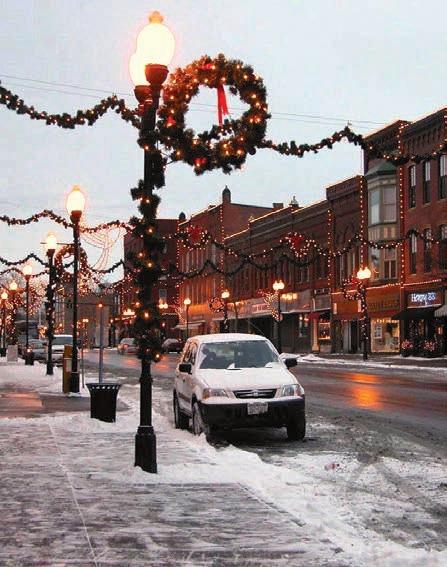
Each of five charming places presents a Christmastime that honors tradition and brightens the spirit.
Tastes 56
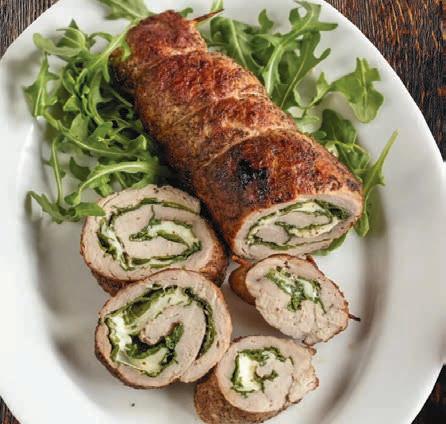
Celebrate the season with rich, hearty dishes that command center stage on your holiday table.
Bar Tab 60
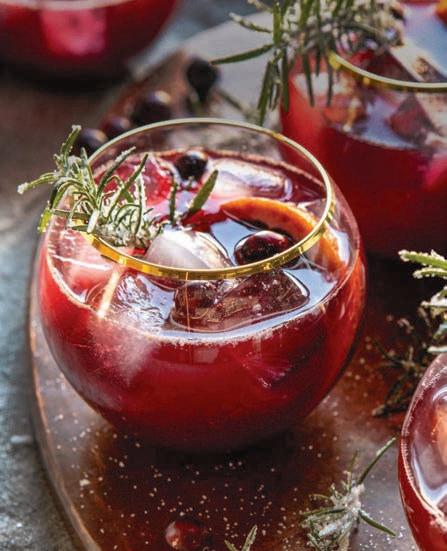
This tart pick-me-up is festive, flavorful and perfect for both holiday parties and fireside sipping.
Restaurant Review 84
Edgewater’s Doner Point spins up Turkish classics with heart, heat and a little theater at the table.
Gatherings 87
Bergen residents always show up to support one another.
A Bergen Moment 88
A photographer watches Christmas’s biggest celebrity arrive in Wyckoff.






Raise your hand if you’ve never faked a reaction. Never, on unwrapping a gift, exclaimed in faux rapture, “How did you know I’ve longed for a paperweight shaped like the Leaning Tower of Pisa?” or “How wonderful—a sweater with tassels! And it’s just my size!”
If your hand is up, you’re not unusual. Most of us accept that, in the ritual of gift giving, part of the job is ours as gracious recipient. Someone has thought of us generously, and that fact alone demands a warm smile of gratitude, whether or not it’s fully sincere. We may even utter that old cliché: “It’s just what I’ve always wanted!”
But let’s drill down on that. Holiday time is a great time to ask: Just what have we always wanted? If it’s one of the presents in this issue’s Gift Guide (and we do think they’re winners), leave the magazine open, as if by happenstance, somewhere near pages 29 through 35, as a subtle hint to loved ones just before shopping day.
Or is holiday décor your heart’s desire? The decorated hearths shown on pages 40–43, with red and green for Christmas or blue and silver for Hanukkah, are the kind of visual treats we wait all year for. And if what you crave most is simply to a chance gather with treasured friends, we’ve got you covered too. The martini party we showcase starting on page 44 is a smart, sophisticated way to do so—and it can be a low-stress event you actually enjoy.
In our Buzz section beginning on page 13, you’ll learn about five workshop classes in which you can develop a creative skill—and carry away the gift you’ve created. There, too, we describe six kinds of local holiday-break fun and three local traditions—in Hackensack, Ridgewood and Franklin Lakes—that help us Bergenites mark the season.
What else is in this December magazine? On page 20, meet all-round music man
Dan Sheehan of Bogota, who’s worked with some of the greats. You’ll find two scrumptious meals on page 56, snazzy outfits “for crisp days and stylish nights” on page 36, Christmas-themed travel destinations on page 54 and advice on the benefits and risks of “weekend warrior” exercise on page 26. And on page 84, find out what our reviewer’s girlfriend said when she tasted the Beyti doner at Doner Point, the new Turkish restaurant in Edgewater.
Then again, maybe what you’ve really always wanted is the joy that comes from knowing you’ve brightened the lives of others by donating to a good cause. On page 50, our Special Report tells how to assure that your contribution really makes a difference.
After all, they say it’s more blessed to give than to receive, and of course they’re right— although sometimes receiving can be pretty darn blessed as well.
Enjoy the holidays—and this holiday issue!
Rita Guarna Editor in Chief rita.guarna@wainscotmedia.com

Managing Director
Whetheryou are selling a business,inheriting wealth,or looking ahead towards retirement, we work in close collaborationwithour investment team and outside advisors toensure your plan iscreated efficientlyand effectively withyour defined objectives in mind.Asyour lifechanges and evolves,your plan grows withyou -and as stewardsof your wealth, we’rewithyou everystep of the way.
Whetheryou are selling a business,inheriting wealth,or looking ahead towards retirement, we work in close collaborationwithour investment team and outside advisors toensure your plan iscreated efficientlyand effectively withyour defined objectives in mind.Asyour lifechanges and evolves,your plan grows withyou -and as stewardsof wealth, we’rewithyou everystep of the way.
Whether you are selling a business, inheriting wealth, or looking ahead towards retirement, we work in close collaboration with our investment team and outside advisors to ensure your plan is created efficiently and effectively with your defined objectives in mind. As your life changes and evolves, your plan grows with you -and as stewards of your wealth, we’re with you every step of the way.
Whetheryou are selling a business,inheriting wealth,or looking ahead towards retirement, we work in close collaborationwithour investment team and outside advisors toensure your plan iscreated efficientlyand effectively withyour defined objectives in mind.Asyour lifechanges and evolves,your plan grows withyou -and as stewardsof your wealth, we’rewithyou everystep of the way.
Whetheryou are selling a business,inheriting wealth,or looking ahead work in close collaborationwithour investment team and outside advisors iscreated efficientlyand effectively withyour defined objectives in mind.Asyour evolves,your plan grows withyou -and as stewardsof your wealth, we’rewithyou the way.
Whetheryou are selling a business,inheriting collaborationwithour iscreated effectively evolves,your withyou


Whetheryou business,inheriting work in close collaborationwithour investment iscreated efficientlyand effectively withyour and evolves,your -and as stewardsof your wealth, we’rewithyou everystep of the way.
Contact us toschedule a meeting
Contact us toschedule a meeting
Contact us to schedule a meeting
Contact us toschedule a meeting
Contact us toschedule a meeting
Vein Center of Oradell Dr. James Geuder and Hackensack Vascular Associates, Dr. Anjali Ratnathican, Dr. Kristin Cook and Dr. Jinny Lu have combined practices. We are vascular surgeons certified by the American Board of Surgery with extensive experience in treating vein and circulation conditions, including varicose veins, spider veins, venous insufficiency, leg ulcers, leg pain, and other circulatory problems of the lower extremities. Offering comprehensive care, from minimally invasive office procedures to complex venous reconstruction. We are in-network providers for Medicare, Horizon, Aetna, Cigna, UnitedHealthcare, and most major insurance plans.
Editor in Chief RITA GUARNA
Creative Director
STEPHEN M. VITARBO
Senior Associate Editor DARIUS AMOS
Assistant Editor
KIRSTEN MEEHAN
Contributing Editors
LESLIE GARISTO PFAFF PAUL RANCE JR.
Contributing Photographer DAN SPRINGSTON
PRODUCTION
Production Manager FERN E. MESHULAM
Production Artist CHRIS FERRANTE
BE SOCIAL
Join our online community! LIKE us on Facebook: BergenMag
FOLLOW us on X: @BergenMag
SEE our photos on Instagram: @BergenMagNJ
VIEW our boards on Pinterest: HealthandLife
SEND YOUR FEEDBACK AND IDEAS TO: Editor, BERGEN, 1 Maynard Dr., Park Ridge, NJ 07656; fax 201.746.8650; email editor@wainscotmedia.com.
BERGEN assumes no responsibility for the return of unsolicited manuscripts or art materials.
BERGEN Magazine (USPS 2535-1) is published monthly by Wainscot Media LLC, 1 Maynard Drive, Suite 2104, Park Ridge, NJ 07656. Periodicals postage paid at Mahwah, NJ, and at additional mailing offices. POSTMASTER: Send address changes to Bergen Magazine, 1 Maynard Drive, Suite 2104, Park Ridge, NJ 07656. Subscription price: $48 per year. Send subscription orders to: Subscription Department, Bergen Magazine, 1 Maynard Drive, Suite 2104, Park Ridge, NJ 07656. Copyright © 2025 by Wainscot Media LLC. All rights reserved. Vol. 24, Issue 12, December 2025. Printed in the USA.












Publisher
THOMAS FLANNERY
Account Executives
PENNY BOAG, CHRISTIE COLVILLE, PEARL LISS
Director, Special Programs
LAURA A. DOWDEN
MARKETING, DIGITAL & OPERATIONS
Director of Marketing and Digital Media
NIGEL EDELSHAIN
Director of Operations
CATHERINE ROSARIO
Director of Advertising Services
JACQUELYNN FISCHER
Chief Finance Officer
STEVEN RESNICK
Assistant Controller
URSZULA JANECZKO
Accounts Receivable Manager
KASIE CARLETON
Accounts Receivable Specialist BRUCE LIBERMAN
Office Manager
MARIA MARTUCCI
PUBLISHED BY WAINSCOT MEDIA Chairman
CARROLL V. DOWDEN
President & CEO MARK DOWDEN
Senior Vice Presidents
EDWARD R. BURNS, LIZETTE CHIN, THOMAS FLANNERY, RITA GUARNA
Vice Presidents
NIGEL EDELSHAIN, NOELLE HEFFERNAN, MARIA REGAN, STEVEN RESNICK
ADVERTISING INQUIRIES


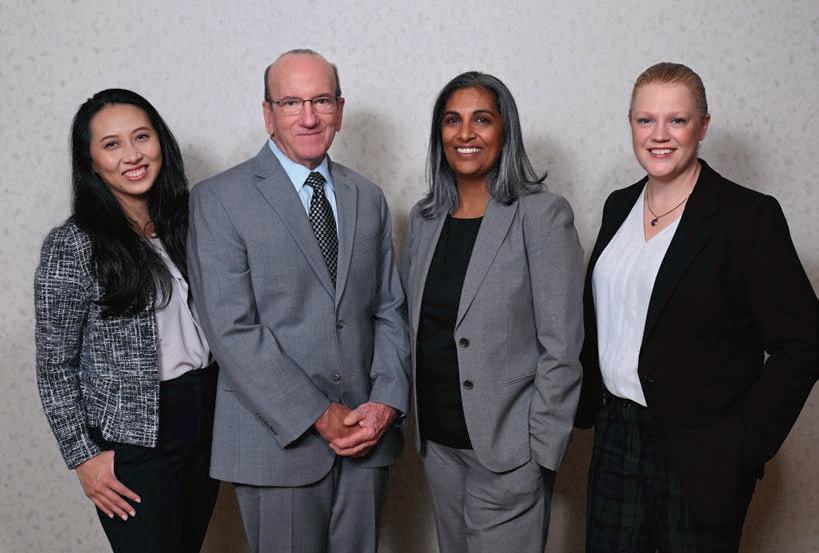
EVAN BAIRD, MD, Assistant Clinical Professor, Mount Sinai Medical Center; RAFAEL LEVIN, M.D., M.S.C., Chief of Spine, HackensackUMC at Pascack Valley; JONATHAN LESTER, M.D., Physical Medicine and Rehabilitation; NOMAAN ASHRAF, M.D., M.B.A., Assistant Clinical Professor, Mount Sinai Medical Center








YOUR VOTE COUNTS
It’s that time again—our annual Readers’ Choice Awards are back! Celebrate the best Bergen has to offer by casting your vote for your favorite local businesses, restaurants, shops, bars, gyms, salons and more. This is your chance to recognize the people and places that make our county special, from your go-to morning coffee spot to the boutique that always has the perfect gift. Online ballots go live next month—don’t miss your chance to make your voice heard! Every vote helps shine a spotlight on your hardworking neighbors who keep our community thriving. Scan the QR code below or visit bergenmag.com to see all the categories and start voting once the polls open. Show your love for local and help crown the 2026 Readers’ Choice winners!

OUR GUIDE TO NEW IDEAS, TIPS, TRENDS AND THINGS WE LOVE IN OUR COUNTY.
Hot cocoa, twinkling lights and a little bit of chaos—the holidays at home have their own special magic. We asked BERGEN readers about what makes the most wonderful time of year special to them and asked them to fill in the blank: “December holidays at home wouldn’t be the same without____.” Here is how eight Bergenites responded:
“…returning home from midnight Mass, unwrapping one present with the family before going to bed and opening the rest of the gifts in the morning. It’s a tradition that started with my parents, and one I’m happy to continue with my family.”
—Renato Villegas, River Edge
“…stepping back to appreciate all the Christmas lights and decorations that our family has created and hung up. I used to do it alone, and it was a chore. But in recent years, everyone has had a hand in decorating, making it special.”
—Brendan Donohue, Mahwah
“…our hand-picked tree with the family ornaments, new and old. Each one holds a different story.”
—Nicole Ward, Lyndhurst
“…lighting every scented holiday candle and all our fairy lights before cuddling up on the couch for a classic movie on TV such as White Christmas as well as Eight Crazy Nights for a fun Hanukkah celebration.”
—Jodi Weinberger, Wood-Ridge
“…watching It’s A Wonderful Life with my hubby and with all the lights turned off except for the tree.”
—Patti Donatello, Rochelle Park
“…attending the Home for the Holidays parade in Westwood.”
—David Marcus Pascaru, Emerson
“…recreating recipes passed down by our mothers and the 12 ingredients for our Italian Christmas: 12 aunts and uncles, 11 distant cousins, 10 crying children, nine pounds of pasta, eight bulbs of garlic, seven kids of fishes, six quarts of gravy, five gallons of wine, four cannoli trays, three women cookies, two Advils, please, and a string of red peppers drying out.”
—Brenda and Frank Calandrillo, Mahwah
“…having my grown children at home with me.”
—Jennifer Colletti Pizappi, Waldwick


Looking to make the most of the week between Christmas and New Year’s? Bergen offers plenty of seasonal experiences to help you wrap up the year in style:
• Bright nights. Demarest Farms’ annual drive-through holiday light display, Orchard of Lights, is open through Dec. 30, so you’ll have a few days after Christmas to see this year’s exhibit. Meanwhile, the Bergen County Zoo’s “Let It Glow” lantern show is open weekends through Jan. 11.
• Skate date. Now’s the perfect time for some open-air ice skating. Bergen County’s Winter Wonderland in Paramus has skating sessions throughout the season. If conditions permit (check posted signs), skating on a pond—such as at Allendale’s Celery Farm, Saddle River County Park in Ridgewood or the Tenafly Nature Center—comes with throwback vibes.
• See the birds. Enjoy Mother Nature’s best and join the Bergen County Audubon and

10 a.m. Dec. 28. Find out more at bergencountyaudubon.org
• Ski the sights. On a snowy day, Palisades Interstate Park becomes a true wonderland, and seeing the woods and the cliffside view while cross-country skiing or snowshoeing is a memorable experience.
• Take a hike. Hiking Ramapo Valley County Reservation in Mahwah in summer is a treat, but it’s just as magical in winter. Grab your trekking poles and strap micro spikes to your boots and head off to see frozen waterfalls and snow-covered peaks and valleys.
• Hit the water. You may not be thinking about swimming in winter, but the temperature’s always ideal (81 degrees!) at Dream Works Water Park in American Dream. The splash pad, slides, pools—and all your favorite characters—make for a great getaway.


Making holiday memories includes loved ones, and furry family members are surely loved. Thus local spots are rolling out the red-and-green carpet for pet photos with Santa, giving you the chance to capture perfect festive snapshot:
American Dream, East Rutherford. On Mondays, Dec. 8 and 15 from 4 to 7 p.m., and your dog can visit Santa at his home Holiday Dreamland.
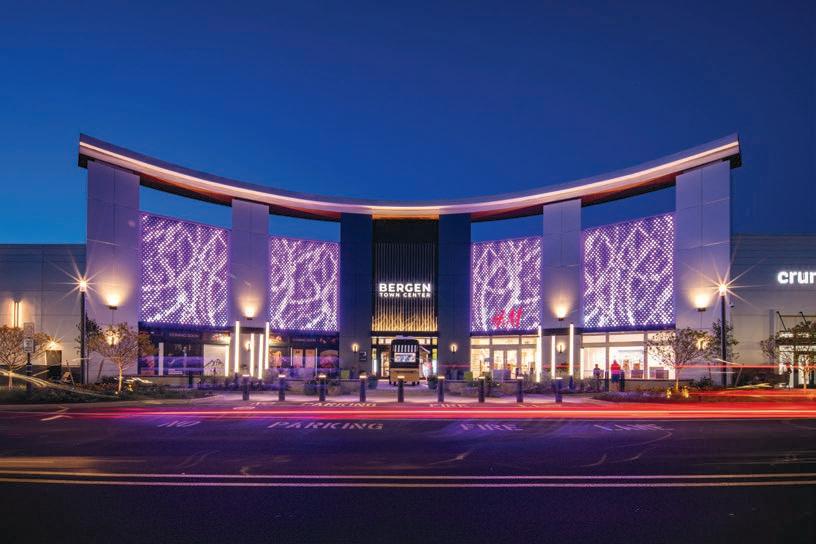
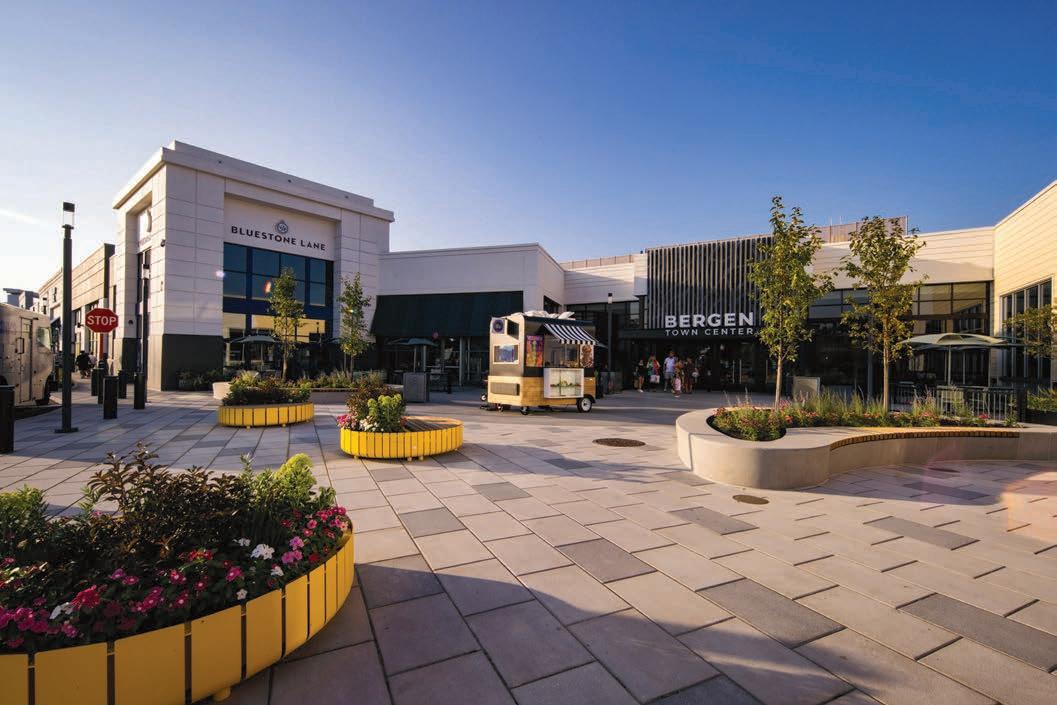
Bergen Town Center, Paramus. Use the online reservation form to save your pooch’s time slot for “Santa Paws” on Dec. 11 and 16.
Fortunoff Backyard Store, Paramus. Bring your kids and pets to the Route 17 for complimentary photos with Santa a.m. to 3 p.m. on Dec. 6.
Garden State Plaza, Paramus. Bring Fido Sally for holiday photos from 4 to 7 p.m. 8, 15 and 22.
Paramus Park, Paramus. Your furry friend photos with Santa from 4 to 7 p.m. on 9, 15 and 16.

…the Kunisch family, owners of Allendale Bar & Grill, on being named Restaurateur of the Year by the New Jersey Restaurant & Hospitality Association. This prestigious award recognizes their enduring commitment to hospitality excellence and community engagement. Fourth-generation owners and siblings Chris, Craig and Katie Kunisch continue a legacy that began in 1935, and the Allendale location has been a staple on the local dining scene for generations.

Whether you’re looking for a place to celebrate the season or simply want to try something tasty, these recently opened eateries are worth checking out.
CHOP, CHOP!
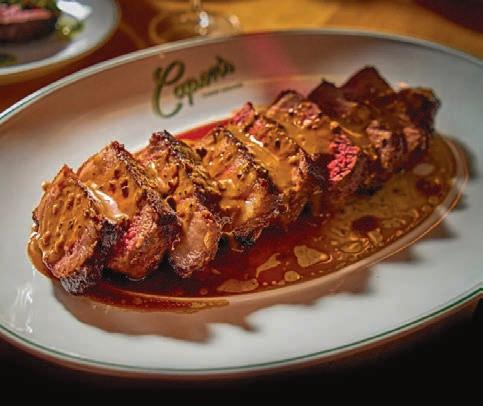
Celebrity chef and Tenafly resident Josh Capon’s newest restaurant is his first in New Jersey. Capon’s Chop House is now open at The Shops at Riverside in Hackensack, dishing out an array of steaks, chops, burgers, seafood (try the seafood tower!) and decadent desserts.
• Capon’s Chop House, 390 Hackensack Ave., Hackensack, 862.247.4037; caponschophouse.com
MEDITERRANEAN FLAIR
For fine kosher dining, book a table at Mediterraneaninspired Becca in Cliffside Park. Everything at this elegant, Manhattan-facing restaurant is made in-house and hits the spot, from starters like yellowtail crudo and canoe-cut bone marrow to main dishes such as whole branzino and bone-in ribeye.
• Becca, 700B Palisadium Dr., Cliffside Park, 973.221.5553; beccanj.com
Your children get a break from school between Christmas and New Year’s— and deserve some fun. Whether you’re raising athletes, naturalists, cooks or just kids—a holiday-break day camp may be what all can agree on:
• Tenafly Nature Center holds its break camp Dec. 24 to 31, and it’s filled with hikes, scenic trails, crafts, story times and many chances to observe and learn about wildlife. More info: tenaflynaturecenter.org
• In Ramsey, Fountain Fitness Center brings back its popular Fountain Ridge Day Camp for a holiday session, from Dec. 29 to Jan. 2. Campers will enjoy an indoor swimming pool, pickleball courts, an arts-and-crafts room and group games and activities. More info: fountainfitnesscenter.com
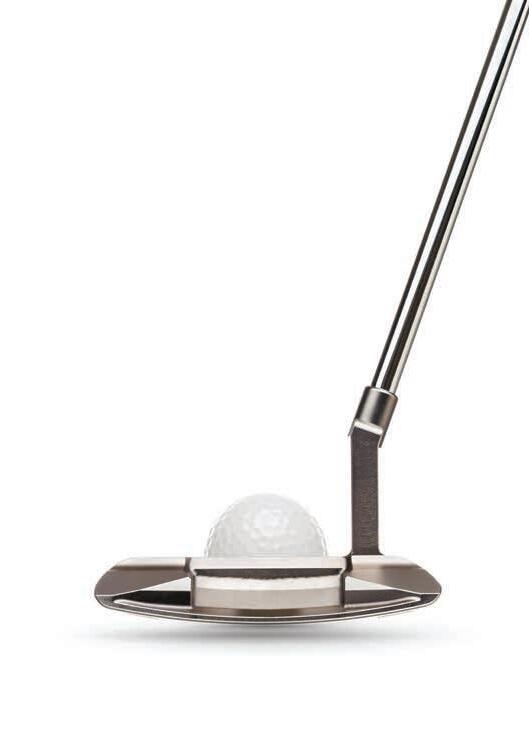
Need to unwind after a long day of shopping Pixar Putt has opened a pop-up location goers a Pixar-and-Disney-inspired mini interactive holes features beloved characters Toy Story, Cars, Finding Nemo and tee time with your friends or kids and it an early holiday present. At presstime, the attraction was set to be open through mid-February 2026. See pixarputt.com details and reservations.


• Hackensack’s Goat Climbing Gym aims to support budding climbers with its break camp from Dec. 29 to 31. Kids will learn top rope-climbing and bouldering techniques and enjoy collaborative team-building games and crafts. More info: goatclimbinggym.com
• Health Barn USA in Ridgewood holds a holiday break camp Dec. 29 to 31, when kids can learn kitchen skills, make crafts, find out about healthy lifestyle choices and try new things (and foods!). More info: healthbarnusa.com
What do you give the person who has everything? You’ll see ideas on page 29, but how about one more—the chance to develop a new skill? Tickets to a workshop or class give your loved one more than just a fun night out: The lucky recipient will leave with something he or she made and, just maybe, a budding new hobby. Possibilities:
• Wheel throwing & pottery classes. Mud Spinners Pottery Studio and Gallery, 580 N. Maple Ave., Ridgewood, 201.981.2792; mudspinners.com
• Cooking classes. Bergen Culinary School, 66B S. Washington Ave., Bergenfield, 201.484.7260; bergenculinary.com
• Painting lessons. The Muse ArtHouse, 84 Herbert Ave., Bldg. B, Suite 205, Closter, 201.431.6420; themusearthouse.com
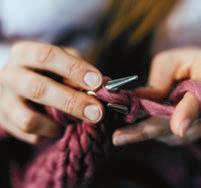
• Knitting classes. Knitapestry, 38B Franklin Tpke., Waldwick, 201.857.8310; knitapestry.com
• Beading workshops. Bazaar Star Beadery, 216 E. Ridgewood Ave., Ridgewood, 201.444.5144; bazaarstarbeadery.com

The end of the year is a time for reflection, and Bergen County had many memorable events this year. Here are a few:
• Jan. 24: Early on a Friday afternoon, some Bergen residents felt some light shaking—a magnitude 2.4 earthquake struck the area at 1 p.m. The epicenter, according to the U.S. Geological Survey, was in Paramus.
• May 10: Bergen made the news all over the tri-state area when the former Sheraton Crossroads hotel in Mahwah was demolished with a controlled implosion. The footage was posted on the internet and has accumulated thousands of views and hundreds of comments.
• May 12: Coach Kurt Hommen of Ridgewood became the all-time winningest baseball coach in county history when the Maroons defeated rival Paramus, 1-0. He’s led the Ridgewood baseball program for more than 15 years, during which the Maroons won two Group 4 state championships and a Bergen County title.
• June 19. Tenafly native Edan Alexander, who was taken hostage during the Oct. 7, 2023, Hamas attack on Israel, returned home to Bergen. He was the last U.S. citizen held captive in Gaza.
• Sept. 15: Ridgewood-based Family Promise of Bergen County, a nonprofit dedicated to helping families facing homelessness, served the 1.5 millionth meal in its nightly Walk-In Dinner program. Countless volunteers have helped keep this program running through its 34 years.
• Oct. 23: Valley Health System opened its Montvale campus at 400 Market St., a state-of-the-art facility for diagnostic imaging services, outpatient rehabilitation and physical therapy and integrative medicine.
• Nov. 9: In Leonia, Overpeck Park’s Field Station: Dinosaurs attraction—filled with animatronics of those prehistoric creatures—closed its gates for good. This drew attention from national news sources, including The New York Times, as the park was auctioning off its dinos (and collectors were eager to own one).
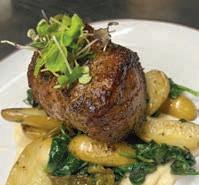

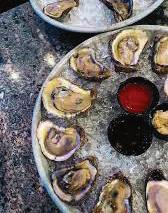
Big feasts are de rigueur for the season’s big days, but that needn’t mean a big mess in the kitchen. For this year’s celebration, why not let someone else do the cooking? The Bergen restaurants below will be happy to serve you and your crew for any occasion, including two very special ones:
For your kosher Hanukkah feast, check out:
• Etc. Steakhouse, 1409 Palisade Ave., Teaneck, 201.357.5677; etcsteakhouse.com
• The Kosher Nosh, 894 Prospect St., Glen Rock, 201.445.1186; 172 Piermont Rd., Cresskill, 201.331.0000; koshernosh.com
• La Cucina, 461 Cedar Ln., Teaneck, 201.357.2370; lcdnava.com
• Biagio’s, 299 Paramus Rd., Paramus, 201.652.0201; biagios.com
• Oceanos Oyster Bar, 2–27 Saddle River Rd., Fair Lawn, 201.796.0546; oceanos restaurant.com
• RP Prime Steakhouse, 41–11 Route 4, Fair Lawn, 201.267.0702; 209 Ramapo Valley Rd., Mahwah, 201.529.1111; rpprime.com
• Sofia, 36 Engle St., Englewood, 201.541.8530; sofiaenglewood.com
• Salt & Butter, 1 Garden State Plaza, Paramus, 201.606.2241; saltandbutter.us For dinner on Christmas Eve or Day, visit:
Odds are many of your holiday traditions are at home—decorating a tree, lighting a menorah or trying to make Grandma’s recipes taste the way they should. (We still can’t figure she did to her latkes.) Some traditions, though, take the house. Here are some annual events around the are as fondly traditional for the performers as for
Hackensack Performing Arts Center stages yearly musical The Christmas Caper throughout December, taking the audience on a joyful journey as Mrs. Claus and the elves race to save the season.
• Hackensack Performing Arts Center, 102 State Hackensack, 201.820.3007; hacpac.org
The always highly anticipated An Ars Musica’s Holiday returns Dec. 13. The Ridgewood-based choir will combine choral music with organ, brass and percussion for a memorable show— including selections from Handel’s Messiah.
• Bethlehem Lutheran Church, 155 Linwood Ave., Ridgewood; arsmusica.org
How’s this for a modern twist on the festival of lights? Over in Franklin Lakes, Chabad Jewish Center of NW Bergen County holds its annual Chanukah Menorah Lighting Ceremony (stay tuned for details). It includes an eye-popping drone show, live music, dancing and crafts.
• Franklin Lakes Borough Hall, 480 De Korte Dr., Lakes, 201.891.4000; franklinlakes.org


Since 1911, it has been our mission to offer a listening ear, a helpful hand, and steady, supportive guidance throughout your wellness journey. Through our comprehensive continuum of mental health services, communities for older adults, and rehabilitation, we work diligently to foster physical health and also nourish the spirit.




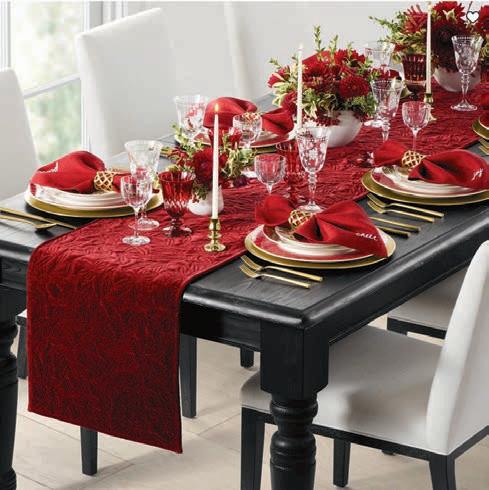
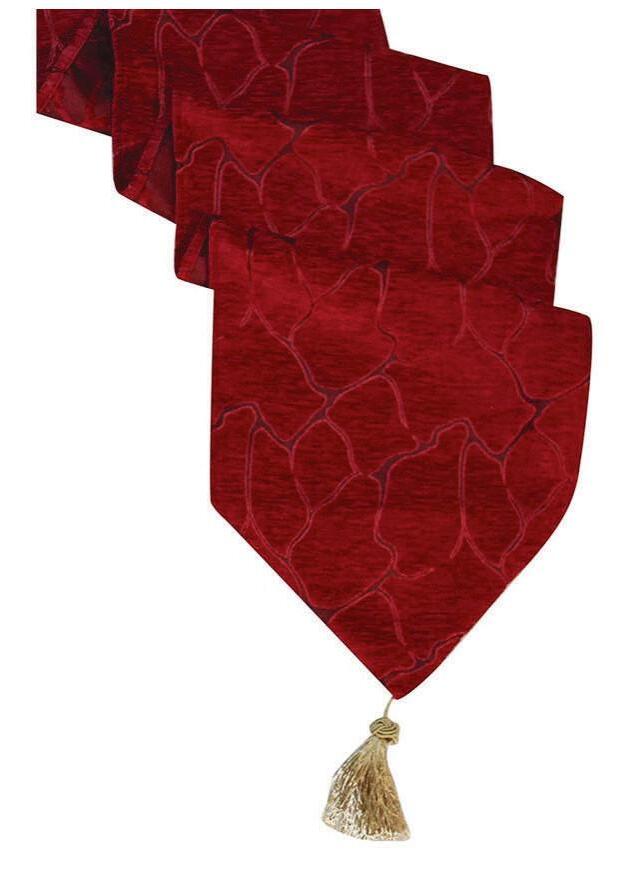
These picks bring cheer, shine and a dash of drama to your holiday table.
Wetherbee Design Table wayfair.com

Gold-Tone Cannage Montaigne Decorative Plate Macy’s, Paramus, 201.843.9100



Valentine Wine Glasses: Set of 2 htohshop.com

Gold Metal Napkin Ring Hobby Lobby, Paramus, 201.689.3101
Slim Pillar Candles, Cylinder Vases and Gold Vevo Pedestals yummi candles.com
Brayden Studio Stainless Steel Flatware Set With Hammered Pattern and Mirror Polish wayfair.com

Collection Red Cloth Napkins amazon.com

Bogota’s Dan Sheehan wants to make music, help others make music and help make sure there’s still a world in which to hear it.
Singer, songwriter, audio producer, assistant professor—Bogota’s Dan Sheehan is many things, but music is at the center of all of them. A regular on the Bergen music scene, he performs solo and as the leader of the Dan Sheehan Conspiracy. He’s toured the U.S., the U.K., Ireland and Spain, worked with musicians from Yes, The Doors and Pearl Jam and opened for Courtney Love. Since 2007, he’s been teaching music production at Bergen Community College (BCC) in Paramus, where he also helps organize some of the school’s concerts and music events.
Sheehan is originally from Nassau County, New York. His most recent project is a concept album and “live concert experience” entitled The Seas Are Rising: Stories of a Climate in Crisis He has performed it both nationally and internationally, and the official album release is forthcoming in 2026.
How did you come to music?
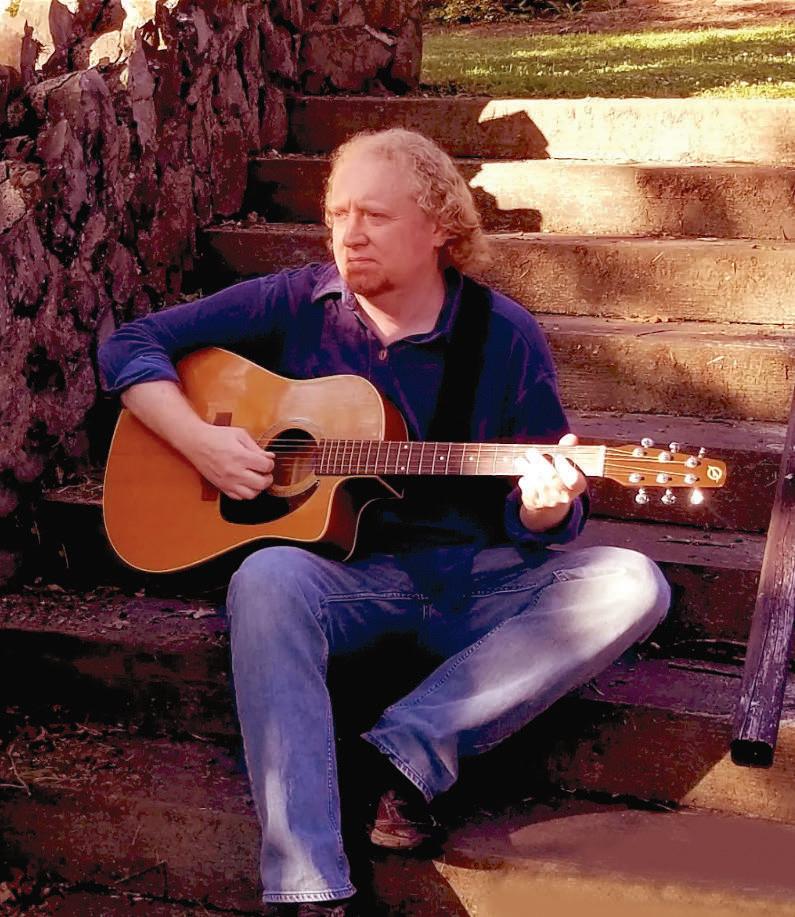
I was lucky to go to public schools with strong music programs. I grew up playing music there. Then, when my older siblings went to college, I raided both of their record collections. I suddenly had access to all this music—The Beatles, The Who—that totally inspired me. In college, my focus was creative writing and poetry, and that brought me to songwriting. When did you realize it could be a career? It was very roundabout. In college I started sharing my original music, and I found people very responsive. I played in bands, I toured. Throughout my life, I always went back to music, even when I needed to do other jobs to get by. I ended up in the recording studio, first for my own work and then as a session musician. That got me interested in music production. When volunteering with the Hudson River Sloop Clearwater environmental organization, I realized I was also drawn to teaching. I went back to school to study
audio production while I continued to play and write and perform, and that eventually brought me to BCC.
You’ve always been drawn to environmental causes?
Yes. Every other issue means nothing if we don’t have a planet we can thrive on. I think the climate crisis doesn’t get nearly enough attention. When I was young, I wrote songs about love and love gone bad. Now I want to write songs that call attention to this issue, which is how The Seas are Rising came to be.
Tell us about that.
I got funding for it through The Puffin Foundation and the Center for Peace, Justice and Reconciliation [part of BCC]. I’ve performed it both solo and with large ensembles, in the U.S. and the U.K. Some of the songs are about things happening right now that I don’t think enough people know about. This isn’t a problem for 50 or 100 years from now—rivers are drying up, tar is
melting on airport runways and famines are happening right now People have come up to me after performances and said that they didn’t know that until they listened.
Favorite part of teaching?
I love seeing my students grow their confidence. They often start with passion, but no concrete way to turn it into something tangible. I get to give them the tools to do that.
A memorable moment with a student?
A few years ago, the college hosted Suzanne Vega, who was giving feedback on students’ songs. One student, an Iraq war veteran, wrote a hip-hop song about his experience. The lyrics were incredible. Vega said, “It shook me.” It was so gratifying to see a student get that kind of reaction.
Favorite band?
The Who.
Best live band you’ve seen?
I saw George Clinton and the Parliament at the Stone Pony in Asbury Park and was blown away.
Favorite person you’ve worked with?
Patrick Moraz, who played keyboards for Yes and the Moody Blues. I met him through a concert series at the college, and we developed a genuine friendship—he’s played on a few of my recordings. I’ll also single out John Densmore, the dr ummer for The Doors. Amazing musician.
Favorite place you’ve played?
I’ve enjoyed playing at the Stone Pony. Internationally, I’ve played the Edinburgh Festival Fringe a few times— it’s always great. Here in Bergen, I love playing the Debonair Music Hall in Teaneck.
Thoughts on Bergen’s music scene?
There is a richness of musicians here, songwriters and artists making incredible original music. I’m heavily involved in a concert called Bergenstock—we want to give these artists a chance to perform their original music and get the exposure they deserve.
Advice for aspiring musicians?
Be open-minded and be influenced by as many different styles as you can. Don’t try to imitate anyone. You’re not going to be a better version of them. Stay true to your own voice and passions.
—Kirsten Meehan


For women diagnosed with early breast cancer, the longterm risk of developing a second primary cancer is low— around 2 to 3 percent greater than women in the general population—according to a recent study. These findings should help reassure breast cancer survivors who believe their risk of a second primary cancer is much higher than these results suggest.
—The BMJ
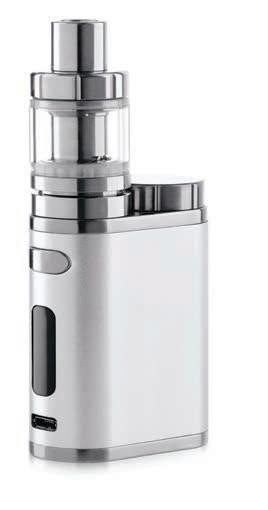
Vaping, common among young people, is consistently linked to subsequent smoking, marijuana and alcohol use, finds a recent review of evidence. And it’s associated with heightened risks of asthma, cough, as well possibly pneumonia, bronchitis and other health issues.
—Tobacco Control

Eating three servings of french fries a week associated with a 20 percent increased risk of developing type 2 diabetes, but eating similar amounts of potatoes cooked in other ways— boiled, baked or mashed— does not substantially increase the risk, according to recent study.
—The

Drug treatment for people with newly diagnosed attention deficit hyperactivity disorder (ADHD) associated with significantly behaviors, substance The disorder of children worldwide.

MILLION kids with hypertension, found Academy of
—Compiled by

Patients are more likely to trust doctors and consider them more professional when they wear white coats, although women doctors in this attire are often misidentified as nurses or medical assistants, according to a review of available research. Patient preferences for doctors’ attire appear to be influenced by clinical context and medical specialty, with a of


The #1 Ranked Debate Academy in America
Locations in Glen Rock, Fort Lee, and Livingston
Practice public speaking with peers
Learn to speak up, think fast, and lead with confidence
Fun group debates; interactive critical thinking games
Beginners and competitive debaters alike
In-person AND online options
TuesdaySunday Nationally recognized students with 1000+ awards
trial classes available Scan the QR Code now!






The Terrace at Biagio’s Paramus, NJ

THURSDAY, APRIL 23, 2026 5:30 p.m. - 8:30 p.m.


By Jenna Demmer
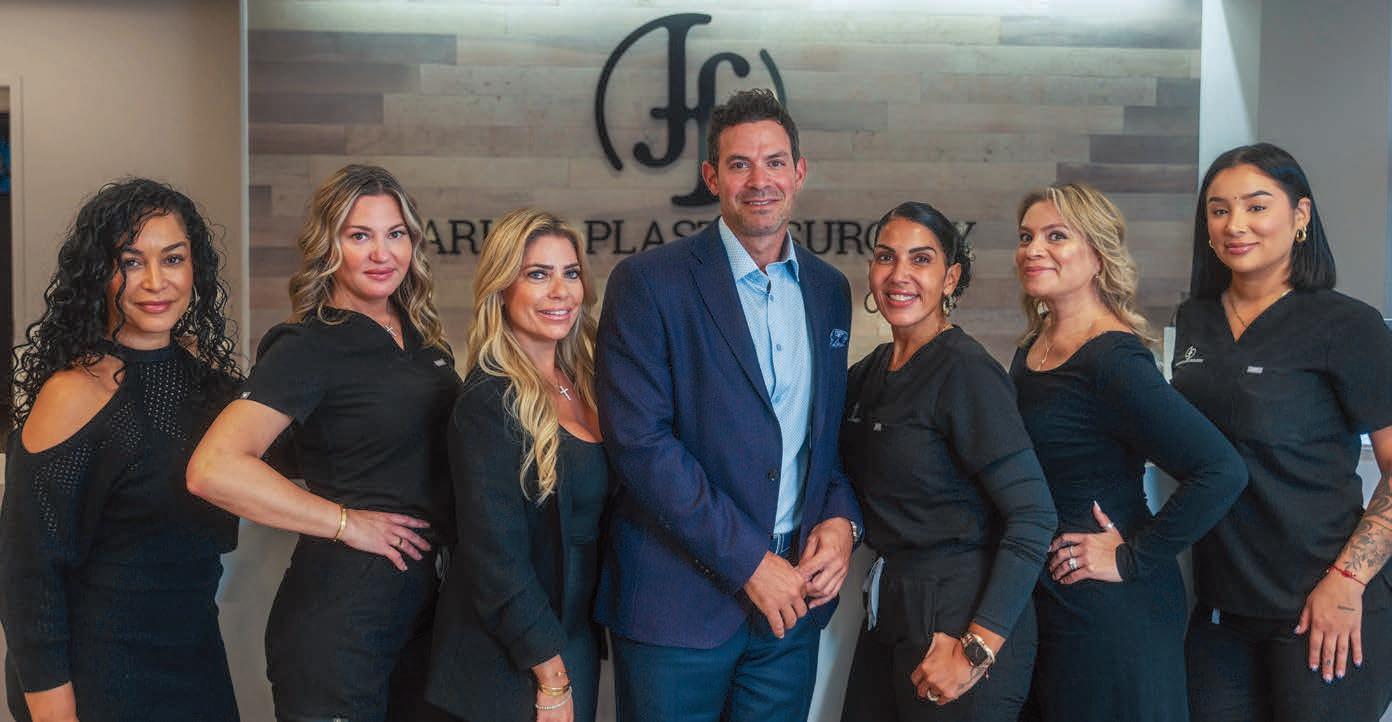
Board-certified plastic surgeon Dr. Jordan P. Farkas may have trained at University of Texas Southwestern Medical Center, but he has called Tenafly home for over a decade. He has long loved the “art of plastic surgery” and puts it into practice at Farkas Plastic Surgery and Medical Spa in Englewood Cliffs. We touched base with Dr. Farkas to learn more.
What kind of services does a medical spa offer?
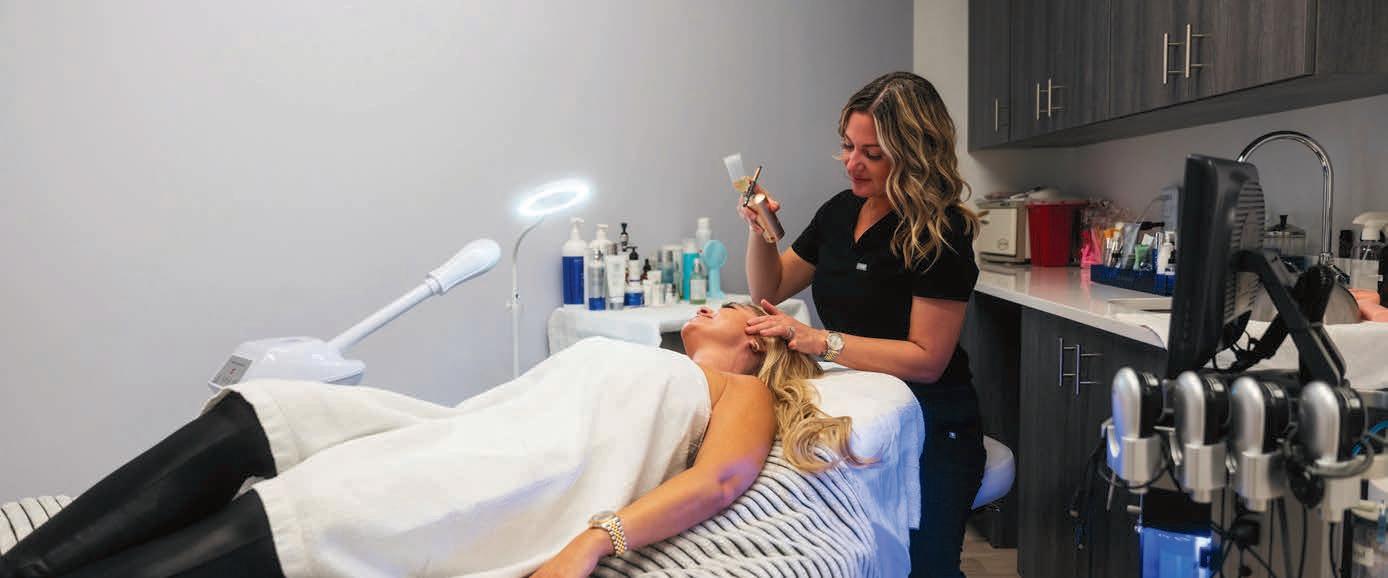
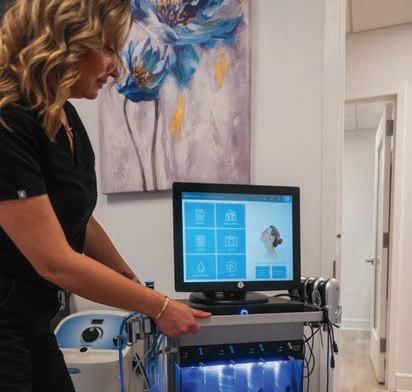
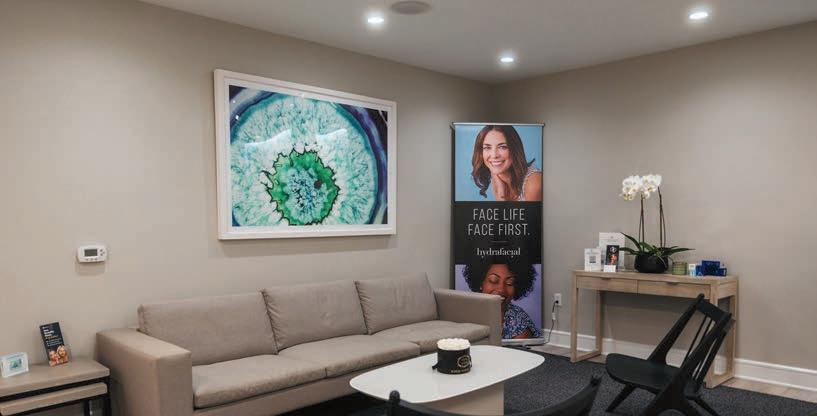
A medical spa usually provides all aesthetic services, ranging from facials and hydrafacials to other skin treatments like microneedling or laser procedures, as well as laser hair removal and other skin ablative techniques. Some medical spas also provide injection services, which I provide by myself, which is really through my surgical practice, more than the medical spa aspect.
What are the most common procedures people seek from your practice and has this changed over the years?
I do a very high number of breast reconstructions for cancer. As far as the cosmetic surgery procedures, that ranges from facelifts to rhinoplasty to body contouring operations like mommy makeovers, including tummy tuck and breast procedures. The injection portion of my practice with Botox and fillers is a very large adjunct.
Noninvasive procedures done through the medical spa, as well as injections, have really skyrocketed over the last five years or so. Patients are much more interested in a no-downtime or recovery procedure, as well as nonsurgical options.
Tell me what potential patients can expect from the consultation process. I won't recommend anything to the patient. I specifically need the patient to discuss with me what their needs and desires are. Then, as a plastic surgeon, I’m able to tailor their care and provide them with the best possible options. It's an entirely personalized consultation process that is best and optimal to get the results they’re interested in.
What do you like most about being a plastic surgeon?
I love the artistry, challenge, and patient care aspect of plastic and reconstructive surgery. Plastic surgery is unpredictable and different every day. It offers the opportunity to perform surgery over the entire body. It is not limited to one anatomical area.
Why did you locate your practice in Englewood Cliffs?
Englewood Cliffs gives very good proximity to New York City, where my wife works, and proximity to where I live, which is in Tenafly, [and] easy access to the hospitals that I do most of my operating at.
Dr. Jordan P. Farkas
Farkas Plastic Surgery
&
Medspa
920 Sylvan Ave., Suite 230
Englewood Cliffs, NJ 07632 (201) 587-4961
PLAY HARD ON SATURDAY AND SUNDAY FOR PEAK GAINS, NOT PEAK PAINS. A BERGEN DOCTOR SHARES TIPS.


Between powerful kicks and flashy footwork, the action in Carlstadt’s Sunday morning 30-and-over men’s soccer league sometimes comes to a sudden stop. But it’s not always to admire a slick move. Sometimes it’s because someone’s down, nursing a sudden injury. For many busy adults, carving out time for regular exercise during the work week feels impossible. Commutes, deadlines, business Zooms, school dropoffs and late-night emails interfere with structured daily workouts. But two obvious remedies pop up in the minds of those who aspire to stay active and fit: Saturday and Sunday. These individuals personify what’s called the “weekend warrior” syndrome. BERGEN recently spoke about it with Joseph Cappadona, M.D., an orthopedic surgeon at Summit Health in Fair Lawn.
• WARRIORS’ GAINS. “The weekend warrior phenomenon is very common as people are becoming more and more health conscious,” says Dr. Cappadona. Indeed, the National Institutes of Health says between 1 and 3 percent of American adults can be classified as weekend warriors. They follow a largely sedentary Monday-through-Friday schedule, then one or two days crammed with intense activity: autumn hikes, 10K runs, group cycling rides, pickup football games. Even raking clean a large, leaf-filled yard can qualify as a burst of activity that would be foreign to their weekday selves.
While it may seem like a compromise, recent research suggests that this condensed approach to exercise isn’t just better than nothing—it can deliver serious health benefits. A study in the September 2024 Circulation, a journal from the American Heart Association (AHA), associated weekend warriors with lower
risks of hypertension, diabetes, obesity and sleep apnea, among other ailments, when compared with less active folk. The AHA recommends 150 minutes of moderateintensity physical activity each week.
Muscle building also can benefit from a weekend-focused approach, especially when workouts include compound movements such as squats, lunges, pushups and deadlifts. High-intensity strength sessions with adequate rest between them can still promote muscle growth, bone density and improved metabolic health— even if they’re limited to weekends.
Still, there are risks.
• WARRIOR WOES. Though strenuous weekend-only exercise may meet AHA guidelines, it’s not without downsides, particularly for those jumping into intense activities without proper preparation. Sudden bouts of high-intensity exercise can lead to strains, sprains or overuse injuries, particularly in joints such as the knees, shoulders and lower back.
Dr. Cappadona notes that “high-impact activities that require running, jumping or pivoting as well as overhead-throwing sports or racquet sports” pose the greatest risk for injury among weekend warriors such as the Carlstadt soccer crew.
“I commonly treat weekend warriors for ailments and injuries, particularly on Mondays,” he adds. “These injuries range from minor sprains and strains that typically respond well to conservative treatment to tendon and ligament r uptures or fractures that could require surgical intervention.” Dr. Cappadona’s past weekend-warrior patients have been treated for ankle sprains, knee sprains (ACL, or anterior cruciate ligament, injuries) or meniscus tears, aggravation of knee arthritis, rotator-cuff strains or tears, Achilles tendon ruptures and biceps tendon ruptures.
There’s also a higher risk of cardiac events in sedentary individuals who suddenly engage in vigorous physical
activity. Although regular exercise is protective for heart health in the long run, sporadic intense exertion—particularly in middle-aged or older adults with existing risk factors—can pose a danger.
• SAFE WEEKENDS. If the weekend warrior lifestyle is one’s best option for staying active, it can absolutely work. Even if one has little time for exercise during the week, Dr. Cappadona says, regular body maintenance is a must.
“Maintain a healthy diet during the week and control your weight,” he says. “Stay flexible with stretching and maintain good core strength. Try to get a good night’s sleep each night even when the stresses of a job try to get in the way.”
And when it’s time for that weekend activity, it’s imperative to hydrate before, during and after exercise and warm up the body. Our expert recommends sleeper stretches for the shoulder, planking for core strength, leg lifts for quadriceps strength as well as calf stretches and light jogging in place.
Rest and recovery are important after exercise, especially as one ages. “Fifty-yearolds will typically not recover as quickly as they did in their 20s,” the doctor says. “Replace fluids and electrolytes after vigorous activities, and control inflamed or irritated joints with rest, ice, compression, elevation and gentle stretching.”
His most important tip for weekend warriors: Know your limits.
“It is important to avoid pushing through painful exercises or activities as this can exacerbate underlying problems such as knee arthritis,” he says. “The biggest myth is ‘I can still do everything I did in high school.’ While there are certainly some people who are in better shape in their 40s than they were in high school, bodies change, and we have to realize that. Do not be afraid to push yourself, but know your limits. With a little wisdom you can still go nuts on the weekends and burn off some stress and calories.”
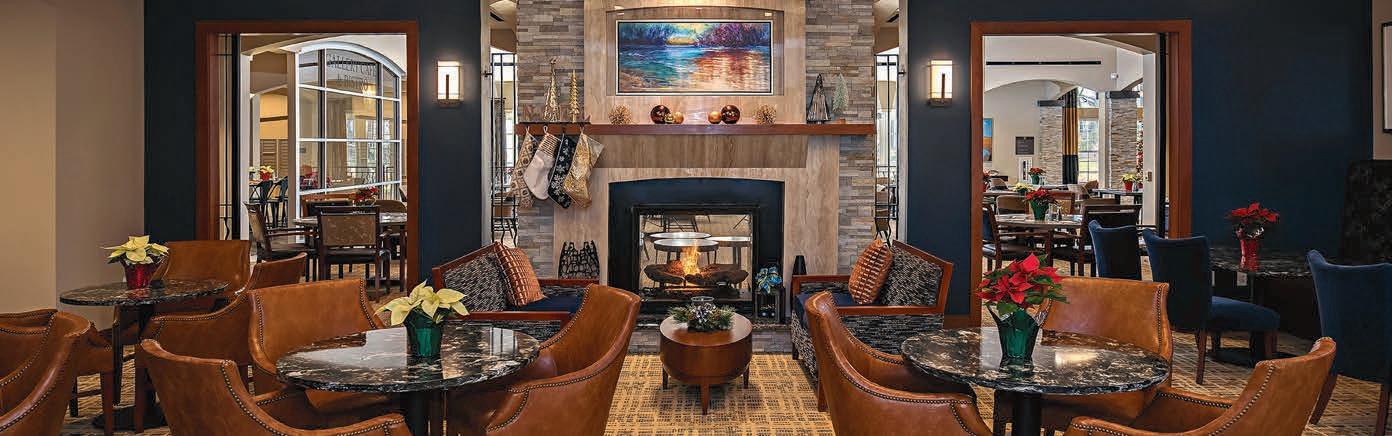
At The Vista, life is beautifully simplified.
With maintenance-free living, housekeeping, lock-and-leave travel freedom, on-site dining, and more, you’ll have more time for what you love.
Resort-style living becomes your everyday with exquisitely-detailed apartment homes, covered parking, on-site storage, multiple culinary options, a performing arts center, fitness and wellness spaces, an indoor pool, and a wide variety of clubs and classes.
And with the reassurance of Christian Health’s continuum of care, you’ll enjoy peace of mind knowing support is here if your needs ever change.
Why wait? Discover Bergen County’s most intimate and exceptional continuing care retirement community today.
To arrange a tour and receive event



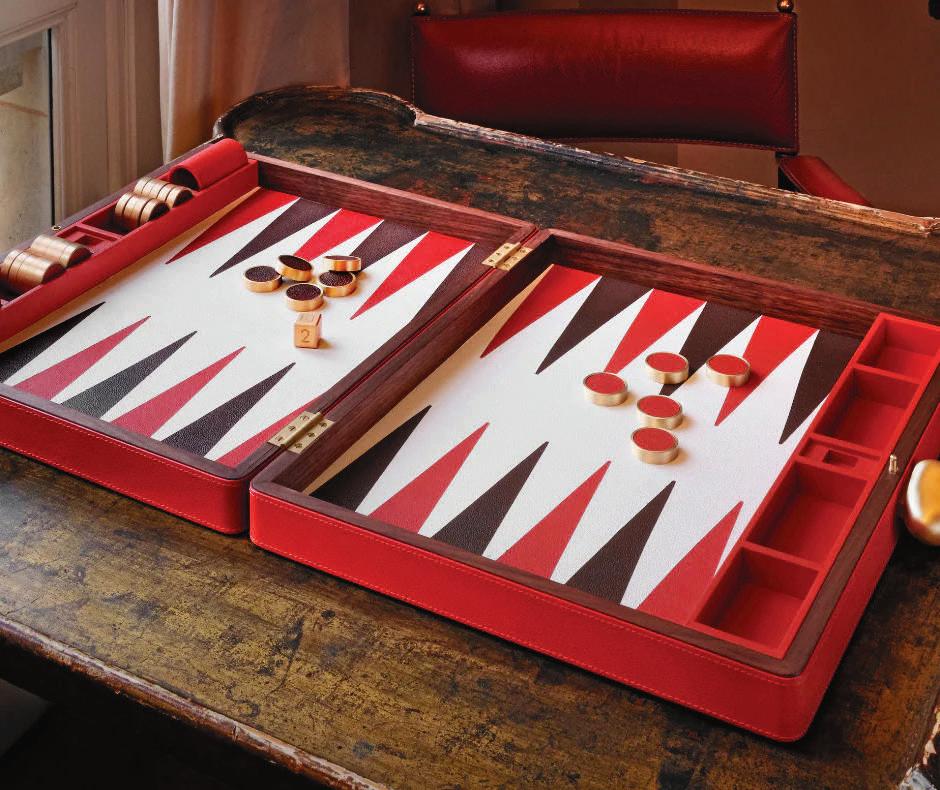

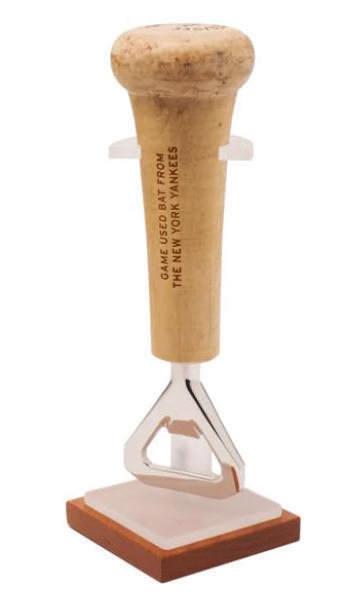
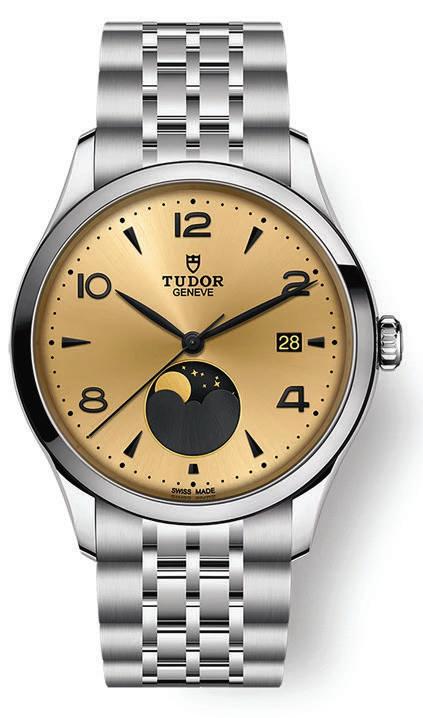
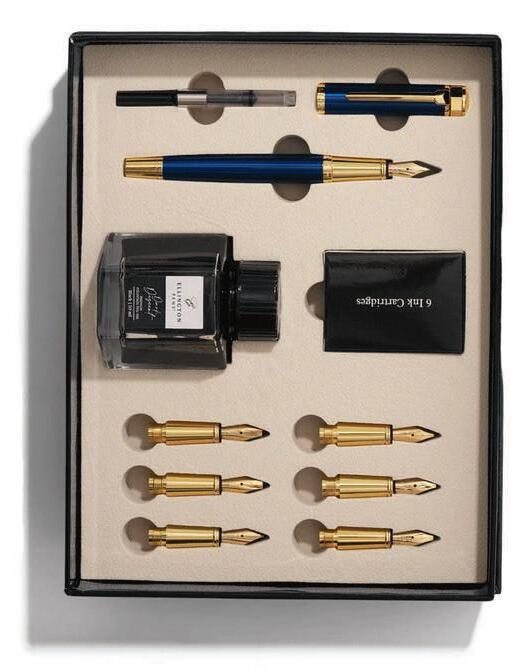

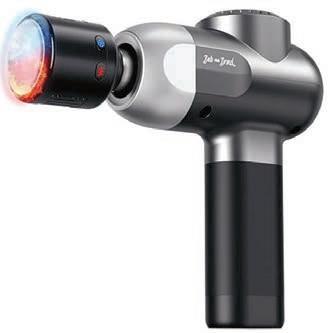
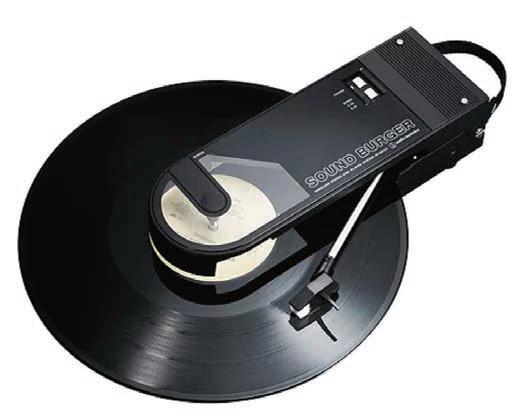
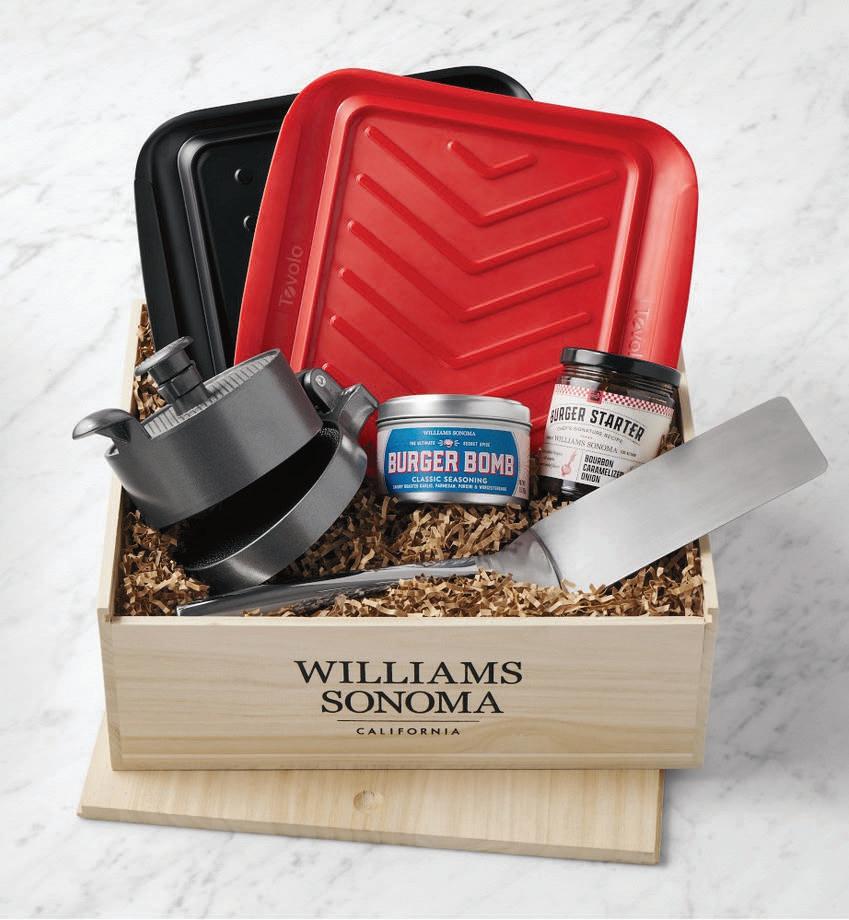
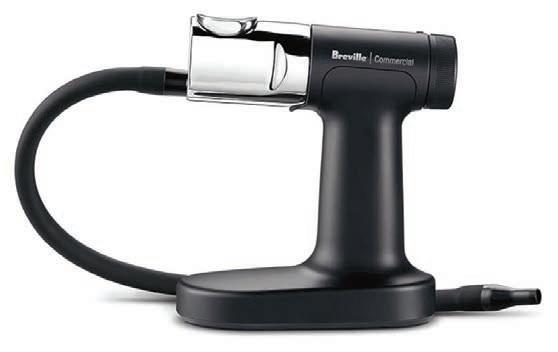
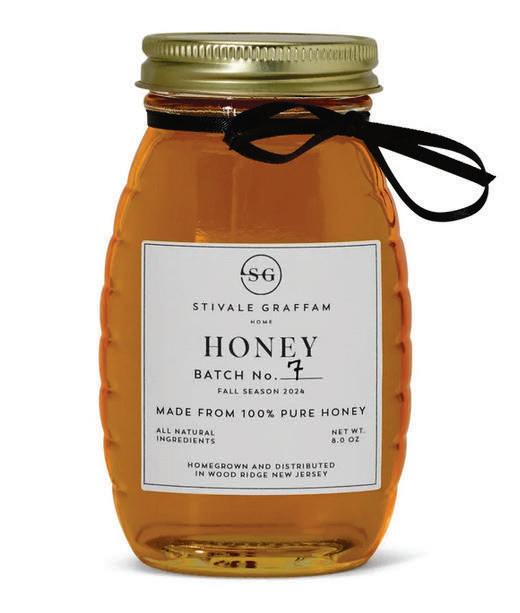





Marble Honeycomb Wine Chiller Williams Sonoma, Montvale, 201.326.0168


Check Cashmere Scarf Burberry, Paramus, 201.518.0082
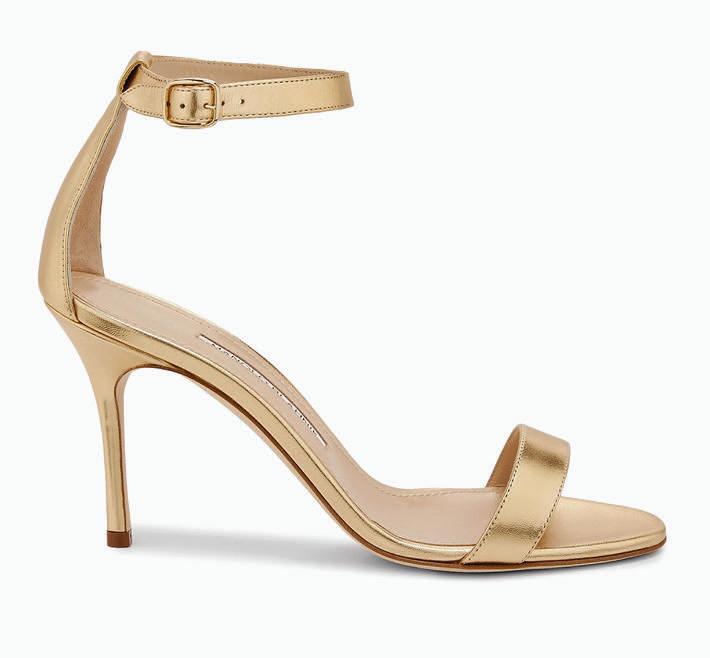
Manolo Blahnik Chaos Metallic Leather Sandals Saks Fifth Avenue, East Rutherford, 201.559.7780
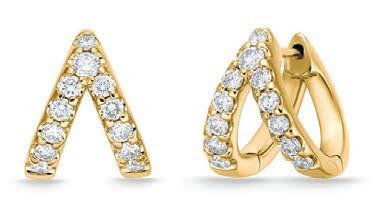
18K Yellow Gold Diamond Earrings LaViano Jewelers, Westwood, 201.664.0616

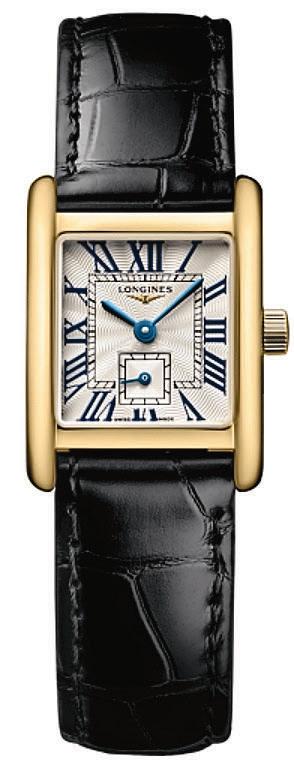
Longines Mini DolceVita Watch The Timepiece Collection, Englewood 201.894.1825

Hermès Fragrance Replica Discovery Set Sephora, multiple locations
Paramus, 201.368.0456
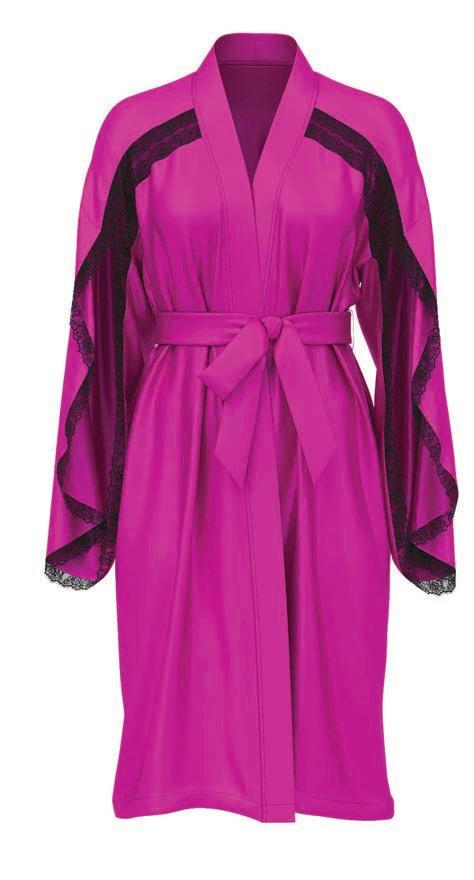


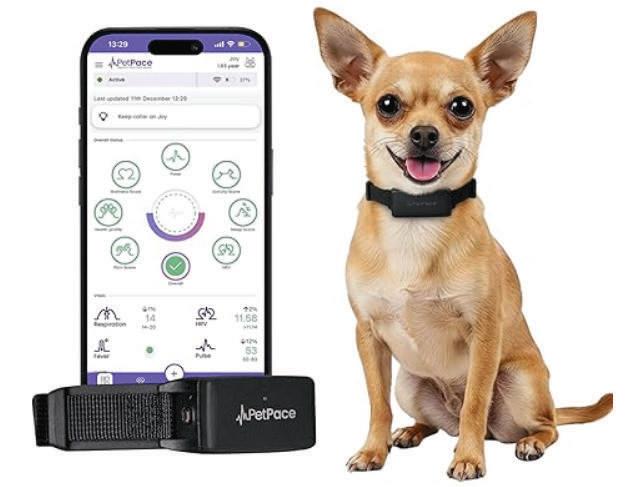
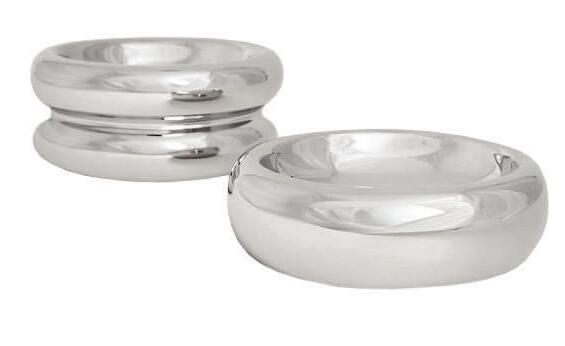







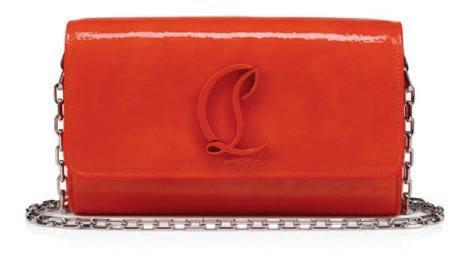
The season’s hottest looks are designed for crisp days and stylish nights—and everything in between.
Party Time
Tank top and pants by Retrofête, retrofete. com. Bag by Christian Louboutin, Neiman Marcus, Paramus, 201.291.1920. Sunglasses by Bottega Veneta, Saks Fifth Avenue, East Rutherford, 201.559.7780. Jewelry by Dripping in Gems, drippingingems.com.


Blazer, sweater and skirt by Ser.o.ya, Neiman Marcus, Paramus. Belt by Christian Louboutin, Saks Fifth Avenue, East Rutherford. Boots by Gianvito Rossi, Gito, Englewood, 201.541.7330.



Jacket by Veronica Beard, Nordstrom, Paramus, 201.843.1122. Sweater and pants by Simkhai, Saks Fifth Avenue, East Rutherford. Shoes by Gianvito Rossi and bag by Jimmy Choo, Gito, Englewood.


Nothing sparks the imagination and magic of the season more than the comfort of a fireplace.
Kristen Sawyer Sawyer Interiors, Hillsdale
Is there anything that brings us more joy than an image of Santa sliding down the chimney to deliver presents? But a fireplace is more than the entryway for Jolly Old St. Nick—it’s a physical and spiritual symbol of a home’s warmth. From the sight of stockings hanging from the mantel to the sounds of crackling flames to the fresh scent of a burning Yule log, a fireplace is a true treat for the senses this time of year. It’s no wonder that this living-room staple is so often associated with the magic of the season.
On the pages that follow, we share a collection of fireplaces that are sure to spark your festive spirit, with tips from interior designer Kristen Sawyer of Hillsdale-based Sawyer Interiors on how to make yours feel warm and festive.
The story of Santa Claus coming down the chimney on Christmas Eve dates back centuries. That legend still lives on today, as hopeful children still wait by the fireplace in anticipation of Santa’s arrival and “catching” him as he stuffs stockings and leaves presents under the tree. Beyond stockings, adorn a mantel with candles or lights. “When choosing white lights make sure your color temperature is warm, especially if your lights are LED,” says interior designer Kristen Sawyer. “Some simple greenery with lighting is all you really need—don’t overthink it!”

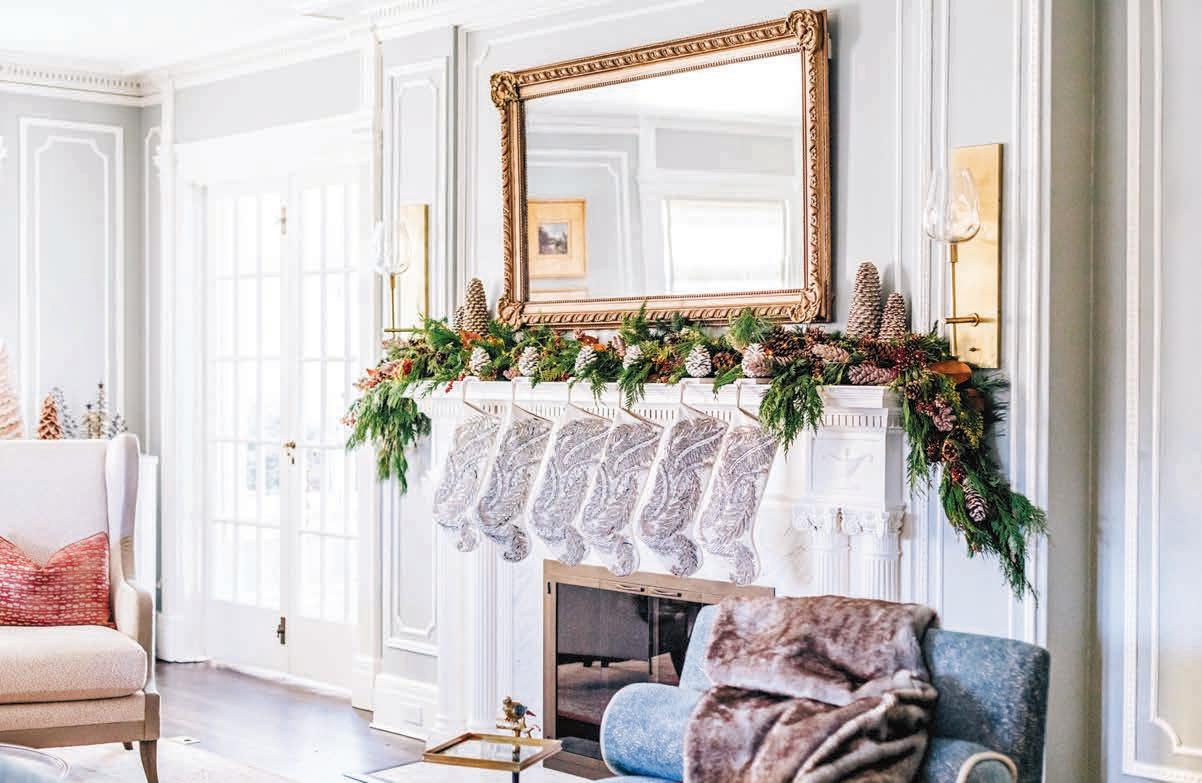

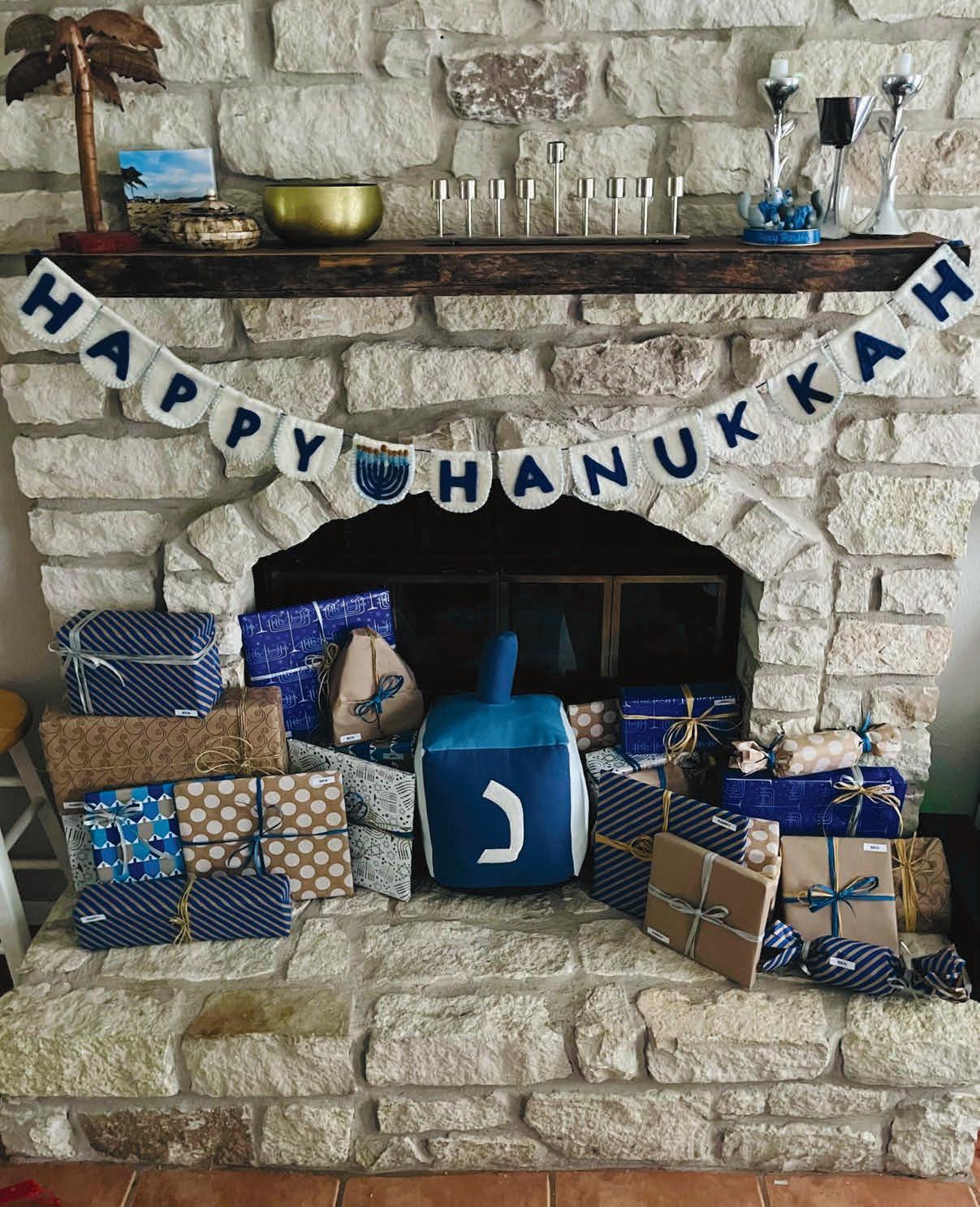
This page: Decorating a fireplace, whether its modern or traditional, during the holidays is a tradition many families enjoy. Garland, stockings and candles, among other décor, around the hearth always lend to the vibe. “Scale is key,” Sawyer says. “Choose a statement piece rather than many smaller pieces. This will create a focal point rather than visual clutter.” Opposite page: When it’s not lit, the hearth can double as extra seating in the living room or a convenient spot to place decorations for any occasion. It’s also a place to introduce color into the space. Use traditional holiday hues like red and green or blue and silver—or try something different. “Jewel tones are perfect for the holidays,” Sawyer says. “Amber, burgundy and olive paired with mixed metals are festive and a bit more elevated than classic red and green.”
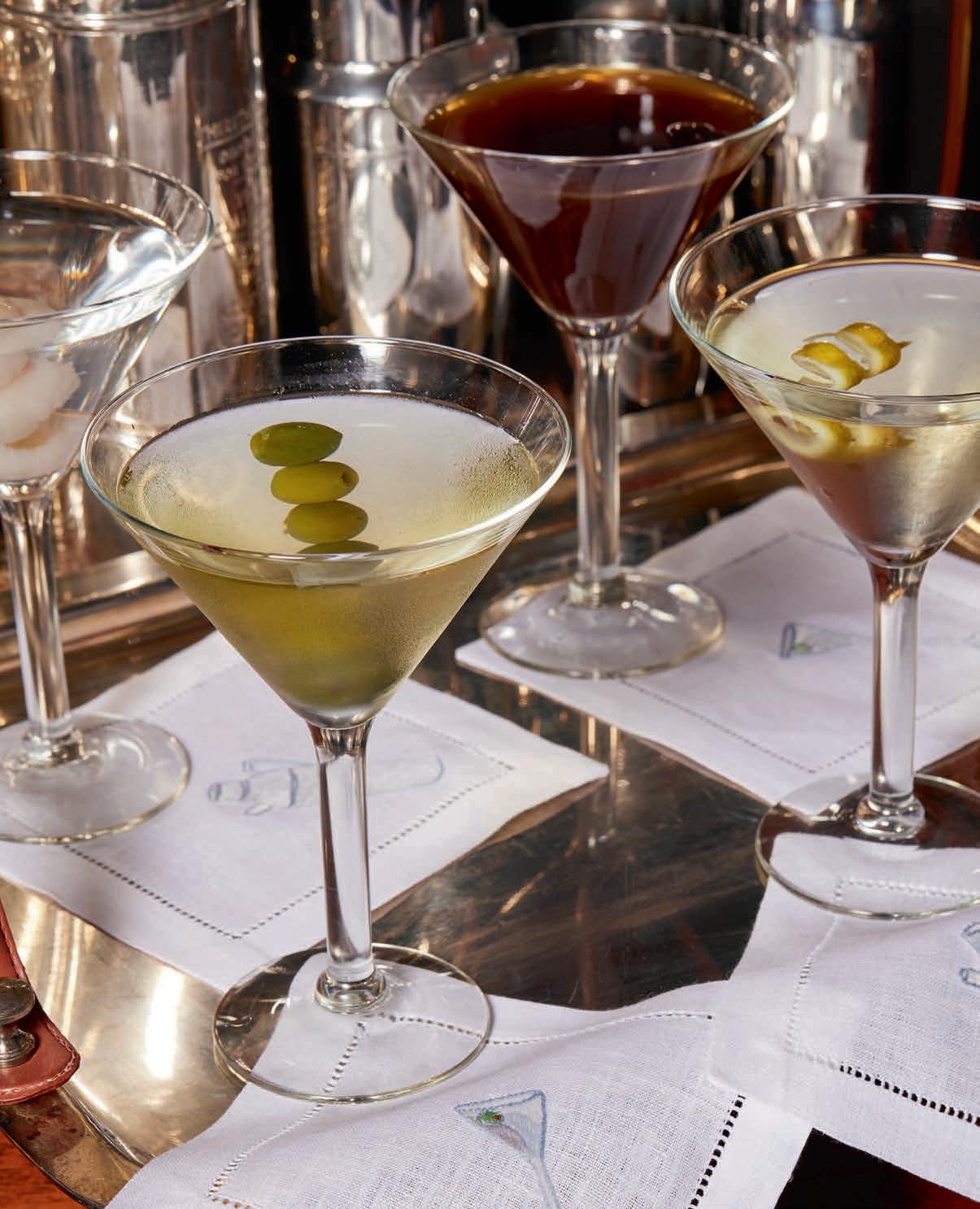
Why not celebrate the season with an unforgettably chic martini soirée?
As end-of-the-year holidays approach, the moment calls for celebration—with style, sophistication and just the right pour. Thus it may be time for a martini party. Equal parts elegance and indulgence, it’s the perfect way to gather a well-dressed crowd, shake up tradition and raise a glass to the year that was. From crisp, minimalist glassware to top-shelf spirits and fashion-forward flair, the modern martini soirée is less about formality and more about effortless glamour.
The keyword is “effortless”—this bash need not add to holiday stress. “A martini party doesn’t require extensive planning or a complicated menu—it naturally exudes an air of classic chic,” says Christine Figliuolo, founder of Wyckoff-based Creations by Christine Events. “The focus is on a signature drink, allowing for a more streamlined approach to food and décor, which makes it easy for hosts to execute.
At the same time, the iconic nature of the martini and the era it evokes instantly elevates the atmosphere, making the gathering feel sophisticated and special.”
Want to host your own martini party? “Focus on elements that evoke a classic, chic vibe,” Figliuolo says. “Stick to a sophisticated color scheme, such as black, white, silver and gold, with a pop of deep jewel tones like emerald green or sapphire blue. Dim lighting with strategically placed accent lights can create a swanky lounge feel. Consider string lights, candles, or uplighting in corners.”
Explore the following pages for more tips from Figliuolo and images from Swing By! Entertaining Recipes and the New Art of Gathering (Rizzoli New York, 2024), in which author and entertaining guru Stephanie Nass used the idea to turn a get-together at Manhattan’s Salmagundi Club into an extraordinary occasion.

Serves 8
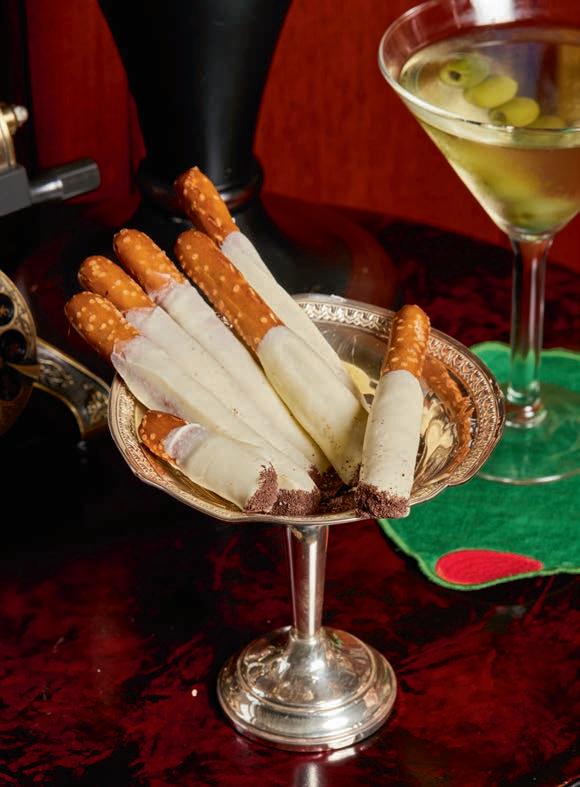
“In a nod to a former time when cigarettes accompanied martinis, I wanted to create the closest thing: a trompe l’oeil cigarette made with pantry ingredients,” says entertaining guru Stephanie Nass. “Guests appreciated the humor and, ultimately, the toothsome confection.”
I N G R E D I E N T S
4 Oreo cookies, white filling discarded and cookies blitzed in a food processor until dusty
1 Tbs. sugar
16 (4-inch-long) pretzel rods
1 (12-oz.) bag white chocolate chips
D I R E C T I O N S
1. Line a baking sheet with parchment or wax paper.
2. Mix the Oreo dust with the granulated sugar in a small bowl. This will be used for the “ashes.”
3. Put the chocolate chips in a tall microwave-safe drinking glass and melt in 30-second increments on normal power, stirring well after each increment, until fully melted.
4. Dip the rod into the melted chocolate three quarters of the way up the pretzel. Shake off
any excess chocolate so that the chocolate generally maintains the shape of the pretzel.
5. Dip the tip of the chocolatecoated pretzel into the “ashes.”
6. Lay each coated pretzel on the prepared baking sheet and allow to cool. Once cool, arrange the rods on a serving platter or in a jar.
If you like, put any remaining Oreo “ashes” in a small dish to be the “ashtray” and place beside the “cigarettes.”
This page: As host of a swanky soirée, entertaining expert Stephanie Nass channeled the spirit of 1970s Cher and wore gold head to toe. “Encouraging guests to embrace a semi-formal or cocktail attire will elevate the entire event,” says Wyckoff event planner Christine Figliuolo. “For women, think elegant cocktail dresses, sophisticated jumpsuits or chic separates. Accessories like statement jewelry or a stylish clutch can complete the look. For men, a sharp suit, a blazer with dress pants or a collared shirt with a tie would be appropriate.”
Opposite, from left: Before they’re used as garnish for cocktails, neatly stacked martini olives can serve as festive décor. Keep food options refined, bite-sized and fun, such as pretzel cigarettes. Figliuolo recommends “elegant, easyto-manage bites that complement the cocktails,” including hors d’oeuvres such as miniature quiches, smoked salmon canapés, gourmet cheese-and-cracker assortments and olive tapenade crostinis.



Serves 8
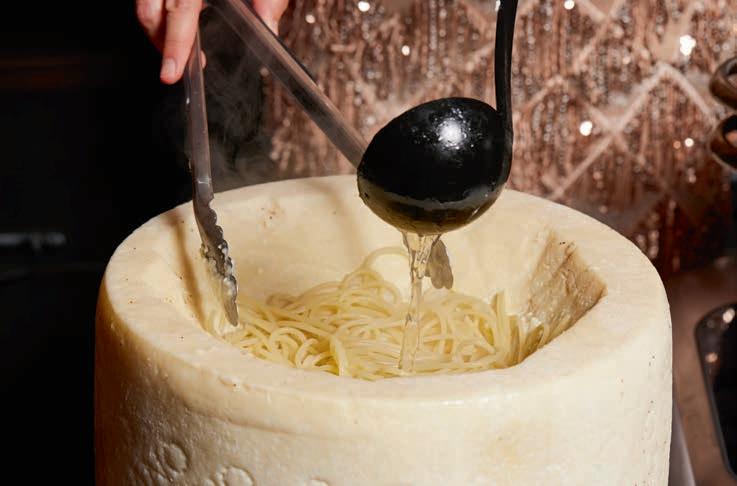
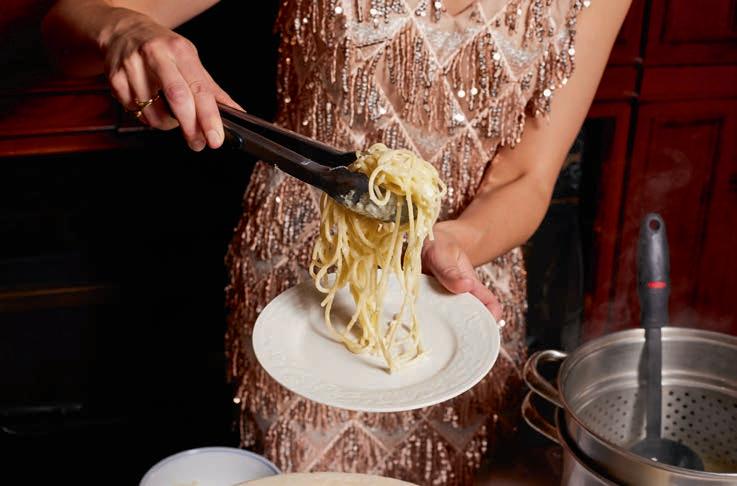
“I love dishes that are theatrical and incorporate their preparation into how they are presented,” says Nass. “Preparing this pasta dish in a giant wheel of cheese in front of guests is a wow. You can source the wheel online, from a food distributor, or (with enough advance notice) potentially from your local grocer. After the event, you can grate and freeze the cheese for future use.”
I
60-lb. wheel Pecorino Romano, hollowed out at the top to form a bowl shape (approximately 2 to 4 inches deep; use pieces removed to grate)
3 lbs. spaghetti, cooked until almost al dente and tossed in olive oil salt
2 cups Pecorino Romano, freshly grated black pepper
D I R E C T I O N S
1. Move your cheese wheel so it is beside your pasta pot and visible to guests.
2. In a pot of boiling salted water, reheat individual servings of cooked pasta for 1 to 2 minutes. As the pot boils down and water runs lower, you can add additional water (and salt).
3. Using tongs, transfer the reheated pasta to the well of the cheese wheel. Add ½ cup pasta water and a sprinkle of the grated cheese. Toss the pasta around the well until it is coated with a slippery cheese sauce.
4. Transfer the pasta to a plate and freshly crack black pepper over the top. Serve immediately. Continue this process until all guests are served.
Serves 16
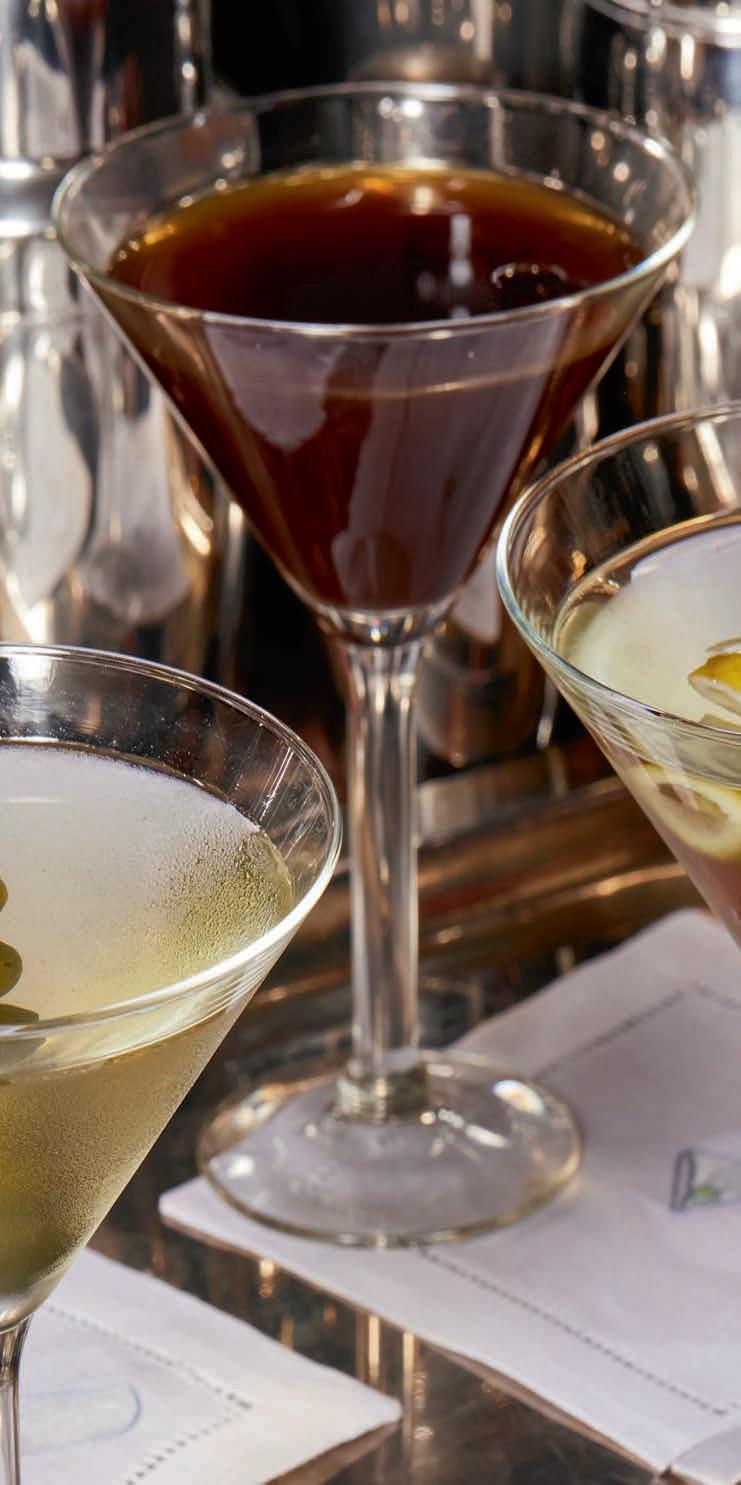
“Bartenders are generally well equipped to make perfect, artisanal espresso martinis with fresh foam,” says Nass. “At a party, when you want to pre-batch and prepare as much as possible in advance, it’s a different story. Use cold brew concentrate if you are batching this or freshly pulled espresso if you are making everything à la minute.”
I N G R E D I E N T S
2 cups plus 2 Tbs. vodka or coffee-infused vodka
1 cup plus 2 Tbs. fresh espresso or cold brew concentrate
1 cup coffee liqueur
½ cup plus 2 Tbs. Demerara syrup
2 Tbs. vanilla extract
ice
16 coffee beans for garnish
D I R E C T I O N S
1. Before guests arrive and to batch prepare this recipe, combine the vodka, cold brew concentrate, coffee liqueur, syrup and vanilla. Refrigerate up to 12 hours in advance.
2. When making each drink to serve, fill a cocktail shaker with ice, stir the mixture and add 2½ ounces to the shaker.
3. Shake for 20 to 30 seconds so that the natural oils from the ingredients combine with air bubbles and form foam. Strain into a martini glass.
4. Garnish with coffee beans, simply sprinkled on top.
Ficiunditi od que nimporem sitatus doluptat. Um auta ni doluptae sam, te consequae ne nossequat plibus maio modi nis vent, to ditatis quament dusandem restior ibusanto dia sus sinctusdam ea dio. Ut qui volorit exerferio intiassimus sandaectur, ut volent exerro entiorem int harum eos es conseque dolendus, nempor re labores endundi psant, verrorum autamet acest faceaquam, conecto tem et fuga. Pore et latem qui ipsam et, ese pe nonet, ea pedis ut atibus, unt. Uptaepe liquiae et aceperi ossitae velessed mi, volorporis de cuscim lam Parumet volori as ea et
All recipes and images are reprinted with permission from Swing By! Entertaining Recipes and the New Art of Gathering by Stephanie Nass (Rizzoli New York, 2024). Photography by Rommel Demano.
It’s the end of the year—I mean the very end of the year, the ball-dropping, last-square-on-the calendar finale—and I’m once again crunching to make my charitable donations before the fireworks flare and the first notes of “Auld Lang Syne” are struck up. I give for the reasons most of us do—I look at the world, see all the broken places, and hope that I can help to fix at least a few of them. And I give at the last minute because I’m a habitual procrastinator who nevertheless wants to take advantage of the Internal Revenue Service’s current-year tax deduction for charitable giving. But lately I’ve begun to wonder if there might be a better way—one that would allow me to give without the attendant stress, and maybe even give more. And in this I suspect I’m not alone. As a whole, Bergenites are a charitable bunch. By one metric, known as the contributor index—arrived at by dividing the number of residents who list charitable donations on their tax returns by the total number of residents who file tax returns—we’re the fifth most generous county in New Jersey. On the other hand, we’re the state’s fourth wealthiest county,
and we have the state’s highest amount of disposable income (and the country’s tenth highest), so we’ve got a lot of Benjamins lying around that could be doing more good in the world. And so we have to ask ourselves, as I’d asked myself: Could we be more efficient—and yes, even more generous—givers?
The answer, according to Stephanie Burke, an Oakland-based, advice-only financial advisor, is yes—for most of us. “When it comes to charitable giving,” she says, “the more the IRS allows you to deduct for tax purposes, the more money you have in your pocket and the more you’re then able to give.” But taking a charitable deduction is about to get a lot more complicated. What you should know:
• Decide whether—and when—to itemize. If you’re among the 90 percent of taxpayers who don’t itemize deductions, you won’t be able to deduct your charitable contributions in 2025. But starting next year, thanks to what the Trump Administration called the One Big Beautiful Bill Act (OBBBA), individuals
Wishing you could give more—or more effectively— to the causes that matter to you? Here’s how.
BY LESLIE GARISTO PFAFF
filing singly will be able to deduct up to $1,000 and couples filing jointly can deduct up to $2,000. If you don’t plan to itemize this year or next, says Burke, “you might consider donating on Jan. 1 of 2026 rather than in 2025, because then you can take the charitable donation.” (She notes that this only applies to cash donations and not non-cash items such as clothing and furniture.) If you don’t itemize but make large charitable contributions, Burke suggests you consider bundling—combining several years’ gifts in a single year and itemizing your deductions in that year. Keep in mind that the OBBBA will also affect those who regularly itemize their deductions: Starting in 2026, itemizers will be allowed to deduct only those amounts that exceed 0.5 percent of their adjusted gross income (AGI). If your AGI is $100,000, say, and you’ve given $5,000 to charity, $500 of those donations won’t be deductible.
That’s the hard-cash part of the equation, but there are also ways to make giving easier without that


extra cash in your pocket. You can:
• Sign up for automatic contributions. Virtually all charities will allow you to donate a specific amount each month, automatically charging that amount to your bank account or a credit card.
Richard Kaufman, a resident of North Arlington, for example, makes a monthly donation to the Wounded Warrior Project, which provides aid of all kinds to wounded veterans and their families; he also plans to start donating monthly to the Tunnel to Towers Foundation, which supports veterans as well as first responders injured on 9/11. “I’m a wounded warrior myself,” he says, explaining his choice of charities. He finds it easier to give monthly, noting that suggested monthly donations to Tunnel to Towers start at $11, a very manageable amount for him and his wife, Michele. (Your employer may also allow you to make a monthly donation through a payroll deduction; to find out if that’s an option, contact your human resources department.)
• Look for matching donation challenges. These fundraising initiatives enlist corporate or other wealthy donors to match gifts dollar for dollar, effectively allowing you to double your gift. They’re most likely to occur on Giving Tuesday—the Tuesday following Thanksgiving—or at the end of the year.
The IRS itself offers a number of ways you can maximize your charitable donations, beyond simply deducting them on your tax return. They include:
• The qualified charitable distribution (QCD). If you have a retirement account such as an IRA or a 401K, you’ll have to start withdrawing a so-called required minimum distribution (RMD) at a certain age—most likely 73. Normally you’d have to pay tax on whatever amount you withdraw, but by making a QCD, you can donate some or all of your RMD to charity, tax free. “I absolutely love this idea,” says Burke. “It’s like free money.”
• The charitable remainder trust (CRT). If you’ve done well in the stock market and want to spread some of that wealth around, consider a CRT. When you donate stock to the trust, you’ll receive a partial tax deduction, as well as an income stream—generally, a percentage of the property in the trust—for the rest of your life. When you die, the remainder of the
nonprofit America’s Charities, one in three people surveyed said a match would encourage them to give more. You can match donations dollar for dollar or at a percentage. For more information, go to America’s Charities (charities.org) and search “matching gift programs.”
• Donate goods or services. This can also lower your taxes. And, says Moss, “It can help to boost employee morale.” Matt Coolidge, for instance, is the owner of Units, a moving and portable-storage company that serves northern New Jersey. This year, he was the recipient of Bergen Volunteers’ Excellence in Corporate Social Responsibility award for his extensive corporate giving, including the donation of containers to the nonprofits Bergen Volunteers and the Jewish Federation of Northern New Jersey. “My wife and I believe that the world can work for everybody,” he says, “so we get ourselves involved in helping people improve the quality of their lives.”
“When it comes to charitable giving, the more the IRS allows you to deduct for tax purposes, the more money you have in your pocket and the more you’re then able to give.”
—Stephanie Burke, financial advisor, Oakland
fund will go to your designated charity or charities.
• See if the company you work for will match your donations. Check with your human resources department or use an online search tool like Open Secrets (opensecrets.org).
• Include in your will the charities that matter most to you. There are several ways to make what are known as charitable bequests, including giving a fixed amount of money or a percentage of your estate’s total value.
We can also give more efficiently, says Roger Moss, a financial advisor with the Montville Group who has many clients in Bergen County, by choosing the most efficient charities—those that use the vast majority of your donation to help people rather than to run the charity or raise money. To do that, you can:
• Vet your charity before you donate. Nonprofit charity monitors like Charity Navigator (charitynavigator.org) and Charity Watch (charitywatch.org) rate nonprofits based on the percentage of donations that go directly to the causes they’ve pledged to help versus the percentage that go toward administrative costs. Be aware, warns Moss, that some very well-known nonprofits don’t necessarily get high ratings, so it’s critical to do your homework before you give.
• The donor-advised fund (DAF). DAFs, sponsored by nonprofit organizations, allow you to shelter highly appreciated assets—stocks, for instance—from capital gains tax. You can donate to the funds now and decide down the line which nonprofits you’d like to contribute to. Burke recommends consulting a financial advisor before committing to a DAF, to find out whether you’re eligible and learn about possible advantages and disadvantages.
Whether you run a one-person operation or head up a large corporation, giving to charity through your business is another way to increase charitable impact. As a business owner, you can:
• Give cash. This can help lower your business taxes. If you’re an individual proprietor, you can deduct gifts up to 60 percent of your adjusted gross income. Corporations can deduct up to 25 percent of their taxable income.
• Match employee donations. You’ll not only be giving through your business, but you’ll also be giving more, by encouraging your employees to give. In fact, according to a recent survey conducted by the London-based international professional services network Deloitte, 84 percent of donors said they’d be more likely to give if the companies they worked for matched their donations. And in a survey by the
Last year, some 28 percent of Americans formally volunteered their time to causes they cared about. Compared with the 73 percent who donated money, that first figure may seem low, but it’s often harder to give time than cash. If you want to give of yourself but worry you don’t have the time, consider some options:
• Give blood. Every two seconds, someone in America needs a blood transfusion, but only 3 percent of us actually donate blood. The process usually takes under an hour, and you can give once a year or every few months. To learn more, go to Red Cross Blood (redcrossblood.org).
• Volunteer online. It’s an option increasingly embraced by Gen Z, who see it as an obvious extension of their online lives, but volunteering online is a time-saving choice for anyone who wants to make a difference. To find opportunities, go to Catch a Fire (catchafire.org).
• Start—or stay—small. Micro-volunteering is a relatively new trend that allows you to give in small ways without committing more of your time than 15 minutes to a couple of hours. You might, say, sign on to send postcards or write thank-you notes for a nonprofit or work a phone bank for an hour or two. You can contact local organizations and ask if they offer opportunities to micro-volunteer or offer your time to nonprofits already recruiting micro-volunteers, such as United Nations Volunteers (unv.org), Translators Without Borders (translatorswithoutborders.org) and Project Gutenberg (gutenberg.org). Even if you give small, you’ll be able to face that new page on the calendar not with wistful regret, but with justified pride.

Each of five charming places presents a Christmastime that honors tradition and brightens the spirit.
Home is the classic locale for celebrating Christmas, Hanukkah and New Year’s, with chestnuts roasting on an open fire. But home has no monopoly on celebration—you’d be surprised what a brief trip can do as a change-up to bolster a mood of celebration. The five places here pull out all the stops for holiday splendor, old-fashioned charm and pure fun:
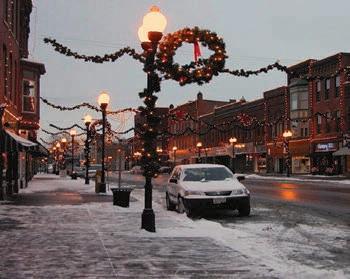
Tucked between Syracuse and Rochester in central New York, this town is a must-stop by if you’re a history buff (the women’s suffrage movement was born here in 1848) and filled with small-town charm. It also has a serious Christmas claim to fame—it’s the main inspiration for the fictional town of Bedford Falls, where the classic film It’s a Wonderful Life takes place. That’s fully embraced with the yearly It’s a Wonderful Life Festival, this year on Dec. 12–14, which transports guests back to that snowy day in 1945. Snap a picture on the bridge from the iconic opening scene and enjoy actor meet-andgreets, themed family activities, lots of vendors, costumed reenactors and a traditional ringing of the bells to close out the celebrations (and to give many, many angels their wings). Once you’re done there, you can check out nearby Wagner Vineyards and Wagner Valley Brewing Co. in Lodi, which boasts a warm, enclosed brew deck for stunning views of the freezing Seneca Lake while you sample craft beer and smallbatch wine.
Where to stay. The family-owned Barrister’s Bed & Breakfast looks like something plucked out of a Christmas picture book—distinctive Victorian architecture, cozy nooks, stained-glass windows and crackling fireplaces abound here. Gather with the other guests for breakfast in the chestnut-paneled formal dining room and stay in richly decorated suites with names like The Yellow Rose Room, Grandmother’s Room and Erin’s Retreat.
Where to eat. For award-winning food and service, stop by Perfect Pair Hospitality. This spot takes comfort food to the next level with a menu filled with loaded baked potatoes, smoked brisket, legendary sausage gravy and biscuits and fun takes on crepes. Dessert options include bread pudding, pumpkin cheesecake and house-made marshmallows. More info: discoverseneca.com
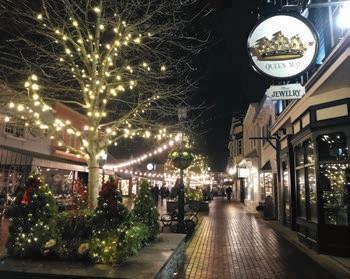
Where better to experience a Victorian Christmas than the town with the most Victorian homes in the state? Seaside glamour, fragrant garlands and trees, twinkling gaslights and warm hospitality combine here for a visit that’s both magical and transportive. On Dec. 13 and 20, Cape May Museums, Arts and Culture (MAC) holds its yearly candlelight walking tours of Victorian Cape May, where you can stroll along gaslit streets and visit homes, inns, bed-andbreakfasts, churches and hotels, with interiors decorated for the season and bursting with holiday warmth. The same organization creates an annual Old-Fashioned Christmas display at the Carroll Gallery at the Emlen Physick Estate, where a miniature town complete with moving trains spreads out under the boughs of a giant Christmas tree.
Where to stay. You’ll find even more holiday cheer at the Congress Hall Hotel, which bills itself as America’s first-ever seaside resort. It transforms into a “winter wonderland” during the holiday season, featuring a vendor village, a carousel done up in dazzling lights and a charming train for all to ride. On weekends, guests can have breakfast with Santa in the sweeping grand ballroom.
Where to eat. The mind behind the Ebbitt Room is Executive Chef Jason Hanin, the winner of the New Jersey Restaurant & Hospitality Association’s 2025 Chef of the Year Award, and you can taste that expertise in every bite. The menu is innovative (rabbit ragout, purple sweet potatoes with local honey and miso halibut are all featured), the ambiance is incredible (think dark wood paneling and leather seats) and the cocktails are seasonal and festive.
More info: capemaymac.org, capemay.com

This restored colonial village, one of the country’s most famous “living history” museums, will whisk you back to holiday time in the 17th century. In Colonial Williamsburg, garlands drape across doorways, madrigals fill the air and costumed actors model the daily life in the American colonies. Nearby, Jamestown Settlement’s “Christmastide in Virginia” shows the English origins of holiday traditions as they developed on this continent. It includes a Lord of Misrule, an individual chosen to preside over wild revelries, in a tradition that dates back to the Renaissance. About a 23-minute drive from Jamestown is Historic Yorktown, which looks like a living Christmas card during the holidays. Dec. 12 is the town’s Enchanted Evening on Main Street, where you can enjoy ice sculptures, holiday carols, roasted chestnuts and strolling musicians. Also nearby: Busch Gardens Christmas Town, the largest Christmas light display in Virginia. Where to stay. You’ll be in good company if you stay at the Williamsburg Inn. It’s the only hotel in the county that has housed the Queen of England—and it hosted her twice. Planned and designed by John D. Rockefeller Jr. and in operation since 1937, the inn features Regency style décor, a crackling fire in the reception room and a long legacy of luxury. If you book for the Christmas season, you’ll arrive to a bottle of wine and a plate of Christmas cookies in your room.
Where to eat. For even more refinement, try the Fat Canary, an upscale bistro known for its fine wine list, rotating seasonal menu and world-class service. Enjoy pork chops with goat cheese bread pudding and golden applesauce, duck breast with celery root and a cherry demi-glace and macadamia nut pie for dessert.
More info: visitwilliamsburg.com
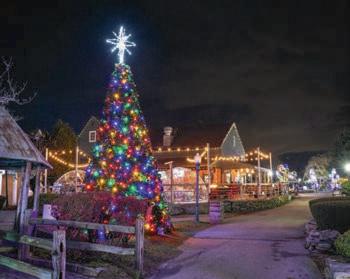
Tucked alongside the Mystic River and home of the largest maritime museum in the United States, this town is all old New England charm, and that charm shines bright during the holidays. You can head over to the Mystic Seaport Museum, which undergoes a holiday makeover every weekend in December with its Lantern Light Village. This year, taking inspiration from Charles Dickens’ A Christmas Carol, it invites visitors to climb aboard horsedrawn carriages and warm themselves by crackling outdoor fires besides meeting Saint Nick and encountering the ghosts of Christmas Past, Present and Future. Olde Mistick Village, a shopping destination made to look like an 18th-century New England town and filled with small boutiques and local artisans, also holds a Holiday Lights Spectacular to transform an already special shopping experience into a dazzling display. Then walk through picturesque downtown Mystic, also done up in holiday décor and filled with even more shopping and waterfront views.
Where to stay. Warm and rustic, the Stonecroft Country Inn bed and breakfast in nearby Ledyard is a treat in December. You may opt for a contemporary setup or stay in one of the inn’s historic rooms (with names like The Briar Rose Suite and The Sarah Master Suite), with fireplaces tucked into corners—all with views of the sprawling grounds. This is a place designed to help you unplug, slow down and enjoy the season.
Where to eat. Keep the maritime vibes going at The Shipwright’s Daughter, a restaurant led by James Beard award-winning chef David Standridge. Breakfast, brunch and dinner are all served here, and menu options include roasted seacoast mushrooms, beet-pickled deviled eggs and five-spiced yellowfin tuna. Everything is made with locally sourced ingredients and the menu constantly rotates, so there’s always something new.
More info: thisismystic.com
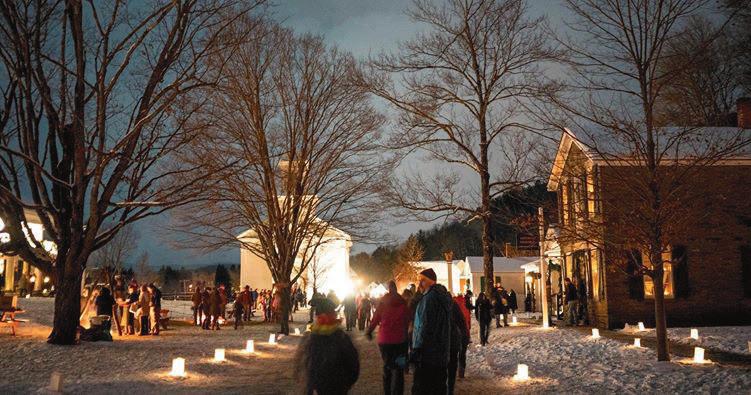
Famous for the Baseball Hall of Fame (which is well worth a visit, whatever the time of year), this burg offers much to love during the holiday season. Downtown is transformed into something out of a postcard or a Hallmark Christmas movie with brick-front buildings in 19th century Italianate and Colonial Revival styles against Otsego Lake. Santa and Mrs. Claus set up a month-long residence in the Christmas Cottage in Pioneer Park, with a mailbox for kids to drop their letters to the portly gent himself. Fenimore Farm & Country Village, a working historical farm, hosts its Glimmer Nights event until Dec. 28—the whole estate is done up in glittering lights for you to explore at your leisure. Or you and the kids can board a real-life Polar Express with the Cooperstown and Charlotte Valley Railroad in nearby Milford for holiday music, goodies, visits from Santa and holiday spirit galore. Where to stay. The Inn at Cooperstown is spectacular to look at—it was built by Henry J. Hardenbergh, who also built The Plaza Hotel in New York City, and is a historical landmark example of Second Empire architecture. (The beautiful wraparound porch speaks for itself.) Rooms are brightly colored and full of personality, and common areas are cozy and vintage. Breakfast is served every morning in the lovely formal dining room, where you eat in front of a roaring fire.
Where to eat. With its exposed brick dining room and a spread of Italian favorites, Toscana of Cooperstown keeps the rustic vibes going. Grab a plate of your favorite—eggplant or chicken parmesan, chicken marsala, grilled veal chops—or opt for house specialties such as lobster ravioli. To end your meal sweetly, you can try some pistachio ricotta cake for dessert. More info: thisiscooperstown.com
—Kirsten Meehan
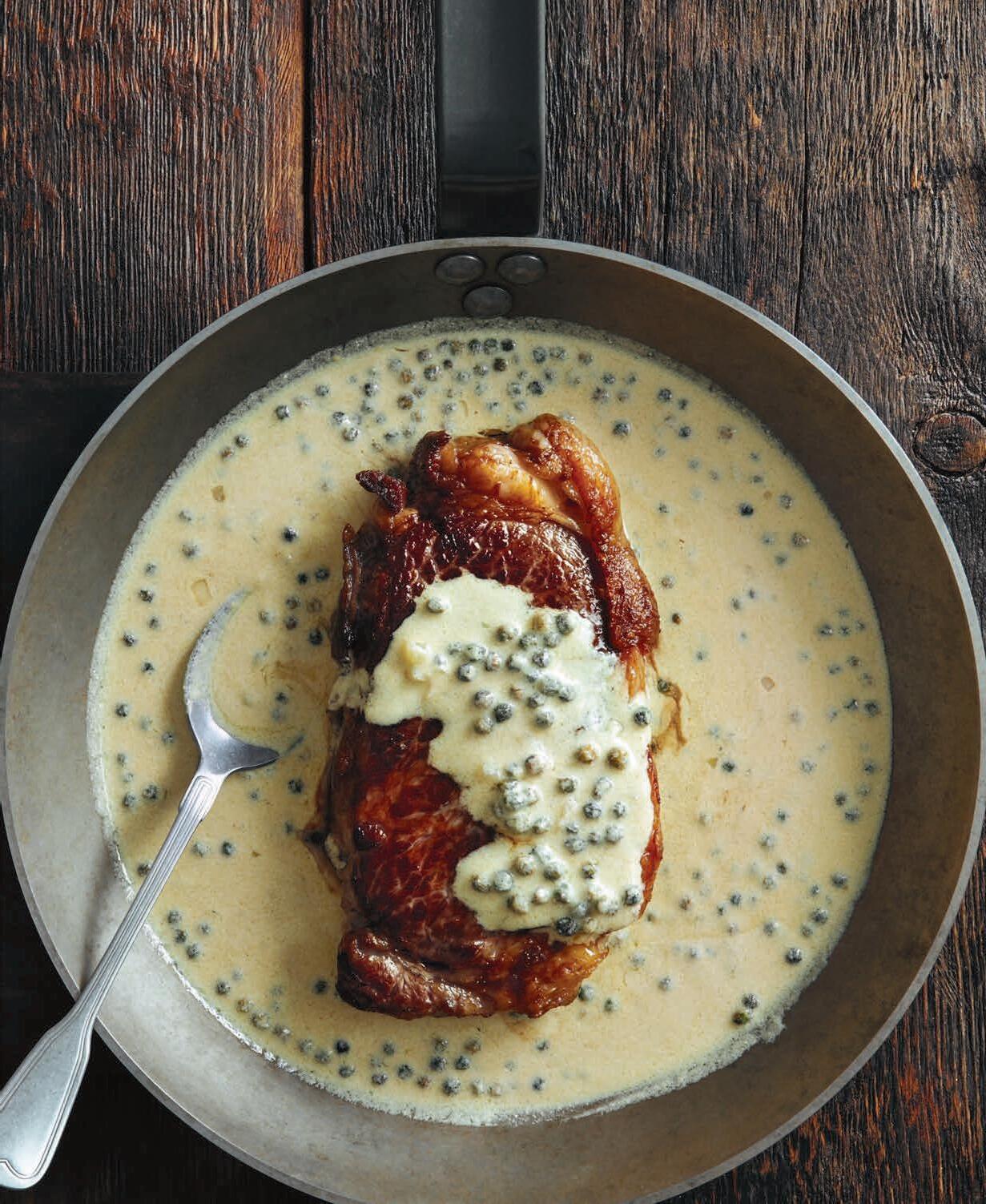
Celebrate the season with rich, hearty dishes that command center stage.
Yields 4 servings
INGREDIENTS
4 (6- to 8-oz.) boneless medallion steaks, such as filet mignon kosher salt
1 oz. whole black peppercorns, plus more as needed, divided
3 Tbs. vegetable oil
1 Tbs. unsalted butter
2 thyme sprigs
1 medium garlic clove
1/2 large shallot (about 11/2 oz.), minced
2 Tbs. brandy or cognac
3/4 cup homemade chicken stock or store-bought low-sodium chicken broth
3/4 cup heavy cream or 6 Tbs. crème fraîche
1 tsp. Dijon mustard
DIRECTIONS
Season steaks all over with kosher salt. Place on a wire rack set over a rimmed baking sheet and allow to air-dry, uncovered, in the refrigerator for 30 minutes.
Meanwhile, crack peppercorns using a pepper mill set on its coarsest setting.
Preheat oven to 375°F. Spread cracked peppercorns on a plate or in another shallow dish and firmly press one side of each steak into the pepper to encrust it in an even layer. Set each steak aside, peppercorn side up. Reserve any remaining cracked peppercorns.
In a large stainless steel or cast iron skillet, heat oil on medium high heat until shimmering. Add steaks, peppercorn side down, and cook until peppercorns are well toasted, about 3 minutes. Carefully turn steaks, trying not to break the peppercorn crust. Add butter, thyme and garlic and cook, basting steaks with a spoon, until steaks are well seared on the second side. Remove from heat.
Transfer steaks to a rimmed baking sheet. Using an instant-read thermometer, check the

internal temperature of the steaks; if they’ve reached 125°F, they’re ready to be served medium-rare. Allow steaks to rest for 5 minutes once the final doneness temperature is reached. Pour off all but 1 tablespoon of fat from skillet and discard garlic and thyme. Add shallot and any reserved cracked peppercorns, return to medium heat and cook, stirring about 2 minutes until shallot is tender.
Add brandy or cognac. (To prevent an unexpected flare-up if working over gas, you can turn off the burner, add the alcohol, then reignite the burner.) Cook until raw alcohol smell has burned off and brandy has almost completely evaporated.
Add chicken stock and bring to a simmer, stirring and scraping up any browned bits. Whisk in cream or crème fraîche, then simmer, stirring often, until sauce has reduced enough to glaze a spoon. Whisk in mustard. Season with salt.
Arrange steaks on plates and pour sauce on top. Serve with French fries, mashed potatoes, or other sides of your liking.
“This is a mindful take on luxury dining—high in protein, rich in flavor and peppered with purpose. The peppercorn crust adds both warmth and digestive support while reducing the need for added salt or heavy seasoning. Swapping cream for ultra-filtered, high-protein milk and a touch of cornstarch slurry will keep the sauce velvety and satiating, but lighter.”
—Ali Senatore, registered dietitian nutritionist, Reimagined Nutrition, Edgewater
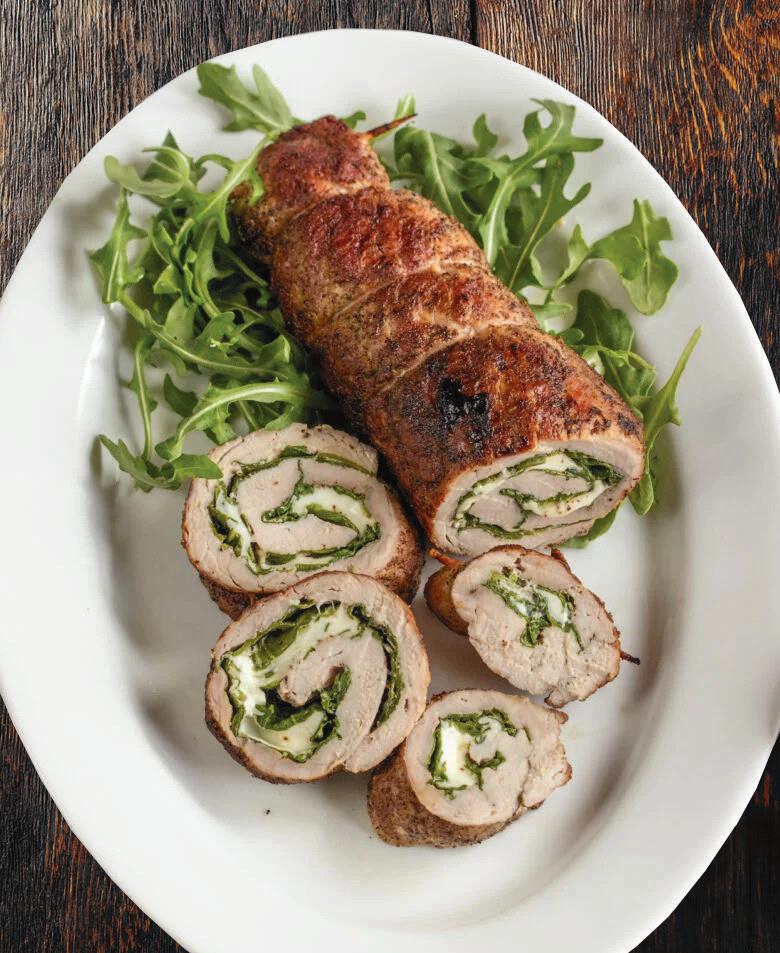
Yields 4 servings
INGREDIENTS
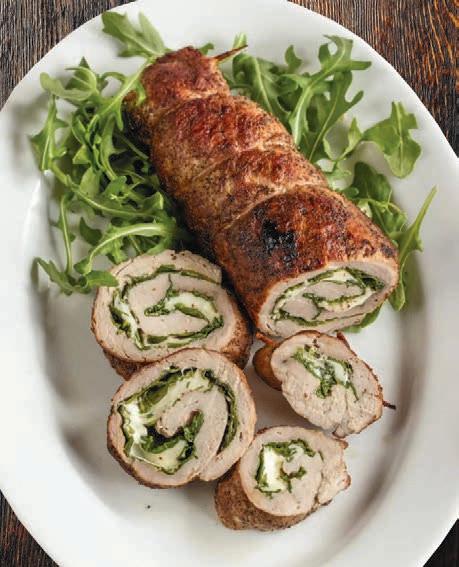
2 lbs. pork tenderloin
1 cup arugula salad
6 slices mozzarella cheese handful of basil salt and black pepper, to taste
1 Tbs. olive oil
For The Sauce
2 shallots, finely diced
1 Tbs. parsley, chopped
½ cup red wine
4 Tbs. unsalted butter
¼ cup heavy cream
Remove all the outer extra fat and pork filaments from each tenderloin. Butterfly each tenderloin once in the middle, making sure you leave about ½ inch of meat space between the knife and the cutting board and not go through. Once the tenderloins are halved, butterfly it three more times from each side, starting in the middle. You must cut down alongside the tenderloin seven times, ensuring you never cut through the meat. Each piece of pork tenderloin will be 7 to 8 inches wide. Pound the pork lightly. Season with salt and pepper generously on the inside. Preheat the oven to 375°F.
Arrange the arugula on top of the cut side of each tenderloin and grind a generous amount of pepper over it. Arrange the slices of mozzarella over the arugula and sprinkle with salt and pepper. Add the basil leaves and again sprinkle with a generous amount of pepper.
Roll each tenderloin, ensuring the arugula and mozzarella are nicely tucked in. Using cooking twine, tie in 4 to 5 places. Place a couple of toothpicks at each end to seal them. Sprinkle a generous amount of salt and pepper all over them. You will have two pork tenderloin rolls.
Place a large ovenproof skillet over medium-high
heat and add the olive oil. Once hot but not burning, add the pork tenderloin rolls and sear each side until a nice medium brown crust is formed. Do not always turn as you want a nice searing to take place.
Once all the sides are golden, 5 to 8 minutes, place the skillet in the hot oven and bake for 30 to 40 minutes.
Remove the tenderloins from the oven, place them on a plate with a high border to catch any juice rendered, and cover them with aluminum foil.
Return the skillet to the stove, and add two tablespoons of butter, the shallots and parsley. Sauté the shallots for a couple of minutes until slightly translucent. Lower the heat and add the red wine, deglazing by scraping the pan for any bits. Raise the temperature back to medium and reduce the wine to 1/3.
Add the heavy cream and stir the sauce together. Add the remaining butter to the skillet and continue to stir until melted. Season with salt and pepper to taste. Add any juices rendered by the tenderloins.
Cut the pork tenderloin into 1-inch-thick slices and serve with the sauce over it or alongside.
“Pairing lean protein with fresh herbs and greens enhances both flavor and nutrition. Arugula and basil bring vibrant antioxidants and nutrients to this dish, especially vitamins A and K. It’s a beautiful balance of fresh flavor, color and nourishment on one plate!”
—Shifra Zuckerman, registered dietitian nutritionist, Healthspan Nutrition with Shifra, Fair Lawn
This tart pick-me-up is festive, flavorful and perfect for both holiday parties and fireside sipping.
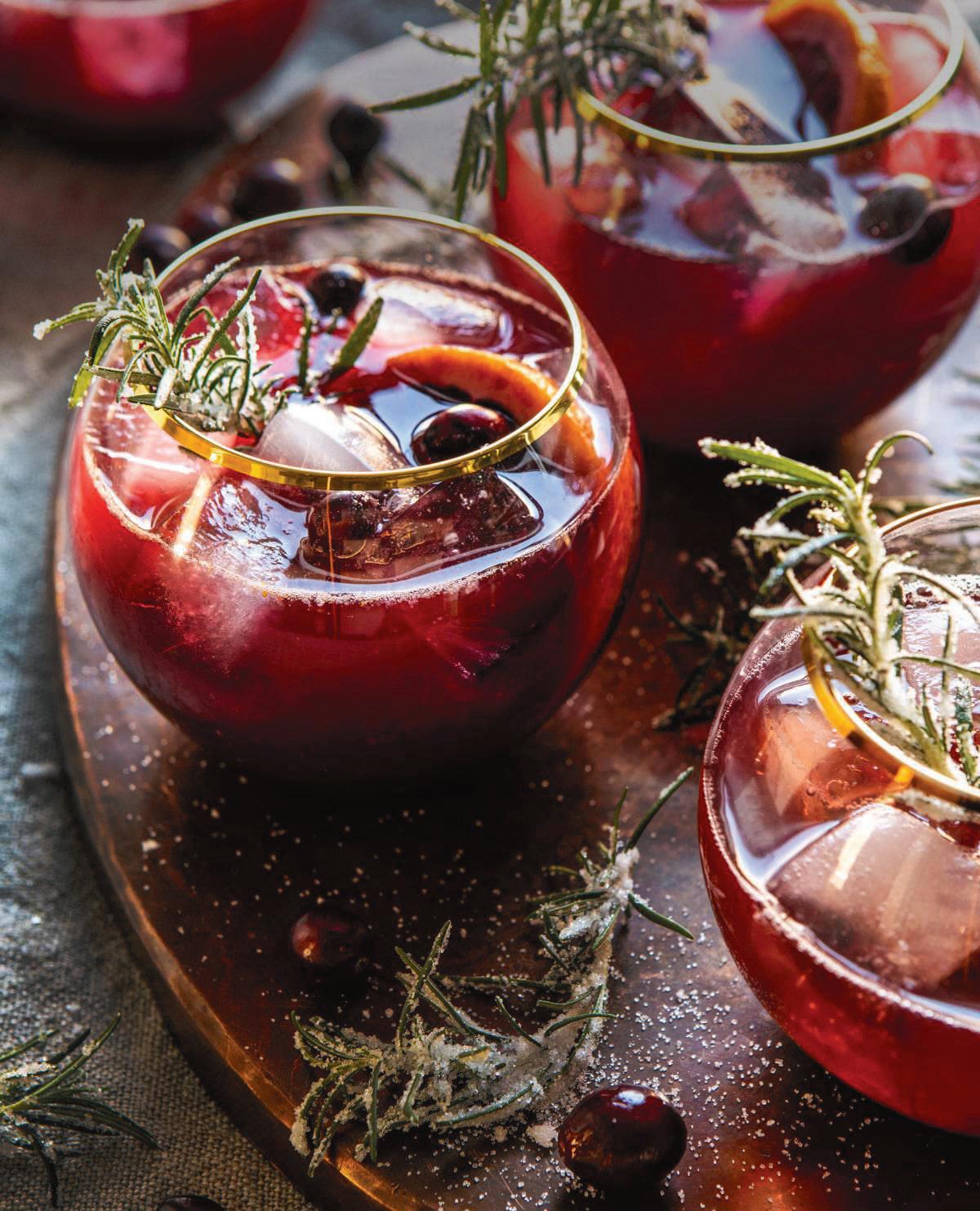
Makes: 6 servings
INGREDIENTS
1/2 cup maple syrup
2 cups fresh cranberries
zest 1 large orange
8 oz. (1 cup) bourbon
4 oz. (1/2 cup) lemon juice
1 cup 100 percent cranberry juice
3-4 dashes orange bitters
1 blood orange or regular orange, sliced candied rosemary

DIRECTIONS
To make the cranberry syrup: In a medium pot, bring 1/2 cup water, the maple syrup and cranberries to a boil over high heat. Boil 5 minutes or until the cranberries begin to burst, then remove from the heat. Stir in the orange zest. If your syrup thickens too quickly, just add additional water to thin. Let cool. If desired, strain out the cranberries. In a punch bowl, combine the cranberry syrup, bourbon, lemon juice cranberry juice, and orange bitters. Stir to combine, chill until ready to serve. Serve over ice. Garnish with an orange slice and candied rosemary, if desired.
For Candied Rosemary Line a baking sheet with parchment paper. Gently run rosemary sprigs under a little water to dampen and place onto the prepared baking sheet. Sprinkle the rosemary with granulated sugar on all sides, making sure the rosemary is thoroughly coated in sugar. Allow to dry on the baking sheet for 1 hour. The rosemary can be made 1 day in advance and stored at room temperature.
“Here‘s a tip: Let the cranberry syrup cool off, then add the bourbon and let it sit overnight in the refrigerator. I also would make ice molds with cranberries and a rosemary sprig along with an orange peel in each mold to add to the punch bowl.”
—Jed Kessler, Jed’s Party Services, Fair Lawn


Pleasant Avenue Dental
141-148 W. Pleasant Avenue Dental | 201.518.3053 www.pleasantavenuedental.com
For Dr. Aneta D’Amico, dentistry is both a science and an art—one that allows her to combine precision, compassion, and innovation every day. Her journey began in Warsaw, Poland, where she earned her dental degree from the Medical University of Warsaw. Driven by a lifelong passion for helping others, she continued her education in the United States, completing Dental Radiography and Dental Hygiene programs at Bergen Community College, where she now serves on the advisory board. She went on to graduate from Rutgers School of Dental Medicine and today leads Pleasant Avenue Dental in Maywood, New Jersey, a family, emergency, and aesthetic-focused practice known for its personalized, high-quality care.
Dr. D’Amico credits her parents for instilling the values of education, hard work, and service, and her husband, John, for his steadfast support and encouragement throughout her career. Opening her own independent practice—free of corporate affiliation—stands as one of her proudest accomplishments. In addition to leading a team of highly skilled professionals, she is the founder of the Scan Squad, a fast-growing network for women in digital dentistry dedicated to advancing patient care through technology.
Committed to both her profession and her community, Dr. D’Amico serves on her local Board of Health and supports outreach programs that promote oral health education and access to care—embodying the very spirit of a Woman to Watch.

Corcoran Infinity Properties 1018 Closter Dock Road, Alpine, NJ 07620 | O:201.768.6868 | M:732.362.1523 | IG @tarynbyron
Breaking the mold and simultaneously helping to redefine the roles of women in New Development Real Estate, Taryn Byron is a reputable force of change in the landscape of Northern New Jersey. As Director of Corcoran Infinity Properties’ New Development Division, she spearheads the firm’s primary business with leading developers on multi-unit residential sale and rental properties. A Top Producing Broker for the firm, she also specializes in representing individual homeowners with buying and selling high-end properties. Most recently, Taryn was hand selected by developer Richard Kurtz and The Kamson Corporation as the exclusive sales agent for The Woodlands, Demarest’s only gated enclave with 24 newly constructed luxury townhomes offering breathtaking views of the esteemed Alpine Country Club.
Holding a degree in Business Management complemented by extensive coursework in Architecture and years working as a construction project manager, Taryn’s broad understanding of new development is bolstered by her sophisticated eye for fashion and design which results in bespoke marketing strategies that captivate and engage target clients.
After nearly two decades in the field, Taryn has developed a thick skin and a great sense of humor. Always thinking outside the box, she successfully disrupts standard real estate norms and is opening doors for other women in the industry with invaluable mentoring opportunities and step-by-step guidance for all agents at Corcoran Infinity Properties bringing developers to the pitching table. In 2026, Taryn’s next moves are the ones to watch as she continues to soar above glass ceilings and into a new world of opportunity in real estate.
Durocher, Owner/Principal Designer
375 S. Central Ave., Ramsey NJ 07446 | 201.825.3832 | www.dianedurocherinteriors.com
For award-winning interior designer Diane Durocher, the spark for design ignited early. As a teenager, she spent weekends wandering through antique shops and paging through House Beautiful and Architectural Digest, captivated by the transformative power of beautiful surroundings. Thanksgiving dinners at her aunt’s home left a lasting impression. The matching draperies, antique chandelier, glowing fire, and artfully set table came together to create an atmosphere that felt truly magical. It was there Diane realized that design is more than decoration; it shapes the way we live and connect with one another.
Diane’s love of interiors was nurtured by family and mentors alike. Her Aunt Jan and Uncle Joe, an upholsterer, introduced her to the craftsmanship behind great design. Later, she drew professional inspiration from design legends such as Sister Parish, Albert Hadley, Jan Showers, and Jamie Drake—figures whose influence helped her refine a timeless, client-centered aesthetic.
Over the past 30 years, Diane has built an acclaimed interior design firm founded on creativity, service, and trust. As a past president of the New Jersey chapter of ASID, she has dedicated herself not only to elevating the design community but also to mentoring the next generation of designers. She takes pride in helping young professionals understand that great design begins with listening to clients, choosing the right materials, and understanding the rhythm of daily life.
Of course, leading a successful firm comes with its challenges. Managing client expectations requires honesty and clear communication about timelines, budgets, and craftsmanship. By fostering transparency and building a dependable team, she ensures that every project meets her exacting standards. For Diane, design is ultimately about enhancing the way people live. Each space she creates is thoughtful, functional, and deeply personal—a reflection of her clients’ needs and dreams.
When she’s not designing, she enjoys spending time with family and friends, exploring antique shops, visiting art galleries, painting, reading, and practicing yoga, activities that keep her centered and inspired.
Manna Helmy Law Group Formerly Michael A. Manna & Associates, PC 66 South Maple Ave., Ridgewood, NJ 07450 | 201.447.2800 | www.MAMannaLaw.com
For more than two decades, Marize Helmy has dedicated her career to guiding families through some of life’s most challenging transitions. Her journey began humbly—working as a secretary at Manna Helmy Law, then known as Michael A. Manna & Associates—long before she ever set foot in law school. What started as a job soon became a passion, and today, Marize is recognized as a trusted advocate for families navigating Elder Law, Estate Planning, Guardianships and long-term care needs.
Marize describes a defining moment in her career as realizing just how gratifying it is to help families during times of crisis. “That’s when it transformed from a job to a calling,” she says. Her compassion and dedication are evident in her impressive record—having successfully worked on more than 1,000 Medicaid applications for individuals and families in need of long-term care.
She credits much of her professional outlook to mentor Michael Manna, who instilled in her the belief that success and integrity go hand in hand. “He taught me that while there’s nothing wrong with making money, you should only do so by bringing value to people,” Marize says. That lesson has guided her approach to law: honest, practical, and deeply people-centered. Like many attorneys, Marize admits that one of her greatest challenges has been maintaining emotional boundaries with clients. “I struggle with not getting too consumed in my clients’ struggles,” she shares. “I have to remind myself that there are professionals, like therapists and counselors, who can help in ways that I can’t. My role is to focus on what I’m qualified to do—and do it well.”
Marize’s impact reaches beyond her firm. Drawing on advice from a college philosophy professor who praised her ability to simplify complex ideas, she has made it her mission to make legal processes accessible and empowering. “If clients don’t feel comfortable or understand their estate planning, then what have we accomplished?” she asks. “My goal is to give families peace of mind—and I’m proud to know I’ve done that.”
Law Offices of Barbara B. Comerford
45 Eisenhower Dr., Suite 110, Paramus, NJ 07652 201.485.8806 | www.tristatedisabilitylaw.com
Barbara B. Comerford has been practicing disability law in Bergen County, New Jersey for over 30 years primarily in the area of ERISA long-term disability insurance claims and litigation; and Social Security Disability claims and litigation. In 2025, her firm was recognized by an independent group of Disability law groups as being among the top 250 nationally of Disability Law firms. She has lectured extensively on ERISA Long term disability insurance and Individual Disability Insurance law, as well as, Social Security disability law throughout the United States on behalf of many organizations including the American Association of Law Schools, the National Organization of Social Security Claimants Representatives, the Association of Administrative Law Judges; the American Bar Association, the New Jersey Bar Association, and The New York and New Jersey Institutes of Continuing Legal Education. She has represented thousands of clients seeking long term disability insurance (ERISA and Disability Income claims), Social Security disability and government disability benefits. She co-authored the CFS Physician Manual published jointly by the New Jersey Academy of Medicine, the New Jersey Department of Health & Senior Services and UMDNJ. It has been utilized by physicians and patients throughout the country to recognize and properly diagnose CFS. Ms. Comerford has also co-authored professional journal articles on proving disability in ME/CFS including for Frontiers, and the Journal WORK.
has testified before the U.S Department of Health & Human Services CFS Scientific Advisory Committee on Education Law Recommendations for Adolescents diagnosed with severe Chronic Fatigue Syndrome.
Comerford has been interviewed on the topic of Long COVID disability by the media including the CBS Morning Show, NBC News, the Washington Post, Kiplingers and Bloomberg Law.
390 Hackensack Ave., Hackensack NJ 201.560.6294 | www.rsvpbyanastasia.com
For event designer Anastasia Baker, creativity and opportunity have always gone hand in hand. Her journey into the world of high-end events began in an unexpected way—through a Craigslist ad. At just 23, while designing sets for film and television, she came across a listing for an event assistant position in New York. That chance application led to a transformative role working alongside renowned event designer Raul Ávila, where she quickly found her calling. Her first floral arrangement was featured at a Dolce & Gabbana Alta Moda dinner at Sotheby’s, and her early clients included icons like Oscar de la Renta. She even worked on several Met Galas, experiences she calls a “masterclass in events.”
A defining moment came when she produced her first major event at The Plaza for The Valley Hospital Gala—a personal milestone that reignited her confidence and reaffirmed her path. It was, she says, her “Freddie Mercury at Live Aid moment,” a turning point that came during a period of professional and personal challenges. Anastasia’s eye for beauty and detail was nurtured early by her mother, who instilled in her a love for design and discipline, and by family and friends who helped shape her creative vision. Today, what she values most are the lasting relationships she’s built with clients who trust her to bring their most meaningful occasions to life. For Anastasia, design isn’t just about aesthetics—it’s about heart, connection, and the stories created along the way.
Getting three squares a day has never been easier—Bergen County is home to a selection of restaurants diverse enough to satisfy all of your cravings.
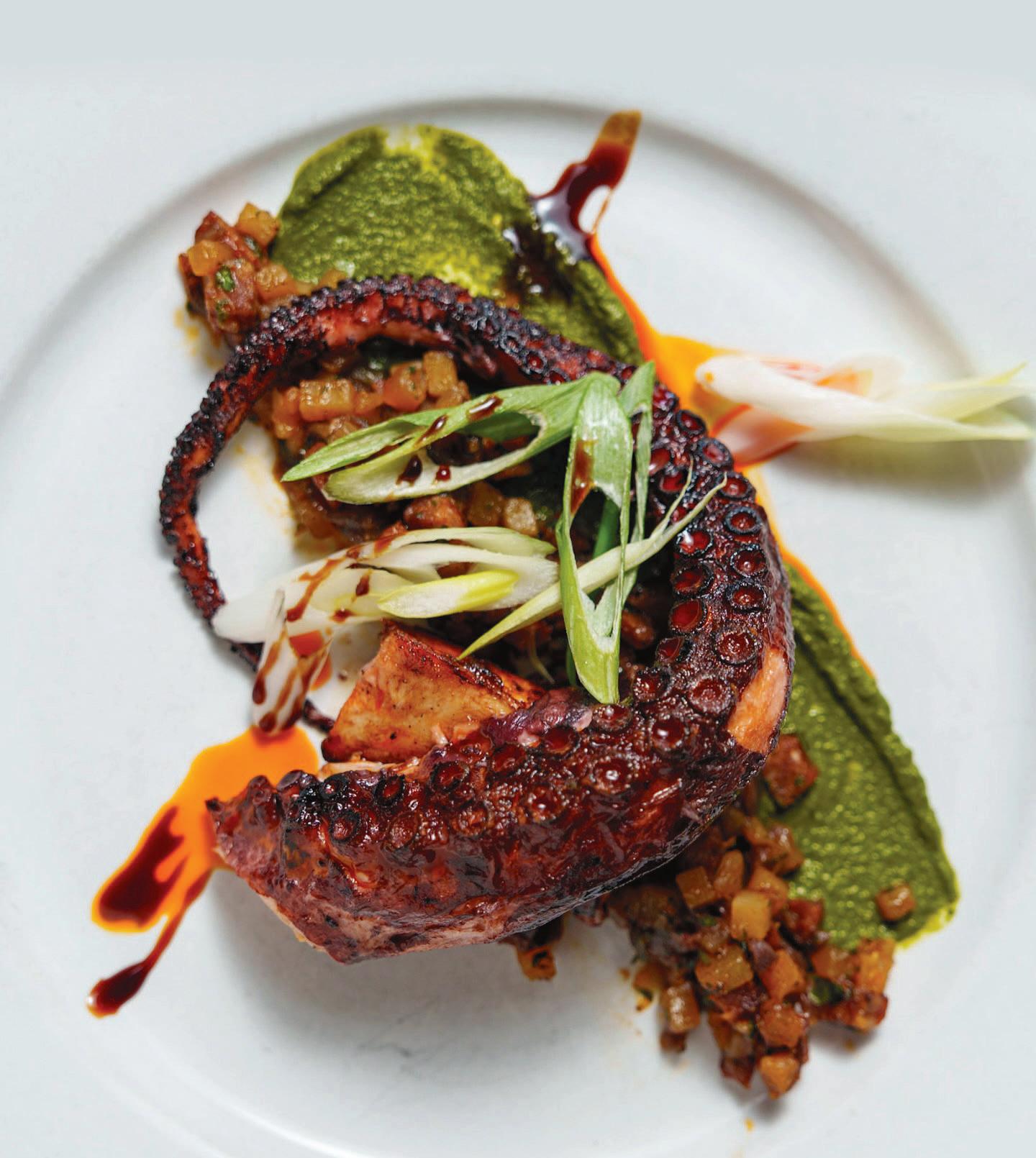
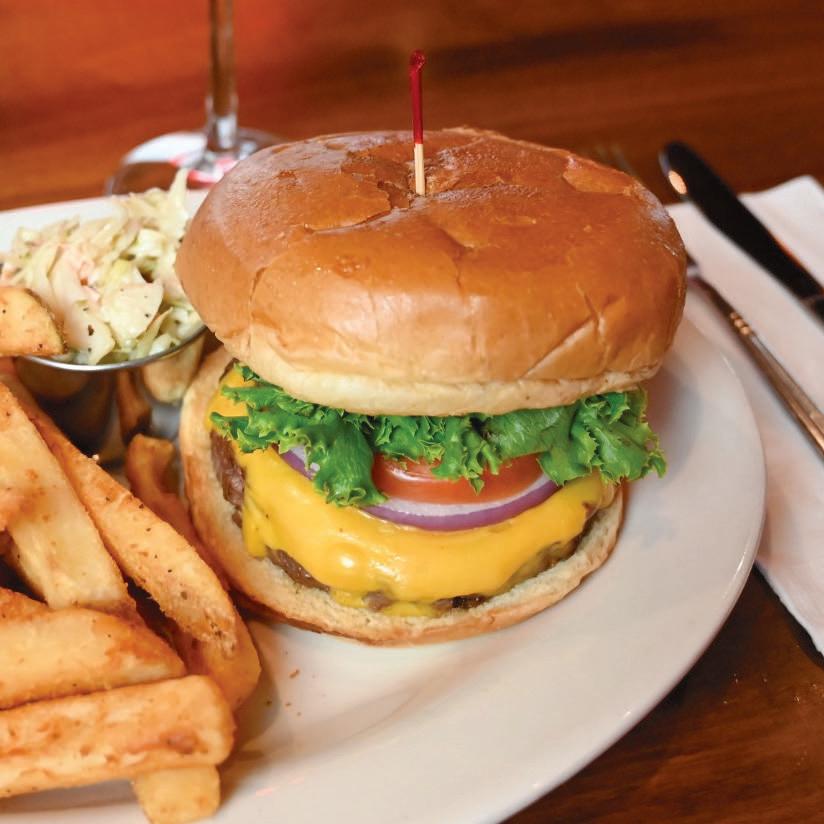
Allendale Bar & Grill
67 W. Allendale Ave.
201.327.3197 allendalebarandgrill.com
Allendale Steakhouse 95 W. Allendale Ave. 201.962.9797 allendalesteakhouse.com
Mezza Luna
96 W. Allendale Ave. 201.327.6556 mezzalunabistro.com
Nirvana Indian Kitchen
29 W. Allendale Ave. 201.818.2300 nirvanaindiankitchen.com
Savini
168 W. Crescent Ave. 201.760.3700 savinirestaurant.com
ALPINE
Kiku
385 Rte. 9 W. 201.767.6322 kikurestaurantsnj.com
BERGENFIELD
Bamboo Grill
54 S. Washington Ave. 201.384.5951 bamboo-grill.com
Chapala Grill
52 S. Washington Ave. 201.387.2107 chapalamexican grill.com
The Cuban Around The Corner 260 S. Washington Ave. 201.574.8600
Nihon Kai 41 S. Washington Ave. 201.384.3000 nihonkaijapanesenj.com
Tommy Fox’s Public House 32 S. Washington Ave. 201.384.0900 tommyfoxs.com
BOGOTA
Luka’s Italian Cuisine 10 River Rd. 201.440.2996 lukasitaliancuisine.co
Sedona Taphouse 679 Anderson Ave. 201.943.2300 sedonataphouse.com
Villa Amalfi 793 Palisade Ave. 201.886.8626 villaamalfi.com
CLOSTER
Brasserie Mémère 107 Vervalen St. 201.660.8822 brasserie-memere.com
The Hill
252 Schraalenburgh Rd. 201.899.4700 thehillcloster.com
Lucio’s
208 Piermont Rd. 201.750.3233 luciosnj.com
Sear House 411 Piermont Rd. 201.292.4612 searhousenj.com
Stern & Bow
171 Schraalenburgh Rd. 201.750.3350 sternandbow restaurant.com
CARLSTADT
Biggie’s
430 Rte. 17 S. 201.933.4000 biggies.com
Hunkar Restaurant
319 Hackensack Ave. 201.507.0606 hunkarrestaurant.com
Il Villaggio
651 Rte. 17 N. 201.935.7733 ilvillaggio.com
CLIFFSIDE PARK
354 Steakhouse
354 Lawton Ave. 201.941.0499 354steakhouse.com
Avos Grill
720 Anderson Ave. 201.945.9038 avosgrill.com
Rudy’s
591 Anderson Ave. 201.943.9252
DUMONT Foschini’s Brick
Oven Kitchen
21 E. Madison Ave. 201.387.9998 foschinisbrickoven kitchen.com
Grant Street Café 25 Grant Ave. 201.385.1705 thegrantstreetcafe.com
La Taberna 31 W. Madison Ave. 201.374.1661 latabernanj.com
Mexico Mi Amor 132 Veterans Plz. 201.244.5555 mexicomiamor.com
EAST RUTHERFORD
Al Di La 1 Hoboken Rd. 201.939.1128 aldilaitalianbistro.com
Annabella’s House of Mozzarella 900 Paterson Plank Rd. 201.804.0303 annabellasmozz.com
CRESSKILL
Chef Mediterranean
38 Union Ave. 201.367.9565 chef-mediterranean. res-menu.com
Hanami 41 Union Ave. 201.567.8508 hanamirestaurant.com
Mami 15 E. Madison Ave. 201.266.8931 mami-hospitality.com
Samdan 178 Piermont Rd. 201.816.7343 samdanrestaurant.net
DEMAREST
Yasou Mykonos 134 Hardenburgh Ave. 201.768.8500 yasougreekfood.com
Blarney Station Pub 258 Park Ave. 201.531.0001 blarneystation.com
Elia Mediterranean 240 Hackensack St. 201.939.9292 elianj.com
The Roosevelt 356 Paterson Ave. 201.713.3145 theroosevelt.us
EDGEWATER
Brownstone Pancake Factory 860 River Rd. 201.945.4800 brownstonepancake factory.com
De Novo European Pub 1257 River Rd. 201.496.6161 denovoeuropean pub.com
Fleming’s Steakhouse 90 The Promenade 201.313.9463 flemingssteakhouse.com
Greek Taverna 55 The Promenade 201.945.8998 greektavernausa.com
Haven Riverfront Restaurant and Bar 2 Main St., Suite G 201.943.1900 havenedgewater.com
Original Pancake House 15 The Promenade 201.366.4065 ophedgewater.com
Rebecca’s 236 Old River Rd. 201.943.8808 rebeccasedgewater.com
River Palm Terrace 1416 River Rd. 201.224.2013 riverpalm.com
Roberto’s II 936 River Rd. 201.224.2524 robertosii.com
Seak
725 River Rd., #30 201.402.3400 seaknj.com
Tommy’s Tavern + Tap 11 The Promenade 201.386.1700 tommytavernandtap.com
ELMWOOD PARK Taverna Mykonos 238 Broadway 201.703.9200 tavernamykonos.com
EMERSON Pimaan Thai 79 Kinderkamack Rd. 201.967.0440 pimaanthai.com
ENGLEWOOD
Akai Lounge 23 E. Palisade Ave. 201.541.0086 akailounge.com
Cassie’s 18 S. Dean St. 201.541.6760 cassiespizzeria.com
CZEN Restaurant 36 N. Van Brunt St. 201.431.9199 czenrestaurant.com
Hummus Elite
39 E. Palisade Ave. 201.569.5600 hummuselite.com
Khao Thai Cuisine
4 E. Palisade Ave. 201.894.0344 khaothainj.com
La Fonda Paisa
95 W. Palisade Ave. 201.871.3544 lafondapaisausa.com
Lulu Mediterranean Grill
63 Nathaniel Pl. 201.569.2662 lululoungejersey.com
Noches de Colombia
90 W. Palisade Ave.
201.567.4950 nochesdecolombia.com
Pintxo y Tapas
47 N. Dean St. 201.569.9999 englewoodtapas.com
Rose’s of Englewood
126 Engle St. 201.541.0020 rosesplacenj.com
Sofia
36 Engle St.
201.541.8530 sofiaenglewood.com
CLIFFS
Brownstone Pancake Factory
717 E. Palisade Ave.
201.945.4800 brownstonepancake factory.com
Café Italiano 14 Sylvan Ave. 201.461.5041 cafeitaliano.net
Cliffs Steakhouse 18 Sylvan Ave. 201.944.0233 cliffssteakhouse.com
Lefkes Estiatorio 495 Sylvan Ave. 201.408.4444 lefkesnj.com
Grissini 484 Sylvan Ave. 201.568.3535 grissinirestaurant.com
Anthony’s Coal Fired Pizza
2101 Promenade Blvd. 201.796.2625 acfp.com
The Craftsman 1609 Maple Ave. 201.773.8985 thecraftmannj.com
Fair Lawn Diner 13-48 River Rd. 201.791.2895 fairlawndiner.com
Jerry’s Hot Chicken 7-09 Fair Lawn Ave. 201.402.9300 jerryshotchicken.com
Oceanos Oyster Bar & Sea Grill 2-27 Saddle River Rd. 201.796.0546 oceanosrestaurant.com
Rose’s Place 32-01 Broadway 201.475.8800 rosesplacenj.com
RP Prime Steakhouse 41-11 Rte. 4 W. 201.267.0702 rpprime.com
Sage Restaurant 17-15 Broadway 201.797.0500 sagefairlawn.com
Saigon Bistro 24-08 Fair Lawn Ave. 201.398.1883 saigonbistro.com
FAIRVIEW
Patsy’s 344 Bergen Blvd. 201.943.0627 patsysbistro.com
FORT LEE
Aquarius 230-234 Main St. 201.592.8338 aquariusrestaurant nj.com
Baggios 212 Main St. 201.585.7979 baggiospizza restaurant.com
Big Red Tomato 1205 Anderson Ave. 201.224.6500 brtnj.com
Cap’t Loui
210 Main St. 201.461.7080 captloui.com
Chillers Grill
2191 Fletcher Ave. 201.461.0075 chillersgrill.com
In Napoli 116 Main St. 201.947.2500 inapoli.com
Kuba Restaurant
2139 Hudson Ter. 201.585.1601 kubarestaurant.com
Pho Today 2151 Lemoine Ave. 201.585.8818
Pomodoro 795 Abbott Blvd. 201.224.0800 pomodoro1.com
Prime & Beyond
501 Main St. 201.461.0033 primeandbeyond.com
Punta Cana
2151 Lemoine Ave. 201.849.5556 puntacanarestaurante.com
Ventana’s
200 Park Ave. 201.583.4777 ventanasatthe modern.com
FRANKLIN LAKES
Harmony Mediterranean Grill
842 Franklin Ave. 201.485.8707 harmony-nj.com
Sushi Cocoro 856 Franklin Ave. 201.560.1333 sushicocoro.com
GARFIELD
The Firehouse 42 Plauderville Ave. 973.478.2226 firehousefamily restaurantnj.com
Goodfellas 661 Midland Ave. 973.478.4000 goodfellasrestaurant nj.org
La Fortaleza 361 Midland Ave. 973.928.4470 lafortalezagarfield.com
GLEN ROCK
Glen Rock Inn
222 Rock Rd. 201.445.2362 glenrockinn.com
Stone & Rail 175 Rock Rd. 201.345.0709 stoneandrail.com
Tani Sushi & Asian Grill 206 Rock Rd. 201.612.1188 taniofglenrock.com
HACKENSACK
Casual Habana Café 125 Main St. 201.880.9844 casualhabanacafe.com
The Cheesecake Factory 390 Hackensack Ave. 201.488.0330 thecheesecake factory.com
Hot Fish 450 Hackensack Ave., #6 201.881.0180 hotfishhackensack.com
Houston’s 1 Riverside Sq. 201.488.5667 houstons.com
Lido Restaurant 701 Main St. 201.487.8721 thelidorestaurant.com
Maggiano’s Little Italy
70 Riverside Sq. 201.221.2030 maggianos.com
Morton’s The Steakhouse 1 Riverside Sq. 201.487.1303 mortons.com
P.F. Chang’s 390 Hackensack Ave. 201.646.1565 pfchangs.com
Rosa Mexicano 60 Riverside Sq. 201.489.9100 rosamexicano.com
HARRINGTON PARK
Donatella Ristorante 12 Tappan Rd. 201.767.4245 donatellasitalian. restaurant
HASBROUCK HEIGHTS Bensi
459 Rte. 17 S. 201.727.9525 bensihh.com
The Heights Bar & Grill 163 Boulevard 201.288.9338 heightsbarandgrill.com
Himalaya on Heights 313 Boulevard 201.257.8744 himalayaonheights0257. s4shops.com
Ivy Inn
268 Terrace Ave. 201.393.7699 ivyinn.com
Sofia’s 220 Boulevard 201.462.0123 sofiasmediterranean grill.com
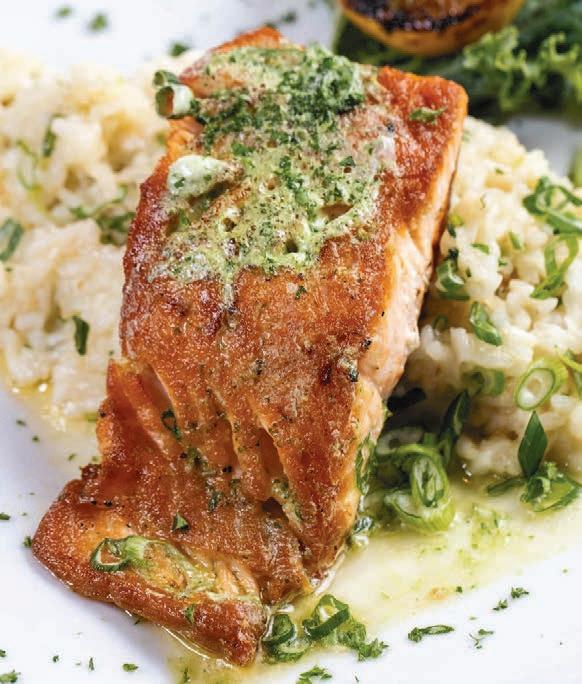
Tom Yum Koong 305 Boulevard 201.288.3840 tomyumkoonghh.com
Zaffron Bloom 194 Boulevard 201.571.0029 zaffronbloom.com
HAWORTH
Alessandro’s 157 Terrace St. 201.385.8544 alessandrosnj.com
Andiamo 23 Hardenburgh Ave. 201.384.1551 andiamorestaurant.net
HILLSDALE
The Cornerstone 84 Broadway 201.666.8688 thecornerstonenj.com
Domani
387 Washington Ave. 201.722.8881 domanirestaurants.com
Fig & Tomato
100 Park Ave. 201.722.8880 figandtomatoeatery.com
Koon Thai Eatery 126 Broadway 551.246.3646 koonthaieatery.com
Matsu Sushi & Grill 140 Broadway 201.930.1896 matsusushibest.com
Osso Buco 343 Broadway 201.664.1600 ossobucogrill.com
HO-HO-KUS
Alt Eats 622 N. Maple Ave. 201.444.1300 alteatscafe.com
Catchy Café 614 N. Maple Ave. 201.445.6400 thecatchycaterer.com
Ho-Ho-Kus Inn
1 E. Franklin Tpke. 201.445.4115 hohokusinn.com
Ho-Ho-Kus Sushi Café 29 Sheridan Ave. 201.670.7677 hohokussushicafe.com
St. Eve’s
611 N. Maple Ave. 201.857.4717 stevesnj.com
LEONIA
Dante’s Place 373 Broad Ave. 201.592.9071 dantesplace.com
Shumi Japanese Cuisine 354 Broad Ave. 201.272.6577 shumiomakase.com
LITTLE FERRY
Segovia Steakhouse 217 Main St. 201.814.1100 segoviasteakhouse.com
LODI
Kaya
334 N. Main St. 973.779.1128 kayalodi.com
ReBar & Kitchen
132 Essex St. 201.368.8181 rebarkitchen.com
Sergio’s Missione 2 Mercer St. 973.778.4545 sergiosmissionelodi.com
LYNDHURST
Angelo’s
263 Ridge Rd. 201.939.1922
Foschini’s Brick Oven Kitchen
298 Ridge Rd. 201.460.7600 foschinisbrickoven kitchen.com
Michael’s Riverside 528 Riverside Ave. 201.939.6333 michaelsriverside.com
MAHWAH
Mahwah Bar & Grill 2 Island Rd.
201.529.8056 allendalebarandgrill.com
Nagoya
1007 MacArthur Blvd. 201.818.9933 nagoyamahwah.com
Nonna’s 11 Franklin Tpke. 201.529.1151 nonnasmahwah.com
Novino Restaurant 64 Ramapo Valley Rd. 201.529.1900 novinonj.com
Roxanne’s 150 Franklin Tpke. 201.529.0007 roxannes restaurant.com
RP Prime Steakhouse 209 Ramapo Valley Rd. 201.529.1111 rpprime.com
Sangria 1033 MacArthur Blvd. 201.962.3310 sangriamahwah.com
State Line Diner
375 Rte. 17 N. 201.529.3353 statelinediner.com
Angelo’s Greek Taverna
245 Maywood Ave.
201.845.4278 angelosgreektaverna.com
Maywood Inn’s
Twin Door Tavern
122 W. Pleasant Ave. 201.843.8022 twindoortavern.com
Maywood Pancake House
92 W. Pleasant Ave. 201.880.7842 maywoodpancake house.com
The Seafood Gourmet
103 W. Pleasant Ave.
201.843.8558 seafood-gourmet.com
MIDLAND PARK
Arturo’s 41 Central Ave. 201.444.2466 arturos.co
Fiona’s Ristorante 118 Godwin Ave. 201.857.5800 fionasristorante.com
Rosario’s Trattoria 29 Central Ave. 201.445.3335
Delpino Restaurant 108 Chestnut Ridge Rd. 201.391.6866 delpinorestaurant.com
Bellissimo
12 S. Kinderkamack Rd. 201.746.6669 bellissimonj.com
Fire & Oak
100 Chestnut Ridge Rd. 201.307.1100 fireandoak.com
Gen Sushi & Hibachi 14B Chestnut Ridge Rd. 201.930.9188 gensushimontvale.com
Hearth & Tap Co. 125 N. Kinderkamack Rd. 201.307.6300 hearthandtap.com
Yuki
2 S. Kinderkamack Rd. 201.391.9877 yukimontvale.com
Bazzarelli 117 Moonachie Rd. 201.641.4010 bazzarellirestaurant.com
Bistro 107 107 Moonachie Rd. 201.440.3339 bistro107nj.com
Segovia 150 Moonachie Rd. 201.641.4266 segoviarestaurant.com
NEW MILFORD
Barrel & Brew 872 River Rd. 201.483.3329 barrelandbrews.com
Casual Habana Café 200 Main St. 201.576.0400 casualhabanacafe.com
Sanzari’s New Bridge Inn 105 Old New Bridge Rd. 201.692.7700 sanzaris.com
NORTHVALE
Biddy O’Malley’s 191 Paris Ave. 201.564.7893 biddyomalleys.com
The Greek Village 254 Livingston St. 201.750.8570 greekvillagenj.com
Olar Noso
493 Tappan Rd. 201.402.9355 olarnoso.com
OAKLAND
Cenzino
589 Ramapo Valley Rd. 201.337.6693 cenzinos.com
Trovato’s Due 4 Barbara Ln. 201.337.0813 trovatosduenj.com
Yuki
350 Ramapo Valley Rd. 201.337.8889 yuki-oakland.com
ORADELL
Oak House
2 Kinderkamack Rd. 201.277.4892 oakhousenj.com
Ora
304 Kinderkamack Rd. 201.267.4304 orainthedell.com
OLD TAPPAN
Bosfa Italian Restaurant 183 Old Tappan Rd. 201.649.8730 bosfaitalian restaurant.com
Ramen Factory 216 Old Tappan Rd. 201.383.0510 ramenfactorynj.com
PALISADES PARK
So Moon Nan Jip 238 Broad Ave. 201.944.3998 so-moon-nan-jip.com
PARAMUS
Biagio’s Ristorante 299 Paramus Rd. 201.652.0201 biagios.com
The Capital Grille 1 Garden State Plz. 201.845.7040 thecapitalgrille.com
Grand Lux Café 1 Garden State Plz. 201.909.0399 grandluxcafe.com
Kiku
365 Rte. 17 S. 201.265.7200 kikurestaurantsnj.com
Mantra 275 Rte. 4 W. 201.342.8868 mantranj.com
Suburban Diner 172 Rte. 17 N. 201.261.2605 suburbandiner17.com
PARK RIDGE
103 Prime At Valentino’s 103 Spring Valley Rd. 201.391.2220 103prime.com
The Park Steakhouse 151 Kinderkamack Rd. 201.930.1300 theparksteakhouse.com
Peppercorns 176 Colony Ave. 201.391.2818 peppercorns176.com
Ridge Diner 125 Kinderkamack Rd. 201.391.4242 ridgediner.com
RAMSEY
Anthony Franco’s 128 E. Main St. 201.236.8000 afpizza.com
Brady’s at the Station 5-7 W. Main St. 201.327.9748 bradysramsey.com
Café Panache 130 E. Main St. 201.934.0030 cafepanachenj.com
Kinchley’s Tavern 586 N. Franklin Tpke. 201.934.7777 kinchleyspizza.com
The Shannon Rose 1200 Rte. 17 201.962.7602 theshannonrose.com
Smyrna 21 E. Main St. 201.934.7990 smyrnacaferamsey.com
Tawara
53 W. Main St. 201.825.8712 tawarajapanese restaurant.com
Varka Estiatorio
30 N. Spruce St. 201.995.9333 varkarestaurant.com
RIDGEFIELD
Café Tivoli 533 Shaler Blvd. 201.941.5561 cafetivoli.com
Karden 630 Broad Ave. 201.699.0988 karden630.com
RIDGEFIELD PARK
MK Valencia
228 Main St. 201.373.0228 mkvalencia restaurant.com
Sparta Taverna 206 Main St. 201.296.0095 spartataverna.com
RIDGEWOOD
Bukhara Grill
37 Chestnut St. 201.444.4910 bukharagrillnj.com
Cafe 37
37 S. Broad St. 201.857.0437 cafe-37.com
Cravings Tapas Bistro
8 Wilsey Sq. 201.857.8533 cravingstapas.com
Felina 18 Prospect St. 551.276.5454 felinarestaurant.com
Kimchi Smoke
BBQ Shack 2 Godwin Ave. 201.447.6653 kimchismoke.com
La Lanterna
29 W. Ridgewood Ave. 201.444.5520 lalanternaof ridgewood.com
Latour
6 E. Ridgewood Ave. 201.445.5056 latourridgewood.com
Meltemi Greek Restaurant 21 E. Ridgewood Ave. 201.632.0022 meltemirestaurant.com
Pardis Persian Grill 47 E. Ridgewood Ave. 201.652.8000 pardispersiangrill.com
Park West Tavern 30 Oak St. 201.445.5400 parkwesttavern.com
Raymond’s 101 E. Ridgewood Ave. 201.445.5125 raymondsnj.com
Roots Steakhouse 17 Chestnut St. 201.444.1922 rootssteakhouse.com
S. Egidio 17 N. Broad St. 201.389.3525 segidiopizza.com
Steel Wheel Tavern 51 N. Broad St. 201.882.1800 steelwheeltavern.com
Village Green 36 Prospect St. 201.445.2914 villagegreen restaurant.com
White Maple Café 47 E. Ridgewood Ave. 201.345.9538 whitemaplecafe.com
RIVER EDGE
Mado Restaurant 570 Kinderkamack Rd. 201.265.3629 madorestaurant. business.site
Sanducci’s 620 Kinderkamack Rd. 201.599.0600 sanduccis.com
RIVER VALE
Ammata Thai Kitchen 184 Rivervale Rd., Suite 2 201.664.2299 ammata.com
Armando’s Grill 688 Westwood Ave. 201.722.5820 armandostuscangrill.com
ROCHELLE PARK
Nanni 53 W. Passaic St. 201.843.1250 nanni.com
RUTHERFORD
Finch’s 801 Rutherford Ave. 201.231.3141 finchsdining.com
Fiorentini 98 Park Ave. 973.721.3404 fiorentinirest.com
Matisse 167 167 Park Ave. 201.935.2995 cafematisse.com
Paisano’s 132 Park Ave. 201.935.5755 paisanos.com
Volare’s 7 Station Sq. 201.935.6606 volaresrestaurant.com
SADDLE BROOK
Midland Brew House
374 N. Midland Ave. 201.797.0070 midlandbrewhouse.com
Que Pasta
326 Market St. 201.712.1900 qpitalian.com
The Plank Pizza Co.
Beer Parlor 383 Market St. 201.843.2426 ppcbp.com
SADDLE RIVER
The Saddle River Inn 2 Barnstable Ct. 201.825.4016 saddleriverinn.com
Amarone 63 Cedar Ln. 201.833.1897 amaroneristorante.net
B V Tuscany
368 Cedar Ln. 201.287.0404 bvtuscany.com
Etc. Steakhouse 1409 Palisade Ave. 201.357.5677 etcsteakhouse.com
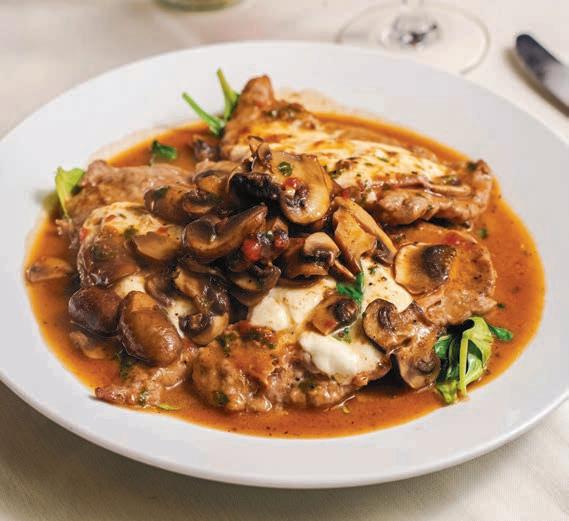
Noah’s Ark 493 Cedar Ln. 201.692.1200 noahsark.net
Regina’s 827 Teaneck Rd. 201.862.1996 reginassteakhouse andgrill.com
Sweet T’s
166 W. Englewood Ave. 201.942.3030 sweettseatery.com
TENAFLY
Axia Taverna 18 Piermont Rd. 201.569.5999 axiataverna.com
Brasserie 4 Washington St. 201.266.6400 tenaflybrasserie.com
Sayola 50 Prospect Ter. 201.871.2182 sayolarestaurantnj.com
TPR Restaurant
38 W. Railroad Ave. 201.871.0444 tprrestaurant.com
WALDWICK
Andrea’s Ristorante
20 E. Prospect St. 201.670.0275 andreasrestaurantnj.com
Limoncello
32 Franklin Tpke. 201.652.5577 limoncellonj.com
WASHINGTON
TOWNSHIP
Bacari Grill 800 Ridgewood Rd. 201.358.6330 bacarigrill.com
WESTWOOD
Bon 487 Broadway 201.238.2371 bonwestwood.com
Downtown Dhaba 266 Center Ave. 201.664.0123 dhabadowntown.com
Farmhouse Café & Eatery 301 Center Ave. 201.664.8424 farmhousecafenj.com
Granita Grille 467 Broadway 201.664.9846 granitagrille restaurant.com
Kimchi Smoke Barbecue 57 Kinderkamack Rd. 201.321.7996 kimchismoke.com
Melt Toba 250 Center Ave. 201.359.8497 tobarestaurant.com
Mezza 22 Jefferson Ave. 201.722.8822 mezzawestwood.com
Osteria Crescendo 36 Jefferson Ave. 201.722.1900 osteriacrescendo.com
The Tavern @ Iron Horse 20 Washington Ave. 201.666.9682 thetavernwestwood.com
WOOD-RIDGE
Al Chile 187 Hackensack St. 862.334.3616 alchilenj.com
Concourse Club
379 Rte. 17 S. 201.710.6459 concourseclubnj.com
WYCKOFF
Aldo’s 640 Wyckoff Ave. 201.891.2618 aldosofwyckoff.com
Benares
327 Franklin Ave., Suite 4 201.904.2222 benaresnj.com
Blue Moon Café
327 Franklin Ave. 201.891.1331 bluemoonmexican cafe.com
T.S. Ma
637 Wyckoff Ave. 201.891.8878 tsmachinesecuisine.com
Wyckoff Thai 314 Franklin Ave. 201.485.8855 wyckoffthai.com
339 Godwin Ave., Midland Park, NJ 07432
201.444.3049
310 Main St., Emerson, NJ 07630
201.261.3364
166 Washington Ave., Dumont, NJ 07628
201.384.2112
www.smilesbybergendental.com
What inspired you to create Smiles by Bergen Dental and what sets your practice apart from others?
Dr. Liany Farinas-Han is the founder of Smiles by Bergen Dental, a practice dedicated to delivering exceptional patient care through a blend of artistry, compassion, and technical expertise. An accomplished classical concert pianist, she graduated from The Juilliard School with a full scholarship supported by the Bill Millennium Scholarship. She also holds a Doctorate of Dental Medicine from the University of Medicine and Dentistry of New Jersey. Recognized as one of America’s Best Young Dentists in 2020 by Edge Magazine’s 40 Under 40, Dr. Farinas-Han combines her artistic talents with modern technology to achieve outstanding results. Her practice offers a full range of dental services — from preventive care to cosmetic, restorative, and implant dentistry — ensuring comprehensive care for patients of all ages. Smiles by Bergen Dental emphasizes a strong, collaborative team atmosphere and continuous training to provide unmatched dental care across three locations in Midland Park, Emerson, and Dumont. The office’s commitment to excellence is reflected in glowing reviews and high praise from patients.

Joseph D’Amore, DDS
Cara Minichetti, DDS
370 Grand Ave., Suite 200
Englewood, NJ 07631
201.871.3555
www.englewooddental.com
Do you offer any cutting-edge treatments or procedures that set you apart from other practices in your field?
Englewood Dental offers the latest advancements in dental technology, including lasers, digital dentistry, milling machines, zirconia restorations, CAT scans, guided surgery, full-arch implant dentistry, periodontal plastic surgery, dermal fillers, Botox, PRF, and IV sedation. Our use of lasers for ulcerations, gum disease, surgery, and TMJ treatment provides a conservative, bloodless approach that promotes faster healing and greater comfort. Our clinicians are also highly trained in facial aesthetics, enabling them to evaluate each patient as a whole and treat both the oral cavity and surrounding facial areas. Englewood Dental is one of the few practices to feature an in-house dental laboratory equipped with the latest digital technology for faster treatment times and outstanding aesthetic results.
What advice do you have for patients who want to feel better about their smile?
First and foremost, don’t be embarrassed. Openly discussing your concerns and goals with your dentist is the best way to explore your options. In many cases, small enhancements—such as enamel reshaping or professional whitening—can make a dramatic difference in both appearance and confidence.
How is digital dentistry (e.g., 3D imaging, AI, same-day crowns) changing patient care?
Dentistry has evolved tremendously in recent years, with technology transforming the way care is delivered. Modern tools have made procedures less invasive, faster to complete, and more precise. Today’s advanced diagnostic and treatment-planning systems allow clinicians to more effectively design healthy, beautiful smiles. In addition, innovations in implant materials and cosmetic products have simplified tooth replacement, improving both function and aesthetics.
What do you see as the biggest game-changer in dentistry over the next 5–10 years?
Digital technology—such as digital impressions and computer-designed crowns and bridges—is revolutionizing the field. These tools streamline treatment, enhance accuracy, and create a more comfortable experience for patients. At Englewood Dental, we’re proud to have embraced these technologies and remain committed to staying at the forefront of innovation to provide our patients with the very best care possible.
Christensen Dental Associates
71 Franklin Turnpike
Suite 1-1, Waldwick, NJ 07463
201.652.1569 | www.cdanj.com
Do you offer any cutting-edge treatments or procedures that set you apart from other practices in your field?
CDA stands out for its use of advanced 3D printing and milling technology, which allows for highly precise and efficient treatment outcomes. The practice also features an in-house laboratory specializing in custom smile makeovers and full-mouth implant reconstructions. This integrated approach provides patients with beautifully personalized results and faster turnaround times, all under one roof.
What advice do you have for patients who want to feel better about their smile?
The first step is always to consult with your dentist to understand your options. At CDA, we make this process simple and comfortable by starting with a comprehensive photo assessment to pinpoint what patients like and wish to improve about their smiles. Using advanced digital imaging and records, we then create a detailed, customized treatment plan designed to meet each patient’s unique goals.
Equally important is creating a welcoming, reassuring environment. We understand that many people experience anxiety about dental visits, especially when they’re self-conscious about their teeth. Our team takes pride in helping patients feel at ease—reminding them that no case is ever “the worst we’ve seen.” In fact, the more extensive the concern, the more gratifying the transformation often is. We want every patient to know that a confident, healthy smile is always within reach.
What do you see as the biggest game-changer in dentistry over the next 5–10 years?
The next decade will bring remarkable advancements in 3D printing and artificial intelligence. As materials and design technologies continue to evolve, AI will increasingly assist in diagnosis, treatment planning, and the design process. These innovations will make dental care faster, more precise, and more accessible for both patients and practitioners. The result will be a new era of dentistry—where technology and artistry combine to deliver optimal results with unparalleled efficiency.
Dayna Cassandra and Associates
351 Evelyn St., Paramus, NJ 07652
201.696.1404
www.cosmeticdentistofparamus.com

Do you offer any cutting-edge treatments or procedures that set you apart from other practices in your field?
Absolutely. We incorporate advanced digital technologies into nearly every aspect of care, from smile design and 3D imaging to precise restoration fabrication. This allows us to customize each patient’s treatment plan with exceptional accuracy and efficiency. Whether we’re crafting veneers, crowns, or implants, our digital approach ensures beautiful, natural-looking results while minimizing discomfort and chair time.
What advice do you have for patients who want to feel better about their smile?
Invest in your smile! Feeling healthy and confident truly is a game changer. Your dental health doesn’t just influence your appearance; it plays a vital role in your overall well-being. When you take care of your smile, you’re also caring for your heart, your body, and your self-esteem. Remember, when you look good, you feel good, and when you feel good, you do good.
How is digital dentistry (e.g., 3D imaging, AI, same-day crowns) changing patient care?
Digital dentistry has transformed both the patient experience and the clinical process. The clarity, precision, and convenience of these tools eliminate many of the traditional roadblocks and delays in dental care. Patients benefit from faster results, more comfortable procedures, and predictable outcomes, all within a more streamlined and personalized approach.
What do you see as the biggest game-changer in dentistry over the next 5–10 years?
Dentistry is evolving beyond simply fixing teeth. We are physicians of the head and neck, and yes, forever teeth have been our focus. However, muscles, joints, airway and more are a huge part of my practice. We take a comprehensive approach to oro-facial rejuvenation, where all of these things are important. Advances in technology and a deeper understanding of the connection between oral and systemic health are allowing us to support our patients in total-body wellness.
What’s one thing you wish more people understood about dental health?
Oral health has a profound impact on our confidence, longevity, and quality of life. Keeping your teeth for a lifetime is absolutely possible when you invest in your oral care and view your dentist as your trusted partner in health.
20-20 Fair Lawn Ave., Fair Lawn, NJ 07410
201.797.3044 | www.bramalsterdmd.com
What makes your dental practice stand out when it comes to family and cosmetic care?
For more than 35 years, Dr. Bram Alster has been dedicated to improving the oral health of New Jersey families. For the past ten years, Dr. Alster is proud to have his son, Dr. Jason Alster, practice with him carrying on the longstanding tradition of superior family, restorative and cosmetic dental care. Together with their staff, they deliver uncompromised quality and comfort to provide patients with healthy, beautiful smiles. “Delivering nothing short of excellence with integrity remains our ultimate goal,” says Dr. Bram Alster.
Both doctors emphasize the importance of educating patients by explaining different options for appropriate treatment. “It’s important that patients feel physically and mentally at ease,” says Dr. Jason Alster. “Our entire team helps achieve this important objective!” In their welcoming state-of-the-art office, services include dental implants, crowns, porcelain veneers, bonding, whitening, Invisalign, and now Botox. Cosmetic procedures are performed to look natural and subtle. ”We design smiles that conform to a patient’s facial features to achieve a harmonious, beautiful appearance,” notes the father-son team.
Dr. Jason teaches dental residents at Hackensack University Medical Center and also practices part-time in Manhattan. He is a member of the Bergen/Rockland Dental Study Club. Dr. Bram remains on staff at St. Joseph’s University Medical Center. Both doctors are members of the ADA, AGD and are ”Fellows” of the International Academy of Oral Implantologists.
Israel,
Precision Smiles
71 Summit Ave., Hackensack NJ 07601
201.342.7742 | www.PrecisionSmiles.net
Do you offer any cutting-edge treatments or procedures that set you apart from other practices?
We’re always striving to exceed the standard of care in every aspect of treatment. One advancement we’re especially excited about is laser technology. It allows us to perform periodontal and prosthetic procedures with exceptional precision and promotes faster, more comfortable healing.
What advice do you have for patients who want to feel better about their smile?
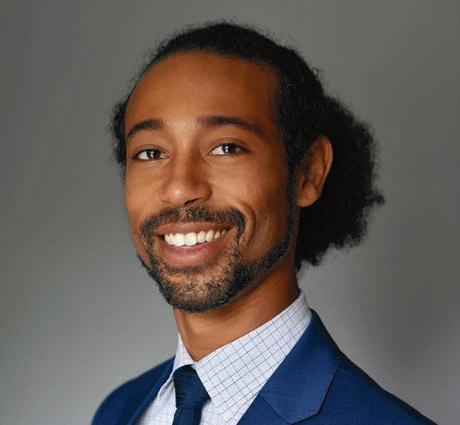
Many patients tell me, “I let things get so bad that I wasn’t sure what could be done.” My advice is—don’t let fear or guilt keep you from taking that first step back to the dentist’s chair. At Precision Smiles, we never judge. We applaud your decision to return to care and are genuinely excited to partner with you in restoring confidence in your smile. That means not only providing quality treatment but also giving you the tools and knowledge to maintain your results every day.
What’s one thing you wish more people understood about dental health?
Dental health is directly linked to overall wellness. A clean, healthy smile supports the body as a whole, while declining oral health can contribute to problems elsewhere. Caring for your teeth isn’t just about aesthetics—it’s an essential part of maintaining long-term health and quality of life.
James Bancroft, DMD
Ashley Bancroft-Dobrin, DMD, MBA
Keith Dobrin, DMD, MBA
90 Franklin Turnpike, Waldwick, NJ 07463
175 Cedar Lane Suite 1, Teaneck, NJ 07666
201.447.1611 | www.bdorthodontics.com
What makes Bancroft Dobrin Orthodontics stand out as a leading provider of orthodontic care in Bergen County?
Bancroft Dobrin Orthodontics has been a premier provider of orthodontic care in Bergen County for decades, treating both adults and children alike with the most innovative and state-of-the-art materials our field has to offer in a comfortable family setting.

Our dedicated providers include Dr. Bancroft, his daughter Dr. Ashley, and son-in-law Dr. Keith, both distinguished diplomats of the American Board of Orthodontics (ABO). Our team has the versatility and experience to treat all cases, from simple and straightforward to the most complex and multi-disciplinary. As leading Invisalign providers (Diamond) and one of the few offices offering the renowned specialized Damon braces, we know what it takes to treat conservatively and safely while making it convenient for our patients. We also offer early interceptive therapy when intervention is necessary for the young adolescent. At our offices in Waldwick, NJ and Teaneck, NJ, you can expect unrivaled quality and care.
Michael W. Klotz, DMD, MDentSc, FACP
312 Warren Ave., Suite #1, Ho-Ho-Kus, NJ 07423
201.444.9777 | www.smilehhk.com
Do you offer any cutting-edge treatments or procedures that set you apart from other practices in your field?
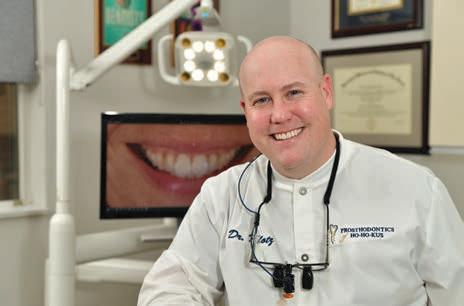
As a board-certified prosthodontist, I specialize in the replacement and reconstruction of teeth and jaw structures. Our in-office lab fabricates many of the restorations we deliver, ensuring strict quality control. I provide both the surgical placement and restoration of dental implants in one location, and I also collaborate with other surgical specialists to achieve the best outcomes for my patients.
What advice do you have for patients who want to feel better about their smile?
Be sure to have all your treatment options explained before making a decision. Often, significant aesthetic improvements can be achieved with minimally invasive techniques. If you have a complex case involving high aesthetic demands, wear, discoloration, or trauma, consider a consultation with a board-certified prosthodontist.
What’s one thing you wish more people understood about dental health?
Routine maintenance is essential for the longevity of your teeth and dental work—and it also has a significant impact on your overall health. Regular checkups and professional cleanings with your dentist are key to maintaining a healthy, confident smile.
Bill Gates, DDS, MS
104 Broadway, Woodcliff Lake, NJ 07677
201.307.1919
www.billgatesdds.com
What advice do you have for patient’s that want to feel better about their smile?
Having a smile you feel confident about is truly a team effort. It starts with maintaining an excellent home care routine that includes brushing and flossing daily, paired with regular professional exams and cleanings. These steps are essential for keeping your teeth and gums healthy, which is the foundation of a beautiful smile. Beyond hygiene, prevention is key—addressing small issues early can help avoid more complex treatments later. If you’re unsure where to start, schedule a consultation with your dental professional to discuss personalized options for improving both the appearance and health of your smile. Remember, the best dental treatment is prevention!
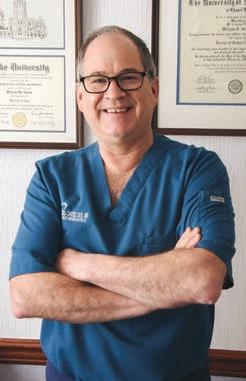

Bergen Buzz is Bergen magazine’s exclusive peek into the people who are helping to shape the county, the places that are generating the most excitement (including restaurants, shops and hangouts) and the upcoming events residents shouldn’t miss.



Sign up now for your free subscription at Bergenmag.com! For information on sponsorship opportunities, contact Tom Flannery at 201.571.2252 or thomas.flannery@wainscotmedia.com.

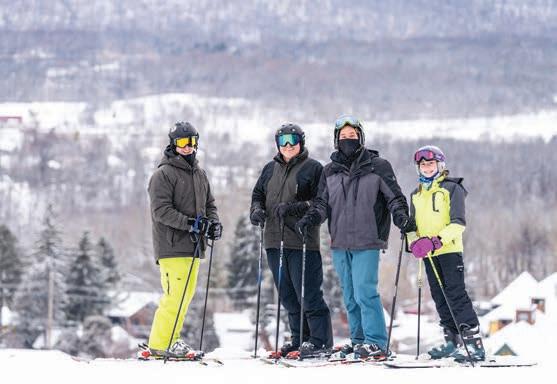
Give the gift of Winter Fun with Mountain Creek’s Triple Play Card. Get 3
Anytime Lift Tickets for just $139.99— no blackout dates & no restrictions.
Hit the slopes and experience three times the adventure.
200 STATE RT.94, VERNON, NJ
973.827.2000
WWW.MOUNTAINCREEK.COM

Celebrating 60 years of couture garment care.
Family-owned and operated dry cleaner.
Proudly trusted since 1966.
Free pick-up and delivery in Bergen County & Manhattan.
172 JOHNSON AVE., HACKENSACK, NJ
201.343.7333
WWW.HALLAK.COM


A gift from SoJo Spa Club is an invitation to unwind and reconnect.
From Nov. 10 - Dec. 25, enjoy added value on gift cards, or choose a limited edition holiday gift certificate that combines daily admission and a signature service. It's a thoughtful way to give more while spending less.
660 RIVER RD., EDGEWATER, NJ
201.313.7200
WWW.SOJOSPACLUB.COM


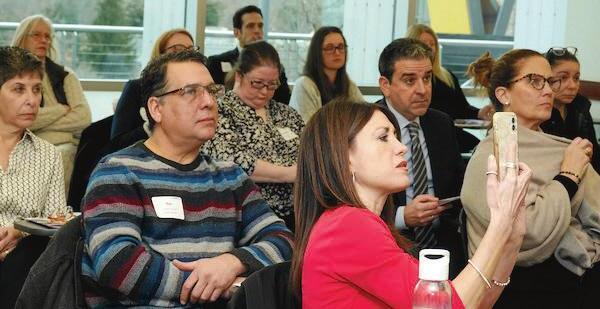








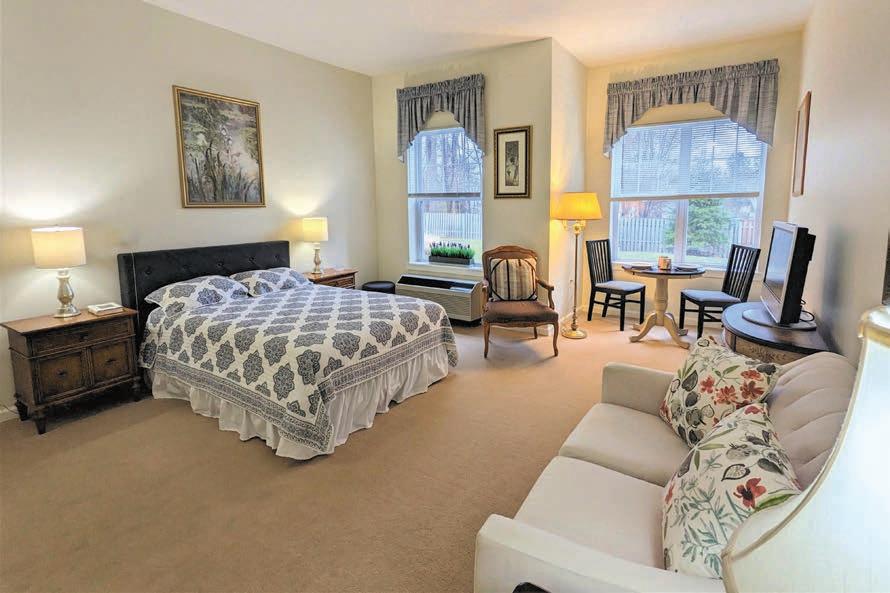
Caring is not simply what we do – it’s who we are. Since 1911, it has been our mission to offer a listening ear, a helpful hand, and steady, supportive guidance throughout your wellness journey. Through our comprehensive continuum of mental health services, communities for older adults, and rehabilitation, we work diligently to foster physical health and also nourish the spirit. Call us today to learn more about our communities and services.
Experience the best in luxury senior living at Thrive at Montvale! A vibrant community offering independent living, assisted living, and memory care. With its modern farmhouse design, spacious interiors flooded with natural light, and panoramic views of the Social Court, every corner exudes elegance. Here, our dedicated team provides unwavering support and fosters meaningful connections that inspire joy each and every day. Enjoy happy hours, social clubs, games, activities, fitness classes, and more. Come thrive with us!
At Mill Gardens, we provide Homelike Elegance & First-Class
Assisted Living in the heart of Bergen County. Discover our spacious apartments equipped with large windows, private baths, updated kitchenettes, and ample storage--all with access to beautiful amenities like our 24-Hour Café, Home Theater, Resident Park & Gardens, and more. Highlights of our First-Class services include: personalized care, gourmet dining, transportation, and a wide variety of social events and outings. Call today for more information or a tour!
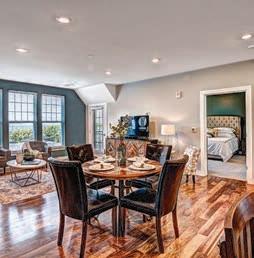
•
•
•


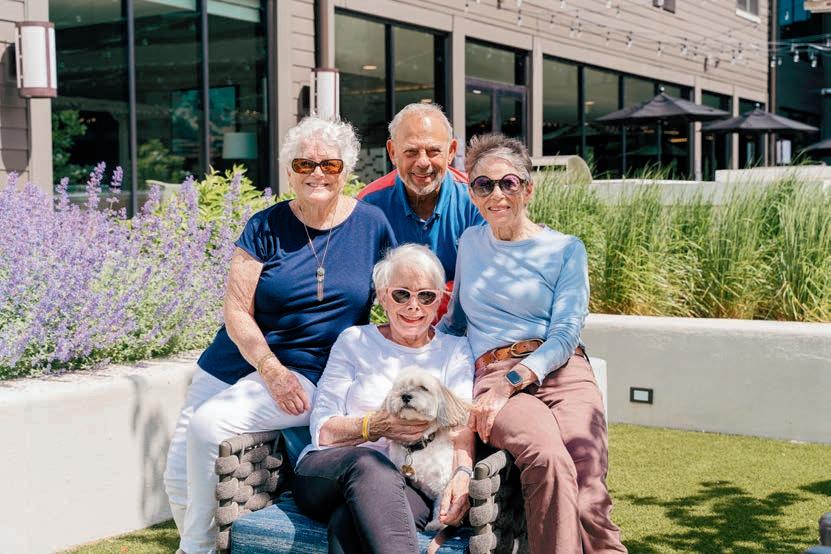

Edgewater’s Doner Point spins up Turkish classics with heart, heat and a little theater at the table.
There’s something endlessly comforting about Turkish cuisine. From the tang of yogurt sauces to the slow-cooked depth of perfectly seasoned meats, it’s a culinary tradition that celebrates both simplicity and soul. And it’s a cuisine I never tire of exploring, always eager to find a new spot that puts its own spin on those beloved flavors. So when I heard about Doner Point in Edgewater, I couldn’t resist checking it out.
The new eatery along River Road specializes in doner, a Turkish lamb and beef mixture that’s cooked on a vertical rotisserie. As the marinated meat rotates and cooks, a chef slices thin shavings from the outer layer and uses the meat in a variety of dishes. It’s similar to a Greek gyro or a shawarma found in other Middle Eastern countries, though the meat’s seasoning, thickness and texture differ.
After navigating a cramped parking lot, my girlfriend and I were seated inside Doner Point’s surprisingly spacious and busy dining room. It was a cold Thursday night in October, so we immediately ordered two hot teas to warm our hands and hearts. (The warm greeting from our server was also of note.)
A pair of appetizers set the tone beautifully for the evening. The first was kibbeh balls, two delicately fried bulgur shells stuffed with seasoned ground beef and crushed walnuts. Each shell was golden and crisp, with its aromatics and perfect texture pleasing to the senses. Our second starter, stuffed grape leaves, was equally impressive. The thin, almostcigarette-shaped leaves filled with rice and herbs offered a burst of citrus and spice with every bite. While both dishes were rich, bright and prepared with care, our main courses were the true stars of the evening.
My selection (which I chose over lamb chops and prime steak) was Beyti doner, one of the restaurant’s signature selections. This was a showstopper in both presentation and flavor—tender grilled meat wrapped in soft lavash, draped with a vivid tomato sauce and sliced into sushisized pieces. After the plate was set on
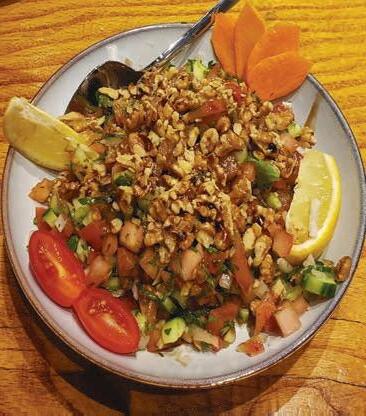
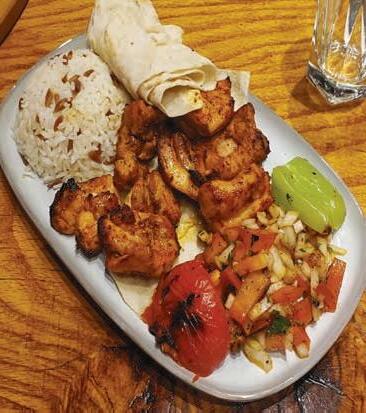

the table, a second server followed and poured sizzling melted butter over each piece. It was such a dramatic moment that it felt like a TV commercial in slow motion. Even better was the bite, with a perfect harmony of smoky, tangy and savory notes.
“This might be one of the best things I’ve ever tasted,” my girlfriend said after sampling the dish. I couldn’t have said it better myself. Her main, chicken shish kebab, meanwhile, was simplicity elevated: a skewer of marinated chicken that was beautifully charred and juicy at the center. It was served with fragrant rice and a medley of grilled vegetables that brought a touch of sweetness and earthiness to the plate. The skewer came with enough chicken for two people, so my dining companion encouraged me to pick from her plate (perhaps so that I would urge her to take more from mine). On any other night, the chicken shish kebab would’ve been tops at our table, but my Beyti doner was hands down the best in show.
Just when we thought the meal had reached its peak, dessert proved that Doner Point still had a few surprises to offer. My sweet treat, simply called “custard” on the menu, was a minimalist masterpiece— smooth, creamy and delicately sweet, with just enough richness (and pistachio pieces) to linger on the palate. But we agreed that her choice, named “pumpkin dessert,” took the cake. It wasn’t cake, of course— the plate was topped with tender slices of slow-roasted pumpkin, glazed with syrup and topped with tahini and walnuts. This was another simple dish that felt deeply traditional yet utterly fresh.
Every detail at Doner Point reflects a genuine respect for the cuisine and the joy of sharing it. From the thoughtful plating to the balance of flavors, the restaurant exudes the spirit of Turkish dining: generous, flavorful and heartfelt. I’m excited for my next visit to soak up more of the culture and cuisine.
—Darius Amos

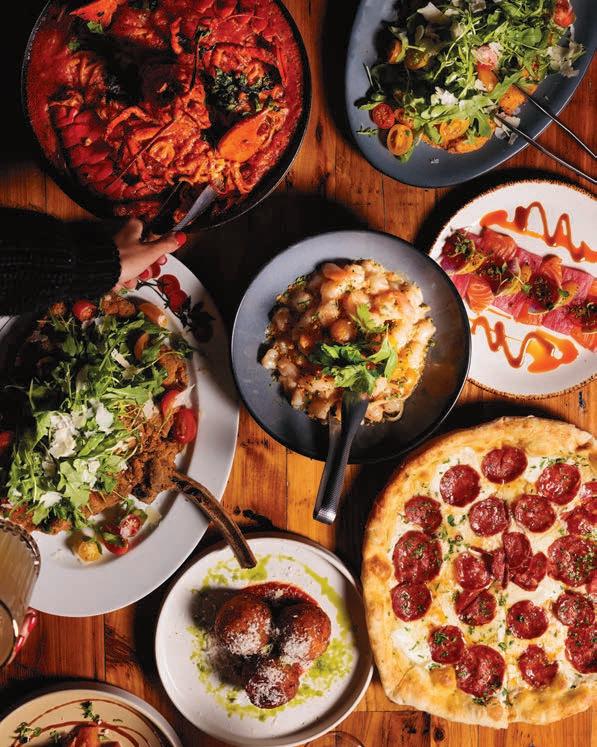


Celebrate the most wonderful time of the year here in Bergen, with music, shows, nature walks and more.
THROUGH DEC. 30

Don’t miss ORCHARD OF LIGHTS, a beloved seasonal experience at Demarest Farms in Hillsdale. Cruise through 32 acres of holiday light displays set to festive music, then stick around for hot cocoa, s’mores by the firepit, photos with Santa and treats from the farm store. Multiple dates and time slots are available; visit orchardoflights.com for tickets and details.

11–13
DEC. 13
Who killed wealthy socialite Kay Ridgeway? You’ll find out when you watch Agatha Christie’s MURDER ON THE NILE, presented by Bergen Community College’s Bergenstages in Paramus. This is a tense, claustrophobic whodunit filled with jealous lovers, high tension and, of course, Christie’s legendary twists and wit. Shows are at 7:30 p.m. except on Dec. which begins at 2 p.m. For tickets and more, see bergen.edu.
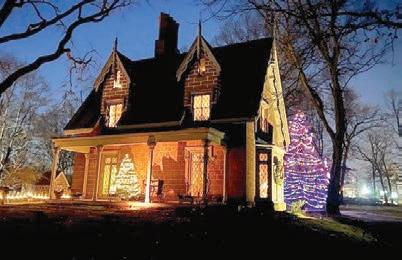
DEC. 12, 14, 19, 21

DEC. 13-14
Over in Oradell, see a seasonal classic as you’ve never seen before. The Bergen County Players presents IT’S A WONDERFUL LIFE, the enduring story of love, hope and redemption set against a snowy Christmas Eve. This production takes elements from both the movie and the radio drama for an immersive experience sure to bring a tear to your eye (we also always cry at the end). There will be two 7:30 p.m. shows, one on Dec. 13 and the other on Dec. 14. For tickets and more information, see bcplayers.org.
DEC. 14
At Teaneck’s Puffin Cultural Forum, listen to jazz group the TED PILTZECKER QUARTET play its album Peace Vibes The group is led by Piltzecker himself, who is a critically acclaimed jazz percussionist. The evening promises swinging music and artist interaction. The show starts at 7 p.m. For more information, check out puffinculturalforum.org.
DEC. 13
We can’t fly you to the moon, but we can bring some serious star power to Bergen to Ol’ Blue Eyes. The stars Federico Castelluccio, Vincent Curatola Carbone come to the Center in Rutherford CELEBRATION OF FRANK SINATRA’S 110TH BIRTHDAY The night will include Sinatra tribute artist Michael Martocci, cast Q&As, behind-the-scenes scoops and much more. The fun starts at 7:30 p.m., and is intended for the 18+ crowd. For tickets, head over to williamscenter.co.
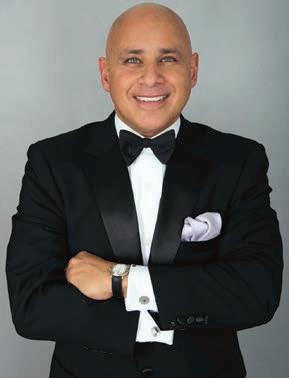
DEC. 13
At The Hermitage in Ho-Ho-Kus, immerse yourself in flickering light and Gilded Age elegance with a CANDLELIGHT HOLIDAY TOUR! This year, each room of this historic landmark will be transformed into an ode (with holiday twists) to the Gilded Age. If you’re looking for education, ambiance and amazing décor, this is the place. Multiple tours are available a night, and registration online is required. For more, check out thehermitage.org.
For holiday cheer and fantastic music, head over to Mahwah and Ramapo College’s Sharp Theater for A SWINGIN’ CHRISTMAS with New York Voices. Enjoy a night of filled with the group’s signature blend of rich harmonies and jazz sophistication. Elegance, beloved holiday tunes and enduring classics—this show has it all. It all starts at 8 p.m., and you can find tickets and more information at ramapo.edu.
Join the ghosts of Christmas Past, Present and Future and try to redeem the soul of Mr. Ebenezer Scrooge with A CHRISTMAS CAROL at Bergen Performing Arts Center Englewood. Charles Dickens’ classic tale comes to life for two shows, at 1 p.m. and the other at 5 p.m. See amazing sets, eye-popping effects and puppetry and a truly special performance. For tickets more, head over to bergenpac.org.
DEC. 21
Welcome the shortest night of the year (they’ll get longer from here on out!) with a WINTER SOLSTICE CAMPFIRE AND NIGHT HIKE at the Tenafly Center. Walk through the woods, learn about what animals live there and then close out the evening with a crackling campfire and sweet s’mores. The walk starts at 5 p.m. Registration is required. For that and more, check out tenaflynaturecenter.org.
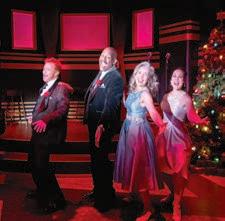
JAN. 1

How best to welcome
How about with some scenery and amazing Bergen Audubon DeKorte Park in a NEW YEAR’S
Stroll with friends, clear morning air, wildlife and start the the right foot. The walk and no registration is necessary. information, see bergencountyaudubon.org or contact Don Torino com, 201.230.4983).

Bergenites
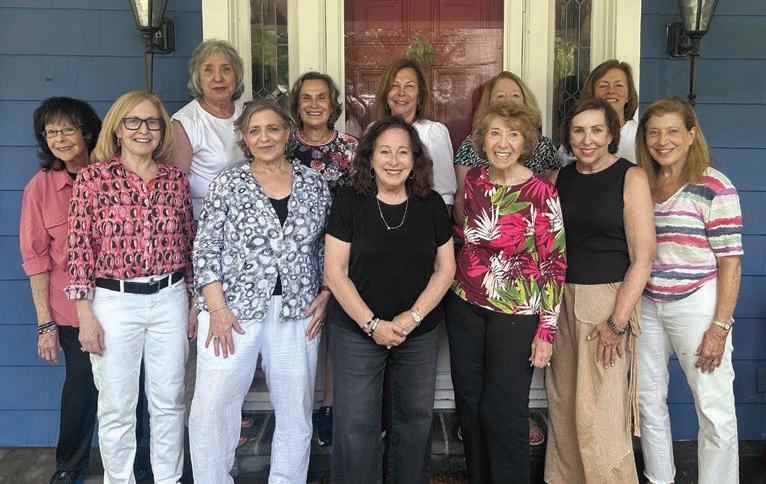

1. NORTHERN NEW JERSEY CHAPTER OF WOMEN’S CONNECTION
The Northern New Jersey Chapter of Women’s Connection collected school supplies for Child Focus–CASA of Passaic and Union counties. Group members, including several from Bergen County, filled 30 new backpacks with back-to-school products for foster children.
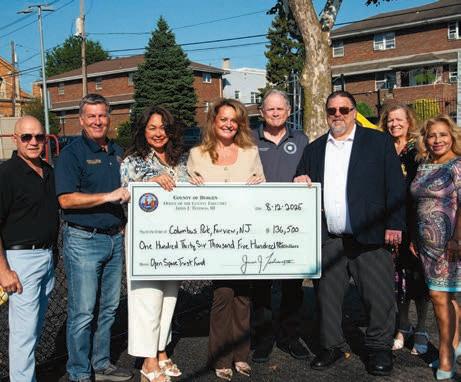
2-3. BOYS & GIRLS CLUBS OF LOWER BERGEN COUNTY
The Boys & Girls Clubs held its annual Elite Golf Outing this summer at Arcola Country Club in Paramus. The sold-out event raised funds to support the organization’s life-changing youth programs.
4-5. BERGEN COURT APPOINTED SPECIAL ADVOCATES
Bergen Court
Appointed Special Advocates was a special guest at a fall fashion show hosted by Bloomingdale’s in The Shops at Riverside. The styles of Theory’s fall collection left Bergen CASA volunteers feeling inspired for the season.
6. BOROUGH OF FAIRVIEW
The Borough of Fairview received a $136,500 grant for the installation of two new playground units at Columbus Park. Funding will allow for the replacement of aging equipment with modern, inclusive play structures designed to provide a safe and engaging space for children of all abilities.
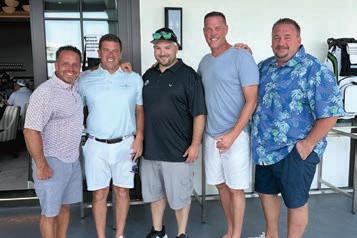
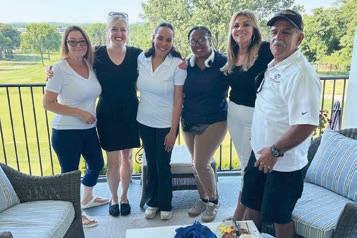
7–8. KAPLEN JCC ON THE PALISADES
Kaplen JCC on the Palisades hosted Next Up: Eat Small Plates–An Evening to Savor. The event brought together culinary power duo Ben and Zikki Siman-Tov as they celebrated the release of their new book, Eat Small Plates!
9. HOLY NAME MEDICAL CENTER
Holy Name Medical Center in Teaneck received a monumental gift of $75.1 million from the Douglas M. Noble Family Foundation. This donation will help expand access to specialized care in the areas such as the new Level III Neonatal Intensive Care Unit.

“I took this picture at the annual Operation Toy Train event at the Wyckoff Parent-Teacher Organization (PTO) Economy Shop—an old railroad station. My favorite parts of the holiday season in Bergen are this event and the Ridgewood tree lighting. Bergen County is a special place, because I really think many towns embody the spirit of Christmas throughout the year. I don’t want that to change.”
—Kelly Brown, Ridgewood
Send us your Bergen Moment! Email your photo and a short description to rita.guarna@wainscotmedia.com.