AQUA JANUARY 2026
PINECREST AT HOME IN PARADISE
Luxury Estate Agent Michael Martinez
A HELPING HAND
For South Florida Pets
VISUAL POETRY
Artist Teá Mox
0 APC_Cover_0126_final_Rev1.indd 1
12/16/25 12:15 PM
ALL WHO ENTER REGENCY PARC ARE GREETED BY POWER TOWER, 2019 BY LYNDA BENGLIS— ONE OF THE MOST STORIED LIVING SCULPTORS IN THE UNITED STATES. IT IS BUT ONE OF MANY EXAMPLES OF HOW THIS LIFESTYLE COMPLEMENTS ARCHITECTURE THROUGH ART.
live where
ART IS IN RESIDENCE Untitled-1 2
12/1/25 10:20 AM
Scan To Discover The Lifestyle A LIFESTYLE CENTER BY
Untitled-1 3
12/1/25 10:20 AM
Untitled-10 2
2/18/25 3:02 PM
Untitled-10 3
2/18/25 3:02 PM
Create Where
CALIFORNIACLOSETS.COM
Untitled-6 2
4/17/25 12:28 PM
You Belong
CALL, VISIT A SHOWROOM, OR FIND US ONLINE TO SCHEDULE YOUR COMPLIMENTARY DESIGN CONSULTATION 305.623.8282 Miami Shores 8703 Biscayne Blvd Now open Mon-Sat
Untitled-6 3
@caliclosetsmiami
4/17/25 12:28 PM
OneSothebys_SP_APC_0126.indd 2
12/2/25 9:23 AM
OneSothebys_SP_APC_0126.indd 3
12/2/25 9:24 AM
Your Extraordinary Awaits Your Extraordinary Awaits
At The Ritz-Carlton Residences, Naples, the Gulf is yours like never before with a prestigious marina-front At The Ritz-Carlton Residences, Naples, the Gulf is yours like neverwest before with a prestigious marina-front location steps from one of the most beautiful beaches on Florida’s coast. Stunning residences feature location steps from one the most beautiful beaches Florida’s westlifestyle coast. Stunning captivating seaside andofsunset views, enriched by aonone-of-a-kind with an residences owners-onlyfeature club, captivating seaside and sunset enricheddining by aexperiences, one-of-a-kind lifestyle withservice. an owners-only club, full-service marina,views, extraordinary and legendary full-service marina, extraordinary dining experiences, and legendary service. Introducing The Park Residences—the final residential offering at The Ritz-Carlton Residences, Naples. Introducing Theidyllic Park Park Residences—the residential at The Residences, Naples. Adjacent to the and limited tofinal just 20 exclusiveoffering residences, this Ritz-Carlton is the last opportunity to become Adjacent to the idyllic Park and part limited to just 20 exclusive residences, thislife. is the last opportunity to become of this extraordinary Gulf-front way of part of this extraordinary Gulf-front way of life. THE RITZ-CARLTON RESIDENCES, NAPLES ARE NOT OWNED, SOLD OR DEVELOPED BY THE RITZ-CARLTON HOTEL COMPANY, L.L.C. OR ITS AFFILIATES (“THE RITZ-CARLTON”). STOCK RESIDENCES, USES THE RITZ-CARLTON MARKS UNDER A LICENSE FROM THE RITZ-CARLTON, WHICH HAS NOT CONFIRMED THE ACCURACY OF ANY OF THE STATEMENTS OR REPRESENTATIONS MADE HEREIN. ORAL REPRESENTATION CANNOT BE RELIED UPON AS CORRECTLY STATING THE REPRESENTATIONS OF THE DEVELOPER. FOR CORRECT REPRESENTATIONS REFERENCE SHOULD BE MADE TO THE DOCUMENTS REQUIRED BY SECTION 718.503, FLORIDA STATUTES, TO BE FURNISHED BY THE DEVELOPER TO A BUYER OR LESSEE. ALL RENDERINGS AND PLANS ARE PROPOSED CONCEPTS SHOWN ONLY FOR MARKETING PURPOSES AND ARE BASED ON THE THE RITZ-CARLTON RESIDENCES, NAPLES ARE NOT OWNED, SOLD OR DEVELOPED BY THE RITZ-CARLTON HOTEL COMPANY, L.L.C. OR ITS AFFILIATES (“THE RITZ-CARLTON”). STOCK RESIDENCES, USES THE RITZ-CARLTON MARKS UNDER A LICENSE FROM THE RITZ-CARLTON, WHICH HAS NOT CONFIRMED THE ACCURACY OF ANY OF THE STATEMENTS OR REPRESENTATIONS MADE HEREIN. ORAL REPRESENTATION CANNOT BE RELIED UPON AS CORRECTLY STATING THE REPRESENTATIONS OF THE DEVELOPER. FOR CORRECT REPRESENTATIONS REFERENCE SHOULD BE MADE TO THE DOCUMENTS REQUIRED BY SECTION 718.503, FLORIDA STATUTES, TO BE FURNISHED BY THE DEVELOPER TO A BUYER OR LESSEE. ALL RENDERINGS AND PLANS ARE PROPOSED CONCEPTS SHOWN ONLY FOR MARKETING PURPOSES AND ARE BASED ON THE
Ritz_SP_APC_0126.indd 2
12/2/25 10:49 AM
Limited residences remain available but are selling quickly—the time to secure your place in this unfolding masterpiece is now. Call or visit the Sales Gallery today. Limited residences remain available but are selling quickly—the time to secure your place 2355 Vanderbilt Beach Road Suite 106, Naples, FL 34109 Phone 239-249-6260 RCRNaples.com in this unfolding masterpiece is now. Call or visit the Sales Gallery today. Park Residences from $4M | Bay Residences from $5M | Tower Residences from $6M 2355 Vanderbilt Beach Road Suite 106, Naples, FL 34109 Phone 239-249-6260 RCRNaples.com Bay and Tower Residences Occupancy 2026 Park Residences from $4M | Bay Residences from $5M | Tower Residences from $6M Bay and Tower Residences Occupancy 2026
DEVELOPER’S CURRENT PRELIMINARY DEVELOPMENT PLAN. DEVELOPER RESERVES THE RIGHT TO MODIFY, REVISE OR WITHDRAW THE PROPOSED DEVELOPMENT PLAN IN DEVELOPER’S SOLE DISCRETION WITHOUT NOTICE. NOTHING HEREIN OR ANY OTHER COMMUNICATION SHALL BE DEEMED TO OBLIGATE THE DEVELOPER, OR ANY AFFILIATE OF DEVELOPER, TO CONSTRUCT THE PROJECT OR OFFER ANY OF THE PROJECT FOR SALE, AND NOTHING HEREIN SHALL BE DEEMED A GUARANTY OF ANY KIND. THIS IS NOT AN OFFER TO SALE OR SOLICITATIONS OF OFFERS TO BUY. DEVELOPER’S CURRENT PRELIMINARY DEVELOPMENT PLAN. DEVELOPER RESERVES THE RIGHT TO MODIFY, REVISE OR WITHDRAW THE PROPOSED DEVELOPMENT PLAN IN DEVELOPER’S SOLE DISCRETION WITHOUT NOTICE. NOTHING HEREIN OR ANY OTHER COMMUNICATION SHALL BE DEEMED TO OBLIGATE THE DEVELOPER, OR ANY AFFILIATE OF DEVELOPER, TO CONSTRUCT THE PROJECT OR OFFER ANY OF THE PROJECT FOR SALE, AND NOTHING HEREIN SHALL BE DEEMED A GUARANTY OF ANY KIND. THIS IS NOT AN OFFER TO SALE OR SOLICITATIONS OF OFFERS TO BUY.
Ritz_SP_APC_0126.indd 3
12/2/25 10:49 AM
CONTENTS JANUARY 2026
20 24
F E AT UR E S
20
In Her Own World
Mexican painter and musician Teá Mox builds stunning, affecting multimedia worlds all from her bedroom. 24
A Helping Hand
Yolanda Berkowitz is transforming the lives of homeless pets—and she needs your help. 28
14
16
Paradise’s Best Salesman
Over the last quarter century, Michael Martinez has built a legendary real estate career in South Florida—and he’s just getting started.
38
CO LUM N S
28
12
EDITOR’S NOTE 2026. Our Year.
14
SUNSHINE STATE Breaking Ground, Building Upon Blessings
16
WANDERLUST A Jewel in a Crystal Sea
34
PEOPLE WE KNOW Think Globally, Plant Locally
36
READING WITH ROCHELLE Read for Your Life!
38
PICTURE THIS Worth a Thousand Words
39
LOCAL EXPERT The New Energy Race
10 / AQUA PINECREST
10 APC_TOC_0126_final_REV1.indd 10
12/16/25 3:58 PM
Artist’s Conceptual Rendering
THE MOST EXQUISITE Expression of Home
Nestled along the tree-lined streets of Coral Gables, Ponce Park presents an intimate collection of 58 residences, ranging from two to five bedrooms. Each home is thoughtfully designed and curated by the renowned Meyer Davis, blending contemporary luxury with old world charm.
Project Address: 3000 Ponce de Leon Blvd, Coral Gables, FL 33134 Sales Gallery: 203 University Drive, Coral Gables, FL 33134
Schedule a Private Appointment PoncePark.com | 786.783.6679
ORAL REPRESENTATIONS CANNOT BE RELIED UPON AS CORRECTLY STATING THE REPRESENTATIONS OF THE DEVELOPER. FOR CORRECT REPRESENTATIONS, REFERENCE SHOULD BE MADE TO THE DOCUMENTS REQUIRED BY SECTION 718.503, FLORIDA STATUTES, TO BE FURNISHED BY A DEVELOPER TO A BUYER OR LESSEE. THIS OFFERING IS MADE ONLY BY THE OFFERING DOCUMENTS FOR THE CONDOMINIUM AND NO STATEMENT SHOULD BE RELIED UPON IF NOT MADE IN THE OFFERING DOCUMENTS. THIS IS NOT AN OFFER TO SELL, OR SOLICITATION OF OFFERS TO BUY, THE CONDOMINIUM UNITS IN STATES WHERE SUCH OFFER OR SOLICITATION CANNOT BE MADE. PRICES, PLANS AND SPECIFICATIONS ARE SUBJECT TO CHANGE WITHOUT NOTICE.
Untitled-1 1
9/12/25 9:10 AM
EDITOR’S NOTE
I
resilient and creative and up to the task of forging a way forward. That’s not only the lesson of human history, but the lesson of South Florida: This year will mark the 100th anniversary of the Great Miami Hurricane of 1926, a disaster that killed nearly 400 people and caused more than $160 billion in inflation-adjusted damage. But did our forbearers abandon their homes and move north and west? No. Instead, Miami Beach Chief Building, Plumbing, and Electrical Inspector John J. Farley, as the Great Floridians Project 2000 notes, “initiated and enforced the first building code in Miami Beach, which more than 5,000 United States cities duplicated.” So, take hope and, in the words of the poet Rainer Maria Rilke,”now let us believe in a long year that is given to us, new, untouched, full of things that have never been, full of work that has never been done, full of tasks, claims, and demands; and let us see that we learn to take it without letting fall too much of what it has to bestow upon those who demand of it necessary, serious, and great things.”
2026. OUR YEAR. I GOT A RENEWED credit card in the mail the other day with an expiration date in the mid-30s. It’s a little bit jarring but also telling. Time moves so fast in some ways, slow in others. I can’t be the only person whose great grandmother warned, “The days are long, but the years are short.” I think that maxim goes double in a moment such as ours—one of unprecedented, highly disruptive technological change accelerating alongside economic and social tumult. I’m not going to sit here and tell you the challenges aren’t real. There are some very thorny jigsaw puzzles being dumped on our collective tables right now, and it’s more than reasonable to wonder how we’re going to make sense of it all. But it’s important to remember that we will. That we are
12 / AQUA PINECREST
12 APC_Letter_0126_final.indd 12
Happy New Year!
Shawn Macomber
Editor shawn.macomber@wainscotmedia.com
PINECREST
Advertising Director Daisy Abreu daisy.abreu@wainscotmedia.com Creative Director Kijoo Kim Editor Shawn Macomber Columnists Gerry Barker Rochelle B. Weinstein Photographer Enrique Tubio www.aquapinecrest.com WAINSCOT MEDIA Chairman Carroll V. Dowden President and CEO Mark Dowden SVP, Group Publisher Thomas Flannery VP, Content Strategy Maria Regan Associate Editor Sophia Carlisle Art Director Rosemary O’Connell Advertising Services Director Jacquelynn Fischer Operations Director Catherine Rosario Production Designer Chris Ferrante Print Production Manager Fern Meshulam Advertising Production Associate Griff Dowden
AQUA Pinecrest magazine is published by Wainscot Media. Serving residents of Pinecrest and surrounding areas of South Florida, the magazine is distributed monthly via U.S. mail. Articles and advertisements contained herein do not necessarily reflect the opinions of the publishers. Copyright 2026 by Wainscot Media LLC. No portion of this magazine may be reproduced in any form without written consent.
12/16/25 12:32 PM
PSM Facility Services. Solutions…. Made Simple Experienced. Reliable. Trusted. Professional. When your space needs to look its best—and work its best— PSM Facility Services is the partner you can trust. We provide comprehensive Cleaning, Maintenance, and Handyman Services designed to keep your business or property running smoothly, safely, and beautifully. Our skilled team delivers high-quality service with a commitment to reliability and attention to detail. Whether it's a commercial building, residential property, office, or retail space, PSM Facility Services brings the expertise and care you deserve. Professional Cleaning Services Commercial & Residential cleaning Porter Services Vacant property, Move-in/Move-out services Floor care, pressure washing & more Maintenance Solutions Preventative, Scheduled or On-Call Facility Maintenance General repairs and maintenance Plumbing, electrical, and HVAC assistance and coordination Expert Handyman Services Repairs, installations, and property improvements Carpentry, painting and flooring Small projects to full facility support Why Choose PSM Facility Services? ✔ Trusted, experienced and reliable professionals ✔ Fully insured and bonded ✔ Fast response, flexible scheduling and high-quality workmanship ✔ Competitive pricing, flexibility and tailor made solutions ✔ A one-stop solution for all your facility needs
A clean, well-maintained space makes a difference—for productivity, safety, and peace of mind. Let us handle the work, so you can focus on what matters most.
PSM Facility Services – Your property. Our priority. Untitled-10 1
12/10/25 11:46 AM
Breaking Ground, Building Upon Blessings Ponce Park in Coral Gables seeks to serve a higher purpose for prospective residents. BY SHAWN MACOMBER
“THE WORLD DOESN’T need another building,” W. Allen Morris tells the gathered. That’s certainly an unorthodox way to kick off a groundbreaking ceremony for an 11-story tower that will house a “boutique collection of 58 bespoke residences, offering impeccably designed two- to five-bedroom homes and penthouses with breathtaking views.” If the bright yellow excavator in the background could speak, it might very
well say, “Oh, really?” The Allen Morris Company chairman and CEO is, however, only all too happy to answer that unasked question: “I want to inspire people with the beauty of our projects,” he says. “I want to impress them with the excellence of their experience. And I want to improve the lives of everyone we touch. And that’s what gets us excited. Not just building another building…But if we can do something that will inspire people and bless their lives and
PHOTOGRAPH BY SHAWN MACOMBER; RENDERINGS COURTESY OF THE ALLEN MORRIS COMPANY
SUNSHINE STATE
14 / AQUA PINECREST
14-15 APC_SunshineState_0126_final.indd 14
12/16/25 12:40 PM
improve their lives, and improve the lives of those in our community, that’s what we’re about. That’s what Ponce Park is intended to be and that’s why we’re excited about it.” The renderings and floor plans of the future iconic structure designed by Zyscovich Managing Principal John Cunningham are inspiring, indeed. “Our vision for Ponce Park was to craft a space that honors the essence of Coral Gables—its lush landscapes, timeless elegance, and vibrant community,” Meyer Davis associate principal Nancy Santorelli, a member of the team designing the residence interiors, explains in press materials handed out at the event. “Working with a developer who shares our passion for creating harmonious spaces, we have designed a destination where lush greenery, European-inspired details, and
inviting pathways come together to celebrate community, history, and the art of living beautifully.” Well, mission accomplished. And no need to take our word for it—the world and market have taken notice as well. “The day that I met [Allen Morris President] Spencer [Morris] and he shared his vision with me, it was just a dream,” ONE Sotheby’s International Realty President Daniel de la Vega says. “But honestly, it was not until we walked the sales gallery for the first time that I said, ‘Oh my God, Coral Gables has never, ever seen anything like this…’ This is one of the most spectacular buildings that Coral Gables has— and arguably ever will—see…And it’s reflected in our sales. It’s reflected in our price point. We are achieving the highest price per square foot that Coral Gable has ever achieved [from] buyers around the world.” Other details of the project slated for
completion in 2027 include 22,000 square feet of ground floor commercial space. “The project will provide residents a boutique lifestyle experience and access to over 100 shops and restaurants located at the $1 billion mixed-use The Plaza Coral Gables directly across the street as well as the Miracle Mile corridor located a short walk away,” the official website notes. Additionally, Ponce Circle Park, opposite the building, will undergo a $9 million renovation, also by the Allen Morris Company. Midway through the presentation, a bit of drizzle passed across the ceremony. W. Allen Morris just smiled. “Rain in the Bible is a symbol of God’s blessings,” he says, “nourishing the earth and making all the beautiful things grow.” For more information, visit www.poncepark.com.
JANUARY 2026 / 15
14-15 APC_SunshineState_0126_final Rev1.indd 15
12/18/25 1:02 PM
WANDERLUST
A Jewel in a Crystal Sea Our intrepid travel correspondent reports back from resilient and resplendent Galveston, Texas. BY GERRY BARKER
IT WAS ONCE CALLED the “Wall Street of the South” and the “Ellis Island of the West.” It is the birthplace of Juneteenth. French pirate Jean Lafitte used it as a hideout, and Glenn Campbell sang about it. Welcome to Galveston, Texas, a barrier island located some 50 miles south of Houston and home to 53,000 people. Rich in history and culture, resilient against all odds. Visitors who come here for the surf and sand will find there’s a lot more to see and do.
16 / AQUA PINECREST
16-18 APC_Wanderlust_0126_final.indd 16
12/16/25 12:45 PM
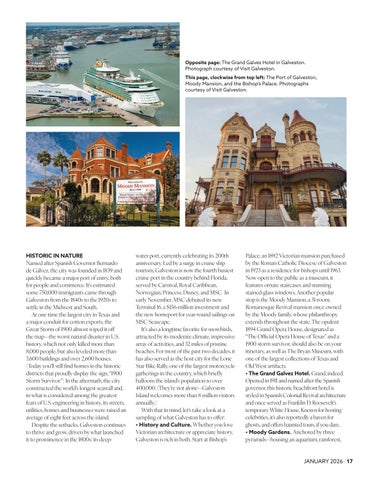
Opposite page: The Grand Galvez Hotel in Galveston. Photograph courtesy of Visit Galveston. This page, clockwise from top left: The Port of Galveston, Moody Mansion, and the Bishop’s Palace. Photographs courtesy of Visit Galveston.
HISTORIC IN NATURE Named after Spanish Governor Bernardo de Gálvez, the city was founded in 1839 and quickly became a major port of entry, both for people and commerce. It’s estimated some 750,000 immigrants came through Galveston from the 1840s to the 1920s to settle in the Midwest and South. At one time the largest city in Texas and a major conduit for cotton exports, the Great Storm of 1900 almost wiped it off the map—the worst natural disaster in U.S. history, which not only killed more than 8,000 people, but also leveled more than 3,600 buildings and over 2,600 houses. (Today you’ll still find homes in the historic districts that proudly display the sign, “1900 Storm Survivor.”) In the aftermath, the city constructed the world’s longest seawall and, in what is considered among the greatest feats of U.S. engineering in history, its streets, utilities, homes and businesses were raised an average of eight feet across the island. Despite the setbacks, Galveston continues to thrive and grow, driven by what launched it to prominence in the 1800s: its deep-
water port, currently celebrating its 200th anniversary. Led by a surge in cruise ship tourism, Galveston is now the fourth busiest cruise port in the country behind Florida, served by Carnival, Royal Caribbean, Norwegian, Princess, Disney, and MSC. In early November, MSC debuted its new Terminal 16, a $156-million investment and the new homeport for year-round sailings on MSC Seascape. It’s also a longtime favorite for snowbirds, attracted by its moderate climate, impressive array of activities, and 32 miles of pristine beaches. For most of the past two decades, it has also served as the host city for the Lone Star Bike Rally, one of the largest motorcycle gatherings in the country, which briefly balloons the island’s population to over 400,000. (They’re not alone—Galveston Island welcomes more than 8 million visitors annually.) With that in mind, let’s take a look at a sampling of what Galveston has to offer: • History and Culture. Whether you love Victorian architecture or appreciate history, Galveston is rich in both. Start at Bishop’s
Palace, an 1892 Victorian mansion purchased by the Roman Catholic Diocese of Galveston in 1923 as a residence for bishops until 1963. Now open to the public as a museum, it features ornate staircases and stunning stained-glass windows. Another popular stop is the Moody Mansion, a 31-room, Romanesque Revival mansion once owned by the Moody family, whose philanthropy extends throughout the state. The opulent 1894 Grand Opera House, designated as “The Official Opera House of Texas” and a 1900 storm survivor, should also be on your itinerary, as well as The Bryan Museum, with one of the largest collections of Texas and Old West artifacts. • The Grand Galvez Hotel. Grand, indeed. Opened in 1911 and named after the Spanish governor, this historic beachfront hotel is styled in Spanish Colonial Revival architecture and once served as Franklin D. Roosevelt’s temporary White House. Known for hosting celebrities, it’s also reportedly a haven for ghosts, and offers haunted tours, if you dare. • Moody Gardens. Anchored by three pyramids—housing an aquarium, rainforest,
JANUARY 2026 / 17
16-18 APC_Wanderlust_0126_final.indd 17
12/16/25 12:45 PM
From top: Mardi Gras! celebration (Photograph courtesy of Visit Galveston); Vida Agave tacos (Photograph by Gerry Barker); Dickens on the Strand (Photograph courtesy of Visit Galveston).
and Discovery Museum—families will find more to do here than there’s time to do it. There are zip lines, ropes courses, and 3D/4D theaters, as well as interactive experiences with penguins, which are both cute and cuddly, and let’s be honest, at times a tad smelly. • Off the Beaten Track. For adventures beyond the tourist brochures, veer off toward the Market Street historic district for the Maceo Spice and Import Company. Founded by Rosario Samuel Maceo in 1944 of Balinese Room fame (look it up!), it’s an emporium of imported foods, meats, and cheeses, their own spices, and “the best Muffuletta sandwich” in town. Owner Concetta Maceo Sims will give you a warm welcome. Crave authentic Mexican? Head for Vida Agave. Located in a strip mall within sight of the port, their Mexican street corn is the best thing going and pairs well with the Thai Chili Chicken tacos. For something more upscale, try Palmetto Osteria, featuring authentic coastal Italian fare. Start with the Amalfi Mussels, then move on to their Signature Picatta. Looking for a place to stay? Consider Hotel Lucine. Located across from the beach, the new owners have taken a rundown, 1960s property and transformed it into a boutique gem, blending both modern and mid-century elements. At their restaurant, The Fancy, the onion jam kolache is a winner. Looking to the year ahead, Visit Galveston Senior Public Relations Manager Mary Beth Bassett says Galveston is “thrilled” to be home for the Battleship Texas. Moored at Pier 15 and currently undergoing a $70-million renovation, it will open for public tours that will feature interactive exhibits and augmented reality. I’ll let playwright and poet Oscar Wilde, who visited here as part of an 1882 lecture tour, have the last word: “Galveston, set like a jewel in a crystal sea, was beautiful. Its fine beach, its shady avenues of oleander, and its delightful sea breezes were something to be enjoyed.”
18 / AQUA PINECREST
16-18 APC_Wanderlust_0126_final.indd 18
12/16/25 12:45 PM
www.sanctuaryofthearts.org @sanctuaryofthearts
2025-2026 SEASON OF AWAKENING Undeterred by the challenges the arts community has been facing, our season unfolds across a spectrum of experiences ~ productions for all ages, groundbreaking dance, powerful music, thought-provoking conversations, and site-specific works that close the gap between art and audiences. From global collaborations to intimate gatherings, our stages and spaces celebrate creativity in its many forms ~ led by artists, inspired by community, and driven by innovation. Sanctuary of the Arts is your "go-to” place for the best in entertainment! Come and enjoy global, national, and local renowned and award-winning artists! DOWNTOWN CAMPUS 410 ANDALUSIA AVENUE, CORAL GABLES, FL 33134
ST. MARY CAMPUS 136 FROW AVENUE, CORAL GABLES, FL 33133
LYDIA HARRISON
Untitled-5 1
12/1/25 4:27 PM
In Her
P
Miami-based Mexican painter and musician Teá Mox builds stunning, affecting multimedia worlds, all from her bedroom.
BY SHAWN MACOMBER
PERHAPS THE DEFINING characteristic of the Mexican painter, musician, and writer Teá Mox is her unapologetic love for and exploration of so many creative objects/mediums. Here, after all, is an artist whose lush, near-symphonic EP Sailors— produced and recorded entirely by herself in her bedroom (!)—is not only one best dream pop releases in recent memory, but also is perfectly complimented by her lovely series of accompanying paintings, ethereal self-shot avant garde videos, and
uninhibited lyrics—at turns poetic, biting, defiant, and soul-baring—that easily stand on their own merits as poetry. “There isn’t a lot of shade between these things in my mind,” Mox tells AQUA Pinecrest. “The art, painting, music, writing, videos, photos, it’s all one thing to me; it’s all interconnected. I’m always chasing the same idea or goal with different tools… It’s very much world-building in my mind. There are many different elements, but it’s the same world.”
PHOTOGRAPHS COURTESY OF TEÁ MOX.
Own World
20 / AQUA PINECREST
20-23 APC_Sailors_0126_final.indd 20
12/16/25 2:04 PM
JANUARY 2026 / 21
20-23 APC_Sailors_0126_final.indd 21
12/16/25 2:04 PM
AN ARTIST’S SOUL
Born and raised in Cancun, Mox’s first love was fashion design, which gave way to writing fiction when she encountered a certain young wizard. “I was deeply obsessed with Harry Potter,” she says. “I was one of those kids who had all the spells memorized.” Art, too, was always present. “I grew up looking at a lot of Frida Kahlo. That’s probably where my thing for self-portraits comes from,” she says. And then, in a moment of pre-teen serendipity, she discovered the Paramore record Riot! amidst the tumult of her parents’ divorce. “I was blown away by it,” she recalls. “I had never really had music or even poetry speak so directly to me like that before. It was like Hayley Williams was hitting the nail on the head with every single line.” Later, living in Fairfax, Virginia she played with other musicians attempting to conjure some of that band magic herself, but it never really clicked; She really was an art pop peg
struggling to fit in a hardcore and aggressive rock-shaped hole. And then she got a new laptop and discovered the GarageBand app. “I realized very quickly: I want to produce my own music. I put hours and hours in learning my way around it.” And then, when she felt as she had a handle on the program, Mox began to study music theory so that she would be able to translate the ambitious ideas into musical notation, more complex chord progressions, and four-part harmonies that could act as a kind of bridge between the low-fi bedroom pop she loved and the cinematic, orchestral work of transcendent alt-pop stars like Bjork and Tori Amos. If Picasso really did say, “Learn the rules like a pro, so you can break them like an artist,” Mox took the sentiment to heart. “Whenever I learn a technique or theory,” she says, “it is with the intention not of becoming an expert but to get the things I have in my mind done in the real world.”
22 / AQUA PINECREST
20-23 APC_Sailors_0126_final.indd 22
12/16/25 2:04 PM
PASSION PROJECT
Sailors represents the first time Mox actualized a holistic, multimedia work on this scale. Part of this is made possible by the fact that, as Hermann Hesse noted, solitude is freedom. “I have memories of being very hesitant to bring up an idea or show people something in a band setting,” Mox says. “And not just because they might not like it or make me feel stupid about something I was proud of, but also because I didn’t want to waste anyone’s time pursuing ideas. When it’s just me, I make so much stuff that is just trash and will never see the light of day, but it’s fine because it’s just my time and I know that’s how I find my way to the sounds and ideas I’m looking for. I’m not scared or embarrassed to say any stupid thing I want or make weird noises because it’s just me in my bedroom refining ideas, taking chances with my art.” But it’s also that Mox’s process has caught up to her conceptualizations. The visual aspect of the record, for example, was there from the beginning: When Mox paints, she listens to music. And when she writes music, she keeps half her computer screen open to a page with a selection of images and pictures she finds inspiring. “I begin to put together a little scene, and it evolves and grows through each step on every level,” she says. It seems appropriate in that, lyrically, Sailors is about the search for love and the fleeting nature of a person or feeling that is only in port for so long. Mox cites both the sailors who populate and abandon the Kit Kat Club in Cabaret and the maid Jenny from The Threepenny Opera who dreams of alternately leading and being rescued by pirate sailors. “Throughout the record, there’s this tension between whether a given sailor is someone who comes, takes something, and leaves or one who saves you and stays—and just the confusion, from my point of view, of never being able to pick the correct one. Then, on the last song, the title track, I have this epiphany that…it’s okay, no matter what. If you don’t find that one person who is going to save you, and everything is temporary, that’s okay. Because when you are not giving your energy to these people, you can direct it to your art or whatever it is that propels you forward. Always, forward.” For more information on her work, visit www.teamox.net.
JANUARY 2026 / 23
20-23 APC_Sailors_0126_final.indd 23
12/16/25 2:04 PM
24 / AQUA PINECREST
24-26 APC_Animals_0126_final.indd 24
12/16/25 2:09 PM
A Helping Hand Yolanda Berkowitz is transforming the lives of homeless pets—and she needs your help. BY SHAWN MACOMBER
O
ONE WOMAN IN OUR midst who has dedicated her life to advancing greatness and progress is Friends of Miami Animals (FOMA) Founder and President Yolanda Berkowitz. “I actually stumbled into animal welfare after nearly 20 years advocating for kids in foster care,” Berkowitz tells AQUA Pinecrest. “I’ve always loved animals, but for a long time, I was more of an advocate from the sidelines. It wasn’t until I saw how many of the same systemic failures affecting kids—such as lack of resources, policy gaps, and reactive systems—also trap animals in cycles of neglect and crisis, that I realized I had to step in and actively be part of the solution. When I left child welfare, I thought I could apply some
of that experience—building support systems, advocating for the vulnerable—to help animals, too.” To that end, Berkowitz established Friends of Miami Animals Foundation in 2016 to “build effective programs, establish meaningful collaborations, and engage leaders and the community to save and improve the lives of homeless pets.” “The biggest challenge isn’t a lack of love for animals; it’s a lack of infrastructure to support that love,” Berkowitz says. “We need to make it easier for people to be good pet owners—through affordable vet care, pet-inclusive housing policies, and stronger protections that reflect the community’s values.”
JANUARY 2026 / 25
24-26 APC_Animals_0126_final.indd 25
12/16/25 2:09 PM
PUTTING IN THE WORK
FoMA also empowers ordinary everyday Miamians to contribute to animal welfare in their own way and with their own available resources. “If someone can foster or adopt an animal, that’s amazing,” Berkowitz says. “But we understand that’s not possible for everyone. That’s why we created programs like our Virtual Foster Program, so people can advocate for pets in need even if they can’t foster at home or volunteer in our shelters. We also connect volunteers with trusted partners doing meaningful work, giving the community a firsthand look at where the needs are and how they can make a difference.” And then, of course,
there are donations, which are the lifeblood of any scrappy nonprofit. And, while our collective culture has made undeniably incredible strides in compassion and awareness when it comes to our animal companions, much work is left to be done. “We’re in a moment in which the community wants to do right by animals, but the system isn’t making it easy,” Berkowitz says. “Miami is filled with people who care deeply about their pets and the animals in need, but compassion is being priced out and progress is being stymied by ordinances and laws that don’t protect animals. Veterinary shortages, skyrocketing
costs of care, and housing policies that treat pets as luxury items rather than family members are creating an environment where even the most well-meaning pet owners and advocates are struggling to keep up.” Still, even in the face of all these challenges, Berkowitz remains an optimist: “What keeps me going is the resilience I see every day—in volunteers, fosters, advocates, and even in the pets themselves,” she says. “Miami’s heart is in the right place. Now, we just need our systems to catch up.” To donate or volunteer, visit www.fomapets.org.
26 / AQUA PINECREST
24-26 APC_Animals_0126_final.indd 26
12/16/25 2:09 PM
REACH THOUSANDS OF HOMES IN PINECREST WITH YOUR BUSINESS MESSAGE
FOR MORE INFORMATION CONTACT EVA DAISY ABREU AT 305-903-0621 OR DAISY.ABREU@WAINSCOTMEDIA.COM
Advertising_FP_APC_0625.indd 1
5/20/25 2:13 PM
PARADISE’S
Best Salesman Over the last quarter century, Michael Martinez has built a legendary real estate career in South Florida—and he’s just getting started. BY SHAWN MACOMBER
28 / AQUA PINECREST
28-31 APC_Cover_0126_final.indd 28
12/16/25 2:14 PM
B
“BELIEVE IN WHAT you sell,” Michael Martinez tells AQUA Pinecrest, “and, trust me, you will enjoy much more success.” The Miami born and raised ONE Sotheby’s International Realty Senior Vice President certainly knows of which he speaks: On the success side of the ledge, over the last quarter century he’s been a certified Top Producer company-wide for more than a dozen years with career gross sales approaching $2 billion. (He earned the distinction of #1 Top Producer, period, in the years between 2018 and 2020, then again from 2022 through 2024.)
In 2024 alone, he finalized more than $200 million in sales. Celebrity clients have included NBA star Jimmy Butler and MLB legend David “Big Papi” Ortiz. And as for belief ? Martinez certainly comes by that honestly as well. “My father had a full-time career, but his part-time hobby was building houses,” he says. “We would move all over town from the Gables to South Miami to Miami Beach and everything in between. So, that’s kind of where I started indirectly learning and appreciating the whole real estate game.”
JANUARY 2026 / 29
28-31 APC_Cover_0126_final.indd 29
12/16/25 2:14 PM
LAW OF ATTRACTION
Still, it wasn’t a straight line. Throughout high school, Martinez thought he’d follow his older brother—a role model—into law. (His oldest brother is a doctor; high achievement apparently runs in the family.) And despite his father’s background in real estate, there was no pressure to join the business. “My parents were immigrants, and they valued hard work, dedication, perseverance,” he says. “But they never forced a path on us. The most important thing at home was for us to go to school and be educated. What we chose to be educated in, though, that was up to us.” After graduation, however, he made the fateful decision at age 18 to take the real estate course and earn a license. “The idea was to have a flexible part-time job while I was in college,” Martinez says. “A full-time career in real estate wasn’t something that was on my radar yet. I didn’t know the
snowball effect it would have, which I am very grateful for now.” Also, as an avowed lower of the water, he wanted to be able to afford a boat. Even at the outset, however, real estate was fun and fulfilling. And, more importantly, Martinez sensed he had a knack—if not an outright calling—for sales. The dominos began to fall in that direction: He set aside law school dreams to study marketing, which he believed—correctly, as it would turn out, that it would go hand in hand with real estate sales. The synergy was obvious almost immediately. Within a couple years Martinez had gotten his real estate sea legs—and, it must be noted, his muchcoveted boat—and when his first big opportunity called, he was ready.
SOMETHING TO BELIEVE IN
It was a loft building on the Miami River: a bit unusual for the Magic City, especially
at the time. Martinez had gone to see the project for some clients but ended up falling in love with the setup. “I believed in the group,” he says. “I believed in the concept.” He sold pre-construction units to friends from childhood, friends from college. He sold units to clients. And this is when Martinez speaks the line with which we opened this article: “Believe in what you sell and, trust me, you will enjoy much more success.” Martinez had such a run in the lofts that he was offered a job with its developer. “I worked there for eight years,” he says. “I learned a lot about construction, obviously, and pre-construction sales, which opened up another path for me. I actually sold condos all over Brickell for a good portion of my career.” Then came the 2009 downturn, which hit the condo market particularly hard. And Martinez learned another foundational career lesson: When to pivot.
30 / AQUA PINECREST
28-31 APC_Cover_0126_final.indd 30
12/16/25 2:14 PM
THE LUXURY MARKET
As he considered his next move, Martinez realized he had spent considerable time on Miami Beach and understood the home market there—not just in the sense of where the beautiful homes are but what the quality of life is in specific enclaves. It was the sort of knowledge that is hard-won and only achieved through experience. He started selling single family homes and in short order realized luxury real estate was the niche in which he wanted to build his long-term career. It was professional endeavor, sure, but it would eventually have personal implications as well: “When I was ready to buy our family home, I knew exactly where I wanted to be: in the Pinecrest and Coral Gables area,” Martinez says. “It’s one of the most sought out neighborhoods for a reason! Great schools, larger spaces and yards for families, proximity to marinas and the water lifestyle. There’s Old Cutler Road, which is one of the most beautiful drives in the city. So, we decided to make that our nest egg neighborhood, and I focused a lot of my efforts in this particular neighborhood.” Today it would be hard to argue Martinez doesn’t have it all. His career has been essentially a rocket ship for many years now. He has a family with his wife Pamela, a nurse practitioner, and two beautiful, happy young children. He’s active in the community. He’s an assistant baseball coach in his son’s league. “I enjoy my life,” he says. “I enjoy selling people the opportunity to move to a place where a lot of people love to vacation. And, as a Miami native, I can say I truly believe in our neighborhood.” The unique specialness of sunny South Florida was really driven home to Martinez in the early 2000s when he would travel to South America and Europe to meet with potential clients about pre-construction opportunities. “That’s when I was realized how special this city is,” he says. “Doesn’t matter where you go; everyone wants a piece of Miami. Whether you’re talking about the culture, the climate, the tax advantages, there’s something for everyone here.” At this point you Martinez into the real estate business? “I always joke that there is probably more real estate licenses issued in Florida than drivers licenses,” he says, laughing. “I don’t think people
always recognize the amount of work and sacrifice that goes into doing this as a career at a high level. But, still, if somebody tells me they’re thinking about getting a real estate license, I encourage them. At the very least it’s good to have that knowledge even if you never use it professionally. And if you do decide to use it professionally, there are so many branches of the real estate business, [a license] is a tool that can definitely give you a lot of options.” To learn more about Michael and his listings, visit www.michaelmartinezrealtor.com.
JANUARY 2026 / 31
28-31 APC_Cover_0126_final.indd 31
12/16/25 2:14 PM
PARTNER CONTENT
Preparing for the Future Think a will is enough? It could be the biggest financial risk your family faces. BY ALINA F. NUÑEZ, ESQ., ESTATE PLANNING AND PROBATE ATTORNEY
THE GREATEST MISTAKE families make is assuming they have “time.” But life rarely gives warnings. The question isn’t whether you need an estate plan, it’s whether the one you have truly protects your loved ones the way you intended. I’ve seen too many stories where a “simple will” turned into months or even years of heartbreak, fighting, and legal bills. The truth is, relying only on a last will and testament alone can leave your loved ones vulnerable during the worst possible time. Estate planning is about making sure your family is protected during one of the most vulnerable times of their lives and yet, many families unknowingly leave their loved ones with complications, conflict, and unnecessary expenses by relying on a document that is often misunderstood. A will is an important part of an estate plan, but it has limitations most people don’t realize. It must go through the probate process, which is a public, time-consuming, and often expensive legal court process. During probate, your family may experience delays accessing funds, increased stress, and in some cases, disputes that strain lifelong relationships. For most families, the probate process can also expose sensitive financial information to the public, jeopardizing privacy.
In 2024 alone, Miami-Dade County recorded over 7,000 new probate filings. That means thousands of families are entering probate court facing delays, public scrutiny, and mounting legal fees which eat away at the assets they left their heirs. In Florida, probate costs often consume 3 to 6% of the estate’s value. That’s before accounting for additional costs such as executor fees, appraisal or accounting costs, and potential legal complications. That’s why I often advise a different approach: using a trust. A revocable living trust, in contrast to a will, is designed to keep your family out of the courtroom and in control. A properly drafted and funded trust allows your assets to pass directly to your beneficiaries without probate, maintaining privacy and avoiding delays. It also provides structure and protection, ensuring that your children, grandchildren, or even future generations receive assets in a way that aligns with your wishes. Whether you want to safeguard inheritance from creditors, divorcing spouses, or even from a beneficiary’s own financial missteps, a trust offers a level of control and security a will simply cannot. If you want to protect your family and leave them more than memories, if you want to leave them certainty, dignity, and
security, now is the moment to act. If you’re not confident your will alone offers that protection or you’ve never created a trust, I encourage you to call my office. Let’s make sure your legacy means something beautiful and lasting. Alina F. Nuñez, Esq. is the principal attorney at Nunez Estate Law & Title, a Miami-based law firm devoted to helping families safeguard their wealth and smoothly transfer it to the next generation.
Schedule Your Consultation – “Protect your family today—your legacy depends on it” 305-962-5929 | www.nunezlawfl.com
32 / AQUA PINECREST
32 APC_PC_Nunez_0126_final_REV1.indd 32
12/16/25 4:00 PM
Untitled-3 1
10/7/25 10:32 AM
PEOPLE WE KNOW
Think Globally, Plant Locally THROUGH HER COLORFUL, fascinating, and passion-infused book Life in the Everglades: A Young Naturalist’s Manual and Field Guide, our very own Mindy Dickman is not only bringing the ecosystems of South Florida to life through accessible science, vivid descriptions, and handson activities, but transforming that curiosity into real environmental understanding. Recently, the educator, author, and environmental advocate kindly agreed to tease out three themes of the book for AQUA Pinecrest readers. Empowerment. “Young naturalists learn that they can make measurable, positive impacts simply by understanding and caring for the living things around them,” Dickman says. “One of the most effective steps residents can take—highlighted in the book’s plant profiles and habitat chapters—is to choose native plants for their yards, balconies, and community spaces. Native species strengthen wildlife corridors, reduce the need for pesticides and irrigation, and restore the ecological balance that South Florida’s landscapes depend upon.”
Pinecrest educator and author Mindy Dickman is helping children—and the adults who guide them—connect deeply with the natural world BY SHAWN MACOMBER
Small Changes Can Lead to Big Benefits. “A yard planted with native species becomes a stepping-stone habitat for migratory birds, a refuge for butterflies, and a living science classroom for children,” Dickman says. “Species such as coontie, wild coffee, saw palmetto, and muhly grass—not only featured but celebrated in the book—support everything from Atala butterflies to songbirds and small mammals.The Jamaican capertree (Capparis cynophallophora), a hardy native shrub or small tree that makes an excellent hedge because it naturally grows compact and dense without pruning, supports pollinators such as bees, moths, and butterflies and is the larval host plant to the Florida white butterfly. When neighborhoods adopt native landscaping, they reduce stormwater runoff, prevent the spread of invasive species, and recreate the resilient ecosystems that once stretched unbroken across South Florida.” Nature is Our Home, Too. “Planting native is more than a gardening decision; it is an act of stewardship,” Dickman says. “It is a way for families to participate in Everglades conservation from their own homes and mirrors the values I hope to instill in young readers: curiosity, responsibility, and connection to place. That, to me, is how we will inspire communities to protect the ecosystems that make Florida unique—one child, one classroom, and one backyard at a time.” For more information, visit www.mindydickman.com.
34 / AQUA PINECREST
34 APC_PeopleWeKnow_0126_final.indd 34
12/16/25 2:17 PM
Let’s Get Social! Join our online community.
FOLLOW US
@aqua_ pinecrest
FOR MORE INFORMATION CONTACT EVA DAISY ABREU AT 305-903-0621 OR DAISY.ABREU@WAINSCOTMEDIA.COM
APC_Social_FP_1225.indd 1
11/18/25 3:07 PM
READING WITH ROCHELLE
Left: Jamilin Zapater-Diaz. Members of the Better Read Than Dead Book Club.
Read for Your Life!
Filling in for Rochelle B. Weinstein while she is on vacation, AQUA editor Shawn Macomber sits down with the Better Read Than Dead book club. BY SHAWN MACOMBER THE POPULAR, SOMETIMES raucous, always convivial thriller and mysterycelebrating monthly meetup Better Read Than Dead is hardly your typical book club. But, then again, Jamilin Zapater-Diaz is hardly your typical book club founder. Here’s an early plot twist: Considering the incredible EQ and kindness she brings to her hosting duties—constantly ensuring everyone is heard; guiding the discussions in the most inclusive way possible; sensing when someone’s shyness is keeping an incisive comment bottled up—Zapater-Diaz never attended a book club before launching her own. “It was actually that burning desire to talk about what I was reading with someone—anyone—that sparked the idea,” Zapater-Diaz tells AQUA Pinecrest. It’s a good thing that was her attitude, too, because the club was not an overnight success. “At our very first meeting back in June of 2022, only one person showed up—shoutout to Linda!” Zapater-Diaz says. Still, the pair had a great chat about Dorothy Koomson’s The Ice Cream Girls. “It inspired me to keep going,” she says.
This resilience would soon be rewarded. Word quickly spread, and before long the club’s friendly and diverse motley crew outgrew the tables at the Books & Books in downtown Coral Gables and set (metaphorical) sail for the current location at Le Parc Café on the Coral Gables Country Club grounds. “I think the club’s popularity comes down to a couple of things: our singlegenre focus and our informal vibe,” ZapaterDiaz says. “People who want something relaxed and low-pressure seem to enjoy it most. Plus, there’s plenty of dark humor, which you don’t find everywhere. I’m incredibly grateful for everyone who’s ever joined us whether once, occasionally, or from the very beginning. They’re what makes Better Read Than Dead special.” It’s a typically humble redirection from Zapater-Diaz. And while, yes, the group is amazing, it’s impossible to disentangle its success from the deft, charismatic, and empathetic leadership of its founder whose own rich background of navigating different cultures might explain why she is such a
natural in this context. “I grew up all over the world, in a sense,” Zapater-Diaz says. “I’m from Puerto Rico, but lived in Okinawa, Japan for several years, then briefly in Germany before moving to Florida 14 years ago for college.” A love of reading was her constant companion throughout these travels and now these two elemental pieces of Zapater-Diaz’ appear to meld within the club. “I genuinely enjoy hearing everyone’s perspectives,” she says, “so I try to give each person a chance to share.” It isn’t all give and no take, either: The process of building Better Read Than Dead has provided a nudge toward personal evolution as well. “I’m not someone who naturally enjoys being the center of attention,” Zapater-Diaz says. “Hosting, especially as the club has grown, has pushed me out of my comfort zone in the best way.” As far as recent standouts go, ZapaterDiaz cites Verity by Colleen Hoover: “It’s a very popular and very polarizing book,” she says, “so the turnout was big and the discussions were spicy.” “Although most of us didn’t enjoy it, we still had a blast discussing it,” Zapater-Diaz says of the latter. “It speaks to the heart of the club: Books are what bring us together, but the connections are what keep people coming back.” For more information visit www. meetup.com/better-read-than-deadbookclub.
36 / AQUA PINECREST
36 APC_Reading_0126_final.indd 36
12/16/25 2:20 PM
View All Our Issues!
Visit us online at aquapinecrest.com
SeeAllIssues_FP_APC_1225_converted.indd 1
11/18/25 3:24 PM
Top lef mos in re esti dolupt
PICTURE THIS
WORTH A THOUSAND WORDS KEVIN PONCE has always viewed and interpreted the world through an artistic lens— painting, composing music—but it wasn’t until he borrowed a camera from his father in the aftermath of Hurricane Irma eight years ago and came upon a washed-up boat in the abandoned Key Biscayne marina. Ponce took his first real, intentional, not-casual photo—and never looked back. “I’ve learned along the way that everything and everyone has beauty one way or another,” Ponce tells AQUA Pinecrest. “I see so much in the eyes of a literal lens. I see things just trying to capture moments that turn into memorial thoughts as like taking a picture that captures a lifetime memory.” Today, the Miami born and bred photographer helps others see the beauty in the world and themselves through his stunning and versatile professional work under the KP Photography moniker. “A good picture to me is one that can tell a story—or stories—and disrupt thoughts,” Ponce says. “Every photographer has a different editing style, but the captured image will always be the thing telling the story. Even with editing enhancing a certain image, it can’t change how strong a picture will look.” And while he still enjoys taking landscape photos, the social element and ability to control the variables in shooting portraits has in many ways stolen his heart. “I learned I liked taking portraits early on into the photography journey,” he says. “I like capturing a smile and the beauty of a face. A smile will always be the best curve of somebody.” For more information, visit @kpphotography01 on Instagram.
Have a great image for Picture This?
38 / AQUA PINECREST
38 APC_PictureThis_final.indd 38
Submit your high-resolution shot to shawn.macomber@ wainscotmedia.com.
12/16/25 2:24 PM
LOCAL EXPERT | FINANCE
Nuclear Energy:
The Next Energy Powerhouse Investors may be able to capitalize as the era of a new energy race begins. AL MAULINI, CFP®, CPM®, CEPA®- PRIVATE WEALTH MANAGEMENT OF CORAL GABLES as Three Mile Island and Michigan’s Palisades, the latter with a $1.5 billion Department of Energy loan. Globally, China has accounted for 80% of new capacity over the past five years and is set to surpass the U.S. as the leading producer, while France, the U.K., and Russia pursue ambitious expansion plans. Goldman Sachs projects 500 reactors worldwide by 2030, providing 12% of global electricity by 2040.
NUCLEAR POWER IS undergoing a global resurgence after decades of decline, fueled by technological advances, improved safety, and the urgent demand for low-carbon energy to power data centers and AI infrastructure. Once supplying 17% of global electricity in 1996 before falling to 9% by 2024, nuclear is poised for a major comeback. In the United States, bipartisan support has combined Biden-era subsidies with Trumpera deregulation to jumpstart the sector, including reactivating dormant plants such
A new generation of small modular reactors (SMRs) backed by tech giants promises safer, more efficient designs using alternative coolants like sodium, helium, or molten salt. TerraPower, backed by Bill Gates, is building a Wyoming project expected to power 276,000 homes by 2030. Amazon-backed X-energy is developing a graphite-fueled, helium-cooled reactor for Washington state, while Alphabet supports Kairos Power’s salt-cooled reactors targeting 2030 deployment. Sam Altman’s Oklo is pursuing an experimental Idaho plant, and Altman also backs Helion Energy in developing nuclear fusion technology. Critics, however, caution that cost overruns and failed ventures such as NuScale’s
canceled Idaho project in 2023 highlight the challenges of unproven technology. Meanwhile, safety and regulatory concerns loom as Trump’s restructuring of the Nuclear Regulatory Commission sparks debate over oversight capacity amid budget cuts and an aging workforce. Furthermore, cultural perception remains negative as roughly 96% of nuclear-themed films portray it negatively, shaping public fear through depictions of meltdowns, mutants, and apocalypse. Today, five, countries led by the U.S., France, China, Russia, and South Korea generate 71% of global nuclear capacity, with France relying on nuclear for 70% of its power and emerging as Europe’s top electricity exporter. Despite lingering public fears, often shaped by decades of negative media portrayals, a new cultural shift aims to reframe nuclear energy as a clean, safe, and essential pillar of the future energy landscape.
Thank you for reading. Live your best life, AL Maulini Founder/Owner, PWMCG Senior Portfolio Strategist, RJFS
The information contained in this email does not purport to be a complete description of the securities, markets, or developments referred to in this material. The information has been obtained from sources considered to be reliable, but we do not guarantee that the foregoing material is accurate or complete. Any opinions are those of Al Maulini and not necessarily those of Raymond James. Expressions of opinion are as of this date and are subject to change without notice. There is no guarantee that these statements, opinions or forecasts provided herein will prove to be correct. Investing involves risk and you may incur a profit or loss regardless of strategy selected, including diversification and asset allocation. Past performance does not guarantee future results. Future investment performance cannot be guaranteed; investment yields will fluctuate with market conditions. Indices are not available for direct investment. Index performance does not include transaction costs or other fees, which will affect actual investment performance. This information is not intended as a solicitation or an offer to buy or sell any security referred to herein. Private Wealth Management of Coral Gables | 141 Miracle Mile | Coral Gables, FL 33134 | 305.548.2247 Securities offered through Raymond James Financial Services, Inc., member FINRA/SIPC. Private Wealth Management of Coral Gables is not a registered broker/dealer and is independent of Raymond James Financial Services. Investment Advisory services offered through Raymond James Financial Services Advisors, Inc.
JANUARY 2026 / 39
39-40 APC_RE_Finance_0126_final.indd 39
12/16/25 2:36 PM
LOCAL EXPERT | FINANCE
China and the Energy Race China is ramping up its geopolitical influence. WHILE AMERICA DEBATES permits for new power plants, China just built the largest electrical grid in human history. China’s massive terrestrial power advantage, which OpenAI has termed the “electron gap,” poses the most significant long-term threat to American AI dominance. China, having added more power capacity than the rest of the world combined between 2010 and 2024, now generates twice the electricity of the U.S. and plans for 400 GW of spare capacity by 2030. This oversupply allows Chinese data centers, like those in Inner Mongolia, to charge just 3 cents per kilowatt hour, less than half the 7 to 9 cents paid in Northern Virginia. This difference is decisive: Chinese firms can use brute force, like bundling 384
inferior chips in Huawei’s CloudMatrix to match Nvidia’s performance despite requiring four times the power, rendering U.S. chip sanctions effectively moot. Meanwhile, the U.S. faces a projected 44 GW power shortfall within three years due to permitting roadblocks, jeopardizing its ability to power the AI chips it manufactures. 18 states have half their solar projects blocked by permitting. SpaceX has the capacity to launch satellites into space to build data centers via Starship, it’s a matter of scale and cost. Orbital deployment could harness continuous solar power without terrestrial permitting
constraints, potentially providing the U.S. with the Type II (stellar) energy capability needed to leapfrog China’s Type I (planetary) infrastructure and secure long-term AI superiority. A 26-mile blanket of solar satellites could power the entire US grid. The sun delivers continuous power in space...no night, no weather, no permits. The nation that controls energy controls artificial intelligence. The nation that controls artificial intelligence controls everything else. Thank you for reading. Live your best life, AL Maulini Founder/Owner, PWMCG Senior Portfolio Strategist, RJFS
40 / AQUA PINECREST
39-40 APC_RE_Finance_0126_final Rev1.indd 40
12/16/25 4:09 PM
Untitled-9 1
9/10/25 11:12 AM
Colson Hicks Eidson
New Address, Same Commitment to Justice Historic Douglas Entrance
For over 50 years, Colson Hicks Eidson has been at the forefront of landmark cases, setting precedents and fighting for justice. Our move to historic Douglas Entrance deepens our 25-year commitment to Coral Gables. A national and international firm of preeminent litigation attorneys, we remain dedicated to providing the highest quality of legal service to individuals and businesses throughout the world.
E x c e l l e n c e • P r o f e s s i o n a l i s m • P e r s e v e r a n c e • Te a m w o r k
806 S. Douglas Rd., Penthouse, Coral Gables, FL 33134 305 476 7400
Untitled-1 1
info@colson.com
colson.com
9/19/25 1:19 PM