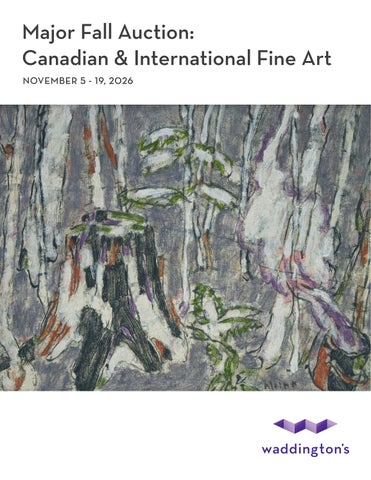
Major Fall Auction: Canadian & International Fine Art NOVEMBER 5 - 19, 2026
bid and view all lots online at bid.waddingtons.ca
fine art fineart@waddingtons.ca
auction ends Thursday, November 19, 2026 Bidding starts to close at 5 pm ET
director Goulven Le Morvan
on preview Saturday, November 14 from 12 pm to 4 pm
specialist Alicia Bojkov
Sunday, November 15 from 12 pm to 4 pm
associate specialist Claire Laycock
Monday, November 16 from 10 am to 5 pm
416-967-6027
Tuesday, November 17 from 10 am to 7 pm
front cover Lot 1 David Brown Milne Stump and Smudge Pail, ca. 1926
438-528-8489
416-847-6176
fine art administrator Holly Yake 416-504-5100
Wednesday, November 18 from 10 am to 5 pm
front inside cover Lot 8 Cornelius David Krieghoff Indians at a Portage, 1865 (detail) Lot 15 Frank Hans (Franz) Johnston Cathedral Isle (detail)
opposite Lot 21 Sir Alfred James Munnings The Sketcher, ca. 1928 (detail)
Or by appointment. preview held at 100 Broadview Ave., Suite 200 Toronto, Ontario M4M 3H3 register to bid You must be registered to bid in this auction. Please register at bid.waddingtons.ca
This catalogue and its contents © 2026 Waddington McLean & Company Ltd. This auction is subject to Waddington’s Conditions of Sale. Photography & design by Waddington’s. All rights reserved.
back inside cover Lot 42 Jean-Paul Riopelle Untitled, 1962 (detail)
back cover Lot 25 Alfred Joseph (A.J.) Casson Madawaska Region (Poplar), ca. 1950 (detail)
t
Lot 5 Georges Mathieu (1921-2012), French Out at Avaray, 1970
6
Canadian & International Fine Art
Our major Canadian and International Fine Art auction opens with a selection of works, lots 1 - 7, from a distinguished family collection from Kingston, Ontario. Passionate and discerning collectors, the family lived with these works in their home for decades, bringing together a significant and carefully curated selection of Canadian and international art. Seven works from the collection are offered in this auction, each with exceptional provenance and a history of acquisition through some of Canada’s most respected galleries and dealers. Among the highlights is Stump and Smudge Pail by David Milne, acquired by the family from Douglas Duncan, a founding member of the Picture Loan Society in Toronto and Milne’s agent. The two international works offered in the auction, Out at Avaray, a major painting by French artist Georges Mathieu, and Damaged Warrior, a sculpture by Scottish artist Eduardo Paolozzi, were acquired from Dominion Gallery in Montreal. The painting was fittingly hung above the family piano, an homage to Mathieu’s connection to musical performance. Other works acquired from the Dominion Gallery in Montreal include In the Shadow I by Sorel Etrog and Still-Life with Wild Flowers by Goodridge Roberts. The family’s appreciation for Canadian modernism also encompassed works by the Group of Seven. An A.Y. Jackson gouache, Autumn Landscape, was acquired from Galerie Gevik in Toronto’s Yorkville Village, while a drawing by Arthur Lismer, Tree, Vancouver Island, was purchased from Gallery Phillip, Phillip Gevik’s earlier gallery in Don Mills, Ontario. These works offer an opportunity to acquire a compelling selection of Canadian and international art from an important private collection.
t DAVID BROWN MILNE In its first appearance at auction in its century-long existence, David Milne’s Stump and Smudge Pail is an eloquent reminder of his remarkable achievement. It was painted when Milne divided his time between Big Moose Lake and Lake Placid almost 350 kilometres due north of New York City. Apart from his service in the Canadian Expeditionary Force and Canadian War Records during the First World War and a brief stay in Ottawa over the fall and winter of 1923-24, Milne lived and worked in New York City and upstate New York following his departure from Canada in 1903. In New York City, he saw the finest historical and modern art to be seen in North America and exhibited assiduously. As a member of the Canadian War Records (1918-1919) he was able to paint steadily without concern for the costs of living or his materials. His consistent diligence and artistic drive contributed to him making the most formally daring paintings made by a Canadian in the 1920s and ‘30s. Stump and Smudge Pail effectively conveys Milne’s achievement in this moment. A palette of cool silver grey heightened by white and accents of black, burnt sienna, veridian, vermilion, and violet activate the intimate view of a tree stump on the left and pail of smouldering smudge in bottom right. Saplings in background are a vertical screen against which the stump is rendered in echoing, broader, vertical brushstrokes and the plume of smoke from the smudge pail swirls to the top of the composition. By the middle of the 1920s, paintings like Stump and Smudge Pot, the Art Gallery of Ontario’s Black House I (1925), and the National Gallery of Canada’s Sparkle of Glass (1926 or 1927) and Tribute to Spring (1925) were abstractions made legible by Milne’s nuanced tracery. This intimate view devoid of horizon, sky, or terrain evokes Milne’s beloved Henry David Thoreau and takes us deep into our solitude, when the humble things we see are all there is, and they are abundant in and of themselves.
8
Canadian & International Fine Art
9
1 DAVID BROWN MILNE (1882-1953), CANADIAN STUMP AND SMUDGE PAIL, CA. 1926 oil on canvas signed lower right 12 x 16 in — 30.5 x 41 cm PROVENANCE: Douglas Duncan/The Picture Loan Society, Toronto, ON Dr. and Mrs. A.E. Mowry, London, ON, ca. 1960 By descent to present Private Collection, Kingston, ON LITERATURE: David Milne Jr. and David P. Silcox, David B. Milne: Catalogue Raisonné of the Paintings, Volume 1: 1882-1928, Toronto, 1998, no. 207.62. $60,000—80,000 10 Canadian & International Fine Art
VIEW LOT
November 5 - 19, 2026
11
SOREL ETROG In 1967, while living in Italy, Sorel Etrog was involved in a serious car accident that left both legs broken and his right hand severely injured. The experience influenced his work in the years that followed, bringing a greater focus to the vulnerability of the human body. Created in 1969, In the Shadow I reflects this artistic direction. The sculpture, produced in an edition of seven, belongs to Etrog’s Links series, one of the most important developments in his career. Drawing in part on ancient Etruscan art, Etrog used interlocking forms to explore the relationship between the human body and mechanical structures. In this work, the central form resembles a bone, with linked elements at either end. Cast in bronze, In the Shadow I brings together the strength of the material and the fragility of the form, a contrast that runs through much of Etrog’s sculpture.
12 Canadian & International Fine Art
November 5 - 19, 2026
13
2 SOREL ETROG, RCA (1933-2014), CANADIAN IN THE SHADOW I, 1969 patinated bronze signed and numbered 2/7 to base, stamped sculpture 8 x 15.75 x 6 in — 20.3 x 40 x 15.2 cm; incl. base 9.5 x 17.75 x 7.75 in — 24.1 x 45.1 x 19.7 cm PROVENANCE: Galerie Dominion, Montreal, QC Private Collection, Kingston, ON $8,000—12,000
14 Canadian & International Fine Art
VIEW LOT
November 5 - 19, 2026
15
tALEXANDER YOUNG JACKSON A. Y. Jackson’s sketches are an important part of the field-based practice through which he and his contemporaries developed a distinctly Canadian visual language. Working en plein air, Jackson used sketching to capture the structure, atmosphere, colour, and character of the landscapes he encountered during his extensive travels. Rather than recording every detail, he reduced the landscape to strong shapes and tonal masses. Autumn Landscape offers a revealing glimpse into his process. Executed in gouache and watercolour, it demonstrates his ability to work freely and economically while maintaining a strong sense of place. The luminous sky, simplified mountain forms, and rhythmic bands of autumn trees illustrate how Jackson distilled the landscape into a clear and expressive composition. While many of Jackson’s studies served as the basis for finished paintings, the sketches also stand as independent works, offering a direct view of his working process and his sustained engagement with the Canadian landscape.
16 Canadian & International Fine Art
17
3 ALEXANDER YOUNG (A.Y.) JACKSON, OSA, RCA (1882-1974), CANADIAN AUTUMN LANDSCAPE gouache and watercolour on strong wove paper signed lower right; titled to gallery label verso 7 x 10.5 in — 18.4 x 26.7 cm PROVENANCE: Gallery Gevik, Toronto, ON Private Collection, Kingston, ON $7,000—9,000
18 Canadian & International Fine Art
VIEW LOT
November 5 - 19, 2026
19
EDUARDO PAOLOZZI t Executed in 1956 in an edition of six, Damaged Warrior reflects Eduardo Paolozzi’s interest in the human figure, industrial machinery, and the physical and psychological scars of war. Created little more than a decade after the Second World War, the sculpture replaces the idealized classical hero with a battered, fragmented figure that suggests the lasting effects of conflict. Its rough bronze surface, irregular proportions, and mechanical details blur the line between the human body and machinery. Using the lost-wax casting technique, Paolozzi incorporated impressions of machine parts into his models, giving the sculpture its distinctive industrial character. Offered by Max Stern’s Dominion Gallery in Montreal, Damaged Warrior was probably exhibited in the gallery’s 1963 exhibition Eduardo Luigi Paolozzi (1959–1963).
20 Canadian & International Fine Art
21
22 Canadian & International Fine Art
4 EDUARDO PAOLOZZI (1924-2005), SCOTTISH DAMAGED WARRIOR, 1956 patinated bronze signed, numbered 1/6, and stamped “Susse Fond Paris” to base 10.75 x 7.5 x 5.25 in — 27.3 x 19.1 x 13.3 cm PROVENANCE:
Dominion Gallery, Montreal, QC Private Collection, Kingston, ON $10,000—15,000
VIEW LOT
November 5 - 19, 2026
23
t GEORGES MATHIEU Georges Mathieu was a leading figure in Abstraction Lyrique, a movement that emphasized spontaneity and the direct expression of emotion through painting. He began experimenting with abstraction in the early 1940s and 1950s, moving away from recognizable forms toward more fluid shapes and gestural brushwork. A trip to Japan in 1957 further shaped Mathieu’s approach—his encounter with Japanese calligraphy deepened his interest in swift, spontaneous gestures and their emotional impact. Mathieu developed a distinctive style in which bold marks take centre stage against a relatively restrained background. The paintings Mathieu produced during the 1960s and 1970s are widely regarded as some of the strongest of his career, reflecting a confident and fully developed artistic language. Painted in 1970, Out of Avaray is a striking example of this period. The composition is particularly effective in its use of colour and contrast. A monochromatic brown background sets off the sweeping gold gestures, which draw the eye toward the deep royal-blue centre. He balances the energy of his brushwork with a carefully considered arrangement of shapes and colour. While a similar palette appears in other paintings from 1970, the combination of gold and royal blue is distinctive to Out of Avaray. This painting has remained in the same collection since it was acquired from Montreal’s Dominion Gallery, which represented Mathieu in Canada.
24 Canadian & International Fine Art
25
5 GEORGES MATHIEU (1921-2012), FRENCH OUT AT AVARAY, 1970 oil on canvas signed and dated “70” lower right; titled to stretcher verso 28.75 x 36.25 in — 73 x 92.1 cm PROVENANCE: Dominion Gallery, Montreal, QC Private Collection, Kingston, ON $100,000—150,000
NOTE: A certificate of authenticity has been requested to the Comité Georges Mathieu, Paris.
26 Canadian & International Fine Art
VIEW LOT
November May 145--28, 19, 2026
27
ARTHUR LISMER t Arthur Lismer spent his summers sketching on Vancouver Island during the latter years of his career. It was during these sketching trips that he began experimenting with abstract methods. Many of the works from this period are focused on capturing the overlooked areas of the forest floor, “…he has characteristically moved in close to examine the undergrowth. The dark trunks of trees [...] to the plants of the forest floor.”1 1963 was a year of tribute and acclaim for Lismer. An exhibition of his drawings was featured at the Art Gallery of Windsor, he received the Canada Council medal, and was honoured with an LL.D. from McGill University in Montreal. The following year, his work was showcased in two exhibitions at Galerie Agnes Lefort and at the Walter Klinkhoff Gallery.
1 Dennis Reid, Canadian Jungle: The Later Work of Arthur Lismer, Toronto: Art Gallery of Ontario, 1985, 50.
28 Canadian & International Fine Art
29
6 ARTHUR LISMER, OSA, RCA (1885-1969), CANADIAN TREE, VANCOUVER ISLAND ink wash and charcoal on paper initialed lower left; signed “A. Lismer” verso; titled to gallery label verso sheet 12.5 x 9.5 in — 30.5 x 22.9 cm PROVENANCE: Gallery Phillip, Toronto, ON Private Collection, Kingston, ON $2,000—3,000
30 Canadian & International Fine Art
VIEW LOT
November 5 - 19, 2026
31
t WILLIAM GOODRIDGE ROBERTS One might have expected Goodridge Roberts to paint the outdoor landscape like most of his contemporaries, but instead, he preferred to focus on still lifes painted in his studio. In Still-life With Wild Flowers, we see that his interest lies mostly in the relationship between the object, the vase, its light shadow, and the visual tension emanating from its position on the pedestal. Roberts also delves into the flowers filtering the light and creating the wavy background.
32 Canadian & International Fine Art
33
7 WILLIAM GOODRIDGE ROBERTS, RCA (1904-1974), CANADIAN STILL-LIFE WITH WILD FLOWERS oil on board signed lower right; titled to gallery label verso 11.5 x 15.6 in — 29.2 x 39.6 cm PROVENANCE:
Dominion Gallery, Montreal, QC Private Collection, Kingston, ON $3,000—5,000
34 Canadian & International Fine Art
VIEW LOT
November 5 - 19, 2026
35
CORNELIUS DAVID KRIEGHOFF In Indians at a Portage, Krieghoff offers what would have been a highly popular view of the Quebec wilderness: a peaceful scene of two Indigenous men portaging their birchbark canoe onto a river shore. A folksy version of the sublime is alluded to, through Krieghoff’s use of formal 19th century pictorial traditions embedded in an untroubled view of nature, where land is presented as an object of contemplation through the removal of any political or local tensions. The portage was an efficient method of travel and trade initiated by Indigenous people throughout what later became known as Quebec; their ancient routes were used by the French-Canadian voyageurs, who learned from them, the most reliable and efficient ways to navigate trade routes. This image, created at the same time that railways such as the Canadian Pacific, Grand Trunk and other settler routes would have been overtaking longstanding traditional trade routes used for centuries by Indigenous people, also alludes to a romantic settler view of a past and disappearing way of life.
36 Canadian & International Fine Art
November 5 - 19, 2026
37
8 CORNELIUS DAVID KRIEGHOFF (1815-1872), CANADIAN INDIANS AT A PORTAGE, 1865 oil on canvas signed and dated lower right; titled to gallery labels verso 14 x 21.75 in — 35.6 x 55.9 cm PROVENANCE:
Laing Galleries, Toronto, ON Kastel Gallery Inc., Montreal, QC Private Collection, Ontario $40,000—60,000
38 Canadian & International Fine Art
VIEW LOT
November 5 - 19, 2026
39
t CORNELIUS DAVID KRIEGHOFF Italian Baroque artist Guido Reni (1575-1642) made at least six known paintings of Cleopatra’s suicide by asp, which are included in the collections of the Museo Capitolino, Rome, the Prado, Madrid, the Royal Collection, London, and the Pitti Palace, Florence. Of these versions, Krieghoff’s Cleopatra is most closely aligned with the latter. Krieghoff was known to work from photographs, and it is likely that he was inspired by a photograph from an 1870 albumin silver print of Reni’s Cleopatra in the collection of the National Gallery of Canada, making the photograph and the painting close contemporaries. Comparing Reni’s Cleopatra with Krieghoff’s version, the main differences are seen in the colouration—cushions, drapery—rather than composition. Reni’s cooltoned original uses minimal red, and what little he does apply is used sparingly to highlight the heroine’s anguished face. In contrast, Krieghoff loaded his palette with red, painting Cleopatra’s skin with gusto—an earthy departure from the Reni original. The strongest argument for Krieghoff’s version being painted from a black-andwhite photograph lies in the basket in the bottom left corner. Krieghoff chose a bright crimson pigment to paint the fruit, a shade not aligned with the reality of any known fig variety. Krieghoff cared about verisimilitude in his work—his paintings of various First Nations costumes are proof—and it seems unlikely that a mere flight of fancy would prompt him to take botanical liberties in a copied work.
40 Canadian & International Fine Art
41
9 CORNELIUS DAVID KRIEGHOFF (1815-1872), CANADIAN, AFTER GUIDO RENI (1575-1642), ITALIAN CLEOPATRA oil on canvas signed “Krieghoff” and inscribed “After Guido” 15 x 12.38 in — 38.1 x 31.4 cm PROVENANCE:
Dr. Albert E. Moll, Montreal, QC Sotheby’s Canada in association with Ritchies, Toronto, ON, 11 Nov 1980, lot 122 The Pagurian Collection, Toronto, ON Collection of Sir Christopher and Lady Ondaatje Waddington’s Auctioneers, Toronto, ON, 30 Nov 2023, lot 62 Private Collection, Ontario
42 Canadian & International Fine Art
EXHIBITED:
Doctors and Art, Montreal Museum of Fine Arts, Montreal, QC, 7 Jun-4 Jul 1961. LITERATURE:
Robert Ayre, Those Acquisitive Doctors, Montreal Star, Montreal, QC, 10 Jun 1961. Pioneers of Canadian Art: The Pagurian Collection, 1981/1982, Toronto: Pagurian Press, 1981, 8 no. 92. $5,000—8,000
VIEW LOT
November May 145--28, 19, 2026
43
tCORNELIUS DAVID KRIEGHOFF Krieghoff’s approach to Indigenous subjects, labour and the land is exemplified in Huron Indian Trapper on Snowshoes. The figure of the trapper is a common and recurrent motif in Krieghoff’s work. The artist focuses on the accoutrements, including clothing, snowshoes and hunting gear. The detail of the landscape and figure provides a generalized context and satisfies what would have been to settler and European audiences alike, a familiar snow-laden image of Canada and its Indigenous inhabitants. Not quite a portrait, this figure operates as an emblem of the traditional Indigenous trapper, exuding at once a kind of familiarity to the settler imagination, whose curiosity about the skills of the trapper are rendered apprehendable, familiar and folksy in the artist’s symbolic and romantic interpretation. The typified bright red hat, embroidered pouch, details of the fabrication of winter leggings, fringing and moccasins are informational rather than intimate. The figure, enduring under an overcast winter sky, exudes solitariness, efficiency and knowledge about the functioning of the natural world—a trapper out on his rounds, shown with a confident, casual and relaxed gesture oft-repeated by Krieghoff: a rifle on his shoulder and pipe in his mouth. There is an entwinement, suggesting some of the early impacts of colonization via the tools at hand (a rifle) while also alluding to the craftsmanship these garments and objects demonstrate about the Indigenous way of life.
44 Canadian & International Fine Art
45
10 CORNELIUS DAVID KRIEGHOFF (1815-1872), CANADIAN HURON INDIAN TRAPPER ON SNOWSHOES, CA. 1859 oil on canvas signed lower left; titled and dated to labels verso 11.25 x 9.25 in — 28.6 x 23.5 cm PROVENANCE: Walter Klinkhoff Gallery, Montreal, QC Private Collection, Ontario LITERATURE: Dennis Reid, Krieghoff: Images of Canada, Art Gallery of Ontario, Toronto, 1999, page 82. $25,000—35,000
46 Canadian & International Fine Art
VIEW LOT
November May 145--28, 19, 2026
47
tCORNELIUS DAVID KRIEGHOFF In this intimate, highly coloured painting, Krieghoff demonstrates his shorthand popularized fusion of European landscape tradition with the specificities of central Canadian autumn foliage. A depiction of dusk or dawn skies has formal similarities to 19th century German romantic artists, such as Casper David Friedrich, where the painting provides reflection and meditation through the observation of an idealized landscape. Although still residing within the naturalized chroma of the mid-19th century, Krieghoff introduces areas of intensity that align with the fall foliage of the Quebec region, achieved within layered, delicate brushwork contained within the scope of a small canvas. An Indigenous figure is depicted within a highly symbolic scene: in a traditional bark canoe anchoring the work in the scope of human affairs. The figure is miniaturized in the land, alluding to the grand scale of the Canadian wilderness. This popular depiction of Indigenous presence in the land would have reinforced a colonial world view that minimizes the tensions of colonization under the veneer of the land as a place of refuge and escape, rather than being contemporaneously contested and reshaped.
48 Canadian & International Fine Art
49
11 CORNELIUS DAVID KRIEGHOFF (1815-1872), CANADIAN AUTUMN, LAKE MEMPHRAMAGOG [SIC], CA. 1859 oil on canvas signed lower right; titled to gallery label verso 14 x 17.7 in — 35.5 x 45 cm PROVENANCE: Alexander McKenzie Ross, Quebec, acquired directly from the artist, 1860 Watson Art Galleries, Montreal, QC, acquired from the granddaughter of A.M.Ross, 1953 A.W. Callard, Montreal, QC Joyner Fine Art, Toronto, ON, 25 Nov 1994, lot 75 Distinguished Quebec family, Quebec LITERATURE: Marius Barbeau, Cornelius Krieghoff, Pioneer Painter of North America, Toronto, 1934, 100. $40,000—50,000
50 Canadian & International Fine Art
VIEW LOT
November May 145--28, 19, 2026
51
tFREDERICK ARTHUR VERNER The earliest buffalo subjects by Verner date to 1875. For these paintings, Verner relied on sketches he drew of buffalo in captivity. At least 57 sketches—some executed in graphite and watercolour, others in charcoal—are known to have been made and he continually referred back to these when producing his canvases. According to art historian Joan Murray, Verner’s buffalo paintings always contain at least one figure from his bank of 57 sketches drawn from life. Examples of these sketches form part of the permanent collections of the National Gallery of Canada, and the McCord Museum in Montreal. By the time Verner began painting buffalo, the herds were already significantly depleted. Murray acknowledges that Verner was acutely aware of the tragic fate of this “monarch of the plains” noting that “the buffalo officially disappeared from Canada in 1879.” Nonetheless, Murray observes that “Verner never showed the buffalo as a hunted species. He preferred to paint them as magnificent beasts in a proud and free state in nature...”1
1 Joan Murray, The Last Buffalo: The Story of Frederick Arthur Verner, Painter of the Canadian West, Pagurian Press, Toronto, 1984, pages 66, 134 and the cover illustration for a very closely related canvas entitled Bison Pawing, 1902, reproduced in colour.
52 Canadian & International Fine Art
53
12 FREDERICK ARTHUR VERNER, OSA, ARCA (1836-1928), CANADIAN BISON, 1911 oil on canvas signed and dated lower right 17.5 x 25.5 in — 44.5 x 64.8 cm PROVENANCE: MacKenzie & Co., Toronto, ON Private Collection, Toronto, ON By descent to the present Private Collection, Ontario $15,000—20,000
54 Canadian & International Fine Art
VIEW LOT
November 5 - 19, 2026
55
tFREDERICK ARTHUR VERNER Joan Murray writes that, according to family legend, Verner’s first contact with the Ojibway people took place in 1862, his second in 1870, his third in 1873, and his fourth around 1890. Murray notes that during the 1873 trip, which he likely embarked upon following the Ontario Society of Artists’ Spring Exhibition of that year, “Verner drew five very important sketches of Indians from life. They were to become sources to which he would refer again and again.” Between 1873 and 1876, Verner brought greater attention to detail, drama, and confidence to his painting than he had previously demonstrated. This halcyon period of consistently exemplary oil painting ended by 1877 after which, according to Murray, many of his best works would now be executed in watercolour. Spire Island, Height of Land, North West, 1876 was painted three years after his third trip and acquired the same year by the current Private Collection and is part of this period of work. Spire Island, Height of Land, North West, 1876, like so many other great landscapes from this period, displays Verner’s “mystical use of distance.” Murray says, “The way (Verner) painted Indians reveals how he felt about them.” This feeling, which ran quite contrary to the current view of many of his peers, was one of deep respect. With island and water blending together in a haze, the focus of the painting is on the vividly painted canoe, bearing the Union Jack, in the foreground. Verner’s use of fog in many of his canoe scenes reflects his artistic training in Europe, at the peak of Romanticism, when a perpetual fixation with Canadian First Nations had prevailed in Europe.
56 Canadian & International Fine Art
57
13 FREDERICK ARTHUR VERNER, OSA, ARCA (1836-1928), CANADIAN SPIRE ISLAND, HEIGHT OF LAND, NORTH WEST, 1876 oil on canvas signed and dated lower right; signed and titled to hand-written label verso 14 x 27 in — 35.6 x 68.6 cm PROVENANCE: Private Collection, California, USA $20,000—30,000
58 Canadian & International Fine Art
VIEW LOT
November May 145--28, 19, 2026
59
tJOHN WILLIAM BEATTY After proclaiming the death of European art, John William Beatty was clear: he would devote himself to creating and advancing Canadian art. “I made the mistake in 1900 of going to Europe to study. That is the biggest mistake and the greatest error that any nativeborn Canadian can make.”1 Beatty’s earlier experiences painting in Ontario’s Algonquin Park had already established this direction, and his works from the early 1920s continued to explore the Canadian landscape rather than European subjects. His work from this period reflects a broader transition in Canadian art. While he shared an interest in the Canadian wilderness with the artists who would later become the Group of Seven, his approach generally remained more representational, characterised by carefully structured compositions. Beatty’s Untitled (Canoe), ca. 1920, is a small but powerful work that exemplifies this new focus. It is emblematic of his goal of making the Canadian landscape, particularly the countryside of Ontario, the principal subject of his painting. The work also demonstrates his distinctly recognisable style—dramatic, expressive skies, changing light, and a sense of quiet solitude within the imposing presence of nature.
1 Farr, D. M., Beatty, J. W., & Centre, A. E. A. (1981). J.W. Beatty, 1869-1941, Kingston, Ont, Agnes Etherington Art Centre, p.17.
60 Canadian & International Fine Art
61
14 JOHN WILLIAM BEATTY, OSA, RCA (1869-1941), CANADIAN UNTITLED (CANOE), CA. 1920 oil on panel signed lower left 6.75 x 10 in — 17.1 x 25.4 cm PROVENANCE:
Acquired directly from the artist Herbert A. Pye, friend of the artist Jean Welles Pye, husband of Herbert A. Pye By descent to the present Private Collection, Toronto, ON $5,000—7,000
62 Canadian & International Fine Art
VIEW LOT
November 5 - 19, 2026
63
tFRANK HANS JOHNSTON Franz Johnston’s Cathedral Isle may evoke his friend and fellow Group of Seven member’s, Lawren Harris’s, monumental 1921 composition Island, MacCallum Lake, fellow Group member, Arthur Lismer’s, Isles of Spruce (1922), or Arnold Böcklin’s Symbolist touchstone, Isle of the Dead (1883). Where Böcklin, Harris and Lismer presented still and brooding islands, Johnston is active in the sun after a solo canoeist has turned his canoe to set it into the wind and traverse the large lake. With the canoe rigged for sail and a scarlet “point” blanket as its sail, the scarlet blaze in the centre of the painting anchors the composition and directs our eyes in the canoeist’s direction of travel. Simple details like the play of light across ripples in the lake in the foreground and bubbles in the bottom left made by the paddle being drawn through the water heighten the immediacy. In contrast to Harris’s and Lismer’s austerity and rumination, Johnston’s is lively and spritely. Johnston painted these works well after he stopped exhibiting with the Group because Masonite (hardboard) came onto the market in the late 1920s. The Shadowed Slope (lot 17) captures the sparkle of light playing off a sagging carpet of snow, and the light-infused vapourous sky. This subtlety is matched by his vermilion highlights on the right sides of the trees’ trunks catching the afternoon light. By painting the trunks in near silhouette, they pop against the many blues and pale violets of the bright sky and shadowed slope. In Augustus Bridle’s obituary of his longtime friend, he emphasised Franklin’s Canadian-ness and career in the arts. Although aware of the broader trends in advanced painting, Johnston maintained interest in and received sustenance from the belief, “the whole epic of visible nature was a miracle to paint,” 1 as we see among the finest of his postGroup of Seven paintings and here in Cathedral Isle and The Shadowed Slope.
1 Augustus Bridle, “Johnston Recreated Drama of Far North on Canvas,” Toronto Daily Star (16 July 1949), p. 40.
64 Canadian & International Fine Art
65
15 FRANK HANS (FRANZ) JOHNSTON, OSA, RCA (1888-1941), CANADIAN CATHEDRAL ISLE oil on board signed lower left; signed and titled verso 25 x 30 in — 63.5 x 76.2 cm PROVENANCE:
Private Collection, Ontario $40,000—60,000
66 Canadian & International Fine Art
VIEW LOT
November 5 - 19, 2026
67
tFREDERIC MARLETT BELL-SMITH Frederic Marlett Bell-Smith immigrated to Canada in 1867, following his studies at the South Kensington School of Art, in London. Although Bell-Smith declared in 1905, “Our country is ripe for the development of a distinctly Canadian Art, which if intelligently recognized should result in master-works comparable with those of older Lands”—we can still sense the influence of his British artistic education.1 Bell-Smith’s classical and almost historical approach transports us to the turn of the century, presenting a newly created and much-frequented beach with a sense of timelessness. English Bay, Vancouver, is one of the subjects that BellSmith painted throughout his career. The beach is depicted from the side, allowing the perspective to unfold gradually across the composition. Bell-Smith was known for his use of colour and his attention to accuracy and detail. Here, his brushwork conveys the movement of the salty sea air under Vancouver’s unpredictable sky, the ruffle on the dresses, and the sound of this crowded beach. The result is a scene that is at once distinctly Canadian thanks to its location but deeply connected to the European and British artistic traditions that shaped the artist’s early training.
1 Frederic M. Bell-Smith, in https://www.gallery.ca/collection/artist/frederic-m-bell-smith
68 Canadian & International Fine Art
69
t
16 FREDERIC MARLETT BELL-SMITH (1846-1923), CANADIAN ENGLISH BAY, 1900 oil on board signed lower right 8.9 x 18.1 in — 22.5 x 46 cm PROVENANCE: Collection of Mr. W.E. Gale, Vancouver, BC Private Collection, British Columbia EXHIBITED: Frederic Marlett Bell-Smith (1846-1923), Art Gallery of Greater Victoria, 15 Sep - 12 Oct 1977. LITERATURE: Roger Boulet, Frederic Marlett Bell-Smith (1846-1923), Art Gallery of Greater Victoria, 1977, 65, illustrated. $5,000—7,000
70 Canadian & International Fine Art
VIEW LOT
November 5 - 19, 2026
71
FRANK t HANS JOHNSTON Franz Johnston’s Cathedral Isle (lot 15) may evoke his friend and fellow Group of Seven member’s, Lawren Harris’s, monumental 1921 composition Island, MacCallum Lake, fellow Group member, Arthur Lismer’s, Isles of Spruce (1922), or Arnold Böcklin’s Symbolist touchstone, Isle of the Dead (1883). Where Böcklin, Harris and Lismer presented still and brooding islands, Johnston is active in the sun after a solo canoeist has turned his canoe to set it into the wind and traverse the large lake. With the canoe rigged for sail and a scarlet “point” blanket as its sail, the scarlet blaze in the centre of the painting anchors the composition and directs our eyes in the canoeist’s direction of travel. Simple details like the play of light across ripples in the lake in the foreground and bubbles in the bottom left made by the paddle being drawn through the water heighten the immediacy. In contrast to Harris’s and Lismer’s austerity and rumination, Johnston’s is lively and spritely. Johnston painted these works well after he stopped exhibiting with the Group because Masonite (hardboard) came onto the market in the late 1920s. The Shadowed Slope captures the sparkle of light playing off a sagging carpet of snow, and the light-infused vapourous sky. This subtlety is matched by his vermilion highlights on the right sides of the trees’ trunks catching the afternoon light. By painting the trunks in near silhouette, they pop against the many blues and pale violets of the bright sky and shadowed slope. In Augustus Bridle’s obituary of his longtime friend, he emphasised Franklin’s Canadian-ness and career in the arts. Although aware of the broader trends in advanced painting, Johnston maintained interest in and received sustenance from the belief, “the whole epic of visible nature was a miracle to paint,”1 as we see among the finest of his postGroup of Seven paintings and here in Cathedral Isle and The Shadowed Slope.
1 Augustus Bridle, “Johnston Recreated Drama of Far North on Canvas,” Toronto Daily Star (16 July 1949), p. 40.
72 Canadian & International Fine Art
73
17 FRANK HANS (FRANZ) JOHNSTON, OSA, RCA (1888-1941), CANADIAN THE SHADOWED SLOPE oil on hardboard signed lower left; signed and titled to labels verso 20 x 24 in — 50.8 x 61 cm PROVENANCE: McCready Galleries Inc., Toronto, ON Private Collection, Ontario $15,000—20,000
74 Canadian & International Fine Art
VIEW LOT
November 5 - 19, 2026
75
tMARC-AURÈLE FORTIN Homme et chien, 1920, is an early work by Marc-Aurèle Fortin, painted before the artist’s first trip to Europe. Between 1905 and 1920, Fortin rarely left Quebec, with the exception of a few months spent at the Art Institute of Chicago in 1909. Between 1901 and 1904, he studied at the Monument-National and at the Académie commerciale catholique in Montreal. Homme et chien was painted while Fortin was working at the post office in Montreal. He continued to paint the landscapes and natural environments of Quebec in his spare time. This painting depicts a late-winter scene, when the snow begins to melt and the atmosphere smells of approaching spring. It reflects the artistic milieu of its time, when Impressionism was increasingly influential. Fortin adapts this approach to the distinctly Canadian landscape, capturing the changing light and atmosphere of the Quebec countryside. Homme et chien exemplifies the artist’s early commitment to portraying the quiet Quebecs' landscape, a theme that would remain central to his work throughout his career.
76 Canadian & International Fine Art
77
18 MARC-AURÈLE FORTIN, RCA (1888-1970), CANADIAN HOMME ET CHIEN, CA. 1905-1920 oil on canvas signed lower right 14 x 9.6 in — 35.6 x 24.5 cm PROVENANCE: Private Collection, Quebec City, QC $12,000—18,000 NOTE:
A copy of the certificate of authenticity from the Foundation Marc-Aurèle Fortin, with the registration number F01817, will be delivered to the buyer.
78 Canadian & International Fine Art
VIEW LOT
November 5 - 19, 2026
79
tALFRED JOSEPH CASSON Alfred Joseph (A.J.) Casson painted Rain - Staynerville, Quebec in 1971. Two versions of this farm scene are known, the work offered here and another held in a Private Collection, which appeared at Joyner Canadian Fine Art in 1998. In addition to these two paintings, Casson likely spent some time in Quebec, probably late summer or early autumn, creating a series of regional works in 1971, all characterized by skies laden with rain clouds. Like many of the Group of Seven, Casson often worked en plein air. His style, always close to Impressionism, allowed him to render skies with particular sensitivity, giving his landscapes a precision that only photography might rival. Celebrated for his use of colour, Casson had a distinctive ability to transform “farmland and forests into highly finished, carefully composed designs, with a stillness that sometimes seems ominous.”1 Within the Group of Seven, he is often regarded as the painter of the sky, and in Rain - Staynerville, Quebec, 1971, the sky is the subject. The clouds are full and heavy, the downpour is imminent. Sparse farm buildings with metallic roofs look frail—they seem to ready themselves under the pressure of the approaching storm. In this painting, Casson continues his tendency toward almost geometrical construction. In the background stands a row of trees with autumn foliage at the foot of the mountains. Behind the mountains, the distant sky illuminates the composition. This 1971 work represents a painting of maturity, embodying all the hallmarks of Casson’s late style and his sustained emphasis on the sky. Rain - Staynerville, Quebec, 1971, passed through the Roberts Gallery, Toronto, which served as Casson’s exclusive dealer from 1955 until his death in 1992.
1 A.J. Casson in https://www.gallery.ca/collection/artist/aj-casson, accessed Sept 11, 2027.
80 Canadian & International Fine Art
81
19 ALFRED JOSEPH (A.J.) CASSON, OSA, PRCA (1898-1992), CANADIAN RAIN - STAYNERVILLE, QUEBEC, 1971 oil on board signed lower right; signed, titled, and dated to labels verso 12 x 15 in — 30.5 x 38.1 cm PROVENANCE: Roberts Gallery, Toronto, ON Private Collection, Ontario $30,000—40,000
82 Canadian & International Fine Art
VIEW LOT
November 5 - 19, 2026
83
tSIR ALFRED JAMES MUNNINGS Celebrated in art history and the auction market for his realistic depictions of stately horses, Sir Alfred Munnings’s oeuvre extended beyond the reins of the equestrian realm. Examples of the artist’s most compelling and evocative work can be found in his lush landscapes of the English countryside, such as The Sketcher, ca. 1928 and Untitled (The Artist’s Backyard). As Britain’s most revered Impressionist painter of the 20th century, the preferred settings for Munnings’s landscapes, particularly the Dedham and Flatford regions of Essex (also referred to as “Constable Country”), are thoroughly documented via the artist’s own memoirs and scholarly interest. At the epicentre of Munnings’s looser, more spontaneous en plein air landscapes was his home, Castle House, in which he had become enamoured in the summer of 1919, writing, “I had indeed found my dream house, river and all”.1 Untitled (The Artist’s Backyard), on the other hand, presents a more conventional landscape study, as Munnings captures the late-spring, earlysummer light on the burgeoning chestnut trees in the gardens of Castle House. Similar works underline the artist’s “zest as a lyrical interpreter of the East Anglian scene”2 and were amongst the 309 exhibited in the landmark 1956 Munnings retrospective held at the Royal Academy of Arts Diploma Gallery.
1 https://www.munningsmuseum.org.uk/archive/. 2 A. E. Richardson, Works by Sir Alfred J. Munnings (Royal Academy of Arts Diploma Gallery, 1956).
84 Canadian & International Fine Art
85
20 SIR ALFRED JAMES MUNNINGS, PRA, WRS (1878-1959), BRITISH UNTITLED (THE ARTIST’S BACKYARD), CA. 1920 oil on panel signed lower right 20 x 24 in — 50.8 x 61 cm PROVENANCE: Private Collection, Toronto, ON $60,000—80,000 NOTE:
We would like to thank Lorian Peralta-Ramos and Dr. Bill Teatheredge for their assistance in cataloguing this work.
86 Canadian & International Fine Art
VIEW LOT
November 5 - 19, 2026
87
tSIR ALFRED JAMES MUNNINGS Despite his monumental success as an equestrian portraitist receiving commissions all across Britain, Europe, and the Americas, it was evident from his autobiography and letters home to his beloved wife, Violet McBride, that painting the Dedham landscape was Munning’s form of artistic freedom, stating, “After the first World War I, I was receiving letters asking me to paint somebody on a horse. Opening such letters, too often I gave way to a burst of petulant rage… I wanted to be painting the English scene.”1 This freedom of artistic expression is epitomized in The Sketcher, ca. 1928, which captures the lush riverbanks of the artist’s home region in sumptuous blue and green tones. Almost camouflaged in the greenery is Maurice Codner, a neighbour and British portrait painter, rendering a scene, vastly different from his own commissioned work, en plein air. As Dr. Bill Teatheredge, Honorary Curatorial Associate at the Munnings Art Museum, notes that the figure in The Sketcher appears to be wearing the same clothing as in other known paintings of Codner in Flatford such as Sketching at Wiston Bridge, offered by Bonhams London in June 2015, and a Maurice Codner painting at Flatford, offered by Sotheby’s London in July 2023.2 In comparison to the other known paintings of Codner, the looser brushstrokes in The Sketcher render the dynamism of the gentle breeze blowing through the East Anglian landscape. The Sketcher also notably follows in the art historical precedent of the French Impressionists, namely Édouard Manet’s 1874 painting of Claude Monet on his floating studio housed in the permanent collection of the Neue Pinakothek in Munich. Both works present vignettes of creative freedom beyond the confines and restrictions of a traditional artist’s studio.
1 Alfred J. Munnings and Stanley Booth, Sir Alfred Munnings, 1878-1959: An Appreciation of the Artist and a Selection of His Paintings (Sotheby Parke Bernet, 1986). 2 Dr. Bill Teatheredge to Alicia Bojkov, “Archive Inquiry: The Sketcher” (Munnings Art Museum, June 30, 2026).
88 Canadian & International Fine Art
89
21 SIR ALFRED JAMES MUNNINGS, PRA, WRS (1878-1959), BRITISH THE SKETCHER, CA. 1928 oil on canvas signed lower right; titled to frame 17 x 21 in — 43.2 x 53.3 cm PROVENANCE: Hosmer Family Collection, Montreal, QC By descent to the present Private Collection, Quebec EXHIBITED: The Montreal Museum of Fine Arts $120,000—180,000 NOTE:
We would like to thank Lorian Peralta-Ramos and Dr. Bill Teatheredge for their assistance in cataloguing this work. 90 Canadian & International Fine Art
VIEW LOT
November 5 - 19, 2026
91
t HENRI LEBASQUE Nu Couché is an example of one of Henri Lebasque’s major artistic themes— the nude. Inspired by Bonnard and Matisse, Lebasque developed his interest in the odalisque, after his move to Le Cannet in the South of France in 1924. Lisa A. Banner wrote: “The year 1924 marked an important turning point in Lebasque’s work and in his painting technique. [...] From 1925 onward, painting from the model, and more specifically the painting of nudes, came to occupy a predominant place in his work. [...] From then on, Lebasque turned toward painting the female body, which he evoked in its many splendours. In Le Cannet, he allowed the model to move, naked, in the warm half-light of rooms during summer, offering us - after Renoir, whom he admired, and not without having been influenced by Bonnard - some of the last and most beautiful nudes that we know.1 The pose of the female model in Nu Couché, is identical to one of the artist’s major canvases, Nu à la peau de léopard, Le Cannet, painted in 1926. The velvety throw and the background also share some similarity. Nu Couché was probably painted after Lebasque’s move to Le Cannet in 1924 but prior to his other works of the 1930s. Of the nudes painted by Lebasque in the 1920s, Banner noted: “[these nudes were] the culmination of [Lebasque’s] intimist manner of painting--the celebration of the female form as fertile, warm, and inspiring...Matisse’s nudes of the same period, painted in his neighboring villa on the Riviera, share his rich decorative sense, but approach the nude in a more intellectual style, as opposed to Lebasque’s sensuous style. Lebasque painted his young models in poses of penetrating intimacy and subtle clarity.”2 Nu Couché has been held in a private collection in Montreal since its purchase from the Galerie Meissner in Zurich in 1960.
1 Lebasque, exh. cat., Montgomery Gallery, San Francisco, 1986, pp. 70-72. 2 Ibid.
92 Canadian & International Fine Art
93
22 HENRI LEBASQUE (1865-1937), FRENCH NU COUCHÉ oil on canvas signed lower right 15 x 25.6 in — 38 x 65 cm PROVENANCE: Galerie Meissner, Zurich, Switzerland Private Collection, Montreal, QC, acquired from the above 16 Feb 1960 By descent to a Private Collection, Montreal, QC Private Collection, Montreal, QC $30,000—40,000 NOTE:
A copy of the original invoice with the buyer’s information redacted will be delivered to the buyer. 94 Canadian & International Fine Art
VIEW LOT
November 5 - 19, 2026
95
FERNAND t LÉGER Following an exhibition of Fernand Léger’s early works in the United States, the critic Henry McBride wrote: “Léger speaks through a use of symbols that ought to be legible indeed to Americans, since these symbols consist for the most part of machines, the things upon which American civilization rests.”1 Léger breaks from this early ideology to focus on the human figure combined with organic elements in the late 1920s. Léger explained his approach to the human figure, "For me the human figure, the human body is no more important than keys or bicycles. That’s true. For me they are objects valuable for their artistic potentiality and disposable according to my will [...] It was necessary for the modern artist to detach himself from this sentimental grip in order to see more clearly. We have overcome this obstacle: the object has replaced the subject; abstract art came as a complete revelation, and then we were able to consider the human figure as a plastic value, not as a sentimental value. That is why in the development of my work from 1905 to the present day, the human figure has stayed intentionally inexpressive." Drawn in 1931, Femme à la Rose is an unpublished work by Léger focusing on the impassive head of a woman. Loose pages from a sketchbook are behind her and a large rose in full bloom is on her right side. Also present is a mysterious hand, possibly the artist’s, in the left corner holding the sketchbook. In this drawing, Léger presents women as anonymous and universal figures, an effect made even stronger by their enigmatic, stoic gazes. Femme à la Rose is a strong example of the “figure-object,” which is central to Léger’s work.
1 Helen Duffy, Fernand Léger, une esthétique de la modernité, Vie des arts, 1982, p. 96.
96 Canadian & International Fine Art
97
23 FERNAND LÉGER (1881-1955), FRENCH FEMME À LA ROSE, 1931 ink and graphite on paper signed and dated lower right 8.9 x 12.2 in — 22.5 x 31 cm PROVENANCE: Collection of Judith Teller, Toronto, ON Private Collection, Ontario $40,000—60,000 NOTE:
Accompanied by a certificate of authenticity issued on 28 May 2026 by the Comité Léger, Paris.
98 Canadian & International Fine Art
VIEW LOT
November 5 - 19, 2026
99
ALEXANDER YOUNG JACKSON t In 1951, the Canadian Pulp and Paper Association (CPPA) published Trees— designed by A.J. Casson and illustrated by Thoreau MacDonald. The publication culminated a year-long process of commissioning six of Canada’s most celebrated landscape artists to create six paintings “depict[ing] in their own terms the chief trees presently employed in the manufacture of pulp and paper. The paintings of these six artists have been reproduced herein in the hope that they will kindle a wider interest in the great forests on which Canada so largely depends for her daily bread, her welfare, and her future in the world.”1 Over the past several decades, CPPA retained the various sketches for the respective paintings, emphasizing the level of thought and care put into this commission and the foresight of the historical importance of the Association’s collection. Of the sketches retained are A.J. Casson’s Madawaska Region (Poplar) oil on panel and pencil sketch and A.Y. Jackson’s oil on panel study for Jack Pines, Peace River. Casson’s Madawaska Region (Poplar), with its lush blue-green tones, captures the artist’s ability “to reflect the mood of bright sunlight and passing cloud shadows, or to bow before the lowering storm”.2 Casson’s use of a limited colour palette harbours a dramatic atmosphere while underlining the unifying national mandate set by the CPPA’s initiative. While cohesion and aesthetic harmony are at the centre of Casson’s Poplar, the resilience of the jack pine is underscored in A.Y. Jackson’s interpretation of the rugged, windblown trees. Matching the rolling hills and mountains along Peace River, the undulating branches of Jackson’s jack pines guide the viewer’s eye across the landscape. The foreground captures the uniqueness of the individual pines, while the melding of the background creates a sense of harmony in the landscape. Both works exemplify the Group of Seven’s meticulous attention to light, captured during the creation of the earliest iteration of the works en plein air. By working directly onsite, in nature, Madawaska Region (Poplar) and Jack Pines, Peace River convey the purest rendering of their respective boreal. 1 Canadian Pulp & Paper Association, Trees (Canadian Pulp & Paper Association, 1951). 2 Ibid.
100 Canadian & International Fine Art
101
24 ALEXANDER YOUNG (A.Y.) JACKSON, OSA, RCA (1882-1974), CANADIAN JACK PINES, PEACE RIVER, CA. 1950 oil on panel 10 x 13.5 in — 25.4 x 34.3 cm PROVENANCE:
Commissioned by the Canadian Pulp and Paper Association, Montreal, QC, ca. 1950 By descent to the present Private Collection, Ontario $15,000—20,000
102 Canadian & International Fine Art
VIEW LOT
November May 145--28, 19, 2026
103
tALFRED JOSEPH CASSON In 1951, the Canadian Pulp and Paper Association (CPPA) published Trees— designed by A.J. Casson and illustrated by Thoreau MacDonald. The publication culminated a year-long process of commissioning six of Canada’s most celebrated landscape artists to create six paintings “depict[ing] in their own terms the chief trees presently employed in the manufacture of pulp and paper. The paintings of these six artists have been reproduced herein in the hope that they will kindle a wider interest in the great forests on which Canada so largely depends for her daily bread, her welfare, and her future in the world.”1 Over the past several decades, CPPA retained the various sketches for the respective paintings, emphasizing the level of thought and care put into this commission and the foresight of the historical importance of the Association’s collection. Of the sketches retained are A.J. Casson’s Madawaska Region (Poplar) oil on panel and pencil sketch and A.Y. Jackson’s oil on panel study for Jack Pines, Peace River. Casson’s Madawaska Region (Poplar), with its lush blue-green tones, captures the artist’s ability “to reflect the mood of bright sunlight and passing cloud shadows, or to bow before the lowering storm”.2 Casson’s use of a limited colour palette harbours a dramatic atmosphere while underlining the unifying national mandate set by the CPPA’s initiative. While cohesion and aesthetic harmony are at the centre of Casson’s Poplar, the resilience of the jack pine is underscored in A.Y. Jackson’s interpretation of the rugged, windblown trees. Matching the rolling hills and mountains along Peace River, the undulating branches of Jackson’s jack pines guide the viewer’s eye across the landscape. The foreground captures the uniqueness of the individual pines, while the melding of the background creates a sense of harmony in the landscape. Both works exemplify the Group of Seven’s meticulous attention to light, captured during the creation of the earliest iteration of the works en plein air. By working directly onsite, in nature, Madawaska Region (Poplar) and Jack Pines, Peace River convey the purest rendering of their respective boreal. 1 Canadian Pulp & Paper Association, Trees (Canadian Pulp & Paper Association, 1951). 2 Ibid.
104 Canadian & International Fine Art
105
25 ALFRED JOSEPH (A.J.) CASSON, OSA, PRCA (1898-1992), CANADIAN MADAWASKA REGION (POPLAR), CA. 1950 oil on panel signed lower right 10 x 13 in — 25.4 x 33 cm PROVENANCE: Commissioned by the Canadian Pulp and Paper Association, Montreal, QC, ca. 1950 By descent to the present Private Collection, Ontario $20,000—25,000 NOTE:
Accompanied by a graphite on paper sketch of Madawaska region.
106 Canadian & International Fine Art
VIEW LOT
November 5 - 19, 2026
107
tDAVID BROWN MILNE Before Dark is being offered at Waddington’s more than 85 years after its only documented public exhibition held in the fall of 1936 at Mellors Gallery in Toronto. David Milne’s small and mighty painting of the mid-1930s was acquired four years later by Upper Canada College’s assistant bursar from Douglas Duncan’s Picture Loan Society, and it has remained with the family ever since. Milne painted Before Dark in Six Mile Lake, Ontario, about 140 kilometres due north of Toronto, six years after he returned to Canada from the United States. He was 53 years old, he had been painting and exhibiting for over thirty years and was at the summit of his artistic powers. An outcropping overlooking a small bay near his cabin at Six Mile Lake dominates the composition.1 In more conventional hands the view would be from the outcropping instead of containing it. In Milne’s hands an arrangement of trees and their reflection are compressed in the top-left corner, parallel bars of white-black-black-white layered in top-right offer a pause, a white wedge of the lake in bottom-right thrusts into the composition, and the aforementioned outcropping explodes in a violent push in bottom-left to capture and anchor attention in a device Milne called the dazzle spot.2 This black and white composition accented with iron oxide, vermillion and violet is one of the finest paintings from the 1936 Mellors exhibition. Before Dark is more dynamic than many of Paul-Émile Borduas’s black and white compositions two decades later, and Milne’s use of white as material stands up to passages by Robert Ryman four and more decades later. More than ninety years after it was painted its potency and power are undiminished.
1 This is based on the account of the location of Canoe in Harbor and the similarity of the foreground topography in both paintings. In David Milne, Jr, and David Silcox David B. Milne: Catalogue Raisonné of the Paintings (Toronto / Buffalo / London, 1998), vol. II, no. 304.569, p. 615. 2 Letter from David Milne to H.O. McCurry, 17 March 1931, National Gallery of Canada, Ottawa, cited in John O’Brian, David Milne and the Modern Tradition of Painting (Toronto: Coach House Press, 1983), p. 38. 108 Canadian & International Fine Art
109
26 DAVID BROWN MILNE (1882-1953), CANADIAN BEFORE DARK, 1935 oil on canvas signed and dated “Sept 16 ‘35” lower left 12 x 14 in — 30.5 x 35.6 cm PROVENANCE:
Douglas Duncan/The Picture Loan Society, Toronto, ON Collection of K.D. Scott By descent to the present Private Collection, Toronto, ON
110 Canadian & International Fine Art
EXHIBITED:
Mellors, Toronto, 1936, 17. LITERATURE:
David Milne Jr. and David P. Silcox, David B. Milne: Catalogue Raisonné of the Paintings, Volume 1: 1882-1928, Toronto, 1998, no. 304.56. $40,000—60,000
VIEW LOT
November 5 - 19, 2026
111
tALFRED JOSEPH CASSON It was at Roberts Gallery in Toronto, in March of 1959 that A.J. Casson had his first one-man show. Jack Wildridge of Roberts Gallery, held the artist in high regard, hosting six dedicated exhibitions of Casson’s work between 1959 and 1972, the year October Storm was painted. The important new association with Roberts Gallery and the freedom from his commercial art career led Casson to a period of great production and achievement from the 1960s onward. In this painting, Casson uses both the rolling storm clouds and the fiery autumn foliage to great effect, provoking an almost dizzying sensation mitigated somewhat—and thoughtfully—by the distance set between viewer and the cliff’s edge. It is a dynamic viewpoint. But Casson also devotes about half of his composition to rocky terrain and autumn trees and half to the sky; a decision that serves to stabilize the composition. The result is a sublime view executed with a wise and experienced brush.
112 Canadian & International Fine Art
113
27 ALFRED JOSEPH (A.J.) CASSON (1898-1992), CANADIAN OCTOBER STORM, 1972 oil on board signed lower right; titled and dated to artist’s and gallery labels verso 12 x 15 in — 30.5 x 38.1 cm PROVENANCE: Roberts Gallery, Toronto, ON Private Collection, Toronto, ON Waddington’s Auctioneers, Toronto, ON, 28 May 2018, lot 16 Private Collection, Toronto, ON LITERATURE: Paul Duval, A.J. Casson, His Life & Works, A Tribute, Toronto, 1980, 158-163 and 225-229. $15,000—20,000
114 Canadian & International Fine Art
VIEW LOT
November 5 - 19, 2026
115
tJAMES EDWARD HERVEY MacDONALD J.E.H. MacDonald moved to Thornhill, north of Toronto in 1911, settling quickly at a property he named “Four Elms.”1 The area provided him with both space for his garden and a rich source of artistic inspiration. As art historian Paul Duval notes, Thornhill’s landscape contributed to several of MacDonald’s best paintings2. In Pasture Lane, Thornhill, we discover an image set in the artist’s sanctuary. Large trees and green pastures exist under MacDonald’s typical sky painted with deep brushstrokes, providing evidence of the artist’s deep attachment to one of his favourite places.
1 The Group of Seven in Thornhill, https://www.thornhillhistoric.org/discover/the-group-of-seven-in-thornhill, accessed Sept 2 2026. 2 National Gallery of Canada, https://www.gallery.ca/collection/artwork/the-tangled-garden, accessed Sept 2 2026.
116 Canadian & International Fine Art
117
28 JAMES EDWARD HERVEY (J.E.H.) MACDONALD, OSA, RCA (1873-1932), CANADIAN PASTURE LANE, THORNHILL oil on board signed and titled verso 8.5 x 10.5 in — 21.6 x 26.7 cm PROVENANCE: Warwick Gallery, Vancouver, BC Galerie Walter Klinkhoff, Montreal, QC Private Collection, Ontario Heffel, Toronto, ON, 25 May 2005, lot 220 Private Collection, Toronto, ON
118 Canadian & International Fine Art
LITERATURE: Paul Duval, The Tangled Garden: The Art of J.E.H. MacDonald, 1978, 49. $15,000—20,000
VIEW LOT
November 5 - 19, 2026
119
t FRANK HANS JOHNSTON Roger Burford Mason notes the artist’s reputation as a painter who excelled in capturing “the elusive beauty of light effects,” and that “Johnston’s skill in rendering the quality of light on snow was thought to be unsurpassed." Trips to northern Quebec and Ontario and the area around Lake Nipigon helped him develop “his very special facility for painting the effect of light and shadow on snow, a theme which informs some of his most popular and enduring works.”1 In The Hidden Stream, Johnston minimises the stream, which is usually prominent in his paintings, drawing us further into the landscape and encouraging us to imagine the hidden stream just beyond our view. Johnston’s mastery of light and shadow is striking here. The strong shadows suggest a morning scene, with the artist painting against the light in a remote, untamed part of Ontario.
1 Roger Burford Mason, A Grand Eye for Glory: The Life of Franz Johnston, Toronto, Dundurn Press, 1998, 62-63.
120 Canadian & International Fine Art
121
29 FRANK HANS (FRANZ) JOHNSTON (1888-1949), CANADIAN THE HIDDEN STREAM oil on board signed lower left; titled to artist’s label verso 10 x 14 in — 25.4 x 35.6 cm PROVENANCE: Heffel, Vancouver, BC, 4 Nov 2004, lot 75 Private Collection, Toronto, ON $10,000—15,000
122 Canadian & International Fine Art
VIEW LOT
November 5 - 19, 2026
123
t JOHN WILLIAM BEATTY John William Beatty’s passion for Canada’s undiscovered landscapes and rural life helped to inspire fellow artists and members of the Group of Seven to turn their attention toward the country’s remote and largely unexplored scenery. From the title and composition of this work, Maple Sugar Camp, we can imagine the artist deep in the woods in early spring. The maple trees are being tapped and a small fire burns beneath the collection of sap, transforming it into maple sugar. The scene evokes what Beatty sought—the physical ruggedness of the Canadian wilderness and a distinctly seasonal tradition. Maple Sugar Camp stands as an example of Canadian iconography as seen through the eyes of one of its most fervent supporters.
124 Canadian & International Fine Art
125
30 JOHN WILLIAM BEATTY, OSA, RCA (1869-1941), CANADIAN MAPLE SUGAR CAMP oil on panel signed lower left; titled to artist’s and gallery labels verso 8 x 10 in — 20.3 x 25.4 cm PROVENANCE: Galerie Walter Klinkhoff, Montreal, QC Acquired from the above by the present Private Collection, Toronto, ON, 1992 $5,000—7,000
126 Canadian & International Fine Art
VIEW LOT
November May 145--28, 19, 2026
127
CLARENCE ALPHONSE GAGNON t Best known for his depiction of Quebec and the historic town of Baie-SaintPaul, on the northern shore of the St. Lawrence River, Gagnon also had close ties to Europe. Haute-Savoie, France, 1926, was created when Gagnon was living in Paris between 1924 and 1936. Gagnon said in 1931: “It was not the over-sensitivity of the misunderstood that made me move to Paris... Over there, I paint only Canadian subjects, I dream only of Canada. The motif remains fixed in my mind, and I don’t allow myself to be captivated by the charms of a new landscape. In Switzerland, Scandinaviaeverywhere, I recall my French Canada.”1 While the architecture from the French mountains close to Switzerland is present, we also see a strong similarity in the treatment of this scene with paintings held in the National Art Gallery of Canada, such as Farm at Sunset, Baie-Saint-Paul, ca. 1923, and Evening on the North Shore, 1924. These works, made two years before Haute-Savoie, France, 1926 when Gagnon was in Quebec, retain the same colour palette – strong and undiluted colours of pure white, reds, blues and yellows.
1 National Gallery of Canada, in. https://www.gallery.ca/collection/artist/clarence-gagnon.
128 Canadian & International Fine Art
129
31 CLARENCE ALPHONSE GAGNON (1881-1942), CANADIAN HAUTE-SAVOIE, FRANCE, 1926 oil on panel artist’s thumbprint verso; titled to certificate of authenticity issued by Lucile Rodier Gagnon with inventory no. 476 verso 6.25 x 9.2 in — 16 x 23.3 cm PROVENANCE: Collection of Mr. & Mrs. Paul La Branche, Quebec Private Collection, Vancouver, BC Heffel, Toronto, ON, 25 Nov 2005, lot 56 Private Collection, Toronto, ON LITERATURE: Hughes de Jouvancourt, Clarence Gagnon, 1970, 44, illustr. $10,000—15,000
130 Canadian & International Fine Art
VIEW LOT
November 5 - 19, 2026
131
MARIAN MILDRED DALE SCOTT t The early 1940s were a pivotal time for Marian Mildred Dale Scott. Commissioned in 1941 to paint a mural at McGill University in Montreal, Endocrinology marked the beginning of her interest in “cell-like forms”, scientific symbols, and biochemistry. This oil on board, Untitled, ca. 1943, comes directly from the estate of the artist and is likely from the same period as the Endocrinology mural, when the artist experimented with scientific models. In this painting, four leaf fossils are depicted. In her essay, Life Chances and Changes: The Evolution of the Art of Marian Dale Scott, art historian Gwendolyn Owens notes the change during this period and the artist’s newfound interest in science: “Her art, however, was forever changed. Gone were the staircases. Now, she was painting cells, fossils and even embryos.”1 Two other works from this period are kept in the collection of the National Gallery of Canada:Variations on a Theme: Cell and Fossil, No.6, 1946 and Fossils, 1946.
1 Gwendolyn Owens, Life Chances and Changes: The Evolution of the Art of Marian Dale Scott, published in Magazine on November 25, 2025, in. https://www.gallery.ca/magazine/your-collection/lifechances-and-changes-the-evolution-of-the-art-of-marian-dale-scott, accessed Monday Aug 31 2026.
132 Canadian & International Fine Art
133
32 MARIAN MILDRED DALE SCOTT, RCA (1906-1993), CANADIAN ABSTRACT COMPOSITION, CA. 1943 oil on board 18 x 15.5 in — 45.7 x 39.4 cm PROVENANCE:
Estate of the artist Sotheby’s, Toronto, ON, 3 Dec 1997, lot 101 Private Collection, Toronto, ON LITERATURE:
Paul Duval, Four Decades: The Canadian Group of Painters and Their Contemporaries 1930-1970, Toronto, 1972, 93-94. $5,000—7,000 134 Canadian & International Fine Art
VIEW LOT
November 5 - 19, 2026
135
MAURICE t GALBRAITH CULLEN Legendary art dealer William Watson gave Cullen his first show at his Montreal gallery in 1923, and continued to do so annually until the 1934 Cullen Retrospective held just months before the artist’s death. Watson points out that the artist made a long and special study of ice formation and ice colour: “There is the steel-blue of mid-winter ice…Cullen loved the joyous flashes of sunlight, the glow of snow, the gleam of ice, the tumult of the freed river in the springtime…He taught us to see beauty where we had only thought of cold.” In Village by a River, Winter, Maurice Cullen offers what he did best, depicting a crisp winter, with patches of snow, an iced river under warm, vibrant light, offering a masterpiece of peaceful countryside scenery.
136 Canadian & International Fine Art
137
33 MAURICE GALBRAITH CULLEN, RCA (1866-1934), CANADIAN VILLAGE BY A RIVER, WINTER oil on panel signed with monogram lower right; Cullen Inventory no. 1574 verso 10.5 x 13.75 in — 26.7 x 34.9 cm PROVENANCE: Gallery Walter Klinkhoff, Montreal, QC Joyner Waddington’s, 26 May 2009, lot 23 Private Collection, Toronto, ON $8,000—12,000
138 Canadian & International Fine Art
VIEW LOT
November May 85--29, 19, 2026 2025
139
tALFRED JOSEPH CASSON By the early 1970s only two living members of the Group of Seven remained, A.Y. Jackson and A.J. Casson, and the responsibility of spokesperson for anything related to the Group fell to Casson due to Jackson’s health and advanced age. Just a few years after the country’s centennial in 1976, Canadians were feeling a distinct sense of the passage of time. As Christopher Jackson writes: “There was a surge of interest in Casson from organizations and institutions seeking to honour a pioneer in Canadian Art.“1 He would be the recipient of a number of honorary degrees and in 1971, the year this work was painted, McMaster University held a Casson retrospective which featured 73 paintings spanning 51 years of Casson’s prolific career. “Finally” writes Jackson “at the age of 73.
1 Christopher Jackson, A.J. Casson: An Artist’s Life, McMichael Canadian Art Collection, Ontario, 1988, p. 53.
140 Canadian & International Fine Art
November 5 - 19, 2026
141
34 ALFRED JOSEPH (A.J.) CASSON (1898-1992), CANADIAN OCTOBER, AVOCA, QUE., 1971 oil on board signed lower right; titled and dated verso 12 x 15 in — 30.5 x 38.1 cm PROVENANCE:
Roberts Gallery, Toronto, ON Private Collection, Hamilton, ON Waddington’s Auctioneers, Toronto, ON, 28 May 2018, lot 52
142 Canadian & International Fine Art
EXHIBITED:
23rd Annual Exhibition, Art Gallery of Hamilton, 1972. LITERATURE:
Christopher Jackson, A.J. Casson: An Artist’s Life, McMichael Canadian Art Collection, Kleinburg, 1998, 53. $15,000—20,000
VIEW LOT
November May 85--29, 19, 2026 2025
143
WILLIAM t KURELEK William Kurelek’s artistic career began in earnest with his first solo exhibition at Toronto’s Isaacs Gallery in March 1960 and concluded with his death, aged 50, in 1977. Like Pieter Bruegel in the 16th century, Kurelek made images adapted from Christian teachings. Like Cornelius Krieghoff in the 19th century, Kurelek made images derived from experience. Each made images more profound than mundane, more relatable than sacrosanct, and ultimately mediums for our humanity. Kurelek used parables explicitly in paintings such as The Parable of the Sower (1963) and Satan Sowing Weeds in the Church (1963), and it is inexplicit in A Prairie Parable. In the painting a haloed figure in a tunic stands on a sunny unplanted prairie field littered with dead Russian thistles (tumble weeds) pointing to a thistle formed into a crown of thorns with one hand and with the other to a pair of men setting a fencepost topped with a cruciform rig as storm clouds approach. The narrative of Matthew 16:21-28, Christ foretelling his Passion and calling for dedicated discipleship, may be the essence of A Prairie Parable. Faith and sacrifice were relevant and vital to Kurelek and course through his work, especially in the early 1970s. The painting’s composition and significance are also heightened by their direct relationship to the lithograph of the same title and year in the Art Gallery of Hamilton, Art Gallery of Ontario, and National Gallery of Canada. The painting’s first owner, the Very Rev. Bruce McLeod owned at least three other works by Kurelek, one of which was a commission and another that includes his portrait. In addition to being the Moderator of the United Church of Canada from 1972 to 1974, McLeod held senior positions with the Ontario Human Rights Commission and the Canadian Civil Liberties Association and mentioned Kurelek in his column for The Toronto Star. While McLeod’s progressive social positions were likely at odds with Kurelek’s, their reverence for faith and good works would have been aligned. When he was 96 years old McLeod answered a question about the meaning of faith at that age and said, “[it] means taking seriously this spirit that is still creating.” 1 It is another perspective Kurelek would have shared and one we see in A Prairie Parable. 1 Erin Pepler, “‘God’s disappointment will still motivate some of us’,” Broadview (28 April 2025), https:// broadview.org/bruce-mcleod/, accessed 29 September 2026.
144 Canadian & International Fine Art
November 5 - 19, 2026
145
35 WILLIAM KURELEK, OSA, RCA (1927-1977), CANADIAN A PRAIRIE PARABLE, 1973 mixed media on board signed with monogram and dated “73” lower right; titled to gallery label verso 19 x 23 in — 48.3 x 58.4 cm PROVENANCE:
The Isaacs Gallery, Toronto, ON The Collection of The Very Rev. Dr. N. Bruce McLeod, 25th Moderator of the United Church of Canada Sotheby’s, Toronto, ON, 22 Nov 2004, lot 199 Private Collection, Toronto, ON $50,000—80,000
146 Canadian & International Fine Art
VIEW LOT
November 5 - 19, 2026
147
SOREL ETROG Sorel Etrog’s steady interest in standing forms, often anthropomorphic, anchored his work in the human experience, natural balance, and patterns of growth. Etrog intended for his figures “to soar from the base like the trunk of a tree […] leaving the drama to the top.”1 The elongated horizontal axis of Small Flight Study is a key departure from Etrog’s signature attenuated figures, and it is one of the artist’s earliest works to exhibit what became a recurring motif in his oeuvre: the link. Here two winged figures are adjoined with a connecting loop, creating tension simultaneously away from and toward one another in an attempt to fly. Created in 1964, Small Flight Study was produced following the artist’s return to Canada from Europe where his discovery of Etruscan art would inspire him. The 180-foot long, fully-realised bronze sculpture, Flight, created for the Canadian Pavilion at Expo ’67, is currently located at the Bank of Canada Plaza at Wellington and Bank Street, Ottawa.
1 Alma Mikulinsky, Sorel Etrog: Life and Work, Art Canada Institute, https://www.aci-iac.ca/art-books/ sorel-etrog/style-and-technique/#the-links-period-196371.
148 Canadian & International Fine Art
November 5 - 19, 2026
149
150 Canadian & International Fine Art
36 SOREL ETROG, RCA (1933-2014), CANADIAN SMALL FLIGHT STUDY, 1964 patinated bronze signed to base (stamped); from the edition of 7 8.25 x 14.25 x 4.5 in — 21 x 36.2 x 11.4 cm PROVENANCE:
Gallery Moos, Toronto, ON Private Collection, Ontario $16,000—18,000
VIEW LOT
November 5 - 19, 2026
151
tMARC-AURÈLE DE FOY SUZOR-COTÉ Born in 1869 in Arthabaska, Québec, Marc-Aurèle de Foy Suzor-Coté was a French-Canadian painter and sculptor known for his depictions of Québec’s landscape, people, and history. After studying and exhibiting in Paris in the early 1890s, he returned to Québec with an interest in Impressionism and Symbolism. Around 1912, he turned his attention to small bronze sculptures inspired by rural life and the people around him. Suzor-Coté’s sculptures offer a vivid portrait of rural Québec, capturing the character and everyday lives of its people through carefully observed details and expressive forms. In Le médecin de campagne, 1922, he depicts the country doctor, a familiar and important figure in rural communities. The lines etched into the doctor’s face suggest age and experience, while his rugged features speak to the demands of his profession and the realities of rural life. The textured bronze reinforces his weathered appearance and gives the figure a strong sense of character.
152 Canadian & International Fine Art
153
37 MARC-AURÈLE DE FOY SUZOR-COTÉ (1869-1937), CANADIAN LE MÉDECIN DE CAMPAGNE, 1922 patinated bronze signed, titled, dated, and stamped “Roman Bronze Works N.Y.” to lower back 10.8 x 12.2 x 7.1 in — 27.5 x 31 x 18 cm PROVENANCE:
Private Collection, Ontario LITERATURE:
Hugues de Jouvancourt, Suzor-Cote, Montreal, 1967, 86, illustrated (as Le Remancheur). $10,000—15,000
VIEW LOT
154 Canadian & International Fine Art
November 5 - 19, 2026
155
tMARC-AURÈLE FORTIN Although best known for his Quebec landscapes, Marc-Aurèle Fortin returned to France in 1934 and 1935, revisiting the landscapes he had first encountered during his earlier stay in 1920. Over the course of four months, he travelled through northern France, including Honfleur and Bayeux, producing numerous drawings and sketches that he brought back with him to Quebec. These studies would later serve as important references for compositions he would create during the 1940s, such as Bayeux, Vue du Canal. In this painting, he revisits the famous canal, reconstructing the scene from memory and probably with the sketches he made during his stay. The larger format combined with the properties of casein, a medium that allowed him to combine the fluidity of watercolour with a distinctive matte, opaque finish, lent the composition in Bayeux, Vue du Canal a greater visual impact. Here, Fortin successfully translates the delicacy of a watercolour technique into a more substantial medium, demonstrating his ability to reinterpret a remembered landscape through both technical experimentation and artistic memory.
156 Canadian & International Fine Art
157
38 MARC-AURÈLE FORTIN, RCA (1888-1970), CANADIAN BAYEUX, VUE DU CANAL, CA. 1945 watercolour, casein, and oil stick on board signed lower left 40 x 30 in — 101.6 x 76.2 cm PROVENANCE:
Galerie Bernard Deroches, Montreal, QC Private Collection, Westmount, QC $20,000—30,000
158 Canadian & International Fine Art
VIEW LOT
November 5 - 19, 2026
159
tBERTRAM CHARLES BINNING Untitled (Ships), 1948, is an early oil on paper by Bertram Charles (B.C.) Binning, a central figure in Canadian modernism. Until the late 1940s, Binning was known primarily for his drawings and works on paper. 1948 marks the year he began to work in oil. His first oils were often boats and harbour scenes, themes drawn from his life in British Columbia highlighted with his longstanding interest in architecture and the sea. In Untitled (Ships), the ships are arranged like two pendulums. Their masts and hulls seem to hang, creating a sense of definite balance. The palette is deliberately restricted, built from shades of black and yellow. Rather than emphasizing colour, Binning uses tone to clarify form and structure, extending the disciplined approach of his drawings into paint. The sea appears only as a light indication in the lower right corner, keeping the focus on the ships’ geometry and the scene’s quiet order. This painting belongs to a transitional moment in Binning’s career. In the late 1940s and early 1950s he moved from drawing toward a more abstracted vocabulary in oil, while retaining a strong sense of composition and architectural vision. Untitled (Ships) is an important early example of Binning’s painted work: it shows the emergence of his mature style and his everlasting engagement with the coastal landscape of British Columbia.
160 Canadian & International Fine Art
161
39 BERTRAM CHARLES BINNING (1909-1976), CANADIAN UNTITLED (SHIPS), 1948 oil on paperboard signed and dated “48” lower right sight 11.6 x 8.7 in — 29.5 x 22 cm PROVENANCE:
Gift from the Artist to the present Private Collection, British Columbia $18,000—22,000 NOTE:
Accompanied by a letter from the artist.
162 Canadian & International Fine Art
VIEW LOT
November 5 - 19, 2026
163
tDORIS JEAN McCARTHY Doris McCarthy’s paintings are generally devoid of human or animal presence and convey a sense of suspended movement or stillness. Her practice is deeply concerned with the shifting spaces of the landscape, which she evokes through moving icebergs, undulating mountains, and flowing water. Yet relatively few works feature human or animal activity. In Untitled (Dogs in Snow), however, the artist’s characteristic visual vocabulary remains evident. The deceptive recession of the landscape and the imposing mountains in the background create a sense of depth and scale, but the central subject is a pack of dogs across the snow in the middle of the composition. Their presence introduces a rare sense of animation and narrative into an otherwise virginal landscape. Untitled (Dogs in Snow) is a double-sided oil on board painted during one of McCarthy’s trips to the North. It is also particularly interesting to note that she studied her subject on the verso of the panel, where she made studies of the dogs before depicting them on the recto in an almost naturalistic scene. The double-sided work therefore offers insight into her working process, revealing how she observed and developed the animal forms before incorporating them into the finished composition.
164 Canadian & International Fine Art
165
40 DORIS JEAN MCCARTHY, OSA, RCA (1910-2010), CANADIAN UNTITLED (DOGS IN SNOW) oil on board signed lower right 12 x 15.75 in — 30.5 x 40 cm PROVENANCE:
Private Collection, Toronto, ON $4,000—6,000
166 Canadian & International Fine Art
VIEW LOT
November 5 - 19, 2026
167
tALAN CASWELL COLLIER While best known for his paintings of the Canadian landscape, Land of Long Winter is an uncommon example of Alan Collier’s work depicting the American West.1 Dating to circa 1967-70, this work would have been completed following his resignation in 1967 from the Ontario College of Art to devote himself to painting full time.2 As inscribed on the verso, the location of this landscape is Granite Pass in Wyoming’s Bighorn Mountains. The exposed granite geology of Granite Pass provides a fitting subject for Collier’s distinctive angular style. In a fall 1970 interview with Paul Bennett, Director of the Robert McLaughlin Gallery in Oshawa, Collier remarked, “people are always saying to me that they can recognize my paintings by my style - and I never know what my style is. I know that I try to get angular things, that angular subjects attract me - I don’t know why I do it that way. I try to simplify things, I try to get a simple pattern…Clare Bice [curator of the then Williams Memorial Art Gallery and Museum in London, Ontario] one time spoke of me being a painter of light. I said to him, ‘Gee, I never thought of myself as being a painter of light.’” 3 Having studied at the college under J.E.H. MacDonald, Franklin Carmichael, and others from 1929-1933, Collier’s work is often discussed in relation to the Group of Seven. In the same interview, he acknowledged this influence, especially that of Lawren Harris, “I suppose as far as painting styles go that Lawren Harris and Casson have influenced me. Cass probably more as a way of life, more than as a painting style.”4 Like Harris, Collier distilled the landscape to heighten the drama of light and atmosphere. Land of Long Winter showcases the artist’s strong preference for simplified landforms and an abstracted treatment of light. Across the sky and snow, blocks of colour are reduced to bold, geometric shapes, creating a striking composition of high contrast and angular forms.
1 Alicia Boutilier, Across Canada with Alan C. Collier: Road Trip (Kingston, ON: Agnes Etherington Art Centre, Queen’s University, 2017). 2 Peter Neary, “‘Terrific Weight of Rock Above Me’: Alan Caswell Collier’s Mining Art,” Ontario History 114, no. 2 (2022): 146, 161, https://doi.org/10.7202/1092216ar. 3 Paul Bennett, “Interview with Alan C. Collier, Fall 1970,” in Alan C. Collier Retrospective (Oshawa: Robert McLaughlin Gallery, 1971). 168 Canadian 4 Ibid. & International Fine Art
169
41 ALAN CASWELL COLLIER, OSA, RCA (1911-1990), CANADIAN LAND OF LONG WINTER, CA. 1967-1970 oil on canvas signed lower right; titled to gallery label verso; inscribed “IN GRANITE PASS, LITTLE BIG HORN MT. WYO.” in ink to stretcher verso 30 x 50 in — 76.2 x 127 cm PROVENANCE:
Roberts Gallery, Toronto, ON Joyner Waddington’s, Toronto, ON, 28 Nov 2006, lot 74 Private Collection, Toronto, ON $10,000—15,000
170 Canadian & International Fine Art
VIEW LOT
November 5 - 19, 2026
171
JEAN-PAUL RIOPELLE t The 1960s present an inspiring era of transformation and discovery in the trajectory of Jean-Paul Riopelle’s artistic practice. Having reached critical acclaim nationally and internationally while residing in Paris, Riopelle began experimenting with new media and techniques in opposition to fashionable avant-garde aesthetics. Working more intimately with paper, via his introduction to the world of pastels by fellow artist Sam Szafran1, Riopelle garners a more fluid hand, breaking from the sharply darted forms that characterized his earlier work. Untitled, 1962 captures this precise breakthrough in the artist’s style and was featured in the 2004 Galerie Simon Blais exhibition Jean Paul Riopelle: Pastel as one of the earliest works in this medium2. The work, hurried and brimming with dynamism, consists of both opaque and sheer layers of vivid colour and yet is tampered by heavy, repetitive black swirls that gently lead one’s gaze around the composition. The black lines, although composed of pastel and not paint, display a looser employment of tachisme, connecting the work back to Riopelle’s already established and celebrated visual rhetoric.
172 Canadian & International Fine Art
173
42 JEAN-PAUL RIOPELLE (1923-2002), CANADIAN UNTITLED, 1962 pastel on paper signed and dated “62” lower right 19.6 x 25.2 in — 49.8 x 64.1 cm
EXHIBITED:
Paris, Galerie Jeanne Bucher and Montreal, Galerie Simon Blais, Jean Paul Riopelle, Pastel, 2004, illustrated, 27. LITERATURE:
PROVENANCE:
Pierre Matisse Gallery, New York, NY Acquavella Galleries, New York, NY Private Collection, New York, NY Sotheby’s, New York, 2 Oct 2019, lot 463 Private Collection, Toronto, ON
174 Canadian & International Fine Art
Yseult and Tanguy Riopelle, Jean Paul Riopelle: Catalogue Raisonné, Tome 3, 1960 - 1965, Montreal, 2009, p. 270, no. 1962.017P.1962, illustrated. $30,000—50,000
VIEW LOT
November 5 - 19, 2026
175
MICHAEL t SNOW Two, 1960 is part of the small body of abstract work produced by Snow while he was experimenting with ideas that were important in the New York art scene, including Abstract Expressionism, Colour Field painting, and Hans Hofmann’s theory of “push and pull.”1 Snow later recalled: “About my abstract/painting sculpture of 1959–60: several different tendencies were involved, none of which were influenced by specific works by specific painters of the New York school. Rather, my works were concerned with the principles that certain New York painters were involved in, in making their paintings.”2 Although his work was not directly derived from specific New York artists, traces of Barnett Newman and Mark Rothko can be discerned in Two. Painted in 1960, this painting is one of the early works by Michael Snow. In the exhibition, Early Snow: Michael Snow 1947-1962, held at the Art Gallery of Hamilton, art historian Dr. James King summarises the artist and his work during this time: “Above all, Snow is a formalist, an artist whose concerns are literally with the physical existence of a painting or a sculpture or any kind of art. In this regard, he is interested in the ideas that have formed his work and in the ways he has gone about giving shape to those ideas.”
1 Dr. James King, Early Snow: Michael Snow 1947-1962, Art Gallery of Hamilton, 2020. 2 Ibid.
176 Canadian & International Fine Art
177
43 MICHAEL SNOW (1928-2023), CANADIAN TWO, 1960 oil on canvas signed and dated to overflap verso; titled to nameplate 40 x 50 in — 101.6 x 127 cm PROVENANCE:
Isaacs Gallery, Toronto, ON Heffel, Vancouver, BC, 17 Jun 2009, lot 17 Private Collection, Westmount, QC EXHIBITED:
Michael Snow Solo Exhibition, The Isaacs Gallery Ltd., Toronto, 1960. Toronto Collects, The Art Gallery of Toronto, 1961. The Michael Snow Project: Exploring Plane and Contour, Art Gallery of Ontario and The Power Plant, Toronto, 11 May - 5 Jun, 1994, catalogue #81. 178 Canadian & International Fine Art
LITERATURE:
Dennis Reid, Philip Monk and Louise Dompierre, The Michael Snow Project, Art Gallery of Ontario and The Power Plant, 1994, reproduced 207. Catsou Roberts, Michael Snow Almost Cover to Cover, 2001, ed. Catsou Roberts, 8. Conversation between Michael Snow and Hri Neil, Toronto, Heffel Gallery Inc., 1 Apr 2009. $18,000—22,000
VIEW LOT
November May 145--28, 19, 2026
179
TAKAO TANABE t Landscape of an Interior Place #13 belongs to a series of paintings by Tanabe in 1955. The first painting in the series, Landscape of an Interior Place, 1955, was acquired by the National Gallery of Canada the same year. In an interview with Becky Rynor for the Gallery’s Magazine in 2014, Tanabe reflected on these early works: “It was the atmosphere at the time. Abstraction was in the air. [...] I was in New York in 1951–1952, and again in the late fifties, and the whole painting ethos in those early days was Abstraction of various kinds.”1 During this decade, Tanabe explored different approaches to abstraction, ranging from gestural to hard-edged, which he would develop in the 1960s. This painting is part of a body of work associated with gestural abstraction and closely related to “The White Paintings,” as defined by fellow artist Joseph (Joe) Plaskett. White appears as a highlight against still-vivid hues of green, yellow, and red. Plaskett provides a particularly fitting description of Tanabe’s use of white in his paintings: “Why all this white? You may think it is snow, or just light. The artist had no such intention. He describes his use of white as a “cleaning up.” In reaction against full and opaque colour he began using white sparingly and thinly, playing it off against the white of the canvas and producing this lightness of touch and technique. The effect of sparkling light is a by-product. Yet you, the viewer, are right…”2 Takao Tanabe 100: Inside Passage, an exhibition of 60 paintings spanning Tanabe’s career was recently on view at the Audain Art Museum in Whistler, BC. Several of Tanabe’s early abstract works are included, such as a similar work to this painting titled Nude Landscape I from 1959.
1 Takao Tanabe, in., Beck Rynor, An Interview With Takao Tanabe, https://www.gallery.ca/magazine/ artists/an-interview-with-takao-tanabe, accessed Oct 1st 2026. 2 Joseph Plaskett, The White Paintings, in Takao Tanabe: Paintings and Drawings, 1954–1957, Vancouver: privately printed, 1957.
180 Canadian & International Fine Art
November 5 - 19, 2026
181
44 TAKAO TANABE (B. 1926), CANADIAN LANDSCAPE OF AN INTERIOR PLACE #13, 1955 oil on canvas signed and dated “55” lower right; titled, situated “London” and second date “1954” verso; titled to gallery and exhibition labels verso 27.5 x 39.5 in — 69.9 x 100.3 cm
EXHIBITED:
Young Contemporaries, 1957, The Montreal Museum of Fine Arts, Montreal, QC, 13-29 Sep 1957. The Elsie Perrin Williams Memorial Art Museum, London, ON. Winnipeg Art Gallery, Winnipeg, MB. $15,000—25,000
PROVENANCE:
Mira Godard Gallery, Toronto, ON Private Collection, Alberta
182 Canadian & International Fine Art
VIEW LOT
November 5 - 19, 2026
183
RITA t LETENDRE "I wanted to create a new world, and if you have a world, it has to have poetry." – Rita Letendre Born in Drummondville, Quebec to Abenaki and Québécois parents in 1928, Rita Letendre began painting in 1950s Montreal. Renowned for her bold and visceral style, she pushed the boundaries of colour, light and space to new heights. Letendre used the paintbrush, airbrush, palette knife, and her hands to express the spirit of life. Her work embodies her ongoing quest for connection and understanding.1 In an essay for the Art Gallery of Ontario in 2017 by Wanda Nanibush, Letendre’s work from the 1970s to the 1980s is explored, when Mistral, 1985 was painted. Nanibush discussed Letendre’s transition from the her hard-edge style to a more diffuse transition of colour in the 1980s: “In 1971, her hard-edged paintings became a signature style, further developed through the innovative use of the airbrush, which in turn became commonplace in many of her murals and canvases. The use of an airbrush gave her considerable control over texture and coverage so she could execute pure, flat, evenly distributed colour arrows. The airbrush, coupled with tape, allowed for the colours to be butted up against each other in perfect lines. She also experimented with the ability of the airbrush nozzle to execute both firm and diffuse lines next to each other, breaking away from strict hard edges.2
1
https://ago.ca/agoinsider/remembering-rita-letendre
2
Wanda Nanibush, Rita Letendre: Fire & Light, 2017 in. https://www.ritaletendre.ca/about-3, accessed Sept 22 2026.
184 Canadian & International Fine Art
185
45 RITA LETENDRE, RCA (1928-2021), CANADIAN MISTRAL, 1985 acrylic on canvas signed and dated “85” lower right; signed, titled, and dated verso 30 x 40 in — 76.2 x 101.6 cm PROVENANCE:
Aviva Art Show, Toronto, ON Private Collection, Nova Scotia, acquired from the above April 1986 Fine Art Collector, Ontario Private Collection, Manitoba, acquired from the above in 2019 $8,000—12,000
186 Canadian & International Fine Art
VIEW LOT
November 5 - 19, 2026
187
tWILLIAM PEREHUDOFF Inspired by his participation in the legendary Emma Lake Artist Workshops of the early 1960s, William Perehudoff had become a central figure in Canadian abstract painting by 1970, creating works that thoughtfully combine the hardedged with the atmospheric. Forwarding modernist ideals while fearlessly experimenting with colour, texture and form, Perehudoff became internationally acclaimed though he never left his hometown of Saskatoon. Despite his remote location, Perehudoff established lasting friendships with influential New York-based critics like Clement Greenberg and artists such as Kenneth Noland, the American Colour Field painter. The two artists shared an interest in fostering the viewer’s “aesthetic feelings”, that is, emotions like wonder or joy prompted by the work’s formal qualities, like its colour palette or size. AC-84-64, 1984, is part of a series created by the artist during the early 1980s. By mixing a heavy gel medium with acrylic paint, Perehudoff was able to emphasize unrestrained colour through a direct and expressive gesture across the large canvas. This horizontal composition features a series of distinctive brushstrokes, each possessing a spontaneity and immediacy. During this period, Perehudoff was a highly assured painter, allowing him to work intuitively and directly, creating some of his most accomplished organic forms.
188 Canadian & International Fine Art
189
46 WILLIAM PEREHUDOFF, RCA (1918-2013), CANADIAN AC-84-64, 1984 acrylic on canvas signed, titled, and dated verso 40 x 60 in — 101.6 x 152.4 cm PROVENANCE:
Mira Godard Gallery, Toronto, ON Miriam Shiell Fine Art, Toronto, ON Private Collection, Toronto, ON $20,000—30,000
190 Canadian & International Fine Art
VIEW LOT
November 5 - 19, 2026
191
tJOE NORRIS Joe Norris holds an important place in Nova Scotia’s folk art tradition and is one of the province’s best-known self-taught artists. Drawing inspiration from his home in Lower Prospect, he developed a distinctive style characterized by simplified forms, flattened perspective, and bold colour. Dated 1980, this work depicts the islands near Lower Prospect, with wooden houses along the shore, fishing boats moored nearby, and two schooners in the distance. The vivid blue sea, characteristic of Norris’s paintings, unifies the composition, while his straightforward approach captures the quiet character of the Nova Scotia coast.
192 Canadian & International Fine Art
193
47 JOE NORRIS (1925-1996), CANADIAN UNTITLED, 1980 oil on panel signed lower left; dated “May.28.1980” verso 10 x 18 in — 25.4 x 45.7 cm PROVENANCE:
The Michael Donoho Gallery, Oakland, CA Private Collection, Pennsylvania, USA $6,000—8,000
194 Canadian & International Fine Art
VIEW LOT
November 5 - 19, 2026
195
tTED HARRISON In 1990, the International Board on Books for Young People (IBBY Canada) invited Ted Harrison to create a poster for International Children’s Book Day, based on The Glade, a short story by Canadian author Monica Hughes. The resulting design reflects Harrison’s enduring interest in the natural world and the imaginative possibilities of storytelling. Through his signature flowing lines and vibrant colours, Harrison offers a tribute to the preservation of nature, the innocence of childhood, and the sense of wonder that reading can inspire. In Design for I.B.B.Y. Poster, Harrison brings together landscape, figures, and architecture in a composition defined by the interplay of colour and form. The mountains and castle establish a distinctive setting, while the gathering of figures beneath the trees brings warmth and a sense of community to the scene. The lower portion of the composition feels lively and inviting, contrasting with the more mysterious, almost eerie colours of the upper section. This contrast lends the work a sense of fantasy, suggesting that the landscape holds both familiar comforts and the possibility of the unknown. Harrison’s contribution also reflects a shared commitment to encouraging children’s engagement with literature. Hughes was widely celebrated for her pioneering work in Canadian young adult science fiction and fantasy, and the collaboration brought together two important figures in Canadian children’s literature.
196 Canadian & International Fine Art
197
48 TED HARRISON, RCA (1926-2015), CANADIAN DESIGN FOR I.B.B.Y. POSTER BASED ON THE GLADE BY MONICA HUGHES, 1990 acrylic on illustration board signed lower right 24 x 18 in — 61 x 45.7 cm PROVENANCE:
Acquired directly from the artist By descent to the present Private Collection, Toronto, ON $8,000—12,000
198 Canadian & International Fine Art
VIEW LOT
November 5 - 19, 2026
199
tJOSEPH YVON FAFARD Born and raised on a farm in Sainte-Marthe, Quebec, Joseph Yvon Fafard maintained a lifelong interest in farm animals. He opened his own foundry, Julienne Atelier Inc., in Pense, Saskatchewan, in 1985, enabling him to produce a greater number of animal sculptures, which he first developed in plaster and ceramic. They would remain a central theme throughout his career, inspiring sculptures of goats, cows, bulls, and horses. Four years after establishing his foundry, Fafard created Mac and Moe, 1989, a pair of workhorses that belongs to the series of farm-animal sculptures he developed during the late 1980s. Although his representation of the horse is relatively traditional, the animals’ sturdy proportions place them within the rural world that shaped the artist’s life. We can identify the maker of these sculptures at first glance. We can also feel in this pair of sculptures Fafard’s lifelong affection for horses. His interest in horses continued throughout his career and led to works such as Running Horses, 2007, part of the National Gallery of Canada’s collection. Mac and Moe can definitely be understood as an important early example of Fafard’s interest in the horse figure.
200 Canadian & International Fine Art
201
49 JOSEPH YVON FAFARD, RCA (1942-2019), CANADIAN MAC AND MOE, 1989 patinated bronze each signed, dated, numbered 5/10, and stamped “JA/PL” for Julienne Atelier to underside 6.25 x 7.5 x 3 in — 15.9 x 19.1 x 7.6 cm; 6.25 x 7.5 x 2.5 in — 15.9 x 19.1 x 6.4 cm PROVENANCE:
Mayberry Fine Art, Toronto, ON / Winnipeg, MB Private Collection, Toronto, ON $8,000—10,000
VIEW LOT
202 Canadian & International Fine Art
November 5 - 19, 2026
203
tJOHN KASYN Igniting the entire sky with reds, oranges and yellows, and illuminating the city in a final fiery burst, a winter sunset can be a magnificent and rare experience, as the sun’s appearance is only fleeting during the winter months in Toronto. John Kasyn seemed to understand the value of this phenomenon, and has rendered it here with celebratory exuberance. Despite the absence of figures, Kasyn evokes their presence by the careful depiction of a well-trodden footpath in the snow, from laneway to back door. This scene is full of latent activity, as it is a common Canadian practice to enter through the backdoor in the winter, where we can divest ourselves of our winter clothing and escape into the warmth of the house. Situated between Carlaw and Jones between Queen Street and Eastern Avenue, Heward Street Lane is now part of the prosperous and lively Leslieville community and home to the filmmaking company, Filmport Studio.
204 Canadian & International Fine Art
205
50 JOHN KASYN, OSA (1926-2008), CANADIAN VIEW FROM HEWARD STREET LANE oil on board signed lower right; signed and titled verso 16 x 22 in — 40.6 x 55.9 cm PROVENANCE:
Private Collection, British Columbia Waddington’s Auctioneers, Toronto, ON, 28 May 2018, lot 69 Private Collection, Toronto, ON $10,000—15,000
206 Canadian & International Fine Art
VIEW LOT
November 5 - 19, 2026
207
tEDOUARD CORTÈS Born in 1882 into a lineage of Spanish court painters in Lagny-sur-Marne, France, Edouard Cortés began his career exhibiting at the Paris Salon at the age of 16. It was not until a decade later though, that the artist would develop his hallmark Post-Impressionist scenes of Paris, epitomized in Paris; Porte Saint Denis au crépuscule. “In 1906, Cortès exhibited the painting Le Boulevard de la Madeleine, soir d’automne, an early example of what would become his signature image of a Paris streetscape. He chose the same type of image for the next Salon as well, submitting Soir de neige près du square Montholon. By 1907, he was confident enough of his painting to organize an auction of his own works at the Hôtel Drouot in April 1907, where he earned 250 francs. Having achieved a certain success as a painter, Cortès began to broaden his scope, exhibiting his work throughout France at regional salons beginning with the Toulouse International Industrial Salon in 1908. There, he received a third-class medal for La Port de Pantin soir de neige,[…] In the following years, Cortès established a pattern of exhibitions throughout the country.”1 The success of his Paris street scenes continued to grow through the First World War, as locals, soldiers, and tourists alike were drawn to Cortès’ idyllic depictions of the city. This success eventually led to the artist’s first commercial representation abroad, in Toronto. “The late 1920s brought an international client, the T. Eaton Company Limited of Toronto[…] In 1928, Eaton commissioned thirty paintings by Cortès to be shown in Toronto, Winnipeg, and Montreal between November and December. Eaton’s remained a steady client until the Great Depression of the 1930s. More importantly, it introduced Cortès to the North American commercial art market.”2 The appeal of Cortès’ Parisian streetscapes and international success still stands nearly a century after his introduction to the broader art world. These charming and timeless scenes are sure to continue to entice collectors and aficionados for decades to come. 1 Janet Whitmore, BIOGRAPHY - Edouard Léon Cortès (1882 - 1969), Reh Galleries, Inc., accessed April 13, 2026, https://rehs.com/eng/images/edouard-l%C3%A9on-cort%C3%A8s/. 2 ibid.
208 Canadian & International Fine Art
209
51 EDOUARD CORTÈS (1882-1969), FRENCH PARIS; PORTE SAINT DENIS AU CRÉPUSCULE oil on canvas signed lower right 13 x 18.25 in — 33 x 46.4 cm PROVENANCE:
Private Collection, Toronto, ON $14,000—18,000
210 Canadian & International Fine Art
NOTE:
This lot is accompanied by a certificate issued by the Comité Édouard Cortès, under N°ECCEC-2026/106. It will be included in the supplement to the catalogue raisonné of Edouard Cortès’s work, which is currently being prepared.
VIEW LOT
November 5 - 19, 2026
211
t VÍCTOR MANUEL GARCÍA VALDÉS As a leading member of Cuba’s Vanguardia movement in the 1920s, Víctor Manuel García Valdés fused aspects of early 20th-century European Primitivism with traditional Cuban themes to create a uniquely Cuban form of modernism. With a varied oeuvre ranging from portraiture to urban and rural landscapes, Manuel’s work captures the vibrancy of culture and setting. This is most evident in Untitled (Figures in a Landscape by the River), as the artist melds both of his aesthetic motifs into a single artwork. Set along the San Juan River in Matanzas, Cuba, García illustrates a bucolic scene with people enjoying the verdant riverbank. The figures bear Manuel’s characteristic flat, heart-shaped faces, heavily influenced by the artist’s exposure to the work of Paul Gauguin while studying in Paris1. Similarly, the levelled perspective and large swatches of colour harken to the landscapes of Paul Cézanne, which he also studied, as the glassy surface of the river reflects the vivid red rooftops and bright-white, traditional Cuban garments onto the water. Ultimately, Untitled (Figures in a Landscape by the River), presents the culmination of his artistic influences.
1 “Victor Manuel Garcia Valdes,” Masterworks Academy, accessed October 16, 2026, https://www.masterworks.com/academy/artists/victor-manuel-garcia-valdes.
212 Canadian & International Fine Art
213
52 VÍCTOR MANUEL GARCÍA VALDÉS (1897-1969), CUBAN UNTITLED (FIGURES IN A LANDSCAPE BY THE RIVER) pastel and tempera on wove paper signed and dedicated lower right 19.7 x 15.7 in — 50 x 40 cm PROVENANCE:
Gift of the artist to Private Collection, Cuba By descent to Private Collection, Cuba Private Collection, Toronto, ON $10,000—15,000
214 Canadian & International Fine Art
VIEW LOT
November 5 - 19, 2026
215
tGORDON APPELBE SMITH Through his studies in Canada and the United States, Gordon Appelbe Smith encountered the colour theories of Johannes Itten and Josef Albers, whose explorations of colour interaction and contrast helped inform the Colour Field movement and Smith’s own work. Although primarily an abstract artist, he often drew on real-life subject matter to give structure to his compositions. In Summer Night, 1960, Smith allows colours to blend through gradual transitions of tone, using colour to convey the warmth and atmosphere of a summer evening. The painting reflects his interest in colour as an expressive tool, capable of capturing the mood of a particular time and place. Smith gained international recognition in 1960 when he represented Canada at the São Paulo Biennial. He went on to become a leading figure in the development of lyrical, landscape-based abstraction on Canada’s West Coast. Summer Night was exhibited at the Royal Canadian Academy of Arts in 1963 and has remained in the collection of Mr. and Mrs. Ross Dunn since its acquisition in the 1960s.
216 Canadian & International Fine Art
217
53 GORDON APPELBE SMITH, RCA (1919-2020), CANADIAN SUMMER NIGHT, 1960 oil on canvas signed lower right; titled and dated to exhibition label verso 34.25 x 37.25 in — 87 x 94.6 cm PROVENANCE:
Mr. and Mrs. Ross Dunn, Toronto, ON By descent to the present Private Collection, Toronto, ON EXHIBITED:
Royal Canadian Academy of Arts, 1963. $30,000—40,000
218 Canadian & International Fine Art
VIEW LOT
November 5 - 19, 2026
219
MARCELLE t FERRON Marcelle Ferron (1924-2001) was a member of the Automatistes. Like many Québécois artists of the period, Ferron spent many productive years in Paris, becoming an artist of note. Almost immediately upon arrival in the city, her technique changed considerably. Ferron regarded the paintings she created in Paris as her most accomplished works, Sans titre - H0216 is one of these works. This painting was started one year after she arrived and began using vivid colours and white, applying the paint in thick multi-directional swaths. A reason for this sudden change was her acquisition of colour pigments from a generous patron, which she ground herself using poppy oil (a light-coloured medium well-suited to whites). It was important to Ferron that the brilliancy of the whites in her paintings be maintained; if any white area of a work in her possession became dirty or yellowed with time, she would simply apply a fresh coat of paint. In Sans titre - H0216, a sense of movement emerges through the interaction of colour and light, as areas of white surround and penetrate the coloured bands, infusing the painting with luminosity. Ferron started this painting in 1954 and finished in 1994—this extended time was a common occurrence throughout her career. In a documentary produced by Monique Crouillère in 1989, she was asked how she knows when a painting is finished. Ferron replies that she is not the one who decides when a painting is done. She describes herself as the painting’s slave. Paintings, she contends, know how to defend themselves.
220 Canadian & International Fine Art
221
54 MARCELLE FERRON, RCA (1924-2001), CANADIAN SANS TITRE - H0216, 1954-94 oil on canvas signed and dated ‘’54” and “’94” verso 19.75 x 25.25 in — 48.3 x 64.1 cm PROVENANCE:
Estate of the artist, Montreal, QC Galerie Simon Blais, Montreal, QC Private Collection, Montreal, QC EXHIBITED:
Marcelle Ferron, Galerie Simon Blais, Montréal, 2018. $25,000—35,000 222 Canadian & International Fine Art
VIEW LOT
November 5 - 19, 2026
223
t MANUEL ESPINOSA Manuel Espinosa’s body of work is one of geometric abstraction, characterized by the repetition of squares or circles across the entire compositional surface. Working with this serial arrangement, he explored shadows, overlapping forms, and shifts in position, allowing him to introduce spatial relationships of advance and recession. In the wake of World War II, Espinosa and fellow founding members of the Asociación Arte Concreto-Invención (Concrete-Invention Art Association) chose to let go of the figurative traditions in favour of exercises in geometry, colour, and form. In a 1946 manifesto, they declared, “The artistic era of representational fiction has reached its end.” Instead, they sought a universal language that could inspire new forms of societal organization and offer hope for a more humane and empathetic future: geometric abstraction. In A.N.Y., 1980, Espinosa repeated the square in layers of grays with a blue hue of acrylic as a means of expressing the shape’s essence. The square canvas, with its square composition, offers rigorous structural support for the application of layers of hand-painted shapes, where the beauty lies in the serialization and rhythm of the motif. In 1980, Manuel Espinosa’s work was shown during the touring exhibition Arte argentino contemporáneo, at the National Arts Centre, Ottawa, Canada, which later travelled to Robson Square Media Centre, Vancouver. Kept in a private collection since the time of its purchase and acquired by descent, A.N.Y., was probably included in this exhibition.
224 Canadian & International Fine Art
225
55 MANUEL ESPINOSA (1912-2006), ARGENTINE A.N.Y., 1980 acrylic on canvas signed, titled, and dated verso 39 x 39 in — 99.1 x 99.1 cm PROVENANCE:
Private Collection, Toronto, ON $20,000—30,000
226 Canadian & International Fine Art
VIEW LOT
November 5 - 19, 2026
227
LARRY RIVERS t In 1970, multi-hyphenate artist Larry Rivers was tasked with the creation of The Atlantic magazine’s first-ever, two-page foldout cover, marking an editorial shift in the publication’s tone and history. Shaken by the effects of the Vietnam War, the magazine embarked on a two-part analysis of the United States as a whole. Marking the inception of this grand endeavour, the cover and accompanying story flip the script on the mystique of war and the heroism of the armed forces, “depict[ing] an institution at bay, its old values under siege, its pride wounded”.1 Leveraging negative space as a place for reflection, Rivers carefully places handdrawn historical war heroes and emblems in conversation with modern vehicles of war now associated with mass casualty rather than glory. The groundbreaking collage aptly embodies the scattered psyche of a nation at war and a publication on the crest of transformation. This lot is accompanied by an issue of The Atlantic, October, 1970.
1 “The Press: The Atlantic Makes Waves,” Time, March 21, 2026, https://time.com/archive/6875440/thepress-the-atlantic-makes-waves/.
228 Canadian & International Fine Art
229
56 LARRY RIVERS (1923-2002), AMERICAN COVER FOR THE ATLANTIC, OCTOBER 1970 mixed media collage on paper signed lower left 21 x 31 in — 53.3 x 78.7 cm PROVENANCE:
Gallery One, Toronto, ON Private Collection, Toronto, ON EXHIBITED:
American Artists for Artists Rights, Gallery One, Toronto, 2-27 Nov 1976. $20,000—30,000
230 Canadian & International Fine Art
VIEW LOT
November 5 - 19, 2026
231
TONY t SCHERMAN Tony Scherman is one of Canada’s leading figurative painters of the 20th century. Working with highly textured canvases imbued with pigment and wax, Scherman creates an evocative narrative in Welcome to Colombia, 1986. At the far end of the table, the figure of a Mafia boss, distinguished by his hat, presides over the composition. To the right, a dog, an animal frequently seen throughout Scherman’s work, looks toward the scene. According to art historian and senior curator Ihor Holubizky, “Scherman’s dogs are thinking animals, with feelings, and are specific, belonging to a demon or having demonic presence.”1 On the left, the partial contour of a figure and in the foreground, two still lifes, one with fruit and the other of a white powder, provide visual clues that reveal the nature of the business being conducted in the room. Scherman’s treatment of shadow is particularly striking in this work and is closely related to his technique of combining pigment and wax. The resulting surfaces create a sense of depth, while the play between light and shadow contributes to the painting’s unsettling narrative tension.
1 Ihor Holubizky, pensées impensables (unthinkable thoughts), in. https://tonyscherman.com/essayunthinkable-thoughts accessed Oct 5, 2026
232 Canadian & International Fine Art
233
57 TONY SCHERMAN (1950-2023), CANADIAN WELCOME TO COLOMBIA, 1986 encaustic on canvas signed, titled [sic], and dated “’86” verso 60 x 72 in — 152.4 x 182.9 cm PROVENANCE:
The Sable-Castelli Gallery Limited, Toronto, ON Private Collection, Toronto, ON BYDealers, Montreal, QC, 26 May 2019, lot 58 Private Collection, Westmount, QC $12,000—18,000
234 Canadian & International Fine Art
VIEW LOT
November 5 - 19, 2026
235
tLUO ZHONGLI Among contemporary Chinese painters, Luo Zhongli is widely regarded as a leading representative of Regional Realism. During his tenure at the Sichuan Fine Arts Institute, he played a significant role in establishing the school as an important centre for this genre. One of Luo Zhongli’s earliest landmarks was his participation in the Second National Youth Art Exhibition in Beijing in 1981. There, he presented Father, a monumental portrait depicting the weathered face of an elderly, rural working man from the Daba Mountains in central China. Made in a photorealist manner, the man’s deeply lined face, darkened and burned by years of exposure to the sun, conveys the harsh realities of rural life in China. Father represented a striking departure from the dominant visual conventions of the Mao era and its propagandistic imagery, which stands as a canonical landmark of contemporary Chinese art. Rather than presenting the idealized vision of Chinese society, the artist turned his attention toward an ordinary rural worker and their harsh working conditions. The work challenged the notions of beauty and artistic representation and confronted viewers with a reality that had largely been absent from China’s imagery. During the 1990s, Luo Zhongli continued his interest in rural China, turning his attention to the Yi people, an ethnic minority living primarily in the mountainous Liangshan region of southwestern China. More than a decade after Father, this new series marked a notable shift to a more mature style. In Portrait, from the Liangshan Yi Portrait Series, 1993, Luo moved away from the darker blues and grays that characterized some of his earlier work toward a more luminous and vibrant palette. Father conveyed hardship and endurance, but the Yi portraits often appear more hopeful and open. In the present portrait, yellow, cerulean blue, red, and orange animate the composition. Dressed in traditional clothing, the young woman appears poised and determined rather than mournful. Her presence conveys a sense of dignity and self-possession. Through this shift in both colour and subject, Luo Zhongli continued to explore rural Chinese life while offering a more affirmative vision of the people he depicted.
236 Canadian & International Fine Art
237
58 LUO ZHONGLI (B. 1948), CHINA PORTRAIT, FROM THE LIANG SHAN YI PORTRAIT SERIES, 1993 oil on canvas signed, dated, and inscribed “This painting is part of a portrait series featuring the Yi people of Liangshun of China” verso 23.6 x 19.7 in — 60 x 50 cm PROVENANCE:
Acquired directly from the artist Private Collection, British Columbia $120,000—180,000
238 Canadian & International Fine Art
VIEW LOT
November 5 - 19, 2026
239
tBRENT McINTOSH Brent McIntosh describes MCI 989, 2004 as follows: “Each colour behaves relative to those surrounding it. They must be arranged so as to allow them to vibrate and activate each other while maintaining structural accuracy. Balancing the colours throughout the image without stagnating, acidifying, or flattening the painting is a consuming portion of the process.”1 MCI 989, 2004, McIntosh mixes different colours almost in a pointillist manner, creating achromatic tension across the surface. The result is a large canvas conveying a warm crepuscular light on the edges of a calm lake. The scene may depict High Park in Toronto.
1 Malone Mullin, Drawings and Paintings, Galerie Bellfeuille, Montreal, 2012.
240 Canadian & International Fine Art
241
59 BRENT MCINTOSH (B. 1959), CANADIAN MCI 989 (HIGH PARK), 2004 acrylic on canvas signed, titled, and dated verso; additionally titled to gallery label verso 60 x 60 in — 152.4 x 152.4 cm PROVENANCE:
Gallery de Bellefeuille, Montreal, QC Private Collection, Ontario $12,000—18,000
242 Canadian & International Fine Art
VIEW LOT
November May 85--29, 19, 2026 2025
243
tKIM DORLAND Kim Dorland describes his relationship with nature in these words: “I’m not using or depicting nature from a place of comfort. Someone like Tom Thomson was comfortable going into nature and trying to paint what he saw expressively. He would live in the places he was painting, which is very different from my relationship to nature. I basically go in, take what I need and get out…I’m more of a tourist and a voyeur. I feel a healthy respect when I’m out in the woods because it’s literally a place (at least for me) where the wrong move can kill you. I think this comes through in my works.”1 Dorland’s consideration of nature and the current human impact on it is neither dramatic nor hopeful, but rather presented as a statement. In Chemtrail, 2021, a plane flies through the middle of the composition, emitting chemicals; the potential danger of such practice is known, yet not forbidden. Still, nothing overtly negative emanates from the composition: the sky is blue, the trail is bright white, and the two trees stand tall in their pristine, deep green coats, yet an uneasy feeling emerges from the work.
1 Kim Dorland in. John K.Grande, Kim Dorland. Out of Nature, https://viedesarts.com/articles/ kim-dorland-out-of-nature, accessed Oct 2nd 2026.
244 Canadian & International Fine Art
245
60 KIM DORLAND (B. 1974), CANADIAN CHEMTRAIL, 2021 oil on arches paper signed with initials and dated “21” upper right 30 x 22 in — 76.2 x 55.9 cm PROVENANCE:
Patel Brown Gallery, Toronto, ON Private Collection, New York, NY $8,000—12,000
246 Canadian & International Fine Art
VIEW LOT
November 5 - 19, 2026
247
tKIM DORLAND In a 2022 interview by Adam Thomas for TreePeople, an American environmental non-profit organization, Kim Dorland described his relationship to trees and the forests: “I’ve used trees in different ways in my paintings – the set of a scene, or a tone/psychology. I’ve also focused in more closely on individual trees or groups of trees, sort of like portraits. I like to think of trees as witnesses – they were here before us, “watched” us evolve and unravel, and will probably be here long after we’re gone.”1 In Untitled (Forest Diptych), 2008, Kim Dorland represents a tree-laden scene with his distinct visual vocabulary: graffiti-marked poplar trees testifying to the invasive presence of humans, and, of course, his infusion of bright pink.
1 Kim Dorland for TreePeople interviewed by Adam Thomas in https://treepeople.org/2022/10/12/ kim-dorland/, accessed Oct 15 2026.
248 Canadian & International Fine Art
249
250 Canadian & International Fine Art
61 KIM DORLAND (B. 1974), CANADIAN UNTITLED (FOREST DIPTYCH), 2008 acrylic and oil on panel signed and dated verso each panel 71.75 x 47.75 in — 182.2 x 121.3 cm PROVENANCE:
Acquired directly from the artist Private Collection, Toronto, ON $20,000—30,000
November 5 - 19, 2026
251
252 Canadian & International Fine Art
VIEW LOT
November 5 - 19, 2026
253
tKIM DORLAND Oneirism, a dreamlike state of consciousness experienced in wakefulness, is a central element of Kim Dorland’s artistic practice. Swimmer, 2013, depicts a woman swimming in a lake beneath the trees, evoking a scene characteristic of the Canadian summer. In this painting, Dorland transforms a familiar landscape through an unexpected use of colour, replacing the blue of the water with vermilion red and the green of the trees with charcoal tones. In this surreal environment, the swimmer’s figure stands in contrast to the red lake, appearing as the only real presence within a dreamlike reality. Dorland transports the viewer to a realm where the lake has a personality of its own.
254 Canadian & International Fine Art
255
62 KIM DORLAND (B. 1974), CANADIAN SWIMMER, 2013 acrylic and oil on linen adhered to panel signed and dated to overflap 36 x 48 in — 91.4 x 121.9 cm PROVENANCE:
Acquired directly from the artist Private Collection, Toronto, ON $8,000—12,000
256 Canadian & International Fine Art
VIEW LOT
November May 85--29, 19, 2026 2025
257
tTOM HOPKINS Portrait of Thomas Fischer, 1977 belongs to an early period in Tom Hopkins’ artistic career. Although the subject differs from the still lifes and boat scenes for which he later became recognised, the painting reveals several qualities that would remain central to his practice: an intense colour palette, a vibrant treatment of light, and a mastery of composition. Hopkins’ work from the 1970s includes foundational portraiture and figurative exploration before he transitioned to a more identifiable style. Discussing his use of colour In an interview with Guido Molinari, Hopkins remarked that "tension between two or three colours in a painting is what makes the painting vibrant, all contrasts - warm cool, broad areas against detail, organic against mechanical. And of course in many of my paintings I am interested in the wild versus the tame…"[1] Unlike his late career works which relied on dense layers of glaze and high-contrast chiaroscuro lighting, this painting is rooted in structural form and observational realism. Born in Summerside, PEI in 1944, Tom Hopkins studied at Mount Allison University and completed his M.F.A. at Concordia University (1987) where he taught from 1983 to 1997.
258 Canadian & International Fine Art
259
260 Canadian & International Fine Art
63 TOM HOPKINS (1944-2011), CANADIAN PORTRAIT OF THOMAS FISCHER, 1977 oil on canvas (triptych) signed lower right to right panel 64.75 x 126.5 in — 164.5 x 321.3 cm PROVENANCE:
Private Collection, Westmount, QC $15,000—20,000
November 5 - 19, 2026
261
262 Canadian & International Fine Art
VIEW LOT
November 5 - 19, 2026
263