Wednesday, December 25-31, 2019 - // no. 035
Puerto Rico and the Caribbean
www.theweeklyjournal.com
Impact of Possible Tax Hike on Pharma Industry Under Scrutiny P18
2019:
Transition in Federal Recovery Funds Did Not Materialize Puerto Rico in waiting mode for the bulk of funds for permanent works
W Rosario Fajardo
J.J. Barea as an Entrepreneur P20
rfajardo@wjournalpr.com
@RosarioWJournal
hile 2019 was supposed to be a year of transition for Puerto Rico in terms of federal recovery funding after Hurricane Maria—moving from temporary, emergency works to permanent projects—for the most part, this has been slow to materialize, as the federal government has been sluggish in releasing the much-needed funds this year. According to a report by the Fiscal Agency and Financial Advisory Authority (Afaaf, by its Spanish acronym), of the $40 billion allocated by Congress, $21 billion have been obligated and $14.8 billion have been disbursed. The report was presented earlier this month to Judge Laura Taylor Swain, who is presiding over the
>Courtesy FEMA
80 Companies Considering P.R. as an Investment Destination P6 Increase in Flights To and From Puerto Rico P12
island’s Title III bankruptcy process under the P.R. Oversight, Management and Economic Stability Act (Promesa), as the issue of recovery after Maria impacts Puerto Rico’s ability to service debt. The projects are categorized into two broad categories: temporary, emergency work and permanent projects. There are four funding sources: FEMA Public Assistance, FEMA Individual Assistance, hazard mitigation assistance and other recovery projects, such as the Housing and Urban Development (HUD) Community Development Block Grants. According to the Afaaf report, a general breakdown of federal recovery funds are as follows: of FEMA’s Public Assistance program, $6 billion have been obligated and $4 GO TO PAGE 4
The Weekly Journal > Wednesday, December 25, 2019 >
2
It's your moment to shine.
www.elvocero.com/revistas/mirame
3
/ Wednesday, December 25, 2019
a week in review Elmer Román Designated as Secretary of State Gov. Wanda Vázquez designated Elmer Román as the new secretary for the Puerto Rico Department of State. Román had been serving as secretary of public safety for several months. The position of secretary of state had been vacant since Luis Rivera Marín resigned amid the political turmoil which arose in the summer after the publication of a controversial Telegram chat. Likewise, Vázquez designated Antonio Luis Pabón Batlle as chief of staff and Pedro J. Janer as the new secretary of public safety. Janer had previously served as a special agent in the Drug Enforcement Administration (DEA). >Josian Bruno Gómez
Hyatt Regency Grand Reserve Opens after MultiMillion-Dollar Transformation
Local Government May Not Spend Beyond FOMB Certified Budget
Notably situated in Río Grande, the new Hyatt Regency Grand Reserve Puerto Rico is a sophisticated, oceanfront haven in the Caribbean on a secluded 72 acres of tropical lush gardens. Framed against the backdrop of the island’s northeast coast and the magnificent El Yunque National Forest, the 579-room property completed a multi-million transformation in Aug. 2019. “Hyatt Regency Grand Reserve Puerto Rico was designed to deliver high-touch service for a seamless, stress-free experience,” said Dave Johnson, chairman and CEO at Aimbridge Hospitality. “We aim to center on the guest’s experience and look forward to providing them with the ultimate escape.” Formerly known as the Gran Meliá Hotel, and relaunched as The Resort at Coco Beach, a Hyatt affiliate, Hyatt Regency Grand Reserve Puerto Rico was acquired in 2019 by Monarch Alternative Capital in partnership with Royal Palm Companies and an affiliate of Aimbridge Hospitality LLC. >Courtesy
Powered BY El Vocero de Puerto Rico, 1064 Ave Ponce de León 2nd floor San Juan, PR Postal Address: PO Box 15074, San Juan, PR 00902
The U.S. First Circuit Court of Appeals in Boston upheld a ruling by U.S. District Judge Laura Taylor Swain which authorized the Financial Oversight and Management Board (FOMB) to exclude from its budget government expenditures that they have not certified. The court agreed with Judge Swain’s ruling that prohibits spending any funds that have not been programmed in the FOMB-certified budget for a given fiscal year. The FOMB sent a letter to Gov. Wanda Vázquez and legislative leaders indicating that a number of bills passed are inconsistent with the fiscal plan it certified, including measures proposing salary increases to certain groups of public employees, and joint resolutions that propose the allocation of funds from prior years. > Archive
President Salvador Hasbún shasbun@elvocero.com
Human Resources Director Arlene Rolón, PHR arolon@elvocero.com
Managing Editor Yennifer Álvarez yalvarez@wjournalpr.com
Comptroller Félix A. Rosa frosa@elvocero.com
Traffic Director Ilia M. Pérez Centeno iperez@elvocero.com
Multi-Platform Digital Director Stephanie Gómez Álvarez sgomez@elvocero.com
Production Director Eligio Dekony edekony@elvocero.com
Editorial Director Juan Miguel Muñiz Guzmán jmuniz@elvocero.com
Multi-Platform Graphic Director Héctor L. Vázquez hvazquez@elvocero.com
Phone: 787-622-2300, 787-721-2300 Customer Service: 787-622-7480
4
/ Wednesday, December 25, 2019
CONTINUED FROM PAGE 1 billion have been disbursed, mainly for temporary projects for the P.R. Electric Power Authority, public buildings and housing. Of FEMA’s Individual Assistance program for households, $2.6 billion have been approved and $2.48 billion have been disbursed. Hazard mitigation assistance to reduce losses from future disasters has yet to be disbursed. “It is estimated that the Commonwealth may receive approximately $3 billion through these funds,” according to the Afaaf report. Meanwhile, CDBG funds, earmarked for permanent projects for damaged housing, businesses and infrastructure, have barely been disbursed. Of the $20 billion allocated, under the purview of the U.S. Department of Housing and Urban Development (HUD), $1.5 billion have been obligated and less than $400,000 have been disbursed. Congress also specifically allocated $2 billion in CDBG funds for improving the electricity systems in Puerto Rico and the
Breakdown of CDBG Funds To date, CDBG funds, earmarked for permanent projects for damaged housing, businesses and infrastructure, have barely been disbursed. Of the $20 billion allocated, under the purview of the U.S. Department of Housing and Urban Development (HUD), $1.5 billion have been obligated and less than $400,000 have been disbursed. Congress also specifically allocated $2 billion in CDBG funds for improving the electricity systems in Puerto Rico and the U.S. Virgin Islands, but no funds have been obligated in this area so far. Source: AFAAF (Dec. 2019)
U.S. Virgin Islands, but no funds have been obligated in this area so far. Despite several requests from THE WEEKLY JOURNAL, local FEMA officials declined to comment for this story. However, FEMA has issued a press release, noting that during the week of Dec. 6-12, an additional $5.4 million had been obligated for 44 recovery and reconstruction projects for Puerto Rico. These projects include more than $2 million for repairing highways and bridges; more than $1.3 million for emergency protective measures; some $909,000 for debris removal; about $510,000 for repairing buildings and equipment; and an estimated $390,000 for municipal governments to help them cover administrative costs. In November, FEMA said nearly $18.5 million in additional funds were obligated for 115 projects on the island. These included over $6 million for emergency
Of the $20 billion allocated, under the purview of the U.S. Department of Housing and Urban Development (HUD), $1.5 billion have been obligated and less than $400,000 have been disbursed. >Archive
5
/ Wednesday, December 25, 2019
Much of the federal funds needed for permanent projects, such as repairing roads and highways, has yet to be disbursed by the federal government, >Carlos Rivera Giusti
protective measures; about $5.5 million for repairs to roads and bridges; some $3.7 million for debris removal; an estimated $853,000 for repairs to public buildings and equipment; and more than $718,000 for repairs to water control facilities. FEMA works with the island’s Central Office for Recovery, Reconstruction and Resilience (COR3) through the federal agency’s Public Assistance program. “The focus of FEMA and COR3 remains prioritizing the obligation of funds to municipalities for eligible costs related to hurricanes Irma and Maria in order to help communities recover,” the federal agency said in a statement. “Many of the projects during this phase of recovery are for architectural and engineering designs, which could lead to opportunities to receive additional funds for large projects in the future. These funds help reduce the ‘damagerebuild-damage’ cycle that arises by restoring structures to the conditions they were in before the disaster,” FEMA said. The work also ensures that the island’s infrastructure is in the “best condition” to resist the impact of another storm. FEMA also explained that emergency protective measures “are actions taken to eliminate or reduce in an effective manner immediate threats to life, public health or safety, as well as other significant damage to public or private properties.”
Puerto Rico in Waiting Mode
Economist José J. Villamil said Puerto Rico’s economy during the next five years depends on the arrival of federal reconstruction funds. In a recent article commissioned by Banco Popular, he said an estimated $8.2 billion in CDBG funds that are still being held by HUD, “should be
available in the next few months,” meaning 2020. He indicated that Puerto Rico will have to wait longer for other CDBG funds, as “the rest, until completing the $20 billion [earmarked], will take longer and we will have them possibly in 2021 or 2022,” said the chairman and CEO of Estudios Técnicos The aim of the federal reconstruction funds is for all of Puerto Rico to benefit, but Villamil noted that several industries should get a bonanza, once all the funds have been released. “The construction, retail and construction materials sectors are the ones that benefit the most from these funds. However, the largest proportion of the construction projects started by FEMA and the U.S. Corps of Engineers were worked on by foreign companies [outside of Puerto Rico],” he said. “Therefore, the Financial Oversight and Management Board indicates in its fiscal plan that only 13 percent of federal [recovery] funds will impact the economy.”
A Different Narrative From HUD
President Trump and other federal officials have cited concerns about corruption and mismanagement in Puerto Rico, but it should be noted that only FEMA federal officials have been charged with corruption, related to a contract to restore the island’s electricity grid. Although the bulk of the CDBG funds are stuck, so to speak, HUD recently allocated another $277 million for the island, citing its “continued support” for 15 states and four territories that have been hit by natural disasters. “Today, we take another important step to ensure those hardest-hit by recent disasters can fully recover,” said HUD Secretary Ben Carson in a statement. “The grants awarded today will help these local communities continue the recovery process of rebuilding their homes, restoring
their businesses and repairing their critical infrastructure.” When those funds will be disbursed still remains to be seen. “Now, let’s concentrate on the fact that the government of Puerto Rico can, in an expedited manner, complete the documents and plans necessary for HUD to disburse the funds, and in the same way, that the federal government leaves bureaucracy aside and expedites the disbursement of these and other funds already approved to move the recovery of the island forward,” said Resident Commissioner Jenniffer González. While González and other Puerto Rico government officials have been lobbying HUD to release the CDBG funds, Congress is now withholding millions from the federal agency for “illegally” delaying billions in disaster aid to the island, according to a report by Newsweek. A provision in the massive 2,371-page, $1.4 trillion budget before Congress denied HUD $19 million until the hold on Puerto Rico’s federal aid is lifted. “We’re determined to show that we’re serious about this and we’re using the tools we have,” Rep. David Price (D-NC) told Newsweek. He is the chairman of an appropriations subcommittee that has been battling with HUD over the funds for Puerto Rico. “If this administration is going to behave in unprecedented ways to hold up legitimate processes, we’re going to have to figure out ways to influence that. It’s just as simple as that.” According to Newsweek, “HUD has withheld the Puerto Rico aid by refusing to release what is essentially the guidelines for how the island nation can begin the process of applying for the money, which starts by submitting a mitigation plan for approval.”
6
/ Wednesday, December 25, 2019
Invest PR Highlights Knowledge Services as Key to Economic Improvement CEO explained that 90 percent of Act 20 decrees were issued in this growing sector
I
Giovanna Garofalo
ggarofalo@wjournalpr.com
@giopgarofalo
nvest Puerto Rico revealed its plan to promote Puerto Rico as an investment destination, attract new businesses and more jobs to the island. The nonprofit organization held a roundtable at the Puerto Rico Convention Center last week to discuss its targeted approach based on research and analysis of global megatrends, as well as to document the results of its efforts since the entity’s conception in 2017. According to CEO Rodrick Miller, Invest PR’s strategy has yielded a pipeline of 2,000 leads, with more than 80 companies or “qualified leads” that are engaged “in serious conversations” about considering Puerto Rico as an investment destination. He affirmed that ever since Invest PR started targeting leads, the upward trend in investment has continued. Miller informed that Invest PR’s study concluded that the key sectors to target are knowledge services, innovation technology, artificial intelligence and software among others, and tourism and hospitality. Concerning the former, he said that Puerto Rico provides access to U.S. protections and markets, doesn’t require shipping costs and offers “attractive” investments. Regarding hospitality and tourism, he listed ease of travel from mainland U.S., room to grow and a skilled workforce as some of the economic incentives provided by the island. With that in mind, Invest PR is shifting its primary focus to knowledge services, while Discover Puerto Rico— the island’s destination marketing organization— will continue to appeal to the latter. “Close to 90 percent of Act 20 decrees went to knowledge service businesses, so that’s further validation that our choice [to focus on] knowledge
Invest PR CEO Rodrick Miller said that the organization’s efforts resulted in a “robust” pipeline of 2,000 leads. >Courtesy Invest PR
services is the right choice,” he said, noting that it is one of the fastest-growing sectors worldwide.
Issues Recommendations
Miller affirmed that the organization’s efforts must be accompanied by effective measures implemented in the public sector. “Puerto Rico’s economic strategy to date has largely revolved around sunshine, tax incentives and expense of labor. That is not the game that we
want to be in for the long term. We do not want to be competing against… Mexico. We want to be competing against the most attractive markets around the world,” Miller said. As such, Invest PR highlighted the need to include strategies that strengthen the island’s competitive stance. This includes improving the talent landscape, reducing the complexity of doing business and strengthening core infrastructure, the latter of which was rated as deficient in an
/ Wednesday, December 25, 2019
infrastructure report card. Based on their market research, Invest PR recommended improving awareness of primary and secondary value propositions related to existing industry assets; tracking federal initiatives to target companies aligned to related asset improvement value propositions, and re-framing available workforce to include on-island talent and out-migrated recapture potential. Other suggestions include prioritizing outreach in London to capitalize on immediate supply/ demand opportunities in software and IT; developing a structure to position Puerto Rico as a business hub in the Caribbean; exploring supply chain gaps and circularly economy business opportunities to recapture market share currently imported; and marketing to benchmark specifically against other Caribbean and Latin American competitors. “We intend to become the leading organization in Puerto Rico’s economic development ecosystem through the consistent execution of our plan, and with the indispensable support of our partners in the public, private and non-profit sectors, who will undoubtedly add value to our operation and contribute to our success,” Miller asserted.
Defends Business Incentives
In the past several years, the local government has approved a series of business incentives that have been praised by the private sector but criticized for benefiting the pockets of the elite with no positive outcomes for the population. Miller informed that the island experienced a 38 percent upsurge in incentive decrees approved
7
The extensive research and analysis conducted by Invest Puerto Rico revealed that Puerto Rico is strongly suited to pursue new businesses in the Knowledge Services sector—which includes Professional and Technical Services, Business Support Services, Software and IT, and Finance & Insurance. >Archive
last year, including Acts 73, 273, and 399, and the controversial Acts 20 and 22. However, the CEO highlighted these as assets when promoting the island also commenting that these have had a positive fiscal impact and have served as job creation engines. “There’s a lot of questions about whether or not incentives in Puerto Rico make sense. Well, since
DDEC Secretary Manuel Laboy, left, said that Invest PR allows the government to focus on retaining investment, calculating existing relationships with companies, and improving the ease of doing business. >Courtesy Invest PR
2015, Act 20 has generated a fiscal impact of $210 million and 36,000 jobs. That’s real impact and that’s an impact that matters,” Miller said. He explained that Invest PR estimates a 32 percent investment increase for fiscal year 20192020 (FY 2019), from 452 to 598 investments, in Act 20 businesses. This represents 1,750 direct jobs, $86 million in annual payroll and $83 million in projected investments. Likewise, Act 22 is estimated to boost incentives by 62 percent—from 443 to 718—representing $221 million in projected capital investment and $424 million in projected real estate purchases. All in all, the decrees are reported to have driven investment up by 38 percent. Manuel Laboy, secretary of the Department of Economic Development and Commerce (DDEC by its Spanish acronym) informed that nearly two thirds of the Act 20 investments are from foreign companies, with similar numbers for Act 22. The official stated that these numbers are well-below the island’s potential, arguing that there should be “twice as many” foreign investments. “It’s the best numbers that we have ever seen since the programs were enacted in 2012, but it’s not enough to move the needle. We need more,” Laboy stated, stressing on the importance of Invest PR, in which he serves as chairman of the board. He added, “through Invest PR’s new plan, we can amplify the promotion of the island worldwide and attract new businesses, while the government can focus on retaining investment, calculating existing relationships with current companies, and improving the ease of doing business. Puerto Rico is a win-win business-unique alternative for investors.” Invest PR was created through the approval of Act 13-2017 as a nonpartisan entity to promote the island as a competitive jurisdiction to attract new businesses and capital investment. For more information, visit http://www.investpr.org.
8
/ Wednesday, December 25, 2019
Nonprofits Continue the Fight Against Prepa’s RSA Reaffirm that the deal would hurt consumers, small businesses
D Rosario Fajardo
rfajardo@wjournalpr.com
@RosarioWJournal
espite assurances from the Financial Oversight and Management Board that the Puerto Rico Electrical Power Authority’s (Prepa) restructuring support agreement (RSA) is good for the
people of the island, as well as the local economy, two nonprofits are continuing their fight against the deal. “The Prepa RSA will increase electricity rates by 50 percent during the next five years. That is a regressive tax that affects low-income families and local businesses,” said Daniel Santamaria Ots. “That is a huge fixed cost for us and will lead to business closures. It will also affect hotels and the tourism sector.” Santamaria Ots disagrees with FOMB Executive Director Natalie Jaresko, who noted that Puerto Rico has not been paying its Prepa debt and thus, the island’s electricity rates would be even higher if that were the case.
“I don’t believe people have forgotten that we aren’t paying the debt,” Santamaria said in response. “But the reality is that higher electricity rates with the Prepa RSA will affect everyone on the island, families and small businesses.” The senior policy analyst for Espacios Abiertos also noted that Puerto Rico is experiencing “massive migration… and it’s not just about jobs, but it’s also about the quality of services from the government and the cost of those services.” As an island, Puerto Rico recognizes that the cost of basic utilities will be higher than those of the mainland U.S., Santamaria indicated. “But an increase of 50 percent in electricity rates in five years is not sustainable. We can’t avoid not
9
/ Wednesday, December 25, 2019
Economist Daniel Santamaría Ots >Courtesy of Espacios Abiertos
paying our electricity bills. There will be tradeoffs. There will be less consumption. People will have to choose between paying their mortgages or rent or their cars. This will have a hug effect on the economy,” he said to THE WEEKLY JOURNAL. The island’s debt-restructuring process must be done, Santamaria acknowledged, “but it has to be done well. It has to be fair to those who are here on the island and who will remain.” Meanwhile, the Institute for Energy Economics and Financial Analysis (IEEFA), based in Cleveland,
Ohio, concurred with Espacios Abiertos and reaffirmed its opposition to the deal. Puerto Rican households currently pay 21 cents per kilowatt-hour (kWh) for electricity, which is slightly higher than the 20 cents per kWh that the Puerto Rico Legislature had established as an “affordable” rate. The Prepa RSA would raise electricity rates in Puerto Rico to 26 cents per kWh, according to the IEEFA, but the nonprofit believes that rates will go up even higher. “The new RSA agreement will cause electricity rates for all Puerto Rican residents and businesses to go up steadily over the next 40 years. These increases will pay for old debt that is owed on money that has already been spent and spent badly on an energy system that now requires to be replaced from the ground up. In addition, Puerto Rico’s population is expected to decline and with it, the demand for electricity,” said Tom Sanzillo, the IEEFA’s director of finance in a statement, “[T]he deal raises electricity prices faster than the economy is growing and, in fact, will make growth much less likely. Beyond stress on residential households, Puerto Rico’s leading business think tank [the Center for a New Economy] has said the electricity prices from the debt deal will harm new investment,” he added. In brief, the Prepa RSA will lead to higher electricity rates that will hit 72 percent of the population, undermine Puerto Rico’s economic recovery and fail to repay investors, according to Sanzillo. The Prepa RSA, agreed upon earlier this year, is
The Prepa RSA will increase electricity rates by 50 percent during the next five years. That is a regressive tax that affects low-income families and local businesses. That is a huge fixed cost for us and will lead to business closures. It will also affect hotels and the tourism sector.
-Daniel Santamaria Ots, senior policy analyst for Espacios Abiertos scheduled to go before Puerto Rico’s Legislature in the New Year. The deal on $8.3 billion of Prepa debt is also before Judge Laura Taylor Swain, who is presiding over the island’s bankruptcy procedures under Title III of the Puerto Rico Oversight, Management and Economic Stability Act. Should the Legislature and Swain reject the RSA, it is back to the drawing board for all the parties concerned.
10
/ Wednesday, December 25, 2019
Inside Puerto Rico’s Energy Transformation As the grid modernization plan takes off, and the approval of a debt restructuring deal draws near, the Center for a New Economy warns about possible pitfalls along the way
T Cynthia López Cabán
clopez@wjournalpr.com
@cynthia_lope
wo years after Hurricane Maria inflicted severe damage on the island’s aging electrical grid, Puerto Rico’s Electric Power Authority (Prepa) unveiled a 10-year plan to transform its energy system at a tag of $20.3
billion. But Prepa’s to-do list is way longer. Aside from being tangled in a bankruptcy process at Federal Court, and in the midst of a grid modernization plan, the public utility is also promoting a new Integrated Resource Plan (IRP), looking for a public-private partnership to take over the transmission and distribution system, and seeking private management for its generating plants, all while operating within the boundaries of a fiscal plan and under the scrutiny of the Financial Oversight and Management Board (FOMB). Although Prepa has already embarked on the upgrade and reorganization of the island’s energy system, experts at the Center for a New Economy (CNE) warned last Friday that the road map to modernization -in so far- seems to contradict the clean energy policy that pledges to produce 40 percent of the territory’s power from renewable sources by 2025, and runs against the grain of other local regulations. Furthermore, the proposed changes contemplate rate hikes that will increase energy costs by 20 percent for over forty years or more within the next five fiscal years, disincentivize the generation of sustainable energy, in the jurisdiction with the most expensive electricity rate when compared to others in the U.S., and limit economic growth in an island besieged by
a decade long recession and a $70 billion plus debt load. Among other costs, the proposed debt restructuring agreement imposes a transition charge on all consumers that remain connected to Prepa’s grid, even those residents and businesses who generate their own electricity. “If the changes contained in Prepa’s fiscal plan and the Restructuring Support Agreement (RSA) are adopted, they will cause a negative feedback loop... and reduce electric demand. As a result, Prepa won’t meet revenue expectations to pay bondholders. We will fall into this vicious circle and end up restructuring the debt again,” CNE Policy Director Sergio Marxuach cautioned. During a roundtable with journalists at the think tank’s headquarters in Old San Juan, Marxuach and Malu Blázquez, executive director of the ReImagina Puerto Rico program, described the complexities of a process that navigates uncharted ground and challenges the legal path that the governmentowned corporation is following. ReImagina, which helps align recovery efforts and bring greater coordination and transparency to the process, is one of the current programs of the CNE.
“We have a process underway, in accordance with Puerto Rican law, running on one lane, and the federal process established by Promesa (Puerto Rico Oversight, Management, and Economic Stability Act) on another lane. Prepa is running on Promesa’s track. Maybe it finds that lane more convenient or more compatible with its own vision. We don’t know. That’s why we are raising a flag,” Marxuach indicated. His concerns echoed the apprehension expressed by other sectors and even by U.S. District Judge Laura Taylor Swain, in charge of the island’s bankruptcy process. In open court, Swain has voiced her unease at the lack of information and legal framework that supports the RSA. Last Tuesday, the judge granted the FOMB’s request to postpone a Jan. 14 hearing on the final approval of the RSA as to give Prepa time to select the company that will take over the transmission and distribution system, and for the commonwealth Legislature to approve legislation enabling the $8.3 billion restructuring deal. Swain didn’t set a new date for the pivotal hearing that has been canceled five times. Marxuach explained that, as part of the deal, the RSA requires legislative intervention
In May, Puerto Rico’s Electric Power Authority (Prepa) reached an $8.3 billion restructuring deal with a majority of its bondholders. >Carlos Rivera Giusti
11
/ Wednesday, December 25, 2019
If the changes contained in Prepa’s fiscal plan and the RSA are adopted, they will cause a negative feedback loop... and reduce electric demand. As a result, Prepa won’t meet revenue expectations to pay bondholders. We will fall into this vicious circle and end up restructuring the debt again. - NE Policy Director Sergio Marxuach
to create a structure, separate from the public utility, to issue the new bonds that will replace existing bonds. The bondholder agreement also calls for the amendment of 16 local laws to facilitate the polemic transaction. Despite the different legal paths, Marxuach and Blázquez believe that the public utility should stick to the procedure outlined in the Energy Transformation Act, which requires Prepa to submit a 20-year action plan for the approval of the Energy Bureau.
“Prepa is working under the assumption that “We believe that the Integrated Resource the savings from natural gas are going to be Plan should be the master document guiding significant and offset the impact of the charges other plans like the fiscal plan and the grid imposed by the RSA. But I haven’t seen any modernization plan,” Marxuach insisted. economist validate that theory,” Marxuach said. “The IRP should serve as a master plan for On the contrary, studies the transformation of published by economist the electrical system in Ramón Cao García and the next two decades, Héctor Cordero Guzmán, a and major capital sociologist at Baruch College investments and in New York, concluded generation privatization that, if approved, the RSA efforts should not occur would hurt the economy and until the IRP is approved,” Blázquez added of the consumers, particularly the ideal scenario. most vulnerable. It will also The Energy Bureau will undermine economic recovery hold a public hearing on and fail to repay investors. Feb. 11 to discuss the IRP, Last month, worried about after rejecting a previous its repercussions, a privateversion of the plan sector coalition urged Gov. that didn’t comply with Wanda Vázquez to withdraw the RSA and renegotiate a government regulations CNE Policy Director Sergio Marxuach. >Archive new deal, citing Cao García’s and standards. Marxuach and Blázquez conclusions. also expressed concern with Prepas’s proposed He concluded that the RSA and Prepa’s fiscal IRP and favored an option that relied on greener plan could increase electricity rates by up to 50 energy options. They noted that the plan calls percent over the next five years, resulting in the loss of up to 170,000 jobs and causing the gross for massive investments in a new natural gas infrastructure, without identifying a method domestic product to drop 22 percent. to subsidize the investment, and ignores the Cordero’s findings also revealed that if the recommendation of Prepa’s own consultants, deal is approved, the island’s poor population who advocated for greater investment in will end up spending 42 percent of its income on electricity. sustainable resources instead of natural gas.
RESORT LIVING AT
Limited Time Offer until January 31, 2020 Includes Refrigerator, Range, Washer-Dryer, Microwave, Air Conditioning Units and Golf Cart.
Harbour Lakes is an exclusive community, with luxury resort-style properties, located in the heart of Palmas del Mar. New Sales Office & New Model Units
Own it now! 787-994-2323 3 BEDROOMS | 2.5 BATHS Starting at $229,000 sales@harbourlakespr.com
www.harbourlakespr.com
harbour lakes at Palmas Del Mar
Office hours: 10:00am to 5:00pm from Wednesdays to Sundays
12
/ Wednesday, December 25, 2019
Major Airlines Unveil New Routes The increase in air travel will have a reported economic impact of $124 million
I
Cynthia López Cabán
clopez@wjournalpr.com
Economic Impact Spirit Airlines $53 million American Airlines $34 million Frontier Airlines $28 million Delta Airlines $9 million Source: Puerto Rico Tourism Company
@cynthia_lope
n prelude to the island’s peak season, five airlines announced expansion of their nonstop services to Puerto Rico due to an upsurge in travelers at the Luis Muñoz Marín International Airport, a move that will inject an estimated $124 million into the local economy. The airport registered 7,589,625 passengers during 2018, and so far, in 2019, it has registered 8,510,537 passengers, according to official data. On the international front, Iberia unveiled plans to launch daily flights between San Juan and the Spanish capital of Madrid starting next July. The Spanish carrier currently flies three times a week -Wednesday, Friday and Sunday- between the Luis Muñoz Marín International Airport and the MadridBarajas Adolfo Suárez Airport. Aside from Iberia, the low-cost American carrier Frontier Airlines announced four additional flights to Baltimore/Washington D.C., Boston, Chicago and its first flight from San Juan to Santo Domingo, the capital of the Dominican Republic, beginning next spring. To kick-off the new service, the airline is offering introductory fares as low as $59 one way when flying on Tuesday, Wednesday and Thursday. “We are excited to expand our presence in San Juan with four new routes, highlighting our commitment to provide economic air access to Puerto Rico,” indicated Daniel Shurz, senior commercial vice president of Frontier Airlines. Carla Campos, executive director of the Puerto Rico Tourism Company celebrated the boost to the economy. “With the increase in routes to Boston, Baltimore, Chicago and Santo Domingo, San Juan adds another 89,540 passenger seats to the 2020 summer season, which represents an economic impact from visitor spending of over $28 million.” Spirit Airlines, another American low-cost carrier, inaugurated additional daily nonstop flights from San Juan to Boston, Newark, Baltimore/Washington D.C., Philadelphia and Orlando. “Since 2001, when we started our service to San Juan, we have seen a constant demand for flights to and from Puerto Rico. Due to the acceptance of our passengers, we have been able to grow not only in the frequency of daily flights but also offering new direct flights. We are proud to be here to celebrate this growth and we hope to continue growing in San Juan even more,” indicated Camilo Martelo, director of International Airports of Spirit Airlines.
Carla Campos, executive director of the Puerto Rico Tourism Company, highlighted the importance and the economic impact of the expansion plans. >Courtesy Tourism Company
“We appreciate Spirit Airlines’ commitment to continue expanding its service in Puerto Rico with new daily flight routes from Newark and Boston. Each destination will add an additional 64,970 seats annually, which represents an approximate economic impact of $25 million for Newark Liberty International Airport, and $28 million for the Boston Logan International Airport,” added Campos. As part of its commitment to improving the passenger experience, Spirit also showed off a new interior design. The new planes feature a change in color scheme, switching from blue to black and yellow, and ergonomically designed lumbar support seats with thicker padding, additional legroom, an extra inch of pre-recline, and a full-size tray table. The redesigned interior will be installed on all Spirit aircrafts over the next year.
American Airlines, the carrier with the largest fleet, launched a second daily flight between San Juan and Dallas/Fort Worth. “The nonstop flight represents 68,255 additional seats available per year and an economic impact of $34 million to the economy of Puerto Rico,” stated the executive director of the Tourism Company. “We continue to work to increase air access to Puerto Rico. This route has the potential to expand our market in the central and western areas of the continental United States and solidifies our position as the Caribbean air hub.” Finally, Delta is adding daily flights to San Juan from Detroit Metropolitan Wayne County Airport between December 21 and April 7, 2020. The economic impact is $9 million, according Campos.
Iberia, Frontier, Spirit, Delta and American Airlines unveiled new daily flights to and from Puerto Rico. >Josian E. Bruno Gómez
13
TheWeeklyJournal.com
Visit us for an updated content of our 24/7 platform.
The
< The Weekly Journal > Wednesday, December 25, 2019
If it’s happening now, it’s on our online journal.
14
/ Wednesday, December 25, 2019
The increase in room nights is supported by arrivals into Luis Muñoz Marín International Airport -DMO’s Industry Report
Demand for lodging and revenue obtained increased this year. >Gabriel López Albarrán/The Weekly Journal
Tourism Industry Poised to End 2019 on a High Note Data gathered by the DMO illustrates that the sector continues to grow in spite of the island’s economic woes
O Cynthia López Cabán
clopez@wjournalpr.com
@cynthia_lope
ver the past years, tourism has been flowering worldwide. International tourist arrivals rose by 4 percent between Jan. 2019 and Sept. 2019, according to the World Barometer from the United Nation’s World Tourism Organization. Tourism’s growth, the agency stated, continues to outpace global economic growth, bearing witness to its potential to deliver
development opportunities across the world and its sustainability challenges. Puerto Rico is no exception. Despite the island’s economic woes and the controversies that have plagued the local Destination Marketing Organization (DMO), the sector is poised to end the year on sound footing. Demand for lodging and the total revenue increased this year, revealed the DMO’s October industry report. The analysis even recorded an upturn trend in travelers from South America, a destination that’s not a marketing priority for the DMO. Year-to-date lodging demand continued to surge throughout 2019, being surpassed only by 2017 highs. On Oct. 2017, a month after Hurricane Maria wrecked the island, a high demand for temporary accommodations was reported as a result of displaced residents and the arrival of relief workers. In the last five years, short-term rentals have increased their share of the lodging industry from
15 percent in 2017 to 29 percent in 2019. Undeterred by this growth in the alternative vacation rental, hotel revenues have maintained an uptick movement. Last year’s revenue reached $567,923,895 and, so far this year, it has fetched $573,923,895. Short term rentals collected $106,821,645 last year and $197,537,558 from January to October of this year. The sector has been growing at such a steady pace that three years ago, research and markets calculated that the global vacation rental market would reach $169.7 billion by the end of this year. The DMO also highlighted that there has been an increase in demand for larger independent rentals. If all the rooms in the rentals are considered, the total room night demand is 11 percent higher than it was in 2017. “The increase in room nights is supported by arrivals into Luis Muñoz Marín International Airport,” the report illustrated. Passenger arrivals are the highest on record, with arrivals from North America, where Discover Puerto Rico invests the majority of its marketing budget, up 9.4 percent. Up until October, 3,291,465 American passengers had disembarked in San Juan, compared to a total of 2,993,807 last year. The data also revealed that since 2015 the number of visitors from South America has increased continuously, from 19,523 to 29,239 so far this year, even though it isn’t a marketing priority for the DMO. In the past, the agency has explained that due to budgetary constraints it mainly focuses on the U.S. market. At present, the tourism economy only accounts to around seven percent of Puerto Rico’s gross domestic product (GDP), so it has the potential to grow further and become a major linchpin in the island’s economy. In its report, the World Tourism Organization noted that destinations worldwide received 1.1 billion international tourist arrivals in the first nine months of 2019, up 43 million when compared to the same period in 2018. Generating $1.7 trillion in revenues as of 2018, international tourism remains the third largest export category behind fuels ($2.4 trillion) and chemicals ($2.2 trillion).
15
/ Wednesday, December 25, 2019
Puerto Rico Government Has Yet to Reach Deal with Royal Caribbean As negotiations ensue, public-private partnership with Global Holdings Corp. reportedly on hold
N Giovanna Garofalo
ggarofalo@wjournalpr.com
@giopgarofalo
early two months after Royal Caribbean International (RCI) announced that it will implement “a number of deployment changes and a significant drop of home port cruises of call in San Juan” throughout 2021 and 2022, the government of Puerto Rico is still in the process of negotiating in hopes of deterring an action that would result in a significant drop in the island’s tourism. Following RCC’s announcement, at the beginning of December, Gov. Wanda Vázquez sent then-Chief of Staff Zoé Laboy, Puerto Rico Tourism Co. (PRTC) Executive Director Carla Campos and Puerto Rico Ports Authority (AP by its Spanish acronym) Executive Director Joel Pizá to the city of Miami, Fla. to attend a meeting with RCI Chairman and CEO Richard D. Fain and other high-ranking executives of the cruise line. THE WEEKLY JOURNAL contacted multiple government agencies to inquire about the outcome of the meeting and how the government will proceed with the public-private partnership (p3) concerning the island’s ports’ management. Fermín Fontanés, executive director of the PublicPrivate Partnership Authority (P3A), said that the government is still in negotiations with RCI, and that no further details can be revealed so as to prevent a fallout in the process. Although the P3 process is ongoing, there won’t be a final contract until all input from RCI and other cruise lines is measured and considered. “At this time we are listening to the input of all parties, including Royal Caribbean, as we have been doing since the [P3] process began.
Royal Caribbean recently announced that it would reduce the number of sailings to Puerto Rico following disagreements concerning the operations of San Juan’s ports. >Josian E. Bruno Gómez
There is still no final contract with the preferred proponent, and in keeping with the request of the governor, we are considering all of that input at the negotiating table,” Fontanés stated. In late November, the governor, the PRTC, the P3A and the AP issued a joint missive informing that RCI would cancel multiple sailings departing to and from San Juan between April 2020 and March 2021. RCI responded, saying: “We have not canceled any of our ships’ visits or homeporting in San Juan. Though we have not yet announced our full 2021-2022 deployments, we do expect fewer calls from San Juan for the 2021-2022 season and we will be able to provide more details once we have announced our itineraries. No decisions regarding deployment beyond those dates have yet been made.”
The company made the announcement at a time when the Ports Authority is in the process of passing on control of the San Juan ports’ operations through a P3. Global Ports Holding (GPH) was selected, given its experience in other islands in the Caribbean. However, according to an insider in the public sector, both RCI and Carnival Cruise Lines (CCL) reportedly opposed the P3 because they will be denied the preferential benefits they currently possess and over concerns of increased costs. “We have significant concerns about the very high capital and loan costs of the privatization project and the subsequent costs being passed onto our customers, and the lack of engagement with Royal Caribbean in any dialogue,” RCI said in a written statement earlier this month.
16
/ Wednesday, December 25, 2019
Puerto Rico Economy Shows Some Weakness at the End of 2019 2020 Outlook: Important to regain the trust of the federal government
A Rosario Fajardo
rfajardo@wjournalpr.com
@RosarioWJournal
s 2019 draws to a close, economist Gustavo Vélez said he sees some signs of weakness in the Puerto Rico economy, in large measure due to the slowdown of federal funds post-Hurricane Maria, as the dynamism in the first half of the year came to a halt. “Until the months of May and June, the economy flowed quite well, until July, when the social explosion and ‘summer revolution’ took place, ending with the mandate of Gov. Ricardo Rosselló Nevárez. Shortly before the summer crisis, the economic indicators had begun to show signs of weakness,” he said. Vélez, the president of Inteligencia Económica, said that July’s political events, coupled with the federal government’s decision to curb sending federal aid to Puerto Rico, have had the effect of putting brakes on the local economy. Of the 125 economic indicators that the firm has analyzed, “the vast majority show a contracting trend, particularly those of construction, (cement and home sales) and many associated with consumption, such as retail and car sales. The original optimism that many entrepreneurs and consumers had about the recovery that Puerto Rico would experience in the hands of federal funds and structural reforms is beginning to weaken,” he said. There are positive signs, though, such as tourism and government revenues, which continue to outperform last year despite the slowdown in federal funds. Total net revenue into the government’s General Fund has increased $700 million since last year, according to Puerto Rico
Department of the Treasury figures. Most of this difference has come not from sales tax revenues, which have shown a drop of some $10 million, but from taxes paid by corporations. “In the third quarter of 2019, Puerto Rico has maintained its middle-of-the-pack position in terms of cost of living when compared with other metro areas in the U.S. This has mostly been due to low medical costs and housing offsetting astronomical prices when it comes to utilities and groceries. When it comes to attracting investment to the island, this becomes an important indicator to watch out for,” said Inteligencia Económica in a statement. Meanwhile, the latest Purchasing Manager’s Index has shown growth for the first time this year since March. In October, it rose 9.5 percent when compared to the previous month of September, going from 43.8 to 48.4. While an index of less than 50 still indicates a less-than optimal state of manufacturing on the island, “the fact that it is
>Archive
growing can tell us that manufacturers are at least feeling a bit less pessimistic about potential for growth. As always, we are on the lookout for the arrival of more federal funding in order to boost manufacturing,” the firm said. To ensure the coming year leads to strong economic growth for the island, Vélez sees two priority areas that must be handled well. “In the short term, we must work hard to guarantee to the federal government that we can make good use of the money to rebuild the island. We must regain trust before Congress so that the money flows and the reconstruction work begins immediately. “Second, we must align our efforts with the Oversight Board, to approve the Fiscal Adjustment Plan and finish the debt restructuring work and get out of bankruptcy. This is important to curb the high legal costs of the process and promote a message of confidence to the private sector and the international financial community,” he said.
/ Wednesday, December 25, 2019
17
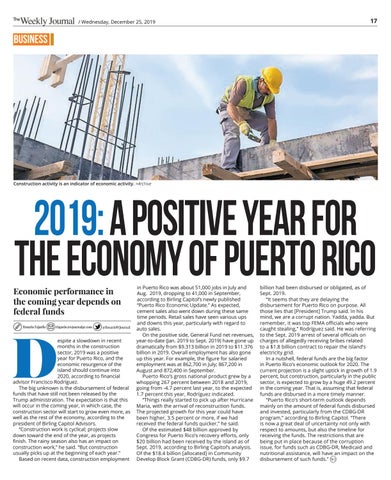
Construction activity is an indicator of economic activity. >Archive
2019: A Positive Year for the Economy of Puerto Rico Economic performance in the coming year depends on federal funds
D Rosario Fajardo
rfajardo@wjournalpr.com
@RosarioWJournal
espite a slowdown in recent months in the construction sector, 2019 was a positive year for Puerto Rico, and the economic resurgence of the island should continue into 2020, according to financial advisor Francisco Rodríguez. The big unknown is the disbursement of federal funds that have still not been released by the Trump administration. The expectation is that this will occur in the coming year, in which case, the construction sector will start to grow even more, as well as the rest of the economy, according to the president of Birling Capitol Advisors. “Construction work is cyclical; projects slow down toward the end of the year, as projects finish. The rainy season also has an impact on construction work,” he said. “But construction usually picks up at the beginning of each year.” Based on recent data, construction employment
in Puerto Rico was about 51,000 jobs in July and Aug. 2019, dropping to 41,000 in September, according to Birling Capitol’s newly published “Puerto Rico Economic Update.” As expected, cement sales also went down during these same time periods. Retail sales have seen various ups and downs this year, particularly with regard to auto sales. On the positive side, General Fund net revenues, year-to-date (Jan. 2019 to Sept. 2019) have gone up dramatically from $9.313 billion in 2019 to $11.376 billion in 2019. Overall employment has also gone up this year. For example, the figure for salaried employment was at 862,700 in July; 867,200 in August and 872,400 in September. Puerto Rico’s gross national product grew by a whopping 267 percent between 2018 and 2019, going from -4.7 percent last year, to the expected 1.7 percent this year, Rodríguez indicated. “Things really started to pick up after Hurricane Maria, with the arrival of reconstruction funds. The projected growth for this year could have been higher, 3.5 percent or more, if we had received the federal funds quicker,” he said. Of the estimated $48 billion approved by Congress for Puerto Rico’s recovery efforts, only $20 billion had been received by the island as of Sept. 2019, according to Birling Capitol’s analysis. Of the $18.4 billion [allocated] in Community Develop Block Grant (CDBG-DR) funds, only $9.7
billion had been disbursed or obligated, as of Sept. 2019. “It seems that they are delaying the disbursement for Puerto Rico on purpose. All those lies that [President] Trump said. In his mind, we are a corrupt nation. Yadda, yadda. But remember, it was top FEMA officials who were caught stealing,” Rodríguez said. He was referring to the Sept. 2019 arrest of several officials on charges of allegedly receiving bribes related to a $1.8 billion contract to repair the island’s electricity grid. In a nutshell, federal funds are the big factor in Puerto Rico’s economic outlook for 2020. The current projection is a slight uptick in growth of 1.9 percent, but construction, particularly in the public sector, is expected to grow by a huge 49.2 percent in the coming year. That is, assuming that federal funds are disbursed in a more timely manner. “Puerto Rico’s short-term outlook depends mainly on the amount of federal funds disbursed and invested, particularly from the CDBG-DR program,” according to Birling Capitol. “There is now a great deal of uncertainty not only with respect to amounts, but also the timeline for receiving the funds. The restrictions that are being put in place because of the corruption issue, for funds such as CDBG-DR, Medicaid and nutritional assistance, will have an impact on the disbursement of such funds.”
18
/ Wednesday, December 25, 2019
Proposed Tax Hike on Foreign Companies Could Hinder Pharma Operations Allergan’s regional director said that corporations could opt to relocate or raise their products’ prices
A Giovanna Garofalo
ggarofalo@wjournalpr.com
@giopgarofalo
member of the Puerto Rico Pharmaceutical Industry Association (PIA) warned that a tax increase proposed for this sector of the local economy could result in adverse effects for the overall healthcare industry and other indirect businesses. San Juan mayor and gubernatorial candidate for the Popular Democratic Party, (PDP) Carmen Yulín Cruz, held a rally in the municipality of Barranquitas, where she shared her platform ahead of the 2020 general elections. Among them, Cruz revealed that part of her strategy for economic development would be to increase taxes on foreign corporations in Puerto Rico by at least 3 percent. This, she argued, could generate roughly $1 billion for the government. José E. Viera, regional director of Puerto Rico and the Caribbean for Allergan, said that this proposed hike—which would affect the pharmaceutical industry—could eventually drive multiple businesses off the island, as well as potentially impact the places where their products are exported and consumers’ pockets in Puerto Rico. “The issue here is paying what’s fair within a globalized market. For instance, if the production taxes here in Puerto Rico are increased that much, all these multinational companies will look for relocation alternatives in other markets and produce there. The government of Puerto Rico needs to look beyond the short term of raising [the tax] by 3 percent and more into how a tax hike could affect the island’s financial health and employment in mid- and long term,” Viera explained to THE WEEKLY JOURNAL. According to Viera, who participates in the PIA, the contributions of foreign biopharmaceutical companies account for nearly one third of the public budget, or $3 billion, and create roughly 72,000
José E. Viera said that the local government needs to assess how a short-term benefit to its revenue could have adverse long-term effects in the healthcare industry. >Courtesy Allergan
“well-paid” jobs. “Add to that all the restaurants, engineering and consulting companies, and even the food trucks in front of [those companies’] premises that benefit from their presence,” he said. Viera argued that a tax hike would only be considered “fair” or reasonable if the government offered certain benefits in return, such as more security, better services or improved utilities. He stated that opting to increase the operational costs for these and other companies without providing something in exchange stems from the local government’s “historic myopia of not assessing longterm impact.” While the Allergan regional director listed Puerto Rico’s strategic geographic position, growing market and quality personnel as top reasons for foreign companies to select the island for their operations, he cautioned that they could opt to leave “in 10 years” or so. “Undoubtedly, these companies remain in Puerto Rico, even with its taxes—it’s the [U.S.] jurisdiction with the most taxes— and have decided to do so because of the quality of the island’s workers. Other companies have tried to replicate processes and they haven’t been able to simply because of our
quality employees, and that speaks highly of us. But until when? How much longer can you tolerate that taxes continue to rise but the benefits don’t?,” he pondered. Viera also warned that the tax might not necessarily be related to these corporations’ products, but it could have an impact because the companies could opt to raise their prices to compensate for losses. This, in turn, could jeopardize revenue, product prices and jobs in other segments of the health industry, such as health insurance companies and drugstores. “This is an issue… that concerns the entire healthcare system,” he said. THE WEEKLY JOURNAL asked Viera if Allergan— an Irish multinational that has been distributing its products from Puerto Rico for nearly 50 years— would consider relocating in light of possible cost increases or Puerto Rico’s declining number of doctors and health professionals over migration. The regional director affirmed that he does not foresee a departure, adding that he expects the medical population to bloom in Puerto Rico, “perhaps not with the growth we hope for, but it is heading that way.”
19
/ Wednesday, December 25, 2019
By Waleska Rivera CEO Danosa Caribbean Inc. Board Member ICSE-PR
TIME FOR CHANGE
T
he holiday season bliss presents itself with its lights, succulent cuisine, music and family warmth. It typically sets the mood to reflect over the challenges faced during the past year and the resolutions or promises to be better human beings during the year to come.
At any other point in time, we could romanticize the holiday spirit focusing our resolutions on promises of wellness, more travel or work-family balance. Nonetheless, after a year of fierce protests and demands for change, as we walk into the threshold of the second decade of the 21st century, we must think hard and deep about the resolutions we are about to make. Almost every dream we have as
By Manuel Cidre
Entrepreneur & Founder of Los Cidrines
T
Watch Out! Don’t Threat the Workhorse of Puerto Rico’s Economy
he pharmaceutical industry is undoubtedly the workhorse of Puerto Rico’s economy. It pays $3 billion in annual taxes, which is over 33 percent of our budget, employs 78,000 direct workers who earn on average $62,000 and spends $500 million annually in capital expenditures in its plants. To put this into perspective, pharma represents 30 percent of Puerto Rico’s GDP, while tourism is just 7 percent. However, for some inexplicable reason, our government has spent decades without a coherent strategy to keep them investing
in the island. Instead, our politicians refer to them as foreign, when they are US companies, and continuously attack them, threatening to raise their taxes one way or another whenever there is a budget shortfall or some governor wants to spend more money. Therefore, it is not surprising that a large portion of our population does not understand the importance of the pharmaceutical and medical device industries to our economy and society as a whole. Our politicians’ populist rhetoric has actually led many to believe that these are evil, corporations that take, take and take while giving nothing back to their communities and the island.
individuals relies on the political stability and the social and economic development we have as a country. Reuniting our families, getting a better job, upgrading our businesses, exporting our products and even taking a trip and having the resources to live a better life, are dreams that depend on economic growth and solid and honest governance. We call upon those who aspire to lead our island to reflect during the Holidays about the resolutions they will make in favor of the common good. It is a retrospection we must all have. Therefore, the focus of our resolutions for the electoral year 2020 must rest upon the quest for a profound transformation. It is time to demand clean and transparent governance from our leaders. It is vital to evaluate each candidate, responsibly, based on their record, their honesty and their achievements. With primaries in
both main political parties, at least eight candidates aspiring to become governor, and dozens of options for the legislature and municipalities, economically feasible proposals that put the interest of people before their own are fundamental. It is imperative to put partisanship aside and measure people by their merits and commitment. We must ignore those who sow unrealistic dreams with the sole purpose of gaining votes. We must read between the lines and give opportunities to those who are willing to serve with honesty. Our resolutions for next year must be different because it is time to make changes. Together, we must assume the responsibility to follow through the resolutions we make, because it is impossible to forget the lessons learned during the summer of 2019, when the country took over the streets to defend its values and dignity.
As we see in the first paragraph, this is simply not true. You might think these companies should contribute even more, but ignoring that they already are one of the most important contributors to our economy and society in terms of job creation and paid taxes, is completely absurd. I write this op-ed because this industry, which we’ve already established plays a vital role in our economy, is coming under attack, for the second time in 20 years. It worries me to see a lack of action from our government and pharma leaders. I fully expected that by now, industry and government leaders would have come out to announce a joint workgroup dedicated solely to solving the issues generated by the phaseout of Act 154. But this hasn’t happened; both groups appear to have taken an “ignore and pray nothing happens” mentality and that is not acceptable. Hoping our government takes the lead in these conversations is futile, we are in the middle of an election cycle, and it is evident that our governor and her opponents are more worried about campaigning than actually preventing an economic crisis.
Therefore, I think it’s time for pharma’s industry leaders to take control of the narrative and force our government into action by making the phaseout of Act 154 an election issue. The people need to clearly understand what will happen if the deductions provided by Act 154 are phased out by the federal government. We need to understand what options are on the table to help pharma grow in Puerto Rico and maintain the sector’s contribution to the economy. Whether it’s changing the industry’s tax structure so that Trump’s guilty tax does not apply, extending current decrees, allowing plants to build out power generation without interference from the AEE, or some other thing that only industry insiders know. I genuinely believe that through proactive communication and education, we can change the current narrative of locals versus foreigners and get everyone to understand that what is good for the industry is good for the people and vice versa. As Puerto Ricans, we can’t allow for a repeat of the 936 debacle to happen; the island might not survive it.
20
/ Wednesday, December 25, 2019
Barea Off the Court: Entrepreneur The point guard for the Dallas Mavericks ventures into new territory with Equinox Harvest
J
Yennifer Álvarez Jaimes
yalvarez@wjournalpr.com
@yalvarezjaimes
osé Juan Barea, famed point guard of the Mavericks, is assuming a new role away from the basketball court: entrepreneur. Equinox Harvest birch water is harvested every spring during the Equinox, that time when the sun crosses the celestial equator and day and night are of equal length. Birch water is a refreshing drink extracted directly from the birch tree during the months of the spring equinox and is ideal for those looking for a natural hydration source. “I am excited to take this new step as an entrepreneur, beyond the courts and basketball. I feel very happy to bring our Equinox Harvest brand to the Puerto Rican market, where I trust it will be well received,” said Barea. According to the basketball player, the Equinox Harvest brand is a business venture launched in 2018 with former NBA escort, Desmond Tremaine Mason. Although the drink has been marketed and recognized outside of Puerto Rico for more than a year, it was not until last month that it entered the Puerto Rican market through WalMart. “We always dreamt of entering the Puerto Rican market and after a negotiation process we managed to reach a limited exclusivity deal with Wal-Mart. We hope to have a successful launch and eventually distribute it to more businesses on the island,” added the businessman. The Equinox Harvest drink is 100 percent birch water and is distributed in two varieties:
According to the basketball player, the Equinox Harvest brand is a business venture launched in 2018 with former NBA escort, Desmond Tremaine Mason. >Manuel Vélez
21
/ Wednesday, December 25, 2019
I am excited to take this new step as an entrepreneur, beyond the courts and basketball. I feel very happy to bring our Equinox Harvest brand to the Puerto Rican market, where I trust it will be well received - José Juan Barea
Equinox Harvest is gluten, vegan, fat and cholesterol free. >Courtesy Equinox Harvest
Birch water is a refreshing drink extracted directly from the birch tree during the months of the spring equinox.>Courtesy
>Courtesy Equinox Harvest
with sugar and without it. Equinox Harvest will be initially sold at WalMart stores and Barea is expected to launch a promotional tour in the near future. Equinox Harvest is gluten, vegan, fat and cholesterol free, not from concentrate and made with no artificial colors. As an added benefit, its extraction does not hurt birch trees. Birch tree water, consumed by many in Baltic nations for centuries, is rich in minerals like potassium, zinc and magnesium and is lauded for its healing and detoxifying properties. The process for collecting birch water is similar to that of maple syrup, by tapping into the tree to extract the liquid. However, it can only be done in the spring right after the winter’s frost wears off. Birch water contains a high level of manganese, a mineral that helps blood sugar
regulation and bone structure through calcium absorption, according to the University of Maryland Medical Center. Manganese is a component of the antioxidant enzyme superoxide dismutase, an enzyme that helps fight naturally occurring free radicals that “can damage cell membranes and DNA,” according to the university. Birch water is the latest beverage to join an alternative water market that accounted for about $2.7 billion in sales worldwide in 2016, according to food and beverage consultancy firm Zenith Global. Previously only available in European countries such as Russia and the Ukraine, birch tree water is now for sale in the U.S. and Puerto Rico.
22
/ Wednesday, December 25, 2019
Sustainable Fashion
>Archive
is in Fashion
The idea of recycling, reusing and repurposing fashion is gaining ground
A Yennifer Álvarez Jaimes
yalvarez@wjournalpr.com
@yalvarezjaimes
ccording to the documentary The True Cost, there are roughly 40 million garment workers in the world today. According to the film, many are not afforded labor rights or protections while also being the lowest paid workers in the world. Roughly 85 percent of all garment workers are
women, and many are victims of exploitation in developing countries across the world. The Ellen McArthur Foundation, a nonprofit organization that seeks to inspire, rethink, redesign and build a positive future through the framework of a circular economy, claims that the fashion industry is responsible for over 5 percent of global carbon emissions, and that 87 percent of the clothing produced ends up incinerated or in a landfill. In 2018, Swedish clothing retailer H&M had $4.3 billion in unsold products, highlighting the issue of waste and the need for corporations to be held accountable and be more accurate in their predictions. The way people consume fashion is a behavior that has been set for years, but the idea of recycling, reusing and repurposing fashion is
gaining ground. The possibilities are endless. Think of all the ways that an item can be altered, maybe you can turn an old pair of jeans into nice denim shorts or those long skirts into miniskirts. Fashion’s $24 billion resale market is on the uptick as consumers look for ways to reduce consumption when it comes to fashion. ThredUp, the world’s largest online thrift store, claims that resale has grown as much as 21 times faster than retail apparel over the past three years and that the secondhand market will reach $51 billions in five years. Data also shows that 64 percent of women in the U.S. have bought or are now willing to buy secondhand products. On the other hand, global management consulting firm McKinsey has issued a report which states that modern fashion consumers do their homework before buying: 52 percent of
/ Wednesday, December 25, 2019
23
Items from brands like J. Crew, Max and Cleo, BGBG, and Zara are among the treasures you may find @elroperopr. >Courtesy @elroperopr
millennials indicate they always research a brand’s backstory before buying, as do 45 percent of Gen Z consumers.
@ElRoperopr
Eisha Mercader and Caterina Ayala joined forces to create ElRoperopr, an Instagram page through which they sell secondhand clothes and never worn items in all sizes. Scouring the page one can find brands like J. Crew, Max and Cleo, BGBG and Zara, among others. “We believe that you can get amazing outfits and help build a more sustainable world by reducing fashion castoff destined for overcrowded landfills. At ElRoperoPR customers can find clothes at lower prices than if they were to head to a boutique,” said Mercader to THE WEEKLY JOURNAL. Ayala and Mercader came up with the concept of ElRoperopr after realizing that sometimes they’d buy expensive gowns and party dresses that they would only wear once or twice before leaving them hanging in their closet, taking up space. “We offer the alternative of picking up or delivering clothes. We will add shoes and menswear to our inventory in the future,” Ayala added. The young entrepreneurs make sure the clothes are impeccable and offer a 20 percent commission to the owner. “Follow us. You will find the perfect outfit and gifts without having to pay full price and while helping the environment,” said Mercader and Ayala. ElRoperoPR is actively searching for a nonprofit organization to which they can donate the clothes that they do not sell or that are damaged.
A Prime Example With her hands, scissors and a sewing machine,
Kenia Barbosa brings pieces of clothing that went out of style back to life. The 20-year-old student reuses every type of clothing available; be pants, coats or shirts. “I started buying pieces in secondhand stores and transforming them, creating whole outfits from a piece that only cost $3,” said Barbosa. The fashion stylist seeks to innovate and, at the same time, raise awareness about the importance of reusing textiles. Using pieces that do not cost more than $5, Barbosa is showing the world through her social media outlets that it is not always necessary to
spend a lot of money to dress well. “I have been familiar with the concept of recycling pieces of clothing and textiles since I was little. My mother is a shopaholic and she would give me her clothes to repurpose,” Barbosa said about the beginnings of her passion for sewing and fashion. Barbosa has plans to upload content about sewing onto her YouTube account so that more young people learn to create their own outfits. You can follow Barbosa on Instagram and Twitter at @keniabarbosar.
Source: ThredUp
24
/ Wednesday, December 25, 2019
Cuba Libre
Restaurant and Rum Bar
to Open in Puerto Rico
$8.6 million investment at Plaza Las Américas locale
C Rosario Fajardo
rfajardo@wjournalpr.com
@RosarioWJournal
uba Libre Restaurant and Rum Bar is expanding into new markets in the new year, including a first-time foray outside the mainland U.S.—to Puerto Rico. Cuba Libre, an affiliate
of GuestCounts Hospitality LLC, is set to break ground in San Juan on Jan. 2020. The 10,000-square-foot restaurant located in Plaza Las Américas mall is expected to deliver millions of dollars to the economy and create more than 200 new restaurant and construction jobs. The company is investing $8.6 million in its new locale. Cuba Libre’s newest location will be a freestanding building built from the ground up at the main entrance to Plaza Las Américas. With construction beginning in the first quarter of 2020, the sixth Cuba Libre Restaurant and Rum Bar location is expected to open in Jan. 2021. Cuba Libre San Juan will feature soaring ceilings,
A mock-up of the future Cuba Libre restaurant in San Juan >Courtesy of Cuba Libre Restaurant
dramatic interior and exterior designs, a signature wood-burning Latin grill and chef’s counter and the capacity to seat 290 guests. The culinary program at Cuba Libre San Juan will be led by the vision of two-time James Beard award-winning chef-partner Guillermo Pernot, who is widely credited for introducing “Nuevo Latino” cuisine to the Northeast United States. The restaurant provides guests with a culinary passport to Cuba’s intriguing flavors and culture. The menu’s tantalizing tastes reflect Cuba’s culinary traditions, as well as the emerging modern cuisine that Pernot has experienced during his continuing travels to Cuba. The
/ Wednesday, December 25, 2019
25
Another mock-up of the future Cuba Libre Restaurant in Puerto Rico. >Courtesy Cuba Libre Restaurant
restaurant’s name, which translates to “Free Cuba,” restaurants. The inaugural trips, open to the channels hope for the future of the island nation, public, began on April 2012 and continue on a bithe company said. annual basis. “I love leading Cuba Libre’s expansion and enhancing the restaurant’s menus in innovative Believing in the Island of Enchantment ways as Cuban cuisine continues to develop,” The Philadelphia-based restaurant brand said it Pernot said. “I am able to use my experience and hopes to play a role in helping to rebuild the island culinary skills to mentor young chefs, manage post-Hurricane Maria, “one empanada at a time.” multiple outlets and According to Barry foster the future Gutin, principal growth of the Cuba and co-founder Libre Restaurant and of GuestCounts Rum Bar concept.” Hospitality, lease The menu will negotiations for the feature such favorites San Juan restaurant as Mama Amelia’s were nearly complete empanadas, black when the massive bean soup, “arroz storm hit on Sept. con pollo” (rice with 2017. “After the chicken), ropa vieja and hurricane, we hired a Cuban-style skirt steak. number of residents Argentinian by displaced by the birth, in 2010, Pernot conditions on the embarked on a mission island. Through our to discover how Cuban efforts to raise funds cuisine had evolved. for those in need, During numerous visits we learned about to Cuba, Pernot forged the resilience, spirit relationships with the and determination of premier local chefs Puerto Rico residents, in Havana. He spent as they supported countless days cooking each other during Barry Gutin, principal & co-founder and dining with them the aftermath of the of GuestCounts Hospitality in their restaurants, storm. homes and farms. We decided to invest In Jan. 2012, chef in post-Maria Puerto Pernot and Cuba Libre Rico to help in the launched a culinary exchange series named Popcommonwealth’s economic recovery and provide Up Paladares, at which the top chefs of Havana opportunities for our employees from Puerto Rico are invited to cook in Cuba Libre’s kitchens for who hope to move back to the island, as well as special guest chef dinners. In return, chef Pernot restaurant workers still there. We believe in the invites Cuba Libre’s guests to join him on a series future of the Island of Enchantment and we’re of custom cultural and culinary tours of the island putting our money where our mouth is,” he added. nation’s capital, featuring dinners at these chefs’ “The addition of Cuba Libre to Plaza Las
We decided to invest in post-Maria Puerto Rico to help in the commonwealth’s economic recovery and provide opportunities for our employees from Puerto Rico who hope to move back to the island, as well as restaurant workers still there. We believe in the future of the Island of Enchantment and we’re putting our money where our mouth is.
Chef Guillermo Pernot, chef and partner of Cuba Libre Restaurant and Rum Bar. >Courtesy of Cuba Libre Restaurant
Américas tenant’s roster, expands our food and entertainment offerings as well as supports the revitalization of the local economy with a significant investment and new jobs,” said Jaime Luis Fonalledas, executive vice president of Plaza Las Américas. Cuba Libre San Juan will be the sixth location for the brand, which first opened in Philadelphia in 2000, followed by Atlantic City in 2004, Orlando in 2008, Washington, D.C. in 2010 and will open in Fort Lauderdale in the summer of 2020. The company said it is also exploring opportunities in Tampa, Chicago, Boston, Detroit, Las Vegas and Atlanta.
26
/ Wednesday, December 25, 2019
The Sweet Heaven that is
Donut Factory From traditional glazed to quirky bacon and maple syrup, savory treats are the order of the day at this sweet eatery
>Josian Bruno Gómez
S
Yennifer Álvarez Jaimes
yalvarez@wjournalpr.com
@yalvarezjaimes
ix years ago, Paola Sánchez began confectioning doughnuts in her native Venezuela. After spending some time in Orlando, Fl. she moved to San Juan five months ago and opened Donut Factory at 705 Andalucía Ave. in San Juan. The crisp, yet tender, glazed exteriors quickly won over the customers and, just a month ago, Sánchez opened her second shop at the Bayamon’s Farmer’s Market. What makes these doughnuts different from those sold by big chains? Usually doughnuts don’t keep well so Sánchez starts production every day before dawn to ensure that the products are fresh. Many flavors sell out early, so it’s good idea to call and ask for available flavors. “My sister and I took classes on how to make doughnuts. The process takes three hours. I open Monday to Saturday at 6 a.m. We sell at least 150 doughnuts every day,” explained Sánchez. Besides the sweet doughnuts, the 32-year-old entrepreneur introduced the “Donwich”, which features your choice of ham, cheese and a fried egg sandwiched between two doughnuts; and the “Pizzatory”, an unsweetened doughnut topped just like a pizza, with marinara sauce, mozzarella cheese and other toppings.
“A doughnut hamburger is in the making,” added Sánchez with a smile. Although the most popular doughnut is one filled with guava and cheese, Donut Factory has 12 different fillings and non-traditional toppings like bacon and maple syrup. Donut Factory also sells mini doughnuts and doughnut holes, the miniature versions that don’t make you feel guilty. Donut Factory can also cater events with “made-to-order” doughnuts in an array of different flavors, fillings, toppings and sizes. Americans eat more than 10 billion doughnuts a year, and the U.S. doughnuts industry brings in an estimated $3.6 billion annually, according to a report from IBIS World. Sánchez enjoys making doughnuts and having her own business brings her joy. When asked about the permit process, Sánchez commented
>Josian Bruno Gómez
that she hired someone to navigate the waters for her and that the process was normal and fast. After opening her first shop, she started the process for the second. THE WEEKLY JOURNAL went on to ask if she recommends investing in Puerto Rico and the entrepreneur quickly answered with a “yes”. Sánchez’s initial investment was of $65,000 and, to date, she has managed both locations succesfully. As a matter of fact, Donut Factory plans to soon open its third shop at San Patricio Mall in an effort to continue spreading the love for one of America’s favorite desserts. Donut Factory opens Monday to Saturday from 6 a.m. to 5:00 p.m. and is located at 705 Andalucía Ave. in San Juan and at the Bayamon’s Farmer’s Market on Ramón Luis Rivera Ave. For more information, please call (787) 998-0171.
27
/ Wednesday, December 25, 2019
The first lady of San Lorenzo is the one who came up with the idea of adding a 3D spectacle. She wanted this to be a mystical experience.
>Courtesy Piedra Dura Park
-José “Joe” Román Abreu, mayor of San Lorenzo
Christmas
at Piedra Dura Water Park Water and lights delight at a local park
A Melissa M. Cruz
“
mcruz@elvocero.com
@mmcruzrios
magical Christmas adventure” is how San Lorenzo’s Mayor José “Joe” Román Abreu hoped children would describe the newly reopened Parque Acuático Piedra Dura (Piedra
Dura Water Park). “We have decided to open the park during Christmas in order to add to the joy of the season. We have decorated the park accordingly so that children can live the wonder of the season. There will also be Puerto Rican Christmas displays throughout the park,” he noted. Piedra Dura, a municipal park located on road 183 which opened on Dec. 15, is a water park that features slides, pools, a crazy river and even a zip line, among other activities. The park also has food concession stands and gathering areas perfect for birthdays and corporate activities.
The mayor explained that the park had been closed since 2017 because of the damage inflicted by Hurricane Maria. Although the park started being remodeled as soon as possible, the mayor dreamt of a Christmas-themed grand reopening full of lights that would delight kids and add to the joy of the season. “Our children need to smile and be happy, but so do their parents. This event was meant to be special and very emotional, I didn’t want to see the park myself until I could do so with the children. I wanted to live it with them and through them,” added Román Abreu, who went on to say that this was his Christmas gift to Puerto Rican children islandwide. “We had to rebuild the park, but instead of merely rebuilding it, we wanted to change things up a bit and modernize it, add more color and lights so that the park would look better. We also added 3D imagery that will be projected next to the bridges that cross over the pools. The zip line will also allow visitors to see everything from a different vantage point,” he stated.
Román Abreu went on to say that the 3D imagery will be nativity themed and include the Three Wise Men. It is worth noting that this will be the first time that the municipality will host a Christmas lighting ceremony at a place other than the town square, and the first time that the park will be opened at night since its inauguration in 2016. “Visitors to San Lorenzo will be able to enjoy the lights we’ve placed in the park from 6 p.m. to 11 p.m., and they will also be able to drive around and see the decor placed by the municipality throughout the town square,” said Román Abreu. Entrance to the park will be $2 for the remainder of the Christmas season, and those who visit will enjoy parades as well as visits from Santa Claus and the Three Wise Men. After Jan. 6, when the Christmas season ends, the park will continue with its regularly scheduled activities, including a gastronomic event named “Al aire libre” which will showcase restaurants from throughout the municipality. For more information, call (787) 736-1457.
28
/ Wednesday, December 25, 2019
STEP BY STEP:
How to Register to Vote
These are the documents required to register to vote
T
Hallee Patterson
newsroom@wjournalpr.com
hinking about a New Year’s Resolution? How about adding registering to vote to your list! Last week’s article titled “Largest Political Parties in Puerto Rico to hold Primaries,” made me realize I could not procrastinate. I tried to do it online, there was link for Puerto Rico, but there was no information. I soon learned that you cannot register online, you have to do it in person. Now on a quest to complete this task, I started asking friends who have lived here for years. No one remembered how they did it. I was sure if I asked enough people someone
would know. I was lucky. I had a dinner party and one of my guests, a beneficiary of Act 22, had just registered. However, he could not remember where he went or what papers he needed to bring. He did have the phone number of a man who he thought could help me. After calling the number three times, I spoke to Enio. He recalled helping my friend and said he would try to find out for me. Twenty minutes later he called to tell me the documents I would need: 1. Passport. This is the most important document. The other items I mention below are just for security reasons, unless they cannot verify your information. 2. Birth certificate 3. Puerto Rican identification 4. Original Social Security card (cannot be laminated) 5. A utility invoice If you live in the San Juan area, the Comisión Estatal de Elecciones office is located adjacent to the Coliseo de Puerto Rico at 550 Aterial Hostos
If you do not vote in two consecutive elections you will need to register again. >Archive
Ave. in Hato Rey. Other municipalities have their own Directory of Permanent Registration Boards that you may find by logging on to http:// www.ceepur.org/directorio. htm Once we found the office, the procedure was quick. They only assist one person at a time. The first agent I saw took my passport, looked me up in their system, verified my address was correct and printed out an application for me to check. I signed electronically and moved to the second agent. This agent took my photo and printed out my “Petición de Inscripción del Elector”. I was then handed my new official voting card. Voters must vote in the area they are registered in. To find out where you need to go, log on to http://www.ceepur.org. On election day, you need to bring your voter registration card to your voting locale. Be aware: If you do not vote in two consecutive elections you will need to go through this procedure again.
29
• Cuando las familias lo pierden todo por un desastre en su hogar • Cuando los militares puertorriqueños necesitan regresar a la isla en tiempos de emergencias • En apoyo a los veteranos ubicados en el Hospital de Veteranos y en las clínicas de veteranos alrededor de Puerto Rico • Para educar a nuestros niños y niñas sobre cómo prepararse y responder mejor ante los desastres Por todos a quienes ayudamos y por todos los que faltan por ayudar, dona hoy.
< The Weekly Journal > Wednesday, December 25, 2019
Siempre cerca de ti
30
/ Wednesday, December 25, 2019
Festival de las Máscaras de Hatillo An annual tradition that dates back to the 19th century, the “Festival de las Máscaras de Hatillo” (Hatillo Mask Festival) is held every Dec. 28, the day of the Holy Innocents. The festival’s most emblematic symbol are the multicolored, handcrafted masks worn by locals, who compete for the best costume award in three categories. When: Friday, Dec. 27 to Dec. 28, all day long Where: Pablo J. Aguilar avenue, Hatillo
New Year’s Eve Party at Caribe Hilton Be amazed and indulge your senses in a groovy display of illusions and beats. Featuring six different atmospheres and top local and international talent. For more info, log on to http://www. newyearspuertorico.com When: Tuesday, Dec. 31 at 7 p.m. Where: Caribe Hilton, 1 San Gerónimo St., San Juan
PRGL and Red Rooster Holiday Tournament Compete and have fun with the gaming community. When: Saturday, Dec. 28 at 11 a.m. Where: Shimmy’s Bayside, 25 Paseo Caribe, 15 Luis Muñoz Rivera Ave., San Juan
New Year’s Eve Dinner “Solo vinilos” DJ set by Sergio Rotman and Johnny Bwoy. For reservations call (787) 303-1116. When: Tuesday, Dec. 31 at 4 p.m. Where: Cocina Abierta, 58 Caribe St., San Juan
NYE at O:LV The Arya Rooftop event includes a premium open bar, Taittinger champagne all night, and hors d’oeuvres by chef Mario Pagán. Live performers by Sak Entertainment, DJ at Rolls Royce and after midnight pleneros. Stay for “asopao”. For more information or tickets, call (787) 705-8421 | reservations@olvhotel.com When: Tuesday, Dec. 31 at 8:30 p.m. - 2:30 a.m. Where: O:LV Hotel, 55 Barranquitas St., Condado
31
/ Wednesday, December 25, 2019
Illusions New Year’s Eve Celebration 2020 Jazz Sunday at La Goyco Enjoy a jazz night on Loíza street. When: Sunday, Dec. 29 at 6 p.m. Where: Taller Comunidad La Goyco, 1763 Loíza St., San Juan
The Sheraton Puerto Rico Hotel and Casino hosts an exciting and celebrity filled event with all-inclusive bars serving premium brands, late night “asopao” and four rooms with different parties and music. Grupo Mania, La Secta and Eladio Carrión will be among the entertainers. For tickets, log on to http://www.fangig. com When: Tuesday, Dec. 31 at 8 p.m. Where: Sheraton Puerto Rico, 200 Convention Blvd., San Juan
Fantasy Park Meet Elsa, Mickey Mouse and Woody; enjoy plays and amusement park rides. When: Thursday, Dec. 25 to Monday, Dec. 30 at 3 p.m. Where: Museo del Niño, Campo Rico avenue, Carolina
New Year’s Party at Paseo Caribe Welcome the new year with live performers Tiempo Extra, Luva and DJ José Valcárcel. For tickets log on to http://ticketerapr.com When: Tuesday, Dec. 31 at 6 p.m. Where: Mercado de Paseo Caribe, 15 Luis Muñoz Rivera Ave., San Juan
Ranger-Guided Program: Exploring San Cristóbal’s Tunnels Learn the myths and realities of the fort’s tunnel system and about their crucial role in San Cristóbal’s defense strategies. The program is offered in English and starts at the fort’s main plaza. The tour itself is free of charge but there’s a $7 fort entrance fee for adults 16 and over. When: Saturday, Dec. 28 at 10:30 a.m. Where: San Juan National Historic Site, 501 Norzagaray St., Old San Juan