Tacna Practical Guide for
Travelers
Tacna
Location
Southwestern Peru, at the border with Chile
Capital
Tacna (at 1,843 ft / 562 m)
Altitude
Min.:
Max.:
62 ft (19 m) (Ite)
14,514 ft (4,424 m) (Candarave)
Weather
Temperature
Max.:
Min.: 54 °F (12 °C)
74 °F (23 °C) Mar-Jun Sept-Dec
How to get here?
By land Dec-Mar Jun-Sept
Lima-Tacna: 1293 km / 22 h
Arequipa-Tacna (by the Panamericana Sur): 229 miles (368 km) / 6 h
Puno-Tacna (by the Interoceanic highway): 258 miles (415 km) / 7 h
Moquegua-Tacna (by the Panamericana Sur): 99 miles (159 km) / 2 h
From Chile: Arica-Tacna: 40 miles (65 km) / 1 h 30 min
By air
Lima-Tacna: 1 h 45 min
to Moquegua, Lima
Department
Province capital
District capital
Town
Ilabaya
Cambaya
Camilaca
Ite
Las Yaras
Tomasiri
Magollo
Sama Grande
Complejo monumental del Campo de la Alianza
Playa Boca del Río
Museo del Desierto y el Mar
Playa Los Palos
Fuentes termales de Calientes
Laguna de Suches o Huaytire
Valle de Locumba
Cuevas de Toquepala
Laguna de Aricota
Camino inca Santa María y andenerías de Tarata
Cataratas de Panina
Humedales de Ite
Tacna
Locumba
TACNA
JORGE BASADRE

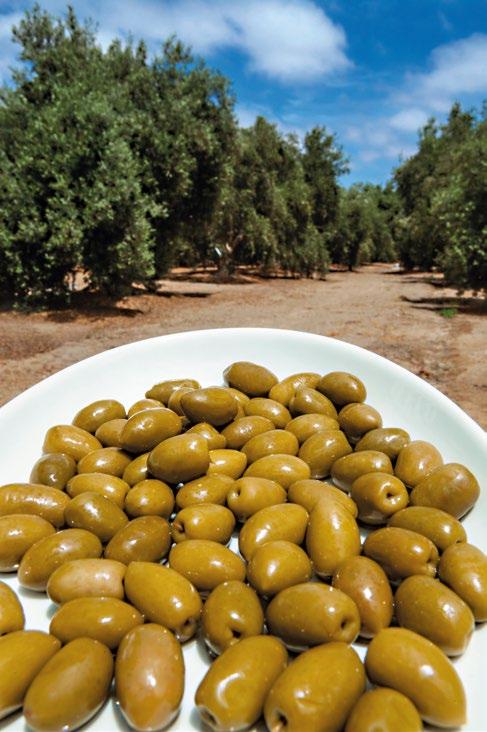
“Aceituna de Tacna” (Tacna olive) is the denomination of origin of this fruit that, thanks to its geographical location, acquires quality and unique characteristics.
Tacna Olives © Marco Garro / PROMPERÚ
Distances
By private transportation, from the city of Tacna to the provinces of:
DESTINATION
Locumba (Jorge Basadre Province) 58 miles (93 km) 1 h 15 min
Tarata (Tarata Province) 1 h 30 min 55 miles (88 km)
Candarave (Candarave Province) 4 h
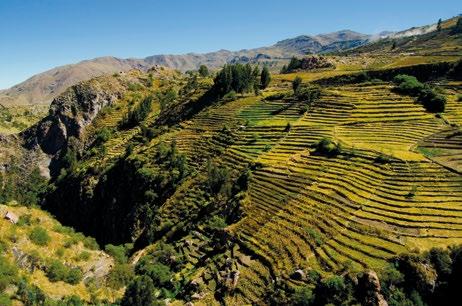
Tarata Platforms © Juan Puelles / PROMPERÚ
miles (170 km)
Tours (minimum recommended stay)
1 day
3 days
City of Tacna: Civic Walk, cathedral, main mansions, museums and shopping centers
Valle Viejo-Miculla tourist corridor ½ day
1 day
1 day
1 day
Tacna Coast: Los Palos Beach, Boca del Río, the beaches of Ite, birdwatching in the Ite wetlands.
Tarata province: town of Tarata, Inca Trail, Santa María archaeological site, Qala Qala archaeological site, the terraces and village of Ticaco (viewpoint, craft workshop, and thermal baths)
Sanctuary of the Señor de Locumba and Panina Waterfalls
1 day Candarave province: queñuales forest, valley of geysers and thermal baths
Agenda
February/March (variable)
March
May 26
July
August
August 28
September 14
December
Carnivals in Tacna and Tarata
Vendimia - Tacna Grape Harvest Festival
Tribute to the defenders of the Campo de la Alianza (Tacna)
Fiestas Patrias - Peru's National Independence Celebration
Tacna International Fair - Feritac (Tacna)
Anniversary of the Reincorporation of Tacna to Peru (Tacna)
Festivity of the Señor de Locumba (Jorge Basadre)
Christmas in Tacna
What to eat?
In the cuisine of Tacna, ají (chili pepper) occupies a stellar role, as it gives color and flavor to the emblematic Picante a la Tacneña (a chili pepper stew, tripe, cow feet, charqui, potato and oregano) or Adobo Tacneño (pork marinated with turmeric, garlic and vinegar, served with a local type of pumpkin and potato). From Pachía comes the tender corn that gives sweetness to the Pastel de Choclo and from Candarave, the tasty black-faced lamb meat. Toast with wine, pisco and macerated apricot. As a snack, you can taste the regional olive.
What to buy?
Tacna is the region with the largest export supply of olives and olive oil in the country, so you can purchase these products of very high quality. Handicrafts in ceramics, alpaca and sheep textiles, religious imagery, and painting reflect the region's traditional architecture. Also notable are works made from hollow cane, leather, wood carvings, and stone, as well as the region's wine, pisco, and macerated drinks. As a duty-free zone, Tacna is an attractive destination for shopping, offering good-quality national and imported products including footwear, clothing, and more.
What to visit?
Tacna Province
Catedral
Paseo Cívico. Opening hours during Mass.
The French firm Eiffel, founded by Gustave Eiffel, started the work in 1875, but then it stopped for several years. It was formally opened in 1954 with a neo-Renaissance design.
Fuente ornamental
Paseo Cívico
The ornamental fountain is a monumental work that the English Simpson foundry gave to the city of Tacna as a gift from the government of José Balta. It was installed in 1869. With a granite base and more than 20 ft (6 m) high, the set of fountains is adorned with several sculptures of children, mythological beings, water lilies, fan shells and other details of marine elements.
Monumento conmemorativo a los héroes almirante Miguel Grau y coronel Francisco Bolognesi
Paseo Cívico
The memorial to the Peruvian Pacific War heroes is a 59 ft (18 m) high-stone monument that was inaugurated in 1957. In August 2018, it was declared National Cultural Heritage.
Centro Cultural Casa Basadre
Av. San Martín 212.
Republican-style house where the historian Jorge Basadre Grohmann, one of the most notable Peruvian thinkers of the twentieth century, was born. The property was declared a historical monument of Peru on April 5, 1978.
Museo Histórico de Tacna
Cl. Apurímac 202. Entrance fee charged.
The historic museum of Tacna is located in the city center, one block from the former town hall, and was created in 1957. The Tacna Public Library operates in this location.
Casa de Francisco Antonio de Zela
Cl. Zela 542
In the house of the forerunner of Independence there is a photographic exhibition that recounts the events of the revolution he led in the city. In honor of this emancipatory gesture, Tacna received the name of “Heroic City.”
Casa Jurídica
Cl. Zela 716.
On August 28, 1929, it was the scene of the signing of the Tacna Presentation Act. Its facilities include the Reincorporation Museum, the Tacna art gallery, and the departmental historical archives.
Teatro Municipal
Pje. Calderón de la Barca s/n, in front of Plaza MacLean
The municipal theater was inaugurated during the Pezet government. Its façade is made of stone, and its main room is adorned with portraits of illustrious people from Tacna, such as the poet Federico Barreto and the painter Francisco Lazo.
Alameda Bolognesi
Two blocks from the Paseo Cívico
One of the busiest roads in the city retains, in its first block, its original architecture with traditional mansions. Under this walk runs the Caplina river.
Parque de la Locomotora
First block of Av. Grau
In this space remains Locomotive no. 3, model 1859, which carried the Peruvian troops for the epic defense of the Morro de Arica under the command of Colonel Francisco Bolognesi. Subsequently, it continued to provide transport services between Tacna and Arica until 1940.
Estación de Ferrocarril Tacna-Arica / Museo Ferroviario Nacional Av. Gregorio Albarracín 484
The old Tacna-Arica station maintains much of the machinery and objects used during the second half of the 19th century, which tells the story of the railway.
Complejo monumental del Campo de la Alianza
5 miles (8 km) north of the city of Tacna (10 min by car)
Mon-Sun, 8:00-12:00 and 14:00-17:00. Entrance fee charged.
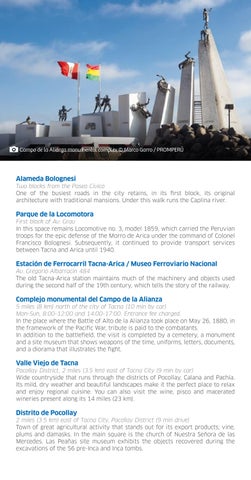
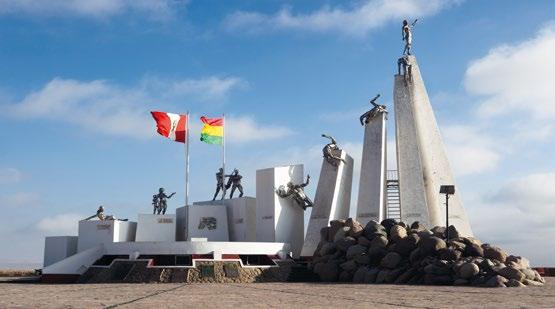
In the place where the Battle of Alto de la Alianza took place on May 26, 1880, in the framework of the Pacific War, tribute is paid to the combatants. In addition to the battlefield, the visit is completed by a cemetery, a monument and a site museum that shows weapons of the time, uniforms, letters, documents, and a diorama that illustrates the fight.
Valle Viejo de Tacna
Pocollay District, 2 miles (3.5 km) east of Tacna City (9 min by car)
Wide countryside that runs through the districts of Pocollay, Calana and Pachía. Its mild, dry weather and beautiful landscapes make it the perfect place to relax and enjoy regional cuisine. You can also visit the wine, pisco and macerated wineries present along its 14 miles (23 km).
Distrito de Pocollay
2 miles (3.5 km) east of Tacna City, Pocollay District (9 min drive)
Town of great agricultural activity that stands out for its export products; vine, plums and damasks. In the main square is the church of Nuestra Señora de las Mercedes. Las Peañas site museum exhibits the objects recovered during the excavations of the 56 pre-Inca and Inca tombs.
Campo de la Alianza monumental complex © Marco Garro / PROMPERÚ
Ruta del Pisco y vino
Magollo, Cercado, Pocollay and Calana Sectors
The region has with the greatest winemaking tradition in the whole country. Along the Pisco and wine route, you can visit wineries and see the process of making wines, piscos and macerates, which begins with the cultivation of vines, plums and damask, used as inputs, up to the artisanal production of beverages.
Calana District
6.4 miles (10.3 km) from the city of Tacna (15 min by car)
During the Colonial days and the early years of the Republic, Calana was an important commercial center. Testimony of that ancient splendor are the traditional mansions of quincha and clay that still stand. In plaza Bolognesi (the main square), there is the church of the Virgen del Rosario.
Distrito de Pachía
7 miles (11.3 km) from the city of Tacna (17 min by car)
Opposite the town’s main square is the church of San José, rebuilt in 1870 after being destroyed by the fierce earthquake of 1868. This modest church keeps a sliver of the cross of Christ, a relic given by the Vatican. The most representative products of the fertile soils of Pachía are corn and pumpkin.
Baños termales de Calientes-Pachía
Anexo de Calientes, 14 miles (23 km) east of the city of Tacna (30 min by car)
Entrance fee charged.
On the banks of the Caplina river, at 4,593 ft (1,400 m), Calientes-Pachía thermal springs reach 102 °F (39 °C). Visitors go for their medicinal properties or just to relax. The facilities have tourist services, such as lodging and traditional food restaurants.
Complejo arqueológico de Miculla
16 miles (25 km) northeast of the city of Tacna (30 min by car)
Entrance fee charged.
In Miculla archeological complex, you can visit Pre-Hispanic remains, such as domestic structures, Inca Trail, canals, geoglyphs, ceremonial centers, cultivation and funerary areas. There are also petroglyphs with diverse iconography and contemporary hanging bridges.
Beach Circuit
Tacna offers both open sandy beaches and rocky shores with calm waters, accommodation, and food services. The circuit includes: Santa Rosa, 46 km away; Los Palos, 41 km; Boca del Río, 52 km; Punta Mesa, 72 km; Meca, 91.1 km; and Arena Blanca, 107 km.
Jorge Basadre Province
Museo del Desierto y el Mar
Carretera Costanera km 92
The museum of the desert and the sea is located in the middle of the Tacna. It has six rooms with exhibitions of archaeological pieces, historical documents and geological samples and representative biological species. It also has two 39 ft (12m) high viewpoints, from where you can appreciate the sea and the wetlands of Ite.
Humedales de Ite
58 miles (93 km) north of the city of Tacna (1 h 30 min). The wetlands can be seen from the boardwalk.
At 4.6 sq. miles (12 km²), they are the largest coastal wetlands in Peru and the second largest in South America. It is an obligatory place for birdwatchers, as it is home to 85 resident bird species and 59 migratory bird species.
Santuario del Señor de Locumba
58 miles (93.4 km) northwest of the city of Tacna (1 hour 10 min by car)
The sanctuary of the Señor de Locumba is located in the district of Locumba (at 1,834 ft / 559 m), where every September 14 thousands of faithful pilgrims venerate the image of the crucified Christ, called the Señor de Locumba.
Catarata de Panina
From Tacna to Cambaya, 98 miles (157 km) (2 h 40 min). From the bus stop to Panina (1,640 ft / 500 m), 7-minute walk. Entrance free. Panina waterfall has two beautiful falls, the highest of which is 98 ft (30 m). The water comes from the Camilaca river. The course of the waterfall forms a natural pool, where visitors can cool off.
Sitio arqueológico Moqi
Located between the communities of Cambaya and Borogueña Moqi archeological site is a large administrative and military center, located at 9,186 ft (2,800 m), at the head of the Locumba river basin. The architectural complex is divided into Moqi Alto and Moqi Bajo, from whose facilities the elite of the Inca Empire controlled the western Yungas and precordillera (“pre-mountain range”) valleys in the Tacna region.
Tarata Province
Mirador de la Apacheta
41 miles (65.5 km) northeast of the city of Tacna (1 h 25 min)
Apacheta viewpoint is at 11,499 ft (3,505 m) and offers a privileged view of the Tutupaca and Yucamani volcanoes to the north, and the Barroso mountain range to the southeast. The name Apacheta refers to the place next to the Inca trail where stones were left as offerings to the deities of the place.
Iglesia de Tarucachi
Main square of Tarucachi village, 49 miles (79.1 km) northeast of the city of Tacna (1 h 40 min by car)
Between the streets and picturesque houses of Tarucachi, stands this colonial-era church, with its two side towers topped by wooden crosses. Its internal walls were painted with yareta ash, wild plants and a type of tuber, to acquire its bluish color, among other natural pigments.
Tarata
55 miles (88 km) northeast of the city of Tacna (1 h 30 min)
Around Tarata main square are the church of San Benedicto, built in 1741 and dedicated to patron saint of the province, and the cultural exhibition hall. The latter presents objects for domestic use and agricultural tools used by the ancient inhabitants of Tarata.
Camino Inca Santa María y andenerías de Tarata
3 blocks away from Tarata’s main square
On the Inca Trail you can see the pre-Hispanic terraces that continue to be used for the cultivation of corn and potatoes. After a few minutes of walking, you will find the archaeological sites of Santa María, a settlement of the ancient inhabitants of the place, and Qala Qala, a place used as a cemetery by the ancient inhabitants of the area.
Baños termales de Putina-Ticaco
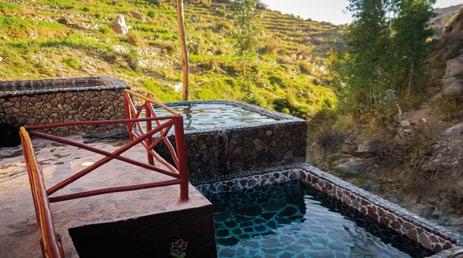
7.5 miles (12 km) north of the city of Tarata (15 min by car). Entrance fee charged. A thermal spring that feeds pools of various sizes - both private and sharedsurrounded by cozy rest areas, perfect for relaxation and photography amid a peaceful landscape
Cataratas de Conchachiri
At an altitude of 14,764 ft (4,500 m) and 52 miles (84 km) away from Tacna
The beautiful Conchachiri waterfalls are caused by deformations of the Earth’s crust due to the passage of time in Maure river.
Candarave Province
Laguna de Aricota
96 miles (154 km) south of the city of Candarave (4 h 30 min by bus)
The extensive Aricota lagoon, where rainbow trout abound, is located at 9,186 ft (2,800 m). The lagoon and its surroundings are home to cormorants and Andean gooses.
Candarave
169 km northeast of the city of Tacna (3 h 15 min by car)
The name of this peaceful town comes from Aymara and means “place of condors.” At an elevation of 11,204 ft (3,415 m), Candarave is an excellent place to watch the flight of these majestic birds. At the foot of the Yucamani volcano are alfalfa fields. In 2018, the anata dance of Camilaca district, was declared National Cultural Heritage.
Área de Conservación Regional Vilacota-Maure
Palca, Tarata, Ticaco, Susapaya and Candarave districts
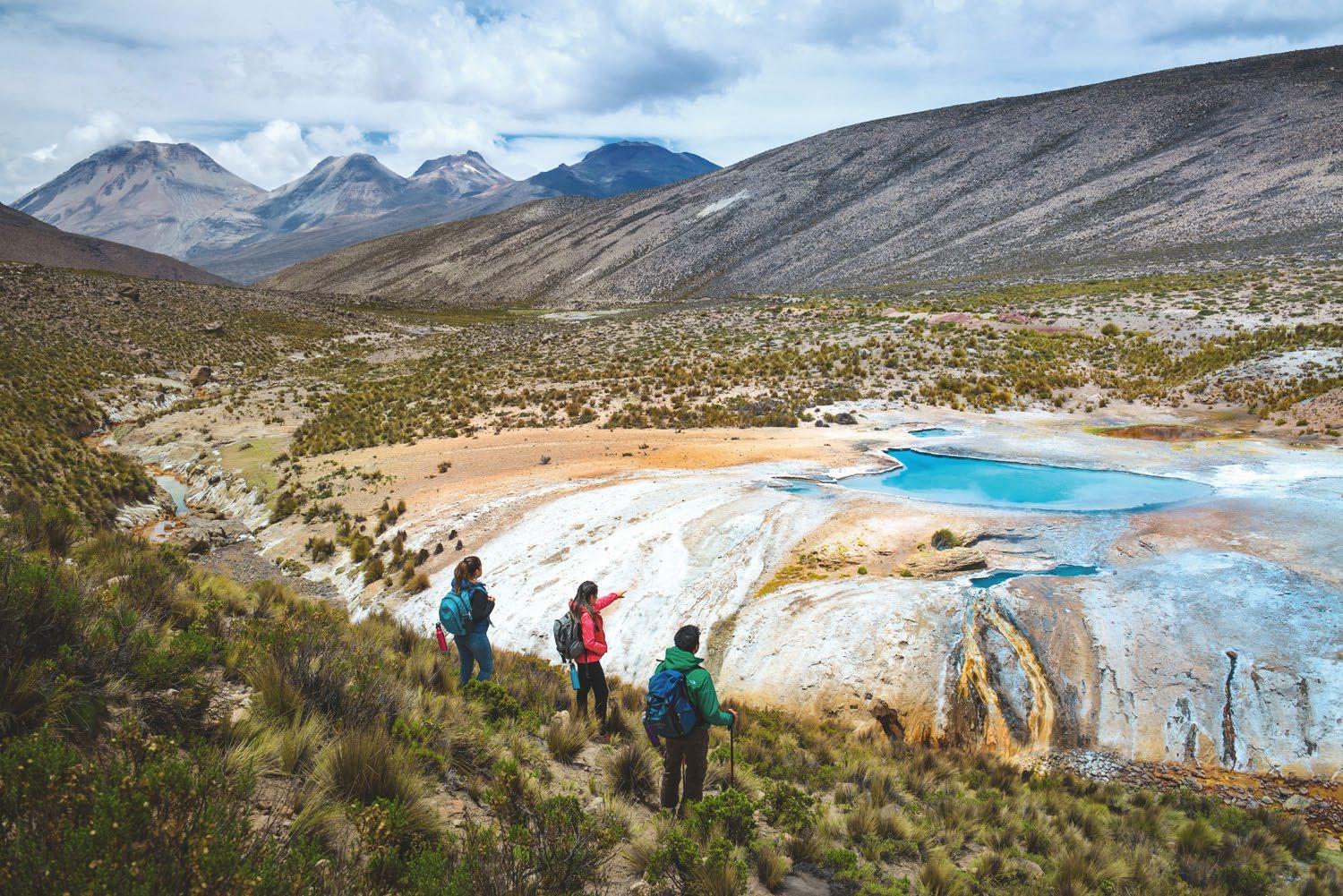
Vilacota-Maure regional conservation area is aimed to conserve the natural resources, biodiversity, and cultural heritage of the regional Andean ecosystem. The tourist areas include Calientes (valley of the geysers), with more than a hundred geothermal sources (geysers, springs, etc.) that emanate boiling water ranging from 104 °F to 194 °F (40 °C to 90 °C); the Vilacota lagoon, located in the high Andean area of the Susapaya district; Calachaca, a picturesque place located in the middle basin of the Maure river, has a waterfall and thermal springs of the
Ferroviario Nacional City
Fuente ornamental
Monumento conmemorativo a los héroes almirante
Miguel Grau y coronel Francisco Bolognesi
Centro Cultural Casa Basadre
Museo Histórico de Tacna
Casa de Francisco Antonio de Zela
Casa Jurídica de Tacna
Teatro Municipal
Alameda Bolognesi
Parque de la Locomotora
Estación de ferrocarril Tacna-Arica / Museo
Pje.México
Av.Tarata
Cl.AnicetoIbarra
Jorge Basadre Grohmann Oeste
Cl.Hipólito Unanue
Cl.EnriqueQuijano
Av.AriasyAragüez
Cl.LaGasca
Pje.LasPalmeras
Cl.MancoCápac
Cl.San Carlos
Cl.ModestoMolina
Cl.SanCamilo
Cl.LosCipreses
Av.AugustoB.Leguía
Cl.JoséRosaAra
Cl.Julio Rospigliosi
Cl.SanPedro
Cl.Curibaya
Cl.Ticaco ÓvaloTúpacAmaru
Cl.2de Diciembre
Cl.Portugal Psje.19
Prlg.28deJulio
Psje.Italia
Cl.GregorioAlbarracín
Prlg. Aniceto Ibarra Cl.Mollendo
Cl.CoronelJoséJoaquínInclán
Cl.PresbíteroAndía
Cl.JulioMacLean
Cl.28deJulio
Cl.Junín
Cl.General Felipe Varela
Av.LuisBasadreFlores
Cl.Blondell
Cl.Callao
Cl.Aries
Cl.Chiclayo
Pje.Libertad
Cl.Restauración
Cl.GildeHerrera
Cl.PachecoCéspedes
Pje.López.
Cl.General Suárez
Prlg.GildeHerrera
Cl.Tauro
Cl.Leo
Cl.Libra Av.GeneralManuelOdría
Cl.Escorpio
Cl.Jerusalén Pje.2
Cl.LosAzafranes
Pje.CoronelBustios
Cl.San Hilarión
Cl.Ayacucho Cl.13(2) Cl.27
Cl.Bolivia
Cl. Jorge Chávez
Cl.MariscalJuanMiller
Cl.JiménezBorja
Cl.AltoCenepa
Prlg.GustavoPinto
Pje.SantaRosa
Cjon.Ayca
Cl.SantoDomingo
Cl.Cusco
Cl.SanRomán Av.Grau ÓvaloCallao Cl.60
Cl.MancoCápac
Paseo6
Pje.3
Cl.Roma
Av.
Cl.Obispo Juan Masías
Tacna Tacna
Alameda Bolognesi (+51) 985-063-747 Av. Bolognesi 221 iperutacna@promperu.gob.pe
iperu@promperu.gob.pe
VisitPeru
The information contained in this brochure has been updated in May 2026. To prepare it, PROMPERÚ has used information from the Regional Directorate of Foreign Trade and Tourism (DIRCETUR) - Tacna and other official sources. The opening hours and telephone numbers are subject to vary at each tourist attraction. Confirm the hours and telephone numbers with IPERÚ.
Published by PROMPERÚ - Peru for Exports and Tourism Promotion Agency
Calle Uno Oeste 50, 14th Floor, Urb. Córpac, San Isidro, Lima, Perú Tel. +511 616-7300 www.promperu.gob.pe © PROMPERÚ. All rights reserved
Legal Deposit in Biblioteca Nacional del Perú No. 2023-10885
Printed by WORK UP E. I. R. L. (Calle Albert Einstein 165, Ate, Lima) Lima, October 2023