
Amazonas
Practical guide for travelers

Amazonas
Location
Mountains, High Jungle and Northern Jungle of Peru
Capital
Chachapoyas (at 7,661 ft / 2,335 m)
Altitude
Min.:
755 ft (230 m) (Santa María de Nieva)
Max.:
8,038 ft (2,450 m) (Chuquibamba)
Weather
Temperature
Max.:
Min.: 52 °F (11 °C)
73 °F (23 °C) Mar-Jun Sept-Dec
How to get there?
By land Dec-Mar Jun-Sept
Tarapoto-Chachapoyas: 219 miles (353 km) / 8 h
Lima-Chiclayo-Chachapoyas: 757 miles (1,219 km) / 22 h
Trujillo-Chiclayo-Chachapoyas: 406 miles (653 km) / 13 h
Chiclayo-Chachapoyas: 279 miles (449 km) / 10 h
Cajamarca-Chachapoyas: 209 miles (336 km) / 10 h
Jaén-Chachapoyas: 114 miles (183 km) / 4 h
By air
Lima-Chachapoyas: 1 h 45 min


Amazonas
Department capital
Province capital
District capital
Tourist attraction
International border
Provincial border
Main road
Paved road
Dirt road
Airport
Natural Protected Area
Approved by DR 0277/RE of September 28, 2016. The indicated borders make no claims over international boundaries.
ECUADOR
Parque Nacional Ichigkat MujaCordillera del Cóndor
CONDORCANQUI
Reserva Comunal Tuntanain
Santa María de Nieva
Zona Reservada Santiago Comaina
LORETO
BAGUA
Chiriaco
Reserva Comunal Chayu Naín
Santuario Nacional Cordillera de Colán
El Parco
Bagua
Grande
Zona Reservada Río Nieva
BONGARÁ
Lonya Grande Paclas Cajaruro
Sarcófagos de Karajía
Caverna de Quiocta Lago de Pomacochas
Catarata Yumbilla
Laguna de Burlán to Yurimaguas
LUYA


Catarata La Chinata
UTCUBAMBA CHACHAPOYAS
Lonya Chica
Restos arqueológicos de Yálape
San Nicolás (Mendoza) Lámud Jumbilla
Asunción Goncha
Catarata Gocta Pueblo de los Muertos Mirador de Huanca Urco Cañón del Sonche
Valle de Huaylla Belén Cavernas de Leo
Complejo arqueológico Kuélap
Mausoleos de Revash
RODRÍGUEZ DE MENDOZA
Aguas termales La Colpa
Museo Leymebamba
Laguna de los Cóndores
CHACHAPOYAS
Scale (km)
SAN MARTÍN


Feb-mar Chachapoyas Carnival
Jun 1-7
Aug 1-15
Sep 1-14
Sep 7-12
Tourism Week and Raymi Llaqta of the Chachapoyas
Patronal festival of the Virgin Assunta
Patronal festival of the Lord of Gualamita
Patronal festival of St. Nicholas of Tolentino and the Virgin of the Nativity
What to eat?
The cuisine of the region is enriched by Andean and Forest traditions. Highlights include the must-try guinea pig in roasted peanut stew, yuca juane, cecina (a local type of jerky), tamales and humitas; and drinks, such as guarapo and milk liquor (brandy and buttermilk). The region produces coffee, cocoa, exotic fruits such as pitahaya, and traditional roots such as arracacha.
What to buy?
Ponchos, vests and blankets made by the local women using the traditional backstrap loom or illahua technique. These fine pieces reproduce the iconography of the Chachapoyas. You can also buy furniture and crafts made from tree roots and trunks. The artists capture in brightly colored ceramics the beauty of their flora and fauna.
What to visit?
Chachapoyas Province
Plaza Mayor de Chachapoyas
The city center follows the checkerboard layout, characteristic of colonial cities. Its main square, surrounded by colonial mansions with carved wooden balconies, has a bronze pool dating from the mid-19th century.
Basílica Catedral San Juan Bautista
The various styles present on the façade of this cathedral are a reference to the one that collapsed with the 1971 earthquake. Among the pieces of art it houses, those from the Quito school deserve special consideration.
Sala de Exhibición Gilberto Tenorio Ruiz
Jr. Ayacucho 904, Plaza Mayor. Mon-Fri, 8:00-13:00 and 15:00-17:45.
Items from the Chachapoyas culture — most of them donated by local residents — are exhibited throughout the four rooms of the museum. In the first room, there is information about the location, flora and fauna of the region; in the second, Chachapoyas-style ceramics, with Cajamarca and Inca influence, textiles and organic objects; in the third, lithic cultural assets; and in the fourth, mummies.
Casa de Toribio Rodríguez de Mendoza
At the corner of Ayacucho and Ortiz Arrieta. Mon-Fri, 9:00-13:00.
This is the house where Toribio Rodríguez de Mendoza, hero of the Independence of Peru, was born on April 17, 1750, and it is currently the seat of the Bishopric of Chachapoyas. The main areas to visit in this house of colonial and republican architecture are the hallway, the main patio, the bishops’ room and the reception room.
Casa de las Dos Rosas

At the corner of Jr. Amazonas and La Merced. Mon-Fri, 9:00-12:00 and 14:30-18:00. Entrance fee charged.
Built in the 18th century, the houswe has both colonial and republican architectural characteristics. Two of its main rooms are the oratory and the living room. Since the end of the 19th century, it has been owned by the Torrejón Montesa family.
Plazuela de la Independencia
Jr. Amazonas cdra. 3
It is a small square that commemorates the battle of Higos Urco, a victory for the patriots led by Colonel José Matos.
Pozo de Yana Yacu
Luya Urco Hill, 0.6 miles (1 km) from the Plaza de Armas (10 min on foot)
The story tells that St. Toribio of Mogrovejo stopped the drought that was devastating Chachapoyas by making water flow from this well, also known as the Cuyana Fountain. In his honor, there is a stone with the engraved figures of a miter and a staff. It is said that single men who come to the city and drink its waters stay here forever, attracted by the beauty of its women.
Cañón del Sonche
Head to Huancas (4.7 miles / 7.5 km north of the city of Chachapoyas, 25 min by car), then walk for 15 min. Mon-Sun, 8:00-18:00. Entrance fee charged. The Sonche canyon is 3,156 ft (962 m) deep, an ideal place to enjoy a wonderful view of the Sonche River and the surrounding area populated with quinine plants.

Mirador de Huanca Urco
2.5 miles (4 km) north of the town of Huancas (10 min by car) to the Huanca Urco viewpoint. Mon-Sun 8:00-18:00. Entrance fee charged. Huanca Urco means “Sacred Hill”. This viewpoint is located at 8,858 ft (2,700 m). From this picturesque place you can see the deep valley of the Utcubamba river, the Sonche canyon, the Vituya canyon, the Gocta waterfall, and the Pueblo de los Muertos archaeological site.
Restos arqueológicos de Yálape
11 miles (17 km) south of the city of Chachapoyas (50 min by car)
The archeological remains are rounded constructions decorated with rhombuses and zigzags in high relief, built by the Chachapoyas between 1100 and 1300 AD.
Museo Leymebamba
Austria s/n, Leymebamba. Mon-Sun, 10:00-16:30. Entrance fee charged. The museum exhibits pre-Hispanic textiles, weapons and ceramics found in the area, the mummies and objects recovered from the Cóndores lagoon stand out.
Laguna de los Cóndores
Located at the end of a 58-mile (93 km) journey south of the city of Chachapoyas (2 h by car) and a walk of 8-12 hours (you can also ride a mule). Entrance fee charged.
More than 200 mummies and around 2,000 items of the Inca and Chachapoyas cultures around Los Cóndores lagoon. Cave paintings can also be found adorning the cliffs on the shore.
Panoramic view of the city of Chachapoyas © Miguel Mejía / PROMPERÚ

Luya Province
Pueblo de los Muertos
You must get to Lamud, 18 miles (29 km) northwest of the city of Chachapoyas (1 h by car). From there, it is 7 miles (11 km) to Pucatambo (30 min by car) and a walk of 45 min. Mon-Sun, 8:00-16:00. Entrance fee charged. It gets its name (Town of the Dead) because it is an ancient pre-Hispanic town where only chullpas and tombs remain. The stone, straw and mud chullpas reach heights of up to 10 ft (3 m) and preserve objects such as fulling mills and niches. There are sarcophagi in exhibition, distributed in groups.
Caverna de Quiocta
45 km northwest of the city of Chachapoyas (1 h 30 min by car, and a walk of 10 min). Mon-Sun, 8:00-16:00. Entrance fee charged. In this cavern of 1,900 ft (580 m) deep, human skulls and bones were found, as well as curious formations of stalactites and stalagmites.
Sarcófagos de Karajía
After travelling 32 miles (51 km) northwest of the city of Chachapoyas (2 h by car) to the community of Cruzpata, the sarcophagi are found at the end of a 0.6 miles (1 km) trek (30 min). Mon-Sun, 8:00-17:00. Entrance fee charged. The anthropomorphic sarcophagi, also called “purunmachoss,” rest on top of a cliff. They are made of small stones joined with mud and straw, and they can reach up to 6.5 ft (2 m) high. On the outside they are painted in ocher and white, simulating masks. Inside some of them there are mummies with their grave goods.
Valle de Huaylla Belén

37 miles (60 km) from the city of Chachapoyas (2 h 30 min by car), along the Luya-Cohechán-Belén route
The walk through the valley of Huaylla Belén, also known as the Silver Serpent, offers hikers the typical landscapes of the misty forest and its fauna. It is a point of interest for birdwatching fans. The Huaylla River crosses the area with its countless meanders.
Zona arqueológica monumental Kuélap
First drive 45 miles (72 km) southwest of the city of Chachapoyas (2 h 30 min by car) to La Malca and then hike for 25 min. You can also go through Nuevo Tingo (1 h by car) and board the cable cars (20 min) to La Malca. Mon-Sun, 8:00-17:00 (entrance fee charged). Kuélap cable car hours: Tue-Sun, 8:00-17:00 (ticket fee charged).
Surrounded by a 6,200 ft (1,900 m) long wall, this fortified citadel was the political, religious and military center of the Chachapoyas (500-1450 AD). It is divided into two levels: Pueblo Bajo (Lower Town), with its buildings decorated with rhomboid figures and zigzags, where El Tintero, a ceremonial building, is located; and Pueblo Alto (Upper Town), where the ceremonial platform and the north tower that served as a surveillance post are located.
Mausoleos de Revash
46 miles (74 km) south of the city of Chachapoyas, in the direction of San Bartolo (2 h 40 min by car) then hiking 0.6 miles (1 km) (25 min). Mon-Sun, 9:00-16:00. Entrance fee charged.
A funerary center with mausoleums, up to three stories high and with gabled roofs, embedded against a mountain. Only its façades with quadrangular, cross and “T” shaped niches can be seen. Some of its sectors show ocher cave paintings that represent animals and people.

Fog trail, Pomacochas lagoon © Walter Wust
Bongará Province
Catarata Gocta
Head north from the city of Chachapoyas to the town of Cocachimba (25 miles / 41 km, 1 h by car). From there, hike 34 miles (5.5 km) (2 h 30 min).
Mon-Sun, 7:00-17:30.
The walk to La Chorrera, as it is also known, is the perfect opportunity to observe the exuberant flora and fauna of the area. Different species of monkeys and the Andean cock-of-the-rock can be seen. At an elevation of 2,529 feet (771 m), it is the third highest waterfall in Peru.
Catarata Yumbilla
Located in Pedro Ruiz Gallo (32 miles (52 km) north of the city of Chachapoyas, 1 hour by car), take a motorcycle taxi to the town of Cuispes (25 min). From there, it is a two-hour walk to the waterfall. Mon-Sun, 7:00-17:30. Entrance fee charged.
The water falls 2,936 feet (895 m) in four jumps. Many birds live in the area, such as the Andean cock-of-the-rock, as well as monkeys and reptiles. It is the second highest waterfall in Peru.
Catarata La Chinata
From Pedro Ruiz Gallo (32 miles / 52 km north of the city of Chachapoyas, 1 h by car), travel 4 miles (7 km) (20 min by car) to the town of San Carlos and, finally, hike for 7.5 miles (12 km) (2 h) to the waterfall. Mon-Sun, 8:00-16:30. Four jumps make up this almost 1,900 ft (580 m) tall waterfall. Enjoy its refreshing waters and the observation of the flora composed of orchids, mosses and ferns.
Lago de Pomacochas
Travel 52 miles (84 km) north from the city of Chachapoyas (2 h by car) to the town of Pomacochas, from there hike 0.6 miles (1 km) (15 min) to the lake. Mon-Sun, 8:00-17:00. Entrance fee charged.
At 7,054 ft (2,150 meters), Pomacochas lake is fed by underground currents. Its dark green waters reach a depth of 262 ft (80 m). It is surrounded by cattails, reeds and foxtails, as well as herons and grebes.
Rodríguez de Mendoza Province
Cavernas de Leo
The tour begins in San Nicolás (52 miles / 84 km southeast of the city of Chachapoyas, 2 h by bus), then 14 miles (22 km) to Omia (30 min by car) and, finally, a walk of 0.6 miles (1 km) (15 min) to the caverns. Entrance fee charged. The interior of the cavern is divided into several chambers, where stalactites and stalagmites in the shapes of candelabras, curtains, shoes, wild animals and Solomonic columns can be seen.
Aguas Termales La Colpa
From the Tocuya Annex (62 miles / 99 km southeast of the city of Chachapoyas, 2 h 45 min by bus), you can reach the hot springs on foot (10 min). Mon-Sun, 8:00-17:00. Entrance fee charged.
Its therapeutic waters have 40% sulfur which is good for dermatological and rheumatic conditions. Its temperature ranges between 68° F (20 °C) and 77° F (25 °C).
Bagua Province
Museo Casual
Travel 6.4 miles (10.3 km) north from the city of Bagua (10 min by car) to the Casual hamlet. Tue-Sun, 10:00-13:00 and 14:00-18:00. Entrance fee charged. Its four rooms house valuable archaeological collections from different sites of the Bagua culture, which inhabited the area between 1300 and 200 BC, and which was discovered by the archaeologist Ruth Shady in 1978.
Utcubamba Province
Laguna de Burlan
Travel 3 miles (5 km) southeast from the city of Bagua Grande (10 min by car) to the Miraflores intersection, from there it is 1.2 miles (2 km) to the lagoon (10 min by car).
It is also known as the Lagoon of the Angels. It has an area of 0.2 sq. miles (0.5 km2). Its origin is due to the constant accumulation of water from the agricultural lands that surround it, mostly rice fields. Its waters have an average temperature of 64° F (18° C), which has given it a unique and very special ecosystem. It is the habitat of herons, wild ducks and fish, such as tilapia and carp. There are countryside restaurants with amenities.


At 9,843 ft (3,000 m), in the middle of a rugged terrain, lies Kuélap, an impressive Chachapoya construction, protected by a 66 ft (20 m) tall wall.
Fortified City of Kuélap © Luis Gamero / PROMPERÚ


Distances
In private transportation from the city of Chachapoyas
DESTINATION
Lámud (Luya Province)


18 miles (29 km) 1 h
San Nicolás (Rodríguez de Mendoza Province) 2 h
Bagua Grande (Utcubamba Province)
Jumbilla (Bongará Province)
52 miles (84 km)
57 miles (92 km) 2 h 30 min
67 miles (107 km) 3 h

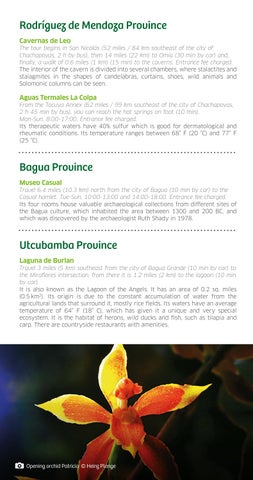
Pitahaya © Yayo López / PROMPERÚ
Tours 5 days (minimum recommended stay)
Chachapoyas and Huancas 1 day
Kuélap Monumental Archaeological Area 1 day
Gocta waterfall 1 day
Leymebamba Museum and Revash mausoleums 1 day
Karajía Sarcophagi and Quiocta cave 1 day
3 days
Los Cóndores lagoon

Chachapoyas
Basílica Catedral San Juan Bautista
Sala de exhibición Gilberto Tenorio Ruiz
Casa de Toribio Rodríguez de Mendoza
Casa de las Dos Rosas
Templo de Nuestra Señora de Belén
Templo del Señor de la Buena Muerte
Plazuela de Santa Ana
Mirador de la Mama Nate
Templo de la Virgen Asunta
Pozo de Yana Yacu
Mirador Luya Urco
Templo del Señor de Burgos

CHACHAPOYAS Amazonas
City Center
(+51-1) 616-7300, Ext. 1897
Jr. Ortiz Arrieta 630 iperuchachapoyas@promperu.gob.pe
iperu@promperu.gob.pe
The information contained in this brochure has been updated in September 2023. To prepare it, PROMPERÚ has used information from the Regional Directorate of Foreign Trade and Tourism (DIRCETUR) - Amazonas and other official sources.
The opening hours and telephone numbers are subject to vary at each tourist attraction. Confirm the hours and telephone numbers with IPERÚ.
Published by PROMPERÚ - Peru for Exports and Tourism Promotion Agency
Calle Uno Oeste 50, 14th Floor, Urb. Córpac, San Isidro, Lima, Perú Tel. +511 616-7300 www.promperu.gob.pe © PROMPERÚ. All rights reserved
Legal Deposit in Biblioteca Nacional del Perú No.
Printed by WORK UP E. I. R. L. (Calle Albert Einstein 165, Ate, Lima) Lima, November 2023