VISIT DENVER Board of Directors Retreat August 26-27, 2021 Beaver Creek, CO
Table of Contents Agenda: Thursday, Aug. 26th
Page 3
Speaker Bios
Page 5
Contributor Bios
Page 12
2021 VISIT DENVER Board Retreat Attendees
Page 17
Reminders & Helpful Information
Page 21
VISIT DENVER Staff Contacts
Page 24
VISIT DENVER Board Meeting Agenda: Friday, Aug. 27th
Page 25
Advance Prep Materials
Page 26
AGENDA: Thursday, August 26th – Morning 7:30am - 9:00am
Breakfast
Gore Range Hall
8:45am - 9:15am
Welcome & Ice breaker
Janice Sinden
Gore Range Hall
9:15am - 10:15am
The New Normal of Travel in a Post-Pandemic World
Jason Laborde, Ph.D. Senior Director, Consulting Division KANTAR
Gore Range Hall
10:15am - 11:00am
Local Perspectives Denver International Air Service Development
Laura Jackson, VP Air Service Development Denver International Airport
New World of Denver Office & Retail Space
Sam Zaitz, Executive Vice President, JLL Patrick Bolick, Executive Vice President, JLL
Gore Range Hall
11:00am - 11:15am
Break
Gore Range Hall lobby
11:15am - 12:45pm
Denver Visitor Experience and Homelessness San Fransicko
Gore Range Hall
12:45pm - 1:45pm
Michael Shellenberger, Author
Assessing Homelessness Strategies & Initiatives
Marc Eichenbaum, Special Assistant to the Mayor for Homeless Initiatives City of Houston
Lunch
Special Guest: Nadia Guerrieto, VP & COO, Beaver Creek Resort, Vail Resorts Special Guest: Herb Rackliff, GM, Park Hyatt Beaver Creek
Crooked Hearth
AGENDA: Thursday, August 26th – Afternoon & Evening 1:45pm - 3:15pm
Workforce Development & Roundtables
1:45pm-2:15pm
“From Furlough to Famine”
2:15pm-2:30pm
Industry Insights: Denver Economic Development Hotel & Lodging Restaurants Higher Education
Gore Range Hall
Mike Gamble, President & CEO SearchWide
Eric Hiraga, Executive Director Denver Office of Economic Development Amie Mayhew, President & CEO Colorado Hotel and Lodging Association Sonia Riggs, President & CEO Colorado Restaurant Association David Corsun, Director & Associate Professor Fritz Knoebel School of Hospitality Management Christian Hardigree, Dean, School of Hospitality, Events & Tourism Metro State University
2:30-3:15pm
Roundtables
3:15pm - 3:30pm
Break
3:30pm - 4:30pm
Leadership Lessons Learned from the Pandemic
4:30pm - 5:30pm
Free time
5:30pm
6:30pm 6:45pm
Gore Range Hall Darrell Hammond, Higher Ground Consulting
Gore Range Hall
Reception
Hyatt Beaver Creek
Crooked Hearth & outdoor patio
Buses Depart Reception & Dinner
Splendido
Splendido
Speakers Justin Laborde, Ph.D. Senior Director Kantar
Dr. Justin Laborde is a Senior Director at Kantar, where for more than 14 years he has consulted with clients in a wide variety of industries to understand the business implications of trends identified by the U.S. MONITOR, the foremost study of U.S. consumer lifestyles, values, and attitudes. He has worked with clients in industries including travel, financial services, retail, CPG, media, automotive, restaurants and hospitality, public relations, and advertising. Prior to joining Kantar, Justin was a communications consultant at Energetics, Inc., a government contractor in Washington, D.C., and has served in strategic communications and media relations roles at financial services and strategic management companies in Charlotte, NC and Nashville, TN. Justin holds an M.S. in Integrated Marketing and Management Communication and a Ph.D. in Mass Communication with a focus on marketing research methodology and statistics from Florida State University. A frequent presenter at conferences, seminars, workshops and client engagements throughout North America, Justin and his family reside near Raleigh, N.C. Kantar is a specialist sales and marketing consultancy designed to ‘switch on growth’ for brand owners and retailers. With its combined creative and analytical heritage, Kantar is unique in combining retail, sales, ecommerce and marketing expertise, a deep understanding of how consumers think, live, behave and buy and world-leading proprietary data. Unlike other consultancies it is able both to develop strategies, execute against them right up to shelf-edge, and embed capabilities within client organisations.
Speakers Laura Jackson Vice President, Air Service Development Denver International Airport
Laura L. Jackson is the Senior Director of Air Service Development and Aviation Research at Denver International Airport. Some of her current projects include managing DIA's efforts to secure nonstop service between Denver and targeted international destinations, directing airport-wide research initiatives and spearheading market intelligence activities related to the dynamic aviation industry. Jackson serves on the Board of Directors of the World Trade Center Denver, the Rocky Mountain French-American Chamber of Commerce, and the SwedishAmerican Chamber of Commerce of Colorado. She is also active with the Japan America Society of Colorado. Jackson received an MBA from the Thunderbird School of Global Management and a BA in Economics and International Studies from the University of Richmond.
Patrick Bolick Executive Vice President JLL Denver
Patrick Bolick focuses on strategic real estate planning and implementation for corporate and public entities, providing site selection, financial analysis and lease negotiations for his clients. Patrick has specialized his entire career working as a tenant representation professional and is known for his public sector clients, airline experience, sales and acquisitions
Speakers for large, urban infill sites on behalf of owners and users, as well as working on behalf of large corporate clients with complex and sophisticated real estate portfolios. Patrick received his Bachelor of Science degree in Business Administration from James Madison University in Harrisonburg, Virginia. He is a member of the Denver Metro Commercial Association of REALTORS® and the Downtown Denver Partnership. He is actively involved with the Cystic Fibrosis Foundation, Brokers Benefiting Kids, the Colorado Uplift and the Rocky Mountain Children’s Law Center.
Sam Zaitz Executive Vice President, Retail JLL Denver
Sam Zaitz started in the retail brokerage business in 2003 and joined Jones Lang Lasalle in 2020 as an Executive Vice President and in charge of running the Retail Brokerage department for the Rocky Mountain Region. Sam has been fortunate to help groups with their first location to helping roll out some of the largest publicly traded companies. Sam and his team take pride in doing everything they possibly can to make sure their clients experience long term success.
Speakers Michael Shellenberger Founder & President, Environmental Progress Author of San Fransicko: Why Progressives Ruin Cities
Michael Shellenberger is author of the best-selling “Apocalypse Never” and forthcoming “San Fransicko,” published by HarperCollins in 2020 and 2021. He is a Time Magazine "Hero of the Environment" and testifies to policymakers around the world on energy and the environment. He has been called an “environmental guru,” “North America’s leading public intellectual on clean energy,” and “high priest” of the environmental humanist movement for his writings and talks. Shellenberger is contributor to Forbes, The New York Times, Washington Post, and Quillette. In his latest book due out in October, Michael has turned his attention to homelessness. According to Michael, he finds most labels confusing, “but it’s fair to say that I am a lifelong progressive Democrat who in April of this year changed my party affiliation to independent and now consider myself moderate.” He has lived in the San Francisco Bay Area for thirty years but spent his early years growing up in Greeley, Colorado where both his parents are psychologists. During that time, he advocated for the decriminalization of drugs, affordable housing, and alternatives to jail and prison. But as homeless encampments spread, and overdose deaths skyrocketed, Shellenberger decided to take a closer look at the problem. What he discovered shocked him. The problems had grown worse not despite but because of progressive policies. San Francisco and other West Coast cities — Los Angeles, Seattle, Portland — had gone beyond merely tolerating homelessness, drug dealing, and crime to actively enabling them. San Fransicko reveals that the underlying problem isn’t a lack of housing or money for social programs. The real problem is an ideology that designates some people, by identity or experience, as victims entitled to destructive behaviors. The result is an undermining of the values that make cities, and civilization itself, possible.
Speakers Marc Eichenbaum Special Assistant to the Mayor for Homeless Initiatives City of Houston
Marc Eichenbaum serves as the Special Assistant to the Mayor for Homeless Initiatives. Marc is a licensed attorney who specializes in public policy, strategic communications, and governmental affairs. Appointed by two administrations, Marc manages the City’s involvement in The Way Home, Houston’s globally recognized homeless housing initiative. Since 2012, The Way Home has housed more than 23,000 individuals experiencing homelessness, effectively ending veteran homelessness and reducing overall homelessness by 55%. Marc created the city’s innovative Public Intoxication Team, is at the forefront of developing holistic strategies to reduce encampments and handles a variety of behavioral health issues for the Mayor. Named by Bloomberg Cities as one of “10 Innovators Who are Raising the Bar in the Fight Against COVID19,” Marc has advised cities, from Perth, Australia and Kuala Lumpur, Malaysia to Orlando, San Diego and Anchorage, on how to create collective-impact, transformative systems to reduce homelessness.
Speakers Mike Gamble Founder, Tourism Diversity Matters Co-founder, SearchWide Global
Mike Gamble is the Founder of Tourism Diversity Matters and Co-founder of SearchWide Global, a full service executive search firm. Prior to TDM and SearchWide Global, he was SVP of Sales and Marketing for the Philadelphia CVB and held various leadership roles with Marriott International. He has served on the foundation boards of Destinations International, PCMA, and MPI, and is currently on the board for the Boys & Girls Clubs of the Twin Cities.
Darrell Hammond Keynote Speaker, Executive Coach & Peak Performance Facilitator Higher Ground Consulting
An international speaker, executive coach and team/performance facilitator, Darrell shares his expertise in leadership and employee engagement through keynotes, work-shops, coaching and consulting. He is known for hi-energy, humor, analogies and straight talking style. Darrell coaches, trains and inspires leaders, their teams and organizations to get more done with greater alignment and fewer headaches. He is a visionary leader that helps transform the way you think about your work and your role.
Speakers A featured speaker and executive coach who inspires leaders and their teams to clarify direction, focus, and effectiveness through proven frameworks, he teaches and coaches audiences how to practically reach their peak performance. Darrell earned an athletic scholarship and completed a degree in Business Management. After college he continued playing exhibition basketball, traveled around the world, keynote speaking, and providing custom training. Awarded a silver medal playing basketball on Team USA, at the Australia Games and earning an NBA Legends M.V.P. award, Darrell’s work ethic has been demonstrated and re-warded over the course of his career. His 30 year career in Human Resources (HR) led to many years in increasingly responsible executive positions. Advisor and consultant to boards, executives, teams, corporations, numerous government agencies, elected officials, and non-profit leadership teams, he is living his dream of ‘Serving Those Who Serve Others’.
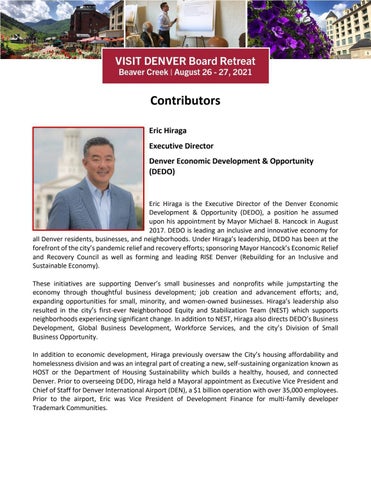
Contributors Eric Hiraga Executive Director Denver Economic Development & Opportunity (DEDO)
Eric Hiraga is the Executive Director of the Denver Economic Development & Opportunity (DEDO), a position he assumed upon his appointment by Mayor Michael B. Hancock in August 2017. DEDO is leading an inclusive and innovative economy for all Denver residents, businesses, and neighborhoods. Under Hiraga’s leadership, DEDO has been at the forefront of the city’s pandemic relief and recovery efforts; sponsoring Mayor Hancock’s Economic Relief and Recovery Council as well as forming and leading RISE Denver (Rebuilding for an Inclusive and Sustainable Economy). These initiatives are supporting Denver’s small businesses and nonprofits while jumpstarting the economy through thoughtful business development; job creation and advancement efforts; and, expanding opportunities for small, minority, and women-owned businesses. Hiraga’s leadership also resulted in the city’s first-ever Neighborhood Equity and Stabilization Team (NEST) which supports neighborhoods experiencing significant change. In addition to NEST, Hiraga also directs DEDO’s Business Development, Global Business Development, Workforce Services, and the city’s Division of Small Business Opportunity. In addition to economic development, Hiraga previously oversaw the City’s housing affordability and homelessness division and was an integral part of creating a new, self-sustaining organization known as HOST or the Department of Housing Sustainability which builds a healthy, housed, and connected Denver. Prior to overseeing DEDO, Hiraga held a Mayoral appointment as Executive Vice President and Chief of Staff for Denver International Airport (DEN), a $1 billion operation with over 35,000 employees. Prior to the airport, Eric was Vice President of Development Finance for multi-family developer Trademark Communities.
Contributors Hiraga received a B.S. in International Affairs from the University of Colorado at Boulder. He was awarded a Peace and Friendship Fellowship from the Japanese Ministry of Education at the University of Tsukuba, the Marshall Memorial Fellowship, and is currently in the second cohort of the Colorado Inclusive Economy. Current civic activities include Denver Urban Renewal Authority, Japan America Society of Colorado, and the Biennials of the Americas.
Amie Mayhew President & CEO Colorado Hotel & Lodging Association
With over twenty years of trade association management experience, Amie Mayhew brings a well-rounded background to her role as President & CEO of the Colorado Hotel & Lodging Association (CHLA), which represents nearly 300 hotels and resorts throughout Colorado. Amie oversees all operations for CHLA, including the development of an aggressive legislative agenda and lobbying effort, and organization of CHLA university designed to provide members with a recruitment and retention tool for employees. Amie serves on several industry Boards including: Tourism Industry Association Board of Directors, VISIT DENVER, the Convention & Visitors Bureau Board of Directors, Colorado Restaurant Association Board of Directors, and the Colorado Restaurant Foundation Board of Directors. Prior to her role at CHLA, Amie was as the Chief Executive Officer for the Colorado Association of Home Builders (CAHB). A native of Colorado, Amie has a Master’s degree in Technical Journalism from Colorado State University and a Bachelor’s degree in Communications from the University of Colorado at Denver. Amie and her husband Bryan live in Lakewood with their 11-year-old son, Henry.
Contributors Sonia Riggs President & CEO Colorado Restaurant Association
Sonia has been President and CEO of the Colorado Restaurant Association (CRA), the leading trade organization for the state’s dynamic restaurant industry, since 2014. The CRA, which represents more than half of the restaurants in the Centennial State, is dedicated to the enhancement and success of Colorado’s foodservice industry. In 2020, during the early days of the pandemic, Sonia was appointed to serve on the Tourism Committee for the Governor’s Council for Economic Stabilization and Growth. She has also served as co-chair of the Restaurant Committee that reports to the Denver Economic Relief & Recovery Council. Sonia is also the President of the Council of State Restaurant Associations, and serves on the Boards of the National Restaurant Association, the Colorado Tourism Board, and Visit Denver.
David Corsun, Executive PhD Associate Professor, Director Fritz Knoebel School of Hospitality Management
David Corsun is director of the Daniels College of Business’ Fritz Knoebel School of Hospitality Management and an associate professor since 2007. After receiving his PhD in 1999 from Cornell University’s School of Hotel Administration, Corsun was named assistant professor at Washington State University. After a year in Washington, he moved to the University of Nevada, Las Vegas, and was subsequently named associate professor and
Contributors coordinator of international relations for the University’s Harrah College of Hotel Administration. Corsun also held academic positions with Cornell University and New York University while a graduate student.
Christian Hardigree, J.D. Dean, School of Hospitality Metropolitan State University of Denver
Christian E. Hardigree, J.D., is the founding dean of the School of Hospitality at Metropolitan State University of Denver. She served as founding director and professor of the Michael A. Leven School of Culinary Sustainability and Hospitality at Kennesaw State University in Kennesaw, Georgia from 2012 to 2018. Hardigree oversaw more than 260 majors with a total enrollment of more than 1,500 students. She also worked for Parnell & Associates as a senior litigation attorney and partner focusing on employment discrimination, arbitration, mediation and labor-management relations. Hardigree serves on a number of industry committees and advisory boards. In 2012, she was selected as a faculty institute senior teaching fellow at UNLV, where she also received the Sam and Mary Boyd Distinguished Professor for Service Award in 2011 and the Boyd Distinguished Professor for Teaching Award in 2010. Hardigree is a researcher and frequent conference presenter. Her areas of expertise are in food safety, risk management, sustainability, workplace violence, bedbug litigation and employment/management issues. Hardigree received her Juris Doctorate from Walter F. George School of Law at Mercer University and a Bachelor of Science, cum laude, from William F. Harrah College of Hotel Administration at University of Nevada Las Vegas.
Contributors Murphy Robinson Executive Director & Deputy Mayor City & County of Denver
Murphy Robinson is the Executive Director of the Department of Public Safety and the Deputy Mayor for the City and County of Denver. He is a member of Mayor Michel B. Hancock’s cabinet and previously served as the city’s Chief Operating Officer (COO). As the Executive Director of Public Safety, Director Robinson oversees management, discipline, human resources, administrative support and policy direction for Denver Police, Fire and Sheriff’s Departments, the 9-1-1 Emergency Communications Center, Community Corrections, Public Safety Youth Programs and GRDI (Gang Reduction Initiative of Denver). In his pervious role as the City’s COO, Director Robison was responsible for overseeing the day-to-day operations of Denver on behalf of Mayor Hancock. He oversaw a $1.5B budget and 16,000 employees across the city. Director Robinson also served as the Executive Director of Denver’s General Services Department where he was responsible for the property management and maintenance of over six million square feet of city-owned land and facilities, $186 million in purchasing contracts, the Denver Security Office and the Energy Office in the City and County of Denver. He is active in multiple community organizations including the I Love You Guys Foundation. He sits on the Visit Denver Board and is a former member of the Board of Equalization, the Board of County Commissioners for the city of Denver, and the Colorado Rangers. Director Robinson has a bachelor’s degree from Xavier University and a master’s degree in Public Policy and Politics from the University of Colorado Denver. He also holds a certificate from the Rocky Mountain Leadership Program Institute of Governance from the University of Colorado Denver.
2021 VISIT DENVER Board Retreat Attendees Paul Andrews & Guest President & CEO National Western Stock Show Association
Evan Dreyer & Guest Deputy Chief of Staff Office of Mayor Michael B. Hancock
Leon Barnes Vice President, Human Resources – Mountain West Region Comcast Cable
Joe Ellis President & CEO Denver Broncos Football Club
Luis Benitez Vice President, Government Affairs & Global Impact VF Corporation Matthew Burkett & Guest Chairman & CEO The Flyfisher Group Jolon Clark City Council, District 7 Rob Cohen & Guest Chairman & CEO IMA Financial Group, Inc. David L. Corsun Director & Associate Professor Fritz Knoebel School of Hospitality Management, University of Denver Joy Burns Center Navin C. Dimond President & CEO Stonebridge Companies
Greg Feasel Chief Operating Officer Colorado Rockies Baseball Club Brent Fedrizzi Co-President & COO AEG Presents Rocky Mountains Andrew Feinstein CEO & Managing Partner EXDO Development Jack Finlaw President & CEO University of Colorado Foundation Bruce Glazer Executive VP & Chief Financial Officer Kroenke Sports & Entertainment Christian Hardigree Dean, School of Hospitality, Events & Tourism Metro State University
2021 VISIT DENVER Board Retreat Attendees Christoph Heinrich Director Denver Art Museum
Steve Sander President Sander Marketing Group
Walter L. Isenberg President & CEO Sage Hospitality Group
Amanda Sandoval City Council, District 1
Bruce A. James Shareholder Brownstein, Hyatt, Farber & Schreck, LLP Nick LeMasters President & CEO Cherry Creek North Business Improvement District Greg Leonard General Manager Hyatt Regency Denver at the Colorado Convention Center Todd D. Munson & Guest Executive Vice President & Director of Commercial Banking Vectra Bank Cindy Parsons Principal Parsons Consulting
Daniel Scherer Senior VP, Mountain Plains Region VP/General Manger, Central Region Outfront Media Adam Schlegel CEO Cumulus Etc. Frank Schultz CEO / Owner Tavern Hospitality Group Janice Sinden President & CEO Denver Center for the Performing Arts Shane Stickel & Guest President & CEO Presidential Worldwide Transportation Hollie Velasquez Horvath Senior Director State Affairs and Community Relations Xcel Energy
2021 VISIT DENVER Board Retreat Attendees Rob Venus General Manager FREEMAN
Sonia Riggs, CAE President & CEO Colorado Restaurant Association
Sid Wilson President A Private Guide, Inc.
Murphy Robinson Deputy Mayor & Executive Director Colorado Department of Public Safety
COMMUNITY BOARD MEMBERS (formerly called Ex-Officio Board Members) John Adams General Manager Colorado Convention Center Tamara “Tami” Door President & CEO Downtown Denver Partnership Mike Ferrufino President & CEO Hispanic Chamber of Commerce of Metro Denver Lee Gash-Maxey & Guest Executive Director Colorado Black Chamber of Commerce Amie Mayhew President & CEO Colorado Hotel & Lodging Association
Ginger White Executive Director, Denver Arts & Venues City & County of Denver Tim Wolfe Director Colorado Tourism Office
LIFETIME BOARD MEMBERS (Voting per Bylaws, Article IV, Section 4.8) A. Barry Hirschfeld & Guest President A.B. Hirschfeld & Sons
2021 VISIT DENVER Board Retreat Attendees SPECIAL GUESTS Nadia Guerriero Vice President & Chief Operating Officer, Beaver Creek Resort Vail Resorts Kathy Hagan Co-CEO Karsh & Hagan Communications, Inc. Pocky Marranzino Co-CEO Karsh & Hagan Communications, Inc. Herb Rackliff General Manager Park Hyatt Beaver Creek Resort & Spa Alan Salazar & Guest Chief of Staff for Mayor Michael Hancock City of Denver
Reminders & Helpful Information Hotel: Park Hyatt Beaver Creek Resort & Spa 136 E. Thomas Pl., Beaver Creek, CO 81620 970-949-1234 Park Hyatt Beaver Creek Resort & Spa 10% Spa Discount: Exhale Spa, located on site, is offering a 10% discount on spa service (excluding salon and retail) Click to View Services Luggage Storage: Upon arrival, you will valet park and enter the main lobby where you will check-in and register. If your room is not ready, you may leave your luggage to be tagged and stored during the meeting. One your room is ready; your luggage will be taken to your room or you have the option to retrieve it yourself. Directions: Beaver Creek is 109 miles from Denver and roughly a two hour drive. However, with current construction projects on I-70, please allow plenty of extra time and check your favorite GPS app or CDOT for current travel conditions. Directions from Denver: Take I-70 west to Exit 167 to Avon Turn left on Avon Rd. At the 1st traffic circle, take the 2nd exit to stay on Avon Rd. At the 2nd traffic circle, take the 2nd exit to stay on Avon Rd. At the 3rd traffic circle, take the 2nd exit to turn on Village Rd. Follow Village Rd. for approximately 2 miles. Turn left on Offerson Rd. Follow Offerson Rd. for approximately ½ mile. Turn right on E. Thomas Pl. and follow to the resort.
Reminders & Helpful Information Weather: Temperatures in Beaver Creek in August typically range from an overnight low in the 40sᴼF to a daytime high in the mid-70sᴼF. Afternoon storms are not uncommon, so pack and layer accordingly. For the current Beaver Creek weather forecast, please check here. Dress Code: Attire is resort casual which includes khakis and jeans. Casual attire for dinner on Thursday night as well. No jackets required. Please remember to bring a light wrap or jacket for the cool mountain mornings and evenings after sunset. Thursday Reception and Dinner: There will be a Reception at the Park Hyatt on Thursday evening at 5:30 p.m. in the Crooked Hearth Private Dining Room and outdoor terrace. This will be a great opportunity to mingle and network with other VISIT DENVER Board members, guests and staff. At 6:30 p.m., shuttles will leave from the portecochere of the hotel and depart for Splendido at The Chateau for dinner. Guests and spouses are invited to attend. Guests: If a guest is joining you for the Retreat, they are welcome to any of the meals on Thursday. These include on-site breakfast, lunch, evening reception, and an off-site dinner event. Expenses: VISIT DENVER will master bill all of the hotel rooms and invoice you at the conclusion of the retreat for any rooms occupied on Wednesday, Aug. 25th and/or Thursday, Aug. 26th at a discounted rate of $229.00 per night. You will be responsible for any incidentals, a discounted Resort Fee of $15.00 per day, and any parking charges at a discounted rate of $15.00 per day. If you plan to extend your time in Beaver Creek, additional hotel room night(s) and incidentals will be your responsibility.
Reminders & Helpful Information All meals during the meeting will be provided by VISIT DENVER. Wi-Fi: Complimentary Wi-Fi is available in the Park Hyatt guest rooms. Health & Safety: Currently, Hyatt hotel staff are required to wear masks. Vaccinated Guests are free to choose based on their individual circumstance and comfort level. Unvaccinated Guests are required to wear a mask. For the most up to date information on COVID-19 in Beaver Creek, please visit: Beaver Creek For the most up to date information on COVID-19 in Eagle County, please visit: Eagle County
VISIT DENVER Staff Contacts Richard Scharf President / CEO Cell: 303-829-1191
Vicki Aycrigg Executive Assistant Cell: 303-349-3035
Jeff Ruffe Executive Vice President, Finance & Administration Cell: 720-272-2362
Rachel Benedick Executive Vice President, Sales & Services Cell: 303-916-3451
Jason Lusk Associate Vice President, Convention Sales Cell: 720-626-1319
Carrie Atiyeh Director, Government & Community Affairs Cell: 720-771-9847
Matthew Payne Executive Director, Denver Sports Commission Cell: 303-518-1703
Justin Bresler Vice President, Marketing & Business Development Cell: 303-918-6517
Jesse Davis Director, PR & Communications Cell: 720-417-9621
MC Genova Director, Partnership & VISIT DENVER Foundation Cell: 303-968-4730
AGENDA M BOARDFOFDIRECTORS DIRECTORS MEETING August 27, 2021
Call to Order Janice Sinden Establish Quorum Cindy Parsons Approve Minutes Janice Sinden Financial Report Greg Feasel Board Retreat Recap Committee Reports o Government & Community Affairs Committee Public Safety presentation – Murphy Robinson o Convention & Tourism Committee 2022 marketing plan overview o Special Projects o DEI Initiative o Strategic Partnership & Road Map o Denver Sports Committee Chair's Report Janice Sinden President's Report Richard Scharf New Business Janice Sinden Adjourn Janice Sinden
Agenda Highlights
Board Retreat Recap 2022 Marketing plan recap Deputy Mayor and Executive Director, Department of Public Safety at City and County of Denver
7/7/2021
The Downtown Office District Was Vulnerable. Even Before Covid. - The New York Times
https://nyti.ms/3qSZXbp
The Downtown Office District Was Vulnerable. Even Before Covid. By Emily Badger and Quoctrung Bui July 7, 2021
At the heart of some big cities, office buildings prevail BUILDINGS THAT ARE:
At least 75 percent office square footage
Less than 75 percent office square footage
Downtown Boston 83% office
1/4 M I L ES
Financial District Boston Common
Downtown Crossing
Downtown San Francisco 74% office
1/4 M I L ES
Financial District
Note: Downtown business district boundaries defined by CoStar. Discrepancies in individual building-level footprints may be a result of recent construction or demolition, or misalignment between satellite data and CoStar data. Source: CoStar
The modern downtown business districts of many large American cities were created through subtraction: First residents left the center city, then the craftsmen and wholesalers, then the museums, theaters and smaller retailers, and — the final blow — the department stores.
https://www.nytimes.com/interactive/2021/07/07/upshot/downtown-office-vulnerable-even-before-covid.html
1/9
7/7/2021
The Downtown Office District Was Vulnerable. Even Before Covid. - The New York Times
What remained at the heart of many cities in the 20th century were blocks and blocks of office buildings filled perhaps 10 hours a day, five days a week — a precarious urban monoculture. It was already susceptible to shocks and recessions before the pandemic. And now, with the future of office work deeply uncertain, this moment has sharpened debate about what downtown should be, if not the domain of staid office real estate above all. In some downtown business districts, 70 percent to 80 percent of all real estate is dedicated to office space, according to an Upshot analysis with CoStar, a company that tracks real estate down to the individual building. That means there are few residents to support restaurants at night or to keep lunch counters open if office workers stay away, and few reasons for visitors to spend time or money there on the weekend. Where Offices Dominate Downtown Real Estate Offices account for a clear majority of real estate square footage in many central business districts. Office Retail Hotels Residential Other
Boston San Francisco Washington Chicago Pittsburgh Honolulu Houston Dallas Denver Detroit Cleveland Cincinnati Seattle New York* Charlotte, N.C. Baltimore Raleigh, N.C. Oakland, Calif. Minneapolis St. Louis Kansas City, Mo. Philadelphia Portland, Ore. Fort Worth Austin, Tex. St. Paul, Minn. Milwaukee Los Angeles Indianapolis Louisville, Ky. Nashville St. Petersburg, Fla. San Diego
83% 74% 72% 68% 66% 62% 59% 56% 54% 53% 52% 51% 49% 49% 48% 48% 47% 46% 44% 43% 43% 42% 41% 41% 41% 40% 40% 39% 38% 37% 30% 25% 19%
25%
50%
75%
Note: New York City’s downtown includes all of Manhattan below 59th Street. Data excludes single-family homes. "Other" includes industrial buildings, hospitals, museums, sports arenas, courthouses, government buildings and parking lots, among other uses. Source: CoStar
And it means that a city’s downtown tax base relies heavily on office property values, that streets grow quiet when workers head home, and that the most central and accessible part of the city — also often the hub of a transit system — is little used much of the time. Such is the case in parts of the San Francisco and Boston financial districts, and in stretches of downtown Washington and the Chicago Loop, where offices command the vast share of all real estate. “Any financial manager would tell you that’s crazy,” said Tracy Hadden Loh, a Brookings Institution researcher who has analyzed office real estate. Downtowns, like investment portfolios, are more sustainable when
https://www.nytimes.com/interactive/2021/07/07/upshot/downtown-office-vulnerable-even-before-covid.html
2/9
7/7/2021
The Downtown Office District Was Vulnerable. Even Before Covid. - The New York Times
they’re diverse. The past year has made that plainly clear in places like Midtown Manhattan, where property tax assessments, transit ridership and small-business revenue fell particularly far during the pandemic. CoStar data going back to 2006 shows that many big-city downtowns have been evolving away from strictly office space, adding college dorms, apartment buildings and civic attractions. Cities where “downtown” has increasingly come to mean more than offices are likely to be more resilient as they emerge from the pandemic, researchers and downtown officials say.
Around 9 p.m. in downtown Austin.
Ilana Panich-Linsman for The New York Times
“To think that we’re going to make it in cities with just single-use office districts — that’s not a formula for success,” said Paul Levy, the longtime head of the Center City District improvement organization in Philadelphia. “And most cities have realized that for the last 20 years.” That recent story of downtown reinvention, however, is pushing against a century of history, as residents and retail left for the suburbs and as highways and parking lots took their place. “We want to be the kind of complete neighborhood where your residences, your job, your dry cleaners, your bank, your child-care facility are all within walking distance,” said Michele Van Hyfte, the vice president for urban design at the Downtown Austin Alliance. The pandemic revealed that downtown Austin hadn’t become that yet, even after 20 years of trying. And it showed that the area still isn’t home to enough residents, Ms. Van Hyfte said, as many restaurants and stores had to close their doors.
https://www.nytimes.com/interactive/2021/07/07/upshot/downtown-office-vulnerable-even-before-covid.html
3/9
7/7/2021
The Downtown Office District Was Vulnerable. Even Before Covid. - The New York Times
“If we had had more residents downtown, would they have been able to survive?” Ms. Van Hyfte said. “I don’t know if we can say that as a foregone conclusion, but it certainly would have helped.” Still, downtown Austin is among the districts that have changed the most since 2006, the CoStar data shows. Its skyline has been reshaped by new high-rises, many of them apartments, hotels or buildings that mix offices with other uses. Restaurants and entertainment spots have replaced vacant land and parking lots. In 2006, 53 percent of real estate downtown was office space. Today, that figure is 41 percent.
The Chicago Loop depends more on offices, while downtown Austin is less dependent on them BUILDINGS THAT ARE:
At least 75 percent office square footage
Downtown Chicago 68% office
Less than 75 percent office square footage
1/4 M I L ES
River North
Millennium park
West Loop
Lake Michigan Buckingham Fountain
Downtown Austin 41% office
1/4 M I L ES
There is no single definition for “downtown” or a central business district. And the boundaries we used here may differ from how some downtown business organizations or city planners define them, or how residents may draw “downtown” in their minds. https://www.nytimes.com/interactive/2021/07/07/upshot/downtown-office-vulnerable-even-before-covid.html
4/9
7/7/2021
The Downtown Office District Was Vulnerable. Even Before Covid. - The New York Times
We adopted CoStar’s definition of the downtown or central business real estate market in each of the 50 largest metropolitan areas (for the biggest cities, we combined markets like the East, West and Central Loop in Chicago). We excluded cities where these boundaries encompass substantial nearby single-family housing, which CoStar does not track. This definition generally produces a tight window on the most intensive job centers — or, those places most at risk when many jobs no longer have to be done at the office. The data reflects all the square footage in buildings recognizable at street level: office towers with guarded lobbies, big banks with ground-floor A.T.M.s, nondescript facades with restaurants open for breakfast and lunch only. In pre-pandemic times, the lack of diversity in the building uses could replicate itself in other ways, as in Boston’s Financial District. “It feels like a very wealthy, very white, rather male place,” said Angie Liou, the executive director of the Asian Community Development Corporation in Boston, which is active in the Chinatown neighborhood bordering the Financial District. “During lunch hour, everybody’s in a suit and their fancy shoes.”
Downtown Boston at the end of a work day.
Philip Keith for The New York Times
But even parts of broader downtown Boston have changed significantly since the 1990s. A generation ago, the nearby theater district (which sits outside our CoStar boundaries) was the site of abandoned theaters and a shuttered opera house. “It was not a place where people would think about block parties and outdoor dining taking place on the streets, or people living here,” said Rosemarie Sansone, the president of the Downtown Boston Business Improvement District. https://www.nytimes.com/interactive/2021/07/07/upshot/downtown-office-vulnerable-even-before-covid.html
5/9
7/7/2021
The Downtown Office District Was Vulnerable. Even Before Covid. - The New York Times
Since 2000, her organization counts four theaters, four college dorms, three hotels and 1,600 units of housing that have opened (or reopened) in the area. A highway that cut through downtown was rerouted into a tunnel, and the former roadway was replaced by parkland. The forces that had hollowed out central Boston were similar in many cities, where downtown was once home to housing, shops, entertainment, government offices, merchants and hotels. By the start of the 20th century, residents had begun to move farther out. But downtown real estate boosters believed this was progress at work: Residents would decentralize, but they would always have reason to come back to the city center.
Office workers taking their lunch break in Boston's downtown.
Philip Keith for The New York Times
“The people who thought they knew what they were talking about were really quite happy with the idea that downtown would be strictly for business,” said Robert Fogelson, a historian who has written a book about American downtowns. “They were very happy with this until it breaks down.” Retailers and museums that couldn’t afford downtown real estate followed the residents who left. Suburban department store branches opened, anchoring new malls with ample parking. Eventually, jobs left, too. Downtown property owners and city officials responded by tearing down buildings for parking lots and erecting highways to lure white middle-class
https://www.nytimes.com/interactive/2021/07/07/upshot/downtown-office-vulnerable-even-before-covid.html
6/9
7/7/2021
The Downtown Office District Was Vulnerable. Even Before Covid. - The New York Times
suburbanites back. Urban renewal projects better known for demolishing lower-income neighborhoods were also essential for developing in their place modernist, office-heavy downtowns.
Construction workers on their break in downtown Austin.
Ilana Panich-Linsman for The New York Times
Cities in increasing financial trouble came to see commercial office buildings as the most lucrative form of development (an office building, unlike a new apartment, is also less likely to bring demand for expensive public parks and schools). Those pressures were particularly acute in a city like Boston that has so many tax-exempt colleges, nonprofits and churches, said Karilyn Crockett, a professor of urban history, public policy and planning at M.I.T. As a result, the center city evolved into a place far different from the gritty waterfront of immigrant tradesmen, textile workers and shipping jobs. “Now these towers and commercial spaces and office spaces tell the story of cities as opportunity areas for people who are senior executives, middle managers,” Professor Crockett said. In the monoculture that formed in downtown Dallas, 45 million square feet of office space were dominated in the 1980s by just two industries, energy and finance, which then got walloped by an economic bust. By the late ’90s, 40 buildings were vacant. The lesson that downtowns need more than offices is “not just true in this post-Covid world,” said Kourtny Garrett, the head of Downtown Dallas, Inc. “For us in Dallas, that’s been true since the big crash in the ’80s.” https://www.nytimes.com/interactive/2021/07/07/upshot/downtown-office-vulnerable-even-before-covid.html
7/9
7/7/2021
The Downtown Office District Was Vulnerable. Even Before Covid. - The New York Times
Ms. Garrett had flashbacks to that era on the March day last year when Dallas County issued its pandemic stay-at-home order. She was vacationing with her family, and her staff kept sending her photos of office workers in the streets, carrying home their computers. It wasn’t clear in that moment if downtown would require another wholesale reinvention. But Ms. Garrett now believes the post-’80s plan still applies: Build more residences, diversify the economy, give people reasons to linger after 5 p.m.
ATX KDC, a K-Pop cover dance team from the University of Texas at Austin, recording a music video in downtown Austin. Ilana Panich-Linsman for The New York Times
The past year has also upended questions about who gets to shape the future of downtown. Historically — and even as recently as the national bidding war for a second Amazon headquarters — a handful of executives inside companies promising new jobs wielded outsize influence. Now decisions have shifted to individual workers, said Kristopher Larson, head of the Hollywood Partnership in Los Angeles. And they will be shaped by wider demands for racial inclusion and affordable housing. Mr. Larson previously led the downtown improvement district in Raleigh, N.C., which has changed in 15 years from a quiet state capital to a more animated and populated downtown. David Meeker, a downtown Raleigh resident, said the transformation helped sustain business during the pandemic at a brewery he co-owns, Trophy Brewing. Even in normal times, he prefers the steady traffic of neighborhood regulars who come in on a weeknight over the boom-and-bust of convention visitors and business clientele. https://www.nytimes.com/interactive/2021/07/07/upshot/downtown-office-vulnerable-even-before-covid.html
8/9
7/7/2021
The Downtown Office District Was Vulnerable. Even Before Covid. - The New York Times
“If there weren’t residents during the pandemic, it would just be ugly — really, really ugly,” he said, imagining the pandemic with the downtown Raleigh of 20 years ago. “It would be just ... annihilation.” Real estate data and downtown business district boundaries come from CoStar. To calculate the share of real estate devoted to offices within each district, we compared the total office square footage across properties within a district to the square footage of all real estate within that district, excluding single-family housing. Downtown business districts were selected to exclude single-family housing as much as possible. In large mixed-use buildings, CoStar separately tracks different uses, making it possible to identify and aggregate separately that some buildings have, for example, retail and offices. The “other” use category in graphics shown here includes government buildings like police and fire stations; cultural institutions like museums; industrial facilities; hospitals; parking lots; and sports arenas, among other smaller categories. To produce maps of several cities, we combined CoStar property data with building footprint data. Discrepancies may reflect recent building construction or demolition, or misalignment between the satellite and property data.
https://www.nytimes.com/interactive/2021/07/07/upshot/downtown-office-vulnerable-even-before-covid.html
9/9
MAYOR HANCOCK Office Insights, Key Themes
The COVID-19 impact The lockdown resulted in leasing activity coming to a virtual standstill during the final two quarters of 2020. Tenant leasing velocity is expected to remain slow through Q1 2021 as businesses continue to evaluate when to return to the office (and based on the rollout of vaccination programs), and then begin to assess their future office space needs.
Oil & gas slowdown Oil & gas, and shale drilling in particular, began a small contraction in 2019 as a result of falling out of favor with Wall Street, but the historic drop in prices in early 2020 will likely result in continued major space reductions that could add up to 1.5 million RSF to office inventory over next two to three years.
The coworking impact Over-saturation, WeWork’s recent issues and the potential fallout of smaller players has been a growing concern, and with COVID-19 issues creating health concerns and an economic pullback, a reduction in coworking space is underway.
Steady in-migration Tech companies have been following millennial employees downtown, occupying large blocks of space and have accounted for a majority of absorption. A continuation of this theme will be necessary to offset energy industry pullbacks and anticipated shrinkage in coworking space. Recent feedback from JLL counterparts in Nor Cal and other publications suggest this trend will continue as demand returns and companies continue to flee California due to high costs, civil unrest, fires, etc. Increasing costs versus lower demand Rising property taxes, increased construction costs and higher ownership bases over past few years added to upward pressure on rental rates but will need to be reconciled with projected lower demand through much of 2021, which will likely put downward pressure on rental rates.
MAYOR HANCOCK CBD Overview
Macro Economics * •
The forecast for annual real GDP growth is 3.8 percent in 2021, with growth slowing throughout the year.
•
The quarterly average unemployment rate peaked at 13% in Q2 2020 and is forecast to decline to 7% by Q4 2021
Safety (2021 v. 2020) • • •
Reported violent crime is up 9% Robberies are up 500% Burglaries are up 140%
Businesses At Risk of Leaving CBD •
1,900 jobs are at risk of leaving CBD, including: o 800 oil & gas; 600 technology; and 144 education
•
1,700 jobs no longer comfortable in Uptown, including: o 670 oil & gas; 200 legal; 177 financial services; and 310 telecommunications
* U.S. Bureau of Economic Analysis, Bureau of Labor Statistics (historical data through 2Q:2020); Blue Chip Economic Indicators (September 2020)
MAYOR HANCOCK A Tale of Two Cities
MAYOR HANCOCK New Tenants to CBD, 2014-20
The CBD market has become more industry-diverse in recent cycles with respect to new occupiers. Much of this change can be attributed to the growth in technology and coworking companies and their affinity for Denver’s complimentary culture and accessibility. It should come as no surprise, given that tech and coworking companies now account for 48% of newto-CBD occupiers, that Downtown Denver has begun to outpace neighboring Boulder as a mecca for tech. The energy sector once dominated CBD occupancy, but has fallen to just 5% of new-to-CBD occupiers over the past six-and-a-half years. Technology and law firms will be the greatest adopters of the WFH philosophy, so given they represent almost 1/3rd of new downtown occupiers, CBD should expect to see anemic office demand post-COVID
MAYOR HANCOCK Large Vacancy Blocks > 50K sf
Supply Dynamics •
Total vacancy > 18% (16% current vacancy + 2% sublease)
•
21 +50K sf blocks of space avail.
•
850K additional sf coming online in 2021
•
Q4 2021 projected vacancy 30%
•
CBD is not overbuilt, 22% of CBD buildings < 10 yrs. old
•
Cheap capital + low equity yields may result in over development
Demand Characteristics
•
70% re-entry by late Q4
•
20% of employees will WFH 2 days/week
•
Law & technology will demand 30% less sf
•
18% of employers expect to hire in 2021
MAYOR HANCOCK Current Disconnect Between Vacancy and Asking Rent
TAKING BOLD ACTION
DOWNTOWN DENVER PARTNERSHIP
Table of Contents Security Action Plan Overview ............................................................................................................ 2 High-level Initiative Prioritization and Timing ....................................................................................... 5 Summary of Initatives ......................................................................................................................... 6 Implementation Plan ........................................................................................................................... 8
Public Report Downtown Denver 2021 Security Action Plan
–2–
Security Action Plan Overview Completed in January 2016, the first Downtown Denver Security Action Plan was a bold undertaking by the Downtown Denver Partnership (DDP), providing a comprehensive and holistic look at how the private sector supports safety and security efforts and recognizing that these efforts are bigger than any one organization. The plan detailed more than 240 action items ranging from improved lighting and management of alleys to enhancing communication programs among property owners and businesses. The plan included five focus areas: Strategy and Management, Information and Coordination, Communication, Education, and Responsibility, Infrastructure and Environment, and Regulation and Enforcement.
Strategy and Management
Information and Coordination
Communication, Education, and Responsibility
Infrastructure and Environment
Regulation and Enforcement
Public safety in Downtown Denver continues to remain once of the highest priorities in 2021 and beyond as they city goes through a reimagining of safety, security, and enforcement. Building upon the accomplishments led by the DDP over the last four years, the 2021 Security Action Plan aims to enhance and evolve current security measures, create new opportunities for collaboration, and address the needs of the Downtown Denver community to create a safer and more vibrant downtown. The 2021 Security Action Plan was built upon the same foundation as the first Security Action Plan – taking bold action through collaboration to foster a culture of safety in Downtown Denver. The Partnership should have a strong voice in the shaping of safety of Denver and should use this Security Action Plan as a tool to expand upon, establish, and advocate for such initiatives. There are a number of foundational principles are at the center of the 2021 Security Action Plan, including: ⎯ Citizen Centric: Creating a safety and security framework with a citizen-centric view is a key foundational component of both the 2016 and 2021 Security Action Plans. Putting people first, be they residents, visitors, business owners, or city staff, helps to ensure that the real needs of the community are being addressed. Not only does it focus on the “why” of developing a Security Action Plan, but also the various stakeholders become an internal part of the solution, with a sense of ownership and stewardship for creating a culture of safety and a safe downtown. ⎯ Collaborative: As so many successful initiatives demonstrate, Denver can better realize outcomes when diverse players participate and collaborate. Such collaboration is important from the development of the 2021 Security Action Plan to the execution of its initiatives. The 2021 Security Action Plan enables stakeholders across government, business, and the community at large to contribute and push forward a safe and secure environment for all. ⎯ Data Driven: Safe cities rely on data, lots of it, and from multiple sources to be successful. The monitoring of downtown’s infrastructure and environment through analysis and technologies can show what is happening in real time on the ground. Combining data from Eponics (a third party vendor utilized by the BID), Regional Transport District (RTD), and Denver Police Department (DPD), among others, can create a rich set of data that can produce insights to better manage operational efficiencies, as well as provide quality-of-life enhancements. ⎯ Fit for Purpose: Creating and maintaining a sustainable Security Action Plan requires careful consideration of current infrastructure, services, and security operating models. Initiatives laid out in
Public Report Downtown Denver 2021 Security Action Plan
–3–
the 2021 Security Action Plan are tailored and shaped to best meet the current needs of Downtown Denver but are flexible enough to grow and adapt over time. The 2021 Security Action Plan is, first and foremost, a collaborative effort. KPMG LLP and the DDP are grateful for all those across the public and private sector who contributed to this effort. We are confident that the actions in this document will help Denver take downtown safety and security to higher levels.
Public Report Downtown Denver 2021 Security Action Plan
–4–
High-level Initiative Priorization and Timing The 2021 Security Action Plan consists of 5 goal areas and 17 initiatives shown below. Recommended timing and prioritization are also depicted, knowing that this plan will continually be monitored and updated and many of the initiatives will in fact extend beyond their initial establishment as defined below. Short-term initiatives are to be initiated within 6 months, medium-term in 6–12 months, and long-term in 12-18 months. Detailed implementation plans follow.
Strategy and Management
Short Term
Medium Term
Long Term
Expand current uniformed security staffing and coordinate a multidisciplinary response team
Identify options to fill resource positions, including data analyst, surveillance specialist, additional security staffing, and/or volunteers
Increase the integration and use of camera technologies to integrate BID into RTD/private property surveillance center
Increase frequency and cadence of Denver Check-In surveys
Ensure a Security and Safety Plan is implemented around the redesign and construction of the 16th Street Mall
Advocate for review of demand and staffing requirements for city agencies and service providers
Advance the Block Captain Program to increase engagement, coordinated communication, and expand CPTED training
Reestablish the legal working group as an ongoing body to help ensure joint approach
Initiate downtown “code of conduct” to outline expected behavior to foster culture of safety Continue to increase participation on current communication networks Information and Coordination
Employ data-driven deployment and hot-spot analysis to better determine security configurations Utilize mobile applications where citizens can anonymously report real-time incidents
Communication, Education, and Responsibility
Infrastructure and Environment
Reinforce and expand education efforts for commercial property security staff Coordinate with private property owners to increase property, garage and parking lot safety measures Increase enforcement and consistency of residential and commercial alley guidance Advocate for expanded city initiatives and partnerships with service providers
Regulation and Enforcement
Advocate for increased partnerships with law enforcement partners
Public Report Downtown Denver 2021 Security Action Plan
–5–
Summary of Initiatives The 2021 Security Action Plan consists of the 5 goal areas and 17 initiatives shown below. Much of this activity will be led by the DDP in coordination with city agencies, the private sector, and law enforcement. Short-term Initiatives Goal Area
Initiative
Strategy and Management
1
Expand current uniformed security staffing and coordinate a multidisciplinary response team to further access to services through collaborative solutions, increased engagement, and coordinated responses
Strategy and Management
2
Increase frequency and cadence of Denver Check-In surveys to better track and measure the public perception of downtown
Strategy and Management
3
Initiate downtown “code of conduct” to outline expected behavior when in the downtown area and how to report those who are not abiding by guideline to foster an enhanced downtown culture of safety
Information and Coordination
4
Continue to increase participation on current communication networks, including the public radio service and Everbridge notification system, to better coordinate security responses
Information and Coordination
5
Employ data-driven deployment and hot-spot analysis to better determine security configurations and deploy security personnel based on geospatial and temporal analysis
Information and Coordination
6
Utilize mobile applications, such as Eponics’ Clean & Safe, where citizens can anonymously report real-time incidents to increase citizen engagement Medium-term Initiatives
Goal Area
Initiative
Strategy and Management
7
Identify options to fill resource positions, including data analyst, surveillance specialist, additional security staffing, and/or volunteers, to create “downtown network” of capabilities to develop, analyze, and enhance deployment strategies
Strategy and Management
8
Ensure a Security and Safety Plan is implemented around the redesign and construction of the 16th Street Mall to address the changing needs of the security landscape and physical environment
Communication, Education, and Responsibility
9
Advance the Block Captain Program to increase engagement, coordinated communication, and expand direct CPTED training to property owners
Public Report Downtown Denver 2021 Security Action Plan
–6–
Communication, Education, and Responsibility
10
Reinforce and expand education efforts for commercial property security staff on roles and responsibilities to decrease demand for BID security intervention
Infrastructure and Environment
11
Coordinate with private property owners to increase property, garage and parking lot safety measures to incorporate CPTED strategies
Infrastructure and Environment
12
Increase enforcement and consistency of residential and commercial alley guidance, targeting trash securing and lighting, to decrease disturbances and incidents in alleyways Long-term Initiatives
Goal Area
Initiative
Strategy and Management
13
Increase the integration and use of camera technologies to integrate BID into RTD/private property surveillance center to better drive tasking and coordination of resources
Strategy and Management
14
Advocate for review of demand and staffing requirements for city agencies and service providers to understand the demand for service, resourcing, and budget required to meet performance requirements
Regulation and Enforcement
15
Advocate for expanded city initiatives and partnerships with service providers to provide targeted services to high-need crisis-utilizers
Regulation and Enforcement
16
Advocate for increased partnerships with law enforcement partners, including DPD and Park Rangers, to increase the coordination of enforcement efforts
Communication, Education, and Responsibility
17
Reestablish the legal working group as an ongoing body to help ensure joint approach is taken for any future proposed legal changes
Public Report Downtown Denver 2021 Security Action Plan
–7–
Implementation Plan: Short-term Initatives The below initiatives are identified opportunities that should be initiated in the next six months. These initiatives should be prioritized for implementation to accelerate value and demonstrate return on commitment to enhanced security and safety measures.
High Level Timeline Goal
Month 1
Initiative
Strategy and Management
1
Expand current uniformed security staffing and coordinate a multidisciplinary response team to further access to services through collaborative solutions, increased engagement, and coordinated responses
Strategy and Management
2
Increase frequency and cadence of Denver Check-In surveys to better track and measure the public perception of downtown
Strategy and Management
3
Initiate downtown “code of conduct” to outline expected behavior when in the downtown area and how to report those who are not abiding by guideline to foster an enhanced downtown culture of safety
Information and Coordination
4
Continue to increase participation on current communication networks, including the public radio service and Everbridge notification system, to better coordinate security responses
Information and Coordination
5
Employ data-driven deployment and hot-spot analysis to better determine security configurations and deploy security personnel based on geospatial and temporal analysis
Information and Coordination
6
Utilize mobile applications, such as Eponics’ Clean & Safe, where citizens can anonymously report real-time incidents to increase citizen engagement
Public Report Downtown Denver 2021 Security Action Plan
–8–
Month 2
Month 3
Month 4
Month 5
Month 6
Implementation Plan: Medium-term Initatives The below initiatives are identified opportunities that should be initiated in the next six to twelve months. These initiatives may take longer to initiate as they require coordination, education, and enforcement efforts. High Level Timeline Goal
Initiative
Month 6
7
Identify options to fill resource positions, including data analyst, surveillance specialist, additional security staffing, and/or volunteers, to create “downtown network” of capabilities to develop, analyze, and enhance deployment strategies
Strategy and Management
8
Ensure a Security and Safety Plan is implemented around the redesign and construction of the 16th Street Mall to address the changing needs of the security landscape and physical environment
Communication, Education, and Responsibility
9
Advance the Block Captain Program to increase engagement, coordinated communication, and expand direct CPTED training to property owners
Communication, Education, and Responsibility
10
Reinforce and expand education efforts for commercial property security staff on roles and responsibilities to decrease demand for BID security intervention
Infrastructure and Environment
11
Infrastructure and Environment
12
Strategy and Management
Coordinate with private property owners to increase property, garage and parking lot safety measures to incorporate CPTED strategies Increase enforcement and consistency of residential and commercial alley guidance, targeting trash securing and lighting, to decrease disturbances and incidents in alleyways
Public Report Downtown Denver 2021 Security Action Plan
–9–
Month 7
Month 8
Month 9
Month 10
Month 11
Month 12
Implementation Plan: Long-term Initatives The below initiatives are identified opportunities that should be initiated in the next twelve to eighteen months. These initiatives may take longer to initiate as they require coordination of multiple parties, including contract security, service providers, law enforcement, city agencies, and the private sector and the integration of technologies. High Level Timeline Goal
Month 12
Initiative
13
Increase the integration and use of camera technologies to integrate BID into RTD/private property surveillance center to better drive tasking and coordination of resources
Strategy and Management
14
Advocate for review of demand and staffing requirements for city agencies and service providers to understand the demand for service, resourcing, and budget required to meet performance requirements
Regulation and Enforcement
15
Advocate for expanded city initiatives and partnerships with service providers to provide targeted services to high-need crisis-utilizers
Regulation and Enforcement
16
Advocate for increased partnerships with law enforcement partners, including DPD and Park Rangers, to increase the coordination of enforcement efforts
Communication, Education, and Responsibility
17
Reestablish the legal working group as an ongoing body to help ensure joint approach is taken for any future proposed legal changes
Strategy and Management
Public Report Downtown Denver 2021 Security Action Plan
– 10 –
Month 13
Month 14
Month 15
Month 16
Month 17
Month 18
Ongoing
GET IN
@DowntownDenver Downtown Denver Downtown Denver
FAU POLL TELLS DISTURBING TALE OF HOSPITALITY AND TOURISM EMPLOYMENT
BY PAUL OWERS | 5/4/2021 10
The world’s battered hospitality and tourism industry has a long way to go to rebound from the devastating effects of the COVID-19 pandemic, according to a survey of workers conducted by Florida Atlantic University. Roughly 70 percent of the more than 4,000 respondents felt COVID-19 would have a negative long-term impact on the industry, while 65 percent said they felt the industry did not protect its employees better than other sectors. More than one-third of respondents indicated they would be seeking employment outside the industry over the next year. Meanwhile, desperately needed entry-level workers are more likely than not to leave the industry or their organizations, the poll showed. Even as hotels, restaurants and other places of employment ramp back up to full staffing, they face a severe shortage of workers, and U.S. colleges and universities can expect a one- or two-year decline in hospitality and tourism enrollment, said Peter Ricci, Ed.D., director of FAU’s hospitality and tourism management program. “These programs are the largest pipeline of future workers for the hospitality and tourism industry in America,” Ricci said. “For years, the industry has struggled with a public relations problem of long hours, low pay and demanding guests. Now those who work in the business have an even more tarnished image from the
pandemic’s impacts. The industry needs more than just a PR campaign. It needs a full overhaul in its staffing levels, pay rates and employee treatment.” FAU researchers Ricci, Soyoung Park, Ph.D., Anil Bilgihan, Ph.D., and Ye Zhang, Ph.D., conducted the survey in March and April, with responses coming from 46 countries, including all U.S. states and territories. Respondents made up all the major industry segments: lodging; food service; tourism and transportation; events; and leisure, recreation and sports. In Florida alone, hospitality and tourism is a $111.7 billion annual business with about 1.5 million employees, according to the Florida Restaurant and Lodging Association trade group. Results of the FAU survey mirrored those from a poll conducted by the American Hotel and Lodging Association. Respondents to the FAU survey said employers were too quick to fire or furlough them and that employers cared more about stock value than the workers themselves. In March 2020, with COVID-19 starting to disrupt nearly every aspect of American life and many employees out of work, FAU decided to help hospitality workers continue their education by offering a free hospitality and tourism management certificate through the College of Business Executive Education department . More than 77,000 people worldwide registered for the certificate, which normally costs $900. “The overwhelming response showed that workers wanted to stay engaged during the pandemic,” Ricci said. “But the results of this poll clearly indicate that employees now are fed up and are looking at moving on to other industries. That’s a huge concern.” Ricci posts 500 to 1,000 entry-level to senior-management job openings a week. He said employers are desperate to attract talent, with some offering $500 signing bonuses for new employees as well as fast-track promotion opportunities. Just prior to the pandemic, industry leaders were attempting to hold off on raising the minimum wage to $15 an hour, according to Ricci. Now the average starting wage for entry-level hotel workers has regularly surpassed that mark. “The shortage in hospitality workers cannot continue if the industry is to sustain long-term growth and profitability,” he said. -FAU-
STREAMLINED : Homelessness in our Community and Pathways to Solutions for Metro Denver December 2020
Executive Summary • Just over 6K individuals experience homelessness on a given night in the Denver area, with two-thirds in the city of Denver; while there is no exact annual count, we estimate that ~2.5X as many individuals experience homelessness annually • Long-term solutions in Metro Denver show positive retention outcomes for residents, but long-term Rapid Rehousing and Permanent Supportive Housing units in the seven-county area are at 100% and 97% capacity, respectively • A review of studies conducted in multiple cities concludes that housing solutions provide cost savings when compared to the direct costs of having individuals remain unhoused, particularly for those experiencing chronic homelessness • Based on our findings, we identify three primary gaps that inform where additional resources and action would be effective in meaningfully changing the trend on the number of individuals experiencing homelessness in our community: ‒ Prevention: A growing affordability crisis creates growing onramps into homelessness, as over 80% of low-income Metro Denver renters are cost burdened ‒ Engagement: Providers note that individuals experiencing homelessness require additional outreach and case management efforts to serve their needs ‒ Continuum: There are not sufficient housing solutions or support services in Metro Denver for all individuals who need them
• Innovative and cost-effective interventions are available to make positive inroads into Denver’s homelessness crisis, both in the short- and long-term ‒ Individuals experience homelessness in different ways; solutions must be tailored to the populations that they aim to serve
2
Metro Denver’s population experiencing homelessness is ~2.5x la rge r tha n on a give n night, but no a nnua l count curre ntly e xis ts Point-in-Time Count
6,104 Metro area
4,171 Denver
Count of the number of people in shelters, transitional housing, or without shelter who are identified by survey on a single night in January
Annual Estimate (Metro Denver) Limitations Count taken on a single night doesn’t accurately reflect the scope of the problem, as it undercounts those whose situations change throughout the year
~14,000 Note: Confidence interval of +/- 2,000
Solution We utilize an estimate of the annual population experiencing homelessness to understand the scale of required intervention
Estimate of the number of individuals who experience homelessness at least once in a given year and require a long-term housing solution; based on interviews, community partner data, and national trends
Outstanding Data Questions How can Denver create a survey-based enumeration of the number of individuals experiencing homelessness annually? Note: PIT count excludes families/individuals who are ‘doubled up’, staying in hotels/motels, or who are already in long-term housing solutions; Annual Estimate excludes individuals who never access services or come into contact with a Continuum of Care provider, as well as those already in long-term housing solutions Source: 2020 Denver CoC Point in Time Count; Colorado Coalition for the Homeless; Saint Francis Center; Urban Institute; National Institute of Health
4
Metro De nve r’s home le s s popula tion growth, while not a s la rge a s othe r citie s ’, outpa ce s the a re a ’s ove ra ll popula tion PIT data
Note: Continuums labeled (State) indicate areas within state boundaries not otherwise covered by individual city Continuums of Care; Denver counts are for 2015 and 2020 PIT counts Source: 2020 Denver CoC Point in Time Count; Department of Housing and Urban Development, Metro Denver EDC; *- all city data for 2019, except for Denver (2020)
Residents who identify as Bla ck or Na tive Ame rica n a re ove rre pre s e nte d in the De nve r a re a ’s home le s s popula tion PIT data Populations by race (%) 100%
Asian Native American
Asian Native American Multiracial
Multiracial
Black / African-American
80 Black / African-American
Native American Population experiencing homelessness is more than 5x share of general population Black/African-American Population experiencing homelessness is more than 2x share of general population 35-54 age group Population experiencing homelessness skews towards non-senior adults
60
White
40 White
20
0
PIT Population
General Population
Note: ‘Hispanic/Latinx’ not included as race category in PIT estimate Source: Metro Denver Homeless Initiative PIT Data (2020); Metro Denver Economic Development Corporation; Colorado Department of Local Affairs
6
The official Continuum of Ca re cons is ts of hous ing provide rs , s upportive s e rvice s , a nd coordina ting s ys te ms working toge the r The Continuum of Care system is intended to ultimately “move” people from temporary housing services to long-term housing solutions. Support services and coordination are intended to facilitate movement along the Continuum.
TEMP ORARY S OLUTIONS Emergency Shelter
Transitional Housing
Temporary beds available for one night at a time (sometimes longer); support services and day shelter may be available, with many shelters shifting to 24-hour operations
24-months of housing with intention to ‘transition’ to permanent destination; often has eligibility and participation requirements
Supportive services
LONG-TERM HOUS ING S OLUTIONS Rapid Rehousing (RRH)
Permanent Supportive Housing (PSH)
Rent is partially subsidized for 6-24 months with case management and supports; tenants take over market-rate rent after RRH subsidy ends
Tenant pays ~30% of income in perpetuity; intensive case management and supportive services for vulnerable populations available
S ERVICES
Health care, behavioral health, eviction prevention, employment, food, etc. for those experiencing or at-risk of homelessness
Housing and services coordination
S YS TEMS
Prioritization for housing eligibility based on vulnerability, data, and outcomes tracking across housing and service providers Note: Affordable housing options (subsidized, income-restricted housing units) also available as long-term solutions, but sit outside of the direct scope of the Continuum of Care
7
Housing solutions are almost entirely at capacity in Metro Denver, a nd ma ny e xpe rie ncing home le s s ne s s ca nnot s e cure s olutions TEMP ORARY S ERVICES
LONG-TERM S OLUTIONS
Utilization
4,000 Unsheltered
2,000
1,000
Utilization
77%
Current shelter capacity insufficient to house entire unsheltered pop.
Catholic Charities
97%
4,000
Other
3,000
Denver Housing Authority
2,000 Sheltered
Colorado Division of Housing
Other
Salvation Army Catholic Charities
Unit Count
Utilization
100%
5,000
Other
Warren Village
Denver Rescue Mission
0
Utilization
87%
5,000
3,000
2019 HIC data; pending 2020 HIC
Units
Units
TH
Unit Use
Shelters *
Unit Count
1,000 Other
Denver Rescue Mission
VoA
0
Unit Use
Transitional Housing
PSH
RRH
CCH
CCH
Unit Count
Unit Use
Rapid Rehousing
Unit Count
Unit Use
Permanent Supportive Housing **
Notes: *Does not account for recent facilities established to respond to COVID-19; **604 units in PSH availability and 566 units in utilization considered “Other Permanent Housing”; ‘VOA’: Volunteers of America; ‘CCH’: Colorado Coalition for the Homeless Source: “2019 Housing Inventory Count,” Metro Denver Homeless Initiative; 2019 Denver CoC Point in Time Count
8
When available, Permanent S upportive Hous ing inte rve ntions ha ve the s tronge s t long-te rm re te ntion outcome s for re s ide nts TEMP ORARY S OLUTIONS
LONG-TERM S OLUTIONS
Emergency Shelter
Transitional Housing
Rapid Rehousing
Permanent Supportive Housing
35%
45%
82%
89%
Exit into permanent housing upon leaving program2
Exit into permanent housing upon leaving program3
Housing retention after 2 years 4
Exit into permanent housing via “usual care” (shelter system)1 Not intended to be used as bridge to permanent solution in all cases
Note: 1Study of Seattle Downtown Emergency Service Center, comparing HF to control group in usual care; 2Analysis of Denver TH programs from 2018 HMIS data; 3Percent of HHs exiting RRH into permanent housing from national study, cited by Urban Institute; 4Calculated from Denver SIB data for participants who remained in housing after 2 years, as a percent of total (104/116) Source: CSH (Closer to Home Initiative); Journal of Community Psychology; Urban Institute
9
Holistic housing costs incorporate both housing and services, and long-te rm s upportive hous ing is more cos t-e ffe ctive tha n ina ction TEMP ORARY S OLUTIONS Emergency Shelter
Transitional Housing
$2,300 – 2,600*
$1,000-$2,900**
LONG-TERM S OLUTIONS Rapid Rehousing (RRH)
Permanent Supportive Housing (PSH)
$900 - $1,200
$900 - $1,200
Supportive Services – Cost per Person per Month Basic: $550 - $600
Housing access, counseling, primary care, mental health services
Moderate: $800 - $850
Basic supports with substance abuse, specialized services (such as for youth or families)
Intensive: $1,400 - $1,500 Basic supports with clinic-based behavioral health services via multidisciplinary teams
Notes: *- Assumes 24/7 shelter operations; **- Transitional housing incorporates wide range of housing solutions (Transitional Housing is intentionally used as a broad grouping) Sources: Corporation for Supportive Housing used for Supportive Services estimates; all detailed sources in full report
10
Community pa rtne rs a nd Hous ingFirs t La b a na lys is ha ve ide ntifie d prima ry focus a re a s for inte rve ntion to be mos t e ffe ctive 1
PREVENTION
2
ENGAGEMENT
3
CONTINUUM OF CARE
Key gap identified
COVID-19 has worsened the hardship facing many residents through job loss, rent costs, and other factors
Outreach efforts are not making effective, continued contact with all who need services
Lack of affordable long-term housing units, vouchers, leaves many without permanent solutions or wraparound services to support them
Data informing gap area
An estimated 85,000 households face eviction in Denver, with approximately 14 - 47% of evictions potentially ending in homelessness
Current pathways into the Continuum of Care rely primarily on emergency shelter, accessing services from a CoC provider, and limited outreach efforts
Based on our population analysis, ~11,000 total new units will eventually be needed to serve all people who experience homelessness in Metro Denver
52% of Metro Denver’s low-income renters are moderately cost burdened by their rent, up from 44% in 2011.
Community partners have identified opportunities to expand on-ramps into the CoC and improve intake processes:
These new units span the continuum, including both short- and long-term solutions:
29% of Metro Denver’s low-income renters are severely cost burdened by their rent, up from 11% in 2011.
-
Expanded street outreach efforts. Designated Safe Parking Spaces Temporary Safe Outdoor Spaces
-
Permanent Supportive Housing ~6,500 new units Rapid Rehousing ~1,800 new units Transitional Housing ~2,700 new units
11
Though homelessness has long been an issue facing Denver, provide rs ha ve ha d to modify ope ra tions to re s pond to COVID-19 • To date, anecdotal evidence suggests a noticeable increase in homelessness as a result of COVID-19, with entry of homeless populations into the city of Denver for resource access from outlying counties ‒ A number of partners, including Denver’s Department of Housing Stability, noted that some clients at the National Western Complex and the Coliseum are “new” faces; shelter providers also noted increased overall demand for services ‒ Outreach teams have noted growing encampment sizes and new connections with individuals living in encampments around the city ‒ Partner experience raises possibility that the scope of the problem facing Metro Denver is more dire than pre-COVID data contained here indicates
• Majority of community providers note mounting concern that economic hardship due to COVID-19 will directly lead to an influx of individuals experiencing homelessness • Providers and advocacy organizations voice concerns that increased enforcement of citywide ban on encampments will further isolate individuals experiencing homelessness following months of limited outreach due to social distancing
“Crises have always had a way of exposing existing problems…shelters are doing their best to serve populations who are in crisis, but crisis response is not a viable long-term response” - Housing Provider
“The economic impact of COVID will be unprecedented; homelessness is a lagging indicator, and people will use up their government and social safety nets” - Community Partner
12
Actions: Effective solutions will respond directly to specific gap areas IDENTIFIED GAPS Prevention
Engagement
Continuum of Care
IMPACT OF PROPOSED ACTIONS
• Half of low-income Colorado renters have reported an inability to pay their rent
• Supplemental rent relief efforts will allow dozens of renters to keep their homes
• 15%+ of low-income renters face threat of homelessness as direct result of eviction
• Advocacy efforts from stakeholders can expand prevention services in Denver
• Temporal count has seen 65% increase in unsheltered population, a trend that has been exacerbated by COVID-19
• Additional outreach efforts will bring hundreds of unsheltered individuals into the CoC to access existing services
• 15 partners surveyed report under-resourcing affecting case management delivery
• Interconnected intake hubs will allow individuals to identify the services they need
• Long-term solutions are at 98% capacity in Denver’s Continuum of Care ‒ Providers surveyed note that projects in
• Innovative construction methods create significant long-term capacity for lower cost, with mechanisms for successful outcomes for residents
operation have waitlists of multiple months
• Vacant units in market-rate properties can be leveraged for additional permanent units 13
Action section overview (1/2) Gap addressed
1
Prevention 2
Engagement
Action
Description
At-Risk Renter Engagement Expansion
Add resources to existing eviction prevention efforts so as to follow-up with assisted renters whose eligible funding lapses through loss of contact, and utilize additional funding to keep more renters housed
Private Prevention Players
Advocate for the introduction of private rent flexibility operators (e.g., Till) into wider uptake in Denver’s renter market, curbing on-ramp into homelessness from eviction
Outreach Expansion
Allocate additional resources for DSOC outreach efforts, supplementing a high-return effort to improve data fidelity for Denver community partners while improving scale to access a larger and increasingly decentralized homeless population
Digitized IDs
Partnership with Atlanta-based organization MiniCity, enabling Denver providers to provide individuals with necessary guidance to obtain legal identification
CVC Temporary Outdoor Spaces
Provide financial support for creation of 60-person encampment alternatives that afford residents who choose not to utilize emergency shelters service-based respite while identifying longer-term solutions
Central Service Connection Hubs
Provide centralized intake processes at designated locations, publicizing service offerings to homeless individuals and investing in updated tracking of available service offerings and efficient connections
Outcome
Funding requirements
5 p.p.
decrease in expiry rate for assisted renters
$100K
TBD
$0
300 individuals connected to services
250 individuals provided with ID
60 individuals
served per location
TBD
$100K
$3K $30K - $90K TBD 14
Action section overview (2/2) Gap addressed
Action
3 Delores Project Expansion
Urban Peak ‘Mothership’ Expansion
Continuum Housing Connector
Innovative Construction Homes
Description
Outcome
Rehabilitation of motel/hotel building to create a viable PSH community for seniors, serviced by Delores Project and at significantly lower cost compared to new construction
35 individuals housed
Fund the construction of one new ‘neighborhood’ community in Urban Peak’s planned expansion, creating a complex to meet the needs of 200-250 youth across a variety of different services targeted to specific populations
300 youth
Expansion of Housing Connector model into Denver market will utilize funds by providing guarantees to property managers; waived screening criteria will bring vacant units online for additional affordable housing capacity
500 individuals
Construct 4 quad-unit shipping container residential buildings on single site, operated by Colorado Village Collaborative, providing dozens of residents with PSH units at significant cost savings compared to traditional construction
16 individuals
housed
housed
housed
Funding requirements $8M
$500K ($30M total)
$350K - $700K
~$1.5M
15
The Economic Footprint of Homelessness in Metro Denver Phase One of a Three-Phase Analysis August 2021 You can read the full report at: https://commonsenseinstituteco.org/the-economic-footprint-ofhomelessness-in-metro-denver/
Key Findings Homelessness in Metro Denver The 2020 Point in Time (PIT) count, which provides a snapshot of the population experiencing homelessness in the region, counted 6,104 people experiencing homelessness on Jan. 27, 2020, in Metro Denver (covering the counties of Adams, Arapahoe, Boulder, Broomfield, Denver, Douglas and Jefferson). 4,171 of those individuals were living within the boundaries of the city and county of Denver, representing 68% of the region’s total. While there is not 2021 data, it is expected that there has been an increase in the number of people experiencing homelessness because of the impacts of the COVID-19 pandemic.
Revenue Streams: Homelessness Assistance Programs The homelessness ecosystem consists of a complex array of organizations, agencies, and funding streams. The U.S. Department of Housing and Urban Development (HUD) is the key federal agency working on this issue, while states and localities have many different agencies and departments working on preventing and resolving homelessness.
Aggregated program expenditures using most recent fiscal year data available.
Common Sense Institute Read the full report at www.commonsenseinstituteco.org
1
Estimated Expenditures: Homelessness Assistance Programs Estimated Annual Expenditures, City of Denver Agency/Organization
Estimated Annual Expenditures
Denver Health
$ 175,867,454
Denver Police Department
$1,300,000
Denver Fire Department
$415,800
Homelessness Resolution Fund
$40,000,000
Charitable Organizations
$217,040,343
City/County of Denver Total
$ 434,623,597
Metro Denver Estimated Expenditures Related to Homelessness Total Expenditures within City of Denver
$434,623,597
Total Expenditures within City of Boulder
$15,945,915
Total Expenditures within City of Aurora
$7,820,157
Charitable organizations in other cities/counties in the Metro Denver region not included in above counts
$22,804,392
Metro Denver Total Expenditures
$481,194,061
Note: Metro Denver includes seven counties: Adams, Arapahoe, Boulder, Broomfield, Denver, Douglas, and Jefferson. Charitable organization spending collected from 990 Forms, annual reports and outreach to organizations.
The estimated expenditure amount of $481.2 million does not represent the full array of charitable organizations, public agencies, or health care and emergency response systems that are dedicated to serving individuals experiencing homelessness.
Common Sense Institute Read the full report at www.commonsenseinstituteco.org
2
Range of Spending Per Person Experiencing Homelessness
Within the City of Denver, the range of spending per person experiencing homelessness is $41,679 per person to $104,201 per person depending on the type of count used. In comparison, spending per pupil for K-12 education in Denver Public Schools is around $19,202.
City of Denver Spending •
$41,679 - $104,201 Per Person Experiencing Homelessness
Comparative Homelessness Assistance Spending: • •
$29,000 Local emergency services per chronically homeless individual who is a “high-utilizer” of services, according to the City of Denver. $22,000 - $36,000 Permanent Supportive Housing Program for one individual per year in the Denver Supportive Housing Social Impact Bond Initiative (Denver SIB).
Comparative Denver Metrics • • • •
$19,202 $21,156 $44,806 $68,592
Per Pupil Spending for K-12 Education, 2019 Average yearly rent for an apartment in Denver, 2021 Per Capita Income for an individual in Metro Denver, 2019 Median Household Income in Metro Denver, 2019
Common Sense Institute Read the full report at www.commonsenseinstituteco.org
3
Workforce Serving People Experiencing Homelessness In Metro Denver, it is estimated that 4,000–7,000 employees work in organizations, government agencies, emergency response units or other entities that have services or housing dedicated to people experiencing homelessness. The estimated number of volunteers ranges from 55,000 to 85,000 people putting in around 200,000–300,000 hours. The estimated financial value of volunteer hours is $5.7–$8.6 million.
Number of Beds and Units for People Experiencing Homelessness Overall, both transitional housing and emergency shelters in Metro Denver had beds available during the 2020 Point in Time count. Transitional housing was 72 percent occupied and emergencies shelters were 82% occupied if including the severe weather beds, or 88% occupied if severe weather beds are excluded. Data on bed occupancy for permanent supportive housing is not available for 2020, but in 2019, there 98 percent of permanent supportive housing beds were occupied during the PIT count.
© 2021 Common Sense Institute. Common Sense Institute Read the full report at www.commonsenseinstituteco.org
4
Answers to Austin's homeless crisis are in Houston, new strategy officer says Ryan Autullo Austin American-Statesman
Dianna Grey began working as Austin's new homeless strategy officer one month ago, but her familiarity with the city and its track record on providing housing for unsheltered people extends much further. Grey has called Austin home for about 30 years, and, for all but 10 of those, she's made her living identifying affordable and supportive housing solutions. She began down that path in 2001 after getting a degree from the LBJ School of Public Affairs at the University of Texas. Her new job is a huge lift: running point on the city's homelessness response at a time of a great political divide pitting progressives in favor of letting Austin's unsheltered community continue to camp in many public spaces against others who say the city has become unclean and uncivilized due to an increase in tent encampments.
Grey, who is being paid $136,011 annually, addressed the media for the first time Friday and laid out her vision for solving the city's homelessness problem. She said she has studied many U.S. cities that have done it well and believes a housing-first model adopted by Houston is the way to go. From 2011 to 2019, Houston's homeless population decreased 55%, from 8,400 to 3,800. Austin's 2020 homeless count, the most recent available, was about 2,500. "The context is very similar; the resources are similar," Grey said. "We have a lot to learn from them and have already begun implementing some of those same strategies." Grey's remarks came a day after the Austin City Council voted in favor of buying the city's fourth motel to house people experiencing homelessness, a Candlewood Suites near U.S. 183 and the Texas
45 toll road. A week earlier, the council approved the purchase of a hotel in North Austin on Burnet Road, the Texas Bungalows Hotel & Suites. Combined, the two properties will add roughly 140 rooms to the city's stock of housing for the most vulnerable and dependent members of the homeless community. Listen to the Statesman's news podcast: The best local news, 8 minutes a day Grey touched on an assortment of homelessness-related topics Friday. Some highlights: Camping ban enforcement Authorities will ask those camping unsafely in four locations in town to relocate, but will not hand out citations to people who disobey. Grey said communication will be key to gain compliance. "One of the things we have found in our own experience and in other cities, is that continued outreach and engagement by service providers around that site can be really effective at reinforcing the message," Grey said. The ban will go into effect after the city finds housing or shelter for the people living in those areas, which is expected to take up to six months.
The four places where camping will be disallowed are large campsites downtown along East Cesar Chavez Street near Congress Avenue and South First Street; an area east of Interstate 35 at the Terrazas Branch of the Austin Public Library; encampments at Manchaca Road and Ben White Boulevard in South Austin; and camps at various spots along U.S. 183 in Northwest Austin. Grey will communicate her recommendations to the city manager's office, which will lay out a plan March 4.
Sanctioned campsites Opening sanctioned campsites to divert people living in those four areas is a possibility, Grey said, but only as an interim step before the city gets them into housing. Grey made similar remarks at a recent City Council meeting, breaking from earlier recommendations by city staffers who said sanctioned campsites would do little to address the problem. "Staff is happy to take a look at that again," Grey said. Shelter locations The city will review vacant land and properties as potential shelter locations, Grey said. She did not elaborate. Politics
Grey did not venture too far into the politics of the city's homelessness problem, but she did answer a question about it. In May, Austin voters will have the option to reinstate the citywide camping ban that the City Council repealed two years ago. Also, Gov. Greg Abbott has called for legislation to enact a statewide camping ban. Grey said no matter what happens, her work stays the same. "My division's core work is the same, regardless of what happens with the camping ban locally or at the state level," Grey said. "Our goal — and what the community truly needs — is strategies to permanently house folks and strategies to provide more humane conditions, until people get into permanent housing."
Sep 12, 2019,10:26am EDT|296,710 views
Why California Keeps Making Homelessness Worse Michael Shellenberger Contributor
What happened in California isn’t the first time that we progressives let our idealism get the... [+] Click here to read Part I of this series: "Why California Must Declare A State Of Emergency On Homelessness -- Or Get A Governor Who Will" On Tuesday, fifteen officials from the White House toured Skid Row in Los Angeles with the head of a local homeless shelter. “Four or five of them were from the Environmental Protection Agency,” Rev. Andy Bales of Union Mission church told me. “That’s because human waste flows into storm sewers.” California is home to some of the world’s toughest environmental and public health laws, but skyrocketing homelessness has created an environmental and public health disaster. The 44,000 people living, eating, and defecating on the streets of L.A. have brought rats and medieval diseases including typhus. Garbage is everywhere. Experts fear the return of cholera and leprosy. And homelessness is making people violent. “We are seeing behaviors from our guests that I’ve never seen in 33 years,” said Bales. “They are so bizarre and different that I don’t even feel right describing the behaviors. It’s extreme violence of an extreme sexual nature. I have been doing this for 33 years and never seen anything like it.”
Bales says he was one of the people who urged the US Government’s Federal Emergency Management Administration (FEMA) to intervene. “We’ve been crying out for a National Guard-like response,” said Bales, whose church provides food, showers, and shelter to 1,350 people camped nearby. In 2016 Bales lost the lower half of his leg to a flesh-eating bacteria from contamination on Skid Row. How did things get so bad in California? The state has long prided itself on being humanistic and innovative. It is home to some of the world’s largest public health philanthropies, best hospitals, and most progressive policies on mental health and drug addiction. The Democrats have a supermajority. What went wrong? According to Bales and other experts, California made homelessness worse by making perfect housing the enemy of good housing, by liberalizing drug laws, and by opposing mandatory treatment for mental illness and drug addiction. Other states have done a better job despite spending less money. “This isn’t rocket science,” said John Snook, who runs the Treatment Advocacy Center, which advises states on mental health and homelessness policy around the country. “Arizona is a red state that doesn’t spend a ton on its services but is the best scenario in every aspect. World-class coordination with law enforcement. Strong oversight. They don’t let people fall apart and then return to jail in 30 days like California does.” What happened in California isn’t the first time that we progressives let our idealism get the better of us. To understand how the current disaster unfolded, we have to go back in time, back to the post-World War II era when progressive reformers convinced themselves and others that they could destroy the country’s system for dealing with the mentally ill and replace it with a radically different and wholly unproven alternative. A Mania for Reform People considered the creation of state mental institutions in the 1800s to be a major progressive reform because they took the mentally ill out of prisons and hospitals and put them into a safer and kinder environment, notes the psychiatrist E. Fuller Torrey, M.D., in his devastating and critically-acclaimed 2014 history, American Psychosis: How the Federal Government Destroyed the Mental Illness System. In many respects, the mental institutions were a step in the right direction, but by the middle of the 20th Century, their reputation was in tatters. They were understaffed and overcrowded. Some patients were
poorly treated, even abused. Others were neglected. During World War II, Mennonites and Quakers worked in the institutions as an alternative to military service. After the war, they drew attention to the deplorable conditions. Reformers felt they could do better. In 1945 they proposed community-based clinics not just to treat but also to prevent mental illness. They called for a federal takeover. Congressional advocates frequently invoked the US government’s Manhattan Project as inspiration. If America could build a nuclear bomb in a few years, why couldn’t we prevent and cure mental illness? As Congress debated mental health reform in 1946, some were suspicious. “Men get strange ideas,” said Republican congressman Clarence J. Brown of Ohio. “They decide the only way in the world they are going to solve all the problems of mankind is to do a certain thing and that their field is the most important.” Many reformers believed mental illness was created by poverty and inequality and argued that solving it required creating “mentally healthy” environments, organizing tenants, and fighting landlords. These reformers viewed mental illnesses like schizophrenia and bipolar disorder as socially constructed and not the result of biology, as most doctors believe today. They sought clinics that would “promote health” and “the development of a resilient character.” They wanted clinics to treat the “totality of [a patient’s] being in the totality of his relationships.” The psychiatrist played a special role, the reformers said. “One might even say,” wrote Francis Braceland, an influential psychiatrist who had studied with Carl Jung, “ the ideal goal of the psychiatrist is to achieve wisdom.” The reformers were so confident in their convictions that they smashed the state mental institutions before creating an alternative. The reformers hyped new psychiatric drugs, which reduced the symptoms of schizophrenia, as a bridge to the new system. There was little resistance to the radical changes by existing mental institutions, whose leadership had been demoralized and discredited. And yet there was no evidence that community-based treatment would work. Between 1948 and 1962, the test that clinic reformers pointed to as the model had not prevented a single case of mental illness or treated a single individual with schizophrenia. But attacking mental institutions had become hugely popular. In two hugely influential 1961 books, a psychiatrist argued that mental illnesses didn’t exist and a sociologist argued that the institutions themselves created mental illness. One year later, One Flew Over the Cuckoo’s Nest, a novel about a sane
but socially maladjusted man who was drugged, electro-shocked, and lobotomized by a mental institution, became a best-seller. In 1967, the film “King of Hearts” depicted psychiatric inmates after World War II as living happily once freed from their asylum. In 1975, the year “One Flew Over the Cuckoo’s Nest” became a hit film, Michel Foucault argued in Discipline and Punish that mentally ill people had been better off in the Middle Ages when they could roam the streets without being shamed as deviant. Over the next two decades, state mental hospitals would empty out. But the vast majority of released patients ended up homeless on the street. Congress had “encouraged the closing of state mental hospitals without any realistic plan regarding what would happen to the discharged patients,” notes Dr. Torrey, “especially those who refused to take medication they needed to remain well.” And yet the reformers were becoming only more radical. “The changes I am talking about,” said a leader at the new National Institute of Mental Health, ” involves a redistribution of wealth and resources… society for the urban poor of such beauty and richness… nothing less than a privilege to be called poor.” But when the community mental health clinics did start operating, they tended to treat the easiest-totreat, not the hardest. It was a trend that worsened the longer the clinics were in existence. The clinic saw “very few individuals with serious mental illnesses,” reported a young psychiatrist working in Santa Monica near LA. “Instead, the patients were people from the community with various personal crises.” In the end, no more than 5% of the federally-funded clinics “made any significant contributions to the care of patients being released from state mental hospitals,” finds Torrey. Financial abuses were rife, with clinics building tennis courts, swimming pools, and rooms for fads like “inhalation therapy” that did nothing for people with schizophrenia. When critics faulted the clinics for their abuses, reformers defended themselves behind a wall of political correctness. One reformer-aligned task force that investigated the situation concluded in 1976 that “to criticize the [mental health] centers themselves for many (but not all) of their failings is to ‘blame the victim!’” The Carter Administration recommended making federal support permanent and included new money to prevent mental illness by reducing “societal stresses produced by racism, poverty, sexism, ageism, and urban blight.”
Republicans who had initially supported deinstitutionalization as a cost-savings measure became increasingly resentful of what they viewed as an anarchistic approach and sought to cut the budget for mental illness. But as federal support for the clinics declined, the state institutions were no longer in place to care for the homeless evicted to the streets. Everybody was in charge and nobody was in charge. The reformers grew depressed. “The deformed creature that has developed from the original community mental health center movement does not arouse much enthusiasm in any of us who had some more grandiose visions,” said one. The problem, Torrey and other advocates for the mentally ill say, wasn’t de-institutionalization but rather the failure to provide new forms of treatment. “The majority of lives were little different than they had had while hospitalized,” he concludes, “and a significant number were considerably worse off.” Many didn’t even realize they were mentally ill, similar to some Alzheimer’s patients. For decades, radical reformers sought de-institutionalization in even the most extreme situations. In 1985, a public defender got a mentally ill client released from jail even though he had been found eating his feces. Importantly, reformers never had evidence that community-based clinics would work better than big institutions. They just assumed it in a way that is eerily similar to the way that 1960s environmentalists in California, including Governor Jerry Brown, assumed “small-is-beautiful” policies would be better for the environment. Out of hubris, the reformers sought to smash the old institution before creating a new one. Intriguingly, that’s exactly what reformers would do again in California, 50 years later. When Dogmatism Is Deadly For decades, many progressives have claimed that homelessness is really just a kind of poverty, a manifestation of social inequality. In 1986, celebrity comedians Whoopi Goldberg, Robin Williams, and Billy Crystal held “Comic Relief,” a telethon for homelessness. Throughout it, they emphasized that the homeless were just like you and me, just poorer. Today, many of California’s leading homelessness advocates insist that the current crisis is due mostly to the housing shortage. Homelessness experts and advocates disagree. “I’ve rarely seen a normal able-bodied able-minded nondrug-using homeless person who’s just down on their luck,” L.A. street doctor Susan Partovi told me. “Of the thousands of people I’ve worked with over 16 years, it’s like one or two people a year. And they’re the
easiest to deal with.” Rev. Bales agrees. “One hundred percent of the people on the streets are mentally impacted, on drugs, or both,” he said. Most of the time what people mean by the homelessness problem is really a drug problem and a mental illness problem. ”The problem is we don’t know if you’re psychotic or just on meth,” said Dr. Partovi. “And giving it up is very difficult. I worked in the local jail, and half of the inmates in the women’s jail were Latinas in their 20s, and all were in there for something related to meth.” The people who work directly with the homeless say things worsened after California abandoned the “carrot and stick” approach toward treating the severely mentally ill and drug addicts who are repeat offenders. “The ACLU will come after me if I say the mentally ill need to be taken off the street,” said Dr. Partovi, “so let me be clear that they need to be taken care of, too.” Bales says things worsened ten years ago when L.A. and other California cities rejected drug recovery (treatment) as a condition of housing. “When the ‘Housing First’ with a harm reduction model people came in they said ‘Recovery doesn’t work,’” said Bales. “But it was after that when homelessness exploded exponentially.” Bales says people have little incentive to do treatment when there is no threat of jail time. “[The Housing First harm reduction advocates] talked about new services, but they were all voluntary.” Things went further in this direction with the passage of Proposition 47 in 2014, which decriminalized hard drugs and released nonviolent offenders from prison without providing after-care support. “Our guests went from 12 - 17% addicted to 50% or higher,” Bales says. “Policymakers need to understand that if you allow the use, you also allow the sales, and if you allow the sales, then you allow the big guys to break your legs when you owe them money,” says Bales. Snook says that California is so unwilling to require non-voluntary mental health care that it is only now considering more extensive “conservatorship” — where a health official is given the authority to make decisions for a mentally incapacitated individual — and only after nine acts of violence against themselves or others. “Imagine having a sick child and hoping he attacks someone once a month so somebody can do something!” said Snook. “That is so out of sync with the rest of the country, and with what mental health care looks like, that it is laughable.”
Lack of shelter and leadership are factors alongside extreme progressive idealism. “It’s the impact of not having a stick and not having shelter,” says Bales. Snook agrees. “There’s a provision that says Medicaid will now pay for beds in psychiatric hospitals,” said Snook. “It’s a no-brainer, but California is hemming and hawing. They don’t want to involuntarily incarcerate, but it’s self-defeating because you end up with mentally ill in jail because a bed isn’t available.” Is the problem a lack of money? “California spends more than most places,” said Snook, whose organization researches and advocates solutions for mentally ill homeless people nationally. What happened to the money from Proposition 63, the successful 2004 ballot initiative that taxed millionaires for mental health? “A Hoover Foundation audit found funds that were supposed to go to seriously mentally ill were used for yoga and trauma and other laudable things, but none for the seriously mentally ill,” said Snook. “When you look at the amount of money being spent, and then you hear the argument that we need more money? You have to ask, ‘How much more?’” said Snook. “Right now it’s just good money after bad. There’s no oversight and no accountability.” Liberal idealism also wasted much of the $1.2 billion that L.A. voters raised in 2016 when they voted to tax themselves to build housing for the homeless. “It was supposed to build 10,000 units but in truth will create half that because each one costs $527,000 to $700,000,” said Bales. “They will take ten years to build, at which point 44,000 lives will have been destroyed by living on the street.” Why did progressive housing activists in L.A. insist on building such expensive apartments for so few people, so slowly, rather than quickly building cheaper units faster for 44,000 people? “[Housing First] is a dogmatic philosophy,” said Bales. “I’ve lost friends. One of my closest friends is attacking me for pushing for housing that costs $11,000 instead of $527,000 per person. He can’t get that we can't provide a $527,000 to $700,000 apartment for each person on the street. I’ve been in planning meetings where people said, ‘Everybody deserves a granite countertop,’ but that isn’t going to work for 44,000 people.” L.A.'s woke housing advocates have intimidated the city’s mayor. “I think the mayor’s unwilling to put out bridge shelters because of backlash from some homeless advocates,” said Bales, “and is concerned
about NIMBYs, and may be concerned about union workers because the shelters may not be built by the unions.” Beyond Right and Left Despite the emergency, and in some ways because of it, homeless reformers are hopeful today that California will seek a more moderate path toward treating mental illness and drug addiction and providing shelter. “The problem is so bad and so significant that there’s an opportunity now,” said Snook. Bales agrees. “In New York where they put a roof over the heads of 95% of the homeless, it took a law to change things,” he said. “I thought it would take a law here, too, but maybe we can get there without a law if people continue to show political courage.” California recently awarded L.A. $124 million for the homelessness emergency, of which L.A.'s mayor has spent $66 million on 27 cheap, quick-to-assemble temporary shelters that can quickly get 13,000 people off the street. “I think the mayor has been fighting an uphill battle against the powers that be, and his political courage is growing,” said Bales. One sign of trouble was the resistance by some in California to receiving help from the federal government. “[Trump's] budget has proposed slashing public housing … and eliminating community development block grant dollars,” LA’s mayor said. “It’s totally out of step with the idea that he’s here to help.” But others were more conciliatory “I am wary of any such offer from an administration that consistently demonizes vulnerable people,” the governor’s top homelessness advisor, Sacramento Mayor Darrell Steinberg, told me “And yet, if the federal government wants to offer resources to help bring people indoors and to offer federal facilities to shelter and house people, we should readily listen. We cannot afford to politicize an issue which needs real thought and real commitment.” Everyone I spoke to hopes that the current crisis makes all sides less dogmatic. Something like that happened at the federal level after a mentally ill man killed 20 elementary school children in 2012. Democrats and Republicans found common ground on sweeping mental health reform legislation in 2015. “It wasn’t a Democrat or Republican thing,” says Snook.
Steinberg, for his part, would like to see legislation codifying his “right/obligation to shelter” framework, which blends the traditional liberal emphasis on rights and care with the traditional conservative emphasis on order. “I’m open to more carrots and sticks and would be for an obligation to seek shelter. I don’t think living outside is a civil right,” he told me. “We back, philosophically, ‘Housing First’... but if all we did was permanent housing, it would be until 2037 before we housed every person on the streets in the Bay Area.” It’s hard to see any of what needs to happen as particularly partisan. “The key is focusing services on the seriously ill,” argues Snook. “You provide extended care. You open up beds for when they are stable. You provide care to people to stay out of the system.” What about the homeless who are not mentally ill? Focus on the hardest population first, he urged. “Once you get that population addressed, you can move on to the others. This is what New York City did. Once you get that population serviced, you’re not in crisis mode anymore, and you free up money for everyone else.” I left the reporting for this column surprised by how stuck California’s leaders remain in 1960s ideology and how slow they’ve been to react to the crisis. “It’s better late than never, but still we are not treating it in the urgent manner we should,” said Bales. “We’re not there yet where people are really taking it seriously as an emergency.” For Torrey, it all comes down to leadership. “It is not clear where the leadership for change will come from,” he wrote seven years ago, “but until it emerges, change is unlikely.” Follow me on Twitter. Check out my website or some of my other work here.
Michael Shellenberger
Follow
Michael Shellenberger is the best-selling author of Apocalypse Never: Why Environmental Alarmism Hurts Us All (Harper Collins), a Time Magazine “Hero of the Environment,” … Read More
Homelessness Homelessness: Cities move from quick fixes to long-haul solutions
September 22, 2020 In the early days of the COVID-19 pandemic, city leaders acted quickly to protect residents experiencing homelessness. Many cities turned hotels, convention centers, recreation halls, and other unused spaces into shelters. That allowed people at existing shelters to maintain social distance and gave those who needed to quarantine or recover from infection a safe space to do so. While those early days are behind us, the virus is not — and thousands more have become homeless due to the pandemic’s economic turmoil. Rather than waiting for a vaccine to return things to “normal,” cities are getting creative about turning short-term responses into long-term solutions. For example, Seattle is putting $60 million toward building nearly 600 units for chronically homeless residents, the city’s biggest single-year investment in permanent supportive housing ever. In San Diego last week, the city’s Housing Commission agreed to purchase two hotels to house up to 400 people who have been temporarily living at the city’s convention center. One of the most innovative plans comes from Houston. There, the city is joining with Harris County and the Houston Coalition for the Homeless on a $65-million plan to house almost 5,000 people who are either experiencing homelessness or are on the brink of it. Notably, the plan will be paid for almost entirely using federal funds, with 70 percent coming from the federal CARES Act and other emergency sources. As Mayor Sylvester Tuner explained: It’s a “crisis response program” that “will also have a major long-term impact.”
For Houston, it’s the latest move in a push to end homelessness that has been building since 2011. In that time, the city has housed more than 18,000 people and reduced its homeless population by more than half. Following Hurricane Harvey in 2017, the city came upon a new way to leverage federal relief aid to quickly house 800 people left homeless by flooding. City leaders skipped temporary Band-Aid interventions and moved straight to long-term solutions, according to Marc Eichenbaum, Mayor Turner’s Special Assistant for Homeless Initiatives. “It was the first time we’d used housing as a crisis response,” Eichenbaum said. Houston’s COVID-19 approach builds on that experience. The city and its partners have pieced together federal funds from a dozen different sources to build a plan with three major components: •
1,000 chronically homeless residents — people who’ve typically lived unsheltered or in encampments — will benefit from a “bridge” to permanent supportive housing that comes with extensive social services.
•
1,700 people — mainly those who have been living in shelters — will get “rapid rehousing” that entails short-term rental assistance for up to 12 months along with case management.
•
2,000 people who are at serious risk of becoming homeless will receive a range of supports — such as a few months’ rent or family mediation — to keep them housed.
According to Eichenbaum, the plan amounts to a “moonshot moment” for Houston — an opportunity to mix bold leadership with federal funds to make another major dent in the city’s homeless population. “This is not the time to be paralyzed and in fear of risk,” he said. There’s opportunity to “look for the long-term play here.” [Read: COVID-19 and the homeless — how cities can turn temporary measures into permanent gains] Eichenbaum offered a few lessons from Houston’s experience for other cities who are interested in turning short-term emergency responses into long-term homelessness gains. Collaboration is key. For years, Houston’s strong results around homelessness have grown out of strong partnerships between the city, county, and community partners who run most of the programming. That’s been true during COVID-19, as well. “Elected and local leaders can make the call to action, but the city cannot do it alone,” Eichenbaum said. Collaboration includes working closely with federal agencies like Housing and Urban Development, and talking regularly with counterparts in other cities about their experiences. “A week doesn’t go by when I’m not talking to people in other jurisdictions,” Eichenbaum said. Think comprehensively. Houston’s approach speaks to the wide array of situations that residents in need may find themselves. On one end of the spectrum are intensive support services for the most vulnerable residents who have been living on the street for some time. On the other end are supports tailored more toward preventing people from becoming homeless in the first place. In addition, the city is running quarantine and isolation shelters, a mental health recovery center, specialized COVID-19 testing for residents experiencing
homelessness, and more. “We are using federal COVID dollars at every single stage to make sure we get this program up and running quickly and having a major impact,” Eichenbaum said. Patching together federal funding requires patience and persistence. Houston’s plan draws on multiple federal funding streams flowing through the city, county, and state level, as well as some private funds. There are different sets of rules for each . Some of the dollars must be spent by the end of December; others extend longer but have different strings attached. “It’s a jigsaw puzzle where the pieces continuously change on you,” Eichenbaum said. “That’s probably the biggest barrier for folks doing this.” The surge in homelessness may not come right away. One lesson Houston took from Hurricane Harvey is that it can take months or years after a crisis hits before the effects begin to materialize. In the beginning, “individuals are scrappy and resilient and spending whatever savings they have, and living with relatives or friends. When all that runs out, that’s when we find individuals falling into homelessness,” Eichenbaum said. With COVID-19, there’s “a growing tsunami that is building and we want to be prepared for.”
Immediate removal of tents, propane tanks in public spaces approved by Boulder council New ordinances are part of the city’s months-long push to enforce Boulder’s urban camping ban BY: MOE CLARK - JULY 21, 2021 1:20 PM A tent is seen near the Glen Huntington Bandshell in downtown Boulder on April 28, 2021. (Derek Miles for Colorado
Newsline) Boulder City Council members on Tuesday night approved an emergency rule that allows law enforcement to remove tents from public spaces without prior notice — part of the city’s months-long push to more aggressively enforce the city’s camping ban. The new ordinance is effective immediately. “Often in the process of removing an encampment, campers will move 50 or 100 feet away and set up the tent in the daytime,” Carey Weinheimer, deputy police chief for the Boulder Police Department, said before the ordinance was approved. “Right now, that’s perfectly legal. So it really inhibits our progress in removing encampments when they can go a few feet away and erect a tent during the day time.” Before the new ordinance was enacted, law enforcement was required to give people living outdoors in tents 72 hours notice before removing them from public spaces. Now, law enforcement can issue tickets or citations as soon as a tent or structure is erected. Council members also approved an ordinance making it illegal for propane tanks to be in public spaces without a permit. The tanks are often used by unhoused people for warmth during Colorado’s harsh winter months and to cook food. In May, Boulder council members unanimously approved the creation of a four-person encampment cleanup team within the city’s Utilities Department. The city also greenlighted a pilot ambassador program to provide more “eyes on the ground” for law enforcement; funding for two unarmed park rangers to help police public spaces and issue citations; and added six specially trained police officers to be present during encampment clearings. The initiatives will cost the city nearly $2.7 million over the course of 18 months. Boulder resident Lynn Segal spoke in opposition to the new ordinances during Monday’s meeting, pointing to rising rents and lack of affordable housing as the main driver of Boulder’s growing homeless population.
“Boulder’s development is causing Boulder’s homelessness,” Segal said to council members. “How many times do I have to say it? I guess I just say it over and over and over and over and over and over and eventually you’ll get it and you’ll do something about it.” The penalty for erecting a tent or possessing a propane tank is a maximum fine of $1,000 and 90 days in jail, according to city staff. Boulder’s urban camping ban has been in place since 2016. The ban makes it illegal for people without stable housing to sleep in public spaces. “The intent is to try to regulate and manage some of this stuff and if people don’t comply, then the option would be to confiscate the tent,” Sandra Llanes, Boulder’s interim city attorney said during the council meeting on July 20. “But arrest is always an option or a possibility, if things escalate and get out of hand.” In response to a council member’s question, Llanes said she is not worried about potential lawsuits related to the new ordinance that allows law enforcement to remove tents without prior notice. A federal judge issued a ruling in January that requires Denver city officials to give written seven days notice before clearing most homeless encampments, or two days notice if the area is deemed dangerous to public health and safety. Shari Hack, a Boulder resident of 20 years, spoke in support of the ordinance during the meeting because it will “allow the police to adequately do their job.” “Let’s not be naive. Propane tanks and tents have no place in public and open spaces and they are frequently used by illegal campers,” she added. “Illegal campers have been running amok in Boulder for way too long.” Council member Adam Swetlik, who voted against the new ordinances, said he shared concerns about people camping in public spaces and the social and environmental impacts of such activity. But he doesn’t think further enforcement will help alleviate the problem. “We can pass all the laws we want that have no effect but to give someone a summons or at most put them in jail a few days, and they’ll return to life with even less than what they had before they went to jail, plus an arrest record that is not going to help them get back into society,” he added.
Los Angeles City Council voted in favor of antihomelessness ordinance that would impact
© Francine Orr / Los Angeles Times via Getty Images Echo Park Lake Thursday, March 25, 2021 in los Angeles, CA. Francine Orr / Los Angeles Times via Getty Images • • • •
The LA City Council passed an ordinance that would prohibit homeless encampments in some areas of the city. The measure restricts "sitting, lying, or sleeping or storing, using, maintaining, or placing personal property in the public right-of-way." The measure passed Wednesday in a 13-2 vote, but LA Mayor Garcetti still has the power to veto it. See more stories on Insider's business page.
The Los Angeles City Council voted on Wednesday in favor of an ordinance that would prohibit homeless encampments in some areas of the city. The measure, which would replace a similar version known as Municipal Code 41.18, was co-authored by city council members Paul Krekorian and Mark Ridley-Thomas. It would prohibit "sitting, lying, or sleeping or storing, using, maintaining, or placing personal property in the public right-of-way." There are approximately 40,000 unhoused Angelenos who would be impacted by the ordinance, according to the Associated Press. Members of the LA City Council first voted on the measure on July 1, approving it in a 13-2 vote. However, a second vote was required because it did not pass unanimously the first time around.
The second vote also had 13 in favor and two against. Councilmembers Nithya Raman and Mike Bonin both voted against the ordinance in the meeting. Raman posted a thread on Twitter detailing her concerns, saying that "real solutions - housing, outreach, and services - take time and money." "None of it is easy to do," the councilwoman wrote. "But that's exactly what we *need* to be doing, not enacting harmful and illusory 'quick fixes.'" During the meeting, Bonin said pointed to contrasts between "housing" and "sheltering." "We need a right to housing, not a mandate to shelter," Bonin said. "People want housing. They don't want warehousing, they don't want shelter, they want housing." Earlier this month, Krekorian, one of the councilmembers who proposed the ordinance, defended the ordinance to Spectrum News, saying it "does not make homelessness illegal," "criminalize homelessness," nor does it "make any conduct that is fundamental to being human illegal" "What it does do is it guarantees that we will reestablish passable sidewalks," Krekorian said on July 1. "It protects the users of our public infrastructure and the unhoused residents of our city from being put into positions of interaction with automobiles, around loading docks, driveways, and so forth. It guarantees access to our fire hydrants, entrances to buildings." Some Los Angeles residents, however, find the ordinance to be unjust. Knock LA, an independent journalism platform, captured a few of those disapproving statements while covering the city council meeting. "You're creating a problem because you're going to be arresting a lot more homeless people," a resident told Spectrum News at the Right to Rest Without Arrest Rally, which took place outside of Los Angeles City Hall prior to the Wednesday meeting. "The idea is they're trying to keep the homeless people moving all the time," the resident continued. "That's impossible. They get tired. They're carrying their stuff. They need places to live and stay, and they don't have it." The ordinance is not law, yet. Los Angeles Mayor Eric Garcetti still has the authority to veto the measure. Representatives for Garcetti did not immediately return Insider's request for comment.