A P
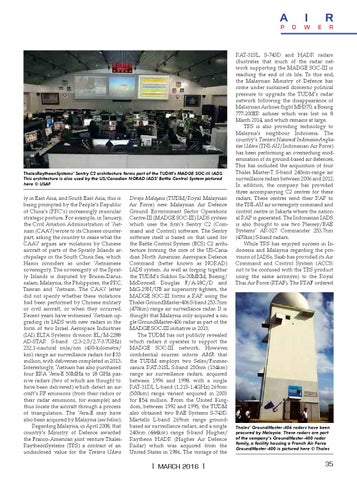
ThalesRaytheonSystems’ Sentry C2 architecture forms part of the TUDM’s MADGE SOC-III IADS. This architecture is also used by the US/Canadian NORAD IADS’ Battle Control System pictured here © USAF
ly in East Asia, and South East Asia, this is being prompted by the People’s Republic of China’s (PRC’s) increasingly muscular strategic posture. For example, in January, the Civil Aviation Administration of Vietnam (CAAV) wrote to its Chinese counterpart, asking the country to cease what the CAAV argues are violations by Chinese aircraft of parts of the Spratly Islands archipelago in the South China Sea, which Hanoi considers as under Vietnamese sovereignty. The sovereignty of the Spratly Islands is disputed by Brunei-Darussalam, Malaysia, the Philippines, the PRC, Taiwan and Vietnam. The CAAV letter did not specify whether these violations had been performed by Chinese military or civil aircraft, or when they occurred. Recent years have witnessed Vietnam upgrading its IADS with new radars in the form of two Israel Aerospace Industries (IAI) ELTA Systems division EL/M-2288 AD-STAR S-band (2.3-2.5/2.7-3.7GHz) 232.1-nautical mile/nm (430-kilometre/ km) range air surveillance radars for $33 million, with deliveries completed in 2013. Interestingly, Vietnam has also purchased four ERA Vera-E 50MHz to 18 GHz passive radars (two of which are thought to have been delivered) which detect an aircraft’s RF emissions (from their radios or their radar emissions, for example) and thus locate the aircraft through a process of triangulation. The Vera-E may have also been acquired by Malaysia (see below). Regarding Malaysia, in April 2008, that country’s Ministry of Defence awarded the Franco-American joint venture ThalesRaytheonSystems (TRS) a contract of an undisclosed value for the Tentera Udara
Diraja Malaysia (TUDM/Royal Malaysian Air Force) new Malaysian Air Defence Ground Environment Sector Operations Centre-III (MADGE SOC-III) IADS system which uses the firm’s Sentry C2 (Command and Control) software. The Sentry software itself is based on that used for the Battle Control System (BCS) C2 architecture forming the core of the US-Canadian North American Aerospace Defence Command (better known as NORAD) IADS system. As well as forging together the TUDM’s Sukhoi Su-30MKM, Boeing/ McDonnell Douglas F/A-18C/D and MiG-29N/UB air superiority fighters, the MADGE SOC-III forms a RAP using the Thales GroundMaster-406 S-band 253.7nm (470km) range air surveillance radar. It is thought that Malaysia only acquired a single GroundMaster-406 radar as part of the MADGE SOC-III initiative in 2013. The TUDM has not publicly revealed which radars it operates to support the MADGE SOC-III network. However, confidential sources inform AMR that the TUDM employs two Selex/Finmeccanica RAT-31SL S-band 250nm (134km) range air surveillance radars, acquired between 1996 and 1998, with a single RAT-31DL L-band (1.215-1.4GHz) 269nm (500km) range variant acquired in 2003 for $54 million. From the United Kingdom, between 1992 and 1995, the TUDM also obtained two BAE Systems S-743D Martello L-band 269nm range groundbased air surveillance radars, and a single 240nm (444km) range S-band Hughes/ Raytheon HADR (Hughes Air Defence Radar) which was acquired from the United States in 1986. The vintage of the
| march 2016 |
I O
W
R E
R
RAT-31SL, S-743D and HADR radars illustrates that much of the radar network supporting the MADGE SOC-III is reaching the end of its life. To this end, the Malaysian Ministry of Defence has come under sustained domestic political pressure to upgrade the TUDM’s radar network following the disappearance of Malaysian Airlines flight MH370, a Boeing 777-200ER airliner which was lost on 8 March 2014, and which remains at large. TRS is also providing technology to Malaysia’s neighbour Indonesia. The country’s Tentara Nasional Indonesia-Angkatan Udara (TNI-AU/Indonesian Air Force) has been performing an overarching modernisation of its ground-based air defences. This has included the acquisition of four Thales Master-T S-band 240nm-range air surveillance radars between 2006 and 2012. In addition, the company has provided three accompanying C2 centres for these radars. These centres send their RAP to the TNI-AU air sovereignty command and control centre in Jakarta where the national RAP is generated. The Indonesian IADS is also thought to use two Plessey/BAE Systems’ AR-327 Commander 253.7nm (470km) S-band radars. While TRS has enjoyed success in Indonesia and Malaysia regarding the provision of IADSs, Saab has provided its Air Command and Control System (ACCS: not to be confused with the TRS product using the same acronym) to the Royal Thai Air Force (RTAF). The RTAF ordered
Thales’ GroundMaster-406 radars have been procured by Malaysia. These radars are part of the company’s GroundMaster-400 radar family, a facility housing a French Air Force GroundMaster-400 is pictured here © Thales
35