
June 2023 Vol.25 issue 3 www.vertikal.net
low level platforms leading women telehandlers Vertikal Days review

neWS 6
New spider lift manufacturer, 5,000 tonne Mammoet SK350 mega lifts, JCB launches new booms and scissors, 100 metre Ruthmann truck mounted lift, New compact ‘city centre’ Multitel, Platform Basket introduces mast booms, First Zoomlion spider lift, ‘All Electric’ Versalift VTL 135, XCMG adds second Euro AT, First MEC mast boom, Haulotte lanyard detection device, New van mount from Comet, Vertikal Days on the move, New president for Skyjack, Sinoboom new product launches and financials round-up…

LOW LeveL acceSS 17
The market and usage of low level powered access equipment continues to grow and is generating more than its fair share of new products and innovation while attracting new players to the market. We take a look at how the sector has developed.

aLL terrain craneS 27
Tadano’s acquisition and integration of Demag has reduced the number of mainstream manufacturers to three, yet at the same time Chinese crane manufacturers have started looking seriously at the market and are working hard to refine their European All Terrain products…
teLehandLerS 39
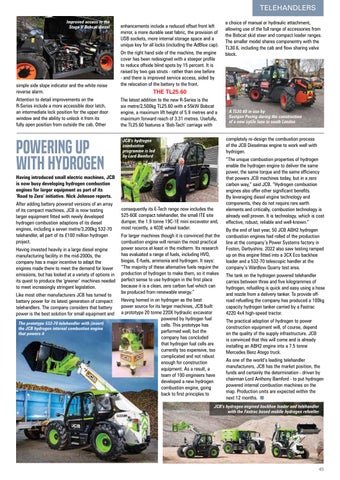
The past few years have seen all-electric telehandlers becoming a practical reality, while hydrogen power is also being tested. More recently Chinese manufacturers have begun to

introduce telehandlers both in North America and Europe, in spite of having little to no domestic demand. We take a look at the what’s happening, while Nick Johnson checks out Faresin’s 17 metre full electric, Bobcat’s latest 12 model R-Series and JCB’s hydrogen powered telehandler.
vertikaL
The biggest Vertikal Days to date saw more than 270 manufacturers represented. Here we have an extended review to try and give you a flavour of the show.

We interview Tjitske van Hellemond - managing director of JLG’s commercial operations for Europe, Africa, the Middle East and India - one of many women moving into senior positions in the access industry.

gin
When Frontier Power Systems was asked to supply wind power generation systems for customers in some of North America’s most challenging terrain, the Canadian company turned to old fashioned gin poles to get the job done. Saul Chernos reports.
On the cOver Maria Hadlow's rescue dog Finn was one of the record number of visitors to the biggest Vertikal Days ever - see the full review on page 47

in the next iSSue Scheduled for publication in July, the next issue of Cranes & Access will include Tower cranes, Scissor lifts, Equipment for arborists, the APEX review and the annual Equipment Source Guide. If you have any contributions or suggestions to make or are interested in advertising in this issue, please contact our editorial or sales teams.


feature editors
Will North
Nick Johnson
Saul Chernos
Sales & customer support
Clare Engelke
Pam Penny
Karlheinz Kopp
production/administration
Nicole Engesser
editorial data specialist
Poppy Horne ph@vertikal.net
Subscriptions
Lee Sparrow
publisher
Leigh Sparrow
advertising sales
UK-based
Clare Engelke ce@vertikal.net
Tel:+44 (0)7989 970862
Pam Penny pp@vertikal.net
Tel:+44 (0)7917 155657
Germany-based
Karlheinz Kopp khk@vertikal.net

Tel:+49 (0)761 89786615
The Vertikal Press
PO box 6998 Brackley NN13 5WY, UK
Tel:+44(0)8448 155900
Fax:+44(0)1295 768223
email: info@vertikal.net
web: www.vertikal.net
Vertikal Verlag
Sundgauallee 15, D-79114, Freiburg, Germany
Tel: 0761 8978660 Fax: 0761 8866814
email: info@vertikal.net
web: www.vertikal.net
cLunk cLick every trip!
Legislation touches the daily lives of us all, with penalties for non-compliance which can range from a warning or small fine to incarceration. Car drivers, for example, must comply with hundreds of laws and regulations from speed limits and driving under the influence to having safe tyres, working lights and insurance…the list goes on and on.
Some of them - such as the compulsory wearing of seat belts and motorcycle helmets - have been proven to reduce injuries and save lives so that any inconvenience in wearing them is clearly beneficial.

In the 1960s and 70s several car manufacturers, mostly in North America, began installing mechanical systems which automatically moved the seat belt into place once you sat in the car. Whether it was customers’ resistance to them or reliability issues, they were soon dropped. It seems that it was too much hassle trying to make a simple process simpler.
All cars now detect if the driver or any passenger is not belted in, with a warning light and very annoying beep which cannot be turned off. As a result of features such as this - along with education and self-preservation - the wearing of seat belts now has a very high uptake. Substantial fines by the police and awareness of what would happen in a major incident reinforce the action.
We are now seeing the introduction of lanyard detection devices in boom lifts. But are they really necessary? There is obviously a significant cost to install them across an entire fleet, but it is
an undisputed fact that wearing a harness with short lanyard when using a boom lift can prevent serious injury or death in the event of an incident. The use of harnesses is only enforced on a minority of job sites… it is not compulsory in law, although there can be legal implications for an employer should a serious incident occur. So, should all platforms be equipped with a lanyard detector? Or is it just another level of complication and expense to try and get us to do the sensible thing which should surely be second nature for a trained operator?
It took years of advertising, legislation and fines to get us to where we are today with car seat belts. The number of boom lift users is insignificant compared to the number of drivers on the road, however training programmes and advertising from organisations such as IPAF promote the need to clip on every time we get into a boom lift. New regulatory standards also highlight it, all of which is focusing the minds or employers and operators.
But as is the way with all rules, some people need more of an incentive to comply than others.
Comment and feedback is most welcome via post, email, fax or phone stating if we may publish them or not: editor@vertikal.net
Mammoet’s 5,000 tonne SK350 crane has replaced four coke drums at a Texas City refinery southeast of Houston, near Galveston, Texas. The crane had to lift out the 740 tonne, 53 metre high derrick to gain access to the old 270 tonne coking drums before replacing them with the new ones each weighing 448 tonnes. The job was carried out in two, 12 hour shifts.

A completely new Italian spider lift manufacturer, ILC Access Solutions, has launched its first model - the 18 metre articulated IL 18. A twin telescopic boomed 21 metre IL 21 will complete the initial line up. The company formed last September and is located in Bari with all of the key managers having been previously employed by spider lift manufacturer CMC.
The new IL 18 has a classic twin sigma type riser topped by a two section telescopic boom and articulated jib.
Maximum working height is 18 metres, while outreach is 8.3 metres at an up & over height of eight metres with the unrestricted platform capacity of 230kg. The new machine has an overall width of 780mm, while the tracks can extend to almost 1.2 metres for additional stability. Total weight is said to be 2,500kg and power is either petrol or battery electric.
The IL 21 has a working height of 20.8 metres, an outreach of 11 metres at a seven metre up & over height, while the maximum up & over height is eight metres with an outreach of 10 metres. The unrestricted/maximum platform capacity is 230kg. Most equipment is standard including telematics and remote diagnostics, radio remote controls, outrigger cylinder covers, automatic ‘home’ self-centering boom stowage and simplified auto levelling.
Ruthmann will return to the 100 metre truck mounted lift market next year with the T-1000 HF22 years after it launched the first 100 metre truck mounted lift, the TTS1000. Few details on the new model have been released although we do know that it will use the same five section lower boom, four section upper boom and HF articulating jib as on the T900 HF but with longer boom sections.
The T1000 HF will be mounted on a five axle chassis such as the Scania T 500 with an all-up weight of 53 tonnes. The first unit has been sold to French rental company Joly Location based in Dijon, and a second is on order to an unnamed customer.

JCB has launched Electric and hybrid versions of its 45ft AJ48D articulated diesel boom lift that it currently sells in North America and introduced the first three of what will be a line of six electric drive slab scissor lifts. JCB will build all new aerial lift models at its facilities in India for global distribution.


The A45E and A45EH are basically one and the same machine which different power options. The maximum working height is almost 16 metres with a maximum outreach of 7.47 metres at an up and over height of 7.48 metres, an unrestricted platform capacity of 300kg and overall weight of around 7,800kg.

The 48 Volt, 400AH A45E is powered by eight 6V batteries - located on either side of the chassis - powering four AC wheel drive motors. The A45EH uses a three cylinder Kohler diesel driving a 7.5kWA generator to keep the machine’s eight 6V batteries topped up. The engine is mounted on a swing-out tray for service and a 40 litre fuel tank is said to have enough fuel for a full week of typical use and the battery can also be plugged into a mains supply if available.
JCB has also updated its slab electric scissor lift range from hydraulic to direct electric wheel motor drive, starting with the 19ft S1932E, 26ft S2632E and 32ft S3246E, followed later this year by the wider 26ft S2646E, the 40ft S4050E and 45ft S4550E. Working heights range from 7.7 to 15.8 metres, capacities from 230 to 450kg with overall widths of 810mm, 1.2 and 1.3 metres.
The S1932E is 50mm wider and 106kg lighter than the S1932 it replaces

Italian truck mount and spider lift manufacturer Multitel has launched a new 17 metre articulated platform on a compact Piaggio Porter NP6 Long Range, powered by propane gas (LPG) or petrol/gasoline - LPG is less expensive while reducing pollution for easy entry to ultra-low emission zones.

The MXE 170 has a working height of 16.9 metres with a maximum outreach of 8.67 metres over the rear or 7.5 metres over the side. Maximum platform capacity is 250kg at an outreach of six metres.
Overall length is 5.85 metres, chassis width is 1.8 metres with fixed inboard jacking and an overall height of 2.55 metres, while the overall weight is only 2,800kg. The new machine has been designed for use in the narrow streets of historical town centres and other areas with limited space. Slew is 400 degrees, while the 1.2 metre by 700mm platform has 100 degrees of rotation. Features include Multitel’s EVE load moment sensing, while telematics with GPS tracking, machine status display and remote diagnostics are optional.


Multitel Pagliero says that 2022 was its best ever in terms of production volumes, producing 2,220 truck mounted platforms and shipping 2,255. Weekly production levels have increased from 41 units in January to 51 by the end of the year. Of the units shipped, 30 percent were sold domestically and 70 percent exported.
Italian spider and boom lift manufacturer Platform Basket has entered the mast boom market with a 10 metre tracked model with standard levelling jacks. Dubbed the Heron 10, it uses a version of the company’s well proven rubber track chassis, with inboard mounted jacks that can level the machine on slopes of up to 10 degrees longitudinally or side to side. The unit can work without jacks on slopes of up to three degrees. The mast is a classic five section open frame forklift type, topped by a jib which offers working heights of up to 9.6 metres and up to 3.4 metres of outreach at an up & over height of six metres through 360 degrees, with two person indoor and one person outdoor ratings.
The overall width is 1.2 metres, the overall height 1.99 metres and stowed length 3.25 metres.
Available with diesel or lithium ion battery pack the total weights are 2,750kg for the diesel and 2,800kg for the electric version. Radio remote controls are standard. It can also be ordered with a jib mounted hoist/winchthat replaces the platform - with 35 metres of wire rope storage and a maximum lift capacity of 250kg.
Zoomlion has produced its first spider lift, the 27 metre twin telescopic boom ZX27AE with lithium ion battery pack. The machine has a three section lower telescopic boom, with an over centre linkage to a three section top boom and articulating jib. Maximum outreach is 14.2 metres at an up & over height of 12.7 metres with 120kg in the platform while the unrestricted platform capacity is 230kg.
Overall width is 890mm and overall length of 5.7 metres with the platform removed, overall height is just over two metres. The widest outrigger spread is 4.48 metres, while auto level is standard. Total weight is 4,650kg. The first unit went to work at the Jiangxi Railway station in Jiangxi.

Versalift UK has completed the first production unit of its 13.5 metre ‘VTL 135 All Electric’, van mounted lift. The battery electric powered VTL 135 superstructure was displayed at Vertikal Days on an all-electric Ford E-Transit chassis. The new lift features a two section telescopic boom topped by an articulating jib, to offer a maximum outreach of just over eight metres without the need for stabilisers. The platform is capable of at least 20 full cycles on a single charge and is designed for telecommunications or street lighting applications.

The spare cargo payload is 500kg after allowing for fuel, driver and passenger and the chassis boasts a range of up to 196 miles, topped up from 15 to 80 percent in 34 minutes with a fast charger.
The VTL 135 All Electric at Vertikal Days
California based MEC Aerial Work Platforms has launched its first mast boom, the 11.2 metre MME30-RJ with direct wheel motor AC electric drive. The lift is essentially a MEC version of Dingli’s AMWP11.5-8100 with 2.6 metres outreach at an up & over height of 7.6 metres with a maximum capacity of 227kg. The overall width is one metre and overall weight just under three tonnes. The platform is larger than usual for this type of machine, at one metre wide by 760mm deep. AGM maintenance free batteries are standard.
Haulotte has launched an active anchorage device that can detect if and when a harness lanyard has been attached and remains attached to the main anchor point on the platform of a boom lift. The ‘Fastn’ system is quite different from other products on the market and has more in common with the seat belt warning system in cars. If a lanyard is not attached, the system will emit a beeping noise. After a pre-set time, a downward facing blue light will flash if the operator hasn’t attached their lanyard in order to alert others.
One end of the Fastn attachment mechanism is connected to the platform’s main anchor point, while the other end has the spring loaded lanyard attachment ring, pulled out with a nylon strap so that the lanyard can be attached quickly and easily. Fastn’s cylinder mechanism has a built-in motion sensor which detects certain types of movement. Trying to cheat it with a spare carabiner or screwdriver will only work for around 30 seconds, as the absence of movement triggers the alarms. The same feature can also detect an operator who has passed out in the platform. Conversely should the operator be ejected from the platform, the system will detect the sudden movement and constant tension, triggering the alarm and flashing lights. The system’s guardrail mounted ‘nerve centre’, also records activity - or lack of it - storing the information for later download via a USB port.
Haulotte claims the system can be installed in around 10 minutes with two plug-in type connections and be fitted to any type or make of machine as long as it has a dead-man foot pedal. The wire connection to the foot pedal is the only link to the machine’s electrics,


However only one anchor point can be equipped with the system, Haulotte says that it is the responsibility of the person in charge of the controls to ensure that anyone else in the platform is also fully harnessed and attached to the other anchor points.
UK rental company Nationwide Platforms, a division of Loxam, has begun installing its ‘Harness
On’ device to its booms and truck mounted lifts.
The Harness On link is attached to the platform’s main anchor point and wired into the platform controls and anyone planning to go up in the platform must attach their lanyard to the link to enable the controls. An indicator light allows operators to see when the device is working or if there is a fault.

The company is making the device available to any company that is interested in installing it. It hopes to have 6,000 booms equipped with the device by the end of the year.
Italian aerial lift and tracked carrier manufacturer Almac/AlmaCrawler has launched the all-electric, ‘no hydraulic oil’ compact 1.5 tonne capacity ML 1.5 FX tracked carrier. Overall width is 700mm, overall length 1.17 metres with a deck height of 500mm and overall weight of 465kg.
The carrier features two 5.3kW AC electric two speed direct drive track motors, the transport deck is steel checker plate and can be slid forward to provide easy access to the components. Power is supplied by a 55Ah maintenance free AGM battery pack, with an integrated onboard charger that takes the batteries from empty to fully charged in six hours. An Autec radio remote controller is standard.
Italian manufacturer Comet has launched a range of van mounted lifts starting with the 15 metre HVM 15 with telescopic boom and articulated jib with eight metres of outreach, mounted on a 3.5 tonne Ford Transit chassis.
The company’s UK dealer, Hydraulic Platform Services is helping develop the range which will also include 11 and 13 metre models. Features include in-cab stabiliser controls with illuminated switches to alert the operator if the jacks are stowed or set for work then changed over to platform operation once the stabiliser set lights are on.


This year’s Vertikal Days - the biggest to date - saw products from more than 270 manufacturers on display. Two days of mostly sunny, warm weather encouraged more visitors than ever to visit the show with 27 new exhibitors reinforcing the claim to be one of the most diverse lifting equipment gatherings anywhere this year. There were also plenty of new product launches which is covered in the extended review starting on page 47.
Unfortunately, ownership of the Peterborough Show Ground changed earlier this year, with the new owners deciding to redevelop the whole site, rather than the half previously planned. That has forced Vertikal Days into a last minute search for a new venue for 2024 with a move to the Newark Showground the most likely. An announcement will be made shortly confirming the venue and dates - probably returning to a September slot.

Chinese manufacturer XCMG has launched a second European All Terrain crane - the 120 tonne four axle XCA120E - which follows the 60 tonne three axle unveiled at Bauma last year.

The new crane boasts a seven section 66 metre main boom, topped by an 11.65 to 18.5 metre bi-fold swingaway extension, which can offset by up to 40 degrees. Two 7.1 metre lattice extension sections can be added between the boom nose and the swingaway for a maximum tip height of just over 96 metres and maximum radius of 60 metres. The crane is rated at a theoretical 2.5 metres and manages 80 tonnes at three metres.


An MTU diesel drives a 12 forward, two reverse speed ZF 12 TraXon transmission, with the three rear axles all driven, while all wheel steering is standard as is a retarder. The independent suspension system is similar in overall concept to that used by Grove. The overall width is 2.75 metres, depending on tyres, while the overall length is just over 14.3 metres. The outriggers have five working widths from fully retracted to seven metres. Maximum counterweight is 33 tonnes.

Telescopic and arTiculaTed spider lifTs from 13 To 52 meTres
spider lifts at a higher level for 40 yearsXCMG has launched a second European All Terrain crane, the 120 tonne four axle XCA120E
Chinese aerial lift manufacturer Sinoboom staged a series of events in Changsha, China last month to celebrate 15 years in business, break ground on a new facility, show off its updated production plant and launch three new products. Events kicked off with a ‘Global Partners Summit’ with Sinoboom customers from Europe, North America, Southeast Asia and South America attending along with local customers. The event included a formal groundbreaking ceremony for the Sinoboom Phase II Intelligent Manufacturing Park, which the company says will take the level of automation and ‘intelligent manufacturing’ to new levels. New product introductions included the new 52ft all-electric AB16EJ Plus/AB520EJ Plus articulated boom lift with twin sigma type risers, two section telescopic boom and articulating jib, providing a working height of 17.8 metres and three platform capacities - 250kg, 340kg and 454kg - with outreaches of nine, eight and seven metres respectively - all at an up and over height of 7.9 metres. The 32ft AB10ERJN industrial zero tailswing articulated boom lift has dual risers, two section telescopic boom and articulating jib with 180 degrees of jib rotation as well as 180 degrees of platform rotation. The machine offers a working height of 11.6 metres along with 6.3 metres of outreach at an up & over height of 4.6 metres and a platform capacity of 230kg. It has an overall width of 1.19 metres and weighs 6,760kg.
The final new model is a classic 12ft mast type lift, the VM04E/VM12E, with a working height of 5.8 metres, a platform capacity of 227kg, direct electric drive, an overall length of 1.38 metres, an overall width of 780mm with an overall height of 1.6 metres while weighing 785kg. The new machine featured on the company’s stand at APEX when it received an order for 200 units from Swedish sales and service company Liftab, all of which will apparently be delivered this year.

Skyjack president Ken McDougall is to retire at the end of the year and hand over to Charlie Patterson, currently vice president of international operations.
McDougall began his Skyjack career in 1987 as a tool designer with Skyjack’s parent company Linamar, moving through increasingly senior roles including global sales, estimating manager and vice president of operations. He was first appointed as Skyjack president in 2008 returning in 2019 to steer the company through the pandemic, and organising the recent expansion in production capacity.


Charlie Patterson joined Skyjack in 2000 as UK sales manager having previously worked with Grove cranes and Manlift aerial work platforms. He went on to head up all of Skyjack’s European operations and moved into his current role in 2014.
EMR (European Metal Recycling) has ordered 50 all-electric industrial telehandlers, JCB’s largest single order for electric telehandlers to date. They include the 3,000kg/four metre 3019E and the slightly heavier 2,200kg/four metre 30-22E in a deal worth more than £3 million.

Riwal Germany has also ordered 50 JCB telehandlers including a mixture of six metre/2,500kg 525-60s, 9.5 metre/3,500kg 535-95’s and two units of JCB’s new six metre/2,500kg compact all-electric 525-60E in a deal worth around £2.6 million.


Following an extensive test programme which included more than 40,000km of road travel, Palfinger has launched the production version of its new 25 metre P 250 BK eDrive truck mounted lift on an Iveco eDaily all-electric chassis. The telescopic machine with jib offers a working height of 24.7 metres, an outreach of 16.9 metres and a platform capacity of 250kg.
EMR has revenues in the region of £5 billion with around 3,000 employees working from 122 sites across the UK, USA, Germany and the Netherlands recycling more than 10 million tonnes of metals and plastics a year.

Jan De Nul Group has ordered a 3,500 tonne spreader beam from Dutch heavy lift crane manufacturer Huisman. The massive beam is equipped with an automated sling handling system with remote controls powered by an on-board battery pack with integrated automatic charging system. Sadly Huisman would not disclose its inner workings.

The spreader beam will be used to lift monopiles for the largest offshore wind turbine foundations, and be used with Jan De Nul’s 3,000 tonne Huisman Leg encircling crane onboard the Voltaire offshore jack-up installation vessel, and the new 5,000 tonne Huisman tub mounted crane on the Les Alizés heavy lift vessel, which will transport and install 107 monopile foundations and an offshore substation topside for Ørsted’s Gode Wind 3 and Borkum Riffgrund 3 offshore wind farms in Germany.

Danish crane and aerial lift rental company BMS has formed a Joint Venture with Finnish truck mounted lift rental company Jalo & Jalo. The jointly held company JaloBMS will target growing demand for large truck mounted lifts from the mobile telecoms and wind turbine markets. The venture will not involve changes to the financial structure or ownership of either company but will promote a combined fleet and services with more than 100 large truck mounted platforms up to 104 metres, while offering a more extensive geographic coverage.


Sami Jalo will be chief executive, while Jens Enggaard of BMS is chairman. The business will initially focus on the Nordic region, where the partners already have a strong presence with 40 locations between them.
LGMG has relocated its North American headquarters to a brand new facility on the north side of Dallas, Texas. The new premises includes offices, a warehouse, meeting rooms and a training centre. It will stock replacement parts and new machines ready for fast delivery and will also feature a showroom of products marketed by the company in North America.

ashtead has reported another record year, with revenues up 24% to $9.67 billion, made up as follows: Sunbelt uSa : revenues increased 27% to $8.26 billion, while operating profit jumped 33% to $2.45 billion. Sunbelt canada: saw revenues grow 32% to C$827 million with operating profits up 17% to C$ 167.4 million. Sunbelt uk : saw revenues dip 6% to £684.8 million, while operating profit dropped 25% to £65 million. Rental revenues however increased 6% to £429 million. Group capital expenditure increased 58% to $3.77 billion.

UK rental group vp, owner of uk forks, Mep and brandon hire Station has reported a 6% rise in revenues to £371.5 million with growth coming from both the UK and overseas. Pre-tax profits declined 14% to £30.7 million. Capital expenditure for the year was flat.


Austrian crane, access and heavy lift group felbermayr has acquired Bulgarian crane rental company Maritza.

Snorkel achieved full year revenues to the end of December of $168.8 million up 9% on 2021, with a net profit of $31.8 million compared to a loss of $12 million last year. In the first quarter of 2023 the company achieved revenues of $43.5 million, up 4.4% and reduced its losses to $113,000 compared to $4 million last year.

Dutch international rental company boels achieved full year revenues of €1.47 billion up 11.5% on 2021. Pre-tax profit increased 15% to €115.1 million while capital expenditure increased 49% to €519.3 million.


Boels has also acquired Norwegian rental company baS Maskinutleie through its Nordic subsidiary cramo
Manitowoc cranes, parent of grove, national crane and potain saw first quarter revenues increase 10.7% to $508.3 million. Pretax profit more than doubled to $20.7 million.


First quarter revenues at genie/terex aWp increased 24.4% to $685.9 million, while operating profits increased 2.5 fold from $32.5 million last year to $83.1 million this year, reflecting the higher volumes and price increases.

US based herc rentals boosted revenues by 30% in the first quarter to $740 million while pre-tax profits improved 12% to $75 million. Capital expenditure was 16% higher at $332 million.
Hiab and Kalmar owner cargotec increased first quarter revenues 26% to €1.07 billion, while pretax profit more than tripled to €95.7 million. Net debt was cut by 31 percent to €393 million.

hiab revenues were 27% higher at €432 million with operating profits up 41 percent to €61.4 million.
Revenues at kalmar were 31% higher at €485 million while operating profits tripled to €62.8 million. cargotec also says it is looking to change Kalmar and Hiab into two completely standalone companies.
First quarter revenues at JLg increased 35.1% to $1.19 billion, operating profit was $135 million compared to $5.7 million last year, a 23 fold increase, due to higher pricing and volumes.
French Telehandler and aerial lift manufacturer Manitou increased its first quarter revenues 48% to €665 million with growth in all sectors.
united rentals saw first quarter revenues improve 30% to $3.28 billon, in part to the addition of the Ahern Rentals business in December. Pretax profits increased 23% to $594 million. Capital expenditure in the quarter was $797 million, up 66% on last year.

Spanish crane and aerial lift rental company grúas aguilar has acquired Catalonian rental company grúas Serrat


US overhead crane manufacturer and rigging supplier Mazzella has acquired John Sakach company.

First quarter sales at haulotte were 45% up on the same period last year at €196.3 million - a record first quarter. The company also confirmed that its lenders have waived the need to meet agreed ratios for a further 12 months.

US crane and hoist rental company Maxim crane reported first quarter revenues up 21% to $253 million - a new record - with 12 months sales of $945 million. EBITDA was 56% higher at $59 million.
United Rentals has acquired chaseco rentals of Missouri from founder and owner chase darrah.

Italian rental company Mollo noleggio has acquired pMp in Friuli Venezia Giulia.


US rental group reic (Rental Equipment Investment Corp) has acquired aim high equipment rental of Brighton, Colorado from owner amy Sepin


Belgian construction company ABHR has taken delivery of the first Raimondi T187 flat-top tower crane. Launched at Bauma, the T187 has a maximum capacity of 10 tonnes and jib length of 67.5 metres with a jib tip capacity of 1.6 tonnes.


UK tower crane company Ladybird Cranes has set up a new subsidiary - the Trailer Crane Company - to distribute the MiDi towable self-erecting tower crane product line. The new company will focus on the Spanish manufacturer’s three model LT range which all weigh less than 3.5 tonnes on the road. The line up includes the LT10, LT12 and LT14 with horizontal jib hook heights of 10, 12 and 14 metres respectively while 20 metres is possible on the LT14 with jib luffed. Maximum capacities are 400kg, 800kg/1,200kg and 1,500kg. The LT10 has a 10 metre jib, while the LT12 and LT14 have 14 metre jibs. Jib tip capacities are 300kg, 325kg and 350kg respectively.

XCMG has appointed Genesis Equipment Sales - a new standalone company within Ballyvesey Holdings - as its sole aerial lift distributor in the UK. The new company will hold new XCMG platforms in stock and provide product support from four regional hubs in England - in the midlands, the North, on the east side of London and one in the south west. Genesis will be overseen by Mark Kennedy who joined Ballyvesey in 2018 as managing director of Contract Plant Rental and more recently TDL Equipment.


The Cramo division of Boels Rental has purchased 181 Genie scissor lifts
Grupo Vivargo has taken the first 150t Liebherr LTM 1150-5.3 in Chile
CTE has appointed Equipment Service as its truck mounted dealer for Northern Germany and ATG Lift as its distributor for Southern Germany for truck mounts and the whole of Germany for spider lifts.
UK’s Ken Harrop Crane Hire has added a second 35t Liebherr to its fleet
French manufacturer Klubb has appointed Eric Baudart as marketing manager


Affordable Access Hire has taken the first CMC S30 spider lift in the UK
Dayim Equipment Rental was named 2023 Access Rental Company of Year at this year’s ME Construction Machinery Awards
Hamburger Hafen und Logistik has purchased three Liebherr dual trolley STS container cranes for its Altenwerder terminal
Kiloutou Germany has opened its 14th location in Karlsruhe
Terex has appointed Eric Kluver as general manager of Terex Utilities


The first 32t Potain MCT 565 ‘A’ flat top tower crane has been delivered in Singapore
UK’s Hire Safe Solutions has begun taking 23 large boom lifts from Genie
Germany’s Luibl Rental & Sales has purchased 50 Magni scissor lifts
Sweden’s Liftab has ordered 200 new Sinoboom VM4E/VM12E mast type lifts
Dutch company Roll Group and Nigeria’s Cranes R Us have formed a partnership
Italy’s CEM has promoted Alan Orlando to production manager and appointed Yvonne Corticelli as customer service officer

PSA Penn Terminals of Philadelphia has purchased a third Liebherr STS container crane
Rental software company MCS has celebrated its 40th anniversary
Scotland’s Stoddart Crane Hire has taken a 230t Liebherr LTM1230-5.1
Scotland’s Emco Services has taken the first 31m Ruthmann Bluelift ST 31 Hybrid spider lift
Lithuania’s Strele Logistics has taken a 700t Liebherr LTM1650-8.1
Italy’s Vecchiato Autotrasporti has taken a 70m Ruthmann T700 HF truck mounted lift
Palfinger has appointed Alexander Susanek as COO

UK’s Ainscough Crane Hire has opened a depot in St. Neots, Cambridgeshire
UK Forks/Vp has taken a unique JCB 525-60E telehandler with proceeds going to the NSPCC
French rental company Foselev has taken the first Sany All Terrain crane in France along with a new 450t Tadano AC 7.450 1
Namibian rental company Concord Cranes has taken two 35t Terex TRT 35 Rough Terrains
UK’s Horizon Platforms has donated an aerial lift to Wakefield Hospice
German rental company Gerken has taken 140 new JCB telehandlers
Tadano America has appointed Central Atlantic Crane as a distributor for AT, RT and telescopic crawler cranes in Virginia
Hiab has appointed John
Carnall as MD of its UK & Ireland distribution business


UK’s Thanet Crane Hire has opened a new depot
UK’s Lee Lifting has taken a 230t Liebherr LTM 1230-5.1
Easy Lift has appointed Ahern Ibérica as its distributor for Spain & Portugal
UK civil engineer J. Murphy & Sons has taken a second 137t Liebherr LR 1130.1 crawler crane
Manitex Valla has appointed Mtandt as distributor for India and SAARC countries
The Saudi Arabian division of Japanese contractor Sankyu, has taken two Liebherr cranes, a 50t LTM 1050-3.1 and 180t LTM 1160-5.2
Magni has appointed Skyworker Trade as its aerial lift distributor for Switzerland & Liechtenstein
UK’s Star Platforms has moved into a new HQ in Houghton Regis, Bedfordshire
MaxiKraft has taken its third 1,000t Liebherr LR 11000 crawler crane
Genie Europe has appointed Karen Bessant as territory sales manager - UK South - and promoted Dominique Luijckx to director, parts & support for Europe, Africa, the Middle East and India.
JLG is expanding telehandler capacity at its plant in Jefferson City, Tennessee
UK JCB distributor Gunn JCB has set up new company ‘Midlands JCB’ for the English midlands
LGMG Europe has appointed Access Supply Nederland as distributor for the Netherlands
Germany’s Richard Kölch & Son has taken its 50th crane on its 50th anniversary - a 30t Tadano AC 3.055-1
Dutch rental company Peinemann has taken two 66ft Holland Lift all-electric RT scissor lifts
Boels has acquired UK lighting tower specialist Illumin8 Lights
UK’s MEP Hire has taken 150, 14ft Genie GS-1432m micro scissors lifts
Spanish rental company Lozano has taken a 90m Bronto Skylift truck mounted lift
Italian spider lift manufacturer
Platform Basket has appointed Enrico Marighella as export manager

Germany’s Franz Bracht has taken a 200t Tadano GTC-2000 telescopic crawler crane
Qatari contractor Galfar Al Misnad has taken two 100t Grove GMK4100L-2 cranes
UK’s Falcon Cranes is adopting the Northvolt Voltpack energy storage system
Jekko has appointed Kogler Krantechnik as dealer for Austria
UK’s Emerson Crane Hire has taken a 450t Liebherr LTM 1450-8.1
Germany’s Schmidbauer has taken six 45t Tadano AC 3.045-1 City ATs
Bahrain’s Al Jazeera Shipping has received the first 400t Liebherr LR 1400 SX crawler crane in the Middle East
Skylift, the Easy Lift dealer for Sardinia and Lazio, has delivered five big spider lifts
UK’s Star Platforms/Star Power has appointed Michael Hooton as finance director
CTE has appointed Key-Tec as its truck mounted lift distributor for Belgium
Scotland’s Horizon Reinforcing and Crane Hire celebrated 50 years with a new 110t Liebherr
Spanish manufacturer Jaso Industrial Cranes is suppling seven cranes to Sheffield Forgemaster in the UK
Canadian rental company Guay has ordered three 700t Liebherr LR 1700-1.0 crawler cranes
China’s XCMG has appointed new company Genesis Equipment Sales as its UK aerial lift distributor
Germany’s Wiemann Autokrane has taken a 400t Grove GMK6400-1
Dutch crane rental company Herms has taken the first 70t Tadano HK 4.070-1 in the Netherlands
Werner has launched the Pro Plus mobile access tower system
Mammoet says is starting to build its long discussed 6,000 tonne SK6000 ring crane
3D Lift Plan developer A1A Software has released ‘Rigging Designer’ a new app for creating rigging plans on the go
Oshkosh - parent of JLG - is to acquire AeroTech, a supplier of aviation ground support products
US group REIC (Rental Equipment Investment Corp) has acquired Midstream Equipment Corporation of Calgary, Canada

However you define low level access, it is an undisputable fact that demand for the equipment that serves this market not only continues to grow but is also generating more than its fair share of new products and innovation... all driven by the need for great safety at these heights and greater efficiency.
For some people it includes step ups, step ladders, small mobile towers and podiums etc, while others think of push around and micro self-propelled platforms with working heights up to around five metres? We tend to focus on powered access with platform heights up to 12ft and working heights of just under six metres.
While there has always been a need, the trigger for the growth of machines rather than ladders was prompted by the 2005 implementation of the European work at height Directive 2001/45/EC which brought in a key change for most countries in that the rules applied when working at any height, rather than the usual four to five metres. One of the first markets to embrace and exploit the new rules was the UK which adopted it with the Work at Height Regulations. At that time between 40 and 50 people died each year from low level falls but another 4,000 suffered serious injuries.

This background led to the development of the first lift to be introduced - the Pop Up push around scissor lift - with a working height of just over 3.6 metres which was launched early in 2006. A larger five metre working height sigma type push around soon followed from Power Towers. Both companies did exceptionally well as the rental

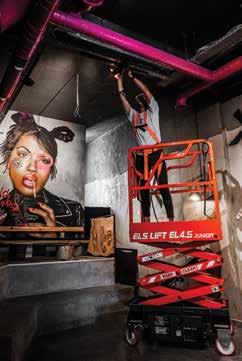
industry embraced the idea and a panic arising from the belief that ladders were to be banned in the UK. While some contractors did initially ban them, common sense soon took hold, however it did curb the dubious use of inverted drinks crates or chairs to gain that additional height particularly on the major construction sites. Perhaps surprisingly in the intervening 20 years or so since, the widespread acceptance in the UK has only spread to a few other countries in recent years with a significant take-up in France, the Netherlands and Germany as well as in parts of the Middle East - thanks to British contractors working in the region. In North America several US manufacturers such as Custom Equipment/HyBrid, GMG and MEC do very well, however many trades still tend to use larger machines such as a 19 or even 26ft scissor lifts, occasionally not even needing to raise the platform to reach the work. While many manufacturers of low level access have come and gone it is not surprising that PopUp and Power Towers are still in the market. JLG acquired Power Towers from its owners Brian and Sandra King and Mark Richardson in 2015 and after a few years of letting Power Towers continue as it had been, the company was brought fully under the JLG umbrella. Since then Power Towers has moved into an all-new 9,500 square metre production facility in Leicester.

New products continue to come onto the market, many of them now self-propelled, while a recent trend is to stop standing on the midrail, with innovations such as vertical guardrails or perforated panels. At the same time adaptable material carriers have been introduced for tubes or panels, while some models have outdoor ratings. pOp
The original Pop Up was built in China with more than 6,000 units produced, however in late 2010 an agreement with Snorkel included the transfer for the on-going design and production of the Pop Up products - including the new Push6, Push8 and
Push10 - to the Snorkel facility in the North East of England. The two companies’ combined product lines were marketed as Pop Up products in the UK and Ireland and Snorkel in the rest of the world however the agreement did not last.

In 2020 Pop Up Products agreed a new 10 year partnership with the Dutch access company Altrex. Both companies had been working together from 2009 and included the joint development of several new products including a one person tower range - the MI Tower, MI Tower Plus and MI Tower Stairs. In February this year Paul Gallacher - a co-founder of Pop Up Products - stepped down as a director and from the day to
day running of the company selling his shares to his two co-owners, Adrian Bottomley and Nigel Woodger.
The following month Pop Up formed a partnership with Italian aerial lift manufacturer Axolift to develop and distribute environmentally friendly low-level access platforms. This will initially be a tweaked Pop Up version of the Axolift Manulift 200 which is calling the IQ Lift Pro 7 ACTIVe - a fully manually operated push around lift similar in concept to the Power Towers Peco lift concept. The Pop Up/Axolift 200 has a working height of four metres, with an overall width of 760mm, an overall weight of 249kg and a platform capacity of 125kg.


Axolift managing director Massimo Grossele said: “Axolift is a relatively young company fully dedicated to developing a range of high quality and competitive low-level access products. With in-house engineering and development with our parent company Gromet, we are ready to react quickly and efficiently to new market demands."
Gromet is a long established fabrication and metalworking business, based in Veneto, in northwest Italy. It has produced fabrications and components for others for many years but launched its new push around products in mid 2021 at a separate facility on the other side of the town and has been expanding its range ever since. Equipped with the latest cutting, bending, and robot welding equipment allows it to produce a high percentage of the content for the new lifts in house - a distinct advantage in times of supply issue challenges.
There’s a sense of great excitement at Versalift as the new VTL All-Electric hits the road. With its 100% electric boom and the new All-electric Ford E-Transit, this urban duo takes the lead in electrifying performance, without comprise.

new boom, higher payload, no stabilisers, impressive range on full-charge, plus reduced maintenance costs, all work together to optimise your productivity.

Its first two products were the manually operated Manulift 200 and the battery powered push around Elift 350 with working heights of 4.0 and 4.95 metres respectively. The two models go almost head to head with the JLG-Power Towers' Pecolift and Ecolift lifts as well as the masted 830P push around model.
The Manulift 200 has a half metre working height advantage over the Pecolift but is 200mm short of the Ecolift. The maximum platform capacity is


110kg while the overall dimensions are similar to JLGs. The overall weight is 249kg. The Elift 350 offers a working height just shy of five metres with a platform capacity of 180kg and an overall weight of 355kg.
JLg pOWer tOWerS
Currently the JLG-Power Towers has three ranges - push around manuals with working heights up to 4.2 metres, push around electrics up to 5.1 metres and self- propelled up to 4.5 metres.

The push around range includes the 3.5 metre Pecolift and the 4.2 metre Ecolift - also available as an outdoor rated Ecolift WR version for use in wind speeds of up to 12.5 m/s and three degrees maximum gradient. The three wheeled Pecolift’s footprint measures 990mm x 700mm and weighs 180kg having no batteries or hydraulic fluid. Slightly larger is the Ecolift with a 1.28m x 740mm footprint and 150kg capacity but like the Pecolift has to be operated on a flat surface


with less than a half degree slope. Weight of the Ecolift is 305kg, with the Ecolift WR weighing in at 340kg.

The push around electric range includes the 4.5 metre Nano, the 5.5 metre Nano 35, the 5.1 metre Power Tower and the two person 5.1 metre Power Tower Duo. Like the original Power Tower the latest version is aimed at users wanting a larger platform for tools and equipment for applications such as dry-lining, pipe and duct work, air conditioning, general M&E work and stop fitting etc. It has a 250kg maximum capacity and a footprint of 1.6 metres x 780mm and weighs 342kg. With additional stabilisers the Power Tower Duo weighs 425kg. Both Power Tower versions have the option of battery or mains power.
The self-propelled models include the 4.5 metre Nano SP and the 4.5 metre Nano SP Plus with double extendable deck giving a two metre by 730mm platform. Overall weight is 550kg and maximum gradient for operation is one degree.
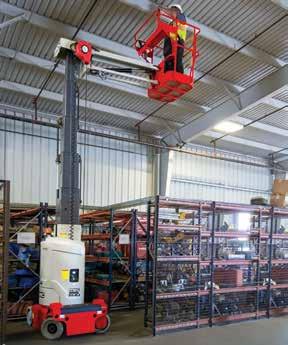
Another company that was one of the early entrants into the low level market was Italian company Bravi which began manufacturing its self-propelled Lui Mini in 1995 which later became the Leonardo. Its double deck extensions meant the Leonardo and Leonardo HD offered 1.7 metres platform length, significantly more than any other lift. Its high specification included 4.9 metres working height, 180kg platform capacity, an overall weight of 495kg and 35 percent gradeability also meant that it found many takers and is still very popular almost 20 years on. Today Bravi has expanded its low level offering and includes the increasingly popular Leonardo HD - with attachments such as the Solo-Gyps Drywall lifter and Small-E Inspection device - the Lui 460, the Spin-Go and Sprint in its tyre TL and LP variations.
The current Bravi Leonardo HD has gained a bit of weight at around 530kg but the impressive
platform length, working height and gradeability remain the same. The battery powered 6.6 metre working height Lui 460 has a shorter deck at 2.4 metres with a 280kg capacity. Overall weight is 1,250kg.
The 4.2 metre working height Spin-Go platform/ stock picker has a 130kg capacity with 90kg on the stock picking platform. Overall weight is 280kg. Its larger brother, the Sprint, has a 5.35 metre working height and 113kg stock platform capacity with one person rating.


A few years ago, Bravi introduced an interesting variation of its 5.35 metre Sprint - the tyre handling Sprint TL - designed to take the effort out of placing and retrieving tyres and wheels from storage racks in a warehouse, workshop or retail environment, quite a specific application but it does show the possibilities.

The lift rack/table tilts forward when the lift is stowed and can easily be loaded with up to four tyres and a combined weight of 100kg. As the lift raises the rack is returned to horizontal when the shelf is reached the tyres can be easily transferred to the shelf, with the bottom plate raised via chain drive system, to bring the next tyre up to the operator. The reverse occurs when retrieving tyres from the shelving.
Not only does this make the picking and storing of tyres safer and easier, but it also increases efficiency and the number of tyres that can be stored within a given space. The platform has an overall width of 808mm and can travel at speeds of up to 5kph when stowed. It also has sufficient battery power for a claimed travel range of 18 kilometres on a single charge.
Bravi has performed well in recent years reporting 20 percent increased revenues and a 60 percent jump in order intake for the first half of last year which was similar to the growth in 2021, driven by a 57 percent increase in sales of its
bestselling Leonardo HD, a 53 percent shift in sales of the Sprint model and a doubling of sales of the Spin-Go push around platform/stock picker. The company has increased production of the Leonardo HD to 25 units a day, and the Sprint to 15 units a day - helped by a €1 million investment in the production lines this year.

Snorkel has been producing push around and powered low level lifts for many years having started with Pop-Up. Its best sellers are the five metre S3010P push around and S3010E selfpropelled version.
“The markets using these products are very diverse, but the core sectors include education, industrial, commercial and retail,” says Snorkel’s Andrew Fishburn. “Generally, these products are now treated as self-erecting scaffold towers, speeding up or eliminating erection time and removing the risks of getting the components of the tower in the right place. Updated HD 1004 regulations further complicated scaffold erection and drove more operators towards these mechanical alternatives.”
Rental rates for the powered push variants vary from £35£85 a week in the key UK market - between one and a half and two and a half percent of weekly capital cost - still higher than the non-powered variants. “Products need to be simple to use and maintain,” he said. “The S3010P and S3010E for example come standard with two coat powder paint system for improved durability and protection and are available with maintenance free AGM batteries. In 2021 following customer feedback, we added wide body guardrails, offering easier access and a roomier platform along with toe board cut aways with dual swing safety gates which prevents debris falling out of platform.”
But when and how do customers choose between a self-propelled version, or a push powered or non-powered?
“Usually high productivity areas such as shop fitting and M&E business require high work output, so operators prefer to be able to drive whilst elevated,” says Fishburn.
In 2021 snorkel introduced the S3210P powered push around machine that is outdoor rated, but the footprint is only 60mm wider than the indoor machine. Uses include shell and core M&E high rise work where clients require currently scaffolds and podiums which are susceptible to overturning in wind.

More recently there have been new entrants to the market. In addition to Axolift, Haulotte launched seven new lightweight models - all under six metres - last year. The two model Move Up line of push around, electric lift vertical mast lifts consist of the Move Up 4.6 and Move Up 5.6,


with working heights of 4.6 and 5.6 metres respectively.
Capacity on the 670mm x 660mm platform is 159kg and overall width is 700mm with a stowed height of 1.8 metres and overall weight 288kg and 378kg respectively. Power comes from a single 12 volt AGM battery.
The two model Swift Up line of push around scissor lifts includes the Swift Up 3.8 and Swift Up 4.5 with working heights of 3.8 and 4.5 metres respectively. The two units have a platform size of 1.04 metres x 570mm with a maximum capacity of 240kg. The overall length of both is 1.2 metres, the overall width 700mm, with stowed heights of 1.72 and 1.78 metres and total weight of 270kg and 315kg respectively. Power comes from the same 12volt AGM battery as the masts.
throughout the Asia Pacific region apart from South Korea, while in South America it only offers the Swift Up SP range.
UK manufacturer Metal & Modular launched its smallest push around manually powered scissor lift earlier in the year. The Navigator


4.5 has a working height of 4.5 metres with a platform capacity of 150kg and an indoor/outdoor rating. It is considerably more compact than the company’s first model - the six metre Navigator 6.0 - unveiled more than a year ago. Overall length is 1.05 metres with an overall width of 720mm, while the total weight is just under 300kg.
in Calais, France with a depot in Lyon with an extensive range of machines and parts in stock. Its aerial lift range is limited at the moment and includes self propelled scissors with working heights from 5.8 to 11.9 metres. For those looking for small track mounted scissors or a small push around lift another Chinese manufacturer Hered (Shandong)
Intelligent Technology has a range with working heights from five metres to 15.8 metres. The smallest tracked machine is the 4.5 metre platform height HC0507E which has a platform size of 1.34m x 720mm with a 600mm deck extension, 230kg maximum capacity, 25 percent gradeability and weighing 920kg. Power is supplied by two 12 volt/100Ah batteries giving a 4kph drive speed. Smallest lift is the five metre working height HS0507ST push around.
faraOne
And finally, the three model Swift Up SP range - the Swift Up 4.5 SP, Swift Up 5.0 SP and Swift Up 5.9 SP - have maximum working heights of 4.5, 5.0 or 5.9 metres respectively. The smaller model has an overall length of 1.2 metres, while the two larger models are 1.4 metres. Platform dimension on the 4.5 is 1.04 metres x 570mm while the two larger machines have a 1.28 metre x 650mm platform. Capacity on all three is 240kg and overall width 700mm. The stowed height of the two smaller models is 1.8 metres while the 5.9 metre model is 1.9 metres. The battery pack comprises two 12volt AGM units.
The new models - badged by Haulotte - are available in Europe outside of the UK, and
One of the more prominent low level access Chinese manufacturers is Reeslift located in Shandong, which exhibited a wide range of products at Bauma and APEX including push around, scissor and mast type machines. Its JCPT03PA push around scissor offers a working height of five metres.


The Elevah series by Faraone offers a wide range of aerial platforms and compact picking machines with working heights up to eight metres. The range includes self propelled and push arounds as well as ‘specials’ with machines with attachments for glass handling and lifting barrels. The company says sales are strong in Germany, France, Ireland, Greece, Spain and Poland. Current models include the Move with working heights ranging from the four metre Move 40 to 7.75 metres and the Move 80. Stock and tyre picker variations are also available. The four model push around range includes the four metre Elevah 40B, the 5.15 metre E5B, the 6.1 metre Elevah 61 and the 7.25 metre Elevah 70.
Other relatively new Chinese manufacturers include Heli - the Anhui Forklift Groupwhich has a European subsidiary Heli Europe. The company has been a leading manufacturer of industrial forklifts in China for more than 30 years. It also has a European subsidiary, Heli Europe, which is based
Latest development is a move to a more compact chassis for the smaller models and the latest introduction is the new five metre 55 ES Move with the whole platform moving 600mm for added reach over obstacles. The new E6which has a working height of six metres - is currently in prototype testing and will be available next year. ■


The All Terrain crane sector appears to be going through some interesting changes at the moment - the result of several factors including Tadano’s acquisition of Demag in 2019 and subsequent integration reducing the number of mainstream manufacturers to three, at the same time some Chinese crane manufacturers are working hard to refine their European All Terrain product ranges.


The amalgamation of two major manufacturers - particularly of different cultures - always raises issues resulting in a period when internal systems, personnel, products, sales and distribution invariably suffer. This has meant that the already dominant All Terrain market leader Liebherr has made further market share gains, as has Grove and some smaller niche manufacturers.
Chinese crane manufacturers, including XCMG, Sany and Zoomlion have been pushing on the door of the lucrative European All Terrain market for more than a decade with little to show for it. More recently they have gained volume for their European products in Russia, thanks to sanctions due to the invasion of Ukraine, as outlined in last month’s feature on crawler cranes (C&A issue 25.2). The major Chinese manufacturers have also learnt from their failures, and are introducing models with improved design, technology and quality and are now working on distribution. They are helped of course by long lead times for many
model sectors. At the same time Link-Belt has launched a new All Terrain crane, however this will realistically only be a factor in America. So as Liebherr edges towards a 50 percent market share, the choice of products for the customer has probably increased and the market is arguably more competitive than ever - but only in some capacity ranges.
As we have already seen in the aerial lift market, Chinese crane manufacturers are prolific when it comes to all-new products. As if to prove this to doubters in the past few years they have unveiled three of the world’s largest All Terrain cranes and are among the first with electric/hybrid machines - arguably a sign that the innovation gap is narrowing - although their efforts at the top end of the market have arguably had a negative impact on their engineering reputations.
Last summer both Sany and Zoomlion launched 2,000 tonne plus All Terrains. Sany began with

its 2,200 tonne, nine axle unit, which quickly morphed into the 2,400 tonne SAC 24000T, with the first unit delivered to Ningxia Julishen Construction Machinery Group last June. The crane has an 80 metre main boom topped by a 95 metre jib for a maximum tip height close to 180 metres. Maximum counterweight is 270 tonnes. Powered by a Weichai China VI diesel it can travel at up to 70kph and has a gradeability of up to 45 percent. The company claims the new crane can lift 270 tonnes to a height of 100 metres with its super lift device installed. It adds that following such a lift, it can be stripped ready for road travel within 10 hours. Although the first crane went to work on the Zhangjiakou Zhangbei Wind Farm, installing 6.25MW turbines with hub heights of 110 metres, Sany had not released this information publicly, until Zoomlion trumpeted the fact that it had shipped the world’s first two 2,400 tonne ZAT24000H All Terrains to Huanghua Haibin Lifting Installing Engineering in Hebei Province. The nine axle Zoomlion crane was developed specifically for wind turbine installation and according to the company is capable of installing turbines with hub heights of up to 160 metres. Overall length on the road is 22.5 metres, with an overall width of three metres. Power is supplied by a 650hp Daimler diesel with 70kph maximum road speed.
A few months later XCMG announced that it had tested its 2,600 tonne, 10 axle XCA2600claiming it to be the world’s largest All Terrain
crane. Its maximum load moment is 5,372 tonne metres with a maximum lift height of 160 metres. Maximum counterweight is 340 tonnes and for turbine work the crane uses a 110 metre long power jib on a 63.7 metre telescopic boom. The crane is 3.5 metres wide and boasts a new patented independent suspension.
XCMG chief crane engineer Shan Zenghai said: "It can be difficult for large cranes to successfully strike a balance between achieving great lifting capability and be capable of traveling around conveniently, especially for those installing wind turbines at heights of 160 metres. To achieve this requires technological innovation and a dedication to customers and their height, accessibility and safety needs."
XCMG has made significant progress in developing high capacity All Terrain cranes from 800 tonnes to 2,600 tonnes over the past 10 years and claims to have sold 126 cranes with capacities over 1,200 tonnes which have installed more than 15,000 wind turbines. Most of these have, of course, been delivered to customers in China.

This past nine months has seen the emergence of the first electric/hybrid powered All Terrain cranes, although Spierings has been pioneering and even perfected, the concept for several years on its self-erecting mobile tower cranes, while Tadano unveiled its all electric Rough Terrain at Conexpo. In China companies like Zoomlion has been working on small all-electric truck cranes for some time, but only recently on All Terrains.
Zoomlion claims to have launched the world's first hybrid - standard chassis/electric superstructure - All Terrain crane, the 220 tonne ZAT2200VE863, with three operating modes: battery electric, AC plug-in and diesel/electric. In pure battery mode it is said to be capable of working for up to eight hours and when operating on an external 380V AC power outlet it recharges the battery at the same time. When the batteries are flat and the crane cannot be plugged in, it can use a generator driven by the chassis engine which provides enough power for crane operations. The crane has an 85 metre main boom and can handle 7.5 tonnes when fully extended.


Zoomlion’s first fully electric crane - the 25 tonne, three axle ZTC250N-EV truck crane - was launched in 2020. It has a travel range of more than 290km and maximum speed of 90kph powered by a lithium iron phosphate or lithium ferrophosphate (LFP) battery - a type of lithiumion battery with a longer life and more constant discharge voltage.

In April last year Liebherr unveiled a plug-in hybrid version of its 50 tonne LTC 1050-3.1 City-type All Terrain crane, the LTC 1050-3.1E. The crane features a 72kW electric motor and required control system, alongside the standard six cylinder diesel engine. The two power units use the same hydraulic pumps, and the operator can switch between diesel and electric power for crane functions. Once on site, it ideally plugs into a 125 Amp mains power supply in order to fully match the performance of the diesel, but it can also operate on a 63 Amp supply. Alternatively, it
can be plugged into a standalone remote battery pack.
Simplistically, all that is required to convert the standard machine to the E version is the installation of the electric motor module plus the transfer gear that fits between the transmission and existing pumps. The electric version of the LTC 1050-3.1 features the 36 metre telematic rather than the new shorter cable extended boom. Options include the RemoteDrive system to operate the chassis and the elevating cab. Technical director Ulrich Hamme said: “We want to be able to offer our customers full crane performance even with the alternative electric power unit. The LTC 1050-3.1 still has a conventional engine, powered by diesel or HVO, for driving on roads and for crane operations. However, it also has an electric power unit for crane operations so that it generates Zero emissions.”

For several years now Tadano has been pushing forward with its Green Solutions initiative which culminated with the launch of the world’s first allelectric Rough Terrain crane launched at Conexpo together with the Auxiliary Power Unit (APU)shown on another Rough Terrain - which operates the air conditioning and cab power supply during standby reducing fuel consumption by 25 percent as well as reducing engine emissions.
At Bauma the company had showed its Hybrid concept on a four axle AT which is at a very early stage of development. It is likely to feature an integrated battery pack powering an electric motor which drives dedicated hydraulic pumps. Recharging can be done from a plug-in connection, a small onboard generator or the

crane’s engine and alternator. The crane is said to have the same performance as the straight diesel. Tadano’s long term environmental targets announced in 2021, aim to reduce CO2 emissions from business activities by 25 percent and 35 percent from product use by 2030 leading to zero carbon emissions by 2050.
For its All Terrain cranes currently the changes include the e-Pack remote electric power pack which is powered by a 400V/63A supply although it can be used with a 400V/32A supply with reduced crane power. The pack can either be transported on the back of the crane using a specific transport rack or by using a trailer.
grOve hybrid cOncept
Grove also introduced its first hybrid concept All Terrain crane - a four axle, 100 tonne capacity GMK4100L-2 - on the Manitowoc stand at Bauma 2022. The crane has a fully electrified superstructure, powered by a generator coupled to the diesel engine, and can also plug into public power supply to charge its 100kWh battery.
xcMg hybrid
XCMG unveiled a new three axle 60 tonne hybrid XCA60 EV All Terrain crane at Bauma based on the company’s existing XCA60 E. The 2.55


Liebherr's electric power train - the blue components are the electric motor and transfer drop box, while the green are the hydraulic pumps
metre wide crane was designed with the help of Dutch crane customers and aimed specifically at the European market. The hydraulic system is powered by a 170kW electrical motor, with three operating modes: 1. the chassis engine driving a generator 2. connected to a 32 or 64 Amp AC power outlet for continuous emission free operation with performance matching or exceeding the diesel, and 3. operated electrically without plugging in thanks its 115kWh high capacity lithium ion battery pack.
XCMG claims crane operation for up to four hours with the battery pack. The batteries can also be recharged when operating from an AC outlet or


the diesel engine with excess power topping up the battery pack and this includes recharging while travelling.
The ‘Dual-Power’ drive concept combines power from both the diesel and the electric motor for both road and off road travel, with the electric motor boosting the engine. According to XCMG the combination has been proven to reduce fuel consumption by around 40 percent. In addition, regenerative braking and coasting allows it to generate electricity to top up the battery pack. The crane has a 48 metre, six section pinned main boom, topped by a 9.2 to 16 metre bi-fold offsetable swingaway extension with a maximum tip height of around 66 metres. Standard features include wireless remote controls for outrigger set up, a 10.4 inch in cab touch screen and hoist cameras.
While new electric and hybrid machines generate interest, most crane users still depend on cranes with a traditional drive train and will do for some time to come. All of the manufacturers have been busy, adding and upgrading products with last year’s Bauma a focal point for many new product launches.

Liebherr’s most recent All Terrain launches included the 110 tonne, five axle LTM 1110-5.2 and the 300 tonne LTM 1300-6.3.

The six axle, single engine 300 tonner features an eight section 90 metre main boom but does not support a luffing jib. However, it does offer a range of extensions including the 11.5 to 20 metre bi-fold swingaway that offsets by up to 40 degrees to which two, seven metre lattice inserts can be added between the boom nose and the swingaway which provides a maximum tip height of 121 metres. The new crane comes with Liebherr’s latest features including ECOmode, ECOdrive, VarioBallast and updated VarioBase Plus outrigger set up system. It also features a wider - up to 9.4 metres - rear outrigger spread as well as Auto-Ballast. Maximum counterweight is 88 tonnes, designed to provide the maximum number of transport configurations. It can also operate with eight tonnes less ballast than the LTM1300-6.2 without compromising capacities.
Another new Liebherr All Terrain is the second generation 110 tonne LTM 1110 originally launched at Bauma 2019. The new five axle LTM 1110 has a 60 metre main boom and now features Liebherr’s latest LICCON3 crane control system - the LICCON2 control system was reaching the limits of its capacity - the latest
generation chassis cab and an ‘almost zero wear’ ZF TraXon DynamicPerform transmission and oil-cooled multi-disk clutch, which Liebherr says it will install in all of its five axle All Terrain cranes on a step by step basis. The LICCON3 control system features a new software package and programming language as well as a faster databus, more storage space and improved computing power. LICCON3 cranes will also be prepared for telemetry and fleet management systems as standard.
grOve
Grove’s latest addition to its All Terrain line up is the 70 tonne four axle GMK4070L which boasts a 60 metre main boom - one of the longest in its class - it can handle 4.4 tonnes fully extended, or 24.5 tonnes on a 31.9 metre boom. Maximum radius is 46 metres at which it can handle one tonne. A 15 metre bi-fold swingaway extension takes the maximum tip height to 78 metres.

On the road the GMK4070L can travel with up to 13.3 tonnes of counterweight within 12 tonne axle loads, or 5.3 tonnes on 10 tonne axle loads. In places such as the UK, it can manage 17.8 tonnes of counterweight - just shy of its full 19 tonnes maximum.
Power is provided by a single Mercedes Stage V/Tier 4 Final diesel with Eco mode which can be used in conjunction with the transmission’s Fuel Saver mode for improved fuel efficiency. It is also approved for use with HVO diesel. A Telma retarder is incorporated into the driveline. The new crane is one of the first to offer the new Grove CONNECTTM digital platform providing owners with real-time access to fleet data - something that will be rolled out to more Manitowoc crane lines in the future. The MAXbase variable outrigger set up system is optional.
The GMK4070L goes head to head with the new Tadano AC 4.070.2 announced around the same time. While the new Grove has 10 metres more main boom and a greater maximum tip height, the Tadano has a stronger load chart, and may have the edge in terms of roading options.
Grove also used Bauma to launch its new 400 tonne Grove GMK6400-1, unveiled ‘virtually’ at Conexpo 2020 (and seen at its Wilhelmshaven plant since October 2021) as well as two five axle cranes, the GMK5150XL and Grove GMK5120L
The GMK6400-1 features a five section 60 metre main boom and is now equipped with a new Stage V/Tier 4 Final diesel driving an upgraded hydraulic system. Other features include MegaDrive hydrostatic drive, the Maxbase variable outrigger set up system and CCS operating controls.
The six axle crane can be equipped with up to 79 metres of luffing jib for a 136 metre maximum tip height and Grove’s Mega Wing Lift self-rigging Superlift system, which increases capacities by up to 70 percent on the main boom and 400 percent on the luffing jib. The company claims that it can handle jobs that usually require a seven or eight axle crane but with a smaller footprint. It can handle 64 tonnes on the fully extended main boom at a radius of 11 metres, when rigged with the MegaWingLift system - 38 tonnes without.
Tadano unveiled its new four axle 70 tonne AC 4.070-2 All Terrain crane at Bauma, with 50 metre six section main boom topped by an 8.5 to 16 metre bi-fold swingaway extension and up to 40 degrees of offset for a 70 metre maximum tip height. A 6.5 metre stubby heavy duty extension option offsets by up to 50 degrees.

The single engine crane has six wheel drive - the second axle is the non-driven - and all wheel steer. It can travel with its maximum 11.9 tonnes of counterweight and full 16 metre extension on board within 12 tonne axle loads, or manage 4.4 tonnes within 10 tonne axle loads, making it a versatile taxi crane. The crane has an overall width of 2.55 metres, an overall length of 11.7 metres, with a stowed height of 3.8 metres. The crane can handle 7.1 tonnes on the full boom at a 12 metre radius or 7.3 tonnes at 10 metres.


Maximum radius is 40 metres at which it can lift up to 800kg to a height of almost 32 metres or handle 1.5 tonnes at 38 metres radius.
The AC 4.070-2 carrier shares drive train componentry with the 80 tonne AC 4.080-1 and 100 tonne AC 4.100L-1, all part of Tadano’s ‘shared component strategy’ to provide customers with standardised controls while simplifying maintenance and reducing parts holdings. Standard equipment includes centralised lubrication, the IC 1 Plus system and Flex Base fully variable outrigger set up and monitoring, remote telematics with cloud storage and ’Tadano Support’ as well as the Tadano Surround View System with a monitor in the carrier cab that provides 360 degree visibility and graphically shows the maximum possible extension lengths for the outriggers and the counterweight tailswing radius from a bird’s eye view perspective. A range of options include being factory equipped to take the e-Pack electric power pack.
Two AT prototypes shown at Bauma included the 50 tonne AC 3.050-1 and the 60 tonne AC 3.060-2 which both use the same chassis. The AC 3.050-1 will have a full power 50 metre boom and will be able to travel within 12 tonne axle loads with its counterweight. Features include Flex Base variable automatic outriggers, Surround View camera system and is designed for Tadano’s E-Pack electric power pack. The main boom can also be lowered to five degrees below horizontal for easy reeving. Both cranes are scheduled for production later this year.
72.5 metre pinned main boom with a 12.8 to 21.6 metres bi-fold swingaway extension which can be hydraulically luffed. Two 7.6 metre lattice inserts take the maximum tip height to 112 metres. Alternatively, a 2.4 metre heavy duty extension provides good capacities and line separation for two line lifting for applications such as precast wall panels installation.
Maximum counterweight is 73.5 tonnes and the crane can travel with the basic 3.6 tonnes of counterweight on board and not exceed axle loads of 10.4 tonnes.
Power comes from a single HVO ready Cummins X15 diesel with EPA On-Highway and CARB OnRoad compliance, driving a ZF Traxon automated manual transmission with integrated intarder braking, and paddle shift controls for easy stop and go on the road.
The full width carrier cab is the same as that on the 175|AT and includes automatic climate control, Bluetooth radio, phone charging and LED
pumps. The crane is just less than 12 metres long, 2.55 metres wide and 3.78 metres high. Features include a new generation iCab, while Sany claims it will have the strongest lift chart in the class. The twin engine, four axle 120 tonne SAC1200E will have a 66 metre main boom, plus 25.7 metres of extensions and 31 tonnes maximum counterweight. It is 2.75 metres wide on the road with an overall length of 14.2 metres but is four metres high. It can carry up to 17.2 tonnes counterweight where 16.5 tonne axle loads are permitted and features a ZF transmission, Kessler transfer case, Kessler axles and the New iCab. The 250 tonne, five axle SAC2500E will have a 75 metre main boom, twin Mercedes Stage V engines with a new eco fuel system, and feature Kessler axles/ZF Traxon transmission/Rexroth valves, pump and motors. The overall length is almost 16 metres long. It can travel with up to 22 tonnes of counterweight where16.5 tonne axle loads are permitted.


xcMg
The 60 tonner also has a 50 metre pinned main boom, with optional 6.5 metre or 16 metre extension. It can travel with full counterweight or 16 metre extension on board within 12 tonne axle loads or both full counterweight and full extension within 13 tonne axle loads. The AC 3.060-2 has similar features to the 50 tonner including being equipped to take the E-Pack, the Flex Base system, Tadano Surround View camera system.
Link beLt’S neW 250t at Link-Belt launched the 250 tonne 300AT at Conexpo. The five axle crane has a seven section

lighting along with an air ride seat with lumbar support. The superstructure cab is equipped with the Pulse 2.0, 10 inch touchscreen display, a large, glazed area with full sweep wipers on the front and top, and strategically placed vents for a quick defrost.
The V-CALC control system now includes variable outrigger positioning, with full asymmetric set up and four beam extension positions - fully retracted, 40 and 70 percent out or fully extended - the SmartStack counterweight detection system also feeds into the system. Other features include wireless remote control for setting the outriggers, superstructure functions and boom extension rigging, as well as comprehensive camera ‘Site Vision’ package, and the company’s premiere lighting package for night time operations.
Sany
Not to be left behind, Sany plans to launch three new European All Terrain cranes in the next year or so, starting with the 60 tonne SAC600E followed by the 120 tonne SAC1200E and the 250 tonne SAC2500E. This follows its 60 tonne crawler telescopic seen at Vertikal Days last month.


Only basic specifications are currently available. The 60 tonne three axle SAC600E has a 50 metre main boom and 16 metre extension, and is powered by a Mercedes E5 diesel, while key components include Kessler axles, Allison transmission and Danfoss/Rexroth/Casappa
Earlier this year XCMG launched the 120 tonne four axle XCA120E which features a seven section 66 metre main boom, topped by an 11.65 to 18.5 metre bi-fold swingaway extension offsettable by up to 40 degrees. Two 7.1 metre lattice extension sections can be added between the boom nose and the swingaway to achieve the maximum tip height of just over 96 metres while the maximum radius is 60 metres.
The 120 tonne capacity is achieved at a theoretical 2.5 metre radius, at three metres it can manage 80 tonnes. An MTU diesel drives a 12 forward and two reverse speed ZF 12 TraXon transmission with the three rear axles all driven while all wheel steering and a retarder are standard. The independent suspension system is similar in concept to that used by Grove. The new crane has an overall width of 2.75 metres, while the overall length is just over 14.3 metres. The outriggers have up to five working widths from fully retracted to seven metres fully extended. Maximum counterweight is 33 tonnes. ■


Access professionals want equipment that solves problems and lowers their total cost of ownership (TCO). Operators should consider this when purchasing their replacement batteries. The right battery lets your equipment handle situations that other batteries cannot, particularly in Partial State of Charge (PSoC) conditions.
Battery-powered access equipment is often used in PSoC. But flooded lead-acid and standard AGM batteries are not designed for this. They experience corrosion, sulfation, and possibly early battery failure when used in PCoS. To prevent this damage, these batteries must be fully recharged after each cycle. This takes eight to 10 hours and can leave employees on the clock but idle. Revolutionising AgM technology to enhAnce
PeRfoRMAnce
Trojan Battery Company’s new premium AES Battery works harmlessly in PSoC, preventing corrosion, sulfation and extending battery life. This adds value to access and material handling equipment, floorcare machines and renewable energy applications.

The maintenance-free battery lasts three to five years and outperforms competitive products in the following vital areas:
• Delivers up to 3x more cycle life than standard AGM and has been validated at 1,200 cycles at 100% DoD vs 400 cycles for AGM.
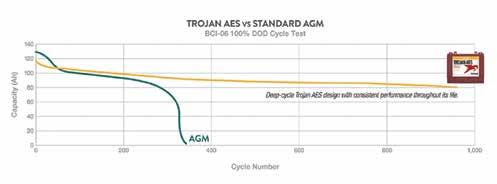
• Performs in harsh conditions and temperatures ranging from -40º C to +71º C (-40º F to +160º F).
• Has been tested to withstand long term PSoC again and again.
The battery is also engineered to absorb vibration and shock and is protected by a three year warranty.
Available in 6, 8 and 12 volt models, the battery is an evolution of safe and trusted AGM technology. However, its carbon additive and Deep Cycle Series (DCS) technology prevent damage and allow users to grab opportunity charges during the workday.
The battery maintains steady performance regardless of the state of charge, and it charges faster and delivers longer run times than a flooded lead acid or standard AGM battery.
As environmental issues stimulate the appetite for battery-powered equipment, more overseas
battery makers are entering the market. However, these startups may lack the manufacturing expertise and infrastructure of larger, more established manufacturers.
With almost a century of battery experience, Trojan Battery Company helped shape deep-cycle battery technology and remains a major supplier. The company offers:
• Timely delivery and supply chain security with global manufacturing sites.
• A global Technical Support Line with trained employees.
• A network of Master Distributors and Authorised Trojan Dealers.
• A complete portfolio of flooded lead acid, gel, Trojan AES and lithium-ion batteries to meet your needs and budget.
Trojan’s AES Battery gives you want you want: affordable solutions that boost productivity, reduce downtime and increase longevity. Learn more about Trojan AES batteries at https://www.trojanbattery.info/YesAES/ or find your local Trojan Master Distributor at trojanbattery.com


The telehandler continues to be one of the most popular materials handling machines in the construction and agricultural markets in a growing number of countries. The past few years has seen increased competition leading to a wider range of products in terms of reach, capacity and power with all-electric machines already a reality, while hydrogen power is being tested. More recently Chinese manufacturers have started dipping their toes into the market with models launched in Europe and North America.
In the following pages we take a look at some of these developments and introductions, while Nick Johnson reviews Faresin’s 17 metre 17.45 All Electric and the latest Bobcat R series machines, while looking at JCB’s hydrogen power project.
Anyone visiting a major equipment show over the past year must have noticed the arrival of telehandlers on Chinese manufacturers’ stands, often tucked away behind the excavators or other equipment and launched with little fuss, almost as if they had been around for years. They haven’t - and their introduction is a subtle warning shot across the bows of the traditional, ‘dominant’ market leaders - Manitou and JCB in Europe and JLG in North America. Until recently the telehandler market seemed to have reached mature market status with annual production of around 60,000 units. A sizeable figure given that most are sold in just a few large markets, such as the UK, France and - only due to its size - the USA.
That appears to be changing, as contractors in other countries start to appreciate their usefulness - something that several Chinese companies have already spotted and are gearing up for telehandler sales to take off in the larger emerging markets, where they are well placed to exploit it. So if their machines do not prove a massive success in Europe it is of little consequence.
The telehandler market is a tough one. Any new entrant is obliged to use existing western componentry such as axles, engines and
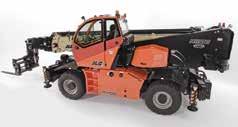

transmissions which makes up much of the cost. The market is not tolerant of radical new designs leaving little room for substantial innovations or to significantly change overall weights and dimensions, meaning it is very much a ‘Me Too’ product although the market leaders have a massive supply chain advantage thanks to their volumes.
The market has already just about ‘seen off’ companies such as Caterpillar, Komatsu, New Holland, Case, Volvo and others, while Liebherr - no shrinking violet - has been slowly plugging away at it for more than a decade and would readily admit that it has not really got anywhere. If sales in the developing world were to take off however… Chinese equipment manufacturers are best placed to benefit, having been quietly gaining traction throughout Africa, much of Asia and more recently Russia.
neW telehAndleRs fRoM chinA
Chinese manufacturers exporting ‘European style’ telehandlers now include Sany, Sunward, XCMG, LGMG and Zoomlion - with others likely to join this list over the next year or two… although the lack of any significant domestic market and price advantage may curb the attraction?
XCMG showed one of two new telehandlers at Bauma, the XC6-2506E - a six metre/2,500kg compact all-electric machine - has a maximum forward reach of 3.45 metres at which it can handle 1,000kg, while managing 2,000kg at full height and can take the 2,500kg to five metres. The 930mm wide cab features heating and air conditioning and is pressurised to keep out dust.

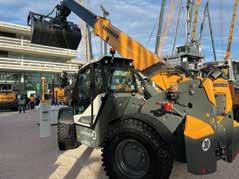
Overall weight is 5.3 tonnes and the battery pack can be recharged in a little as two hours with a fast charger. The company also plans to launch the 17 metre/4,500kg 1056VN North American model with a 17.2 metre lift height, 13.1 metre forward reach - at which it can handle up to 1,400kg - and a total weight of 14,000kg.

Also, at Bauma LGMG showed its first ever telehandler - the H1840 - with a 17.6 metre lift height, 4,000kg capacity, Perkins Euro V diesel and hydrostatic transmission. Total weight is 12,350kg and standard specification includes stabilisers and self-diagnostics system.
Sany launched three telehandlers for the North American market at Conexpo, the 10 metre/2,700kg STH 634A, the 13 metre/3,630kg STH844A and the 17 metre/4,535kg STH1056A. The company will also introduce the 17 metre/5,450kg STH1256A.
Sany has also launched two European models, the 14 metre/4,000kg STH1440 and the 18 metre/4,000kg STH1840. Standard features include all-round visibility from the German designed cab, low boom, sloping covers and low dashboard. A rear view camera with sensor and visual and acoustic warnings helps visibility, while a safety lock prevents movement when the driver is not seated. Sany is also planning compact models.
Sunward has been showing a ‘new’ telehandler at exhibitions for almost 15 years but never seems to follow through to production or distribution. This year was no exception - at Conexpo it showed the 17 metre/4,500kg SWTH1056.


heAvy duty genie
At the ARA earlier this year Genie launched its new 17 metre/5,400kg GTH-1256 which can take 2.7 tonnes at its maximum lift height or 1.59 tonnes to its maximum forward reach of 12.8 metres. Deutz power is matched to a four speed powershift transmission, with limited slip differentials on both axles. A new cab design features improved visibility, a seven inch display, reverse back-up camera, rear proximity alarm and full air conditioning. The unit also includes Genie’s ‘Quick Attach’ system for faster, easier swapping of attachments and includes the same options as the GTH-1056 with rotating and swing carriages.

metres. It can also extend a tonne to 1.5 metres. The 514-40 is 1.56 metres wide, 1.8 metres high and less than three metres long. Overall weight is 2,915kg. Features include a full width cabclaimed to be 200mm wider than competitors - while power comes from a low maintenance 1.1 litre three cylinder diesel.
At the ARA Manitou presented a ‘sneak preview’ of an all-new North American telehandler line - the MTA series - which will include the MTA 642, MTA 842, MTA 1055, MTA 1242 AND MTA 1255. The company says that it is aiming to win a 25 percent share of the North American market in the years ahead. The longer wheelbase models employ many European features such as automatic parking brakes, with the engine mounted at 90 degrees to the machine length so mechanics can reach both sides of the engine. The company also showed the 22 metre/6,000kg MRTE 2260 electric/hybrid 360 degree telehandler, with battery pack and optional range extender diesel.
Manitou has also introduced four new MT telehandlers - the MT735, MT935, MT1135 and MT1335 - for both Europe and North America. All four have a maximum capacity of 3,500kg with lift heights of seven, nine, 11 and 13 metres respectively. Overall width is 2.28 metres making them easier to load on a truck, or a standard container. Initially they will be diesel powered only, with electric versions to follow. The machines employ Manitou’s latest technology platform which enables features such as automatic parking brakes, engine Start & Stop, more efficient hydraulics with load sensing pump and flow sharing for multifunction operation, along with the latest telematics, in cab information and operational display screen.


suB -coMPAct jcB

JCB has announced a new sub-compact telehandler - the four metre/1,400kg 514-40 - its smallest telehandler to date. Based on the current 516-40 it can take 1,300kg to its full height and handle 525kg at a maximum forward reach of 2.5
Zoomlion also has a range of telehandlers to launch. At APEX it just had basic details of the 12.7m/3,500kg 74kW Cummins powered ZTH3513 but also revealed four other models including the 6.1m/2,500kg 55kW Kubota powered ZTH2506, the 7m/3,000kg 74kW Weichai powered ZTH3507, and two 360 degree machines - the 18m/4,500kg 89kW Cummins ZTH4518R and the 24.8m/4,500kg 89kW Cummins powered ZTH4525R.

JCB has announced a new sub compact telehandler, the 1,400kg four metre 514-40
All four feature a new wider cab with increased glazed area, including a windscreen cut out for a better view of the load at low boom angles, and benefit from a narrower, sturdier floating fork carriage designed to improve visibility when the boom is lowered while being compatible with Manitou’s 14 and 18 metre models. Shipments are expected to begin late next year.
neW All electRic 360°
At APEX the company showed the all-electric MRT2236e Vision+, a new 26 metre/6,000kg
360 degree model with a forward reach of 21.7 metres. Using a 65kWh lithium battery it weighs in at 18 tonnes and has a maximum travel speed of 38kph. When the outriggers are set it can operate on an AC electricity supply while also recharging with the on-board charger. Alternatively, the Yanmar powered E-Xtra generator offers a faster recharge time.
Both JCB and Manitou are working on hydrogen powered telehandlers. JCB is putting a seven metre/3,200kg 532-70 through a final test programme, part of its £100 million hydrogen project (see page 45). Meanwhile Manitou is testing a modified version of an existing 14 metre model which it hopes to send for field testing at the end of next year.
Manitou’s development programme will evaluate two types of hydrogen technology - a diesel engine modified to take Hydrogen fuel, and a hydrogen fuel cell, a prototype of which is currently on the test bed. The company says that it will choose the solution that best meets the needs of its customers although much will depend on how the relevant hydrogen fuel infrastructures develop. If all goes well the company will begin hydrogen telehandler production in 2026 - just over two years away.
In the meantime, Manitou and French international rental group Kiloutou have signed a partnership agreement to convert used diesel telehandlers to battery electric power. Phase one of the project is

already underway at Manitou’s Ancenis facility, where a battery electric retrofit kit has been installed in a “high reach” Kiloutou telehandler. The machine will then go to Kiloutou’s test centre in Lille where a full test programme will evaluate it for technical and economic feasibility. Assuming the test programme is positive, Manitou will provide retrofit electrification kits to Kiloutou for an exclusive 12 month period from the start of 2024. The kits include a lithium-ion battery pack feeding a large electric motor which will drive the pumps in place of the engine. Kiloutou will put the retrofitted machines back into its French rental fleet where it expects them to be used for around five years.
Following its launch at Vertikal Days Nick Johnson took a closer look at Faresin’s new 17 metre fully electric telehandler before it was returned to the factory in Italy, courtesy of UK distributor GGR.

Having stolen a march on more established telehandler manufacturers when it launched the first battery electric model in 2019, Faresin is now using its experience to introduce larger all-electric models, building on the commercial success of its 5.9 metre/2,600kg 6.26 model. The move follows last year’s introduction of new, improved battery options.


largest Full Electric
was a star of Vertikal Days 2023

Unveiled at Bauma in October, the Faresin ‘Big Range Full Electric’ series comprises the 14.42, 17.40 and 17.45 models with 14 and 17 metre lift heights and maximum capacities of 4,200kg, 4,000kg and 4,500kg respectively.

Dominating GGRs stand at Vertikal Days, the Full Electric 17.45 was displayed with the boom extended to its maximum lift height of 16.4 metres. The new model uses most of the structural elements from Faresin’s 17.45 diesel, reducing new content. Maximum forward reach is 12.6 metres at which point it can handle 500kg.
After the show, I was able to take a closer look at the 17.45 Full Electric at GGR’s Haddenham facility in Buckinghamshire, allowing me to check out the new machine’s clever charging system first hand.
Faresin has worked closely with lithium-ion battery supplier Aliant to develop improved power sources for its Full Electric telehandlers. Last year it unveiled the fruits of its labours in the form of the new 24kW/h (315Ah), 32kW/h (420Ah) and 43kW/h (560Ah) batteries for its popular 6.26 Full Electric telehandler. This advance in battery technology has been a key factor in electrifying Faresin’s larger telehandlers.


With the 45kW/h lithium-ion battery pack, the 17.45 Full Electric is said to have run times of up to eight hours for non-intensive use and up to 3.5 hours intensive use. The battery feeds two electric motors, a 51kW motor for the drive transmission and a 23kW motor for the lifting functions. Faresin maintains that its electric telehandlers offer equal performance to its diesel models. On the 17.45 Full Electric, the optimised transmission management provides a peak traction force of 44.3kN and a maximum travel speed of 25 km/h - managed by a two speed gearbox.

To make charging as easy as possible, the 17.45 is equipped with an on-board charger and a universal charging socket, identical to that used on road vehicles. The intelligent interface accepts 220V single-phase and 400V three-phase inputs, with the option of a fast charging station. Consequently, the machine’s batteries can be conveniently charged or topped up, with whatever power source is available on site.
At the Haddenham facility this charging versatility was demonstrated first by plugging into a 415V three-phase 32Amp charging point in the yard, where the e-Station visual display on the charging cable proved to be really informative. Subsequently the machine moved to the car park at the front of the facility where there are standard 220V single phase 16Amp Rolec charging pillars for owners of electric cars.
This ability to utilise existing charging points such as those in parking bays is a big bonus - however the lower the voltage, the longer a recharge takes. At present there is no 110V charging option, but GGR says that this may be introduced in future if there is sufficient demand.
The physical characteristics of the 17.45 Full Electric follow well established telehandler design principles, with a low rear boom pivot to maximise all round visibility and four equal sized wheels, all wheel drive and steering and a turning radius of four metres. The down angled front stabilisers fold within its 2.36 metre overall width, while side slope frame levelling is standard. Boom suspension is optional.
The side mounted cab has a stylish curved front screen which provides good forward visibility. However, some rental companies prefer flat glass on the grounds that replacements are easier to source and cheaper. The spacious cab is entered through a side, split opening, stable door. The top half of the door swings back through 180 degrees and can be safely secured in the fully open position. Inside the cab there is convenient space behind the seat for the stowage of personal items. Air conditioning is an option as are front and rear LED lights.
The proportional hydraulic joystick allows convenient control of all hydraulic functions and there is a clear interactive colour display providing useful operating and diagnostic information. The 3B6 Load Moment Indicator takes readings from the rear axle and helps prevent moving into an unstable position when the maximum capacity is reached. The machine also comes as standard with a reversing bleeper and a forward travel Acoustic Vehicle Alerting System (AVAS) is a
handy option with a different sounding buzzer which can be adjusted in volume or even switched off to suit particular site requirements. selling
The standard headstock on the 17.45 is a Faresin design with a good tilt angle, and options include a Euro headstock and adapters to facilitate the use of other company’s attachments. The interest in the new machine was such that orders for nine units were received at the launch. First in line at Bauma was Flannery Plant Hire which spoke highly of its fleet of 6.26 Full Electrics which have proved to be very popular with its customers. Operations director Niall Hester is looking forward to adding the 17.45 to its electric fleet.
Flannery is also using the Faresin Farmatics telematics system and has worked closely with the manufacturer and GGR to feed the diagnostic information it generates directly into the MachineMax telematics platform that the company uses. Two companies ordered the 17.45 Full Electric without even seeing it, Explore Plant and Transport Solutions ordered five units while L Lynch Plant & Haulage has ordered three units. Deliveries are expected to begin this autumn.
With the development of its latest 12 model R-Series of telescopic handlers Bobcat appears to be better placed to improve its share of this lucrative market sector. Nick Johnson reports.


In the construction machinery business, the Bobcat name remains closely associated with the original skid steer loader introduced back in 1960 by Melroe Manufacturing Company of North Dakota, USA, although the famous brand name is now found on a range of other equipment, including telehandlers.
Telescopic handlers have been an important part of the Bobcat range since 2000 when the then parent company Ingersoll-Rand acquired the Sambron business in France. Sambron had been making telehandlers at its Pontchateau factory since 1979 when the Drop 2000 model was launched. The purchase provided Bobcat with the extensive experience needed to introduce and develop its own TL range of fixed frame telehandlers.
The latest Bobcat telehandlers to go into production at the Pontchateau factory are the R-Series. First introduced in 2021, all 13 models use Stage V compliant Bobcat D34 engines, with DPF after-treatment and electronic regulated hydrostatic transmissions. The arrival of these new generation machines coincided with Bobcat boldly proclaiming that it intended to double telehandler production by 2025.
At the lower end of the R-Series, the six metre/3,000kg TL30.60 is the middle machine of three Compact models. I recently had the opportunity take a closer look at one courtesy of Kent based Bobcat dealer Versatile Equipment. The TL30.60 has an overall width of 2.1 metres and an overall height of 2.29 metres. Maximum capacity is 3,000kg, while 2,500kg can be handled at the maximum lift height of 5.8 metres. Maximum forward reach is 3.1 metres where the capacity is a useful 1,250kg.
The TL30.60 features an improved cab common

to all R-Series telehandlers, with an overall width of 930mm it is more spacious than earlier models, while the more rounded front screen and upper FOPS grill contribute to a claimed 52 percent greater visibility. The slim vertical pillars of the cab also maximise the glazed area and reduce blind spots.
Inside the cab a new dashboard design has intuitive controls including automotive style colour-coded soft touch switches. The improved joystick helps the operator to maintain smooth control of all the lift functions, while the enhanced inching pedal allowed more precise manoeuvring. A particular R-Series enhancement is the new five inch interactive LCD display which provides clear operating information and can be used to show images from the rear view camera. Other useful safety aids include the load moment indicator, the
simple side slope indicator and the white noise reverse alarm.
Attention to detail improvements on the R-Series include a more accessible door latch, an intermediate lock position for the upper door window and the ability to unlock it from its fully open position from outside the cab. Other
Having introduced small electric machines, JCB is now busy developing hydrogen combustion engines for larger equipment as part of its ‘Road to Zero’ initiative. Nick Johnson reports. After adding battery powered versions of an array of its compact machines, JCB is now testing larger equipment fitted with newly developed hydrogen combustion adaptions of its diesel engines, including a seven metre/3,200kg 532-70 telehandler, all part of its £100 million hydrogen project.
Having invested heavily in a large diesel engine manufacturing facility in the mid-2000s, the company has a major incentive to adapt the engines made there to meet the demand for lower emissions, but has looked at a variety of options in its quest to produce the ‘greener’ machines needed to meet increasingly stringent legislation.
Like most other manufacturers JCB has turned to battery power for its latest generation of compact telehandlers. The company considers that battery power is the best solution for small equipment and


enhancements include a reduced offset front left mirror, a more durable seat fabric, the provision of USB sockets, more internal storage space and a unique key for all locks (including the AdBlue cap). On the right hand side of the machine, the engine cover has been redesigned with a steeper profile to reduce offside blind spots by 15 percent. It is raised by two gas struts - rather than one before - and there is improved service access, aided by the relocation of the battery to the front. the tl25.60
The latest addition to the new R-Series is the six metre/2,500kg TL25.60 with a 55kW Bobcat engine, a maximum lift height of 5.9 metres and a maximum forward reach of 3.31 metres. Usefully, the TL25.60 features a ‘Bob-Tach’ carriage with

a
consequently its E-Tech range now includes the 525-60E compact telehandler, the small ITE site dumper, the 1.9 tonne 19C-1E mini excavator and, most recently, a 403E wheel loader.

For larger machines though it is convinced that the combustion engine will remain the most practical power source at least in the midterm. Its research has evaluated a range of fuels, including HVO, biogas, E-fuels, ammonia and hydrogen. It says: “The majority of these alternative fuels require the production of hydrogen to make them, so it makes perfect sense to use hydrogen in the first place because it is a clean, zero carbon fuel which can be produced from renewable energy.”
Having homed in on hydrogen as the best power source for its larger machines, JCB built a prototype 20 tonne 220X hydraulic excavator powered by hydrogen fuel cells. This prototype has performed well, but the company has concluded that hydrogen fuel cells are currently too expensive, too complicated and not robust enough for construction equipment. As a result, a team of 100 engineers have developed a new hydrogen combustion engine, going back to first principles to
completely re-design the combustion process of the JCB Dieselmax engine to work well with hydrogen.
“The unique combustion properties of hydrogen enable the hydrogen engine to deliver the same power, the same torque and the same efficiency that powers JCB machines today, but in a zero carbon way,” said JCB. “Hydrogen combustion engines also offer other significant benefits. By leveraging diesel engine technology and components, they do not require rare earth elements and critically, combustion technology is already well proven. It is technology, which is cost effective, robust, reliable and well-known.”
By the end of last year, 50 JCB ABH2 hydrogen combustion engines had rolled of the production line at the company’s Power Systems factory in Foston, Derbyshire. 2022 also saw testing ramped up on this engine fitted into a 3CX Eco backhoe loader and a 532-70 telescopic handler at the company’s Wardlow Quarry test area.

The tank on the hydrogen powered telehandler carries between three and five kilogrammes of hydrogen, refuelling is quick and easy using a hose and nozzle from a delivery tanker. To provide offroad refuelling the company has produced a 100kg capacity hydrogen tanker carried by a Fastrac 4220 4x4 high-speed tractor.
The practical adoption of hydrogen to power construction equipment will, of course, depend on the quality of the supply infrastructure. JCB is convinced that this will come and is already installing an ABH2 engine into a 7.5 tonne Mercedes Benz Atego truck.
As one of the world’s leading telehandler manufacturers, JCB has the market position, the funds and certainly the determination - driven by chairman Lord Anthony Bamford - to put hydrogen powered internal combustion machines on the map. Production units are expected within the next 12 months. ■


With more than 270 manufacturers represented, this year’s Vertikal Days was the biggest to date. It even dodged the bad weather with two days of mostly sunny, warm weather… even though the forecasts were atrocious. The combination encouraged more visitors than ever to visit the show which unfortunately has to move location to a new venue in 2024. An additional 27 new exhibitors to the exhibition reinforced its claim to be one of the most diverse lifting equipment gatherings anywhere - and it did not disappoint.
Despite having two major international exhibitions - Bauma and Conexpo - within seven months of the show, there were still plenty of new product launches while providing a UK launchpad for a large number of products.


Visitors included a wide range of senior staff from rental companies, contractors and utility companies as well as many government funded departments and all manner of end users.
A month or so prior to the show opening we were told that the showground had been sold for housing development and would no longer be available, null and voiding the 2024 booking.
While it did not affect this year’s show, a new site is required for next year, with Newark Showground looking the front runner at the moment. An announcement will be made shortly confirming the venue and dates - probably returning to a September slot.
With so many exhibitors and new models at the show, it is impossible to cover each and everyone in the space we have. Those missed will be covered in relevant features throughout the rest of the year.
ggR
GGR highlighted the new 17m Faresin, 17.45 Full electric telehandler, an in-depth report on this machine can be found in the Telehandler feature
MR229 has a maximum capacity of 14 tonnes, a 55 metre jib with a 2,700kg jib tip capacity. Minimum out of service radius is 11.25 metres. uPlifteR/sPt
Vertikal Days provided the UK launch for the SPT spider cranes and glass handlers from China being sold under the UpLifter brand. Two hybrid models were on the stand - the 2.95 tonne SPT299 and the five tonne SP499.

JCB included the electric drive S3246E slab scissor lift and 45ft hybrid A45EH Extra Capacity articulated boom lift, with has eight 6V batteries and Kohler diesel. Built in a JCB plant in India, it has a maximum outreach of 7.47m and 300kg platform capacity.
Among the cranes on the Liebherr stand were two new All Terrains - the 300 tonne LTM 1300-6.3, said to be the first six-axle crane with a 90m boom and the first UK appearance of the new 110 tonne five axle LTM 1110-5.2 - the first to feature the new LICCON 3 control system. This crane also has the new style Liebherr carrier cab.

Also new was the MK88-4.1E four axle selferecting mobile tower crane, with E-mode electric power system when on site. Alongside was Liebherr’s two axle Liduro Power Port trailer - a standalone 160kW power supply for electric equipment on sites with no or limited access to the grid.

First time exhibitors Nationwide Group showed the first FB Gru GA301 self-erecting tower crane to arrive in the UK from Italy. With a maximum capacity of 4,000kg it can handle 1,000kg at its 30 metre jib tip. The GA 301 has a maximum lift height of 23.4 metres or 31.8 metres with the jib raised to 20 degrees. The machine on the stand is joining the Nationwide Group’s rental fleet.

MAnitoWoc/gRove/PotAin
Towering above the stand was the new Potain MR229 luffing jib tower crane - the first luffer to incorporate the CCS Crane Control System. The


The
the
Jekko UK distributor JT Cranes launched the new all-electric 2.8 tonne Jekko SPX328 spider crane with a maximum tip height on the main boom of 12.8m.
AlmaCrawler demonstrated the slope climbing ability of its new all electric Jibbi 1890 PRiMO self-levelling tracked boom lift. The machine’s dynamic bi-levelling system allows it to work and travel on slopes up to 22 degrees.


With a maximum working height of 17.9 metres. Maximum outreach is 9.82m with a platform capacity of 140kg or 8.32m with the 250kg.

Niftylift hosted the world premiere of the allelectric version its 86ft HR28E articulated boom lift which uses a large AGM maintenance free battery pack. Maximum outreach is 19m and 280kg platform capacity.
Looking stylish on this high spec Ford Transit the prototype Comet VHM platform
platform capacity. Another new Comet was the 20m 20-10HQ mounted on an Iveco 35-160 chassis.
An eye catching exhibit on the CTE stand was the 20m MP20Ev truck mount on an ECarry chassis from Green-G Technology in Italy. Claiming to be the first 100% vehicle mounted platform on a 3.5 tonne chassis it has a maximum outreach of 13m and a travel range up to 100km. Also attracting attention was the 22m CTE Zetra 22 platform on an Iveco Daily 35-140 chassis.

Chinese manufacturer LiuGong made its first appearance at Vertikal Days with a display of booms and scissors including the 33ft LSC1012DE electric scissor and 19ft LSC0607DE.


The LiuGong LSC0607DE has a maximum working height of 7.8m
skyjAck
Skyjack featured its 20ft SJ20E e-drive mast type lift with direct AC electric drive.

veRsAlift/Bluelift/RuthMAnn
A big attraction on the Versalift stand was its new all-electric VTL135-F mounted on a 4.25t Ford eTransit. Maximum working height is 13.5 metres, with up to eight metres of outreach. The company also showed the 31m Bluelift SA31 spider lift.


Versalift’s new all-electric VTL135-F platform on a Ford eTransit created a lot of interest
Vertikal Days hosted the European launch of Socage’s new Raptor range of spider lifts, including the 18.3m Raptor 18S, bi-energy machine weighing around 2,500kg it has a maximum outreach of 8.2m.

The new Socage Raptor 18S tracked spider
Making its public debut was a 14.5m prototype Comet VHM15 on a 3,500kg Ford Transit chassis with a maximum outreach of 7.5m and a 200kg
XcMg
XCMG launched its new UK dealer Genesis Equipment Sales, along with the 186ft XGS58E1 boom lift, with dual 450kg/230kg platform capacity. Also on show was the 43ft XG1523ERT electric RT scissor lift with a 680kg platform capacity.


XCMG


BRAvi
Bravi Platforms displayed its new Small-E inspection platform attachment for its Leonardo HD vertical mast lift. Useful for ceiling inspections it has a load rating with operator of 113kg.
BöckeR
Böcker showed its new AK48e, the first all electric aluminium truck crane on a 27 tonne lithium-ion powered Mercedes eActros 6x2 chassis production of which will be late next year. Range is up to 300km and a battery recharge from 20 to 80% takes 75 minutes.
MAnitou
Manitou showed its latest 46ft 160 ATJe all-electric Rough Terrain boom lift as well as its recently launched Ultra Light telehandlers. The small ULM412H has a maximum capacity of 1,250kg and maximum lift height of 4.3m and was shown on an Indespension trailer hitched to a 4x4 Ford Ranger.

AliMAk
The expected latest generation Scando 650a construction hoist did not appear at Vertikal Days - it is still on test in Swedenhowever it did feature the new 900kg capacity Medius 350 which replaces the TPL1000 transport platform and uses a triangular mast and is adaptable for use in lift shafts.


£40.00/€60.00 (UK and Ireland)
€75.00 (Rest of Europe)
$110.00/£60.00 (Other regions) Payable by BACS transfer/ credit card/cheque
RAXtAR
RAXTAR launched the Smart Series 2,300kg capacity RXS2300 transport platform/materials hoist and the 2,300kg RXS2340FS passenger/ materials hoist. The RXS2300 is offered in two configurations - as a material only hoist or as a transport platform. The RXS2300 on display was sold to Multiplex.


First time Vertikal Days exhibitor Stros from the Czech Republic featured its NOV 2032 UP F4 passenger/materials hoist with a cage capacity of 2,000kg and a maximum speed of 45 metres a minute. Maximum lift height is 350 metres. The NOV 2032 UP F4 can be operated as a single or twin cage hoist and the machine on show had been sold to the Brogan Group.


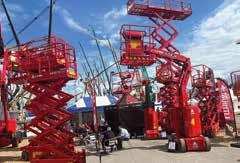


Brilliant Ideas launched its new Alimats Half Loader Spreader Module. Designed to provide a more even load spread under high outrigger loadings, the new profile is deeper than the standard profile and three times stiffer.

On display near the entrance, the Aspen A-62 under bridge inspection unit on a four axle Volvo chassis has an 18.8m underbridge reach, can reach 20.6m below ground level and 16.6m vertically with 272kg basket capacity. The chassis can operate without outriggers and being 2.55m wide only needs one lane to work.
UK Zoomlion dealer AJ Access launched several new electric boom lifts including the 72ft ZT22JE telescopic boom, and the electric version of the ZA20J diesel - the 65ft ZA20JE didn’t make it to the show but will be available shortly. Also seen was the 86ft ZT26JE all-electric telescopic boom, the 32ft ZA10RJE compact zero tailswing industrial lift with an 11.5 metre working height, and the ZA14J diesel/ lithium hybrid ZA14JE-Li.


Vertikal Days has always provided a great indication of the latest machine sales in the UK. Having at least one new machine on display at the show has become something of a ‘badge of honour’ for many crane and access rental companies. This year the buoyant UK equipment sector was evident by the number of items on display in customer colours. Nick Johnson captured many of the customer names on booms to provide a visual record of the latest fleet additions.
The biggest stand at this year’s Vertikal Days was Liebherr’s and most of its exhibits sported customer colours. The largest of which included the new 300 tonne, six axle LTM 1300-6.3 for King Lifting making its UK debut, a 230 tonne, LTM 1230-5.1 for Stoddart Crane Hire, a 180 tonne, LTM 1160-5.2 for Abba Crane Hire and a 150 tonne LTM 1150-5.3 for Forsyth of Denny all on five axles.


Other cranes on the stand were a 90 tonne, LTM 1090-4.2 for Crowland Cranes and a 50 tonne, three axle LTM 1050-3.1 for SDM Fabrication carrying the name Ellie-May. Finally, a 100 tonne LTR 1100 telescopic crawler sported the livery of G H Johnson & Sons.
Next door two crane hire companies had their own stands. NMT Crane Hire which used the
show to promote its new management structure, while its exhibits comprised three new cranes including two Liebherr All terrains - a 120 tonne, four axle LTM 1120-4.1 and a 60 tonne three axle LTM 1060-3.1 - alongside a six axle Spierings SK1265-AT6 eLift mobile tower crane with full electric operation on site.

Emerson Crane Hire meanwhile showed off its new 450 tonne, eight axle Liebherr LTM 1450-8.1 - the largest All Terrain at the event - alongside a 60 tonne, three axle LTM 1060-3.1. and a brand new, fully equipped escort vehicle.
Across the aisle on the Nationwide Lifting Solutions stand was another new Liebherr All Terrain looking smart in its silver and black livery - a 60 tonne, three axle LTM 1060-3.1.
On the Tadano stand an 80 tonne, four axle
AC4.080-1 for Cadman Cranes, featured distinctive signwriting highlighting Cadman’s 50 years in business and included a picture of red poppies on the side with the poignant message “We will Remember”. Tadano also exhibited its latest All Terrain, the 40 tonne two axle AC 2.040-1- the first crane developed jointly by Tadano’s Lauf and Demag Zweibrücken engineering teams, in the colours of Mann Crane Hire and Sparrow Crane Hire’s Plymouth depot. New Grove All Terrains included a 250 tonne, five axle GMK5250XL-1 for Crowland Cranes, a 120 tonne, GMK5120L for Baldwins Crane Hire and a 60 tonne three axle GMK3060L-1 for Lee Lifting Services.
Truck mounted cranes with aluminium/steel booms continue to prove popular with new cranes on the Böcker and Kranlyft stands. Böcker had no less than three AK46/6000s on display - all mounted on MAN chassis - in the colours of Berry Cranes, Crowland Cranes and Nationwide Lifting. Kranlyft displayed a Klaas K1100 aluminium boom crane mounted on a Volvo FMX 6x2 truck
and finished in the bright orange livery of long established UK company Chamberlain Crane Hire. Alongside was a smaller Klaas K1003, also on a Volvo destined for Graham Jones Contract Lifting of Wrexham.
Spierings had two mobile tower cranes on show, one was the second of two fully electric three axle, SK487-AT3 City Boy machines for City Lifting whilst the other was a six axle, SK1265AT6 eLift for Cork Crane Hire.

Making its UK debut on the Sany UK stand was the 60 tonne Sany SCE600TB telescopic crawler crane from TMT Crane Hire and Contract Lifting of Brentwood, Essex.


Among the new spider cranes on show was a 2.8 tonne Maeda MK3053C ECO prototype, with a maximum lift height of just under 17 metres, which will be available around October this year. The crane has already attracted orders from several companies including Hird, whose name was on the show machine.

There was a ‘sea’ of the latest orange Jekko spider cranes from Italy on the stand of distributor J T Cranes. A different coloured Jekko was the all-electric 2.8 tonne capacity SPX328 making its UK debut at the show in the green and white livery of McGovern Crane Hire. The SPX328 has a 12.8 metre main boom and 10.4 metre articulated jib. Russ Taylor of JT Cranes formally handed the new crane over to Kieran McGovern at the show.
Truck and van mounted platforms carrying the names of their new owners could be spotted on many of the stands. One truck mount that stood
out was a 38 metre Bronto S38XDT on a 4x2 Volvo FE chassis for Nationwide Platforms. New 20 metre platforms sported customer names included a GSR B220PXE on an Iveco 35-140 chassis for Nationwide Platforms, a Ruthmann Ecoline RS200 on an Iveco 35-140 for P G Platforms and a Comet 20.10 HQ on an Iveco 35-160 for Peter Douglass Platforms.
The CPL stand featured one of the many 12 metre Klubb KL26 electric van mounted platforms now available for long term hire and lease from Access Hire Nationwide. Mounted on a modified Renault Master ZE van, this all electric platform carried prominent Access Zero signage.
Luffing jib tower cranes on the Peterborough skyline this year included two units from the fleets of two prominent UK companies. Falcon showed off a five tonne capacity Jaso J80PA,
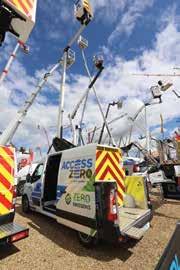


Manufacturers, distributors and rental companies in the construction equipment market have long been male dominated businesses. That has been slowly changing over the past decade, but the pace of change is now beginning to gather real momentum - at least in the European aerial lift business where there are already a good number of strong, talented women excelling in key positions. Leigh Sparrow interviews Tjitske van Hellemond - managing director of JLG’s commercial operations for Europe, Africa, the Middle East and India - one of many women moving into senior positions in the access industry.
In 1982, when I was appointed as district manager for a crane manufacturer, most of the women working in the business were secretaries or accounting clerks. I do recall however, several astute, capable, and highly talented ‘Personal Assistants’ working for senior executives, who wielded enormous soft power but were still regarded as glorified typists or dogsbodies, even though they were often more capable than the men they served. At the time, one of my territories was the Netherlands - one of the most male dominated markets I looked after - but my direct competitor was a woman - Jeanine Jappes or Jeanine De Cock as she was later known. She was possibly the only female salesperson in the industry at that time - and I am not sure it has changed that much since then? She was a true trailblazer. I had been thrust into the job at a young age with little experience of the role and soon discovered that while I had the better products, better range, better brand name and worked for a more dynamic company, I soon learned that I was completely outclassed by Jeanine. I also realised

from causal conversations with customers and dealer staff that any woman in such a role had to be twice as good as any male - and Jeanine most certainly was.
Jeanine still attends the occasional trade show, despite having retired on several occasions. Since retiring the first time around, she worked with GGR - the European master distributor for Unic cranes - helping set up its distribution network. At GGR, she worked for Gill Riley, a tough nononsense boss with zero ability to ‘suffer fools

gladly’. Jeanine was called out of retirement on several occasions after a male replacement failed to make the grade.
The situation regarding women in senior management positions has changed for the better, but old prejudices remain, in some countries more than others. This is the first in what we hope will become a series of interviews with leading women in lifting related industries.

To begin, we spoke with an individual who, while she has been in the access industry for six years, is not particularly well known and is almost certainly underestimated. Many people were surprised when earlier this year Tjitske van Hellemond was appointed as managing director of JLG’s commercial operations in Europe, Africa, the Middle East and the Indian sub-continent, with responsibility for all sales, customer service and after sales activity.
The move followed a restructuring that brought all the company’s businesses and products under one umbrella, including those manufactured in Tonneins, France, and at Power Towers in the UK. It also includes direct sales subsidiaries in four European countries.
Before her promotion, van Hellemond was responsible for regional marketing, more recently adding customer care to her role. We wanted to find out how this seemingly mild-mannered individual was catapulted from a low profile marketing executive to such a wide ranging senior position.

Born and bred in the Netherlands, van Hellemond made the unusual decision to study to be a civil engineer. Why did she choose such a maledominated career?

“My father was a civil engineer and while he never encouraged me to follow in his footsteps - in fact, he positively tried to talk me out of itwhen I was growing up, he would regularly pull over to the side of the road to look at a bridge or other impressive structure, it was hard not to soak up his enthusiasm for his work and what he helped create. I also loved mathematics and physics, subjects which are well suited to such a career.”
“When I decided I wanted to be a civil engineer, my father tried to dissuade me knowing full well that this was no career for a girl, even the degree course would be male dominated and not particularly welcoming to female students. That simply made me even more determined. So, when I went for the university interview, learn more about the course and meet the other applicants, I took my mother rather than my father. When my mother and I left the building we had exactly the same impression, while things might have moved on a little since my dad was studying, it was not by that much. I thought to myself - I can and will do this.”
“By the time I started the course there were just two other girls in my year. I thoroughly enjoyed it and did well, although, as I progressed, I began to realise that I did not really want to spend my life as a technical engineer. So, when finance and insurance company Accenture offered me
a job as a financial service consultant following one of those career fairs, I accepted and spent a wonderful four years in an incredibly intensive environment working, eating dinner and socialising with my colleagues around the clock. There was very little life outside of the job, it was all work. Although it was incredibly intense it was also a lot of fun, but it is very much a life for young people starting their careers.”
“While banking and finance has a reputation for being an extremely male oriented industry, I found that it was much more open than that, just so long as you are able to handle an intense work-related lifestyle. However, it began to dawn on me that I would like to work in a more tangible industry - banking is a numbers business and not at all product related.”
“In 2008 I landed an interview with Caterpillar dealer Pon, (which was to acquire access rental company Gunco, Crane rental company Milcon and Crane and access distributor HDWJeanine’s old dealer - but that is another story) as soon as I pulled into the yard for my first interview, the sight of all the big Cat equipment immediately captured by imagination and I thought there and then ‘this is for me, yes!’ It was an exciting time at Pon in that it owned Cat dealers in four countries and I was involved in all aspects of the business as assistant to a senior manager - not just in title, but in reality, helped by my engineering background. Although I was a civil engineer and not particularly familiar with equipment, the fact that I was an engineer and had a technical ability really helped.”
“In 2013 Pon acquired the Trimble distributor Sitech, and I was appointed as its general
manager. The previous owner had agreed to stay with the business for an extended transition period, so I got to work with him, listening and learning. My brief was to integrate the business into the Pon group over time, without destroying it. Although this period of my life lasted less than three years it taught me a great deal. I had several significant obstacles to overcome, firstly I was seen as an agent and a spy - the eyes and ears of head office. Secondly I was young for the job and a woman in a company of more than 20 employees, of which only two were female - a secretary and the owner’s wife who looked after the finances. But thirdly, and perhaps even more of a challenge was the fact that I was a northerner going into a very southern Dutch company. My name and even the way I spoke were even more northern than the North.”
“My approach was to completely avoid anything that might suggest I was showing that I was the boss, preferring to take a much humbler
approach, to listen and learn and understand how people related with each other and what made them tick. It has never been in my nature to be the first to shout out. I also made sure to take time to win the trust of the former owners wife, not only because she was in charge of finance, or that I was spending most of my time in the early days with her husband, as I soaked up knowledge - but also because it became clear that there was much I could learn from her as I came to know and understand the business. She was very good, almost like the ‘mother of the company’ and she helped me a great deal. The next two years or so were really good ones, and we managed to integrate the business without spoiling it and at the same time expand.”
So how come you did not stay with the business longer? Especially given that telematics were the up and coming thing at the time?

“Well, the location was the big thing, as family began to play a more important role in my life. We lived near Almere, so the job at Sitech involved long commutes and I had not long given birth. So,
I began looking to relocate to a Pon division closer to home, if and when an opportunity appeared.”
“By chance at that time a fantastic job did come up, but it seems that I was discounted at an early stage of the selection process. It turned out that those responsible for making the selection had assumed that having a new baby I would not be interested. Thankfully one of the women on the selection panel contacted me and said that she thought it should be me who decided if I was interested in the job or not, rather than the members of the panel. I said ‘yes!’ I did want to go for it. And I made it through to the final stage and was ultimately chosen to run the Pon parts and service operations.”
That is a massive job at a national Caterpillar dealership, and a critical part of the business and yet you had little, if any, experience of running even a small parts or service operation?
“True, but I had a technical background, and by

now I had a good cross section of experience and had even managed an entire business within the group, where I learnt how to manage everything from cash flow and finance to sales, marketing and dealing with an OEM.”
“But you are right, and I saw that as a serious issue, so for the first few weeks on the job I insisted that I worked on the shop floor learning what everyone did - as a co-worker not simply as an observer. As you might imagine, they took the opportunity to give me all the nasty jobs, such as washing down the dirtiest machines coming into the yard for repair. And they played all of the usual new trainee tricks on me, such as cranking up the pressure washer to maximum so that the first time I pulled the trigger the recoil almost blew me across the yard. In spite of such trickery, I really enjoyed it and surprised some of them because I did not care how dirty I got, or how hard the work was physically. I also made a point of taking my coffee and lunch breaks with them, just as I would have done if I it had been my permanent job. It would have been so easy to head upstairs for my lunch, but I learnt so much and the time spent there has proved invaluable on so many levels.”
“In this new job I got to work closer than ever with Caterpillar which had a regional office in the building, I also had overall responsibility for parts and service operations in the other three countries that Pon covered, which not only gave me an international perspective, but allowed me to compare the different work practices between the companies, with the aim to adopt the most successful strategies. The use of Telematics data in aftersales service was also coming on stream, which was perfect timing, given my Sitech experience, as we looked at ways of using all that data in the most effective way possible to improve our business. It was especially interesting to learn how our operations in Sweden and Norway overcame the incredible geographic challenges, especially with the bigger equipment,
travelling incredible distances on roads that are not so great.”
It sounds like a wonderful opportunity and experience and sounds as if you were being ‘fast tracked’ for even more senior roles. And yet you did not stay with Pon that long what happened?
“Yes it is true I was in the job for little more than a year. What happened was that an ex Pon colleague, a person I trusted and respected enormously, approached me about a job at JLG. I knew nothing about the access industry, but he insisted that the opportunity was one I should go for. When I hesitated, he pushed me to at least go along for an initial interview - with no commitment.”
“Eventually I thought, ‘well what do I have to lose’, it would involve learning new skills and going into marketing, an area of which I knew little and I have always tended be attracted by the unknown and moving outside of my comfort zone. So, I went along and met Karel (Karel van Huijser - regional vice president). When I told him that I had no direct experience of marketing - he said: “We have people here who know that - I am looking for someone who can help over a much wider area.”
“I liked the look of the access industry, and I would be working for a manufacturer, an OEM. So, I began to warm to the idea, but it took months, as I was not at all keen to leave Pon. What finally swung it, perhaps was when he said: ‘Look go to JLG headquarters in the USA to meet everyone over there, take your husband and stay the weekend.’ So off we went to Hagerstown, Maryland. I had eight interviews in a single day and liked what I heard and saw. Then we went and stayed in Washington for the weekend, enjoying a rare opportunity to have time for just the two of us, and were able to think about our lives and where our careers were going etc. We loved Washington and decided that weekend that I would give it a go and say Yes.”
“So, I joined JLG in mid 2017 as the regional director of marketing. It was an exciting time as JLG had recently acquired Power Towers and there much was going on.”
So, tell me, when you are looking to fill a new role, especially senior ones, and you are confronted with a very experienced male candidate and perhaps a less experienced female - how do you handle it?
“I try to look beyond the apparent experience and look at the person and what they might be able to achieve. But a much bigger problem is persuading enough women to apply for such jobs. I find that typically when a woman reads a job advertisement, which lists 10 required skills or criteria, and she only fully meets eight of them she will take the view that she is not qualified. A man doing exactly the same and meeting only five of criteria will think the job was made for him. It is hard to know how to overcome that.”
In summary, Tjitske van Hellemond’s career, not to mention Jeanine Jappes’, shows how it has always been possible to make the grade as a woman in a male dominated industry, BUT - it does involve everything working out, a company that is open minded to some extent or other, often being in the right place at the right time, and having some luck and good fortune on your side. All that plus it has typically involved being better and working harder, which will eventually win the respect of even the most hard-boiled dinosaur. Van Hellemond also mentioned the benefit of mentors several times, and this is true for everyone - male or female. I do think that we are getting closer to a truly level employment playing field, and that now the major challenge is encouraging enough female candidates to apply for jobs in our industry. Business will be all the better for it. ■


Anyone who’s ever tried installing anything significant in remote areas knows the uphill battle it can be to transport and then use a crawler or other large crane. So, when Frontier Power Systems was asked to supply wind power generation systems for customers in some of North America’s most challenging terrain, the Canadian company turned to old fashioned gin poles to get the job done. Saul Chernos reports.
Gin poles have absolutely nothing to do with the beverage distilled from juniper berries, though one might enjoy a tipple after a gruelling day in harsh conditions. The term gin pole is in fact derived from gyn, a tripod shaped derrick, which uses a pulley or block and tackle on its upper end to lift objects into place.
The pole’s lower end is braced or set in a shallow retaining hole or socket and positioned so that the upper end lies above the object to be raised. The pole is then secured with guy ropes which can be manipulated to move the load as required.
Over the years, gin poles have hoisted everything from roof trusses to weathervanes. Now, Prince Edward Island-based Frontier is pairing them with winches to leverage modest sized wind turbine towers into place in some of North America’s most isolated communities.
“A gin pole can be a viable way of replacing a crane when conditions aren’t compatible with using a crane,” said Frontier president Carl Brothers. It should be noted that the turbines small communities use are insignificant in comparison with those feeding power grids. While an 18MW behemoth in an industrial park in China’s Shandong province stands as the current record holder, Frontier’s customers are typically looking to offset diesel generators with emissions free power. So, its turbines trend in the 100KW range, with comparably short towers of 32, 40 or 50 metres in height and components maxing out at five to six tonnes.
While Frontier often uses conventional cranes to lift towers and other heavy materials, the conditions in remote ‘fly-in communities’ such as Atmautluak and Chefornak in western Alaska are simply too challenging for a crane of any significant size.

The only practical way in for heavy equipment is by barge during the summer months, when waterways aren’t hampered by ice. The ground is also boggy and soft - muskeg is more predominant than rock - so cranes can’t be set up and tower anchors bolted into place until the wintertime freeze. By that time, much of Alaska is bitterly cold, snowy and short on sunlight.
“March and April are usually the construction season for this sort of work,” says Brothers.
“We can do some work in the fall, but winter is very difficult in these areas, and unless you’ve got really exceptional soil conditions there’s not much to be done in the summer in most of the communities we have worked.”
The harsh conditions set the stage for the lightweight gin poles, which are relatively easy to bring to site and work with. While turbine towers are usually installed in sections, gin poles lift the


entire assembly as a fully constructed entity.
Frontier not only designs wind turbines but also configures its own gin pole and hydraulic winch systems to suit the job at hand. “It is a completely engineered package and you just piece it together like a Meccano set,” says Brothers, noting the taller the tower, the longer the gin pole by a two to one ratio. “On a 50 metre tower, we use a 25 metre gin pole. The taller the tower and the heavier the turbine, the more force you need.”
Crews begin by setting up gin pole sections by hand, with help from a loader or skid steer rented or borrowed from another user in the community. The next step is to do the same with the tower structure - setting the pieces on the ground horizontally and manoeuvring them into place.

Key to the gin pole’s function is the hydraulic winch. Frontier says that it could use electric winches, but finds that they are heavier and require larger generators than are generally available on location.


Frontier’s winches hold up to 365 metres of rope


and are typically reeved with between 10 and 14 parts of line. “You reduce the load on your winch line, but multiply the force with your block assembly, providing the force we need to pull up a heavy load with a relatively small winch.” While manoeuvres are generally straight forward, they do require pre-engineering just as a crane lift does. “You need to consider your foundation,” says Brothers, noting that access and load considerations are critical regardless of the device used for a lift. “Before we ship our turbines, we need all the geotechnical information so we can design the anchorage, and we need the site’s physical layout so we can ensure the turbines can be laid out and assembled. We’ll also ask the construction company to ensure the access point from the barge landing to the site is suitable for delivering the equipment.” Brothers hesitates to discuss costs in detail because the specific nature of a project ultimately dictates the price tag, and gin poles can be less expensive or more expensive than cranes. “There’s


a continuum where it’s much more attractive, almost the same, to much less attractive. If you have to bring a crane into a remote community and leave it there for a year, that’s a pretty expensive undertaking. That often happens in these projects.” The process of erecting a tower and turbine can also be slower with a gin pole than with a crane, and even in isolated locales there are circumstances where gin poles simply aren’t feasible. Brothers points to one job he is currently planning in Ramea, Newfoundland, where hilly terrain and steep slopes don’t offer the flat ground that crews need to assemble their gin pole or turbine. “In some mountainous areas, it’s just not practical. In that case we would use a crane or a boom truck.”
The bottom line, says Brothers, is selecting the tool that makes sense for the project. “Every location is different, the specific requirements of each project need to be engineered to select the most economic equipment and procedures to use.” ■

Produced in conjunction with a specialist industry Working Group, ALLMI has added to its Guidance Note series with the publication of ‘GN034 Tipper Grab Supplementary Instructions’. ALLMI technical manager Keith Silvester, who chairs the Tipper Grab Working Group said: “Whilst comprehensive manufacturer instructions exist for the tipper, loader crane and clamshell bucket as individual elements of a build, GN034 provides valuable direction on their installation as a whole, as certain practices involving the crane and tipper body combined may not otherwise be addressed.”

Key topics include controls to be implemented when tipper grabs are loaded by other means such as a bucket/shovel loader and the sequence of operations and measures required when tipping.

For a complimentary copy please contact ALLMI.
Sergeant Alex Burlison, Dangerous Goods Safety Advisor for the Metropolitan Police Service Commercial Vehicle Unit (CVU), will be the guest speaker for ALLMI’s membership meetings on 22nd June at the Forest of Arden Country Club in Meriden. He will explain Metropolitan Police activity and criteria in relation to roadside checks, as well as reporting on accident case studies involving lorry loaders and the CVU’s recent work with ALLMI. The meetings will also provide updates and debate on numerous industry issues and ALLMI projects/activities.

ALLMI’s industry representation continues to grow, with new member registrations to the end of May double that of this time last year.

One new member is Bimson, a national brick and block haulier serving UK construction materials manufacturers. The company’s logistics compliance manager, Kevin Buckler said: “Having been a user of ALLMI training for nearly 10 years, achieving member company status was a logical move for us. The application process included comprehensively reviewing the lorry loader aspect of our business to ensure we conform with legislation, standards and industry good practice, resulting in a membership that further enhances our already strong reputation for safety and quality.”
ALLMI chief executive Tom Wakefield added: “ALLMI membership is something which is earned, and companies work hard to meet and maintain the required standard. It is, therefore, important that the industry recognises the value that should be associated in dealing with an ALLMI member, and the investment in quality the company will have made to have the right to display the ALLMI logo.”
“We also have a provisional membership category, allowing companies that aren’t quite able to meet the audit requirements to still be a part of the association, thereby having access to our training, guidance and support. Importantly, these companies cannot bear the ALLMI logo until full membership has been achieved, but it’s an excellent means of helping them to improve what they do and is another demonstration of ALLMI’s ability to raise industry standards in a very direct and tangible way.”
ALLMI provides membership for: manufacturers/importers, installers, service companies, ancillary equipment suppliers, fleet operators and site operators. Annual subscriptions start at £450. Visit www.allmi.com/membership for more information on the benefits of membership.
The Civil Aviation Authority has launched the Airspace Coordination and Obstacle Management Service (ACOMS) an online facility designed to streamline aerodrome notifications for crane operations. All crane permit applications should now be made through ACOMS. Further information is available at www.caa.co.uk

In relation to the requirements of CAA publication, CAP 1096 - which is anticipated to have changes to the distances/heights specified - for the time being it remains that if a crane is to be used within 6km of an aerodrome/airfield and its height or load will exceed 10 metres or that of surrounding structures or trees, the Appointed Person should use ACOMS to request permission to proceed.
Contact ALLMI, should you have any lorry loader related queries on this issue.
A reminder that the Global Lifting Awareness Day 2023 is on 13th July. ALLMI is once again a partner for the event, which aims to promote the lifting industry, with particular emphasis on good practice, compliance, innovation and attracting new recruits to the sector. Further details can be found at www.globalliftingawarenessday.com.
The Draft for Public Comment window of the amendment to EN 12999: 2020 - driven by ALLMI’s work on the design of swing-up stabilisers - has now closed. A Comments Resolution meeting is scheduled for 31st August in Bergamo, Italy.
For details of ALLMI standards, guidance documents and training, visit: www.allmi.com


IPAF has signed a memorandum of understanding with the Korea Crane Association (KCA), committing to closer co-operation on work at height safety. The agreement was signed on 17th May by Romina Vanzi of IPAF and One-Kyu Chung, chairman of the KCA.

Among its objectives is a commitment for the two organisations to promote the safe and effective use of aerial work platforms, and aid companies in achieving compliance with legislation, national and international standards, expanding training, and jointly participate in relevant events.
KCA is also set to open an IPAF training centre, following the Korea Rental Corporation, which was accredited as the first IPAF Training Centre in Korea in 2018. IPAF has been increasing its profile in the Republic of Korea since appointing Roberto Kim as a dedicated representative for the country in 2020. Romina Vanzi said: “The powered access industry in Korea is similar in size to that of the UK, this link-up with the KCA is an important step forward in spreading the safety message and building engagement with end users of powered access equipment. The agreement will initially run for five years, and we look forward to working with the KCA to promote work at height safety, quality training and offer mutual support at industry events.”
Peter Douglas of IPAF, added: “We are pleased to come together with the KCA to further our joint aims to promote safety and the importance of quality operator training to all users of powered access in the country.”
The launch of the 2023 IPAF Rental Market Report is now available to see on the IPAF website and YouTube channel. It includes an introduction from chief executive Peter Douglas and an in-depth review of the findings from the German rental market by Jana Rohwer, senior market analyst at Ducker.
IPAF has worked with Ducker for the past 14 years to provide detailed insight into global powered access rental market trends. The 2022 report covers the UK, France, Germany, Italy, Spain, the Netherlands and the Nordic countries, plus the USA and Canada, along with a special focus on China. The report is available to purchase as one of four packages, while IPAF manufacturer, rental, dealer/ distributor and supplier members qualify for a free version of the report as part of the expanding range of membership benefits.
Peter Douglas said: “The IPAF Rental Market Report is the leading analysis of key global aerial work platform rental markets, compiled by Ducker with input from our members, representatives and industry experts worldwide.”

“Last year, as part of IPAF’s ongoing commitment to supporting our members during economically volatile times, we decided that rental, manufacturer, dealer/distributor and supplier members should be eligible to claim a free version of the relevant market report. The report offers invaluable insight into the state of the market, reflects trends stretching back over a 10 year period, and includes market confidence and sentiment for this year and beyond. In my view it is an essential piece of business intelligence for any serious player in the aerial work platform rental market.”


The reports estimate the size of the aerial lift rental fleet worldwide and includes metrics on rental revenue and rates, fleet size, utilisation rates, fleet mix, power sources, investment, retention periods etc. The Global Report compares all countries under study and includes data analysis and comparison by country, region and machine type and more.
The launch is available at www.ipaf.org/resources or www.youtube.com/@IPAForg IPAF members can register for their free report, while others can purchase a copy at www.ipaf.org/reports.

IPAF used the Vertikal Days 2023 event on 10-11 May to promote its Load and Unload safety campaign. Visitors to the IPAF stand could try their hand at a “wheel of (mis) fortune” safety quiz to put their knowledge of safe loading and unloading to the test. All those who successfully passed the challenge were offered a water bottle courtesy of Warren Access. IPAF’s representatives were also on hand to offer support and technical guidance including the latest leaflets, stickers, Andy Access safety posters and Toolbox Talk site safety briefings.
IPAF will host a special event to mark and highlight its 40th anniversary at The Belfry Hotel & Resort in the UK on 16-17 November. The event will also include an afternoon conference, followed by dinner and entertainment. The following day there will be opportunities to participate in golf or spa activities. Visit www.ipaf.org/elevation for further information and to secure your place at this event.


As part of this year’s Vertikal Days, two of the CPA’s Special Interest Groups - the Crane Interest Group (CIG) and the Tower Crane Interest Group (TCIG) - held a joint open meeting during the event at the East of England Showground in Peterborough.


The Crane Interest Group is chaired by Peter Gibbs of Ainscough Crane Hire, while David Holder of Wolffkran chairs the Tower Crane Interest Group. The joint open meeting held on the first day of the exhibition was very well attended with more than 70 people participating. the new cAA notification system
The meeting was opened by CPA chief executive Kevin Minton, prior to CPA technical consultant Ian Simpson delivering two presentations. The first provided an overview of the new Civil Aviation Authority (CAA) automated online notification system which went live on 2nd May 2023. The old notification method of using DAP1924 - as detailed in the April 2021 version of CAP 1096 or AVOKA submissions - is no longer accepted. Users must register to use the system on the CAA customer portal which can found at www.caa.co.uk/commercial-industry/ airspace/event-and-obstacle-notification/cranenotification.
Notification is required if a crane is:
• To be used within 6km of the aerodrome/ airfield and its height exceeds 10 metres Above Ground Level (AGL) or that of surrounding structures or trees, if higher. Or….
• To be operated at or above a height of 100 metres AGL, regardless of location or height of surrounding structures.
Where cranes are to be in-situ for more than 90 days, users must also notify the CAA by the ACOMS Service, and the Defence Geographic Centre (DGC) before installations begins. There are also specific crane lighting requirements namely:
• Above 150 metres - it must be illuminated with 2000 candela.
• Within 6km of aerodrome - as dictated by the aerodrome operator.

• 45 metres to 150 metres - recommend 2000 candela.
• Less than 45 metres - recommend 32 candela. The CPA will continue to engage with the CAA regarding the crane notification and lighting requirements. While the CAA has retained the existing 6km and 10 metre height, or 100 metre height AGL notification triggers, these criteria are under review and may change.
The CPA Annual Golf Day will be held on Thursday 20th July at Rutland Water Golf Course in Oakham, Rutland. Proceeds from the event will go to industry charity, the Lighthouse Club. With views over Rutland Water Reservoir, the Normanton 18 hole championship course is one of the country’s finest new golf courses.

Participation is open to individuals and companies, with prizes awarded for the winning individual and team, as well as nearest the pin and the longest drive. Last year, London Tower Cranes was the team winner, while Lawrence Carter of London Tower Cranes won the individual competition. Greg Dimoline of Tower Cranes UK won the longest drive and Grant Chamberlain of Nixon Hire won nearest the pin.
For more details contact David Smith on 020 7796 3366 or email david.smith@cpa.uk.net. The cost of the day is £100 per person plus VAT and includes coffee and bacon rolls, 18 holes of golf, a three course dinner and an awards ceremony with prizes.
In his second presentation, Ian Simpson referred to guidance currently being developed relating to the minimum standards required for the procurement of a mobile crane. The guidance was requested by the CIG Steering Committee and the initial draft is based on guidance on the HS2 project and provided by Lead AP group members.
The overall aim of the guidance is to encourage crane users to source cranes from responsible providers that can demonstrate that they can provide cranes and lifting personnel to undertake lifting operations safely in compliance with good practice guidelines and statutory requirements.
It considers movement on the public highway of cranes to site and the use of the crane to undertake lifting operations on arrival, and also covers legal requirements and good practice, and directs readers to further published guidance.
The next presentation - delivered by inspector Richard Wenham who heads up the Metropolitan Police Commercial Vehicle Unit - covered movement orders and authorisation for cranes and encouraged consultation with the Commercial Vehicle Unit.

Three presentations were then delivered on the topic of working at height, drop prevention and engineered solutions, by Bradley Rix and Chris Garton of Falcon Tower Crane Services, Steve Bradby of Select Plant Hire and Steve Palmer of Wolffkran respectively.

Place your products in front of almost 25,000 crane, telehandler and aerial lift buyers & users reading the June issue of cranes & Access…

We report on some interesting developments, along with a roundup of the latest new product launches, including flat tops, luffers and self-erecting tower cranes.

There’s always plenty of product news for scissor lifts given the size of the market and the current pace of development in terms of electrification drive train improvements. We will also look at the growing range of tracked and self-levelling scissor lifts.

The tree care market has always had a need for access and lifting equipment, with demand growing rapidly for powered access equipment and new, more efficient and safer methods. We look at the growing range of equipment available from vehicle mounted to spider lifts.


The C&A annual product source guide lists all the companies manufacturing cranes, aerial work platforms, telehandlers and ancillary equipment, complete with the product types they offer and their contact details. A handy guide for year-round use.
The APEX show was held this year after a six year absence following the cancellation of the 2020 event. It also returned to its original venue of Maastricht after a 12 year absence.
We report on the new products and developments from the event.
Every issue of c&A is also packed with our regular columns and news plus reader’s letters, books, models, training, along with the latest news from cPA, AllMi, and iPAf
Palfinger has opened a new education and training centre in Upper Austria with an extension to its Lengau location. The new 1,600 square metre/€10 million investment includes high tech conference and training rooms with interactive stations.


Courses will range from apprentice training for high school graduates to training programmes for managers. Palfinger opened its first apprentices’ workshop at the Lengau location 30 years ago. Today, around 120 apprentices are trained there in 15 technical and commercial professions.
Speaking at the May 8th opening, chief executive Andreas Klauser said: “At Palfinger we embrace the philosophy of facing today’s challenges by taking the initiative. We have created state of the art training and education opportunities for existing and future employees, marking an important investment for our company, the region and our entire production and competence network.”


Vertikal Days played host to My Future My Choice for the first time since 2019 and the first time at Peterborough.

As in the past, two groups of students from local schools attended, with students in Key Stage 2 & 3 - aged from nine to 13 - on day one and older students, Key Stage 4 - aged 14 to 16 - attending on day two. The event was supported by Liebherr, which made a presentation during the event, while allowing those interested to operate a crane.
An incident on a site in Newcastle, UK in January 2020 has cost principal contractor Tolent Construction and its sub-contractor SIP Build UK a combined £66,000 after a lift supervisor was struck by a 124kg panel that fell from a tower crane, putting him in hospital for two weeks. The crane was lifting Structured Insulated Panels when one of them struck steelwork and fell on him, fracturing his collarbone, shoulder blade, left ankle and left rib.
The investigation found that Tolent had failed to properly plan, manage and monitor the construction phase. Most importantly, the lift plan failed to stipulate how the individual panels were to be safely lifted, and failed to consider proximity hazards or how they would be adequately controlled during the lifting operation.
Clad Build UK T/A SIP Build UK, was responsible for the design, supply and installation of the panels and was found to have failed to plan, manage and monitor the work, or provide the information and instruction on how to prepare them for lifting. It also failed to ensure effective supervision and monitoring of the work or comply with requests for information from the principal contractor.
Clad Build was fined £12,000 plus £45,000 in costs, while Tolent Construction - which entered administration prior to sentencingwas fined £1,000 pus £8,468.50 in costs. The recorder, James Wood KC, stated that had it not been insolvent, it would have received a £1 million fine, noting that as Tolent had not used voluntary liquidation to avoid a fine, imposing such a high penalty would have been wrong.
Spotted in Australia, someone who decided that unloading was simply too much bother.

Eco Waste and Recycling has been fined £30,000 plus more than £3,000 in costs, after an employee’s leg was amputated above the knee, following an incident in which he was run over by a telehandler in March 2022. The man, who was 51 at the time, was hand sorting recyclable materials at the company’s site in Newnham, Hertfordshire, UK when he was struck from behind by a reversing telehandler. The investigation found that the company had failed to adequately segregate vehicles and pedestrians on the site or act on the findings of risk assessments.


The Liebherr LR 11000 crawler crane has a maximum capacity of 1,000 tonnes at a radius of 11 metres and has been modelled by NZG of Germany in 1:50 scale. It comes with parts to build an SL8F2 configuration which is typically used for wind turbine erection.


It arrived in a huge box with the many parts well protected from damage. Assembly instructions are included, along with a full set of tools to help with the assembly. It takes a number of hours to assemble and rig.
The metal tracks are mounted on removable frames which include working rollers. The tracks roll very easily and the complete model can be carefully manoeuvred nicely on the tracks. Metal guardrails are used throughout although they need to be set carefully to stand straight. A nice inclusion is erection outriggers for posing the model during boom erection.
The operator’s cab is detailed and tilts to a good angle, it also rotates to the transport position. The crane superstructure has discrete holes to allow the winch drums to be operated using supplied


keys, and the winches have positive brakes which perform well. All the counterweight blocks have useable lifting points and chevron type graphics. The heavy boom sections are well made, and the boom foot is a particularly complex piece. The pendant bars are robust metal pieces connected by brass nuts and bolts.
Three hooks are provided. One has a single sheave and is metal and well made. The second is a large heavy lift hook block which is very good, and the third is a single line hook.
In terms of functionality the crane slews well and is stable with the boom fully installed. It also breaks down into realistic transport loads. This is the type of model that impresses anyone who sees it because of its huge size. Even in this simple configuration the model weighs more than other large crawler crane models. It has the scope to be significantly extended and it is expected that add on kits will be released in future. Overall, it is an excellent model. It costs €824 excluding VAT from the Liebherr webshop.
To see the full review, including a full unpacking and set up video, visit www.cranesetc.co.uk

My name is John Alder, my father was a rep through the 1970s and 80s for Mark, Calavar and Hunterlift. Later on, he worked with Simon and as a consultant for MI-Jack. John Parker was a frequent guest of my folks when in Chicago and then when in Southern California.
When I relocated to the Los Angeles area John helped me get started finding a residence and having me work at the plant for a short time. He suggested I take the position offered to me by Calavar where I became a field service rep and learned a bunch! I had previously met Russ Guthrie as he had also visited our home. These guys were super smart and very cool!
When Parker made the deal with Calavar to use his design for their scissor lift line I went to the Hunter facility to learn about the machines for my field service training. It was a very cordial environment. Some of the assemblers were Vietnamese guys that were super meticulous about their work. The electrical systems were very ‘sano’! I had been wondering about John recently and was so sorry to learn of his passing.
Another character from that era was Terry Hansen. He was a field service rep for Calavar in their early self-propelled days and became the service manager at Calavar. I travelled as a service rep for him. He was great to work for and we became pretty close friends. I lost track of him long ago but think of him often.
Condolences to John’s family, I know they were very close. I wonder how David is doing these days…I always thought young John looked like Joe Montana….LOL
Sincerely, John Alder
Facebook: Johnny Alibi or Alibi’s Garage
This letter follows the tribute/obituary to John Parker in the May issue of Cranes & Access, if any of our readers can shed light on those mentioned in John’s letter I am sure he will appreciate it - as would we.

I have just read the story on Vertikal about Nationwide installing a lanyard detection system on its boom lifts, and seeming to urge other companies to do the same by buying it from them? This device is in my view a waste of time.

- What if the site risk assessments do not require a harness to be used, such as over water where an attached harness can kill?
- How can you be sure that something is connected to the other end of the lanyard or there are other people in the platform? Are they suggesting that you install multiple devices?
Some machines are complicated enough, and adding another layer to the anti-crush and other ‘safety’ devices risks making a platform too complicated for many operators who already have a ‘day job’ as an electrician or painter etc…
If I am not mistaken back in the 1980s American car manufacturers started to instal automatic seat belts that motored into place once you sat down. I don’t know what happened, but within a year or two they stopped fitting them
- I am guessing that they were so irritating or unreliable that people moved to cars that did not have them? That ought to be a warning note for Nationwide. The combination of a warning message if the seat belt is not attached, along with the law and education has succeeded where the enforced belt did not. The letter above is melange of three letters saying pretty much the same thing, and in two of the three specifically asked not to be named.
Johan van de Water - the long-term manager marketing & communications for Dutch heavy trailer manufacturer Nooteboom - passed away at the end of May, he was only 59.


He began his career in 1987 as a marketing assistant with the agency De Kock & Van Gelder, but the following year moved to the Dutch company Stork, which ran a group of companies active in aerospace, technical services, food and printing machinery, where he was appointed as one of its advertising managers. In 1993 after five years in the role he made the move to Nooteboom, where he found his niche, seeming to thoroughly enjoy the industries the company serves, in particular the crane and powered access markets. A larger than life character who enjoyed life to the full, the following letter from the company best sums up how his friends and colleagues thought of him.
Dear Sir,
On 31st May 2023, our colleague Johan van de Water, manager marketing & communications, passed away at the age of 59. He worked with great dedication at Nooteboom for almost 30 years and his loss leaves a huge void in our company. In his role as manager marketing & communications, Johan was highly driven and always looking for innovations and opportunities. This is how he started the Nooteboom Shop more than 20 years ago and under his leadership, Marketing & Communications has grown into a fully-fledged department within Nooteboom.
Although Johan preferred to operate behind the scenes, he was a key factor of Nooteboom’s strong image and brand perception. Especially during exhibitions and events at home and abroad, he and his team always managed to put together an event that was organised down to the last detail.
Johan was an idea generator and organiser with a very large and diverse network. He was always optimistic, full of life and much loved by his colleagues. We will miss him dearly.
On behalf of Nooteboom’s management and staff, we wish his family and all those who will miss him much strength in coping with this great loss.
Marinka NooteboomDusty Hess, a JLG veteran of 28 years, passed away in May and the age of 47. He worked with JLG in McConnellsburg for 28 years.
ESTA, the European association representing abnormal road transport and the mobile crane industries, has written to the German government and EU, pushing them to take urgent action to resolve the crisis facing heavy transport in Germany caused by weak infrastructure and long delays in issuing permits.

The strongly worded letter calls on ministers and commissioners to set out a detailed long-term plan for heavy transport to stop the current situation being repeated in future years. The letter was written by ESTA director Ton Klijn with the support of the ESTA board. In it he says: “Central and regional governments - both politicians and officials - and Autobahn GmbH have to date completely failed to recognise the gravity of the situation. They have declined to adopt any immediate, short-term measures to ease this crisis or shown any sign of developing the long-term policies required for an efficient, modern industrial economy.”

“Heavy transport is an increasingly important service industry. We deliver heavy equipment from the factory to the ports for export, we transport the wind turbines essential for Europe’s net zero ambitions, we carry the growing number of industrial and building units that are constructed offsite before being taken to their destinations. The German government’s grand plans for an energy turnaround and a green economy are an illusion without functioning abnormal transport.
“Yet the transport companies and our clients are hampered every step of the way by a bureaucracy that is unable or unwilling to consider realistic solutions and politicians who are too often afraid to look beyond the next election.”
The letter is reproduced in full.

JDL Expo
June 22-24, 2023
French cranes and access exhibition/ event. Beaune, France
Tel: +33 (0)1 45 63 68 22 wwwjdlexpo.com/
Platformers’ Days 2023
September 8-9 German access and lifting show Karlsruhe, Germany

Tel: +49 721 3720 5096
www.platformers-days.de
Internationale Schwerlasttage
22.-23. September 2023
Heavy lift and moving days
Hohenroda Germany
+49 (0)6181 9060705
https://schwerlasttage.de/home.html

HCEA International Convention and Old Equipment Exposition

September 22-24, 2023
The Historical Construction Equipment Association’s 37TH annual convention and expo. Bowling Green, Ohio, USA
Tel: +1 785 243 0083
www.hcea.net/page-1492158
Crane Safety 2023
September 26, 2023
Crane safety conference organised by the Institution of Mechanical Engineers and supported by the Vertikal Press
London, UK
Tel: +44 (0)207 973 1251
https://events.imeche.org/ ViewEvent?e=7624#

The Utility Expo

September 26 - 28th 2023
Previously The International Construction & Utility Equipment Exposition /Demo Expois the US utility industry’s largest show Louisville, Kentucky, USA Tel: +1 414-274-0644 www.theutilityexpo.com
GIS 2023
October 05-07, 2023
Italian crane, access and heavy transport exhibition Piacenza, Italy Tel: +39 010/5704948 www.gisexpo.it


CICA National Conference 2023
October 26 - 28 2023
The annual conference of the Crane Industry Council of Australia
Perth – Western, Australia
Tel: +61 03 8320 0411 www.conference.cica.com.au
IPAF Elevation
November 16-17, 2023
IPAF’s Elevation conference and dinner. The Belfry, Sutton Coalfield, UK
Tel: +44 (0)15395 66700 http://em.ipaf.org/web/ elevation-2023
Liftex conference
November 21-22, 2023
Annual conference of LEEA Lifting Equipment Engineers Association

Liverpool, UK
Tel: +44 203 488 2865 www.liftex.org/
Smopyc 2023
November 22-25, 2023
Spanish construction equipment exhibition Zaragoza, Spain
Tel: +34 976 764 700 www.feriazaragoza.com/smopyc
2024
Swissbau

16-19th January 2024
Swiss construction exhibition
Basel, Switzerland
Tel: +41 58 200 20 20 www.swissbau.ch
The ARA Show 2024
February 18-21, 2024
The American Rental Association’s annual trade show and convention
New Orleans, Louisiana, USA
Tel: +1800 334 2177 http://www.arashow.org/


Mawev 2024
April 10-14, 2024
Austrian construction Exhibition
St. Pölten, Austria
Tel: +43 316 8088 216 www.mcg.at/events/mawevshow
SC&RA Annual Conference
April 1519, 2024
Annual Conference of the US cranes and heavy transport association including the Jobs of the Year awards
Omni Barton Creek, Austin, Texas, USA Tel: Tel: +1(703) 698-0291
www.scranet.org/SCRA/Events
Hanover Messe
April 22 - April 26
World’s largest industrial exhibition Hanover, Germany
Tel: +49 511 89-1 www.hannovermesse.de


Intermat 2024
April 22-27 2024
The big French international construction equipment show Paris, France +33 (0)1 76 77 15 21 www.paris.intermatconstruction.com
Hire24
May 2024
The annual convention and exhibition of the Hire and Rental Association of Australia and the Elevating Work Platform Association
Sydney, Australia
Tel: +61 (0)2 9998 2255 www.hire21.com.au
Innovationstage der Höhenzugangstechnik
June 19-20, 2024
Innovation Days, informal event for innovative access equipment, mini cranes and telehandlers
Hohenroda, Hessen Hotel Park, Germany www.borntolift.de/ innovationstag
Vertikal Days 2024
September 2024 UK/Ireland Crane, access and telehandler event. Venue to be confirmed


Tel: +44 (0) 8448 155900 www.vertikaldays.net

The IPAF Summit and awards 2024

Annual Summit and IAPAs awards ceremony of the International Powered Access Federation Berlin
Tel: +44(0)15395 66700 www.ipaf.org
Bauma China 2024
November 26-29, 2024
bauma in Shanghai
Shanghai, China
Tel: +49(0)89 9 4920251
Fax: +49 (0)89 9 4920259
www.bauma-china.com/
Bauma Conexpo India




December 11-14 2024
Preliminary dates for the bauma/Conexpo exhibition in India

Noida, Delhi, India
Tel: +49 89 949-20255
www.bcindia.com/en/
2025
Baumag
January 26-29, 2023 Swiss construction equipment show Lucerne, Switzerland

Tel: +41 56 204 20 20
www.baumaschinen-messe.ch /htm/home.htm
Bauma 2025
January 23-26 2025
World’s largest construction equipment show Munich, Germany
Tel: +49 (0)89 51070
www.bauma.de/index-2.html
2026
The ARA Show 2026
February - Dates to be confirmed the American Rental Association’s annual conference and exhibition

Orlando, Florida, USA
Tel: +1800 334 2177
www.arashow.org
Conexpo-Con/Agg 2026
March 03-07, 2026
The leading US construction show Las Vegas, Nevada, USA
Tel: +1 414-298-4133
www.conexpoconagg.com
Samoter
May, 6-9, 2026
International earthmoving and building equipment show Verona, Italy
Tel: +39 045 8298111
www.samoter.it/it
Apex 2026
June 2026
International powered access trade show Maastricht, The Netherlands
Tel: +31 (0)547 271 566
www.apexshow.com
Place
Then why not start right here in the Cranes&access recruitment section? With your support we can build a highly useful recruitment resource for the industry right within the Uk and ireland’s only dedicated publication. Call or email us today to find out about our great start up rates. jobs Wanted ads are free!

+44 (0) 8448 155900
if responding to one of the ads please say you saw it in Cranes&access.
I am a proactive, highly skilled, and progress driven seasoned Mobile Crane Operator with over 15 years of intense and diversified experience. Locationcurrently Oman - but willing to relocate
I have also operated overhead cranes, heavy equipment, forklifts, telescopic handlers, including JCB Loadall, loader cranes -Hiab, pallet jack. In my search for new creative endeavours, I am looking for a job opportunity to work as Crane Operator. With a long standing record of initiative and innovation, I have developed and executed strategies that I believe will bring value to your organisation.
Malik
+968 9920 2824 - WhatsApp
mushimalik01@gmail.com

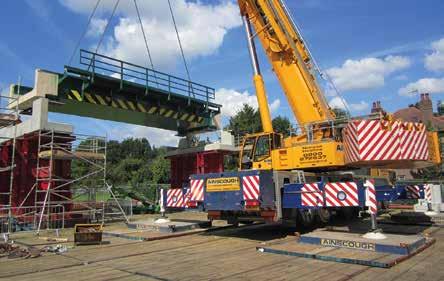

• Hire & Sales with our buyback Guarantee
• Nationwide and European Delivery Service
• Prompt professional service
• Specialising in Tropical Hardwoods Azobe (Ekki), and European Hardwoods Oak and Beech.
• FSC Certified CU-COC-817978


London: +44 203 968 0439
Manchester: +44 161 442 3157
Edinburgh: +44 131 285 1215

Email: info@timbermat.co.uk
www.timbermat.co.uk

aCCess equipment manufaCturers
AIRO www.airo.com
Alimak www.alimak.com
Almac www.almac-italia.com
ATN www.atnplatforms.com
Böcker www.boecker.de
Bravi www.braviisol.com
Bronto Skylift www.brontoskylift.com
CLM Construction Supplies www.clm-supplies.com
CMC www.cmclift.com
CPL www.cumberlanduk.co.uk
CTE www.ctelift.com
Denka-Lift www.rothlehner.com
Dino Lift www.dinolift.com
Dingli www.cndingli.com
Easylift www.easy-lift.it
Falcon Lifts www.falconlifts.com
GEDA www.geda.de
Genie www.genielift.com
GSR www.gsrspa.it
Haulotte www.haulotte.com
Hinowa www.hinowa.com
Holland Lift www.hollandlift.com
Imer Access www.imergroup.com
Iteco www.imergroup.com
JCB www.jcb.com
JLG www.jlg.com
Klaas www.klaas.com
Klubb France www.klubb-france.fr
Leguan Lifts www.leguanlifts.com
Manitou Group www.manitou.com
Omme Lift www.ommelift.com
Palazzani Industrie www.palazzani.it
Palfinger Platforms www.palfinger-platforms.com
Platform Basket www.platformbasket.com
Ruthmann www.ruthmann.de Sinoboom www.sinoboom.com
Saeclimber www.saeclimber.com
Skyjack www.skyjack.com
Snorkel www.snorkellifts.com
Socage www.socage.it
Teupen www.teupen.com
Versalift UK www.versalift.co.uk
Zoomloin http://en.zoomlion.com
platform rental
AA Access (Specialists) www.aaaccess.co.uk
Acrolift www.acrolift.co.uk
Ahern Rentals - USA www.ahern.com
AFI- Uplift www.afi-uplift.co.uk
Dragon Access www.dragon-access.co.uk
Drammen Liftutleie AS www.drammenlift.no
Hird www.hird.co.uk
JMS Powered Access https://jms.co.uk
Kran Cranes www.kran.ro/inchiriere-macara-constanta
Rental Romania
Monitor Lifts - AUS www.monitor.net.au
Mr Plant Hire www.mrplanthire.co.uk
Platform Sales & Hire www.platformsales.co.uk
Power Platform Services www.pps.co.uk
Rapid Platforms www.rapidplatforms.co.uk
Warren Access www.warrenaccess.co.uk
new & used platforms
Access Platform Sales (APS) www.accessplatforms.co.uk
AFI Resale www.afi-resale.co.uk
A.J. Access Platforms www.accessplatforms.com
Gantic, Norway www.gantic.no
Genie www.genielift.com
GSR Aerial Platforms UK http://en.gsrspa.it
Haulotte www.haulotte.com
Hird www.hird.co.uk
Independent Access Sales www.iasales.co.uk
International Platforms www.internationalplatforms.co.uk
INTEQ UK and UAE www.inteq.uk
JLG www.jlg.com
JMS Powered Access https://jms.co.uk

Kunze GmbH www.kunze-buehnen.com
Mr Plant Hire www.mrplanthire.co.uk
Rothlehner www.rothlehner.com
Platform Sales www.platformsales.co.uk
Promax Access www.promaxaccess.com
Rapid Platforms www.rapidplatforms.co.uk
TVH - Group www.tvh.com
Vertimac www.vertimac.com
Crane manufaCturers
Böcker www.boecker.de
Ernest Doe & Sons Ltd. www.ernestdoeloadercranes.com
Grove www.groveworldwide.com
Jaso Tower Cranes https://jaso.com
Jekko Minicrane www.jekko.it
JMG www.jmgcranes.com
KATO www.rivertekservices.com
Klaas www.klaas.com
Kobelco www.kobelcocm-global.com
Liebherr www.Liebherr.com
Linden Comansa www.comansa.com
Maeda www.maedaminicranes.co.uk
Manitowoc www.manitowoccranes.com
Potain www.manitowoccranes.com
Raimondi www.raimondi.co
Spierings www.spieringskranen.nl
Tadano www.tadano.com
Tadano Faun www.tadano.com
Tadano Demag www.demagmobilecranes.com
Unic Cranes www.unic-cranes.co.uk
Valla www.valla-cranes.co.uk
Wolffkran www.wolffkran.de
Zoomlion www.zoomlioncranes.co.uk
lorry/truCk loader Cranes
Atlas Cranes UK www.atlasgmbh.com
Ernest Doe & Sons Ltd. www.ernestdoeloadercranes. com
Palfinger www.palfinger.com
new & used Cranes
Cotac Oy www.crane.fi
Crowland Cranes www.crowlandcranes.co.uk
Delden Cranes www.deldencranes.co.uk
Ernest Doe & Sons Ltd. www.ernestdoeloadercranes.com
Gantic, Norway www.gantic.no
HighSparks www.highsparks.co.uk
Hird www.hird.co.uk
Kobelco www.kobelco-cranes.com
Rivertek Services www.rivertekservices.com
Terex Demag www.terex-cranes.com
Valla https://valla-cranes.co.uk
Crane Hire
Cadman Cranes www.cadmancranes.com
Cork Crane Hire (Liverpool) www.corkcranehire.com
Delden Cranes www.deldencranes.co.uk
HighSparks www.highsparks.co.uk
Hovago www.hovago.com
John Sutch Cranes www.johnsutchcranes.co.uk
Kran Cranes www.kran.ro/inchiriere-macara-constanta
Rental Romania
Ladybird Tower Crane Hire www.ladybirdcranehire.co.uk
McNally Crane Hire www.cranehire-ireland.com
Sangwin www.sangwin.co.uk
Schaften Leasing B.V. www.schaftenleasing.nl
mini Crane Hire
GGR www.unic-cranes.co.uk
JT Mini Crane Hire www.jtminicranes.co.uk
Lift Limited www.liftminicranehire.co.uk
Hird www.hird.co.uk
self ereCtinG tower Cranes
Cork Crane Hire www.corkcranehire.com
John Sutch Cranes www.johnsutchcranes.co.uk
Ladybird Tower Crane Hire www.ladybirdcranehire.co.uk
tower Cranes
HighSparks www.highsparks.co.uk
furniture Hoists
Böcker www.boecker.de
teleHandler manufaCturers
Dieci Telehandlers Ltd www.dieci-telehandlers.co.uk
Faresin www.faresindustries.com
Genie www.genielift.com
Haulotte www.haulotte.com
JLG www.jlg.com
Magni www.magnith.com
Manitou Group www.manitou.com
Skyjack www.skyjack.com
Snorkel www.snorkellifts.com
Merlo www.merlo.co.uk
new & used teleHandlers
Dieci Telehandlers www.dieci.com
Gantic, Norway www.gantic.no
GT Lifting Solutions www.gtlift.co.uk
TVH Group www.tvh.com
Vertimac www.vertimac.com
teleHandler rental
GT Lifting Solutions www.gtliftingltd.co.uk
JMS Powered Access https://jms.co.uk
Mr Plant Hire www.mrplanthire.co.uk
sCaffold towers
CLM Construction Supplies www.clm-supplies.com
mastClimbers & Hoists
Alimak www.alimak.com
CLM Construction Supplies www.clm-supplies.com
GEDA www.geda.de
Klaas www.klaas.com
Saeclimber www.saeclimber.com
speCial/bespoke
aCCess & liftinG solutions
Access Platform Sales (APS)www.accessplatforms.co.uk
GT Lifting Solutions www.gtliftingltd.co.uk
JMS Powered Access https://jms.co.uk
Platform Sales & Hire www.platformsales.co.uk
Warren Access www.warrenaccess.co.uk/hire
Working At Height Ltd www.workingatheightltd.com
speCial & niCHe aCCess
Acrolift www.acrolift.co.uk
DENKA Narrow www.rothlehner.com
JMS Powered Access https://jms.co.uk
Rapid Platforms www.rapidplatforms.co.uk
Smart Platform Rentals www.smartplatforms.co.uk
speCial lift & transport equipment
Collett A Sons, UK www.collett.co.uk
Heavy transport/abnormal loads
Collett A Sons, UK www.collett.co.uk
self-propelled
modular transporters
Collett & Sons, UK www.collett.co.uk
site safety audits
Alfa Access Services www.alfa-access-services.com
industry assoCiations
ALLMI www.allmi.com
CICA www.cica.com.au/
CISRS www.cisrs.org.uk
CPA www.cpa.uk.net
EWPA www.ewpa.com.au
IPAF www.ipaf.org
NASC www.nasc.org.uk
OSHA www.osha.gov
PASMA www.pasma.co.uk
Heavy lift manaGement
DWLS www.dwls.co.uk
Heavy lift planninG & risk analysis
DWLS www.dwls.com
auCtion Houses
Ritchie Brothers www.rbauction.com
battery suppliers & manufaCturers
Battery Service Hub www.batteryservicehub.com
DC Battery Technologies www.dcbattery.tech
Leoch Battery UK www.leochbattery.co.uk
Platinum International Ltd Platinuminternational.co.uk
load Cells & load monitorinG systems
PCE Instruments UK Ltd www.pce-instruments.com
Control systems
MOBA Automation www.moba.de
Generator sales & rental
JMS Powered Access https://jms.co.uk
online teCHniCal Help
Crane Tools www.cranetools.com
outriGGer pads, mats & roadways
Brilliant Ideas / https://brilliantideasltd.co.uk/alimats/ Alimats
DAWSON-WAM Steel Mat Hire www.SteelMatHire.co.uk
Mat & Timber Services www.sarumhardwood.co.uk
Nolim www.nolim.co.uk
Outriggerpads www.outriggerpads.co.uk
Timbermat www.timbermat.co.uk
TMC lifting supplies www.tmc-lifting.com
Universal Crane Mats www.universal-crane-mats.com
Welex Group www.welexgroup.com
Component suppliers
PCE Instruments UK Ltd www.pce-instruments.com
Tele Radio Group www.tele-radio.com
wire rope & Cable
Rope and Sling www.ropeandsling.co.uk
liftinG Gear manufaCturers
Britlift www.britlift.com
parts & serviCe suppliers
Alfa Access Services www.alfa-access-services.com
Crowland Cranes www.crowlandcranes.co.uk
Ernest Doe & Sons Ltd. www.ernestdoeloadercranes.com
Gantic, Norway www.gantic.no
Haulotte www.haulotte.com
IPS www.ipspartsonline.com
JLG www.jlg.com
Lift-Manager www.lift-manager.com
OTR Wheel Engineering Europe www.otrwheel.co.uk
PCE Instruments UK Ltd www.pce-instruments.com
TVH - Group Thermote & Vanhalst www.tvh.be
Vertimac www.vertimac.com
reCruitment
Vertikal.Net www.vertikal.net/en/recruitment
safety equipment
Load Systems UK Ltd www.loadsystems.co.uk
rental manaGement software
Higher Concept www.higherconcept.co.uk
HireHop Equipment Rental Software www.hirehop.co.uk
HireHop Equipment Rental Software www.hirehop.com
Infosystem www.levaplus.ch
inspHire www.insphire.com
Matusch GmbH www.matusch.de
MCS Rental Software www.mcsrentalsoftware.com
vWork www.vworkapp.com
struCtural repairs
Crowland Cranes www.crowlandcranes.co.uk
John Taylor Crane Services www.jtcranes.co.uk
traffiC manaGement
Atlas Traffic Management www.atlastm.co.uk
teCHniCal & safety ConsultanCy
Access Safety Management www.accesssafety.co.uk
traininG assoCiations & networks
ALLMI www.allmi.com
AWPT www.awpt.org
IPAF www.ipaf.org
NASC www.nasc.org.uk
Pasma www.pasma.co.uk
traininG Centres & trainers
Access Platform Sales (APS) www.accessplatforms.co.uk
Astra Access www.astratraining.co.uk
Ainscough www.ainscoughtraining.co.uk
AJ Access www.accessplatforms.com
Boss Training www.bosstraining.co.uk
Certora Training certoratraining.co.uk
Haulotte www.haulotte.com
IAPS www.iapsgroup.com
Lift-Manager www.lift-manager.com
Smart Platform Rentals www.smartplatforms.com
TVH Group www.tvh.com
UTN www.utntraining.co.uk
Versalift Training Direct www.versalift.co.uk/training
Warren www.warrenaccesstraining.co.uk/courses/
Access Training
safety traininG
Atlas Cranes UK www.atlasgmbh.com
traininG serviCes
JLG Training www.jlg.com
Liebherr Training (UK) www.liebherr.co.uk
Lifting Equipment Training www.letltd.co.uk
Mr Plant Hire www.mrplanthire.co.uk
Rapid Platforms www.rapidplatforms.co.uk
TH White www.thwhite.co.uk
Terex Atlas (UK) Ltd. www.atlascranes.co.uk
TVH Group www.tvh.com


Rest assured that your spare parts will arrive safely and on time through our meticulous handling, secure packaging, and efficient delivery methods.


Our team of dedicated logistics experts goes above and beyond to provide a seamless and reliable delivery experience, giving you peace of mind throughout the entire process.

