



Sany’s new 4,000t All Terrain crane, Zoomlion launches world’s largest boom lift, Potain unveils its biggest flat top tower crane, EU confirms tariff rates, Tadano to acquire IHI material handling cranes, Dieci adds to electric telehandler range, First 70m Multitel hybrid truck mount, New Genie scissors, Bauma China highlights, Nifty ClipOn now available, Aldercote launches platforms for electric vehicles as well as financials round-up and News Highlights.
In industries such as machinery moving, industrial maintenance and material handling, pick & carry cranes excel, having evolved over more than 80 years, albeit a little differently in each country. We take a look at the latest developments.
The truck mounted lift market is wide ranging and varied, extending from sub two tonne all electric chassis all the way up to Bronto’s seven axle, 112 metre working height S112HLA weighing around 75 tonnes…and everything in between. But has the recent launch of Ruthmann’s 100 metre T1000 HF refocussed manufacturer’s attention back onto big truck mounts?
MaStcliMberS & hOiStS 37
Two major incidents involving a mastclimber and a hoist in which seven people lost their lives has highlighted the difference in the way national safety authorities investigate such events. We look at both in greater detail as well as rounding up other news in the sector.
We take a more in depth view on the current discussions regarding the suitability of certain mat and pad materials to spread load correctly.
Publisher Leigh Sparrow has recently returned from a visit to Bauma China in Shanghai. Here are some of the highlights.
On the cOver
One of six 500kg capacity Geda SH1000 US service hoists installed on container cranes in the deep water Port of New Orleans on the Mississippi River. Two of the hoists have a lift height of 37 metres while the others have lift heights of 45 metres.

in the next iSSue Scheduled for publication in mid-January 2025, the next issue of Cranes & Access will include features on Truck mounted and aluminium cranes, Vertical lifts and mast booms, The UK and Ireland Rental rate guide and a Look Back at a very eventful 2024. If you have any contributions or suggestions to make or are interested in advertising in this issue, please contact our editorial or sales teams.


editorial
Mark Darwin - Editor
Imogen Campion - Assistant Editor
Leigh Sparrow
associate editors
Rüdiger Kopf (Freiburg)
Alexander Ochs (Freiburg)
feature editors
Nick Johnson
Saul Chernos
Sales & customer Support
Clare Engelke
Pam Penny
Karlheinz Kopp
Production/administration
Nicole Engesser
editorial data Specialist
Poppy Horne ph@vertikal.net
Subscriptions
Lee Sparrow
Publisher
Leigh Sparrow
advertising Sales
UK based
Clare Engelke ce@vertikal.net
Tel:+44 (0)7989 970862
Pam Penny pp@vertikal.net
Tel:+44 (0)7917 155657
Germany based Karlheinz Kopp khk@vertikal.net
Tel:+49 (0)761 89786615
The Vertikal Press
PO box 6998 Brackley NN13 5WY, UK
Tel:+44(0)8448 155900
Fax:+44(0)1295 768223
email: info@vertikal.net web: www.vertikal.net
Vertikal Verlag
Hofackerstr. 95
D-79110 Freiburg
Germany
Tel: +49 (0)761 897 8660
Fax: +49 (0)761 897 86614
E-mail: info@vertikal.net

Having a potential prosecution hang over you for years has been likened to a long drawn-out torture. The UK government certainly recognises this with its policy of not extraditing suspected criminals to states in the USA with the death penalty for the crimes of which they are accused. It apparently has nothing to do with an objection to the death penalty itself, but to the years they will spend on Death Row with the penalty hanging over them after the verdict is handed down. Year after year of waiting in the hope of clemency, a successful appeal or stroke of luck is considered to be cruel to the point of torture.
Unfortunately, some UK government agencies - the Health & Safety Executive and the Police for example - do not appear to subscribe to this principle when related to serious workplace incidents. The HSE often takes years and years and years before even deciding whether it will prosecute or not, with a further wait until it reaches court. And then a last-minute plea bargain is often offered! For those brave, confident and flush enough to plead not guilty, a judge may well dismiss the case for lack of evidence.
This month’s feature on mastclimbers and hoists deals with two incidents - one in the UK and one in Sweden - that between them resulted in seven fatalities. However, the way each incident was dealt with by the authorities could not be further apart.
In a nutshell, the investigation into the incident in Stockholm, Sweden was dealt with efficiently and quickly with the cause identified and announced within a couple of days. This was followed by the publication of a full and extremely comprehensive report five months later. All of which helped others learn from what happened while product and
procedural changes were quickly implemented. In Liverpool, UK, little to nothing was widely communicated about the cause of the incident and the lessons that might be learnt until the inquest almost four years later, and even then, it was poor at best.
This is not the first time this has happened in the UK. In 2013 a new boom lift overturned onto the M25 motorway during a routine pre-delivery inspection at a Kimberley Access depot taking the depot foreman’s life. It was nine years before Kimberley and its directors were told that they would not be prosecuted as there was no case to answer, while a plea bargain was accepted from the manufacturer. Nine years of torture for those connected to the incident.
In 2020 an 85 year old lady was killed when a tower crane collapsed onto the family home in London. After waiting more than three years with no answers or offer of permanent rehousing, the surviving residents sued the developer and engineering firm that designed the crane’s foundation. At this point the Police had not completed its investigation and therefore not handed the case to the HSE or disclosed details. The legal case did at least uncover what went wrong. Those years in limbo, not knowing what will happen are certainly a form of torture. The government does not inflict this on murderers facing a potential death sentence - so why do so on those who are not criminals while holding back valuable information?
Taking years to ‘investigate’ or rule on ‘accidents’ does not work on any level at all. Information should be shared openly as early as possible, as in aviation, rather than focusing on blame and prosecution. Let the legal system follow, not lead.
Mark Darwin
Comment and feedback is most welcome via post, email or phone stating if we may publish them or not: editor@vertikal.net
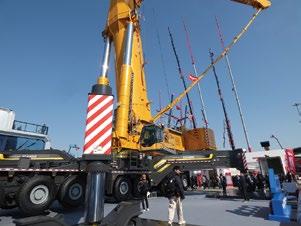
Chinese manufacturer Sany has completed the first unit of its 4,000 tonne, nine axle All Terrain crane, the SAC40000T. Currently only available in China, it features an 81 metre six section boom and can be topped with up to 106 metres of lattice extension, or a 124 metre Wind Power Jib that takes the maximum tip height to around 210 metres. The capacities can be boosted with a heavy duty Superlift device.

The crane can handle up to 375 tonnes on 100 metres of boom and shortest extension at an 18 metre radius, or 320 tonnes on 120 metres of stick at a 24 metre radius. Overall width is 3.6 metres,

length 26.7 metres and overall height 7.4 metres. The cruciform outrigger footprint measures 15 by 15 metres, while the counterweight is a relatively modest 300 tonnes.
Travel weight with superstructure and outriggers on board is 181 tonnes which means axle weights of 20 tonnes or more but it can travel at its full 60kph road speed. With superstructure, boom, outriggers and one hoist in place it weighs 357 tonnes and can travel at 10kph, or with full Superlift device added it weighs 411 tonnes and speed is limited to 5kph. The move follows the launch of the 11 axle 4,000 tonne XCMG at the start of this year.
Potain launched its largest flat top tower crane to date - the 80 tonne MCT 2205at Bauma China. The new crane is already in production at Manitowoc’s plant in Zhangjiagang, China, with the first eight units sold to Abu Dhabi international tower crane group NFT.
The new crane can be rigged with an 80 metre jib with a tip capacity of 23.6 tonnes. Free standing heights up to 99 metres are possible, depending on whether the R99A or R910A the tower/mast is used. Jib can also be extended to 85 metres.
The maximum capacity is available at five to 26.3 metres with full jib installed, or 30.5 metres on a 45 or 50 metre jib. Alternatively, 72.9 tonnes can be handled at the jib tip of a four section, 30 metre jib. The crane is fitted with Potain’s V140S Vision Cab.

The European Commission has published its ‘Definitive’ ruling on the tariff levels that it proposes to apply to aerial work platforms made in China when they are imported into the European Union.
The 'Definitive' and one assumes final ruling - after reviewing all the submissions - is that there was some evidence of dumping, but its main concern appears to be the rapid surge in sales of Chinese built products over the period investigated. However, it has reduced most of the tariff levels that it originally proposed. The final duties will be:
Zoomlion is planning to launch a new 265ft telescopic boom lift, the ZT82J, next year. A prototype of the new platform was displayed at Bauma China last month. It features a six section main boom topped by a 13.1 metre, three section articulating jib for a maximum working height of 82.3 metres. That compares with the five section boom and two section jib on its 215ft ZT68J.
Co-operating producers not sampled: Country
PRC Lingong: Heavy Machinery
PRC Zoomlion Intelligent Access Machinery
PRC XCMG Fire Fighting Safety Equipment
PRC Sunward Intelligent Equipment
PRC Haulotte Access Equipment Manufacturing (Changzhou)
PRC Fronteq (Changzhou) Machinery
PRC Jiang:su Liue:one: Machinery
PRC Hangcha Group
PRC Shandong Chufeng Heavy Industry Machinery
PRC Reeslift
PRC Mantall Heavy Industry
PRC Shandong Qiyun Group
PRC Jinan Juxin Machinery
PRC Shandong Yuntian Intelligent Machinery Equipment
The Commission has now accepted or ruled that the spike in imports were related to seasonal variations and not stockpiling. As a result, it had dropped plans to apply retroactive duties. An additional investigation prompted by the complainant into possible government subsidies of some of the larger companies is, however, ongoing. The tariffs are due to be applied from January 11th, 2025.
The maximum outreach on the new machine is 34.1 metres with 230kg in the platform, other capacities include 300kg and 454kg. The overall operating width will be just over 5.5 metres. The new model has an overall stowed width of 2.8 metres, an overall length of 17.5 metres and an overall height of 3.33 metres. Total weight is 48.5 tonnes. The new boom takes over as the world’s largest from the 223ft XCMG XGS70K telescopic boom lift, several of which have already been delivered to customers in the UK and the Netherlands.
Dutch crane and aerial lift rental company Boer has taken the first 70 metre Multitel MJ700 Hybrid truck mounted lift. Mounted on a five axle Volvo FM500 truck chassis, it has a maximum working height of 70.2 metres and up to 36 metres of outreach with 120kg in the platform or 28.5 metres with the maximum platform capacity of 600kg.
The new hybrid power pack includes two 80V/210Ah lithium batteries with a total of around 33KWh of power, driving an 80V/20KW electric motor, coupled to a hydraulic pump. The machine has enough battery power to fully extend and retract the boom at least four times. A full recharge takes four hours when connected to a 400V network or five hours with the onboard diesel generator. The unit can also be operated while plugged in or operate as a normal diesel machine.
Genie is upgrading its ‘core’ slab scissor lift range with the aim of improving performance, while reducing the total cost of ownership. Dubbed the ‘Next-Generation Genie’ the models will include the 19ft GSTM-1932, 26ft GS-2632, 32ft GS-3232 - narrow models - plus the wider 26ft GS-2646, 32ft GS-3246 and 40ft GS-4046 scissor lifts.
the key specifications
The most noticeable change is a new curved scissor arm linkage design, which Genie says reduces machine weight. The new units are available in Europe now and will be launched in North America at the ARA Show at the end of January.


Tadano is to acquire IHI Transport Machinery Co, the crane and material handling division of IHI Corporation. Not to be confused with the IHI crawler crane and excavator business which was sold to Kato eight years ago. Established in 1973 the Transport Machinery subsidiary’s current product range includes a combination of port and yard handling cranes along with large climbing Luffing Jib Tower Cranes for high rise construction, plus Ship to Shore cranes, Large Offshore cranes, Wind Power cranes, Floating cranes and Bulk Handling Systems.
The division had sales last year of ¥73.4 billion ($476.8 million) with an operating profit of ¥2.8 billion ($18.1 million) and net assets of ¥19.1 billion ($124 million).
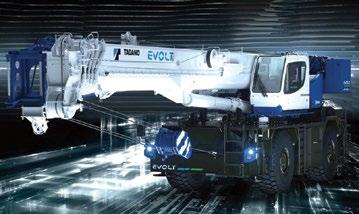
Tadano’s 90.7 tonne/100 ton all electric Evolt eGR-1000XLL-1 Rough Terrain crane is now in production with orders being taken for the North American version. The crane has the same lifting capacities as the diesel powered GR-1000XLL-4 launched in 2020, but without the emissions. It is good for seven hours of lifting or five hours of lifting plus five and a half miles of jobsite travel on a single charge. For pure travel it has a 16 mile range at 11 miles an hour and includes regenerative braking. The crane can be recharged from a standard 480 Volt AC grid power, taking approximately five hours for a full charge, or two to three hours on a CCS1 charging system. Features include a five section 51 metre main boom and 10.7 to 17.1 metre bi-fold swingaway extension with up to 45 degrees of offset. It also has a new ‘Smart Counterweight’ system providing two counterweight positions which boosts capacities by up to 20 percent when in the extended position. Maximum radius on the main boom is 47.2 metres.
Italian telehandler manufacturer Dieci has unveiled two additions to its electric telescopic handler range - the Mini Agri-e Smart and Apollo-e Smart. The units have a maximum capacity of two tonnes, a 4.35 metre lift height, a maximum speed of 20kmh and a 3.1 tonne towing capacity. Overall weight is 4.4 tonnes. Both are equipped with a 22kWh lithium battery and feature an adaptive load sensing system, low noise pumps and a seven inch display offering a 3D like view.
Niftylift's ClipOn harness attachment sensor has now been rolled out across its range of HR selfpropelled boom lifts. The ClipOn system activates when the key switch is turned on. If the operator has not attached their lanyard and attempts to move the machine, bright red LEDs above each anchor point illuminate and an alarm sounds. Once the harness is attached the LEDs turn green, and the alarm stops. The system also includes LEDs under the platform floor for those working below. It can also be retrofitted to older Niftylift platforms. The harness must be correctly attached for the light to turn green


Bauma China, held in Shanghai last month, included a number of new products, which we will cover in more detail over the coming months.
XCMG 4,000 tonne AT
Sinoboom had a slew of new and upgraded products to launch at Bauma China, so decided to organise an international event at its plant in Changsha to overcame space issues at Bauma in Shanghai, and to show the huge extensions to its production facilities.
The product launches included:
A 16ft mast lift, the VM05EL, with 227kg platform capacity, 780mm overall width, 1.38 metre overall length and total weight of 970kg, including a roll out deck extension.
4,000 tonne AT - XCMG had the largest stand by far, with the 4,000 tonne 11 axle XCA4000 All Terrain crane launched earlier this year taking centre stage alongside a new 80 tonne AT. It also had several new aerial lifts on display.
Zoomlion regains biggest boom titleZoomlion launched a 265ft telescopic boom lift, the ZT82J, with a maximum working height of 82.3 metres. The maximum outreach is 34.1 metres with 230kg in the platform, while the maximum platform capacity is 454kg.

Zoomlion ZT82J boom
Big XCMG spider - XCMG launched a 39 metre lithium battery powered telescopic spider lift - the XGS39X-Li - with 16.5 metres of outreach, a 2.4 metre platform with dual 120/230kg platform capacity and an overall weight of 8,700kg.
Big electric boom - XCMG also displayed a 165ft electric telescopic boom lift - the XGS52AXK-Li - with a 52 metre working height, 25 metres of outreach, dual 300/460kg platform capacity and overall weight of 26.1 tonnes.
12m mast booms - Two new 12 metre mast booms caught our attention…The 12.5 metre LGMG M1012JE with a five section box type mast, and three section telescopic jib, for a 5.3 metre outreach at a 6.6 metre up & over height and 200kg platform capacity. Overall width is 1.2 metres, overall length 3.7 metres and it weighs 4,900kg.

The XCMG XGR12J, with open mast design and telescopic jib, for a 12.7 metre working height, with 5.7 metres of outreach and 200kg platform capacity - total weight is 4,980kg.
Euro truck mounts - A number of European style truck mounted lifts included Sinoboom’s 32 metre GKS32EL straight telescopic, with 4,495kg GVW, 14.8 metres of outreach, and 200kg platform capacity. At the heavier end XCMG had a 34 metre model, the GKS34, with a six section boom, 19 metres outreach and 7.2 tonne GVW.
See show review page 54
A 34ft Rough Terrain diesel boom lift, the AB10J, with piston pump hydraulics, a working height of 11.62 metres, 250kg platform capacity, 1.85 metre overall width and 4.95 tonne overall weight. 30 units have already been built, most of which are destined for Australia.
A 27ft ‘No Oil’ slab electric scissor lift, the 0808E ALL, with AC wheel motor drive, heavier duty lift mechanism and electric actuators for lift and steer.
A 27 metre spider lift, the SPA 27J, with 230kg platform capacity, a heavy duty four section lower boom, light weight three section top boom and articulated jib. It features 360 degree continuous slew, is 895mm wide with an overall length of 4.75 metres. Total weight is 3,800kg.
A 137ft battery powered telescopic boom lift, the TB42RJ Plus HD, with X-type chassis, four wheel drive and steer and rotating articulated jib which can be transported in a standard container. A 129ft version, the TB38RT Plus HD, is also available.
A six metre/2,500kg compact telehandler, the TH25-6, can take 2,000kg to its 5.8 metre lift height and manage 800kg at the maximum 3.36 metre forward reach. With the arrival of Ian Pratt from JCB, the prototype on show is likely to undergo substantial changes prior to launch next year.
Upgraded models include: Four articulated booms - the 50ft AB15J, 52ft AAB16EJ, 73ft AB22J Plus and 66ft AB26EJ Plus 25.6 metre work height, 19 metre outreach and rotating jib. Two upgraded slab electric micro scissor lifts, the 14ft 0407EN and 16ft 0607EN, with larger tyres and slightly wider scissor stack
UK van mounted lift manufacturer Aldercote has introduced a line of aerial work platforms designed for mounting on all electric vehicles/chassis, initially developed for Norwegian distributor Liftco. Designed without stabilisers, the load path is directed to reinforced points on the vehicle resulting in a lighter product. Mounted on a Ford Transit van it has a 13.8 metres working height, 8.4 metre outreach and platform capacity of 230kg.




JCB has upgraded two of its 360 degree telehandlers - the 21metre 555-210R and 26 metre 555-260R - which become the 5,5800kg/21m 558-210R Pro and 26m 558-260R Pro. While the lift heights are the same, they offer an extra 300kg lift capacity and include a higher basic specification and several new option packs.
The company also unveiled the battery powered TLT 30-22E HL ‘Teletruck’ industrial telehandler which can take its 3,000kg maximum capacity to a height of 4.4 metres. The battery pack provides up to eight hours of operation on a single charge.
Also announced is the ‘Intellisense’ human recognition system which detects pedestrians within a pre-set proximity of the machine, setting off audible and visual warnings both inside the cab and externally to warn those in the immediate vicinity. The system uses four AI cameras to cover the sides and rear of the machine along with a standard forward facing camera. The system will initially be available on the 540-140 and 535-125 telehandlers.

JLG is to introduce a new 19ft (5.8m)/5,000lb(2,500kg) compact North American telehandler - the 519essentially an updated version of its 18ft/5.5 metre G518A launched in 2007.
The new unit has a 5.8 metre lift height, 3.3 metres of forward reach and a 2,495kg maximum lift capacity. It can handle just under two tonnes at its maximum lift height. The specifications are largely the same as its predecessor, the main differences being a little more lift height and a 270kg reduction in overall weight.
The telehandler is powered by a Deutz diesel and has a number of new features including a new control system with Load Stability Indication (LSI), Seatbelt Engagement warning and Operator Presence (SEAOP) sensing and diagnostics through ClearSky Smart Fleet.


IPAF has issued a Position Statement regarding the isolation of platform controls following consultation with the IPAF’s Manufacturers' Technical Committee and International Safety Committee, along with the UK Health and Safety Executive (HSE). This follows an incident in the UK in November 2022, when one of the levelling jacks on a large scissor lift leaked causing the lift to tilt, yet failing to activate its loss of jack pressure warning or sound the tilt alarm, because the operator had stopped the machine using the emergency stop button which cut off the electrics including the safety alerts.
The HSE launched an investigation into the incident and found that when at height, the method of isolating the upper controls can introduce a hazard to the occupants of the platform. The investigation is ongoing. The emergency stop control on aerial work platforms of all types has been traditionally used to cut the engine and isolate the controls when the platform has reached its work point. This practice has not been designed for current standards and modern machines that have all manner of safety systems that require power. The use of the emergency stop button is no longer appropriate as other methods are now used in control designs.
The operator of a work platform may be required to isolate the controls and/or power source using platform controls. Where the machine is equipped with an ‘engine on/off’ control on the platform control console, this should be used to switch the engine off during normal operation rather than the emergency stop control, unless the manufacturer indicates that it would be unsafe to do so. Where machines are not equipped with a dedicated ‘on/off’ control, the operator should follow the manufacturers’ operating instructions.
If you have any questions or require further details, you can contact IPAF head of safety and technical, Brian Parker, on +44 (0)15395 66700.
After three years of development, Ruthmann has formally launched its new 100 metre truck mounted platform - the T1000 HF. The new model is essentially a stretched version of its 90 metre T900 with a maximum outreach of 39 metres. The launch signals Ruthmann’s re-entry into the 100 metre market after a gap of more than 20 years. It hopes to sell at least 20 units by early 2026 and produce between 15 and 20 units of its 90 and 100 metre models a year.
The first T1000HF is destined for German rental company Gerken, the second, third and fourth will go to French rental company Joly Location, while further models have been ordered by Wörle in Germany and Galaksi Platform & Vinç in Turkey. For more information on the T1000 HF see the Truck mounted lift feature starting on page 27.


The International Crane Stakeholders Assembly (ICSA) - made up of the SC&RA in the USA, ESTA in Europe, CICA in Australia, CRAC in Canada’s and JCA in Japan - has published new guidance on working with cranes near power lines, which could also be useful for aerial work platforms. It has been driven by growing concern over the number of fatal power line related incidents.
Entitled Safe Crane Operation in the Vicinity of Power Lines, the truly international document is highly detailed, informative and nicely illustrated. It provides guidance for operations in the vicinity of live low and high tension power lines and is also intended to assist local regulatory authorities evaluate requirements to prevent power line contact.
The guidance document can be download free of charge at https://estaeurope.eu/docs/library/ cranes/icsa-guidance-007/


In the UK the Staffordshire Police force has confirmed that will be removing embargo times on all Staffordshire’s roads for Category A cranes.
This will initially be done for a three month trial period which began in November. Public complaints, incidents and traffic disruption will be monitored throughout the period. If there are no notable negative effects during the trial, Staffordshire Police will look to remove embargo times permanently for all Category A cranes.

Manitowoc - owner of Grove, Potain and National Crane - saw nine month revenues decline 3% to $1.58 billion, while pre-tax profit plunged from $46.1 million to just $2.3 million. Order intake continued to keep pace with shipments at $1.61 billion with the backlog/order book at the end of September up 10% to $1.03 billion. Full year revenues are now predicted to be between $2.17 and $2.22 billion.
UK rental group vp - owner of uk forks, MeP and brandon hire Station - has reported first half revenues one percent higher at £192.5 million. UK revenues and operating profit were slightly lower, while international revenues increased 17% and profit up 5%. Pre-tax profit for the group was £19.5 million, down 2% on last year.


genie/terex aWP saw revenues improve 9.5% to $2.42 billion for the nine months to the end of September. Operating profit was almost five percent higher at $324 million. The Crane division figures are now lost in the Material Processing business.

terex group revenues slipped just over 1% for the nine months to $3.89 billion, while pre-tax profits slumped 13.5% to $410 million. Terex is forecasting full year group revenues of $5.15 billion, with Genie/AWP making up $3 billion of this, around 3% higher than 2023.
billion, although the order book was 20% smaller at €636 million. Operating profit for the period fell 4% to €196.8 million. cargotec revenues were flat at €1.83 billion, while pre-tax profit edged up very slightly to €183.9 million.

Nine month revenues at Manitou declined 3% to €2.0 billion, with third quarter sales down 10% to €593 million. Order intake for new equipment improved 17% to €252 million. The company is now forecasting full year revenues of around €2.67 billion, a 7% fall on 2023.

US based access solutions company canopy brands has acquired the rack and pinion and suspended platform divisions of alba-Macrel Alba is based in Spain’s Basque region and manufactures material and personnel hoists, transport platforms, mastclimbers, construction elevators and modular suspended platforms with sales in 77 countries. Bee Access - a Canopy group company - will continue to distribute Alba products in the USA, while Alba will continue to operate from its plant in Miranda de Ebro, Spain.

Mastclimber, hoist and façade access company alimak has reported a flat year to date. Revenues for the nine months to the end of September were SK5.28 billion ($494 million), while pre-tax profit increased almost 6% to SK563 ($52.7 million). Third quarter sales jumped 58% to SK1.7 billion ($156.1 million) while pre-tax profits increased 93% to SK189 million ($17 million).
tadano is to acquire ihi transport Machinery Co, the port and tower crane manufacturer and material handling subsidiary of IHI Corporation - not to be confused with the IHI crawler crane and excavator business which was sold to Kato eight years ago.

Hiab owner cargotec has sold the Macgregor crane and marine hatch manufacturing business to funds managed by Triton Partners for €480 million. The deal should complete by April next year. Last year MacGregor had revenues of €733 million with an operating profit of €33 million.

Jlg revenues for the nine months to the end of September improved four percent to $4 billion. Aerial work platform sales were flat, but telehandler sales increased 11% to $1.25 billion. Operating profit was almost 15% higher at $662.5 million compared to the same period last year. The company is forecasting full year revenues of $5.1 billion, a 2% increase on 2023.

US rental company united rentals posted another record quarter with nine month revenues up 6% to $11.25 billion. Pre-tax profits improved almost 6.5% to $2.48 billion. Third quarter revenues were 6% higher at $3.99 billion, with pre-tax profits up 1% at $943 million. United is forecasting record full year revenues of $15.10 to $15.30 billion.

UK rental company elev8 access Platforms has entered into insolvency protection/administration following a tough period of trading.


US rental company herc rentals has reported a 7% increase in revenues for the nine months to the end of September to $2.62 billion. During the period the company completed eight acquisitions with a total of 26 locations and opened 16 new greenfield locations. Pre-tax profit for the period improved 3% to $334 million. Capital expenditure over the nine months was $753 million almost 31% lower than at the same point in 2023.
Palfinger saw revenues for the nine months to the end of September decline 3% to €1.75 billion. Order intake was 27% lower at €972 million, its lowest level since 2021 with both of its major markets - Europe and North America - slower. Pretax profit slipped 11% to €124.9 million. Palfinger is forecasting full year revenues of around €2.3 billion which is 5% lower than for 2023, with pre-tax and interest profit in the region of €189 million.
haulotte has reported an 11% decline in revenues to €509 million for the nine months to the end of September. New equipment sales declined 12% to €437 million. Rental revenues fell a further 7% to €16 million although parts and service revenues increased 5% to €56 million. Haulotte is forecasting a 10% drop in full year revenues for 2024.


Cargotec’s third quarter results showed lower revenues for hiab compensated by higher sales at Macgregor. Hiab revenues were €1.23 billion an 8% reduction on the same period in 2023. Order intake however improved 3% to €1.1
Yama Saha, the owner manager of German aerial lift distributor Sahalift, has acquired Aichi’s longterm European importer and product support businesses, Netherlands based Aichi Sales Office B.V. and ASO Parts B.V. in an all-share purchase deal. A formal distribution agreement has now been signed following an agreement reached in February. The new partnership will launch a wider range of Aichi platforms in Europe, including the new 68ft SR21CJM crawler boom lift, at Bauma next April.

Magni Telehandlers has launched a new five tonne rotating and tilting FEM/ISO standard compatible fork carriage, designed specifically for handling bulky materials in tight spaces. The forks rotate a full 360 degrees at a height of up to three metres, above this height an automatic restriction limits fork rotation to 90 degrees either side of centre in order to prevent the load fouling the boom. In addition to the rotation, the carriage can tilt by up to 70 degrees to keep the load stable making it easier to load or unload materials.
The forks are compatible with all Magni TH fixed frame and RTH 360 degree models. Maximum capacity over the front is 2,300kg on the more compact TH models and up to 5,000kg on the RTH models. The capacity with the forks rotated 90 degrees is 2,500kg on all compatible models.

Chinese manufacturer Sinoboom has shipped the first CE version of its 153ft AB46RJ articulated boom lift to German rental company Hässler Lift. The AB46RJ features a three section telescopic riser, three section top boom, plus an articulating jib with up to 150 degrees of rotation. Maximum working height is 48.6 metres and the maximum outreach 25.5 metres with the unrestricted platform capacity of 275kg or just under 24 metres with the maximum capacity of 455kg - both at an up & over reach of around 19 metres.
The company introduced the AB46 in 2019, delivered the first five domestically and began shipping overseas last year. The CE model includes a Stage V diesel and a number of other refinements and improvements including the use of a heavy duty composite material for the superstructure covers/shrouds in place of steel. The company and has also delivered the first unit to Australia and received a mega order for the Middle East, with the 30th unit likely to come off the production line by the end of the year.


US Select Crane Sales has appointed Bruce Alvis as MidAtlantic territory manager
UK based Collet & Sons has opened a new office in Bradford
UK’s Ardent is to invest £50 million in new telehandlers

Germany’s Auto Kurz has taken a 70t Liebherr LTM 1070-4.2
UK’s NMT has taken a 300t Liebherr LTM 1300-6.2
Turkey’s Kambeton has taken a 120t Grove GMK5120L
UK’s Ainscough has spent £40 million on 14 big Liebherr ATs
China’s LGMG has appointed Omar Kaïma as sales manager France
Spain’s Aguado has taken a 700t Liebherr LR 1700-1.0W narrow track crawler

Ireland’s Global Hire has taken 69 Sunward scissor lifts
UK based Lester Cladding has taken a Liebherr MK 140-5.1
Germany’s Schwarze ASC has taken the first 15t Jekko JF545.2
Potain has appointed NFT Hong Kong as distributor
UK’s KC Machine Movers has taken a 2.5t Valla 25E pick & carry crane
Yama Saha of Sahalift has acquired Aichi importer Aichi Sales Office and ASO Parts
UK’s Cadman cranes has taken a 230t Liebherr LTM 1230-5.1
Dubai’s Johnson Arabia has taken a large number of Sinoboom booms
Terex has appointed Jennifer Kong-Picarello as chief financial officer
Germany’s Schwerlast Weise has taken a 300t Liebherr LTM 1300-6.3

Denmark’s Danfoss has launched new selfguidance software
Manitowoc Philippines has relocated to Muntinlupa, south Manila
UK’s Falcon Cranes has been acquitted of charges for a fatal tower crane incident in Crewe in 2017
MGX has opened a new facility in Geismar, Baton Rouge, Louisiana
Socage has opened a US distribution company - Socage North America
UK’s Select Plant Hire has taken two 150t Liebherr LTR 1150s
Sinoboom has appointed Tim Barnett as product manager telehandlers
Italy’s Baldini has taken a 110t Liebherr LTM 1110-5.2
Cargotec has sold MacGregor to Triton Partners
Jersey’s 4 Hire has taken a 24m Socage 24D Speed truck mount
Merlo UK has appointed Blue Central as a dealer
Italy’s Nuova Age has taken a Raimondi T97 tower crane
JLG has appointed Rogerio dos Santos as VP Europe, ME, Africa & India replacing Karel Huijser
France’s Labrosse Material
Solution BTP has taken its first CTE Zeta 22

Rogerio dos Santos
Jekko has appointed AP Rentals as distributor for Hong Kong, Macau and Singapore
Germany’s MSG Krandienst has taken a 300t Liebherr LTM 1300-6.3
Magni Deutschland has appointed Dennis Tyler and Thomas Bennemann to product support roles


Switzerland’s Richi has taken a 350t Liebherr LTM 1350-6.1
XCMG has launched training courses in Indonesia
UK’s Lawson Haulage has taken a 60t Liebherr LTM 1060-3.1
Spain’s Grúas Pirineos has taken a 700t Liebherr LTM 1650-8.1
Florian Büscher has returned to Teupen as sales & marketing director, Europe
Germany’s Treelancer has taken a 30m CMC S30 spider lift
Al Jaber Heavy Lift & Transport has added Modulift spreader beams

Denmark’s Trackunit has launched ‘Specialty Equipment Solution’
Trailer manufacturer Faymonville is to open its first plant in America
Isle of Man’s Mann Crane Hire has taken a 60t Grove GMK3060L-1
Austria’s Felbermayr has taken two 36m Ruthmann T360 truck mounts
Tadano is to acquire IHI Transport Machinery
Germany’s Häßler-Lift has taken 70 Sinoboom platforms and the first 153ft AB46RJ in Europe
Terex Tower Cranes has appointed Mevi as dealer for Lombardy, Piedmont, Liguria, Tuscany and Emilia Romagna
Italy’s Baschieri Noleggio and De Angelis Noleggi have purchased multiple Multitel platforms
France’s Mordefroy Levage has taken a 180ft Genie SX-180 boom
Veteran crane salesman Dick Lloyd has died

Mexico’s Eseasa has taken the first 700t Liebherr LR 1700-1.0W in S. America
Germany’s Jakob Schäfer has taken a 21.5m GSR B220PXE truck mount
Taiwan’s Chi Deh Crane Engineering has taken a 104m Bronto S104HLA

Wales’ Davies Crane Hire has taken a 700t Liebherr LTM 1650-8.1
Grove has appointed Sia Good Work as repair agent for the Baltic states
Niftylift’s apprentice team, Elevate Elite, won the IMechE Apprentice Automation Challenge
Raimondi has delivered two T147 tower cranes to France’s GP Mat International
John Hewitt, the founder of J. Hewitt Crane Hire in Middlesbrough, UK, has died
Italy’s Flash Battery has opened a subsidiary in Texas

British Airways has taken four 24m CTE MP 24 C truck mounted lifts
Kuwait’s La’ala Al Kuwait Real Estate has taken six Tadano GR RT cranes
Italy’s Palazzani is adding its Lifting Kit platform to all but its smallest models
Magni Telehandlers has launched a 5,000kg rotating/tilting fork carriage
Germany’s Möller manlift has purchased five 30m Palfinger truck mounts
China’s LGMG has appointed Paul Cooper as UK sales manager
Finland’s Leguan Lifts has appointed Spider Lift Asia as Singapore dealer

Belgium’s ICO has taken its second 154t Liebherr LHM 550 mobile harbour crane
Terex RT Cranes has appointed AMA Industria as distributor for Angola
Müller Weser has taken the first 208t Liebherr LPS 600 rail mounted crane in Germany
Dutch company Kraanverhuur Tholen has taken the first 80t Grove GMK4080L
India’s Mtandt is to take over Comansa tower crane distribution in India, Nepal and Bhutan
ML Crane group businesses - Crane Service Inc, ML Crane and Winslow Crane Servicehave merged
Palfinger UK is to open a service centre in London near the M25
China’s XCMG has appointed Thomas Gack as AWP sales manager in Germany
Anglo Irish WH Scott & Son Engineers has acquired UK based RHC Lifting

UK based Mac’s Truck Sales has moved its rental division to Outlane, Huddersfield
Italy’s Autovictor has taken a 650t Tadano CC 38.650-1, a 130t AC 5.130-1 and an 80t AC 4.080-1
Boels has taken 24 more Easy Lift spider lifts
US Bennett On Site Services has opened a location in Dayton, Texas
Australia’s EQSS is to open its first international operation in the UK
UK’s Marsden Crane Hire has taken 40t and 60t Liebherr LTMs
Stafford Tower Cranes is manufacturing its own crane cabs
Manitex Valla has appointed Gianluigi Salvini as technical manager
XCMG has terminated its UK distribution agreement with Genesis

Jekko has introduced a Li-on version of its 6.15t JF235 spider crane


In industries such as machinery moving, industrial maintenance and material handling, pick & carry cranes excel having been designed specifically for the job at hand and evolving over more than 80 years, albeit a little differently in each country. Imogen Campion reports.
While small two axle city or All Terrain cranes such as the 13 tonne Kato CR-130Rv city crane, the 35 tonne Liebherr LTM 10302.1 or the 40 tonne Tadano AC 2.040-1 can handle this type of work, their size, base boom length, manoeuvrability and diesel power can’t match the agility or pick & carry ability of an all electric Valla, Ormig, Galizia or JMG. Purpose built to lift and transport heavy loads over short distances, often indoors, they thrive in cramped spaces with low headroom where traditional cranes or forklifts may struggle.
However, when it comes to rough or uneven terrain, pick & carry cranes face a significant drawback. Their smooth solid tyres, heavy rigid frame and inability to level up - while excellent for working on firm level surfaces - limit their versatility. These cranes excel in controlled environments such as warehouses, factories and industrial sites, where concrete floors and level ground are the norm. However, they struggle to maintain performance on loose gravel or in soft, muddy conditions. In such challenging terrains, telehandlers and RT forklifts come into their own - horses for courses if you like.
A precursor to the modern mobile cranes, pick & carry cranes were widely used, not only in industrial applications but in some countriessuch as the UK and Australia - in rental fleets. As a result, cranes in those markets developed differently with products like the Iron Fairy, Taylor Jumbo or Coles Speed cranes in the UK and articulated cranes like the Franna in Australia, with more speed for local road travel

and avoiding the need for a trailer. Meanwhile in India, a cost effective articulated tractor based alternative was adopted.
In Italy nothing much has changed in terms of overall concept, but in recent years the technical developments and styling have improved beyond recognition. In the USA carry deck cranes became popular led by Drott, but in the 1950s the first Grove crane was more like the Italian machines in terms of basic concept and were almost the only show in town when it came to hydraulic cranes. Then along came truck and Rough Terrain cranes which would eventually replace industrial pick & carry units. In Germany early Demag, Krupp and Liebherr mobile hydraulic cranes were also pick & carry models often looking decidedly weird but performing well in the role they were used for.
The size of the pick & carry crane market in the UK, Italy and the USA kept a couple of dozen or more manufacturers busy over several decades, but decline came with the rise and spread of operated mobile crane rental in several European markets such as the UK, Netherlands and France.


That created a booming telescopic truck crane market replaced by All Terrains with Rough Terrains playing their part in developments. the Pallet changed everything
Perhaps the more significant factor though was the arrival of the pallet! This led to a massive surge in forklift sales and in some markets the emergence of telehandlers which could handle routine industrial material handling much more efficiently.
However, in recent years, the pick & carry market has seen a resurgence of interest, largely driven by the introduction of innovative and highly functional models, particularly from Italian manufacturers. This new wave of pick & carry cranes has revitalised the concept to a point.
The pick & carry crane played a pivotal role in the evolution of mobile cranes, gaining prominence during and after the second world war. The concept of unloading and loading materials from delivery trucks with a crane that could also transport it to where it is needed or stored and then when required move material around the factory, was a requirement in every market with a manufacturing base particularly the USA, UK, Italy and Germany etc… As mentioned above Grove was one of the pioneers, but only because it needed something to load and unload axles for the farm wagons it produced. Unable to find what it wanted it designed and built its own. The Grove brothers found that whenever a customer visited its little production plant, they would also want one, so they started improving their designs and manufacturing them, thus Grove crane production began and farm wagons were dropped.
The second World War effort also inspired developments with Drott generally credited with the introduction of the carry deck crane in the US, which allowed loads to rest on the chassis deck while travelling across the larger factory spaces of logistics centres. In Europe, the development followed a different path, with Coles, Jones and others building larger slewing models with everything apart from the axles and chassis being in the superstructure. Booms were either solid, or cantilevered lattice booms. These cranes can occasionally still be seen in small boatyards or the corner of a sawmill. Then along came the Iron Fairy and Taylor Jumbo cranes. While in Germany, Demag and later Krupp began making similar products. Italy’s Ormig and Valla joined the fray in the 1940-50s and in


Japan, Kyoei Kaihatsu (later Unic and Tadano) contributed significantly by the late 1950s. The 1960s introduced iconic UK models like the Iron Fairy and Coles acquired Taylor and created the Speed crane. In Australia articulated tractor based cranes became popular but soon morphed into more sophisticated and heavy duty models that look like the ‘Franna’ articulated pick & carry cranes of today. In India the tractor crane can be seen everywhere, but they can be dangerous if not handled correctly.
Post war rebuilding in Europe spurred on Italian crane manufacturers, including Valla, established in 1945 and Ormig in 1949. Valla introduced its first models of pick & carry cranes in 1961 and since then innovations have regularly followed, such as the all electric 30E in 1972 and the first hybrid in 1999.
Since then, the pick & carry market has grown significantly with - according to this year’s Cranes & Access source guide - 26 manufactures worldwide including Ace Cranes and Escorts


Kubota in India, Franna in Australia, as well as Bailey Cranes, Lift Systems, Shuttlelift Cranes and Zee Cranes in America to name a few.
anOther cOntender Landoll, a new player in the European pick & carry field displayed its PT40 Precision telehandler at this year’s Vertikal Days. The company was founded in 1963 by Don Landoll in Marysville, Kansas, USA as Quick Service Welding offering welding, radiator repair and blacksmith services before becoming an agricultural equipment manufacturer with products such as trailers for the farming industry. Over the years, Landoll's focus has evolved and the company expanded its product line to include a variety of heavy equipment for industries such as construction, material handling and transportation.
Throughout the 1980s and 1990s, the company introduced a range of innovative solutions for lifting, loading and transporting large machinery resulting in the development of the 18 tonne PT40 in 2018. It fills a niche on industrial and construction sites that require precise lifting and transportation, slotting between traditional pick & carry cranes, telehandlers and big forklifts. The Landoll PT40 has a three section main boom and a maximum capacity of 18.1 tonnes at a 600mm load centre, which it can also take to its full height of 6.1 metres. Maximum forward reach of 2.43 metres. If the optional six

tonne auxiliary counterweight is installed, the maximum capacity increases to 21.7 tonne. All available free on wheels of course.
The unit is compatible with a variety of attachments, but the most interesting is what it refers to as the Machinery Boom, which replaces the forks on the carriage via a quick connect coupling system. Essentially the Machinery Boom is a two section horizontal manually telescoped and pinned jib, which provides 3.4 metres of reach from the carriage to the hook centre. Capacities range from 17.5 tonnes at 600mm or 3.5 tonnes at 3.6 metres both at a hook height of 7.6 metres. With the extra counterweight installed, the capacities rise to 21.4 and 4.6 tonnes respectively.
Powered by a 3.0 litre diesel engine, the PT40
features a hydrostatic drive system that allows forward and reverse travel speeds up to six mph. It can generate nine tonnes of tractive effort, enabling it to move an 18 tonne load up a 24 percent slope/gradient. It offers three steering modes: Front wheel steering for standard movement, rear wheel steering for tighter turns in confined spaces and crab steering for diagonal movement.
The PT40 has an overall stowed height of 2.2 metres, with an overall height of 1.8 metres and an overall weight of 21 tonnes when equipped with the auxiliary counterweight and boom. A wireless remote controller with LCD colour display shows a range of data including load position and capacities.
There are currently more than 70 units in America and six in Europe, sold by distributor and machine moving company Keith Rhodes Machinery, which took delivery of its first Landoll PT40 in 2021, the manufacturer’s first export unit.
Based in Gloucester, UK, Keith Rhodes Machinery is the official European dealer for Landoll. Established in 1982 it specialises in machinery installations, removals and relocations across Europe, using its own transport fleet. Operations manager Chris Palmer tested the first Landoll machine extensively before the company took on the distributorship. “We used our PT40 for over a year before deciding to become a dealer,” he said. “We wanted to ensure the product was reliable and met our standards before committing to represent it.”


“As a company known for machinery moving and installation, we knew that our name would be directly tied to the product. If the PT40 didn’t perform as expected, customers may think that we let them down. So, we took our time to thoroughly assess the product’s quality and performance."
As machinery movers, Palmer believes that selling the Landoll to other machine movers provides a competitive edge, “who better to sell the product than someone like us in the industry that this machine is designed for.” So far it has sold four units to three different companies as well as running two of its own.
When compared to competitors such as VersaLift forklifts or Hoist Liftruck, Palmer believes the Landoll PT40 offers several advantages. “The Landoll can lift up to 21 tonnes and due to the boom, it offers more flexibility than a standard forklift with the added trackway, machinery jibs and forks. One major advantage is that at around 21 tonnes it is light enough to be transported on a standard trailer without a police escort, a planned route or special permits, which are required with some of the larger Versa-Lift models.”
Keith Rhodes also runs several Versa-Lift forklifts in its fleet and says that despite being a good machine they have their challenges. “When using boom attachments with the Versa-Lifts, you must add a manual extension to reach the required height of seven metres, but that puts


you 2.5 to three metres off the ground before you even begin lifting. In contrast, the Landoll, with its current configuration, allows the hook to sit directly on the ground and then lift to eight metres in one movement,” says Palmer.
The PT40 is compatible with various attachments including forks, boom extensions, winches and jibs expanding its range of applications. “A lot of other manufacturers produce standard pick & carry cranes, whereas the Landoll is a hybrid version. Companies like JMG have been around for 17 years making purely pick & carry cranes, while others produce heavy conventional forklifts. The Landoll fits between these two and aims to combine the best of both worlds.”
Manufactured in Kansas, USA, Landoll may take some time to gain traction in Europe, especially when compared to sophisticated products like Valla, Ormig and JMG. Speaking of the challenges Palmer says: “Landoll works with its distributors on product improvements. When our first unit arrived in 2021, I mentioned to sales manager Al Connelly, that adding an extra counterweight to create the PT48 would be a great idea. They made it happen and we ordered our unit with the extra feature and every unit we’ve had since has come with it. Delivery times also tend to be shorter, for example units are available in the first quarter of next year and I know some manufacturers can’t deliver until 2026.”

Midland Machinery offers machinery removal and crane rental in the UK’s West Midlands and took delivery of its Landoll two years ago. Managing director Carl Ames said: “We are often handling high level and long reach jobs. For several of our customers, we have used the Landoll to place items onto mezzanine floors or loading decks, which is where it comes into its own. For example, we did a strip out job in Gloucester where everything was on a raised plinth, so with the forks we were able to lift things off and reach over the other side of the plinth very easily. It’s also very easy to use, you can use either joystick or a handheld remote controller which functions exceptionally well, allowing you to load and unload onto a trailer or carry out the entire operation remotely. Despite not massively increasing productivity, so far it has been 100 percent reliable and I know there was talk of building a bigger one, so if that does materialise, we’d be very interested in that.”
Flegg Projects, a machinery installation business based in Aylesbury, UK, has two Landoll’s in its fleet. Managing director Jayson Flegg said: “As soon as my machine turned up it was so good I bought another!”
Flegg runs a fleet of forklifts, truck mounted cranes, forklifts including Hoist and JMG pick & carry cranes, so the addition of a PT40 seemed a natural progression. “We have two electric
Flegg Projects' PT40


JMG MC100’s and our Hoist 40/60 are brilliant, but its reach is limited to only three metres,” he said. “While the pick & carry’s are also great, they require a fork attachment on the end. The Landoll is a hybrid of the two, it’s a jib truck with forks with a better reach. With the Hoist forks, the maximum lift height is 2.8 metres, but the Landoll allows lifting up to seven metres."
Manitex Valla - one of the pioneers in the Italian market with cranes ranging in capacity from 1.8 to 25 tonnes - will launch eight all new models next autumn with capacities ranging from 35 to 50 tonnes. Among other features the cranes will incorporate a new ‘futuristic’ design and new technical advances, two of which are patented. The new machines will join the eight new models that Valla has launched over the past two years with capacities from 4.6 to 18 tonnes. Although still at the prototype stage, each model will follow the company’s practice of offering remote control versions with no cab, or versions with cabs for those who prefer it.

Another veteran participant in the Italian market, Ormig, offers cranes between 5.5 and 100 tonnes. Its latest addition launched last year is the 30 tonne battery powered 30iEk. It has an overall width of 1.98 metres, an overall length of four metres and an overall height of 2.2 metres. Total weight ranges from 17 to 27 tonnes depending on the number of modular counterweights installed.
The unit features a 10.7 metre ultra heavy duty three section boom with a maximum tip/lift height of just over 12 metres at which point it can handle up to 16.5 tonnes. The 30 tonne maximum capacity is available at around 800mm beyond the front bumper. The maximum radius is 7.4 metres with boom horizontal, at which point it has a capacity of 4.7 tonnes.
The standard hydraulically controlled boom nose or ‘Power Tilt nose’ if you prefer, has up to 90 degrees of offset for fine tuning the load placement.
The new Ormig crane features two front wheel direct drive electric motors, with what it describes as an ‘electronic differential’ enabling

a machine with two wide spaced wheels with a 90 degree steer angle to almost turn smoothly on the spot, without scrubbing the front drive wheels. It works by sensing the rear wheel steer angles and adjusts the speed of each front wheel to match. In a 90 degree turn the front wheels will even counter rotate.
The design minimises the turning radius while maintaining stability through four corner support points, compared to the three wheel geometries used by some manufacturers to achieve the same level of manoeuvrability. Optional attachments include a range of hydraulic or mechanically offsetable extensions.
JMG, established in 2008, is a relative newcomer to the market but has almost certainly become the leading manufacturer with models with capacities ranging from 750kg to 70 tonnes. This year the company has launched the 15 tonne MC100.08 telescopic pick & carry crane which can also double as a telehandler and featuring an extendable frame similar to other larger JMG pick & carry models. It offers a choice of three interchangeable booms - a two section short boom for a compact machine with a lifting height of eight metres, a longer three section boom with a 10 metre lifting height and a short two section heavy duty boom best used when using the machine with forks which offers a capacity of 14 tonnes at a height of five metres with a load centre of 600mm. The forks can be replaced with a hook. The short three section boom stows almost within the length of the machine at 3.8 metres and offers a lift height of eight metres. The third interchangeable option is the three section long boom which has a lift height of 10 metres but provides a slightly longer stowed length.
JMG also has a range of three electric carry deck cranes with capacities ranging from 10 to 50 tonnes and able to operate for up to eight hours on a single charge.


The 10 tonne MC100RE features 360 degree hydraulic boom rotation, independent outriggers and a remote control. The mid range 22.5 tonne MC22500RE adds a longer hydraulic boom for greater reach and at the top of the range, the 50 tonne MC50000RE has an extended hydraulic reach and foldable, extendable outriggers.

There are several other competitors to the traditional pick & carry crane cranes - Versa-Lift, Hoist, and Landoll in North America and more Italian manufacturers including spider crane company Jekko which offers four fully electric ‘Mini Picker’ models with lifting and pick & carry capacities ranging from 600kg to five tonnes. The company has also announced plans to update the 600kg MPK06, 990kg MPK10 and two tonne MPK20 models, incorporating redesigned glass manipulators and several new functionalities. The smallest model in the range is the 600kg MPK06, which Jekko claims is the only crane of its kind that can be used with a manipulator and vacuum handler, or in hook mode, while complying with EN 13000 regulations. It has a maximum lift height of four metres and a maximum radius of 2.1 metres. The rear-steer crane has an overall width of 765mm, is just 1.85 metres long without an attachment and an has an overall height of 1.48 metres. It’s pick & carry


capacity is 600kg.
In 2021, Italian manufacturer JMG announced its new concept in the form of the MC 250.09 FL industrial forklift/pick & carry crane although first deliveries were not until 2023. It offers 2.49 metre long forks and a four section telescopic boom mounted horizontally on a three section mast giving a hook height of up to 7.5 metres and a maximum reach of 3.5 metres and capable of lifting eight tonnes with the mast vertical.
Tilting the mast forward extends the horizontal reach to five metres with a capacity of 5.6 tonnes although the lift height is reduced to just over seven metres. The maximum capacity of 25 tonnes is available at up to 500mm in front of the machine and as with all capacities is available at full height.
When used as a heavy duty forklift the unit is equipped with the 2.5 metre long forks which can remain in place along with the boom. Lift
height on the forks is 2.7 metres. Weighing 25 tonnes, the MC 250 has a stowed overall height of 2.78 metres and an overall width of 1.8 metres.
The MC 250 has a 1.2 metre extending chassis moving the counterweight up to 1.2 metres to the rear, for maximum lifting capacities. The overall length is 5.3 metres when extended or 4.1 when retracted. Capacities given above are with the chassis extended although they are still pretty good with the chassis retracted, a maximum of 17 tonnes at 500mm and up to 5.7

Built in the USA the Versa-Lift 40/60 is another industrial telehandler and alternative to the Landoll, matching its maximum lifting capacity of 18.1 tonnes with the frame retracted. However, unlike the Landoll, the Versa-Lift can lift up to 27.2 tonnes when the frame is extended.
The 40/60 has a chassis weight of 15 tonnes with removable counterweights adding 7.2 tonnes. The boom weighs 2.7 tonnes and the forks contribute 1.3 tonnes, giving the machine a total weight of 26.3 tonnes. Its mast has a
forward tilt of 12 degrees and a backward tilt of seven degrees. It offers a gradeability of 47 percent when empty and 20 percent when fully loaded.
Additional features include a machine override capability in case of lever or pedal failure and a built-in lift capacity calculator. Optional features such as remote control operation, fork positioning, side shifting and an XT option for an additional four feet of lift are also available as well as custom forks.
Finally, the Hoist FR 40/60, has a capacity of 18.1 tonnes with the counterweight retracted, or 27.2 tonnes when extended and at a load centre of 900mm. It is powered by an LPG engine driving a two speed hydrostatic drive train.
The Hoist includes a two stage, free lift mast and a carriage with a fork positioner, as well as a hydraulically powered multi-stage telescopic boom. The operator cab has a digital display unit for monitoring key functions.


The truck mounted lift market is wide ranging and varied extending from sub two tonne all electric chassis all the way up to Bronto’s seven axle, 112 metre working height S112HLA weighing around 75 tonnes…and everything in between.
In recent years there has been strong development and growth in the popular 3.5 tonne sector - the heaviest vehicle that can be driven on a car type ‘standard’ Class B driving licence in most European countries. While the lower end of the market is hotly contested, product choice and demand drop off as the working height increases, with relatively few manufacturers or models to choose from over 75 metres. This decreases further when looking for a unit of more than 90 metres. Until recently just two of manufacturers continued to offer 100 metre plus productsBronto and Socage. This changed in October when Ruthmann launched its 100 metre T1000 HF. Are manufacturers taking a fresh look at the top end of the truck mounted lift market, possibly driven by future demand to replace older models and to expand fleets to meet the likely growth in the wind turbine installation and maintenance market, as well as work on harbour cranes, overhead power lines and large, landmark buildings?
Around 20 years ago the three major large truck mounted lift manufacturers were all based in Northern Europe - Bronto in Finland, Ruthmann in northern Germany and not quite so far north, Palfinger in Austria. They dominated the growing market and were constantly vying to introduce higher reaching platforms. Ruthmann was the first into the 100 metre platform sector in 2001 with its 100 metre TTS 1000. It was unusual in that it was mounted on a six axle articulated
trailer which probably led to its demise due to its size and weight.
Palfinger then launched its 103 metre WT 1000 in 2007 mounted on a Tadano Faun ATF 110 G-5 All Terrain crane chassis. It was renamed and updated in 2017 to become the P 1000 before production was ended altogether a few years ago when the chassis was no longer available. Palfinger’s 90 metre P 900 is currently its largest platform. Bronto pushed the working height envelope unveiling its 104 metre HLA104 in 2009 and then showing the 112 metre S112 HLA at Bauma 2010 although it was several years before it was fully sorted and available for sale.
Despite being market leaders in the 3.5 tonne truck mounted sector, Italian manufacturers have not fared so well at the top end of the working height market. Perhaps this is related to perceived quality, reliability and resale values of the Northern European machines?
Currently there are three Italian manufacturers with sizeable truck mounts - Socage, Multitel and Cela. Socage has a wide range of truck mounts up to its 100 metre Forste 100TJJ. The model was first mooted in 2008 but due to the global financial crisis and lack of demand was not launched until 2021. Multitel’s largest truck mount is the 77.5 metre working height MJ775 and Cela has the 60 metre DT Truck platform. In fact, over the past 15 years or so, market conditions have been against the growth of the big truck mounted platform but with the launch of the 100 metre Ruthmann there are signs that this might be set to change.


Unlike other construction equipment markets, Chinese manufacturers have not shown much interest in this sector internationally - yet. Perhaps because it tends to be regional due to the chassis and road regulation differentials, but it also might be the relatively low volume with each and every model built for a specific customer and therefore does not exactly lend itself to globalisation. Add to the fact that a handful of established players are already well entrenched, and it seems unlikely that the market will appeal enough to entice any new players.
The biggest truck mounted launch of the past three years was Ruthmann’s 100 metre T1000 HF in October. As already mentioned, the company has history in this market size with its 100 metre TTS1000 unveiled at Bauma 2001. A few machines were sold just after the launch, the first machine to Gardemann and the second to Gerken. Unfortunately, only a few were ever built although we believe they are all still operational with one certainly working in the USA. However, this is where the similarity with its new 100 metre truck mount ends. The TTS1000 was mounted on a six axle trailer, pulled along by a three axle tractor unit. The unit was capable of 40 metres of outreach at heights of up to 60 metres.
Some details of the new Ruthmann T1000 HF were announced in July 2023 with the unit taking three years to develop, even though it is based on the company’s 90 metre T900 HF which the company says it has sold more than 60 units. The first of the new 100 metre platforms has been purchased by German rental company Gerken, back in the market after purchasing the original 100 metre Ruthmann 23 years ago.
The T1000 HF is essentially a stretched version of the T900 HF using the same five section lower boom, four section upper boom and HF articulating jib but with longer individual boom sections. Both however have a similar maximum outreach of 39 metres. As with the T900 HF, the T1000 HF is mounted on a standard five axle commercial truck chassis with a choice of Scania, MAN or Kenworth in North America. The average Gross Vehicle Weight is around 53 to 55 tonnes, but 10 tonne axle loads are possible. The overall length is 16.35 metres with an overall height of 3.95 metres.
The new T1000 HF features two Performance operating modes - Sky and Height. In Sky Performance mode the lower boom elevation angle is restricted to between 80 and 88.5 degrees above horizontal - almost vertical - for some performance improvements. The 39 metre outreach for example can be achieved at a height of around 50 metres with 100kg capacity, while the outreach with maximum unrestricted capacity is limited to just over 30 metres. However, in Height mode, there are no restrictions on the lower boom which gives a larger working envelope but can only achieve its 39 metres of outreach at a height of around


15 metres. The T1000 HF has a 3.82 metre by 970mm extended platform which features several operator assistance systems including DRS range optimisation and RTC service & telematics.
Ruthmann says it hopes to sell at least 20 units by early 2026 and by next year will have the capacity to produce between 15 to 20 units of its 90 and 100 metre models a year. Orders for the T1000 HF appear to have started well with the second, third and fourth all going to French rental company Joly Location - the original launch customer. Further models have been ordered by German company Wörle and Galaksi Platform & Vinç in Turkey.
For many years the UK and Ireland markets has been among the largest in Europe taking more than its fair share of 75 metre plus models, possibly to catch up with those countries that were early adopters of top end truck mounts. The market however has typically been supplied by just three companies - Palfinger, Bronto and Ruthmann. Palfinger Platforms in the UK is now distributed by CPL - part of the Klubb group - and since 2021 Ruthmann it has been part of the Time Versalift group and distributed by Versalift UK which also looks after the Versalift van mounts and smaller truck mounts. Bronto was acquired by Morita Holdings in 2016 - Japan’s

Over 2500 lifting equipment professionals visit Vertikal Days each year to see the very latest cranes, access platforms and telehandlers, innovations and associated products. If you want to get in front of key buyers, end users and purchasing influencers, Vertikal Days is the place to be in 2025. & 11th September.


Exhibitor registration
open https://vertikaldays.net Email the team: contact@vertikaldays.net


leading producer of firefighting equipmentand tends to have a more direct sale strategy, although it has sales and service partners to support the product.
The market across the UK and much of the rest of Europe has seen demand for large truck mounted platforms disappear recently, perhaps due to economic uncertainties given the investment costs for these big beasts. The UK has also been hit by a spate of rental rate discounting, rising prices and a lack of staff - especially skilled operators. Some rental companies have been resorting to rate cutting to keep the truck mounts out of the depot. With about six 90 metre platforms in the UK and very little work, rental rates have dropped from about £3k a day to less than £2k. Why buy a new machine when rentals are so cheap? With some rental companies having mainland European divisions it is more cost effective for them to bring in a large truck mount into the UK as and when required.
However, a recent sale of a 75 metre truck mount has been made by Socage’s UK dealer, Independent Access Sales. The Socage Forste 75TJJ has been ordered by Kent based Orion Access and is the first Socage large truck mount ever to be sold into the UK. According to dealer Richard Martin the 75TJJ is replacing Orion’s 61 metre Palfinger WT 610 and becomes the largest truck mount in its fleet which also includes a 45 metre Multitel MJ 450 and 57 metre Palfinger P 570. In total Socage says it has sold 16 units of its 75 metre 75TJJ truck mounts since it's launch in March 2015.
The Forste 75TJJ has a maximum working height of 74.5 metres and a maximum outreach of 39.5 metres - which is slightly more than Ruthmann’s new 100 metre T1000 HF - with 100kg in the platform. Its maximum platform capacity of 600kg is available at up to 28 metres of outreach, while 37 metres is possible with 300kg in the platform. When operating with inboard jacking the outreach is still a healthy 25 metres with 300kg and just over 15 metres with 600kg.
“Orion’s machine is mounted on a UK spec, four axle Scania chassis and has been supplied with the 2.3 metre to 3.6 metre telescopic platform with 360 degrees rotation - 180 degrees either side of centre - a 300kg capacity jib winch and material handling frame for items such as glass panels. The UK market for big trucks is stagnant at the moment but the competitively priced Forste 75TJJ with UK spec Scania chassis with three year warranty ticked all the boxes for Orion,” said Martin.
The 75 metre Forste 75TJJ is however not the largest truck mount in the Socage lineup. The company announced it was working on a '100 metre or more' truck mount way back in 2008. Rumours suggested that the company was looking at using a five axle Scania chassis to produce a platform with a working height of up to 105 metres, which at that time would have made it the world’s highest platform.

However, it was a further 13 years in the making - a casualty of the economic crisis and lack of demand - and it finally appeared in 2021 as the 100 metre Forste 100TJJ, mounted on a five axle Scania chassis with an all up weight of 53 tonnes.
The platform has a five section lower boom/ telescopic riser, which can elevate to almost 90 degrees, topped by a four section upper boom, and as with other TJJ models it features a jointed articulated jib. The result is an up & over height of up to 68 metres with an outreach
at this height of almost 33 metres. At an up & over height of 58 metres - four sections of the lower boom extended - the outreach is slightly increased. Maximum outreach is 43 metres at an up & over height of 14 metres with a capacity of 350kg.
A useful feature is its below ground reach of 26 metres at a 12.5 metre outreach. Maximum capacity in the 2.3 to 3.6 metre by 900mm telescopic platform is 600kg with a six person rating, which is also available at the maximum working height of 99.5 metres. 700 degrees of slew is standard.


The overall length on the road is 15 metres, with a height of just less than four metres. The outrigger set up is variable with the company’s Multi-Zone system that allows the operator to set them to match the available space, with the automatic selection of a corresponding working envelope. Standard platform rotation is 180 degrees, but a manually rotating top jib can extend this to 360 degrees.
The platform controls are equipped with a seven inch LCD display that allows the operator to monitor a wide range of information including the actual and available working envelope and outrigger set up etc. A remote controller is also available and is used for emergency descents.
firSt Multitel
70 Metre hybrid
Multitel’s largest truck mount - the MJ775 - offers a 77.5 metre working height and a maximum outreach of 38 metres with 120kg, 35.8 metres with 280kg and 33 metres with 400kg in the platform. It is mounted on a 44 tonne, five axle chassis, however its latest development is what it describes as the world’s largest ‘green’ platform - the 70 metre MJ700 Hybrid truck mount.

The first unit has been delivered to Dutch crane and aerial lift rental company Boer. Mounted on a five axle Volvo FM500 chassis the new hybrid power pack includes two 80V/210Ah lithium batteries with a total of around 33KWh of power, driving an 80V/20KW electric motor, coupled to a hydraulic pump. The machine has enough battery power to fully extend the boom from its stowed position to full height at least four times. When connected to a 400V network, a full recharge takes four hours, or five hours when using the on-board diesel generator. The unit can also be operated while plugged in or can operate as a normal diesel machine. A hybrid system diagnostic screen can be used to check the battery charge, the current usage in real time, the operating temperature of the batteries and inverter and other parameters.
Its six section main boom and long three section top boom/jib are topped by an articulating jib giving a maximum working height of 70.2 metres and up to 28.5 metres of outreach with the maximum platform capacity of 600kg. The outreach can be increased to 36 metres with 120kg in the platform, while 280kg is possible at 33.5 metres and 400kg at 31.3 metres. Around

29 metres of outreach can be achieved at an up & over height of 48 metres. The unit also features variable outrigger set up and monitoring making it well suited to working in confined spaces, albeit with a reduced working envelope.
Mid range MOveMentS
As well as the recent developments in the large truck mounted sector, there are new mid range models on the market. Ruthmann previewed its new 38 metre T380 XS at Platformers' Days in Germany and will exhibit it for the first time at Bauma next April. Ruthmann says the new platform is ‘a combination of compactness and performance’ - of course!
The ‘XS’ in the model designation stands for ‘Xtra Short’, as it is mounted on a two axle chassis with an overall length of just 8.35 metres. Compared to its T380, the new model offers 1.2 metres more reach but is 1.4 metres shorter.
Of course, there has to be a compromise - the platform capacity of the T380 XS is 500kg100kg less than the T380. However, thanks to the DRS - Dynamic Reach System - the new model has a maximum reach with the boom horizontal of a whopping 32.1 metres which Ruthmann claims is up to eight meters more than comparable models and the only machine in this class that can be loaded close to the ground.

A hybrid version using a 23kW lithium-ion battery is said to have enough power for a day’s work is also available as an option. The standard 2.1 metre by 860mm platform can be insulated to 1,000 Volts and includes a mount for the manufacturer's winch attachment. Two other


platform options are available - a slightly smaller GRP and one for tree work measuring just 710mm square.
Italian manufacturer Cela has added a large truck mounted platform to its range. Mounted on an 18 tonne chassis, the ‘Double Telescopic’ Cela DT Truck 60 follows in the footsteps of its record breaking sibling - the 40 metre DT Truck 40 mounted on a 7.49 tonne chassis - by pushing the maximum working height from the size of chassis.
Cela claims the 60 metre working height on the 18 tonne chassis is a new record, it can also be supplied on an 18 tonne all-wheel drive chassis. The DT Truck 60 has a 30 metre outreach at an up & over height of 30 metres. By way of a quick comparison Ruthmann’s 57 metre T570 HF and Palfinger’s P 570 are mounted on 26 tonne chassis, Socage mounts its Forste 54TJJ on a
26 or 32 tonne chassis and Multitel's 60 metre MJ 600 is on a 32 tonne truck.
Cela also has another new model, the 28 metre DT Truck 28FE, mounted on a 3.5 tonne Iveco Daily chassis which can be driven on a Class B driver’s licence. It has a maximum capacity of 250kg and a maximum outreach of 13.5 metres with 100kg in the platform.


Paolo Troni, of Cela said: "Our vision was to develop a lightweight and revolutionary aerial platform that would be perfect for rental companies looking for a reliable and cost effective solution without the need for a Class C driver's license. It was a two year challenge
to develop a work platform that combines a working height of over 28 metres, a reach of 14 metres and a capacity of 250kg, while still complying with the Class B driver's licence."


A 64 metre Palfinger P 640 truck mount owned by Munich-based rental company Roggermaier has been modified with a battery electric drive superstructure and is being used to inspect the inside of the radar dome in Raisting, in the Upper Bavarian district of Weilheim-Schongau.
The 49 metre strutless air dome dates back to 1963 and houses a 25 metre diameter parabolic antenna which until 1985 was part of the Raisting earth station for intercontinental radio communications - telephone and television - via news satellites.
The platform’s 40.5 metre outreach, jib and 360 degree rotating basket is ideal for carrying out maintenance and inspection work on the radar dome’s supporting air envelope. The ‘white balloon’ like dome is continually exposed to the varied weather elements and in early 2020 fell victim to a storm when the shell came crashing down. Water seeped into the operating rooms and destroyed the electrics resulting in a new shell being installed the following year.
Since that incident, René Jakob, managing director of Radom Raisting, has focused on more frequent inspections. The outer shell is inspected by industrial climbers whereas the internal joints and seams are checked using an aerial work platform. And because it is an enclosed hall, a diesel powered platform cannot be used and an emission-friendly electric drive is required.
Thanks to the electric drive, Roggermaier’s P 640E truck mount can be operated completely emission-free. The company has continuously invested in the latest environmentally friendly technologies over its 40 year history. Horst Bröcker, product manager at Roggermaier, said: “We opted for electric drives early because of their advantages. Access platforms with battery drive are as powerful in operation as conventional diesel machines, but at the same time enable low noise emissions and complete freedom from exhaust fumes.”
“However, the green fleet was only available for
small machines for a long time. The Palfinger P 640E was intended to extend the range of applications of the Greenline fleet upwards. Palfinger supported our vision and equipped the P 640 with battery drive. The P 640E now has sufficient payload and the weight of the batteries also provides greater performance data.”
The battery electric truck mount now enables the machine to operate in emission free zones such as city centres.
“Even night operations and working in nature reserves are now no longer an obstacle, this was previously unthinkable with truck-mounted
platforms in this class,” he said. “The machine is also sustainable: 2.64kg of CO2 is generated per litre of diesel. The alternative drive burns around 10 litres less diesel per hour and therefore emits 26kg less CO2 per hour. This means that it can be used in enclosed spaces, such as in a radome without any further measures. Thanks to the electric motor, the work platform, which is mounted on a four axle MAN TGS 35.470 8x4H-6 BL CH, is ultimately emission and CO2-free and running costs for fuel as well as downtimes for burning out the particulate filter and the resulting costs can be saved.”


Nationwide Platforms recently provided a 90 metre truck mounted platform to DH Renewables’ Mid Hill Wind Farm in Aberdeenshire, Scotland, to help with maintenance work on the 80 metre high turbine spoke hubs. The farm includes 33 wind turbines at heights of up to 90 metres which will generate 75.9 megawatts of energy a year - enough to power 31,000 households annually.
The majority of energy produced by the farm is generated between March and October which meant maintenance work had to be carried out in the winter off-season. With the challenging winter weather in Aberdeen, work had to be completed within a specific time slot and in the presence of potentially difficult environmental conditions. As expected, strong winds teamed up with rain and heavy snow throughout the project. However the toughest challenge proved to be the dense fog that settled over the area and persisted for days at a time, significantly reducing visibility, especially higher up where the work was being carried out.
Nationwide started with a detailed survey of the Mid Hill site, examining the terrain and access roads, analysing the weather forecasts and taking measurements for the actual height of the hubs, as well as the distances between each turbine to calculate exactly how long the maintenance work would take.
The company then selected a machine capable of working safely at a height of 80 metres during intense weather and could navigate tricky often snow covered logging roads that wound through the highlands leading towards the site.
Given the height of the turbine hubs, Nationwide chose the largest machine in its Specialist Vehicle Fleet - a 90 metre Bronto T90Boperated by its highest level (Tier 4) operators, all of whom have racked up hundreds of hours’ experience on a variety of machines in all kinds of weather conditions.
The tight three week schedule coupled with its remote location in the Fetteresso Forest of Stonehaven, meant that for maximum efficiency, operators would arrive on site the day before and would stay overnight to start work early the following morning. To ensure the operators could work as safely as possible Nationwide introduced a tightly scheduled rota, with the work alternating between operators so that no single operator worked long hours.
The project also used Nationwide Platforms’ Harness ON operator safety device. The system connects a worker’s lanyard carabiner directly into a machine’s control panel, preventing the machine from working until the operator is securely fastened in.
DH Renewables’ chief executive Dan Hall said: “It’s vital that we get our maintenance work done during the off-season, but of course this means we’re facing the harsh Aberdeen weather. Nationwide Platforms’ combination of fleet expertise, and careful, planned approach is something that stood out to us, and gave us confidence that the work would be done efficiently and safely.”


David and Clayton Bottomley were using a mastclimber on the Unity building in Liverpool when it went into freefall from the 21st floor, landing the on the roof of a seven storey building
Over the past year or so, mastclimbers and hoists have been in the news for all the wrong reasons. Seven people have died in just two incidents - five in Sweden and two in the UK - yet the difference in the way the safety authorities have dealt with them could not be more different. C&A takes a look at both.
The UK incident occurred on 19th May 2021 when father and son David and Clayton Bottomley were using a mastclimber to carry out cladding work on the Unity building in Liverpool when it went into freefall from the 21st floor, landing on the roof of a seven storey building. David died at the scene while Clayton died in hospital four days later. The full details and information on the tragic incident only started to come to light when the inquest began last September, three years and four months after the event occurred.
At the preinquest hearing in July 2023, coroner Johanna Thompson announced the investigation would be held with a jury, as UK law states this must occur ‘when a death was caused by an accident, poisoning or disease reported to a government department or inspector’.

Solicitors representing the Bottomley family, site contractor Laing O’Rourke, building facade specialist AAI Selby, mastclimber supplier Adastra Access - which appointed an insolvency administrator the month before - and gearbox specialist Nord Gear all appeared in court for the pre-inquest hearing along with representatives from the Health & Safety Executive and Merseyside Police.
For reasons known only to themselves, the HSE said it would likely take a further two to three months - September or October - for the leading inspector to prepare a full report into what happened - at this point 40 months after the incident! The coroner said: “At the moment, we are unable to make any more substantial progress until we have the report from the Health & Safety Executive, so I am going to therefore arrange a future pre-inquest review hearing. That is not likely to be for at least another two or three months. It’s very difficult because this is a case with complexities, and it is important we get it right by making all the evidence come at the right time so we will progress.”
At a pre-inquest review which took place on October 20th 2023, the court was told that the cause of the sudden failure of the mastclimber was due to a ‘mechanical fault’. The solicitor representing the Bottomley family asked that evidence regarding the maintenance of the platform from contractors Laing O’Rourke, the mastclimber supplier Adastra Access, and the machine’s rack & pinion gearbox supplier Nord Gear be requested.
Almost a year later in September 2024 the inquest actually got underway. HSE inspector Andrew Crouch confirmed the investigation had found that a small pinion shaft in the gearbox - which sits between the drive motor and brake and the main drive pinion - had fractured and failed on
both drive motor assemblies leaving the platform without any drive or brakes leading to the freefall. Crouch added that the shafts must have failed at different times, indicating that the unit continued to be used after one of the drive motors and brakes had broken. He added that it was impossible to say when the first shaft had failed, and therefore how long the platform had been operated with a single drive motor and brake. As to the cause of the failure he said that an HSE metallurgist had simply determined that it was due to ‘metal fatigue’.

The findings highlighted the fact that rules regarding regular drive and brake tests had not been adequately followed. The manufacturer’s manual recommends carrying out a brake test once a day at a bare minimum, and ideally before every ascent. Crouch also confirmed that such a test would have revealed that one of the motor/ brakes had failed, adding that the platform did not have a system installed that monitored how much power each motor was using, which could have alerted users to a potential issue, well in advance of the second failure. “If this system had been in place, this accident would simply not have happened.”
The coroner did however say that a daily and weekly check had been completed as per the provided checklist, which included ‘visual and functional’ checks of switches. These had apparently been completed on the day of the incident and somehow did not identify a problem. The evidence however indicated a woeful lack of service and maintenance, while the failure itself may also have highlighted a poor design or the use of substandard materials. The jury was also told that the mastclimber was made in China and branded TDT and that it was supplied and installed by Adastra. Both deaths were recorded as an accident.
SwediSh hoiSt incident
Compare that investigation into the fatal Swedish hoist incident in Sundbyberg on the north side of Stockholm in December last year. It occurred on the construction site of a new residential apartment building complex, the highest element being 14 storeys high.
The Alimak Scando 650 hoist was attached to the building being built by local contractor and developer Andersson Company. It initially appeared that the mast had given way or became detached, causing the mast and hoist car to crash to the ground from a height of around 20 metres killing all five occupants.
The day after the incident three senior experts from hoist manufacturer Alimak visited the site together with investigators from the Swedish Accident Investigation Authority and the police. The following day Alimak issued details of its initial investigation and based on observations, concluded that two of the mast sections holding the hoist in place had not been bolted together, which may have been the reason why the hoist fell to the ground.
Sweden’s Statens haverikommission (SHK)National Accident Commission - published its full and detailed report less than eight months

Two days after the incident manufacturer Alimak issued details of its initial investigation and based on observations, concluded that two of the mast sections holding the hoist in place had not been bolted together

later. It confirmed that the hoist was originally installed on the 24th of August and inspected by an accredited inspector from the independent control body Lyftbesiktningar i Sverige. The hoist was approved for use and went into operation. As part of the inspection and signing off process Lyftbesiktningar approved the plans for adding additional mast sections as the building work moved upwards, only requiring an inspection by the supplier - ABC Bygghissar - which also agreed to inspect and service the hoist once a month. The monthly inspections were supposed to include a full mast check including the bolts between sections.
Between August 24th and December 11th four extensions to the mast were carried out - on 21st of September, 18th of October, November 1st and finally on December 5th when the mast was extended to the ninth storey. The investigation found that five of the bolts and nuts that connect the mast sections together were missing, with all four corner bolts missing between two of the sections. The unbolted joints were simply not strong enough to support the forces applied when the hoist car moved above these sections.
The investigation report said: “The accident occurred when the load on the mast where the four bolts and nut assemblies were missing became greater than the structure could hold, leading to the mast sections separating and the hoist car falling to the ground. It is likely that the bolts were already missing from the three-section mast extension when it was added at the start of November. However, this was not spotted when installed, nor in the subsequent inspections and service measures taken after the assembly. The accident was caused by failure to perform relevant safety inspections on the mast and thus not picking up the missing bolts.”
the hoiSt
The Scando 650 - serial number 816849 and manufactured in 2016 - has 1.5 metre long mast sections each weighing 115kg. The sections are connected with short spigots on each of the four corner tubes, with four large bolts - one near each corner - and lock nuts to hold the sections firmly together. They are installed from below, with the
nuts on top, so that they cannot be left off as the bolts would simply drop out. Also, if by chance a nut vibrates loose, or the bolt should shear they drop out.
The hoist has a free standing height of 15 metres and needs to be braced to the building when extended above that. In this case the first tie was placed at 16 metres. Two assembly procedures are permitted: Assembling section by section from the hoist car, or pre-assembling three or four sections on the ground, and then lifting them into place with a crane, guiding them into position and bolting the length to the existing mast from the hoist car roof. In total 21 sections had been added to the mast by the time the incident occurred.

The installation guide/manual with drawings clearly warns of the risks of leaving any bolts out. And yet it is clear that five bolts were missing at the time of the accident - one between sections 19 and 20 and all four bolts between sections 18 and 19, meaning that the sections above that were only held in place by the friction between the short spigots and the sockets of the section below.
The offending sections were installed on the 1st of November with the joint in question being the one between the middle and lower section in a run of three that were preassembled and installed by crane. It has not been determined if the bolts were missing when the 4.5 metre length was delivered to site some weeks earlier, or if the bolts had been removed on site for some reason. Regardless, the subsequent inspections failed to spot that they were missing.


The incident was caused by the control measures intended to catch assembly errors being carried out without the due diligence required, completely ignoring the fact that the critical bolts were missing, allowing the top section of the mast to rely purely on friction and gravity to remain in position.
A number of measures have already been instigated by those who wish to use the lessons
learnt from this incident, to improve hoist safety and reduce the risk of similar incidents. The SHK has not made any specific recommendations on possible changes to overall safety regulations and inspections, as its remit is to simply identify the shortcomings.
The report recommended that an investigation be launched into how safety measures applied in the hoist assembly process can be improved, while also looking at how risks involving construction hoists are managed. It has recommended that


the main contractor, Andersson Byggnads, and hoist supplier ABC Bygghissar och Byggmaskiner, integrate risks relating to hoist assembly into their systematic work environment safety management, and improve inspection routines to reduce the risk for assembly errors occurring. concluSion
As stated above the root cause was that the mast bolts were missing and were not spotted during the erection and subsequent inspections or maintenance of the hoist.


Due to the design of the mast section joints once they have been properly bolted together it can require a load of around 2,500kg to break the joint connection if the bolts are removed. This was proven by a series of tests carried out with the manufacturer and the inspectors at Alimak’s facilities in Skelleftea, Sweden. Unfortunately, this factor ultimately caused the failure when the car was fully loaded.
Each country is different when it comes to inspection requirements. Some insist that the inspections are carried out any time there is a change to the build - as in Sweden - but that the inspection is done by a competent person that has NOT been involved with the installationideally a qualified third party.
The design of a product must allow for predictable human error factors, but this can only be done to a certain degree. Any product that has a modular and variable construction, such as mastclimbers, hoists or tower cranes, will always carry an extra element of risk, especially when other variables are added to the mix. As with aviation, safety of such products depends on those carrying out the installation, dismantling or inspections, being fully familiar with the correct process and understanding the reasons for it being that way, along with the potential risks if elements of the procedure are missed, ignored or short circuited.

Follow the instructions and the warnings religiously and all should go well every time. But equally important is that subsequent inspections are carried out by a diligent and even overzealous inspector. For instance, by paying them a bonus for each error they manage to discover!
Since the accident Alimak has looked at ways of improving/making it easier to check the bolts. This it has done by painting bolts red so that it is easier to carry out a visual check even from a distance.
Sweden v uK?
This is not the first time that incidents in the UK have taken years to get to court - often without reaching a satisfactory conclusion. Not only is it totally unacceptable that important information on how and why these incidents occur are kept hidden by the HSE/police, but the whole focus appears to be one of blame and prosecution rather than as in the incident in Sweden, learning from the mistakes that caused the deaths in the first place and spreading that information in an open, detailed, comprehensive and easy to digest report. In the case of the Swedish incident, the reasons behind the collapse were known within two days and the full report published eight months later. When years go by before a meaningful outcome in the UK, is it any wonder that the end results are somewhat meaningless?


One company that already has a system that detects missing, or even loose mast bolts is Italian hoist and mastclimber manufacturer Electroelsa. Introduced and patented in 2021 it is now installed as standard on all of its models.
During the mast assembly the installer places the ‘Bolt Presence’ system on top of the mastclimber or hoist and around one side of the mast. The system then applies pressure on the mast section it is in contact with and monitors any unexpected movements, such as when the mast sections are not correctly bolted together or adequately torqued. If it does, the power is automatically cut and the brake applied stopping the platform from climbing any further. The operator must then manually override the brake to restore the power to lower the platform and insert or tighten the bolt. Once the mast section is correctly bolted together, the hoist or mastclimber can continue its movement up the mast.


One of the biggest challenges facing high rise construction or maintenance works in urban areas is the limited ground space available to work from. Because of this there has been a notable shift in mentality amongst forward-thinking developers and contactors, with, in many cases, solutions to work with these limitations taking priority over value engineering and budgets.
Therefore, early involvement with a project in relation to access and lifting is essential. Specialist suppliers such as the UK international Brogan Group, along with hoist, mastclimber and common tower manufacturers understand this and are collaborating to provide innovative solutions to meet the demands of increasing heights and complexities of the latest high rise buildings.
hoiStS
The hoist market is now big business, said to be worth more than £2 billion globally in 2023 and is predicted to grow rapidly to around £3 billion by 2030, if not sooner. This is driven by the surge in construction projects around the world - in particular high rise and infrastructure projectstogether with advancements in technology and an underlying focus on safety and manual handling. Vertical transport for personnel, materials and equipment is no longer seen as a luxury, but more of a necessity, particularly on projects of five storeys or more.
Size matters and demand for larger passenger cars or lift platforms, coupled with high lift capacities has never been greater. The need for speed is also an increasingly important factor - time is money with faster machines meaning more productivity onsite. The ability to load large bulky items such as bathroom pods and the freeing up of invaluable crane time is also helping improve efficiency.
The use of mastclimbers is also on a growth curve as contractors seek more efficient and safer work at height solutions. Taller buildings, the rise of prefabricated modular buildings and recladding
projects are playing a major contributing role in this, along with the ability to reach multiple elevations, and adjust the platform height to the ideal point, along with fast easy erection and dismantling are just some of the advantages mastclimbers offer over conventional scaffolding.
The common tower solution has quickly become an attractive proposition for developers looking to build taller buildings more efficiently. The standard five by five metre four-sided tower is erected next to the building façade with the inside face connected to the building at each required floor by a three metre opening. The tower can support up to six large construction hoists on the remaining three free sides - two hoists per side - all of which feed into the tower and the single entry into the building.
Reducing the number of building openings has a massive effect on the cladding installation and

completion speed. For example, six individual large construction hoists may take up to 18 metres wide ground space and building façade. The common tower only requires a façade width of three metres.
Floors of the tower can support 4,000kg per square metre, and heights in excess of 250


metres are possible. The minimal interference with the building façade means that only one very small cladding panel needs to be left off to accommodate the tower ties which speeds up the cladding installation and allows floors to be completed and occupied as work continues around. Optional staircases can also be included. The common tower maximises capacity for the transport of materials and personnel while minimising interference to the building. Its modular structure is easily adaptable to building heights and shapes. The Brogan Group recently acquired common tower specialist Construction Access Systems (CAS), leading to work on projects across Europe, the Middle East and the USA, and not just on high rise projects. increaSed demand
Over the last 12 months, Brogan has seen a huge uplift in demand and has invested substantial amounts in the latest, largest and fastest machines. Its fleet now includes more than 400 hoists, from standard two tonne goods/passenger hoists up to the five tonne Colossus hoist with a 40 metres per minute lift speed. Its largest goods hoist cage measures 6.5 x 3.2 metres. The group can fabricate mastclimbers to meet unusual building profiles such as saw tooth, inclined and curved facades. Sliding decks are available to accommodate balconies and protrusions and double stacked machines enabling access to multiple levels simultaneously.
The CAS fleet added heavy duty loading platforms, larger cage sizes, bigger payloads, extra long ties and angled mast configurations as well as expertise to the engineering and design of temporary works structures to construction programmes.
US based access solutions company Canopy Brands has acquired rack and pinion and suspended platform divisions of Alba-Macrel. Founded in 1957 Alba is based in Spain’s Basque region and manufactures products including material and personnel hoists, transport platforms, mastclimbers, construction elevators and modular suspended platforms with sales in 77 countries.
Canopy is made up of numerous companies including Safewaze, HySafe, Xtirpa, SST, Bee Access, Galaxy Lifts and American Muscle Docks. It has more than 6,000 products covering fall protection, suspended and permanent access, powered lifts, marine access and confined space equipment plus a growing range of services from design, engineering and installation to training. Bee Access will continue to distribute Alba products in the USA, while Alba will retain the Alba brand, related intellectual property and continue to operate from its plant in Miranda de Ebro, Spain.

Swedish international hoist, mastclimber and façade access group Alimak has launched two new products - the Medius 350 construction hoist and the Vectio 650 transport platform.
The Medius 350 is aimed at small to medium sized projects with restricted space. It offers a maximum capacity of 1,000kg or 11 passengers, has a car size of 1.4 by 1.5 metres with an internal height of 2.2 metres, while being lighter than the Alimak Scando with the same capacity. Maximum lift height is 100 metres with a speed of 24 metres a minute. It features a new 1.3 by 2.0 metre vertical sliding door with a folding threshold ramp and low power consumption.
The ride is said to be more comfortable with Alimak’s newly developed AliSoft soft start technology. It is compatible with Scando landing equipment and Alimak TPL transport platform as well as being digitally connected and accessible via My Alimak portal.
The Vectio 650 offers platform widths of either 1.5 metres or 3.0 metres while lengths vary from 3.1 metres up to 4.9 metres. Maximum capacities range from 2,500kg to 3,700kg depending on whether it is a single or twin mast set up.
The large platform size makes it ideal for transporting wide, heavy and bulky goods. Speed is 12/24 metres a minute with a power requirement of 400-480V/50-60HZ. Maximum lift height is 100 metres. Compatible with Alimak’s 650 mast, tie and landing systems its open design and low 400mm step in height makes loading and unloading easier. The unit is digitally connected and accessible via My Alimak.


& 11th September.
Over 2500 lifting equipment professionals visit Vertikal Days each year to see the very latest cranes, access platforms and telehandlers, innovations and associated products. If you want to get in front of key buyers, end users and purchasing influencers, Vertikal Days is the place to be in 2025.


Moffett Field’s Hangar One in the San Francisco Bay Area of California is one of the world’s largest freestanding structures covering 32,000 square metres. Dating back to 1933 the massive hangar is an iconic landmark, originally designed for the USS Macon dirigible airship and now part of the NASA Ames Research Centre. At 345 metres long, by 94 metres wide and 60 metres high, it can accommodate six American football fields and its interior is so large that fog sometimes forms near the ceiling.
The structure is currently undergoing a massive restoration project headed by Google and NASA that includes removing and renovating parts of the steel structure and installing new cladding. It is hoped that this will preserve its historical value but also re-establish it as a hub for innovation.

To carry out the external cladding work a custom twin deck, triple mast P45 mastclimber from SAEclimber was chosen featuring two independent drive units on one mast, while a material hoist at one end is also being used.
The mastclimber is 65 metres high and inclined at angles of 25 and 30 degrees. In order to keep the platform level, special drive units with levelling mechanisms are employed. A crucial aspect of the P45 was the anchor forces on the inclined façade and the metal structure’s function, form and construction which required special attention including a tie solution specifically for the job and a new method of cladding placement.

German hoist manufacturer Geda has launched the 200 Z Comfort - a compact, lightweight hoist for use with all types of scaffolding, especially modular and frame scaffolding. Maximum capacity is 200kg while the maximum height is 35 metres.


The hoist is quickly assembled using the quick lock system for the ladder sections and the base unit can be easily aligned with the optional scaffolding spindle holders - ideal when working on slopes or non-asphalted surfaces - reducing substructure or alignment work. The 1.2 metre wide platform opening makes it easy to unload large materials without the need for landing level safety gates. New anchors provide the exact distance to the scaffolding without the need for time consuming measuring, which saves time and therefore money. The 200 Z Comfort is compatible with Geda accessories including remote controllers.


For an outrigger mat to perform as designed, the material used must be suitably stiff to distribute the load correctly. Surprisingly, given the importance of the mat in the lifting process, they are rarely, if ever regulated, unlike lifting gear such as chain sets and slings etc which in many jurisdictions - such as the UK - have to be certified and regularly inspected. We take a look at various materials used for outrigger mats and how they perform in strength tests.
Outrigger mats, whatever they are made from - steel, timber, aluminium, HDPE or nylon - are designed to evenly distribute the outrigger load over a wide enough area to safely support the load applied by the crane, aerial lift or telehandler. Their effectiveness is determined by two factors: 1) the size of the mat to distribute the load to the ground at a stress level less than the ground bearing capacity and 2) the strength and integrity of the mat and its ability to handle the load exerted by the crane. According to The Crane Industry Council of Australia: “The strength and stiffness of a mat will depend on the material and the thickness. Material strengths and stiffness are generally understood but it should be noted that plastics are stronger than timber, but timber is stiffer than plastic.”
There is perhaps a misconception that a material that is strong in compression is also stiff. This is not necessarily the case. The order of strengthfrom strongest down - of materials used for mats is steel, aluminium alloy, nylon, polyethylene, hard wood and soft wood. However, the order of stiffness is steel, aluminium alloy, hard wood, soft wood, nylon with polyethylene. If an outrigger mat is strong but not stiff the load
is spread only through the mat material at 45 degrees from the equipment’s point of contact. For the load to be spread over the entire area of the mat the material must be strong and stiff. If the load is not suitably distributed, then the smaller pressure area results in a higher load being applied to the ground and the mat is not doing its job correctly. Again, given the importance of the mat system in a lifting operation, it is surprising they also do not fall under the lifting operation safety check list.
coSt and weight factor
Cost is always a significant factor that affects the specifying and purchasing of equipment and accessories. As you would expect the cheapest to most expensive is polyethylene, nylon, soft wood, hard wood, aluminium and steel… with the cheapest being the least stiff.


At the end of 2021 the Temporary Works Forum (TWf) in the UK issued safety bulletin TW21.144 which dealt with concerns raised by several members regarding the stated capacity of some plastic outrigger mats/systems. It said that members should treat stated capacities of plastic outrigger mats/systems with caution, even where they are supported by seemingly complex testing or analyses. Things to consider include: the experience and track record of the supplier; any assumptions made in respect of the ground conditions, material properties and the method of analysis, compatibility with the site investigation and interpretation, eg acceptable ground bearing pressure and acceptable deflection.
Aluminium mat manufacturer Alimats recently carried out Finite Element Analysis (FEA) studies into how outrigger mats actually perform when loaded, including how outrigger materials performed in comparison.
One of its tests was a Beam Analysis - stiffness - test with each material used as a simple beam spanning 1.5 metres with a load of 10 tonnes applied at the mid span. Three systems were tested, Alimats aluminium, single D40 Oak sleepers and Ultra High Molecular Weight Polyethylene (UHMWPE) with the maximum bending deflection in the middle of the beam when under load being measured at 24mm, 88mm and 972mm respectively. As we have seen earlier, stiffness - the resistance to bending - is key to an even distribution of a load through the mat.
Alimats also carried out several physical bending tests which compared the material stiffness of two types of crane mats - its own aluminium Alimats system and a commonly used industry competing UHMW-PE plastic system - under three point loads from one to 3.5 tonnes. Dan Westgate of Alimats said: “The extent to which UHMWPE deflects or bends under load raises a huge question over its suitability of being fit for purpose. The mat we used for the beam/ stiffness test was rated by the manufacturer at 54 tonnes, yet failed, having reached its elastic limit - not returning to its original shape - at just one tonne. In my opinion it is therefore not fit for purpose when it comes to outrigger spreader mats. Several Tier One contractors are already looking into this and are reaching the same conclusion. We had feedback from a principal engineer from a Tier One contractor who said: “We waste significant amounts of time trying to explain to sites why a 50mm thick HDPE mat is not suitable for almost any application - by the time you’ve considered the maximum allowable settlement for that crane’s outriggers - and that the ground would need to settle/deflect a massive amount for it to do anything... A compressible material underneath or a much stiffer mat is the only answer.”
There appears to be an issue in that some systems promote compressive strength rather than stiffness. Concrete for example is a great material for compressive strength but useless in a tensile situation - hence the reason steel reinforcement bars are used in floors/floor beams and lintels etc. Steel has very good tensile and compressive strength as has aluminium and


nylon. UHMWPE has reasonable compressive strength but like timber has poor tensile strength. A pack of A4 paper is very strong in compression and could support a crane but it has very limited stiffness. It is stating the obvious but how many floor beams or columns are made of UHMWPE?
Only a few types of mats are sold with grab handles so that they can be carried and placed in position. However, attention needs to paid to the actual weight. 1.8 metre rectangular modules can weigh up between 38kg and 48kg and therefore need handles at both ends for two people to lift. Round mats could be moved by rolling and therefore may be heavier but still manageable.
mat baSicS
To understand which materials should be used on larger mats for cranes and access equipment we need to understand a few basics. What do we mean by compressive and tensile strength?
The table below shows various materials, and their properties used in handleable outrigger mats including density, compressive strength, tensile strength and modulus of elasticity - the substance’s resistance to not being permanently deformed when a stress is applied to it.

Most of the materials are self-explanatory however Nylanite is an advanced self-lubricating, semi-crystalline thermoplastic polyester blending the dimensional stability of PET - Polyethylene terephthalate, the most popular thermoplastic polymer resin - with the wear resistance of nylon. This combination makes it particularly wellsuited for heavily loaded mechanical precision components operating in abrasive environments.
The table shows that Nylanite, Ekki/Azobe Timber and Plastic have a mat density almost double of Oak Timber and Aluminium. However, the material density of aluminium is double that of Nylanite. Compressive strength is not a critical feature in mat design, but it shows that aluminium has the highest, while plastic more than 10 times lower.

Critically the tensile strength of aluminium is almost 10 times that of plastic and oak timber. The modulus of elasticity - a materials resistance to not deforming permanently - is very low for plastic, 50 times lower than aluminium. As well as highlighting the varying material properties, it shows why they should be known when being used for certain applications.
One of the UK’s larger crane companies also carried out a bending test applying a 10 tonne load at the mid span of two 920mm wide supports with a contact area of an outrigger sized 450mm x 450mm to modified nylon and UHMWPE mats. The maximum deflection of the nylon system was 10.6mm and remained elastic. The deflection of the UHMWPE bottomed out on


the rig and the test was halted as the material had also reached its elastic limit.
While UHMWPE mats lack stiffness, the material is used in many smaller carry on outrigger mats used for spider lifts, spider cranes, smaller truck mounted lifts and scissor lifts - and are more than adequate at doing the job they were designed to do - spread a small load and protect surfaces. The main issue arises when UHMWPE is used for larger mats under cranes, but careful consideration also needs to be made when looking at powered access machines and spider cranes working on suspended floors.
Some temporary works engineers have begun to realise this and are specifying particular materials. However, there may be an issue with a temporary works design being modified on site - not the mat sizes but the specified material being changed. This often goes unnoticed unless there is a major problem with the crane on site, such as mats sinking in the ground.
“It could also be argued that the lack of major accidents involving mobile cranes tipping over when using UHMWPE mats suggests that the declared allowable ground pressure is inaccurate and therefore mat systems are being over specified on a regular basis,” says Westgate.
“This also impacts other areas within the industry such as sustainability. When mat systems are over specified they weigh more and cost more to transport to site. The negatives are higher shipment costs for the end users and higher
outriggers

greenhouse gas emissions. We would like a more standardised approach on the materials allowed to be used for the manufacture of load spreader mats.”
a different view
An alternative take on the subject comes from Nolim, the Dutch manufacturer of recycled high molecular weight polyethylene HMPE outrigger mats and associated products.
It says that “as with all safety systems, the critical issue is to use products that are appropriate for the task to be undertaken, with the equipment being used and the methodology that


has been selected. When it comes to outrigger mats, it means that there can be no ‘one size fits all’ approach. All types of mats have their strengths and their weaknesses that must be understood by the lifting teams at work”.
Director Rogiér de Laat said: “Some industry commentators point to mat deformation as a sign of weakness. However, this misrepresents the process. Firstly, HMPE mats may deform slightly under load, but Nolim’s products will return to their original state, integrity and strength once the load has been released.”
“This cannot be said, however, for some other materials, for example wood and aluminium. Once wood has deformed, it loses some of its structural integrity. The next time such a wood mat is used, it will be weaker, and so at greater risk of failing. The same risk applies to metal pads, for example aluminium. We are aware of crane operators that use metal pads that deform. So, they flip the mats and place them under load again, to correct the deformation. What they may not realise is that after this process, the mats have lost some of their strength.”
“We’re pleased to say there’s growing demand for Nolim outrigger pads, which are extremely hard wearing down to minus 30 degree temperatures, extending their lifetime in extreme conditions. They are also non absorbent and oil resistant, unlike some other products.”
“For instance, we supply one metre square mats to German original equipment manufacturers for self-erecting cranes and have noticed an increase in demand for larger mats this year, which indicates that HMPE mats remain, rightly trusted and valued,” he said. “The longevity of Nolim’s HMPE mats make them highly cost effective. They’re not going to be stolen by thieves to sell for scrap and they can incorporate the customer’s name which reduces the risk of them being pinched, while enhancing the reputation of the user.”
“As with outrigger mats made with other materials, not all HMPE mats are the same. We have had concerns about some HMPE mats imported into Europe that do not have the same strength and durability of our mats. This can put machine operators at risk, and harm the reputation of responsible manufacturers. It is something we have to be constantly wary of.”


Publisher Leigh Sparrow recently returned from a visit to Bauma China in Shanghai. Here are some of the highlights.
This year’s event was a more modest affair than most previous shows, portably due to the economic downturn in the country. Most exhibitors had much smaller stands than in the pre-covid days, while many major manufacturers including Liebherr, JLG, Genie, Alimak, Tadano, Kobelco and Maeda did not attend at all. Manitowoc was present but filled its space with a large double deck booth, so no products on display. On the other hand, those Chinese companies that have grown and thrived since the last show such as Dingli and LGMG had very impressive displays, while Sinoboom focused on hosting a large contingent of international visitors at is production facility in Changsha, where it launched a slew of new products. Saying that, its stand remained impressive. The number and range of Chinese equipment companies never ceases to amaze and one of the major stand-outs this year’s show was the number of manufacturers with telehandlers, more than
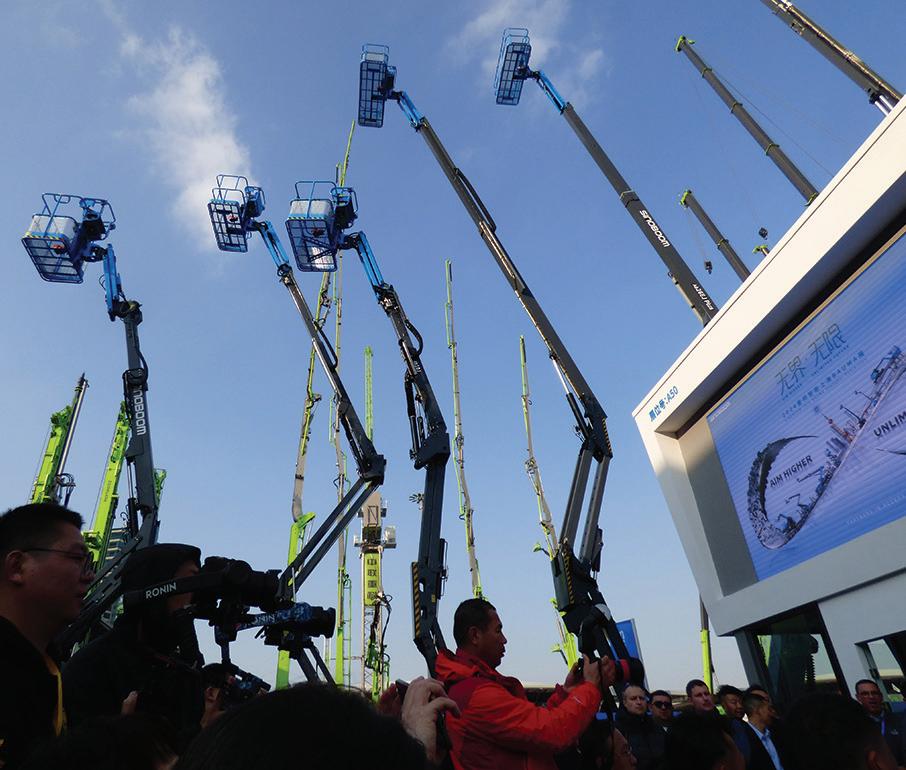


A Rhinocerous KS435 with a 4m lift height and 2,500kg capacity
XCMG displayed its 4,000 tonne All Terrain crane, the XCA4000

another 4,000 tonne at a dozen of them with classic rigid frame and 360 degree models on display. A little strange given that China’s domestic market is almost nonexistent.
Another product that seems to have taken off in China is spider lifts, with several Chinese companies - both large and small - now producing them. What is always a surprise in China are the large number of crane and aerial lift companiesscores of them - that you have never ever heard of in spite of broad product lines.
The 265ft Zoomlion ZT82J boom

Among the stand out products were new record breaking boom lifts, topped by Zoomlion’s 265ft ZT82J boom lift the world’s largest self-propelled lift taking over from XCMG’s 223ft XCMG XGS70K telescopic. Scheduled for launch next year it features a six section main boom topped by a 13.1 metre, three section articulating jib for working heights of up to 82.3 metres. The maximum outreach is 34.1 metres with 230kg, while the maximum platform capacity is 454kg.
The new XCA4000 is designed to install wind turbines of 10MW or more and can lift 230 tonnes to heights of 170 metres


XCMG displayed its 4,000 tonne 11 axle All Terrain crane, the XCA4000, which it began shipping earlier this year. It was recently joined by the nine axle, 4,000 tonne, Sany SAC40000T which was not on display.
new Xcmg awPS

XCMG had plenty of new aerial lifts on show, including a 39 metre lithium battery powered telescopic spider lift - the XGS39X-Li - with 16.5 metres of outreach, a 2.4 metre platform with dual 120/230kg platform capacity and an overall weight of 8,700kg.
Also new was the 165ft XGS52AXK-Li all electric telescopic boom lift with a 52 metre working height, 25 metres of outreach, dual 300/460kg platform capacity and overall weight of 26.1 tonnes.

At the smaller end was the 12 metre XGR12J mast boom, with open mast design and telescopic jib, for a 12.7 metre working height and 5.7 metres outreach with 200kg platform capacitytotal weight is 4,980kg.


Others included a 34 metre telescopic truck mounted lift, the GKS34, with a six section boom providing 19 metres of outreach and a GVW of 7.2 tonnes, and the 66ft - 22 metre working heightelectric Rough Terrain scissor lift, the XG2225ERT.
Potain’S largeSt flat toP
Potain launched its largest flat top tower crane to date, the 80 tonne MCT 2205. The first eight have been sold to Abu Dhabi based tower crane group NFT. The MCT 2205 can be rigged with an 80 metre jib with jib tip capacity of 23.6 tonnes.


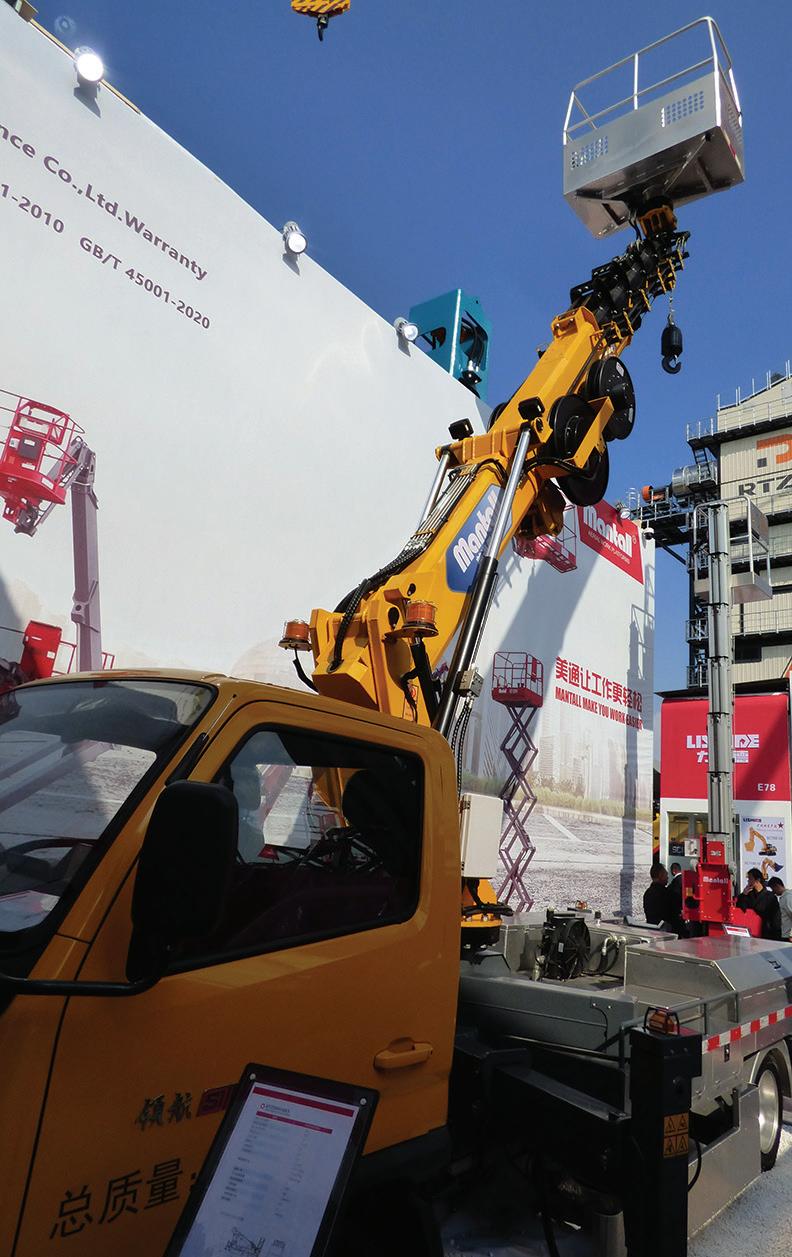


Chinese crane and aerial lift manufacturer XCMG is to run 200 training courses a year in Jakarta, Indonesia aiming to annually train 1,800 participants. Aimed at local service personnel, dealership staff and operators, The Newton Education Centre in Marunda, will run courses that combine lectures and practical experience. The initiative is aimed at tackling a serious shortage of talent. Participants that graduate will be based at locations across Indonesia.
UK port operator A&P Falmouth has been fined more than £750,000 plus costs £26,792.30 for a crane incident that occurred in May 2017.
The crane, an aging Stothert & Pitt dock crane, dropped its boom onto an Acetylene gas cylinder storage cage below. Around 260 people were working on the dock at the time, thankfully no one was hurt in the incident. The crane was working on the Royal Fleet Auxiliary ship, Tidespring, when the boom began its rapid descent, the operator reacted fast enough to slew the boom away from the ship, although it landed on the gas cage. The investigation found A&P Falmouth had failed to properly maintain the crane causing the jib’s luffing ropes to fail due to a lack of lubrication and basic maintenance. The crane had also been recently inspected by a third-party, but recommendations regarding a number of defects were not acted on.

In October, Italian spider lift manufacturer Palazzani, hosted a group of fifth year engineering students from the University of Brescia aiming to provide students with insights into the design and manufacturing processes of aerial work platforms.
President Paola Palazzani and chief executive Francesco Zola, introduced the students to the company and the industry, and then guided them through the production cycle from raw material management to assembly and testing, followed by a session with the company’s technical and engineering team. Finally, they had an opportunity to see the machines in action and experience them first hand.


The US based National Commission for the Certification of Crane Operators (NCCCO) has launched MyCraneCareer.org, an interactive website for employers and people looking to work in the crane industry. The initiative aims to introduce and educate individuals about the opportunities the crane and lifting industry offers, directing them towards training, certification and employment.

T.J. Cantwell of NCCCO said: “As with all skilled trade jobs, the crane industry needs more people, given that it plays a critical role in infrastructure projects and the $1.2 trillion Infrastructure Law will create a need for thousands of new crane operators. We recognised that the crane industry did not have a one stop online resource to provide the information and tools for individuals to learn about the many amazing careers available. Hopefully this will fit the bill.”
UK based Paul Freeman Ltd has been fined £40,000 plus £6,263 in costs after an employee was left paralysed after lying on the floor for six hours following a fall from height.
Andrew Clifford, 51, was installing first floor joists in a house when he slipped and fell. He spent five months in hospital while spinal cord injuries left him paralysed from the chest down. He said: “The first thing I recall was landing on my head. From that point it was a strange feeling, I felt no pain and I couldn’t understand why I couldn’t get up. It was a quiet street and when it became dark, I was really worried. I think I fell between 9:00 and 9.30am and wasn’t found until 3pm.”
The HSE found that the company failed to ensure that the work was properly planned with no measures taken to prevent falls.
A reader sent us this picture of a man using a ladder, a car, a roof rack and a friend to reach what we assume are telephone wires. The friend remains below holding the ladder in place on the roof rack, trying to prevent it from twisting around the pole.




ALLMI had released its new course dates schedule for 2025. As the UK’s only accrediting body providing specialist training for each member of the lorry loader lifting team, along with engineers, instructors and managers, ALLMI’s courses are approved by CSCS and delivered to the highest standard.
Courses available directly from ALLMI include:
• Crane Supervisor
• Appointed Person
• Thorough Examiner
• Manager - PUWER 9.2
• Instructor
ALLMI training providers supply the following courses:
• Lorry Loader Operator • Slinger/Signaller
Course information, dates and training provider details can be found at www.allmi.com/training
ALLMI has launched a campaign to promote its collection of good practice videos, which are freely available on the ‘ALLMI TV’ section of its website. Among the videos now accessible is the ‘Safe Use of Lorry Loaders’. Intended to complement periodic and ongoing formal training and assessment, the video addresses the applications of ‘Hook’, ‘Builders Merchants’ and ‘Utilities’ and covers the following:
• Legislation, Standards & the Lifting Team Hierarchy
• Siting the Loader
• Pre-Operational Checks
• Safe Operation
• Safe Travel


ALLMI chief executive Tom Wakefield said: “We are delighted to make this content readily obtainable via ALLMI TV and to remind the industry that this area of the website also features videos concerning swing-up stabiliser safety and the safe use of remote controls.”
“To further distribute this important good practice content, we have made a range of campaign tools available for members and the wider industry to utilise, including postcard literature and QR code stickers.”
ALLMI is providing the following free of charge:
• Postcard Literature: including a QR code linking to ALLMI TV (as well as information concerning ALLMI’s Guidance material on the reverse) and designed for insertion into lorry loader handover packs/ documentation. These postcards are available in hard copy and digital format.
• QR Code Stickers: designed for affixing to lorry loaders, the stickers are 114mm (H) x 74mm (W), made from weather-proof external grade vinyl and contain a QR code linking to ALLMI TV.
• Standalone QR Code: The ALLMI TV QR code contained in the above is also being provided as a standalone graphic for companies to utilise and incorporate into their own literature.
• Email Signature Graphic: ALLMI staff will use an email signature graphic to assist with campaign promotion and this is also being offered to members.
Wakefield added: “We hope the industry will join us in spreading this important message and we would encourage stakeholders to contact us, should they wish to order a quantity of postcards or stickers, or if they have any related queries.”


ALLMI technical manager Keith Silvester presented at the SAFed Annual Member Conference, which carried the theme ‘Change’. He talked about the lorry loader industry’s work on swing-up stabiliser safety, particularly in terms of product development, training and guidance, as well as the collaborative way in which this was achieved.
On 13th December, ALLMI will host an online seminar on the Industry Lifting Lead AP Group’s ‘Hands Off, Step Away, Safe Space’ (HOSASS) campaign. The campaign aims to improve practices in relation to personnel/load interfaces during lifting operations and the group has produced a range of supporting material, including a guidance document, poster and video, all of which can be accessed via: illapg.com/ updates-downloads-links/
Whilst ALLMI is hosting the event, the core presentation will be delivered by Costain’s chief engineer and ‘designated individual for lifting’, Tom Pawson, who is also a co-chairman of the Lead AP Group and played a primary role in the development of the HOSASS campaign.
Keith Silvester, also a co-chairman of the Lead AP Group said: “We look forward to welcoming Tom, who will be explaining the origins of the HOSASS campaign, the resources that are freely available and what the lorry loader industry can expect in terms of site requirements.”
If you’re interested in attending, please email enquiries@allmi.com
The Industry Lifting Lead AP Group was formed in 2015 to encourage collaboration and co-ordination between working groups, associations, governing bodies, contractors, owners and suppliers. Its aim is to support lifting industry improvements through the development and promotion of guidance and training, ultimately making lifting operations safer and more efficient.


For details of ALLMI standards, guidance documents and training, visit: www.allmi.com

Zac Bradshaw of Commhoist won the 2024 Lifting Technician of the Year award at this year’s CPA Stars of the Future Awards. Part of his prize included a trip to Liebherr’s plant in Ehingen, Germany.
Kirsty Archbold-Laming of Southern Hoist Services, who chairs the Construction Hoist Interest Group and sits on the CPA Council joined him on the trip and said: “Anyone who knows me also knows how passionate I am about training and attracting people to the industry. At the awards I watched as Zak was awarded Lifting Technician of the Year, I could only imagine how he felt, winning the award and a trip to the Liebherr plant in Germany. Arran Willis of Liebherr, which sponsored the award, then surprised me by asking if I would accompany Zak on the trip. Be rude not to I thought!”
“On arrival Arran introduced his German colleagues and we learnt about the history of Liebherr and how Hans Liebherr had started the company after the war with a simple idea of helping rebuild Germany and how the company remains a family owned business to this day.”

“We then embarked on a tour of the factory, with Arran telling me I would be investing in cranes by the end of the visit, I can see why now! After moving through the manufacturing and assembly process from start to finish, we headed to the test area… Zak’s eyes lit up. He has already become a respected crane operator often asked for by name and was offered the opportunity to operate some of the larger cranes, putting them through their paces.”

“I myself have never sat in a crane, let alone operated one, however Arran enticed me to give it a try. As I got into the cab and was shown the controls, I was clearly out of my comfort zone. Zak helped me become acquainted with it and I stopped shaking, with lots of laughter along the way.”
“The trip was amazing. It was truly an honour to spend time with Zak and talk shop. For someone so young he already has great experience of the industry and clearly knows what he is doing. He is already a Star of the Future, but I know he will be a leader in his field given the drive, determination and attitude he has to succeed.” The Stars of the Future Awards 2025 will open for nominations on 1st January nomination forms will then be posted at www.cpa.uk.net.
Around 200 delegates attended this year’s CPA Conference on the7th November with the overall theme of ‘Shaping the Future: Insights for the Plant-Hire Sector’. CPA chief executive Steve Mulholland opened the event by stressing the need to find new ways to attract school leavers into the industry, given the number of people that are retiring and taking their skills with them, creating a serious knowledge gap and an aging workforce.
He also argued strongly for a more pragmatic, common sense approach from governments and regulatory bodies, “especially politicians and some Tier 1 contractors and their clients who have been racing to mandate policies too quickly in order to outdo one another, while manufacturers race to gain commercial advantages, leaving rental companies with little option but to conform to these mandates. Ultimately it is the end hire company and end user who feel the pain at the sharp end.”
“CPA members must be able to continue using fossil fuelled equipment while alternatives are developed and sensibly phased in as their performance allows. Evolving to get there without these ridiculous targets is how we will do it, not by panic and knee-jerk reactions to meet impossible political targets which suit their own agendas and that of noisy minorities.”
The event also included five panel discussions which brought industry experts together to share opinions and solutions.



Place your products in front of 31,000 crane, telehandler and access platform buyers & users who will be reading the December/January issue of cranes & access…

will
We will take a look at some of the latest developments in this sector where commercially mounted traditional truck mounted cranes are making a bit of a comeback, while the ‘aluminium truck crane’ sector continues to grow and spread. If you have news or information to add, we’d love to hear from you.


Given the increasingly wide choice of work platforms with a telescopic mast for elevation, we take a look at mast type lifts, which fit between low level work platforms and small slab scissor lifts, along with the latest mast boom developments and new entrants coming into what was a niche market.
After a tough year for many rental companies, the annual C&A survey provides an indication of latest crane, access and telehandler rental rate trends as well gauging the mood of the sector both looking back and into 2025 and how it may influence rental company capital expenditures in the year ahead.
We take a look back at both the lifting industry and world events in another eventful year!

or call us on UK +44(0)8448
every issue of c&a is also packed with our regular columns and news plus reader’s letters, books, models, training, along with the latest news from cPa, allmi, and iPaf.
news, photographs or ideas on these subjects
+44(0)7989 970862
Cameron Reid, managing director of Alimak, has been appointed the new chairman of the Mast Climbing Work Platforms (MCWP) & Hoist International Committee succeeding Kevin O’Shea who becomes vice chairman.
The committee aims to promote the safe and effective use of Mast Climbing Work Platforms and Construction Hoists worldwide through technical expertise, guidance, and training to meet industry standards and regulations.
Speaking of his new role, Reid said: “The expansion of safe and effective use of mast climbing work platforms and construction hoists is critical as demand grows worldwide. Our committee is focused on increasing the number of certified instructors and training centres globally. By expanding our reach and resources, we aim to ensure the highest safety standards across the industry and reinforce IPAF’s commitment to operational excellence.”
His vision as chairman includes enhanced safety through IoT (Internet of Things) based real time monitoring, providing operators with data on factors like safe working loads, wind conditions and equipment status, as well as automatic alerts for untrained operators and overdue maintenance, aiming to reduce accidents. Innovations in materials and modular designs will lead to stronger, lighter and more adaptable machines, improving efficiency and safety on site. Reid also supports a shift towards energy efficient designs and recyclable materials, prioritising sustainability as a key driver for the sector’s future.

Emphasising the importance of training, Reid plans to ensure initiatives keep pace with technological advancements and support global standardisation for safer, more efficient operations.
Reid added: “Regular inspections, rigorous maintenance and clear compliance with local and national standards are fundamental for a safer industry. Our committee will actively work to provide guidance and resources that support these standards.”
IPAF mast climber and hoist manager Angel Ibanez, added: “With Cameron stepping in as the new chairman, the committee is set to enhance its efforts to truly represent the voice of this industry on a global scale. Cameron’s extensive professional experience will undoubtedly enable him to carry on the outstanding work achieved by his predecessor, Kevin O’Shea, while injecting fresh momentum with the full support of the IPAF team.”
In collaboration with the UK Health and Safety Executive (HSE), IPAF has developed guidance on the safe methods for isolating platform controls on aerial work platforms. The HSE is currently investigating an incident involving an aerial work platform, which highlighted the fact that isolating controls at height could pose a hazard to platform occupants.
The emergency stop control has been used for as a form of engine stop and isolation for many years, initially on older machines to prevent entrapment and accidental control operation. However, as standards and designs have evolved, this method may no longer be the safest option.
For machines with an ‘engine on/off’ control at the platform control console, operators should use this to switch off the engine during normal operation, unless the manufacturer advises otherwise. If no such control is available, operators should follow the manufacturer’s instructions for isolation.
It is the user’s responsibility to select the correct work platform for the task and conduct a suitable risk assessment. The HSE supports this guidance and encourages IPAF to share it with aerial platform users.

Taking place in Dublin March 13th The International Awards for Powered Access 2025 (IAPAs) are now open for entries and bookings are available for the IPAF Summit.
The IAPAS feature 13 award categories, covering a range of areas including new products, innovations, sustainability, safety, and workplace equality and diversity. Winners will be chosen by an independent judging panel of five industry experts. The award ceremony will follow the IPAF Summit, which will offer presentations, industry discussions and networking opportunities.
IAPA Categories:
• Access Rental Company of the Year
• The Sustainability Award
• The EDI Award
• Contribution to Safe Working at Height
• Innovative Technology Prize
• Digital Development Award
Lifetime Achievement:
• Lifetime Achievement Award
Product of the Year Awards:
• Mast Climbing Work Platforms & Hoists
• Scissor Lifts & Vertical Mast Platforms
• Self-Propelled Booms & Atrium Lifts
• Vehicle and Trailer Mounted Lifts
IPAF Member Companies and Individuals Only:
• IPAF Training Instructor of the Year
• IPAF Training Centre of the Year


The Liebherr 195 HC-LH 6/12 is a tower crane with a hydraulic luffing jib that first appeared as a prototype at Bauma 2022. It can be rigged with a maximum jib radius of 55 metres and a maximum capacity of 12 tonnes. Although it may be seen as a late entry by Liebherr into the hydraulic luffing jib sector, it was in fact a pioneer of this type with the 25 HB and 50 HB cranes of the early 1960s.
This model is made by Conrad in 1/87 scale and it comes in a high quality Liebherr branded box with a detailed instruction manual. Some of the steps are not in the right order, but assembly is generally straightforward.
The cruciform base is modelled in metal and four large ballast blocks are single pieces shaped like separate slabs. The triple height tower sections are very good with clip fixings at each end. Inside each section there are plastic ladders and platforms, and rails for an LiUP operator lift, although the elevator is not modelled.
The slew ring and tower top are modelled in one piece with the top section of jib so that it cannot be used as a transport load. The cab deck has
a realistic looking cab and cabinet with slightly over thick handrails. The short counter jib has a walkway while the counterweight is a single block.
The jib profile is excellent and is made up of three pieces. The lattice work is fine quality, although surprisingly there is only triangulation on the two sides reminiscent of much older models and this may have been a weight reduction compromise. The jib luffs by adjusting a lock on the top of the hydraulic lift cylinder barrel with a spanner and works well enough.
A metal hook block is provided with a single sheave, and the hoist/winch works by turning the protruding shaft, relying on friction as a brake. Plastic stand frames fit on each side of the block and a Liebherr branded load is also included. Overall, this is a very good looking model only compromised from some angles by the hollow jib bottom. The tower can be built in different heights, but the jib configuration is fixed, and most parts do not make realistic transport loads. It costs €210 excluding VAT from the Liebherr Webshop.


Dear Leigh
Great cover in the latest issue, it captures Mr Bravi perfectly - that intense frown and concentration - that’s him perfectly. He has been a real pioneer of low level access and deserves to be recognised more. Good issue of the magazine too.
Jeffrey Sleight
i have been waiting for you to publish a report on the fatal accident that happened here in northern ireland last week. a delivery driver working for kDm died after he was crushed by a platform that moved. We all know it happened but nothing from hseni, nothing from the company just a wall of silence with people discussing in hushed tones. but by the grace of god go i, but surely the safety authority ought to say, ‘this happened yesterday because of XYZ - make sure your employees are made aware of exactly what happened so that they can be wary of it.’
if we are ever going to become safer we all need to talk - look whats happened with prostate cancer testing since chris hoy announced his diagnosis. iPaF needs to demand more openness from its members and the hse - enough is enough.
Name supplied but anonymity requested.
We could not agree more with our reader on this, we did eventually publish the story, after we managed to confirm the key details to almost beyond all doubt. We reached out to KDM repeatedly to obtain the full details and learn ‘its side of the story’ but to no avail. We do appreciate that it is a terrible and traumatic time when this happens to a team member. Made worse perhaps by the threat of prosecution.
Shame however on the safety authorities for not being more open. Their focus all too often appears to be totally misdirected, allowing the police to dither over an investigation for months, and giving more weight to blame and prosecution than safety. It’s time for a change.
The following note came from a man calling himself Tommy D, a fall protection engineer in the UK, and part time trainee pilot and fitness coach. He recently operated a boom lift and came across Nationwide’s Harness On device.
richard John ‘dicK’ lloyd 1933 - 2024

“out of all the work platforms i have been on, i have never seen this harness on attachment before. i think it’s a brilliant piece of innovation. i like it and think it’s really cool, a lot of people though were talking negative about it saying it can be bypassed etc...but so can anything. i think the more loopholes you’d have to jump through to avoid using the machine properly, the more chances you’ve got to check yourself and make the right decision.”
While we are not convinced that this device is as great a game changer as Tommy does, some of the feedback he received after posting a video of it on a social media platform was utterly appalling. And what made it worse is that the comments came from people who regularly work with platforms, ranging from rental company owners to steel erectors. At best they were cynical, but in a good few cases rude, abusive and downright ignorant. Thankfully a decent number were encouraging, while recognising that the device is far from perfect.
You can see three of the comments below: note we have not published the worst one.
“absolute bag of s**t, something added just to make idiots rich and further hinder the poor guy in the platform, who already has a double lanyard, half a dozen tool lanyards, anti-collision bars or wires and some dickhead safety guy watching him and making him nervous just in case he takes his glasses off for 5 seconds.”
“Put a bolt in it works fine”
“looks like a good bit of kit especially for new operators” We would be interested to hear some comments from our readers.

Veteran crane salesman Dick Lloyd passed away in late September shortly before his 91st birthday, following a long struggle with prostate cancer.
He passed away peacefully on the 21st of September surrounded by his family. He leaves behind his wife, Audrey, of 55 years as well as three daughters: Josephine, Fay and Lucy Jean. Dick Lloyd left school in 1952 having secured a place at Merton College, Oxford, to study Jurisprudence, but first he had two years of
National Service to do. Having been a cadet at school he was able to choose which service to join and chose the Army’s Royal Engineers. After a year training and working with the Bridge Classification, Mines and Demolition Group he was posted to Port Said, Egypt, where he was appointed as a liaison and troop welfare officer. In 1954, he began three years of study at Oxford but realised that law was not for him, so as his time at Merton came to an end, he began looking for jobs with the usual companies attending University recruitment fairs.

He had two interviews lined up, the first to become a management trainee with Rolls Royce, but the interview with a board of stuffy and formal directors failed to impress. However, his interview at Coles Cranes with Robert Albon for the position of export sales trainee was far more to his liking, with the potential of overseas travel and excitement. At that time, Coles was the largest crane manufacturer in Europe, and one of the largest in the world.
His time with Coles was successful - especially once he was able to start travelling and selling outside of the UK - and as a result of those early years he remained in the crane business for the rest of his life, adding excavators along the way.
In 1965 Coles appointed a new sales director and Dick struggled to get on with him and accepted a job offer from the managing director of Hymac whom he knew well. The company had launched a hydraulic excavator and also dabbled in cranes and later platforms.
After five years with the company Hymac hired the very person that caused him to leave Coles. So, in 1970, he looked to move back to Coles, which was owned at that time by the familyowned Steel Group. While there was no suitable opening at Coles, it also owned crane and excavator manufacturer Priestman. So, in March of that year, Dick began his export sales career with Priestman, and later added Coles to his remit for certain markets.
Coles and Priestman had become part of the Acrow Group and when it went into administration in 1985, Dick and most of the other employees were laid off. Grove then stepped in and acquired the business, putting the Coles management in charge of the business and then merging its own European operations into Coles. Dick managed to obtain a sales role with the reformed company, mostly covering Poland. He was officially employed as a consultant with Grove with the plan that he would work with his contacts in Poland to set up a new distributor. The business they founded became Grabcranex. The new venture was initially supported by Grove and before long handled Grove/Coles cranes and Grove Manlift platforms and Dick had also become involved with Sennebogen and began selling its crawler cranes and other equipment later adding a Manitou dealership.
In late 1997 Dick sold his shares in Grabcranex and made his last visit to Grove’s headquarters in Shady Grove Pennsylvania for an international dealer conference. He was one of the very few people or distributors that managed to sell the 150 tonne Grove RT1650, a four axle Rough Terrain crane with hydrostatic drive which was technically a major challenge, but Grabcranex managed to sell at least two of them and managed to keep them going and eventually sorted out some of its technical issues.
At the end of the year events conspired to cause him to retire although he was approaching 65, the age that he had always planned to retire, having served 40 years as a crane and excavator sales. In retirement he began writing and publishing his memoirs. In his first volume “40 Years A Salesman” he gives a forthright account of his
career unabashedly writing about events at the companies he worked for as he saw them or believed them to be. In 2007 he joined Vertikal Press at Bauma 2007, where he sold and signed copies of his book from our stand. As you might expect if you knew him, he turned up in full Bavarian dress, complete with lederhosen, Tyrolean shirt, loden jacket and Bavarian hat, complete with feather.

His next two books were more personal memoirs about his earlier days, starting out with “ReIncarnated A Boarding School Boy” covering his school years along with a large section on the teachings of Arthur Wyeth, a healer who spoke widely on the subject of incarnation to which the young Dick became a follower, thus the title of his book. His third book “Three Glorious Years” covered his time as a student at Merton College, Oxford. More recently he had been working with ex-Priestman colleague Bill Bromwich on a detailed history of Priestman. That text is currently with us for eventual publication. Dick Lloyd was unquestionably a one off, larger than life and always a rebel. He was a true character, could be loud and was more than capable of irritating some people with his manner, but was also fiercely intelligent. Although he came across as being very ‘English’, he was very international and loved travelling and learning new languages as well as meeting people from different cultures. While he has been out of the crane or lift industry for a good few years, the lifting community has certainly lost one of its true characters.
The following are some of the comments received regarding the news:


Very sad news. I knew in the late ‘80’s/early ‘90’s. I have a signed copy of his book, ‘40 Years a Salesman’ on my bookshelf. A lovely man. My sincere condolences to his family.
Steve Barnett
Sad news. Dick was a lovely guy. Spend a long time at Bauma with him listening to his great stories. Have good journey Dick...
Nicole Engesser
Dick was a great guy, always smiling and with an infectious optimism - especially for the Eastern European market for lifting equipment, which he knew so well.
Very sad news. RIP Dick.
Paul Richards


thank you for your support
We would like to thank our readers, sponsors and contributors for the fantastic support that you have given us throughout this year, all of which helps to make our publications, events and other activities a success. We wish you all a very safe and happy holiday season and a healthy and prosperous year in 2024.
From all o F us at

John Hewitt, the founder of J. Hewitt Crane Hire in Middlesbrough, UK, has died. He passed away peacefully on Thursday the 17th of October in hospital surrounded by his family he was 77.
He leaves behind his wife Norma, daughter Jennifer, son Paul, five grandchildren and two great grandchildren.
John Hewitt worked at British Steel before deciding to get into the crane rental business, but in 1980 he purchased an Iron Fairy mobile pick & carry crane and began working as a one man band. The new venture went well, and he move up a notch in April 1982, when he registered the current company, with his wife Norma as codirector, she also served as company secretary. They built the company into a well-respected operation with between 27 and 30 cranes, along with trucks and ancillary vehicles, operating across the North east region of England. His son Paul came into the business and managed it as John began to take a back seat as he focused on the Navigation pub which he had acquired and loved.
Speaking of his father, son Paul said: “He was a really kind person who everyone loved. Everyone respected him and he was a very successful businessman. He was a self-made multimillionaire. He worked from 5am to 6pm every day and built the business up with our mam. You couldn’t keep him away from work he was still coming in until his last days and would go to The Navigation for his liquid lunch. He just loved the business.”

His funeral was attended by around 500 people with his coffin leading a small convoy of Hewitt cranes. Such was the attendance that it made it into the local newspapers.
Comments from staff, customers and suppliers give a flavour of the man:


“Always the life and soul of factory visits, always smiling. RIP John. Sincere condolences to the Hewitt family.”
“Great guy, he had one of his drivers give me lessons on a small crane to help me pass my Class 2 licence and wouldn’t take a penny. RIP John.”
“He was a lovely man. He will be sadly missed by so many. He was always joking with me when I came to site.”
“Best boss I’ve worked for, and absolute gent loved listening to the stories he use to tell down the Navigation, he will be sadly missed by all. RIP boss”
“John was a legend and one of the most honest men you could ever meet.”
“RIP John the best boss I’ve ever worked for. Second to none”
“RIP John you were a true gentleman”
“Although a customer John was a friend. Always left his office with a smile on my face. So Sorry to you all for yours and our loss.”





10th and 11th september 2025, newark showground, Nottinghamshire
vertikal days 2025 will return to newark showground, nottinghamshire on 10th & 11th september.
Over 2500 lifting equipment professionals visit Vertikal Days each year to see the very latest cranes, access platforms and telehandlers, innovations and associated products.


If you want to get in front of key buyers, end users and purchasing influencers, Vertikal Days is the place to be in 2025.

Bauma Conexpo India
December 11 - 14, 2024

Preliminary dates for the bauma/Conexpo exhibition in India Noida, Delhi, India
Tel: +49 89 949-20255 www.bcindia.com/en/ 2025
Baumag
January 26 - 29, 2023 Swiss construction equipment show Lucerne, Switzerland
Tel: +41 56 204 20 20 www.baumaschinen-messe.ch /htm/home.htm

The ARA Show 2025
January 30 - February 1, 2025
The American Rental Association’s annual trade show and convention Las Vegas USA
Tel: +1800 334 2177 http://www.arashow.org/ Executive Hire Show
February 12-13, 2025 Coventry
Tel: +44 (0)207 973 4630 www.executivehireshow.co.uk
IPAF Elevando 2025 13 - 14 February 2025
IPAF meeting and event for Spain Valencia, Spain
Tel: +44 (0)15395 66700 www.ipaf.org/elevando-espana ainara.greno@ipaf.org

SC&RA Annual Conference
April 21 - 25, 2025
Annual Conference of the US cranes and heavy transport association including the Jobs of the Year awards, Arizona Biltmore Hotel, Phoenix, Arizona, USA
Tel: Tel: +1(703) 698-0291
https://www.scranet.org/SCRA/Content/ events/AnnualConference.aspx
ERA Convention 2025
June 4 - 5, 2025 Location to be confirmed
Tel: + 32 2 761 16 04 www.erarental.org era@erarental.org
Hire25
June 4 - 5, 2025

Platform Gunleri 25
September 18 - 20, 2025
Annual exhibition of Platformder - the Turkish aerial work platform association
Istanbul, Turkey
Tel: +90 216 466 87 22 www.platformgunleri.org/ platformder@platformder.org.tr Internationale Schwerlasttage

2026
Swissbau
January 20 - 23, 2026
Swiss construction exhibition
Basel, Switzerland
Tel: +41 58 200 20 20 www.swissbau.ch
The ARA Show 2026

The Hire and Rental association of Australia and Elevating Work Platform Association annual convention & expo
Melbourne, Australia
Tel: +61 (0) 299982255 www.hriaconvention.com.au hire25@hria.com.au
Hire Con 2025
September 1 - 2, 2025

Turmdrehkran-Branchentreff des VDBUM 17-18. February 2025
German tower crane interest group meeting Bruchsal, Germany

Tel: +49 0421 87168-0 www.//tdk-interessenvertretung.de/ zentrale@vdbum.de
The IPAF Summit and awards
March 13
Annual Summit and IAPAs awards Dublin, Ireland
Tel: +44(0)15395 66700 www.ipaf.org
Buildtech Asia 25
March 26 - 28, 2025 Asian exhibition for the building and construction market Singapore Tel: +65 6319 4020 www.buildtechasia.com/sg Hanover Messe
March 31- April 4, 2025
World’s largest industrial exhibition Hanover, Germany
Tel: +49 511 89-1 www.hannovermesse.de
Bauma 2025
April 7 - 14, 2025


World’s largest construction equipment show Munich, Germany
Tel: +49 (0)89 51070 www.bauma.de


September 19 - 20, 2025
German conference on heavy lifting, transport, rigging, and installation Hohenrhoda, Germany
Tel: +49 (0) 6181 9060 705 www.schwerlasttage.de info@schwerlasttage.de
The Utility Expo
October 7 - 9, 2025
US utility industry’s largest equipment show Louisville, Kentucky, USA
Tel: +1 414-274-0644 www.theutilityexpo.com
TheUtilityExpo@Xpressreg.net
Crane Safety 2025
October 14, 2025


HIANZ- Hire Association of New Zealand conference & expo
Christchurch, New Zealand
Tel: +64 7 575 2563 www.hianz.net.nz/ events@hianz.net.nz
Vertikal Days 2025
September 10 - 11, 2025

Newark showground, Nottingham, UK UK/Ireland Crane, access and telehandler event.
Tel: +44 (0) 8448 155900 www.vertikaldays.net
Innovationstage der Höhenzugangstechnik
September 12 - 13, 2025
Innovation Days, informal event for innovative access equipment, mini cranes and telehandlers Hohenroda, Hessen Hotel Park, Germany www.borntolift.de/ innovationstag
JDL Expo
September 17 - 19, 2025 France’s crane and access event Beaune
Tel: +33 (0)1 45 63 68 22 www.jdlexpo.com/ info@jdlexpo.com
HCEA Convention and Old Equipment Exposition
September 18 - 20, 2025


The Historical Construction Equipment Association’s annual convention and expo Bowling Green, Ohio, USA
Tel: +1 419-352-5616
www.hcea.net/ info@hcea.net
Crane safety conference organised by the Institution of Mechanical Engineers. London, UK
Tel: +44 (0)207 973 1251 www.eventsportal.imeche.org eventenquiries@imeche.org
CICA National Conference 2025
Brisbane October 16 - 18, 2025
The annual conference of the Crane Industry Council of Australia
Brisbane, Australia
Tel: +61 03 8320 0411 www.conference.cica.com.au/ wise@wiseconnections.com.au
TCI Expo 2025
November 06-08, 2025

February - Dates to be confirmed the American Rental Association’s annual conference and exhibition Orlando, Florida, USA
Tel: +1800 334 2177 www.arashow.org
Conexpo-Con/Agg 2026


March 3 - 7, 2026 The leading US construction show Las Vegas, Nevada, USA Tel: +1 414-298-4133 www.conexpoconagg.com
Samoter
May 6 - 9, 2026
International earthmoving and building equipment show Verona, Italy Tel: +39 045 8298111 www.samoter.it/it
SC&RA Annual Conference

April 20 - 24, 2026 Annual Conference of the US cranes and heavy transport association including the Jobs of the Year awards
Omni Amelia Island, Amelia Island, Florida, USA
Tel: +1 (703) 698-0291 https://www.scranet.org/SCRA/ Events/
Apex 2026
June 2026 International powered access trade show Maastricht, The Netherlands Tel: +31 (0)547 271 566 www.apexshow.com
IAA Transportation
September 15 - 20, 2026
The logistics, commercial vehicles, and the transport show

Tree Care Industry Association annual exhibition St Louis, Missouri, USA
Tel: +1 603-314-5380 www.expo.tcia.org EXPO@tcia.org
Liftex 2025

November 18 - 19, 2025 Liverpool
Annual conference and exhibition of LEEA Liverpool, UK
Tel: +44 (0) 203 488 2865 www.leeaint.com enquiries@L2Events.com

Crane Rental Association of Canada Annual Conference
Date to be advised The annual Canadian crane conference Windsor, Ontario, Canada
Tel: +1780.790.2722 www.crac-aclg.ca/ info@crac-canada.com
GIS 2025
October 08-11, 2025
Italian crane, access and heavy transport exhibition Piacenza, Italy
Tel: +39 010/5704948 www.gisexpo.it

Hanover, Germany
Tel: +49 30 897842-202 www.iaa-transportation.com/en stephanie.glaesser@vda.de Platformer Days 2026
October 8 - 9, 2026

German Access and lifting exhibition Karlsruhe, Germany
Tel: +49 721 3720 5096 www.platformers-days.de/ philipp.doll@messe-karlsruhe.de Glasstec 2026
October 20 - 23, 2026

The largest event for glass lifting and installation
Düsseldorf, Germany
Tel: +49 211 456001 www.glasstec-online.com/ online-support@glasstec-online.com Smopyc

November - Dates to be confirmed Spanish construction equipment exhibition Zaragoza, Spain
Tel: +34 976 764 700 www.feriazaragoza.com/smopyc

Visit : www.Vertikal.net/en/events for a full listing of events with direct links to the organisers.

delay
vertikal days 2025 will return to newark showground, nottinghamshire on 10th & 11th september.
Exhibitor registration is open https://vertikaldays.net Email the team: contact@vertikaldays.net
Over 2500 lifting equipment professionals visit Vertikal Days each year to see the very latest cranes, access platforms and telehandlers, innovations and associated products. If you want to get in front of key buyers, end users and purchasing influencers, Vertikal Days is the place to be in 2025. book today!
RECRUITMENT . USED EQUIPMENT . REPLACEMENT PARTS
Place your products or services in front of more than 28,700 individuals who buy, specify or use cranes, lifting gear, aerial work platforms, work at height equipment or telehandlers across 195 countries. Given the global readership you may be surprised at how little a regular advert costs and how effective it can be. www.vertikal.net/en/cranes-and-access/advertise advertising@vertikal.net or info@vertikal.ne
Contact us at:
The Vertikal Press Ltd. PO Box 6998, Brackley, NN13 5WY UK.
Tel: +44 (0)8448 155900 E: advertising@vertikal.net

Vertikal Verlag Sundgauallee 15, Freiburg Germany, D-79114
Tel: +49 (0)761 8978660 E: info@vertikal.net
Crane Hire Limited (CHL) is Ireland’s leading provider of mobile telescopic cranes and associated services. We are recruiting an experienced and customer-focused Hire Desk Controller to manage the daily crane hire operations at our Dublin depot.
Responsibilities:
• Understand and ensure delivery of customer hire requirements
• Manage customer enquiries, contracts and orders
• Coordinate hire desk operations, including scheduling and resource management
• Work closely with sales, operations, maintenance and transport teams
Requirements:
• Excellent customer service skills
• Previous hire desk experience
• Strong communication, organisational & IT abilities
• Team player with a positive, can-do attitude
For more information or to apply, please email :operations-manager@cranehireltd.com
Crane Hire Limited, Kylemore Park North Ballyfermot, Dublin, D10TN56


LOOkIng fOr Crane, aCCess Or TeLehanDLer
peOpLe? LOOkIng fOr a jOb?
Then why not start right here in the Cranes&access recruitment section? With your support we can build a highly useful recruitment resource for the industry right within the Uk and Ireland’s only dedicated publication. Call or email us today to find out about our great start up rates. jobs Wanted ads are free!
+44 (0) 8448 155900
If responding to one of the ads please say you saw it in Cranes&access.
Industrial lifting magazine Lift & Hoist International (LHI) has been rebranded as ..


The new magazine and web site will continue to provide independent, impartial coverage and information for professionals working in the global industrial lifting sector for all types of industrial lifting equipment including: Overhead cranes, Hoists, Aerial work platforms, Lift trucks, Rigging and all related Drives, Controls and Ancillary Components.
Published by MK International Media Ltd.



We are currently conducting live trials on our new online Marketplace for buying and selling anything involved with cranes, access equipment, telehandlers or lifting equipment.
The Vertikal Marketplace is a very simple format, in which buyers or sellers can upload an advert either using artwork or just plain text and photos. For the next few weeks anyone can advertise in the Online Marketplace totally free of charge. Attractive ‘bolt on’ packages will also be available for anyone wishing to add their adverts to the Cranes & Access magazineboth print and digital versions.
If you have something to sell, or are looking for a specific product - just give it a try and please let us know what you think.


The fast and efficient way to find a supplier
reach over 28,000 readers for only £185/€210 per year with live link direct to your website. Check out the new enhanced entry option!
Book now – advertising@vertikal.net
aCCess equipMent ManufaCturers
AIRO www.airo.com
Alimak www.alimak.com
Almac www.almac-italia.com
ATN www.atnplatforms.com
Böcker www.boecker.de
Bravi www.braviisol.com
Bronto Skylift www.brontoskylift.com
CLM Construction Supplies www.clm-supplies.com
CMC www.cmclift.com
CPL www.cpl-ltd.com
CTE www.ctelift.com
Denka-Lift www.rothlehner.com
Dino Lift www.dinolift.com
Dingli www.cndingli.com
Easylift www.easy-lift.it
Falcon Lifts www.falconlifts.com
GEDA www.geda.de
Genie www.genielift.com
GSR www.gsrspa.it
Haulotte www.haulotte.com
Hinowa www.hinowa.com
Holland Lift www.hollandlift.com
Imer Access www.imergroup.com
Iteco www.imergroup.com
JCB www.jcb.com
JLG www.jlg.com
Klaas www.klaas.com
Klubb www.klubb.com
Leguan Lifts www.leguanlifts.com
Manitou Group www.manitou.com
Mecaplus www.mecaplus.es
Omme Lift www.ommelift.com
Palazzani Industrie www.palazzani.it
Palfinger Platforms www.palfinger-platforms.com
Platform Basket www.platformbasket.com
Ruthmann www.ruthmann.de
Sinoboom www.sinoboom.com
Saeclimber www.saeclimber.com
Skyjack www.skyjack.com
Snorkel www.snorkellifts.com
Socage www.socage.it
Teupen www.teupen.com
Versalift UK www.versalift.co.uk
XCMG European Sales and Services www.xcmgess.de
Zoomloin http://en.zoomlion.com
pLatforM rentaL
AA Access (Specialists) www.aaaccess.co.uk
Acrolift www.acrolift.co.uk
Ahern Rentals - USA www.ahern.com
AFI- Uplift www.afi-uplift.co.uk
Dragon Access www.dragon-access.co.uk
Drammen Liftutleie AS www.drammenlift.no
Hird www.hird.co.uk
JMS Powered Access https://jms.co.uk
Kran Cranes www.kran.ro/inchiriere-macara-constanta
Rental Romania
Monitor Lifts - AUS www.monitor.net.au
Mr Plant Hire www.mrplanthire.co.uk
Platform Sales & Hire www.platformsales.co.uk
Power Platform Services www.pps.co.uk
Rapid Platforms www.rapidplatforms.co.uk
Viking Access www.vikingaccess.co.uk
Warren Access www.warrenaccess.co.uk
new & used pLatforMs
Access Platform Sales (APS) www.accessplatforms.co.uk
AFI Resale www.afi-resale.co.uk
A.J. Access Platforms www.accessplatforms.com
Gantic, Norway www.gantic.no
Genie www.genielift.com
GSR Aerial Platforms UK http://en.gsrspa.it
Haulotte www.haulotte.com
Hird www.hird.co.uk
Independent Access Sales www.iasales.co.uk
International Platforms www.internationalplatforms.co.uk
INTEQ UK and UAE www.inteq.uk
JLG www.jlg.com
JMS Powered Access https://jms.co.uk
Kunze GmbH www.kunze-buehnen.com
Mr Plant Hire www.mrplanthire.co.uk
Rothlehner www.rothlehner.com
Platform Sales www.platformsales.co.uk
Promax Access www.promaxaccess.com
Rapid Platforms www.rapidplatforms.co.uk
TVH - Group www.tvh.com
Vertimac www.vertimac.com
Crane ManufaCturers
Böcker www.boecker.de
Ernest Doe & Sons Ltd. www.ernestdoeloadercranes.com
Grove www.groveworldwide.com
Jaso Tower Cranes https://jaso.com
Jekko Minicrane www.jekko.it
JMG www.jmgcranes.com
KATO www.rivertekservices.com
Klaas www.klaas.com
Kobelco www.kobelcocm-global.com
Liebherr www.Liebherr.com
Linden Comansa www.comansa.com
Maeda www.maedaminicranes.co.uk
Manitowoc www.manitowoccranes.com
Potain www.manitowoccranes.com
Raimondi www.raimondi.co
Spierings www.spieringskranen.nl
Tadano www.tadano.com
Tadano Faun www.tadano.com
Tadano Demag www.demagmobilecranes.com
Unic Cranes www.unic-cranes.co.uk
Valla www.valla-cranes.co.uk
Wolffkran www.wolffkran.de
XCMG European Sales and Services www.xcmgess.de
Zoomlion www.zoomlioncranes.co.uk
Lorry/truCk Loader Cranes
Atlas Cranes UK www.atlasgmbh.com
DN Cranes www.dncrane.com/en
Ernest Doe www.ernestdoeloadercranes.com
Palfinger www.palfinger.com
Palfinger UK www.palfinger.co.uk
new & used Cranes
Cotac Oy www.crane.fi
Crowland Cranes www.crowlandcranes.co.uk
Delden Cranes www.deldencranes.co.uk
Ernest Doe & Sons Ltd. www.ernestdoeloadercranes.com
Gantic, Norway www.gantic.no
HighSparks www.highsparks.co.uk
Hird www.hird.co.uk
Kobelco www.kobelco-cranes.com
Rivertek Services www.rivertekservices.com
Terex Demag www.terex-cranes.com
Valla https://valla-cranes.co.uk
Crane rentaL
BJW Crane Hire - UK www.bjwcranehire.co.uk
Cadman Cranes www.cadmancranes.com
Cork Crane Hire (Liverpool) www.corkcranehire.com
Delden Cranes www.deldencranes.co.uk
HighSparks www.highsparks.co.uk
Hovago www.hovago.com
John Sutch Cranes www.johnsutchcranes.co.uk
Kran Cranes www.kran.ro/inchiriere-macara-constanta
Rental Romania
Ladybird Tower Crane Hire www.ladybirdcranehire.co.uk
McNally Crane Hire www.cranehire-ireland.com
Sangwin www.sangwin.co.uk
Schaften Leasing B.V. www.schaftenleasing.nl
spider/piCk & Carry Crane rentaL
GGR www.unic-cranes.co.uk
JT Mini Crane Hire www.jtminicranes.co.uk
Lift Limited www.liftminicranehire.co.uk
Hird www.hird.co.uk
seLf ereCting tower Cranes
Cork Crane Hire www.corkcranehire.com
John Sutch Cranes www.johnsutchcranes.co.uk
Ladybird Tower Crane Hire www.ladybirdcranehire.co.uk
tower Cranes
HighSparks www.highsparks.co.uk
furniture Hoists
Böcker www.boecker.de
teLeHandLer ManufaCturers
Dieci Telehandlers Ltd www.dieci-telehandlers.co.uk
Faresin www.faresindustries.com
Genie www.genielift.com
Haulotte www.haulotte.com
JLG www.jlg.com
Magni www.magnith.com
Manitou Group www.manitou.com
Skyjack www.skyjack.com
Snorkel www.snorkellifts.com
Merlo www.merlo.co.uk
new & used teLeHandLers
Dieci Telehandlers www.dieci.com
Gantic, Norway www.gantic.no
GT Lifting Solutions www.gtlift.co.uk
TVH Group www.tvh.com
Vertimac www.vertimac.com
teLeHandLer rentaL
GT Lifting Solutions www.gtliftingltd.co.uk
JMS Powered Access https://jms.co.uk
Mr Plant Hire www.mrplanthire.co.uk
sCaffoLd towers
CLM Construction Supplies www.clm-supplies.com
MastCLiMbers & Hoists
Alimak www.alimak.com
CLM Construction Supplies www.clm-supplies.com
GEDA www.geda.de
Klaas www.klaas.com
Saeclimber www.saeclimber.com
speCiaL/bespoke
aCCess & Lifting soLutions
Access Platform Sales (APS)www.accessplatforms.co.uk
GT Lifting Solutions www.gtliftingltd.co.uk
JMS Powered Access https://jms.co.uk
Platform Sales & Hire www.platformsales.co.uk
Warren Access www.warrenaccess.co.uk/hire
Working At Height Ltd www.workingatheightltd.com
speCiaL & niCHe aCCess
Acrolift www.acrolift.co.uk
DENKA Narrow www.rothlehner.com
JMS Powered Access https://jms.co.uk
Rapid Platforms www.rapidplatforms.co.uk
Smart Platform Rentals www.smartplatforms.co.uk
speCiaL Lift & transport equipMent
Collett A Sons, UK www.collett.co.uk
Heavy transport/abnorMaL Loads
Collett A Sons, UK www.collett.co.uk
seLf-propeLLed
ModuLar transporters
Collett & Sons, UK www.collett.co.uk
site safety audits
Alfa Access Services www.alfa-access-services.com
industry assoCiations
ALLMI www.allmi.com
CICA www.cica.com.au/
CISRS www.cisrs.org.uk
CPA www.cpa.uk.net
EWPA www.ewpa.com.au
IPAF www.ipaf.org
NASC www.nasc.org.uk
OSHA www.osha.gov
PASMA www.pasma.co.uk
Heavy Lift ManageMent
DWLS www.dwls.co.uk
Ellevo Group www.ellevogroup.com
Heavy Lift pLanning & risk anaLysis
DWLS www.dwls.com
Ellevo Group www.ellevogroup.com auCtion Houses
Ritchie Brothers www.rbauction.com
battery suppLiers & ManufaCturers
Battery Service Hub www.batteryservicehub.com
DC Battery Technologies www.dcbattery.tech
C&D Technologies https://www.cdtrojan.com
Leoch Battery UK www.leochbattery.co.uk
Platinum International Ltd Platinuminternational.co.uk
Load CeLLs &
Load Monitoring systeMs
PCE Instruments UK Ltd www.pce-instruments.com
ControL systeMs
MOBA Automation www.moba.de
generator saLes & rentaL
JMS Powered Access https://jms.co.uk
onLine teCHniCaL HeLp
Crane Tools www.cranetools.com
outrigger pads, Mats & roadways
Brilliant Ideas / https://brilliantideasltd.co.uk/alimats/ Alimats
DAWSON-WAM Steel Mat Hire www.SteelMatHire.co.uk
Mat & Timber Services www.sarumhardwood.co.uk
Nolim www.nolim.co.uk
Outriggerpads www.outriggerpads.co.uk
Timbermat www.timbermat.co.uk
TMC lifting supplies www.tmc-lifting.com
Universal Crane Mats www.universal-crane-mats.com
Welex Group www.welexgroup.com
CoMponent suppLiers
PCE Instruments UK Ltd www.pce-instruments.com
Tele Radio Group www.tele-radio.com
wire rope & CabLe
Rope and Sling www.ropeandsling.co.uk
Lifting gear ManufaCturers
Britlift www.britlift.com
parts & serviCe suppLiers
Alfa Access Services www.alfa-access-services.com
Crowland Cranes www.crowlandcranes.co.uk
Ernest Doe & Sons Ltd. www.ernestdoeloadercranes.com
Gantic, Norway www.gantic.no
Haulotte www.haulotte.com
IPS www.ipspartsonline.com
JLG www.jlg.com
Lift-Manager www.lift-manager.com
OTR Wheel Engineering Europe www.otrwheel.co.uk
PCE Instruments UK Ltd www.pce-instruments.com
TVH - Group Thermote & Vanhalst www.tvh.be
Vertimac www.vertimac.com
reCruitMent
Vertikal.Net www.vertikal.net/en/recruitment
safety equipMent
Load Systems UK Ltd www.loadsystems.co.uk
rentaL ManageMent software
Higher Concept www.higherconcept.co.uk
HireHop Equipment Rental Software www.hirehop.co.uk
HireHop Equipment Rental Software www.hirehop.com
Infosystem www.levaplus.ch inspHire www.insphire.com
Matusch GmbH www.matusch.de
MCS Rental Software www.mcsrentalsoftware.com vWork www.vworkapp.com
struCturaL repairs
Crowland Cranes www.crowlandcranes.co.uk
John Taylor Crane Services www.jtcranes.co.uk traffiC ManageMent
Atlas Traffic Management www.atlastm.co.uk
teCHniCaL & safety ConsuLtanCy
Access Safety Management www.accesssafety.co.uk training assoCiations & networks
ALLMI www.allmi.com
AWPT www.awpt.org
IPAF www.ipaf.org
NASC www.nasc.org.uk
Pasma www.pasma.co.uk
training Centres & trainers
Access Platform Sales (APS) www.accessplatforms.co.uk
Astra Access www.astratraining.co.uk
Ainscough www.ainscoughtraining.co.uk
AJ Access www.accessplatforms.com
Boss Training www.bosstraining.co.uk
Certora Training certoratraining.co.uk
Davis Access www.davisaccess.co.uk
Haulotte www.haulotte.com
IAPS www.iapsgroup.com
Lift-Manager www.lift-manager.com
Smart Platform Rentals www.smartplatforms.com
TVH Group www.tvh.com
UTN www.utntraining.co.uk
Versalift Training Direct www.versalift.co.uk/training
Warren www.warrenaccesstraining.co.uk/courses/ Access Training safety training
Atlas Cranes UK www.atlasgmbh.com training serviCes
JLG Training www.jlg.com
Liebherr Training (UK) www.liebherr.co.uk
Lifting Equipment Training www.letltd.co.uk
Mr Plant Hire www.mrplanthire.co.uk
Rapid Platforms www.rapidplatforms.co.uk
TH White www.thwhite.co.uk
Terex Atlas (UK) Ltd. www.atlascranes.co.uk
TVH Group www.tvh.com

While the holiday season is a time of celebration, safety should remain a priority. The use of machinery in dimly lit warehouses elevates the risk of injury. Don’t let unfortunate incidents such as collisions overshadow the festivities.
To avoid such accidents, we recommend investing in high-intensity strobe lights. These lights effectively capture workers’ attention, alerting them to potential hazards.
As a result, numerous accidents are prevented, ensuring you and your colleagues can safely enjoy the holidays.
Michiel Heffinck Account Manager BENE


