FREE FREE Edition 10 9 | |April June--May July2016 2016 Your Student Mag
Inside This Edition ISurvival nside This Edition Alphabet The ChaseSoup The BitterArtist's Band Eye Chat Bitter Chat MurderBand at the Winery To My Daughter Distance: A Matter of Perspective
versemag.com.au Another way to procrastinate.
Exclusive online content, articles, reviews, galleries & flick through past issues!
Edition 10 | June - July 2016
contact@versemag.com.au www.versemag.com.au Head Editor Emmylou Macdonald Editor Jordan Leović Communications Editor Adrienne Goode Graphic Designer Nicole Scriva Contributors Nicole Chia, Madison Alana, Amelia Cecchin, Meg Bielby, Rhys Stalba-Smith, Emile Pearson, James Calley, Emma Cuppleditch, Maddy Higginson, Frances L. Early, Gemma Itropico, Victoria Casson, Ashlee Hopkins, Caitlin Tait, Hannah Vorrath-Pajak, Ela Colangelo, Chloe Coates, Molly Paton, Savindri Perera, Daniel Zander, Danny Jarrat, Devil’s Crossroad, Alexia Hatjo, Aston Valladares, Izik Nehow, Jamie Denyer, Melina Scarfo, Jordan Mumford, Daniel Steinert, Isabel Bollen, Nina Karadžić, Eleni Glouftsis. Cover Hannah Vorrath-Pajak Printer Newstyle Design & Production Consultant Georgie Smith The views expressed in this magazine are not necessarily representative of the views of USASA or the editors. instagram.com/versemagazine facebook.com/Versemagadelaide @versemag_adl
Verse Magazine is brought to you by
Original Cover Image ▶ Hannah Vorrath-Pajak
Edition 10 2016
1
Editor’s Letter Head Editor | Emmylou Macdonald
This is the point where things start to get tough. Assignments are getting more difficult, deadlines are more cutthroat and there’s less room to move. You’ve got no choice but to get tougher yourself. Do your best not to fall victim to the belief that you’ve got as much leeway as the beginning of the year. The time is ticking until end of semester and it won’t wait for anyone. While tackling your mounting responsibilities may seem like a big task, it doesn’t have to be. Break everything down into parts and conquer it one bit at a time. A paragraph a day keeps the bad marks away. If you’re finding yourself feeling down on motivation, flick through our pages for bold opinions, striking art and imaginative prose. We’re here to be both a distraction and an inspiration during your most trying times. That time is now.
2
Edition 10 2016
Contents Edition 10 | June - July 2016
02 Editor’s Letter
Page 15
04 Why I've Chosen to Remain a Feminist 08 Winter 10 Anthea Parks 15 New World 16 Changes 20 Strong Women 22 By Nightfall 24 In[ter]view: Eleni Glouftsis
Page 28
26 Tiny Gallery 28 Star Sign 32 Imag[in]e: Hannah Vorrath-Pajak 40 Vox: Student Voice 44 The Artist's Eye 50 Catching Violet 54 To My Daughter 56 Alphabet Soup
Page 44
58 Board Game Reviews 60 Bitter Band Chat: Devil's Crossroad 62 Horrorscopes
Edition 10 2016
3
Why I’ve Chosen to Remain a Feminist Words ▶ Nicole Chia | Images ▶ Madison Alana
The term ‘feminist’ gets such a bad reputation that in all honesty, if you called me that when I was in my first year of uni I would throw piping hot coffee in your face. When you ask someone what comes to their mind when they think of a feminist, the image of the notorious angry feminist, or feminazi as they are often affectionately called, might come to mind — a woman with her breasts popping out, and the hair from her unshaved armpits dragging on the floor, marching around and declaring freedom for only women. Some might say that she would be hell bent on eliminating all men as well.
woman; in other words, I’m going to ruin my future because they say that no man is going to be able to handle my strong quasi-liberal values and different way of thinking. They say that I will be “left on the shelf” like all those other so-called social justice warriors. I have been kindly advised from time to time again to put aside those “westernised” values and just find a good man that I can eventually settle down with, and maybe pop out a few children. I have been told by many that identifying as a feminist will do nothing but make my life harder than it already is.
Feminism has been painted negatively with a broad brush too frequently, and it is often shouted down upon by opponents of the growing movement as poorly disguised misandry — when in fact feminism is a movement that seeks to eliminate, if not reduce, inequality in all areas in humanity. Feminism isn’t a group of angry women trying to eliminate all men from the face of Earth, but includes standing up for the rights of both women and men where relevant. It’s standing up for the rights of all homo sapiens, regardless of whether you were born or female or whatever you sexually identify with.
I like to lie through my teeth that it isn’t true, but it is; feminism has made my life harder than it already is. Apart from dying in between uni and work commitments, the ideological and philosophical values that I have been exposed to in the past seven years of living in Australia constantly wage a bloody war in my head against the Christian and Confucian values that I have been raised to believe in. I was determined to shake off everything that I had been brought up to believe in. The renewed zeal in the fight for same-sex civil union rights in the past year had me questioning all the religious texts that I was taught from since I was as young as two. I was constantly searching the Bible for answers that would support my supportive position on the issue, not refute it. I didn’t understand why a big and holy God, as they described Him in the Bible, would deliberately ignore a group of people within society who desperately wanted the social and legal recognition that marriage would afford them —
I am a young Christian woman of Southeast Asian heritage, most of which is predominantly East Asian. I know that identifying as a feminist is the last thing any of my relatives want me to do. I’ll occasionally hear from the older, and usually more conservative, relatives that identifying as a feminist will taint my brand as a single
4
Edition 10 2016
"I like to lie through my teeth that it isn’t true, but it is; feminism has made my life harder..." and so, in the process of searching for the answers to my questions, I found that I was beginning to isolate myself from everyone. I completely distanced myself from both the religious teachings that I had been brought up to believe in, as well as the culture that I was raised in. I was especially adamant on not allowing my role in society to be dictated by what my religion, or culture, had to say about it. I wore my own personal brand of feminism loudly and proudly on my sleeve and used it as a shield against any expectations that were placed upon me. Respect my husband? I retaliated by telling everyone that it was impossible for a man to earn it from me unless he was ready to respect me in that same way. It was personally empowering to feel so independent – waking up every morning, drinking coffee, and working on my hopes and dreams and ambitions without having a man in the picture. I was happy being away from church, being away from my family. Or so I thought. I was lacking direction in my life, a moral compass of some sort; it all culminated when I found myself flailing desperately last year on a busy morning as I was driving along Port Road. I felt extremely isolated. I felt like my
Edition 10 2016
5
6
Edition 10 2016
"... trying to reconcile the clash of secular, worldly values with the ones that I have been taught to believe in from a very young age." family and friends, and even God, could not understand the pain that I was feeling. I pulled over, rolled down the windows, and began sobbing. I had nowhere to go, in both the physical sense and metaphorically. I had lost all sense of direction in my life. I realised how tired I was, that I was working myself to the bone, and that I had just lost all strength to continue. It was difficult relying on my own strength to push through life’s cycles; I knew something was missing, but I didn’t want to acknowledge it because that would only ruin my independence. It would mean that I would be relying on something supernatural, and I had already recoiled at the thought of having to rely on a man. The past three years of my degree have been difficult, trying to reconcile the clash of secular, worldly values with the ones that I have been taught to believe in from a very young age. I’ve grown more religious, and developed a personal brand of feminism that I am more comfortable with which gives me the direction that I need to lead at a student organisation such as the Women’s Collective at the University of South Australia. Now, I don’t mean to say that my growing passion for God is anyone’s business. You might be thinking, doesn’t being a feminist in the secular space clash with your religious or cultural values? Doesn’t that make you less of a feminist? No, it doesn’t. Why do I still choose to remain a feminist? It’s because I believe that my religion is no one else’s but my own, and that feminism has an important role to play in bringing crucial changes to this frightening world we live in. I may enjoy the freedom to practice my own religion in Australia, but that doesn’t mean that I want policy-makers in my government to be ruled by my
religion, or other religions, in any way. I want everyone in society to be viewed equally, both in the legal and social space. I want my government to implement policies and generate a climate where people respect each other, regardless of what gender or sexuality they identify with. I may be a Christian, but it’s not my job to judge whether someone chooses to identify as gender-fluid, bisexual, or asexual; following that, I’m also not going to close one eye and pretend that the problems that the LGBTQIA+ community face are not real, and that men don’t bear the brunt of society’s expectations on them, too. Feminism is not restricted to only women; women and men should work alongside each other, not against, to affect real change in this world. I may be a Christian, but my relationship with God is my own and no one else’s. I may be a Christian, but shutting my eye to the world’s problems is not going to make anything better for the very real issues, and inequality, that we are facing right now. I may be a Christian, but I’m not going to behave in a way to my fellow homo sapiens that does not exhibit Godly love. So I’m not going to judge anyone who voluntarily decides to stay at home to look after the kids, wash the dishes, and hang the laundry even if it doesn’t align with my feminist values. It’s time we allowed both women and men to do whatever they want to do without feeling like they are being judged against some ever-moving metric of what it means to be a good religious person, or feminist. And that’s what feminism really is, anyway – it’s about celebrating both men and women and everything else in between. But do know that it’s okay if you want to let your boobs hang out or let your armpit hair chill around for a breather – I won’t judge you for it.
Edition 10 2016
7
8
Edition 10 2016
Words ▶ Adrienne Goode | Image ▶ Amelia Cecchin Winter is incontestable beauty. Darkness and soul-trembling cold: two wonderfully terrifying concepts that consume me. All of me. Every time. I am overwhelmed with melancholic yearning, a longing for a place I have never been and in my heart that place is of deep, perpetual winter. When the fog drifts between the gnarled tree trunks and the leaves descend silently into its embrace, I envision myself as one of those leaves, falling from my place amongst thousands into a soft obscurity. Everything is damp, and there is no opportunity for it to dry. Demeter, the Goddess of the harvest cries, making a point of her devastation. Her heartache takes form in the deep greens and earthy browns of the soaking landscape and the piercing rainfall that breaks through the earth’s barrier, coating the world. I love to wander through the mist of dawn, while the sun is still in bed and the city is yet to wake. I can drift between the wet, oak columns and, like the enchanting mist, I become the wraith of the girl who made wintertime possible. Like her, Hades has trapped my soul—yet I feel I belong. Like the God of the Underworld, winter is often misunderstood. The scent of decay in the air, the unrelieved death, and the seeming finality of the pair are inspiring. Refreshing and stimulating, they provide a break from the oppressive heat of summer. While Demeter is pleased in the warmth, the world I yearn for is non-existent. Hades fell in love with her daughter and seduced her to be his wife in the Underworld. While she resides there with him, Demeter throws the world into a cold, dark, wintery trance, and I have fallen in love with this season. This world of winter is filled with the gloom of dark trees with twisted branches that are holding on to their final signs of foliage with great despair. Their roots, usually exposed, extend deep below the earth’s surface, nestling beneath their newly provided shelter. I am seduced by winter’s complexities. The air is empty—tranquil, almost. With each breath my psyche is invigorated and with each step my body is lured by the mysterious, yet comforting, presence of Hades. The pattering of the rain blankets the decaying leaves and the shades of the dead that inhabit this world chase me, but I barely notice. I am at peace with their presence. This is home for my soul.
Edition 10 2016
9
Anthea Parks Words â–ś Rhys Stalba-Smith | Images â–ś Emile Pearson
Rhys Stalba-Smith tells the chilling story of a girl with a horrific past.
10
Edition 10 2016
It’s funny how as a kid that the monsters we’re afraid of are always exaggerated living things from the deepest darkest recesses of our minds. At some point we learn that they’re not real though, that our minds are playing tricks on us. What’s worse is finding monsters that are just as terrifying as those mental beasts, but they look like humans. Humans that have no qualm about recreating what they find when they look in their mental closet and in doing so, become monsters in your mind. I used to walk home with a girl called Anthea Parks. We both went to the same primary school, and lived relatively near each other—our friendship grew from that 'well, you're walking this way I guess?' kinda thinking. We were nine at the time of this incident and had been friends for a year or so before. It was a 20 minute walk home, but we'd stretch it out for however long we wanted—both our parents didn't usually get home until after 5 o’clock. Every so often Anthea would be sick. She wasn't one for staying home sick though as she loved school. Looking back I know she loved school because she didn't like her home. She’d mention things here and there but I never took notice. I just figured they were her problems, and everyone has problems. I wish I’d listened more now. Probably in the second term of school that year, 1983, she had at least two weeks off. As a kid two weeks was huge! When I saw her after that it was only when I was walking home —she still wasn't better. Anthea had battled her sickness and made it out just to get fresh air and walk with me. I was chuffed! My friend was back! But, she did look terrible. In the two weeks she'd been away, she'd
become really pale, the bags under her eyes had sickly tinges of yellow and black, her fingernails were blunt, and her walk had a slight limp. Anthea told me she’d been unable to move for those weeks, she just felt so trapped. After another two weeks she did come back to school. She looked even worse. She wouldn't tell me what was up, but she said she was getting better, that her problems were going away, and that she would soon be her happy self again. She was sick again in the last week of term. So in that first week of holidays I figured I'd go visit her. I packed a basket of goodies, bought our favourite lollies, and trooped on down to her house. I still remember the date because it’s a day I don’t think I will ever forget, July 7th. When I got to their house, even as a kid, I was a bit surprised. I thought that although Mr Parks works hard, he should surely look after his garden. The grass was about waist high—even growing out of an old car they had in their front yard—and overran the whole place. The paint on the house was peeling and on their front porch they had couches that had their cushions fall out long ago. I thought Mr Parks would have to be real busy to not want to keep his yard clean. My dad always said, 'it doesn't matter who you think you are, you're who everyone sees you as... So clean up that damn room!' So I tromped up the path and knocked on the door of their dilapidated house. No answer. I was starting to think things about these Parks parents, but on the third knock, Mrs Parks answered. She hid behind the door, like she was frail and had to hold onto something. I didn’t really see her, but I heard her.
Edition 10 2016
11
'Oh, you! An's friend! How sweet! You've bought a gift!' She yelled everything. Acting like she was really happy but not at all. She cocked her ear like she’d heard Mr Parks call from back in the house, because then she did this awkward bow and closed the door. A minute later the door ripped open and Mr Parks filled up the doorway. 'A boy! A goddamned boy here to see my daughter!' he yelled. I was really terrified. Mr Parks was bigger than I thought. I suddenly felt stupid holding my basket of food. But he cracked a big smile and said to come in. I didn't even breathe until he showed me to Anthea's room. I was still so scared. Anthea was lying on her bed on her back. She didn't look up when Mr Parks called that I was here. She just lay there looking at the ceiling. I was yammering away and pulling out lollies when I realised she still hadn’t said anything. It was then I saw the fear in her eyes. The way she clung to the bed. She looked like she never wanted to close her eyes again, or that she had never wanted to open them in the first place. She didn’t have the energy to do anything other than lie there. I tried to help her up but she just couldn’t do it. As she fell back her shirt came up and revealed her stomach. There were big welts and bruises everywhere.
12
Edition 10 2016
I yelped. Mr Parks heard me and was storming back to the room. I started dancing and yelping again, he opened the door as I said 'howdy partner' and tipped my fake hat towards his daughter. He laughed and walked away. It felt like we’d dodged a dragon. Although that was the first time I’d ever met Mr Parks, I sure didn’t want to cross him. Something in his look when he first answered the door said he wasn’t joking—he really was upset that I was there. Anthea was so grateful for my quick thinking. She chirped up a bit after that and with my help sat up in bed. We talked like old times and joked around. After I'd been there for about an hour, and we’d blown off a bit of steam with us chatting constantly, I looked around her room. It was only then that I noticed how bare it was, how odd it was. Well, for a kid at least. Not that a kid has to have toys and clothes littered everywhere, but you do expect some unruliness. Anthea’s room was immaculate. For a nine year old child, her room was squared away with zero trace of dust. It felt wrong. It didn’t feel like a child’s room. As if to make up for the peeling wallpaper and chipped floorboards, her room resembled that of a minimalist interior decorator’s stockroom. The truth was, what Anthea didn’t have in toys and clothes, she made up for with books. She had her own little bookshelf in the corner packed to the brim. I pulled out books and she talked about them, which was her favourite, who her favourite characters were. She used
to say that someday she’d be writer and I believed her. Even then as sick as she was, she looked really happy. Under all that sickness, she still shone out. Mr Parks called on us after a while and said they’d be having lunch soon, and that I had to go in a couple minutes. He did however ask if I wanted a glass of the punch he was mixing up. I declined, as I’d probably get something on the way home. ‘Lucky you,’ he said. Anthea panicked as soon as he left the door. She looked around her room as if to make sure no one was listening, then told me to look in her closet. In there behind all the clothes, under a stack of shoes, she’d hidden a box. She said for me to take it, and hold it for a while. She wanted me to hold onto if for the holidays, and if we didn’t see each other after, that I should look in there. So I hid the box in my basket, said goodbye to Anthea—I gave her a hug to get better—then left. I called out to Mr and Mrs Parks in the kitchen as I let myself out, but they must’ve been having a good time cause they didn’t reply. They were shouting and singing; I thought they must have some fun lunches. I don’t think Dad, or anyone in the town for that matter, had ever really liked Jim Parks—I found out his name when they showed him in the paper. A few weeks later
I was talking with my dad about Anthea’s sickness, he admitted that neither of the Parks parents had been seen much recently either. He said not to worry—they generally kept to themselves anyway. A few more weeks went by, and I’d thought about the box on and off that Anthea had given me. She’d been adamant that I wait out the holidays and then some before looking in there. And I was going to do just that. But after a while my curiosity got the better of me. Its taunting seemed to echo out of my closet and begged me to open it up. Inside she’d stuffed a teddy bear, one picture, and lots of drawings. I still have the box to this day too, actually. The picture was of her and her mum when they were younger. Her mum was beautiful. She had a really bright smile, and was holding Anthea up to the sky. They looked happy. The bear was a little beat up, but cuddly none the less. The drawings were mostly happy ones—a lot from school of her with friends, reading, running, playing with me after school. But closer to the bottom of the stack, they started to change. The colours got darker. There were fewer smiles in the pictures, and a lot more of them were at home. There was a big man, Mr Parks, swinging big fists around the page. The drawings didn’t scare me, but I didn’t—and still don’t—enjoy looking at them. I guess that was when I started to understand things about Anthea a bit more.
Edition 10 2016
13
14
Edition 10 2016
New World Words â–ś James Calley | Image â–ś Emma Cuppleditch
Toxic shadows cast over the stars; Neon, metallic streets Liars and thieves; priests for the god of sales Discordant; industrial - claustrophobic disharmony, As a thousand hurried feet trample, the grave of the old world
Edition 10 2016
15
16
Edition 10 2016
Changes Words ▶ Maddy Higginson | Images ▶ Meg Bielby
Maddy Higginson tells the story of two sisters struggling through different stages of life. “Remind me again, Lucy, why are we outside?”
“Oh god, I can’t even do a picnic right.”
Fiona was lounging, her legs stretched out across the plastic-backed picnic rug. She was wearing a long black dress and her dark glasses hid angry bloodshot eyes. Lucy was unpacking the store-bought sandwiches, cakes and French cheeses from the wicker basket.
“I am not sure that’s a completely necessary skill.”
“Because it’s nice,” she replied. “Nice?” Fiona questioned, peering at her with alarm over her glasses. She looked around her at the various families enjoying the sunshine. “Who are you, and what have you done with my sister?” “I just can’t spend another afternoon in that dingy hole, with all those miserable people drinking away their lives.” “But those are our people, the interesting, intelligent, depressed people. Everyone here is just so … happy. I mean haven’t any of them even heard of a hang-over?” She raised her voice to emphasise the last point as a particularly animated child skipped passed singing. “Did you at least bring the wine?” “I wouldn’t dare forget the wine,” Lucy said, dangling the bottle in front of her sister’s face. Fiona grabbed it and inspected the label while Lucy rustled through the basket. “I could have sworn I had some cups in here. Oh, Fiona I forgot the cups.” “It’s okay. We can drink straight from the bottle. It’ll be like the old days.”
“I might want to have children someday,” Lucy said, ripping the bottle from Fiona’s hand to screw in the cork screw. “Really, why?” Again Fiona looked at the children who surrounded her. “I couldn’t think of anything worse.” “It wouldn’t be that bad,” Lucy mumbled to the bottle of wine in her lap. “Oh, and you know what’s funny?” Fiona said suddenly. “I had dinner with the parents the other night, and great aunt Muriel was there and asked, yet again, when I was going to let myself be tied down. And apparently, she’s even given up on the idea that it has to be a man. So I told her, in that case, I might consider marrying my dog. Our family is a bloody nightmare.” “They’re not that bad.” “Well, not to you, at least you have a boyfriend,” Fiona said with harsh emphasis on the last word. “That’s even worse, actually. They’re always asking when Bill and I are going to have children. I hate it. We aren’t even married yet.” “I think they have given up on me. And thank God, because they would be sorely disappointed.” “Oh Fiona, it will happen eventually.” “That’s what they tell me. We are all doomed to fall in love
Edition 10 2016
17
and get married. Yet, I am not sure I can actually be bothered. All my friends have gotten married and they have become incredibly dull. No, it’s a bachelorette’s life for me.” Fiona took a swig of wine, lay down with her arms under her head, and looked up at the sky. Lucy had wanted to reply to her sister’s words. She really did, but she didn’t know where to begin. *** Earlier that morning Lucy was leaning over the sleek black granite counter top trying to fit all the Tupperware boxes into the cramped wicker basket, like an elaborate game of Tetris. She gave up and decided against the third box of crackers—she had no idea how many would be enough—and ripped the price tag off the stiff basket handle. They were fancy crackers from the expensive shop in town like the rest of the food. The lady in the store had said they were picnic essentials. Lucy closed the basket lid heavily and kept her palms lingering on top. She rested her head in tired defeat on her hands. Bill entered the kitchen and placed his large hand on the back of her head and ruffled her hair gently. “Oh, Luce,” he said, “not going so well?” “I finally got everything to fit.” “Why the sudden need to turn all domestic goddess? Don’t get me wrong, I’m as big a fan of Nigella Lawson as the next man, but this isn’t you.” “Things are different now, Bill. I need to be different.”
18
Edition 10 2016
“I hope not too different. Do you think your sister will even appreciate the effort?” He asked and picked up a large bottle of white wine sitting next to the basket. “I couldn’t fit the second one in. Do you think she will be mad?” “It might help ease the pain.” Bill handed Lucy the bottle and picked up his computer bag from the small dining room table. “Are you going to tell her today? I think you’ve left it long enough.” “Well, I doubt it is going to get any easier.” “She’ll be happy for you, Luce. She’s your sister.” Bill ruffled Lucy’s hair again. She pulled a face and patted it down with her free hand. He kissed her goodbye before leaving through the front door. She leant against the counter and stared at the space where he used to occupy. She glanced down at the ring on her finger. She held it to the light and watched it reflect off the glittering surface. She tried running the conversation through her head. Every conceivable reaction her sister could have. Her sister’s pessimistic voice wasn’t as clear in her head as it used to be. Then Lucy tugged the ring off her finger and placed it gently on the counter. She picked up the stiff wicker basket and left through the door. She put the second bottle of wine in her large handbag and slung the bag—now straining at the straps—over her shoulder. She didn’t think it would be her sister who needed help easing the pain.
Edition 10 2016
19
"I am not a strong woman, I am just a woman who did what she had to."
Words & Images ▶ Frances L. Early #viajosola is the movement empowering women to travel alone. We shouldn’t be afraid to do it or expect bad things to happen. Travel opens us up to the world and its vast possibilities. But with all of the stories about women being harassed and murdered while overseas, it’s easy to see why people get scared. I was on a bus from Chiang Mai to Chiang Rai when a woman sat down next to me. Her name was June and she was born in Thailand but grew up in America. When she heard my story – a uni student doing work experience in Thailand for a month – she had one thing to say: “You are so brave!” It’s a line that I heard over and over during my trip, “You are such a brave girl! Such a strong woman!” Truth be told, I wasn’t being brave. Maybe that makes me foolish, but this trip was something I felt I had to do. After reaching the end of my third year of a Journalism/ International Relations I was exhausted, confused and feeling slightly disillusioned about why I was doing it in the first place. So I decided to go on an adventure. And it was so worth it. Spending a month travelling, writing, meeting incredible people and seeing other cultures reminded me that all I want to do with my life is tell those stories. I am not a strong woman, I am just a woman who did what she had to. These photos from beautiful Thailand only begin to capture the joy of travelling.
Edition 10 2016
21
By Nightfall Words ▶ Gemma Itropico | Image ▶ Victoria Casson Last night she got a peek at the moon through the towering trees by the ocean. Silent in her favourite place, her thoughts were not the same as they used to be. Gazing across the water, her trembling body heaved. Her stomach griped. The new diary she clutched resembled her broken soul. The unsightly notebook had been scratched in times of rage. She no longer felt fury, she felt numb. It now read heartbreaking thoughts that clouded her mind like meaningless yet unnerving fog. Last night she got a peek at the moon and prayed for the night to take her away.
Adapted from Rob Pope’s poem, Last Night, via textual intervention.
Edition 10 2016
23
In[ter]view Verse Mag’s Regular Graduate Interview
Eleni Glouftsis is making headlines as the first female umpire to adjudicate an official AFL match. Having studied Bachelors of Applied Science and Education at UniSA, her skillset is well equipped for the big goals she has in mind. Words â–ś Emmylou Macdonald What has been the biggest challenge you've experienced in your career so far and how did you overcome it? The biggest challenge for me was moving to Melbourne to be part of the AFL Female Field Umpire Pathway at the beginning of 2015. I have lived in Adelaide my whole life and have a fantastic network of family and friends so moving away was a difficult time for me and my partner, Dillon. Fortunately all of our friends and family have been extremely supportive and have visited many times, which has been great. The AFL and VFL umpiring groups, as well as staff at my school, St Bernard's College, have been really welcoming and friendly and have made my transition smooth. What were you most excited about during your first AFL match? I was really excited about being involved in a match at AFL Level. It has always been an aspiration of mine to umpire in the AFL and officiating in the NAB Cup is one step closer to achieving that goal. What is your pre-game ritual? I try not to have too many rituals because if you are too set on your routine and it gets changed this can be detrimental to your performance. My main ritual is having toast with butter and cheese or butter and honey for breakfast. Who is your biggest role model? I've had lots of role models through my umpiring career. When I was umpiring in the Juniors I looked up to Mick Avon who was the only South Australia AFL Umpire at the time. There are a number of umpires who I look up to for their dedication, enthusiasm and eagerness to always improve.
24
Edition 10 2016
What is your top tip for keeping on track with setting goals, working towards them and achieving them? It is important to set challenging long term goals for yourself, but just as important is setting short term goals. By setting short term goals you are able to see yourself improving and progressing toward your long-term goal. This helps to keep you motivated, feeling successful and seeing results. What advice would you give to other women looking to break into an industry dominated by men? I think the most important elements to being successful in any industry are being passionate, motivated, enthusiastic, committed and showing a willingness to seek and listen to feedback in order to improve. If you demonstrate these things it doesn't matter if the industry is dominated by men or women, as long as you are confident and eager to learn you can be successful. Where do you see yourself in five years? In five years I would like to be refining aspects of my teaching, as well as on the Senior AFL Field Umpire List. My goal is to umpire a Senior AFL Match and I hope that it may become a possibility in the next couple of years.
Edition 10 2016
25
Tiny Gallery Ashlee Hopkins is an emerging ceramic artist seeking balance between function and aesthetic to make wares that turn everyday moments into personal experiences. These works, all made within the last six months, reflect recently explored aesthetics. They are all handmade at the potter's wheel and fired in an electric kiln to 1000째C, then hand glazed and fired to 1280째C. Instagram @a.sh.lee
26
Edition 10 2016
Words ▶ Caitlin Tait | Images ▶ Meg Bielby
I’ve started to read your star sign. I could’ve guessed you were water before I knew your birthday. Just by looking at you I could tell. With our fingers linked, I could feel how free you were. There’s so much of you, I can only get a handful at a time. You’re an ocean, a lake, a river – you soothe. Your waves of peace ripple out. I’m fire, setting everything ablaze. I look at you and I light up. You lean towards me and I burst into flames. I start claiming and conquering the world. You put it out and remind me to be gentle. You remind me that everything is already ours. Your cheeks are covered in constellations and your eyes are the colour of the sky.
28
Edition 10 2016
I’ve stopped reading your star sign. Of course you’re water. So consuming. Always moving. You only let me take a handful of you at a time. I tried grasping at you but it’s no good. You slip through my fingers. I’m red-hot passion, filled with love and depth and strength. I could take out anything – Except you. You put me out and tell me to be peaceful and gentle and soft. Don’t you know I was born to claim land and warm people? I could swallow the world. We ended by the water as though you needed to be backed up – as though if my flames licked at you, if I put up a fight, you could call on a tsunami to take me down. The constellations on your cheeks don’t show our future and your eyes changed colour to storm clouds.
Edition 10 2016
29
June
What the heck is there to do around here? These things. 1st: UniTopia at Magill & Whyalla
4th - 5th: Winter Street Food Market Flinders Street Market
UniTopia
8th: UniTopia at City West 9th: UniTopia at City East
Escape to your on-campus oasis before exams! Unwind, Refresh, Enjoy: chocolate meditation, petting zoo, free massage & henna, live acoustic music, smoothie bike and more! UniTopia is a free event provided by USASA. 11.00am – 3.00pm, May 31, June 1, 8 & 9. RAW Theatre For We Are Young and Free A confronting, multi-artform piece of theatre that examines what WAR means to a generation who have never experienced it. 7:30PM, Hartley Playhouse, Magill Adult: $17, Concession $12 www.bit.do/RAWtix
9th-11th: UniSA RAW theatre production
10th - 25th: Adelaide Cabaret Festival
13th: Queen’s Birthday Public Holiday
17th: VisComm Pubcrawl 17th: Architecture / Interior Pubcrawl 29th: VisComm Movie Night- Finding Dory
30
Edition 10 2016
July
Or these things.
Submit to Verse! It’s mid-year break! In addition to long day naps you could get creative and submit something to Verse Mag. We love submissions of all kinds and encourage any topic you’re passionate about! Email contact@versemag.com. au with your writing or artwork. This is your chance to have your voice and work published!
2nd: Federal Election 3rd - 24th: Mid Semester Break 4th: Verse Mag Edition #11 Deadline
15th - 17th: AVCon Festival Umbrella: Winter City Sounds
15th June - 7th Aug: Umbrella Festival
The inaugural Umbrella will be held from 15th July to 7th August 2016, offering an exciting smorgasbord of curated live music projects and other performances across the Adelaide CBD to warm and illuminate the colder weeks. 18th: International Student Orientation Day 18th - 22nd: Mid Year O-Week 23th - 24nd: Craftapalooza – Flinders Street Markets
If you’d like to organise an event, join or start a club! Visit USASA.sa.edu.au/clubs
32
Edition 10 2016
The art of Hannah Vorrath-Pajak
Imag[in]e Verse Mag’s Regular Student Art & Design feature
Hannah Vorrath-Pajak challenges the perception of brown as a visually unpleasant colour. Currently studying a Bachelor of Visual Arts, her paintings feature refreshing takes on both the natural and constructed worlds. Words ▶ Jordan Leović | Images ▶ Hannah Vorrath-Pajak Where do you draw your inspiration from? I've found recently that a lot of my inspiration comes from nature and the patterns and compositions you can find within it. For example, the patterns in tree trunks and leaves. You’ve said that your art consists greatly on uncontrolled factors, such as the random flow of the ink and water. Do you find it more or less rewarding when something brilliant happens by chance? I definitely find it more rewarding when something amazing happens by chance. It gives you something to build from and often makes it easier to decide what to do next. It can also make the piece look less rigid and contrived which is something I'm growing to like more and more. Does your art explore any recurring themes? I'm not aware that my art explores any exact themes, apart from it being quite earthy.
Brown II, ink on paper, 2016.
Edition 10 2016
33
It’s often said that artists reveal a piece of themselves in their work. Does your work reflect anything about yourself? I think my art reflects the connection I have with the world: the soil, plants, people and animals, as well as the places I've been to. Where's your favourite place in Adelaide to create art? My favourite place in Adelaide to make things would probably be university because there are always people around to bounce ideas off of.
34
Edition 10 2016
Do you collect anything? I don't have any official collections as such, no. But I think it would be nice to one day have a whole bunch of decorative pillows. I've got one so far. Where do you see yourself in five years? In five years I hope to have a job that in some way involves visual arts, whether it be at a university or art gallery, as well as having my own practice. See more of Hannah’s work on Instagram @hannahvorrathpajak
Edition 10 2016
35
36
Edition 9 2016
Previous Page: Brown, ink on paper, 2016.
38
Edition 10 2016
Schwerin, screen print and ink on paper, 2016.
Edition 10 2016
39
VO X: Student Voice Where to find the best student discounts, pros and cons of the ‘Parki’ app, and degree highlights according to UniSA students. Words ▶ Adrienne Goode
Alexia Hatjo Bachelor of English & Creative Writing What do you take advantage of the most when it comes to student discounts? Literally everything! ASOS has really good 'back to uni' student discounts that are amazing, and Top Shop too, for those who online shop heaps.
Aston Valladares Bachelor of Media Arts What has been the highlight of your degree thus far? I think it has been the tutors. Pretty much all of the tutors I've had have been super helpful and determined to make sure they get the best work out of myself and other students. Some more than others, but the ones that do really leave an impression on you.
Izik Nehow Bachelor of Aviation What has been the highlight of your degree thus far? Probably getting involved in student politics, although I was disappointed when it wasn't anything like House of Cards. What do you take advantage of the most when it comes to student discounts? I use my student discount for a lot of things, but I probably use it mostly for public transport.
40
Edition 10 2016
Jamie Denyer Bachelor of Communication & Media What do you take advantage of the most when it comes to student discounts? Anything and everything. It would mostly have to be tickets for sports matches and concerts – adult prices are pretty expensive when it comes to those sorts of things. Being a uni student, I don’t have a great deal of money so discounts come in handy.
Melina Scarfo Bachelor of Journalism/Bachelor of Arts (Writing & Creative Communication) What has been the highlight of your degree thus far? Meeting so many interesting people at uni and learning from them. I have made some close friendships that I hope will last a lifetime.
Jordan Mumford Bachelor of Aviation What has been the highlight of your degree thus far? Studying a Bachelor of Aviation, I’ve gotten to start my flying career at Parafield Airport and have loved every minute of it. What do you take advantage of the most when it comes to student discounts? I don’t actually use student discount often, but I don’t mind a cheap jug at the Austral every now and then!
Edition 10 2016
41
Daniel Steinert Bachelor of Media Arts What do you take advantage of the most when it comes to student discounts? I don't usually find chances to take advantage of student discount, but when I do it's usually on things like food and entertainment. Getting anything cheaper rules heaps, but I always seem to forget that student discount is a thing in the first place. Could that be because there are not actually many 'student' advantages out there in the big wide world? How do you feel about the new UniSA ‘Parki’ parking system? The new Parki app can be super convenient when I'm in a rush to class or if I don't have change. Unfortunately it doesn't work all of the time and the majority of the ticket machines aren't functioning now either, so I'm super paranoid that I'll get a ticket while I'm in class. I could probably just leave early and not risk a parking ticket, but the sleep-ins are just too dang good.
Isabel Bollen Bachelor of Communication & Media What has been the highlight of your degree thus far? Getting to work with the TV and film equipment! How do you feel about the new UniSA ‘Parki’ parking system? Great innovation. Saves me having to walk back and forth from my car!
Nina Karadžić Bachelor of Journalism/Bachelor of Arts (Writing & Creative Communication) What has been the highlight of your degree thus far? Being published on behalf of the University in the new Piping Shrike anthology, with my poem 'You Eat my Heart Out'. What do you take advantage of the most when it comes to student discounts? Purchasing textbooks and loading my metro card.
42
Edition 10 2016
Words ▶ Ela Colangelo | Images ▶ Chloe Coates
Ela Colangelo tells the story of a man with an appetite for pretty girls… and pretty eyes. The club is too noisy, as always, but it’s my favourite hunting place. I’ve already found tonight’s choice — a girl with beautiful green eyes across the bar from me. I noticed her a while ago when she firstly came in. She’s cute and bubbly, perhaps a little nervous in comparison to her brash friends, but that suits me fine. The nervous and the inexperienced are always the easiest. She isn’t wearing glasses either, which is good. My last choice turned out to be wearing contact lenses, and we all know what happened to her. Pungent cigarette smoke curls along the ceiling, making shadows in the multi-coloured lights. Loud voices, slurred with alcohol, joke and yell as I pad towards the girl. I avoid the tangle of sweaty bodies on the dance floor and sit next to her and her friends. It’s not hard to overhear their conversation. ‘It’s ok, we can talk about it,’ the girl wearing a tight leopard-print dress says too loudly. A bottle is clenched in her fist; she’s probably drunk. ‘I get you’re bummed you’re still a-’ ‘Don’t say the ‘V’ word.’ The green-eyed girl cuts her off with a false laugh, but her other friend, the one with too much mascara, pouts. I hate mascara. It clogs up the lashes and conceals the eye’s organic beauty. ‘Aw, c’mon honey, it’s alright. I was a virgin too until-’ ‘You said the ‘V’ word.’ Leopard-Print accusingly pokes Mascara in the ribs and Green-Eyes fakes a smile. That’s my cue. ‘Hey, can I offer any of you beautiful ladies a drink?’ Their radiant smiles quickly freeze when they see what my mother used to call my ‘unique’ feature. I have bi-coloured
eyes. One blue, and one brown. A peculiar colour set perhaps, but I think they’re charming. They offset each other well, my bright sapphire against the rich auburn warmth. Melted chocolate and watercolour seas, what isn’t attractive about that? ‘Uh, ew.’ Leopard-Print leans to Green-Eyes and murmurs in her ear something along the lines of however desperate she is, she shouldn’t lose her virginity to such a creepylooking dude. Thanks sweetheart. At least my eyes aren’t the colour of sewage. Green-Eyes apologetically glances at me. ‘Sorry, no thank you.’ ‘Good bye,’ Mascara smiles sweetly. I ignore her and make a show of putting away the hundred-dollar bill I was going to use to pay for the drinks. While a show of money is, for want of a better word, cheap, it rarely fails me. ‘That’s a shame. I guess it’ll just be me by myself tonight. I had great plans for one of you ladies…’ I wink at GreenEyes, who rewards me by giggling a little. She hesitates and glances at her friends. ‘…what sort of plans?’ she asks shyly. ‘Let’s just say,’ I lean close and breathe in her ear, ‘that this time tomorrow night, your friends will be the jealous ones begging you for details.’ She gazes at me, already enticed, and I smile encouragingly at her. ‘So how about that drink, then?’ ***
Edition 10 2016
45
I open my Mercedes’ passenger door, and Green-Eyes gracefully steps out. With a polite ‘ladies first’, I usher her inside my rich townhouse. ‘This is your place?’ she gasps. I flick on the lamp. ‘The one and only.’ Silky light washes over the entrance hall. The chandelier reflects glittering shards across the room and I smirk at how her jewel eyes widen in awe. It is delicious. ‘It’s beautiful.’ Her eyes catch mine, and I allow myself a few decadent seconds to study them before she bashfully looks away. ‘Not as beautiful as you,’ I say softly. She gazes up at me, eyes wide. I hate sappy talk, but girls love it. ‘Your eyes are absolutely stunning, by the way.’ She smiles, and I take her hand to lead her upstairs to my bedroom. ‘Wait, what’s that?’ I look around, and with frustration, I realise that she’s seen the door to the study. ‘Just my private room,’ I reply casually. ‘Why’s it padlocked?’ I playfully tug on her hand with a chuckle. ‘We’ve only just met, you can’t know all my secrets at once!’ She hesitantly peers at the study door again, so I tilt her chin up so she looks at me instead. Man alive, her emerald eyes are gorgeous.
46
Edition 10 2016
‘I’ll make you a deal, ok sweetheart?’ I fish around in my pocket and hold up a key. ‘How about, just for the night, you keep the study key safe for me. In return, you don’t ask any more questions, alright?’ She smiles and nods. I take her hand again. ‘Now, if you think my hallway’s exciting, then you should see my bedroom.’ *** The daylight mercilessly prods me through my window and I groggily open my eyes. What a night. I smirk as I run the memories through my mind, and turn to see if GreenEyes is awake. Is it bad that I didn’t know her name yet? She isn’t there. Downstairs, I am pleased to discover the study door ajar. Temptation is a wonderful tool, and combined with curiosity, it is deadly for her and convenient for me. It gives me an excuse to ‘silence her’, though we all know I was always going to add her, and her lovely eyes, to my collection eventually. This just speeds up the process, removes the paperwork. I smile at the thought and silently enter. The sight that greets me is amusing. Frozen in shock, phone in hand, the poor girl stares in turn at my four beautiful creations. I take a chance to admire them too. They are exquisite, all standing in ghostly attention along the wall, their dazzling glass eyes almost poignant -- one blue, and one brown. Each one is still dressed in their party outfits from the last night they had spent on earth
48
Edition 10 2016
-- my favourite is the girl with the classy silver and black dress. I admit, her natural eyes were pretty before I fixed them -- large, soft, liquid hazel -- but her new blue-brown set make her breathtaking. Her old hazels rest peacefully in the jar, along with the others I have carefully collected. The new sets are what transforms all these girls from pretty to exquisite. Oh sure, their bodies are in various stages of decay, and I should get around to cleaning those unsightly bloodstains, but their eyes! Even in death, they still look alive, silently watching me through their own sapphires and melted chocolate drops. My unique beauty is theirs now, forever. Mismatched eyes are wonderful. ‘I thought I told you this was a private room,’ I say pleasantly. Green-Eyes whips around with a squeak, and I chuckle. She is adorable. ‘I called the cops. They’ll be here any moment.’ She thrusts the phone in my face, watching me, but I don’t move. Instead, I force a smile.
‘You have a permit to murder?’ It isn’t murder! Frustrated, I take a step towards her, but she jumps back. ‘Stay away from me,’ she spits. She bumps into the table and some of my instruments clatter to the floor. She grabs one, the serrated knife, and eyes me. ‘You know, I was expecting something crazy in here, but not like this… I suppose though, all this actually works in my favour. So I should say thank you.’ I laugh in delight. Finally, a young lady who sees where I stand, who knows I only want to make her beautiful. It is incredible. She is incredible. This is so much easier than having to deal with all the crying and blubbering. Instead of another pretty face, Green-Eyes will be the queen of my collection. I will put her natural emeralds in a special jar, and select only the finest glass eyes for her new set. I will visit her and admire her daily. She will be my queen, and it will be glorious. It will be glorious.
‘Why the police? I’m an artist, sweetheart. I only want more beauty in the world.’ ‘Art?’ Her trembling jaw is the only thing giving her away. ‘This isn’t art, this is sick.’ I wave my hand. ‘Oh, there’s no need for that. I have a permit for this.’ Liar.
Edition 10 2016
49
Molly Paton vividly illustrates what it’s like to feel trapped. Words ▶ Molly Paton | Images ▶ Nicole Scriva The room is dark. In between my bookcases I have a lamp, but it’s not on. I roll over. Covering myself with the long, heavily quilted fabric my mother made as a Christmas present. I have to curl my feet up towards my body so they don’t escape beyond the line of the binding. I’m nuzzled in the fetal position. I’m back within the womb. Stuck, claustrophobic, dependent, drowning. I feel as though I’m drowning. It’s morning. I know it’s morning because there’s movement in the house. I can’t really tell where the sound is coming from. Dishes clang in the kitchen. Breakfast time. I can hear muffled voices murmur in the air along the hallway and through my bedroom door, almost like running water, trickling down from a drainpipe onto the pavement outside. I decide that breakfast is a good idea. Lifting my body from the mattress, I feel my chest tighten. My lungs are shrivelling and the space inside me grows. It hurts. It’s not my heart. It’s a space. An empty space. And it continues to spread. It starts in my chest, but slowly crawls along my insides until all I’m doing is shaking and my eyes begin to water. I wrap my hands around myself in the most pitiful attempt at a hug. Even though I’m leaving prints and digging my nails into my skin so hard I cause myself to bleed, I still can’t feel it. I won’t. I decide, after all, that breakfast isn’t a good idea. Lying
back down I bury my face deep into my pillowcase. I soak the thin layer of fabric and it begins to stain the pillow beneath. I could stay here forever. I’ll probably stay here forever. Nobody knocks on my door anymore. In the beginning mum used to come and open my curtains, claiming the day had begun. It’s not that I didn’t believe her; I knew her day had, but mine hadn’t. Sometimes I would go and sit in the lounge, letting myself sink into the couch, watching the light of the sun glare at me through the window. It used to make me warm, and I would cuddle myself and fall asleep. But really, no one likes to be glared at. I like that they don’t knock anymore, but hearing them is nice. If they all left completely I’d feel alone. More alone. It would be another thing to add to the list. One more thing proving that I might not be real. I’m probably not real. I can hear them, and even though it wakes me, it’s nice. I swivel my body, replacing my toes with my head and my head with my toes, bringing my damp pillow with me. Facing this way, I can see my wardrobe. The door’s ajar and half falling off the coat hanger is my pale pink hoodie. That’s a lie. It’s not really my hoodie. Three years ago I had a friend named Alex. I met her through someone else and we were never very close. But I remember being at
the beach in the middle of the night. We sat together, rugged up and sharing body heat, watching the boys jump around on the sand. She’d brought with her two jumpers and some blankets from her bed. I refused six or seven times when she offered the jumper and I attempted to return it when I was leaving, but she insisted I would be cold on the ride home. I don’t know what happened, but since that day I’ve seen her twice. On both occasions it was by accident and I didn’t have the jumper with me. We were friends though, I was sure of it. There’s a mirror on the door of my wardrobe, and in it I can see a face. The reflection appears almost motionless as I stare into the eyes. I can’t tell who started first, or if it was completely in sync. But the girl in the mirror is crying, she looks tired, broken, pathetic. So I cry for her too, and my eyes feel as wet as hers look. I’m not sure what time it is. Lying in the dark with the incessant ticking of time drove me a little insane. I didn’t mean to smash the clock, it slipped through my fingers once I’d released it from its hook on the wall. I wasn’t upset. Cleaning up the crystallised shards of glass and broken plastic sparked that feeling inside me. Not exactly happiness or pleasure, but excitement. I’d torn the tip of my left index finger on the smallest piece as I attempted to finish the job. I can’t describe it, but I dream about that feeling. The sight of blood sickens me, and the gash had
been deep, it hurt. But I felt satisfaction filling my chest from the neck down, swirling about and touching all of me. I was in pain, and I knew why. I’m in pain now. The empty space is tugging at the base of my lungs and stretching my stomach. It’s making me regret having wriggled my position on the bed. Sleeping upside down is almost identical to sleeping the right way up. The disorientation upon waking can be scary though. I have a bruise on my right elbow from half falling out of bed on the side which is up against the wall. Part of me thinks I’d do that anyway. The first time I fell out of bed I knocked over a glass of water that shattered when it hit the floorboards. Mum rushed in to check that I was okay. I wasn’t cut, so it was fine. My mum’s nice like that, sometimes. She does things because she cares, but sometimes I can’t make the connection. Two months into my hibernation when I hadn’t showered for weeks or even been outside, she took me to the doctor. Not a proper doctor, a mind doctor. Nothing is physically wrong with me; it’s all in my mind. That’s what he said to me. Three sessions in and he kept repeating it. You’re strong, Violet, just pull yourself out of this rut. He’d use lots of words like that, phrasing it in a generally positive light while secretly blaming me for being in a rut in the first place. Who is he to tell me I’m strong? I guess it became too much money and I
wasn’t getting better. I heard my mum say that to my little brother, she just needs some time to get better. She just needs to want to get better. This is what she believes. Maybe if I just try hard enough, I’ll get better. I used to think she was one of those strong women. And maybe she is. But she wasn’t strong enough for both of us. Neither am I. On the back of my door is a poster of a cat hanging from a clothesline. I don’t think I even like cats. The words sprawled across the top make me feel a little pathetic: ‘Just hang in there’. That slogan wasn’t thought through very well. It supplies all the necessary items. Plants the thought and practically shows an example. Then again, it could be considered like one of those half full/half empty scenarios. It’s either telling you to get better, or daring you to hang one last time. I don’t know I believe either. Sebastian and I used to go to the hot chip shop on Saturday afternoons. I’d make him do the talking when we ordered potato fritters so I wouldn’t have to. He’d ask for chicken salt because he knew it was my favourite. We’d sit outside on the bus bench and watch the cars drive by. I remember smiling. The act isn’t hard to picture. But I can’t remember what it felt like. I strain my muscles and create the crescent moon curve on my face but it doesn’t make me feel happy. Maybe I didn’t feel happy then either. I remember being there,
I remember following my body in its actions, but I don’t remember feeling happy. I turn my pillow over in search of somewhere dry to rest my face. But my damp skin sticks to the clean fabric and it isn’t so dry anymore. I push my head further into the softness of my pillow. I want to be comforted by it. Instead I choke while inhaling my first breath and sit up spluttering all over my blanket. There’s a pause after my coughing fit where I swallow my spit to sooth my throat. Once or twice Sebastian snuck into my room and sat on the floor next to my bed. He didn’t say anything. He’d start off by fidgeting, wiggling his hand under my blanket until he found one of mine and he would just hold it, palm to palm. I never knew how long it took, but he always ended up lying next to me in the bed. Cradling me like I was his baby, his little baby sister, and not the way it actually was. I told him to stop coming, and he looked hurt. I hurt him. But I didn’t want him to catch this monster. My monster. I didn’t want my monster to want to catch him. The edges of my thick curtains darken and I realise how late it must be. I feel tired but it’s normal, I’m used to it. Maybe I was always used to it. I call it a monster, but what if it’s not? What if it’s just me? I don’t remember anything else. I don’t remember feeling anything else. I remember the actions, but maybe that’s all it was, an act.
To My Daughter Words ▶ Savindri Perera | Image ▶ Nicole Scriva You sleep, so soundly, so peacefully, and the worries of the world have not yet etched lines into your face. And so I make these promises to you. I want you to know that you will always be more than just pretty. You will be pretty amazing, pretty talented, pretty strong, pretty extraordinary. Pretty will just be a superlative, a suffix, an adjective used in front of the words that truly describe who you are. And I will help you get there. I will teach you, guide you and discipline every step of the way to help you become the woman you can be. The world will undress you. Strip you down off your clothes, your skin, right down to the barest of your bones, and take you apart piece by piece. And when they do, they will find nothing but beauty, wonder and resilience there, shouting back at them. They will break for you cannot be broken and your strength will resonate through the hearts of those who tried to tear you apart. And I will help you get there. The world will say that you shouldn’t demand the things you do. They will tell you boys will be boys but you will raise your voice, with conviction and say the word NO with so much power that they will bow at your feet. You will not be a victim, my darling, for you will be a fighter, warrior, and you will never settle for anything less than you deserve. You will be catastrophically unyielding and you will be a woman who builds others up. And I will help you get there. Please know that you do not owe your beauty to anyone but yourself my darling. Not to me, your lovers, your friends or society. Your beauty is yours and yours alone, and the light that you grow within you and shine on others will be the only beauty you should share with the world. Your skin, face, eyes, breasts… The beauty in your body is yours alone, and you will love yourself with so much abandon that others won’t be able to help but love the light you carry within you. And I will help you get there. You will make mistakes, your heart will break, your spirit and endurance will take many hits but you will rise and rise again. You will know when to fend for yourself and when to ask for help, for everyone needs help and that is okay. Your strength will move mountains. You will live your life on your own terms. Not mine, your father’s, your lover’s, your friends’. Yours, yours, yours. And I will help you get there.
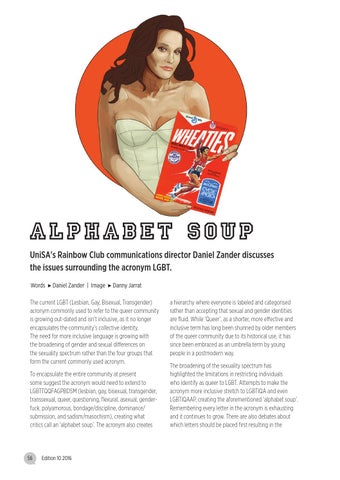
UniSA's Rainbow Club communications director Daniel Zander discusses the issues surrounding the acronym LGBT. Words ▶ Daniel Zander | Image ▶ Danny Jarrat The current LGBT (Lesbian, Gay, Bisexual, Transgender) acronym commonly used to refer to the queer community is growing out-dated and isn’t inclusive, as it no longer encapsulates the community’s collective identity. The need for more inclusive language is growing with the broadening of gender and sexual differences on the sexuality spectrum rather than the four groups that form the current commonly used acronym. To encapsulate the entire community at present some suggest the acronym would need to extend to LGBTTQQFAGPBDSM (lesbian, gay, bisexual, transgender, transsexual, queer, questioning, flexural, asexual, genderfuck, polyamorous, bondage/discipline, dominance/ submission, and sadism/masochism), creating what critics call an ‘alphabet soup’. The acronym also creates
56
Edition 10 2016
a hierarchy where everyone is labeled and categorised rather than accepting that sexual and gender identities are fluid. While ‘Queer’, as a shorter, more effective and inclusive term has long been shunned by older members of the queer community due to its historical use, it has since been embraced as an umbrella term by young people in a postmodern way. The broadening of the sexuality spectrum has highlighted the limitations in restricting individuals who identify as queer to LGBT. Attempts to make the acronym more inclusive stretch to LGBTIQA and even LGBTIQAAP, creating the aforementioned ‘alphabet soup’. Remembering every letter in the acronym is exhausting and it continues to grow. There are also debates about which letters should be placed first resulting in the
hierarchy previously described. The acronym in its historical use has been contentious in its inability to justify its order considering bisexuals statistically make up the largest percentage of those who identify as queer. It is often written as LGBT however is also commonly written as GLBT, placing gay men before others. Due to this there have been calls within the community to ditch the proper noun identities and assume an umbrella adjective term such as queer. Labelling people with identities representative of a certain letter they may or may not completely identify with is often seen as categorisation despite sexuality being fluid. Rather than the alphabet soup being empowering with the awareness of more sexual and gender identities, it is disempowering as it excludes those whose sense of identity is fluid and can’t be labelled. The community is being done a disservice by expanding the acronym for every micro group rather than projecting an understandable and simple message of equality for all. Alphabet soup unconvincingly provides a source of empowerment for many as it ignores the fact that gender, sex and sexual orientation are disparate of each other. Grouping individuals of ever expanding sexual and gender minorities into a single acronym delegitimises their identities and their progress in being included into language, suggesting everyone can be categorised separately rather than into a community that recognises fluidity. In reality the community is fractured, with categorical language adding to this. Finding alternative umbrella language to the longstanding LGBT acronym is difficult considering the history of the queer community. Queer as an alternative term has been suggested by many after being taken back from its negative past by young people in a postmodern way, however it still has limitations. For older generations it is a negative and loaded term with a hateful history. For many decades it was used as an insult to refer to someone outside of society’s gender and heterosexual norms. The term was used to demean, devalue and insult those who don’t identify as cisgender or heterosexual, thus having negative connotations for older queer people. Since 1990, however, when it was used at the New York Gay Pride Parade in an anonymous flyer, it has gradually
"The community is being done a disservice by expanding the acronym" changed from a negative to a positive, not carrying the same weight it once did. More recently it has been used in place of the LGBT acronym and extended alphabet soup versions, as an overarching umbrella term, which everyone in the community can feel they belong to rather than individuals and groups feeling excluded because their letter is not in the acronym. It is used as both a political statement and sexual identifier with advocates pushing against binary thinking, recognising the fluidity of sexual orientation and gender identity. It allows people to avoid strict boundaries that are associated with categorised language, simultaneously refusing to engage in conventional essentialist identity politics and making a move against heteronormativity. Young people particularly use it as an expansive term for a spectrum of sexual and gender variances, especially as interdisciplinary queer studies continue to move away from binaries such as heterosexual/homosexual and male/female. Queer media is an advocate of the term with websites such as Queer Nation, Queer Voices on the Huffington Post, and television shows such as Queer Eye and Queer as Folk. Older generations may see the term as self-depreciating, but younger people have embraced it as a positive self-identifier. LGBT doesn’t allow the queer community to positively identify with a term that does not exclude or negatively categorise people, disempowering individuals through the creation of hierarchy in a categorical acronym. It has become increasingly apparent that the alphabet soup associated with the acronym is similarly disempowering as it continues to label individuals in an ever-expanding set of letters rather than preach acceptance and visibility for all. While queer may have a past as a derogative term used to discriminate against individuals or self depreciate, young people have since taken it back in a postmodern manner to better represent those with fluid or un-categorical identities, resisting binary thinking. It is the best alternative to an exclusive, hierarchal, and categorical acronym out of touch with the modern queer community.
Edition 10 2016
57
No One Can Be Trusted: Board Game Reviews Words ▶ Adrienne Goode
Lies, secrets, betrayal. Reviews to help you choose between the most cut-throat, friendship destroying board games.
Monopoly: Adelaide Edition Monopoly is renowned for creating a wretched hive of greed and villainy, and the Adelaide Edition is no exception. Navigating Adelaide’s CBD is simple. I know this place like the back of my hand, from the earthy browns of the Art Gallery to the striking blue lights of Adelaide Oval. With the first lap unfolding slowly, each player’s escapade around town is civil—pleasant, you might say. But not for long. Each lap of Adelaide is distressingly similar to reality. I’m invincible. I’m broke. Self-hatred is my downfall. Adelaide is a labyrinth of lies, manipulation, and deception. A $200 train ticket leaves me in debt to my ‘best’ friend. The life lessons are piercing: no one gets rich renting and in this cruel, competitive world you will always be on your own. Before a victor is established, the game implodes from a destructive combination of player boredom, verbal warfare, and financial disaster. Congratulations, Monopoly. You have successfully destroyed friendships. Though this time, it is a little too close to home.
58
Edition 10 2016
A Game of Thrones: The Board Game (Second Edition)
Ultimate Werewolf: One Night
A Game of Thrones has truly come alive, and as Cersei Lannister most famously observed: you either win, or you die.
The village is under a silent siege. Werewolves have thrown the town into an inhospitable trance of paranoia and villagers have been found dead each morning. A werewolf is living amongst us, but who is it?
I have journeyed out from my home in Winterfell and extended my army across the entirety of the north. With a strong force of cavalry, infantry, and ships I have formulated a sequence of attacks that are bound to see me conquer the Greyjoy’s stronghold, Pyke. However, a swift glance up from the game board at my once honourable friend reveals a shattering truth: I can’t trust anyone. My forces are battered and I have no option but to retreat to familiar land. I mistakenly underestimated Balon Greyjoy, and only a timely intervention from the Lannister waters can save me now. Lies, secrets, betrayal. This world brings out the worst in my friends (and myself). My reality is blurred and my alliances are fragile. There’s blood on my dining table. If Balon doesn’t behead me, my mum certainly will. “Focus,” I remind myself. Desperate and anguished, I exert all my forces. It’s no use. My ‘friends’ have ganged up on me. Balon emerges from Ironman’s Bay, wiping out my entire strength. Powerless, I look him in the eye with desolation and plea. He meets my gaze with a fierce hatred, and in that instant I realise that help isn’t coming.
I wake up to a spine-chilling howl. It’s midnight, and tonight is a full moon. I am being summoned and I know exactly what for. I am a werewolf. The town wakes and each player examines one another. This role requires skill, strategy, and luck. The social deduction and player elimination begins instantly, and I beg that I have the strength to survive. Each accusation and rebuttal is heavy on the psychological manipulation. Each role comes with power, however there are criminals amongst us. Have they stolen my identity? The perplexing reality that I might not be who I think I am overwhelms me. Do I still have a duty to kill my friends? Lies, over-analysing, and deception triggers endless questions that are impossible to answer. Although there is safety in numbers, no one can be trusted.
Edition 10 2016
59
Verse Mag’s Regular Band Chat
Psych-rock wannabes Devil’s Crossroad are “this close” to making it big. They’re proud representatives of UniSA with their dirty, long hair and open drug habits. Here’s what they had to say. Words ▶ Jordan Leović | Images ▶ Courtesy of Devil's Crossroad
Edition 10 2016
You describe your music as “Alternative Psychedelic Indie Punk Rock”. How do you manage to combine so many popular genres yet still sound so shit? We were hoping to combine genres so the shitness would be harder to hear. Some of your music even features dope rhymez by mad Adelaide rapper Emsee Entirety. How does it feel to know you’ve already sold out as a rock band but haven’t made any money from it? We were looking forward to selling out so that we could settle down, buy a Lambo, buy a mansion, create a cosy heroin den and then come out with a musical masterpiece. But we don't have any heroin and we don't have a cosy den. Now we're just addicts and can't even pay for our problems. Maybe we celebrated too early? Your mums told you to follow your dreams but in 5 years you’ll all be homeless. In retrospect, how will you see this advice? Stefan: We're already half way there. Nathan: I always figured I'd end up either being homeless or a drug dealer. Zac: I've been dreaming of this dream dumpster for ages, right behind KFC. It's all happening for me. Kyle: There are some pretty hot homeless chicks, you know? So we can be like, (gruff voice) "We used to have a band five years ago, wanna bang?"
How will you survive when you realise that your band isn’t going to ‘make it’? Zac: Prostitute Nathan on Hanson Road. Nathan: Yeah, we're going to have to dress me up with some really pretty make-up and just hope for the best. We'd probably end up making more money. Seems like the only real option we have. Zac: Or making bracelets and selling them for exuberantly expensive prices to rich white girls at Coachella. Is it true your bass player sometimes wears a kimono on stage and why is this surprisingly sexy? Kyle: Because I'm wearing clothes for a change. Nathan: It leaves a little to the imagination because once you've actually seen everything, it's not that exciting. Kyle: People have already seen me naked or in my underwear. So by seeing the outline of my junk in a kimono, it makes me look huge for an Asian dude. Let’s play Kill, Fuck, Marry: Keith Richards, Beethoven, DJ Khalid. Go. Kill: DJ Khalid. Nothing against him, but he's a DJ. Fuck: Beethoven. His fetish was to fuck married women so he'd probably have a few Casanova tricks to show us in future. Marry: Keith Richards. Even though he'd outlive all of us, we'd marry him for his drugs. Catch them at facebook.com/devilscrossroadsband
Edition 10 2016
61
Stargazing â–ś Nicole Scriva
For optimal results, make sure you carry your lucky object at all times!!!
a
b
c
March 21 - April 20
April 21 - May 21
May 22 - June 21
Every coffee you drink will taste like tepid International Roast.
Your next Tinder date will bring their child along.
You will never become Internet famous. Sorry.
Lucky object: Discarded burger pickles.
Lucky object: Moist (ocean or sink) sponge.
Lucky object: Plastic bag.
g
h
i
September 24 - October 23
October 24 - November 22
November 23 - December 22
You will be either too early or too late to everything for an entire month.
You will accidentally CC all your contacts into a saucy, private email.
Your parents will set you up on a blind date. It will not go well.
Lucky object: Crumbs.
Lucky object: Cotton ball.
Lucky object: Leaking water bottle.
62
Edition 10 2016
d
e
f
June 22 - July 23
July 24 - August 23
August 24 - September 23
You will become involved in a health supplement Pyramid Scheme.
Next week you will be forced to be a third wheel 6 out of 7 days. Ew.
You will fart in a very full lift. The lift will be full of people you know.
Lucky object: Floppy disk.
Lucky object: Tin of cat food.
Lucky object: Ergonomic mouse pad.
j
k
l
December 23 - January 20
January 21 - February 19
February 20 - March 20
You will kiss someone that will turn out to be your tutor next year.
Pizza will not taste nice in your mouth for a whole month. How cruel!
You'll be embroiled in a Facebook fight. You won't win, keyboard warrior.
Lucky object: Framed photo of Shannon Noll.
Lucky object: Your greatest rival's eyelash.
Lucky object: 2 Minute noodles seasoning packets.
Edition 10 2016
63