PAUSD Book, pg. 12 Mosque, pg. 16 9/11, pg. 20
VERDEMAGAZINE.COM 1
2 OCTOBER 2026
VERDE MAGAZINE OCTOBER 2026 Volume 28 Issue 1 Editors-in-Chief Ananya Adya Tessa Berney Leela Kulkarni Managing Editors Angela Fang Chris Jeon Julie Yang
ON THE COVER 25 years ago, the U.S. was rocked with an unprecedented terrorist attack: 9/11. Former Verde staff believed the U.S. was on the brink of war. They captured this atmosphere by publishing an all-black cover with just the word “war” on it. We believe “pressure” is the new word that embodies the atmosphere at Paly; a concept featured in the cover designed by Editor-in-Chief Ananya Adya. Publication policy Verde Magazine, a news and features magazine published by the students in Palo Alto High School’s Magazine Journalism class, is a designated open forum for student expression and discussion of issues of concern to its readership. Verde is distributed to its readers and the student body at no cost. Letters to the editors The staff welcomes letters to the editors but reserves the right to edit all submissions for length, grammar, potential libel, invasion of privacy and obscenity. Send all letters to verdemagazine1@gmail. com or 50 Embarcadero Rd Palo Alto, CA 94301. Advertising The staff publishes advertisements with signed contracts providing they are not deemed by the staff inappropriate for the magazine’s audience. For more information about advertising with Verde, please contact our business manager at verdebusiness5@ gmail.com.
Features Editor Justin Chen Profiles Editors Jacob Domingo Ryan Saket Culture Editors Ethan Bradley Alma Michlin
Social Media Managers Alma Michlin Kai Schoebel Photo Director Shaurya Thummalapalli Art Directors Ethan Bradley Keira Ling Webmaster Joshua Joo Staff Writer Alan Suzuki Adviser Paul Kandell
Perspectives Editor Lilo Sayag News Editor April Yuan Editorials Editor Shaurya Thummalapalli Managers of Business Operations Ryan Saket Anisha Shetty
Printing & distribution Verde is printed five times a year in October, December, February, April and June by Folger Graphics in Hayward, California. The Paly Parent Teacher Student Association mails Verde to every student’s home. All Verde work is available at verdemagazine.com.
VERDEMAGAZINE.COM 3
In this issue Foreword
Index Editorial News
4 6 8
Features
PAUSD book Mosque lawsuit Midterm elections 9/11 City Council elections
12 16 19 20 23
Profiles
Jason Glass 27 Brennan Bailey 29 Albert Balcita 31
Culture
AI slop CardVault Zingster’s Node art gallery
32 34 36 38
ZINGSTER’S pg. 36
Perspectives
Bell schedule Growing up
40 42
CARDVAULT pg.32 4 OCTOBER 2026
NODE ART GALLERY pg. 38
FROM THE EDITORS
THE PRESSURE COOKER
“Pressure” is a term Paly students resonate with. It tends to describe the result of the suffocating amount of coursework and homework that students strap themselves to each school year. Less often do we zoom out from the individual level to mull over the greater external pressures that weigh down on us. Recently, a new form of pressure has grown, one that’s been hitting from numerous sides: pressure from our community. This pressure has materialized as text messages in online parents group chats, polarization from our community in local elections and lawsuits against the district. To compare past community reactions to the present, editors-in-chief Ananya Adya and Tessa Berney reached out to former Verde staff in “9/11 in retrospect.” Following the 9/11 attacks, student journalists jumped into action, covering its aftermath impacts on the local community without concerns of criticism. Looking back 25 years later, they reflect on what it was like covering 9/11 as a student journalist when the entire nation was under immense pressure. If 9/11 occurred today, the way we report it would not be the same as 25 years ago. Both 9/11 and today’s era feature wars in Middle East countries led by Republican presidents. However, publications have become extra cautious when covering topics related to religion, culture and international conflicts that can easily spark backlash. This community controversy is seen in our feature story “Education or establishment?” by Culture Editor Ethan Bradley and Ed-
itorials Editor Shaurya Thummalapalli. Their piece dives into a recent lawsuit launched against Palo Alto Unified School District for a Social Justice Pathway field trip to a local mosque. The complaint filed by the Community Members for Religious Neutrality in Public Schools states that during their field trip, students were allegedly encouraged to wear Islamic religious attire and were photographed without parent consent for public use. Our reporting shows that students on the trip disagree with many of the allegations. Our writers explore the effects of this outside pressure on the Social Justice Program, particularly the stress it has placed on Paly students and teachers in the program. This lawsuit has put our school in the international spotlight, with publications like the New York Post, Edsource and Times of Israel reporting on the case. Pressure is not always an immediate byproduct of such events; sometimes, it does not surface until years later. In “Pressure on PAUSD,” Features Editor Justin Chen and News Editor April Yuan piece together the troubled time of former Paly Principal Adam Paulson through the eyes of his ex-wife Amy Paulson. In Amy Paulson’s memoir, she retells the systemic issues her husband faced that drove him to his resignation. We invite you to reflect on the relationship between the Palo Alto community and Paly. Academic pressure is a large part of our school’s life, but this issue looks to explore how factors outside of the classroom contribute to this highly tense atmosphere. — ANANYA, TESSA, ANGELA, CHRIS, LEELA, JULIE
VERDEMAGAZINE.COM 5
the verdicts
The Verdicts editorial section expresses the collective opinion of the Verde Magazine staff.
Applauding PAUSD’s in-class phone policies
T
WO YEARS AGO, California Governor Gavin Newsom signed the Phone-Free School Act, requiring California school districts to develop policies limiting smartphone use during the school day by July 2026. Since then, companies have launched products to help enforce this policy. Among them is Yondr, which provides a lockable phone pouch, making phones completely inaccessible without the help of staff. According to its website, the company has partnered with thousands of schools across all 50 states. While many students, parents and educators support Yondr’s goal of improving student focus and mental health, others raise concerns about student safety, especially when these measures physically prevent students from reaching their devices. We applaud the Palo Alto Unified School District for not implementing a bell-to-bell ban enforced through locked pouches like Yondr. As student journalists, we are especially grateful for the flexibility, as our work regularly depends on having access to our phones during the school day. Rather than adopting Yondr pouches, PAUSD implemented a classroom-based approach, with each classroom having designated holders or wall-mounted organizers where students slot their phones into numbered pockets at the start of each period. This keeps phones out of reach during class while allowing students to access them between class periods and in emergency situations. In comparison, other local school districts have partnered with Yondr to enforce a strict bell- to-bell ban via locked pouches, including San Mateo High School, which launched their Yondr bell-to-bell system in 2018, and Salinas Union High School District, which implemented the Yondr system only to middle schools last year. PAUSD’s approach targets classroom distractions without completely separating their students from their devices throughout the day. This distinction is especially important at Paly, where students have considerably more independence than at Art by KEIRA LING
6 OCTOBER 2026
closed-campus schools. During lunch, many students leave campus to Town & Country Village, communicate with friends and family and use digital payment methods to purchase food. Students also believe that stripping them of access to their phones raises safety concerns, as they would be unable to reach help or contact their families during an unexpected crisis. “Phone restrictions would be unreasonable because we’re often off campus, where safety is more of a concern because we’re not under faculty supervision,” Paly senior Charlotte Liu said. “I believe that Paly’s current policy of not having phones in class makes the most sense because class time is when you need to focus the most. During our break or lunch, I don’t see why they have to overreach even more. At that point, it’s our own responsibility to use our phone or not.” Especially important for student journalists, we rely on our phones to serve as tools for filming, recording, transcribing and note-taking. A complete ban on phone usage during the school day could directly compromise our reporting. Lucas Arai, a junior on Anthro Magazine, says his phone is essential to reporting. “When I’m collecting quotes for verbatims, which is where we interview kids at school on their opinions on a specific topic, I need a phone with me so I can record their responses,” Arai said. “I also need my phone whenever I need to take a quick photo for a breaking news story. So if these pouches were implemented, I wouldn’t be able to do any of these things.” Beyond safety concerns and journalistic needs, there is also a serious financial cost to consider. PAUSD is planning a $33 million budget cut for next school year and is budgeted to lose $66 million from reserves by next June. With Yondr pouches costing $22-25 per student, a one time fee, implementing them across the school could cost over $40,000, based on Paly’s enrollment. Rather than spending tens of thousands of dollars on a policy that compromises safety, the district is right to keep an already working system for free. “They should spend the money on something that matters more for education,” Liu said. “Because we’re high schoolers, we should be given opportunities to take responsibility for ourselves; we shouldn’t be coddled.” v Design by SHAURYA THUMMALAPALLI
VERDEMAGAZINE.COM 7
news
SCALING BACK — Superintendent Jason Glass discusses the planned budget cuts for the 2026-2027 school year. Glass firmly supports managing the cuts in a way that doesn’t affect students. “I want the students to know that we're placing their experience and protecting their experience as the very most important thing through this process,” Glass said. Photo: Shaurya Thummalapalli
Glass: budget deficit calls for change
I
N JANUARY 2027, the Palo Alto Unified School District will finalize the number for its budget deficit, according to a PAUSD board presentation. Currently, PAUSD is facing estimated budget cuts of $33 million for the 20262027 school year. A major cause for the deficit is the failed 2026 PAUSD Parcel Tax renewal, which has historically brought in almost $17 million in funding for the school district every year. Opposers of the parcel tax claim that the district has enough money in reserves — about $100 million. Additionally, PAUSD gave teachers a 10.4% raise and $10,000 in bonuses — spread out over the 2025-2026 and 20262027 school years — which significantly increased the total spending amount in the last school year. The raises were heavily protested for by the Palo Alto Educators Association. PAEA President Tom Culberston remains supportive of the raises while acknowledging the role that they played in the deficit. Culbertson said he is pleased with how collaborative the district was
8 OCTOBER 2026
throughout the negotiation process. “The school board had to make some big decisions,” Culbertson said. “We pressed them and we asked them to be our partners on this and really make a change. And they did that.” The spending that occurred at the end of the previous school year substantially increased the final expenditures, and PAUSD Superintendent Jason Glass said the district is now using its reserve money to stay afloat. “We've already spent $20 million of the $100 million, and we'll get down to $30 million at the end of this year,” Glass said. “We're going to have to do things to get the expenditures in line with the revenue.” As a way to cut down on spending, the district could consider not offering certain employees a contract renewal, lowering the number of job opportunities across PAUSD schools without firing employees. The district could also increase class sizes and stop the hiring of new teachers. However, Glass is focused on making sure this doesn’t affect students.
“We'll have to look at district programs, maintenance, transportation, food service, custodial supports, aides [to cut],” Glass said. “They're really important people, but they're as far away from the classroom as we can.” According to Glass, managing the budget cuts is expected to be an 18-month process that could lead to a total of $43 million in deficits split between the 20262027 and 2027-2028 school years. Glass said he intends some programs to be cut down in terms of quality, but he is fully prepared to bring these programs back to their original caliber after the district can bounce back from the deficit. In the coming months of change, Culbertson says the community should be prepared to work as one alongside the district. “Families just need to be open to the idea that changes are coming, and to work with Superintendent Glass and with educators to figure out how we can get through this,” Culbertson said. by SHAURYA THUMMALAPALLI
Edited and designed by APRIL YUAN
Students press admin to restore passing periods
S
TUDENTS AT Palo Alto High School are calling for the restoration of 10-minute passing periods after a new bell schedule reduced passing periods from 10 minutes to seven minutes. Paly and Gunn High School’s administration made a joint decision to implement the schedule at both schools this year. In July, senior Leilani Chen started a petition calling for the reversal of the seven-minute passing periods. “I definitely noticed that I only am able to take bathroom breaks during class … which is unfortunate because I care about being present for instruction time,” Chen said. “There's less freedom to talk to teachers after class.” Paly senior Inhoo Chang agrees that the passing periods do not provide ample time for students to make it to class. The petition has received over 1,200 signatures and a response from Superintendent Jason Glass, who stated that Paly administration was reviewing scheduling and campus transition concerns. The schedule change also resulted in the school day being shortened, with school never ending past 4 p.m. Paly Principal Brent Kline said multiple perspectives, including students, were incorporated in the process of the schedule change. “We got feedback from teachers and department members and student input, a little bit through the principal advisory committee,” Kline said. Kline said that future bell schedule changes at the high school level must be decided by both Paly and Gunn. “We're looking at it, but it's not going to be a decision that's done separately between the two high schools,” Kline said.
NAVIGATING THE BELL – Palo Alto High School students make their way across campus during a passing period. A new bell schedule shortened Paly and Gunn passing periods by three minutes. “I don’t feel a lot of urgency to get to class, but I also don’t have another bell to make me feel urgent,” Paly senior Levi Vollmar-Currimbhoy said. Photo: Justin Chen
by JUSTIN CHEN
School turns away from scanning in for class attendance
A
TURNING INTO TYPING – A student signs into class by typing his student ID. Despite the Paly administration encouraging students to sign in by scanning their ID card, most students are typing in by keyboard. “I don't think I see anyone using their physical ID,” Paly junior Kyle Chen said. “Everyone types it out. It's just a lot easier.” Photo: Alan Suzuki
FAILURE to implement a new scan-in system means a majority of students now type their ID numbers to sign in for class at Palo Alto High School. Paly first introduced computer scan-in systems for the 2024-2025 school year that were designed to allow students to sign in faster and save time for learning. Alternatively, students could type in their ID number instead of scanning their physical ID. From a back-to-school email sent by the administration team in August this year, students were required to “scan either their physical Paly Student ID card or the digital ID available through Infinite Campus.” According to administrators, the purpose of implementing this system was to mitigate students from signing in for other classmates.
Assistant Principal Jerry Berkson said the decline in use of the ID cards among students was partially due to a change in the picture company the school uses for ID cards. Students still use their ID for other reasons besides attendance, such as grabbing school lunch or checking out books from the library. However, the use of ID cards in regular classroom attendance is more of a burden for students such as junior Kyle Chen. Chen says that he does not see anyone scanning their ID for class. “It [scanning in] is really annoying,” Chen said. “I'm not trying to bring my ID card to school every single day. It's a hassle. It's another thing to lose.” by JOSHUA JOO and ALAN SUZUKI
VERDEMAGAZINE.COM 9
Parking lot refresh impacts student parking for fall
Pathwise launches program
V
ISUAL AND Performing Arts and Facilities portables in the Churchill parking lot at Palo Alto High School are set to be renovated or replaced. According to Palo Alto Unified School District Director of Facilities and Construction Eric Holm, the project — which will start in October and end in December — is to update old buildings. “Some [portables] were in decent shape, others were well past their useful life,” Holm said. “So we're reconfiguring a little bit and recreating the offices.” Due to this, Holm said the Paly administration decided to close the parking lot entirely. “We're going to need all of that space for the construction to happen,” Holm said. “So we decided instead of opening it and then closing it again, to just keep it closed.” The closure of one of two of Paly’s parking lots available to students means less parking overall is available for students. Thus, parking permits will not be sold to juniors for the first semester, according to a back-to-school email sent by Paly administration. Junior Lucas Wu believes that the Churchill parking lot should be kept open to students while the construction has not started. “If there's open spots in the parking lot, why [not] make more money as well by selling permits to people and saving students more time as well,” Wu said.
by JACOB DOMINGO
TOWER TUTORS – Palo Alto High School senior Andrew Oh tutors Katrina Haggerty in the Paly Tower Learning Center. The TLC offers peer tutoring to all students at Paly. “It [tutoring] just spreads positivity, teaching other people," Oh said. Photo: Alma Michlin
P
ATHWISE IS OPENING applications for its mentor certification program, providing high school students with the opportunity to become certified mentors. Formerly known as Dreamcatchers, Pathwise pairs high school student volunteers with low-income middle-schoolers to receive academic help during afterschool programs. Students can also volunteer as mentors without certification. Becoming certified entails three hours of virtual training on the platform SAGA Education, three hours of in-person training, and 10 hours of classroom work over the course of one school year. The program was created after a decline in volunteers. “One reason for the certification program is to make sure that they are receiving something from it [mentoring] as well,” said Nicole Chiu-Wang, executive director of Pathwise. Interested students can sign up to be mentors on the Pathwise website. by ALMA MICHLIN
Palo Alto residents push against El Dorado tunnel plan
E
L DORADO AVENUE neighbors are petitioning following the release of a plan for construction of a crosswalk and tunnel on El Dorado. The petition proposes an alternative hybrid plan, where cyclists and pedestrians could cross Alma Street at a new traffic signal at Loma Verde Avenue before traveling north along a protected bike path on the west side of Alma. The path would then connect with a tunnel underneath the railroad tracks near El Dorado and continue toward Park Boulevard. Petition organizer David Hung said the idea proposed by the residents places the surface crossing on Loma Verde, which he believes is better suited for increased traffic due to its width, while still keeping the railroad tunnel location near El Dorado. Hung said the petition is up to 270 signatures as of Sept. 28. He is concerned
10 OCTOBER 2026
about the amount of additional bike and pedestrian traffic the project would bring to El Dorado. “The residents there are concerned that because of this higher amount of traffic, they’ll have difficulty getting out," Hung said. "There will be higher chances of collision.” Hung also raised concerns about the proposed traffic circle at Bryant Street and El Dorado, saying the intersection may be too constrained to safely handle cars, cyclists and pedestrians at the same time. Hung said organizers have spoken with several City Council members and are now asking the council to direct transportation staff to formally evaluate the alternative. “The first step is actually getting them to evaluate the hybrid plan,” Hung said. “The transportation department is capable of doing that.” by RYAN SAKET
SPREADING THE WORD — Resident David Hung speaks informs neighbors about changes being made to El Dorado Avenue. The city proposed a plan to construct a crosswalk and tunnel.. “They [neighbors] didn't know that the city had proceeded so far along in focusing on El Dorado,” Hung said. “So the petition helped in raising awareness.” Photo: Ryan Saket
MEET THE CANDIDATES This November, the Palo Alto Unified School District Board of Education prepares to welcome two new members. Verde and the Campanile hosted a panel with the running candidates. Here's what they said:
John Craig
"If you build trust and align with what the community wants and needs, hopefully we can also encourage more families that have chosen to send their kids to private school to bring them back to public school by offering them a place that they want to join."
Linda Henigin
"We need to have respect among everybody who's in our system. Our stakeholders all need to listen to each other with respect and curiosity, and really focus on outcomes for our students. If we all stay focused on what we're here for, we can deliver."
Avery Wang "Something I've been trying to emphasize in my campaign is a culture of respect and empathy, and this is something that I've felt has been missing. ... This should be coming from all stakeholders, including students, teachers, administrators, and parents."
WHAT AM I VOTING ON?
A PREVIEW OF THE 2026 BALLOT FOR PALO ALTO RESIDENTS
Governor
State Assembly
Xavier Becerra (D) Steve Hilton (R)
Marc Berman (D) David G. Johnson (R)
Prop 40
Measure J
Billionaire tax
0.5% sales tax
House of Rep. Sam Liccardo (D)
Peter Sundin Soulé (R)
Prop 39
Voter identification VERDEMAGAZINE.COM 11
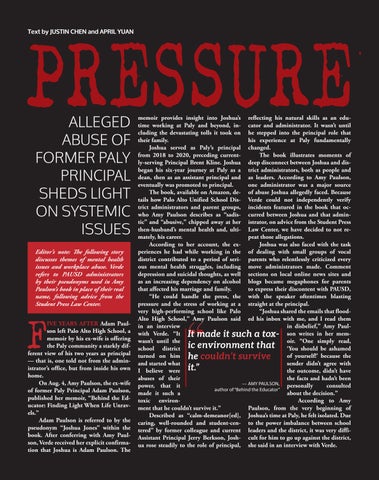
PRESSURE Text by JUSTIN CHEN and APRIL YUAN
provides insight into Joshua’s reflecting his natural skills as an eduALLEGED memoir time working at Paly and beyond, in- cator and administrator. It wasn’t until cluding the devastating tolls it took on he stepped into the principal role that family. his experience at Paly fundamentally ABUSE OF theirJoshua served as Paly’s principal changed. 2018 to 2020, preceding currentThe book illustrates moments of FORMER PALY from ly-serving Principal Brent Kline. Joshua deep disconnect between Joshua and disbegan his six-year journey at Paly as a trict administrators, both as people and then as an assistant principal and as leaders. According to Amy Paulson, PRINCIPAL dean, eventually was promoted to principal. one administrator was a major source The book, available on Amazon, de- of abuse Joshua allegedly faced. Because SHEDS LIGHT tails how Palo Alto Unified School Dis- Verde could not independently verify administrators and parent groups, incidents featured in the book that ocON SYSTEMIC trict who Amy Paulson describes as “sadis- curred between Joshua and that admintic” and “abusive,” chipped away at her istrator, on advice from the Student Press mental health and, ulti- Law Center, we have decided to not reISSUES then-husband’s mately, his career. peat those allegations.
Editor’s note: The following story discusses themes of mental health issues and workplace abuse. Verde refers to PAUSD administrators by their pseudonyms used in Amy Paulson’s book in place of their real name, following advice from the Student Press Law Center.
F
IVE YEARS AFTER Adam Paulson left Palo Alto High School, a memoir by his ex-wife is offering the Paly community a starkly different view of his two years as principal — that is, one told not from the administrator’s office, but from inside his own home. On Aug. 4, Amy Paulson, the ex-wife of former Paly Principal Adam Paulson, published her memoir, “Behind the Educator: Finding Light When Life Unravels.” Adam Paulson is referred to by the pseudonym “Joshua Jones” within the book. After conferring with Amy Paulson, Verde received her explicit confirmation that Joshua is Adam Paulson. The
According to her account, the exJoshua was also faced with the task periences he had while working in the of dealing with small groups of vocal district contributed to a period of seri- parents who relentlessly criticized every ous mental health struggles, including move administrators made. Comment depression and suicidal thoughts, as well sections on local online news sites and as an increasing dependency on alcohol blogs became megaphones for parents that affected his marriage and family. to express their discontent with PAUSD, “He could handle the press, the with the speaker oftentimes blasting pressure and the stress of working at a straight at the principal. very high-performing school like Palo “Joshua shared the emails that floodAlto High School,” Amy Paulson said ed his inbox with me, and I read them in an interview in disbelief,” Amy Paulwith Verde. “It It made it such a tox- son writes in her memwasn’t until the oir. “One simply read, school district ic environment that ‘You should be ashamed turned on him he couldn’t survive of yourself!’ because the and started what sender didn’t agree with I believe were it.” the outcome, didn’t have abuses of their the facts and hadn’t been — AMY PAULSON, personally power, that it consulted author of “Behind the Educator” made it such a about the decision.” toxic environAccording to Amy ment that he couldn’t survive it.” Paulson, from the very beginning of Described as “calm-demeanor[ed], Joshua’s time at Paly, he felt isolated. Due caring, well-rounded and student-cen- to the power imbalance between school tered” by former colleague and current leaders and the district, it was very diffiAssistant Principal Jerry Berkson, Josh- cult for him to go up against the district, ua rose steadily to the role of principal, she said in an interview with Verde.
“
BY PAUSD
“It’s your word against someone who has more power,” Amy Paulson said. “He [Joshua] was very afraid, at first, of not being believed, and then having this situation play out very publicly in the press, and that prohibiting him from moving on [in his career].” Berkson said that not only do online news sites spread blatant misinformation at astonishing speeds, too often, community members immediately assume that what they read is true. As someone who faces many of these situations, Berkson said he has experienced frustration from not being able to refute these inaccuracies.
Amy Paulson said that her lens into what was happening was solely through Joshua’s accounts. As a stay-at-home mother to their three children, she describes becoming increasingly wary of which version of her husband PAUSD would send home to her at the end of each day. As the environment in his workplace worsened, Joshua fell into depression, Amy Paulson writes, describing how chilling it was to see her cheerful and optimistic husband slip away from her. The daily dread of heading to Paly became so overwhelming that Joshua frequently contemplated taking his own life in order
to escape the school forever. “Now, it was Joshua who was suffering from the effects of the pressure cooker of the educational system in Palo Alto, to the point where he wanted to succumb to it permanently,” Amy Paulson writes. Externally, she writes, Joshua put on a smile for the students he cared deeply about, thoroughly hiding his own pain. Berkson, who worked closely with Joshua, said that he was unaware of Joshua’s depression and suicidal thoughts. Unbeknownst to all but Amy Paulson, treatment from district leadership up above and parent criticism from down below chipped away at his will to live, she wrote.
CHEERY PAULSON – Former Palo Alto High School principal Adam Paulson smiles in a photo taken on the Quad. A recently-published memoir by his former wife Amy Paulson details his experience working at Palo Alto Unified School District. “The things Joshua would tell me he loved about working at Paly were the school’s embrace of innovation, the school culture, and the collaborative environment,” Amy Paulson said. Photo courtesy of The Paly Voice.
Joshua used alcohol to quiet the intrusive thoughts that accompanied his depression, Amy Paulson writes, which began filling his head shortly after he became principal. Slowly, this evolved into a dependency on alcohol that eventually broke his marriage, she adds. “Because for Joshua, alcohol was like a fire. Maybe there were always a few embers smoldering within him,” Amy Paulson writes. “The abuse he felt he endured from the school district during the past school year served as an accelerant. It drenched the embers with gasoline, fueling a flash fire that was beginning to burn recklessly.” Amy Paulson writes that Joshua’s fear of speaking out against his superiors stemmed from his fear of jeopardizing his career. “He was in rooms where they were making hiring decisions and when it was revealed that one of the applicants had filed a lawsuit against a former employer, that applicant’s packet was removed from the stack,” Amy Paulson said. “He very much was aware that if he spoke out or if he tried to pursue legal action, that would end his career.”
Tom Culbertson, currently president of the Palo Alto Educators Association, PAUSD’s teacher union, was an elementary school teacher at the time. According to Culbertson, school employees were fearful of retaliation for self-advocating. “It was communicated both overtly and subtly to not do that [speak up for themselves],” Culbertson said. “People felt fear. People were worried about intimidation. People were worried about retaliation.” Berkson said he observed Joshua returning from meetings at district headquarters visibly upset but did not realize the extent of the difficulties Joshua faced as described in Amy Paulson’s book. “I felt really bad for him,” Berkson said after reading the memoir. “A ton of it, I had no idea what was going on. If I had known, at minimum, I would have supported him.” Culbertson says that under what he called the “authoritarian-style” leadership of former district officials, he felt the overall health of the district was failing. “It [the tenure of a former district administrator] damaged a lot of different
communities in this institution,” Culbertson said. “Lots of families were alienated. Lots of educators were alienated, and administrators were never valued for what they can bring to solve problems and to make this district really great.” Denise Pope, a senior lecturer at Stanford’s Graduate School of Education who specializes in student engagement and school reform, warns against pinning blame on one single factor or person. “You have to look at external factors and also individual factors,” Pope said. “There’s a lot of things that go into stress and mental health issues. … I would really caution anybody to point specific blame at one specific thing or person.” According to Amy Paulson, she believes accountability and transparency were missing at every level of the leadership structure. She said that without a review process where teachers and staff can evaluate the administrators working above them, a vacuum is created where administrators are not able to dispute false information tied to their name. A former district administrator stated that during Joshua’s tenure, the district had outlets through which administrators could voice their concerns. However, the source declined to comment on any specific situation where this outlet may have been used. Amy Paulson said the problem was “not about a few people that I think abuse their power,” but how the system allowed that to happen. And, she emphasizes that these issues don’t just exist at PAUSD and also became an issue at her husband’s next job. “When I started seeing it repeated at a different school district, that’s when it started to connect that this wasn’t just about one school district; it’s more of a systemic issue,” Amy Paulson said. “It’s a system designed to keep power concenSTOIC PAULSON – Former Palo Alto High School principal Adam Paulson poses for a photo in his Paly gear. Adam Paulson’s former wife, Amy Paulson, opened up in her memoir about the tolls that working at Palo Alto Unified School District took on their family. “The system rewards people who are complicit and compliant and who prioritize self-preservation instead of what it should be, which is doing what’s right for students,” Amy Paulson said in an interview with Verde. Photo: Ben Cohen
14 OCTOBER 2026
EL PALO ALTO – A sign in front of Palo Alto High School displays the school’s name. Amy Paulson published her memoir “Behind the Educator” about her former husband Adam Paulson’s experience working at Paly. “He loved the people he worked with, and he loved that school, and he was enormously proud to work at Paly,” Amy Paulson said in an interview with Verde. Photo: Emma Donelly-Higgins
trated to a few people at the top, and it represents more systemic issues than just one person’s experience.” Amy Paulson acknowledges that everyone, including Joshua, is imperfect and flawed. However, she says a person can be both imperfect and flawed and still not deserve to be humiliated, publicly shamed and professionally destroyed. “We can’t change what we don’t name, and I tried to name it in the book, but ultimately, it’s up to other people to try and make that change because it does matter. If we don’t name it, then it invalidates that whole experience,” Amy Paulson said. “The first step really needs to be ... an acknowledgement of what happened, and an acknowledgement that damage was done. I believe that should come from school boards. If they’re not willing to do that, it really tells where their priorities lie.” In an email to Verde, Joshua confirmed that the portrayal of himself in
the memoir is accurate. “I am aware of Amy’s memoir and supportive of her telling our family’s story,” he stated. “Her account of this period reflects what I experienced and the impact it had on our family. I hope people read the book to understand the broader context and complexity that can’t be fully captured in a news story.” Amy Paulson says by bringing these problems to the surface, the hardships they faced carry a new meaning and purpose. Joshua hopes that by telling the story of his career as an educator, he will help destigmatize mental health. “I share this story in the hope that it reaches others who are struggling in silence with intrusive thoughts, unhealthy coping mechanisms, and mental health challenges,” Joshua stated. “I also hope it reaches anyone who has felt that the institutions meant to serve them have turned against them instead, because that
experience deserves to be named. Mental health challenges are far more common than we often acknowledge, and the stigma that keeps people from seeking help can have devastating consequences.” Joshua also hopes that can give courage to others going through similar situations. “I found support and have been in recovery for several years now, and I hope others can find that support too,” he stated. “If sharing my experience helps even one person feel less alone or find the courage to ask for help, then it was worth telling.” v
Mental Health & Substance Abuse Resources Call 24/7 suicide and crisis hotline: 988 Crisis Text Line: Text HOME to 741741 Call SAMHSA Helpline: +1 (800) 662-HELP
VERDEMAGAZINE.COM 15
EDUCATION Text by ETHAN BRADLEY and SHAURYA THUMMALAPALLI
OR
in this religious setting could be Quran. Jane, a student who attended the IMPLICATIONS students posted online. trip, challenged these claims, saying that On the trip, female students were giv- students never actually engaged with any to — and allegedly encour- religious program. OF LAWSUIT enagedthetooption — wear traditional head coverings, “Never did we participate in this memwhile boys were expected to wear long orization,” Jane said. “But we were able to COULD MEAN pants in accordance with Islamic modes- ask a lot of questions to all the volunteers ty values. Moreover, parents bringing the and students there, and they were very reare angry that Zahra Billoo, executive spectful in their answers.” CHANGE suit director of the Council on American-IsEvery school year, SJP takes students lamic Relations, San Francisco Bay Area on the mosque trip, with it even being FOR PAUSD office, was a speaker at the mosque. She has mentioned to every student at the program
I
N AN AUG. 15 POST ON HIS SOcial media site “X”, Elon Musk wrote “ ,” responding to Palo Alto Unified School District’s lawsuit involving a school trip to a local mosque. The lawsuit, which has received international media coverage, could result in PAUSD changing policies that will directly affect a community of students. Musk’s ridicule of the situation is a part of the online wave of hate brought towards PAUSD following the lawsuit’s filing, a wave that has buried the nuances of the full story. The Community Members for Religious Neutrality in Public Schools, a San Francisco Bay Area group formed by local parents, is suing PAUSD and Palo Alto High School Principal Brent Kline following a 2025 field trip to the Muslim Community Association mosque in Santa Clara. The lawsuit, filed on Aug. 7, heavily targets Paly’s Social Justice Pathway, an optional multi-year program in which students learn about religion, alongside other topics. It claims that PAUSD should have acknowledged beforehand that the trip would heavily expose students to a religious environment and that photographs of
🤡🌎
16 OCTOBER 2026
faced controversy in the past for statements promoting the Oct. 7 attacks on Israel and saying what could be seen as anti-semetic conspiracy theories. A notable part of the suit alleges that the district violated the students’ rights to religious freedom and equal protection under the First and Fourteenth Amendments, along with the California Constitution and Educational Code, by pressuring students to engage with a specific religion. Alice, a senior who went on the trip and asked that her real name not be used, said that the SJP’s unit of religion covered a diverse array of faiths. “Everyone was assigned a different religion to study,” Alice said. “We all had presentations about it, and they were very in depth.” Arabella Guinle, a former student in the Paly class of 2026, said that SJP students learned about a variety of beliefs. “We got a good foundation of a lot of different religions through our whole religion unit in humanities,” Guinle said. The plaintiffs claim that attendees participated in Noor Hifz Academy, a religious program in which students memorize the
orientation, according to Jane. Jane also denies the plaintiff's claims that students were pressured to wear head coverings. “A lot of us did wear the head scarves,” Jane said. “But they were very clear that if we didn't want to wear them, we didn't have to.” Jane also trusts that the program’s teachers were prepared for a trip of this scale. “I trust them [SJP teachers] to know what the line is for a field trip,” Jane said. “If they felt like the people there were trying to proselytize to us, I think they would have cut it off and stopped it there.” Coercion, however, is not the only legal standard the plaintiffs could argue for. Erica Goldberg, a professor of law at Gonzaga University, said the more compelling legal argument is the one against the Establishment Clause. The Establishment Clause is a section of the First Amendment that states that the government cannot force one religion nor can it favor one religion. “You didn't have to do [the field trip] as part of the [SJP] program, and then even aspects of the
ESTABLISHMENT?
Art by SHAURYA THUMMALAPALLI
field trip were voluntary, like whether you she was explicitly talking about, ‘If you wear the hijab, whether you take your shoes know anyone at a church or at a synagogue off, etc,” Goldberg said. “Coercion could or at a temple or anything else like that, potentially be applied to this situation, please set us up.’ But the issue was that no [but] the better theory for the plaintiffs is one in my class took the initiative to actuthe endorsement test,” ally set up another field trip like that. That The endorsement test is asking wheth- was honestly the only reason why we didn't er a reasonable person would feel that the end up going to another place of worship.” government is promoting a certain religion Both Guinle and Alice are concerned over others. about the negative attention brought to the Alice felt her experience didn’t reflect SJP teachers by the lawsuit. the allegations from the plaintiffs that Islam “You're around all these teachers for was promoted as the religion most aligned three years, which is a lot of time,” Guinwith social justice. le said. “You get to know them on a dif“[Billoo] was showing how … she uses ferent level … it makes you really upset her lawyer practice to help people who are when it's like you see how much this is Muslim against hate crimes [and how] she affecting them. Random parents [whose practices social juskids] weren't even there tice through her A big part of SJP is and don’t know anything religion,” Alice said. about SJP, don't know “But she wasn’t say- that students will anything about the trip, ing that it was the organize field trips are just framing it … most social justice on these teachers and … we bring things to putting extra stress on [aligned] religion.” Guinle ex- our teachers that we them.” plained that planAlice is also conning field trips for want to learn.” cerned about the stress the program inteachers are being put — ARABELLA GUINLE, Class of 2026 volved student colunder. laboration rather “Teachers can only than it being chosen by a teacher. do so much,” she said. “They’re humans “In SJP, our senior year, we had a too.” whole unit on religion, so we were taking Goldberg said that the plaintiffs have the time to learn a bunch of different re- some potentially valid claims, but the comligions, like Taoism, Judaism, Christianity plexity of the Establishment Clause cases and Buddhism,” Guinle said. “A big part of makes it hard to tell. SJP is that students will organize field trips “Establishment clause jurisprudence is … we bring things to our teachers that we a little bit tough because it's very fact spewant to learn or we want to do, and we cific,” Goldberg said. “Our current state of make it happen.” the law on the Establishment Clause is acSarah says that in addition to the trip tually a bit of a mess. Because these cases being based on student interest, they were are so fact specific, it's hard to say … the given the option to offer up other religious Establishment Clause claim looks, at least locations to visit. at first blush, like it could be viable, but I'm “[My teacher] also said, ‘Hey, if you not saying that the school definitely violatguys want to visit any other places of wor- ed the Establishment Clause.” ship, just let me know,’” Sarah said. “And In addition to widespread backlash,
“
PAUSD’s recent budget issues could make the district more likely to change its field trip policies. “The school district doesn't want to get sued, even if they win this case,” Goldberg said. “It's annoying to go through a trial. It's expensive. They're taking money away from … other aspects of education.” Goldberg says that pressure put on districts from lawsuits can push them to change policies. “I would say even just the filing of this lawsuit is probably going to change the school's behavior,” Goldberg said. “I imagine they'll be looking to … potentially change their policy.” Goldberg says in terms of the SJP’s field trips during religious units moving forward, the school has two directions to go in. “I imagine their legal counsel [might] tell them to potentially stop visiting houses of worship … if they want to avoid establishment clause problems. That would be a pretty nice, clear, bright-line. Or they could add more houses of worship, conversely, going in the other direction,” Goldberg said. Ultimately, she says, the decision is going to come down to what PAUSD decides they value. “It really depends on how important and necessary they think this activity is to their educational curriculum [compared to] the exposure to liability for potential constitutional violations, and how much they want to avoid public backlash.” v
VERDEMAGAZINE.COM 17
Savannah Tailoring Sewing & Alterations
101 California Ave Ste D 100D Palo Alto, CA 94301 650 -329-1789 Mon - Fri: 9:30AM - 7:00 PM Sat 9:30AM - 4:00 PM
18 OCTOBER 2026
Midterm Murmurs Text and photos by TESSA BERNEY, LEELA KULKARNI and JULIE YANG
O
N NOV. 3, voters around the country will decide on a variety of people and issues, including which lawmakers will represent them in Congress. The outcome of these elections will have profound effects on people across America. To get a sense of the local perspective, Verde Magazine interviewed Palo Alto High School students on their thoughts about this major election. v
Max li Junior “I think the midterms will be a really big opportunity for the Democrats because of what’s recently going on with the Trump administration. This will be more likely to sway people that are politically neutral towards the side of the Democrats.”
Lily Chen Sophomore
“Some of my friends know nothing about elections. Most of my friends are really caught up on what’s happening now with the election. I’m very curious because I know that before this election, our current president was trying to get more conservatives in the House and the Senate.”
Kimberly Li sophomore
“I’m looking forward to seeing the result because there’s such a big competition between the two parties, and we just learned about it today [in US government].”
Elizabeth Jerian senior “A lot of Republican Senate seat holders in states that have the probability to swing from the polls are for the ban of diesel export, because they want short-term solutions for their constituents. ... I hope that enough Americans will spend the time to see the long-term negative impacts and realize that these are just hopes to maintain their political power, not necessarily with the community’s best interest in heart.”
VERDEMAGAZINE.COM 19
Text by ANANYA ADYA and TESSA BERNEY
9/11 IN
issue, writers reported on matters REFLECTING winter such as misunderstood Muslim populations in San Jose and pushed our Paly comdissolve stirring prejudices. ON STUDENT munityWe todecided to reach out to our predecessor editors to compare how they JOURNALISM responded to their world and how we respond to ours. we found were striking similariCOVERAGE 25 ties. What Both 9/11 and today’s era feature wars Middle East countries led by Republican YEARS LATER inpresidents and both eras had incredible
T
WENTY-FIVE YEARS AGO, THE geopolitical instability. the pages of this publication were Alex Doniach, one of the ediremarkably raw. A solid black cov- tors-in-chief of Verde at the time, used her er landed on the doorsteps of over role on the magazine as a way to provide 1,500 Palo Alto High School family house- student commentary on 9/11 and report on holds with nothing more than the word the local impacts. “WAR.” etched in red ink. “It was a way to process what was unOn 9/11, four passenger airplanes were folding,” Doniach said. hijacked by members of the terrorist group Donaich and the staff of 22 students al-Qaeda. At 8:46 a.m. the first airplane were tasked with the role of capturing crashed into the North Tower of the World how the Paly community responded to the Trade Center in New York City. Shortly af- event. ter, another plane crashed into the South “We were grappling with what it meant tower. By 10:00 a.m., for us, and that was both towers had colthe genesis of this [islapsed to the floor. It wasn’t necessarily sue], just to understand Passengers on Flight a scary time. It was what does war mean for 77 bravely decided to young people today, and rush the cockpit and more of a curious how can we learn from crash their plane into time. What is going our predecessors to help a field in Shanksville, us make sense of this Pennsylvania. The to happen? What will moment,” Doniach said. last plane skidded the future look like? Despite the graviinto the west side of ty of the crisis, students I think no one really the Pentagon. navigated the moment The U.S. watched knew.” with a desire for clarity. in horror. In one day, “It wasn’t necessar— ALEX DONIACH, former Verde editor-in-chief ily a scary time. It was nearly 3,000 Americans were killed. more of a curious time,” Immediately following the Sept. 11 Doniach said. “What is going to happen? attack, Verde writers instinctively stepped What will the future look like? I think no up to capture one of the most volatile mo- one really knew.” ments of this century. Surrounded by a cliLaki Sarah was a staff writer on Verde mate where people used curiosity to make when 9/11 happened. Though details sense of their broken world, these journal- during the War issue may have been forgotists probed without hesitation. In our 2001 ten, one sentiment stuck with her.
“
20 OCTOBER 2026
Art by ANANYA ADYA
RETROSPECT “There was an all-pervasive feeling to self-censor their names because they that war was on everyone’s minds, and were worried they would unlawfully get that … there would be an eventual war in deported. This largely departed from the response to what had happened,” Sarah fearless climate that journalists experisaid. enced in the past. Doniach felt a similar way. “It was a very different time in jour“We were entering conflict and we nalism,” Sarah said. “I don’t think that had no choice because we were attacked, any of us thought, ‘Something I write is so we needed to retaliate,” Doniach said. going to get me in trouble or deported or 9/11 brought a period of contempla- on some CIA/ICE watch list.’” tion for Sarah. She distinctly remembers While there were many people in the sitting in front of the TV doing her math Bay Area who put themselves into the homework when she thought to her- public spotlight to protect the Muslim self, ‘Is math worth community, there it?’ Shortly after, she It was a very differwas still hostility decided to drop her towards this group math class to focus ent time in journalpost-9/11. Sarah more on what mat- ism. I don’t think that said that 25 years tered to her. ago, many students “If we were going any of us thought, didn’t expect backto die soon, [if ] we’re ‘Something I write lash to what they going to be at war, voiced, allowing math was not a high is going to get me in them to write freely priority,” Sarah said. without fear of retrouble or deported Perhaps what percussions. stood out the most or on some CIA/ICE “I also think from Verde’s interview watch list.’” there was a little bit — LAKI SARAH, of a lack of underwith these two writers former Verde reporter standing of what was the fearlessness they felt when coverwould come next,” ing 9/11. The War issue included articles Sarah said. “I don’t think anybody was explaining the origin of Islam; a bold fea- prepared for the level of hatred that hapture called “Dare To Wear” was written to pened post-9/11.” spotlight non-Muslim women who were Today’s journalists fight a different standing up against Muslim violence and battle, one where threats emerge from exclusion by voluntarily wearing a hijab. the very government and organizations But the climate for journalistic re- meant to protect them. And still, young porting has changed drastically. Today, journalists navigate their own broken student journalists battle to keep their world, where the stakes for speaking out voices heard while shielding themselves are as risky as ever. But as Verde looks and their peers from government retali- back on the past 25 years, one goal reation. mains clear: to keep writing the truth, In August 2025, The Stanford Daily even if voices around us demand silence. filed a federal lawsuit against Secretary Pictured on the next page is reportof State Marco Rubio for the U.S. gov- ing done by Verde on 9/11. We encourage ernment’s attempt to target and deport you to flip through these stories and reinternational students over protected flect on how Paly students tried to piece political speech. Writers felt the need through this devastating event. v
“
VERDEMAGAZINE.COM 21
CHILD’S EYE-VIEW (top) — Teachers needed to tread carefully on how to discuss 9/11 in the classroom. They had to balance not infringing on a parent’s discussion to inform or not inform their kid, but avoid problematic situations. Former Verde editor-in-chief Jenna Drumright reported how teachers would see kids recreate the planes crashing into the twin towers, using toy planes and sandboxes.
SHELTERED SOCIETY (bottom) — Then Paly freshman Huda Shaikh explains that the local community has been incredibly comforting post 9/11. This was featured alongside an informative article written by former Verde editor-in-chief Alex Doniach about the history of Islam. The article, Islam 101, clarifies common misconceptions of the time, such as tying the religion of Islam to terrorism and violence.
22 OCTOBER 2026
A BUSY BALLOT Art by ETHAN BRADLEY
Text by CHRIS JEON and ALAN SUZUKI
MEET THIS YEAR’S CITY COUNCIL CANDIDATES
O
N NOV. 3, EIGHT CANDIDATES will compete for three seats on the Palo Alto City Council. Incumbents Ed Lauing and Vicki Veenker will each seek a second term, joined by six new challengers with varying political experience. Housing is a significant issue in this year’s election following California legislation mandating high-density residential construction
P
lanning and Transportation Commission Chair Bryna Chang has always been about community. A lifelong Palo Alto resident, Chang spent years volunteering with Palo Alto Unified School District before joining the PTC in 2021. Chang supported former Mayor Ed Lauing as his 2022 campaign manager and did the same for two other colleagues at the PTC in 2024. Now, Chang is running herself, with the primary focus of expanding housing for Palo Alto’s expected growth and supporting these developments with parks, transportation and stores. “I want to make sure there are com-
Y
udy Deng is a mother of two Palo Alto middle schoolers and board member on several local organizations, including the Parks and Recreation Commisison and Palo Alto Police Foundation. Deng’s love for her community manifests in three campaign priorities, all focused on improving quality of life for Palo Alto residents. First, she wants to pass Measure J, a plan to place a 0.5% sales tax on residents to fund the transformation of Cubberly Community Center into a central hub with gym facilities, a theater, child care and senior services. Deng also plans to build accessory
in cities across the state. To inform voters about this year’s field, Verde Magazine spoke with each candidate about their path to candidacy and key priorities for the city. v Editor’s note: Verde does not publicly endorse any candidate featured in this article. Descriptions of candidates are based solely on reporting.
plete neighborhoods, so that we’re not just building high rises, but that there are services,” Chang said. She also highlights the need for the city to prepare its infrastructure for growth, including additional police and fire capacity and a modernized electrical grid. Above all, Chang emphasizes her community-first approach to city council. “You don’t do it to be famous or get power, but because you want to help, and that’s how I look at city council,” Chang said. “So I want to really listen to neighborhood and resident voices. And frankly, we have very smart residents.”
Bryna Chang
dwelling units and housing in San Antonio, downtown, Stanford and along El Camino Real to make living in Palo Alto affordable for young families. Her third priority is expediting permits for small businesses and home improvement projects by increasing efficiency and setting clear timelines. Deng is the only immigrant candidate in this year’s race, which she considers significant. “Palo Alto is over 35 percent, almost 40 percent immigrants,” Deng said. “That immigrant voice is very important on the council, and I would like to serve as the bridge builder for the old-timers and the newcomers.”
Yudy Deng VERDEMAGAZINE.COM 23
S
ociologist and Stanford research fellow Henry Etzkowitz, whose work has focused on science, technology and university-industry relations, came to Palo Alto in 2009 to study Stanford’s technology-transfer system. Etzkowitz later became involved in housing and community issues. This November, Etzkowitz is running as the “super residentialist” candidate, advocating for accessible and affordable housing while preserving existing neighborhoods. “I want to allow the children of current Palo Alto residents to be able to live here in Palo Alto,” Etzkowitz said.
A
Stanford graduate, physician and resident of over 20 years, Gary Gechlik decided to run for city council to bring new ideas to the Palo Alto community. Gechlik’s platform focuses on improving Palo Alto residents’ quality of life in two key ways: safety and open spaces. Gechlik believes the city should take advantage of its self-servicing fire and police departments and coordinate them more effectively to improve emergency preparedness and resident safety. He is also passionate about expanding open spaces and parks where residents can exercise, keeping the city
R
aymond Goins, a member of the Democratic Socialists of America, is running on a platform focusing on economic inequality and greater government transparency in Palo Alto. Goins comes from a challenging background and was incarcerated for several years of his adult life, after which he began advocating at the local grassroots level for youth justice in 2023. Now, Goins’ top priority is affordable housing and ending homelessness, particularly for workers and young people who struggle to remain in Palo Alto. “There’s always going to be an im-
24 OCTOBER 2026
“To do that, you have to build new housing at all income levels.” Etzkowitz proposes that Stanford build graduate residential colleges between the existing research firms to provide housing for graduate students and faculty. He also hopes younger people and seniors can live in these spaces instead of being separated by age. While advocating for new housing connecting Stanford with the broader community, Etzkowitz also wants to protect existing homes’ light and air, opposing second stories and accessory dwelling units that would contribute to the “Bronxification” of Palo Alto.
Henry Etzkowitz
clean and healthy amid rapid urbanization. “Palo Alto has become incredibly urbanized in the last 20 years,” Gechlik said. “That urbanization has to be balanced with the opportunities to be athletic, and I think athleticism is a long-term key to people’s health and success.” Additionally, Gechlik wants to establish a 10-story height restriction for all Palo Alto buildings, citing Stanford as an example to follow. “Even the [Stanford] hospital is only seven stories,” Gechlik said. “Building very, very tall buildings will overconcentrate density in the end.”
Gary Gechlik
balance of power because of finances, but the imbalance of power can be used for the betterment of mankind,” Goins said. “We need to somehow figure out a way for the workers that work here and who want to live here to be able to live here.” Goins also advocates for greater transparency in city council, arguing that taxpayers deserve to know how their money is being used. “Our taxpayers should know what’s going on,” Goins said. “I want to make sure our government works for everybody and [to] get rid of Flocks because individualism is stolen when you have cameras tracking people.”
Raymond Goins
S
oftware engineer and lifelong Palo Alto resident Brian Hamachek opts for an intentional approach to housing, opposing dense developments in Palo Alto’s residential neighborhoods. Despite recent laws that push local governments for more housing, Hamachek wants to avoid industrializing Palo Alto with large numbers of high-rises. “I think our single-family homes are what make this city special,” Hamachek said. “That’s going to change inevitably because of the state laws, but we can push back.” Hamachek wants to keep developers in check and maintain a strict stan-
F
ormer Mayor Ed Lauing is running as the most experienced candidate in this year’s election, having served seven years on the Parks and Recreation Commission and six years on the Planning and Transportation Commission. One of Lauing’s top priorities is establishing practical affordable housing for Palo Alto residents, specifically through deed-restricted, below-market-rate homes, which tie rents to the area median income. “That’s the only way we can guarantee successful affordable housing,” Lauing said. Laung also wants to manage the
C
urrent Mayor Vicki Veenker is sticking to her roots in her second campaign for councilmember, priding herself on being an advocate for all Palo Alto residents. “I have always been the unity candidate,” Veenker said. “I have never run on a slate, not last time or this time.” Veenker, who has lived in Palo Alto for many years, served on the board for the Law Foundation of Silicon Valley prior to her first term on city council, an experience that motivated her to become a policymaker who could contribute to systemic change. As chair of the Climate and Sus-
dard on what projects can be built on Palo Alto soil. “I want to make sure that all of our future housing projects conform to the Palo Alto way,” Hamachek said. “That means shorter heights and less density. But obviously, we do need additional housing, so it’s going to be threading a needle, for sure.” In addition, Hamachek wants to keep more residents who know the city well to preserve Palo Alto’s traditional identity. “I want to keep Palo Alto as it always has been,” Hamachek said. “The only reason I’m here is because I love this city.”
Brian Hamachek
city’s shrinking budget responsibly while allocating more funds toward public safety and essential community services, including police recruiting and youth mental health programs such as Allcove. Most importantly, Lauing believes a council member needs to understand the scope of the job. “I was a CEO three times of a software company, so I know how to balance budgets, I know about business problems,” Lauing said. “Somebody doesn’t have to have the length of experience I do, but you need to be able to trust that they can step on the dais on day one and do something.”
Ed Lauing
tainability Committee, Veenker wants to push for greater integration of electric vehicle charging infrastructure in shared residential units and schools. Veenker also touts affordable housing for employees who have to commute from neighboring cities for work and believes enabling more working-class individuals to live in Palo Alto will make the community more complete. “Our city roughly triples in size during the day because of all the people who come in,” Veenker said. “If we can do it [affordable housing] in a way that preserves the beauty and nature of our community, that would be a win.”
Vicki Veenker VERDEMAGAZINE.COM 25
26 OCTOBER 2026
SEEKING STABILITY Text by JACOB DOMINGO and LEELA KULKARNI
Photo by SHAURYA THUMMALAPALLI
JASON GLASS STEPS IN AS SUPERINTENDENT
J
ASON GLASS IS THE FOURTH PERSON to take on the and the district, Glass has also been interacting with teachers, sturole of superintendent this year. His arrival in June followed dents and parents. “I learned through the community feedback surveys that were Don Austin’s official departure in June, and the leave of two conducted through the superintendent interim superintendents Trent Bahasearch process that that feeling of we dursingh and Herb Espiritu who finished know and trust the district, the superinoff the school year. Glass hopes to bring You need a stable fountendent is something that has slipped,” a period of stability to Palo Alto Unified dation if you’re going to Glass said. School District succeeding the many leadjump or take a leap, and He acknowledged that some of that ership changes. distrust is a result of past district leaderFrom food services to the student in- so working on creating ship decisions. terests to budgeting, Glass described how “Part of that is the district owning its superintendents have to manage every as- that has been a priority.” mistakes, where we've done things wrong pect of the district. — JASON GLASS, PAUSD superintendent or let people down, “ Glass said. “We “It's working with the board, workneed to own that and get better.” ing with the operational aspects of the orAs students settle into a new school year, Glass is aiming ganization, but trying to keep the focus on learning and the for a calm start rather than immediately making changes. student experience as the primary responsibility,” he “What I'm focused on right now is just making said. sure that the next several months feel normal, that Glass moved to Palo Alto after serving as suwe deal with kind of regular school problems, perintendent of Laguna Beach Unified School regular community problems, and that there's a District. He said a reason to come to PAUSD period of stabilization,” Glass said. “You need a — which has recently faced lawsuits, a suicide stable foundation if you're going to jump or cluster and budget cuts — was to provide stable take a leap, and so working on creating that leadership. has been a priority.” v “All of these things call for somebody who brings in a relational and steady approach, and that's something that I've always focused on,” KEEPING CALM — This is Jason Glass’s first year Glass said. as superintendent. He is coming into the disThe reputation of PAUSD students also drew trict with an open mind. “One of the him to the district. things I’ve learned not to do “I think you could take Palo Alto kids and is don’t come in with the assumption stack them up against any kids anywhere that you know in the world, and we would comexactly what pete well in anything,” the strateGlass said. “So that was gic plan or the focus exciting to get to work in should a community that had inb e , ” vested so much and had Glass such pride in schools. said. That was a tremendous draw.” Hoping to regain trust between community members
“
VERDEMAGAZINE.COM 27
BRENNAN BAILEY REVIVES A FORGOTTEN AGE OF FASHION
A
MID THE UNIFORM SEA sparked serendipitously in middle school of Hollister jeans and Rainbow when Dennis Leinbaugh, his grandfather flip flops, Palo Alto High School who was a Vietnam War veteran, pulled out senior Brennan Bailey strides a blue container and uncovered his retired across campus in wool pants and cap-toe U.S. Navy uniforms. Oxfords. “He really liked the bridge coat, the On any given day, Bailey appears to long oil wool,” Leinbaugh said. “He wore be from a different era of fashion, sporting it to school. It may not be very traditional a vintage ensemble that any other Viking always, but he looks very put together.” might wear for a Spirit Day: a dazzling Since then, Bailey has expanded his jacket, a striped dress shirt, one of his three collection by thrifting at secondhand stores wide-brimmed hats on and even creating his rotation and his charown pieces with his anacteristic leather bag. tique sewing machine. His distinctive I shouldn’t really “I’ve been pracstyle has not gone unticing tailoring and noticed. Bailey’s outfits be trying to fit into learning how to make have elicited frequent any one standard.” patterns from period compliments along accurate books,” Bailey — BRENNAN BAILEY, Paly senior said. “I’m in the process with curious and perhaps confused reacof making another jacktions at school. et — a single-breasted “Reactions are ‘Nice suit!’ even if I’m silk frock coat. It’s not as easy as it looks.” not really wearing a suit,” Bailey said. “I On a cultural level, dressing according also get ‘Wow, you must be really hot in to mainstream trends is especially prevalent that!’” to which he debunked. According to in high school. Bailey defies fashion norms, Bailey, wool pants are “not as hot as you but he also embodies a greater mindset of might think they are,” even in the summer. differentiating himself. Bailey’s interest in vintage fashion “I’ve never been a fan of conformity,”
“
PACKED TO THE MAX (LEFT) — Paly senior Brennan Bailey holds his everyday leather school bag. “I fit everything in it: my school stuff, Narcan, screwdrivers, cough drops, a toothbrush — everything,” Bailey said. ALL LEATHER (MIDDLE-LEFT) — Bailey rocks a vintage leather jacket he found in Vermont, paired with brown leather Oxfords and a red geometric tie. GLAMOROUS IN GREEN (MIDDLE) — Bailey shows off an emerald, three-button tweed jacket. “Material-wise, I like to look for tweed,” Bailey said.
28 OCTOBER 2026
STUNNING STAFF (MIDDLE-RIGHT) — Bailey layers a pinstripe vest from France overa striped dress shirt as he leans on a walking staff. The staff, which he made himself, is crafted from white oak and conifer wood with a brass plaque and copper ferrule. “Knowing that a lot of what he wears is handcrafted just makes his outfits even cooler,” Paly senior Tess Kim said. HATS OFF! (RIGHT) — Raising his widebrimmed hat from Mexico in the air, Bailey poses with a vintage bird brass belt buckle. “I’ve been called cowboy a lot,” Bailey said. “None of my hats are cowboy hats.”
Text and photos by ANGELA FANG
Bailey said. “I feel like I shouldn’t really be trying to fit into any one standard. It’s more true to myself to do what I like to do, not what I think other people would like to perceive me as.” Paly senior Tess Kim said that Bailey inspires other students to explore fashion. “Just seeing him around reminds me that you can have fun with fashion and that you should keep trying to experiment and try new things,” Kim said. As much as his style functions as an expression of his identity, Bailey’s closet also holds memories from far away places. “One of the greatest things you can do is to have mementos of your travels everywhere you go,” Bailey said. “Each ring on
my finger is from a different place.” Although the vintage finds Bailey has acquired are newer than the 1950s, Bailey said he draws inspiration from the Victorian Era, the Edwardian Era and the 1920s. “There were changes in those time periods in terms of how the clothes are made, what tools there are, how the patterns are made and all the silhouettes changing dramatically,” Bailey said. To other young people seeking individuality through fashion, Bailey offered a piece of advice. “Don’t one day come to school in a clown costume,” Bailey said. “Start small, ease into it and figure it out inch by inch.” v
VERDEMAGAZINE.COM 29
30 OCTOBER 2026
Text by RYAN SAKET and KAI SCHOEBEL
Art and photo by RYAN SAKET
goal is to urge other custodi- come out and shine.” CUSTODIAN ans toBalcita’s take pride in what they do. While much of custodians’ work hap“I want to uplift the cleaning indus- pens behind the scenes, Balcita said stuand janitors because dents can help make that work feel seen PUBLISHES trywe asdon’tfar asgetcustodians a lot of recognition,” Balcita through small acts of recognition. “We’re kind of talked about as being “If you see your custodian at a buildBOOK AND said. at the bottom of the totem pole, but I want ing, say hi to him,” Balcita said. “We’re all uplift that because this is a profession- one team. Just try to recognize them [cusPOSTS toal profession, and we need to take pride in todian], because those are the people doing what we do.” the grunt work.” v Balcita said he is currently working on TIKTOKS a second book, “Behind the Mop 2,” which
M
OST CUSTODIANS clock in to work, do their job and then go home. But for Palo Alto High School custodian Albert Balcita, his passion for the job goes beyond the work. Along with being a custodian, Balcita is also an author and content creator. He recently published a book titled “Behind the Mop,” sharing stories from his many years of experience as a custodian. Additionally, he has a TikTok account where he highlights the custodian community. He has amassed around 1,600 followers on TikTok, with his top video having received over 21,900 views. Balcita has been working in the district since 1997, where he originally started as a substitute teacher before becoming a permanent custodian in 2001. Throughout his 29 years in the district, he has seen the growth of many kids. “I’ve seen everything from elementary kids in kindergarten all the way until they’re graduating high school,” Balcita said. “So I think those are cool stories in and of themselves.” Balcita said one of the main reasons he decided to publish his book was because he wanted to share his stories. While most of the stories he tells are real, some of them are semi-fictional inspired by real life encounters. “I wanted to publish a book because through experience, I have stories,” Balcita said. “Some of it is [realistic] fiction, some of it is real stories.”
will focus on his custodian stories from over the summer. “A lot of people don’t see what we [custodians] do during the summer,” Balcita said. “You [students] come back and you guys see shiny floors, shampooed carpet and clean desks. So that is going to explain the stuff behind the scenes.” Balcita also posts videos on his TikTok account “Al B the custodian,” where he further shares his experiences as a custodian. “I post about tips, tricks and stuff behind the scenes,” Balcita said. “I also leave videos of actual cleaning methods that we use here in the district.” Balcita said he uses AI for his TikToks to enhance his ideas. “I use AI [for TikToks], but the idea comes from me,” Balcita said. “What AI does is it enhances the descriptions ... but it keeps my initial thought.” Balcita is happy that his TikToks have succeeded in bringing the custodian community together. “I got almost 20,000 views on one of my videos, and this was bringing all custodians together, and surprisingly, I got people from other countries [to watch my videos] that can relate to what I’m trying to do,” Balcita said. Balcita’s advice for anyone looking into creating social media content is to be themselves. “If you’re trying to be somebody that you’re not, you can’t [succeed],” Balcita said. “If you just come off as original and be yourself, that’s where your content will
MAKING A MARK — Outside the janitorial office, custodian Albert Balcita finishes his shift. “There’s a lot people who don’t see behind the scenes,” Balcita said. “We sweat just like anybody.”
VERDEMAGAZINE.COM 31
Text by JOSHUA JOO and ANISHA SHETTY
NAVIGATING THROUGH AN ERA OF AI GENERATED CONTENT
A
S A PALO ALTO HIGH school student swipes up on their lock screen to open Instagram, an artificial-intelligence-voiced video lights up their screen. Their eyes dart across the screen and after a few chuckles, they swipe to the next video. Social media platforms are now dominated by AI-content, reaching millions of people. Platforms such as Instagram and TikTok have recently been overflowing with AI-generated content, according to a study done by Statista. The study found that 74% of marketing professionals said AI could be used as a positive oppertunity to market their products. The term “AI slop” has been used to label low-quality, low-effort AI-content, according to a 2024 article by The Guardian. According to Pew Research Center, 76% of people have said they belive distinguishing what is and is not made by AI is a major issue in a 2025 study. In January, the White House published an AI-altered image of an arrested Minnesotan anti-ICE protestor on the social
32 OCTOBER 2026
Art by JOSHUA JOO media platform, X, formerly known as rate and best-success prompts. viewers content were generated by AI, Twitter. The account published an image “When you think about cybersecu- with the best-performing AI channels of the arrestee crying, which gained pub- rity in particular, AI is going to be a big raking in over $4 million every year. lic traction. When The New York Times part of that field,” Bell said. “Students The videos of talking fruits and used an AI-content checker on the im- that are going to be going into cyber- other objects obviously animated by AI age, it failed to authenticate, causing security, or actually most fields at this seem harmless, maybe even comparable backlash. Uncontrolled AI-generated point, thSey need to know how to use to a children’s movie, but they might accontent is being circuit [AI] effectively tually be doing far more harm than exlated, and AI’s inability and how to use it pected. to differentiate truth They need to know productively in a People who oppose AI slop can from lies creates a grey how to use it [AI] efway that doesn’t be represented through the film “Niu zone of ethics around replace but en- Lai,” a Chinese animated film directed AI-generated work us- fectively and how to hances the things by Yunmeng Xin. This film gained popage. they do.” ularity for its low-quality production. use it productively Some successful Paly junior Although it was intended to be a small, AI slop videos easily in a way that doesn’t Kyle Chen, a mother-son project, the movie earned reach millions of peo- replace but enhances user of social $1,000 in the first few days and grossed ple; as of December media platforms over $2.2 million at the box office, ac2025, AI-generated vid- the things they do.” noticed the spike cording to IMDB as of Aug. 29. People eos amassed 63 billion who praise the movie often applaud it — CHRISTOPHER BELL, in AI-generated views, according to an videos. He em- for bluntly defying the use of AI to crePaly computer sciences teacher article by The Guardbraces the AI cre- ate entertainment at a time when some ian who used Kwaping’s ations on social people choose to applaud human enterdata. These videos have been character- media, and said that the AI prevalence tainment and criticize AI creations. ized by their common theme of absurd in his internet surfing did not negatively Vedhant Paramesh, a Paly junior and repetitive content that has been affect his daily life. who watched “Niu Lai,” said that the spread all over the internet. “I really like these [AI] stories,” film was a good example of how the Text-to-text and text-to-visual plat- Chen said. “They’re entertaining, and world should value human creativity forms such as Sora AI and Google Gem- that’s what I go on Instagram for. I use more than AI-generated comedy conini allow users to generate content from it to have fun and relax tent. machine algorithms. after a stressful school “I think These platforms specifically allow day. I’m honestly fine They’re entertaining, knowing that it text-to-visual algorithms to be the source with all this AI slop.” was made by huand that’s why I go on of many AI videos being circulated. Social media mans and that Christopher Bell, a computer sci- makes it hard for Instagram.” some [people] ence and AP Cybersecurity teacher at people to avoid comhad to put in the — KYLE CHEN, Paly junior Paly, said that AI acts as a necessary tool puter-generated vidwork just makes for his students to learn about courses. eos and posts. A New it so much more AP Cybersecurity explicitly has materi- York Times article usinteresting than als requiring the application of AI, such ing Kapwing’s data reported that 20% something that as generated [by AI],” as through learning how to write accu- of YouTube Shorts shown to first-time Paramesh said. v
“
“
VERDEMAGAZINE.COM 33
Text by LILO SAYAG and KAI SCHOEBEL
T
HE LINE STRETCHED Since then, the company has rapidly TOM BRADY’S through Town & Country Vil- expanded across the country, with the Palo lage as collectors and fans waited Alto Location becoming its 17th store. to enter CardVault, “Every single month we’re opening a CARDVAULT the tradingforcarda chance store co-owned by NFL new store,” CardVault manager Alex Pawn Tom Brady. The crowd waited for said. “Now we have 18 locations, and toRESHAPES legend the chance to meet seven-time Super Bowl morrow [Sept. 16] is the opening of our LA champion at the Aug. 15 grand opening. location, which is in Century City.” Located within Town & Country, According to Pawn, Palo Alto was choCARD CardVault has quickly become a destina- sen because of its location between two mafor both students and longtime collec- jor Bay Area collecting communities. TRADING tion tors. “It is the perfect location for people CardVault, founded by Chris Costa, that are too far away from the city [San COMMUNITY Randy Greenstein, Ed Kane and others, Francisco] … but it’s also really close to opened its first location in Massachusetts in 2020.
34 OCTOBER 2026
the San Jose area, which has a lot of card shops,” Pawn said. “It’s a good fit area for cards, and it [Palo Alto] is also one of the richest cities in America.” Although CardVault attracts collectors of all ages, its location across from Palo Alto High School has brought in a steady stream of student customers. “We see a lot of students, but we also see a lot of just your average collector,” Pawn said. “People that are just really into sports and Pokemon.” The store primarily specializes in sports cards, par-
Art by SOPHIE TANPHAICHITR
ticularly higher end collectibles, but they month,” Notzold said. “But I profit an adalso carry Pokemon cards and other mem- ditional two hundred.” orabilia. The store’s early success hasn’t come Packs of Pokemon are harder to keep without challenges. Just one week after its in stock than sports cards because they sell grand opening, CardVault was burglarized. out so quickly According to Palo Alto Online, one or “We don’t have that many big more intruders broke in by smashing the Pokemon cards,” store’s window and Pawn said. “It’s hard display cases, taking to keep Pokemon Kids and adults can around 60 trading cards because they cards worth around come in, trade with sell so fast.” $12,000. CardVault hosts each other, sell to each Even with monthly gatherings the setbacks, other. It’s basically a called Trade Night Pawn said the to increase engage- little card show-esque, store’s connecment in cards. to the lobut more community tion “Kids and cal commuadults can come in, oriented.” nity remains trade with each othunshaken. — ALEX PAWN, CardVault manager er, sell to each oth“The er,” Pawn said. “It’s student basically a little card show-esque, but more community here is really community-oriented.” good,” Pawn said. “The kids The sense of community extends be- are super into it, and that’s yond CardVault specific events. what we’re looking for. We “The Bay Area in general has a lot of want to keep the generatrading card fanatics,” Pawn said. “I would tions coming back and colsay that the best way to get into that [trad- lecting.” v ing cards] would be to go to a card show and buy some pretty cheap cards.” Paly sophomore and trading card collector Smith Notzold participates in the hobby himself through collecting, buying and selling Pokemon cards. “I’d say I spend around two to five hundred dollars per
“
THE BRADY EFFECT — Inside the shop, football legend Tom Brady is displayed on the wall. “Everything that you see here is because of him [Brady], and we’re just grateful to work here,” Pawn said.
VERDEMAGAZINE.COM 35
Text by KEIRA LING and ANISHA SHETTY
A NEW NASHVILLE HALAL CHICKEN EATERY HATCHES IN PALO ALTO
BEAT THE
I
36 OCTOBER 2026
N DOWNTOWN PALO ALTO, A NEW EATERY HAS joined the bustling food scene. Located on 220B University Avenue, Zingsters is known for serving Nashville fried chicken on a strictly halal menu. To capture an authentic Nashville experience, owner Syed Shah focused on creating a menu that caters to both heat-seekers and cautious diners alike. “We have a lot of options for the spice levels, which is the concept of Nashville,” Shah said. “We season the chicken based on the spice levels — no spice, mild, medium, hot, extra hot and volcano. Everyone has a different kind of tolerance, so we want to accommodate as many people as we can.” Beyond tailoring to different heat tolerances, Zingsters was born from a desire to provide dietary accessibility in an area that lacked it. “We noticed that in Palo Alto, there aren’t a lot of halal options,” Shah said. “A lot of people who want to have halal options find that they cannot go anywhere. So we found that gap, and then we tried to fulfill it in Palo Alto.” While Zingsters is definitely place for spice lovers, it is also built to be a place rooted in comfort and hospitality. “If you really like spicy chicken, this place is for you for sure,” Shah said. “When you come in, we are very welcoming and kind, because we think of how we want to be treated and how we want the environment to be when we go to a restaurant — that’s what we are trying to achieve.” This community-oriented goal is especially aimed at local students looking for a relaxing place to unwind. “We always encourage students to come over here, and we want to keep it a chill environment,” Shah said. “To us, it’s not just a business; it’s a place where people should feel comfortable to hang out, and that’s the goal.”
Art by KEIRA LING Zingsters’ kindness and welcoming nature extend beyond their warmth towards customers. Defying advice from others, Shah made the deliberate decision to install a dedicated prayer space within the restaurant. “We proudly express who we are, and we respect each and every one,” Shah said. “This prayer room is not only for the Muslim community; it’s for everyone. So that’s what we believe in.” However, bringing this vision to life required Shah to step away from a conventional career path. “It was a dream since I was growing up back home in India,” Shah said. “I’m an immigrant, and growing up, I saw a lot of people doing business…The culture back home in India is to force your kids into a good job at a company and have a safe life. But every once in a while, there’s a guy like me who wants to take challenges and who wants to take risks and do something on our own.” Straying from traditional corporate expectations came with obstacles and skepticism from others, but that never discouraged Shah. “In life, whether you do journalism or you start a restaurant, challenges are everywhere,” Shah said. “It’s a constant journey to improve, no matter what you do. I always wanted to do something on my own, which I can call mine.” To see how Shah’s vision and passion translate onto the plate, we visited the University Avenue storefront to sample a range of their signature menu items. More than just a casual stop for Nashville hot chicken, Zingsters offers a rare sense of warmth and accessibility to University Avenue. Between the generous portions, customizable spice levels and an atmosphere built around inclusivity, the restaurant proves that its priority lies in the comfort and inclusivity of their customers. Overall, we would definitely recommend the restaurant for any students hungry for Nashville chicken or anyone who would appreciate an all-inclusive environment. v
Photos by ANISHA SHETTY
Zing 1 Chicken Burger
We started off with the recommended Zing 1 chicken burger ($15.99) at a “mild” spice level. The burger is built with a slice of cheese, pickles and a mound of coleslaw. The chicken is thick, heavily breaded, and packs a loud, spicy crunch. Because the chicken is so dense and crispy, the coleslaw plays an important role, providing a soft, creamy texture that cushions the heat and the patty’s heavy fried texture.
Combo Burgers
For diners who want variety without the commitment of a massive sandwich, the combo burgers ($17.99) are a much more approachable option. The plate comes with two mini burgers — beef and chicken. The mini chicken slider is similar to the Zing 1, scaled down into a smaller portion, while the beef burger offered a new flavor. The patty was tender, juicy, and packed with a rich, beefy flavor that easily anchored the slider.
Chicken Rice Platter
Finally, we tackled the chicken rice platter ($16.99), stepping the heat level up to “hot.” Arriving in a massive portion, the bowl is layered with bite-sized cubes of crunchy, spicy fried chicken, generously drizzled with sauce. To keep the heat from overpowering the dish, a generous heap of coleslaw provides creamy relief. The yellow, long-grain rice also delivered a fragrant quality that ties the spicy, saucy chicken together.
VERDEMAGAZINE.COM 37
THE POWER
Text by ALAN SUZUKI and JULIE YANG
ART GALLERY EXPLORES THE DIGITAL ERA
L
IGHTS SPILL out of a building on a corner of downtown Palo Alto, attracting pedestrians. As they peer in, the surrounding darkness of the atmosphere makes the colors of the LEDs pop. From Thursday to Sunday, the NODE art gallery electrifies the city’s bustling streets, with roughly 150 people visiting the gallery every day, according to a NODE security guard. Many come specifically for NODE’s art exhibitions, both to admire and to interact with the pieces, but others find themselves at the gallery for an unexpected pitstop during a night downtown. Located on the corner of University Avenue and Emerson Street, the nonprofit organization greets its visitors with a welcoming public-relations officer robot dog, Nemo. Taha Haider, a visitor to NODE, came to view the installations after a dinner celebration downtown. “I didn’t necessarily plan to be here, but it’s always a good spot to see something interesting when you’re in the area,” Haider said. Perry, a NODE employee, said that each room carries a unique feature, and each exhibition is deeply suited to what the artist wants. “We’re partnered with the artist [for the exhibition], and they’re doing us a favor by allowing us to show their work,” Perry said. “This entire space is redesigned for each exhibition. Walls were built … and the screens are all completely different.” The unique digital medium pulls bystanders into the gallery. Since the rise
38 OCTOBER 2026
of computer technology, digital art has grown immensely in popularity for the freedom of expression and accessibility of viewage. Rachel Choi, a NODE gallery visitor, said that she enjoyed the cohesive mood that all the digital pieces had throughout the gallery in alignment with the artist’s theme. Choi particularly liked the Node Zone, as the circular displays shifted the entire room dynamically based on her choosing. “One thing [that makes this gallery special] is that you can really interact with the pieces,” Choi said. “It was a very cool experience and feels a little bit like sci-fi.” Likewise, Haider found the immersion of that room interesting because of the effects that the displays have on the human eye. “The blacks are really black, and it
just genuinely feels like the pixels are just hovering in air,” Haider said. This art gallery aims to help people better interact with digital art in a new technological age. The nonprofit focuses on the three pillars — preservation, education and presentation — with the physical gallery acting as the presentation component. Perry said that what sets the digital gallery apart from accessible digital media is that many pieces aren’t viewable anywhere but at NODE. For example, PXL NET, part of the “PXL” exhibition by German visual artist Kim Asendorf, was displayed on a 35.7-foot-by-10-foot screen and can only be seen at the gallery. “Currently, it [PXL NET] is 110 million pixels, and your computer can only handle about 10 million,” Perry said. Collaboration is key when working with a nonprofit. Specifically for the “PXL” exhibition, NODE sold “PXL”
OF PIXELS Photo by ALAN SUZUKI
THE BIG PICTURE — PXL DEX is the first work of the “PXL” series, in which visitors can interact on individual consoles to create a shared overlapping artistic experience. “The vibe in this one here [PXL DEX] is definitely the next stage style of an art gallery,” NODE visitor Taha Haider said.
non-fungible token cards as the gallery’s primary source of funding for this exhibition. Ranging from $16 to $5,000, the cards act as a cryptocurrency and are kept in a wallet. You can’t edit the characteristics; once purchased, the algorithm sets how the pixels interact with each other. The more characteristics, the more valuable and rare the card is. Many that have associated the rise of digital art with the takeover of artificial intelligence might unconsciously view digital exhibitions below traditional art exhibits. But the uniqueness of Asendorf ’s creation is that he created his “pixel-sorting algorithm” before AI. “This is all handwritten code,” Perry said. “It’s really interesting to see people interacting with new technologies and understanding how art is evolving, and how this is different from a traditional medium but it still can have a very similar cultural impact.”
Haider said he believes both traditional and digitalized galleries should aim to coexist, and that free-admission galleries such as NODE allow more people to be exposed to more authentic forms of digital art. “You might call this digital art, but if you’d like to truly experience it as this artist may have intended, you might need specific physical mediums to actually get there,” Haider said. “That includes not just the artwork itself, but the screen image it’s displayed upon, the exhibit that has been curated in terms of sounds that you’re hearing, the way that other rooms have seats [for] … a slower exhibit so you’d want to sit down and watch.” A question that this art gallery tries to address is how creating a physical hub to display digital pieces represents the public spaces that society still wants preserved. Haider said NODE is important for
the immersion aspect of digital art, especially for those who can’t get the experiences from home. “I definitely see this as a blueprint for other galleries in the future,” Haider said. “I think that we’re probably going to see more and more of these. Just because the artwork itself is digital doesn’t mean that the entire experience that was intended for this art should also be digital.” Perry said she appreciates how willing people are to learn and try something new, which is the first step to building an inclusive artistic community that showcases digital culture in a formal light. “They [visitors] walk in and they’re like, ‘This is the coolest thing I’ve done all week,’ and that’s really awesome to see,” Perry said. “We try to make space for the fact that humans and technology have to come together, and that’s what we’re doing here.” v
VERDEMAGAZINE.COM 39
Text and art by ETHAN BRADLEY
SAVED FROM THE BELL HOW TO NAVIGATE THE NEW SEVEN MINUTE PASSING PERIODS AND AVOID TARDIES
F
OR THE 2026-2027 SCHOOL year, Palo Alto High School has implemented a new bell schedule, cutting passing periods down from 10 minutes to seven minutes. This new schedule is much more straightforward and easy to follow: Instead of impossible times to remember, like lunch ending at 1 p.m., it now ends at a neat 12:57 p.m. Due to long bathroom lines, Paly students get a unique opportunity to practice bladder control by skipping the bathroom until they can get a break during class time. As a bonus, interrupting their teachers’ lessons to ask for a bathroom break also creates a special bond between students and teachers! In case you’ve had some trouble, here’s some of my advice on how to get to class on time:
40 OCTOBER 2026
Tip #1: Knocking over friend groups Despite Paly hallways being outdoors, conglomerations of teens still manage to block your way to class. The new schedule necessitates an adapted mantra to live by: survival of the fittest. If there’s no path, take matters into your own hands and make one yourself. This school year, stop stalling and start shoving! Tip #2: Time travel Let’s hope you’re not a junior, because you’re going to need a parking pass for your DeLorean, TARDIS or other time-travel-related vehicle. I recommend heading toward your temporal device as soon as the bell rings. To play it safe, go back 30 minutes to have plenty of time to make it to
class. Be sure not to step on any earth-shattering butterflies! Tip #3: Tattoo the schedule on yourself Having trouble remembering that sixth period on Monday ends at 2:48 p.m.? No need to add up the time on the corner of your notebook! Instead, push some ink under the top layer of your skin and get a sick sleeve to quickly consult for the time. v
Text by CHRIS JEON
VERDEMAGAZINE.COM 41
Text by ALMA MICHLIN
UNKNOWN
to take my life. And that was fine; MY JOURNEY did. “That’s not a job!” I heard from the wanted few people know what they want to pursitting next to me. Only four years sue at a young age. TO FINDING kid old, I did not understand why everyone People told me “you’re still young” was laughing. Wasn’t my teacher asking and “you have time.” MY PURPOSE what I saw myself doing in the future? Over the years, there were many
I
REMEMBER THE FIRST time someone asked me, “What do you want to be when you grow up?” Sitting cross-legged on the rough carpet of my preschool, I watched as my teacher stood at the front of the room. She called on a few volunteers, writing their answers on the old rickety whiteboard. Hesitantly, I raised my hand. “I want to be a mom,” I said.
42 OCTOBER 2026
Yes, you can laugh. Most of my class
I could not decide what direction I
The question that once seemed so simple followed me through elementary school, middle school and eventually high school. The next time someone asked me, I told them I wanted to be a model. Then I wanted to be an actress, so my parents put me in drama classes for a year. Then I decided I wanted a more stable job, so I wanted to be a lawyer. Then I wanted to be the CEO of my own company. The list goes on.
things I discovered I enjoyed doing. At 8 years old, I started volleyball, and since then, my passion to play has only grown. The only problem was, I did not want to become a professional athlete. How do you differentiate from the things you love doing, to what you want to pursue? Your passions versus your purpose? By the time I got to high school, I imagined I would have an idea of what I want to do with my life.
DESTINATION Photo by LEELA KULKARNI
Now I am a junior, and to be honest, projects to set themselves apart for colMy cousins, however, knew they I have no clue where I want to be after lege applications. I could not decide on a would serve in the army after graduation, high school. program because I was too worried about giving them a much more relaxed high Plotting a course to my destination wasting time on something I would not school experience. requires coordinates I do not have yet.For want to pursue. That opened my eyes to the other a long time I thought that meant I was I felt like everyone else was following possibilities I have after high school. falling behind. a map to their future while I was still tryI realized the path everyone else was Stanford Professor William Damon ing to figure out which direction to go. on does not have to be my own. explored how young Professor Kendall I can take a gap year to travel, I can people find a meaningBronk is a developmen- study abroad or I can stay in the U.S. and ful calling. In his book I had spent years tal psychologist at Clare- pick a major that sounds interesting. All “The Path to Purpose,” trying to choose mont Graduate Univer- this pressure I put on myself to figure out he discusses how modsity who researches how my future started to fade. ern generations are hav- a destination young people develop a There is always something more I ing a harder time with without asking sense of purpose. could be doing, whether it’s volunteering motivation and passion “We think about or taking extra classes outside of school. for their future. Many what I wanted purpose …[as] how we I realized I would rather enjoy the young people postpone the journey to want to leave our mark rest of high school and not overwork mylife decisions such as on the broader world,” self, than to constantly feel overwhelmed marriage or a perma- mean. Bronk said. “It’s not al- to “catch up” with my peers. nent job, and Damon ways a goal that you can A wrong turn does not mean the end describes these people as “the dreamers.” ever fully achieve, but it’s one that you of the journey and a change in direction He characterizes this group as those can definitely make progress toward.” does not mean the miles you have already who have feelings of passion but no inThis made me realize a purpose does traveled were wasted. tention of acting on them, or creating a not necessarily have to be a career. As long as I am doing things I enjoy, realistic direction to achieve their goals. “Some people find things I am passionate On the other end are “the purpose- purpose in volunteering about, nothing I choose I realized the ful,” those who have found something in their communities… to do would be a waste meaningful to devote themselves to while some people in support- path everyone of time. maintaining that interest for an extensive ing the environment, I trust that each exelse was on period of time. They are intentional when and some people through perience will bring me achieving their ambitions. their work, through their does not have one step closer to discovAccording to Damon’s first study, careers,” Bronk said. “But ering my purpose. to be my own. only 20% of young people fit the pur- it’s not like the only place I still ask myself to poseful description. He explains that the you can find purpose is this day if I want to go majority of high school students have work, not at all.” to law school like my parents, or end up high ambitions but no clear life plans to I had spent years trying to choose a starting a business like my dad, or even go attain their goals. destination without asking what I wanted down my own path and become a jourI find myself somewhere in the mid- the journey to mean. nalist. dle. I am passionate about the things I This meaning became clearer one The only difference is now it does do, but I have not found one interest to summer while I was visiting family not worry me so much anymore. devote myself to. abroad. I spent a lot of time with my Someone once told me, “Whatever In freshman year, I felt a constant cousins. you choose to do with your life, make it pressure from myself to find something I We talked about how different our something you look forward to doing evwould want to pursue, to find an interest teenage years were. Growing up in Palo eryday,” and I hope to find that some day. to dedicate myself to. Alto, I had always assumed going to colBut right now, I do not need to In sophomore year, my peers talk- lege right after high school was the only know my destination, I just need to coned about summer programs and passion option. tinue exploring the map. v
VERDEMAGAZINE.COM 43
Palo Alto Unified School District Palo Alto High School 50 Embarcadero Road Palo Alto CA, 94301
44 OCTOBER 2026
Non-profit Org. U.S. Postage Paid Palo Alto, California Permit#44