Volume 26, Number 1, Fall 2024
The Magazine for Alumni and Friends of the University of


Volume 26, Number 1, Fall 2024
The Magazine for Alumni and Friends of the University of

Corrinne Steele, a dedicated UW alumna, combines her love for dogs, children, and agriculture with a passion for education. She enjoys walking her dogs in the beautiful Black Hills and has fostered about 25 children during her life. Corrinne’s Wyoming legacy creates two endowments through her estate to support UW students with childcare needs and scholarships in agriculture.
“ ere are people out there who really want to go to school,” she says. “ ey are the ones who need help.”

Rabbia Khalid, pictured in front of the Cooper House, came to UW from Pakistan to pursue her MFA in creative writing. “When I saw pictures of UW, I knew immediately that this place was beautifully tangled with nature and would be amazing for a beginner like me to get in touch with my inner writer,” she says.
14 / STUDENT CHANGEMAKERS
UW students take on leadership roles and become key volunteers for issues close to their heart.
22 / IMPACTFUL
From saving human lives to improving the economy, UW research is at the forefront of discovery.
32 / JOBS FOR GRADS
UW alum Matt Smith comes full circle with a new Laramie software engineering hub.
36 /
From improving health care and local parks to helping solve complex environmental and historical challenges, UW programs benefit citizens across the state.
44 / ALL THAT WE CAN NEVER KNOW
John and Theresa Branney gifted UW a collection of artifacts, as well as funding for their curation.
68 / ALUMNI LEADERS
Meet 11 alumni giving of their time and talent at home and abroad.
04 / PRESIDENT’S LETTER 06/ NEWS & NOTES 35 / ATHLETICS 42 / GIVING 48 / ART MUSEUM 50 / ALUMNEWS 76 / BY THE NUMBERS
WWAMI medical student Rafael Homer researches telehealth and serves as an advocate for greater access to rural specialty care (page 14).

UWYO / University of Wyoming 1000 E. University Ave., Dept. 3226 Laramie, WY 82071-2000 uwyomag@uwyo.edu
The Magazine for Alumni and Friends of the University of Wyoming
Fall 2024 | Volume 26, No. 1 uwyo.edu/uwyo-mag
University President: Edward Seidel
Associate Vice President for Communications and Marketing: Chad Baldwin
Editor: Micaela Myers
Design: Michelle Eberle, Emily Edgar, Fernando Lechuga
Photography: Ted Brummond, Andrew Wee unless noted
Video: Ali Grossman, Mary Jung, Kyriessa Lane, Andrew Wee
Contributing Editors: Chad Baldwin, Tamara Linse
Contributing Writers: Chad Baldwin, Michaela Jones, Sunnie Lew, Tamara Linse, Michelle Sunset AlumNews/WyoGrams: Michael Blaney, Kirby Federock, Abi Gerhard, Jennifer Kirk, Amy Morgan
UWyo is published three times per year as a partnership among UW Institutional Marketing, UW Foundation and the UW Alumni Association. UWyo is supported by UW Foundation, UW Research & Economic Development, Student Affairs, Academic Affairs and the Office of the President. ©2024 by the University of Wyoming. All rights reserved. Excerpts from this magazine may be reprinted with permission, provided appropriate credit is given to the University of Wyoming and copies of reprinted materials are provided to the editor.

To access past UWyo publications, visit uwyo.edu/uwyo/archive
The University is committed to equal opportunity for all persons in all facets of the University’s operations. All qualified applicants for employment and educational programs, benefits, and services will be considered without regard to race, color, religion, sex, national origin, disability, protected veteran status, sexual orientation, gender identity, genetic information, creed, ancestry, political belief or any other applicable category protected by law and University policy.
By Ed Seidel
These days, much is said and written about people questioning the value of higher education. They point to the cost of earning college diplomas; the burden of college debt; the assertion that universities indoctrinate students in a particular political ideology; and the opportunities to enter the workforce without college degrees.
While I will certainly acknowledge that college may not be for everyone, I can tell you that the University of Wyoming — as it has in so many ways since its founding in 1886 — bucks the trends that have soured so many on higher education.

First, UW remains an incredible bargain — particularly for Wyoming residents, but also for students from outside our borders. Our in-state tuition and fees remain among the lowest in the nation for public, four-year institutions, and nonresident tuition also is relatively low. Our focus is on making college accessible to everyone in Wyoming — whether in person or online — as well as attracting people from across the world to contribute to the Cowboy State.
Additionally, well over half of UW students graduate with no student loan debt. That is remarkable at a time when, nationwide, over 60 percent of new college graduates are burdened with student loan debt.
Regarding political indoctrination, there is simply no indication that UW is like some elite
institutions on the east and west coasts. UW students are exposed to a wide variety of ideas and perspectives — which is an important part of the college experience — but they’re free to find their own positions on the divisive issues of our times. Last year, the university reaffirmed its commitment to institutional neutrality and free expression — and as a place where all sides of an issue can be explored and debated. We are gaining national recognition as a university where all perspectives are welcomed.
When it comes to career outcomes, the data continue to clearly show that a four-year degree or higher results in higher lifetime earnings than without a bachelor’s degree. Even in proudly blue-collar Wyoming, economic forecasts point out that future jobs will increasingly require higher education — whether bachelor’s degrees or certificates, programs we are looking to increase.
There are new data showing that a couple of additional components — digital literacy and internship experiences as students — are important for college graduates to maximize their earning potential and career outcomes. We have made great strides on the former, including making a computing minor available to all UW students. And we are working to provide more opportunities for paid internships and hands-on learning experiences for our students.
But increased earning potential isn’t the only reason for someone to attend UW. As the stories in this issue of UWyo Magazine show, degrees from UW provide a platform for our graduates to fulfill their personal ambitions — and to make the world a better place. Whether it’s starting a company, advocating for your local community, advancing innovation or helping


people overseas, UW graduates are making a difference in Wyoming and across the world.
It’s no wonder that even as a recent Gallup poll found reduced confidence in higher education nationwide, there is robust evidence that people with college degrees are, on average, happier, healthier and more prosperous than those with less education. These UWyo Magazine stories provide plenty of anecdotal evidence in support of the survey data.
So, as you read and listen to accounts that are critical of U.S. higher education, please keep in mind that UW is an exception to almost all of the rhetoric. We are working to prepare our students for jobs in Wyoming’s current and future economies; to support our legacy industries and develop new ones; and to address environmental, social and other challenges in our “small town with long streets.”
Most of all, we are working to prepare our graduates for successful careers and fulfilling lives, whether they decide to stay in Wyoming or put down roots elsewhere. That has been a constant throughout UW’s history, and it remains our priority today.
Ed Seidel is the 28th president of the University of Wyoming.


Tuesday-Saturday from 10AM-5PM
The Leona M. and Harry B. Helmsley Charitable Trust, a national foundation supporting people’s quality of life, has granted nearly $1.6 million to the UW College of Health Sciences to train Wyoming health care professionals on state-of-the-art ultrasound equipment as part of a statewide ultrasound initiative. It includes nearly $13.9 million to help Wyoming hospitals and health centers purchase ultrasound imaging devices and to boost sonography and pointof-care ultrasound training opportunities across the state.
Grant Dillivan — a recent UW criminal justice, psychology and honors graduate from Powell — is the recipient of a prestigious Truman Scholarship. He is the first UW student in 15 years to receive the premier graduate scholarship for aspiring public service leaders in the U.S. Dillivan is among 60 exceptional college students from 54 U.S. colleges and universities selected. Truman Scholars receive funding for graduate studies, leadership training, career counseling and special internship and fellowship opportunities within the federal government.

The McMurry Foundation and Susie McMurry generously donated a combined $3.5 million to support UW’s Difference Makers Campaign, paving the way for the revitalization of the west side of War Memorial Stadium and the construction of a new UW Aquatics Center. This gift — a combined $2.5 million from the McMurry Foundation and a previous $1 million from the late Susie McMurry — will greatly enhance fans’ experience and boost the competitive edge of UW’s student-athletes. In recognition of this remarkable investment by the McMurrys, the new premium club area on the War Memorial Stadium’s west side will be named the Wyo Sports Ranch Club, after the Wyo Sports Ranch in Casper — a 131,000-square-foot sports complex for youth and amateur sports tournaments.
UW’s School of Energy Resources — in partnership with the College of Engineering and Physical Sciences — is establishing the Center of Excellence in Subsurface Energy and Digital Innovation. Soheil Saraji, an associate professor of energy and petroleum engineering, will direct the new center, which will be a groundbreaking hub for advancing energy solutions by integrating cutting-edge digital technologies.

The Colorado-Wyoming Climate Resilience Engine — a regional effort to expand research and innovation that will shape the future of carbon management technologies — launched this spring. It’s one of 10 groundbreaking initiatives nationwide selected to receive funding from the National Science Foundation Regional Innovation Engines program. With an initial award of up to $15 million over two years and potential funding of up to $160 million over 10 years, the CO-WY Engine will be at the forefront of environmental and climate technology innovations.


An $850,000 grant from the Mellon Foundation, a national arts and humanities foundation, supports a threeyear effort by UW to create “a living public archive” of Wyoming stories as well as the
A newly discovered ancient wasp species, dubbed Cretolyra shawi, was recently named in honor of UW Insect Museum Curator Scott Shaw. The insect came to light in a recently published paper in the journal Arthropod Systematics & Phylogeny. “I feel very honored to have a 98-million-year-old extinct animal that lived alongside dinosaurs named after me,” says Shaw, who is also a professor in the Department of Ecosystem Science and Management.
Art and Catherine Nicholas, Wyoming ranchers and investors who own Wagonhound Land & Livestock near Douglas, gave a $2.5 million gift — doubled to $5 million by state matching funds — to the UW Ranch Management and Agricultural Leadership Program. Launched in 2021, this program provides future generations of ranchers and agricultural producers with in-depth hands-on programs that honor the tried-and-true while also developing the technologies of tomorrow.


launch of a new Ph.D. in public humanities. The gift goes to UW’s Department of English for the project, “Re-Storying the West for a Transformative Future: We Are Wyoming,” led by Associate Professor Nancy Small. It provides subgrants to faculty members and creates assistantships and internships for graduate students — all of whom will gather Wyoming stories.
UWyo Magazine will return to three print issues a year, replacing the spring digital issue with a print version, thanks to a new partnership with the UW Foundation.

On display at the American Heritage Center through October, “Stan Lee: Beyond the Book” provides visitors an intimate glimpse into the extraordinary life and enduring legacy of Stan Lee. Curated by three UW students, the exhibition is based on the Stan Lee Papers, which Lee donated to the center over the course of 30 years.
• Mandy Marney is the new director of UW Extension and associate dean of the College of Agriculture, Life Sciences and Natural Resources. Marney joined UW Extension in 2020 as associate director and was named senior associate director in 2022.
• Shawna McBride, who has served as interim director of UW’s EPSCoR/ IDeA and Research Development Office, has officially been appointed senior director of that important resource to the state. EPSCoR (Established Program to Stimulate Competitive Research) is a federal program at five agencies, including the National Science Foundation, the IDeA (Institutional Development Award) Program and an equivalent program of the National Institutes of Health.
• Arundeep Pradhan has been selected for the newly created position of deputy vice president for research and innovation. Previously, Pradhan served as interim director for UW’s Technology Transfer Office.
Launched in 2021, UW’s prestigious Tomé Scholars to Fellows Program supports diverse future leaders in the Haub School of Environment and Natural Resources. It was established by UW alumni Carol and Ramon Tomé and their Tomé Foundation, and it has now been expanded with a new gift. Carol Tomé is the CEO of UPS. This yearly scholarship amount is one of the most generous on campus, supporting everything from tuition to extra-academic experiences. It will also create a position in the Haub School dedicated to recruiting and supporting students.
PHILANTHROPIST
The 2024 Spirit of Philanthropy Award was awarded to Cheyenne attorney Greg Dyekman (B.S. accounting,’77, J.D. ’80). The award was established in 2001 by the Wyoming Community Foundation to celebrate the spirit of philanthropy in Wyoming and to honor an individual/family who has demonstrated outstanding philanthropic leadership. For many years, Dyekman has generously supported
colleges across the UW campus with gifts large and small, and he has remembered UW in his estate. He served on the UW Foundation Board of Directors for 21 years — the longest tenure of any board member. Dyekman also currently serves on the UW College of Arts and Sciences Board of Visitors, the College of Law Dean’s Advisory Board and the College of Business Advisory Board, serving as chair on each. He extends his generosity to numerous other charitable causes, including the Wyoming Community Foundation, Cheyenne Symphony Orchestra, Boy Scouts of America, Leadership Wyoming and Cheyenne LEADS.

Haub School students are the next generation of environment and natural resource professionals and leaders. Our students bring creativity, innovation, and collaboration to natural resource and environmental challenges, beginning with a strong sense of place and open-minded curiosity. Field courses across the West and around the world:


• Medicine Bow National Forest
• Greater Yellowstone Ecosystem
• Colorado River Basin and Grand Canyon
• French and Italian Alps
• Queensland, Australia
• Patagonia, Chile
• Canary Islands, Spain
• Coastal Belize

Find your future with the Haub School of Environment and Natural Resources at the University of Wyoming.
bit.ly/becomeahaubie
Professor Examines Tree
Adaptability to Climate

During his recent sabbatical, Department of Botany Professor Daniel Laughlin led a study that found that trees can sustain life in temperatures higher or lower than where they are currently growing. “We found that tree species could grow and survive at one common moderate temperature, even though many species are only found in either cold or warm environments. In fact, many trees could expand their ranges by more than 25 percent based on their potential temperature tolerances,” he says. Laughlin is lead author of a paper titled “Trees have overlapping potential niches that extend beyond their realized niches” that was published in Science, one of the world’s top academic journals.
Associate Professor Receives American Heart Association Research Award

Researchers Publish Results Assessing Coal Char as a Soil Amendment
Division of Kinesiology and Health Associate Professor Danielle “Nellie” Bruns received an American Heart Association Transformational Project Award. She is using the $300,000 in funding to advance research on understanding mechanisms of heart disease — including the impact of age and sex on the failing heart, exercise as medicine for heart failure and the identification of new therapies for the treatment of heart disease.
Research led by Research Professional Resham Thapa in the School of Energy Resources demonstrated that the use of coal char and biochar as soil amendments could increase soil organic carbon and cation exchange capacity in semiarid rangeland soil. An article on the research titled “An Assessment of Plant Growth and Soil Properties Using Coal Char and Biochar as a Soil Amendment” was published Agronomy and co-written by Professor Emeritus Peter Stahl, Department of Agricultural and Applied Economics, Community Development Specialist Roger Coupal, and Mohan Dangi, a professor in the Department of Geography and City and Regional Planning at California State University – Fresno.

Researchers Find Yellowstone Lake Ice Cover Unchanged Despite Warming Climate

The length of time that Yellowstone Lake is covered by ice each year has not changed in the past century, despite warming temperatures in the region, according to new research led by Lusha Tronstad, lead invertebrate zoologist with UW’s Wyoming Natural Diversity Database and Department of Zoology and Physiology, and Isabella Oleksy, a former UW postdoctoral researcher now on the University of Colorado Boulder faculty. This is an unexpected finding, as most lakes around the world are experiencing shorter durations of ice cover, the scientists note in a new paper published in the journal Environmental Research Letters. Other researchers involved in the study are from Utah State University, Colorado State University and Colorado Mesa University.


Launched by the School of Energy Resources, the new Energy Engagement, Leadership, and Careers Program will work toward the development of a skilled energy workforce; engage industry stakeholders; empower communities by incorporating local knowledge into program development and research; advance social science capacity building; and inspire the next generation of leaders through innovative education. Leading the program will be Erin Phillips as director of crosscutting programs and Senior Research Professional Selena Gerace, who will oversee the Energy ELC Program.

Launched in April, the new WyldTech Center focuses on using technology and high-performance computing to track animal movements. It aims to facilitate interdisciplinary collaborations across campus to address this core question: “How can new approaches to animal bio-logging, environmental informatics and computational workflows advance the management and conservation of Wyoming’s diverse wildlife?”

EARN YOUR M.S. IN
LEARN MORE AT: www.uwyo.edu/pharmacy/mshsa Ideal for working professionals
Primarily online program
Affordable tuition
30-credit, non-thesis professional graduate degree
Two years of part-time study
Rolling admission for fall or spring


The Wyoming Institute for Disabilities (WIND) is one of 68 University Centers for Excellence in Developmental Disabilities (UCEDD) in the United States. UCEDDs share the common university goals of teaching, research, and service. With specific interests in enhancing the opportunities of people with developmental disabilities, UCEDDs serve as bridges between universities and communities. WIND advances diversity, equity, full community inclusion, independence, and social participation guided by values of service, dignity, collaboration, and innovation.

To celebrate our 30th year anniversary, WIND will be hosting educator, advocate and filmmaker, Jim Warne.
Monday, October 7th, 2024
Public Talk and Reception
Tuesday, October 8th, 2024
Film Screening and Discussion of 7th Generation
Sandy Root-Elledge, M.A. is senior faculty and former executive director of the Wyoming Institute for Disabilities. She has been with WIND for over 20 years and has been an instrumental part of the Wyoming Institute for Disabilities. Sandy is retiring this year, so we would like to extend a special thank you for everything she has done through WIND to support families and individuals with disabilities, and to expand community inclusion across the state.
Scan to learn more about WIND


Scan to Register for our 30th Event

Alyson White Eagle embraced her role as a student changemaker at UW, taking on leadership roles, working with her tribal community and mentoring other Native American students.
“My experience at UW was filled with a lot of unique and amazing opportunities,” she says. “I’m Northern Arapaho, so my tribe is within the state of Wyoming, and because of that, I was afforded a lot of opportunities to work for the tribes and my community directly.”

White Eagle came to UW as a nontraditional student with two young daughters. She earned her bachelor’s degree in energy resource management and development (2021), then went on to law school and completed her Juris
Doctor this past spring. While in law school, she took part in Professor Darrell Jackson and UW Art Museum Director Nicole Crawford’s summer educationabroad course to Europe called “Stealing Culture: The Intersection of Criminal Law and Museums,” where she viewed a headdress that belonged to her great-greatgrandfather, Northern Arapaho leader Chief Yellow Calf. The headdress is at the British Museum, and the visit led to talks of repatriating the headdress to the tribe. But that advocacy is just one of the many ways White Eagle served her community and fellow students.
“I was fortunate enough to be involved in a lot of things while studying here at UW,” she says. “I was a co-founder of a mental health and wellness club in the College of Law, I researched legal questions around buffalo restoration to tribal communities, I testified in front of the Select Committee on Tribal Relations in advocacy of Native students on UW’s campus, I sat on a panel with other UW students regarding tribal co-management within the National Park System, and I was a mentor to other Native students on campus.”
White Eagle spent the summer studying for the bar exam and hopes to work in federal Indian law, making a meaningful and positive impact on tribal nations through the protection and promotion of tribal sovereignty.
“I hope that my future work will allow me to continue to learn how to give back to the communities that I come from,” she says. “I hope that I can inspire and encourage others like me to continue to pursue their dreams. I also hope that the work I do has an important and lasting impact.”
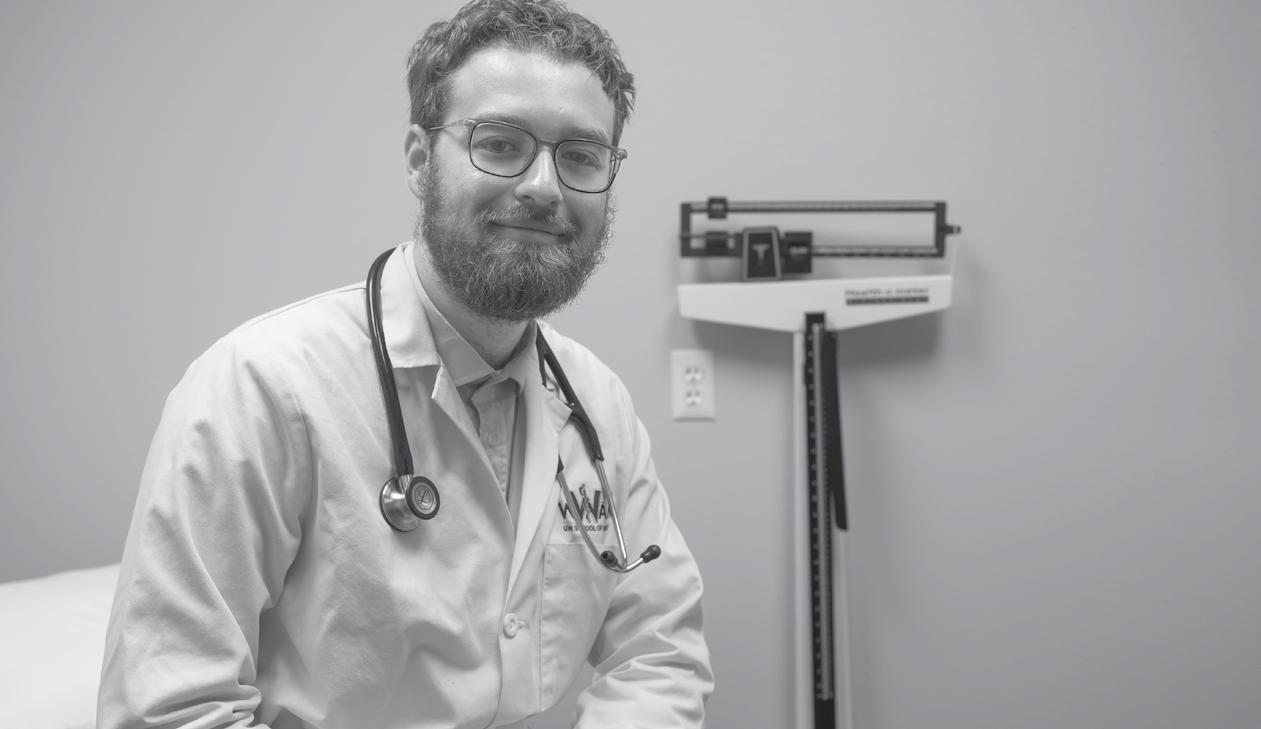
Rafael Homer and his family immigrated to Wyoming from Turkey when he was 2. Watching his mom study for her Ph.D. in agronomy at UW, he fell in love with science and went on to earn dual degrees in molecular biology and finance at UW (2023) before applying to medical school in the multistate WWAMI program, which stands for Washington, Wyoming, Alaska, Montana and Idaho. Wyoming students spend two years on the UW campus, then complete two years at clinical sites throughout the region before earning their medical degrees from the University of Washington School of Medicine.
Growing up, Homer saw and experienced the lack of specialty care available to rural residents. After working for a time at Ivinson Memorial Hospital and shadowing doctors, he cemented his calling. Homer
recently completed his first year of medical school. As if the rigorous coursework weren’t enough to keep him busy, he serves on the Wyoming Medical Society Board of Trustees, volunteers as a Wyoming State Science Fair judge, researches telehealth and serves as an advocate for greater access to rural specialty care.
“Health access is a big thing for me, so I’ve been working with Wyoming Medicaid to research telehealth usability amongst the Wyoming Medicaid population,” Homer says. “My family was on Medicaid for a time when I was growing up, so being able to give back to people who are in the same situation has been really meaningful.”

This summer, he presented on telehealth at the National Rural Health Association’s Annual Rural Health Conference. Homer also works with The Sun Bus mobile clinic and the American
Academy of Dermatology to bring dermatology care and skin cancer screenings to rural communities. He spent the summer researching Darier disease, a rare genetic skin condition, with a mentor in Seattle.
“I want to be able to leverage my medical education and my future status as a physician to create change and, hopefully, to improve the lives of folks in Wyoming and other rural areas,” Homer says. “It doesn’t really feel like extra work — it’s more of a calling.”
As a doctor, he hopes to work in oncology, dermatology or immunology. Homer says his UW education prepared him well for his future and was the perfect size for access to research and mentorship from professors.
“It felt like everybody’s got your back and everybody’s rooting for you,” he says. “It was such a unique experience to have both the finance and molecular biology departments making me feel like I could do anything and teaching me the skills that I need to thrive and survive.”
Wyoming itself provides a supportive environment where Homer can easily reach out to leaders and make connections for his research and advocacy.
“I don’t think any other state has the environment where you can work with the people making the policy decisions,” he says. “I love Wyoming, and I love being a part of the community and doing my best to make the state better for everyone.”

Johnna Arthur earned her bachelor’s degree in sociology and Native American studies from UW (2022). She was working regular jobs that earned a paycheck but weren’t her calling when she lost both her parents six months apart.


Her father, “Big” John Smith, served as transportation director for the Eastern Shoshone and Northern Arapaho tribes Joint Business Council on the Wind River Indian Reservation for 25 years, where he improved infrastructure, dramatically cut alcohol-involved crashes and fatalities, worked with tribal leaders to enhance seat belt compliance and more. Her mother, Elizabeth “Betty” Ridgely, served as a crime victims coordinator and helped countless folks going through difficult circumstances, including domestic violence. Arthur and her mother were in a devastating head-on car crash that took her mother’s life six months
after Big John passed. The accident also left Arthur wheelchair bound. She was told she’d never walk again, but when she could, she knew it was for a reason.
The death of her parents motivated Arthur to return to school and to dedicate her life to serving her tribal communities. She’s now earning her master’s degree in public administration at UW.
During a Native Americans in Contemporary Society course, Arthur connected with fellow student Scott McClurkin, and they began discussing reservation

I put a lot of heart into this project. It’s really a dream come true for my community. — Johnna Arthur
housing issues. According to government research, more Native Americans than non-Native citizens live in housing that is overcrowded, lacks complete kitchens and bathrooms, has heating and electrical problems, or is structurally unsound. The Northern Arapaho Housing Authority estimates that the Wind River area needs 400 new homes to meet community needs.
These housing issues inspired Arthur to start Warm Valley, which became a nonprofit 2024. She wants to create sustainable multigenerational housing and eventually offer classes on homeownership, construction and more. Arthur hopes that the initial housing projects will provide housing for elders and stability for parents recently reunited with children removed by the Department of Family Services. The first phase of housing construction will include a number of A-frame homes, a circular community building, a community garden and other services.
“I put a lot of heart into this project. It’s really a dream come true for my community,” she says. “If it’s a community effort and we build on other people’s talents, I think it can go a long way.”
Arthur is working to secure grants to support Warm Valley’s efforts, including funding from the Northern Arapaho Business Council, the U.S. Department of Agriculture and Wind River Cares.
For the Arthurs, giving back is a family affair. Her husband Melvin is a research scientist at UW and does community health work on the Wind River Reservation, including helping with a medical clinic on wheels and a future mobile dental van. Johnna also earned her community health certificate and wants to improve mental health on the reservation, a topic she studied during her UW McNair Scholars research. They also sponsor a food share cabinet in UW’s Native American Education, Research and Cultural Center.

Micah Brandt wanted a challenge and to help people, so when it came time for college, he joined the Army ROTC Cowboy Battalion at UW with the goal of commissioning as an Army officer after graduation. It proved an ambitious and rewarding route. When he wasn’t studying toward his degree in energy resource management with a concentration in professional land management, he was busy with ROTC commitments, training at 7,200 feet above sea level in the dead of winter and at Fort Knox, Ky., and presenting the colors at football games.

Brandt graduated this past spring and is now a second lieutenant in the Army. Just like his time as a student, he chose a challenging specialty. “I’m going to be going into explosive ordnance disposal, which is the bomb squad,” he says. “The biggest thing about serving for me is the opportunities to lead, to help out and to do what I can.”
When he retires from military service, Brandt hopes to work as a landman, putting to use the skills he gained at UW’s School of Energy Resources. Brandt encourages prospective students to consider UW for its perfect size, location and opportunities: “I highly encourage people to check out Wyoming because it’s not like anywhere else.”

Social work is a helping profession, so it’s no surprise that many UW social work students — on both the Laramie and Casper campuses — are passionate about giving back. Luckily, student organizations such as the Associated Students of Social Work (ASSW) provide the perfect avenue.
“Helping others and giving back are not only at the heart of social work but are typical qualities of those in the helping profession,” says senior Noelle Romer, president of the UWCasper ASSW chapter, who plans to go on to pursue her master’s degree at UW. “Helping brings me joy. As an adult and having certain personal experiences, I am acutely aware of the impact that a helping hand can have. So, for me, being able to help and give back is extremely important and something I consider a privilege to be able to do. Casper is such an amazing community with so many existing resources to help. I always feel so proud to have been born and raised here, and to now be in a position to make a positive impact is very fulfilling.”
Last school year, as president of the club, Romer, along with her fellow social work students, decided on several goals. These included fundraising and volunteering for Natrona County nonprofits and strengthening the connections between Casper College and UW-Casper. These efforts
included designing T-shirts to sell on both UW campuses, with proceeds benefiting Health Care for the Homeless and the Child Development Center of Natrona County’s Go Baby Go Wyo program. This program modifies batteryoperated ride-on cars to give children with mobility impairments an opportunity to access play, exploration and social encounters. They also volunteered to help the Mercer Family Resource Center with its Dancing With the Stars of Casper fundraiser. On campus, they held social hour events for social work students and faculty from both campuses to get to know one another.
On the Laramie campus, senior Alexis Arp of Cheyenne serves as co-president of the ASSW chapter. The group led a clothing drive for the COMEA Homeless Shelter in Cheyenne, raised significant funding during its Giving Day campaign, supported the Laramie Women’s Club, led a food drive for UW’s food share pantries, and advocated for mental health and social work.
“Through my own mental health journey and personal values, I found that I have a strong sense of justice and care deeply for people and the human experience,” Arp says. “I am also very passionate about social justice because I think people are inherently good and deserving of equality and equity. It is important to me that I live a life worth being proud of, and to me that has to include working with people and systems to create a better world for everyone.”
As a social worker, she hopes to provide therapeutic services that are accessible for all with a focus on neurodivergence, addiction and substance abuse. “I would also like to lobby or hold a public office one day, to create community programs to centralize resources and to work with indigenous communities,” Arp says. “I hope to do many related plans as well, but I believe some of these goals can become interconnected with the ultimate goal of creating networks of resources that make getting help easier.”
Helping others and giving back are not only at the heart of social work but are typical qualities of those in the helping profession.
— Noelle Romer
Demand for software developers is increasing by 22% b/t 2022 and 2030

*Bureau of Labor Statistics
The Applied Software Development degree program combines practical experience and knowledge of modern programming languages, tools, and processes used in the rapidly evolving field of Software Development.

UW’s student team took fourth place in an international competition to design zero-energy buildings. The solarpowered home they helped design in the foothills of Wyoming’s Wind River Mountains was part of the 2023 U.S. Department of Energy’s 20th annual Solar Decathlon Build Challenge.
“We’re thrilled to place so highly in an international competition. It’s a great credit to our hard-working enthusiastic students, our outstanding faculty and a tremendous partnership with the builder,” says Tony Denzer, professor and head of UW’s Department of Civil and Architectural Engineering and Construction Management. “Moreover, this was not a vanity project but a real market-ready home with the goal of introducing the zero-energy concept to Wyoming homebuyers.”
UW finished just behind Ball State University, the Indian Institute of Technology Bombay and the University of British Columbia but ahead of schools including the University of Kansas, the University of Illinois, Brigham Young University, the University of Colorado and Texas A&M University. While UW’s entry was fourth overall, it placed first in the “Comfort and Environmental Quality” category, tied for first in the “Energy Performance” and “Occupant Experience” categories, and was third in the “Embodied Environmental Impact” category.
The three-bedroom two-and-a-halfbath home sits on its 6-acre lot 10 miles southwest of Lander overlooking Red Canyon. It was built with a “minimal mountain modern” style and features a super-insulated and air-tight envelope; advanced heating systems including a heat pump and radiant floors; green building materials; and a large array of solar panels to ensure the home will produce more energy than it consumes on an annual basis. It was built and financed by Timshel Construction, led by UW alumnus Cory Toye, on land that he purchased. Toye collaborated directly with students during the design process and sold the house to a private buyer after competition.
Ten UW graduate and undergraduate students made up the team, including Ph.D. civil engineering student Emmanuel Iddio of Ibadan, Nigeria. “The American dream is rooted in independence and resilience, so why shouldn’t that extend to our buildings as well?” he says. “Learning about designing passive sustainable net-zero houses is incredibly beneficial for this generation. For homeowners, especially with rising energy costs, imagine owning a home that not only
saves energy but also generates income by producing electricity.”
Iddio served as the measured contest officer and as a member of both the engineering and marketing teams. He appreciated how the project mimicked the real world — working with various specialties and the contractor.
“I sincerely hope that this competition will become a tradition, allowing future students to also benefit from such enriching experiences,” Iddio says.
It also gave him valuable experience for his future career, where he hopes to shape policy and sustainable environmental practices. “Through my expertise and experience, I seek to contribute to the formulation and execution of policies promoting renewable energy, energy efficiency and climate resilience in building practices,” Iddio says. “My objective is to actively contribute to mitigating climate change and fostering a healthier more sustainable future for generations to come.”


• Class schedule planning
• Early class registration
• One-on-one and small group tutoring
• Applications for free federal financial aid
• Access to key college staff and offices
• Help balancing life challenges


Interested in applying? Contact us at sss@uwyo.edu or scan this code

Interested in applying? Contact us at sss@uwyo.edu


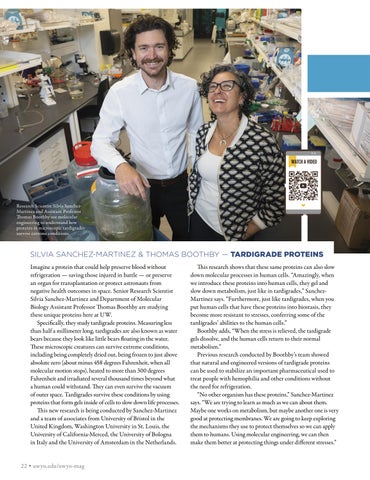
Imagine a protein that could help preserve blood without refrigeration — saving those injured in battle — or preserve an organ for transplantation or protect astronauts from negative health outcomes in space. Senior Research Scientist Silvia Sanchez-Martinez and Department of Molecular Biology Assistant Professor Thomas Boothby are studying these unique proteins here at UW.
Specifically, they study tardigrade proteins. Measuring less than half a millimeter long, tardigrades are also known as water bears because they look like little bears floating in the water. These microscopic creatures can survive extreme conditions, including being completely dried out, being frozen to just above absolute zero (about minus 458 degrees Fahrenheit, when all molecular motion stops), heated to more than 300 degrees Fahrenheit and irradiated several thousand times beyond what a human could withstand. They can even survive the vacuum of outer space. Tardigrades survive these conditions by using proteins that form gels inside of cells to slow down life processes. This new research is being conducted by Sanchez-Martinez and a team of associates from University of Bristol in the United Kingdom, Washington University in St. Louis, the University of California-Merced, the University of Bologna in Italy and the University of Amsterdam in the Netherlands.
This research shows that these same proteins can also slow down molecular processes in human cells. “Amazingly, when we introduce these proteins into human cells, they gel and slow down metabolism, just like in tardigrades,” SanchezMartinez says. “Furthermore, just like tardigrades, when you put human cells that have these proteins into biostasis, they become more resistant to stresses, conferring some of the tardigrades’ abilities to the human cells.”
Boothby adds, “When the stress is relieved, the tardigrade gels dissolve, and the human cells return to their normal metabolism.”
Previous research conducted by Boothby’s team showed that natural and engineered versions of tardigrade proteins can be used to stabilize an important pharmaceutical used to treat people with hemophilia and other conditions without the need for refrigeration.
“No other organism has these proteins,” Sanchez-Martinez says. “We are trying to learn as much as we can about them. Maybe one works on metabolism, but maybe another one is very good at protecting membranes. We are going to keep exploring the mechanisms they use to protect themselves so we can apply them to humans. Using molecular engineering, we can then make them better at protecting things under different stresses.”
From saving human lives to improving the economy, UW research is at the forefront of discovery. By Micaela
Myers
Psychology and the law intersect in many ways — from witnesses to police use of force and many things in between. This led Emeritus Professor Narina Nuñez to spearhead a Ph.D. program with an emphasis in psychology and law a number of years ago. Now, Assistant Professors Kayla Burd and Hannah Phalen head up the program, each with their own areas of related research. Graduates of the psychology and law program have gone on to hold public office, start advocacy organizations and more.
“In the Social Cognition and Law Lab, we study how individuals’ beliefs, backgrounds and predispositions bias memory, reasoning and decision-making within legal contexts, particularly for jurors and juries,” Burd says of her research, which includes many graduate and undergraduate students. “Some of our work studies how mock jurors think about forensic science evidence and police use of force. As a lab, we often seek ways to apply our research findings and knowledge to assist with real-world cases. For instance, we volunteer with the Wyoming Youth Justice Coalition, the Wyoming Children’s Law Center and the Defender Aid Clinic in UW’s College of Law.”
This work brings to light important
factors influencing the justice system. For example, Burd explains, research finds that jurors don’t make decisions based purely on factual evidence — their decisions can be swayed by psychological factors, such as how mature they perceive a child victim
advocacy are driven by the belief that all who make contact with the criminal legal system — whether as suspects, defendants, or victims — deserve fair and humane treatment. Most individuals who make contact with the criminal legal system come from

to be, how attractive they perceive a defendant to be or their beliefs about how victims “should” behave.
“We hope that our research can lead to improvements in the legal systems in the United States, for both children and adults,” Burd says. “My research and
disadvantaged backgrounds, which is the case for the majority of suspects and victims alike. Contact with the law can have intended and unintended consequences, and I hope our work can help minimize unintended negative consequences for victims and suspects.”

You’ve likely heard of blockchain, cryptocurrency, and bitcoin, but to the average person, the terms are still confusing. Blockchain is a digital record of transactions, where each transaction added to the chain is validated by multiple computers. Blockchain technology enables cryptocurrencies. The first decentralized cryptocurrency was bitcoin. It’s exchanged through peer-to-peer networks, and it’s open-sourced, meaning anyone can participate.

“Bitcoin was designed to be digital cash,” says Department of Philosophy Associate Professor Bradley Rettler. “One can acquire it and hold it and spend without revealing one’s identity. It was invented by cypherpunks — a group of people that could see the
promise of the Internet for democratizing information but also its threats to privacy.”
Rettler co-wrote “Resistance Money: A Philosophical Case for Bitcoin,” published this year. He wrote the book with colleagues Andrew Bailey, an associate professor of philosophy at Yale-NUS College, and Craig Warmke, an associate professor of philosophy at Northern Illinois University.
“Bitcoin isn’t just for criminals, speculators or wealthy Silicon Valley entrepreneurs — despite what the headlines say,” Rettler says.
“In an imperfect world of rampant inflation, creeping authoritarianism, surveillance, censorship and financial exclusion, bitcoin empowers individuals to elude the expanding reach and tightening grip of institutions both public and private. So, although bitcoin is money, it is not just money. Bitcoin is resistance money.”
The book, which is intended for the public, explains why bitcoin was invented, how it works and where it fits among other kinds of money. The authors then offer a framework for evaluating Bitcoin from a global perspective and use it to examine bitcoin’s monetary policy, censorshipresistance, privacy, inclusion and energy use.
“More than half the world lives in a country with an authoritarian government,” Rettler says. “Nearly a quarter of the world lives in a country whose local currency’s inflation rate is over 10 percent per year. For such people, bitcoin is a lifeline. As long as authoritarianism threatens and central banks behave irresponsibly, bitcoin will remain as an alternative.”
In addition to his research and publishing on bitcoin, Rettler studies metaphysics, the philosophy of religion, and epistemology. He teaches on those topics as well as critical thinking, philosophy of language, money and philosophy, and science fiction.
“Philosophy helps us ask the important questions about the world and how to live in it — and gives us the tools to make progress in answering those questions,” Rettler says. “In my teaching, I try to impart those tools to students, and in my research, I try to make progress in understanding the world.”

Department of Molecular Biology
Assistant Professor Eunsook Park is working to find new fungicides that can save crops and, potentially, human lives. Park, with her collaborators, published a recent paper in Nature Communications titled “Attenuation of phytofungal pathogenicity of Ascomycota by autophagy modulators.” It notes that crop losses are estimated to cost about $550 billion worldwide, and approximately 40 percent of crop losses are due to fungal pathogens. Some plant and human pathogens have become resistant to current fungicides, making the creation of new ones critical. For example, some candida species that infect humans are resistant to existing fungicides. The changing climate can also cause pathogens to morph, Park explains.
“With COVID, we didn’t have any preparation, so we have to prepare for this kind of infectious disease,” she says.
Park and her team are working to identify potential new treatments targeting the autophagic pathway. Autophagy allows organisms — from humans to fungi — to break down and reuse old cell parts so cells can operate efficiently. Researchers including Park are investigating this pathway’s role in preventing and fighting disease. For example, studies show that autophagy plays important roles in homeostasis, cellular differentiation, nutrient starvation, sporulation and pathogenicity of fungal pathogens. Infection to host plants can be interrupted by the inhibition of the autophagic pathway.
“We utilize our understanding of basic cell biology in application to prevent fungal diseases in crops and animals,” Park says. “Isolated chemicals provide the potential to develop new fungicides to prevent fungal infection of economically important crops and
fruits. Our research is about screening these compounds with a unique and easy technique we developed.”
The technique uses bioluminescence resonance energy transfer based high-throughput screening to identify compounds that inhibit autophagy formation in fungal pathogens. Of the more than 7,000 compounds tested for the paper, several showed promise. Park is applying for a patent on selected chemicals and looking for an industry partner to take them to market. Her team is also applying for larger grants in partnership with international collaborators that will allow them to further their research and test more compounds.
Park hopes her research will help Wyoming and the world economy. She also sees the potential benefits of saving human lives.
“While normally healthy people can overcome fungal infections like candida, immunocompromised patients are really vulnerable,” Park says. “We definitely need to develop new antifungal agents, and our screening system shows great promise.”

Water is a precious resource in Wyoming, and the extractive industries are vital to the state’s economy. However, these industries require water and also create “produced water” — water that comes out of the ground along with the oil and gas. Produced water may have oil and gas mixed in and is often saline or brackish, making disposal difficult and costly. To better address this issue, UW launched the Center for Excellence in Produced Water Management in 2015. The center is made up of a team of scientists, engineers, research scientists and graduate students from across campus. It aims to develop and implement environmentally sustainable and economically fruitful water resource recovery programs for industrial and municipal wastewaters.
“Wyoming is the fourth or fifth largest generator of produced water in the United States on any given year, and that’s a big deal because we’re such a water-poor state,” says center Director Jonathan Brant. “Taking advantage of this impaired water source can provide numerous economic benefits to Wyoming, as well as provide an avenue by which we can reduce the varied stresses on our limited freshwater resources. The center was formed to cover three areas of the water management tree: technology development and water characterization, economic analysis, and environmental assessments for water reuse applications.”
In the past, produced water was often re-injected into the ground or put into evaporation ponds. Nowadays, it’s practically impossible to get a permit to re-inject water due to environmental concerns such as earthquakes and/or the absence of suitable receiving formations, Brant explains, and evaporation ponds can harm air quality and soil quality with salt blowoff and also kill birds.
The Center for Excellence in Produced Water Management is researching ways to treat water with techniques such as desalination, and it is investigating using produced water to generate revenue by extracting precious metals and rare Earth materials. The solutions must be affordable and work for Wyoming’s small communities.
“My dream for this center is to be a resource for Wyoming’s citizens, industry, regulators and all people impacted by water needs,” Brant says.
“I want folks to know there are people at UW working to provide this knowledge and find real unbiased solutions for Wyoming.”
Brant explains that there’s a difference between an environmental engineer and an environmentalist, and he resides in the gray area in between. He says, “I’m really passionate about water and trying to maximize our water resources in the state.”

Douglas Kamaru came to Wyoming from Kenya to earn his Ph.D. in UW’s Program in Ecology. For his dissertation research, he’s studying predatorprey dynamics as well as human-predator interactions, including the impact of bushmeat poaching on lions in Kenya’s Tsavo Conservation Area — the largest protected area in Kenya and one of four remaining lion strongholds in East Africa.
Across their historical range, lion populations have been decimated to just over half of what they were three decades ago, Kamaru explains. Further declines are projected across Africa and India, which stems from a combination of habitat loss, retaliatory killing following livestock attacks and other factors.
“Less recognized by the conservation community is the potential for competition with humans for prey,” Kamaru says. “I am assessing the magnitude of prey depletion via bushmeat poaching by conducting DNA barcoding of meat in markets adjacent conservation area, assessing the extent to which de-snaring reduces bushmeat removal, and assessing the extent to which de-snaring results in increased lion prey and changes in lion occupancy and population size.”
Snares used to catch prey are the common form of bushmeat poaching in the area. His work includes de-snaring teams accompanied by snare-detection dogs, game cameras and collaring of select lionesses.

“The lion population is very small compared to the area,” Kamaru says. It technically should no longer qualify as a stronghold. “We have about 450 lions, which is about one-tenth of what we’d expect to have — that’s why we question what is happening.”
Kamaru explains that humans are considered super-predators. His current and future work in Kenya involves working with communities to determine why they are poaching and help find alternatives.
“Poverty is an issue, and that’s why people poach — the need for protein,” he says. “We must work with the communities to ensure that that they can get alternative livelihoods or alternative proteins.”
Kamaru works in partnership with government entities including the Kenya Wildlife Service and Wildlife Research and Training Institute.
“I want this information to influence policies and strategies for conservation of these lions,” he says. “The significant loss of lion population is why it is very important for us to be able to think about conservation and how best to do that.”
Katelyn Kotlarek’s research aims to improve speech and surgical outcomes for people born with cleft lip and palate. In recognition of her work, she earned the 2023 American Cleft Palate Craniofacial Association Emerging Leader Award.

“Cleft lip and/or palate affects one in 700 newborns every year in the United States and is the second most common birth defect,” says Kotlarek, an assistant professor in the College of Health Sciences Division of Communication Disorders. “However, the theoretical approaches behind speech and surgical treatments have remained rather unchanged over the past 50 years, resulting in numerous surgeries and corresponding speech issues that limit participation in society and are accompanied by a financial
burden for families.”
In her research, Kotlarek integrates the technology of magnetic resonance imaging, or MRI, with acoustic speech analysis to better understand the structural changes from palate repair surgery and connect those modifications to speech differences to guide patient-specific interventions. She also collaborates with colleagues at other universities and pediatric hospitals across the United States and Europe.
“Through my research, I hope to improve the current standard of care for individuals with craniofacial differences by establishing treatment approaches that are individualized and patientspecific,” Kotlarek says. “By working collaboratively across health care disciplines, we can achieve a world where these children require fewer surgeries and fewer speech therapy sessions.”
She teaches graduate and undergraduate courses. UW is unique in that it offers a course dedicated to craniofacial disorders as part of its speechlanguage pathology graduate program.
Kotlarek says, “By sharing my passion with students, I play a role in ensuring that the next generation of speechlanguage pathologists will feel prepared and confident in treating individuals with craniofacial differences through collaborative interdisciplinary care in Wyoming and beyond.”
College of Engineering and Physical Sciences Assistant Professor Xiang Zhang recently received nearly $600,000 from the National Science Foundation’s CAREER Program to help fund his team’s research on advanced composite materials.
Simply put, a composite is any two materials combined. In industrial applications, there’s typically a matrix material, often a polymer, and a reinforcement material, such as particles, fibers or fabrics. For example, glass-fiber or carbon-fiber reinforced polymer matrix composites can provide lightweight highstrength solutions to many industries. Hybrid composites made of more than two different reinforcement materials can enable an even wider performance spectrum. However, the prohibitive computational costs in modeling and designing to determine the best materials are limiting to industry — something Zhang’s team aims to help solve.
Zhang runs the Computations for Advanced Materials and Manufacturing Laboratory at UW, and his research focuses on developing advanced computational tools to understand how materials respond and evolve during their lifespans — from manufacturing to service and eventually failure — to help broaden their applications.
“This CAREER award aims to develop a seamlessly integrated education and research program to advance state-of-the-art multiscale modeling and design approaches and machine learning techniques to elucidate the microstructure-property-performance relationship of advanced composite materials and prepare the next generation with a background in composites and modeling to support the nation and state’s technology innovation in energy and various other industries,” Zhang says.
continued on page 30

The University of Wyoming College of Engineering and Physical Sciences looks forward to the opportunity to engage students and teachers in hands-on learning to build knowledge and understanding in the field of science, technology, engineering and mathematics (STEM). Strength in K-14 education can enhance the quality and quantity of students who pursue STEM programs at the University of Wyoming and ultimately pursue high-impact careers in Wyoming and beyond.
Computer Science Education Week | December 6-12, 2024
A week-long opportunity for K-12 students to work virtually or in-person with UW engineering students and receive an introduction to programming, with engaging computer science activities.
Engineers Week | February 16-22, 2025
Professional and student engineers visit Wyoming 3rd grade classrooms to facilitate an engineering design challenge to inspire innovative thinking, design and problem solving.
| Spring 2025
Part of a national competition series that provides 6th-8th grade students the chance to compete in contests against and alongside their peers. The state competition is held at the University of Wyoming campus in March 2025. To be eligible for the state competition, participants must qualify in their school competitions in January 2025 and chapter competitions in February 2025.
Land Surveyors Outreach | March 16-22, 2025
Educators and students in 4th-12th grades can connect and collaborate with professional land surveyors and GIS professionals to learn more about these professions and support Wyoming state STEM objectives. Students will engage in an activity involving a web-based, interactive map while learning from professionals in the field.
In addition, Zhang and his team will partner with the UW Department of Mechanical Engineering, School of Computing, Advanced Research Computing Center, Innovation WyrkShop, the Idaho National Laboratory, and other industry partners to conduct fully integrated research, education, outreach and workforce development. This will include a series of workshops for college students, high school students and K–12 educators in partnership with the School of Computing, where Zhang is also an adjunct faculty member.
“We plan to increase awareness and interest in composites at an early age to people from diverse

backgrounds through training programs and outreach events at different technique levels,” he says.
Zhang also hopes his team’s work will help solve the high costs of computational modeling
to create even better composite materials for a wide variety of uses and applications.
“I hope to fill the gap so we can use those very advanced models in our actual product design,” Zhang says. “My proposal has a lot of method development to reduce the computational cost and enables fundamental understanding of the microstructure-propertyperformance relationship of advanced composite materials. There is so much potential for computational modeling and design. It could assist in finding composites with even better properties for different engineering applications, such as those in energy, aerospace and automobile engineering.”


The Humanities Research Institute strives to be an engine for producing interdisciplinary research in the humanities; a community for faculty, students, and the public; and a model of democratic education fit for our land-grant university. Please join us!
For an exciting list of activities and programming, visit our Website: uwyo.edu/humanities and our Facebook page: Facebook.com/UWYOWIHR
The Global Engagement Office supports students, faculty, communities, and businesses in generating internationally engaged research, teaching, and program opportunities. With an array of fellowships, grants, awards, partnerships, and events, our office cultivates effective collaboration between Wyoming and the world.

| Education abroad opportunities
| International research
| Intercultural community engagement
| Grants, fellowships, awards
| Transdisciplinary exploration
| Workshops
| Faculty resources
| Student & scholar immigration support
| Language classes
| Global partnerships
| Student leadership opportunities
| Outreach
Learn about our programs at www.uwyo.edu/global
APPLY FOR A SCHOLARSHIP!
CONTACT US TO LEARN ABOUT FULBRIGHT OPPORTUNITIES.


alumnus Matt Smith comes full circle with a new Laramie software engineering hub.
By Chad Baldwin
When Matt Smith graduated with a master’s degree in electrical engineering from the University of Wyoming in 1989, his employment opportunities in the state were quite limited, and he began his career in the aerospace industry as a systems engineer at Rockwell Collins in Cedar Rapids, Iowa.
Now, as CEO of Safran Passenger Innovations (SPI), one of the world’s three in-flight entertainment and connectivity companies, Smith is leading a development that could make it possible for hundreds of UW graduates to stay in Wyoming — and for many UW engineering alumni to return to the state.
Under Smith’s direction, SPI has opened a software engineering hub in Laramie, in collaboration with UW and its Office of Industry and Strategic Partnerships, the Laramie Chamber Business Alliance (LCBA) and the Wyoming Business Council (WBC). Operating temporarily in UW’s Wyoming Technology Business Center, the company already has 14 software engineers on the job, with plans to have 21 on board by the end of this year and


up to 72 engineers at the end of 2025. Eventually, he hopes to have upwards of 200 employees in Wyoming.
“We want to start out with a strong nucleus of software engineers with experience. We will then surround them with talent from recent college graduates,” Smith says. “It has always been a dream of mine to provide an opportunity for Wyomingites to stay home, providing a great career opportunity that includes significant growth for their future.”
UW as a Launching Pad Smith grew up in Riverton, the son of a uranium miner and a Montessori preschool teacher. His parents, Richard and Pat, instilled in him the values of gratitude, integrity and respect for
others — along with a drive to pursue higher education.
He began his studies at UW in 1983 with the intention of becoming an optometrist, but he switched to electrical engineering at the encouragement of his uncle, Tom Shepherd, a 1976 UW electrical engineering graduate and longtime resident of Gillette.
“My undergrad certainly got off to a rocky start. I was by no means an ‘A’ student. I had to work extremely hard and study endlessly,” says Smith, who also has fond memories of the broader student experience, which included starting as a neighbor of UW basketball great Fennis Dembo in McIntyre Hall and watching Pokes games. “Engineering certainly didn’t come easy, but in the later years, the
classes got more interesting and got me excited, and things became easier.”
During his senior year, Smith became close with longtime UW electrical engineering faculty members John Steadman and Francis Long, who also held various administrative positions in the college.
“The two of them really shaped my future and got me interested in getting my master’s degree,” Smith says. “Dr. Steadman had grant monies to develop a digital hearing aid. I have had hearing loss my entire life and have always had to wear hearing aids. I thought it was so exciting to help him do something that could help shape that industry and get a digital hearing aid I could eventually wear. I truly look up to the two, as they had a major impact on my life and got me ready for my career.”
When it came time for a job search — and knowing that the opportunities in Wyoming were limited — Long connected Smith with the director of engineering at Rockwell Collins.
“He was in Laramie to visit, and I happened to run into him,” Smith says. “We talked for several hours, and he described the perfect opportunity for me, so I took it.”
A Career of Ascent
Smith’s career has been remarkable for its upward trajectory and impact.
After working for Rockwell Collins from 1989-1997, Smith went to work for Honeywell Avionics as a project engineer, responsible for all of the technical aspects of the CH-47SD helicopter. He returned to Rockwell Collins in 1998 and worked there until 2008, holding roles ranging from systems engineer in Bordeaux, France, and Montreal, Canada, to senior director of cabin systems and senior
director of program management/ content services.
He became the senior vice president of operations for Panasonic Avionics Corp. in 2008, based in California and responsible for all global operations and more than 2,500 employees. His tenure with Panasonic included the acquisition of Ku-band antenna technology for airlines and joint ventures with companies in Germany and Singapore.
He became the CEO of SPI in 2015, based in Orange County, Calif., which has grown from about 300 employees to over 650 in seven countries. Safran Passenger Innovations is part of France-based Safran, one of the world’s major aerospace companies with 92,000 employees across the globe.
“We are the newest of the three inflight entertainment and connectivity companies. We started out with no airlines, and here we are today serving over 90 airlines worldwide,” Smith says. “SPI has changed the industry when it comes to connectivity. To date, connectivity has been tied to the hardware. We broke it away, just like is the case with your cellphone, to give the airlines a choice for service.”
Along the way, Smith married his wife, Lois — they met while he was working in Montreal for Rockwell Collins — and they raised a son, Michael, who today lives in Chicago.
While Smith’s career has taken him around the globe, he has maintained ties with Wyoming and the Rocky Mountains. His parents still live in Riverton; his brother, Greg, is a longtime Laramie restaurateur; and his sister, Shawna, lives just across the border in Wellington, Colo.
When his company was looking to expand outside Orange County, corporate leaders initially pushed him to
locate a new operation in Mexico, where Safran has thousands of employees. But he persuaded them that Laramie was a better option, after visits and meetings with UW, LCBA and WBC leaders.
The advantages include Wyoming’s favorable tax climate and financial incentives, along with the opportunity to collaborate with the university. Smith is particularly excited about President Ed Seidel’s artificial intelligence initiative and the opportunity to provide internships to help UW students earn money and at the same time promote SPI for future employment.
What lessons would he share with UW students from his career?
“Wyoming is such a wonderful place,” Smith says. “I understand the work ethic that comes with Wyoming, and I can’t wait to watch (the Laramie operation) blossom.”
“Most importantly, treat people with respect and understand their perspectives. You must connect — it’s all about relationships,” he says. “Once you enter the workforce, you are not likely to be the smartest person in the room. It’s your emotional intelligence that will set you apart and create the greatest opportunities to grow.
“I truly believe in aptitude and attitude. Continue to learn and understand what you are doing, and love coming to work every day.”
The College of Arts & Sciences o ers a distinct and well-rounded education in Fine Arts, the Humanities, Social Sciences, and Interdisciplinary Programs. Whether you're interested in pursuing a degree in A&S or looking for ways to unlock your creativity, nationally-ranked degree programs and courses with A&S provide an opportunity to gain valuable education and skills. Our programs involve work in the creative fields, using data, learning new languages, understanding the world around you, and much more.

Courses, programs and degrees o ered in:
The Neltje CENTER FOR EXCELLENCE IN CREATIVITY AND THE ARTS
FINE ARTS
Music
Theatre and Dance
Visual Arts
SOCIAL SCIENCES
Anthropology
Communication and Journalism
Criminal Justice and Sociology
Psychology
INTERDISCIPLINARY PROGRAMS
School of Culture, Gender and Social Justice
School of Politics, Public A airs and International Studies
Humanities
English
Modern and Classical Languages
Philosophy and Religious Studies
History
INTRODUCING TWO NEW PROGRAMS!
7 English Ph.D. in Public Humanities
7 Bachelor's degree in European Languages, Literature, and Film Studies

uwyo.edu/as


By Micaela Myers
When Jack O’Neil visited the University of Wyoming, he told swimming and diving Coach Dave Denniston that, if he joined the swim team, he wanted to be treated like every other athlete — he wanted to be pushed just as hard. And he was. As team captain, he also helped push his teammates.
O’Neil didn’t set out to be a role model or an inspiration, but as a decorated athlete, high-achieving student and someone with one leg, he understands that it goes with the territory.
“I realize that I have the power to be an inspiration every day, and I don’t take that lightly,” says O’Neil, who came to UW from Colorado Springs. “Every day that I show up to practice, I hold myself to the highest standards and hold other people to the highest standards. I recognize that I have a unique platform.”
He was born with a variety of issues in his left leg. After multiple surgeries and complications, the leg was amputated in 2013.
Now a senior at UW, O’Neil says that he strives to be a good teammate and a good person and to embrace his role as a leader. In addition to Division I swimming, he competes internationally. His accomplishments include competing in
the U.S. Paralympics Swimming National Championships multiple times and becoming a three-time silver medalist at the 2023 Parapan American Games in Chile.
O’Neil is also a standout student, making the Western Athletic Conference All-Academic honors list. He is majoring in journalism with minors in honors and disability studies and aspires to a career in sports broadcast journalism. You can hear O’Neil on air this semester as he interns as a sports broadcaster for Wyoming Public Media.
However, it’s not easy balancing competitive swimming with academics. O’Neil says: “The college swim season goes from August through February, and with swimming overseas and for Team USA, it really never ends. Balancing school has been tough, but I have the greatest support staff in athletics. My advisers have always looked out for me, and I’ve been really good about making relationships with my teachers and making sure they’re in the loop. But I think the way I’ve really been able to balance it is that I just love both of the things that I do — each one is a nice break from the other.”
This summer, O’Neil became an Olympian, competing in the 2024 Paralympic Games in Paris. “I’ve been training for that ever since I started swimming,” he says. “Coming to UW, I seriously don’t think there’s a better group of people I could have been surrounded by to chase that goal.”

From improving health care and local parks to helping solve complex environmental and historical challenges, UW programs benefit citizens across the state.
By Micaela Myers

Many environmental issues put folks at odds with one another. Say, for example, you work for the Wyoming Game and Fish Department and are trying to repopulate streams with native trout species and remove nonnative species. However, locals who fish for rainbow trout are not happy about it. Your best bet is to contact the UW’s Haub School of Environment and Natural Resources Collaborative Solutions program in the Ruckelshaus Institute. The Collaborative Solutions program brings stakeholders together to facilitate collaborative decision making that creates inclusive lasting solutions.
A second program — the Collaboration Program in Natural Resources — provides training in multi-party negotiation and problem solving to natural resource decision makers and engaged citizens. Both programs help Wyoming manage its environment collaboratively.
“What we do at the Ruckelshaus Institute is to provide evidence-based information for decision makers in the state around environment and natural resource issues,” says Steve Smutko, who recently retired as the Spicer Chair of Collaborative Practice after serving for 14 years. “The second
thing that we do is collaborative solutions. Primarily this work has policy focus and is Wyoming-centric — for example, helping the Department of Environmental Quality develop rules for protecting water or air quality.”
The program brings together stakeholders who are passionate about the issue at hand to meet over several months. First, they agree on what the problem is. Then each person shares what’s important to them, such as making a living off their land or protecting the water quality. Next, the group generates options and alternatives — ways to achieve various people’s interests and objectives.
“We generate a whole list of potential ideas, then we evaluate those ideas,” Smutko says. “And we ask our stakeholders to make trade-offs. We facilitate those negotiations and find a place where they can all reach agreement.”
Gov. Mark Gordon recently called upon the program to help with the Rock Springs Resource Management Plan by facilitating a working group to provide recommendations for him to use in negotiations with the Bureau of Land Management. The program also worked with the Medicine Bow-Routt National Forest on trails development and with the U.S. Forest Service on prescribed burns.
In addition to this work, the Collaboration Program in

When UW Carbon County Extension Educator Abby Perry moved to Rawlins 10 years ago, she wanted to start a park day tradition with her own kids similar to her mother’s — each week her mother and nieces would visit a different park. She also wanted to contribute to her community’s beautification and health initiatives.


Natural Resources provides a 10-month professional development opportunity for people from all levels of government, nonprofits, industry, landowners and anybody who has any interest in natural resources management and policy. Each cohort consists of around 12 people, and about 150 folks have been trained so far.
“We provide training to people so that they are better equipped
continued on page 38
Last year, Perry garnered startup funding from the John P. Ellbogen Foundation and launched the Carbon County Park Challenge in partnership with Discover Carbon County and local businesses. The challenge ties together 25 parks across the county’s 10 incorporated towns. Each park will feature a sign and map of all the county’s parks, a QR code to learn more about the park and a raised medallion specific to the park. Visitors can use a piece of scrap paper to make an etching of the medallion. After visitors gather all etchings, they will earn a “I completed the Carbon County Park Challenge” sticker.
Perry hopes the project will encourage physical exercise and family time as well as improve experiences for visitors to Carbon County. In the future, she plans to apply for grants for park improvement projects such as pollinator gardens, free little libraries and interactive stations. For example, Wyoming’s Cent$ible Nutrition Program has stencils for games including hopscotch, and additional stations could offer balls or toy cars to use while in the park. Perry believes other communities can create similar park challenges.
“I want this community to be best that it can be because this is where I’m raising my family and where I’ve put down roots,” Perry says. “But I think I can also contribute to the beautification and economy of our community. I can help make it a prettier place so that, when people drive through it, they want to stop and explore.”
continued from page 37
to handle these thorny issues that they have to work through in a way that brings people to the table to participate in meaningful dialogue,” Smutko says.
Aaron Voos, public affairs specialist for Medicine Bow-Routt National Forest and Thunder Basin National Grassland, says: “The resources provided by the Haub School and Ruckelshaus Institute are invaluable. I have personally benefited from the Collaboration Program in Natural Resources as a graduate, and the USDA Forest Service has engaged both students and staff for management issues, facilitation, shared learning, research, employment opportunities and so on. Our Forest Service unit
The United States faces an everincreasing population of individuals 65 and older. UW’s Wyoming Center on Aging (WyCOA) addresses this growing need with a broad range of programs and resources aimed at optimizing the health and well-being of Wyoming’s older residents. WyCOA offers innovative collaborations regarding chronic disease management, dementia support, and family and health care provider education.
“Historically, there has been limited sustained availability of programs to support people in Wyoming as they manage chronic illnesses,” says WyCOA Director Christine McKibbin. “To increase access, we believed that we needed a coordinated approach. It really takes many champions within many organizations to create a network of selfmanagement support in any state.”
For example, WyCOA partners with the Wyoming Department of Health Chronic Disease Prevention Program on the Healthier Wyoming website and on a variety of evidence-based prevention and management programming, including Healthy U chronic disease self-management and cancer care. The partnership also brought blood pressure monitors to several Wyoming libraries. In addition, WyCOA provides
is often the envy of other agency offices due to our relationship and proximity to such an amazing pool of individuals — all of whom dive into collaborative opportunities with a willingness to learn, teach and utilize such a powerful tool.”
Smutko says that this work is especially effective in a low-population state such as Wyoming. “I consider it to be a state of relationships,” he says. “I’ve done this work across the United States, and in Wyoming, people really get it because we have to work with our neighbors whether we agree with them or not. I find Wyoming to be a really wonderful place to work because people don’t take these relationships for granted.”
educational programing — including Wyoming Dementia Together, a community of professionals who provide free education and support to caregivers; Dementia On the Road, which brings dementia education and resources to Wyoming communities; and SHARE for Dementia, a care-planning program for families. For health care professionals and students, WyCOA offers a virtual care coordination certificate program for primary care professionals, a dementia care certificate, a program on infectious diseases and a UW ECHO in Geriatrics, where health care professionals receive best-practice recommendations in a virtual setting.
“There is a great deal of research to support that these programs make a difference in the quality of life and health outcomes for people living with chronic or other health conditions,” McKibbin says. “When UW students participate in these programs, it gives them an understanding of the many strengths that older adults bring. Students can also get to know and learn from the vast experience of older adults in their communities and carry those lessons forward with them as they enter the health professions.”
WyCOA also partners with Wyoming hospitals and health systems. For example, both Ivinson Medical Group and Cheyenne Regional Medical Center

Christine McKibbin
established chronic care management programs, and Ivinson became the first Age-Friendly Health System in Wyoming.

“As we age, we tend to develop one or more chronic conditions, and managing those conditions well is important to continuing to engage in what matters to us,” McKibbin says. “I am particularly passionate about making sure that older adults in Wyoming have access to the same programs that are available in other areas — especially to programs that we know work when it comes to improving well-being and health outcomes. At the same time, I am passionate about looking to our own communities for strengths and solutions that can be a model for other communities, states and regions.”
In 2023, UW and Cardiff University in Wales signed a fiveyear partnership agreement for joint ventures in research and education. This initiative built upon a previous memorandum of understanding signed in 2021.
“This strategic partnership marks a substantial commitment to fostering meaningful collaborations across the disciplines,”
UW President Ed Seidel says. “We envision projects that expand the scope and impact of our research, that create new opportunities for student and faculty exchange, and that will generate connections between Wales and Wyoming that will benefit both our universities and our broader communities.”
As part of this partnership, a group of UW faculty members and students visited Wales in May to see how the country revitalized Welsh language in education, tourism and government. They contemplated how this information may relate to the Arapaho, Eastern Shoshone and other Indigenous languages — some still remembered on our maps and some no longer noted.
The group included UW faculty members Tarissa Spoonhunter, Bridget Groat, Phineas Kelly, Richard Vercoe and Mary Keller, and UW students Darwin St. Clair Jr. and Juwan Willow. They traveled across Wales and visited Cardiff University, the National Library of Wales, museums, historical landmarks, a slate mine and much more. Along the way, they saw street signs, directions, museum exhibition information, national park brochures, and all sorts of information in both in Welsh and English. They received fun handouts that help tourists learn basic Welsh phrases. A group from Cardiff University then visited UW in July to further discuss language revitalization.
“The overall purpose of our trip was to learn about the Welsh language and how it is normalized within Wales to help grow the language,” says St. Clair, a member of the Eastern Shoshone Tribe from Fort Washakie, Wyo., majoring in secondary education and math with a minor in Indigenous studies. “The number of Welsh speakers had been decreasing. To combat this, the Welsh government created a scheme to have teachers take up to a year of paid sabbatical to properly learn Welsh. This was really cool to hear about, since I’m a future educator and also can relate to the Welsh people in wanting to preserve their culture with language. The issue of language loss is a significant problem not for just my tribe but many others in the United States.”
High Plains American Indian Research Institute Director Tarissa Spoonhunter says, “I am a member of the Northern Arapaho Tribe, and language is vital to our people and cultural ways of knowing. Seeing how Wales mandated Welsh language into federal policy was impressive. Tribes struggle finding the support in language revitalization through soft funding of grants rather than government mandates and
support for immersion programs.”
Among other things, the UW faculty members are thinking about how Indigenous languages survive in a time when artificial intelligence and the internet primarily utilize and promote English. They are also considering the relationship of language to tourism.
“Language is one of those key components to help maintain cultural vibrancy,” says Vercoe, an assistant lecturer in the Haub School of Environment and Natural Resources. “We looked at what occurred in the formal recognition process of the Welsh language, what the initial steps were, what were the challenges, and onto where it is now — having a language that is very much integrated.”

Kelly teaches courses in Native American and Indigenous studies and anthropology at UW and works with the Northern Arapaho Tribe and the Rapa Nui people to strengthen indigenous language and culture. He says: “A key aspect of the ongoing Welsh language revitalization process is how Welsh is now formally used, displayed and valued in diverse settings from street signs to historical markers, shop windows and the names of government buildings and institutions. This was both inspirational and humbling given the current lack of such representation for Indigenous languages here in Wyoming. The bilingual signage at Cardiff University that uses both Welsh and English is a good example of something we could do here at UW to support and value the indigenous languages and people of Wyoming.”

Across the country, rural school districts struggle to recruit and retain teachers. While working in a rural location can feel isolating to new teachers, these districts also provide unique opportunities to get to know families and to work closely with tight-knit communities. To provide prospective rural teachers with the information and support they need to thrive in rural settings, the UW College of Education launched the Wyoming Rural Teacher Corps.
“The Rural Teacher Corps is a unique opportunity to showcase the amazing assets and qualities of rural schools and communities and then to also nurture our preservice teachers,” says Alison Mercier, the Mary Garland Early Career Fellow and assistant professor of elementary science education. She co-directs the program with Leslie Cook, head of professional learning at the Teton Science Schools.
Students from all types of backgrounds enroll in the Rural Teacher Corps, and the program connects them with mentors currently
teaching in rural settings and takes them on field trips to rural districts.
“Visiting rural schools and learning from teachers made the biggest impact,” says Danielle Clapper, an elementary education major from Veteran, Wyo. “It changed my view of the future and what’s possible in rural schools.”
Teton Science Schools is a partner in the corps and plays a key role in the place-based educational offerings, including leading a weeklong workshop.
“Place-based education is important for all classrooms, but it is especially important in rural schools with its emphasis on the culture, history and traditions of those places where you’re teaching,” Mercier says.
Rural Teacher Corps mentors come from districts throughout Wyoming and are matched with UW students based on each student’s area of focus and interest.
UW students in the corps also lead a STEM night each year in Rock River and work with the local teachers to plan hands-on activities.
“STEM night was the most impactful thing I’ve done with Rural Teacher Corps because the parents were there with their kids and the
community came together,” says Mitch Dollerschell, an elementary education major from Merino, Colo. “It gave me a chance to practice finding common ground with parents and community members.”
Many UW students who took part in the first year of the Rural Teacher Corps wanted to return this past school year, so Mercier and Cook designed individualized pathways for them to gain additional knowledge, mentorship and exploration in rural teaching. Funding for the corps has come from the George B. Storer Foundation and College of Education Dean’s Office, and organizers are working with the UW Foundation to secure additional funding. They hope to expand corps offerings in the future. For example, this past school year, the Rural Teacher Corps began providing graduates with mini grants to help set up their classrooms or to attend professional development, and graduates continue to be mentored as they start their careers.
Mercier says, “We hope that we prepare them to not just to get a job in a rural school after graduation but also to be successful and to thrive here in Wyoming.”


RESEARCH, SERVICE, AND OUTREACH
Trustees Education Initiative (TEI)
Literacy Research Center and Clinic (LRCC)
Early Care and Education Center (ECEC)
WellSpring Counseling Clinic
Science, Math, and Teaching Center (SMTC)
Wyoming School - University Partnership


uwyo.edu/education
edquest@uwyo.edu


By Tamara Linse
Peter Kline is the founder and sole operator of Marathons with Meaning (marathonswithmeaning.com), a program dedicated to making running more accessible for people with disabilities.
Kline is also a UW finance alumnus (1975) and senior vice president, wealth management adviser and portfolio manager with Merrill Lynch Wealth Management. Marathons with Meaning is not a nonprofit organization, and he uses his own money to fund it.
Kline didn’t begin running until later in life. “I was overweight, 52, and I’d never done it,” he says. He tried a 10K and loved it so much he was hooked. But it wasn’t without a lot of training and a lot of pain: “I tried a marathon, and I did horrible. It was the most miserable, painful experience I ever had. It took me three years to qualify for Boston Marathon.”
Eight years later, the idea for Marathons with Meaning was sparked when Kline met a young woman whose spinal column was crushed after a tree fell on her. He saw how hard it was for her to navigate the world and society with this
disability, though her mind was not at all affected. At that time, Kline was getting tired of being a stand-alone athlete. “Running is very much an individualistic sport,” he says. “So, I thought, ‘Why don’t I try to include somebody else and take them along?’” He contacted a children’s hospital and the Make-a-Wish Foundation, and soon he was including rider-athletes in his marathons. And the rest is history.
Kline has now been running with rider-athletes for 12 years — over 70 to date — in marathons all over the world. “The kids have just been an amazing blessing,” he says. “They love it, and it changes their lives. It changes their parents’ lives, and it changes the other runners. Everybody is empowered by it.”
Some of the kids who are rider-athletes are very sick, some are nonverbal, and some are physically disabled but very sharp mentally. For example, one young woman rider-athlete is extremely physically disabled — can’t use her arms or legs — but she has a Ph.D. in marine biology and speaks three languages. “I never judge the disability or the person’s ability,” Kline says. “They’re amazing, and they inspire us.”
What advice would Kline give others? “Reach out. Don’t look the other way when you see someone not as well off. If you don’t know how to love unconditionally, then you’ll never understand love.”
He adds, “Giving is the selfish thing because you get back 10 times what you’ve given. It’s not always money and shouldn’t always be money. What good are you doing for society and for people in general?”
Kline doesn’t take donations for Marathons for Meaning and funds everything himself, including equipment, travel and race registrations. “If you want to give money, give it to the University of Wyoming. I really support that,” he says. “Would you rather have the gift come from a cold hand or a warm hand?”
Kline has also been a generous supporter of the UW College of Business with his philanthropy.

John and Theresa Branney gifted UW a collection of artifacts, as well as funding for their curation.
By Sunnie Lew
This story begins at its end.
Some clarity on facts and truth. A fact is an indisputable observation that can be verified by evidence. Facts are rigid, existing in actuality and cannot be convinced otherwise. Truth is a body made up of real things, including facts, and is dependent on a belief. Truth is amicable to your own experiences, to your gut reaction. While the truth harbors facts, it can’t outlive them. At the end of it all, truth dies with its messengers, and all that is left are the stones that time could not hide.
Archaeology is storytelling in reverse. It’s the collection of facts, used to map what we believe to be true. And that is why we start at the end, to bring us closer to what came before.
In the Colorado mountains under the outlook of Horsetooth Rock rests a significant piece of the archaeological record. It’s a massive collection, unlike any other, that’s available for study by University of Wyoming students. The collection is composed of prehistoric artifacts that have been procured throughout the high plains. The keepers of these artifacts are John and Theresa Branney, who gifted the collection to UW.
The gift has three parts: the artifacts themselves, the collection’s database and funding for the artifacts’ curation. For the remainder of John and Theresa’s lifetimes, the

collection will stay in their home, a space open to aspiring archaeologists.
“We haven’t seen anything quite like John’s collection,” says Todd Surovell, a professor in UW’s Department of Anthropology and director of the George C. Frison Institute of Archaeology and Anthropology. “The locational information, along with the amount and quality of the materials, is rare. Artifacts are the primary insight to how people lived over the last 13,000 years. John’s collection is a wonderful example of this.”
The collection resides in John’s office. In the morning hours, a warm light floods through cases made of wood and glass, where he has stored almost all that he has found. The items are meticulously organized and labeled. The significance of John’s work is apparent, regardless of one’s archaeological knowledge.
“Do you want to hold one?” asks John, opening a display case containing Clovis points dated as far back as 11,300 years ago.
The facts: The age of an artifact is determined through a method called radiocarbon dating, which analyzes a radioactive isotope of carbon found in organic materials. Clovis points are described as wholly distinctive, chipped from jasper, chert, obsidian and other fine, brittle stone. They have a lance-shaped tip and are sometimes unexpectedly and wickedly sharp.
This is what we know to be true: When John places the Clovis in your palm, his face beams. The moment feels restorative. It will lead you to believe that the warmth of the room is more than a peering sun through French

doors. It’s the space itself — a space where evidence of past civilizations has hived together, humming secrets in dead languages. To be here with John is finding a closeness with truth while accepting all that we can never know.
John and Theresa hold significant gratitude for the landowners who have granted John permission to collect from their properties. Over time, they’ve become great friends with many of them, sparking a community interested in the deep past of the high plains. Theresa shares her favorite stories of John’s adventures and the building of these relationships. Although she doesn’t hunt herself, she’s an integral part of the bestowed gift.
The Branneys are defined by their values. They inform that it’s important to always have permission before artifact hunting. Never trespass, never cut fences, never take anything without permission. In amassing the physical collection, the Branneys have also gained the trust of those who steward the land.
“We couldn’t have put this collection together without the landowners,” John says.
The collection is an extraordinary effort that has spanned nearly six decades. Currently, there are over 8,000 records in the database, each with a catalog number that includes information about the artifact type, date collected and even GPS coordinates, among other pertinent details. Since the beginning, John has hunted artifacts with noble intention.
“In the 1930s, my grandparents owned a homestead near Moneta, Wyo., and one of my grandfather’s passions was collecting artifacts,” John says. “When he died, my mother inherited his collection. Seeing that collection lit a fire that has shined bright ever since.”
John found his first perfect arrow point when he was 8 years old. At an early age, his mother bought him two artifact books that he still has — “Indian Artifacts” by Virgil Russell of Casper, Wyo., and “Stone Artifacts of the Northwestern Plains” by Warren Steege and Louis Welch. From those books, he learned the importance of documenting everything he found.
The value of John’s work is not lost on the Cowboy State.
Surovell says, “Archaeology is so rewarding because understanding the human past is a serious challenge but a fun one. Finding things and dreaming of finding things that haven’t been touched by another person in thousands of years is really the romance of the profession.”
Facts are the widow of truth. Each artifact looks somehow precious in the light of John’s office. However, when you imagine what each one must have endured to survive the passing millennia, it feels remarkable to be in their presence. While facts expose themselves openly through the symmetry of chipped obsidian and the smooth surface of a grinding stone, the truth is something we must listen for, like the gentle moaning of high plains ghosts.
BY

collected over the course of nearly six decades.
PHOTO BY AUSTIN JACKSON

Three UW anthropologists — William Mulloy, George Gill and Doug Owsley — have made significant contributions to the field of anthropology.
William Mulloy – UW has long had a research connection with Easter Island, or Rapa Nui, located in the Pacific Ocean approximately 2,300 miles west of its federal government in Chile — since 1955, when UW anthropologist William Mulloy accompanied Thor Heyerdahl on the Norwegian Archaeological Expedition. Mulloy devoted his life to extensive research and restoration of the island’s shrines and monuments — particularly the large stone statues (moai) for which Easter Island is best known. Mulloy’s early research was on North American Plains archaeology.
George Gill – After his service as a U.S. Army Combat Ranger, UW Anthropology Professor George Gill excavated and studied hundreds of human skeletal remains from Mexico, Easter Island and the Great Plains of North America. His travels have carried him to 45 countries and all 50 states, where he has developed osteological collections for national museum collections. He served as scientific leader of the National Geographic Society’s 1981 Easter Island Anthropological Expedition and has been active in skeletal identification for law enforcement agencies as a fellow of the American Academy of Forensic Sciences.
Doug Owsley – Doug Owsley is curator of physical anthropology at the Smithsonian’s National Museum of Natural History in Washington, D.C. A UW alumnus who was born in Sheridan, Owsley is one of the foremost forensic anthropologists in the world, and his research focuses on skeletal biology, forensic anthropology and historic populations in North America and Polynesia. He helped identify the 9/11 Pentagon victims, victims of the Bosnian War and those killed in Waco, Texas, during the 1993 siege of the Branch Davidian compound. He is among Smithsonian Magazine’s list of “35 Who Made a Difference,” stemming from his work on the 9,500-year-old remains of the Kennewick Man.
By Curator Michelle Sunset and Director and Chief Curator Nicole Crawford
If you are plugged into the arts scene in Wyoming, you have probably heard of Neltje (American, 1934–2021), and you may have had the opportunity to visit her expansive home and studio outside of Sheridan. She was an iconic artist, businesswoman and philanthropist. In 2010, Neltje stayed true to her lifelong dedication to supporting the arts by generously donating her home, property and collection to the University of Wyoming. The Banner property now functions as the Neltje Center for Excellence in Creativity and the Arts, providing UW students, faculty and creatives with a retreat in the natural beauty of the Bighorns, immersed in the world she crafted. To share a glimpse into Neltje’s life and home, the UW Art Museum is proud to present the exhibition “Neltje: The Collector” in Laramie through Jan. 11, 2025. Heiress to the Doubleday Publishing fortune, Neltje attended private schools and was raised by nannies in Long Island, N.Y. In 1965, following a divorce, Neltje chose a markedly different path. She relocated with her young children to Banner, Wyo., where she acquired a 440-acre ranch on Lower Piney Creek that featured a modest stone house built in 1899. Over the next five decades, she transformed this property into a


working ranch, partly dedicated to preserving historic and land resources.
Neltje’s contributions to Wyoming are widely acknowledged — from restoring the national historical landmark Sheridan Inn to founding the Jentel Artist Residency Program and endowing several programs including the Neltje Blanchan Literary Award through the Wyoming Arts Council. In recognition of her unwavering support for the arts, she received the Wyoming Governor’s Arts Award in 2005. Neltje also cultivated her own art career, exploring painting and other materials and often incorporating found objects into her abstract expressionist-inspired works.
An avid art collector, Neltje adorned her Banner home with an array of works amassed during her global travels. She creatively juxtaposed cultural objects with fine artworks and
her own abstract paintings, bringing vibrant life to her living spaces. She said, “My whole house is filled with carved moments from faraway places, they take me back. I pass by them in my daily travels in the house.”
“Neltje: The Collector” invites visitors in Laramie to experience Neltje’s distinct vision and to explore her life as a collector through eight vignettes of her personal collections. Each vignette replicates her unique pairings of objects and artworks as seen in accompanying photographs of her home installations. The artworks on view include her vibrant beaded chair from the Yoruba people of Nigeria, a Pablo Picasso pitcher, and paintings by Neltje herself, among other eclectic works.
“Neltje: The Collector” is funded through the generosity of the Lucile Wright Endowment and UW’s Office of the President.

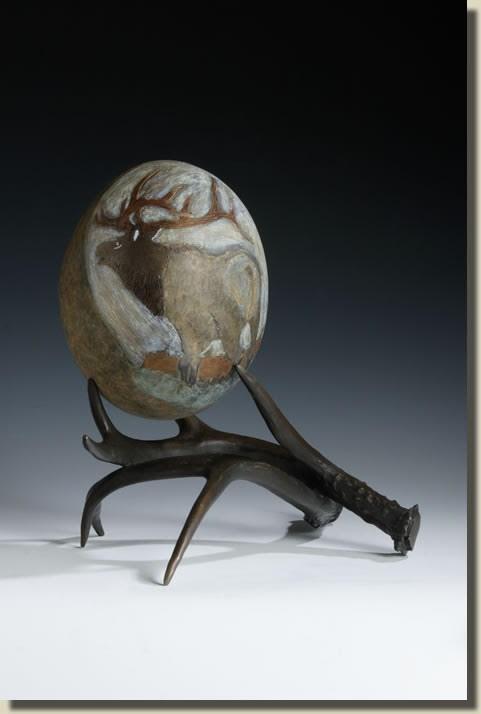


We have heard many say, “What do you give to that person who has everything?”


nineties, after a long successful career in the oil gas business, Randy turned his focus and passion to carving eggs. His mother's water color paintings of the sands and beaches of South Texas were an inspiration to Randy and his interest in the creative realm. His appreciation of original artistic expression and the unique medium rendered many years of gratification from his carving creativity. Carving the goose, rhea and the amazing threelayered emu egg, he gravitated almost exclusively to carving on the incredible ostrich egg, the world's largest egg.

Randy’s carvings have been gifted to several foreign dignitary wives due to the uniqueness of his work and medium. The process involves repetitive carving and staining to obtain his desired image. Years later, along with his wife Dana, they turned the original egg carvings to the beauty of bronze sculpture.


By Michael Blaney
The University of Wyoming Alumni Association (UWAA) is excited to welcome Jane France as the new president of the UWAA board. France is a Wyoming native and third-generation graduate of the University of Wyoming, and her journey to becoming board president has been a blend of family legacy, a passion for education and a deeprooted connection to UW. From her early years growing up in Rawlins to her successful legal career and dedicated involvement with the board, France is a testament to the powerful bonds fostered by UW. France’s ties to UW run deep. Her mother, Candace Carroll France, was the UWAA board president in 1994. Additionally, France’s uncle, Sherrod France, and aunt, Jana Cook, served as UWAA board presidents. Her father, Dwight France, was a board member. France’s own story began as a student employee with the UWAA, where
she managed memberships and alumni information updates from the second floor of the Alumni House — a welcomed break from student pressures, she says. There, she realized UW’s remarkable power to bring alumni together, transforming strangers into friends and creating lasting relationships — something that inspired her to stay heavily involved with UW and the alumni community.
After her first year studying finance, France discovered a passion for history and was encouraged by Professor Phil Roberts to change her major. Along the way, she met fellow student and now husband, Ross Hinschberger. She attended law school at UW and is a partner at Sundahl, Powers, Kapp & Martin LLC, where she specializes in civil defense litigation. Her broad skillset, strong work ethic and problem-solving abilities have been invaluable during her seven-year tenure on the UWAA board and now in this leadership role.
“Every alum.” What does that mean? It means my goal as UWAA president is to engage with all alumni. This is a tall task, but we are up to it. Our new regional and affinity networks are a perfect tool to help find alumni and reconnect them to UW in a way most meaningful to them. Since October 2023, we have launched nine regional networks, and since April 2024, we have launched five affinity networks. One of our fastest growing networks is the Marching Band Alumni Network, which currently boasts 160-plus members and is still growing. We also recently launched the Denver Alumni Network, which has 330-plus members. I am excited to watch these networks expand the bounds of our impact while reconnecting people to UW.
In the last year, I met two graduates who had fallen off the radar and lost contact with UW until they recently received a copy of the UWyo Magazine. This small gesture made them feel reconnected, and I know there are others out there in similar situations. I hope we can find them, engage them and rekindle their affinity for their alma mater.
I would be remiss if I did not acknowledge the UWAA Board of Directors and staff. Our board is composed of talented and passionate people from all walks of life. Our reasons for loving UW are different, but we share the same drive to make it a better institution and encourage others to do the same. We couldn’t do it without our gifted staff, and I am excited to see where the next two years take us!

By Micaela Myers
When John Easterbrook walked on to the Cowboys golf team in 1981, no one knew he’d one day become a leader in the golf industry.
Growing up, Easterbrook spent summers with his grandfather, PGA of America Golf Professional Bob Klewin. While Easterbrook’s golf bug was planted early, his father was offensive coordinator for Wyoming Cowboy football, and Easterbrook played football in high school. Starting at UW, he made the ultimately life-altering decision to switch to golf and went on to become the team captain and earn all-conference honors. He graduated with a finance degree in 1985.
Easterbrook’s career started in golf operations for Marriott and Hyatt. In 1997, he moved to the golf management company Troon. As executive vice president and chief operating officer, he was instrumental in building the foundation and hiring the team at what is now the world’s leader in golf management. At Troon, he oversaw the company’s expansion to operations in 38 states and 31 countries, supervised more than 15,000 associates and helped generate over $1.8 billion in annual revenues.
In 2017, Easterbrook took on the role of chief member officer for the PGA of America, where he oversees the membership programming and benefits for the 30,000-plus members and sits on the executive committee for PGA of America and the Global PGA Alliance. Easterbrook is himself a 38year PGA of America member. His responsibilities include directing career services, education, membership services, section operations, properties, player engagement, member communications, membership governance and global and PGA of America vendor relationships.
During the pandemic, Easterbrook took a leadership position for the industry and was instrumental in getting the game of golf reopened —
making it the first sport to do so. This effort included many calls with the Centers for Disease Control and Prevention and the White House. Since that time, golf has seen tremendous growth.
“I’ve been lucky to travel the world with this amazing game that touches so many lives and changes so many lives,” Easterbrook says. “Golf has

the ability to connect families, it has the ability to help rehabilitate our veterans, and our golf professionals are really special people.”
Easterbrook and his wife, Lori, have three daughters and live in Plano, Texas. He has spent the last four years as the PGA of America point person overseeing the construction and opening of PGA Frisco, a world-class golf destination that has a number of major championships already on the schedule — the first was hosted last year, and the 2025 KPMG Women’s PGA Championship and 2027 PGA Championship will be coming soon.
Still, Easterbrook considers Laramie home and remains closely connected to UW. His professional
achievements and service earned him a 2024 UWAA Distinguished Alumni Award.
“Attending the University of Wyoming is the best choice I ever made,” Easterbrook says.
He fondly recalls practicing golf inside War Memorial Fieldhouse or in the snow. At the time, the golf team was fledgling, but the team was dedicated. Also while at UW, Easterbrook served as president of Sigma Nu fraternity, and he credits the College of Business professors with giving him a strong foundation in business principles.
“I try to wear my Steamboat logo at every event I attend,” Easterbrook says. “I love that it is a conversation starter.”
The relationships Easterbrook made at UW helped set him up for success, and they motivated him to stay involved and give back.
“Wyoming people genuinely care about the success of other Wyoming people, and that’s ingrained in me: See the good in people, see what they’re trying to accomplish, and see where you can help them,” he says.
John and Lori helped the UW golf team grow and prosper. Easterbrook also served on the UWAA Board of Directors, the UW Foundation Advisory Board, the Cowboy Joe Club Board and the UW Athletics Board of Directors.
“Lori and I have really enjoyed our connection to Cowboy Joe and the golf teams,” Easterbrook says. “Working with Coach Joe Jensen to start our Cowboy Collegiate golf events and the years spent working with Cowboy Joe and the Alumni Association are by far some of my greatest memories.”
Easterbrook also takes leadership roles in many important golf industry initiatives, including Make Golf Your Thing, PGA Works, PGA HOPE and all PGA of America REACH programming. Additional past service includes the Arizona Elite Girls Basketball Club, the charity event board for Phoenix Children’s Hospital, the Colorado PGA trustees and University of Colorado Springs Advisory Board.
He credits his family with instilling this pay-itforward attitude: “My parents were always giving back and trying to do more for others. I think if you have the means — whether it’s time or money — it’s our responsibility to pay it forward. My mother always said, ‘Johnny, leave it better than you found it.’”
Easterbrook wants UW alumni to know that they too can reach the highest levels: “Be proud of where you went to school. You can accomplish anything you want. UW prepares you very well. You understand how to get along with people, how to get things done and how to be successful in business.”

By Micaela Myers
Mary Behrens’ nursing career took her to many unexpected places, including to Geneva to speak before the World Health Organization’s World Health Assembly, to Vietnam to teach nursing and to public office in Wyoming. Her many accomplishments earned her one of this year’s UWAA Distinguished Alumni Awards.
Behrens’ call to nursing started when she was a child. She looked up to her nurse mother and went on house calls with her father, a family physician. She earned a bachelor’s degree in nursing at the University of Wisconsin – Madison in 1964, a master’s degree in maternal child health from the University of Colorado in 1969 and a nurse practitioner second master’s degree from UW in 1998. Here at UW, she appreciated the stellar professors and the opportunity to learn about rural health care.
Behrens’s 60-year career included not only direct care to patients but also serving nursing organizations, mentoring young nurses and giving back to the state as a public servant.
“I’ve had a rich career in nursing, and it led me into public policy,” Behrens says. “I feel very strongly that many times
nurses’ voices are not heard. For me to be able to serve on the Casper City Council and become mayor and then go on to the state Legislature and become a county commissioner certainly was a highlight of that part of my career. This also led me to a national office within the American Nurses Association and to serve on the national board.”
Behrens says nurses are natural problem solvers, which makes them an excellent fit for public service. To promote this, she was active with the American Nurses Advocacy Institute, which prepared U.S. nurses to engage in political advocacy. Though retired, Behrens serves as president of the Wyoming Center for Nursing and on the UW Friends of the Fay W. Whitney School of Nursing board.
Her long list of honors includes the 2005 Distinguished Alumni Award from the University of WisconsinMadison School of Nursing, the 2005 Nightingale Award from the University of Wyoming Fay M. Whitney School of Nursing and the 2015 Lifetime Achievement Award from the Wyoming Nurses Association. She is one of six Wyoming nurses in history to be nationally recognized as a fellow of the American Association of Nurse

Practitioners. In 2018, Behrens gave a poster presentation in the Netherlands for International Advanced Practice Nurses, which covered her work with the Movement Is Life caucus that aims to break the cycle of physical inactivity that leads to many negative health outcomes.
“A big highlight of my career was being part of the official U.S. delegation to Geneva for the World Health Assembly,” Behrens says. It was 2005, and

teaching nursing in Vietnam. She got the call in 1995 — a team of nurses would be working to help bring formal nursing education back to the country.
she wrote to then-Vice President Dick Cheney urging him to send a nurse as part of the delegation. A week later, a call came through — she was to be that nurse. “I presented on the international nursing shortage and what steps needed to be taken to resolve it,” Behrens says. “After I testified, I had many nurses from all over the world tell me how happy they were that I had brought this issue into the spotlight. It resulted in a resolution to explore and find ways to reduce this problem.”
Another highlight was
“My husband Jerry had served with the Marines as a doctor in Vietnam in 1967–68, so when I heard about this opportunity, I didn’t have to think twice about it,” she says. Working through power outages and government spies, the nurses persisted. Behrens made over a dozen trips to the country and then began mentoring young nurses to make the trip.
“I feel strongly that I had a wonderful basic education in nursing, and I enjoy teaching and mentoring,” she says of her motivation to give back.
Mary and Jerry live in Casper and have three children and two grandsons.
Through her current work with the Wyoming Center for Nursing, Behrens helps nurses in Wyoming obtain their psychiatric mental health nurse practitioner certification. She also helps nurses receive important training on sexual assault cases, among other things. The organization works closely with UW.
“I am very confident that we are educating wonderful new nurses,” Behrens says.
She always tells folks that nurses do more than improve health care — they can improve communities and overall quality of life, two things that Behrens has certainly done.
By Micaela Myers
Distinguished Alumni Award winner Randall Luthi’s life and career are defined by two places — Wyoming and Washington, D.C.
“I’ve had the opportunity to serve 12 years in the Wyoming Legislature, work in the offices of Dick Cheney and Alan Simpson, serve in the George W. Bush administration, testify before congressional committees on energy issues, catch a 125-pound halibut, tour through Morocco and Oman with the best companion, and accomplish several years of selling steers that averaged 700 pounds, and I still have fishing trips with high school classmates, keep close family ties and now work with Gov. Mark Gordon,” he says.
Luthi was raised on the family farm and ranch in Freedom, Wyo. While he loved hunting, fishing and cattle, he could skip the farming and harsh winters. “There are two versions of how Star Valley got its name,” he jokes. “One, star of all valleys, and two, abbreviated from starvation valley.” Luthi adds, “This era of mixed feelings helped me realize that you take the good with the bad, and usually the scales of life tip toward the good.”
He and his siblings were raised to work hard and do well in school. At UW, he loved attending sporting events and took a variety of classes, eventually deciding to major in administration of justice (1979). When he was unsure of what to do next, a friend suggested law school. Luthi was accepted to UW and Pepperdine University and wisely chose Wyoming (1982).
“UW helped me learn the importance of faith and knowing that hard times happen to everyone,” he says. “My mother passed away in my first semester of law school during finals.”
His professors helped him make it through, and law school gave him a solid foundation. Luthi’s
first job was as a legislative assistant to U.S. Sen. Alan Simpson. In addition, he served as an attorney in the Department of the Interior Office of the Solicitor and as a senior counselor for environmental regulations in the National Oceanic and Atmospheric Administration’s Office of General Counsel.

“Wyoming and Washington, D.C., could not be more different, but they both gave me an opportunity to work in areas in which I have always had an interest — energy and natural resources,” Luthi says. “My law degree from UW gave me the opportunity to work on federal issues concerning management of natural resources, and Wyoming was always a ground-truthing to see how federal policies affect those who actually work, recreate and live in a state
where almost 50 percent of the surface and 67 percent of the minerals are managed by the federal government. Unfortunately, often it is a relationship of conflict and strife.”
After a few years in D.C., Luthi returned to Wyoming to run the family ranch. He also established a law practice and ran for the Wyoming Legislature. Joining the House of Representatives in 1995, he went on to become speaker of the House in 2005–06. As majority leader and speaker, he was instrumental in the formulation of state budgets and served as a legislative member of the Energy Council.
Luthi then returned to D.C. to work for the second Bush administration. He served as the deputy director of the Department of the Interior

Fish and Wildlife Service before being named director of its Minerals Management Service. Under his leadership, the service conducted the largest Gulf of Mexico outer continental shelf and Arctic outer continental shelf oil and gas lease sales in history. Luthi also oversaw the highest mineral revenue collections and distributions in history and the creation of a renewable energy office. He went on to serve as president of the National Ocean Industries Association, a national trade association representing over 250 companies involved in the exploration and development of offshore energy.
In 2019, Luthi was called back to Wyoming to work for Gov. Gordon as an energy adviser and is now his policy director. He also serves as managing partner of the Luthi Ranch and on UW’s Energy Resource Council.
“I have been able to work in areas of great challenge and personal interest,” Luthi says. “A willingness to make changes and take a chance is a great motivator.”
THE DISTINGUISHED ALUMNI AWARD recognizes alumni who are distinguished in their business, profession, or life’s work; are persons of integrity, stature, and demonstrated ability; reflect upon and realize the importance of their UW education.
THE MEDALLION SERVICE AWARD recognizes alumni or friends of the university who have given unselfishly of their time, talent, or support to the university, and are a person of integrity and stature. This award may not be given annually, but nominations are accepted each year, and MSA nominees need not be UW alumni to be eligible.


Completed nominations must be submitted online by Feb. 28, 2025, to be considered. Nominations can only be submitted online at www.uwyo.edu/alumni/awards.


By Micaela Myers
When UW College of Business alumnus Clayton Hartman speaks to future students, he shares with them his recipe for college success: striking a balance between academics and social life so that you come away with strong people skills and professional training. That lesson on balance carried into his professional life, where Hartman cultivated success in business, family and philanthropic pursuits.
“Whatever you do for work allows you to have a good family life — that’s my philosophy,” he says, adding that his wife Kandy, their daughters Haley and Morgan, their husbands Payden and Kevin, and their children are his biggest source of pride.
Hartman, a senior investment adviser representative with IFAM Capital and Impact Financial Strategies, received this year’s UWAA Medallion Service Award, which recognizes individuals who have given their time, talent and support to UW. As a financial expert, Hartman is a longstanding UW Foundation board member, serving on its investment committee and planned giving council. The Hartmans have also given to UW generously, establishing the Hartman Family Women’s
Basketball Endowment. They have supported athletics and infrastructure improvements on campus, including the Mick and Susie McMurry High Altitude Performance Center, the Marian H. Rochelle Gateway Center and most recently the Difference Makers Campaign West Side Stadium. And they are not alone — Hartman says UW alumni support the university at one of the highest rates in the country.
“I always feel like I get way more back than I put in,” Hartman says. “I’ve been a lucky guy. I graduated from high school in Glenrock, Wyo. Had I not attended UW and earned my degree in accounting with the emphasis in finance (1979), I’m not sure any of this that I’ve accomplished would have been possible. So that’s why, when I’ve been asked to serve the university, it’s always been easy to say yes.”
As an investment consultant and adviser, Hartman discovered a love for helping people make the most of their money. “It’s an area of education that generally people don’t gain a good understanding of,” he says. “Early in my career in Casper, I was able to serve many of the retirees at the refineries. These were really hard-working guys — good savers, hard workers — but they never had a single day’s worth of financial classes.
I love being around people and helping them figure out what they should do with their money.”
Hartman spent the first 27 years of his career with the financial services companies EF Hutton, Shearson Lehman, Smith Barney and UBS. Early on, he and

Kandy relocated to Fort Collins for easy access to the international airport for his business travels. His successful career has included serving as senior vice president of investments at UBS Wealth Management and senior vice president of wealth management

and institutional consulting at Smith Barney/Citigroup, followed by his founding of Institutional & Family Asset Management. Hartman was recognized multiple times by Barron’s financial and investment news as one of the Top 1,000 Financial Advisers in the United States.
Hartman is also a businessman. He served on the board of Taco John’s for 20-plus years and owned multiple restaurants. He was also one of the founders of the Colorado Golf Club and a real estate development in Parker, Colo. He is currently chairman


of two boards: Regenexx Interventional Orthopedics and Consano Biologics.
Along the way, the Hartmans stayed involved with UW and their local community. “Our general philosophy has always been, if you’re in a good place, you should give back to your community,” he says. In addition to UW, he has served many other organizations and nonprofits, including the Medical Center of the Rockies/Poudre Valley Health System, Poudre School District Foundation, Fort Collins Chamber of Commerce, United Way, Fort Collins Cancer Society, the Better Business Bureau, Boy Scouts of America and Hospice.
As a student at UW, Hartman


achieved the social-academic balance he advises. He loved cheering on the Cowboys and Cowgirls and playing sports with his Sigma Nu fraternity brothers. He also mastered a solid understanding of accounting and finance that he says propelled him into becoming a good businessman.
Among the many benefits of staying involved with the university, he says, is the incredible people he’s gotten to know — from students and alumni to faculty, staff and fellow board members.
“It’s just a special place,” Hartman says. “I’m so proud of our graduates and what they give back — both in money and time.”

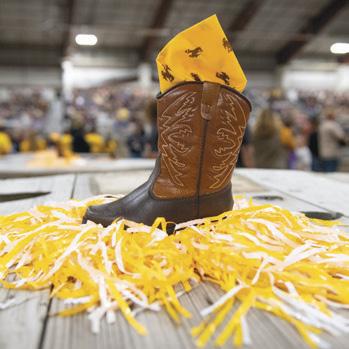


uwyo.edu/homecoming


By Michael Blaney
In the summer of 2023, the UWAA launched the Steamboat Stories project to celebrate and preserve the personal stories of our alumni and to create a shared history of UW. Over the past year, the UWAA has gathered over 8,400 accounts from UW alumni around the world. These stories are more than just memories — they reflect the shared history and enduring spirit of our community. Each account highlights the experiences and achievements that define our alumni, showcasing the powerful connections and lifelong bonds formed at UW. Through these narratives, we celebrate the vibrant legacy that makes the UW community special, and now we want to share these stories with you.

Thomas Zimmerman, B.A. ’76, French, B.A. ’76, Spanish, Lakeland, Fla.
I grew up in Wyoming and attended UW for my undergraduate degrees. At one point I studied Spanish, French, German and Russian all at the same time, and I was grateful that God had given me the gift of languages. My two older brothers, Robert Zimmerman and Richard Zimmerman, also attended and received degrees from UW. After graduating, I decided to use my languages to serve in the military. I worked as a linguist and used my languages a lot both in my job and travels while stationed overseas. Earning my degree was an accomplishment that took a lot of hard work and dedication. Serving my country was an honor, and I am grateful to have been able to try to make it a safer place.

James Kladianos, B.S. ’76, M.S. ’89, Ph.D. ’02, civil engineering, Laramie, Wyo.
I graduated with my degree in 1976 and went to work in Cheyenne as a bridge design engineer. In 1982, I applied for a position in the Laramie Design Squad and got it. I loved working with engineering students and teaching one civil engineering class every semester. I stayed in that position until I retired on Jan. 1, 2021. Working with students all day every day was a great experience. I had to learn to work with them, teach them what they needed to do and still get our jobs done. I enjoyed watching over the jobs and seeing them get constructed. College students always had their own characteristics, and I got a kick out of them.

Cheryl Lynn Bean Grant, B.S. ’83, civil engineering, Cheyenne, Wyo.
I studied a lot during my time at UW, and I was a bit older than most of the other students. I had some great professors and advisers who were very helpful and motivating. With their guidance and my hard work, I grew and changed as a person. After graduating, I started working for the highway department and eventually worked my way up to a bridge design squad leader position. I then moved to aeronautics and construction and eventually became the airport’s engineering and construction manager. I left for three years to work in consulting and then went back to aeronautics. I was a project engineer and then the aviation planning and programming manager before I retired. I’m grateful for the atmosphere of UW. It had a small-town feel and was a really nice place to attend college. I’m pleased with my accomplishments and the legacy I left behind. When I think of my memories at UW, I smile and am thankful for the environment and the opportunities I had there.

Cameron J. Turner, B.S. ’97, mechanical engineering, Clemson, S.C.

I attended UW, and it prepared me very well for my future. I was able to get my Ph.D. and become a faculty member at a couple of schools. I remember the faculty members in my department were very interesting. My adviser studied how snow fell; one professor studied how paint dried; and the department head studied how ice melted. I decided to go to UW because I wanted to learn the basic skills of being an engineer. During my time there, I learned how to manage my own time and be a professional. I also had a memorable experience when the Hawaii football team came to the Student Union and asked me about the weather in Laramie. My greatest takeaway from my time at UW was learning how to manage myself and be a professional.

Rex Walter Connell Jr., J.D. ’79, law, Bozeman, Mont.
I’m proud of my time at the UW College of Law. It was a great school with a lot of great experiences. I’m from Cheyenne, but I got my bachelor’s at BYU and had a little child. UW was very accommodating and allowed me to bring my son to class with me. I was able to work in the city attorney’s office while I was still going to school, so I was well prepared and skilled before I even graduated. I still rely on the background I got at UW for my current business. I’m also proud of the fact that the state supports the university to such an extent that I was able to get a great legal education at a low cost. It’s something to be proud of for the state.
Frederick Fritts, B.S. ’72, mechanical engineering, Henrico, Va.

After eight years in the Air Force, I married and decided to pursue my education in engineering. It had been a long time since I had been in a classroom, but I was able to make the Dean’s List. One of my favorite instructors was Anton Munari, who was very patient and had a warm personality. He really appreciated veterans. I also enjoyed watching Wyoming football at the stadium, which was close to the student housing where I lived. I went deer and elk hunting, which was a new experience for me. After graduating, I got a job offer with Coors in Golden, Colo., and then went to work for the Bettis Atomic Power Laboratory, where I spent the next 31 years of my career in engineering. I am proud of the success I achieved and the hard work I put in to pursue my degree.
Anthony Barros, M.E.D. ’80, educational administration, Woodward, Okla.
I was living in Colorado Springs and working on my master’s degree through the University of Colorado and UW. I had to spend one summer at the university, and the professors they sent down to teach the extension classes were top notch. One professor in particular, Myron Mason, really stood out to me. He cared about his students and taught substance, valuing our time and enrollment fees. Through my experience with UW, I learned that they cared, and I was able to take back what I had learned and apply it to my daily job. I stayed in the school district for over 15 years and used the principles I learned to help the inner-city school. I also went on to receive two doctorates — one in ministry from Golden Gate Seminary and one in psychology. My experience with UW was invaluable, and I am grateful for the knowledge and relationships I gained.


Paul Kenneth Henry, B.S. ’60, M.S. ’62, physics, Red Lodge, Mont.
I attended a state university (UW) and found that the education I received there was as good as any I could have gotten anywhere. I was able to compete in the workplace with the finest of schools. One professor, Robert Bessey, stands out to me because he had a way of explaining things that linked things together and made complex things make sense. I was part of the university band and marching band, as well as the outing club. My college experience was a very positive thing, and I matured and expanded my horizons tremendously. My greatest takeaway is that you can get an education at a state university that is as good as any private institution. My advice to those looking to attend the university is to study hard, do well in your coursework, but don’t neglect your social life either.

My time at UW was incredibly memorable. The closeknit community and the professors and faculty who were always invested in student success made it feel like a homeaway-from-home. Professor Ron Beiswenger was especially amazing — he was great at relating the content to the real world and had a great sense of humor. There were so many clubs and organizations to take part in, many of which had outdoor events. Being able to be out in nature and having people to do different activities with was great. I was in Phi Alpha Delta, the law fraternity, and Gamma Theta Epsilon, the geography fraternity and club. We went snowshoeing and hiking with Gamma Theta Epsilon and did fundraising for things in the community. The professors also helped students outside of the university, like my advisor who helped me obtain an internship with the U.S. Forest Service. I felt prepared for life after graduation because the university gave me the academic base and real-world application. I’m grateful for the skills I gained and the opportunities I had at UW.


By Amy Morgan
Service to UW is about more than just words — it’s about actions, results and the dedicated individuals who make it happen. UWAA celebrates this dedication with the Medallion Service Award. Since 1968, the award has honored those who have selflessly given their time, talent or support to the university.
There is no mold to fill or one set type of person to receive this honor. Awardees come from diverse backgrounds, including professors, trustees, deans, department heads and association members. Many are involved in government and media, and they often come from a legacy family that has made UW a tradition. They serve as role models and hire student interns and graduates of the university. They actively participate in university initiatives that build connections and bring resources to people and communities that need them.
Service is at the core of many strong ties that bind the 43 recipients of this award. Each loves Wyoming and the university and is grateful for the opportunities afforded to them — driving a strong desire to give back. Through a deep understanding, appreciation and passion to be involved, these individuals strive for a future of excellence at UW.
If you recognize someone whose service reflects the dedication and passion celebrated by this award, we encourage you to nominate them through our nomination form at www.uwyo.edu/alumni/awards
A full list of awardees and their inspiring stories are also featured on our web page.

CLIFF HANSEN’S PHOTO FROM HIS AWARD ARTICLE IN THE ALUMNEWS, SEPTEMBER 1983.
Hansen was honored with the Medallion Service Award for his extensive contributions to UW and the state, including his roles as a county commissioner, UW Board of Trustees president, Wyoming governor and U.S. senator. His dedication to public service and support of education and community values made him the first individual to receive all three of the university’s highest accolades: Distinguished Alumnus, Honorary Doctor of Laws and Medallion Service Award.

MARY GULLIKSON’S PHOTO FROM HER AWARD ARTICLE IN THE ALUMNEWS, SEPTEMBER 1998.
Gullikson was honored with the Medallion Service Award for her extensive volunteer service to UW. Her impactful work with the College of Health Sciences — including fundraising for scholarships, advocating for state funding and supporting various programs — significantly contributed to the college’s success. Additionally, her roles on the UWAA Board of Directors and the UW Foundation Board highlighted her dedication to the university’s mission and her commitment to education and community service.

DR. T.A. “AL” LARSON’S PHOTO FROM HIS AWARD ARTICLE IN THE ALUMNEWS, SEPTEMBER 1985.
Larson was awarded the Medallion Service Award for his exceptional contributions to documenting and preserving Wyoming’s history. His work as a historian and professor at the UW along with his mentorship of countless students and active involvement in historical organizations has made a lasting impact on the academic and local communities.
Join any of these networks using the QR code or link below! Don’t see the network you’re looking for? Let us know using the form on our website.


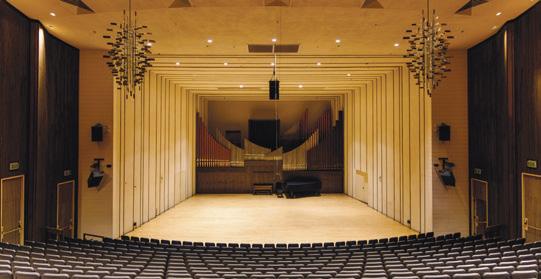


By Kirby Federocko
Alumni, we want to hear about your professional successes! Mail career, publication, art, certification and other professional accomplishments to: Career Celebrations, UW Alumni Association, 222 S. 22nd St., Laramie, WY 82070, or email us at uwalumni@uwyo.edu. Photos may also be sent to uwalumni@uwyo.edu for consideration.


Alex Vass, B.S. ’17, petroleum engineering, has recently been promoted to the position of rotating equipment engineer at Xcel Energy. The UW engineering program was incredibly beneficial to Vass through the petroleum engineering certification. He also says that, during his time at UW, he was fortunate enough to have the resources that he needed to succeed as a student, both academically and socially.
Vass started his career in petroleum engineering as a field engineer, but as oil prices started to decrease in late 2019, he decided that he wanted to shift his career goals to something that had a more stable career path. He began to work in vibration analysis, reliability engineering and condition-based monitoring. Vass was eventually hired by Xcel Energy, where he has developed
multiple vibration monitoring programs, led overhaul projects for combined cycle power plants and developed reliability engineering analyses.
His advice to graduating seniors is this: “Don’t be afraid to make those mistakes, so long as you recognize what you can do to improve. The first job does not need to be a dream job — it just needs to be an opportunity to learn and grow.”
Alexander Wild, B.A. ’06, political science, has recently gotten a new job in the Army National Guard Bureau as a strategist. Today, there are only 500 Army strategists, only 50 of whom are in the Army National Guard. While most are in the National Capitol Region, several strategists are assigned across each of the global combatant theaters, creating plans for any
number of contingencies for U.S. or allied conflict.
Wild says that UW’s professional faculty who brought their passion to the classroom and who coupled theoretical lessons with real-world applications helped him succeed and make him grateful. Second is the unique culture of Laramie — remote and secluded yet rich in opportunities and resources — coupled with UW’s direct access to state and federal governance with no competition from other institutions. UW is one of the best kept secrets — a Division I university, one of the most affordable institutions in the nation, and in a small city charged with boundless possibility. He says that his success is due to the lessons he learned from professors such as Jean Garrison, Fred Homer and Bud Moore. These experiences were heightened by the remoteness of Laramie combined with the institutional progressiveness and expansionist ideals of the university. Platforming possibilities bolster the capability and reputation of Laramie and UW. Wild’s advice to students is this: “Your experiences and opportunities will be shaped by who you surround yourself with.”
Brett Hanson, B.A. ’92, journalism, has become the director of broadcasting for the Arizona Diamondbacks. Out of college, Hanson had a winding path in the field of journalism and broadcasting, working for institutions such as the Los Angeles Chargers, the University of Arizona and most recently FOX Sports Arizona. After FOX Sports Arizona closed its doors

in October 2023, Hanson said he was lucky enough to land his job at the Diamondbacks.
Hanson’s time at UW was full of learning and experience as he worked for UW Athletics in the sports information office. Working under Kevin McKinney, Hanson says he learned how important it is to respect everyone you work with and that you don’t need to be the biggest person in the room all the time. He says that the most important advice he has ever gotten came from McKinney — advice he wishes to pass onto all UW students: “It’s amazing how much can be accomplished when no one cares who receives the credit.”
Garrison Hocker, B.A. ’15, criminal justice, recently landed a job as a behavior analyst and program manager at the Lighthouse Autism Center. Though Hocker’s initial plans were to become a county sheriff, he instead held a variety of entry-
level jobs before stumbling upon the position of applied behavior analysis. He began working with individuals with autism spectrum disorder, which ultimately helped him decide to pursue further education with a master’s degree in applied behavior analysis.
Hocker believes that UW not only gave him the tools he needed to succeed in life but that his time on the football team helped to keep him pushing for excellence even when he felt overwhelmed. He recommends using your time at UW to build up skills and knowledge but to also be openminded to the paths ahead. You could end up in a career you never even knew existed.
Hazel Homer-Wambeam, B.A. ’24, theatre and dance performance, recently landed a job as the junior brand manager of the Stan Lee Universe. HomerWambeam spent the last year of her undergraduate program researching and curating an exhibit for UW’s American

Heritage Center that culminated into a display titled “Stan Lee: Beyond the Book.”
Homer-Wambeam’s knowledge of the Stan Lee archives at the AHC began nearly a decade ago in 2015, where she took second place nationally in the National History Day program. Her 2015 project was a documentary on Stan Lee, and because of her countless hours spent utilizing the AHC’s nearly 200 boxes of material, the director of the AHC reached out to her and asked her to head the creation of a large exhibition to showcase Stan Lee’s legacy.
Due to her excellent cultivation of the “Stan Lee: Beyond the Book” exhibition, with the help of two others, Homer-Wambeam was offered a job with Kartoon Studios — helping to manage Stan Lee’s official social media pages, collaborating with celebrities and assisting in the creation of a Stan Lee brand deck.
“Take advantage of every opportunity,” she says. “While my in-class experience did teach

me the necessary skills needed to succeed, it was my involvement outside my major that led me to this incredible opportunity.”
Jill Higham, B.A. ’00, English and English-secondary education, J.D. ’06, law, recently became the senior vice president for development at the UW Foundation. Previously the inaugural general counsel for the Colorado State University Foundation, Higham also owns her own law practice, Higham Law, that serves communities throughout both Wyoming and Colorado.
After earning her bachelor’s degree from UW, Higham taught as an English teacher at Cheyenne’s Central High School until she decided to return to school to pursue a career in law. She went on to serve on the Wyoming Land and Water Law Review board.
Higham’s responsibilities will include maintaining a philanthropic culture in the UW Foundation and fostering relationships with alumni, other foundations and new donors.
Her advice to future students and alumni is this: “Step outside of your comfort zone. You don’t always know what’s in your own best interest, and you can often find your true calling in the most unexpected of places.”
Pete Simpson Jr., B.A. ’93, English and theatre, has recently received the Charles Bowden Award in recognition of his “exceptional collaboration with the New Dramatists community of playwrights” for his near 20 years of service as an actor. Simpson’s role — to help playwrights define and amplify their works in progress — has led to the development of numerous works that have hit the stage. The ceremony was attended by most of the current Tony Awardnominated talent in the business, including many of whom have benefitted from New Dramatists. Simpson, the longest-running member of the famous performance company Blue Man Group, has also been appointed as adjunct to Harvard University’s Theater, Dance and Media Program this year, and he was an adjunct at NYU for the two years prior. Additionally, Simpson is participating in two separate offBroadway productions. “Gatz,” an 8-hour enactment of the entire novel The Great Gatsby, begins Nov. 1, while the other, “Red Hook History Project (Working Title),” is a multimedia piece “inspired by the history of the Red Hook watering hole and music venue Sunny’s and the extraordinary determination and resiliency of the woman who owns it.” Shows begin October 2024.


Myers
Shannon Bendtsen was recruited by Genesis Alkali in Green River, Wyo., long before she graduated with her degree in chemical engineering (2022), thanks in large part to a gift from the company that set up a process controls lab at UW, which later led to the creation of a minor.
As a process controls engineer, Bendtsen also works on a team that helps to program and automate the plants.
“Programming is kind of like an art,” she says. “There’s a lot of different ways to do the same thing, and you can get your own style and put your own spin on it.”
She loves her team, her level of autonomy and that the company offers many routes to advancement.

“To actually get hands-on experience with process controls unit operations was a game changer,” says Bendtsen, who came to UW from Riverton as a first-generation student. As an undergraduate, she completed an internship with the City of Laramie, where she focused on recycling and plastic bag use. This helped prepare her for her initial role at Genesis Alkali as an environmental engineer.
While she enjoyed being outside, it was the data she fell in love with. That led Bendtsen to transition to process controls, including serving as historian administrator overseeing 50,000 data points. Using the software, she can study historical data and trends. Genesis Alkali operates two world-class trona ore mining and soda ash production facilities near Green River.
When Bendtsen isn’t at work, you can find her volunteering at The Actors’ Mission nonprofit theater group, which brings free meals and quality performances to the communities of Rock Springs and Green River.
“I spend about 20 hours a week there,” she says. “It’s been a great way to get involved with the community. I’ve always been an actor, but now I’m learning the tech side, like how to do lights, build sets and sew costumes.”
Bendtsen wants aspiring engineers to know that math doesn’t have to come easy for you to succeed. Many hours at the UW Center for Assistance with Statistics and Mathematics and with the tutors from the McNair Scholars Program helped her make it through.
“There are times you might think you don’t need all the information you’re learning in class, but it is seriously all very helpful,” Bendtsen says. “Keep an open mind and take it all in because the more you do that, the better off you’ll be.”
To encourage the next generation, Bendtsen recently volunteered at a Wyoming Youth in STEM conference for middle and high school students in Riverton, where she shared her career path and led a workshop.


Eli Ellis — Researcher at the Center for Carbon Capture and Conversion
Eli Ellis and his colleagues work to find new uses for coal products, including building materials.

Wyoming coal and creating economic development and diversification opportunities.
“Being from Wyoming, I’ve seen how getting a high throughput of coal helps people all across the state — from the school systems to not having to pay state income tax,” Ellis says. “I feel like I’m really working for the state and looking at different avenues for generating revenue.”
The center helps create coal-based building materials, pavement and much more. Ellis is currently focused on gathering data for a demonstration plant in Gillette. The plant will produce high-quality products for many of the center’s ongoing projects and collaborations.
“At the same time we are generating revenue from these products, we’re also doing it in a clean and environmentally responsible manner,” Ellis says.
His path started as an undergraduate. “Doing research in the lab really sparked my passion for being the first one to do things and finding your own path to get answers,” Ellis says.
At UW, Eli Ellis of Cheyenne, Wyo., discovered a love for engineering, research and creating alternative uses for coal. After earning his bachelor’s degree in mechanical and energy systems engineering (2021) and a graduate degree in mechanical engineering (2023), Ellis now serves as an assistant research professional in the School of Energy Resources Center for Carbon Capture and Conversion. At the center, a collaborative group of scientists and entrepreneurs focuses on supporting the future of
As an undergraduate, he also served with the Wyoming Conservation Corps. “I’m super passionate about the outdoors, and I wanted to give back,” Ellis says. “We did trail work and wildlife-friendly fencing.”
In the future, Ellis plans to continue his research and work to scale it up to commercial plants. “I look forward to advancing this new technology and then passing it on to help diversify Wyoming’s energy industry,” he says. “I hope to continue to work in the field and stay in Wyoming — feeling like I’m contributing to the state.”


By Michaela Jones
This fall, recent graduates Alea Denney of Keene, N.H., and Katie Johnson of Casper, Wyo., began their service in the Peace Corps.
“I was attracted to the Peace Corps initially in high school as a way to explore the world and create meaningful change at local levels,” says Denney, who graduated with a degree in governance and conflict resolution and minors in anthropology and honors. “I am a big believer in citizen-to-citizen diplomacy and have always felt that it is one of the most effective ways to create positive change.”
Denney is now promoting Spanish literacy in the Dominican Republic, helping local teachers develop curriculum and working on student and parent outreach programs to increase community involvement in education.
At UW, Denney served as a program assistant with Education Abroad and as assistant outreach coordinator with the Arabic and Middle East North Africa Studies Program. She also studied abroad in Iceland, Vietnam, Cambodia, the United Kingdom and several Nordic countries, which cemented her love of learning about other cultures.
Denney also completed the Peace Corps Prep program at UW, which is administered by the Advising, Career and Exploratory Studies Center. The program enhances students’ undergraduate experiences by preparing them for international development fieldwork and potential Peace Corps service.
“I feel very well prepared to live in a new country with the research and work I have done,” she says.
After serving with the Peace Corps, Denney plans to pursue a career in foreign policy analysis or in the international charity sector with organizations such as Amnesty International, Oxfam or the U.S.
Agency for International Development. She also hopes to continue championing citizen diplomacy and children’s right to education.
Johnson majored in international studies and philosophy with minors in Spanish and honors. She is serving as an English teacher in Sri Lanka. “The Peace Corps combines my love of service and interest in different cultures, and it promises a challenge to make me a more resilient, altruistic, well-rounded person,” she says.
“At UW, I studied economics in Iceland; visited New York with the dean of the Honors College; lived and learned in Ecuador; interviewed people in Jordan, Israel and Palestine about the conflict; interned for one of Wyoming’s U.S. senators in Washington, D.C.; earned a U.S. State Department Critical Language Scholarship to study Portuguese in Brazil; and most recently explored the post-Soviet states of Kazakhstan, Uzbekistan, Azerbaijan, Armenia and Georgia for my Honors College capstone project,” Johnson says.
In the future, she hopes to work for the State Department or U.S. Agency for International Development: “My career goal is to contribute to world peace and sustainable development so everyone can access the goods I have enjoyed my entire life.”


Connor Kasarda didn’t just come to UW to learn — he also came to give back and teach others about computer science. Kasarda was born at the Naval Air Station Keflavik in Iceland while his father served in the Navy, but the family soon relocated to Center Valley, Pa. As an undergraduate, he transferred from Pennsylvania State University to UW, and in 2021 he earned a degree in computer science with a minor in math and a certificate in cybersecurity.
While in the midst of his master’s degree in computer science, he was offered a job as a computer scientist and software engineer at the Tinker Air Force Base in Oklahoma City, Okla., which he began last spring.
Throughout his time in Wyoming, Kasarda shared what he was learning with children, fellow students and teachers.
When he worked with educators in the Research Experience for Teachers program, he made YouTube learning videos. “I’ve always loved the process of taking complex topics and breaking them down into a teachable concept for others,” he says. It’s something he hopes to do more of in the future.
“I would love to take my current coding projects and turn them into video lessons for others to learn a new skill.”
Kasarda also helped resurrect the Laramie Robotics Club.
“With the launch of the School of Computing plus our computer science outreach at UW, the timing was perfect,” he says. “At first, a lot of the time had to be spent acquiring funding so that we could get the proper equipment, but eventually we were able to invite elementary through high school students from the Laramie area.
What’s nice is that the club allows undergraduate and graduate students, including future teachers, to help out as mentors who teach computer science and STEM concepts to the younger students as they work through the activities, labs, challenges and competitions. It was very inspiring for me to see the learning progress of those attending the robotics club.”
Kasarda believes that everyone contains a spark or talent that makes them special. “When we volunteer or help others, we are helping them to know more about themselves,” he says.
“What follows is an individual who finds their passion and goals in life. Volunteering can even give people their hope back or restore confidence in their abilities. We all can help others, and we all need a little nudge here and there to keep going and obtain our goals.”

The saying goes that Wyoming is a small town with long streets. Turns out, those streets stretch across the country. Army veteran Jason Hatch is based in Virginia. Former U.S. Rep. Brian Baird lives in Washington state. Hatch and Baird met for the first time when Baird asked Hatch to join the initiative to build a National Museum and Center for Service. They quickly discovered that they were both UW alumni. The friendship that formed went on to help save numerous lives.

Hatch grew up in Riverton and earned his degree in history (1995) before being commissioned as an Army officer. After serving around the world, he retired in 2013 and went to work on international development issues, disaster resilience and counterhuman-trafficking endeavors. He then joined AmeriCorps for a year of service and started his own additive manufacturing and design company. Baird, however, took a much different path. He grew up in Fruita, Colo., and attended UW for his master’s degree (1980) and Ph.D. (1984) in clinical psychology. He went on to work as a professor, author, and psychologist and serve six terms in the House of Representatives from 1998–2010.
The two connected in 2017, as Baird began work to create a National Museum and Center for Service (www.nmcfs.org) to celebrate and honor those who serve as volunteers. The museum will have a physical location in D.C., but it also provides resources for local communities to honor volunteers in displays at schools, libraries and other public locations. For example, while only a small selection of kids will make it into school sports display cases, any child can be inspired to volunteer, and their service can be highlighted just as the trophies are.
“As I traveled, I repeatedly saw so many examples of people giving of themselves, whether it was domestically to help homeless people or with international disaster relief or countless other things,” Baird says. While there are museums and monuments for many other types of service, volunteers were left out.
As Baird and Hatch worked on the project, things fell apart in Afghanistan. In August 2021, the U.S. and coalition partners evacuated tens of thousands of people from Kabul, but
many others who had worked with the U.S. couldn’t get out in time and were left in danger from the Taliban. Hatch began working with Operation Snow Leopard, a nonprofit dedicated to the safe evacuation and resettlement of high-risk Afghans, and he recruited Baird to help with his political connections. For example, Baird made important contacts with Argentina to help resettle refugees there.
“To date, we have evacuated over 1,800 Afghans and are working with the Inter-Parliamentary Union in Geneva to facilitate the resettlement of approximately 1,000 more,” Hatch says.
Getting even one person in danger out is tricky. First, they have to be moved out of Afghanistan, and then they have to find a new country to accept them.
“Our problem was that we had nowhere to send them, and that’s the problem that we’re dealing with to this day,” Hatch says.
The hundreds they have helped include a young woman who was hiding in a crypt for two years and now attends college in Canada and a couple who both suffered great injuries under the Taliban — the wife lost her feet in a terror attack, and her husband had been shot in the back.
Hatch also personally sponsors several Afghan families so that they could receive their U.S. visas. He is looking for others to do the same.
Both Hatch and Baird were inspired to serve others by their families and small-town upbringings.
“My parents were Depression-era kids, and my dad was a World War II veteran,” Hatch says. “They impressed upon us this strong sense of giving back. I feel, like, if you have the time and you have some abilities then you should be able to volunteer and give a little back.”
If you’ve watched the hit Apple TV exclusive “Masters of the Air,” based on the true story of the “Bloody Hundredth” bomb group of World War II, you no doubt jumped at the fact that one of the dashing lead characters is Wyoming’s own Gale “Buck” Cleven (played by Austin Butler).
Produced by Tom Hanks, Steven Spielberg and Gary Goetzman, the show focuses on the Eighth Air Force’s strategic daylight bombing campaign and is based on the book “Masters of the Air: America’s Bomber Boys Who Fought the Air War Against Nazi Germany” by Donald L. Miller. Cleven was born in 1918 in South Dakota and moved to Casper as a child, where his father worked in the oil fields. He graduated from Midwest School and began attending UW in 1937.

He enlisted in the Army as a flying cadet in 1940 and quickly rose to commander of the 350th Bomb Squadron. In 1943, the squadron joined the 100th Bomb Group at Thorpe Abbotts, England. On Cleven’s 11th mission in 1943, he was flying lead plane when enemy fighters attacked over the English Channel. His B-17 took a number of hits, killing one crew member and seriously injuring another. The hydraulics and electric systems were damaged. As another shell ripped through the nose of the plane, injuring the bombardier, the co-pilot started panicking and preparing to bail out, but Cleven told him to stay put. He successfully landed the plane in Africa, which earned Cleven the Distinguished Service Cross.
Just four months later, in October 1943, Cleven’s plane was shot down over Bremen, Germany, and he spent 18 months as a prisoner of war. When the camp was evacuated in 1945, Cleven and his friend from UW, fellow pilot George Niethammer, tried to escape. Cleven made it, but Niethammer was shot and killed. Niethammer’s family owned the Casper Packing Company, and he was active in the Wyoming National Guard before he transferred to the Army Air Corps.
After the war, Cleven returned to UW and earned a bachelor’s degree in geology (1946) and later a master’s degree (1956). He also attended Harvard and completed graduate degrees in business and physics while continuing to serve in the Air Force. Cleven served in Korea and Vietnam and at the Pentagon, retiring in 1964 as a colonel with many honors. He went on to work in aeronautics and in academia. Cleven always considered Wyoming home and passed away in Sheridan in 2006.
Lindsey Amerine — Chief Pharmacy Officer for the Cleveland Clinic
The Cleveland Clinic operates more than 300 locations and regularly garners national recognition, including being named one of the 2023 World’s Best Hospitals by Newsweek. UW Doctor of Pharmacy graduate (2009) Lindsey Amerine was named chief pharmacy officer for the Cleveland Clinic earlier this year and now leads more than 1,700 full-time pharmacy professionals across the enterprise.
“It’s very exciting to be in a place that’s always striving to be better than we were the day before. It’s all centered on our patients and our caregivers,” says Amerine, originally from Ogallala, Neb. “The clinic has certainly been at the forefront of a lot of pharmacy practice innovations over time, and I’m excited to continue to do that.”

Before joining Cleveland Clinic, she served as interim chief pharmacy officer and vice president of pharmacy for UNC Health.
Amerine considers team building one of her strengths — a strength that was cultivated at UW, where pharmacy students worked cooperatively versus competitively.
“I think our pharmacy school saw we’re all in this together,” she says. “There were a number of times that classmates would create study guides for themselves and email them to the whole class.”
Amerine pays that forward by helping other hospitals that reach out for information or assistance. She also gives back by serving with the American Society of Health-System Pharmacists (ASHP), most recently as past chair of the section of pharmacy practice leaders. ASHP recognized Amerine with many best practice awards as well. She’s also active with the Hematology/Oncology Pharmacy Association, presents on pharmacy practice topics nationally and internationally, and has over 50 peer-reviewed publications.
“UW instilled in me that commitment to service and giving back,” says Amerine, who served in ASUW and was active in Tri Delta sorority and pharmacy student organizations. “I think the more active you are, the more impact you can have.”
Amerine also appreciated learning about rural health care and learning how to do everything hands-on at UW. “We had a lot of great programs and classes,” she says. “I felt very prepared when I got into residency. Plus, we had that that sense of community where I knew my whole class. It was a great environment to train in, and I feel very fortunate and proud to be a UW alum.”
Emily
Payne Fellows
Two recent UW graduates earned the highly competitive Payne Fellowship, which awards up to $100,000 in benefits over two years for graduate school, internships and professional development activities to promote excellence and diversity in the Foreign Service of the U.S. Agency for International Development.
“I’m thrilled to be joining USAID as a Foreign Service Officer after completing my master’s degree at Georgetown,” says Maeve Knepper of Cheyenne, who graduated summa cum laude from UW in 2023 with majors in economics and international studies and a minor in honors. “USAID works with countries around the world to address critical development issues in areas such as health, governance, poverty and the environment. I was inspired to pursue a career in international development by the many mentors and opportunities I had while a student at UW, and I am excited to use everything I learned in a career that aims to improve lives around the world.”
Knepper was a Trustees Scholar Award recipient at UW and studied abroad in Jordan and Morocco. She’s currently studying Arabic on a Boren Scholarship in Oman before beginning her master’s degree in foreign service.
Fellow alum and Trustees Scholar Emily Wood of Granite Canyon in Laramie County also earned the Payne Fellowship. She graduated from UW in 2019 with a double major in international studies and German and a minor in honors. Wood went on to serve in the Peace Corps and then attended Georgetown, completing her master’s degree in spring 2024. She is

now serving as a Foreign Service officer for USAID and is assigned to her first posting in Central America.
“I hope to have a positive impact on people so that they’re able to access the resources that they need to protect and improve their communities,” Wood says.
As a Pacific Islander, Wood didn’t see many Indigenous people in roles such as Foreign Service and wants to inspire others. “Seeing some of the human rights issues that our people and communities face pushed me a


trip to Japan. In Indonesia, she worked with a coffee collective, helping local farmers get the most out of their crops and keep the wealth in their country.
little more into that realm of human rights and representation,” she says.
“I still want to be connected to these communities on an international level and really advocate for us and our families.”
Wood’s international interest began when she befriended a foreign exchange student in high school. This prompted her to apply to become one herself. At UW, she laid the groundwork for her future career. Wood spent two summers in Indonesia, an academic year in Lithuania and took a faculty-led
“I loved my time at UW and was able to take advantage of so many opportunities,” Wood says. “I was able to get funding and support to take advantage of experiences that opened my eyes to different parts of the world, different cultures and the development sector, too. My professors were very encouraging and helped me along the process.”
As a senior, Wood applied to the Peace Corps, where she worked as an English teacher in Mozambique. “We lived with host families during training, so I was able to immerse myself and learn from them as I was learning Portuguese,” she says.
Going forward, Wood plans to continue her work as a Foreign Service officer and to work together with communities and organizations in other countries to improve lives.

Six UW scientists have been selected for funding by the UW – National Park Service Research Station in Grand Teton National Park. Top 1% No. 25 2nd
The Department of Physics and Astronomy received the 5+ Club award from the Physics Teacher Education Coalition for graduating students in physics teaching during the 2022–23 academic year, placing UW among the top 1 percent of institutions nationwide.
The College of Business economics program has been recognized by TFE Times as among the Top 25 Best Master’s of Economics Programs for 2024, coming in at No. 24.
6
Department of Music Associate Professor Ben Markley’s new book, “Cedar: The Life and Music of Cedar Walton,” was nominated for the Best Biography/Autobiography Award by the Jazz Journalists Association and the 2024 Association for Recorded Sound Collections Award for Excellence in Historical Recorded Sound Research.
UW ranks second among the top five cryptocurrency and blockchain programs listed by SuccessfulStudent.org.
Three UW students — Britt Bardman, Abby Metzger and Corah Miller — received an honorable mention in the 2024 Interior Design Educators Council Student Design Competition for their group project designed to provide space for neurodiverse students.
$50K
285
285 students and 30 teachers representing 14 junior high and high schools from across Wyoming participated in UW’s annual World Languages Day competition in March.
Michelle Blakely, an assistant professor of social and administrative pharmacy, co-wrote a published paper that received the 2023–24 American Association of Colleges of Pharmacy Public Health Special Interest Group Best Publication Award.
Student teams won big in the 24th annual John P. Ellbogen $50K Entrepreneurship Competition. The grand prize went to FINA Custom Work, a tactical gear company led by UW senior marketing and sales major Ana Acevedo and her spouse, Army National Guard Sgt. Jesus Acevedo.
$1.6M $250K
A $250,000 charitable gift from Tallgrass will be doubled by state of Wyoming matching funds and used to create a CO2 Storage Excellence Fund in the School of Energy Resources.
$5M
The Department of Psychology’s Wyoming Center on Aging has been awarded a $5 million grant from the Health Resources and Services Administration through the Geriatrics Workforce Enhancement Program to expand and strengthen geriatrics education for the health care workforce and to expand resources for the state’s older adults and caregivers.
The Leona M. and Harry B. Helmsley Charitable Trust has granted nearly $1.6 million to the College of Health Sciences to train Wyoming health care professionals on stateof-the-art ultrasound equipment as part of a statewide ultrasound initiative.


Division of University Public Relations
University of Wyoming Department 3226
1000 East University Avenue
Laramie, WY 82071-2000


