IN THIS ISSUE
Travel is a fundamental constant in the human experience. Whether it be the result of circumstances beyond our control such as war and plague, or an inner push for more favorable social conditions, greater economic opportunities, the search for adventure or to enjoy meaningful recreation opportunities, as individuals and society we recall those trips and journeys that have taken us from the familiar to the unknown. Often they test our inner strength, commitment, endurance, and courage.
Here in Utah and the American West, what would our history be without such milestones as the Dominguez Escalante journey in 1776, the Lewis and Clark expedition in 1804-1806, the California-bound immigrants of 1846, and the Mormon pioneer trek of 1847? A list of subsequent journeys might include the Parley P. Pratt expedition in 1849, the John Wesley Powell trip down the Green and Colorado Rivers in 1869, the Hole-in-the-Rock journey in 1880, and many others. But, as the first article in this issue contends, the Jacob Hamblin expedition of 1858 from the southern Utah settlement of Santa Clara, across unmapped mountains and deserts, through the nearly impassable canyons of the Colorado River, and on to the ancient Hopi Villages of Arizona deserves recognition as one of the West’s important epic journeys. The mettle of the fourteen members of the group that set out in late October 1858, with the last returning to Santa Clara on December 26,1858, proved to be substantial.
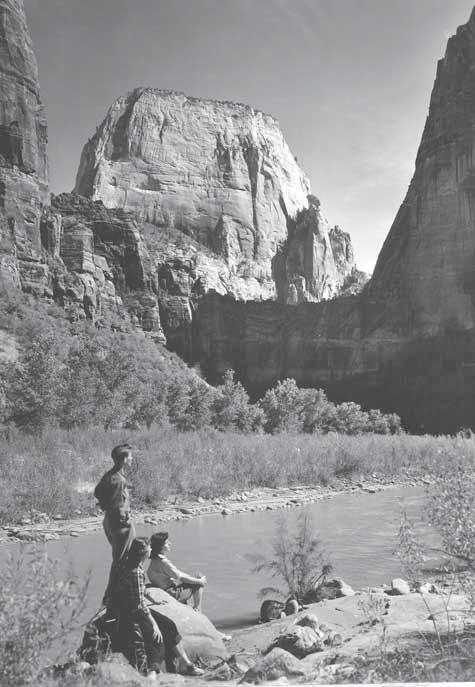
COVER: The Great White Throne, Zion National Park, Lynne Clark Photography. IN THIS ISSUE (ABOVE): Tourist buses in front of Zion National Park Lodge in the 1930s. UTAH STATE HISTORICAL SOCIETY. (OPPOSITE): Visitors to Zion National Park enjoy the magnificent scenery including the Great White Throne (bottom right). UTAH STATE HISTORICAL SOCIETY.

2
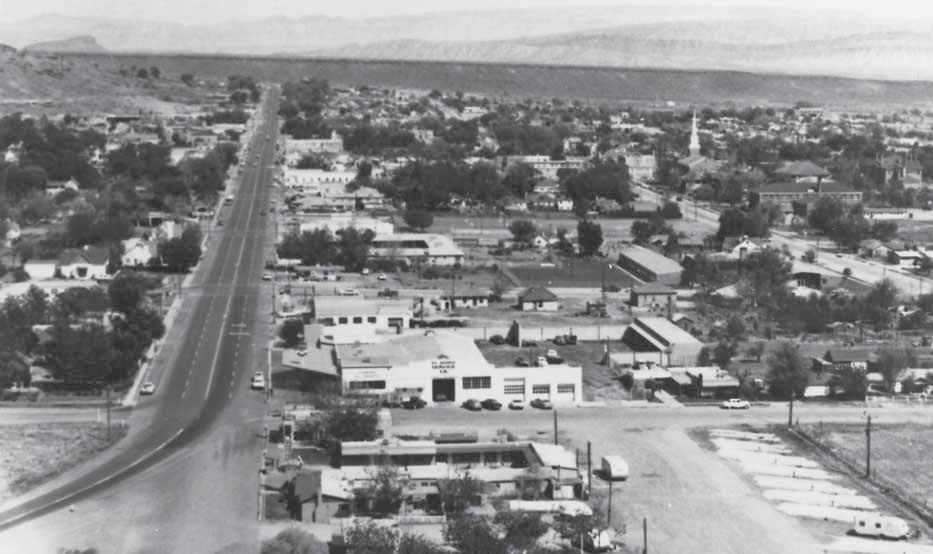
If Jacob Hamblin and his companions were thankful to have a blanket to wrap themselves in and a rock outcropping to protect themselves from the icy blasts of a December storm, later automobile travelers found roads and accommodations in Utah’s Dixie to be luxurious by comparison. Our next two articles, “Early Roadside Motels and Motor Courts of St. George,” and a photo essay “St. George: Early Years of Tourism,” illustrate the area’s transformation from a pioneer agricultural economy to one grounded in travel and tourism.

Keeping within the broad boundaries of our travel theme, our fourth article addresses the legal status of those African Americans who were brought to Utah as slaves prior to the Civil War. No longer slaves, they were still not free as the Utah Territorial Legislature sought to structure an unsteady bridge in protecting property rights and avoiding animosity by either the North or the South over the nation’s peculiar institution.
The gyrations and schemes to prevent war were, in the end, unsuccessful as the nation was swept into four long years of civil war. While Utah was spared the fighting and destruction that devastated much of the South and disrupted the social and economic life of both sections of the country, the territory still felt the impact of war as carried in Northern and Southern newspapers. These newspapers, which occupied different worlds in their treatment of the war, its causes, and consequences, found common ground, as our final article for this issue recounts, in addressing the subjects of Mormonism, polygamy, Brigham Young, and Utah statehood.
3
Vermillion
MIKE HEAGIN (AGRC)
BY TODD M. COMPTON
Jacob Hamblin’s first expedition across the Colorado to the Hopi mesas, which took place from October 28 to December 26, 1858, was one of the great adventures in Western history. It included the first known crossing of the Colorado by whites at the “Crossing of the Fathers” since Fathers Escalante and Domínguez’s crossing in 1776 and Antonio Armijo’s crossing in 1829, and an early reconnaissance of some of the territory of northern Arizona. It was a journey into country that

4
Todd M. Compton is an independent historian currently working on a biography of Jacob Hamblin.
“In & through the roughefist country it has ever been my lot to travel”: Jacob Hamblin’s 1858 Expedition Across the Colorado
was absolutely unknown to the Mormons—it is not surprising that the expedition teetered on the edge of disaster at times. On the one hand, the participants witnessed landscapes that were spectacularly beautiful and made contact with one of the most unusual tribes of Indians in America. On the other hand, they almost died of starvation and thirst and also risked freezing to death. As they witnessed breathtaking, vast formations of rock carved out by water and, to a lesser extent, wind, they had to struggle to keep their balance on trails that were nearly non-existent and which were a casual misstep away from spectacular drop-offs.
This was far from a pleasant, relaxed tourist jaunt. Ammon Tenney, a member of the expedition, writes, “The sorrows and hardships on that journey would shock the readers of history. The strength of some of our company reached beyond the endurance of mortal man. [We suffered] Starvation, sickness, without clothing to cover our weak and worn bodies, disentery followed with Hemmorage.”1 The expedition also attained mythic status because many geographical points received their names during the journey—notably Pipe Spring, Badger Creek, and Soap Creek.
To a large extent, this was a missionary journey, as Brigham Young sent Hamblin and company to preach to the Hopis.2 Young had been intrigued by reports that the Hopis were white and were “the first Lamanites known, up to that date, to live in permanent villages.”3 Hamblin also was eager to visit the Hopis, as he had become somewhat disillusioned with local Utah Indians.4
Other purposes of the journey were less straightforward. Utah Indian agent Jacob Forney had given Hamblin the responsibility of locating all the child survivors of the Fancher party after the Mountain Meadows Massacre, and Hamblin informed Forney that Paranigat Paiutes in presentday Nevada had told him that “Pey Utes” had taken two children east of southern Utah, possibly to the Hopis or Navajos. “I could not feel satisfied in my mind until I had visited those two tribes,” he wrote.5 As a result the U.S. government may have contributed $318 to this expedition.6 Some historians believe that Hamblin concocted the story of these two Mountain Meadows Massacre survivors in order to receive funding from the government, but it is entirely possible that there were rumors of massacre survivors among Indians, and Hamblin simply felt it was worthwhile to check on
1 “Account of Travels in S. Utah and Ariz.,” typescript, Huntington Library, San Marino, California.
2 James Little, ed., Jacob Hamblin, A Narrative of his Personal Experience . . .(Salt Lake City: Juvenile Instructor Office, 1881), 58.
3 Ammon M. Tenney, “Account of Travels” and “Early Recollections of My Youth,” Arizona Historical Society, Tucson, Arizona.
4 Jacob Hamblin to George A. Smith, September 10, 1858, George A. Smith collection, MS 1322, bx 5, fd 15, Church History Library, Family and Church History Department, The Church of Jesus Christ of Latter-day Saints, hereafter cited as LDS Church History Library.
5 Jacob Hamblin to Jacob Forney, December 9, 1858, Jacob Forney Letterbooks, MS 14278, fd 2, pp. 468-70, and Forney to Hamblin, August 4, 1858, p. 311, LDS Church History Library.
6 Juanita Brooks, The Mountain Meadows Massacre (Palo Alto: Stanford University Press, 1950), 102-103.
5 JACOB HAMBLIN
these rumors, even though they turned out to be wrong.7
Another purpose of the expedition, according to Ammon Tenney, was to find a possible place for the Saints to retreat if the United States armies in the Utah War drove the Mormons out of northern Utah.8 While the Utah War had concluded by June 1858, Brigham Young may have been planning this journey before then, or he may have considered the underlying Utah War conflict to be ongoing, even though the standoff had officially terminated.
In addition, the expedition was supposed to determine if the Hopis were, in fact, descendants of the Welsh from western Britain. Young and other Mormons were intrigued by the Welsh Indian theory (which held that Welshmen had sailed to America soon after 1170 A.D. and become the ancestors of certain tribes of Indians) and therefore wondered if the Hopis—whose culture seemed so different from other, mostly nomadic Indians—might be “descendants of Nephi or of Welsh.”9
On September 26, 1858, Hamblin and his party met for priesthood ratification of their expedition, and six men were called to stay among the Hopis and Navajos for a year.10 The members of the expedition were three Hamblins: Jacob, William (called to the Hopis), and the youngest of the family, Frederick. Then there were two Leavitts, Dudley and Thomas (also called to the Hopis). Four southern Utah stalwarts from Santa Clara were part of the group: Ira Hatch, Samuel Knight, Andrew S. Gibbons, and Thales Haskell (the last three of whom were called to the Navajos).

Then there were Santa Clara resident Lucius “Luke” Hubbard Fuller, Englishman Benjamin Knell, one of the founders of Pinto (also called to the Navajos), and two linguists, a Welshman, James George “Dariris” Davis, from Harmony, who was expected to confirm that a lost tribe of Welshmen had settled in the desolate mesas of southwest America; and a Spanish
7 Brooks, Mountain Meadows Massacre, 102, 173, see also Charles S. Peterson, “The Hopis and the Mormons, 1858-1873,” Utah Historical Quarterly 39 (Spring 1971): 180-81.
8 Tenney, “Early Recollections of My Youth,” 3-4. For Brigham considering different parts of the west as places of retreat, see William P. MacKinnon, ed., At Sword’s Point, Part 1: A Documentary History of the Utah War to 1858 (Norman: The Arthur H. Clark Company, 2008), 440.
9 Tenney, “Account of Travels”; “Early Recollections,” p. 4. For Mormon interest in this theory, see Ronald D. Dennis, “Captain Dan Jones and the Welsh Indians,” Dialogue 18 (Winter 1985): 112-18; Wallace Stegner, Mormon Country (Lincoln: University of Nebraska Press, 1981), 145-53. More generally, Gwyn Williams, Madoc: The Making of a Myth (Oxford: Oxford University Press, 1987).
10 “Minutes of a special conference held by the missionaries of Santa Clara,” September 26, 1858, in Journal History, LDS Church History Library.
6
HISTORICAL
UTAH
QUARTERLY
UTAH STATE HISTORICAL SOCIETY
Jacob Hamblin
speaker, Ammon Tenney, who was only thirteen, was in poor health, and weighed less than ninety pounds.11 At this tender age he started a long career of travel, exploration and missionary work among the Indians in the Far West. Most of these men were in their early or mid-twenties; Jacob was now thirtynine. Later, the Paiute Naraguats would join the group as guide, along with other unnamed Paiutes. 12 This brings the tally of the group to fourteen named participants, thirteen whites and one Indian.13

This company of thirteen men left Santa Clara on October 28, 1858, with pack mules and supplies for thirty days’ travel.14 Hamblin, in his December 1858 letter to Young, describes the first part of the journey as travel over “a contry destitute of water,” except for water in rock hollows. Their first major obstacle was the Hurricane Cliffs, which they probably surmounted near the eventual site of Fort Pearce. From here they may have passed the Short Creek area and entered into the territory of Arizona.
On the third day out they reached the oasis that Paiutes called Red Rock Spring, which Hamblin describes as “alarg spring.”15 It had been used by Indians for centuries, and after 1858 became an important way station for travelers between Arizona and Utah. It became known as Pipe Spring because of an incident that occurred as the missionaries rested here in 1858. As Ammon Tenney tells the story, Bill Hamblin and the Leavitt brothers, all excellent marksmen, were taking target practice at a silk handkerchief, and were all missing it. James Davis laughed and said, “You can’t hit my hat 25 yards away.” They declined to shoot at this target, but offered to shoot the bottom out of the pipe Davis was smoking at the time.
11 Tenney, “Early Recollections,” 6; see also Winn Whiting Smiley, “Ammon M. Tenney: Mormon Missionary to the Indians,” Journal of Arizona History 13 (Summer 1972): 82-108, and “Ammon M. Tenney: His Life and Where He Lived,” typescript, Arizona Historical Society, Tucson, Arizona.
12 Jacob Hamblin to Brigham Young, December 18, 1858, Brigham Young Office Files, LDS Church History Library.
13 The earliest, best listings of the expedition are in “Minutes of a Special Conference,” and Hamblin to Young, December 18, 1858. Incomplete listings are in Little, Jacob Hamblin, 59; James H. McClintock, Mormon Settlement in Arizona (Phoenix: State of Arizona, 1921), 64; and Stegner, Mormon Country, 145.
14 Hamblin to Young, December 18, 1858; Tenney, “Account of Travels”; Hamblin to Forney, December 9, 1858.
15 Hamblin to Young, December 18, 1858. According to John Wesley Powell, the Paiute name was Yellow Rock Spring, Exploration of the Colorado River of the West and Its Tributaries (Washington D.C.: Government Printing Office, 1875), 112, but this is probably incorrect. Kathleen L. McKoy, Cultures At a Crossroad: An Administrative History of Pipe Spring National Monument, Cultural Resources Selections No. 15 (Denver: Intermountain Region, 2000), ch. 1, fn 102.
7 JACOB HAMBLIN
Ammon Tenney.
JAMES MCCLINTOCK, MORMON SETTLEMENT IN ARIZONA
(c. 1872).
He set it up for target practice, then sure enough, one of them—reputedly Bill Hamblin, nicknamed “Gunlock” for his expertise with guns—stepped out the twenty-five yards aimed shot and “did tear the entire back of the pipe out without breaking the edges of the mouth.”16
A day and a half later, the company reached the foot of the Kaibab Plateau, soon to be called Buckskin Mountain, which Hamblin called “Deer mountain” in his 1858 letter to Young.17 There the missionaries met the “Minepats or Pine ites Indians a small band of Piutes with hoom we ware acquainte[d],” as Hamblin writes. “Naraguots the chief [who] was some acquainted with the Moquiches and the rout[e] we engaged to Pilot us throu[gh].” The Mormons and Paiutes feasted together on rabbits and bread that night.18

The next morning, the group, now with Naraguats and possibly a few other Paiutes, set out over the Kaibab Plateau. Hamblin described this as “nere 29 mls a high or elivated country covered with Pine no water for 60 miles.” (“Kaibab” derives from the Paiute word Kai-vav-wi, which means “mountain lying down,” an astute description of the plateau.) Aside from the pine Hamblin mentions, this formation is covered with spruce, fir, juniper and aspen trees; its elevation sometimes reaches 9,300 feet, but much of it is 7,000 to 8,000 feet high. For those approaching it from the west, the plateau slopes gently upwards, but on the east, it drops down in steep slopes and escarpments to House Rock Valley. Two of the early names
16 “Account of Travels.” See also Tenney’s “Early Recollections,” 6. By fall 1859, Thales Haskell was already referring to the place as Pipe Springs. Juanita Brooks, ed., “Journal of Thales W. Haskell,” Utah Historical Quarterly 12 (January-April 1944): 68-98.
17 Andrew Smith Gibbons Diary, December 18, 1858, holograph, MS 4008 2, LDS Church History Library.
18 Little, Jacob Hamblin, 59.
8 UTAH HISTORICAL QUARTERLY
A lithograph of the Crossing of the Fathers,
FROM A SKETCH BY JOHN WEYSS
of the formation, Deer Mountain and Buckskin Mountain, attest to the prevalence of deer on the plateau—it was an important Indian hunting ground.19 Tenney wrote of “the gorges of mountain, where . . . the foot of civilized man had never trod.”20
The Kaibab slopes might have been covered with snow at this time and were certainly very cold. “Alas cold & bleak indeed was the knight,” wrote Tenney. He was called to take his share of guard duty at one camp, and the company’s horses somehow managed to get loose, which caused “quite a rumpass” in the morning.21 However, the group managed to track down and recover their mounts.
The company probably followed a trail up modern Jacob Canyon as they ascended the Kaibab, then may have followed Ridge Trail Canyon down off the plateau.22 After this descent, the missionaries would have passed modern House Rock Valley, and continued traveling southeast near the beautiful Vermilion Cliffs, which rose above them on their left. Then, at the southern point of the Paria Plateau, they would have turned northeast. The Vermilion Cliffs would have continued on their left; to their right lay the Grand Canyon and the Colorado River, still unseen.
According to Tenney, the group passed modern Soap and Badger Creeks (flowing through canyons into the Colorado; they received these names on the expedition’s return journey), then “camped in the Bottom where now stands Bro Johnsons house and enjoyed the roaring of the Colorado River.”23 Tenney is referring to ferryman Warren Johnson, and thus the site of modern Lee’s Ferry, near where the Paria River flows into the Colorado. This was the first documented visit by whites to Lee’s Ferry since it had baffled Escalante in 1776. Jacob did not try to cross here, but he saw that the Colorado might be traversed by boat here at some future time, and that such a crossing might save the traveler a substantial amount of precious time and supplies.
The only practical place for crossing the river on foot or horseback was a three day march northeastward to the “Crossing of the Fathers,” known to Hamblin as the Ute Ford. To get there, the men would have to surmount the northeast wall of Paria Canyon, then, far above the Colorado River, work their way back down to the river. Ammon Tenney merely says that the missionaries continued up the river, then over a mountain.24 These three days of travel were nerve-wracking, as the men climbed “dangerous cliffs” and crossed “extensive fissures in the rocks.”25
19 P. T. Reilly, “Roads across the Buckskin Mountain,” The Journal of Arizona History 19 (Winter 1978): 380.
20 Tenney, “Early Recollections,” 6.
21 Ibid.
22 Reilly, “Roads Across Buckskin Mountain,” 382, 386.
23 Tenney, “Early Recollections,” 7.
24 Ibid.
25 Little, Jacob Hamblin, 60.
9 JACOB HAMBLIN
The Escalante and Domínguez expedition (and presumably the later Mormon company) traveled three miles up Paria Canyon, then took a rough path four hundred feet up to a sloping bench with areas of red sand. They climbed this until they were about a thousand feet above the Paria, then had to ascend another “very steep slope.” About three hundred feet from the top, they made a switchback over sandstone ledges “that were not only narrow but were dangerously rounded on the outside edge.” They came to the summit via “a shallow notch about 150 yards long.”26 Escalante and Domínguez (and presumably, Hamblin and company) then passed modern Castle Rock, Navajo Creek Canyon, Warm Creek, and Gunsight Canyon.27
The Ute Ford, Hamblin wrote, “being [shut in] with rock hundreds of feet high all of the inlets being in the same fix made the road crooked and dificuilt to travail with pack Animals.” The Escalante diary parallels this description precisely.28
Jacob and company passed Gunsight Canyon, then probably took Gunsight Pass, a narrow passage northwest of Gunsight Butte. This may be what Gibbons referred to as “The Devil’s Gate,” where the trail passed between “steep, perpindicular rocks.”29 This led to a winding Indian path on the north side of the canyon. The Escalante and Domínguez party went south of Gunsight Butte and then had to make a steep descent into Navajo Canyon on the south side of the canyon, carving steps into the slick rock. As the Hamblin company had Indian guides, they probably took the less precipitous trail on the north side, though steps have also been carved out here as well.30
The Ute Ford was simply a place where the Colorado was shallow enough and gentle enough to ford, at certain times of the year; one simply walked or rode one’s horse across it, following sand bars when possible. Wallace Stegner referred to “fantastic erosional forms” there and the “moonlike loneliness” of the spot.31
This historic crossing took place on the tenth day after the group left Santa Clara—approximately November 7, 1858.32 The company did not cross directly across the river, which was about three-quarters of a mile in width; they had to slant southeast before reaching the opposite bank.33
26 Fray Angelico Chavez, trans., and Ted J. Warner, ed., The Domínguez-Escalante Journal: Their Expedition Through Colorado, Utah, Arizona, and New Mexico in 1776 (Salt Lake City: University of Utah Press, 1995), 115.
27 Ibid., 116-20.
28 Ibid., 116; Hamblin to Young, December 18, 1858.
29 Andrew S. Gibbons Diary, December 15, 1858.
30 C. Gregory Crampton, Historical Sites in Glen Canyon, Mouth of San Juan River to Lee’s Ferry (Salt Lake City: University of Utah Press, 1960), 6-7, 13.
31 Wallace Stegner, Beyond the Hundredth Meridian: John Wesley Powell and the Second Opening of the American West (Boston: Houghton Mifflin, 1954), 92-93.
32 Hamblin to Young, December 18, 1858.
33 Tenney, “Early Recollections,” 7; Crampton, Historical Sites in Glen Canyon, 9.
10 UTAH HISTORICAL QUARTERLY
According to Tenney, nineteen Paiutes helped the Mormons across, holding hands to make a hundred foot line, “so that they could aid and help to hold up the one or more [men or horses] who found it hard to swim the water.” The missionaries stayed behind this line and followed the men who had reached shallower water in front of them, which allowed them to maneuver their horses when they were not swimming. “Our suspense was lowered a little on reaching the eastern bank,” wrote Tenney, probably a considerable understatement.34
Thus these Indian missionaries repeated what the Escalante and Domínguez expedition had done eighty-two years earlier—curiously enough, on the same day of the year, November 7.35 Both expeditions were primarily evangelical, religious in nature—one animated by Old World Catholicism, the other by New World Mormonism.

Hamblin and company now probably continued to follow the Ute Trail, as had the Domínguez-Escalante expedition, setting out over a no man’s land of mesas, buttes and washes, a territory even now little populated, and with very little water. First, the trail led just west of Padre Butte, then followed the Domínguez Buttes and reached the dramatic Tse Tonte formation. It came to another major natural barrier, “Cottonwood Creek,” probably Navajo Creek and Canyon, after one day’s journey, twenty-five miles southwest of the Colorado. Crossing this canyon required a dangerous descent by the minimal Ute trail, with frightening drop-offs over cliffs just inches away. The trail weaves a course through small canyons leading to the main canyon, winding “through side gulches, around isolated mini-buttes, and across precipitous ledges,” as historian Ted Warner writes.36 At points, Indians had “fixed” the trail with “loose stones and sticks,” according to
34 Ammon Tenney, “Autobiography,” quoted in Smiley, “Ammon M. Tenney,” 18. See also James H. McClintock, 3rd Interview with Ammon Tenney, pp. 5-6, in Interviews with Arizona Pioneers, MS 18991, LDS Church History Library.
35 Chavez and Warner, The Domínguez-Escalante Journal, 119-20.
36 Ibid., 125.
37 Ibid.
38 Ibid., 125-26.
39 Tenney, “Early Recollections,” 7.
11
JACOB HAMBLIN
A 1932 photograph of the Colorado River near the Crossing of the Fathers.
UTAH STATE HISTORICAL SOCIETY
Escalante.37 Crossing this by foot was a challenge; crossing it with animals was extremely difficult; and crossing it with a wagon would be impossible.
At the bottom there was welcome water, as Jacob and friends came to the confluence of Navajo and Kaibito Creeks. Now the Ute trail followed the Kaibito and led the missionaries up the east face of Chaol Canyon. Here again the journey was nerve-wracking: Escalante wrote that his company climbed upward “by a precipitous and rocky ridge-cut . . . making many turns and passing some rocky shelves which are perilous and improvable only by dint of crowbars.”38
Tenney wrote, “our rout lay in & through the roughefist country it has ever been my lot to travel.”39 It was hard going, but beautiful, and Hamblin was overwhelmed by the scenery. In the 1858 letter to Young he wrote,
On either Side of the River is sand, plains, rocks or small mountains perpendicular on all sides which has the aperance of domes, pyramids and castles. These rocks look to be from 500 to 1000 feet high. The aperance of these was the most grand and sublime of any thing I ever saw. We travailed ocasiso[nal]ly on bare rocks for miles.
Judging by the route of the 1859 company, the 1858 expedition, after crossing Navajo Canyon, traveled thirty miles southeast to what the missionaries would call “Rock Basin,” then the following day another twenty-three miles southeast to “flat rock,” where there were some “ancient ruins”—today’s Wildcat Peak (which had natural features that looked like fortified walls), just south of White Mesa.40 Twenty-two more miles, again southeast, brought them to water in Blue Canyon, on the Moenkopi Wash, part of which the Paiutes called Quichintoweep, meaning “Buffalo Flats.” From here, it was about thirty-five miles to Oraibi.
During this 1858 trek, the expedition was faced with a near-disaster three days after crossing the Colorado: a pack mule “ran off with our dried meet and flower,” Jacob wrote. “This he done jest at Dusk.”41 The men searched unsuccessfully for the animal with his precious cargo through the night. Since Naraguats did not expect water for a full three days, they “were oblige[d] to travail without food” and water. Hamblin left two men to search for the mule and the other twelve soldiered on.
On the “third day” after the split, at noon, some of the men, desperate with hunger, roasted and ate a cowhide they had with them.42 But finally, “after many days we began to see signs of men & beasts,” wrote Tenney, which must have been a welcome sight to the starving men.43 At about this time, Naraguats and the other Paiutes left the Mormons, as they did not believe they would be needed at the mesas. However, the Mormons commissioned one of the Paiutes to hunt antelope for them and meet them with food on their return journey.
40 Thanks to Kenneth Beesley for his geographical reconstructions of this route.
41 Hamblin to Young, December 18, 1858.
42 Ibid.
43 Tenney, “Early Recollections,” 7.
12 UTAH HISTORICAL QUARTERLY
At four o’clock, on about November 11, the missionaries saw a place where sheep had been herded and a garden of onions, peppers and other vegetables, watered from a small spring, probably the Hotevilla Spring, on the side of the mountain, under a cliff, eight miles northwest of Oraibi.44 On the top of a cliff they found a withered squash which looked abandoned.45 The men lost no time in carving it up and devouring it. “It tasted delicious,” wrote Hamblin, and they thought it was a variety of squash they had never tasted before, but they subsequently found that hunger had made it sweet.46
Thus fortified by feasts of cowhide and one squash, the missionaries staggered on. When they reached the summit of a ridge, they found it was “pasturd with sheep and goats.” They followed a trail five miles and found themselves below old Oraibi, on the westernmost of the three Hopi mesas.
The Hopis and their villages on mesas are, of course, one of the most unusual cultures and sights in southwest America.47 Hamblin wrote that “The Oribie Town” was “built on an eminance or high rock perpendicular except a narow enterance. [It] consists of about .500. dwelling plases built of morter and small rock.”48
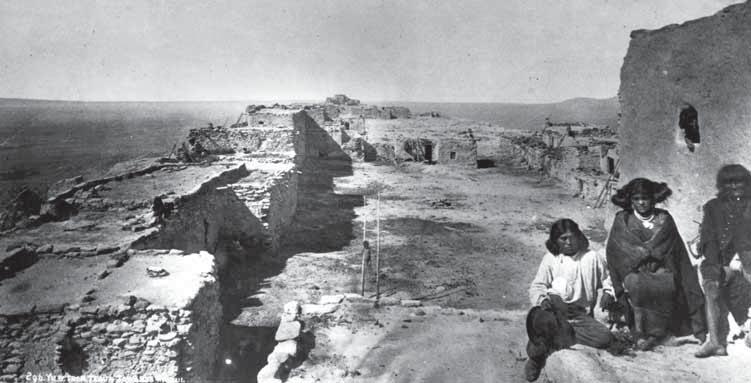
The missionaries were met by “guards” on horses whose appearance was most striking to young Ammon Tenney. Their “netely comed” hair was “tied in a bow behind their heads,” except for some bangs over the forehead. They had saddles whose head pieces holding the bridle
44 Harry C. James, Pages from Hopi History (Tucson: University of Arizona Press, 1974), 86, 14.
45 Hamblin to Young, December 18, 1858.
46 Little, Jacob Hamblin, 60.
47 For more on the Hopis, see Frank Waters, The Book of the Hopi (NY: Viking Press, 1963); Peter M. Whiteley, Deliberate Acts: Changing Hopi Culture through the Oraibi Split (Tucson: University of Arizona Press, 1988); and Peterson, “The Hopis and the Mormons.”
48 Hamblin to Young, December 18, 1858.
13 JACOB HAMBLIN
A photograph of Hopi First Mesa in 1875.
UTAH STATE HISTORICAL SOCIETY
bit were covered with silver ornaments.49
A brief parley with the village leaders ensued, and fortunately for the starving men, they were treated most hospitably. “We ware invited in to Town,” wrote Hamblin, and were led up into Oraibi, ascending via a narrow, difficult entrance on the east side of the mesa.50
As they passed through the gates of the town, “hundreds could be seen from the house tops where they had congregated to see the white face of which they knew nothing except by tradition,” as Tenney writes.51 This is an exaggeration, but whites at the mesas were certainly rare at this time. The missionaries were taken to a large room, and their animals were unpacked and fed. Then each of the missionaries was assigned to a different family. A Hopi signaled to Hamblin, and he followed him through a few streets. He noticed that the houses were usually three stories high, with the second and third stories set back from the first, so that the lower stories looked like terraces. Entrances to the dwellings were on the roof of the first level, which required Hamblin to use a ladder to reach the roof of his host’s home, then climb a ladder down into the house. Inside, the room was furnished with sheepskins, blankets, earthen cooking utensils, and water urns. It seemed like a palace to Hamblin, after his last four days of exhaustion and hunger.52
The Hopis now gave Jacob a meal which he remembered with great fondness: blue cornbread tortillas (called piki), boiled meat, bean soup, and a pudding of stewed peaches “of luxerant flavor.” He “partook with agoo[d] relish thanking the Lord that he had onc[e] more plased me in a land of plenty having pertakeing very little for four days previous.” The woman of the house, seeing that Hamblin was uncertain how to eat the soup, dipped her fingers in it and raised them to her mouth. He quickly followed her example.53
The next day, he was relieved when the two men he’d left to find the runaway pack mule showed up at the mesas with the recalcitrant animal.
The following day, perhaps November 13, the Mormons visited what Hamblin called “Moquis Town,” about eighteen miles from Oraibi, which was apparently Sichomovi on the First Mesa.54 It took the missionaries a half hour to climb up to the town. Here they found some Navajos, though many of these had fled in fear at seeing whites, as Americans had “drove them out of thare Town and took ^many of^ thare horses sheep ^and^ goats,” Hamblin wrote. Indeed, a major war between the U.S. Army and the Navajos had begun on September 8 and would
49
Tenney, “Early Recollections,” 7.
50 Hamblin to Young December 18, 1858; Little, Jacob Hamblin, 61.
51
Tenney, “Early Recollections,” 7.
52 Little, Jacob Hamblin, 61.
53 Hamblin to Young, December 18, 1858; Little, Jacob Hamblin, 61.
54
Andrew Gibbons diary, November 22-23, 1858; Charles Kelly, ed., “Journal of Walter Clement Powell,” Utah Historical Quarterly 16-17 (1948-1949): 466.
14 UTAH HISTORICAL QUARTERLY
end only on November 20. Using Ammon Tenney as interpreter, Jacob did talk to one Navajo who knew Spanish.55
The missionaries also met a Spanish-speaking Hopi, who invited them to a dance and feast. Hamblin wrote that even though he had been to many Indian dances, “this surpased any I ever witnessed.”56 Many visitors to the Hopis have been similarly overwhelmed at the beauty of their ceremonial cycles, with their elaborately symbolic costumes, dances, and ritual actions.
The next day, the Mormons visited Mishongnovi, on the Second Mesa, where they “maid strict inquiry for the lost childrin and could here of non[e] among the Moquiches.” However they found a white child, whom the Hopis said they had obtained from Comanches. As the child was sick, the missionaries decided they could not even attempt to bring it back with them.57
When it came time for the main party to return to Utah, the Mormons decided to leave four missionaries (Bill Hamblin, Andrew Gibbons, Tom Leavitt, and Ben Knell) at the Hopi mesas and none among the Navajos, as the Hopis advised them not to visit the Navajos, “as they was mad at all white fases.”58

Though the starving Mormons had been kindly received by the Hopis,
55 Hamblin to Forney, December 9, 1858.
56 Hamblin to Young, December 18, 1858.
57 Hamblin to Young, December 18, 1858; Hamblin to Forney, December 9, 1858.
58 Hamblin to Young, December 18, 1858.
15 JACOB HAMBLIN
The east side of Oraibi Village.
UTAH STATE HISTORICAL SOCIETY
nevertheless, Tenney describes a persistent “jealousy” that some Hopis felt toward the Mormons. As the missionaries began seeking to buy food and supplies for the trip back to Santa Clara, the Hopis seemed to charge exorbitant prices. This left the missionaries “powerless” and thus forced to set out for home facing a serious risk that they would not be able to find sufficient food for themselves or their animals.59 It is possible that the Hopis were still recovering from a severe smallpox plague and drought in 1853-55.60 Thus, Hamblin and eight of the missionaries left the mesas on November 18 without sufficient supplies.61 The larger group of missionaries left their brethren with some apprehension, given the “jealousy” and high rates for food that the Hopis were demanding.
The first camp of the homecoming missionaries—possibly at Quichintoweep—was stamped in Ammon Tenney’s memory because Navajos repeatedly tried to steal the missionaries’ horses through the night.62 A bitter north wind also blew on them, but they did not dare light any fires.63
The missionaries expected to have desperately-needed antelope meat waiting for them now, but the Paiute hunter failed to make an appearance, so they continued on their way on very short rations—“unlevened bread, beans and occasionally a little meat with salt, so by the time we reached the [Colorado] river we had nothing left but crums a few Buns & salt,” wrote Tenney. The men often traveled on foot because their horses were “exausted from hardships.”64 Despite these adverse conditions, they pressed forward as quickly as possible because they wanted to surmount the Kaibab Plateau before any major snowstorms.65
After crossing the Colorado, they retraced their steps, passing by today’s Lee’s Ferry. As they trudged on in the shadow of the Vermilion Cliffs, Jacob Hamblin killed a badger, and soon thereafter they reached a creek and camped on it, with “our Horses worn out and us fainting for want of food,” Tenney wrote.66 The missionaries “put [the badger] to boiling but it proved so tough and tasted so strong we decided to carry it and try it agin the following night.”67
They camped the next night on another creek, where they began to boil the badger meat and buns. But “no sooner did the kittle begin to boil when there arose a foam that smelt like soap and within the space of two
59 Tenney, “Early Recollections,” 8.
60 Thomas Donaldson, Moqui Pueblo Indians of Arizona and Pueblo Indians of New Mexico (Washington, D.C.: United States Census Printing Office, 1893), 14-15, 28; David Conrad, “The Whipple Expedition in Arizona 1853-1854,” Arizona and the West 11 (Summer 1969): 157.
61 Hamblin to Young, December 18, 1858; Andrew Gibbons diary.
62 Tenney, “Early Recollections,” 8.
63 Little, Jacob Hamblin, 62.
64 Hamblin to Young, December 18, 1858; Tenney, “Early Recollections,” 9.
65 Hamblin to Young, December 18, 1858.
66 Tenney, “Early Recollections,” 9.
67 Tenney, “Account of Travels,” and “Early Recollections of My Youth,” 9, adds that one of the guards secretly ate some of the badger and was sick that day.
16 UTAH HISTORICAL QUARTERLY
hours it had curdled so much like soap that the mess could not be eaten,” wrote Tenney, “Thus the names of Bagger & Soap Creek.”68 These names have stuck up to the present-day. Next they sampled some crab apples, but these sickened and weakened them instead of strengthening them. “By this time we were allmost starving to death,” wrote Tenney. But they were temporarily saved when they met some Paiutes who took them to their camp, “where the squaws mixed up grass suds in cold watter and we drank it.” This typical Indian food gave the missionaries some strength as they began their dangerous winter journey over the Kaibab Plateau. They reached what Tenney called “the warrior’s camp” where earlier they had cached fifty pounds of flour. “The natives . . . were true to their trust,” Tenney wrote, “but alas what was 50 lbs for starving men?”69 They could only push onwards.
On November 27, the men “crosed the mountains ^s[n]owe knee deep^,” Jacob wrote. The following day, the weather seemed to conspire against them: “A snow storm ^set^ in upon us. We ware unable to travail as we could not see our course this storm having lasted .2. days and nites.”
Two of the men, very anxious to get back to civilization, pushed on ahead, against Hamblin’s advice. He soon felt that it had been a mistake to let them separate, so the main company of missionaries “packed up and persude [pursued] after them.” After following their trail about two hours, they overtook the two men in a cedar grove. “Thare feet [were] nerely frosen. The snowe was then knee deep and the storm increasing. We stopt under those cedars which partley shelterd us from the storm. We had then ben 5 days racioned on lesse than a pint of beans a day to the man. Our provisions had now given out.” In addition to facing possible death by starvation, the men were menaced by the severe cold: “It was all most imposible to ceep [keep] from freasing [even] with a larg fire,” Hamblin wrote.70

68 Ibid. See also James Bleak diary, March 19, 1864, Ms B 171, fd 6, Utah State Historical Society. Hamblin, on the other hand, later stated that the name Soap Creek came from an attempt to boil beans and pork. Horatio Morrill diary, October 8, 1869, Utah State Historical Society; Brigham Young Jr. diary, May 23, 1876, MS 1236/1-4, LDS Church History Library.
69 Tenney, “Account of Travels.”
70 Hamblin to Young, December 18, 1858.
17
Paiute Indians near Kanab.
UTAH STATE HISTORICAL SOCIETY
We should not imagine these men crossing the winter mountain with solid, substantial boots. “Ear [ere] we reached Pipe Springs we were realing like drunken men for want of food and the snow falling fast,” Tenney wrote. “Our shoes had been worn out and our poor feet larcerated by rocks thorns & ice.”71

The missionaries somehow managed to descend the mountain and reached Pipe Spring as the storm continued. They set out from Pipe Spring but at some point Samuel Knight was ill, and had to dismount and stay behind. Tenney states that Knight had to “release a few Oose apples [a yucca fruit that was generally eaten raw or roasted over coals] which demanded of him their entire and unconditional freedom. He was so weakened by the disloyalty of the only nourishment he had received for some passed days that he couldn’t mount his horse.”72 The rest of the company covered only eight miles, to Cedar Ridge, where two men were sent back to help Knight. “He was not able to remount and had the two men been 30 minutes longer they would have found him frozen stiff,” writes Tenney.73
This was the darkest moment of their entire journey, as the storm refused to relent. “We at the camp with great difficulty started a fire,” said Tenney, “for the sleet, ice and snow was falling all day and the snow lay two feet deep while our poor horses stumbled and reeled like drunkards.”74 Finally the starving men were forced to look to their precious mounts for food. “The knaweings of hunger induced us to kill one of our animils,” wrote Hamblin in his letter to Young. “We chose the flesheyest one, a 4 year old mare.”
As Dudley Leavitt tells the story, he and Luke Fuller began saddling their horses to try to ride ahead, but Jacob, who had been almost silent for two days because of worry and exposure, came up to them and told them they would never make it. “I see no way but to kill one of the horses for food,” he said. In response, Dudley simply pulled the saddle from his mare and motioned for Fuller to shoot it. Jacob turned away in tears. Dudley later remembered that “Some of the men had steaks cut out of the hind quarters of that horse almost before it stopped kicking. No meat has ever tasted so
71 Tenney, “Early Recollections,” 10.
72 McClintock, 3rd Interview with Tenney.
73 Little, Jacob Hamblin, 63; Tenney, “Account of Travels.”
74 McClintock, 3rd Interview with Ammon Tenney.
18
UTAH HISTORICAL QUARTERLY
UTAH STATE HISTORICAL SOCIETY
Andrew Smith Gibbons.
good since.”75 Jacob agreed. “We boiled the flesh on the coles and eat it without salt and to me it was the sweetest meat I ever et. I think thare was not a man in camp that eat less than 5 lbs. of that meat.”76
After this meal they were able to lie down and sleep through the night, and in the morning “the storm was abated and we felt strengthened and persuid our journey at a raped rate,” wrote Jacob.
The missionaries arrived “at the coton Farm on the Riovergin,” the town Washington on the Virgin River, on December 4th, “whare the Brotheren Blessed us with such good things as the Lord Blessed them with.”77 For these nine men, the great adventure was over.
Meanwhile, the four missionaries back at Sichomovi were not making good progress in their mission; in fact, though they had been expecting to stay a year, they departed less than a month after the main company, mostly because of the difficulty they had obtaining food in the mesas, despite their best efforts to work, hunt, and even beg. They managed to obtain some supplies for their return journey only with great difficulty, but as they were getting ready to depart for Utah, in a touching moment, a Hopi leader took one of their sacks and filled it with piki. He also brought a small pony to exchange for a mare the missionaries had that was so “reduced in flesh” that she probably would not make it home. After receiving this last unexpected double gesture of kindness, the Mormons set off on December 8, plodding through a foot of snow.
The four’s trip home was probably even more difficult than that of the main group of missionaries, because the weather was colder and there was more snow on the ground. Gibbons wrote on December 9: “Made our beds on the snow. Suffered considerable from cold.” Four days later, the men “had considerable difficulty in keeping from freezing our feet.”78 In addition, the trail was hard to see because of snow, and the four missionaries wasted precious time wandering as they searched for it.
75 Juanita Brooks, On the Ragged Edge: The Life and Times of Dudley Leavitt (Salt Lake City: Utah State Historical Society, 1973), 88-89; Alonzo Leavitt, Interview with Selena Leavitt
Dudley Leavitt, July 24, 1933, typescript in author’s possession. Hamblin and Tenney tell the story differently, suggesting that the horse was selected by the group because it was in the best condition. Hamblin to Young, December 18,1858; Tenney, “Account of Travels.”
76 Hamblin to Young, December 18, 1858.
77 Hamblin to Young, December 18, 1858, and Hamblin to Forney, December 9, 1858.
78 Gibbons Diary.

19 JACOB HAMBLIN
concerning
Thales Haskell.
UTAH STATE HISTORICAL SOCIETY
They somehow managed to guide their animals down Navajo Canyon (which fortunately was not snowy), but at the bottom of the canyon, at Navajo Creek, one of their animals was “strained . . . very bad,” and could not be used after this.
On the fourteenth, they reached the Colorado River and found pieces of ice floating in it. When they crossed the river early the next day, they found the river shallower than it had been on the trip out, but it was bitterly cold and they had to watch for dangerous pieces of floating ice. Gibbons rode a horse across because he had a lame knee, but the other three men waded across safely, though they were probably half-frozen when they reached the northwest side.
The travel through the cold and snow continued, and the missionaries’ provisions were nearly gone. By the seventeenth, the four men were reduced to killing and eating a crow. As they approached the Kaibab Plateau, they fired their guns to attract friendly Paiutes, and when they came, the missionaries begged them “to bring us some ground grass seed, on which we mad[e] our supper.” The Paiutes also gave them some seed for the trail ahead.
The snow on the Kaibab Plateau was very deep, especially where it drifted against stands of timber. Fortunately, two Indians had passed over the mountain the day before, so the four missionaries at least did not get lost. When they camped on December 20th, the cold was “verry severe,” Gibbons wrote. The next day, running out of food, they met some Indians, who gave them two small rabbits and some oose. They roasted and devoured the rabbits, but unfortunately, Gibbons and party had the same experience with oose that Knight had had a month earlier: it turned out to be “very injurious to persons not used to eating it,” Gibbons wrote, as the missionaries discovered only after “eating a hearty supper of it.”Vomiting or diarrhea was probably the result.
After descending the west flank of the Kaibab two days later, they camped in a small hollow, but that night their beds “swam in mud and water.” They reached Pipe Spring the next day at midday, and watered their thirsty animals, that had had nothing but melted snow to drink since the Ute Ford. They did not stop but pushed ahead. That night they were weak, having had nothing but oose to eat in recent days, and amazingly, they made exactly the same decision that the main group of missionaries had made, and in about the same place—they would have to kill and eat a horse to survive. They shot the lame animal, and made “a sumptuous supper on horse meat which relished well,” Gibbons wrote.
The small company traveled all day on the twenty-fourth through deep snow without any trail. But a supper of horse meat kept them strong and active. On Christmas day, they found the trail of the main group at midday, which would have heartened them, and ate the rest of their horse meat, as they expected to arrive at Washington in about twenty-four hours. They sent Tom Leavitt ahead on their best horse and the remaining three men traveled on about six miles before camping.They “suffered much from cold” that Christmas night.
20 UTAH HISTORICAL QUARTERLY
The next day they traveled some six miles and reached the bluff overlooking the Virgin Valley, at which sight they “rejoiced much.” After traveling on three or four more miles, they had reached the limits of their strength and lay down exhausted. Soon after this they saw “the brethren comeing to our relief,” as Gibbons wrote. “The feelings that pervaded our bosoms is much easyer felt than described.” The men from Washington gave them hearty handshakes of welcome, and the three men wept openly from joy and relief.
After arriving back at Fort Clara on December 26th, Gibbons wrote a fitting coda to their improbable trek: “After a Journey of 19 days in the dead of winter, travling a distance of 350 miles through a section of country little known by the white man we all feel to acknowledge the miraculous power of God being made manifest in our deliverance from the many dangers that we were exposed to.” The survival of the fourteen Indian missionaries was not a certain thing at many points.

Subsequent expeditions over the Colorado would still be difficult and dangerous, but at least Hamblin and others knew that the journey was possible, and they knew the route in a general way. And they had made some friends in the Hopi mesas.
One striking aspect of this story is the importance of Paiutes in helping Hamblin and his men in their journey. They guided the Mormons along Indian trails and over an Indian ford; then fed them traditional Indian foods of rabbit, oose and grass seed as they faced starvation on their trip back. The good relations that Hamblin and the Mormons had developed with these Indians served them well in this journey.
This epic story has been overshadowed by the explorations of Fray Escalante and Domínguez, Joseph Christmas Ives, and John Wesley Powell.79 Without taking anything away from the remarkable explorations and writings of those men, the first trip to the Hopis by Hamblin and his thirteen companions, guided by the Paiute Naraguats, deserves to stand in their company. Aside from the accomplishment of this company in surviving such a difficult winter journey, the 1858 expedition to the Hopis marked the beginning of the important Utah-Arizona road, one of the major arteries in southwestern history.
79 For example, in Peggy Froeschauer-Nelson, Cultural Landscape Report: Hubbell Trading Post National Historic Site, Ganado, Arizona (Santa Fe: National Park Service, 1998), figure 8, a map showing important early exploration routes in northern Arizona, includes Ives (1858) and Powell (1869), but Hamblin (1858) is ignored.
21 JACOB HAMBLIN
Ira Hatch.
THE MOUNTAIN MEADOWS MASSACRE FOUNDATION
Early Roadside Motels and Motor Courts of St. George

The friendly mom-and-pop roadside motels along southern Utah’s highways in the mid-twentieth century exemplified the beginnings of a tourism industry that came to define the state. But tourism was both a blessing and a curse for these small rural towns. Though they fiercely sought the national advertising attention and road improvements required for development, the towns were forever changed by both.
The stimulus for the growth of roadside motels and motor courts in St. George was the oiling and graveling of the last stretch of the original Arrowhead Trail between Los Angeles and Salt Lake City in January 1931.1 The road became a major artery for motor travelers throughout the west. These new automobile tourists demanded better lodging facilities to accommodate their overland journeys. Southern Utah’s community leaders jumped at the chance to re-invent their struggling towns—which lacked a secure economic base from the beginning— and turned their focus on tourism, the new
By LISA MICHELE CHURCH Milne Motor Court.
1 Washington County News, January 8, 1931.
22
Lisa Michele Church is a Salt Lake City attorney who works as Utah’s Juvenile Court Administrator. She is a native of Southern Utah and many of her great-great-grandparents were sent by Brigham Young to settle the area.
POSTCARD IN
AUTHOR’S COLLECTION
ST. GEORGE ROADSIDE MOTELS
“industry without a smokestack.”2 Rural Utahns built motor courts and motels by the dozens, beginning in the 1930s and escalating sharply after World War II. With clever neon signs, inviting cottage rooms, and picturesque names such as “Rugged West” and “Shady Acres”, these motels provided the impetus for a shift in St. George and other communities along the Arrowhead Trail from the agricultural economy of the previous century to the new tourism destination economy.
Ironically, the better roads and increased tourism dollars that combined to produce the boom in motor courts and motels in rural Utah also caused their eventual decline. The citizens not only received the paved roads they lobbied for, those same roads were eventually widened and re-routed to entirely bypass their downtown streets. The tourists spent their millions visiting the scenic wonders of southern Utah, but the flood of revenue came in such a deluge that large hotel/motel chains followed soon after, drowning out the chances for the small roadside properties to survive. These quirky, cozy lodging facilities were given a lethal dose of the very medicine they thought would sustain them, and became victims of their own success within twenty short years.3
The story of southern Utah’s motels fits into a broader history of tourism in the West, where boom and bust cycles are as regular as the seasons. As historian Hal K. Rothman observes, “The inherent problem of communities that succeed in attracting so many people is that their very presence destroys the cultural and environmental amenities that made the place special.”4 In southern Utah, the presence of internationally known national parks heightened both the benefits and risks of tourism development. The sheer scale of Utah’s tourism influx in the past century brings into sharp focus the tension between local families trying to survive economically and outside tourists demanding the small town charm they loved. Motels were caught in the middle. They arrived first on the scene to claim the upside of tourism, but could not adapt fast enough to the changing demands of the tourist. Examining these motels’ history illuminates the fascinating force of local business interests in shaping the West’s tourism experience for all of us.5
When Mormon Prophet Brigham Young sent carefully assembled
2 Sperry and Hutchinson Company Brochure, “Unique Utah,” 1962, PAM 7281, Utah State Historical Society Library.
3 Phil Patton wrote: “[T]he reign of the classic motel was short – really from the ‘40s to the late ‘50s, when the interstate-highway program and the boom in the chains made it obsolete.” “America’s home away from home is still a good motel,” Smithsonian Magazine, March 1986.
4 Hal K. Rothman, Devil’s Bargains – Tourism in the Twentieth-Century American West (Lawrence: University Press of Kansas, 1998), 27.
5 For an excellent analysis of the impact of tourism on the West, see Earl Pomeroy, In Search of the Golden West, The Tourist in Western America (Lincoln: University of Nebraska Press, 1957); David M. Wrobel, and Patrick T. Long, Seeing and Being Seen, Tourism in the American West (Lawrence: University Press of Kansas, 2001); and Marguerite S. Shaffer, See America First, Tourism and National Identity, 1880-1940 (Washington D.C.: Smithsonian Institution Press, 2001).
23
companies of immigrants to settle towns like St. George in the 1860s there were not many natural resources to justify settlement. Leaders sited traditional western frontier towns for economic reasons, such as a nearby mine, forest or agricultural valley, but Mormon leaders arbitrarily platted most southern Utah towns in the strategic locations needed to colonize the vast Utah Territory. 6 These pioneers received a religious call to settle southern Utah, and thus were motivated by spiritual conviction, not homesteading fever. That devout belief produced in them a deeper level of commitment to the place, no matter how inhospitable, than might have driven other settlers.
Brigham Young selected stonecutters, farmers, merchants and schoolteachers to settle towns such as St. George, Cedar City and Panguitch and create a community overnight. Each town struggled through various attempts to develop an economic anchor, from growing cotton to making wine and from logging to iron mining. While none of these efforts produced the self-sufficiency that Brigham Young originally sought, the settlers clung to their religious imperative and refused to give up on the towns. By the dawn of the 1900s, the original settlers’ children and grandchildren sought employment in these same towns, but efforts to make the communities self-sustaining waned. Scarce water limited their agricultural opportunities to uneconomical five-acre farms. Pioneer families needed a new approach in order to keep the towns viable. Tourism beckoned. It was a possible new source of revenue to provide hometown employment for their sons and daughters and future generations.
As early as 1916, boosters made predictions that tourists would flock to the St. George area in droves and that the town could be saved by seizing the economic opportunity. California road promoter and race driver Charles H. Bigelow wrote, “The old Mormon trail will mean to each and every town not alone close neighborhood connections but the presentation to the automobile tourists of the possibilities, mineral, agricultural and civic of your communities. It means because of short mileage and scenic beauty, the diverting of thousands of cars from the other transcontinental routes.”7 The Los Angeles Tribune Sunday edition for December 24, 1916, included a rare full color headline stating: “Arrowhead Trail, Retracing old Mormon Trail from San Pedro to Salt Lake City.” The multi-page spread touted the beauty of southern Utah, recited the history of the trail, and gave Brigham Young credit for plotting the trail’s route: “As deeply interesting as its history are the scenic wonders that the Arrowhead Trail places within reach of the motorist.”8 Scenic beauty may be in the eye of the beholder, but southern Utah
6 Douglas D. Alder and Karl F. Brooks, A History of Washington County – From Isolation to Destination, (Salt Lake City: Utah State Historical Society and Washington County Commission, 1996), 48.
7 Washington County News, February 24, 1916.
8 Charles H. Bigelow scrapbook, Special Collections, Dixie State College Library. For a history of the Arrowhead Trail, see Edward Leo Lyman, “The Arrowhead Trails Highway: The Beginnings of Utah’s Other Route to the Pacific Coast,” Utah Historical Quarterly 67 (Summer 1999): 242-64.
24 UTAH HISTORICAL QUARTERLY
1920s view of Tabernacle Street in St. George, looking west.
Arrowhead Hotel is on the left.
possesses all the key elements: river-carved canyons, extinct volcanoes, sagebrush meadows, tree-filled forests, endless blue skies and plenty of sunshine. St. George was especially attractive because its lower elevation made it one of the warmest and driest climates in the Intermountain West. Utah Governor William Spry joined Union Pacific Railroad officials on a 1917 bus tour of southern Utah designed to promote travel, and the reporter who accompanied him boasted, “This is southern Utah, and the majestic wilderness that will soon echo the siren of the motor car and the whistle of the locomotive.” After touring through Cedar City, Hurricane, Kanab, the Grand Canyon, Rockville, Zion, and St. George, the group “completed a tour which marks a new epoch in Utah’s history and forecasts an early development of roads to make this little-known paradise accessible to the tourist world.” 9 Little mention is made of any potential dangers of promoting these new roads or the impact of the visitors that would follow.
At the time of these bold predictions, lodging in St. George consisted of two hotels and a few small rooming houses. In 1913, Samuel Judd began operating the original four-story Erastus Snow home known as the Dixie Hotel at the corner of Main and First North, featuring “modern up to date garage in connection, table service, best of everything in season, Rates: $2.00 per day and up.”10 In 1916, Warren Cox, originally a farm implements dealer, bought Mary Conger’s rooming house and expanded it into the Arrowhead Hotel at the corner of Main and Tabernacle. When it

9 George H. Kelly in The Albatross, quoted in Washington County News, February 1, 1917.
10 Polk’s Directory, 1918-1919, p. 189.
25
ROADSIDE
ST. GEORGE
MOTELS
LYNNE CLARK PHOTOGRAPH COLLECTION
opened, the local paper noted, “The location of the hotel is a choice one, on the corner opposite the tabernacle, and it has fine shade trees and lawns, also a fine rose garden.”11
Cox, who owned the second automobile in St. George, built the Arrowhead Hotel with a large formal dining room, high ceilings with fans, and a marble design laid into the lobby floor in the shape of an arrowhead. He advertised, “Most modern hotel in southern Utah…private baths…Our aim: to care for the traveling public as they should be cared for…”12 His daughter Irene remembered, “It was his great joy to house all his relatives and anyone else needing a place to stay. He also fed them whether they could pay for it or not.”13
Southern Utah state legislator Joseph Snow bragged about his hometown in 1920 to a Salt Lake crowd by saying, “We feel that there are more and better opportunities in southern Utah than in any other undeveloped portion of the United States.” Still, he said more lodging was needed. “Tourist traffic over the Arrowhead trail is growing every week…With the opening of good weather the problem of finding accommodations for the automobilists will be the most serious difficulty for business men of that section. More hotel accommodations are seriously needed…and the construction of two or three hotels along the Arrowhead trail this year will be one important phase of the development of southern Utah.” 14 Apparently, the underlying assumption of Snow and others was that growth was good as an end in itself, and any growth would bring only benefits.
The old-fashioned St. George hotels along the trail did not suit the new traveler who came by car.15 The hotels didn’t have enough adjacent parking for the automobiles now swarming through southern Utah. (During September, 1917, a Mesquite businessman counted at least three hundred cars on the Arrowhead Trail at the Virgin River crossing where deep sand required cars to be towed.16) In addition to parking problems, the stodgy hotels, with their formal lobbies and dining rooms, failed to attract automobile tourists who wanted a more informal and anonymous experience where they didn’t have to dress for dinner or interact with hotel staff.17
11
Washington County News, April 26, 1917.
12 Ibid., May 10 1917.
13Irene Cox Brooks unpublished personal history in author’s possession.
14 Washington County News, February 5, 1920.
15 “Few were convenient for automobiles…Such establishments catered to salesmen and other travelers arriving on foot or by delivery van from nearby railroad depots. When guests arrived in their automobiles in the years before World War I their vehicles were shunted off to distant livery stables or storage garages.” John A. Jakle, Keith A. Sculle, Jefferson S.Rogers, The Motel in America (Baltimore: Johns Hopkins University Press, 1996), 23.
16 Prior to 1920, it was possible to keep a precise count of cars traveling the trail as they passed over the Virgin River near Mesquite, because each car had to be towed by wagon through the sand at that point. When a bridge was constructed across that ford, the local paper noted that car traffic on the Arrowhead Trail in Utah increased by 300 percent, from 4,900 cars in 1919 to 12,035 cars in 1920. Washington County News, June 16, 1921.
17 “…downtown hotels deprived the traveler of privacy and anonymity. Downtown hotels required for-
26 UTAH HISTORICAL QUARTERLY
By the early 1920s, St. George hosted at least two auto camps. John W. Pace established his tourist campground at Main and First North where he allowed camping behind his barbershop. Within a few years Pace moved to the northwest corner of the same intersection and built more substantial wooden cabins that operated as the Pace Camp and Inn, with “everything new and clean, cabins have electric lights, beds and mattresses, stove, table and stool.”18 Pace charged one dollar per cabin and his son, Andy, performed the challenging job of carrying a fresh bucket of water into each cabin at dawn.19
William Nelson started the Dixie Camp just to the east of the Pace Camp on the same street and Fred and Edna Schulz bought it some years later.20 Again, this camp consisted of a series of separate cabins with bathrooms and some kitchenettes where the auto traveler could park directly in front of the door. The Dixie Camp advertised “plenty of shade.”21
The fun of driving a car at one’s own pace, stopping on a whim and maintaining independence, was at the heart of the early road trip, just as it is today. There is a profound spontaneity to jumping in the car and not knowing the next stop. Travelers were no longer tied to train schedules or advance reservations. The new “autoist” watched for the inviting camp or cabin where he could arrive on the spur of the moment, drive up and park next to his room, and enjoy nature right outside his front door.22
Residents of St. George began wondering if their struggling economy could be energized with this new breed of traveler. In 1921, the Washington County newspaper ran a series of fifteen articles extolling the benefits of inviting outside interest, and asked readers to mail their copy of the paper to “some relative or friend in some other section of the U.S. for
mal dress and the rituals of registration, dinner and checkout were all designed for exposure and public exhibition. The rituals associated with downtown hotels were incompatible with the spirit of motor touring. Touring by car also meant travelers arrived covered with road dust, making their appearance unacceptable by hotel standards. Motor touring also appealed to families with children and the downtown hotels intimidated children and their parents.” Lori Henderson, “America’s Roadside Lodging: The Rise and Fall of the Motel,” Historia (2010), 24.
18 Washington County News, May 10, 1928.
19 Brooks Pace interview with author, 2010.
20 Under Dixie Sun, (St. George: Washington County Chapter Daughters of Utah Pioneers, 1975),307.
21 Lions Rodeo Program, 1940, Washington County Library, Special Collections.
22 Car ownership in America skyrocketed as assembly lines made cars affordable for the average person. People in Washington County could buy a car for about four hundred dollars in 1919. While in 1910 the U.S. had fewer than five hundred thousand autos registered, by 1920 there were eight million cars owned, and by 1930 that number jumped to twenty-three million. Newspaper articles around the country drew many of these new automobile travelers to southern Utah by touting Utah’s unusual scenery at the newlydesignated Zion National Park and Bryce Canyon National Monument. Southern California newspapers regularly devoted full sections to the beauties of southern Utah with stunning drawings of Zion’s cliffs and photographs of auto tourists at the sites. Headlines in the Los Angeles papers of the 1920s included: “Scenic Zion Canyon looms as rival of Yellowstone and Yosemite,” “Unique Rock Formations Colored by Nature in Bryce Canyon Utah,” “Wonders of Zion and Bryce Canyon Utah,” “Scenic Vacation Trip to Unique National Parks,” and “Arrowhead trail is destined to be popular gateway to majestic scenic spots,” Los Angeles Express, December 20, 1922, and August 3, 1924; Los Angeles Sunday Times, February 5, 1922, and September 7, 1924, in Bigelow Scrapbook.
27 ST. GEORGE ROADSIDE MOTELS
his perusal….It will mean more immigration and greater development of Washington County.” The enthusiastic editorial went on to say, “The groundwork has been laid for a future extensive tourist business for this city. The tourists over the United States have come to know of the beautiful scenic attractions and the prosperous country existing in Southern Utah.…”23
It is difficult to capture the excitement of these early days of Western tourism, when the possibilities for revenue seemed endless and the costs few. As Rothman points out in Devil’s Bargains: “Local communities that embraced tourism expected to be visited by many people but generally thought their lives would remain the same. They did not anticipate, nor were they prepared for, the ways in which tourism would change them….many locals found selling themselves more complicated than selling their minerals or their beef. But given their dwindling options, tourism was sometimes the only choice.”24 St. George residents were similar to many lonely Mormon pioneers who had settled land no one else wanted; they were filled with wonder at the idea that tourists were suddenly flocking to see these same forbidding landscapes.
In order for the plan of ambitious St. George boosters to succeed, tourists needed a way to get to southern Utah by car. The railroad stopped at Lund, a tiny town seventy miles northwest of St. George, and the tracks would never extend farther south due to the steep summit of the Black Ridge. The Arrowhead Trail from Los Angeles to Salt Lake City looked like not much more than two dirt ruts across the desert in the early 1900s when Charles H. Bigelow, the southern California road racer, made it his personal mission to popularize the route. He became convinced that improving the trail was the best way to link southern California with the rest of the country. Bigelow was part of a larger group of road enthusiasts hired to travel the route, report on conditions, draw maps and generally whip up support for road improvements. He also staged races as in 1917 when he and Owen Bird set a “record” for traveling the road from Los Angeles to Salt Lake City and back in 74 hours 50 minutes.25
Local Utah citizens raised money and even performed road work with their own equipment to improve driving conditions. Bigelow fell in love with the red rock beauty around St. George and wrote hundreds of newspaper articles throughout the west urging auto trips to the area. The Federal Highway Act of 1921 made federal road funding available to local officials. Utah received additional national attention when United States President Warren G. Harding visited Zion in June 1923 and promised more road improvements.26
23 Washington County News, June 16, 1921.
24 Rothman, Devil’s Bargains, 27.
25 “Oldsmobile in military run smashes road speed records between Los Angeles and Salt Lake City,” Los AngelesTribune, June 9, 1917, Bigelow Scrapbook.
26 Washington County News, June 28, 1923.
28 UTAH HISTORICAL QUARTERLY
Utah Governor Charles Mabey solicited support for roadwork from not only the head of the National Park Service, but even the Los Angeles Chamber of Commerce and the Automobile Club of Southern California, asking them for a contribution of one hundred thousand dollars toward southern Utah roads and stating “while I may be sanguine, I believe we will get it.”27 He didn’t, but the next Utah Governor, George Dern, made “exploitation of Utah’s scenic attractions” a key theme of his administration. He encouraged an increase in the gasoline tax for highways and implemented a road maintenance program. Meanwhile, Americans began pouring into the area to visit Zion National Park at a rate of 24,303 visitors in 1927, jumping to 30,016 in 1928.28
During these improvements in the Arrowhead Trail, officials changed the name to Highway 91 and made other changes as well. In the mid-1920s, a conflict grew among St. George residents as to the proper route for oiling Highway 91 through St. George. One group wanted the Tabernacle route, which would allow existing businesses such as the Snow Hotel and the Arrowhead Hotel to remain on the main route. Another group wanted the alternative First North route in order to open new business properties for development along the entire twelve blocks of that street.29

The Washington County Commission, including Dixie Hotel owner
27 Ezra C. Knowlton, History of Highway Development in Utah (Salt
Department of Highways, 1964), 214, 238, 245.
28 Washington County News, September 13, 1928.
29 Salt Lake Telegram and Washington County News, August 26, 1926.
29 ST.
ROADSIDE MOTELS
GEORGE
Lake City: Utah
LYNNE CLARK POHOTGRAPH COLLECTION
Family traveling across Ivins Bench in Southern Utah, early 1920s.
James Judd, urged the State Road Commission to designate the Tabernacle route, noting that it contained the most beautiful buildings and more than four miles of sidewalk compared to three blocks of sidewalk on First North. Citizens held mass meetings in St. George and the Road Commission even visited the town to hear comments during 1926. Mayor Henry T. Atkin, E.H. Snow, and Joseph K. Nichols all urged the Road Commission to route the road along First North instead, and submitted a list of 350 St. George residents in support. Debate became so heated at one point that Arrowhead Hotel owner Warren Cox said the county would rather not have the road paved at all than to have it paved in the wrong location.30
Highway officials eventually oiled the road along First North in 1928, leaving the Arrowhead Hotel pushed off the main route.31 Cox tried to hang a sign across Main Street directing traffic toward his hotel from First North, but the sheriff made him take it down.32
With a new highway fully surfaced through town, energetic businessmen engaged in a burst of new construction in St. George. In 1928 G.W. “Jockey” Hail constructed the twenty-three-room Liberty Hotel at 100 East and Highway 91. It featured steam heat, private baths for all rooms on the second floor, some telephones and room for a third story to be added later.33 When it opened in August 1928, the county newspaper reported that one thousand people attended. Liberty Hotel ads read, “new and modern, on main highway—why start a fire on Sunday in this hot weather when we have meals all prepared?”34
J.W. Pace improved the Pace Camp cabins and added the White Front service station in connection.35 Other entrepreneurs added a gas station at the Dixie Camp down the street and built the Sunshine Camp cabins at 407 West Highway 91. Soon the outskirts of town featured Bill Prince’s cottages on Bluff Street, Camp Washington operated by Calvin Hall in nearby Washington, the Fig Orchard Cabins at the east end of St. George, and the Gates Cabins in Santa Clara.
National advertising continued to highlight the beauties of southern Utah in sometimes purple prose. St. George boosters’ dream for an economic base built on tourism was starting to take shape. Bigelow’s excitement about the scenery was evident in many of the nationally featured articles: “Sandstone hills, sculptured by the winds and rains, grassy leas walled by colored ledges—visions that amaze and delight the eye were visited recently by an Examiner party in a Chandler Royal 8-75 Sedan,”
30
Utah State Road Commission Minutes, August 18, 1925, p. 250, and August 25, 1926, 36-37.
31 Washington County News, April 19, 1928.
32 Risa Cox unpublished personal history, in author’s possession.
33 Washington County News, May 10, 1928.
34 Ibid., August 9, 1928.
35 Ibid., February, 1928.
30 UTAH HISTORICAL QUARTERLY
ST.
Bigelow gushed in the Los Angeles Examiner of September 2, 1928. 36 “Describe a 300 mile circle with Zion Park as the center and therein is a territory in which a dozen lifetimes might be spent in geological, botanical and archaeological research.”36
Sunset Magazine , March 1929, featured an article written by Frank J. Taylor with “vivid description[s] given of National parks and scenic features of Utah’s famous Dixie.”37 California newspaper coverage continued to draw visitors: “This was a land of high flung peaks, deeply graven canyons, timbered mesas and desert valleys all bathed in gold or red or purple lights made easy of access and serves today as a vacation land where jaded spirits find rest and toil-worn brains recuperate from business warfare. The Utahns rallied en masse made the best possible use of their limited resources and saw to it that a real highway was built from Salt Lake into Zion Canyon.”38
Local southern Utah newspapers echoed the national tune of bringing more and more tourists to town. A review of the St. George newspapers during the 1920s and 1930s reveals little in the way of a community conversation about the pros and cons of tourism’s impact on their town. A few naysayers made their way onto the pages of the Garfield County News occasionally, but were quickly reminded of the principle: “a few tourists who stay, will keep poverty away.”39
Bigelow gave credit to the roads and cars for saving the economic life of these towns when he wrote, “Ten years ago Las Vegas, St. George and the intervening hamlets were just places where people lived. Today you find paved streets, electroliers, handsomely appointed hotels and well-kept stores housed in modern buildings. Yesterday the residents of these cities were apparently living from day to day; now they are forward looking—taking pride in self and ownership. Thanks to highways and automobiles.”40
Businesspeople in southern Utah apparently agreed with Bigelow’s assessment, because the national attention spurred more building. The Liberty Hotel added rooms during 1930, and both the Liberty and Arrowhead installed phones in each room later that year. Dixie Camp added six new cabins.41 The Scenic Utah Motorist magazine recommended these establishments noting, “The new Arrowhead Hotel, 50 rooms, 34 rooms with bath, rates $1.00 per day up, dining room in connection, garage
36
“Atop Zion National Park,” Los Angeles Examiner, September 2, 1928, Bigelow Scrapbook.
37 Washington County News, February 28, 1929.
38
“New Tunnel Motor Highway Taps Zion National Park,” Los Angeles Express, June 2, 1929, Bigelow Scrapbook. See also “Utah’s Amazing Highway brings Los Angeles ‘nearer’ to the scenic wonders of Utah’s national parks,”Los AngelesExaminer, May 4, 1930, Bigelow Scrapbook.
39 Garfield County News, August 3, 1939. In another News article entitled “The Good Derived from Tourists,” the reporter acknowledges hearing some residents mutter, “I can’t see that tourists have done me any good,” but the article goes on to say “If the tourist trade and travel were taken from the district we are quite sure you would miss a great deal of the good things you are receiving today.” August 10, 1923.
40
“Motor Party Pays Visit to Zion,” Los Angeles Evening Express, May 27, 1931, Bigelow Scrapbook.
41 Washington County News, June 6, 1930.
31
GEORGE ROADSIDE MOTELS
in connection,” and “Hotel Liberty, located on Highway 91 entering from east. European plan, 42 rooms with bath, $2.00 per day and up 14 rooms without bath $1.50 per day and up. Fans in all rooms. Café in connection giving short orders and regular meals. Telephone service. G. W. Hail, Prop.”42
This new competition spelled the end of an era for one early hotel. New owners demolished the Dixie Hotel in 1930 to make way for a modern service station. Still the travelers kept increasing. Officials counted one hundred cars per day along Highway 91 through St. George—a large number for a town of just over two thousand people.43
In May 1936, the National Geographic magazine featured southern Utah with twenty-two color photographs of Bryce, Zion and Cedar Breaks, along with other sites, exclaiming that, “To describe the colors of southern Utah, one would need to translate the most vivid adjectives into verbs, for under an afternoon sun those reds and pinks and yellows are violent forces that fairly crash upon the vision.”44
Motor courts popped up along Highway 91 during this time of rejuvenation in southern Utah. Just as hotel owner Warren Cox adapted from farm equipment to auto salesman to hotelier with the advent of automobile tourism, St. George service station operators began to build adjacent motor courts to capture the travelers that poured into the area during the 1930s.
Bert Milne began his adult life working at his brother’s Sinclair station at 300 East and Highway 91 in the 1930s. Bert, a fastidious fellow who was never seen without a clean, ironed white dress shirt and spotless slacks, watched the steady parade of motorists at his gas pumps and decided to build the fourteen-unit Milne Motor Court behind the service station. He noticed that tourists wanted a little more luxury than the auto camps provided; they especially wanted modern indoor plumbing. He saw an opportunity to capture the same motorists arriving to fill their gas tanks, and invited them to rest in the shade of his pretty new lawn. The motor court business suited him just fine because he loved meeting the customers and visiting with them about their travels.
Bert’s wife, Edith, was already a successful businesswoman in her own right who operated one of the first beauty salons in St. George. With Edith’s head for figures and Bert’s people skills, they epitomized the early motor court operators. They kept overhead low by living right on the property in a tiny manager’s unit with a living room that doubled as the motel office.45 They built the Milne Motor Court in a Spanish style with white stucco exterior and red tile roofs that they admired during their travels to southern California. The rooms featured heavy maple furniture with bold Spanish prints in reds and oranges with bright throw pillows.
42 The Scenic Utah Tourist, August 1930, and October 1930, Utah State Historical Society Library.
43 Washington County News, January 26, 1928, and November 27, 1930.
44 “Utah, Carved by Winds and Waters” National Geographic (May 1936), 577-623.
45 Edna Mae Miller Sampson interview with author, 2010.
32 UTAH HISTORICAL QUARTERLY
Rooms opened on to a small grass-filled court with chairs and shade umbrellas.
Bert Covington’s was a similar story. He operated the Conoco station at 247 East and Highway 91 and then opened the Conoco Auto Court in June 1931 by announcing “new deluxe cabins, strictly modern in every respect.”46 During the 1930s Bill Bennett also built his auto court on the east end of town, and John Pace built a roof over his old Pace Camp cabins and re-named them the Big Hand Tourist Court, in connection with the Big Hand Café on the corner of Main and Highway 91. These operations used the new design of a motor court, or tourist court, where cottages were joined together by a common roof. Builders put parking right at the door to each unit or even garages between each unit, and planted trees and landscaping in the center of the court.
This change in business model relegated the Arrowhead Hotel rooms to use as apartments, no longer along the highway and no longer offering what the traveling public demanded. Even the Liberty Hotel lost some if its shine. Owner Jockey Hail was killed in a car accident in 1938, and a few years later his son, Brown Hail, built Hail’s Motel down the street, signaling his faith in motels over hotels.
By 1941 St. George boasted nine service stations, four motor courts and one hotel along Highway 91; more than respectable for a town with barely three thousand residents. Building slowed during the war years, when materials were scarce, gasoline and tires were rationed, and travelers were not as frequent, but picked up again when a new generation of young men returned from World War II full of ideas about building St. George’s tourism future.
“Here They Come! The tourist vanguard is already over the horizon!...Wishful thinking belongs to the war period, forever behind us. Let’s now face the fact that the flood of tourist dollars will come to us only if we deserve them.” The newly created Utah Department of Publicity and Industrial Development placed these messages in ads throughout southern Utah newspapers in 1945. Another ad challenged residents: “How many tourist questions can you answer? Prepare yourself…and your business first…then be sure your community and civic organizations are prepared. Start NOW for the biggest tourist year in our history!”47
With the scarcity of the war years behind them, Americans everywhere took to the road. “First, by far, with a postwar car!” shouted an ad for the 1947 Studebaker; “Millions turn to travel and war deferred vacations in the first full summer of peace,” said the July 1946 National Geographic magazine.48
Andrew Pace epitomized the new view of southern Utah as a destination in itself. Having grown up in St. George working at the Pace Camp started
46
Washington County News, June 25 1931.
47 Garfield County News, August 30, 1945, January 24, 1946,
48 National Geographic, July 1946, p. 2, and “Postwar Portrait of the United States,” 135.
33 ST. GEORGE ROADSIDE MOTELS
by his father, Andy left to attend law school in Arizona and then served in the FBI. He returned to Utah’s Dixie after the war with an eye toward capitalizing on the favorable climate and scenery of his hometown. Due to his experiences in Arizona, Pace thought about selling St. George as part of the recreational southwest mecca that featured golf, swimming pools and cowboy motifs. He almost immediately began planning the extensive remodeling of the family-owned Big Hand Tourist Camp into the Rugged West Motel and the construction of a fancy new two story motel he cleverly named the “El Pace’O Lodge—a modern ranch motel.”49
Andy was a gregarious man, who was interested in all sorts of people and loved to talk. He believed that newly developed residential air-conditioning would be the key ingredient in developing St. George tourism. Andy’s son, Brooks, who grew up living next to the El Pace’O Lodge, vividly remembers the first time he saw a swamp cooler in a window and stood in front of it to feel the cold air. Prior to air conditioning, the one hundred degree-plus summer temperatures of St. George discouraged some tourists’ enthusiasm for staying more than one night. Brooks Pace earned ten cents per hour for scrubbing and oiling the rubber mat along the El Pace’O’s second floor landing. His father worked the front desk greeting customers and giving directions. The family did their motel laundry on site, grinding up soap remnants from guest rooms for laundry soap. Many of their staff worked at both Pace motels for their entire working career and Andy Pace even made sure they were cared for after retirement.
The El Pace’O Lodge was the first of its kind in town, built as a thirtyunit motel with fireplaces and kitchenettes in some rooms. Down the street, the Rugged West Motel featured custom made “combed siding” paneling and western furniture built by Andy’s friend and local carpenter, Clair Sterling. Ads for the Pace motels used a southwest theme with a tiny figure in a large sombrero leaning against a cactus and proclaiming “A Real Rest in the Rugged West!” Pace had an ear for slogans. He and a few other motel owners in town collaborated to come up with the advertising slogan “St. George—Where the Summer Sun Spends the Winter.” Starting in the 1940s, the St. George Chamber of Commerce used this campaign in its brochures and featured it on many motel postcards.50 Motel owners agreed that, if a customer came on a day when the sun didn’t shine at all, he earned a free room. Brooks Pace remembers driving up on the red hill with his father, Andy, to check the cloud cover and see if the sun would at least peek through before the day ended. Northern Utahns found the slogan particularly catchy because they dreamed of Dixie during their snowy winters.
Tourism promoters kicked into high gear in the post-war years through-
49 Brooks Pace interview with author, 2010, Pennie Pace Sproul interview with author, 2011, postcard from author’s collection.
50 “St. George, Center of the World’s Best,” St. George Chamber of Commerce brochure, 1948, Special Collections, Washington County Library; and postcards from author’s collection.
34 UTAH HISTORICAL QUARTERLY
out Utah. The Department of Publicity and Industrial Development urged all rural Utah towns to develop a friendly attitude toward tourism. “The tourist traffic spreads friendliness, unifies America, multiplies revenue, carries nothing away from the state except good will, leaves growing millions of dollars. What will keep tourists longer in Utah? Courteous service, accurate information, our enthusiasm for our attractions, better hotels and auto courts.”51 Visits to the southern Utah national parks soared after the war. In 1941, Zion reported 192,805 visitors and Bryce hosted 124,563; during 1947, Zion reported 273,953 visitors and Bryce saw 163,172.52 This post–war enthusiasm, combined with the determination to re-establish the economies of southern Utah towns, created a veritable building boom. Almost every town added at least half a dozen motels during the years 1945-1950. By 1948, local St. George families looking for additional sources of income started nine new motels. The children of the original pioneers lost patience with hard-scrabble agriculture in the arid desert, and they were learning that ranches could only support one or two descendants at a time. “All I ever thought about doing was working on the ranch with my dad,” remembers Sid Atkin, whose family homesteaded the Arizona Strip in the 1800s. “But my dad sat me down and let me know that the ranch could only support one or two of my brothers, and I needed to make my own way.” Sid decided to buy the Sugar Loaf Café and jumped headlong into the blossoming service industry of St. George.53
51 ‘Tourism is Utah’s all year wealth,” The Utah Magazine, February 1946, 10.
52 “The Tourist Industry” Utah Economic and Business Review 14 (April 1954).
53 Sidney J. Atkin interview with author, 2010.

35 ST. GEORGE ROADSIDE MOTELS
Rugged West Motel.
POSTCARD IN AUTHOR’S COLLECTION
Others of his generation made similar transitions. In 1946, Bert Milne sold his original Milne Motor Court and built the larger twenty-room Milne Motel one block to the east, advertising it as completely carpeted with 100 percent modern tile baths. In 1947, Bill’s Cottages on Bluff Street became the Red Bluffs Motel and Atwood’s Cottages became the Big D Motel at 338 West operated by Clarence Force, also a former rancher. Walter Cannon, a successful businessman whose son later became a U.S. Senator from Nevada, built the Haven Motel at 310 West.
Two partners named Dewsnip and Schmutz built the Motel St. George at 535 West and advertised “the comfort of Waldorf Astoria in our beds.” The buddies devised a profitable plan they would take turns staying on the property for twenty-four hours at a time, each keeping all the money they took in during their own shift, then splitting the bills in half.54 Lynn Empey built the Lyn Mor Motel at 410 East and Brown Hail opened the fourteen-unit Hail’s Motel at 185 East.
In 1948, the new motels included the Shady Acres built by Julio Paolosso at 770 East, the implausibly named Carolina Pines at 644 East operated by Nicholas Bird and the previously mentioned El Pace’O. Paolosso built his motel around his own home and copied its architectural style. His wife ran the motel while he worked as a Ford mechanic. Richard and Jessie Jensen modernized the old Sunshine Camp into the new Southern Motel at 455 West and added trailer parking.
A small group of friends and craftsmen pitched in to help each other build most of the St. George motels during this period. Leo Holt was a designer and builder who constructed many homes in town as well. Ed and Gene Brooks were known for their skills with lath and plaster. Lee Hirschi was a popular plumber. Scott Prisbey designed the El Pace’O and later became the city building inspector. Leon Jennings made the bricks used for the Pace motels and combined them with red stones to give it a rustic appearance. Some motels used the southwest design with flat tile roofs and mission-style stucco pioneered by the Milnes. Others used steeply pitched roofs to keep the rooms cooler and red bricks to add a cottage flavor. All of the motor courts and motels emphasized plenty of shade trees, grass, and potted flowers, with metal lawn chairs and cloth umbrellas where hot, dusty travelers could relax.
Community leaders continued efforts to establish St. George as not just a way station, but as a destination for tourists. The St. George Lions Club rallied together in 1948 to build the Dixie Sun Bowl, an arena that could host the annual Dixie Round-Up each September and other events year round. Motel owners such as Bert Milne served as leaders in the Lions, knowing that the rodeo guests would fill up motel rooms, just as the annual
36
UTAH HISTORICAL QUARTERLY
54 Alma Truman interview with the author, 2010; Lions Dixie Rodeo program, 1947, Special Collections, Washington County Library.
deer hunt guests did each October. Talk began in earnest about the possibility of a golf course, which had been urged by at least one Utah governor as early as 1931.55
Motel construction continued into the 1950s. Lester Wittwer and his wife Vanola, already successful motel owners in Las Vegas, built the Wittwer Motel at 310 East with the first swimming pool in town. Leo Holt and his brother-in-law, Bill Hackwell, built the Twin Oaks Motel at 231 West, featuring refrigeration air conditioning in all twenty-seven rooms, a large shaded pool with a diving board and slide. Holt later built the Sands Motel at 581 East using a design based on a Kanab motel. The Sands was the other two-story motel in town and built the largest swimming pool with a shallow end designed especially for children.56 Lindau Foremaster and his family built the Stardust Motel at 651 East.
Sid Atkin remembers the profound shift in thinking that took place among locals at this time. “It was a heady thing to realize that tourism was an industry where they would bring the money to us. Before tourism, we had to ship our fruit and other products out of the community,” says Atkin. “We thought it was a wonderful thing that people would stay with us and leave their money here.”57 Little thought was given to the permanency of the changes tourism made to the cityscape. Instead of small bungalow homes and horse corrals lining the streets, neon signs and parking lots dominated the town. Motels drew other businesses as well, because the motel guests needed gas, food and even entertainment. St. George’s commercial business district grew much larger than the local residents could support alone, and they became dependent on travelers to make up the difference. In September 1956, St. George contained “some twenty three motels and two hotels contain over 427 air conditioned units to serve the needs of travelers…” noted the Utah Economic and Business Review. “In all, St George serves well over 100,000 tourists each year.”58 This was the peak for the mom-and-pop motel business.
Visitors to Zion National Park jumped to a total of 421,163 in 1956 and Bryce reported 257,570 visitors that same year, almost doubling what they were ten years before. As the early promoters predicted, Highway 91 was the key route funneling tourists from California to many parts of the west where cozy twenty-unit motels dotted its landscape.
The motels used memorable advertising, homey touches and familyfriendly features to attract customers. Most were small operations where mom-and-pop owners lived on the property and their children helped out with laundry and cleaning guest rooms. Alma and Ruth Truman bought the Sands Motel from Ruth’s brother-in-law, Leo Holt, and operated it
55
“Dern advocates Dixie Vacations” Salt Lake Telegram, April 4, 1931.
56 Alma Truman interview with author, 2010.
57 Sidney J. Atkin interview with author, 2010.
58 “St George Desert Mecca” Utah Economic and Business Review 16 (September 1956).
37
ROADSIDE MOTELS
ST. GEORGE
for many years while raising their four children on the premises. “Our daughter Teresa was running the front desk by the time she was 10 or 12 years old,” says Truman, “and the kids loved living there because they could swim any time they wanted to.” Having a pool was a huge advantage to a St. George teenager trying to outlast the blazing hot summers. Alma spent hours cleaning the pool but kept it sparkling because it was a big draw to customers. “Our rooms would fill up by 3 p.m. every afternoon, because people would drive by and see our pool,” Truman says.59
Ruth enjoyed the lodging business that she first learned when working at the Liberty Hotel for her aunt, Leda Hail. Alma proved handy with the maintenance and even designed a special wall clip for Ruth to use so she could fold sheets and towels without the help of another person. Guest rooms featured solid Franciscan furniture made in Albuquerque, New Mexico with Naugahyde upholstery. Bright turquoise headboards were fastened to the wall and durable benches sat at the foot of each bed. After the first summer, the Trumans invested in an ice making machine when travelers’ demand for ice was so high. They never turned off the “vacancy” sign, because Truman believed that any contact with a customer was a good thing. “People would come in and we would visit with them and, if we didn’t have a room, we would call up one of the other motels in town and send them down there,” he explains. “If they wanted a pool, we would send them to the Twin Oaks or the Wittwer. If they wanted a cheap, clean room, we would send them to the Bennett’s across the street or to the Red Mesa, originally Bert Covington’s Conoco Auto Court.”60 Demand was so high that the Trumans sometimes moved their own family out of the manager’s unit and rented it out during the summer months.
Customers brought with them their own melodramas, such as the time two couples came to rent rooms, one towing the car of the other. Truman only had one room left, so they grudgingly agreed to share. One of the wives came down to the front desk and told him, “Isn’t this the damndest thing you ever saw? I only met this couple a few hours ago and now I am sleeping with them!” It turned out the one couple was on their honeymoon from California when their windshield popped out. The other couple, also on their honeymoon going to California, stopped to help and they ended up sharing a room. Another time, Truman remembers, a woman customer cut her husband so badly during a domestic fight that he was taken to the hospital, but the man promptly returned to the room all stitched up to spend the night with the same woman. Truman says the best thing about the motel business was “depositing the money” but meeting the customers came in a close second.
Truman and many other St. George motel operators used a clever method of running at more than 100 percent occupancy rates each
59Alma Truman interview. 60 Ibid.
38
UTAH HISTORICAL QUARTERLY
summer. In the days before car air conditioning, most drivers preferred not to cross the blistering Nevada desert during daylight. They would drive across the desert at night and check into the motel at dawn, sleep part of the day, and then resume their drive in the afternoon. If the motel staff quickly cleaned the room, they could re-rent it out within a few hours to another “day sleeper” customer driving south who wanted to sleep until dark before setting out across the desert. In this way they often rented the same room to two sets of clients in the same day and doubled their profits.
St. George motel owners were a tightly knit group who knew each other and engaged in friendly competition. Almost all joined the American Automobile Association and kept high standards of cleanliness. They watched each other for business strategies. If one establishment put in a swimming pool, soon everyone had one, then someone would put in a diving board and the competition would start again. When television became popular, they added it to their rooms and advertised it on their signs. Certain branded amenities were a magnet for business, such as Beautyrest mattresses or Sylvania televisions. In mid-century America, many customers did not have televisions, wall-to-wall carpet or tiled bathrooms in their own homes. Manufacturers soon learned that if they placed their products in roadside motels, they would reach a whole new market of middle class Americans who could experience modern conveniences while on vacation.61
Truman served as President of the St. George Motel Association and
61 “More than one frustrated operator complained that some tourists seemed to want more on the road than they had at home…In effect, motels joined hotels as a promotional arm of the construction and home decorating industries.” Warren James Belasco, Americans on the Road, From Autocamp to Motel, 19101945, (Cambridge: MIT Press, 1981), 164.

39
ST. GEORGE ROADSIDE MOTELS
C. H. BIGELOW SCRAPBOOK, DIXIE STATE COLLEGE SPECIAL COLLECTIONS
August 1924 edition of Southern California Traffic Journal, "Zion Canyon, Cedar Brakes and Puffer Lake, Utah offer most intriguing vacation possibilities."
worked hard on the business relationships between operators. One of the most difficult challenges was to keep owners from posting their room rates on signs, because it made competition difficult. At this time rooms generally rented for three to five dollars per night. Truman, who also ran a horse stable, was amused that he could rent a room to a guest for three dollars per night and then board the same man’s horse at Sands Stables for six dollars per night. Truman also undertook an effort to convince his fellow operators they should support the transient room tax so the proceeds could be used for national tourism promotion.
By the 1950s, tourism in Utah generated eighty million dollars annually and millions of cars traveled along Highway 91.62 The St. George Chamber of Commerce and Motel Association cooperated to place billboards on the road advertising the St. George sunshine and business kept coming.
The frenzy of motel building for a few years in St. George masked the slightest hints of trouble on the horizon. But there were warning signs. Operators of the small motels and service stations in downtown St. George knew that the government was building Interstate 15 across the state and it would soon come to their valley. Citizens jumped into a debate over where to put the off ramps, reminiscent of the debate about the original location of Highway 91 that raged thirty years before. Some businesses wanted to limit Interstate access to the northeast side of town and force a business loop down the Highway 91 route; others wanted an exit at both the south and north ends of town, opening up all of Bluff Street for future development.63
A study examining the financial viability of Utah’s small motels in June 1959, described the precarious state of the industry: …about two thirds of the motels in the state have been built in the last 16 years, 17 percent in the last four years alone. And despite the fact that most Utah motels are less than 15 years old, over half of them have been remodeled in the last five years…Although still largely made up of small husband and wife combinations, the industry has been invaded to an extent by the large chain motels. No longer is a motel merely a small comfortable room and bath; now such items as air conditioning, wall to wall carpeting, telephones and television sets are considered standard equipment. In addition, many motels have swimming pools…More than 60 percent of Utah’s motels have less than 20 units, 84 percent have less than 30, with the average size being 23 units.64
Business experts expressed concerns about market saturation and opined that room rates may be insufficient to pay back the investment. One study observed that, “For the last five years the financial health of the motel industry in the State of Utah has been a state of decline. New units have been constructed faster than tourist travel has increased. The traveling
62 Tourism survey performed by the Utah Economic and Business Review 14 (October 1954), 63 Douglas Alder interview with author, 2010.
64 “Characteristics of Utah’s Motels” by Connie P. Faulkner, Utah Economic and Business Review 19 (June 1959); “Nationally motel owners with 21 to 40 units had a return of 18.98 percent for his time and investment, but Utah’s was slightly higher at 21.67 percent. Average daily rates in Utah were $6.35 and nationally $6.71…the rate structure in our state is not sufficient to give the operator the reasonable return to which he is entitled.”
40 UTAH HISTORICAL QUARTERLY
public, always on the lookout for a bargain, has been shopping from city to city.”65
Just as in previous cycles, it was not only the imbalance of demand and supply that hit the roadside motels, but also a fundamental shift in customer preference. Hotel chains such as Travelodge, Howard Johnson and Holiday Inn expanded nationally in the late 1950s and early 1960s, giving birth to a new lodging business model. Customers liked the fact that they could count on a chain looking the same, offering the same amenities, and charging the same price, no matter what the location. Catering to a traveling public made up of families, these chains let children stay for free and emphasized playgrounds and even babysitters.66
St. George businesspeople did not miss this trend. Many family-owned motels began to change hands or close altogether. Andy Pace sold his El Pace’O to Don and Maxine Winmill, who changed the spelling of the name to the simpler “El Peso Motel.” The Haven Motel became the Sunset and then the Western Safari as a succession of owners tried to modernize. Almost all of the motels added swimming pools and at the Stardust they even added a playground. Bert and Edith Milne sold the Milne Motel and Bert died the following year. Brown Hail sold his Hail’s Motel to a new owner who didn’t want to invest in a new sign, so he conveniently re-named it “Sail’s Motel” and kept going.
During the 1960s, some operators adapted by building even bigger
65 Donald H. Pickett, “A Critical Appraisal of Utah’s Motel Industry,” Utah Economic and Business Review 19 (June 1959).
66 Susan Sessions Rugh, Are We There Yet? The Golden Age of Family Vacations (Lawrence: University Press of Kansas, 2008), 38.

41 ST. GEORGE ROADSIDE MOTELS
Postcard from Bert Covington's Conoco Motor Court.
AUTHOR’S COLLECTION
facilities, called motor inns or motor lodges. The Wittwer family renamed their original motel the “Wittwer’s Best Western Motor Lodge” and built the brand new Coral Hills Motel across the street in June 1968. The Royal Inn was built at 460 East with “49 royal rooms featuring queens, kings, executive and VIP suites,” a sun deck, sauna baths, therapy pool and the Jolly King restaurant.67 When the Travelodge company came to St. George in the mid-1960s, it built a two story lodge at 60 West advertising direct dial phones, putting green, and banquet facilities at the adjoining Trafalga restaurant. The smaller motels struggled to keep up in the face of daunting costs for continuous remodeling.
According to Travel Utah, by 1972 tourism was ranked as the second largest industry in the state and generated an income of nearly $209 million per year.68 It is poignant that St. George finally saw the millions in tourism revenue, but it came with its own set of problems. The sheer volume of tourists in St. George made larger hotel properties a better investment. Twenty rooms were not enough. Smaller properties like the Shady Acres started charging weekly rates, the Bennett Motel promised “lawn and lots of shade trees” and the Oasis motel, formerly Twin Oaks, advertised “some queen sized beds.” But they could not compete with the mammoth Four Seasons convention center and its king sized beds, game rooms, conference rooms and 120 rooms extending on both sides of the street.69
It is also bittersweet that Highway 91 originally gave rise to the motel boom, but the new Interstate 15 bypassed the center of St. George (and most other southern Utah towns), leaving the downtown motels high and dry. Historians Alder and Brooks wrote about the first day after the opening of the Interstate in 1972: “Motel owners, restaurant workers, and gas station help stood around waiting for people to stop, but few did. Many felt their anxieties justified. Within a few days, business picked up, however, ending the worst fears, but within a few years the location of the off ramps wrought a major change in St. George…”70 Another round of construction began, similar to the building boom of the 1940s and 1950s, but this time builders went to the edges of town, and used financing from national chains such as Comfort Inn, Days Inn, Quality Inn and Motel 6.
Within a few years of the Interstate opening, the mom-and-pop motels started disappearing. Chain operators bought some and rebuilt them into standard formats. The old eight-room Thompson Motel at 565 East is now the seventy-five-room Coronado Inn, the Southern Motel was first rebuilt
67
Mountain States Telephone and Telegraph Company, St. George, Utah, phone book, 1976.
68 Susan Sessions Rugh, , “Branding Utah,” Western Historical Quarterly 37 (Winter 2006): 20,(quoting Lee Jorgensen, “Governor’s Conference on Tourism, Travel Utah, Inc.” Box 3 Series 2501, Utah State Archives).
69
Mountain States Telephone and Telegraph Company, St. George, Utah, phone book, 1972, 1975, 1980.
70 Alder and Brooks, History of Washington County, 320.
42
UTAH HISTORICAL QUARTERLY
as the Lamplighter Inn but is now a grocery store parking lot, and the LynMor was razed and rebuilt as the Sun Time Inn. Gone for good are the Twin Oaks, Milne, Colonial, Rugged West, Shady Acres, Bennett’s, Conoco, St. George, Red Bluffs, Big D, Stardust, and Carolina Pines motels.
Several of the old St. George pioneer families re-invented themselves yet again, and adapted to the changing business trend. Sid Atkin grew his business to involve several motels and restaurants, including the Rodeway and Singletree Inn. The Wittwer family affiliated with the Abbey Inn chain and opened up other properties, at least one by the Interstate. Danny Wittwer, a third generation motel owner, explains it this way: “My grandpa, Lester Wittwer, took a very proactive approach to the business and did his best to stay ahead of the competition. He wasn’t satisfied being one of the best, he knew the importance of staying at the top long-term…The continual process of renovating rooms, listening to our guests, great customer service, community service and dedication to the business were key to the success in the past and now.”71 He adds that the family all worked in the business starting in childhood by cleaning rooms and making beds, so they knew the business from the ground up.
Business cycles can be cruel, but the gains sometimes outweigh the losses, as one industry builds on the other’s ashes. Brooks Pace points out that the population of St. George exploded from four thousand to sixty-five thousand just in his lifetime and continues to increase. It is not surprising that his family saw hotels replaced by auto camps, camps replaced by motor courts and motels, and finally, motels replaced by national chains again. Each contributed to the rich history of southern Utah and its bid for a stable economic future.
Driving along Highway 91 today (renamed St. George Boulevard), travelers can see just five of the original motel buildings that remain from the boom days of the 1940s and early 1950s. The motel built by Brown Hail at 185 East is still operating, now called the Dixie Palms and owned by the Wittwer family. The Wittwers also operate the Best Western Travel Inn on the site of the original Wittwer Motor Lodge. The El Pace’O Lodge at 111 West, once the centerpiece of the post-war boosters, is a rooming house used as low-cost housing. A similar fate has befallen the Haven Motel, now the Cliff Inn at 310 West. Only the Sands Motel at 581 East retains some of its original charm, with its large neon sign, its sparkling swimming pool and its “vacancy” sign still brightly lit
43 ST. GEORGE ROADSIDE MOTELS
71 Email from Danny Wittwer to the author, November 23, 2010.
Act in Relation to Service”
By CHRISTOPHER B. RICH, JR.
On February 4, 1852, the first annual session of the Utah Territorial Legislature passed a law entitled "An Act in Relation to Service." Although this statute was little noted outside of Utah, it quietly took part in a dispute which was nudging the United States ever closer toward a bloody civil war. Less than two years earlier, Congress had formally organized the Mormon communities of the Great Basin into a territory under the principle of "Popular Sovereignty."1 Significantly, this permitted the Utah legislature to decide whether or not Utah would allow African slavery within her borders without interference from Washington.
Over the years, many historians have asserted that after receiving this new authority, the Utah Legislature drafted "An Act in Relation to Service" in order to legalize slavery
Photograph of Green Flake, who was born a slave and came to Utah in 1847.

The author received a B.A. in history from Brigham Young University and a J.D. from the University of Virginia. He is currently serving in the U.S. Army JAG Corps. This article is the author’s personal work and in no way represents the official position of the United States Army or the JAG Corps.
1 Popular sovereignty generally refers to the proposition that the people are the ultimate sovereigns of a nation, and it is therefore the basis of American republicanism. However, in the mid-nineteenth century, Senators Lewis Cass and Stephen Douglas formulated a policy for territorial self-governance (particularly in regard to slavery) which was also known as "Popular Sovereignty."
2 See,Nathaniel R. Ricks, “A Peculiar Place for a Peculiar Institution: Slavery and Sovereignty in Early Territorial Utah ( Master’s Thesis, Brigham Young University, 2007); Dennis L. Lythgoe, “Negro Slavery in Utah,” Utah Historical Quarterly 39 (Winter 1971): 40-54; Newell C. Bringhurst, Saints, Slaves, and Blacks: The Changing Place of Black People Within Mormonism (Westport, CN.: Greenwood Press, 1981).
54
UTAH STATE HISTORICAL SOCIETY
in the territory.2 However, the reality is far more complicated. In fact, if one carefully examines the text of the statute in its proper context, it becomes clear that this legislation did not legalize chattel slavery as it has been alleged. Rather, the act was an attempt to find a practical compromise between three contradictory goals. The first of these goals was to abolish the status of “slave,” meaning a human being who is legally reduced to a chattel, or a piece of personal property. However, the second goal was to honor the property rights of a small number of Southern slaveholders who brought their slaves into Utah while also ensuring that these bondsmen would be subject to the influence and authority of the community at large. Finally, the third goal was to uphold the appearance of neutrality towards slavery in order to strengthen a bid for statehood. In order to accommodate these goals, the law instituted a scheme of quasi-indentured servitude and gradual emancipation for African slaves who immigrated to the territory with their masters. In fashioning this system, the Utah legislature was hardly treading new ground. State legislatures in the northern United States had wrestled with the problem of abolishing chattel slavery while also defending property rights for more than sixty years, and had come up with similar solutions. Indeed, it is evident that the provisions of “An Act in Relation to Service” were largely based upon these northern statutes, particularly those of Indiana and Illinois. Like the practices that developed in these states, Utah’s indenture system was almost certainly a form of “involuntary servitude” despite the legislature’s requirement that African American servants give nominal consent to the arrangement and receive compensation.3 Nevertheless, it remained distinct from chattel slavery and a step forward in the gradual emancipation model.
It should here be noted that this article will necessarily be limited in scope. It is not a social history of African American servants who lived in early Utah, nor is it a full exposition of the complex Mormon attitudes toward those of African descent. Further, it cannot adequately address how Utah’s approach toward African slavery was affected by the explosive national events which occurred subsequent to the passage of “An Act in Relation to Service.” For instance, the infamous Dred ScottDecision of 1857 ostensibly forced all U. S. territories to legally recognize the institution of slavery.4 Instead, this article is an attempt to recreate the historical and legal context in which the act was drafted in 1852, interpret the law based upon a close reading of its text and other contemporary sources, and analyze how Utah courts put the law in practice over the next four years. No doubt, this may leave some unsatisfied. Nevertheless, “An Act in Relation to Service” was first and foremost a statute, and to properly understand its meaning, it is important to approach it as such.
In mid-nineteenth-century America, indentured servitude and slavery
3 See, Nathan B. Oman, “Specific Performance and the Thirteenth Amendment,” MinnesotaLawReview (2009): 2020-56.
4 Dred Scott v. Sanford, 60 U.S. 393, 395 (1857).
55
TRUE POLICY FOR UTAH
existed side by side as long-established forms of “unfree labor.” Essentially this meant that both slaves and indentured servants were legally bound to labor for their masters for their entire terms of service. However, while these conditions were in many ways comparable to one another, important legal and practical distinctions separated them. For instance, slavery in America was by definition “a lifetime status, passed on to the children of slaves, who in their turn were slaves for life."5 In other words, slavery was involuntary, permanent, and hereditary. In contrast to slavery, indentured servitude was typically entered into voluntarily and was limited to a specified term of years. Even more significantly, the condition of servitude was not hereditary and therefore did not pass on to one's children.
Slavery in the United States was further characterized by the absolute domination of the slave by his or her master and the consequent dehumanization of the slave. By the mid-nineteenth century, American law had begun to recognize a degree of humanity in African slaves. For instance, under contemporary law the willful killing of a slave would have been considered murder in most jurisdictions.6 But even under the most liberal standards, a slave was still not considered to be a legal person. Rather, a slave was viewed to be the personal property of his master. This was, of course, the very essence of chattel slavery; the premise that in most instances, an African slave was legally equivalent to livestock or a piece of furniture and therefore could not lay claim to any particular set of rights.
Indentured servitude also conveyed a large measure of control over the servant to his or her master. Traditionally, the labors of an indentured servant could be sold from one master to another and these servants faced many restrictions on their personal liberties. Indeed, one scholar concludes that indentured servants lived in a state of "half-freedom." 7 But in an
5 William M. Wiecek, “The Origins of the Law of Slavery in British North America,” Cardozo Law Review 17 (May 1996): 1711, 1714, 1736.
6 The Virginia Slave Code of 1705 provided that “if any slave resist his master, or owner, or other person, by his or her order, correcting such slave, and shall happen to be killed in such correction, it shall not be accounted felony; but the master, owner, and every such other person so giving correction, shall be free and acquit of all punishment and accusation for the same, as if such accident had never happened..." This is an example of what the lawyer Thomas Cobb called “absolute slavery” in an 1858 treatise. He argued that under such a regime, a slave was legally considered to be nothing more than a piece of property. Accordingly, such a slave could be totally deprived of "life, liberty, and property, under the absolute and uncontrolled dominion of his master." However, Cobb maintained that under contemporary American law, the legal status of slave had actually become more subtle. In fact, he believed that by the mid-nineteenth century, slaves had actually taken on a sort of hybrid status between a legal person and property. Thus, while the slave was beholden to the will of his or her master and could be sold and otherwise used like a chattel, the killing of a slave by his master would be treated as a murder. Historian Joanne Melish has added that this hybrid status of slaves as both people and property had always been recognized in the law of New England, but not necessarily in the Southern legal system. Virginia Slave Code (1705) found at http://rcchonorshistory.wordpress.com/2008/09/29/virginia-slave-code-1705/ (accessed September 4, 2010); Thomas Cobb, An Inquiry into the Law of Negro Slavery in the United States of America (1858, New York: Negro University Press, 1968), 83; Joanne Pope Melish, Disowning Slavery: Gradual Emancipation and “Race” in New England, 1780-1860 (Ithaca, NY: Cornell University Press, 1989), 26.
7 Alexa Silver Cawley, “A Passionate Affair: The Master-Servant Relationship in Seventeenth Century Maryland, The Historian 61(1999):753.
UTAH HISTORICAL QUARTERLY 56
indenture relationship, the master actually owned the potential labor of his servant, not the servant himself. Consequently, the association between a master and servant was essentially one of contract and, perhaps more importantly, an indentured servant always remained a person rather than a mere chattel. Among other things, this conveyed the ability for an indentured servant to sue his master while a slave did not have that legal right.
By the 1830s, indentured servitude was rapidly disappearing among white Americans in favor of a “free labor” model of employment. Yet, as many Northern states began the long process of abolishing slavery in the late eighteenth and early nineteenth centuries, modified forms of indentured servitude were created as a status for former slaves and their children.8
Orson Hyde, whose 1851 article in the Frontier Guardian described the Mormon position on slavery.

After the Revolutionary War, some Northern states adopted laws to fully emancipate all of their slaves immediately. However, many legislators feared what would happen if a large number of slaves were suddenly freed. They also felt the need to honor the property interests of slaveholders. As a result, states like Connecticut, Pennsylvania, New York, and New Jersey adopted laws which would emancipate their slaves only gradually. In fact, these statutes did not free anyone who was in a state of slavery at the time of their adoption. Any such person would actually remain a slave until his or her death. Instead, these laws freed only the children of slaves who were born in the state after the statute was enacted. But there was a catch. These children were to remain “in servitude” until they reached their mid to late twenties.9 This was a kind of hybrid status especially devised for the children of slaves. It was not slavery, but neither was it a traditional form of indentured servitude or apprenticeship. In the words of historian Joanne Melish, this constituted an “an entirely new form of servitude,” which was noncontractual and involuntary yet had a definitive end.10 In 1775, Levi Hart, a Connecticut clergyman and early advocate of gradual emancipation, defended such provisions under a theory that these children should be forced to repay "an equivalent for their education" to their masters. 11
8 Cawley, “A Passionate Affair,” 753; R. Kent Lacaster, “Almost Chattel: The Lives of Indentured Servants at Hampton-Northampton, Baltimore County,” Maryland Historical Magazine 94 (Fall 1999); Veronica Hendrick, “Codifying Humanity, the Legal Line Between Slave and Servant,”Texas Wesleyan Law Review 13: 685; Wiecek, “The Origins of the Law of Slavery in British North America,” 17: 1711; Oman, “Specific Performance and the Thirteenth Amendment,” 2020-56.
9 David Menschel, “Abolition without Deliverance: The Law of Connecticut Slavery 1784-1848,” Yale Law Journal 111 (2001): 183.
10 Melish, Disowning Slavery, 69, 77-78.
11 Ibid., 61.
57 TRUE
FOR UTAH
POLICY
UTAH STATE HISTORICAL SOCIETY
However, once this period was over, the child would become totally free and perpetual servitude based on race would thus gradually expire. Relying on these systems of gradual emancipation, most of the above mentioned states finally abolished slavery in the late 1840s.
But even when a state took steps to completely abolish slavery, legislatures still struggled with the desire to protect the property interests of slaveholders. For instance, after four decades of gradual emancipation, New Jersey abolished slavery as a legal status in 1846. Nevertheless, New Jersey created a new legal category for those individuals who remained in a state of slavery at the time of the law’s adoption. These were thereafter called “perpetual apprentices," and the New Jersey abolition statute made them a form of indentured servant for life.12 In some ways, this status still closely resembled slavery. It was, of course, both involuntary and perpetual. Nevertheless, it was not hereditary as all children born to such an individual would be “absolutely free from their birth, and discharged of and from all manner of service whatsoever.” 13 Concurrently, a master’s ability to dominate his African American servant was severely curtailed, and the servant was actually given the ability to gain his freedom if the master was “guilty of any misusage, refusal of necessary provision or clothing, unreasonable correction, cruelty or other ill treatment.”14 In sum, despite the law’s obvious shortcomings, its provisions legally transformed those who had been mere chattels back into human beings and contemplated the eventual end of all forms of perpetual servitude based on race. Similar measures were also adopted in areas where slavery had never been legal in the first place. For example, slavery was explicitly barred in Indiana Territory by the Northwest Ordinance of 1787. However, the Indiana legislature passed a statute in 1807 that was meant to honor the property interests of slaveholders who settled within the territory, yet to concurrently alter the legal relationship between master and slave and to initiate a system of gradual emancipation. This law allowed immigrating slaveholders to enter into a contract with their slaves whereby the slave legally became an indentured servant and remained bound to the master for a term of years. In practice, this law suffered the same shortcomings as that from New Jersey creating perpetual apprentices. It is difficult to imagine that these contracts were completely voluntary on the part of the servant. Indeed, if the servant refused to sign the indenture contract, she could immediately be returned to a state that officially recognized slavery.15
12
"An Act to Abolish Slavery, April 18, 1846" Revisions of 1846, Title XI, chapter 6, pp 382-90 in “The Law of Slavery in New Jersey: An Annotated Bibliography,” The New Jersey Digital Legal Library, http://njlegallib.rutgers.edu/slavery/bibliog.html (accessed April 21, 2010). There were still “perpetual apprentices” in New Jersey into the early 1860s.
13 Ibid.
14 Ibid.
15 "An Act concerning the introduction of Negroes and Mulattoes into this Territory," in John Brown Dillion, A History of Indiana From Its Earliest Explorations By Europeans to the Close of Territorial Government in 1816 (Indianapolis: W. Sheets & Co., 1843), 617-19.
58 UTAH HISTORICAL QUARTERLY
At the same time, the law did not set any upper limit on the term of these indentures. While indenture contracts for whites typically lasted no more than seven years, a fortyyear term was not unheard of for an African American servant. Thus, the law effectively authorized lifetime indenture contracts for former slaves. 16 Because of such provisions, courts ruled that these indenture contracts represented a lawful form of “involuntary servitude.” This was a somewhat hazy status somewhere between slavery and traditional indentured servitude. Like slavery, the status was involuntary in that the service agreement was not entered into while the servant was in “a state of perfect freedom.” In addition, the servant was probably not given “bona fide consideration” for his work. Nevertheless, involuntary servitude was distinct from slavery in that individuals in such a status were not mere chattels, nor was the status hereditary. 17 Instead, as with other gradual emancipation laws, the children of these servants could only be forced to
UTAH
Sections 2-5 of “An Act in Relation to Service,” copied from the 1852 Utah Territorial Laws.
16 American slaveholders immigrating to Texas tried similar tactics in the late 1820s and early 1830s. Before gaining independence from Mexico in 1836, slavery was outlawed in Texas just as it was in the Great Basin a decade later. However, once American immigrants had legally freed their slaves, they immediately contracted with them to become indentured servants. At least one of these contracts bound a former slave to labor as an indentured servant for a term of ninety-nine years.Quintard Taylor and Shirley Ann Wilson Moore, eds., African American Women Confront the West: 1600-2000 (Norman: University of Oklahoma Press, 2003), 5.
17 Oman, “Specific Performance and the Thirteenth Amendment,” 2020-56. Like slavery, “involuntary servitude” was eventually barred by the Thirteenth Amendment except as a punishment for crime.
59
TRUE POLICY FOR UTAH
STATE HISTORICAL SOCIETY
labor until they reached their late-twenties to mid-thirties, and then they would become legally free. The law also guaranteed a variety of rights for these newly indentured servants. For instance, the master of such a servant could not remove that servant from Indiana Territory without the servant’s express consent as communicated to a judge.18
Even though this statute soon fell out of favor in Indiana, it was adopted by Illinois Territory in 1809 where the law’s basic terms were upheld for decades to come.19 As late as 1843, when the Mormons were settled in Nauvoo, the Supreme Court of Illinois continued to uphold indenture contracts entered into under this statute. In the case of a woman named Sarah Borders, the court upheld a forty-year indenture which she had contracted with her master as a fifteen-year-old slave.20 Consequently, it is more than likely that the Latter-day Saints were aware of Illinois’ technique of legally transforming slaves into quasi-indentured servants and then freeing their children after a period of servitude. Indeed, since most Latterday Saints originally came from New England and other Northern states, they would have already been familiar with various schemes of gradual emancipation which combined the ultimate goal of abolition with an underlying respect for property rights and a desire to maintain a degree of control over recently freed blacks. For instance, in an 1856 sermon, Brigham Young vividly recalled the gradual emancipation laws from his former residence of New York. He reminded his audience that New York, used to be a slave State, but there slavery has for some time been abolished. Under their law for abolishing slavery the then male slaves had to serve until they were 28 years old, and if my memory serves me correctly, the females until they were 25, before they could be free. This was to avoid the loss of, what they called, property in the hands of individuals. After that law was passed the people began to dispose of their blacks, and to let them buy themselves off. They then passed a law that black children should be free, the same as white children, and so it remains to this day.21
It is interesting to note that Young actually mischaracterized the legal status of the “slaves” who were freed under the New York statute; they were not slaves, but servants under that new form of indentured servitude described above. This indicates how easy it was to confuse modes of servitude that were legally distinct from one another yet bore apparent similarities. In any event, Young’s statement makes it plain that he at least had a basic understanding of Northern policies for gradual abolition.
18 "An Act concerning the introduction of Negroes and Mulattoes into this Territory," and "An act concerning servants," Dillon, A History of Indiana, 617-21.
19 The Illinois Constitution of 1818 unequivocally banned the introduction of "slavery and involuntary servitude" into the state, and provided that no indenture contracts would be recognized henceforth unless they were entered into while in a “state of perfect freedom.” It also stated that any children born to African indentured servants in Illinois subsequent to ratification would be considered free at the age of twenty one for boys and eighteen for girls. Nevertheless, the constitution explicitly recognized all indentures which were contracted with former slaves over the previous decade and held them to specific performance.
20 Sarah, alias Sarah Borders, a woman of color v. Andrew Borders, 4 Scam. 3414 Ill. 341, 1843 WL 4086 (Ill.).
21 Journal of Discourses, 26 Vols. (London, 1854-86),4: 39.
60
UTAH HISTORICAL QUARTERLY
African slavery had been an issue of enormous consequence within the Mormon community ever since a party of Latter-day Saints settled in the slave state of Missouri in the early 1830s. In 1833, the Saints were actually driven from Jackson County, Missouri, in large part because the Missourians believed that these Yankee interlopers were committed abolitionists. As a result, over the next decade the church leadership consciously attempted to maintain a moderate stance on the slavery question in order to avoid conflict with those around them.22 But by 1844, when the Mormons had gathered in Illinois, the prophet Joseph Smith adopted the position that the United States government should emancipate African slaves and compensate their owners for the loss of their service. “Break off the shackles from the poor black man,” Smith wrote, “and hire them to labor like other human beings.”23 This proposal overtly recognized the significant property interests of slaveholders even while it acknowledged the inherent humanity of those of African descent and called for an end to African slavery.
Despite Smith’s call for national abolition, a small number of southern Mormons continued to hold slaves and brought them west after Smith’s assassination. 24 By 1850 there may have been up to eighty-seven slaves residing in and around the Salt Lake Valley. These made up less than 1 percent of the territory's population even at their peak, and their numbers quickly decreased in both absolute and relative terms. Ten years later there were fewer than thirty in Utah.25
Nevertheless, in the three years between the Mormon settlement of Salt Lake Valley in 1847 and the formal organization of Utah Territory in 1850, African American slavery was arguably illegal throughout the region as a result of Mexican law. However, it seems highly doubtful that the Latterday Saints understood that Mexican law applied to their new home. Indeed, they seemed to believe that the Great Basin was devoid of any legal system when they arrived and that they would soon be subject to the laws of the United States as a result of the Mexican War. 26Yet neither the Mormons’ first theocratic government (1847-1849), nor their provisional State of Deseret (1849-1851) chose to create any laws in regard to African
22 Ricks, “A Peculiar Place for a Peculiar Institution,” 22-37.
23 Joseph Smith, Jr., General Smith’s Views of the Powers and Policy of the Government of the United States (Nauvoo: J. Taylor Printing, 1844), 7.
24 Ricks, “A Peculiar Place for a Peculiar Institution,” 48.
25 U. S. Bureau of the Census, The Seventh Census of the United States, 1850 (Washington, D.C., 1853), 953, and The Eighth Census of the United States, 1860 (1864), 574-79.
26 In the summer of 1846, as the Mormons were spread in refugee camps across the Iowa prairie, Brigham Young wrote to President James K. Polk that "as soon as we are settled in the Great Basin we design to petition the United States for a territorial government." But a year and a half later the Mexican War had not yet concluded and sovereignty over the Mountain West remained unclear. Consequently, the theocratic High Council of Great Salt Lake City declared in December 1847 that it was enacting a series of laws "in the absence of any organized jurisdiction of any Territory...for the government and regulation of the inhabitants of this city and valley for the time being, subject to the approval of the people." See, James R. Clark, Messages of the First Presidency, (Salt Lake City: Bookcraft, 1965), 1:299; Dale L. Morgan, The State of Deseret, (Logan: Utah State University Press, 1987), 196.
61 TRUE POLICY FOR UTAH
slavery whatsoever. This was probably the result of two factors. First, there were so few slaves living in the Great Basin that defining their legal status seemed a matter of little importance, particularly when compared to the problems of establishing a new community in the barren Great Basin. Second, the lack of action was based on advice from such men as Thomas L. Kane, a politically savvy philanthropist from Philadelphia. Although an ardent abolitionist, Kane warned the Latter-day Saints that any legislation they drafted in regard to slavery was likely to offend either Northerners on the one hand or Southerners on the other. This in turn could materially damage the Mormons’ bid for statehood which would soon be submitted to Congress. Consequently, he urged the Mormons to take no public position on the issue at all.27 Desperate to obtain statehood, the Saints largely followed Kane's advice.
However, there were at least two notable exceptions to this effort. The first occurred in the fall of 1849, roughly a year before Congress organized Utah as a territory. At that time, the Zachary Taylor administration proposed that the Latter-day Saints in the Great Basin join with the settlers of California to create a single state encompassing the former Mexican province of Alta California. President Taylor hoped that such a move would circumvent a congressional debate regarding slavery in the new territories conquered from Mexico. In the so-called “Deseret Petition,” the Latter-day Saints informed California’s constitutional convention that even though “a respectable minority of the People of the [Salt Lake] Valley [are] in favor of Slavery, still a very large majority are opposed to it.” Therefore, the Mormons wrote that they would vote for provisions in a state constitution “prohibiting slavery forever.” 28 Nothing came of these negotiations between the Mormons and California. Nevertheless, the Deseret Petition may be taken as a general description of contemporary attitudes toward slavery in Utah, which were largely negative.
Then, in early 1851, Mormon Apostle Orson Hyde published a newspaper article in the Kanesville, Iowa, Frontier Guardian that attempted to explain the official position of the LDS church in regard to slavery. Although he wrote this article a few months afterthe Utah Territory was organized in September 1850, it most likely presented the de facto position of African slavery in the Great Basin ever since the Mormons first settled there in 1847. Hyde explained that when, a man in the Southern States embraces our faith, and is the owner of slaves, the church says to him, if your slaves wish to remain with you, and to go with you, put them not away; but if they choose to leave you, or are not satisfied to remain with you, it is for you to sell them, or to let them go free, as your own conscience may direct.29
27
Wilford Woodruff, Wilford Woodruff’s Journal 9 Vols. (Salt Lake City: Signature Books, 1983-1984), 3:513-16; Bringhurst, Saints, Slaves, and Blacks, 65-66.
28 Quoted in Frederick A. Culmer, “‘General’ John Wilson, Signer of the Deseret Petition: Including Letters from the Leonard Collection,” California Historical Society Quarterly 26 (December 1947): 321-48.
29 The Frontier Guardian article was republished in the Millennial Star, February 15, 185, 63.
62 UTAH HISTORICAL QUARTERLY
He continued that there were “several men in the Valley of the Salt Lake from the Southern States who have slaves with them.”
Nevertheless, he asserted that there was “no law in Utah to authorize Slavery, neither any to prohibit it. If the slave is disposed to leave his master, no power exists there, either legal or moral, that will prevent him. But if the slave choose to remain with his master, none are allowed to interfere between the master and the slave.”30
Hyde's statements clearly indicate that some form of African servitude was tolerated in early Utah. Yet his description of the institution is fraught with paradoxes. Certainly, it does not seem to comport with traditional notions of chattel slavery. For instance, Hyde asserted that in Utah there were no legal mechanisms to enforce a master’s rights over his slave. This meant that at least in theory, an African “slave” who lived in Utah was legally free to leave his master at any time. But the idea that a slave, a piece of property, could simply leave his master at will was anathema to the very notion of slavery. Indeed, Hyde implied that the relationship between a Mormon master and his slave was entirely voluntary once they entered the Great Basin. Thus, if Hyde’s descriptions are accurate, then the term “slave” as it was used in early Utah was merely a label for a black servant that was devoid of any legal significance.31
According to the 1852 law, children born in Utah were not subject to perpetual servitude regardless of their parents status.
From the point of view of the slave, the reality of these associations was no doubt far more complicated than Hyde suggests. Even with no law
30 Ibid.
31 The continued use of the word "slave" by Mormons throughout the 1850s to describe their African American servants is no doubt one of the reasons why historians have misinterpreted "An Act in Relation to Service" for so long. It is possible that the Saints continued to use the term simply out of convention. However, there is also reason to believe that Brigham Young and other members of the Mormon hierarchy purposely used the term "slave" when referring to black servants in order to appeal to Southern congressmen whose votes were desperately needed if Utah were ever to become a state.

63 TRUE
FOR UTAH
POLICY
UTAH STATE HISTORICAL SOCIETY
authorizing slavery, the master clearly had the upper hand in any such relationship. Nevertheless, as a description of legal principle, Hyde makes it plain that in Utah, no person described as a “slave” could actually be considered the property of his or her master. Rather, these individuals were human beings who should be given a large degree of personal autonomy, even to the point of leaving their master’s service if they so chose.32 It remains unknown if any slave attempted to exercise this supposed right between 1847 and 1852, when the Utah territorial assembly enacted “An Act in Relation to Service.” Still, it is likely that some Mormons (particularly those who brought slaves to Utah) were uncomfortable with these "at-will" relationships, even if their voluntary nature was largely hypothetical. At the very least, this faction wished the territorial government to legally recognize the property interest that they maintained in the labor of their African servants.33
At the same time, Mormons were also forced to deal with the problems associated with Indian slavery in Utah Territory. For decades, the equestrian Utes had been raiding weaker Indian tribes for slaves (typically children) whom they then sold to Euro-American traders along the Old Spanish Trail or to other Native Americans. Since their arrival in the Salt Lake Valley, the Saints had initiated a policy of purchasing or "redeeming" these Indian slaves largely for humanitarian reasons. Nevertheless, they often kept these children as apprentices or indentured servants until they worked off the price of their own purchase. But despite their nominal involvement with this practice, the Saints were anxious to stop the Indian slave trade in Utah, which they believed was a source of instability and violence. In December 1851, a party from New Mexico led by Don Pedro Leon was actually arrested by a Mormon posse for engaging in the slave trade with the Utes.34
Earlier that year, news reached Great Salt Lake City that Utah Territory had been organized by Congress under a regime of popular sovereignty. This specifically granted the Mormons an opportunity to create new legislation in regard to slavery. By the end of 1851, this legislative authority was given an added sense of urgency by the arrest of Don Pedro and his compatriots. As a result, Governor Brigham Young became convinced that the time had finally come to fashion a legal framework to deal with the question of slavery in Utah. In January 1852, Young announced his official position on the subject to the territorial legislature during its first annual session. He said,
32 This opinion seems to have been widely shared among most Latter-day Saints. For examples of widespread anti-slavery sentiment in pre-territorial Utah, see Bringhurst, Saints, Slaves, and Blacks, 62-63.
33 Bringhurst, Saints, Slaves, and Blacks, 68.
34 Sondra Jones, “`Redeeming’ the Indian: The Enslavement of Indian Children in New Mexico and Utah,” Utah Historical Quarterly 67 (Summer 1999): 220-41, and “The Trial of Don Pedro León: Politics, Prejudice, and Pragmatism,” Utah Historical Quarterly 65 (Spring 1997): 165-86; Stephen P. Van Hoak, “Waccara’s Utes: Native American Equestrian Adaptations in the Eastern Great Basin, 1776-1876, Utah Historical Quarterly 67 (Fall 1999): 309-33.
64 UTAH HISTORICAL QUARTERLY
A view of Great Salt Lake City in 1853, a year after “An Act in Relation to Service” was past by the Utah Territorial Legislature.

It is unnecessary, perhaps, for me to indicate the true policy for Utah, in regard to slavery. Restrictions of law and government make all servants; but human flesh to be dealt in as property, is not consistent or compatible with the true principles of government. My own feelings are, that no property can or should be recognized as existing in slaves, either Indian or African. No person can purchase them, without their becoming as free, so far as natural rights are concerned, as persons of any other color...[Nevertheless,] [s]ervice is necessary; it is honorable; it exists in all countries, and has existed in all ages...Thus, while servitude may and should exist, and that too upon those who are naturally designed to occupy the position of "servant of servants," yet we should not fall into the other extreme, and make them as beasts of the field, regarding not the humanity which attaches to the colored race...35
Over the next decade, Young’s actions and statements concerning slavery were a veritable Gordian Knot of seeming inconsistencies. Like many Northerners of his generation, Young had no love of slaveholders, yet neither did he sympathize with the divisive abolitionists.36 Considerations of politics further complicated his views and rhetoric. Nevertheless, certain themes come out clearly in Young’s speeches, particularly in this early proclamation to the territorial legislature. Similar to many of his contemporaries from both the North and the South, Young strongly believed in the Biblical “curse of Ham” or “curse of Cain.” In short, this posited that God had anciently cursed those of African descent to be “servant of servants.”37 Such a belief had been used to morally justify slavery throughout America since at least the seventeenth century. Indeed, six years after the Utah Legislature passed “An Act in Relation to Service” a Georgia lawyer began an exhaustive study of American slavery with the observation that slavery "dates back at least to the deluge. One of the inmates of the ark became a ‘servant of
35 Deseret News, January 10, 1852. See also, “Governor Brigham Young's Speech before the Joint Session of the Legislature, January 5,1852,” Journals of the House of Representatives, Council and Joint Sessions of the First Annual and Special Assembly of the Territory of Utah,held in Salt Lake City, 1851 and 1852 (Great Salt Lake City: Brigham Young Printer, 1852), 108-109. Microfilm reel 1, series 03145, Utah State Archives.
36 Journal of Discourses, 4: 39.
37 Genesis 9:25.
65 TRUE
FOR UTAH
POLICY
UTAH STATE HISTORICAL SOCIETY
servants;’ and in the opinion of many the curse of Ham is now being executed upon his descendants, in the enslavement of the negro race."38
There is abundant evidence that Young took this scriptural gloss literally and absolutely believed that until God lifted the curse of Ham, Africans should be servants. 39 Nevertheless, Young made an implicit distinction between a servant and a slave, even if it was not always reflected in his choice of terminology. Like Joseph Smith, Young fervently believed in the essential humanity of all people regardless of color. As a result, he would not countenance a system that reduced a person, whether Indian, African, or European, to a piece of personal property. To do so was, as he said, “not consistent or compatible with the true principles of government.” 40 In other words, Young rejected the very premise of chattel slavery. On the other hand, he believed that servitude was quantifiably different. Even though this system still placed the master in a vastly superior position to the servant, it also recognized the inherent humanity of the servant, insisted that the servant retain a degree of self-determination, and provided the servant with numerous legal protections. It therefore neatly tied together all of Young’s theological preconceptions about African Americans.
As a result, Young advised the legislature to create a modified system of indentured servitude for African American slaves and for Indians purchased by the Mormons. This would ensure that the Indians would repay their benefactors for “purchasing them into freedom,” while simultaneously honoring the rights of Southern slaveholders.41 Nevertheless, Young was adamant that no person in Utah could be held as a piece of property. Indeed,Young personally believed that the best method for carrying out his theories in regard to African Americans was to hire free blacks as wage servants rather than legally binding them to a master.42 But like Joseph Smith before him, Young rejected the idea of simply stripping slave-owners of their property rights. In fact, this is one reason why Young was so thoroughly disgusted by abolitionists. Young and his colleagues also
38 Cobb, An Inquiry into the Law of Negro Slavery, xxxv-xxxvi; see also, Melish, Disowning Slavery.
39 It should be noted that Young maintained that someday God would remove the curse from those of African descent. Until that happened, he taught Latter-day Saints that they should treat black people kindly, welcome them into their church, and elevate their positions in life wherever possible; yet certainly not to the point of religious or political equality. However, some Mormons had a more liberal outlook than this. For instance, Apostle Orson Pratt had no compunction about giving African Americans the right to vote in Utah. And although Joseph Smith had strongly discouraged miscegenistic relationships during his lifetime, it seems that the prophet had also supported full equality for African Americans within the LDS Church. Nevertheless, it was Young’s position which eventually prevailed. SeeRichard L. Bushman, Joseph Smith: Rough Stone Rolling, A Cultural Biography ofMormonism's Founder (New York: Alfred A. Knopf, 2005), 288-89, 516-17; Governor Brigham Young's Speech before the Joint Session; Juanita Brooks, On the Mormon Frontier: The Diary of Hosea Stout1844-1861, 2 Vols (Salt Lake City: University of Utah Press and Utah State Historical Society, 1964), 2: 423.
40 Deseret News, January 10, 1852.
41 “Governor's Message,” Deseret News, January 10, 1852.
42 SeeBrigham Young to Mrs. David Lewis, January 3, 1860, Brigham Young Collection, The Church of Jesus Christ of Latter-day Saints, LDS Church History Library; Horace Greely, An Overland Journey, from New York to San Francisco, in the Summer of 1859 (New York: C. M. Saxton; Barker & Co., 1860), 212.
66 UTAH HISTORICAL QUARTERLY
remained keenly aware of Thomas Kane’s warning that any legislation in regard to African American slavery was sure to damage the Mormons’ continuing drive for statehood. Therefore, after taking all of these factors into consideration, the legislature soon drafted two laws to formalize indenture contracts with racial minorities in the territory.
On the last day of January 1852, the legislature passed “An Act for the Relief of Indian Slaves and Prisoners.”43 In its preamble, the legislature noted that it was “the duty of all humane and christian people to extend [Indian captives]...such relief as can be awarded to them.” 44 Therefore, it officially sanctioned the Mormon practice of buying Indian children from their captors. The legislature also authorized the Mormons to keep these children as indentured servants or apprentices for a term of no more than twenty years as long as the indenture was approved by the county selectmen or probate court, and as long as the master assured that his “apprentice” was properly clothed and sent to school for at least three months a year.45
Four days later, the legislature passed “An Act In Relation to Service.” In order to avoid controversy in Congress which may have hindered the Mormons' quest for statehood, the law was enacted with little fanfare and its terms were left somewhat vague. Indeed, the journals of the legislature in regard to the statute are almost empty, and in contravention of usual practice, the law was not even published in the Deseret News, Utah’s only newspaper at the time. 46 Consequently, the best sources of legislative purpose for the statute are Brigham Young’s statements to the legislature before and directly after its enactment. These are bolstered by other near contemporary documents such as Orson Hyde’s 1851 article and the Deseret Petition mentioned above. When these sources are combined with the plain text of the statute, it becomes evident that the act created an indenture system reminiscent of those that the Mormons had become acquainted with in Illinois and other northern states.47
The first section of the act states quite simply that any person coming into Utah was legally entitled to the labor of “servants justly bound to them, arising from special contract or otherwise,” as long as “written and satisfactory evidence that such service or labor is due,” was presented to a county probate court. In other words, the legislature was willing to uphold labor relationships between white masters and their African American servants, which had been formed outside of the territory. This must have come as a relief to Mormon slave-owners who, up until that time, had no
43 “Acts Resolutions and Memorials,” 93-94 .
44 Ibid., 92.
45 Ibid., 93-94.
46 Ricks, “A Peculiar Place for a Peculiar Institution,” 99-100.
47 Scholar Newell C. Bringhurst has previously written that that the Mormons "looked upon Utah's institution of servile bondage as something like the practice of black indentured servitude that existed in...Illinois." However, Bringhurst still insisted that "An Act in Relation to Service" actually legalized African slavery in Utah Territory. Bringhurst, Saints, Slaves, and Blacks, 68-69.
67 TRUE POLICY FOR UTAH
legal right to the labor of those slaves who had come with them to Utah. In fact, the wording of this section makes it appear that the legislature was willing to recognize labor relationships which were not dependent on contract such as slavery. However, the remainder of the act clearly shows that the legislature actually intended to legitimize a form of indentured servitude and not chattel slavery.
Section 2 of the statute dictated how a valid labor relationship was to be proven. It stipulated that “the Probate Court shall receive as evidence any contract properly attested in writing or any well proved agreement wherein the party or parties serving have received or are to receive a reasonable compensation for his, her, or their services.”48 Such language unmistakably refers to an indenture contract between a master and servant supported by some form of reasonable consideration. In other words, the servant must somehow be compensated for his work. Thus, while such a contract legally entitled a master to the labor of his servant, it was obvious that the master did not own that servant as a chattel. After all, one does not compensate livestock.But even more importantly, the section stated that no contracts would be honored that “shall bind the heirs of the servant or servants to service for a longer period than will satisfy the debt due his, her, or their master or masters.” Consequently, probate courts could not recognize an indenture contract which attempted to impose a permanent condition of servitude upon the “heir” of an African American servant. Later clauses indicate that this contemplated the child of a servant who was actually born in Utah. Such children could only be forced to work as long as necessary to repay any debts that were owed to their parent’s master. This reflected the old gradual emancipation laws which authorized a period of servitude to be extended over the children of slaves before they were legally free. Yet, it also specifically disallowed perpetual servitude based on heredity.
Despite this injunction, Section 3 of the act provided that an African American servant and her children who were brought into the territory by their master “from any part of the United State[s], or any other country” could legally be held as servants for life.49 Like the Indiana indenture statute of 1807 and the New Jersey law creating “perpetual apprentices,” this provision was meant to honor the antecedent property interests of slave-owners. But as in Section 2, the plain language of the statute did not give a master any permanent rights over the child of an African American
48 It is unclear what would have been considered “reasonable compensation.” A law from Indiana Territory had provided that a master properly feed and clothe his African American servants during the time of their indenture. It also required that if the servant had not "contracted for some reward" in exchange for his service that the master would provide the servant with a suit of clothes upon his or her release from bondage. This "freedom suit," therefore, served as a default form of consideration. See “An act concerning servants,” in Dillon, A History of Indiana, 619- 21.
49
“Acts, Resolutions, and Memorials,” 81. Although the law never states this directly, Section 3 makes it clear that the labor of an African American servant could be inherited without limit, suggesting that such a servant would continue in that role even upon the death of their original master. In addition, the marginal notes published with Section 3 state that "Servants bro't from U.S. may be retained in servitude for life."
68
UTAH HISTORICAL QUARTERLY
servant who was born in Utah Territory.50 This meant that perpetual servitude would legally expire within one generation of a bound servant entering Utah, and therefore created an implicit system of gradual emancipation. At the same time, Section 3 also imposed two conditions before any perpetual indenture would be recognized in the Utah Territory. First, it required that the master of a perpetual servant must submit to a probate judge “the certificate of any Court of record,” that he was “entitled lawfully to the service of such servant…” 51 The law further specified that these relationships would only be upheld “if it shall appear that such servant or servants came into the Territory of their own free will and choice.” This clause shows yet another way in which the legislature attempted to draw a bright line distinction between a servant and a slave.
A daughter and two granddaughters of Green Flake— Martha J. Perkins Howell, (granddaughter); Lucinda Flake Stevens, (daughter); and Belle Oglesby, (granddaughter).

In 1851, Orson Hyde had insisted that Mormon slave owners were obligated to present their slaves with a choice between accompanying their master to Utah, or remaining in the states. There are a number of practical reasons why a slave might voluntarily remove to a jurisdiction like Utah or Illinois despite their acceptance of lifetime servitude. For instance, in these jurisdictions (unlike in the slave states) their
50 In an early version of the Utah act, Section 3 stated that a master and his heirs were entitled to the labor of an African American servant and “his, her, or their heirs, until the curse of servitude is taken from the descendents of Canaan.” If this language had been followed, it would clearly indicate that perpetual indentures could be passed generationally, and that the Utah Legislature was in fact trying to legalize a form of hereditary servitude much closer to chattel slavery. However, this clause was stricken from the final law. As a result the only language mentioning the “heir” of an African servant comes from Section 2. See Ricks, A Peculiar Place for a Peculiar Institution, Appendix 3,161.
51 “Acts, Resolutions, and Memorials,” 81.
69 TRUE
FOR UTAH
POLICY
UTAH STATE HISTORICAL SOCIETY
children would eventually be freed as a matter of law. Nevertheless, it is difficult to believe that a slave could ever make a truly voluntary choice, particularly when that choice may have involved either remaining a slave or becoming a servant for life. In fact, for this very reason the Illinois Supreme Court had ruled that the indenture law of 1807 constituted a (legal) form of involuntary servitude.52
Yet drawing upon the central Mormon doctrine of free agency, the Utah Territorial Legislature apparently determined that even a slave had the ability to make a voluntary choice if it was presented to her.53 As a result, a slave’s choice to accompany her master to Utah was a fundamentally transformative event. Suddenly, a relationship of total subjugation had instead become a relationship of nominal consent. Thus, evidence showing that a slave came to Utah “of their own free will and choice” indicated that this individual was now bound to her master through an act of personal will rather than merely being a chattel that was subject to the whims of her master. Despite this apparent requirement for consent, Utah’s indenture system was most likely a form of involuntary servitude just like the practices in Indiana and Illinois. This was because the servant was plainly not in “a state of perfect freedom” when the agreement was made.54 But in the minds of the legislators, the necessity of consent represented a basic distinction between a chattel and a human being, and therefore between a servant and a slave.
To reinforce this change of status from slave to servant, “An Act in Relation to Service” also guaranteed certain rights to African American servants, and continued to emphasize the need for consent in the relationship. Like standard indenture contracts, the law permitted masters to punish their servants “in a reasonable manner when it may be necessary, being guided by prudence and humanity.” Nevertheless, a probate judge could declare the contract between master and servant to be null and void if the master was “guilty of cruelty or abuse, or neglect to feed, clothe, or shelter his servants in a proper manner.”55 When New Mexico Territory created a true slave code in 1859, it also provided that a master could be fined or imprisoned for the “cruel and inhuman treatment” of a slave. However, New Mexico followed Southern precedent and barred any “slave, free negro, or mulatto” from giving evidence in court “against a free white person.”56 In contrast, Utah created no legal barrier to an African American servant testifying against his or her master under similar circumstances. Further, the sale of an
52 See Phoebe, a woman of color, Plaintiff in Error, v. William Jay, Defendant in Error, 1 Ill. 268, [1828] WL 1662 (Ill.), Breese 268.
53 Mormon doctrine teaches that on a basic level all people are free to make choices about their lives, particularly in regard to personal salvation. See,i.e.,Book of Mormon, 2 Nephi 2:13-29.
54 Oman, Specific Performance and the Thirteenth Amendment, 2048.
55 Acts, Resolutions, and Memorials, 82.
56 Reports of Committees of the House of Representatives, 36th Cong., 1st Sess., 1860, Report No. 508, 6. Like Utah, New Mexico had also been organized under a regime of popular sovereignty as part of the Compromise of 1850.
70 UTAH HISTORICAL QUARTERLY
African servant from one master to another was permitted under the law just like in a traditional indenture. Nevertheless, this required both the approval of a probate court and the explicit consent of the servant which was to be expressed to a judge “in the absence of his master or mistress.”57 Seemingly, this was meant to ensure that a servant could not be unilaterally separated from his home and family. To enforce this measure, any unauthorized transfers within the territory, and any attempts to remove an African American servant from the territory contrary to his or her wishes, could result in a heavy fine, imprisonment, and forfeiture of the servant. An important court case four years later would prove that the Mormons took this provision very seriously. The law also tried to defend African American servants from sexual exploitation by their masters, a common problem in both indenture and slave relationships.58 Finally, the statute required a master to send his African American servants between six and twenty years old to school for at least eighteen months. Again, this stands in stark contrast to the Southern slave codes which often made it a criminal offense to teach a slave how to read.59
At the end of 1852, Governor Young declared himself perfectly satisfied with "An Act in Relation to Service," and added that if similar measures were adopted around the country, it could alleviate the growing national divide over the question of slavery. He assured the territorial legislature that: not until the subject of servitude and the relation existing between Master and Servant shall be understood and acted upon, and carried out by all parties on a righteous principle, may we expect quiet in our Nation's councils. When southern Statesmen shall learn that Africa's sons and daughters are not goods and chattels, and will attach unto them, that humanity and moral accountability to which they are entitled…and northern fanaticism learn to know that "Canaan" shall be servant of servants unto his brethren…If [abolitionists] wish to do [slaves] a kindness...let them purchase them into freedom, and place them in their own household, where they can partake of their kindness, wisdom, and intelligence...Happily for Utah, this question has been wisely left open for the decision of her citizens, and the law of the last session, so far proves a very salutary measure, as it has nearly freed the Territory of the colored population; also enabling the people to control all who see proper to remain, and cast their lot among us.60
Here, Young once again makes it clear that under “An Act in Relation to Service,” no person could be considered a piece of property. In other words, the statute did not legalize chattel slavery in the territory.
57 This was similar to an Indiana law which stated that a "contract of service shall be assignable" if "the servant shall, in the presence of a justice of the peace freely consent," to the sale. "An act concerning servants," inDillon, A History of Indiana, 619-21.
58 The law stipulated that if "any master or mistress shall have sexual or carnal intercourse with his or her servant or servants of the African race," any claim to that servant would be forfeit "to the commonwealth." This was paired with a strong anti-miscegenation clause which criminalized any sexual activity between whites and blacks. But interestingly, it was only the white person who could be punished for such acts under the law. See Acts, Resolutions, and Memorials, 81.
59 See, i.e., Slave Codes of the State of Georgia (1848), Article 1, Section 11, paragraph 22 inhttp://academic.udayton.edu/race/02rights/slavelaw.htm, (accessed September 4, 2010).
60 “Governor’s Message,” Deseret News, December 25, 1852.
71 TRUE POLICY FOR UTAH
Nevertheless, African American servants did not partake in the at-will employment which Orson Hyde had described in 1851. Indentured servitude remained an “unfree” form of labor, and once a Utah judge was convinced that a slave had consensually bonded himself to his master as an indentured servant, that servant could then be legally forced to labor for the rest of his natural life.
Four years after “An Act in Relation to Service” was passed, the probate court of Great Salt Lake County heard the only known case that directly touched on the law’s provisions. The case helps to illustrate the contradictions inherent to this new system of servitude, and the tensions that continued to exist within the Mormon community over the institution of slavery after the statute was enacted.
On June 16, 1856, Edwin D. Woolley filed a complaint before Judge Elias Smith against another Mormon named Williams Camp.61 Woolley was a prominent local businessman, a confidant of both Joseph Smith and Brigham Young, a Mormon bishop, and finally a member of the territorial legislature which had drafted “An Act in Relation to Service.” He had also been raised a Quaker in Pennsylvania before joining the LDS church, and presumably had grown up with a deep abhorrence of slavery.62 Woolley contended that Camp and several associates had kidnapped a "negro named Dan," and attempted to remove him from the territory without his consent in contravention of the law. 63 Dan had been born as Camp’s slave in Tennessee in 1833, probably moved with Camp to the Mormon headquarters in Nauvoo, Illinois, after his master’s conversion, and finally accompanied his master to Utah in 1850.64 In short, Dan was just the sort of person that “An Act in Relation to Service” was designed for.
The same day that Woolley made his complaint to Judge Smith, Governor Young held a meeting with several law enforcement officers to discuss “Brother Camp taking away his Negroes.”65 It seems clear that Young was also concerned that Dan's rights were being violated and that Camp planned to remove him and other African American servants from the territory unlawfully. However, according to Hosea Stout (Camp's defense attorney) Dan had actually attempted to escape from his master and was
61 The People v. Williams Camp, et. al. (1856), Salt Lake County Probate Court Records, (microfilm reel 1, series 3372)Utah State Archives.
62 Leonard J. Arrington, From Quaker to Latter-day Saint: Bishop Edwin D. Woolley (Salt Lake City: Deseret Book Company, 1976); Melish, Disowning Slavery, 52-56.
63 Woolley was actually Camp's bishop. At some point, Woolley disfellowshipped Camp from the LDS church, although it is not known why. It may have been for fraudulently obtaining two promissory notes from one James Allen in April 1856. In any event, Woolley announced in February 1857 that Camp had been returned to full fellowship in the church. See Deseret News, April 9, 1856 and March 4, 1857.
64 Connell O'Donovan, "Let This Be a Warning to All Niggers": The Life and Murder of Thomas Coleman in Theocratic Utah,” (draft, June 2008) 2, inhttp://connellodonovan.com/coleman_bio.pdf (accessed July 16, 2010). It should be noted that Dan’s legal status at the time of his arrival in Utah would have been greatly complicated by his former residence in the free-state of Illinois.
65 Journal History of the Church of Jesus Christ of Latter-day Saints, June 16, 1856.
72 UTAH HISTORICAL QUARTERLY
then recaptured with the help of a few companions. Preliminary hearings and the ensuing trial moved forward quickly over the next several days.
Early on, a motion was argued as to whether Dan could testify against Camp, and Judge Smith ruled that he could. Nevertheless, the court finally acquitted Camp and his compatriots of kidnapping Dan, apparently on the grounds that Dan was in fact a fugitive from labor. Stout concluded in his journal that there was “a great excitement on the occasion. The question naturally involved more or Less the Slavery question and I was surprised to see those latent feeling[s] aroused in our midst which are making so much disturbance in the states.”66
Several points of interest arise out of the trial. To begin with, it is evident that some members of the Mormon community (largely of Southern extraction) had begun to rely on “An Act in Relation to Service” in order to protect their interests in the labor of African American servants. Others, including Edwin Woolley and Brigham Young, used the law as a means to defend those same servants from abuse by their masters. It also reveals the fault lines which still existed in Utah in regard to slavery, and a general confusion about the status of bonded African Americans. Under “An Act in Relation to Service,” Dan could not legally be considered a slave. In fact, nowhere in any court document is Dan ever referred to as a slave. Instead he is referred to as a “negro,” or “coloured person,” who was “lately in the service of Williams Camp.”67 Still, it is likely that Dan was bound to labor for Camp under a long-term indenture contract as authorized by territorial law. Because specific performance of such a labor contract over the servant’s later objections certainly appeared slave-like, Hosea Stout asserted that the case involved “more or Less the Slavery question,” and it was this question which created such “a great excitement” in the community. Thus, notwithstanding the legal and practical realities which differentiated African American servants such as Dan from slaves, it seems that some Mormons failed to make a distinction between the two. Brigham Young had made a similar mistake when describing the laws of New York as mentioned above. As a result, William Camp's attempt to recapture his indentured servant elicited the same strong feelings which many Latter-day Saints harbored towards chattel slavery.
In conclusion, “An Act in Relation to Service” certainly did not create the system of compensated emancipation that Joseph Smith had advocated
66 Juanita Brooks, On the Mormon Frontier: The Diary of Hosea Stout (Salt Lake City: University of Utah Press and Utah State Historical Society, 1964), 2: 597.
67 In 1858, Camp sold Dan's indenture to Thomas S. Williams, a local merchant. The following year, Williams sold Dan to his business partner William H. Hooper for eight hundred dollars. The document which recorded this second sale recited that Dan had been born as a slave, but then refers to him as a "Negro boy," throughout the rest of the writing. If this sale proceeded according to law, then Dan must have given his personal consent to a probate judge. Interestingly, this bill of sale was actually recorded before Franklin B. Woolley, the son of Edwin D. Woolley. The full document is in Lythgoe, “Negro Slavery in Utah”: 53.
73
FOR UTAH
TRUE POLICY
in 1844. This had been conceived as a national program subsidized by the federal government and would have been impossible to implement in cash poor Utah Territory.68 Instead, based upon a series of Northern laws, the Utah legislature chose to honor the expectation of immigrating slaveholders that they were entitled to the continued labor of their slaves for life. However, the legislature refused to create a system of chattel slavery in which one individual could own another as a piece of property. Instead, “An Act in Relation to Service” required that slaves must come to Utah “of their own free will and choice,” that their legal status must be altered to a modified form of indentured servitude, that these newly minted servants must receive some kind of reasonable compensation for their work, and that they must be guaranteed certain personal rights as fellow human beings. Despite the requirements of the statute, the Utah indenture system was most likely a form of involuntary servitude, similar to the system created by Indiana in 1807 and continued in Illinois. Nevertheless, the expectation of perpetual service which applied to former slaves would not extend to their children who were born in Utah. Hereditary indenture was rejected by the legislature, and life-long bondage based on race would therefore be eliminated within a single generation. In the end, “An Act in Relation to Service” represented an old solution to an old problem and reflected both Mormon theology and Mormon cultural roots in New England and other Northern states. It was also a legislative success for its drafters; as the Latter-day Saints desired, the law was all but ignored outside of Utah Territory.69
68 However, there is evidence that Brigham Young personally sought to buy African American servants from other Mormons in order to set them free. See Young to Lewis, January 3, 1860.
69 Ricks, “A Peculiar Place for a Peculiar Institution,”138-41.
74 UTAH HISTORICAL QUARTERLY
Utah and the Civil War Press
By KENNETH L. ALFORD
Shortly after the Civil War ended, the New York Times suggested that “in the Spring of 1861 South Carolina was more loyal to the Union than Utah is today.”1 This was a truly staggering statement considering that South Carolina had seceded from the Union in December 1860, and the following spring South Carolinian artillery units fired the first shots of the Civil War—a war that led to the death of more than six hundred thousand people. What was there about Utah Territory that caused newspapers to express such strong views?
To understand what interested American newspapers about Utah and Mormons during the Civil War; we must look at the decade before the war. While the Latter-day Saints had never been popular in the American press, reporting took a negative
Civil War era newspaper headlines about Utah and the Mormons.
Sample of
Kenneth L. Alford is an associate professor of Church History and Doctrine at Brigham Young University. He served as an active duty U.S. Army officer for nearly thirty years, retiring as a colonel. While in the army, he served in a variety of positions including the Secretary of the Army's staff at the Pentagon and teaching at the United States Military Academy at West Point, New York, and the National Defense University in Washington, DC.
1
“Affairs in Utah,” New York Times, November 27, 1865.
75
turn following Apostle Orson Pratt’s public announcement on August 29, 1852, regarding the practice of polygamy.2 Interest and reporting about Utah reached new heights during the Utah War (1857-58). Mormons and the Utah War captured the popular imagination of the nation and were among the most frequent news stories—second only to articles about slavery and the Kansas territory. In 1857-58 the New York Times , for example, printed more than twelve hundred articles that mentioned Utah, Mormons, or the Utah Expedition—an average of almost two stories a day.3 Throughout the Utah War, American newspapers reported a steady stream of “Mormon outrages” regarding polygamy, Brigham Young, and Utah’s perceived disloyalty.4
The Utah War essentially ended on June 26, 1858, when Brevet Brigadier General Albert Sidney Johnston and his soldiers marched through Salt Lake City. With the nation’s interest piqued during the Utah War, news reporting about Utah Territory and Mormonism continued after the war. Camp Floyd, located forty miles outside of Salt Lake City, became the largest military post in the country and served as a Civil War training ground for military leaders on both sides of the conflict. Utah and Mormonism continued to receive harsh treatment from the press during the Civil War.
While the artillery barrage of Fort Sumter in Charleston Harbor during April 1861 is generally credited as the official beginning of the Civil War, the first hostile Confederate artillery fire actually occurred on January 9, 1861, when a Southern battery fired upon the Star of the West, a commercial ship carrying needed supplies to soldiers stationed at Fort Sumter.5 Those opening shots of the war occurred just two-and-a-half years after the Utah War ended; it should come as no surprise, therefore, that Civil War newspapers continued to reflect the same anti-Mormon bias exhibited during the Utah War.
As should be expected, reporting of the Civil War dominated the American press from 1861 to 1865. While newspapers were focused on bringingwar news to their readers, reporting also continued on a host of other issues of national and local concern. Continuing interest in Utah
2 Orson Pratt in Journal of Discourses 26 vols. (London: Latter-day Saints’ Book Depot, 1854-1886; repr., Salt Lake City, 1967), 1:53.
3 Based on research by the author, for the years 1857 and 1858 more than twenty-two hundred articles regarding Kansas and slavery appeared in the New York Daily Times and the New York Times. (The New York Daily Times changed its name to the New York Times on September 14, 1858.)
4 For example, see “The Mormon Outrages,” New York Daily Times, May 1, 1857, and “War with the Mormons,” New York Daily Times, May 13, 1857.
5 In one of the many ironies of the Civil War, Fort Sumter was commanded by Major Robert Anderson. The Confederate artillery battery that fired upon the fort was commanded by P.G.T. Beauregard who had been Anderson’s artillery student at the United States Military Academy at West Point. Beauregard also has the distinction of being West Point’s shortest-serving Superintendent—from January 23-28, 1861. See Stephen E. Ambrose, Duty, Honor, Country: A History of West Point (Baltimore: The Johns Hopkins University Press, 1999), 167, 170, and William H. Davidson, A History of the United States (Chicago: Scott, Foresman, 1902), 382.
76 UTAH HISTORICAL QUARTERLY
Territory and Mormonism ensured a steady stream of news reports on those subjects during the war.
Newspapers and weekly news magazines were the most common source of news in the nineteenth century.6 Newspapers were hungry for news and printed much, if not most, of what they received. In the 1860s, information reached newspapers several ways—by mail, reporters, dispatches, and express riders. The immediacy with which news could be delivered changed when the first transcontinental telegraph lines met in Utah in late 1861. For the first time in American history, newspapers could quickly share news from across the nation.
Nineteenth century journalism standards were different from what they are today. It was not uncommon for rumors, speculation, and editorial comments to appear intermingled in the same article. News reporters and editors were more open with their views, and there was little attempt to hide political opinions. Stories that were often published without confirmation. Some Confederate news reporters, for example, tried to encourage rebellion and secession in Utah. This helps explain why the North Carolina Fayetteville Observer printed the false report in August 1861 that “Brigham Young has thrown off his allegiance to Lincoln’s rump government, and declared the independence of the territory. The Mormons are arming in every direction to maintain their independence at all hazards.”7
Newspapers regularly sent bundles of previous editions to other papers so they could borrow and reprint articles of interest. Journalism standards only required newspapers to acknowledge the source of a story. There was so much borrowing between newspapers that it was sometimes difficult to determine where an individual article originated. Reports regarding the conduct and progress of the war often carried a political bias so they were not readily reprinted between Northern and Southern newspapers, but articles and reports about Mormonism, polygamy, Brigham Young and Utah Territory were generally outside of wartime politics. Consequently, they were easily printed and reprinted by both sides of the conflict; Utah was a good source of news. While the nation held divergent views regarding slavery, polygamy was a source of moral outrage on which most of the nation agreed. Articles about Utah Territory and Mormonism tended to focus on several recurring themes—loyalty, Utah’s quest for statehood, polygamy, and Brigham Young. This essay provides an overview of Civil War newspaper reporting on those four themes.
Mormon loyalty was a national concern throughout the nineteenth century. During the Utah War, Latter-day Saints were portrayed as disloyal to the nation, and as the Civil War began there were lingering and sincere doubts among Americans regarding the true loyalties of Mormon Utah.
6 Although there were popular weekly and monthly publications, such as Harper’s Weekly, Harper’s New Monthly, and Leslie’s Illustrated Magazine, this essay will focus exclusively on period newspaper articles.
7 Fayetteville (North Carolina) Observer, August 29, 1861.
77 CIVIL WAR PRESS
Mormons were usually portrayed in the press as being “openly inimical to the Government of the United States” while considering themselves “steadfast adherents to the Constitution.” 8 Difficult relations between Utahns and federal officials, an important cause of the Utah War, continued during the Civil War which reinforced previous perceptions.
Ten days after Confederate artillery fired upon The Star of the West, the Daily Dispatch in Richmond, Virginia, published a comparison of the federal government’s response to Utah in 1857 and South Carolina’s secession. When Utah “that abominable nest of murder, incest and polygamy…was in open rebellion against the General Government, Mr. Buchanan sent Peace Commissioners with the Army,” but to South Carolina “a sovereign State, one of the most civivilized [sic], virtuous, and exemplary of Christian communities” the government “sends no Peace Commissioners … only the Sword.”9
At the beginning of the Civil War, there were seven United States territories—Washington, Nebraska, Utah, New Mexico, Colorado, Nevada, and Dakota. The Southern press predicted that “in all probability they [the territories] will, with the exception, perhaps of Utah, be admitted into the Union in the course of a few years.”10 The Congress of Confederate States which met at Montgomery, Alabama, in 1861 recognized that Utah had aligned itself with the Union. The “permanent Constitution of the Confederacy” debated in March 1861 proposed that “south of Kansas and Utah slavery shall be established beyond the power of Congress or of the Northern States ever to abolish it.”11
Southern papers often reported events and stories differently from their Northern neighbors. Following the outbreak of hostilities in 1861, the Union War Department ordered army units stationed in Utah to return east for service against the Confederacy. A month after Fort Sumter, the New York Times expressed the Northern concern that “the removal of the small force from Utah will prove a fatal blunder, as it will leave the great overland routes to California and Oregon unprotected, and invite aggression both from lawless Mormons and hostile Indians.”12 Southern newspapers reported the long-standing perception that Utah Territory was disloyal to the national government differently. After commenting on Utah’s assumed disloyalty, a Georgia paper added this Southern sentiment, “We hope Father Brigham will give the Yankees as much trouble as possible.” And not wishing to miss an opportunity to malign their Northern enemies as well, the reporter added, “They [the North] are no better than the Mormons, though they conceal their rascality a little more.”13 Even though they were at war
8
“From Washington,”Boston Herald, February 14, 1863.
9
“Utah and South Carolina,” Richmond Daily Dispatch, January 19, 1861. 10
11
“Three New Territories,” Weekly Raleigh (North Carolina) Register, March 27, 1861.
“Important from the South,” Evening (Alexandria) Virginia Sentinel, March 5, 1861.
12
“The Secession Rebellion,” New York Times,May 24, 1861.
13
“The Mormons,” Savannah Daily Morning News, June 12, 1862.
UTAH HISTORICAL QUARTERLY 78
with the North, Mormons were still viewed as being less trustworthy.
This October 1861 photograph shows the first telegraph office in Utah located near 100 South and Main Street in Salt Lake City. The telegraph meant that news could now be reported and received in almost real time.

After defining the Confederacy as the “self-appointed champions of the institution of slavery,” a correspondent for the North Carolinian paper the Weekly Raleigh Register complained that under President Buchanan “the Mormons who were to be thrashed into good behavior are still as obdurately determined as ever to set at defiance the laws of God, and man, and decency” and that “the army of the United States, sent to the Mormon territory at an enormous expense, has not been permitted to carry out, or attempt to carry out, the object of the expedition.”14 Again, even while involved in a war of secession with the North, many Southern newspapers could not bypass an opportunity to publicly complain about Utah Territory.
Many political observers in the states watched closely to see how Utah Territory celebrated the nation’s birthday in 1861. Explaining Fourth of July celebration events, a Utah-based reporter for the New York Times discussed the clearly patriotic observance of Independence Day in Salt Lake City: “The procession might have been a mile and a half long, nearly onehalf of which consisted of school-children from the various Wards in the city. Flags and banners were numerous, and with varied inscriptions and devices, all intensely Mormon and strongly conservative of the ‘Constitution’ and the ‘spirit of 76.’ … [which] magnified the ‘Declaration of Independence…” After reciting numerous patriotic events in Salt Lake City, the reporter still concluded, though, that it was “difficult to judge whether the ‘North’ or the ‘South’ has the preponderance in the scale of Mormon sympathy.”15 Newspapers across the country seemed united in the
14 “Ex-President Buchanan,” Weekly Raleigh Register, March 13, 1861.
15 “Affairs in Utah,” New York Times, July 26, 1861.
79 CIVIL WAR PRESS
UTAH STATE HISTORICAL SOCIETY
popular belief that Mormons were disloyal and could not be trusted.
In July 1861, two weeks before the First Battle of Bull Run (Manassas), the first major military engagement of the war, the New York Times reminded readers of the federal government’s reaction to Utah’s perceived rebellion in 1857 by noting that “three years ago, when the authority of the nation was contemptuously defied by the Mormons in Utah, the only safe policy consistent with the dignity of the Government was the prompt employment of such an overwhelming force for the suppression of the rebellion as removed all possibility of failure.” The writer then recommended “the same vigorous and merciful policy now” to deal with Confederate secession.16
Reinforcing the national stereotype regarding Utah’s disloyalty, Henry Martin, Utah Territory’s Superintendent of Indian Affairs, announced in October 1861that “the Mormons are seceding on their own hook, and won’t have anything to do more with the National Union, and are declaring vengeance on Government trains which may be caught in this Territory hereafter, and several other things of that sort.” Several Mormon leaders “called on the superintendent, and represented their view of matters so strongly to him, that after a great deal of unwillingness he has consented to a public acknowledgment that he told the Government a little more or less than he now considers strictly warranted by the facts in the case.”17 Occasionally alternative viewpoints would also appear in print. In early 1862, the New York Times reported that “the ‘crusade of ‘57’ [the Utah War] was now generally acknowledged to have been the result of slander.” 18 Stories of that nature were an exception, though, rather than the rule.
In the fall of 1861, after hostilities between the opposing Union and Confederate armies had increased, William Cullen Bryant, a prominent American poet, wrote a patriotic poem entitled Our Country's Call. The last stanza of his poem proclaimed the correctness and ultimate triumph of the Union’s cause:
Few, few were they whose swords of old Won the fair land in which we dwell; But we are many, we who hold The grim resolve to guard it well.
Strike, for that broad and goodly land, Blow after blow, till men shall see That Might and Right move hand in hand, And glorious must their triumph be!
Eliza R. Snow, a Mormon poet, wrote a poetic reply a few months later. Portions of Snow’s poem were published by the New York Times in January 1862. The reporter interspersed political commentary and criticism with lines from Snow’s poem as he mocked Utah’s apparent neutrality regarding the war:
16
“The War Department,” New York Times,July 7, 1861.
17 “Affairs in Utah,” New York Times, November 3, 1861.
18 Ibid., February 3, 1862.
UTAH HISTORICAL QUARTERLY
80
Perhaps this lady’s effort may be taken as a fair index of the views of the more orthodox Mormons on the present National civil struggle. Bryant is asked reproachfully why his “gifted pen” should “move to scenes of cruel war.” Eliza thinks the effort vain to save the country, for “Its fate is fixed—its destiny Is sealed—its end is sure to come; Why use the wealth of poesy To urge a nation to its doom?”
The cause of the distress and calamity which now afflict the nation is perspicaciously revealed:
“It must be so, t’avenge the blood That stains the walls of Carthage jail.”
That is, the blood of the original “Joseph, the Prophet.” It appears there is little hope for the country, for war, pestilence and famine are to rage
“Till every hope and every charm Shall that ill-fated land forsake.”
North and South are eventually to make the discovery that “Protection is not made of steel.”
Salt Lake is to be and remain the single cheering oasis amid the universal National desolation in the years to come.19
The American press, North and South, eagerly embraced negative reports about Utah. In August 1862, at the same time that the Utah Cavalry—a military unit mustered by Brigham Young at the request of President Lincoln and commanded by Lot Smith—completed ninety days of federal service protecting the Overland Trail, a Mississippi newspaper reported that the “robberies and murders on the stage route heretofore ascribed to hostile Indians, have in reality been instigated, if not actually committed by the Mormons.”20 In actuality, Mormon soldiers from Utah guarded the trail that summer.
A few months after the military abandoned Fort Crittenden (formerly Camp Floyd) outside of Salt Lake City, the government ordered Colonel Patrick Edward Connor and the California Volunteers he commanded to establish a wartime garrison in the Utah Territory.21 Soon after the War Department announced that soldiers would return to Utah, the New York Times asked, “What are these troops needed for in Utah? There are no rebels there … The Mormons and Indians are, as things go, doing respectably well at present; and it would not be bad policy to let well
19 Ibid., January 20, 1862. Italics added.
20 “The Mormons,” Hinds County (Raymond, Mississippi) Gazette, August 20, 1862.
21 Camp Floyd, established in 1858 by Albert Sidney Johnston, was renamed Fort Crittenden in honor of U.S. Senator John J. Crittenden after Secretary of War John B. Floyd (after whom Camp Floyd was named) resigned to join the Confederacy in December 1860. The Utah military outpost is identified as both Camp Crittenden and Fort Crittenden in military dispatches.
81 CIVIL WAR PRESS
enough alone.”22 Connor selected a site in the Salt Lake City foothills in late 1862 and established Camp Douglas.
Northern papers portrayed Utah—not entirely without cause—as sitting on the sidelines during the war. In January 1863, Utah’s Governor Stephen Harding was quoted in the eastern press as saying “he was sorry that he had heard so very little in the Territory, in public or in private, which sympathized with the Government in its present unhappy struggle with the rebels.” 23 In May 1864, the Northern press reported that Lieutenant General Daniel H. Wells (commander of Utah’s Nauvoo Legion militia and Brigham Young’s counselor in the First Presidency) “thinks the present a good time to be watchful that the ‘disunion, secession, direful war and general discord,’ which are ‘filling the land with devastation, crime and misery,’ be not permitted to creep into Utah … the folks up in this Territory have no idea of themselves being drawn into the vortex of war, for they think of fighting to keep out.”24
Utahns were generally pleased with Lincoln’s November 1864 re-election. During March 1865, “in common, as is presumed, with the whole of the northern portion of the Union, on the 4th inst., the reinauguration of Mr. Lincoln, was celebrated here [Utah] in grand style.”25 Mormons still considered themselves loyal to the Union. The war’s end and President Lincoln’s assassination shortly thereafter, in April 1865, did not bring an end, though, to the questioning of Mormon sympathies as American newspapers continued to report Utah’s perceived disloyalty. A November 1865 report in the New York Times suggested that “as to the graver matters of disloyalty and threatened difficulties, we may say that such accusations against the Mormons are not new, and perhaps are not now, any more than formerly, altogether without foundation.” The news report suggested two possible reasons for Mormon disloyalty, “firstly, because more than half of the population of Utah consists of recent emigrants of foreign birth … and secondly, because the long and terrible persecutions of the Mormons in Illinois and Missouri in the early days of the Church, have left behind them bitter memories of the power that failed to afford protection.” The reporter suggested that “there have always been annoying quarrels in progress with the Mormons, which reached the very verge of war eight years ago, and the embers of which have been smouldering ever since.” Even though the nation was weary from four years of Civil War that killed over half a million people, the reporter noted that “there are folks who think the only thing to do is to fight the Saints, and reduce them to loyalty and monogamy at the point of the sword.”26
22
“A Needless War in Prospect” New York Times, May 26, 1862. 23 “Affairs in Utah,” New York Times,January 4, 1863.
24 Ibid., May 28, 1864.
25 Ibid., April 27, 1865.
26 “The Mormon Question—Its Easy and Peaceful Solution.” New York Times, November 28, 1865.
UTAH HISTORICAL QUARTERLY
82
With the end of formal hostilities between the North and South, Utah Territory returned once again to the front pages of many newspapers. In November 1865, a large front page article in the New York Times announced that the Mormons “are preparing for resistance, even to war … They anticipate no interference except from the United States. The burden of their speeches and sermons everywhere is to arm for the coming contest. They are arming.”27

The physical distance between Utah Territory and the States—both east and west—as well as the religious distance between Latter-day Saints and the majority of Americans made it difficult, if not impossible, for Mormons to be perceived and portrayed as they saw themselves. An 1865 New York Times article showed the depth of distrust within the nation. Negatively comparing Mormons in Utah to secessionists in the Confederacy, the paper suggested that “Utah was the first to go through with the solemn farce of declaring its little self independent of the United States. … [in] August, 1857 when Brigham Young … declared … that the umbilical cord that united this Territory with the United States was then and there cut … The so-called State of Deseret … is in open rebellion against the United States; and the people, under the command of their leaders, are in open rebellion against the laws of the United States.”28
Utah’s extended quest for statehood was a second topic that received
27 “Affairs in Utah,” New York Times, November 27, 1865. 28 Ibid.
83 CIVIL WAR PRESS
This illustration of the bombardment of Fort Sumter in Charleston Harbor on April 13, 1861, appeared a short time later in Harper ʼs Weekly.
PUBLIC DOMAIN
frequent coverage during the Civil War. Utah first applied for statehood in 1849 and submitted other unsuccessful requests prior to the Civil War. Beginning with South Carolina’s secession in December 1860, eleven states eventually left the Union. A year after the Southern states formed the Confederate States of America, the Utah Territory again formally applied for statehood. As William H. Hooper, Utah’s territorial delegate to Congress, noted in a letter to George Q. Cannon, “We show our loyalty by trying to get in while others are trying to get out.”29
Unlike their Northern counterparts, Southern newspapers seldom mentioned Utah’s application for statehood. By January 1862, Confederate papers grudgingly announced that “Utah desires admission into the Federal Union” and two weeks later reported “Utah demands admission into the Union.”30 Utah’s 1862 statehood convention occurred in a brief period between January and July when Utah was without a federally appointed governor in residence.31 Utah’s governor, John W. Dawson (Lincoln’s first appointment for Utah), was “accused of making improper advances to one of the Mormon women” and fled the territory on New Year’s Eve 1861.32 The state convention in Salt Lake City three weeks later drafted a constitution and appealed to the United States Congress for statehood.33 When two associate federal judges, Thomas J. Drake and Charles B. Waite, left Utah a month after Governor Dawson, Northern reporters asked, “What is to be done with Utah? Shall she become one of the sisterhood of States, or shall she be kept out here in the cold a little longer?” 34 That question was answered in an earlier news story: “We shall have to tell Utah to wait…”35 When news of Utah’s statehood request reached the east, the New York Times commented that “in the stirring events of the rebellion, the Mormon territory out in the Great Salt Lake region has probably been the last thing thought of; and it is a little startling to hear that Utah is knocking at the door of the Union, and asking to be let in.…during the present session [of Congress].” The article further observed that “Utah had dropped as completely out of mind as Pompeii or Palmyra, when, all of a sudden, a few weeks ago, a message was flashed over the wires, by the just completed telegraph from Salt Lake City, announcing to the Government that Utah was loyal to the Union, and her people ready to fight for its preservation.”36
29 William H. Hooper to George Q. Cannon, in Millennial Star,December 16, 1860.
30 “Late Northern and European News,” Weekly Raleigh Register, January 15, 1862; and “Northern News,” Fayetteville Observer, February 3, 1862.
31 Frank Fuller, Utah Territory Secretary and a close friend of Mark Twain’s, served as Acting Governor until Governor Stephen S. Harding arrived in July 1862. See “Frank Fuller Dead; Utah War Governor,” New York Times, February 20, 1915.
32 Hubert Howe Bancroft, History of Utah (San Francisco: History Company, 1889), 604.
33 B.H. Roberts, A Comprehensive History of The Church of Jesus Christ of Latter-day Saints 6 vols., (Salt Lake City: Deseret News, 1930), 5:3-7.
34 “Affairs in Utah,” New York Times, February 28, 1862.
35 “Utah Applying,” New York Times, January 9, 1862.
36 Ibid.
UTAH HISTORICAL QUARTERLY
84
In February 1862, a news report observed that “Utah had for years petitioned every session of Congress for admission as a State, in vain; while Oregon, with half the population, got a State Government.” The rejection came, according to the reporter, because “they were poor, d—d Mormons, and that was sufficient.”37
Northern readers were informed of the prevalent view in Utah that “they were going to become a State” and that if their application was approved by Congress, “they would be as faithful and true as the sun to the Constitution and the Union.”38 Utahns wanted statehood. That same article concluded, “There are two things which the Mormons seem bent upon doing—entering into the Union, and erecting their wonderful temple.”39
In June 1862, as another request for Utah statehood languished on Capitol Hill, President Abraham Lincoln signed the Anti-Bigamy Law.

In spring 1862, Brigham Young was elected governor of the proposed state of Deseret. The New York Times reported that within the Utah Territory “the feeling [was] freely expressed, that it [was] the duty of Congress to acknowledge the present initiatory steps and to straightway admit ‘Deseret’ into the Union ‘on an equal footing with the original States.’” Writing from Salt Lake City in May 1862, the Utah-based newspaper correspondent asked, “What are we? Are we a Territory or are we a State? We have a Territorial organization, and we have a State organization. We have a Territorial Acting Governor, and we have a State Governor beginning to act. … So you see the questions of ‘to be, or not to be,’ and what to be, are assuming an actual importance in this Territory.”40 Congress, however, took little serious action regarding Utah’s statehood request. In January 1863, Brigham Young acknowledged that “Congress, during its last session, was heavily burdened with duties pertaining to the conduct of the war … [and] took no action upon our petition.”41 In November 1863, a week before President Lincoln’s Gettysburg Address, Young was quoted as asking, “Who is it that calls us apostates from our Government, deserters, traitors, rebels, secessionists?”42 The article provided no answer.
37 “Affairs in Utah,” New York Times, February 3, 1862.
38 Ibid.
39 “Affairs in Utah,” New York Times, February 28, 1862.
40 Ibid., May, 4, 1862.
41 Ibid., February 15, 1863.
42 “Brigham Young on the War,” New York Times, November 8, 1863.
85 CIVIL WAR PRESS
PUBLIC DOMAIN
During the 1864 Northern presidential election, the Daily South Carolinian predicted that “four new States will be admitted this session [of Congress] … Nevada, Colorado, New Mexico, and Utah.” With the addition of those four states, Lincoln’s reelection would “be a fraud, but as they say, a justifiable one.” The reporter recognized, though, that “there may be a hitch in admitting Utah, owing to her polygamy institutions.” 43 Utah’s application was again denied. The general tone of reporting was clearly against granting statehood to Utah; polygamy was too large a problem. An 1865 Boston Herald editorial stated “In our judgment the nation would never sanction it [polygamy] by receiving Utah as a State until the whole thing was wiped out. The law of Congress on this subject, as all other laws, we assure them must be obeyed.”44
Polygamy, the third major topic of wartime reporting about Utah and the Mormons, was a source of continuing fascination and disgust for the rest of the divided nation. During the first Republican National Convention held at Philadelphia in 1856, slavery and polygamy were jointly designated “the twin relics of barbarism.”45 The Civil War provided the North with the opportunity to eliminate the “first pillar”—slavery—but the “second pillar”—polygamy—remained a topic of great interest, debate, and action throughout the war.
In March 1861, the month before Fort Sumter surrendered, The Boston Herald reported that “the doctrine of the Mormons is blasphemous in the extreme. … The effects of polygamy are extremely horrible. Woman is degraded, all her finer qualities being sunk to give place to licentiousness. … Most of the Mormons have two wives, but six appears to be a favorite number with the leaders. … The effect upon the children … is still more horrible to contemplate.”46
During the spring of 1862, as Utah’s latest petition for statehood was debated on Capitol Hill, antipolygamy legislation passed both houses of Congress. A June 1862 editorial in the New York Times suggested that “the purpose of the bill is entirely right, and commends itself to every true friend of morality and civilization, [it] will scarcely be questioned anywhere outside the circles of Mormondom. … A National Republican Convention has also declared war against the institution, as one of the ‘twin relics of barbarism.’ The duty of the Government to exert its power for the extermination of this great social evil is almost universally recognized, and we may consider that question to have passed beyond the field of discussion.”47 President Lincoln signed the Morrill Anti-Bigamy Act in July 1862.
43
“The Northern Presidential Race,” Daily (Columbia) South Carolinian, April 2, 1864.
44
“Utah,” Boston Herald, July 19, 1865.
45
“Polygamy and a New Rebellion,” New York Times,June 19, 1862; and “First National Convention,” Chicago Tribune, June 17, 1856.
46
“The Mormons, their Doctrine and their Social Condition,” Boston Herald, March 1, 1861.
47 “Polygamy and a New Rebellion,” New York Times, June 19, 1862.
UTAH HISTORICAL QUARTERLY 86
However the same Times editorial expressed “grave reasons for doubting the policy” of openly confronting polygamy “at this precise period of time.” Only two courses of actions were envisioned—either “the law will remain a dead letter on the statute book” or if the law was enforced there would be “another Mormon rebellion and another civil war.” The editorial affirmed that civil war with the Mormons “under ordinary circumstances would be a less evil” than not enforcing the law. The Times noted, however, that even though the nation was “engaged in a grand struggle of much larger importance” it was not “prudent to break up or endanger our overland communications” by going to war with the Mormons “unless the Mormons are insane enough to begin the struggle by harassing overland emigration, exciting the Indians to mischief, oppressing or driving out the few Gentiles residing among them, interrupting the mails and telegraphs, or in some other way compelling active military operations for the protection of American citizens and interests.”48
The Times concluded that “if the sacred duty of suppressing Polygamy is so immediately upon us as to justify all these risks, it is the clear duty of Congress to anticipate the consequences, and at once provide the means necessary for the enforcement of the new law.”49 A Tennessee newspaper predicted that “serious trouble may yet grow out of the condition of affairs among the Mormons in Utah” because “the whole church is in deadly rebellion against this law [the Anti-Bigamy Act].”50
Polygamy was also used as an instrument of social satire. A February 1862 letter to the editor in North Carolina’s Semi-Weekly Raleigh Register complained that if a proposal of the Confederate Congress to draft only single men for military service was enacted, then the remaining married men could be forced to “introduce Mormonism [polygamy] for the benefit of that portion of the community, and the good of the State.”51
In June 1865, as the last Confederate forces were surrendering in the South, Schuyler Colfax, Speaker of the U.S. House of Representatives (and future vice president during Ulysses S. Grant’s first term), visited Utah

48 Ibid. 49 Ibid.
50
“The Mormons and their Positions,” Chattanooga Daily Gazette, December 30, 1864.
51 “The Military Ordinance,” Semi-Weekly Raleigh Register, February 12, 1862.
87 CIVIL WAR PRESS
Brigham Young, pictured here during 1864, was a source of great interest in both the North and the South.
UTAH STATE HISTORICAL SOCIETY
and met with Brigham Young. Of his visit, the New York Times reported: Mr. Colfax remonstrated earnestly against the barbarous institution of polygamy. The Prophet said in reply that it was no essential part of Mormonism; that it did not exist in the early days of the Mormon church; that it was not enjoined in the Book of Mormon, and that if the Lord were to give him a revelation that it should be stopped, he would cheerfully enforce the divine injunction. It seemed, from the Prophet’s remarks, that he was in expectation of receiving such a revelation. We hope he will get it before next session of Congress, though we hardly know how he will dispose of his three score and ten wives.52
The Boston Herald reported that Mr. Colfax and his party did not hesitate “to express their condemnation of the system, and to say that it [polygamy] is under the ban of the entire civilized world.” 53 The article equated polygamy with slavery noting that slavery was practiced “by the wealthy and influential, so this peculiar vice [polygamy] is indulged in mainly by the leading and wealthy men among the Mormons ... Whatever opinions we may form of the men, all who know anything of the misery they suffer, must pity the Mormon women.” That July 1865 article concluded that “like all festering sores, the longer it [polygamy] is endured, the more difficult of removal and the more dangerous it becomes.”54
As illustrated by a November 1865 newspaper article, the question of Mormon loyalty often boiled down to one issue—polygamy: “Our correspondent in Utah … declared that Young and the other hierarchs are treasonably disposed toward the United States Government; and not only this, but the Mormon people, under the advice of their leaders, are preparing … against any interference with what they call their religious faith—which … appears from all they say and do, is reduced to but one item—polygamy.”55 The press correctly recognized the importance faithful Latter-day Saints placed on the practice of polygamy. “This [polygamy] is the only thing they talk of fighting for, and it is the only item the leaders care a rush for.”56
Brigham Young, a fourth major topic of Civil War news reporting about Utah and Mormonism, was a larger-than-life character, and the press was fascinated by him. The unique combination of prophecy, polygamy, and power exercised in a desert kingdom hundreds of miles from the States made him a figure of great curiosity and interest. No wonder he was the subject of many profiles and articles during the war.
Much of the nation viewed Young more as a despot than a religious leader. According to the Boston Herald, “Unlimited obedience to Brigham Young and enmity of the Federal Government are topmost in the obligations taken” by Mormons. Readers were told Latter-day Saints considered that
52
“Polygamy,” New York Times, July 18, 1865.
53 “Utah,” Boston Herald, July 19, 1865.
54 Ibid.
55
“The Mormon Question—Its Easy and Peaceful Solution,” New York Times, November 28, 1865. 56 “Affairs in Utah,” New York Times, November 27, 1865.
UTAH HISTORICAL QUARTERLY
88
“this prophet has been re-elected by God, and that the three [the First Presidency] represent the Trinity. Brigham dictates the only law known among the Mormons.” 57 If the Saints “would ‘do as Brigham says,’ they would soon become the wealthiest and most powerful people on the face of this mundane sphere.”58
Each semiannual Latter-day Saint general conference brought renewed interest in Brigham Young. According to a November 1862 report, Brigham was “in the habit of giving the speakers a text to ’spound and ‘splain during the Conference.” After hearing talks on a variety of subjects—from taking care of emigrants to hauling rock for the rising temple, Brigham turned his attention to the war and reportedly commented that “the people of the States were pitied for the fix they had got into, but of course it all came of rejecting the ‘Prophet Joseph Smith.’”59
A vocal opponent of polygamy, Schuyler Colfax, Jr., Speaker of the United States House of Representatives, visited Utah and met with Brigham Young in 1865. He later served as Ulysses S. Grantʼs Vice President.

In summer 1862, Southern papers crowed that “Northern papers are predicting that their Government will soon have some trouble with the Mormons.”60 Newspapers reported in March 1863 that Young was indicted and released on bail “to answer for a violation of the polygamy act” and that “a collision is anticipated between the Mormons and the yankee military.”61 A Savannah, Georgia paper noted that one of Lincoln’s cabinet members called for “relentless severity” in dealing with Brigham Young.62
Southern papers reprinted Northern news reports of Mormon activities, especially those that portrayed Brigham Young as a thorn in the Union’s side. A June 1863 reprint in a North Carolina paper reported that “Brigham Young, in a speech in his Salt Lake Tabernacle recently, said if the United States asked for a battalion of soldiers for the war he would see it in h-ll first. Too much female society, says the Boston Post , is impairing Brigham’s sense of discretion.”63
57
“The Mormons, their Doctrine and their Social Condition,”Boston Herald, March 1, 1861.
58 “Affairs in Utah,” New York Times, May 7, 1861.
59 Ibid., New York Times, November 2, 1862.
60 “The Mormons,” Savannah Daily Morning News, June 12, 1862.
61 “Telegraphic Late Northern News,” Savannah Daily Morning News, March 18, 1863; and “From the North,” Fayetteville Observer, March 23, 1863.
62 “Affairs in Utah,” Savannah Daily Morning News, April 1, 1863.
63 “Brigham Young,” Raleigh Register, June 24, 1863.
89 CIVIL WAR PRESS
PUBLIC DOMAIN
The Natchez ( Mississippi ) Courier reprinted an 1863 interview with Brigham Young that originally appeared in the New York Evening Post. The author claimed that “old women have been known to go tottering out of their cabins and touch Brigham’s clothes, believing that it would restore their eyesight.” The interviewer personally found “President Young an agreeable, affable gentleman, apparently not over forty-five years of age, although he is really upward of sixty. … Brigham sleeps alone and eats his meals alone. Whenever he wants one of his wives he sends for her.” 64 President Young “conversed upon any and all subjects very freely. … The war, he thinks, will be continued till a great part of the North and South is used up, or, to speak more plainly, till they are annihilated, when the ‘Saints’ will be the people to occupy the country in peace and quietness. The desolation caused by the war, he regards as the judgment of the Lord for the persecution of the ‘Saints.’”65
As the war entered its fourth year, the press reported that “Brigham expresses himself of the opinion that the folks eastward will make war their all-engrossing business for years to come, neglecting even the very necessary and fundamental labors of agriculture, and thus bringing upon themselves the necessity of crossing the barren plains to the deserts of Utah for bread, or at least that the widows and orphans and teetotal peace lovers will make this long and dreary pilgrimage.”66 Interest in Brigham Young remained high during the war; he was described in one 1865 newspaper account as follows:
Brigham Young is a man of about medium height, with an immense chest, giving assurance of tremendous vital energy. His head is large, forehead high, round and broad, his hair and whiskers incline to auburn, and though he is sixty-four years of age, scarcely a gray hair can be seen and not a wrinkle detected upon his red and expressive face. His nose resembles the hawk’s bill, and his lips, firmly closing, with his blue and at times flashing eyes, betoken the great force and indomitable energy which he has always manifested. As some one said of Napoleon, ‘He is one of the favored few, born to command.’ He is also one of the shrewdest and most cunning of men, and sensible to the power money gives, and withal possessed of business talents of the highest order, he is now, it is believed, one of the wealthiest men in the nation.67
Regarding his reported wealth, one newspaper concluded that “It is a mistaken idea that the keeping of so many wives is rendered expensive. The case is quite different, as husbands are frequently supported by their wives. Brigham Young keeps in operation quite a large workshop, with sewing machines, &c. The women were described as representing the lower order of servant girls.”68
The New York Times discussed the role that Brigham Young played in
64
“Life Among the Mormons,” Natchez Courier, November 17, 1863.
65 Ibid.
66
“Affairs in Utah,” New York Times, July 3, 1864.
67 “Utah,” Boston Herald, July 19, 1865.
68 “The Mormons, their Doctrine and their Social Condition,” Boston Herald, March 1, 1861.
UTAH HISTORICAL QUARTERLY
90
Utah. “I must say,” the reporter wrote, “that the tourist visits few places where more undefined impressions and emotions rush upon him than here … the land of the Latter Day Saints—the land of many wives and many children … the land of obedience, temperance and order—the land where Democracy and Republicanism are not known—the land of the one-man power.”69 The article continued by complaining that there are three governments in Utah, … in form, if not in fact—the Territorial Government … the government of the so-called State of Deseret, of which Brigham Young is Governor; and the government of the Church, of which Brigham Young is First President … The Church … extends to all the relations of life and business; to family affairs … Nothing is beneath its care and nothing is above its power. This Church has larger and more positive powers than were ever claimed by the Church of Rome in the dark ages. … the voice of Brigham being the voice of God...70
A few months prior to the war’s end, a Chattanooga newspaper humorously reported that “the prettiest girls in Utah generally marry Young.”71 Some reports claimed Brigham Young had eighty wives, sixty children, “and a prospect of more.”72
An article in the Boston Herald predicted in July 1865 that “when Brigham Young sleeps with his fathers then will come the searching test before which we predict the whole Mormon fabric will be crumbled to the dust. It may, and doubtless will continue to exist as a religious sect, but as a compact and tremendously effective organization, its power will cease when Brigham Young’s heart is forever still”—one of the less prescient statements made by that publication.73
From 1861 to 1865, even while the nation was locked in a bitter Civil War, Union and Confederate newspapers continued to feed their readers a steady diet of articles about Utah, Mormonism, and polygamy. The numerous reports about Utah Territory and Mormonism that appeared in national and local newspapers across the country had no influence on the outcome of the war, but collectively they helped to set the stage for the national preoccupation with polygamy that followed the Civil War.
Americans remained curious and cautious about Utah and Mormonism throughout the remainder of the nineteenth century. After Appomattox and the formal ending of the Civil War, newspapers continued to portray Utah and the Mormons much as they had throughout the war. The general views expressed were that Mormons remained disloyal, Utah Territory should not be granted statehood, and polygamy must be eliminated. Brigham Young also remained a powerful and interesting enigma who continued to be a source of widely read news stories until his death in
69 “Affairs in Utah,” New York Times, November 27, 1865.
70 Ibid.
71 “News Items,” Chattanooga Daily Gazette, February 3, 1865.
72 “All About—Ghosts,” Natchez Courier, December 30, 1865, and Daily Richmond Examiner, November 18, 1863.
73 “Utah,” Boston Herald, July 19, 1865.
91 CIVIL WAR PRESS
1877. The tone of news reports changed little in the decades following the Civil War, as this excerpt from an 1875 address in the Salt Lake Tabernacle by Elder George Q. Cannon illustrates: “We [Latter-day Saints] are accused, you know, of being disloyal. This has been a story told of us, a charge repeated against us from the very beginning … The idea prevails in many quarters that we are scarcely as true to the government as we should be. I have heard it stated that were it not for these troops at Camp Douglas, Utah Territory would rebel. By such nonsense as this do men who oppose us seek to deceive the world at large respecting us and our motives and feelings.”74 While most news stories were negative, occasionally there was grudging recognition and puzzlement over Mormonism’s success and the fact that “the means of the Mormons to convert others to their faith are as great as those of all the Christian sects put together.”75
74 George Q. Cannon, in Journal of Discourses, 18:6.
75 “The Mormons, their Doctrine and their Social Condition,” Boston Herald, March 1, 1861.
UTAH HISTORICAL QUARTERLY
92
BOOK REVIEWS
Kit Carson: The Life of an American Border Man By David Remley. (Norman: University of Oklahoma Press, 2011, xxx + 289 pp. Cloth, $24.95.)
THIS BIOGRAPHY OF KIT CARSON by David Remley is the twenty-seventh volume in the Oklahoma Western Biography series. Editor of the series, the redoubtable Richard W. Etulain, explains two goals of the series:“to provide readable life stories of significant westerners and to show how their lives illuminate a notable topic, an influential movement, or a series of important events in the history and cultures of the American West”(xiii). This new biography on Kit Carson does this admirably.
Carson is one of the best-known figures of Western lore. With his long and varied career, Kit was a run-away saddle-maker’s apprentice, freighter on the Santa Fe Trail, mountain man, Indian fighter, guide for John C. Fremont, Indian agent, and army officer rising to the rank of brevet brigadier general. Carson played a role in the Bear Flag Revolt, was the hero of dime novels; led the military in the defeat of the Navajo and their subsequent Long Walk. However, most Native People liked and trusted him and believed him to be a man of his word. Kit outlived three wives and was father of several children. Though illiterate Carson could speak fluent English, Spanish, several native languages, and native sign language; he “became a speaker, negotiator, and diplomat of great skill” (4). Unlike many of his contemporaries, Carson did not promote himself, brag, nor seek notoriety. He quietly and efficiently played his various roles so well that fame sought him rather then he it.
Remley describes Carson as a “…little man — plainspoken, firm, cool under fire, protective of his friends and of others in need, …sometimes impetuous, even reckless, willing to use violence”(64). Remley shows Carson as a man of his time in the violent and often bloody border region of the Southwest as advancing Americans clashed with Native tribes and the deeply rooted Hispanic peoples of the Southwest during the 1820s through the 1860s. The author deftly uses the incidents from history to explain the paradigms of the time that are wholly outside our current cultural expectations. Perhaps the greatest contributions in this work are his placing Carson within a context of his Scottish-Irish heritage on the American frontier and his treatment of Carson during the Navajo Wars and the Long Walk.
Hampered by the proscribed confines of the series, the biography reads like a blend between an historical novel and a scholarly biography while not fully reaching either. This reviewer’s greatest criticism is the lack of footnotes, although this was addressed by the editor in the introduction. Remley strives to satisfy, perhaps, too broad an audience. In most ways he achieves this lofty goal; however in places the book is too scholarly for
93
most casual readers and in other places too informal for most scholars. Remley often takes sentences, paragraphs, and even pages discussing the varied historical accounts of a particular incident that distracts a general reader, but without footnotes, leaves a scholar unsatisfied. Trying to bridge the gap of audience Remley often adds discussion of events and their treatment by different historians in the text that rightly should be in a footnote. In an attempt to address these concerns a biographical essay is offered at the end of the text.
JOHN D. BARTON
Mountain
Collections. Edited by Richard E. Turley, Jr., and Ronald W. Walker. (Provo: Brigham Young University Press, 2009. ix + 342 pp. Cloth, $44.95.)
IN SEPTEMBER 1857, religious leaders in southern Utah orchestrated the betrayal and murder of some 120 emigrants, mostly women and children, at Mountain Meadows, an overland oasis thirty-five miles west of Cedar City. Having completed the first installment of a narrative retelling of the atrocity, Massacre at Mountain Meadows (2008), Rick Turley and Ron Walker, two of Mormonism’s best scholars, have collaborated on a documentary history of the event that “continues to shock and distress”(viii). The editors hope the release of these documents, drawn from two manuscript collections in The Church of Jesus Christ of Latter-day Saints History Library and from two previously unavailable sources in the First Presidency’s Office, marks “a further step in facilitating understanding, sharing sorrows, and promoting reconciliation” (viii).
Organized into twenty-one sections, these documents consist mostly of notes and interviews self-taught historian Andrew Jenson gathered in 1892 on a “special mission” for the faith’s highest officials to find “the true facts” so “that the Church may have the details in its possession for the vindication of innocent parties . . . when the time comes”(3). Between 1896 and 1909, St. George attorney David H. Morris collected statements from massacre participants, notably Samuel Knight and Nephi Johnson. Having directed a monumental research effort, Turley and Walker naturally give precedence to previously unused documents, most of which, they note ironically, came from their own church’s restricted archives.
Future investigators might regard the recollections of murderers recorded thirty-five years after the event by a church official skeptically. The editors seem reluctant to use history to examine too closely many of these most
Utah State University Uintah Basin Regional Campus
Meadows Massacre: The Andrew Jenson and David H. Morris
94 UTAH HISTORICAL QUARTERLY
troubling memories, which their narrative history did not use. Nephi Johnson’s chilling report that Bishop Klingensmith “selected seventeen of the smallest children together, and handed the older ones over to the Indians who killed them,” confirms the recollections of several of the surviving children (330). Johnson’s statement should be evaluated in light of his confession to a Mormon apostle that “white men did most of the killing” (327n20).
As a documentary history, the book has problems. The editors seldom critically engage these blame-shifting sources, but they admit Elias Morris’s “full role in the massacre planning and discussion can never be known and his statement to Jenson was not entirely forthright, though it did provide some useful details”(243). In another example, John Chatterly wrote to Andrew Jenson “…an insane (I called it) religious fanaticism” gripped Cedar City (283). A faithful Latter-day Saint, Chatterley told Jenson he opposed the “hellish murderous conduct” of “a secret Committee, called ‘Danites,’ or ‘distroying angels’” and said, “I could tell you of single instances of quietly starting fellows off to California, that never got very far from town, but not any use to repeat such things…”(283-84). These revealing statements pass without comment. The editors use documents withheld from Juanita Brooks (and other historians) to claim these suppressed sources provide “no smoking gun that might reveal an official Church cover-up or a hidden attempt to shape public opinion” (296).
The volume’s elegant production spared no expense—the documents are reproduced in color photographs and meticulous transcriptions. Jenson often used scrap paper to record his notes, and the book includes at least thirty color reproductions of pages containing no useful content, a puzzling extravagance. The book occasionally appears to have been assembled by a committee. Conscientious editors would not have overlooked so many repetitions, inconsistencies, and contradictions: no one from Pinto participated, the text states, eleven pages before putting Pinto-resident Richard Robinson at the massacre. More disturbing are the eleven documents Jenson marked “confidential” or “Absolutely confidential,” a restriction the editors ignored, apparently along with the church’s “sacred, private, or confidential” policy still used to deny other scholars access to controversial sources.
Few sources about Mountain Meadows can be taken at face value, Richard Turley observed. Nephi Johnson’s previously unpublished 1908 statement exemplifies these valuable and problematic sources. Many of Johnson’s revelations have “the ring of truth,” notably his recollection that Captain Fancher rebuked “the boastful ones of the company” for making threats and was murdered in the third attack. “No testimony of a human witness can ever be completely accurate, nor was Johnson’s, especially
95 BOOK REVIEWS
because so many years had passed between the massacre and his affidavits,” the editors observe. “Like other white settlers who played a part in the massacre, Johnson gave varying accounts of the role of the Indians, failing in his version of events to give convincing answers about why they were willing to take part in the killing and making too much of their role” (326, 328). That said, neither Turley nor Walker address their questions in their version of events.
Publication of these long-restricted documents is an enormous step forward: future generations of scholars will no longer wonder what remains locked away in church vaults. The opening of the Jenson and Morris collections represents the dawning of a new and brighter day in Mormon studies. This bold step reflects a virtual revolution in how the LDS historical establishment handles the critical source material available in the church’s vast archives. The institution no longer regards its sometimes troubling past as a threat to its survival. Rather than periodically revoking access to the Brigham Young letterbooks as it did as recently as 1996, the Church History Library has made this critical collection available on the Internet. Future historians may not find the Mountain Meadows memories in the Jenson and Morris collections to be “more powerful than history,” to use Richard White’s phrase, but they will no longer worry about what they might be hiding.
WILL BAGLEY Salt Lake City
The Mormon Rebellion: America’s First Civil War, 1857-1858. By David L. Bigler and Will Bagley. (Norman: University of Oklahoma Press, 2011. xv + 392 pp. Cloth, $34.95.)
IN THEIR SUBTITLE, David Bigler and Will Bagley correctly suggest that the Utah War was a major political, religious, and social event in U. S. history, though many historians of early America, including Alan Taylor in his 2010 book The Civil War of 1812, would dispute their characterization of the event as America’s first Civil War. Building on the many previous works they have authored on the Mormons in the West, they argue that Brigham Young established a theocratic government in early Utah which purged outsiders, quashed dissidents, and created a clash with the federal government. The stern response of President James Buchanan, they assert, ended the serious aspirations of the Mormon theocrats to establish an independent government in the West.
The authors argue the importance of their work in two ways. First, the rebellion of Mormon “Zealots” offers insights into America’s contemporary
UTAH HISTORICAL QUARTERLY
96
confrontation with radical Islamic terrorists, by demonstrating how “a democratic republic engaged in a long struggle with Zealots who claim that their authority comes directly from God”(3). Second, Bigler and Bagley explicitly argue that Utah historiography has existed in an Orwellian state in which historians who bravely question the accepted mythology of the Mormon past “are immediately branded ‘anti-Mormon,’ which pigeonholes their work and stifles open debate”(6). Ignoring the last three decades (at least) of Mormon/Utah historiography, during which a broad array of historians have presented a much more nuanced history, the authors position themselves as truth-tellers opposed to whitewashers of the past.
Bigler and Bagley are tenacious researchers and capable writers; using an array of sources, many obscure, they narrate the confrontation between the Mormons in Utah and the federal government. Nevertheless, as one who has examined many of the sources the authors use, I have three principal objections to their account. First, they often unquestioningly accept critical accounts of Mormonism from newspapers of the era, while arguing that sources that would put Mormons in a more favorable light were contrived, manipulated, or false. “As usually happened in public fights between the Mormons and their neighbors,” they note at one point, “it was impossible for an impartial observer to figure out where the fault lay”(48). And yet, Bigler and Bagley confidently assign blame, in large part by highlighting sources that support their narrative and dismissing those that suggest a contrary or at least a more nuanced position.
Second, the authors present a highly one-sided view of the Utah War era. This theme clearly emerges in their retelling of Mormon history from the 1830s to the 1850s. Mormon millennialism, they argue, repeatedly caused violence with their neighbors in Missouri and Illinois; certainly, the Saints were not without guilt in their early conflicts, but they were the recipient of most violence against them, not the instigators. The bias is also seen in their one-dimensional portrayal of the book’s main characters. Brigham Young is the dominant figure in their telling: powerful, corrupt, conniving, bloody, with few redeeming qualities save his efficiency in controlling his people. Federal officials in Utah, particularly Indian agent Garland Hurt, are repeatedly praised for their courage in defying Mormon authority. Military leader Albert Sidney Johnston is seen as competent and gallant. The authors dismiss Thomas L. Kane as a self-aggrandizing meddler who played essentially no role in bringing about the Utah War peace, and they depict incoming governor Alfred Cumming as a weak-willed puppet of Young. In reality, Kane and Cumming played a crucial role in reducing tensions between the Saints and the federal government in the spring of 1858.
Third and most disappointingly, Bigler and Bagley do little to situate the Utah conflict within the era’s larger political, cultural, and social events.
97 BOOK REVIEWS
They maintain their narrative focus on events in Utah and the army camps, while missing opportunities to understand the national and international contexts and implications of the Utah War. For instance, the Utah War helped define and ultimately cripple Buchanan’s presidency. However, the authors offer little insight into Buchanan, his cabinet, or national politics. They misunderstand elements of the national political scene as trivial as the timing of the presidential inaugural (it was then in March instead of January as it is now) to the critical role the Utah War crisis played in the congressional debates of the late 1850s. Situating the Utah War in its broader setting would have been the strongest argument for portraying it as “America’s first Civil War.”
MATTHEW J. GROW Salt Lake City
Between Pulpit and Pew: The Supernatural World in Mormon History and Folklore. Edited by W. Paul Reeve and Michael Scott Van Wagenen. (Logan: Utah State University Press, 2011. x + 243 pp. Paper, $21.95.)
FOLKLORE, A CURMUDGEONLY HISTORIAN once declared to eminent folklorist Henry Glassie, "is a pack of damned lies." Implied in this statement, of course, is the idea that history, the crabby historian's own field, is somehow "pure," untouched and unaffected by the supposed half-truths with which folklorists are forced to work. Over the years, scholars and laypeople alike have accepted and perpetuated similarly harsh sentiments. History is important; significant events are, after all, "historic." Folklore, on the other hand, has become, as Glassie puts it, "a polite synonym for malarkey." What detractors often fail to recognize, though, is how the methods of history and folklore studies may be used together to more fully understand a subject. As the contributors to this new volume edited by W. Paul Reeve and Michael Scott Van Wagenen have discovered, Mormonism, with its essential supernatural origin stories rooted in angelic visitations and other miraculous events, is a perfect subject for just such an interdisciplinary approach. The essays Reeve and Van Wagenen have brought together do not just take Mormon folklore seriously; they acknowledge Latter-day Saint lore as an "important component of Mormon history" (3).
Between Pulpit and Pew is divided into eight chapters, each comprising a stand-alone essay. The first chapter serves as the editors' introduction. Of the other seven essays, four—chapters 2, 3, 4 and 8—were published previously in some form. Chapter 2, Matthew Bowman's piece on Mormon conceptions of the biblical Cain, is a particularly engaging read.
98 UTAH HISTORICAL QUARTERLY
Bowman shows how nineteenth-century Mormons constructed Cain as a racialized embodiment of evil—a big, black, hairy man, cursed to roam the earth after murdering Abel, his brother. Over time, however, Mormons have gradually reinterpreted the figure of Cain, stripping him of many of his supernatural and racial trappings, until he has come to resemble the more-animal-than-man Bigfoot. Indeed, in the minds of at least some contemporary Mormons, Cain is Bigfoot.
A second standout contribution to the volume is W. Paul Reeve's piece—included as Chapter 3—on the Mormon belief in disembodied spirits. Reeve's fine essay shows how Latter-day Saint doctrines regarding spirits gave rise, through what folklorists term the "legend process" (or the way in which folk beliefs are transmitted through time and space), to the notion that some of the Great Basin's most ill-fated Mormon colonizers had inadvertently built their towns on the haunted burial sites of the Gadianton robbers, a cabal of ancient criminals written about in the Book of Mormon. At first, nineteenth-century Mormons equated Gadianton's band with Utah's Native American inhabitants, claiming they were the robbers' descendants, as Brigham Young famously did in 1851. Over time, however, ideas about the robbers broadened to include the world of spirits, and spectral Book of Mormon-era criminals were soon being blamed for the collapse of settlements across the territory. When their colonies failed, Mormons could fault the Gadianton-cursed land they had built upon, rather than accept the failures as their own. Utah places—including Hebron in Washington County, the Cottonwood and Millcreek canyons east of Salt Lake Valley, and the Pine Valley Mountains—became key sites in this particular manifestation of the legend process.
Other chapters in Reeve and Van Wagenen's collection include a second entry by Matthew Bowman on Mormon stories about raising the dead,Van Wagenen's own piece on LDS interpretations of unidentified flying objects, Kevin Cantera's engaging narrative history of Utah County's Dream Mine, Allen Morrell's contribution about a monster in Bear Lake, and Stan Thayne's entry on Joseph Smith's supposed attempt to walk on water. Each chapter has its charms, though Morrell's piece ends up being too short to shed much light on the folklore of the Bear Lake monster. Readers, depending on their interests, will read some chapters with much relish and choose to skim others, but all will learn something new from Between Pulpit and Pew
BOOK REVIEWS 99
BRANDON JOHNSON Bristow, Virginia
In the Whirlpool: The Pre-Manifesto Letters of President Wilford Woodruff to the William Atkin Family, 1885-1890. Edited by Reid L. Neilson with contributions by Thomas G. Alexander and Jan Shipps. (Norman: The Arthur H. Clark Company, 2011. 231 pp.Cloth, $29.95.)
PERHAPS IT WAS the twenty-two accidents before his call to the Quorum of the Twelve Apostles, or the number of people who accepted his invitation to be baptized while he served his British Mission, or maybe it was the quality and quantity of his diaries that won my admiration, or the fact that he believed the Lord had prepared him before he ever heard the Mormon missionaries and accepted the message they brought. For whatever the reason or reasons, I have for most of my life counted Wilford Woodruff among my favorite Latter-day Saint leaders. I believe that a strong case can be made that he was among The Church of Jesus Christ of Latter-day Saints’ more significant presidents. He was a very important figure in nineteenth-century Mormon history being present and playing a vital role in the pivotal events that brought a very young religion into the twentieth century.
Reid L. Neilson, an important young historian of Mormonism in a fine preface and introduction contextualizes the more than forty letters Wilford Woodruff wrote to William Atkins and his family from 1885-1890, which he also carefully edits and enhances in 188 footnotes.
Thomas G. Alexander in an “expanded” version of an article published in the 1991 issue of Journal of Mormon History provides the backdrop and context that caused Wilford Woodruff to issue the 1890 Manifesto that he believed was for the temporal and religious salvation of the church he led.
Jan Shipps, one of the best known and most respected non-Mormon chroniclers of the Latter-day Saint past, offers “The Principle Revoked Mormon Reactions to Wilford Woodruff’s 1890 Manifesto,” which originally appeared in the 1985 issue of Journal of Mormon History . The article focuses on women’s reactions to the Woodruff 1890 Manifesto at the expense of men’s reactions.
After 113 pages that include an introduction and the two essays by Alexander and Shipps, which prepares readers for what is to follow, the last half of this volume is a delicious, somewhat unexpected dessert. The quality of the Woodruff missives and their insights into the apostles’ underground world reveal a man more likeable and appealing than many readers might have dared hope.
Readers learn that on a least one occasion the eighty- year-old leader “scribble[s] his private letters while George Q. Cannon reads on the floor of the First Presidency’s office, and Joseph F. Smith scans the newspaper
UTAH HISTORICAL QUARTERLY
100
while resting in a corner” (138). After the death of John Taylor, Woodruff has a large, stout man (Carl Heinrick Wilcken) who carried two pistols and a double barrell shotgun, with him everywhere he went. Wilcken also “drove a very fast team,” that sometimes made Woodruff uncomfortable.
He wrote of meetings of the apostles that lasted all night, and after the church experiences a political defeat, he tells William that “God is not dead in Salt Lake” (183). In an early October 1887 missive, he declares that he is worried that after spending so much time on the underground “I don’t know but what I have forgotten how to talk to people”(146). He wrote, too, of Frank Dyer, U.S. Marshall, who on November 23, 1887, “took possession of the First Presidency’s office,” took “up the desk [and] took the keys and turned us all out”(146).
The letters Woodruff wrote provide insights into Latter-day Saint history and the workings of the First Presidency, and reveal much about Mormonism’s fourth president that made him an even more appealing and likeable person. Neilson has allowed readers a glimpse into the heart and soul of an extraordinary man who possesses rather ordinary likes and dislikes; a man comfortable in the presence of common folk, business leaders, and a man who while dedicating the Manti Temple “felt the Power of God” (159).
The 188 footnotes are both informative and interesting providing context for the content of the letters. The footnotes reveal why Woodruff chose Lewis Allen as his underground alias as well as the identity of the Brother Mack (Joseph F. Smith) referred to in one missive (130, 158). Still some of the footnotes might leave readers wanting more information. For example, Neilson could have told his readers that the William Thompson mentioned on pages 135-36, was the first boy born in Clarkston, Utah, helped construct a railroad and was called a “well off bachelor,” had a fifth grade education and was finally married on July 21, 1899, at age thirty-three. Readers might also wish the editor had written more about Apostle Albert Carrington’s excommunication that kept the apostles up all night, or more about David H. Cannon’s affairs.
This volume housed in a beautifully designed cover, possessing large easy to read type, will have an honored place in my library because, as Richard E. Bennett writes on the cover, In The Whirlpool “is a little jewel in Mormon history literature, a treasure to be read and consulted for years to come.”
KENNETH W. GODFREY Logan
101 BOOK REVIEWS
BOOK NOTICES
A Navajo Legacy: The Life and Teachings of John Holiday. By John Holiday and Robert S. McPherson. (Norman: University of Oklahoma Press, 2011. xxii + 394. pp. Paper, $24.95.)
This engaging account of the life of John Holiday, a tribal elder, medicine man and spiritual leader was first published in 2005 as a hardback edition and reviewed in the Winter 2006 issue of the Utah Historical Quarterly . Holiday saw his purpose to provide a source of information to future generations. “Our children will read and learn the important teachings, language, and history of our people. These teachings of life are from the past, but they are still good for the present and future. Our children will benefit from them” (xi). This paperback edition, also published by the University of Oklahoma Press, makes this important source on Navajo rituals, ceremonies, traditions, and beliefs available as volume 251 in The Civilization of the American Indian Series
The Introduction of Mormonism to Finnish Society, 1840-1900. By Kim Östman. (Åbo, Finland: Åbo Akademi University Press, 2010. vi + 486 pp. Paper.)
This study by Finnish scholar Kim Östman is a result of his graduate studies at the Åbo Akademi University, Turku, Finland. In eight chapters as well as an introduction and a section on methodology, Östman focuses on the societal relationship between Mormonism and the Russian governed Finnish society (both religious and secular) between the years of 1840 and 1900, with special attention to the earliest Mormon proselytizing activities of Mormon missionaries primarily from Sweden during the last quarter of the nineteenth century.
Östman’s extensive research into documents and newspapers in Finland as well as his extensive research in the archives of the LDS church in Salt Lake City present a much different approach (and understanding) of early LDS church activities in Finland than what is generally found in traditional Mormon studies by American scholars.
Of special interest are the chapters fourth through seven: “Proselytizing and its Results,” “A Turbulent Interface to Society,” Pohja as a Finnish Mormon Microcosm,” and “From Finland to Zion: Emigration to Utah.” The latter chapter is an analysis offor the lack of adherence by the few Finnish Mormon converts to the peculiar Mormon doctrine of “gathering to Zion” than that which was followed by other European Mormon converts during the last third of the nineteenth century.
The author provides several appendices of all LDS church missionaries
102
who served in Finland during the period under discussion, data of Finnish Mormon converts, and those Finns who converted to Mormonism abroad.
Latter-day Dissent: At the Crossroads of Intellectual Inquiry and Ecclesiastical Authority. Philip Lindholm, ed. (Salt Lake City: Greg Kofford Books: Salt Lake City, 2011. xxxiii + 236. Paper, $24.95.)
This collection of nine interviews includes five of the “September Six,” a group of intellectuals officially excommunicated or disfellowshipped from The Church of Jesus Christ of Latter-day Saints in September 1993. Of particular interest to students of Utah history are the interviews with prominent Mormon historians Lavina Fielding Anderson and D. Michael Quinn. Interviews with three other members of the “September Six,” include those with Lynne Kanavel Whitesides, Paul James Toscano, and Maxine Hanks. Three other intellectuals whose interviews are included are Janice Merrill Allred, Margaret Merrill Toscano, and Thomas W. Murphy. A concluding interview with Donald B. Jessee, a veteran of forty-five years employment in various departments of the LDS church, offers an “unofficial” defense of church disciplinary action.
103 BOOK NOTICES


 By LISA MICHELE CHURCH AND LYNNE CLARK


 PHOTO TAKEN BY J. M. STEWART, LYNNE CLARK HISTORICAL COLLECTION