SPECIAL ISSUE 2011
described this work as “sculpting light”, and these sculptures address his continuous exploration of universalism and spiritualism in art. In 1955 he wrote: “This area of expression has great and varied possibilities. It doesn’t belong to the art of today or tomorrow, but embodies timeless spiritual truths produced by a new material and light.” In the 1950s Archipenko investigated the unity of form and colour with
СПЕЦИАЛЬНЫЙ ВЫПУСК, 2011
industrial materials such as Bakelite, Formica, and Lucite, which he colourfully transformed into surrealistic, organic shapes. Moreover, he began a series of polychrome bronze editions. With these works his practice came full circle, as he stated in 1957: “Form without colour cannot be perceived. From universal laws of harmony, rhythm and balance flows the aesthetic unity of form and colour, however complex the components. Ever
экспозиция переедет в Смит-колледж в Нортгемптоне (штат Массачусетс), где продлится с 31 марта по 30 июля 2006 года, а затем будет перенесена в художественный музей Чейзен (Мадисон, штат Висконсин) на период с 19 августа по 26 ноября 2006 года. Александр Архипенко внес неоценимый вклад в развитие модернизма. Сегодня мы вновь и вновь обращаемся к творчеству мастера и убеждаемся в неисчерпаемости его творческого духа. Мы исследуем его творчество, и на этом пути нас ждут интереснейшие открытия.
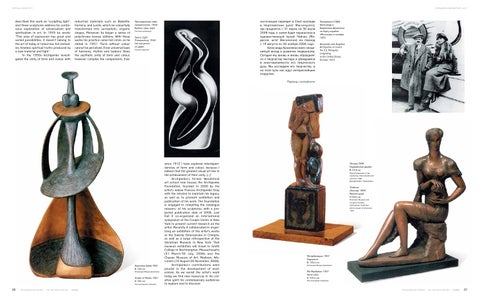
Пространство, свет, прозрачность. 1948 Бумага, тушь, перо Частная коллекция
Space, Light, Transparency. 1948 Ink and pencil on paper Private Collection
Эмиграция в США: Александр и Анджелика Архипенко на борту корабля «Монголия» в октябре 1923 Alexander and Angelica Archipenko on board the S.S. Mongolia, emigrating to the United States, October 1923
Перевод с английского
Королева Шеба.1961 В. 165 см Коллекция Фонда Архипенко
Queen of Sheba. 1961 H 165 cm The Archipenko Collection
66
ТРЕТЬЯКОВСКАЯ ГАЛЕРЕЯ / THE TRETYAKOV GALLERY / #2’2006
since 1912 I have explored interdependencies of form and colour, because I believe that the greatest visual art lies in the achievement of their unity. (…)” Archipenko’s former Woodstock art school now houses the Archipenko Foundation, founded in 2000 by the artist’s widow Frances Archipenko Gray with the mission to maintain his legacy, as well as to promote exhibition and publication of his work. The Foundation is engaged in compiling the catalogue raisonné of his sculptures, with a projected publication date of 2008. Last Fall it co-organized an international symposium at the Cooper Union in New York to present current research on the artist. Recently it collaborated in organizing an exhibition of the artist’s works at the Galerie Gmurzynska in Cologne, as well as a large retrospective at the Ukrainian Museum in New York. That museum exhibition will travel to Smith College in Northampton, Massachusetts (31 March-30 July, 2006) and the Chazen Museum of Art, Madison, Wisconsin (19 August-26 November, 2006). Archipenko's contributions were pivotal in the development of modernism. As we revisit the artist's work today we find new resources in his creative spirit for contemporary audiences to explore and to discover.
Печаль.1909 Окрашенное дерево В. 22,6 см Музей Хиршхорн и Сад скульптур, Смитсониевский институт. США Дар Джозефа Г. Хиршхорна.
Tristesse (Sorrow). 1909 Painted wood H 22.6 cm Hirshhorn Museum and Sculpture Garden, Smithsonian Institution. Gift of Joseph H. Hirshhorn, 1972
Ма-медитация. 1937 Терракота В. 133,4 см Коллекция Фонда Архипенко
Ma Meditation. 1937 Terra-cotta H 133.4 cm The Archipenko Collection
ТРЕТЬЯКОВСКАЯ ГАЛЕРЕЯ / THE TRETYAKOV GALLERY / #2’2006
67