


SPRING 2023 Grass Isn’t Always Greener in Workers’ Compensation p 24 ‘Great Resignation’ Spurs Spike in M&A Activity p 2 Doing business in the Canadian Province of Quebec p 10 Counselor or Indemnitor? Are Attorneys Responsible for Indemnifying Clients for Any Fallout they Face? p 8 Takeaways from Foreign Corrupt Practices Act Enforcement Actions in 2022 P 6 z
When
Ladder collapsed?
Base of the ladder slipped?
Analysis determined that the worker overreached, causing the ladder to become unstable and fall.

it comes to workplace incidents, our team of industrial hygienists, biomechanists, and Imaging Sciences visualization specialists provide an unparalleled ability to dig beyond the conjecture and speculation to find and convey the truth like no one else.
Broken rung?
Improper set-up?
2023 800.782.6851 SEAlimited.com Since 1970 Know. SUBMIT AN ASSIGNMENT Forensic Engineering, Investigation and Analysis
Partner USLAW NETWORK Inc. since 2004.
©
Proud
FEATURES:
‘Great Resignation’ Spurs Spike in M&A Activity
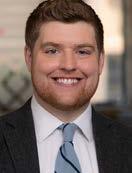
By Avi Sinensky • Rivkin Radler LLP
Takeaways from Foreign Corrupt Practices Act Enforcement Actions in 2022
page 2
Will Birds of a Feather Flock Together? Implications of Juror-Litigant Similarity for Your Defense Strategy
By
Lauren Iannaccone
• Connell Foley LLP page 6 Counselor or Indemnitor? Are Attorneys Responsible for Indemnifying Clients for Any Fallout they Face?
By Peter T. DeMasters, Morgan E. Villers, and Michelle K. Schaller
Flaherty Sensabaugh Bonasso PLLC page 8
Doing business in the Canadian Province of Quebec: What is Bill 96 and what you need to know about amendments to the Charter of the French Language
By Caroline Guy • Therrien Couture Joli-Coeur LLP
Self-Critical Analysis Without Fear of Reprisal: Taking Advantage of Increased Privilege Protections Under Federal Law
By
By Alex Jay, Ph.D. • IMS Consulting & Expert Services page 20 New European product liability and AI liability rules on the way
By Daan K. Baas, Wim C.T. Weterings & Jonathan S. Overes • Dirkzwager page 22
Grass Isn’t Always Greener in Workers’ Compensation
By Albert B. Randall, Jr. and Samantha Schilling • Franklin & Prokopik, P.C. page 24
Defense Weapons in a Nuclear World
By Alison H. Sausaman and Thomas S. Thornton, III • Carr Allison page 26
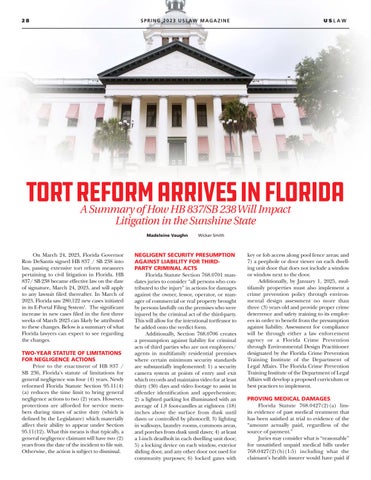
TORT REFORM ARRIVES IN FLORIDA: A Summary of How
HB 837/SB 238 Will Impact Litigation in the Sunshine State
page 10
By: Madeleine Vaughn • Wicker Smith page 28
Reality Capture and Forensics: Advancements In Technology and Spatial Analysis
By John Swanson • S-E-A page 30
Jeffrey Hendrickson • Pierce Couch Hendrickson Baysinger & Green, L.L.P. page 12
The Trick to Rule 30(b)(6): Avoiding a Never-Ending Series of Depositions

By Benjamin W. Kuhlmann • Laffey, Leitner & Goode LLC page 14
The I-Do’s and I-Don’ts of Risk Limitation for Wedding Venues
By Erica Spurlock and Michael Halvorson • Jones, Skelton & Hochuli, PLC page 16 Almost 50 Years Later, MICRA is Amended
By Len Blonder • Arcadia Settlements Group. page 18
DEPARTMENTS:
The European Mobility Directive, a Dutch legal and tax perspective
By Karen Verkerk and Dennis Nijssen • Dirkzwager. page 32 Liability of Internet Applications for Content Posted by Third Parties on Their Virtual Platforms
By João Carlos Zanon and Thiago Silveira Antunes • Mundie e Advogados page 34
The articles contained herein are for informational purposes only and are not intended to be the basis for decisions in specific situations nor a substitute for legal counsel. Copyright © 2023 USLAW NETWORK, Inc. All rights reserved. From the Chair .......................................................... page 1 faces of uslaw.......................................................... page 36 firms on the move..................................................... page 41 Successful verdicts & transactions ........................ page 43 diversity, equity and inclusion .............................. page 47 pro bono Spotlight ................................................. page 48 About USLAW ............................................................ page 51 USLAW NETWORK SourceBook ..................................... page 53 uslaw member firm listings ..................................... page 56 Spotlight on Corporate Partners............................ page 68
table of contents
SPRING 2023
www.uslaw.org
At Arcadia, our passion for empowering people is at the heart of everything we do. Our knowledge helps resolve conflicts, reduce litigation expenses and create long-term financial security for people involved in personal injury claims — helping settle over 500,000 claims, and positively impacting the lives of those we serve. Over 1,000 clients rely on Arcadia; we invest significantly in the development of innovative products and security tools that make doing business with us easier, and helping your clients settle more cases, faster.
• Licensed in all 50 states & Canada
• Experienced settlement consultants

• Lifetime payments & tax-advantaged income
• Spendthrift protection using a myriad of settlement tools
Visit teamarcadia.com | call 810.376.2097
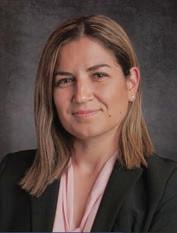
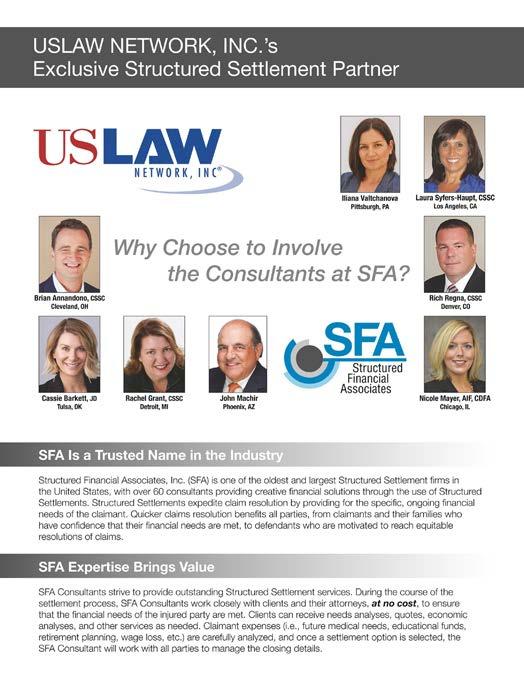 Rachel Grant, CSSC Detroit, MI
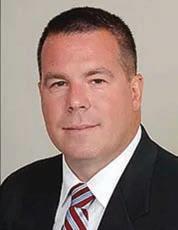
Rich Regna, CSSC Denver, CO
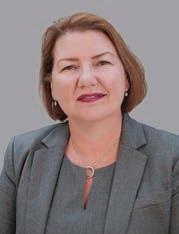
Iliana Valtchanova Pittsburgh, PA
Len Blonder Los Angeles, CA
Rachel Grant, CSSC Detroit, MI
Rich Regna, CSSC Denver, CO
Iliana Valtchanova Pittsburgh, PA
Len Blonder Los Angeles, CA
Our humanistic approach leads to better settlements for your clients.
from the Chair’s Desk
As we witness daily the ever-evolving world of tech, cybersecurity, crossborder business, cannabis, online retail, AI and more, USLAW members inspire thoughtful discussions to propel business forward while helping prepare legal decision-makers for changes that may take place within an industry or a given jurisdiction. I am immensely proud to be a member of USLAW NETWORK, where we build on a 20-plus-year tradition of working collaboratively to address many of the latest changes in our specialties and deliver resources and legal counsel where needed.
USLAW Magazine is among the many complimentary resources we offer.
Written by USLAW members and our exclusive corporate partners who are leaders in their disciplines, USLAW Magazine is produced to address legal and business issues facing our clients. This issue addresses the Patient Safety and Quality Improvement Act, M&As, “reality capture” and digital 3D replicas, liability risks in special events, workers’ compensation, tort reform, nuclear verdicts, and much more. From transportation and logistics to labor and employment or complex tort and product liability and numerous other practice areas, our attorneys and industry leaders address real-world matters impacting legal and business leaders daily.
USLAW Magazine also highlights the best part of USLAW – the people. USLAW is rooted in trusted relationships and friendships, and as you read the firms on the move, pro bono, DEI, faces of USLAW, and trial successes sections, you will see the excellent work our members are doing. They are making a positive impact in the courtroom and community alike.
As you enjoy this latest issue, please stay connected with us. Let us know how we can help you with your USLAW connection. If you need a resource or a referral, please call us. If you want to learn more about our members and corporate partners, please visit uslaw.org or connect with us on LinkedIn. Thanks for your continued support of USLAW and our member firms, and I hope to see you at a USLAW or industry event soon.
Sincerely,
Amanda Pennington Ketchum
USLAW NETWORK Chair Dysart Taylor | Kansas City, MO
Publisher RogeR M. Yaffe
Editor Connie Wilson
Art Director Jeff fReibeRT • Compass Creative
BOARD OF DIRECTORS
aManda P. KeTChuM, ChaiR Dysart Taylor, Kansas City, MO
osCaR J. Cabanas, ViCe ChaiR Wicker Smith, Miami, FL
KenneTh b. WingaTe, seCReTaRY/TReasuReR Sweeny, Wingate & Barrow, P.A., Columbia, SC
TaMaRa b gooReViTz, MeMbeRshiP ManageMenT diReCToR Franklin & Prokopik, P.C., Baltimore, MD
ThoMas s. ThoRnTon, iii, ClienT liaison diReCToR Carr Allison, Birmingham AL
JennifeR d. TRiCKeR, assisTanT TReasuReR Baird Holm LLP, Omaha, NE

bRadleY a. WRighT, PRaCTiCe gRouP liaison Roetzel & Andress, Cleveland, OH
RodneY l uMbeRgeR, iMMediaTe PasT ChaiR Williams Kastner, Seattle, WA
dan l longo, ChaiR eMeRiTus Murchison & Cumming LLP, Los Angeles, CA
KeVin l fRiTz, ChaiR eMeRiTus Lashly & Baer, P.C., St. Louis, MO
baRbaRa baRRon MehaffyWeber Houston, TX
douglas W. ClaRKe
Therrien Couture Joli-Coeur
Montreal, Quebec, Canada
KeelY e duKe Duke Evett, PLLC Boise, ID
sTanfoRd P. fiTTs
Strong & Hanni, PC Salt Lake City UT
JessiCa l. fulleR Lewis Roca
Denver, CO
eaRl W. housTon, ii
Martin, Tate, Morrow & Marston, P.C.
Memphis, TN
MeRTon a hoWaRd
Hanson Bridgett LLP
San Francisco, CA
MiChael a ludWig
Jones, Skelton & Hochuli, P.L.C. Phoenix, AZ
RobYn f. MCgRaTh Sweeney & Sheehan, P.C. Philadelphia, PA
JeffReY l o’haRa Connell Foley LLP
Roseland, NJ
laRRY a sCheChTMan Amundsen Davis LLC Chicago, IL
fRedeRiCK M. heiseR
Future USLAW Leaders Representative Klinedinst PC Irvine, CA
MiChael C. TYson Diversity Council Representative Wicker Smith Orlando, FL
KaRen a. VeRKeRK
TELFA Representative Dirkzwager Arnhem, Netherlands
leW R. C. bRiCKeR, Chair eMerituS Amundsen Davis LLC, Chicago, IL
John d. CRoMie, Chair eMerituS Connell Foley LLP, Roseland, NJ
ThoMas l oliVeR, ii, Chair eMerituS Carr Allison, Birmingham, AL
®
RogeR M. Yaffe, Chief exeCutive OffiCer roger@uslaw.org
®
CheRYl hanleY, PraCtiCe GrOuP, SPeCial PrOjeCtS, and COrPOrate Partner direCtOr cheryl@uslaw.org
JennifeR Randall, MeMberShiP ServiCeS ManaGer jennifer@uslaw.org
Paige ThoMPson, MeMberShiP ServiCeS COOrdinatOr paige@uslaw.org
Connie Wilson, COMMuniCatiOnS SPeCialiSt connie@uslaw.org
uslaw.org • Phone/Fax 800.231.9110
US LAW www.uslaw.org 1
www.uslaw.org
‘Great Resignation’ Spurs Spike in M&A Activity
Any analysis of the economic impacts of the COVID-19 pandemic and the period that followed would be certain to place the so-called “Great Resignation” at its center. The much-discussed phenomenon refers to the unusually high number of U.S. employees who left their jobs during the years 2020-2022. Many factors have been cited to explain the Great Resignation, including burnout, pandemic-related health and safety concerns, and a reevaluation of personal and professional priorities.
The time period in question also
overlapped with a high-water mark in the domestic mergers and acquisition (M&A) market, setting historical records for M&A transactions both by deal size and volume. According to a study by the Institute for Mergers, Acquisitions and Alliances, calendar year 2021 saw the closing of nearly 60,000 merger and acquisition transactions, with an aggregate purchase price of over $5 trillion, both of which shattered previous records. But what, if anything, is the connection between the Great Resignation and the spike in M&A activity that followed, and
what does it portend for the future? Was this phenomenon an aberrant blip during an unprecedented time, or does it offer us any lessons of trends we can expect going forward?
To be sure, global macroeconomic conditions play a vital role in explaining the rise in M&A activity in 2020-22. Central banks around the world moved to lower interest rates to near-zero levels to buoy their economies during the pandemic. The lower prices to borrow offered strategic companies in acquisition mode and
2 SPRING 2023 USLAW MAGAZINE US LAW
Avi Sinensky Rivkin Radler LLP
financial investors unprecedented access to cheap capital that made it much easier to finance M&A transactions, leading to an increase in deal-making.
Likewise, the economic uncertainty caused by the pandemic led many companies to reassess their business models and strategies. Some companies found it difficult to operate in the new normal and some saw a decline in their business due to reduced demand. Mergers and acquisitions offered an opportunity for companies to reposition themselves in the market, diversify their offerings, and gain access to new markets and technologies.
But those economic fundamentals only explain half of the puzzle: the demand side. To understand the supply side, we need to talk about the Baby Boomers.
The Baby Boomers, the generation of Americans born between 1946 and 1964, had the dual fortunes of both being born during the mid-20th century baby boom that made it one of the largest generations in history and also coming of age during the historic post-war economic expansion. Known for their hatred of smartphones and love of The Beatles, the Baby Boomer generation enjoyed the greatest accumulation of wealth in American history, and its investment in private business ownership played a crucial role in that success story.
According to the U.S. Census Bureau, Boomers owned 2.34 million small businesses in the United States on the eve of the pandemic, employing more than 25 million people. Managing a business during COVID-19 proved to be an arduous ordeal for many business owners, who were forced to balance company productivity with employee health while reckoning with the new normal of Zoom meetings and remote work. As the pandemic dragged on, fatigue set in for many business owners who, left without a succession plan, decided it was time to sell. With the stock market at an all-time high and interest rates at historic lows, many Baby Boomer business owners took advantage of the opportunity to cash out under favorable market conditions.
The Baby Boomer phenomenon is by no means the sole cause of the M&A spike during the pandemic, nor is it even the only cause with a direct link to the Great Resignation. With so many employees leaving their jobs and unemployment rates receding throughout 2021, companies found it increasingly difficult to attract top talent through traditional recruiting efforts. By acquiring companies with talented employees, companies could bypass the recruiting process and bring in a group of experienced workers all at once. Acquiring talent
through M&A is not a new concept, as many companies have been using the strategy for years. However, during the Great Resignation, companies began to pursue M&A more aggressively as a way to acquire top talent. For some companies, acquisition became their primary method of adding workers.
According to research firm Mergermarket, after a collapse in the second quarter of 2020 (when the shelter-inplace order had just been implemented nationwide and uncertainty abounded), the M&A market saw a 33% increase in deal volume and a 140% increase in deal value in Q3 over Q2. The frenetic pace of M&A transactions continued well into 2021 and even the first half of 2022 before it finally crescendoed in Q3 and Q4 of 2022.
W hile some observers have seized upon the precipitous decline in M&A activity from 2020-21 levels to declare that the M&A market is in recession, the truth of the situation is more nuanced. There is no question that the market has receded from its 2021 apex (and with it, its historic valuations, multiples and deal prices) and there are good reasons for that. The macroeconomic conditions that made closing deals during the pandemic like running downhill have abated. Instead, once-in-a-generation inflation has caused widespread economic uncertainty. To make matters worse, rising interest rates have significantly increased the cost of capital needed to finance acquisitions. In addition, increased antitrust scrutiny from the Biden Justice Department has slowed (and in some cases, completely halted) a number of blockbuster transactions with deal prices in the tens of billions. The overall number of megadeals decreased, with only six $25 billion-plus deals and thirty $10 billion-plus deals announced in 2022, compared to 10 and 53, respectively, during 2021.
Still, there are many reasons to be optimistic about where the M&A market is headed, particularly for middle-market transactions that are less likely to be the subject of merger enforcement by the DOJ Antitrust Division. If one were to simply remove the two-year period between Summer 2020 to Summer 2022 from a graph of domestic M&A volume, what one would see would be most similar to a steady upward trajectory. According to the Harvard Law School Forum on Corporate Governance, 2022 ended with a total deal volume of $3.6 trillion globally, down from the over $5 trillion we saw in 2021 but in line with the $3.5 trillion of volume in 2020 as well as with the trailing five-year average (excluding 2021). While M&A activity has clearly failed to con-
tinue at the historic, unsustainable rates of the pandemic, it has continued apace with pre-pandemic growth levels. In certain key sectors – technology, energy, business services and healthcare, to name a few examples – activity is burgeoning.
There are a number of factors that explain why the M&A bonanza has resumed even in the face of macroeconomic hurdles that are challenging, to say the least. Many well-positioned public companies now have balance sheets that are relatively strong compared to previous recessionary periods, which could help drive corporate acquisition activity despite an economic downturn. Similarly, private equity funds have continued raising massive amounts of cash from investors and find themselves with record amounts of uninvested capital to deploy. Both of these factors are likely to drive more M&A activity in 2023 and beyond despite turbulent debt financing markets.
But the most important factors may very well be those on the supply side that were at the heart of the 2021 M&A peak. While many Baby Boomers took the plunge and sold their businesses at the height of the market, a sizeable percentage held on to their companies and will be looking to close deals in the months and years to come. Similarly, while the labor market has normalized somewhat, unemployment has remained incredibly low, the hunger for top talent has prevailed, and talent acquisition via M&A continues to be a core corporate strategy.
According to a recent article in Forbes, the M&A forecast for the year ahead is split between two camps. Optimists expect the downturn in the global economy to be brief and shallow with a rapid acceleration in M&A activity as soon as Q2 of this year. The more pessimistic camp is predicting a longer, deeper recession that will delay the resurrection of the M&A boom until Q4 or even 2024. Either way, it is likely only a matter of time before M&A professionals find themselves buried in deal work yet again.
Avi Sinensky is a partner in Rivkin Radler’s Corporate Practice Group with a broadbased transactional practice. He has extensive experience advising business owners and investors on a wide variety of corporate transactions and corporate governance matters across a broad range of industries and throughout all stages of the business life cycle. He can be reached at avi.sinensky@rivkin. com.
US LAW SPRING 2023 USLAW MAGAZINE 3




Reduce Uncertainty BEFORE TRIAL When your client is involved in high-stakes litigation, you need to be certain your key themes, evidence, and testimony will resonate with jurors. Partner with our experienced team of jury research consultants to develop and test your strategy. IMS Is a Proud Corporate Partner of USLAW 877.838.8464 | contactus@expertservices.com Let’s build your best case: expertservices.com JURY CONSULTING | TRIAL PRESENTATION
Takeaways from Foreign Corrupt Practices Act Enforcement Actions in 2022
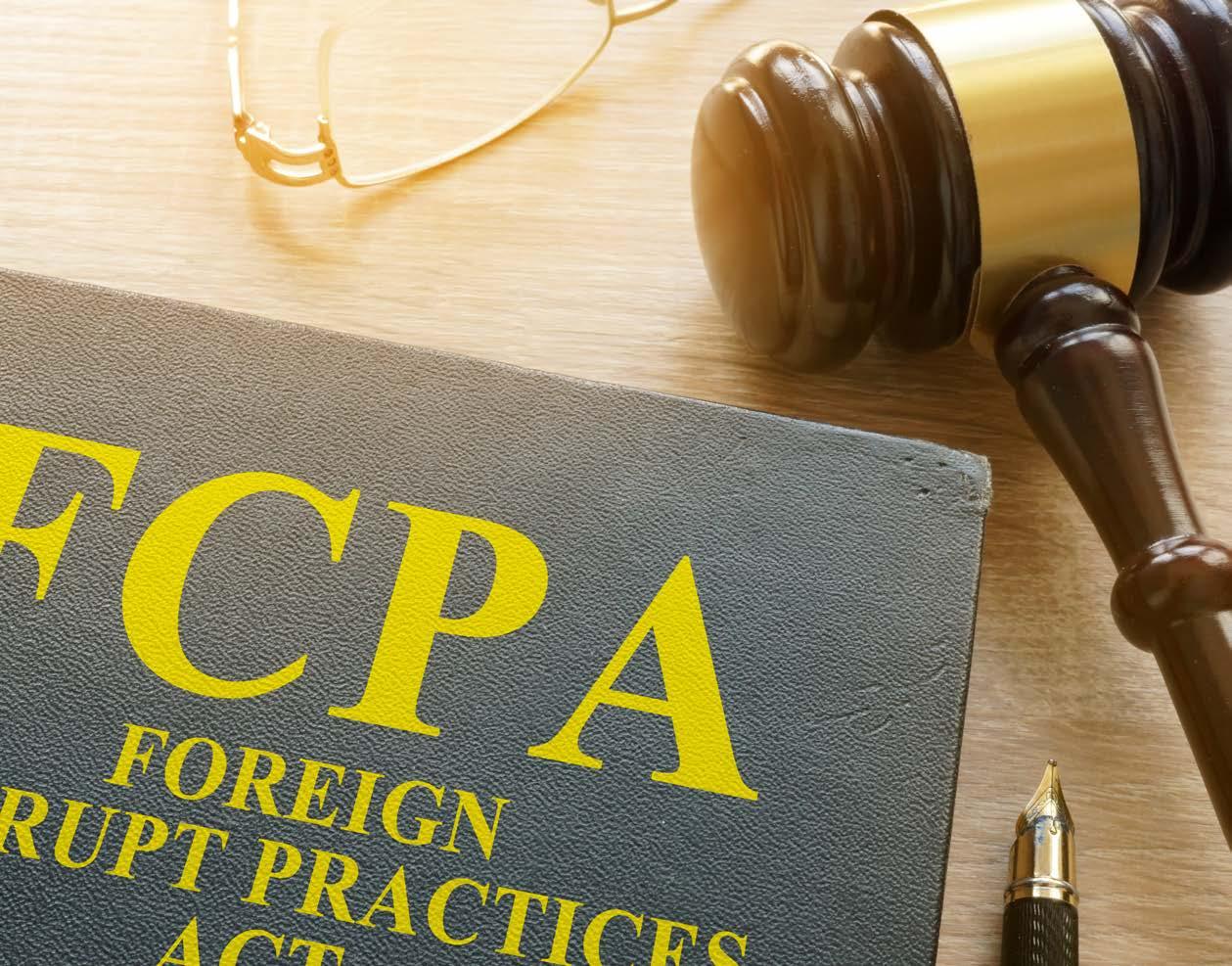
 Lauren Iannaccone and John Lacey Connell Foley LLP
6 SPRING 2023 USLAW MAGAZINE US LAW
Since 1977, the U.S. Securities and Exchange Commission (“SEC”) has led a crusade against companies gaining a business advantage by utilizing illegal business tactics, including bribery. The SEC can discipline offenders and take corrective action through the Foreign Corrupt Practices Act (“FCPA”), which generally prohibits companies and persons from offering, promising, authorizing, or paying money or anything of value, directly or indirectly, to a foreign official to obtain or retain business. The FCPA also mandates that public companies in the United States maintain accurate financial records and a system of internal accounting controls that, among other things, will reasonably detect and prevent improper payments to foreign officials.
Companies must beware that the FCPA’s penalties are draconian. Last year alone, the SEC’s enforcement of this critical statute led to more than $200 million in sanctions. This article will explore the 2022 top offenders and highlight some of the key FCPA provisions of which executives and counsel must be aware.
Under the FCPA, it is unlawful for companies to offer, promise to pay, pay, authorize payment, gift, give or authorize giving anything of value to “any foreign official” to, among other things, influence that foreign official in his or her official capacity, ask the foreign official to influence an act or decision. In short, companies cannot offer bribes or other incentives to secure a political, economic, or other advantage. In April 2022, a U.S.- based medical waste and document destruction company with more than 100 locations in the U.S. agreed to pay more than $28.2 million to resolve charges it allegedly bribed government customers in three foreign countries to obtain and maintain business. In this case, there were allegations that “sham third-party vendors” were created to hide payments through bogus invoices. Not surprisingly, the company also allegedly failed to implement the internal controls required under the FCPA to prevent such illegal payments to foreign officials.
The FCPA requires companies to devise and maintain a system of internal accounting controls that provide “reasonable assurances” that, among other things, transactions are authorized, and books and records show, with reasonable detail, these transactions. In February 2022, a technology company with a single office in Los Angeles, California, paid over $6.3 million to settle charges that it made improper payments in Korea and Vietnam. Of that amount, $3.5 million was for civil penalties, and $2.8 million was for the disgorgement of company profits. Once again, the SEC focused on the alleged lack of internal accounting controls concerning
charitable donations, third-party payments, executive bonuses, and gift-card purchases.
Modifying company books is also impermissible under the FCPA. Specifically, “no person shall knowingly circumvent or knowingly fail to implement a system of internal accounting controls or knowingly falsify any book, record, or account….” This past year, a global manufacturer and supplier of steel pipe products agreed to pay over $78 million to resolve charges that it allegedly violated this provision, among others.
Two years ago, the Supreme Court affirmed the SEC’s ability to disgorge company profits as a penalty, which was precisely what happened when an electric company allegedly violated anti-bribery, books and records, and internal accounting control sections of the FCPA. There, the company was required to pay a $75 million penalty, $58 million disgorgement, and $14.5 million in prejudgment interest.
Utilizing off-the-books funds for bribes is also not permitted under the FCPA. An American-based computer company headquartered in Austin, Texas, agreed to pay a $15 million penalty and $8 million in disgorgement for allegedly creating offthe-books slush funds. These funds were allegedly used to incentivize foreign officials to attend technology conferences. The payments violated the company’s anti-bribery policies and procedures, but this was not the company’s first FCPA violation. In 2012, the company was also required to pay FCPArelated penalties to resolve claims that it created millions of dollars in slush funds.
FCPA provisions need to be effective across all management and employee ranks. For example, a Brazil-based airline that offers flights to the United States was charged with bribing foreign officers in exchange for payroll tax and aviation fuel tax reductions. Here, the director of the company was allegedly involved. The company agreed to pay $70 million for alleged violations of the FCPA; the SEC agreed to reduce this penalty due to the company’s inability to pay.
A company’s best means to ensure compliance with the FCPA is to adopt comprehensive ethics and accounting policies specifically designed to prevent violations of the FCPA and similar anti-corruption laws in other jurisdictions (including the U.K. Bribery Act, which in some instances, has more stringent provisions than the FCPA).
Such policies should:
1) Have a stated goal to detect, prevent, and sanction violations of the FCPA. It should set forth the company’s obligations under the FCPA, as well as the significant penalties
the company will impose (up to and including immediate termination) for any violation of the FCPA or the company policies. It also should highlight the penalties the company itself could face for each FCPA violation.
2) Require the maintenance of accurate books and records to document, payments, gifts, entertainment, and other expenses and things of value given to third-parties.
3) Set an internal accounting procedure and protocol to detect, prevent, and stop any impermissible expenditures.
4) Identify a procedure for employee questions concerning whether an expenditure is appropriate.
5) Assemble a procedure for employees concerned that a violation of the FCPA did, or is about to, occur.
6) Make sure that the policy is applied equally to all employees, including company executives.
7) Identify red flags that employees are required to report.
8) Require that any contracts entered with, or in, a foreign country have an anti-bribery provision.
Last year, the SEC filed more than 16 enforcement actions. The message to executives and companies that conduct business internationally is simple: The privilege to conduct international business comes with an ethical obligation to ensure that such business does not promote corrupt business practices. There is still time to review or adopt appropriate company policies.
Lauren Iannaccone, Of Counsel, at Connell Foley LLP focuses her practice on commercial litigation and business disputes concerning shareholders, antitrust allegations, employer disputes and class actions. She litigates cases in federal and state courts.
John Lacey focuses on complex federal and state litigation matters, white collar criminal defense, internal and external corporate investigations, and the defense of individuals in governmental investigations. John is the Chair of Connell Foley’s White Collar Criminal Defense and Complex Litigation practices and a former president of the Association of the Federal Bar of New Jersey.
US LAW SPRING 2023 USLAW MAGAZINE 7
Counselor or Indemnitor?
Are Attorneys Responsible for Indemnifying Clients for Any Fallout they Face?

8 SPRING 2023 USLAW MAGAZINE US LAW
Peter T. DeMasters, Michelle K. Schaller, and Morgan E. Villers Flaherty Sensabaugh Bonasso PLLC
It is well known that when clients are dissatisfied with legal representation, they can file a malpractice suit against their attorney. But can an attorney be liable for more than malpractice? Depending on the court where they are sued, maybe. When a client is sued by someone over actions taken with or at the advice of counsel, the client may seek to hold their attorney liable for any harm they suffer as a result of that suit. When a client is liable to a third-party as a result of the advice that their attorney provided, does the client have an implied right to indemnification from the attorney? Courts in various jurisdictions have grappled with this issue, which has the potential to burden the attorney-client relationship and increase an attorney’s liability exposure.
Implied indemnity is a legal concept originating out of equitable considerations. Where there is a relationship between two parties, a court may, in certain circumstances, find that there is an implied right to indemnification where the parties don’t have a written indemnification agreement. An implied right of indemnity is often found in respondeat superior relationships, bailor/bailee relationships, and lessor/lessee relationships. The idea is that where a party in one of these relationships has been found liable and responsible for a monetary sum, fairness requires that the other party assume the burden of that liability by virtue of the relationship. For this reason, these types of relationships are sometimes referred to by courts as “special relationships.”
Does an attorney-client relationship result in one of these special legal relationships that would give rise to an implied right to indemnity?
The answer is the stereotypical lawyer’s response—it depends. Many states have not ruled on this exact issue. This is unsurprising, as legal malpractice claims are the standard remedy for problems resulting from legal representation. However, if a third party sues a client, the client may seek to hold the attorney liable for indemnification if the client is held liable to the third party.
Some courts have indicated that they consider an attorney-client relationship to be one of those relationships that could give rise to implied indemnity, at least on certain types of claims. See Nestle Purina Petcare Co. v. Blue Buffalo Co. Ltd., 181 F. Supp. 3d 618 (E.D. Mo. 2016); Amusement Indus., Inc. v. Stern, 693 F.Supp.2d 301 (S.D.N.Y. 2010); Schulson v. D’Ancona and Plfaum LLC, 821 N.E.2d 643 (Ill. App. Ct. 2004).
Other courts have determined that a typical attorney-client relationship, by itself,

does not give rise to an indemnitee-indemnitor relationship, but without foreclosing on the idea that such a special relationship could exist. In Rhode Island Depositors Economic Protection Corp. v. Hayes, 64 F.3d 22 (1st Cir. 1995), the court reviewed the issue of implied indemnity between a client and attorney and determined there was no evidence to substantiate a claim for implied indemnity because there was no evidence that the attorney agreed to indemnify its client. Nor was there any evidence that the relationship was anything more than an ordinary attorney-client relationship. Most importantly, however, the court did not foreclose the possibility that an implied right to indemnity could be found in such a relationship. The court simply found no evidence to establish it in that case. This indicates that in some situations, an attorney could be implicitly liable to their client for indemnity. Likewise, in Schulson v. D’Ancona and Plfaum LLC, 821 N.E.2d 643 (Ill. App. Ct. 2004), the court did not foreclose the possibility of implied indemnity on claims not relating to breach of contract. Still, with regard to breach of contract claims, the court held that an attorney who drafts a contract that is entered into between a client and a third party is a stranger to a contract and could not be held liable for his client’s breach of contract. In Fidelity National Title Insurance Company v. Radford, No. 7:15–cv–00018, 2015 WL 6958291 (W.D. Va. Nov. 10, 2015), the court examined a “typical” attorney-client relationship in a matter of purported wrongdoing by the attorney arising out of their work on a grant of easement. The court determined that the facts of that particular case did not lead it to find that the relationship was “unique or special enough” to give rise to an implied right of indemnification. In so finding, the court relied on holdings from other jurisdictions that general professional relationships with a simple contract do not constitute special relationships.
Some courts that have examined the issue in depth have noted the risks to the attorney-client relationship if an implied right to indemnity were to exist. For example, in Fladerer v. Needleman, 30 A.D. 371 (N.Y. App. Div. 1968), a third-party complaint was filed by a client against her lawyer for failing to discover a title defect. The appellate court rejected the implied indemnity claim between the client and the attorney. It explained that to hold otherwise would be akin to holding “that a lawyer in every case such as this becomes an insurer of the title, with no temporal limitation upon his liability; or, indeed, that every rendering of legal advice implies the advisor’s liability as
an indemnitor.”
With this in mind, attorneys and clients should establish their intentions at the outset of a matter and be clear about memorializing the scope of the representation in their representation agreement. Unless they want to become an indemnitor of their clients, attorneys should also be cognizant of their actions and not do anything to create a “special relationship” that goes above and beyond the typical attorney-client relationship. Unfortunately, even in the cases decided to date, no courts have been clear as to what those actions might be. Because each case seems to be factually driven and decided on a case-by-case basis, we have no clear guidance and are left to guess.
Peter T. DeMasters is Managing Member in the Morgantown, West Virginia, office of Flaherty Sensabaugh Bonasso PLLC. Pete has been practicing for more than 25 years and is head of Flaherty’s Transportation Practice Group. He concentrates his practice on the defense of transportation companies and construction litigation but has a varied practice in both state and federal courts. Pete may be reached at pdemasters@flahertylegal.com.
Michelle K. Schaller is an associate in Flaherty’s Morgantown office, where she is a member of the Commercial Litigation and Transportation Group. She has experience in federal and state courts in West Virginia in a variety of subjects ranging from criminal law and mediation to toxic torts and insurance. Michelle may be reached at mschaller@ flahertylegal.com.
Morgan E. Villers focuses her practice on professional malpractice defense, as well as commercial and general litigation. As a member of our healthcare law practice group, Morgan has defended an array of healthcare professionals and hospitals against medical professional liability claims. She has also defended attorneys and other professionals accused of malpractice or breach of contract in their fields. Morgan may be reached at mvillers@flahertylegal.com.

US LAW SPRING 2023 USLAW MAGAZINE 9
Doing business in the Canadian Province of Quebec: What is Bill 96 and what you need to know about amendments to the Charter of the French Language
Caroline Guy Therrien Couture Joli-Coeur LLP
Bill 96, adopted by the Quebec government on June 1, 2022, to combat the declining use of the French language in the province, has and will continue to have a significant impact on companies doing business in Quebec, as more of its provisions come into effect over a three-year period. This bill amends the Charter of the French Language (the “French Charter”), a law adopted in 1977 to protect the French language. The purpose of this short article is to present certain changes affecting Quebec businesses and to give you some insight into how to deal with them.
Bill 96 also affects other aspects that we will not address in this article, such as communications with the public administration, and the language of work and education.
CONTRACT OF ADHESION
As of June 1, 2023, most contracts pre-determined by one party (adhesion contracts), or contracts containing printed standard clauses used in Quebec (form contracts), will have to exist in French. It will no longer be sufficient to add a clause stating that the parties had agreed that the contract be drawn up in English, or in any other language.
With the reform of the French Charter, the parties to such a contract will only be bound by the version of the contract in another language after having been provided a copy of the French version. Thereafter, if the adhering party expressly requests to have the contract drafted in another language, then the contract and documents related to that contract may be exclusively in such other language.
While it is sometimes difficult to determine whether a contract is a contract of adhesion, generally, if the essential terms of the contract are non-negotiable, it will be considered a contract of adhesion. It should be note that exceptions apply for certain types of non-negotiated contracts, such as loan contracts, and contracts used “in dealings outside Quebec.”
For companies that enter into adhesion contracts with Quebec clients, it is necessary to have a French version of the contract available and to present that version first, thus ensuring that a contracting party’s express request to have the contract in another language. Examples include a franchisor located in the United States that has franchises in Quebec or a supplier that distributes its products in Quebec. In case of non-compliance, a fine can be imposed on the party that
10 SPRING 2023 USLAW MAGAZINE US LAW
drew up the contract, and more importantly, the contract may be declared null and void.
CUSTOMER SERVICE IN FRENCH
The right to be served in French in Quebec already exists, but since June of 2022, the French Charter specifies that businesses that offer goods and services to clients in Quebec (both consumers and non-consumers) must inform and serve them in French.
Businesses offering customer ser vice in Quebec must be able to inform their customers in French, whether in person, by telephone or via an Internet site, even for business-to-business services.
PUBLIC SIGNAGE AND COMMERCIAL ADVERTISING
The general rule is that public signs and commercial advertising in Quebec must be in French. Bilingual signage, in French and in another language, is permitted, provided that French is markedly predominant. Some exceptions exist, particularly with respect to trademarks. However, as of June 1, 2025, the exception will only apply if the non-French trademark is registered in Canada and provided that no corresponding French version appears on the Canadian trademark register.
Furthermore, if a public sign containing a trademark is visible from the exterior of a business, the trademark in a language other than French must be accompanied by words in French that are markedly predominant. For the French terms to be “markedly predominant,” they must have a much greater visual impact than the text in another language. This generally means that the French text must be twice as large or that the space allocated to the French text must be twice as large as that for the text in another language.
Since the Canadian Trademarks Office is experiencing a significant backlog of applications, we recommend that you file your applications for non-French trademarks without delay if you intend to use them in Canada, including Quebec.
INSCRIPTIONS ON LABELS AND PRODUCTS
The basic rule is that any inscription on a product, its container or its packaging must be written in French and may be accompanied by one or more translations. However, the text in another language must not prevail over the text in French. Since the assent of Bill 96 last June, the text in another language must not be accessible under more favorable conditions.
Until now, a trademark (registered
or not) was a recognized exception with regard to labels, and a trademark could be displayed on products regardless of its language. Beginning June 1, 2025, a nonFrench trademark must be translated if it is not registered in Canada. Furthermore, if a French version has been filed with the Canadian Intellectual Property Office, this version must be used.
This new provision is a topic of ongoing discussion. Although the French Charter only applies to Quebec, its impacts are Canada-wide. Indeed, trademark owners who sell their products in Canada generally use the same trademark and packaging in all provinces. Furthermore, distributors and wholesalers can sell in any province, and the goods can subsequently travel into Quebec.
The new legislation goes even further, by providing that if a registered trademark contains descriptive or generic terms such as “moisturizing soap” or “sugar-free” that are not in French, they must be translated. This rule is intended to prevent trademark owners from registering their trademarks with descriptive terms in another language to avoid the obligation to translate these terms. During the study of the bill, the example of the registered trademark SOFTSOAP was given. The SOFTSOAP registered mark is the design of a product label that contains descriptive elements such as “lavender and shea butter,” “refill 50 ounces” and “washes away bacteria.” The new legislation will ensure that these descriptive elements, that are part of registered trademarks, will have to be translated into French.
New regulations, which will contain more specific guidelines, will eventually be adopted by the government. The International Trademark Association (INTA) and the Intellectual Property Institute of Canada have built a coalition to work on different aspects of Bill 96 to ensure that the regulations being implemented consider brand owner’s interests.
The current delay to obtain a trademark registration in Canada is approximately two to three years. It is, therefore, high time for trademark owners to file their applications for non-French trademarks.
WEBSITE AND COMMERCIAL DOCUMENTS
The French Charter already provided that websites, and most commercial documents, must be written in French but may be accompanied by a translation. Under Bill 96, the French version must be accessible under at least equally favorable conditions. Websites aimed at Quebec customers must therefore be in French, and as of June 1, 2025, non-French trademarks displayed
on such websites must be translated if they are not registered in Canada, or if a corresponding French version of the mark has been filed, it must be used.
APPLICABLE SANCTIONS
Until now, the government organization tasked with oversight of the French Charter, the Office Québécois de la langue française (hereinafter “OQLF”), usually intervened only when an offending business had an establishment in Quebec. It is expected that with the amendments made, particularly with respect to product labeling, the OQLF will also intervene when a business located outside Quebec offers offending products or services in the province.
The fines for non-compliance are substantial, ranging from $700 to $30,000 for a first offense, and each day that the offense continues is considered a separate offense. It is also important to note that Bill 96 provides that directors of a corporation may be held personally liable if they commit an offense under the Act. They will be presumed to have committed the offense themselves if they are not able to demonstrate that they exercised due diligence. In addition, the OQLF will now be able to seek an injunction to ensure that the requirements of the French Charter are respected.
CONCLUSION
This article is only an over view of certain notable changes to the French Charter’s more commercial provisions. The regulations that will clarify the rules have not yet been adopted. Our team will be pleased to answer any questions you may have.
The content of this article is informational only and does not constitute legal advice.
The bill and its amendments are available here: https://m.assnat.qc.ca/en/ travaux-parlementaires/projets-loi/projet-loi-96-42-1.html
Caroline Guy is a Canadian attorney and a trademark agent at Therrien Couture Joli-Coeur LLP in Quebec, Canada. She has been working in the Intellectual property field for 20 years. Her practice is focused on trademark prosecution. She also represents her clients in trademark opposition and expungement proceedings. She is a member of the Intellectual Property Institute of Canada (IPIC), and of the International Trademark Association (INTA), where she currently sits on the Harmonization of Trademark Law and Practice committee.

US LAW SPRING 2023 USLAW MAGAZINE 11
Self-Critical Analysis Without Fear of Reprisal: Taking Advantage of Increased Privilege Protections Under Federal Law
Jeffrey Hendrickson Pierce Couch Hendrickson Baysinger & Green, L.L.P.
Increasingly, medical-malpractice defense attorneys encounter discovery requests seeking information that, at first glance, would appear to be covered by state-law privilege doctrines. One might reasonably assume that a request like “produce risk management and/or investigative files related to the patient’s care and treatment,” for example, would fall well within your state’s peer-review privilege, barring disclosure. After all, protecting things like these seems to make sense, if the goal of peer review is—as the Texas Supreme Court once put it—to “foster a
free, frank exchange among medical professionals about the professional competence of their peers” without the fear that the discussions later become evidence in a civil suit.

B ut one might be surprised. In Oklahoma, for example, items like “incident reports” or “other like documents” that concern “health care services being reviewed” are specifically excluded from the state’s definition of peer-review information. Similarly, in Nebraska, certain documents fall within the peer-review privilege only if they were created and main -
tained for exclusive use by a peer-review committee. And in New York, statements made by a defendant-provider at a peer-review meeting are, similarly in outcome, not covered by the privilege. These are but a few examples, and yes, protections vary from state to state, but what they show is that not everything designed to “foster a free, frank exchange” between healthcare practitioners about patient treatment stays under wraps when litigation comes calling. At least, that is the case when practitioners rely solely on their state’s law for protection. There is, however, another option.
12 SPRING 2023 USLAW MAGAZINE US LAW
THE PATIENT SAFETY QUALITY IMPROVEMENT ACT
In 2005, motivated by recent studies that suggested that medical providers, be they entities, physicians, or otherwise, were refraining from sharing information about medical errors for fear of reprisal via malpractice litigation, Congress passed the Patient Safety and Quality Improvement Act (PSQIA). 1 The PSQIA and its implementing regulations amended an existing federal law to create a national framework by which individual practitioners and healthcare entities can collect, submit, and learn from data regarding patient treatment and outcomes without fear of that information becoming discoverable in malpractice litigation.
Under the PSQIA, participating providers—which include individual providers as well as healthcare entities—can set up internal systems called “patient safety evaluation systems” (PSESs) to which providers submit treatment information, following which the facility transmits the collected data to federally certified institutions called patient safety organizations (PSOs). These PSOs, in turn, collect and analyze the provided information, compare similar cases among providers, identify broad statistical patterns, and then provide feedback and assistance to participating organizations, with the goal of improving patient care.
As the structure of this system suggests, the ultimate aim of the PSQIA was to create a national database of information crossing state lines, where one provider’s input from treatment rendered in Oregon, for example, could be used to educate a provider in South Carolina who was performing the same operation—cross-country collaboration that had never previously been achieved at scale. To encourage participation, Congress declared that any “data, reports, records, memoranda, analyses (such as root cause analyses), or written or oral statements” is, once submitted to an entity’s PSES, considered patient-safety work product (PSWP),2 and PSWP is privileged. Per the Act, PSWP “shall not” be admitted as evidence in any legal proceeding, or even subject to discovery in connection with any legal proceeding.
IMPACTS OF THE PSQIA
On its own, the PSQIA program would serve a limited role, arguably applying only to federal healthcare facilities and practitioners. It is, however, the language Congress chose to include regarding the law’s interpretation with, and effect on, other state and federal laws that gives it such bite. To wit, the PSQIA section discussing confidentiality for PSWP states, expressly, that “notwithstanding any other provision of Federal, State, or local law” patient safety work product shall be privileged and confidential and shall not be subject to discovery in connection with or admitted into evidence in a “Federal, State, or local civil, criminal, or administrative proceeding.” In other words, no contradictory provision of Federal, State, or local law—such as a more limited statelaw peer-review privilege—applies to require disclosure in any legal proceeding of information that is otherwise privileged under the PSQIA.3
It is these provisions that give the PSQIA such an impact. Many limits on state privilege law are not present in the PSQIA, especially when medical facilities seek to go above and beyond in performing internal, self-critical assessments of patient care. Incident reports that currently fall outside of protection in certain states, like my own of Oklahoma, would likely be privileged under the PSQIA if prepared for that purpose. Likewise, oral statements of a physician that might otherwise be discoverable would likely not be under the PSQIA if made for the purpose of submitting to a PSO. The point is, for an entity that is prepared to go through the lengthy process of establishing a PSES, engaging a relationship with a PSO, and undergoing the type of top-down compliance training so that all relevant staff are familiar with how the PSQIA system operates,4 the benefits are legion.
LIMITS ON THE PSQIA’S AMBIT
This is not to say that the PSQIA is the end-all be-all. Information that is required to be reported independently to other federal or state health agencies does not qualify as PSWP, even if also placed into a PSES. Moreover, some state appellate courts, no doubt concerned with what could be viewed as federal overreach in
an area typically confined to state control, have held that the PSQIA does not pre-empt state law in the area of peer-review privilege. The Florida Supreme Court, for example, ruled in 2017 that the PSQIA does not preempt a constitutional amendment to Florida’s constitution that gives patients the right to learn about information from adverse events. Several years earlier, in 2014, the Supreme Court of Kentucky likewise limited the PSQIA’s preemptive effect to information that is created exclusively as PSWP, and that it did not cover documents required by state law to be prepared and provided to an independent state agency.
These state-by-state considerations must be taken into account, but for the most part (aside from Florida), the limitations on the PSQIA’s preemptive effect are no different than the limitations of coverage already recognized by the Act (compare Kentucky’s decision that the PSQIA does not preempt state reporting requirements with the PSQIA regulations’ own acknowledgment that it does not apply to documents created for state-reporting requirements, for example). That said, given the benefit the PSQIA and its provisions confer on participating facilities, providers and entity administrators should strongly consider exploring the process involved in setting up a PSES and engaging with a PSO. That process is, to be fair, complicated, lengthy, and outside the scope of this article, but the benefits are wide-ranging. Not only does participation in the PSQIA provide access to a large database of interstate information on adverse events from other facilities that risk managers can use in assessing a facility’s own procedures, but it permits a facility to broaden the scope of its internal review processes to better allow the facility to review its own adverse incidents for the betterment of care down the road. And, practically, it expands a facility’s ability to maintain privileges over peer-review items. Everyone: facilities, physicians, providers, and patients, win in the long run.
US LAW SPRING 2023 USLAW MAGAZINE 13
Jeffrey C. Hendrickson is a partner at the USLAW firm of Pierce Couch Hendrickson Baysinger & Green, L.L.P., in Oklahoma City, Oklahoma. He practices primarily in the areas of medical malpractice defense and labor/employment defense.
1 42 U.S.C. § 299b-21 et seq.
2 See 42 U.S.C. § 299b-21(7).
3 See 42 U.S.C. § 299b-22(a)-(b).
4 This type of training is a must, as the PSQIA imposes a financial penalty on anyone who knowingly or recklessly discloses information that is considered patient-safety work product. See 42 U.S.C. § 299b-22(f)(1).
The Trick to Rule 30(b)(6)...
It’s never a good day when a thick subpoena lands on your desk – especially when it notices a deposition under Rule 30(b) (6) of the Federal Rules of Civil Procedure. Under the rule, a party to a lawsuit may depose a corporation, government agency, or other organization and require one or more representatives to speak on behalf of that organization about any and all topics listed in the notice. The problem that counsel and business leaders alike face in preparing for these depositions and their defense is that the topics involved are often as expansive as they are vague, especially if one is being dragged into a complex commercial case. As a result, the amount of knowledge required of a designee on each topic can be daunting, especially because under Rule 30(b)(6) the persons designated must testify about “information known or reasonably available to the organization.” This requirement means that “I don’t know” may not suffice as an answer by a designee if some part of the organization did, in fact, know the answer (or at least could have found it out.)
It might be tempting when reviewing a list of what could be thirty or more detailed and wide-ranging matters of examination in the deposition notice (there is no set limit) to take advantage of your organization’s expertise by designating any number of company employees to testify about the topics

they know the most about. Although you will certainly need to use these employee experts to learn the information necessary to prepare the eventual designee, designating more than one person runs into an important question that could be the difference between a day of depositions and a week of time, expense, and uncertainty: in cases where several designees are named, is the deposing attorney limited to seven total hours to depose all named designees, or are they allowed to depose each designee for up to seven hours?
THE SEVEN HOUR RULE
Surprisingly, under modern interpretation it is typically the latter. There is no doubt that having to prepare for several 7-hour depositions under a single 30(b) (6) deposition notice is not ideal – and in certain complex cases, counsel will not hesitate to use every minute of that time. So why would this somewhat unexpected use of the rule be allowed? In part, it stems from the language of 30(d)(1), which explains that “unless otherwise stipulated or ordered by the court, a deposition is limited to 1 day of 7 hours.” Because each 30(b)(6) designee is deposed separately, the logic goes that each designee’s deposition is considered “a” deposition that is entitled to a full seven hours, even under a single 30(b)(6) notice. This was not always the case, and the
advisory committee’s interpretation of Rule 30 has changed and expanded over time. The 1993 Advisory Committee Notes on Rule 30 discussed the limits on the number of depositions: “A deposition under Rule 30(b)(6) should, for purposes of this limit, be treated as a single deposition even though more than one person may be designated to testify.” Although this did not directly address the question raised above, it at least suggested that the 30(b)(6) deposition was generally considered to be singular for the purposes of Rule 30’s limitations. But, in 2000, the advisory committee provided more specific guidance, instead explaining: “For purposes of this durational limit, the deposition of each person designated under Rule 30(b)(6) should be considered a separate deposition.” Although there is some ambiguity in the text of the rule itself, the most recent advisory committee interpretation and most corresponding case law allows for a separate, seven-hour deposition for each named 30(b)(6) designee. Based on the still unchanged portion of the 1993 Advisory Committee Notes however, these depositions still count as a single deposition for the purposes of the ten-deposition limit expressed in Rule 30(a)(2)(A)(i). This means that the number of depositions under 30(b)(6) is potentially limitless – kept in check only by the number of designees you might choose to
14 SPRING 2023 USLAW MAGAZINE US LAW
Benjamin W. Kuhlmann Laffey, Leitner & Goode LLC
Avoiding a Never-Ending Series of Depositions
select. See Infernal Tech., LLC v. Epic Games, Inc., 339 F.R.D. 226, 230 (E.D.N.C. 2021).
But take note, courts are certainly not unanimous on the issue, and the preferences or interpretation of a specific judge might limit a 30(b)(6) deposition to seven total hours, regardless of the numbers of designees. See , e.g., E.E.O.C. v. The Vail Corp., No. 07-cv-02035-REB-KLM, 2008 WL 5104811, at *1 (D. Colo. Dec. 3, 2008). Nevertheless, a party with multiple designees could very likely be subject to numerous, lengthy depositions that strain company resources and employee patience if they do not take care to recognize this nuance of these rules.
SO WHAT CAN I DO ABOUT IT?
The first step should be (mostly) clear: choose fewer designees. Even if the notice you’ve received is in-depth, technical, or speaks to information no one person could possibly know, remember that a 30(b)(6) deposition is not a memory test. You’re allowed to prepare and bring binders or documents (though remember these can typically be reviewed by opposing counsel and even entered into evidence) and conduct extensive preparation sessions to ensure that the organization’s designee can speak on the topics intelligently. This preparation should be the result of conversations with the members of the organization who have the most expertise on the
respective topics in the notice, but these members should not necessarily be chosen as designees. In fact, a common and effective litigation strategy is to teach the 30(b)(6) topics to a designee who starts with limited or even no direct knowledge of the topics, so that they only know the exact information the organization has prepared and collected. Doing so means it is less likely a knowledgeable designee will add personal opinion, misstate the organization’s position, or speak on extraneous matters that can push the boundaries of the scope of the deposition.
But there’s another option, particularly if you prefer to have individuals speak to their own expertise, so long as you plan ahead: simply set limitations on the 30(b) (6) depositions in the discovery plan required under Rule 26. Rule 26(f) requires that parties meet and confer to create a discovery plan, which includes the parties’ agreement as to discovery scope and other related issues. Because Rule 30 allows for the duration or number of depositions to be changed by stipulation, and the 2000 Advisory Committee Notes label the seven-hour-per-designee rule as a presumption that can be extended or otherwise altered by agreement or court order, these issues can be easily be defined in advance by the parties. In many cases, particularly where both parties are organizations covered under the rule, neither party will want to
subject themselves to days of lengthy depositions, and the simplest place to stipulate to that objective is in the discovery plan. If you failed to account for the issue in the discovery plan, or were brought in as a third party, you can still try to seek agreement from the opposing party on the issue, or seek an order from the court to limit the number or duration of depositions for being unduly burdensome, or for any other relevant reason.

In sum, so long as you are aware of the nuance of the federal rules surrounding 30(b)(6) depositions and multiple designees (and have checked first with your local court and its particular rules), you can easily make tactical decisions to your advantage and in your interest. This preparation will protect you both from expense and from seeing the inside of a deposition conference room for any longer than you need to.
Benjamin W. Kuhlmann is a commercial litigation and franchise law attorney with Laffey, Leitner & Goode LLC in Milwaukee, Wisconsin. Ben’s practice runs the gamut of civil issues, specializing in advising businesses on legal problems and taking complex cases to trial. Contact Ben at bkuhlmann@llgmke.com.
US LAW SPRING 2023 USLAW MAGAZINE 15
Grandma Ginger tripping on the slightly elevated dance floor; DJ Denny’s disco lamp falling onto Aunt Linda; the bridal party’s bus rear-ending the cake delivery van – some liability risks associated with hosting a wedding or other special events are more straightforward, while others may be as sneaky as the groom’s ex-girlfriend planning her sabotage. When the glitz and glamor of the wedding wear off, the last thing that the venue, the vendors, or the bride and groom want to deal with is a hefty lawsuit. While it is impossible to truly inoculate wedding venues from liability, a well-prepared venue can certainly limit and reduce that risk.
O ne of the biggest risks associated with weddings comes from liquor. It comes as no surprise that wedding guests often over-indulge, which can sometimes lead to property damage, or even worse, injuries. In some states, traditional agency elements can be used to impute liability for liquor service under common law even if there are designated caterers or bartenders ‘handling’ the service of alcohol. If a venue exercises control over a bartending vendor,
The I-Do’s and I-Don’ts of Risk Limitation for Wedding Venues
Erica Spurlock and Michael Halvorson Jones, Skelton & Hochuli, PLC
profits specifically from the sale or service of liquor, or undertakes duties associated with liquor service, they could be jointly and severally liable for damages caused by a rogue guest either during or after the wedding. Actions as unassuming as allowing venue employees to assist in handing out champagne just for the toast, or as well-intentioned as having managers or dedicated security monitor guest behavior may lay the groundwork for an agency claim. Similarly, while most venues require the wedding party to use a separate liquor vendor for the reception, they may be hard-pressed to prevent bridesmaids from chugging mimosas while they do their hair and makeup in the bridal suite. Additional liability risk could be based on the simple act of providing a security guard to help discourage the craziness that seems to follow the nuptials. Many venues require site security to avert guests from climbing the twinkle-light-lined trees or to dissuade popular couples from sneaking in more guests than the maximum capacity. But what if Big Dave, the venue’s security guard, steps in to disrupt a fight between the bride’s father and stepfather?

Suddenly that venue faces vicarious liability for Big Dave’s fight-stopping techniques, and the training he received from his employer is now under the scrutiny of an aggressive plaintiffs’ attorney.
Intoxicated guests and well-meaning security guards aside, wedding venues may also play host to a litany of outside vendors and subcontractors. In fact, a number of different vendors may be involved in any one wedding to handle the delivery and installation of massive tents, bars, tables, lights, and dance floors, and individual vendors are often used to provide the drivers, laborers, waiters, bartenders, photographers, videographers, and DJs, who each may have their own equipment. Every personwhether the bride, guest, caterer, waiter or the videographer’s nephew Tommy who is just there to shlep around the equipment - poses risks to the venue for damage and injury to other entrants. Indeed, co-author Erica Spurlock recently spent the morning of her wedding preserving video and gathering names, DOT numbers, and insurance information after two delivery drivers overloaded a pallet with thousands of pounds of
16 SPRING 2023 USLAW MAGAZINE US LAW
sandbags before ramming it into her venue’s expensive security gate.
State law may vary slightly on what constitutes an invitee versus a licensee or trespasser, and the duties to each. But, generally speaking, a possessor of land is liable if they (1) knew or reasonably should have known of an unreasonable risk of harm that (2) they would not have expected guests to have discovered, yet (3) failed to exercise reasonable care in either warning the guest or rectify the risk. Restatement (Second) of Torts § 343 (1965). If My Little Wedding Venue knows that the wing-style leaves of the “Sweetheart Love” tables used by their preferred caterer regularly drop down without warning, but still allow those tables at their weddings, My Little Wedding Venue may have adopted the risk associated with those tables when a leaf suddenly falls and cracks Uncle Kramer’s knee caps.
In light of all the risks associated with hosting weddings, many venues have developed lengthy contracts that they require their wedding couples to sign. These often include provisions wherein the renting couple must agree to very broad indemnity agreements; ‘as-is’ provisions so that the couple must accept the venue with all its possible flaws and risks; and liquor agreements where the venue expressly denies liability for any liquor-related claims. While the validity of these contracts varies state by state, many are pulled from templates found on various websites. The renting couple generally has no bargaining power in the language of such agreements, which may be considered adhesion contacts, and such provisions may not comport with applicable state law. This, of course, could impact the enforceability of such contacts. Further still, while the newlywed couple may have been able to afford the most expensive orchids in their bouquets, the likelihood that they can cover the defense and indemnity costs associated with a significant personal injury claim is quite low. Homeowners’ and renters’ policies might apply, but nothing also screams “free advertising” quite like suing and bankrupting the beautiful influencer couple who just posted hundreds of pictures of your venue three months before.
To further insulate from risk, many venues will require separately insured and licensed bartenders to handle liquor service, and many will require all vendors to provide certificates of insurance. While this is certainly a recommended practice, as crafty plaintiffs’ attorneys look to agency and assumed duties to expand liability, the existence of a vendor’s insurance may still not
protect that venue in a worst-case scenario. The vendor’s liability insurer may also refuse a tender of defense demand if, for example, Big Dave, the venue’s security guard, roughly removes Aunt Phillis from the bar after too many signature cocktails. And what if the venue’s insurance policy has a liquor and/or an assault and battery exclusion? The venue could now be on the hook for all of the damages that ultimately resulted from Big Dave’s actions against Aunt Phillis.
All that risk aside, according to IBIS World Statistics, the wedding service industry market was worth more than $60 billion in 2022, and the average American wedding in 2022 cost $25-35,000. So what can a wedding venue (and those that insure wedding venues) really do to limit liability risks? Some practices, such as detailed contracts and insurance requirements of vendors remain strongly recommended, but with some tweaks.
• First, venues should seek legal counsel to create state-specific and venue-specific contracts that can be adjusted to fit the needs of each wedding. Such contracts should allow for some options and bargaining power with the renting couple. Perhaps the couple can specifically opt in or opt out of certain provisions in exchange for a higher rental cost, or allow them to sub-contract out certain aspects such as hiring their own security. The more these contracts constitute a bargained-for agreement, the more likely they are to influence a judge or jury tasked with upholding them.
• Second, venues should continue to require all vendors to provide proof of insurance, but the best practice would be to have vendors specifically name the venue as an additional insured on their policies. While this might increase the cost to the vendor slightly, for repeat or preferred vendor status it may be worth it to the vendor as well.
• Third, venues should require the renting couple to obtain and provide proof of a special event policy or proof that their homeowners or umbrella policies would apply to cover their indemnity agreements. These policies are relatively inexpensive compared to the cost of wedding venue rentals.
• Finally, if venue employees are used to help monitor guests, then such venues should look to
best practices of other industries in handling their training and documentation – specifically the restaurant and bar industries. Training employees regarding liquor service safety and event security; basic risk management; and documenting and preserving key evidence following an incident may be crucial in responding to a tragic claim. Maintaining detailed lists of all vendors for each event, including copies of their insurance certificates and lists of all the names of their employees on site for the length of that state’s statute of limitations, for example, quickly allows a venue to respond when facing a claim.
The hosting and throwing of weddings is a beautiful and lucrative industry, and one that does not exactly mirror the regulations, risks, or experiences of other industries. Champagne flows and dancing occurs, often in the highest heels that Grandma Ruth has worn in decades, and the risks associated with these gorgeous events are incalculable. With proper preparation, contracts, insurance, training, and record keeping, however, wedding venues can continue to offer fabulous events while still addressing and limiting their risk of liability.
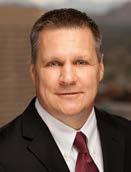
Mike Halvorson’s practice focuses on motor vehicle liability, product liability, dram shop and premises liability defense. He chairs the firm’s General Liability/Auto Trial Group, representing numerous auto and transportation insurers, product manufacturers, retailers, and distributors. He has successfully tried, arbitrated and mediated a wide variety of cases for more than 20 years, obtaining multiple defense verdicts.
Erica Spurlock focuses her litigation practice in the areas of automobile, commercial trucking, and other personal injury, wrongful death and general liability defense. Additionally, Erica represents healthcare providers involved in mental health cases, overseeing Court Ordered Treatment Plans, and other Title 36 matters. In her practice, she has obtained favorable outcomes for many of her clients through motion practice, settlement negotiations, arbitrations, and trials in state and federal court.

US LAW SPRING 2023 USLAW MAGAZINE 17
Almost 50 Years Later...
Recently, California Governor Newsom signed a bill amending the Medical Compensation Reform Act (MICRA), which addresses medical malpractice claims in California, the first changes made to MICRA since the act was passed in 1975. While this amendment didn’t capture the headlines, some had sought revisions for many decades. People representing both the defense and plaintiff sides in California medical malpractice law were able to reach an agreement before the issues made their way to California voters. The amendment to MICRA (called AB 35) will impact cases filed after January 1, 2023, and is likely to result in higher proceeds for people receiving medical malpractice verdicts and settlements and their attorneys. At the same time, AB 35 maintains caps on payouts, reducing the risk to insurers and medical professionals of potentially large payouts, allowing some comfort about the affordability of insurance and the protection of personal assets.
HISTORY OF MICRA
MICRA was enacted in California in 1975 during a period of soaring inflation and interest rates. The act was intended
to lower medical malpractice liability insurance premiums and payouts. Excited by the promise of increased protections, doctors and other healthcare professionals put their full support behind the legislation. MICRA changed the legal approach to medical malpractice cases by limiting non-economic damages to a maximum of $250,000 and scheduling plaintiff attorney fees based on the amount recovered.
The attorney’s fees were limited to the following:
• 40% of the first $50,000
• 33% of the next $50,000
• 25% of the next $500,000
• 15% of anything above $600,000
For plaintiffs, the act limited the dollar amounts they could recover in claims of medical negligence resulting in personal injury or death and made it harder to find lawyers willing to take their cases. Under MICRA, attorneys were less likely to pursue medical malpractice cases due to their limited earnings potential and the costs of pursuing cases; attorneys tended to take only “open and shut” cases. Cases that were particularly complex or likely to go to trial
were risky to plaintiffs’ lawyers for multiple reasons. First, the need to find and pay qualified experts to prove medical malpractice. Second, the tendency of juries to trust doctors’ expertise. Without legal teams with qualified medical malpractice experience to back them up, plaintiffs had little chance of winning in court. Despite opposition by many plaintiffs’ representatives, the courts and the legislature upheld MICRA for over 45 years until the signing of AB 35.
KEY CHANGES TO MICRA
MICRA previously capped all noneconomic damages at $250,000 and made no adjustment for inflation. AB 35 distinguishes between cases involving death and life-altering injury and amends the caps accordingly:
• In wrongful death cases, the cap is raised from $250,000 to $500,000, and the cap will increase by $50,000 every January 1 until the total payout cap reaches $1 million.
• If the injured person sur vives, the cap is now $350,000 and will increase by $40,000 every year until the total payout cap reaches $750,000.
In addition to the increase in the dam-
Len Blonder Arcadia Settlements Group
18 SPRING
USLAW
LAW
2023
MAGAZINE US
MICRA is Amended
age caps, the number of caps applicable in any single case is also increased. Under the original statute, only one cap was allowable, regardless of the number of defendants. Under the revised statute, plaintiffs are entitled to multiple caps when there are unaffiliated defendants.
AB 35 also makes inflation adjustment provisions for years to come. Beginning January 1, 2034, the applicable limitations on noneconomic damages will be adjusted for inflation on January 1 of each year by 2%.
ATTORNEY FEE LIMITS
Advocates for plaintiffs will credit AB 35 with making legal representation more accessible, due to the greater potential financial reward to plaintiffs and their lawyers. While plaintiffs’ attorneys’ fees are still limited to a percentage of the proceeds, the overall percentage will be higher on any case over $200,000. With greater potential reward, plaintiffs’ attorneys will likely take on clients whose cases would have otherwise gone unrepresented. AB 35 adjusts attorneys’ earning potential based on the stage of the case when damages are recovered.
The new attorneys’ fees limits are:
• 25% if the recover y happens before a civil complaint or request for trial is filed.
• 33% if the recover y happens after a civil complaint or request for trial is filed.
• A contingency fee greater than 33% if a case goes to trial and the plaintiffs’ attorney can substantiate a reason for a higher fee.
BEYOND THE CHANGES
An important provision of MICRA is maintained in the revised act with a slight modification. The mandatory nature of MICRA’s periodic payment statute at the request of either party can still be initiated when a judgment is at least $250,000 – an increase from $50,000. While this may seem like only a post-verdict issue, it offers opportunity for a strategic approach in the negotiation phase. Evaluation of economic damages, and now potentially non-economic damages, using structured settlement payments is especially valuable in cases in which plaintiffs have incurred life-long injuries, families have lost the support and wages of a family member, or it is sensible to schedule future payments for minors.
While the tax-free nature of a struc-
tured settlement is often its initial appeal, there are other advantages that are frequently overlooked. In catastrophic cases, medical underwriting can increase the benefits available to the injured party over their lifetime. Additionally, disagreements over a plaintiff’s life expectancy can be mitigated by utilizing a lifetime annuity, as payments cannot be outlived, removing the concern of early exhaustion of the settlement. A structured settlement consultant can work closely with the parties to craft payment streams that are designed to meet financial needs for as long as a lifetime.
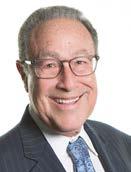
Len Blonder is vice chair and settlement consultant at Arcadia Settlements Group. He has more than 40 years of negotiation expertise, ranging from medical malpractice to product liability, and has helped resolve billions of dollars in claims. Serving an unprecedented three terms as president of the National Structured Settlements Trade Association, Len is respected for his efforts to preserve the tax-free benefits of structured settlements.
US LAW SPRING 2023 USLAW
19
MAGAZINE
Will Birds of a Feather Flock Together?

Implications of Juror-Litigant Similarity for Your Defense Strategy
By Alex Jay, Ph.D. IMS Consulting & Expert Services
As your trial date approaches, one lingering question inevitably moves to front of mind: What jurors do I want? Or, perhaps more accurately given the reality of the jury selection process: What jurors do I not want?
Litigators often encounter potential jurors with some similarity to one of the litigants, such as age, culture, interests/ hobbies, or relevant professional experience. We sometimes call these jurors “juror
knowledgeables,” as, depending on the relevance and extent of the similarity, their experience can elevate them into a persuasive position with the other jurors in deliberations. That is, their similarity can have a
20 SPRING
2023 USLAW MAGAZINE US LAW
tangible effect on the trial outcome.
While jurors can of course share similarities with both plaintiffs and defendants, for the purposes of this article, we will examine a somewhat common situation for corporate defendants—when jurors share a similarity with the defendant. In many instances, a defense attorney may perceive juror-defendant similarity to be a positive. Consider, for example, a medical malpractice case where healthcare providers at a hospital are accused of falling short of the standard of care. Defense counsel might reasonably assume that a healthcare-professional juror—say, a registered nurse—would be more favorable to their case; after all, such juror knowledgeables understand the rigors of being a healthcare provider and might more readily see the case from the defense’s perspective.
Although such assumptions about the implications of a juror’s similarity to the defendant are intuitively appealing, psychological research suggests they could be wrong. Indeed, relying on them wholesale during jury selection could lead to striking, or failing to strike, the wrong jurors. So, in a world where jurors with similarities often outnumber the strikes available to you, and cause challenges are far from guaranteed, it is crucial to determine if a juror knowledgeable is going to interpret the facts favorably.
But how do we know whether a juror similar to the defendant will be good or bad for the defense?
JUROR-DEFENDANT SIMILARITY DEPENDS ON THE PSYCHOLOGY OF THE JUROR
To assess the possible impact of juror-defendant similarity, the first step will be to determine whether a similarity exists in a meaningful way for the juror. We can start with a basic premise, Tajfel’s and Turner’s (1986) “Social Identity Theory” (SIT), wherein similarity to others is determined based on some shared, identifiable social group that has generally agreed-upon values and rules. Typical examples of social identities include social groups based on nationality or religion, but a person’s social identity is multi-faceted and can be comprised of any social group that is important to how they think about themselves, including their profession (Ashforth & Mael, 1989).
POTENTIAL BENEFITS OF JURORDEFENDANT SIMILARITY
According to SIT, because people are motivated to think of themselves in a more positive light relative to others, they are more likely to think of their in-group(s) more positively, too; their social identities are tied to their self-esteem. This desire for a positive
self-image means people are likely to have a positive in-group image and are more likely to react more favorably to in-group members. As it relates to juror decision-making, this bias is termed similarity-leniency (Kerr et al., 1995), and has been demonstrated in numerous studies where jurors are more lenient on criminal defendants who are similar to themselves (e.g., Devine & Caughlin, 2014; see also Jay et al., 2021). Similarity to a defendant can lead jurors to give in-group members a “pass” of sorts. That is, similar jurors might focus on the situational factors that could explain the defendant’s apparent transgressions, justifying and excusing the defendant’s behavior rather than deeming the alleged transgression to be evidence of a flawed character (Pettigrew, 1979).

The similarity-leniency effect suggests that a juror whose healthcare profession forms a part of their social identity might indeed be more favorable to a healthcare-provider defendant in a medical malpractice case. If only it were so simple.
POTENTIAL RISKS OF JURORDEFENDANT SIMILARITY
As one might expect, there is a limit to the potential benefits of juror-defendant similarity. Sharing a social identity can also make people, including jurors, react more negatively to “similar” others who have behaved badly. Because an individual’s self-esteem is partly dependent on maintaining a positive perception of their in-group(s), deviant in-group members can threaten that self-esteem by, put simply, making the whole group look bad.
When that happens, people are motivated to derogate or create distance from deviant in-group members—otherwise known as the “Black Sheep Effect,” (Marques et al., 1988; see also Santuzzi & Ruscher, 2006). This effect has been demonstrated in numerous studies that have found jurors are harsher on defendants who share a social identity compared to defendants who do not (e.g., PeterHagene, 2019).
Whether a juror is inclined to explain away a defendant’s alleged transgressions or judge them all the more harshly will depend in part on the nature and strength of the evidence relating to the transgression. One component of a shared in-group identity is that group members ascribe to a similar set of norms or rules that are unique or particular to the group. When an in-group member appears to violate a rule egregiously, the transgression is not as easily explained away. In our healthcare-professionals example, one such rule might be something like, “Do no harm to patients.” If the alleged deviation from the standard of care involves a reckless disregard
for patient safety, a healthcare-professional juror would react particularly negatively to create distance from the deviant in-group member. As evidence of that rule-breaking behavior grows stronger, our registered nurse juror’s in-group image—and thus their self-esteem—will be increasingly threatened in anticipation of discussing the defendant’s rule violation with other jurors in deliberations.
IMPLICATIONS FOR JURY SELECTION AND VOIR DIRE
Jury research, including qualitative and quantitative juror profiling, is the ideal way to assess how jurors with similarity to a litigant might interact with the fact pattern and parties of your case. If you do find yourself approaching trial and have not conducted jury research, keep in mind that it is dangerous to rely on intuition alone. At the least, counsel will want to talk to potential juror knowledgeables during voir dire to get a sense of the extent to which their perceived similarity might be relevant to their case judgments (i.e., if the shared element seems important to their personal identity). Following through with our med-mal example, attorneys might consider asking questions such as “What motivated you to become a healthcare professional?” or “How important is your profession to you?” or “Are most of your friends outside of work also healthcare professionals?” Paying attention not only to what jurors say in response, but how they say it, can aid this assessment.
Voir dire is also an opportunity to elucidate the types of “rules” that jurors with perceived similarity to the defendant hold near and dear to their hearts, and therefore to evaluate whether the bad facts of your case might be particularly offensive to these jurors. Hypotheticals like “If you hear about a doctor faced with a split-second decision to save a life, what more would you want to know?” can be one way to pursue this goal. That way, if counsel is unable to excuse these jurors for cause and is forced to use its peremptory strikes on more demonstrably worrisome jurors, it can make critical strategic adjustments in anticipation of a juror knowledgeable’s heightened sensitivity to bad facts.
Alex Jay, Ph.D. is an experimental social psychologist with expertise in jury decision-making and complex commercial litigation. As a jury consultant with IMS Consulting & Expert Services, Dr. Jay specializes in quantitative and qualitative jury research, witness preparation, theme development, juror profiling, and jury selection.
US LAW SPRING 2023 USLAW MAGAZINE 21
New European product liability and AI liability rules on the way

INTRODUCTION
N ew rules on product liability and liability for artificial intelligence (AI) are set to be introduced in the European Union (EU). On September 28, 2022, the European Commission – the executive body of the EU – proposed two new directives on these subjects. While EU directives are not directly applicable law, it is mandatory for the national legislators of the EU member states to incorporate the content of the directives in their national law.
One directive relates to the strict liability of manufacturers and other parties for damage as a result of defective products (COM(2022) 495 final). This proposal relates to the revision of a currently existing EU directive on product liability. The other directive relates to liability for damage caused by AI systems (COM(2022) 496 final). There is no such AI directive at present.
Although the two proposed directives have to be approved by the European Parliament and by the Council of Ministers and may yet be amended, the proposal of the two new directives means that liability law is likely to change significantly within the
EU in the near future. This new liability law will be of great importance for U.S. companies selling products within the EU market.
In this article, we will briefly discuss the content of the two new proposed directives and the consequences they will have for U.S. companies with a sales market in the EU, for example.

THE PROPOSAL FOR A NEW DIRECTIVE ON PRODUCT LIABILITY
In the EU, there has been a directive on product liability (85/374/EEC) since 1985. EU member states adapted their national product liability law in line with the standards in this directive. The European Commission now deems it the right time to improve this directive in order to promote legal certainty within the EU market and the legal protection of EU consumers. Four objectives are put forward in the proposal:
(1) To bring EU product liability law up to speed with the current “digital age” and “circular economy.”
(2) To have a liable company within the EU in the case of a defective product, even if the product is sold directly by manufacturers outside the EU.
(3) To ease the burden of proof for consumers in complex cases and relax restrictions on bringing actions.
(4) To improve alignment with modern EU legislation and codification of EU case law.
The core of this directive is that, in line with the current situation, any natural person who suffers damage due to a defective product is entitled to compensation. We will discuss some of the highlights of this new product liability directive.
First and foremost, it is important – naturally – that this product liability directive only relates to products. The scope of this term is broad and also includes medicines. In the new directive, it is explicitly made clear that it also covers electricity, software and digital manufacturing files. The latter relates to digital versions or a digital template of a movable that is used in 3D printing, for example. AI systems and software updates also come under this new definition of a product, even if they are integrated into another product. The term ‘product’ also covers digital services which are integrated into – or connected with – a product in such a way that the product is unable to fulfill its functions without them,
Daan K. Baas, Wim C.T. Weterings and Jonathan S. Overes Dirkzwager
22 SPRING 2023 USLAW MAGAZINE US LAW
such as the continuous provision of traffic data in a navigation system, for example. Secondly, it refers to strict liability for a defective product, which means that it is not required for the defendant to be at fault for causing the damage or defect. In principle, it is sufficient for liability that the product has a defect that caused damage. Even under the new directive, whether there is a defect remains a consideration based on all the circumstances of the case, which requires that the product does not provide the safety that the general public is entitled to expect. For products with AI systems, one of the things that will be relevant is the effect on the product of the ability to keep learning after it has been placed on the market or put into service.
Thirdly, product liability only relates to personal injury, property damage and the loss or corruption of data. This may also include objects or data that have been partly used professionally. The current minimum for property damage of at least EUR 500 will lapse, as well as the possibility for member states to limit liability.
Compared with the current directive, the new directive contains an expanded circle of liable persons. The liable party system is tiered. The basic principle is that the manufacturer of a defective product is liable and that if the product is defective on account of a defective component, the manufacturer thereof is also liable too. In the context of the circular economy, anyone who substantially modifies a product that has already been placed on the market or put into service is also going to be regarded as such a manufacturer, provided that the original manufacturer had no control over it. If the manufacturer is based outside the EU, the importer and the authorized representative of the manufacturer, such as a commercial agent, are regarded as liable parties. If that importer or authorized representative is not based in the EU either, the fulfillment service provider is regarded as the liable party. In short, the fulfillment service provider is the party that stored and packaged, addressed and dispatched the product. And if a fulfillment service provider cannot be designated either, it is the (online) distributor of the product that is liable unless they designate the party that delivered the product to them. Thus the new directive aims to ensure that there is always a liable party in the case of a defective product within the EU.
I n addition, the new directive provides the injured party with certain evidentiary benefits. In principle, the burden of proof with regard to the defect, damage and causal link rests with the injured party.
However, in certain cases, a product is deemed defective and/or the causal link to the damage is assumed. In addition, at the request of the injured party, a court may order the defendant to disclose relevant evidence in their possession.
This new directive will apply to products that are placed on the market or put into service at least 12 months after this directive comes into force. Within that period, EU member states will have to adapt their national law in line with this directive.
THE PROPOSAL FOR A DIRECTIVE ON LIABILITY FOR AI
At the same time as the new product liability directive, a directive was proposed regarding non-contractual liability for AI. The aim of this directive is to provide legal certainty and the same legal protection within the EU for damage as a result of using AI systems. The idea behind this is that AI systems are extremely complex, autonomous and opaque, which means that it is not always easy for an injured party to prove that the damage they have suffered was caused by the violation of a duty of care in relation to an AI system. This directive has been proposed in order to improve the position of an injured party in terms of information and proof. This directive does not provide a basis for liability itself but seeks to alleviate the problems of injured parties in terms of furnishing proof by providing a right to the disclosure of evidence and rebuttable presumptions of a violation of a duty of care and causal link.
This directive is linked to the proposal for an AI regulation currently under negotiation within the EU proposed by the European Commission in 2021 (COM(2021) 206 final). This regulation is going to bring rules that apply to AI in the field of human rights and health and safety within the EU. Violation of those rules may lead to delictual liability. This new directive relating to AI will help the position of parties claiming such liability in terms of information and proof.
First and foremost, the directive provides the option for a court – at the request of injured parties – to order the providers or users of a “high-risk” AI system to furnish evidence relating to the AI system which is suspected to have caused the damage. However, this is subject to several conditions, such as the claimant having to have done everything reasonably possible to obtain the relevant evidence from the defendant and a demonstration of the credibility of the claim for compensation. The court may order that certain evidence must be kept and will allow the disclosure thereof
only insofar as it is necessary and commensurate in support of a potential claim. If a trade secret were to be disclosed as a result, the court will have to take measures to ensure that confidentiality is maintained.
The directive also provides the option of a rebuttable presumption of a causal link between the fault of the defendant and the output generated by the AI system. This requires, among other things, the claimant to have demonstrated the fault of the defendant, namely that the defendant violated a duty of care and that the damage was caused by the output of the AI system. In the case of a “high-risk” AI system, a presumption is more likely to be accepted.
CONCLUSION
Both directives are still only at the proposal stage. However, they will mean that liability law changes significantly in countries within the EU in the near future. That will have legal consequences for U.S. companies selling products on the European market. It is therefore important to have an understanding of these product liability and AI liability directives and to take them into account now. Although amendments and minor changes are still possible, the main features seem to have been fixed already.
Daan K. Baas is a lawyer (partner) at Dirkzwager in Arnhem, the Netherlands. Daan is an experienced and acknowledged specialist in the field of insurance and liability and focuses on (the insuring of) directors’ and officers’ liability, professional liability and product liability.

Wim C.T. Weterings Ph.D. is a lawyer (salary partner) at Dirkzwager in Arnhem, the Netherlands. Wim is an experienced and acknowledged specialist in the field of insurance and liability and focuses on (the insuring of) directors’ and officers’ liability and product liability. He is also an associate professor of private and business law at Tilburg University.
Jonathan S. Overes is a professional support lawyer at Dirkzwager in Arnhem, the Netherlands. Jonathan is an experienced specialist in the field of insurance and liability and focuses on general liability insurance and property insurance.
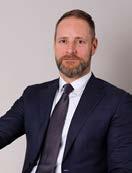
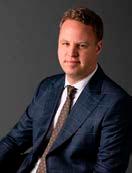
US LAW SPRING 2023 USLAW MAGAZINE 23
Grass Isn’t Always Greener in Workers’ Compensation
Thirty-seven states, as well as three territories and the District of Columbia, have enacted state legislation allowing for the medical use of cannabis (“medical marijuana”) by qualified individuals. Estimates reveal that nearly three million people
nationwide are enrolled in state medical marijuana programs. The most common conditions being treated by medical marijuana include chronic pain and post-traumatic stress disorder, conditions which are commonly diagnosed in reference to

work-related injuries.
In recent years, there has been a growing number of litigated cases involving the use of medical marijuana in the context of workers’ compensation claims. One specific issue which has emerged in workers’
Albert B. Randall, Jr. and Samantha Schilling Franklin & Prokopik, P.C.
24 SPRING 2023 USLAW MAGAZINE US LAW
compensation litigation is whether state workers’ compensation laws can compel an employer or insurer to reimburse an injured employee for the cost of medical marijuana. Of the 41 jurisdictions that have legalized the use of medical marijuana, as of the writing of this article, only 12 states have expressly addressed this issue of reimbursement through either a state court decision, legislation, or administrative rule. Of those 12 states, four have addressed the issue of reimbursement at their respective Supreme Court levels, with an even split between them regarding whether or not reimbursement of medical marijuana is preempted by federal law.
The preemption issue focuses on the fact that marijuana remains federally illegal, as it continues to be classified as a Schedule I drug in the Controlled Substances Act (“CSA”), and the debate rages on as to whether states have the ability to regulate the use of medical marijuana, particularly in the context of workers’ compensation reimbursement.
Parties who are against reimbursement argue that a judicial order compelling an employer to reimburse an employee’s purchase of medical marijuana would subject the employer to criminal liability for aiding and abetting the possession of marijuana under federal law. In light of this dichotomy, with medical marijuana being legal under state law, yet illegal federally, their position is that it would be impossible for an employer to comply with both federal and state law. Due to this conflict, and in accordance with the Supremacy Clause in the United States Constitution, a federal law with respect to the legality of marijuana, specifically the CSA, would preempt any state law mandating reimbursement for the purchase of medical marijuana.
On the other side of the argument, those who are of the opinion that reimbursement would not conflict with federal law, largely base their argument on Congress’s actions since 2015 involving appropriation riders. Since 2015, Congress has included provisions in their yearly appropriation acts that prohibit the United States Department of Justice from spending federal funds to prosecute persons who use medical marijuana consistent with their state laws. Therefore, it is argued that these actions by Congress demonstrate the federal government’s “purpose” to not interfere with the operation of state medical marijuana programs and workers’ compensation laws. Further, parties for reimbursement argue that employer’s actions of merely reimbursing for an employee’s past purchase of medical marijuana would not satisfy the intent required for aiding
and abetting under the CSA. To that end, parties argue that employers would not and could not be federally prosecuted for complying with an order requiring reimbursement of medical marijuana as authorized under a state law.
These arguments were recently presented to the Minnesota Supreme Court in the case of Musta v. Mendota Heights Dental Center, 965 N.W.2d 312 (2021). The Minnesota Supreme Court ultimately overturned a workers’ compensation order mandating the employer to reimburse the costs of the employee’s medical marijuana. The Court explained that requiring the employer to reimburse the costs of medical marijuana would, in fact, subject them to criminal liability for aiding and abetting the possession of marijuana under the CSA. Therefore, it would be impossible for the employer to comply with both federal and state law, so to that end, the Minnesota workers’ compensation law requiring reimbursement was preempted by federal law. Maine’s Supreme Court also has taken a similar stance on this issue, in that reimbursement of medical marijuana cannot be legally required.
By contrast, the New Hampshire and New Jersey Supreme Courts have held the opposite - that the CSA does not preempt state medical marijuana laws, so that employers can be legally ordered to reimburse injured employees for the cost of their medical marijuana. In light of this equal split among state Supreme Courts and the unpredictability of this issue among all other states with legalized medical marijuana, the United States Supreme Court was petitioned in November of 2021 to review and make a final decision on the matter. In June 2022, the United States Supreme Court declined to review the matter, whereby leaving us with this same ongoing uncertainty.
Unfortunately, the quandary doesn’t stop there. Not only can we expect to see more cases involving the use and reimbursement of medical marijuana in the context of workers’ compensation, but we can also anticipate issues arising in reference to the use and reimbursement of alternative medications which use the byproducts found in marijuana, such as medical cannabidiol (commonly known as “CBD”).
Earlier this year, in January 2023, the state of Maine’s Workers’ Compensation Board heard an appeal in the case Bourgoin v. Twin Rivers Paper Company, Case No. App. Div. 21-0022, Decision No. 23-2, State of Maine Workers’ Compensation Board (January 6, 2023), where an injured employee sought reimbursement for CBD gummies purchased from a medical mar-
ijuana retailer. In accordance with the state of Maine’s Supreme Court decision holding that reimbursement for medical marijuana was not required as marijuana remained federally illegal, the workers’ compensation administrative law judge determined that the employer, in this case, was also not required to reimburse the costs of purchasing CBD gummies. The administrative law judge explained that since the gummies had not been approved for use by the U.S. Food and Drug Administration and the retailer of the CBD gummies did not grow the products it sold, they were unable to verify whether the CBD gummies had less than .3% Tetrahydrocannabinol (“THC”), which would exempt it from prohibition under the CSA. As a result, reimbursement was not permitted as the injured worker did not meet the burden of proof.
As we await definitive medical research pertaining to the health benefits of medical marijuana while jurisdictions continue to pass, expand and interpret existing medical marijuana laws, the issue of reimbursement will, unfortunately, continue to plague employers, insurance companies, and their counsel. Until the United States Supreme Court decides to resolve this issue once and for all, or the federal government decides to either reschedule marijuana in the CSA or pass federal legislation allowing for the individual states to make the decision as to whether private parties can be required to reimburse the purchase of medical marijuana, we can expect continued litigation on this issue. For the vast majority of jurisdictions that do not have caselaw on this issue, employers and insurers are essentially left to roll the dice as to how their respective states will interpret these issues.
Bert Randall, President of Franklin & Prokopik, P.C., is a trial attorney concentrating in complex matters involving employment, tort liability and business litigation. He regularly represents companies in state and federal courts, and before state and federal administrative agencies.
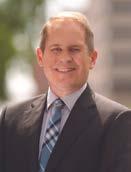
Samantha Schilling is an associate at Franklin & Prokopik, P.C. in Baltimore, Maryland. She is a member of the firm’s workers’ compensation and employers’ liability team.
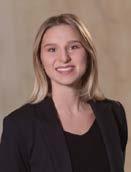
US LAW SPRING 2023 USLAW MAGAZINE 25
Defense Weapons in a Nuclear World
One of the most salient and intimidating topics plaguing the legal industry is the rise of “nuclear verdicts,” especially in personal injury cases. Most commentators attribute this recent increase in disproportionate verdicts to the following factors: plaintiffs’ personification of corporate clients as impersonal or inhumane, which is often compounded by strategic use of the reptile theory; exaggerated economic damages, due to letters of protection and third-party litigation funding; staggering and non-sensical non-economic awards; jury selection; general anger or bitterness due to the current economic, political, and cultural climate; and strategic use of law firm advertising as propaganda by normalizing and desensitizing the general public to high verdicts and settlements, while also educating them on the fact that insurance companies are the ones paying for such. While the availability of certain “weapons” in defendants’ arsenal depends on the jurisdiction, below are some potential “weapons” to use to defend against nuclear verdicts and “nuclear settlements.”
DEFENDANTS’ DEPOSITIONS
One of the most important ways to prevent a nuclear verdict is by preventing damaging testimony or “sound bites” from defendants. It is important to invest time and energy preparing not only the corporate representative but also employees, who
are equally (or more) vulnerable to reptilian attacks and can be easily cornered with questions about the company’s policies, values, or training as it relates to public safety. Savvy plaintiffs’ attorneys also elicit detrimental testimony from employees about being understaffed, lack of training, staff turn around, or other shortcomings due to difficulties faced by businesses during COVID (such as, “we were going to clean it up, but we were short-staffed because of COVID and couldn’t get to it”). These depositions are crucial to how the defendant will be portrayed at trial and plaintiffs will attempt to have the jury extrapolate based on such.
SPOLIATION OF EVIDENCE, MEDICAL EXAMINATIONS, AND PREVENTING SURPRISE SURGICAL RECOMMENDATIONS
At the outset of cases, defendants should send spoliation letters requesting to be notified if plaintiff intends to undergo surgical intervention and reserving the right to have a medical examination of plaintiff performed prior to such treatment. Similarly, defendants may want to request the following information in their initial interrogatories: whether any physician or medical professional has recommended that plaintiff undergo injections or surgery as a result of complaints or injuries from the subject incident, as well as who made the recommendation, and whether
the recommended treatment has been performed (and if not, why). If the plaintiff then proceeds with surgery prior to submitting to the examination, the defendant can, depending on the jurisdiction, move for sanctions for spoliation, arguing that a plaintiff who submits to non-emergency and non-life-threatening surgery prior to a court-ordered physical examination has destroyed or altered critical evidence. Additionally, this tactic also encourages plaintiffs’ attorneys to keep defendants apprised of new developments and can help prevent “surprise” surgeries and dramatic, unanticipated increases in case valuations. Additionally, neuropsychology examinations can be an extremely powerful tool in combatting against the resurgence of baseless traumatic brain injury claims. These examinations typically entail 6-8 hours of invasive, highly personal evaluation, and as a result, merely requesting the plaintiff undergo such an evaluation can sometimes dissuade a plaintiff from pursuing such a claim.
THIRD-PARTY LITIGATION FUNDING
While attempts to introduce federal legislation regarding litigation funding transparency have been unsuccessful to date, courts increasingly allow discovery regarding this information, albeit with great variability as to the permissible scope. Additionally, some federal courts are requiring automatic
 Alison H. Sausaman and Thomas S. Thornton, III Carr Allison
26 SPRING 2023 USLAW MAGAZINE US LAW
disclosure of litigation funding as part of parties’ initial disclosure requirements. Defendants should request such information by propounding discovery requests on plaintiffs, sending non-party subpoenas to the funding companies, and requesting depositions of the funding companies. In many states, defendants can search the state UCC website to ascertain whether the plaintiff has taken out a litigation loan, although there is significant variability in what information is available on such sites.
MITIGATION OF DAMAGES
In cases where plaintiffs have private insurance available and decline to use it, thereby amassing grossly exaggerated medical bills by treating under letters of protection, defendants should argue that plaintiffs have failed to mitigate their damages. This should be asserted as an affirmative defense. Defendants should also consider filing motions for summary judgment on this issue, which usually requires the deposition of a billing expert and/or evidence of what the charges would have been if plaintiff had mitigated his damages.
Alternatively, depending on the applicable collateral source rule, defendants can file affirmative motions in limine to admit evidence of plaintiff’s failure to mitigate. Some practitioners have successfully argued that the collateral source rule only prevents evidence of payments made for medical care; thus, it is inapplicable because no payments from a collateral source were made and therefore evidence of health insurance coverage is not barred. Defendants should attempt to expose the plaintiff’s nefarious intent in failing to submit his bills to his insurer and thereby knowingly failing to mitigate his damages to try to obtain a larger verdict.
DAMAGES AWARDS
Historically, defense practitioners have valued non-economic damages based on the economic damages, often using some type of ratio. At trial, plaintiffs are routinely asking for egregious non-economic damages awards based on a per diem or per hour rate of compensation. Plaintiffs will ask for a small, seemingly unoffensive hourly amount (such as minimum wage) to be attributed to every waking hour of plaintiffs’ life for the rest of their life span. This equates to roughly $50,000/year and easily translates into a multi-million-dollar non-economic damages award for younger plaintiffs (especially when coupled with a life care plan predicting a lifetime of pain management), even in cases with minimal treatment and low boardable economics. There is a clear psychological aspect to this strategic “lawyer math,” as plaintiffs spoonfeed the numbers to unsuspecting (and
often unsophisticated) juries in small palatable amounts that snowball into massive, disproportionate, illogical awards. Plaintiffs justify this by focusing on what was “taken” from the plaintiff as a result of the defendant’s negligence and asking for the “fair value” of what plaintiff lost (“he or she will experience some level of pain or discomfort every waking moment for the rest of his or her life”). Thus, it is not about the amount the plaintiff will be given, it is about what was “taken” from the plaintiff, which triggers the reptilian brain and fundamental concepts of fairness.
Defendants must be prepared to combat these tactics at trial in their closing arguments by delicately explaining to the jury what the plaintiff’s attorney is trying to accomplish without insulting or angering them. Additionally, defendants must anchor the jury and offer a more palatable alternative to a defense verdict. One such approach is to tell the jury that if they find the defendant at fault, they should award the plaintiff the cost of his initial ER visit, initial imaging, and initial chiropractic treatment or physical therapy. Similarly, an alternative, rational value should be offered for non-economics based on what has been “taken” from plaintiff. In sum, defendants should be prepared to give the jury a proposed number for both economic and non-economic damages and to offer some rationale for how they came up with that number. While this tactic may be seen as decreasing your likelihood of a defense verdict, or even inviting the jury to “split the baby” and award the midpoint of the two options it was presented with, this may be a risk worth taking to mitigate the potential for a nuclear verdict.
JURY SELECTION
Undoubtedly, the jury’s perception of the defendant’s corporate identity and the identity of the industry in which it operates has a significant impact on a verdict. During voir dire, careful inquiry should be made into the venire’s perceptions of the defendant company and its industry. Defendants should also be analyzing whether the COVID pandemic affected potential jurors’ perceptions of such.
Defendants should also use voir dire to identify jurors who are disproportionately angry or likely to “lash out.” If able, ask questions about the impact of COVID on the venire. For example, asking jurors to address whether they feel they were disproportionately impacted by COVID, or even using a numerical scale to define the level of perceived impact. It is important to delicately identify and isolate jurors who are “mad at the world” by engaging in a dialogue that empowers them to admit
that the burden and hardships in their life may preclude them from effectively serving, such that they may be stricken for cause.
Defendants should also file motions in limine to prevent plaintiffs from asking the jury, in voir dire or openings, to commit to a high damages award without being presented with the evidence.
CONCLUSION
As reflected above, the best defensive weapon against a “Nuclear Verdict” is to always approach and prepare a case for trial from the onset through every stage of discovery. Efforts which may be perceived as solely going through the motions to prepare a case for settlement would be like blood in the water for the Plaintiff’s Bar based upon the opportunity they may view being presented for a Nuclear Verdict. We must also make a concerted effort to identify early in the discovery process, appreciate and discuss the problems with our cases which may lead to an unexpected high damage award that exceeds any rational analysis or multiplier of damages. As once your case begins to slip down the potential nuclear verdict rabbit hole, it can be difficult to de-escalate the ensuing arms race.
Alison H. Sausaman is a shareholder in Carr Allison’s Jacksonville, Florida, office, where she practices in the areas of premises liability, retail and hospitality, transportation, and professional liability. Alison is admitted to practice in the state of Florida and before the United States District Court for the Middle and Northern Districts of Florida.
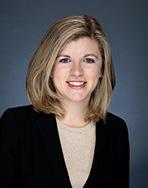
Thomas S. Thornton, III is a shareholder with Carr Allison and a resident in the firm’s Birmingham, Alabama, office where he serves as chair of the firm’s Retail and Hospitality Practice Group. He has focused his litigation practice on the defense of personal injury, premises liability, product liability, transportation, retaliatory discharge, general liability, as well as catastrophic workers’ compensation matters. Tommy also serves as National CMS Coordination Compliance Counsel for a number of his national business and insurance industry clients ensuring compliance with the Medicare Secondary Payer Act and Section 111 Reporting bringing strategic solutions to the forefront of the claims and litigation industry while increasing compliance and improving claim closure rates.
US LAW SPRING 2023 USLAW MAGAZINE 27
TORT REFORM ARRIVES IN FLORIDA
A Summary of How HB 837/SB 238 Will Impact Litigation in the Sunshine State
 Madeleine Vaughn Wicker Smith
On March 24, 2023, Florida Governor Ron DeSantis signed HB 837 / SB 238 into law, passing extensive tort reform measures pertaining to civil litigation in Florida. HB 837/ SB 238 became effective law on the date of signature, March 24, 2023, and will apply to any lawsuit filed thereafter. In March of 2023, Florida saw 280,122 new cases initiated in its E-Portal Filing System1. The significant increase in new cases filed in the first three weeks of March 2023 can likely be attributed to these changes. Below is a summary of what Florida lawyers can expect to see regarding the changes.
TWO-YEAR STATUTE OF LIMITATIONS FOR NEGLIGENCE ACTIONS
Prior to the enactment of HB 837 / SB 236, Florida’s statute of limitations for general negligence was four (4) years. Newly reformed Florida Statute Section 95.11(4) (a) reduces the time limit to bring general negligence actions to two (2) years. However, protections are afforded for service members during times of active duty (which is defined by the Legislature) which materially affect their ability to appear under Section 95.11(12). What this means is that typically, a general negligence claimant will have two (2) years from the date of the incident to file suit. Otherwise, the action is subject to dismissal.
NEGLIGENT SECURITY PRESUMPTION AGAINST LIABILITY FOR THIRDPARTY CRIMINAL ACTS
Florida Statute Section 768.0701 mandates juries to consider “all persons who contributed to the injury” in actions for damages against the owner, lessor, operator, or manager of commercial or real property brought by persons lawfully on the premises who were injured by the criminal act of the third-party. This will allow for the intentional tortfeasor to be added onto the verdict form.
Additionally, Section 768.0706 creates a presumption against liability for criminal acts of third parties who are not employees/ agents in multifamily residential premises where certain minimum security standards are substantially implemented:
1) a security camera system at points of entry and exit which records and maintains video for at least thirty (30) days and video footage to assist in offender identification and apprehension;
2) a lighted parking lot illuminated with an average of 1.8 foot-candles at eighteen (18) inches above the surface from dusk until dawn or controlled by photocell;
3) lighting in walkways, laundry rooms, commons areas, and porches from dusk until dawn; 4) at least a 1-inch deadbolt in each dwelling unit door;
5) a locking device on each window, exterior sliding door, and any other door not used for community purposes; 6) locked gates with
key or fob access along pool fence areas; and 7) a peephole or door viewer on each dwelling unit door that does not include a window or window next to the door.
Additionally, by January 1, 2025, multifamily properties must also implement a crime prevention policy through environmental design assessment no more than three (3) years old and provide proper crime deterrence and safety training to its employees in order to benefit from the presumption against liability. Assessment for compliance will be through either a law enforcement agency or a Florida Crime Prevention through Environmental Design Practitioner designated by the Florida Crime Prevention Training Institute of the Department of Legal Affairs. The Florida Crime Prevention Training Institute of the Department of Legal Affairs will develop a proposed curriculum or best practices to implement.
PROVING MEDICAL DAMAGES
Florida Statute 768.0427(2)(a) limits evidence of past medical treatment that has been satisfied at trial to evidence of the “amount actually paid, regardless of the source of payment.”
Juries may consider what is “reasonable” for unsatisfied unpaid medical bills under 768.0427(2)(b)(1-5) including what the claimant’s health insurer would have paid if
28 SPRING 2023 USLAW MAGAZINE US LAW
the claimant has health insurance, 120% of Medicare (or 170% of Medicaid if there’s no Medicare rate) if the claimant does not have health insurance, or evidence of the amount a third party paid or agreed to pay in exchange for the right to receive payment under a letter of protection. Similar provisions apply to future treatment as well.
Section 768.0427(3) provides for required disclosures for any claimant using letters of protection including: a copy of the letter of protection, all itemized billing for the claimant’s medical expenses, utilization of CPT codes, information regarding the selling of accounts receivable to a “factoring company” or third party, whether the claimant had health insurance coverage, and whether the claimant was referred for treatment under a letter of protection and if so who made the referral.
Importantly, there is a special carve-out for if the referral was made by the claimant’s attorney. In that instance, even in the face of an attorney-client privilege objection, the financial relationship between a law firm and a medical provider, including the number of referrals, frequency, and financial benefit obtained, is relevant to the issues of bias of a testifying medical provider. This provision will allow for a wealth of discovery into the referral and financial relationships of large plaintiffs’ law firms and commonly utilized treating physicians.
MODIFIED NEGLIGENCE STANDARD
Florida’s newly reformed laws provide for a modified comparative negligence standard, as opposed to the pure comparative standard previously utilized. What this means is a claimant who is found to be more than fifty (50) percent at fault may not recover any damages. Previously, that same claimant would still recover damages reduced by the percentage of their fault.
CIVIL REMEDY & BAD FAITH CHANGES
Under the new Florida Statute 624.155(4)(b), an insurer is not liable for bad faith for a liability insurance claim brought under statutory or common law if the insurer tenders the lesser of the policy limits or the amount demanded by the claimant within ninety (90) days of receiving actual notice of a claim accompanied by sufficient evidence supporting the amount of the claim. Under 624.155(4)(c), failure of an insurer to tender within ninety (90) days is not bad faith and is not admissible in a bad faith action. If the insurer fails to tender within the ninety (90)-day period, any applicable statute of limitations is extended for an additional ninety (90) days.
Section 624.155(5)(a) states that mere negligence alone is insufficient to constitute bad faith. In fact, according to Section 624.155(5)(b), the claimant (the insured) has the duty to act in good faith in furnishing information about the claim, making demands to the insurer, setting deadlines, and attempting to settle the claim. However, this subsection does not create a separate cause of action. Of note, the jury may consider whether the insured or their representative acted in good faith and reasonably may reduce damages against the insurer accordingly under Section 624.155(5)(b)(2).
Section 624.155(6) states that if two or more third-party claimants have competing claims arising out of a single occurrence, which in total may exceed the insured’s available policy limits, the insurer does not commit bad faith by failing to pay all or any portion of the available limits to one or more of the third-party claimants if, within ninety (90) days after receiving notice of the competing claims, the insurer either: (1) files an interpleader action under the Florida Rules of Civil Procedure. If the claims of the competing third-party claimants exceed the policy limits, the third-party claimants are entitled to a prorated share of the policy limits as determined by the trier of fact. This does not alter or limit the insurer’s duty to defend the insured; or (2) pursuant to binding arbitration agreed to by the parties, makes the entire amount of the policy limits available for payment to the competing third-party claimants before a qualified arbitrator selected by the insurer and the third-party claimants at the insurer’s expense. The third-party claimants are entitled to a prorated share of the policy limits as determined by the arbitrator, who must consider the comparative fault, if any, of each third-party claimant, and the total likely outcome at trial based upon the total of the economic and non-economic damages submitted to the arbitrator for consideration. A third-party claimant whose claim is resolved by the arbitrator must execute and deliver a general release to the insured party whose claim is resolved by the proceeding.
“ONE-WAY ATTORNEY FEE” ELIMINATED
“One-way attorneys’ fees” corresponding with Florida Statutes Sections 626.9373 (suits against surplus lines insurers), 627.428 (suits against insurers to enforce an insurance policy), 631.70 (suits against life insurers of insurance policies or annuity contracts), and 631.926 (suits against the insurers of residential or commercial property) have been eliminated. These statutes are repealed. Further,
this change will apply to auto-glass and personal injury protection (PIP) litigation, significantly limiting (if not completely eliminating) these types of lawsuits, as it will no longer be a fruitful business model for firms operating solely on these types of suits.
COMPUTATION OF ATTORNEYS’ FEES
The newly amended Florida Statute Section 57.104 limits the awarding of attorneys’ fees multipliers to “rare and unusual circumstances.” There is a strong presumption that the lodestar fee is sufficient and reasonable. This change brings the Florida contingency fee multiplier statute in line with the federal standard.
DENIAL OF COVERAGE ATTORNEYS’ FEES
Under the newly added Florida Statute Section 86.121, there is a limited ability to recover attorneys’ fees from an insurance company after a total coverage denial. Such fees may be awarded in declaratory action to determine the validity of coverage.
ATTORNEYS’ FEES FROM PROPOSALS FOR SETTLEMENT APPLY TO ANY CIVIL ACTIONS INVOLVING INSURANCE CONTRACTS
The provisions of Florida Statute Section 768.79 (offer of judgment or proposal for settlement section) now apply to any civil action involving an insurance contract.
BONDS FOR CONSTRUCTION CONTRACTS
Section 627.756 eliminates reference to 627.428, which previously governed the award of attorney’s fees in certain construction disputes. Now, Section 627.756 independently provides for awards of attorney’s fees against surety insurers in actions brought by owners, contractors, subcontractors, laborers, or materialmen.
CONCLUSION
The changes above will set the landscape for civil litigation in Florida for years to come. For a full version of all changes, please reference the Florida Senate’s website, which includes the full text of Chapter 2023-15 at: http://laws.flrules.org/2023/15.
Madeleine “Maddie” Vaughn is an associate in Wicker Smith’s Tampa (FL) office handling matters in healthcare law and professional liability litigation. A graduate of the University of Florida Levin College of Law, Vaughn has been admitted to practice in the State of Florida since 2018.
US LAW SPRING 2023 USLAW MAGAZINE 29
1 Fargason, Patrick. April 6, 2023. Comprehensive Tort Reform Spurs Record Filings. Florida Bar News. https:// www.floridabar.org/the-florida-bar-news/comprehensive-tort-reform-spurs-record-filings/.
Reality Capture and Forensics: Advancements In Technology and Spatial Analysis
When you are standing in the middle of a site or in front of a piece of evidence, whether it is a construction site, accident site, fire loss, or even a disaster area, it is easy to overlook the significance of the spatial relationships of everything around you. But when there are questions about build plans, risk management, or how an accident or loss occurred, those spatial relationships are often the key. Forensic investigators and other experts rely on measurements of all kinds to analyze the evidence and solve the problems presented to them. Things like the length of a skid mark, the relative location of sprinkler heads, the diameter of a pipe, or the rise and tread of a staircase, offer more to an analysis than just the face value of the measurement. Experts can interpret this data and use it to answer complex questions, but access to evidence might be limited, and not all evidence lasts forever.
The term “Reality Capture” describes the process of acquiring digital data of a site or object and creating accurate digital 3D replicas, or “digital twins” of the world we see. The resulting 3D data can be explored and measured on the computer and is accurate to within millimeters or centimeters depending on the tools and methods applied. Some sensors of these tools also have the ability to capture additional data to help drive an analysis. Reality capture data is so accurate that it often serves as a means of digitally preserving evidence, allowing physical evidence to be released, repaired, or destroyed, and allowing for digital inspection of the evidence even years later. There is a wide range of reality capture tools commercially available today,
but certain technologies stand out from the crowd.
Terrestrial 3D laser scanners that utilize light detection and ranging (LiDAR) are often the tool of choice amongst forensic investigators for collecting detailed, highly accurate reality capture data. This technology has been prevalent for over a decade, but over those years, it has become the gold standard for reality capture. Where a
traditional survey might capture hundreds of individual data points in a day’s work, terrestrial 3D laser scanners capture tens of millions of data points in just a few minutes, and combined data points over a large site can reach into the billions. This LiDAR data is accurate to within millimeters at distances ranging from a few feet to hundreds of meters. It is used to document roadways, vehicles, buildings, bridges, interiors, exteriors, sidewalks, power lines, equipment, people, and more. It is widely accepted as
objective scientific data in the courtroom, and it is often used as the benchmark for validating new reality capture technologies. The simplest application of terrestrial 3D laser scanning is using it to take measurements. It is especially useful for measurements that would be difficult, unsafe, or outright impossible with just a measuring tape. In one case study, the concrete slab of a factory floor had heaved significantly, and the first question asked of forensic investigators was, “how much has it heaved?”. To answer the question, 3D laser scan data of the exposed slab was captured, measured, and analyzed, drawing topographic cross-sections and applying a colorized height gradient to the 3D data, enabling investigators to view the extent and area of damage overlaid on a section plan of the factory (Figure 1). The second question asked was, “is this an isolated incident or an ongoing problem with the underlying soil?”. To determine if the slab was continuing to heave and quantify any changes over time, it was documented two more times over several months. Experts conducted a deviation analysis between the first dataset and the subsequent scans, using color-coded data to visualize any deviation (Figure 2). Ultimately, the LiDAR data allowed experts to conclude that the damage was an isolated incident and not an ongoing problem. Because of the non-invasive nature of terrestrial 3D laser scanning, the entire reality capture process and forensic analysis were conducted without any business interruption.
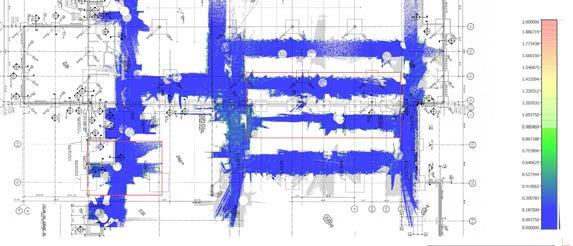
LiDAR offers more than just the measurement from one point to another. Many 3D laser scanners use a camera to collect
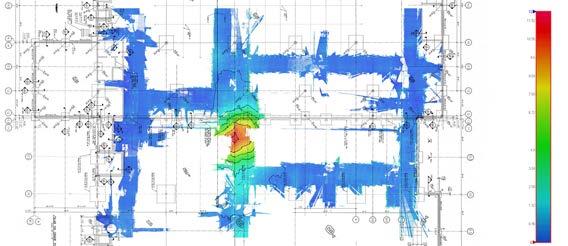
30 SPRING 2023 USLAW MAGAZINE USLAW
John Swanson S-E-A
FIG
1
FIG
2
color information and an infrared laser to measure the distance between the scanner and an object, but that laser beam carries additional information about the object’s surface. In a second case study, terrestrial 3D laser scan data was captured of a fire scene. The fully processed data uses the color information from the camera and can be viewed as a 360-degree panoramic image (Figure 3). Like any camera, this relies on visible light to create the image, making it subject to lighting and exposure challenges. The underlying data, however, is captured in the infrared spectrum (Figure 4). This looks like a black and white photograph, but these grayscale colors represent reflectance values of the scanned surfaces. Experts can interpret this information to glean data on the color and/ or reflective properties. Where the color photograph relies on visible light and captures all the highlights and shadows, the infrared image ignores the visible light and can even capture data in total darkness. With the infrared’s ability to ignore visible light, LiDAR is useful for analyzing surface properties obscured by highlights and shadows, when mapping burn patterns, for example, and it is indispensable when documenting in dark environments such as fire scenes, tunnels, or at night.
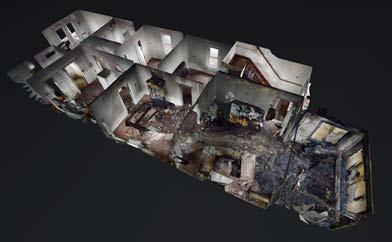
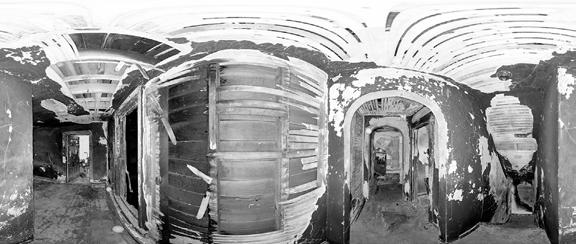
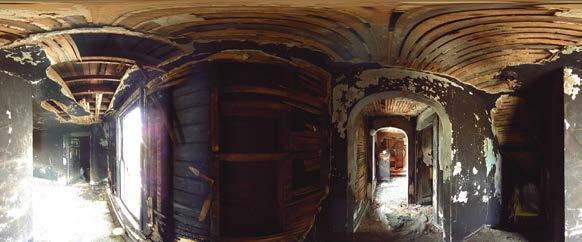
Another tool that has become commonplace in the field is UAVs (drones). The use of drones for commercial purposes is regulated by the FAA, but more and more experts are getting their UAV pilot’s license to make use of the technology. Aerial imagery on its own can be very useful for getting photos and video of hard or dangerous-to-reach areas, but photogrammetry software makes drones a powerful reality capture tool. Photogrammetry is the science of extracting 3D information from photographs. While it is not specific to drones, an aerial perspective and ability to quickly photograph large or difficult-to-reach areas often make drones preferable to taking photos from the ground. Many professional-grade drones come with the ability to fly predetermined automated flight paths, capturing photos in a specific pattern optimized for photogrammetry that can generate high-quality 3D data. The latest advancement for improving this data is the use of real-time kinematic po-
sitioning (RTK), a highly accurate means of spatial positioning. Traditionally, generating 3D data via photogrammetry relied on the images themselves, using common features between photographs to reverse-engineer the camera’s position and derive 3D information of the subject matter. This works well, but accuracy of the resulting 3D data over large scenes is generally measured on the scale of several inches, or even feet. By incorporating RTK into the drone’s reality capture workflow, photogrammetry software is provided with the camera’s position to within a centimeter. This constraint allows for better 3D data, improving accuracy to the scale of centimeters, even over long distances.
One of the newer technologies in forensic reality capture is 3D cameras. These tools combine cameras and photogrammetry with depth sensors and LiDAR to generate 3D data of any space. The accuracy is measured in centimeters, but documentation is fast, taking a fraction of the time terrestrial 3D laser scanning requires. The most prevalent 3D cameras generate 3D models of the space (Figure 5) with platforms to interactively navigate and explore
the data online, and AI-driven tools to automatically create floorplan drawings and generate data that feeds directly into common adjusting software. The future of reality capture is mobile scanning. The top smartphones and tablets now incorporate LiDAR sensors of their own, which program developers are taking advantage of, turning mobile devices into handheld 3D cameras. But as with any exciting new technology, there is a minefield of obstacles to navigate. Since the first LiDAR-equipped smartphone was released in 2020, experts have been testing the capabilities and limitations of scanning with a mobile device. Although there are a select few apps tailored to forensics that can produce quality data, the research suggests that most mobile scanning apps still have some room for improvement before the data can be consistently relied upon for forensic analysis. Ultimately, more research is needed to validate mobile scanning for forensic use, but given current trends, it is only a matter of time before it becomes a reliable reality capture tool in the forensic toolbox.
Whether it is because of time restrictions, physical limitations, or safety precautions, traditional measurement tools can limit an expert’s ability to collect all the data they need during an inspection. Reality capture overcomes these challenges allowing for detailed and accurate analysis to be done on the computer. The tried-and-true technologies that have driven forensic reality capture for years continue to improve, and modern technologies are breaking into the forensic space, changing the way spatial relationships are documented and analyzed.
John Swanson is Practice Lead, Imaging Sciences for S-E-A. He specializes in creating demonstrative evidence and other visuals using a variety of 3D, video, photo, and graphics techniques; forensic video and photo analysis; and scientific 3D modeling and animation, aided by over a decade of experience in the field of 3D laser scanning and digital preservation of evidence.
US LAW SPRING 2023 USLAW MAGAZINE 31
FIG 3
FIG 4
FIG 5
The European Mobility Directive a Dutch legal and perspectivetax
INTRODUCTION
EU Directive 2019/2121 of November 27, 2019 (‘the Directive’) provides EU-wide harmonized rules on cross-border mergers, conversions and divisions. These rules are expected to contribute to the functioning of the internal market for companies and firms and their exercise of the freedom of establishment. Previous Directives covered cross-border mergers, but not conversions and divisions. Meanwhile, the European Court of Justice issued case law that interpreted the freedom of establishment as laid down in the Treaty for the Functioning of the European Union to encompass the right of a company or firm established in accordance with the legislation of a Member State to convert itself into a company or firm governed by the law of another Member State, provided the conditions laid down in the legislation of that
other Member State are satisfied (201/06, Cartesio, C-378/10, Vale and C-106/16, Polbud). By now providing a further legal framework for the structuring of such transactions, the Directive aims to simplify cross-border mergers, conversions and divisions and, at the same time, strengthen the position of stakeholders, including employees, creditors and minority shareholders.
Member States were required to implement the Directive into their national law by January 1, 2023, at the latest. Unfortunately, the Netherlands has not been able to meet this deadline. It has, however, in early 2022 held an internet consultation and on December 5, 2022, the responsible Minister submitted a draft bill for implementation with the Dutch Parliament (‘the Bill’), which is expected to enter into force in the course of the year. In this article, we will touch on the highlights of the Dutch imple-
mentation, as it illustrates the opportunities (and limitations) presented by the legal framework provided for by the Directive. You may assume that similar legislation has been or will soon be implemented in other Member States.
LEGAL ASPECTS
Type of cross-border transactions covered In principle, a cross-border merger under the Bill features a legal merger of a limited liability company from one Member State, for example, a Dutch ‘naamloze vennootschap’ (‘nv’) or ‘besloten vennootschap’ (‘bv’), with a limited liability company from another Member State, whereby all the assets and liabilities of the disappearing company transfer by law (under universal title) to the acquiring company and the shareholder(s) of the disappearing company becomes shareholder(s)
32 SPRING 2023 USLAW MAGAZINE US LAW
Karen Verkerk and Dennis Nijssen Dirkzwager
of the acquiring company. A cross-border division can be structured as a legal demerger (‘zuivere splitsing’) or a spin-off. In both cases, it is required that the acquiring company is newly established. A cross-border division to an existing company is not provided for by the Bill. Again assets and liabilities are transferred by law, so separate transfer provisions, which may differ in each Member State, are not needed, and the shareholder(s) of the transferring company becomes shareholder(s) of the acquiring company. Last but not least, in case of a conversion, a company transfers its legal seat to another Member State and converts itself into a legal form under the legislation of another Member State. The converted entity does not cease to exist, and the shareholder(s) of the converted entity generally remain the same.
The afore-described transactions can take place both Netherlands inbound and outbound, but only in relation to companies from Member States of the EU or the European Economic Area (the 27 EU Member States plus Norway, Iceland and Liechtenstein). Companies from other countries do not qualify for a cross-border transaction with a Dutch company. It should be noted, however, that some other EU Member States do allow cross-border mergers, divisions and conversions with companies from third countries and that this could open a back door, as a company from a third country could, for example, convert into a Luxembourg company and then subsequently into a Dutch company.
Legal procedure
The general outline of the procedural rules provided in the Bill for all three cross-border transactions (mergers, divisions and conversions) are similar. There is a substantial list of formalities that have to be met, and it goes beyond the scope of this article to address all of those in detail. In broad lines, the explanatory memorandum to the Bill, however, distinguishes three procedural phases:
(i) The preparator y phase includes, among others, the drafting and publication of a proposal as well as the supervision by the accountant;
(ii) I n the decision-making phase, the shareholders meeting decides on the transaction; and
(iii) In the executional phase, the issuance of a certificate of approval by the competent authority in both the Member State of departure is required, a completion of the cross-border transaction in the State of arrival, as well as the (de) registration with the trade registers.
In the Netherlands, the competent authority is a Dutch notary, who will, before issuing the certificate of approval, also have to confirm that all formal requirements for the transaction at hand have been met. Furthermore, the notary will have to assess that the cross-border transaction is not aimed at abuse or another fraudulent purpose. The latter implies that approval will be denied if the transaction has a criminal, unlawful or fraudulent intent. The Dutch notary also executes the deed of merger, diversion or conversion
TAX ASPECTS
The Directive is of a corporate law nature and does not directly cover tax matters. As such, the Council did not need to adopt it unanimously. Instead, a normal majority was sufficient. Consistent with this approach, there is also no tax legislation included in the Dutch implementation bill. However, it has been announced that a separate bill covering the tax implications of cross-border transactions will follow separately, later in the year.
That being said, it can be pointed out that Dutch tax law already today provides a basis for tax-neutral mergers and divisions, also in a cross-border context with other EU and EEA Member States. These transactions are, in principle, qualified as a taxable transfer of assets and liabilities to the acquiring entity, but under certain conditions, the associated corporate income tax charge can be deferred. In that case, the acquiring entity continues the tax book value of the transferred assets and liabilities. Such a deferral can also be applied, if the acquiring entity is located in another EU or EEA Member State. It is critical, however, that the Dutch tax claim is not lost in the process. In other words, the acquiring entity should either become a tax resident of the Netherlands or (come to) have, a permanent establishment in the Netherlands, to which the assets and liabilities received are attributed. If the assets and liabilities leave the Netherlands’ tax sphere, Dutch corporate income tax would be payable on the difference between their fair market value and tax book value. Furthermore, as an anti-abuse measure, the deferral is disallowed, if the principal objective or one of the principal objectives of the (cross-border) merger or division is tax avoidance or postponement. The latter is assumed to be the case, if the transaction is not carried out for valid commercial reasons or if the shares in any of the companies involved are in part or in whole, directly or indirectly disposed of to a third party within three years after the transaction. In such a case, it is up
to the taxpayer to prove that the merger or divisions were not principally aimed at tax avoidance or postponement.
A tax-neutral cross-border conversion is so far not covered by legislation. Following the case law by the European Court of Justice referenced above, the State Secretary of Finance has allowed for a tax-neutral conversion under a specific Decree. This, however, formally does not suffice as implementation of the Directive and therefore a legal basis for cross-border conversions is widely expected to be included in the announced accompanying tax bill.
CONCLUSION
As the legal framework for cross-border mergers, diversions and conversions is harmonized across the EU and EEA, the process of execution will become more consistent in different Member States, and the position of stakeholders should be better safeguarded. Furthermore, the European Commission expects that the administrative costs for the execution of cross-border transactions will reduce significantly. As the tax treatment is also further clarified, the threshold for these transactions could be significantly lowered. This can open up new restructuring opportunities and is something to keep in mind for companies and firms involved in the reorganizing of their European legal structure, for example, after an M&A transaction.
Karen Verkerk is a civil law notary at Dirkzwager specializing in the law of legal entities and company law, M&A and restructures, as well as advising large and medium-sized companies and non-profit institutions in particular with regard to their company structure and governance. She is a member of the Combined Committee on Corporate Law, which advises various ministries and parliament on draft legislation on behalf of the Royal Dutch Notarial Association (KNB) and the Dutch Bar Association. Karen is currently President of TELFA.

Dennis Nijssen is a tax advisor at Dirkzwager and specializes in Dutch corporate income tax as well as European and international tax law. His clients are both private and publicly owned companies. He holds a PhD in Tax Law and also teaches International Tax Law at Raboud University in Nijmegen (The Netherlands).

US LAW SPRING 2023 USLAW MAGAZINE 33
Liability of Internet Applications for Content Posted by Third Parties on Their Virtual Platforms
INTRODUCTION: CONTEXT OF INTERNET APPLICATION PROVIDERS IN BRAZIL
Certain companies’ business activities include providing electronic space for sellers to advertise their products and services to interested third parties and perform, through the electronic platform, the formalization of the respective contracts. They are known as online marketplace service providers.
In online marketplaces, users interested in buying or selling products or services exchange data and information, negotiate values and set deadlines for payment and delivery of goods or completion of services. It is a service that brings potential business partners together and facili-
tates businesses between the users.
While there was no specific statute ruling the activities of online marketplace service providers, there were doubts in the Brazilian legal system regarding the liability of online marketplace service providers for illegalities existing and committed within the electronic space by the users of the marketplace services without any interference from the provider. For example, liability in the case of users inserting illegal content in the online marketplace or advertising or selling services or products which are controlled or prohibited.
In the absence of a specific law, the issue of the internet service providers’ civil liability eventually had to be solved by the Judiciary, in the various concrete cases that
reached the courts of appeal, especially the Brazilian Superior Court of Justice.
By weighing the principles of freedom of expression and the inviolability of people’s privacy, the Court understood that it would be impossible and illegal to impose on the online marketplace service providers the obligation of monitoring content created by the marketplace users in advance of its inclusion in the marketplace, under penalty of unduly restricting the freedom in the internet environment.
The Superior Court of Justice also emphasized that such prior monitoring of content is not an intrinsic activity of the type of service provided by online marketplace service providers, and for this reason, one cannot presume that such providers assume

34 SPRING 2023 USLAW MAGAZINE US LAW
João Carlos Zanon, Thiago Silveira Antunes, Nathalia Muñoz Vianna, and Flavia Regina Duarte Torres de Carvalho Mundie e Advogados
the risk of damages generated by the insertion of illegal content by users. The Court concluded that the providers’ liability is subjective and only in case of omission. This means that the providers may only be held liable in cases where, after being notified of the existence of illegal content in their electronic platform, they delay or fail to delete such content (STJ, in AgInt AREsp n. 931.341/SP of 2021, in AREsp 484.995⁄RJ, of 2015).
LIABILITY FOR OMISSION. NO NEED FOR PRIOR CONTROL. MCI REGULATED SUBJECTIVE LIABILITY FOR OMISSION.
Consolidating the understanding of the Brazilian Superior Court of Justice, the Brazilian Civil Framework Law for the Internet (“MCI”) enacted in 2014 expressly established that, regarding content generated by users, internet service providers have what is called in Brazilian law subjective liability for omission. In other words, internet providers can only be held liable for damages arising from content created by users if, after a specific court order, they fail to take action to make the content unavailable, within the technical limits of their service and within the specified period (article 19, paragraph 1).
The MCI aims to guarantee the users’ freedom of expression and prevent any type of censorship, in harmony with the foundations of the regime of internet use in Brazil: free speech and the free expression of thoughts.
In addition to the understanding, reflected in the decisions of the Superior Court of Justice and in the MCI, that internet application providers have no obligation to create prior filters to prevent the inclusion of illegal content in their platforms, the MCI sets forth that a court order for the removal of digital content from the internet should contain, under penalty of nullity, a clear and specific identification of the content indicated as infringing and allow an unequivocal location of the material. This means that the party that feels aggrieved must indicate in detail the harmful content, so that the judge may issue a specific and precise order. The Brazilian Superior Court of Justice decided that such specific and precise indication of the content by the injured party must be made through the indication of the URL (Uniform Resource Locator) or the specific code of the content inserted in the platform. A judicial order for the provider to exclude content not specifically identified by its URL would be seen by Brazilian courts as akin to censorship.
The duty of the providers to search
their platforms and websites for infringing content has been removed by the law and the Courts, and it is currently understood that it is the applicant that is qualified and capable of accurately identifying the contents that, in the applicant’s view, would violate the applicant’s rights.
The exception to these rules is the cases involving a violation of privacy resulting from the undue use of images, videos or any other material with nudity or private sexual acts. In such cases, the illegal content must be removed after notification by the offended – there is no need for notification by a judge – with the URL information (article 21). In such cases, the Superior Court of Justice already has strong precedents.
THE COPYRIGHT ISSUE (ART, 19, §2, MCI) - THE UNDERSTANDING OF THE COURTS AND THE DIFFERENCES IN LIABILITY
The MCI has not regulated the internet application provider’s responsibility for the protection of copyrights. Even though it was generally established that the internet application provider would be held liable when it failed to remove the content created by a user after being notified by a judge, the MCI, in respect of copyrights, only sets forth that the matter depends on the enactment of specific legislation, which will have to respect the right to free speech and other guarantees provided by the Brazilian Federal Constitution (article 19, paragraph 2, MCI).
In this scenario, matters involving copyrights must take into consideration, not only the MCI, but also the Brazilian Copyright Law, enacted in 1998. However, because the Brazilian Copyright Law does not deal with questions of copyright in the internet, the superior courts will have to define how to articulate it with the MCI.
It is important to note that there is no indication that the Brazilian Copyright Law will be updated soon. The consequence is that there will be uncertainty in this matter until significant decisions are issued by the Superior Court of Justice. So far, the courts are implementing MCI’s general rule, that the internet application provider must remove the content after being notified by the court with the URL information.
CONCLUSION
The MCI entrenched the Court precedents that decided the liability of Internet Application Providers regarding illegal content.
Internet Application Providers are held liable only if they fail to remove such contents after judicial notification, containing specific indication of that which must
be removed (URL), except in the case of violation of privacy with the use of images, videos or any other material with nudity or private sexual acts, which must be removed after notification with the URL information by the offended, without the need for notification by a judge.
As to copyright violations, Brazil does not have specific legislation regarding violations committed in online marketplaces, which leaves to the courts the analysis of each case individually.

João Carlos Zanon has wide experience in civil litigation, mainly with corporate and consumer law, collective actions, arbitration and debt restructuring, bankruptcy and judicial recoveries. João also has developed an extensive practice in corporate and constitutional advisory, working for more than 20 years in strategic litigation law firms.
Thiago Silveira Antunes has experience in civil litigation, mainly in the practice area of corporate, consumer and regulatory. He holds a bachelor’s degree in law from Mackenzie University and a master’s degree in procedural, diffuse and collective law from the Pontifical Catholic University of São Paulo (PUC-SP).

Nathalia Muñoz Vianna is a lawyer with experience in dispute resolution and in debt restructuring, bankruptcy and judicial recoveries, working with national and international companies, mainly in civil law complaints and arbitration procedures regarding Consumer law and product liability, telecommunications, regulatory, sales representative, intellectual property and banking law.
Flavia Regina Duarte Torres de Carvalho is a lawyer in dispute resolution with experience working with national and international companies, mainly in civil law complaints, collective actions (class actions and popular actions) and arbitration procedures, regarding consumer law and product liability, telecommunications, sales representatives, automotive industry, agricultural machinery and environmental law.
US LAW SPRING 2023 USLAW MAGAZINE 35
Attendees of the 2023 USLAW NETWORK General Counsel and In-House Counsel Forum enjoyed a unique dining experience in the Estate Cave located within the Grand Reserve at the Meritage. Built into the hillside beneath the resort’s nine-acre vineyard, the nearly 4,000-square-foot cave features a dramatic barrel ceiling illuminated by the warm glow of ornate wall sconces and chandeliers.
USLAW


Spring
Connell Foley recently volunteered with Rebuilding Together Jersey City, a leading organization that, in partnership with the community, rehabilitates the homes of low-income, elderly, or disabled persons, or families with children, at no cost to them and non-profit organizations, including the Boys and Girls Club, and Camp Liberty. Connell Foley partner Thomas Forrester, who is instrumen-
tal in organizing the firm’s annual participation with Rebuilding Together Jersey City, led the Connell Foley team in cleaning and painting nine lengthy hallways throughout Dr. Lena Edwards Academic Charter School. The volunteers who were on hand and working hard included Janika Best, Cindy Chen, Louis Cassaganol, Veronica Speaks, Cristina Diaz Salcedo, Richard DeAngelis, Jr., Lucas Arciszewski, friends, and family members.
36 SPRING 2023 USLAW MAGAZINE US LAW of
USLAW Chair Mandy Ketchum from Dysart Taylor in Kansas City, Missouri, keynote speaker Ben Nemtin and USLAW CEO Roger Yaffe at the Spring 2023 USLAW NETWORK Client Conference in Miami.
When in Vegas…..attendees of the 2023 USLAW NETWORK Labor and Employment Forum got up to speed and then some while enjoying a high-end supercar experience at Las Vegas Motor Speedway’s 1.2-mile infield road course, located inside the Superspeedway oval track.
An afternoon tour of Little Havana during the Spring 2023 USLAW NETWORK Client Conference in Miami included a stop at historic Domino Park.
A TRADITION OF LEGAL EXCELLENCE SINCE 1938
2023 USLAW NETWORK Client Conference attendees enjoyed a sunrise Live Better Power Walk Hosted by S-E-A and USLAW on the Miami Beach Boardwalk.
Barclay Damon participated in the American Heart Association’s National Wear Red Day in support of the Go Red for Women movement, which “brings awareness to the issue of women and heart disease, and also action to save more lives.” Attorneys and staff across the firm’s platform wore red to show their support.
Poyner Spruill Holds Service Week Remembering
Cheslie Kryst
Poyner Spruill LLP (North Carolina) organized its first-ever firm-wide Service Week to remember the late Cheslie Kryst, who died by suicide in January 2022. Kryst served as the firm’s diversity advisor, and she was formerly a member of the litigation team.


Throughout the week of April 10-14, 2023, Poyner Spruill offered various volunteer activities and educated employees about mental health awareness.
Kryst was well known for her involvement in the local community, especially through her championing of people from underrepresented backgrounds. She was very involved with Dress for Success, and Poyner Spruill was grateful to honor her memory with two opportunities to volunteer with the international
“

non-profit.
Cheslie was an incredible colleague, passionate advocate, and inspiration to us all,” said Managing Partner Dan Cahill. “We wanted to keep her legacy and memory alive by holding a week filled with volunteer opportunities and chances to discuss the mental health epidemic. Cheslie is greatly missed, and she will always be remembered.”
In 2022, Poyner Spruill partnered with Wake Forest University School of Law to establish the Cheslie C. Kryst Advocacy and Social Justice Law Scholarship. The scholarship is awarded annually to students from underrepresented backgrounds who demonstrate a passion for the pursuit of social justice and civil rights causes after graduation. To make a gift to the Cheslie C. Kryst Advocacy and Social Justice Law Scholarship, please visit wfu.law/cheslie.
Attorneys and staff across Barclay Damon participated in the Lots of Socks campaign by wearing brightly colored, mismatched socks in honor of World Down Syndrome Day, a global awareness day that the United Nations has observed since 2012. The significance of celebrating on March 21, or 3/21, is that every individual living with Down syndrome has an extra 21st chromosome—three as opposed to the typical two.
US LAW 37 of USLAW
The fish were biting! Sean Burnett (pictured left) of Snyder Burnett Egerer, LLP in Santa Barbara, California, and Kevin Visser (pictured right) of Simmons Perrine Moyer Bergman in Cedar Rapids, Iowa, enjoyed a successful day on the water during the Spring 2023 USLAW NETWORK Client Conference in Miami.
Debra Melisi (Pictured 2nd from left, Moran Reeves & Conn PC (MRC) nurse paralegal and senior board member for the Children’s Hospital of VCU Foundation, hosted a group at the celebration of the opening of the new Wonder Tower at the hospital in Richmond, Virginia. MRC attorneys Shyrell Reed, Marty Conn, and Taylor Brewer were in attendance.
Sweeney & Sheehan Senior Associate Megan Robinson attended the JDRF Gala at the Loews Hotel in Philadelphia on April 15, 2023, with her husband and son and helped raise more than $1.4 million for research to cure Type 1 Diabetes. JDRF is the leading global organization harnessing the power of research, advocacy, and community engagement to advance life-changing breakthroughs for Type 1 Diabets.
MERCH WITH A MISSION
Now when you purchase your favorite USLAW-logoed apparel, accessory, drinkware or gift item, 10% of your total purchase supports scholarships for diverse law students.
You get exclusive USLAW merchandise while also supporting an important cause.
The USLAW NETWORK Foundation is a 501(c)(3) charitable organization organized exclusively for charitable and educational purposes, including funding scholarships to provide financial assistance to diverse law students pursuing a legal education at an American Bar Association-accredited U.S. law school.
Make the purchase that makes a difference.
Shop now at www.storeuslaw.org
®
38 US LAW of USLAW
Marni Sperling, Heather Rice (pictured center) and Renee Bowen were among several Franklin & Prokopik, P.C. staff members on “Heather’s Heroes” team at the annual Walk MS event in Annapolis, Maryland, on April 16, 2023.
® WEAR IT WITH PRIDE!
Faces from around the USLAW educational circuit...
Throughout the year, USLAW members and clients lead facilitated discussions at USLAW events from coast to coast. Here are some of the recent leading voices.
Alexander C. Jay, Ph.D., IMS Consulting & Expert Services (New York); Pamela S. Hallford, Carr Allison (Dothan, AL); Jessica L. Dark, Pierce Couch Hendrickson Baysinger & Green, L.L.P (Oklahoma City, OK); Jill Liebold, Ph.D., IMS Consulting & Expert Services (Los Angeles); Meghan M. Goodwin (Thorndal, Armstrong, Delk, Balkenbush & Eisinger (Las Vegas, NV); Michael J. Judy • Dysart Taylor (Kansas City, MO); Adam Bloomberg, IMS Consulting & Expert Services (Dallas)
Scott E. Ortiz, Williams, Porter, Day and Neville PC (Casper, WY); Oscar J. Cabanas (Wicker Smith, Miami); Rodney L. Umberger, Williams Kastner (Seattle, WA)
Louis J. Vogel, Jr., Sweeney & Sheehan, P.C. (Philadelphia, PA); Jacob J. Liro, Wicker Smith (Miami, FL); Michael A. Ludwig, Jones, Skelton & Hochuli, P.L.C. (Phoenix, AZ)
Noble F. Allen, Hinckley Allen (Hartford, CT); Merton A. Howard, Hanson Bridgett LLP (San Francisco, CA)
Stanford P. Fitts, Strong & Hanni, PC (Salt Lake City, UT); E. Holland “Holly” Howanitz (Jacksonville, FL); John M. Gregory, Jones, Skelton & Hochuli, P.L.C. (Phoenix, AZ)
Kara A. Loridas, Rubin and Rudman LLP (Boston, MA); Nicholas C. Grant, Ebeltoft Sickler Lawyers (Dickinson, ND); Alison H. Sausaman, Carr Allison (Tallahassee, FL); Kevin K. Broerman, Jones, Skelton & Hochuli, P.L.C.(Phoenix, AZ)
Elizabeth G. Stouder, Richardson, Whitman, Large & Badger (Portland, ME); Colleen E. Hastie, Traub Lieberman (Hawthorne, NY); Meghan M. Goodwin, Thorndal, Armstrong, Delk, Balkenbush & Eisinger (Las Vegas, NV)
Christina Marinakis, Psy.D., J.D., IMS Consulting & Expert Services; Jerri A. Harrell, Liability Claims Manager, Vertiv Operating Company (Atlanta, GA); John T. Pion, Pion, Nerone, Girman, Winslow & Smith, P.C. (Pittsburgh, PA)
John T. Pion, Pion, Nerone, Girman, Winslow & Smith, P.C. (Pittsburgh, PA); Trey Sandoval, MehaffyWeber (Houston, TX)
Ryan C. Holt, Sweeny Wingate & Barrow, P.A. (Columbia, SC); Alexandra C. Wells, Lashly & Baer, P.C. (St. Louis, MO)
(Pictured Left, second and fourth) Thomas S. Thornton, III, Carr Allison (Birmingham, AL); Shyrell A. Reed, Moran Reeves & Conn PC (Richmond, VA); Constantin “Dean” G. Nickas, Wicker Smith (Coral Gables, FL)
Brandon R. Gottschall, Sweeny Wingate & Barrow, P.A. (Columbia, SC); Stephen D. Straus, Traub Lieberman (Hawthorne, NY); John C. Lennon, Pierce Coach Hendrickson Baysinger & Green, L.L.P. (Oklahoma City, OK); Michael D. Riseberg, Rubin and Rudman LLP (Boston, MA)
Kyle Weaver, Carr Allison (Tallahassee, FL); Peter T. DeMasters, Flaherty Sensabaugh Bonasso PLLC (Morgantown, WV); Jeffrey Y. Choi, Snyder Burnett Egerer, LLP (Santa Barbara, CA)
Eliot M. Harris, Williams Kastner (Seattle, WA); Neil V. Mody, Connell Foley LLP (Roseland, NJ); Daniel M. Karp, Fee, Smith & Sharp, L.L.P. (Dallas, TX)
Joseph F. Moore, Hanson Bridgett LLP (San Francisco, CA); Thomas A. Ped, Williams Kastner (Portland, OR)
Colleen E. Hastie, Traub Lieberman (Hawthorne,
®
US LAW 39 of USLAW
NY); Jessica L. Dark (Pierce Couch Hendrickson Baysinger & Green, L.L.P, Oklahoma City, OK); Meghan M. Goodwin, Thorndal, Armstrong, Delk, Balkenbush & Eisinger (Las Vegas, NV); Alexandra C. Wells, Lashly & Baer, P.C. (St. Louis, MO)
Kristin A. VanOrman, Strong & Hanni, PC (Salt Lake City, UT); Jessica L. Dark, Pierce Couch Hendrickson Baysinger & Green, L.L.P. (Oklahoma City, OK); Jessica Farley, Snyder Burnett Egerer, LLP (Santa Barbara, CA)
Lisa A. Zaccardelli, Hinckley Allen LLP (Hartford, CT); Sandra L. Rappaport, Hanson Bridgett LLP (San Francisco, CA); Barbara Barron, MehaffyWeber (Houston, TX)
Robyn F. McGrath, Sweeney & Sheehan, P.C. (Philadelphia, PA); Julie Z. Devine, Lashly & Baer, P.C. (St. Louis, MO); Rosemary Enright, Barclay Damon LLP (Buffalo, NY)
American Legal Records offers many services to assist and simplify the discovery process. ALR is an industry leader in record procurement and duplication services with a personalized customer service staff for all your needs. Our management represents over 200 years of knowledge in our field assisting the legal and insurance communities.
Below are a few types of Records American Legal retrieves
Medical Insurance
Government (including SSA)
Employment
Scholastic
Military
Pharmacy
Our staff is fully HIPAA Compliant
We offer a full range of services for the record retrieval process including
Notices to all parties
Customized Billing including direct to Carrier/TPA or Client
Dedicated account reps
Expedited Service
Multi-Party Management
Online Secure Account access with live status updates of requests
Payment of Fee Advances/ Custodial Fees
Many other services customized to your needs
NATIONWIDE LEADERS IN DOCUMENT RETRIEVAL CLIENT SERVICES SECOND TO NONE P# (888)519-8565 F# (877)861-9459 info@americanlegalrecords.com www.americanlegalrecords.com
firms on the move

Dysart Taylor McMonigle Brumitt & Wilcox, P.C. reached a milestone achievement as they are now 50% women-owned.
“In a field with historical gender imbalance, I am proud to work at a firm that values the leadership and voices of women at the table,” said shareholder/director Amanda Pennington Ketchum, who also is Chair of USLAW NETWORK. “Dysart Taylor has made it a priority to support the careers of women attorneys and we are so proud of this new chapter in the firm’s history.”
The six women shareholders are (pictured L-to-R) Amanda Pennington Ketchum (seated), Anne Lindner Saghir, Leslie A. Boe, Kathryn T. Alsobrook, Carol Z. Smith, Meghan A. Litecky
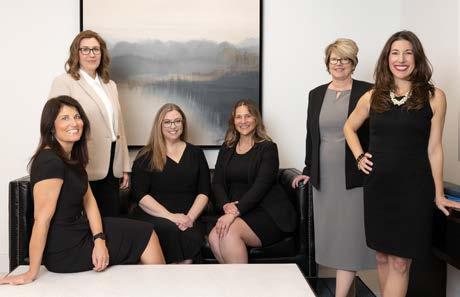
After an exciting 2022, which brought the firm to a new location on the Plaza in Kansas City, Missouri, Dysart Taylor rang in 2023 with a new name (Dysart Taylor McMonigle Brumitt & Wilcox, P.C.), a new firm president (John F. Wilcox, Jr.), and now, they are thrilled to share that 50% of the firm’s directors are women.
Barclay Damon announces two changes that signal the law firm’s continued focus on serving clients’ needs in the areas of data security, technology, and intellectual property licensing. Barclay Damon’s former Cybersecurity Team has been elevated to practice area status and is now called the Data Security & Technology Practice Area. The practice area is co-chaired by Renato Smith and Kevin Szczepanski, both partners. And Barclay Damon’s Trademarks, Copyrights & IP Transactions Practice Area has been renamed Trademarks, Copyrights & Licensing Practice Area to better reflect the team’s ongoing focus. The practice area is co-chaired by Mike Oropallo, partner, and Renato Smith
Two new members have been added to Barclay Damon ’s Management Committee: Corey Auerbach and Mark Whitford. Auerbach also serves as managing director of the firm’s Buffalo office. He took over the role from Peter Marlette. Mark Whitford also serves as managing director of the firm’s Rochester office. He took over the role from Tom Walsh. All attorneys named here are partners.
The New York State Hospitality & Tourism Association has named Barclay Damon “Partner of the Year,” one of the industry group’s Stars of Industry categories. Stars of Industry are recognized as “exceptional organizations in New York State’s hospitality and tourism industry.” Scott Rogoff, partner, leads the firm’s Hotels, Hospitality & Food Service Team.
firm focused on the defense of workers’ compensation claims and related litigation throughout California. Visit cca-law.com for more information. (picture L to R, Richard Chavez, Chad Coleman, and Noelle Sage.)
Hanson Bridgett LLP partner Alex Grigorians has been named a Leadership Council on Legal Diversity (LCLD) Fellow for 2023. This landmark intensive year-long professional development program connects high-potential attorneys with leading general counsel, managing partners and their peers for cross-collaboration.
Jahmal Davis, a partner at Hanson Bridgett LLP, was inducted as a Fellow into the American College of Trial Lawyers (College), one of the premier legal associations in North America.
Hanson Bridgett LLP associates David Casarrubias and Nicholas Yang have been named Leadership Council on Legal Diversity (LCLD) Pathfinders for 2023. A multifaceted program produced by LCLD, the Pathfinder program provides participants with the opportunity to learn from top leaders in the legal profession as well as career development experts.
Adam Hofmann of Hanson Bridgett LLP in San Francisco was confirmed as a member of DRI’s Amicus Committee in the Center for Law and Public Policy as well as chair of the Appellate Skills Development Subcommittee.
David Cohen of Jones, Skelton & Hochuli, P.L.C. in Arizona was accepted into the National Academy of Distinguished Neutrals (NADN). NADN is a national association whose membership consists of mediators and arbitrators distinguished by their hands-on experience in the field of civil and commercial conflict resolution.

Dietrich C. Hoefner, a partner in Lewis Roca’s Litigation Practice Group, has been selected as a City Council Member for the City of Louisville, Colorado, and as a board member for the Denver Regional Council of Governments.
 USLAW NETWORK welcomes Coleman Chavez & Associates, LLP as its newest member firm exclusively for workers’ compensation work in California. Coleman Chavez & Associates is a 65+ attorney law
US LAW SPRING 2023 USLAW MAGAZINE 41
firms on the move
The City Council, consisting of six members and a mayor, serves as the governing body of the city. The Denver Regional Council of Governments brings together local government officials to shape regional planning and policymaking in vital areas such as transportation, land use, and aging. Hoefner’s law practice focuses on complex regulatory matters for a wide range of clients across numerous industries, including energy, utilities, telecommunications, natural resources, and alcoholic beverages. He is also a member of the firm’s renewable energy decommissioning industry team, focusing on strategies to address and anticipate changing regulations affecting end-of-life issues for renewable energy facilities.
Poyner Spruill LLP partner


Kate Dewberry is now a North Carolina Dispute Resolution Commission Certified Mediator in the Superior Court. As a Superior Court Certified Mediator, Dewberry mediates employment cases for claims asserted under state and federal employment laws. Dewberry concentrates her practice on employment law issues and litigation arising under federal and state laws covering leave, discrimination, termination, affirmative action, and wage and hour law.
Steven W. Quattlebaum of Quattlebaum, Grooms & Tull in Arkansas was installed as national president of the American Board of Trial Advocates (ABOTA) at the organization’s annual National Board Meeting in Santa Barbara, California, in January 2023.
Michael B. Crosby III of Quattlebaum, Grooms & Tull in Arkansas has been named to the Commercial Real Estate Council of Metro Little Rock (CREC MLR) Board of Directors for 2023. A transactional attorney with the firm, Crosby’s practice is primarily focused on real estate and agricultural matters. CREC MLR supports and promotes all aspects of commercial real estate. Groups, individuals, and companies representing development, property management, finance, construction, and other industries work together to facilitate engagement, education, and networking in commercial real estate in the metro Little Rock area.
Rivkin Radler named to the New York State Corporate Mentoring Honor Roll

Rivkin Radler LLP in Uniondale, New York, has been named to New York State’s 2023 Corporate Mentoring Honor Roll. This appointment comes as a result of the firm’s investment in quality youth mentoring. The New York State Corporate Mentoring Honor Roll is a network of community-minded businesses that believe in the power of mentoring and the mission of MENTOR New York. Companies on the honor roll have demonstrated corporate excellence in their support of mentoring in the following ways:
• Involved in a corporate mentoring initiative;
• Interested in developing a mentoring program; and/or
• Dedicated to supporting mentoring in their corporate goodwill portfolio in the future.
“Rivkin Radler has enjoyed a long partnership with MENTOR New York,” said Matt Spero, Rivkin Radler partner and Chair of MENTOR New York’s Board of Directors. “In fact, Managing Partner Evan Krinick is a former board chair as well. Our firm has been involved with MENTOR New York for over 20 years and we look forward to supporting the organization’s mission for many more years to come.”
Learn more about the honor roll: www.mentornewyork.org/corporate-honor-roll.
Simmons Perrine Moyer Bergman
PLC attorney Carrie Thompson has accepted an invitation to join the Iowa Academy of Trial Lawyers (IATL). The IATL is an invitation-only honor limited to 250 attorneys across the state who are selected by their peers and voted on by the Board of Governors. Carrie joins Simmons Perrine Moyer Bergman attorneys Christine Conover, Paul Gamez, Robert Hatala, Robert Konchar, Roger Stone, Kevin Visser, Chad VonKampen and Thomas Wolle as Fellows. Thompson represents physicians, physician assistants, nurse practitioners, nurses, hospitals, nursing homes, medical clinics and other healthcare providers in disputes related to medical malpractice claims and litigation. She also counsels clients on various healthcare matters, including HIPAA, state privacy and security laws, licensing, and medical staff credentialing and privileges.
Sweeney & Sheehan Partner Denise Montgomery was selected to be the program chair for the 2024 Defense Research Institute Construction Law Seminar to be held in Scottsdale, Arizona. Montgomery is also the vice chair of the Pennsylvania Defense Institute (PDI) Eastern Division and co-chair of the PDI Civil Practice Committee.
42 SPRING 2023 USLAW MAGAZINE US LAW
(Continued)
successful RECENT USLAW LAW FIRM VERDICTS & transactions
verdicts
Flaherty Sensabaugh Bonasso PLLC (Charleston, WV)
Martin, McDaniel obtain defense verdict in medical professional liability case
On December 12, 2022, attorneys Ted Martin and Shereen McDaniel obtained a defense verdict in a medical professional liability case in the Circuit Court of Harrison County, West Virginia. Plaintiffs (husband and wife) alleged that a diagnostic radiologist deviated from the standard of care in the work-up of a palpable breast mass, which delayed the diagnosis of breast cancer. Plaintiffs sought damages for past medical expenses and the maximum amount of noneconomic damages recoverable under the West Virginia Medical Professional Liability Act. Following a six-day trial, the jury rejected plaintiffs’ claim and found that the radiologist acted within the standard of care, returning a unanimous verdict in favor of the diagnostic radiologist.
Hanson Bridgett LLP (San Francisco, CA)
Hanson Bridgett scores trial victory for Leprino Foods in wage-and-hour class action
A team from Hanson Bridgett LLP successfully defended Leprino Foods Company, the world’s largest mozzarella cheese maker and top producer of whey protein and dairy ingredients, in a class action in which the plaintiffs sought more than $100 million for alleged non-compliant meal and rest breaks at the company’s largest plant in Lemoore, California. After a four-week jury trial in federal court in Fresno, California, the jury returned a unanimous defense verdict after just over an hour of deliberations.
“It was gratifying to be able to show the jur y who Leprino Foods is and all that the company does for its employees,” said lead partner Sandra Rappaport. “Leprino Foods not only complies with the law but goes well beyond what the law requires to make their environments great places to work.”
Background on the Case
The lawsuit was filed in 2017, alleging a number of wage and hour claims relating to Leprino Foods’ Lemoore West plant. The court granted class certification for one of the plaintiffs’ claims in March 2020 – an allegation that the company’s policies and practices effectively put its hourly employees on call during meal and rest breaks. The plaintiffs sought wages and penalties for 1540 class members over a seven-year time period. The result was a complete victory for Leprino Foods Company.
The Hanson Bridgett trial team, led by partner Sandra Rappaport, included partner Lisa Pooley and associate Winston Hu.
Jones, Skelton, Hochuli, P.L.C. (Phoenix, AZ)
Bullington, Tyzska obtain unanimous defense verdict in medical malpractice case
Jones, Skelton & Hochuli, PLC Partners Steve Bullington and Cory Tyzska obtained a unanimous defense verdict for a medical malpractice case. This case involved allegations of medical malpractice arising from a neurologist’s workup of a patient’s complaints of left-sided symptoms of weakness, shaking, and loss of control. Six weeks after the workup, the patient suffered a stroke and has residual permanent injuries.
Plaintiff alleged that the neurologist was negligent for failing to order vascular imaging, failing to diagnose TIA, failing to properly educate the patient on the significance of a TIA diagnosis, failing to order aspirin therapy, and failing to send the patient to the emergency room upon the patient’s report of new and worsening symptoms. The neurologist maintained that he met the applicable standard of care in all respects, that there was insufficient evidence that plaintiff would have had a better outcome with earlier intervention, and that plaintiff’s illicit drug use caused his stroke and would have overshadowed the protective effect of aspirin therapy. Plaintiff claimed permanent loss of function and sensation of his left upper extremity, weakness and spasticity in his left lower extremity, cognitive deficits, pain and suffering, and loss of enjoyment of life. The case was tried in Maricopa County Superior Court before the Honorable Joan Sinclair. After a twelve-day trial, the jury deliberated for only 25 minutes before returning a unanimous defense verdict on April 6, 2023.
US LAW SPRING 2023 USLAW MAGAZINE 43
successful RECENT USLAW LAW FIRM VERDICTS & transactions
Moran Reeves & Conn PC (Richmond, VA)
MRC attorneys obtain dismissal in wrongful death case
Moran Reeves & Conn attorneys Shyrell A. Reed, Taylor D. Brewer, and Sophia M. Brasseux obtained a dismissal of a wrongful death case against a hospital in Virginia two months before trial. The case involved the failure to diagnose and treat a sacral pressure ulcer. Just after Reed deposed plaintiff’s causation and damages expert, plaintiff’s counsel took a non-suit.
Rivkin Radler LLP (Uniondale, NY)
Gershenoff, DiGennaro, and Bernstein successfully defend law firm client against RICO, defamation claims
Max Gershenoff, Janice DiGennaro, and Yonatan Bernstein successfully defended Wigdor LLP, a prominent Manhattan law firm that specializes in cases involving sexual harassment and misconduct, against claims that it engaged in supposed wrongdoing while representing one of its clients.
In Black v. Ganieva, et al., S.D.N.Y. Case No. 1:21-cv-08824PAE, billionaire plaintiff Leon Black had alleged in federal court that Wigdor made defamatory statements and committed RICO violations while representing its client in connection with a firstfiled New York State Supreme Court lawsuit against Black for intentional infliction of emotional distress and gender-motivated violence.
After Black dropped his purported RICO claims against Wigdor in the face of Wigdor’s motions to dismiss and for sanctions, United States District Judge Paul Engelmayer then proceeded to dismiss Black’s defamation claims as well and denied Black’s request for permission to replead his claims. Black appealed to the Second Circuit, but the Second Circuit affirmed, holding that the District Court was within its discretion to dismiss Black’s federal complaint with prejudice.
Traub Lieberman (Hawthorne, NY)
Traub Lieberman Partner Lisa Rolle earns motion to dismiss for international hotel conglomerate client, summary judgment for contract utility company in personal injury action
Traub Lieberman (TLSS) Partner Lisa Rolle successfully secured the dismissal on behalf of an international hotel conglomerate in an action asserting tort claims brought in the Southern District of New York, as well as Bronx Supreme Court. The plaintiffs, who are New York residents, made a reservation to stay at one of the hotel conglomerate’s properties in Aruba through a popular travel reservation website. One of the plaintiffs was injured during the hotel stay and, initiated this action in both federal and state court against multiple foreign defendants, including the hotel conglomerate.
The plaintiffs allege personal jurisdiction for all defendants using the same boilerplate language for each. However, based on the defendants’ locations, the nature of each business, and the lack of New York contacts for each, TLSS successfully established that neither federal nor state court had jurisdiction over the matter, dismissing the action.
Rolle also obtained summar y judgment on behalf of a contract utility company (“Utility Company”) in a matter brought before the New York Supreme Court, Queens County. In the complaint, the plaintiff alleged that she sustained injuries as a result of a trip and fall accident where the plaintiff’s foot allegedly went into a hole in the grass strip abutting the sidewalk adjacent to a premises located in Queens, New York. The plaintiff claimed that the defect in the sidewalk was caused by the removal of a utility pole at the curb strip that was not correctly backfilled. Based on the facts and the plaintiff’s inability to prove negligence on the part of the Utility Company, the court found that the Utility Company did not owe the plaintiff a duty of care. The summary judgment was granted, and the complaint and any cross-claims against the defendant were dismissed.
44 SPRING 2023 USLAW MAGAZINE US LAW
(Continued)
successful RECENT USLAW LAW FIRM VERDICTS & transactions

(Continued)
Wicker Smith (Orlando, FL)
Wicker Smith’s Richards Ford and Patrick Mixson obtain defense verdict in medical malpractice trial
Wicker Smith Orlando shareholders Richards Ford and Patrick Mixson recently obtained a defense verdict following an eight-day medical malpractice trial in Hernando County, Florida.
They represented the hospital in a case involving the alleged failure to diagnose a bowel perforation following a laparoscopic gynecological surgery performed on the day before the first of three straight days of presentation to the ER. Plaintiff claimed that the co-defendant surgeon negligently perforated her bowel during the surgery and failed to recognize it, and that the hospital negligently failed to appreciate the signs and symptoms of a perforation.
The crux of the case involved a 5 mm puncture in the plaintiff’s bowel. Plaintiff alleged that the puncture was the result of the co-defendant surgeon’s negligent perforation of the small bowel by a 5 mm trocar utilized during the surgery, while the defense maintained that the perforation resulted from irritation of the intestinal wall caused by surgical mesh placed in a previous, unrelated surgery.
Plaintiff was admitted to the hospital ICU with sepsis after her third consecutive day visiting the ER. Plaintiff ultimately underwent a bowel resection procedure and had numerous subsequent complications due to leaking from the anastomosis from the bowel resection site, as well as a GI transplantation surgery. She claimed that she required skilled nursing in a nursing home as a result of the incident and had a $3.3 million Medicaid lien. Plaintiff asked for $39 million in the closing argument. The jury returned a complete defense verdict.
transactions
Flaherty Sensabaugh Bonasso PLLC (Charleston, WV)
Flaherty attorneys successful argue for certificate of need exemption for WV hospital
Following a multi-year effort, attorneys Caleb Knight and Bob Coffield successfully argued for the approval of a certificate of need exemption for War Memorial Hospital, Inc. to acquire and operate an MRI scanner at Valley Health Spring Mills in Martinsburg, West Virginia. The West Virginia Health Care Authority had denied the exemption. The denial had been upheld by the West Virginia Office of Judges (predecessor to the new Intermediate Court of Appeals of West Virginia) and the Circuit Court of Kanawha County before being reversed and remanded by the Supreme Court of Appeals of West Virginia on March 27, 2023. The Supreme Court agreed with the hospital’s arguments on appeal and determined that the Health Care Authority had improperly interpreted the exemption statute in violation of applicable law. The Court reversed and remanded the Health Care Authority’s decision and directed that the exemption be approved.
US LAW SPRING 2023 USLAW MAGAZINE 45

Diversity, Equity and Inclusion
Han recognized for diversity and inclusion efforts
Sharon Brown (picture left) has been appointed Barclay Damon’s diversity partner and chair of the Diversity Partner Committee. In this role, Brown leads Barclay Damon’s award-winning Diversity, Equity & Inclusion (DEI) program and oversees all diversity initiatives and groups, including the Diversity Partner Committee; Diversity Leadership Teams resident in each office; and employee affinity networks, which are the firm’s Women’s Forum, Black Employee Affinity Network, and LGBTQIA+ Employee Affinity Network. Brown follows Sheila Gaddis, of counsel, as diversity partner and chair of the Diversity Partner Committee.
Last spring, Meghan Dwyer and Sharon Brown (picture R-to-L), then co-lead partners of Barclay Damon’s Summer Associate Program, connected with over 20 law schools in the Northeast region to promote the program to a broader audience and expanded the pool of potential applicants. Dwyer and Brown connected with affinity groups and had meaningful conversations with DEI officers, career services offices, deans, and other administrators, and they took part in career fairs, diversity programs, and other recruitment opportunities. In addition, Barclay Damon promoted the program to approximately 25 law schools, including many historically black colleges and universities and schools outside the Northeast, and received applications from their students. The diversity careers fairs Dwyer and Brown participated in included the USLAW NETWORK Virtual Job Fair for Diverse Law Students. Proactive outreach is a critical component of the firm’s goal to reach more diverse applicants and to raise Barclay Damon’s profile as a desired destination for a summer associateship and long-term employment. As a result of these efforts, Barclay Damon’s 2023 summer associate class of 15 students is 73 percent diverse.
Hanson Bridgett LLP Chief Diversity, Equity, and Inclusion Officer (CDEIO) Jennifer Martinez has been appointed to the Board of Directors of the California Minority Counsel Program (CMCP).


The CMCP is a California 501(c)(6) non-profit mutual benefit corporation, dedicated to promoting diversity in the legal profession by providing attorneys of color with access and opportunity for business and professional development. CMCP is the only state-wide organization that brings business lawyers of all races together as members and colleagues, regardless of the type of organization in which they practice, for the purpose of achieving diversity and inclusion within law firms and in-house law departments, and in the outside counsel spend of corporations and government agencies.
Hanson Bridgett recruits for 1L LCLD Scholar program

Hanson Bridgett LLP hosted its first-ever 1L Networking Receptions in various cities, including San Francisco and Sacramento. The firm met over 60 first-year law students from across California and had a record number of applicants for their 1L LCLD Scholar position for which they are currently recruiting. The firm received positive feedback from the students expressing gratitude for the opportunity to learn more about the firm and, more generally, about a career in law.
On March 21, Rivkin Radler attorney, Lawrence Han, received a Diversity in Business award from Long Island Business News. The award highlights the outstanding achievements of business leaders of diverse ethnic backgrounds and those with disabilities, who are dedicated to growing the diversity of Long Island’s business community awards program.
“I’m honored to be part of such distinguished honorees and receive the Diversity in Business award from the Long Island Business News,” Lawrence said. I want to thank my firm, Rivkin Radler, for its continuing support of my Asian American initiatives, as well as the Korean American Lawyers Association of Greater New York for giving me the opportunity to help make the legal community more diverse and inclusive.”
Han is the executive vice president of the Korean American Lawyers Association of Greater New York (KALAGNY) and a member of the Asian American Bar Association of New York and the International Association of Korean Lawyers.

The Strong & Hanni law firm supports The Utah Center for Legal Inclusion (UCLI) and its Utah Law Student Mentorship program Promoting Legal Education to Diverse Groups Everywhere (PLEDGE). The PLEDGE program fosters working relationships between two practicing attorneys and a law student enrolled in law school. Currently, 46 students from both the University of Utah and Brigham Young University’s law school participate in the program, in addition to their nearly 100 volunteer attorney mentors. The program’s primary mission is to empower underrepresented students by utilizing attorneys from similar backgrounds to guide them through the journey from law student to practicing attorney. To date, UCLI has had over 100 attorneys participate in the program. Through the dedication of the staff at UCLI, attorney mentors, and students, long-lasting changes are being made in the Utah legal community.
Strong & Hanni’s participation is led by Sadé Turner and Scarlet Smith (pictured L-to-R). Turner and Smith have both served as cochair of the PLEDGE, with Turner serving as PLEDGE co-chair from its inauguration in 2020 to 2023 and Smith assuming the leadership role in 2023. Turner practices civil litigation specializing in family law and insurance-related matters, including both first- and third-party cases that she frequently tries to verdict. Smith is a civil litigator with appellate expertise, which began with her clerkship with Judge Kate Appleby of the Utah Court of Appeals. Since joining Strong & Hanni, Smith has spearheaded numerous victories in both state and federal appellate courts.
47 SPRING 2023 USLAW MAGAZINE US LAW
DRIVEN TO DELIVER®
pro bono spotlight

Barclay Damon announced that in 2022 all of the firm’s full-time attorneys, working with firm paralegals, provided pro bono legal services to low-income individuals in need of legal assistance and organizations serving those seeking access to justice. The firm has achieved this goal every year since 2017. Through its multi-awardwinning pro bono program, the firm dedicated in 2022 approximately 2,500 hours of time valued at nearly $850,000 to pro bono efforts. Mitch Katz (pictured left) is the firm’s pro bono partner.
Barclay Damon has been named an Empire State Counsel® honoree by the New York State Bar Association. This is the sixth consecutive year the firm has received this honor. Sharon Brown, partner; Oliver Young, of counsel; and Carolyn Trespasz, associate, attended the award ceremony, and Brown accepted the award on the firm’s behalf. The award acknowledges the exemplary pro bono work of individual attorneys and law firms.
Hanson Bridgett attorneys earn California pro bono recognition
35 Hanson Bridgett attorneys earned the California Lawyers Association’s Wiley W. Manuel Certificate for Pro Bono Legal Services for the 2021-2022 billable year. This recognition is given to attorneys who dedicated at least 50 hours of pro bono service during the year.
Hanson Bridgett secures win for coastal access after seven years of litigation
On behalf of all beachgoers, Hanson Bridgett LLP successfully secured a published opinion from the Court of Appeal, Second District, in Spencer v. Lunada Bay Boys and City of Palos Verdes Estates, the firm’s long-running pro bono effort to ensure public access to Lunada Bay, and ultimately all California beaches.
“We never gave up and could not be more pleased with the court’s precedent-setting decision,” said partner Kurt Franklin who led the Hanson Bridgett team. “It’s been seven long years, and the Spencer v Lunada Bay
Boys and City of Palos Verdes Estates opinion is a great victory for beach-access advocates everywhere. We want to thank the Coastal Commission staff and California AG’s office who supported our appeal with an amicus brief and argument.”
For more than 40 years, a stretch of a public beach in Los Angeles County known as Lunada Bay has been guarded by a group of well-to-do locals known as the Bay Boys, who are dedicated to keeping the area to themselves. Their turf was marked by an illegal, unpermitted Rock Fort – a masonry-and-wood hangout that served as a monument to their sense of entitlement. The Bay Boys served as an informal band of self-appointed violent security guards and developed a cozy relationship with the City of Palos Verdes Estates.
Complicit in these troubles, the city long knew about the illegal Rock Fort, and the Bay Boys’ efforts to effectively privatize the city. As succinctly stated by former City Chief of Police Timm Browne, “People in the city do not like outsiders because they pay a price to live there and have beautiful views, so, they are protective of their community.”
But Lunada Bay is a public beach, and California law guarantees that the public must be able to reach and use what it owns. On February 27, 2023, the court followed the California Coastal Act and agreed. Cities are not immune from the Act and must seek a permit for all physical structures on their property. Further, the court held that harassment and other conduct that directly interferes with access to the Pacific Ocean may qualify as unlawful “development” under the Coastal Act.
The Hanson Bridgett team was led by partner Kurt Franklin and included partners Gary Watt, Lisa Pooley, and Samantha Wolff; and senior counsel Sean Herman and Ellis Raskin. Victor J. Otten of Otten Law, P.C. acted as co-counsel.
Hanson Bridgett files Amici Curiae Brief in case regarding trademark protection and first amendment rights

Hanson Bridgett LLP has filed an amici curiae brief before the U.S. Supreme Court in the case Jack Daniel’s v. VIP Products, on behalf of a group of intellectual property scholars, former judges, and former government officials supporting reversal of the Ninth Circuit’s decision in favor of VIP Products.
The case asks whether the ostensibly humorous use of another’s trademark on a commercial product should receive heightened First Amendment protection. The Ninth Circuit answered this in the affirmative, finding that VIP Product’s “Bad Spaniels” dog toy, resembling the iconic Jack Daniel’s bottle but making dog poop jokes, conveys a humorous message that is entitled essentially to a total exemption from liability for trademark infringement or dilution based upon the First Amendment despite significant evidence of actual consumer confusion.
The amici curiae brief argues that, in considering the balance between trademark protections and freedom of expression, the Ninth Circuit failed to
48 SPRING 2023 USLAW MAGAZINE US LAW
At Barclay Damon, Pro-Bono is firm-wide
pro bono spotlight
consider an important right and interest—the rights that trademark owners hold in their indicators of source and associated goodwill. The brief urges the Supreme Court to reaffirm the long-standing view that trademarks and trade dress are the property of their owners, and that those rights cannot be simply ignored by infringers who claim to be making an expressive use. The Ninth Circuit failed to recognize a fundamental and long-held precedent of trademark law—that, in addition to protecting consumers, the law secures the valuable goodwill generated by commercial enterprises like Jack Daniel’s through their productive labors in creating, manufacturing, and marketing products that achieve commercial success. Since the Ninth Circuit disregarded the property-side of the equation, the brief asks the Supreme Court to properly consider and weigh in that interest.
The brief was filed on behalf of former USPTO Director Andrei Iancu; retired Federal Circuit judges Hon. Paul Michel (Ret.), Hon. Kathleen M. O’Malley (Ret.), and Hon. Randall R. Rader (Ret.); law professors Adam Mossoff, Richard A. Epstein, Hugh Hansen, Lateef Mtima, Kristen J. Osenga, Susan Scafidi, Ted M. Sichelman, Zvi S. Rosen, Bowman Heiden, and Geoffrey Manne; and Devlin Hartline, legal fellow at the Hudson Institute.
The Hanson Bridgett team was led by Raffi Zerounian, Garner Weng, Adam Hofmann, Rosanna Gan, and Kristine Craig
Radler receives top pro bono firm honors
Rivkin Radler’s pro bono team, led by partner Alan Rutkin, was again recognized as a top pro bono firm by the Nassau County Bar Association and Nassau Suffolk Law Services. For more than two decades, Rivkin Radler has provided pro bono support to the clients of Nassau Suffolk Law Services through participation in their LandlordTenant Project and service on their Advisory Council. Through Kids in Need of Defense (“KIND”), Rivkin Radler has represented unaccompanied local migrant children in Immigration Court and Family Court.
(pictured L-to-R): Bill Cornachio, Henry Mascia and Alan Rutkin represent the Firm’s pro bono team in accepting the award from Roberta Scholl, project coordinator for Nassau Suffolk Law Services’ the Landlord/ Tenant Attorney of the Day Project.
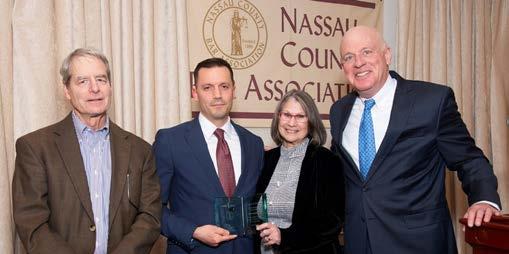
Thorndal Armstrong attorneys advocate for children through Children’s Attorneys Project

Thorndal Armstrong actively participates in a program called the Children’s Attorneys Project (CAP), which is facilitated through the Legal Aid Center of Southern Nevada. This program provides free legal advice and representation to abused and neglected children. In representing the children directly, a “CAP attorney” serves a unique role. During court proceedings, one table is typically for the district attorney, while the other table is typically for the parent(s). While judges always try to take into account the best interest of the children, before the CAP program started about 20 years ago, there was no specific, dedicated representation for the children. Counsel for the children essentially do not stand at either table in court. A CAP attorney stands in the middle of both sides as a true advocate for only the children. While some abuse-and-neglect child clients are not old enough to discuss their feelings or opinions on the issues affecting them, many of the children are and do become very involved. Those children now have their own voice, free of charge. The children are often in foster care, institutions and/or are wards of the state. The CAP program allows them to take an active role in the proceedings that affect their life and growth into adulthood. The representation ranges from being extremely rewarding, like when parents complete all orders of the court and are reunified with their children, to being extremely difficult, such as when a decision needs to be made concerning the possible termination of parental rights. Thorndal Armstrong has participated in this program for a number of years and still actively takes cases to help children in need. Thorndahl Armstrong shareholder Kevin Diamond, pictured, leads the firm’s participation with CAP.
US LAW SPRING 2023 USLAW MAGAZINE 49
Rivkin

about uslaw network
2001. The Start of Something Better.
Mega-firms...big, impersonal bastions of legal tradition, encumbered by bureaucracy and often slow to react. The need for an alternative was obvious. A vision of a network of smaller, regionally based, independent firms with the capability to respond quickly, efficiently and economically to client needs from Atlantic City to Pacific Grove was born. In its infancy, it was little more than a possibility, discussed around a small table and dreamed about by a handful of visionaries. But the idea proved too good to leave on the drawing board. Instead, with the support of some of the country’s brightest legal minds, USLAW NETWORK became a reality.
Fast forward to today.
The commitment remains the same as originally envisioned. To provide the highest quality legal representation and seamless cross-jurisdictional service to major corporations, insurance carriers, and to both large and small businesses alike, through a network of professional, innovative law firms dedicated to their client’s legal success. Now as a diverse network with more than 6,000 attorneys from nearly 100 independent, full practice firms across the U.S., Canada, Latin America and Asia, and with affiliations with TELFA in Europe, USLAW NETWORK remains a responsive, agile legal alternative to the mega-firms.
Home Field Advantage.
USLAW NETWORK offers what it calls The Home Field Advantage which comes from knowing and understanding the venue in a way that allows a competitive advantage – a truism in both sports and business. Jurisdictional awareness is a key ingredient to successfully operating throughout the United States and abroad. Knowing the local rules, the judge, and the local business and legal environment provides our firms’ clients this advantage. The strength and power of an international presence combined with the understanding of a respected local firm makes for a winning line-up.
A Legal Network for Purchasers of Legal Services.
USLAW NETWORK firms go way beyond providing quality legal services to their clients. Unlike other legal networks, USLAW is organized around client expectations, not around the member law firms. Clients receive ongoing educational opportunities, online resources, including webinars, jurisdictional updates, and resource libraries. We also pro-
vide USLAW Magazine, compendia of law, as well as an annual membership directory. To ensure our goals are the same as the clients our member firms serve, our Client Leadership Council and Practice Group Client Advisors are directly involved in the development of our programs and services. This communication pipeline is vital to our success and allows us to better monitor and meet client needs and expectations.
USLAW IN EUROPE.
Just as legal issues seldom follow state borders, they often extend beyond U.S. boundaries as well. In 2007, USLAW established a relationship with the TransEuropean Law Firms Alliance (TELFA), a network of more than 20 independent law firms representing more than 1,000 lawyers through Europe to further our service and reach.
How USLAW NETWORK Membership is Determined.
Firms are admitted to the NETWORK by invitation only and only after they are fully vetted through a rigorous review process. Many firms have been reviewed over the years, but only a small percentage were eventually invited to join. The search for quality member firms is a continuous and ongoing effort. Firms admitted must possess broad commercial legal capabilities and have substantial litigation and trial experience. In addition, USLAW NETWORK members must subscribe to a high level of service standards and are continuously evaluated to ensure these standards of quality and expertise are met.
USLAW in Review.
• All vetted firms with demonstrated, robust practices and specialties
• Organized around client expectations
• Efficient use of legal budgets, providing maximum return on legal services investments
• Seamless, cross-jurisdictional service
• Responsive and flexible
• Multitude of educational opportunities and online resources
• Team approach to legal services
The USLAW Success Story.
The reality of our success is simple: we succeed because our member firms’ clients succeed. Our member firms provide high-quality legal results through the efficient use of legal budgets. We provide cross-jurisdictional services eliminating the time and expense of securing adequate representation in different regions. We provide trusted and experienced specialists quickly.
When a difficult legal matter emerges –whether it’s in a single jurisdiction, nationwide or internationally – USLAW is there.
For more information, please contact Roger M. Yaffe, USLAW CEO, at (800) 231-9110 or roger@uslaw.org
®
US LAW www.uslaw.org 51
2023 membership roster
ALABAMA | BIRMINGHAM
Carr Allison
Charles F. Carr (251) 626-9340 ccarr@carrallison.com
ARIZONA | PHOENIX
Jones, Skelton & Hochuli, P.L.C.
Phillip H. Stanfield (602) 263-1745 pstanfield@jshfirm.com
ARKANSAS | LITTLE ROCK
Quattlebaum, Grooms & Tull PLLC
John E. Tull, III (501) 379-1705 jtull@qgtlaw.com
CALIFORNIA | LOS ANGELES
Murchison & Cumming LLP
Dan L. Longo (714) 953-2244 dlongo@murchisonlaw.com
CALIFORNIA | SAN DIEGO
Klinedinst PC
John D. Klinedinst (619) 239-8131 jklinedinst@klinedinstlaw.com
CALIFORNIA | SAN FRANCISCO
Hanson Bridgett LLP
Merton A. Howard (415) 995-5033 mhoward@hansonbridgett.com
CALIFORNIA | SANTA BARBARA
Snyder Burnett Egerer, LLP
Barry Clifford Snyder (805) 683-7750 bsnyder@sbelaw.com
CALIFORNIA | ROSEVILLE
Coleman, Chavez & Associates, LLP
– For Workers’ Compensation Only
Richard Chavez (916) 787-2300 rchavez@cca-law.com
COLORADO | DENVER
Lewis Roca
Jessica L. Fuller (303) 628-9527 Jfuller@lewisroca.com
CONNECTICUT | HARTFORD
Hinckley Allen
Noble F. Allen (860) 725-6237 nallen@hinckleyallen.com
DELAWARE | WILMINGTON
Cooch and Taylor P.A.
C. Scott Reese (302) 984-3811 sreese@coochtaylor.com
FLORIDA | CENTRAL FLORIDA
Wicker Smith
Richards H. Ford (407) 843-3939 rford@wickersmith.com
FLORIDA | SOUTH FLORIDA
Wicker Smith
Nicholas E. Christin (305) 448-3939 nchristin@wickersmith.com
FLORIDA | NORTHWEST FLORIDA
Carr Allison
Christopher Barkas (850) 222-2107 cbarkas@carrallison.com
HAWAII | HONOLULU
Goodsill Anderson Quinn & Stifel LLP
Edmund K. Saffery (808) 547-5736 esaffery@goodsill.com
IDAHO | BOISE
Duke Evett, PLLC
Keely E. Duke (208) 342-3310 ked@dukeevett.com
ILLINOIS | CHICAGO
Amundsen Davis LLC
Lew R.C. Bricker (312) 894-3224 lbricker@amundsendavislaw.com
IOWA | CEDAR RAPIDS
Simmons Perrine Moyer
Bergman PLC
Kevin J. Visser (319) 366-7641 kvisser@spmblaw.com
KANSAS/WESTERN MISSOURI | KANSAS CITY
Dysart Taylor
Amanda P. Ketchum (816) 714-3066 aketchum@dysarttaylor.com
LOUISIANA | NEW ORLEANS
McCranie, Sistrunk, Anzelmo, Hardy McDaniel & Welch LLC
Keith W. McDaniel (504) 846-8330 kmcdaniel@mcsalaw.com
MAINE | PORTLAND
Richardson, Whitman, Large & Badger
Elizabeth G. Stouder (207) 774-7474 estouder@rwlb.com
MARYLAND | BALTIMORE
Franklin & Prokopik, PC
Albert B. Randall, Jr. (410) 230-3622 arandall@fandpnet.com
MASSACHUSETTS | BOSTON
Rubin and Rudman LLP
John J. McGivney. (617) 330-7000 jmcgivney@rubinrudman.com
MINNESOTA | ST. PAUL
Larson • King, LLP
Mark A. Solheim (651) 312-6503 msolheim@larsonking.com
MISSISSIPPI | GULFPORT
Carr Allison Douglas Bagwell (228) 864-1060 dbagwell@carrallison.com
MISSISSIPPI | RIDGELAND
Copeland, Cook, Taylor & Bush, P.A. James R. Moore, Jr. (601) 427-1301 jmoore@cctb.com
MISSOURI | ST. LOUIS
Lashly & Baer, P.C. Stephen L. Beimdiek (314) 436-8303 sbeim@lashlybaer.com
MONTANA | GREAT FALLS
Davis, Hatley, Haffeman & Tighe, P.C.
Maxon R. Davis (406) 761-5243 max.davis@dhhtlaw.com
NEBRASKA | OMAHA
Baird Holm LLP
Jennifer D. Tricker (402) 636-8348 jtricker@bairdholm.com
NEVADA | LAS VEGAS
Thorndal Armstrong Delk
Balkenbush & Eisinger
Brian K. Terry (702) 366-0622 bkt@thorndal.com
NEW JERSEY | ROSELAND
Connell Foley LLP
Kevin R. Gardner (973) 840-2415 kgardner@connellfoley.com
NEW MEXICO | ALBUQUERQUE
Modrall Sperling Jennifer G. Anderson (505) 848-1809 Jennifer.Anderson@modrall.com
NEW YORK | BUFFALO
Barclay Damon LLP
Peter S. Marlette (716) 858-3763 pmarlette@barclaydamon.com
NEW YORK | HAWTHORNE
Traub Lieberman Stephen D. Straus (914) 586-7005 sstraus@tlsslaw.com
NEW YORK | UNIONDALE
Rivkin Radler LLP
David S. Wilck (516) 357-3347 David.Wilck@rivkin.com
NORTH CAROLINA | RALEIGH
Poyner Spruill LLP
Deborah E. Sperati (252) 972-7095 dsperati@poynerspruill.com
NORTH DAKOTA | DICKINSON
Ebeltoft . Sickler . Lawyers PLLC
Randall N. Sickler (701) 225-5297 rsickler@ndlaw.com
OHIO | CLEVELAND
Roetzel & Andress
Bradley A. Wright (330) 849-6629 bwright@ralaw.com
OKLAHOMA | OKLAHOMA CITY
Pierce Couch Hendrickson
Baysinger & Green, L.L.P.
Gerald P. Green (405) 552-5271 jgreen@piercecouch.com
OREGON | PORTLAND
Williams Kastner Thomas A. Ped (503) 944-6988 tped@williamskastner.com
PENNSYLVANIA | PHILADELPHIA
Sweeney & Sheehan, P.C.
J. Michael Kunsch (215) 963-2481 michael.kunsch@sweeneyfirm.com
PENNSYLVANIA | PITTSBURGH
Pion, Nerone, Girman, Winslow & Smith, P.C. John T. Pion (412) 281-2288 jpion@pionlaw.com
RHODE ISLAND | PROVIDENCE
Adler Pollock & Sheehan P.C. Richard R. Beretta, Jr. (401) 427-6228 rberetta@apslaw.com
SOUTH CAROLINA | COLUMBIA
Sweeny, Wingate & Barrow, P.A.
Mark S. Barrow (803) 256-2233 msb@swblaw.com
SOUTH DAKOTA | PIERRE
Riter Rogers, LLP
Robert C. Riter (605) 224-5825 r.riter@riterlaw.com
TENNESSEE | MEMPHIS
Martin, Tate, Morrow & Marston, P.C.
Lee L. Piovarcy (901) 522-9000 lpiovarcy@martintate.com
TEXAS | DALLAS
Fee, Smith & Sharp, L.L.P.
Michael P. Sharp (972) 980-3255 msharp@feesmith.com
TEXAS | HOUSTON
MehaffyWeber
Barbara J. Barron (713) 655-1200 BarbaraBarron@mehaffyweber.com
UTAH | SALT LAKE CITY
Strong & Hanni, PC
Stephen J. Trayner (801) 323-2011 strayner@strongandhanni.com
VIRGINIA | RICHMOND
Moran Reeves & Conn PC
C. Dewayne Lonas (804) 864-4820 dlonas@moranreevesconn.com
WASHINGTON | SEATTLE
Williams Kastner
Rodney L. Umberger (206) 628-2421 rumberger@williamskastner.com
WEST VIRGINIA | CHARLESTON
Flaherty Sensabaugh Bonasso PLLC
Michael Bonasso (304) 347-4259 mbonasso@flahertylegal.com
WISCONSIN | MILWAUKEE
Laffey, Leitner & Goode LLC
Jack Laffey (414) 312-7105 jlaffey@llgmke.com
WYOMING | CASPER
Williams, Porter, Day and Neville PC
Scott E. Ortiz (307) 265-0700 sortiz@wpdn.net
USLAW INTERNATIONAL
ARGENTINA | BUENOS AIRES
Barreiro, Olivas, De Luca, Jaca & Nicastro
Nicolás Jaca Otaño (54 11) 4814-1746 njaca@bodlegal.com
BRAZIL | SÃO PAULO
Mundie e Advogados
Rodolpho Protasio (55 11) 3040-2923 rofp@mundie.com
CANADA | ONTARIO | OTTAWA
Kelly Santini
Lisa Langevin (613) 238-6321 ext 276 llangevin@kellysantini.com
CANADA | QUEBEC | MONTREAL
Therrien Couture Joli-Coeur
Douglas W. Clarke (450) 462-8555 douglas.clarke@groupetcj.ca
CHINA | SHANGHAI
Duan&Duan
George Wang 8621 6219 1103 george@duanduan.com
MEXICO | MEXICO CITY
EC Rubio
René Mauricio Alva +52 55 5251 5023 ralva@ecrubio.com
TELFA
BELGIUM
CEW & Partners
Charles Price (+32 2) 534 20 20 Charles.price@cew-law.be
CYPRUS
Demetrios A. Demetriades LLC
Demetrios A. Demetriades +357 22 769 000 dadlaw@dadlaw.com.cy
CZECH REPUBLIC
Vyskocil, Kroslak & spol., Advocates and Patent Attorneys
Jiri Spousta (00 420) 224 819 133 spousta@akvk.cz
52 www.uslaw.org US LAW
DENMARK Lund Elmer Sandager Jacob Roesen (+45 33 300 268) jro@les.dk ENGLAND Wedlake Bell LLP Martin Arnold +44(0)20 7395 3186 marnold@wedlakebell.com ESTONIA • LATVIA • LITHUANIA LEXTAL Tallinn|Riga|Vilnius Lina SiksniuteVaitiekuniene (+370) 5 210 27 33 lina@lextal.lt FINLAND Lexia Attorneys Ltd. Markus Myhrberg +358 10 4244200 markus.myhrberg@lexia.fi FRANCE Delsol Avocats Emmanuel Kaeppelin +33(0)4 72 10 20 30 ekaeppelin@delsolavocats.com GERMANY Buse Jasper Hagenberg +49 30 327942 0 hagenberg@buse.de GREECE Corina Fassouli-Grafanaki & Associates Law Firm Korina FassouliGrafanaki (+30) 210-3628512 korina.grafanaki@lawofmf.gr HUNGARY Bihary Balassa & Partners Attorneys at Law Phone +36 1 391 44 91 IRELAND Kane Tuohy Solicitors Hugh Kane..................(+353) 1 6722233 hkane@kanetuohy.ie ITALY LEGALITAX Studio Legale e Tributario Alessandro Polettini +39 049 877 58 11 alessandro.polettini@legalitax.it LUXEMBOURG Tabery & Wauthier Véronique Wauthier (00352) 251 51 51 avocats@tabery.eu MALTA EMD Dr. Italo Ellul +356 2123 3005 iellul@emd.com.mt NETHERLANDS Dirkzwager Karen A. Verkerk +31 26 365 55 57 Verkerk@dirkzwager.nl NORWAY Advokatfirmaet Sverdrup DA Tom Eivind Haug +47 90653609 haug@sverdruplaw.no POLAND GWW Aldona Leszczyńska -Mikulska..... .. +48 22 212 00
PORTUGAL Carvalho,
&
Antonio
Alianciaadvokátov Gerta
Flassiková +421
Adarve Abogados SLP Juan José García +34 91 591 30
Wesslau Söderqvist Advokatbyrå Phone +46 8 407 88 00 SWITZERLAND Meyerlustenberger
Nadine von
22 737
00 warszawa@gww.pl
Matias
Associados
Alfaia de Carvalho (351) 21 8855440 acarvalho@cmasa.pt SLOVAKIA
Sámelová
2 57101313 flassikova@aliancia.sk SPAIN
60 Juanjose.garcia@adarve.com SWEDEN
Lachenal
Büren-Maier +41
10 00 nadine.vonburen-maier@mll-legal.com
the complete uslaw sourcebook

USLAW NETWORK offers legal decision makers a variety of complimentary products and services to assist them with their day-to-day operation and management of legal issues. USLAW Client Resources provide information regarding each resource that is available. We encourage you to review these and take advantage of those that could benefit you and your company. For additional information, contact Roger M. Yaffe, USLAW CEO, at roger@uslaw.org or (800) 231-9110, ext. 1.
USLAW is continually seeking to ensure that your legal outcomes are successful and seamless. We hope that these resources can assist you. Please don’t hesitate to send us input on your experience with any of the USLAW client resources products or services listed as well as ideas for the future that would benefit you and your colleagues.

VIRTUAL OFFERINGS
USLAW has many ways to help members virtually connect with their clients. From USLAW Panel Counsel Virtual Meetings to exclusive social and networking opportunities to small virtual roundtable events, industry leaders and legal decision-makers have direct access to attorneys across the NETWORK to support their various legal needs.

EDUCATION

It’s no secret – USLAW can host a great event. We are very proud of the timely industry-leading interactive roundtable discussions at our semi-annual client conferences, forums and client exchanges. Reaching from national to more localized offerings, USLAW member attorneys and the clients they serve meet throughout the year at USLAW-hosted events and at many legal industry conferences. USLAW also offers industry and practice group-focused virtual programming. CLE accreditation is provided for most USLAW educational offerings.
USLAW NETWORK undoubtedly has some of the most knowledgeable attorneys in the world, but did you know that we also have the most valuable corporate partners in the legal profession? Don’t miss out on an opportunity to better your legal game plan by taking advantage of our corporate partners’ expertise. Areas of expertise include forensic engineering, legal visualization services, jury consultation, courtroom technology, forensic accounting, record retrieval, structured settlements, future medical fund management, and investigation.
A TEAM OF EXPERTS
US LAW www.uslaw.org 53
all 2021 USlaw networkClientConference SEPTEMBER23-25,2021 oTHE BROADMOOR COLORADOSPRINGS,COLORADO USLAW NETWORK • TWENTIETH ANNIVERSARY 2001 2021 • CLIENT ClientConference spring 2022 uslaw network March 17-19, 2022 Ritz-Carlton Amelia Island, florida ® CLIENT
LAWMOBILE

We are pleased to offer a completely customizable one-stop educational program that will deliver information on today’s trending topics that are applicable and focused solely on your business. We focus on specific markets where you do business and utilize a team of attorneys to share relevant jurisdictional knowledge important to your business’ success. Whether it is a one-hour lunch and learn, half-day intensive program or simply an informal meeting discussing a specific legal matter, USLAW will structure the opportunity to your requirements – all at no cost to your company.
COMPENDIA OF LAW
USLAW regularly produces new and updates existing Compendia providing multi-state resources that permit users to easily access state common and statutory law. Compendia are easily sourced on a state-by-state basis and are developed by the member firms of USLAW. Some of the current compendia include: Retail, Spoliation of Evidence, Transportation, Construction Law, Workers’ Compensation, Surveillance, Offer of Judgment, Employee Rights on Initial Medical Treatment, and a National Compendium addressing issues that arise prior to the commencement of litigation through trial and on to appeal. Visit the Client Toolkit section of uslaw.org for the complete USLAW compendium library.


STATE JUDICIAL PROFILES BY COUNTY

Jurisdictional awareness of the court and juries on a county-by-county basis is a key ingredient to successfully navigating legal challenges throughout the United States. Knowing the local rules, the judge, and the local business and legal environment provides a unique competitive advantage. In order to best serve clients, USLAW NETWORK offers a judicial profile that identifies counties as Conservative, Moderate or Liberal and thus provides you an important Home Field Advantage.
USLAW MAGAZINE
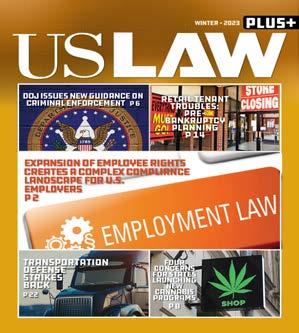



USLAW Magazine is an in-depth publication produced and designed to address legal and business issues facing today’s corporate leaders and legal decision-makers. Recent topics have covered cybersecurity & data privacy, artificial intelligence, medical marijuana & employer drug policies, management liability issues in the face of a cyberattack, defending motor carriers performing oversized load & heavy haul operations, nuclear verdicts, employee wellness programs, social media & the law, effects of electronic healthcare records, allocating risk by contract and much more.
54 www.uslaw.org US LAW
of Law SPOLIATION OF EVIDENCE SUMMER 2021
Compendium
FALL 2022 TransferTheValueofRiskConsultingin RealEstateTransactions andConstruction EvidenceUnderstandingSpoliation GutCheck: WhenaValidMedical CardIsn’tEnough p2 CorporateTransparency ActImposesRegulatory
USLAW CONNECTIVITY
In today’s digital world there are many ways to connect, share, communicate, engage, interact and collaborate. Through any one of our various communication channels, sign on, ask a question, offer insight, share comments, and collaborate with others connected to USLAW. Please check out us out LinkedIn, Twitter, Instagram and Facebook




TELFA CORPORATE PRACTICE GROUP COUNTRY-BY-COUNTRY GUIDE
The Trans European Law Firms Alliance (TELFA) Corporate Practice Group Country-by-Country Guide provides legal decision-makers with relevant info for creating corporate structures in jurisdictions across Europe. The corporate structure guide is intended to:
• Provide an overview of the different corporate structures and requirements in the EU.
• Inform about directors’ liabilities.
• Supplement company law aspects by always considering issues of tax.

To View and download the TELFA Country-by-Country Guide, visit the Client Toolkit section of uslaw.org.
PRACTICE GROUPS
USLAW prides itself on variety. Its 6,000+ attorneys excel in all areas of legal practice and participate in USLAW’s 25+ substantive active practice groups and communities, including Appellate Law, Banking and Financial Services, Business Litigation and Class Actions, Business Transactions/Mergers and Acquisitions, Cannabis Law, Complex Tort and Product Liability, Construction Law, Data Privacy and Security, eDiscovery, Energy/Environmental, Insurance Law, International Business and Trade, IP and Technology, Labor and Employment Law, Medical Law, Professional Liability, Real Estate, Retail and Hospitality Law, Tax Law, Transportation and Logistics, Trust and Estates, White Collar Defense, Women’s Connection, and Workers’ Compensation. Don’t see a specific practice area listed? Not a problem. USLAW firms cover the gamut of the legal profession and we will help you find a firm that has significant experience in your area of need.
CLIENT LEADERSHIP COUNCIL AND PRACTICE GROUP CLIENT ADVISORS
Take advantage of the knowledge of your peers. USLAW NETWORK’s Client Leadership Council (CLC) and Practice Group Client Advisors are hand-selected, groups of prestigious USLAW firm clients who provide expertise and advice to ensure the organization and its law firms meet the expectations of the client community. In addition to the valuable insights they provide, CLC members and Practice Group Client Advisors also serve as USLAW ambassadors, utilizing their stature within their various industries to promote the many benefits of USLAW NETWORK.

US LAW www.uslaw.org 55
COUNTRY COUNTRY GUIDE BY
AL CARR ALLISON
ADDRESS
100 Vestavia Parkway Birmingham, AL 35216
PH (205) 822-2006
FAX (205) 822-2057
WEB www.carrallison.com
PRIMARY Charles F. Carr (205) 949-2925 ccarr@carrallison.com
ALTERNATE Thomas L. Oliver, II (205) 949-2942 toliver@carrallison.com
ALTERNATE Thomas S. Thornton, III (205) 949-2936 tthornton@carrallison.com
MEMBER SINCE 2001 Carr Allison, one of the fastest growing firms in the Southeast, has offices strategically located throughout Alabama, Mississippi and Florida to provide our clients with sophisticated, effective and efficient legal representation.
We are the largest pure litigation firm in Alabama and have been recognized as a top five law firm by the Alabama Trial Court Review. From complex class actions to the defense of professionals, retailers, transportation companies, manufacturers, builders, employers and insurers, we represent clients of all sizes. Our attorneys include two former USLAW Chairs, the Executive Director of the Alabama Self-Insurers Association, adjunct faculty in Alabama’s law schools and several national speakers and writers on legal subjects ranging from punitive damages in Mississippi to quantifying death verdict values in Alabama and around the country.
Additional Offices:
Daphne, AL • PH (251) 626-9340 | Dothan, AL • PH (334) 712-6459 | Florence, AL • PH (256) 718-6040 Jacksonville, FL • PH (904) 328-6456 | Tallahassee, FL • PH (850) 222-2107 | Gulfport, MS • PH (228) 864-1060
AZ Jones, Skelton & Hochuli, PLC
ADDRESS
40 North Central Avenue Suite 2700 Phoenix, AZ 85004
PH (602) 263-1700
FAX (602) 651-7599
WEB www.jshfirm.com
PRIMARY Phillip H. Stanfield (602) 263-1745 pstanfield@jshfirm.com
ALTERNATE Michael A. Ludwig (602) 263-7342 mludwig@jshfirm.com
CA Murchison & Cumming, LLP
ADDRESS 801 South Grand Avenue Ninth Floor Los Angeles, CA 90017
PH (213) 623-7400
FAX (213) 623-6336
WEB www.murchisonlaw.com
PRIMARY Dan L. Longo (714) 501-2838 dlongo@murchisonlaw.com
ALTERNATE
Richard C. Moreno (213) 630-1085 rmoreno@murchisonlaw.com
ALTERNATE Jean A. Dalmore (213) 630-1005 jdalmore@murchisonlaw.com
MEMBER SINCE 2001 Founded in 1930, Murchison & Cumming, LLP is an AV-rated AmLaw 500 “Go
To” law firm for litigation in California. One third of the firm’s shareholders are from diverse backgrounds. We have the resources of a large firm while ensuring the level of personalized service one would expect to receive from a small firm. We represent domestic and international businesses, insurers, professionals and individuals in litigated, non-litigated and transactional matters.
We value our reputation for excellence and approach our work with enthusiasm and passion. What truly sets us apart is our ability to provide our clients with an early evaluation of liability, damages, settlement value and strategy. Together with our clients we develop an appropriate strategy as we pursue the targeted result in a focused, efficient, and effective manner.
Additional Office: Irvine, CA • PH (714) 972-9977
CA Klinedinst PC
ADDRESS 501 West Broadway Suite 600 San Diego, CA 92101
PH (619) 400-8000
FAX (619) 238-8707
WEB www.Klinedinstlaw.com
ALTERNATE
ALTERNATE
Clarice A. Spicker (602) 263-1706 cspicker@jshfirm.com

MEMBER SINCE 2001 Jones, Skelton & Hochuli, PLC is the largest and most experienced law firm of trial and appellate lawyers in Arizona practicing in the areas of insurance and insurance coverage defense. The firm’s 100+ attorneys defend insureds, self-insureds, government entities, corporations, and professional liability insureds throughout Arizona, New Mexico, and Utah.
Recognized as highly skilled, aggressive defenders of the legal and business communities, JSH lawyers have extensive trial and appellate experience in both state and federal courts. We present a vigorous defense in settlement negotiations and the deterrence of frivolous claims, as well as cost-effective arbitration and mediation services. With over 75 years of collective experience, our nationally-recognized in-house appellate team has handled over 800 appeals in state and federal courts.
AR Quattlebaum, Grooms & Tull PLLC
ADDRESS
111 Center St., Ste. 1900 Little Rock, AR 72201
PH (501) 379-1700
FAX (501) 379-1701
WEB www.QGTlaw.com
PRIMARY John E. Tull, III (501) 379-1705 jtull@qgtlaw.com
ALTERNATE Thomas G. Williams (501) 379-1722 twilliams@qgtlaw.com
ALTERNATE Michael N. Shannon (501) 379-1716 mshannon@qgtlaw.com
MEMBER SINCE 2004 With offices in Northwest and Central Arkansas, Quattlebaum, Grooms & Tull PLLC is a full-service law firm that can meet virtually any litigation, transactional, regulatory or dispute-resolution need. The firm’s clients include Fortune 500 companies, regional businesses, small entities, governmental bodies, and individuals. Our goal is to provide legal expertise with honesty, integrity, and respect to all clients, always keeping our client’s best interests in the forefront. Whether engaging in business formation, commercial transactions, or complex litigation, clients look to our over 40 attorneys for sound counsel, guidance and dependable advice, which has led to many long-term client relationships founded on mutual trust and respect.
Additional Office: Springdale, AR • (479) 444-5200
PRIMARY Frederick M. Heiser (949) 868-2606 fheiser@klinedinstlaw.com
Heather L. Rosing (619) 488-8888 hrosing@klinedinstlaw.com
ALTERNATE Nadia P. Bermudez (619) 488-8811 nbermudez@klinedinstlaw.com

MEMBER SINCE 2002 Klinedinst PC serves domestic and international clients in a broad range of civil litigation, corporate defense, white collar, and transactional law matters. Klinedinst attorneys are highly skilled and experienced individuals who provide a range of sophisticated legal services to corporations, institutions, and individuals at both the trial and appellate levels in federal and state courts. Each matter is diligently and effectively managed, from simple transactions to complex document-intensive matters requiring attorneys from multiple disciplines across the West. Klinedinst is firmly committed to providing only the highest quality legal services, drawing upon the individual background and collective energies and efforts of each member of the firm. Klinedinst’s overriding goal is to efficiently and effectively achieve optimal results for each client’s legal and business interests.
Additional Office: Irvine, CA • PH (949) 868-2600
CA Hanson bridgett llp
ADDRESS 425 Market Street 26th Floor San Francisco, CA 94105
PH (415) 777-3200
FAX (415) 541-9366
WEB
www.hansonbridgett.com
ALTERNATE
PRIMARY Mert A. Howard (415) 995-5033
MHoward@hansonbridgett.com
Sandra Rappaport (415) 995-5053
SRappaport@ hansonbridgett.com
ALTERNATE Jonathan S. Storper (415) 995-5040 JStorper@hansonbridgett.com
MEMBER SINCE 2015 Hanson Bridgett LLP is a full service AmLaw 200 law firm with more than 200 attorneys across California. Creating a diverse workforce by fostering an atmosphere of belonging and intentional support has been a priority at Hanson Bridgett since its founding in 1958. We are dedicated to creating an environment that provides opportunities for people with varied backgrounds, both for attorneys and administrative professionals. We are also committed to the communities where our employees live and work and consider it part of our professional obligation to serve justice by encouraging and supporting pro bono and social impact work.
Additional Offices: Sacramento, CA • PH (916) 442-3333 | San Rafael, CA • PH (415) 925-8400 | Walnut Creek, CA • PH (925) 746-8460 56 | US LAW NETWORK MEMBER FIRMS
CA SNYDER BURNETT EGERER, LLP

ADDRESS
5383 Hollister Avenue
Suite 240
Santa Barbara, CA 93111
PH (805) 692-2800
FAX (805) 692-2801
WEB
www.sbelaw.com
PRIMARY Sean R. Burnett (805) 683-7758 sburnett@sbelaw.com
ALTERNATE
Ashley Dorris Egerer (805) 683-7746 aegerer@sbelaw.com
CT HINCKLEY ALLEN
ADDRESS 20 Church Street, 18th Floor Hartford, CT 06103
PH (860) 725-6200
FAX (860) 278-3802
WEB www.hinckleyallen.com
ALTERNATE
ALTERNATE
ALTERNATE Christopher M. Cotter (805) 692-2800 ccotter@sbelaw.com

MEMBER SINCE 2001 Snyder Burnett Egerer, LLP is an AV rated firm which concentrates its practice on the defense and prosecution of civil litigation matters. The firm handles matters in state and federal courts throughout Central and Southern California, primarily for self-insured clients. Our very active trial practice includes actions in personal injury, premises liability, professional malpractice, business and complex litigation, employment law, products/drug liability, environmental, toxic tort, property, land use and development. Because the firm is staffed with trial lawyers, discovery does not involve “turning over every rock” and then billing the client for the effort. Rather, we direct discovery and investigation to the issues that will move the case toward resolution. If the case does not settle, we relish protecting our client’s rights at trial. The firm’s trial record is enviable – a winning percentage of over 85% for over 300 jury trials in the past decade.
ADDRESS
1731 E. Roseville Parkway Suite 200 Roseville CA 95661
PH (916) 787-2312
FAX (916) 787-2301
WEB www.cca-law.com
PRIMARY Richard Chavez (916) 607-3300 rchavez@cca-law.com
ALTERNATE Chad Coleman (916) 300-4323 ccoleman@cca-law.com

ALTERNATE Noelle Sage (714) 742-0782 nsage@cca-law.com
MEMBER SINCE 2023 Coleman Chavez & Associates, LLP is a 65+ attorney law firm focused on the defense of workers’ compensation claims and related litigation in California. Coleman Chavez & Associates was established in 2008, and we recently celebrated our 15th anniversary.
Coleman Chavez & Associates represents a variety of clients, including employers, insurance carriers and third-party administrators. We take pride in the quality of our work, and we are committed to providing thorough and effective representation to our clients. We believe that we can achieve the best results by staying well informed on the law, being thoroughly prepared, negotiating assertively and effectively, and keeping an open line of communication with our clients.
From our offices throughout the state, we service all Northern California and Southern California WCAB District Offices. The attorneys at Coleman Chavez & Associates look forward to working with you and your team members.
ADDRESS
1601 19th Street
Suite 1000 Denver, CO 80202
PH (303) 623-9000
FAX (303) 623-9222
WEB
www.lewisroca.com
PRIMARY Jessica L. Fuller (303) 628-9527 JFuller@lewisroca.com


ALTERNATE Ben M. Ochoa (303) 628-9574
BOchoa@lewisroca.com
ALTERNATE Michael D. Plachy (303) 628-9532
MPlachy@lewisroca.com
MEMBER SINCE 2005 Established and emerging companies, across key Colorado industries, consistently look to Lewis Roca Rothgerber Christie for informed and experienced counsel on the issues that matter most to their businesses. Our attorneys serve a diverse base of local, regional, national and international clients, including some of the world’s largest corporations, with transactional and litigation guidance. And from a service perspective, we immerse ourselves in your industry, business, and matter to solve your problems and anticipate the ones that lie ahead. We believe that every client deserves an exceptional experience and we’ve made it our mission to continuously exceed expectations in order to help you meet the unique business challenges of a rapidly evolving global marketplace. What matters to you, matters to us.
Additional Office: Colorado Springs, CO • PH (719) 386-3000
PRIMARY Noble F. Allen (860) 331-2610 nallen@hinckleyallen.com
William S. Fish, Jr. (860) 331-2700 wfish@hinckleyallen.com
Peter J. Martin (860) 331-2726 pmartin@hinckleyallen.com
MEMBER SINCE 2009 Hinckley Allen is a client-driven, forward-thinking law firm with one common goal: to provide great value and deliver outstanding results for our clients. We collaborate across practices and continuously pursue operational excellence to deliver cost-effective, exceptional service. Structured to serve our clients based on their industries and how they do business, we offer a rare combination of agility, responsiveness, full-service capabilities, and depth of experience.
Recognized as an AmLaw 200 Firm, Hinckley Allen offers pragmatic legal counsel, strategic thinking, and tireless advocacy to a diverse clientele. Our clients include regional, national, and international privately held and public companies and emerging businesses in a wide range of industries. Leading utilities, financial institutions, manufacturing companies, educational institutions, academic medical centers, health care institutions, hospitals, real estate developers, and construction companies depend on us for counsel. We have been a vital force in businesses, government, and our communities since 1906.
Additional Office: Manchester, NH • PH (603) 225-4334
DE COOCH AND TAYLOR
ADDRESS
1007 N. Orange Street Suite 1120 Wilmington, DE 19801
PH (302) 984-3800
FAX (302) 984-3939
WEB www.coochtaylor.com www.delawarelitigator.com
PRIMARY
C. Scott Reese (302) 984-3811 sreese@coochtaylor.com
ALTERNATE
ALTERNATE
Blake A. Bennett (302) 984-3889 bbennett@coochtaylor.com
R. Grant Dick IV (302) 984-3867 gdick@coochtaylor.com
MEMBER SINCE 2015 Cooch and Taylor, established in 1960, has long been regarded as one of Delaware’s best litigation firms. The firm’s attorneys spend a significant amount of time in the courtroom and have achieved many significant bench and jury verdicts, but recognize that to the vast majority of clients, success is defined by getting the best possible outcome long before a jury is ever seated. Delaware’s judiciary has a reputation as one of the best in the country based on factors such as judicial competence, treatment of litigation and timeliness. As a result, Delaware’s judges have strict expectations for all counsel appearing before them and Cooch and Taylor has over half a century of experience in ensuring its clients and co-counsel meet those expectations.
FL WICKER SMITH | CENTRAL FLORIDA
ADDRESS
390 North Orange Street, Suite 1000 Orlando. FL 32801
PH
(407) 843-3939
FAX (407) 649-8118
WEB www.wickersmith.com
PRIMARY Richards H. Ford (407) 317-2170 rford@wickersmith.com
ALTERNATE
Kurt M. Spengler (407) 317-2186 kspengler@wickersmith.com
MEMBER SINCE 2001 Founded in 1952, Wicker Smith O’Hara McCoy & Ford P.A. is a full-service trial firm deeply experienced in handling significant and complex litigation for a broad variety of clients including multinational corporations to individuals. With more than 260 attorneys, Wicker Smith services clients throughout Central and South Florida and beyond. Our Central Florida region serves Melbourne, Orlando, Tampa, and Sarasota. In South Florida, we serve Fort Lauderdale, Key Largo, Miami, Naples, Palmetto Bay, and West Palm Beach. The backbone of our relationship with clients is built upon integrity and stability. We strive to establish long-term relationships with our clients built upon a partnership of communication and trust by listening to our clients, understanding their businesses, and developing legal solutions to best meet their individual needs.
Additional Offices: Atlanta, GA • PH (407) 843-3939 | Brunswick, GA • PH (912) 266-8620 | Fort Lauderdale, FL • PH (954) 847-4800 Jacksonville, FL • PH (904) 355-0225 | Largo Key Largo, FL • PH (305) 448-3939 | Melbourne, FL • PH (321) 610-5800 Naples, FL • PH (239) 552-5300 | Orlando, FL • PH (407) 843-3939 | Palmetto Bay, FL • PH (305) 448-3939 Sarasota, FL • PH (941) 366-4200 | Tampa, FL • PH (813) 222-3939 West Palm Beach, FL • PH (561) 689-3800
57 | US LAW NETWORK MEMBER FIRMS Additional Offices: Los Angeles | Encino/Van Nuys | Orange County | Riverside | San Diego | Sacramento | Bay Area/Pleasant Hill | Fresno | San Jose/Salinas | Santa Rosa • PH (916) 787-2312
CA COLEMAN CHAVEZ & ASSOCIATES FOR WORKERS’ COMPENSATION ONLY CO LEWIS ROCA
FL WICKER SMITH | SOUTH FLORIDA
ADDRESS
2800 Ponce de Leon Blvd.
Suite 800 Coral Gables, FL 33134
PH (305) 448-3939
FAX (305) 441-1745
WEB www.wickersmith.com
ALTERNATE
PRIMARY
Nicholas E. Christin (305) 461-8710 nchristin@wickersmith.com
Oscar J. Cabanas ((305 )461-8710 ocabanas@wickersmith.com
ID DUKE EVETT PLLC
ADDRESS
1087 W River Street Suite 300 Boise, ID 83702
PH (208) 342-3310
FAX (208) 342-3299
WEB www.dukeevett.com
ALTERNATE Constantine “Dean” Nickas (305) 461-8703 cnickas@wickersmith.com
PRIMARY
Keely E. Duke (208) 342-3310 ked@dukeevett.com
ALTERNATE
Joshua S. Evett (208) 342-3310 jse@dukeevett.com
MEMBER SINCE 2001
Founded in 1952, Wicker Smith O’Hara McCoy & Ford P.A. is a full-service trial firm deeply experienced in handling significant and complex litigation for a broad variety of clients including multinational corporations to individuals. With more than 260 attorneys, Wicker Smith services clients throughout Central and South Florida and beyond. Our Central Florida region serves Melbourne, Orlando, Tampa, and Sarasota. In South Florida, we serve Fort Lauderdale, Key Largo, Miami, Naples, Palmetto Bay, and West Palm Beach. The backbone of our relationship with clients is built upon integrity and stability. We strive to establish long-term relationships with our clients built upon a partnership of communication and trust by listening to our clients, understanding their businesses, and developing legal solutions to best meet their individual needs.
Additional Offices: Atlanta, GA • PH (407) 843-3939 Brunswick, GA • PH (912) 266-8620 | Fort Lauderdale, FL • PH (954) 847-4800 Jacksonville, FL • PH (904) 355-0225 | Key Largo, FL • PH (305) 448-3939 Melbourne, FL • PH (321) 610-5800 Naples, FL • PH (239) 552-5300 | Orlando, FL • PH (407) 843-3939 | Palmetto Bay, FL • PH (305) 448-3939 Sarasota, FL • PH (941) 366-4200 Tampa, FL • PH (813) 222-3939 | West Palm Beach, FL • PH (561) 689-3800
FL CARR ALLISON | NORTHWEST FLORIDA
ADDRESS
305 South Gadsden St. Tallahassee, FL 32301
PH (850) 222-2107
FAX (850) 222-8475
WEB www.carrallison.com
PRIMARY Christopher Barkas (850) 518-6913 cbarkas@carrallison.com
ALTERNATE
William B. Graham (850) 518-6917 bgraham@carrallison.com
MEMBER SINCE 2001 The Tallahassee office of Carr Allison brings a legacy of more than 40 years of providing quality legal service to north Florida. A member of USLAW since 2001, Carr Allison has increased the scope of services available to its clientele, covering the Gulf Coast from Mississippi through Alabama and across the northern Florida panhandle to Jacksonville on the Atlantic coast.The lawyers handle all insurance issues from licensing to litigation. Firm members have extensive trial experience in the event matters can’t be resolved. Clients of the firm include insurance carriers as well as self-insured companies. Having a unique location in Florida’s Capital gives us the ability to lobby the legislature and influence public policy.With the resources of more than 120 lawyers in Alabama, Florida and Mississippi behind it, Carr Allison’s offices in Tallahassee and Jacksonville stand ready to serve the national and international client faced with legal exposure in Florida.
Additional
HI GOODSILL ANDERSON QUINN & STIFEL LLP
ADDRESS
First Hawaiian Center Suite 1600 999 Bishop Street Honolulu, HI 96813
PH (808) 547-5600
FAX (808) 547-5880
WEB www.goodsill.com
PRIMARY Edmund K. Saffery (808) 547-5736 esaffery@goodsill.com
ALTERNATE
Johnathan C. Bolton (808) 547-5854 jbolton@goodsill.com
MEMBER SINCE 2004 With more than 50 attorneys located in downtown Honolulu, Goodsill offers knowledge and experience in all aspects of civil law, including business and securities law, banking, real estate, tax, trusts and estates, public utilities, immigration, international transactions and civil litigation. In addition to representing clients in alternative dispute resolution, a number of our trial lawyers are trained mediators and are retained to resolve disputes. Goodsill’s litigation department also handles appeals in both state and federal courts.
Goodsill attorneys provide innovative, solutions-oriented legal and general business counsel to an impressive list of domestic and international clients. We work closely with each client to identify and deploy the right mix of legal and business expertise, talented support staff and technology.
MEMBER SINCE 2012 Success. Excellence. Experience. Dedication. These values form the foundation of our firm. At Duke Scanlan & Hall, we are dedicated to representing corporate, insurance, and healthcare clients through litigation, trials, and appeals all across Idaho and Eastern Oregon. We offer the experience and dedication of seasoned trial attorneys who insist on excellence in the pursuit of success for our clients. Our clients know that we not only consistently win, but that we keep them informed of case strategy and developments, while helping them manage the costs of litigation. In handling each case, we employ the following key strategies to help us effectively and efficiently fight for our clients: early and continued case evaluation and budgeting; consistent and timely communication with our clients; efficient staffing; and the use of advanced legal technology both in and out of the courtroom. While we bring experience and dedication to each of our cases, we are also proud of our profession and feel strongly that we – and the profession – can positively impact the lives of others. As part of our commitment, we support enhancing diversity in the legal field, working to improve our profession, and helping our community.
IL AMUNDSEN DAVIS LLC
ADDRESS
150 North Michigan Ave. Suite 3300 Chicago, IL 60601
PH (312) 894-3200
FAX (312) 894-3210 WEB www.amundsendavislaw. com
PRIMARY Lew R.C. Bricker (312) 894-3224 lbricker@ amundsendavislaw.com
ALTERNATE Larry A. Schechtman (312) 894-3253 lschechtman@ amundsendavislaw.com
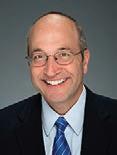
ALTERNATE Dennis J. Cotter (312) 894-3229 dcotter@ amundsendavislaw.com
MEMBER SINCE 2001 Amundsen Davis is a full service business law firm of more than 230 attorneys serving companies of all sizes throughout the U.S. and beyond. Our attorneys are prepared to handle a multitude of diverse legal services from the inception of business, to labor and employment issues, and litigation. We understand the entrepreneurial thinking that drives business decisions for our clients. Amundsen Davis attorneys combine experience with a practical business approach to offer client-centered services efficiently and effectively. The foundation for our success is the integrity, quality and experience of our attorneys and staff, an understanding of the relationship between legal risks and business objectives, and the desire to explore new and innovative ways to solve client problems.
IA SIMMONS PERRINE MOYER BERGMAN PLC
ADDRESS
115 Third Street SE Suite 1200 Cedar Rapids, IA 52401
PH (319) 366-7641 FAX (319) 366-1917 WEB www.spmblaw.com
PRIMARY Kevin J. Visser (319) 366-7641 kvisser@spmblaw.com
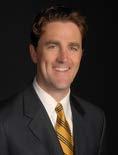

ALTERNATE
Lynn W. Hartman (319) 366-7641 lhartman@spmblaw.com
ALTERNATE
Brian J. Fagan (319) 366-7641 bfagan@spmblaw.com
MEMBER SINCE 2005 Simmons Perrine Moyer Bergman PLC is a full-service law firm headquartered in Cedar Rapids, Iowa with an additional office located in Coralville, Iowa. The firm’s deep history dates back to 1916, having more than a century of experience representing national (and international) clients in matters from complex transportation, construction and intellectual property litigation to business transactions of all sizes. We are also home to one of the largest banking practices in Iowa and are known for our long history of serving the needs of families and their businesses, including estate and succession planning. Our attorneys work together to find the most efficient solutions for the best outcomes for our clients.
Additional Office: Coralville, IA • PH (319) 354-1019
Daphne,
•
626-9340 | Dothan, AL • PH (334) 712-6459
Jacksonville,
Gulfport, MS • PH
Offices: Birmingham, AL • PH (205) 822-2006 |
AL
PH (251)
Florence, AL • PH (256) 718-6040 |
FL • (904) 328-6456 |
(228) 864-1060
Additional
Lake, IL • PH (815) 337-4900 | Rockford, IL • PH (815) 987-0441 | St. Charles, IL • PH (630) 587-7910 58 | US LAW NETWORK MEMBER FIRMS
Offices: Crystal
KS/MO DYSART TAYLOR
ADDRESS
700 West 47th Street
Suite 410 Kansas City, MO 64112
PH (816) 931-2700
FAX (816) 931-7377
WEB www.dysarttaylor.com
MD FRANKLIN & PROKOPIK P.C.
ADDRESS
2 North Charles Street, Suite 600 Baltimore, MD 21201
PH (410) 752-8700
FAX (410) 752-6868
WEB www.fandpnet.com
PRIMARY Amanda Pennington Ketchum (816) 714-3066 aketchum@dysarttaylor.com

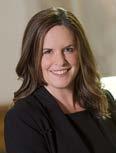
ALTERNATE Patrick K. McMonigle (816) 714-3039 pmcmonigle@dysarttaylor.com
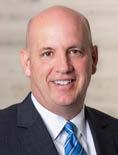

ALTERNATE John F. Wilcox, Jr. (816) 714-3046 jwilcox@dysarttaylor.com
MEMBER SINCE 2014 Dysart Taylor was founded in 1934. It is a highly respected Midwestern law firm with broad expertise to support its clients’ growth and success in a myriad of industries. It is also touted as one of the nation’s leading transportation law firms. Six members of the firm have served as Presidents of the Transportation Lawyers Association, the leading bar association for attorneys in the transportation industry.
Our attorneys are active in the community and have held governing positions in local and state bar associations and community organizations. Our AV-rated law firm is proud of its reputation for zealous advocacy, high ethical standards, and outstanding results. We are equally proud of the trust our local and national clients place in us.
LA MCCRANIE, SISTRUNK, ANZELMO, HARDY, MCDANIEL & WELCH
ADDRESS
909 Poydras Street Suite 1000 New Orleans, LA 70112
PH (504) 831-0946
PH (800) 237-9108
FAX (800) 977-8810
WEB www.mcsalaw.com
PRIMARY Keith W. McDaniel (504) 846-8330 kmcdaniel@mcsalaw.com

ALTERNATE Heather N. Shockley (504) 846-8334 hshockley@mcsalaw.com
MEMBER SINCE 2001 McCranie, Sistrunk, Anzelmo, Hardy, McDaniel & Welch is an aggressive, experienced, “AV” rated law firm with numerous “AV” rated attorneys. We provide our clientele with innovative, cost-effective representation statewide and in the gulf south.
We represent both insured and self-insured clients who face a multiplicity of exposures in today’s business environment.
Our practice areas include tort litigation, professional liability litigation, transportation, products liability, hotel-innkeeper liability, construction, workman’s compensation, environmental and toxic tort, maritime claims, premises liability, insurance coverage, excess insurance issues, highway design cases, civil rights litigation, municipal liability, medical malpractice, and other related areas.
Our attorneys also have expertise in commercial entity risks such as fidelity, surety, director and officer liability, and errors and omissions claims.
ME RICHARDSON, WHITMAN, LARGE & BADGER
ADDRESS
465 Congress Street, 9th Floor Portland, ME 04101
PH (207) 774-7474
FAX
(207) 774-1343
WEB www.rwlb.com
PRIMARY Elizabeth G. Stouder (207) 774-7474 estouder@rwlb.com
ALTERNATE Eric J. Uhl (207) 774-7474 euhl@rwlb.com
ALTERNATE Joseph L Cahoon (207) 774-7474 jcahoon@rwlb.com
MEMBER SINCE 2004 The core of Richardson, Whitman, Large & Badger’s practice is civil litigation. We are one of the largest and most diverse trial practice firms in Northern New England. From offices in Portland and Bangor we handle hundreds of cases in all of Maines’s state and federal courthouses. In addition, RWLB has developed an extensive labor and employment practice: counseling clients, writing policies and employee handbooks, and handling cases filed in the Maine Human Rights Commission, the EEOC, and all Maine courts.
RWLB’s trial practice covers the full breadth of civil litigation, from products liability to professional malpractice, from dam construction to ship collision, from gender discrimination to wiretapping and criminal defense. Our clients include small family businesses, local Maine companies, and some of the world’s largest multinational corporations. They come from all sectors of the economy and have included automakers, construction contractors, retailers, electric utilities, insurers, law firms, lending institutions, supermarkets, doctors, consumer product manufacturers, insurance agencies, and municipalities.
Additional Office: Bangor, ME
PRIMARY Albert B. Randall, Jr. (410) 230-3622 arandall@fandpnet.com
ALTERNATE
Tamara B. Goorevitz (410) 230-3625 tgoorevitz@fandpnet.com
ALTERNATE
Stephen J. Marshall (410) 230-3612 smarshall@fandpnet.com
MEMBER SINCE 2005 Headquartered in Baltimore City, Franklin & Prokopik is a regional law firm comprised of over 70 experienced attorneys. Our mission of providing the highest quality personal service enables us to grow, as we attract and develop other likeminded attorneys to serve our clients. From twenty-four hour emergency services to complex litigation, we listen carefully to our clients and tailor our services to meet their outcome goals. Franklin & Prokopik provides a broad spectrum of legal services and represents corporate and business entities of all sizes, from small “mom and pops” to Fortune 500 companies across a wide range of industries.
Additional Offices: | Easton, MD • PH (410) 820-0600 | Hagerstown, MD • PH (301) 745-3900
MA RUBIN AND RUDMAN LLP
ADDRESS 53 State Street Boston, MA 02109
PH
(617) 330-7000
FAX (617) 330-7550
WEB www.rubinrudman.com
PRIMARY John J. McGivney (617) 330-7017 jmcgivney@rubinrudman.com
ALTERNATE
Michael D. Riseberg (617) 330-7180 mriseberg@rubinrudman.com
ALTERNATE
Michael F. Connolly (617) 330-7101 mconnolly@rubinrudman.com
MEMBER SINCE 2020 Founded over a century ago, Rubin and Rudman LLP is a full-service law firm with more than 75 lawyers in Boston, Massachusetts. With a diverse mix of practices, Rubin and Rudman serves national and international companies, including large public companies and closely held businesses; real estate developers; biotechnology, pharmaceutical and medical device makers; regulated industries, public entities and municipalities; insurance companies and their insureds; educational and other institutions; non-profit organizations; families and high net worth individuals. Rubin and Rudman also has a suburban office in Woburn, Massachusetts. Web: www. rubinrudman.com.
Our years of experience and continuing dedication to providing high quality legal advice has earned us client loyalty and respect amongst our peers. Our attorneys thrive on challenging assignments across diverse areas of the law. We offer innovation and responsiveness, with a collaborative team approach to solving problems that get results
Additional Office: | Woburn, MA • PH (781) 933-5505
MN larson•king, LLP
ADDRESS
30 East Seventh Street Suite 2800 St. Paul, MN 55101
PH (651) 312-6500
FAX (651) 312-6618 WEB www.larsonking.com
PRIMARY Mark A. Solheim (651) 312-6503 msolheim@larsonking.com
ALTERNATE
David M. Wilk (651) 312-6521 dwilk@larsonking.com
ALTERNATE Shawn M. Raiter (651) 312-6518 sraiter@larsonking.com
MEMBER SINCE 2002 As a nationally recognized firm with an enviable track record of success, Larson • King delivers high quality legal services through a nimble and cost-effective team, without strict or overpriced fee structures. Our firm is capable of efficiently managing dispersed litigation resources and our attorneys provide seamless integration and rapid response times. Larson • King partners work directly with clients, and are closely involved with all aspects of a dispute. Whether it is finding the right expert testimony in a construction case, or retaining local counsel in a remote jurisdiction, Larson • King attorneys hand-select the right team to achieve client objectives. With these resources, Larson • King stands ready to take a case to the highest court – there are times when this fact alone can deter the opposition.
59 | US LAW NETWORK MEMBER FIRMS
MS CARR ALLISON | SOUTHERN MISSISSIPPI
ADDRESS
1319 26th Avenue Gulfport, MS 39501
PH (228) 864-1060
FAX (228) 864-9160
WEB www.carrallison.com
PRIMARY Douglas Bagwell (228) 678-1005 dbagwell@carrallison.com
MEMBER SINCE 2001 Carr Allison is one of the fastest growing firms in the Southeast. Why? Our clients tell us the fact that we have lawyers with a lifetime of ties in the seven cities in Alabama, Florida and Mississippi where our offices are located is the primary reason they come to us for legal problems in those areas. In Mississippi, we provide litigation services to national clients in the southern part of Mississippi from our office in Gulfport.When clients face litigation exposure in Mississippi they often hear the horror stories involving the imposition of punitive damages. We like to think we “wrote the book” on the subject of punitive damages in Mississippi. With the resources of more than 120 lawyers in Alabama, Florida and Mississippi behind it, the Carr Allison office in Gulfport, Mississippi stands ready to serve the national and international client faced with legal exposure in southern Mississippi.
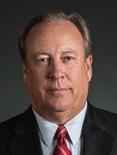
Additional Offices:
Birmingham, AL • PH (205) 822-2006 | Daphne, AL • PH (251) 626-9340 | Dothan, AL • PH (334) 712-6459
Florence, AL • PH (256) 718-6040 | Jacksonville, FL • PH (904) 328-6456 | Tallahassee, FL • PH (850) 222-2107
MS COPELAND, COOK, TAYLOR AND BUSH, P.A.
ADDRESS
600 Concourse, Suite 200 1076 Highland Colony Pkwy. Ridgeland, MS 39157
PH
(601) 856-7200
FAX (601) 856-7626
WEB www.copelandcook.com
PRIMARY James R. Moore, Jr. (601) 427-1301 jmoore@cctb.com
ALTERNATE Greg Copeland (601) 427-1313 gcopeland@cctb.com
ALTERNATE R. Eric Toney (601) 427-1302 etoney@cctb.com
MEMBER SINCE 2004 Copeland, Cook, Taylor and Bush, P.A. is a full-service AV-rated law firm based in the Metro Jackson area of Mississippi. Founded in 1985 by the four named shareholders, the firm’s original practice was based principally on Commercial Litigation, Oil and Gas, and Insurance Defense. The firm’s growth has resulted from strategic planning in direct response to the diverse needs of our clients. CCTB has built a reputation for strong client relationships as a result of its lawyers’ skills in communication and counseling. If litigation cannot be avoided, our seasoned litigation group is prepared to aggressively defend the interests of our clients in state and federal courts. While Mississippi can be a challenging jurisdiction, the record of CCTB clients speaks well for the quality of our representation.
Additional Offices: Gulfport, MS • PH (228) 863-6101 | Hattiesburg, MS • PH (601) 264-6670
MO LASHLY & BAER, P.C.
ADDRESS
714 Locust Street St. Louis, MO 63101
PH (314) 621-2939
FAX (314) 621-6844
WEB www.lashlybaer.com
MT DAVIS, HATLEY, HAFFEMAN & TIGHE, P.C.
ADDRESS
The Milwaukee Station Third Floor 101 River Drive North Great Falls, MT 59401
PH
(406) 761-5243
FAX
(406) 761-4126
WEB
www.dhhtlaw.com
ALTERNATE
ALTERNATE
PRIMARY Maxon R. Davis (406) 761-5243 max.davis@dhhtlaw.com
Paul R. Haffeman (406) 761-5243
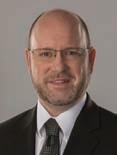
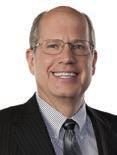
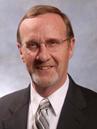

paul.haffeman@dhhtlaw.com
Gregory J. Hatley (406) 761-5243
greg.hatley@dhhtlaw.com
MEMBER SINCE 2007 Davis, Hatley, Haffeman & Tighe, P.C., is a business and litigation law firm located in Great Falls, Montana. It has been in continuous existence since 1912. Originally the firm focused on insurance defense work. While the defense of insureds and insurers remains a primary component of DHHT’s practice, the firm’s work has expanded over the years to include business litigation, representation of national and multi-national corporations in class actions, products liability, employment, environmental, toxic tort and commercial litigation, and the defense of public entities, including the State of Montana and numerous cities and counties, as well as a wide range of transactional work, running the gamut of business formations, farm and ranch sales, commercial leasing, oil and gas, and business consulting. There is also an active estate planning and probate practice. The firm carries on a state-wide trial practice. The lawyers at DHHT are proud of their reputation in the Montana legal community as attorneys who are always willing to go the distance for their clients. Since 2007, DHHT lawyers tried cases to verdict in federal and state courts all over Montana, including Great Falls, Billings, Missoula, Helena, Bozeman, Kalispell, Lewistown, Glasgow, Deer Lodge and Shelby. That reputation assures clients of experienced representation through all phases of litigation and instant creditability with the Montana bench & bar.
ADDRESS
1700 Farnam Street Suite 1500 Omaha, NE 68102
PH (402) 344-0500
FAX (402) 344-0588
WEB www.bairdholm.com
PRIMARY Jennifer D. Tricker (402) 636-8348 jtricker@bairdholm.com


ALTERNATE
J. Scott Searl (402) 636-8265 ssearl@bairdholm.com
ALTERNATE Christopher R. Hedican (402) 636-8311 chedican@bairdholm.com
MEMBER SINCE 2007 Baird Holm LLP’s integrated team of 97 attorneys, licensed in 22 states, is committed to connecting each of its valued clients to the positive outcomes they seek. With extensive and diverse expertise, we leverage one another’s skills to respond efficiently to our clients’ local, regional, national and international legal needs. We are proud to represent public and private companies, individuals, private funds and other investors, financial institutions, governmental entities and nonprofit organizations.
Rooted by the promise to constantly evolve in anticipation of our clients’ changing needs, Baird Holm has enjoyed steady and measured growth since its founding in 1873. We are proud of our strong tradition of uncompromising quality, dedication to clients, personal and professional integrity, and service to the profession and the community.
PRIMARY Stephen L. Beimdiek (314) 436-8303 sbeim@lashlybaer.com
ALTERNATE Kevin L. Fritz (314) 436-8309 klfritz@lashlybaer.com
ALTERNATE Julie Z. Devine (314) 436-8329 jdevine@lashlybaer.com
MEMBER SINCE 2002 Lashly & Baer, P.C. is a mid-size Missouri law firm with deep roots in St. Louis and surrounding areas. As a full-service firm, we have been fortunate to develop a very diverse and extremely loyal base of national, regional and local clients. Our clients have learned to expect a high level of service and a great degree of satisfaction, regardless of their size. Whether it’s a publicly-owned or private business, government institution, hospital or an individual – to each client, there is no more important legal matter than theirs. We know this and work hard to achieve results and help our clients reach their goals. Given the complexities of today’s business environment, lawyers develop experience in specific practice areas, such as: civil litigation, corporate, product liability, retail, transportation, professional liability, labor and employment, education, estate planning, government, health care, medical malpractice defense, personal injury, toxic tort and real estate.
Since 1912 our simple philosophy has never changed: at the core of every case is the client. The client’s goals become our goals, and our firm works tirelessly to find the most efficient and cost-effective solution to each legal issue.
ADDRESS
1100 E. Bridger Avenue Las Vegas, NV 89101
PH (702) 366-0622
FAX (702) 366-0327
WEB www.thorndal.com
PRIMARY Brian K. Terry (702) 366-0622 bkt@thorndal.com
ALTERNATE Katherine F. Parks (775) 786-2882 kfp@thorndal.com
ALTERNATE Michael C. Hetey (702) 366-0622 mch@thorndal.com
MEMBER SINCE 2007 Thorndal Armstrong has enjoyed a strong Nevada presence since 1971. Founded in Las Vegas, the firm has grown from two lawyers to just under thirty. It expanded its statewide services in 1986 with the opening of the northern Nevada office in Reno. An additional office was opened in Elko in 1996 to further satisfy client demand in the northeastern portion of the state.
With a strong emphasis in civil defense litigation for insureds and self-insureds, including expertise in complex litigation, general business, commercial law, and industrial insurance defense, Thorndal, Armstrong, Delk, Balkenbush & Eisinger is committed to providing thorough, efficient and effective legal services to its clients. Its experienced attorneys, combined with a highly capable professional support staff, allow the firm to represent clients on a competitive, cost-efficient basis.
Additional Office: Reno, NV • PH (775) 786-2882
NE baird holm llp NV THORNDAL
ARMSTRONG
60 | US LAW NETWORK MEMBER FIRMS
NJ CONNELL FOLEY LLP
ADDRESS
56 Livingston Avenue Roseland, NJ 07068
PH (973) 535-0500
FAX (973) 535-9217
WEB www.connellfoley.com
PRIMARY Kevin R. Gardner (973) 840-2415 kgardner@connellfoley.com
ALTERNATE John D. Cromie (973) 840-2425 jcromie@connellfoley.com
ALTERNATE Karen P. Randall (973) 840-2423 krandall@connellfoley.com




MEMBER SINCE 2005 A leading full-service regional law firm headquartered in New Jersey, Connell Foley LLP has more than 140 attorneys across seven offices. We take a hands-on approach to provide outstanding legal services while maintaining a firm culture predicated on service and teamwork. Our clients range from Fortune 500 corporations, to government entities, middle market and start-up businesses, and entrepreneurs. With experience in the various industries in which our clients operate, we offer innovative and cost-effective solutions. Connell Foley is recognized as a leader in numerous areas of law, including: banking and finance, bankruptcy and restructuring, commercial litigation, construction, corporate law, cybersecurity, environmental, immigration, insurance, labor and employment, product liability, professional liability, real estate, zoning and land use, transportation, trusts and estates, and white collar criminal defense.
Additional Offices: Cherry Hill, NJ • PH (856) 317-7100 | Jersey City, NJ • PH (201) 521-1000 Newark, NJ • PH (973) 436-5800 | New York, NY • PH (212) 307-3700
NM MODRALL SPERLING
ADDRESS
500 Fourth Street N.W. Suite 1000 Albuquerque, NM 87102
PH (505) 848-1800
FAX (505) 848-9710
WEB
www.modrall.com
PRIMARY Jennifer G. Anderson
(505) 848-1809
Jennifer.Anderson@modrall.com
NY TRAUB LIEBERMAN
ADDRESS
7 Skyline Drive Hawthorne, NY 10532
PH (914) 347-2600
FAX (914) 347-8898
WEB www.traublieberman.com
PRIMARY Stephen D. Straus (914) 586-7005 sstraus@tlsslaw.com
ALTERNATE Lisa Rolle (914) 586-7047 lrolle@tlsslaw.com
ALTERNATE Colleen E. Hastie (914) 586-7075 chastie@tlsslaw.com
MEMBER SINCE 2005 Traub Lieberman, located in Westchester County, NY, has achieved a national reputation for excellence in legal service. We are recognized by multiple organizations that monitor the legal community for outstanding service and high ethical standards.
Our focus is on innovative solutions to serve the needs of clients with sophisticated legal representation. We represent corporate clients in commercial disputes, and professionals in lawsuits alleging breach of contract and professional negligence, including employment practices, defense of lawyers, accountants, financial advisors, agents, brokers, corporate directors and officers. Our practice groups include defense of general and municipal liability, products liability, and complex toxic tort lawsuits.
Traub Lieberman provides a complete range of services to our insurance company clients including claim and coverage analysis, complex dispute resolution and policy drafting.
Additional Office: London, England • PH +44 20 3741 9500
ALTERNATE
Megan T. Muirhead
(505) 848-1888
Megan.Muirhead@modrall.com
ALTERNATE
Timothy L. Fields (505) 848-1841
Timothy.Fields@modrall.com
ADDRESS 926 RXR Plaza Uniondale, NY 11556-0926
PH
(516) 357-3000
FAX (516) 357-3333
WEB www.rivkinradler.com
PRIMARY David S. Wilck (516) 357-3347 david.wilck@rivkin.com
MEMBER SINCE 2004
Modrall Sperling provides high quality legal services on a range of issues and subjects important to businesses and individuals in New Mexico. Our clients include financial institutions, state and local governmental bodies, insurance companies, small and family businesses, national and multi-national corporations, energy and natural resource companies, educational institutions, private foundations, farmers, ranchers, and other individuals.With offices in Albuquerque and Santa Fe, the firm provides innovative legal solutions and is prepared to meet both the basic and sophisticated demands of business and individual clients in a challenging economy. Since its founding in 1937, Modrall Sperling has been recognized for excellence in a variety of practice areas and many of our lawyers have been consistently ranked among the best and brightest by peer review, as conducted by legal ranking organizations including Best Lawyers in America®, Chambers USA, Southwest Super Lawyers®, Martindale-Hubbell, and Benchmark Litigation. Several of our lawyers have also been recognized on a regional and national level.
Additional Office: Santa Fe, NM • PH (505) 983-2020
NY BARCLAY DAMON LLP
ADDRESS
The Avant Building, 200 Delaware Avenue Buffalo, NY 14202
PH (716) 856-5500
FAX
(716) 856-5510
WEB www.barclaydamon.com
PRIMARY Peter Marlette (716) 858-3763
pmarlette @barclaydamon.com
ALTERNATE Michael Murphy (518) 429-4209 mjmurphy@ barclaydamon.com
ALTERNATE Courtney Merriman (315) 425-2715 cmerriman@ barclaydamon.com
MEMBER SINCE 2019 Barclay Damon has 300 attorneys across a strategic platform of locations. Our attorneys team across practices and offices to provide customized, targeted solutions grounded in industry knowledge and a deep understanding of clients’ businesses. For more information, visit our award-winning website at barclaydamon.com.
Additional Offices: Albany, NY • PH (518) 429-4200 | Rochester, NY • PH (585) 295-4400 Syracuse, NY • PH (315) 425-2700 | New York, NY • PH (212) 784-5800 | Washington, DC • PH (202) 582-0601
ALTERNATE
ALTERNATE
Jacqueline Bushwack (516) 357-3239 jacqueline.bushwack@rivkin.com
Stella Lellos (516) 357-3373 stella.lellos@rivkin.com
MEMBER SINCE 2016 Through five offices and 200 lawyers, Rivkin Radler consistently delivers focused and effective legal services. We’re committed to best practices that go beyond professional and ethical standards. Our work product is clear and delivered on time. As a result, our clients proceed with confidence.
We provide strong representation and build even stronger client relationships. Many clients have been placing their trust in us for more than 30 years. Our unwavering commitment to total client satisfaction is the driving force behind our firm. We are the advisor-of-choice to successful individuals, middle-market companies and large corporations.
Additional Office: New York, NY • PH (212) 455-9555
NY RIVKIN RADLER LLP NC POYNER SPRUILL LLP

ADDRESS
301 Fayetteville St. Ste. 1900
P.O. Box 1801 (27602) Raleigh, NC 27601
PH (919) 783-6400
FAX (919) 783-1075
WEB www.poynerspruill.com
PRIMARY Deborah E. Sperati (252) 972-7095 dsperati@poynerspruill.com
ALTERNATE Randall R. Adams (252) 972-7094 radams@poynerspruill.com
ALTERNATE Karen H. Chapman (704) 342-5293 kchapman@poynerspruill.com
MEMBER SINCE 2004 Poyner Spruill LLP is a large, multidisciplinary North Carolina law firm, providing a comprehensive range of business and litigation legal services. The firm has a reputation for professional excellence and client service throughout the Southeast. Poyner Spruill has approximately 100 attorneys with offices in Charlotte, Raleigh, Rocky Mount, Southern Pines and Wilmington, from which we cover all federal and state courts. Approximately one-half of the firm attorneys practice litigation including a broad range of general commercial litigation, bank litigation and defense work in various types of liability cases. Many of our practice groups send up-to-the-minute legal developments on a myriad of issues pertinent to our clients’ business needs. Our periodic mailings are distributed via e-mail and posted to our web site’s publications page. We invite you and your clients to take advantage of this complimentary news service by signing up through our web site.
Additional Offices: Charlotte, NC • PH (704) 342-5250 | Rocky Mount, NC • PH (252) 446-2341 | Southern Pines, NC • PH (910) 692-6866
61 | US LAW NETWORK MEMBER FIRMS
ND EBELTOFT . SICKLER . LAWYERS PLLC
ADDRESS
2272 Eighth Street West Dickinson, ND 58601
PH (701) 225-5297
FAX (701) 225-9650
WEB www.ndlaw.com
PRIMARY Randall N. Sickler (701) 225-5297 rsickler@ndlaw.com


ALTERNATE Nicholas C. Grant (701) 225-5297 ngrant@ndlaw.com
ALTERNATE Courtney Presthus (701) 225-5297 cpresthus@ndlaw.com

MEMBER SINCE 2003 At Ebeltoft . Sickler . Lawyers PLLC we break away from rigid traditions and place our clients at the heart of all we do.
Our lawyers are skilled in civil litigation and means to avoid litigation. We provide advance planning and problem solving for businesses large and small, established and new. Our clients include a wide range of energy and mineral developers, manufacturers, insurance companies, financial institutions, public entities, hospitals and nursing homes, construction and transportation industries, educational institutions and non-profit entities.
Ebeltoft . Sickler . Lawyers PLLC is a law firm better for you. Better for your needs.
OH ROETZEL & ANDRESS
ADDRESS
1375 East Ninth Street
One Cleveland Center 10th Floor Cleveland, OH 44114
PH (216) 623-0150
FAX (216) 623-0134
WEB www.ralaw.com
PRIMARY Bradley A. Wright (330) 849-6629 bwright@ralaw.com
ALTERNATE
Moira H. Pietrowski (330) 849-6761 MPietrowski@ralaw.com

ADDRESS 1515 SW Fifth Avenue Suite 600 Portland, OR 97201-5449
PH (503) 228-7967
FAX (503) 222-7261
WEB www.williamskastner.com
ALTERNATE Chris Cotter (330) 819-1127 ccotter@ralaw.com
MEMBER SINCE 2003
Founded in 1876, Roetzel & Andress is a leading full-service law firm headquartered in Ohio. The firm provides comprehensive legal services to publicly traded and privately held companies, financial services participants, professional and governmental organizations, as well as private investors, industry executives and individuals. With over 160 lawyers in 12 offices, including five regional offices in Ohio, Roetzel & Andress collaborates seamlessly across industries and disciplines to provide sophisticated transactional, employment and litigation guidance to clients across the public and private sectors.
OK PIERCE COUCH HENDRICKSON BAYSINGER & GREEN, L.L.P.
ADDRESS
1109 North Francis Pierce Memorial Building Oklahoma City, OK 73106
PH (405) 235-1611
FAX
(405) 235-2904
WEB www.piercecouch.com
PRIMARY Gerald P. Green (405) 552-5271 jgreen@piercecouch.com
ALTERNATE Amy Bradley-Waters (918) 583-8100 abradley-waters@ piercecouch.com
ALTERNATE Mark E. Hardin (918) 583-8100 mhardin@piercecouch.com

MEMBER SINCE 2002 Pierce Couch Hendrickson Baysinger & Green, L.L.P. was founded in 1923 and is the largest litigation defense firm in the state of Oklahoma. The Firm has offices in Oklahoma City and Tulsa and is engaged in the representation of clients in all 77 Oklahoma Counties and all three federal district courts. Our attorneys have expertise in the areas listed below and prides itself in developing strategies for the defense of its clients, delivering advice and counsel to deal with claims ranging from the defensible to the catastrophic. Our attorneys have tried hundreds of cases to jury verdict and have mediated and/or arbitrated thousands of disputes. We attribute the success and longevity of our firm to our steadfast philosophy of combining the best in cost-efficient legal services with client-tailored strategies.
Additional Office: Tulsa, OK • PH (918) 583-8100
PRIMARY Thomas A. Ped (503) 944-6988 tped@williamskastner.com
ALTERNATE Heidi L. Mandt (503) 228-7967 hmandt@williamskastner.com
MEMBER SINCE 2002 Williams Kastner has been providing legal and business advice to a broad mix of clients since our Seattle office opened in 1929. With more than 65 lawyers in Washington and Oregon, the firm combines the resources and experience to offer national and regional capabilities with the client service and sensibility a local firm can provide. The firm culture is characterized by hard work, high-performance teamwork, diversity and partnerships with our clients and the local community. Our commitment to our clients is reflected through our quality legal work, personalized approach to servicing our clients and the integrity and pride we devote towards the practice of law.
Additional Office: Seattle, WA • PH (206) 628-6600
OR WILLIAMS KASTNER PA SWEENEY & SHEEHAN, P.C.
ADDRESS 1515 Market Street Suite 1900 Philadelphia, PA 19102
PH (215) 563-9811
FAX (215) 557-0999
WEB www.sweeneyfirm.com
PRIMARY
J. Michael Kunsch (215) 963-2481 michael.kunsch@ sweeneyfirm.com
ALTERNATE
Warren E. Voter (215) 963-2439 warren.voter@ sweeneyfirm.com
ALTERNATE
Robyn F. McGrath (215) 963-2485 robyn.mcgrath@ sweeneyfirm.com

MEMBER SINCE 2003 Founded in 1971, Sweeney & Sheehan is a litigation firm of experienced and dedicated trial attorneys and other professionals working in partnership with our clients to meet their changing and increasingly sophisticated particular needs. With client satisfaction our primary goal, we are committed to delivering superior legal services and pursuing excellence in all aspects of our practice. Our success is achieved without compromising the ideals which define the best in our profession: integrity, loyalty and expertise. We constantly enhance our firm to meet the expectations of our clients. Committed to these principles, we have a reputation as skillful and effective litigators in a broad range of practice areas, providing the talent and experience of larger firms while maintaining flexibility to deliver personalized, cost-effective quality service.
Additional Office: Woburn, MA • PH (781) 933-5505
PA PION, NERONE, GIRMAN, WINSLOW & SMITH, P.C.
ADDRESS
1500 One Gateway Center 420 Ft. Duquesne Blvd. Pittsburgh, PA 15222
PH (412) 281-2288
FAX (412) 281-3388 WEB www.pionlaw.com
PRIMARY John T. Pion (412) 667-6200 jpion@pionlaw.com
ALTERNATE Michael F. Nerone (412) 667-6234 mnerone@pionlaw.com

ALTERNATE Timothy R. Smith (412) 667-6212 tsmith@pionlaw.com
MEMBER SINCE 2011 Pion, Nerone, Girman, Winslow & Smith, P.C. is a civil litigation firm with offices in Pittsburgh and Harrisburg.
Our practice areas include transportation, railroad, asbestos, premises liability, products liability, family law, estate, Medicare Set-Aside, workers’ compensation, and general liability. In addition to trial representation, catastrophic response and business consulting, the firm has an appellate and complex research group. The Partners of the firm have more than 150 years of collective experience.
Most of our lawyers and staff were born and raised in Pennsylvania and we are proud to be part of the distinguished Pittsburgh and Harrisburg legal communities. The emergency response telephone number (412-600-0217) is answered by a lawyer 24/7 and allows us to provide high quality service to our clients. We urge our clients to utilize this number should the need arise.
Additional Offices: Akron, OH • PH (330) 376-2700 | Cincinnati, OH • PH (513) 361-0200 | Columbus, OH • PH (614) 463-9770 Toledo, OH • PH (419) 242-7985 | Wooster, OH • PH (330) 376-2700 | Detroit, MI • PH (313) 309-7033 62 | US LAW NETWORK MEMBER FIRMS
RI ADLER POLLOCK & SHEEHAN P.C.
ADDRESS
One Citizens Plaza
8th Floor Providence, RI 02903
PH (401) 274-7200
FAX (401) 751-0604
WEB www.apslaw.com
PRIMARY Richard R. Beretta, Jr. (401) 427-6228 rberetta@apslaw.com
ALTERNATE Robert P. Brooks (401) 274-7200 rbrooks@apslaw.com
ALTERNATE Elizabeth M. Noonan (401) 274-7200 bnoonan@apslaw.com
MEMBER SINCE 2008 Since 1960, Adler Pollock & Sheehan P.C. has delivered client-focused business law services designed to achieve cost-effective solutions for today’s complex challenges. Based in Providence, the firm is a full-service regional law firm, featuring a sophisticated corporate practice and a nationally-renowned litigation practice. The firm successfully combines the depth and breadth of expertise of a large law firm with the advantages of responsive and direct personal service by partners found in smaller firms.
Among the firm’s more than 60 attorneys are several former leaders of the Rhode Island legislature as well as former senior members of state administrations who are able to provide a unique understanding of governmental processes for clients. The firm’s client base includes Fortune 500 and 100 companies, small and medium-sized businesses, individuals, public and quasi-public agencies, and private not for- profit organizations.
Additional Office: Newport, RI • PH (401) 847-1919
SC SWEENY, WINGATE & BARROW, P.A.
ADDRESS
1515 Lady Street Columbia, SC 29201 PO Box 12129 (29211)
PH (803) 256-2233
FAX (803) 256-9177
WEB www.swblaw.com
PRIMARY Mark S. Barrow (803) 256-2233 msb@swblaw.com
ALTERNATE Kenneth B. Wingate (803) 256-2233 kbw@swblaw.com
ALTERNATE Christy E. Mahon (803) 256-2233 cem@swblaw.com
MEMBER SINCE 2002 Sweeny, Wingate & Barrow, P.A. is a litigation and consulting law firm serving the needs of individuals, businesses and insurance companies throughout South Carolina. We are committed to a philosophy of excellence, integrity, and service.
Cooperation, selflessness, and diligence are essential to providing high-quality service to every client. At Sweeny, Wingate and Barrow, we are committed to providing excellent representation to our clients in helping achieve their legal goals. Our relationships with our clients are honest, open, and fair.
Our practice covers many legal issues in two distinct areas. As a business and tort litigation defense firm, we provide defense representation to corporations and individuals in trucking litigation, construction defect litigation, product liability cases, medical malpractice cases, and insurance coverage matters, including opinion letters and defense of accident claims, professional liability, construction defect, and product liability defense.
The other section of our practice includes the transactions and litigation situations that arise in connection with business planning, estate planning, probate administration, and probate litigation. We handle contract drafting, incorporations, startups, wills, trusts, probate matters, and countless other business needs for our clients.
Additional Office: Hartsville, SC • PH (843) 878-0390
SD RITER ROGERS, LLP
ADDRESS Professional & Executive Building
319 South Coteau Street
Pierre, SD 57501
PH
(605) 224-5825
FAX
(605) 224-7102
WEB
www.riterlaw.com
TN MARTIN, TATE, MORROW & MARSTON, P.C.
ADDRESS 6410 Poplar Avenue Suite 1000 Memphis, TN 38119 PH (901) 522-9000
FAX (901) 527-3746
WEB www.martintate.com
PRIMARY Lee L. Piovarcy (901) 522-9000 lpiovarcy@martintate.com
ALTERNATE
ALTERNATE
Earl W. Houston, II (901) 522-9000 ehouston@martintate.com
Shea Sisk Wellford (901) 522-9000 swellford@martintate.com
MEMBER SINCE 2002 Martin Tate was endowed by its founder, Judge John D. Martin, Sr., over 100 years ago, with a solid tradition of service to clients, the profession and the Memphis Community. Because of its long-term commitment to the Memphis community, Martin Tate projects a unique perspective in delivering legal services for Memphis businesses and national clients. The firm combines quality legal services with innovative legal thinking to create practical solutions that provide clients a competitive edge. The firm’s areas of significant practice are business and commercial transactions; litigation in state and federal courts; trusts and estates; and commercial real estate. The firm’s attorneys counsel clients in M&As, banking, IPOs, partnership matters, PILOT transactions, bankruptcy reorganizations and creditor’s rights. Attorneys regularly deal with matters involving contracts, transportation law, insurance, products liability, and employment rights. Attorneys in the real estate section are involved in transactions regarding construction, development, leasing and operation of shopping centers, office buildings, industrial plants, and warehouse distribution centers. The firm is involved in financing techniques for real estate syndications, issuance of tax-exempt bonds, and equity participations.
Additional Office: Nashville, TN • PH (615) 627-0668
FEE, SMITH & SHARP LLP
ADDRESS 13155 Noel Road Suite 1000 Dallas, TX 75240
PH (972) 934-9100 FAX (972) 934-9200 WEB www.feesmith.com
PRIMARY Michael P. Sharp (972) 980-3255 msharp@feesmith.com
ALTERNATE Thomas W. Fee (972) 980-3259 tfee@feesmith.com
ALTERNATE Jennifer M. Lee (972) 980-3264 jlee@feesmith.com
MEMBER SINCE 2005 Fee, Smith & Sharp, LLP an AV rated firm based in Dallas, Texas, was founded to service the litigation needs of the firm’s individual, corporate and insurance clients. The partners’ combined experience as lead counsel in well over 200 civil jury trials allows the firm to deliver an aggressive, team-oriented approach on behalf of their valued clients. The partnership is supported by a team of talented, experienced, and professional associate attorneys and legal staff who understand the importance of delivering efficient, quality legal services. The attorneys at Fee, Smith & Sharp, LLP are actively involved in representing clients throughout Texas in a variety of commercial, property and casualty cases at the state, federal and appellate levels.
Additional Office: Austin, TX • PH (512) 479-8400
TX MEHAFFY WEBER PC
ADDRESS
One Allen Center 500 Dallas, Suite 2800 Houston, Texas 77002
PH (713) 655-1200 FAX (713) 655-0222 WEB www.mehaffyweber.com
PRIMARY Robert C. Riter r.riter@riterlaw.com
ALTERNATE Darla Pollman Rogers dprogers@riterlaw.com

ALTERNATE Lindsey Riter-Rapp l.riter-rapp@riterlaw.com


MEMBER SINCE 2004 The original predecessor firm of Riter Rogers, LLP commenced the practice of law in Pierre, South Dakota over 100 years ago.
The firm has a wide and varied practice, particularly in central South Dakota, but also maintains a statewide litigation practice, regularly appears before State boards and commissions, and serves as legislative counsel for numerous associations and cooperatives.
Firm members have spent considerable time representing insurance companies in defense of casualty suits, products liability claims and similar matters.
The firm handles substantial regulatory law matters, and also does much work relating to banking, contracts, real estate, title work and probate and estate planning.
All members of the firm are active in professional activities and civic and fraternal organizations.
PRIMARY Barbara J. Barron (832) 526-9728
BarbaraBarron@ mehaffyweber.com
ALTERNATE Bernabe G. Sandoval, III (713) 210-8906
TreySandoval@ mehaffyweber.com
ALTERNATE Michele Y. Smith (409) 951-7736
MicheleSmith@ mehaffyweber.com
MEMBER SINCE 2011 MehaffyWeber was founded in 1946 as a litigation firm. As our clients’ needs expanded, we evolved into a broad-based law firm, still with a strong litigation emphasis. We tailor our approaches to best suit the client’s individual needs. We are proud to have a long record of winning cases in tough jurisdictions, but we know that not all cases need to be tried. We use legal motions and other means to achieve positive results pre-trial, and when appropriate, we work hand in hand with our clients to secure advantageous settlements. Today, we continue to believe that hard work, ethical and innovative approaches are core values that result in success for the firm and our clients.
Additional Offices: Austin, TX • PH (512) 394-3840 | Beaumont, TX • PH (409) 835-5011 | San Antonio, TX • PH (210) 824-0009
TX
63 | US LAW NETWORK MEMBER FIRMS
UT STRONG & HANNI
ADDRESS
102 South 200 East, Suite 800 Salt Lake City, UT 84111
PH (801) 532-7080
FAX (801) 596-1508
WEB www.strongandhanni.com
PRIMARY
Kristin A. VanOrman (801) 323-2020 kvanorman@ strongandhanni.com
ALTERNATE
Peter H. Christensen (801) 323-2008 pchristensen@ strongandhanni.com
ALTERNATE
Ryan P. Atkinson (801) 323-2195 ratkinson@ strongandhanni.com
MEMBER SINCE 2005 Strong & Hanni, one of Utah’s most respected and experienced law firms, demonstrates exceptional legal ability and superior quality. For more than one hundred years, the firm has provided effective, efficient, and ethical legal representation to individuals, small businesses, and large corporate clients. The firm’s attorneys have received awards and commendations from many national and state legal organizations. The firm’s practice groups allow attorneys to focus their in-depth knowledge in specific areas of the law. The firm’s organization fosters interaction with attorneys across the firm’s practice groups insuring that even the most complex legal matter is handled in the most effective and efficient manner. The firm’s commitment to up to date technology and case management tools allows matters to be handled with client communication and document security in mind. The firm’s trial attorneys have received commendations and recognition from local, state, and national organizations. Our business is protecting your business.
Additional Office: Sandy, UT • PH (801) 532-708
VA MORAN REEVES & CONN PC
ADDRESS
1211 E. Cary Street Richmond, VA 23219
PH (804) 421-6250
FAX (804) 421-6251
WEB www.moranreevesconn.com
PRIMARY A.C.Dewayne Lonas (804) 864-4820 dlonas@moranreevesconn.com
ALTERNATE Martin A. Conn (804) 864-4804 mconn@moranreevesconn.com
ALTERNATE Shyrell A. Reed (804) 864-4826 sreed@moranreevesconn.com

MEMBER SINCE 2022 Richmond, Virginia-based Moran Reeves & Conn PC specializes in complex litigation, business transactions, and commercial real estate/finance. Its attorneys and legal professionals operate within a technologically advanced, nimble work environment. Client service is foremost at Moran Reeves Conn. Firm leaders also encourage community involvement and are proponents of a collaborative, inclusive culture.<br><br>The firm’s litigation team handles product liability defense, toxic torts and environmental litigation, construction litigation, premises liability, commercial litigation, and general liability defense. Its award-winning healthcare team works on matters involving medical professional liability, healthcare litigation, and employment disputes. Known as experienced trial attorneys, MRC lawyers also pursue alternative means of dispute resolution when appropriate, including arbitration and mediation.<br><br>The firm’s robust business transactional practice includes representation of corporate clients and developers in large-scale financing and commercial real estate deals. Team attorneys are experienced in entity formation, creditors’ rights, securities offerings, tax-advantaged arrangements such as 1031 exchanges, and other complex transactions.
WA WILLIAMS KASTNER
ADDRESS
Two Union Square
601 Union Street Suite 4100 Seattle, WA 98101-2380
PH
(206) 628-6600
FAX
(206) 628-6611
WEB
www.williamskastner.com
SENSABAUGH BONASSO PLLC
ADDRESS
200 Capitol Street Charleston, WV 25301
PH (304) 345-0200
FAX (304) 345-0260
WEB
www.flahertylegal.com
PRIMARY Peter T. DeMasters (304) 225-3058 pdemasters@flahertylegal.com


ALTERNATE Tyler Dinsmore (304) 347-4234 tdinsmore@flahertylegal.com
ALTERNATE
Michael Bonasso (304) 347-4259 mbonasso@flahertylegal.com
MEMBER SINCE 2015 Flaherty Sensabaugh Bonasso PLLC serves local, national and international clients in the areas of litigation and transactional law. Founded in 1991, today more than 50 attorneys provide quality counsel to turn clients’ obstacles into opportunities.
At Flaherty, we are deeply committed to partnering with our clients to obtain optimum results. Throughout our history, our prime consideration has been our client’s interests, with a key consideration of the costs associated with litigation.
While avoiding litigation may be desired, when necessary, our attorneys stand prepared to bring their considerable experience to the courtroom. We are experienced in trying matters ranging from simple negligence to complex, multi-party matters involving catastrophic damages.
Additional Offices: Clarksburg, WV • PH (304) 624-5687 | Morgantown, WV • PH (304) 598-0788 | Wheeling, WV • PH (304) 230-6600
ADDRESS 325 E. Chicago Street, Suite 200 Milwaukee, WI 53202
PH (414) 312-7003
FAX (414) 755-7089
WEB www.llgmke.com
PRIMARY Rodney L. Umberger (206) 628-2421 rumberger@williamskastner.com

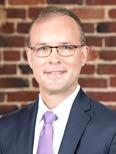
ALTERNATE
Sheryl J. Willert (206) 628-2408 swillert@williamskastner.com

MEMBER SINCE 2002 Williams Kastner has been providing legal and business advice to a broad mix of clients since our Seattle office opened in 1929. With more than 65 lawyers in Washington and Oregon, the firm combines the resources and experience to offer national and regional capabilities with the client service and sensibility a local firm can provide. The firm culture is characterized by hard work, high-performance teamwork, diversity and partnerships with our clients and the local community. Our commitment to our clients is reflected through our quality legal work, personalized approach to servicing our clients and the integrity and pride we devote towards the practice of law.
Additional Office: Portland, OR • PH (503) 228-7967
PRIMARY
Jack J. Laffey (414) 312-7105 jlaffey@llgmke.com
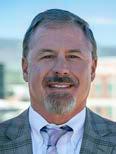
ALTERNATE Joseph S. Goode (414) 312-7181 jgoode@llgmke.com
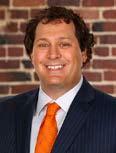
ALTERNATE Mark M. Leitner (414) 312-7108 mleitner@llgmke.com
MEMBER SINCE 2019 Relentless. Inspired. Committed. Authentic. Our team of professionals share an almost fanatical commitment to practicing Law as a means of balancing the unbalanced, leveling the unleveled, and bringing big-time results to you, our client.
We want the hardest problems you can throw at us. There is nothing we love more than diving deep into complex litigation and disputes. We will solve your problems, no matter how large or how small. This team thrives under pressure, so pile it on. Our team of battle-tested attorneys brings an unmatched drive and determination to every client. We don’t rest on our laurels. We innovate and create new solutions to produce winning results. We bring order and symmetry to chaos and complexity. We love what we do.
Lots of firms talk about being responsive; we live it. Our commitment to serving our clients fundamentally shapes how we view and practice law.
We are human beings. While we thrive under incredible challenges and difficult circumstances, we also care deeply about the people we work with and represent. Being authentic also means that we recognize our clients are people too. We understand them, and we know them.
& GOODE LLC WY WILLIAMS, PORTER, DAY & NEVILLE, P.C.
ADDRESS
159 North Wolcott Suite 400 Casper, WY 82601
PH (307) 265-0700
FAX
(307) 266-2306
WEB www.wpdn.net
PRIMARY Scott E. Ortiz (307) 265-0700 sortiz@wpdn.net
ALTERNATE Scott P. Klosterman (307) 265-0700 sklosterman@wpdn.net
ALTERNATE Keith J. Dodson (307) 265-0700 kdodson@wpdn.net
MEMBER SINCE 2006 Williams, Porter, Day & Neville, P.C. (WPDN) has deep roots in Wyoming, running back over 70 years. WPDN is the pinnacle of representation in Wyoming and has been involved in Wyoming’s most seminal legal decisions, across many practice areas, in state and Federal courts. WPDN represents clients from international, national, and state-based insurance providers, publically-traded to privately-held natural resource companies, national and local trucking operations, local and state governmental entities, ranches, banks and other business entities. With its high standards and integrity, WPDN offers clients a vast knowledge and understanding of the ways of Wyoming and provides the highest quality representation within its practice. WPDN attorneys and staff work as a team to ensure fairness, productive working atmosphere and high-quality representation.
WV
WI LAFFEY,LEITNER
FLAHERTY
64 | US LAW NETWORK MEMBER FIRMS
ARGENTINA | BARREIRO, OLIVA, DE LUCA, JACA & NICASTRO
ADDRESS
Av. Córdoba 1309 3° A
Ciudad de Buenos Aires
C1055AAD Argentina
PH +54 11 4814 1746
WEB
www.bodlegal.com
PRIMARY Nicolas Jaca Otano +54 11 4814 1746 njaca@bodlegal.com
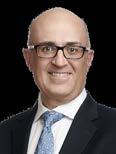
ALTERNATE Gonzalo Oliva-Beltrán +54 11 4814-1746 goliva@bodlegal.com

ALTERNATE Ricardo Barreiro Deymonnaz +54 11 4814-1746 rbarreiro@bodlegal.com
MEMBER SINCE 2019 BARREIRO, OLIVA, DE LUCA, JACA & NICASTRO is a law firm based in Buenos Aires, Argentina. We advise our clients on all business matters including M&A, Banking & Finance, Employment & Labor, Dispute Resolution, Regulatory and Tax. We also have special teams focused on infrastructure and construction, corporate and foreign investments, technology, energy and natural resources. As a boutique firm, we have a high involvement at partner and senior associate level, which allows us to work efficiently and to provide an outstanding level of service to our clients
CANADA | THERRIEN COUTURE JOLI-COEUR L.L.P. | QUEBEC
ADDRESS
1100 Blvd. René-Lévesque
West, Suite 2000
Montreal, Quebec H3B 4N4
PH (514) 871-2800 / (855) 633-6326
FAX (514) 871-3933
WEB www.groupetcj.ca
BRAZIL | MUNDIE E ADVOGADOS
ADDRESS
Av. Brig. Faria Lima, 3400
CJ. 151 15.º andar
04538-132 São Paulo, SP, Brazil
PH
(55 11) 3040-2900
WEB
www.mundie.com.br
PRIMARY Rodolpho Protasio (55 11) 3040-2923 rofp@mundie.com.br
ALTERNATE Eduardo Zobaran (55 11) 3040-2923 emz@mundie.com.br
ALTERNATE Cesar Augusto Rodrigues (55 11) 3040-2855 crc@mundie.com.br
MEMBER SINCE 2012 Mundie e Advogados was established with the goal of providing high quality legal services to international and domestic clients. The firm is a full service law firm, with a young and dynamic profile, and it is renowned for its professionalism and its modern and pragmatic approach to the practice of law. Since its inception, in 1996, the firm has been involved in several landmark transactions that helped shape the current Brazilian economic environment and has become a leading provider of legal services in several of its areas of practice, especially in corporate transactions, mergers & acquisitions, finance, tax, litigation, arbitration, governmental contracts and administrative law, regulated markets and antitrust.
Clients of the firm benefit from its knowledge and experience in all areas of corporate life and our commitment to excellence. The firm`s work philosophy, combined with the integration among its offices, practice groups and lawyers, put the firm in a privileged position to assist its clients with the highest quality in legal services.
CANADA | KELLY SANTINI LLP | OTTAWA
ADDRESS
160 Elgin Street
Suite 2401
Ottawa, Ontario K2P 2P7
PH
(613) 238-6321
FAX
(613) 233-4553
WEB
www.kellysantini.com
PRIMARY Lisa Langevin (613) 238-6321 ext 276 llangevin@kellysantini.com
ALTERNATE Kelly Sample (613) 238-6321, ext 227 ksample@kellysantini.com
ALTERNATE J. P. Zubec (613) 238-6321 jpzubec@kellysantini.com
MEMBER SINCE 2011 Kelly Santini LLP is based in the nation’s capital of Ottawa and is ideally placed to advise businesses looking to establish or grow their Canadian operations. We act for many Torontobased financial institutions and insurers and represent clients throughout the province of Ontario. We also regularly advise on procurement matters with the Canadian Federal Government and interface with regulatory bodies at both national and provincial levels on our clients’ behalf. Our Business Group handles cross border transactional files throughout the US.
Our insurance defence team is amongst the largest in the region and is recognized in the Lexpert Legal Directory for Canada as a ‘leading litigation firm in eastern Ontario’ in the area of commercial insurance. The group regularly acts for leading insurers on insurance defence and subrogation.
Additional Office: Ottawa, Ontario • PH (613) 238-6321
PRIMARY Douglas W. Clarke (514) 871-2800 douglas.clarke@groupetcj.ca
ALTERNATE Eric Lazure (450) 462-8555 eric.lazure@groupetcj.ca
ALTERNATE Yannick Crack (819) 791-3326 yannick.crack@groupetcj.ca
MEMBER SINCE 2013 Therrien Couture Joli-Coeur LLP is a team of more than 350 people including a multidisciplinary team of experienced professionals that consist of lawyers, notaries, tax specialists, trademark agents and human resources specialists working together to create a stimulating, collegial work environment in which to serve their clients with an approach to the law that is simple, dynamic and rigorous.
From our original focus on agri-business, the firm has grown and branched out both in terms of its size and expertise. While we have maintained our industry leadership with respect to our historical roots, we handle a wide range of matters for our clients. Our most significant ingredient for success however continues to be the professionals of our firm who commit themselves every day to serving our clients.
Additional Offices:
Brossard, QC • PH (450) 462-8555 | Laval, QC • PH (450) 682-5514 | Quebec City, QC • PH (418) 681-7007
Saint-Hyacinthe, QC • PH (450) 773-6326 | Sherbrooke, QC • PH (819) 791-3326
CHINA | DUAN&DUAN
ADDRESS
Floor 47, Maxdo Center, 8 Xing Yi Road 200336, Shanghai, China
PH
(008621) 6219 1103, ext. 7122
FAX (008621) 6275 2273
WEB www.duanduan.com
PRIMARY George Wang (008621) 3223 0722 george@duanduan.com

MEMBER SINCE 2012 In 1992, Duan&Duan Law Firm was one of the first firm to open its doors in Shanghai and in China. From its beginning, Duan&Duan Law Firm has always offered, to selected PRC Lawyers, a unique opportunity to leave their mark on the legal community and to contribute to China’s flourishing economy and developing legal environment. Due to its long history, Duan&Duan can be seen as a window reflecting the multiple changes and the rapid evolution of the legal industry in the PRC during China’s reform and opening-up. Duan&Duan’s success can be understood by examining closely its unique business model: • It is the first private partnership that has been established in the PRC by Chinese nationals returning to China after completing overseas studies and after gaining working experience abroad; and • It is also a small, but a representative example, of the many successful businesses that saw the need for services focusing on PRC related to foreign businesses and transactions. Duan&Duan Law Firm has grown to become a prestigious medium size PRC law firm, with an international profile and practicing law in accordance with international standards, focusing on legal issues involving foreign businesses and PRC laws and regulations.
MEXICO | EC RUBIO
ADDRESS
Ejército Nacional 7695-C
32663 Ciudad Juárez, Chihuahua México
PH +52 656 227 6100
FAX
+52 55 5596-9853
WEB www.ecrubio.com
PRIMARY René Mauricio Alva +1 (915) 217-5673 rene.alva@ecrubio.com
ALTERNATE Javier Ogarrio +52 (55) 5251-5023 javier.ogarrio@ecrubio.com
ALTERNATE Fernando Holguín +52 (656) 227-6123 fernando.holguin@ecrubio.com
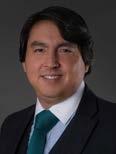
MEMBER SINCE 2016 Our firm’s attorneys have more than 40 years of experience catering to foreign companies doing business in Mexico. Because of the importance of providing high-quality legal assistance to our clients, we have built one of Mexico’s largest legal firms with a presence in the top income per capita cities in Mexico with specialized attorneys with key practices to fulfill our clients’ needs and satisfy their expectations. Our firm and attorneys have been ranked as leading firm and practitioners in Mexico in M&A, customs and foreign trade, labor & employment, real estate and finance. We have a wide range of clients from all spectrums of industries and businesses, each of our clients has its own particular manner of operating and doing business in Mexico, which requires us to be cognizant of their specialized and peculiar legal needs both for their day-today operations, as well as with their finer and greater projects. For many of our clients, our attorneys act as the in-house counsel in Mexico. EC Legal has become their legal department for their entire operations in Mexico, working closely not only with our peers in our clients’ headquarters but also with their local teams..
Additional Office: México City
Additional Offices: Brasilia • PH (55) 61 3321 2105 | Rio de Janeiro - RJ • PH (55) 21 2517 5000
Additional Offices: Beijing • PH 010 - 5900 3938 | Chengdu • PH 028 - 8753 1117 | Chongqing • PH 023-60333 969 Dalian • PH 0411 - 8279 9500 | Hefei • PH 0551 - 6353 0713 | Kunming • PH 0871 - 6360 1395 | Shenzhen • PH 07552515 4874 | Sichuan Province • PH 0838-2555997 | Wanchai • PH 00852 - 2973 0668 | Xiamen • PH 0592 - 2388 600
65 | US LAW NETWORK INTERNATIONAL MEMBER FIRMS
BELGIUM | BRUSSELS CEW & PARTNERS
250 Avenue Louise • 1050 Brussels, Belgium • (+32 2) 534 20 20 • Fax: (+32 2) 534 30 18 • Web: www.cew-law.be Additional Offices: Correspondents in Antwerp and Liège
ENGLAND | LONDON WEDLAKE BELL LLP
71 Queen Victoria Street • London EC4V 4AY • 44(0)20 7395 3000 • Fax: +44(0)20 7395 3100 Web: www.wedlakebell.com
GERMANY | FRANKFURT BUSE
Bockenheimer Landstraße
PRIMARY Charles Price (+32) 485660807 Charles.price@ cew-law.be
ALTERNATE Laurent Verbraken (+32) 477447814 Laurent.verbraken@ cew-law.be




ALTERNATE Sébastien Popijn (+32) 4793084 58 sebastien.popijn@ cew-law.be
CYPRUS DEMETRIOS A. DEMETRIADES LLC.
Three Thasos Street • Nicosia, 1087 • Cyprus PHONE: (+357) 22 769 000 • FAX (+357) 22 769 004 Web: www.dadlaw.com.cy
PRIMARY Martin Arnold +44 (0)20 7395 3186 marnold@wedlakebell.com

ESTONIA | LATVIA | LITHUANIA LEXTAL LEGAL
PRIMARY Jasper Hagenberg (+49) 30 327942 38 hagenberg@buse.de
ALTERNATE Michael Krämer (+49) 69 989 7235-55 brueckner@buse.de
ALTERNATE Dr. Dagmar Waldzus (+49) 40 41999 215 waldzus@buse.de



GREECE | ATHENS CORINA FASSOULI-GRAFANAKI & ASSOCIATES

PRIMARY Demetrios A. Demetriades +357 22769000 ddemetriades@dadlaw. com.cy
ALTERNATE Harris D. Demetriades +357 22769000 hdemetriades@dadlaw. com.cy
ALTERNATE Natasa Flourentzou +357 22769000 nflourentzou@dadlaw. com.cy
CZECH REPUBLIC | PRAGUE VYSKOCIL, KROSLAK & PARTNERS, ADVOCATES
PRIMARY Lina SiksniuteVaitiekuniene ILAW LEXTAL +370 5 248 76 70 lina.vaitiekuniene@ ilaw.legal
ALTERNATE Urmas Ustav LEXTAL +372 6400 250 urmas.ustav@lextal.ee
ALTERNATE Jãnis Ešenvalds RER LEXTAL +371 67 280 685 esenvalds@rer.legal
FINLAND | HELSINKI LEXIA ATTORNEYS LTD.
PRIMARY Korina Fassouli-Grafanaki (+30) 210-3628512 korina.grafanaki@ lawofmf.gr

ALTERNATE Anastasia Aravani (+30) 210-3628512 anastasia.aravani@ lawofmf.gr
ALTERNATE Theodora Vafeiadou (+30) 210-3628512 nora.vafeiadou@ lawofmf.gr
HUNGARY | BUDAPEST BIHARY BALASSA & PARTNERS
PRIMARY
Jiri Spousta (00 420) 224 819 133 spousta@akvk.cz
ALTERNATE Michaela Fuchsova (00 420) 224 819 106 fuchsova@akvk.cz
DENMARK | COPENHAGEN LUND ELMER SANDAGER
PRIMARY Markus Myhrberg +358 10 4244200 markus.myhrberg@lexia.fi
ALTERNATE Peter Jaari +358 10 4244200 peter.jaari@lexia.fi
FRANCE | PARIS & LYON DELSOL AVOCATS

Lassagne • LYON 69001 France • +33(0) 472102030 • Web: www.delsolavocats. com • contact@delsolavocats.com
PRIMARY Ágnes Dr. Balassa 0036) 391-44-91 agnes.balassa@bihary balassa.hu
ALTERNATE Tibor Dr. Bihary (0036) 391-44-91 tibor.bihary@bihary balassa.hu
IRELAND | DUBLIN KANE TUOHY LLP SOLICITORS


Hambleden House, 19-26 Pembroke Street Lower, Dublin 2 Ireland • (+353) 1 6722233 • Fax: (+353) 1 6786033 • Web: www.kanetuohy.ie
PRIMARY Jacob Roesen (+45 33 300 268) jro@les.dk
ALTERNATE Sebastian Rungby (+45 33 300 255) sru@les.dk
ALTERNATE Carsten Brink (+45 33 300 203) cb@les.dk


PRIMARY Emmanuel Kaeppelin (+33) 472102007 ekaeppelin@ delsolavocats.com




PRIMARY Hugh Kane (+353) 1 6722233 hkane@kanetuohy.ie
ALTERNATE Cómhnall Tuohy (+353) 1 67722240 ctuohy@kanetuohy.ie
101 • Frankfurt 60325 Germany • (+49) 69 9897235-0 • Fax: (+49) 69 989 7235-99 • Web: www.buse.de Additional Offices: Berlin, Düsseldorf, Essen, Hamburg, Munich, Stuttgart, Sydney, Brussels, London, Paris, Milan, New York, Zurich, Palma de Mallorca Konstitucijos ave. 7 • LT-09308 Vilnius • Lithuania • (+370) 5 248 76 70 • Web: www.lextal.legal Additional Offices: Estonia • Latvia Panepistimiou 16 • Athens 10672 Greece • +30 210-3628512 • Fax: +30 210-3640342 • Web: www.cfgalaw.com Additional Offices: New York City Vorsilska 10 • 110 00 Prague 1 • Czech Republic • +420 224 819 141 • Fax: +420 224 816 366 • Web: www.akvk.cz Lönnrotinkatu 11 • FI-00120 Helsinki, Finland • +358 104 244 200 • Fax: +358 104 244 21 • Web: www.lexia.fi Zugligeti út 3 • Budapest 1121 Hungary • +36 1 391 44 91 • Fax: +36 1 200 80 47 • Web: www.biharybalassa.hu Kalvebod Brygge 39-41 • DK-1560 Copenhagen V • (+45 33 300 200) • Fax: (+45 33 300 299) • Web: www.les.dk 4 bis, rue du Colonel Moll • PARIS 75017 France • +33(0) 153706969 • 11, quai André
66 | TELFA MEMBER FIRMS
ITALY | PADUA
LEGALITAX STUDIO LEGALE E TRIBUTARIO
Main offices: Gall. Dei Borromeo, 3 - 35137 Padua • +39 049 877 58 11• Fax: +39 049 877 58 38 • Web: www. legalitax.it • 20123 Milano piazza Pio XI no.1 • 00196 Roma via Flaminia no. 135
Additional Office: 37122 Verona via Locatelli no. 3
NORWAY | OSLO ADVOKATFIRMAET BERNGAARD AS


Beddingen 8, 0250 Oslo, Norway • Telephone: +47 22 94 18 00 • Web: www.berngaard.no
SPAIN | MADRID ADARVE ABOGADOS SLP
Calle Guzmán el Bueno • 133, Edif. Germania • 4ª planta-28003 Madrid, Spain • (0034)91 591 30 60 • Fax: (0034)91 444 53 65 • info@adarve.com • Web: www.adarve.com
Additional Offices: Barcelona • Canary Islands • Malaga • Santiago de Compostela • Seville • Valencia
PRIMARY Alessandro Polettini +39 049 877 58 11 alessandro.polettini@ legalitax.it
ALTERNATE
Rescigno +39 02 45381201 andrea.rescigno@ legalitax.it
LUXEMBOURG | LUXEMBOURG TABERY & WAUTHIER
BP 619 • Luxembourg L-2016 • Grand-Duchy of Luxembourg • 10 rue Pierre d’Aspelt • Luxembourg L-1142 • +352 25 15 15-1 • Fax: +352 45 94 61 • Web: www.tabery.eu
PRIMARY Tom Eivind Haug +47 906 53 609 haug@berngaard.no

ALTERNATE Inger Roll-Matthiesen +47 928 81 388 irm@berngaard.no
POLAND | WARSAW GWW
ALTERNATE Heidi Grette +47 900 68 954 heidi@berngaard.no
PRIMARY Juan José Garcia (0034) 91 591 30 60 Juanjose.garcia@adarve.com
ALTERNATE Belén Berlanga (0034) 91 591 30 60 belen.berlanga@adarve.com
SWEDEN | STOCKHOLM WESSLAU SÖDERQVIST ADVOKATBYRÅ
PRIMARY Véronique Wauthier (00352) 251 51 51 avocats@tabery.eu






ALTERNATE Didier Schönberger (00352) 251 51 51 avocats@tabery.eu


MALTA | VALLETTA EMD
Vaults 13-15 • The Valletta
Dobra 40, 00-344 Warszawa, Poland • +48 22 212 00 00 • Fax: +48 22 212 00 01 • Web: www.gww.pl
Kungsgatan 36, PO Box 7836 • SE-103 98 Stockholm Sweden • (+46) 8 407 88 00 • Fax: (+46) 8 407 88 01• Web: www.wsa.se Additional Offices: Borås • Gothenburg • Helsingborg • Jönköping • Malmö • Umeå
PRIMARY Aldona Leszczynska-Mikulska +48 22 212 00 00 Aldona.leszczynska-mikulska@gww.pl
PORTUGAL | LISBOA CARVALHO MATIAS & ASSOCIADOS
PRIMARY Max Björkbom (+46) 8 407 88 00 max.bjorkbom@wsa.se
ALTERNATE Henrik Nilsson (+46) 8 407 88 00 henrik.nilsson@wsa.se
SWITZERLAND | GENEVA AND ZURICH MLL
PRIMARY Dr. Italo Ellul (+356) 99426555 iellul@emd.com.mt
ALTERNATE Dr. Tonio Ellul (+356) 99476110 tellul@emd.com.mt
NETHERLANDS | ARNHEM DIRKZWAGER
ALTERNATE Dr. Pierre Mifsud (+356) 99421212 pmifsud@emd.com.mt

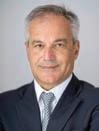
PRIMARY António A. Carvalho (+351) 21 8855448 acarvalho@cmasa.pt
ALTERNATE Rita Matias (+351) 21 8855447 rmatias@cmasa.pt
SLOVAKIA | BRATISLAVA ALIANCIAADVOKÁTOV
PRIMARY Nadine von Büren-Maier (00 41) 58 552 01 50 nadine.vonburen-maier@ mll-legal.com


ALTERNATE Wolfgang Müller (00 41) 58 552 05 70 wolfgang.muller@ mll-legal.com
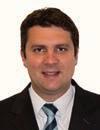
ALTERNATE Guy-Philippe Rubeli (00 41) 58 552 00 90 guy.philippe.rubeli@ mll-legal.com
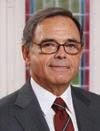
PRIMARY
Karen A. Verkerk +31 26 365 55 57 Verkerk@dirkzwager.nl
ALTERNATE Claudia van der Most +31 26 353 83 64 Most@dirkzwager.nl
ALTERNATE Daan Baas +31 26 353 84 16 Baas@dirkzwager.nl
PRIMARY Gerta Sámelová Flassiková +421 903 717431 flassikova@aliancia.sk

ALTERNATE Jan Voloch +421 903 297294 voloch@aliancia.sk

Waterfront • FRN 1914 MALTA +356 2203 0000 • Fax: +356 2123 7277 Web: www.emd.com.mt Rua Júlio de Andrade, 2 • Lisboa 1150-206 Portugal • (+351) 21 8855440 • Fax: (+351) 21 8855459 Web: www.cmasa.pt 65 rue du Rhône | PO Box 3199 • Geneva 1211 • Switzerland • (00 41) 58 552 01 00 Web: www.mll-legal.com Additional Offices: Zurich • Lausanne • Zug • London • Madrid
• 6800 AC
• The Netherlands • Velperweg 1 • 6824 BZ Arnhem • The
• +31
100 • Fax: +31
•
Additional Office:
Vlˇckova 8/A • Bratislava 811 05 Slovakia • +421 2 57101313 • Fax: +421 2 52453071 • Web: www.aliancia.sk
Postbus 111
Arnhem
Netherlands
88 24 24
88 24 24 111
Web: www.dirkzwager.nl
Nijmegen
Andrea
67 | TELFA MEMBER FIRMS
THANK Y OU PARTNERS
S-E-A
OFFICIAL TECHNICAL FORENSIC ENGINEERING AND LEGAL VISUALIZATION SERVICES PARTNER
www.SEAlimited.com
7001 Buffalo Parkway
Columbus, OH 43229
Phone: (800) 782-6851
Fax: (614) 885-8014
Chris Torrens Vice President
795 Cromwell Park Drive, Suite N
Glen Burnie, MD 21061
Phone: (410) 766-2390
Email: ctorrens@SEAlimited.com
Ami Dwyer, Esq. General Counsel
795 Cromwell Park Drive, Suite N
Glen Burnie, MD 12061
Phone: (410) 766-2390
Email: adwyer@SEAlimited.com
Dick Basom Manager, Regional Business Development
7001 Buffalo Parkway
Columbus, Ohio 43229
Phone: (614) 888-4160
Email: rbasom@SEAlimited.com
S-E-A is proud to be the exclusive partner/sponsor of technical forensic engineering and legal visualization services for USLAW NETWORK.
A powerful resource in litigation for 50 years, S-E-A is a multi-disciplined forensic engineering, fire investigation and visualization services company specializing in failure analysis. S-E-A’s full-time staff consists of licensed/registered professionals who are experts in their respective fields. S-E-A offers complete investigative services, including: mechanical, biomechanical, electrical, civil and materials engineering, as well as fire investigation, industrial hygiene, visualization services, and health sciences—along with a fully equipped chemical laboratory. These disciplines interact to provide thorough and independent analysis that will support any subsequent litigation.
S-E-A’s expertise in failure analysis doesn’t end with investigation and research. Should animations, graphics, or medical illustrations be needed, S-E-A’s Imaging Sciences/Animation Practice can prepare accurate demonstrative pieces for litigation support. The company’s on-staff engineers and graphics professionals coordinate their expertise and can make a significant impact in assisting a judge, mediator or juror in understanding the complex principles and nuances of a case. S-E-A can provide technical drawings, camera-matching technology, motion capture for biomechanical analysis and accident simulation, and 3D laser scanning and fly-through technology for scene documentation and preservation. In addition, S-E-A can prepare scale models of products, buildings or scenes made by professional model builders or using 3D printing technology, depending on the application.
You only have one opportunity to present your case at trial. The work being done at S-E-A is incredibly important to us and to our clients – because a case isn’t made until it is understood. Please visit www.SEAlimited.com to see our capabilities and how we can help you effectively communicate your position.
68 www.uslaw.org US LAW 2023 USLAW Corporate Partners
HHHHH
USLAW PREMIER PARTNER
American Legal Records
OFFICIAL RECORD RETRIEVAL PARTNER
www.americanlegalrecords.com
1974 Sproul Road, 4th Floor
Broomall, PA 19008
Phone: (888) 519-8565
Michael Funk
Director of Business Development
Phone: (610) 848-4302
Email: mfunk@americanlegalrecords.com
Jeff Bygrave
Account Executive
Phone: (610) 848-4350
Email: jbygrave@americanlegalrecords.com
Kelly McCann
Director of Operations
Phone: (610) 848-4303
Email: kmccann@americanlegalrecords.com
American Legal Records is the fastest-growing record retrieval company in the country. The pandemic has greatly impacted the record retrieval industry and made it increasingly difficult to obtain medical records in a timely fashion. We have streamlined this process to eliminate the monotonous, never-ending time your team/panel counsel is spending on obtaining records. Our team has over 200 years of experience and can provide nationwide coverage for all your record retrieval needs. Our highly trained staff is experienced in all civil rules of procedures and familiar with all state-mandated statutes regarding copying fees. We are approved by more than 80% of the carriers and TPAs.
Ametros OFFICIAL FUTURE MEDICAL FUND MANAGEMENT PARTNER
www.ametros.com
P.O. Box 827
Burlington, MA 01803
Phone: (877) 275-7415
Mark Doherty, CMSP
Executive Vice President of Sales
Email: mdoherty@ametros.com
Ametros is the largest and most trusted professional administration expert in the industry, working closely with everyone involved in the settlement process to drive resolution and provide support, security and potential savings for injured individuals once they settle their case. Ametros becomes the injured individual’s main resource to help guide them through their medical treatment and any necessary reporting after settlement. Ametros helps ease settlement fears and assists in settling difficult and complex claims, including workers’ compensation, liability, trusts, life care plans, Medicare Set Asides, and all other future medical allocations.
Arcadia
OFFICIAL STRUCTURED SETTLEMENT PARTNER
www.teamarcadia.com
5613 DTC Parkway, Suite 610
Greenwood Village, CO 80111
Phone: (800) 354-4098
Rachel D. Grant, CSSC
Structured Settlement Consultant
Phone: (810) 376-2097
Email: rgrant@teamarcadia.com
Your USLAW structured settlements consultants are:
Len Blonder • Los Angeles, CA
Rachel Grant, CSSC • Detroit, MI
Richard Regna, CSSC • Denver, CO
Iliana Valtchinova • Pittsburgh, PA
Arcadia Settlements Group is honored to be USLAW’s exclusive partner for structured settlement services.
Arcadia Settlements Group (Arcadia) and Structured Financial Associates (SFA) have merged to create the largest provider of structured settlement services, combining the strength of best-inclass consultants, innovative products and services, and deep industry expertise. Our consultants help resolve conflicts, reduce litigation expenses, and create long-term financial security for injured people through our settlement consulting services. Arcadia Consultants also assist in the establishment and funding of other settlement tools, including Special Needs Trusts and Medicare Set-Aside Arrangements, and are strategically partnered to provide innovative market-based, tax-efficient income solutions for injured plaintiffs.
Arcadia is recognized as the first structured settlement firm with more than 45 years in business. Our consultants have used our skill and knowledge, innovative products and unparalleled caring service to help settle more than 325,000 claims involving structured settlement funding of more than $40 billion and have positively impacted hundreds of thousands of lives by providing security and closure.
US LAW www.uslaw.org 69 2023 USLAW Corporate
Partners
IMS Consulting
OFFICIAL JURY CONSULTANT AND COURTROOM TECHNOLOGY PARTNER
www.expertservices.com
4400 Bayou Boulevard, Suite 4 Pensacola, FL 32503
Phone: (877) 838-8464
Twitter:@ExpertServices
Merrie Jo Pitera, Ph.D.
Senior Director of Jury Consulting
Phone: 913.339.6468
Email: mjpitera@expertservices.com
Adam Bloomberg
Client Services Advisor
Phone: 214.395.7584
Email: abloomberg@expertservices.com
Jill Leibold, Ph.D.
Jury Consulting Advisor
Phone: 310.809.8651
Email: jleibold@expertservices.com
Christina Marinakis, J.D., Psy.D.
Director of Jury Research
Phone: 443.742.6130
Email: cmarinakis@expertservices.com
Your goal is to provide high-caliber advocacy for your client—IMS Consulting helps you achieve that goal by providing jury consulting and courtroom technology services.
Everything we do at IMS is anchored in our commitment to help you gain the best position to win. Our 2021 union with Litigation Insights joined complementary strengths and common ideals to elevate your visual communications and jury research.
For 30 years, the most influential attorneys and firms have relied on IMS for the most comprehensive trial services. Our unique perspectives and proprietary methods have been developed over more than 20,000 cases and 2,000 completed trials. With strategic locations in major U.S. markets, the IMS team is primed to support your in-person and remote litigation proceedings.
Gain peace of mind with our experienced trial professionals. Let’s work together: expertservices.com.
Marshall Investigative Group
OFFICIAL INVESTIGATIVE PARTNER
www.mi-pi.com
401 Devon Ave. Park Ridge, IL 60068
Phone: (855) 350-6474 (MIPI)
Doug Marshall President
Email: dmarshall@mi-pi.com
Adam M. Kabarec Vice President
Email: akabarec@mi-pi.com
Matt Mills
Vice President of Business Development
Email: mmills@mi-pi.com
Thom Kramer Director of Business Development and Marketing
Email: tkramer@mi-pi.com
Amie Norton Business Development Manager
Email: anorton@mi-pi.com
Jake Marshall Business Development Manager
jmarshall@mi-pi.com
Shannon Thompson Business Development Manager
sthompson@mi-pi.com
Marshall Investigative Group is a national investigative firm providing an array of services that help our clients mediate the validity of questionable cargo, disability, liability and workers’ compensation claims. Our specialists in investigations and surveillance have a variety of backgrounds in law enforcement, criminal justice, military, business and the insurance industry. Our investigators are committed to innovative thinking, formative solutions and detailed diligence.
One of our recent achievements is leading the industry in Internet Presence Investigations. With the increasing popularity of communicating and publishing personal information on the internet, internet presence evidence opens doors in determining the merit of a claim. Without approved methods for collection and authentication this information may be inadmissible and useless as evidence. Our team can preserve conversations, photographs, video recordings, and blogs that include authenticating metadata, and MD5 hash values. Our goal is to exceed your expectations by providing prompt, thorough and accurate information. At Marshall Investigative Group, we value each and every customer and are confident that our extraordinary work, will make a difference in your bottom line.
MDD Forensic Accountants
OFFICIAL FORENSIC ACCOUNTANT PARTNER
www.mdd.com
11600 Sunrise Valley Drive, Suite 450
Reston, VA 20191
Phone: (703) 796-2200
Fax: (703) 796-0729
David Elmore, CPA, CVA, MAFF
11600 Sunrise Valley Drive, Suite 450 Reston, VA 20191
Phone: (703) 796-2200
Fax: (703) 796-0729
Email: delmore@mdd.com
Kevin Flaherty, CPA, CVA
10 High Street, Suite 1000
Boston, MA 02110
Phone: (617) 426-1551
Fax: (617) 830-9197
Email: kflaherty@mdd.com
Matson, Driscoll & Damico is a leading forensic accounting firm that specializes in providing economic damage quantification assessments for our clients. Our professionals regularly deliver expert, consulting and fact witness testimony in courts, arbitrations and mediations around the world.
We have been honored to provide our expertise on cases of every size and scope, and we would be pleased to discuss our involvement on these files while still maintaining our commitment to client confidentiality. Briefly, some of these engagements have involved: lost profit calculations; business disputes or valuations; commercial lending; fraud; product liability and construction damages. However, we have also worked across many other practice areas and, as a result, in virtually every industry.
Founded in Chicago in 1933, MDD is now a global entity with over 40 offices worldwide.
In the United States, MDD’s partners and senior staff are Certified Public Accountants; many are also Certified Valuation Analysts and Certified Fraud Examiners. Our international partners and professionals possess the appropriate designations and are similarly qualified for their respective countries. In addition to these designations, our forensic accountants speak more than 30 languages.
Regardless of where our work may take us around the world, our exceptional dedication, singularly qualified experts and demonstrated results will always be the hallmark of our firm. To learn more about MDD and the services we provide, we invite you to visit us at www.mdd.com. •
•
Services include:
•
•
•
•
•
•
•
•
70 www.uslaw.org US LAW 2023 USLAW Corporate
Partners
Activity/Background Checks
AOE / COE
Asset Checks
•
Bankruptcies
Contestable Death
Criminal & Civil Records
Decedent Check
Intellectual Property Investigations
•
Internet Presence Investigations
Pre-Employment
Recorded Statements
Skip Trace
Surveillance
•

Precisely revealing the cause of accidents and thoroughly testing to mitigate risk. Doing both at the highest level is what sets us apart. From our superior forensics talent, technology, and experience to the visualization expertise of our Imaging Sciences team, we dig past the speculation to find and convey the truth about what happened like no one else. We erase the speculation. We analyze the could’ve beens. We investigate the maybes. We explain away the what-ifs. To take note of the facts. Know. © 2023 800.782.6851 SEAlimited.com Since 1970 SUBMIT AN ASSIGNMENT Forensic Engineering, Investigation and Analysis Proud Partner USLAW NETWORK Inc. since 2004.




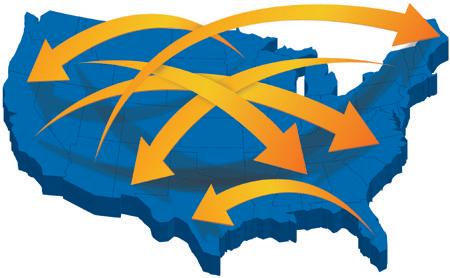













www.uslaw.org 11555 Heron Bay Blvd., Suite 200 Coral Springs, FL 33076 fall 2023 USLAW NETWORK Client Conference OCTOBER 5-7, 2023 WALDORF ASTORIA MONARCH BEACH DANA POINT, CALIFORNIA www.uslaw.org Compendium of Law SPOLIATION OF EVIDENCE FALL 2014 Santiago CHINA Shanghai Hong Kong Birmingham, AL 35216 (205) 822-2006 AL CARR ALLISONand efficient legal representation. We are the largest pure litigation firm Alabama and have been recognized top five law firm by the include two former USLAW Chairs, the Executive Director the Alabama Self-Insurers Association, adjunct faculty Alabama’s law schools and several national speakers and writers on legal subjects ranging from punitive Daphne, PH (251) 626-9340 Dothan, AL PH (334) 712-6459 Florence, AL PH (256) 718-6040 Jacksonville, PH (904) 328-6456 Tallahassee, PH (850) 222-2107 Gulfport, MS PH (228) 864-1060 AZ Jones, Skelton & Hochuli, PLC Phillip Stanfield Michael Ludwig mludwig@jshfirm.com Clarice Spicker cspicker@jshfirm.com Jones, Skelton Hochuli, PLC the largest and most experienced law firm liability insureds throughout Arizona, New Mexico, and Utah. Recognized highly skilled, aggressive defenders the legal and business communities, JSH lawyersand mediation services. With over 75 years collective experience, our nationally-recognized in-house appellate team has handled over 800 appeals state and federal courts. AR Quattlebaum, Grooms & Tull PLLC www.QGTlaw.com Springdale, AR (479) 444-5200 With offices in Northwest and Central Arkansas, Quattlebaum, Grooms and respect to all clients, always keeping our client’s best interests the forefront. Whether engaging in CA Murchison & Cumming, LLP CA Klinedinst PC Irvine, CA (714) 972-9977 MEMBER SINCE 2001 Founded in 1930, Murchison Cumming, LLP an AV-rated AmLaw 500 “Go To” law firm for litigation California. One third the firm’s shareholders are from diverse backgrounds. individuals in litigated, non-litigated and transactional matters. We value our reputation for excellence and approach our work with enthusiasm and passion. What truly result in focused, efficient, and effective manner. Heather Rosing hrosing@klinedinstlaw.com 501 West Broadway Klinedinst PC serves domestic and international clients broad range of institutions, and individuals at both the trial and appellate levels federal and state courts. Each matter is diligently and effectively managed, from simple transactions to complex document-intensive matters and efforts of each member the firm. Klinedinst’s overriding goal to efficiently and effectively achieve optimal results for each client’s legal and business interests. Additional Office: Irvine, CA PH (949) 868-2600 CA Hanson bridgett llp (415) 777-3200 Hanson Bridgett LLP full service AmLaw 200 law firm with more than creating an environment that provides opportunities for people with varied backgrounds, both for attorneys and administrative professionals. We are also committed to the communities where our employees live and 1 USLAW NETWORK MEMBER FIRMS SO MUCH MORE THAN JUST A NETWORK OF OVER 6000 ATTORNEYS USLAW MEMBER CLIENTS RECEIVE THESE COMPLIMENTARY SERVICES: EDUCATION A TEAM OF EXPERTS USLAW ON CALL LAWMOBILE COMPENDIA OF LAW STATE JUDICIAL PROFILES BY COUNTY HOME FIELD ADVANTAGE PRACTICE GROUPS USLAW CONNECTIVITY USLAW MAGAZINE VIRTUAL OFFERINGS USLAW MEMBERSHIP DIRECTORY RAPID RESPONSE CLIENT LEADERSHIP COUNCIL AND PRACTICE GROUP CLIENT ADVISORS For more information about these complimentary services, visit uslaw.org today! ®