USC LEONARD DAVIS SCHOOL OF GERONTOLOGY
VOL. 11 A Magazine for All Ages SPRING 2020
12
#NoFilter
How social media influencers challenge misconceptions and celebrate real aging online
FALL 2018 | 3
DEAN’S MESSAGE
Top: Our school led campus-wide celebrations for International Day of Older Persons. Bottom: The school celebrated the Year of the Rat with a festive lunch and lion dance for Lunar New Year.
“The 2020s will bring an increased focus on important aging issues as well as incredible scientific advances in addressing age-related illnesses.”
Recently, I was asked by Kaiser Health News to share my predictions for major trends in the aging field for the next decade. This was a great opportunity to articulate my vision of where the field is heading and where our school should be investing. I believe that the 2020s will bring an increased focus on important aging issues, as well as incredible scientific advances in addressing age-related illnesses. During the next few years, I think challenges to healthy aging presented by our environment — from pollution to social isolation — will come into much sharper focus. My hope is that we can integrate aging issues with other, larger sustainability and community initiatives. Advances in genetic research and big data analytics will enable more personalized and effective treatments and prevention strategies for age-related diseases. While we’ve made enormous advances in extending lifespans, we now need to maximize healthspans. This will require tailoring interventions for individual characteristics. This personalized approach will be especially crucial as we address Alzheimer’s disease. A USC study found that by 2050, if we were able to achieve a five-year average delay in disease onset, the result would be a 40 percent lower prevalence of the disease and a dramatic reduction in overall costs. Personalized therapies that could prevent or delay onset, including diet, exercise and mental activity interventions, are beginning to show promise and are increasingly important areas of research. Finally, emerging consumer technologies have the potential to make lives easier for older adults. Innovations such as self-driving cars, robotic assistants, and digital apps for health monitoring and assessment could support independence, social connection and health. Above all, I predict that in the next decade and beyond, our brilliant faculty and the incredible gerontologists graduating from our school will be the people making these advances. Fight On!
Pinchas Cohen MD Dean, USC Leonard Davis School of Gerontology
VITALITY MAGAZINE — Chief Communications Officer Orli Belman Editor in Chief Beth Newcomb Managing Editor Natalie Avunjian Design Golden Design Studio Copy Editor Mary Nadler Contributors Lois Albert Angelo Shannon Flynn Michelle McCarthy Jenesse Miller Fiona Pestana Constance Sommer Cover Photo Mel Kobayashi
USC LEONARD DAVIS SCHOOL OF GERONTOLOGY — Dean Pinchas Cohen Executive Vice Dean Kelvin J. A. Davies Senior Associate Dean Maria L. Henke Senior Associate Dean for Advancement David Eshaghpour Associate Dean of Research Sean Curran Assistant Dean of Diversity and Inclusion Susan Enguídanos Assistant Dean of Education John Walsh Assistant Dean of Faculty and Academic Affairs Mara Mather Senior Business Officer Lali Acuna Senior Human Resources Business Partner Wendy Snaer
INSIDE
3
Postcard Students fight Alzheimer’s in D.C.
6
Vital Signs Strength training may protect cognition
FEATURED —
7
Q&A Teal Eich on neuroimaging and aging brains
10
GlamourGals The beauty of friendship
36
26
12
#NoFilter How social media influencers challenge misconceptions and celebrate real aging
Alumni at Work Graduates explore the gerontology field and forge unique careers in aging and health
Celebrate Aging USC observes International Day of Older Persons
38
In Memoriam Remembering Vern Bengtson
40
Recognition Mei-Lee Ney honored by USC Alumni Association
18 22 32 The Big Picture New framework shows how multiple factors affect Alzheimer’s risk
Life Courses Curriculum helps students understand aging, including their own
Leading by Example Sean Curran helps students embrace surprises and the discoveries they yield
SPRING 2020 | 1
NEWS BITES AWARDS — Pinchas Cohen Irving S. Wright Award of Distinction, American Federation for Aging Research; 2019 GSA Fellow SPOTLIGHT
Priya Rangan PhD ’19 iCARE-2 Incoming Fellowship, Fondazione AIRC and European Union
QUOTABLE —
“Of the nearly 6 million people in the U.S. with Alzheimer’s today, almost two-thirds are women.” — Christian Pike, who discussed the latest research on Alzheimer’s disease in a November 13, 2019, Facebook live chat for Alzheimer’s Awareness Month
2 | VITALITY
— Donna Benton, a research associate professor at the USC Leonard Davis School of Gerontology, is actively involved in creating a more age-friendly California. As an appointee to the California Master Plan for Aging Stakeholder Advisory Committee, she is working at the direction of Governor Gavin Newsom to develop a road map for helping all Californians to grow old safely and with dignity and independence. Benton, director of the USC Family Caregiver Support Center, also recently addressed lawmakers about barriers to accessible and equitable family leave at a hearing of the California Senate Select Committee on Women, Work and Families and the Assembly Select Committee on Women in the Workplace. In addition, she served as vice chair of the California Elder Justice Coalition and co-chair of the California Task Force on Family Caregiving. — O.B.
Photos: Stephanie Kleinman, John Skalicky, Beth Newcomb
Kate WIlber Elaine M. Brody Thought Leader Award, GSA Social Research, Policy, and Practice Section
GLOSSARY —
USC members of The Youth Movement Against Alzheimer’s grab a selfie with actor and activist Seth Rogen.
POSTCARD —
Students fight Alzheimer’s in D.C. College students most often encounter actor Seth Rogen portraying a slacker in comedies like Superbad, Knocked Up and Pineapple Express. But on a trip to Washington, D.C., a group of USC Leonard Davis School students met Rogen in a more serious role: that of Alzheimer’s activist. At the 2019 National Alzheimer’s Summit in October, the students — members of The Youth Movement Against Alzheimer’s — spoke out on Capitol Hill, lobbying leaders to increase funding for Alzheimer’s research and pass legislation designed to enable early detection of the disease. Rogen and his wife, Lauren, rallied the students and joined them on congressional office visits. The couple are founders of Hilarity for Charity, an awareness organization committed to energizing the next generation of champions for Alzheimer’s treatment, prevention and care. If the USC Leonard Davis School students are any indication, the future looks bright in that regard. “Sharing the platform with supportive medical professionals, legislative leaders and community stakeholders gave me a feeling of purpose and determination, reminding me that I was in the right place at the right time,” said Giovanna Manson-Hing, who is in her first year of the Master of Arts in Gerontology program. “Together… we proclaimed our mission to support family caregivers, tackle this fatal neurodegenerative disease and be the voice for those who cannot advocate for themselves.” — F.P.
Mindfulness The practice of maintaining a nonjudgmental state of heightened awareness of one’s thoughts, emotions or experiences on a moment-to-moment basis. - Merriam-Webster Dictionary Resilience The process of adapting well in the face of adversity, trauma, tragedy, threats or significant sources of stress. - American Psychological Association Generativity The desire to nurture and guide younger people and contribute to the next generation. - Psychoanalyst Erik Erikson
SPRING 2020 | 3
NEWS BITES
Los Angeles Times
IN THE MEDIA —
New York Times
Air pollution, evolution and the fate of billions of humans An article cited research co-authored by Caleb Finch about the relationship between humanity’s early ancestors and airborne toxins. “Most traditional people live in a highly smoky environment. I think it has been a fact of human living for us, even before our species,” Finch said. The story also appeared in the Chicago Tribune.
ABC News INTERVIEW
“For sure, the body needs to reset, but there are safe ways of doing that, and dry fasting is not one of them. We require water.” — Valter Longo, in a Los Angeles Times article about the dangers of “dry fasting”
4 | VITALITY
Boomers in the next decade: working longer, living better Pinchas Cohen and Paul Irving were quoted in an article on what lies ahead for older adults this decade, including advances in geriatric research and how inequality affects older adults. “My prediction is that the biggest impact of this is going to be felt around predicting dementia and Alzheimer’s disease as biomarker tests [that allow the early identification of people at heightened risk] become more available,” Cohen said. The article also appeared in Salon and the Los Angeles Daily News.
Washington Post
Why older and chronically ill Americans are at greater risk from coronavirus Eileen Crimmins was quoted on how the COVID-19 illness may affect Americans who are older or in poor health. “People don’t realize how bad the health of the American population is. When we compare our health to Europeans, we have more disease, more disability.”
What “dry fasting” is, and why you shouldn’t do it Valter Longo and Cary Kreutzer were quoted regarding the detriments of dry fasting. Kreutzer likened it to a car running out of oil: “You can basically burn out some parts of the car that you’re going to have to get replaced. You don’t want those replacement parts to include your vital organs.”
Insider
College students and senior citizens living together? It’s more common than you’d think An article mentioned USC’s relationship with the Kingsley Manor senior living community, where students have lived with older residents since 1986. “The social benefits of shared housing between generations include reduced isolation and assistance with basic daily activities. However, the financial benefits are of great importance, too, for reducing costs of housing,” said Caroline Cicero.
Quartz
How the human brain stays young even as we age An article mentioned the Long Beach Longitudinal Study and quoted Elizabeth Zelinski on brain resilience: “The brain has a lot of redundant systems. So basically, if one system gets knocked out, other parts will compensate over time.”
Forbes
Some say a nonprofit research group unfairly influences drug prices Mireille Jacobson was quoted on how pharmaceutical insurance coverage decisions are made by the Institute for Clinical and Economic Review. “One way to think about it is if a government or insurer has a limited budget, they need to decide how to spend that money. So, they have to decide, ‘how do we cover one drug versus another, and which ones should we cover, within a class?’”
EXPERT OPINION —
Asia’s leadership in aging
“A longevity economy will drive growth as companies develop products, services and innovations to serve the needs and aspirations of the aging population. Intergenerational workforces will drive the businesses of the future.” — Paul Irving, in a column for Forbes on how Asia is ground zero for the age shift that’s impacting societies across the globe
Photos: iStock/Cunaplus_M.Faba, USC Photo/Gus Ruelas
Elder abuse and the holidays
“The holidays can be a peak season for scammers who capitalize on the generosity of their victims.” — Kate Wilber, in a column in the Houston Chronicle on why the holidays are a prime time for elder abuse and scams
Reduce fall risks at home
“Home is where the heart is, and where the heart often wishes to grow old. It’s also becoming the healthcare setting of the future, where most caregiving occurs. But homes are not always the most well-equipped setting, and that can impact an older adult’s chances of growing older safely.” — Julie Hultman Overton, who discussed fall risks and prevention tips for a column published in the Mediaplanet “Supporting Our Caregivers” campaign
CULTURE —
Sophie Davis Gallery one of USC’s “treasures” USC Trojan Family Magazine included the Sophie Davis Art Gallery in a recent article on USC’s artistic and cultural treasures. According to the article, “This gallery celebrates aging as an art form. With an emphasis on older artists, pieces explore the many stages of life.” For the gallery’s current exhibition, Going Gray in LA: Stories of Aging Along Broadway, journalist Ruxandra Guidi and photographer Roberto “Bear” Guerra spent a year exploring the lives of a diverse population of older Angelenos. The stories highlight citizens who often feel neglected and invisible. For more information, visit gero.usc.edu/about/sophie-davis-art-gallery.
SPRING 2020 | 5
VITAL SIGNS
Strength Gains and Healthy Brains Games like crossword puzzles and sudoku are often practiced to keep brains flexing, but in the face of cognitive decline, physical strength training could also help maintain or improve cognition. Ranier Castillo, a student in the USC Leonard Davis Master of Science in Nutrition, Healthspan and Longevity program, recently explored research regarding the connection between muscular strength and cognition for PULSE, a publication of the Academy of Nutrition and Dietetics. Here are his takeaways:
8
grams of protein per ounce of seafood or lean meat
6 | VITALITY
AN APPLE A DAY — ALONG WITH EXERCISE AND BRAIN GAMES — KEEPS THE DOCTOR AWAY Taking a multifaceted approach to preventing cognitive decline proved most effective in the studies Castillo referenced. A balanced diet, exercise and cognitive training combine to fight anything from mild cogni-
tive impairment to dementia. Regarding diet, the research suggests consuming foods like dairy, fish/seafood, red meat and protein powders. Such foods contain creatine, an organic acid shown to positively affect brain health. “Timing of protein intake is critical,” says Cary Kreutzer, director of the Nutrition, Healthspan and Longevity program. “Consuming higher-protein foods at each meal is preferable to once per day; depending on the individual, protein intake should be 2040 grams per meal. Seafood or lean meat contains 8 grams of protein per ounce.” As for exercise, aerobic activities — such as running and swimming — work especially well against neurodegenerative diseases. Combining the above type of diet with aerobic workouts reportedly increases lean muscle mass, helping to maintain and improve cognitive function.
Photos: iStock/Ridofranz, Natalie Avunjian
by Fiona Pestana
“Consuming higher-protein foods at each meal is preferable to once per day.” — Cary Kreutzer, director of the Nutrition, Healthspan and Longevity program
NO NEED TO BE TOM BRADY Different bodies often require different, specified workouts. What is too strenuous for one person might be too easy for another. Moderate- to high-intensity workouts have been shown to improve cognition, but beginners should start with lower-intensity workouts and work up to more difficult exercises. Sports dietitians do not have to be resources for athletes only. In fact, consulting with a sports dietitian can help anyone to balance a diet and exercise plan while working toward improved cognitive health, providing expertise so that people can train properly and safely.
View these tips on our Instagram @USCLeonardDavis
Teal Eich, assistant professor of gerontology, is a cognitive neuroscientist who explores age-related changes in brain function. Q: What questions are you tackling? A: Why does memory decline, and why is there so much variability in memory with age? Memory problems in aging might actually be problems with selecting the right information to remember; older adults may be more prone to encode irrelevant information that interferes with relevant memory. My lab has shown that changes to several brain areas seem to be related to this. Q: What has neuroimaging revealed about Alzheimer’s? A: Functional magnetic resonance imaging has revealed a network of brain areas, called the default mode network, that is connected when people are resting and consolidating memories but breaks down in Alzheimer’s. Q: What are some surprising findings about cognition and aging? A: Cues that people use to learn information may shift with age. When we retested younger and older adults on trivia questions they initially got wrong, younger adults tended to get the questions they had initially gotten wrong with high confidence right on the second test. But older adults didn’t seem to use their initial confidence from the first test as much; on the second test, they correctly updated questions they had gotten wrong with high and low confidence. These different patterns may point to different memorial strategies that change with age.
SPRING 2020 | 7
NEWS BITES
2019 GSA SCIENTIFIC MEETING — Faculty, postdoctoral and student researchers presented their latest work during the Gerontological Society of America Annual Scientific Meeting in Austin, Texas, in November 2019. USC Leonard Davis investigators shared exciting new research on a variety of topics, from the links between brain injuries and dementia to the relationships between caregivers and recipients.
The Potential of Aging Biomarkers “We have made significant inroads in measuring biological aging as opposed to chronological aging in large populations. We now have a 22-item measure that is quite good at predicting both diseases and mortality. We suggest that this measure can be used to measure ‘aging’ in trials to intervene in the aging process.” — Eileen Crimmins, University Professor and AARP Professor of Gerontology
Fasting-Like Diet Shows Clinical Promise
“In a randomized clinical trial, risk factors for metabolic syndrome and other age-related diseases were favorably impacted after completion of three fasting-mimicking diet cycles. These effects were larger in participants at risk for age-related diseases. … Larger studies on patients with diagnosed diseases are necessary to determine [the diet’s] impact on diabetes and cardiovascular disease treatment.” — Sebastian Brandhorst, research assistant professor
Internet Use, Isolation and Life Changes
WRIGHT AWARD —
“Mitochondrial-derived peptides ... are a new class of mitochondrial hormones that have diagnostic and therapeutic potential in human disease.” — Pinchas Cohen, in his 2019 Irving S. Wright Award lecture. The award is given by the American Federation for Aging Research.
8 | VITALITY
— Hyunju Shim, PhD in gerontology student; Jennifer Ailshire, assistant professor; and Eileen Crimmins, University Professor and AARP Professor of Gerontology
Photo: Stephanie Kleinman
“Using the internet was associated with lower social isolation and depression for people who became separated or divorced, but no significant interaction was observed for people who became widowed. On the other hand, becoming unemployed and using the internet was associated with more depressive symptoms.”
Grandparents Strained by Opioid Epidemic
“The contemporary American drug overdose epidemic has wreaked havoc on individuals, families and communities across the country. As increasing numbers of middle-aged adults become addicted to or die from drugs, grandparents may be called upon to provide care for their grandchildren. … Findings suggest that the epidemic is placing considerable and unexpected strains on older adults’ financial and emotional resources, at a time when they themselves may be requiring care, retiring from the labor force and experiencing declines in health.” — Jessica Ho, assistant professor of gerontology
Mitochondrial Peptides and Parkinson’s
“[Mitochondrial-derived peptide] SHLP2 potently inhibits Parkinson’s disease toxin-induced apoptosis in neuronal cells. … SHLP2 has therapeutic potential as a precision medicine in Parkinson’s disease.” — Su Jeong Kim, research assistant professor; Anjali Devgan, bachelor’s in health and human sciences student; Hemal Mehta, research lab specialist; and Pinchas Cohen, USC Leonard Davis dean and professor of gerontology, medicine and biological sciences
Supporting CaregiverRecipient Relationships
“Most caregivers reported relationship strain occurring after taking on the caregiving role, and frustration and anger arose when providing assistance with activities of daily life, especially during bathing and toileting. ... A recurring theme that emerged was that they developed strategies to decrease frustration and anger and improve the quality of their relationships with their care recipients.” — Elizabeth S. Avent, PhD in gerontology student; Laura Rath, PhD in gerontology candidate; Kylie Meyer PhD ’18, postdoctoral researcher at the University of Texas, San Antonio; Donna Benton, research associate professor; and Paul Nash, instructional associate professor
Similarities Between Brain Injuries and Alzheimer’s
“Geriatric traumatic brain injury and Alzheimer’s disease share similar patterns of white matter degradation. … Future research should focus on clarifying the similarities between mild traumatic brain injury and Alzheimer’s, potentially leading to improved diagnoses.” — Andrei Irimia, assistant professor; Kenneth Rostowsky, bachelor’s in neuroscience student; Nikhil Chaudhari, master’s in computer science student; Maria Calvillo, project scientist; and Sean Lee, master’s in computer science student
32%
increased risk of shingles in older adults with at least one chronic disease (Kang, Crimmins & Ailshire, 2019)
SPRING 2020 | 9
NEWS BITES
STUDENTS —
At Belmont Senior Village in the Hollywood Hills, USC volunteers are greeted by a group of older adults excited to connect and chat. The residents cheerfully tell stories and share laughs with the volunteers — and many also get a fun new nail color. With more than 100 high school and college chapters across the United States, GlamourGals has empowered young people to connect with older adults while providing manicures and makeovers. The USC GlamourGals chapter, founded by PhD in Gerontology candidate Carly Roman and now headed by President Anjali Devgan, continues to serve the nearby older adult population and hopes to expand outward to new areas. Devgan, a junior in health and human sciences with an emphasis in gerontology, mentions how the USC chapter has grown since her freshman year, when it was comprised of about five students. Today, the group’s recruit-
10 | VITALITY
ment efforts have grown the pool of volunteers to more than 300. The student volunteers learn more about the daily lives of older adults living in these care facilities, where issues relating to social isolation in older adults are often prevalent. Many volunteers realize this ever-growing issue and gain a deeper appreciation not only for older adults in their own lives, but also for the opportunity to provide service. “You realize why we study longevity so much, and why it’s important to see how aging affects everyone differently,” Devgan said. Devgan has many plans for the chapter, including expanding to new facilities to address the health and isolation of older adult populations in minority groups. She has also begun work on a Gerontology Volunteer Education Plan with USC Instructional Associate Professor of Gerontology Paul Nash and Rachel Doyle, CEO and founder of GlamourGals. — L.A.A.
Photos: Lois Albert Angelo
The Beauty of Friendship
“I absolutely love GlamourGals. ... It’s just so fun to make the cards and share our goals and mission with other students at USC. Then, to be able to bring them to different residents at the nursing home and be able to see their smiles when they see that we’ve made something personal for them always really makes me happy. ” — McCrae Mower, USC GlamourGals vice president and junior in lifespan health
“I decided to do GlamourGals because I was interested in talking to seniors. ... I got to speak to older people, how they felt, how they enjoyed California, and it’s really cool to see how they’ve impacted other people in their lives.” — Arantza Pena, volunteer and undeclared freshman
“My favorite part was just talking to the residents, because I love connecting with the residents and providing them company. ... This club is not only helpful but also unique as a service organization.” — Camille Feorene, volunteer and freshman in architecture
SPRING 2020 | 11
12 | VITALITY
How social media influencers are challenging misconceptions and celebrating real aging online. By Constance Sommer
ith a rapidly aging population in the U.S. and around the world, it makes sense that older faces are popping up more often in the media, from the stars of shows such as Grace and Frankie, to presidents and presidential candidates, and even Sports Illustrated swimsuit models. But open up Facebook or scroll through Instagram, and it’s even easier to see that today’s older adults don’t look like the stereotypical grandmas and grandpas of yesteryear, nor do they accept the more modern notion that aging is something they need to defy. “It’s a time of some change,” said Eileen Crimmins, University Professor and AARP Professor of Gerontology at the USC Leonard Davis School of Gerontology. “The media-savvy crew is now moving into old age,” she said, and today’s seniors are “much more mixed up, much less easily categorized into the standard categories.” Members of the baby boom generation — still roughly 73 million strong — are entering their later years. As a group, they are more likely to work at an older age, and they continue to break new ground, from adopting digital technology to taking up cohabitation with gusto. Jenny Kee @jennykeeoz 2m The media should recognize that “older people are [The best part about getting older is] the wisdom gained as diverse — in some sense, more diverse — than the from a big life lived adventurously, creatively and colorfully, rest of the population,” said Paul Irving, chairman of [and] experiencing many groundbreaking decades, the Milken Institute Center for the Future of Aging and a especially the ’60s — a renaissance time for the world. Leonard Davis School distinguished scholar in residence. Some, Irving said, are ill or in pain, while others continue to engage in work and society. None are bland or blank slates — in fact, he said, many people's personalities actually intensify as they age. “For some reason, some people seem to believe that our tastes and inclinations and beliefs are not as strongly held and distinct as they were earlier in life,” Irving said. He added that younger generations, and the media in particular, need to remember that older people still have meaningful things to say. And, often, they are speaking up — and showing up — online.
SPRING 2020 | 13
TRADITIONAL MEDIA AND TROPES When it comes to television, movies and advertising, older Americans are still often portrayed as types, said Caroline Cicero, an instructional associate professor and director of the USC Age-Friendly University Initiative. “When I look at a Disney film, I cringe,” she said, citing the trope of the “evil old hag,” like the stepmother in Snow White, who downs potions to keep herself young and attractive. In a similar vein, Cicero finds herself irritated when watching an event like the Kennedy Center Honors and seeing older celebrities without a wrinkle or a gray hair in sight. Like the cartoon, it sends a message that the physical manifestations of age are unacceptable. Advertisers fall into this trap as well, marketing products using younger adults even when those products, such as Viagra, were developed for seniors, said Elizabeth Zelinski, a professor of gerontology and psychology and the Rita and Edward Mel Kobayashi @bagandaberet 1m Polusky Chair in Education and Aging at USC. “If older My spirit of adventure has grown in direct proportion people are actually shown, they represent the fantasy to the number of wrinkles on my face. of ‘successful aging’ — that is, doing what younger people do [but] with a gorgeous older body,” she said. Coverage of older adults in news media also skews
14 | VITALITY
Photos: Mel Kobayashi (right, @bagandaberet), Georges Antoni (previous, @georgesantoni)
According to a 2019 Pew survey, nearly 60% of baby boomers now use social media, a rapid increase from just 40% in 2012.
SHAPING THE NARRATIVE ONLINE While traditional media is slowly changing, the rise of new and social media has provided people with ways to reach others directly and tell their own stories, no matter who — or what age — they are. Younger generations are typically the early adopters of social media channels, but in recent years older adults have also joined in on Instagram, Facebook and the like to share their art, fashion, viewpoints and more. Nearly 60% of baby boomers now use social media, a rapid increase from just 40% in 2012, according to a 2019 Pew survey. In the process, these older adults interact with and show their unique, yet normal, versions of aging to friends and followers of all ages around the world. “Seeing older people on social media being open and honest and expressing themselves true to their own style is inspiring — if we can have ’em young, we can have ’em old!” said world-renowned Australian artist and designer Jenny Kee, who shares and wears her art on jennykee.com and Instagram @jennykeeoz. “It’s all about style and [has] nothing to do with age.” Viewing fellow older adults in both traditional and new media is very important, said Mel Kobayashi, who publishes the art, style and comedy blog Bag and a Beret (bagandaberet.blogspot.com) and posts self-portraits and videos on Instagram @bagandaberet. “When I see older people in media, I feel relevant and empowered, like I still have a voice," Kobayashi said. “Experiencing the physical changes that come with aging in a youth-centric world can be rattling, and it’s a comfort to know I’m not alone in dealing with these changes and ageism.”
SPRING 2020 | 15
Wisdom of Age, Both Sides of the Camera As both a counselor and a photographer, Susie Lang (left) values making genuine connections with people, including subjects of her photo projects Population Portraits (@populationportraits) and Women 60 Plus (@women.60.plus).
Susie Lang @susielang 5m Certainly, social media has played a huge part in me being seen — no longer invisible. Now, I can at least acknowledge to myself when I want to be invisible or visible.
Top row (left to right): Furaha Moye, @furaha.moye;
Evetta Petty, @harlemsheavenhats; Teri Cox, @handcraftedjewelrybyteric Bottom row (left to right): Liz Friedman, @lizfriedman2;
Sandra Inez Rivera, @nez528; Paul Romano and Meri Frischman, @the.pro.age.woman
16 | VITALITY
Photos: Susie Lang (@women.60.plus, @populationportraits), Susan Bowlus (@susanbowlusphoto)
So what would be the right way to depict aging in the media? Simple, says Caroline Cicero: Normalize it.
Aging with Attitude Writer and model Dian Griesel founded the Silver Disobedience blog, social media channels and podcast (@silverdisobedience) as "a rebellion of law-abiding citizens against ageism."
negative, though sometimes in subtle ways, said Erfei Zhao, a firstyear gerontology PhD student at USC. For his master’s thesis, Zhao examined 198 articles from 19 major news outlets, spanning the years 2015 to 2019, looking for age bias. Nine of the publications were politically conservative, and 10 were liberal. But the political persuasion didn’t matter much: Two-thirds of all articles about older people contained negative stereotypes, he found. “They included attitudes such as older adults are more vulnerable, less productive, and are seen as a burden,” Zhao said. When discussions of Social Security arose, it was with a hostile edge. “They viewed older adults as a really greedy generation that’s taking benefits away from the taxpayers,” he said. Even when the media tried to portray seniors in a positive light, “the language was problematic,” Zhao said. Most of the discussion was centered around cheating aging — how to look younger, feel younger, act younger. “That implies that being old is not a good thing, even though it’s coming from a good place,” he said. “They fail to emphasize that aging is a very normal process. It shouldn’t be something we are avoiding.” SHOWING THE REALITY OF AGING So what would be the right way to depict aging in the media? Simple, Cicero said: Normalize it. Show older people living their lives just like younger people do, but don’t shy away from depicting the disability and illness that can come with advanced years. “We need to allow people to live with less-than-perfect functioning. We all need more permission and confidence to be who we are,” she said. There are some indications that progress is being made within traditional media, from more realistic roles for older actors to successful films and TV shows with intergenerational ensembles, such as The Farewell, Knives Out and Orange Is the New Black. And on social media, older users are forgoing the filters and changing the conversation. This is important, because stereotypical media depictions are not just unfair; they can be unhealthy as well, said Paul Nash, an instructional associate professor who has studied the effects of ageism. “When you get to 65 years of age, you start to live the stereotypes you have acquired,” he said. “When we are looking at ageist attitudes, if older people internalize those negative attitudes about aging, they can actually reduce their lifespan by up to seven and a half years.” Writer and model Dian Griesel (@silverdisobedience), who founded the Silver Disobedience blog, social media channels and podcast as a way to counter ageist sterotypes, encourages others to embrace older age as a time of self-acceptance and confidence. “We’re entering a stage where we aren’t as worried about societal norms as to how we’re supposed to be or act,” she said. “Perhaps aging is, in essence, the process of getting to know ourselves more deeply, and with greater acceptance and kindness, over time.” Additional reporting by Beth Newcomb
SPRING 2020 | 17
22 | VITALITY
E F I L SES R U O C
A MUL TIF STUDE ACETED CUR NT R POINTS S WITH AN E ICULUM PRO V XPAND FOR UN ING SE IDES OF AGI D E R S T T NG, IN CLUDIN ANDING ALL OF ENTRY A G S THEIR BY ORL OWN. PECTS I BELM A ILLUST RATION N BY KEI TH NEG LEY
Virtual reality headsets, robotic pets and digital personal assistants are all part of the curriculum in Gero 506, a technology-focused course exploring how digital devices can help provide older adults with therapy, companionship, support and more. Students got a firsthand look at how seniors are using these interactive tools during a recent field trip to the Front Porch Center for Innovation and Wellbeing. Later in the semester, they will conduct their own research to identify additional areas where technology can provide solutions. “As the boomers age — especially the younger ones — I think we’re going to want a lot more innovative, convenience-driven type technology,” says Leslie Hellow, a student in the Master of Aging Services Management program. She enrolled in the class because of the huge role she sees technology playing in serving the older adult population. “I think rolling our sleeves up and really seeing what’s out
SPRING 2020 | 23
there, and then seeing what the gaps are, will be interesting — and meaningful, too,” Hellow says. Along with courses that delve into the power of the mind-body connection or the different role individual genetics can play in nutrition, the gerontechnology class is an example of the cutting-edge curriculum and diversity of approaches to the study of aging at the USC Leonard Davis School. When the school was founded in 1975, initial classes focused on core topics related to biology, sociology, psychology and policy. Today, an increasing number of degree programs and course offerings prepare students for a changing and vibrant field. “Our gerontological imagination has expanded to include entrepreneurship, corporate consulting, health care, nutrition, exercise science, technology and more,” says Senior Associate Dean Maria Henke. “Our graduates are being called upon to advance solutions in areas that were not even considered decades ago, and our ever-evolving course catalog both anticipates and reflects that.” Professor and Dean Emeritus Ed Schneider credits Henke with keeping the curriculum relevant by introducing innovative programs like the new Master in Senior Living Hospitality program. “It is really a new ball game,” he says. “Learning how to serve older adults in retirement settings will create careers for thousands of students.” The school’s curriculum also empowers students to address still-critical issues around aging policy, biology and service. As part of their coursework, they have detailed which neighborhood crosswalks are least safe for seniors, designed diets to meet specific nutritional needs and developed apps to combat social isolation.
MAKING IT PERSONAL
When it comes to teaching the physiology of development and aging, Schneider takes a personal approach, requiring students to actively participate during discussions. “I think reading is the least productive way to learn something,” he says. His emphasis on interaction extends
24 | VITALITY
to a class assignment in which students are tasked with interviewing older adults about their individual health conditions and concerns. Master of science student Stephen Santos recorded a conversation with his 72-year-old uncle, and the experience proved invaluable. “I probably would have never had this type of conversation with him in such an intimate way had it not been for this class and assignment,” he says. “It’s also helpful to begin speaking with older people as opposed to coming into future jobs thinking we [already] know it all. By starting this practice early, we will be able to refine these skills and remember that there is no onesize-fits-all approach to working with such a diverse population with varied needs.”
GENERATIONAL SHIFTS
Course curricula also address how aging impacts young adults. Stacks of skateboards line the walls of Professor John Walsh’s lecture hall during his popular general education class, Gero 315g, A Journey into the Mind. He connects with his undergraduate students by playing current music and passing out homemade cookies. He also pays extra attention to what is going on in the 20-year-old brain. “These are freshmen and sophomores, so I spend an enormous amount of time talking about the psychological and psychiatric issues they are confronting — what psychiatry refers to as the affective disorders. I go over clinical depression, bipolar disease, ADHD, ADD and anxiety, because these are things some of them are experiencing right now,” Walsh says. Walsh also developed Gero 508, The Mind and Body Connection Through the Lifespan, which introduces the beneficial effects of yoga, diet, exercise and music therapy and asks students to design intervention programs that make use of them. In addition, he recognizes that today’s young adults are not following the life course trajectory that some members of his generation did, leaving home and becoming financially independent at age 18. As a result, he added instruction in his adult
development classes to encourage students to save and invest for their retirements and to prepare to assist aging parents. “It’s important for them to think about not just their own futures, but [that of] their parents, especially if they’re moving home,” he said. “I get feedback from students who had never thought of this stuff. But they are 20-year-olds, so why would they?”
S UDENT G T S S R E IN EMPOW AROUND AG M U L U S UE RIC ’S CUR RITICAL ISS L O O H C THE SC ESS STILL- SERVICE. R D TO ADD BIOLOGY AN , POLICY
Photos: USC Photo/Gus Ruelas, Dario Griffin
FUTURE FORWARD
Professor Susan Enguidanos pushes her pupils to plan even further ahead. In her course Gero 420, Social and Psychological Aspects of Death and Dying, she assigns the task of filling out an advance directive, a legal document that expresses an individual’s wishes regarding medical care should they be unable to speak for themselves. Students must also help a parent or other family member complete one. “I definitely knew it was something that should get done, but I had no motivation until this class,” says Adam Drazan, a junior in the Bachelor of Science in Lifespan Health program. “Now I’m excited about the opportunity to get it going and have in writing what I want, and what a family member would want.” Despite their relative youth, Drazan and his classmates appreciate how applicable they have found their gerontology courses to their everyday lives. When asked whether studying aging sets the students apart from their peers on campus, junior Raelynn Kelley, who is also majoring in lifespan health, answered with an amusing anecdotal observation: Gerontology students wear more practical shoes. “It’s something funny — I noticed more people wearing tennis shoes and more practical shoes,” she says. “It’s something really bizarre, but not as many heels, not as many shoes you look at and say, ‘Oh, wow, you’ll have orthopedic problems 20 years down the line.’” Her response is perhaps proof that students have taken their lessons about the importance of prevention to heart. But those same shoes can also serve as a symbol of the many paths their varied gerontology journeys will allow them to travel.
Top: Students in the USC Age-Friendly Los Angeles Practicum tackle challenges facing older residents in various regions of Los Angeles. Bottom: Gero 506 students interact with social robots designed for older adults during a field trip to Front Porch.
SPRING 2020 | 25
18 | VITALITY
the
Picture
The “Alzheimer’s Exposome” framework illustrates how environmental and genetic factors interact to more fully illustrate disease risk. By Jenesse Miller Illustration by Natalie Avunjian
SPRING 2020 | 19
RESEARCHERS HAVE PROPOSED a new approach for the future study of Alzheimer’s disease, one that takes into account both environment and genetics and provides a more comprehensive view of disease risk, including how risks have changed throughout our species’ history. Caleb Finch, University Professor and ARCO/William F. Kieschnick Professor of the Neurobiology of Aging at the USC Leonard Davis School of Gerontology, and Alexander Kulminski of the Social Science Research Institute at Duke University have outlined a framework called the Alzheimer’s Disease Exposome. This framework addresses major gaps in understanding how environmental factors interact with genetic factors to increase or reduce risk for the disease. Their theoretical article appeared in Alzheimer’s & Dementia: The Journal of the Alzheimer’s Association in September 2019. “We propose a new approach to comprehensively assess the multiple brain-body interactions that contribute to Alzheimer’s disease,” Finch said. “The importance of environmental factors in gene-environment interactions is suggested by wide individual differences in cognitive loss, particularly among people who carry genes that increase the risk of Alzheimer’s disease.” ENDOGENOUS AND EXOGENOUS FACTORS The proposed AD exposome includes macrolevel external factors, such as living in rural versus urban areas, exposure to pollution and socioeconomic status, and individual external factors, such as diet, cigarette smoking, exercise and infections. This exogenous (external) domain overlaps and interacts with endogenous (internal) factors, including individual biomes, fat deposits, hormones and traumatic brain injury, which has been observed in professional boxers who develop Alzheimer’s. “Analysis of endogenous and exogenous environmental factors requires consideration of these interactions over time,” Finch said. The researchers assume that some interactions can change factors of the exposome, describing, for example, a “lung-brain axis” for inhaled neurotoxicants of air pollution and cigarette smoke, and a “renal-cardiovas-
20 | VITALITY
cular disease-brain axis” for renal aging driven by diet and hypertension. Each of these axes may have different gene-environment interactions for each risk gene. Finch has also studied the human exposome for clues on how humans have evolved and adapted to changing environmental factors that can influence Alzheimer’s risk, including air quality. Genes that helped humans survive exposure to ancient toxins, including pollen, woodsmoke and other airborne contaminants, may be the same genes that influence human resiliency to modern pollution from fossil fuels and cigarette smoke, according to a study coauthored by Finch and Benjamin Trumble of Arizona State University and published in the December 2019 issue of The Quarterly Review of Biology. Millions of years before humans had to contend with engine exhaust, early hominids faced airborne toxins ranging from savanna dust and pollen to fecal particles from the large herds of prey animals they followed, Finch and Trumble wrote. Certain genes, including the gene for an immune cell protein called MARCO, may have evolved to better clear toxic smoke particles from lungs in humans. However, other proteins that help break down airborne toxins also leave behind fragments that damage tissues. In the face of more constant pollution exposure, having higher amounts of these damaging byproducts may now do more harm than good. HOW ENVIRONMENTAL AND GENETIC RISK FACTORS INTERACT Increasing age is the most important known risk factor for Alzheimer’s disease, but many other risk factors, including environmental exposures, are poorly understood. The authors note that previous studies of Swedish twins by USC’s Margaret Gatz suggested that half of the individual differences in Alzheimer’s disease risk may be environmental. The two classes of Alzheimer’s disease genes are considered in the exposome model. One class, called familial Alzheimer’s genes, is made up of dominant genes, meaning that someone who inherits them will ultimately develop Alzheimer’s. The other class includes gene variants like apolipoprotein E4 (APOE4), where risk
Photo: John Skalicky
increases along with more copies of the genes. Among carriers of APOE4, a few people reach age 100 and older without ever developing the disease — demonstrating that environmental risk is contributing to that variability. The researchers provide an “underappreciated” example of a study showing that the onset of dementia was a decade earlier for carriers of a dominant Alzheimer’s gene who lived in cities and who came from lower socioeconomic backgrounds or had less education. “Environmental factors, including exposure to air pollution and low socioeconomic status, shifted the onset curve by 10 years,” explained Finch. “It’s in the research literature, but until now no one has paid sufficient attention to it.” Other recent examples come from Finch’s research on the gene-environment interactions between parasitic infections and the Alzheimer’s risk gene APOE4. Among a preindustrial tribe of Bolivian people called the Tsimane, the presence of the gene along with chronic parasitic infections seemed to lead to better, not worse, cognition. Finch says the startling results provide an example of how the exposome concept could lead to enhanced understanding of risks for dementia. “Those are just some of the environmental interactions we have brought up in building a larger framework called the exposome, which lists the different types of environmental factors that are known to interact with Alzheimer’s but haven’t been studied broadly for how they impact the Alzheimer’s-linked genes,” Finch said. “This is the story of the gene-environment interaction.” THE FUTURE OF EXPOSOME-BASED RESEARCH Many studies are looking at conditions such as heart disease, stroke, high blood pressure, obesity and diabetes with the goal of understanding how reducing risk factors for these conditions could reduce the risk of Alzheimer’s disease. Additional research — including studies for which Finch is the co-principal investigator — examines how urban air pollution contributes to accelerated brain aging and dementia risk. The exposome concept was first proposed by cancer epidemiologist Christopher Paul Wild in 2005 to draw attention to the need for more data on lifetime exposure to environmental carcinogens. The exposome is now a mainstream model, eclipsing previous characterizations of environmental factors as affecting risk one by one. “Epidemiologists have been using the exposome to have a broader outlook for whatever they’re studying, whether it’s lead toxicity or head trauma,” Finch said. “It’s our point that a number of things need to be considered for interaction, and many effects are additive.” Additional reporting by Beth Newcomb
Finch Symposium Highlights USC Alzheimer's Expertise University Professor Caleb Finch delivered a lecture on the Alzheimer’s Disease Exposome during the 2019 Finch Alzheimer’s Disease Symposium on November 8, 2019. Named in honor of Finch for his many contributions to the study of the disease, the event brought together doctoral students and postdoctoral researchers from throughout USC to share oral presentations and posters about the latest developments in the basic and clinical science of Alzheimer’s. Frank LaFerla, dean of the University of California, Irvine School of Biological Sciences, and Paul Aisen, director of the USC Alzheimer’s Therapeutic Research Institute, delivered plenary lectures.
AWARDS FOR OUTSTANDING PRESENTATIONS Isabella Cordova “DHA Brain Delivery Pilot Study: A Randomized Clinical Trial” Ashley Martinez “Interaction Between Obesity, Brain HDL, and ApoE4 Genotype in Cerebral Amyloidosis” Shai Porat “Structural Integrity of the Locus Coeruleus and Its Ascending White Matter Tracts” Terri-Leigh Stephen “APOE Genotype and Sex Affect TREM2Dependent Microglial Interactions With Amyloid Plaques in EFAD Mice”
SPRING 2020 | 21
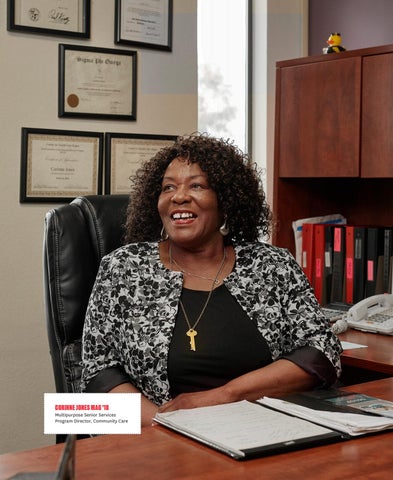
CORINNE JONES MAG ’18
Multipurpose Senior Services Program Director, Community Care
26 | VITALITY
ALUMNI AT WORK AFTER RETIRING EARLY from a career with AT&T, Corinne Jones went back to school to earn a bachelor’s degree in political science. She remembers that it was in a class on elder law where she got her first taste of gerontology. It excited Jones so much that one of her undergraduate professors took notice and encouraged her to pursue a master of arts degree at the USC Leonard Davis School of Gerontology, the largest gerontology program in the nation. She agreed, and in 2016 Jones became one of hundreds of thousands of Americans over age 50 going back to school — in her case, for a second time — to study a fascinating field that she knew could take her in any number of directions. USC’s degree program in gerontology explores all aspects of human development and aging, using a multidisciplinary approach and embracing students of all ages and backgrounds. In 2018, Jones was 66 years old when she earned her master of arts degree and was an honor student with recognition by Sigma Phi Omega, the gerontology honor society. She knows that students like her are changing the course of our views on aging, and the USC Leonard Davis School of Gerontology is the perfect place to do that. “There’s a place for everyone,” Jones says, adding that it was the “perfect option” for her. “USC is the oldest school of gerontology in the United States. Why would I
How the USC Leonard Davis School of Gerontology helped three graduates explore the gerontology field and forge unique careers in aging and health.
Photography by Aaron Wojack
go anywhere else when I had the best school right here?” Jones has since put her learning into practice. As the Multipurpose Senior Services Program Director for Community Care serving Lake and Mendocino counties, she administers a program funded through the California Department of Aging. Her clients are low-income, frail adults 65 and over who are certified as being at risk for nursing home placement. The program offers services that allow these individuals to remain in their homes. The people who interviewed Jones for the job were “totally impressed” by her USC degree, she says. And she is thankful that the Leonard Davis School of Gerontology, with its pioneering faculty and rigorous training, prepared her so well to do it. “The program is current and relevant,” she says. “It had everything that I needed to walk away as a graduate and get a top job running one of California’s top programs for older adults.” By 2030, all baby boomers will be older than age 65, making the need for people who understand aging (and its implications for society) all the greater. With that in mind, Jones says she knows that her USC gerontology degree has positioned her well for the future. Her advice to others: “Hitch yourself to something that will benefit older adults. If you do that, I guarantee you’ll be successful. The field is growing, and it’s attached to everything we do.” — By Shannon Flynn
SPRING 2020 | 27
ATHAN BEZAITIS MA ’01, MPW ’10, CERT ’12
Senior Director of Communications and Public Relations, The Permanente Federation
28 | VITALITY
“I NEVER WOULD HAVE PREDICTED WHERE I AM TODAY. ... GERONTOLOGY IS ONE OF THE MOST IMPORTANT DISCOVERIES OF MY LIFE.”
IT DIDN’T TAKE LONG for Athan Bezaitis to catch the gerontology bug. He worked as communications director for the USC Leonard Davis School of Gerontology before he ever took a class. But after getting to know the school’s faculty and students and learning about their impactful work, Bezaitis decided to dive into the field himself in 2010. He now works as senior director of communications and public relations at The Permanente Federation, where he communicates on behalf of 23,000 physicians caring for more than 13 million members of Kaiser Permanente. His USC certificate in gerontology, coupled with his professional experience, is the reason he got there, he says. The certificate program gave him a greater understanding of gerontology policy and research at a time when the aging of the U.S. population has wide-ranging implications. “It’s a degree that’s going to help provide you the insight that you’ll need to be a decision-maker around the future of aging,” he says. “I can’t think of a better foundation.” Bezaitis says his decision represented the logical next step in a career spent primarily with organizations focused on health care and healthy aging. USC was the perfect choice, not only because he worked there but also because it offered an online graduate certificate in gerontology with highly experienced instructors and an unparalleled range of courses. The program also provided Bezaitis with the flexibility he needed, given his full-time job. He took one course each semester and was able to engage with each class based on his personal schedule. He could participate in a class in real time or watch a recording later. “The experi-
ence was both convenient and enriching,” he says. His favorite course was a gerontology policy class with Kevin Xu Professor in Gerontology George Shannon, who directs the Rongxiang Xu Regenerative Life Science Research Lab at USC. “I felt like I could have had a degree in public policy because of the amount of information I learned in that course,” Bezaitis says. “What I learned about aging public policy is the most relevant part of the work I do today.” Bezaitis applied what he learned at USC to his previous work as communications manager at The SCAN Foundation, an independent nonprofit foundation dedicated to advancing quality care for seniors. As the organization’s communications manager, he was able to contribute to discussions that helped shape the Affordable Care Act’s long-term care provision. “We got to be right on the cusp of what was happening during the ACA’s implementation,” he says. Many of his team members at The SCAN Foundation were USC graduates who had connected him to the job. The school’s professional network is real, Bezaitis says, and it’s strong. “The aging network at USC is something that [someone can] really take advantage of when they’re at the school—and after,” he says. Bezaitis says that the USC program also helped him stand out when interviewing with Kaiser Permanente, and it will only become more valuable amid a growing need for experts in the field. “I never would have predicted where I am today,” Bezaitis says. “[But] gerontology is one of the most important discoveries of my life.” — By Shannon Flynn
SPRING 2020 | 29
KATY FIKE MSG ’06, PHD ’09 Partner, Generator Ventures
30 | VITALITY
“IT JUST OPENED MY EYES, PAGE AFTER PAGE, CLASS AFTER CLASS. I FELT THERE WAS SO MUCH I WANTED TO KNOW."
THE TRAGEDY ON SEPTEMBER 11, 2001, changed the direction of Katy Fike’s life. At the time, she was an investment banking analyst at the World Financial Center in New York City, often pulling all-nighters at the office. The experience made her question everything. “After that morning, I had this feeling in the pit of my stomach that I wanted to do work that made a difference,” she recalls. “All the projects I’d been doing suddenly didn’t matter.” Fike has always had a strong affinity for seniors, but she hadn’t thought about working with them professionally until her mother sent her the book Learning From Hannah: Lessons for a Life Worth Living, by William H. Thomas. The author’s thoughts about an ideal elderhood helped Fike connect the dots. “I was kind of blown away,” she says. “I still have that copy of the book, and I think I underlined 95 percent of it.” Overwhelmed by the belief that seniors deserved better, Fike began volunteering at Meals on Wheels and assisted living centers. Once she found the topic of gerontology, Fike couldn’t get enough. She says her time at the USC Leonard Davis School of Gerontology was transformative: “It just opened my eyes, page after page, class after class. I felt there was so much I wanted to know, so I decided to stay for the PhD.” After graduation, Fike co-founded a start-up that was focused on health assessment. What she quickly learned was how challenging it can be to raise capital and get new companies off the ground. It would inform her future endeavors. She then joined a consulting firm in Atlanta that dealt with companies such as General Mills, Colgate and Pall Mall. “Through the course of that work, I was
struck [that] for every project we’d work on, the demographic target was 18-49,” she says. “People over 50 brush their teeth, grocery shop, and wash dishes probably more than 18-year-olds.” So when Fike and her husband moved to San Francisco, she started her own consulting firm, Innovate 50, to facilitate the burgeoning ecosystem of innovators and start-ups. Around that time, she met Stephen Johnston, with whom she would co-found Aging 2.0, a network that strives to accelerate innovation to address the biggest challenges and opportunities in aging. The company has hosted 600 events around the world and has 83 volunteer-run chapters globally. In 2014, Fike and Johnston started Generator Ventures, an investment platform focused exclusively on the intersection of aging, senior care and technology. One of the companies it’s investing in is Active Protection, which produces the Tango Belt: “It’s a belt with a bunch of sensors and cold gas airbags,” Fike explains. “It can detect if someone is going to have a hip-injuring fall and inflates these airbags to protect the hip, and [it] decreases the effect of a fall by more than 90 percent.” Another is Third Eye Health, a mobile platform that provides telemedicine so seniors can receive medical consults from their home. “We look at ways we can take what have traditionally been very low-tech, high-touch businesses and shift them to more high-tech and hightouch,” Fike says. “We want to help people get the care and resources they need in as low-cost a way as possible [and] in the setting they want.” — By Michelle McCarthy
SPRING 2020 | 31
32 | VITALITY
•
•
•
LEADING by Example
An accomplished scientist and awardwinning mentor, Sean Curran helps students embrace surprises and the discoveries they can yield.
By Beth Newcomb
•
Photography by Dario Griffin
Sean Curran knows from personal experience that laboratory experiments can end in failure. That understanding has shaped how he mentors his students and colleagues — and has led to some remarkable findings in his lab. “I learned a lot of science by doing it wrong the first time, figuring out what the mistake I made was and then trying not to make that mistake again,” says Curran, who is an associate professor of gerontology and molecular and computational biology and the associate dean of research at the USC Leonard Davis School of Gerontology. “When an experiment doesn’t work, don’t just repeat it again — but don’t throw it away, either. Taking the time to figure out what was done inappropriately is probably the best learning experience you can have.” Scientific Serendipity Curran’s own research into healthy longevity involved a few such learning experiences and resulting shifts in focus. One unexpected discovery happened while he was examining the genetic changes that can lengthen or shorten life in C. elegans, a tiny, transparent worm with a short lifespan that’s well suited for research into aging. Curran says, “The discovery that we could use diet to correct a genetic deficiency that shortens healthspan was a mistake.”
SPRING 2020 | 33
Curran with lab members Nicole Stuhr (left), Molecular Biology PhD student, and Osvaldo Villa, Biology of Aging PhD student
Under normal conditions, C. elegans in the laboratory eat a standard diet consisting of a strain of E. coli bacteria called OP50. However, performing RNA interference (RNAi) — a way to reduce the expression of a target gene without knocking it out entirely — requires feeding the worms a different strain of E. coli bacteria, HT115, which transfers the genetic material needed for the interference into the worms. From genetic screens, Curran’s team identified a mutant line of C. elegans that was short-lived. It developed normally until its reproductive period, but the remainder of its short lifespan was unhealthy. Using this line of mutant worms, Curran’s team prepared to manipulate genes systematically using RNAi techniques. However, says Curran, “The problem was that when we put it on that diet [for RNA interference], it was no longer short-lived. It had a perfectly healthy, regular lifespan. It wasn’t long-lived [compared to the average C. elegans lifespan], but it wasn’t short-lived anymore, either, and didn’t exhibit the sickness.” The difference between the bacteria making up the two diets was
34 | VITALITY
small — “like eating wheat bread versus white bread,” Curran says — but the questions it posed led to his identification of “diet-gene pairs,” in which genes confer health advantages or disadvantages depending on what type of diet an organism eats. The team has now identified several of these diet-gene pairs in C. elegans and is transferring its work to experiments in mice. Curran notes that, so far, each of the genes pinpointed in the worms is evolutionarily conserved — i.e., there is an analogous version of the gene in other animals, including humans. Thus, what was once thought to be a laboratory mistake may turn out to have important clinical applications, he says. Curran has already been recognized by the aging field for extraordinary research contributions. He received the Nathan Shock New Investigator Award from the Gerontological Society of America in 2014, and he was honored by the Duke University Center for Aging and Human Development with the Ewald W. Busse Research Award in 2015. “I think we can actually predict that one day we’ll be able to say,
‘These will be the healthiest foods that you should eat’ or ‘These are the ones that you should avoid,’ based on individual genetics,” he says. “We could potentially prescribe food as a nutraceutical.” Helping Students Expect the Unexpected Such unforeseen findings provide great teaching moments for the students in his lab, Curran says. His strength in teaching and mentorship has been repeatedly recognized by USC; in 2012, he received a USC Mentoring Award for his work with undergraduate students, and in 2019 he received the university’s highest award for mentorship, the Provost’s Mentoring Award. While his lab includes mainly PhD students, he takes his role of preparing students of every level to be the next generation of independent scientists very seriously. His goal: to help students stop thinking about science from a textbook viewpoint and start realizing that they can make new discoveries and write the next chapter themselves. “There is a point where students’ questions stop being method-based
— ‘Am I doing this right? How do I do this? How do I set up a specific experiment?’ — and become more about ‘I’m interested in this question,’ and that question is larger in the scheme of biology,” he says. “And then by the time they’re able to propose the tools and the approach to do that, they’re ready to graduate. That’s what a PhD program is for — to be able to identify an interesting topic, develop a plan to answer that question, get data, integrate it into a new model and shape the next big question.”
"I did undergraduate research and realized, ‘Oh my gosh, you just get to solve puzzles all day long. How great is this?’ And it’s the most challenging puzzle, but it’s worth taking the time to try to do it."
Empowering Colleagues On top of his busy schedule with research and students, Curran also serves his fellow USC Leonard Davis School faculty members as both the associate dean of research and chair of the school’s Academic Advancement Forum for junior faculty. Since he began leading the forum in 2016, Curran says he has focused on keeping both tenure-track and non-tenure-track junior faculty aware of opportunities and ensuring that they have the information they need to succeed. He also makes sure that members of the forum, who span a wide range of aging disciplines, from biology to sociology, have ample time to freely talk and network with one another. And as associate dean of research, Curran is the USC Leonard Davis School’s representative to the university’s Office of Research, voicing school concerns and gathering information about university research policies and resources on behalf of gerontology colleagues. In addition to these roles, he is also leading a university-wide, convergent initiative on the study of lifespan health. In 2019, he received a perfect and highly coveted score of 10 on an application that earned him a prestigious K07 Academic Leadership Career Grant funded by
the National Institute on Aging. With the grant, Curran aims to convene faculty members, postdoctoral researchers and students from across USC who are interested in aging, encourage mentoring relationships and scientific cooperation, and hold annual multidisciplinary scientific events focused on aging. “A university standpoint could seed new ideas and make new collaborations,” Curran says. “I think there is something to be said about being at a conference, meeting someone in the coffee line, and having it develop into the best collaboration you’ve ever had.” With these additional leadership roles — plus his responsibilities as the father of seven-and-a-halfyear-old twin boys — he is showing his students and trainees what life as an academician is really like. While it’s not the typical 9-to-5 job, he balances research, mentorship and administrative work with family life, and he makes sure his mentees know that it’s important to be adaptable and to take time for oneself in the midst of a challenging scientific career. “Biological science is riddled with failure at times, but I learned at the appropriate time that failures aren’t always bad. If you look at them as learning opportunities to figure out what went wrong, you’re in an okay place,” Curran says. “It takes a strong person to be able to overcome challenges and disappointment, and you have to really want to be a problem solver. It’s actually what drew me to science. Once upon a time, I thought I was going to be a medical doctor, but then I did undergraduate research and realized, ‘Oh my gosh, you just get to solve puzzles all day long. How great is this?’ And it’s the most challenging puzzle, but it’s worth taking the time to try to do it.”
SPRING 2020 | 35
NOTES
CAMPUS —
Sporting sequins, top hats and tuxedos, the Snappy Tappers took the stage by storm. Grooving to the likes of Sinatra’s “New York, New York” and the Beatles’ “When I’m SixtyFour,” the troupe tap-danced on the bricks outside USC’s Doheny Library before a crowd of beaming fans, new and old. After their final kickline, the dancers — all older adults — received a shower of applause. The Snappy Tappers were just one of the acts at USC’s events commemorating the International Day of Older Persons on October 1, 2019. This special day was created by the United Nations in 1990 to celebrate and advocate for older people in our global society. Throughout the day last fall, USC hosted performances and other activities by, for and about older adults, raising awareness across campus. “We are embracing the intergenerational ethos within our school, challenging misconceptions of aging, and embracing the importance of education and participatory inclusion,” said Paul Nash, an instruction-
36 | VITALITY
al associate professor of gerontology, who organized and emceed the USC Leonard Davis School–led event. Showcasing this dedication to intergenerational communication, USC Leonard Davis School students presented talks on important aging-related topics, including caregiving issues and end-of-life decisions. Another highlight of the event was an appearance by The Fifth Dementia, an intergenerational music group whose members include older adults with dementia. Performing classics such as “California Dreamin’” and “Somewhere Over the Rainbow,” the members sang and played their instruments with pride. The group’s members participate through Music Mends Minds, an organization that supports older adults through music. The nonprofit helped organize the event, along with Leonard Davis researchers, staff and students; the USC Center for Excellence in Teaching; the USC Student Gerontology Association; the USC Alumni Association; and the USC Emeriti Center.
Photos: Fiona Pestana
USC Celebrates International Day of Older Persons
“We are embracing the intergenerational ethos within our school, challenging misconceptions of aging, and embracing the importance of education and participatory inclusion.” — Instructional Associate Professor Paul Nash
In addition to leading talks, gerontology students presented research and provided information about the school’s programs and opportunities. USC students from across campus took part in the activities, achieving the Leonard Davis School’s goal of introducing young people to the field of gerontology. “I had no idea that it was the International Day of Older Persons, and I was surprised to see how many people showed up to this event,” said Mikey Chun, a junior majoring in cinema and media studies. Chun said he especially enjoyed the musical guests and the positive exposure to older adults: “It was really heartwarming to see all of the older people show up and just have fun on stage with their performance, as well as all of the people so invested in the elders of their community.” The day’s events were also geared toward having participants engage with older adults. Through activities such as tai chi, yoga and networking with USC alumni, attendees were able to authentically connect and interact with older persons living vibrant lives. Dean Pinchas Cohen of the Leonard Davis School put it perfectly when introducing the event: “This is really a fantastic opportunity to celebrate older persons, gerontology and community.” – F.P.
SPRING 2020 | 37
NOTES
IN MEMORIAM —
USC Leonard Davis School of Gerontology Professor Vern Bengtson, a social psychologist known for his work on intergenerational relations, passed away on November 8, 2019. He was 78 years old. “For over half a century at USC, Vern Bengtson defined excellence in gerontology through his important research, dedication to students and commitment to exploration,” said USC Leonard Davis School Dean Pinchas Cohen. “His findings around family, religion and social change challenged many societal assumptions and are part of his legacy as a global giant in our field.” Bengtson also served as a research professor at the USC Suzanne Dworak-Peck School of Social Work and as a senior scientist with the USC Edward R. Roybal Institute on Aging. Professor Bengston originated the Longitudinal Study of Generations, an exploration of family dynamics that tracked up to four successive generations of California families for nearly 50 years and yielded rich
38 | VITALITY
insights about aging, conflict, values, faith and spirituality. Bengston, who was born in 1941 in Lindsborg, Kansas, to devoutly religious Evangelical Christian parents, earned his bachelor of arts degree from North Park College. He went on to earn a master’s degree and a doctorate in human development and social psychology at the University of Chicago. Bengston’s experience as a religious graduate student attending school in the 1960s alongside predominantly nonreligious peers prompted him to explore why some people conform to the religious views of their families, while others do not. This research question would come to define his long career. After Bengston joined the faculty of the newly formed USC Andrus Gerontology Center (future home of the USC Leonard Davis School of Gerontology) in 1967, that question led to his starting the Longitudinal Study of Generations, funded by the National Institutes of Health.
Photos: Bob Riha, USC Leonard Davis School archives
Remembering Professor Vern Bengtson
Over the eight waves of data collection, respondents included members of the socalled silent generation (who came of age during World War I) through late 1980s– born millennials (also known as Generation Y). Bengtson’s survey results led to findings that ran counter to prevailing notions around the decline of familial influence, support and spirituality. In fact, he found that the values, attitudes and beliefs of grandparents and parents continued to be transmitted across generations. Prior to his death, Bengtson had been co-leading — with frequent USC collaborator Merril Silverstein, now the Marjorie Cantor Endowed Professor in Aging at Syracuse University — a study funded by the John F. Templeton Foundation aimed at better understanding spiritual beliefs and prosocial values in the absence of religion among Millennials and their families. Bengtson was the former holder of the AARP University Chair in Gerontology. He also held a joint appointment in the Department of Sociology at the USC Dornsife College of Letters, Arts and Sciences. Known for his course on theories of aging and for his love of teaching and mentoring, Bengtson taught at USC for more than 40 years. He was an admired lecturer, earning three major awards for teaching from the Dornsife College and chairing 34 dissertations. He was the author of more than 260 articles and 19 books on gerontology, theories of aging, the sociology of aging and family sociology. In his recent book Families and Faith: How Religion Is Passed Down Across Generations, he surveyed the religious beliefs and spirituality of multiple generations of more than 350 families. Bengtson was a past president of the Gerontological Society of America, which recognized his research and teaching excel-
Bengtson (at podium) joined the faculty of the USC Andrus Gerontology Center (now the USC Leonard Davis School) in 1967 and taught for more than 40 years.
lence with its Robert W. Kleemeier Award and a Distinguished Mentor Award. He also received two MERIT awards for research from the National Institute on Aging. Additional honors and awards include the Distinguished Scholar Award from the American Sociological Association’s Section on Aging and the Life Course, the Ernest W. Burgess Distinguished Career Award from the National Council on Family Relations, and the Reuben Hill Award from the National Council of Family Relations. Bengtson was preceded in death by his daughter Julie Bengtson Gregory (Michael). He is survived by his wife, Hannah Gruhn-Bengtson; his daughters Erin Stephens (Alex) and Kristina Bryte; and four grandchildren, Boz, Zoe, Zadin and Tyler. – O.B.
SPRING 2020 | 39
Alumni Association Honors Mei-Lee Ney Mei-Lee Ney, USC Leonard Davis Board of Councilors member, was honored by the USC Alumni Association during its Volunteer Recognition Dinner on September 5, 2019. Ney received the President’s Award, which “recognizes the outstanding leadership contributions of a volunteer over the course of several years,” according to the USC Alumni Association website. A volunteer’s overall record of service, loyalty, dedication and contribution to the Trojan Family is also taken into consideration for the award. In 2018, Ney made a $20 million gift to the USC Leonard Davis School to found the Ney Center of Healthspan Science. Ney had previously funded an endowed scholarship for USC gerontology students. In 2017, she was awarded the Dean’s Medallion, the USC Leonard Davis School’s highest honor, in recognition of her contributions. In May 2019, she delivered the school’s commencement address.
Corii Berg ’89, President of the Alumni Association Board of Governors; Mei-Lee Ney; and Patrick Auerbach EdD ’08, Associate Senior Vice President for Alumni Relations.
40 | VITALITY
Dean’s Circle Giving Society Launches The USC Leonard Davis School celebrated the launch of the Dean’s Circle, the school’s leadership annual giving society, with a reception at the USC University Club on August 28, 2019. Attendees enjoyed remarks from Dean Pinchas Cohen and an informative presentation by Professor Mara Mather, along with refreshments and live music. The Dean’s Circle plays a vital role in the continued financial sustainability of the USC Leonard Davis School. The generosity of Dean’s Circle members allows students to explore and engage further in their studies, advances the school’s outreach and advocacy for older adults, and provides faculty scientists the best resources for conducting groundbreaking research. To learn more about the Dean’s Circle, please call the Office of Development at (213) 740-1361.
Top: Dean Pinchas Cohen with Linda Seiter and John Seiter ’66. Bottom: Diane Rankin ’74, Mei-Lee Ney, Edna Ulasewicz and Charlie Mustachia.
Photos: Will Chiang, Steve Cohn, Beth Newcomb
NOTES
Honoring Students and Supporters USC Leonard Davis School of Gerontology supporters, faculty members and students gathered at USC’s Town and Gown on October 17, 2019, for the Scholars and Benefactors Luncheon, an annual event recognizing the donor support that makes endowed scholarships, professorships and other important school initiatives possible. Pinchas Cohen, dean of the USC Leonard Davis School, mentioned that the last several years have seen tremendous growth for the school. “We’ve grown our student body more than threefold to over 600 students in the last seven years. Many of these students have benefited from the wonderful scholarships that have been made possible by our supporters,” Cohen said. “We’ve also expanded our faculty, mainly in young, brilliant assistant professors who are the future of the field of gerontology. We’ve also expanded our research programs dramatically, increasing our grant portfolio from the National Institutes of Health from $6 million [in 2012] to over $20 million in 2020.” Shari Thorell, chair of the USC Leonard Davis School Board of Councilors, said the annual celebration was a wonderful opportunity to appreciate all that the school’s students, alumni, faculty and supporters make possible. “I love this day, because it gives us a chance to honor both our benefactors and our scholars,” Thorell said. “For you benefactors, today you get to see the tangible expression of your investment. I have a feeling you’ll agree with me that you have a very high rate of return on your investment in the Davis School, so thank you for that commitment.” She also thanked USC Leonard Davis students for pursuing the study of human development and aging: “I know that what you are doing now is going to make a big, positive difference in my life, so thank you for that!” During the program, Dean Cohen presented the Dean’s Medallion to Rick Matros MSG ’77, chairman, president and CEO of Sabra Health Care REIT and member of the USC Leonard Davis School Board of Councilors. The Dean’s Medallion is the highest honor that can be bestowed by the dean of the USC Leonard Davis School. In his remarks, Matros described how the school had prepared him and his fellow alumni for making a difference in the field of aging. “One of the things that excites me about how this school has developed over the last 45 years is the quality of student leadership that has come out of this school, and the impact the school could have on policy,” he said. “Those are game changers and will really impact the industry and the people we serve.” – B.N.
Top: USC Leonard Davis School Dean Pinchas Cohen presents Rick Matros MSG ’77 with the Dean’s Medallion. Bottom: Dean Pinchas Cohen, Rick Matros MSG ’77, Board of Councilors Chair Shari Thorell ’65, PhD in Neuroscience candidate Brendan Miller, Edward L. Schneider Chair in Gerontology Reginald TuckerSeeley, and Dean Emeritus and Professor Edward Schneider.
SPRING 2020 | 41
Left to right: Fall Prevention Coordinator and Curator Leon Watts, volunteer Thomasina Curry, Professor Beauregard Tirebiter, Biology of Aging PhD candidate Conscience Princesse Bwiza, and Bachelor of Science in Human Development and Aging students Ryan DoyLoo and Ariana Chen.
13 | VITALITY
Photo: Natalie Avunjian Photo: Natalie Avunjian
PAW-FFICE HOURS
Professor Beauregard Tirebiter, or “Beau,” visited the USC Leonard Davis School of Gerontology to help students relax during the end of the busy Fall 2019 semester. Beau is USC’s first full-time canine faculty member and a professionally trained facility dog. The gregarious goldendoodle travels around campus with his student “teaching assistants,” including Ariana Chen (far right), a junior in human development and aging at the Leonard Davis School.
to
Conquer Dement ia Swing
ROD DEDEAUX MEMORIAL GOLF CLASSIC
Save the Date!
Monday, August 31, 2020 Old Ranch Country Club Seal Beach, California
Join us for a Shotgun Scramble tournament supporting USC Leonard Davis School of Gerontology scholarships and Alzheimer’s disease research! For more information, call (213) 740-6493 or email gerodev@usc.edu
The USC Leonard Davis School of Gerontology thanks our 2020 Senior Living Executive Course Sponsors!
Mercedes Kerr
The Dean’s Circle
When you donate to the USC Leonard Davis School, you partner with us in the pursuit of excellence. Your support allows students to explore and engage further in their studies, advances our work to provide outreach and advocacy for older adults, and helps provide faculty scientists the best resources to conduct groundbreaking research. Please show your commitment to our students and mission by making a gift of $500 or more to the USC Leonard Davis School, and join the Dean’s Circle today. THANK YOU, AND FIGHT ON!
Nonprofit Org. U.S. Postage
PAID
3715 McClintock Avenue Los Angeles, CA 90089 gero.usc.edu
Santa Ana, CA Permit 4849
AUGUST 31 Swing to Conquer Dementia: Rod Dedeaux Memorial Golf Classic Old Ranch Country Club, Seal Beach, Calif.
— Hit the links for a Shotgun Scramble tournament supporting USC Leonard Davis scholarships and Alzheimer’s research! To learn more, call (213) 740-0777 or email gerodev@usc.edu.
OCTOBER 8-11 Trojan Family Weekend USC Campus
— Trojan Family Weekend offers visiting families an up-close look at how the campus community achieves excellence in teaching, research and public service. Learn more and register at tfw.usc.edu.
NOVEMBER 14 USC Homecoming USC Campus
— Cheer on the Trojans as they take on the Arizona Wildcats in the 2020 USC Homecoming football game! For tickets, call (213) 740-GOSC or visit usctrojans.com. Note: all events subject to change or cancellation. Please confirm via listed event contact information.
STAY IN TOUCH
uscleonarddavis
@USCLeonardDavis
/USCLeonardDavis
/company/usc-leonard-davis