F E AT U R E
TRANSLATING SCIENCE INTO HOPE
The CHeT Model for Neurological Drug Discovery By Mark Michaud
T
he University of Rochester Center for Health + Technology (CHeT) stands as one of academic medicine’s most successful experiments in translating science into patient benefit. Over nearly four decades, CHeT has played an instrumental role in bringing 12 drugs and devices to market—including landmark treatments for Parkinson’s, Huntington’s, and neuromuscular diseases—while pioneering new ways to design, measure, and deliver clinical trials. What began as a small coordination effort in the late 1980s has evolved into a global model for how an academic research center can run industry-grade clinical trials, invent new endpoints, and move therapies from lab to life faster and more equitably. Today, under the leadership of Chad Heatwole, MD, MS-CI, CHeT is building on that legacy while charting an ambitious path forward, employing new tools like digital endpoints and predictive analytics to speed clinical trials in neurological and other diseases. The approach blends scientific rigor with empathy for the patient experience. “Every new technology or trial design we adopt,” Heatwole said, “should be focused on improving the lives of the people we’re striving to help.” At its core, CHeT embodies a simple but radical idea: that rigorous, patient-centered science and operational
4
excellence can—and should—live within academia. From the analog coordination of early Parkinson’s trials to today’s decentralized, sensor-driven studies, CHeT’s evolution reflects a steady commitment to the principle that research should answer the questions that matter most to patients. Building an academic powerhouse CHeT’s origins at the University of Rochester date back to 1987, when neurologist Ira Shoulson, MD, launched the Coordination and Data Center to oversee DATATOP, an NIH study examining the effects of deprenyl (selegiline) and tocopherol (vitamin D) in Parkinson’s disease. The team
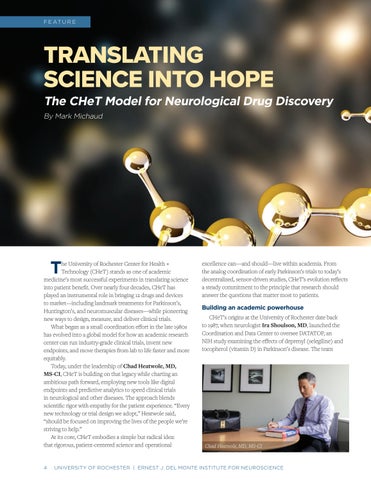
Chad Heatwole, MD, MS-CI
UNIVERSITY OF ROCHESTER | ERNEST J. DEL MONTE INSTITUTE FOR NEUROSCIENCE