Systematic Design for Behavior Change DISCUSSING THE APPROACH APPLIED TO
VOLUNTARY MEDICAL MALE CIRCUMCISION
What’s Inside...
IMPROVING HEALTH CALLS FOR A PERSONALIZED APPROACH
5
FR AMING THE CHALLENGE
13
UNDERSTANDING THE COMPLETE JOURNEY
17
FIT TING IT ALL TOGETHER: THE BEHAVIOR FR AMEWORK
23
DEFINING THE MARKET FOR INTERVENTION: SEGMENTATION
31
DESIGNING FOR DIFFERENT T YPES OF MEN
37
EVALUATING THE INTERVENTIONS
47
EXTENDING THE IMPACT
59
GUIDANCE FOR FUTURE APPLICATIONS OF THE APPROACH
65
REFERENCES
68
4
Improving Health Calls for a Personalized Approach Behavior change is hard. Everyone knows that exercise is good for you, but knowledge alone won’t turn most of us into runners or gym-goers. Even if we have time for exercise, or the money for a gym membership, there are other barriers to staying healthy. Advertisers promote unhealthy food and drink more than products that foster a healthy lifestyle; social norms may discourage exercise; family and friends may not support our goals. Above all, we’re often inhibited by a mixture of our beliefs, values, and emotions. How seriously do we take the risks of not exercising? How do we feel about our body? How can we weigh short-term pain against long-term gain?
A PERSONALIZED APPROACH
5
If it’s hard for one person to adopt a healthy behavior,
Combining this human-centered framework with data-
imagine the challenge facing public-health programs as
analysis techniques adapted from private-sector advertising,
they try to persuade millions of people to take steps to
we developed tools for community mobilizers to identify
safeguard their health. This publication describes how the
persuadable men and target them with messages designed
problem was addressed for an urgent and particularly difficult
specifically for them – similar to an advertiser who knows that an
issue: persuading men to be circumcised to substantially
exercise program must be sold differently to different consumers,
reduce their risk of contracting HIV via heterosexual
depending on whether they’re motivated by looks, lifestyle, or
sex. The approach taken to tackle this challenge has
longevity. These tools were field-tested and refined, and then
applications far beyond this one intervention or disease.
piloted as new interventions to generate demand for VMMC.
The voluntary medical male circumcision (VMMC) program
The initial results were not fully what we anticipated – in
in eastern and southern Africa had ambitious goals and
a programmatic evaluation in Zambia, the interventions
reached substantial scale, but its approach to messaging
increased the effectiveness of outreach, but in Zimbabwe,
wasn’t changing the minds of men most at risk of HIV. So the
where we conducted a randomized controlled trial, the
Bill & Melinda Gates Foundation funded and collaborated
interventions appeared not to have a significant impact on
with a consortium of partners, under the leadership and
demand. The difference in effect between the two countries
guidance of the governments of Zambia and Zimbabwe, to
may be because the interventions in Zimbabwe did not
implement a new approach to generating demand for VMMC.
address an adequate range of clients’ needs, there were challenges in implementing and adhering to the study, and
Faced with a complex problem, we applied a unique
the study design itself made implementation less responsive
approach. We put men’s perspectives at the center of the
to challenges on the ground. However, programmatic data
program, creating a framework for understanding behavior
from Zimbabwe does seem to show that the interventions
that mapped their changing needs, beliefs, emotions, and
there had a positive correlative effect upon VMMC uptake.
values as they weighed the decision to be circumcised.
6
A PERSONALIZED APPROACH
Want to learn more? Placeholder Text
EVALUATION RESULTS ZAMBIA A programmatic evaluation showed that 23 community mobilizers using the new interventions were able to book an average of 301 clients each for VMMC, compared to an average of 212 clients booked by each of the 54 mobilizers using the standard approach. This was a 42% increase in efficiency. In addition, 91% of those actually circumcised via the new interventions belonged to the 15-29-year age group that was being targeted in Zambia, compared to 50% of those circumcised using the standard approach. ZIMBABWE We conducted a randomized controlled trial with four arms: community mobilization approach • •Standard” approach plus offer of HIV self-testing • •Standard new approach • •The • •New approach plus offer of HIV self-testing The new approach showed no statistically significant effect upon the rate of VMMC uptake generated by community mobilizers. Offering HIV self-testing also showed no significant effect upon VMMC uptake per community mobilizer. These results are described in more detail on pp. 47-57
The interventions evaluated represent just a few of the possible tools that can be generated using this behavioral framework and a human-centered design approach. The framework and approach are designed to be adaptable in other countries (Figure 1), and they’re being taken up across eastern and southern Africa. Understanding the target audience in depth and designing programs around the “client” can help resource-constrained public-health programs operate more effectively and efficiently. The projects in Zambia and Zimbabwe were the first to show the potential impact of our behavioral model in generating demand for VMMC. Simply put, it can help deliver a better program design. We believe it can inspire problemsolving in sectors beyond HIV prevention, and our experience holds lessons for other programs facing similar challenges.
“
Complex health challenges and the respective interventions to address these challenges generally require a multidisciplinary set of approaches and expertise. A creative, effective, and rigorous process brings people’s needs to the forefront when decisions are made about the design and implementation of interventions intended to bring about positive changes in their lives.” DESIGNFORHEALTH.COM
8
FIGURE 1:
A SYSTEMATIC APPROACH TO EFFECTIVE PROGR AM DESIGN
1 FR AME THE
CHALLENGE Frame existing evidence through the lens of behavior to focus the project effort
2 ESTABLISH
3 QUANTITATIVE
4 BEHAVIOR
5 CREATE
6 DEVELOP
7 EVALUATE
QUALITATIVE FR AMEWORK Understand the target population in depth to define behavior framework
TOOL S TO AC T Create organizational tools that leverage the framework to empower planning/design
RESEARCH AND SEGMENTATION Quantify barriers to behavior change and divide population into actionable segments
PORTFOLIO OF INTERVENTIONS Design holistic solutions for the key barriers to enable behavior change
THIS APPROACH IS DESIGNED TO B E FLE XIB LE , AND SOME S TEPS (SUCH A S SEGMENTATION) ARE NOT ESSENTIAL WHERE RESOURCES ARE LIMITED
FR AMEWORK Establish the final framework and identify the highest-impact areas of focus
AND ITER ATE Prototype, measure, and learn to refine the interventions
8 EX TEND
THE IMPAC T Deploy the framework and tools in other countries and contexts
The HIV epidemic and potential for impact with VMMC In 2017, an estimated 19.6 million people were living with
The potential gains for those countries were significant: research
HIV in eastern and southern Africa, and 380,000 people
showed that raising the circumcision rate to above 80% among
died of HIV-related illnesses. The same year, around 800,000
males aged 15-49 by 2015 (and maintaining it at that level
people became infected with HIV in the region – nearly half
by circumcising boys as they entered this age group) could
of all new HIV infections globally.1 Preventing the spread of
avert 3.4 million new HIV infections over a 10-year period.6
HIV remains an urgent humanitarian and economic need. It’s also a challenge for countries in the region, many of
The VMMC program focused on rapidly scaling up high-quality
which have rapidly growing populations – meaning that
services and communicating the safety and preventive benefits
more people become sexually active each year – and face
to attract prospective clients. By the end of 2017, a cumulative
significant resource constraints upon their health systems.
18.6 million circumcisions had been performed.7 Despite this impressive progress, there had been periods of flagging demand,
More than 90% of HIV infections in the region are transmitted
particularly among those at highest risk of HIV. Meanwhile,
through heterosexual sex. Research in three African countries
UNAIDS had made its targets even more ambitious, calling for
in the early 2000s showed that being circumcised reduces a
an additional 25 million circumcisions between 2016 and 2021.
man’s risk of acquiring HIV through sex with an HIV-positive woman by 60%.2,3,4 In response, the World Health Organization
With most “early adopters” – those men most easily persuaded
and the Joint United Nations Programme on HIV/AIDS (UNAIDS)
to undergo circumcision – already circumcised, the challenge
recommended voluntary medical male circumcision as a key
now was to find new approaches to persuade those who were
intervention for preventing HIV.5 The VMMC program focuses
more resistant to the idea, and those who were likely at higher
on 14 countries in eastern and southern Africa with high rates
risk of HIV. The need was urgent if UNAIDS’ ambitious goal
of HIV and low rates of circumcision in men.
was to be met: to eliminate HIV as a global threat by 2030.
Why Zambia & Zimbabwe? Zambia and Zimbabwe are two of the priority countries participating in the VMMC program. They are hard hit by HIV: in 2016, HIV prevalence among males was 12.3% in Zambia and 10.5% in Zimbabwe, and between them the two countries accounted for 100,000 new infections that year.8 By the end of 2017, Zambia had performed almost 2 million VMMCs, and Zimbabwe 1.1 million,7 but under the new UNAIDS goals, their targets for 2024 had doubled. New interventions were needed to generate more demand for VMMC.
The
14
priority countries
Botswana, Ethiopia, Kenya, Lesotho, Malawi, Mozambique, Namibia, Rwanda, South Africa, Swaziland, Tanzania, Uganda, Zambia, Zimbabwe
Framing the Challenge In order to approach a behavioral challenge, it’s critical to identify how behaviors are connected to the programmatic goals. By assessing the existing knowledge in the landscape through a behavioral lens, we introduced a human-centered approach to the project. Correctly framing the behavioral challenge that needed to be addressed at the beginning of the process preserved this human-centered mindset throughout.
FRAMING THE CHALLENGE
13
First, the consortium examined the existing evidence
Because these studies were mostly qualitative and had
about attitudes towards VMMC among men in eastern
small samples, they could only serve as a starting point
and southern Africa. Awareness of VMMC was already
for designing a program to generate demand for VMMC.
high: a majority of men knew about its potential benefits
The data were too fragmented to build a holistic picture of
and even stated their intention to be circumcised in the
men’s journey to circumcision, and they gave us a relatively
future. But between intention and action there was a
shallow understanding of the reasons for their behavior. We
big gap. In Zimbabwe, for example, nearly two-thirds of
wanted a more human-centered perspective, with deeper
uncircumcised men said they intended to go for VMMC,
insights into what men understood and felt about VMMC.
yet only 11% of all men had actually done so (Figure 2).
And to target them effectively, we had to understand the differences among their journeys, as much as the similarities.
Men listed a variety of issues that deterred them: fear of
What we needed was a framework to understand the entire
pain during and after surgery, the long healing period,
ecosystem within which men made choices about VMMC, in
loss of money (for transportation, and time off work),
order to identify and precisely target the beliefs and mental
and worries about medical complications.9 Despite this,
models that prevented them from getting circumcised.
campaigns promoting VMMC didn’t target men’s specific barriers, instead taking a “one size fits all” approach to messaging that focused mostly on its importance for HIV prevention – information the majority of men already knew.
14
FRAMING THE CHALLENGE
Check out a video about the approach: https://www.malecircumcision.org/resource/ market-research-vmmc-applying-private-sector-approaches-vmmc-demand-creation
FIGURE 2:
POSITION ALONG THE VMMC PATHWAY AMONG MALES AGED 15 – 49 IN ZIMBABWE
100% 68%
66%
64% The “intent to action” gap
11%
All Men
Aware
Interest
Intention
Circumcised
Source: Population Services International (2013)
FRAMING THE CHALLENGE
15
Understanding the Complete Journey To create a holistic framework for men’s decision-making about VMMC, we used two complementary methods – journey mapping and Ethnolab. They’re grounded in behavioral science, and each has a proven track record in the private sector, but they have rarely been applied in the global health sector.
UNDERSTANDING THE JOURNEY
17
The first method, journey mapping, is commonly used in consumer marketing to systematically understand how people make decisions. Local moderators interviewed men and the people around them to identify and map the full range of influences on the journey toward circumcision. Marketers might do this to understand what leads consumers to buy a product; in this case, we wanted to understand how men make the decision to become circumcised. The interviews used “journey maps� to capture stories from men and their influencers about their beliefs, emotions, and actions at each stage of the decision-making process, moving from awareness, to intent, then to action, and ultimately to becoming advocates for VMMC themselves. Defining the encouraging forces and the inhibiting barriers along their journey helped us identify the scenarios that cause men to get stuck.
18
UNDERSTANDING THE JOURNEY
We explored these scenarios further with our second approach, Ethnolab. This is a game-based method of understanding decision-making that draws on principles of behavioral economics. Groups of participants were shown scenarios related to health choices. Each scenario came with several possible outcomes, and participants were asked to select the outcome that they thought the majority of the group would choose. By predicting outcomes based on what they thought people like them would do, the game-players were more likely to reveal their actual emotions, mental models, and biases in their responses, rather than simply saying what they thought the facilitators wanted to hear.
UNDERSTANDING THE JOURNEY
19
Going deep and wide with research
JOURNEY MAPPING Qualitative, in-depth interviews were conducted in 13 districts in Zambia and Zimbabwe with
Much qualitative and quantitative research
purposively selected participants.
into demand generation for VMMC had used small samples and focused primarily or exclusively on uncircumcised males. Our research was a phased, mixed-method approach, on a larger scale, that examined the ecosystem of relationships around men.
152
boys & men
13-29 years, circumcised and uncircumcised
656
influencers
of those boys and men (female partners, close male friends, parents or parent figures, community leaders, VMMC service providers)
ETHNOL AB Qualitative research using behavioral
In order to keep fieldwork logistics practical and costs
economics was conducted with groups
reasonable, in each country the research targeted those
of randomly selected participants.
districts with the highest concentration of uncircumcised men. These accounted for 80% of the uncircumcised
ZAMBIA:
210
population. Districts were first sorted from high to low by their populations of uncircumcised men. The cumulative
boys & men
female partners, and service providers
percentage of all uncircumcised men was then calculated. Around half of districts fell below this 80% cut-off point, and thus research was carried out in 38 of 72 districts in Zambia, and 35 of 61 districts in Zimbabwe. Samples were distributed by age in proportion to the population
ZIMBABWE:
220
size for each age group in each district. Households were randomly sampled in the selected districts, and a male was approached in each household for the interview.
boys & men
female partners, and service providers
Fitting it All Together: The Behavior Framework As with any health behavior, men don’t make decisions about VMMC in an instant. Over the course of the journey, a man forms and then revises his beliefs about the options available to him for VMMC, what he can do, and the likely actions and responses of those around him. This evolution allows him to overcome the emotional or practical challenges at each stage – unless those barriers cause him to become stuck. Our VMMC Behavior Framework lays out our research findings to create a coherent picture for program planners.
FIT TING IT ALL TOGETHER
23
We analyzed the findings from the journey mapping and Ethnolabs and integrated them to create the VMMC Behavior Framework (Figure 3). The framework systematically maps three broad stages of a man’s journey to undergo VMMC, represented by the gray bars in the center of the framework. Each bar depicts progress, first from awareness of VMMC to a commitment to undergo it; then from anticipation to the procedure itself; and finally from relief to potential advocacy for VMMC. The framework also depicts the kinds of barriers that
can impact a man’s progress, represented by the colored squares in the lower half of the framework (each color represents one category of barrier). The maroon-colored squares in the upper half show benefits of VMMC – but a man may regard these as barriers too, if he doesn’t believe they’re personally relevant to him. The framework shows how the barriers may change over time, and it also identifies the people who may influence him to overcome them and move toward the next stage.
A behavior framework is a powerful resource because it provides a simple reference for understanding complex behavior. It allows planners to discuss different challenges while using a common reference point and encourages a holistic approach when addressing them. In this way, the VMMC Behavior Framework can be contextualized across different types of men and different countries.
24
FIT TING IT ALL TOGETHER
FIGURE 3:
VMMC BEHAVIOR FR AMEWORK
Protection Protection from from STIs STIs
HEALTHCARE HEALTHCARE WORKERS WORKERS
Protection Protection from from HIV HIV
HEALTHCARE HEALTHCARE WORKERS WORKERS
Protect Protect partner partner (from (from HPV, HPV, STIs) STIs)
HEALTHCARE
HEALTHCARE WORKERS WORKERS
FRIENDS
Protection from STIs
HEALTHCARE WORKERS
FRIENDS
FRIENDS
Believe Believe there there isisno no risk risk in in monogamy monogamy
FRIENDS
Sex Sex lasts lasts longer longer
PARTNER
PARTNER
Improved Improved perception perception by by women women
FRIENDS
FRIENDS
Improved Improved hygiene hygiene
Believe there is no risk in monogamy
FRIENDS
FRIENDS
FRIENDS
LACK OF BENEFIT RELEVANCE
1
Anticipated pain of Anticipated procedure
pain of procedure
FRIENDS
FRIENDS
COMMITMENT
ANTICIPATED LOSS Anticipation of lost Anticipation of wages
lost wages
FRIENDS
FRIENDS
Anticipated loss of Anticipated religious alignment
loss of religious alignment
FAMILY
FAMILY
HEALTHCARE WORKERS
Improved perception by women
FRIENDS
Improved hygiene
Protects the community
HEALTHCARE WORKERS
FRIENDS
LACK OF RELEVANCE
LACK OF BENEFIT RELEVANCE
R E L AT E ANTICIPATED PAIN
PARTNER
Protects the community
DISTRUST Distrust of circumcised Distrust of men under-representing circumcised men pain
under-representing pain
FRIENDS
FRIENDS
Distrust of intent of Distrust of intent women making request
of women making request
PARTNER
PARTNER
UNCERTAINTY
Uncertainty Uncertainty of procedure steps of procedure &steps timelines & timelines FRIENDS
FRIENDS
HEALTHCARE HEALTHCARE WORKERS
WORKERS
2
A N T I C I PAT E
P R O C E D UR E
ANTICIPATED PAIN
ANTICIPATED LOSS
Anticipated pain of procedure
Anticipated loss of sex
FRIENDS
Anticipated pain of healing
FRIENDS
FRIENDS
PARTNER
Anticipated loss of pleasure
FRIENDS
Anticipation of lost wages
FRIENDS
3
RELIEVE
DISTRUST
UNCERTAINT Y
ANTICIPATED SHAME
ANTICIPATED SHAME
Distrust of circumcised men underrepresenting pain
Uncertainty of procedure steps & timelines
Anticipated shame at time of service
Anticipated shame when telling others
FRIENDS
Distrust of intent of women making request
PARTNER
Partner distrusting man in monogamy
PARTNER
FRIENDS
HEALTHCARE WORKERS
Uncertainty of surgical complications
FRIENDS
HEALTHCARE WORKERS
Uncertainty of surgical implications
FRIENDS
HEALTHCARE WORKERS
FRIENDS
Anticipated shame while healing
FRIENDS
FRIENDS
ADVO CACY
1
R E L AT E
COMMITMENT
2
A N T I C I PAT E
PROCEDURE
COMING TO TERMS WITH THE CONCEPT OF
PROGRESSING FROM INTENTION, TO SCHEDULING,
Progressing through the Relate stage means that the man
As the time for the procedure draws near, men experience
moves from an awareness of VMMC to internalizing its value
intensifying pressure and concerns about their decision.
for him, and finally to a personal commitment to follow
Those who can manage their concerns will follow through, but
through and undergo circumcision. This means more than
others are inhibited from undergoing the surgery, because their
just assimilating information about VMMC. He must relate
belief in its long-term benefits is outweighed by significant
positively to it and decide that he needs to obtain the
fears about the short-term drawbacks. We call this cognitive
benefits that VMMC can give him. Men who do this are most
dissonance – being intellectually committed to VMMC but
likely to commit to VMMC and move to the next stage on the
avoiding decisive action for emotional reasons. Such men may
journey. Men who relate neutrally or negatively, i.e. who do
find themselves stuck indefinitely in the Anticipate phase.
VMMC, ITS BENEFITS AND DR AWBACKS
TO COMPLETION OF THE SURGERY
not see VMMC as relevant to themselves, may remain in the Relate phase indefinitely.
26
FIT TING IT ALL TOGETHER
 Download the VMMC Behavioral Framework here: https://www.malecircumcision.org/resource/vmmc-behavioral-framework-lessons-quantitative-qualitative-market-research
3
RELIEVE
A DVO CACY
THE LIFTING OF THE INTENSE PRE- OPER ATION PRESSURES AND POST- OPER ATION CONCERNS
Men who are proud of having been circumcised and who value VMMC for others can become valuable advocacy resources, acting as peer influencers for those who may be stuck in one of the first two stages. By contrast, some men who reach the Relieve stage choose to hide their status from others because of feelings of shame or embarrassment. This suggests a need to intervene upstream to address concerns in the earlier stages that will otherwise persist.
Men who are proud of having been circumcised and who value VMMC for others can become valuable resources for advocacy.
FIT TING IT ALL TOGETHER
27
How men get stuck: barriers along their journey In addition to illustrating and articulating the journey, the behavior framework also synthesizes the qualitative data on the barriers that men face. These are classified into six “barrier themes”. The framework shows how these vary at different stages of the VMMC journey, and it depicts the people who can influence a man to help him overcome each barrier. Laying out the stages, barriers, and influencers makes it possible to identify potential intervention points to affect a man’s behavior and move him along the journey. While the framework recognizes the benefits of VMMC (shown in the maroon-colored squares), it is primarily structured around barriers, because these are what need to be overcome by interventions.
BARRIER
THEMES IN THE
VMMC BEHAVIOR FR AMEWORK
The six barrier themes are color-coded in the framework. Our research showed that these themes are present across the age range of adult men and appear common across countries. However, the themes manifest themselves differently at each stage of the VMMC journey, and in the framework they are represented by an inventory of 33 specific barriers. The framework is designed so that other barriers can be added when
it is adapted for use in other countries, based on research conducted in each context.
28
THE SIX BARR IER THEMES IN THE VMMC B EHAVIOR FR AMEWORK
L ACK OF BENEFIT RELEVANCE The man’s sense that he doesn’t need the benefit of VMMC, because he doesn’t consider himself at risk for HIV, or avoiding HIV is not a priority goal
DISTRUST If a man’s partner encourages him to undergo
VMMC, he may distrust her reasons; he may also
distrust circumcised men who downplay the pain ANTICIPATED PAIN
involved in the procedure.
Pain is highly subjective: we tend to overestimate the pain of a future event, and understate pain
suffered in the past. This makes it difficult for those
who have already undergone VMMC to address the fears of uncircumcised men
ANTICIPATED LOSS Financial losses due to the costs of transport,
the procedure, and time off work while healing;
perceived loss of sexual pleasure; and potential loss of cultural or religious identity
UNCERTAINT Y Uncertainty about how the procedure is done, the
risk of medical complications, and the healing time
may cause the man to focus on worst-case scenarios
ANTICIPATED SHAME The man’s worry that he will run into people he
knows at the VMMC clinic, or that people who learn that he has been circumcised will react negatively
Defining the Market for Intervention: Segmentation While the behavior framework establishes a comprehensive view of a man’s journey toward VMMC, our approach acknowledges that not every man goes through this process in the same way. The journey mapping and Ethnolab had shown that men did not all share the same beliefs, attitudes, and emotions about VMMC, or experience each of the barriers depicted in the behavior framework. This meant that a more nuanced understanding of the differences between men – as well as their similarities – needed to be at the center of our program design.
DEFINING THE MARKET
31
To divide men into distinct groups, we used market segmentation, a method employed widely for marketing in the private sector. Segmentation uses cluster analysis (a machine learning statistical technique) to divide a population into groups whose members share particular characteristics, while the groups themselves are as distinct from one another as possible. They can then be efficiently targeted with tailored messaging, interventions, and services. For segmentation to be useful, each segment must be large enough to be worthwhile targeting, and the number of segments must not be so great that it is impractical to customize an intervention to each one. Programs often segment against programmatic, demographic, or other
SEGMENTATION SURVEY: ZAMBIA
2,000 boys & men
15-29 years, circumcised and uncircumcised
criteria. The survey that formed the basis of our segmentation went further, examining the behaviors and attitudes of boys and men at each stage of the VMMC journey, providing a lens through which to view their behavior at a deeper emotional level. The segmentation process relied on the components identified in the behavioral framework. The result was six population segments in Zimbabwe, and seven in Zambia. We developed detailed profiles of each segment based on the demographics, attitudes, beliefs, and behaviors of the men within it. The uncircumcised men in each segment are generally at a particular stage of the VMMC journey and face a particular set of barriers which are summarized in Tables 1 and 2.10 More extensive data on each segment for Zambia and Zimbabwe are available on the VMMC Clearinghouse website (malecircumcision.org).
32
DEFINING THE MARKET
ZIMBABWE
2,001 boys & men
15-29 years, circumcised and uncircumcised
TAB LE 1:
SEGMENTATION OF MALES AGED 15 -29 IN ZAMBIA SEGMENT NAME
% OF TOTAL POPUL ATION
% OF UNCIRCUMCISED POPUL ATION
S TAGE OF JOURNE Y
KE Y BARRIERS
Self-Reliant Believers
19%
9%
Relieve
Strong commitment to VMMC and ready to advocate to friends, brothers, and sons
Indifferent Resistants
17%
27%
Relate
Express little interest in engaging with the messaging behind VMMC or sexual health in general
Friends-driven Hesitants
14%
19%
Anticipate
Committed but with weak motivation. Wish they had been circumcised as a child rather than have to make a difficult decision as an adult; this drives rejection due to cognitive dissonance. Need assurance that they have the ability to handle the procedure and healing
Socially Supported Believers
14
%
11
Anticipate or Relieve
Committed and ready for VMMC, but with some support needed on understanding the procedure and pain. Ready and willing to advocate once circumcised
Traditional Believers
13%
6%
Anticipate or Relieve
Show intent to circumcise but low motivation. Tend to be married or with a long-term partner and family
Knowledgeable Hesitants
12%
10%
Relate or Anticipate
Mainly positive attitudes to VMMC, but concerns around safety and pain, and not relating benefits to themselves
Scared Rejecters
11
17
Relate
Believe in some benefits of VMMC (predominantly hygiene) but have many fears and concerns over risk of complications, procedure and surgery, which prevent them from committing to or scheduling the procedure
%
%
%
DEFINING THE MARKET
33
TAB LE 2:
SEGMENTATION OF MALES AGED 15 -29 IN ZIMBABWE % OF TOTAL POPUL ATION
SEGMENT NAME
34
% OF UNCIRCUMCISED POPULATION
S TAGE OF JOURNE Y
KE Y BARRIERS
Anticipate
Strongly motivated but have personal fears around pain and other barriers, as well as some rejection due to cognitive dissonance
Relieve
Experienced very few barriers to circumcision. Strongly motivated and willing to advocate (although only a small proportion are actually advocating)
VMMC Enthusiasts
25%
21%
VMMC Champions
18%
6%
Embarrassed Rejecters
17%
17%
Relate or Anticipate
Very strong fears over anticipated pain and shame. Lack of social support network to talk through fears
Highly Resistant
15
21
Relate
Have little or no motivation to go for VMMC. Do not believe in the benefits and have a very negative attitude toward VMMC
VMMC Neophytes
14%
19%
Relate or Anticipate
Feel generally positive about VMMC but lack information or confidence to go for the procedure
Scared Rejecters
12
16
Relate
Believe in the benefits but have a variety of fears and worries, especially around safety and pain, which prevent them from making a commitment to VMMC
%
%
DEFINING THE MARKET
%
%
In order to make these insights actionable, for each country we designed a simple tool for mobilizers to quickly identify which segment a man belonged to. The segmentation typing tool consists of a short series of questions arranged in a decision tree. The mobilizer asks a potential VMMC client an initial question, and based on his response asks one to three further questions. No more than four questions are needed in order to classify the client in the appropriate segment with a 61-71% degree of accuracy. The client can then be given messages about VMMC tailored to men in his segment.
Designing solutions to meet the unique needs of people is the central principle of human-centered design. Thus, the ability to identify which segment a person represents is an essential part of the process
DEFINING THE MARKET
35
Designing for Different Types of Men Through the behavior framework, we had an overview of the journey to VMMC and the barriers along the way, and we understood that men go through this journey differently. Through the segmentation process and the segmentation tool, we knew how to identify which segment a potential VMMC client belonged to. The next step in our approach was to use the behavior framework and segmentation tool to design and pilot specific interventions to generate demand for VMMC.
DESIGNING FOR DIFFERENT MEN
37
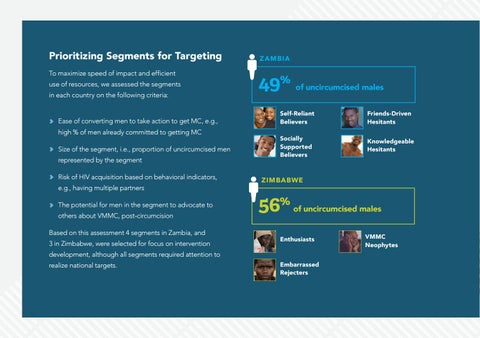
Prioritizing Segments for Targeting To maximize speed of impact and efficient use of resources, we assessed the segments in each country on the following criteria:
• •high % of men already committed to getting MC
Ease of converting men to take action to get MC, e.g.,
• •represented by the segment
Size of the segment, i.e., proportion of uncircumcised men
of HIV acquisition based on behavioral indicators, • •Risk e.g., having multiple partners potential for men in the segment to advocate to • •The others about VMMC, post-circumcision Based on this assessment 4 segments in Zambia, and 3 in Zimbabwe, were selected for focus on intervention
ZAMBIA
49%
of uncircumcised males
Self-Reliant Believers
Friends-Driven Hesitants
Socially Supported Believers
Knowledgeable Hesitants
ZIMBABWE
56%
of uncircumcised males
Enthusiasts
development, although all segments required attention to realize national targets.
38
Embarrassed Rejecters
VMMC Neophytes
The design workshops used the common behavior
In each workshop, participants studied the framework in
framework, combined with country-specific segmentation
depth, using it to understand the characteristics of men in
and local expertise, so there were naturally both
each segment and identify the common barriers, motivators,
similarities and differences between the interventions
and influencers for them at each stage along the VMMC
tested and chosen in Zimbabwe and Zambia.
journey. They brainstormed ideas to address the barriers, and sketched out prototype interventions and tools from
In keeping with our approach to human-centered design,
a shortlist of the most promising concepts. Community
the consortium brought together numerous stakeholders
mobilizers, who talk to men about VMMC in groups or one-
in each country – marketing and communications experts,
on-one, are a key component of the VMMC program, and they
health ministry officials, program implementers, community
were trained to test the prototype interventions in the field.
mobilizers, and representatives of the men whom the program wanted to reach. The process combined the insights of our research with the expertise and experience of the participants in the design workshops.
A prototype is a model or artifact built to test a concept with users in order to learn from them. A prototype helps designers understand,explore, and communicate what it feels like to engage with a solution in real working conditions rather than theoretical conditions.
DESIGNING FOR DIFFERENT MEN
39
40
DESIGNING FOR DIFFERNT MEN
In Zimbabwe, two interventions were selected for piloting, based on their practicality and acceptability among both clients and mobilizers: LACK OF
RELEVANCE
TARGETED MESSAGING – specific messages delivered to
men in priority segments (see page 38), addressing themes identified in the design workshop and the behavior framework: pain, the need for social support for VMMC, concerns about sexual appeal, and the emotional and functional benefits of VMMC. If the segmentation tool showed that the man did not belong to a priority segment, he received standard (generic) program messaging about VMMC.
ANTICIPATED
PAIN
“PAIN - O - METER” – a tool
offering visual analogies to help the client understand the level of likely pain experienced at each step of the procedure, and options to manage it. The analogies were based on input given by men who had already undergone VMMC.
42
DESIGNING FOR DIFFERENT MEN
In Zambia, seven interventions were field tested and four were chosen:
ANTICIPATED
PAIN
PAIN - O - METER – similar to the
Zimbabwe tool (but designed separately from it)
UNCERTAINT Y
PROCEDURE WALK THROUGH – a presentation
to help clients understand the steps involved in the VMMC procedure ANTICIPATED
SHAME LACK OF
RELEVANCE
“BUDDY” SYSTEM – to encourage social support
THE “60% JAR” – a simple tool to address and
help men understand the HIV prevention benefits of VMMC.
DESIGNING FOR DIFFERENT MEN
43
Iteration and improvement: insights from the intervention design process Field testing the interventions was a crucial part of the process. A key principle of human-centered design is that it is not enough to conceptualize interventions in a workshop, even with all stakeholders represented. They must also be tested, reviewed, and refined based on the experience of those using them in the field, and the clients they are meant to serve. The community mobilizers put the prototype interventions into practice, accompanied and observed by marketing experts. The feedback of both was used to refine the prototype tools and the intervention procedures. Along the way, we gained insights into what worked – and examples of what needed to be worked on.
ADJUST THE SELECTION CRITERIA FOR THOSE DELIVERING NEW INTERVENTIONS ON THE
the mobilizers needed structured support for about two
GROUND: Mobilizers for the intervention were recruited
months in order to become fully accustomed to correctly
from those working in the standard VMMC program.
implementing the new approach, segmenting prospective
Those who were more successful in implementing the new
clients, and targeting them with the right messages.
interventions had good literacy levels, were young (under 30)
44
However, monitoring showed that this was not sufficient:
but had a mature attitude, and were dynamic and motivated.
RESTRUCTURE THE PROGR AM TO SUIT THE NEW
PROVIDE INTENSIVE AND SUSTAINED TR AINING,
mobilizers needed as they got used to the new approach,
INTERVENTIONS: To provide the close support that
MENTORING, AND SUPERVISION: Mobilizers
the ratio of supervisors to mobilizers was adjusted from 1:150
in Zimbabwe were initially trained for four days on the
to 1:25 in Zimbabwe, with supervisors spending at least half
behavioral framework and tools, effective communication
a day per month with each mobilizer. The job description
skills, how to conduct sessions with clients, and how
was revised to include a 90% level of effort in providing
to use the tools for segmentation and data collection.
technical support to the mobilizers. This included mentoring,
DESIGNING FOR DIFFERENT MEN
supervision, and quality checks through accompanied
clients found the images too alarming and were deterred by
field visits to ensure that mobilizers did not slip back into
them, so these were revised. In Zimbabwe, clients who could
their familiar old approach to implementation. Structured
not read had difficulty understanding the numerical scale on
support and supervision were designed to help supervisors
the Pain-o-Meter, and in response, emojis were added to it.
manage the change effectively. Each mobilizer was assigned to a clearly defined cluster, and their job description was revised, emphasizing process rather than targets.
CONFRONT THE CHALLENGE OF EFFECTIVE DATA COLLECTION: In Zimbabwe, data collection evolved
during the pilot period. A data cascade was designed to MA XIMIZE THE VALUE OF HUMAN - CENTERED
DESIGN TO PROGR AM IMPLEMENTERS AS WELL
help supervisors evaluate mobilizers’ effectiveness in the field. The cascade recorded information on clients reached
AS CLIENTS: The segmentation tool was designed to be
with the new key messages, the numbers booked for a
portable and easy to use in the field. Mobilizers reported
VMMC appointment, the number of follow-ups, and the
that it made their recruitment efforts more efficient by
numbers circumcised. Mobilizers initially used paper-based
enabling them to accurately deliver the most important
tools to gather data, but it became clear that this was
messages based on the client’s identified needs, rather
not working uniformly, making data analysis challenging.
than delivering a blanket set of messages to every client.
Electronic tablets for data collection were subsequently
REFINE TOOLS BASED ON FEEDBACK FROM
THE FIELD: The initial design for the segmentation tool
introduced, and additional training was provided to mobilizers. Nevertheless, it took mobilizers some time to get used to the tablets, and some preferred to record
was translated into vernacular languages and streamlined,
data on paper and transfer them to the electronic tool
and the segment titles (Neophytes, Embarrassed Rejecters,
later. Internet connectivity in the field was also an issue.
etc.) were replaced with colors to avoid stigmatizing prospective clients. Initial feedback on the Pain-o-Meter developed by the program in Zimbabwe and Zambia was that
DESIGNING FOR DIFFERENT MEN
45
Evaluating the Interventions We took different approaches to testing the impact of the interventions and tools in each country. In Zambia we piloted the interventions for a six-month period, while in Zimbabwe we conducted a randomized controlled trial over eight months. In each country, implementing the interventions yielded important insights into how our design approach can best be used to create behavior change interventions.
EVALUATING THE INTERVENTIONS
47
Zambia In Zambia the interventions were evaluated using a six-month operational pilot. Twenty-three mobilizers were trained to use the new interventions in two regions of the country, while 54 mobilizers used the standard intervention. Mobilizers using the new interventions were able to book an average of 42% more clients for a VMMC appointment than mobilizers using the standard approach. This meant that although the “conversion” rate (clients booked for VMMC who followed through and became circumcised) increased only modestly for the new intervention (from 47% to 49%), mobilizers using the new interventions were more productive. The 23 mobilizers using the new interventions booked 6,923 clients, compared with the 11,448 VMMCs booked by 54 mobilizers using the standard intervention (i.e. there were 2.3 times as many “standard” mobilizers as “new” ones, but they achieved only 1.7 times as many bookings).
In addition, 91% of those actually circumcised via the new interventions belonged to the 15-29-year age group that was being targeted in Zambia, compared to 50% of those circumcised using the standard approach.
48
EVALUATING THE INTERVENTIONS
PROCESS EVALUATION Mobilizers in Zambia reported that whereas before the pilot many
Conversely, some mobilizers reported that the space for
men seemed uncomfortable being counseled about VMMC, the
recording information on each page was too small, and clients’
new interventions made a difference because the mobilizers could
phone numbers were sometimes written down unclearly as a
present the benefits of VMMC more explicitly. Segmentation helped
result, making follow-up difficult. Mobilizers recommended
by guiding them to give messages that resonated with their clients.
replacing the books with electronic tablets.
The structured walk-through of the VMMC procedure using
Other logistical challenges included the difficulty of doing
a flipchart helped to demystify the process and address
outreach during the rainy season, especially when having
misconceptions about it. The most frequent topic of discussion
to travel long distances by bicycle without adequate
reported by mobilizers was pain. They found that discussing it
raingear. Finally, there was a shortage of VMMC providers
openly helped convince clients to undergo VMMC.
at some referral facilities, meaning that clients going for circumcision were sometimes not attended to and
A straightforward but important lesson related to practical
became frustrated as a result. While these challenges
design was that the size of tools and materials has an impact on
were not directly related to the intervention design, they
how successfully they are used. Each mobilizer was issued with a
reflect the importance of taking the complete context into
daily activity book to log details of each man they met with, but
account when designing and assessing interventions.
the book was too large to fit easily in their bag and carry around.
EVALUATING THE INTERVENTIONS
49
Zimbabwe In Zimbabwe, there was an initial three-month pilot during which the new interventions were refined in an iterative process. They were then evaluated through a randomized controlled trial over eight months. The trial was designed to also examine the effectiveness of offering men HIV self-testing kits (see box on the following page).
IN THE TRIAL , MOBILIZERS WERE ASSIGNED TO ONE OF FOUR ARMS:
• •Standard mobilization, i.e. generic information about VMMC (control group) • •Standard mobilization, plus an offer of an HIV self-testing kit • •Standard mobilization, plus the new demand creation intervention mobilization, plus the new demand creation intervention, • •Standard plus the offer of HIV self-testing Data gathered from the interventions were aggregated at the level of each community mobilizer and analyzed using the negative binomial model. Circumcisions were measured as the total number of men circumcised per mobilizer over the total follow-up period.
50
HIV self-testing HIV testing is offered to men before they undergo VMMC. Although it is not compulsory, the journey mapping and Ethnolabs (and qualitative research by others10,11) indicated that testing was one of the main barriers to uptake of VMMC services, and the same theme was raised in the intervention design workshops. In particular, older sexually active men feared receiving a positive test result, or that if they didn’t undergo circumcision after being tested at the VMMC clinic, people would infer that they must be HIV positive. Zimbabwe had already been offering HIV selftesting kits to men in the context of efforts to improve uptake of testing and linkages to treatment, and this included the VMMC program. Self-testing allows clients to learn their HIV status in private before choosing whether to go to the VMMC clinic. For this reason, the efficacy of HIV self-testing in increasing uptake of VMMC in Zimbabwe was evaluated as part of the trial of the new interventions. EVALUATING THE INTERVENTIONS
51
Our trial found that the new demand creation intervention had no significant effect on VMMC uptake per mobilizer, nor on the number of men reached, booked, and presenting for VMMC per mobilizer (Figure 4). The direction of effect of the HCD-informed intervention on the 18-19 and 20-29 years age group was in favor of the intervention, although not significant. FIGURE 3:
EFFECT OF NEW DEMAND CREATION INTERVENTION 0.87(0. 38, 2 .02)
VMMC Uptake
0.86(0. 36, 2 .03)
VMMC - 15-17 yrs
1.03(0. 39, 2 .72)
VMMC - 18-19 yrs
1.05(0.42 , 2 .62)
VMMC - 20-29 yrs VMMC - 30+ yrs
0. 29(0.1,0.9)
0.89(0.62 ,1. 26)
Men Reached
1.0 0 (0.62 ,1.6)
Men Booked
1.0 0 (0.48, 2 .06)
Men Presenting
Favors Standard of Care
Favors Intervention
RR=1.0 52
EVALUATING THE INTERVENTIONS
Offering an HIV self-test also had no effect on VMMC uptake, nor on men reached, booked, and presenting for VMMC per mobilizer (Figure 5). Self-testing did not have a significant effect on VMMC uptake in any age category, although there was a non-significant doubling of VMMC uptake among men over 30 years, indicating that older men are interested in self-testing. FIGURE 5:
EFFECT OF OFFER OF HIV SELF-TESTING
VMMC Uptake
VMMC - 15-17 yrs VMMC - 18-19 yrs VMMC - 20-29 yrs
0.65(0. 28,1. 5)
0. 54(0. 23,1. 27) 0. 57(0. 22 ,1. 5) 0.78(0. 31,1.92) 2 .09(0.69,6.4)
VMMC - 30+ yrs
Men Reached Men Booked Men Presenting
0.75(0. 53,1.07) 0.8(0. 5,1. 29) 0.84(0.4,1.73)
Favors Standard of Care
Favors Intervention
RR=1.0 EVALUATING THE INTERVENTIONS
53
This lack of detectable effects may be due to a number of factors related to the design of the intervention, the logistical challenges of implementing it, and the design of the study itself. segmentation was carried out in July 2016, but the study • •The did not begin until February 2018, during which time the
(tablet-based) tool. However, some mobilizers struggled
number of uncircumcised males in the targeted segments
because they had developed a negative attitude towards
declined. Males in those segments were more likely to be
segmentation. Difficulties with the power supply and internet
under 20 years old, and the intervention did not prioritize
access further complicated use of the electronic tool.
segments with larger proportions of older men. intervention addressed only some of the barriers to • •The VMMC uptake: it focused primarily on pain and on HIV testing, and did not address other concerns, for example about loss of income, which is potentially a significant factor for men of working age. all the insights gleaned from the intervention design • •Not process were successfully carried over into the final
the focus on pain, the Pain-o-Meter tool was not • •Despite used consistently by all mobilizers, because clients found the images offputting, indicating a weakness in the design process. it seemed that older mobilizers were less able • •Into general, deliver the new intervention than younger ones. Younger, high-performing mobilizers had been involved in the design of the intervention, but they were not well represented
interventions. Many mobilizers found the segmentation tool
among mobilizers assigned to the new-intervention arm
difficult to master, time-consuming and poorly designed.
of the study.
In response, the implementer converted it to an electronic
54
to use the electronic version, or did not use it as intended
EVALUATING THE INTERVENTIONS
number of active mobilizers was sub-optimal: only • •The 105 out of the 132 mobilizers reached at least one man
In Zimbabwe, the new interventions were also piloted and
to discuss VMMC during the six-month period, and the
of the randomized controlled trial (RCT), where the VMMC
majority of mobilizers referred none or only a few men.
program was funded by the US President’s Emergency Fund
of mobilizers was inadequate, due for • •Monitoring mobilizers to operational challenges with transportation. structures made it advantageous for mobilizers • •Incentive to address younger boys in group settings, rather than older men individually.
• •versions of the new intervention, and some in the HIV Some mobilizers delivered only abridged or selective
self-testing arms of the study did not always offer the selftesting kit, because they felt it made the outreach session
rolled out in five districts of Zimbabwe that were not part
for AIDS Relief (PEPFAR). In these districts, the conversion rate (the proportion of men booked for circumcision who followed through and completed the procedure) more than doubled, from 30.9% (out of 2,002 circumcisions booked) before the roll-out to 69.3% (out of 3,864 circumcisions booked) one month later, and it was above 70% in each of the six subsequent months. While not as rigorously evaluated as the RCT, these programmatic results imply a correlation between the new interventions and improved conversion to VMMC.
too long. Inadequacies in performance such as these
Further analysis is ongoing to ascertain whether the
are common challenges with new interventions, and under
difference in results between the trial and non-trial districts
normal conditions a program would replace mobilizers whose
was due to variations in the way the interventions were
performance was seriously deficient, but the study design did
implemented, since in the non-trial districts the mobilizers
not allow for replacing mobilizers part-way through trial.
had more flexibility about how they used the tools.
EVALUATING THE INTERVENTIONS
55
56
PROCESS EVALUATION A process evaluation conducted in Zimbabwe led to other,
alarming, and they also reported that the seven-point pain
qualitative insights into the effectiveness of our new
scale was too complex; however, with time they internalized
interventions there. Mobilizers found that approaching clients
the messaging and were able to talk sensitively to clients
individually – rather than in groups, as they would often do in the
about the pain they were likely to experience. Clients exposed
standard program – enabled a more focused conversation, and
to these messages before the procedure expressed a better
that segmentation allowed them to identify the client’s needs
experience with pain during and after circumcision.
and address them with targeted messaging; they found this was more effective in persuading a client to be booked for VMMC.
The process evaluation found that men offered HIV self-
However, sessions using the new tools tended to last longer.
testing preferred this to provider-delivered testing, due to privacy and confidentiality concerns. Mobilizers said that
Mobilizers who had initially resisted having frank conversations
once a man reported testing HIV negative, it was easier to
with potential clients about pain reported that targeted
persuade him to follow through and undergo VMMC.
messages on the topic that provided credible-seeming information increased trust among potential clients. Some
Overall, the process evaluation established that the pilot
mobilizers did not show the Pain-o-Meter directly to potential
interventions (and HIV self-testing) were feasible and
clients because they felt that the revised version was still too
acceptable methods for generating demand for VMMC.
These are just the first of many potential interventions that can be created using our human-centered design approach.
EVALUATING THE INTERVENTIONS
57
Extending the Impact One of the most valuable aspects of our approach is that it is applicable beyond Zambia and Zimbabwe, and can be adapted to other markets to support the design of similar programs. The VMMC behavior framework eliminates the need for duplicating efforts to understand the VMMC journey from scratch in new countries, significantly increasing the return on investment through economies of scale. The framework is adaptable to local contexts: for example, specific barriers can be added or subtracted to reflect men’s experiences. Ideally, segmentation will be performed in each country (but is not essential), and our model also provides the survey structure for this.
EX TENDING THE IMPACT
59
To support the application of this framework and design approach in other places, we developed a suite of four Action Catalyst Tools (see following page). Used sequentially, they enable implementers, funders, and other stakeholders to improve existing interventions or systematically develop new ones. The tools relate directly to the behavioral framework, and they are similarly informed by the principles of human-centered design and behavioral science, and based on extensive research among men and their influencers. In combination with the VMMC behavior framework, the Action Catalyst Tools offer a powerful way for countries to contextualize the application of our model to their program. Rather than adopting interventions wholesale from other contexts, programs can take the underlying principles and insights, and use the same techniques, in order to design effective interventions suited to the context and characteristics of males in their country. The framework and materials offer a common structure and taxonomy for different countries to understand and share successful approaches.
The Action Catalyst Tools offer a powerful way for countries to contextualize the application of our model to their program. 60
VMMC BEHAVIOR FR AMEWORK
Understand the “big picture” of what’s preventing men from undergoing VMMC. The four tools below all reference this framework. PLAN
INFORM
DESIGN
IMPROVE
Where should we focus our efforts?
Who should we target with interventions?
How can we create more effective interventions?
How can we make our interventions work better?
PORTFOLIO
PERSONA
INTERVENTION
INTERVENTION
Identify opportunities
Define different groups
Generate new intervention
Guide a process of
for developing new or
of men by understanding
ideas that address the
improving the effectivness
improved interventions
their unique challenges
different barriers men face
of interventions
MAPPING TOOL
TOOL
DESIGN TOOL
Download the Action Catalyst Tools here: https://www.malecircumcision.org/resource-bundle/ action-catalyst-tools-voluntary-medical-male-circumcision
INPROVEMENT TOOL
62
DESIGNING FOR DIFFERNT MEN
Guidance for Future Applications of the Approach Our experience designing and implementing interventions for VMMC using a human-centered design approach led us to several insights that we believe are relevant beyond their initial application of generating demand for VMMC. Programs seeking to change behavior in relation to other development challenges should consider these lessons.
GUIDANCE FOR A FUTURE APPROACH
65
WE DON’T “GENER ATE” DEMAND: DEMAND EXISTS IN PEOPLE
PEOPLE MAKE DECISIONS AND
BEHAVE WITHIN A SOCIAL AND
Demand is present, whether consciously
ENVIRONMENTAL CONTEXT
or latently, in the forms of individuals’
They accept or reject options based on their
needs, wants, and aspirations. Demand
own expectations and those of others in their
is best met by understanding these
social network. Influencing behaviors requires
and designing products, services, and
understanding and engaging the conscious
marketing to align with and meet them.
and unconscious drivers of those behaviors.
SUPPLY AND DEMAND ARE
CUSTOMERS VIEW SUPPLY AS A
INHERENTLY INTERLINKED
SET OF POTENTIAL SOLUTIONS IN
Good products and services promote
COMPETITION TO MEET THEIR DEMAND
demand for their use. Likewise, demand
They will pick the option that they feel best meets
prompts a supply that responds properly
their needs at a price (in money, convenience, time,
to people’s needs and wants.
etc.) that they can afford. Understanding this helps us to position our solution as the most preferable.
TARGET POPUL ATIONS FOR OUR PROGR AMS SHOULD BE VIEWED AS “CLIENTS” R ATHER THAN “BENEFICIARIES”
HUMAN - CENTERED DESIGN IS AN ENTIRE APPROACH, NOT A STEP The principles of human-centered design should
People are not passive recipients of programs: they
be applied across the entire project. Human-
have free will and use it to accept or reject what
centered design isn’t a standalone task or simply
is offered or available, according to their needs
a workshop – it informs the project approach from
and wants. This is as true of a health service like
start to finish, and enables programs to design a
VMMC as it is of a consumer product or service.
wide range of solutions specific to their context.
APPROACH SOLUTIONS AS PORTFOLIOS,
AVOID CREATING AN
Behavioral challenges in global health are complex
Approaching research and solutions in
and need to address many aspects of a person’s life
isolation will result in the development of an
across the progress they need to make. There are
“insight to action” gap. While this frustration
no magic bullets: intervening at a single point only
is widely observed and discussed, the reality
is unlikely to address the challenge adequately.
that we too often create it ourselves is not.
NOT AS AN INDIVIDUAL INTERVENTION
INSIGHT-TO -ACTION GAP
References 1. Factsheet - World AIDS Day 2018. Geneva: UNAIDS; 2018. 2. Auvert B, Taljaard D, Lagarde E, et al. (2005). Randomized, controlled intervention trial of male circumcision for reduction of HIV infection risk: the ANRS 1265 Trial. PLoS Med. 2(11):e298.
for HIV prevention – July 2018. Geneva: WHO; 2018. 8. http://www.unaids.org/en/regionscountries/countries 9. Djimeu Wouabe E (2013). Scoping report on interventions for
3. Bailey C, Moses S, Parker CB, et al. (2007). Male circumcision
increasing the demand for voluntary medical male circumcision.
for HIV prevention in young men in Kisumu, Kenya: a
Washington, DC: International Initiative for Impact Evaluation.
randomized controlled trial. Lancet. 369:643–56.
10. Hatzold K, Chatora K, Taruberekera N, et al. (2017). Case
4. Gray H, Kigozi G, Serwadda D, et al. (2007). Male
study: Evidence-based demand creation and advocacy
circumcision for HIV prevention in young men in Rakai,
interventions for voluntary medical male circumcision scale-up
Uganda: a randomized trial. Lancet. 369:657–66.
in Zimbabwe. In: Social Marketing and Public Health: Theory
5. WHO/UNAIDS technical consultation on male circumcision
and Practice; 2nd ed. Oxford, UK: Oxford University Press.
and HIV prevention: research implications for policy and
11. Hatzold K, Mavhu W, Jasi P, et al. (2014). Barriers and
programming. Geneva: World Health Organization; 2007.
motivators to voluntary medical male circumcision uptake
6. Njeuhmeli E, Forsythe S, Reed J, et al. (2011). Voluntary medical male circumcision: modeling the impact and cost of expanding male circumcision for HIV prevention in eastern and southern Africa. PLoS Med. 8:e1001132. doi:10.1371/journal.pmed.1001132.
68
7. WHO progress brief: voluntary medical male circumcision
REFERENCES
among different age groups of men in Zimbabwe: results from a mixed methods study, PLoS ONE, 9 (4): e85051.
www.upstreamthinking.com
www.thefinalmile.com
www.ipsos.com
www.psi.org
With support from the Bill & Melinda Gates Foundation