1
2
U P G R A D E D L I V I N G M AG A Z I N E S E P T E M B E R 2 0 2 6
Save the Date! JOIN US FOR OUR ANNUAL
FALL
FESTIVAL SEPTEMBER
17
4-6 PM
80 Declaration Drive
RAFFLE prizes
FOOD & drinks
MUSIC good vibes
EDUCATION from our experts
+ DISCOUNTED PRICING
SCAN TO RSVP 3
5
FROM THE PUBLISHER It’s difficult to believe I've been publishing Upgraded Living for 19 years. What began nearly two decades ago as an opportunity to celebrate the brighter points of our community has grown into something I’m incredibly proud of, and this Anniversary Issue is a wonderful reminder of why we started. Every year, we celebrate businesses, individuals, and organizations reaching milestones of their own. Some are marking five or ten years, while others have been serving our communities for 25, 50, or over 100. Behind every anniversary is a story—one filled with risk, perseverance, unexpected turns, difficult years, and people who believed enough in something to keep it going. We feel incredibly fortunate that so many trust us to tell those stories. Like last September, we decided to look backward in this issue, revisiting moments from Butte County’s past that once captured headlines but have gradually faded from our collective memory. Some changed our communities forever. Others were simply fascinating moments in time. All remind us that the places we call home didn’t become what they are by accident. Our history lives in the people who built businesses here, volunteered their time, protected the places we love, created organizations to serve their neighbors, and had ideas that grew into institutions. It lives in buildings we pass every day, parks we wander through, traditions we continue, and stories tucked away in old clippings waiting to be rediscovered. Keeping those stories alive matters. When they disappear, we lose some understanding of what makes this place special. Bringing them back to the forefront has been one of our favorite parts of putting this issue together, and we’re honored to give them another moment in the spotlight. Of course, history isn’t only in the past. It’s being written right now. The businesses you shop at, nonprofits you support, people you celebrate, and organizations you volunteer with are creating the stories someone may rediscover decades from now. Supporting them helps preserve the connection that makes Butte County such a beautiful place to call home. For 19 years, we’ve had the privilege of documenting a small piece of that story. Thousands of people have trusted us with their histories, opened their doors to our writers and photographers, shared their successes and struggles, and allowed us to introduce them to our readers. We never take that privilege for granted. Here’s to 19 years of celebrating this incredible community, to everyone whose stories fill these pages, and to keeping the stories that brought us here alive for generations still to come.
UPGRADED LIVING AVEED KHAKI Owner/Publisher JASON CORONA Sales Director MICHAELA GULBRANSEN Writer and Account Executive SHELLY BRANDON Writer TIM MILHORN Writer MELANIE WALSH PHOTOGRAPHY Cover Story Photographer
CONTRIBUTORS JIM SECOLA Local History
LORI PIERCE Local History
DOUG LOVE Real Estate
DANNY BALLARD Local History
YOUR DAILY DOSE OF NOSTALGIA For years, we’ve loved following the Facebook group “You Know You’re From Chico When…”, operated by Jim Secola. It has become a wonderful gathering place for longtime locals, history lovers, and anyone who enjoys a good dose of Chico and Butte County nostalgia. The group is filled with old photographs, familiar places, forgotten stories, and the kinds of memories that immediately send people back to another time. After following Jim’s posts for years, we knew we had to invite him to contribute to our Anniversary Issue. His deep knowledge of Butte County history, tenacious spirit in uncovering forgotten stories, and genuine dedication to keeping that history alive are qualities we truly respect and admire. History has a way of disappearing when no one takes the time to preserve and share it, and Jim has made that work a passion project. If you haven’t already, visit “You Know You’re From Chico When…”, give the group a follow, and enjoy a little Butte County nostalgia every day.
ADVERTISING INQUIRIES Aveed Khaki Owner/Publisher
6
U P G R A D E D L I V I N G M AG A Z I N E S E P T E M B E R 2 0 2 6
For sales inquiries, please contact: Jason Corona, 530.591.2634 jason@upgradedliving.com
7
CONTENTS | SEPTEMBER 2026 COMMUNITY 10 1850-1920 Butte County enters an era of colorful characters and curious inventions as Black Bart makes headlines, Freda Ehmann’s olive experiment proves a success, questionable galvanic spectacles promise stronger eyesight, and a mysterious, well-spoken gentleman appears on the streets of Oroville.
10
21 1921-1945 From Chico’s bootleggers and moonshine operations during Prohibition to warm summer days and wartime nights, step back into everyday life across two unforgettable decades and discover how national events shaped life here at home. 28 1946-1960 Explore remarkable Chico legacies through the story of the historic Miller Mansion and the life of celebrated artist and educator Janet Turner, whose extraordinary talent, teaching, and love of the natural world left a lasting mark on our community. 35 1961-1979 Relive one of Chico’s most frightening moments with the 1961 hijacking attempt at Chico Municipal Airport, then discover the origins of CAVE at Chico State and how a student-led idea grew into a lasting force for volunteerism and community service.
28
47 1980s After 72 years, Chico’s beloved Pioneer Days celebration comes to an end, while another defining chapter begins with the creation of the Greenline—a landmark effort to protect agricultural land and preserve the farmland surrounding Chico for generations to come. 53 1990s Chico takes center stage as Shakespeare in the Park brings live theater outdoors, while the Olympic flame makes its way through town— two memorable moments that brought the community together through art, celebration, and a little bit of history in motion.
47 8
U P G R A D E D L I V I N G M AG A Z I N E S E P T E M B E R 2 0 2 6
COMMUNITY 58 2000-2019 Chico invests in its future as the Boys & Girls Club of the North Valley opens its new Campus for Kids, the Chico Air Museum welcomes visitors, and Chico State establishes the Big Chico Creek Ecological Reserve. 75 2020s Chico Rotary marks an extraordinary 100 years of service by creating Rotary Centennial Park, a lasting gift to the community that celebrates a century of local leadership, volunteerism, generosity, and the organization’s enduring commitment to making Chico a better place.
COVER STORY 77 Five years after opening its doors, Deja Vu Breakfast Company has become a Chico favorite by doing things the slow way. Owner Christian Griffith built the restaurant around scratch-made food, genuine hospitality, and a refusal to cut corners—even when it would be easier. For Deja Vu, great breakfasts take time, and so does building something worth coming back to.
ON THE COVER: THE TEAM AT DEJA VU DELIVERING EGG-CELLENCE, AS USUAL
9
WANTED
the West, he seems to prefer cunning over bloodshed. Witnesses describe him as unusually polite for a highwayman, but travelers are warned not to mistake manners for mercy. Oroville and Butte County have not escaped his attention. On July 25, 1878, the Quincy-to-Oroville stage was traveling through the rugged country near Berry Creek when Black Bart struck. After securing his prize, he left behind something that would make his name famous far beyond the mining roads: a poem. “Here I lay me down to sleep, to wait the coming morrow; perhaps success, perhaps defeat, and everlasting sorrow.” Beneath the verse appeared the peculiar signature, Black Bart the Po8. Word spread quickly, and California suddenly had more than a stage robber on its hands—it had a dangerous poet.
BLACK BART Stage drivers, miners, merchants, and travelers throughout Northern California are warned to keep watch for one of the most cunning highwaymen ever to haunt the roads of this state. He travels alone, strikes without warning, favors isolated stretches of mountain road, and has repeatedly vanished before a posse could be raised. He is known throughout California as Black Bart, and any man carrying a Wells Fargo treasure box would do well to remember the name. The fellow is believed to be an Englishborn adventurer who came to America as a boy and later traveled west during the California Gold Rush. Before turning outlaw, he married, raised a family, and served the Union during the Civil War. He fought at Vicksburg, suffered wounds in battle, and rose to the rank of first sergeant. How such a man came to exchange the soldier’s uniform for the 10
U P G R A D E D L I V I N G M AG A Z I N E S E P T E M B E R 2 0 2 6
highwayman’s mask remains a mystery, but his exploits upon California’s roads have made him infamous. His first known strike came near Copperopolis on July 26, 1875. A stagecoach rounded the road and found a masked stranger waiting with a shotgun. From the surrounding brush, several rifle barrels appeared trained upon the driver. Believing himself outnumbered, the driver surrendered the treasure box. Only after the robber escaped was the trick discovered: there had been no gang at all. The “rifles” were nothing more than sticks posted in the brush. Black Bart had taken the treasure by bluff and escaped alone. The same cleverness has marked his career ever since. Bart chooses lonely roads where help is distant, conceals his face, demands the Wells Fargo box, and disappears into the hills. Unlike many desperadoes of
Berry Creek was not his only appearance in these parts. Bart has been connected to roads surrounding Oroville, La Porte, Forbestown, and the mountain settlements beyond, where stages carry passengers, mail, coin, and valuable express shipments through miles of lonely country. These routes offer exactly the sort of terrain he favors: steep grades, thick timber, sharp bends, and long distances between settlements. His methods only deepen the mystery. Black Bart does not ride with a gang or thunder away on horseback. He is known to travel astonishing distances on foot, appearing along remote roads and disappearing again before pursuit can begin. He seems to study the coaches carefully, choosing places where a driver is most vulnerable and assistance is far away. How he learns the schedules, where he hides, and where he goes after remain questions lawmen cannot answer. So let every traveler in Northern California be warned. The man sought may appear older than the desperado one expects, may speak politely, and may travel without horse or companion. From Copperopolis to Berry Creek and the roads leading into Oroville, Black Bart has proven patient, clever, and exceedingly difficult to catch. Somewhere beyond the next wooded bend, the highwayman poet may still be waiting.
A Mysterious Gentleman Arrives in Oroville
Freda Ehmann's olive experiment
a success
OROVILLE—In 1899, after about a year of leasing an olive grove just north of the Feather River, across from Oroville, the Ehmann Olive Company secured a $3,000 loan to purchase a building site and establish what would become the world’s largest ripe olive processing plant of its time. The first plant unit, a 78-by-96-foot wooden building, was completed in 1901 on the southeast corner of the block bounded by the Southern Pacific Railroad, West Lincoln Street, Ehmann Street, and Second Street. The site was approximately where Lincoln Boulevard now crosses the railroad tracks. Inside were 90 sugar pine vats—an astonishing number to the lumbermen who supplied the wood. But even that enormous facility proved too small. Within two years, Mrs. Ehmann’s operation had outgrown the plant.
With her perfected recipe for California ripe olives, Freda Ehmann began filling orders, and by 1904, the company had established national distribution. That same year, the plant added the first unit of an oil mill. Two concrete warehouses followed in 1907. Expansion continued. In 1911, an entirely new room was constructed, and the plant eventually occupied the entire southern half of the block. By 1922, the company owned 700 acres of olive trees in Butte, San Joaquin, Shasta, and Yuba counties, more than half of them in full production. Its final grove acquisition came in 1916. The plant’s last major addition was completed in 1920, filling the entire city block. On Nov. 15, 1920, the new facility was dedicated during the fifth annual Oroville Orange and Olive Exposition, marking another milestone in Oroville’s rise as a center of California’s olive industry.
PHOTOS COURTESY BUTTE COUNT Y HISTORIC SOCIET Y, WRITTEN BY LORI PIERCE
A gentleman of uncommon refinement has lately made his appearance in Oroville, and already no small amount of curiosity surrounds the stranger. Giving his name as Charles Boles, he is said to possess considerable means, dresses in the finest fashion, and carries himself with the easy confidence of a man long accustomed to respectable company. Mr. Boles speaks with remarkable polish and is described by those who have encountered him as exceedingly courteous, intelligent, and well read. Though apparently familiar with mining country and the affairs of Northern California, he has offered little explanation concerning the source of his fortune or his business in Oroville. His arrival has therefore become a favorite subject of conversation. Some suppose him an investor seeking opportunity among the region’s mines. Others whisper that he may be a gentleman traveling west for pleasure, while others believe business interests elsewhere have brought him north. Whatever the truth, Mr. Boles appears entirely at ease among Oroville’s high society and has attracted attention wherever he goes. For now, the stranger remains something of an enigma. Who is Charles Boles, where did he acquire his wealth, and why has he chosen Oroville? Perhaps, in time, the gentleman will provide the answer. 11
A better grain of rice For more than a century, the Lopes family has grown rice just outside Chico in Princeton, tending the same ground generation after generation. Today, father-and-son duo Bruce and Christopher Lopes are carrying that legacy forward while also rethinking what rice farming can look like. Through their company, Lopes Family Farms, they are producing rice that tastes better, uses dramatically less water, works naturally with the surrounding ecosystem, and could ultimately reshape the economics of farming for growers throughout the region—and even the industry at large. The Lopes family began farming rice locally in 1911. Their larger family operation, Charles Lopes & Sons, encompasses 203 acres that have remained in the family for generations, while Lopes Family Farms operates on 60 of these acres and has spent the past five years experimenting with new methods. Rice is so deeply woven into the family story that Bruce jokes they are practically “ingrained” in it. One of his brothers even bought a home that used concrete mixed with rice hulls for added insulation. Bruce’s own farming career began at 16. The youngest in the family, he was the first to figure out how to start their broken tractor, and before long, he was spending his days behind the wheel. From 18 to 20, he earned $3 an hour driving the 12
U P G R A D E D L I V I N G M AG A Z I N E S E P T E M B E R 2 0 2 6
tractor, but what began as work quickly became a passion. Within eight years, he was managing the entire operation. He married, raised Christopher, and passed along the same connection to the land that had shaped him. Christopher, however, would eventually bring home an idea that challenged generations of his family's conventional rice farming. He discovered a method commonly known as rice-and-duck farming, or aigamo in Japan, an integrated system with ancient roots that was refined and popularized in the 1980s by Japanese farmer Takao Furuno. Christopher introduced the concept to Bruce, and the two became fascinated by what it could accomplish. Their mentor, Eric Andrus of Boundbrook Farm in Vermont, had trained directly with Furuno and helped Bruce and Christopher adapt the system to their own fields. Christopher affectionately calls Eric a “one-man army.” The idea is surprisingly simple: let ducks do some of the work farmers have traditionally asked water, chemicals, and machinery to do. Young ducklings are introduced into the rice fields, where they eat weeds and insects while naturally fertilizing the soil. Their movement through the water stirs the plants and stimulates their roots, encouraging the rice to grow shorter and fuller. Because young rice leaves contain abrasive
silica, the ducks generally leave them alone, instead focusing their appetite on competing plants and pests. For Bruce and Christopher, the results were convincing. They converted 25 acres to duck-rice farming, creating one of the largest duck-rice operations of its kind. More importantly, the system aligns with nearly everything they want Lopes Family Farms to represent: lower resource use, healthier soil, a more balanced ecosystem, strong yields, and a better finished product. Water conservation may be its most dramatic advantage. Traditional rice farming relies on maintaining a significant 10 inches of standing water across a field for the roughly 145-day growing season. Lopes Family Farms’ transplanting and duck-rice system can reduce water use by approximately 66 percent. For farmers facing increasingly expensive inputs and an uncertain climate, doing more with less is not simply an environmental ideal; it is becoming an economic necessity. Then there is the rice itself. “This is single-source rice,” Bruce says. "Unlike many rice products that combine grain from multiple farms or fields, Lopes Family Farms’ Duck Rice comes from a single farm and is grown under consistent conditions. Agricultural products, like rice, are very similar to wine. A bottle made
from a specific varietal, like Barbera or Pinot, and from a specific winery carries its own character; a broad blend can lose those complexities and distinctions." “There are no competing flavors, aromas, or quality differences,” he continues. “The rice was all harvested from the same field and farmed in the same way, so you’ll find the taste and aroma are significantly more complex and concentrated. One taste is enough to prove that.” Bruce and Christopher are equally particular about what happens after harvest. Their rice is milled in Richvale and moved directly into temperature-controlled storage to help limit oxidation and preserve its flavor and freshness. They are now working toward eventually bringing more of the milling process in-house. But Bruce and Christopher do not want the story to end with their own fields. At farmers markets, Lopes Family Farms can sell their organic rice directly to consumers for a fair market value, rather than receiving commoditylevel prices averaging 30 cents through traditional broker contracts. That difference has opened their eyes to what direct branding and distribution could mean for other small rice farmers. “We have the business model, and the means and opportunity to distribute it,” Christopher says. “So, why not open the opportunity to other farmers in our area? By bringing more rice farmers on board and teaching them the duck-rice farming method, we’re boosting everyone else around us. We want to be great stewards of farming and also our community. The opportunity to increase their profits by as much as ten times is a real driver for us.” Their long-term vision includes helping growers develop their own brands, tapping into Lopes Family Farms’ growing distribution network, and making smaller acreages more financially viable. If farmers can earn substantially more per acre, Christopher believes they may not need enormous operations to make a living. That could mean less water, healthier farms, and stronger local agricultural families. Someday, Bruce and Christopher would love to see a duck shack in every rice field—a landscape where ducks once again feel at home among the crop and where farming works with the ecosystem rather than against it. For local shoppers, supporting that vision is remarkably easy. Lopes Family Farms Organic Rice and Duck Rice are available at S&S Produce. Buying a bag means taking home rice with a family history stretching back more than a century, but it also supports something decidedly more forward-looking: two generations of farmers trying to leave their land, their industry, and their community better than they found them. Visit Bruce and Christopher at www.LopesFarms.com to learn more about these two pioneers and the work they're doing to improve our community and the food on our plates.
13
14
U P G R A D E D L I V I N G M AG A Z I N E S E P T E M B E R 2 0 2 6
Where The Past Lives On The block of Montgomery Street between Huntoon and Myers was once the beating heart of a bustling Gold Rush town. It wasn’t simply a row of respectable little shops. Six of the 16 buildings in the Old Oroville Commercial District housed saloons between the mid-1800s and early 1900s, which sat alongside hardware stores, variety shops, haberdasheries, photography studios, jewelry stores, and shoe shops. Behind Montgomery Street, Miners Alley added another layer to downtown life. Hotels and saloons opened onto the alley, which remained a busy social gathering place well into the early 1900s, reflecting Oroville’s colorful Gold Rush-era roots. Flyers urging travelers to head to Oroville were handed out at Fisherman’s Wharf in San Francisco: “Go to the Bank Exchange in Oroville and watch the ladies dance the fandango!”
WRITTEN BY SHELLY BRANDON
The gambling halls and saloons have evolved over the years into various types of businesses, but the intention of the space remains: a welcoming street and walkable social hub in the heart of Oroville.
| TOP PHOTO COURTESY BUTTE COUNTY HISTORICAL SOCIETY
The original Washington Block was constructed in 1856 and housed the Pioneer Store at street level with an underground saloon, known as the Bank Exchange, tucked below the sidewalks. The store had all the provisions needed for the miners, from beans to bacon and picks to axes. That building has been transformed into Provisions restaurant in homage to the character of that original store. Restaurant Manager Gracie Stewart explains, “We’re a craft bar and restaurant that makes delicious American cuisine.” When asked to describe the personality, she says, “It's kinda like Frank Sinatra. It has an old school vibe that’s classy but still fun!” The dark wood-and-glass cooler across from the bar was thoughtfully renovated from its time at the Oroville Liquor store in the 1960s. Today, it’s the perfect spot to store Provisions’ handsqueezed juices, beer kegs, and wines. Whether you sit in the eclectically decorated bar area or head to the inviting patio, you’ll get to enjoy amazing handcrafted cocktails while your lunch or dinner is prepared.
| OROVILLE CLOCK PHOTO BY BEN NORTH
Just doors down from Provisions is Ruby’s Boutique, which sits in the historic Kusel Building. Kusel had a photography studio and was responsible for some of the earlier photos of Oroville. Destroyed by a fire in 1904, it was rebuilt that same year with bright, airy storefront windows, beautifully suited to displaying merchandise from Edward Kusel’s shop. Today, Raine Deigh, owner of Ruby’s, shares that those windows display “handpicked essential items for your wardrobe that you’ll cherish for years to come.” She explains that being situated in this building in Historic Downtown Oroville gives her shop a unique backdrop that showcases the thoughtfully curated clothing and jewelry she sells. Raine says with a smile, “Your favorite pieces, the ones you always go back to, will be found right here!” You can find Provisions at 1975 Montgomery St. in Oroville, open Monday-Saturday starting at 11 am, and Ruby's Boutique down the block at 1955 Montgomery St., open Monday-Saturday 10 to 6, and Sunday from 11 to 4. The next time you’re looking to explore, park across the street and see everything that’s changed and everything that's remained the same along Montgomery Street. 15
A CURE ARRIVES
Judge Gray's Historic Home Step back in time and stay in history in the heart of Oroville. Built in 1875 by Butte County Superior Court Judge John Carleton Gray, this beautifully restored home invites you to experience Oroville’s history in comfort and style. Four spacious suites feature antique furnishings and décor inspired by the home’s original character. Enjoy local restaurants, coffee shops and unique shops just steps away. The Feather River is only blocks from your door, offering fishing, disc golf, summer concerts and peaceful picnics. Come experience the history. Stay for the charm.
Citizens troubled by weak sight, tired eyes, headaches, or spectacles may rejoice, for an assortment of electrical inventions promise to restore eyes to youthful vigor. Among the latest wonders are galvanic spectacles, fitted with metallic plates said to conduct invisible currents directly to the nerves of sight. Magnetic eye appliances claim to draw weakness from the optic organs, while patented eye cups bathe the eyes in medicinal vapors and mysterious fluids guaranteed to “strengthen” vision. For those desiring greater force, batterypowered contraptions may be strapped to the head, temples, or face, delivering shocks believed to awaken sluggish eyes and renew failing sight. Advertisements assure the public that these instruments may relieve every complaint without medicine or surgery. Physicians may raise an eyebrow, but manufacturers insist the results speak for themselves. Whether these contraptions truly sharpens vision remains uncertain, but the word of a confident traveling salesman is certainly good enough for us! After all, what else would he be interested in peddling if not the truth?! 16
U P G R A D E D L I V I N G M AG A Z I N E S E P T E M B E R 2 0 2 6
Book your stay by visiting airbnb.com/h/judgegrayshouse or by calling (206) 406-4229.
Downtown Oroville Looking for a small town with plenty of charm? Downtown Oroville offers 10 historic, walkable blocks where you can visit unique boutiques, restaurants, coffee shops, a cozy wine bar, and an old-school ice cream parlor; all with convenient, free parking. Spend the day wandering shady sidewalks, exploring historic buildings, finding something unexpected in an antique shop, or taking in one of the many museums. With a surprising variety of things to see, eat, shop, and experience, it serves as a great weekend destination or a delightful evening escape. Visit downtownoroville.com for the go-to guide and plan your trip today! DowntownOroville www.DowntownOroville.com
head up to the machine, and for 45 seconds you have light delivered to your eye,” he says. “I was surprised that it was painless! It couldn’t have been easier.” His second surprise was how little the treatment disrupted his life. Jim completed nine sessions over three weeks, visiting Monday, Wednesday, and Friday. “From walking in to walking out, each visit took no more than 15 minutes,” he says. “I can’t say enough about how efficient they’ve made this process.” For someone who spent his career evaluating technology, that combination of innovation and thoughtful implementation matters. “The advancement in technology is great, but it’s really the process they’ve created that makes it so wonderful,” he says.
What more could I ask for? In the late 1800s, electricity seemed to promise nearly everything. Galvanic spectacles, magnetic devices, eye cups, and battery-powered contraptions were promoted as ways to strengthen weak eyes, restore failing sight, and even address conditions doctors could not treat. Some were little more than medical theater. At a time when physicians were only beginning to understand retinal disease, age-related vision loss could be broadly described as failing sight or degeneration of the retina, with no meaningful way to reverse its course. More than a century later, the idea of using energy to help the eye sounds strangely familiar—but the science behind it has changed completely. Photobiomodulation (PBM) uses specific wavelengths of light rather than electrical current, and the Valeda Light Delivery System received FDA authorization in November 2024 for patients with dry age-related macular degeneration. For people like Jim Hauenstein, that progress is deeply personal. Jim recently finished writing a book, 50 Year Journey: Users First, Technology Second, built around lessons gathered
over more than five decades in management and technology. Ironically, it was while spending more time reading and working at his desk that he began noticing something had changed. “I began feeling like my eyes were tired,” Jim says. Things he once could read without glasses suddenly required them. “That was telling me that things were not as smooth as they were before. I was starting to not see as well as I once had.” Fortunately, the problem was caught early. His doctor at North Valley Eye Care identified that Jim had dry age-related macular degeneration and continued monitoring him as it gradually progressed. “I began taking chewable AREDS2 pills to slow it down, as that’s all we could try to do.” Jim said, “I took two every day for six years. The chewables are expensive, and it's a hassle of remembering to take them. Unfortunately, it was the best option at the time to try and slow my vision loss.” When his doctor mentioned a new treatment to help patients with dry AMD, he was ready to try it before his vision worsened. His first surprise was how simple the treatment felt. “You put your
Now, Jim is in the waiting period before his follow-up testing, when his doctors will evaluate how his eyes have responded and determine if he needs further treatments. He is quick to note he already notices a difference in his life. “I find that my eyes aren’t tired like they used to be,” he says. “I see things clearer, and I’m thrilled to know my eyes are responding positively to the treatment!” Jim understands why some people may approach unfamiliar technology cautiously, especially later in life. But he hopes positive experiences like his can make that decision easier for others. “The doctors at North Valley Eye Care really go above and beyond to make sure people are comfortable with this service,” he says, adding, “The community is so lucky to have Dr. Barthelow scaling the availability and accessibility of this technology the way he has.” For Jim, the hope is simple: protect what remains, improve what can be improved, and keep doing the things that matter for years and years to come. “If this stabilizes things and makes them better,” he says, “what more could you ask for?” If you have experienced changes in your vision, call North Valley Eye Care and the Macula Preservation Institute today at (530) 891-1900 to schedule an appointment and see if PBM treatment is right for you. 17
From Oroville to the National Stage Tucked inside Feather Falls Casino Resort, Feather Falls Brewing Company has long given Northern California beer lovers another reason to make the trip to Oroville. Now, The Brewery is raising a glass to one of its biggest achievements yet: being named the No. 3 brewery in the nation at the 2026 U.S. Open Beer Championship. One of the country’s premier beer competitions, the U.S. Open Beer Championship draws entries from breweries across the United States and around the world in more than 180 categories. Feather Falls finished third overall among the competition’s Top 10 Breweries, earning six medals across an impressive range of styles. Four beers brought home gold medals: Volcano Mudslide, a rich Sweet Stout; Angry Mama Bear, an Imperial Porter; Crouching Cougar, an American Barley Wine Ale; and Charging Buffalo, a Belgian-Style Dark Strong Ale. For Crouching Cougar, the honor marks an impressive third consecutive gold medal at the U.S. Open. Rye Not? received a bronze in the Rye Beer category, while the refreshing Oroveza received bronze 18
U P G R A D E D L I V I N G M AG A Z I N E S E P T E M B E R 2 0 2 6
in the International Style Pilsner category. “This national recognition is an incredible honor for our entire brewing team,” says Brewery Manager Andy Durocher. “Each of these beers reflects the knowledge, creativity, and attention to detail that goes into every batch we produce. Being named the No. 3 brewery in the country is a tremendous achievement and a proud moment for Feather Falls Casino Resort and our entire community.” The national ranking builds on years of award-winning brewing at Feather Falls, where each beer is created on-site with
a focus on quality ingredients, distinctive flavors, and true craftsmanship. From approachable year-round favorites to creative seasonal releases, The Brewery continues to offer something for every kind of beer drinker. Whether you are already a devoted fan or simply looking for a new local favorite, there has never been a better time to stop in and taste what has made Feather Falls one of the top breweries in the country. Pair a pint with lunch or dinner, explore a flight, and celebrate a national win brewed right here in Northern California.
19
A River Runs Through It: Oroville’s Salmon Festival Each September, something remarkable happens in Oroville. Chinook salmon, after years in the Pacific Ocean, return to the waters of the Feather River, following an instinct that leads them home. For more than 30 years, the community has marked that journey with a celebration as lively and enduring as the salmon themselves.
“The Salmon Festival has been a celebration of the salmon returning to the river,” says Amber Miland. Around the second week of September, the fish ladder at the Feather River Fish Hatchery opens, creating a soft welcome for migrating salmon as they make their way toward the facility. 20
U P G R A D E D L I V I N G M AG A Z I N E S E P T E M B E R 2 0 2 6
The Friday night Salmon Festival Kick-Off Dinner is back and will be presented by the Enterprise Rancheria Community Fund. This year’s festival takes place Saturday, September 26, from 9 a.m. to 3 p.m., spreading the celebration from the hatchery into historic Downtown Oroville. The Oro Dam Cruisers will roll in with classic cars, while the “Salmon Court,” sponsored by Feather Falls Casino Resort and Feather Falls Brewing Co., will offer food trucks, downtown restaurant fare, and plenty of room for families. The Union will even feature a vibrant salmon dish. The festivities also include a six-hour beer garden and Pro Championship Wrestling’s appropriately named “Slammin’ Salmon”
match, with the ring set up right inside the garden. Younger guests can head to the Oroville Convention Center for a Kids Zone managed by Feather River Recreation and Park District and Feather River Elite Gymnastics. The Boy Scouts will also host their soapbox derby for the second year. For a different view of the migration, the Forebay Aquatic Center will offer ticketed kayak tours along the river. Most festival activities are free, as is admission to Oroville’s city museums. Free shuttles will run from Riverbend Park and near the Green Bridge, and a trackless train will carry guests within the event. Pickup and drop-off locations will be identified on the Salmon Festival's online map. Beyond the salmon, Miland hopes visitors explore Oroville itself—its museums, shops, restaurants, and historic downtown. After all, the festival celebrates more than a returning fish. It celebrates the river, the cultures connected to it, and the community that gathers each year to welcome the salmon home. Festival schedules, ticketing, and more information can be found online at www.visitoroville.com/salmon-festival.
PHOTOS COURTESY OROVILLE CHAMBER OF COMMERCE
The Oroville Salmon Festival began in 1994 as a collaboration between the city and local tribes, whose relationship with the river and its salmon stretches back generations. Longtime resident and Chamber of Commerce employee Freda Flint helped champion the idea of celebrating the annual return in Oroville. What began as a small gathering has grown into one of the city’s signature traditions, bringing together tribal communities, local organizations, the California Department of Water Resources, and the California Department of Fish and Wildlife.
Built in 1967 to compensate for spawning habitat lost after the construction of Oroville Dam, the hatchery remains central to the festival. Operated through a partnership between DWR and Fish and Wildlife, it raises Chinook salmon and steelhead while helping support fisheries throughout Northern California. During the festival, visitors can tour the facility, watch salmon climb the ladder, observe spawning operations, and learn how young fish are raised for release.
passageway. The grandchildren call it a bootlegger tunnel. Give it another 50 years, and Al Capone will have personally driven a Cadillac through it. The illegal liquor trade, however, was very real. In 1929, authorities in the Siskiyou Mountains stopped Joe Resaro of Chico driving a new Ford coupe containing approximately 30 gallons of alleged moonshine whiskey. Thirty gallons. That isn’t, “I brought something for dinner.” That’s inventory. And it gives us a glimpse of what Northern California bootlegging probably looked like. You didn’t need Al Capone. You needed a still, rural roads, an automobile, customers, and friends who knew when to keep their mouths shut.
CHICO AFTER DARK Bootleggers, Moonshine, and the Very Dry Town That Wasn’t So Dry
Imagine Downtown Chico on a warm night in 1926. The shops are closed, Broadway is quiet, and a Model T rattles down the street. Officially, nobody is stopping somewhere for a whiskey. Unofficially? Well, that’s where things get interesting. From 1920 to 1933, Prohibition outlawed the manufacture and sale of alcoholic beverages nationwide. Chico, however, had been practicing for this moment long before Washington got involved. John Bidwell was so committed to temperance that he ran for president of the United States as the Prohibition Party candidate in 1892. Annie was equally serious. When she donated the land that became Bidwell Park, the deed specifically prohibited making, selling, or giving away intoxicating liquor there. There wasn’t much wiggle room. “But Annie, it’s my birthday.” Nope.
Meanwhile, ordinary Chico had saloons, beer, and even its own brewery. So, when Prohibition arrived, Chico found itself caught between two traditions. One said: “Temperance! Sobriety! Moral improvement!” The other presumably whispered: “Yeah, yeah—what time should I come over?” Stories have circulated for years about secret drinking rooms and unusual basements beneath Downtown Chico. An underground space at 345 Broadway, today home to Chico Paper Company, has been described in local lore as an old speakeasy. Then there are Chico’s legendary underground tunnels, including tales of a Prohibition-era passage associated with the building that eventually became Madison Bear Garden.
Did Chico have a major organizedcrime syndicate or resident mob boss? We may never know for sure, but its underground liquor business was more likely comprised of smaller networks of moonshiners, drivers, sellers, and willing customers—likely very willing. Then comes the historical punch line: Ironically, the building generations of Chicoans know as Madison Bear Garden has been connected in local histories with Chico’s Prohibitionist movement. A future Chico watering hole with a Prohibition connection—if buildings could laugh, that one would need oxygen. Prohibition ended in 1933. Chico eventually became home to Sierra Nevada Brewing Company and known nationally for beer. John Bidwell ran for president as a Prohibitionist; a Chico man was caught hauling 30 gallons of moonshine; and Chico eventually became a beer town. History certainly has a sense of humor.
Are the tunnel stories true? It depends who you ask. That’s how local legends grow, though. Grandpa remembers an opening between two basements. Dad calls it a
-James Secola 21
the evening. Neighbors actually knew one another, and a trip downtown could easily take longer than planned because you kept stopping to talk. And Chico still knew how to have fun. In 1944, Chico State women signed up for blind dates with lieutenants from the Army Air Field for a "Harvest Moon" dance. The gym was decorated with cornstalks, pumpkins, and grapevines. Then, imagine the excitement when Dinah Shore came to Chico in 1942. One of America's biggest radio stars visited the Army flying school during a war bond tour. In an age when radio stars were truly stars, seeing Dinah Shore in little old Chico must have been something. Evenings could still be wonderfully ordinary: screen doors open, radios playing, and the smell of dinner drifting from kitchens. Perhaps you’d even find somebody sitting on the porch trying to catch a breeze while neighbors talked across the fence and the last of the day's heat slowly disappeared.
Summer Days and Wartime Nights A Glimpse of Everyday Life in Chico During the 1940s Chico woke up to warm summer mornings, irrigation water running through the valley, trucks heading toward orchards and packing sheds, kids pedaling bicycles around town, and families sitting down together for supper at night. In summer, the heat settled over town early and stayed late, and shade from Chico's big trees was something to be appreciated. Downtown was where much of Chico life happened. You might do some shopping, stop on the sidewalk and visit with somebody you knew, grab a bite to eat, or catch a movie at the Senator Theatre on Main Street or the American Theatre on Second Street, which we know today as the El Rey. Imagine those theater marquees glowing downtown on a warm Saturday night, with people strolling beneath them looking for a little entertainment. 22
U P G R A D E D L I V I N G M AG A Z I N E S E P T E M B E R 2 0 2 6
Of course, sometimes, the music on that radio gave way to news from overseas. A letter from a son or sweetheart might be sitting on the kitchen table, and an Army airplane might rumble overhead.
The war, though, had quietly worked its way into everyday life. Sugar, meat, and gasoline were rationed, so families learned to stretch what they had. Clothes were patched instead of replaced. Tires were precious. Cooking grease, rubber, and scrap metal were saved, and victory gardens appeared in backyards. People made do.
That may be the best way to picture Chico during World War II.
Out in the orchards, the work didn't stop. Fruit still ripened whether there was a war going on or not. Harvest meant hot, dusty days; ladders against trees; boxes filled with fruit; and trucks carrying another load away. The familiar smells of fruit, dust, and summer heat were still part of living in Chico.
Chico kept being Chico.
Kids still went to school, played outside until supper, and found ways to entertain themselves without television or video games. Families listened to the radio in
Life didn't stop because there was a war. People worked, kids played, fruit was picked, movies were watched, couples danced, and families laughed around dinner tables.
-James Secola
23
Built by the Community and Restored for the Future: The Renaissance of the Oroville Inn There’s something magical about sitting in a lobby that has welcomed guests for nearly 100 years. Close your eyes, and you can almost hear the echoes: black-tie dinners, President Herbert Hoover addressing a crowd from the second-floor mezzanine, and martini glasses clinking as local dignitaries and traveling businessmen crossed paths. The Historic Oroville Inn opened its doors on June 1, 1930, but its story began years earlier with a remarkable investment from the community itself. In the 1920s, Thomas Edison sold land from the Edison Ore-Milling Company for the development of a grand new hotel in Downtown Oroville. Construction, however, was halted by the stock market crash, leaving the ambitious project unfinished. Rather than let the vision disappear, local residents stepped forward. Community members became shareholders, pooling resources to bring the hotel to completion. When the Oroville Inn finally opened its doors, it stood proudly across from the newly constructed State Theater, becoming an important part of Oroville's growing downtown. Nearly a century later, the Oroville Inn remains a reminder of what a community can accomplish when people believe in the future of their town. Its walls have welcomed generations of travelers, residents, and visitors— and its history continues to be woven into the story of Downtown Oroville. After decades as a hotel, it served as an apartment building in the 1970s and ’80s before falling into disrepair and eventually becoming property of the City of Oroville. It was a hub of entertainment and premium lodging with all the modern amenities. It had a bar, restaurant, and shops. That is the vision for the future of this remarkable building. Now, Oroville Historical and Cultural Preservation Council (OHCPC) has stepped in with a renewed mission: restore the Inn and restore its original purpose as a place to stay, gather, celebrate, and experience Oroville’s historic downtown and surrounding natural beauty. The five-story main wing is transitioning into a boutique hotel. The west wing provides longer-term vocational housing, while the courtyard, Valencia banquet room, and grand lobbies host weddings, celebrations of life, and community gatherings. The building itself remains part of the allure. Its Spanish Colonial Revival architecture features stucco façades, wrought-iron details, richly carved wood, and a secluded courtyard. “It’s the epitome of California architecture,” says Inn Manager Natalie Sheard.
For OHCPC, preservation is about honoring historic buildings that no new construction can replicate. Nearly a century after the community first came together to bring the Oroville Inn to life, a new generation is working to ensure its story continues. Visit the Oroville Inn at 2066 Bird Street. Learn more at orovilleinn.com. 24
U P G R A D E D L I V I N G M AG A Z I N E S E P T E M B E R 2 0 2 6
WRITTEN BY SHELLY BRANDON
Established in 2025, OHCPC advocates for the preservation of Oroville’s historic landmarks through active use. Its long-term vision includes boutique hotel rooms, a café and bar, commercial kitchen, and gathering spaces. “We’re passionate about preserving historic buildings by using them,” Natalie says. “We want to bring them back to life—to make them active and profitable again, so they can help stimulate the local economy.”
25
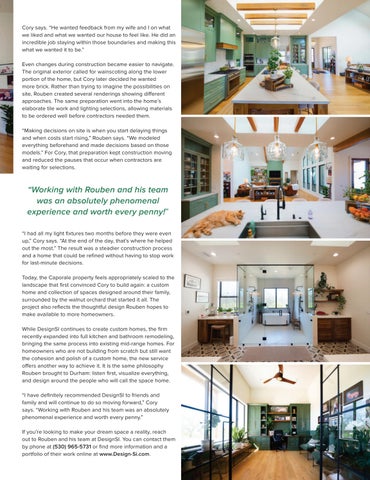
Building Beyond the Blueprint For Cory and Vicky Caporale, building a home in Durham wasn’t part of the plan. Having built and remodeled homes before, Cory knew how much time and energy the process required. After a year and a half of searching and making offers on existing homes, he was ready to find something they loved and move in. Then he was introduced to ten acres of walnut trees in Durham.
“My wife thought it looked fine on paper, but when she started seeing the footings, she realized it actually felt really small in the vast area of the 10-acre property,” Cory says. “She said she had to visualize it, but couldn’t with just the plans.” That need to better understand the finished home led the Caporales to architectural designer Rouben Mohiuddin, owner of DesignSI in Chico.
modeling, DesignSI transformed the plans into something Cory and Vicky could experience before it was built. Finishes, colors, materials, and spaces could be viewed together, allowing decisions to be made before contractors needed them.
“Rouben created full 3D renderings and walkthroughs so we could visualize the home,” Cory says. “He didn't change things that were structural, saving us time and money.” The approach became even more valuable as the project evolved. What began with a 2,700-squarefoot floor plan became a nearly “Rouben created full 3D 4,000-square-foot home accompanied renderings and walkthroughs so by a 5,000-square-foot shop.
The owner of Sam’s Door Shop in Chico, Cory has deep roots in the area. His parents met at Chico State, and years later, he met Vicky we could visualize the home,” at Panama’s in Downtown Chico. Cory says. “He didn't change When their search led toward things that were structural, Durham, a Realtor friend told him about a productive 10-acre walnut saving us time and money.” property beside a creek. “I looked at it, and I didn’t want to build another The project was already moving. Plans house, but I knew I had to have it,” Cory had been approved, construction had remembers. He made a full offer, and started, and Cory and Vicky hoped to within 10 days, the property was theirs. finish within a year. Rather than starting over, Rouben focused on improving what The Caporales cleared two and a half was there while preserving structural acres and began planning their home. decisions that would have been costly to Vicky searched online for floor plans, change. and the family settled on one measuring nearly 2,700 square feet. After taking “We actually changed a lot in it, but it to a draftsperson, who helped make kept it structurally the same,” Rouben several changes, they had their plans says. “It was a really interactive process, approved and began construction. Once and it was so much fun designing their the footings went in, Vicky began to see house with them!” Using detailed 3D the project differently. 26
U P G R A D E D L I V I N G M AG A Z I N E S E P T E M B E R 2 0 2 6
Rouben also helped shape the spaces to fit the Caporales’ lifestyle, including an outdoor kitchen, a large swimming pool, a gym, a man cave, and areas for entertaining. His involvement extended deep into interior design, where Vicky’s preferences for materials and color, and Cory’s love of lively American wood flooring, helped guide the home's design. Together, they worked through finishes, lighting, flooring, brick, and tile. “I wasn’t there to dictate, just facilitate where they wanted to go,” Rouben says. Cory appreciated that the process remained centered on what he and Vicky wanted the home to become. “He wasn’t like a designer that says, ‘This is the design I like to do,’ and that’s it,”
Cory says. “He wanted feedback from my wife and I on what we liked and what we wanted our house to feel like. He did an incredible job staying within those boundaries and making this what we wanted it to be.” Even changes during construction became easier to navigate. The original exterior called for wainscoting along the lower portion of the home, but Cory later decided he wanted more brick. Rather than trying to imagine the possibilities on site, Rouben created several renderings showing different approaches. The same preparation went into the home’s elaborate tile work and lighting selections, allowing materials to be ordered well before contractors needed them. “Making decisions on site is when you start delaying things and when costs start rising,” Rouben says. “We modeled everything beforehand and made decisions based on those models.” For Cory, that preparation kept construction moving and reduced the pauses that occur when contractors are waiting for selections.
“Working with Rouben and his team was an absolutely phenomenal experience and worth every penny!” “I had all my light fixtures two months before they were even up,” Cory says. “At the end of the day, that’s where he helped out the most.” The result was a steadier construction process and a home that could be refined without having to stop work for last-minute decisions. Today, the Caporale property feels appropriately scaled to the landscape that first convinced Cory to build again: a custom home and collection of spaces designed around their family, surrounded by the walnut orchard that started it all. The project also reflects the thoughtful design Rouben hopes to make available to more homeowners. While DesignSI continues to create custom homes, the firm recently expanded into full kitchen and bathroom remodeling, bringing the same process into existing mid-range homes. For homeowners who are not building from scratch but still want the cohesion and polish of a custom home, the new service offers another way to achieve it. It is the same philosophy Rouben brought to Durham: listen first, visualize everything, and design around the people who will call the space home. “I have definitely recommended DesignSI to friends and family and will continue to do so moving forward,” Cory says. “Working with Rouben and his team was an absolutely phenomenal experience and worth every penny.” If you’re looking to make your dream space a reality, reach out to Rouben and his team at DesignSI. You can contact them by phone at (530) 965-5731 or find more information and a portfolio of their work online at www.Design-Si.com. 27
Three Houses, One Chico Landmark
The Fires, Families, and Memories Behind the Miller Mansion If you’ve been around Chico long enough, you can probably picture it sitting back along The Esplanade—those enormous white columns rising through the trees. At Christmas, families piled into cars to see the lights. During Halloween, as people have been reminding me, kids knew this was apparently where the serious candy action was. Some families drove in from out of town just to get there. But here’s the part that surprised me: The Miller Mansion is actually the third major house to stand on that property. The land was once known as Five Oaks Ranch and belonged to Daniel Bidwell, half-brother of Chico founder John Bidwell. Daniel built a house there shortly before the Civil War. About seven years later, it burned. Another grand house replaced it and stood for decades, known at various times as Five Oaks, the Daniel Bidwell House, and the Reed Mansion. Then came the Millers. Roy and Artie Miller were part of the family behind Miller’s Market, which grew into a regional grocery chain with several Chico locations and stores in other Northern 28
U P G R A D E D L I V I N G M AG A Z I N E S E P T E M B E R 2 0 2 6
California towns. They acquired the property in the 1950s, hoping to restore the old mansion. Unfortunately, time and termites had other plans. The house was considered too deteriorated to save, so it came down. Around 1956-58, the Millers built the mansion we recognize today, which is surprising when you look at it. Those columns and that grand entrance make it look like somebody named Beauregard ought to be sitting on the porch discussing the price of cotton. But the familiar Miller Mansion is actually a midcentury house. Some pieces of the older mansion reportedly survived, including fireplace mantels and trim incorporated into the new home. Then Roy and Artie decided to create memories of their own. The Christmas displays became a Chico tradition, but judging from the memories people have shared, Halloween may have been just as legendary. People remember the gates opening, cars coming through the circular driveway, and the Millers handing out enough candy to make every other house in town look downright stingy.
The mansion eventually passed through the hands of other owners and even operated for a time as a bed-andbreakfast. Later it belonged to Wayne Cook, a man closely associated with restoring and preserving old Chico properties. Wayne died in 2022 after battling cancer, leaving another poignant chapter in the mansion’s long history. So, next time you pass that big white house on The Esplanade, remember what you’re really looking at: three houses, fire, termites, Bidwells, Millers, Christmas lights, and Halloween candy. In total, it stands for more than 160 years of Chico changing around one patch of ground. Somehow, that old place is still collecting memories, and I can’t wait to see what the future holds.
-James Secola
days. It’s very rare for someone to have a serious reaction to the flu vaccine such as an allergic reaction, and there are effective treatments if this does happen. Q: Can the flu shot give you the flu? Matthews: No. It’s impossible to get the flu from the vaccine we offer because it’s made with inactivated viruses. Hundreds of millions of people have safely received the vaccine for more than 50 years. Flu shots are made using killed flu viruses for inactivated vaccines or without the flu virus at all. The vaccine triggers your body’s immune response because your system recognizes it as an intruder and creates antibodies. Then, when your body does see the real flu, it responds and uses those antibodies to protect you. It takes about two weeks after getting your flu shot for these antibodies to fully develop. This is one reason we recommend getting the vaccine early in the season, so that your immune system is primed and ready to go before the flu starts circulating in our community. Q: Since the flu can be hard on older adults, is there a special vaccine for them?
Fight the flu A hundred years ago, flu season carried far more uncertainty than it does today. Without a vaccine and with limited understanding of how viruses spread, influenza outbreaks could overwhelm families and communities. Modern medicine has changed that picture dramatically, and annual vaccination remains one of the best ways to reduce the risk of severe illness. Enloe Health will join Butte County Public Health for a free flu vaccination clinic in October at the Chico Elks Lodge. Officials won’t set a date until the vaccine supply is in hand. Margie Rackley, who helps coordinate the clinic on behalf of Enloe Health, said caregivers administered more than 1,000 vaccinations at the 2025 clinic. We recently spoke to Rackley and Wes Matthews, Enloe Health’s Community Health Services Manager, to learn more about the shots.
Q: Is the flu shot good for everyone, and does it work? Matthews: Medical experts say nearly everyone ages 6 months and older benefits from being vaccinated. However, it’s especially important for children, pregnant women, and anyone over the age of 65 to get their flu shot. Those groups are more vulnerable to complications from illness. People with chronic illnesses like asthma, diabetes, or heart disease have a higher risk of complications and should seek medical advice regarding vaccination.
Q: Are there any side effects to the vaccine? Rackley: Some minor side effects may occur, including mild soreness, redness, and/or swelling where the shot was given, a low-grade fever, or aches. If these problems do occur, they are usually mild and go away on their own within a few
Matthews: Yes, there are vaccines that are preferentially recommended for those over 65. Q: Will Enloe Health have that vaccine at the upcoming vaccination clinic? Rackley: We should receive it, but if we don’t, older adults can also get those vaccines at their local pharmacy. Q: What are symptoms of the flu? Matthews: They can include fever, cough, sore throat, muscle aches, chills, nausea, headache and fatigue. While many symptoms overlap with those of the common cold, the flu tends to cause more severe illness, including temperatures as high as 104 degrees. Q: Where can folks learn more about the flu and see the finalized date of Enloe’s vaccination clinic? Rackley: They can visit Enloe Health online at www.enloe.org/flu. 29
final serigraph color layer. She said: “I am awed by the richness of nature—the details of fur and feathers, which have meaning because they evolved from the relationship of one thing to another.”
Janet’s “wry humor” is present in “Guinea Fowls (The Climbing Conformist).” Janet had “seen the birds roosting, each one jostling to roost higher than another,” which reminded her of “power struggles in the academic world.” Another of her satirical prints, “The Night Watcher,” was inspired by memories of being scrutinized by male faculty when she taught in Texas.
Janet Turner:
Artist, Educator, Collector In 1959, Janet Turner was hired by California State University, Chico to establish a printmaking program. She was already known nationally for her wildlife subjects and mastery of printmaking techniques such as etching and linocut. Her résumé listed degrees from Stanford, Columbia University’s Teachers College, and Claremont Graduate School; she had also taught in Texas for nine years. By her retirement in 1983, she had laid the foundation for The Janet Turner Print Museum (The Turner), which is now a major asset for Chico State and our community. A student of hers, Paula Busch, recalls her first encounter with Janet. “She was coming out of an elevator carrying a portfolio of prints under her arm and didn’t look like I expected an artist to look.” In that hippie era, art faculty and students favored long hair and flamboyant attire, but Turner might have stepped out of her mentor Grant Wood’s “American Gothic” painting. Paula says: “Gradually, 30
U P G R A D E D L I V I N G M AG A Z I N E S E P T E M B E R 2 0 2 6
I developed a deeper understanding of Janet as a true Midwestern woman who didn’t care about appearances, was hardworking and determined, and had a wry sense of humor.”
Roger Lederer, a Chico State Ornithologist, recalls that Janet often attended bird-watcher meetings at his house and supported local conservation efforts. In his section on Janet in his 2019 book “The Art of the Bird,” he writes: “The natural world was at the forefront of her thinking. On her hospital deathbed Turner said ‘it’s just nature’s way.’”
Janet Turner the Artist At a time when Abstract Expressionists such as Jackson Pollock had become celebrities, Janet remained a realist who carefully planned her wildlife prints. Her sister, Barbara Edmonson, said: “Janet believed all of nature’s creations were just as important as human beings.” Janet depicted all stages of the life cycle and even saw expressive potential in the “Backbone of a Sheep.” Janet produced “Guinea Fowls (The Climbing Conformist)” in 1952, the year she received a Guggenheim Grant to experiment with combining linocut and serigraph techniques. Janet carved different feather details into four linoleum blocks, then inked and printed one impression on top of another, with a Janet Turner, "Guinea Fowl"
WRITTEN BY DOLORES MITCHELL | PHOTOS COURTESY RACHEL SKOKOWSKI AND CHICO STATE
To prepare for “Guinea Fowls,” Janet collected feathers, examined skeletons, and took photographs. She captured the fowls' dangling wattles and their variegated feathers with convincing realism. However, the birds cast no shadows and look as flat as playing cards, as in the Japanese prints Janet admired. A blend of realism with abstraction is a key characteristic of her art.
Realizing that her soft voice and laconic delivery didn’t serve her well for classroom lecturing, she relied on small-group discussions and demonstrations, as well as having students scrutinize original prints she had purchased. She said: “I brought to class as many styles and techniques as possible, rather than trying to teach what reflected my viewpoint.” One of her students, Mike Halldorson, recalls, “She would show us prints from all over the world, including ones by famous artists such as Kathe Kollwitz. Being able to examine these up close was totally different from looking at prints in books, where they are all the same size, and you can’t make out the textures. It’s the difference between looking at photos of rhinos and seeing them at a zoo.”
Janet Turner, "Skeleton of a Ram"
Janet Turner the Educator I met Janet in 1970 when I was hired to teach art history at Chico State. I was soon convinced she was as committed to teaching as if she’d joined a religious order. Her sense of purpose attracted students and might have encouraged them to imitate her style had she not focused on nurturing their individuality.
Janet Turner, "The Night Watcher"
Another student, Marianne Goven, says: “Janet was a role model for me at a time when becoming a secretary was considered ambitious for a woman. She was a successful, independent older woman dedicated to both teaching and creating her own art.” Janet’s teaching methods were methodical. Marianne recalls, “We’d start by doing sketches from nature and then collect leaves and stones and feathers as visual resources. Back in the classroom, we’d pin up our sketches for critiques and do value studies of our best ones. Finally she’d demonstrate how to cut and ink a block and operate the press.” Marianne says: “After graduation I had a successful career that combined painting, art teaching, and graphic design.” Marianne later contributed to The Turner by serving on its board, running summer art camps, and donating her graphic design services. Janet could be stern with students who expected easy grades for minimal effort, but had endless patience for those struggling to improve. As a young student, Paula Busch hadn’t taken an assignment seriously until Janet told her, “I’d expected more from you.” Shocked, Paula labored long hours until she created a print that redeemed her in Janet’s eyes. Paula went on to practice and teach art. She also served as chair of The Turner’s board for nine years.
31
Janet Turner the Collector It was one thing for Janet to amass nearly 2,000 original prints for classroom use and quite another to decide how the collection would be managed, housed, preserved, and viewed after her retirement. Fortunately, during planning for her 1983 Retirement Retrospective at the University Art Gallery, Janet developed a rapport with the Gallery’s Associate Director, Catherine Sullivan, whose degrees in studio art and art history, along with her gallery experience, impressed her. Catherine recalls: “Janet appreciated that I understood her content, processes, and how she saw the world.” Janet passed away in 1988, and in 1993, Catherine became the curator of the small Turner Print Gallery in Laxson Auditorium’s mezzanine. She recalls, “Through her sister Barbara, I obtained many of her blocks, plates, studies, sketchbooks, photographs, and other materials that let me demonstrate the printmaking process. I also read much of her voluminous correspondence.” “During the 25 years I served as curator, I was able to move the collection five times for better care in increasingly accessible locations, hold competitions, and encourage faculty from history, English, religious studies, and many other departments to use Turner prints for class assignments. I also developed a curatorial intern program so grads and undergrads could work directly with the collection. In this and more, I just followed Janet’s lead!”
Westmont of Chico
530.287.4125
Independent & Assisted Living • Memory Care
Live Your Way Today ®
Your Style, Your Choices. At Westmont of Chico we aim to inspire residents daily through fun, engaging and meaningful activities.
Schedule your Tour!*
Monday Social Hour Live Entertainment • Connection Studio, 1–2– 3:30PM Every Monday • 2:30
2750 Sierra Sunrise Terrace • Chico, CA 95928 westmontliving.com 32
U P G R A D E D L I V I N G M AG A Z I N E S E P T E M B E R 2 0 2 6
Rachel continues to develop programs started under Catherine Sullivan, including “Kids at The Turner,” a free after-school workshop run by Chico State interns and currently mentored by Education Professor Dr. Sangmin Lee. The workshop includes hands-on art projects connected to current Turner exhibitions. For many youngsters, it will be their first time in a museum. Arguably the most consequential recent development at The Turner is Rachel’s push to digitize the entire collection—a move that can offer worldwide research opportunities. Like Catherine, Rachel credits Janet for laying the foundation that has made The Turner such a dynamic asset to our campus and community. What if, when Janet was interviewed at Chico State, she’d had to lecture as part of the hiring process? Would her lack of public speaking skills have eliminated her? Fortunately, she was hired, and her unique teaching strategies led to the founding of The Turner Print Museum and to her being named Outstanding Professor in the California State University system in 1975.
Themes Change Weekly!
Memory Care #045001756 • Assisted Living #045002620
Rachel Skokowski joined The Turner as its curator in 2022. Her PhD from Oxford University was on nineteenth-century French print culture. Since she took over The Turner, she has been building on its strengths. Rachel says: “Through fundraising and donations, we have doubled Janet’s bequest to 4,000 prints and are filling in some of the gaps, such as more purchases from women artists. We want ours to be a living collection that keeps up with the times.”
*Terms and conditions apply.
For listings of exhibitions, lectures, and children’s activities and to browse through the collection, visit www.csuchico.edu/turner
Age LET’S TAKE THE Aging OUT OF IMPROVE
Lines and wrinkles, texture and tone, pore size, sagging skin, neck laxity, jowls, loss of volume, sun damage and brown spots, facial veins and redness, scars/acne scars, lymphatic drainage, hair restoration, or unwanted hair. Texture and tone, sagging skin, sun damage and brown spots, unwanted fat, muscle toning, body contour, cellulite reduction, weight loss, urinary incontinence, pelvic floor restoration, sexual wellness, tattoo removal, or unwanted hair.
WE HAVE THE EXPERTISE AND TECHNOLOGY TO HELP
(530) 862-6000 564 Rio Lindo Ave. Ste. 103, Chico AmourMedicalAesthetics.com33
34
U P G R A D E D L I V I N G M AG A Z I N E S E P T E M B E R 2 0 2 6
fighting. Three passengers joined the struggle and helped overpower him. The co-pilot suffered knife wounds, but survived. Hicks, despite having been shot in the back, had managed to alert authorities, and law enforcement soon arrived to take Britt into custody. Everyone aboard the aircraft survived. Perhaps the strangest part of the story was Britt's motive. America was experiencing the beginning of a wave of aircraft hijackings in 1961. Planes were being diverted to Cuba, and the exploits received enormous coverage in newspapers and on television. Britt later told authorities he had been reading about those incidents. He was broke, separated from his family, and wanted to return to Arkansas to see his wife and seven-month-old son. After watching other hijackings succeed, he apparently decided commandeering an airliner might provide the transportation he needed. The plan ended before Flight 327 ever left Chico.
TERROR ON THE TARMAC Inside the Violent 1961 Hijacking Attempt at Chico Municipal Airport
On a warm Monday evening in July 1961, passengers at Chico Municipal Airport were preparing for what should have been an ordinary flight to San Francisco. Pacific Air Lines Flight 327, a Douglas DC3, was scheduled to depart at 7:20 p.m. There were no metal detectors to pass through, no TSA checkpoints, and airport security bore little resemblance to what travelers know today. Then a man came running across the tarmac. His name was Bruce Britt Sr., a 40-yearold welder from Smackover, Arkansas, who had temporarily been living in Corning while working on a gas pipeline project. Britt didn't have a ticket. Instead, carrying an overnight bag containing a snub-nosed .38-caliber revolver—and also armed with a folding knife—he simply rushed aboard the waiting airplane. Chico ticket agent William Hicks ran after him. Hicks caught up with Britt inside the
aircraft and told him he would have to get off. As Hicks turned toward the cabin door, Britt pulled the revolver and shot him in the back. He fired again, missing Hicks and striking a bulkhead instead. Britt then demanded access to the cockpit and threatened to begin shooting passengers if the pilots refused. At one point, he fired at a San Francisco attorney aboard the flight, but missed him as well. Eventually, Britt made his way forward and demanded that Captain Oscar Cleal fly the airplane away from Chico. Cleal began taxiing the DC-3 but refused to take off. Britt became enraged and shot him in the face. The wound would permanently blind Cleal and end his flying career. Rather than surrender, the crew fought back. The co-pilot managed to wrestle the revolver away from Britt, but Britt produced his knife and continued
Britt ultimately pleaded guilty to three counts of attempted murder and received a prison sentence that could have kept him incarcerated for roughly three decades. He served about 15 years before being paroled in the mid-1970s. Hicks recovered from his wound and lived until 2006. Cleal survived, but never regained his sight. The incident quickly faded from Chico's collective memory, despite earning the small Northern California airport an unusual place in aviation history. The original Chico Enterprise-Record put the story on its front page on August 1, 1961, alongside a photograph of Britt lying face-down with his hands cuffed behind his back. Today, the Chico Air Museum has revived the story with an exhibit displaying newspaper coverage, photographs, Britt's mugshot, and even the revolver and knife used that evening, on loan from the Butte County Sheriff's Office. More than six decades later, it remains one of Chico's strangest forgotten stories: an ordinary summer flight, a desperate man running across the tarmac, and a few violent minutes that could have ended far differently. 35
TWENTY STUDENTS, THOUSANDS OF LIVES In 1966, a small group of Chico State students decided they wanted to do more than attend classes and earn degrees—they wanted to help. That year, 20 students joined a new tutoring program providing free educational support for local children. The idea was simple: pair college students with young people in the community and let them share their time, knowledge, and encouragement. It worked almost immediately. The program became Community Action Volunteers in Education—better known as CAVE—and quickly grew beyond its modest beginnings. By 1968, just two years later, roughly 350 Chico State students were volunteering through the organization. The timing was significant. College campuses across America in the 1960s were becoming centers of activism and social change, and Chico State was no exception. Students participated in civil rights demonstrations, challenged discrimination, and searched for practical ways to improve their communities. CAVE gave that energy somewhere constructive to go. Tutoring remained part of its foundation, but CAVE continued expanding. Over the decades, students volunteered with children, older adults, animals, schools, environmental organizations, and nonprofits throughout the region. What began as a few students helping local kids became one of Chico State's strongest connections to the broader community. And remarkably, it endured. By CAVE's 50th anniversary, approximately 2,000 student volunteers were contributing around 50,000 hours of service in a single year. Today, it remains Chico State's largest student-led organization, continuing a tradition started six decades ago. Students arrive in Chico, graduate, and move on, yet generation after generation has continued picking up where the last left off. What started in 1966 wasn't particularly complicated: 20 college students saw a need and decided to show up. Thousands followed. 36
U P G R A D E D L I V I N G M AG A Z I N E S E P T E M B E R 2 0 2 6
Our digital banking rocks.
Does yours? We’ve launched a new digital banking platform, with an upgraded Online Banking experience, sleek Mobile App and the ability to connect all your external bank accounts in one place—AND IT ROCKS. If you’re not loving your current bank, join the Sierra Central family!
SMART TECHNOLOGY. LOCAL SERVICE. COMMUNITY.
(800) 222-7228
SierraCentral.com Federally Insured by the NCUA. 37
53 Years of Building the North State For 53 years, Payless Building Supply has built its reputation on a simple idea: give customers the materials, knowledge, and value they need to get the job done right. Founded in Chico in 1973 by Frank Solinsky, Payless began with a determination to offer the lowest prices and highest value possible. Frank’s background in the timber industry gave him strong relationships with mills and vendors, allowing the company to source products, uncommon lumber, and deals that were difficult to find elsewhere. More than five decades later, that resourcefulness remains at the heart of the business. Homeowners are equally welcome, but contractors quickly made Payless a favorite, returning for its broad selection, straightforward pricing, and people who understood the realities of building. Today, Payless is locally owned and employee-owned, with five locations serving communities across the North State: Chico, a new lumber location in Oroville, a standalone door-and-window location in Oroville, one in Anderson, and another in Susanville. While the company has grown considerably, much of its strength still comes from the people behind the counter, in the yard, and behind the wheel. 38
U P G R A D E D L I V I N G M AG A Z I N E S E P T E M B E R 2 0 2 6
Some team members have been with Payless for as many as 40 years, while many others have logged 15 to 25 years with the company. That longevity translates directly into experience. Payless’ sales team has been involved in countless projects over the years and brings a level of practical knowledge and problem-solving ability that can be difficult to find. Whether a customer is building a fence, replacing a deck, constructing a home, or developing an apartment complex or subdivision, the goal is the same: have the materials and resources available to serve projects of every size and budget. That includes Payless’ exclusive shop-grade offerings—mill seconds, closeouts, and products milled specifically for the company. While certain pieces may not meet code requirements for specific applications, many remain structurally sound and can offer significant savings when used appropriately. Combined with direct mill relationships and the ability to source everything from economy-grade material to premium lumber, Payless continues to make value one of its greatest strengths. The company’s reach extends well beyond its yards. Payless delivers throughout much of the North State, thanks to yard teams and drivers who work through every season to
ensure orders are accurate, handled safely, and delivered on time. That commitment became especially important following the Camp Fire, when Payless became heavily involved in supplying materials for rebuilding Paradise. Community support has remained equally important. Over the years, Payless has donated materials or financially partnered with local schools, 4-H, Eagle Scout projects, the Honey Run Covered Bridge restoration, Chico Creek cleanup efforts, CHIP, CHAT, Habitat for Humanity, Rotary, Boys & Girls Clubs, and many others. The company looks for opportunities where its support can help projects create lasting community impact. After 53 years, Payless Building Supply continues to grow without losing sight of what made it successful: honest value, experienced people, dependable service, and a commitment to the communities it serves. Visit Payless Building Supply at 2600 Notre Dame Blvd in Chico or 2630 S 7th Ave in Oroville and see what 53 years of building experience can do for your next project. You can also visit them online at PaylessBuildingSupply.com, and don’t forget to catch the Payless team at next spring’s Home & Garden Show in Chico!
"Effie was with me every step of the way, and I mean every step. She was always just a call away, answering my endless questions with patience and clarity, no matter how small they seemed. Her knowledge of our area? Unmatched. She’s not just an expert—she’s the expert, knowing every nook and cranny of the market like the back of her hand. Thanks to her savvy negotiating, she saved me a fortune. Her integrity, work ethic, and sheer skill put her in the top 0.1% of anyone I’ve ever worked with. She didn’t just help me buy a house—she made me feel like I was her only client, pouring her heart into every detail. I can’t recommend her highly enough, and I wouldn’t dream of working with anyone else." - Dr. Isaac Barthelow, owner of North Valley Eye Care, Chico
Tuscan-style residence in the gated Canyon Oaks golf course community, set on nearly half an acre with breathtaking views and elegant living spaces. Soaring ceilings, abundant windows, and laminate wood flooring create a bright, inviting interior. Two spacious primary suites include a main-floor retreat with jetted tub, walk-in shower, and generous closet, plus a private lower-level suite ideal for guests or multi-generational living. The kitchen features custom self-closing cabinetry, granite countertops, a large island, premium appliances, gas cooktop, walk-in pantry, and breakfast nook with picturesque views. A formal dining room and fireplace enhance the interior, while a massive veranda overlooks the golf course. Outside, enjoy a heated Pebble Tec pool with cascading waterfall, multiple dining areas, and a covered patio wired for TV and spa. Bed: 4 Bath: 4 SqFt: 4,361 Price: $1,445,000
Nestled on 6.34 serene acres, this country estate blends charm and modern efficiency with views of an incomeproducing walnut orchard. Picture-frame windows fill the home with natural light, while the living room features flooring, built-in bookshelves, and a fireplace. The dining area offers a custom dry bar, and the breakfast nook overlooks the orchard. The chef’s kitchen showcases a vintage 1940s gas range, maple cabinetry, center island, convection microwave, and walk-in pantry. The primary suite includes separate closets, radiant-heated bathroom floors, and an oversized walk-in shower. A bonus room with private entrance offers flexibility as a third bedroom, office, hobby room, or studio. Additional highlights include landscaping, an owned 54-panel solar system, Tesla charger, and powered shop/barn with attached workspace! Bed: 3 Bath: 3 SqFt: 2,714 Price: $975,000
Located in a desirable cul-de-sac near Bidwell Park, this light-filled home offers comfort, style, and modern convenience. The open floor plan features high ceilings, engineered wood flooring, and abundant natural light. The kitchen includes Corian counters, a breakfast bar, pantry, and gas appliances, while the family room offers a cozy fireplace. The primary suite features a soaking tub, walk-in shower, and dual vanities. Outside, enjoy a covered patio, private yard, RV parking, Tesla charger, batteries, and leased solar for efficiency. Bed: 3 Bath: 2 SqFt: 1,853 Price: $490,000
Set on 5.83 picturesque acres with panoramic sunsets and views of Black Butte Bluff, this charming ranch-style retreat offers peaceful country living near Black Butte Lake. Inside, enjoy laminate flooring, a spacious great room with wood-burning stove, and a well-equipped kitchen. Three bedrooms include a comfortable primary suite. Outside, two dining patios, an aboveground pool, open-bay shop, two-stall barn, two-car garage, and room for horses add versatility. Fully electric with solar, this property blends space, recreation, efficiency, and freedom to enjoy country living at its best. Bed: 3 Bath: 2 SqFt: 1,470 Price: $499,000
Built in 2017 near vibrant Meriam Park, this charming 3-bedroom, 2-bath home offers modern comfort and an inviting open floor plan. Soaring ceilings and abundant windows create a bright, airy interior, while the kitchen features solid stone countertops, an island, pantry, and gas range. The primary suite includes dual vanities and a walk-in shower. Outside, enjoy landscaped yards and a dining patio. Additional highlights include indoor laundry, owned solar, and a convenient two-car garage, just moments from Meriam Park amenities. Bed: 3 Bath: 2 SqFt: 1,318 Price: $419,000
39
Birkenstock of Chico & Paradise
Joy Lyn's Candies Since 1969, Joy Lyn’s Candies has been a sweet part of Paradise’s story. Don and Joan Memmer began crafting chocolates on their patio, naming the business after their daughters’ middle names. Over the decades, each set of owners upheld the tradition of small-batch, handmade confections that locals love. In 2000, Pam and Bill Hartley took the reins, adding signature favorites like truffles, caramel apples, and chocolate-dipped strawberries while preserving the recipes and craftsmanship that made Joy Lyn’s famous. Now retired, they remain involved as their son, Glenn, owner and chief candy maker, and granddaughter, Haley, continue the legacy. When the 2018 Camp Fire destroyed their shop, the Hartleys rebuilt bigger and better, reopening in 2020 in a bright, central location near the Gold Nugget Museum. With the same dedication to quality, care, and community connection, Joy Lyn’s remains a cherished destination, proof that in Paradise, even after hardship, something sweet can always rise again. JoyLynsCandies www.joylynscandies.com 220 Pearson Rd, Paradise (530) 872-9167 Wed-Sat 10am-5pm 40
U P G R A D E D L I V I N G M AG A Z I N E S E P T E M B E R 2 0 2 6
For 50 years in Chico—and 40 in Paradise—Birkenstock has built its reputation one careful fitting and lasting relationship at a time. Now, Lori Dillard has taken the reins from longtime owner Celeste Baker, continuing a family legacy that began when Celeste’s mother, Helene, purchased the business in 1985. Lori’s connection to the store runs deep. It was her first job after high school, and she worked for Celeste from ages 18 to 26 before moving away, but continued working in shoe retail. Years later, she reconnected with Celeste, and the opportunity to carry the business forward unfolded naturally. For Celeste, finding someone who loved the stores, customers, and community mattered deeply. She 333 Broadway Street, Chico | 530-345-4880 remains involved, still enjoying the work she loves. Together, they continue Tue-Fri 10am-5:30pm, Sat 11am-4pm Birkenstock’s personalized “sit and fit” 691 Fir St, Paradise | 530-762-0640 tradition while offering a wide variety Tue-Fri 11am-5pm, Sat 11am-4pm of comfort-driven brands, helping every www.birkenstockchico.com customer find the right fit for wherever birkenstockchico life takes them next.
Working with Sherry Calbert was a great experience from start to finish. She was professional, responsive, and genuinely cared about helping us find the right home. Throughout the process, she was always available to answer our questions, explain each step clearly, and guide us with honest advice. Her knowledge of the market and attention to detail made everything much smoother and less stressful. We always felt that she had our best interests in mind, and she went above and beyond to make sure everything was handled properly. We're very happy with our new home and truly appreciate all the effort she put into helping us get here. I highly recommend Sherry to anyone looking to buy or sell a home. -Ghias Naser, Chico
Call me today at (530) 514-4855
Just minutes from Chico, this secluded Mediterranean estate is centered around a breathtaking two-acre manmade lake. Beyond custom gates and a private bridge, the home offers water views from nearly every room, along with a sparkling pool and expansive patios. The grand living room features soaring lake-facing windows and a custom fireplace. The chef’s kitchen includes a dining nook, fireside sitting area, and wine cellar, while the formal dining room opens to a courtyard. Additional features include a pool-view office or den, nearby full bath, and private downstairs bedroom with a half bath. The primary suite offers dual vanities, dual closets, a spa-inspired shower, and a private patio with hot tub. A dock, resort-style pool, tranquil lake, and expansive grounds complete the retreat. You have to see this home to believe it! Bed: 4.0 Bath: 4.0 SqFt: 5,824 Price: $2,645,000
Experience luxury, serenity, and seclusion at this extraordinary Mediterranean estate, just minutes from Chico and centered around a breathtaking twoacre manmade lake. Beyond custom security gates and a private bridge, the home offers water views from nearly every room, along with a sparkling pool and expansive patios. The grand living room features soaring lake-facing windows and a custom fireplace. The chef’s kitchen includes a dining nook, fireside sitting area, and wine cellar, while the formal dining room opens to a private courtyard. Additional features include a pool-view office or den, secluded downstairs guest suite, and a luxurious primary retreat with dual vanities, dual closets, spa-inspired shower, and private hot tub patio. A private dock, resort-style pool, and expansive grounds complete this unforgettable property. Bed: 3.0 Bath: 4.0 SqFt: 4,354 Price: $1,575,000
This rare private ranch spans 5.53 acres, with a year-round creek, cross-fenced livestock-ready acreage, and a wraparound porch accented by artistic wagon-wheel supports. An approximately 20-by-22-foot attached bonus room offers flexibility as a bedroom, art studio, or private retreat, complete with a wet bar, abundant windows, and generous storage. Two barns provide exceptional versatility: a classic timber barn with loft, power, water, cement floor, two bays, tack room, and large overhangs, plus a six-stall metal horse barn with a full breezeway. Three varieties of pomegranate trees, numerous olives, and abundant natural shade complete the property. Bed: 2.0 Bath: 2.0 SqFt: 1,344 Price: $697,000
Top Agent First Half of 2026! (530) 514-4855
Sherry Landis Real Estate, Inc. Serving happy customers for over 36 years.
41
alumnus with extensive Bay Area hospital experience, and James Partridge, M.D., who was at the Mayo Clinic for more than two decades. Dr. Schneider calls them his dream team. It’s a team equipped to handle nearly anything, including hernia repairs, gallbladder disease, cyst and lipoma removals, and other general surgery needs. They see patients at Enloe Health & Wellness General Surgery and Enloe Health Enloe Medical Center. Not All Hernia Repairs Are Created Equal
Front left to right: Shannon Johnson, NP, Bradley Dyniewski, M.D., Bunry Pin, D.O., James Partridge, M.D., Scott Schneider, M.D., Mark Janzen, M.D., Austin Holmes, M.D., and Brian Dwyer, PA, have helped expand surgical services at Enloe Health.
Expanding surgical care Christopher Bowen’s 76th birthday is one he won’t forget. Instead of celebrating at home, the Chico resident found himself at Enloe Health’s Emergency Department after his hand and arm suddenly went numb and turned a deep red-purple. Dizzy and disoriented, he drove himself to the hospital. Tests ruled out a stroke, but physicians discovered a blockage in a small artery supplying blood to Bowen’s left forearm and hand. Without quick treatment, he risked losing his arm. Mark Janzen, M.D., a vascular surgeon who joined Enloe Health in 2023, performed a minimally invasive procedure using a thin, flexible tube threaded through an artery to deliver clot-dissolving medication. The procedure was repeated the next day. After four days in the hospital, Bowen went home and fully recovered. Dr. Janzen is one of three vascular surgeons—along with Bradley Dyniewski, M.D., and Austin Holmes, M.D.—who have joined Enloe Health in recent years. Vascular surgeons treat conditions affecting blood vessels throughout the 42
U P G R A D E D L I V I N G M AG A Z I N E S E P T E M B E R 2 0 2 6
body, from varicose veins and chronic wounds to life-threatening blockages and aneurysms. The Enloe team also brings new treatments to the area, including the breakthrough technology TransCarotid Artery Revascularization (TCAR) to treat patients with carotid artery disease, a narrowing of the blood vessels in the neck. Growing to Meet the Moment “Our newer vascular surgeons bring varied experience from different universities and big cities,” said Enloe Health’s Chief Medical Officer Sean Maiorano, D.O. “We’ve been lucky that the people we chose also chose us. Chico is a special place to live and work.” In addition to the growing vascular surgery service line, Enloe’s general surgery team has also expanded to meet the needs of the community. Scott Schneider, M.D., has been a cornerstone of Enloe’s general surgery program since 1999, helping shape it into what it is today. He’s now joined by Bunry Pin, D.O., a California State University, Chico,
Durl White knows firsthand how much that team can do. The 35-year-old police sergeant underwent multiple hernia repair surgeries over five years, ultimately developing a painful 3-inch hernia that protruded from his abdomen. He was eventually forced to take medical leave. White needed a surgeon with specialized skills. He found that in Dr. Schneider, one of only a few general surgeons in Northern California who perform these procedures. Dr. Schneider uses a distinctive multi-layered approach— combining mesh with targeted Botox injections to relax the abdominal muscles before reconstruction. “I think of it like a lasagna,” White said. “Muscles, stitches and mesh, rather than just mesh. My previous surgeries were like slapping a patch on a kiddie pool—it was only a matter of time before it tore again.” The surgery delivered the result he’d been searching for. “I feel great, and I’m going back to work soon,” White said. “I’m pain-free, and the visual difference is night and day.” That kind of care is becoming more accessible across the North State. In all, Enloe Health added 12 surgeons since 2023. This fall, the organization will expand services even more by opening a new multispecialty clinic in Oroville. Learn more about surgical services at Enloe Health by visiting its website at www.enloe.org/surgery.
Happy LABOR DAY Appreciating our working community Chico Native with 18 Years in Real Estate.
Where there’s a Willman there’s a way!
(530) 966-1296
(530) 680-8962
Lwillmanchico@gmail.com www.WillmansWay.com
LA and Meriam Park experienced! nicolecarterhanna@gmail.com
NICOLE HANNA
LAURA WILLMAN DRE #01931088
DRE #02150386
Helping Buyers and Sellers of Real Estate Achieve Their Goals Through Kind, Quality Service.
PATRICK RILEY DRE #01417492
GARRETT FRENCH DRE #01402010
ALICE ZEISSLER DRE #01312354
Providing Quality Service in Chico Areas Real Estate since 1999.
(530) 864-0336
Quality Service Award Winner 2017-2024
SandyStonerc21@gmail.com
SANDY STONER DRE #01131795
HIGHLY Recommended for Commercial and Residential
(530) 518-5635
530-570-7111
carolronissc21@sbcglobal.net DRE #00756402
(530) 518-1872
(530) 514-5555
Helping Achieve Goals and Commitment!
CAROL RONISS
DRE 01363526
Contact me for all your Real Estate needs
Experienced in Estates, Probates, Trust, Residential, Income Properties, Relocation, Horse Properties, Vacant Land.
Search for all homes at GarrettFrenchHomes.com
TERI GARCIA
KimberleyTonge@yahoo.com DRE #01318330
(530) 228-1305
(530) 370-0158
1804 Hwy 99 Ste A, Gridley, CA 95948 Tgarcia@c21selectgroup.com
#1 Agent Chico 2022, 2023, 2024
KIMBERLEY “SOLD” TONGE
Your Real Estate Expert for the Chico and Orland areas!
Centurion Producers Award
Call me anytime for your complimentary market analysis of your home.
(530) 518-5508
(530) 588-6593
Patrick.Riley@c21SelectGroup.com
Serving Butte County for over 20 years.
Lfeatherston@c21selectgroup.com
LARRY FEATHERSTON DRE #00582302
JENNIFER PARKS DRE #01269667
Your Goals. My Mission. Every Time.
(530) 520-3169
Olivia.Larrabee@c21selectgroup.com
OLIVIA LARRABEE DRE #02056059
Options that make sense!
Conventional • Jumbo FHA • VA • USDA • HELOC (530) 321-9018
Jim.Heberle@SanfordMortgage.com
MIKE RICHARDS
JIM HEBERLE NMLS 252781
DRE# 00907540
MELISSA FINCH DRE# 02091505
(530) 864-9192
(916) 885-3895
Mike.Richards@C21SelectGroup.com
Melissa.Finch@C21SelectGroup.com
Your neighborhood Realtor
Contact me for all your Real Estate needs!
Serving Butte County and Lake Almanor
DOUG LOVE (530) 680-0817 DRE #00950289
Proudly Serving our Communties with interegrity!
SHELINDA BRYANT (530) 520-3663 DRE #01726378
©2026 Century 21 Real Estate LLC. All rights reserved. CENTURY 21®, the CENTURY 21 Logo, and C21® are registered service marks owned by Century 21 Real Estate LLC. Century 21 Real Estate LLC fully supports the principles of the Fair Housing Act and the Equal Opportunity Act. Each office is independently owned and operated. DMCA Source: ©2025 Realogy Brands. The accuracy of all data, including measurements, is not warranted or guaranteed. This information is provided exclusively for the use of consumers, for their consideration, purchase, or lease of real estate. It may not be used for any other purpose and is not to be redistributed. Residential properties advertised herein are subject to availability, fees, and terms at each location. Prices subject to change without notice. Real estate services are offered in multiple U.S. locations. Home sales volume reflects 2025 transaction levels. Written, graphic, or text materials are the sole property of their respective owners. The REALTOR® brand is owned by Realtor 43 Group Limited Company (Realty Group), a leading global real estate financial organization. From November 1–December 31, 2025. Stanford Mortgage is Powered By Texana Bank. Company NMLS: 407536. Member FDIC – Equal Housing Lender.
Rebuilding a Durham tradition For generations, Tozier’s Hardware has been more than a place to pick up a box of screws or a can of paint. It has been a familiar stop at the four corners of Durham; a place where customers are known by name, employees become family, and someone behind the counter knows exactly what you need. Their story began in 1976, when Lyn’s father, Gus Gore, built Gore’s Supply House in Durham. Mike and Lyn managed it, and in 1978, purchased and transformed it into what the community came to know as Tozier’s Hardware.
That sense of family extends to the employees, too. Tozier’s is home to a dedicated team of employees who have become an important part of the business 44
U P G R A D E D L I V I N G M AG A Z I N E S E P T E M B E R 2 0 2 6
That commitment to the store and Durham was never more evident than in 2024, when a fire destroyed the building. There was no question about what came next. They rebuilt. Tozier’s reopened in January, with a grand reopening celebration still to come for its 50th anniversary. While the building may be new, the heart of the business remains the same. Tozier’s has long served Durham’s farming community, maintaining long-term relationships and becoming a trusted resource for household repairs, agriculture, irrigation, and more. If they don’t have it, they’ll order it, and most special orders arrive in two days. Customers can find hardware, plumbing, lawn and garden, and paint accessories. They also offer key cutting, chainsaw sharpening, copying, and shipping. It’s a little bit old-fashioned hardware store and a little bit modern-day convenience center.
Tozier’s is also a community hub, supporting youth, selling tickets for local events, and participating in charitable projects. People come not only to shop, but to connect with neighbors. Mike and Lyn may be stepping back, but they aren’t going far. They plan to continue supporting their children as they carry the family business into its next chapter. Mike estimates roughly 4,000 cars pass Tozier’s every day. For those drivers, it’s worth stopping in. You might be surprised by what you’ll find. As Tozier’s looks toward its 50th anniversary celebration, they invite the community to stop by and see the new store. The fire may have taken the building, but it didn’t take what made Tozier’s special. They rebuilt the store, the community helped bring it back to life, and now the next generation is ready to carry it forward. Tozier’s is located at 2384 Durham-Dayton Hwy in Durham. They’re open MondaySaturday from 8 am-5 pm and Sunday from 10 am-3 pm. You can also reach them at (530) 345-5291.
WRITTEN BY MICHAELA GULBRANSEN
Family and business have always gone hand-in-hand for the Toziers. The store became a place where their three children, Katie, Ken and Kristie, learned hard work, experienced their first jobs, and watched their parents build a family legacy. They helped Mike with his ventures, from his invention of Heat-N-Shrink Handlesaver, still sold at Tozier’s, to their Mosquito Magnet service center that grew into the largest in the U.S.
and community. Kristie’s husband Ryan, who has been with Tozier’s since 2009, serves as manager, while Katie’s husband Matt is always ready to lend a hand.
45
T
O
T
ED
ROW
PREPA
OR
RE
M
D
O
DA
PROTEC , Y T
Emergency Preparedness, Injury Prevention, & Concussion Awareness Educational Workshop
Friday, September 18, 2026 10:00am - 12:30pm Enloe Health Conference Center 1528 Esplanade Join us for an interactive educational event. Attendees will have the opportunity to participate in various interactive
SCAN TO REGISTER
demonstrations: Concussion empathy experience Home injury prevention Helmet safety education And more!
530.342.3118
Learn practical skills, increase safety awareness, and gain valuable knowledge to help protect yourself, your family, and your community.
46
U P G R A D E D L I V I N G M AG A Z I N E S E P T E M B E R 2 0 2 6
CHICO'S PIONEER WEEK: THE WHOLE STORY
PHOTO COURTESY MERIAM LIBRARY SPECIAL COLLECTIONS
If you were lucky enough to experience Pioneer Week in Chico, you probably don’t need photographs to remember it. You can still hear it—hammers pounding nails into plywood on campus; horses clopping down the street; marching bands, laughter, and parade crowds packed along Downtown Chico. There was also the smell of dust, horses, food, and likely a few things coming from the college crowd that nobody was going to put in the official Pioneer Week program.
Then there were the Quads. Campus groups hammered together elaborate Old West displays, turning parts of Chico State into a temporary frontier town. You could hear the pounding of hammers as the place took shape. There were wooden facades, costumes, and students campaigning as if their candidate for Sheriff or Little Nell were running for President of the United States.
The crowds grew. More and more people came from out of town, and the celebration's reputation changed. Then came April 1987—bonfires burned in the streets, cars were overturned, rocks and bottles flew, and violence erupted over two nights.
It all started rather innocently.
There was the Ghost Town Concert, the rodeo, street dances and, of course, the Hangman’s Dance.
Back around 1915, Chico Normal School began holding a spring Senior High School Day to show prospective students what the little college in Chico had to offer. In 1925, it was combined with something wonderfully named Whiskerino Day, and by 1929, Pioneer Days had arrived. And Chico ran with it.
And then came Saturday morning. The Pioneer Day Parade rolled through downtown with horses, wagons, marching bands, floats, Sheriff and Little Nell, and familiar Chico characters including John and Annie Bidwell brought back to life. In 1971, more than 150 entries were scheduled for the parade.
The community tried to bring the tradition back as Rancho Chico Days, but after more rioting in 1990, Chico finally had enough. And just like that, something generations of Chicoans had grown up with was gone.
There was Sheriff and Little Nell, our Old West answer to homecoming king and queen. There were costumes, dances, skits, sack races, pie-eating contests, beard contests, and tug-of-war. By 1947, Pioneer Days had grown into Pioneer Week, and it became much more than a college event. It belonged to Chico.
For kids standing along the route, it must have seemed like the Old West had wandered straight into Chico for the weekend. But somewhere along the way, Pioneer Week became a victim of its own success.
After 72 years of fun, Chico State President Robin Wilson pulled the plug.
Maybe that's why Pioneer Week still holds such a strange place in Chico's memory. It ended badly, no question about it. But before the outsiders, the riots and the headlines, there were generations of Chico kids sitting on curbs waiting for the parade. There were horses and wagons, ridiculous beards, homemade frontier towns, Sheriff and Little Nell, John and Annie Bidwell, and one spring week when an entire town gave itself permission to play cowboy.
47
The Line That Changed Chico
Why the Orchards West of Town Are Still There—and the Fight That Saved Them Drive west from Downtown Chico today, and something unusual happens. Within minutes, neighborhoods and city streets give way to almond and walnut orchards, open fields, and some of the richest agricultural soil in California. In many growing cities, farmland this close to downtown disappeared beneath subdivisions ages ago. In Chico, much of it survived due to a line drawn on a map. The Chico Area Greenline was formally established on July 21, 1982, when the Butte County Board of Supervisors approved it by a 3-2 vote. Its purpose was consequential: separate land for Chico's urban growth from prime agricultural land stretching toward the Sacramento River. Over four decades later, that boundary remains one of the most influential landuse decisions in Chico history. Chico was growing rapidly, and the west side presented an obvious temptation. The land was flat, close to town, and relatively easy to develop. Unfortunately, those same qualities made it extraordinarily productive farmland. Generations of flooding from local creeks and the Sacramento River had deposited deep, fertile soils across the valley. Building houses there meant permanently removing some of Butte County's best agricultural ground from production. 48
U P G R A D E D L I V I N G M AG A Z I N E S E P T E M B E R 2 0 2 6
One of the leading voices for preservation was Jane Dolan, then a young Chico State graduate and community activist. Dolan ran for the Butte County Board of Supervisors in 1974 with farmland protection among her major issues but narrowly lost to Bernie Richter. After Richter supported development proposals on agricultural land, opponents unsuccessfully attempted to recall him in 1976. The debate over Chico's future had become a defining political battle. Dolan won election to the board in 1978 and continued pushing for a permanent agricultural boundary. What followed was an unusual alliance. Farmers wanting protection from subdivisions found common cause with environmentalists concerned about sprawl. Even some developers supported the concept as a firm boundary provided certainty about where Chico would—and would not— grow. The philosophy was simple: Why pave Chico's finest farmland when less productive land remained elsewhere? In 1979, Butte County outlined an urban growth boundary in its General Plan. Three years later, supervisors made the Chico Greenline official. Jane Dolan, Len Fulton, and Hilda Wheeler provided the three votes needed for passage.
Instead of the uninterrupted subdivisions that consumed agricultural land around cities like San Jose and Stockton, working orchards remain remarkably close to Chico's center. County policy continues to identify the Greenline as the boundary between urban and agricultural land, directing growth away from protected western farmland. That doesn't mean the controversy disappeared. Landowners challenged restrictions outside the boundary, developers sought opportunities beyond it, and critics argued limiting developable land contributes to higher housing costs. One notable legal battle followed when developers tried to turn a 110-acre almond orchard outside Chico into housing. The dispute eventually reached the California Court of Appeal, where challenges involving the Greenline were rejected. Through it all, the original boundary endured. Perhaps the Greenline's greatest legacy is that most Chico residents barely notice it. The orchards west of town can feel inevitable, as though Chico simply happens to end where agriculture begins. It doesn't. Those trees are still there because, in the summer of 1982, three county supervisors decided where the city should stop.
from a home they love or having a difficult conversation with a seller about price. Reaching closing is never the only goal; helping someone make a decision they will feel good about years later is. Then there is the kind of local knowledge that only comes from spending 37 years in one market. Effie understands the subtle differences between Chico's properties and how those differences can affect everything from daily life to future value. She says, “I've always loved Chico, and its blend of rural and city life, which is why I chose to stay. Introducing others to everything I love about what I now consider to be my hometown is one of my favorite parts of the work I do.”
One Client at a time For 37 years, Effie Khaki has watched Chico real estate change in nearly every imaginable way. Markets have risen and fallen, interest rates have climbed and retreated, and technology has transformed how homes are found. Yet the qualities people want most in a Realtor® have remained remarkably consistent: communication, experience, honesty, local knowledge, negotiation, patience, and someone who genuinely cares—not just about her clients, but also her community. Those are also qualities Effie has spent a lifetime building. Real estate has been part of her world since childhood. She earned her own real estate license in 1989, and what followed was a career built the old-fashioned way: long hours, countless conversations, doors knocked, relationships earned, and a willingness to show up again and again for people who trusted her with one of the biggest decisions of their lives. Since then, Effie has personally closed more than 1,000 transactions and sold over $230 million in local homes—without a team. Every phone call, showing, negotiation, contract, and closing carries
her direct involvement. When a client calls with a question, they get Effie. Buying or selling a home is exciting, but it can also be stressful, emotional, and overwhelming. Effie understands that something routine to her after 1,000+ transactions may be completely unfamiliar to the person sitting across from her. She takes the time to explain what is happening, what comes next, and why it matters. Sometimes that means celebrating good news together; other times, it means talking someone through a problem with their sale or purchase. That experience is invaluable. After more than three decades in the business, Effie has navigated every kind of market and knows how quickly a small issue can grow. Whether recognizing a concern before an offer is written, preparing a seller for inspections, or helping a buyer consider a property's long-term value, she is constantly looking several steps ahead. Honesty is just as important. Effie’s job is not to tell clients what they want to hear, but what they need to know. That can mean advising a buyer to walk away
That knowledge becomes especially powerful when negotiating. Dr. Isaac Barthelow, owner of North Valley Eye Care, credits Effie’s negotiating skills with saving him “a fortune,” but says what he remembers most about working together is how she approached it. “She was with me every step of the way,” he says. “She made me feel like I was her only client, pouring her heart into every detail.” That explains why real estate transactions have turned into something much bigger. Clients who first worked with Effie decades ago have returned to sell, purchase their next homes, and eventually send their children and grandchildren to her. Clients have become friends, and Effie has shared in life's important milestones with them. Real estate may have changed dramatically since 1989, but people have not. They still want a Realtor® who answers the phone, knows the community, tells them the truth, fights for their best interests, calms their nerves, celebrates alongside them, and remembers that behind every contract is a person imagining what comes next. After 37 years, more than 1,000 closings, and over $230 million in local sales, Effie is still doing exactly that—one home, one family, and one relationship at a time. If you're looking for someone who will treat your goals and real estate transactions as if they were her own, call Effie Khaki directly at (530) 514-3334.
49
PHOTO BY CREATIVE IMAGING CENTER
Jim Moll, Stifel Oroville
1891 Robinson Street, Oroville Monday-Friday 9am-5pm (530) 534-8021 www.Stifel.com/branch/ca/oroville
When Jim Moll drove into Oroville from San Mateo in 1974—in a car without air conditioning—he expected to stay only a few years. Fifty-two years later, the longtime financial advisor at Stifel proudly calls Oroville his hometown. His career began at KORV, where he ran the news department before moving into sales and management with the launch of KEWE FM in 1979. Through decades of emceeing parades, celebrations, and community events, Jim enthusiastically earned the title “The Voice of Oroville.” This year brings even more reason to celebrate: 42 years in financial services and 50 years of marriage to his wife, Claudia, an Oroville native. Jim remains energized by his work, enchanted by the close-knit community, and thrilled to see Downtown Oroville vibrant once again. He cannot imagine living— or working—anywhere else, and his myriad contributions to the community and Oroville State Theater are proof of that. For Jim, every conversation, celebration, and familiar face is a reminder that choosing Oroville was the best decision he made.
320 Broadway St, Chico (530) 893-0545 10am-5pm, 7 days a week! BirdinHandChico BirdinHandChico www.birdinhand.com
Bird in Hand Bird in Hand is celebrating 45 years in Chico, a milestone rooted in Bob and Barbara Malowney’s vision to create a store with “something for everyone.” Opening as a print shop in 1972, they launched the store in 1981, and quickly grew thanks to the help of many local supporters. “You get little bits of help along the way, and we couldn’t have done it without everyone,” Bob recalls. Their daughter Christine joined in 1990, falling in love with the work 50
U P G R A D E D L I V I N G M AG A Z I N E S E P T E M B E R 2 0 2 6
and now runs the store as one of Northern California’s most experienced buyers. Over the years, Bird in Hand has become known for its specialty items, personal and knowledgeable service, and unique finds— not the mass-market fare of big-box stores. From housing the National YoYo Museum to curating products locals truly value, the Malowneys have built a store generations cherish. “We’re happy with what we built,” Bob says. “We still get a kick out of going in, and it means the world to us that our customers do too.”
Carrying Chico With Him For 44 years, Bob Fitzgerald has built more than a business in Chico. Through Concours Elite, he has built relationships, supported causes, raised money, donated resources, and repeatedly found ways to show up for people in need. That instinct was planted early. The son of a U.S. Air Force colonel, Bob grew up watching his father model discipline, sacrifice, and service. One lesson in particular stayed with him. When Bob wanted to become a surfer in Hawaii, his father told him, “If you’re going to do something, you have to carry it.” Bob carried the surfboard—and the lesson. It became a philosophy for how he approached work, family, and eventually philanthropy. After developing a love for car repair and restoration, Bob moved to Chico with his wife, Linda, in 1978 and opened Concours Elite on April 1, 1982. His goal was to bring concours-level craftsmanship to every vehicle. The company’s motto, “Quality with a personal touch,” quickly became more than a promise to customers. It became the way Bob chose to live. Over the decades, Bob has poured that philosophy into the North Valley. He has helped raise money for Butte Humane Society, Boys & Girls Club of the North Valley, Toys for Tots, veterans through VFW Post 1555, breast cancer awareness through Real Men Wear Pink, Northern California Ballet, local schools, libraries, first responders, and countless other causes. Whether the need involved children, veterans, animals, first responders, the arts, or a neighbor in crisis, Bob has looked for a way to help. Cars have often been the vehicle for that giving. Bob has organized and participated in charity car shows at the fairgrounds, Downtown Chico, local care facilities, schools, churches, and community events. He has supported Butte Humane Society dinners, helped with the Great American Race, participated in Parade of Lights and Fourth of July celebrations, driven Pleasant Valley High School homecoming queens, and supported Toys for Tots for 15 years. For Bob, the point has never been recognition. It is simply about doing what he believes a good neighbor should do. “It’s about doing the right thing for people,” he says. “That’s what’s kept us here all these years.” None of it, Bob says, would have happened without Linda. The two married in 1976 and are approaching their 50th anniversary together. Linda handled the books, finances, and much of the operations while Bob worked in the shop and in the community. As he has often joked, “The business was built by my hands and her brain.” Today, their daughter Jennifer helps run Concours Elite as well, continuing the family tradition and giving Bob more time to fundraise and support those in our community who need it most. He notes that none of it would have been possible without his incredible employees, sponsors, and volunteers. After 44 years, Bob’s legacy is evident in beautifully restored cars, a family that loves him, and a business that has stood the test of time. But it may be even more visible in the organizations, families, veterans, children, animals, and neighbors who have benefited from his willingness to give. Bob learned long ago that when you choose to do something, you have to carry it. For 44 years, he has carried Chico with him. If your car has been in an accident or could use restoration, drop by Concours Elite at 2267 Esplanade in Chico or call (530) 891-0234. 51
fun. After decades of being known through her career, she is enjoying giving people a glimpse of who she is outside of work. Real estate remains a profession she is deeply proud of, but it is only one part of a full life. Her willingness to evolve is matched by the perspective that only time can provide. Sherry encourages buyers and sellers to view today’s market in historical terms rather than compare it to a single unusually favorable moment. Interest rates, for example, reached 18.45% in October 1981. While that was an extreme, Sherry points out that the low rates of the early 2020s were unusual, too. Making a good real estate decision, she believes, requires looking at the bigger picture rather than waiting for one set of conditions to return.
Experience Meets Innovation Thirty-six years into a career would be a good time to settle into what you know. For Sherry Calbert, it has become an opportunity to do the opposite. Since beginning her real estate career in 1990, Sherry has built her business on experience, relationships, and connection. The path suited her from the beginning. Her father encouraged her to find a career where her love of talking would be an asset, and after purchasing her home at 21, real estate began to feel like a natural fit. What she initially imagined as a part-time pursuit quickly became a lifelong profession. Those foundational values remain unchanged, but the tools Sherry uses to serve her clients continue to evolve. Today, she is embracing everything from 52
U P G R A D E D L I V I N G M AG A Z I N E S E P T E M B E R 2 0 2 6
artificial intelligence to video and safety technology, proving that longevity in real estate does not mean standing still. AI has become one of Sherry’s newest tools, helping her brainstorm, refine listing presentations, and think through new ways to market properties. She sees it as another place to bounce ideas around, complementing the decades of experience she already brings to every transaction. It is part of a larger shift toward expanding her video communication and strengthening her social media presence. That presence is becoming more personal, too. Alongside homes and real estate insights, Sherry has begun highlighting the places, activities, and experiences that make this community
Experience also means knowing how to protect clients in ways they may never see. Sherry points to Forewarn, an identity and risk-assessment app available to real estate professionals, as a gamechanger for agent safety and an added layer of protection for clients. To her, it is another example of what a Realtor® brings beyond writing offers or putting a sign in a yard: experience, professional resources, market knowledge, and systems designed to help clients navigate major financial decisions confidently. That combination continues to produce results. Sherry was the top agent in her office for the first half of 2026, an accomplishment that feels especially meaningful after more than three decades in the business. The recognition is impressive, but it also reflects what has always driven her career. Sherry still loves the conversations, relationships, and opportunity to help people through one of life’s biggest transitions. The technology may change, the market will certainly change, and the way homes are marketed will continue to change with it. Sherry’s approach is to keep learning right alongside it all. After 36 years, she has plenty of history behind her—and she is clearly still looking forward. Whether you’re looking to buy or sell, call Sherry at (530) 514-4855 and see what she can do for you.
All the Park’s a Stage
The 1990 Summer Experiment That Became a Beloved Chico Tradition In the summer of 1990, Chico found a new use for one of its oldest treasures. Bidwell Park had long been a place for swimming, picnics, hiking, horseback riding, and lazy afternoons beneath the trees. That year, it also became a stage. Shakespeare in the Park made its Chico debut with a production of Romeo and Juliet performed at the old campfire ring near One-Mile. There was no grand theater, elaborate proscenium, or ornate lobby. The park itself provided the scenery, with actors performing beneath the trees while audiences gathered outdoors to watch one of Shakespeare’s most familiar tragedies unfold in a distinctly Chico setting. It was a remarkably natural pairing. Shakespeare’s plays had been performed outdoors for centuries, and Bidwell Park offered something no traditional theater could reproduce: changing evening light, rustling leaves, birds overhead, and the occasional reminder that nature had not read the script. What began as a summer experiment quickly took hold. Year after year, actors returned to the park with new productions, and Shakespeare in the Park became a fixture on Chico’s cultural calendar. By 2006, the program was celebrating its 16th season. Performers who had appeared in that first Romeo and Juliet were still involved with the local theater community, carrying memories of those early productions.
The tradition also reflected something distinctly Chico: the city’s unusual ability to blend the arts with the outdoors. A Shakespeare production didn’t require audiences to dress up and file into a formal theater. People could arrive at the park on a summer evening, settle in beneath the trees, and watch actors turn familiar patches of Bidwell Park into Verona, Athens, Denmark, or the Forest of Arden. Over the years, the tradition changed hands and evolved. Ensemble Theatre of Chico was formed in 1997 in part to keep Shakespeare in the Park alive, preserving a summertime event that had already become important to the community. Decades later, outdoor Shakespeare is still being performed in Bidwell Park. Legacy Stage has continued the tradition, staging productions in Cedar Grove Meadow and even using the park itself as part of the performance. Its 2019 production of Macbeth, for example, moved audiences through multiple natural settings in Lower Bidwell Park rather than keeping the action confined to a single stage. What began in 1990 as Romeo and Juliet beside an old campfire ring became something much larger: a Chico summer tradition built around the simple idea that one of the world’s greatest playwrights might sound even better beneath the oaks. 53
both Greece and Atlanta. For Chico, the moment was brief. The train stopped, the community had its opportunity to see the Olympic flame, and then the journey continued north toward Redding and ultimately Klamath Falls, Oregon. Chico was just one stop among hundreds across the country, but that was exactly what made the 1996 relay so ambitious. Organizers wanted the Olympics to belong not only to Atlanta or the athletes who would compete there, but to communities across America. The torch itself was designed specifically for the Centennial Games. Standing roughly 30 inches tall, it incorporated aluminum elements resembling reeds and a wooden handle made from Georgia hardwood. Bands on the torch celebrated the cities that had previously hosted the modern Olympic Games. Thousands were produced so individual torchbearers could carry their own during portions of the relay.
When the Flame Came to Chico The Day the Olympic Torch Made an Unforgettable Stop on Its Journey to Atlanta
Thirty years ago, long before smartphones made it possible to watch almost anything happen anywhere in the world, Chico residents were given something considerably more memorable: the chance to stand beside the railroad tracks and watch one of the world's most recognizable symbols pass through town. On May 4, 1996, the Olympic flame came to Chico. It was only eight days into an extraordinary 84-day journey across America leading to the Centennial Olympic Games in Atlanta. After being lit in Greece, the flame crossed the Atlantic and arrived in Los Angeles on April 27, where Olympic legend Rafer Johnson began the American relay at the Los Angeles Memorial Coliseum. From there, it started an enormous cross-country journey involving more than 12,000 torchbearers and nearly 17,000 miles. California received the flame first. During those opening days, it traveled through Southern California, crossed Hoover Dam into Nevada, returned to 54
U P G R A D E D L I V I N G M AG A Z I N E S E P T E M B E R 2 0 2 6
California by train, and moved through San Jose and San Francisco. On the morning of May 4, torchbearers carried it past Fisherman's Wharf, Fort Mason and the Palace of Fine Arts before taking it across the Golden Gate Bridge. From there, it traveled through Marin County, Napa, Winters and Davis before reaching Sacramento. Then the flame turned north. After ceremonies in Sacramento, the Olympic torch was placed aboard a train for the journey toward Oregon. The route included stops in Marysville and Yuba City before continuing up the Sacramento Valley toward Chico. For a community more accustomed to freight trains rolling through the center of town, this one carried something remarkable. The flame aboard that train could trace its journey back to Olympia, Greece, where Olympic flame ceremonies connect the modern Games with traditions inspired by the ancient Olympics. It was now passing through a Northern California railroad town thousands of miles from
From Chico, the flame still had an enormous journey ahead. Over the following two and a half months, it crossed the country through small towns, state capitals and major cities. It traveled by foot, bicycle, boat and train. More than 12,000 people participated as torchbearers before it finally reached Atlanta on July 19. That night, millions watching the Olympic opening ceremony saw swimmer Janet Evans carry the flame toward the stadium's towering cauldron. Waiting above her was a figure whose identity had been kept secret until the final moments: Muhammad Ali. With his hands visibly trembling from Parkinson's disease, the former Olympic boxing champion raised the torch and lit the mechanism that carried the flame to the cauldron, creating one of the most unforgettable moments in Olympic history. For Chico residents who had gathered beside the railroad just 76 days earlier, that flame was suddenly familiar. Before it illuminated the Olympic Games for the world, it had stopped right here at home.
Morning Thunder Café In October 1947, Carl Bedford built a wonderful little round restaurant building in Chico and opened Carl’s Drive Inn. Five years later, in 1952, it became Don’s Drive Inn. Then in 1953, the new Chicken Kitchen quickly became Chico’s favorite hangout with car hops, a walk-up window and dining room sit-down service with the Star Castle live radio broadcast booth that took requests! 1962 saw the end of an era when Ingram Shelton Realty/ Marks Insurance moved in followed by MorningThunderCafe |
Signature Gallery, and by the late '80s, Rock-A-Way Diner rekindled the place’s retro mojo. Our beloved Morning Thunder Café opened in 1993, and they have been serving up breakfast, brunch and lunch ever since! Now, it is one of the most popular restaurants in the Chico area. Morning Thunder Café's owner, Dee Luna, sends a shout out: “Thanks, Carl! Great little place ya got here!” Visit Morning Thunder again today!
MorningThunderCafeChico | MorningThunderCafe.com
352 Vallombrosa Ave, Chico | (530) 342-9717 | Mon-Fri 6:30am-2pm, Sat-Sun 7am-2pm
55
Three Decades of Heart and Impact For 30 of the Boys & Girls Clubs of the North Valley’s 31 years, Rashell Brobst has been there—helping shape the organization, guiding it through uncertainty, and keeping young people and families at the center of the mission. Today, BGCNV spans 11 sites across two counties and five communities. When Rashell began, there was just one. Those who have worked beside her say the numbers only hint at her impact. “Three decades of change and impact,” says Scott Dinits, who has worked alongside her for 22 years at the Club. “She’s navigated all of those changes with grace, vision, and leadership.” Those changes have included the 2008 recession, wildfires, COVID-19, school disruptions, expansions, and funding challenges. Through it all, Scott says Rashell has remained a force to be reckoned with, helping BGCNV innovate while strengthening its reputation. Yet the spotlight has never been the point. “She never loses sight of the mission—providing for the youth and families that need us the most,” Scott says. That mission—to inspire and enable all young people to reach their full potential as caring, productive, and responsible citizens—has guided every decision. Joe Hejl, who has worked with Rashell for 25 years, has watched that commitment play out. “She’s always been such a huge advocate for our youth,” Joe says. “She’s never afraid to speak up, even if she’s the only voice doing so. She works to change kids’ lives on the micro and macro level.” Joe describes Rashell as a grassroots leader—equally comfortable setting a vision and rolling up her sleeves. Her leadership has also brought financial stability to BGCNV. When the organization began its capital campaign, it carried significant debt. Today, it is debt-free and has a growing endowment to help protect its future. “Her business acumen has taken the organization to the next level,” Joe says. That approach has also guided BGCNV’s expansion. Rashell asks what value the organization can bring to a community, then works to solve practical challenges: funding, partnerships, sustainability, even transportation for children who otherwise could not reach a Club. Her advocacy extends beyond BGCNV. When Rashell sees a gap in services or funding, Joe says she will speak up, rally partners, and push for solutions whether or not BGCNV receives credit. Perhaps that is why this recognition feels fitting—and why it had to be a surprise. For 30 years, Rashell has preferred to shine the light on the team, community, and young people they serve. Scott says friends, family, coworkers, and community partners all experience the same thing from her: complete commitment. “She gives everyone her all, all the time,” he says. Three decades later, BGCNV is larger, stronger, and ready for whatever comes next. Its work continues, as does the need for community support. For those looking to invest in local youth and families, BGCNV remains committed to being a thoughtful steward of every dollar entrusted to it. Thirty years is a milestone worthy of celebration. For Rashell Brobst, it is also a reflection of young lives changed, communities strengthened, and a mission carried forward. Visit www.BGCNV.org online to discover more about this vital organization, the incredible work Rashell and her team are doing, and how you can participate. 56
U P G R A D E D L I V I N G M AG A Z I N E S E P T E M B E R 2 0 2 6
DELICIOUS DECISIONS.
Fun Looks Good on You ROLLINGHILLSCASINO
RHILLSCASINO
ROLLINGHILLSCASINO.COM 57
Gambling problem, call 1-800-522-4700 for live confidential counseling 24/7.
An Ordinary Block, An Extraordinary Purpose In the early 1990s, a group of Chico residents saw a problem they couldn't ignore. Local young people needed somewhere safe to go after school—a place where they could find mentors, activities, encouragement, and simply belong. In 1993, that concern became the Boys & Girls Club of Chico. Two years later, after partnering with the City of Chico and securing a city-owned site downtown on a long-term lease for just $1 a year, the organization opened its doors at 601 Wall Street. Its message was simple and optimistic: a “Positive Place for Kids.” Almost immediately, the dream began growing beyond a single building. By the end of the decade, the Club had its sights set on creating something much more ambitious: an entire downtown campus dedicated to children and teenagers. In 1999, with help from the S.H. Cowell Foundation, Sierra Health Foundation, and the City of Chico, the organization purchased a warehouse across the street from its existing Club site. The plan was to transform the area into a connected “Campus for Kids,” complete with space for younger children, teenagers, recreation, and community programs. 58
U P G R A D E D L I V I N G M AG A Z I N E S E P T E M B E R 2 0 2 6
Making that vision real required Chico to rally behind it. In 2001, Boys & Girls Clubs of the North Valley formally launched a capital campaign and ultimately raised more than $2 million for the downtown project. Two years later, the first major piece was ready. In October 2003, the Ostrander Clubhouse opened its doors, marking the first completed phase of the new campus. For Chico families, the new building meant far more than additional square footage. The Clubhouse created a permanent home where elementary-age children could spend their afternoons surrounded by adults and peers invested in their success. Today, that same facility continues serving local children at 601 Wall Street, but the original vision didn't end there. In 2005, the Club partnered with the City of Chico and Chico Noon Rotary to permanently close a section of Wall Street and create Rotary Plaza, safely connecting the Ostrander Clubhouse with the Nettleton Gymnasium and future Teen Center across the way. In 2006, the Teen Center and gym opened, completing
the downtown Campus for Kids that supporters had imagined years earlier. The Chico project also became part of a much larger story. The Chico and Paradise organizations had merged in 2000 to form Boys & Girls Clubs of the North Valley. In the years that followed, the organization expanded into Oroville, Magalia, Hamilton City, Juvenile Hall, and additional school campuses. Today, the network stretches across multiple North State communities, while the Ostrander Clubhouse remains at the heart of its Chico operations. It's easy to drive down Wall Street today and simply see a collection of buildings, playgrounds, and gathering spaces. In 2003, however, the opening of the Ostrander Clubhouse represented something much larger. A community that had started with an idea just ten years earlier had built a permanent place for its children—and in the process, turned an ordinary downtown block into a campus designed around their future.
Chico's Living Lab
Saving Chico’s Stories of the Sky By 2004, Chico had accumulated nearly a century of aviation history, but much of it was scattered through private collections, old photographs, fading memories, and surviving aircraft. A group of local aviation enthusiasts worried that if no one began preserving those stories, a vital part of Chico's past could simply disappear. Six residents decided to do something about it. Vic Alvistur, Jim Babcock, Brian Baldridge, Norm Rosene, Gary Thompson, and Noël Wheeler founded the nonprofit Chico Air Museum in 2004 with a mission to collect, preserve, document, and display aviation artifacts while educating future visitors about the history of flight. They didn't have to wait long for the collection to begin growing. That same year, the fledgling museum received its first two aircraft: a Lockheed P-2V Neptune, a large Navy patrol aircraft developed for anti-submarine warfare, and an Antonov AN-2, a massive Sovietdesigned biplane unlike almost anything visitors would normally encounter at a small municipal airport. Suddenly, the idea of an aviation museum in Chico had something very real sitting on the ramp. The location couldn't have been more appropriate. Chico Municipal Airport had its own remarkable history, including service as Chico Army Air Field during World War II. Thousands of military personnel had once passed through the base, and the airport later became tied to civilian aviation, aerial firefighting, aircraft maintenance, and generations of local pilots. Creating a museum there
meant Chico's aviation history could be preserved in the same place where much of it had actually happened. In May 2005, less than a year after the organization formed, the Chico Air Museum officially opened to the public inside a small World War II-era Army Air Field building at the airport. The early museum was modest, but the vision was much larger. Volunteers began collecting uniforms, photographs, flight logs, models, military memorabilia, aerospace artifacts, and additional aircraft while documenting the stories behind them. The collection continued expanding, eventually outgrowing its original home. In 2015, the museum moved into a much larger World War II-era hangar, allowing visitors to walk among aircraft representing nearly a century of flight. Today, its displays range from early aviation and military aircraft to jets, helicopters, space artifacts, and exhibits devoted specifically to Chico's own aviation history. Perhaps the most fitting part of the museum's story is that it remains rooted in the same spirit that created it. It began because six local residents believed Chico's aviation history was worth saving, and volunteers have continued building on that idea ever since. What started in 2004 with an empty museum, two airplanes, and a concern that history was slipping away became a permanent place for Chico to remember when it looked to the sky.
In 1999, Chico State began creating something very different from the classrooms and laboratories on its downtown campus. The University Research Foundation purchased Simmons Ranch, establishing the first portion of what would become the Big Chico Creek Ecological Reserve. The idea was ambitious: preserve important habitat while creating a living laboratory where students and researchers could study Northern California's natural environment firsthand. A second purchase, Henning Ranch, followed in 2001. Together, the properties created a 3,950-acre reserve encompassing 4.5 miles of Big Chico Creek and an extraordinary mixture of oak woodland, riparian habitat, chaparral, grasslands, forests, springs, and rocky canyon terrain. The land became more than protected space. Chico State describes the reserve as an outdoor laboratory, natural museum, and classroom, providing opportunities for research, field trips, environmental education, habitat restoration, and longterm ecological study. The experiment continued growing. In 2021, a major private land donation nearly doubled the Big Chico Creek Ecological Reserve to 7,835 acres, preserving an even larger stretch of Chico's foothills for future generations. What began with the purchase of a ranch in 1999 ultimately gave Chico State something few universities can claim: thousands of acres where the classroom has no walls, the laboratory is alive, and every trail offers something new to study. 59
The Heart of HodariMD For 26 years, Rejuvené has been one of Chico’s most recognizable names in medical aesthetics and dermatology, but this anniversary, Dr. Kafele Hodari wants to shine the spotlight somewhere different. Behind the polished spaces is a medical dermatology team whose work is quieter, less visible, and essential. “Over half of our organization is this group of front- and back-office medical dermatology staff,” Dr. Hodari says. “They’re the worker bees that keep everything going.” Most are medical assistants, receptionists, and back-office staff members who handle everything from preparing patients for appointments to calling with pathology results. They support Dr. Hodari and his providers in detecting and treating skin cancer, coordinating care, answering questions, and helping patients navigate frightening or uncertain moments. For Dr. Hodari, who is celebrating 21 years as a physician and 15 years in medical dermatology, those team members represent the heart of HodariMD. Some have been with the practice for as long as 15 years. Others arrive early in their 60
U P G R A D E D L I V I N G M AG A Z I N E S E P T E M B E R 2 0 2 6
healthcare careers, gaining experience before continuing on to nursing or physician assistant programs. Some return with new degrees for new roles. “We’ve had folks go to school after being an MA for a while, and they’ve come back and become one of our nurses,” he says. “I love the opportunity to work with them again after they earn those degrees.” That creates a workplace with a mix of career staff and people building toward the next stage of their professional lives. Dr. Hodari describes the team as hardworking, professional, positive, and willing to have fun together, whether through team-building retreats or the occasional TikTok post. Staff members regularly move between HodariMD offices throughout Northern California when another location needs support. “They’re unsung heroes who work hard and are vital to what we do,” he says. “They’re willing to jump in and get deployed to our other offices throughout Northern California whenever needed.” Reliability is only part of what the work
requires. Medical dermatology often places staff members in human situations, particularly when results are serious, or patients are elderly, anxious, or confused. Dr. Hodari says the job requires patience, empathy, sympathy, and intellectual ability. It is not enough to simply relay information; people need to know the person on the other end understands what that means to them, especially in situations like a skin cancer diagnosis. That emphasis on patient experience has shaped HodariMD from the beginning. When Dr. Hodari began practicing in Chico in 2011, he saw an opportunity to create a seamless connection between traditional medical dermatology and the elevated service patients expected from Rejuvené’s aesthetic side. Dr. Richey and his wife, Mary, founded Rejuvené in 2000 to bring sophisticated dermatology and aesthetic services to Chico. When Dr. Hodari took over the practice in 2015 and merged it with HodariMD Dermatology, he carried that vision forward while expanding its reach. Today, he wants the medical side to feel as intentional as the aesthetic side.
“Clients have high expectations, and we want to make sure we meet that,” he says. “I felt we could take the same approach on satisfying the customer not just with our quality in aesthetics, but also do that with our medical side as well.” That means rethinking what a medical office can feel like. HodariMD works to create warmth, professionalism, efficiency, and a clear indication that every detail matters. The surroundings are part of it, but Dr. Hodari reminds his team that beautiful offices alone cannot create a memorable experience. “I tell my staff all the time we can’t just rest on how stunning the building looks,” he says. “It’s a great motivator and reminder, but I remind them that they’re what makes the place special.” His goal is for the entire team to be “locked into providing the WOW factor,” whether someone is arriving for an aesthetic treatment, having a suspicious spot evaluated, or waiting for pathology results. He wants patients to leave thinking, “Wow, that felt like a great experience.” That standard requires careful hiring, and sometimes unexpected hiring. Dr. Hodari says the practice has hired even when it was not hiring because the right person walked through the door. In a field where technical skill and human sensitivity are equally important, finding someone with patience, professionalism, empathy, and a genuine desire to care for people can be too valuable to pass up. The team’s work also connects directly to the practice’s larger mission of skin wellness. That mission will be on full display during HodariMD and Rejuvené’s Annual Fall Festival on September 17 from 4–6 p.m. at 80 Declaration Drive in Chico. The event will offer visitors an accessible way to learn more about improving skin and overall health. Guests can explore skincare, injectables, lasers, and sun protection while speaking with representatives and vendors who can answer their questions. Local vendors will also offer food, photography, permanent jewelry, and more. The first 100 attendees will receive swag bags, raffle prizes will be available, and guests can take advantage of at least 20% off across the board, with additional discounts on select lines and services. For Dr. Hodari, anniversaries are not simply about years in business. They are reminders of the people who made those years possible. Rejuvené may be celebrating 26 years, and his own career has now passed two decades, but much of the life-changing work happens because of the people answering phones, rooming patients, coordinating offices, communicating results, and supporting providers every day. Those are the people Dr. Hodari especially wants recognized this year: the medical support staff helping find and treat skin cancer, care for patients through difficult moments, and, in some cases, quite literally help save lives. Visit HodariMD and Rejuvené online for more information or to schedule an appointment at www.Rejuvene.com.
61
22 Years of Real good cooking For Linda Juanarena, cooking has never been simply about feeding people. It has always been a way of caring for them. That philosophy has been at the heart of The Roost Cafe since it opened in 2004, summed up in a motto that still says everything customers need to know: “Real Food. Real Butter. Real Good Home Cooking.” Twenty-two years later, Linda remains just as committed to it. Her love of cooking started early. Growing up in a home where both parents appreciated great food, Linda was encouraged to experiment in the kitchen from a young age. “I was the Bisquick queen in elementary school,” she laughs. Her mother cooked nearly everything from scratch, while her father celebrated Linda’s creations—even the occasional “Chuck Wagon Mac” made from the back of a Kraft Mac and cheese box. Their table was often full of kids, friends, and home-cooked meals, and Linda knew early on that she wanted a restaurant of her own someday. In 2004, she took the leap and opened The Roost Cafe. The Roost’s following quickly grew, and she eventually decided it was time for a larger space, moving from the original Park Avenue location to 817 Main Street in Downtown Chico. The expanded location gave The Roost more room to welcome regulars while reducing wait times for newcomers. It was a hit as soon as it opened its doors. Of course, the biggest reason to visit is the food. The Roost is perhaps best known for its eggs Benedict, but favorites span the menu. Omelets, the Monte Cristo, biscuits and gravy, corned beef and eggs, pancakes, and hearty scrambles have all earned enthusiastic fans. Their burger meat is freshly ground from the S&S Butcher Shop, and their sausage is made at Chico Locker & Sausage. Their Bloody Marys and array of mimosas have developed a following of their own, too. Customers are not shy about sharing their enthusiasm. One reviewer called his omelet exactly what an omelet should be—fluffy, flavorful, and prepared like someone in the kitchen actually cares about eggs. His daughter’s eggs Benedict looked, he wrote, “like a postcard version of what that dish should be,” while the potato pancake was so good he joked it deserved to be in the potato hall of fame. Another diner praised The Roost for offering “some of the best biscuits and gravy around.” Yet another reported that every visit was perfect, praising everything from the hand-sliced turkey on the Monte Cristo to the fresh corned beef and perfectly prepared eggs. That consistency is a big part of what has kept people returning for more than two decades. Friendly staff, knowledgeable service, and a comfortable neighborhood atmosphere make first-time visitors feel welcome while regulars feel right at home. And now, with DoorDash recently added, customers can enjoy their Roost favorites without leaving home. Their early-bird specials are just another reason to visit in person. For Linda, 22 years represents far more than longevity. It is the continuation of a mission that began at her parents’ table: cook good food, make it from scratch, welcome people in, and give them a reason to come back. At The Roost, that recipe still works. Visit The Roost Cafe at 817 Main Street in Downtown Chico or order from their menu directly to your doorstep using DoorDash! 62
U P G R A D E D L I V I N G M AG A Z I N E S E P T E M B E R 2 0 2 6
Geralyn Sheridan Designs
GeralynSheridanDesigns GeralynSheridan www.geralynsheridan.com 1334 Mangrove Ave, Chico (530) 519-4367 By Appointment and Seasonal Hours
Geralyn Sheridan Designs is celebrating 18 years in Chico, marking a journey from a shared jewelry gallery in 2008 to a thriving fine jewelry studio. In 2012, Geralyn shifted her focus exclusively to creating custom, one-of-a-kind pieces, operating by appointment to offer clients a truly personalized experience. Her business has since flourished, with more custom projects than ever and appearances at prestigious shows in Palm Beach, Boston, the Hamptons, and Chicago’s One of a Kind Show. Known for her signature Ribbon Candy Collection, launched in 2009, she has earned national design awards nearly every year since. She specializes in interactive custom design, often transforming inherited or outdated jewelry into fresh, modern treasures. With gold prices high, many clients bring in old pieces to be melted and reimagined. By reusing materials and crediting your precious jewelry, Geralyn makes fine jewelry both affordable and sustainable, breathing new life into cherished heirlooms while crafting pieces as unique as the people who wear them. Visit Geralyn online to see her work and join the inner circle to be the first to learn about new work and gallery events.
63
Rawbar at 25: A Chico Original Long before Rawbar became one of Downtown Chico’s most recognizable restaurants, it began with a group of friends and a weekly theme night. Darren Chadderdon and his partners were operating Black Crow, where Thursday evenings transported diners somewhere new through food inspired by cultures around the world. Of all the cuisines they explored, sushi was the one they understood least—and loved most. Whenever the craving struck, they drove to the Bay Area for dinner. Eventually, the question became unavoidable: Why not bring the food they loved home to Chico? In May 2001, Rawbar opened its doors. The restaurant was much smaller then, and its five owners were learning as they went. Darren admits they were in over their heads, but the arrival of Masaaki “Mike” Tanaka changed everything. A vendor had connected them with Tanaka, an older Japanese chef who had worked at many Southern California sushi bars. “He took us to the next level,” Darren said. He remained with Rawbar until his passing, bringing the knowledge, discipline, and respect for the craft that would shape it for decades. At his celebration of life, former employees shared how he had shaped their 64
U P G R A D E D L I V I N G M AG A Z I N E S E P T E M B E R 2 0 2 6
during the Black Crow years, inviting guests to experience the craft more personally.
work ethic and the people they became. Tanaka trained Matt Janeway, now a partner and Rawbar’s head sushi chef, but his influence extended beyond technique. This drove Matt to expand and refine his culinary skills in Seattle, where he worked under several top chefs. Matt returned to Chico and brought his skill set back to The Rawbar. That sense of mentorship and family remains one of Rawbar’s defining ingredients. Darren, his wife, Michelle, and their children—Jack and Gemma—are intricately involved with the daily operations. Original hires Sjarif McNeil and Ali Sonberg joined the staff on Day One and never left. Chef Matt and his wife, Serena, are working partners; Chef Chloe Criez leads the kitchen; and Jamie Sydnor oversees the lounge. It is a place where regulars are recognized and newcomers feel included. For 25 years, Chico diners have gathered around Rawbar’s tables for beautifully prepared sushi, celebratory dinners, first dates, family traditions, and nights stretching from a roll at the original bar to drinks in the lounge. The menu continues to evolve, with Matt exploring dry-aged fish, intimate omakase dinners, and new ways to present the cuisine that first inspired the restaurant. Classes continue a tradition Darren began
The building has grown with the restaurant. A hotel expansion prompted early improvements to the façade, while the pandemic accelerated patio plans. A later expansion enlarged the overworked kitchen, improved the restrooms, and created a full bar and additional dining room. Today, the patio, original restaurant, and lounge each offer their own atmosphere. Guests can settle in for sushi, enjoy the patio’s energy, or linger over food and drinks in the lounge. Michelle worked with Nikole Enns to unite the spaces while preserving what longtime customers loved. After 29 years of operating businesses downtown, Darren continues looking for ways to strengthen Chico’s city center, including responsible participation in the new Downtown Chico Entertainment Zone. Rawbar has become a Chico icon not because it has stayed the same, but because it has known what to preserve: exceptional food, genuine hospitality, loyal people, and the feeling that everyone who walks through the door is joining a story already 25 years in the making. Visit them at 346 Broadway Street in Downtown Chico and find out more information online at www.RawbarChico.com.
Yoga Center of Chico The Yoga Center of Chico, located next to T. Bar, was born 13 years ago when founders Rex Stromness and Tom Hess—then beloved instructors at local fitness clubs—dreamed of creating a space wholly dedicated to yoga. They found the perfect venue, opened their doors, and quickly became a cornerstone of Chico’s wellness community. Teaching traditional forms of Hatha yoga, including Iyengar and Vinyasa, the center emphasizes breathwork, alignment, flexibility, and mindful strength. With 20+ classes a week, offerings range from gentle to advanced, serving everyone from world-class athletes to students in their 80s. Rex, who taught yoga at Chico State for 18 years and worked with the university’s basketball team, believes yoga is one of the best tools for lifelong physical health and mindfulness—supporting injury prevention, recovery, and healthy aging. With six skilled instructors, a welcoming studio, prenatal options, and an on-site shop, the Yoga Center of Chico stands as one of the North Valley’s most experienced and inspiring yoga destinations. YogaCenterOfChico YogaCenterOfChico | www.YogaCenterOfChico.com 250 Vallombrosa Ste 150 | 530-892-8583 | Classes 7 days a week! Schedules online
Open Table Church
Open Table was created for people in Chico who have said “no” to church but may still be open to saying “yes” to Jesus. Founded by a husband-andwife team, the non-denominational church arose from one of Chico's oldest ministries, dating back to 1920, with a simple goal: meet people where they are and create a safe place for the spiritually curious, tired, frustrated, or searching for more. Today, a staff of six helps serve a growing community of roughly 280 to 290 people, meeting people where they are to share Jesus as He is.
2090 Amanda Way, Chico info@opentable.church http://opentable.church OpenTableChurchChico For Open Table, church has never been about a building. Its focus is on carrying the gospel into everyday life, with Jesus at the center and the mission beginning on Monday—not ending on Sunday. The church welcomes people to belong before they believe, without pressure or strings attached. Visitors do not have to agree with everything to be welcomed. Open Table’s hope is that people can find rest, friendship, purpose, and space for their story to meet God’s story, discovering who they were made to be.
65
A stage for everyone In 2003, founder Marc Edson and a dedicated troupe of volunteers transformed an empty space into Chico Theater Company (CTC) in just one month. They remodeled, painted, laid flooring, and installed theater seats—all while rehearsing their first production, Seven Brides for Seven Brothers. On October 1, 2003, the curtain rose before an appreciative full house.
“I want the theater to be a reflection of what we are as a community,” Hansen says.
The whirlwind opening captured the spirit that would carry CTC through its next 22 years: local people working together to create something meaningful for their community. Edson built the nonprofit around musical theater and the belief that performers of every experience level deserve a place onstage.
Hansen wants CTC to preserve the shows and experiences Northern California audiences know and love without allowing its programming to become stale. The 2027 season reflects that balance, pairing beloved productions such as Sweet Charity, Bye Bye Birdie, and Meet Me in St. Louis with less frequently staged and tonally bolder selections including The Curious Savage, Separate Tables, and Reefer Madness. “If it’s good enough for Broadway, it’s good enough for Chico,” Hansen says.
“Chico Theater Company is a labor of love for me. Because of the people,” Edson says. “It is incredibly fulfilling to work with both the actor who has performed in theater all their lives, as well as the new person who is acting for the first time in their life.” In October 2025, Edson passed the reins to executive director Owen Hansen, who hopes to build on that foundation while drawing more people into the conversation. 66
U P G R A D E D L I V I N G M AG A Z I N E S E P T E M B E R 2 0 2 6
For Hansen, theater has always been about connection. Long before formal stages, people gathered around fires to share stories, ask difficult questions, teach lessons, and make sense of life. Though the art form has continually changed, its ability to bring people together remains.
What makes each production distinctly Chico is the people behind it. CTC’s casts are composed entirely of local talent—not performers recruited from Sacramento or beyond. Doctors, lawyers, janitors, students, seasoned actors, and first-time performers all have a place.
“Our talent is the talent of our town,” Hansen says. “Everyone deserves the chance to shine.” That invitation now extends to younger performers through CTC JR., an educational program launched by Emilie English. Through after-school productions and summer camps, students learn acting, improvisation, theater techniques, technical production, and crafts while rehearsing and performing complete shows. Following three summer camps—including a Disney showcase, Dorothy in Wonderland, and Summer Spectacular—the program will present The Legend of Sleepy Hollow, with plans to expand its after-school and summer offerings next year. More than preparing children for the stage, CTC JR. gives them a safe, welcoming place to express themselves, build confidence, make friends, and feel part of a creative community. For Edson, Hansen, English, and the many volunteers and performers who have shaped CTC, the goal has always been larger than putting on a show. It is about creating a stage where everyone can find their voice—and where Chico can see itself reflected. To learn more about productions, auditions, camps, and CTC JR., visit Chico Theater Company online at www.chicotheater.com.
67
was our ability to complete a full kitchen renovation in two days,” Z says. Eventually, they added cabinet refacing, giving them the ability to change the entire look of a kitchen within another three to five days. A major reason for that speed remains central to Z’s business today: everything is handled in-house—no waiting for one subcontractor to finish before another can begin. Z’s team controls the schedule, fabrication, preparation, and installation. “I can tell our team, ‘Today we’re doing this. Tomorrow, we’re completing that,’” he explains. “I don’t have any subcontractors, so scheduling isn't an issue; someone else’s bad day doesn’t turn into a delay for our customers.”
Transforming Kitchens, Bathrooms, and Expectations For Zaher “Z” Murad, transforming kitchens and bathrooms has never been about following the traditional remodeling playbook. In fact, much of his success has come from asking a simpler question: Is there a better way to do this? Long before becoming one of Chico’s most experienced kitchen and bathroom remodelers, Z spent years working construction while attending college. He eventually moved into corporate retail, managing large stores and gaining experience in leadership, customer service, marketing, and operations. Construction, however, never completely left the picture. During a trip to Florida with his business partner, Don Thomas, Z discovered Granite Transformations. “They showed me everything, and their product and offerings just made a lot of sense,” he remembers. The concept paired durable countertop overlays with dramatically shorter installation times than traditional remodeling. Customers 68
U P G R A D E D L I V I N G M AG A Z I N E S E P T E M B E R 2 0 2 6
could completely change the appearance of their kitchens without weeks of demolition, dust, dumpsters, and subcontractors moving in and out of their homes. To Z, the opportunity seemed obvious. “It was one of those concepts that just made perfect sense.” He and Don brought the idea home to Chico, wondering if it would catch on here, and put it to the test at a local home show. Over the course of a single weekend, roughly 150 people signed up to learn more. Z had his answer. They opened Granite Transformations, established a showroom and operation, and began growing throughout the North State. Over the next two decades, the company became known for something that sounded almost impossible in the remodeling world: beautiful transformations completed predictably and, maybe more importantly, quickly. “The beauty of Granite Transformations
That efficiency helped Granite Transformations complete more than 9,000 kitchens during Z’s tenure and earn numerous accolades, including Readers’ Choice awards for Best Contractor, Best Remodeling Company, and Best Cabinet Maker. Even still, after nearly 20 years with the brand, he began looking for ways to offer customers more. The original system still worked, but Z felt the product line had stopped evolving. Colors and choices had become increasingly static, while newer materials entering the market offered improved strength, realism, and design flexibility. He began supplementing the existing line with another vendor and discovered a higher-grade overlay product that provided the same advantages with significantly greater visual depth and selection. When his Granite Transformations agreement eventually ended, everything was already in place for the next chapter. As a result, Kitchen and Bathroom Transformations was born. The new name does more than distinguish an independent company; it better describes what Z and his team have become. Today, overlays and cabinet refacing remain an important part of the business, but they are only part of what the company offers. Since 2024, Kitchen and Bathroom Transformations has increasingly taken on full kitchen and bathroom remodels, giving customers the option to preserve what works or start completely fresh.
For homeowners who want to avoid demolition, however, the advantages of the original concept remain hard to beat. Rather than tearing out structurally sound countertops and cabinetry, Kitchen and Bathroom Transformations can install new surfaces over what is already there. Templates can often be completed within a week, with materials installed within six to eight weeks—far less than the threeto-six-month timeline many traditional remodels can require. There is less disruption, less demolition, and considerably less waste, too. Z estimates that the average kitchen demolition can generate around 600 pounds of debris, not to mention the fine construction dust that works its way throughout a home and continues to settle on surfaces for years to come. Cabinet refacing offers a similar shortcut without sacrificing the finished appearance. In many Chico homes, Z says the existing cabinet boxes are solid wood and structurally excellent; homeowners simply dislike the color or dated style. His crew removes the doors, hinges, drawer tracks, crown molding, base, and hardware, leaving the cabinet boxes intact. Those boxes are prepared and resurfaced before receiving new doors, drawer fronts, hardware, top-of-theline full-extension soft-close drawers, hinges, dividers, and other upgrades. The result is a kitchen that can look completely custom in about five days, with projects costing significantly less than a newconstruction remodel. Bathrooms have become another major area of growth, particularly custom walk-in showers. Using a waterproof Hydro-Blok system and large quartz slab walls, Z’s team can remove an existing tub or tubshower combination, prepare and waterproof the space, template the space, and often complete the new shower in approximately one week. Walls can be created from individual slabs up to 10 feet tall, allowing veining to continue across surfaces with dramatically fewer seams and grout lines. Niches, benches, lighting, custom vanities, quartz surfaces, and other details can turn an outdated bathroom into a completely personalized retreat. Whether a homeowner wants a countertop update, cabinet refacing, a luxurious walk-in shower, or an entirely new kitchen, Z believes the real benefit Kitchen and Bathroom Transformations provides is something harder to put a price on: peace of mind. Home remodeling can consume months of evenings, weekends, phone calls, contractor coordination, and uncertainty. Z would rather make it simple. After more than two decades and thousands of local projects, his philosophy remains remarkably straightforward: use great products, keep the work in-house, move quickly, and deliver renovations that homeowners are excited to live with. Many of his employees in the office, the fabrication shop, and on his installation teams who started with him all those years ago still work with him today, in no small part because they also strongly believe in the company’s mission. Kitchen and Bathroom Transformations may have a new name, but behind it is more experience, capability, and choice than ever before. Visit them online at www.KitchenAndBathroomTransformations.com, call (530) 891-1600, or visit their showroom at 629 Entler Ave, Suites 5-7 in Chico to learn more and schedule an appointment. 69
a choice. He could leave, like so many others, or stay and build something lasting. He stayed. Twenty-two years after entering lending, Justin is now a mortgage professional at Happy Dog Home Loans, and his philosophy is remarkably simple: relationships matter more than sales. His clients see that commitment firsthand. One reviewer recalled Justin personally visiting a challenging foreclosure on a weekend with pool professionals to determine what needed to be done for underwriting—and for the family’s safety. Another first-time buyer praised his patience, communication, and ability to help them close within 30 days. A third completed an entire Chico home purchase remotely from Southern California and described Justin and his team as friendly and easy to work with. The stories that mean the most, though, are often the hardest, and Justin feels blessed to have found a career where he has been able to help so many people along the way. “Making it work for someone who doesn’t think they can do it—that’s the most gratifying experience,” Justin says. “One phone call is all it takes to change someone’s life.”
Helping People find their way home Justin Bowman’s path to mortgage lending didn’t begin behind a desk. It began in restaurants, Hollywood, a halffinished dream on Melrose Avenue, and eventually, a sight-unseen home purchase in Chico. Justin had worked in restaurants since he was 14, when an inheritance from his father helped take him to Los Angeles. There, he became a talent agent and joined two friends in opening a restaurant on Melrose Avenue. He spent long days renovating and nights working restaurant shifts, battling everything from liquor licensing to neighborhood opposition. For one memorable night, the place exploded with energy when one of Turkey’s biggest singers performed under a one-night liquor license. Vin Diesel even emerged 70
U P G R A D E D L I V I N G M AG A Z I N E S E P T E M B E R 2 0 2 6
as a potential investor. It was a wild few years, but ultimately, city hurdles proved too much. Justin closed the restaurant, built a clothing line, and eventually decided Los Angeles had run its course. He bought his first Chico home sight unseen, moved in during 2003, watched its value climb, and pulled equity from it to purchase a duplex. Then came a triplex, fourplex, another duplex, and more. Real estate investing opened his eyes to an entirely new career. Justin earned his real estate license in 2003 and became a mortgage broker in 2004, working other jobs while he built his business and real estate portfolio. When the mortgage industry collapsed between 2007 and 2010, Justin faced
He never forgets what is at stake. For most people, a home is their largest financial investment, but Justin sees the emotional and lifelong investment too. His job is to help clients understand their options, navigate the unknowns, and make the best decision possible. Rates will change. Markets will change. If rates drop, refinancing may be an option. What matters most, Justin believes, is having someone beside you who cares enough to work through the questions, answer them knowledgeably, and help you find the best path forward. For him, that is the real reward of 22 years in lending: helping people find a way home. If you’re looking to buy a property and are in need of a loan or have questions regarding lending, give Justin a call at (530) 680-8050.
health system is extremely challenging. Bruce helps clients compare plans to find coverage that fits both their medical needs and their budget while ensuring access to preferred doctors and medications whenever possible. A preliminary phone call gives him an idea of where they’re at in their journey. From there, Bruce is happy to meet wherever clients feel most comfortable—whether that’s in their home, at a local coffee shop, or in his home office. Providing support from Corning down to Sacramento, Bruce is also happy to facilitate the full consultation by telephone for those who prefer that level of convenience. As people are living longer, healthier, and more active lives, Bruce has expanded his services beyond health insurance to include retirement planning. He recognizes that healthcare decisions and retirement finances often go hand in hand. This support includes Social Security maximization planning and fixed-rate annuities. He shares, “My responsibility is to help people have a stable monthly income to go along with their Social Security payments when they retire.” He recommends that the first step in planning be determining what age to start taking Social Security payments. This decision is based on multiple factors including age, health, other retirement income, and tax implications. Bruce will help develop a plan that meets their needs while advising them on potential sacrifices to achieve those goals.
A SLAM DUNK WRITTEN BY SHELLY BRANDON
When you think of a salesman, maybe you picture a big talker, someone who dominates the room with their conversation. The reality is that a good salesman should be the other side of that coin—someone who really takes the time to listen in order to find out exactly what you need. Bruce Jenkins is just that. He’s an insurance and financial services provider who focuses on finding the best products to meet his clients’ needs. Bruce studied business administration in Sioux City, Iowa, where he also captained the college basketball team. Following graduation, he moved to France, where
he played professional basketball for five years. Once he returned to the States, he says, “It was a mental coin flip on whether to get my MBA or a law degree, and in the end, I thought a law degree would be a better fit.” After graduating from law school, he returned to his love of sales, selling legal research and law books throughout Northern California. Looking to maximize his skillset, he decided to take the insurance exam. He has now been in the industry for over 25 years. Bruce shares, “I’ve been in sales most of my life, and I think my strength is in listening to people and then asking the right questions.” He explains that navigating through our complicated
Along with his wife, Dorothy Lee-Jenkins, a licensed client assistant, Bruce offers a full range of services to help individuals and families. Best yet, all of those services are free of charge. Whether it’s health insurance, life insurance, or retirement planning, the insurance companies and investment funds pay his service fees. Bruce’s diverse experiences and communication skills allow him to effectively connect with people from all different backgrounds. If you’re not sure where to start planning your retirement, contact Bruce at brucejenkinsinsurance@gmail.com, call (530) 781-3592, or visit BruceJenkinsRetirementPlanning.com. CA License #0B86680 71
A doctor's mission Often, your life’s path doesn’t appear as a lightbulb moment but more like a sunrise that slowly grows brighter over time. This was true of Dr. Samuel Garcia’s decision to attend medical school. Growing up in a small town in Peru, he was mostly exposed to the medical field through missionary doctors passing through the country. “I didn’t have any doctors in my family, but it kind of interested me,” he says.
When it came to choosing a residency path, Dr. Garcia decided on family medicine. He shares that as a child, his father’s arms and torso were badly burned, so much so that his skin fused to itself and left his arms pinned to 72
U P G R A D E D L I V I N G M AG A Z I N E S E P T E M B E R 2 0 2 6
As a family medicine physician, he has broad knowledge and experience treating a variety of conditions, which would allow him to help the most people in need. He shares, “With family medicine, you can have a lot of impact in the right community.” That reasoning is also part of why he chose to move to Northern California. He wanted to live in a more rural area and practice in an underserved community. The cold, snowy spring of New Jersey was no competition for the warm blossoming orchards here. He smiles and says, “We flew in and everything here was sunny and blooming. The weather drew us in, but I appreciated that they were serving minorities; they were serving a lot of Hispanic populations, which I am proud to be a part of.”
He worked with Ampla Health in Hamilton City and Orland for seven years, and while he enjoyed his time there with the community, he wanted to spend less time commuting and more time with his wife and daughter in Chico. He joined Mangrove Medical Group in August of 2026 and is excited to continue his family medicine practice. Dr. Garcia prides himself on being a thoughtful communicator and educator. He explains that it’s important to build relationships with patients through back-and-forth conversations to truly understand their needs and concerns. It’s this commitment to his patients and the unwavering desire to understand their needs that makes him the incredible doctor that he is today, and we couldn’t feel more blessed to have him in our community. If you’re in need of a primary care physician who truly cares about his patients and community, schedule an appointment with Dr. Garcia by calling Mangrove Medical Group at (530) 345-0064 or visit their website at www.mangrovemedicalclinic.com.
WRITTEN BY SHELLY BRANDON
Dr. Garcia moved to the States when he was 16, and his first job at Little Caesars Pizza taught him the value of hard work. He went on to various other jobs before landing at the Red Cross, where he worked as a viral technician performing HIV and hepatitis testing. This was his first exposure to the medical field, and he decided to attend medical school after his time there.
his sides. During one of the medical missions, surgeons were able to release the scarred skin and enable his father to regain some of his mobility. This story left an impression on him, and Dr. Garcia hopes to join a medical mission someday to provide aid to similar underserved communities around the world.
2313 Lincoln St, Oroville www.PiecesOfLoveQuiltShop.com piecesoflovequiltshoporoville pieces_of_love_quilt_shop
Pieces of Love Quilt Shop For 11 years, Pieces of Love Quilt Shop has been a gathering place for Orovillearea quilters. Owner Ashley Coffey began sewing at age 5, making doll clothes and quilts, with encouragement from her stepmother. Today, Ashley is a certified stripology instructor, and she believes she can teach anyone to quilt. But Pieces of Love is more than one person; it’s a welcoming team that offers personalized shopping and help for every skill level and project. The shop carries fabrics,
sewing machines, and notions; provides machine servicing; and offers classes for quilters ranging from beginners to experienced. Customers can receive hands-on help choosing fabrics and supplies, learn new techniques, or have their quilts finished with longarm quilting and embroidery. Their retreat center also provides another place to learn, create, and connect socially. Follow Pieces of Love on social media, visit their website, or sign up for their newsletter for classes, events, and sales.
73
74
U P G R A D E D L I V I N G M AG A Z I N E S E P T E M B E R 2 0 2 6
A CENTURY OF SERVICE, A PARK FOR THE FUTURE: How Chico Rotary Celebrated 100 Years by Creating Something Built to Last
For decades, the five-acre patch of land at Ceres Avenue and Whitewood Way wasn't much to look at. It had been set aside for a neighborhood park, but year after year, it remained largely undeveloped—an open space waiting for its turn. Then Chico Rotary's 100th anniversary approached. PHOTOS COURTESY CHICO AREA RECREATION & PARK DISTRICT
Rather than celebrate a century of service with a party that would come and go, local Rotarians began looking for a project that could remain in the community long after the anniversary had passed. The forgotten park site in northeast Chico provided the perfect opportunity. The idea became Rotary Centennial Park. Chico Area Recreation and Park District had already been saving money for improvements and eventually committed more than $1 million to the project. Chico's Rotary clubs contributed additional funding, volunteer labor, and energy, turning what had once been an overgrown empty lot into a gathering place for one of Chico's growing neighborhoods. The name commemorated 100 years of Rotary service in the community. Construction began in 2020, at a
particularly unusual moment in Chico history. The community was still adjusting to dramatic population changes following the Camp Fire, while the COVID-19 pandemic had made parks and outdoor spaces feel more valuable than ever. New homes and apartments were also appearing in northeast Chico, creating even greater demand for a nearby place to play, exercise, and gather. By late 2021, the empty land looked entirely different. Rotary Centennial Park opened with a multi-use turf field, basketball court, children's playground, shaded picnic areas, walking space, and other amenities designed for families and neighborhood recreation. On December 4, 2021, Rotarians, CARD representatives, volunteers, and local families gathered for the park's grand opening. There was something fitting about the timing. Chico Rotary had spent a century putting the organization's familiar motto, “Service Above Self,” into practice through countless local projects. Centennial Park transformed that history into something tangible: a place where children could play, neighbors could meet, and families could spend an afternoon together.
The park's story continued after opening. In October 2022, CARD named its playground for retiring General Manager Ann Willmann, who had led the district since 2015 and played an important role in transforming the long-neglected property. More than 100 friends, relatives, Rotarians, CARD employees, and community members gathered for the dedication of the Ann Willmann Play Area. The improvements haven't stopped. In 2025, Chico Noon Rotary and The Arc of Butte County partnered with CARD on accessible playground features. Rotary contributed $75,000, while The Arc donated specialized equipment intended to make the park more welcoming to children of different abilities. Today, Rotary Centennial Park feels as if it has always belonged there. Kids climb and swing, basketballs bounce across the court, families gather, and neighbors cross a space that was once little more than an empty field. But its history makes the park particularly fitting. A piece of land waited decades for a purpose. Then, Chico Rotary’s 100th anniversary gave the community a reason to create one—a place intended to serve Chico for the next hundred years. 75
Hear the AudioNova difference One simple visit to an AudioNova hearing center can not only help get your hearing back, but part of your life back.
LIMITED-TIME OFFERS
FREE
HEARING SCREENING Try hearing aids
RISK-FREE* 2450 Oro Dam Blvd. E, Suite IC • Oroville, CA 95966
Call today! 760-203-6579 or visit us online at AudioNova.com *
76
Certain types of hearing loss may require a hearing instrument model that is not appropriate for the trial. Hearing evaluation required. See clinic for details. Only available for selected hearing instruments.
U P G R A D E D L I V I N G M AG A Z I N E S E P T E M B E R 2 0 2 6
and discover what you’ve been missing before making any long-term commitment
CALL TODAY! 760-203-6579
“The amount of doubt that came in on a daily basis was nuts,” he says. “I’d have 100% conviction in the morning, then by noon I’d lose all steam. By two, I’d be back into it completely. It was a total rollercoaster!” Eventually, something he read online changed his approach. The advice was meant for people struggling to return to the gym: if you cannot make yourself work out, simply make yourself go. Rebuild the habit of showing up, even if it's just driving to the parking lot for a while. Christian applied it to the restaurant. “I started going into the restaurant and doing nothing,” he says. “I got into the habit of going there every day and just getting comfortable with being in the space. Once I was, I slowly started working on things again.”
PHOTOS BY MELANIE WASLH PHOTOGRAPHY AND COURTESY DEJA VU BREAKFAST CO.
Deja Vu Breakfast Company: Five Years Without Shortcuts Five years ago, Deja Vu Breakfast Company was an idea, an empty restaurant space, and a leap of faith. Owner Christian Griffith spent 15 years at Sierra Nevada Brewing Co., eight in the restaurant, learning leadership, financials, and the details behind a memorable guest experience. He also helped open the Torpedo Room in Berkeley. When Christian heard Roots Restaurant was leaving its space on the Esplanade, he saw an opportunity. “I felt confident I could do it,” he says. He signed the lease on February 1, 2020, gave notice at Sierra Nevada, and began building the breakfast restaurant he had imagined.
Seven weeks later, the world shut down. “Things definitely didn’t go according to plan,” Christian says. With sudden lockdowns that closed restaurants and made the future impossible to predict, Christian stopped the project. The Small Business Administration connected him with an experienced Monterey restaurateur who offered simple advice: don’t spend another dollar until you know what is happening in the world. Christian listened, continuing to pay rent and keep the dream alive while momentum—and much of his confidence and financing— disappeared.
Piece by piece, Deja Vu moved forward. A front-page article in the Chico Enterprise-Record generated interest. He began posting job openings online, and prospective employees began reaching out. Hiring remained brutal. Other restaurants, flush with stimulus financing, were offering up to $1,000 in signing bonuses, while Deja Vu had just three applicants for the back of the house. Still, a small team came together, aided by talented culinary consultants, and Deja Vu opened with two promises: great customer service and really good, madefrom-scratch food. Within the first week, Priya Tuvell visited and posted about Deja Vu in the Foodies of Chico Facebook group. Her headline was impossible to miss: “New Restaurant Alert: Best Breakfast in Chico Hands Down.” The post took off. Christian expected a relatively quiet first weekend. Instead, a line formed outside, and all 80 seats remained full throughout the day. “It nearly broke us,” Christian says. “It was rough, but it forced us to grow up fast. It was the best thing that could have happened and instantly took the training wheels off.”
77
That baptism by fire exposed the challenge built into Deja Vu’s philosophy: there is no microwave waiting in the kitchen to rescue a ticket during a rush. Food takes time because the kitchen is committed to preparing it properly. His years in Berkeley and admiration for Alice Waters at Chez Panisse shaped the philosophy: seasonal ingredients, relationships with growers and producers, and food connected to its source. “I haven’t had a bite of fast food in 20 years,” Christian says. “I believe in voting with my dollars and keeping them local. I wanted to bring as much of that as I could into the restaurant.” Deja Vu uses Mary’s free-range chicken from Petaluma, breads from Chico’s Camina Bakery, Chico Chai, and coffees from Thanksgiving Coffee in Fort Bragg and Cat & Cloud in Santa Cruz, co-founded by a Chicoan. They also work with local nut growers and meat wholesalers. Christian jokes, “Our can opener doesn't get much use.” Artichoke hearts are the lone canned item in their kitchen.
78
U P G R A D E D L I V I N G M AG A Z I N E S E P T E M B E R 2 0 2 6
The beverage program follows much the same philosophy, pairing thoughtfully sourced coffee and chai with espresso drinks and plenty of brunch-worthy fun. On Fridays, $2 mimosas add another layer entirely, helping transform the dining room from neighborhood breakfast spot to weekend kickoff. The slow-food approach requires patience when 40 guests arrive at once, but Christian is relentless about how guests are treated. That comes from his time at Sierra Nevada, too. “If you can deliver a wonderful experience and level of service, people will carry that with them,” he says. From the beginning, Christian told his staff that every meeting would include customer service—not because anyone had failed, but because hospitality was never a box he wanted Deja Vu to just check off. Five years later, the restaurant changes with the day. Wednesdays and Thursdays are easygoing neighborhood mornings. Fridays are a vibe unto themselves. Deja Vu’s themed Friday brunches turn breakfast into an event, complete with
decorations, costumes, music, and $2 mimosas. The upcoming Fun Friday brunch themes are 9/18 Tie Dye, 9/25 Harry Potter, 10/9 ’60s/’70s, 10/16 ’80s, 10/23 ’90s/Y2K, and 10/30 Halloween. Guests who embrace the theme and arrive in costume earn a spot in a raffle for prizes such as gift cards and Deja Vu Breakfast Company t-shirts. The crowd is just as varied: Chico State students, families, regulars, travelers, an 80-something book club, and even a couple of centenarians. Some live nearby; others cross town specifically for Deja Vu’s slow-food approach. Becoming a destination restaurant means something to Christian. That enthusiasm makes sense once the plates arrive. The Eggs Benedict layers Camina bread and Black Forest ham beneath poached eggs and hollandaise. The Carnitas Plate pairs slow-roasted pork with jalapeño crema and herbroasted potatoes—a component Christian says took six months to dial in. Cheddarchive biscuits meet scratch-made sausage gravy, while their chicken and waffles features Mary’s chicken in an herb-forward batter.
Whipped egg whites are folded into the pancake batter for stacks that are fluffy without feeling heavy, with cookies-and-cream and seasonal flavor variations adding playfulness. Strawberry Three-Way French Toast remains a staple, while summer brings specials like blackberry French toast. For all the attention paid to food, Christian is quickest to credit the people around him. About 15 employees make up the team, and four—Mike, Chelsea, Robin, and Amanda—have been there since the beginning. Amanda brought serving and management experience and still works at Deja Vu after becoming a physical education teacher. Mike, once Christian’s boss at Sierra Nevada, is now the restaurant's general manager. Chelsea, the head server and systems lead, is the team mom, cheerleader, and hype person who makes themed brunches feel like events. Robin’s story captures the culture. He arrived with limited experience as a prep cook and dishwasher. Working alongside consulting chefs—including Matt Ritchie, who worked for Thomas Keller in Napa—he learned everything from hollandaise forward, took on more responsibility, and has spent four years as head chef. Relentless standards are part of Deja Vu’s culture, but so is a strong sense of belonging. Team tie-dye parties, paint-and-sips, and nights downtown help ensure hard work and fun coexist. “They could go to other restaurants, but they choose to stay here,” Christian says. “That means more to me than I could say.” After five years, that may be Deja Vu’s most meaningful accomplishment. Awards and accolades—like those for best new breakfast restaurant and best brunch—are gratifying, as are memorable moments like the morning Paris Jackson dined with them, but Christian returns to the people who kept showing up: employees willing to build during an impossible time and customers who gave them a chance. “We wouldn’t be here without the community,” he says. “If you haven’t been in, we’d love to have you over to give us a try.” Deja Vu Breakfast Company is located at 3221 Esplanade in Chico and is open Wednesday through Sunday from 8 a.m. to 2 p.m. It is closed Monday and Tuesday. For the full experience, visit during a themed Fun Friday, when the restaurant hits its highest energy; for something more low-key, stop by Wednesday or Thursday. Find Deja Vu Breakfast Company on Facebook for menus, upcoming themes, and updates, then come hungry and prepared to enjoy breakfast the way this team believes it should be made. 79
80
U P G R A D E D L I V I N G M AG A Z I N E S E P T E M B E R 2 0 2 6
Building a Healthier Community, One Meal at a Time For Molly Naylor, Pro Dough Co. was born during one of the most challenging seasons of her life. When she and her husband, Nate, welcomed twins with medical complications, their family found itself navigating hospital visits and uncertainty. In the middle of it all, Molly found comfort in making protein cookie dough balls—not to start a business, but simply to create something positive during a difficult time. She began selling them from her front porch after sharing them on social media, and demand quickly grew as customers asked where else they could buy them. What started as a homemade product soon found its way into Marigold Marketplace in Durham before expanding into more than 30 locations from Chico to Redding and as far away as Auburn.
than 120 calories. Today, Molly leads a team that produces and distributes Pro Dough throughout the region. As Pro Dough grew, it formed a natural partnership with Diamond Dash Meal Prep. Founded by Tyler Diamond with the mission of making healthy eating convenient, affordable, and accessible, Diamond Dash carried Pro Dough products alongside its prepared meals for several years. When Tyler decided it was time to step away from the business, Nate and Molly saw more than an acquisition—they saw an opportunity to continue a mission they already believed in.
"I never expected it to become a business," Molly says. "I was just trying to get through a difficult season with our family. Looking back now, it's incredible to see something that started on our front porch helping so many people make healthier choices."
Purchased just two months ago, Diamond Dash Meal Prep continues the vision Tyler established when he founded the business. Customers can order chef-prepared meals online, while the company's expanding micro markets provide refrigerated, graband-go meals. In just eight weeks under the Naylors' ownership, the number of micro markets has grown from two to eight.
Available in five flavors—including Oreo, Butterfinger, Funfetti, Reese's Pieces, and chocolate chip—each refrigerated protein ball contains six grams of protein and fewer
"We want to keep prices low so healthy eating is accessible," Nate says. "Our meals are made with whole ingredients; they're good for you, and reasonably priced."
Most meals range from $10.99 to $11.99 and feature fresh proteins, rice, and vegetables, with options to add extra protein, substitute vegetables for a low-carb meal, or choose gluten-free selections. Whether serving busy professionals, families, healthcare workers, or fitness enthusiasts, Diamond Dash is designed to make healthy eating simple and convenient. Looking ahead, the Naylors are expanding Diamond Dash's micro market program into Yuba City and communities farther north while increasing production capacity to maintain the quality customers expect. Pro Dough products are also available through Diamond Dash's website and micro markets, bringing the two businesses together under one shared vision. To learn more about Diamond Dash Meal Prep, place an order, or explore workplace micro market opportunities, visit www.DiamondDashMealPrep.com, email DiamondDashMealPrep@gmail.com, or call (541) 892-2347. Whether you're fueling a workout, feeding a family, or simply looking for a healthier option during a busy day, Nate and Molly invite you to discover just how delicious healthy eating can be.
81
and probate. Her goal is to make what often feels overwhelming approachable and understandable, empowering clients to make informed decisions with confidence. One of the biggest misconceptions she encounters is that estate planning is only for retirees or individuals with substantial wealth. In reality, nearly every adult can benefit from having a plan in place. Parents need to designate guardians for minor children. Business owners should have strategies to protect the companies they’ve built. Homeowners, blended families, and young professionals all have important decisions that deserve careful consideration. Estate planning is about maintaining control over your wishes while providing clarity and security for the people you love. Ultimately, it’s knowing that your family will have clear direction, your wishes will be honored, and your legacy will be protected according to your intentions, not left to chance.
Planning with purpose Life is full of milestones: buying a home, growing a business, welcoming children, watching them graduate, or preparing for retirement. Yet amongst the excitement of building a life, one important conversation is often postponed: What happens if the unexpected occurs?
82
U P G R A D E D L I V I N G M AG A Z I N E S E P T E M B E R 2 0 2 6
After earning her law degree from Cal Northern School of Law and becoming a member of the California Bar, Jondea chose to dedicate her practice exclusively to estate planning, trust administration,
Erisman Law is intentionally different than a traditional law office, keeping clients informed without the overwhelm of complex legal terminology. Jondea is proud to provide a welcoming environment that encourages questions and tailors recommendations to each person’s unique circumstances. To learn more or begin creating a personalized estate plan, visit Erisman Law online at www.erismanlaw.com or call (530) 531-7702 and discover how planning with purpose today can provide peace of mind for generations to come.
WRITTEN BY MICHAELA GULBRANSEN
For Jondea Erisman, founder and attorney of Erisman Law, helping families answer that question has become both her profession and her passion. Serving Oroville, Chico, and surrounding communities, she has built a boutique practice rooted in compassion, education, and personalized guidance. Her philosophy is simple: estate planning isn’t about preparing for death; it’s about protecting the people and life you’ve worked so hard to build.
During her final year of law school, Jondea welcomed her first son months after losing her home in the Camp Fire. Finishing her degree, caring for a newborn, and rebuilding her life all at once taught her firsthand how quickly everything can change, and how little control any of us have over when that moment arrives. Those experiences continue to shape the way she practices today, offering clients not only legal knowledge but also empathy, understanding, and reassurance at every step of the planning process.
Jondea also spends time educating clients about probate, the courtsupervised legal process that often occurs when someone passes away without proper planning. Probate can be lengthy, expensive, and public, adding unnecessary stress during an already emotional time. Through thoughtfully prepared trusts, wills, powers of attorney, and advance healthcare directives, many families can simplify that process or avoid probate altogether. When probate is necessary, Jondea provides experienced guidance with the steady support families need during life’s most difficult moments.
Two sides of the leash Waking with the sunrise, a twelveyear-old girl heads out to a nearby stable to muck out horse stalls in exchange for riding lessons. That work ethic followed her through high school, college, and into her dog training business, For The Love Of Dog Training. Now, Tiffany Damm’s days begin well before sunrise, and although she’s traded her reins in for leashes, she shares that the work ethic remains. “When you get up early, show up and do the work, good things will happen,” she says.
join weekly packwalks with other owners looking to establish neutrality and build relationships. These walks demonstrate Tiffany’s dedication to supporting her people and their dogs. She keeps her head on a swivel, alerting the group to off-leash dogs, quick-moving children, or even the occasional rattlesnake. By identifying triggers early, she’s enabling teams to effectively work through distractions and keep their training successful. She has your back, literally and figuratively!
Tiffany’s business began in 2013 with in-home training sessions and short-term boarding. She describes her style as relationship-based, both with the dogs and the owners. Tiffany explains that for many years she focused solely on the dog, but then she says, “I realized that my psychology degree was going to come in handy and I needed to work more with the owners.” That’s when things really shifted. She started writing lectures, getting owners more involved, and focusing more on the human side of the leash. The relationships she builds with humans are among the most rewarding parts of her business. “I have students that are on their third or fourth dog with my board and train, and I’ve known them through different stages of life; graduation, marriage, careers, even babies.” She laughs as she talks about the “New Pack Member” onesies she has waiting in the warehouse for those new arrivals.
Tiffany is excited about the next phase of her business, opening a brick-and-mortar dog training facility in Oroville. She intends to “create better access to dog training, education, and community for local dogs and their people.” The building at 2628 Lincoln Street will offer a controlled environment for private and group training classes yearround, without having to schedule around the weather.
WRITTEN BY SHELLY BRANDON
Tiffany is adamant about building community through her work and then supporting that community. One way she does this is through her K9 Guardians subscription. For a nominal monthly fee, members gain access to a video library full of informative training clips covering topics ranging from dealing with visitors to resource guarding. The included Facebook group allows Tiffany to answer questions, analyze personal training videos, and offer encouragement. Members can also
Is it scary embarking on this new phase of her business? Sure, but she reminds herself, “I know this chapter is going to work out because I know who the author is.” Tiffany will offer a variety of classes at her facility including Surviving the Holidays, AKC S.T.A.R. Puppy, and Teamwork (a mix of rally and obedience). She shares, “I want the space to feel warm. I want it to feel… not like a dog training facility.” The bright teal-and-orange space will host a coffee truck, movie nights, and SPCA outreach opportunities. She doesn’t want to lose the personal relationship-based program she has. Tiffany emphasizes, “It’s not about getting bigger; it’s about being able to do more. I feel so blessed to make a living helping people live better lives with their dogs. The whole thing is pretty rad!” Visit www.OrovilleDogTraining.com for more information or find For The Love Of Dog Training on Facebook! 83
84
U P G R A D E D L I V I N G M AG A Z I N E S E P T E M B E R 2 0 2 6