Volume XI, Issue I Feb. 15, 2022
Aquila University Preparatory Academy
22 Got Sole? Exploring sneakerhead culture
one step at a time
moc.elpmx ©
Letter From From The The letter EdItors-In-Chief EdItors-In-chief I had a dream last night that I was playing “Wordle”—an online game where the goal is to guess a five-letter word in six tries—but for some reason, the words were only four letters long. I start with my optimized starting word: “bald.” OK, let’s pivot directions; let’s try “name.” The “m” is yellow. Let’s try “shoe.” Oh! We have an “O.” What about “room”? Oh goodness, the word ends in “oom.” No, it couldn’t be. My finger trembled as I hovered over the letter “Z.” I bit the bullet. Zoom. “Zoom” was the word of the day. I woke up in a cold sweat; after over a year of distance learning, I never wanted to hear the word “zoom” again. As journalists, the name of our game is communication, a task drastically hindered by the isolation necessary of quarantine. And so, we have counted our blessings this year, where instead of blindly hoping our reporters were active on Slack, our messaging software, when we needed the answer to a quick fact check, we could merely walk up to them during class. This is the first issue of the 2021-2022 school year and the first production cycle in person in two years; we are back, baby. Looking back, most of the dream foreshadowed this issue of the newsmagazine. Bald: we watched reporter Alyssa Garcia’s hair grow into a bob as she wrote an essay about the experience of shaving her head (page 15) and the difficulties in relationships and confidence that followed. Garcia reflects on the role of male validation in her life over the years, critically examining the idea of femininity and how her definition has changed in the aftermath of her haircut. Name: reporter Vidya Achar explored the importance of a name in a person’s identity (page 19). As Aquila, our standard is to censor curse words, following AP style. But in this article, we decided to include the f-word, uncensored, as part of a quote from junior Chrys Tran. The quote, where Tran expresses their frustration with watering down a true expression of themselves in regards to pronoun use, is in itself watered down with the standard censoring. Therefore, to maintain the integrity of meaning, the word appears without dashes. Shoe: reporter Tyler Yuen tells the story of our feet (page 22), or more accurately, what we put on them, exploring the roots of sneakerhead culture and its influence on personal brand as well as the controversy surrounding sneaker reselling and the use of bots. Room: math teacher Esther Chen’s manila file folders, which serve to prevent cheating, have become a collaborative mural that defines her classroom culture (page 12). Reporter Alexandra Rozmarin interviewed Chen and shot photos of words and doodles ranging from a snarky “ur gonna fail” to a slightly unhinged “rat is short for ratthew.” As you read through this issue, we encourage you to celebrate the return to raw, unfiltered life—the drumming sound of sneakers on the floor of the Learning Center, the anxious hum before a calculus test, the disruptive side conversations we didn’t know we missed so much. Our perception is no longer removed and abstract, warped through the lens of a computer camera. Consider this our petition to make “Zoom” a car noise again.
ALEXANDRA ROZMARIN AND JANESSA ULUG
1
moc.elpmx
The journalism class recieved their Aquila apparel on Oct. 21, 2021.
“Wordle” was recently bought by the New York Times.
PHOTO BY ARIANA RODRIGUEZ • ILLUSTRATIONS COURTESY OF PNGTREE • DESIGN BY ZAINAB SHAIKH
Alexandra Rozmarin Editor-in-Chief
Janessa Ulug Editor-in-Chief
Vidya Achar Managing Editor
Shayna Tran Web Manager
Nadia Hines Social Media Manager
Abhishek Mynam Multimedia Manager
Kyla Ulug Multimedia Manager
Amanda Reboredo Editor
Haylie Yee Editor
Issac Rios Editor
Melawit Soloman Editor
Tyler Yuen Editor
April Nguyen Copy Editor
Ria Pandey Copy Editor
Abenezer Fissha Reporter
Aidan Beaver Reporter
Alyssa Garcia Reporter
Anibal Gonzalez Reporter
Chloe Luu Reporter
Christopher Alvarez Reporter
Dahlia Paul Reporter
Daniella Alvarez Deven Mangar Reporter Reporter
Gabriela Zurek Reporter
Akhila Ayyadevara Editor
Mariah Myers Reporter
Meghan Earle Reporter
Sana Purdhani Reporter
Shibani Ghosh Reporter
Joe Shem Reporter
Taylor Nguyen Reporter
Julia Wong Reporter
Zainab Shakib Reporter
Lucas Lang Reporter
Kathryn Gong-Guy Adviser
Aquila Staff 2
ABOUT AQUILA MISSION STATEMENT Aquila is a student-produced, student-edited high school news publication. It serves as a designated public forum for student expression. We aim to reflect the diversity of our community and build unity through accurate reporting in hopes that each of our readers will find an article they can connect with.
Aquila Broadcast
@upa_aquila
upaaquila.org
upaaquila
Aquila Podcasts
“SOARING TO NEW HEIGHTS” From the shift of a black and white newspaper to a vibrant newsmagazine, to a broadcast channel and an active Instagram presence, we continue to innovate the way we tell stories and elevate our publication to new horizons. We do this not just because we are student journalists, but because reaching for success is what it means to be a member of Aquila.
SHARE AN IDEA
ON THE COVER Volume XI, Issue I Feb. 15, 2022
Have a story to share? Scan the QR code to submit your suggestions or email us at aquila@upatoday. com.
3
AquilA uniVersity PreParatory academy
22 Got sole? Exploring snEakErhEad culturE
onE stEp at a timE
The front cover, shot by Tyler Yuen and featuring Alyssa Garcia, showcases an assortment of sneakers from 11s to Blazers. See Tyler Yuen’s “Got Sole?” feature article on page 22 to learn about sneakerhead culture.
DESIGN BY SHIBANI GHOSH
TABLE OF CONTENTS NEWS 5
nationwide substitute shortage forces upa to turn inward
6
where textbooks check out but don’t check in
7
English 9 Replaces “To Kill a Mockingbird” With “The Hate U Give”
Features 10 point your toes 12 “rat is short for ratthew” 13 Where in the world? 14 brothers take on varsity
opinion 15 mom, i shaved my head 17 it’s not me, it’s you
IN-DEPTH 19 PUTTING A DEAD NAME TO REST
arts & culture 22 got sole? 25 Marvel phase 4 26 cloudy with a chance of pancakes
4
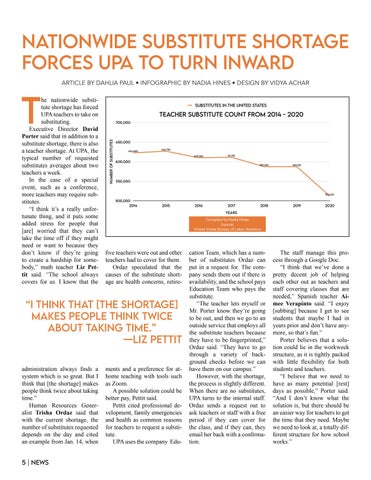
Nationwide substitute shortage forces UPA to turn inward ARTICLE BY DAHLIA PAUL • INFOGRAPHIC BY NADIA HINES • DESIGN BY VIDYA ACHAR
T
SUBSTiTUTES iN THE UNiTED STATES
TEACHER SUBSTiTUTE COUNT FROM 2014 - 2020 700,000
NUMBER OF SUBSTiTUTES
he nationwide substitute shortage has forced UPA teachers to take on substituting. Executive Director David Porter said that in addition to a substitute shortage, there is also a teacher shortage. At UPA, the typical number of requested substitutes averages about two teachers a week. In the case of a special event, such as a conference, more teachers may require substitutes. “I think it’s a really unfortunate thing, and it puts some added stress for people that [are] worried that they can’t take the time off if they might need or want to because they don’t know if they’re going to create a hardship for somebody,” math teacher Liz Pettit said. “The school always covers for us. I know that the
650,000 622,600
626,750 609,960
587,240
5 | News
587,120
550,000
512,030
500,000 2014
2015
2016
2017
2018
2019
2020
YEARS
Compiled by Nadia Hines Source: United States Bureau of Labor Statistics
five teachers were out and other teachers had to cover for them. Ordaz speculated that the causes of the substitute shortage are health concerns, retire-
“I think that [the shortage] makes people think twice about taking time.” —LiZ pettit administration always finds a system which is so great. But I think that [the shortage] makes people think twice about taking time.” Human Resources Generalist Trisha Ordaz said that with the current shortage, the number of substitutes requested depends on the day and cited an example from Jan. 14, when
611,310
600,000
ments and a preference for athome teaching with tools such as Zoom. A possible solution could be better pay, Pettit said. Pettit cited professional development, family emergencies and health as common reasons for teachers to request a substitute. UPA uses the company Edu-
cation Team, which has a number of substitutes Ordaz can put in a request for. The company sends them out if there is availability, and the school pays Education Team who pays the substitute. “The teacher lets myself or Mr. Porter know they’re going to be out, and then we go to an outside service that employs all the substitute teachers because they have to be fingerprinted,” Ordaz said. “They have to go through a variety of background checks before we can have them on our campus.” However, with the shortage, the process is slightly different. When there are no substitutes, UPA turns to the internal staff. Ordaz sends a request out to ask teachers or staff with a free period if they can cover for the class, and if they can, they email her back with a confirmation.
The staff manage this process through a Google Doc. “I think that we’ve done a pretty decent job of helping each other out as teachers and staff covering classes that are needed,” Spanish teacher Aimee Verapinto said. “I enjoy [subbing] because I get to see students that maybe I had in years prior and don’t have anymore, so that’s fun.” Porter believes that a solution could lie in the workweek structure, as it is tightly packed with little flexibility for both students and teachers. “I believe that we need to have as many potential [rest] days as possible,” Porter said. “And I don’t know what the solution is, but there should be an easier way for teachers to get the time that they need. Maybe we need to look at, a totally different structure for how school works.”
Where textbooks check out but don’t check in The reasons why some students fail to receive textbooks ARTICLE & PHOTO BY GABRIELA ZUREK • DESIGN BY JOE SHEM
U
PA has an $80,000 textbook budget, and even as curriculums transition to online, a part of that budget is always spent on supplementary purchases of textbooks for the students that fail to receive them at the beginning of the year. New textbooks are picked out by different departments every five to seven years because the content in the old textbooks becomes too outdated compared to newer editions. However, replacing textbooks can be difficult for UPA because most major textbook manufacturers prefer large orders or selling to bigger districts. Using the Intent to Return forms and class registration, UPA is able to estimate how many books will be required and if any will need to be bought. This is done through websites like Follett and other textbook resellers. “The most common reason for students failing to receive textbooks at the beginning of the year is previous students not returning theirs, and the first two to three months of school are spent trying to source books for the affected students,” Director of Curriculum and Instruction Matt Daugherty said. Daugherty works to select, order and make distribution schedules for textbooks as well as handle supplementary orders of textbooks. “Typically we rely on the teachers to report how many students don’t have a textbook,” Daugherty said. “And then we’re able to order that quantity from either a reseller or another outlet.” UPA’s policy is to withhold a graduate’s diploma until all textbooks are returned or the student pays a fine, which is the main incentive for students to return their textbooks. However, there is little incentive before that point to return textbooks, and the administration has to email students in hopes of convincing them to return the textbooks. Issues involving textbook return are more prominent among high school classes because students’ courses are more diversified, and it becomes harder for the administration to track down every missing textbook. During the COVID-19 campus closure, traditional textbooks became a secondary option; with the coursework transferring online, PDFs replaced paper. “The sort of the silver lining of COVID was that online textbooks and textbook sources have been around for years, but nobody had the time to sit down and learn how to use them correctly as a textbook,” Daugherty said. “Because it just sort of
Different versions of the precalculus textbook sit side by side on racks in the book room located above Horton. The book room is where textbooks not in use are stored.
changed how you have to think about planning, COVID kind of forced us into that space.” The nature of updating textbook inventory also plays a part in the absence of physical textbooks for students. Math teacher Jaz Dhillon said that the math department decided not to buy supplementary textbooks despite the increasing number of calculus students because the textbook will be replaced soon. Despite many students not receiving the textbook, Dhillon has not heard many complaints. “The only thing I have heard is students appreciating getting digital copies,” Dhillon said. However, the need for physical textbooks remains for some students. Sophomore Joe Wong had not gotten an AP Calculus AB textbook at the beginning of the school year. “It was a bit annoying to do the homework and it always took ten minutes to download [the online textbook], but during classwork I’d be fine,” Wong said. Wong is able to use the textbook his sister received when she transferred out of the class. However, other students need to either go to their teacher hoping that they are able to request a supplementary purchase of a textbook or contend with the online resources. Sophomore Krish Nirmale also did not receive an AP Calculus AB textbook this year and chose to not try to find out a way to get a physical textbook. “They had the online copy, so I figured that’s much easier than actually going and trying to talk to people and get another one,” Nirmale said. In accordance with Section 60119 of the California Education Code, schools are only required to provide their students with sufficient textbooks or other instructional materials in the five core subjects, and the online textbooks and materials fulfill this need where physical textbooks may fail. This year, the most affected classes were Biology and World Geography because more students were added to the classes, however, the failure of students to return textbooks is still central to the issue of missing textbooks. “When there’s these books that are out there from students who don’t turn them in, it influences and affects all the kids down the line because there’s one fewer set of books in circulation for everybody,” Daugherty said. News | 6
English 9 Replaces “To Kill a Mockingbird” With “The Hate U Give” Looking at the efforts behind the approval process for “The Hate U Give” ARTICLE, PHOTO & ILLUSTRATIONS BY HAYLIE YEE • DESIGN BY AMANDA REBOREDO
E
nglish teacher Jessica Wall’s pilot program to replace the novel “To Kill a Mockingbird” with “The Hate U Give” in UPA’s English 9 curriculum was approved on Sept. 23 by Executive Director David Porter. Freshmen began reading the novel on Oct. 18. “The Hate U Give” by Angie Thomas follows Black sixteen-year-old Starr Carter in the modern-day South, as the character grapples with racism, police brutality and activism after witnessing police murder her Black friend. It is the first of UPA’s book replacements not on the Recommended Literature List provided by the California Department of Education. In contrast, “To Kill a Mockingbird” by Harper Lee explores civil rights and racism in the segregated suburbs of Maycomb, Alabama during the Great Depression and Jim Crow era. It is narrated by Scout Finch—a
7 | NEWS
white girl who ages from six to almost nine years old—whose lawyer father is asked to defend a Black man falsely accused of raping a white woman. “The main issue that I have with ‘To Kill a Mockingbird’ is it’s a novel about race from a white person’s perspective, versus ‘The Hate U Give’ is a novel about injustice and race from a Black person’s perspective,” Wall said. “How can you have a real discussion and say what the issues are if you’re only hearing from the person in power’s perspective?” Wall compared “To Kill a Mockingbird” to “Uncle Tom’s Cabin” by Harriet Beecher Stowe. Stowe’s novel helped readers begin to care about the issue of slavery, but it is not considered the ideal novel today because of its comfortable, white point of view. “My concern with how racism is handled in ‘To Kill a Mockingbird’ is that it is handled in a
way that makes white people feel comfortable about it,” Wall said. “‘Oh, we’re doing the right thing, things are going to get better as long as one person speaks up, things will be handled.’ It covers it, but it doesn’t challenge [the ideas of racism].” The usage of the n-word by multiple white characters as a slur was not a factor in Wall’s decision to remove “To Kill a Mockingbird.” Wall highlighted that another novel in the English 9 curriculum, “Of Mice and Men” by John Steinbeck, also employs the word’s usage by white characters. “The n-word is used for a specific purpose to point out the nature of racism and how it affects characters,” she said. “Although it has been a reason [‘To Kill a Mockingbird’] has been challenged or censored in other school districts, for our kids I feel like it’s valuable to confront
these things in a controlled setting.” Senior Nahom Belay was one of the only Black students in his period when he read “To Kill a Mockingbird” his freshman year in 2018.
“For some students, the book can be traumatizing to read,” Belay said. “Obviously no one said [the n-word] out loud in class, but it was always around and having people look at you is an uncomfortable experience.” Wall cited other issues like the outdated vocabulary and unusual speaking styles for her push to replace “To Kill a Mockingbird.” On the first page, Lee uses phrases such as “a fur-trapping apothecary,” “piety” and “dictum.”
“I’m glad all the ninth graders are reading it because they can learn the importance of it and understand that [racial injustice] is something that happens. This is something that happens to their peers. This still happens at school.” —Nahom Belay In another passage that lacked historical context, Scout mentions the Battle of Hastings, a conflict between Norman and English armies in 1066. In previous years, Wall would make up for the contextual deficit with excess research to understand the context of the time. Additionally, the perspective of “To Kill a Mockingbird” is confusing as it spans across three years in which Scout narrates from the future looking back on her childhood. Wall has been searching for novels to replace other sections of her curriculum including “Fahrenheit 451” by Ray Bradbury and the mythology unit. While reading recommendations from We Need Diverse Books, Scholastic and more, Wall found “The Hate U Give.” She read it in the spring of 2020 as the first novel she considered to replace “To Kill a Mockingbird.” Wall first implemented the novel
with four students during summer school to make up for the “To Kill a Mockingbird” unit. She chose to implement “The Hate U Give” because she knew those students had struggled when reading “To Kill a Mockingbird.” “It went so well when I tried it with kids during summer school,” she said. “I said we need to do it this year because it is going to benefit our students so much. We need to do it.” Teachers have liberty with their summer programs and regular course curriculums. During summer school, Wall did not require approval to use “The Hate U Give,” but it was required during the school year due to the cost of books for all 123 students. Wall initially planned the adoption process of “The Hate U Give” to take six months to a year. After conferring with the English department and Porter, they decided to proceed with a pilot program this year. A pilot is the temporary approval of a text, novel or another student resource by the department and administration with the opportunity for family feedback. A board policy and Education Code [51000-53303] on general instructional programs gave them the freedom to switch curriculums this year. “If it turns out that it’s a really positive experience, and
it moves the students towards their learning targets or the standards for that course, then it’s worthwhile to present all of that through the formal process,” Porter said. The pilot program will collect student work as well as student, teacher and parent feedback that will be presented in the formal adoption process. The English department and administration will review this data before deciding to continue the pilot next year, move for permanent adoption or opt for a different direction. Since pilot programs usually test materials with one class or a smaller group of students, an additional benefit of it is that the school would not waste money if the material was not adopted permanently. In this case, Wall wanted all freshmen to have a copy of “The Hate U Give.” This request was approved because the cost was “nominal”—$12.68 per copy— despite having to purchase hardcover editions due to the lack of paperback. As a part of the approval process, Wall held a Zoom town hall as a forum for freshmen families to learn more about the program. Five parents were present, most either out of curiosity or in support of the novel. “The parents who participated in town hall all share that Continued on next page NEWS | 8
same type of desire to be able to know that these powerful conversations are happening somewhere,” Porter said. “That really gives me a lot of hope for [this] generation to fix the ills and issues that we’re
specific student would read “To Kill a Mockingbird” instead. Nine students opted out of “The Hate U Give.” “I liked that we were talking about racial injustices because this
to what you’re saying, and I felt like that was all completed after they said ‘yeah.’” The petition was sent to Wall and Porter on Sept. 2. “[The petition] didn’t change
Freshmen Angelica Froumis and Kathy Nguyen read chapters 15 to 18 of “The Hate U Give” during second period in Yale on Nov. 12. They then complete the corresponding reading questions due before their next class. leaving to you to fix.” Although parent opinions were mostly positive about the change in curriculum, three to four sent Wall emails in opposition due to their beliefs that “To Kill a Mockingbird” should still be taught in school. Others were concerned about “The Hate U Give” containing topics pertaining to drugs, sex and violence. While those are mature topics, they are not censored in UPA’s curriculum. Wall and fellow English teacher Andrea Aquino sent home permission slips for parents to consent to their students reading “The Hate U Give” due to the usage of profanity. If their guardian opted out, that 9 | NEWs
was my first time talking about it in class,” freshmen Maya Berhane said. “My old school was majority white and there weren’t that many people of color, so it was close-minded.” On Sept. 2, Berhane and fellow freshman Artem Babin created a petition to bring representation to student voices in the decision and bring more awareness to why “The Hate U Give” would be a better choice. The petition received a total of 78 signatures from various grade levels at UPA. “We’re being heard in a way,” Berhane said. “Because when you petition you want people to spread awareness. You want them to listen
the timing of the approval process,” Porter said. “I just know for me, it strengthened the case for what Ms. Wall was talking about: students want something more contextual that they can relate to.” Belay, who is co-president of UPA’s Black Student Union, read “The Hate U Give” and watched its movie adaptation in middle school. He cites the novel as his current favorite book and supports the change in curriculum. “I’m glad all the ninth graders are reading it because they can learn the importance of it and understand that [racial injustice] is something that happens,” Belay said. “This is something that happens to their peers. This still happens at school.”
Point Your Toes Jory Luther’s experiences as a male ballet dancer ARTICLE & PHOTOS BY ISAAC RIOS • ILLUSTRATIONS BY HAYLIE YEE • DESIGN BY TAYLOR NGUYEN fter auditioning for and participating in many musical theater performances, sophomore Jory Luther came to the realization that he was not the most skilled at singing, so he shifted his focus to dancing, particularly ballet. As a Christmas tradition started by Luther and his family, he and his neighbors would see “The Nutcracker” every year, which inspired his neighbor’s children to enroll in a ballet studio. They convinced Luther to join in January 2018 when he was twelve years old, knowing he did not excel in musical theater and he was active as a child, always looking for activities to do. “I’ve been performing [‘The Nutcracker’] for so long, so there’s not a lot of nostalgia but there is a big sense of community every year,” Luther said. “I think that’s really important. Everyone comes together to make this production happen. It’s really special.” He started at San Jose Dance Theater—located on Junction Ave—in the level two class, where most of his peers were seven-year-olds. “I was in there with a bunch of seven-year-olds, and it was embarrassing for me,” Luther said. “It was a little disheartening at first because seeing kids who can do more stuff than you is never fun.” Luther is currently in the level six class, one of the most ad-
A
vanced classes. Through time spent practicing seven days a week, Luther built an interest in pirouettes, a type of ballet move where one turns their whole body on a single foot, as well as contours, another move where one jumps and spins in the air, because the moves come naturally to him. Currently, his ballet class is split into barre and center exercises. Barres are handrails placed at the very end of the studio or away from the end to provide support as dancers focus on certain aspects of their technique, while center exercises are done away from the barre. Barre exercises are when the dancers do smaller exercises such as pliés or tendus to warm up for center exercises. Center is when the dancers do more exercises that require stability, such as pirouettes and jumps. Even as a novice ballet dancer, Luther never had stage fright during a performance. “I’m usually very nervous,” Luther said. “Once I get on stage, though, it’s —Jory Luther pretty normal, and you sort of understand what’s happening right then and there. The nerves just sort of disappear. I’m not very experienced. I haven’t done many performances, but usually before a turn, you just have to trust your instincts, and if Continued on next page you freak out in the middle of a turn, it
“I don’t think masculinity and femininity necessarily have to mean different things. It’s pretty much socially constructed.”
From left to right, sophomore Jory Luther poses in fifth position in releve, attitude and passé. Features | 10
passes. But as long as you’re prepared, you’re fine.” Luther is fond of performing the jester doll in “The Nutcracker,” as the role consists of many turns, and most recently, the Cavalier, another role involving partnering. “I have done partnering before, but not in a performance setting, so I was nervous before the play,” Luther said. Partering is a duet move in which one partner leads while the other follows. Partnering is usually done between a male and female dancer where the male is usually the foundation of the move, while the female dancer focuses on movements like turns. “I like the partnering aspect of ballet, as it presents its own challenges,” Luther said. “You have to keep you and your partner balanced and control their weight. It's a challenge, but it's fun.” However, Luther has come across setbacks. He received ridicule at his old school for being a male ballet dancer. “At my old school, people called me ‘gay’ and stuff like that,” Luther said. “It didn’t bother me that much, [but] it was annoying, and I was definitely sad about it.” For a brief moment of time, Luther felt obligated not to talk about his commitment to ballet, and he became self conscious about it. Eventually, he realized that he did not need others’ opinions about his involvement in ballet since ballet is a hobby he enjoys engaging in. Luther’s idea of masculinity is not the stereotypical boys “play sports all the time” stigma. “It’s being the most capable version of yourself without dragging others down,” Luther said. “I don’t think masculinity and femininity necessarily have to mean different things. It’s pretty much socially constructed.” Luther wants to pursue a career in ballet at a prestigious dance school like Juilliard right after completing high school. “It definitely got to me,” Luther said. “Eventually, I realized that this is something that I won’t necessarily get a lot of support from, and I had to do it because I want to do it and I love to do it. I realized that [ballet] is something that I wanted to do and not something that I would stop because people thought it was strange. Ballet is a big part of who I am.”
Luther demonstrates an assemblé, one of the many positions he learned from his ballet class at the San Jose Dance Theater. 11 | features
“Eventually, I realized that this is something that I won’t necessarily get a lot of support for, and I had to do it because I want to do it and I love to do it. I realized that ballet is something that I wanted to do and not something that I would stop because people thought it was strange. Ballet is a big part of who I am.” –Jory Luther
“Rat is short for ratthew” Manila file folders become a collaborative mural for student doodles ARTICLE, PHOTOS & DESIGN BY ALEXANDRA ROZMARIN ath teacher Esther Chen began using manila file folders as dividers between students during exams approximately five years ago and has used the original set since then. Inspired by fellow math teacher Jaz Dhillon, she bought the folders to function as a mechanism against academic dishonesty. The folders stayed blank until a student three years ago asked to doodle a flower. After that first flower was drawn, other students felt more comfortable adding their own drawings, Chen hypothesized. Now, every folder has at least one doodle; the folder with the original flower is the most marked. “I think it’s definitely a nice way for them to release their energy,” Chen said. “Sometimes, before you take a test, you feel really stressed out or anxious, and maybe seeing a funny sketch could help make you feel more relaxed.” Although Chen does not have a favorite drawing, on Feb. 2, she noticed a student drawing “really big butt cheeks” on a character from the popular video game Among Us and chuckled. Chen plans to keep the folders for as long as possible so future years can look back at previous math students’ doodles. “I never expected them to become like this,” Chen said, “but now I feel like it’s a part of being in my class, which is pretty awesome.”
M
The flower on the right-hand page was the first doodle to be added. Other doodles on this page include shout-outs to Kanye West’s album “Donda” and pleas for help.
Some doodles are just comprised of short phrases.
Bart Simpson is a recurring character on the folders. Students often respond to other messages and interact between periods. Although Chen teaches precalculus, statistics and AP Calculus BC, calculus is the most common class mentioned.
Encouraging messages are another common theme. Students often write about their frustrations, relating to math or not. On the left-hand side, a student expresses frustration regarding seminar lessons about integrity. A majority of illustrations are paired with short phrases. Some could be interpreted as a title, while some are closer to a cartoon caption. Do frogs make you crazy, too? Features | 12
Where in the World? How communities are connected through cultural clubs
C
ARTICLE AND PHOTO BY DEVEN MANGAR • ILLUSTRATIONS & DESIGN BY ABHISHEK MYNAM
ultural clubs provide students with a community where they can share the experiences of being a member or admirer of a certain culture, whether that be through cultural practices or activities teaching members about that culture. Currently, there are eight cultural clubs which reflect the diverse demographics of UPA: LatinX, Desi Student Association, Vietnamese Student Association, Black Student Union, Habesha Student Association (HSA), Muslim Student Association (MSA) and Guzaarish. Sophomore Nurit Ambaw’s first year at UPA was during distance learning. When she came to school in person for the first
lem of evil. Students do not have to be a part of a specific culture to join a club. Cultural clubs aim to teach UPA students about their specific cultures, whether they are members of the culture or not. “We have these interfaith events, which is pretty much just there for people to kind of get an insight on what we believe, why we believe and what we believe the reasoning behind it, where the main audience is non-Muslims,” Syed said. Desi Student Association was created to build a community of South Asian and non-South Asian students who wanted to learn more about South Asian culture and traditions, Desi Student Association President and senior Shreya Parikh said. During the first Desi Student Associatime, she decided to join UPA’s Habetion meeting, members played a game of sha Student Association to connect with Kahoot—a trivia-like game—quizzing a community she was already familiar their knowledge of Bollywood movies with. and South Asian geography. The follow“I hope to make new friends and ing meeting, the club watched an iconic learn more about my culture,” Ambaw Bollywood film: “Happy New Year.” said. “My parents don’t really teach me Many students choose to join culturabout it or talk to me about it so this al clubs due to an interest in the culture, could be a great opportunity for me. Exranging from music to TV to literature. cited to see what happens.” “It was nice to see not only Habesha, Being back in person has not only but other people also learning about the made meetings easier for club members Habesha culture,” Ambaw said. but also for the club leaders. Senior Zoie Charbonnet learned “I’m very glad that we’re back in more about Desi culture while accompaperson,” MSA president and senior nying Parikh to a meeting. Zaid Syed said. “Now, I just feel more “It’s great as a member of not the culconnected in person.” ture to experience parts of [it], for examMSA was started as a way to combat ple their filmography,” Charbonnet said. misunderstandings of Islam and to edu“It was very interesting to see a movie cate UPA’s community. from another culture because I’ve expe“There’s a lot of Islamophobia in rienced things about Asian culture, but the world right now,” Syed said. “And On Feb. 1, the Vietnamese Student Associa- it was very different. You can find sima lot of it is because of miseducation, ton hosted a lottery game similar to bingo ilarities within it, and you can compare or extremists who pretend to be Mus- in front of the office where students had a cultures.” lim. And I think because of that, people chance to win $50 for Lunar New Year. Club leaders have seen members who have a really negative perception of our joined the club from outside interests religion. And so I just kind of want to combat that. Now, I can’t fix have positive experiences and find them to be more open-minded that in one day. I’m just doing what I can, which is educating the about different beliefs and cultures. people here because I have a platform, which is the club.” “We have really positive reactions. A lot of people come to me Cultural clubs may also teach members aspects of their culture and tell me like, ‘Yo, this is like, really amazing stuff.’ Other peothat they might not have known before, such as music, art or ge- ple start engaging with me and having dialogues with me, which is ography, through interactive activities. These include games to ex- also good,” Syed said. “I want people to really start thinking about pand HSA members’ knowledge of Ethiopian geography or watch- these types of things. And really, at the end of the day, I just want ing a movie to portray the unique filmography of Desi culture. people to see things from our perspective. Because a lot of times in In MSA, activities are aimed to educate UPA’s community and school, we learn things a certain way, and we don’t really take time to provide a space for Muslim students to practice their faith. The to view other people’s perspectives.” first MSA meeting covered the Islamic perspective on evolution. The second meeting focused on the fine tuning of the universe and Illustration shows symbols of Hinduism, Christianity and how it was created. In the third meeting, Syed addressed the prob- Islam. 13 | Features
brothers take on
VARSITY
How brotherly dynamics shape the varsity basketball team ARTICLE BY ZAINAB SHAIKH • PHOTO COURTESY OF JOSHUA ASADA • DESIGN BY KYLA ULUG
T
he odds of making UPA’s boys’ varsity basketball team are slim, with over 50 students trying out. Two pairs of brothers among 11 other varsity candidates making it? Even slimmer. Despite the odds, senior Zaid Syed and sophomore Bilaal Syed along with senior Jonah Martinez and junior Jared Martinez are two pairs of siblings who made the boys’ varsity basketball team for the 2021-2022 season. As of Feb. 7, the team is second in their league with six wins and two losses. They practice throughout the week after school. During practice, the team does exercises like suicides or runs plays that would be applied during a game. “Honestly, I’m a good free throw-shooter,” Bilaal said. “And at the end of practice, [our] Coach always makes us shoot free-throws. And then the other day he actually told us, ‘If Bilaal misses his free throw, then you’re all running 17 laps.’ Yeah, I made the shot.” As far as brotherhood and compatibility go, all four brothers agree that being brothers does not afford them “telepathic connection,” as Zaid said. “We practice; we play hard,” Zaid said. “In terms of having a biological brother on the team, it doesn’t really do much. I don’t treat him any different than I would treat anyone else.” However, head coach Caleb Plasschaert has noticed an area where the Martinez and Syed brothers’ relationships are beneficial: communication.
‘‘our whole team is like a family.’’ –zaid syed “There are definitely moments where I’ve noticed that them being brothers has been helpful, whether it’s communication-based or just having a good feel for how to get the most out of them on the court, ” Plasschaert said. Although UPA’s varsity boys’ basketball team is second in the Private School South League rankings, they did have trouble during the preseason having lost all their games. To combat the losses and bounce back even stronger, the team focused on strengthening offensive and defense plays and incorporated certain drills during practice to address problems they encountered during the season. “I think [the official] season’s going really well overall,” Plasschaert said. “Don’t get me wrong, it hasn’t been easy, […] but overall I think we’ve really improved as a unit and learned a lot, so I think that’s really all you can ask for.” As children, both families picked up basketball as a hobby, which evolved into a greater passion for the sport. Jared has
been playing basketball since he was a kid and also played for his former school. “Watching Jonah, actually, it’s pretty interesting,” Jared said. “He’s really aggressive and makes shots that I never see anyone else make, so it is kind of interesting to watch him and, you know, learn stuff from him.” Bilaal is one of the younger players on the varsity team as a sophomore. As a middle schooler, he would often struggle with his confidence and frequent self-doubt, but as soon as he outgrew his uncertainty and fears, he flourished. He worked hard especially during the summer of eighth grade. “The best strategy to get over shyJonah Martinez makes ness was to play more,” a layup on Jan. 21 as an Bilaal said. “The best opponent from St. Thomas thing that happened to me More attempts to block him. and Zaid was that we started going to the park and playing with strangers who’d have chemistry on and off the court. It was the best thing ever.” Although the brothers often play together in their free time, both pairs of brothers said their styles are completely different. Jonah says he is an aggressive player, choosing more often to drive in and take closer shots versus attempt to sink deeper three-pointers. “I’m not as aggressive as him [Jonah] I’d say,” Jared said. “I usually take more shots and everything. And then I’d say I’m also more defensive than offensive.” In Bilaal and Zaid’s case, the younger Syed brother is the more spontaneous, dribble-frenzied and quicker sibling in contrast to his older brother, who stays calm under pressure and can adapt to any situation that comes up. Both admire each other’s skillset, wanting to learn more and emulate their sibling’s ability. “We work hard; we help each other out,” Zaid said. “Our whole team is like a family. At the end of the day, we’re all friends.” Features | 14
Mom, I shaved my head Discovering myself, 16 and bald
ARTICLE BY ALYSSA GARCIA • PHOTO ILLUSTRATION BY TYLER YUEN • DESIGN BY HAYLIE YEE
After shaving my head, I did not realize how cold it would be. I constantly found myself wearing beanies and keeping my hood on even though it was 80 degrees in the spring. 15 | OPINION
ou are not reading to hear about the day I shaved my head; you are here to witness the aftermath. The first time I noticed my social anxiety, it was December of eighth grade, and I was up late at night about to pass out from hyperventilation, obsessing about what I wore two days prior. I questioned how I looked, what I spoke about and how I spoke. So, why did I decide to shave my head when I knew I had social anxiety? I shaved my head March 16, 2021 because of my cousin. She was 14 when she was diagnosed with acute lymphocytic leukemia. When she found out about her diagnosis, I was the one she leaned on as she bawled her eyes out, gripping the clumps of hair falling out of her scalp. So, I shaved my head to make her hurt a little less. Though I got constant praise, I didn’t feel brave; I didn’t feel courageous; I just felt a new breeze on my freshly shaved head. Faking confidence is a talent—my greatest talent, I think. But, it is draining to constantly keep up this façade of effortless confidence and carefree character I have made for myself. Although I constantly received praise from my friends, they wondered why I did it, thinking I was much
Y
prettier with longer hair. I learned of the rumors that my ex-boyfriend said he would never “hit that” now because of my hair. I could not wrap my head around why my hair was such a big deal to these boys. I told myself that they were just stupid and could not see my true beauty, but at that point, I could not even look at myself before I went to bed at night. I just closed my eyes and imagined my hair as longer and attractive to the boys my age. To my face, my friends and strangers said I was the only person who could possibly pull this haircut off. But, I know that is not what boys thought of me. I was pretty, sure, but was I pretty enough to date? To kiss? No. The answer was that I was different, and not in a romantic Wattpad way. Up until I shaved my head, male validation was all I had ever known to feel pretty. The attention from boys, either through flirting or being called pretty, was what fueled my confidence for as long as I’ve ever known. Once that stopped, it was difficult to like the way I looked and love myself regardless. One experience in particular trashed my idea of romance, and I ultimately gave up on having a high school relationship. I met a boy from work, and we became friends. He asked if I wanted to go on a date with him. Of course I would; he was a cute and incredibly kind boy. The night of the date, my adrenaline was rushing, heart pounding out of my chest. I was a 16-year-old getting ready for a date; this was normal. He picked me up in his red Mercedes, a cliché that excited me. I later learned of a text conversation where his friend told him to “ask the cancer patient out.” This destroyed my hope at any normal high school romance. I thought of my cousin, an actual cancer patient, of her strength, being able to persevere through an illness that both mentally and physically destroyed her youth. I decided if boys wouldn’t change their mind about the length of hair they accepted on dateable girls, I would just have to change my idea of self worth. I do not fit the cisgender female
description. Sure, from the shoulders down I am a woman. But, I knew my head was shaved, and I did not fit a feminine gender norm. Before this experience, my idea of femininity was skinny with long hair— something out of a Chanel commercial. Now, my own concept of femininity is restructured into the exact opposite of how I’d been socialized. For me, shaving my head was a test. It showed me the pure strength I had to move past the degrading words and actions of others. I feel like women tend to put their femininity into having long hair, so I wanted to prove to myself that I could still be feminine with short hair. I don’t regret shaving my head, and I would do it again. Now, I feel very comfortable, and no longer panicked about looking different. I’ve grown up and I’ve learned to appreciate looking unique—not having long, dark hair. That in itself is my most important achievement. I would love it if other girls with the same hair could feel the same way: empowered and beautiful.
Now, my own concept of femininity is restructured into the exact opposite of how I’d been socialized. —Alyssa Garcia
OPINION | 16
IT’S NOT ME, IT’S YOU Exploring the rom-com genre’s fall from fame
ARTICLE BY AKHILA AYYADEVARA • PHOTO ILLUSTRATIONS & DESIGN BY CHLOE LUU
i
magine: you are a young, chic woman in New York City. You bump into a handsome man who you, in theory, should never meet again. Yet, you do. And you slowly fall in love over the span of a few weeks. You get past your third act conflict and live happily ever after. You have just experienced the plot of a romantic comedy. Rom-coms were some of my favorite movies growing up, and they still are. The first rom-com I ever watched was “The Princess Diaries” when I was eight years old with my mom. In 1998, my mom watched “You’ve Got Mail” when it first came out with a group of college friends, solidifying her love for the genre that she then passed onto me. From “Legally Blonde” to “But I’m a Cheerleader,” you name it, chances are I have seen it. My favorite is “13 Going on 30.” I blame them for my feverish love of New York City; my constant hunger to be 30 and single; my desire to throw dinner parties and be unexplainably wealthy even though I am a column writer for a women’s magazine and should only make $30k a year. Clearly, I love romantic comedies, yet even I can admit the genre has its flaws, and in recent years, modern rom-coms have felt less lovable compared to those made from the ‘80s to early 2000s. While the formula seems the same on the surface, they aren’t as memorable as they used to
OPINION 17 | Opinion
Seniors Nahum Hintsa and Tiffany Tran pose as Patrick Verona (Heath Ledger) and Kat Stratford (Julia Stiles) from "10 Things I Hate About You."
be.
What originally made me fall in love with rom-coms was the perfect combination of simplicity in plot and variety between movies. Though the genre employs tropes, it always found a way to make each story feel different. Both “How to Lose a Guy in Ten Days” and “Love Don’t Cost a Thing” employ similar fake dating tropes, yet can be distinguished from each other. In “How to Lose a Guy in 10 Days,” Andie Anderson (Kate Hudson) is a columnist who decides to date a Ben Berry (Matthew McConaughey), the most “undateable” person she could think of, with the goal of making him break up with her in 10 days or less—the twist being he is completely unaware of this, and Berry is simultaneously trying to make her fall in love with him in 10 days. Even though they are “fake dating,” the nuances in the details of the plot let it stand completely on its own. “Rom-coms, for me, are very comforting and safe because they present the kind of worlds that we all want to live in, which is the idea that there’s a happy ending with a loving partner waiting for us all,” English teacher Kristen Moore said. As nice as the predictable plot is, it can become derivative without other elements. Even when using a trope, older romcoms used their setting, costuming and soundtrack to make their movies memorable. In “10 Things I Hate About You,” two social pariah protagonists get flung together due to their odd circumstances. Even though the plot is predictable, every character’s outfit is quintessentially ‘90s, therefore making it unforgettable, and protagonist Kat Stratford’s (Julia Stiles) introduction scene features Joan Jett’s iconic “Bad Reputation.” Movies like “The Kissing Booth” and “The Perfect Date” from 2018 and 2019, respectively, are more modern takes on a teen romance reminiscent of “10 Things I Hate About You,” but they blur together due to their predictable plot void of other intriguing elements. The love triangle plots are no longer charming but rather formulaic. And part of the fun of watching a rom-com is rooting for a character or team, impossible when all characters are just plain unlikable. Admittedly, older rom-coms have problematic aspects. Well-loved Carrie Bradshaw of 1998’s “Sex and the City”—a sex writer who claims to open about sexual relationships—dumps the bisexual man she is seeing because “he would just end up with men anyway.” Bradshaw, unable to believe her boyfriend could be attracted to more than one gender, invalidates his bisexuality. In that way, I applaud recent progress. We can acknowledge that romcoms in recent years have made attempts to be more diverse and accepting.
These improvements are clear when comparing Asian charac- most teen magazines. ters in “Crazy Rich Asians” (2018) and “Breakfast at Tiffany’s” “It actors” are people (1961). In “Breakfast at Tiffany’s,” Audrey Hepburn’s landlord, who attract you to watch played by Blake Edwards (a white man), is a Japanese man por- movies: people like Zentrayed to be a walking stereotype. Edwards’ eyes are taped back, daya and ‘90s “it woman” and his mannerisms—such as his shuffle-like walk—make him Julia Roberts, who repeatseem like a brainless fool. Edwards attempts an accent so thick edly brought in a crowd for and parodic it’s hard to understand. rom-coms like “Pretty Woman” “Crazy Rich Asians,” made 57 years later, is a movie that depicts a non-white story through a fresh lense. It portrays people of color without relying on stereotypes; each character was multifaceted and totally different from one another instead of having to follow the archetypes of being quiet and submissive. On the other hand, hyper wokeness—the action of being ultra-politically correct, often appealing to privileged groups as a way to make the media they consume feel progressive and “safe”—can ruin a viewing experience. Feminist buzzwords written for brownie points don’t make viewers feel like the writers care about social issues. An empty reference to toxic masculinity won’t salvage a movie. Minorities are turned into archetypes, boxes to check for the people in the writers’ room. A character that immediately comes to mind is Murph from “The Perfect Date.” Gay, Black and dyslexic, Murph, the lead’s best friend, is a mish-mash of “diversity.” In a movie with a majority straight, white, neurotypical cast, he stood out like a sore thumb because in contrast with the rest of the recurring characters, his only character traits are his diversity. In the same way, Netflix’s attempt at portraying a plus-sized girl in a rom-com was a painful fail at diversifying body types. Seniors Tyle r Yuen and D Obsessively loving skinny white women in your chubby, preesiree Pekar “Ugh! As if!” imitate the scene from th teen years can be painful. How could I have love if I wasn’t one e hit 1995 fil m ”Clueless. of them, and would never be one of them? The movie “Sierra ” Burgess is a Loser” was supposed to be for girls like me. The most heartbreaking part of this movie flopping was the and “Notting Hill.” writers’ need to redeem unredeemable characters, such as Burgess, Moore believes the shift away who imitated a deaf person and kissed a boy without his consent. from “it actors” choosing rom-coms Veronica, Burgess’s lifelong bully, calls Burgess a lesbian and trans comes from young actors being more as a way to insult her looks. The implication of calling a plus size interested in prestigious films—pieces that will get awards. Timothée Chalamet, an actor who could easily be the star of a well-loved rom-com due to his internet presence as a conventionally attractive person, opts for roles in movies like “Call Me By Your Name,” “Lady Bird” and “Dune.” “I found that our culture is turning away from romantic comedies as a legitimate genre of film,” she said. “I think today’s people are much more cynical about romantic relationships.” Moore thinks that the genre will not die out, but rather needs to adapt to what people want to see now. “I want to see romantic comedies where the characters are more flawed, where the characters feel more true to human nature, to the girl a lesbian and trans and then never facing the consequences for human experience,” Moore said. that can lead viewers to feel disheartened by their own appearance. In a time where life is so bleak, we want an escapism that still Further, in the ‘90s, the marketability of rom-coms often came feels applicable to us—one that resonates with us, light and digestfrom the big-name actors they featured. Moore says “it actors” are ible. New rom-coms must force themselves to reckon with their people who hold the most roles in media, actors who come up in current reality, rather than recreate the exact inauthentic plot from social media the most often or in the ‘90s, who were featured in the a wildly different, unjaded time period.
"And part of the fun of watching a rom-com is rooting for a character or team, impossible when all characters are just plain unlikable." —Akhila Ayyadevara
OPINION | 18
Putting a Dead Name to Rest The place names hold in dictating identity
ARTICLE & ILLUSTRATIONS BY VIDYA ACHAR • DESIGN BY AKHILA AYYADEVARA Editor’s Note: Eli Lockwood’s pronouns are “he/him” and “it/its,” a gender neutral pronoun created by the LGBTQ+ community. This article alternates between both sets of pronouns, as is customary. Chrys Tran uses they/them pronouns.
A
ttendance. Report cards. Graduation. Popsicle sticks. Ballots. Names are the labels used everywhere. So when individuals like freshman Eli Lockwood, Executive Director David Porter or junior Chrys Tran change their name, the process
18 | IN-DEPTH 19 In-depth
can be long-drawn-out with court fees and incite backlash from the community.
“Teachers can assume my pronouns but they can’t assume my name,” Lockwood said. “They actually have to think and get it right.” Eli Lockwood According to Lockwood, overall, UPA To Eli Lockwood, his name is an expression of gender, personality and a students and staff use its chosen name and deep-rooted sense of identity. After realiz- respect its pronouns. “Everyone’s so great,” it said. “Like, at ing he was transgender in 2018, Lockwood came out to his friends with the new name my old school, there wasn’t much repre“Ren,” which he said encapsulated his free sentation, but here, people are so open to spirit and a new, more positive outlook on talking about [being queer].” Lockwood was born in China and life. In September 2021, Lockwood started using the name “Eli,” which he picked moved to California from Hong Kong in from the movie “To the Bone’’ because he April 2021. Unlike at UPA, the teachers at resonates with the main character of the his school in Hong Kong frequently deadnamed and misgendered him because they same name. “My name makes me feel so euphoric,” did not understand his reasons for changLockwood said. “It’s really just this feeling ing his name and pronouns. However, of it fitting right. I don’t know if other peo- Lockwood found support in his friends. ple will understand just how right it feels.” Lockwood’s best friend in China was also Lockwood’s name is a symbol of his transgender, which made it easier for him masculinity—a “large, blaring neon sign” to experiment with different pronouns and for the people who still think he is a girl. names. “I think it’s so important to find the Lockwood’s mother, who is Christian, believes that Lockwood is sinning by not right name because people kind of define presenting and acting like a cisgender girl. you by it,” Lockwood said. “You’re basiShe wants him to “stop this nonsense” and cally choosing the impression you’re going to have on people when they meet you.” implores him to meet her expectations. Eli also goes by “Lucifer,” a name he “She’s like ‘Don’t worry, I’ll rescue you from hell,’” Lockwood said. “So I guess avoids using around strangers because he she has good intentions. And as she puts it, does not want to give off the “wrong” impression. He chose the name “Lucifer” bewe’re all sinners so it’s fine.” Lockwood’s mother allows him to cause it represents not being accepted by choose his outfits and hair color, but people at home and the concept of rebirth. does not allow him to “express himself He believes that starting to socially transifully,” prohibiting him from wearing tion and come out to his friends has been a a binder or taking hormone-block- sort of “rebirth” and has “given me the pering medication. Changing his name mission to be a different person.” Though is the only way Lockwood feels he its friends call it “Luci,” the name “Eli” can fully control the way he is per- avoids “upset feelings” from Christians. ceived. Because Lockwood wears The name Lucifer also gives him unwanted makeup, teachers usually use she/her attention from his peers. “There’s this one guy who’s in a coupronouns automatically, but when Lockwood tells teachers his name, ple classes with me who keeps preaching “there’s no way for them to mess it the gospel to me,” it said. “People can’t get past wanting to save me.” up based on my appearance.” The student also asked Lockwood to meet him after school so he could “let To freshman Eli Lockwood, being pan- Jesus save me.” Eli understands that sexual and transgender are just some of his classmates and people online treat the many labels that define him. his queerness “like a dirty secret or
cause of the realization that I was going through such a difficult time and he was there the whole time,” Porter said. “That’s selflessness. I’d say my name is a s pi r at ion a l; it’s who I want to become.” Porter described the joy he experienced when being welcomed into his adoptive father’s family for the first time by his grandma. “I still remember the day we drove up to Rexburg,” he said. “My [adoptive] dad’s mother was just running out of the house. And she smiled so big and said ‘We’re gonna call you D.R. so we don’t get mixed up.’” Porter’s initials are D.R.P, while his adoptive father’s initials are D.O.P. His middle name, “Rountree,” comes from his biological mother’s maiden name. Despite Porter, his adoptive father and biological mother being eager to change his name legally, the process took 14 years, starting when Porter was a sophomore in high school. Even when Porter was going to college and starting his first career, he used his dead name for legal documents and chosen name for social situations. He made all of his checks out to two different names and did not receive a passport for 15 years. “I was born in the country and raised in the country,” he said, “but it’s this sense of you’re not a citizen because you don’t even really exist on pa-
“That’s selflessness. I’d say my name is aspirational; it’s who I want to become.”
—David Rountree Porter
something.” He hopes to shed light on the humanity of people who change their name and show his peers that there should be no stigma against people who change their name more than once. “I don’t want people to think we’re faking it,” he said. “You know, our name isn’t all we are anyways.”
David Rountree Porter
For David Rountree Porter, names can connect people as family. Porter was adopted in 1990 and decided to change his first, middle and last name the same year. “I was named after the wrong person […] to put it lightly,” Porter said. “ I think people with broken homes know how destructive and manipulative people can be and my birth name was a continuance of those behaviors.” Porter decided to honor his new family by using the first name “David” and last name “ Po r t e r,” both of which are from his adoptive father’s name. “I chose that n a m e be-
per.” In New Hampshire, the state Porter was born in, biological parents are allowed to seal their children’s records, which includes the child’s birth certificate. This means that only the state Supreme Court can release those records and allow adopted children to access and change their own records. Porter was adopted in California, and New Hampshire did not recognize the adoption as legal. So when Porter’s biological father mailed a letter in 1990 to the Records Department in New Hampshire, Porter was barred from changing his name on his birth certificate or passport. “The fact that for 12 out of the 14 years I was fighting, I was over 18 years old,” Porter said. “A legal adult. And I was still unable to access my own records?” Porter believes that laws surrounding name changes should be more flexible and have an “empathy factor.” He is discontent with California’s current laws surrounding name changes in schools as well. Legally, the UPA administration can only make changes to a student’s name in certain situations. Ed. Code 49062.5, which focuses on proof of identification, states that schools’ official documentation must contain the name on the student’s birth certificate. This includes transcripts and diplomas. Other platforms, however, like Schoology, can be adjusted by teachers to reflect a different name than that on the birth certificate and remove or change the gender marker. Changes to the name on Schoology, PowerSchool or email do not require parental consent. “Names are a core part of who you are,” Porter said. “And I wish the law understood that and made exceptions to accommodate students who want to change their name.” Porter recalled his poor experience with administrators at his school when he was changing his name. The administration refused to accept the family’s request for a name change and while many of his teachers changed his name on their roll call sheets, they did not change Porter’s name on his transcript or diploma. “I felt rejected and unaccepted,” Porter Continued on next page Executive Director David Rountree Porter’s name is a “torch of selflessness and greatness” that he carries from his adoptive father. IN-DEPTH | 20
said. “It seems that people have very concrete beliefs about names, believing your parents gave it to you and it would be a violation to change it, but it’s your name and your life.”
Chrys Tran
Chrys Tran’s name came from the nickname their late grandmother used to call them: “Chrysanthemum.” “My grandma actually gave me the name because she said, and I quote ‘Your given name is too white,’” Tran said. “It made me feel special, and I love that it’s gender-neutral.” When pronounced “Chris,” their name seems masculine but the “y in there adds femininity.” The change from their dead name to the name “Chrys” was a “natural next step when I realized I was nonbinary.” Although Tran loved their chosen name, they waited months to tell anyone at school. “I saw people coming out with their name on social media,” Tran said. “And I realized ‘Hey, people aren’t ridiculing them,’ and if they won’t get ridiculed, does that mean I won’t?” Still, Tran decided to “ease into” telling people their name, first telling their friends it was a nickname they wanted to go by and later telling their teachers about their name change. “It’s so fucked up that we try to make ourselves more palatable to others,” Tran
they introduce Tran to other people, they say that “Chrys” is a family nickname. “I remember when I was in the school play, and t h e y saw
that I was written down as. Chrys and they were like ‘Oh, your little nickname Chrys. You go by that at school too?’ with such a condescending tone,” Tran said. “That made me feel awful.” Tran also tried to make their pronouns more palatable to their followers on their social media account by choosing “they/she” in their pronouns section even though they hated the pronouns “she/her.” “I was like ‘Hey, you know what? I don’t want to blow their brains too much, so let me get a she/her in there to be nice,’” they said. “But now I’m like ‘Why am I sacrificing my comfort and literally my identity for strangers who I literally don’t care about?’” Tran said that all of their teachers have been supportive and willing to make
“It’s so fucked up that we try to make ourselves more palatable to others.” —Chrys Tran
said. “Like it hurts every time people say it’s just a nickname, but I said that too so that I wouldn’t get the heat.” When Tran came out to their conservative family members, they refused to use Tran’s chosen name. Instead, whenever 21 | In-depth
changes to their attendance sheets, popsicle sticks and tests. However, one particular teacher stands out to them: dance teacher Catherine Dietrich. “Most teachers pulled me aside and asked if I was going by a new name which is great, but Ms. Catherine was really the best,” they said. “On the first day, she took roll call by saying our last name and asking us to tell her our first name. That’s the first time I’ve ever heard of that, and it just warmed my heart. I almost cried.” Instances like these make Tran believe that the school environment is changing and getting better at “acknowledging the students’ identities.” They have hope that all teachers will implement practices like Dietrich’s to make students feel more comfortable. Porter, too, has hope that the students and staff are making strides to be more inclusive. “As I said, I didn’t have a good experience with the administrators at my school,” he said. “And I just hope we can be more open-minded and accepting of everyone that comes here.”
Junior Chrys Tran’s name change celebrates their “rebirth” and ever-evolving gender expression.
Beyond a Name
Lockwood hopes that despite his name change, people start to realize that there is more to him than his “dyed hair, piercings and weird outfits.” “I want people to know that I love animals and want to get a master’s degree in zoology,” Lockwood said. “My gender is weird and complicated, but I’m more complex than that. I’m more complex than my name.” For Lockwood, Porter and Tran, using their dead name feels like they are not being respected as a human being. “A dead name is the slur you hear the most often,” Tran said. “I just wish people would care more about the pain that name carries.”
A
I • EN ARC U G Y A R YLE LYSS BY T N BY A S TO IG PHO & DES & S ICLE ION ART STRAT ILLU
got sole? Exploring sneakerhead culture one step at a time
ARTS & CULTURE | 22
E
verytime we take a step outside, a shoe is there to be the barrier between us and the ground. But for “sneakerheads,” these carefully stitched pieces of canvas and rubber are more than another piece of outerwear. For some, sneakers represent an art form—a stylistic choice. For others, they could be the key to entrepreneurial success. Basketball shoes, in particular, were never associated with a certain brand or style until Chuck Taylor founded Converse in 1921. Until the 1970s, Converse’s canvas and rubber were the top choice for basketball players. Leather sneakers became more popular, as Chuck Taylor would slowly be phased out by Nike and Puma’s new basketball shoes. But, in 1985, the sneaker industry would be flipped upside down when Hall of Fame basketball player Michael Jordan developed the Jordan 1 with a retail price of $65 ($170 after inflation). This innovation in the sneaker community sparked a culture of collectors and would change the future of footwear. Flashforward to present day, Air Jordan 1 Highs released in 1985 are worth up to $33,000 because of their infamous history and rarity. Nike made an effort over the past 36 years to keep the price for Air Jordan 1 Highs the same, as they also retail for $170 today. For freshman sneaker enthusi-
23| ARTS & CULTURE
ast Elise Njogu, sneakers are worth the hefty price tag. Njogu was inspired to collect sneakers starting at the age of eight. She particularly took a liking to the outfits of basketball players and the uniqueness of their shoes. Njogu recounts her experience getting her first pair of sneakers, Curry 1s. “I was really excited,” she said. “I did a whole bunch of research on how to take care of them, so when I got them I would feel prepared.” At the age of eight, Njogu and her younger brother were fans of the Golden State Warriors, which inspired her to purchase Currys. Sneakers still play an important role in Njogu’s life, and her collection has grown over the years. “Sneakers are a way a person expresses themselves, their culture and their history, especially in the Black community,” she said. “For me, [sneakers] are a really big part of who I am, what I like and what I want to be.” Njogu estimates that she has spent a total of $3,000 on sneakers, varying from Jordans to Currys to Lebrons. Before she purchases, she puts in weeks of research to determine factors such as seller integrity and fair prices. With such large differences between original retail price and current market value, Njogu sees this as an opportunity to profit. By buying shoes at a low value and selling them for higher, she has turned an estimated $1,000 profit. Despite the high profit margin, she decides to keep prices around MSRP, the suggested retail price for family and friends. “I try not to sell for that much because other people are in tough financial situations,” she said. Reselling has become an integral aspect of the sneaker community. When popular shoes such as Jordans, Yeezys or New Balances are released to the general public, one way buyers can obtain them is through a lottery-like system, where entries are randomly chosen to have the opportunity to purchase these shoes. Dedicated resellers can purchase “bots,” which grant them more entries into this “lottery,” therefore giving them a greater chance of winning.
These lottery systems can be seen on apps such as caution when utilizing resale platforms. SNKRS, Adidas and Foot Locker. Popular sneakers are “It’s really, really hard,” she said. “And if you manrarely seen in stores as most transactions occur online. age to get them for a low price, they have a chance of There are various avenues through which people can being fake.” resell sneakers, such as GOAT, StockX or through In“Reps” or replicas are knockoffs of original sneakers stagram. that carry the same design and colors. These clones go For junior Nathan Taye, sneaker reselling is a life- for much cheaper prices but garner mixed feelings from style. Starting an Instagram shop named “Golden State within the sneaker community. Replicas are technicalSneakers” around early May of 2020, he has made ly illegal under California Penal Code 350, which proaround $15,000 in profits. Taye first sale were the Air hibits “possessing, selling or manufacturing counterfeit Jordan 1 Retro High Royal Toe. goods with a registered trademark,” though typically, “It was surreal because my family thought it was not no legal action is ever taken against consumers who going to work,” he said. purchase replicas. Taye sells a variety of shoes such as Jordan 1s, Yeezy With sneakerheads purchasing shoes for hundreds if Slides or Dunks, posting on his account to notify his not thousands of dollars, being able to keep them clean followers of what shoes he is vital to ensure optimal has in stock. When comresell price. Cleaning kits “I think [sneakers] represent panies release these shoes, are sold online, even in they typically come in a with booths being togetherness and the way people malls, unique “colorway,” which set up for demonstrations. means a different color on “It is important to me have their own unique interests,” the same base shoe. to keep the shoe clean, and he said. “It ’s the way people like how I dress is a reflection “I think [sneakers] represent togetherness and of my personality,” Njogu what they like.” the way people have their said. “I want to look my — own unique interests,” he best and feel my best.” said. “It’s the way people This even includes like what they like.” choosing what shoes to wear on certain days. Njogu Taye utilizes “bots” to help obtain multiple pairs of avoids wearing sneakers on days with rainy weather popular shoes, purchasing them for $200 to $2,000. and during physical activities. Taye estimates his success rate to be around 75%, and For sneakerheads around the globe, the combination he has sold around 15 unique pairs of sneakers. Though of art and high value make sneakers the perfect aveapps have been implementing methods to mitigate the nue for stylistic expression. These colorful pieces use of “bots” such as two-factor verification and track- of canvas and leather not only join feet to the ing IP addresses, its use is not outlawed. ground, but people together as a communiThis has sparked some controversy among the ty. Even though the process of purchasing sneaker community. For senior Talia Ybarra, obtain- the first pair of sneakers can be daunting sneakers is constantly a challenge against resellers. ing, Taye offers advice for those joining “It’s unfair for the people who are trying to get this well stitched group of collectors shoes,” she said. “It is like one person [using bots] get- and entrepreneurs. ting all the shoes.” “Don’t buy for the hype, Online resale platforms have gotten backlash from buy what you like,” he said. the sneaker community, as shoes received by customers have been discovered to be fake. Njogu emphasizes
Nathan Taye
ARTS & CULTURE | 24
SE 4
MARVEL PH
Assembling cinema’s infamous Marvel cinematic universe
ARTICLE BY HAYLIE YEE • INFOGRAPHIC & DESIGN BY RIA PANDEY ho knew that Marvel Studios’ 2008 “Incredible Hulk,” thing better than the Infinity Wars storyline? Like where could it rated 67% on Rotten Tomatoes, would be the first mov- possibly go from here?’” ie in assembling the Avengers, “Earth’s Mightiest HePhase Four kicked off with the television miniseries “Wandaroes”? Created by Stan Lee and Jack Kirby, they de- Vision” in January of 2021. Pekar watched it when it was released buted in the 1963 comic “Avengers #1.” The comic was adapted but rewatched it with her mother in January of this year. into the live-action “The Avengers” film in 2012 by Marvel Studios “Although she’s not much of a superhero person, I think she’s as a part of their Marvel Cinematic Universe (MCU) franchise. actually really interested,” Pekar said. “So it’s cool because I can The MCU went on to become the highest grossing film-franchise have that introduction with new characters. It’s like the newer ones in the world. come with connection and the older ones come with a childhood Sophomore Dakota Pekar watched the debut of “The Aveng- memory.” ers” when she was six years old. Salcedo also shared a love for “WandaVision” and other Phase “The heroes seemed appealing to me because they went out and Four films, but still expressed concern for where it will lead with helped people,” she said. “And that’s what I like to focus on as a new additions such as the multiverse. The multiverse surrounds the person: to improve and help people.” idea that multiple universes coexist, and that different versions of From 2008 to 2019, Marvel Studios released 23 movies, 14 of universes include altered variations of the same people and events which starred the six original Avengers: Iron Man, Captain Amer- as the original universe. The multiverse appeared in Phase Four ica, Thor, Black Widow, Hulk and Hawkeye. during “Loki,” “What If…?” and “Spider-Man: No Way Home,” Marvel Studios organized the release of their films into phases. and is next set to be featured in May with “Doctor Strange in the The first three phases were an overarching storyline collectively Multiverse of Madness.” known as the “Infinity Saga.” Its name is derived from the six in“Anything goes now,” Salcedo said. “It’s so wide open that they finity stones collected by the main antagonist Thanos, who was can make anything a possibility and they have the storyline to do defeated in the two-part movies “Avengers: Infinity War” and it, and so that kind of worries me. Is it going to get old after a “Avengers: Endgame,” released in 2018 and 2019 respectively. while?” “Avengers: Endgame” became the second highest grossing film Along with those new concepts, Phase Four films and shows of all time. have made Marvel Studios history with their inclusivity. “EterMultimedia teacher Leo Salcedo collected Marvel comics be- nals,” released in 2021, featured LGBTQ+ representation with fore the beginning of the MCU and has been a fan ever since. their first openly gay superhero Phastos and his husband. The film “[‘Avengers: Endgame’] was nice closure,” he said. “And it also included Marvel Studios’ first deaf superhero Makkari played completed the stories of so many characters. Captain America’s by Lauren Ridloff. Actor Simu Liu starred as the titular character in story finished and Iron Man’s story finished, but at the same time, “Shang-Chi and the Legend of the Ten Rings” as Marvel Studios’ they’ve left it open for the MCU to continue.” first Asian-lead superhero. The television mini-series “Falcon and Kevin Feige, President of Marvel Studios, announced Phase the Winter Soldier” explored racism in America and introduced a Four—the next set of films after the conclusion of the Infinity Black Captain America. Saga—at San Diego’s 2019 Comic-Con. “It’s all about helping different sorts of people and minorities,” They introduced several films and, for the first time in Mar- Pekar said. “They are doing well starting to introduce minorities vel Studios, multiple television miniseries were released on the and giving them a face and a voice.” streaming platform Disney+. In Marvel Studios’ Spider-Man series, Spiderman’s best friend, Phase Four introduced new characters like Shang-Chi, the ten Ned Leeds, is Filipino. In the third film “Spider-Man: No Way Eternals, Yelena Belova in “Black Widow” and Kate Bishop in Home,” Leeds Lola—“Lola” meaning grandmother in Tagalog— “Hawkeye.” It also explored the untold backstories of previous was introduced and speaks unsubtitled Tagalog. Avengers like Black Widow in her first feature film. “I’m Filipino and Ned is Filipino,” Salcedo said. “And when I “I was skeptical,” Salcedo said. “After seeing the whole ‘Infin- was watching ‘Spider-Man,’ I could understand everything Ned’s ity Saga’ with the ‘Infinity War’ and all that stuff I was thinking, [Lola] was saying and I was just laughing in the theater like, ‘Oh ‘How are they going to top this? How are they going to do some- my God! Someone is speaking my language!’ I love that.”
W
Phase one
Phase Two
Phase three
Phase four
2008-2012
2013-2015
2016-2019
2021-
25 | ARTS & CULTURE
CLOUDY WITH A CHANCE OF PANCAKES Reporter Shayna Tran reviews the Japanese-owned Hanabusa Cafe ARTICLE, PHOTO & DESIGN BY SHAYNA TRAN
J
apanese soufflé pancakes are a major upgrade from plate, topped with powdered sugar, a light drizzle of maple syrup, your regular old American style pancakes. The tall, fresh fruits and a fluffy blob of whipped cream. On the blob of fluffy soufflé pancakes are made with whipped egg whipped cream, the workers make adorable little animal faces uswhites to create that cloudy texture, while the thin ing the fruit. I thought the whipped cream animals were really cute American pancakes have eggs incorporated in them to form because they made my pictures look aesthetic, and it felt great to the chewy, cakey consistency. drown their little faces in matcha sauce. For the matcha and chocoHanabusa Cafe is a minority-owned shop that specializes in late orders, it came with a small pitcher for the sauce, so you could Japanese soufflé pancakes. It is open every day, except for Mon- add as much or as little as you want. The pitcher was a great idea day, from 11 a.m. to 6 p.m. On weekdays, walk-in customers because not everyone is going to like the sauces or a lot of sauce, so are welcome, but reservations made through eiwith the pitcher, customers have control. ther their website or Yelp are required on I was already starving, so I dove right in. the weekends. Coming into this review, The pancakes felt like a fluffy pillow and I had pretty high expectations. I melted in my mouth. You could press learned about these pancakes a on the pancakes a little bit, and it few years ago through one of would puff back up slowly. The my friend’s Instagram stodish reminded me of a Korean ries, but when I decided I steamed egg but sweeter and wanted to go, most places with a lighter texture. The were closed down beslight eggy taste was not too cause of COVID-19. I noticeable, and they were attempted to make my not too sweet even with own pancakes over the additional sauce. quarantine, but mine The original was a basic were soggy and flat. batter, but it was still really I rushed to the cafe, good; I would recommend growing desperate and it if matcha and chocolate wanting to try the real are not your favorite. I was deal. expecting the matcha to be As you walk into the overbearingly sweet, but the cafe, the smell of freshly thin matcha sauce managed baked pancakes embraces to embrace the bitterness of the you. There were plenty of open matcha without overpowering the tables inside, with an additional pancakes. I took the chocolate pantwo on the outside. I loved how their cakes to go because I wanted to see if they pink chairs matched with the pink and would taste the same the next day. Sadly, they white backdrop. The overall atmosphere of the did not because the fruits turned a little brown in cafe was casual and cute with soft Japanese color and the pancakes were less airy, The original soufflé pancake is topped with music playing in the background. but the chocolate sauce was similar to whipped cream, fruit and powdered sugar. As the little foodie that I am, I ordered all a mousse that tasted like chocolate ice of the flavors: original, matcha and chocolate. cream. Every component complimented The matcha and chocolate were a bit more pricey than the original each other perfectly. The lychee tea was a bit watery and did not pancakes even though they were made with the same soufflé bat- have a strong lychee flavor, but it was refreshing to drink after all of ter—the only difference being the additional matcha and chocolate the pancakes. Great things really do come to those who wait. sauce. The original was $12.99, while the matcha and chocolate I came with some of my cousins, and we devoured the two panwere $14.99. They had a small drinks menu of coffee and fruit teas, cake dishes in five minutes. That’s right: two plates that took forty and I ordered an iced lychee tea for $5. The wait time was around minutes were finished in five minutes. One pancake was left and forty to forty-five minutes, a bit longer than I expected, but great one of my cousins kept slicing the piece in halves to stretch out the things come to those who wait, right? experience. This is a great place to come with friends and family if You know your order is ready when you start to smell the de- you are willing to make the twenty minute car ride to Sunnyvale. licious pancakes. After a long forty minutes, the pancakes came A kind of dangerous small little meal. I could eat a thousand of out warm and drool-worthy. Three pancakes were served on each these fluffy things without even thinking about the calories. ARTS & CULTURE | 26
Contact Us
2315 Canoas Garden Avenue San Jose, CA 95125 (408) 723-1839 aquila@upatoday.com www.upaaquila.org