





Paul Jones Editor-in-chief We love hearing your news and views. Get in touch with us by emailing ed@purbeckgazette.co.uk
Lloyd Armishaw Publisher ed@purbeckgazette.co.uk 01963 400186


Debi Thorne Sales Director Debi.thorne@blackmorevale.net 07714 289409
Donna Garner Account Manager Donna.garner@blackmorevale.net 07714 289408
Rachelle Cooper Classified Adverts adverts@blackmorevale.net 01963 400186
Lorraine Drake Distributor lorraine_drake@icloud.com 07850 529937
The legal stuff... Every effort is made to ensure the accuracy of information contained in this magazine, but the editor is unable to accept responsibility for any omissions or errors that may occur. The inclusion of any article or advertisement does not constitute any form of accreditation or approval by the editor. No part, written or visual, of this publication may be reproduced without written permission of the editor. Opening Hours: Mon-Fri, 9am-5.30pm


THE Swanage skyline will be painted red, white and blue when the Red Arrows officially open this year’s Swanage Carnival.
The world-famous RAF Aerobatic Display Team are set to dazzle spectators at the award-winning carnival on Saturday, July 26.
Swanage Carnival secretary Kevin Langdon welcomed the return of the Red Arrows for the first time since 2017.
“This is a fantastic attraction for our carnival and a major boost for the town,” he said.

“The Red Arrows are renowned for their precision and skill, and having them as part of our event is a true honour.
“We can’t wait for everyone to experience the magic of their display against the stunning backdrop of Swanage.”
The theme of this year’s

01929 552934 OFFICE@PYCF.ORG.UK WWW.PYCF.CO.UK

The Wareham Youth Hub, run by Purbeck Youth and Community Foundation, is a vibrant space dedicated to empowering young people. It offers a wide range of activities, from creative opportunities and sports to mental health support and volunteering.

With a focus on building confidence and
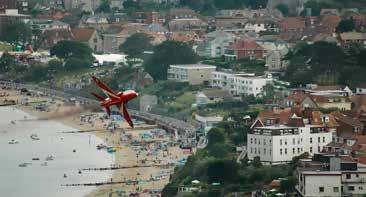
Red Arrows are appearing at Swanage Carnival for the first time since 2017 PHOTOS: Andy Lyons
eight-day carnival is ‘Cirque Du Swanage’ and organisers have promised a fun-filled circus extravaganza, featuring circus acts, street performers, live music and family-friendly entertainment.
Swanage Carnival is entirely volunteer-run and supported by voluntary contributions.
A record-breaking total of
supported local charities and good causes.
The carnival was awarded Bronze in the prestigious Tourism Award for Best Festival/Live Event of 2024.
A carnival organiser added: “Don’t miss out on this unforgettable week of fun, thrills and aerial excellence.
“Mark your calendars, spread the word, get ready for a week of thrills, spills and sky-high excitement, and join








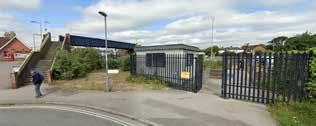
THE future of the ground level pedestrian crossing at Wareham railway station has been secured for the ‘long-term’ following a series of meetings between Network Rail, Dorset Council and local MP Vikki Slade.
It had been feared the crossing would close for safety reasons, but the manually operated gates will now remain in place with Dorset Council picking up the £120,000 cost of staffing.
Network Rail had maintained it would close the crossing for good when an agreement expired in 2038.
It has now proposed a
continuous rolling agreement to be signed with the council to keep it in place.
Councillor Nick Ireland,
Leader of Dorset Council, and Vikki Slade MP for Mid Dorset & North Poole finally secured the agreement with Mark Goodall, Wessex route director for Network Rail, at a meeting last month.
Cllr Ireland said in a joint statement released with Ms Slade and Mr Goodall that the funding will remain in place as long as he leads Dorset Council.
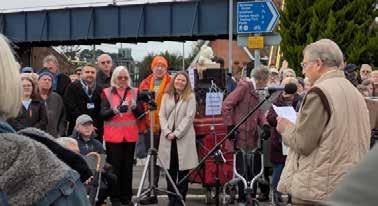
Local people turned out in force to protest against the potential closure of the crossing – as reported in the Purbeck Gazette in February – which they said would ‘split the town in two’.
They said alternatives such as lifts and a ramped bridge would make life difficult for wheelchair users, parents pushing buggies and the elderly and frail living on the north side of town to access healthcare, jobs, shops and schools in the town centre.
Network Rail has maintained
that any unmanned or automatic crossing would contravene its safety obligations and require a total closure if funding for staffing the crossing was removed
The issue dates back to the 1970s when Dorset County Council extinguished the pedestrian right of way over the railway line after it built a road bridge.
Cllr Ireland said: “I am delighted we have been able to secure this agreement with Network Rail – it’s the right decision for Wareham community.
“I’d like to thank Vikki Slade MP for her help in securing this agreement and, of course, the people of Wareham for their perseverance and determination on this matter.”
Vikki Slade said: “Since Cllr Ireland was elected Leader of Dorset Council he has engaged with this issue, attending meetings and shown a commitment to a resolution.
“The original failure of the county council in the 1970s created the uncertainty and I am pleased that he has provided assurance on continued funding, which secures the ground level access into the long term.
“This shows the value and importance of partnership working.”
Mark Goodall, of Network Rail, said: “We know how important this level crossing is to the community in Wareham, and we are pleased to have worked with Vikki Slade MP and Cllr Nick Ireland to find a way forward.
“The safety of people using the crossing has always been our primary concern, and the commitment from Dorset Council to continue funding the staffing costs will ensure that we can maintain the same high level of safety we have today.”
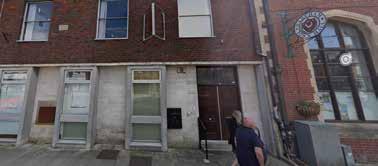
THE old and long disused NatWest bank in North Street, Wareham, could be brought back to life as a cultural hub for locals and visitors, under plans revealed by the town council.
The council has secured an option to buy the site and would like to see it turned into a state-of-the-art museum complex, complete with educational facility, tourist information area and versatile exhibition spaces.
The former bank’s strong rooms would be used to store collections from the museum, ensuring Wareham’s history is preserved for generations to come.
It is hoped the project would revitalise the town centre, attracting more visitors and boosting local shops, cafes and businesses.
The council also plans to refurbish the current home of Wareham Museum next door to create a hireable community space and improved council offices.
This would free up the town hall to host more weddings and special events and help bring further economic benefits to the town.
The town council plans to acquire the building through a public works loan and grants.
It plans to consult with residents over the coming months and hopes they will engage with the process.
A strong show of support would help make the case for securing the necessary funding, it says.
Town clerk, Nicola Gray, said: “This is an exciting moment for Wareham, marking the first step in turning a prominent, empty town centre building into a vibrant centre of culture, learning and tourism while improving the look and feel of the town centre.
“The town council looks forward to hearing from the community and sharing more details as the project progresses.”

Marshall is organising a coffee morning fundraiser for the Alzheimer's Society
The event, which also includes art and craft stalls, is at The Loft upstairs at 17a Commercial Road, opposite Chococo. The event is on Monday, April 7, from 10am-noon.




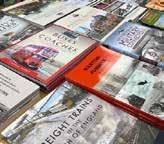
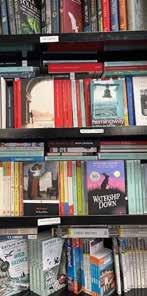

THE 90th anniversary of the death of TE Lawrence is set to be marked in a two-day commemorative event at Wareham Town Museum.
Lawrence is known by the epithet Lawrence of Arabia for his role in the Arab Revolt from 1916-18 against the Ottoman Empire during the First World War.
He died in Wool Military Hospital on Bovington Camp on May 19, 1935, following a motorcycle accident near his home at Clouds Hill.
TE Lawrence continues to intrigue and captivate people today, and the museum holds documents, photographs and artefacts related to him.
“Our Lawrence display is always very popular,” said Paul

Willis, museum manager.
“Many people visit just to see our Lawrence display.
“Lawrence’s life was one full


Lawrence’s life.
On Saturday, May 17, at 12.30pm, short films relating to Lawrence in the Middle East will be screened, along with the Pathe film of his funeral at Moreton.
The museum will also host a series of speakers who will discuss the life and legacy of TE Lawrence.
of excitement and adventure, so I don’t think the interest in him will ever let up.”
The commemorative events on Friday and Saturday, May 16-17, will see authorities on the life and times of Lawrence provide insights through documentaries, films, talks, Q&As and book-signings for visitors of all ages.
The events begin with the documentary Who Killed Lawrence of Arabia on Friday, May 16, at 6.30pm and a question and answer session with the director, Mark JT Griffin.
This awarding-winning feature-length documentary

n 1pm – Archaeology, TE Lawrence and the Arab Revolt in Jordan, 1916-18 with Professor Nicholas Saunders. n 2.30pm – On the Trail of Lawrence in the Old Levant with Philip Neale, vice-chair, TE Lawrence Society.
n 4pm – Filming TE Lawrence with Professor James Chapman. n 6.30pm – Lawrence’s Legacy with Dr Andrew Norman.
All the events will be held in the Town Hall, Corn Exchange, and admission is free and open to all.
Donations would be greatly appreciated, and refreshments will be served throughout the day.


YOUNG Elleigh Smith, from Bovington, has won a place in the grand final of Miss Junior Teen Great Britain 2025 after landing the Miss Junior Teen Dorset 2025 title.
Elleigh, 14, saw off hundreds of teens from across Great Britain to make it to the grand final.
She said: “I am so excited to have made it to the final, it’s a great achievement, as there were so many gorgeous semi-finalists!”
Elleigh has an online platform to raise awareness of mental health issues and anxiety in teenagers and young children, especially those with a military background, as she is a military
No
child herself and understands the issues.
Last year she handed ‘Little Bags of Joy’ to children in the community to spread some joy to those who needed it.
She also handed out her bags to residents in a local care home.
Elleigh has raised money for military charities such as Little Troopers and Scotty’s Little Soldiers, which help support bereaved children and children who have a parent away on tours.
Miss Teen Great Britain will be supporting Together for Short Lives, the UK’s leading charity for children’s palliative care, and Elleigh will take part

in fundraising events throughout the year.
Elleigh also attends ATWP – Athena Theatre Works & Productions – a local dance school where she is a teaching assistant and helps with the younger children.
Her dream is to be a dance teacher and choreographer.
She recently performed at the National Entertainment Awards at the 02 with her dance school.
Next year Elleigh will fly to Las Vegas with ATWP to compete against the USA at the National Entertainment Awards.
The winner of Miss Junior Teen Great Britain, being held at The Globe Theatre in Blackpool on Saturday, October 11, will walk away with prizes including a cash prize, dresses from The Dress Studio and a sparkling sash and crown.
The finalists will stay in the luxurious Boulevard Hotel in Blackpool, enjoy a Beauty Queen Challenge Day and a pyjama diva party at the hotel.
Elleigh added: “Making it to the grand final is a dream come true – fingers crossed I will be able to win the crown!”
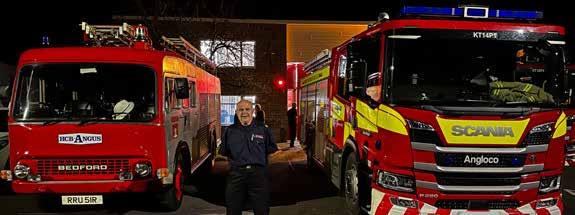
ONE of the longest serving on-call firefighters in Dorset & Wiltshire Fire and Rescue Service will hang up his fire kit for the last time today (March 31) after 41 years.
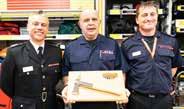
Crew manager, Tom Reid, joined Wareham fire station on December 6, 1983, and is now one of just a handful of on-call firefighters who have given more than 40 years of service to their local community.
He grew up with the fire service, as his dad was a firefighter in Strathclyde in the 1960s – and the family connections continue, as his son Liam is now also on-call at Wareham.
After Tom’s family settled in Wareham in 1977, he started working for the Forestry Commission, a job he held for 43 years before retiring two years ago.
His knowledge of the local area, and of trees, has proved invaluable during fire calls and
rescues – whether from knowing the best routes through local forests, to helping the safe rescue of someone trapped by a tree by knowing the best branches to cut.
Tom has attended many heath fires over the years, the biggest of which was at Wareham Forest in 2020.
He said: “On one hand, working as part of such a big team, all pulling together to extinguish this extraordinary fire, was something very special.
“However, on the other hand,
I was looking at 20 years of my working life literally up in smoke, and that was very difficult.”
The fire did lead to a unique experience at the fire station a few weeks later: “It was during Covid, and we were all out every Thursday evening to clap for the NHS,” Tom said.
“On this one occasion, someone in the crowd then called three cheers for their firefighters – we all had some dust in our eyes at that point!”
Other incidents that Tom will never forget are the merchant vessel EBN Magid fire in January 1986 – the Liberian cargo ship caught fire in the English Channel and was towed into Portland Harbour – and the BDH factory blaze in Poole in June 1988.
His last drill night last Tuesday (March 25) was a celebration of an outstanding career before he formally retires today.
Tom is looking forward to more free time: “I’ve loved every minute of my time in the fire service, and I’ll always be a firefighter at heart,” he said.
“But being on-call does mean you don’t always have the freedom to go for a long walk, or a family lunch, so I’m looking forward to more time with my wife, Dawn, and the rest of the family – I may even finally get my garage sorted into a proper workshop!”
Chief Fire Officer Andy Cole said: “It’s people like Tom, and their dedication to their colleagues and the wider community, that keep the fire and rescue service going.
“Being an on-call firefighter is incredibly rewarding, but it needs a level of commitment that goes beyond the individual into their family life and primary employment.
“My heartfelt thanks therefore go to Tom and everyone who has supported him for 41 years.
“He has been a real inspiration to his colleagues at Wareham and across the wider service, and he will be missed.
“On behalf of Dorset & Wiltshire Fire and Rescue Service, the people of Wareham and the wider communities of Dorset and Wiltshire, I am sending Tom every good wish for a long and happy retirement, with plenty of time to enjoy life – without the interruption of a pager!”
Opportunities exist to become an on-call firefighter at Wareham and other fire stations across Dorset – visit www. dwfire.org.uk/on-callfirefighters for more information.
THE
Composting Shield.
For the second year running there was a tie and the ‘Flower Power’ team won the tie-break question to win the shield. Each member of the team also received a bottle of red wine.
It was obvious that those present enjoyed the evening and Wimborne in Bloom thanks everyone who supported the event.
The funds raised, which will be well over £1,000 makes an excellent contribution to the cost of providing the floral displays in the town for all to enjoy.







THE Friends of Dolphin charity is raising funds for a new boat to take disabled people on trips around Poole Harbour.
The existing Dolphin III boat can take 12 disabled people and their carers –including up to six wheelchairs – around the harbour or up the River Frome to Wareham.
The passengers, all transported free of charge,
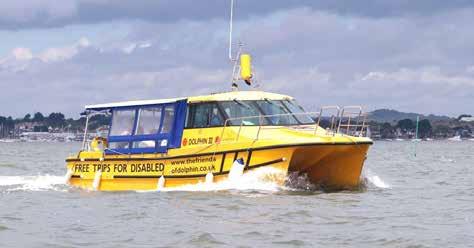
range in age from very young up to 106.
But Dolphin III, a 10-metre catamaran built on the Isle of Wight to the charity’s specifications, is now nearly 20 years old and showing her age.
A trustee of The Friends, Robert Irwin, said: “The trustees took the decision in October 2023 to purchase a new Dolphin, with fundraising
Notice is hereby given that SUTTLE PROJECTS LIMITED, SWANWORTH QUARRY WORTH MATRAVERS SWANAGE, BH19 3LE has applied to the Marine Management Organisation under the Marine and Coastal Access Act 2009, Part 4, for a marine licence to undertake sea wall repairs behind a residential property, including the installation of sheet piles.
Copies of the application and associated information may be viewed on line in the Public Register at www.gov.uk/check-marine-licence- register. Representations in respect of the application should ordinarily be made by:
- Visiting the MMO public register at https://marinelicensing. marinemanagement.org.uk/mmofox5/fox/live/MMO_PUBLIC_REGISTER/ search?area=3 and accessing the `Public Representation? section of case reference MLA/2025/00024; However, we will also accept representations via the following formats:
- By email to marine.consents@marinemanagement.org.uk; or alternatively
- By letter addressed to Marine Management Organisation, Lancaster House, Hampshire Court, Newcastle upon Tyne, NE4 7YH In all cases, correspondence must:
- Be received within 28 days of the date of the first notice 24/03/2025;
- Quote the case reference; and
- include an address to which correspondence relating to the representation or objection may be sent.
The Marine Management Organisation will pass to the applicant a copy of any objection or representation we receive.
over the next two years to raise in the region of £150,000 – this will be match-funded by funds we already have.
“We have put in place an appeal and are looking for any help that could come our way, not only for funds but also in fundraising.”
Dolphin, which operates between May 1 and September 30, has taken roughly 60,000 passengers on trips around
Poole Harbour since it launched in 1980 and was awarded the Queen’s Award for Voluntary Service in 2017.
The Friends of Dolphin hope to have a new Dolphin in place for 2026/27.
To donate to the charity, visit the Charities Aid Foundation website, www. cafonline.org, click on the ‘donate’ tab and search for ‘The Friends of Dolphin’.
A CHILDREN’S author and app creator from Dorchester has been named one of the UK’s most impressive female entrepreneurs.
Jenna Whyman, who created Woogie Big Pants in 2020, has been included in Small Business Britain’s f:Entrepreneur #IAlso100 campaign.
The campaign celebrates the achievements of 100 inspirational female entrepreneurs from across the UK.
Woogie Big Pants is a children’s book series and app providing inclusive, creative and healing tools for children.
It focuses on empowering children through art, music and
dance, offering a unique approach to mental health and emotional wellbeing.
Small Business Britain highlighted Jenna’s work advocating for children’s mental health and wellbeing, and providing workbooks and communication tools to children’s services in Dorset.
“Being featured in the #iAlso100 is an incredible honour that holds deep personal significance to me,” she said.
“I am immensely proud to represent Dorset women in business, showcasing the strength, creativity, and determination that thrives in our community.”
Find out more at woogiebigpants.com.
A REGGAE festival and a popular dance festival near Swanage will not go ahead later this year.
Wolkswood Reggae Festival, known as the Notting Hill Carnival by the sea, is a fourday festival that has taken place in July at Wilkswood Farm in Langton Matravers since 2016.
The popular family-friendly festival had more than 50 acts lined up to perform this year, but the festival announced that this year’s event has been cancelled due to the “current financial position of the company”.
The Jurassic Dance Festival, which was also planned for Wilkswood Farm from July 29

to August 31, has also been cancelled.
Organisers said the company behind both festivals has entered into voluntary liquidation.
“It is with deep regret that we must announce that due to the current financial position of the company, we have made the difficult decision to place the company into creditors’ voluntary liquidation,” their statement reads.
“As a result, the company is unable to proceed with either of the planned festivals, and we must serve formal notice of the cancellation of both events.”
All festival ticket holders have been made aware of the situation and they can claim money back.
“We sincerely apologise for the disappointment and inconvenience this may cause and thank you for your understanding during this challenging time,” they added.



IF someone was to mention a game of croquet, what would be your first thoughts?
For many it would be British upper class families playing the game on their country house lawn while enjoying tea and salmon and cucumber sandwiches.
That is not the way croquet is viewed nowadays.
The people that play the game now are ordinary folk who enjoy a friendly social activity which does not involve strenuous ball play.
It is a game of skill and tactics which can aid wellbeing for the mind as well as the body.
If you feel this is something you would like to try, then why not come along to Wareham Croquet Club.
We play every Tuesday and Thursday – weather permitting – from April to October, play starting around 10am.
The club was founded in



2010 with a grant from a local organisation.
Rod Curtis, the town clerk, managed to find sufficient money to purchase a croquet set for the club to use.
A launch party was held in September 2010 with representatives from the town council and the newly formed Swanage Croquet Club.
The late Dr William Ormerod, a Dorset and England International player, provided coaching to members for the 2011 season.
The club has also received a further grant from the Co-op.
We are a small, friendly and varied group of people who are always happy to chat over a cup of tea, so why not come along – you might surprise yourself at how easy and enjoyable the game can be.
You will find us on Wareham playing fields, just off the Worgret Road, opposite the police station.


Pat Ashdown Secretary, Wareham Croquet Club


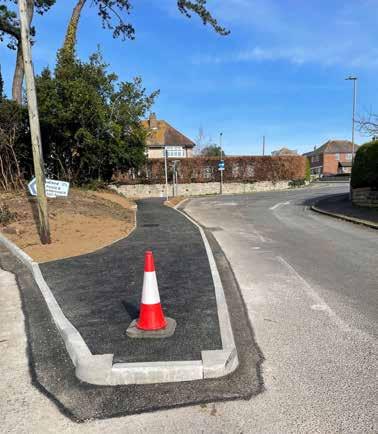




I DON’T think this footpath –above – that juts out into the road in Redcliffe Road, Swanage, is really necessary.
Possibly when we had three shops to visit, it may have been useful, but they are long gone.
The first time I drove up the road I had to swerve to avoid hitting the kerb – this has effectively taken away the traffic lane that goes up to Moor Road.
We now have a bottleneck of one lane and half a lane.
I noticed a traffic cone has been placed as a warning to drivers.
Already I see a scrape on the pavement kerb where a car tyre has caught.
It all seems a dangerous waste of money.
Susan Tomes Via email
PURBECK Youth Music (PYM) is a local charity founded in 2019.
We are all volunteers who work hard to provide musical opportunities for primary age
school children where few currently exist.
PYM and the trustees are hugely grateful for all the financial support we receive from the Purbeck community. From fundraising choirs and bands to local charities, Rotary, PAW and many generous individuals, we have enabled more music making to take place where early opportunities are so important, in our primary schools.
If you have a Co-op loyalty card, you can vote online to support its Community Fund donation to PYM as we have been chosen as one of the beneficiaries.
In order for this to be extended, votes from the community are required. So, please, if you don’t have a card, get one and make your vote count!
For more information about PYM, visit www. purbeckyouthmusic.org.
Dilys Thomas PYM
Something to say? Then email our letters page at ed@purbeck gazette.co.uk
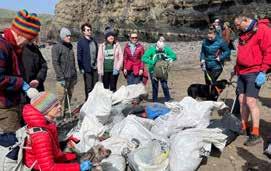
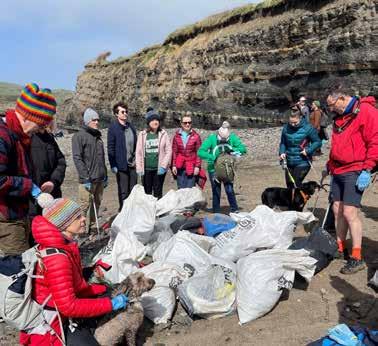
THE Great Dorset Beach Clean, organised by Litter Free Dorset, is back for another year next month with scores of volunteers set to take part.
This year’s event, the 35th, will take place all along the Dorset coast, from Lyme Regis to Poole, during Easter halfterm.
More than 200 volunteers took part in last year’s event at eight beaches, collecting hundreds of kilos of litter, including fishing gear, hard plastics – and even items like brooms and a fridge.
Kim, a long-time beach clean volunteer, said: “Me and mum join the beach clean every year at different locations, and wherever we go, there is always a wonderful sense of community.
“Everyone pulls together to get the job done, and we always have such a laugh at the same time.
“We’ve been going for 10 years now and will be continuing for the next 10 at least!”
Data collected during the beach cleans helps organisations such as the Marine Conservation Society inform government policies aimed at reducing litter and protecting marine environments.
Beach clean dates and venues: Saturday, April 5 –Cogden Beach, Lyme Regis. Sunday, April 6 – West Bexington; Shore Road, Sandbanks; Charmouth; Swanage; Chesil Cove. Monday, April 7 – Hengistbury Head. Wednesday, April 9 – Lake Pier,
Poole. Saturday, April 12 –Durdle Door; Man O’ War Beach; Seatown. Sunday, April 13 – Ringstead; Shell Bay, Studland; Swanage. Anyone who attends an event is asked to tag @litterfreedorset
in their photos and use the hashtag #GDBC35 to spread the word.
The full schedule of beach cleans can be found at www. litterfreedorset.co.uk/greatdorset-beach-clean.
WOULD you like to support rescue animals in need, and ensure they receive the love and care they so desperately deserve?
By making a regular donation to Margaret Green Animal Rescue, you will be helping us to look after many vulnerable animals each year, and provide them with the food, comfort, shelter, veterinary treatment and rehabilitation they may need.
As we receive no Government funding, our charity relies on the incredible generosity of our supporters to make sure we can give our rescue animals the best care possible, while they await their loving forever homes.
To set up a regular donation today, and to join us on this

journey of animal rescue, please visit our website at www.mgar.
org.uk/donate for more information.
Every penny will make such a big difference to our
rescue animals, now and in the future.
If you have any questions or would like to get in touch, please email comms@mgar. org.uk and our friendly team will be delighted to help.



EASTER is here! And aren’t we happy about it?
It feels as though we’ve blinked, and Easter is now upon us! After the cold, wet and windy winter months, and the excitement of our first blooms of daffodils, snowdrops and celandines, spring cannot come soon enough.
We have a whole host of events to keep everyone entertained this Easter break. Running daily from Wednesday, April 2, until Wednesday, April 23, is our Easter ‘Fairy Doors’ activity trail. Follow the trail and explore the woodland and the mystical creatures that might live there – you might just win a prize.
We also have workshops on offer this Easter. On Tuesday, April 8, join artist Mark Page for an Easter Drawing Workshop, to learn skills in sketching Easter bunnies and hares. Then on Saturday, April 19, join Madelaine Devenay
for a workshop discovering the art of drawing in pencil and pen. You could join us on our Wild Durlston and Make a Bug House bookable Ranger-led kids activities.
On top of this, on Wednesday, April 9, and Wednesday, April 16, drop in from 11am-3pm for our free Wild Wednesdays sessions, with crafts, games and activities. For more information on all events and activities, please visit www. durlston.co.uk/events.
In the Fine Foundation Gallery, from Friday, April 4, to Wednesday, April 23, we have an exhibition that helps
COULD Lytchett Minster & Upton be harbouring another Luke Littler in its midst –Littler being the teenage sensation who became World Darts Champion in 2024?
The young people who attend CJ’s Youth Club now have a chance to prove their worth after Mayor, Councillor Ray Griffin, re-visited to hand over a new
dart board, following the town council’s previous donation of a table tennis table and an outdoor football five-a-side goal.
Upton is only one of two towns in Dorset that does not have a local authority funded youth club.
Lytchett Minster & Upton Town Council commissioned research to seek the views of
us celebrate the coming spring. The Birds and Bees exhibition will showcase work by artists Lydia Needle, Angela Knapp and Nina Grown-Lewis, responding to the nature and landscape of Durlston. The exhibition is open daily and free to enter from 10.30am5pm.
On the park, we look forward to brighter days and the first emerging butterflies the warmer weather will bring. Early morning strolls are a great opportunity to soak in the views of the sunrise and its reflections on the sea – have a read of our daily diary blogs online Daily Diary|Durlston Country Park.
A stroll to Tilly Whim Caves on a warm, sunny day can offer a great variety of spring wildlife. While the caves have remained closed since 1976, the location itself offers incredible views of the coast, lighthouse and sea. Reptiles such as common
lizard, slow worm and adder may be seen above the cave entrance basking in the sunshine, and seabirds like fulmars, guillemots and herring gulls can be spotted from the observation points above the breeding ledges in the cliffs.
Why not join a guided walk this month to learn more about what can be seen around the park? On Sunday, April 6, join our Spring has Sprung guided walk or on Monday, April 14, join our Early Spider Orchids and Other Spring Flowers walk, just £3.50 per person, no need to book.
Whatever your reason for visiting this month, we hope you enjoy Durlston in spring as much as we do! All the best from the Durlston Rangers.
For more information on events and more, visit the Durlston website at www. durlston.co.uk. Visit the Seventhwave café website at www.seventhwaverestaurant. co.uk.
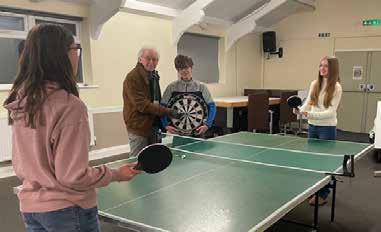
young people in the town to see what it could do for them and with them.
In the meantime, the town
council has stepped into the breach to support the volunteer-run CJ’s, despite its limited resources.
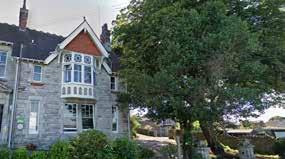
PROTECTED trees in Swanage are set to be felled because of concerns over subsidence – a move that has sparked outrage from some residents.
Dorset Council approved plans last month, submitted by Wye Valley Tree Services, on behalf of Swanage Youth Hostel Association (YHA) in Cluny Crescent, to fell about 36 trees at the hostel.
The site is under a preservation order, which provides protection for trees that are significant to their surroundings.
The move sparked outrage from some residents, who, despite asking YHA for its reasoning for the felling, were

left in the dark.
Purbeck resident Georgina Codd claimed this ‘ecologically destructive decision’ was made under the guise of garden restoration and aesthetics.
The Purbeck Gazette contacted YHA for an explanation at the time, and a spokesperson has now come back to say the decision was made due to subsidence concerns, as a border wall had already collapsed.
“YHA loves trees and we love bats,” they said.
“As an environmentally conscious and sustainable charity, we do not do anything to impact our sites that isn’t necessary to maintain the fabric
and related safety of our accommodation and surrounding land.
“There are parts of the Swanage site that are completely overgrown.
“We have also been informed by structural engineers that the plant growth is beginning to put at risk the youth hostel due to subsidence.
“We have already seen our border wall collapse onto the public footpath adjacent to the site. That is currently fenced off.
“Our plans, which have received planning consent from Dorset Council, are about ensuring the safety, integrity and long-term future of the youth hostel while maintaining a great

The Youth Hostel Association says it is concerned about subsidence
outdoor space for guests and the local community to enjoy.
“We have some wonderful mature trees at Swanage and will be ensuring their long-term future too by tidying up the area.
“An independent bat survey was completed last week. We will be complying with all of the recommendations, including a tree-climbing bat surveyor, who will [be] on site to inspect any necessary bat related areas.”
Subsidence however was not included as a reason for the felling of the trees in the planning documents.
Swanage Town Council raised no objections to the plans but stated its concerns about the extent of felling.
8:15am - 11:30am


THE Double Act Drama Group has presented £1,000 to Pancreatic Cancer UK in a tribute to two talented local people.
Maryrose Bray, of Corfe Castle, helped set up a drama group many years ago, which is still thriving today as Double Act.
Maryrose was involved on-stage and backstage in many roles and capacities and attended shows until she was almost 100 years old.
Sadly, last year she was
diagnosed with pancreatic cancer, and passed away in the autumn at the age of 101.
Gerald Ward, another friend of Double Act, died last October, also from pancreatic cancer.
He was well known in Purbeck as half of Ball & Socket and provided keyboard accompaniment for Double Act’s production of Dame Agatha’s Greatest Case in 2009.
The drama group dedicated the leaving collection at the
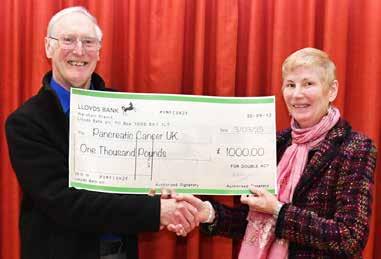
November 2025 production of This Secret Isle to Pancreatic Cancer UK, topping up the sum raised with proceeds from the raffle to total £1,000.
The money was presented at
Double Act’s annual meeting to Heather Penton, who helped and cared for Maryrose for many years, and accepted the donation on behalf of the charity and Maryrose’s family.
by Trish Hook
YOGA, kick-boxing, Mad Melodies, fitness and board games are all taking place as usual during April, and our coffee and cake morning is on Thursday, April 10, from 10am-noon. I am pleased to say that the Guerilla Gardeners are joining us from time to time at the coffee morning to make poppies for display throughout Wool and East Burton for this year’s celebrations. You are very welcome to come along to learn how to crochet or knit poppies and, of course, just for a natter and some friendly banter!
East Burton Gardening Club is on Thursday, April 24, and
the talk will be by photographer David Boag, ‘In Praise of Plants’. I am sure this will be an entertaining and interesting session, so come and join us. We start at 7.30pm, have a tea and coffee break, and a raffle.
Remember, the hall can be hired for private/personal events or, if you wish to start a class – maybe tai chi, karate, art, drama, dancing or book club – get in touch on 01929 288020 or visit our website, ebvh.org.uk. The accommodation is very flexible, as the whole hall can be hired, or we can divide it in half – with a kitchen for each half – and there is a smaller meeting room.
For any information about these events, hire rates, availability, booking and so on, do not hesitate to get in contact.
The D’Urberville Players are currently rehearsing for their next show and would dearly love to swell the company’s numbers. If you think you could help, not necessarily by acting, but in many other ways, such as scenery preparation, behind the scenes administration and so on, please get in touch. If you think you can help a friendly AmDram society continue this important activity for the local community, please contact it via its Facebook page or email me, Trish Hook, at patricia.
hook125@gmail.com. Other exciting news I wouldlike to tell you about is that Wool Community Library is running a Lego club for young people aged five upwards on Tuesday, April 15, from 3- 4.30pm. Lego will be provided and lots of opportunities be on offer to make your own models, as well as a special challenge with prizes. The club will be held in the Osgood Room at the D’Urberville Centre. Register your interest by emailing info@woolcommunitylibrary. org or pop into the library and speak to a volunteer. The event promises to be lots of fun and I, for one, will definitely be joining in!
Could you be a friend to the isolated?

VOLUNTEER Centre Dorset is looking for individuals to sign up to be community response volunteers as part of a befriending campaign.
The centre says that one in five households in Dorset is vulnerable to loneliness and
isolation, and that for some people volunteers provide the only human contact they have all week.
Volunteers do not have to make a minimum time
commitment – they are simply included in an email if someone
in their area requires help. If the volunteer is available and happy to help, they respond. To find out more, visit www. volunteeringdorset.org.uk and search Opportunities for the Community Response Volunteers.
TWO ewes, two lambs and two unborn lambs have been killed in a dog attack in West Lulworth.
Dorset Police Rural Crime Team said the injuries were consistent with those caused by a dog(s)
A spokesperson said: “This brutal attack caused horrific injuries to the animals and unnecessary suffering.
“A ewe that was pregnant with twins and a lamb were killed as a direct result of the attack.
“A further ewe and lamb had to then be euthanised due to the severity of their injuries.
“This attack was not only traumatic for the animals involved, but also the shepherd that found the animals.
“It is also possible the remaining ewes may have been affected by this and could go on to miscarry over the coming weeks.”
The attack happened on Sunday, March 9, between 3pm and 4pm and police are appealing for witnesses to come forward.
Anyone with information is asked to call 101 using reference number 55250033881 or to make a report on the Dorset Police website.


A Living Trust, is a legal arrangement that allows you to protect your assets, including your home, from care costs along with potential inheritance tax implications. Here are a few key points to consider:
1. Asset Protection: By transferring ownership of your home and other assets to a living trust, can help protect them from certain creditors and potential claims, including care costs.
2. Care Costs: Placing your main home into a living trust can ring fence the property from any potential future care costs. Thus, protecting your inheritance
3. Inheritance Tax Planning: A living trust can be part of an estate planning strategy to minimize inheritance tax liability. By placing assets into a trust, they can be excluded from your taxable estate upon your passing, potentially reducing the amount of inheritance tax your beneficiaries would owe.
4. Reversable Nature:
One of the advantages of a living trust is that it is reversable, meaning you can make changes to the trust or remove your home from the trust during your lifetime. This flexibility allows you to adapt to changing circumstances or wishes.
5. Trust Administration: When you establish a living trust, you typically designate yourself as the trustee alongside one to three other trustees. Thus, maintaining control over the assets and allowing you to continue using and managing them as you did before. Surviving trustees take over the administration of the trust upon your incapacity or death. The effectiveness of a living trust in achieving your specific goals will depend on your individual circumstances. Oakwood Wills offer a free consultation in the privacy of our own home. Tel 07832 331594 email: info@oakwoodwills. co.uk

NURSERY children at Tops Wareham enjoyed a visit from Councillor Ryan Holloway on World Book Day.
Cllr Holloway, who represents Wareham on Dorset Council, read to youngsters aged two to three in the Investigators room.
He chatted with staff over refreshments and asked about the extent to which parents were accessing services offered by the Family Hub, which opened in Wareham last year.
Nursery occupancy and funding changes were also discussed, following a large increase in demand with the introduction of funding for ninemonth-olds.
Nursery manager, Danielle Hewitt, said: “It was fantastic to
welcome Cllr Holloway to our nursery, especially on such a fun occasion like World Book Day.
“The children loved having a special guest read to them, and it was great to have meaningful conversations about the challenges and opportunities in early years education.

“We’re excited to continue working with local leaders to ensure the best outcomes for our children and families.”
Cllr Holloway said: “It’s always a pleasure and privilege to return to Tops for World Book Day.
“I thoroughly enjoy reading stories with the children, as
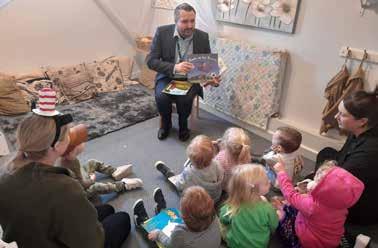
early reading is incredibly important for their development and transition into mainstream education.
“It was great to see Danielle, the nursery manager, again and to speak with the wonderful staff at Tops Wareham.
“I appreciate them taking the time to give me a tour and share their views and experiences.
“I’m pleased to see the nursery thriving and full of happiness.
“However, with the new Employer’s National Insurance tax changes coming into effect in April 2025, I understand from the managing director of Tops that this could significantly increase costs and potentially impact vacancies across the Tops group.
“This is a concern, and I will be raising these issues with Dorset Council and our MPs.
“I look forward to returning later this year and visiting the nursery again this summer.”
VILLAGERS in Church Knowle are being urged to take part in a housing survey being launched this week.
Pippa Edwards, from the Church Knowle Neighbourhood Plan Steering Committee, says the main aim is to establish if there is a genuine need and support for affordable housing.
The survey aims to give local people a say on what they think should or should not be built, for whom, and where and what it should look like.

TIM Balmer, of Lydlinch, took this photo of a white-tailed eagle, one of three he recently saw in Poole Harbour.
He said: “Following their reintroduction to the Isle of Wight in 2019 they are now a regular sight in and around Poole Harbour and the surrounding area – with the occasional foray into the Blackmore Vale.”
The survey goes live on Wednesday, April 2, and will be open until April 30. Leaflets with a QR code will be delivered to households and other stakeholders to enable access to it – printed versions will also be available.
DORSET Chamber Choir has announced details of its Passiontide Concert at Broadstone United Reformed Church.
It will be singing The Passion of Our Lord, According to St Mark, set to music written in 1920 by Charles Wood, well known composer of Anglican church music.
The concert will also include devotional readings.
The choir’s musical director, John Watkins, will conduct and well-known local musician
Chris Dowie will provide the organ accompaniment.
The main solo parts, the Evangelist and Christ, will be sung by two talented young local singers.
The concert is on Monday, April 14, at 7.30pm at the church in Higher Blandford Road (BH18 9AB).
Tickets are £10, free for students and children.
They can be ordered through the choir’s website at www. dorsetchamber choir.com and are also available from choir members or at the door.
The choir would like to thank Stephen Feltham and Chorali Fiscus for their support and sponsorship.
RegisteredCharityNo.1120193 Size:Week:
Drop off your donation at your local shop:
Ashley Cross, Christchurch, Ferndown, Highcliffe, Poole High Street, Ringwood, Swanage, Westbourne, Wimborne, Winton
Or book your collection with the QR code:
Lewis-Manning Hospice Care

MEMBERS of the audience for Wessex Musical Theatre’s sell-out performances of Sister Act at The Hardye Theatre in Dorchester last year raised hundreds of pounds for a good cause.
The theatre group has now presented a cheque for £1,032.60 to Gully’s Place Trust
Fund, which supports children receiving palliative care across Dorset.
A spokesperson for Gully’s Place said: “Take a bow, Wessex Musical Theatre, because that Sister Act performance was show-stopping, raising a brilliant amount for Gully’s Place!
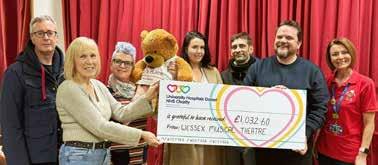
“Thanks to your talent, dedication and dazzling energy, you’ve helped bring joy, comfort and hope to the children and families supported by Gully’s.
“Bravo, encore and a standing ovation of gratitude from all of us!”
The Gully’s Place Suites at Dorset County Hospital and
Poole Hospital provide children with a life-limiting illness and their families with a supportive environment.
Wessex Musical Theatre is performing Oliver! at Weymouth Pavilion, from May 28-31.
Tickets are available from the box office on 01305 783225.
by retired Dorset rights of way officer Chris Slade START at the church, which is worth a visit and has some lovely stained glass. Then walk east along the road down to a junction where you turn left, north east, along the B3070 leading uphill. For most of the way it has a pavement/footpath on the right hand side behind a hedge.
After passing Lulworth
WEYMOUTH and Kingston Maurward College student
Katie Burgoine has been awarded a Cornish Mutual Young Farmer Further Education Bursary.
Despite not coming from an agricultural background, Katie is determined to build a career in the industry. She has received a bursary of £500 to support costs related to her Level 3
Camp with tanks at the entrance you come to a junction at Burngate where you turn left and head west for a mile and a half along the byway to Daggers Gate. It’s a long hill, up and down, with some good views in places.
At the road at Daggers Gate turn left, south, passing the entrance to a holiday camp.
The public footpath goes down some steps then, after a right
and a left, makes its way south, downhill, then up through some woodland to a meeting of ways. Head south east uphill, along a path to Hambury Tout. It’s worth climbing to the top of the Tout to take photos of the land and seascape all around. It’s Access Land so you are allowed to wander.
Make your way downhill to join the Coast Path with cobbles and steps taking you

Agriculture T-Level in Livestock Production at the Kingston Maurward campus, with the judges commending her commitment to entering the industry.
Katie developed an interest in farming after working as a veterinary care assistant and raising her own chicks. Katie said: “The idea of working hard
Katie Burgoine has received a further education bursary of £500 from Cornish Mutual
no matter the day or weather is so exhilarating to me. I love the fact that each day brings new and different tasks and challenges to face, and you never know what will happen.
“I plan to use the bursary to fund driving lessons so I can travel to local farms for work experience. I’d like to also gain either my AI or foot trimming
steeply downhill to a car park where you will find signs steering you towards Stair Hole, after visiting which, join the western entrance to Lulworth Cove. Depending on the state of the tide, you might be able to walk along the beach.
Then join the village street, the B3070, and make your way back to where you started, having walked about 5 ½ miles.
ticket which could make me more employable and expand my horizons further.”
Kate Barfoot, course manager (Agriculture) at Weymouth and Kingston Maurward College, said: “The bursaries are incredibly important for our students, allowing them to demonstrate their skills and talents. The opportunities it can fund, such as extra training, can help them develop their career and make them more employable.”
Applicants for the Further Education bursaries were asked to explain ‘Why I am studying agriculture’ with entries judged by a panel including Cornish Mutual chief executive officer Peter Beaumont.
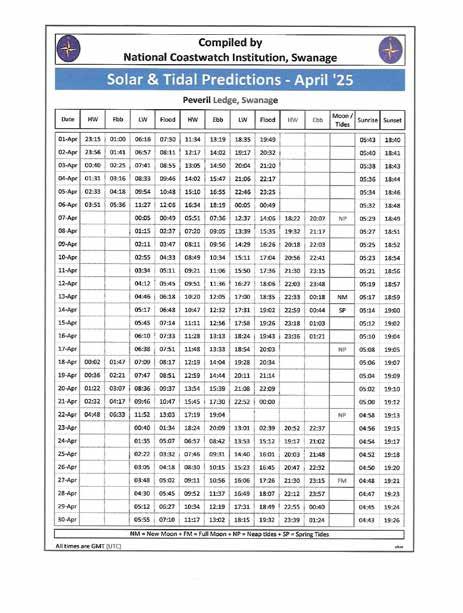
GOOD morning, Portland Coastguard, this is the NCI Station at Peveril Point, Swanage. We will be on watch until 1700 this evening. Do you want our weather observations?”
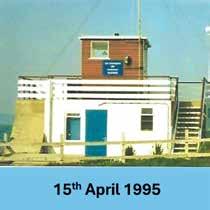
On Saturday, April 15, 1995, those words were spoken for the first time and the National Coastwatch Institute station at Peveril Point came into being. It is with tremendous pride that this year sees Swanage NCI – as we are now known – celebrating 30 years of being part of the NCI ‘Eyes Along the Coast’. During that time, we have kept a daylight watch for 364 days a year – as we are all volunteers, we allow ourselves Christmas Day off! An even more impressive way of thinking about it is when you consider we’ve kept watch for about 90,000 hours. Over the past 30 years we have logged somewhere in the region of 480,000 vessels; assisted with and instigated responses to numerous incidents; been instrumental in saving lives; and, sadly, been involved in one situation where the outcome wasn’t so positive.
The Swanage station can trace its history back to at least the 1870s when the lookout became manned by the HM Coastguard. This presence was maintained until the early 1990s when cutbacks and reorganisation led to the closure of Coastguard stations around the country. Perhaps as a measure of its importance, Peveril Point was the last station to be closed, ceasing operations in September 1994.
Luckily for us, the fledging Coastwatch organisation was just about to be formed. It grew
by Nick Reed
out of the formation of the Sea Safety Group led by a marine pilot, Captain Tony Starling Lark. It’s said that the idea for Coastwatch came to him during a particularly dangerous transfer to a vessel off the Devon coast. When he remarked: “Well, if the worst happens and I fall into the rough stuff, at least the lookout at Berry Head will see me.” He was chastened by the reply: “Oh no they won’t, the lookout’s closed, There’s no one up there!”. Further impetus came after a small fishing vessel sank in view of the unmanned coastguard station on the Lizard, sadly with the loss of two young fishermen, Tony Culmer and Peter Williams.
In October 1994

that later in the year!
We inherited a lookout that had been built in the early 1960s and it soon began to show serious signs of wear and tear. By day Ian Surface was a builder and, under his supervision, the new improved lookout was built. The fact that the designer, himself a watchkeeper, had spent time in the RAF may have something to do with the fact that the current lookout is reminiscent of an airfield control tower! The new lookout was completed in June 2001 and is the one we currently use.
WCaptain Starling Lark and a colleague, Peter Rayment, organised a public meeting on the Lizard to look at what could be done to avoid similar tragedies. Things moved quickly and in early December 1994, the first Coastwatch station opened at Bass Point.
Shortly after the Cornwall meeting, Tony Starling-Lark was invited to Swanage to
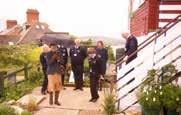
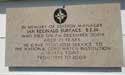
explore re-opening the recently closed lookout. Instrumental in this meeting was the late Ian Surface BEM, also the officer in charge of the Auxiliary Coastguard team in Swanage. Ian quickly gathered a team of volunteers, including members of his auxiliary team, and the second NCI station in the country was opened. It was fitting that Ian became the first station manager. The town council, which has always been very supportive of us, agreed to allow the new organisation to operate from the old Coastguard Lookout, at a peppercorn rent of £1 a year. From those early beginnings we now have more than 70 watchkeepers. Re-opening lookouts began to gather steam across the country, and later in 1994, the station at St Alban’s Head re-opened – but more of
E’VE had several notable highlights during the last 30 years. In 2012 we were awarded the Queen’s Award for Voluntary Service (QAVS). The QAVS is awarded to voluntary groups for their contribution to their communities and is often referred to as the MBE for groups! In 2021 we were privileged to be visited by the Institution’s patron, Princess Anne, and in 2024 we received the High Sheriff’s Award, which recognised our contribution to improving safety and lives in Dorset.
As part of our anniversary year, we’d like to build an archive about the history of the lookout and Peveril Point, in general. If anyone has any photos of the point, or any thoughts, recollections or anecdotes about the point, please get in touch with us.
An ideal time to find out more about the stations and to wish us ‘happy birthday’ will be the Easter weekend. Both stations will be offering their usual refreshments over this period. The ‘Hatch’ at St Alban’s Head will be open during the day – 10.30am-4pm – between Good Friday and Easter Monday, while tea and cakes will be served up at the Swanage Lookout on Easter Sunday and Monday.
This is Swanage NCI and St Albans Head NCI looking forward to the next 30 years. NCI out.


Across
1 Lousy unction spilt without interruption (12)
Place 1 to 9 once into every black-bordered 3x3 area as well as each of the 54 rows indicated by the coloured lines. Rows don’t cross the thick black lines.
8 A line backing strange revolutionary wall decoration (5)
9 Red coat tailored in ornamental style (3,4)
10 Old musical instrument, we hear, in sack (4)
11 Miles tramped around island in France making one weaker (8)
14 Comedian with hard rather than large dairy food (6)
15 Some beast at icecap is not moving (6)
Killer Sudoku Pro
17 Hearing about universal religious books in turn in lesson (8)
Down
1 Manic co-pilot stirred up difficulty (12)
2 Most limited pointer found in comfortable residence (9)
3 Move along furtively with sun out in lounge
4 Upper-class fur of practical value? (6)
5 Tamil scrambling aboard pick-up truck is last (8)
6 General in Liege at regular intervals (3)
7 Role narcotic plays – characteristic of some prisons? (12)
12 Genuine critic’s caught out in work around North (9)
18 Small car popular in Michigan (4)
20 Manage deliveries with letter (7)
22 Large ox is working behind entrance to barn (5)
23 Typical rich criminal defending ring – feigning truth? (12)
Place numbers 1 to 9 once each into every row, column and bold-lined 3x3 box. No digit may be repeated in any dash-lined cage, and all the digits in any cage must add up to the value shown in that cage.
13 Urge among English in this way to get coffee (8)
16 Concern about to be resurrected in occupation (6)
19 Short account of a late party? (4)
21 See material held by creative lyricist (3)
(12)
Most limited pointer found in comfortable
(9)
Move along furtively with sun out in lounge (4)
Upper-class fur of practical value? (6) 5 Tamil scrambling aboard pick-up truck is last (8)
6 General in Liege at regular intervals (3) 7 Role narcotic plays – characteristic of some prisons? (12)
12 Genuine critic’s caught out in work around North (9) 13 Urge among English in this way to get coffee (8)
16 Concern about to be resurrected in occupation (6) 19 Short account of a late party? (4)
See material held by creative lyricist (3)
FORGIVE me if I don’t respond in kind to Labour’s last column – Purbeck Gazette, March 17 – which praised and lionised one MP while denouncing and belittling his predecessor. MPs are big enough to look after themselves and shouldn’t need a cheerleader to tell everyone how good they are and how dreadful the other guy was. In fact, it wouldn’t require a Socrates to make the case for another, similarly unedifying, personal comparison, but this time the other way round. At the local level in particular, this is the kind of negative party politics that turns people away and gets us nowhere.
One small point in relation to climate change and the UK’s pursuit of carbon neutrality: Even on the most hyperoptimistic forecasts of when this might be achieved, it’s obvious to every realist that this country
– unfortunately but unavoidably, and particularly in view of unchecked population growth – is going to remain dependent to a significant degree on fossil fuels for quite a number of years yet. In that case it seems to me to border on madness to buy-in from abroad, at exorbitant cost, the necessary oil, gas and coal which is already under our feet. (The unprecedented cost of comparatively tiny amounts of imported coal is even threatening the existence of heritage railways). By all means let’s get shot of the need for all but minimal, offset supplies of these fuels as soon as possible, but in the meantime, we should surely not be rendering ourselves dependent on others –not always friendly – for resources we can supply at home – and without the carbon
deficit of importation.
Now that we understand rather more of the Government’s ‘devolution’ plans, I shed no tears for Dorset Council’s failure to persuade Whitehall to include a proposed Somerset, Wiltshire and Dorset council –all under an overseeing, compulsory, executive mayor – in a first tranche of reorganised English local authorities.

‘Local’ would such a council hardly be, with Dorset as the smallest component, unlikely to supply the mayor, subject to an additional layer of bureaucracy in the shape of the mayor’s office, and much more likely to lose powers upward than gain them downward. In the words of Ral Donner of the pre-Beatles era: “You don’t know what you’ve got until you lose it”. Few people cared much
about our district councils, but they were close to residents and the ‘unitary’ Dorset Council struggles to match the former efficiency of district services. Reorganisation of the kind intended represents another big step away from residents, but as things stand it will still come, in the second tranche of new authorities or later. The only beneficiary – unsurprisingly enough – will be the government, since the command and control mechanism will be much easier through a single point of authority, the mayor. If the Government was genuinely interested in real devolution –handing down powers to the lowest practical level – it would implement it under the existing structure of local government. The big loser is local democracy.
CLLR BILL
TRITE
Conservative –Dorset Council and Swanage Town Council
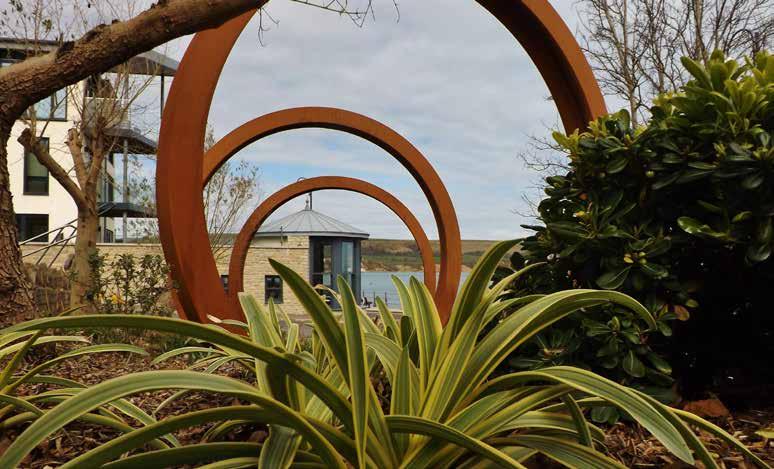
WAREHAM level crossing has been an issue for over 50 years, all because Dorset County Council back in the 1970s managed to extinguish the pedestrian right of way over the railway line at Wareham station after it had built the new road bridge – which incidentally doesn’t have any pavement so is also unusable by pedestrians.
Successive iterations of the county council kept the ground level access open via an agreement with Network Rail, and in recent times have had to pay for an attended crossing which is controlled manually.
In the meantime, the end date of the agreement (2038) was coming ever nearer, at which point Network Rail had indicated it would close the crossing for good. Faced with the prospect of closure, several attempts were made by the council, under Network Rail’s aegis, to obtain planning
permission to alter the existing bridge via ramps at an eyewatering cost to the taxpayer and in flagrant disregard to the views of Wareham residents, who quite rightly pointed out the existing ground level access worked well and didn’t need changing!
Following the local government elections last year, Dorset Council is controlled by the Liberal Democrats and as Leader, I took the decision to scrap the latest plans for the bridge and commit to maintaining the ground level route.
With the help of Vikki Slade MP, local Lib Dem councillors Beryl Ezzard and Ryan Holloway, plus the amazing support of Wareham residents, Network Rail has agreed to continue with the existing crossing arrangements and remove the 2038 closure date so that step-free, accessible access
will remain for the foreseeable future.
On other transport-related matters, Purbeck residents will be acutely aware of the proposed changes to the operation of the Studland chain ferry. SE Purbeck Lib Dem Dorset Councillor Ben Wilson and Dorset Council officers attended the public hearing late last year to give evidence against the changes and the final decision will be known soon.
One of the attractions of Dorset to many is that there is no motorway, although for some that might be a frustration! The reality is that there never will be one – the cost, both financially and ecologically, would be huge and the hegemony of the car is on the wane.
Dorset Council is responsible for most of the roads in its area, notably excluding the East/West
A31/35 corridor from Ringwood to the Devon border. With the current state of local government funding, maintaining our roads is a challenge and the income we receive from car parking goes towards that budget.
The previous Dorset Council administration hiked up the charges significantly three years ago and introduced a three-tier system whereby some of our residents pay considerably more to park in their local car parks than others. Dorset Council has started a parking review which will examine all of its parking provision and look at equitability, dual tariffs and so on, so please keep your eye out for the public consultation phase and contribute to ensure your views help shape the final outcome.
Liberal
Democrat Leader of Dorset Council
WILD beavers are back in Purbeck! Following years of campaigning by the National Trust, Planet Purbeck and countless local campaigners, wild beavers have finally been reintroduced in our back yard. It has been a privilege to join these groups’ and individuals’ efforts in recent months and lend my support to their fantastic campaign.
Wild beavers were hunted to extinction centuries ago, so their recent release was truly a historic moment. Dorset’s wild beavers are part of the first ever licensed release of beavers in England – representing a significant step forward to restore nature and support stronger biodiversity in our countryside. And the release of beavers is yet another boost for ‘green tourism’ here in Dorset. Unfortunately, the previous Conservative Government flip-flopped and dithered on this local issue – with little progress
made. The new Labour Government is fully supportive of the managed release of wild beavers, getting this project over the line in just a few months.
Beavers are often referred to as nature’s engineers, and for good reason. Their instinctive dam-building creates wetland habitats that support countless other species. These wetlands act as natural water regulators, which reduces the risk of flooding and helps maintain water supplies during droughts. They also improve water quality by filtering out pollutants, ensuring cleaner rivers and streams for wildlife and people alike.
The National Trust’s careful preparation and engagement with local landowners, conservation groups and the wider community has been key to making this local reintroduction a success so far. The release site – within the
Purbeck Heaths Super National Nature Reserve – offers an ideal habitat for the beavers to thrive. With its fresh water, dense willow woodland and rich biodiversity, it is a welcoming home for beavers. There will always be challenges when reintroducing species, but through careful management and collaboration we can ensure that beavers bring more benefits than conflicts. The Wild Purbeck partnership has developed a detailed management plan to address any potential issues proactively. This collaborative approach is vital to the long-term success of the project.
It is exciting to see our community step forward as pioneers – leading the way with rebuilding nature and conservation efforts. South Dorset is blessed with diverse wildlife, and projects such as this help to build a healthier environment for future
generations.
On a more personal note, I have been making the most of the improving weather by visiting the Swanage Bay Sauna and taking a dip in the sea, and I thoroughly enjoyed the experience! If you have a quiet Sunday morning, then do take the opportunity to make the most of this fantastic new business on our beautiful beach.
As always, I am keen to hear from you about the issues that matter most. My regular advice surgeries provide an opportunity to discuss local concerns, and you can find details for upcoming surgeries on my website and Facebook page. Whether it’s regarding conservation, local services or any other issue impacting our community, I am here to listen and make sure that your priorities are my priorities.
LLOYD HATTON
for South Dorset
by AJ Selby
“To stand at the edge of the sea, to sense the ebb and flow of the tides, to feel the breath of a mist moving over a great salt marsh” – Rachel Carson
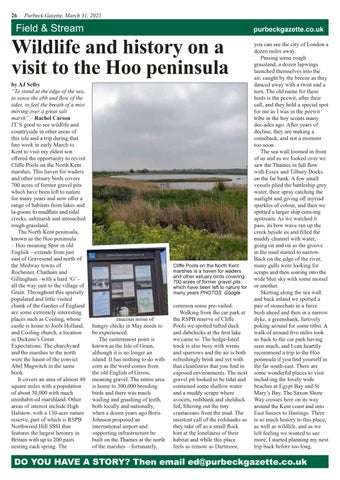
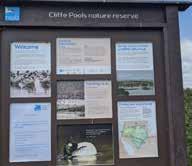
IT’S good to see wildlife and countryside in other areas of this isle and a trip during that fine week in early March to Kent to visit my eldest son offered the opportunity to revisit Cliffe Pools on the North Kent marshes. This haven for waders and other estuary birds covers 700 acres of former gravel pits which have been left to nature for many years and now offer a range of habitats from lakes and la-goons to mudflats and tidal creeks, saltmarsh and untouched rough grassland.
The North Kent peninsula, known as the Hoo peninsula – Hoo meaning Spur in old English – extends from just east of Gravesend and north of the Medway towns of Rochester, Chatham and Gillingham –with a hard ‘G’ –all the way east to the village of Grain. Throughout this sparsely populated and little visited chunk of the Garden of England are some extremely interesting places such as Cooling, whose castle is home to Jools Holland, and Cooling church, a location in Dickens’s Great Expectations. The churchyard and the marshes to the north were the haunt of the convict Abel Magwitch in the same book.
It covers an area of almost 40 square miles with a population of about 30,000 with much uninhabit-ed marshland. Other areas of interest include High Halstow, with a 130-acre nature reserve, part of which is RSPB Northwood Hill SSSI that features the largest heronry in Britain with up to 200 pairs nesting each spring. The

raucous noise of hungry chicks in May needs to be experienced.
The easternmost point is known as the Isle of Grain, although it is no longer an island. It has nothing to do with corn as the word comes from the old English of Greon, meaning gravel. The entire area is home to 300,000 breeding birds and there was much wailing and gnashing of teeth, both locally and nationally, when a dozen years ago Boris Johnson proposed an international airport and supporting infrastructure be built on the Thames at the north of the marshes – fortunately,
you can see the city of London a dozen miles away.
Passing some rough grassland, a dozen lapwings launched themselves into the air, caught by the breeze as they danced away with a twist and a turn. The old name for these birds is the peewit, after their call, and they hold a special spot for me as I was in the peewit tribe in the boy scouts many dec-ades ago. After years of decline, they are making a comeback, and not a moment too soon.
The sea wall loomed in front of us and as we looked over we saw the Thames in full flow with Essex and Tilbury Docks on the far bank. A few small vessels plied the battleship grey water, their spray catching the sunlight and giving off myriad sparkles of colour, and then we spotted a larger ship com-ing upstream. As we watched it pass, its bow wave ran up the creek beside us and filled the muddy channel with water, going on and on as the groove in the mud started to narrow. Back on the edge of the river, many gulls were looking for scraps and then soaring into the wide blue sky with some morsel or another.
common sense pre-vailed. Walking from the car park at the RSPB reserve of Cliffe Pools we spotted tufted duck and dabchicks at the first lake we came to. The hedge-lined track is also busy with wrens and sparrows and the air is both refreshingly brisk and yet with that cleanliness that you find in exposed environments. The next gravel pit looked to be tidal and contained some shallow water and a muddy scrape where avocets, redshank and shelduck fed, filtering out the tiny crustaceans from the mud. The insistent call of the redshanks as they take off as a small flock hint at the loneliness of their habitat and while this place feels as remote as Dartmoor,
Skirting along the sea wall and back inland we spotted a pair of stonechats in a furze bush ahead and then in a narrow dyke, a greenshank, furtively poking around for some titbit. A walk of around five miles took us back to the car park having seen much, and I can heartily recommend a trip to the Hoo peninsula if you find yourself in the far south-east. There are some wonderful places to visit includ-ing the lovely wide beaches at Egypt Bay and St Mary’s Bay. The Saxon Shore Way crosses here on its way around the Kent coast and into East Sussex to Hastings. There is so much history to this place, as well as wildlife, and as we left feeling we wanted to see more, I started planning my next trip back before too long.
AN iconic image of Dorset –one which has even graced millions of television screens in iconic comedy classic Only Fools and Horses – is of traditional fingerposts.
The signs have been guiding carts, cars and walkers for centuries, their white or occasionally red metal roundel or finials becoming a familiar sight.
To ensure their continued presence on the landscape, in 2017 Dorset CPRE launched a grant scheme for their restoration and maintenance.
Eight years on, the charity has paid out more than £22,000 towards the restoration of 160 traditional fingerposts, helping save the treasures from extinction.
Fingerposts are a legacy of the early road system. In 1773, the General Turnpike Act made it mandatory for trustees to put up signs informing the traveller of the distance to the closest town.
Of the 1,300 or so fingerposts thought to exist in the 1950s, just 717 survive today.
Many were lost in the Second World War as they were removed in 1940 to deny guidance to an invading army and were not replaced.
Others have been repaired using non-traditional materials or lettering, and many are in
need of attention.
The local authority no longer has a remit to repair them, and both the Dorset National Landscape – formerly Dorset Area of Outstanding Natural Beauty – and Dorset CPRE are keen to support local fingerpost champions to save the signs from extinction and restore them to their former glory.
Roger Bond – Dorset Fingerpost Restorers –coordinates the Dorset National Landscape Fingerpost restoration project, working from his home workshop, repairing and restoring characters on new oak ‘fingers’, while Coles Castings provides new stock – cast lettering and roundels – ready for fettling and painting.
around the county.
The experience gained is now collated in his new website to help others restore their village fingerposts and can be viewed at www. dorsetfingerpostrestorers.co.uk.
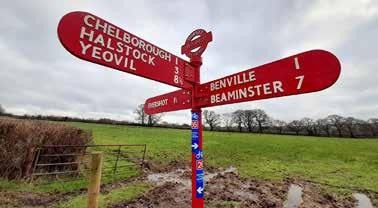
Among those Roger has managed and supported are the full reinstatement of all four of Dorset’s ‘Red Posts’, including at Horsey Knapp, near Evershot.
Roger first became involved in fingerpost restoration projects 10 years ago, when he stepped in to assist with the repair of a bracket on the Green Hill Junction fingerpost at Sutton Poyntz.
Since then, he has been engaged in restoring more than 200 traditional fingerposts
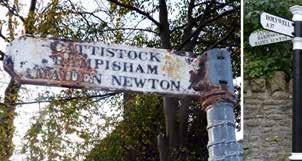
The post had been badly damaged a couple of times and a new location opposite, away from traffic, was provided by a farmer, while Highways agreed a new site and provided a new post. New oak fingers and alloy lettering were prepared and fitted by volunteer, Nigel Clarke, who also fitted the fully refurbished bracket assembly and roundel.
Roger said: “This distinctive fingerpost, one of four we have restored in Dorset, is now looking good and in a safer position. Thanks to Dorset National Landscape for the new oak and a grant from Dorset CPRE.”
“Dorset has only a few surviving fully cast-iron fingerposts, so we were pleased to have fully restored this post in the centre of Evershot village,” he added.
“After several visits and much surface preparation and painting, a missing finger was
located and a new cast finger to Holywell was fitted – made by Coles Castings foundry in Melbury Abbas.”
Neil Matthews, chair of Dorset CPRE, said: “These distinctive signposts which show, not only distances and directions, but also the grid reference of the junctions concerned, are a real boon to walkers and drivers in the county.
“I am pleased that Dorset CPRE are able to support this scheme which enhances the character and uniqueness of the Dorset countryside.”
Dorset CPRE offers a small grant scheme, up to £200 a post, for people wanting to restore fingerposts using the correct materials as set out by the Dorset National Landscape.
Match funding is not required and there is no application form, but the charity asks that requests come from a parish council representative or similar, with a summary of the fingerposts that need repairing, their location and estimated costs.
For more information, contact Dorset CPRE via dorsetcpre.org.uk/contact-us.
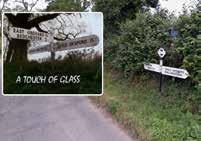
As for the sign that features in Only Fools and Horses, it is in the classic A Touch of Glass episode – the one with the chandeliers.
The title screen of the episode uses a rural road sign to establish how the Trotters are out ‘in the sticks’ for an auction. That road sign is a fingerpost at Peggs Lane, Farrington, while other Dorset locations were also used in the episode.
by Danielle Goshawk
DO you ever find that when you have a bunch of things to do, it can be hard to focus and prioritise? I know I can get frazzled when tasks feel overwhelming, and that level of stress makes it hard to achieve anything. It’s at times like that when bringing in some mindfulness can be helpful. Essentially, mindfulness is about intentionally paying attention – without judgement – to what is happening in the present moment, that is noticing thoughts, emotions and sensations from all five senses. Through regularly practising mindfulness we become used to noticing what is going on for us rather than operating on autopilot.
This is great to apply to any area of life, but let’s focus on work as an example. It might seem counter-intuitive that by slowing down or stopping you will become more productive and efficient at work. But when we don’t rest and just keep working through, say for exams







or a deadline, eventually we burn out and stop being productive altogether. Slowing
Here are a couple of suggestions you might try incorporating into your working day:
n Use your tea break as a mindful moment. Focus on your hot drink – tune into the warmth on your hands; notice the colour and the scent; the texture of it when you take a sip; if you blow on it to cool it down, what do you notice? These are ways to tune into your senses and become present, even if just for a few moments.
n Pause between tasks. For example, if you have back-toback meetings, take yourself into the bathroom and give yourself a couple of minutes to breathe mindfully. There’s no need to change how you breathe, just notice an aspect of it, like the rising and falling of your chest, or the temperature of the air as it enters in and out of your nose. This can help you to reset before heading on to the next task.










down and reflecting to make the best decisions and actions is a mindful way of working. At a certain level, stress is useful, it can push you to get a particular piece of work done on time, it can focus you and you can produce great work when under pressure. It’s helpful to be able to recognise when your stress is at such a high level that you become unproductive and unfocused, and take the opportunity to use mindfulness techniques to get back on track.
When you first start practising mindfulness you will get distracted and your mind will wander, but if you persevere, you will find it easier to manage your mind. After a while, your ability to concentrate increases, as does your general sense of wellbeing.
n Danielle Goshawk is a counsellor working with adults and couples, based in Lytchett Matravers and online – www. acaciacounselling.net. She is also the co-founder of Dorset Employee Wellness Support which provides local businesses with counselling and wellness services. For more information, email DorsetEWS@proton.me.

by Susanna Curtin
INSPIRED by the spring sunshine, I have set aside the day to declutter my garage. Among the countless piles of wood, recycling bags of tin foil and soft plastics, plus the old sentimental items once belonging to my late parents, that for some reason I have kept, I know there are a family of mice somewhere, but where? I am rather hoping they have not set up home in my kayak. So, the obvious place to start is to carefully remove the pile of summer camping chairs and bags that are stored on top of my boat.
Just as I lift the last chair, a wood mouse scurries away as fast as he can, followed closely by another, and another. Eventually I find the nest. It is a work of fine art. A ball of ‘fluff’ comprised of the blue and red fabric from the camping chairs, tiny pieces of shiny tin foil, some black fabric, unfortunately from the seat of my kayak, and miniscule pieces of plastic, all superbly mixed up and carefully crafted into the perfect burrow for the winter. As I slowly dismantle this colourful bundle, two more mice scatter away, frightened and startled from their different ‘chambers’ – each of which is lined with leaves still warm from their furry bodies. This is a bitter-sweet moment. I am glad, in a way, that I have disturbed them, especially given the damage to my kayak, but at the same time, I feel the act of
my wanton destruction when they have gone to so much endeavour to create such a comfortable winter hideout.
The wood mouse is a native rodent to Europe and north west Africa. It is a commensal rodent, that enjoys the benefits of living alongside us having evolved side-by-side with humans in a millennia-old relationship. It is sometimes referred to as a long-tailed field mouse given that its tail is the length of its head and body combined. It has a reddish brown back with a white or grey belly, large black eyes and big round ears. It is also a highly adaptable creature, capable of living anywhere but generally preferring grassy fields, hedgerows, gardens and woodlands. They can live for up to a year and tend to stay in one location, although they are known to take night trips of up to a quarter of a mile in search of berries, seeds and sometimes snails. During these foraging expeditions, they carry twigs and leaves to mark their paths so they don’t get lost. Instead of hibernating, wood mice gather in communal burrows where there are a number of chambers and food stores, just like there were in the nest in my garage. In the wild, these burrows are used and modified by several generations. Wood mice tend to live near a food source, as they have big appetites eating up to 15 or 20 times a day in between regular bouts of cleaning


themselves. Finally, they have rib cages that are collapsable, allowing them to get into the smallest of places in order to enter our buildings.
Although many people do not like mice, we owe them a great deal. They are genetically very similar to us with the same bodily systems and organs. In fact, they share about 85% identical genes to humans and 90% of their genome, that is the total amount of DNA, which is why they are a mainstay of biomedical research. Without them we would lack understanding of major diseases such as cancer, genetic disorders and life-threatening infectious diseases, or how to treat them. While I dislike the idea of experimenting on fellow mammals, where would we be without them?
But more than just their usefulness, they are intelligent, adaptive, sociable creatures in their own right. I remember how, a few years ago, I accidently disturbed a nest in my garden. This time it was a mother and her blind, furless babies, only days old. I watched in awe as she carefully carried each baby to a safe haven after being made homeless by my actions. I’d forgotten how sad I had felt.
As I continue with my big tidy-up, my thoughts turn to the daily news of bombardments

Mice share about 85% identical genes to humans and 90% of their genome, that is the total amount of DNA
and killings – the thousands of people made homeless through the deliberate violence of war, the lack of humanity and the cruelty, the inability to coexist with ‘others’, and the human obsession of power and land. I worry that if we cannot look after and live alongside our own kind, what hope is there for the conservation of wildlife or the planet?
As I sweep the garage for the last time, I hope that the mice are safely stowed in the log pile at the back of the garage. Before I finish up for the day, I cannot help myself. I have to leave a few nuts, seeds and fresh bedding material just in case they need it!
n Dr Susie Curtin (email curtin. susanna@gmail.com).
A DAY of action saw 30 vehicles stopped across Purbeck as police targeted metal thefts.
Two vehicles were seized following reported licence and insurance offences, with both drivers reported.
Two other drivers were reported for having an insecure load and for driving in a condition likely cause injury due to the vehicle’s load.
The day was part of a national week of action in relation to metal crime.
Sergeant Natalie Skinner, of Dorset Police’s Rural Crime Team, said: “We recognise the role commercial vehicles can play in the disposal of stolen metal, even if it is unintentionally.
“By stopping drivers and engaging with them we were able to offer education and advice, while the day also resulted in the identification of further driving offences.


“We were also able to work with our partners in the Environment Agency to allow them to gather vital intelligence in relation to this issue and inform their ongoing work to identify offences in relation to waste disposal.”
Dorset Police and Crime Commissioner, David Sidwick, said: “It was great to join the Rural Crime Team and our partners at the Environment Agency, for this important day of action.
“As well as providing an opportunity for the officers to gather intelligence, it was an invaluable chance to educate and inform members of the public who might have been otherwise unaware of the law around metal theft.
“I know the impact these types of offences have on our communities – particularly for those in rural areas – so it’s important that Dorset Police work together to forge effective, crime-fighting partnerships to
the people and businesses of Dorset, and I look forward to seeing more of these types of operations take place.”
The day also provided the Environment Agency with an opportunity to gather intelligence in relation to waste offences, with follow-up visits planned based on information obtained.
Ben Shayler, area environment manager at the Environment Agency, said:
“Last week, officers from our Waste and Enforcement teams joined Dorset Police in Purbeck for an operation targeting illegal waste transport and metal crime.
“Through intelligence-led partnership working and roadside stops we are taking a targeted approach to prevent and disrupt the illegal movement of waste across the county by unlicensed carriers, brokers and dealers.
“Anyone handling, storing or transporting waste must be registered with the Environment



ALMOST half of UK police forces (48%) have caught motorists driving over 90mph on 30mph roads – more than three times the speed limit, new data analysed by the RAC reveals.
A Freedom of Information request to the UK’s 45 police forces also found that, of the 40 with data, almost all (90%) had clocked people driving at 60mph – more than twice the limit – on these roads.
With the highest recorded speed on any road being 167mph on a 70mph stretch of the M1 by Leicestershire Police, the new RAC study paints an alarming picture of the speeds some motorists have been caught driving at.
Looking at the largest difference between the speed recorded and the posted limit, the highest logged speed was 161mph on a 50mph eastbound stretch of the A303 in Somerset.
More than half of police forces (23, or 58%) recorded drivers travelling in excess of 140mph.
While most of these contraventions were on 70mph motorway stretches, this wasn’t always the case.
South Yorkshire Police clocked a driver at 146mph on a 50mph southbound stretch of the M1, while Police Scotland detected someone driving at 148mph on a 60mph section of the A68 in the Scottish Borders.
But perhaps most disturbing of all are the speeds some people are prepared to drive at on 20mph and 30mph roads – those that are far more likely to have high numbers of pedestrians, cyclists and other vulnerable road users using them.
South Yorkshire Police recorded a speed of 122mph on

48% of police forces have clocked motorists driving at over 90mph on 30mph roads and 90% of forces had caught drivers at 60mph
a 30mph road, while North Wales Police logged a vehicle being driven at 88mph on a 20mph road. Both speeds are more than four times faster than the speed limits.
In total, six-in-10 police forces (24) have caught motorists driving over twice the speed limit on 20mph roads, with seven recording speeds of more than 60mph.
Government data shows speed is the biggest factor reported in fatal road collisions – it is a factor in 58% of fatalities and in 43% of road collisions of all severities. In 2023 speed contributed to 888 fatalities and 39,882 collisions of all severities.
RAC road safety spokesperson Rod Dennis said:
“Although this data is a snapshot, it shines a light on the incredibly dangerous actions of a few, that are putting lawabiding road users at serious risk. Thankfully, the police were on hand to catch these drivers.
“There is no place for the vastly excessive speeds that some people are prepared to drive.
“While some speeds were recorded in the middle of the night when traffic will have been lighter, this isn’t always
the case – some of the fastest drivers were clocked at other times of day when they’d have been sharing the roads with many others.
“Speed is the leading cause
of deaths on UK roads. We look forward to the Government’s forthcoming road safety strategy understanding what can be done to reduce such avoidable casualties on the UK’s roads.”
National Police Chiefs’ Council lead for roads policing, Chief Constable Jo Shiner, said: “We know that some incidents of going over the speed limit can be genuine mistakes or errors but the speeds cited here are clearly drivers taking deliberate decisions to travel at excessive speeds, putting everyone at risk.
“Speed limits are set based on many factors including the road layout, what’s in the surrounding area and taking into account where there might be more vulnerable road users.
“Choosing to drive above those limits is reckless, selfish and completely unacceptable.
“We all have a responsibility to keep each other safe and do whatever we can to reduce the number of people killed and seriously injured on our roads each day.”
2018 (18) CITROEN C3 AIRCROSS 1.2 PURETECH 130 FLAIR 5 Dr in Blue Sat Nav with 7” Touch Screen, Android Auto, Apple CarPlay, Mirror Link, Bluetooth, Cruise Control, DAB Radio, Lane Departure Warning System, Electric Heated & Folding Mirrors, Alloys, Full Service History, 45800 Miles
2015 (15) TOYOTA YARIS 1.33 VVT-i SPORT (Nav/Pan Roof) in Red Sat Nav with 7” Touch Screen, Panoramic Roof, Reverse Camera, Bluetooth, DAB Digital Radio, Alloy Wheels, 63000 Miles with FSH................................................................ £7495. 2019 (19) DACIA DUSTER COMFORT TCE 1.3 5 Dr in White Sat Nav with 7” Touch Screen, Apple CarPlay, Android Auto, Cruise Control, Bluetooth Connectivity, Rear Parking Camera, Electric Windows/Mirrors, Air Con, Alloys, 50800 Miles, FSH............................................................................................................................ £9795
2017 (17) TOYOTA AURIS TOURING SPORT 1.8 BUSINESS EDN HYBRID In Silver, Automatic, Sat Nav, 7” Touch Screen, Lane Departure Warning System, Rear View Camera, DAB Radio, Bluetooth, Air Con, Alloys, Euro 6 Compliant, Heated Front Seats, Electric Windows, 82700 Miles.......................
2015 (15) VAUXHALL VIVA SE 5Dr in Silver Air Con, Cruise Control, Lane Departure Warning System, Electric Front Windows, Electric Mirrors, Euro 6 Compliant, £20 Year Road Fund Licence, Only 15000 Miles with FSH
2019 (19) VW TRANSPORTER T32 TDi BMT 4M 4X4 in Met Blue Automatic, Satellite Navigation, Wessex Conversion includes 4 Rear Captains Seats in Leather and Suede/Iso x, ABT Bodykit, Black Roof Lining to Rear with Touch Lights and Climate Control, Removeable Tow Bar, 20” Alloys, USB Ports, Auto Lights, Stop/Start, Heated Front Seats,Heated Windscreen, Heated and Folding Electric Mirrors, Folding Table in Rear, Upgraded Sound System, FSH, 61500 Miles, Two Future Services and MOTs with VW included in price...£34995
2018 BMW 118 1.5 SPORT NAV STEP AUTO in Grey Auto, Sat Nav, Air Con, Cruise Control, iPod/USB Connect, Bluetooth, Front & Rear Parking Sensors, DAB Digital Radio, Auto Headlights, Alloys, 50500 miles with FSH.......................................................................£11595

2017 (17) VAUXHALL CORSA STING 1.4 ECOFLEX 3 Dr in Black Bluetooth System, Cruise Control, Radio/CD Player, USB Port,Electric Front Windows, Electric Mirrors, Black Alloys, 50700 Miles withService History, Only £35 a Year Tax...................................................................................................£5895 Looking for a Quality Used Car? Call Now: 01929 503115 Not found what you’re looking for? If you can’t find what you’re looking for, have a look at our Car Finder Page on our website www.foleysgarage.co.uk or call the Sales line on 01929503115 We successfully find all makes and models of cars to satisfy our customer needs Servicing - MOT’s - Repairs - Tyres - Aircon Service - Batteries - Exhausts Collect & Delivery Service available locally Valley Road, Swanage, BH19 3DZ | www.foleysgarage.co.uk T: 01929 480215 | E: info@foleysgarage.co.uk T: Sales Direct Line 01929 503115
2017 (17) TOYOTA AURIS TOURING SPORT 1.8 BUSINESS EDN HYBRID, In Silver, Automatic, Sat Nav, 7” Touch Screen, Lane Departure Warning System, Rear View Camera, DAB Radio, Bluetooth, Air Con, Alloys, Euro 6 Compliant, Heated Front Seats, Electric Windows, 82700 Miles............................................................................................. £10995
ARTIFICIAL intelligence is –apparently – among us. A reader wrote to tell me she had to consult HMRC recently: “What a mind-blowing abysmal service – 30 mins before the phone was answered... your call is important to us...really?” Translated as: “B****r off and leave us alone!” During that time a constant relay of how the ‘customer’ could do the work for themselves: “No...I needed very particular advice on extra tax to be paid on a lump sum as the situation is a bit complicated…even when I spoke to a person I am not convinced the advice, that no tax is due, is correct – hang it – they can go ‘whistle’!”
One of the major factors in my decision to cut right back on my accountancy practice was the way in which successive governments have ruined HMRC over the years. When I started work for ‘HM Inspector of Taxes’ back in the 1960s, we all wore suits and ties, we called our superior officers ‘Sir’ and were disciplined if our post tray had any ‘over 14’ items in it. Now, it’s a waste of time writing a letter to them, at least 30
by David Hollister
minutes to get through on the phone, and if you can’t find the exact question you want advice about, their suggestion to ‘do it online’ is just so much ‘white smoke’ to conceal the fact they don’t have enough staff to do the job properly.
It was suggested to me that HMRC was now run by one man and his dog, and if you couldn’t get through it was because the one man had taken the dog for a walk. Seriously, HMRC is supposed to be providing the funds to keep this country afloat and if this is its idea of doing so then God help us all.
WAREHAM Town Council has announced plans for options to purchase the adjoining former NatWest Bank to create a new vibrant centre of culture, learning and tourism. I wish it well and hope it will prove a more efficient use of the building than a bank which hardly anyone visited because we are all now being encouraged – bullied – to ‘do it online’. I understand that someone has now found a practical use for

Lloyds Bank in Swanage, and that the NatWest bank in Swanage is being re-purposed – again. What we need – in Swanage and in Wareham – is a multi-branch ‘banking hub’ where traders can go and pay in their cash securely, and perhaps even talk to a bank officer face to face for ‘advice’ that doesn’t come from a ‘bot’ or an anonymous ‘AI’ ‘person’. That’s if any bank staff are trained up to give advice rather than just ‘box ticking’.
That’s what we need. But what we will get is yet another ‘antiques and collectables’ shop to browse around floors full of stuff that other people don’t want. Yes, they make a valuable contribution to the charities and organisations they support but surely there must be a limit – we won’t get a clothes shop, a baby shop or a friendly electrical retailer, but no doubt another coffee shop or snack bar will spring up. Only because with a coffee shop you can’t ‘do it online’, because that would be messy.
SO, what’s happening with the doomed trees at the YHA? Do we still have a ‘tree preservation officer’? If so, where is he? And if not, why not? Who has the result of the ‘bat survey’ and who is monitoring the alleged ‘subsidence’. I challenge any representative of the YHA team to meet me on site and prove that the trees are causing subsidence or doing anything other than provide a green space when so much ‘green’ is being sacrificed in the interests of ‘zero carbon’... hang on a minute, I thought trees helped with the battle against CO2?
I am confused by the YHA’s proposed replanting plans: While Dorset Council has requested just four new trees be added once the 36 are felled, some Swanage town councillors were led to believe there would be more. For ‘requested’ please read ‘required’ and for ‘four’ read ‘34’. I bet the four
replacements won’t be as carbon-efficient as the 36 doomed trees! In short, it appears we are being stuffed. Again.
Do we have a ‘dog warden’? If not, why not? And do we have the additional police officers we were promised at the public meeting last year? If so, where are they and if not, why not?
FOLLOWING the approval of increases to the maximum tolls chargeable by the Department of Transport in 2021, the ferry toll charges from Tuesday, April 1, will be:
Pedestrians (one way charge only from Sandbanks) – £1; pedal or motorcycle – £1; cars/ vans up to 3,500kg maximum operating weight/minibuses up to 17 seats – £5.40; goods vehicles with a maximum operating weight of more than 3,500kg – £10.80; bus or coach (with 18 or more seats, including driver and maximum two axles) – £10.80.
So now you know. I’m off now to buy a year’s supply at the ‘old’ price.
Swanage Medical Practice has a Patient Participation Group which is inviting new members and is inviting you to pop in to find out more.
AND finally. Why are motorcyclists legally obliged to wear crash helmets while idiots on quad bikes are not, and are even permitted to carry their kids on the back with no protective headgear?
Why is it an offence to ride a bike on a pavement unless that piece of pavement has silly little white images of cyclists on it and been re-titled a ‘cycleway’? What price pedestrian safety there, then? (Sandford please note). Why does the Sandford cycleway run out just where the 30 limit stops and the traffic speeds increase to 60? Ridiculously dangerous.
So many questions. So little time…
by Sally Gregson
AMID all the busy-ness of spring, it can be difficult to remember to prepare for later in the summer. But to keep the garden going into the autumn it is important to ensure it is well populated with summer perennials, and with grasses.
The welcome spring sunshine has encouraged Hakonechloa macra ‘Aureola’ to start into growth and greet the warmth. This is an excellent, and unusual grass for shade. And now it’s ready to have a haircut and be split and planted out. Use an old bread knife to divide the clumps, discard the debris, and replant them into the soil improved with a little garden compost. A regular drink while the weather is dry and they are actively growing, will settle


them down. Grasses have become an essential part of modern gardens. Their graceful movement in any slight breeze adds another dimension to the border. Where once our gardens were rigid and immutable, full of stiff plants standing to attention, now softly swaying grasses lighten the palette.

It can be tempting to buy one or two large plants in the autumn and assume they can easily be split and replanted then and there like most border perennials. But grasses do not like having to push out new roots into the cooling ground at the end of the summer. They are preparing for a long winter sleep. Very few grasses split successfully after June/July. The exception being the big Miscanthus sinensis whose giant forms populate the autumn garden. They can be split up, with the help of a hand axe, or even a machete, at the end of the flowering season, and will settle back down, injured but unbowed and produce glorious spikes of satin flowers the following autumn. But they are the exception. In our heavy
Somerset clay, it is wiser to wait until spring to divide them all. Some grasses, the Festucas in particular, prefer light, sandy soil. And most, but not all, prefer a sunny spot. Steer clear of the colonisers such as ‘Gardeners’ Garters’ – Phalaris arundinacea – and the selfseeders such as Stipa tenuissima if you want a more disciplined border. But allow a few seedlings their wicked ways and the garden beds will work coherently, and with great character.
22 DRAWER PINE CHEST
£200.00 photos available Tel: 07729-398507
G.D HOUSE CLEARANCE
Fully Licensed, Family run, FREE Quotes. Tel: 07301-094707
EX-DISPLAY SHEDS, Stables/field shelters, summerhouses, offices, workshops, agricultural 01935 891195

DORSET County Hospital (DCH) has recognised the achievements of apprentices at a special awards ceremony.
The hospital currently has more than 200 staff undertaking apprenticeships across a wide range of clinical and nonclinical roles, and at different levels – from Level 2 – GCSE equivalent – through to a Level 7 – Master’s degree.
The awards, organised by the Trust’s Apprenticeship team, recognised those that are excelling in their studies and demonstrating the Trust’s values in 12 categories.
The winners were: Rising Star Award, Sam Spracklen; Outstanding Academic Performance, Rob Membury; Best Attitude, Joanna Ballard; Most Improved Apprentice, Lydia Dare; Role Model Apprenticeship, Lucinda Harris; Extraordinary Effort, Carly Brimacombe; Best Classroom Participation, Beverley Lagden;
Most Dedicated Apprentice, Debra Castle; Commitment to Professional Development, Anna Elford; Excellence in Functional Skills, Katie Ballard; Exceptional Mentor, Sophia Trim; Apprentice of the Year, Pete Spurr.
Emma Hallett, Dorset County Hospital’s deputy chief people officer, presented the winners with their certificates.
She said: “Studying and learning while working takes commitment, tenacity and considerable effort, so it is important that we celebrate our apprentices and their achievements.
“Congratulations to this year’s award winners and to all our apprentices for their hard work and dedication.
“I am very proud of our commitment to apprenticeships at Dorset County Hospital.
“They give staff the opportunity to develop their skillset and further their careers,
while making sure our workforce has the skills to provide excellent care to our patients.”
Student nursing associate, Peter Spurr, was awarded Apprentice of the Year.
He said: “I was working as a senior drug and alcohol treatment worker in general practice.
“I loved it, but wanted to be more hands-on, so when the opportunity came up to apply to become a Student Nursing Associate Apprentice, I jumped at the chance.
“It’s not easy working full time while learning and writing assignments.
“However, by having the most amazing and encouraging support from my DCH
colleagues, lecturers at Bournemouth and Poole College, fellow students and my family, I’ve managed to excel in my studies and develop my clinical skills.
“If you are thinking of a career change, I would say an apprenticeship is the best way to do it.
“I cannot thank DCH enough for the opportunity to learn and be supported in my new, and hopefully long, career in nursing.”
The awards were supported by the Trust’s training providers, Weymouth College, University of Exeter, Southampton Solent University, Bournemouth and Poole College and CSR Scientific Training Ltd.
A SWANAGE law firm received praise for career development, people management and continuous improvement when it was awarded a coveted quality mark.
Ellis Jones Solicitors – with offices in the High Street –gained the Lexcel accreditation from The Law Society for the 17th consecutive year after a rigorous and full reassessment.
The certification is only awarded to law firms which

provide the highest level of client care, compliance and business management standards.
Nigel Smith, managing partner at Ellis Jones Solicitors, said: “The Lexcel legal practice quality mark is highly prized within the sector.
“Our continued accreditation represents independent endorsement of the very high standards to which we operate and the service we provide for our valued clients.
“It was pleasing to see the assessors highlight our support for staff at all levels to progress their careers as well
as our flexible working policy and culture of continuous improvement.
Assessors recognised Ellis Jones’s structured approach to personal success and career development that mirrors its approach to the business’s success.
It highlighted the firm’s policy of promoting from within, with eight of its 25 partners starting as trainees and many other lawyers who have climbed the career ladder after joining as newlyqualified solicitors.
by editor@dorsetbiznews. co.uk
A SET of innovative new systems designed to autonomously detect security breaches have undergone testing at Winfrith, Dorset’s former nuclear reactor test site.
The four systems, put forward by four different suppliers, variously make use of unmanned ground vehicles (UVGs) and unmanned aerial systems (UASs).
These latest trials came as the Nuclear Decommissioning Authority (NDA) looks to leverage technology in its work to shut down the UK’s earliest nuclear sites safely, securely and sustainably.
Unmanned aerial systems (UAS) are being tested
Andrew Gray, innovation delivery manager at the NDA, said: “This project marks an exciting milestone in our commitment to innovation, utilising cutting-edge technology to improve threat detection and response.
“These demonstrator programmes are key in delivering benefit group-wide, capturing and sharing learning so that future deployments can be accelerated.
NEW figures just published reveal that in 2024 the number of companies in Dorset was the highest ever recorded – in a year that presented a range of challenges for business.
During the last 12 months, registered companies grew to an all-time high of 63,675 – up from 63,266 at the end of 2023 – and 7,890 new businesses were established in the county.
The statistics are taken from the Inform Direct Review of Company Formations, using data from Companies House and the Office for National Statistics.
“Winfrith has been selected as it’s a lower risk site where we’ve removed most of the hazardous material, so that when traditional nuclear security measures are no longer proportionate, we can move quickly and reduce costs overall in the longer term.
“The insights gained throughout the trial will be invaluable in exploring how these systems could be deployed in real-world applications, potentially revolutionising security operations.”
The £2 million NDA-funded project will run throughout 2025 and is being delivered in collaboration with the Defence and Security Accelerator

(DASA) team, Nuclear Restoration Services (NRS) security projects and the Winfrith site.
Four external suppliers –Operational Solutions Ltd, Espanaro Ltd, ISS Aerospace and Archangel Imaging – have all been sponsored to trial their concept systems.
Rob Coan, site manager at Winfrith, added: “The project is the first large-scale active demonstrator on an NRS site.
“By testing these advanced technologies in real-world operational conditions, we aim to significantly enhance security capabilities while exploring new pathways to safeguard vital infrastructure.”

number of companies.
“The year undoubtedly presented a range of challenges for business with the uncertainty of the General Election, the introduction of new regulations and concerns over Labour’s first Budget in October which included the increase in Employer National Insurance.

Bournemouth formed the most new businesses (2,063), followed by Purbeck (1,705) and Poole (1,518).
John Korchak, managing director at Inform Direct, said: “It is really good news that Dorset can celebrate a record
inspired leadership, evidenced in this successful result.”




The UK as a whole mirrored this trend with a record total of 5,637,210 companies, up from 5,476,772 at the end of 2023.
Some 848,192 businesses were formed during the year and 690,501 dissolved.
by Amy Brenan, director of Heirlooms Jewellers, 21 South Street, Wareham
ONE of the things I find most fascinating about antique jewellery is the superstitions passed down through generations. Some pieces are believed to bring luck and protection, while others are better known for their alleged curses.
Cursed diamonds
ONE of the most famous ‘cursed’ jewels in history is the Hope Diamond. This deep-blue 45.52-carat gem is said to have brought misfortune, financial ruin and even death to its owners, including French King Louis XVI and Marie Antoinette.
Lucky charms and protective amulets
NOT all antique jewellery carries bad luck—many pieces were created to ward off evil or attract good fortune. The evil eye amulet, found in ancient Middle Eastern and
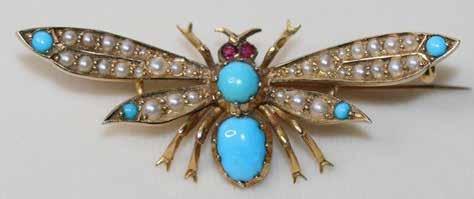
Mediterranean cultures, was worn to protect against menacing glares.
Similarly, Victorian-era acrostic jewellery, which used gemstones to spell words like ‘LOVE’ – Lapis, Opal, Verdelite, Emerald – was believed to enhance romance and happiness. The Victorians also fa-voured four-leaf clovers and horseshoes as symbols of good luck.
The Georgians loved snake
motifs, which represented eternal love and wisdom – snake rings and bracelets were popular, especially after Prince Albert gifted Queen Victoria a snake engagement ring in 1839.
Celestial-themed jewellery, particularly crescent moons and stars, was worn for guidance and good luck. After the discovery of ancient tombs, Victorians wore scarab beetles for rebirth and good for-tune.
Mourning and sentimental jewellery
DURING the Victorian era, mourning jewellery, often made with jet or woven hair, was believed to keep a lost loved one’s spirit close.
Whether cursed or lucky, antique jewellery remains steeped in mystery – I love that each piece gives a fascinating glimpse into history and the beliefs of our ancestors.
THE eternal magnificence of Asian Art returns on Thursday, May 22, to Duke’s Auctioneers.
With consignments open until Thursday, April 24, the beloved auction is already

forming into great shape, curating a collection of fine quality.
The auction will feature a diverse array of items, including porcelain, bronzes, jade, furniture, paintings and more, from every corner of Asia.
Anyone who would like to consign an item for the auction, should contact Duke’s at enquiries@dukes-auctions.com to organise a free valuation.
A highlight of Duke’s previous Asian Art sale was a Chinese porcelain blue and white double gourd vase, from the collection of Dinah Reynolds, author of Worcester Porcelain 1751-83, published 1989.
Despite being estimated at £200-£400, the vase made a remarkable £3,500, solidifying Asian Art’s unpredictable and wondrous nature, with surprise

A Chinese porcelain blue and white double gourd vase sold for £3,500 at Duke’s Auctioneers
hiding behind every corner, where even the most unassuming items can conjure vast fortunes.
BOXERS from the Purbeck Power Gym shined in a tournament at the Mountbatten Centre in Portsmouth.
Ryan Dwyer, 21, from Harmans Cross, beat Connor Handley over four rounds in the last fight of the night to claim the Southern Area light heavyweight (80kg) belt.
The strong and experienced Handley was expected to beat his opponent, but Dwyer showed skill, power and courage to win the fight and championship by a clear margin, despite a painful hand injury.
Jack Buchanan, 19, from Swanage, was too strong and

judged the clear winner when he took on Sam Fitzgerald over four rounds to claim the Southern Area super welterweight (70kg) championship belt.
Lloyd Crisp, 18, from Swanage, was strong and
A triumphant Jack Buchanan (left) and Ryan Dwyer
Match winner Josiah Wells-Parkes, 34lb 4oz
skillful as he beat Jon Preston – as he had done before a few months ago – in a fierce battle.
Ashley Cannon, 21, from Wareham, pressed a stronger, heavier opponent in Ross Brennan over three rounds and was unlucky to lose.
by Ron Butler
Swanage & Wareham 38 Corsham 27
SWANAGE & WAREHAM
welcomed Corsham to Bestwall for Swans’ final home game in the league this season.
Swans started brightly but Corsham were tough opponents and came back before Swans triumphed at the end.
A good start by Swans took them into the Corsham 22 and from a catch/drive move Swans were soon on the scoreboard with a try by hooker Jack Young. Max Philips added the extras (7-0) after three minutes.
Swans gave away a penalty in their own 22 and Corsham slotted the three points.
Corsham backs caught Swans short with a good move and the visitors took the lead with a converted try (7-10) after 15 minutes.
A few minutes later Swans’ second row was red carded, so Swans were reduced to 14 men for the rest of the game.
Swans, however, still dominated the scrums and a
penalty led to a line-out inside the Corsham 22 and a catch/ drive move which saw prop forward Zach Wyburgh score.
Philips converted (14- 10) after 24 minutes.
George Crouch fielded a Corsham clearance and went on a run, avoiding the Corsham defence and scoring a fine individual try close to the posts. Philips added the conversion (21-10) after 30 minutes.
At the start of the second half, Swans overpowered a scrum in the Corsham 22 and the ball was sent along Swans’ three-quarters to Crouch who touched down (26-10) after 43 minutes.
The visitors were soon able to come back, with a move along the backs to score a well worked try in the corner (26-15) after 50 minutes.
From the re-start, Corsham knocked the ball on, Swans won the scrum, moved the ball to centre Meli Yawailagi who powered his way over the line. Crouch converted (33-15).
From a penalty to Corsham, Swans won the line-out, passed the ball to Crouch, who went down the wing but cut inside to score close to the posts for his hat-trick of tries (38-15) on 64 minutes.
Twelve minutes from the end of the game, Swans were reduced to 13 men as a Swans player was yellow carded.
From the offence Corsham moved the ball along the backs to score in the corner (38-20) on 70 minutes.
Corsham were on top against Swans’ 13 men and with five minutes left scored another converted try (38-27).
In the last few minutes Swans were under severe pressure in their own 22 but good defence kept the visitors out.
Swans: Will Slack, George Crouch, Meli Yawailagi, Ed Dimescio, Ollie Dillon, Max Philips, Ollie Peters, Steve Waterman, Jack Young, Nick Audley, George Slack, Joe Towers, Jonny Blackmore, Tom Holland, Kian Salina, - Zach Wyburgh, Duncan McDermid, Rory Ferguson.
OTHER RESULTS: Weymouth & Portland 29 Swans 2nd XV 8; Poole 50 Swans 3rd XV 10.
by Graham Howard DDAS junior secretary
DORCHESTER & District Angling Society (DDAS) Juniors came together for the first junior match of the year at Harbourbridge Lakes, near Chickerell.
Milder conditions arrived at last, despite the easterly breeze. 10 juniors took part in the match, and with a further five doing a coaching session, it was a fantastic start to the 2025 season.
Josiah Wells-Parkes made the most of a good draw with a winning weight of 31lb 4oz of good-sized carp caught on the method feeder from under the far bank.
Soon to be crowned champion Austin Scott-Kennedy got off to a good start in his title defence in second place with 24lb 15oz, also on the feeder.
Venue specialist, Jack Copp, fished with pole and feeder to finish just behind in third place with 22lb 6oz, including 10lb of silverfish on the pole in difficult conditions.
Fishery information from harbourbridgelakes.com; membership information from d-das.com; and DDAS Juniors information from to ddasjuniors. co.uk or email juniors.sec@ d-das.com.
LIONEL Bart’s musical, ‘Oliver!’, depicts the nature of social inequalities, poverty and the treatment of vulnerable members of society during Charles Dickens’ era.
It continues to resonate as a powerful depiction of a young boy’s struggle for basic rights and his quest for a life free from destitution.
Wessex Musical Theatre is producing ‘Oliver!’ at Weymouth Pavilion in May, and its cast and crew have chosen Weymouth Women’s Refuge
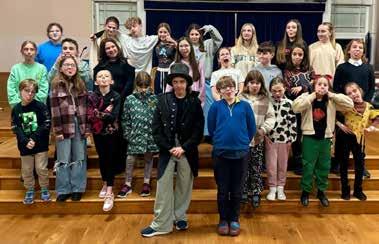
THE iconic Anglo-Chilean band Quimantú will be performing The Miners’ Mass this spring at three concerts in Dorset, including at Cerne Abbas, staged with local community choirs.
The first concert in the Surtierra Touring Project is at Blandford Parish Church on Friday, April 4, and features the Palida Choir and Shaftesbury School Choir.
The second half of the concert will feature music from Quimantu’s repertoire of Latin American and world music, alongside songs from the Palida Choir, led by Karen Wimhurst.
The concert in Cerne Abbas at St Mary’s Church on
Sunday, May 11, will serve as the finale of the Cerne Giant Festival.
The repertoire for the second half will reflect the festival’s celebration of ‘humanity in the landscape’ and include songs from the Cloud 9 Chorus, led by Kathie Prince.
The project culminates with a concert at The Exchange in Sturminster Newton on Sunday, June 15, with more than 80 singers from all the Dorset choirs taking part on stage alongside Quimantu.
Mauricio Venegas-Astorga, director of Quimantú, fled the Pinochet dictatorship in Chile five decades ago and made the UK his home.
and Weymouth Foodbank as charities to support with its bucket collections after each performance, reflecting the themes of the show.
Peter Lindsley, from Wessex Musical Theatre, said: “Rising energy bills are leaving families struggling and we wanted to help in any way we can.
“Our show highlights these issues and monies raised are going to two fantastic causes.”
Oliver! has a sensational score, including Food, Glorious Food, Consider Yourself and many more, and brings to life Dickens’ story of ‘the boy who asked for more’.
Oliver! is at Weymouth Pavilion Theatre, from Wednesday to Saturday, May 28-31.
Tickets are available from the box office on 01305 783225.
Now, through the Surtierra Project, Quimantú seeks to break down the stigma associated with immigration resulting from war, persecution and poverty.
The tour will conclude with two major concerts in London during Refugee Week 2025, at St Paul’s Church in Covent Garden.
Mauricio said: “It’s wonderful to bring the Surtierra Project to Dorset –
having performed here over the years we have good friends and are delighted by how the local singers are embracing the music of the Misa de los Mineros [The Miners’ Mass].
“This is exactly what we hoped the project would achieve – sharing music and culture and building bridges between communities.”
For tickets and further information visit www. artsreach.co.uk.
LOCAL singers and musicians will be performing in a charity fundraising concert at Worth Matravers Village Hall next month.
The concert, Musical Mirth @ Worth, is being organised by Swanage singer Suzanne Bunyar and her husband, Bob, along with friends.
The event will raise money for Dorset & Somerset Air Ambulance and Swanage Railway’s T9 locomotive appeal, Project 120, with profit from ticket sales being split between the two funds.
Singers Suzanne Bunyar, Ali and Tim Arnold, pianist Hazel Kennett and other guest performers will take part in the concert.
Musical nostalgia, songs from the shows, a little light opera and other musical genres will feature in the event.
Suzanne has had a lifelong love of singing and performing, having sung in numerous choirs and musical groups for over 50 years, including being a member of the Bath Gilbert and Sullivan Society for over 25 years, performing in concerts and fully staged productions.
Tribute to a legend
She often takes part in charity events and currently sings with the Harmony Rocks choir based at Harmans Cross Village Hall.
One of Suzanne’s musical claims to fame is to have sung on stage with Keith Potger, from the Australian band The Seekers, when they sang one of the group’s biggest hits, A World of Our Own, together.
Ali and Tim Arnold live in Worth Matravers. Ali has always enjoyed musical theatre and has been a member of three amateur operatic societies in Hampshire and Cambridge, performing in numerous shows including Half a Sixpence, Showboat, Oliver, Hello Dolly and taking the lead role of Ado Annie in Oklahoma.
Her husband, Tim, is an accomplished musician and a baritone with the Bournemouth Symphony Chorus, of which he has been a member for 10 years. He is also chair of trustees for Purbeck Youth Music.
Hazel Kennett won a scholarship at the age 12 to the Royal Academy of Music
Saturday morning school and subsequently attended full time

from the age of 18, to be taught piano by Freddie Jackson.
She became a peripatetic piano teacher when she left and has coached private pupils.
Since 2016 she has been accompanist for the Harmony Rocks Choir, and she is also a practice pianist and choir member of the Belvedere Singers in Swanage.
Tickets for the show on Friday, April 11, at 7.30pm, are available online at www. purbeckproductions.com/events priced £12 (concessions £10). Further details are available on 01929 289209.
The air ambulance is celebrating its 25th anniversary this year and one of its local fundraisers, Daphne Saville,
by a five-piece band, covers the rockabilly Sun Record years right through to the Traveling Wilburys era.
will be running a raffle at the concert to help raise funds.
Last year the air ambulance carried out 2,909 missions at an average cost of £3,500 per flight with a daily running cost of £27,400.
The Swanage Railways T9 Class locomotive number 30120 is on long term loan to the railway from the National Railway Museum collection. It was built in 1899 for the London and South Western Railway and arrived at Swanage in 2017.
The locomotive is currently at workshops near Lydney in Gloucestershire being assessed to return it to running order, which it is hoped can be done for its 130th birthday in 2029.
The show also features a sprinkling of songs from Johnny Cash, ELO and Tom Petty.
The show celebrates the Rock ‘n’ Roll Hall of Fame inductee and six-time
Grammy Award winner and his many friends. Steele – pictured – backed
He sings all the classic hits including Pretty Woman, Crying, I Drove All Night, You Got It, Only the Lonely, In Dreams, California Blue, Rattled, Handle with Care and Roll Over Beethoven.
Barry Steele’s The Roy Orbison Story is on Saturday, April 5, at 7.30pm – for tickets and information, visit www.lighthousepoole. co.uk or phone 01202 280000.

The home of Country House opera in South West England featuring reowned soloists, a full ochestra and a large chorus if emerging young artists
Marquee Bar | Picnics | Formal Dining
Giuseppe Verdi
22, 25, 26 July at 19:00 | 24 July at 14:00
Double Bill Pietro Mascagni
Giacomo Puccini
23, 24 July at 19:00 | 26 July at 14:00
IN 2020, Poole-based sailor Pip Hare became the eighth woman in history to finish the Vendée Globe solo, non-stop, round the world yacht race.
Last year, she set out to do it all over again, but in a newer and faster boat. It spoils nothing to know that things did not turn out the way anyone had planned.
In An Evening With Pip Hare, on Thursday, April 3, Lighthouse patron Pip will share the story of what happened, why it went wrong and how she rescued herself 800 miles from land.
The story is inspirational, a testament to the power of Pip’s practical and mental acuity, and the bloody-minded resilience that got her to safety.
Round the world solo yacht racing is a necessarily solitary affair, and Pip is fiercely independent in thought and word and deed, but that hard won self-containment at sea is fuelled by a great deal of teamwork on land.
It is something that Pip has been considering lately in a blog about how she has tackled the challenge of bringing her stricken boat back to Poole from Melbourne, Australia, the nearest land to where her race ended 10 days before Christmas.
In essence, having spent a month raising the funds to return the boat, Pip and her two-man team with a hastily assembled crew of volunteers and the goodwill of the Melbourne maritime community managed to crane the boat out of the water to remove its foils and keel.
It was an epic 12-hour job with no time to rest – or spare – before the dock they used was needed by the shipping company that had loaned it.
“It is incredible to think of
what we achieved with such a short run-up and so far from home,” she said. “It would not have been possible at all without the effort, energy and passion of so many people.
“It continues to humble and amaze me that complete strangers are willing to put themselves out, work all night and pull in favours on my behalf. I couldn’t get the keel out with my own hard work, but I didn’t need to because so many other people had my back.
“I started out as a lone sailor.
I like action, I work hard, I am fiercely independent and hate to rely on others or ask for help. Over the last six years of building our IMOCA team, I have learned the power of working with others and how performance and results are exponentially increased when a well-functioning team all lean their shoulders to the wheel.
“Our team has become huge, it stretches around the world, and together we are moving forwards.”
Tickets for An Evening with Pip Hare are available at www. lighthousepoole.co.uk or from 01202 280000.
THE Mowlem in Swanage hosts a National Theatre Live screening of Dr Strangelove this week.
Seven-time BAFTA Awardwinner Steve Coogan (Alan Partridge, The Trip) plays four roles in the world premiere stage adaptation of Stanley Kubrick’s comedy masterpiece.
When a rogue US General triggers a nuclear attack, a surreal race takes place, seeing
the Government and one eccentric scientist scramble to avert global destruction.
This explosively funny satire is led by a world-renowned creative team including Emmy Award-winner Armando Iannucci (The Thick of It, Veep) and Olivier Award-winner Sean Foley (The Upstart Crow, The Play What I Wrote).
The screening is on Thursday, April 3, at 7pm.
LUCY Brazier, author of The Honesty Box, will talk about midlife and everything it raises through the prism of food at The Mowlem in Swanage.
From fighting against the midlife clichés to how her husband’s mental health, her own menopause and the kids leaving home created the perfect storm.
Lucy lives on the Dorset coast and swims in the sea most mornings – and tries not to go on about it! – and believes in the power of wild swimming to build friendships, resilience and courage for everyday living.
Lucy is appearing on Tuesday, April 8, at 2.30pm.

MUSIC fans of a certain vintage can enjoy the music of Phil Collins when a tribute act visits the Tivoli Theatre in Wimborne.
The musician sold 150 million albums during his solo career And Finally…Phil Collins, fronted by singer Chris O’Connell, will be performing all the hits.
Those include In The Air Tonight, Another Day In Paradise and Sussudio – and O’Connell will perform a sprinkling of Genesis hits for good measure.
And Finally…Phil Collins are in Wimborne on Friday, April 11, at 7.30pm.
For tickets, visit www.tivoliwimborne.co.uk or phone 01202 885566.
THE Fureys, legends of Irish music and song, are playing The Regent in Christchurch this week.
The band are renowned for their hit songs I Will Love You, When You Were Sweet 16, The Green Fields of France, The Old Man, Red Rose Café, From Clare to Here, Her Father Didn’t Like Me Anyway, Leaving Nancy, Steal Away and more.
The Fureys are in Christchurch on Friday, April 4.
For tickets, visit www.theregent.co.uk or phone 01202 499199.
Diary entries are £6 plus VAT per entry. The deadline for the April 11 issue is NOON on Friday, April 1. Call on 01963 400186 or email adverts@blackmorevale.net. Please call prior to attending events listed to ensure they are still on.
TUESDAY
19:30 WAREHAM CAMERA CLUB PARISH HALL: 7:30pm Wareham unless Zoom Visitors welcome - £3 Zoom link available from website 1st April, Print & Projected Image of the Year, 8th Speaker Sue Sibley, Sue’s Travels’ Prints & PDI’s. 15th Zoom, Bristol Salon of Photography. 22nd, 10 from 7-10 images from 7 members. 29th Speaker Mike Brown ‘The Amazon & Large Format Photography;
SATURDAY
18.30 WHIST DRIVE at St Mary’s Church, Rectory Classroom, Swanage. Every Saturday. Tea and coffee provided. Very friendly group. Contact Richard: 01929 553516



• PC & Laptop hardware upgrade & repair
• Windows & Apple Mac software issues fixed
• Virus and Malware removal and prevention
• Wi-Fi, Internet, Email, printer issues resolved
• Computer Cleanup & Health Check
• Data recovery & Backup
• Local with over 20 years experience


J.A.

J.A.

Call Pete on: 01929 421989 or 07900 992110
Email: info@whizzbits.co.uk
www.whizzbits.co.uk
J.A.
(DORSET) LTD
(Dorset) Ltd.
J.A.


(Dorset) Ltd.
Specialist in Purbeck Stone Walling Construction General Building, Extensions, Renovations, Roofing, New Builds and all types of Ground Work. Also available for Plumbing, Electrics & Carpentry.


Specialist in Purbeck Stone Walling Construction General Building, Extensions, Renovations, Roofing, New Builds and all types of Ground Work. Also available for Plumbing, Electrics & Carpentry.
Specialist in Purbeck Stone Walling Construction General Building, Extensions, Renovations, Roofing, New Builds and all types of Ground Work. Also available for Plumbing, Electrics & Carpentry.
Specialist in Purbeck Stone Walling, General Building, Extensions, Renovations, Roofing, New Builds and all types of Ground Work. Also available for Plumbing, Electrics & Carpentry.
Tel: 01929 554249 / Fax: 01929 552294

Tel: 01929 554249
Mobile: 07973 388190
www.jaconstructiondorset.co.uk
Tel: 01929 554249
Fax: 01929 552294
Fax: 01929 552294
Mobile: 07973 388190
Mobile: 07973 388190
Email: sales@jaconstruction.co.uk
Tel: 01929 554249 Fax: 01929 552294
Mobile: 07973 388190
www.jaconstructiondorset.co.uk
www.jaconstructiondorset.co.uk
www.jaconstructiondorset.co.uk
Email: sales@jaconstruction.co.uk
Email: sales@jaconstruction.co.uk (Dorset) Ltd.
Email: sales@jaconstruction.co.uk

HUNTERS DOMESTIC APPLIANCE REPAIRS all makes all models call 07872901608
KDL PLUMBING. All jobs undertaken, free estimates call 0747-512-8249 (01929)-421632
TERRY WARR. Carpentry and Associated work. Tel: 07742-699874



























UPVC Multipoint & Wooden Door Lock Specialist. Locks & Safes, Repaired, Replaced, Opened or Ser viced. Additional Security for Garages & Gates, Key Safes, Antique Locks & keys. Vehicle Opening, Remote Spare Keys, Restricted Key Systems. 07709 545701 (24/7) www.parrottlocks.co.uk paul@parrottlocks.co.uk


DURWESTON HOLISTIC FESTIVAL. Sunday 25th May 2025Durweston Village Hall & Green. A variety of Therapists, Stalls & Talks £2 entry - children free.







NEW GARDENINGCLUB OPENING IN POOLE, ROOTED IN FRIENDSHIP. Commencing 1st April, and there after on the first Tuesday of every month, 2-3.30pm. The Salvation Army, 2 New Orchard, Poole, BH15 1LY. Entrance via carpark. To Share ideas about gardening, swap seeds and plants etc. Free Parking, £2 including coffee, tea and cake.
ROOF BOX FOR CAR, large capacity, £25 ONO. Coral (Weymouth) 07563 105 836
RADIATOR DESIGNER. Slim,tall,grey. Was working with wall fixings. £50 ono, Gillingham 07485-703231
BOOKS HARDBACK, FOUNTAIN PENS, coins and stamps, costume jewellery. Cash paid. Tel Mr Jones 01202-733550.
FOREST Holme Hospice has been chosen as the official charity partner of the Seafood and Sounds festival, which takes place in Poole later this year.
The hospice, which provides palliative and end-of life-care and support to more than 1,500 people each year across Poole, Wimborne and the Isle of Purbeck with advanced cancer and other life-limiting illnesses, will be represented at the festival by staff and volunteers, who will also be participating in the event’s seafood-themed opening parade.
Seafood and Sounds, now in its third year, is the brainchild of five Poole business owners – City Cruises, The Custom House, The Poole Arms, Saint Tropez Restaurant and Truly
Scrumptious – to celebrate locally produced seafood and Dorset musicians across Old Town Poole, The Quay and Falkland Square.
Kirsty Perks, community and corporate fundraiser at Forest Holme, said: “We’re thrilled to have been chosen as charity partners and everyone is very excited about being involved over the festival weekend.
“The festival is all about community, which fits in so well with our own hospice values and our commitment to ensuring that everyone in our local community affected by a life-limiting illness or bereavement gets the care and support they need.”
The Seafood and Sounds festival runs over the weekend of September 13-14.