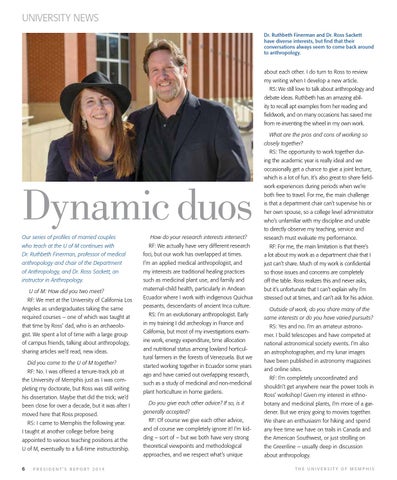
UNIVERSITY NEWS Dr. Ruthbeth Finerman and Dr. Ross Sackett have diverse interests, but find that their conversations always seem to come back around to anthropology.
about each other. I do turn to Ross to review my writing when I develop a new article. RS: We still love to talk about anthropology and debate ideas. Ruthbeth has an amazing ability to recall apt examples from her reading and fieldwork, and on many occasions has saved me from re-inventing the wheel in my own work. What are the pros and cons of working so closely together? RS: The opportunity to work together during the academic year is really ideal and we occasionally get a chance to give a joint lecture,
Dynamic duos Our series of profiles of married couples who teach at the U of M continues with
How do your research interests intersect? RF: We actually have very different research
which is a lot of fun. It’s also great to share fieldwork experiences during periods when we’re both free to travel. For me, the main challenge is that a department chair can’t supervise his or her own spouse, so a college level administrator who’s unfamiliar with my discipline and unable to directly observe my teaching, service and research must evaluate my performance. RF: For me, the main limitation is that there’s
Dr. Ruthbeth Finerman, professor of medical
foci, but our work has overlapped at times.
a lot about my work as a department chair that I
anthropology and chair of the Department
I’m an applied medical anthropologist, and
just can’t share. Much of my work is confidential
of Anthropology, and Dr. Ross Sackett, an
my interests are traditional healing practices
so those issues and concerns are completely
instructor in Anthropology.
such as medicinal plant use, and family and
off the table. Ross realizes this and never asks,
maternal-child health, particularly in Andean
but it’s unfortunate that I can’t explain why I’m
Ecuador where I work with indigenous Quichua
stressed out at times, and can’t ask for his advice.
U of M: How did you two meet? RF: We met at the University of California Los Angeles as undergraduates taking the same required courses – one of which was taught at that time by Ross’ dad, who is an archaeologist. We spent a lot of time with a large group of campus friends, talking about anthropology, sharing articles we’d read, new ideas. Did you come to the U of M together? RF: No. I was offered a tenure-track job at the University of Memphis just as I was completing my doctorate, but Ross was still writing his dissertation. Maybe that did the trick; we’d been close for over a decade, but it was after I moved here that Ross proposed. RS: I came to Memphis the following year. I taught at another college before being appointed to various teaching positions at the U of M, eventually to a full-time instructorship.
6
P R ESI DENT’S R EPORT 2014
peasants, descendants of ancient Inca culture. RS: I’m an evolutionary anthropologist. Early in my training I did archeology in France and California, but most of my investigations examine work, energy expenditure, time allocation and nutritional status among lowland horticultural farmers in the forests of Venezuela. But we started working together in Ecuador some years ago and have carried out overlapping research, such as a study of medicinal and non-medicinal plant horticulture in home gardens. Do you give each other advice? If so, is it generally accepted?
Outside of work, do you share many of the same interests or do you have varied pursuits? RS: Yes and no. I’m an amateur astronomer. I build telescopes and have competed at national astronomical society events. I’m also an astrophotographer, and my lunar images have been published in astronomy magazines and online sites. RF: I’m completely uncoordinated and shouldn’t get anywhere near the power tools in Ross’ workshop! Given my interest in ethnobotany and medicinal plants, I’m more of a gardener. But we enjoy going to movies together.
RF: Of course we give each other advice,
We share an enthusiasm for hiking and spend
and of course we completely ignore it! I’m kid-
any free time we have on trails in Canada and
ding – sort of – but we both have very strong
the American Southwest, or just strolling on
theoretical viewpoints and methodological
the Greenline – usually deep in discussion
approaches, and we respect what’s unique
about anthropology. THE UNIVERSITY OF MEMPHIS