

The University of Pretoria aspires to be internationally competitive and nationally relevant. The Faculty achieves this by ensuring that it’s academic and research programmes conform to the highest standards and that the national and international accreditation of its degrees by professional bodies is maintained. Furthermore, the Faculty strives to ensure that the market value associated with its degrees will always be of competitive benefit to students.
The key to the Faculty of Economic and Management Sciences’ success lies in the high premium it places on the preparation of a new generation of business leaders, entrepreneurs, managers and government officials who can create jobs and maintain an innovative outlook on life.
The Faculty consists of eight departments: Accounting, Auditing, Taxation, Financial Management, Economics, Marketing Management (including Tourism Management), Human Resource Management and Business Management (including Communication Management), as well as the School for Public Management and Administration. Jointly, these departments and school present all the BCom and BAdmin degrees as well as the postgraduate programmes on honours, master’s and doctoral level.
The Faculty boasts active agreements with institutions abroad of which six appear on the QS World University rankings and the Times Higher Education World University rankings.
For more information about the Faculty’s academic offering, please visit www.up.ac.za/bcom.
Tel +27 (0)12 420 2425 Email elsabe.loots@up.ac.za

The following persons will be considered for admission: a candidate who is in possession of a certificate that is deemed by the University to be equivalent to the required Grade 12 certificate with university endorsement; a candidate who is a graduate from another tertiary institution or has been granted the status of a graduate of such an institution; and a candidate who is a graduate of another faculty at the University of Pretoria.
Life Orientation is excluded when calculating the APS.
University of Pretoria website www.up.ac.za/ems
National Benchmark Test website www.nbt.ac.za
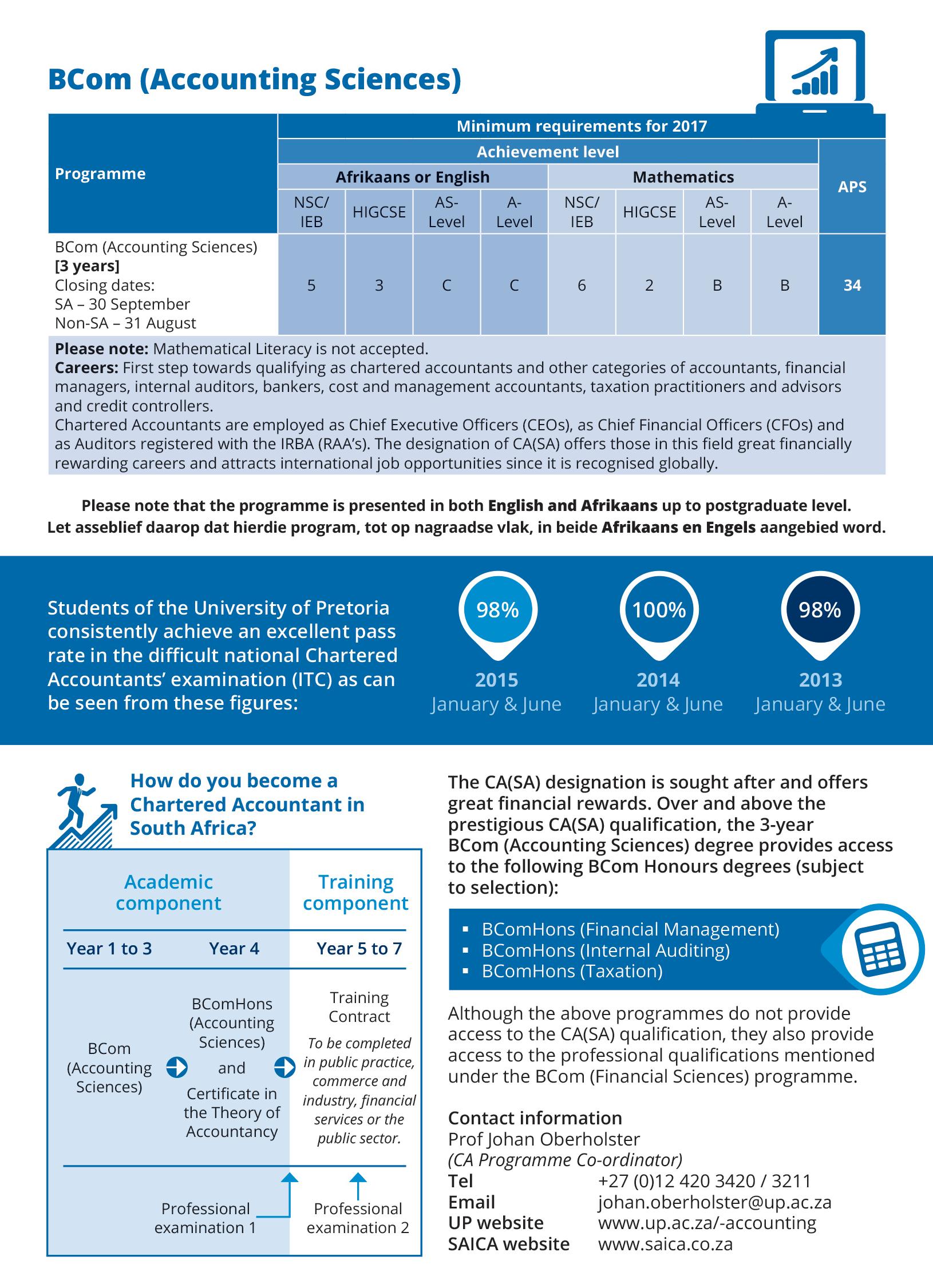
BCom (Accounting Sciences) [3 years]
Closing dates:
SA – 30 September Non-SA – 31 August
Careers: First step towards qualifying as chartered accountants and other categories of accountants, financial managers, internal auditors, bookkeepers, bankers, taxation practitioners and advisors, cost and management accountants and credit controllers
BCom (Investment Management) [3 years] Closing dates: SA – 30 September Non-SA – 31 August
Careers: Funds manager, investment advisors, financial advisors, management accountants, management consultants, financial
and investment analysts
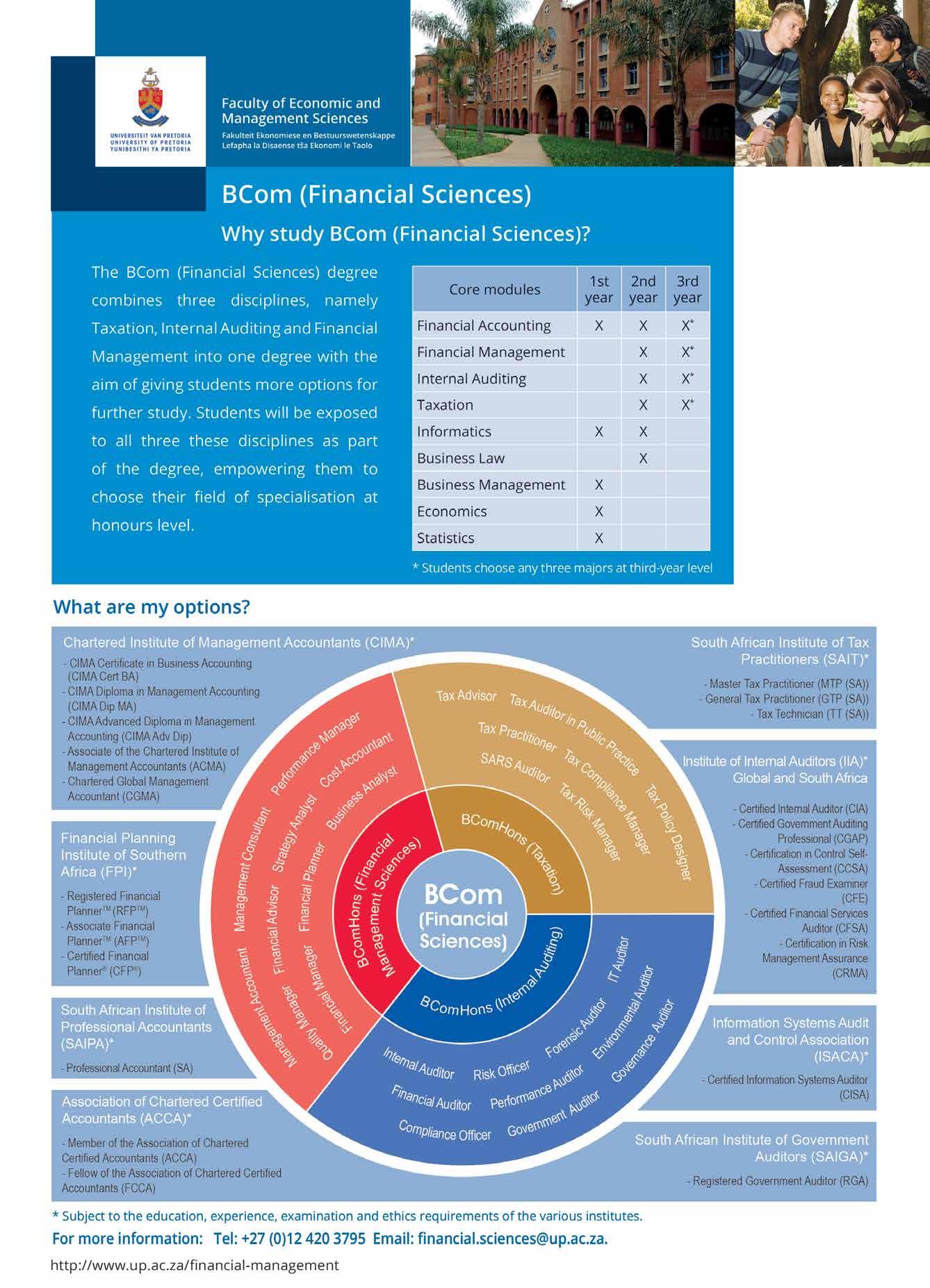
BCom (Financial Sciences) [3 years]
Closing dates: SA – 30 September Non-SA – 31 August
Careers: Specialisation in financial management: Management accountants, management consultants, performance managers, quality
strategy analysts, cost accountants, financial managers, financial planners and business analysts
Specialisation in taxation: Tax advisors, tax auditors in public practice, tax policy designers, tax practitioners, tax compliance managers, SARS auditors and tax risk managers
Specialisation in internal auditing: Internal auditors, risk officers, forensic auditors, IT auditors, financial auditors, performance auditors, environmental auditors, compliance officers, government auditors and governance auditors
BCom (Econometrics)
[3 years]
Closing dates:
SA – 30 September
– 31 August
Careers: Econometricians are employed by government, the central bank, private and commercial banks, leading stockbrokers and consultancies, both locally and internationally. Positions include analysts, consultants, researchers, traders or brokers, and academics. The work mostly entails statistical analysis (forecasting, structural and policy analysis) of economic and financial markets and interrelationships.
BCom (Economics)
[3 years]
Closing dates:
SA – 30 September
Non-SA – 31 August
Careers: Economists may specialise in banking, public finance, international trade and investment or economic development. Economists are employed by government, the central bank, private and commercial banks, stock brokerage firms and consultancies, both locally and internationally. Positions include analysts, consultants, researchers, traders and academics.
BCom (Law)
[3 years]
Closing dates:
SA – 30 September
Non-SA – 31 August
Careers: First step towards becoming attorneys, legal advisors, advocates, prosecutors, presiding officers (magistrate or judge) and law academics
BCom (Statistics)
[3 years]
Closing dates:
SA – 30 September
Non-SA – 31 August
Careers: Statistical analysts in several industries, researchers, consultants and lecturers
BCom (Informatics)
Focus area: Information Systems
[3 years]
Closing dates: SA – 30 September Non-SA – 31 August
Careers: Manager in information technology environment, computer software or hardware supporter, computer
business analyst, information facilitator, IT training, systems developer, business systems analyst BCom (Agribusiness Management)
[3 years]
Closing dates: SA – 30 September Non-SA – 31 August
Careers: Agricultural economist at banks and other agricultural and food-orientated institutions, commodity trader on future markets BCom (Recreation and Sports Management) [3 years]
Closing dates:
SA – 30 September Non-SA – 31 August
Careers: Sport facility managers, sport event organisers, sport and recreation managers and sport marketing managers BCom
[3 years]
Closing dates: SA – 30 September Non-SA – 31 August
Careers: The degree does not lead to a specific vocational outcome, but offers opportunities to determine your own career outcome, within
Students are
to compile their own curricula with a view to work opportunities in all sectors.
BCom (Entrepreneurship)
[3 years]
Closing dates: SA – 30 September Non-SA – 31 August
Careers: Running of entrepreneurial activities and business, corporate entrepreneur, mentor to an entrepreneur, administrative
manager, entrepreneur, business manager, business owner, retail-trade manager BCom (Business Management)
[3 years]
Closing dates:
SA – 30 September Non-SA – 31 August
sales
Careers: A wide variety of opportunities in administration, finance, marketing and human resource management, including manager, teacher, lecturer, general manager, management consultant BCom (Supply Chain Management)
[3 years]
Closing dates: SA – 30 September Non-SA – 31 August
Careers: The purpose of this programme is to equip learners of supply chain management with the ability to participate in functional management within an integrated supply chain. This includes the disciplines of supply management, production and operations management, warehousing, transport management and supply chain strategy.
BCom (Marketing Management)
[3 years]
Closing dates: SA – 30 September Non-SA – 31 August
Careers: Product management, customer service management, customer relationship management, strategic marketing, sales management, distribution management, brand management, advertising management, media planning, marketing research management and promotions management BCom (Human Resource Management)
[3 years]
Closing dates: SA – 30 September Non-SA – 31 August
Careers: Human resource practitioners, personnel consultants, mediators, labour relations specialists, human resource managers, personnel managers, liaison officers, psychometrists and industrial psychologists. In their capacity as human resource practitioners, graduates will be responsible for matters such as developing human resource strategies and policies, human resource planning, recruitment and selection of employees, training and development of staff, labour relations and personnel administration.
BCom – Extended programme [4 years]
Closing dates: SA – 30 September Non-SA – 31 August
Please note: This programme is only offered in English. The first year of study is presented on the Mamelodi Campus. Admission is subject to selection. Careers: Career opportunities depend on the field of study chosen by students in their second year of study.
BAdmin (International Relations) [3 years]
Closing dates: SA – 30 September Non-SA – 31 August
Please note: This programme is only offered in English. Students cannot be admitted to a BCom degree via a BAdmin if they do not comply with the admission requirements for a BCom degree.
Careers: Diplomats, public servants, political analysts
BAdmin (Public Management)
Focus area: Public Administration [3 years]
Closing dates:
– 30 September
– 31 August
Please note: This programme is only offered in English. Students cannot be admitted to a BCom degree via a BAdmin if they do not comply with the admission requirements for a BCom degree.
Careers: Managers in the public sector, local government and the private sector, non-governmental organisations, international organisations and embassies. Graduates are often employed in human resource sections, planning divisions and in general administrative divisions.
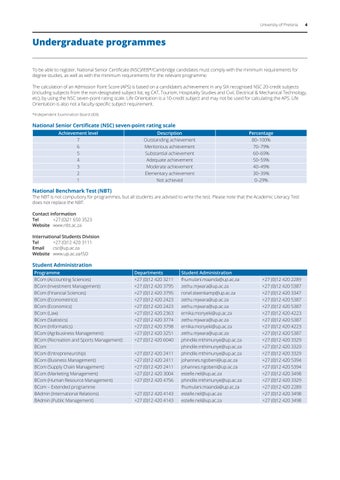
To be able to register, National Senior Certificate (NSC)/IEB*/Cambridge candidates must comply with the minimum requirements for degree studies, as well as with the minimum requirements for the relevant programme.
The calculation of an Admission Point Score (APS) is based on a candidate’s achievement in any SIX recognised NSC 20-credit subjects (including subjects from the non-designated subject list, eg CAT, Tourism, Hospitality Studies and Civil, Electrical & Mechanical Technology, etc), by using the NSC seven-point rating scale. Life Orientation is a 10-credit subject and may not be used for calculating the APS. Life Orientation is also not a faculty-specific subject requirement.
*Independent Examination Board (IEB)
National Senior Certificate (NSC) seven-point rating scale
National Benchmark Test (NBT)
The NBT is not compulsory for programmes, but all students are advised to write the test. Please note that the Academic Literacy Test does not replace the NBT.
Contact information
Tel +27 (0)21 650 3523 Website www.nbt.ac.za
International Students Division
Tel +27 (0)12 420 3111
Email csc@up.ac.za
Website www.up.ac.za/ISD
Student Administration
BCom (Accounting Sciences)
(Investment Management)
(0)12 420 3211
(0)12 420 3795
BCom (Financial Sciences) +27 (0)12 420 3795
BCom (Econometrics)
BCom (Economics)
BCom (Law)
BCom (Statistics)
BCom (Informatics)
BCom (Agribusiness Management)
BCom (Recreation and Sports Management)
(0)12 420 2423 zethu.mjwara@up.ac.za
(0)12 420 3347
(0)12 420 5387
+27 (0)12 420 2423 zethu.mjwara@up.ac.za +27 (0)12 420 5387
+27 (0)12 420 2363 ernika.monyeki@up.ac.za +27 (0)12 420 4223
+27 (0)12 420 3774 zethu.mjwara@up.ac.za +27 (0)12 420 5387
+27 (0)12 420 3798 ernika.monyeki@up.ac.za +27 (0)12 420 4223
+27 (0)12 420 3251 zethu.mjwara@up.ac.za +27 (0)12 420 5387
+27 (0)12 420 6040 phindile.mthimunye@up.ac.za +27 (0)12 420 3329
BCom phindile.mthimunye@up.ac.za +27 (0)12 420 3329
BCom (Entrepreneurship)
BCom (Business Management)
+27 (0)12 420 2411 phindile.mthimunye@up.ac.za +27 (0)12 420 3329
+27 (0)12 420 2411 johannes.ngobeni@up.ac.za +27 (0)12 420 5394
BCom (Supply Chain Management) +27 (0)12 420 2411 johannes.ngobeni@up.ac.za +27 (0)12 420 5394
BCom (Marketing Management)
BCom (Human Resource Management)
+27 (0)12 420 3004 estelle.nel@up.ac.za +27 (0)12 420 3498
+27 (0)12 420 4756 phindile.mthimunye@up.ac.za +27 (0)12 420 3329
BCom – Extended programme fhumulani.maanda@up.ac.za +27 (0)12 420 2289
BAdmin (International Relations)
BAdmin (Public Management)
+27 (0)12 420 4143 estelle.nel@up.ac.za
+27 (0)12 420 4143 estelle.nel@up.ac.za
+27 (0)12 420 3498
+27 (0)12 420 3498
Note: All first-year students take the compulsory fundamental modules, Academic Information Management and Academic Literacy for EMS; and all second-year students take Professional Ethics.
Core modules (compulsory)
1st year 2nd year 3rd year
*Financial Accounting *Financial Accounting *Financial Accounting
*Financial Management *Financial Management *Financial Management
Statistics *Auditing *Auditing
Economics *Taxation *Taxation
Informatics Informatics
Commercial Law Commercial Law
Business Management Communication Management
*The specialisation modules of the first to third years for BCom (Accounting Sciences) may only be taken by students who are selected for this degree.
BCom (Accounting Sciences) is an accredited programme that forms part of the requirements for training as both a chartered accountant (CA(SA)) and auditor (RAA). The CA(SA) and RAA qualifications are the highest professional qualifications in accounting in South Africa and enjoy international recognition.
Note: All first-year students take the compulsory fundamental modules, Academic Information Management and Academic Literacy for EMS; and all second-year students take Introduction to Moral and Political Philosophy.
Core modules (compulsory) 1st year 2nd year 3rd year
Financial Accounting Financial Accounting Financial Accounting Economics Economics Economics
Business Management Investment Management Investment Management
Commercial Law Financial Management Financial Management
Statistics Statistics
Informatics Informatics
Graduates of this degree tend to pursue the following professional qualifications: Chartered Financial Analyst (CFA®)*, Certified Financial Planner (CFP®)* and Chartered Alternative Investment Analyst (CAIA).
*CFA Institute and CFA are registered trademarks of CFA Institute.
Note: All first-year students take the compulsory fundamental modules, Academic Information Management and Academic Literacy for EMS; and all second-year students take Introduction to Moral and Political Philosophy.
Core modules (compulsory) 1st year 2nd year
Financial Accounting Financial Accounting *Financial Accounting
Business
Management Internal Auditing *Internal Auditing
Statistics Taxation *Taxation
Economics Financial Management *Financial Management
Informatics Informatics
Business Law
*Students choose any three majors at third-year level.
The University of Pretoria is one of only six universities in the world accredited as Centre of Excellence in Internal Auditing – the highest level of accrediting awarded by the International Institute of Internal Auditors.
Graduates with a BCom (Financial Sciences) degree obtain certain exemptions for the CIMA (Chartered Institute of Mangement Accountants) professional qualification and may also pursue professional qualifications from SAIPA (South African Institute of Professional Accountants) and ACCA (Association of Chartered Certified Accountants).
Note: All first-year students take the compulsory fundamental modules, Academic Information Management and Academic Literacy for EMS.
Core modules (compulsory)
Economics Economics Economics
Mathematical
Statistics Mathematical Statistics Mathematical Statistics
Mathematics Mathematics
Business Management
Financial Accounting
Informatics
Communication
Management
Note: All first-year students take the compulsory fundamental modules, Academic Information Management and Academic Literacy for EMS; and all second-year students take Professional Ethics.
Core modules (compulsory)
Economics Economics Economics
Statistics Statistics Statistics
Business Management Business Law
Financial Accounting
Mathematics
Communication
Management
Note: All first-year students take the compulsory fundamental modules, Academic Information Management, Judisprudence, English or Afrikaans. Core modules (compulsory)
Economics Law of Contract Law of Things
Business Management Law of Succession Law of Delict
Financial Accounting Specific Contracts
Law Statistics Consumer Protection Insolvency Law
Roman Law
Methods Law of Persons
(See the Yearbook of the Faculty of Economic and Management Sciences)
Students in Mathematical Statistics who also want to be trained for the insurance industry, select the following modules, among others, as part of their core and elective modules:
Mathematical Statistics Mathematical Statistics Mathematical Statistics
Economics
Mathematics
Management
*See prerequisites for Actuarial Mathematics in the Yearbook of the Faculty of Economic and Management Sciences.
Students in Mathematical Statistics who also want to be trained in the econometrics field, select the following modules, among others, as part of their core and elective modules:
BCom (Statistics)
Note: All first-year students take the compulsory fundamental modules, Academic Information Management and Academic Literacy for EMS.
Other students choose modules from any other subject or faculty according to their own specific career requirements.
Note: All first-year students take the compulsory fundamental modules, Academic Information Management and Academic Literacy for IT; and all second-year students take Introduction to Moral and Political Philosophy.
Core modules (compulsory)
Informatics
(See the Yearbook of the Faculty of Economic and Management Sciences)
*See prerequisites for Actuarial Mathematics in the Yearbook of the Faculty of Economic and Management Sciences.
Elective modules
Choose one elective. (See the Yearbook of the Faculty of Economic and Management Sciences)
Financial
The BCom (Informatics) degree is the only Information Systems programme that is accredited by the International Accreditation Board for Engineers and Technology (ABET) in Africa.
Note: All first-year students take the compulsory fundamental modules, Academic Information Management and Academic Literacy for EMS; and all second-year students take Introduction to Moral and Political Philosophy.
Core modules (compulsory)
Economics Economics Economics
Statistics Statistics Agricultural Economics
Business Management Business Management
Financial Accounting Business Law
Communication Management Agricultural Economics
Marketing Management
Note: All first-year students take the compulsory fundamental modules, Academic Information Management and Academic Literacy for EMS.
Core modules (compulsory)
1st year 2nd year 3rd year
Marketing Management Marketing Management Marketing Management
Business Management Business Management Business Management
Fundamentals of Recreation and Sport Management Sport Facility and Event Management Economics of Sport and Leisure
Economics Business and Governance of Sport Value-based Decision-making in Sport and Recreation
Leadership in Sport and Recreation Sport Tourism
Financial Accounting Business Law
Statistics Sport Development
BCom
Note: All first-year students take the compulsory fundamental modules, Academic Information Management and Academic Literacy for EMS; and all second-year students take Introduction to Moral and Political Philosophy.
Core modules (compulsory) 1st
Economics Business Law
Financial Accounting
Commercial Law (first-year level) or Business Law (secondyear level)
Statistics or Mathematical
Statistics
Communication Management
One of the following modules: (See the Yearbook of the Faculty of Economic and Management Sciences)
1st year
Business Management
Marketing Management
Industrial and Organisational Psychology
Public Administration
Any of these four modules may be chosen as elective modules if not chosen as core modules.
Elective modules
(See the Yearbook of the Faculty of Economic and Management Sciences)
Business Management Business Management Business Management
Marketing Management Marketing Management Marketing Management
Industrial and Organisational Psychology
Industrial and Organisational Psychology
Industrial and Organisational Psychology
Public Administration Public Administration Public Administration
Mathematics Statistics or Mathematical Statistics or Mathematics Statistics or Mathematical Statistics or Mathematics
Informatics Communication Management Communication Management
Economics Economics
Financial Accounting Financial Accounting
Taxation Taxation
Informatics Labour Relations
Financial Management Labour Law
Note: All first-year students take the compulsory fundamental modules, Academic Information Management and Academic Literacy for EMS; and all second-year students take Introduction to Moral and Political Philosophy.
Core modules (compulsory)
Business Management Business Management Business Management
Economics Entrepreneurship Entrepreneurship
Statistics Business Law International Business Management
Financial Accounting Financial Management
Marketing
Management Marketing Management
Communication
Management
Note: All first-year students take the compulsory fundamental modules, Academic Information Management and Academic Literacy for EMS; and all second-year students take Introduction to Moral and Political Philosophy.
Core modules (compulsory)
1st year 2nd year 3rd year
Business Management Business Management Business Management
Marketing Management Marketing Management Marketing Management
Economics Business Law International Business Management
Financial Accounting Financial Management
Statistics
Communication Management
Informatics
Note: All first-year students take the compulsory fundamental modules, Academic Information Management and Academic Literacy for EMS; and all second-year students take Professional Ethics.
Core modules (compulsory) 1st year 2nd year 3rd year
Business Management Business Management Business Management
Marketing Management Business Law International Business Management
Economics Supply Chain Management Supply Chain Management
Financial Accounting Financial Management
Informatics
Communication Management
Statistics
The supply chain management programmes offered by the Chair in Logistics are accredited by the European Certification Board for Logistics (ECBL) who acts as the custodian of standards for the European Logistics Association (ELA). The University of Pretoria is the only certification centre to offer the ELA certification in South Africa and only one of two countries outside the European Union.
Note: All first-year students take the compulsory fundamental modules, Academic Information Management and Academic Literacy for EMS; and all second-year students take Introduction to Moral and Political Philosophy.
Core modules (compulsory) 1st year 2nd year 3rd year
Marketing Management Marketing Management Marketing Management
Business Management Business Management Business Management
Economics Financial Management International Business Management
Financial Accounting Business Law
Statistics
Communication
Management
Note: All first-year students take the compulsory fundamental modules, Academic Information Management and Academic Literacy for EMS; and all second-year students take Introduction to Moral and Political Philosophy.
Core modules (compulsory) 1st year 2nd year 3rd year
Industrial and Organisational Psychology Industrial and Organisational Psychology Industrial and Organisational Psychology
Business Management Business Management Business Management
Economics Business Law Labour Law
Financial Accounting Research Labour Relations
Statistics
Communication Management
The first study year is offered at the Mamelodi Campus and is offered in English only. This is the ideal starting point for students who are interested in studying towards BCom in management and financial sciences. Students must apply during October of their first year to be transferred to the Faculty of Economic and Management Sciences on the Hatfield Campus. Placement in BCom (Accounting Sciences) and BCom (Investment Management) cannot be guaranteed. All first-year modules must be passed to be able to transfer to any of the BCom programmes.
Core modules (compulsory) 1st year 2nd year 3rd year 4th year
Language, Life and Study Skills
Mathematics
Academic Information Management Complete outstanding first-year modules as per chosen programme. Complete outstanding modules as per chosen programme. Complete outstanding modules as per chosen programme.
Financial Accounting Statistics/ Mathematical Statistics
Business Management
Note: All first-year students take the compulsory fundamental modules, Academic Information Management and Academic Literacy for EMS.
Core modules (compulsory) 1st year 2nd year 3rd year Public Administration Public Administration Public Administration Communication Management International Relations International Relations Politics Economics
Elective modules
(See the Yearbook of the Faculty of Economic and Management Sciences) 1st year
Industrial and Organisational Psychology
Industrial and Organisational Psychology
Industrial and Organisational Psychology
History Political Science Political Science
Marketing Management Marketing Management
Language: German, English, French, Arabic, Mandarin, Russian, Spanish
Language modules with a maximum value of 64 credits may be taken up to the second year. Select from the following:
A European language (English, German, French or Spanish) at UP
An international language (Arabic, Mandarin or Russian) at Unisa
Note: All first-year students take the compulsory fundamental modules, Academic Information Management and Academic Literacy for EMS.
Core modules (compulsory)
Elective modules
(See the Yearbook of the Faculty of Economic and Management Sciences) 1st year 2nd year 3rd year
Economics Economics Economics
Business
Management Business Management Business Management
Financial Accounting Industrial and Organisational Psychology Industrial and Organisational Psychology
Statistics Political Science or International Relations Political Science or International Relations
Afrikaans Business Law Labour Law
Communication
Management Communication Management
Legal Interpretation Administrative Law Labour Relations
Note: Candidates who did not obtain at least 4 (50–59%) in Mathematics in Grade 12, or who did not pass Statistics (STK) 113 and 123 may not include Economics (EKN) 120, 234, 244, 310 and 320 and Statistics (STK) 110 and 120 in their curriculum. Also refer to the faculty prerequisites for these modules.
The Faculty of Economic and Management Sciences offers postgraduate opportunities in numerous specialisation areas. See the Faculty of Economic and Management Sciences Postgraduate Yearbook for contact information or visit www.up.ac.za/bcom.
Visit www.up.ac.za > ‘Study at UP’ > ‘Undergraduate students’ for information on the following:
Study information
Calculate your Admission Point Score (APS)
Closing dates
Fees and Funding
Special offer for top academic achievers
Apply at Tuks
Change or add a programme
National Benchmark Test (NBT)
Application status
Prepare to study at Tuks
Registration and start of the academic year
Date 21 May 2016
Time 08:00–14:00
The following persons should attend the UP Open Day:
Learners in Grade 12 who already received confirmation that they are provisionally admitted to UP
Learners in Grade 12 who meet the admission requirements and wish to hand in their application forms
Learners in Grade 11 who are fairly certain they will apply at UP
Parents of the above learners




The Faculty of Economic and Management Sciences strives to create a quality student life and the student houses play an important role in this regard. Commercii is the overarching Faculty’s student house.
Commercii goes beyond just being a “typical society” on campus – it concentrates on being a society that provides valuable experiences and life learning skills that will empower our students to be leaders both on campus and in the workplace after completing their studies.
TUKS CA-students annually excel in the SAICA exams!
The Chartered Accountancy (CA) students of the University of Pretoria constantly perform exceptionally in the Initial Test of Competence (ITC) of the South African Institute of Chartered Accountants (SAICA).
Our students serve the community.
Providing a balanced student life is important to the Faculty, as it forms an integral part of students’ development. Through outreach projects our students serve the community and understand the meaning of caring.
Our students often get the opportunity to participate in discipline-specific events.
Off to New York! Students from the Department of Economics annually attended a six week Summer Study Tour at the Fordham University in New York.



The Tax Indaba was held at Sandton Convention Centre. More than 800 participants – including over a hundred speakers – discussed, debated and deliberated on every area of tax from every conceivable angle.
3 Continent Master of Science in Global Management (3CMGM) programme

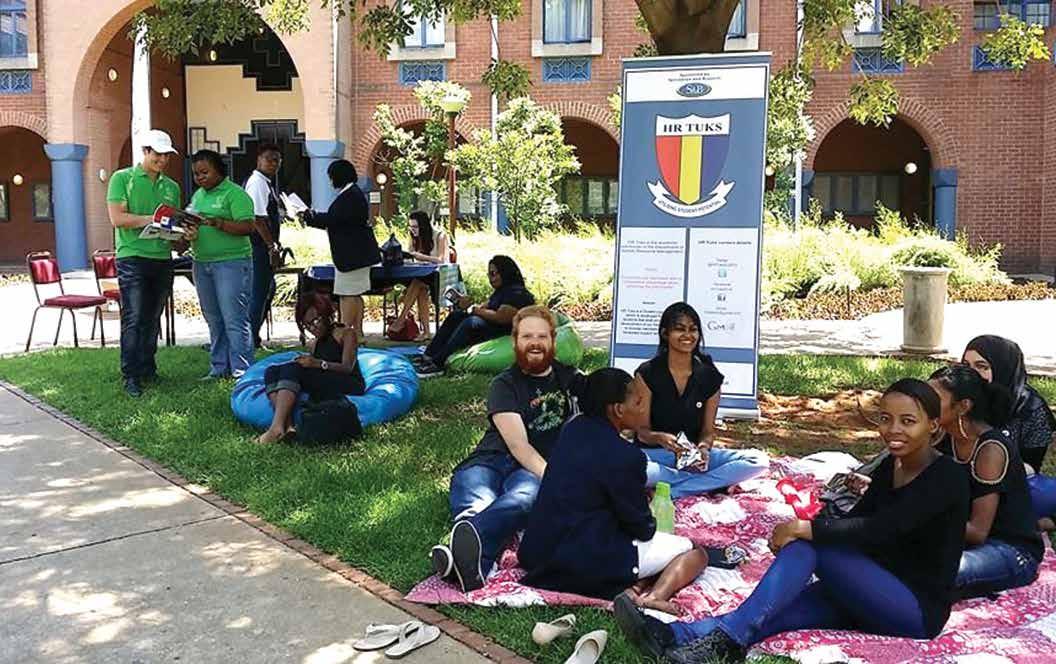
EMS Students – not everything happens in the classrooms…
There is ample opportunity for students to liaise outside the classroom with fellow students and industry.