WELLB EI NG EAT WELL IS S UE 6 2
H E A LT H Y E A SY D E L I C I O U S Easy & nutritious Yogi Y gii Mi Miso B Bowll with ith i h Oyster Mushrooms & Kimchi
70+
SENSATIONAL SPRING RECIPES
ZERO WASTE cooking
High-protein
BREAKFASTS
Recipes that fuel
YOUR MIND
ISSUE 62 AUS $12.95* NZ $12.95 (Both incl. GST)
wellbeing.com.au EWL062_Cover Final.indd 1
GLUTEN-FREE
Favourites Spice it up with Sri Lankan cuisine | Cooking with kids Make your own butter & ricotta | The truth about plant milks
9/06/2026 8:22:40 AM
Montague-Farms-Eatwell61-Wellbeing222.indd 2
12/02/2026 11:30:18 AM
Life is better with fresh moments in between. Sweet-tangy JAZZ™ apples make these moments special. Delighting your senses, lifting your mood, and keeping you energised!
montaguefarms.com.au @ montaguefarms
Montague-Farms-Eatwell61-Wellbeing222.indd 3
12/02/2026 11:30:47 AM
sunny-queen-EWL062.indd 2
28/04/2026 8:52:00 AM
sunny-queen-EWL062.indd 3
28/04/2026 8:52:32 AM
Artichoke
An artichoke is a flower that never got to bloom. Its tightly furled bud is harvested before it opens, which is why it looks the way it does: layered, armoured, completely unlike anything else at the market. Most people have walked past one without knowing what to do with it. That’s a shame, because what lives at the centre of all those leaves is one of the most extraordinary things you can eat. Technically a thistle, the globe artichoke (Cynara scolymus) has been cultivated since antiquity. Greeks and Romans ate them as a luxury, preserving the hearts in vinegar and cumin. In Australia they come into season through winter and spring, and you’ll find them at farmers’ markets and good greengrocers from around June. Buy them with the outer leaves tightly closed and the stems on. Steam a whole artichoke for 35 to 40 minutes, then sit down and eat it slowly. Pull back each leaf, dip the tender base in butter or aioli and draw it through your teeth. When you reach the heart, once you’ve scraped away the choke (the fibrous, inedible disc that sits on top of the heart) with a spoon, you’ll understand why this vegetable has devotees everywhere. The hearts are also excellent grilled, folded through pasta with olive oil and chilli, layered into a frittata or blended into a dip. If you come across baby artichokes before the choke has formed, slice them raw and dress with lemon juice and parmesan. Artichokes are among the most antioxidant-rich vegetables, with good amounts of fibre, vitamin C, vitamin K, folate and magnesium. Cynarin, the compound behind their distinctive flavour, supports liver health and digestion. It also temporarily alters your taste perception, making everything you eat and drink afterwards seem sweeter, including water and wine. The artichoke changes the meal around it, which is part of what makes it so unlike anything else on the table.
6 | EAT WELL
EWL062_006-007 Food Mood Artichokes_proofread.indd 6
1/06/2026 2:05:38 PM
E AT W ELL
for the love of food
EAT WELL | 7
EWL062_006-007 Food Mood Artichokes_proofread.indd 7
1/06/2026 2:05:42 PM
Editor Dana Diament Sub-Editor Michelle Segal Designer Michaela Primiano Feature Writers Lisa Holmen, Carrol Baker, Terry Robson, Jennifer Stackhouse, Liliana Battle, Neville Donovan Chefs Lisa Holmen, Lisa Guy, Georgia Harding, Lindy Zolnierczak, Harry Lancaster, Joanna Rushton
fr the EDITOR I
t started with pregnancy, the way so many things do. Growing a person takes everything you have, and I gave it willingly, expecting to get myself back on the other side. In many ways I did, but not entirely, and not the part I wanted most. The sharpness. The clarity. The ability to hold a thought from one end of the day to the other without it slipping away somewhere in the middle. I told myself it was postpartum. Then I told myself it was the season I was in — the beautiful, relentlessness of building a career, raising small children and making a life. There was always a reasonable explanation, and for seven years, I accepted them all. I got good at working around the gaps, the way you learn to navigate a house in the dark. Then perimenopause arrived to properly introduce itself, and I had a very clear, very still moment where I thought: Is this just how it’s going to be now? I am not, by nature, someone who accepts “this is just how it is”. So I started reading. Exercise physiologist Dr Stacy Sims has spent her career making one essential argument: women are not small men. It sounds obvious when you say it out loud, and yet the vast majority of nutritional research has been conducted almost exclusively on men. The guidance so many of us have quietly absorbed: skip breakfast, fast until noon, let your body reset. It was never designed for our hormones, our cortisol rhythms, or the specific demands of a perimenopausal body. There’s another reason so many women aren’t eating in the morning, and it has nothing to do with fasting trends. It’s that we’re simply last on our own list. We’re packing lunches, getting kids out the door and answering emails before we’ve sat down. Somewhere in the chaos, breakfast becomes the thing we skip because everyone else’s needs came first. We arrive at 10am running on coffee and cortisol, wondering why we can’t think straight, not realising the two are connected. For women in midlife especially,
On the cover Harry Lancaster's, Yogi Miso Bowl Page 49
extending that morning fast elevates cortisol at exactly the time our bodies need steadiness. What I learned is that what our bodies need first thing is protein. Not a small amount but real, substantial protein, ideally 25 to 30 grams, before anything else. Protein is the raw material our brains use to produce the neurotransmitters that regulate focus, mood and memory. It stabilises blood sugar through the morning in a way that nothing else does, and for women navigating perimenopause, it helps preserve the muscle mass that declining hormones are quietly working against. So I changed my mornings. Protein before coffee, every day. I made other choices too, including reducing sugar, cutting back on alcohol, putting the phone down earlier at night and starting to lift weights. At first my body protested, but with persistence, change came. While the brain fog has significantly improved though has not completely gone yet, most of myself has returned. I feel like me again, and that’s everything. This issue exists to put the research, recipes and tools in your hands: protein-packed breakfasts to transform your mornings, the science of how food feeds your brain, real and easy gluten-free recipes to reduce inflammation, and so much more. Whatever you’re navigating, I hope you find what you need in these pages.
Dana Give u s fo o d bac k We want your foodback: EatWell is all about building a sharing community of people who care about the origins, quality and enjoyment of our food, so we want to hear from you. Let us know how you have found some of the recipes you have made from this issue, share the improvements you might have made or even send us one of your own favourite recipes. We will publish as many of your insights and contributions as we can. Send your foodback to Dana at ddiament@umco.com.au.
National Advertising Manager VIC & QLD Tracey Dwyer twdyer@umco.com.au Brand Partnerships Manager Hareni Nimalan +61 488 424 232 Advertising Production Co-ordinator Mila Rojano +61 2 9887 0325 Publisher Janice Williams
Chairman/CEO Prema Perera Publisher Janice Williams Chief Financial Officer Vicky Mahadeva Associate Publisher Emma Perera Circulation Business Development Manager Mark McTaggart Subscription enquiries 1300 303 414 Circulation enquiries +61 2 9805 0399
EatWell Issue 62 is published by Universal WellBeing Pty Ltd, Unit 5, 6–8 Byfield Street, North Ryde NSW 2113, Australia. Phone: +61 2 9805 0399, Fax: +61 2 9805 0714. Printed by KHL Printing Co Pte Ltd, Singapore. Distributed by Gordon and Gotch, Australia. Editorial advice is non-specific and readers are advised to seek professional advice for personal problems. Individual replies to readers’ letters by consulting editors are not possible. The opinions expressed by individual writers in WellBeing are not necessarily those of the publishers. This book is copyright. Apart from any fair dealing for the purpose of private study, research, criticism or review as permitted under the Copyright Act, no part may be reproduced by any process without written permission. Enquiries should be addressed to the publishers. The publishers believe all the information supplied in this book to be correct at the time of printing. They are not, however, in a position to make a guarantee to this effect and accept no liability in the event of any information proving inaccurate. Prices, addresses and phone numbers were, after investigation and to the best of our knowledge and belief, up to date at the time of printing, but the shifting sands of time may change them in some cases. It is not possible for the publishers to ensure that advertisements which appear in this publication comply with the Competition and Consumer Act 2010 (Cth) and the Australian Consumer Law. The responsibility must therefore be on the person, company or advertising agency submitting the advertisements for publication. While every endeavour has been made to ensure complete accuracy, the publishers cannot be held responsible for any errors or omissions. This magazine is printed on paper that comes from a mill that satisfies the requirements of ISO 14001. *Recommended retail price ISSN 2204-2474/0812-8220 Copyright © Universal Magazines MMXXVI ACN 003 026 944 umco.com.au Important: This magazine is intended as a reference volume only, not as a medical manual. While the information is based on material provided by researchers, the magazine does not presume to give medical advice. Be sure to consult your physician before beginning any therapeutic program. We are a member of
8 | EAT WELL
EWL062_008 Ed's Letter_proofread.indd 8
9/06/2026 8:50:09 AM
The snack with active probiotics...
... and gluten free. • No artificial flavours • No artificial colours • No preservatives • No added msg • 100% Australian owned • Two billion active probiotics per pack
Available at Chemist Warehouse, selected independent supermarkets, green grocers and delicatessens.
piranhacorp.com.au
Tixana-EWL062.indd 1
1/05/2026 12:01:08 PM
Contents 1 2 Fo o d P r o f i l e : S a f f r o n While commercial threads can sometimes cost more than gold, this ancient spice is surprisingly within reach of the home gardener. 14 Fo o d P r o f i l e : A s i a n G r e e n s Tasty, nutritious, easy to grow and versatile in the kitchen, leafy green Asian vegetables are so much more than a stir-fry ingredient. 16 Fo o d P r o f i l e : L e m o n B a l m Fragrant and delicate, lemon balm has long been lauded for its many healing powers. 18 K itc h e n M a s te r y Learn how to toast spices for deeper flavour, make the most of your freezer with ice cube trays, and discover the julienne peeler, and three ways to use an immersion blender. 2 0 Fo o d f o r T h o u g h t We now know that your brain continues to develop throughout your lifetime, and many studies link how well your brain ages with the foods you eat. 2 8 R e c i p e s : Fe e d Yo u r B r a i n What you eat shapes how clearly you think today and how well your brain ages over time. These recipes put the most powerful ingredients to work. 4 0 R o o t to S t e m Using the whole plant — root, leaves, skin, stems and flowers — is good for the planet and great for your health. 48 Recipes: Gluten-Free Done Si mple Going gluten-free doesn’t mean going without. These recipes deliver all the satisfaction of wholesome, flavourful food using naturally gluten-free ingredients. 6 2 D on’t H a v e a C o w The plant-based milk market has exploded, with more people turning away from dairy. But how do the alternatives stack up for health and sustainability? 70 R e c i p e s : P r o te i n - P a c ke d B r e a k f a s t s Front-loading the day with protein sets the tone for steady energy, sharper focus and better appetite control.
48 7 8 M i n d f u l n e s s i n t h e K it c h e n Research shows that happy kids are healthy kids. Discover how getting your children in the kitchen can help boost confidence and concentration. 86 Recipes: Sr i L a n ka n Sri Lankan food is bold and aromatic, built on layers of spice, coconut, curry leaves, sambol and relishes. 9 6 G r o w i n g G u i de : G a r d e n t o Ta b l e Learn how to grow rhubarb, artichoke, broad beans and radicchio. 10 0 R e c i p e s : DI Y D a i r y Discover how easy it is to make butter and ricotta at home, bringing fresh, creamy goodness straight to your kitchen. 1 0 4 C o o k b o o k Fe a t u r e : C o o k : G r e e n Renowned chef Karen Martini puts vegetables center stage with bold, seasonal recipes from zesty salads to comforting mains. 112 Our Chefs Meet the chefs who bring this issue’s recipes to you: Lisa Guy, Georgia Harding, Lisa Holmen, Harry Lancaster and Lindy Zolnierczak.
O u r Gu ide Next to each recipe in EatWell, you will see icons as a guide. This is what they mean: GF G lute n F r e e
V
DF D a i r y F r e e
VG Ve g a n F r i e n d l y
Ve g e t a r i a n F r i e n d l y
10 | EAT WELL
EWL062_010 Contents_proofread.indd 10
27/05/2026 10:18:13 AM
The Honey Cake Australia is talking about! Savour together, layer after layer. Marlenka Australia
Marlenka-EWL062.indd 1
marlenka_australia
www.marlenka.au
18/05/2026 2:50:58 PM
FOOD IN PROF IL E saffron
Saffron
(Crocus sativus) While commercial threads can sometimes cost more than gold, this ancient spice — ex tinct in the wild — is surprisingly within reach of the home gardener.
S
affron is a spice used to flavour and colour foods such as rice and chicken. Its red threads impart a rich yellow colour to food. Saffron is the most expensive spice in the world and, gram for gram, pricier than gold. Saffron can retail from $10 per gram, with local or high-quality imported saffron costing up to $100 per gram. When you realise saffron comes from a crocus flower, you understand why it is so expensive. Saffron threads are the stigma (the female part of the flower) and the style (the “stalk” that attaches the stigma to the flower). Each flower has three stigmas. As a bulb can produce four flowers, a good harvest from a single bulb is 12 strands of saffron. Saffron
S a f f ron Common name: Saffron crocus Botanical name: Crocus sativus Group: Bulb Requires: Full sun, well-drained soil Dislikes: Humidity, poor drainage Suitable for: Raised beds, bulb bed Habit: Autumn flowering; dormant spring to summer Needs: Avoid digging around dormant corms Propagation: Corms Difficulty: Moderate
is harvested by hand, plucked in the early hours of the morning when the flower is fully open. The flowers bloom for just a few weeks, making for a short and intensive harvest period. After harvest the strands are dried. Although the saffron crocus is not known in the wild, its ancestors grew around the Mediterranean region. Today, most commercial saffron comes from Iran, but it is also grown in Afghanistan, Greece, Kashmir, Spain and Australia. It has pretty blooms of lilac or purple, often with light stripes. Each flower has three deep-red stigmas and three golden anthers and the blooms appear in autumn. Try planting new corms in summer or early autumn. It takes 150 flowers to produce 1g of dry saffron, so you will need to plant at least 30 corms to harvest 1g of spice! As the saffron crocus prefers a cool climate with moist but well-drained soils, it grows best in southern and highland areas of Australia. Commercial saffron production occurs in Tasmania and west of Sydney at Capertee. Flower production is best with full sun.
L i fe supp or t Saffron crocus can only survive through cultivation. It is no longer found in the wild and the flowers are sterile, so it can only be grown by dividing the clumps of corms, which are divided and replanted in late summer or autumn. For commercial production, clumps are lifted, divided and replanted each summer — but in home gardens it is enough to divide clumps every three years. To ensure strong growth, allow the thin, reedy foliage to die down naturally.
12 | EAT WELL
EWL062_012 Food Profile Cape Saffron_proofread.indd 12
27/05/2026 10:18:27 AM
atms-ewl062.indd 1
22/05/2026 2:40:16 PM
Asian Greens (Brassica sp.)
What would a stir-fr y be without lovely leafy Asian greens? But there are plenty of other uses for these easy-going plants.
L
eafy green Asian vegetables are tasty, nutritious, easy to grow and versatile in the kitchen. All are good sources of calcium and vitamins A, C and K. They can be steamed, stir-fried, stewed, braised or chopped and cooked in soups. Asian greens have great flavour but it’s the different leaf shapes, colours and textures that make them such appealing veggies, in both the garden and the kitchen.
Grow i ng
Stor i ng Whole heads that are trimmed, rinsed and refrigerated (in the crisper) will keep for several days.
P reser v i ng Bumper crops of any Asian green variety can be blanched (plunged into boiling water, removed after a brief interval and then plunged into iced water or placed under cold running water) and frozen.
All Asian greens grow best in moist, fertile, well-drained soil that has plenty of mature organic compost mixed in. The ideal pH is between 6.0 and 6.5. They like a sunny position. Seeds: Sow seeds about 5cm apart and 0.5–1cm deep. Water gently so as not to dislodge seeds. Seeds germinate rapidly, sometimes within a week, and can be thinned for proper spacing. Buk choy grows well 15cm apart while the larger growers, such as wombok, gai lan (Chinese broccoli) and gai choy should be thinned to 30–35cm apart. Eat the little seedlings that you remove while thinning the crops. Alternatively, seeds can be raised in seed-raising trays and planted out. Seedlings: Transplant seedlings into the garden four weeks after germination and space according to their needs. Water thoroughly and carefully without disturbing the soil.
P roblem s Control aphids that cluster on new shoots or leaves with soap spray, wiping off with a damp cloth or squashing them. Hunt slugs and snails and squash or drown them in a bucket of soapy water. Set beer traps or make protective barriers around plants using crushed eggshells.
Ha r vest i ng Leaves can be cut away from the central crown of the plant as the leafy types of Asian greens mature. New leaves quickly replace the harvested ones. Buk choy or wombok can be pulled whole from the soil as required.
14 | EAT WELL
EWL062_014-015 Food Profile Asian Greens_proofread.indd 14
27/05/2026 10:18:40 AM
FOOD IN PROF IL E
asian greens
Va r iet ies Buk choy (pak choy): Mature buk choy (pictured left) has white stems and dark-green leaves. Young buk choy is called pak choy and is light green with spoon-shaped stems and a soft texture. Both are best used in stir-fries, steamed or in soups. Young leaves are great in salads. Choy sum (Chinese silverbeet): Similar to buk choy but the stems are thinner. Good in soups or steamed. En choy (Chinese spinach or amaranth): The dark-green leaves have purple centres and crunchy green stems. It wilts easily so does well when it is lightly steamed or stir-fried. Gai choy (Chinese or Asian mustard): This large dark-yellow-green vegetable has a peppery taste and is high in vitamins A and C. It can be pickled, stir-fried, stewed or braised. Gives a spicy bite to salads. Gai lan (Chinese broccoli): Has small flower heads like broccoli and is slightly bitter. It’s dark green with thick, glossy stalks and large leaves. Usually steamed or used in stir-fries. Kang kong: A type of water spinach that has dark-green, smooth, arrowhead-shaped leaves and long, green stems. Best used in stir-fries.
A si a n g re en s Common name: Asian greens Botanical name: Mostly Brassica sp. Group: Vegetable Requires: Sun Likes: Slightly alkaline soil, pH 6.0–6.5 Suitable for: Veggie garden, pots Habit: Vigorous Needs: Friable, moist, fertile soil Propagation: Seed Difficulty: Easy
Mizuna: A pretty garden plant with serrated bright-green leaves and narrow stalks — both are edible. With a peppery, even bitter, taste, mizuna can be stir-fried, pickled or used as a salad garnish. Wombok: Probably the best-known Asian green. It’s a large, oblongshaped vegetable with white stalks and pale-green leaves. When cooked, it has a mild taste and soft texture — ideal in stir-fries and soups. Snow pea shoots: Have long stems with many leaves. Can be eaten raw, cooked in soups or stir-fried. Tatsoi: Very similar to buk choy but with rounder leaves. Steam or use in soups or stir-fries.
EAT WELL | 15
EWL062_014-015 Food Profile Asian Greens_proofread.indd 15
27/05/2026 10:18:44 AM
FOOD IN PROF IL E lemon balm
Lemon Balm ( Melissa officinalis) Fragrant and delicate, melissa has long been lauded for its many healing powers.
I
n Germany, lemon balm (Melissa officinalis), also known as melissa, is considered an important medicinal herb. The German government’s regulatory agency Commission E has approved its use internally for nervous sleeping disorders and gastrointestinal complaints, while the European Scientific Cooperative on Phytotherapy (ESCOP) recognises its internal use for tenseness, restlessness, irritability and symptomatic treatment of digestive disorders, and externally for herpes or cold sores. Such acceptance of its medicinal uses has come about as a result of several studies. One important double-blind, placebo-controlled study found a lemon balm cream very effective for the herpes virus, significantly reducing both the area of infection and the healing time. In addition, it had a beneficial effect on associated symptoms such as itching, tingling, burning and swelling. The researchers found evidence suggesting that use of the cream could reduce the frequency of recurrences. Of course, the Germans were not the first to understand the value of this beautifully fragrant herb in treating skin and digestive problems. Both the ancient Greeks and Arab physicians of the 11th and 12th centuries knew of its healing powers. A well-known legend has it that Llewellyn, Prince of Glamorgan, who lived in the 11th and 12th centuries, drank lemon balm tea every day and lived to be 108. The flavonoids, polyphenols and other compounds found in lemon balm are the keys to its anti-viral and anti-bacterial properties. Other actions of the herb include relaxant, antispasmodic and nerve tonic. Convinced? Well, even if you’re not very interested in it for its various medicinal benefits, melissa has plenty of culinary uses, especially in salads, soups and teas, imparting a delicate lemony flavour and aroma.
Grow i ng The clue to how useful lemon balm is in the herb and veggie garden is in its botanical name: Melissa is from a Greek word meaning honey bee, and lemon balm flowers are a powerful bee attractant. The plant is a perennial that likes moist, sunny conditions, though it will do well in partial shade. Grow it as an annual in cold regions. Sow seed or propagate from stem cuttings, planting in autumn or spring. It will thrive in most conditions, though like other mints it does not like to go thirsty.
L e gend ha s it t h at L lewel ly n , P r i nce of Gla mor ga n , d ra n k lemon ba l m tea ever y day a nd l ive d to be 108. Ha r vest i ng Pick the leaves before the plant flowers, as lemon balm changes once it flowers. For a new crop, cut the plant right back after flowering.
Usi ng This herb has many culinary uses. For medicinal benefits, there are two simple ways to use it for treating cold sores and insect bites. One is to make a tea and dab it onto the affected area 3–5 times a day. The other is to make an oil infusion to apply in a similar way. If you make the oil, you may wish to go further and try your hand at making a salve or ointment using beeswax. Though the oil will last a few months if stored properly — preferably in the fridge — you only need to make a small quantity.
L emon B a l m Tea Infuse 1½ tablespoons fresh lemon balm leaves in a cup of water for 10–15 minutes and strain. Double the quantity for dried leaves. Keep in the fridge and use for the duration of a cold sore outbreak.
L emon B a l m O i l If using fresh leaves, gather them before the plant flowers and make sure they are completely dry — wilt them to ensure there is absolutely no moisture present. To make the infusion, chop the dried or wilted fresh leaves and completely submerge them in cold-pressed extra-virgin olive oil or sweet almond oil in a dry wide-mouthed jar with a lid. Coconut oil is also excellent if kept somewhere warm enough to stay liquid while infusing. Leave in a sunny spot for a couple of weeks. Do a speedier infusion by standing the jar of oil in very hot water for an hour or so, changing the water a few times to keep it hot; or by simmering gently in a double boiler. Strain through cheesecloth until completely clear of plant material and transfer to a clean bottle. Once bottled, store in the fridge.
16 | EAT WELL
EWL062_016 Food Profile Lemon Balm_proofread.indd 16
27/05/2026 10:18:58 AM
clorox-glad-ewl062.indd 1
16/04/2026 9:11:06 AM
Kitchen MAST ERY Sharpen your culinar y prowess with essential equipment and clever shor tcuts. These practical tips and must-have gadgets are game changers that can take you from novice to confident home chef. Discover how great gear, properly used, can be the secret ingredient to your kitchen success.
Wor d s / D a n a D i a m e n t
Sm a r t Te c h n iq ues How to toast spices The difference between toasted cumin and straight-from-the-jar cumin is startling. Toasting whole or ground spices in a dry pan over medium heat for 1–2 minutes releases their essential oils and dramatically deepens their aroma. A single step can transform a spice from flat to fragrant. More rewarding is how this can take a dish from mediocre to mind-blowing. 1. Place spices in a small, heavy-based pan with no oil. 2. Set the heat to medium. 3. Stir constantly. Spices can go from toasted to burnt in seconds. 4. Watch for the colour to deepen slightly and a warm, nutty fragrance to fill the kitchen. 5. Tip immediately into a mortar (if continuing on to grind the whole spices) or onto a cold surface to stop the cooking. This technique works beautifully with cumin, coriander, fennel, mustard seeds, peppercorns, cardamom, star anise and dried chilli flakes. Try it before adding spices to curries, soups, spice rubs or dressings. You’ll quickly find this becomes a reflex and the kind of upgrade that makes everything taste more alive.
Top Tips Turn your freezer into a pantry Ice cube trays are one of the most underrated tools in a resourceful kitchen, beyond making ice for drinks. The habit of freezing food and other liquids is a natural extension of root-to-stem thinking: before anything goes off, freeze it. It saves money, reduces waste and means there is almost always something useful on hand. To get started, try freezing: • Leftover wine, red or white, for adding to sauces, stews and braises. • Fresh herbs blended with olive oil, ready to drop into soups, stir-fries and pan sauces all year round. • Leftover pesto for a ready-to-go pasta boost. • Homemade stock in cube portions — a single cube into a risotto or quick pan sauce adds so much flavour. • Kitchen scraps: parmesan rind, chilli paste or lemon zest in syrup. Be sure to label every tray with the contents and the date. Once frozen, things tend to look the same.
18 | EAT WELL
EWL062_018-019 FEAT Kitchen Mastery_proofread.indd 18
27/05/2026 10:19:09 AM
A RT ICL E
tips and gadgets
Hero Gadget Julienne peeler A julienne peeler is a small, inexpensive tool that creates long, thin matchstick strips from firm vegetables in seconds. It looks like a standard peeler but has a serrated blade that cuts fine ribbons as it glides along the surface. Carrots, zucchini, cucumber, daikon, beetroot and kohlrabi all work beautifully. Use it to make quick Asian-inspired slaws with sesame dressing, to top rice paper rolls with crunchy vegetable ribbons, to add texture to salads, or to create the kind of elegant garnish that elevates a simple dish. Julienned carrot and zucchini cook quickly in stir-fries or can be tossed through noodles raw. Stainless steel is worth seeking out for longevity. A julienne slicer (a mandoline-style version) offers more speed for larger quantities, but the simple hand peeler is perfectly adequate for everyday use and takes up almost no space. It is the kind of tool that changes how often you reach for fresh vegetables, because preparation suddenly becomes this easy.
A ppl i a nce Sp ot l ig ht Three ways to use an immersion blender Also called a stick blender or hand blender, the immersion blender is one of the most practical appliances a kitchen can hold. It blends directly in the pot, jug or bowl, with no decanting, no splashing and no extra washing up. Most models come with a whisk and chopper attachment, which extends their usefulness considerably. Look for a detachable shaft for easy cleaning and at least 600 watts for thicker blends. Try using your immersion blender to: Make soups and sauces: Blend soups directly in the pot while they’re still hot — no need to transfer to a blender in batches. The same goes for pasta sauces, puréed vegetables and gravies. For anyone who makes soup regularly, it is indispensable. Make foolproof emulsions and dips: The immersion blender is one of the easiest ways to make mayonnaise, aioli and vinaigrette that actually stays together. Place all ingredients in a tall, narrow jug, lower the blender to the bottom and blend without moving it until the emulsion forms. It also makes quick work of hummus, baba ganoush and any blended dip. Whip up smoothies and nut milks: Blend straight in a tall jug and pour directly into a glass. For homemade nut milks, soak the nuts overnight, drain, blend with fresh water and strain. No need for a full-size blender and far less to clean. Top tip: The chopper bowl attachment alone is worth having. It makes fast work of onions, herbs and nuts without requiring a food processor.
EAT WELL | 19
EWL062_018-019 FEAT Kitchen Mastery_proofread.indd 19
27/05/2026 10:19:11 AM
A RT ICL E
food for thought
FOOD FOR
thought We now know that your brain continues to develop throughout your lifetime, and many studies link how well your brain ages with the foods you eat . So here are some of the foods that will not only be delicious, but will also nourish your neurons.
Wor d s / Te r r y R o b s on
O
ne of the great medical misconceptions of the 20th century was that you do not grow new brain cells. The last few decades have shown that in the olfactory bulb (smell) and the hippocampus (memory and cognitive processes), new neurons can grow throughout life. We also know that health-promoting foods can stimulate neuron growth. For instance, polyphenol compounds (from foods like tea, grapes, wine, olive oil, cocoa, nuts, fruits and vegetables) and polyunsaturated fatty acids (from fish, corn, soybeans and sunflower seeds) lead to significantly higher rates of neuron growth in both the olfactory bulb and the hippocampus. To keep your brain healthy as you age, choosing the right foods is an important, and essential, first step. It is also worth choosing them well. In Australia, the ACOcertified organic badge is the official mark that a product has been independently verified to meet the country’s strictest organic standards — something worth looking for, given that not every product labelled “organic” has genuinely earned that status. You will find it on shelves at your local grocery store, not just in specialty health shops. It takes the guesswork out of choosing food that is as clean and nutrient-dense as possible.
The Me d iter ra nea n d iet There is plenty of evidence suggesting that the Mediterranean style of eating keeps your brain sharper as you age. The basis of the Mediterranean diet is a lot of fruits, vegetables, legumes (beans, peas, lentils), olive oil and fish, along with a little wine. Typically, red meat does not play a major part in the Mediterranean way of eating, although it is eaten perhaps once a week and is almost always lean. From the fruit and vegetables you get nutrients including antioxidants and fibre. Legumes are a protein source and also provide a range of nutrients. Olive oil yields healthy monounsaturated fats as well as antioxidants. Fish provides
protein and healthy omega-3 fats while wine offers antioxidants. Over the years, the Mediterranean diet has been credited with reducing the risk of developing a range of conditions potentially related to ageing like heart disease, cancer and diabetes. As far as your mind goes, one study of almost 4000 people aged 65 and over set out to see how a Mediterranean diet impacts the brain and mental function. The people in the study were assessed as to how closely their diet matched a Mediterranean-style diet using a test called the MedDiet scale. Then every three years the participants did tests that measured their word memory and basic maths skills to see if they were experiencing cognitive decline. Over time it emerged that people who scored higher on the MedDiet scale had slower rates of cognitive decline. In other words, the closer people were to the Mediterranean style of eating, the younger their brain. It all happens because the antioxidants and healthy fats in the Mediterranean diet reduce the oxidation and inflammation that contribute to conditions like Alzheimer’s disease. An additional factor in all of this is that most of the Mediterranean diet is based on raw foods with minimal processing. Add the fact that these foods are often consumed around a table with family and friends and it is not hard to imagine why the Mediterranean way of eating is such a positive thing for your brain. The fruits, vegetables, legumes and olive oil at the heart of the Mediterranean diet are foods that reward careful sourcing. These are ingredients where growing conditions, soil health and minimal intervention genuinely affect nutritional quality. Looking for the ACO-certified organic badge when buying these staples is a practical way to ensure you are getting produce that has been independently verified to meet Australia’s highest organic standards — the kind of care in cultivation that the Mediterranean way of eating has always been built around.
20 | EAT WELL
EWL062_020-024 FEAT Food For Thought_proofread.indd 20
1/06/2026 2:06:15 PM
EAT WELL | 21
EWL062_020-024 FEAT Food For Thought_proofread.indd 21
1/06/2026 2:06:18 PM
Neurovascular coupling refers to the fact that as an area of the brain is called into action, it requires more energy and it needs an increase in blood flow to achieve it. So healthy neurovascular coupling results in a rapid blood flow response to brain activity, and Harvard researchers wanted to see whether cocoa flavanols might enhance that process. To test this, they used ultrasound to measure the neurovascular coupling of a group of subjects as they completed some mental tasks. Around 30 per cent of people showed as having impaired neurovascular coupling. The subjects were then asked to drink two cups of hot cocoa daily for 30 days. Half of the subjects drank a highflavanol cocoa while the rest drank a flavanol-poor cocoa. Since the cocoa was high in flavanols, it is effectively equivalent to cacao. Those people with impaired neurovascular coupling experienced improvements in brain function regardless of which drink they consumed. The people with normal neurovascular coupling did not receive any benefit from their cocoa. This tells us that even moderate daily intake of cocoa flavanols will improve brain function where the brain is functioning less than optimally. You will get more bang for your buck with cacao, but even cocoa will offer some benefit. With cacao, though, quality is everything. Soil health, farming practices and what happens at every stage of cultivation all affect the concentration of the antioxidants and flavanols that make it such a powerful brain food. The ACO-certified organic badge is a reliable indicator that the cacao you are choosing has been grown and handled in a way that preserves what makes it worth eating in the first place.
Omega-3
C ac ao a nd co coa The cacao bean is the source of both cacao and cocoa powders. Cacao beans are found inside the fruit of the Theobroma cacao tree in fleshy, oval-shaped pods. The beans are harvested, fermented and dried. When you see cacao nibs, powdered cacao (or cacao powder) in the grocery stores, the bean is in its raw state — uncooked, additive-free and unprocessed. Cacao contains an abundance of antioxidants as well as fibre, magnesium, essential fatty acids, iron, copper, zinc, sulphur and calcium. It is only to switch a few vowels to get from “cacao” to “cocoa”, but there can be a world of difference. When cacao beans are roasted and processed they are called “cocoa”. Most cocoa powders have additives like sweeteners or cocoa butter. Once roasted and processed (turning cacao to cocoa), the beans lose much of their nutritional benefits. There are two processes used to make cocoa powder. Dutch-process cocoa powder is made from cacao beans that have been washed with a potassium carbonate solution to neutralise their acidity. Dutch-process cocoa is dark brown in colour. Natural cocoa powder is reddish-brown and is made from cocoa beans that are simply roasted and ground into a fine powder. Natural unsweetened cocoa powder is very similar to raw cacao powder except for experiencing higher temperatures during production, which decreases antioxidant activity. Research has shown that antioxidant flavanols from cocoa might improve memory via a process called “neurovascular coupling”.
Omega-3 fats accumulate in your central nervous system when you are in the womb. It has been assumed that these fatty acids are replaced continuously throughout life, and some diseases are known to impact the fatty acids in the brain. Alzheimer’s disease, for instance, is associated with lower than normal concentrations of the omega-3 fat docosahexaenoic acid (DHA). People taking omega-3 supplements do show reduced inflammatory markers in their cerebrospinal fluid as well as improvements in their Alzheimer’s disease. There has also been evidence that fish oil and its omega-3 fatty acids can benefit brain-related conditions like ADHD in children. Research has even shown that supplementing with fish oil can change the brain structure of adults. The best fish sources of omega-3 fats are sardines, salmon, tuna, John Dory, trout, snapper and flathead. The omega-3s from plants have to go through an extra step within your body to be used, but for healthy people this is not usually a problem. Chia seeds Chia seeds come from the desert plant Salvia hispanica, a member of the mint family. Chia seeds are an excellent source of omega-3 fatty acids but also fibre, protein, iron, calcium, magnesium and zinc. Linseeds Linseeds (Linum usitatissium) are also known as flaxseeds. The primary omega-3 fatty acid found in linseeds is alpha-linolenic acid, or ALA. As well as omega-3 fats, linseeds also contain lignans, fibrelike compounds that also have antioxidant actions and also act as phytoestrogens. Linseeds also contain fibre in the form of mucilage.
22 | EAT WELL
EWL062_020-024 FEAT Food For Thought_proofread.indd 22
4/06/2026 10:38:57 AM
A RT ICL E
food for thought
A nt iox id a nt s The b est f i sh sou rces of omega-3 fat s a re s a rd i ne s , s a l mon , t u n a , Joh n D or y, t rout , sn app er a nd f lat head .
One of the potential brain diseases associated with ageing is Alzheimer’s disease. The theory goes that Alzheimer’s disease results from brain changes that occur as a result of amyloid plaques that accumulate in the brain. It is thought that these plaques and the changes that result from them might be due to oxidative stress, so antioxidants should theoretically be of some help in preventing Alzheimer’s occurring, and this theory was proven in practice in a recent study. Research has shown that vitamin C and beta-carotene levels are much lower in people with Alzheimer’s. Perhaps vitamin C and beta-carotene selectively act against the oxidative drivers of the Alzheimer’s process. More research needs to be done, but it is certainly worthwhile to get stuck into foods rich in these nutrients like spinach, broccoli, oranges, capsicum, berries, papayas and carrots. Berries are wonderful brain foods because they are rich in polyphenols, the antioxidant molecules in berries that give them their various lustrous colours. Berries such as blueberries, strawberries and blackberries have been shown to help your brain stay healthy in a variety of ways. The antioxidants protect brain cells from damage, and also change the signalling of brain neurons in a way that reduces inflammation. The net result is maintaining motor co-ordination as well as cognitive powers as you age. Oranges are another antioxidant food that is particularly worth adding to your brain-friendly diet. Citrus sinensis is the common orange we eat, but there are many other varieties with different uses. Common examples are the Seville orange (or bitter orange) Citrus aurantium, and bergamot orange (Citrus bergamia). Although famous for its vitamin C content, the orange fruit also contains other substances that support your brain such as antioxidant and antiinflammatory compounds including flavonoids. Red (blood) oranges have much higher levels of these anti-inflammatory substances.
EAT WELL | 23
EWL062_020-024 FEAT Food For Thought_proofread.indd 23
1/06/2026 2:06:24 PM
A RT ICL E
food for thought
Pe ople told t h at a gei ng h a s ne gat ive ef fe c t s on t he bra i n w i l l do a rou nd 20 p er cent wor s e on a test g iven i m me d iately a f ter w a rd s . L eg u mes Legumes are a big family of foods including peas, beans, chickpeas, alfalfa and lentils. In general, legumes will help your brain as you age primarily because they will balance your blood-sugar levels and, as outlined below, high blood-sugar levels can be damaging to brain function. Legumes are also known as pulses and they provide protein, B vitamins, iron, calcium, zinc and magnesium, and are high in soluble fibre. They have a low glycaemic index (GI), meaning they are broken down more slowly so that you feel fuller for longer, making them a particularly good food for preventing and managing diabetes. Most importantly, studies tell us that adding legumes to the diet causes drops in blood-sugar levels and that is good news for your brain. Lentils Lentils are a small but nutritionally large member of the legume family. They are an excellent source of fibre as well as a good source of folate and the mineral iron. You also get a good dose of B vitamins from lentils, and the whole nutritional package comes at the expense of very few kilojoules. The other great benefit of lentils is that they are quick and easy to prepare. Peas Like lentils, peas are low in fat and kilojoules but high in fibre and packed with other nutrients. Although peas are so common that we may take them for granted, we now know that green peas contain unique and powerful antioxidants. In fact, the lowered risk of type-2 diabetes associated with legume and pea eating is probably thought to arise from not only their high fibre content, but this unusual combination of antioxidant and anti-inflammatory compounds as well. The other bonus for your brain is that green
peas are a reliable source of omega-3 fats in the form of alphalinolenic acid. In one cup of green peas, you can expect to find about 30 milligrams of ALA.
Cut dow n on suga r There is a definite link between Alzheimer’s disease and high sugar levels. It is also known that people with diabetes are at a greater risk of developing dementia. People with high blood-sugar levels are more likely to have brain shrinkage in the areas of the hippocampus and the amygdala. These are the areas of the brain involved in memory and cognitive skills. Even if you don’t have diabetes, high-end “normal” blood-sugar levels can impact brain function, and to keep your brain ageing well you just have to cut down on sugar.
B e l ie ve i n you r bra i n This article has focused on food, but when it comes to your brain it has to be mentioned that other factors drive ageing in your brain. Adequate sleep, regular physical exercise and continuing to use your brain (on things like crosswords and problem-solving) all lead to a better ageing brain. It is also important that you believe you can help your brain to age well. Research has shown that people told that ageing has negative effects on the brain will do around 20 per cent worse on a test given immediately afterwards than people not told this. It is a case of self-fulfilling prophecy: someone believes their brain will function less well as they age and so it does. The truth of it is, if you eat healthily, you are on the way to having a brain that will serve you well for a lifetime.
Terry Robson is a writer, broadcaster, journalist, speaker and Editor-in-Chief of WellBeing magazine.
24 | EAT WELL
EWL062_020-024 FEAT Food For Thought_proofread.indd 24
1/06/2026 2:06:27 PM
Naturally pink
AUSTRALIAN OWNED
AUSSIE ADORED Made in Australia from 100% Australian ingredients
AVAILABLE IN SELECT WOOLWORTHS, INDEPENDENTS AND ONLINE
MURRAYRIVERSALT.COM.AU
Murray-River-Salt.indd 1
28/04/2026 9:25:06 AM
The Finishing Touch M U R R AY R I V E R S A LT
DI Y K a f f i r L i me VG P i n k S a lt
GF
R e c i p e / A d a m P r itc h a r d
Working with fresh kaffir lime leaves fills the space with incredible fragrance. Finished this way, this blend is a perfect pantry addition for seasoning vegetables, avocado, seafood and Asian-style cooking where that subtle citrus aroma really shines. Serves: 20 10-15 fresh kaffir lime leaves Murray River Salt Pink Flakes
Murray River Salt Pink Flakes are naturally harvested from ancient Australian saline waters, creating delicate, soft crystals with a subtle flavour. Loved by chefs and home cooks alike, they dissolve effortlessly, enhancing dishes without overpowering them. Perfect to cook with and as a finishing salt, they bring a clean, balanced taste to every bite. For more information visit murrayriversalt.com.au
1. Dehydrate the kaffir lime leaves to remove moisture and extend the life of the blend. Using a dehydrator, dehydrate on high for about 8 hrs. 2. Oven alternative: Line a baking tray with baking paper, lay out the kaffir lime leaves evenly and bake at a low temperature for 60–70 mins, turning occasionally. The leaves should be completely dry and brittle before moving to the next step. 3. Once cooled, grind the dried kaffir lime leaves using a mortar and pestle (or blender) until finely broken down. 4. Add the Murray River Salt Flakes and give the mixture a light grind, just enough to combine while keeping the flake texture intact.
26 | EAT WELL
EWL062_026-027 SR Murray River Salt_proofread.indd 26
1/06/2026 2:14:59 PM
R ECIPES M A DE W I T H
murray river salt
C ho col ate C h ip Co ok ies
V
R e c i p e / Mu r r a y R i v e r S a l t Serves: 2 1½ cups plain flour ½ tsp bicarbonate of soda ½ cup unsalted butter, softened ½ cup sugar ½ cup brown sugar 1 tsp vanilla extract 1 large egg 1½ cups chocolate chips or favourite chocolate Murray River Salt, for sprinkling
1. Preheat the oven to 180°C. 2. Whisk flour and bicarbonate of soda together in a bowl. 3. In a separate bowl, cream together the butter, sugar and brown sugar until light and fluffy. 4. Add vanilla extract and egg and beat until combined. 5. Gradually mix in the flour mixture, then fold in the chocolate chips. 6. Scoop tablespoon-sized portions of dough onto a baking tray. 7. Sprinkle a pinch of Murray River Salt on top of each cookie before baking. 8. Bake for 10–12 mins or until golden brown.
EAT WELL | 27
EWL062_026-027 SR Murray River Salt_proofread.indd 27
1/06/2026 2:15:02 PM
FEED YOUR
ain
What you eat feeds your brain as much as it does your body and the effects compound over time. The ingredients most strongly linked to cognitive health, including oily fish, eggs, leafy greens, walnuts, seeds and antioxidant-rich berries, support not just how clearly you think today, but how well your brain ages in the years ahead. These bright and satisfying recipes span the day from breakfast to dinner and are designed to leave you feeling clear-headed.
28 | EAT WELL
EWL062_028-036 CR Feed Your Brain_proofread.indd 28
21/05/2026 11:08:24 AM
R ECIPES
feed your brain
Ta ndo or i Spice d Ocea n Trout w it h Spr i ng R ice S a l ad
GF
R e c i p e / L i n d y Z ol n i e r c z a k
Ocean trout is an excellent source of omega-3 fatty acids. Together with the spices featured in this recipe, it can support brain health. The rice salad offers a refreshing counterpoint to the ocean trout, creating a meal that is satisfying yet light.
Serves: 4 4 x 200g ocean trout fillets, skin on 2 cups basmati rice 250g medley cherry tomatoes, quartered 1 cucumber, seeded & chopped to size of cherry tomatoes 1 red onion, diced Juice 1 lemon ¼ cup freshly chopped parsley Fresh coriander & lemon wedges, to garnish Tandoori Paste 2 tsp coriander powder 2 tsp cumin 1 tsp turmeric ½ tsp chilli powder 1 tbsp freshly grated ginger 2 cloves garlic, crushed Juice 1 lemon 1 cup Greek yoghurt 1 tbsp freshly chopped coriander 1 tbsp freshly chopped parsley Salt & pepper, to taste 1. Preheat the oven to 180°C. 2. Place the fish fillets in a large flat container and set aside. 3. Mix all the tandoori paste ingredients in a container with a lid and combine thoroughly. 4. Use half of the tandoori paste to coat the fish fillets. Ensure the paste covers the trout well, then cover and refrigerate for 30 mins. 5. Refrigerate the remainder of the paste for later. 6. Wash the rice under cold running water for 5 mins. Cook in a rice cooker. If using a saucepan, add 5 cups of water, bring to a simmer, add rice and cook for 10–12 mins. Drain and allow to cool. 7. Once cooled, combine the rice with the tomatoes, cucumber, onion, lemon juice, parsley and the reserved tandoori paste. Fold together and season with salt and pepper. Refrigerate until ready to serve. 8. Line a baking tray with baking paper. Place the fish skin-side down and bake for 12–15 mins. 9. To serve, divide the trout and rice salad between plates and garnish with fresh coriander and lemon wedges.
Ta ra m a s a l at a w it h Fen nel & Pome g ra n ate S a l ad
GF
DF
R e c i p e / H a r r y L a nc a s te r
Taramasalata is one of those foods that you generally have to avoid if you are gluten-free as breadcrumbs are used to pull the dip together. This version skips the crumbs completely and so you end up with a richer, more thick mayonnaise-like dip. You’ll still need a goodquality piece of toast or cracker to carry it though and this salad works amazingly well as an accompaniment.
Serves: 4 3 small garlic cloves, crushed 5 spring onions, roughly chopped 35g dried mullet roe (bottarga from a deli), skin removed to reveal the tightly packed fish eggs 2 tbsp apple-cider vinegar 2 tbsp lemon juice 2½ tbsp water 1 cup olive oil Sea salt, to taste 1 small fennel bulb, shaved 2 handfuls rocket 1 bunch watercress
Seeds from 1 pomegranate (retain juice for dressing) Gluten-free bread or crackers, to serve Pomegranate Dressing ½ tsp Dijon mustard ¼ cup olive oil ½ tsp pomegranate molasses, plus any pomegranate juice from the salad Pinch sumac Sea salt & black pepper, to taste Squeeze lemon, to taste
Fennel Salad 1. Combine the garlic, spring onion, mullet roe, vinegar, lemon juice and water in a food processor. Blend on low to combine, then increase speed to medium and slowly add the oil, little by little, until thick and emulsified. Season to taste with salt and refrigerate until ready to serve. Taramasalata will keep in the fridge for 3-plus days but is best fresh. 2. For the pomegranate dressing, add all ingredients to a bowl, whisk to combine and season to taste with salt and freshly ground pepper, adjusting the lemon juice to taste. 3. For the fennel salad, toss the fennel, rocket, watercress and pomegranate seeds together, then toss with the dressing to coat. 4. Serve the taramasalata with bread or crackers and the salad alongside.
EAT WELL | 29
EWL062_028-036 CR Feed Your Brain_proofread.indd 29
21/05/2026 11:08:26 AM
Pot ato, Th ree B ea n S a l ad w it h GF DF Eg g s & Smoke d S a l mon R e c i p e / L i n d y Z ol n i e r c z a k
This dish not only helps to nourish the brain, but may also assist in reducing stress and improving focus. Potatoes provide a clean source of carbohydrate, aiding in mental clarity. Beans offer a wealth of trace minerals, vitamins, nutrients and amino acids, all of which contribute positively to cognitive function. Both eggs and salmon are excellent sources of omega-3 fatty acids, essential for brain development and maintenance.
Serves: 6 1kg small new-season potatoes, skin on 8 small organic free-range eggs 200g green beans, topped & tailed 2 cups fresh or frozen broad beans 400g tin butter beans, drained ¾ cup egg mayonnaise Juice 1 lemon 2 tbsp chopped parsley Salt & pepper, to taste 1 small red onion, thinly sliced 200g Tasmanian hot-smoked salmon ¼ cup fresh chopped chives 1. Fill a steamer pot with water and bring it to a simmer. 2. Wash the potatoes thoroughly, place them in the steamer basket and cook for 20–25 mins or until a small skewer can be inserted easily. Once cooked, transfer the potatoes to a shallow bowl and leave them to cool on the benchtop. 3. Using the same steamer pot, clean the basket and add the 8 eggs. Bring the water back to a simmer and cook the eggs for 8 mins. 4. Place the cooked eggs in a bowl filled with icy water to cool, then peel and refrigerate until required. 5. Bring a separate saucepan of water to a rapid simmer. 6. Add the green beans and broad beans to the simmering water for 2 mins. Then, quickly transfer them to a bowl of icy water to cool. 7. Drain the green beans and remove the outer casing from the broad beans, keeping only the inner centres. Combine the broad beans with the green beans. 8. Cut 6 of the cooked eggs in half and set aside. 9. Place the remaining 2 eggs in a food processor with the mayonnaise, lemon juice and parsley. Blitz until combined and the dressing has a slightly coarse texture. Season with salt and pepper to taste. 10. On a large platter, cut the cooled potatoes in half and arrange them evenly. Scatter the green beans, broad beans and butter beans over the potatoes. Add the sliced red onion and smoked salmon, then sprinkle over the chopped chives. 11. Finish by placing the halved eggs on top and serve with the prepared egg mayonnaise dressing.
30 | EAT WELL
EWL062_028-036 CR Feed Your Brain_proofread.indd 30
21/05/2026 11:08:29 AM
R ECIPES
feed your brain
S a rd i ne Br u sc het t a w it h Tom ato S a l s a & Gre en C h i l l i S a l s a Ver de
DF
R e c i p e / H a r r y L a nc a s te r
Rei m ag i ne d Wa ldor f
This works as a quick bite. The brunch with friends version presented here needs a touch more prep and shopping. If you don’t have time to chargrill your breads and sardines, a bit of toast and a quality sardine from a can will still provide all you need.
R e c i p e / H a r r y L a nc a s te r
Serves: 4 4 slices sourdough or favourite good bread 400g fresh sardine fillets, ready to grill (or tinned in olive oil) 2 tbsp olive oil, for brushing & drizzling Lemon wedges, to serve Tomato Salsa 200g cherry tomatoes, roughly chopped ¼ red onion, finely diced 1 garlic clove, crushed Pinch sea salt & freshly ground
black pepper, to taste 2 tsp good-quality red-wine vinegar Green Chilli Salsa Verde 1 handful flat-leaf parsley, roughly chopped 1 mild-medium green chilli (jalapeño or similar), roughly chopped 1 garlic clove, crushed Juice ½ lemon Pinch sea salt & freshly ground black pepper, to taste 4 tbsp olive oil
1. Mix all the tomato salsa ingredients together and season to taste. For the salsa verde, blitz with a hand blender or hand chop and use a mortar and pestle until it’s like a paste that can be drizzled and spooned over the sardines. For both salsas you are looking for an acid-forward flavour to cut through the oily fish and balance the flavour. 2. Brush the olive oil over both the breads and the fresh sardines, then toast and grill on a hot barbecue grill or skillet pan to char both sides. 3. Assemble by topping the grilled breads with a tbsp of tomato salsa, then sardines, then drizzle with the green salsa. Serve immediately with lemon wedges and extra green salsa on the side.
GF
Here’s a quick version of a classic with all the goodness of the original without the hassle of the mayo and excluding grape as the sugar saps brain power.
Serves: 2-4 2 tart apples (Granny Smith), quartered & cored 1 cup celery (2–3 stalks), diced ½ cup walnuts, dry-roasted in a frying pan for 2 mins then roughly crushed or chopped 2 tbsp hemp seeds (optional) Sea salt & freshly ground black pepper Dressing 1 organic egg yolk 1 tsp wholegrain mustard Juice ½ lemon 100mL olive oil Dash of cream 1. First make the dressing. In a salad bowl whisk the egg yolk with the mustard and lemon juice plus add a little salt and pepper. Then whisk in the olive oil casually until it emulsifies or at the least mixes well. Finally add a small splash of cream and whisk. 2. Using a mandolin, peeler or grater, finely slice the apple into the salad bowl with the dressing and mix. Add the celery and mix, then add the crushed walnuts. Taste and adjust the salt or lemon as needed. Serve with a scattering of hemp seeds.
EAT WELL | 31
EWL062_028-036 CR Feed Your Brain_proofread.indd 31
21/05/2026 11:08:31 AM
Smoke d S a l mon B a ke
GF
R e c i p e / G e or g i a H a r d i n g
This smoked salmon bake is a delicious way to nourish your brain first thing in the morning for breakfast or any time of the day. Salmon provides omega-3 fats that support brain structure, memory and cognitive function, while eggs are a great source of choline, a nutrient involved in brain cell communication and focus.
Serves: 4 1 tbsp olive oil 1 red onion, finely diced 10 free-range or organic eggs Ground black pepper, to taste 60g spinach leaves, roughly chopped 1 zucchini, grated 150g hot-smoked salmon fillet, flaked into small pieces 2 tbsp capers, drained 250g feta cheese (or goat’s cheese) Salad, to serve 1. Preheat the oven to 180° fan-forced. 2. Heat a large oven-proof pan or large skillet (approx. 30cm) over a moderate heat. 3. Add the oil and onions to the pan and sauté until just soft. 4. While the onion is cooking, blend or whisk together the eggs and season with black pepper to taste (and a little sea salt if you wish, bearing in mind the feta is salty). 5. Once the onion has started to soften, add the spinach and zucchini to the pan and stir to wilt and evaporate any moisture. Remove from the heat. 6. Then add the smoked salmon to the pan. 7. Immediately pour over the egg mixture. 8. Finally, sprinkle over the capers and crumble over the feta cheese. 9. Bake in the oven for 20 mins or until puffed up and firm in the middle. 10. Serve with a side salad.
Ch ic kp ea & Tu n a Bra i n Power S a l ad
GF
DF
R e c i p e / L i s a Hol m e n
This vibrant salad is packed with brain-boosting superfoods, protein and healthy fats, making it a nourishing lunch that fuels both body and mind. Toasting the pumpkin seeds brings out their nutty flavour and adds a satisfying textural crunch.
Serves: 2–4 1 small red onion, thinly sliced 400g tin chickpeas, drained & rinsed 1 cup cherry tomatoes, halved 1 Lebanese cucumber, diced 1⁄3 cup kalamata olives, pitted 2 cups mixed salad greens ¼ cup parsley, roughly chopped 185g tin tuna, drained 2 tbsp pumpkin seeds, toasted Dressing Juice 1 lemon 3 tbsp extra-virgin olive oil 1 tsp Dijon mustard 2 cloves garlic, minced Salt & pepper, to taste 1. In a large bowl, combine the onion, chickpeas, cherry tomatoes, cucumber, olives, greens and parsley. Toss gently to mix. 2. Arrange the tuna on top and sprinkle over the toasted pumpkin seeds. 3. In a small bowl, whisk together the dressing ingredients until well combined. 4. Drizzle the dressing over the salad just before serving.
32 | EAT WELL
EWL062_028-036 CR Feed Your Brain_proofread.indd 32
21/05/2026 11:08:43 AM
R ECIPES
feed your brain
Sup er Gre en G oo d nes s S a l ad
V
GF
Recipe / Lisa Guy
L i me Hone y C h i a P udd i ng
This salad is packed with beneficial brassicas. Kale and cabbage are rich in glucosinolates, sulphur-based compounds with antioxidant and detoxifying properties that support liver function. Avocado is rich in heart-healthy monounsaturated fats, potassium and vitamin E, which support cardiovascular health and promote radiant, glowing skin.
R e c i p e / G e or g i a H a r d i n g
Serves: 4–6 2 cups shredded baby kale, remove stems 2 cups shredded cabbage or Brussels sprouts 1 large avocado, sliced 1 medium cucumber, diced ¼ cup pumpkin or sunflower seeds 2 tbsp hemp seeds ¼ cup pistachios or walnuts (optional) ¾ cup cooked shelled edamame
Green Dressing ¾ cup Greek yoghurt 1 tbsp cold-pressed olive oil ½ cup fresh basil, finely chopped ½ cup fresh parsley, finely chopped Juice 1 lemon 1 tsp raw honey or pure maple syrup ½ tsp garlic powder 1 tsp Dijon mustard ½ tsp sea salt
1. Place all dressing ingredients in a food processor and pulse until well combined. 2. In a large bowl, combine all salad ingredients and gently toss. 3. Add dressing and gently toss through. Top with extra nuts and seeds to serve.
GF
V
This creamy coconut chia pudding blends omega-3-packed chia seeds with antioxidant-rich berries and a zesty lime kick for sustained mental focus and clear-headed energy — light, refreshing and ideal for students, professionals or parents starting the day sharp.
Serves: 2 1 tbsp rice malt syrup, honey or maple syrup 3 tbsp chia seeds 270mL tin coconut milk 100mL coconut water 1 cup berries, fresh or frozen ½ lime, zested & juiced To serve 1 tbsp extra berries or fresh fruit 2 tsp slivered almonds ½ lime, zested 1. In a bowl, jug or large jar, combine the syrup, chia seeds, coconut milk, coconut water, berries, lime zest and juice. Mix well, cover and place in the fridge to set for at least 3 hours or overnight. 2. Serve as is or top with berries or fresh fruit, slivered almonds and some extra lime zest.
EAT WELL | 33
EWL062_028-036 CR Feed Your Brain_proofread.indd 33
21/05/2026 11:08:47 AM
S a l mon Tray B a ke w it h Di l l & Yog hu r t Dressi ng
GF
R e c i p e / L i s a Hol m e n
This nourishing salmon tray bake is packed with flavour and nutrients. Salmon is an excellent source of omega-3 fatty acids, which are known to support brain health and overall wellbeing.
Serves: 4 600g salmon fillets 1 tbsp lemon juice 2 tbsp extra-virgin olive oil 2 garlic cloves, minced 2 tbsp dill, chopped (plus extra for serving) Sea salt & pepper, to season 500g kipfler potatoes, halved 2 tbsp extra-virgin olive oil 1 lemon, sliced 1 bunch broccolini Fresh dill & lemon wedges, to serve
Dill Yoghurt Dressing ½ cup Greek yoghurt 2 tbsp fresh dill, finely chopped 1 garlic clove, minced 1 tbsp lemon juice 1 tsp lemon zest 1 tsp extra-virgin olive oil ½ tsp Dijon mustard Sea salt & pepper, to taste
1. Preheat the oven to 200°C. 2. Place the salmon in a large bowl with the lemon juice, olive oil, garlic, dill, salt and pepper. Toss gently to coat and refrigerate to marinate while the potatoes cook. 3. Place the kipfler potatoes in a large pan of salted boiling water and cook until fork-tender, about 10–12 mins. 4. Drain the potatoes, then place the potatoes cut-side down on a large baking tray. Drizzle with olive oil and roast for 20 mins. 5. Remove the tray from the oven and add the salmon, lemon and broccolini and return to the oven. Roast for 10–15 mins until the salmon is cooked through and the broccolini is tender. 6. To make the dill yoghurt dressing, combine all the ingredients in a small bowl and mix until smooth. 7. Serve the salmon immediately with extra dill, lemon wedges and the dressing.
A l mond S at ay L ion’s M a ne Mu sh room s
V
GF
Recipe / Lisa Guy
Lion’s mane mushrooms are renowned for their brainboosting properties, thanks to unique compounds called hericenones and erinacines. These compounds stimulate nerve growth factor, a protein vital for neuronal health and supporting brain plasticity, memory and overall cognitive function.
Serves: 4 450g fresh lion’s mane mushrooms 1 tbsp sesame oil 1½ tbsp tamari 1 tsp raw honey or pure maple syrup 1 tsp lemon or lime juice 1 clove garlic, minced 1 tsp cumin powder ½ tsp turmeric powder ½ tsp chilli flakes ½ tsp sea salt Sesame seeds, coriander & rice, to serve
Almond Satay Sauce 3 tbsp almond butter 1–2 tbsp tamari or coconut aminos 1 tbsp pure maple syrup or raw honey 1 tsp sesame oil 1 clove garlic, minced 1 tsp grated ginger 2–3 tbsp warm water or coconut milk ½ tsp chilli flakes
1. Gently brush mushrooms clean and remove any tough stems. Pull apart into bite-sized pieces. 2. In a bowl, whisk together sesame oil, tamari, honey, lemon juice, garlic, cumin, turmeric, chilli flakes and sea salt. Toss mushrooms until coated. Set aside for 5–10 mins. 3. In a small bowl combine almond satay sauce ingredients. If it’s too thick add more water or coconut milk. 4. Heat some oil in a large frying pan over medium-low heat. Press mushrooms gently with a spatula to cook them evenly. Cook for 5 mins each side until golden. 5. Place the mushrooms on skewers and drizzle on the almond satay sauce. Top with sesame seeds and coriander and serve with a side of rice.
34 | EAT WELL
EWL062_028-036 CR Feed Your Brain_proofread.indd 34
21/05/2026 11:08:56 AM
R ECIPES
feed your brain
R o a st B e e f & Plu m S a l ad
GF
R e c i p e / L i n d y Z ol n i e r c z a k
Plums play an important role in nourishing the body, helping to eliminate undesirable bacteria and providing the liver and brain with essential glucose and glycogen. Butter lettuce is beneficial for addressing brain fog, while avocado offers support in preventing fatigue.
Serves: 2 ½ tbsp olive oil 6 to 8 Japanese plums, halved & stones removed 120g butter lettuce, washed & dried 200g cold roast beef, thinly sliced 1 avocado, peeled, pit removed & sliced 2 spring onions, sliced 100g goat’s cheese ¼ cup almonds, toasted
Dressing Juice 1 lemon 2 tsp finely chopped fresh rosemary 1 tbsp maple syrup 1 clove garlic, crushed 1 tsp hot mustard 1 tbsp olive oil
1. Drizzle the surface of a non-stick pan or griddle with olive oil. Heat to medium and place the plums flesh-side down. Cook until they are slightly charred, then remove and set aside. 2. Arrange the butter lettuce on plates, then layer with the plums, roast beef, avocado and spring onions. Crumble over the goat’s cheese and scatter with the toasted almonds. 3. Combine all dressing ingredients in a small bowl, whisk thoroughly, and drizzle over the salad. Serve immediately.
EAT WELL | 35
EWL062_028-036 CR Feed Your Brain_proofread.indd 35
21/05/2026 11:09:07 AM
R ECIPES
feed your brain
Blueber r y C ho col ate Ta r t
GF
Recipe / Lisa Guy
These tarts are a delicious brainboosting dessert. Blueberries are rich in antioxidants and polyphenols that support brain health, memory and cognitive function. Cacao contains flavanols and other compounds known for their nootropic, mood-boosting and neuroprotective effects.
Makes: 5 individual tarts 160g raw hazelnuts 11⁄3 cups rolled oats 2 tbsp pure maple syrup or raw honey 50g coconut oil, melted 2 tsp cacao powder 3 tsp gelatine powder 2 tbsp cold water 120g blueberries, fresh or frozen (let them thaw first) 1 tbsp lemon juice 280g full-fat coconut milk reserving 2 tbsp 80g pure maple syrup or raw honey 1 tbsp cornstarch or arrowroot Fresh blueberries & figs, to garnish Ganache 90g good-quality dark chocolate (70 per cent cacao) 40g full-fat coconut milk 1 tsp coconut oil 1. Preheat the oven to 175°C. Grease and line five 8cm tart tins. 2. In a food processor, blend the hazelnuts and oats until finely ground. Add the maple syrup, melted coconut oil and cacao and pulse until the mixture clumps together. 3. Press the base mixture evenly into the tart tins, prick with a fork and bake for 10 mins. 4. Sprinkle the gelatine over the cold water and let sit for 5–10 mins to bloom. 5. Purée the blueberries with lemon juice in a food processor, then add the coconut milk and maple syrup and pulse to combine.
6. Strain the mixture through a fine sieve into a saucepan to remove skins. Dissolve the cornstarch in 2 tbsp of coconut milk and whisk into the blueberry mixture. Heat gently over medium heat, stirring constantly until slightly thickened and just steaming. Do not boil. Remove from the heat, add the bloomed gelatine and whisk until fully dissolved. 7. Pour the filling into the cooled tart bases and let them cool briefly at room temperature before refrigerating for 3–4 hrs or until set. 8. To make the ganache, melt the chocolate with the coconut milk and coconut oil in a heat-proof bowl over simmering water, stirring until smooth and glossy. Pour over the tart filling, smooth the top and refrigerate until firm. Decorate with fresh blueberries and figs before serving.
36 | EAT WELL
EWL062_028-036 CR Feed Your Brain_proofread.indd 36
21/05/2026 11:09:08 AM
OUR PASSION LIES IN THE NATURAL HEALING POWER OF MANUKA HONEY Email: info@biosota.com.au | Website: www.biosota.com.au
biosota-ewl062.indd 1
13/04/2026 2:55:48 PM
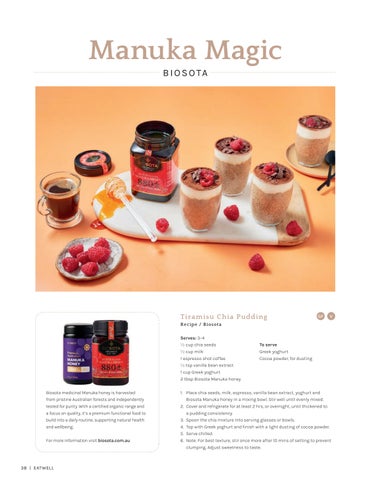
Manuka Magic B I O S O TA
Ti ra m i su C h i a P udd i ng
GF
V
Recipe / Biosota Serves: 3–4 ½ cup chia seeds ½ cup milk 1 espresso shot coffee ½ tsp vanilla bean extract 1 cup Greek yoghurt 2 tbsp Biosota Manuka honey Biosota ta medicinal Manuka anuka h honey is harvested from pristine Australian forests and independently tested for purity. With a certified organic range and a focus on quality, it’s a premium functional food to build into a daily routine, supporting natural health and wellbeing. For more information visit biosota.com.au
To serve Greek yoghurt Cocoa powder, for dusting
1. Place chia seeds, milk, espresso, vanilla bean extract, yoghurt and Biosota Manuka honey in a mixing bowl. Stir well until evenly mixed. 2. Cover and refrigerate for at least 2 hrs, or overnight, until thickened to a pudding consistency. 3. Spoon the chia mixture into serving glasses or bowls. 4. Top with Greek yoghurt and finish with a light dusting of cocoa powder. 5. Serve chilled. 6. Note: For best texture, stir once more after 10 mins of setting to prevent clumping. Adjust sweetness to taste.
38 | EAT WELL
EWL062_038-039 SR Biosota_proofread.indd 38
27/05/2026 10:19:24 AM
R ECIPES M A DE W I T H
biosota
R o a sted But ter nut P u mpk i n w it h C a mem ber t , Pe c a n s & M a nu k a Honey
GF
V
Recipe / Biosota Serves: 4 1 butternut pumpkin, peeled & cut into thick rounds 2–3 tbsp olive oil Sea salt & freshly cracked black pepper 200g Camembert cheese, sliced into medium-thick pieces ½ cup pecans 1 small red chilli, finely sliced 2–3 rosemary sprigs Biosota Manuka honey 1. Preheat the oven to 180°C. 2. Arrange the pumpkin rounds on a lined baking tray. Drizzle with olive oil and season with salt and pepper. 3. Place slices of Camembert over each piece of pumpkin. Scatter over pecans, chilli and rosemary sprigs. 4. Roast for 20–25 mins or until the pumpkin is tender and the cheese is melted and lightly golden. 5. Remove from oven and finish with a generous drizzle of Biosota Manuka honey. 6. Serve warm, allowing the honey to melt gently into the cheese and pumpkin. Note: Avoid high heat after adding the honey. Drizzle just before serving to preserve its natural bioactive properties.
EAT WELL | 39
EWL062_038-039 SR Biosota_proofread.indd 39
27/05/2026 10:19:28 AM
A RT ICL E
sustainable cooking
R O O T-T O - S T E M
cooking
We take a look at the social and health benefits of using the whole plant — root, leaves, skin, stems and flowers — when you’re cooking up a storm in the kitchen.
Wor d s / L i s a Hol m e n
T
here’s been a lot of talk about the concept of nose-to-tail cooking when it comes to cooking meat, but what about our forgotten plants? Although it’s not a new concept, root-tostem cooking is gaining traction, not only in Australian restaurants but also in households by people keen to cook more consciously and reduce their food waste. Most modern recipe books encourage cooks to cut, deseed and peel vegetables and fruits, so it’s no surprise that a staggering amount of edible and nutritious produce ends up in the trash. According to OzHarvest, 35 per cent of the average household bin is attributed to food waste, with more than 5 million tonnes of food ending up as landfill in Australia (enough to fill 9000 Olympic-sized swimming pools!). So, what exactly does it mean to cook root-to-stem? Root-to-stem cooking sees the whole food item being used in the kitchen, from the zest of your lemons to the green tops of carrots. This includes the leaves, skins, seeds, stalks and everything in between. Cooking rootto-stem may not come easily at first, but with careful meal planning you can reap the rewards and save your household money while you’re at it. By cooking more consciously, you will stop throwing away useful food scraps and rethink the way you cook by getting a bit creative in the kitchen. Here are some ways to get the most out of your food to ensure nothing is wasted and all the produce ends up on your dinner plate instead of in the rubbish bin.
Th i n k beyond comp ost i ng Composting is great, but there are plenty of ways to use up your food scraps before they hit your compost heap. Cooking consciously with the whole of the food can definitely reduce the amount of food that goes to waste and is the simplest way to adopt root-to-stem cooking for beginners. In many cases, the parts of the produce which are often thrown out contain more nutrition than the commonly edible parts and are packed full of antioxidants and dietary fibre, also known as NSP (non-starch polysaccharides) like hemicellulose,
pectin and more. The leaves, stems, stalks and skins of vegetables have their own unique tastes and textures so it’s like getting multiple veggies in one package and you have the added benefit of maximising your nutrient intake while you’re at it. Sweet potatoes, carrots and potatoes are the perfect vegetables to roast whole, without the need to peel off their skins. Simply scrub them clean and they are ready to be cooked. Roast a jacket potato in the oven for an easy mid-week dinner and fill it with your toppings of choice or make a delicious soup using whole carrots and sweet potatoes; just blanch the carrot tops lightly first and blitz them with your favourite vegetables or simply use as a garnish. Cauliflower is also a great vegetable to cook whole. Make some cauliflower rice by finely dicing the whole cauliflower, or cut the cauliflower into “steaks” and roast them in the oven. They will literally melt in your mouth if you cook them for long enough.
40 | EAT WELL
EWL062_040-044 FEAT Root to Stem_proofread.indd 40
1/06/2026 2:15:14 PM
EAT WELL | 41
EWL062_040-044 FEAT Root to Stem_proofread.indd 41
1/06/2026 2:15:17 PM
M a ke ve get a ble stoc k or soup One of the easiest ways to use up all your leftover food scraps is to convert them into a delicious homemade vegetable stock. A great way to do this is to build up a vegetable scrap heap in an airtight freezer container that holds both scraps and any vegetables past their prime. When the container is full, make a big batch of vegetable stock. Carrot tops, leeks, cabbage cores and broccoli stalks are all a great base for a beautiful stock as well as onions and garlic (in their skins), but you can use pretty much everything. Just be wary with beetroot, unless you want a very discoloured pink stock at the end of it! Simply add vegetables, water, herbs and simmer in a saucepan for an hour and then strain. Making soup is also another great way to use up leftover vegetables and sneak in extra ingredients or things you need to use up in the freezer. Don’t forget your ugly vegetables! They might not be attractive enough as a garnish or salad, but they’re perfect blitzed up in a soup — you won’t even notice the difference.
Don’t toss t he leaves Don’t toss the leaves from your beetroot, cauliflower, turnip greens and radish tops. Vegetable greens and leaves are packed full of flavour, nutrient-dense and rich in macro and micronutrients, which are all essential for a balanced diet. For example, broccoli leaves are higher in vitamins than the actual broccoli florets, particularly vitamin A. Similarly, beetroot greens are a great source of calcium, magnesium and iron and have a deep earthy flavour profile. Did you know that the whole beetroot plant can be eaten both cooked and raw including the stem, leaves and the actual bulb? Try making a pesto with your leftover greens by blitzing them all up in a food processor with garlic, herbs, salt, pepper and oil. Greens and leaves are also great to cook in a stir-fry or salad by simply sauteing them with some olive oil and garlic. Some greens, particularly carrot tops, have the tendency to be bitter but blanching them takes most of the bitterness away. To blanch the greens, bring a large saucepan of water to the boil and briefly drop the greens in for a very short period of time then transfer the greens to an ice bath or very cold water to stop the cooking process.
Spice up you r cook i ng Are you a culprit of cutting off and discarding the stems and stalks of herbs and vegetables when you cook? Next time you’re cooking, don’t throw out your herb stems. It’s easy to forget they are also part of the edible part so make sure you don’t leave them behind. Herbs are also great in salads, soups and stews and can really lift a dish. The stems of herbs like dill, basil, coriander and parsley are full of flavour and nutrients. Herbs that have woodier stems like rosemary and tough asparagus stalks are more suitable for soups and stews. Broccoli stalks are one of the biggest victims of food waste and more often than not end up in the bin. Chop up the cauliflower and broccoli stalks as well as the florets to really complement your cooking.
Ret h i n k you r peels, sk i n s a nd r i nd s Do you have a recipe that calls for just the juice of one lemon? If so, don’t throw out the peel. The skins and peels of fruit and vegetables are a concentrated source of phytochemicals, soluble fibres and antioxidants. For example, apple is particularly rich in quercetin which is found mostly in the peel.
I n m a ny c a s e s , t he p a r t s of t he produce wh ic h a re of ten t h row n out cont a i n more nut r it ion t h a n t he com mon ly e d i ble pa r t s . The zest of thick-skinned citrus fruits like lemons, limes and oranges are great in cakes or bakes, or if you’re feeling extra creative try candying them or drying them to infuse in a pot of tea. Another great way to use leftover fruit peels is to whip them into a smoothie or juice. Even though most people can’t stand the thought of eating furry kiwi peels and banana peels, they are completely inoffensive in a smoothie. Vegetable peels are also one of the most underutilised ingredients. Potato skins are loaded with vitamins C and B6, potassium, manganese and copper. If you can’t bear the thought of an unpeeled potato, roast the peels in the oven to make fries or fritters with some simple seasoning and a drizzle of olive oil. So, next time you make mashed or boiled potatoes, just scrub the potatoes really well and leave the peels on.
42 | EAT WELL
EWL062_040-044 FEAT Root to Stem_proofread.indd 42
1/06/2026 2:15:22 PM
A RT ICL E
sustainable cooking
3 5 p er cent of t he avera ge hou sehold bi n i s at t r i buted to food w a ste, w it h more t h a n 5 m i l l ion ton ne s of fo o d end i ng up a s la nd f i l l i n Au st ra l ia . Make your own sauces and condiments Making homemade sauces, dressings and condiments is easier than you may think — you just need to get a bit creative with your leftovers. Fresh herbs including their leaves and stems can be blitzed up in no time to make a delicious sauce or dressing.
Su st a i n a ble se e d s Seeds from winter squash and pumpkin, just to name a few, can be roasted and added to salads for extra texture and crunch. They are also rich in nutrients like fibre and magnesium. A great way to use seeds is to roast them in the oven lightly with subtle spices like cumin and paprika. On the fruit side, papaya and jackfruit seeds are also packed full of health benefits and are great sprinkled on your morning muesli or as an afternoon snack.
Dehyd rate or pic k le you r food scraps Pickled and dehydrated vegetables and fruit are definitely making a popular comeback. The pickling process tenderises and adds flavour to tough scraps like cabbage stems, kale and chard ribs and even watermelon rind. Meanwhile, the roots and skins of most produce, including beetroot and carrots, can easily be dehydrated and used as crisps or ribbons.
Si mple st i r-f r ies Who else loves a stir-fry for a simple mid-week dinner? The best thing about stir-fries is they have no rules, so they are a perfect way to use up all your leftovers and your vegetable scrap heap in the freezer. Chop up your vegetables and all of their accompanying roots and stalks as the perfect base for a stir-fry. Radish tops are also great in a stir-fry, since their leaves are so peppery and pungent. Root-to-stem cooking can be applied to pretty much any produce under the sun. Just be wary of rhubarb leaves, green potato skins and the seeds of some fruits like apricots since they are mildly poisonous. Root-to-stem cooking is easier than you think and is a great way to keep your kitchen sustainable and ensure you are getting the most out of your produce each week.
Lisa Holmen is a Melbourne-based food writer, photographer and blogger. Find out more at @lisaeatworld on Instagram or lisaeatsworld.com.
EAT WELL | 43
EWL062_040-044 FEAT Root to Stem_proofread.indd 43
1/06/2026 2:15:25 PM
A RT ICL E
sustainable cooking
Swe et Pot ato & C a r rot S oup
V
GF
This sweet potato and carrot soup is loaded with vitamins and minerals. Roast the sweet potatoes and carrots in their peels to maximise their nutrient intake. The carrot tops can be used in either the soup or as a garnish on top. Serves: 4 500g sweet potatoes (peel on), diced 300g carrots (peel on), sliced 3 tbsp olive oil Salt & pepper, to season 2 onions, finely chopped 3 garlic cloves, finely diced 1L vegetable stock 2 tbsp red curry paste 150g crème fraîche
Optional garnishes Pumpkin seeds Greek yoghurt White sesame seeds Red chilli, seeds on & sliced Fresh herbs Lime, sliced Green carrot tops, blanched
1. Preheat the oven to 200°C. Place sweet potatoes and carrots on a baking tray and drizzle with half the olive oil, season with salt and pepper and roast in the oven for 30 mins. 2. While the vegetables are roasting, heat the rest of the olive oil in a large pot. Fry the onions for 5–7 mins until softened and translucent then add the garlic and cook for another minute until aromatic. Add the vegetable stock, red curry paste and leftover onion and garlic peels and simmer for 10 mins. Strain the remaining onion and garlic peels. 3. Transfer the cooked vegetables to the pot and use a hand mixer to mix until smooth. 4. Heat again if required and stir in the crème fraîche. 5. Serve immediately and top with pumpkin seeds, yoghurt, white sesame seeds, sliced chilli, fresh herbs, lime and carrot tops.
St u f fed Sweet Jac ket Pot ato e s
V
GF
These sweet jacket potatoes are perfect cooked whole with the peel on. I have filled these ones with lentils, creamy feta, yoghurt and fresh herbs (I love using parsley and dill) but they can be topped with pretty much anything. Serves: 2 2 sweet potatoes (peel on) 2 tbsp olive oil Salt & pepper, to season 200g cooked lentils 100g feta cheese 4 tbsp Greek yoghurt Bunch fresh herbs, stems on & sliced 2 tbsp pine nuts Green chilli, sliced (optional) 1. Preheat the oven to 200°C. Using a fork, prick the sweet potatoes all over and place them on a baking tray and drizzle with olive oil. Season well with salt and pepper. Roast for 45–50 mins until tender. 2. Remove from the oven and cut in half and fill with lentils and feta cheese. Top with fresh herbs, pine nuts and chilli (if desired).
44 | EAT WELL
EWL062_040-044 FEAT Root to Stem_proofread.indd 44
9/06/2026 8:43:31 AM
loco-love-ewl062.indd 1
2/06/2026 1:26:41 PM
Chocolate Therapy LOCO LOVE L o co L ove Co ok ie D oug h B a r s
GF
V
Recipe / Loco Love
Indulgent yet healthy, this doublechocolate gluten-free cookie dough slice is finished with signature baking drops for extra satisfaction. With a vegan option, it’s easy to make and stores well in the fridge or freezer. Expect these bars to become the next late-night craving. To make this nut-free, swap the almond meal for oat flour. You can also add freeze-dried berries or chopped nuts to taste. Serves: 16 ½ cup butter, at room temperature (or vegan butter or softened coconut oil) ½ cup hulled tahini or cashew butter plus 1 tbsp 2 tsp vanilla extract ¼ cup pure maple syrup 2½ cups almond meal ½ tsp bicarbonate of soda ¼ tsp salt ½ cup Loco Love Dark Chocolate Drops ¾ cup Loco Love Mylk Chocolate Drops Salt flakes, to sprinkle
Loco Love crafts organic, refined sugar-free chocolate that nourishes body and soul. From silky-smooth couverture chocolate drops perfect for baking to wildcrafted ceremonial Chuncho cacao discs, every product is made with intention and packed with adaptogens, herbs and superfoods. For more information visit locolove.com
1. Grease and line a 20cm-square baking tin. Set aside. 2. Place the butter, tahini, vanilla and maple syrup in a bowl. Beat until pale and creamy. This will take 2–3 mins with electric beaters or longer with a hand whisk. 3. Add the almond meal, bicarb soda and salt. Fold the wet and dry ingredients together until uniform, then add the dark chocolate drops and fold through. 4. Transfer the batter to the lined tray. Spread out the dough and press down to form a firm layer. This is easiest done with clean hands. 5. Melt the mylk chocolate drops and the remaining 1 tbsp tahini, using either a double-boiler method or the microwave. 6. Pour over the cookie dough base and spread out. Sprinkle with salt flakes and place in the fridge for 4 hrs or until set. 7. Use a warm sharp knife to cut into 16 slices. Store in an air-tight container in the fridge for up to 4 days or freezer for up to 3 months.
46 | EAT WELL
EWL062_046-047 SR Loco Love_proofread.indd 46
20/05/2026 3:43:46 PM
R ECIPES M A DE W I T H
loco love
Hot C ho col ate Cook ies GF
V
Recipe / Loco Love x Pa naceas Pa ntr y
These cookies are everything a chocolate lover dreams of — crispy on the edges, soft in the centre, and packed with deep, rich cocoa flavour. We’ve teamed up with Panaceas Pantry to bring you this decadent yet nourishing treat, made with simple, wholesome ingredients. And if that wasn’t enough chocolate, what better way to serve than with a dunking of ceremonial cacao, using our newest Chuncho Drinking Cacao. Makes: 12–14 180g Loco Love Dark Chocolate Drops, divided 210g hulled tahini 165g coconut sugar 1 medium egg, at room temperature 1 tsp vanilla extract 33g (1⁄3 cup) cacao powder 1 tsp bicarbonate of soda ½ tsp fine salt 2-3 marshmallows, sliced into ½cm-thick discs (optional & preferably homemade) 1. Melt 90g of the Dark Chocolate Drops in a heatproof bowl over a saucepan of simmering water. Stir until smooth, then set aside to cool slightly. 2. Place the tahini and coconut sugar in a large bowl. Beat with an electric beater for 2 mins (or 90 seconds in a stand mixer with a paddle attachment). 3. Add the egg and beat for another 90 secs until the mixture resembles thick caramel. 4. Fold in the melted chocolate and vanilla extract until uniform. 5. Sift in the cacao powder and bicarb soda, then add the salt. Fold until fully combined. Stir in the remaining chocolate drops. 6. Refrigerate for 30 mins. Meanwhile, preheat the oven to 180°C and line 2 baking trays. 7. Roll 45g portions of dough into balls and space out on a tray. Bake for 10–12 mins in the lower third of the oven. Once baked, tap the tray firmly on a heatproof surface to encourage slight spreading. 8. Let the cookies cool for 5 mins before transferring to a wire rack. 9. For the optional marshmallow topping, after baking for 10 mins, top each cookie with a marshmallow and bake for another 30–60 secs.
EAT WELL | 47
EWL062_046-047 SR Loco Love_proofread.indd 47
20/05/2026 3:43:56 PM
Gl Free DONE SIMPLE
Going gluten-free doesn’t mean going without. These recipes deliver all the satisfaction of wholesome, flavourful food using naturally gluten-free ingredients that make everyday cooking as simple as it is nourishing. From comfort meals to fresh salads and family-friendly options, these dishes celebrate practical, no-fuss ingredients across lunch and dinner.
48 | EAT WELL
EWL062_048-056 CR Gluten Free_proofread.indd 48
21/05/2026 11:09:46 AM
R ECIPES
gluten-free done simple
Honey-Mu st a rd C h ic ken w it h Pea r Wa l nut S a l ad
GF
R e c i p e / L i n d y Z ol n i e r c z a k
When preparing the chicken breasts for baking, scrunch the baking paper around the outside of the breasts to form a small vessel. This will help to collect any glaze that runs off the chicken as it cooks. Use this glaze to baste the chicken throughout the cooking process, ensuring it remains moist and develops a golden finish.
Serves: 4 ½ cup organic walnuts ¼ cup raw honey 2 organic chicken breasts 150g rocket
1 green pear, cored & sliced Small white onion, thinly sliced 60g parmesan, sliced
Yog i M i so B owl
Glaze 1 tbsp gluten-free seeded mustard 2 tsp gluten-free mustard, medium heat 1 tbsp raw honey ½ tbsp lemon juice 2 cloves garlic, crushed Salt & pepper, to taste
R e c i p e / H a r r y L a nc a s te r
Dressing 1 tsp gluten-free mustard 1 tsp raw honey 1 tbsp olive oil
Serves: 4 12⁄3 cups brown rice (soaked 4–8 hours in filtered water if possible, then drained & rinsed) 2 tbsp sushi vinegar or rice-wine vinegar 1 tbsp peanut oil 1 tsp sesame oil 2 cups fresh shiitake or oyster mushrooms 4 tbsp unpasteurised white miso paste ½ daikon, spiralised or grated 1 small Lebanese cucumber, shaved into ribbons 2 colourful radishes, thinly sliced on a mandolin 50g dried wakame, soaked in boiling water 3–5 mins, then drained
Juice 1 orange 1 clove garlic, crushed Salt & pepper, to taste
1. Preheat the oven to 180°C and line a baking tray with baking paper. 2. Place the walnuts on the tray, drizzle with honey and place them in the oven. Bake for 5 mins, then remove the tray and stir the walnuts to ensure they are evenly coated. Return to the oven and bake for a further 5 mins until they are golden brown. Allow the walnuts to cool, then transfer them to a bowl and set aside. 3. Place all the glaze ingredients in a bowl and whisk thoroughly to combine. 4. Lay the chicken breasts on the same baking tray lined with baking paper. Brush the glaze over the chicken, then bake for 30 mins. Every 10 mins, baste the chicken with the glaze collected around the chicken. Once cooked, remove from the oven and let the chicken rest while the salad is prepared. 5. Arrange the rocket on a serving plate or divide it between individual plates. Top with the pear, onion, parmesan and honey-glazed walnuts. 6. Slice the cooked chicken breasts and add to the salad. 7. Mix all the dressing ingredients in a bowl, whisk to blend, then drizzle the dressing over the salad. Serve immediately.
VG
GF
This dish was originally designed as a reluctant acknowledgement that the predictable yogi style or nourish bowls were actually pretty fun if done well and you’re in the mood. It thrives or wilts upon the quality of your ingredients, so if you can’t find a tasty unpasteurised miso and a proper kimchi, then step back and consider your position.
1 tbsp kimchi 2 spring onions, cut into matchsticks 1 handful coriander leaves 1 tsp dried dulse flakes 1 sheet nori, coarsely torn 1 handful snow pea shoots 1 tbsp toasted white sesame seeds 1 tbsp toasted black sesame seeds Dressing 2 tbsp olive oil 1 tsp sesame oil 1 tbsp tamari 2 tsp mirin Juice ½ lime ½ garlic clove, minced ½ tsp minced ginger
1. Cook the rice in plenty of salted boiling water for 25–35 mins if soaked or more if unsoaked. You want to retain some texture but do not undercook it. Drain well, then stir the vinegar through. Set aside to cool. 2. Get a chargrill pan smoking hot. Mix the peanut and sesame oils, brush the mushrooms with the oils, then grill on both sides about 1–2 mins each side so they char nicely but maintain their raw quality through the middle. Slice them into thick bite-sized pieces. 3. For the dressing, whisk the ingredients well and leave to infuse until needed. 4. Divide the rice among 4 bowls, then add the daikon, cucumber and radish. Nestle the wakame, kimchi and mushrooms around, then spoon the dressing over the top. Garnish with spring onion, coriander, dulse, nori, snow pea shoots and sesame seeds plus add a little dish of the miso or spread liberally around one edge of the bowl.
EAT WELL | 49
EWL062_048-056 CR Gluten Free_proofread.indd 49
21/05/2026 11:09:48 AM
C r i spy- Co ate d Blue Eye Tre v a l l a w it h Noo d le Sl aw
GF
DF
R e c i p e / L i n d y Z ol n i e r c z a k
Blue Eye Trevalla is a deep-sea fish renowned for its firm white flesh and robust flavour. It is considered one of the finest fish found in Australia. By coating the fillets twice with the herb mixture, you achieve a lovely, crisp crust that helps retain the moisture in the fish. The accompanying slaw brings a tangy freshness to the noodles, complementing the herb-crusted fish perfectly.
Serves: 4 ¾ cup gluten-free plain flour 1½ tbsp sesame seeds 2 tbsp chopped parsley 1 tbsp chopped chives Salt & pepper, to taste 1 egg 2 tbsp cold water 4 x 150g Blue Eye Trevalla fillets Lime wedges, to garnish Fresh mint, to garnish 125g Pad Thai rice noodles 4 tbsp olive oil 1 large carrot, cut into long matchsticks (julienned) 2 small zucchinis, julienned 1 yellow & green capsicum,
deseeded & julienned 60g snow peas, sliced 3 spring onions, sliced thinly 1⁄3 cup chopped parsley ½ cup chopped mint 1 tbsp chopped coriander 1 tbsp sesame seeds Dressing Juice 2 limes 1 clove garlic, crushed 1 tbsp maple syrup ½ tsp sesame oil 1 tbsp olive oil 1 tsp tamari Salt & pepper, to taste
1. Mix the gluten-free flour, sesame seeds, parsley, chives, salt and pepper in a bowl and set aside. 2. Whisk the egg and cold water together in a separate bowl. 3. Coat each fish fillet in the flour mixture, dip in the egg wash, then coat again in the flour mixture. Place the fillets on a plate without overlapping and refrigerate until cooking. 4. Soak the rice noodles in hot water from the kettle for 5 mins, drain, and toss with 2 tsp of olive oil. Let cool on the benchtop. 5. Combine carrot, zucchini, snow peas, capsicum, spring onions, parsley, mint, coriander and sesame seeds in a large bowl. Toss lightly, add the noodles and refrigerate. 6. Heat remaining olive oil in a non-stick pan over medium heat. Cook the fish fillets for 5 mins on each side or until golden. Transfer to a plate. 7. Prepare the dressing by whisking all ingredients together in a bowl. Remove the salad from the fridge, drizzle with dressing and toss gently to coat. 8. Divide the salad and fish among four plates. Garnish with lime wedges and fresh coriander.
Med iter ra nea n Q u ic he
V
GF
Recipe / Lisa Guy
This wholesome gluten-free Mediterranean quiche makes a delicious protein-packed dinner. Eggs provide high-quality protein, vitamin B12, choline and selenium, which support brain function, energy production and muscle health. Tomatoes are rich in vitamin C, potassium and the antioxidant lycopene, which supports heart health and helps protect cells from oxidative stress.
Serves: 6–8 1 sheet gluten-free shortcrust pastry, thaw if frozen 2 tbsp cold-pressed olive oil 4 cups roughly chopped English spinach 6 eggs, lightly beaten ½ cup Greek yoghurt 1 cup milk of choice 10g finely grated parmesan
Sea salt & pepper, to taste ¼ cup sun-dried tomatoes ¼ cup pesto Handful goat’s cheese or feta cubes Handful toasted pine nuts Handful cherry tomatoes, halved for topping, optional
1. Preheat the oven to 180°C fan-forced. Lightly grease a 23cm x 5cm deep tart tin and line the bottom with baking paper. 2. Line the tin with the gluten-free pastry sheet, gently pressing it into the base and sides. Trim any excess pastry. 3. Line the pastry with baking paper and fill with baking weights or uncooked rice. Bake for 20 mins. Remove the paper and weights and return to the oven for 5–10 mins, until the pastry is lightly golden. 4. Pan-fry half the spinach in a pan over medium heat with a little olive oil. Cook until wilted. Remove and set aside to cool. Then repeat with other half of spinach. Use your hands to squeeze out excess water from spinach. 5. To prepare the filling, whisk eggs, yoghurt, milk, parmesan, sea salt and pepper. 6. Assemble the quiche by spreading half the spinach and sundried tomatoes over the pastry. 7. Pour over the egg mixture. Layer remaining spinach and tomatoes, and top with spoonfuls of pesto, goat’s cheese or feta, pine nuts, and halved cherry tomatoes if using. 8. Bake for 30–40 mins until golden and set, with a slight wobble in the centre. Allow to cool for 15 mins before taking out of the tin.
50 | EAT WELL
EWL062_048-056 CR Gluten Free_proofread.indd 50
21/05/2026 11:09:50 AM
R ECIPES
gluten-free done simple
Q u i noa & Roa ste d Ve get a ble Power B owl R e c i p e / L i s a Hol m e n
VG
GF
For an easy lunch or light dinner, make this nourishing, flavour-packed bowl with fluffy quinoa, caramelised roasted vegetables and a creamy lemon tahini dressing. Prep ahead and use up any leftover vegetables in the fridge. For extra crispy chickpeas, pat them dry before roasting and add them to the tray halfway through cooking.
Serves: 2–4 1 cup quinoa, rinsed, drained 2 cups water 1 medium sweet potato, peeled & diced 1 red capsicum, diced 1–1½ tbsp olive oil Salt & pepper, to taste ½ cup chickpeas (rinsed & drained) 1 cup kale, chopped
1 avocado, diced 2 tbsp pumpkin seeds, toasted Lemon Tahini Dressing 2 tbsp tahini Juice of 1 lemon 1 tsp maple syrup 1–3 tbsp water Salt, to taste
1. Preheat the oven to 200°C and line a large baking tray with baking paper. 2. Place the quinoa and water in a saucepan over medium heat. Bring to the boil, then reduce the heat to low, cover and simmer for 15 mins or until the liquid is absorbed. Remove from the heat and allow to rest for 5 mins before fluffing gently with a fork. 3. Place sweet potato and capsicum on the prepared tray. Drizzle with olive oil, season with salt and pepper and toss to coat. Roast for 15 mins, then add the chickpeas to the tray and roast for a further 10–15 mins or until the vegetables are golden and tender. 4. In a small bowl, whisk together the tahini, lemon juice, maple syrup and a pinch of salt. Add water gradually until the dressing reaches a smooth pouring consistency. 5. Divide the quinoa between bowls. Top with the roasted vegetables, chickpeas and kale. 6. Add the avocado and sprinkle with toasted pumpkin seeds. Drizzle with the lemon tahini dressing and serve.
Roa ste d C apsic u m & C her r y Tom ato Spa g het t i
V
GF
R e c i p e / L i n d y Z ol n i e r c z a k
When most people think of pasta, gluten is usually the first thing that comes to mind. However, with the wide variety of gluten-free pastas now available at supermarkets, there is no need to miss out on enjoying a delicious pasta dish. This recipe delivers a lovely sweetness from roasted capsicums and cherry tomatoes, complemented by the creaminess of goat’s cheese. It is a simple meal and requires minimal time in the kitchen. Double-up the ingredients for a meal for the whole family.
Serves: 2 175g assorted coloured minicapsicums (orange, red, yellow), sliced in half, seeds removed 200g vine-ripened cherry tomatoes 3 cloves garlic, sliced ½ tbsp olive oil Salt & pepper, to taste
3 tbsp pine nuts 180g gluten-free spaghetti ¾ cup fresh basil leaves, plus extra for serving 80g baby spinach 1 zucchini, spiralised 100g goat’s cheese Black cracked pepper
1. Preheat the oven to 180°C and line a baking tray with baking paper. 2. Place the capsicums, cherry tomatoes, garlic and olive oil on the tray. Season with salt and pepper, then toss to distribute the seasoning. Bake for 15 mins. 3. Add the pine nuts and continue baking for a further 5 mins. 4. Remove from the oven and leave on the bench until needed. 5. While the vegetables are roasting, bring a large saucepan of water to a rapid simmer. Add the gluten-free spaghetti and cook for 6 mins or until al dente. 6. Place the spinach and basil in a blender and blitz together. Remove and set aside. 7. Heat a large frying pan on medium heat. Add the spinach and basil mixture, cooked spaghetti, roasted veggies, zucchini spirals and goat’s cheese. Gently toss everything together to combine. 8. Remove from heat and plate into warm bowls. Garnish with extra basil leaves and cracked black pepper.
EAT WELL | 51
EWL062_048-056 CR Gluten Free_proofread.indd 51
21/05/2026 11:10:05 AM
P u r ple Swe et Pot ato & Ok ra L a k s a w it h R aw No o d les
VG
GF
R e c i p e / H a r r y L a nc a s te r
Pesto P u mpk i n Gno cc h i
V
GF
Recipe / Lisa Guy
This pesto pumpkin gnocchi is a comforting, nourishing, gluten-free meal. Pumpkin is rich in beta carotene, vitamin C and fi bre, which support strong immunity, skin and eye health while also helping to keep you feeling satisfied.
Serves: 4 450–500g pumpkin, peeled & diced 1½ cups gluten-free plain flour ½ tsp xanthan gum (if the plain flour doesn’t contain it) 1 egg, beaten 1⁄3 cup pesto 2 handfuls rocket Handful shaved parmesan Handful toasted pinenuts 1. Preheat the oven to 200°C. Line a baking tray with baking paper. 2. Place pumpkin on a baking tray and bake for 30-35 mins until soft and cooked through. Mash and set aside to cool. 3. To make the dough, place the pumpkin purée in a large bowl. Add the gluten-free flour, xanthan gum and the beaten egg. Mix gently until a soft dough forms. If the dough feels too sticky, add a little more flour, 1 tbsp at a time. 4. Turn the dough out onto a lightly floured surface. Shape into a round disc and divide into 6 equal portions, like you’re cutting a pizza. 5. Using floured hands, roll each portion into a log about the thickness of your finger and cut into 2cm pieces. Lightly roll each piece into an oval gnocchi shape and place on a floured tray. Repeat with the remaining dough. 6. Bring a large pot of salted water to the boil. Add the gnocchi in batches. Once they float to the surface, allow them to cook for about 30 secs, then remove with a slotted spoon and set aside. 7. Heat some olive oil in a frying pan over medium heat. Add the cooked gnocchi and cook for 5 mins, turning gently, until golden and lightly crisp. 8. Remove the pan from the heat and toss through the pesto. Gently fold in the rocket. Serve topped with shaved parmesan and toasted pine nuts.
Satisfying, fresh and a little different with both the okra and raw noodles, this is pretty simple to pull together. If you can’t find okra or don’t have a raw vegetable spiraliser, you can still create a similar experience by swapping in some green beans and rice noodles. This version is great though, so mentally bookmark it for when you spy the ingredients at the market.
Serves: 2 1 lemongrass stalk (white part only), roughly chopped 50g ginger 25g fresh turmeric 1 onion, chopped 60g raw cashews, soaked 4 hours & drained 1 long red chilli (plus small chillies to taste), chopped 2 tsp tamarind paste 1 tsp sea salt 1 tbsp coriander seeds 1 tsp ground turmeric 1 tsp ground cumin 1 tbsp coconut oil
400mL coconut cream 600mL water 1 purple sweet potato, peeled & cut into large dice 4 coriander roots 400g okra, chopped 1 daikon 1 zucchini 1 carrot 2 tbsp sesame oil Juice 1 lime 1 handful coriander 1 handful Thai basil ½ tsp each white & black sesame seeds
1. Place the lemongrass, ginger, turmeric, onion, cashews, chillies, tamarind paste, salt and spices into a food processor and blend to a smooth paste. 2. Heat the coconut oil in a wok over medium heat, then add the paste and stir for 1–2 mins until fragrant. Add the coconut cream and water, bring to the boil, then reduce to a simmer. 3. Add the sweet potato and coriander roots (bruise them before throwing them in) and simmer until softened, about 10–15 mins. Add the okra and cook, stirring occasionally, for a further 5 mins until the soup is thickened and the okra is just cooked through. Remove from the heat and check the seasoning — you want a balance of hot, sweet, salty and sour. 4. Meanwhile, for the raw noodles, spiralise the daikon, zucchini and carrot (you should have about 2 large handfuls). Toss with 1 tbsp sesame oil and half the lime juice, then mix through half the coriander and basil. 5. Ladle the soup into bowls, pile the noodles into one side, scatter with sesame seeds and remaining herbs, drizzle with remaining sesame oil and serve with remaining lime juice.
52 | EAT WELL
EWL062_048-056 CR Gluten Free_proofread.indd 52
21/05/2026 11:10:12 AM
R ECIPES
gluten-free done simple
Gre en L ent i l S a l ad w it h Spice d Hone y A l mond s
V
GF
Recipe / Lisa Guy
This vibrant Green Lentil Salad is a nutrition powerhouse. Kale and mixed greens are packed with vitamin K, vitamin C, folate and antioxidants that support heart health, immunity and glowing skin. Lentils provide protein, iron, magnesium and fibre to support muscle health, steady energy levels and good digestion. The spiced honey almonds add healthy monounsaturated fats, vitamin E and a touch of natural sweetness to this dish.
P u mpk i n Fet a Fr it t at a Serves: 4–6 ½ bunch purple kale, stems removed then chopped 2 big handfuls mixed greens (rocket, baby spinach, Swiss chard, beet greens) Sea salt, to taste 1 cup French green lentils, rinsed & debris removed ½ cup raw whole almonds ½ tsp chilli flakes 2 tsp raw honey or pure maple syrup 2 shallots, thinly sliced ½ English cucumber, diced
V
GF
R e c i p e / G e or g i a H a r d i n g ½ cup chopped parsley 100g feta or goat’s cheese, crumbled Dressing 1 lemon, zested & juiced 2 tbsp extra-virgin olive oil 1 tsp wholegrain or Dijon mustard Pinch sea salt, to taste Spiced Honey Almonds ½ cup raw whole almonds ½ tsp chilli flakes 2 tsp raw honey or pure maple syrup
1. Add the kale to a large bowl with a pinch of sea salt. Massage gently until slightly softened, about 30 secs. Add mixed greens and toss to combine. 2. Bring a large pot of salted water to the boil. Add lentils and simmer uncovered for 20–25 mins, until tender but still slightly firm. Drain well and allow to cool slightly. 3. Heat a frying pan over medium heat with a splash of olive oil. Add almonds and chilli flakes. Toast, stirring often, until golden. 4. Reduce heat to low and drizzle in honey. Stir continuously for 30 secs until almonds are lightly glazed and sticky. Immediately transfer to baking paper and spread out to cool. 5. In a small bowl, whisk together all dressing ingredients. 6. Add lentils, shallots, cucumber, parsley and half the almonds to the greens. 7. Pour over the dressing and toss gently to combine. 8. Transfer to a serving dish and top with crumbled feta and remaining spiced honey almonds.
This frittata is a great meal for nourishment and sustenance. It’s super easy to make and extremely enjoyable to eat.
Serves: 4 250g pumpkin, diced approx. 2cm cubes (peel if preferred) 1 red onion, cut into eighths 1 tbsp extra-virgin olive oil 100g kale, leaves only 10 free-range or organic eggs 150g feta Ground black pepper, to taste ¼ tsp dried thyme Salad, to serve 1. Preheat the oven to 180°C fan-forced. 2. Line a loaf tin with baking paper. Add the pumpkin and onion and toss with the olive oil to coat. 3. Bake for 15 mins. 4. Roughly chop the kale, removing any heavy woody stems. Add to the roasted pumpkin and return to the oven for another 5 mins to just start to wilt. 5. Whisk the eggs, feta, black pepper and thyme in a food processor or with a whisk. 6. Pour the egg mixture over the pumpkin. 7. Bake for 45–50 mins until the egg is set in the middle. 8. Serve with a side salad.
EAT WELL | 53
EWL062_048-056 CR Gluten Free_proofread.indd 53
21/05/2026 11:10:32 AM
K a nga roo & Red C apsic u m Skewer s w it h GF DF Brow n R ice & Bl ac k ber r y S auce R e c i p e / L i n d y Z ol n i e r c z a k
Kangaroo cooks quickly and pairs beautifully with a vibrant berry sauce. Alongside wholesome brown rice, this dish becomes a delightfully gluten-free meal that is both satisfying and full of flavour, without requiring much time to prepare and cook.
Serves: 3 Rice 400g kangaroo fillets, diced 4cm 1 large red capsicum, diced 4cm Salt & pepper, to taste Olive oil 350g brown rice 80g snow peas, sliced 1 tbsp chopped fresh parsley Blackberry Sauce 1 tbsp olive oil ½ red fresh chilli, diced (choose preferred heat)
1 small red onion, thinly sliced 1 clove garlic, crushed ½ tsp native pepperberries, crushed ¼ tsp cumin ¼ tsp coriander ¼ tsp cinnamon Juice 1 orange 1 tbsp maple syrup 125g fresh or frozen blackberries ¼ tsp salt
1. Thread the kangaroo and capsicum pieces evenly onto 6 metal or wooden skewers. Season with salt and pepper, drizzle with olive oil and refrigerate until ready to cook. 2. Cook the brown rice according to the instructions for a rice cooker, or, if using a saucepan, bring 800mL water to the boil, add the rice, reduce to a simmer, cover, and cook for about 30 mins or until tender. Drain any excess liquid and keep warm. 3. To prepare the sauce, heat the olive oil in a small, heavy-based saucepan over a medium heat. 4. Add the chilli, onion and garlic. Sauté for about 5 mins until the onion has softened. 5. Stir in the spices and cook for a further minute, then add the orange juice, maple syrup and blackberries. Bring the sauce to a gentle simmer and cook for 15 mins. Season with salt and keep warm until serving. 6. Remove the kangaroo skewers from the fridge. Heat a griddle pan over medium-high heat. Once hot, cook the skewers for about 3 mins on each side or until nicely coloured. Be careful not to overcook the kangaroo to keep it moist and tender. Rest the skewers on a warm plate for 5 mins once cooked. 7. Combine the warm brown rice with the sliced snow peas and chopped parsley, seasoning with salt and pepper to taste. 8. To serve, divide the rice mixture among plates, top with the kangaroo and capsicum skewers and spoon over the blackberry sauce.
C au l i f lower C he e s e w it h Gluten-Fre e Breadc r u m bs V
GF
R e c i p e / L i s a Hol m e n
This creamy, naturally gluten-free comfort dish is perfect for easy family dinners. Sprinkle gluten-free breadcrumbs on top for added texture or add some toasted almonds at the end for some added crunch.
Serves: 4–6 1 large cauliflower, cut into florets 50g unsalted butter 2 tbsp gluten-free flour 500mL milk ¼ tsp nutmeg Salt & pepper, to season 1 cup cheddar or tasty cheese, grated 2–4 tbsp gluten-free breadcrumbs or toasted almonds 1. Preheat the oven to 200°C fan-forced. 2. Boil the cauliflower for 5 mins in boiling water until just tender. 3. Drain the cauliflower and place in a large baking dish. 4. Heat the butter in a large saucepan over medium heat then add the flour, whisking constantly. Slowly add the milk, whisking frequently for a few mins until the mixture thickens. It should be thick enough to coat the back of a spoon. 5. Season with nutmeg, salt and pepper. 6. Take off the heat then add the cheese and stir until combined. Pour over the cauliflower and top with breadcrumbs. 7. Bake in the oven for 15–20 mins until golden and bubbling.
54 | EAT WELL
EWL062_048-056 CR Gluten Free_proofread.indd 54
21/05/2026 11:10:47 AM
R ECIPES
gluten-free done simple
Polent a Cr uste d Sweet Pot ato C h ips w it h S ou r C r e a m & C h i l l i
V
GF
R e c i p e / H a r r y L a nc a s te r
The original inspiration for this recipe came from one of Ottolenghi’s books. I’ve played with lots of different spicing but the basic principle of a potato marinade with a dusted polenta crust works so well. If you make the effort to create your own chilli sauce, you will be rewarded.
Serves: 4 1kg red sweet potato, cleaned, skin on & cut into wedge-like chips 6 tbsp coarse polenta Sour cream, to serve Marinade 1 garlic clove, crushed ½ tsp ground cumin ½ tsp ground coriander ½ tsp smoked paprika 1 tsp dried oregano 1 tsp sea salt
1 tsp wholegrain or Dijon mustard 3 tbsp olive oil Quick Simple Chilli Sauce 2 tbsp dried chilli flakes 500mL water 2 tbsp good vinegar (apple-cider or red/white wine) 2 tbsp maple syrup or brown sugar Pinch sea salt 5 tbsp olive oil
1. Preheat the oven to 200°C. Mix all the marinade ingredients together then toss the sweet potato wedges until they are well covered in the marinade. Sprinkle over roughly one-third of the polenta, mix and repeat. 2. On a baking tray scatter half the remaining polenta, spread the potato wedges on top (skin-side down if you like but it doesn’t really matter), then a final scatter of polenta over the top and into the oven for 45 mins to 1 hr depending on oven strength. Leave them to cook but if the oven is particularly hot on top or bottom, you may want to turn them halfway through to get an even crust. You want to see charred edges and for the chips to be nicely browned. 3. For the chilli sauce, place the chilli flakes and water in a saucepan and bring to a simmer gently for 20–30 mins, topping up the water if needed. Once you have reduced the liquid by half, add the vinegar, maple syrup, salt and reduce until you have approximately 3–4 tbsp of mixture left then turn off the heat. Allow to cool a little then add the oil. As it continues to cool, mix and it should turn into a kind of chilli emulsion. If it’s too dry, add a splash of extra water or oil until you reach a satisfying consistency. 4. Share the chips with a liberal amount of sour cream and a bowl of the chilli sauce.
Cr i spy C h ic ken Tray B a ke GF
DF
R e c i p e / G e or g i a H a r d i n g
This gluten-free main meal will be super popular with the family. With deliciously roasted vegetables and crispy-skin chicken, it’s a perfect all-in-one meal.
Serves: 4 2–3 potatoes, diced 2cm 1 sweet potato, diced 2cm 3 tbsp extra-virgin olive oil Sea salt & freshly ground black pepper, to taste 2 red onions, cut into eighths 1 red capsicum, diced 425g tin chickpeas, drained 1 tsp dried thyme 700g skin-on chicken thighs (boneless) 1. Preheat the oven to 200°C fan-forced. 2. Place the diced potatoes, sweet potatoes, olive oil and seasoning in a large baking dish or ovenproof pan. Toss well to coat and roast for 20 mins. 3. Add the red onion, red capsicum, drained chickpeas and thyme. Toss well and season again. 4. Nestle the chicken thighs into the vegetables skinside up. Drizzle with more olive oil, season with salt and pepper and bake for 20–25 mins or until the chicken is cooked through.
EAT WELL | 55
EWL062_048-056 CR Gluten Free_proofread.indd 55
21/05/2026 11:10:53 AM
R ECIPES
gluten-free done simple
Q u i no a Fr ied R ice
GF
DF
R e c i p e / G e or g i a H a r d i n g
This is a great alternative to regular fried rice, with the quinoa adding extra protein and nutrition. The quinoa can even be made in advance to make dinnertime quick and easy. This one is on high rotation for my family.
Mu m’s Tea C a ke
V
GF
R e c i p e / H a r r y L a nc a s te r Serves: 4 1 cup raw quinoa or 3 cups cooked 1½ cups water (if cooking the raw quinoa) 1 tsp extra-virgin olive oil 4 free-range or organic eggs 4 rashers bacon, diced 1 tbsp extra-virgin olive oil 4 cloves garlic, finely grated 1 tbsp ginger root, finely grated 2 carrots, finely diced
1 cup frozen peas 6 spring onions, white part sliced; green part reserved for garnish 1 red capsicum, diced 3 tbsp tamari To serve 1 tbsp chilli oil (optional) 4 free-range or organic eggs, optional, for extra protein
1. If using raw quinoa, rinse well in a fine sieve for at least 1 min to remove bitter saponins. If you have time, soak in water with a splash of apple-cider vinegar for up to 12 hrs to improve digestibility. 2. Place the quinoa in a pot with the water. Bring to a boil over mediumhigh heat, then reduce to a gentle simmer. Cook uncovered until all water is absorbed, about 10–12 mins. Remove from heat, cover and let steam for 5 mins, then fluff with a fork. 3. Heat a large pan or wok over a moderate heat. Whisk the eggs in a jug or bowl. 4. Add 1 tsp olive oil to the pan, pour in the eggs and stir until cooked. Set aside. 5. Add the bacon and cook for a few mins. 6. Add 1 tbsp olive oil, then the garlic, ginger and vegetables and stir-fry for a few mins to soften. 7. Add the cooked quinoa, egg and tamari and stir-fry together. 8. Serve with chilli oil and a fried egg on top if desired.
Who doesn’t love a tea cake? On a recent trip to England visiting my family, we were reminded that tea and cake should be part of your recommended daily happiness allowance, particularly when served with clotted cream (which you never even see in Australia). This is my mum’s super-simple but oh-sovery-pleasing tea cake.
Serves: 8–10 8 tbsp raspberries (or other frozen berries fully thawed) 4 organic eggs 170g caster sugar 200mL vegetable oil (I use a light olive oil or coconut oil) Splash vanilla extract 225g ground almonds (almond meal) 1 tsp gluten-free baking powder 1. Preheat the oven to 180°C. Grease and line a 25–30cm cake tin. 2. Scatter raspberries or berries across the base of the prepared tin. 3. Whisk the eggs and sugar together until thick and pale. Add the oil and vanilla then whisk to combine. 4. In a separate bowl, combine the ground almonds and baking powder. Fold the dry ingredients into the wet mixture until just combined. 5. Pour the batter over the fruit. Bake for 25–30 mins or until a skewer inserted in the centre comes out clean.
56 | EAT WELL
EWL062_048-056 CR Gluten Free_proofread.indd 56
21/05/2026 11:11:06 AM
Feel Good Food, Made for Every Body Discover great tasting food made for everyday living with Orgran. From crisp wafers to convenient pantry staples, our range is designed to fit easily into modern lifestyles. Simple, delicious food to enjoy any time of day. Proudly Australian family owned, Orgran specialises in gluten free foods made with carefully selected ingredients, designed for those with food sensitivities, without ever compromising on flavour, quality or enjoyment.
www.orgran.com orgranhealthandnutrition
Orgran-EWL062.indd 1
@orgranfoods
25/05/2026 8:10:46 AM
Gluten-Free Goodness ORGRAN
Avocado, Tom ato & Fet a Cr ispbread s GF
V
Recipe / Orgra n
Pairing healthy fats from avocado with crispbreads helps keep you fuller for longer, while tomato adds a natural vitamin A & C boost and vibrant colour to the plate.
Proudly produced in Australia in a gluten-free and allergy-friendly facility, ORGRAN™ offers an extensive range of products thoughtfully developed to support a variety of dietary needs. The selection includes cereals, crispbread, pasta, baking mixes, biscuits and more, providing meal solutions for different lifestyles. Look out for the new Protein Crispibread at your local supermarket. For more information visit orgran.com
Serves: 2 6 Orgran Protein Crispibread 1 ripe avocado, ½ smashed & ½ sliced 1 fresh tomato, sliced 60g feta, crumbled Extra-virgin olive oil, to drizzle Cracked black pepper, to taste 1. Spread the smashed avocado over the crispbreads. 2. Layer the tomato slices evenly over the avocado then layer the sliced avocado evenly over the tomato. 3. Crumble over feta. 4. Finish with a drizzle of extra-virgin olive oil and cracked black pepper before serving.
58 | EAT WELL
EWL062_058-059 SR Buontempo_proofread.indd 58
1/06/2026 2:57:31 PM
R ECIPES M A DE W I T H
orgran
Bl ac k S e s a me C ho col ate Brow n ie s w it h Ta h i n i R ipple
GF
VG
Recipe / Orgra n
Fudgy, deeply chocolatey and naturally gluten-free, these brownies use aquafaba in place of eggs for a vegan bake that doesn’t compromise on texture. The black sesame tahini adds earthy depth, while the rippled tahini topping makes every slice as beautiful as it is delicious. Serves: 16 Brownie 200g 70% dark chocolate (vegan) 120mL olive oil 120mL aquafaba (liquid from tinned chickpeas) 180g brown sugar 1 tsp vanilla extract 40g black sesame tahini paste 110g Orgran Gluten Free All Purpose Plain Flour 40g cocoa powder 1 tsp espresso powder ½ tsp baking powder ½ tsp fine sea salt 1 tbsp black & white sesame seeds Flaky sea salt Tahini Ripple 60g white tahini 2 tbsp maple syrup, divided 60g black tahini
1. Preheat the oven to 170°C fan or 180°C conventional. Line a 20cm square baking tin with baking paper. 2. Place the chocolate in a heatproof bowl and melt gently over a bain-marie or in the microwave in short bursts. Stir in the olive oil until smooth and glossy. 3. In a separate bowl, whisk the aquafaba and brown sugar together for 5–8 mins until slightly foamy and glossy. This step helps create the classic shiny brownie crust. 4. Add the melted chocolate mixture, vanilla extract and black sesame tahini paste to the aquafaba mixture. Whisk until smooth. 5. Sift together the flour, cocoa powder, espresso powder, baking powder and salt. 6. Fold the dry ingredients into the chocolate mixture until just combined. Pour into the prepared tin. 7. For the tahini ripple, mix the white tahini with 1 tbsp maple syrup in a small bowl, and the black tahini with the remaining maple syrup in another. Stir each until smooth. 8. Drop spoonfuls of each tahini mixture over the surface of the mixture and use a skewer or knife to create a ripple pattern. Sprinkle with the sesame seeds. 9. Bake for 25–28 mins. The centre should still look slightly soft; it will firm up as it cools. Sprinkle over the flaky salt. Allow to cool completely in the tin before cutting. 10. Cut into 16 squares using a hot knife for clean edges.
EAT WELL | 59
EWL062_058-059 SR Buontempo_proofread.indd 59
1/06/2026 2:57:42 PM
Sri Lankan Spice TILDA
Sr i L a n k a n-I n spi re d Co conut Swe et GF VG Pot ato Dh a l Recipe / Ti lda
Inspired by the flavours of Sri Lankan cooking, this coconutrich dhal combines lentils, sweet potato and warming spices for a nourishing, flavour-packed bowl. Serves: 2 1 small sweet potato, peeled & diced 2 tbsp olive oil 1 onion, finely diced 1 garlic clove, crushed 2 tsp mild curry powder ½ tsp turmeric 1 pouch Tilda Coconut Steamed Basmati Rice 400g tin green lentils, drained 160mL coconut cream 50mL water Salt & black pepper Small handful fresh coriander, chopped
For more than 50 years, Tilda has been committed ommittted to ex excep exceptional ceptio tional nal ri rice rice, ce, ca caref carefully refull ully sou sourcing the finest grains for purity, quality and flavour. From naturally aromatic basmati to versatile everyday grains, Tilda brings light texture and global inspiration to elevate everyday meals. For more information visit tilda.com
1. Preheat the oven to 200°C. Toss the sweet potato with 1 tbsp olive oil and roast for 15 mins until tender. 2. Heat the remaining oil in a large pan. Add the onion and garlic and cook for 5 mins until softened. 3. Stir in the curry powder and turmeric and cook for 1 min until fragrant. 4. Heat the coconut rice according to packet instructions. Add to the pan with the lentils and roasted sweet potato. 5. Pour in the coconut cream and water. Simmer gently for 5 mins until thick and creamy. 6. Season to taste and stir through the coriander. Serve immediately.
60 | EAT WELL
EWL062_060-061 SR Tilda Rice_proofread.indd 60
2/06/2026 1:32:04 PM
R ECIPES M A DE W I T H
tilda
Ve get a ble Bi r ya n i
GF
V
Recipe / Ti lda
Inspired by Sri Lankan biryani and the island’s love of fragrant rice dishes, this vegetable biryani layers basmati rice with spiced vegetables, warming whole spices, fresh herbs and toasted nuts. Serves: 4–6 500g Tilda Pure Basmati Rice 2 tbsp oil 2 medium onions, sliced 2 carrots, chopped 15 green beans, chopped 10–12 cauliflower florets 1 cup peas Salt, to taste 1½ tbsp ginger-garlic paste ½ cup yoghurt 1 cup tomato purée Fresh coriander & mint, chopped Pinch saffron, soaked in 2 tbsp hot water 1 tsp rose water (optional) Handful cashews & sliced pistachios, toasted Whole spices 8 green cardamom pods 1 black cardamom pod 8 cloves ½ inch cinnamon stick 1 bay leaf ½ tsp caraway seeds Ground spices 1 tbsp turmeric 1 tbsp ground coriander 1 tbsp chilli powder (adjust to taste) 1 tsp garam masala 1. Rinse the basmati thoroughly and soak in cold water for 30 mins. Preheat the oven to 180°C. 2. Heat 1 tbsp oil in a pan and cook the sliced onions until golden. Set half aside for layering. 3. Add the remaining oil to the pan, then briefly toast the whole spices. Add the vegetables and salt, cover and cook for 2–3 mins. Stir in the ginger-garlic paste, then add the ground spices, yoghurt and tomato purée. Simmer for 5–7 mins until slightly thickened. 4. Drain the soaked rice. Cook in plenty of boiling water for 8 mins until just tender but still with bite. Drain well. 5. In an ovenproof dish, use a slotted spoon to add half the vegetable mixture, reserving some sauce. Top with half the rice, a sprinkle of herbs and some fried onions. Repeat the layers. Spoon over the saffron water and rose water. 6. Cover and bake for 20 mins. Top with the toasted cashews, pistachios and remaining herbs. Serve with the reserved sauce, if desired.
EAT WELL | 61
EWL062_060-061 SR Tilda Rice_proofread.indd 61
2/06/2026 1:32:30 PM
D O N ’ T H AV E
a cow
The plant-based milk market has exploded, with more people turning away from dair y. But how do the alternatives stack up for health and sustainability ?
Wor d s / C a r r o l B a k e r
E
ver find yourself scratching your head in disbelief at the dizzying array of plant-based milks in a supermarket aisle? The non-dairy milk market has exploded over the last few years, with more people moving away from cow’s milk in droves. ABS health statistics spokesperson, Paul Atyeo, says: “Almond milk had a particularly rapid increase in apparent consumption, up 31 per cent in the last two years. Soy milk increased by 16 per cent over the same period.” The trend is particularly strong in Australia, Singapore and the UK, according to global research company foodinsights.com.au. Soy, macadamia, rice, oat, coconut, almond, pea and more are becoming the new non-dairy diet staple. There are even a few funky new players, like hemp and tiger nut milk (which is made from plantbased nuts). There are several reasons why people are making the switch. For some it’s due to ethical or environmental concerns. For others it’s about pursuing a vegan lifestyle, while some people make the shift because of health reasons. For those who are lactose intolerant, consuming plant-based milks means you can still sip and savour your favourite coffee.
A supersi zed hoof pr i nt There is a lot of positive hype about plant-based milks and a plethora of research shows non-dairy milks are generally kinder to the planet. According to Professor Eleanor Beck, Head of School Health Sciences at the University of New South Wales, when it comes to opting for
an eco-friendly beverage, cow’s milk falls short in most categories including water usage, land usage and transport. “Plant-based milks are a better choice if you don’t consider the trade-off of nutrition provided with these environmental considerations,” she explains. Now that raises a few questions, but more about that later. Sustainability experts like Professor Dora Marinova of Curtin University agree the carbon footprint of cow’s milk is much higher than that of plant-based milks. “This is mainly because of the methane produced by the livestock through enteric fermentation,” she notes. This is the digestive process that breaks down sugars into simpler molecules for absorption into the bloodstream. Methane is a by-product that is expelled when cows belch, burp and pass wind. Estimates depend on the climate, soil and other conditions, but Marinova says a litre of cow’s milk can produce more than 3kg of greenhouse gas emissions. “This is compared to less than 1kg for soy, oat and almond milks,” she points out. A litre of dairy milk is estimated to require close to 630 litres of fresh water to produce. But some plant-based milks, like almond milk are also water guzzlers, according to Marinova. “It’s the most water-thirsty from the plant-based milks (it takes 12 litres of water to produce a single almond kernel).” Despite the fact that almond milk is the top consumer choice, at 31 per cent (followed by oat at 19 per cent), it seems like almond milk really isn’t quite the bees’ knees. The use of pesticides in producing almond milk can impact some bee populations, which of course are crucial for food production.
62 | EAT WELL
EWL062_062-066 FEAT Don't Have a Cow_proofread.indd 62
1/06/2026 2:15:56 PM
A RT ICL E
don’t have a cow
A l it re of da i r y m i l k i s e st i m ate d to re q u i re close to 630 l it res of f resh w ater to pro duce. Coconut milk is also a concern. According to People for Ethical Treatment of Animals (PETA), in some Asian countries, chained monkeys are forced to climb trees to source coconuts, are ill-treated and suffer injuries. Marinova adds that soil fertility is another factor. Plants, such as soy, hemp and peas, help rebuild the nitrogen content of the soils. They’re good for producing plant-based milks, but also for improving yields in crop rotation. Marinova is in favour of hemp and oat milk, with a personal preference for soy. But she is quick to point out that soy is not without sin. “Soybeans have been commercially exploited as animal feed and have been associated with the destruction of the Amazonian rainforests,” she says.
I n pra i se of da i r y Dairy milk is the third most popular beverage consumed globally, behind water and alcohol. It’s smooth and creamy to the taste. It can be enjoyed on its own, or whipped, stirred, blended and puréed to create any number of gastronomic delights. Protagonists of milk like Matthew Evans, chef, food critic, farmer, food activist and author of Milk extols its virtues, touting it as “the original superfood”. Many say he’s not wrong. In his opening chapter, he’s ladling thick raw cream. “Three days ago, this cream was grass. And that blows my mind,” he writes. Milk is indeed a marvel. It’s a nutritional powerhouse that contains protein, calcium, vitamin B12, vitamin A, vitamin D, riboflavin, phosphorus, zinc and iodine. Of all the non-dairy milks available, none has the same nutritional and dietary benefits of cow’s milk. In relation to its nutrition profile, Beck says cow’s milk really is the crème de la crème. “Cow’s milk has around 8g of protein per cup, soy milk is very close to that, almond has 2g, oat milk 3g, and rice milk has virtually none,” she shares. Dairy milk is also rich in calcium and vitamin B12. Beck points out that no plant-based milks have naturally occurring calcium or vitamin B12. “These are two key nutrients we might drink milk for, but in plant-based milks, they’re always an additive,” she says. Some of the lesser-known nut milks like cashew and macadamia might be low in fat and sugar, but they’re also low in protein. Pea protein milk is less common — it is high in calcium and protein. It’s important for your health to ensure the “milk” you choose to drink contains vitamins and nutrients. Beck says poor calcium and vitamin D intake, especially in youth, is associated with poor bone formation and growth and higher risk of osteoporosis. “Vitamin D deficiency has also been linked with metabolic disease, for example diabetes and cardiovascular disease,” she explains.
EAT WELL | 63
EWL062_062-066 FEAT Don't Have a Cow_proofread.indd 63
1/06/2026 2:16:00 PM
A RT ICL E
don’t have a cow
“My adv ice i s for people to a lter n ate a nd not st ic k to on ly one pa r t ic u la r pla nt-b a sed m i l k .” P rofess or Dora Ma r i nov a , Cu r t i n Un iver sit y The p ower of pl a nt s While it might seem plant-based milks are a new foodie trend, milks like almond have been around since the 13th century, and soy has been consumed since 25-220 AD in China. Nutritionally each type of plant-based milk has its advantages and limitations. Some have beneficial added or fortified nutrients like calcium, iodine, vitamin D and B12. They may also have added sugar; it’s a wise move to opt for an unsweetened version. Non-dairy milks are also more expensive than dairy milk. Global research company foodinsights.com.au shows that this is a barrier to the plant-based milk market for some families. Food Standards Australia has warned plant-based milks should have an advisory label. Those with less protein than milk should state the product is not suitable as a complete milk replacement for children under five. Others with adequate protein but low in fat should state the product is not a complete milk replacement for children under two. When choosing a non-dairy milk, Jane Freeman, accredited practising dietitian, cautions it’s always a good idea to read the label. “There are so many permutations of plant-based milks. Review the ingredients list so you know what you are buying, and ensure it contains 300mg of calcium,” she says. “Only one in 10 Australians are meeting the recommended three to four daily servings of dairy.” The reality is plant-based milks do have their limitations. To compete with dairy, the taste and consistency of the product needs to appeal. Dairy and non-dairy milks aren’t just a beverage to drink, they’re often a key ingredient in baking and cooking. Research by
Andrew J Beardy and Colleagues from Loma Linda University shows new manufacturing technologies for plant-based milks continue to be explored, including alternatives to thermal pasteurisation treatments, which may also influence sensory characteristics.
W h at ’s i n you r m i l k? Soy milk Soy comes top for many. In China, it’s called the miracle plant because of all its benefits, among them all the essential amino acids for the human body. It’s made from soybeans or soy protein powder. Freeman says when looking at plant-based alternatives, some do stack up better than others. “The closest to cow’s milk in terms of its nutrition and protein profile is soy,” she says. Soy also contains a high concentration of phytoestrogens, plantderived compounds that Freeman says have positive benefits for women’s health. “Look for a soy milk that contains whole soybeans; you will get a more whole and complete nutrition,” she says. Oat milk The smooth silky consistency of oat is similar to cow’s milk. It’s manufactured by blending oats and water. Oat milk contains soluble fibre called beta-glucan, which helps to control blood sugar levels and reduces cholesterol. Given its creamy consistency, oat milk is one of the best nondairy options to use when cooking. Oat milk is lower in protein than soy and cow’s milk, with 8g to 10g of protein per cup, compared to 4g to 6g grams. Another point to note: it is not gluten-free.
64 | EAT WELL
EWL062_062-066 FEAT Don't Have a Cow_proofread.indd 64
1/06/2026 2:16:05 PM
EAT WELL | 65
EWL062_062-066 FEAT Don't Have a Cow_proofread.indd 65
1/06/2026 2:16:09 PM
A RT ICL E
don’t have a cow
Almond milk This popular dairy milk substitute is made of processed almonds, water and sometimes sweeteners. It is, however, low in protein. Freeman says almond milk isn’t all it’s cracked up to be. “I was quite shocked at the shortfalls of almond milk; it’s usually only three per cent almonds, with mostly water and added sugar. Sometimes oils are added,” she notes. It’s advisable to source products that don’t have added sugar (which can be in the form of maltodextrin, agave or rice syrup). Because it’s soy- and lactose-free, almond milk can be an alternative for those who are allergic or intolerant to soy and dairy. Rice milk Made up of milled brown or white rice mixed with water, rice milk has a distinct sweet taste, with roughly twice the sugar content of soy. On the plus side, it’s the most hypoallergenic of all the more common plant-based milks. If you do opt for rice milk, make sure it’s protein and calcium fortified. Coconut milk Coconut milk is made by blending coconut pulp and cream with water and is often used in Asian and Indian cooking. It’s very low in protein and carbohydrate and high in saturated fat. It’s also low in calcium, so if you opt for coconut milk, choose one with added calcium. Some processed coconut milk also has added sugar. Macadamia milk This milk has a creamy consistency and delicate flavour. It’s a popular choice for cooking. It’s made simply by soaking macadamia nuts in water and blending them. This type of milk is low in protein and high in saturated fat. Some macadamia milks are also made by adding dates.
A t a ste of t h i ng s to come It’s not just eco-savvy young hipsters who are making the switch to plant-based milks, but they do make up the largest group. Marinova says Gen Z are definitely leading the charge. “One third of Gen Z are opting for plant-based milks, compared with one quarter of the general population,” she notes. The next generations are all too aware of the potential environmental impact of food production. While dairy milk comes up trumps in nutrition, experts agree it falls short in sustainability, and that is becoming increasingly important to eco-conscious consumers. The dairy industry in Australia is big business. It produced about 8.8 billion litres of milk in 2022–23, and it is the third-largest rural industry in Australia. According to The Department of Agriculture, Fisheries and Forestry, it generated $6.1 billion in farm gate value in 2022–23. The storm is brewing. Water use, land use, production methods, transportation, greenhouse gas emissions, soil degradation and fertilisers all impact our planet.
“On ly one i n 10 Au st ra l ia n s a re me et i ng t he re com mende d t h re e to fou r da i ly ser v i ngs of d a i r y.” Ja ne Fre em a n , acc re d ite d prac t i si ng d iet it ia n
A re you tempted? For those who are a little reticent to take a walk on the wild side and experiment with plant-based milks, what is Freeman’s advice? “I use soy myself; it takes time to get used to the taste, you have to grin and bear it for a few weeks,” she says. If you want to try plant-based milks, instead of choosing a favourite, Marinova suggests sharing the love. “My advice is for people to alternate and not stick to only one particular plant-based milk.”
Carrol Baker is a freelance journalist who writes for lifestyle and health magazines across Australia and New Zealand.
66 | EAT WELL
EWL062_062-066 FEAT Don't Have a Cow_proofread.indd 66
1/06/2026 2:16:13 PM
cellsquared-ewl062.indd 1
25/05/2026 8:25:18 AM
Nourish from Within CELL SQUARED Slow- Co oke d B e ef C he e k s w it h Or ga n s Powder
GF
DF
Recipe / Cell Sq ua red
This rich, hearty dish is the ultimate comfort food. It’s flavourful, nourishing and surprisingly simple to throw together. Adding Cell Squared’s Organic Beef Organs Powder at the end is an easy way to sneak in a big nutritional boost, without affecting the taste. Serves: 4 2 tbsp Cell Squared Organic Ghee 1 brown onion, diced 2 carrots, diced 2 stalks celery, diced ½ leek, chopped 2 large grass-fed beef cheeks 2 large potatoes, cubed 8 mushrooms, quartered 1 tbsp thyme (or fresh herbs: rosemary, sage or oregano) 1–1.5L chicken or beef stock or bone broth Salt & pepper, to taste 1–1.5 tbsp Cell Squared Organic Beef Organs Powder Cauliflower purée, rice or mash, to serve Fresh parsley or chives, to garnish
Cell Squared’s Certified Organic Beef Organs Powder is a 100 per cent natural blend of freeze-dried beef liver, heart, kidney, lung and spleen. It offers essential nutrients including haem iron, vitamin B12, vitamin A, folate, riboflavin and more. With a mild savoury flavour, it easily incorporates into a variety of recipes and smoothies to support everyday nutrition. For more information visit cellsquared.com.au
1. Heat a large frying pan over medium heat, add 1 tbsp ghee and sauté the onion, carrot, celery and leek for about 5 mins until lightly golden. Transfer the veggies to a medium-large saucepan or Dutch oven. 2. In the same pan, add another tbsp ghee and sear the beef cheeks on each side until browned. 3. Add the beef cheeks to the saucepan with the veggies, then add the potatoes, mushrooms, thyme, broth and a generous pinch of salt. 4. Cover with a lid and bring to a gentle simmer. Cook on low heat for 4.5–5 hours or until the beef cheeks are meltingly tender and falling apart. 5. After serving, sprinkle 1⁄3–1 tsp (depending on age and nutrient goals) of Organic Beef Organs Powder over each plate and gently stir through for an extra boost of nutrients. 6. Serve with cauliflower purée, rice or mash and top with fresh herbs.
68 | EAT WELL
EWL062_068-069 SR Cell Squared_proofread.indd 68
1/06/2026 2:16:30 PM
R ECIPES M A DE W I T H
cell squared
A n i m a l-B a se d Date Ice Crea m
GF
Recipe / Cell Sq ua red
This ice cream is a nourishing take on a classic favourite. Naturally sweetened and made with real ingredients, it’s enhanced with Cell Squared’s FreezeDried Beef Organs Powder, a source of iron, B12 and folate. Smooth and creamy, this ice cream offers a simple way to incorporate foundational nutrients into an everyday treat. Serves: 6–8 600mL organic cream 125mL (½ cup) organic milk 1 banana ¼ cup honey 8 Medjool dates, pitted 2 tsp vanilla extract 6 tsp Cell Squared Organic Beef Organs Powder 1. Place the cream in a large bowl. Using an electric beater, whip until soft peaks form (when the cream starts to leave ribbons, but the peaks still collapse). Do not overbeat. A hand whisk works too. 2. Add the remaining ingredients, including the Organic Beef Organs Powder, to a blender and blend until smooth. If you don’t have a blender, use a stick blender. 3. Tip: if it’s your first time using Beef Organs Powder, start with a smaller amount, stir through and taste before gradually increasing to suit your preference. 4. Pour the blended mixture into the whipped cream and whip through until soft peaks form again. 5. Pour the mixture into a standard loaf tin. Knock out any air, then use a spoon to flatten the surface. Cover with cling wrap, pressing it directly onto the surface to prevent ice crystals forming. 6. Freeze for 4 hrs for the best texture. If leaving overnight, allow the ice cream to defrost on the bench for at least 10 mins before scooping. Heat the ice cream scoop in hot water first. 7. Alternatively, freeze in individual portions (small bowls or cups, covered with cling wrap), which will need minimal softening time before serving.
EAT WELL | 69
EWL062_068-069 SR Cell Squared_proofread.indd 69
1/06/2026 2:16:36 PM
PROTEIN-PACKED
eakfаts
Front-loading the day with protein sets the tone for steady energy, sharper focus and better appetite control. These recipes are easy to prep ahead or assemble quickly. Now, there's no excuse for skipping breakfast or skimping on protein!
70 | EAT WELL
EWL062_070-075 CR Protein Packed Breakfast_proofread.indd 70
1/06/2026 1:00:34 PM
R ECIPES
protein-packed breakfasts
H ig h-P rotei n C a ra mel i se d B a n a n a Por r idge
GF
V
R e c i p e / L i s a Hol m e n
This warm, comforting breakfast is packed with protein, creamy oats and sweet caramelised bananas and topped with crunchy chocolate granola.
Serves: 2 Chocolate Granola 6 tbsp rolled oats 2 tbsp almonds or walnuts, chopped 2 tsp coconut oil 1 tbsp nut butter 1 tbsp maple syrup 2 tsp cacao powder Pinch sea salt Porridge 1 cup old-fashioned rolled oats 2 cups unsweetened almond milk
2 tbsp chia seeds 1 tsp cinnamon Pinch salt 2 scoops vanilla protein powder 4 tbsp Greek yoghurt Caramelised Banana 2 small bananas, sliced lengthways 2 tsp unrefined coconut oil 1–2 tbsp maple syrup
1. To make the chocolate granola, add the oats and chopped nuts to a small pan and toast for a few minutes until lightly golden. Stir in the coconut oil, nut butter, maple syrup, cacao powder and salt. Cook for another 1–2 mins until crispy, then set aside to cool. 2. Combine the oats, almond milk, chia seeds, cinnamon and salt in a large saucepan over medium heat. Cook for 4–5 mins, stirring frequently, until thick and creamy. Remove from the heat and stir through the protein powder and Greek yoghurt. 3. To make the caramelised banana, heat the coconut oil and maple syrup in a pan over medium heat. Add the bananas cut-side down and cook for about 2 mins on each side until caramelised. 4. Divide the porridge between bowls and top with the caramelised banana and chocolate granola.
Blueber r y Por r idge w it h Fresh Fr u it & R aw Honey
GF
DF
V
R e c i p e / L i n d y Z ol n i e r c z a k
Oats offer a gentle source of protein and complex carbohydrates, ensuring you remain satisfied and energised throughout the morning. Incorporating fresh fruit and honey delivers the right kind of glucose, which supports clear brain function and helps curb mid-morning cravings.
Serves: 1 ¾ cup gluten-free organic oats 2 cups water ½ cup frozen or fresh organic blueberries ¼ cup fresh raspberries and strawberries 1 banana ½ tbsp raw honey Edible flowers
1. Add the oats, water and blueberries to a small saucepan. Bring to a simmer and cook for 5 mins until the oats begin to thicken. Spoon the mixture into a bowl. 2. Add the fresh raspberries and sliced strawberries. 3. Slice the banana and add it to the porridge. Drizzle with honey and garnish with fresh edible flowers.
EAT WELL | 71
EWL062_070-075 CR Protein Packed Breakfast_proofread.indd 71
1/06/2026 1:00:40 PM
Gluten-Fre e Frenc h Toa st w it h Th ic k- Cut B acon , B er r ies & Crea m
GF
R e c i p e / H a r r y L a nc a s te r
French toast has always been a standalone favourite, but then add some quality bacon, a bit of fresh fruit and you’ve suddenly got an excellent brunch worthy of any day of the week. Ask your butcher for quality, double-thick-cut bacon. As a final touch, if you can serve with kefir, crème fraîche or mascarpone you get both an elevated experience and a protein hit.
Serves: 4 4 organic eggs 100mL pouring cream 4 slices good-quality gluten-free bread 4 extra-thick-cut bacon rashers (or bacon of choice) 150g unsalted butter 350g fresh or frozen blueberries 200mL maple syrup 100mL kefir, crème fraîche or mascarpone, to serve 1. In a bowl, whisk the eggs and cream. 2. Cut the bread slices into triangles and allow to soak in the egg and cream mixture for 10–15 mins, turning a few times to ensure the mix soaks in as much as possible. 3. In a large frying pan over medium heat, cook the bacon till sizzling so you have a nice brown crust on both sides. Set aside and keep warm, retaining any rendered bacon fat. 4. Still on medium heat, add a knob of butter and cook the egg-soaked pieces of bread in the pan. You want to see sizzling and browning without charring. Turn the bread after 2–3 mins and allow to cook on the other side. Repeat for any remaining pieces of bread. 5. Arrange the now officially French pieces of toast on plates. Put a little knob of butter on each, scatter over the berries and arrange the bacon on top. Finish with a generous dollop of kefir, crème fraîche or mascarpone and serve with maple syrup.
The L ove Cup
VG
GF
R e c i p e / H a r r y L a nc a s te r
The key thing that makes this special is the cashew layer, even though it’s still good without, but then it’s just a chia pudding. This batch of cashew cream yields 2 cups — freeze some and decadently enjoy the rest. If the season’s too early for fresh mango, use frozen or sub for any seasonal fruit you enjoy. It’s all about creating beautiful layers of texture and flavour. A good granola is also a must for essential crunch.
Serves: 2 ¼ cup chia seeds 200mL coconut water ½ cup desiccated coconut Splash of maple syrup (optional) Pinch sea salt 2 mangoes, flesh diced 2⁄3 cup mixed berries 80g quality gluten-free granola
Cashew Cream 1½ cups raw cashews, soaked overnight in 2 cups cold water, drained & rinsed 1 cup fresh cold water 2 tbsp maple syrup Pinch sea salt
1. For the cashew cream, place the soaked and rinsed cashews in a blender with fresh cold water and blend until super creamy. You need a good blender for this. Scrape the mix down with a spatula to help it blend evenly and add extra water if you need. Add the maple syrup and salt and blend well to combine. Reserve about 80g for the love cups and freeze the rest or keep in the fridge for up to 5 days. 2. Soak the chia seeds overnight in the coconut water to make a chia pudding (you can get away with much shorter than this but ideally soak them for at least 1 hour). Again, add extra coconut water if the chia seems a little dry. 3. Stir the desiccated coconut through the pudding and add a splash of maple syrup and a pinch of salt. 4. Spoon the pudding into serving glasses, then add the rest of the ingredients in layers starting with the mango, then the cashew cream and then the berries. Finally, scatter the granola on top.
72 | EAT WELL
EWL062_070-075 CR Protein Packed Breakfast_proofread.indd 72
21/05/2026 11:11:50 AM
R ECIPES
protein-packed breakfasts
H ig h-P rotei n B a ke d Pa nc a ke
V
R e c i p e / G e or g i a H a r d i n g
This is a sweet start to the day without skipping the protein. With the higher protein, your energy lasts long into the morning, setting up your body to thrive.
Serves: 1 1 free-range or organic egg 60mL milk of choice 1 tbsp Greek yoghurt 20g protein powder ½ tsp vanilla 1 tbsp maple syrup ½ tsp baking powder 30g wholemeal spelt flour 1 tsp butter or coconut oil ¼ cup raspberries (fresh or frozen) 1 tbsp flaked almonds (or slivered) To serve 2 tbsp Greek yoghurt ¼ cup raspberries (fresh or frozen) 1 tbsp maple syrup (optional) 1. Preheat the oven to 180°C fan-forced. 2. Place the egg, milk, yoghurt, protein powder, vanilla, maple syrup and baking powder into a jug and whisk to combine. 3. Gently fold in the flour. 4. Grease a shallow oven-proof bowl (approx. 15cm diameter) with butter or coconut oil. Pour in the batter. 5. Top with the raspberries and almonds. 6. Bake for 20 mins or until golden and puffed in the middle. 7. Serve with yoghurt, raspberries (or another fruit) and maple syrup, if you like.
H ig h-P rotei n Cot t age C he ese & Ve g g ie Brea k fa st Mu f f i n s
V
R e c i p e / L i s a Hol m e n
These muffins are a great way to meal prep a high-protein, nutritious breakfast when time is limited or you’re on the go. Try adding chia or hemp seeds for extra protein and a boost of fibre.
Serves: 12 3 cups finely chopped broccoli and/or spinach 4 eggs ¼ cup milk or plant-based milk ½ cup cottage cheese ½ cup Greek yoghurt 1 tbsp extra-virgin olive oil 1 cup plain flour
¼ cup unflavoured protein powder 2 tsp baking powder Salt & pepper to season 3 green onions, finely sliced 1 cup shredded cheddar cheese 2 tbsp parmesan, grated 2 tbsp chia or hemp seeds (optional)
1. Preheat the oven to 200°C. Lightly grease a 12-cup muffin tin or line with muffin cases. 2. Lightly steam the vegetables until slightly softened. Allow to cool, then squeeze out excess moisture if needed. 3. In a large bowl, whisk the eggs, milk, cottage cheese, Greek yoghurt and olive oil until smooth. 4. Gradually add in the flour, protein powder, baking powder, salt, pepper and seeds until combined. 5. Fold in the vegetables, green onions and most of the cheddar cheese. 6. Divide the mixture in the muffin tins and sprinkle the remaining cheddar and parmesan on top. 7. Bake for 15–20 mins until cooked through and slightly golden, then let them cool in the pan for 5 mins before transferring to a wire rack.
EAT WELL | 73
EWL062_070-075 CR Protein Packed Breakfast_proofread.indd 73
21/05/2026 11:12:03 AM
S avou r y S au s age Mu f f i n s R e c i p e / G e or g i a H a r d i n g
Cot t a ge C he e s e Pa nc a ke s
V
GF
This is a perfect grab-and-go breakfast, loaded with protein from the sausage, eggs and cottage cheese. Start the day well on your way to your protein target.
Recipe / Lisa Guy
These fluffy, protein-packed cottage cheese pancakes make a nourishing breakfast or healthy snack. Cottage cheese is rich in high-quality protein and calcium, supporting muscle maintenance, bone health and satiety. Oat flour adds slow-releasing carbohydrates and soluble fibre, which help balance blood sugar, support digestion, and keep you feeling energised for longer.
Serves: 2 2 large organic eggs 1–2 tbsp raw honey or pure maple syrup 1 tsp vanilla extract 200g cottage cheese ½ cup oat flour or almond flour ½ tsp baking powder Fresh fruit, yoghurt, honey & hemp seeds, to serve 1. Preheat the oven to 175°C and lightly grease a cupcake tin. 2. In a bowl, beat the eggs, honey and vanilla until combined. Stir in the cottage cheese, then fold in the oat flour and baking powder until just combined. 3. Spoon the batter into the prepared tin and bake for 18–22 mins or until golden and fluffy. 4. Let the pancakes cool slightly before removing from the tin. 5. Serve with fresh fruit and berries, yoghurt, a drizzle of honey, and a sprinkle of hemp seeds.
Serves: 6 400g sausages of choice 4 spring onions, white & half of the green part chopped 1 red capsicum, finely diced 120g baby spinach, finely chopped 1 carrot, grated 4 free-range or organic eggs 250g cottage cheese
60mL milk of choice 1 tbsp extra-virgin olive oil 200g wholemeal spelt flour 1 tsp sea salt & freshly ground black pepper, to taste 2 tsp baking powder 2 tbsp chia seeds 1 cup parmesan, grated
1. Preheat the oven to 180°C (fan-forced). Grease a 12-hole muffin tin well (or line with muffin cups). 2. Heat a large skillet or frying pan over a moderately high heat. Squeeze the sausage meat from the casing into the pan and cook until browned, breaking up into smallish pieces. 3. Add the spring onion, capsicum, spinach and carrot and stir-fry for 2–3 mins (just to wilt the spinach). 4. In a large mixing bowl whisk together the eggs, cottage cheese, milk and olive oil. 5. Now add the flour, salt, pepper, baking powder and chia seeds and gently fold into the wet ingredients until almost combined (there should be some flour visible). Take care not to over-mix as this will result in the muffins being very dense. 6. Carefully fold in the sausage and vegetables then spoon into the muffin tin. 7. Top with the grated cheese and bake for 20–25 mins or until they are cooked through when a skewer inserted in the middle comes out clean.
74 | EAT WELL
EWL062_070-075 CR Protein Packed Breakfast_proofread.indd 74
21/05/2026 11:12:12 AM
R ECIPES
protein-packed breakfasts
O ver n ig ht Oat s
GF
DF
V
R e c i p e / L i n d y Z ol n i e r c z a k
When pressed for time in the mornings, it can be difficult to ensure you start your day with a nourishing meal. Overnight oats offer a practical and wholesome solution as they allow you to prepare your breakfast in advance. This means you can enjoy a healthy and nutritious start to your day. These overnight oats are rich in protein and healthy carbohydrates, and they contain no unnecessary fats. The recipe is intended to serve two people, but it can easily be adapted for a larger batch. Preparing multiple servings in one go means you will have breakfast sorted for three to four mornings, making your routine even simpler. If you don’t have fresh peaches, feel free to use another fruit of your choice.
Serves: 2 1½ cups gluten-free organic oats 1 cup pear juice, freshly juiced from 2 pears ¾ cup filtered water 1 apple, cored & grated 3 medjool dates, chopped ½ tsp cinnamon ¼ cup sunflower seeds, toasted ¼ cup pepitas, toasted ½ cup organic shaved coconut, toasted 2 yellow peaches, stone removed, sliced 1. In a glass container with a lid, combine the oats, pear juice, filtered water, grated apple, chopped dates and cinnamon. 2. Mix well, cover with the lid, and place in the refrigerator overnight. 3. Place the toasted sunflower seeds, pepitas and shaved coconut in an airtight container. 4. When ready to serve, divide the oats between two bowls, add the sliced peaches on top and sprinkle over the toasted seeds and coconut. 5. If only one portion is needed, leave the remaining oats in the airtight container and store in the refrigerator for the next morning. Consume within 4 days.
P rotei n O ver n ig ht Oat s
VG
GF
Recipe / Lisa Guy
Start your day off right with these protein-packed overnight oats. They’re a quick, no-fuss breakfast that’s ready to go in the morning. Ground flax adds omega-3 fatty acids and lignans, which help reduce inflammation and support hormone balance. Hemp seeds give this breakfast an extra boost in protein, fibre and beneficial omega-3 essential fatty acids.
Serves: 2 ½ cup rolled oats ¾ cup almond milk 1 tbsp almond butter plus extra to serve ¼ tsp vanilla extract 1 tsp hemp seeds 1 tbsp ground flax 1 tbsp pure maple syrup or raw honey 1 scoop vanilla protein powder Sliced banana, nuts & hemp seeds, to serve 1. In a bowl combine the oats, almond milk, almond butter, vanilla, hemp seeds, flax, maple syrup and protein powder. Stir well until all ingredients are evenly mixed. Cover and refrigerate overnight. 2. In the morning, give the oats a quick stir, then serve in a bowl with sliced banana, nuts, hemp seeds and extra almond butter.
EAT WELL | 75
EWL062_070-075 CR Protein Packed Breakfast_proofread.indd 75
21/05/2026 11:12:30 AM
High-Protein Hits SUNN Y QUEEN FARMS
Ver y B er r y P rotei n Pa nc a kes GF
V
R e c i p e / S u n ny Q ue e n Fa r m s
These pancakes use Sunny Queen Farms’ high-protein, low-sugar, gluten-free Protein Pancakes as the base. Top them with creamy Greek yoghurt, a quick berry compote and fresh strawberries and enjoy a healthy yet indulgent dish any time of day. Serves: 2 2⁄3 cup frozen mixed berries ¼ cup water 6 Sunny Queen Farms Protein Pancakes Vanilla Flavour ½ cup Greek yoghurt Fresh strawberries, to serve Hemp seeds, to serve
Sunny Queen Farms’ high-protein range makes healthy eating easy, whatever the craving. From sweet to savoury, these freezer-friendly favourites are made with Aussie free-range eggs, high in protein, a source of fibre and easy to prepare. Available now at Woolworths nationwide in the freezer aisle. For more information visit sunnyqueen.com.au
1. Place the berries and water in a small saucepan over medium heat. 2. Bring to a gentle simmer, stirring occasionally, until thickened into a compote. 3. Remove from the heat and allow to cool slightly. 4. Place the pancakes in the toaster and heat for 1–2 mins until lightly golden. 5. Arrange the warm pancakes on a serving plate. 6. Spoon yoghurt over the top, followed by the berry compote and fresh strawberries. 7. Finish with a sprinkle of hemp seeds and serve.
76 | EAT WELL
EWL062_076-077 SR Sunny Queen_proofread.indd 76
20/05/2026 3:44:06 PM
R ECIPES M A DE W I T H
sunny queen farms
C ho c B er r y Ske wer s
V
R e c i p e / S u n ny Q ue e n Fa r m s
Made with Sunny Queen Farms’ high-protein, low-sugar Double Choc Protein Muffin Bites threaded onto skewers with fresh strawberries and blackberries, this is an easy, indulgent dessert that comes together fast. Serves: 1 6 Sunny Queen Farms Double Choc Protein Muffin Bites 3 strawberries, tops removed & halved 6 blackberries 3 wooden skewers Nutella or yoghurt, to serve
1. Heat the protein muffin bites according to packet directions. 2. Thread a piece of strawberry onto each skewer, followed by a muffin bite and a blackberry. Repeat until skewers are full. 3. Serve with Nutella for dipping or yoghurt for a higher-protein option.
EAT WELL | 77
EWL062_076-077 SR Sunny Queen_proofread.indd 77
20/05/2026 3:44:14 PM
A RT ICL E
mindfulness in the kitchen
Mindfulness IN T HE KI TCHEN Research shows that happy kids are healthy kids. Discover how getting your children in the kitchen can help boost confidence and concentration.
Wor d s / L i l i a n a B a t t l e
W
hen parents are asked what they want for their children, most would give the same answer: happiness. Of course, we all want our children to be happy — and with good reason. Happy kids are healthy kids. Mental health and wellbeing are fundamental to kids’ physical, educational, social, emotional and cognitive development. But unfortunately, many kids are struggling. According to the Australian Child and Adolescent Survey of Mental Health and Wellbeing, one in seven children is diagnosed with some form of mental health condition, including anxiety and depression. Expectations to perform at school and juggle extra-curricular activities have never been higher, and family life, often with both parents working, can be hectic. “Today, children are growing up in a very different world than their parents grew up in,” says Chris Dickson, psychologist from Youthrive. He believes a boom in technology has created a whole new range of issues for children, including online bullying, social media and an amplified pressure to meet the expectations of friends. How do we help children cope with the pressures of today’s world? Dickson suggests getting “back to basics and building a relationship with your child without technology”.
G ett i ng bac k to ba sics Getting back to basics could be as simple as getting your kids in the kitchen. “We all have to eat each night and encouraging your child to help out in the kitchen provides a collective and connective time where children can get off their devices and be present with the family,” says Dickson. “Cooking is an excellent therapy activity for children struggling with anxiety or depression. It is a co-mindful experience that is not only a positive and celebratory process that brings people together, but your child must pay attention to the food.”
Cooking forces you to pay attention to the job at hand, bringing the mind to the present. It encourages you to slow down, enjoy the sensations of taste, touch and smell. The repetitive motions of mixing, chopping and stirring can be meditative and therapeutic, therefore providing a time to push out worries and other distractions and focus on something pleasurable — and there is nothing more pleasurable and satisfying than eating the end product! Cooking is essentially creating something that not only nourishes your body but also gives you pleasure. It is an opportunity for creativity and self-expression, which research shows increases overall wellbeing. A study published in the Journal of Positive Psychology shows that taking on small creative projects on a regular basis makes people feel happier, relaxed and more enthusiastic about their day-to-day lives. Another study by the British Journal of Occupational Therapy found that cooking boosts confidence, increases concentration and provides a sense of achievement. Getting your kids in the kitchen can have powerful psychological benefits as well as providing a place to spend quality time together and reconnect while you teach them life skills that will bolster their self-esteem.
M i nd f u l ness Everyone has heard of the benefits of incorporating mindfulness into our lives. But what exactly is it? Jon Kabat-Zinn, founder of the Center for Mindfulness in Medicine, defines mindfulness as an “awareness that arises through paying attention, on purpose, in the present, as non-judgmentally and as open-heartedly as possible”. At its most basic, mindfulness means getting rid of negative or racing thoughts and doing something that requires your full concentration. Cooking forces you to do just that: measuring out ingredients; following step-by-step instructions; concentrating on smells, touch
78 | EAT WELL
EWL062_078-082 FEAT Mindfulness in the Kitchen_proofread.indd 78
1/06/2026 2:16:50 PM
EAT WELL | 79
EWL062_078-082 FEAT Mindfulness in the Kitchen_proofread.indd 79
1/06/2026 2:16:51 PM
80 | EAT WELL
EWL062_078-082 FEAT Mindfulness in the Kitchen_proofread.indd 80
1/06/2026 2:16:55 PM
A RT ICL E
mindfulness in the kitchen
Posit ive fe e d b ac k a lw ay s m a kes you fe el go o d but w hen s ome one v a lue s a nd enjoy s s omet h i ng you h ave co oke d it go es a long w ay to prov id i ng a sen se of sel f-wor t h . and taste; and paying attention to what is happening as you knead, mix, stir or chop. If you walk away for a minute, you can burn the garlic sizzling in the pan. If you check your phone and answer a few emails, the biscuits might burn. When it comes to cooking, you need to be present, both physically and mentally. This helps to ignore negative thoughts as you focus on the job at hand. By getting kids in the kitchen you’re providing them an outlet to channel out everyday worries and focus on something pleasurable and creative.
Fa m i ly bond i ng Food brings people together. Celebrations and get-togethers are usually accompanied by food, and food can evoke memories of special times and certain people. Cooking helps build and strengthen family connections, both past and present. Family recipes have a way of taking you back in time; certain smells can transport you to a special time or place, evoking positive memories. Grandma’s special sponge cake, Nonna’s spaghetti sauce or other family dishes can evoke feelings of love, warmth and security. Cooking such meals can be helpful for children whose loved ones have passed. Enjoying these dishes can bring back memories and provide opportunities to talk and reminisce about the good times. Food does much more than just nourish your body; it feeds your soul. Cooking with your child offers a combined sense of purpose and focus. It provides a safe and secure environment where your child can switch off, focus on the activity at hand and enjoy one-on-one time with you while you create something to share. “Cooking is a great way for family members to come together where the kitchen is an even playing field,” explains Julie Ohana, clinical social worker and culinary arts therapist who works with mental-health patients and families. “It creates a bond, strengthening communication and family interactions.” Along with cooking together, sitting down and eating together also adds to the family bonding experience. If your kids are interested in cooking and take the time to make a meal, you are more likely as a family to sit down together and eat. This provides more time to talk about the day and genuinely connect with each other, as well as lots of opportunities to give kids praise and positive feedback for their kitchen exploits, leading to an increased sense of self-worth and sense of achievement.
S e l f- e ste em Positive feedback always makes you feel good but when someone values and enjoys something you have cooked it goes a long way to
providing a sense of self-worth. By participating in an activity that is part of the family routine, children are engaged in the responsibility of the household. Cooking nurtures others. When a child has the opportunity to cook and nourish others, it encourages feelings of pride. Cooking also offers something kids can learn at their own pace, without pressure, and do so for their own pleasure and for the pleasure of others. It provides an alternative outlet to showcase their talents, something that is valued by the family because food is an integral part of human life. Cooking is an activity where, explains Ohana, “adults don’t necessarily need to be the ones who know more or better. They can easily learn from their kids and work right alongside them. It increases kid’s self-esteem when they can show off a skill to their parents. Then everyone comes together to sit, eat and enjoy the fruit of all their labour.” By ensuring kids are given manageable tasks, parents can set up kids to achieve and feel a sense of mastery, contributing to their self-esteem. For kids who struggle academically or have special needs, cooking provides a non-threatening opportunity to engage and achieve. Psychologist and mum Davinia Glendenning says she has found cooking to be invaluable for her nine-year old daughter who has dyslexia: “She struggles at school, having that constant comparison to what she’s not good at. There’s a constant fear of putting herself out there and not wanting to ask for help. At home, she has a real passion for cooking; the pressure is off. “It has encouraged her to take risks, to ask: what’s the worst thing that can happen? If it doesn’t work, what are the positives? It may not look perfect but it still tastes great. Failure isn’t a big deal; even the best cooks fail. It has really given her something she aspires to and something we can talk about together.” Recipes don’t always turn out; cakes sometimes flop and food sometimes burns. But giving kids opportunities to fail in the lowpressure environment of your home kitchen can help them realise that failures are OK. Resilient kids cope with failures because they have been exposed to them in a positive way. Give kids easy recipes you feel they can manage and are likely to master, but also teach them that if a meal doesn’t turn out it isn’t the end of the world. Anxiety in kids often comes from a fear of failure. When kids realise failure isn’t the end of the world, they tend to worry less and learn to focus on solutions for times when things just don’t work out. This is a great life skill to apply to other areas of their lives.
EAT WELL | 81
EWL062_078-082 FEAT Mindfulness in the Kitchen_proofread.indd 81
1/06/2026 2:17:01 PM
A RT ICL E
mindfulness in the kitchen
I ndep endence Teaching kids to be independent and do things for themselves is an important part of parenting. It encourages confidence in their abilities and promotes self-care. By teaching kids to cook, you are giving them the skills to look after themselves, which further asserts their self-esteem by giving them independence. Cooking is a life skill; you want to feel secure in knowing your kids have the skills needed to live full, functioning lives. Tasha Alach, director of Therapy and Clinical Services, describes a cooking program developed for teenagers by Autism Australia that teaches a life skill as well as providing a place for social engagement. “They develop confidence in their cooking skills and feel better about themselves because of those skills,” says Alach. The parents love seeing their kids learning to cook and becoming independent, as well as develop new friendships through the program. “It is a great focal point for teenagers in the group who have autism to start a conversation,” says Alach. The independence gained from learning to cook has had a major impact on participants’ self-confidence as they learn a skill needed for their future lives. Deanne Bogusz, founder of Itsy Bitsy Chef, runs cooking classes for kids between the ages of four and 13 in Port Melbourne. “It gives them time to be social and reflect and talk while they’re cooking,” she says. “It’s empowering for children to cook, allowing them to feel they are a valued family member.” Cooking gives kids a sense of achievement, an opportunity to complete a task with a pleasurable, tangible outcome. Kids can benefit from attending a cooking program and taking home
new skills to show off to parents, kindling a new interest that can continue at home. Bogusz suggests getting the kids in the kitchen from the youngest age possible. “Get kids doing small tasks in the kitchen and build from there, such as cutting up fruit, buttering toast, peeling vegetables or rolling cookies or meatballs. Teaching kids to cook can foster a healthy respect for food. It is empowering for a child to cook a meal with their own hands, becoming involved in nourishing their bodies from a young age.”
Hea lt hy c hoices Learning to cook gives kids the opportunity to learn about good eating habits and what goes into the food they eat. Parents have the opportunity to teach kids about nutrition and the benefits of fromscratch cooking as opposed to processed foods. Lisa Vale, a paediatric occupational therapist at Splash Paediatric Therapy, says, “Involving the child in a play activity with food or in food preparation without the pressure of eating is a great way to expose them to a new food in a non-threatening way.” Frequent exposure to new foods will encourage children to give them a go and expand the variety of healthy foods they eat, leading to a more nutritious diet. This is a fundamental component to your kids' health and wellbeing.
Liliana Battle is a freelance writer and author of four cookbooks, including The Corleone Family Cookbook, the official cookbook for the Godfather movie series. Her inspiration comes from her family and her love for travel.
82 | EAT WELL
EWL062_078-082 FEAT Mindfulness in the Kitchen_proofread.indd 82
1/06/2026 2:17:02 PM
Pearl-River-Bridge-EWL062.indd 1
22/04/2026 9:03:42 AM
Sweet & Spicy Asian PE ARL RIVER BRIDGE
Hot & S ou r B e e f S oup
DF
R e c i p e / P e a rl R i v e r B r i d g e
Enjoy this bold, spicy soup ready in under 15 minutes. Pearl River Bridge Yellow Lantern Chilli Sauce gives it authentic depth, while rice vinegar adds a sharp, clean tang that cuts through the richness of the beef. Serves: 2 100g lettuce, sliced 200g enoki mushrooms 300g beef, thinly sliced oil 15g ginger, chopped 15g garlic, chopped 3 pickled green chillies, chopped 30g Pearl River Bridge Yellow Lantern Chilli Sauce 1.2L water 1 tsp Pearl River Bridge Superior Light Soy Sauce 2 tsp Pearl River Bridge Rice Vinegar 5g Pearl River Bridge Golden Label Chicken Powder Salt & sugar, to taste 2 small red-hot chillies, sliced 3 green chillies, sliced
Use PEARL RIVER BRIDGE (PRB) Superior Light Soy Sauce as a dipping sauce with your favourite Asian snacks or add it to stir-fries and marinades for an extra flavour infusion. It’s so versatile! Available at Coles and Woolworths. For more information visit pearlriverbridge.com
1. Blanch the lettuce and enoki mushrooms in a pot of boiling water for 30 secs, then transfer to a serving bowl. Add the beef slices to the same water and cook for 7 secs, then remove. 2. Heat a little oil in a medium saucepan over medium heat. Fry the ginger and garlic until fragrant, then add the pickled green chilli and Pearl River Bridge Yellow Lantern Chilli Sauce. Stir-fry for 1–2 mins. 3. Pour in the water and bring to a simmer. Cook for 1 min, then season with the soy sauce, rice vinegar, chicken powder, salt and sugar. 4. Add the beef slices to the soup and boil for 1 min. Remove heat and ladle soup into 2 bowls. 5. Heat a little oil in a separate small pan until very hot. Add the sliced chillies and fry for 30 secs until sizzling, then pour over the soup and serve immediately.
84 | EAT WELL
EWL062_084-085 SR Pearl River Bridge_proofread.indd 84
1/06/2026 2:17:19 PM
R ECIPES M A DE W I T H
pearl river bridge
B a ke d Eg g pl a nt Tower w it h Q u i noa
GF
V
R e c i p e / P e a rl R i v e r B r i d g e
Golden fried eggplant rounds are layered with tomato paste and melted cheese and served on a bed of quinoa. A splash of Pearl River Bridge Gluten Free Soy Sauce gives the whole dish a savoury depth. Serves: 2 100g quinoa 2 tbsp olive oil, for frying 1 eggplant, sliced into rounds approx. 2cm thick 1 tbsp Pearl River Bridge Gluten Free Soy Sauce 2 tbsp tomato paste 50g mozzarella, sliced approx. 0.5cm thick 50g parmesan, grated 15g onion, chopped Sugar, to taste Pepper, to taste Fresh parsley, chopped, to garnish 1. Preheat the oven to 150°C and line a tray with baking paper. 2. Cook the quinoa according to packet instructions. 3. Heat 1 tbsp olive oil in a frying pan over medium-high heat. Fry the eggplant rounds until golden on both sides, then brush each side with Pearl River Bridge Gluten Free Soy Sauce. 4. Place a ring mould on the tray. Build the tower inside the mould: eggplant round, spread of tomato paste, then mozzarella. Repeat the layers, finishing with parmesan on the top layer. Bake for 10 mins until the cheese is melted and golden. 5. Heat remaining olive oil in a pan and sauté the onion. Add the quinoa and toss over medium heat for 2–3 mins, then season with Pearl River Bridge Gluten Free Soy Sauce, sugar and pepper to taste. 6. Spoon the quinoa onto plates. Carefully lift the ring mould to remove it and place the eggplant tower on top of quinoa. 7. Scatter with fresh parsley.
Bra i sed Pork Meat ba l l s i n Sic hua n- Gi nger S auce
DF
R e c i p e / P e a rl R i v e r B r i d g e
This is the kind of comfort food that fills the kitchen with incredible aroma. Pearl River Bridge soy sauce and oyster sauce give the sauce its deep, glossy character. Serves: 3–4 Meatballs 500g pork mince 1 egg 5g ginger, chopped 100g pear, chopped 1 tsp Pearl River Bridge Superior Light Soy Sauce 2 tsp Pearl River Bridge Kwangtung Cooking Wine 1 tsp Pearl River Bridge Sesame Oil Salt, sugar & pepper, to taste 15g cornstarch Sauce 3 slices ginger 15g spring onion
3g Sichuan peppercorns 2 star anise 5g cinnamon 2 dried chillies 2 tbsp Pearl River Bridge Superior Light Soy Sauce 1 tsp Pearl River Bridge Premium Oyster Flavoured Sauce 3 tbsp Pearl River Bridge Kwangtung Cooking Wine ¼ tsp Pearl River Bridge Superior Dark Soy Sauce 22g sugar 1 tsp cornstarch mixed with 1 tbsp cold water (cornstarch slurry)
1. Combine all the meatball ingredients into a large bowl. Mix well, then throw the mixture firmly against the inside of the bowl 4–5 times. This develops the texture and helps the meatballs hold their shape. 2. Shape the mixture into 6 equal balls. 3. Deep-fry in oil over medium heat (approx. 140°C) until golden all over. Drain on paper towels and set aside. 4. To make the sauce, heat a little oil in a pan over medium heat. Add the ginger, spring onion, Sichuan peppercorns, star anise, cinnamon and dried chillies and fry until fragrant. Add the meatballs, soy sauce, oyster sauce, cooking wine and sugar to the pan. Cover with water until 2⁄3 full and cook over low heat for 1 hr. 5. Remove the meatballs from the sauce then strain the sauce into a clean pan. 6. Stir the cornstarch slurry into the sauce and cook over low heat until thickened and glossy. Pour over the meatballs and serve.
EAT WELL | 85
EWL062_084-085 SR Pearl River Bridge_proofread.indd 85
1/06/2026 2:17:27 PM
SRI LANK AN
Sri Lankan food is bold and aromatic, built on layers of spice, coconut, curry leaves, sambol and relishes. Heat is balanced by the sour and sweet notes of tamarind, green mango and lime. Spices are roasted, ground and added in stages so that flavours can unfold gradually. These recipes invite you to explore that tradition one dish at a time.
86 | EAT WELL
EWL062_086-092 CR Sri Lankan_proofread.indd 86
1/06/2026 2:17:42 PM
R ECIPES
sri lankan
Yel low R ice w it h P raw n s
GF
R e c i p e / L i n d y Z ol n i e r c z a k
Yellow rice, known as kahabath, is a traditional Sri Lankan dish often enjoyed as part of a larger meal. This recipe takes inspiration from the authentic version, incorporating aromatic ingredients such as curry leaves, cinnamon, cloves and ginger. These spices infuse the rice with a depth of flavour, transforming an otherwise simple dish into something truly special. While yellow rice is typically served alongside other dishes, this version is elevated with the addition of prawns, making it a satisfying and complete meal on its own. For those who do not eat prawns, small strips of cooked chicken can be used as an alternative topping.
Serves: 4 2 cups basmati rice 2 tbsp olive oil 2 sprigs curry leaves 1 onion, diced 4 cloves garlic 2 tsp freshly grated ginger ½ tsp turmeric 1 cinnamon stick 4 cloves 3 tsp concentrated vegetable stock
3½ cups water ½ cup organic coconut milk Salt & black cracked pepper Rice Toppings 1 tbsp butter 1 large onion, sliced 24 wild-caught prawns, green meat only ½ cup cashews
1. Thoroughly wash the basmati rice under running water and set aside. 2. In a heavy-based casserole dish, heat the olive oil over a medium flame. 3. Add the curry leaves and cook for 1 min to release their fragrance. 4. Stir in the diced onion and sauté for approximately 2 mins until softened. 5. Add the garlic, ginger and turmeric, stirring well. Cook for a further minute. 6. Add the rice, cinnamon stick, cloves, vegetable stock, water and coconut milk. Mix thoroughly and season with salt and freshly cracked black pepper. 7. Bring the mixture to a simmer, cover and allow it to cook for 10–12 mins until the liquid is absorbed and the rice is tender. Leave the lid on and let the rice rest while preparing the toppings. If preferred, remove the cinnamon stick and cloves at this stage. 8. For the toppings, melt the butter in a non-stick pan over a medium heat. Add the sliced onion and cook until it becomes golden brown, then remove from the pan. 9. Add the prawns to the same pan and cook until they turn golden on each side and become opaque. Remove and set aside. 10. Add the cashews, tossing them in the pan until lightly golden. Remove and set aside. 11. Spoon the rice into a large serving dish and arrange the caramelised onion, cooked prawns and toasted cashews over the top. 12. Garnish with extra curry leaves and serve immediately while hot.
Sr i L a n k a n Beef Cu r r y
GF
DF
R e c i p e / G e or g i a H a r d i n g
This lovely slow-cooked beef curry is infused with a delicious combination of aromatic spices. The coconut and tomato sauce is naturally sweetened with pumpkin. This curry is very easy to make and delivers a sensational result.
Serves: 4 1 red chilli 4 cloves garlic, minced 1 tbsp ginger root, finely grated 1 vine-ripened tomato, halved & diced 1 tsp ground turmeric 1 tbsp ground coriander 1 tbsp garam masala ½ tsp mustard seeds 4 cardamom pods, bruised 1 tsp sea salt, or to taste Ground black pepper, to taste 400mL tin full-fat coconut milk 250mL chicken stock or bone broth
2 onions, peeled & sliced 1 cinnamon quill 1kg grass-fed beef chuck steak, diced 2–3cm 400g pumpkin, diced 2–3cm 10 fresh curry leaves, optional 1 bunch kale, leaves only, roughly chopped 1 bunch fresh coriander leaves, chopped, to serve 1 broccoli, optional, to serve Rice, quinoa or cauliflower rice, to serve
1. Preheat the oven to 150°C, fan-forced. 2. Finely chop the chilli and place in a large jug or bowl. Add minced garlic, finely grated ginger and the diced tomato. 3. Add all of the spices, salt, pepper, coconut milk and stock and whisk to combine. 4. In a large cast-iron or oven-proof dish with a lid, place the onion, cinnamon quill, steak, pumpkin and optional curry leaves. 5. Pour over the liquid, mix well and cook for 3 hrs with the lid on. 6. Once cooked, stir in the kale, replace the lid and allow to wilt for 5–10 mins. 7. (I like to mix the curry with a fork so that the pumpkin falls apart to thicken and sweeten the gravy. My kids aren’t fans of pieces of pumpkin, so this works really well.) 8. Serve with coriander, steamed broccoli (you can also add this to the pot for the last 10 mins of cooking if you’d prefer), and your choice of rice.
EAT WELL | 87
EWL062_086-092 CR Sri Lankan_proofread.indd 87
1/06/2026 2:17:43 PM
Sr i L a n k a n Eg g pl a nt Cu r r y w it h Co conut Rot i
V
R e c i p e / L i n d y Z ol n i e r c z a k
This Sri Lankan recipe requires you to prepare the roti in advance, ideally eight hours prior or the night before. Allowing the gluten to rest overnight ensures the roti has a soft, pliable texture once cooked. The aromatic spices and creamy coconut milk infuse the curry with authentic Sri Lankan flavour, pairing beautifully with the freshly made roti bread.
Serves: 4 Roti ½ cup unsweetened desiccated coconut 2 tins coconut milk, reserving ½ cup for the coconut roti 1¾ cups plain flour ¼ cup coconut flour 1½ tbsp butter 1 green chilli, diced 1 spring onion, diced Good pinch salt 4½ tbsp cold water Eggplant Curry 2 medium/large eggplants 2 tbsp olive oil 1 tbsp mustard seeds 1 tsp fennel seeds 1 onion, finely diced 6 cloves garlic, crushed 1 tsp turmeric 2 tsp coriander powder 2 tsp cumin 1 tsp cinnamon 1 fresh chilli, finely diced Salt & pepper 4 large fresh truss or vine-ripened tomatoes, chopped 1. Combine the desiccated coconut and the reserved ½ cup coconut milk, then set aside for 5 mins. 2. Mix the plain and coconut flours together well. Add the butter and rub it into the flour using the fingertips. 3. Add the soaked coconut to the flour mixture, along with the chilli, spring onion and salt. Mix thoroughly. 4. Gradually add the cold water 1 tbsp at a time until a dough forms. 5. Wrap the dough in cling film and leave it to rest at room temperature for at least 8 hrs, or overnight, to allow the gluten to relax. 6. Preheat the oven to 180°C.
7. Slice the eggplants lengthways from top to bottom into pieces approximately 1.5cm thick. Score a criss-cross pattern into the flesh of each slice. 8. Use a heavy-based rectangular baking dish suitable for both on the stove top and in the oven. 9. Add the olive oil and heat to medium. Add the mustard and fennel seeds; once they begin to pop, stir in the diced onion and crushed garlic, cooking until the onion softens. 10. Stir in all the spices and chilli, cook for 1 min to release their aroma and season with salt and pepper. 11. Place the sliced eggplant into the spiced onion mixture, ensuring both sides are well coated. Cook each side for 2 mins. 12. Add the chopped tomatoes, stir through, and cook for a further 5 mins. 13. Transfer the dish to the oven and bake for 20 mins. 14. Remove from the oven, pour in the remaining coconut milk, mix well, and return to the oven for another 10 mins. 15. While the curry is cooking, divide the rested roti dough into 8 equal portions. Roll each piece into a circle the size of a bread-and-butter plate. 16. Heat a non-stick pan over medium to high heat. 17. Place each roti in the pan, pressing the fingertips gently into the top to create small pockets that will puff up and turn golden. Cook for 1–2 mins per side. Once cooked, keep each roti warm under a tea towel as you prepare the remainder. 18. To serve, spoon the eggplant curry onto the roti bread. Enjoy with cutlery or use your hands to dip the roti into the curry. Either way, savour this delicious Sri Lankan dish.
88 | EAT WELL
EWL062_086-092 CR Sri Lankan_proofread.indd 88
1/06/2026 2:17:46 PM
R ECIPES
sri lankan
Sr i L a n k a n Fi sh Cu r r y
GF
DF
R e c i p e / G e or g i a H a r d i n g
This delicious dish combines tender fish with a rich, spiced coconut cream sauce. The curry’s balance of spices, including cumin, coriander and turmeric, creates a warm and comforting dish perfect for any occasion.
Serves: 4 2 tbsp coconut oil (or butter if not dairy-free) 1 large onion, diced 3 cloves garlic, peeled 1 tbsp ginger root, peeled 4–5 roma tomatoes, roughly chopped 1 tsp ground cumin 1 tsp ground coriander 1 tsp ground cinnamon 2 tsp ground turmeric Chilli flakes, to taste 1 tsp sea salt, or to taste
600g firm white fish fillets (boneless and skin removed), cut into 5cm pieces 3 cardamom pods, bruised 400mL coconut cream 20 fresh curry leaves, optional 75g peas, fresh or frozen ½ broccoli head, broken into small florets Juice of 1 lime ½ bunch fresh coriander leaves, chopped, to serve Rice or cauliflower rice, to serve
1. In a large pan melt the coconut oil and sauté the onion over a low to medium heat until it is soft and translucent. 2. In a food processor or powerful blender, chop the garlic and ginger. Add the tomatoes, cumin, coriander, cinnamon, 1 tsp of the turmeric and optional chilli flakes. Purée until smooth. 3. In a small bowl combine 1 tsp of turmeric with 1 tsp of sea salt. Pat the fish with a paper towel and toss in the salt and turmeric mixture to coat. 4. Push the onion aside and sear the fish quickly on both sides (it doesn’t need to cook through, just the outside seared). Set aside. 5. Add the tomato purée from the food processor and the cardamon pods to the onion and cook for 5 mins uncovered on a medium-high heat (rapid simmer), stirring occasionally. 6. Add the coconut cream and optional curry leaves and simmer for another 5–10 mins until it starts to reduce. 7. Gently add the fish, peas and broccoli to the sauce and simmer for another 5 mins. 8. Turn off the heat, squeeze over the lime juice and serve immediately. 9. Serve with fresh coriander leaves, extra chilli flakes and rice or cauliflower rice.
Ch ic kp ea C a shew Cu r r y
VG
GF
Recipe / Lisa Guy
This Sri Lankan curry is a nourishing vegan meal that truly satisfies. Chickpeas provide protein and fibre to help balance blood sugar, along with iron to support healthy energy levels. Cashews contribute heart-healthy fats, magnesium and zinc to support strong bones, heart health and immune function. This dish is delicious served with rice, green beans and a sprinkle of nuts.
Serves: 3-4 1 tbsp olive oil 1 tbsp grated fresh ginger 5 garlic cloves, finely chopped 1 bay leaf 1 shallot, finely diced 2 tbsp finely chopped lemongrass, use tender base only 3 tsp Sri Lankan or regular curry powder ½ cup raw cashews Pinch sea salt & black pepper 400g tin coconut milk 400g tin chickpeas, drained & rinsed Handful baby spinach Handful fresh coriander, finely chopped 1 lime, cut into wedges 1. Heat the olive oil in a large saucepan over medium heat. Add the ginger, garlic, bay leaf, shallot and lemongrass and sauté for 2–3 mins until softened and lightly golden. 2. Stir in the curry powder, cashews, sea salt and pepper, and cook for another 2–3 mins to toast the spices and nuts. 3. Pour in the coconut milk, stir in the chickpeas and add a little water if needed. Bring to a gentle simmer and cook for 20 mins. 4. Add the spinach, cover and cook for a further 2–3 mins. 5. Remove from the heat, stir through the fresh coriander and a squeeze of lime juice, then serve with lime wedges.
EAT WELL | 89
EWL062_086-092 CR Sri Lankan_proofread.indd 89
1/06/2026 2:17:47 PM
Eg g Hopp er s w it h Co conut S a m bol
V
GF
Recipe / Lisa Guy
Egg hoppers with coconut sambol are a classic Sri Lankan dish. They’re rich in healthy medium-chain triglycerides (MCTs), which provide a quick source of energy to support brain function and metabolism. Coconut also contains fibre and lauric acid, which can help support immunity and heart health.
Serves: 4 1 organic egg, whisked 400mL tin coconut milk 1 cup rice flour Pinch sea salt Cold-pressed coconut or olive oil Coconut sambol 1½ cups fresh shredded or grated coconut 1 shallot, finely chopped 1 tsp chilli flakes ½ tsp chilli powder
Pinch sea salt 1 green chilli, finely chopped (optional) Juice of 1 lime Toppings 4 organic eggs Fresh coriander, roughly chopped Sliced shallot Handful nuts (almonds, walnuts, hazelnuts) Lime wedges
1. To make the sambol, place the shredded coconut, shallot, chilli flakes, chilli powder, sea salt and green chilli (if using) into a mortar and pestle. Grind together until the mixture is well combined. Stir in the lime juice and mix thoroughly. Or you can finely chop all ingredients and combine in a bowl. 2. To make the hoppers, beat the whisked egg, rice flour, coconut milk and sea salt together until smooth. Add more coconut milk if mixture is too thick. You want a thin pancake-style batter. 3. Heat some oil in a small frying pan over medium heat. 4. Pour ¼ cup of the batter into the pan and spread with a spoon so it’s a thin layer. Cook until bubbles form on the surface. Remove the hopper then repeat to use up all the remaining batter. 5. Fry the 4 eggs and then place 1 egg on each hopper. Top with the coconut sambol, shallots, nuts and coriander.
Sr i L a n k a n On ion S a m bol
VG
GF
Recipe / Lisa Guy
This vibrant Sri Lankan onion sambol is a tasty spicy condiment that adds brightness and flavour to curries, rice dishes and grilled foods. This nutritious sambol is made with red onions that are rich in antioxidants such as quercetin, which help reduce inflammation and support heart health. They also contain prebiotic fibres that nourish beneficial gut bacteria, along with vitamin C and sulphur compounds that support immune function and the body’s natural detoxification processes. Delicious served with curries and rice, hoppers, eggs and dhal.
Makes: around 1 cup or 4 servings 1 tbsp coconut oil 3 garlic cloves, finely chopped 3 medium red onions, 2cm fresh ginger, finely chopped finely sliced 1 tbsp apple-cider vinegar 1 sprig fresh curry leaves 1 tbsp coconut sugar 2–3 tsp chilli flakes Pinch sea salt 1 small cinnamon stick Juice ¼ lime 1 tsp grated lemongrass (tender base only) 1. Heat the oil in a frying pan over medium-low heat. Add the onions and sea salt and cook, stirring often, until they are soft and caramelised. Remove the onions and set aside. 2. Add the curry leaves, chilli flakes, cinnamon and lemongrass to the pan on low heat and cook until fragrant. Stir in the garlic and ginger and sauté gently until softened. 3. Return the caramelised onions to the pan then add the applecider vinegar and coconut sugar. 4. Stir well and simmer on low heat until the liquid reduces and the sambol becomes sticky and rich. 5. Remove the cinnamon stick and finish with fresh lime juice.
90 | EAT WELL
EWL062_086-092 CR Sri Lankan_proofread.indd 90
1/06/2026 2:17:58 PM
R ECIPES
sri lankan
K a lu Ku ku l M a s Cu r r y (Bl ac k C h ic ken Cu r r y) GF
DF
R e c i p e / H a r r y L a nc a s te r
This is a village-style dish from Sri Lanka’s southern coast and one of the oldest cooking techniques on the island. It’s concentrated, dry and intensely flavoured, closer to a braise than a soup. The tamarind adds a sour brightness that cuts through the dark spice. The curry leaves add a very distinctive flavour but if you can’t find pandan leaves, don’t worry.
Serves: 4–6 1kg chicken thighs, bone-in 4 tbsp coconut oil 1 sprig fresh curry leaves 1 pandan leaf, 5cm & halved lengthways (optional) 1 cinnamon stick, 5cm (Ceylon if possible) 2 medium onions, thinly sliced into half-moons 2 tbsp ginger-garlic paste (equal parts fresh ginger & garlic, grated) 2–3 green chillies, slit lengthways 1 tsp freshly ground black pepper 1–2 cups water Sea salt, to taste Marinade 1 tbsp chilli powder (Kashmiri for colour & moderate heat) ½ tsp turmeric 1½ tbsp roasted curry powder ½ tsp ground cumin 2 tbsp tamarind paste 1 tsp salt Dark Spice Paste (roast & grind) 1 tbsp raw white rice 3 tbsp freshly grated coconut (or desiccated coconut rehydrated in 1 tbsp warm water) 2 dried red chillies (Kashmiri) 1 tsp black mustard seeds 1 tsp cumin seeds ½ tsp fennel seeds (optional)
1. Combine all marinade ingredients in a bowl and coat every piece of chicken thoroughly. Rest for a minimum of 20 mins at room temperature or overnight in the fridge for deeper flavour. 2. For the dark spice paste, in a dry pan over medium-low heat toast each element separately: rice for 2–3 mins stirring until light golden; grated coconut for 1–2 mins stirring constantly until golden (watch it, coconut goes from golden to burnt in seconds); dried red chillies for 30 secs until fragrant; mustard and cumin seeds together for 1 min until aromatic and mustard pops. Cool everything completely then grind to a coarse powder. 3. Heat the coconut oil in a heavy-bottomed pot over medium heat. Add the curry leaves and let them crackle for 30 secs. Add the pandan leaf and cinnamon stick for another 30 secs. Add the onions and cook 2–3 mins until translucent and softened. Add the ginger-garlic paste, stirring for 1–2 mins until the raw smell mellows. Add the green chillies. 4. Add the dark spice paste and black pepper. Stir into the onion mixture to create a thick dark aromatic paste. Cook on medium-low for a few mins, stirring occasionally. 5. Add the marinated chicken and stir to coat every piece. Increase heat to medium and sear for 5–7 mins, stirring occasionally. Add the water and scrape up any browned bits from the bottom. Cover, reduce heat to medium-low and simmer for 45 mins to 1 hr, stirring occasionally. If after an hour there is still too much liquid, remove the lid and cook on medium until the sauce reduces to a thick coating that clings to the chicken. 6. Taste and adjust the salt. Add a dash more tamarind if it needs more sour brightness. The finished curry should be very dark brown to near-black with a thick concentrated sauce.
EAT WELL | 91
EWL062_086-092 CR Sri Lankan_proofread.indd 91
1/06/2026 2:18:12 PM
R ECIPES sri lankan
K a h a B at h ( Yel low R ice) w it h Pol S a m bol GF
DF
R e c i p e / H a r r y L a nc a s te r
Kaha bath is Sri Lanka’s celebration rice served during festivities. It’s turmeric-gold, fragrant with whole spices and coconut milk. Serve it alongside the black chicken curry with a bowl of pol sambol and you have the full Sri Lankan experience — golden rice, near-black curry and white sambol; gentle warmth, deep intensity and bright. heat.
Serves: 4-6 2 cups basmati rice 2 tbsp ghee or coconut oil 2 tbsp raw cashew nuts (optional) 1 tbsp raisins or sultanas (optional) 1 medium onion, finely sliced 6 green cardamom pods, lightly crushed 6 whole cloves 8 black peppercorns 1 cinnamon stick, 5cm (Ceylon if possible) 1 stalk lemongrass, bruised with the back of a knife 1 sprig fresh curry leaves 1 pandan leaf, 5cm (optional) 1 tsp turmeric 2 tsp salt 1½ cups coconut milk, full-fat 1½ cups water Pol Sambol 1 cup freshly grated coconut (or desiccated coconut rehydrated in a little warm water) 2–3 dried red chillies, soaked & chopped (or 1 tsp chilli flakes) 1 small red onion or 2 shallots, finely diced Juice of 1 lime 1 tbsp Maldive fish flakes (from Asian grocers, optional) ½ tsp sea salt
1. Wash the rice well, soak for 15 mins then drain. 2. Heat the ghee in a heavy-bottomed pot over medium heat. If using cashews, fry them first stirring until golden, about 1-2 mins, remove and set aside. If using raisins, fry briefly until they puff, about 30 secs, remove and set aside. 3. In the same pot, add the onions and fry for 3-4 mins until they begin to take on some colour. Add the cardamom, cloves, peppercorns, cinnamon stick, lemongrass, curry leaves and optional pandan leaf. Stir for 1 min until fragrant. 4. Add the turmeric and salt and stir. Add the drained rice and stir gently for 2-3 mins, coating every grain. The rice should look uniformly golden. 5. Pour in the coconut milk and water, stir once to combine and bring to a boil over mediumhigh heat. As soon as it reaches a full boil, reduce heat to the lowest possible setting. Cover with a tight-fitting lid and do not lift the lid for 20 mins. 6. After 20 mins, check — the liquid should be fully absorbed and the rice tender. If still slightly wet, cover and cook for 3–5 more mins. When done, remove from the heat, cover and let it steam for 5 mins. Fluff gently with a fork, then fold in the fried cashews and raisins if using. 7. For the pol sambol, pound all ingredients together using a mortar and pestle or mix by hand. Season to taste. It should be fresh, sharp and punchy. 8. Serve the rice with the pol sambol.
92 | EAT WELL
EWL062_086-092 CR Sri Lankan_proofread.indd 92
1/06/2026 2:18:23 PM
corn-thins-EWL062.indd 1
27/05/2026 9:25:03 AM
Vegan & Gluten-Free Bites CORN THINS®
Everything tastes better with Corn Thins® slices. Being made from grains of popped corn squished into a healthy crispbread, they taste like popcorn. Plus they are gluten free and non-GMO. This makes them perfect for your favourite toppings or used in surprisingly tasty recipes. For more information visit cornthins.com
Me x ic a n Swe et Cor n & Bl ac k B e a n VG GF Cor n Th i n s ® Nac h itos R e c i p e / C or n T h i n s ® Serves: 1-2 ½ cup black beans, rinsed ½ cup sweet corn kernels 2 tbsp finely diced red onion 1 tbsp lime juice ¼ tsp cumin
¼ tsp chilli flakes 6 Corn Thins® slices 2 tbsp mashed avocado Coriander, to garnish
1. Combine the beans, corn, onion, lime juice, cumin and chilli flakes. 2. Spoon the mixture onto the Corn Thins® slices. 3. Top with the avocado and coriander.
94 | EAT WELL
EWL062_094-095 SR Corn Thins_proofread.indd 94
1/06/2026 2:14:11 PM
R ECIPES M A DE W I T H
corn thins ®
Me d iter ra nea n Ch ic kp ea Sm a sh on Cor n Th i n s ® Sl ices
VG
GF
R e c i p e / C or n T h i n s ® Serves: 1–2 1 cup tinned chickpeas, rinsed & drained 1 tbsp extra-virgin olive oil 1 tbsp lemon juice 1 garlic clove, minced ¼ tsp smoked paprika 6 Corn Thins® slices 12 cherry tomatoes, halved 1 tbsp chopped parsley
1. Mash the chickpeas with the olive oil, lemon juice, garlic and smoked paprika. 2. Spread the chickpea mixture on the Corn Thins® slices. 3. Top with the tomatoes and parsley. 4. Enjoy immediately.
EAT WELL | 95
EWL062_094-095 SR Corn Thins_proofread.indd 95
1/06/2026 2:14:14 PM
Rhubarb
(Rheum rhabarbarum ) With its jewel-bright stalks and irresistible tar tness, rhubarb has earned its place as a garden favourite.
Wor d s / Ne v i l l e D onov a n
R
hubarb is one of those amazing plants that has stayed incredibly popular for many generations and gardeners still love it. It is native to Mongolia and prefers cool, moist climatic conditions. A hardy perennial with stalks ranging from green to crimson or dark-red, its stalks are edible once cooked and, due to their tartness, a sweetener can be added, making it a great option for dessert. However, the large, round, heart-shaped leaves are toxic and not edible due to their high oxalic acid content. Rhubarb has been used for centuries in northern Asia as a laxative and it wasn’t until the 18th century that it was grown in England and France for its stalks. Later on, its popularity gradually spread to America and other countries. Rhubarb has been used mainly as a dessert — in pies, crumbles or preserves. Usually, you would find it planted in the corner of the veggie patch or used as a short border. I remember my parents having a border of the ‘Sydney Crimson’ variety. My mother would roll out her own pastry and make rhubarb and apple pie, which was a simple but delicious treat. Many gardeners seem to have trouble growing this wonderful plant, even though it is truly easy to grow and, once established, will always be there ready to make delicious desserts.
How to g row Rhubarb prefers a temperate to cold climate but you can still produce good plants in warmer climates by providing shading from the afternoon sun and maintaining good soil moisture. The plant prefers deep, well-drained, loose, friable soil with plenty of organic matter. Dig in aged animal manure or compost around plants, making sure the bed is raised for drainage because rhubarb is prone to root rot. A slightly acidic pH of between 5.5 and 7.0 is ideal, which means it will grow successfully in average soil. Rhubarb requires regular deep watering in dry weather. Side dressings of organic fertilisers, such as pelletised chicken manure, blood and bone, compost or animal manure, can be used during the growing season when needed. If plants are growing well, avoid fertilising. Loosen soil by forking around plants periodically to improve aeration and drainage. When planting, space about 40cm apart to allow strong crowns to develop. Generally rhubarb plants need lifting and replanting every three to four years when plant vigour tends to decline. Crowns can be divided and replanted in a freshly prepared bed.
R hu ba rb Common name: Rhubarb Botanical name: Rheum rhabarbarum Family: Polygonaceae Aspect: Sun to part shade Soil: Fertile and well-drained Climate: Cold, temperate, subtropical Habit: Upright Difficulty: Moderate
Plants will benefit from mulching, which will protect crowns from frost damage. Spent and yellow leaves can be removed during the growing season by cutting stalks off at the base. Mature rhubarb plants will send up a tall flower spike in late winter to early spring. It has a creamy light-green stalk and produces a cream-coloured blossom that stands up to one metre tall. Several plants need to be flowering at the same time for good pollination as the flowers are self-incompatible. The dry, flaky seeds ripen in only a few months. Harvest seed at the light-brown stage and they can be sown immediately or stored in the fridge as they are short-lived. If seeds are not wanted, the stalk can be cut off to improve plant vigour.
W hen to pl a nt Cool climate. Sow seeds after the last frosts and up until March. Plant crowns at the end of winter. Temperate climate. Sow seeds March–October avoiding the coldest part of winter. Plant crowns autumn to winter. Subtropical climate. Sow seeds March to October. Plant crowns autumn–winter. Tropical climate. Sow seeds April to August. Plant crowns in winter.
P ropagat ion Seed Rhubarb can be propagated by seed or by dividing an existing mature plant that has an established crown (plant parts above ground level). Sow in a reasonably good seed-raising mix. Plant seeds sparsely in a container at least 5cm deep. Lightly cover with 8mm of soil. Keep the soil surface moist and don’t allow it to dry out. Germination will take about 10 days.
96 | EAT WELL
EWL062_096-099 GTT Artichokes & Rhubarb_proofread.indd 96
1/06/2026 2:19:02 PM
R ECIPES
garden to table
Transplant seedlings when 5cm high into individual pots and allow further growing for 4–6 weeks before planting in the garden. You can also use the same method to sow seeds direct in the garden on a finely prepared seed bed. Allow plants to grow and mature for six to eight months before harvesting. Crown Divide crowns in the cooler months by lifting the rhubarb clump out of the soil with a fork or spade. A knife can be used to cut through the brown-coloured base, making sure to leave growing tips with small leaves. By reducing the number of large leaves, pieces can be potted up easily or simply be planted back into freshly prepared soil. Be careful to plant at the same level as it was originally. Keep plants moist after transplanting.
Va r iet ies ‘Victoria’ is a tall grower to 60cm with long green to red stalks. ‘Ever Red’ boasts red stalks that have a sweet flavour. ‘Sydney Crimson’ is a hardy old variety with red stems. ‘Wandin Red’ stalks are thick and red in colour.
Trou blesho ot i ng Rhubarb is virtually free of pests. Aphids may appear in spring and autumn. Keep watch and wipe or hose off. Avoid over-watering as too much water will cause crown rot, so water early in the morning to avoid leaf diseases. Slugs and snails attack plants in damp conditions. Keep a sharp eye on stalks and pick off, with gloved hands, any slugs or snails and squash. There are non-toxic, pet-friendly baits available, too. Tip: Rhubarb leaves make good mulch, preventing weeds from popping up. They can also be used to make a natural spray for insect pests such as aphids.
Ha r vest i ng , stor i ng a nd preser v i ng Rhubarb can be regularly harvested at any time. Choose stalks with good colour that feel firm, and pick from around the outside of the clump. Avoid using stalks that are soft, pale and spongy. The stalk can easily be removed from the base of the clump with a gentle twisting motion. Secateurs will do the job as well. Trim the leaf off the stalk, removing the thin membrane attachments at the base. Rhubarb is always best used fresh but also stores well. To keep it over a period of time, start by washing and draining the stalks well. Place them into a sealed container or plastic bag to prevent them drying out. Store stalks in the refrigerator at 5°C for up to two weeks. Stalks can also be frozen raw, cut into pieces about 4cm long. Before freezing, rhubarb can be blanched to help preserve its colour and flavour. Simply cut into 4cm pieces, add to boiling water for one minute. Remove from water and plunge immediately into ice water to stop the cooking process. Remove from ice water, dry thoroughly and freeze in containers or bags. Preserving rhubarb is fun and it proves versatile in the kitchen. It can be stewed and eaten with custard or made into jam, jelly, chutney or wine. It goes well with a combination of fruits such as apple, pear and strawberries, and comes to the fore when sweetened with dates, sultanas, honey or coconut, palm or cane sugar. Adding spices such as cardamom, cinnamon and star anise or natural flavourings such as orange zest or vanilla makes it even more delicious.
R hu ba rb & Apple Cr u m ble
GF
VG
R e c i p e / Jo a n n a R u s h ton Serves: 4–6 2 medium green apples, cored & cut into thick cubes, skin on 1 bunch rhubarb, washed, trimmed & chopped ½ tsp vanilla powder ½ tsp ground nutmeg ½ tsp ground cinnamon ½ tsp ground cloves 1 tbsp coconut sugar 2 tbsp filtered water Coconut yoghurt, to serve (optional) Crumble Topping 1 cup flaked coconut, toasted 1 cup shredded coconut, toasted 1 tbsp virgin coconut oil 1 tbsp coconut flour 2 tsp coconut sugar 1. Combine topping ingredients to form a crumble and set aside. 2. Preheat the oven to 160°C. 3. Mix apple and rhubarb with spices and filtered water and poach in a medium saucepan until soft and tender. 4. Divide into individual ramekins. 5. Top with the crumble mix and bake for 8–10 mins to warm the crumble through. 6. Serve as is or with a dollop of organic coconut yoghurt.
EAT WELL | 97
EWL062_096-099 GTT Artichokes & Rhubarb_proofread.indd 97
1/06/2026 2:19:04 PM
Artichoke
(Cynara cardunculus var. scolymus) The globe ar tichoke is one of the most dramatic plants you can add to a garden. Just as happy in a flower bed as a veg gie patch, its striking good looks make it truly at home in both.
Wor d s / J e n n i f e r S t a c k h o u s e
G
lobe artichokes are long-lived perennial vegetables, which means they grow, are harvested then die back to regrow again in spring from the same roots. They are part of the thistle family, which gives a clue to how easy they are to grow as well as tells you about the way they flower. We eat artichokes as flower buds. Left to bloom, they become inedible. Even as buds, however, the beginning of the thistle flower can be found in the part of the bud called the “choke”. As they grow as a clump, artichokes take up lots of space in the garden. They are also among the most striking of all vegetables, so it’s not unusual to see them growing in flower beds rather than banished to the veggie patch. Artichokes are native to the Mediterranean region and this remains their centre for commercial production. Although artichokes have been harvested in Europe and North Africa for thousands of years, there are not many varieties available for Australian gardeners. Many are sold without a varietal name, although named varieties include ‘Green Globe’ and ‘Imperial Globe’ along with ‘Purple’ and ‘Violetto’, both with purple-tinged buds.
A r t ic hoke Common name: Globe artichoke Botanical name: Cynara cardunculus var. scolymus Family: Asteraceae Aspect and soil: Sun to part shade; well-drained soil Best climate: Cool, Mediterranean, temperate Habit: Perennial clump to 1.5m high and 1m wide, flowers spring to autumn Propagation: Best from offshoots planted any time, or sow seed in spring Difficulty: Easy
98 | EAT WELL
EWL062_096-099 GTT Artichokes & Rhubarb_proofread.indd 98
1/06/2026 2:19:05 PM
R ECIPES
garden to table
W h at you’re eat i ng When you eat an artichoke, you scrape the fleshy part off the bud scales and then eat the succulent heart of the unopened flower. It can be time-consuming to eat an artichoke but there’s a lot of good nutrition and great flavour. As well as being rich in dietary fibre, artichokes provide vitamin C, potassium, magnesium and other minerals. Before you apply butter or sauce to a lightly boiled artichoke, they are low in kilojoules, providing around 105kJ per bud. But there’s more to an artichoke. The buds contain a chemical (an organic acid) which, for most people, alters the taste of water and wine. Water will taster sweeter than normal after you’ve eaten an artichoke, but wine will lack its true taste, so serve artichokes with a jug of water and leave the wine until later in the meal.
How to g row Artichokes can be grown from seed planted in spring but are more usually grown from dormant crowns planted in winter or from offsets: small plants produced on the edges of a clump, which are divided from the parent plant and replanted from late spring until autumn. If you know someone who is growing artichokes already, begging an offshoot or two is a great way to get plants started in your own garden. Plant offsets or crowns (sections of roots) into a garden bed that’s been prepared by digging in well-rotted compost. Allow lots of space between plants as each individual can measure 1m across. Plants grow up to 1.5m tall and each clump has lots of large, spiny leaves off stout, hairy stems. All that growth means artichokes grow best in rich, fertile soil. As the plants grow, they appreciate a few handfuls of potassium-rich fertiliser. They have a large root system, which also needs room to grow. Although plants wilt on hot, dry days, they bounce back with additional watering. A lack of water, especially at flowering time, can affect the size of the buds. In hotter areas, afternoon shade in summer reduces the need for extra watering. So, too, does keeping plants free of competing weeds and including a thin layer of organic mulch around each plant.
Trou blesho ot i ng There’s very little that troubles an artichoke. Its spiny leaves and tough buds render it impervious to most caterpillars and other pests. Plants that lack water or nutrients may produce fewer flower stems and have smaller, tougher buds. Poorly drained soil may lead to root rot, so in wet or humid areas grow artichokes in raised garden beds.
Ha r vest i ng Artichokes flower in spring with subsequent blooms through summer and autumn. The round, scaly buds must be harvested before they open. Any sign of a purple thistle at the top of the flower means it’s too late to harvest that bud. Use a sharp knife to pick the unopened buds with a small piece of stem attached — around 3cm is ideal. Expect to harvest about six artichokes in the first year of growth. Once the clump is established, you’ll reap between eight and 30 or more buds from one large plant.
Stor i ng a nd preser v i ng Artichokes are best cooked and eaten as soon as they are picked, which is a good reason to grow some in the garden. If you do want to store the buds, they keep for a few days wrapped in clingfilm in the fridge. Artichokes can be preserved by removing the outer leaves and bottling the inner area known as the heart. They can also be frozen.
A r t ic hoke Tag i ne
VG
Recipe / Simon Br ya nt Serves: 4 100g dried chickpeas, soaked overnight in cold water 300g mograbiah (jumbo cous cous) Sea salt 100mL extra-virgin olive oil 6 medium-sized artichokes Juice 2 lemons 2 onions, chopped 2 cloves garlic, chopped 2 tsp ground coriander 1 tsp ground cumin
2 cinnamon sticks Pinch saffron threads 1 preserved lemon, pith & flesh removed, finely sliced 2 bay leaves 100g toasted almonds, chopped Cracked black pepper Loose handful flat-leaf parsley leaves, roughly chopped Handful coriander leaves & stems, roughly chopped Harissa to serve (optional)
1. Drain the chickpeas, discarding water. Place in a saucepan and cover by a few centimetres with cold water. Cook the chickpeas for about 50 mins until tender. Drain and set aside. 2. Cook the cous cous as you would pasta, ie in plenty of salted water at a rolling boil. Give it 15 mins or until tender to the bite, drain, splash on a bit of EVOO and toss to prevent clumping. Cover to keep warm. 3. To prepare artichoke, pare down the stem a little with a peeler, cut the top third off, remove tough outer leaves and ease the hairy chokes out of the centres with a dessert spoon. Chuck into some water with a splash of lemon juice as you go to prevent oxidisation. 4. Simmer the “cleaned” artichokes for around 10 mins in salted water or until soft. Drain, slice in half lengthwise. 5. In a big frying pan (or tagine), sauté onions and garlic in remaining oil until soft. Add spices, preserved lemon, bay leaves and sea salt and sauté 1 min or so. Add artichokes and chickpeas plus a couple of cups of water and simmer for about 15 mins. 6. Place cous cous on plates, top with chickpea/artichoke mix and sauce, sprinkle with toasted almonds, pepper, chopped parsley and coriander. Add a little harissa if you like.
EAT WELL | 99
EWL062_096-099 GTT Artichokes & Rhubarb_proofread.indd 99
1/06/2026 2:19:11 PM
DIY DAIRY Discover how easy it is to make butter and ricotta at home, bringing fresh, creamy goodness straight to your kitchen. They’re cost-effective, delicious and made with ingredients you can feel good about. Once you taste the difference, you’ll never go back to the store-bought kind.
100 | EAT WELL
EWL062_100-103 HH DIY Dairy_proofread.indd 100
1/06/2026 2:19:26 PM
R ECIPES
homegrown and homemade
The hea lt h b enefit s a nd del ic iou snes s of but ter a re m a ny. Ta ke b ot h it s nut r it ion a l v a lue a nd fl avou r to new heig ht s by m a k i ng it you r sel f.
B et ter but ter
GF
V
Thankfully, the bad image butter has had over the past few decades is slowly starting to disappear as people realise that it is, in fact, very good for us. Butter is a great source of vitamins A, D, E and K, is rich in trace minerals, especially selenium and iodine, and is high in essential fatty acids, particularly when it comes from grass-fed animals. It helps the body to fight infections, among many other health benefits. Organic cultured butter is as good as butter gets and it is extremely easy to make.
1.25L organic cream Starter culture (yoghurt, kefir or powdered) 1 heaped tbsp sea salt (optional) 2L glass jar with tight-fitting lid Wooden spoon Tea towel Container for buttermilk Container for butter 1. Pour the cream into the 2L glass jar. 2. Add some yoghurt, kefir or a powdered culture as a starter. When stirring the culture into the cream, use non-metallic implements. Let it sit in a cool spot for about 12–24 hrs. 3. Add the sea salt to the cream (skip this if you prefer unsalted butter). Ensure the lid is tightly sealed, then wrap the jar in a tea towel so that if the lid is not entirely liquid-proof, you don’t get any cream on your clothes. 4. Place one hand on the lid end and the other hand on the bottom end of the jar. Shake it slowly from side to side by moving the jar up and down. 5. Ensure the cream goes from the top of the jar to the bottom of the jar in a nice, steady rhythm. This can be achieved by giving the jar
a slight jolt when going from side to side. Don’t rush it or you’ll tire yourself before the butter has formed. 6. The cream will become very thick at some point and will barely move inside the jar. Keep going until it starts moving again. 7. It will start sloshing around because the buttermilk will separate from the butter. It takes about 5 mins of steady movement to get to this point. 8. If this is too labour-intensive for you, you can use an electric mixer or blender until the butter starts to form. Then finish by beating it with a wooden spoon and ensure the buttermilk separates from the butter. 9. Keep going for a bit longer until a fair amount of buttermilk has separated from the butter. 10. Put a wooden spoon into the glass jar to hold back the butter while you pour off the buttermilk. 11. After pouring off as much of the buttermilk as possible, spoon the butter out of the jar with the wooden spoon, squeezing it against the side of the jar to get rid of any excess buttermilk. 12. Transfer the butter into a bowl, pushing it down in the bowl to drain any excess buttermilk. 13. Then wash the butter with cold water while kneading it with your hands to push the last of the buttermilk out. It’s important to get rid of all the liquid so your butter will last well. 14. Once you have pressed out all the water and buttermilk, put the butter into a container and store the butter and the buttermilk in the fridge. You can freeze the butter for later use if you wish. Both buttermilk and butter should keep at least a few weeks in the fridge. Tip: You can make butter into ghee (clarified butter) by gently heating the butter in a saucepan until melted. Scoop the scum off and strain the clear yellow liquid through some cheesecloth into a container to ensure all impurities are removed. Now you have created a healthy cooking oil that you can store in the fridge and use for all your frying needs.
EAT WELL | 101
EWL062_100-103 HH DIY Dairy_proofread.indd 101
4/06/2026 10:52:27 AM
But ter m i l k Pa nc a kes
GF
V
These pancakes are made with a simple homemade gluten-free flour mix. Any flour should be fine but don’t use rice flour on its own as it crumbles. For vegan pancakes, use water instead of buttermilk and don’t add eggs. To make apple and cinnamon pancakes, add some finely chopped apple into the batter.
Serves: 4 3 cups flour ¾ tbsp allergy/aluminium-free baking powder 2 tbsp rapadura or coconut palm sugar (optional) 1 tsp cinnamon Buttermilk 2 eggs (optional) Ghee or butter for cooking Gluten-free flour mix 1 cup quinoa flour 1 cup brown rice flour 1 cup buckwheat flour 1. Mix all dry ingredients well, then add buttermilk and eggs (if using) and stir until it forms a smooth, thick batter. If you don’t have enough buttermilk to achieve this, you can always add some milk or water. 2. Heat a frying pan or skillet on medium heat and melt some ghee or butter in the pan. 3. Pour a ladle of batter into the pan and spread it gently. 4. When the top of the pancake starts to dry out, flip it and cook the other side.
102 | EAT WELL
EWL062_100-103 HH DIY Dairy_proofread.indd 102
1/06/2026 2:19:36 PM
R ECIPES
homegrown and homemade
E a s y c he ese
GF
V
Strictly speaking, this cheese is not proper ricotta cheese made in the traditional Italian way because it is made with milk. Real Italian ricotta is made with the whey that’s a byproduct of cheesemaking. But, unless you do make other cheeses, or large quantities of whey, it’s easier to make this creamy curd cheese with milk. We use cow’s milk but you can be like the Italians and use sheep’s or goat’s milk instead. You will need a medium-sized pot, cheesecloth, a large strainer or colander and a large bowl that fits the strainer or colander over the top.
1L whole milk 2 tbsp cream (optional) ½ tsp sea salt 3 tbsp white vinegar (or lemon juice) 1. Pour the milk into the pot, add the salt and heat over medium heat. Add the cream if your ricotta is to be used for desserts. Stir occasionally so the milk doesn’t burn. Heat the milk to no more than 90°C or until it’s a bit foamy. Don’t let it boil. 2. Remove from heat and add the vinegar. Stir just once or twice to distribute the vinegar and curds will start to form. (More stirring will only make the curds rubbery, so don’t be tempted.) Let stand for about 5 mins. 3. Place the strainer or colander over the bowl and place the cheesecloth in the strainer. 4. Very gently pour the milk mixture into the cheesecloth. Let it drain for about 10–20 mins depending on the desired consistency. The longer it drains, the drier it’ll be. 5. Transfer the cheese to a container, pack firmly and cool. Cover and refrigerate for up to a week. 6. Transfer the whey to a container and save for making pickles, bread or other things. Or save up enough to make ricotta the Italian way, using whey instead of milk.
Swe et R icot t a D u mpl i ngs
V
These sweet ricotta dumplings make a delicious dessert. Eatòthem immediately while still warm. They are delicious on their own or you can serve them with cut-up strawberries, puréed raspberries or mascarpone. If you have some organic icing sugar, you can give them a light dusting to serve. When using citrus zest, make sure the fruit is organic and still give it a good wash under running water.
Makes: 20 500g fresh whole-milk ricotta ½ cup plain flour ½ cup sugar 2 eggs
1 tbsp grappa, brandy or dry sherry 2 tsp lemon zest 2 tsp orange zest Olive oil for deep frying
1. Place the strainer over the bowl and place the ricotta in the strainer to drain off any whey for about an hour or more. 2. Preheat oven to 130°C and line an oven-proof dish with baking paper. 3. Pour the whey that comes off into a clean container and save for other uses. Place the drained cheese in a bowl and add all the other ingredients except the oil. Stir to form a thick batter. (If not thick enough, add more flour.) 4. Add some of the olive oil to a pan so that it is about 5cm deep and heat on medium. 5. Drop heaped tablespoons of batter into the heated oil and fry to golden-brown on each side. 6. Remove the fritters from the pan and drain on paper towels. Place in a lined oven-proof dish and keep warm in the oven while you cook the dumplings in batches. 7. Serve warm.
EAT WELL | 103
EWL062_100-103 HH DIY Dairy_proofread.indd 103
4/06/2026 10:52:44 AM
Cook: Green
By K a ren Ma rtin i Cook: Green is a vegetable celebration from Karen Martini, one of Australia’s most loved and respected chefs, and it’s as confident and generous as everything else she does. Across more than 80 recipes, vegetables are treated as the main event rather than an afterthought, with dishes ranging from bright, zesty plates like a zucchini flower, wild rice, lentil and yoghurt salad to deeper, more comforting serves such as crispy eggplant with spiced caramel and fried Thai basil. Martini’s approach is rooted in genuine curiosity: she wants you to wander the markets, pay attention to what’s in season and cook with instinct. Her recipe introductions draw on decades in two-hatted kitchens and family meals alike, carrying the warmth and authority of a chef with eight cookbooks. Part of the acclaimed Cook series and beautifully photographed by Armelle Habib, Cook: Green is for anyone who wants to bring more vegetables to the centre of the plate without giving up boldness or flavour. Cook: Green by Karen Martini, published by Hardie Grant Books, AU$39.99, published April 2026. Photography Armelle Habib.
Jer u s a lem A r t ic hoke S a l ad w it h Hor serad ish & Trout C av i a r
GF
I love the nutty complexity Jerusalem artichokes take on when roasted, partnering so well with robust flavours, such as the pungent kick of fresh horseradish. This is a simple warm salad, with a luxuriously salty pop of trout roe. Serves: 4 800g Jerusalem artichokes, scrubbed & large ones halved Extra-virgin olive oil for drizzling Flaked salt & freshly ground black pepper, to season 100g crème fraîche 10cm piece fresh horseradish 30g trout roe 3 dill sprigs, fronds picked and chopped 4 bull’s-eye radishes, finely sliced 1. Preheat the oven to 180°C. 2. Toss the artichokes and oil in a roasting tin, season with salt and roast for 40–50 mins, until golden and tender. Remove from the oven and leave until cooled but still with some residual warmth. 3. Toss the still-warm artichokes with the crème fraîche and pile onto a serving plate. 4. Finely grate the horseradish over, season with salt and pepper and dot with the trout roe. 5. Scatter with the dill and radish and serve.
104 | EAT WELL
EWL062_104-105 Cookbook Recipes_proofread.indd 104
27/05/2026 10:19:42 AM
COOK BOOK R E V IE W
cook: green
C au l i f lower & Tu r mer ic S oup w it h Yog hu r t & Ru n ny Eg g
GF
Cauliflower works so well with spices. Stained with golden, earthy turmeric, it is one of my favourite vegetables in Indian curries. Perhaps this is why this soup makes so much sense to me. The pungent top note of fenugreek makes it so aromatic, with the curry powder (make sure it’s a good one) filling in the spice gaps with minimal effort. This soup is deeply nourishing and a fine salve as is, but adding in poached eggs, yoghurt and chilli sauce transforms it into quite the elegant one-bowl meal. Serves: 6–8 1kg cauliflower, sliced 3cm thick 1 tbsp extra-virgin olive oil, plus extra for drizzling 6cm piece fresh turmeric, peeled & finely grated 3 tsp fenugreek seeds 3 tsp cumin seeds Flaked salt & freshly ground black pepper, to season 1 large (180g) creamy yellow-fleshed potato (such as Dutch cream), peeled & finely sliced on a mandoline 1.5L good-quality chicken stock or vegetable stock 600mL pouring cream (35% fat) 120g unsalted butter 1 small onion, finely sliced 1 leek, white part only, finely sliced 3 tsp curry powder Runny poached eggs, plain yoghurt & chilli sauce or sriracha, to serve 1. Preheat the oven to 180°C. Line a baking tray with baking paper. 2. Arrange the cauliflower on the prepared baking tray in one layer. Drizzle generously with oil, sprinkle with the turmeric, fenugreek and cumin seeds, then season with salt and pepper. Roast for about 45 mins, until the cauliflower is tender and lightly charred. Set aside. 3. Meanwhile, combine the potato, stock and cream in a large saucepan over a medium heat. Bring to a simmer, then cook for about 10 mins, until the potato is quite soft, topping up with water as needed to keep it just covered. 4. Heat the butter and 1 tbsp oil in a large saucepan over a medium heat. Add the onion and leek, and sweat until translucent but without any colour, about 8 mins. 5. Add the roasted cauliflower and curry powder and stir through for a minute or so, then add the stock and potato mixture. 6. Simmer for 5 mins, adjusting the seasoning to taste, then blitz until smooth. 7. Serve the soup with an egg in each bowl, topped with a dollop of yoghurt, some chilli sauce, a sprinkling of black pepper and a drizzle of oil.
EAT WELL | 105
EWL062_104-105 Cookbook Recipes_proofread.indd 105
27/05/2026 10:19:45 AM
NOURISH YOUR MIND & BODY ALL YEAR WITH THIS
SPECIAL OFFER Subscribe now and receive a selection of wall calendars & a best-selling bookazine
BEST-SELLING
Bookazine
Subscribe now at universalshop.com.au or call 1300 303 414 and quote the code EW62. HURRY! Offer ends 16th November, 2026
EWL062_DPS Subs.indd 106
9/06/2026 9:45:01 AM
y edition, Over O recipes in ever giving you quick, tasty s! & healthy meal solution
Su b s c r ipt ion opt ion s 6 issues of EatWell magazine plus AirFryer Cookbook and one choice of 2027 wall calendar - save $22.65! Family Planner
Big Dates
Flower of the Month
FOR ONLY $95 12 issues of EatWell magazine plus AirFryer Cookbook and two choices of 2027 wall calendars - save $50.35! Family Planner
Big Dates
Flower of the Month
FOR ONLY $165 Order online: Bonus digital access will be given to every order made via universalshop.com.au
My det a i l s My pe rso nal d e t ails: Mr/Mrs/Miss/Ms First name: Surname: Address: Suburb:
Postcode:
Daytime telephone: ( ) Email:
Gift sub sc ript io n:
SAVE
Mr/Mrs/Miss/Ms First name:
$50
Surname: Address: Suburb:
12 issues
Email:
of EatWell magazine
Pay ment opt ion s
RRP $155.40
Cheque/money order for AU$
plus 2 choices of 2027 wall calendars RRP $40.00
and our best-selling AirFryer Cookbook RRP $19.95
ONLY $165 EWL062_DPS Subs.indd 107
Postcode:
Daytime telephone: ( )
(Please make cheques payable to Universal Magazines Pty Ltd)
Please charge my:
American Express
Diners
MasterCard
Visa
Card number: Expiry date (must be included): Cardholder’s name: Cardholder’s signature:
Su b s c r i bi ng m ade e a s y 1300 303 414
SEND COUPON NOW
and quote the code EW62
Subscriptions Department, Reply Paid 75687, North Ryde NSW 1670
universalshop.com.au and enter code EW62
subscriptions@umco.com.au
(02) 9805 0714
Subscriptions will commence with the first available issue. Existing subscriptions will simply be extended. Free gifts arrive separately to the magazine subscription and are sent as soon as possible. Free gift offers do not apply to subscribers currently on the Easy Payment Plan or those upgrading with the Early Bird offer. Offer open to Australian residents only. By subscribing you acknowledge that you understand that ‘tip-ons’ and gifts or bonus issues that may be available with non-subscriber copies of this magazine may not be provided to subscribers and is at the discretion of Universal Magazines Pty Ltd. The Promoter shall not be liable for any loss or damage which is suffered or sustained (including but not limited to, indirect or consequential loss) or for personal injury which is suffered or sustained as a result of taking part in this or any other gift offer. By subscribing, you consent to receive any direct marketing material including emails which inform the recipient of the Promoter’s other publications, products, services or events and to receive promotional material from third parties. Please tick the box if you do NOT wish us to use this information for the purposes stated above . Offer only available while stocks last, or until expiry date.
9/06/2026 9:45:08 AM
FOOD SOU RCE meet our sponsors
Ti ld a For more than 50 years, Tilda has been committed to exceptional rice, carefully sourcing the finest grains for purity, quality and flavour. From naturally aromatic Basmati to versatile everyday grains, Tilda brings light texture and global inspiration to elevate everyday meals. tilda.com
Su n ny Q ue en Fa r m
Mu r ray R iver S a lt
Sunny Queen Farms’ high-protein range makes healthy eating easy, whatever the craving. From sweet to savoury, these freezer-friendly favourites are made with Aussie free-range eggs, high in protein, a source of fibre and easy to prepare. Available now at Woolworths nationwide in the freezer aisle. sunnyqueen.com.au
Murray River Salt Pink Flakes are naturally harvested from ancient Australian saline waters, creating delicate, soft crystals with a subtle flavour. Loved by chefs and home cooks alike, they dissolve effortlessly, enhancing dishes without overpowering them. Perfect to cook with and as a finishing salt, they bring a clean, balanced taste to every bite. murrayriversalt.com.au
O r g ra n P Proudly produced in Australia in a gluten-free and allergyfr friendly facility, ORGRAN™ offers an extensive range of p products thoughtfully developed to support a variety of d dietary needs. The selection includes cereals, crispbread, p pasta, baking mixes, biscuits and more, providing meal s solutions for different lifestyles. Look out for the new P Protein Crispibread at your local supermarket. orgran.com o
L oco L ove Loco Love crafts organic, refined sugar-free chocolate that nourishes body and soul. From silky-smooth couverture chocolate drops perfect for baking to wildcrafted ceremonial Chuncho cacao discs, every product is made with intention and packed with adaptogens, herbs and superfoods. locolove.com
Cel l S q ua red Cell Squared’s Certified Organic Beef Organs Powder is a 100 per cent natural blend of freeze-dried beef liver, heart, kidney, lung and spleen. It offers essential nutrients including haem iron, vitamin B12, vitamin A, folate, riboflavin and more. With a mild savoury flavour, it easily incorporates into a variety of recipes and smoothies to support everyday nutrition. cellsquared.com.au
Pea rl R iver Br idge
Biosott a Biosota medicinal Manuka honey is harvested from pristine Australian forests and independently tested for purity. With a certified organic range and a focus on quality, it’s a premium functional food to build into a daily routine, supporting natural health and wellbeing. biosota.com.au
Use PEARL RIVER BRIDGE (PRB) Superior Light Soy Sauce as a dipping sauce with your favourite Asian snacks or add it to stir-fries and marinades for an extra flavour infusion. It’s so versatile! Available at Coles and Woolworths. pearlriverbridge.com
Cor n Th i n s ® Everything tastes better with Corn Thins® slices. Being made from grains of popped corn squished into a healthy crispbread, they taste like popcorn. Plus they are glutenfree and non-GMO. This makes them perfect for your favourite toppings or used in surprisingly tasty recipes. cornthins.com
108 | EAT WELL
EWL062_108 Food Source_proofread.indd 108
2/06/2026 10:44:25 AM
2027 PRE-ORDER NOW
FP_Paper Pocket 2027 calendars.indd 1
9/06/2026 9:40:10 AM
Guava
Guava is one of the most widely eaten fruits in the world and one of the most overlooked in the Australian kitchen. In tropical Asia, across the Americas and throughout the Pacific, it is as ordinary as an apple. Fragrant and almost fermented at full ripeness, it’s capable of filling a room with a scent unlike anything else in the fruit bowl. Native to Central America and the Caribbean, guava spread through the tropics with traders and colonists and now grows across South-East Asia, India and northern Australia. It is eaten at almost every point in its life: ripe and perfumed from the hand or green and firm with salt and chilli, a classic street snack across South-East Asia where the sharpness and crunch are the whole point. Pink-fleshed and white-fleshed varieties both exist, with the pink carrying more lycopene and a slightly more intense flavour. In Australia, guava grows in Queensland and the Northern Territory through summer and autumn. Look for fruit that gives slightly to gentle pressure and smells fragrant before you cut it. Guavas don’t continue to ripen once picked, so choose accordingly. Ripe guavas make excellent jam, jelly and juice. You can halve them and grill until caramelised, blend the flesh into dressings or simmer into a sauce for pork. Strain out the seeds for a smoother result. At its most elegant, guava is cooked down with sugar into a thick, glossy paste called goiabada in Brazil and guava cheese across the Caribbean. Sliced alongside a piece of aged cheese, it becomes a dish called Romeo y Julieta. Sweet, salty, sharp and creamy at once, it is the best possible argument for seeking out a block of guava paste the next time you’re near a Latin grocery.
110 | EAT WELL
EWL062_110-111 Food Mood Guava_proofread.indd 110
1/06/2026 2:20:09 PM
E AT W ELL
for the love of food
EAT WELL | 111
EWL062_110-111 Food Mood Guava_proofread.indd 111
1/06/2026 2:20:13 PM
Our Chefs G e or g i a Ha rd i ng Georgia Harding is a naturopath with almost 20 years’ experience, a mother and a passionate health educator. After many years consulting in a busy practice, lecturing in natural medicine and sharing her knowledge on talkback radio, Georgia decided to reach out and share her passion for holistic health by developing her blog, Well Nourished. On her website, she shares fad-free health advice and intolerance/ allergy-friendly recipes to inspire people to live happy, healthy lives and create delicious food memories. “The intricacies of the way we eat seem to have become the big picture and a source of stress for so many people,” Georgia says. “Avoid becoming hung-up on all of those little things you ‘should’ be doing and take simple steps to improve your health and wellbeing. Good health and eating well is a lifestyle, not a diet.” She endeavours to simplify nutrition and make cooking nourishing meals achievable for everyone. Georgia is committed to supporting the health of this generation of children, so she especially loves to help parents feed their kids well. She believes healthy eating habits and a passion for good food are developed in early childhood. “Just like you have to teach your children manners or to read and write, you also need to teach them how to eat well,” she says. On her website, Georgia shares many tips and strategies for encouraging kids to be fuss-free and genuinely love eating nourishing wholefoods. Her beautiful eBook, Rise and Shine — A Well Nourished Breakfast, will inspire and guide you to prepare the most important meal of the day in just minutes. Her latest eBook, The Well Nourished Lunch Box, contains more than 50 nut-free, allergy-friendly, wholefood sweet and savoury snacks, lunches and meals to inspire you to pack a nourishing lunch box that your kids will love to eat and you will love to make. Connect with Georgia Harding at wellnourished.com.au
112 | EAT WELL
EWL062_112-114 Chefs.indd 112
27/05/2026 10:19:58 AM
CHEF PROF IL ES
meet our chefs
L i s a Hol men Lisa Holmen is a food and travel writer, recipe developer and photographer. Her blog, Lisa Eats World, is one of the leading food and travel blogs in Australia, featuring healthy recipes, restaurant reviews and food-inspired travel guides. Lisa divides her time between the bustle of Melbourne and her new home on the Mornington Peninsula, where she loves meeting local producers, visiting wineries, soaking up the coastal lifestyle and adopting a “slower” approach to living. An advocate of sustainable and ethical foods, Lisa is particularly passionate about healthy, organic and wholesome foods and cooking from scratch. She believes in simplicity in the kitchen and loves trying new recipes, drawing inspiration from her travel adventures and her heritage. Although she’s not a vegetarian, Lisa has an appreciation for plant-based cooking and wholefoods and tries to cook vegetarian at home wherever possible. Connect with Lisa at lisaeatsworld.com
L i s a Guy Lisa Guy is an experienced naturopath who has been treating people for more than two decades in her Sydney-based clinic, Art of Healing. Lisa is also an author, avid health writer and recipe developer. Finding immense joy in supporting and educating people on their journey to improved health and wellbeing, Lisa sees clients with a wide range of health conditions including anxiety, depression, perimenopause and menopause issues, insomnia and chronic fatigue. She is particularly passionate about supporting women through pregnancy and beyond into their menopausal years. Lisa works closely with her clients to find the best natural solutions to their specific health needs. She tailors these to suit each individual’s unique everyday circumstances, enabling them to regain their health and vitality and to get back to doing and enjoying the things they love most. Through thorough consultation and functional medical testing when needed, Lisa identifies the root cause of her client’s symptoms and addresses these using safe and effective natural medicines. Her methods are based on science and tradition, including herbal and nutritional medicines, homeopathic remedies and dietary interventions. Lisa believes that food is one of the greatest pleasures in life. With her wholesome recipes and meal recommendations, she helps to motivate people to embrace healthy eating and to become excited about cooking nutritious and delicious meals that will nourish both their minds and bodies. Connect with Lisa at artofhealing.com.au
EAT WELL | 113
EWL062_112-114 Chefs.indd 113
27/05/2026 10:19:59 AM
Ha r r y L a nc a ster Harry Lancaster is an explorer of holistic living, a wholefood cook and keen surfer. He lives in the Northern Rivers region of NSW with his wife and two teenage children. Drawing inspiration from traditional food culture and wisdom, Harry combines his love of nourishing foods with a deep connection to life by the ocean, balancing his bon viveur appreciation for celebration with holistic practices. After years of building businesses in Sydney, Harry now works as a chef for a holistic centre, as well as private events and retreats, while running seasonal cooking classes. His approach to cooking celebrates the intersection of ancient wisdom and modern global cuisine, influenced by his travels and ongoing study of food culture and nutrition. When not in the kitchen, Harry can be found working on new business projects or surfing the Northern Rivers breaks, diving into yoga practices, or exploring breathwork and meditation as foundational tools for maximising potential in life while riding the roller coaster. He is currently developing Soul Sauce, a new personal project representing his knowledge of food and other transformational life practices.
L i ndy Z ol n ier cz a k Lindy is a wife, mother and grandmother from a north-east coastal town in Tasmania. Even though her love for food has always been there, her journey started back in the mid-2000s when she trained in commercial cookery. This gave her the confidence to become the owner of a cafe for three years. In 2018, Lindy’s yearning to learn photography blossomed and soon after, she signed up for a food photography course. She was instantly hooked, bringing these two passions together. She has since established a food styling, product and recipe development business from her passion, which she finds refreshingly rewarding as she pursues work she loves. Developing recipes using fresh, organic produce free from pesticides and preservatives is especially exciting. She believes such ingredients have the power to promote mental and physical health, which she has personally experienced over the last few years. As women’s bodies change with age and enter new phases, she sees food as medicine. Small pleasures, like growing her veggie patch, keeping recipes simple and delicious and being able to share this through images, bring her immense satisfaction. Connect with Lindy on Instagram @melindajz
114 | EAT WELL
EWL062_112-114 Chefs.indd 114
27/05/2026 10:20:01 AM
W H AT ’S ON
event calendar
What’s о
W H AT ’ S COM I NG U P FOR YOU AUGUST Ta ste of t he K i m berley August 14–16, East Kimberley WA tasteofthekimberley.com.au
Moreton Bay Food + Wine Festiva l August 22–24, Woody Point Qld moretonbayfoodandwine.com.au
OCTOBER Heat hcote W i ne & Foo d Fest iva l
Fi ne Foo d Au st ra l i a
October 10–11, Heathcote Vic heathcotewinegrowers.com.au
August 31–September 3, Melbourne Convention & Exhibition Centre, Vic finefoodaustralia.com.au
SEPTEMBER Au st ra l i a n Or ga n ic Awa reness Mont h September 1–30, Australia austorganic.com
McL a ren Va le’s Gren ac he & G ou r met Fest iva l September 18–October 5, McLaren Vale SA grenacheandgourmet.com.au
Cu r r y fest September 26, Woolgoolga NSW curryfest.com.au
G oo d Foo d & W i ne Show October 23–25, Brisbane Qld goodfoodshow.com.au
UnW i ne d Su bi aco October 24–25, Subiaco WA unwinedeventswa.com.au
NOVEMBER ag r iC U LT U R ED November 5–8, Launceston Tas agricultured.com.au
Mu r ray R iver S a l a m i Fest iva l November 14, Euston NSW murrayriversalamifestival.com.au
Fl avou r s of Mudge e
Bud bu r st M ace don R a nges W i ne Fest iva l
September 26, Mudgee NSW flavoursofmudgee.com.au
November 14–15, Macedon Ranges Vic macedonrangeswineandfoodfest.com.au
EAT WELL | 115
EWL062_IBC What's On_proofread.indd 115
1/06/2026 2:20:28 PM
Available at Woolworths & independent retailers Explore more recipes at Tilda.com
@TildaRiceAU
Tilda-EWL062-v3.indd 1
1/05/2026 8:24:37 AM